No smoke on the horizon?
Work Environment Committee discusses the possibility of Pierce going smoke-free
Elliot Golan / Roundup
Pierce College students may soon be attending a smoke-free school.
In their monthly meeting Sept. 15, the Pierce College Work Environment Committee (WEC) discussed going smoke-free, according to Dr. Leland Shapiro, director of the pre-veterinary program and WEC member.
“We will be (smoke-free) if people don’t respect the designated smoking areas,” Shapiro said.
The WEC addresses many topics on campus including workplace safety, environmental concerns and smoking.
Shapiro, an asthmatic, considers smoking a major issue.
“We have a constitutional right to a safe working environment,” Shapiro said.
According to the American Lung Association, secondhand smoke can have a wide range of adverse health effects including cancer, respiratory infections and asthma.
UP IN SMOKE— Jose Bruno, a Pierce College student, smokes a cigarette right outside his electronics class during a break.
Pierce would not be the first to make this decision. There are 12 smokefree campuses in the state and 16 more that restrict smoking to parking lots, including nearby Moorpark College.

Shapiro also mentioned the city of Calabasas, whose Comprehensive Second-Hand Smoke Control Ordinance prohibits smoking in all public places in the city wherever others can be exposed.
“Nothing at this point has been decided,” said Melody Cooper, WEC
chair and instructor of art.

The map on the back page of the Fall 2009 Schedule of Classes illustrates eight designated smoking areas scattered throughout the campus. According to Shapiro, that hasn’t worked out the way it was supposed to.
“Pierce has authority to enforce it, but has elected not to,” Shapiro said.
Picking up the PACE
ELIMINATING— Pierce College is considering eliminating waiting lists from the class-registration process, with several classes already having removed them. The semester has started with much fuller classes.
Waiting lists on the way
Pierce is slowly removing waiting lists from classes
Alina Popov / Roundup
After 18 months of broad consultations and discussions, the Pierce College administration decided to eliminate waiting lists from the class-registration process beginning in the spring.
“The issue with waiting lists is one that sets off the convenience of getting students lined up in preparation for being accepted to classes that (are already) full against the problems of the registration system that we have,“ said Nabil Abu-Ghazaleh, vice president of academic affairs.
Pierce uses the Los Angeles Community College District’s Student Information System, a unified system comprising nine colleges and around 150,000 students.
The system, written in the outdated programming language KOBOL, doesn’t give control of waiting lists, resulting in many empty seats. An update to the current system is unlikely because the system would be too difficult and costly to modify.
The district is currently exploring the options for a new system, but the project will take a long time because of the size and cost of the upgrade, as well as testing to ensure
a smooth transition.
Currently, if a section has a waiting list, classes are closed once they fill up and students are added to the waiting list until it reaches its limit. The class will not reopen when students drop it, which restricts students from registering for the open seats.
“At the beginning of the semester we have thousands of seats that have been held back by the registration system, which should have become available again to students to register,” Abu-Ghazaleh said.
“We have an artificial and unnecessary system that locks students out of seats that we actually want
Lorrie Reyes / Roundup
The Program for Accelerated College Education’s (PACE) number of available class sections has dropped from approximately 42 sections in Fall 2008 to 31 sections this semester at Pierce College.
According to PACE Director Art Gillis, this is the main reason PACE class sizes have risen steadily.
them to register in.”
The admissions office enrolls around 3,000 students between the first day of school and the last day to add classes, accounting for 15 to 20 percent of the total semester enrollment. Without waiting lists, as soon as seats are available, the class will reopen and let people add. The semester will start with much fuller classes, some filled weeks before the beginning of school.
Originally all Pierce classes had waiting lists. For the last 18 months, the college was moving slowly to removing waiting lists,
The number of students enrolled in the PACE program and PACE Bridge classes in Fall 2009 has increased to 1,780 students from 1,561 students in one year.
The decrease in the number of sections and the increase of students in PACE can be attributed to the continuous budget cuts that the Los Angeles Community College District had to impose on the nine colleges in the district, including Pierce.
“The increase is not dramatic,” Gillis said, “but it appears so because we have so few classes.”
The Pierce PACE program is aimed toward working adults who
are busy with full-time jobs and/ or families and are specifically designed to help students graduate or transfer to four-year university. Students attend designated courses that meet one evening a week and five Saturdays in an eight-week period.
The largest challenge for professors is the preparation for their lectures. Some PACE professors are currently teaching their largest classes to date, ranging from 80 students to almost 140 students during Saturday sessions.
“Your lectures have to be more precise and concise in the delivery of lectures, and therefore that makes it more challenging,” said PACE professor Edward Gika, who is currently teaching Humanities 31. Although the number of students is rising in PACE classrooms, both professors and students are aware of the situation and are trying to embrace the increase.
“[The class size] doesn’t matter. It actually feels like a university
Woodland Hills, California One copy free, each additional copy 50¢ Volume 110 - Issue 02 September 23, 2009 A FIRST AMENDMENT PUBLICATION Roundup theroundupnews.com Dance auditions - Page 5
Gerard Walsh / Roundup
Petrina J. Roudebush / Roundup
The program has had a steady increase in enrollment with more students than ever
SEE SMOKING PAGE 3 SEE PACE PAGE 3 SEE WAITING LIST PAGE 3 For exclusive multimedia and more stories, check out theroundupnews.com
Pierce still soaring despite budget cuts
There are times when your mother would tell you, “If you don’t have anything nice to say, don’t say anything at all.”
This would be one of those times. California and the rest of the nation are under a tough budget crunch. We all know that and the evidence is all around us. However, it’s not as apparent at Pierce College. You might have noticed a few changes this semester, but more importantly, you probably didn’t notice what hasn’t changed.
According to the tentative budget set for the Los Angeles Community College District for the 2009-10 school year, Pierce will be receiving the third largest amount of money of all the nine campuses.
This semester, only 25 classes will be cut and 175 spring classes will be cut of the 3,500 classes offered year-round, according to Nabil Abu-Ghazaleh, vice president of Academic Affairs.
Winter session will be reduced from 212 classes to 50 classes, limited only to basic English and math. There might be outcry and complaining and protests, but if we all took a step back to look at the big picture, it might put things in perspective.
Los Angeles City College, the school receiving the second largest amount of the budget, had to cut six of their sports teams in order to fund classes.
Getting rid of the wait list is upsetting students and professors alike
With schools cutting classes, the last thing any student needs is to not have the ability to get into a class because it’s based on a lottery system.
Doing away with the waiting list, Pierce College is deciding to put the fate of students’ academic lives to chance. This is a plan that hasn’t been thought through to its fullest potential.
Having a waiting list is beneficial to all students and faculty. There are students that waited and waited for classes they couldn’t get into, just for the board to say, “Sorry, but you’re out of luck because you didn’t win the game of chance.”
Where’s the justice and fairness in this issue? I guess that still remains to be seen.
In a public meeting Sept.

14, the Academic Senate addressed this issue.
Nabil Abu-Ghazaleh, vice president of academic affairs, said Pierce College was abolishing the waiting list and going with the lottery system.
There are senate members who, now opposed to the abolishment of the waiting list, were under a different impression last semester.
Before the Sept. 14 meeting, senate members agreed about letting individual departments decide whether they wanted to get rid of waiting lists.
Unlike the math department, which decided to do away with the waiting list, the English department wanted to keep the waiting list.
Richard J. Follett, an English professor, is one of the senate members who is upset about the college’s plan to abolish the waiting list.
“We were told in May that some departments can use the waiting list system, and some don’t have to,” Follett said. “Now they are doing away with it?”

The lack of communication is visible between senate members.
“When you have faculty members that want to have a waiting list and then you do away with it,” Follett explained, “there’s a problem.”
Organizational skills are must in order to succeed
in a business or institution. However, the skills of keeping things organized are not present at Pierce College. If several senate members can’t come together about whether or not to abolish the waiting list system, what faith do I have in them bringing the lottery system together?
How can I feel safe with trying to get into a class when I have “lottery” odds stacked against me?
With the waiting list, everything is made easier because the students who weren’t able to get in the first week have a better chance of getting in the next week because they are on the waiting list.
Conversely, with the lottery, if you can’t get to the class early enough the first day, it’s going to be very hard for any student to take the class. It further takes up the time of already-enrolled students while the teachers try to figure out which students to pick at random for the class.
Teachers, are you supposed to know that the student you pick at random wants to take the class, or just wants to fill up the schedule they paid for?
The California State Assembly and Senate passed Title V, which states that community colleges need to function more like universities. The college is invested into the faculty.
With all this miscommunication between faculty members and senate members, is the community college really investing in its faculty?
If you are left scratching your head, don’t worry. I was too. Changing from the waiting list system is not only wrong, but it will further complicate an issue that is already in disarray.
A
West Los Angeles College offered no summer school and had to cut their entire athletic program.
Not only has Pierce kept all of its sports teams, it offered summer school and will also be preserving its winter session.
It’s not all sunshine and rainbows though.
We are going to have to make sacrifices by way of class sizes and student services. This is the reality for every school in the district.
We’re receiving nearly twice the amount of funding of other schools. We’re not eliminating any of the programs already in place, including athletics and student services, and we’re able to offer some classes in the winter.
And students are complaining about waiting lists while some schools don’t have any of the things we have this semester?
Times are tough and everyone is feeling it, but look on the bright side. We have the opportunity to go to a school that is still flourishing, despite hard times.
Teachers were still adding during the first week of classes. Our sports teams are still having games. Students get to walk around a brand new mall, and enjoy an amazing swimming pool and a remodeled gym. So the next time you want to complain about the budget cuts, think about the people at other schools in the district, and remember the advice your mother gave you.
DUI or DWT?
Even though driving and texting does increase the chances of an accident, drunk driving is a proven killer, taking more lives yearly and injuring more people than anything related to texting or driving.
Around 40 percent of all vehicle fatalities are alcohol related, and around 11,700 people died in drunk driving-related crashes in 2008, according to Mothers Against Drunk Driving. Another 500,000 were injured.
Texting while driving does not cause a physical impairment like alcohol does. Texting causes a distraction, makes the driver lose focus, but that focus can be regained almost immediately.
What alcohol does is impair the driver to the point where they cannot make the right judgment in any given situation, regardless. And that is something that texting while driving does not do to a driver.
At any point, a driver can put his or her cell phone down and pay complete attention to the road. An intoxicated person does not have that privilege, because once they are drunk, they are drunk, and there are not many ways to get around it.
Drivers face many distractions and situations on the road that can make them lose focus, including eating, applying makeup, talking to passengers, looking at a billboard or singing along on the radio.
Although these distractions can be risky, they are situations many drivers encounter on a daily basis.
While these are all distractions like texting, they are not physical impairments.

All drivers are different, not any two are alike.
Virginia Tech study reported that drivers who text message while driving are 23 times more likely to be in an accident than those who do not text.Driver A might feel comfortable sending a text message while at a stop light or in traffic while Driver B might be comfortable chowing down a Big Mac and a soft drink while driving. And although unsafe, these are daily activities that many drivers practice.
A recent survey has shown that nearly 50 percent of all drivers between the ages of 18 and 24 text while driving and that one-fifth of experienced adult drivers in the United States also text while driving.
Many States have passed legislation to ban texting while driving, like California, but that has not stopped the texting generation.
Today, the use of cell phones has become an extension of our own human hand, making it seem simple and natural. Many people can even send text messages without staring at their phone.
Cell phones such as the Blackberry give their users a 35-key keyboard that makes text messaging simpler than ever.
And although the dangers of text messaging still lurk, it is in no way more dangerous than drinking and driving.
“I am not going to lie, I text while I drive sometimes. It’s kind of easy,” said 22-year-old Pierce College student Rene Moreno. “But drinking and driving, never, that’s like wishing my own death.”
these materials are free from prior restraint by the virtue of the First Amendment to the Constitution of the United States of America. Accordingly, materials published herein, including any opinions expressed, should not be interpreted as the position of the L.A. Community College District, the college or any officer or employee thereof.

Letters to the editor 6201 Winnetka Ave. Woodland Hills, CA 91371 Room: Pierce College Village 8211 Phone: (818) 719-6427 Fax: (818) 719-6447 Web site: www.theroundupnews.com E-mail: roundupnews@earthlink.net Policy: Letters and guest columns for or against any position are invited. Letters should be kept as brief as possible (300 words or less) and are subject to non-substantive editing. Letters must be signed and include a valid mailing address and telephone number. Pseudonyms or initials will not be used, but names may be withheld upon request and approval of the Editorial Board. The Roundup publishes “Letters to the Editor” that are not obscene or libelous and do not contain racial denigration. Writers are given the opportunity to revise unacceptable letters. The Pierce College Roundup will not publish, as letters, literary endeavors, publicity releases, poetry or other such materials as the Editorial Board deems not to be a letter. The deadline is noon Thursday prior to the issue date. Editorial Policy: The Pierce College Roundup position is presented only in the editorials. Cartoons and photos, unless run under the editorial masthead, and columns are the opinions of the creators and not necessarily that of the Roundup. The college newspaper is published as a learning experience under the college journalism instructional program. The editorial and advertising materials published herein, including any opinions expressed, are the responsibility of the student newspaper staff. Under appropriate state and federal court decisions,
Roundup Editor in chief ....... Melissa Meek Managing & A&E Editor ...... Antonio Hernandez Online /Multimedia Editor...............Anibal Ortiz Assist. Online/Multimedia Editor...Louie Heredia Opinion Editor.......................Arnavaz Fatemi Copy Editor ..................................... Aaron Sheldon Print Photo Editor .................. Petrina Roudebush Print Photo Editor ............................ Gerard Walsh Features Editor ................................... Emily Kelley Sports Editor ........................................ Dan Cromar Advisers .......................................... Amara Aguilar ............................................. Jill Connelly ........................................... Stefanie Frith .............................................. Rob O’Neil Advertising Manager ........................... Julie Bailey [For advertising call Julie at (818) 710-2960] Reporters: Calvin Alagot, Shannon Berry, Laura Corral, Paula Duran, Andre Fuller, Ashley Green, Elliot Golan, Adrian Herrera, Eimantas Kiseliovas, Eduardo Lagunas, Jalima Maldonado, Tyler McGee, Sarah Mednick, Beatrice Negulescu, Kevin Peyton, Alina Popov, Helen Ramirez, Lorrie Reyes, Matthew Rubinfeld, Jeff Sandstoe, Gizette Segura, Eunice Virgen Photographers: Aisha Ahal, Jason Alan, Takahiro Aono, Burke Bryant, Courtney Coles, Christina Colucci, Danny Duarte, Jill Durgan, Melissa Elder, Ryan Gall, Ayda Memary, Kody Robinson, Galit Royker PIERCE COLLEGE www.theroundupnews.com ROUNDUP: September 23, 2009 Opinion 2
Shannon Berry / Roundup
When you have faculty members that want to have a waiting list and then you do away with it, there’s a problem
-Richard Follett English Professor EDITORIAL
“ ”
The ‘wait’ could be over COLUMNS
Texting while driving may not be as dangerous as you think
aherrera.roundupnews@gmail.com
Adrian Herrera / Roundup
afuller.roundupnews@gmail.com
Andre Fuller / Roundup
Pierce to remove waiting lists
and over time some departments have opted to limit the waiting lists to zero, as others continued to keep it.
Business Education, Computer Applications, Office Technologies and some other departments are still concerned about eliminating waiting lists because they have huge classes and think it would be discouraging to the students.
They also see it as an issue of fairness to students.
“We sort of feel it’s unfair for those students who really make a concerted effort to try to add a class, and therefore they are on the list,” said business professor Richard Ahrens. “If they feel they
have a chance, they are probably going to come to that class. If they are not on any waiting list, that means that someone who didn’t really try to get on it comes to class and they get into the class one-two-three.”
Kathy Holland, adjunct instructor of political science, shares her view.

“I like the idea as an option. I know for myself I use the wait list every single semester,” she said.
“It gives any student who really, really wants to be in the class, but couldn’t get enrolled, a second chance of getting enrolled.”
First-time student Erica Ramirez, 17, majoring in nursing, was on the waiting lists for all of her 13 units, and was able to enroll in all of them.
“Waiting lists are good, because it gives new incoming students a chance to get into classes,” Ramirez said.
Supporters of the waiting lists reason that they help track demand for sections and provide the conve-
SHERIFF’S BLOTTER
In the past week, there have been four cars broken into on Victory Boulevard, between Mason Avenue and Winnetka Avenue.
-Richard Follett
nience of filling classes by priority simply by going down the list in order.
According to Abu-Ghazaleh, because of the low budget, which prevents the school from opening up more classes, having the ability
Continued from PAGE 1
class and it’s something you have to get used to,” said Joseph Demby, 24, first-time PACE student.
The PACE program has picked up more attention than from just students. California State University, Northridge also has a program akin to PACE. Although CSUN has cut its General Studies cohort after Fall 2009, it plans on building upon its existing Business PACE program. Despite the prospect of crowded classrooms, students remain, which is what is most important to Gillis and other PACE instructors. The students who want an educa-

to see how many students are trying to enroll in a filled class doesn’t offer an advantage.

At the Sept. 14 Academic Senate meeting, English professor Richard Follett raised a concern about informing students in order to avoid confusion about which classes have lists and which don’t.
Students in the English department, business department and CAOT, who are used to having waiting lists, would check class online and, if the class is full and there are no waiting lists, they will think class is closed and are not going to come back and check again.
“We certainly have to let the students know...if we are going to have a change of policy,” Follett said. “If we do that, that’s fine. So everybody knows, ‘I need to
get on my computer regularly and check.’”
Without waiting lists the students will simply come to the class on the first day and try to add. It will be some random selection, a concept of lottery where everyone has an equal chance. The instructors will implement their own system.
But as long as college doesn’t have an ideal waiting list system, Abu-Ghazaleh advises students to plan well in advance, not miss their priority registration appointments and make it to class to secure their seat.
tion should have it,” Gillis said. “We will offer as many seats as possible.”
With the PACE transfer and graduation rate almost double that of a traditional student’s rate, Gillis might need more seats to offer.
Continued from PAGE 1
There is no monetary fine determined at this point for violating the smoking policies, according to Sheriff’s Deputy Al Guerrero.
“We try to give students the benefit of the doubt,” Guerrero said.”
He added that current protocol can consist of taking down the student’s name and information and filling out an incident report, which is subsequently sent to the dean of student services.
“Whatever final policy concerning smoking comes forward will be the result of complete shared governance discussions between all groups at Pierce College,” said Bob Martinez, math department chairperson and senate vice president of academic policy, in an e-mail.
The remaining members of the WEC include Curtis Smith, John Millhone, Richard McMillan, Paul Nieman, Paul L. Whalen, Raymond Lim, Traci Drelen and
Christine Garcia, who is currently out of her office.
Though numerous attempts were made to contact the other members of the WEC, none responded.
Martinez said the issue will be discussed with input from both student and staff leadership. However, no timetable for a final decision was given.
Shapiro suggested that students incapable of quitting smoking should take some of the addiction studies courses offered on campus.
“If you’re addicted to drugs or alcohol, we wouldn’t provide you a place to drink alcohol,” Shapiro said.
ROUNDUP: September 23, 2009 www.theroundupnews.com News 3
We certainly have to let the students know...if we are going to have a change of policy.
“ ”
from PAGE 1
English professor
egolan.roundupnews@gmail.com apopov.roundupnews@gmail.com lreyes.roundupnews@gmail.com Continued
Committee discusses smoke-free possibility
PACE sees increasing enrollment for fall
For more information about PACE: http://info.piercecollege. edu/offices/Pace/index.html (818)-719-6455 Visit Village 8340 Sayed A. Balkhi / Roundup KARATE— Kelli Brady, 21, a biological science major at Pierce College, practices her round kick during instructor Nathan Carlen’s karate class Sept. 14 in the Campus Center ON CAMPUS News in Brief Last day to drop is fast approaching The last day to drop classes without a grade of “W” is Sunday. The Admissions and Records Office is closed Saturdays and Sundays. Info: http://eweb4.laccd.edu/WebStudent/signon.asp, or call (818)-988-2222. Celebration of Hispanic Heritage Month Pierce celebrates Hispanic Heritage Month with the group Los Pinguos Oct. 8 from 4 p.m. to 6 p.m. in the Great Hall inside the Student Community Center. The event is being hosted by the Pierce Diversity Committee and recognizes the contributions of Hispanic Americans and Hispanic heritage. Financial Aid is available to those who qualify Degree programs, delivery options, and start dates vary by campus. Argosy University is accredited by the Higher Learning Commission and a member of the North Central Association (30 North LaSalle Street, Suite 2400, Chicago, IL 60602, 1.800.621.7440, www.ncahlc.org). Phone/Dept. # Ad Key Address Website Programs Color/Font/Size Logo/Art Mandatory Info Slug Correct Notes Section DESIGNER CHECKLIST: Initial: Designer School Name Programs Phone Number Web Address Ad Key Dept. Number Slug Sign Off Docket Spot Color Spell, Grammar Punctuation School Logo Name Match School Address Mandatory Info Optional/Misc. Notes Section PROOFER CHECKLIST: Initial: Proofer AD PROOF: (TG) Proof Due Back By: 08/06/09 4pm Ad #: 105419-b-10916-6x6 Deadline To Pub: 08/06/09 5pm First Run: 08/10/09 Publication: CA Com. College Pub. Section: ROP Specs: 6 x 6 Approved as is. Approved with revisions. Revise and resend. Initial _________ Date __________ Flexibility. Balance. Growth. Solutions. Explore your career interests to the fullest. Stay on track Pending legislation and budget cuts in california could make getting your degree more difficult. Argosy University offers opportunity for students wanting to earn their degree in California. We have campuses in Orange County, Inland Empire, Los Angeles, San Diego and San Francisco Bay Area. Argosy University can help you meet your educational goals. Learn more – contact Argosy University. 1.877.851.9065 WWW CLICkArgOSy.COm argosy University administration 205 N. michigan Ave., Suite 1300 | Chicago, IL 60601 BACHELOR’S | MASTER’S | DOCTORATE Reach thousands 0f students who attend day and evening classes at Pierce College and who represent considerable buying power Email: baileyjd@piercecollege.edu (818) 710-2960 Advertise • Display • Classified • Job
Some students sacrifice luxury
Berry/ Roundup
The reduced funding for California Community Colleges, as well as the increase in fees, are directly affecting students’ educational goals, lifestyles and recreational activities.
The Fall 2009 semester was expected to undergo major financial changes when Gov. Arnold Schwarzenegger signed the California State Budget July 28, which included the enrollment fee increase from $20 to $26.
Six dollars might not seem like a huge increase, but a 30-percent increase adds up when tacked on to each unit.
More students are budgeting and prioritizing their spending with the budget cuts in full effect. Aside from school expenses, essentials including bills, gas, rent, and food all have to be satisfied.
Melissa Meek / Roundup
When David Follosco became interim vice president, it put him in a better position to oversee student services.
Follosco was appointed vice president of student services Sept. 2 by Joy McCaslin, Ph.D, who is serving as interim president at Pierce College.
“There were a number of candidates interviewed,
A variety of students who live different lifestyles can be found on Pierce’s campus — some who are affected tremendously by the fee increase, and others who are not even aware of the change.
Political science student Abrielle Pendleton is not employed because she “does not have time for a job.” She said her her mom covers her expenses and she receives a monthly allowance which she has to budget for bus fare, gas, food and personal activities.
A number of independent students live on their own, work full time and pay for the necessary expenses. Some of these students do not qualify for financial aid and are feeling the brunt of the economic downturn.
Aymara Dellano, a fine arts major, is among many others whose education is suffering because of the enrollment-fee increase. Dellano lives on her own and is solely responsible for her income and her education.
“The price per unit is affecting me. I have other responsibilities,” Dellano said. “I want to take a certain amount of classes, but I am unable to. I have to cut back because of rent, bills and gas.”
Personal lives are also suffering as a result of the budget cuts.
Rather than going to check out the newest movie release, club opening, or favorite restaurant, students are forced to become creative with their leisure activities.
Pierce theater major Jack Barnett said, “going out is overrated.”
Instead of spending money on club admission, Barnett goes garage bombing at night with friends as a form of leisure.
Garage bombing is an adrenaline-pumping activity where people go to the top of parking garages and travel to the bottom level with an accelerating speed on their skateboards.
Some students, whose finances and leisure time have not been restricted, are exceptions to what is now the norm.
Cody Floyd who served in the U.S. Navy for three years, has been not affected by the budget cuts because of the G.I. Bill. He is taken care of under the post-9/11 bill which covers 100 percent of his school tuition and awards him a Basic Housing Allowance of $2,100 a month.
While working part time, Floyd is “saving my BHA for my future education.”
A number of students have been affected differently by the budget cuts, and whether it weighs more on their education or their leisure activities, they figure out ways to get through it as best they can.
sberry.roundupnews@gmail.com
and he was selected. I’m very happy with this choice,” said McCaslin, who has known Follosco for 20 years.
Follosco, who was previously dean of student services, took on the job after McCaslin was named interim president following Robert Garber’s abrupt departure to care for his son.
“It’s an experience,” he said.
Born and raised in the Valley, he got his associate’s degree at Los Angeles Valley College before transfer-
ring to CSUN for his bachelor’s degree. His first job in the Los Angeles Community College District (LACCD) was as a student worker at Los Angeles Mission College. He was a peer adviser in the Extended Opportunity Programs and Services (EOP&S) while he obtained his master’s degree. He was then hired as a counselor in 1979.
Follosco has assumed positions at five different campuses in the district, including EOP&S director at Mission and at Los Angeles City College for four years.
He was also vice president of student services at West Los Angeles College for 10 years before coming to Pierce, where he has served for three years.
“My biggest goal is to see how much we can get done and be as creative as possible so we can continue to provide services,” he said.
Follosco said the preliminary reports from each service have just come in and they’re still looking them over to find out what areas to cut. He stressed that all programs would remain running, but some would be cut back. Some, he said, have been cut by as much as 32 to 33 percent.
“Nothing is being cut completely, but we’ll have to deal with less,” he said.
The cuts, however, have been a hot topic since well before the start
of the semester.
“One of the things McCaslin did before she became president was ask all the (service) managers to take a real critical look at their budgets and come up with worst case scenarios,” he said. “(We asked), ‘What are you going to do if you’re cut by 15 percent or 30 percent?’”
Despite all the cuts from various programs, Follosco’s main concern is still the students.

“It’s going to be a very tough year for students,” he said.
Once a new college president is chosen by the LACCD, Follosco will return to his previous position. Follosco has “absolutely no idea” who is planning on running for president. Follosco, who has two grown children, Daniel and David, and five grandchildren, likes to read, exercise and ski in his spare time.

“(I go to) mostly Big Bear, but I like Mammoth or Tahoe when I can get away,” he said. The hardest part of the job for Follosco?
“Long days,” he joked. “Weekends and nights and checking my e-mail whenever I get the chance. It’s part of the job. I knew what I was getting into.”
mmeek.roundupnews @gmail.com
www.theroundupnews.com ROUNDUP: September 23, 2009 Features 4
Shannon
for necessity Budget crisis woes and worries David Follosco’s main concern will still be students, even in his new position Many long days for interim vice president Louie Heredia / Roundup HOUSINGHOUSINGHOUSING HOUSINGHOUSINGHOUSING HOUSINGHOUSINGHOUSING HOUSINGHOUSINGHOUSING HOUSINGHOUSINGHOUSING HOUSINGHOUSINGHOUSING HOUSINGHOUSINGHOUSING HOUSINGHOUSINGHOUSING HOUSINGHOUSINGHOUSING HOUSINGHOUSINGHOUSING HOUSINGHOUSINGHOUSING HOUSINGHOUSINGHOUSING HOUSING HOUSE FOR RENT 2 Bedroom House (Could be 3) 1.5 ba Sherman Way/Winnetka • Large New Deck • Hardwood Floors • Quiet • BBQ • Fire Pit $1,850/mo. Email: rkfnbc123@yahoo.com Or Call: (818) 704-0201 (and leave message) CONDO 2+2+Office Single Story Condo Warner Center(walk to Pierce) Across from Warner Park. Hardwood Floors, Balcony, View, Laundry in unit, Pool, Tennis Court, Jacuzzi 21500 Califa Street $1800/mo. Email: schneiderrn@hotmail.com Or Call: (818) 625-2473
Bring on the Folk
Too much porn......................not enough plot
Sandstoe / Roundup
“Hell is a teenage girl.”
The moment I hear these words
I also know that hell will be the theater I’ll be spending the next 104 minutes in.
Multiple times I jumped to my feet, wondering why I was watching this movie, only to be mesmerized and placed gently back in my seat by one of the many slow-motion close-up shots of Megan Fox. I told myself that it would maybe get better.
It doesn’t.
Megan Fox is not particularly known for her regal acting, but she does a good job playing a “super hot and dumb” high school girl.

The majority of the film revolves around her playing the part of a succubus, seducing men and then killing them.
In a normal horror movie, you tend to find it hard to believe the characters would get themselves into these death scenarios, but Megan Fox is so attractive that you can’t blame the boys for following her into these dark, isolated and creepy places.
The protagonist of the film is played by Amanda Seyfried, who does a good job in the acting department — at least with the material she had to work with.
A counterpoint to this takes place in the movie’s standout scene: a lesbian scene between Fox and
Seyfried. Although very pleasing to the eye, the entire span of the scene is ridiculous. The big revelation that Fox is now a demon who kills boys is met with such little emotion from Seyfried that it is laughable.
Writer Diablo Cody maintains her now-trademark high school girl banter that made her previous film “Juno” such a hit, but it doesn’t quite fit in this movie.
The age group is the same, but the tone of the movie makes the rhetoric feel out of place, and you are left cringing every time another “Homeskillet”-wannabe quote is attempted.
In a day and age where ideas are repackaged and rehashed in Hollywood, “Jennifer’s Body” is
surprisingly a breathe of fresh air. The plot is original, so that has to speak for something. While paying homage to earlier pivotal horror films such as the Evil Dead and Carrie, the movie still manages to maintain its originality.
If you are looking for an uncomplicated movie with a little bit of eye candy and a few quotable lines, this movie will entertain you. However, if your main reason to see “Jennifer’s Body” is to see Megan Fox’s body, save yourself the $10 and just Google her.
jsandstoe.roundupnews @gmail.com
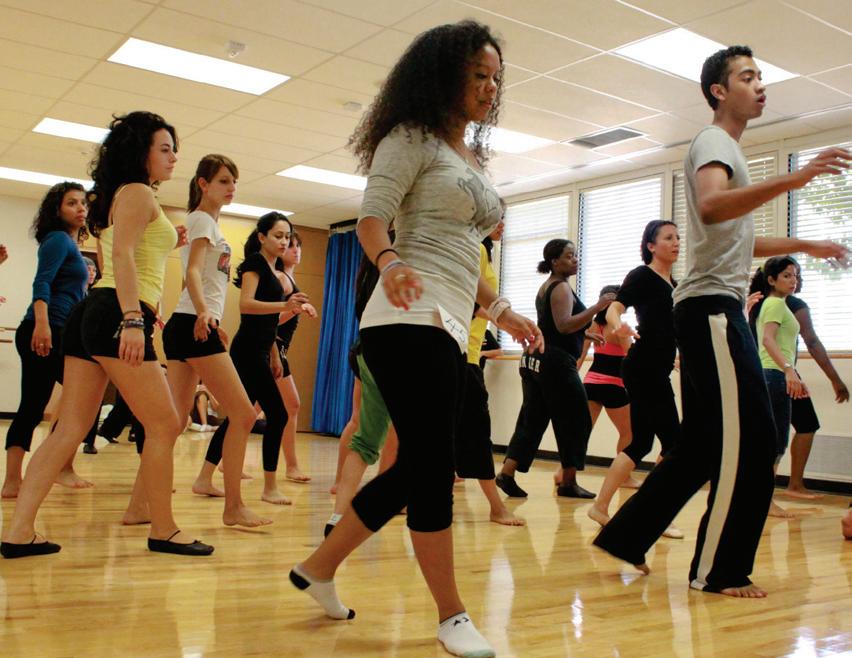
Hope filled the air in the new dance studio as more than 75 dancers packed the room during Sunday auditions for the Fall 2009 folk concert at Pierce College.

Not only was the number of people that showed up a surprise — which is usually around 35, according to Marian Weiser, instructor of theater and dance — but the amount of males who showed up was also surprising.
“America has more male dancers since hip-hop has become popular,” Weiser explained.
Sandy Allman, a professor who is currently teaching social dance, said, “Folk dancing is really exciting when you have guys. They bring it alive.”
Other than the excitement about male participation, the dedication put out by all the dancers is no secret.
Melanie Dayan, an 18-year-old Pierce student, said she hopes to have “fun and a good time” with the dances, but is also willing to practice “as many hours as it takes
to make it look good.”
She isn’t the only one showing devotion. Anthony Tholberg, a 24-year-old Pierce student, said, “I’ll never stop dancing. As long as I have legs, I’ll be dancing.”
This year’s Folk Dance Concert will feature dances from America and Bulgaria to Italy and Spain. Included along with the wide range of different dances being performed will be a Michael Jackson tribute dance choreographed by Jay Zornes, who is 19 years old.

The piece, which Zornes described as “really technical,” is said to have taken two weeks to choreograph.
“It’s just for a tribute,” Zornes said. “He’s everybody’s inspiration.”
The concert will take place Nov. 21 at 8 p.m. and Nov. 22 at 2 p.m.
Tickets go on sale Oct. 2. Tickets can be reserved by calling (818)-710-4355.
afatemi.roundupnews@ gmail.com

ROUNDUP: September 23, 2009 www.theroundupnews.com A&E 5
Ayda Memary / Roundup
FOLLOW IN STEP: Jacqueline Eusanio, a folk and social dance instructor at Pierce College, teaches Azerbaijan folk dance moves to students auditioning for the folk dance concert.
Courtesy of 20th Century Fox
BLOOD SUCKING: Megan Fox plays a ruthless serial killer who only targets unsuspecting boys.
Jeff
Fox’s medicore acting performances continue in Jennifer’s Body
Arnavaz Fatemi / Roundup
As long as I have legs, I’ll be dancing.
“ ” As concert nears
auditions heat up JOB BOARD Do you need extra cash for books, college fees or rent? Join our call center for FT & PT hours in the evenings (after training) Conveniently located in Chatsworth Outbound Telephone Sales Reps Apply Now Limited Space Available! • Fun and casual work environment • Performance Commissions • Medical, dental, and 401k benefits • Merchandise discounts at Sears & Kmart $12.50 hourly rate plus commission bonuses. We are looking for individuals with a competitive drive, energetic style, highly motivated personalities and sales drive, who are interested in working in a fun and energetic environment. Prior experience a plus; Bilingual: English/Spanish a plus. Shifts available 2-9pm, 5-9pm, Saturdays 5am-4pm, Sundays 7am-4pm 9332 De Soto Avenue, Chatsworth, CA 91311 Send resume to fax or e-mail to Maria.Valenzuela@searshc.com or call for interview information Tel. 818.885.3000 Fax. 818.885.3037 EOE/AA Background check/drug screen conducted
-Anthony Tholberg, speaking of his devotion to dance
,
Pierce sports surviving budget cuts
While other community colleges are cutting athletics programs, Pierce is getting by on cutbacks
Shannon Berry / Roundup
The Pierce College athletics program, along with other community college sports programs, are becoming endangered as a result of the state’s new budget and the Commission on Athletics’ proposed ultimatum.
This year the COA revised community colleges’ budgets in an effort to help the campuses better accommodate their sports programs without having to eliminate them completely.
The state declared community colleges must undergo cost containment, forcing every sport to cut their number of allowable contests.
Pierce Athletic Director Bob Lofrano said the effect of the hefty budget cuts on Pierce athletics is unnoticeable.
Memories at midfield
Sophomore shifts from supporting role to key player
Rachel Kove of the Pierce women’s soccer team is more than just a midfielder.
Kove, 18, is tied with fellow sophomore midfielder Michelle Oakes for the team lead in goals, with four scores in four games. She also accomplished the rare feat of scoring a hat trick, three goals in the same game, Friday against the Mariners of Loyola Marymount.
“I don’t consider myself one of the stars,” said Kove, sitting outside the Freudian Sip on campus, her Pierce Soccer T-shirt still sweaty from the practice she just finished.
Her humility stems from a life of team sports. Kove has also been involved in baseball and tennis at different stages of her life.
“I consider myself a jock,” Kove said, laughing.
Kove attended Beverly Hills High School, where “not everyone drives a Corvette.” She played on the varsity soccer team for her first three years, citing “drama and pettiness” as her reasons for not playing her senior season. Nonetheless, Kove caught the eye of Adolfo Perez, head coach of
women’s soccer, while she played club soccer for the West Coast Soccer Academy in West Los Angeles.

Perez called Kove a hard-working young lady and mentioned she has overcome a lot.
“Soccer is like a haven for her,” he said.
Kove’s stepfather passed away six months ago, which she called the reason for a lackluster performance her freshman season, when she scored only one goal.
“My head wasn’t there.”
This now defines Kove as both a person and a player.
“He is my motivation,” she said of her late stepfather. “If I didn’t have soccer these past five months, I don’t know what I would have done. Probably would have dropped out.”
Kove juggles her renewed focus on soccer
with 14 units this semester. A psychology major, she recently quit her job as a nanny to make sure that school and soccer would receive her full attention.
From her superior eating habits to spending time with a personal trainer, Kove intends to taker her game to the next level.
“Ever since I was little, I wanted to be a professional,” she said.
Kove also holds acting and singing dear to her heart. Her father, Martin Kove, played a memorable role as John Kreese, leader of the Cobra Kai dojo in “The Karate Kid.” Kove laughs at the mention of the famous quote her father spoke.
“Sweep the leg,” she said. “All my coaches make fun of me.”
Kove is the consummate team player.
“If I get a goal, it’s because one of them gave it to me,” she said, referring to her fellow teammates.
Kove also points out a quote written on the back of her shirt.
“Together everyone achieves more,” she said proudly, adding that she was a complete believer in the adage.
With a great deal of pride in her team, which she calls her family, Kove sees no limits to the team’s ability.
“I think we have a really big chance of going to state (championship) and winning.”
egolan.roundupnews @gmail.com
“We took one assistant coach from each team, with the exception of football, where two assistant coaches were released,” Lofrano said. “It all added up to a savings between $80,000 to $90,000.”

Lofrano stated that, according to the Commission on Athletics, a college football team can have up to, but not exceed, six assistant coaches.
He further stated that Pierce is doing well because, while some community college campuses have cut entire athletic sports programs, Pierce was able to appease the budget situation by only having to cut a number of assistant coaches.
“A school is better off not dropping a sport because if you drop a sport, it’s probably not going to come back,” Lofrano said.
Some community colleges are feeling the brunt of the state’s budget proposal more than others.
Every school has an individual budget and colleges such as Moorpark College and Los Angeles City College, which dropped every
sport except women’s volleyball, are making drastic changes to their sports programs in an effort to meet their school budget.
Activities that were once considered essential to sports teams’ well-being and development have been put on the back burner instead of the athletics program as a whole.
“Football scrimmages were wiped out due to the budget. We also had to cut down on equipment,” said Julio Gramajo, Valley College academic and athletic support program coordinator and football defensive line coach.
Gramajo describes the budget’s effect on athletics as something that has been ongoing, but just not at the current rate. He also feels the budget cut on academic programs and classes weighed more heavily on some athletes.
“The second summer session being cut affected athletes because some athletes were depending on the semester to catch up with their GPAs,” Gramajo said. “That impacted a lot of the sports because it delayed students being able to transfer. Some are being forced to take a year off and red shirt.”
Aside from the newly proposed budget cuts taking away the muchneeded second summer session, some colleges are eliminating sports programs on campuses because they are becoming less of a commodity.
“Nothing’s a perfect scenario. Everyone has to bite the bullet,” Lofrano said.
sberry.roundupnews@ gmail.com

- Football loses to Allan Hancock, 42-17, at home Saturday
- Women’s soccer loses to Ventura College, 2-1, Friday in Ventura
Complete coverage available at: theroundupnews.com, twitter.com/roundupsports
www.theroundupnews.com ROUNDUP: September 23, 2009 Sports 6
Elliot Golan/ Roundup
If I didn’t have soccer these past five months, I don’t know what I would have done.
-Rachel Kove Women’s soccer midfielder
“ ” Weekend Brief
Louie Heredia / Roundup
Reach thousands 0f students who attend day and evening classes at Pierce College and who represent considerable buying power Email: baileyjd@piercecollege.edu (818) 710-2960 Advertise • Display • Classified • Job
ROCKET: Brahma midfielder Rachel Kove overcame the death of her stepfather to have a breakout year for the women’s soccer team.
