VOLUME 6 ISSUE 1 2021
SUGGESTIONS FOR SUPPORTING YOUR CHILD WITH ONLINE LEARNING
KIMBERLY BARTLETT is Senior Director of Teaching, Learning and Strategic Partnerships, Junior Kindergarten–Grade 12. She has a B.A. from McGill, a B.Ed. and M.Ed. from U of T and her Principal’s qualifications. Her responsibilities include teaching, curriculum, faculty development, and advising the school’s Global Ideas Institute Team. She has worked as an instructor at OISE/U of T, as a consultant and has developed textbooks and curriculum. In 2011, she was a Finalist for the Governor General’s Award for Excellence in Teaching Canadian History.
By now, it is certain that your child has worked with our many online learning platforms. Learning in an online environment requires additional considerations which are often difficult to manage. Here are some quick tips to help maximize learning online at home: SPACE Create a personalized space in a welllit room dedicated to learning. Involve your child in this process; remove clutter and place learning materials in close proximity.
JULIA HUNT is Senior Director of Strategic Innovation at Pickering College and is responsible for developing the Global Leadership Program for all students, Junior Kindergarten to Grade 12. Some of Julia’s responsibilities include diploma design, program framework, research, training and professional development, communications, outreach, local and international excursions, student life and leadership activities and speakers. Julia holds her B.A. and B.Ed. as well as an M.A. in Education and Development.
continued from front page
FOCUS Keep your child close. Position the computer screen in full view. Set up non-verbal or quick cues to get your child back on track. Keep other devices out of the workspace.
will take an online course at least once in their post-secondary careers. It is therefore a benefit for students to experience online learning in the younger grades so they are competent when faced with more difficult courses. Their technological skills increase substantially, and they are better problem solvers when faced with challenges. Learning new skills seems far less daunting—rather than seeing obstacles, they begin to see new opportunities. The independence and confidence students gain will also assist them when they eventually enter the workforce. Furthermore, students who have had a varied experience in their learning are more likely to be successful in their future careers.
ROUTINE Follow the same morning routine as if they are going to school. Your child already has structure built into timetables/calendars in Edsby and Microsoft Outlook; take some time to review these with your child.
Online learners tend to demonstrate not only independence and self-sufficiency, but equally the ability to think and work globally. The competencies stressed in 21st Century learning; creativity, collaboration across cultures and effective communication are skills that are emphasized in an online learning environment. Students in online environments are more likely to research, discuss and construct their own knowledge while collaborating with their peers in and outside of class time. This expands their understanding of the concepts taught and deepens their connection to their learning.
EXPECTATIONS Review the Pickering College Responsible Use of Technology Policy with your child. Set expectations on when you can be interrupted and when you cannot.
Children recognize that the world has grown smaller, and the need to collaborate with others internationally is critical. Pickering College students are poised to embrace this wider global community, both the challenges and the adventures ahead. The tools they are learning today will certainly open new horizons for them tomorrow and we are proud to be a part of their learning experience.
PRAISE Give specific feedback on your child’s work. Encourage self-praise and a growth mindset.
CREATIVITY & INNOVATION AT PIC KERIN G C OL L EG E
VOLUME 6 ISSUE 1 2021
Graduates of the Pickering College Global Leadership Program are creative, innovative and courageous agents of ethical and positive change, true to Quaker values.
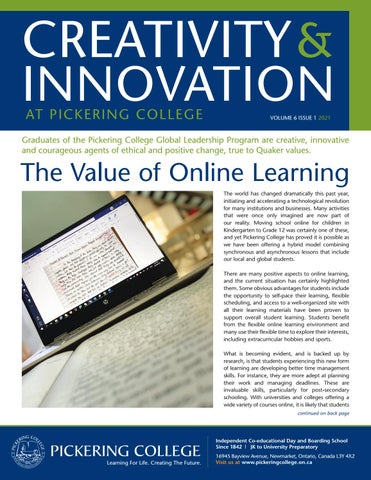
The Value of Online Learning The world has changed dramatically this past year, initiating and accelerating a technological revolution for many institutions and businesses. Many activities that were once only imagined are now part of our reality. Moving school online for children in Kindergarten to Grade 12 was certainly one of these, and yet Pickering College has proved it is possible as we have been offering a hybrid model combining synchronous and asynchronous lessons that include our local and global students. There are many positive aspects to online learning, and the current situation has certainly highlighted them. Some obvious advantages for students include the opportunity to self-pace their learning, flexible scheduling, and access to a well-organized site with all their learning materials have been proven to support overall student learning. Students benefit from the flexible online learning environment and many use their flexible time to explore their interests, including extracurricular hobbies and sports. What is becoming evident, and is backed up by research, is that students experiencing this new form of learning are developing better time management skills. For instance, they are more adept at planning their work and managing deadlines. These are invaluable skills, particularly for post-secondary schooling. With universities and colleges offering a wide variety of courses online, it is likely that students
If you have any questions, or would like to provide feedback, please contact: Kimberly Bartlett, Senior Director of Teaching, Learning & Strategic Partnerships, at kbartlett@pickeringcollege.on.ca Julia Hunt, Senior Director, Strategic Innovation, at jhunt@pickeringcollege.on.ca
continued on back page
I ndependent Co-educational Day and Boarding School Since 1842 | JK to University Preparatory
I ndependent Co-educational Day and Boarding School Since 1842 | JK to University Preparatory
Learning For Life. Creating The Future.
6945 Bayview Avenue, Newmarket, Ontario, Canada L3Y 4X2 1 Visit us at www.pickeringcollege.on.ca
Learning For Life. Creating The Future.
6945 Bayview Avenue, Newmarket, Ontario, Canada L3Y 4X2 1 Visit us at www.pickeringcollege.on.ca
CREATIVITY & INNOVATION AT PICKERING COLLEGE
VOLUME 6 ISSUE 1 2021
Online Learning Adventures in the Senior School It is evident that our Senior School is thriving in the new technological landscape. Each classroom is equipped with a camera to capture synchronous lessons, and the use of Microsoft Teams has enabled teachers to bring the online students into their lessons for activities and discussions. Our learning community has truly become global.
Middle School and Online Learning Building Community and Competency— Online Learning in Grade 1 It is time for printing practice in Grade 1, but this year it’s taking on a new format. The Grade 1 teacher is using a document reader, a device that projects an image of a page both on the class’s whiteboard and onto the students’ devices. Students who are in the physical classroom, or students who are learning at home, can all clearly see the teacher’s demonstration. This visual supports the students in the perceptual learning of where letters and spaces go. The Grade 1 class has four students who have opted to learn online this year, and it has been a big priority for the teacher to ensure that they are fully connected members of the Grade 1 community. These four learners are projected on the smart board and interact with their classmates in groups and class discussions. The teacher often takes the online learners for a walk around the class on an iPad, where the other students can chat with them and work with them on projects. Birthdays, always important at this age, are celebrated together through messages, pictures and class activities. When it is their turn to be ‘star of the day,’ they share special items from home with their classmates over the screen. In fact, the students learning in person also share videos from home when it is their turn to be the star. New applications and software have benefited all the class members. Reading apps allow the students to access leveled readers and the teacher to assess reading levels. This year, students are not allowed to sing ‘O Canada’ during in-person learning (music is considered to be one of the higher risk activities in a COVID-19 environment for virus transmission) so they have taken this as an opportunity to learn to sign! Having this technology in place has allowed the students to continue learning despite disruptions: whether they have chosen to work fully at home, are recovering from a minor illness or are at home for a snow day, meaningful learning continues. We are very proud of how responsible and engaged our young students are at PC.
Students enrolled in the Middle School online learning program are integrated into the community by participating in many of the school’s traditional programming, despite many of them being located a far distance from the school. Our online learners participate in their homeroom meetings, where each member of the class (both those in person and online) get to know each other through discussion activities facilitated by their homeroom teacher. The academic program has the students engaged in our core academic subjects: Mathematics, Language Arts, Science and Social Studies. The students benefit from a weekly group meeting with their teacher, participating in live classes (where their time zone permits) and watching recorded classes. Each student has an in-person classroom buddy and can view live classes through cameras set up in our classrooms. We are also able to engage students in our GLP Pillar Week programming from a distance. Using Microsoft Teams, each student is placed in a group with their other group members (either online or in-person) to collaborate on creating a public service announcement about a water issue. Through Microsoft OneNote, they can submit research and tasks associated with the project. Each online student participates in the same workshops live with their in-person classmates. The final products of their work will be showcased in a Virtual Film Festival for all of Middle School to view.
Teachers in the Senior School have continued their learning by experimenting with new technology in their lessons. Integrating applications and various software has strengthened their teaching, while the use of Edsby and Microsoft OneNote has helped students follow lessons, submit work and keep organized. This has increased the engagement of students in their learning. An area we are particularly proud of is the Music program. Although many schools are currently not offering Music as a subject, students at Pickering College are flourishing in their studies. This year, Senior School students have had the opportunity to improve their vocal and instrumental skills through individualized practice routines, listening activities and music theory lessons. Although they participate from home, they have synchronous rehearsals using a common pulse such as a metronome and backing tracks, and students have also created multi-screen videos of the repertoire they are learning. In the Music Production course, a new offering for Pickering College, students are learning how to record, mix, re-mix and edit their projects in a digital audio workstation (DAW). They are also discovering how to add effects, panning and reverbs, make volume mixes, while improving their critical listening skills. Students in this course understand how sound can be manipulated in a digital audio workstation, just as professionals do. This is just one example of the richness of online learning in the Senior School and we are excited to continue our development of online education.
A Principled Approach to Learning In all Pickering College programs, whether blended or online, we are committed to the following five principles of online learning: PRINCIPLE 1: We will establish and maintain regular effective contact with students and families. PRINCIPLE 2: We will create opportunities for student-centered learning and collaboration. PRINCIPLE 3: We will create opportunities that have practical real-world applications for students. PRINCIPLE 4: We will provide continuous support for each student’s learning process and autonomy to help them reach their full potential. PRINCIPLE 5: We will ensure all course content is readily and easily accessible to all students. Our learning program is designed to be flexible and to respond to changing contexts. Should our ability to host in-person classes be disrupted, Pickering College is fully committed to delivering an online program that reflects best practices in teaching and learning. SYNCHRONOUS LEARNING is live and occurs in real-time during scheduled blocks/periods: •T he use of technology for synchronous classes accommodates students in different locations and time zones •T he lessons are recorded for students for future reference to support their asynchronous work •S tudents have access to teachers to ask questions and receive immediate feedback on their work •S tudents can socialize and collaborate with their peers in class online discussions, and live-broadcast lectures ASYNCHRONOUS LEARNING is completed independently or collaboratively with peers: •S tudents have choice and flexibility to complete work at a time and place of their choosing which develops their organizational and time management skills •S tudents are provided with opportunities to research, develop discipline-specific and interdisciplinary learning skills, and reflect on their learning • Students can ask questions and receive feedback from their teachers and peers through different forums such as email or messaging
CREATIVITY & INNOVATION AT PICKERING COLLEGE
VOLUME 6 ISSUE 1 2021
Online Learning Adventures in the Senior School It is evident that our Senior School is thriving in the new technological landscape. Each classroom is equipped with a camera to capture synchronous lessons, and the use of Microsoft Teams has enabled teachers to bring the online students into their lessons for activities and discussions. Our learning community has truly become global.
Middle School and Online Learning Building Community and Competency— Online Learning in Grade 1 It is time for printing practice in Grade 1, but this year it’s taking on a new format. The Grade 1 teacher is using a document reader, a device that projects an image of a page both on the class’s whiteboard and onto the students’ devices. Students who are in the physical classroom, or students who are learning at home, can all clearly see the teacher’s demonstration. This visual supports the students in the perceptual learning of where letters and spaces go. The Grade 1 class has four students who have opted to learn online this year, and it has been a big priority for the teacher to ensure that they are fully connected members of the Grade 1 community. These four learners are projected on the smart board and interact with their classmates in groups and class discussions. The teacher often takes the online learners for a walk around the class on an iPad, where the other students can chat with them and work with them on projects. Birthdays, always important at this age, are celebrated together through messages, pictures and class activities. When it is their turn to be ‘star of the day,’ they share special items from home with their classmates over the screen. In fact, the students learning in person also share videos from home when it is their turn to be the star. New applications and software have benefited all the class members. Reading apps allow the students to access leveled readers and the teacher to assess reading levels. This year, students are not allowed to sing ‘O Canada’ during in-person learning (music is considered to be one of the higher risk activities in a COVID-19 environment for virus transmission) so they have taken this as an opportunity to learn to sign! Having this technology in place has allowed the students to continue learning despite disruptions: whether they have chosen to work fully at home, are recovering from a minor illness or are at home for a snow day, meaningful learning continues. We are very proud of how responsible and engaged our young students are at PC.
Students enrolled in the Middle School online learning program are integrated into the community by participating in many of the school’s traditional programming, despite many of them being located a far distance from the school. Our online learners participate in their homeroom meetings, where each member of the class (both those in person and online) get to know each other through discussion activities facilitated by their homeroom teacher. The academic program has the students engaged in our core academic subjects: Mathematics, Language Arts, Science and Social Studies. The students benefit from a weekly group meeting with their teacher, participating in live classes (where their time zone permits) and watching recorded classes. Each student has an in-person classroom buddy and can view live classes through cameras set up in our classrooms. We are also able to engage students in our GLP Pillar Week programming from a distance. Using Microsoft Teams, each student is placed in a group with their other group members (either online or in-person) to collaborate on creating a public service announcement about a water issue. Through Microsoft OneNote, they can submit research and tasks associated with the project. Each online student participates in the same workshops live with their in-person classmates. The final products of their work will be showcased in a Virtual Film Festival for all of Middle School to view.
Teachers in the Senior School have continued their learning by experimenting with new technology in their lessons. Integrating applications and various software has strengthened their teaching, while the use of Edsby and Microsoft OneNote has helped students follow lessons, submit work and keep organized. This has increased the engagement of students in their learning. An area we are particularly proud of is the Music program. Although many schools are currently not offering Music as a subject, students at Pickering College are flourishing in their studies. This year, Senior School students have had the opportunity to improve their vocal and instrumental skills through individualized practice routines, listening activities and music theory lessons. Although they participate from home, they have synchronous rehearsals using a common pulse such as a metronome and backing tracks, and students have also created multi-screen videos of the repertoire they are learning. In the Music Production course, a new offering for Pickering College, students are learning how to record, mix, re-mix and edit their projects in a digital audio workstation (DAW). They are also discovering how to add effects, panning and reverbs, make volume mixes, while improving their critical listening skills. Students in this course understand how sound can be manipulated in a digital audio workstation, just as professionals do. This is just one example of the richness of online learning in the Senior School and we are excited to continue our development of online education.
A Principled Approach to Learning In all Pickering College programs, whether blended or online, we are committed to the following five principles of online learning: PRINCIPLE 1: We will establish and maintain regular effective contact with students and families. PRINCIPLE 2: We will create opportunities for student-centered learning and collaboration. PRINCIPLE 3: We will create opportunities that have practical real-world applications for students. PRINCIPLE 4: We will provide continuous support for each student’s learning process and autonomy to help them reach their full potential. PRINCIPLE 5: We will ensure all course content is readily and easily accessible to all students. Our learning program is designed to be flexible and to respond to changing contexts. Should our ability to host in-person classes be disrupted, Pickering College is fully committed to delivering an online program that reflects best practices in teaching and learning. SYNCHRONOUS LEARNING is live and occurs in real-time during scheduled blocks/periods: •T he use of technology for synchronous classes accommodates students in different locations and time zones •T he lessons are recorded for students for future reference to support their asynchronous work •S tudents have access to teachers to ask questions and receive immediate feedback on their work •S tudents can socialize and collaborate with their peers in class online discussions, and live-broadcast lectures ASYNCHRONOUS LEARNING is completed independently or collaboratively with peers: •S tudents have choice and flexibility to complete work at a time and place of their choosing which develops their organizational and time management skills •S tudents are provided with opportunities to research, develop discipline-specific and interdisciplinary learning skills, and reflect on their learning • Students can ask questions and receive feedback from their teachers and peers through different forums such as email or messaging
VOLUME 6 ISSUE 1 2021
SUGGESTIONS FOR SUPPORTING YOUR CHILD WITH ONLINE LEARNING
KIMBERLY BARTLETT is Senior Director of Teaching, Learning and Strategic Partnerships, Junior Kindergarten–Grade 12. She has a B.A. from McGill, a B.Ed. and M.Ed. from U of T and her Principal’s qualifications. Her responsibilities include teaching, curriculum, faculty development, and advising the school’s Global Ideas Institute Team. She has worked as an instructor at OISE/U of T, as a consultant and has developed textbooks and curriculum. In 2011, she was a Finalist for the Governor General’s Award for Excellence in Teaching Canadian History.
By now, it is certain that your child has worked with our many online learning platforms. Learning in an online environment requires additional considerations which are often difficult to manage. Here are some quick tips to help maximize learning online at home: SPACE Create a personalized space in a welllit room dedicated to learning. Involve your child in this process; remove clutter and place learning materials in close proximity.
JULIA HUNT is Senior Director of Strategic Innovation at Pickering College and is responsible for developing the Global Leadership Program for all students, Junior Kindergarten to Grade 12. Some of Julia’s responsibilities include diploma design, program framework, research, training and professional development, communications, outreach, local and international excursions, student life and leadership activities and speakers. Julia holds her B.A. and B.Ed. as well as an M.A. in Education and Development.
continued from front page
FOCUS Keep your child close. Position the computer screen in full view. Set up non-verbal or quick cues to get your child back on track. Keep other devices out of the workspace.
will take an online course at least once in their post-secondary careers. It is therefore a benefit for students to experience online learning in the younger grades so they are competent when faced with more difficult courses. Their technological skills increase substantially, and they are better problem solvers when faced with challenges. Learning new skills seems far less daunting—rather than seeing obstacles, they begin to see new opportunities. The independence and confidence students gain will also assist them when they eventually enter the workforce. Furthermore, students who have had a varied experience in their learning are more likely to be successful in their future careers.
ROUTINE Follow the same morning routine as if they are going to school. Your child already has structure built into timetables/calendars in Edsby and Microsoft Outlook; take some time to review these with your child.
Online learners tend to demonstrate not only independence and self-sufficiency, but equally the ability to think and work globally. The competencies stressed in 21st Century learning; creativity, collaboration across cultures and effective communication are skills that are emphasized in an online learning environment. Students in online environments are more likely to research, discuss and construct their own knowledge while collaborating with their peers in and outside of class time. This expands their understanding of the concepts taught and deepens their connection to their learning.
EXPECTATIONS Review the Pickering College Responsible Use of Technology Policy with your child. Set expectations on when you can be interrupted and when you cannot.
Children recognize that the world has grown smaller, and the need to collaborate with others internationally is critical. Pickering College students are poised to embrace this wider global community, both the challenges and the adventures ahead. The tools they are learning today will certainly open new horizons for them tomorrow and we are proud to be a part of their learning experience.
PRAISE Give specific feedback on your child’s work. Encourage self-praise and a growth mindset.
CREATIVITY & INNOVATION AT PIC KERIN G C OL L EG E
VOLUME 6 ISSUE 1 2021
Graduates of the Pickering College Global Leadership Program are creative, innovative and courageous agents of ethical and positive change, true to Quaker values.
The Value of Online Learning The world has changed dramatically this past year, initiating and accelerating a technological revolution for many institutions and businesses. Many activities that were once only imagined are now part of our reality. Moving school online for children in Kindergarten to Grade 12 was certainly one of these, and yet Pickering College has proved it is possible as we have been offering a hybrid model combining synchronous and asynchronous lessons that include our local and global students. There are many positive aspects to online learning, and the current situation has certainly highlighted them. Some obvious advantages for students include the opportunity to self-pace their learning, flexible scheduling, and access to a well-organized site with all their learning materials have been proven to support overall student learning. Students benefit from the flexible online learning environment and many use their flexible time to explore their interests, including extracurricular hobbies and sports. What is becoming evident, and is backed up by research, is that students experiencing this new form of learning are developing better time management skills. For instance, they are more adept at planning their work and managing deadlines. These are invaluable skills, particularly for post-secondary schooling. With universities and colleges offering a wide variety of courses online, it is likely that students
If you have any questions, or would like to provide feedback, please contact: Kimberly Bartlett, Senior Director of Teaching, Learning & Strategic Partnerships, at kbartlett@pickeringcollege.on.ca Julia Hunt, Senior Director, Strategic Innovation, at jhunt@pickeringcollege.on.ca
continued on back page
I ndependent Co-educational Day and Boarding School Since 1842 | JK to University Preparatory
I ndependent Co-educational Day and Boarding School Since 1842 | JK to University Preparatory
Learning For Life. Creating The Future.
6945 Bayview Avenue, Newmarket, Ontario, Canada L3Y 4X2 1 Visit us at www.pickeringcollege.on.ca
Learning For Life. Creating The Future.
6945 Bayview Avenue, Newmarket, Ontario, Canada L3Y 4X2 1 Visit us at www.pickeringcollege.on.ca