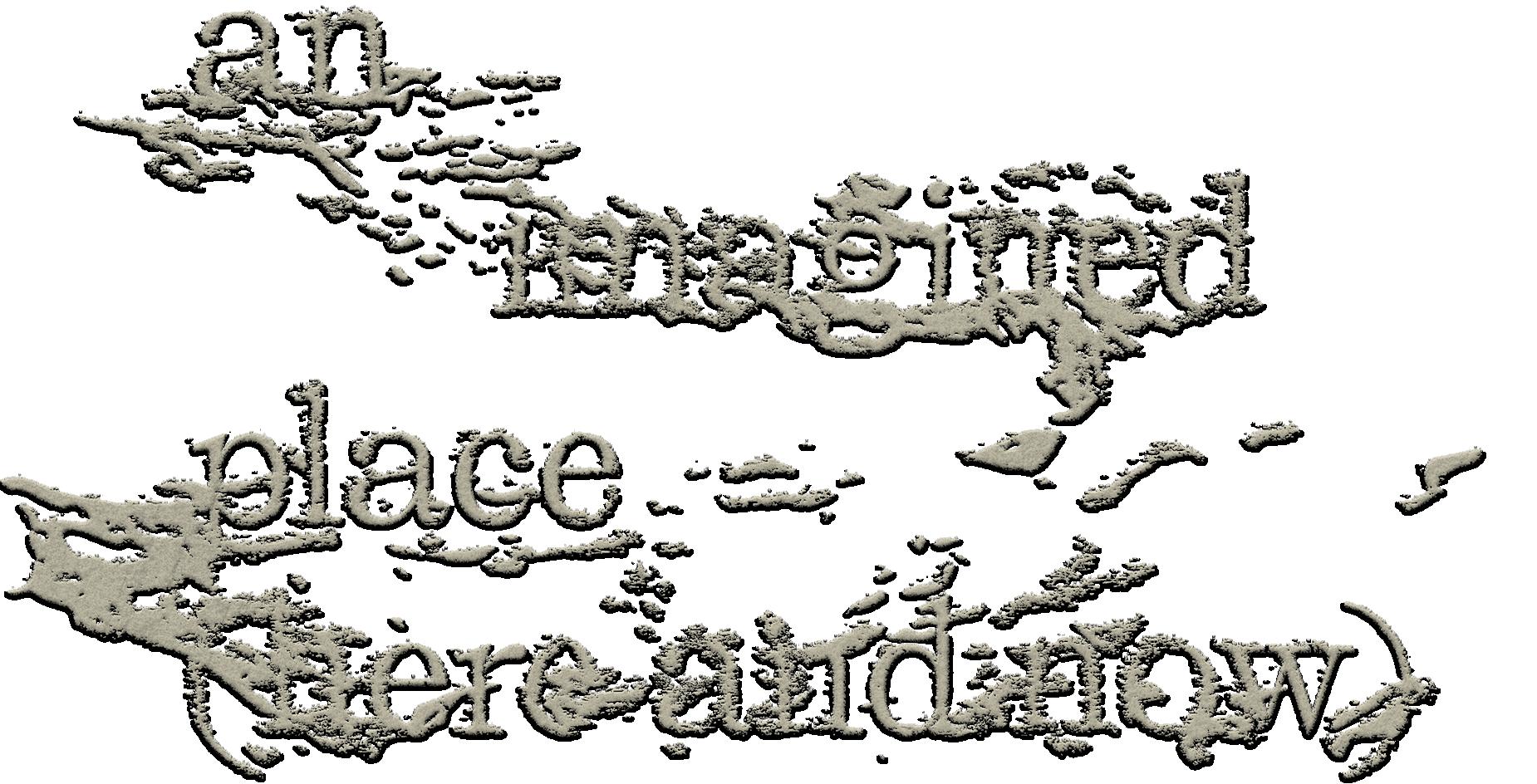
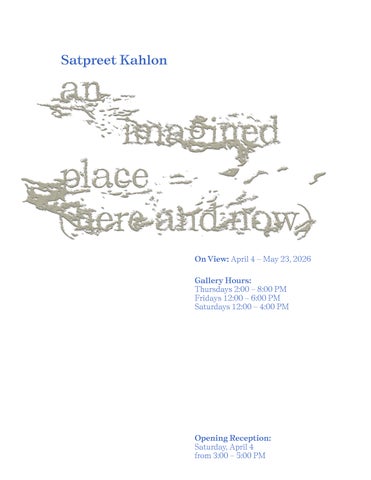
Satpreet Kahlon
On View: April 4 – May 23, 2026
Gallery Hours: Thursdays 2:00 – 8:00 PM Fridays 12:00 – 6:00 PM Saturdays 12:00 – 4:00 PM
Opening Reception: Saturday, April 4 from 3:00 – 5:00 PM
On View: April 4 – May 23, 2026
Gallery Hours: Thursdays 2:00 – 8:00 PM Fridays 12:00 – 6:00 PM Saturdays 12:00 – 4:00 PM
Opening Reception: Saturday, April 4 from 3:00 – 5:00 PM
Something that once traveled through deep space now inhabits the cavernous interior of a room. A wandering celestial body, one that has spent decades floating alongside Earth’s path around the sun, has been translated into matter that can be circled, stood inside of, listened to. Cosmic distance folds inward until it meets the scale of the human body. What once existed far beyond perception becomes something we move through.
Astronomers use the term quasi-moon to describe a mass that appears to orbit Earth while actually maintaining its own orbit around the sun. It is never fully captured by Earth’s gravity. The motion is subtler, an extended choreography of proximity and drift. The object travels beside our planet for decades, sometimes centuries, before eventually slipping away again. "Goodbye…see you soon… we will miss you... " These bodies are temporary companions. They arrive slowly, linger for long stretches of time, and then depart.
Satpreet Kahlon imagines such a body differently. In her telling, PN7 becomes a lover. Encountering Earth during its long journey through space, the wandering object falls quietly into devotion. It follows the planet across the solar system, watching from a distance. It studies the movements of oceans, the rise and erosion of mountains, and the bending of light. Within the imagined geology of its surface, it stores these observations like time capsules.
The story is tender and melancholic. The quasi-moon watches the enduring relationship between Earth and its moon and begins to hope that somewhere in the universe, there might be a body that will love it back.
Orbit becomes a metaphor that reaches far beyond astronomy. It describes emotional gravity, inherited patterns, and psychic repetition. We orbit families, memories, institutions, and histories, even when we believe we have moved beyond them. This work traces the possibility of altering such patterns, not through abrupt escape but through gradual recalibration. A trajectory bends slowly; a life begins to move otherwise.
The quasi-moon’s devotion to Earth begins to feel like a strange cosmic version of this idea. A body traveling next to another body, close enough to witness all of the little things. Love is not possession, it is proximity. As Dean Spade reminds us, love is often less of a private feeling than a shared practice of survival.1 Built together.
Inside the vast hall, the narrative unfolds through a field of sculpture, reflection, image, and sound. At its center stands a massive, ring-like formation, an uneven halo constructed from recycled styrofoam and other salvaged materials. The forms are covered in plaster and pigment, surfaces alternately smoothed and roughed to appear geological from a distance. Up close, the illusion dissolves. This rock reveals itself as packaging foam, cardboard, and fragments of the industrial present. The sculpture itself feels monumental yet provisional, as though it might collapse or crawl apart. Forms lean and redistribute weight across improvised supports. The internal logic appears precarious, almost impossible, yet the structure holds.
Kahlon’s work repeatedly returns to the surface. Plaster is layered over foam until the material reads as topographic skin. Photographs are distressed, sewn, and reassembled to mural-scale, where seams remain visible. Mirrors scatter fragments of light across walls and bodies. These surfaces do not conceal what lies beneath, but register the traces of contact between hands, labor, memory, and duration.
Surface becomes a place where relations accumulate. Vivian L. Huang describes how surfaces can hold meaning without fully resolving it, allowing histories to circulate without being completely translated or extracted.2 Kahlon’s surfaces operate in this register, carrying fragments of personal archive, industrial debris, and cultural memory while resisting the demand to consolidate those fragments into a single narrative.
Across the installation, surfaces behave less like boundaries than meeting places. Plaster skins, photographic seams, mirrored reflections, and even the imagined crust of the quasi-moon function as working external sites for memory, labor, and relation. In this sense, the work moves through three intertwined logics: orbit, surface, and relation. Bodies circle one another, histories register across surfaces, and meaning emerges through the relations that form between them. Seen this way, the quasi-moon itself becomes another kind of surface. Its imagined crust stores the memories of what it observes: the slow passage of planetary time.
Kahlon frequently begins with what already exists in the debris fields of contemporary life: scrap foam, reclaimed wood, fragments of cardboard. To work this way is not merely an aesthetic decision but a philosophy of making, grounded in survival and improvisation. Work with what you've got or have been given.
Industrial refuse becomes planetary terrain, architecture, texture. The materials are not inert matter; they continue to carry the histories of labor and circulation that brought them into the room. Matter, as Karen Barad reminds us, is not simply substance, but activity, something that continues to participate in the world’s ongoing formation.3
Among the materials woven through the work is knāff, a coarse plant fiber associated with the region of Panjab where Kahlon was born. Historically exported for the production of luxury art paper, the fiber was deemed too rough for that purpose and redirected toward industrial use, most commonly as an absorbent used to soak up oil spills. The trajectory of the fiber mirrors a broader story of colonial value systems: what is “refined,” what is discarded, what becomes waste. In Kahlon’s work, the fiber returns as both material and metaphor, carrying the geography of the artist’s birthplace while also speaking to global circuits of extraction and pollution.
Objects are material witnesses, carrying traces of the work they have been asked to perform. Sara Ahmed has written about how objects accumulate histories through use, shaped by the bodies that handle them and the tasks they are made to perform.4 The materials in the installation do not abandon their previous functions; they carry those histories forward while inhabiting another relation.
Likewise, memory appears throughout the environment in multiple forms. Photograph-based collages draw from familial images, while the multichannel soundscape carries fragments of boliyan—short verses sung in Panjabi folk traditions and passed down for generations through matrilineal lines. These verses circulate through the installation like signals from another time. Boliyan move quickly between humor, flirtation, and storytelling. As an oral form, they resist the stability of the written archive and instead travel through repetition and embodied experience.
3 Karen Barad, Meeting the Universe Halfway: Quantum Physics and the Entanglement of Matter and Meaning (Durham, NC: Duke University Press, 2007).
4 Sara Ahmed, What’s the Use? On the Uses of Use (Durham: Duke University Press, 2019).
Listening to boliyan in slight fragments in their new, sensuous, layered form hidden within other collected sound and in the cavernous space, one senses how Kahlon envisioned the work stretching across intimate family histories and planetary motion. The quasi-moon itself exists in a similar state of relation, neither satellite nor stranger, appearing to accompany Earth while actually following its own path through the solar system.
Perhaps this is also a model for diasporic life. To live in diaspora is often to move through layered gravitational fields, cultural, linguistic, and historical. The body is here but also elsewhere, tethered by memory and inheritance. Kahlon’s installation does not resolve these tensions. Instead, it stages them materially. Structure, image, and sound lean into one another—transmissions from a distant object.
Around the central structure, clusters of thin vertical sticks rise from the floor in irregular formations. They appear fragile, ephemeral, almost skeletal, like the exposed ribs of something unearthed. The viewer does not simply observe the work, but enters its field of relation, adjusting to the weirding of time and space. The viewer is never fixed in one position, but continually negotiates where
to stand, where to pause, and how to move through the gravitational environment the work produces. During a conversation about the project, my colleague Spencer ByrnesSeres described the installation as “bringing a distant thing close.” The phrase clarifies something essential: distance, cosmic, historical, and emotional, rarely remains distant for long. Diasporic life often involves carrying faraway histories within the present moment. Languages, songs, gestures, and memories travel across continents and generations. The past becomes something you move alongside rather than something entirely left behind.
And still, the wandering celestial body invites yet another way to think about relation. Kim TallBear writes that moments of crisis do not necessarily create entirely new conditions, but rather sharpen relations that were already present.5 What emerges in those moments is an intensified awareness of interdependence between people, land, history, and nonhuman life. Seen through this lens, the quasi-moon begins to feel less like a metaphor. Perhaps it is more like kin?
This dynamic becomes especially complex when the histories that follow us are difficult ones. Abuse, displacement, and silence often persist in the body long after circumstances have shifted. Sampada Aranke describes how aesthetic practices can emerge in proximity to violence without simply reproducing it, producing instead forms of life that exceed the conditions meant to contain them.6 Kahlon’s stitched photographic surfaces and precarious architectures operate in this register, acknowledging histories that cannot be erased while simultaneously generating other possibilities for how those histories might be held.
In an imagined place (here and now), the environment itself becomes part of this process. Mirrors scatter projected light across surfaces while bits of video drift through the room, allowing the atmosphere to change as bodies move within it. Kemi Adeyemi describes atmosphere as something produced collectively through bodies gathering, moving, and sensing together.7 Though her writing often considers the charged space of the club, the insight translates easily here. Kahlon’s installation also comes into being through shared presence. The work is not completed by objects alone but by the bodies that dance through it.
Standing inside the massive ring of plastercovered foam, surrounded by reflected light and ghostly voices, one becomes aware of another orbit entirely: the psychic orbit between bodies in space. Somewhere within its layered surface, PN7 continues to store what it sees, light rays, mountains, songs, fragments of childhood, and the slow shift of every moment. The wandering body moves beside Earth not as a satellite or possession, but as a witness, companion, and lover. It remains close enough to observe, close enough to remember, and close enough to imagine that another relation might still be possible. Inside the field Kahlon assembles, bodies and we gather briefly beneath this imagined gravity, human, planetary, remembered, and newly forming.
—Kristan Kennedy, Curator
an imagined place (here and now) Exhibition Map
recycled styrofoam, scrap wood collected (2014–2026) from woodshop trash, salvaged fish net collected during Duwamish River clean up (2022), curbside furniture finds, and old Christmas trees; plaster; earth pigment; beeswax; rainwater collected in Portland (2026); archival images pasted onto recycled cardboard boxes; rocks collected in a cornfield in Nebraska where the artist witnessed the full solar eclipse (2017); bead soup (glass, plastic, stone); weaving yarn; archival images printed on fabric; embroidery thread; recycled sequins; salvaged tile pieces; gifted obsidian; earrings gifted to the artist by Gurpreet Phabi Ji (2018); salvaged and cut acrylic mirror; vintage sheesha; graphite; hot glue; and staples
archival home videos from the Ketcham and WallaceKelly families; archival home videos filmed between 1926 and 1998; footage from a documentary about the poet Shiv Kumar Batalvi, directed by Balwant Gargi; footage from the unmanned Apollo 6 mission (courtesy of the NASA Archives); footage from a PBS documentary about space from the 1960s; and additional footage from a documentary about metal work in South Asia from the 1950s (courtesy of the Indian Ministry of Information)
archival audio of Madan Bala Sandhu singing the poetry of Shiv Kumar Batalvi; NASA recordings sonifying magnetic fields; solar flares and plasma waves near and around earth; boliyaan sung by matriarchs in the artist’s family; recordings of soil in Brooklyn, NY; Portland, OR; the inside of the artist’s mouth; and the artist’s vocals
Satpreet Kahlon (b. 1989) is a Panjabi-born artist based in Brooklyn, NY. She received a full fellowship to pursue her MFA in Sculpture from the Rhode Island School of Design, graduating in 2019. In addition to her studio practice, which has been featured in Hyperallergic and Artforum, she co-founded and -ran an Indigenous arts organization that supported 400 artists with over $2 million of opportunities and rematriated 1.5 acres of greenspace that was slated for development during her tenure from 2017-2023. For this work, she was named one of the Most Influential People in Seattle by Seattle Magazine in 2019, and was a 2022 Roddenberry Fellow for “new and innovative strategies to safeguard human rights and ensure an equal and just society for all.”
Kahlon's practice has been supported by Headlands Center for the Arts, Sausalito, CA; National Endowment for the Arts; Robert Rauschenberg Foundation; Foundation for Contemporary Arts; Critical Minded; Vermont Studio Center, Johnson, VT; Portland Institute for Contemporary Art (PICA), Portland, OR; RISD Museum, Providence, RI; 4Culture, Seattle, WA; Henry Art Gallery, Seattle, WA; Magnum Foundation, New York, NY; Brown University, Providence, RI; and Bellevue Art Museum, Bellevue, WA, among others. She is the 2024 recipient of the Foundwork Artist Prize.
This exhibition is supported in part by Sarah Miller Meigs, The Andy Warhol Foundation for the Visual Arts, Foundation for Contemporary Arts, New Archives (Matthew Offenbacher and Satpreet Kahlon), Ridwell, and PICA’s Visual Art Circle Members.
The artist and curator would like to thank the entire PICA staff for their many and varied contributions to this exhibition, with special acknowledgment to the crew and apprentices who built this exhibition alongside the artist, by hand, with care and exuberance. PICA’s staff and crew are artists themselves, and we are grateful for their time and talent. We are also grateful to the PICA Board and to PICA members whose energetic and financial support provides essential ballast for everything we do.
We extend special thanks to Sarah Miller Meigs for her extraordinary and transformative gift, which made this project possible in meaningful ways.
Special thanks as well to Jeanine Jablonski for reinvigorating PICA’s Visual Art Circle, an important peer network of supporters who come together to champion visual art programming and engage with projects at an intimate level. PICA’s Visual Art Circle is Emma Christ, Derek Franklin, Allie Furlotti, Jeanine Jablonski, Martie Kilmer, Adam Kostiv, Elizabeth Leach, Justin Oswald, Daniel Peabody, Liz Reaves, Jarret Reynolds, Stephanie Snyder, Bianca Sparta, and Jason Walker.
We are deeply grateful to the many artists, colleagues, and collaborators who offered conversation, contributions, advice, and other forms of support over the life of this project and others. Our thanks to Ralph Attanasia, Mohamed Almusibli, Ariel de Leon, Pamela Chipman, Maurin Dietrich, Jamie Edwards, devynn emory, Logan Franken, Garrick Imatani, Tarleen Judge, Kameelah Janan Rasheed, Kiran Lam-Saili, Purl Samoheyl, Jamie Villarreal, and Sandy Zohore, as well as Matthew Offenbacher, Satpreet’s creative partner in New Archives, and Matt Waymire (Ridwell) and the Portland Ridwell staff, PDX Woodworks, Luisa Gui (Sylus), and Megan Steinman (Denniston Hill), for saying yes, and living YES.
We would also like to thank Vivian Huang for lending her scholarship and words in the expansion of this work.
The curator would especially like to thank Satpreet Kahlon for the many years of conversation and shared dreaming that led to this project, and for the trust and generosity that made its realization possible through many challenges and even more joyful moments of connection and collaboration.
Betsey Brock
Jakob Dawahare
Ana DeBrock
Erin Boberg Doughton
Molly Gardner
Tia Katcharian
Kristan Kennedy
Milo Mattern
Samantha Ollstein
Van Pham
Jayne Pugh
Elio Quezada
Reuben Roqueñi
Leslie Vigeant
Exhibition Staff
Brit Abuya, Preparator
Simeen Anjum, Gallery Attendant
Lauren Isa Arri, Apprentice
Noah Beckham, Preparator
Ellen Chungbin, Apprentice
Alan Cline, Technician
John Foster Cartwright, Preparator
Milo Mattern, Preparator
Christian Orellana Bauer, Preparator
Isabella Saavedra, Apprentice
Topher Sinkinson, Preparator
Hannon Welch, Gallery Attendant
Didi Wyss, Preparator
Cristi Miles | Co-Chair
Kevin Washington | Co-Chair
Emily Fusaro | Vice Chair
Nishat Akhtar
Andrew Dickson
Allie Furlotti
Peter Gronquist
Stephanie Kelly
Shawna Lipton
Pamela Baker-Miller
sidony o'neal
Master Artist Michael Bernard Stevenson Jr.
Many thanks to Phoebe Ebright, bart fitzgerald, and Shelly Kapoor for your service on the board. Your support, time, and generosity are greatly appreciated, and your impact is ongoing.
Everyone should have access to contemporary art. Your investment and involvement allow PICA to present bold, new work by artists representing a broad range of identities and perspectives which might not otherwise be seen in Portland, and to connect audiences to boundary-pushing ideas, experiences, and expressions through direct access to artists.