DIRECTORY.
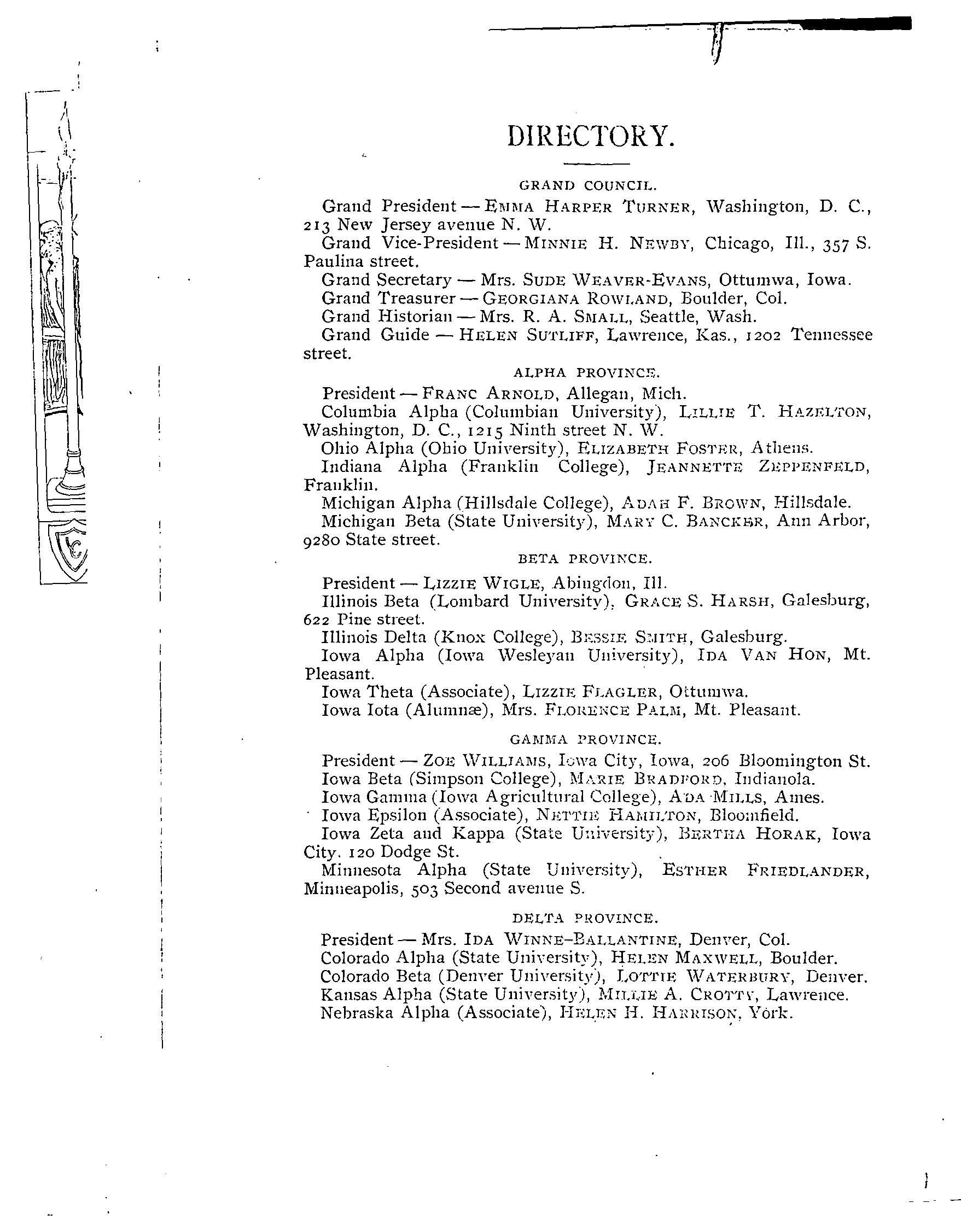
GRAND COUNCIL.
Grand President - EMMA HARPER TURNER, IVashington, D. C., 213 New Jersey avenue N. IV.
Grand Vice-President - MINNIE H. NEWBY, Chicago, III., 35i S. Paulina street.
Grand Secretary - Mrs. SUDE WEAVER-EvANS, OttUl11wa, Iowa.
Grand Treasurer - GEORGIANA ROWLAND, Boulder, Col.
Grand Historian- Mrs. R. A. SMAI.L, Seattle, Wash.
Grand Guide - HELEN SU1'l.IFF, Lawrence, Kas., 1202 Tennessee street.
ALPHA PROVINCE.
President - FRANC ARNOLD, Allegan, Mich.
Columbia Alpha (Columbian University), LILLIE T. HAZEl/roN, Washington, D. C., 1215 Ninth street N. IV.
Ohio Alpha (Obio University), ELIZABETR FOSTER, Athens.
Indiana Alpha (Franklin College), JEANNBTTE ZEPPENFrlLD, Franklin.
Michigan Alpha (Hillsdale College), ADAl{ F. BROWN, Hillsdale.
Michigan Beta (State University), MARY C. BANCKHR, Ann Arbol-, 9280 State street.
BETA PROVlI':CB.
President - LIZZIE WIGI.E, Abingdon, Ill.
Illinois Beta (Lombard University). GRACE S. HARSH, Galesburg, 622 Pine street. '..
Illinois Delta (Knox College), BI,:'3Sm S:.nHI, Galesburg.
Iowa Alpha (Iowa 'Wesleyan Ul!iversity), IDA VAN HON, Mt. Pleasant.
Iowa Theta (Associate), LIZZn: FLAGLER, Ottulllwa.
Iowa Iota (Alumna:), Mrs. FLOIunicE PALM, Mt. Pleasant.
GAMMA l")ROVINCE.
President - ZOB IGwa City, Iowa, 206 Bloomington St.
Iowa Beta (Simpson College), BRADFORD. Indianola.
Iowa Gamma (Iowa Agricultural College), AiM. 'MIl.LS, Ames.
Iowa Epsilon (Associate), NETTIE I-IAr.r n'I'ON, Bloo:nfield.
Iowa Zeta and Kappa (State University), HERTHA HORAK, Iowa City. 120 Dodge St.
Minnesota Alpha (State University), ESTHER FRIEDLANDER, Minneapolis, 503 Second avenlle S.
DEef.'\. ?HOV!NCE.
President - Mrs. IDA WINNE-BAI,LANTINE, Denver, Col.
Colorado Alpha (State University), HEl_EN MAXWEU, Boulder.
Colorado Beta (Denyer University), I,oT'I'm IVATERBURY, Denver.
Kansas Alpha (State University), Mn.UE A. CROTTI', Lawrence.
Nebraska Alpha (Associate), J-Im•.EN H. HAlwrSOK, York.
.ington, D. C., go, Ill., 357 S. tmwa, Iowa. Col. 202 Tennessee
r. HAZELTON, Athens. ZEPPENFELD, 'I, Hillsdale. R, Ann Arbor, .H, Galesburg, urg.
AN HON, Mt. lsant. Domington St. lianola. ), AllIes. field.
HORAK, Iowa
RIEDLANDER, CoL Boulder. JRY, Denver. Lawrence. ark. , I
1. :\ ,,01 1111: 1:lIlg'htcr of maidens ran light through the throng? " II"", 1,,'1'1')' II'" \\'ere in that sweet SUII1lY weather ".Will 11,.:se I", I he tenderest words of our song?
SONG.
OUR TENDEREST WORDS. (Air -" Oh,lca\'e not your Kathleen,")
1.
111 (t:.ys yet to come, girls, when we shall have parted; 1\ "cl left the bright circle that held us so long, 1\' "'c sing of the past, when we met, all true-hearted, (lh. 1<:11 lIle the tenderest words of our song. \'/ill :.!,.:,. lell of the times when we were together,
II.
'J'hllllgh dear the re111elni>rance of every gay meeting, As we livt..: o'er their 1110111ents again, \I':IS there ever :1Il hour whea we met with sad greeting, All hOllr that was dearer, thongh heavy with pain? " II(,,\' ,:ad \\':IS the day when we last met together," We'll sing, as the tide of remembrance flows strong, \\' ilh voices hushed IO\\>, never questioning whether These he not the tenderest words of our song?
MARY MANLEY.
THE ARROW. SYMPOSIUM.
CHAPTER MEETINGS.
You have indeed made a happy choice in the selection of a subject for discussion in the October Arrow, f0r the chapter meetings are the very roots and fibres of a sorosis - the source of its vitality, and that without which it would be but :l. lifeless trunk.
It has been said that one of the aims of such all organization as that of Pi Beta Phi should be the development of its members to "ideal womanhood." This is one of the things that may be effected through individual chapter work. But ,how, is the question? For sorosis chapters, each of which has its own characteristic requiremellts and environment, no iron rules can be laid down which shall regulate the process ofthe realization of an object. VVe may llot say, "It shall be thus and so with this and every other chapter," 110r is it to the interest of the sorosis at large so to do. On the cont trary, each community of sister-workers l11ust, with an eye to the end, struggle for the attainment of that end, selecting those means which are best adapted to its 0\\,11 peculiar needs and to the demands of the situatioll. Such a course of action constitutes the indi viduality of a chapter-·-i ts character; and no less the character of each of its lllcm bers.
This brings us to question that vague and far-off" ideal womanhood" into which each character should develop. What does it mean, and h?IV can it practically be reached? Can it be other than the realization of the peculiar function of the illdividu,al? It certainly refers to what one should be; and the ideal is attained if, to use the homely and well-worn words, we do our duty in that state of life unto which it shall please God to call us. In accomplishing this object, one, perhaps the 1110st indispensable tool, is sympathy. "Sympatliy," bri I1g·s ; gelllllI]( relatiOlI sharers lIIachillt
For lIec indivic1r c1ivic1ual commU1 chapter, one mw Wor spnng i for allu( against quences
This t view to 1 vital imj Micli S0111( one of 1\ ably suil That societyrest, a!lii ment.
Ie selection of f0r the chapsorosis - the would be b11t
I ail orgamza:lpmen t of its of the things l' work. But !ach of which 'ironment, no te the process; " " It shall be ," nor is it to On the convith an eye to :nd,. selecting leculiar needs llrse of action IUracter; and far-off "ideal mid develop. be reached? lliar function l1e be; .nd well-worn which it shall , object, one, :hy. "8 , ym-
SYMPOSIUM.
1':11 hy," said Professor John Dewey, Ph. D., "rests upon and brillgs ,11'0111. a community of persons; and sympathy is not gelill i lie e:-;cepting' as it leads to its OW11 realization, institutes rel:lliollSl!ips ill which the individuals concerned are equally sl!:!rers in a COlll1ll0n life." We might almost term it a llJachine will! :t "double-back-action;" iL works both ways. For necessarily, though indirectly, does the realization of an individuality i:!volve the realization of the commnnity of individuals of which one is a member, because the needs of the cOlllmunity, a1ld by that of course I mean especially the chapter, constitute the environment with reference to which one must act in order to realize himself.
'Would that sYllJpathy were more invariably the mainspring in chapter work; then there would be no occasion (or alluding to the appalling truth that the house divided against itself mllst fall, and its yet more appalling consequences to chapter success.
( This, to be sure, is Oldy nne of the innumerable points of .. view to be taken on the subject, yct none occur to me of more vital importance to both chaptcr and individual.
Very sincerely, FRANC ARNOLD.
lI.fzdzigml Beta.
Something was suggested to us not long ago, throngh one of Miss Turner's letters, which we think most admirably suited to this question of chapter work.
That is, let eaeh chapter aim to make of itself a perfect society - an ideal woman's club; the chapter-hall a place of rest, aud the chapter meetings a time of profitable enjoyment.
It is not a detailed literary program th?t we so much require to meet the needs of this woman's dub; that we have in our literary societies; moreover, we have 'not the time of preparation to give to it. But what we do want is a work suited to the needs of each individual chapter.
If tIle work on' this basis of our ideal woman's dub is successful, our girls ought to go out nobler, happier, willing, and better able to help those whose lives may be less bright. Let us try this, at least.
Colorado Beta.
Our chapter meetings should bring us doser together. To meet as sisters, to sympathize with the sorrows and rejoice in the prosperity of our loved ones opeus our hearts to a wider humanity. We should feel drawn together closer in those bonds which strengthen with time until our hearts are indissolubly bound. Thus do we derive benefit from them.
We should get away fr0111 the conventional meetings of acquaintances, aud be something more to each other; find' something higher in the companionship of those w 110 are, with us, aiming for a nobler womanhood.
We should be able to settle differences of opiuion in that sisterly manner which, no matter how bitter the dissension, can, immediately 011 settling the disputed question, assume the warm, affectionate demeanor of, those whom ties of kinship make to overlook most grievous faults and count them naught for love. We should each one strive to bring to meetings a cheerful face and hopeful words, and thus to help each other.
Nebraska Alpha.
l , . Om chaptel !-'<,II rce of thc fr I t is certain1 illkrcst in frate Ilr college; and I,y (lllr lllutnal so thoroughly i .'\ s friends, , sliol1lc1111Can to life. It is allll i;III'IIIc1 be a thi Then, as to I,y ((1II1/mls/ult, liS (1/ It.'as/ as (>II r homes, all ill'\cclI a comp: Ilhltllls De, C'a I, i'vl ichigan /' :wlves with fra 1.11 I'e ahle to I ::clvcs generall HII'" nlall.\' It 1111'" the date Ihcir 0\\'11 ch:q We think III slI,;h In( ill lith'r li!'<.: so
we so much :lub; that we ha ve not the' ve do want is :hapter. man's club is happier, will:s mr..y be less
Jser together. sorrows and ns our hearts 1gether closer .til our hearts benefit from I meetings of h other; find lose who are, Jillion in that le dissension, stion, assume 11 ties of kin1 count them : to bring to thus to
Our chapter meetings should be the very life-giving source of the friendship that binds us in Pi Beta Phi. It is certainly fro111 our meetings that we gain that deep interest in fraternity work, unsurpassed in any other society of college; and there our friendship is much strengthened by our mutual intercourse and discussion of subjects that tl so thoroughly interest ns, and us alone.
As friends, in the truest sense of the word, our meetings should mean to us one of the greatest pleasures in college life. It is almost needless to say that a fine for absence should be a thing unknown among Pi Beta Phis.
Then, as to frt"ends, and friends of careful clzoz"ce, and not by compulszcm, our chapter meetings should be and mean to us at least as much as a mutual interview with sisters in our homes, and so helping much to make Pi Beta Phi indeed a complement of OUI' college interests.
Illz"nozs Delta, Knox College, Galesburg, Ill., September I9th, I890.
Michigan Alpha thinks it would be well to familiarize ourselves with fraternities in general, and especially our own; to be able to name our prominent women, and inform ourselves generally upon fraternity details.
How many can locate all of our chapters? How many know the date of fouuding of the sorosis, and some even of their own chapter?
We think some time out of each meeting should be devoted to such information. The meetings, too, should be something looked forward to with pleasure, and our sorosis in after life somethiug of which to be proud.
A.F.B.
We measure a business man's ability to sllcceed by his punctuality in all things. So ought we to consider this an essential quality in a successful meeting.
Another person's time may be more valuable to them than yours is to you; then do lIot, by thoughtlessness, keep· them waiting for you. Let each meeting begin promptly, and after the proper opening ceremony the business portion of the meeting should be carried on in a rapid, business-like manner.
An ordinary meeting should not last longer than one hour. A literary musical programme, or readings, should follow the business meeting.
No extraordinary ability is necessary, for the most essential thing in our· literary work should be the development of our members' capabilities.
Unity and harmony should reign ill all our meetings. Let every member do her duty with all the zeal and earnestness that is at her command.
Our object should be to make the meetings of equal interest to every member, for the great source of chapter life and prosperity lies in the chapter meetings.
That each member may grow into a more perfect woman, a short time could profitably be spent in criticism.
Many of our minor faults may be brought to our notice by indirect rather than direct criticism.
Our work may be secret, yet the lesson which each meetting teaches us should illnmiuate onr individnallives so that all who·come in contact with us should feel its inflnence and become better men and women.
Each one is building a house, a temple made without hands, in which the sonl shall dwell eternally. Let the foundation be firmly built 011 love, charity, and trnth. Iowa Alpha. \. i , i I ! i: I !\ t. Ihe ,Jose' I'lIld;; 110 better p. 1',,"liIlC or Latill . I'lli :It olle 01 (.IIII' {'tl11lP:l11iolls"iii 1'1'"lil:.hk a\1<1 pl. Tite :111110:';1'1 i'l-"I lital she h:\s f:It'I"r ill l1Iakill Till; " tTHe :1I l'i"ru;i1, r I, 'I'cl it,;r where ... 1"':11' fcel free t , III,;:;" ';l)lIli<1clIec 1","<1 "f fril;l1t1s1 I,'r:lt<:rllity l' I'(,will'"t'. • \ lit' (: ret' k \\")1 1\,t'II'I'; 11'11"111 lI'e had I: Tite fr:II.,;ni: \,,1' \I·"ri.: I,y I· 11111 it"r" , I,,!:.elit \Vit". I it ell , ,,"I. lit" i.liillCII 111111' ,·1,,:<:1' \ h.:.\l' i'ri.· ,,01:; it i '''""'<' ·}li'nilIlHlillll; I," ,','f\,i\oU'X,LI,!'d :llId I
Oil /" 1/11 i:', • , 1-
At the close of the week, when books are put away, one finds no better place to forget the cares of the daily college routine of Latin declensions and Greek verbs than does a Pi Phi girl at one of her meetings.
Our meetings do 110t convey to 011;' minds the thought of companionship, frivolous ,md gossiping; but recreation, profitable and pleasant.
The atmosphere of the chapter-hall tends to make one feel that she has a place to fill in the world, and is a potent factor in making her strive to fill this position creditably.
The" true and tried" friends whose healt the alTOW pierced, having formed a mystic band of co·workers, gathered together where there are none but sympathizing ears to hear, feel free to confide their failures and successes. By these confidences are the disappointments and the . bond of friendship strengthened.
Fraternity life, as all other life, is "toiling, rejoicing, sorrowing;" toiling to bring the barbarian out into the light of the Greek world; rejoicing in the bright hopes for the future; sorrowing when some rival takes the one npon whom we had built our hopes.
The fraternity woman derives much good fro111 the chapter work by the discussing of standard books and their authors, together with current topics.
\Vho, theu, would do these meetings and blot out the influence of this life.
How cheerless would college life seemwithont them; these friendships, influences, and benefits do not cease upon graduation; b\lt live in our memories forever, directing us " onward and \lpward."
FAN:HE B. BROWN.
Gino Ulll·"crs£iy.
In looking back at our school-days, how pleasantly we think of the dear old chapter meetings, and recall the" tried and true" friends, who are not forgotten, but remembered as sisters.
One question present!; itself, are we not too selfish in our own enjoyment, and narrow our work dOWll to our small " circle too much? While we aim to make our chapter meeting helpful to our members, intellectually and momlly, should we not remember that it is iu helping others we help ourselves most, and make our work more pmctical and our field larger? .
Then who can estimate the iufluence of sisters banded together in love aud high aspirations?
" No life can be true in its purpose and strong in its strife. and all life not be stronger and nobler thereby."
Denver, Col.
MRS. G. W. BALLANTINE.
Permit me to speak of two phases of the work to be done in chapter meetings.
First. As to the programmes: Chapter work and chapter'c' life are to supp1ement college work and life. Make that thought your own, I beg of you. Chapter programmes should not, then, be permitted to become burdensome or irksome by taking all a character of which yon have already quite enough. So much remains to be learned or acquired, so much positive1y necessary to make us the broad-minded, broadly-cultured women we hold as ideal, there ,can be no dearth of lines along which to conduct on;' work. Also, every chapter progr3.l11me should give time to the discussion of topics vital to the college world in general and the several colleges in particular. VI] e may adhere qnite closely, and with profit, to the habit of the Greeks in gathering after the day's work for the discussion of the school work and life.
t
I f, as Oll r 1 S. 11lemi homc gatlI( eve111 pathi into t just t over' line c it slH you r cloud L placc spirit rise t, A rigidl fixed have mom( thus sister excla" L· the ti Phi " L ever'
SYMPOSIUM.
If, as is true, we are a college organization, let us hold fast our profession, and make it a being, not seeming.
Seco1ld. The chapter meeting is a frat. meeting, and every mem ber is a frat. member. J\Iake, then, your meetings the home gatherings of the sisters; the twilight hour when we gather in the family room for a chat before taking lip the evening's work. Listen patiently to this sister's woes, sympathize with that oil.e's trials, give this tired one an insight into that knotty problem-"" you remember being puz:ded at just the same place, and the sister just there needs to talk over with you her duty for the literary; she is conscious her line of thought is faulty, but jllst where or how to remedy it she can"not tell; talk it over with her, perhaps together yon may be able to strengthen the weak places or make the cloudy thoughts clear.
Let every chapter meeting be a resting, strengthening place for every member of the circle, so full of the true frat. spirit that as we go about our daily tasks unconsciously will rise to our lips the talismanic words, Pi Beta Phi, Pi Beta Phi!
A third thought: Have a fixed time for meetings, hold· rigidly to that time, and as rigidly confine Pi Phi work to that fixed time. I fear we have been at fanlt j list here. There have been too many meetings called on the spur of" the moment and without thoroughly prepared plans, and time thus occupied needful for other work. The overly zealous sister has thus often caused the faithful, plodding student to exclaim" there is not time for both college and frat. work."
Let me repeat, after carefnlly, deliberately deciding upon the time for meetings, hold rigidly to that time, and hold Pi Phi work sacred for that time.
Let us remember we may make of these meetings whatsoever we will. For Pi Beta Phi.
EMIlIA HARPER TURNER.
REALISM AND IDEALISM IN ART AND LETTERS.
" And God created man in his own image; in the image of God created He him."
"And the Lord God formed man of the dust of the ?T:Jl1nd. " .0
God has revealed his highest power in creation, and the, P:5t and greatest act of creation was the creation of man. For mall was made in the image of the great All-Father; man is tile God-like creature. His attributes are like those of God himself; but man's power is, finite, God's infinite. As creative power is the mightiest attribute of God, so it is of man; "and earthly power doth then show likest God's when it is creative power."
But man was not made to Vle with his Maker in the creation of the actual things of nature. So far froril ordaining sun, moon, and stars, and putting into harmony all the material things of the universe, man cannot make the tiniest violet which may surpass or even equal "nature's darlings."
He may by scientinc research obtai'n a full knowledge of nature and nature's laws, but the wisest of scientists have created no new thing in nature.
Man has the power of invention, He may harness steam with his iron ba1](ls, and by means of the evanescent lightning " put a girdle round about the earth in fifty minutes," but the prince of il1yentors can only ntilize the forces of nature; he is a disc(were1', not ;t creator.
There is' one "domaiu in which' mall lilay exhibit the creative intrusted to him by the omnil;oteilt Creator. I t is the wide domain of art.
Few men are artists. The poet sings of Milton, "Thy soul was like a star, and dwelt apart." The souls of artists are bright, peculiar stars, and if we view them as they appeal' in the firmament of art, they seem to us innumerable. But if we compare them with the millions of unseen 'stars, they are but few. .
The artist's soul approaches nearest to the mighty genius of the Maker of the universe.
His is the power to' reveal himself in painting, in sculptnre, ill literature IJOl' literature is but a broad field in the vast domain) and in a thousand lesser forms. And he l-eveals not only himself (self revelation is not creation) but he reveals something mightier than himself--the ideal which he has conceived. The artist's mission is to body forth his ideal as best he cau. The artist's power is finite, his ideal is spiritnal and intaJ!gible, hence not even the greatest artists have succeeded to their own satisfaction in giving expression to their ideals, but to attair,' the perfection of representation of his ideal has been the aim of every artist since the days of Apelles, of Phidias, of Homer.
There are, then, the two fields of creation and art. Nature is l-eal and material; it it "knows, not seems." Art is ideal, and seems ztl'es!; it is illusion, not reality; and the, creators in this field are the greater as they are the more skilful in producing illusion.
Though tl;e two fields are thus different, the methods of, creation are the same in each.
God created man in his OW11 image. Man was not modeled after the beasts of the field, the fowls of the air, 'the fish of the sea, or whatsoever passeth through the paths of the sea; he was made in the image or ideal of God. As we have seell, the artist must have all ideal, and he who has
not an ideal is not au artist, however skilful he may be in delineating nature.
" And the Lord God formed man of the dust of the ground." As the Lord took a part of the former creation to make the latter, so the artist 111 ust so found his ideal upon nature, the former creation, that his work of art may present the proper illusion to the beholder.
A story is told of a painter cOl11missiolled by a king to paint the most beautifui hum:l1l being imaginable. So he did, and to the surprise of kiug and court, it was discovered that the artist had pai:lted ill his picture the beautiful eyes of the queen, the beautiful smile of a page, and the beautiful features of one courtier after another. Thus every artist selects beauties fl"Om nature, and by the power of his imagination combines them into one harmonious whole-his idea1. These selective and formative powers are requisite component parts of an artist's imagination.
The crowning feature of an·artist's work is reducing his ideal to visible form. The proverb is, " a }Joet is born, not made," but wise Bell. Johnson says, "a good poet's made as well as born," and the s8.ying is equally true of all artists. Each must serve an apprenticeship to his art.
Nature is adapted to satisfy the material needs, art the tastes of mankind. He therefore mistakes the ·animus of art who imagines that the grapes that Zeuxis painted so cleverly as to cause the birds to peck at them were painted for the purpose of deceiving the birds, or that" Romeo and Juliet" was created for the htudable purpose of inculcating the lesson that the passion of love, violent and headstrong as Romeo's, is necessarily disastrous in its effects.
In other words, art is ill itself neither utilitarian nor ethical; it is illusionary, and the greatest artist is he who produces the Illost perfect illusion.
REALISM AND IDEALISM IN ART AND LETTERS. IS
Of late there has grown up in artistic circles a new sect, whose chief tenet is realism, whose chief recreation from the labors of composition is to cry out and spare the old, tiine-worn, moss-covered relics of the art wh!ch they call , idealistic.
They claim for the productions of their school the ter!11 realistic art. They have an indisputable right to the epithet --realistic; no more worthy use has ever been made of the term, and they have dragged it fro111 no high pedestal into the dust aud glare of the arena.
But, art! 0 le1llpora! 0 mores! that a daughter of Joye, sprung full-armed from his mighty forehead, should be stripped of her glorious panoply, and forced to serve as trencher-maid to ostrich-like mortals, distinguished chiefly by 'an inordinate appetite for all sorts of things.
The priests of the realistic shrine are critics; in modern parlance, book-reviewers. Their name is legiou, and, indeed, if one considers how easy it is to be an orthodox realistic book-reviewer, one wonders that there are not more priests in the temple.
It is by 110 means a difficnlt thing for a man of observation to decide whether a piece of work is like nature. Any one who keeps his eyes open may see everywhere landscapes and people, and he may tell if an author be true to nature in the realistic sense, c'cst a' dz"re, whether he be able to copy exactly.
But a man must be of rare genius to appreciate the ideal of a work of art-' to become thoroughly en rapport with it. And a man must a trained taste and judgment to perceive the skill of the illusion, to comprehend the art of the artist. The good critic is the complement of the true artist; hence good critics are as rare as great artists, and they
THE ARROW.
have, perhaps, as great influe!lce in the taste of mankind. For we comlllon people could nevel' hope to appreciate a great artist so fully as we Illay if the good critics did not, with their trusty pickaxes, open to liS mines of delight in the veins rich with gold ore.
The realistic critics are, then, as they lIlust be, high priests in the temple of nature. A poem, a painting, a novel, or a piece of scnlpture, ill order to Wil\ their unqualified approval, must be a U';mscript fro111 nature. It matters not how " weary, stale, flat, and unprofitClhle " the landscape, subject, model, or cast of characters lIlay be, if the work is natural, it is realistic, it is the acme of :.lrt! It even matters not how degrading 'the theme Iilay be, if the work is "natural." Everyone should be able, willing, ;I<1Y, joyful, to overlook any little delinquencies of that sort, to glory in the realist's power of representing things exactly as they are.
Nor must the model fro111 be arranged or altered so as to present a more seemly aspect; backgrounds are mere excrescences, plots are unpardonable.
In short, the realist is the apostie of imitatioll, not of creation; his genius is not formative; his philosophy is fleshly, 1lOt spiritual. He is the fungus which the nineteenth century spirit of !icielltific materialism has produced upon the fair field of art.
•• By their fruits ye shall know them."
It is perlwps well to inquire what this new growth has produced aheadv in thefidd where it has found itself.
. " Those who still hold that a work of art is the result of a special inspiration - that the artist presents to us, however imperfectly, his ideal-- might object to such illquil'Y on the ground that the time is too short to judge fairly the work of the realist. They might instance Ruskin's reply to the
youthful painter, who asked if he could ever, in Ruskin's opinion, become a Turner. Ruskin, in effect, answered thus: "It is easier that you should become Czar of all the Russias. There is a new Czar every few years, and by a for-tunate cabal yon might succeed in becoming Czar; but God makes only one Turner in one hundred and fifty years.
But the realist can make no such objection. He is not a credulous believer in the inspiration of an artist. And surely'nature is as natural as she has been or will be, and every child, iu this cultured age, is carefully taught to express his thoughts clearly in writing, to draw, and to model in clay. What more is needful? Indeed, I think no well-informed realist is inconsistent enough to demand more time.
The advanced leaders may already be enjoying beatific visions of such time-worn idealists as Shakespeare and Dante being entirely obscured by geniuses of the Whitman type; already they may be foreshadowing the total eclipse of the Titians and Raphaels by the host of asteroid artists who have come so "near to nature's heart" as to accept gratefully her valuable assistance in the technique of composition - the photographers. Their bards may even now be staring at the sorrowful countenances of the sculptured Venuses and Madonnas of the Renaissance as they, lingeringly yield their long-held pedestals to various honorable gentlemen, who have, as Mark Twain vividly expresses it, " gone on a bust."
The leaders in the van of realism may see all these things in the near future, but there is one agreeable picture that even the rank and file of the realist army may gloat over. They see Balzac, Tolstoi, and Zola under the glowing sun of popular approval, while the ghosts of Scott, Dickens, and Thackery stand wringing their hands in the shade. Far be it from me to suggest the impious thonght that they are 2
THE ARROW.
wriuging their hands because they perceive tbat carnon should not be left "too much ill the sun." Would they not then be wringing their noses?
I confess that I am unable to see how realistic poets, painters, and sculptors can attain the high position foreseen by the prophets and foreshadowed by the triumph of the fictionists. It is difficult to conceive of an artist of oue of these classes who shall live as an artist without imagiuation or idealization. It seems to me that an artist's existence under such circumstances would be analogous to that of a martyr to science, the decapitated frog, whose heart continues to beat long enough to furnish all instructive specimen to eager searchers after scientific truth. Poetry is not fouud in nature, hanging to the trees like Orlando's verses.
The man whose sale impression on seeing Niagara was, "\iVhat a big mill-wheel it, would turn," is well known. The man who wrote in his diary, "Thc moonlight falling on Lake Lucerne has a very pleasing effect," is perhaps not so well known; but surely the most casual thinker would hardly accnse either of these men of holding "sweet COlllmunion with the various forms" of nature, or would suspect that nature spoke to them in a various language. Nature is not pd- se poetical. Not only does she demand a receptive spectator to whom she may appear poetical, but 'au imaginative spectator, one who is able to attribute personality to her various forms. For we are so constituted that nothing appeals powerfully to our emotions unless it is invested with personality. The poet must have this attributive quality evinced by his epithets and metaphors. A poet must also have the power of concrete expression. Abstract expression is cOlllmonplace. Great poets are distinguished by their power to think in concrete images. Milton's famous line, in Comus, "and airy tongues that syllable men's names," was
REALISM AND IDEALISM IN ART AND LETTERS. 19
first written" and airy tongues that lure night wanderers." The former is a concrete image, "a 'touchstone of poetry; " the latter is a glittering generality, a commonplace.
One comes to poetry to receive new impressions fl'esh from the heaven,made mint of a poet's brain, and however perfect the rhyme and rythme of a poem, if these essential qualities of attributiveness and concreteness are 'lacking, there is no health in the poem; it is mere doggerel. If these things be in it and abound, the poem, at the least, is not unprofitable reading. Emerson, it is said, had not the poet's musical ear. His technique as an artist in the poetic line is faulty. But we love his poetry for its beautiful thought, as we are fond of a beautiful soul in an ugly body.
To the painter like attributes are necessary, but modified, inasmuch as the form of expression is different, and, indeed, simpler. The poet's art is the most complex of all arts. The power of attributing personality to nature, which is called sentiment in painting, is found in all the works of the' great painters. Concreteness of imagination is, too, a necessity, and is particularly shown in the disposition of the accessories of the picture. In Millet's Angelus the expression of the faces is revelatory of a beautiful phase of human natnre, but the setting and accessories of the picture increase the personality and power of the picture, so that we, as well as MilIet's friend, can hear the Angelus.
Sculpture is a more simple form of expression than painting, in that there usually are no accessories to intensify the effect. The personality must be in every muscle and curve of the figure, iu every line of the face. The whole character must be wrought out in the form.
The modern school of art, beginning with the Renaissance, has e11lphasized especially this idea of expressing character in sculpture.
The Greek calmness and repose of the works of Phidias and Praxiteles are no longer the characteristics most sought for.
This change is perhaps due to Christianity, which brings Ollt to a greate;- degree the spiritud nature of mall, whereas the Greeks attained the highest development in the lower natures, the intellectual and the physical. Be that as it may, the change in the mollj of the sculptor certainly demands the highest degree of power and imagination.
The o:lly dep:l.rtmellt of art in which it is possible for to distinguish tlIemseives, tlien, is fiction. For it is possible to \Hite ;.\ novel withont a plot, dealing with charactel'S exceedingly insipid ;llld ull.illteresting, or exceedingly wicked and re,'o1til'lg, just as clJaracte,'s ;\ppear to realists in every-day life. The result in the former case is a rec'ord of chatte,'ing and trifling actions, not worth wasting time upon ulllcss one wishes to justify the sOHnd observation of Puck: " Vlhat fools we mortals be."
Iu the latter instance it IS a groveling in the filth of humanity under the vain pretext that any delineation of nature is alt. Moral obliquity lias a place ill any work of fiction corresponding to the dark backgrOlllld of a painting, such as the old masters love.
But where the backgroulld is made foreground, or where the entire picture is background, there is liO beautiful work of art; there is only" blackness and darkness."
It does seem to me that this wise old world has no inclination to drink of the muddy rivel' water, natnral tho' it be, while wells of clear water exist, opened np to it by the magic driving,rods of the" \Vizard of the North" and fellow magicians. Z02 VVrLLIAMS. Iowa Zeta.
COLUMBIA ALPHA
'vVilh renewed and warmer interest we enter npon a1lother year of Pi Phi life and its ambitions, and are looking forward to holding our regular meetings very soon now, as the close of vacation brings together our absentees.
Tt has been our good fortune this summer to meet with members of other women's fraternities, and these introductions have been the means of broadening our ideas of fraternity friendships. Pi Beta Phi and Alpha Phi have clasped hands throngh the Misses Allen and Caraway j the former is editor-in-chief o( the Alpha Phi Quarterly, and is peculiarly fitted for the position by her superior intelligence and kind, w0!11anly tact. Both young ladies are fine types of the fraternity woman.
111 the latter part of J ul y, at the time of full moon, a pall-l1l:lk1lic excnrsion to Cleveland Heights, " Oak View," \\'as give1l by Coll!mbia Alpha. Besides our own chapter, alld om sister, i'vliss Grace (irosvcnor, from Ohio Alpha, there were wilh liS tbc Alph:l Phis, Misses Allen and Caraway, !llld I\'Iissl\Jnble, ;]n ex-Grand Secretary of Kappa Kappa Gamma, who provc:d tf) be a brilliant acquisition. The eveni1lg pas .,;ed all too quickly, though not without the happy suggestion that we meet again this winter, perhaps atjoi!lt meetings, or at a pan-hellenic banquet.
More recently wc have met Miss Pitman, of Kappa A lpha Theta, which adds another interestiug member to our circle of pan-hellenic sisters.
We expect through meeting these representatives of the Greek world to cultivate a friendship for other fraternities
ARROW.
without losing our own individuality that ,will result in a C0ll11l10n good. It is inconsistent with fraternity principles to indulge in petty jealousies, ;,nd we are hoping 111nch to keep in mind the fact that the cOlllmon good is the highest good. 'vVe have learned that like begets like, consequently of whatever material a chapter is formed, just such material will it choose or win. A fraternity or chapter loyal to its noblest principles need never be afraid of holding its own.
Columbia Alpha has no rival, but should it have one, it is its earnest desire to stand the test.
As our regular meetings have not beel1 resumed, we cannot give any definite idea of what. our plans will be for the winter, but it is enough to say we are hopeful for the future. No doubt we shall study our new constitution, of which we are proud and well pleased (not only for Its inward strength, but also for its outward beauty). Vlfe hoid it as a precious document.
To all Pi Phis we' send our kindest greetings, and wish for them a year of much prosperity.
Washl'llf{tOIl, D. c., 1911z, 1890.
After a vacation pleasurably and profitahly spent, we are again withili college walls. Most of the girls spent a part of the vacation with friends away from home. As all of onr girls live in Athens, we .found it convenient and exceedingly pleasant to continue our regular meetings. We generally had a prearranged programme. After we had read and discussed several books, we took up a plan of comparing notes on the current events of foreign countries, which we found very interesting. .
OHIO ALPHA.
CHAPTER LETTERS.
College has opened up quietly and industriously. The buildings have been repaired and made much more comfortable. An unusually lai'ge lIumber of new students is in attendance, and many of the old ones back. In proportion to the number of men, the lIumber of women has increased.
Both as a sorosis and as college students we have started the new year in earnest. Our number is yet small, but we will endeavor to make up in zeal, and take advantage of good opportunities for membership
Best wishes to Pi Beta Phi for a successful year.
Athens" 01110, Scptcmber Isth, I890.
INDIANA ALPHA.
Autumn greetings are extended to sister 'chapters, and a glad welcome to Minnesota Alpha.
After three months of separation and rest frol11 college duties, we are again together. We again number twelve. Mabel Abbott has not returned to college, but in her place is Lizzie Middleton, one of our chat·termembers, who bas been teaching the last two years. Our three sisters who graduated last spring are Franklin girls, and so are claimed as active members. Hattie Palmer, our graduate of one year ago, is also a resident member.
On the evening of .Tune 10th we entertained a few lady visitors and some of our gentlemen friends in our hall. One of the features was a dainty feast, the cloth be.ing spread npon the carpet in true Pi Phi style.
We are rejoicing over the partial fulfillment of a longcherished dream, that of making our hall more attractive. We have had it neatly papered and curtained in light colors, making'it far prettier than with its former s'ombre furnishings. The paper is the gift of Dr. Burton, the father of OUf, May and Lizzie.
THE ARROW,
Nell Turner, of Columbia Alpha, has entered Franklin College to finish her course ill l1lllsic.
VI/e had our first meeting last ;:3:ttnrday night, and elected officers for this term.
Fervent wishes are extended to all for a prosperocls and happy year.
Franklz'n, hzdztuza, September IStll, 1890.
MICHIGAN
ALPHA.
The fall of 1890 finds Michigan Alpha 111 high spirits, with eight good workers.
VITe regret that the coming school year has brought with it an absence of five of our sisters.
VI/ e are proud to mention sisters Greene, Higbee, and Randall, our graduates of 1890, who received high honors; also sister Kempton, who has taken a prominent work in • elocution. Sister Harter, of Mexico, Indiana, is the second of our number to become a participant of wedded life. She is beautifully sit1lated in bel' new home in St. Paul, Minn.
The new constitution was most heartily we1comed and its contents eagerly devoured. VITe pronounce it a great improvement upon the old.
College work has been in progress but a week, and we have had a meetiug. With the help of the new constitution and the new ideas we have beeu able to glean, we anticipate a thriving year.
Hzllsdale, September I3tlz, I890.
CHAPTER LETTERS.
MICHIGA N BETA.
The class of 1 S9CJ i 11 a certai 11 eastern college chose for their 1110tto the line fro111 Tennyson; "Vile will work and Il11Hl1d the woman to the perfect day j" a llob1e sentiment, which helped to make one hnnrlreu girls truer and better • WOJ1len,
Is it not something of this kind that Pi Beta Phi intends to do for her girls; that besides the fun aild gayety of college life there should also be the serious side?
A rival Greek in a western college openly tries to help its girls, and takes for members not only those who will benefit the chapter, but whom they in turn may benefit, for in so doing the whole chapter is improved, This, it seems to me, should be one of the fundamental principles of any sorosis or fraternity, all working together for the common good, each assisting the other, and at times, perhaps, gently mentioning a little fault of which the possessor is wholly unconscious and in the end will be glad and thankful for the help,
I have thought of this a good deal thjs summer, while the Michigan Betas have enjoyed themselves in town and country, and have heen impressed so strongly with the idea that I send it to THE ARROW ill place of the personal letter sent last spring.
Vve may each be a" princess" in the truest sense if we but try and rule our little kingdoms where II thoughts and feelings dwell," so that when our college course is done and Pi Beta Phi calls us active members 110 longer we may be the truer and nobler for our connection with her.
Ann Arbor, Mz'chigan, September, £89°,
THE ARROW.
ILLINOIS BETA.
Illinois Beta sends greetings to her sisters, one and ai I. \iVhat a short, delightful vacation we have had, and now we are ready for work once nl!)reo \iV e enjoyed a very pleasant cOlllmencement, but it was with a feeling of sadness that we beheld our four sisters going fro111 our college to enter the ranks of Alun111re.
Lizzie Wigle, Lizzie Duston, Anna Ross, and Lillian \iViswell were the girls who were graduated with the class of·, 1890. Vile all feel very proud of them. Fortunately they will be near enough to visit us occasionally, and aid us in our work.
Elsewhere will be found a notice of the wedding which occurred at Barry, Illinois, sister Harriet Grubb being the bride. She was very dear to the hearts of her Beta sisters, and we wish her a11 joy and success in life. Her husband was formerly a student at Lombard, and is a member of Illinois Zeta, Phi Delta Theta.
Many of our former active members were pl'esent at the commencement exel'cises this year, and oh, how we enjoyed their visits.
Lombard UIll'versz'ly, September, 1890.
ILLINOIS DELTA.
Our letter this time must be rather short, as the term week l1as but just begun. During the summer we held 110 regular meeting, although a number of the chapter remained in town.
This tcrm our college has opened with a number of new students, and everythiug points to a very successfnl and
CHAPTER U:TTl£RS.
prosperous year. The foundation fur the new Alumni hall is being laid, which prclillises to b2 a very handsome and commodious str\1cture.
Of course we are 011 the lookout for new me)llbers, and hope he[.)re anot her 1] u moel" of TH EAR p.ow is published that we shall h2.ve SOi;Je new sisters to present to the sorosis. Vve miss greatly Bessie Smith, our last year's president, who g-raduatcc1 in J nne, and also Blanche S111ith, who has left us to attend school elsewhere. Grace Pitt.ard not yet retGrned frolJl her Europeau trip.
I n the absence of Bessie and Blanche Smith we feel that we are losing onr reputation as the" Smith" chapter, for we have always been noted for tbe numbel- of Smith members.
'We all enjoyed the last numherofTHE ARROW very much, and found it wry helpful in many ways. Vie were much pleased to hear of the new Minnesota chapter, and gladly welcome it to our ilumbe·r.
\Ve send best wishes for a prosperous year to all the Pi Beta Phis.
I('lIox (o/leg'c, Galesburg', 111., September 201ft, [890.
IOWA ALPHA.
As we have no letter ill the last ARRow, I will begin my letter with a short Qccount of COlllme;1cement.
Four I)f onr g'irls left as graduates, Miss Elsie Byrkit, Ida Van Han, Marguerite Campbell, fro111 the college proper, and 111 iss Lillian- Kendig, hOlll the conservatory of music.
A farewell I uncl! was given the last evening before all dispersed to go home at the home of the Misses Walbank; also a short business meeting WClS held, in which we initiated two new girls, Miss Edith Cork hill and Helen Byrkit.
THE ARROW.
Miss Kate Corkhil1, class of '89, will go soon to spend a year at Harvard annex. Miss Cora Dill goes to Washington to attend the Columbian University. 'Ne are sorry to lose these sisters, but are proud of their efforts, and hope to have them with us again in the near future.
Several of our girls will not be with us again this fall, but we hope to find some new recruits to help fill our ranks . College is opening up with bright prospects, but nothing of particular interest has as yet happelled. I will close for this time, wishing all a pleasant year in schooL We remain yours in Pi Beta Phi.
1111. Pleasant Iowa, September IS/It, 1890'
IOWA THETA.
Vacation, so longed for, has come and passed. Al,ld, whether ,the average desire for. its coming equals in intensity one's wish to throw off the lassitude of the idler to commence active, wholesome wOI'k, will ever remain a mooted question. The writer inclines to the opinion that the spirit of knighthood is still extant, and that most of us are more eager to don than doff the rumor .. Vve are certain that neither great reforms nor heroic achievements find their origin in vacation. It is only when the mind is actively alive that great thought finds its way forth to the enlightenment and benefit of mankind. Join we, then, sister Pi Phis, in welcoming the. return of activity.
Iowa Theta has accomplished some work, however, since the last meeting. We gave the public the privilege of hearing our charming voices ill Mikado, the proceeds of which were given to the Coal Palace fund. We have also had charge of a portion of the decorations in said palace, erecting a bower for Cupid's sole occupancy. The bower is ex-
ceedingly pretty, but we must l).ave selected a kind of Quakerraised Cupid, as he don't seem to be shooting very vigorously. However, we are reasonably well satisfied with the world its we find it. Of the Coal Palace I must not say too much in a chapter letter, only, living in Ottumwa, it would not be meet to ignore it. It is just too lovely to be described, and we cordially invite all THE ARROW'S readers to come and behold its glories.
We are compelled to record a serious loss to Iowa Theta in the removal of our valued sister, Lizzie Flagler, to Chicago. \\1ith sorrows also come joys, and we are pleased to announce to the sorosis that we have admitted a new sister fro111 the class of 1890, Miss Grace Tisdale.
Success to the work of each Pi Phi for the COllll11g winter, is the earnest wish of your correspondent. Ottumwa, Iowa, September I8th, I890.
IOWA IOTA.
The chapter letter this month should not fail to be lively, as our girls have indeed been buckling on the armor for another school,year's campaign, and have been not only working but enjoying themselves.
The new President of the allum::e chapter means to push matters, and will brook no lagging 011 the part of the" old girls i" and prompt and steadfast attendance of chapter meetings is her first command, to be followed shortly by others, we doubt not.
We have been greatly enjoying the visits of a number of our girls of auld lang syne.
Three sisters of our faithful member, Miss Lanra Cole, and all sisters of Pi Phi, were among the number i Miss
IOWA BETA.
After a happy,.and we trnst a well spent, vacation, we once again take our places in the class-room, and enter npon the duties of another school year.
The fall term of Simpson opened September roth with .a greater attendance than at any time previous ill its history, and while we miss many of the old students, yet new ones have come to take their place, and we hope to make this year one of the best in our college life.
The ladies' boarding-hall will be completed and ready for occupancy by the winter tenn. A slight change has been made in the faculty, Professor Noss having been elected to the chair of mathematics, and Professor C. W. Bricker, of the New England Conservatory, principle of the school of music.
The members of Pi Beta Phi enter upon the year with renewed energy and zeal in the work of the sorosis, and the prospects for our futnre growth and prosperity are flattering. At our £rst meeting, held September 13th, the following officers were elected:
President - Ida Hartman.
Vice-President - Anna McLaughlin.
Secretary - Marie Bradford ..
Treasurer - Ora Talbot.
Beta chapter welcomed to her ranks two sisters from Mt. Pleasant, Edith Corkhill and Helen Byrkit, both of whom we consider, in every sense of the word, worthy members of Pi Beta Phi.
We have already initiated two new members, Tilla Talbot and Louise Meek, and one other lady of high standing has been pledged. At present there is an active membership of fourteen, all true, active, loyal members of Pi Beta Phi . .indz"anoia, .iowa, September, I890 .
CHAPTER LETTERS.
IOWA GAMMA.
Not even a breath from the "barbs" has rippled the quiet sea on which Gamma is sailing; not a cloud can be seen in the "silvery blue" above us; our colors are hoisted, and we are steering straight for port. We have on board eleven active members, and expect to take on one or two more soon. Three alumni members have taken several "pleasure trips" with us, also. We are getting -ready to say good-bye, however" for this fall, when we enter the harbor. Four of us, who are seniors; will land, and can never a1ZJI more be counted in among the "crew" of Gamma.
But may she sail on, and on" * * A stately ship, * * With all her bravery on, tackle trim, Sails filled, and streamers waving."
We have no fears for her, and having been recently so fully" armed and equipped;" we know she can, with colors spread, gain an entrance into every friendly port, or with the sure aim of her arrows subdue her most hostile rivals.
" Sail on, thou union, strong and great." Ames, Iowa, Atigust I9th, I890.
IOWA EPSILON.
Almost four months has the June ARROW laid before us awaiting the progress of time and the coming of the October number. Time flies on swift wings where one is busy, and stueIyactivity has been the ruler of Epsilon this summer. None of us have been idle.
3
Cupid, too, has taken a very active part in the management of the life interest of three of our girls. Even the goat, when not engaged in active service, chewed away at the Greek alphabet until, as a happy result, he has overcome his mother tongue to the extent of changing his baa to Beta.
The first week in June we had the pleasure of welcoming among us again onr sister, Wilda Davis-\Vallace, who, with her hnsband, spent a few days in Bloomfield while on the W2.y to their home in Colorado. Mr. and Mrs. \Val1ace reached us on Thursday, and on the next evening we gave • them a reception at the home of Mr. and Mrs. J Ohl1 R. Wal1ace.
Last Wednesday we paid homage to our mothers and a few friends by giving them an afternoon tea party at the home of Mrs. Del1a Greeilleaf-Somers. After the usual time allotte'd to a social good time had passed, a programme was rendel'ed which cousisted of-
Pi Phi song - Ring Ching-Ching.
Recitation - Kate Linaberry.
Solo - Marne McGowen.
Recitation - Olive Saunders.
Historical Sketch of Pi Beta Phi-Mrs. E. Flora McAchran.
Solo - Olive Saunders.
Recitation -Marne McGowen.
After the programme refreshments were served, and our mothers departed feeling a just pride in their daughters' social merits. During the two weeks of teachers' institute we had with llS our sisters, Misses Rubie Foot and Lena Swift. A cookie-shine, which was heartily enjoyed by al1 present, was given in their honor at the home of Misses Cora and Mamie McGowen.
Just now we are all taking a keen interest in the Ottumwa coal palace. We are sure that we shalLbe able to join in congratulating Theta on her success in the arrang1IJent of Pi Beta Phi interests.
On the' 12th of August, at the home of Mr. and Mrs. James B. VI/eaver, occurred the wedding of their daughter Slide to Harry C. Evans, of Ottumwa, Iowa. At 8:30 P. M. thc bridal party entered the room and the beantiful and impressive marriage ceremony was performed by Rev. Robinson, of Cincinatti, Iowa. All were charmed with the beautiful bride, the expression of whose face during the ceremony was so sweetly serious. When all had tendered warm congratulations to Mr. and Mrs. Evans, they were ushered into the dining-room, where, underneath a b!-illiant canopy of Chinese hangings, stood the tables, prettily arranged with floral decorations. Refreshments served, the guests returned to the parlors and passed the remainder of the evening listening to music and examining the weddingpresents, whic1! were numerous aud elegant. Epsilon has lost a sister and Theta gained one, for Mr. and Mrs. Evans make their home in Ottumwa, Iowa. .
Iowa Epsilon sends greeting to Minnesota Alpha, and . wishes all Pi Beta Phis a prosperous school year. Bloomfield, I,?wa, Sfptember 20th, I890.
IOWA ZETA AND KAPPA.
Iowa Zeta and Kappa did no summer work. They meant to be indolent and comfortable, and succeeded admirably. We had meetings, but no business meetings. With a large resident membership and the home-coming to spend the long vacation, we always had a goodly number ready to respond to suggestions for picnics, etc.
THE
ARROW.
Every member had worked hard dm'iug the school year of nine months, and the numerous outings in July and August were enjoyed to the fullest extent, and then there was not enough of them.
COlllmencement marked a complete course 'for Bessie and Nellie Peery and Lillian Johnson, These members are sadly missed from Pi Phi ranks.
The same occasion brought Gertrude Dawley, '87, from Oskaloosa, where she had spent the year teaching j also Minnie Ely, '87, and Mary Ely, '83, from Iowa City.
Later, after a sojourn in and around St. Paul, Eva Elliott, '90, returned to join us, She l'eports teaching in North Dakota not the most unpleasant thing in the world, bnt sufficiently satisfacto:-y to try for another year.
Miss Ida Powell, of Iowa Iota, was spending the summer with her sister Mrs. Garretson, and we had the pleasure of her company many times.
Cora Ross, '88, came home from Chicago, where she has been for some months studying elocution.
Several evenings were spent socially in family visits at the homes of tl;e mem bel'S. We derive much pleasure and benefit from such meetings. The camp north of town was not strictly Pi Phi, but the Pi Phis accepted an iuvitation one Saturday afternoon to join the party, which was made up of fraternity people and Pi Phi sympathizers.
A week previous we went armed with lunch baskets to a point a little farther down the river. Here we had a delightful evening boat-ride before the carriages came to take us home.
So the Slimmer school yea!' finds all this tenn. has passed, and the hands ready to work. beginning of the Four initiations
Some three weeks since the Pi Phis and their gentlemen friends spent the day at the country home of Sister Mrs. E111ma Haddock. The day was one of Iowa's finest autumnal specimens. Two band-wagon loads of young men, young women, and baskets left the Athens, and its books, alld work, for several hours of unalloyed out-door enjoyment, and were not disappointed.
The Y. M. C. A. buildillg and the new chemical laboratory are in process of cOllstrnction. The university has a larger attendance than ever before, and the cry for . . more ro0111 IS never ceaSll1g.
Iowa Cit.)', Iowa, September, 1890.
MINNESOTA ALPHA.
Minnesota Alpha for the first time sends greetings to. ; her sister chapters, and hopes soon to be intimately acquainted with them all.
VI e have had all summer to prepare for our fall work, and we have 110t been idle. Numerous meetings, both of a business and social nature, have taken place.
Although we are the infant chapter of Pi Beta Phi, we are no lOllger the baby sorosis at our university, for September 15th witnessed the advent of a chapter of Alpha Phi. This fact indeed necessitates harder and more energetic work on our part.
On September r6th we held a reception in honor of our pledged membcrs at the home of our president, and we shall have the pleasure of introdncing them in our next letter.
We have had the good fortune to meet several of the older members of Pi Beta Phi recently. Mrs. Clara Gish, of Stillwater, Miss Jessie Chaney, of this city, and Mrs .
THE ARROW.
Dora Harter·-Stevens, of St. Pau1. a definite course of work soon. We expect to commence With best wishes from Minnesota Alpha.
Umversz"tyof Mz'71llesota, lI£z"mzeapolzs, Sept. 18th, 1890.
COLORADO ALPHA.
Colorado Alpha feels that she can do little more in the way of a chapter letter than send kindest greetings to her sister chapters, and wish them all possible success in the year's work that is before us. Since last convention our s01"Osis stands 011 a basis more fin11 than ever, and surely its future growth will be most healthful. Our chapter in school is at present very small, but we hope to be able to announce a larger one soon.
The University of Colorado opens this year with numbers and facilities greatly increased, Although yet young, she promises to be one of the foremost universities of the west.
Two of our number are teachers in the Boulder public schools - Miss Rowland in the primary department, and Miss Sternberg in the high school.
With delight do we hail the new chapter, Minnesota Alpha.
Denver, Colorado, September 16th, 1890.
COLORADO BETA.
Om University has opened this year with a good attendance.
We gladly welcome our new Chancellor, Dr. \V. F. McDo,well, who comes to us full of earnest zeal and new ideas, knowing there is 110 better place to plant them than in our western soi1.
The new year has brought many changes among our students, not sparing our chapter. Many of our members do not return this school year, but though separated from n5 show their interest in our work through correspondence. Those of us who are here are striving for the best interests of our chapter.
Denver, Colorado, September, 1890.
KANSAS ALPHA.
The fall term has begun and the halls of Kansas State University echo with, " glad to see you back." Only three from our chapter of last year are absent.
Miss Josephine Berry teaches mathematics ill the Carthage, Missouri, high school, while Miss Stella Hntchings makes home pleasant at Osage, Missolll·i. Miss Flora Kennedy attends Earlham College for the coming year.
The year promises to be a prosperous one. The Spooner legacy of a qnarter of a mi11ion falls due the university this fall.
General McCook, of New York, has promised the Athletic Association $10,000 for a gymuasium, on condition the association raise $ro,ooo.
Charters of Phi Beta Kappa and Sigma Xi (the scientific society) have been granted the university.
Miss Hannah Oliver, '74, one of the charter members of Kansas Alpha, has been appointed assistant in Latin, while Miss Helen Sutliff, '90, is one of the assistants in the library .
We have as yet made no plan for chapter work, but think we will carry ont the plan of last year - that is, to have talks from friends and members of the faculty on
THE ARROW. '-
topics in which we are interested. We have found this by , far the most pleasant and profitable thing we have ever tried.
.June 13th the Alumn:£ members of Pi Phi entertained the active members by a luncheon at Mrs. Mina MarvinWilcox's, '81. The luncheon was given in honor of Mrs. Gertrude Boughton-Blackwelder, '76, who delivered the Alumni address in June. We are very proud of Mrs. Blackwelder, for she is the first woman upon whom that honor has ever been conferred, and certainly we had a very gay time at the luncheon, and it was not the active' members who led in the wildest of the revels, either.
Kansas Alpha sends greetings to sister chapters. Lawrence, Kansas, September IS/Iz, I890.
PERSONALS.
After several months enjoyably spent in \Vashington, Miss Grace . Grosvenor is again with us.
Elizabeth Foster will teach this year at Hanging Rock, Ohio.
ILLINOIS BETA.
Miss Lizzie \Vigle has accepted a position in a college at Abingdon, Illinois.
Miss Anna Ross is to teach in the gramlliar grade of her home town, Camp 'Point. Misses Anna Stow and Kit Nellis, of Girard, Penn., were visitors during commencement.
Sister Nellie BU11n will 110t be with 11S this year. \Ve are very sorry to miss her pleasant face from our circle.
PERSONALS.
Misses Mildred Woods, of Topeka, ancI Laura SofielcI, of Washington, Kansas, were with us in June.
Mary and Norah \Villy, Mae Bradford, and Mate Stateler attended commencement.
IOWA BETA.
I'd iss Elha Mitchell was married in Des Moines, September loth, to Mr. Charles Parks, of Omaha, Nebraska.
Mrs. Spalding visited Mrs. Nell Richey, a former Pi Beta Phi, in Ogden. Utah, this summer.
Gertie Dunlap intends to go to Boston this winter, where she will complete her course in music.
Martha Dashiell and Evelyn Hodge visited Iliary Hall, of Stutgart, Arkansas, this summer.
Blanche Kern will not return to school this fall, on account of illness.
Katie Miller, now of Des Moines, greeted Pi Beta Phi sisters last week.
Anna McLaughlin, class of ' 90, is continuing .her stndy of music.
IOWA GAMMA.
Miss Harriet J. Elden, once of ' 90, will teach in North Des Moines next year. . She visited at the college over Sunday.
Mrs. J. C. Hainer, '84, is visiting her sister in New Hampshire.
Nell Johnson, '89, visited us last week. She has the position of assistant principal in the Ames schools.
Miss'Mame Zimbelman, '79, Cantata, '.' Ruth, the Moabites." schools for next year.
came up last week to attend the She has a position in the Boone
The Pi Beta Phis of Gamma were given a reception and banquet at the end of the spring term by the DeJa Tau's of Omega. It was' one of the most enjoyable affairs that we have had the pleasure of attending. '
Mrs. Mary Carpenter-Hardin, '77, visited about a week at the college, recently. She was one of our charter members. and the one instrumental in organizing a chapter here. She attended one of our meetings and related some very interesting accounts of Pi Beta Phi in early days.
IOWA EPSILON.
Martha Greenleaf spent a few weeks visiting friends and reiatives in Eldon and Keosauqua, Iowa.
Lida I)naberry spent vacation in Eldon, Iowa, visiting her sister, Mrs. \Vill Allander. She returns to attend the teachers' institute, at the close of which she resumes her duties in the Bloomfield high school.
Olive Saunders will visit her Pi Beta Phi sister, Mrs. Kissie Sheton, of Ottumwa Iowa .
. ' Hattie Peppus, who has been teaching school in Dakota, spent the summer at her home, near Bloomfield.
Mollie Cree, of Miller, Dakota, is soon to be with us again for a short time. Miss Cree was one of Iowa Epsilon's first members.
Miss Kate Linaberry, as delegate of the Young People's Missionary Society of the Presbyterian church of Bloomfield, attended the conventioil of the Iowa l)resbyterian Missionary Societies, held at Mt. / Pleasant, Iowa, September 4th.
IOWA ZETA AND KAPPA.
Ida Powell, of Iowa Iota, spent several weeks with her sister, , Mrs. Garretson, in Iowa City.
Minnie Ely, '87, has returned to her position in the Sioux City schools.
Lillian Lewis, '85, returned early in September from a Snmmer's jaunt in Europe.
Cora Ross, '89, started for New York, October 11th.
Lilliall Johnson, '90, spent a few days in Iowa City on her way to Ottumwa, where she will teach this year.
Gertrude Dawley, '88, has begun ber second year in the Oskaloosa schools.
Bessie and Nelly Peery, '90, spent a week with the members of Zeta and Kappa this term, much to the pleasure of all:
Mrs. Laura Shipman-Donnell, of Minneapolis, is visiting with friends and relatives in Iowa City.
PERSONALS.
COLORADO ALPHA.
Miss Elizabeth K. Culver returned to Boulder only to leave us again. She expects to make Baitimore her home for the next few years.
We enjoyed a delightful visit from Carrie Dorr, the first of August.
Mrs. Osburn, of Iudianola, is in Boulder, seeking health. We hope she will make this her home.
The Misses Helen and Mame Maxwell spent a part of the summer at Steamboat Springs.
Miss Leila Peabody will return to Denver in a few days. She will spend the winter with her sister and ours, Mrs. A. C. Dickinson.
COLORADO BETA.
Miss Charlotte Fowler is teaching in the public schools at Canon City.
Miss Clara Batchelder has returned to Evanston.
'Miss Nellie Stearns is visiting in North Carolina.
Miss Carrie Armstrong, declares Estes Park the most popnlar camping-ground in the Rockies.
. KANSAS AJ;PHA.
Misses Helen and Jennie Sutliff, '90, spent the summer at Nantucket.
Miss Crotty, '89, has ret.urned from a three months visit in Boston and \Voods- Hole.
Misses Mattie and Mary Snow camped for several weeks in Estes Park, Colorado.
Miss Oliver, '74, spent the SUlIlmer in Portland, Oregon.
Miss Eleanor Humphrey visited Salt Lake City.
Miss Lucene Barker will attend an eastern seminary the coming year.
Miss Flora Kennedy goes to Earlham College. Ind., for three years.
NEBRASKA ALPHA.
Miss Jessie Ewen, of Alpha Chapter, of Nebraska, is now Mrs. Dr. Nichols, of Plano, III.
Miss Blanche Burns, a long and active member of Nebraska Alpha, is residing at Santa Cruz, Cal., and has become Mrs. T. A. English.
Miss Minnie Freeman passed through York on her way to Omaha, to accept a position as stenographer.
Mattie G. Smith, Mary Greer, and Mabel Sheldon, members of Nebraska Alpha, grac1nated at Wesleyan University last commencement.
Maud Chilicote is enjoying a short vacation in the mountains of Colorado.
MARRIAGES.'
KANSAS ALPHA.
GRIFFITH - VAN PELT.- At Lawrence, Kansas, Miss Lida Griffith to Rev. Van Pelt, pastor of First Presbyterian church.
GRIFFITH - BENEDICT.- At Lawrence, Kansas, Miss Nellie Griffith to Mr. Benedict, of Lawrence.
MICHIGAN .lH!'PA. (X ,.'._,
ARMSTRONG - DOUGLASS.- At Ottawa, Illinois, September 23d, 18 90 , Miss Sarah Belle Armstrong to Mr. Charles Douglass. At home after October 1st, at Ottawa, Illinois.
ILLI:--IOIS BETA.
GRUBB -HALE.- At Barry, Illinois, June 25th, 1890, Miss Han;jet C. Grubb to Mr. Percy 1. Hale.
IOWA EPSILON.
GREENLEAF - SOWERS.- At Bloomfield, Iowa, June 18th, 1890, Miss Della Greenleaf to Mr. George Sowers, of Bloomfield.
\VEAVER - EVANs.- At Bloomfield, Iowa, August 12th, 1890, Miss Sude \Veaver, of Bloomfield, to Mr. Harry C. Evans, of Ottumwa, Iowa.
DAVIS - WALLACE.- At Moreland, Illinois, May 28th, 1890, Miss Wilqa Davis to Mr. Will Wallace, of Grand Junction, Colorado.
IOWA KAPPA.
HUDSON - ROBINSON.- At Omaha, Nebraska, June 26th, 1890, Miss Kate Linn Hudson to Mr. Frank Bernard Robillson.
COLORADO BETA.
HASTINGS - HOLME.- At Denver, Colorado, June 5th, 1890, Miss Nellie Hastings to Mr. Charles Holme.
IN MEMORIAM.
VINNIE HARRISON-COWELL.
Not here!
When the rain is falling gently from the dull and gloomy heaven; When the stars are coming singly in the dusk of summer even; When the sun's warm rays shine fully on the heated summer day; When the nightingale is singing in the forest its sad lay.
Not here!
When we gather round the fireside and the day's work is .all done; When the storm king's icy splendor is vanquished by the sun; When the buds and blossoms tremble at the coming of the spring; When the birds in all the tree tops with their glad free voices sing.
THE ARROW.
But there!
\Vhere no sorrow comes to sadden all the merry gladsome day; Where no storms with ruthless power hold their surging, scathless way; \\There friend and friend united are through all eternity, And the King in all his brightness sheds his sweet smile over thee. It is with sad hearts we chronicle the death of our beloved sister, Vinnie Harrison·Cowell. She died of consumption at the home of her mother in this city, Monday September 15th. Everything that lay in mortal power was done to allay the disease. Last summer she . spent in Manitou, and seemed much improved, but this spring began again to fail; her husband took her to Tennessee in hopes that the mild climate might be a benefit, but to no avail. Again they tried Colorado, and yet no change. Thursday, September 11th, she was brought home to die. She rallied for a few brief hours to express her delight at being home; to leave fond messages for her Pi Phi sisters and all her friends, and then joined loved ones Oil the other shore. Vinnie was one of our founders, and no one was ever so loyal as she to the sorosis. Many will remember· her as our delegate to the Lawrence convention. Hers was a perfect life; it was fined with good deeds and crowned with the fruition of fond hopes. First always in work for church, for charity, for home. We shall miss her; and our hearts are filled with sadness.
HELEN H. HARRISON.
EDITORIALS.
Just now the Greeks are having daily symposiums, and the beverage is new victims. When all material both desirable and attainable has been offered up there will be a: day of reckoning, which will show how much thought and care have gone with the zeal ::tnd persistence. Too much care cannot be taken in becoming acquainted with the new before initiation - that the old and the new may harmonize, may blend, indeed, and leave no dividing line.
l Alumni activity, and as a natural consequence, alumni organization, is a healthy development of college fraternity life. 0) Fraternity journals have much to say by way of comment, and much to tell of actual work in this line. ( The time is coming when all Greeks can find enough members of their own organization to establish a chapter home in every city in the Union'- a home for all wandering brothers as they pass to andofro. Too mnch of this spirit cannot be, and each cliapter can do much toward its propagation and perpetuity. The beginning of the college COUl-se is the time to think seriously of this.) Why so far ahead, does some one ask? (Unless you can find men and women \" ho can carry this spirit of fraternity through life you do not want them, and cannot afford to give them the luxury of a place in your household if it is to be only for the college course. We want young women who come to live and help live, not to stay and be. "
Life is too short to waste any small portion of it by close companionship with uncongenial people. College fraternity life is too brief, too precions, to afford the alloy of unappreciative membership. After-life is too important not to have a careful preparation; and a harmonions fraternity chapter is a voaluable factor in bringing out the useful elements and subduing the insubordinate human nature. It is a good harmonizer, but not so good that it should be overworked by laboring to mix water and oil. ***
Pi Phis are not hearing frolll their alumn::e; too little is being done to keep alive fraternity spirit after graduation. When the college curriculum has been gone through with, and active life-work has been begun, the plea of " too busy, no time for these things now," is pretty sure to greet a call
THE ARROW.
for fraternity notice. "Don't fail to praise the bridge that carries you safely over," is a saying old and trite, and quite pertinent just here. If we may judge from our ownexperience, help in many ways is never more generonsly and timely given than by sisters in the fraternity. ::: ::: *
Everybody will accept the following as an invariable rule:
" Organization increases the power of the elements possessed by the component parts of the organization. If those elements be evil, the evil influence is necessarily increased; if the elements be good, the good influence must be necessarily increased. This fact is axiomatic, no antifraternity philosophy can gainsay it."
The Shield of Theta Delta Chi comments logically as follows:
"The aim, then, should be: First, to secure such men as possess good elements; second, to educate the brothers whose tendencies are evil up to a higher standard of morality. Then no greater bOQn to mankind exists than fratern i ties."
Don't say anything, anybody; we cannot Improve on that.
<. .,. :1: *
The Shz"eld of Theta Delta Chi questions the advisability . of an exchange department in fraternity journals. How, we wish to ask, can the membership know anything of other similar organizations, except locally, without this feature of fraternity journalism? Pi Phis want more rather than less - would doubtless like it better; we would - but they are kind enough not to complain. It isn't of any special interest to anybody to give the numerical division by pages
of each magazine on the editorial table, but good thoughts are of benefit to all, and wholesome suggestions are often the outgrowth of some carefully selected cutting and comment upon same by the editor.
***
Some thoughtful member of Columbia Alpha has our thanks for catalogues of the departments of Columbian University.
***
Please see to it, chapter correspondents, that the directory is properly revised. When changes are made as to correspondents or addresses, do not £'til to inform the editors.
***
" Onr second year in a chapter honse began in April, and we hope never to abandon the plan for the old one of living anywhere, and in any way."- Chapter Letter fron:z Allegheny College, z"n Raz"nbow .
This is the substance of every comment which results from experience in chapter houses. A place for things, and things in their places, is the only plan by which successful housekeeping or business can be accomplished. "A rolling stone gathers no moss;" a chapter has no records that anybody knows or cares anything about unless there is a place to keep them, and they are kept in the place so provided. Periodicals, pictures, and books, besides many nameless etceteras, might and would be collected in a chapter house that go to the four winds, or anywhere else, without snch an ark of safety.' What chapter of Pi Beta Phi will be the pioneer in such a movement? The, only way to do anything is to do it, and the present is just as fitting a time as you are likely to have to start the ball rolling in that direction.
4
\¥ e are grateful for so hearty a response to our call for contributions to our first symposium. Do you like it well enough to lend a hand in keeping it up? It makes just that much more work for some member In the chapter in each case, and if the membership is willing, we think good will come of it. Tell us what you think, and how you feel upon the subject. Silence means consent - not always. Suggest subjects j tell us what you want talked over.
OFFICIAL NOTICES.
The Grand Council of Pi Beta Phi has chosen as jeweler to the sorosis, D. L. Auld, 30Yo' North High street, Columbus, Ohio. He may be addressed at once for samples and price lists.
SUDE \¥EAVER-EvANS. Grand Secretary.
It is our desire to place a sample copy of THE ARROW in the hands of every Alulllua. Chapters will please send in names and addresseo: of their non-subscribing Alumnre, and copies will be sent them.
Chapters whose subscriptions end during the year, in renewing, will please send in their subscriptions fo,r the rest of the year, as we wish to have them end with the June number, the last number of each volume. *",*
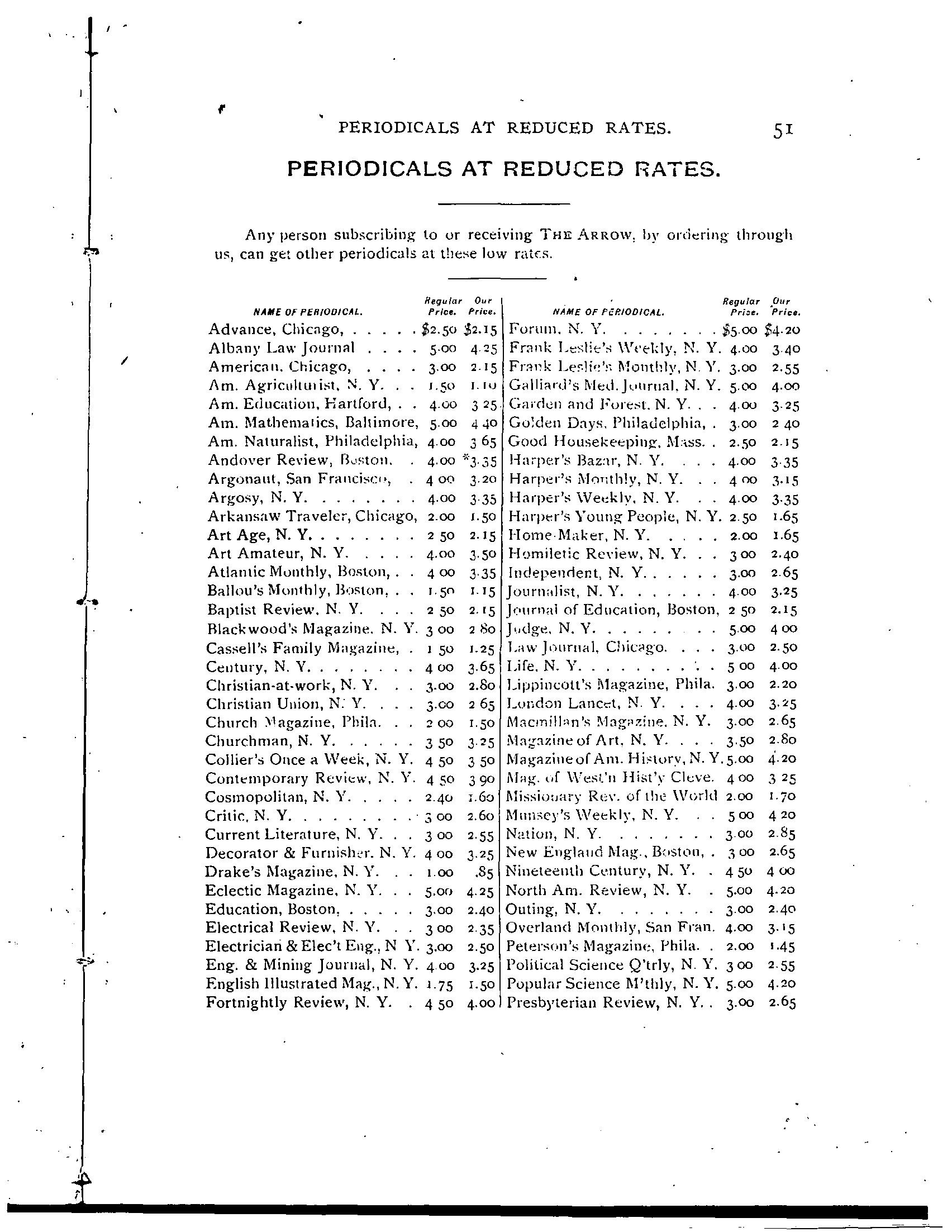
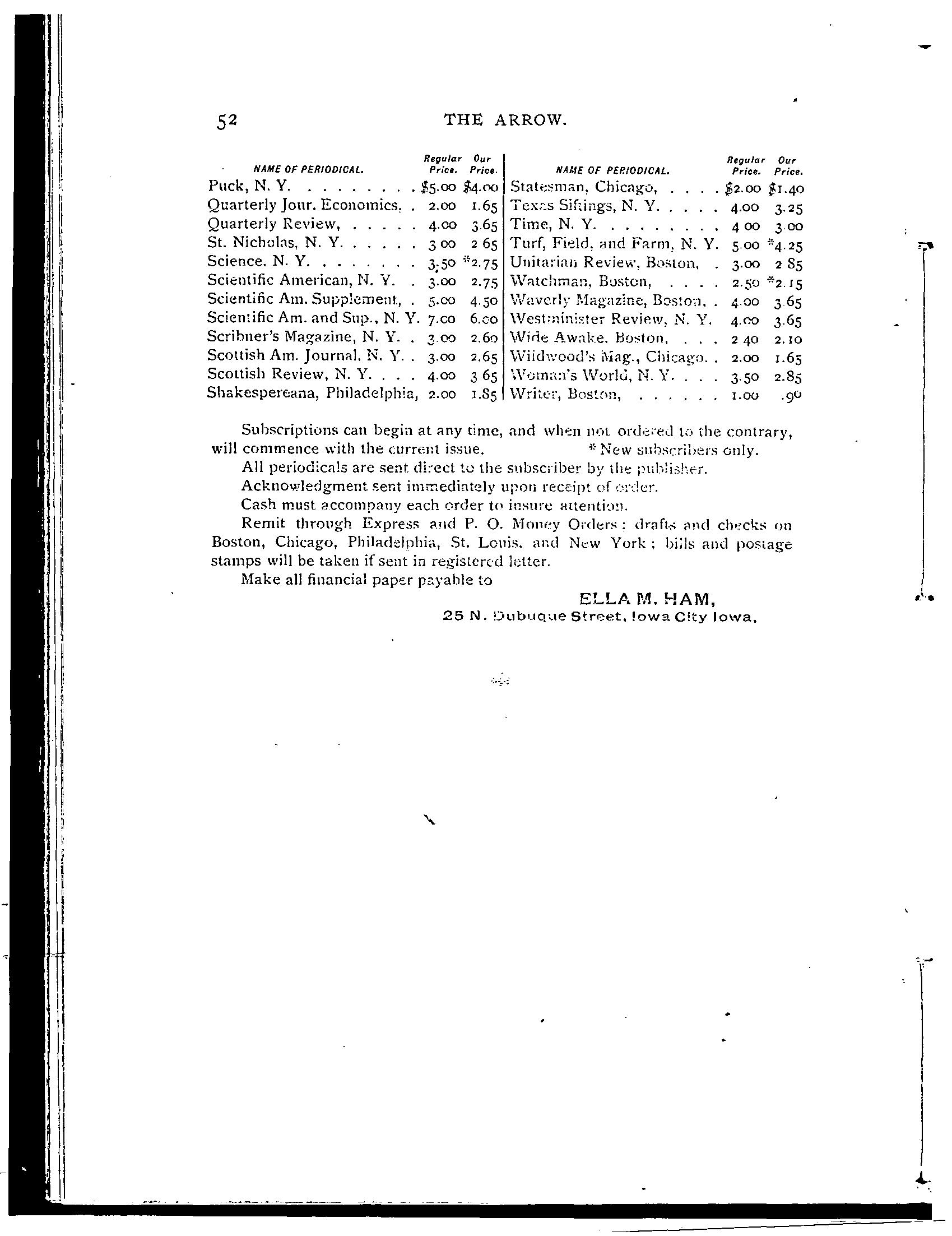
\Ve desire to call attention to the list of clubbing rates f01' leading peri6dicals that we are able to furnish our subscribers Those wishing to subscribe or renew their subscriptions for any of these publications will find advantageous rates. These rates can be used at any time.
BUSINESS MANAGER.
[Excltanges left out for wallt of space.]
Any person subscribing to or receiving THE ARROW: by ordering- through can get otber periodicals at t!Je:-;e luw ratf.S.
Advance, Chic;1g0, Alb,,,), Law Journal
Americ:ll1. Chicago,
Am. AgricuItUli:-;t. :--.:. Y.
Am. Education, Hartford, Am. Mathema1ics, Baltimore,
Am. Naturalist, Philadelphia, Andover Review, B<..lstOll.
Argonal1t, San Fral1ciscfO, Argosy, N. Y.
Arkansaw Tra ve1cr, Chicago,
Art Age, N. Y.
Art Amateur, N. Y.
Atlantic Munthly, Boston, .
Ballou's Monthly, B')SlOn , Baptist Review. N. Y.
Rlackwood's Magazine. N. Y.
Cassell's Family Magazine, Celltury, N. Y.
Christian-at· work, N. Y.
Christian Uuion, N: Y.
Church Phila.
Churchman, N. Y.
Collier's Once a vVeek, N. Y.
Con1t:'mporary Review, N. Y.
Cosmopolitan, N. Y.
Critic. N. Y.
Current Literature, N. Y.
G811iClrd's Med.Jt.'UTIlal. N. Y. 5.00 4.00 Gardell and Fore:-ot. N. Y. 4.00 3.25
Go;c!en D:lYs, Philadelphia, 3.00 240
Good Housekeeping-. M:1.ss. 2 . .')0 2.15 Harper's Baz:ll', N. Y. 4.00 3·35
"'3-35 Fr:lnk Leslit':, N. Y. 4.00 3.40 f\'!ollthly, N. Y. 3.00 2.55
400 3.20 Harper's i\-lI)T,thly, N. Y. 4.00 3·35 Harper', We"klv. N. Y. 3.
5 3·35
5 2.00 1.50 Harper's Young People, N. Y. 2.50
250 2. IS Home·Maker, N. Y. 4.00 3.50 Humiletic Re\'iew, N. Y.
400 3·35 Indepenrient, N. Y ,"sn I. '5 Journalist, N. Y. 2.00 3. 00 4.
5 1.
250 2. IS F,"rnal of EdlicHlion, Boston, 2 SO 2.15
300 280 J'.ldge. N. Y. 5.00
1 So J. 25 Lnv ] l)lIrll<-t 1, ClIic<-lgo. 3.00 2. SO
400 3.65 Life. N. Y. 500 4. 0 0 3.00 2.80 LippilH.:ott's r'1agazine, Phila. 3.00 2.20 3.00 265 London Lancet, N. Y.
Macmilhn':-; !\'13g;llille. N. Y. 3.00 l\l<1;;":lzine of Art. N. Y. 3.50 .Magazincor Am. N. Y.S.oo ur \\'est'n Clt..:ve. 400 1\li:-;sio:Jary Rev. or tht \Vorld 2.00 MUll<C),'S Weeki)" N. Y.
Decorator & N. y, 400 3.25 New EnglalJd J\.lag., B:.Istol1, Drake's Magazine. N. ·Y. 1.00 .85 Nineteenth N. Y. Eclectic Magazine. N. Y. 5.00 4.25 North Am. Review, N. Y. Education, Boston, 3.00 2.40 Outing, N. Y. Electrical Review, N. Y. 300 2.35 Overland IV10l1thly, San Fran. Electriciari &Elec't Eng.! N Y. 3.00 2.50 Peterson':-; Magazint;, Phila. Eng. & Mining Jourllal, N. Y. 400 3.25 Political Science Q'trly, N. Y.
English Illustrated Mag., N. Y. 1.75 1.50 PopUlar Science N. Y. Fortnightly Review, N. Y. 450 4.00 Presb)'terian Review, N. Y 450 400 5.00 4. 20 3.00 2·40 4·00 3. 1 5 2.00 1-45 300 2·55 5.00 4. 2 0 3.00 2.65
Puck, N. Y.
Quarterly Jonr. Economics, Quarterly Review,
St. Nichulas, N. Y Science. N. Y.
Scientific American, N. Y.
Scientific Am. Supplement, Scicn:ific Am. and Sup .• N. Y. Scribner's Magazine, N. Y..
Scottish Am. J ourna!. N. Y
Scottish Review, N. Y ShakesperE:ana, Philad.elphia,
3.65
NA!.1E OF PEP.IOOICAL. Stak:-::l11an, Chicago, Texr:.s Sifdngs, N. Y Time, N. Y Turf, Field, ::md F;'J.rm: N. Y. Unita:'i.-lli Review, Bo:.>ton, \Vatchman, Huston, V,!<:!"\'c.rly 1305;0",1. Review, N. Y. ,,vidE:: AW;lk.e. \Viidwood's iVlag., \Vorlu, N. Y. VVriL('r, Boston,
Subscriptions can begia at any time, and who::n W)t onJ.:;;-ed the contrary, wi1l commence with the current issue. ..:- New only. All period:ca!s are sent di:-ect to the subscriber by pubH;--;!:f-i. Acknowledgment 5ent immedintely upon receipt of (::-::1el". Cash must accompallY each order t(1 insure attenti'.)!l.
Remit throngh. Express tI.nd P. O. 1'\'ioney dn1ft.;-> on Boston, Chicago, Philadelphia, St. Lonis. and N;::w York; biils and postage stamps will be taken if sent in registered letter. Make all financial paper pyabJe to
ELLAM. HAM, 25 N. !.:.hlbuq:'le Street, Iowa City Iowa,
T,
DREKA and House,
1121 Chestr.l!t Stred. Philadelphia.
C.omm':!ncerlleJlt, (:las:; Day, RCceptii)n, and \C:!cdding liyv-ita\1.jD3, Ba:--,quet Nienu'3, etc8 Steel Piate
Work for Fraternities Anr.uals. Fir:e Stationery
Visiting Card FJate Zngraved for One Dollar.
JOO Cords from t"!le p!Rte fo'!'" One D'Jll:'r.
All work i ::xee,jted in (ht: '.!-;tabli"'\)lll !Ilt. u'lde:- O,jr supervision, and on1y in b':!S!. a:1,1 !C)ng pr;\ctic<\1 ,;llaiJle II;; l.u pr.:)dllCe styies allJ most cilt!cts, while our reput.:1:iflll i :1.':,;"U.lr-;llltC'C c,f the \. 1)( tilt' p "dllcriul\=-' (i[ tlJi:; iHJllse.
Designs. Samples, and Pr;cGs sent en appl!cation
.ANEW BOOK FROM COYER TO COVER
Fully Abreast with the Times.
'l'he Authentic Webster's Unabrldgea Dictionary, comprising the issues of 1864, '7'9 and '84, copyri;;hted property of the un. dersigned, is now Thoroughly Revised :';.n<1 Enlnrged, and as a· distinguishing title, bears the name of 'Vebster's International Dictionary. Editorial work on this revision has he en in active progress for (n'er Ten Years.
Not less than One Hundred paid editorial laborers have been engaged upon it.
Over 8300,000 expended in its preparation before the first copy was printed
Critical comparison with any other Dictionary is inVited.
GET THE BEST.
Sold hy 311 descriptive Pamphlet mailed free. Published by G. &. C. MERRIAM. &. CO., Sprlngtield,Mass.,U.S.A.