The strategy to secure carrier partnerships in any market cycle
Group 534: Almost all construction trades eligible
Group 533: All types of woodworkers, lumberyards, and building material dealers
Group 501: Plumbing, heating, cooling, HVAC, and steamfitting contractors
Hamond Safety Management Where Safety Pays Dividends
Up front discounts up to 35%, for new businesses that qualify.
Consistent annual dividend payments—unbroken string since the group’s inception.
Staff averaging 40+ years of workers’ compensation experience.
Focused exclusively on New York’s building trades industry.
*
50% of our service fee paid to brokers for the first 3 policy terms.
Hamond Safety Management included service checklist
Payroll and audit assistance
Audit preparation and support
Class code and payroll review assistance
Hearing and claims reviews, testimony support and assistance
OSHA compliance and safety training
Risk management and job-specific safety program development
Underwriting and billing assistance
Policy renewals, review and premium optimization
Please send all quotes to Alan Cohen – Sales & Marketing Specialist (516) 762-4212 • Fax: (516) 488-5940 ACohen@HamondGroup.com • Hamondgroup.com
MAKE THE MOST OF YOUR CARRIER RELATIONSHIPS
To your clients, one of the biggest benefits of working with an independent insurance agent is your ability to compare coverage options across multiple carriers and find the best fit for their needs.
While your clients may consider these relationships a given, you know that maintaining these connections can take time and effort. So, how do you go about cultivating these relationships?
Best practice: Carrier visits
• Make sure the right staff members are scheduled to attend each visit.
• Discuss the status and future goals for both the agency and the company. If there’s a disconnect, be sure to address it or consider your agency’s options.
• Don’t forget to schedule follow-up meetings.
Tips for agents: Carry the relationship beyond the carrier visit: Take part in carrier and insurance industry networking events. This will allow you an opportunity to get to know your carrier representatives in a less formal environment, and to help build rapport that you can carry back to the agency.
Prove your agency’s value: Come to the carrier visits prepared and ready to move forward with your carrier relationships. Have an idea of what each carrier is looking for, and how your agency can help each carrier achieve its goals.
Timeline. Meet quarterly with your top-tier carrier partners to review production, loss ratios, goals, etc. However, you should meet at least once or twice a year with all your carriers. If these meetings aren’t taking place, ask yourself why this might be the case, and determine if you need to make changes.
Best practice: Direct rapport
• Build personal connections with underwriters and marketing representatives.
• Be responsive and proactive. Respond to carrier queries quickly. And, if there’s an issue, let the carrier know ahead of time so your company representatives have time to respond.
• Make sure the information you send your carrier representatives is complete and represents the whole story—whether it’s a policy request or claims submission.
Tips for agents: Assign a specific team member to be a dedicated contact for each carrier representative. This will make it easier to build a good working relationship, and to cut down on the learning curve as everyone becomes more familiar with each other.
Prove your agency’s value: Refine your client base to move beyond those individuals who are just looking for the lowest price. Instead focus on your clients who are aligned with your agency and carrier goals. When you find clients who are interested in building relationships, you find clients who are more likely to stay with your agency and the carrier.
Best
practice: Utilize the tools
• Work with your carriers to determine which carrier tools streamline agency workflows.
• Make sure everyone in your agency has the proper training, and knows how to use the tools and resources each carrier provides your agency. If you have team members who are struggling, ask for additional training.
• Review the data analytics to determine the next steps for your agency.
Prove your agency’s value: If your carriers offer you an opportunity to provide insight into their innovation, be a part of the process. Be prepared to discuss your client base and their needs, and how new processes could help or hinder your agency’s business growth.
Be candid. If you are not forthcoming about changes or problems, your carrier representatives will find out eventually. If your carrier partners are constantly scrambling to adjust to new information or ongoing troubles it will make it harder to maintain quality, working relationships.
Tips for agents: Agents who don’t innovate their agencies risk falling behind. However, it’s important to make sure to do it when it makes the most sense for your agency. Taking on too much at one time can be overwhelming.
Work smarter. Digital platforms enable rapid quoting and binding, which reduces paperwork. And, artificial intelligence can help you perform better risk assessments, and can offer personalized solutions for your clients.
PIA Northeast’s mutual partnership between agents and carriers
To strengthen and grow the independent agency distribution channel, PIA Northeast established the PIA Carrier Partnership. Its goal: to enhance the dialogue and collaboration of independent insurance agents and carrier partners. The partnership is co-chaired by PIANY President Jason Bartow, AAI, CPIA, TRA, and PIANJ President Aaron Levine, CIC.
After the COVID-19 pandemic, PIANY’s leadership wanted to revamp its Regional Advisory Councils, and they discussed the idea of establishing a Carrier Advisory Council.
“We wanted to focus on issues that affect agents throughout the Northeast, so we could talk about topics that really matter,” said Bartow. “Certain issues create a massive shift in the dynamic of carrier/agent relations [e.g., private equity, mergers and acquisitions, third-party litigation funding].
Carriers look to the agents for insight; agents want to work with carriers to find the answers that benefit them both. Now, carriers are showing their commitment to independent agents, so with this positive response, it seemed like the perfect time to launch a partnership.”
And, so the PIA Carrier Partnership was created.
These meetings—there have been several already, including at PIANY’s MetroRAP in January, and at last month’s PIANJ | PIANY Annual Conference—move beyond discussions of commissions, pricing and products, and include individuals who are willing to come to the table and work together. It’s a space where carrier representatives can explain the decisions they are making—and ask for feedback—so that agents understand that these changes (e.g., policy forms and rate drivers) aren’t arbitrary.
“The dialogue is great, and the momentum continues to grow. We are building relationships on the surface, and then we are diving into what matters at each meeting,” said Levine. “However, the relationships between carriers and agents are paramount. Maintaining these relationships increases knowledge and understanding. It also helps to make sure that consumers have a better product and experience with both their agents and their carriers. It helps consumers understand the process, so that conversations between agents and their clients can move beyond price.”
Most national insurance carriers have their own agency advisory councils, but they usually include representatives from larger agencies. PIA Northeast’s Carrier Partnership is different: It focuses on smaller, independent insurance agents, so the carriers can know what’s going on with them— their answers to questions, and the issues they face can be
vastly different than those of the larger insurance agencies. Because of this focus, the carriers have a better picture of how all their agency partners are faring. Better relationships between agents and carriers means better communication between the two, which in the end benefits the clients.
During the meetings, the agent and carrier representatives have discussed myriad topics that affect insurance agents in the Northeast, including: agent- and consumer-facing communications; how technology/artificial intelligence affects everyone day-to-day; and third-party litigation funding. And, they also create high-level access to the carriers for the PIA Northeast membership—in fact, the CEO Panel Discussion that was held as part of this year’s PIANJ | PIANY Annual Conference, was a direct result of these meetings.
The information gathered at these meetings can carry over to the agents’ everyday business practices. PIA Northeast can share the information with its members (e.g., what factors are driving rates), and then agents can use it to help ease consumers’ concerns. If agents know about carrier changes ahead of time, agents can reach out to their clients proactively, so they aren’t blindsided at renewal time.
Watch your PIA publications for more details from these meetings. If PIA Northeast members have issues of concern, or want the partnership to address a specific topic at a future meeting, let PIA know (via email at pia@pia.org), and Bartow and Levine will bring it up at the next meeting.
CARRIER PARTNERS:
Access 100+ quality carriers with one powerful partner
More markets. More solutions. More wins for your clients.
Brooks Insurance Agency gives you direct access to over 100 trusted carriers nationwide, helping you place both standard and hard-to-place risks with confidence.
Why agents choose Brooks:
Deep carrier relationships across the U.S.
Web-based quoting tools to streamline submissions, making it easier to find the right market—fast.
Broad appetite across commercial and personal lines
Collaborative wholesale approach to challenging risks
Expand your markets to win more deals.
Contact a Brooks broker at info@brooks-ins.com and scan to start a quote.
Let me tell you about the Roman Empire, please!
Bradford J. Lachut, Esq. Director of government & industry affairs, PIA Northeast
There’s a certain point in life—usually somewhere north of 40—when you start receiving books about the Roman Empire as gifts. As someone comfortably on that side of the line, I can attest to the truth of this statement. I’ve received several—including a book on the emperors of Rome. And, while I would love to walk you through it, I’ll spare you that experience.
What matters here is one of the book’s central themes: often history is shaped by those who come next. Emperors who followed particularly disastrous predecessors had a vested interest in distancing themselves from the past—sometimes literally. Buildings were constructed on top of older structures. Roads were rerouted. Monuments were repurposed. Rarely was anything fully removed.
Instead, Rome became a layered system—generation after generation building on what already existed.
Sometimes it worked brilliantly. Roman roads lasted for centuries. Aqueducts still stand today. And, sometimes it didn’t. Layers hid weaknesses. Inconsistencies accumulated. Systems that appeared solid on the surface became fragile underneath, and they would crumble.
It’s hard not to see the parallel to modern insurance industry technology.
A system built in layers
Today’s insurance technology ecosystem wasn’t cleanly designed for the demands placed on it now—it has evolved.
Carrier systems were built decades ago to solve the problems of their time. Over the years, new capabilities were added—sometimes carefully, sometimes quickly—without fully removing what came before. Agents, facing their own pressures, assembled technology stacks to keep pace: management systems, comparative raters, customer relationship management and document tools. The list goes on.
The result isn’t a single, unified structure. It’s an interconnected city—roads layered on roads, new bridges tied into old foundations. When everything lines up, the system functions. When it doesn’t, cracks appear.
And unlike a crumbling villa, these failures aren’t hidden— they show up immediately in day-to-day operations.
When the road doesn’t lead to Rome
Across the insurance ecosystem, the movement of information is often less seamless than it appears. While systems are designed to connect, the reality is that gaps still exist between them.
These gaps tend to show up in familiar ways. Information is entered into one system, only to be re-entered into another. A quote might begin in one place and then it needs to be completed somewhere else. And, a policy update can exist in multiple versions at once—depending on which system you happen to check.
In other words, the roads exist—but they don’t quite meet. From a distance, it looks like a functioning city. Up close, agents and their staff are navigating around gaps that shouldn’t be there—bridging systems that were intended to communicate directly. The result is delay, duplication and the potential for inconsistency at every turn.
The cost of structural gaps
It’s easy to dismiss these disconnects as inconveniences—just part of the workflow. But history—Roman or otherwise— teaches us that small structural issues rarely stay small.
Errors multiply. Every time information must be manually rekeyed, the risk of mistakes increases. In insurance, even minor discrepancies can have outsized consequences.
Service slows. When systems don’t align, routine transactions take longer. Consumers expect speed and clarity. Friction—visible or not—affects their experience.
Frustration rises. Agency staff didn’t enter the business to manage technology workarounds. Yet too often, they’re left compensating for gaps technology should address.
Compliance risks emerge. Inconsistent or delayed information across systems isn’t just inefficient—it can raise
regulatory concerns. Discrepancies invite questions, and questions invite scrutiny.
What begins as a system-level issue ripples outward, affecting trust, service and accountability.
Rome wasn’t built in a day
This isn’t the result of bad intentions— it’s the result of evolution.
Many carrier systems were built in an era when real-time integration wasn’t expected. Over time, enhancements were layered on, workarounds became normalized, and legacy processes remained because replacing them entirely was costly and risky.
At the same time, agencies adopted tools to solve immediate needs—often without the luxury of ensuring every system could seamlessly connect with every carrier platform.
No one set out to create disconnects. But layered systems, left unaligned, tend to drift.
Rome didn’t struggle because it lacked infrastructure. It struggled when that infrastructure could no longer support the demands placed upon it (and then the Visigoths attacked).
When the infrastructure works
We also know what success looks like— because we’ve seen it.
When systems are designed to communicate effectively, data flows smoothly between platforms without manual intervention. Quotes move seamlessly from initiation to binding. Policy changes synchronize in real time. Documentation is created as part of the process, not reconstructed after the fact.
In that environment, agents focus on advising clients. Carriers operate more efficiently. Consumers receive faster, more accurate service.
The infrastructure fades into the background—exactly where it belongs.
What about low-tech environments?
Independent agents are not a monolith. Agencies operate across a wide spectrum of technological sophistication—and some operate with very little technology at all.
Layered infrastructure still affects these agencies—sometimes more acutely.
Low-tech environments rely heavily on manual processes, which makes system disconnects harder to absorb. When information must move between organizations operating at different technological levels, inefficiencies compound. Paper, PDFs, phone calls and emails become the connective tissue.
That can work—for a time.
However, as regulatory and industry expectations rise and consumer demands increase, the strain becomes harder to ignore.
The issue isn’t that every agency must adopt the same tools overnight. It’s about approaching modernization thoughtfully—identifying pressure points, addressing inefficiencies incrementally, and ensuring that improvements account for varying levels of technological maturity.
More than an industrywide tech problem
This is not just an IT issue—it’s an industry issue.
Regulators are paying closer attention to consumer experience, safety, accuracy and operational effectiveness. Technology limitations don’t stay contained within systems; they show up in audits, complaints and enforcement actions. There’s also a competitive dimension. Carriers that are easier to do business with—particularly from a technology
standpoint—have a clear advantage. Integration is no longer optional; it’s part of the value proposition.
For agencies, efficiency across multiple carriers isn’t a convenience—it’s essential to serving clients well.
A shared opportunity
The encouraging news is that this is a solvable challenge. Carriers investing in technology that allows different software applications to communicate effectively, real-time data exchange and integration with agency systems are strengthening the foundation for everyone. Agents who advocate for better connectivity reinforce that ease of doing business includes how well systems communicate.
At an industry and policy level, there’s an opportunity to support modernization and data standards without imposing one-size-fits-all mandates. Rome didn’t thrive because every region was identical—quite the opposite. It thrived because its infrastructure allowed different regions to function as part of a connected whole.
Rebuild with intention
Layered systems aren’t inherently flawed. Romans proved they can endure for centuries—if they’re maintained, aligned and adapted thoughtfully. However, ignoring structural gaps doesn’t make them disappear.
The goal isn’t perfection—it’s progress. Progress toward systems that communicate clearly, share information accurately, and support the people who rely on them every day.
Because in an industry built on trust and relationships, infrastructure matters. Even the invisible kind.
Now … who wants to hear about Alexander the Great?
If premium finance is part of your business, it should be a meaningful revenue engine - not just a process.
While many agencies are earning...they are not necessarily optimizing.
As a PIA member, you can share portfolio data for a complimentary analysisno obligation, no identifying information required - to determine:
• Revenue gaps
• Alternative earning structures
• Operational insights
Request your complimentary revenue consultation today. Reach out to: solutions@afcodirect.com
Real Dividends!
$459 Million Paid
“In a world of customer service outsourcing, I truly appreciate the personal service from the team at Friedlander. Not only does Friedlander offer lower workers’ compensation premiums and dividend options for our insureds, but their customer service is also impeccable. Whether inquiring about prospects, quotes, or billing, the team is knowledgeable and quick to respond. The Elwood Jordans Insurance Agency is a small hometown agency, and I feel we are treated with as much importance as their larger clients.”
Jenny Urbanski, Commercial Service Manager The Elwood Jordans Agency, Inc., Alden, NY
UP TO 45% SAVINGS UPFRONT!
RETAILERS
WHOLESALERS
RESTAURANTS
HOME HEALTHCARE
RESIDENTIAL CARE
uFINANCIAL SERVICES
MATERIAL
Maria Thomas | 631-834-9829 mariat@friedlandergroup.com (LI, Manhattan, Queens, Brooklyn, Bronx, Staten Island)
Donna Nygard | 914-844-2195 donnan@friedlandergroup.com (Remainder of NY, NJ, and CT)
Work with carriers: Manage property risk, close coverage gaps
Ryne Carney Head of property product, Middle & Large Business Unit, The Hartford
From fluctuating costs to potential flooding and other extreme weather, business owners are confronted with risks to operations and profitability regularly, making a holistic risk management program critical to staying ahead of property exposures. If left unchecked, these trends can lead to gaps in coverage.
Prerenewal stewardship reviews provide a key opportunity for agents and brokers to assess their clients’ risks and collaborate with carriers to address potential gaps in insurance. For example, economic inflation can change property valuations and result in coverage gaps if policyholders have not examined their estimated replacement costs recently. It is important that all parties—policyholder, agent and carrier—have the latest data on specific risks.
Understand insurance-to-value
Agents need to explain to their clients that one of the best ways to make sure a property is insured adequately is to know the true replacement cost value. Business owners need to perform regular coverage limit assessments relative to property replacement costs—known as insurance-to-value. Clients need to understand that in the event of a major loss, if policy coverage limits have not been re-evaluated over time, the policy may no longer afford enough limit to cover replacement costs at today’s prices. Having an accurate assessment of the complete cost to replace the insured property can be the difference between recovering quickly or facing significant out-of-pocket costs and prolonged disruption following a loss.
Help with asset valuation
Getting the valuation right is helpful for property owners to avoid coverage gaps when they experience a claim. Due to inflationary pressures, higher energy input costs and supply-chain challenges, agents can explain that construction materials may be more expensive today than they were 12-24 months ago. An additional cost driver is skilled labor, which is in high demand but short supply. Added together,
it costs more to repair or replace components following property damage. However, having an insurance agent or broker work with an experienced carrier can help alleviate any complicated valuation scenarios.
Risk engineering and underwriting professionals can track replacement cost trends, and they have access to several industry data sources that track material and component pricing. By using data to assist in property replacement cost valuation, agents and carriers can help business owners maintain adequate insurance-to-value and better protect their facilities.
Protect property from flooding and water damage, plan ahead
While flood insurance serves as an essential risk management element of a large business insurance plan, it’s also important for business owners to maintain a flood emergency response plan to prepare for, respond to and recover from a flood. This plan should include details about evacuation procedures and employee responsibilities, sheltering-in-place protocols, medical emergency information, emergency response teams and contact information for public emergency services and contractors. The plan also should address post-loss response actions, including prompt assessment, initial water removal and temporary mitigation measures, as early restoration efforts can help limit secondary damage and reduce the risk of extended downtime.
Agents need to remind their clients that even areas considered lower risk can be vulnerable to flooding due to intense rainfall, flash flooding or construction-related runoff. Agents should advise their business owner clients to take practical steps, such as routine site inspections to identify potential water-damage exposures. They should also perform basic maintenance to keep drainage systems clear and functional.
For nonflood water risks, a formal Water Damage Prevention Plan can serve as a foundational element of a property risk management program. A well-designed plan incorporates
appropriate physical mitigation measures—such as the use of backflow preventers on sewer connections—along with technology-enabled solutions like water-sensing devices to help identify uncontrolled or unintended water in vulnerable areas.
Operational preparedness is equally important. Typically, effective plans designate trained response personnel, document the location of zoned shut-off valves and maintain an updated list of emergency service providers to support a prompt response when water incidents occur.
The impact of building codes and roof design
Building design can play an important role in reducing water intrusion, particularly when it comes to roof construction. Agents should be prepared to ask their clients about their roofs’ construction. Many buildings are constructed without sealed roof
decks, which is the structural surface beneath roofing materials. Think of the roof deck as the floor of the roof, and the shingles as the outer skin. If high winds tear off shingles and the roof deck is not sealed, rain can pour straight into the building.
Although sealed roof decks are most easily incorporated during initial construction, existing buildings still can benefit from retrofit solutions and enhanced roof system maintenance to reduce the risk of wind-driven water intrusion.
Strengthen buildings against severe weather
Insurance agents can work with their clients and contractors to help their properties better withstand a broad range of severe weather, including helping to reduce the risk that wind will cause serious damage or lead to costly water intrusion. For example, installing steel straps to reinforce
roof-to-wall connections within the building’s framing may help improve structural performance and reduce potential damage from hurricane or tornado-force winds.
Building owners also can take steps to support operational continuity during severe weather, including assessing whether emergency generators are appropriately sized to support essential operations during a power outage.
A partner with experience
Insurance agents and brokers play an important role in helping business owners think proactively about protecting their property and operations.
Working with an experienced carrier can complement a policyholder’s own risk-mitigation efforts by aligning coverage, loss-prevention resources and long-term risk awareness.
Carney is head of property product in the Middle & Large Business Unit at The Hartford.
SPRING WEIDMAN, API, AINS, AIS
Distribution division manager, NYCM Insurance
EARN THE APPOINTMENT
The strategy to secure carrier partnerships in any market cycle
or independent agents, earning an appointment with a property/ casualty carrier is a significant step in growing their businesses. It’s also not as straightforward as many expect. In the current market, carriers are adjusting their underwriting appetite, watching profitability closely, and managing regulatory requirements that continue to evolve. From the agency side, the decision process sometimes can feel opaque.
Ultimately, the appointment decision comes down to business fit. Carriers evaluate risk alignment, growth strategy, operational readiness and long-term performance expectations. Agents who take the time to understand these dynamics tend to present a stronger case for partnership.
Start with strategy, not a submission
Before approaching a carrier, agents should recognize that appointments are driven by business objectives.
Every carrier operates with defined growth priorities. Some are expanding into small commercial, while others are tightening personal auto guidelines. Certain carriers are entering new territories; others are recalibrating following catastrophe exposure or unfavorable loss trends. Carrier appointments are driven by strategic alignment. If an agency’s book of business doesn’t match the carrier’s capital priorities, approval is unlikely, regardless of reputation.
Interested agents should review earnings reports, monitor industry coverage, and pay attention to product launches, leadership changes and geographic expansion announcements.
There is a clear distinction between requesting an appointment and demonstrating an understanding of a carrier’s current priorities. Agents who can speak to how their books of business align with those priorities enter the conversation with greater credibility.
Lead with data
In many appointment discussions, agencies rely on broad statements about growth, service quality or client loyalty. While those characteristics are important, they are not sufficient on their own to support a business case for appointment.
Carriers assess agencies with the same structured thinking they apply to underwriting. Decisions are grounded in performance data. Agents should be prepared to present clear metrics.
Typically, this includes:
• total written premium;
• distribution by line of business;
• retention rates;
• three- to five-year growth trends;
• average account size;
• new business production;
• cross-sell ratios;
• loss ratios;
• business plan; and
• perpetuation plan.
If an agency presents organized, accurate data to a carrier, it reflects operational discipline. It signals that the agency understands its own performance drivers, and that it manages the business accordingly.
More importantly, it positions the agency as a strategic partner to the carrier.
Profitability matters more than volume
This is an area where agents can sometimes misjudge where carriers are allocating attention.
Most carriers aren’t chasing premium just to grow top-line numbers. What they care about is profitable growth. Adding volume without underwriting discipline doesn’t move the needle the way it needs to be moved.
When an agency’s presentation emphasizes production, but it does not address risk selection, it can raise concerns. Carriers are mindful of adverse selection, and the possibility that higher-risk or price-sensitive accounts may be directed toward them without careful assessment.
For example, an agency might indicate that its personal auto book of business is concentrated in standard, multivehicle households with clean driving records and minimal prior losses. It also may outline how driving history and prior claims are reviewed before submitting any new business. That level of clarity does more than highlight prospects; it shows a solid understanding of risk quality and alignment with carrier standards.
When carriers are confident that an agency is intentional about risk quality, the discussion shifts from volume to long-term partnership.
Operational readiness is part of the equation
Appointments are not just sales decisions. They are operational commitments.
From the carrier’s perspective, appointing an agency requires onboarding resources, compliance review, contract management, training and ongoing support. If your agency appears disorganized, that perceived cost increases. Make sure your house is in order before asking for access.
This includes:
• proper licensing for all producers;
• adequate errors-and-omissions coverage;
• clean compliance records;
• defined submission workflows;
• a modern agency management system; and
• clear documentation standards.
Emphasize commitment to customer service
In an era of technological shifts in the market and rising consumer expectations, commitment to customer service remains a defining differentiator for independent agents. Carriers value agencies that:
• maintain high client retention;
• invest in service teams and technology;
• respond quickly and professionally; and
• protect the carrier’s reputation.
Explain how your service model enhances the policyholder experience. Show how you reduce E&O exposure, improve communication, and reinforce the carrier’s brand promise.
Customer loyalty drives policy longevity, and policy longevity drives profitability.
Timing matters
Market cycles matter. In a soft market, carriers are in growth mode. Appetite broadens. Guidelines loosen. Distribution expands. Adding agencies is part of the strategy because market share becomes the goal.
In a hard market, the agency appointment strategy for a carrier changes quickly. Carriers start protecting results instead of chasing premium. New appointments slow down or stop altogether. Territorial concentration draws increased scrutiny, and loss performance moves to the forefront of strategic discussions.
The same carrier that was eager to talk to you three years ago may now be pulling back due to exposure, reinsurance costs or underwriting performance. It doesn’t mean your agency isn’t strong. It may simply mean the carrier’s strategy has shifted.
Some items agents should watch for include more frequent rate filings, tightening guidelines, more selective underwriting, and earnings calls that start to emphasize profitability versus growth.
On the flip side, when a carrier enters a new state, launches a product or announces a growth initiative, that’s your window to act.
Differentiate with substance
There are thousands of independent agencies in the market. Almost all of them would describe themselves in similar terms: customer-focused, relationship-driven and growth-oriented. Do you specialize in a niche class of business with historically stable loss performance? Is your crosssell ratio above industry averages? Have you maintained favorable loss ratios through multiple market cycles?
Carriers that are under pressure to restore their profitability will pay close attention to your performance history. They want to see how your agency performs in changing market conditions.
Set realistic production expectations
As conversation progresses, projected production becomes a key topic.
In a soft market, ambitious production forecasts tend to receive more flexibility. In a hard market, inflated projections raise concerns. Carriers are less interested in rapid premium growth if it compromises underwriting discipline.
Overstating production potential may secure an appointment initially, but underperforming or presenting business that doesn’t align with the carrier’s appetite can damage the relationship quickly. Carriers monitor new appointments closely—particularly during the first 12 to 24 months.
Offer conservative, defensible projections. Explain how the carrier will be incorporated into your quoting workflow. Target segments that match the carrier’s appetite. Disciplined, sustainable growth is attractive in any cycle, but it is essential in a hard one.
Prepare for due diligence
Appointment discussions often feel collegial, but the underwriting discipline carriers apply to risks extends to agencies as well. Expect background checks, financial reviews, licensing verification and E&O confirmation. Transparency is critical. Highlight what’s working well, and if there are a few gaps, pair them with the actions taken to close them. That kind of clarity usually makes compliance reviews faster and more collaborative. Having your documentation organized and ready to share upfront signals operational discipline—which makes it easier for the carrier to move forward with confidence.
Demonstrate long-term commitment
Carriers are wary of books of business that swing from one market to another every year, or that shift heavily in concentration. This may cause a carrier to question whether you’re building real partnerships or prioritizing price over collaboration.
Point to the carriers you’ve stayed with for multiple years. Show that your distribution is well balanced and make it clear you’re focused on building a steady, sustainable book of business. This shows carriers that you’re not jumping ship every time rates move.
From a carrier’s perspective, consistency matters. Stable distribution means fewer surprises and less volatility.
Handle rejection with discipline
Rejection is part of the process. How you respond makes a real impression.
If the answer isn’t what you hoped for, ask what you could strengthen to be a better fit down the road. Keep the relationship intact and stay in touch. This gives you the opportunity to share updates as your book of business grows or your strategy evolves.
A thoughtful, professional interaction today may open a door later.
Consider alternative access models
For newer or smaller agencies, direct appointments may be difficult to obtain immediately. Aggregators, clusters and networks can provide market access, increased profit-sharing
leverage and carrier relationships that might otherwise be unavailable to them.
These arrangements come with trade-offs. Typically, some of these trade-offs surface in commission splits or autonomy, but they can serve as stepping stones. In some cases, they also strengthen negotiating leverage down the road.
The key is understanding the economics clearly before committing to these types of relationships.
Approach it with an executive mindset
At the end of the day, an appointment decision isn’t personal; it’s strategic and economic. Carrier leadership is weighing questions like:
• Will this agency deliver profitable growth?
• Will it respect and support underwriting discipline?
• Will it represent our brand the right way in the market?
• Does it operate with strong compliance and professional standards?
• Does this relationship meaningfully strengthen our distribution strategy?
Agents who frame their conversations around those priorities separate themselves quickly. They are positioning themselves as potential partners contributing to a shared objective, not as applicants seeking approval.
The bottom line
Securing a p/c carrier appointment isn’t about being persistent or likable. It comes down to alignment, preparation, timing and credibility.
When agents treat the process casually, they tend to stay frustrated. The ones who approach it strategically with solid research, clean data, operational readiness and realistic growth projections have a much easier time gaining traction.
Appointments aren’t simply granted; they represent a meaningful investment in underwriting capital and brand trust.
A clear understanding of that responsibility will position your agency as a credible and valued partner.
In a competitive market, that distinction is what sets leading agencies apart, and opens the door to new opportunities. Weidman has been with NYCM Insurance for 13 years—including a decade overseeing software quality in Application Development. She leads the Distribution Division, including agency relations, e-commerce and marketing representatives. NYCM Insurance is a participating member of the PIA Northeast Carrier Partnership.
Ben Ward Marshall Glass Gary Reisman
Mark Soraci
New England underwriting manager, Merchants Insurance Group
Understand how carriers evaluate risk
How to prepare a winning underwriting submission
In today’s property/casualty insurance environment, underwriting has become more disciplined, data-driven and selective than ever before. Capacity constraints, rising loss costs and increased market volatility have placed pressure on carriers to scrutinize each risk more carefully. For independent agents, this reality has elevated the importance of one foundational skill: preparing a high-quality underwriting submission.
A strong submission isn’t just a procedural step; it’s a strategic differentiator. It influences not only whether a risk
is quoted, but how it is priced, structured, and ultimately retained. The difference between a favorable outcome and a missed opportunity can come down to how effectively the risk is presented.
For agency principals, building a culture of submission excellence is one of the most impactful ways to improve performance across the organization. They can guide their teams in building underwriting submissions that stand out, reduce friction and drive better results.
Understand the underwriter’s perspective
Underwriting is fundamentally about evaluating risk, assessing whether a business is financially stable and operationally sound, and whether it aligns with the carrier’s appetite. Underwriting decisions are made with the information presented, while balancing profitability and growth objectives.
At a basic level, underwriters are trying to answer a core set of questions:
• What does this business do? How does it operate?
• What exposures are present?
• How well are those risks managed?
• Does this account align with our appetite and strategy?
A submission that answers these questions clearly and proactively reduces uncertainty, which often leads to more optimal decisions on pricing and terms—as well as fewer declinations. From an underwriter’s perspective, incomplete or unclear submissions slow down the process, introduce doubt, and often result in follow-up requests or missed opportunities altogether.
By contrast, a well-prepared submission builds confidence. It signals professionalism, preparedness and a clear understanding of the risk—which positions the agent as a trusted partner to the carrier.
A winning underwriting submission
At its foundation, a winning submission is complete, accurate and thoughtfully constructed. The most basic and critical element of a successful submission is its completeness.
While requirements vary by carrier and line of business, there are several core elements that consistently strengthen submissions and accelerate underwriting decisions.
A strong submission should include:
• a detailed description of operations, clearly explaining what the business does, how it generates revenue, and any unique aspects of its operations;
• the year the business was established—provide context around stability and longevity;
• years of experience in the field or trade, particularly for ownership and key leadership;
• five years of hard copy loss runs, offering a clear and credible view of claims history;
• prior carrier information for the past five years, including coverage continuity and market movement;
• the business’s website, which allows underwriters to validate and to better understand operations quickly;
• complete contact information, including phone number and email address;
• key exposure metrics such as gross sales, payroll and the number of employees;
• a clear indication of whether the agency controls the account; and
• targeted pricing.
While these elements may seem straightforward, their absence is one of the most common reasons submissions stall. Incomplete submissions are one of the primary sources of friction in the underwriting process. Missing data leads to follow-up requests, delays, and in some cases, lost opportunities.
Agency principals should reinforce internal processes that ensure submissions are reviewed for completeness before they are sent. Consider standardized checklists, submission templates and internal quality-control steps.
The goal is simple: eliminate avoidable back-and-forth between the agency and the carrier by presenting a fully developed picture of the risk upon submission.
Tell the story
Data alone isn’t enough; underwriters need context. A winning submission clearly tells the cohesive story of the account. Beyond raw data, a strong narrative helps underwriters understand what the business does and its day-today operations, who its customers are and how services are delivered, how the business has evolved over time, and what differentiates it from others in its industry.
Key elements of a strong narrative include:
• Operations overview: What products or services are provided? Who are the customers?
• Experience and leadership: How long has the business been operating? What is the management team’s background?
• Growth trajectory: Is the business stable, expanding or changing direction?
• Risk controls: What specific measures are in place to mitigate exposures?
This narrative is vital for accounts that may appear complex or fall outside standard underwriting patterns. Without proper context, underwriters may rely on assumptions, which may lead to undesired outcomes.
By articulating the story behind the risk clearly, agents can guide the underwriting process and highlight strengths that might otherwise be overlooked.
Highlight risk management
One of the most effective ways to strengthen a submission is to demonstrate how risk is managed. Remember, underwriters aren’t just evaluating exposure. They are assessing how well that exposure is controlled. Two businesses with similar operations can be viewed differently depending on their approach to risk management. Businesses that can demonstrate strong risk management practices often are viewed more favorably, even in challenging classes.
Submissions should highlight the loss control measures in place, such as:
• formal safety programs and employee training;
• hiring practices and background screening;
• equipment maintenance and inspection routines;
• cyber security protocols;
• contractual risk transfer strategies; and
• claims management processes.
Providing this level of detail positions the insured as proactive and disciplined, giving underwriters greater confidence in the long-term performance of the account. For agencies, this represents a significant value-add opportunity by helping clients articulate their strengths in ways that resonate with underwriters.
Align submissions with carrier appetite
Not every risk is a fit for every carrier. One of the most important and often underutilized skills in submission preparation is aligning the account with the right underwriting partner.
Before submitting an application, agents should ensure the risk fits the carrier’s target industries or classes, the exposures are within acceptable parameters, and the account aligns with the carrier’s growth strategy.
Agents should focus on targeted submissions, matching risks with carriers that are most likely to value them. This approach improves efficiency and strengthens long-term partnerships.
A winning submission matters
The benefits of a strong underwriting submission extend beyond securing a quote. They influence nearly every aspect of the underwriting and placement process. High-quality submissions speed up decision-making, which in turn,
reduces turnaround time and improves client experience. They improve quote accuracy—minimizing surprises and ensuring that pricing reflects the true exposure—and help ensure appropriate coverage and endorsements, aligning policies with actual risk.
A winning underwriting submission reduces the likelihood of premium changes post-bind, which creates greater stability for clients and saves time for agents and underwriters by limiting unnecessary back-and-forth. Additionally, it demonstrates strong loss control measures upfront, and ensures all relevant information is disclosed and documented.
These benefits translate into stronger client relationships, improved retention and more efficient agency operations.
Leverage technology without losing the human element and judgement
Technology has improved the submission process significantly. Digital applications, data pre-fill tools and submission platforms have increased speed and efficiency—however, technology cannot replace human judgment.
The most effective agents use technology to streamline data collection while still investing time into narrative development, risk analysis and relationship-building. A well-crafted submission reflects both accurate data and thoughtful interpretation.
Maintain accuracy and excellence in underwriting submissions
Accuracy is essential in underwriting submissions. Inconsistent or contradictory information raises red flags and can erode underwriter confidence. Even small discrepancies in information (e.g., payroll figures or loss histories) can create doubt in the integrity of the submission.
Preparing winning submissions is not just an individual skill among agents; it’s an organizational discipline. Agency principals play a key role in setting expectations and building systems that support consistency and quality.
This may include:
• establishing standardized submission requirements and checklists;
• training producers and account managers on underwriting expectations;
• implementing internal review processes;
• sharing examples of strong submissions and reviewing best practices; and
• creating accountability for submission quality across the agency.
Over time, these efforts create a culture in which strong submissions are the expectation, not the exception.
Strategic impact of a strong submission
A high-quality underwriting submission shapes outcomes. It can lead to more competitive pricing, broader coverage terms, faster turnaround times and stronger carrier relationships.
Conversely, weak submissions can result in missed opportunities, higher premiums or declined risks.
Agents who invest in submission quality differentiate themselves. They are seen as partners who bring well-understood, well-presented risks to the table.
The effects of your winning underwriting submission: improved outcomes
In today’s insurance landscape, where underwriting discipline continues to tighten, the quality of your submission is one of the most important factors within your control. Preparing a high-quality underwriting submission requires
attention to detail, strategic thinking and a deep understanding of how underwriters evaluate risk.
A winning submission is complete, accurate and thoughtfully presented. It tells a clear story, highlights strengths and addresses concerns proactively. It aligns with carrier appetite and reflects a deep understanding of how underwriters evaluate risk.
For agency principals, the opportunity is clear: by investing in submission excellence and elevating submission standards, you can improve outcomes for your clients, strengthen carrier relationships and position your agency for longterm success.
In an increasingly competitive and complex market, the agents who stand out will be those who make underwriting easy and compelling for their carrier partners.
Soraci is the New England underwriting manager at Merchants Insurance Group, a leading regional property/casualty insurance carrier specializing in commercial lines and selling its products through a network of independent agents in Massachusetts, Michigan, New Hampshire, New Jersey, New York, Ohio, Pennsylvania and Vermont. Merchants Group is a participating member of the PIA Northeast Carrier Partnership.
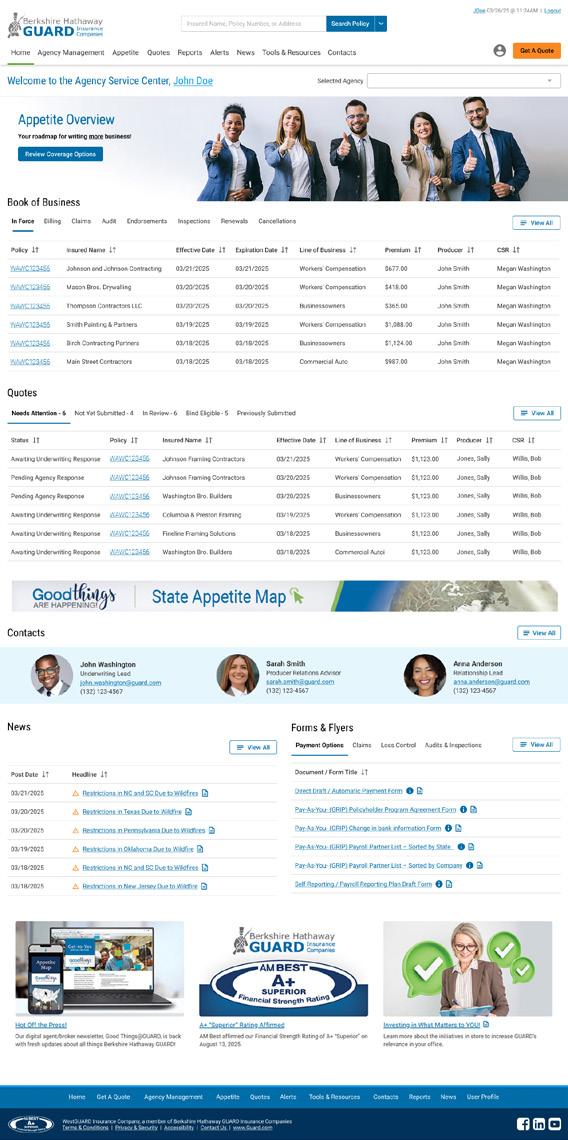
An Enhanced Digital Experience
FOR OUR AGENTS & BROKERS
Redesigned to empower our agents and brokers with the data and tools you need to do business, our updated Agency Service Center dashboard features a more modern, intuitive, and personalized interface — built to make your day easier.
Where Insurance Thrives
McDonough
A groovy time at PIANJ | PIANY Annual Conference
Tech and AI highlight the event
This year’s PIANJ | PIANY Annual Conference was a far-out time for its attendees. Nearly 2,000 insurance professionals gathered June 7-9, 2026, at the Hard Rock Hotel Casino in Atlantic City, N.J., for a three-day insurance experience loaded with exciting opportunities.
Agents explored the latest innovations at the sold-out trade show, expanded their minds at the insightful education seminars, took the time for much-needed networking at the many social events the venue offered and more.
A trade show with products for all your needs
With more than 150 exhibitors, the trade show was sold out. Insurance professionals explored new products and innovations for their business. It also meant there were plenty of fellow agents to connect with and exchange ideas.
The AI Tech Hub provided insurance professionals with an opportunity to watch live demos of AI-powered insurance tools. It featured demonstrations from Cara, Infer.so, RiskAdvisor and Imperial PFS. These demos showcased how AI tools can be used by agents on the job.
Insight into industry issues at the CEO Panel
This Networking Lunch featured the Annual Conference’s first-ever CEO Panel, which brought together CEOs from Merchants Insurance Group, Utica Mutual Insurance Co., and Preferred Mutual: Charlie Makey, Kristen Martin and R. Benedikt Sander, respectively, to offer their perspective on some of the biggest issues facing agents and carriers. Newly elected PIANJ President Aaron Levine, CIC, and PIANY President Jason Bartow, AAI, CPIA, TRA, moderated the discussion.
Dozens of attendees watch a demonstration at the AI Tech Hub.
The discussion panel broached a variety of subjects, including the industry’s response to technological innovations like AI, relationships between insurance agents and their clients and workforce challenges. The conversation focused on tech innovations in the industry. Sander said that Preferred Mutual made significant investments in cloud technologies, AI and modernization efforts. On new technology’s relationship with agents as it is being implemented, he said: “It’s important to see what works, what doesn’t work, and get feedback. Ultimately, we get a much better chance of launching a solution that works for everybody involved because you built it with the agents in mind.”
Martin offered her thoughts on the topic: “I know the things AI can’t do that relationships can—in picking up the phone, in talking to underwriters. AI is going to look at a submission and it is not going to understand the story of the insured. We have to continue to make an investment in people.”
Makey continued: “I think is important for carriers to have peer-learning communities. At Merchants, we want to make sure we hear from our agents: what are they hearing from their customers?” He continued: “I can’t stress enough the need to strike the right balance between technology and human interaction. As we continue to modernize our systems at the carrier or agency, we need to continue to allow our agents and policyholders the ability to have easy and quick access to our team who can help with questions and finding solutions together.”
For many in attendance, the CEO Panel was a welcome addition to the program. According to Levine, the idea for the panel began with a desire to add more value to their attendees at lunch. Bartow and Levine, as co-chairs of the PIA Northeast Carrier Partnership,
(L-R) Aaron Levine, R. Benedikt Sander, Kristen Marin, Charlie Makey and Jason Bartow
Industry leaders take the stage before an engaged audience.
Insurance professionals discovered the next generation of products driving business growth.
were able to tap into some of the connections they had made and bring out the CEOs to the conference. Many insurance agents don’t have direct access to the leadership of an insurance company, and this panel filled that need. Much like the tech hub, this is an event that Levine wants to expand in the future, with new panelists and moderators.
Education opportunities abound
The conference had high-quality education sessions taught by industry experts. These courses were approved for a total of 8 continuing-education credits.
Real Claims, Real Coverage: Lessons from the Field—taught by Steve Lyon, CIC, CRM, CPCU, ARM, AAI, AFIS, CRIS, AIS, MLIS, TRIP—used real-life claims examples to study policy coverages and endorsements, and gave attendees a fresh look at familiar issues they see on the job.
Technology: Impacting You and Your Clients—taught by John Fear, CISR, CPIA— guided attendees through the many technological advances shaping the insurance industry, which affect the products insurance companies develop and underwrite.
I Didn’t Know That! Policy Wording That Can Ruin or Make Your Day—taught by Lyon—was action-packed with a dive into coverage surprises and misunderstandings. It covered issues that face agents when they’re insuring drones, medical and recreational marijuana, misclassifying workers and more.
There was also the PIANJ Deep Dive Live: AI Done Right, which offered an inside look at how AI is used by agencies. This panel allowed AI vendors and agents to discuss the challenges agents face with technology, as well as insights on productivity, compliance and client service.
A full house at a CE session.
At the YIP After-Hours Rock ’n’ Roll Revue.
At the Sunset Groove Beach Bash.
Social networking?
On Sunday night, the YIP After-Hours Rock ’n’ Roll Revue in the Hard Rock Café Backstage set the stage, and it featured great music and craft cocktails. This high energy venue was the perfect spot for rising insurance stars to connect at the conference.
On Monday night, the music of GoodMan Fisk filled the LandShark Bar & Grill, and attendees enjoyed each other’s company at the Sunset Groove Beach Bash.
Fun Run raises over $89,000 for SONJ
The 42nd Annual YIP Fun Run 5K was held Tuesday morning on the New Jersey Boardwalk. With over 90 runners participating, the Fun Run raised $89,284 for Special Olympics New Jersey.
This year’s top finishers were: Noelle Rosimini as the first-place female finisher (25:31); and Francis Kelly as the first-place male finisher (18:24); Nichole Reppert as the second-place female finisher (27:21); and Tyler Richey as the second-place male finisher (23:54); Tiffany Cospito as the third-place female finisher (33:08); and Mark Stephenson as the third-place male finisher (23:57).
This year’s top fundraisers were: top overall individual fundraiser: Ken Bull ($5,835); top agency fundraiser: Jimcor ($2,210); and top company fundraiser: FMI ($25,710).
Thinking about 2027
Thanks to everyone who took part in this unforgettable Annual Conference. PIA hopes to see you next year—save the date for June 6-8, 2027, at the Hard Rock, Atlantic City.
For more information about the event, including more photos, see the related article on PIA Northeast News & Media (blog.pia.org).
And … they’re off to raise money for Special Olympics New Jersey.
The YIP Fun Run raised $89,284 for Special Olympics New Jersey.
Enjoying time at the LandShark Bar & Grill.
AI and the independent agent: Threat, tool or teammate?
Kevin Fuschich National General, an Allstate company
From document automation and predictive analytics, to conversational tools and workflow optimization, artificial intelligence is increasingly integrated into how carriers and agencies operate.
With that visibility comes a natural question: Will AI replace independent insurance agents?
The answer is no. However, AI will change how work gets done and the agencies that thrive will be those that understand how to use technology to strengthen—not replace— their expertise.
The independent agency system has never competed on automation alone. It competes on judgment, advocacy and trust. Technology that enhances those strengths reinforces the channel rather than weakens it.
Why is the question emerging?
Underwriting, pricing, claims handling and risk selection depend on large volumes of structured information. AI excels at processing data quickly, identifying patterns and automating repetitive tasks—areas where efficiency has long been a priority.
At the same time, the role of the independent agent is fundamentally human. Agents interpret coverage nuances, advise clients through complex decisions, advocate during claims, and build long-term relationships grounded in personal trust.
As AI tools become more visible by generating quotes, answering routine questions, summarizing documents or analyzing risk indicators, it is reasonable to ask where that leaves the professional agent.
The reality is that AI is reshaping workflows, not replacing relationships.
What AI is already doing in insurance
Much of AI’s impact in insurance operates behind the scenes. Advanced analytics and machine learning have long supported underwriting precision, fraud detection and claims triage.
Today, AI also is enhancing agent-facing processes, including:
• improving consistency in risk assessment;
• accelerating routine claims handling; and
• supporting customer inquiries outside traditional business hours.
In each case, the objective is speed, accuracy and efficiency. These tools are designed to reduce administrative burden while maintaining professional oversight.
For example, tools that reduce manual data entry during the intake process can help agents spend less time rekeying information across systems and more time reviewing coverage needs with clients. That shift may seem incremental, but over weeks and months it meaningfully increases the time available for advisory work.
AI is not stepping into the client meeting. It is helping streamline the tasks that surround it.
What remains distinctly human
AI does not fully understand context without structured inputs. It cannot independently assess a client’s long-term business goals, family circumstances or evolving risk tolerance. It cannot negotiate across carriers to structure the best overall solution. And, it cannot advocate when a claim falls into a gray area requiring interpretation and judgment.
Insurance decisions are rarely purely transactional. They involve nuance, explanation, reassurance, and sometimes, difficult conversations. Clients value not just answers, but understanding.
The independent agent’s role always has extended beyond transaction processing. It includes interpretation, accountability and long-term partnership. These are responsibilities that remain firmly rooted in human expertise.
The consumer expectation shift
Many consumers now expect faster response times, digital accessibility and seamless service experiences. That expectation
does not eliminate the need for agents, but it does raise the bar for operational responsiveness.
AI-powered tools can help agencies meet these expectations without sacrificing personalization. Automated status updates, more efficient document processing and improved data visibility, can shorten response times while preserving the agent as the trusted adviser.
A pattern of adaptation
It also is important to remember that the independent agency system has adapted to technological changes in the past.
Comparative raters, online quoting platforms, electronic signatures, digital policy delivery, and advanced customer relationship management systems were once viewed as disruptive shifts. Each required agents to adjust workflows and adopt new capabilities.
Yet with each innovation, the independent agency channel evolved and often emerged stronger.
AI represents another step in that evolution. The core value proposition of independent distribution has not changed—choice, expertise and advocacy. Rather, the tools that support the proposition have changed.
How AI can strengthen the independent model
When adopted thoughtfully, AI can reinforce the strengths that define the independent agency system.
No. 1: Elevating advisory conversations. By reducing manual processes, AI can free agents to focus more on proactive risk reviews, coverage discussions and strategic planning. Administrative efficiency does not diminish the agent’s role. It elevates it.
The more time agents spend advising rather than processing, the more clearly their expertise is demonstrated.
No. 2: Enhancing insight. Data-driven tools can surface trends and risk indicators that support more informed conversations. For example, analytics may highlight emerging exposure patterns or changes in risk characteristics that warrant a coverage discussion.
No. 3: Improving responsiveness. Timeliness matters. Faster intake processing, more consistent underwriting data, and streamlined claims triage contribute to a smoother client experience. These efficiencies allow agencies to compete effectively in a marketplace where responsiveness increasingly influences satisfaction and retention.
Importantly, these improvements do not require sacrificing personal connection. They support it.
Responsible implementation matters, be careful
As AI capabilities expand, so does the responsibility to apply them carefully. Transparency, data privacy and appropriate human oversight remain essential.
Clients should understand when they are interacting with automated tools. Decisions affecting coverage, pricing or claims outcomes, should continue to involve an agent’s professional review and accountability.
Technology works best when aligned with professional standards, but not when substituting for them. For carriers and agents, responsible implementation is not simply a compliance consideration; it is a trust consideration. The independent channel’s reputation rests on credibility and accountability. AI must reinforce, not erode, that foundation.
Look ahead
Independent agents who combine technology-driven efficiency with personalized expertise will be well positioned in an evolving marketplace. Those who embrace innovation while preserving the human elements that define independent distribution will continue to deliver differentiated value.
The independent agency system has never competed on speed alone. It competes on judgment and on the ability to interpret complexity—and advocate for clients when it matters most.
If AI reduces paperwork, improves data clarity, and increases efficiency, it does not displace that judgment. It sharpens it.
Conclusion
Artificial intelligence will continue to influence how insurance operations are structured and delivered. It will automate routine tasks, improve access to insights and enhance operational consistency.
What it will not replace is the professional expertise that defines the independent agent.
By reducing administrative friction and expanding access to information, AI creates greater capacity for what agents do best: advising clients, navigating complex situations and delivering trusted guidance.
In that sense, AI is not a threat to the independent agent. It is a tool. When guided by experience, accountability and judgment, it becomes a powerful teammate.
Fuschich leads communications for National General, an Allstate company, helping independent agents stay informed, take action and capitalize on opportunities across a complex insurance landscape. National General is a participating member of the PIA Northeast Carrier Partnership.
PIA’s highly qualified technical specialists can answer:
• Compliance
• Legal
• Coverage
• Industry
• Legislative
• Regulatory … and other questions!
PIA offers a searchable database of previously asked member questions answered by our highly qualified specialists.
More than
235,000
inquiries since the Industry Resource Center’s inception
“I appreciate how PIA Northeast gets information out to its members that is timely and informative on what is going on and changing in the industry. I also am very pleased with the smooth process of renewing my E&O policy through PIA.”
—Michael Cavalieri
Vehicle Insurance Brokerage Services Inc.
“PIA Northeast has made me a more resourceful and, therefore, a more effective insurance agent. From legislative and regulatory issues, to risk management, to industry trends and communications, and agency management, not to mention the people and network I’ve developed through the organization. There’s almost no topic for which I can’t source an answer because of my involvement with PIA.”
—Andrew Harris Jr., CIC, AAI, CISR Liberty Insurance Associates Inc.
“PIA Northeast’s membership resources page has been extremely helpful to me and my staff as we navigate the ever-changing world of insurance. The page has terrific information on crisis planning and preparation, marketing, staffing, agency development, and provides access to experts. I particularly like the technical hotline where you can submit a request online and receive an answer back from an expert on the topic. The technical hotline is worth the cost of membership alone!”
—Timothy G. Russell, CPCU
The Russell Agency Inc.
Education For Every Occasion PIA has
your back.
• Are you looking for continuing-education classes with new approval numbers?
• Do you need a class for your E&O discount?
• What about Ethics courses to comply with your licensing renewals?
PIA Northeast offers the courses you need year round. Not only do these courses comply with your yearly education requirements, but they also help you add value to your relationships with your clients.
Register for all four sessions and receive a discount.
Thursday, Sept. 10, 2026 Farm Auto Exposures: Effective Use of Insurance to Address Ag Transportation Risk
Tuesday, Oct. 13, 2026 Precision in Protection: Writing Coverage Right & Replacing It Safely
Wednesday, Oct. 14, 2026 Ethics – How to Maintain Ethical Behavior in Your Agency
Wednesday, Oct. 14, 2026 Better Customer Service Through Time Management
Agency agreements, credit checks, business data checks and more
PIA technical staff
Have a question? Ask PIA at resourcecenter@pia.org.
Company not required to forego earned premium, accept lost policy release
Q. We issued a binder for a client. Ultimately, the client decided to go with another carrier instead. This was a year ago. The company is billing for the earned premium, and it will not accept a lost policy release to cancel flat. We sent the carrier a copy of the other company’s policy, but this did not change its mind. Is the insurer required to accept the lost policy release?
A. No. The insurer is not required to accept a lost policy release or cancel the binder flat. Once a binder is issued, it provides temporary coverage until it is properly canceled under New York law and the policy terms. Generally, cancellation requires written notice from the policyholder with a future effective date. A lost policy release may serve as notice, but it does not require the insurer to backdate cancellation. Because coverage remained in force until a valid cancellation request was received and processed, the carrier may charge earned premium for that period. Replacement coverage alone does not retroactively terminate the binder. Some insurers may voluntarily backdate cancellation with proof of replacement coverage, but that is discretionary and often limited. It is not required by law.—Ritchie
NYAIP: Assigned carrier lasts three years
Q. My insured does not like the company he was assigned to in the New York Automobile Insurance Plan. He wants me to cancel and rewrite the policy to get another company. I told him he will probably end up with the same company. Is this correct?
A. Yes. He will be reassigned to the same company until the full three-year assignment period is up. Also, the current policy will be canceled short-rate. Even after three years, reassignment is on a random basis, so he could end up with the company again.
If your insured has a legitimate complaint about this carrier, he should register it with the New York State
Department of Financial Services, using the plan’s complaint procedure.—Patterson
Carrier website agency agreements
Q. Quite often when a carrier updates its website, there appears to be a contract or agreement that we must accept before advancing in the website. By accepting these new terms, am I amending my carrier/agency agreement?
A. I think we have all seen these pages, where you cannot advance before you click the button on the bottom of the page that states “I have read and agree to these terms ...” or something to that effect. In most agency agreements, there is a provision requiring that any changes made to the contract must be agreed to by both parties in writing. When the company decides to modify a provision in the existing agency agreement, the company should agree to provide the agent with reasonable written notice before any changes are implemented.
More likely, the acceptance of terms you are prompted to agree to is applicable only to the use of the insurer’s website. This would not affect the terms in your agency agreement. However, while the acceptance on a carrier website would not change the terms of the agency agreement, it could create new responsibilities outside of the agency agreement. For more information, PIA Northeast members can access Agency-insurer agreements: Information issues for agency principals (QS90517) in the PIA QuickSource library.—Lachut
Carrier appointment credit checks, effects on an agency’s credit history
Q. Generally, credit checks are becoming a condition for carrier appointments. Principals and producers can both be subject to this requirement. If a carrier puts through an inquiry into our credit score, will this have a bearing on our credit report or credit history?
A. We can understand the aggravating aspect of this, if one does not have a stellar history, that history could then be used
as part of the decision process—just like a credit score is used in obtaining an insurance policy. However, a review of credit history for employment purposes is considered a soft inquiry, and it does not affect a person’s credit score.
Inquiries not related to a new financial commitment won’t hurt your credit score. These include credit checks from employers, companies sending preapproved offers of credit or insurance, or in this case a carrier reviewing the agency principals’ credit histories. An inquiry will be added to the credit report each time an insurance company, potential employer, etc., accesses the credit report. But, the inquiries will have no effect on credit scores or lending decisions. These soft inquiries are not provided to lenders, so they are not considered in credit score calculations or lending decisions.—Lachut
Company seeks agents’ business data
Q. What is the propriety of a company asking our agency to share with it information about the business we write with other companies?
A. PIA believes this is, at the very least, a significant breach of business etiquette, bordering on an ethical breach. Just as important, PIA is concerned that complying with this request would undermine the ownership of your expiration list.
Your agency has entered into separate business relationships with each of your companies. Under the terms of these relationships, independent agents own their records. Moreover, the main value of the agency rests in the information these records contain. In sharing the information in your business records with a third party, you would take an action that not
only could prove unwise from a business standpoint, but it also could run counter to the fiercely held principle of ownership protecting the value of an independent agent’s business.
Moreover, the company that is asking for the records is inviting you to take a step that undermines the written or (more likely) unwritten understanding you have with your other business partners—partners that have enabled you to write the business in question. The company is asking for a competitive advantage to view information about business in which it currently has no role. By accommodating one company, it is entirely possible that you would jeopardize your relationships with others.
PIA advises that members think about all the ramifications of such requests in deciding how to respond.—Lachut
PIANY 2025–2026
Board of Directors
OFFICERS
President
Jason E. Bartow, AAI, CPIA, TRA Bartow Insurance Agency & Jebb Brokerage Inc. Deer Park, NY
President-elect
Michael A. Loguercio Jr. Belfor Property Restoration Middle Island, NY
First Vice President
Jorge Hernandez North Franklin Brokerage Inc. Hempstead, NY
Vice President
Eric Cohen
Benefit Quest Inc./Eric Cohen Insurance New York, NY
Treasurer Ed Chadwick Jencap Specialty Insurance Services Buffalo, NY
Secretary
Justin Fries, CIC, CPCU, CPIA Garber Atlas Fries & Associates Inc. Oceanside, NY
Immediate Past President
Richard Andrews, LUTCF Andrews Agency Inc. Ithaca, NY
NATIONAL DIRECTOR
Michael J. Skeele, CIC, CPIA Skeele Agency Inc. DeRuyter, NY
DIRECTORS
Dina Bruno, CPIA Trucordia Long Beach, NY
Peter Buccinna XS Brokers Quincy, MA
Marshall Glass, CPIA Ironpeak Astoria, NY
Leslie C. Rogoff Madison Avenue Brokerage Corp. New York, NY
Richard Signorelli AZBY Brokerage Inc. Bronx, NY
NY-YIP REPRESENTATIVE
Peter Conte, CPIA, MSRE Honig Conte Porrino Insurance Agency Inc. New York, NY
ACTIVE PAST PRESIDENTS
Jamie A. Ferris, CIC, CRM, AAI, CPIA P.W. Wood & Son Inc. Ithaca, NY
Lynne R. Frank, CPCU Williamsville, NY
Jeffrey H. Greenfield NGL Group LLC Lynbrook, NY
Fred Holender, CLU, CPCU, ChFC, MSFS Lawley LLC Buffalo, NY
John C. Parsons II, CIC, AAI, CPIA, NcSA Parsons & Associates Inc. Syracuse, NY
Gene L. Sandy, CIC Highstreet Insurance Partners Millennium Alliance Group LLC Melville, NY
Richard A. Savino, CIC, CPIA, TRA Broadfield Group LLC Trucordia Warwick, NY
Gary Slavin, CIC, CLTC, LUTCF Massapequa, NY
John Tomassi, CPCU Open Coast Surety Agency LLC New York, NY
COMMITTEE VOLUNTEERS
Matthew Davoult AFCO Direct Lake Forest, IL
Jennifer P. DeCristofaro Lancer Management Co. Inc. Long Beach, NY
Jeffrey Dende, CIC, CPIA, CRM P.W. Wood & Son Inc. Ithaca, NY
Leslie Driscoll Tronilo-Driscoll Insurance Agency Ozone Park, NY
Khaleedah Francis Sedgwick Claims Mahwah, NJ
Natalie Golubski Jencap Specialty Insurance Services Buffalo, NY
Sean Grant Jimcor Agencies Montvale, NJ
Christina Kager Piper Insurance Agency Inc. Painted Post, NY
Scott Richards Hilltop Strategies Huntington Station, NY
Frances A. Scott F.A. Scott Insurance Agency Goshen, NY
Ian Sterling, CLCS Sterling Risk Woodbury, NY
Derek Stork, CIC Stork Insurance Agency Penn Yan, NY
Shannon van Doorn Lawley LLC Buffalo, NY
Resource Center resourcecenter@pia.org
Services memberservices@pia.org
Insurance Professionals yip@pia.org
Lawyers Professional Liability Coverage
38 PIA Education
34 PIA Members’ Choice
41 PIA NumberONE Comp
37 PIA Industry Resource Center
27 SIAA
8 Venbrook Group
For more information about an advertiser, email ads@pia.org, or call (800) 424-4244