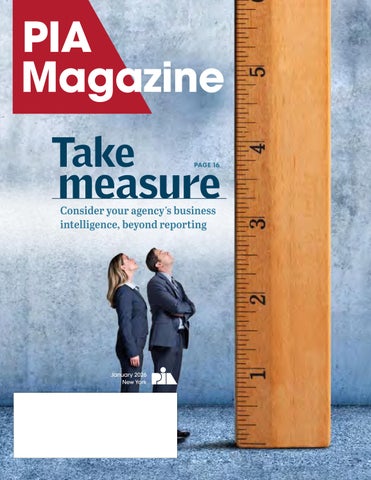
PAGE 16
Consider your agencyʼs business intelligence, beyond reporting
January 2026 New York
Brokers trust Lovell to keep pricing steady.
Over
$1.28 Billion in Dividends Issued to Date
Lovell Safety Management continues its track record of providing affordable workers’ compensation insurance coverage for the following industries: • Asbestos Abatement • Building Metal Trades • Cleaners • Construction • Electrical Manufacturers • Hospitals • Launderers and Cleaners • Municipalities
• Painters and Decorators • Paper Products Manufacturers • Retail Lumber • Roofers and Sheet Metal Workers • Truckers, Movers, and Warehouse Workers
DiscountsNN upt to 35% Call us for a quote today at 800-556-8355
Get a quick estimate by visiting our website at
www.LovellSafety.com Lovell Safety Management Co., LLC 22 Cortlandt Street, 33rd Floor New York, NY 10007 212-709-8600 | 1-800-5-LOVELL www.lovellsafety.com
Vol. 70, No. 1 January 2026
Departments PAGE 16
Consider your agencyʼs business intelligence, beyond reporting
16
Cover story Find new tactics to succeed in changing conditions
Highlights
9
4
In brief
9
Service
13
E&O
29
Learn
31
Ask PIA
34
Officers and directors directory
35
Advertising index
Cover Design David Cayole
Service
Rediscover, re-engage in personal lines
13
E&O
Safeguard against UM/UIM coverage issues
23
Feature
Navigate a complex auto market
Professional Insurance Agents 25 Chamberlain St., P.O. Box 997, Glenmont, NY 12077-4835 (800) 424-4244 | pia@pia.org | www.pia.org
President and CEO Jeff Parmenter, CPCU, ARM; Executive Director Kelly K. Norris, CAE; Communications Director Katherine Morra; Editor-In-Chief Jaye Czupryna; Advertising Sales Representative Adam Wolfe; Magazine Layout Designer Patricia Corlett; Communications Department contributors: David Cayole, Jeana Coleman, Darel Cramer, Matthew McDonough and Damon Whimple. Postmaster: Send address changes to: Professional Insurance Agents Magazine, P.O. Box 997, Glenmont, NY. “Professional Insurance Agents” (USPS 913-400) is published monthly by PIA Management Services Inc., except for a combined July/August issue. Periodical postage paid at Glenmont, N.Y., and additional mailing offices. ©2026 Professional Insurance Agents. All rights reserved. No material within this publication may be reproduced—in whole or in part—without the express written consent of the publisher. Statements of fact and opinion in PIA Magazine are the responsibility of the authors alone and do not imply an opinion on the part of the officers or the members of the Professional Insurance Agents. Participation in PIA events, activities, and/or publications is available on a nondiscriminatory basis and does not reflect PIA endorsement of the products and/or services.
IN BRIEF
An outlook for the insurance industry Each year, there are conditions that affect and reshape the insurance industry. While crystal balls aren’t standard issue in insurance, keeping updated on the trends that are affecting the industry and markets may help agents to act proactively and prepare for changes. Here’s a look at what experts are saying could be factors in 2026.
Weather-related losses The frequency and severity of wildfires, floods, and other natural disasters continue to rise. As a result, these events are becoming more expensive for the admitted markets to transfer their risk. Reinsurance terms are narrowing, and increased risk retention are driving up loss ratios—according to Deloitte, this is adding to a $183 billion global protection gap. Secondary factors that could continue to affect weather-related losses in 2026 could include: • Inflation. The higher cost of labor and materials will increase the cost of rebuilding. • Increased exposures in new areas. Regions that have been less affected by major storms could see a rise in insured losses. • Market uncertainty. The lack of a long-term extension of the National Flood Insurance Program continues to create confusion for both agents and their clients. Since 2017, the program has been reauthorized more than 30 times.
4
Third-party litigation funding
Generative AI for analytics
Litigation funding companies offer nonrecourse cash advances to plantiffs in exchange for a portion of future settlements or judgements. While marketed as a lifeline for cash-strapped litigants, these arrangements often conceal exorbitant fees, lack transparency and offer predatory contract terms.
The use of artificial intelligence in the insurance industry will continue to evolve. Moving beyond taking on everyday tasks to allow insurance producers to focus on providing education and expertise to their clients, AI could help agents expand their product offerings and risk management capabilities.
Because these transactions are classified as investments—not loans—they escape the protection of many states’ laws. The result? Plaintiffs can walk away from a successful legal outcome with little to no recovery after excessive financing coats are deducted. The damage doesn’t stop there. Frequently, these financing arrangements encourage inflated settlement demands and prolonged legal battles, placing added strain on insurers, courts and defendants. The end result: higher premiums for businesses, homeowners and drivers across the state. Some states have started to address this issue to effect new laws that would limit fees, necessitate clear contract disclosures, and establish safeguards that would prohibit attorneys from the having a financial interest in funding companies or receiving kickbacks for referrals.
PROFESSION A L I NS U RANC E AG E NTS M AG AZIN E
AI can help with fraud detection, underwriting, predictive analytics and the claims processes. Additionally, the use of real time monitoring systems to detect leaks and other issues will be able to help those in the insurance industry predict and minimize losses. However, insurance producers need to be careful not to set-itand-forget-it when it comes to AI. The number of stories about how insurance policies have been canceled or denied based on errant information garnered from AI will only continue to grow as the use of this technology becomes more prevalent.
Enhanced customer experience with collaborations Customer experience affects both retention and growth. Customers are looking for speed and custom solutions. According to J.D. Power’s 2024 U.S. Claims Digital Experience Study, overall customer satisfaction with auto and home insurance digital claims experience increased. Customers’ approval was led by an appreciation of the services offered through the companies’ mobile apps and websites. Partnerships with carriers that can offer tools to provide uberpersonalized product offering and customer service can help agents give their clients the service they expect.
New workforce models The Bureau of Labor Statistics estimates that 400,000 insurance professionals are expected to retire by 2026. This Bureau statistic ranges from 2021-26, so the insurance industry is already facing a need for new employees. However, AI has changed the skill set that is needed to replace workers—research by McKinsey shows that 43% of insurance tasks can be automated by 2030. When you are looking to hire individuals, you should look for highly adaptable people who: • can use AI tools; • can interpret AI-generated material; and • can bridge the gap between technology and customer relations.
Checklist for success in 2026: • Invest in tools to modernize your agency and increase the quality of the data available to you. • Update your hiring process to ensure you are appointing the right people for the new workforce. • Consider partnerships that will enhance your insurance offerings, resources and customer experience. • Analyze your clients’ expectations, and evolve your agency to make sure you are offering what they want. • Be protective in your agency’s management of risk.
Now is the time to start updating your agency’s job descriptions— you need insurance expertise and digital savviness. You also need to update your interview questions and rethink your screening criteria to find the employees you need to compete in the evolving insurance industry.
PIA .ORG
5
FYI
A chat with your PIANY President Jason Bartow Tell us about your journey in the industry. I am the fourth generation in a multigenerational agency, and I have been a member of PIANY/NY-YIP since 2005. My family has been invested in the industry, and my family’s support helped me get where I am today. They encouraged me to pursue my roles in both the Young Insurance Professionals (of which I was president from 2015-18), and PIANY. My whole family sees the value that PIA can bring to an agency, a family and a legacy. I can honestly say that I wouldn’t be president of PIANY today without the support of my family and the organization.
As PIANY president, what is your vision/goals? I’d like to amplify the voice of independent agents in government and throughout the industry. I’d like to support our members with tools, training and resources that will keep them at the forefront of innovation and to help them thrive in the ever-changing market. We need to invest in young insurance professionals, foster membership and make sure we give the same opportunities to the next generation of insurance professionals that people gave to us when we were starting out in this industry. To make this happen, our members need to be active in the association. PIA is strongest when everyone shows up: Get involved, be vocal and share your expertise. When PIANY knows the needs and experiences of its membership that’s when it can do amazing things.
What trend(s) do you think will most affect the insurance industry in 2026? I think there are several trends that will continue to affect the industry this year. First is market conditions: will the market continue to harden, or will premiums start to soften, allowing certain markets to open again? Second is weather-related claims: The severity and frequency of weather events continues to put stress on the insurance industry. Add to that the fact that it’s more costly to rebuild/repair after a weather-related claim, and I think prices of premiums and replacement costs will continue to rise. Third is third-party litigation claims: It’s an issue influencing claims, settlements and premiums. PIANY is urging lawmakers to pass a bill that would make critical regulations to protect consumers from predatory litigation financing.
6
PROFESSION A L I NS U RANC E AG E NTS M AG AZIN E
How has the insurance industry evolved since you joined it? The industry has gone from being mostly smaller family-owned legacy agencies to larger multistate and private equity-backed systems. There have been so many mergers and acquisitions, which has changed the average size of agencies. Jason Bartow, AAI, CPIA, TRA,
Additionally, there has Executive Vice-President, been a technological evoEugene A. Bartow Insurance Agency Inc., Deer Park, N.Y. lution, which continues to change day-to-day. There is more artificial intelligence-based programing, which is being used to sell, service and safeguard our clients. However, remember that AI can only take us so far. ChatGPT (and other AI systems) can’t know or understand a person’s tone, and they can’t be sympathetic if clients need someone to listen.
Outside of the insurance industry, what are you most passionate about? I love politics. In college, I did my thesis on the subject. It’s nice that a part of it translated into my work with PIANY’s Agents Advocacy Coalition, because so much of what I learned in school is outdated. I chair several boards, including the National Jewish Sports Hall of Fame. And, I’m a big Islanders and Yankees fan. I also enjoy talking with my fellow Whovians about the latest episode of Doctor Who.
Do you have any New Year’s resolutions? As a Gen Xer, I’m hoping that this is the year I get better at time management. And, I’d love to finish one project before I get distracted by another one. I also appreciate the younger generations’ focus on work/ life balance. Maybe I’ll try to do that as well. Right now, I feel like I spend so much time working hard so that I can spend time with my family. Maybe that time management goal will help me out with that, too.
What makes us smart, different, and better? Simply put, we offer a better way to do business. • Competitive commissions • No volume or premium commitments • Simplified annual audits
[
844-761-8400 • omahanational.com
• Dedicated sales representative • Attentive customer service from a real person
Send in your submissions today. For more information contact a sales rep at 844-761-8400 or email us at Sales@Omahanational.com.
Coverage in: AZ • CA • CT • DE • GA • IA • ID • IL • IN • KS • KY • MD • MO • MS • MT • NC • NE • NJ • NM • NY • PA • RI • SC • SD • TN • UT • WI • WV
844-761-8400 • omahanational.com
Omaha National Underwriters, LLC is an MGA licensed to do business in the state of California. License No. 078229. “A-” (Excellent) rated coverage through Omaha National Insurance Company, Omaha National Casualty Company, Preferred Professional Insurance Company, and/or Palomar Specialty Insurance Company.
Supporting businesses that bring urban communities to life Insurance solutions for restaurants, retail, and professional service businesses from Brooks Insurance + District Cover Leveraging location-specific analytics and an innovative quoting platform, we offer competitive coverage for metropolitan businesses. Coverage limits and features: • Available in 24 states with competitive rates in major metro areas • Up to $5M TIV • Multi-location support • Reliable, tech-enabled underwriting
Consult a Brooks broker Email us at info@brooks-ins.com for a District Cover quote
Brooks Group Insurance Agency, LLC | NJ License 1575143 • Brooks Specialty Insurance Agency | CA License 0L58112 © 2025 Brooks Group Insurance Agency is a wholly-owned subsidiary of Venbrook Group, LLC. All Rights Reserved.
SERVICE
Rediscover personal lines: Tips for producers ready to re-engage Bradford J. Lachut, Esq. Director of government & industry affairs, PIA Northeast Having grown up in the Northeast and more specifically Upstate New York (let the fight commence as to where upstate New York actually begins1), I’m aware of the changing seasons. In the Northeast, the change in the seasons is not merely an external change, but one that signals the time for certain rituals of transition. For me, that ritual includes the Sisyphean-task of lugging multiple boxes of winter clothes up from the basement—only to be replaced by multiple boxes of summer clothes going down to the basement. While I might lament the chore of retrieving my winter wardrobe, there is a certain satisfaction to slipping on that comfortable and familiar cardigan I haven’t worn in a year— even if it takes a while to refamiliarize myself with sleeves. While you may not be able to totally relate to my plight and love of cardigans, many insurance producers are experiencing a similar feeling as they rediscover personal lines. The insurance market has been existing in a hard-market cycle for the past few years. This cycle has seen premium rates increase while availability decreased. The result is that many producers hunkered down like a bear hibernating in winter, surviving on existing personal lines business, but doing little remarketing or taking on as little new business as possible. As I write this toward the end of 2025, there have been signs that the hard-market cycle may be winding down. If that holds true, insurance producers may wish to once again pursue personal lines clients more vigorously. But just like any skill, the longer it is ignored, the harder it is to get back into shape.
Coming out of hibernation The first step is to reconnect with the carriers. Just as you wouldn’t wear last year’s snow boots without checking the tread, producers shouldn’t assume personal lines products are the same as they were pre-hard market. Carriers have
evolved their offerings—some out of necessity, others in response to consumer demand. For example, usage-based auto insurance has become more mainstream, with telematics offering discounts based on driving behavior. Bundled home and auto policies are increasingly popular, not just for pricing advantages but for retention. Cyber insurance protection for homeowners is no longer a niche offering— especially as smart homes become more common. And in catastrophe-prone areas, parametric products are gaining traction. This isn’t the time to skim a brochure and call it a day. Producers should schedule time with carrier representatives to understand underwriting appetite, new eligibility criteria, and any tech tools available to streamline quoting and servicing. Carriers are eager to support producers who are ready to re-engage, and those conversations can reveal opportunities that weren’t available—or even imaginable—a few years ago. Of course, knowing the products is only half the battle. (G.I. Joe!) Personal lines sales have their own rhythm, and for producers who’ve been focused elsewhere, it may take a little time to get back in step. Personal lines conversations tend to be more emotional than commercial ones. They’re about protection, peace of mind and family. That means producers need to refresh their approach—not just their quoting tools. Scripts should emphasize empathy and education. Consumers may not understand why their premiums rose or what coverage they truly need. Producers who take the time to explain—rather than just sell—will stand out among their competitors. Technology can help here, too. Many carriers and third-party vendors offer risk assessment tools, coverage calculators, and customer relationship management integrations that make personal lines more efficient. For newer producers, these tools can build confidence. For veterans, they can help re-establish a rhythm that may feel a little rusty.
PIA .ORG
9
SERVICE Rekindle the spark It’s not just producers who’ve changed during the hard market—clients have evolved, too. They’re more price-sensitive, more tech-savvy and more skeptical. Re-engaging means meeting them where they are. That starts with listening. Surveying existing clients can reveal what matters most—price, coverage and service—and that data can shape outreach efforts. Monitor-
ing local trends also is key. Are more people working from home? Buying electric vehicles? Installing solar panels? These shifts impact coverage needs, and producers who stay informed can offer more relevant solutions. Offering value beyond price is essential. Highlighting your ability to advocate during claims, explain policy language, and provide personalized advice can make all the difference. For newer
Lawyers Professional Liability Coverage* If you have law firms as clients, you know they have unique insurance requirements that can’t be covered by a standard general liability policy. We can help you help them. Parsons & Associates has programs designed to help you cover your clients’ unique insurance needs.
producers, this is a great opportunity to build trust early. For veterans, it’s a chance to show you’re still the go-to expert—even in a changed landscape. Rebuilding a personal lines pipeline may feel daunting, especially if you’ve been focused on retention. But it’s doable. Reconnecting with referral sources like mortgage brokers, realtors and financial advisers can open doors. Social media is another powerful tool—sharing tips, success stories and seasonal reminders (yes, even about winter wardrobes) can keep you top of mind. Hosting local events or webinars positions you as a resource, not just a salesperson. And, don’t forget your existing book of business—cross-selling opportunities abound. A commercial client may need a homeowners policy. A renters client may now own a home. Ask the questions.
Flexibility required While signs point to a softening market, volatility remains. Producers need to stay nimble. That means tracking carrier changes, staying educated through webinars and industry publications, and supporting legislative efforts that impact availability and affordability. Advocacy matters—and being informed and involved helps shape the market in which we all work. Just like slipping on that old cardigan, re-engaging with personal lines may feel awkward at first—but it’s also familiar, rewarding and necessary. The market is shifting, and producers who act now will be best positioned to serve clients, grow their book of business and strengthen relationships with carriers.
4lawyersinsurance.com (800) 440-9932 *New York only
10
PROFESSION A L I NS U RANC E AG E NTS M AG AZIN E
So, dust off your quoting tools, call your carrier representatives, and start the conversation with your clients. The season is changing—and it’s time to get back in shape. 1 My personal opinion: Anywhere north of Sullivan, Ulster and Dutchess counties.
PIA + AFCO Direct Collaborating for growth and success through premium finance What does AFCO Direct bring to the table? • Focus on easing administrative burdens. • Technology tools for a fast and easy process. • Funding capacity to meet all growth objectives. • Complete investment in your success.
Visit afcodirect.com to learn more.
A PIA preferred and endorsed provider PIA .ORG
11
Real Dividends!
Now M anagin g Three Safety More Group u s
$456 Million Paid
“In a world of customer service outsourcing, I truly appreciate the personal service from the team at Friedlander. Not only does Friedlander offer lower workers’ compensation premiums and dividend options for our insureds, but their customer service is also impeccable. Whether inquiring about prospects, quotes, or billing, the team is knowledgeable and quick to respond. The Elwood Jordans Insurance Agency is a small hometown agency, and I feel we are treated with as much importance as their larger clients.” Jenny Urbanski, Commercial Service Manager The Elwood Jordans Agency, Inc., Alden, NY
UP TO 45% SAVINGS UPFRONT! (35% advance discounts and NYS Assessment deferrals until dividends for first two periods) HOTELS
OIL DEALERS
Retail Group of NY Workers’ Comp. Safety Group #544
RETAILERS
Wholesale Group of NY Workers’ United Restaurants of NY Comp. Safety Group #551 Workers’ Comp. Safety Group #556 2024-25 . . . . . . . . . . . 42.5%*** 2023-24 . . . . . . . . . . . 42.5%*** 2023-24 . . . . . . . . . . . 45%*** 2023-24 . . . . . . . . . . . 42.5%*** 2022-23 . . . . . . . . . . . 42.5%*** 2022-23 . . . . . . . . . . . 42.5%*** 2022-23 . . . . . . . . . . . 40%** 2021-22 . . . . . . . . . . . 40%** 2021-22 . . . . . . . . . . . 40%**
WHOLESALERS
Hotel & Motel Group of NY Workers’ Comp. Safety Group #578 2023-24 . . . . . . . . . . . 40%*** 2022-23 . . . . . . . . . . . 37.5%*** 2021-22 . . . . . . . . . . . 35%**
Oil & Gas Dealers Group of NY Workers’ Comp. Safety Group #582 2023-24 . . . . . . . . . . . 37.5%*** 2022-23 . . . . . . . . . . . 35%** 2021-22 . . . . . . . . . . . 35%**
42% average dividend over past 3 years. 42% average dividend over past 3 years. 42.5% average dividend over past 3 37% avg. since 2011. 32% avg. since 2011. years. 36% avg. since 2011.
37.5% average dividend over past 3 years. 23% avg. since 2006.
36% average dividend over past 3 years. 23% avg. since 2010.
HOME HEALTHCARE Social & Health Services Group of NY Workers’ Comp. Safety Group #585 2023-24 . . . . . . . . . . . 42.5%*** 2022-23 . . . . . . . . . . . 42.5%*** 2021-22 . . . . . . . . . . . 40%**
RESIDENTIAL CARE
RESTAURANTS
u
FINANCIAL SERVICES
Residential Care Facilities Group Financial Services Group of NY Workers’ Comp. Safety Workers’ Comp. Safety Group #586 Group #558 2024-25 . . . . . . . . . . . 37.5%*** 2024-25 . . . . . . . . . . . 50%*** 2023-24 . . . . . . . . . . . 37.5%*** 2023-24 . . . . . . . . . . . 50%*** 2022-23 . . . . . . . . . . . 35%** 2022-23 . . . . . . . . . . . 50%**
u
BUILDING MATERIAL
Building Material Dealers Workers’ Comp. Safety Group #540 2023-24 . . . . . . . . . . . 42.5%*** 2022-23 . . . . . . . . . . . 42.5%*** 2021-22 . . . . . . . . . . . 25%
u
TRANSPORTATION
Transportation Industry Workers’ Comp. Safety Group #510 2023-24 . . . . . . . . . . . 42.5%*** 2022-23 . . . . . . . . . . . 42.5%*** 2021-22 . . . . . . . . . . . 25%
42% average dividend over past 3 years. 37% average dividend over past 3 years. 50% average dividend over past 3 years. 37% average dividend over past 3 years. 37% average dividend over past 3 years. 27% avg. since 1991. 24% avg. since 2011. 21% avg. since 2012. 23% avg. since 1986. 40% avg. since 1994.
***12.5% increase in advance discount **10% increase in advance discount *5% increase in advance discount Underwritten by the New York State Insurance Fund, 199 Church Street, New York, NY 10007. Dividends not guaranteed.
Safety and Workers’ Compensation Strategies Maria Thomas | 631-834-9829 mariat@friedlandergroup.com (LI, Manhattan, Queens, Brooklyn, Bronx, Staten Island) Donna Nygard | 914-844-2195 donnan@friedlandergroup.com (Remainder of NY, NJ, and CT)
www.friedlandergroup.com
To Unleash Productivity and Profits Featuring insightful interviews with experts including Paul O’Neil, 72nd Secretary of the U.S. Treasury By Adam Friedlander Now on Amazon.com
Help safeguard your agency from UM/UIM coverage issues
E&O
Utica National Insurance Group E&O Risk Management
Issues surrounding uninsured/underinsured motorists are a common source of errors-and-omissions claims against agents. Navigating UM/UIM motorists coverage placements can be challenging—especially if you write in numerous states. While the coverage is required in some states, the majority allow it to be rejected by insureds—and most states do not require UM/UIM limits to be equal to the bodily injury/ property damage limits. Stacking is allowed in some states. A study by the Insurance Research Council notes that in 2023, 15.4% of drivers were uninsured and 18% were underinsured. Overall, this makes 1 in 3 drivers uninsured/ underinsured—a number that has climbed 10% since 2017. Some states have significantly higher numbers of uninsured/underinsured drivers than the national average.1 Uninsured: Mississippi (28.2%), New Mexico (24.1%), Michigan (22.3%) and Tennessee (21.3%). Underinsured: Colorado (49.7%), Florida (38.3%), Nevada (37.3%) and Louisiana (36.4%). Considering that many states only require low liability limits—often $25,000 or less—an accident could easily result in an underinsured incident.
Your clients have a
1 in 7 chance
of being involved in an accident with an uninsured driver,
and a
1 in 6 chance
of being underinsured
Obtain a signed rejection letter—even if there is not a specific form required—when an insured rejects the limits or takes them at a limit lower than bodily injury/property damage. This is your strongest protection in the event of a claim.
What can you do?
Limits. The default should be to quote UM/UIM limit equal to the bodily injury/property damage limits. However, you should also offer additional limit options. This requires the clients to make a choice regarding their limits.
The following risk management tips can help:
Encourage clients, in writing, to review their limits at renewal.
Education. Your staff should handle this issue with diligence, be well-versed in the coverages, and be provided with clear procedures.
Ask if the client has umbrella/excess coverage in place and, if so, determine if the umbrella carrier has limit requirements for the primary coverage.
Advise your clients and prospects on the value and purpose of UM/UIM coverage.
Umbrella/excess UM/UIM. Include UM/UIM if it is offered by the carrier. If you do not have a carrier that offers this option, specifically point this out to clients so they have the choice to pursue coverage through other sources that could provide it. We have seen E&O claims in which a failure to advise of the availability of this coverage results in liability against the agent.
Documentation. Be aware that carriers now are more likely to hold agents accountable for not following requirements to obtain and store rejection forms for UM/UIM coverage. If a form is missing, the carrier may pay the claim, but then it may seek reimbursement from the agent’s E&O insurance.
PIA .ORG
13
Make sure the client is aware of any requirements regarding the primary limits.
Don’t let this happen to you AN EXAMPLE: The agent placed auto coverage for a client with $250,000/$500,000 UM/UIM limits— also placing a $1 million umbrella policy that did not provide UM/UIM coverage. The agent indicated that the agency usually recommended additional UM/UIM coverage, but did not address it since the umbrella carrier the agent procured terms from did not offer the coverage. The umbrella carrier started offering UM/UIM coverage by the next renewal of the umbrella policy, however, the agent did not advise the client of this coverage availability at this renewal or subsequent renewals. The client was involved in a severe motor vehicle accident with a driver who
only carried $15,000 liability limits. The agent’s E&O insurance paid out $700,000. THE LESSON: A well-educated staff and good documentation are critical to helping you protect your agency when it comes to UM/UIM coverage issues. This information and any attachments or links are provided solely as an insurance risk management tool. They are derived from information believed to be accurate. Utica Mutual Insurance Company and the other member insurance companies of the Utica National Insurance Group (“Utica National”) are not providing legal advice or any other professional services. Utica National shall have no liability to any person or entity with respect to any loss or damages alleged to have been caused, directly or indirectly, by the use of the information provided. You are encouraged to consult an attorney or other professional for advice on these issues. Insurance Information Institute, 2025 (tinyurl. com/4wmcctyv) 1
Be aware that carriers now are more likely to hold agents accountable for not following requirements to obtain and store rejection forms for UM/UIM coverage.
Grow your book of business—offer the protection of Hartford Flood Exclusive online program access for PIA members—Personal and Commercial Flood policies Why Hartford Flood • Competitive commissions • Multi-rater quoting system • Online quoting, endorsements and policy issuance • Free flood zone determinations, certified to be accurate • Dedicated flood sales director assigned to your agency
Get started—contact us today. Neil L. Randerson, National Flood Sales Director Office: (303) 645-8526 Email: Neil.Randerson@thehartford.com The program is available to PIA members and their policyholders in all 50 states, the District of Columbia and Puerto Rico, and offers special PIA member commissions starting with the first sale (no minimums to qualify).
14
PROFESSION A L I NS U RANC E AG E NTS M AG AZIN E
When you conduct the audit of your agency files, make sure everyone is documenting their in-person and over-thephone conversations. It also can help if your agency management system doesn’t include an easy way to capture text message conversations. Remember, if it’s not in the file it’s hard to prove the conversation happened. If you find that files are lacking this vital information, it’s a good time to remind your employees about the value of keeping your agency files updated. Documentation is one of the best ways to help reduce your agency’s E&O exposure. Best practices • Document conversations immediately. If you wait to do it later, later may never arrive. Plus, the longer the time between the conversation and the documentation, the easier it is to forget important points. • Be detailed. Remember, notes need to be understood by everyone in your office. Include the name of the insured who was involved in the conversation, and the details of the conversation. Include any next steps that need to be taken, and avoid abbreviations as they may be misinterpreted by another staff member.
BLAZING A PATH OF PROTECTION.
• Get a sign-off. Once the details have been documented. Send a note to the insured detailing what was said and agreed upon. Ask him or her to review the document and verify that there weren’t any miscommunications or lack of clarity. Ask if the insured has any additional questions or requests. Keep a copy of the signed document in your files. This practice goes beyond client files, don’t forget to memorialize discussions with wholesalers, managing general agents, carriers, and anyone else with WHOLESALE BROKERAGE whom you and your employees may speak with throughout the day. Remember, the person you may have had the original conversation with, may have left the business when you need
| BINDING AUTHORITY | EXCLUSIVE PROGRAMS JencapGroup.com
ANURAG SHAH Chief data officer, SIAA
Consider your agencyʼs business intelligence, beyond reporting
he past few years have tested the resilience of small- and mid-sized businesses as unpredictable market swings have created obstacles to agency growth. For many independent agency owners, the challenge is not simply surviving a tumultuous market, it’s finding new tactics to succeed in constantly changing conditions.
While the obstacles are shifting for agency owners, there are now tools available for independent agents to grow their business. Business intelligence can help agency owners uncover growth potential, strengthen client relationships and create operational efficiency throughout the organization. Typically, business data has been viewed through a rearview mirror, or as a tool agents use to explain what already happened to or in their businesses retroactively. However, business intelligence can enable agents to use their data as a forward-looking dashboard, which can lead to faster, more confident decisions that support profitable, sustainable growth.
Go beyond reporting Traditionally, business intelligence has been used by agencies as a reporting tool that generates weekly sales data, renewal ratios, commissions earned and more. However, the modern application of business intelligence presents far greater capabilities, and it can integrate critical data points into a single view of an agency’s performance while helping to more accurately project future outcomes. With proper implementation, business intelligence can provide several important advantages for small- to midsized agencies, including improved operational efficiency, customer retention, profitable growth, stronger carrier relationships and benchmarking. No. 1: Efficiency gains. Every agency has inefficiencies. Some include slow manual processes, duplicated work or outdated communication methods. Business intelligence can pinpoint these issues so agency leaders can address them proactively and improve their bottom line. For example, a predictive dashboard can identify which upcoming renewals are at risk or when a specific team’s productivity starts to lag. Then, owners can allocate resources or rebalance workloads to improve efficiency and scale. This results in a more agile operation capable of weathering fluctuations in client demand or staffing. No. 2: Retention. Independent agencies always are focused on growth, but customer retention also is essential to driving agency success. Business intelligence can help agencies find retention risks early by analyzing data patterns like past cancellations, claims experience and client engagement. Instead of reacting and reviewing data after a client’s departure, agencies can start acting proactively. These actions include flagging at-risk clients, scheduling check-ins and identifying segments that may have an opportunity for cross-selling. Measuring and managing retention at this
18
PROFESSION A L I NS U RANC E AG E NTS M AG AZIN E
level can make a significant difference between stagnation and building sustainable profit. No. 3: Profitable growth. Agencies tend to have great sales staff constantly seeking new business opportunities, but how can they determine what portion of this new business is profitable? Agents may see higher premium volumes after taking on new business but have struggling margins. Business intelligence can address this issue by helping distinguish profitable and unprofitable growth. Business intelligence can help analyze commission data, carrier performance and account size to show where an agency earns the highest returns. This clarity enables leaders to invest resources in the right business and exit lines that are draining resources. Rather than focusing on earning more business, owners can focus on better business that fits their growth and profitability plans. No. 4: Improved carrier relationships. Traditionally, agencies rely on carriers to provide data. When agencies use business intelligence to understand their own data, such as loss ratios or renewal trends, they can be better equipped to negotiate appointments, design marketing programs and collaborate on new products to better meet their clients’ needs. In turn, carriers gain confidence that their agency partners are managing their books of business strategically instead of in a chaotic fashion. No. 5: Benchmarking. How do you know if your agency is truly performing well? Data alone lacks context and will not provide the insight agencies need to self-assess. Benchmarking allows ownership to measure their results against industry averages and peers. Business intelligence can help benchmark vital data points (i.e., revenue per policy and number of policies per client), helping to identify areas where an agency excels compared to competitors and where it struggles. This insight can help ownership determine opportunities for growth, such as cross-selling, or areas to cut back if an agency is struggling significantly in certain disciplines.
What should agencies measure? Business intelligence works best if agencies determine the right metrics to track. There are two critical types of data points to consider: Monthly hygiene points, such as premium, revenue and growth rate, and retention-based data points. Agencies can track retention rate by product line or geography, average policies and premium per customer, which demonstrates the quality of a customer relationship, and
revenue per employee, a powerful internal measure of whether an agency is growing profitably or spending more than needed for growth. There are plenty of other options small- to mid-sized agencies can use, but these data points together can paint a more complete picture of how well an agency is operating and where there are untapped opportunities for growth. These insights are powerful and can lead to significant growth, but only if agencies have the right foundation to leverage business intelligence. Most small- to mid-sized agencies rely on a few core platforms. Of course, almost every agency uses an agency management system to house its policies and customer data. They also likely have a customer relationship management system to track leads, opportunities and communications. In addition, agencies should incorporate a marketing plan to run and support campaigns, handle outreach and track engagement metrics. To leverage business intelligence properly, agents need to integrate intelligence with their existing systems. Without proper integration, business owners can lose track of critical data and generate more unnecessary inefficiencies. With business intelligence integrated into an agency’s AMS or CRM, business owners can find critical trends that drive growth.
What are the challenges? Agents eager to embrace business intelligence often encounter a few common challenges. Addressing these concerns early can help prevent frustration later in the process. These challenges include: Data quality. If an agency does not have quality data in its system, it will not be able to generate useful reports or dashboards, limiting the impact of business intelligence. Ensuring consistent data quality should be a top priority, and agencies should build systems and processes to ensure data quality always aligns with business operations. Integrations. Often agents have multiple systems running operations. For example, they may use separate tools for calling or running a CRM or policy management. On average, we see small- to mid-sized agencies using at least 12 to 15 tools. If these technology resources don’t talk to each other, the data will be isolated and hamper an agency’s ability to understand its limitations and opportunities. Skills and cost. Agency owners are busy growing their businesses and they may not have the inherent skills needed to build dashboards or reports to create data processes. Smaller businesses must identify these needed skills early and hire or train talent to handle this in advance.
PIA .ORG
19
Cultural alignment. Perhaps the most interesting challenge involves culture. Data may differ from what experienced team members typically identify as problems or opportunities. If a business solely relies on individual input without data to back it up, the value of business intelligence diminishes significantly. Agents should be culturally aligned to make decisions based on the data—not instinct or experience alone.
Additionally, I have always recommended transparency. Share key metrics with your team—even if they paint a negative picture. People will digest the information better if they see both positives and negatives, and this approach will help improve adoption and reduce data skepticism.
A data-driven culture can take time to build, but with transparency, collaboration and a focus on evidence-based decision making, agents can make the process smoother and more efficient to avoid these common pitfalls.
Independent agencies always have been defined by relationships and expertise. This will never change, but the methods to drive these factors have changed. Agents who take proactive steps to understand and use their data can position themselves to act and grow faster while providing better serve to clients.
How to start For owners who feel overwhelmed by data, the best approach is to start small. Select an area of the business that needs improvement or is struggling, and use data to show quick wins, rather than trying to change the whole organization. If an agency is struggling with renewals, use business intelligence to find specific, solvable problems and garner those quick wins. These wins will help build confidence and buy-in into the system. Owners should create incentives that encourage the entire organization to act on these insights and take a data-driven approach. Whether through financial rewards or employee recognition, staff members should see clear benefits of using data effectively. You can implement a kudos system: When team members implement a suggestion from the tool, they earn a digital thumbs up. It’s a small measure, but it helps build engagement and accountability around business intelligence.
In addition to these tips, implementing the right programs can help streamline efficiency with business intelligence.
Business intelligence can be a foundation for an agency to build long-term, sustainable growth. With the right tools and systems in place, agency owners can ensure they are ready to embrace new opportunities and grow their business. Shah is chief data officer for SIAA–The Agent Alliance (siaa. com), the nation’s leading network for starting, growing and evolving independent insurance agencies. The organization has over 5,200 member agencies writing more than $17 billion in total written premium. Built on strong carrier partnerships and three decades of growth, SIAA now is advancing the industry with SIAA NXT (siaanxt.com)–The Intelligent Distribution Platform, which connects agencies, carriers and partners to drive better outcomes and long-term success. SIAA also offers AgencyIQ , a business intelligence and analytics platform that connects to an agency’s AMS to pull data automatically, apply predictive models and deliver actionable insights. It’s part of a technology initiative called PortfolioIQ , which was developed to unify data and technology across the company’s ecosystem and help agencies, carriers and partners operate smarter and faster.
Business intelligence can help agency owners uncover growth potential, strengthen client relationships and create operational efficiency throughout the organization.
20
PROFESSION A L I NS U RANC E AG E NTS M AG AZIN E
Experts at Building
WIN-WIN-WIN Ben Ward Regional Director
Partnerships
781.718.8920 bward@ironpeak.com
Marshall Glass Regional Manager 917.387.7603 mglass@ironpeak.com
Ken Bull
Regional Manager
Agents, carrier partners and
908.698.7355 kenbull@ironpeak.com Ironpeak® have been winning
together for 48 years.
Ben Ward
Marshall Glass
Gary Reisman
•
Win more new business through optimized markets.
•
Grow top-line commission revenue.
•
Increase profit-sharing revenue with enhanced incentives for profitable growth.
•
Build equity value while remaining 100% independent.
Learn more at Ironpeak.com PIA .ORG
21
These are the
Workers’ Comp Markets
You’re Looking for!
Market Access Only With Your PIA Membership Program Appetite Guide Auto Body Cabinet/Floor Installation Electrical Grocery/Deli/Supermarkets Landscapers Masonry
Painting Plumbing Restaurants Retail And, more …
Exclusive Features for PIA Members Simplified submission process Trusted carriers Competitive commissions
Hundreds of class codes A low-minimum premium Quick turnaround
Scan to Get Started (800) 424-4244, ext. 318 | memberservices@pia.org | https://bit.ly/3Rpe5oc Provided in partnership with Agency Resources
22 2270-D-2022
PROFESSION A L I NS U RANC E AG E NTS M AG AZIN E
Jennifer Nuest Senior vice president, transportation practice leader, Amwins Group
Navigate a complex market
Transportation companies are at a critical junction As transportation insurers shift into 2026, they find themselves at a critical crossroads. The challenges of recent years related to supply-chain issues and social inflation fueled by rising loss costs continue to drive up insurance premiums. As these challenges linger across the market, they are eating away at transportation companies’ margins. The ongoing fear of nuclear verdicts® is continuing to push more insurers to settle rather than litigate. Compounding these challenges, tariffs are raising uncertainty industry-wide. While the full impact of federal regulatory changes is still unknown, forward-thinking market players are not waiting for the storm to pass. Instead, they are finding creative ways to reduce volatility, manage risks and protect insureds’ bottom lines, without hitting the brakes on growth.
Top market trends The commercial auto market has been unprofitable for the last 10 years. Lately, however, we have seen a possible glimmer of light. The second-quarter 2025 Ivans index saw premium renewal rate change drop to 8.43%—down from the prior quarter’s average of 9.24%.1 Yet, the market still has a long way to go when it comes to profitability due to a confluence of surging claims costs, increased reinsurance rates and a difficult litigious environment.
But it is social inflation—an economic force that our industry was slow to anticipate—that is leading the charge toward higher claims costs and pricier premiums. While some carriers assumed claims severity would track alongside inflation, outsized jury awards created a huge imbalance in a short period of time. This led some carriers to adjust pricing models rapidly and reserves to mitigate rising loss ratios. The resulting record-setting commercial auto rate hikes we have seen over the past two years have had a direct impact on transportation companies. In general, larger operations with established contracts and routes have been able to absorb rising premiums better than smaller fleets, but profit margins among trucking companies of all shapes and sizes are razor thin.
Capacity concerns Dwindling capacity is another market concern that will persist in 2026. Profitability concerns have pushed many carriers out of the commercial auto market, with few new players stepping in to take their place. Across the board, underwriters are more concerned with frequency than severity. As a result, transportation companies with reported claims—no matter how small—are viewed as a higher risk than those without. PIA .ORG
23
Tight capacity is affecting some regions harder than others. States like New York and Louisiana have only a few active commercial auto players still in the market. Meanwhile, California, Texas and Illinois have a healthy number of players offering capacity, but these carriers tend to have more nuanced underwriting and appetites.
No. 1: Managing costs in a tariff-driven economy. Despite endless headlines about tariffs over the past year, their impact remains one of the great unknowns heading into 2026. An early 2025 estimate from the American Trucking Association reasoned that tariffs could increase the price of new trucks by as much as $35,000.2
This combination of capacity constraints and financial pressures will likely cause transportation companies to scale back on both fleet size and driver counts in 2026 as they try to balance protection with profit.
Should prices of new trucks, parts and repairs increase over the long term, transportation companies—already hard hit by macroeconomic forces—will continue to struggle. Some will postpone planned fleet upgrades, while others may cease to exist. We already saw an increase in trucking company bankruptcies, reorganizations and shutdowns in 2025—and 2026 will not bring much relief.
Top emerging risks Three emerging risks—cargo theft, driver requirements and autonomous vehicles—bring both challenges and opportunities to producers and their insureds. Rates of cargo theft are increasing in incidence and sophistication. Bad actors are leaning into artificial intelligence tools to falsify documents. We’ve even seen hackers infiltrate tracking systems to mimic the conversation between dispatchers and shippers and perpetrate fraudulent activity. U.S. Department of Transportation requirements around nondomiciled commercial driver licenses, along with state regulations that require drivers to demonstrate a certain level of English-language proficiency are growing concerns. The nondomiciled CDL rules call for stricter verification of immigration and work status, and a recent crackdown on states issuing these licenses to immigrants has resulted in operational challenges for transportation companies. Additionally, those who cannot meet the state ELP requirements are subject to out-of-service violations—regardless of their driving record. Fleets in Texas are impacted the most by these rules, with fleets in California, Florida, Illinois and New Jersey close behind. Meanwhile, autonomous vehicles still are far away from full adoption by fleet owners and operators. While some states are allowing testing of driverless taxis and trucks, most jurisdictions still require a human driver as well.
Providing a roadmap for insureds Many of the emerging market and capacity trends are beyond a transportation company’s control. Yet, insurance producers can step in to help their clients steer clear of many commercial auto-related risks and develop strategies to keep their fleets protected. Independent agents should advise their insureds in these five areas.
24
PROFESSION A L I NS U RANC E AG E NTS M AG AZIN E
Independent agents can help by looking for warning signs of financial stress, such as late premium payments, reductions in coverage limits, dropped endorsements, or requests for higher deductibles. Agents can help their insureds navigate financial turmoil by carefully reviewing their risk and coverage options. Agents will want to ensure they are analyzing premiums and projected deductible payments based on their individual loss history. This will help to optimize insurance costs. No. 2: Turning data into defense. Data powers almost every industry today and insurers and underwriters favor writing business with companies that use data to their advantage. For these reasons, independent agents should recommend that insureds across the transportation sector implement technologies such as telematics, electronic logging devices and onboard cameras with richer cloud-based data that can be shared with the insurance carrier early to obtain fairer pricing and policy terms, as well as reduce claims costs. Electronic logging devices are mandated by the Federal Motor Carrier Safety Administration, with only a few exceptions.3 Meanwhile, vehicle telematics and safety cameras track critical data (e.g., vehicle speed, mileage, driver behavior), while also giving insureds defensible evidence in the event of a claim. Front-facing cameras have been table stakes for many fleets for years, but now driver-facing and side-facing cameras are providing a more complete picture. While telematics and safety cameras are proven risk reduction tools, fleets only benefit from them if they review and act upon the data through continuous driver feedback and ongoing training. Additionally, producers and insureds should understand that all telematics vendors are not equal.
Some may adjust their driver logs to make it look like fleets are safer than they are. However, this type of deceptive data will undermine the insured’s credibility in court. That is why producers should guide clients toward reputable telematics vendors with high degrees of data integrity. No. 3: Addressing emerging risks. Technology also can help insureds combat emerging risks like cargo theft. Innovations such as geofencing—sometimes integrated into telematics systems—create a virtual boundary and alert fleets whenever a truck or trailer moves outside of its intended range. Agents also can recommend certain endorsements to motor truck cargo policies—like reefer breakdown and earned freight—to cover goods that spoil or cannot be delivered due to a covered loss. In terms of driver requirements, independent agents should brush up on FMCSA English Language Proficiency regulations and advise insureds accordingly. They also can encourage fleet owners to document training and communication protocols to show regulators they’re addressing the issue. No. 4: Same-day reporting of loss directly to insurance carrier. Agents should encourage insureds to report any potential claims directly to their insurance carrier on the day of the loss, and to convey the value of doing so clearly. Plaintiff attorneys tend to be organized, and often they start to review claimants’ cases quickly. When the first claim report comes in from the plaintiff attorney or a third-party claimant rather than the insured, the process can be slowed as the insurance company claims personnel essentially are operating from their back foot. Alternatively, when the insurance company receives comprehensive files—including any video footage or telematics data on the day of the loss—it is better prepared to defend the insured proactively and manage claims costs more effectively. No. 5: Taming litigation wildfires. The industry is tackling nuclear verdicts from multiple angles, and agents and their insureds can help lead the charge. Encouraging news came last summer when the Texas Supreme Court reversed an earlier decision that levied a nearly $90 million penalty against a transportation company.4 The hope is that this decision will set a new precedent for these types of claims in the state. However, litigation risks continue to impact some regions more than others, making it challenging for carriers to price risk accurately. Telematics could solve this challenge. Using accurate data from telematics devices, underwriters
can see precisely how many miles a fleet operates within a litigation-prone jurisdiction, such as Cook County, Ill. This type of highly detailed information is far more precise than using the industry-standard International Fuel Tax Agreement statements, which offer only a broad picture of miles traveled per state. One final piece of the litigation puzzle is tort reform regarding third-party litigation funding, which is a root cause of many nuclear verdicts. States such as Arizona, Colorado and Kansas passed laws to require disclosure or to restrict the influence of third-party funders,5 and at the time of this writing, other states like Connecticut, New Jersey and New York are considering such laws or regulations—yet the issue remains largely unregulated at the federal level. We expect it will take another two to five years to see how reform plays out and how insureds might benefit. Agents can work with their insureds to understand the value in using telematics and other reporting technology to help protect them against litigation risks. Further, agents can work with their insureds to help them understand risk around third-party litigation funding and how they might protect their business against the nuclear verdicts that can result from it.
Move beyond the traditional Traditional cycles of tightening and easing no longer offer predictable relief for transportation companies. That is why producers need a new playbook to help their insureds address financial and operational risks. Independent agents and brokers who stay on top of industry trends and recommend risk mitigation strategies will deliver higher value to transportation industry clients in 2026 and beyond. Nuest is the senior vice president and transportation practice leader for Amwins Group (www.amwins.com), the largest wholesale insurance distributor globally. She is responsible for managing key business initiatives, working alongside all Amwins’ divisions, and coordinating with other practice leaders to meet the coverage needs of transportation industry clients. Reach her at Jennifer. nuest@amwins.com. 1
Ivans, 2025 (tinyurl.com/y8983ze8)
2
American Trucking Associations, 2025 (tinyurl.com/psk3ctyc)
3
Federal Motor Carrier Safety Administration (tinyurl.com/yfk3hnh5)
4
Freight Waves, 2025 (tinyurl.com/y5eb5ytv)
5
Texans for Lawsuit Reform, 2025 (tinyurl.com/yydbbmsd)
PIA .ORG
25
Excellence
Members are not just policyholders! At Hamond, our staff averages over 40 years of workers’ compensation experience! Group 534: Almost all construction classes eligible
New to NYSIF prospects may qualify for an enhanced discount
Group 533: Woodworkers, lumberyard, and building material dealers Group 501: Plumbing, heating, cooling, and steamfitting contractors
50% of the service fee paid to brokers for the first three policy terms!* Unbroken string of dividends since group’s inception!
Hamond Safety Management included service checklist Knowing your client’s business and exposure Assisting with payroll audits Assisting employers with claim filing Working with the carrier to assure proper claim handling Hearing and testimony support including prehearing interviews with witnesses Support with underwriting and billing issues Assisting with OSHA issues and training Safety audits and risk management
Direct quote requests to: (516) 762-4212 • Fax: (516) 488-5940 acohen@hamondgroup.com • hamondgroup.com *Service fee paid to brokers on subsequent renewals and on returning members at our usual 20%. 26 PROFESSION A L I NS U RANC E AG E NTS M AG AZIN E
Underwritten by the New York State Insurance Fund.
3017-D-2024
Development of safety programs, both corporate and site-specific
MetroRAP 2026:
Made for Insurance MVPs There’s no denying it: you’re an MVP for the insurance industry! You go above and beyond for your clients, you uplift your colleagues and steer your business to success. Further develop your talents at MetroRAP 2026, on Thursday, Jan. 29, at the Sheraton New York Times Square Hotel. There’s plenty to explore and enjoy at this year’s MetroRAP: • A Keynote/Awards Lunch honoring industry all-stars, featuring the NY Giants former running back Tiki Barber as keynote speaker! He’ll share his strategies for maintaining motivation and being an MVP. • Two expert-led panel discussions on the uses and emerging exposures of artificial intelligence, moderated by PIA Northeast’s very own Director of Government & Industry Affairs, Bradford Lachut, Esq. • NEW! Network with members of CIBGNY, FNYIP, IBANY, IPALI, KAIFA, LABA, NAAIA and PIWA MetroRAP 2026 is packed with exciting events catered to an MVP like yourself.
www.pia.org/metrorap PIA .ORG
27
We’ll Navigate Your
E&O Coverage You Focus on Business
Scan to learn more and get a quote.
PIA is here to help you navigate through uncertain times, so let’s make sure you have great errors-and-omissions coverage at a competitive price.
Why PIA is the Best Choice for E&O • Our professional liability and cyber liability programs are designed for your agency’s needs and risk exposures • Critical coverage options—especially important when many agents are working remotely • Top-rated, stable E&O carriers • Experience & expertise from our team
Call (800) 424-4244, ext. 408 | Web www.pia.org 28
PROFESSION A L I NS U RANC E AG E NTS M AG AZIN E
LEARN
Learning is the ultimate success skill in a changing world Dave Kahle President, Kahle Way Sales Systems The pace of change has increased, the growth in complexity has multiplied, and information has proliferated at an unprecedented pace. We are in extraordinary times. And, unprecedented times call for unique and disciplined approaches if we are to survive and thrive. The only sure way to deal with this pace of change is to nurture the skill of changing ourselves as rapidly as the world is changing around us. And, that makes learning the ultimate success skill.
Definitions When most of us hear the word learning we often associate it with formal school, or perhaps seminars and company-sponsored training programs. While these are all means of facilitating learning, they don’t capture the essence of what I’m talking about in this article. The kind of teaching/learning that is done in academia revolves around the transfer of information. The focus is on what you know, and the measurement is the score on an exam. For adults on the job, the focus is different. Here it is all about behavior change. Often, I tell salespeople in my seminars “I don’t care what you know. You are not paid for what you know. You are paid for what you do.” Learning is the ability, on the part of the individual—or the organization—to absorb new information about the world or oneself, and to change one’s behavior in positive ways in response to it. The key is behavior change. Learning without action is impotent. Knowledge that doesn’t result in changed action is of little value. To illustrate this point, let’s use an example: Say you invest in a new software program. You bring in the trainers and dedicate time to training your staff on the new program. The trainer gives a final exam, and everyone passes with 100%. The next day, no one uses the new software. They learned
The proactive learner narrows in on a goal to be accomplished or an interest to be developed, and takes the steps to acquire the skills and competencies necessary. how to use it intellectually, but they never made the leap to changed behavior, which makes it worthless. Changed behavior is synonymous with learning. Whenever we speak of learning, we are talking about changing behavior. This kind of learning, which I call professional learning, manifests itself as both a personal discipline, as well as a strategic piece of an organization’s culture. Professional describes both the mind-set of the learners and the approach to the challenge. It’s like golf. Everyone can golf just like everyone can learn—eventually the ball will go into the hole. However, if you were going to make your living at golf, you would take a whole different approach. You would devote serious time, energy and money to the process of improving your golf game. Rather than being an occasional event, golf would become a key focus in your life. You’d invest in the best clubs, hire the best coaches, practice regularly and create
PIA .ORG
29
LEARN the necessary disciplines and habits. Improving your golf game would be a necessary avenue to financial survival and success.
to the life-long pursuit of continuous growth, deciding to build in habits, attitudes and skills that will enable continuous and life-long behavior change.
So, it is with learning in our frenetic world. Like golf, one can do it occasionally, or decide to be a professional. A professional learner understands that learning is the key to survival and success. This type of learner decides to make it a key focus in life, investing time, money and energy in the routines, habits and tools that will enable greater and more rapid learning.
This kind of learning is proactive. It’s one thing to react to an employer’s requirement to learn a new software program, and it’s quite another to decide to develop the skill necessary for a potential promotion. The proactive learner narrows in on a goal to be accomplished or an interest to be developed, and takes the steps to acquire the skills and competencies necessary.
A professional golfer engages with some aspect of the game every day. So, too, a professional learner is occupied with the attitudes, disciplines and tools of learning. This kind of learning is intentional.
Just like professional golfers are focusing continuously on one aspect of the game at a time, so professional learners keep a list of things to be learned. The list is dynamic, and it evolves continuously. Items on the list come from multiple sources: introspection, goal setting, and the stimulant of engaging with new information regularly.
Intentional means that the learner—or the learning organization—decides to learn. It doesn’t happen by osmosis. Just like one doesn’t become a tournament-level golfer accidently, one doesn’t unconsciously stumble into becoming a professional learner. It is easy to understand the decision to learn a specific skill—per our example of a new software program—as something that circumstances require occasionally. Occasional requirements—to keep up with company dictates—is not what I’m talking about here. That’s a watered-down version of the kind of commitment to which I’m referring. This kind of commitment is to a lifetime of continuous growth. The intentional learner understands that the need to continually learn is the ultimate skill for success and survival in our hyper-frenetic age. So, this person makes an intentional commitment
30
In a world that is changing as rapidly as ours is, the ability of every individual to learn and grow is the fundamental skill we must master if we are going to survive and prosper in these turbulent times. Kahle is one of the world’s leading sales authorities. He’s written 12 books, presented in 47 states and 11 countries, and he has helped enrich tens of thousands of salespeople and transform hundreds of sales organizations with his various programs, such as Menta-Morphosis® Learning System and the Kahle Way® Selling System programs. Sign up for his free weekly Ezine (www.davekahle.com/ ezine-subscribe). His book, How to Sell Anything to Anyone Anytime, has been recognized by three international entities as “one of the five best English language business books.” Check out his latest book, The Good Book on Business.
PROFESSION A L I NS U RANC E AG E NTS M AG AZIN E
ARE YOU A PROFESSIONAL LEARNER? … PIA CAN HELP PIA Northeast offers several continuing-education approved designation programs that can help you establish yourself as an insurance professional: The Certified Insurance Counselors designation signifies a high level of experience and competence (www.pia. org/EDU/designations/cic). The Certified Insurance Service Representative designation empowers representatives to provide exceptional customer service (www.pia.org/EDU/ designations/cisr). The Certified Professional Insurance Agent designation reflects professionalism and a commitment to training, technical knowledge and results (www. pia.org/EDU/designations/cpia). The Certified Risk Manager and Certified Personal Risk Manager designations are great options for those CIC designees who need some variety for their yearly update (tinyurl.com/5xac2a26). The Trusted Risk Advisor™ Certification Program from Beyond Insurance gives agents and brokers an enterprise risk management skill-set through a logical, disciplined and results-oriented framework (www.pia.org/EDU/ traprogram). Additionally, PIA Northeast provides on-demand-access online classes to further your career as an independent insurance agent. To find the online classes that you need for your professional career, visit www.pia.org/ EDU/schedule.php.
Noncompetes, tariffs, cannabis endorsements and more
ASK PIA
PIA technical staff Have a question Ask PIA at resourcenter@pia.org
New York law against steering for auto repairs Q. I have been told that our agency can never recommend a specific repair shop when a customer needs repairs to a vehicle following a collision. Is this true? A. Not quite. Agents can recommend one or more repair facilities if your client asks you for a recommendation. If your client does not ask, you cannot make such a recommendation. There is an exception if the damage involves only window glass. For glass-only claims, you can make a recommendation without being asked (although the glass shops are trying to get this changed). Here is the text of the law: Section 2610. Collision or comprehensive coverage on motor vehicles; claims; repairs. a) Whenever a motor vehicle collision or comprehensive loss shall have been suffered by an insured, no insurer providing collision or comprehensive coverage therefor shall require that repairs be made to such vehicle in a particular place or shop or by a particular concern. b) In processing any such claim (other than a claim solely involving window glass), the insurer shall not, unless expressly requested by the insured, recommend or suggest repairs be made to such vehicle in a particular place or shop or by a particular concern.
insurance policy if the fee is pursuant to a written memorandum, signed by the party to be charged, specifying the amount or extent of the fee. This section of the law applies in situations when you are acting purely as a consultant, without the expectation that you may be receiving commission income in connection with the policy. Section 2119(b) applies in situations where you will, or might, receive commission in connection with the policy, but also only covers consultative services. Regardless of whether you are the agent who actually placed the customer’s business, assisting with the collection of a claim payment would not be considered a “consultative service.” As a result, an agent cannot charge a fee for such assistance.— Bradford J. Lachut, Esq.
FTC ban on noncompetes Q. Is the U.S. Federal Trade Commission still enforcing a nationwide noncompete ban? A. No, the FTC’s noncompete rule currently is not in effect, and it is not enforceable. In April 2024, the FTC announced its final rule banning the use of noncompete agreements nationwide. However, in August 2024, a district court issued an order that stopped the FTC from enforcing the final rule.
While the law refers to “insurers,” it also applies to agents as a representative of the insurer.—Shirley Albright, CPIA, CISR
The FTC decided to appeal this decision in October 2024. However, the FTC took formal steps to dismiss its appeal in September 2025.
Consultative services
Therefore, the United States is back to its previous legal status quo when it comes to noncompete agreements, and they are enforceable (if they meet certain standards) in all the states in the PIA Northeast footprint.—Bradford J. Lachut, Esq.
Q. If I’m an insurance agent, can I charge customers a fee for helping them collect a claim payment? A. In New York state, the only services for which an insurance agent can charge the customer a fee are “consultative services,” as contemplated by Insurance Law Section 2119. In part, Section 2119(a) states that an agent can charge a fee for “examining, appraising, reviewing or evaluating” an
Tariffs Q . How does the implementation of tariffs impact insurance policies?
PIA .ORG
31
ASK PIA A. Generally speaking, tariffs don’t apply directly to insurance premiums or the carriers themselves—whether domestic or foreign. Tariffs are taxes on imported goods, and insurance policies aren’t considered tangible imports.
In essence, it is best to err on the side of caution, and to encourage your clients to contact you to discuss their individual policy to determine what coverage, if any, would respond to these types of ride-hailing situations.
So, even with carriers like Lloyd’s of London, there wouldn’t be a direct tariff applied just because they’re overseas.
ISO introduced three personal auto policy endorsements in 2015—see ISO introduces TNC endorsements (QS90813) in the PIA QuickSource library.—Bradford J. Lachut, Esq.
However, here’s where it gets interesting: Tariffs can affect insurance indirectly. When tariffs drive up the cost of materials or goods, replacement costs go up. That trickles down into higher insured values, increased loss costs and eventually, rate adjustments. So, yes, it definitely puts pressure on underwriting and pricing for all carriers—domestic and foreign alike.— Bradford J. Lachut, Esq.
Ride hailing–what should I tell my clients Q . What should I advise my clients about if they are considering working with a ride-hailing service? A. You should tell them that their own personal automobile insurance policy may not cover them in these types of situations, so they must contact their personal automobile insurance agent before they start working for a ride-hailing company. Consumers may believe they have insurance for these types of services; however, that may not be the case. The typical personal automobile liability policy excludes coverage for a livery business conducted via a personal vehicle. It is common practice for insurance carriers to include a question on their initial insurance application or renewal questionnaire, which states: “Are you currently—or have you previously—worked with any ride-hailing services?”.
32
Tenant with cannabis business Q . I have a landlord client who is not in the cannabis business, but his tenant may have an exposure with cannabis products. Given that most policies now have a cannabis exclusion, is there some way to protect the landlord? A. Yes, there is. ISO introduced the CG 40 16–Cannabis Exclusion With Hemp and Lessors Risk Exceptions with its 2019 general liability multistate endorsements. This endorsement includes an explicit exception addressing bodily injury, property damage or personal and advertising injury arising out of the ownership, maintenance or use of a premises leased to others by the named insured.—Bradford J. Lachut, Esq.
Secondary location Q. We have an insured who owns two condo units in the same building. Both are for his use. One is his primary residence and the other is used as an office, which also contains a guest bedroom. He does not sleep in this unit, but his girlfriend sleeps there occasionally. We wanted to write this as a secondary location. The company is stating this is not secondary because he does not sleep there. Is that the correct description of a sec-
PROFESSION A L I NS U RANC E AG E NTS M AG AZIN E
ondary residence? Must the insured sleep there? Is the fact that he spends time in this unit every day enough to show it is a secondary residence for the insured? A. A secondary residence (also known as a second home) is a residence used for vacationing or secondary living purposes. Unfortunately, ISO does not define a secondary residence as it does a seasonal residence (one that must be unoccupied three or more consecutive months during any one-year period). If he is operating a business out of the office, he will need a commercial policy for the exposures pertaining to that unit or obtain an HO-6 policy with the Permitted Business Occupancies endorsement attached. If you cannot convince the underwriter to write an HO-6 policy (because its principal use is not residential), then you may be able to write a Dwelling policy (but ISO rules also require it to be used as private living quarters of the insured or rented to others). However, since it is used primarily as an office, you most likely will need a commercial policy.—Bradford J. Lachut, Esq.
PIA’s curated programs for member agencies and brokerages feature carrier selection, flexible coverage, top-notch customer service, and claims assistance when you need it.
Employee Benefits for Insurance Agencies
Let the
PIA Members’ Choice group benefits program take care of your agency. Medical Dental/vision LTD with Reliance Standard Term life with Reliance Standard guarantee issue, no medical questions
Get your quote today! (800) 424-4244 memberservices@pia.org PIA .ORG
33
DIRECTORY
Email>
PIANY 2025–2026 Board of Directors OFFICERS President Jason E. Bartow, AAI, CPIA, TRA Bartow Insurance Agency & Jebb Brokerage Inc. Deer Park, NY President-elect Michael A. Loguercio Jr. Belfor Property Restoration Middle Island, NY First Vice President Jorge Hernandez North Franklin Brokerage Inc. Hempstead, NY Vice President Eric Cohen Benefit Quest Inc./Eric Cohen Insurance New York, NY Treasurer Ed Chadwick Jencap Specialty Insurance Services Buffalo, NY
NY-YIP REPRESENTATIVE
COMMITTEE VOLUNTEERS
Peter Conte, CPIA, MSRE Honig Conte Porrino Insurance Agency Inc. New York, NY
Matthew Davoult AFCO Direct Lake Forest, IL
ACTIVE PAST PRESIDENTS
Jennifer P. DeCristofaro Lancer Management Co. Inc. Long Beach, NY
Tim Dean, CIC, CRM Marshall & Sterling Inc. Poughkeepsie, NY
Jeffrey Dende, CIC, CPIA, CRM P.W. Wood & Son Inc. Ithaca, NY
David Dickson Fairport, NY
Leslie Driscoll Tronilo-Driscoll Insurance Agency Ozone Park, NY
Jamie A. Ferris, CIC, CRM, AAI, CPIA P.W. Wood & Son Inc. Ithaca, NY Lynne R. Frank, CPCU Williamsville, NY Jeffrey H. Greenfield NGL Group LLC Lynbrook, NY
Secretary Justin Fries, CIC, CPCU, CPIA Garber Atlas Fries & Associates Inc. Oceanside, NY
Fred Holender, CLU, CPCU, ChFC, MSFS Lawley LLC Buffalo, NY
Immediate Past President Richard Andrews, LUTCF Andrews Agency Inc. Ithaca, NY
John C. Parsons II, CIC, AAI, CPIA Parsons & Associates Inc. Syracuse, NY
NATIONAL DIRECTOR Michael J. Skeele, CIC, CPIA Skeele Agency Inc. DeRuyter, NY DIRECTORS Dina Bruno, CPIA Trucordia Long Beach, NY
Gene L. Sandy, CIC Highstreet Insurance Partners Millennium Alliance Group LLC Melville, NY Richard A. Savino, CIC, CPIA Broadfield Group LLC Trucordia Warwick, NY
Khaleedah Francis Sedgwick Claims Mahwah, NJ Natalie Golubski Jencap Specialty Insurance Services Buffalo, NY Sean Grand Jimcor Agencies Montvale, NJ Christina Kager Piper Insurance Agency Inc. Painted Post, NY Scott Richards Hilltop Strategies Huntington Station, NY
Keep these addresses handy to reach PIA electronically General pia@pia.org Conference conferences@pia.org Design + Print design.print@pia.org Education education@pia.org Government & Industry Affairs govaffairs@pia.org Industry Resource Center resourcecenter@pia.org Member Services memberservices@pia.org
Frances A. Scott F.A. Scott Insurance Agency Goshen, NY
Publications publications@pia.org
Ian Sterling, CLCS Sterling Risk Woodbury, NY
Young Insurance Professionals yip@pia.org
Gary Slavin, CIC, CLTC, LUTCF Massapequa, NY
Derek Stork, CIC Stork Insurance Agency Penn Yan, NY
Peter Buccinna XS Brokers Quincy, MA
John Tomassi, CPCU Open Coast Surety Agency LLC New York, NY
Shannon van Doorn Lawley LLC Buffalo, NY
Marshall Glass, CPIA Ironpeak Astoria, NY
J. Carlos “Shawn” Viaña Marshall & Sterling Inc. Scotia, NY
Leslie C. Rogoff Madison Avenue Brokerage Corp. New York, NY Richard Signorelli AZBY Brokerage Inc. Bronx, NY 116889
34
PROFESSION A L I NS U RANC E AG E NTS M AG AZIN E
DIRECTORY
Advertising Index 11 12 14 26 21 15 2 7 10 28 33 27 22 BC 8
When you advertise in the PIA Weekly Dispatch* ...
AFCO Direct Friedlander Group Hartford Flood Hamond Safety Management Ironpeak JENCAP Lovell Safety Management Omaha National Parsons & Associates PIA E&O Insurance PIA Members’ Choice PIA MetroRAP PIA NumberONE Comp United Risk Venbrook Group
For more information about an advertiser, email ads@pia.org, or call (800) 424-4244.
Your brand is seen by all PIA Northeast members on a weekly basis Your ads are featured with content insurance professionals rely on for their industry news You cater to a dedicated audience Contact Adam Wolfe Advertising Sales Representative (800) 424-4244, ext. 338
*Advertising in PIA Magazine is a prerequisite to access digital placements
www.pia.org
PIA .ORG
35
Luke Donald Ryder Cup Captain, Team Europe 2023 & 2025 Former World Number One.
Up-and-down The best scramblers on tour today achieve a 67% conversion rate.
Luke Donald knows the game has evolved. As a winning Ryder Cup Captain, he chooses his players carefully. At United Risk, we unite elite capability backed by proven results. A magnet for apex underwriting professionals committed to free enterprise and success.
©2026 United Risk Global
The Global Choice for Apex Underwriting Professionals.