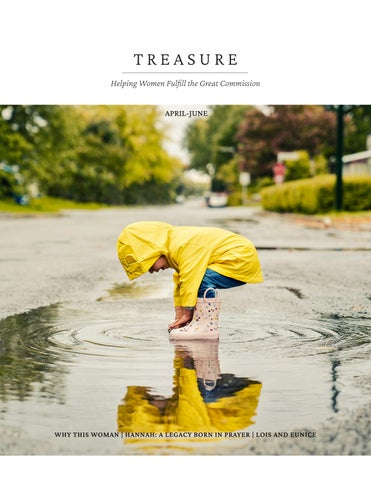
Treasure Bible Study Guide | April-June 2026

Page 1


TREASURE

Helping Women Fulfill the Great Commission

APRIL-JUNE

WHY THIS WOMAN | HANNAH: A LEGACY BORN IN PRAYER | LOIS AND EUNICE

TREASURE

Volume VII, Issue 2 |April-June 2026 | WNAC.ORG

TREASURE

ISSN 8960038

Volume VII, Issue 2

Have you ever hesitated to share your faith, thinking, “Who’d listen to me?”

Why does God allow some women the ability to conceive and yet denies it to others? How can we come alongside those women experiencing infertility and provide love and support?

Lois and Eunice ........................22

Do your children regularly hear you pray out loud, and how could you make prayer a more visible and natural part of your everyday life?

TREASURE (ISSN 8960038) is produced quarterly by Women Nationally Active for Christ of the National Association of Free Will Baptists, Inc., 5233 Mount View Road, Antioch, TN 37013-2306. Copyright privileges reserved. A 2026 Member of Evangelical Press Association. Mail questions or comments to: Treasure, PO Box 5002, Antioch, TN 37011-5002 treasure@wnac.org | wnac.org | @WNACFWB

Editorial Staff

Kristi Johnson, Director

Tori Matlock, Design

WNAC Board

Ashley Alphin, Ohio

Rachelle Burchett, Kentucky

Sharon Dickey, Texas

Jessica Edwards, Tennessee

Angie Frasier, Florida

Tracy Payne, Arkansas

Katie Postlewaite, South Carolina

LeeAnn Wilfong, Missouri

Contributors

Diana Bryant, Florida

Rebecca Dotson, Tennessee

Patrick Hall, North Carolina

Kristi Johnson, Tennessee

Amber McDonald, Oklahoma

Ruth McDonald, Tennessee

Tracy Payne, Arkansas

Cristina Price, Tennessee

Mckensie Watts, Missouri

Sarah Sargent, Ohio

About the Writer:

Tracy Payne serves with her husband, Russell, in Springdale, Arkansas. She is mother of five and “Chick” to one grandson. She loves Women’s Ministry, especially Bible Study, and often can be found in a local thrift store.

Let’s Talk!

We sing. We have probably had some windows and doors shut to drown out our singing, yet we continue to sing. Who are we? We are The Sisterhood of The Divine Raccoon. Nine of us, from five states, meet at least once each year for an extended weekend of games, laughter, tears, and yes, sometimes we sing. We meet at various times and places, like church camp, special days with family or friends, college, or even while attending Vertical Three (youth conference) at the National Convention.

Now, do not take exception to our name. We are named after a taxidermy raccoon we affectionately named “Skippy.” Skippy has joined us for almost every gathering of the Sisterhood, because he represents a beginning of hearts reunited, with friendships from 45 to 60 years in the making. Of course, he is not “divine,” yet he is part of our story, thus the name.

And did I say we sing? We sang through laughter as we recorded a special song for one of our sister’s fathers. We sang through tears as we attended the funeral of our sister’s loved ones. They sang with me through the death of my father, a cancer diagnosis, the untimely death of my son, and a devastating tornado.

Psalm 30 is a picture of deep sorrow and intense pain. David does not mince words as he tells us how he feels. Yet he sang through his experience. Psalm 30 is, in fact, a song! It is a beautiful example of life, its struggles, and our God, who is there through each moment. He hears when we sing through adversity, and He is glorified. He is exalted as we sing of His kindness and His keeping through it all. In verses four and five, David urges others to sing, reminding us that joy comes in the morning.

Do you sing when others cannot? Sisters, let’s sing together.

WHY THIS WOMAN?

Pursued by Grace

Picture this: It’s a scorching day in ancient Samaria, the kind where the sun beats down like a relentless drum. Most folks grabbed their water jugs and headed for the well either at dawn or dusk to beat the heat, chatting with neighbors along the way. But not the Samaritan woman in John chapter 4. She slinks out alone at midday, her steps heavy with the weight of whispers and side-eyed glances from the town. Why? Her life was a tangle of failed marriages — five husbands down, and now she was living with a sixth man who wasn’t even that. In her culture, she was a pariah, someone to avoid lest her immorality be contagious. Defensive and guarded from years of rejection, she shields herself with pride and superiority in the face of disdain and cruelty. At the mercy of a patriarchal society, she is a broken woman with zero rights and perhaps no means to remedy her circumstances. She chooses solitude over scorn, having been beaten down by the morality of the “righteous.”

Enter Jesus. He’s traveling from Judea to Galilee, but instead of taking the preferred route through the Jordan Valley, He goes through Samaria — a place most Jews detoured around like an infectious leper colony. Samaritans were viewed as half-breeds, their ancestry mixed with Assyrian invaders centuries earlier, and their faith a DIY (Do-It-Yourself) version with its own temple and twisted scriptures. Jews and Samaritans? Oil and water. But John 4:4 tells us, “And he must needs go through Samaria.” That “must” is not about shortcuts; it is divine necessity with sovereign intent. Jesus arrives at the well, tired and thirsty, and sits down just as the Samaritan women arrives.

Why her, specifically? Couldn’t He have picked anyone — a shopkeeper, a farmer, even one of His disciples — to spark a revival? Of course, He could have. However, a recurring theme in Scripture is God doing the unexpected as He systematically reveals His plan of redemption for mankind. God uses the weak to display His strength, the sick to illustrate healing, and the broken to showcase how He alone mends and creates something new (2 Corinthians 5:17). He hunts

down the hidden, the hurting, the ones society labels “least likely to succeed.” Jesus didn’t see a scandal; He saw a soul thirsty for more than well water.

Jesus’s request for water in verse 7 shatters norms. Jews didn’t share cups with Samaritans, and men didn’t chat up strange women in public. But Jesus crosses cultural lines on purpose, showing that God’s love isn’t boxed in by borders, biases, or social and gender prejudices. He then says, “If thou knewest the gift of God, and who it is that saith to thee, Give me to drink; thou wouldest have asked of him, and he would have given thee living water” (verse 10).

Living water? In a dry land, that’s poetry. Jacob’s well was deep — still a remarkable 100 feet deep today. It was reliable, a symbol of heritage and survival. The woman leans on that and, sarcastically, asks who Jesus thinks He is. He didn’t even have anything to draw water, so how could He give her “living water”? However, Jesus’ purpose was more than simply quenching her thirst. He was about to turn her world upside down, and she would never again approach this well without remembering God Himself had once met her there.

Transformed by Truth

Okay, so Jesus has her attention now. But rather than debate with her, He changes tactics, saying, “Go, call thy husband, and come hither” (verse 16). Ouch. She squirms: “I have no husband” (verse 17). Then comes the zinger: “Thou hast well said, I have no husband: For thou hast had five husbands; and he whom thou now hast is not thy husband: in that saidst thou truly” (verses 17-18). Imagine the shock — this stranger knows her secrets, her failed relationships, and her current mess. Jesus sees her. There is no judgment in His voice, just quiet knowing. It’s like having your diary read aloud! Why bring up her past? Not to shame or embarrass her, but to bring healing. We all wear masks, don’t we? We smile through pain, post highlight reels on social media, and pretend everything’s fine. But truth cuts through the charade. Jesus exposes her sin compassionately, forcing her to

acknowledge her sinful reality and her need for Him. She attempts to dodge with a classic deflection — a shift to religion, citing the age-old Jewish/Samaritan feud over temples (verses 19-20). But Jesus doesn’t get sidetracked. He reframes worship as something not dependent on a place but focused on whom it is directed (verses 21, 23-24). No more holy sites or rituals as crutches; it’s about heart connection, anywhere, anytime. God isn’t confined to buildings — He’s a boundless Spirit seeking real relationships. She then seeks to dismiss the conversation altogether, saying the coming Messiah will clear it up. In that perfect moment Jesus says, “I that speak unto thee am he” (verse 26). Best mic-drop moment ever!

In Greek, the phrase “I am” is particularly emphatic: egō eimi. The “I AM” statements of John point us back to a conversation between God and Moses when God explained who He was” — “I AM WHO I AM” (Exodus 3:14). Boom! This strange guy in front of her is claiming to be Yahweh, the almighty Creator of the universe. She’s the first to hear this direct revelation — not a disciple, not a rabbi, but a Samaritan woman with baggage. Why her? To demonstrate to us salvation is for everyone — Jews, Samaritans, you, me. It echoes Acts 1:8, “But ye shall receive power, after that the Holy Ghost is come upon you: and ye shall be witnesses unto me both in Jerusalem, and in all Judaea, and in Samaria, and unto the uttermost part of the earth.” Transformation happens in honesty. When we drop the facades, truth floods in. She came for water, but left drastically changed, forsaking her water pot, with spiritual thirst quenched (verse 28).

Relate this to everyday life: Ever had a conversation that peeled back layers, leaving you lighter? Maybe with a friend over coffee, admitting struggles. That’s what Jesus offers — truth that transforms. He sees our messes: the addictions, regrets, the brokenness. Five husbands? She had been chasing satisfaction in the wrong places. Sound familiar? Careers, relationships, stuff — we are all guilty. Why this woman? Jesus took her guarded heart, cracked it open, and she became a conduit for truth.

Empowered to Share

Transformation isn’t private; it spills over. The woman dashes back to town: “Come, see a man, which told me all things that ever I did: is not this the Christ?” (John 4:29). The same folks who’d shunned her are now listening. Why? Her efforts to get the community’s attention stand in stark contrast to her previous efforts of avoidance. She ran through the streets of the town, wanting the very people who had shunned and despised her to come meet their Messiah. What an example for us! This woman didn’t have a theology degree or a spotless record; she had an encounter. And that was enough. Her voice reached where others couldn’t. As a local with a notorious past, her change was undeniable proof.

“And many more believed because of his own word; And said unto the woman, Now we believe, not because of thy saying: for we have heard him ourselves, and know that this is indeed the Christ, the Saviour of the world” (John 4:41-42). A whole town was transformed and mobilized to share this amazing gospel message, and it started with one sinful, broken woman willing to share her story. Why her? I now ask, why not her? Let’s remember elderly Sarah the barren, Rahab the harlot, Ruth the Moabitess, David the adulterer, Mary the teenager…all individuals God purposefully chose and included in His great plan.

What about us? Have you ever hesitated to share your faith, thinking, “Who’d listen to me?” The Samaritan woman did it without any training whatsoever, just enthusiasm. We should avoid pitfalls like prejudice (judging who’s “worthy”), busyness (mundane tasks over mission), procrastination (waiting for perfect timing), or jealousy (grasping for recognition or reward). Instead, seize the moments. Share your story — the highs, lows, and how Jesus met you there.

The story of Jesus meeting a Samaritan woman at a well has stayed with us for centuries because it hits home: no one is too broken or too far gone for God. We keep circling back to stories like this because

they are reminders we’re not alone in our flaws. The Samaritan woman wasn’t some polished saint; she was an outcast with a complicated past, dodging the town’s gossip by fetching water at high noon. Yet Jesus didn’t just bump into her — He went out of His way to find her. Why her? Not because she had it all together, but because her brokenness made her the perfect canvas for His grace. This pursuit teaches us God doesn’t choose individuals based on their reputations, resumes, or charisma. In a world that judges by appearances, God looks deeper, as it says in 1 Samuel 16:7, “For man looketh on the outward appearance, but the LORD looketh on the heart.”

This isn’t just ancient history; it’s a mirror for our lives. Think about it: Each of us has a unique story, shaped by joys and heartaches, and a distinctive voice that can connect with others in ways no one else can. Jesus knew this, and He left the “ninety-nine” in Judea to chase after this one “lost sheep” (Luke 15:4) in Samaria showing us no one is beyond His reach.

The Samaritan woman was seen.

She was known.

She was loved.

And she was given grace and opportunity to share in the premier event of cross-cultural evangelism, immortalized in Scripture for her willingness to overcome all she had endured to share Jesus with others. We should never doubt the power of personal testimony or the power of God to make us new creations in Him, empowering us to display and communicate His glory. We can leave our forgiven past and “waterpots” of doubt behind, step out in faith, and watch God move.

About the Writer:

Rebecca Dotson is wife to Chris, mom to Philip and Andrew, and Nonnie to Jennings Anne, Callan Brooks, and Charly Ruth. A graduate of Welch College, she has served at Peace Free Will Baptist Church in Morristown, Tennessee, for 40 years. Becky is an avid reader, a church pianist, and a craft enthusiast.

We all wear masks, don’t we? We smile through pain, post highlight reels on social media, and pretend everything’s fine. But truth cuts through the charade. Jesus exposes her sin compassionately, forcing her to acknowledge her sinful reality and her need for Him.

TATIANA’S TESTIMONY

AS TOLD BY RUTH MCDONALD

In August 2023, I had the wonderful opportunity to travel to Tajikistan and Kazakhstan with a small ministry group through THP (The Hanna Project). On one of our last days traveling, we visited the Hope Center in Dushanbe, Kazakhstan, and met a beautiful woman, Tatiana. Here is her story:

When I was a young woman, I lived with a man and had his child. She was just five years old when we were traveling across some desolate country and had a terrible accident. All the passengers in the vehicle were killed instantly except me. I was thrown from the vehicle and landed several yards away in a ditch. The first people who came upon the wreck were sure that I would not make it due to the severity of my injuries, but they took me to the hospital anyway.

After a very long recovery, I was discharged from the hospital, but I was extremely angry at everyone and everything, especially God. I began drinking and didn’t quit. I lived a promiscuous life, addicted to alcohol, and was constantly cursing and fighting. One night in a bar fight, I attacked a woman so savagely that she died. As a result, I served a 10-year sentence in prison for murder.

While I was there, I didn’t have access to alcohol, but I was still full of hatred, cursing, fighting, and anger. During that time, a group of Baptist Christians came to the prison once a week to talk with the prisoners. My only experience with Christianity was through the Orthodox Church, and they characterized Baptists as “those people who drink blood and eat flesh,” so I didn’t think they had anything to say that I wanted to hear. Out of boredom, however, I started to attend. I enjoyed heckling them and cursing them during their talks.

In time, their message got through to me, and I repented of my sins and decided to follow Jesus. My anger went away as I experienced God’s grace and love. Another dramatic change was that I quit cursing.

After my release from prison, I was taken in by Christians who showed me the love of Christ. In the next few years, I lived — and eventually began to work — in a Hope Center for displaced women and children. I am currently serving as Director of the Hope Center in Dushanbe, which ministers to orphans and at-risk children. Jesus saved my life, and all praise goes to Him!

HANNAH: A Legacy B n Pray

M A y

Imagine living in a society where a woman’s value is determined by something beyond her control — measured not by her God-given worth, but by what she can produce. For thousands of women in 11th century BC, including Hannah, this was reality.

We first encounter Hannah in 1 Samuel chapters one and two. We know the end of the story — the High Priest Eli noticed her deep faith and declared God would grant her petition. Soon afterward she became the mother of Samuel, the last judge of Israel. Her story had a very happy ending; however, the journey to that special pregnancy was fraught with agonizing heartache.

Who is Hannah?

In the first eight verses of 1 Samuel 1, we are introduced to Elkanah, who lives in Ephraim and to Eli, the High Priest. Now Elkanah had two wives, Hannah and Peninnah. Scripture does not tell us how old Hannah was nor how long she had been married, but we do know she was barren. Peninnah, however, had produced several children for Elkanah. Some scholars suggest Elkanah married Peninnah because Hannah was unable to bear children, though he continued to love and favor Hannah.

Infertility is a pain hard to understand unless you have experienced it. I lived through seven years of infertility, and even though God eventually blessed us with two beautiful daughters, the scars from those years of anguish will remain in my own heart until the day I die. Fortunately, I live in a culture that does not equate my worth as a woman to my ability to bear children, but Hannah did not have that privilege. Women in her day did not go to university and get degrees, climb the corporate ladder, own businesses, or write books. Their greatest and only role was to be a wife and mother. Both then and now those are definitely worthy roles, but, at that time, a barren woman’s worth dropped drastically.

Not only was Hannah experiencing crushing grief over her own empty arms and guilt for disappointing Elkanah, but Peninnah, her “rival,” also added to her pain by mocking and provoking her. Most likely Peninnah knew she was not the favored wife, even though she had given Elkanah children. At the temple she had watched as he gave Hannah a double portion of the sacrifice while she only received one. Perhaps it is understandable she felt hurt by Elkanah’s actions and took it out on Hannah.

Elkanah, meanwhile, is completely clueless. His steadfast love for Hannah, despite her barrenness, is admirable. Not many men in his culture were that upstanding. His words to Hannah after she pours out her hurt to him reveal just how little he understood the drama simmering under his own roof. He meant well, but his favoritism toward Hannah was only adding to the pain and reassuring her he was “as good to her as ten sons” (verse 8) was certainly well-meaning but completely wide of the mark. He did not understand Hannah’s grief at all.

Unlike the accounts of Sarah and Rebekah earlier in the Old Testament, Hannah’s story offers a more intimate glimpse into the depth of her suffering through infertility — a story that speaks to all who know the pain of waiting, unanswered prayers, and being misunderstood by family and friends.

For Thought and Discussion:

Do you have your own infertility journey?

If you are comfortable, please share your emotions during those days/weeks/years. What lessons did you learn about yourself during that time? About God?

Why does God allow some women the ability to conceive and yet denies it to others?

How can we come alongside women experiencing infertility and give love and support?

Hannah’s Petition

Accompanied by Hannah, every year Elkanah made the journey to Shiloh, a city of worship. And every year Hannah carried her pain and grief to the temple. How many times had she done this? The passage says “year after year” (verse 7). How many years had her request gone unanswered? Did she return home feeling her prayers were useless? Recorded in verse 11, her prayer reminds me of my prayers during my own infertility journey. She begged God to listen, to answer. She even bargained with Him by offering to raise her son as a Nazirite, dedicating him to God’s service. The High Priest Eli sees her praying so fervently he assumes she is drunk and chastises her. She readily admits to being troubled in spirit and to pouring out her soul before the Lord. What she doesn’t tell Eli, however, is for what she is praying. She never mentions her desire for a child. He blesses her, assuring her God will grant her petition. Hannah went away and was no longer sad. She understood what Eli was telling her — she finally had her answer!

Hannah happily returns home with Eli and the rest of the family. Before the next annual trip to Shiloh, she had given birth to a son, Samuel, which means “God has heard.” As promised, she raises him as a Nazirite and brings him to the temple once weaned.

Side note: What did it mean that she raised him as a Nazirite? Nazirites were known for three things: abstention from grapes and grape products (juice, wine, and vinegar), not cutting their hair, and not becoming ritually unclean by touching a dead body. This vow could last a lifetime or a limited time. (Interestingly, Samson and John the Baptist were also Nazirites, and both were born to infertile women).

For Thought and Discussion:

How would you describe Hannah’s faith? Share a time when you bargained with God.

Hannah’s Sacrificial Vow

Hannah had vowed to take Samuel back to the temple permanently “after he had been weaned” (verse 11). What a hard decision that must have been! The exact age a child was considered weaned in the Old Testament is unknown, but most scholars assume it was between the 18 months and five years. Since Samuel needed to be pretty independent while living with Eli (who was an old man), he was likely closer to five years old when left by Hannah. Not only would he need to be “weaned,” (no longer nursing and able to eat solid foods) but also potty-trained, able to feed and dress himself, and communicate verbally. Hannah only had about five years to pour as much into her son as she could.

She likely told him about the miracle of his birth — how long she prayed for him, the long journey of grief and pain that finally ended joyously with a baby in her arms. She explained how one day she would take him to the temple where he would learn to serve God, and how she would return each year to see him. Whatever Hannah’s lessons were, they laid a solid foundation of faith Eli built upon later. When the time came for Samuel to live in the temple, he was ready.

Can you imagine what was going through Hannah’s heart and mind as she prepared to leave her son in the hands of Eli? I have always admired her words of faith to Eli, “For this child I prayed, and the LORD has granted me my petition that I made to him. Therefore, I have lent him to the LORD. As long as he lives, he is lent to the LORD” (verse 27). The name Samuel can also mean “borrowed from the LORD,” so it is poignant here that Hannah, who “borrowed” Samuel from the LORD, is now “lending” him back to God.

For Thought and Discussion:

Why do you think Hannah made such a sacrificial vow? Put yourself in her place…do

you think you could make a similar vow?

How has Hannah’s long-ago vow affected you/us today?

Hannah’s Song

After fulfilling her vow, Hannah breaks out into a song (1 Samuel 2:1-10). Pay attention to the timeline. She doesn’t sing this beautiful worship when she realizes she is pregnant, nor when Samuel was born. No, she sings when she takes him to the temple to leave him there permanently. At the moment when any mother’s heart would be breaking, her heart is worshiping. Her song is not a lament, mourning the separation from her son, but instead, she “exults in the LORD” and “rejoices in [His] salvation.” She sings of God’s holiness, His steadfastness, and His strength. Perhaps Hannah was thinking of Peninnah when she sings, “Talk no more so very proudly, let not arrogance come from your mouth; for the LORD is a God of knowledge, and by him actions are weighed” (verse 3). Hannah sings of images of battle, of the poor and hungry being clothed and fed, of the barren giving birth to seven children, and the power of the LORD to exalt or bring low. She ends her song by declaring God would “give strength to his king and exalt the horn of his anointed” (verse 10).

Hannah’s declaration is interesting because Israel had no king during her lifetime. Samuel was Israel’s last judge. And the day when kings began to reign, Samuel would anoint Israel’s first king, Saul, and later, their second king, David. Was Hannah’s song pointing to a future she would never live to see, but in which her son would play a vital role? I am grateful the Holy Spirit included Hannah’s song in the Bible. After all she had endured, her remarkable words of praise and faith are an encouragement to everyone traversing dark valleys.

For Thought and Discussion:

What does Hannah’s song tell us about her emotions when leaving Samuel?

What do you think of verse 3 in Hannah’s song?

What about Hannah do you want to emulate?

When in your life did you sing in spite of your circumstances?

Why Hannah?

The Bible is a big book, with hundreds of characters, but Hannah’s story is unique as Scripture gives an intimate peek into the life and heart of a woman. Sarah, Rebekah, Rachel, Samson’s mother, Hannah, and Elizabeth were all women suffering through infertility. Scripture reveals little about their inner thoughts regarding their barrenness, aside from their diminished standing in the community and, at times, the created tension within their marriages. Though, from my own experience, I imagine they were all going through similar heartache. So why did God decide to include Hannah’s story in the Old Testament?

I used to believe the moral of Hannah’s story was the need to be persistent. Like the widow in Luke 18:1-8 who keeps pestering the judge to give her justice, Hannah also prays consistently for God to give her a child. While the Bible does encourage us to pray fervently and without ceasing, it does not promise we will always get what we ask for, even if our “ask” is something holy. And God’s promises of a child to Sarah, Rebekah, and Rachel were promises specific to them, not to all women everywhere. Why did Hannah persist? Why should we?

Hannah’s experience demonstrates a truth we all need to learn — she took her request, sorrow, and incomprehension to God because He was the only one who could understand completely. He was the only one who could intervene. He chose to act spectacularly in response to her prayers, but He doesn’t always intervene like that. Sometimes the hardest-earned

faith is that which continues to believe even when the answer is no. Why did Hannah stay true to Jehovah? Why did she keep coming to Him with her request even though she had received no answer for years?

I had to settle that question for myself, too, and I eventually found my answer (and the words to express it) in Peter’s reply to Jesus’ question in John 6:67. After many of His followers left Him, Jesus

Hannah’s faith and trust not only shaped her son, but also impacted the generations after her.

turned to the disciples and asked them if they also wanted to leave. Peter replied, “LORD, to whom shall we go? You have the words of life…” Even though Hannah may have felt her prayers were being ignored, she still committed to praying to the one true God capable of intervening.

1 Samuel 2 tells us that Hannah, after she had taken Samuel to live at the temple with Eli, visited him ev-

ery year with a new robe she had made. Samuel was probably around five years old when he first moved to the temple. That seems very young, and yet, he already had a solid foundation of faith that Eli could build on, training him to be one of the best priests Israel ever had. How did Samuel obtain such a foundation in only five years? I wish Hannah had left us a handbook of her child-rearing methods! We can only speculate what she taught him, but she and Elkanah most likely followed the directives given in Deuteronomy 6 to teach their children diligently, night and day. Of course, God had big plans for this little boy, so there was an element of supernatural intervention as well.

I have often tried to imagine Hannah’s feelings as she surrendered Samuel to Eli, and how eagerly she looked forward to her annual visits to see him. How very proud she must have been, yet what a hole his absence must have left! Happily, God blessed her with three more sons and two daughters, who helped fill the void left by their eldest brother.

For Thought and Discussion:

Why do you think God included Hannah’s story in His Word?

Hannah’s barrenness gave her no “worth” in those days. Where did Hannah find her worth?

Where do you find your worth?

The Bible does not share any more details about Hannah yet knowing her habit of coming to the LORD with her desires and sorrows, we can reasonably assume she continued that pattern, praying for Samuel and his future. Though it is unlikely God will call us to surrender our children to be raised in the temple by an elderly priest, He does call us to offer our children back to Him for His service and His will in their lives. A “baby dedication” during a church service is not

just a pleasant ceremony. The dedication vows mean praying for our children, reading the Bible with them, disciplining them, taking them to church, and living with consistent integrity in front of them. Those vows also encompass the idea of allowing them to obey God in whatever He calls them to do, whether working locally and living next door, or ministering in a foreign country halfway around the world.

Hannah was just an ordinary woman hemmed in by the societal expectations of her time. But God saw her heart and knew she was the mother Samuel needed. Her faith and trust not only shaped her son, but has also impacted generations after her, through the ministry of Samuel, and through her own testimony, recorded in the Old Testament for millions of women to read. Who would have guessed a humble woman from Ephraim, childless and mocked, would one day leave behind such a legacy? Her example of persistent prayer, faithful training of her son, and prophetic worshipper is an example we should aspire to model. Who knows what kind of impact a life lived in such a manner may have on future generations?

About the Writer:

Born in Washington, North Carolina, Cristina Price moved to Omaha, Nebraska, with her church-planting parents when she was two years old. She still bleeds Husker Red to this day! Cristina and her husband, Matt, have been IM missionaries to France for 21 years, and they have twin 14-year-old daughters, Madeleine and Emilie. Cristina loves to read, drink tea, take walks through the woods near her home, and have deep conversations with guests around her table.

About the Writer:

Sarah Sargent loves to laugh and make others laugh even more. She is a third-generation member and leader in Free Will Baptist Women’s Ministries. She currently serves as the president of the women’s ministry at Reynoldsburg Free Will Baptist Church and president of Ohio Free Will Baptist Women’s Ministries.

Giggles

Have you ever gotten “church giggles” at a church fundraiser?

While I was in college, my church held a “pig-in-a-poke” auction to raise money for the youth group. A pig-in-a-poke auction is when participants bid on a bag having no idea the value of its contents or what is inside. This particular year we asked people in the church to place their items inside a paper bag from the grocery store so they would all be the same size.

The auction had been underway for some time, and we were having a great time. One man ended up with a loaf of bread, a jar of peanut butter, and a jar of jelly; another woman won a bag full of toilet paper. Someone else received a new DVD with popcorn and a candy bar, while another lady walked away with a gift card to a local restaurant — and a can of tuna. The rhyme and reason behind the “pigs” in the “pokes” were delightfully all over the place.

In our church was a guy who was quiet and shy but had a family full of big personalities. He quietly bid on a particular bag and eventually won the auction. As the bag was delivered to him, everyone in the church turned to see what gem he had just won. Peering inside the bag, his face immediately flushed red, and he quickly rolled the bag closed. Noticing his embarrassment, the crowd began cheering for the reveal. He adamantly refused. His never-embarrassed wife grabbed the bag and pulled out…a clothes hanger. But not just any clothes hanger, this particular one was designed with two very shapely female legs of a doll. The church all got a good laugh. My dad (the pastor) was as shocked as the hangar’s new owner and asked the audience, “Now who brought that?” No one admitted it. After a short hesitation, this little granny, who to most of the church was a quiet older lady (the ladies’ group knew better!), raised her hand. I started giggling, but that giggle turned into a full belly laugh when I spied the man’s face go red all over again!

A Beautiful Mess

I remember the pain all too well: the trying, the testing, the waiting, and the well-intended but tactless remarks. Then came the poking, the prodding, the procedures, and the depression. The mental and physical toll of infertility on a couple is isolating and devastating. However, through it all, God was with us, even when the days seemed long, and His hand felt distant. We were never out of His sight.

Our journey to parenthood was not a conventional one. While my husband and I felt IVF (in-vitro fertilization) was not an option, we pursued another type of intervention. After that was unsuccessful, I was guided towards surgery. I had endometriosis. After a time of processing our next step, we explored domestic adoption. We were introduced to embryo adoption and felt this was the direction to pursue.

It is a beautiful mess: carrying and birthing a child genetically unrelated to you yet loved just the same. But it was an adventure — joined by countless supporters — we were willing to take.

However, after initially looking positive, our first embryo transfer failed. The devastation once again set in — yet our second round was a success! I gave birth to a healthy baby boy. Then 10 months later, we discovered we were having another baby: a natural surprise! We welcomed a beautiful baby girl, and we are so grateful. While this is a much longer story, I want to share some resources that helped us. First, find a good Christian counselor; we needed this. The devastation of my infertility affected both of us, and we benefited from professional, godly wisdom. Second, choose one (or a few) prayer partners you can trust. Believers need Christian community, and this is especially true when we are facing trials. Every personal detail does not have to be shared with every church member or friend but select a few trusted friends to pray for you and with you. They can also provide encouragement and simply listening when you need to cry.

One of my friends sent me Kathe Wunnenberg’s Grieving the Child I Never Knew. This devotional book was one of the greatest blessings in my journey. Hannah’s story was now relatable to my own experience. The story of the two women who stood before King Solomon was also included in this book. I had never focused on the grief of the woman who lost her child and who tried to pass the other baby as her own. She probably wasn’t as cruel and heartless as she appeared; she was just experiencing an enormous loss and trying to cope with it. It reminded me many others experience the nightmare I was going through, but God always sees me, hears me, and will take care of me, no matter the outcome.

Mckensie Watts lives in Missouri with her husband, Jackson, and two children, Amos and Isla. They belong to Grace FWB Church in Arnold. Mckensie is originally from Fuquay-Varina, North Carolina, where her grandmother helped start the Hilltop FWB Church. Mckensie is a graduate of Southeastern FWB College and has a background in education and childcare. She now volunteers at her church and is a homemaker.

It’s been four years today. Four years since I had that excitement of thinking we were going to hold a little miracle, four years since we were talking about baby names and thinking about what would sound good together, four years since we got that sonogram to show it wasn’t my body playing tricks on me and that I saw that little black outline of a circle on a screen. four years since I made those three different terrified calls over the span of five hours to an ER desk asking if the bleeding was normal and being told by the on call nurse that it “wasn’t enough to be concerned” and “call back or come in if it gets worse.” Four years since I talked to a lady at my church who urged me to go to the ER, and the worship team could hold down the fort while I went. I was poked, stuck, given two types of ultrasounds, and at the end of it all, heard “I’m so sorry.”

Since then, it has been four years of struggling with infertility and not understanding why it was happening. So much bloodwork, so many tests, ultrasounds, medications, and after all of that just...nothing. It can all feel so hopeless and lonely sometimes when you’re in the middle of the hurt, and so overwhelmingly just THERE, that it can cloud anything else that has happened.

What else has happened in the four years of struggle? Let me tell you.

• Thomas and I learned to lean on each other more than we already did.

• Two weeks after our miscarriage, I was offered the position of worship leader at the church I have attended since I was four years old (lots of fours here apparently).

• I walked into the position with a team of amazing people that have such a love for God, worship, and each other that it’s almost unbelievable.

• I have seen this group of people grow even bigger and have seen their care for each other grow with it, even those who have stepped back for a little bit.

• I have seen members grow and move on to be worship leaders themselves!

• I have seen lives change. I’ve been given the opportunity to be a mentor. I’ve been blessed to have the chance to share a part of my testimony. I’ve been able to watch and be a supporter for people who have shared theirs as well.

• I have watched my friends and family have children and I have been nothing but excited and happy for them. (I love being an Aunt to these kiddos; they’re fantastic!)

Have these past four years been easy? Absolutely not. Infertility is never easy. It isn’t simple, it doesn’t get better, it just…is. It stinks, it’s awful, and I have a hard time not feeling like my body is betraying me or is just broken. But there has been so much good as well. Instead of focusing on the pain, I want to see all of the other beautiful things that God has blessed me with along the way.

If you are going through this painful journey, please know you are not alone. In Isaiah 66:9, God promises He will not cause pain without allowing something new to be born. God is using your story to bring others to Him.

About the Writer:

Amber McDonald serves as a worship leader at Calvary Free Will Baptist Church in Oklahoma, where she has been a part of the music ministry since the age of 15, while her husband, Thomas McDonald, serves in the church’s tech ministry. In her spare time, Amber enjoys baking, creating art, singing, and reading in her spare time.

B Y D IANA B RYANT

There she stood—my 17-year-old granddaughter — wearing my going-away dress from my wedding day 46 years ago. Seeing her in it brought happy tears to my eyes, and a pride I couldn’t quite put into words. The dress is still very pretty and fit her as though it had been made for her. In that moment, I realized traditions don’t just live in stories; sometimes they’re stitched into fabric and quietly passed from one generation to the next.

My granddaughter and I shared a sweet Christmas visit this year, spending one afternoon in the kitchen making candy together from a recipe handed down by my grandmother. For years, side by side, Grandma and I had made that same divinity candy. In those simple moments — an old dress, a well-worn recipe — the most meaningful traditions are the ones that keep our hearts connected across generations.

It is heartwarming to see traditions and memorabilia passed down. Family stories and memories are preserved for at least one more generation. Grandmothers and mothers are typically storehouses of family traditions, and their origins. They are the source of wisdom about babies and their care, feeding children and nursing wounds and illnesses, and general knowledge on caring for homes and families. Many a woman finds herself doing things in the kitchen a certain way simply because her mother or grandmother did it that way. We can’t overestimate the influence our grandmothers and mothers have on us and our daily lives. Unfortunately, some women have witnessed negative traits in those examples and have learned to do things differently. Still, the influence and the results of that influence are very real.

For Thought and Discussion:

Take a minute to think about the influence of your own mother and grandmother. What did you “inherit” from how they did things?

Consider what 3 John 1:4 says: “I have no greater joy than to hear that my children walk in truth.” Seeing our prized possessions and traditions recurring

through posterity is encouraging, yet the deeper satisfaction and profound happiness is witnessing those coming after us continuing our example of faithful and righteous living, trusting God for everything. Our first biblical example of this is in the lives of Timothy’s grandmother and mother. In 2 Timothy 1:5 Paul specifically points out he sees the faith in Timothy, which he first saw in his grandmother Lois and his mother Eunice. Later in 2 Timothy 3:15, Paul notes Timothy had known the holy Scriptures since he was a child. The influence and teaching of these two godly women were obvious to Paul.

Scripture does not give us much detail about these two women; we’re not sure if Lois was Eunice’s mom or her mother-in-law. We do know Timothy’s mother, Eunice, was Jewish and his father was Greek. While that no doubt gave Timothy insight into both cultures and certainly helped as he later ministered to different people over the course of his ministry, those two cultures differed significantly in their religious points of view. Possibly Eunice needed to be very intentional in sharing and living her faith in contrast to her husband’s lifestyle. We don’t know that specifically, but we do know challenges arise when only one parent is a believer. Certainly, Eunice’s relationship with Christ would affect her relationship with her husband. Example and teaching must be carefully deliberate while still respecting the role of the other parent.

Paul describes the faith of these two women as “unfeigned” or “sincere,” and was demonstrated before Timothy as he grew up. Our children, probably more than anyone else, recognize when our walk doesn’t match our talk. They watch to see whether we worry over circumstances or take them to God and trust Him to work. They notice whether we truly pray and read our Bibles or merely talk about it. They are aware of how we respond when daily situations don’t go our way or when people cause us grief. Obviously, his mother and grandmother were very intentional in teaching Timothy about the one true God.

What a legacy these women have left for us! I par-

ticularly love that not only was Mom mentioned, but also Grandma! What a responsibility and a privilege — we can teach and influence not only our children, but also our children’s children. Just think of the truths here. A grandmother who teaches her daughter to love and obey God, who then teaches her children to love and obey God. When God calls one of those children to the mission field, or to the pastorate, do you think those women share in the reward of the souls won to Christ because of their ministry? What a powerful role women have in nurturing faith and passing on dedication to service for the Kingdom of God!

Several years ago, women from the WNAC (Women Nationally Active for Christ) board went to Kazakhstan and Tajikistan to host a retreat for the Christian women in the churches there. These women were almost all first-generation Christians and were fascinated by our stories of having godly mothers and grandmothers. Of particular interest was learning from us how to pass their faith on to their children so they could have stories like ours in the future. What seemed unremarkable and common to us was very new to them. It was a humbling experience that made us stop and give thanks to God we had those stories!

One of my earliest memories of this is the time my grandmother broke her leg and recuperated at my house, lying on the couch with her cast propped up on pillows. I spent a lot of time sitting on the floor beside her. She told me stories, watched me dress my paper dolls, and taught me the 23rd Psalm and the books of the Bible. As I grew older, I stayed many nights at her house. I remember watching Grandma read her Bible and hearing her pray before bed. We also continued memorizing Scripture, and she rewarded my efforts with pancakes for breakfast! When I was still quite young, my grandmother bought my first piano and told me she had asked God to give her something she could do for me that I could use to serve Him. Apparently, He told her to buy me a piano and pay for piano lessons! I’ve played

the piano for every church I’ve attended since I was 12. Her faith was lived out daily, and that influence continues as I raise my own children and watch them faithfully serving God today.

Various women told how their mothers were faithful to see they were in church each Sunday, and others shared accounts of Bible stories before bed every night or family devotions before school each morning. Most of all, we emphasized living faithfully and explaining to children and grandchildren what God had done, how He had provided. We distributed newly-translated Bibles in the Kazak language (the first they had ever had) and described the impact on our children when seeing us read the Bible and sharing with them what God had shown us in His Word. Children don’t just hear and see what goes on around them; they absorb much of it. Timothy’s life demonstrates how early spiritual influences shape not only our children’s lives, but future ministries, and everyone affected by that ministry. “Ministry” is not necessarily a full-time paid position. Mothers have a ministry with their children. Women can serve as Sunday School teachers or mentors to teenage girls or young wives and mothers. Children of the next generation will become doctors, nurses, or schoolteachers, each with countless opportunities to influence young lives. God may call some into pastoral work, while others will serve on mission fields.

What a vital role we women play in shaping the spiritual foundation of the next generation. Women with no children, or no children at home can still have a significant influence. Countless children in our churches need a godly example to follow. They need to hear real-life stories of God’s faithfulness or to experience the love of Jesus through someone who cares. Can you bake? I know one faithful, precious woman who quietly baked cookies for the children at church. They still talk about her impact on them.

As we think about Lois and Eunice, there are some truths we can conclude about them, and things we can emulate.

Teach your children what you believe and why. That happens by following the Deuteronomy 6 model of talking about the Lord and His commands and what He’s done when we sit in our house, when we walk by the way, when we lie down, and when we rise. We’re told to be diligent in doing these things. That means intentional. In 2 Timothy 3:15 we read that Timothy knew the Scriptures from an early age. It’s never too early to talk to children about the Lord, to sing songs with them, read a Bible story together, and continually share about things God has done or provided. The sooner we read and sing to them about God or teach them short memory verses, the earlier these biblical values change their thought patterns and become a normal part of their life. It becomes familiar to them. The sooner babies hear, “Jesus Loves

Me,” the sooner He is recognized as a reality in their lives. Remember the decision to follow Christ is an individual one; the saying goes, “God has no grandchildren.” Teach them early and often and pray your faith becomes a reality in their own heart and mind.

For Thought and Discussion:

What are some natural moments in your daily routine (mealtimes, bedtime, car rides) where you can intentionally talk about God and what you believe?

How can you begin, or strengthen, the habit of reading Scripture, singing songs about God, or sharing Bible stories in age-appropriate ways with the children you influence?

Live what you believe. Children, and especially teens, are masters at recognizing “phony.” It is not that we will never mess up but apologizing and acknowledging we need forgiveness goes a long way. Teaching our kids kindness means demonstrating it in our own lives…responding graciously to a rude cashier or staying patient in frustrating traffic will convey more than we realize. When you’re gathering items for a family in need or filling a shoebox at Christmastime, let them in on the why. Talk about it as you go. Those everyday moments are where faith becomes real, and where our words and actions begin to line up. Point out when there are opportunities to take an action your pastor spoke about in his message on Sunday. Perhaps someone has wronged you or your child, and you need to show forgiveness. Discuss these issues and show them how to do the right thing even when it’s hard. Faith is not just an outward religion we say we believe. Kids must see our faith is alive, real, and working in our everyday life.

For Thought and Discussion:

When was the last time your child (or achild watching you) saw you admit a mistake or ask for forgiveness — what did that teach them?

How can you more intentionally explain the why behind acts of kindness, forgiveness, or generosity, so children see faith lived out?

Pray often. I loved hearing my grandma pray at night before bed. Even as a child, I knew I was being prayed for — and that has stuck with me. Let your children hear you pray, too. Gently remind them to turn to prayer at the right moments and share when God answers.

Teach them to pray first, not as a last resort. Through your own life, show them that prayer is a gift — that we can boldly approach God, we can go often, and we can talk with Him just as naturally as we talk with one another.

For Thought and Discussion:

Do your children regularly hear you pray aloud, and how could you make prayer a more visible and natural part of your everyday life?

How can you help your children learn to pray first — especially in moments of stress, fear, or decision-making — and celebrate answered prayers together?

Encourage questions. As they grow and come across different influences in their lives, kids will have questions. Remember this faith we’re passing on must become theirs personally. Answer questions, be approachable, and make them comfortable so they don’t feel afraid or ashamed to ask. If you can’t answer their question, find someone who can. Find good books on apologetics if you need to. Use Scripture. In order for the faith of our children to stand the tests and trials that will undoubtedly come, they absolutely must believe in their hearts on their own. Don’t be afraid of questions; God can handle anything we can ask. Work hard to answer those questions and help kids form their own solid beliefs. Pray over these questions with your kids. You may find that you benefit from working on answers to their questions!

For Thought and Discussion:

How do you currently respond when your child asks hard questions about faith, and what might help you create a safer space for honest conversations?

What resources (Scripture, trusted mentors, books) could help guide children as they form a faith truly their own?

I’m grateful for the mention of Lois and Eunice in Scripture. I’m grateful for the opportunity, the obli-

gation, and the privilege we have of being used by God to have influence far beyond what we can see. We are stewards of our children with a holy duty to impact our homes, our churches, and our world by nurturing their faith. Think how the efforts of these two women have influenced Christianity. It continues today! May we be the faithful ones who come behind them and do the same.

About the Writer:

Diana Bryant lives in Florida with her husband, Randy, a retired pastor. Throughout their years of ministry, her passion has been women’s ministry, where she has served at every level. She currently serves as board chair of the Florida Women’s Ministry Board and enjoys writing, speaking, playing the piano, and spending time with her two granddaughters.

Do your children regularly hear you pray out loud?

REGENERATION & RECOVERY

When I started our church 27 years ago, one of our first converts made a statement that has stuck with me all these years. He said, “Preacher, there’s no church in this town that a crack addict can attend.” The heartbreak is that it is not “those” people (outsiders) anymore, but many times our own families and loved ones in addiction. This addiction problem is now at pandemic levels in America. It doesn’t matter if you live in the country or city, good homes or broken, big income or poor, young or old. And it is affecting our society through crime, sex trafficking for women selling themselves or being sold, foster children coming from addicted moms, and so on. We just cannot ignore it anymore. And surely the church should have a heart for all these people.

We started an addiction ministry 20 years ago. Reformers Unanimous, then Celebrate Recovery, and now, Regeneration Recovery. Our meetings lead into a faith-based, 12-step program. In a word, “discipleship” — exactly what addicts and all of us “sinners” need. Our discipleship course includes 11-12 months of daily Bible work, asking questions, and journaling about past struggles, hurts and pain. This system leads to Christ first, with repentance, confession, and trusting. After salvation, each participant receives help in dealing with the past, making amends, and finding or giving forgiveness. The final step of recovery is helping others.

My wife Cathy started helping in this ministry. Saved at a young age, she was a good Free Will Baptist Christian girl! But when she started the discipleship book work, she was confronted with some things she didn’t expect, like childhood hurts and trauma, ministry hurts, etc. The journaling and questions of the program reminded her we all have past struggles, though maybe not as public as others. As good Christians, we hide them a little better, although “hiding” is not the answer — they need to be given to Christ and healed.

May I challenge you to check out the website below and take the online survey? This survey identifies any compulsive or addictive behaviors in otherwise “normal” people. Maybe you need help in pinpointing your struggles. The survey is fairly accurate and unfortunately, usually makes people angry. Could it possibly be “the truth hurts”?

Access an online survey called “Find My Struggles” by Regeneration Recovery: www.regenerationrecovery.org/struggle-finder

About the Writer:

Pastor Patrick Hall was saved age 18 after being delivered from drugs and alcohol. While stationed in Norfolk, Virginia, aboard the USS Iowa (BB-61) in 1983, he was introduced to Gateway FWB Church through the military ministry. In 1998, he started Cape Fear FWB Church in Wilmington, North Carolina. He currently serves as chief chaplain for the New Hanover County Sheriff’s Office. Patrick is married to Cathy and is the proud father of four children and (so far!) eight grandchildren.

* Ruthful is an archaic English word (and the complete opposite of ruthless) meaning “full of compassion.”

Just Being Ruthful*

We live in a broken world, and none of us is exempt from the challenges it brings. Pain, dysfunction, and difficulty are to be expected. The words of Jesus recorded in John 16:33 tell us, “In the world you will have tribulation.” Not “might” or “probably will” but you will. I’d like to just say “no, thank you” and pass on that dish.

That’s where the context of Jesus’ words becomes vital as we navigate our unwanted circumstances. Let’s read it in its entirety: “I have said these things to you, that in me you may have peace. In the world you will have tribulation. But take heart; I have overcome the world.”

1. In Jesus, you may have peace. You might lose many precious things like your health, marriage, career, possessions, dreams, reputation, loved ones, or even your life. But you can never lose Jesus and His care for you. You cannot lose His loving presence. You cannot lose your home in heaven. In times of brokenness I find peace when I focus on the things I can never lose.

2. Jesus has overcome the world. He has won the victory over divorce, disease, death, and every broken thing. Resting in Him, we experience His victory. Jesus says we can “take heart” because of His victory. Even our perfect Savior didn’t look forward to suffering. He too wanted to pass on that cup. Our struggles in this broken world grieve Him too. He found peace by submission (Luke 22:42). The women in this issue also found joy in submission, in trust, and in faithfulness to God’s will. Hang in there, sweet sister. Imagine Jesus, who has overcome the world, stretching out His nail-pierced hand and offering you the priceless gift of peace.

“Peace I leave with you; my peace I give to you. Not as the world gives do I give to you. Let not your hearts be troubled, neither let them be afraid” (John 14:27).

Love and blessings,

I first met Ruth McDonald in Japan. She was a mother of three young children, including a newborn who was just six weeks old. I showed up on her mission field as a summer missionary ready for an adventure, but not sure that sushi was going to be my friend. Ruth and her husband, Donnie, worked in the same church as Debbie Griffin at the time. Debbie was the brave missionary who’d agreed to host college students from FWBBC (Welch) and Southeastern FWB College. Donnie and Ruth graciously allowed us to be a part of their family and life that summer. I watched her with wonder as she ruthlessly served her family and her church.

I got to know Ruth better when I became a missionary and then later when I served in the IM office. We traveled together a few times, sharing hotel rooms, flights, snacks, and most importantly — late night conversations. We realized the paths of our lives had not physically crossed often, but they had so many similarities. Cross-cultural faux pas. Airline stories. Luggage issues. Living overseas with kids. And the lack of a large selection of peanut butter and cereals in our host cultures. None of those things mattered because we were able to share Jesus with people who had never heard of Him. What I learned from her was that she ruthlessly loved building relationships and doing ministry.

Today is my first day to sit at what still feels like Ruth’s desk. I was recently named as the new WNAC Executive Director. What an awesome privilege and responsibility. From my seat, I can see the word “love” written in Japanese on a wall plaque. I can see a prayer card for Ruth’s daughter’s carefully placed under the glass on the desk. I can sense her incredible decorating skills in the furniture and items around me. And I am reminded to be ruthless….as I lead the women of our denomination to continue making the Great Commission even greater in their lives.

Join Ruth and me today and celebrate ruthlessly what God has done through WNAC for more than 90 years!

About the Writer:

Kristi Johnson began serving as Executive Director of WNAC in January 2026. Along with her husband, Tim, she invested nearly 25 years as an IM missionary in Spain before joining the IM home office for four years. Kristi has a deep passion for walking alongside women through friendship and discipleship. Her heart for ministry and her love for coffee keep her fueled and ready to take on the incredible task of leading WNAC with vision and hope into the future.

Want to hear the vision of new Woman’s Ministry Director Kristi Johnson? Listen to the podcast.

Turn static files into dynamic content formats.

Create a flipbook