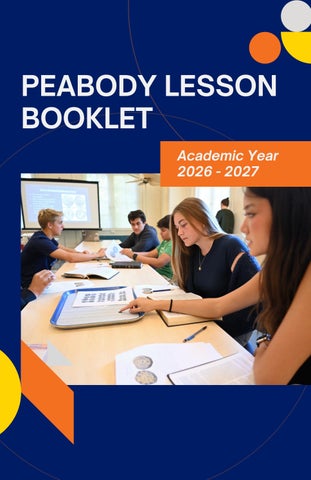
PEABODY LESSON BOOKLET Academic Year 2026 - 2027
A MESSAGE FROM THE PEABODY Teaching with the Peabody Institute goes beyond content in archaeology or anthropology. Our staff brings expertise in Native American and Indigenous studies, inclusive research methodologies, and systems of knowledge management. Visits here are designed to support your course goals and help your students gain new perspectives, build their skillsets, and connect complex theory to realworld practice. The Peabody supports learning in many academic departments, with established lesson plans that we continue to offer.
In this booklet you will find a selection of these lessons that demonstrate the unique content we can contribute to your courses, as well as examples of collections able to speak to classes across disciplines and course themes. Each can be modified to meet your particular needs, or you can request an alternative not mentioned here or something new entirely; these lists are far from comprehensive. Come to the Peabody for a staff-led lesson; to teach from collections yourself with staff assistance; or for help devising a plan for your class visit. We look forward to hosting you! To schedule a lesson or request a consultation, contact: Lainie Schultz (lschultz@andover.edu) Curator of Education
LESSONS IN NATIVE AMERICAN AND INDIGENOUS STUDIES
LESSONS IN NATIVE AMERICAN AND INDIGENOUS STUDIES These lessons center Indigenous experiences and knowledges within broader areas of inquiry, integrating these perspectives as part of your course content to augment the discussions already in your classroom. They do not require that you are teaching a course specific to Indigenous topics or themes.
Reservation Relations: Storytelling and Storywork Storytelling is a vital practice for Indigenous peoples, preserving and communicating history and shaping cultural expressions and artforms. Storywork is an Indigenous research framework that takes seriously the process of meaning-making contained in the sharing of stories. This lesson practices storywork in telling the story of Peabody curator Warren K. Moorehead and his 1909 investigation of the theft of lands from residents of the White Earth Reservation. Associated collections connect students to the emotional resonance of the relationships built between Moorehead and the people of White Earth. Students practice their own storywork through a creative writing exercise in response to a photograph by visual storyteller Lee Marmon (Laguna Pueblo). Most recently used in ENG300.
LESSONS IN NATIVE AMERICAN AND INDIGENOUS STUDIES
American Indian Movement The most well-known group of the Red Power movement, the American Indian Movement (AIM) joined in the social protests that shaped the United States of the 1960s and 1970s and helped inspire movements globally. The history of AIM fits within any discussion of civil rights while adding to them the unique positionality of Native Americans as sovereign nations. This lesson joins such important conversations by addressing some of the most significant protests organized by AIM during the height of its actions, connecting them to the long and ongoing history of Native American resistance, past and present. Most recently used in HSS300.
Restorative Justice Seeking to understand what justice is requires us to consider how justice can be accomplished. This lesson creates a context for students to discuss restorative justice and its approach to redress through consideration of select Indigenous collections. Putting these in conversation with retributive and rehabilitative justice, students gain an understanding of the principles of different forms of justice through focus on the spatiality and materiality of judicial processes. Most recently used in PHR513.
SKILLS-BASED LESSONS
SKILLS-BASED LESSONS Skills-based lessons demonstrate to students the factors that shape research processes, impacting both what we learn and how, and offer approaches for navigating these. They can be used to complement course skills grids, and are especially well suited for courses with interdisciplinary content.
Native American Graves Protection and Repatriation Act (NAGPRA) The 1990 Native American Graves Protection and Repatriation Act (NAGPRA) marked a turning point for archaeologists, museums, and Native peoples. This law requires museums to consult with tribal nations and repatriate ancestral remains, funerary objects, and other sacred items previously allowed to be excavated and held by museums, fundamentally changing professional best practice for archaeologists and museums alike. This lesson introduces students to this law and the participation of Phillips Academy and the Peabody Institute in its implementation. It additionally situates the work of this legislation within the context of efforts to understand and heal the wounds of colonialism. Most recently used in HSS300, HSS320B, and PHR533.
SKILLS-BASED LESSONS
Provenience, Provenance, and Empire This lesson develops students’ research skills by helping them to consider how it is we know what we think we know about the past, understanding bias in the primary source record and introducing provenience and provenance as key terms. Practicing small group work and using collections from the Ancient Mediterranean, students are asked to interpret collections as imagined from the perspectives of multiple locations within the Roman Empire. Along with practicing careful observation and critical thinking, this lesson helps students to experience the crucial impact of context on the interpretive process. Most recently used in HSS100.
Museum Histories and Practice How do collections get to places like the Peabody? What decides which kinds of collections go to which kinds of institutions? What happens to their documentation? How do these routes impact what and how we can learn from them? Why does any of this matter? This lesson introduces students to some common museum histories, with discussion of the biases they embed in the primary sources they seek to preserve and their impact on contemporary best practice in the field. Most recently used in HSS563.
PEABODY INSTITUTE COLLECTIONS
PEABODY INSTITUTE COLLECTIONS Collections-based learning is an incredible tool for teachers. Applying abstract ideas to something physically in front of them simultaneously focuses students’ minds while opening their imaginations, expanding the questions they ask and the connections they make. Below is a small sampling of some of the collections available at the Peabody, that can be engaged to explore any number of themes and topics.
Maya Textiles This collection of Maya textiles was amassed in Guatemala in the 1970s for import and sale in the US and consists of hundreds of examples of wearable art. Made by women and worn by everyone, this clothing is a complex artistic expression that combines aesthetics and technical proficiency with cultural and personal identity. The collection further includes examples of works still on the loom, demonstrating process alongside of product, and slides of street scenes from the areas in which the textiles were acquired. Items can be engaged to discuss topics in women’s rights; intellectual property and appropriation; forms of language and communication; personal expression and innovation; choices and uses of technology; among others. Most recently used in SPA501 and HSS581.
PEABODY INSTITUTE COLLECTIONS
Southwest Collections These collections from the Southwestern US are expansive, ranging in media and representing approximately 1,000 years of history, up to and including recent items created by contemporary artists and culture holders. The Southwest collections additionally overlap with the Peabody’s photographic holdings, including works from Indigenous and non-Indigenous photographers. Items can be engaged to discuss topics in cultural exchange, continuity, and survivance; representation and audience; design and technique; interpretive methods, collections bias, and knowledge transmission; among others. Most recently used in HSS200 and ENG300.
Baskets For many Native Americans, baskets are representations of community. As such, they bring the whole of life into the classroom, including areas that often are not preserved elsewhere in our historical records, or are otherwise often overlooked. The Peabody cares for at least 200 baskets from various parts of the United States. Regional strengths within the collection include the Northeast, providing opportunity for a local focus. Items can be engaged to discuss topics in gender; ecology; sequence and growing patterns; artist genealogies; among others. Soon to be used by clever faculty who know a good opportunity when they see one.
ADDITIONAL FACULTY RESOURCES For further ideas for connecting Indigenous content to subjects across the curriculum, see the faculty resources prepared by MLK Scholar Sam Clare (’25), available on the Peabody Space on PANet: https://panet.andover.edu/spaces/18/peabody-institute-ofarchaeology/articles Don’t forget to schedule a storage tour as an activity for your advising group, department, or visiting scholars!
Robert S. Peabody Institute of Archaeology
175 Main Street Andover, MA 01810 978-749-4490
https://www.andover.edu/learning/peabody @peabodyandover To schedule a lesson or ask a question, please contact: Lainie Schultz (lschultz@andover.edu) Curator of Education