The Blue Guidon
The Newsletter of Andover and the Military Fall 2025
John Campbell Greenway
By David Chase, Faculty Emeritus
“The best man in my regiment.” That was Theodore Roosevelt’s assessment of John Campbell Greenway, a Rough Rider during the Spanish-American War. Born in 1872, Greenway would excel in three endeavors: as an athlete, mining executive, and Army officer in two wars. In each undertaking, courage, skill, teamwork, initiative, and determination played their part.
John Campbell “Jack” Greenway entered Andover in 1891. He first achieved recognition as a member of PA’s football team, playing left end. In 1892 he was catcher on the baseball nine. Both teams had mixed records, but (as today) the school judged a season successful if PA trounced Exeter, and it had. It was common for Andover students destined for scientific or technical vocations in the late 19th century to leave before graduating. Greenway was among 13 underclassmen matriculating into Yale’s Sheffield Scientific School in 1892. At Yale, he gained national recognition, again in football, playing end, and in baseball as catcher. Yale teams were among the best of the era, each game reported in papers across the country. Elected president of his class, Greenway graduated with an engineering degree in 1895.
He went to work for Carnegie Steel at its thrumming Duquesne mill on the Monongahela outside Pittsburgh, starting as a machinist’s helper at $1.32 a day. He spent two and a half years
gradually advancing, proving himself a bright, ambitious employee. Late in April 1898, with the United States’ declaration of war against Spain, Greenway left Carnegie, took the train to San Antonio, and enlisted as a trooper (private) in the First United States Volunteer Cavalry, soon nicknamed the Rough Riders. Col. Leonard Wood was commander. Wood had been a college football player himself in the early 1890s and recalled Greenway’s Yale career. Thanks to Wood, in four days Trooper Greenway became 2nd Lt. Greenway.
The Rough Riders were equipped with the latest Krag-Jørgensen carbines and Colt revolvers. They were fitted with a unique, casual uniform, rugged and frontier-like: a large, high-crowned slouch hat, flannel shirt, baggy canvas trousers, leggings, boots, a cowboy bandana worn around the neck. Supplying the regiment was the work of Wood’s second in command, Lt. Col. Theodore Roosevelt. More than a thousand Rough Riders assembled in Tampa in May 1898. Due to a lack of adequate sea transport, however, only eight companies, without their mounts, arrived in eastern Cuba on June 23. The Rough Riders would fight as infantry. The troop ships heading to Cuba also carried Regular Army Cavalry, African American Buffalo Soldiers, and volunteer Black troops. (Among them was Lt. Walter Pinchback, PA Class of 1893, profiled in the fall 2023 issue of The Blue Guidon.)
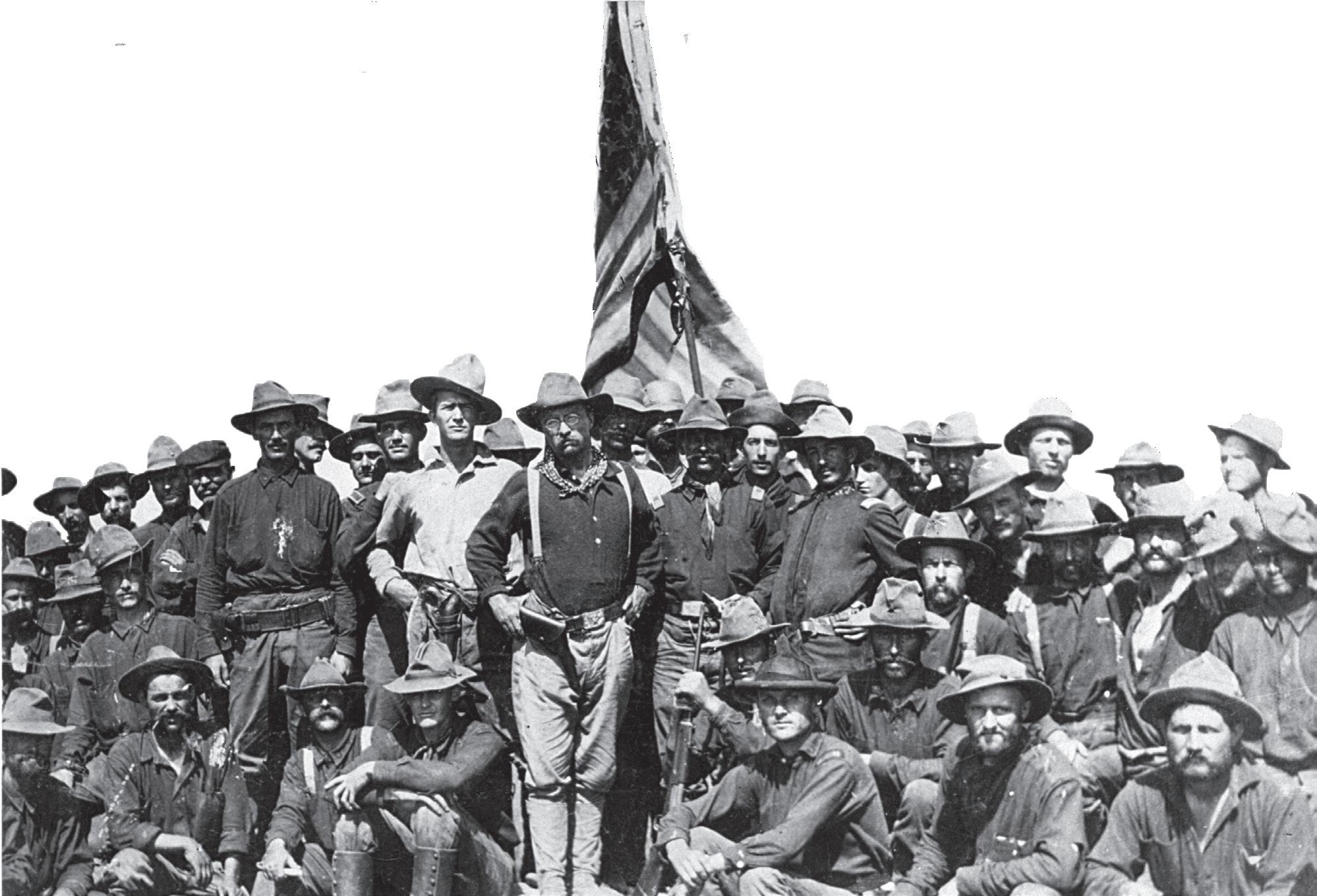
July 1898: The Rough Riders atop San Juan Heights during the Spanish-American War. Theodore Roosevelt is center; Jack Greenway is literally Roosevelt’s right-hand man.
A Lesson on Bravery and Sacrifice
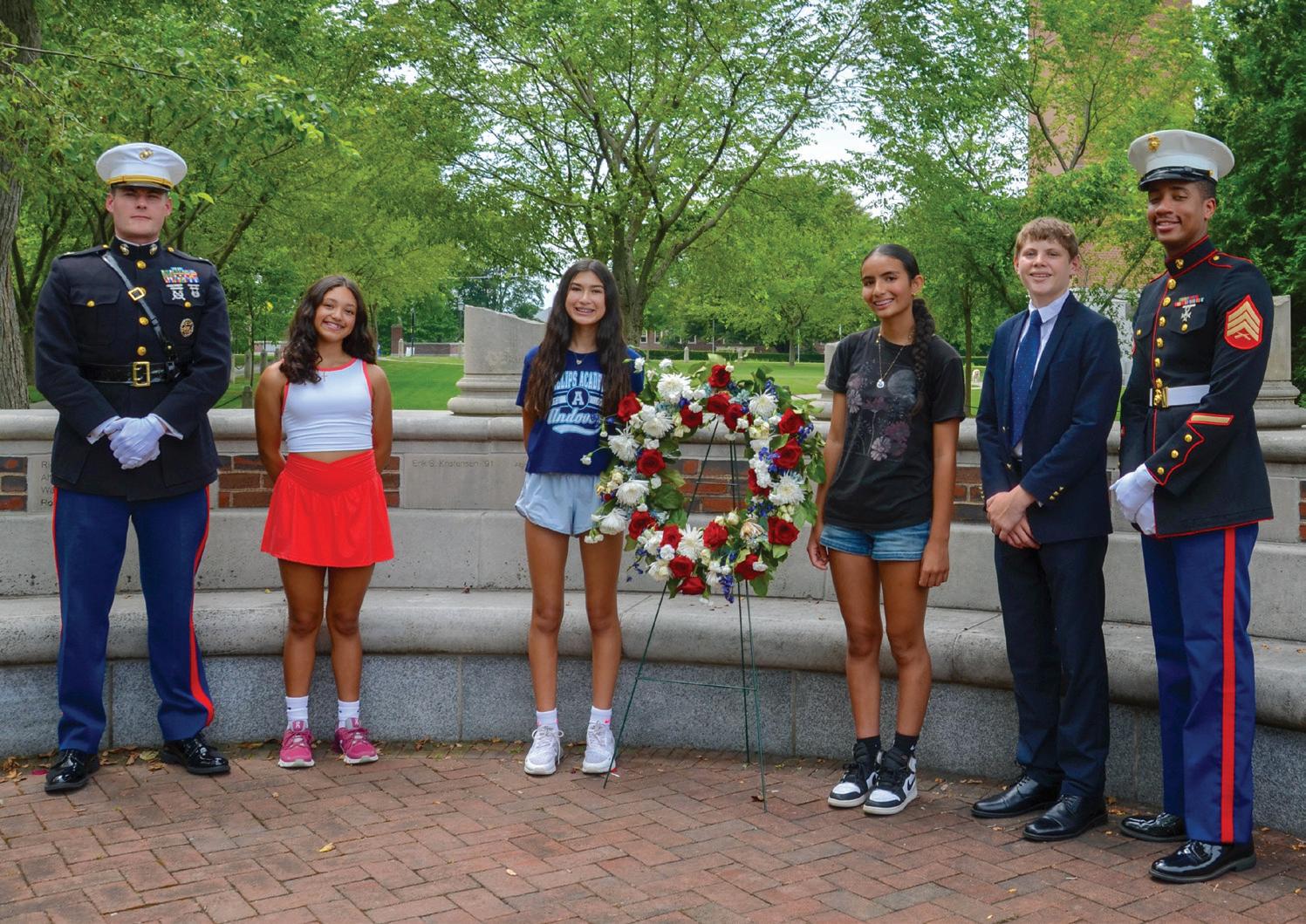
This summer’s Kristensen Scholars gathered at Memorial Place in early July to meet with Capt. Connor Flynn ’06, USMC, who shared the story of their scholarship’s namesake—Lt. Cmdr. Erik S. Kristensen ’91, USN, SEAL—who was killed in action in 2005 while leading Operation Red Wings in Kunar Province, Afghanistan. Kristensen’s non sibi spirit and ultimate sacrifice inspired Flynn, a rising senior at the time, to choose a career in the military.
Pictured above, from left, are Flynn, scholars Alana, Christine, Daenerys, and Stephen, and Sgt. Justin Douglas, USMC. The wreath was placed by Flynn and his sons, Sean ’27 and Stephen, on June 28 to mark the 20th anniversary of Kristensen’s death.
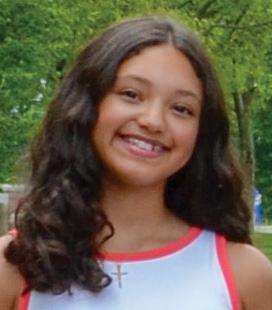
Alana is an 8th grader from Virginia. Her mother, a firstgeneration immigrant from Venezuela, is a sergeant major at the Pentagon. Alana lived on a U.S. military base in Japan—her father’s home country—before moving to the United States. Her interests include student council, volleyball, dance, and music.
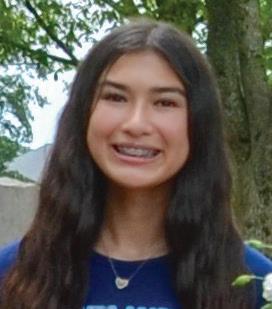
Christine is also an 8th grader from Virginia. Her father is a U.S. Marine Corps veteran, her mother is Class of ’07, and her grandfather, John Maier, taught Spanish at PA. Christine’s interests include student council, clarinet, competitive dancing, volunteering, and learning Korean.
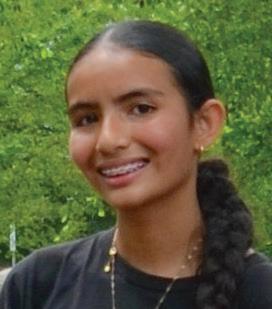
Daenerys is a 7th grader from Massachusetts. She was born on U.S. Military Base Camp Fort Foster in Okinawa, Japan. Her father was active in the U.S. Marine Corps for more than
continued from page 1
The combined force overwhelmed a Spanish outpost at Las Guasimas on June 24, then rested in camp for six days. During the lull, Col. Wood moved up the chain of command and Roosevelt took charge of the Rough Riders. It was as regimental commander that Roosevelt came to esteem Jack Greenway. A lasting friendship resulted.
On the seventh day, U.S. forces attacked San Juan Heights near the city of Santiago. The Heights were a heavily fortified series of hilltop positions protected by artillery, manned by 760 Spanish regulars led by veteran officers who had fought Cuban insurgents for years. It was July 1. Initially, U.S. troops were pinned down at the base of San Juan Hill and Kettle Hill, suffering heavy casualties. The U.S. field commanders quickly took action. Regular Army troops stormed San Juan Hill while a mixed force led by Roosevelt, including the Rough Riders, attacked Kettle Hill.
In the assault, 2nd Lt. Greenway showed his mettle, running ahead uphill over open ground directly at the enemy. The Spanish were routed. Greenway, unbidden, searched the fortifications, found intrenching tools, organized squads to improve a protective perimeter, then led the work, shovel in hand. He was awarded the Silver Star for gallantry and promoted to first lieutenant. Writing home on July 13, Greenway described the battle for San Juan Heights as “the grandest sight I ever saw.” Walter Carter, the Yale pitcher for whom Greenway had caught, sent congratulations, calling Jack “the best catcher, the finest fellow, and the bravest man that ever lived.”
The Rough Riders mustered out in September 1898. Greenway
visited Roosevelt’s home at Oyster Bay, Long Island, then returned to work, accompanied by a Roosevelt letter of commendation, and was the occasional subject of press plaudits. Greenway joined Theodore Roosevelt’s circle at a propitious time: the Rough Rider commander of 1898 became governor of New York in 1899, vice president in 1901, and following McKinley’s assassination, U.S. president that September.
As much as Greenway admired Roosevelt—and supported his progressive yet often jingoistic politics—Greenway wanted to make his own way, and did. He was hired as assistant superintendent at Michigan’s Oliver Iron Mining Corporation, controlled by Carnegie Steel (subsequently U.S. Steel). In 1905, Greenway took charge of developing the firm’s extensive claims in the remote Mesabi Range of northern Minnesota—within a decade one of the leading iron mining districts in the world. A 1908 article reported:
John C. Greenway, the man who in such a brief while has transformed a peaceful, fragrant
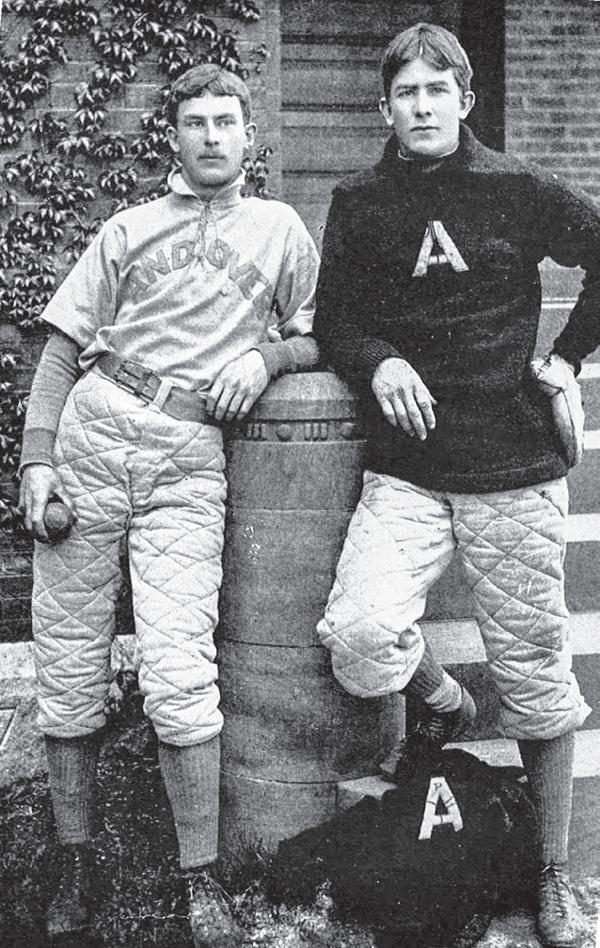
1892 baseball standouts M.L. Paige (left) and Jack Greenway
10 years. Daenerys enjoys gymnastics, volleyball, band, and choir and is learning Spanish and French.
Stephen, an 8th grader from Massachusetts, is the son of Capt. Connor Flynn ’06, USMC. His brother was also a Kristensen Scholar.
Stephen plays football, soccer, basketball, and baseball and wrestles, sings in choir, and plays chess. He also volunteers regularly at a food pantry.
To support the Lt. Cmdr. Erik Kristensen Scholarship, scan here or visit andover.edu/AATMgift.
Seniors Answer the Call
Since 2014, 24 young people from military families have attended Andover’s five-week Summer Session as Kristensen Scholars, thanks in part to the generosity of the AATM community. To learn more about Kristensen’s heroic actions, please visit andover.edu/paserves.
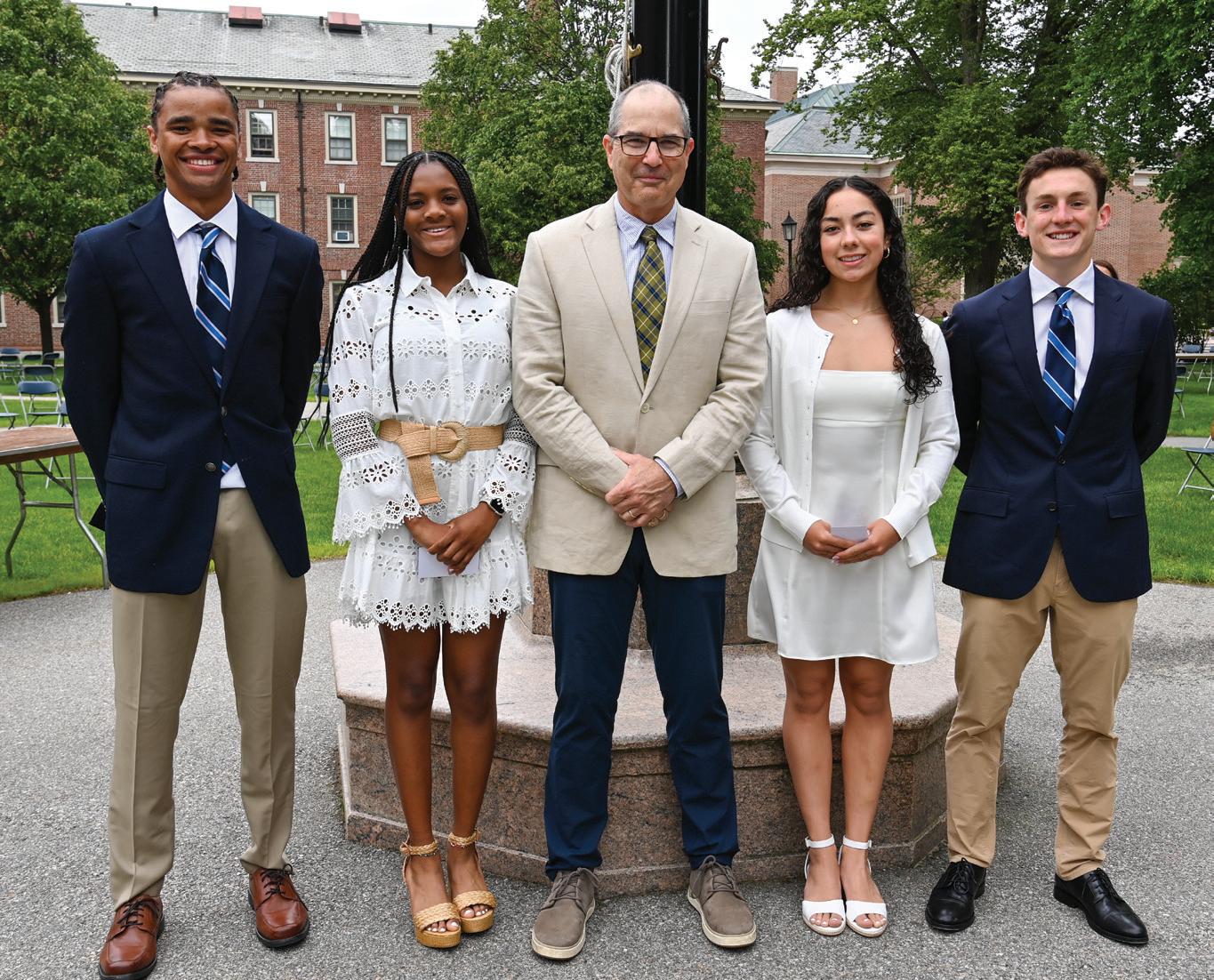
Just prior to Commencement in June, four seniors bound for military academies were congratulated by U.S. Navy veteran and current PA math instructor Dale Hurley, P’14, ’19, who presented each with an AATM military pin. From left are Luke Francis and Kennedy “Edy” Leach (both bound for the U.S. Naval Academy), Hurley, Lilliana Keim (West Point), and Luke Williamson (U.S. Naval Academy).
AATM pins, originally designed to recognize Andover and Abbot veterans and those currently serving, have been ceremoniously presented to graduating seniors enrolled at a military institution and/or in an ROTC program since 2021.
pinewoods into the likeness of a vast tract convulsed by an earthquake, traverses every foot of the work on his handsome bay horse directing present operations. On the books of the United States Steel Corporation, Mr. Greenway appears as its viceroy in this district, but on the unwritten books of Minnesota’s history he appears as the czar of the western Mesabi iron range.
Making the ore beds productive required processing, transport, and labor. Greenway built a washing plant, railroad, and a lakeside city for his miners—no ordinary camp but a permanent, model community—Coleraine. It boasted modern infrastructure, a business district, schools, churches, and parks. Cottages to house his workforce were provided, with rent credited toward purchase. “The idea was to fix it so that a workman could come to us dead broke,” Greenway stated, “and have new heart put into him by a chance to own his home and give his children the advantages he wants for them, from his wages alone.”
In 1910, with Coleraine thriving and the Mesabi mines productive, Greenway accepted a new challenge—to develop copper mines in Arizona. Ore was plentiful but low grade, and there was no water. Greenway and his advisors perfected a processing technique making copper extraction there profitable, constructed a railroad to the Sonoran Desert site, brought in water at enormous expense, and created another model town, Ajo. It was now 1917. That April, the United States entered World War I.
Greenway volunteered to serve. Commissioned a major in the Corps of Engineers, he was tasked with supervising military construction in Europe. It seemed the perfect post. But Maj. Greenway
wanted to get into the fight. In the summer of 1918, he persuaded Gen. Pershing to transfer him to infantry, where he was promoted to lieutenant colonel. Fight he did—and was wounded in the final month of the war. It was characteristic of Greenway that he led from the front. He was awarded the Distinguished Service Cross:
The President of the United States of America … takes pleasure in presenting the Distinguished Service Cross to Lieutenant Colonel John C. Greenway, United States Army, for extraordinary heroism in action while serving with the 101st Infantry Regiment, 26th Division, A.E.F., near Verdun, France, 23 October 1918. During a terrific enemy shelling on two of his battalions, and after both his battalion commanders had been wounded, Colonel Greenway personally directed the activities and greatly encour aged his forces by his presence. Leading them in attack [on German trenches] he demonstrated the utmost valor at the most critical moments.
“A strapping fellow,” Theodore Roosevelt had declared, “entirely fearless, modest, and quiet .... A man who could be counted upon with absolute certainty.” All but forgotten now, John Campbell Greenway remains celebrated in one place: Coleraine, Minnesota, the first town he founded. Coleraine’s high school is named for Jack Greenway. The school color: green.
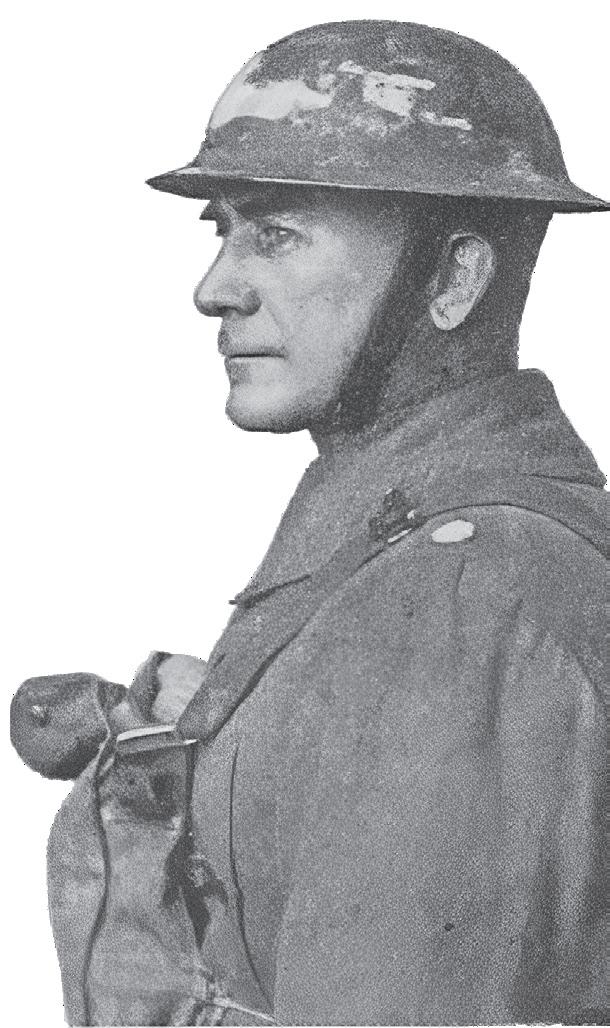
John Campbell Greenway, World War I
CURRENTLY SERVING IN THE
New AATM Leadership Announced
Andover and the Military is grateful for the significant contributions of Capt. Rob Patrick ’88, USN (Ret.), who recently stepped down as AATM Committee chair after two and a half years. “Whether on active duty in Djibouti, stationed at the Pentagon, or busy with his corporate career in ‘retirement,’ Rob has been a stalwart partner and steady, guiding hand in connecting our veterans to one another and to Andover,” said Jenny Savino P’21, ’24, director of the Office of Alumni Engagement. “A decorated naval officer himself, Rob was instrumental in initiating major AATM events, including those honoring Lt. Cmdr. Erik Kristensen ’91 and Capt. Thomas Hudner ’43. We stand in gratitude.”
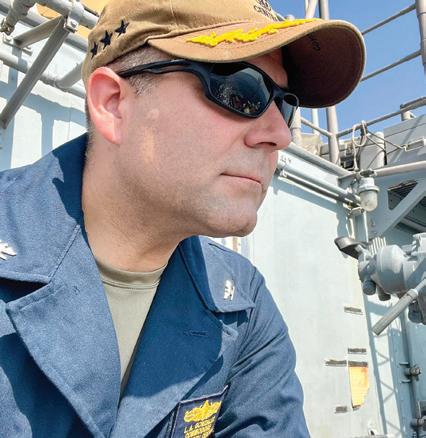
Patrick received the Academy’s Distinguished Service Award in September.
“It was an honor to serve,” said Patrick. “The committee will continue to support our alumni veterans under the very capable leadership of Capt. Luis Gonzalez ’97, USN.”
Gonzalez (pictured at left) is a 2017 U.S. Naval War College alumnus. He commissioned into the Navy in 2001 via the Boston Consortium NROTC Unit after completing his undergraduate studies in government at Harvard College. He is a surface warfare officer by profession and a destroyerman by fortune, having sailed all Seven Seas and forward deployed seven times onboard four destroyers, one cruiser, a maritime battle staff, and a geographic command staff. He is currently in major command as commodore, Naval Surface Group–Central, in charge of Force Generation and Sustainment for all surface combatants in Forward Deployed Naval Forces–Central assigned to U.S. Naval Forces Central Command and U.S. Fifth Fleet.
Gonzalez is married to former naval officer and nuclear engineer Lauren Francis and has two young children.
In other leadership changes, Justin Accomando ’99 will serve as committee vice chair and Renee LaMarche ’14 will oversee finances.
Annual Veterans Day Event
November 10
Save the date—Monday, November 10—for the 16th annual Veterans Day Dinner & Program in Kemper Auditorium. This year’s guest speaker (virtual) will be former U.S. Navy commander Jesse M. Ehrenfeld ’96, MD, MPH. For more information, email jsavino@andover.edu. All are welcome to join us for this free event!
From the Editor
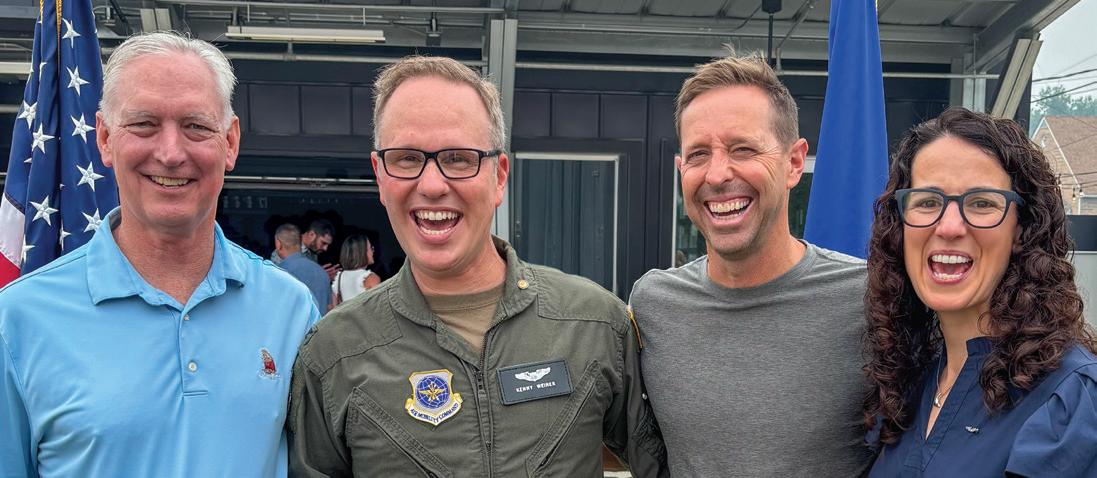
A big highlight of my summer was attending the retirement of Col. Kenny Weiner ’96, USAF, in Dover, DE, in June. Roommates at Andover and George Washington, Kenny and I spent lots of time together. His dedication to service inspired me to join the Air Force too.
After graduating from Officer Training School in early 2001, Kenny was deep into Undergraduate Pilot Training at the time of 9/11. He flew countless combat missions in Iraq and Afghanistan, later commanding a squadron and an operations group. In 25 years, his dedication and commitment never wavered.
Kenny and his family are hugely responsible for whatever successes in life I have achieved. I encourage you to think about the people who helped shape your path and reach out to thank them. They’ll appreciate it.
Speaking of gratitude, a shout-out to our AATM liaison Mary Corcoran, who recently took on a new role at PA. Mary has provided invaluable support and guidance for well over 10 years, coordinated our Veterans Day programs, managed The Blue Guidon, and tirelessly supported Andover’s veteran alumni community. Thank you, Mary.
As always, we want to hear more from you out there in the field! Please email military@andover.edu with a story or two about your service experiences.
Celebrating with Kenny (second from left) are former AATM committee chair Jim Donnelly ’82, me, and Kenny’s wife, Hannah ’97.

AND RESERVE
Luke Francis ’25
Lilliana Keim ’25
Kennedy Leach ’25
Luke Williamson ’25
Andres Aleman ’23
Remy de Saint Phalle ’23
Maximillian Gomez ’23 Daniel Zou ’23
Daniel Ferris ’22
James
The Newsletter of Andover and the Military
Vol. 13, No. 2
military@andover.edu
Published biannually by the Office of Academy Resources,
’96
ASSOCIATE EDITOR
Rider ’51, P’86, GP’22 HISTORIAN David Chase, Faculty Emeritus
AATM COMMITTEE
Luis Gonzalez ’97, Chair Justin Accomando ’99, Vice Chair Renee LaMarche ’14, Finance
Hawn ’89 The “Currently Serving” list is based on data we receive from alumni. To add or remove a name, please email military@andover.edu.

USAF Lt. Col. Rush Taylor ’96