phenomenal
▒ AUGUST 2026 ▒ TM
W OMAN WOMAN M
A
G
A
Z
I
N
E
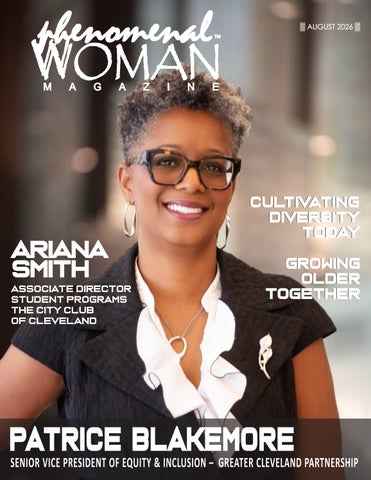
CULTIVATING DIVERSITY TODAY
ARIANA SMITH Associate Director Student Programs The City Club OF CLEVELAND
GROWING OLDER TOGETHER
PATRICE BLAKEMORE
SENIOR VICE PRESIDENT OF EQUITY & INCLUSION – GREATER CLEVELAND PARTNERSHIP
phenomenal phenomenal W WOMAN
Beletu (Belé) Wondwossen Founder / Publisher
™
™
W WOMAN
M
A
M
G
A
A
G
Z
A
I
Z
N
I
E
N
E
Shelley M. Shockley Managing Editor Writers Shelley M. Shockley Marsha Walker Eastwood Brittany Garrett Rhonda Crowder Creative Belé Wondwossen Jason Garrett Cover Story: Shelley M. Shockley Photos: Jason Garrett Contributing Writers Rhonda Crowder Michelle Phillips Fay Marianna Marron Letitia Nall Stephanie Phelps Kimberly Smith-Woodford Advertising Sales ads@phenomenalwoman.me 216.702.0845 Phenomenal Woman Magazine A subsidiary of Atlantic Creative Productions 5247 Wilson Mills Road #141 Cleveland, OH 44143
©2026 Phenomenal Woman Magazine. All rights reserved ISSN 2330-2534 (Print) ISSN 2330-2550 (Online) Material may not be reproduced in whole or in part in any form of this publication without prior permission from the publisher. Produced and printed in OHIO, USA.
216-702-0845
bele@phenomenalwoman.me
2 ▒ JULY/AUG 2026
2026 CERTIFIED
2026 CERTIFIED
www.PHENOMENALWOMAN.me ▒ 3
From the Editor: Shelley M. Shockley
CULTIVATING DIVERSITY TODAY I was shocked to find that the phrase “diversity, equity, and inclusion,” is part of Webster's Dictionary. The first definition reads, “a set of values and related policies and practices focused on establishing a group culture of equitable and inclusive treatment and on attracting and retaining a diverse group of participants, including people who have historically been excluded or discriminated against.” A second definition for this word group is “the state of having a diverse group or participants as well as policies and norms that are equitable and inclusive.” The idea of equity and inclusion has most always focused on race after the passage of civil rights legislation in the 1960s, meaning that for a mere ¼ of that time DEI were considered. The result of the legislation resulted in a workforce that tried to be representative of its population. In the short span of two years that attention to inclusivity has been dismantled without any parachutes to catch those thrown out of the plane. Here at Phenomenal Woman we continue to highlight the diversity in our communities and seek out, and bring attention to groups who were never a part of the discussion. For many years I have suggested that DEI includes women of all ethnicities, anyone suffering with physical or mental limitations, and the most seasoned members of society. Reviewing this edition, I was introduced to a new segment of the community often forgotten or taken for granted – young adults or students. This issue addresses the common definition of DEI, and also hones in on the challenges faced by our senior citizens and finally our students. The latter group gave me pause, because while I do believe we (adults) often dismiss or discount their opinions solely based on their age. Over the years, I have personally tried to remember that they are our future and if we have raised them at some point we must begin to trust the knowledge we have instilled in them.
4 ▒ JULY/AUG 2026
Our cover story features Patrice Blakemore, Senior Vice President, Equity and Inclusion for the Greater Cleveland Partnership. In her capacity as Senior VP, Blakemore seeks to ensure the Webster's Dictionary definition is fulfilled in northeast Ohio. From helping majority firms create equitable environments for all employees to recruitment of diverse members of the community, she and her team are impacting the communities they serve. Another key focus for she and her team is the growth and scaling of small businesses – many led by minority owners both black and female. To learn more about the work the Blakemore and GCP are doing in the region, please check out the cover story. I encourage you to also read the column on Ageism and the many challenges our senior citizens experience as they age.This population of Americans is diverse and their needs and desires are vast. Seniors are military veterans, retired teachers, healthcare professionals, business owners, factory workers, artists, clergy, farmers, caregivers, grandparents, lifelong volunteers and key to their continued enjoyment of life is recognition of their needs as well as their capacity to continue to function. Read more inside. If you're looking for something to challenge your thoughts, please read the feature on Ariana M. Smith, Associate Director of Student Programs at The City Club of Cleveland. Smith has a heart for young people and her career and life choices exemplify that love. At her core, Smith wants everyone to see young people as she does – appreciative of their insight, and open to guidance. These youth are our future and Smith is working to provide them with the knowledge and ability to soar, one student at a time. Enjoy this edition of Phenomenal Woman, and share the good news with someone else. Until our next meeting on the page, be blessed!
phenomenal
™
W WOMAN INSIDE THIS ISSUE M
A
G
A
Z
I
N
E
COVER
04 CULTIVATING DIVERSITY TODAY Shelley M. Shockley
06 GROWING OLDER TOGETHER
Why Diversity, Equity, and Inclusion Matter Throughout the Lifespan Marsha Walker Eastwood
13 NORTH SHORE HIGH SCHOOL
PAGE 16
14 TRI-C RESPONDS TO NEEDS OF EVOLVING NEO MANUFACTURING SECTOR
21 WHO’S WHO IN BLACK CLEVELAND
||||||||||||||||||||||||||||||||||||||||
PATRICE BLAKEMORE
FEATURE
Growing up, Patrice Blakemore had dreams of becoming a lawyer, which didn't surprise her family and friends, who often told her, "Oh, you like to argue. You'd be a great attorney," to which she agreed, but later learned that having research skills is even more important. “But that was what first drove me to consider law."
PAGE 10
Patrice received her undergraduate degree in English, because “You can do anything with an English degree,” including studying law. While in law school, she learned to analyze both sides of an issue to craft stronger arguments. But studying for the bar taught her how to believe in herself. “I never felt comfortable with standardized tests and did poorly on the practice exams. More on page 16.
ARIANA M. SMITH From launching a business at the age of 12 to inspiring young leaders across Northeast Ohio, one educator is proving that lasting change begins by believing in the potential of young people. “I started my own business, Monai Enterprise, when I was just 12 years old, making custom-designed, handmade tissue holders that I sold at community events and in bulk to people placing orders,” said Ariana Smith, Associate Director of Student Programs at The City Club of Cleveland. More on page 10
PAGE 24
DELICIOUS RECIPES
www.PHENOMENALWOMAN.me ▒ 5
GROWING OLDER TOGETHER Why Diversity, Equity, and Inclusion Matter Throughout the Lifespan “The greatest gift we can give another human being is not advice. It is the feeling that they have been seen, heard, and remembered." Their stories are equally diverse.
By: Marsha Walker Eastwood, BSEd, MSHS
Most conversations about diversity, equity, and inclusion begin in familiar places. We discuss employment opportunities, educational access, housing, and representation in leadership. These conversations are important, and they continue to shape our workplaces, schools, and communities.
Some continue to mentor young professionals, volunteer with civic organizations, care for grandchildren, and remain deeply engaged in community life. Others quietly navigate chronic illness, caregiving responsibilities, financial challenges, transportation barriers, or the loss of lifelong friends and spouses. Recognizing this diversity is not simply an exercise in awareness. It is an expression of respect.
Yet there is another conversation that deserves equal attention—one that will eventually touch nearly every one of us.
When we stop viewing older adults as one category and begin seeing them as individuals with unique experiences, strengths, hopes, and challenges, we create opportunities for deeper understanding and stronger communities.
What do diversity, equity, and inclusion look like after retirement?
Equity Beyond Equal Treatment
If we are fortunate enough to live long lives, each of us will one day become an older adult. Aging is the one experience that crosses every race, culture, profession, neighborhood, economic background, and belief system. It is the one diversity we all hope to experience. Ironically, many older adults begin to feel less visible at precisely the stage of life when they have accumulated the greatest wisdom, resilience, and perspective. Perhaps it is time to broaden our understanding of diversity, equity, and inclusion beyond the workplace and begin viewing these principles as lifelong commitments that strengthen every generation.
Equity often becomes even more meaningful later in life. For one person, equity may mean having reliable transportation to medical appointments or community events. For another, it may involve learning how to use technology to connect with family members, schedule healthcare appointments, or participate in online educational opportunities. Others may need information available in multiple languages, accessible buildings, affordable community programs, or volunteer opportunities that accommodate changing physical abilities.
Aging Is Not One Story
Providing these opportunities is not about giving special treatment.
One of the greatest misconceptions about older adults is the belief that they represent a single, uniform population. Nothing could be further from the truth.
It is about ensuring that every person has a genuine opportunity to remain connected, engaged, and independent for as long as possible.
Today's older adults include military veterans, retired teachers, healthcare professionals, business owners, factory workers, artists, clergy, farmers, caregivers, grandparents, lifelong volunteers, and individuals whose stories have unfolded in countless different ways. Some have lived in the same community for generations, while others arrived later in life after journeys that carried them across the country—or around the world.
True equity recognizes that people arrive at different stages of life with different experiences. Meeting those differences with understanding rather than assumptions allows individuals—and communities—to flourish.
6 ▒ JULY/AUG 2026
The Hidden Cost of Becoming Invisible Many older adults describe an unexpected experience that receives far too little attention.
phenomenal
™
W WOMAN M
phenomenal
W WOMAN ™
M
A
G
A
Z
I
N
E
A
G
A
Z
I
N
E
TO ADVERTISE PLEASE CALL: 216-702-0845 EMAIL: Ads@ phenomenalwoman.me
They begin to feel invisible.
Belonging Changes Everything
Not because they have nothing left to contribute, but because others gradually stop asking for their opinions, inviting their participation, or recognizing the depth of their experience.
Inclusion is far more than opening the door.
Conversations sometimes occur around them rather than with them.
Belonging is one of humanity's deepest needs, regardless of age.
Technology advances rapidly while instruction is often assumed rather than offered.
Communities become healthier when older adults continue serving as mentors, volunteers, historians, caregivers, neighbors, teachers, and trusted advisors. Their life experiences provide perspective that cannot be found in textbooks or online searches.
Community decisions are made without seeking the perspective of those who have spent decades building the very neighborhoods now being discussed.
It is ensuring people know they are welcome after they walk through it.
Every generation has something to teach. This quiet form of exclusion rarely makes headlines, yet it affects countless older adults every day. Feeling invisible is not simply lonely. It can diminish confidence, reduce community engagement, and contribute to social isolation.
Every generation has something to learn. When communities intentionally create opportunities for people of different ages to learn from one another, everyone benefits. Children gain wisdom.
Fortunately, the solution is remarkably simple. Adults gain perspective. Listen. Older adults gain renewed purpose. Invite. Communities gain stronger relationships. Include. Lessons Only Time Can Teach Ask questions. Seek advice. Recognize experience.
Growing older has a way of clarifying what truly matters. Many older adults have learned that relationships outlast possessions.
Small acts of respect often have life-changing effects. That kindness is rarely wasted. Continued on next page ... www.PHENOMENALWOMAN.me ▒ 7
That forgiveness often brings greater peace than resentment. That listening is sometimes more powerful than speaking. That every generation believes it is facing unprecedented change, only to discover that resilience has always been part of the human story. These lessons deserve to be shared. Not because older adults have all the answers, but because their experiences help illuminate the path for those still making the journey. Building Communities for Our Future Selves Perhaps the most compelling reason to expand our understanding of diversity, equity, and inclusion is this: If we are fortunate, we will all grow older. The communities we build today are the communities in which we may someday live ourselves. Will they be places where older adults continue to find purpose? Will they be places where experience is celebrated rather than overlooked? Will they be places where every individual, regardless of age, knows they still belong? Those questions are not simply about today's seniors. They are about all of us. Growing older should never mean growing invisible. Diversity, equity, and inclusion do not end at retirement. They continue throughout the lifespan, reminding us that dignity, belonging, respect, and opportunity enrich every generation and strengthen every community fortunate enough to embrace them. The Privilege Of Aging If we live long enough, aging is the one diversity we all hope to experience. Our contributions to various communities reinforce the true meaning of how growing older should never make anyone feel invisible. Senior voices resonate as loudly, if not louder than the generations that followed. Why? Because they are the voices of experience, wisdom, and knowledge. They are the voices of survival over decades of societal changes. Inclusion should never be considered a destination, and it is a collective sense of right that should be a promise made and a promise kept. One of the greatest privileges of growing older is discovering that our value is no longer measured solely 8 ▒ JULY/AUG 2026
by what we accomplish, but also by the encouragement we offer, the wisdom we share, and the relationships we nurture. Communities flourish when every generation has a place at the table—and every voice is welcomed into the conversation. The issue is how to help older adults feel a sense of belonging. How Communities Can Help Older Adults Feel They Belong The first question is what kind of community do we want to become? Do we want communities where people gradually disappear from view as they grow older? Or do we want communities where every generation is valued, every voice is respected, and every person continues to find purpose and belonging? The answer will shape not only the lives of today's older adults but also our own futures. The communities we build today are the communities in which we may someday live ourselves. True diversity, equity, and inclusion do not end at retirement. They continue throughout the lifespan, reminding us that dignity, belonging, and respect are not benefits reserved for one stage of life—they are values that enrich every stage of life and strengthen every community fortunate enough to embrace them. Understanding Equity For The Aging Population Equity later in life may mean access to transportation, technology, healthcare navigation, access to buildings, financial flexibility, or information presented in ways that meet different needs. Equity is not treating everyone the same – it is providing opportunities for everyone to participate fully. Creating Inclusion and Belonging Inclusion is more than just inviting someone into the room. It is making sure they know they belong once they arrive. Older adults continue to serve as mentors, caregivers, volunteers, historians, neighbors, and trusted advisors. Communities thrive when the wisdom is welcomed rather than overlooked. Looking Ahead As our communities continue to age, perhaps the most important question is not whether diversity, equity, and inclusion apply to seniors. The better question is how we can build communities where every person continues to experience dignity, purpose, belonging, and respect throughout every chapter of life. Adults aged 65 and older make up approximately 18% to 19% of the U.S. population, representing over 61 million Americans. This demographic is projected to steadily increase, with older adults expected to account for roughly 22% of the nation's population by 2040. g
www.PHENOMENALWOMAN.me ▒ 9
Ariana M. Smith,
Associate Director of Student programs at The City Club of Cleveland,
Helping shape tomorrow's leaders By M. Abebe PWM Contributing Writer From launching a business at the age of 12 to inspiring young leaders across Northeast Ohio, one educator is proving that lasting change begins by believing in the potential of young people. “I started my own business, Monai Enterprise, when I was just 12 years old, making custom-designed, handmade tissue holders that I sold at community events and in bulk to people placing orders,” said Ariana Smith, Associate Director of Student Programs at The City Club of Cleveland. Phenomenal Woman recently caught up with Smith to learn more about her successful career and her passion for believing in and lifting young members of our community.
generation. “The passion for creating intentional spaces for young people to learn, grow, and thrive is what stuck with me from each summer session that I taught,” she said. The summer before her freshman year of high school, she participated in the E-City programEntrepreneurship: Connecting, Inspiring, and Teaching Youth. The experience marked a cornerstone in her first exposure to entrepreneurship and helped kick-start her public speaking ability, allowing her to compete in various local and national business plan competitions. Through the program, she traveled to New York and Boston to compete with other aspiring young entrepreneurs from across the country. The results showed a new generation of innovative ideas creating a positive impact across various industries.
Ariana completed her K-12 education in the Shaker Heights City School District, where she was a member of the Future Teachers Club during middle and high school. Her participation in the program gave her an early introduction to education and the opportunity to work with young people.
After completing high school, Ariana enrolled at John Carroll University to study Business Management. While her chosen field of study remained exciting to her, she soon realized that her main passion lay in working with youth. That realization became even clearer after her participation in the Freedom Schools program, funded by the Children's Defense Fund.
It also laid the foundation for her lifelong commitment to teaching, mentoring, and empowering the next
Prior to joining the City Club of Cleveland, Ariana coordinated entrepreneurial education programs at the
10 ▒ JULY/AUG 2026
Young Entrepreneur Institute at University School, supporting middle school and high school students in Northeast Ohio. As part of her responsibilities, she organized the annual Celebrate Youth Entrepreneurship event, where students were connected with seasoned experts and learned more about the importance of entrepreneurship. She taught youth entrepreneurship and leadership development at the school and served as an advisor to student organizations dedicated to supporting Black and brown youth. Earlier in her career, she traveled across the Midwest, spent a few years in Georgia, Kentucky, Indiana, and Ohio, helping schools raise money while promoting fitness and instilling character lessons. A commitment to serving others—especially young people —is deeply rewarding and requires significant sacrifice. Helping and nurturing the next generation also requires considerable time and dedication. So how did Ariana become deeply immersed in this work? She said, “What inspired my commitment was realizing the innocence, curiosity, and potential of young people. I appreciate seeing the 'aha' moment when a topic goes from confusion to understanding, or from frustration to excitement. Young people are still growing and evolving, and life has not made them as jaded about the possibilities of the future.” She firmly believes that her work with young people will help further propel them into their already bright futures, or at least be a support along the way, and she said, “Seeing their motivation and determination in moments when they may feel defeated, tired, or unsure of a positive outcome is what fuels my passion to continue the work. It is because I know that we are in good hands, as long as we continue to allow them space, listen to them, and help lead them with intention.” Education is the cornerstone for nurturing young minds into the leaders of tomorrow. Preparing young minds with knowledge and skills would enable them to make meaningful contributions to their communities and the world. For this reason, investing in and prioritizing education is essential to building a brighter future. As a seasoned educator, Ariana would like to see meaningful changes in our current education system to better prepare students for leadership, innovation, and overall success. She noted, “I would love for more students to have opportunities to be paired with local businesses during their time in high school. Early exposure to the workforce, especially in areas they are interested in or know little about, can help provide students with clarity about where they may see their futures.” She also noted that every school board should have some sort of youth liaison or youth voice that can be part of the important conversations and decisions that impact them and their peers. Ariana strongly believes that early exposure to entrepreneurship is key to helping prepare students for whatever pathway they choose to pursue. She explained, “From lived experience, exposure to entrepreneurial traits such as problem-solving, creativity, innovation, public speaking, and many more are all skills that young people need to hone, regardless of what their next steps are going to be. Early exposure
to and practice with these skills will help more young people feel prepared for the environments they will walk into.” Data from the CDC show that 40% of high school students report persistent feelings of sadness or hopelessness. Concerned by these troubling statistics, Smith spearheaded the annual Mental Health Matters Youth Summit, an initiative she created to support the mental health and well-being of high school students. The summit provides a supportive, youth-centered space for students and educators to discuss mental health, develop healthy coping strategies, and help reduce the stigma surrounding depression and anxiety. In addition, she would like to see schools do a better job of investing in the mental health and well-being of our youth. Ariana's new role at the City Club of Cleveland gives her the opportunity to transform her passion into action. Her work places students at the center of conversations that shape their schools, communities, and futures. She is responsible for a wide range of duties, all centered on youth programs. "I want students to recognize that their voices matter," she explains. "When young people are trusted with responsibility and given the right support, they consistently rise to the occasion." Continued on next page ... www.PHENOMENALWOMAN.me ▒ 11
Among her responsibilities is advising the Youth Forum Council, a group of more than 40 high school students who are leaders in their own right across Northeast Ohio. In addition to hearing from outstanding speakers who address topics that interest them, students are also expected to design and organize programs that matter most to their peers. “My students host four to six youth-led and youth-planned forums each school year for high school students in Northeast Ohio, and I help provide the structure and support they need to execute their programs from start to finish,” Ariana said. Always keen to bring students to the table, Ariana ensures that students are represented in more than 50 percent of the forums at the City Club of Cleveland. She believes that including them in the conversation by encouraging them to ask questions at the microphones before live audiences and speakers, and to network with business and community leaders, gives them the confidence to tackle challenges and shape their future careers. Last year, she worked alongside the Cleveland Cavaliers with the inaugural Social Impact Academy for high school juniors and seniors, leading up to their individual and group capstone presentations. She explained, “Over the course of the program, students learned about a variety of topics, such as the power of diversity, equity, and inclusion, civic engagement, the privilege of community service, and many more. The end result was powerful. It was moving to hear how various aspects of the program, from the speakers to the topics to the organizations we connected them with, truly changed and shaped the lives of the participants.” For Ariana, a typical day looks like anything from checking in with students, preparing educators for an upcoming forum visit, coordinating student seating and logistics, building out programming, reviewing feedback, planning Youth Forum Council meetings, or connecting with community partners.
cannot do meaningful work alone. The balance comes from being intentional about what I say yes to, creating systems that help me follow through, and making sure the work I take on still aligns with the impact I hope to make.” While Ariana has put in a lot of hard work, she is grateful to all those who have supported and enabled her to reach her level of success today. She said, “I have had mentors in my life since high school and into my professional career. My mentors have helped shape my entrepreneurial journey, from brainstorming business ideas to giving me feedback on my business plan pitches. I have also been blessed to have mentors who helped me stay focused on working toward my goals, even the ones I was not always prioritizing in certain moments.” Today she strives to offer those same gifts to the young people she mentors. “Each mentor has instilled specific character traits in me that I try to uphold when I am mentoring young people and other young professionals. Without their leadership, I know that I would not be as motivated and driven in my current field,” she noted. “I use those experiences to make sure I am preparing my mentees and students with the resources and information I did not have at the beginning, while always making sure to check in with where they are and what they are looking for.” Achieving a healthy work-life balance remains a challenge for those dedicated to serving others. Ariana said, “I am an 'extroverted introvert,' as they say. I am a person who craves her personal space and can feel drained when I have to talk to people for long periods. However, I also enjoy public speaking, creating spaces for young people to thrive, and being intentional in my interactions. Often, those actions require a higher level of energy, effort, and time that can be draining, but I would not have it any other way.”
She shared, “balancing the behind-the-scenes logistics with the relationship-building that makes the programs meaningful, both matter, and require intention,” as one of the challenges in her work.
One strategy that has helped is aligning her career with her personal passions. Because her work reflects her deepest values, it energizes rather than exhausts her. Perhaps her greatest lesson has been recognizing that rest is not a distraction from meaningful work—it is an essential part of it.
Ariana seamlessly embraces many roles, including as educator, entrepreneur, youth advocate, strategist, and community leader. These responsibilities may seem too many, but to her they are all united by a grand purpose. She explained, “Being an educator helps me think about how people learn. Being an entrepreneur helps me think about creativity, problem solving, and building something from the ground up. Being a youth advocate keeps me centered on who the work is for. Being a strategist helps me think through the steps, the people, and the details needed to move an idea from concept to execution.”
In closing, her message resonates far beyond the classroom. “I would like to remind folks that our young people are ready to lead and are already making the moves. Instead of assuming that they do not have the experience or do not know enough, stop and talk to them, ask them a question, and really listen to what they are saying. You will realize that their level of understanding and passion for finding solutions is impressive and needs to be heard.”
Prior to entering a new initiative/environment, Ariana invests ample time learning about the people she hopes to serve and equally analyzes the end goal she aims to achieve. In the course of designing programs for students, she prioritizes their interests instead of imposing her perspectives and ensures that they take ownership by delegating certain responsibilities to them. When asked how she manages all her responsibilities, she said, “The key is Intention. Being clear on the purpose of each role, staying organized, and knowing when to lean on the right people. I am very aware that I 12 ▒ JULY/AUG 2026
To young women, she advised, “Give yourself grace. When you are a hard worker and committed to the work you are doing, sometimes you can forget that your bare minimum may be someone else's top level of work.” She continued, “Stay ready, don't get ready. It is a reminder that when you are prepared and take the time to listen and learn, you will always be ready for whatever space you walk into. It does not matter who the audience is.”
www.PHENOMENALWOMAN.me ▒ 13
Tri-C Responds to Needs of Evolving NEO Manufacturing Sector The story of Northeast Ohio is rooted in its “Rust Belt” heritage. Totems of this history line the shores of Lake Erie. But as chatter trends toward gig work, AI and any other buzzwords that are trumpeted as the next big thing in economic development, where does that leave manufacturing? Turns out, the heart of it all still beats thanks to manufacturing. It just looks different these days. NEO manufacturing today “A lot of us remember manufacturing the way our parents and grandparents used to work in it — a dingy, dark, dirty environment that wasn’t very desirable,” said Ray Nejadfard, dean of Advanced Manufacturing and Engineering at Cuyahoga Community College (Tri-C®). “Manufacturing has completely changed. Those dingy spots have been brightened up with automation and technology,” Nejadfard, a 33-year industry veteran, said. “I’ve been in places where you could eat off the floor, almost like a hospital.” Today, manufacturing is less grime and more gleaming surfaces, fewer hard hats and more robots. It is safer, more productive and offers a better quality of work — for those who are qualified to do it.
“There are many headquarters in Northeast Ohio that people don’t even talk about or think about,” Nejadfard said. “Quite a few of them are international companies.” Sherwin-Williams, Swagelok Company and ClevelandCliffs Inc. are three of the biggest in the area. “There are companies that are multinational,” Nejadfard said. “They could have a manufacturing location in China, a manufacturing location in South America, a few in the U.S., maybe even a couple in Europe. So, it’s across the whole world, and cybersecurity has become a big issue and problem.” According to a report by Thomas Inc., an industrial sourcing platform, between 2020 and 2023, the Ohio manufacturing sector achieved 8.5% growth in GDP, a 5.8% growth in employment and a 13.5% increase in average weekly wages. “Ohio manufacturing is enjoying a renaissance,” the company says. The Ohio Manufacturers’ Association estimates that manufacturing accounts for 17% of the state’s GDP and 700,000 workers. Cuyahoga County has the state’s highest concentration of manufacturing employment, home to more than 1,600 companies. The county’s manufacturing sector employed 65,418 people in 2023 or 9.3% of the county’s workforce.
Manufacturing is in the midst of what is called variously Industry 4.0, the Fourth Industrial Revolution and 4IR. Smart technology, the Internet of Things, cloud computing, data analytics and AI have radically redefined the sector. These technologies create safer work environments, improve productivity, allow manufacturers to be more nimble with improved quality control, and have changed the skill set required of the industry’s workers. And business is booming. "If you talk to 10 manufacturing companies, all 10 of them are going to tell you they need people." — Ray Najadfard, dean, Advanced Manufacturing and Engineering" “Northeast Ohio has everything it needs to lead the world in smart manufacturing,” states a 2021 Team NEO economic report. Ohio is third in the nation, after California and Texas, for the number of manufacturing sites and the number of people employed in the sector. Ohio is second in the nation in the production of automobile parts and aerospace tooling. 14 ▒ JULY/AUG 2026
The Ohio Manufacturers’ Association’s 2025 economic impact report states, “The manufacturing sector contributes to Ohioans’ quality of life by providing a payroll totaling $49.9 billion, the highest total annual wages of any Ohio sector; $55.8 billion in exported products to 210 countries and territories; and cleaner environment through decreased emissions and increased recycling.”
Help wanted As much as anything, manufacturing is a technical sector today, as cybersecurity, automation, analytics and data analysis play bigger and bigger roles in production. So, while entry-level, unskilled positions are not as plentiful, skilled workers are in high demand. What’s more, manufacturing in NEO is a space where workers can earn good wages with solid advancement opportunities. Yet, manufacturing is starved for qualified people to fill vacancies. “If you talk to 10 manufacturing companies, all 10 of them are going to tell you they need people,” Nejadfard said. While the overall number of workers in the field has fallen over the years due to automation and other technologies, this doesn’t mean there is no work. It means there is different work. “In-demand skills” is a buzzy phrase itself, but in manufacturing here, the struggle to find job candidates who have them is real. Absorbing computers and robotics created a host of new technical demands. Traditionally, an entry-level worker would move up the ladder as they gained experience, but as workers neared or are nearing retirement, the entry-level positions have not been filled at the same rate, creating a gap in the middle. “The industry is missing a staggering number of people,” Nejadfard said “It can stay afloat due to things like automation, but the reality is it needs more people.”
guys, you had electrical guys, you had IT guys,” Nejadfard said. “You had all kinds of different types of engineers, and everybody was specialized. “Today, the expectation is that you need more than one thing. You need to be able to perform a little bit more than just one field of expertise. Our graduates are the translators, if you will, between the mechanical workers, electrical workers and the IT workers.” In developing the bachelor’s curriculum, Tri-C worked with industry partners to ensure it was meeting emerging workforce needs in Northeast Ohio. The curriculum combines the expertise of a dozen specialties, including electrical, mechanical and network engineering, cybersecurity, cloud security, enterprise security and design. More than 30 certifications are embedded in the degree, providing different career pathways and dynamic skills. Nejadfard said the IDMET bachelor’s degree was the only one in the country to combine mechanical engineering, electrical engineering and cybersecurity elements in a single degree program. “We place a huge emphasis on the lab, and I'm proud of the lab,” Nejadfard said. “We have better labs than a lot of four-year institutions.” Courses are taught using industry-standard platforms and equipment, and many of the embedded certifications are specific to Northeast Ohio companies — a Parker Hannifin certification in hydraulics and pneumatics, for example. The Smart Manufacturing program offers lots of handson learning, so when a student walks on the job, they are ready to get to work. Graduates of the bachelor’s program are qualified for a variety of positions in the industry with an $80,000 per year median salary. “The industry is looking for people who have mechanical skills, they have electrical skills, but they also are much more aware of all the cybersecurity problems,” Nejadfard said. “You can get hacked through an air compressor.” Here for the long haul
Skills to pay the bills In response, Tri-C developed its Smart Manufacturing program. In 2024, the program launched the College’s first bachelor’s degree, a Bachelor of Applied Science in Integrated Digital Manufacturing Engineering Technology (IDMET). The Smart Manufacturing program also offers an associate degree and a bridge program to help two-year degree holders attain the bachelor’s degree. “I remember in the ’80s and ’90s, you had mechanical
Manufacturing is not going anywhere. Its legacy is still being written, especially in NEO, by people who can embrace and understand new technologies and the way they work in a foundational industry sector. As ever, manufacturing is a space that offers stable employment with competitive wages and room to grow. “Everyone wants to do more with fewer people,” Nejadfard said. “The industry needs knowledgeable people, and Tri-C is positioned to provide them.” Source: Tri-C.com www.PHENOMENALWOMAN.me ▒ 15
PHOTOS: JASON GARRETT THE BLUSH GALLERY
16 ▒ JULY/AUG 2026
PATRICE BLAKEMORE, SENIOR VICE PRESIDENT OF EQUITY & INCLUSION, CHAMPIONING INCLUSION IN NORTHEAST OHIO Shelley M. Shockley Managing Editor Growing up, Patrice Blakemore had dreams of becoming a lawyer, which didn't surprise her family and friends, who often told her, "Oh, you like to argue. You'd be a great attorney," to which she agreed, but later learned that having research skills is even more important. “But that was what first drove me to consider law."
But she has learned, particularly with her current position, that her life experiences have prepared her to be where she is today. The time spent running her own business, navigating the complexities of diversity programming, and connecting contractors with opportunities gave her a unique perspective that can't be taught in any classroom or corporate training program. Joining GCP at a Critical Moment
Patrice received her undergraduate degree in English, because “You can do anything with an English degree,”including studying law. While in law school, she learned to analyze both sides of an issue to craft stronger arguments. But studying for the bar taught her how to believe in herself. “I never felt comfortable with standardized tests and did poorly on the practice exams. Once I changed my mindset from 'I can't' to 'How can I”, I began believing in my ability to master the material and the tests. That was the turning point for me and was critical to passing the bar on the first try.” After earning her law degree, Blakemore worked in the Prosecutor's office in Dayton, gaining valuable experience in the legal field. But when it came time to start a family, she made the decision to move to Cleveland with her husband and step away from fulltime work to raise her children. That time away from traditional employment didn't mean she stopped working—it simply meant she redirected her energy.
Patrice Blakemore joined the Greater Cleveland Partnership (GCP) in 2022 at a pivotal moment. As the largest metropolitan chamber of commerce in the country and the leading economic development organization in Greater Cleveland for 178 years, GCP works with its 12,000 members to strengthen the regional economy. The organization's longevity speaks to its adaptability and commitment to meeting the evolving needs of the business community.
“
[My mother] is a person who does not understand the word ‘no,’ and she made magic happen out of nothing. So, when I think about resolve and how to overcome obstacles, I think about her.
”
While raising her children, she launched Blakemore Coaching, a lifestyle business through which she trained and coached professional women, managed diversityprogram initiatives, and matched minority contractors with corporate clients. This entrepreneurial venture allowed her to stay connected to the professional world while maintaining the flexibility she needed as a mother. It also gave her invaluable insight into the challenges minority-owned businesses face when trying to break into corporate supply chains and secure meaningful contracts.
GCP operates through its "All In" approach, which identifies clear priorities and aligns the organization's efforts around what matters most to drive growth and prosperity. This strategy is built on five pillars—Dynamic Businesses, Abundant Talent, Inclusive Opportunity, Appealing Community, and Business Confidence. Each pillar addresses critical needs in the region's economic ecosystem, and together they create a comprehensive framework for sustainable growth.
When she made the decision to return to work as a fulltime employee, she wondered if her time away from the workforce would hinder her growth and potential. Would employers see the gap in her resume as a liability? Would her skills be considered outdated? These are questions many women, particularly mothers, grapple with when re-entering the workforce.
When Blakemore joined as Senior Vice President of Equity and Inclusion, programs focused on diversity, equity, and inclusion were thriving across corporate America. Everyone was talking about DEI, investing in it, and celebrating it. Companies were making bold commitments, creating new roles, and allocating significant budgets to inclusion initiatives. Continued on next page ... www.PHENOMENALWOMAN.me ▒ 17
Then the landscape shifted. Political winds changed, and suddenly the work that had been celebrated became controversial. As conversations changed and programs began to trail off across the country, many organizations and companies met the change with panic, scrambling to figure out their next move. Some quietly dismantled their DEI departments. Others rebranded their initiatives, hoping new language would shield them from criticism. But Blakemore didn't panic. "Life is about being able to solve problems, and I am a problem solver," she said. Rather than seeing the political shifts as detrimental to her work, she doubled down on GCP's core strategy: strengthening the region by creating pathways for untapped businesses and talent. Despite the focus of her position and the chaos surrounding inclusion work nationally, she maintains a clear perspective. “Here's what I would say: the work is the work, is the work. And our goal is to figure out how to overcome hurdles and roadblocks. We're in a multigenerational, multicultural country," she said. Tying her statement to her role at GCP, she added, "That is not going away, and there are still going to be needs that business owners have that we serve, and needs that companies have in terms of attracting and retaining talent." Her approach is refreshingly pragmatic. She doesn't get caught up in the political rhetoric or the fear that often paralyzes organizations during times of uncertainty. 18 ▒ JULY/AUG 2026
Instead, she focuses on the fundamental business case for inclusion: companies need diverse talent to compete, minority-owned businesses drive economic growth, and regions that embrace inclusion attract investment. As a problem solver, one of the problems she works on is ensuring all communities within the region are represented. "When we help problem-solve for those who are underrepresented, that means we can make sure that we have a stronger Cleveland and a stronger city. Any time you have a stronger region, you're going to attract more businesses." Building Stronger Businesses In the small business arena, Blakemore champions the MAP Lab initiative—Mergers and Acquisitions Partnerships—a statewide initiative that advises small businesses how to position themselves for growth through acquiring other businesses. "We connect our members to acquisition opportunities," she explained. "Minority businesses can grow organically or inorganically through the purchase of an established business, and we think that is one of the best ways to continue to grow wealth in communities of color." The MAP Lab initiative represents a sophisticated approach to business development. Rather than simply teaching entrepreneurs how to start businesses from scratch—a process that can take years or even decades to build significant value—the program shows them how to accelerate growth by acquiring existing businesses with established customer bases, proven revenue streams, and operational infrastructure already in place.
The challenge came when federal funding for the Minority Business Development Center (MBDA) was dismantled. The loss of funding for what is now the MAP initiative hit hard. Blakemore recalled it as a low point, a moment when it would have been easy to give up or scale back ambitions. But “I have a great team, and my colleague who ran the MBDA Center pivoted to make MAP our sole focus. This is an initiative that can make an impact moving forward.” Another critical component of GCP's business development strategy is the Built Strong program, a construction accelerator where untapped construction firms participate in cohorts to learn about finances, marketing, processes, and hiring. The program provides comprehensive support, helping businesses strengthen their operations and position themselves for larger opportunities. The plan is to provide businesses with a "solid foundation so they can grow," because Blakemore said forecasting indicates "In the next 20 years there will be tens of billions in construction, and we need a robust pipeline." The region is facing a massive opportunity but without a diverse pipeline of qualified contractors ready to compete for that work, much of that economic benefit could flow outside the region or fail to reach untapped communities. The results speak for themselves. Utilizing the five pillars of the All In approach, advancements have been made and are outlined in GCP's Annual Report using the 2025 Midwest Growth Rankings to illustrate that success. These rankings "compare 11 Midwest metro areas and track year-over-year performance across three key indicators outlined in GCP's All In plan: business, income and jobs growth. Together, they provide a snapshot of how Cleveland is performing relative to peer regions in economic growth and prosperity." The data shows Cleveland is making progress, moving up in rankings and demonstrating that strategic, focused efforts can drive measurable economic improvement. For Blakemore, these numbers represent more than statistics—they represent real businesses growing, real jobs being created, and real wealth being built in communities that have historically been excluded from economic opportunity. Creating Cultures Where People Stay On the talent and retention side, GCP partners with established companies to ensure they provide environments where multiethnic workforces can thrive. GCP used its nearly two decades of experience with the Equity & Inclusion Conference as a cornerstone to help organizations build inclusive workplace cultures. It has now evolved into the Culture Matters Conference, because when you have the proper feedback loops to gather employee input and respond appropriately, you can retain your talent.
"We want to make sure that all employees feel a sense of belonging at their job, and the companies they work for," Blakemore explained. It's not just about hiring diverse talent—it's about creating cultures where everyone can succeed, contribute their best work, and choose to stay long-term. The conference consisted of a data presentation, panels and workshops. It is an opportunity for leaders to develop action plans and strategies to implement after the conference. Patrice shared, "It is a very expensive proposition to look for new hires, to onboard them, train them, and then have them leave in less than 12 months. So, our conference answers the question—what does it mean to have a culture where people stay? We have added an action planning portion where companies can take what they learned and transform it into next steps for their organization.” The business case for retention is compelling. Studies show that replacing an employee can cost anywhere from 50% to 200% of their annual salary, depending on the role and level. When you factor in recruitment costs, lost productivity during the vacancy, onboarding and training expenses, and the time it takes for a new hire to reach full productivity, the financial impact of turnover becomes staggering. But beyond the financial costs, there are cultural costs as well. High turnover disrupts team dynamics, erodes institutional knowledge, and can create a negative reputation that makes it harder to attract top talent in the future. Companies that invest in creating inclusive cultures where people feel valued and supported don't just save money—they build competitive advantages that drive long-term success. Continued on next page ... www.PHENOMENALWOMAN.me ▒ 19
PHENOMENAL FACTS: B.A. English Spelman College Doctor of Law (J.D.) University of Dayton School of Law Secretary, Board of Directors The Better Business Bureau serving Greater Cleveland President, Board of Directors Orange Schools Foundation Received the Professional Excellence Award Cuyahoga Community College, 2018 Assisted more than 500 business owners during her tenure as business advisor at Tri-C. Created a consulting practice that focused on providing executive coaching for women in male-dominated professions.
Measuring Impact and Driving Results With success comes challenges and impactful wins. When asked about her biggest win, Blakemore didn't point to a specific program or initiative. Instead, she pointed to her team. "I would say having a team where we rely on one another, support one another, and bounce ideas off of one another – we're in it together and they know that I support them, and I know that they support me. We have accomplished a lot." This team-first mentality reflects Blakemore's leadership philosophy. She doesn't look at the successes under her leadership as hers, but as "the team's." In an environment where many leaders seek personal recognition and credit, her approach stands out. She understands that sustainable impact comes from building strong teams, not from individual heroics. Leadership Rooted in Life Experience Not only does Blakemore thrive on problem solving, but she also believes in nurturing the future in her
20 ▒ JULY/AUG 2026
leadership style and as an informal mentor to others. She takes seriously the responsibility of developing the next generation of leaders, sharing the lessons she's learned and creating opportunities for others to grow. When asked about mentors and those who inspired her, without hesitation she cited her mother. "She is a person who does not understand the word no, and she made magic happen out of nothing. So, when I think about resolve and how to overcome obstacles, I think about her." Her mother's influence is evident in how Blakemore approaches challenges. Rather than being deterred by obstacles or limitations, she seeks creative solutions and alternative paths forward. This mindset has served her well throughout her career, from navigating the transition back into full-time work after raising her children to leading inclusion efforts during a politically turbulent time. Her marriage and the importance of finding the right mate is something Patrice is passionate about, particularly when mentoring young women. "I think it's important, especially for women and young women, to understand that picking a good partner can aid your success," she said. Prior to meeting her husband, she had three relationships, and she says, "None of them were great matches for me or for them. And what I realized is that the only person that connected those three people together in this world was me. If I wanted something different, I was going to have to do something different. I was going to have to change my mindset. And it is a process, but if you want success professionally and personally, a large part of that is going to be about who you choose to be your partner. Being selective is a good thing." This willingness to share personal insights alongside professional wisdom makes Blakemore an effective mentor. She doesn't pretend to have all the answers or present a perfect image. Instead, she shares the real struggles, the lessons learned through trial and error, and the mindset shifts that have made a difference in her life. For Blakemore, the work continues regardless of political headwinds or shifting corporate priorities. The mission remains clear: build a stronger, more inclusive Greater Cleveland economy where businesses can scale, talent can thrive, and opportunities are accessible to all. And with her problem-solving approach, her dedicated team, and her unwavering commitment to the work, she's making that vision a reality—one business, one program, one partnership at a time. g
www.PHENOMENALWOMAN.me ▒ 21
22 ▒ JULY/AUG 2026
www.PHENOMENALWOMAN.me ▒ 23
24 ▒ JULY/AUG 2026
www.PHENOMENALWOMAN.me ▒ 25
26 ▒ JULY/AUG 2026
www.PHENOMENALWOMAN.me ▒ 27
Market Place Bring bold flavor to game day with these premium Bluegrass Bourbon Pecans. Infused with authentic bourbon flavor, they offer the perfect balance of sweet, savory, and crunchy. Packaged in a re-sealable tin to keep them fresh throughout the game, they're an elevated addition to any tailgate snack lineup. $29 walmart.com
This gourmet peanut gift tin features three crowdpleasing flavors—Moonshine Mix, Pale Ale, and Kentucky Bourbon. Small-batch roasted for bold flavor and satisfying crunch, these peanuts are easy to pass around at tailgates, watch parties, or backyard barbecues. The reusable tin makes them convenient to bring along to every game. $24.95 at Walmart.com.
Every tailgate needs a great snack mix, and this variety pack delivers. Featuring Whiskey Nut Mix, Stout Beer Almonds, Salted Cashews, and Tap Room Nut Mix, each resealable bag is packed with bold flavors that pair perfectly with cold drinks and football. With 16 ounces total, there's plenty to share with fellow fans. $26 at Walmart.com.
The Trick or Treat Halloween Snack Shop Box arrives in a bakerythemed package built for the season. Inside are 14 pieces — snowwhite peanut butter mummy cookies, milk chocolate-covered graham crackers, 3D eyeball gummies, skull and bones gummies, monster caramel corn, milk chocolate candy corn bark, and chocolate pretzels with orange drizzle — each individually wrapped or bagged for freshness and sharing. It’s the assortment that turns a candy shop into a gift box, with something spooky and sweet for everyone at the table! $69.95 at https://www.goldbelly.com
28 ▒ JULY/AUG 2026
CELEBRATE DIVERSITY!
We are like snowflakes, all different in our own beautiful way.
www.PHENOMENALWOMAN.me ▒ 29
phenomenal
™
W WOMAN M
A
G
A
Z
I
N
E
A Magazine That Empowers and Inspires Women!
TO ADVERTISE, CALL 216.702.0845 ADS@PHENOMENALWOMAN.ME
phenomenal
TM
W OMAN WOMAN M
A
G
A
Z
I
N
▒ JUNE 2026 ▒
E
FELICIA DAVIS
RISK ASSESSMENT, SAFETY DIRECTOR, THE AKA TEAM
INTENTIONALLY SEEK JOY, WHILE FIGHTING FOR FREEDOM BEYOND THE SYLLABUS: THE HIDDEN CURRICULUM SHAPING STUDENT SUCCESS
Dr. Denise McCory PRESIDENT, TRI-C METRO CAMPUS 30 ▒ MAY/JUNE 2026
www.PHENOMENALWOMAN.me ▒ 31