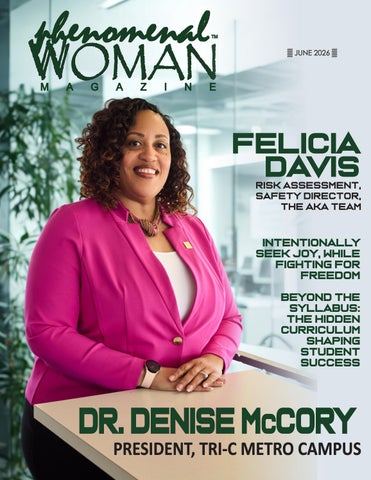

WOMAN Wphenomenal
WOMAN W WOMAN Wphenomenal

INTENTIONALLY SEEK JOY, WHILE FIGHTING FOR FREEDOM BEYOND THE SYLLABUS: THE HIDDEN CURRICULUM SHAPING STUDENT SUCCESS


FromtheEditor: Shelley M. Shockley


INTENTIONALLY SEEK JOY, WHILE FIGHTING FOR FREEDOM
Let's talk about the weather we've experienced for what feels like the last twelve months! I know it's really only been about half of that, but it has been a long time since Northeast Ohioans came out of winter feeling like a bear released from hibernation. We've been waiting for the warmth of the sun offering daffodils, cherry blossoms, and crocuses permission to bloom.
These are the things that offer hope, peace, and renewal, especially during troubling times. I've seen a glimmer here and there, followed by another strong cold front sent by our friends in Canada.
This is the time we celebrate the accomplishments of our students, attend Derby teas, and bridal showers signaling new beginnings. Smiles are brighter, our gaits are spry, and we're planning for all the things that equal spring and summer.
As we plan, let's be intentional in seeking joy for ourselves and our families. Let's leave the headlines on the television and computer screens while finding ways to participate in the fight for freedom.
There are many ways we can elevate our voices, from calling our representatives to volunteering at a local food bank to reading to our children. When I say our children, I'm speaking of the collective, not only those in our homes for families.
When a friend shared with me the dismal illiteracy rate in Cleveland a few years ago, I didn't want to believe the statistics were true; however, with each passing year, I'm learning more about their validity. Recently, I learned that 90 percent of third-graders at an eastside school failed the reading proficiency test. That news broke my heart, and I began to wonder how we, as a community, could work to decrease that number.
My church, True Vine Missionary Baptist Church, and others will do our part by participating in Summer Reading Programs, opening our doors to host tutoring sessions for neighborhood children. This is a start, and I'm encouraging those reading this column to seek out ways you can help
I believe low literacy rates correlate with low voter turnout, creating a vicious cycle in which those in need are left behind due to a lack of knowledge, which begins with reading and, more importantly, comprehending what you read.
As many of our high school graduates prepare to enter college in the fall, let's make sure they are equipped with the tools they need to succeed, beyond computers,
books, and the necessities of life. Our columnist, Marsha Walker Eastwood, introduces us to the needs of our students beyond the syllabus - behavioral and emotional skills, keys to success not only in college but in life.
These skills include time management, self-advocacy, communicating with professors, and a strong sense of self-worth. Our young people are accustomed to parents and others advocating on their behalf, reminding them to schedule time for the many projects they must complete, and so many other things that will not be their sole responsibility. Eastwood's column outlines many ways that we can help prepare our students for success away from home - check it out!
If you have a student eagerly waiting to attend college, but you believe they need a little extra support before heading to the four-year institution of their dreams, consider Cuyahoga Community College (Tri-C), and more specifically, the Metro Campus, where Dr. Denise McCory serves as president.
Dr. McCory is our cover story feature, and her sense of community and love for her job is a great place to send a student who needs some extra guidance before entering the big leagues. A first-generation college student, born and raised in Cleveland, she understands the rigors of entering college and learning to navigate on your own.
The article details her rise within the Tri-C community from administrative assistant to College President. She's tenacious, strategic, and a light to guide those following in her footsteps. Learn more about her inside.
Have you ever wondered how seemingly unrelated fields interconnect and the skills utilized in one translate seamlessly into another? That is the story of Felicia Davis, Risk Assessment and Safety Director at The AKA Team. Davis shares how she spent the better half of her career in various compliance-focused roles that supported the next phases of her journey, and ultimately played a significant role in the work she does today. The correlations were not clear early on, but Davis now recognizes how each rung on her path has prepared her for the next level.
Each of these women were intentional in their pursuit of career advancement, and willing to go the extra mile to achieve their goals. At the same time, they found space to be fully functioning women outside the workplace, ensuring a good work-life balance in the end.
I encourage you to read about them and to be intentional in your own life.

Until we meet between these pages again, be blessed!
INTENTIONALLY SEEK JOY, WHILE FIGHTING FOR FREEDOM
BEYOND THE SYLLABUS: THE HIDDEN CURRICULUM SHAPING STUDENT SUCCESS
CUYAHOGA COMMUNITY COLLEGE
JAZZ FEST


Felicia Davis never imagined that her career choices would lead her into the construction industry For much of her life, she envisioned herself in a traditional corporate setting—wearing a suit, heels, and a desk overlooking a skyline view. Construction simply was not on her radar
Today, however, Davis serves as the Risk Assessment and Safety Director at The AKA Team, a leading construction firm led by visionary leader Ariane Kirkpatrick and recognized for delivering some of the region's most significantand impactful projects.
on page 10

While many professionals advance their careers by moving from one company to another in pursuit of higher titles, Denise McCory chose a different path — she stayed and grew within one institution. Beginning as an administrative assistant and ultimately becoming a college president, each step in her journey at Cuyahoga Community College came because someone recognized her potential before she fully recognizedit herself

Marsha Walker Eastwood

By:
BEYOND THE SYLLABUS: THE HIDDEN CURRICULUM SHAPING STUDENT SUCCESS
This article explores the often-overlooked role of behavioral and emotional skills in student success within higher education. Higher education is often described as a clear and structured path: attend lectures, complete assignments, pass exams, and earn a degree. On paper, the process seems straightforward. But for many students, success in college depends on far more than what appears in a syllabus.
Beneath the formal curriculum lies something less visible but equally powerful—the hidden curriculum. These are the unwritten expectations students are assumed to understand but are rarely taught. They include how to communicate with professors, manage time effectively, navigate stress, and ask for help
For some students, these expectations feel natural. For others, they can be confusing, overwhelming, and, at times, discouraging. The difference is not intelligence. It is exposure.
What Isn't Being Taught
The hidden curriculum is not about academic content—it is about behavior, communication, and selfmanagement.
Students are expected to:
● Manage multiple deadlines without direct supervision
● Communicate professionally with faculty
● Advocate for themselves when they need help
● Interpret feedback and adjust accordingly
● Navigate institutional systems independently
● Maintain emotional balance under pressure
These skills are essential. Yet they are rarely taught in a structured or intentional way. Instead, they are assumed, and when something is assumed, it often goes unnoticed—until a student struggles.
“Success in college isn't just about what students learn—it's about what they're expected to know already.”
Not All Students Start in the Same Place
Students enter higher education with vastly different levels of familiarity with academic environments. Some arrive having grown up around college culture. They may have parents, mentors, or teachers who helped them understand how things work when to speak up, how to ask questions, and how to manage expectations. Others, particularly first-generation students, may not have had that same exposure.
They may not know that:
● Office hours are there for them to use
● Asking questions is encouraged, not frowned upon
● Struggling is part of the process—not a sign of failure
● Silence can quickly turn into falling behind
Without this understanding, students can misinterpret their experiences. What is actually a lack of information can feel like a personal shortcoming.
“The difference between struggling and succeeding is often not ability—it's understanding the rules no one explained.”
The Emotional Cost of Not Knowing
When expectations are unclear, students are left to figure things out on their own. For some, this process works. For others, it creates unnecessary stress.
Students may:
● Fall behind even when they are capable
● Misinterpret feedback and become discouraged
● Avoid asking for help because they feel unsure or intimidated
● Experience increasing anxiety and self-doubt
● Begin to question whether they belong at all
Marsha Walker Eastwood, BSEd, MSHS PWM Contributing Writer

WOMAN WWOMAN Wphenomenal

What is often labeled as a lack of motivation or discipline is, in many cases, a lack of clarity, and over time, that lack of clarity can take a real emotional toll.
What It Feels Like in Real Life
For many students, the hidden curriculum is not something they can easily name—it's something they feel. It shows up in small but significant moments.
A student sits in class, unsure whether it is appropriate to ask a question. Another reads the feedback on an assignment but does not fully understand what is being asked to improve. Someone else considers attending office hours but hesitates, unsure of what to say or whether their concerns are “valid enough.”Over time, these moments accumulate.
What begins as uncertainty can turn into hesitation. Hesitation can turn into avoidance. And avoidance can eventually turn into falling behind.
For students who are already balancing work, family responsibilities, or financial stress, this added layer of confusion can feel overwhelming. The academic challenge is no longer just about learning the material—it becomes about navigating an environment where expectations are not always clearly defined. Many students internalize these struggles.
Instead of thinking, “I wasn't shown how to do this,” they think, “I should already know how.”That belief can be incredibly difficult to overcome.
“When expectations remain invisible, students don't just fall behind—they begin to question themselves.”
More Than Academics: The Skills Behind Success
One of the most overlooked aspects of higher education is how much it depends on emotional and behavioral skills.
Students are expected to:
● Manage stress without clear guidance
● Handle frustration when things don't go as planned
● Stay consistent even when overwhelmed
● Regulate their reactions to pressure
These are not small expectations. They require skills that take time and practice to develop. Yet most students are left to figure them out on their own.
Some do. Others struggle quietly, and in many cases, the difference has little to do with intelligence and everything to do with preparation.
“College doesn't just test what students know—it tests how they cope when they don't.”
Why This Matters Now More Than Ever
Today's college students are navigating more than just academics. They are balancing financial pressures, family responsibilities, work commitments, and, increasingly, mental health challenges.
At the same time, higher education has become more diverse. Students come from a wide range of backgrounds, each bringing different experiences and levels of preparedness.
In this environment, relying on unspoken expectations is no longer sustainable. If institutions want students to succeed, they must be willing to make those expectations visible.
Clarity does not lower standards—it gives students a fair chance to meet them.
The Expanding Role of Faculty
Faculty members are also navigating the realities of the hidden curriculum—often without formal support themselves.
In today's classrooms, professors are not only educators but also mentors, guides, and, at times, informal support systems for students facing a wide range of challenges. Many recognize that students need more than content knowledge to succeed. They see the effects of stress, uncertainty, and lack of preparation in real time.
However, without institutional structures that support this expanded role, faculty are left to bridge the gap individually. Some do so effectively, while others may not have the time, training, or resources to address these needs. This inconsistency can further reinforce the hidden nature of the curriculum.
When expectations vary from one classroom to another, students must continually adjust—often without clear guidance. Bringing greater consistency and transparency to these expectations does not just support students—it also supports educators.
Making the Invisible Visible
Addressing the hidden curriculum does not require a complete overhaul of higher education—but it does require intention. Small, deliberate changes can have a significant impact.
Institutions can begin by clearly defining expectations— not just for assignments, but also for how students are expected to engage, communicate, and manage their time. When these expectations are explicitly stated, students are better able to meet them.
First-year programs offer another important opportunity Introducing students to practical skills such as time management, professional communication, and helpseeking behaviors early on can reduce confusion and build confidence.
Faculty also play a critical role. When instructors take a few moments to explain not only what is expected but also how to approach it, they help make the academic environment more accessible. Even simple actions—such as modeling how to ask questions or explaining how to interpret feedback—can make a meaningful difference.
Mentorship is equally important. Structured opportunities for students to connect with advisors, peers, or support staff can provide guidance that might otherwise be missing. These relationships help students navigate both academic and emotional challenges.
Finally, institutions must continue to normalize helpseeking. When students understand that asking for support is part of the learning process—not a sign of weakness—they are more likely to engage fully.
These changes do not lower academic standards. They strengthen them by ensuring that all students have a clearer path to success.
“Clarity is not a reduction in rigor—it's an expansion of opportunity.”
A Shift in Perspective
Perhaps the most important change is how we think about student success. Instead of asking, “Why are students struggling?” we might ask, “What are we expecting them to know that we have not taught?”
This shift moves the conversation away from blame and toward responsibility. Students are not failing to adapt. In many cases, the system has not fully explained how to succeed within it.
Rethinking What It Means to Educate
Higher education has traditionally focused on knowledge. But education, in its fullest sense, is about more than information. It is about helping people develop the skills, habits, and confidence they need to navigate challenges, solve problems, and grow.
The hidden curriculum reminds us that what is left unsaid can be just as powerful as what is taught. By bringing these expectations into the open, institutions can do more than improve academic outcomes; they can create environments where students feel capable, supported, and prepared, because success in higher education should not depend on what students already know. It should depend on what they are allowed to learn, always remembering that it is a partnership between student and faculty, not a competition. g


Building More Than Structures, Finding Purpose in an Unexpected Industry Felicia Davis:

Felicia Davis never imagined that her career choices would lead her into the construction industry. For much of her life, she envisioned herself in a traditional corporate setting—wearing a suit, heels, and a desk overlooking a skyline view. Construction simply was not on her radar.
Today, however, Davis serves as the Risk Assessment and Safety Director at The AKA Team, a leading construction firm led by visionary leader Ariane Kirkpatrick and recognized for delivering some of the region's most significant and impactful projects.
Phenomenal Woman recently spoke with Davis to understand her inspiring journey to success and to gain deeper insight into this critical branch of the construction industry
The construction industry remains a major driver of the U.S. economy. According to the Associated General Contractors of America (AGC), the sector employs approximately 8 million workers and generates nearly $2.1 trillion in construction annually. In Ohio alone, construction contributes $38 billion—about 4.1%—to the state's $928 billion GDP.
While construction projects are vital to economic growth and job creation, they are inherently complex and often hazardous. In addition to applying sound project management practices, implementing a structured risk assessment process is essential to preventing costly
delays, minimizing safety incidents, and addressing operational challenges.
Davis was born and raised in Cleveland in a loving and supportive two-parent household where family was a central priority. Education was prioritized as the key to unlocking success, while faith served as the unwavering foundation that guided every step forward. In this environment, hard work, resilience, and resourcefulness were not just encouraged—they were expected and consistently practiced. She credits these early experiences with teaching her to adapt, remain curious, and embrace new learning opportunities.
After graduating from high school, Davis studied business administration at Bowling Green State University. She views education not as a finite chapter, but as a lifelong journey. She explains, “Whether through formal education, professional certifications, or hands-on experience, I've always believed in equipping myself with the knowledge and skills needed to navigate any opportunity or challenge that comes my way”
Prior to joining The AKA Team, Davis spent more than 30 years working across a wide range of compliancefocused roles. She owned and operated a commercial general contracting and landscaping company as well as a licensed childcare center in Cleveland. At the time, each position felt like a distinct chapter; in reflection, however, she sees them as stepping-stones leading to her current role as Risk Management and Safety Director
At the time, it was not fully recognized that each step was contributing to the formation of something meaningful. A strong foundation was being established, and a bridge to new opportunities was gradually taking shape.
Davis elaborated on it, “When I opened my childcare center, I had to design the plan of operation, work with architects on floor plans, coordinate with the building department and fire division, pull permits, and complete certifications such as CDA, MBE, and FBE. All of that—every form, every inspection, every requirement was compliance.” She continued, “I've truly come full circle. I began my career ensuring that children were cared for and safely returned to their loved ones, and today my role requires me to advocate for the care and safety of our team so they, too, can return home safely to the people who love them. I just didn't recognize it as the foundation of a future career in risk management and safety”
Each step strengthened her ability to navigate regulations, manage complex operations, and lead with both structure and empathy—skills that continue to define the work she does today.
Along her career journey, Davis experienced uncertainty about whether construction was the right field for her. Of the grueling period, she said, “Much of my adult life, I've found myself in rooms where I was the only woman, the shortest person, and often the darkest person. That can shake your confidence, but it can also sharpen your purpose. Over time, I realized that my perspective, my lived experience, and my voice were not obstacles—they were assets. They allowed me to bring something different, necessary, and valuable to the table.”
So, how did Davis get interested in risk assessment and safety branch of the construction industry? She explained, “My interest in this field didn't come from a single moment—it was shaped over time. I genuinely believe that this role was ordered and ordained by faith. Every analytical, compliance-driven experience throughout my career prepared me for this work, even when I didn't realize it.” She continued, “Risk management allows me to use my strengths, my attention to detail, and my passion for protecting people and processes. I enjoy what I do, and I take pride in knowing that my work helps create safer environments and stronger outcomes for our organization.”
Her decision to remain in and grow within the industry was ultimately shaped by the realization that construction is not merely about buildings but about people, systems, safety, and the creation of environments where others can thrive. This work is deeply valued.
As the Risk Assessment and Safety Director at The AKA Team, Davis is responsible for identifying, assessing, and mitigating risks that could impact The AKA Team's operational and legal integrity. She develops and implements policies designed to minimize asset loss, manages the organization's insurance portfolio, and oversees all insurance requirements for construction projects. In addition, she conducts inspections and ensures employees have the training, knowledge, and resources needed to work safely and confidently.
In today's construction industry, effective risk management is no longer optional—it is a critical driver of safety, stability, and long-term success. Companies that prioritize proactive risk strategies are better equipped to reduce workplace accidents, avoid costly project delays, maintain regulatory compliance, and make smarter operational decisions. Just as importantly, strong risk management builds trust among employees, clients, and communities.
The industry's risk landscape is evolving rapidly According to Davis, construction firms are currently contending with significant labor shortages, rising material costs, and ongoing supply chain disruptions that threaten project timelines and budgets. At the same time, increasingly stringent environmental and safety regulations are adding to compliance pressures across the sector
Technology has introduced new vulnerabilities as well. As companies adopt digital platforms and cloud-based systems, cybersecurity threats have become a growing concern. Meanwhile, climate-related risks—including extreme weather events—are reshaping project planning and jobsite safety expectations.
In this environment, Davis explained, “successful construction companies are those that view risk management not simply as damage control, but as a
strategic advantage. The ability to anticipate challenges, adapt quickly, and respond effectively is becoming essential to staying competitive in a fast-changing industry”
Davis begins her day at 5:00 a.m. with a cup of tea, two cell phones, and the morning news. She first checks the weather and traffic conditions, as The AKA Team's earliest crews are already heading to job sites. Ensuring their safe arrival is a responsibility she takes seriously, reflecting the strong trust and reliability shared between her and her team.
From there, her schedule varies widely. On any given day, she may review insurance policies, analyze incident reports, conduct safety inspections, develop site-specific safety plans, or collaborate with project managers on risk and compliance matters. She also oversees certification applications and prequalification documentation. The dynamic nature of her role ensures that no two days are alike—an aspect she finds especially rewarding.
Davis acknowledges that many of the industry's challenges stem from its inherently unpredictable nature. Weather fluctuations, supply chain disruptions, evolving regulations, and the fast-paced demands of construction require constant vigilance and timely decision-making.
Maintaining a strong safety culture can also be challenging, particularly under tight deadlines and highpressure conditions. However, these obstacles serve as a source of motivation, reinforcing the importance of effective risk management and deepening her pride in the work she does.
The under-representation of women in the construction industry is a concern for Davis. Although women comprise approximately 50.5% of the total U.S population, they remain markedly under-represented within the construction sector. According to the U.S. Bureau of Labor Statistics, women make up only 11.3% of the construction workforce, despite more than 1.3 million women currently employed in the industry.
Closing the representation gap in construction requires more than awareness—it demands intentional, sustained action. Meaningful progress happens when organizations actively cultivate environments where individuals can see themselves reflected in leadership, feel a genuine sense of belonging, and have the opportunity to succeed on their own terms.
Drawing on her industry experience, Davis enumerated several key strategies for creating lasting change:
· First, visibility matters; When people see leaders, project managers, safety directors, and skilled trades professionals who look like them, it sends a powerful message that they belong here too.
· Second, access and opportunity must be expanded; That means outreach to schools, community organizations, and training programs that introduce young people, especially girls and students of color—to construction as a viable, rewarding career path. Many simply don't know what's possible because no one ever showed them.
Continued on next page ...

As part of The AKA Team’s ongoing commitment to OSHA heat-illness prevention guidelines, Davis conducted an on-site visit with team members. Giventheelevatedtemperaturesthatday,shebroughtsmoothiesandwaterto help keep everyone hydrated, motivated, and mindful of the importance of recognizingandpreventingheat-relatedillness.
· Third, support systems need to be strengthened; Mentorship, sponsorship, and professional development programs help individuals navigate an industry that can still feel isolating. That experience can be intimidating, but it can also be transformative when you have allies and advocates who recognize your value.
· Finally, companies must commit to creating inclusive cultures, not just diverse headcounts. That includes equitable hiring practices, fair advancement opportunities, and workplaces where every voice is respected.
Throughout her career, Davis has had the distinct privilege of working alongside an extraordinary group of women, and she is grateful to all of them. She noted that some are widely recognized leaders whose presence commands attention in any room, while others operate quietly behind the scenes, creating impact without seeking acknowledgment. Each has left a meaningful imprint on her professional and personal journey.
Among these influences was her experience working within the executive leadership team at Step Forward. Under the leadership of Dr. Jacklyn Chisholm, alongside executive assistant Michelle Hayes, she witnessed and learned a standard of professionalism defined by grace, precision, and an unwavering commitment to excellence. “Their leadership demonstrated that strength and compassion are not mutually exclusive, but rather essential partners in effective leadership.” She said.
Equally impactful have been the Kirkpatrick sisters—Ariane Kirkpatrick, CEO of The AKA Team, and Amonica Davis, COO of Mavuno of Ohio. She noted, “Their consistent example of women supporting, celebrating, and elevating one another has served as a powerful source of inspiration.” Being in the presence of women who actively foster growth in others has reinforced her own commitment to pursuing excellence in every endeavor.
At the foundation of these influences is her mother, a steadfast mentor whose example of strength, integrity, and dedication continues to shape her approach to leadership and life. The values instilled by her mother remain evident in how she makes decisions, leads others, and engages with the world around her.
Collectively, these women have invested in her growth, challenged her to expand her perspective, and affirmed that there is space for everyone at the table. Their enduring influence continues to guide not only her professional work, but also how she shows up in service to others.
With all her responsibilities, the natural question is, how does she strike a work-life balance? For Davis, it's a practice that requires intention and consistency. With days that begin early and often unfold unpredictably, establishing grounding routines has become essential. Each morning starts quietly with tea, reflection, and a deliberate pause before the day's demands take hold. This simple ritual provides a sense of steadiness and focus.
Equally important to Davis is the conscious effort to protect time for what matters most. Whether devoted to family, faith, or moments of stillness, she doesn't view balance as an equal division of hours, but rather as a thoughtful allocation of energy and attention. It is about ensuring that the right priorities receive care at the right time.
There is also an understanding that some days will require a greater professional commitment from her. On such occasions, she leans in with purpose while remaining mindful to step back, rest, and recharge when necessary. She firmly believes that her ability to support others effectively depends on maintaining personal well-being, making it vital to recognize limits, listen closely to one's needs, and create space for renewal and joy.
Ultimately, Davis believes that balance is not a fixed destination but an ongoing practice—one that she approaches with daily commitment and care.
Closing out the interview and conveying messages to women interested in pursuing careers in construction, Davis said, “Construction is not just hard hats and heavy equipment. It's problem-solving, communication, planning, compliance, safety, innovation, and teamwork. There is room for every skill set, every background, and every kind of brilliance.”
Her advice is simple: “Step forward with confidence, even if you don't see many people who look like you yet. This industry needs your voice, your perspective, and your leadership more than you may realize.”
She also encourages aspiring professionals to stay curious and ask questions, seek out mentors and allies, know their worth, stay resilient, and own their expertise. g

CUYAHOGACOMMUNITYCOLLEGE
SPRING 2026 COMMENCEMENT: STEFANIE WIMS

Stefanie Wims knows firsthand how powerful support can be and why showing up for young people matters. Growing up, her family emphasized strong values and the importance of education, but life presented serious challenges. As her grandmother battled Alzheimer's disease and Wims faced her own personal struggles, her path to a high school diploma was delayed.
Still, she never lost sight of her goals.
Cuyahoga Community College (Tri-C®) became her second chance. After earning her GED diploma, Wims stayed the course, building confidence and momentum one semester at a time.
Along the way, Wims rooted herself deeply in campus life to prepare for a future dedicated to helping adolescents navigate challenges. She was vice president of Active Minds, a student-run organization promoting mental health awareness and suicide prevention, and a Jack, Joseph and Morton Mandel Continuing Scholar. She also served as a peer influencer with the Help Is Here team and worked as a student ambassador in the Counseling department, gaining valuable experience supporting peers and the campus community.
"I am passionate about helping youth because adolescence is a critical and challenging time and having a supportive adult can make a huge difference in guiding them toward their goals," Wims said.
Wims will earn an Associate of Arts in Psychology and a certificate in Chemical Dependency. She will graduate from the School of Liberal Arts and Sciences when the College celebrates Spring Commencement on May 15 at the Wolstein Center.
"My goal is to work in schools, helping adolescents overcome personal barriers and succeed both academically and emotionally," Wims said.
She will continue as a Mandel Scholar at Cleveland State University as a full scholarship recipient and plans to earn a bachelor's degree in psychology
What made you choose Tri-C?
Tri-C offered the support and flexibility I needed to continue my education and achieve my goals. I first enrolled to complete my GED diploma and continued my education here to pursue my associate degree.
Describe your Tri-C experience. Has a specific person, class or event played a role in your success?
My experience has been very rewarding. Tri-C provided me with the support, resources and opportunities I needed to grow academically and personally. Being a Jack, Joseph and Morton Mandel Scholar has played a significant role in my success by giving me guidance, mentorship and motivation to stay focused on my goals.
How has Tri-C changed your life?
Tri-C gave me a second chance at education and helped me regain confidence in my abilities. The sense of family and community made me feel encouraged and motivated, which helped me stay on track toward my goals.
Do you have any pearls of wisdom to share with students considering a similar degree or certificate program?
When things get tough, don't give up. Take it one day at a time and lean on the Tri-C community, whether it's a mentor, teacher, adviser or counselor, because they genuinely want to see you succeed.
Tri-C will celebrate the academic achievements of its newest graduates during Commencement on May 15 at the Wolstein Center in Cleveland.
SOURCE: TRI-C.EDU

TEN TRI-C STUDENTS NAMED TO 2026 ALL — OHIO ACADEMIC TEAM
College leads the way with most honorees among state's community colleges
Ten Cuyahoga Community College (Tri-C®) students — the most of any two-year college in the state — were named to the 2026 All-Ohio Academic Team, which recognizes the top community college students in academics, leadership and community service.
Students from across Ohio's 22 community colleges were chosen for this year's team. All team members are recognized in April as part of Community College Month.
The following Tri-C students, designated by teams, made the All-Ohio Academic Team:
· First Team: Marcella Moore of Bedford Heights (School of Liberal Arts and Sciences, Eastern Campus)
· Second Team: Verona Mahilet of Cleveland (School of Advanced Manufacturing, Engineering and Computer Science, Metropolitan Campus)
· Third Team: Harry Anderson of South Euclid (School of Liberal Arts and Sciences, Eastern
Campus); Aniya Alex of Euclid (School of Nursing and Health Professions, Metropolitan Campus); Taylor Confer of Parma (School of Business, Legal Professions and Hospitality, Western Campus); Alexis Hurchanik of Independence (School of Liberal Arts and Sciences, Western Campus); Victoria Kovalsky of Brunswick (School of Liberal Arts and Sciences, Metropolitan Campus); Tuan Khoi Phan of Brooklyn (Workforce Innovation, Western Campus); Mona Shaban of Strongsville (School of Liberal Arts and Sciences, Westshore Campus); and Chris Wise of Lakewood (School of Advanced Manufacturing, Engineering and Computer Science, Westshore Campus)
Students were nominated by College faculty, staff and other campus leaders. First-team honorees will receive $1,000 scholarships, second-team members will get $500 scholarships, and third-team members will get $250 scholarships.

PHOTOS: TIA McKNIGHT
THE BLUSH GALLERY
Dr. DENISE MCCORY
A BEACON OF LIGHT AT TRI-C
FROM ADMINISTRATIVE ASSISTANT TO CAMPUS PRESIDENT
Shelley M. Shockley Managing Editor
While many professionals advance their careers by moving from one company to another in pursuit of higher titles, Denise McCory chose a different path — she stayed and grew within one institution. Beginning as an administrative assistant and ultimately becoming a college president, each step in her journey at Cuyahoga Community College came because someone recognized her potential before she fully recognizedit herself.
“You should apply for this,” colleagues and mentors would encourage her And each time, she did. Again and again, she embraced new opportunities, evolving from the woman once responsible for filing papers to the leader now shaping the vision of an entire campus.
Growing up on the southeast side of Cleveland, Denise McCory watched her parents build a loving home and provide life's necessities with only high school diplomas. She deeply admired their dedication and sacrifices, yet she envisioned a different path for herself — one that included a college education. When she learned about the National Urban League HBCU (Historically Black Colleges and Universities) College Tour, she eagerly seized the opportunity to explore potential schools and discover where she might find her collegiatehome.
She returned home filled with excitement and determined to attend North Carolina Central University in Durham. Her mother, however, had other ideas. After graduating from high school, her mom built a long and successful career with Ohio Bell, later AT&T. Through hard work and dedication, she was able to retire at just 48 after thirty years of service. That experience shaped her worldview, and the idea of attending college — especially out of state in North Carolina — felt unfamiliar and uncertain. Instead, she encouraged her daughter to “go to a state school first, and we'll see if you're really into this college thing.”
As the first member of her family to consider college, Denise relied heavily on her high school counselors to help her navigate the complexities of the college admissions process. When she began considering in-state options, she eagerly joined a group of students visiting Ohio University (OU). At the time, the university was working to diversify its student population by recruiting minority students from inner-city communities. To make a strong impression, an OU charter bus arrived in Cleveland on an unusually warm weekend in February, outfitted with plush seating and flat-screen televisionsto showcase the campus experience.
McCory recalls the bus ride as awesome, but the greeting upon their arrival on campus was spectacular She said, “We got off the bus, and there were Greek fraternities and sororities, a band, and just a really hyped and welcoming environment to show us around campus.
After a great introduction to OU, the students boarded buses headed home and agreed, “We're going to OU,” even though they had applied to other schools. For McCory, this would work out well because her mom wanted her to attend a school in Ohio
For seven months, McCory and her classmates were filled with excitement as they planned for their future at OU McCory regularly met with counselors and worked with the Cleveland Scholarship Program for guidance on completing the FAFSA (Free Application for Federal Student Aid) forms and on applying for and taking the ACT and SAT to ensure they were prepared for college.
At the end of those seven months, she said, “I got down to OU finally, and all the people who were there during the welcome day disappeared.” As she walked around campus, no one talked like her No one came from where she came from, and the lecture halls were the worst. She said, “We go to lecture halls with 500 people, and maybe two or three look like me. It was a huge culture shift for me.”
What happened next would become a defining theme throughout McCory's career and life: the power of community and connection. Reflecting on her experience, she shared, “Fortunately, I had the benefit of about a dozen classmates from high school from that initial bus ride. We formed our own little community down there. So, it was like hanging out with your high school besties for four years.”
Today, McCory reflects on that experience and recognizes how deeply it influences her work at Cuyahoga Community College (Tri-C). “I try to keep that in mind here at Tri-C,” she explained, “even though most of our students are commuters and have homes that aren’t far away, having a sense of community with people who share similar goals and experiences really helps with retention.”
“ ”
What I love about the community college is the diversity. You will have a wide range of student types and experiences they bring into the classroom, and you can leverage that in your teaching. You know they can learnalotfromeachother.Ilovethat.
That same sense of support and belonging helped carry her through college, and she believes it remains just as important for today's students. “I think that's the case for a lot of our students here at Tri-C,” she said.
As an undergraduate, McCory majored in English and PreLaw. Her choices were not necessarily driven by long-term career ambitions Instead, she chose English at the encouragement of her high school English teacher and added Pre-Law partly out of personal interest. She explained, “I watched a lot of LA Law, and I liked the theatrics of it.”
Aside from some early feelings of isolation, Ohio University ultimately fulfilled Denise's expectations of college life, and she was on track to graduate when life took an unexpected turn. During her senior year, she learned she was pregnant with her daughter — news that might have derailed someone else's plans. But Denise had spent years building a strong foundation, not only at Ohio University, but earlier as a student at John Marshall High School in Cleveland.
Continued on next page ...

Her discipline, determination, and strong work ethic prepared her to face the challenge with resilience rather than surrender her goals.
She participated in the Scholarship-in-Escrow program, earning college credits while still in high school. These credits would be just what she needed after becoming pregnant. With one quarter to go, she said, “I came into OU a quarter ahead, so that helped me take the last quarter off to have my daughter.”
Denise was armed with a bachelor's degree in English and a baby girl, but no clear plan for what was next. She knew she had a new role, mom, and caring for her daughter was a priority, so she took a job in retail.
One day, not long after graduation, McCory was working at Burlington Coat Factory when a former classmate from Ohio University walked in and struck up a conversation. The community she had helped build in Athens was now bearing fruit. Her classmate said, “I have a position available in TRIO—the federally funded program that includes Upward Bound, Talent Search, and Student Support Services— at the college I work for in downtown Cleveland. Would you be interested?”
McCory's response was simple: “Sure, why not?” About a month later, McCory was a Tutoring and Supplemental Instruction Coordinator at Myers College in downtown Cleveland.
She would spend the next couple of years working with the TRIO program before being recruited by her classmate to serve as an administrative assistant at Tri-C. McCory said, “The rest is history. I've been here for the last 25 years, but came into the organization as an administrative assistant.”
While her parents did not attend college, they laid a strong foundation for Denise by modeling a powerful work ethic. That work ethic, combined with her eagerness to learn, propelled her into opportunities and positions she never imagined pursuing It also helped that she joined an institution committed to cultivating and developing talent from within.
When she joined Tri-C, McCory worked in a NASA-funded program as the National Trainer for the Science, Engineering, Mathematics, and Aerospace Academy (SEMAA), working with students in grades K-12 to spark their interest in math
and science. She put her all in that position, particularly the parent education component, and every job after that.
Her commitment to the job and tenacity in completing tasks led to her promotion to Director, Science, Engineering, Mathematics, and Aerospace Academy, when the position became available.
When asked how she was able to navigate college and advance professionally, she said, “It was pretty serendipitous, honestly. I never aspired to this role — things just kind of opened up for me. As an administrative assistant, I learned the importance of professionalism, legitimacy, and efficiency.”
Learning new processes and frameworks was key, but more importantly, Denise said, “I just loved every job I was in, every single position I was in at the institution, I loved it.” The joy she found in her jobs radiated and resonated with others, prompting other leaders to ask, “Hey, I think you're great at A, B, and C. Would you be interested in doing this for a while? So, that's honestly how I was able to move from position to position.”
Denise enjoyed the work so much that she went back to school for her master's degree in adult learning and development. Through her work, she realized she enjoyed working with adults, a realization that took her back to Ohio University and her days as a new student orientation leader Of that time, she said, “They would always give me to the parents, so it was my job to make the parents feel good about sending their babies a hundred miles away”
Capitalizing on the joy of working with parents, Denise enrolled at Cleveland State University, working evenings and weekends to pursue her master's degree in Adult Learning and Development. Recalling this time as a blur, she is grateful for the support she received. “I did that in the evenings and on weekends, working full time at Tri-C, raising a daughter, and newly married. That was a juggling act to get all of that done. There were some days, especially in the summer, when I was going to school four nights a week. My husband and parents did a lot of the heavy liftingfor me.”
It was a long road, but she said, “I did that for about seven years, got my degree, and decided that I need to really leverage this degree. I am working at a college. I want to work with college students. So I took a position in the Enrollment Center working as a Student Success Specialist.”
In her new role, Denise was able to maximize all she had learned over the years. It was a brand new role, and “What I loved about that role is I could make it my own. It had a really basic job description, but the projects and activities all needed to be planned and designed. So I had an opportunity to make the position what I wanted it to be.”
Her work was well received and eventually adopted on other campuses throughout the College. Reflecting on the lasting impact of those efforts, she said proudly, “It's residual — 15 or 16 years later, the programs are still in place, so I'm really proud of that.”
To achieve her goals with the program, she said she worked closely with the assistant dean's office on programming, putting together mentoring programs and other services where her bright light was once again noticed.
So, of course, when the Assistant Dean's position became available, she received a call from the dean offering her the
interim Assistant Dean of Student Affairs position. She jumped at the chance to gain more experience working closely with students, but quickly learned the role had a challengingside.
She explained, “When I moved into that role, it was very different because they served as the institution's primary conduct officers. They handled the adjudication of behavioral issues, academic dishonesty, and related matters. I found myself jumping right into working with students who had gotten into fights in the cafeteria, and I had to determine appropriate disciplinary action, including suspension in some cases. But I actually loved that work. I saw it as more of a developmental conversation an opportunity to help students get back on track.”
With an average student age of 28, McCory often took on the role of counselor to the students, helping them stay focused on their goals of staying in school and getting what they needed.
She loved the work, she said, “I was actually working more with adults, which you would consider non-traditional students, and I love that because I feel that I connect to them on a more practical level.” She felt she could talk to them and show them they had a community supporting them to reach their goals by pointing out what is important: “You've got kids to feed, you've got a career that you're trying to get to or navigate up to, so let's keep our eye on the goal.”
When an opportunity arose for the Dean of Student Affairs to move to a District position, Denise was tapped to serve as Interim Dean of Student Affairs. She would serve as the Interim Dean for a short while before advancing to permanent Dean of Student Affairs,a position she held for five years.
During her tenure as Dean, she believed something was missing in her career and decided to pursue a doctorate degree. “I wanted to get a doctorate because it seemed like everybody who was in some type of executive position in a college had a doctorate.”
This period highlighted McCory's tenacityand discipline as she maintained a demanding schedule to achieve her goals. She explained, “I'm talking about getting up at 3 a.m. every day to study from 3-6:30 a.m. —every single day Doing class work, writing before getting the kids ready I had another kid by then. I would get the kids ready and off to school before heading to campus.”
Maintaining this schedule allowed her to complete her dissertation in record time. As the Dean, McCory felt she had found her forever job, “I was loving that job.” She said. “You couldn't tell me I wasn't going to spend the rest of my life working in student affairs. I felt like I had reached the pinnacle.”
The most she felt she could or would strive for was the Vice President of Student Affairs, but once again, her bright light caught the eye of one of her bosses. This time, it was former Tri-C President Alex Johnson who said to her, “I really see a future for you on the academic side of the house. You will want to round out your resume and consider applying for an academic position.”
While she took his advice seriously, McCory said it took a little nudging before she ultimately applied for— and secured — the Dean of Instruction position at Tri-C's Eastern Campus. The transition was bittersweet, as her collegiate and professional life up to that point had been rooted at the college's Metropolitan campus.
Recalling that time, she said, “It was so sad for me to leave the Metro Campus. I had grown up here and spent all of my Tri-C career here. But I took that opportunity at East, and I learned a tremendous amount. It's like learning how the sausage gets made, how the curriculum gets produced, working with the faculty, understanding the instructionalpieces.”
Seeking to become a well-rounded educator, Dr McCory decided, during her tenure as Dean of Instruction that she wanted firsthand experience in the classroom. Reflecting on that decision, she said, “I thought it would really be helpful if I could teach. I needed to understand what faculty members were seeing and what the student experience was like in the classroom.”
To achieve that goal, she realized she would need to return to school once again—this time to earn a master's degree in the discipline she hoped to teach: English Explaining her decision, she said, “I only had a bachelor's degree in English, so I had to go back to school. I attended Bowling Green State University online and earned my master's in English Teaching because I wanted to learn how to teach English, not just write.”
She completed her degree program four years ago and soon began adjunct teaching in the English Department, where she taught English Composition. Reflecting on the experience, “This, honestly, has been probably the best experience in terms of rounding out my perspective on this place. Seeing it from both sides of the house — academic affairs and student affairs — and then experiencing it as both an administrator and a teacher has helped me become a better campus president.”
McCory has officially held the Metro Campus President position for about five years, but during this time, she served as Interim President for about seven months before the pandemic hit, which disrupted not only Tri-C but the world. She recalls interviewing and accepting the job, but asking herself, “What is this job?”
In the early years, she felt she hadn't spent enough time in the position to fully understand the role. She explained, “I don't count maybe three years of work as experience because it was really about moving chairs around and measuring the distance between tables, and to mask or not mask. It was all about just surviving the pandemic. But then eventually we got through that, and now I feel like I'm hitting my stride.”
As the longest-serving of Tri-C's current campus presidents, McCory is often viewed as a mentor by her peers. Still, she believes she continues to grow and evolve in a role that has changed several times throughout her tenure.
According to McCory, her responsibility is to translate the College's districtwide vision into meaningful action at the campus level. In her words, “They tell us, 'These are the policies and procedures. This is what we want the overall Tri-C student experience to be.' Our role as campus presidents is to interpret and implement that vision in a way that best serves our students and the local community, because each campus is very different.”
Statistically, the Metro Campus serves an older student population, including a mix of late bloomers and members of the workforce seeking to enhance their skills for upward mobilityin their jobs.
McCory explained, “A lot of my students are people who started college— either here or somewhere else—and didn't finish. Then maybe they entered the workforce and realized they didn't have the educational background they wanted, so they came back. We call those returning students. I also have a good number of professionals who are looking to upskill. They already have careers and are seeking additional credentials. And then I have traditional high school students, overwhelmingly from the Cleveland Metropolitan School District.”
To achieve success, she said, “We advocate for our respective communities, our students, our campuses, to make sure that there's equity in how we do things across the district. We fundraise, try to bring back partners, and provide experiential learning opportunities - employers that meet our local community'sneeds.”
Continued on next page ...
PHENOMENAL FACTS:

Bachelor's degree, English
Ohio University
Master's degree, Adult learning and development
Cleveland State University
Doctorate degree, Higher education leadership
Walden University
Member, Board of Directors
Positive Education Program (PEP)
Member, Board of Directors Campus District
Served as State Co- Chair
The ACE (American Council on Education) Women's Network - Ohio
Additionally, it is the responsibility of the Campus President to oversee campus operations, ensure facilities are clean and functional, and maintain an optimal teaching and learning environment.
Having such a diverse population is a plus for McCory, who said, “What I love about the community college is the diversity. You will have a wide range of student types and experiences they bring into the classroom, and you can leverage that in your teaching. You know they can learn a lot from each other. I love that.”
When asked how she navigates from top campus administrator to English professor, she said, “You let it flow On the first day I meet the students, I prepare an icebreaker, as every other faculty member does. I disclose that I have a “Day job,” and they are just like deer in the headlights. But by class three, they're totally cool with it.”
While the students are cool with it, wearing both hats affords McCory an opportunity to see operations up close and
personally, and see how efficiently or inefficiently systems are working.
She is clear that she operates in the teaching space as a visitor, explaining, “I respect the faculty space. I know I am a visitor in this space, for the most part, but it does help me relate to the faculty. Honestly, I say all the time that I respect folks who can do this work day in and day out, year after year, hundreds of students annually I get worn out in one semester a year with just 25 students.”
Continuing, she added, “That wears me out, so I definitely respect the rigor of that work, and I approach the faculty with full respect for what they do and the expertise they bring. I seek their advice and insight while assuring them that my questions or requests are never evaluative — I'm simply trying to learn how to teach as well as they do.”
As a former administrative assistant with a long tenure on campus, many of her current subordinates are also former colleagues— and in some cases, friends. Still, she has found a way to navigate what could be murky situations. Reflecting on those relationships, she explained, “I came up through the staff ranks, the folks who I work side-by-side in the enrollment center who trained me or supervised me. So there's a relationship there. There's a rapport there where I'm able to tap into those long-standing relationships, and the trust from that, even, you know, the faculty and I would go and visit their classes and help them with conduct issues and things like that. So a lot of it just has to do with being here so long and building trust and relationshipover time.”
She further emphasized that her leadership style is grounded in collaboration rather than hierarchy, saying, “I think I'm very approachable. I don't rely on positional authority. If you see me in a meeting, a lot of times I am rarely sitting in the head seat. I prefer to be side by side with colleagues.”
As president, she identified navigating institutional politics as one of her biggest challenges. She explained, “Politics is huge. Everybody has an agenda, and you are always trying to tend to everybody's agenda. But at the same time, understanding that our students are at the center of what we do They're the reason we're here.”
“When we come up with situations where it's a union issue, or faculty or staff or administrators don't want to do something that we know is best for students,” she said, “ I'm typically the one to bring up the elephant in the room and ask, 'But what's best for students?'”
Dr. McCory's approachable nature and ability to connect with students have recently been recognized beyond her administrative role at the college. One of her English students nominated her for the Excellence in Teaching Award in Honor of Ralph M. Besse, an honor presented annually to up to four fulltime faculty members and up to four adjunct faculty members or lecturers who demonstrate exceptional professional competence and a strong commitment to student success.
Recipients of the award are recognized for their dedication to academic quality, their ability to stimulate intellectual development, and their investment in students both inside and outside the classroom. The award is named in honor of Ralph M. Besse, a prominent Cleveland community leader and advocate for higher education who played an instrumental role in the founding of Cuyahoga CommunityCollege.
When she is not running the College Campus or teaching, McCory loves to spend time with friends and family. She belongs to a wine club and a travel club She and her husband of twenty-five years also love going to the movies and live concerts. This quality time helps her relax and enjoy life with the communitiesshe has created. g

A WIN FOR YOUR SKIN: 4 STEPS TO SUPPORT SKIN HEALTH

A bit of shade and diligent sunscreen use can go a long way, but protecting your skin – the body's largest organ – takes more than just the basics for optimal health, particularly during the hottest times of the year.
In fact, it's not only about what you put on your body, but in it, too. Emerging research suggests grapes may do more than simply provide hydration, nutrition and natural sweetness; they may help support health at the genetic level. A study published in “ACS Nutrition Science” found consuming grapes changed gene expression in human skin and helped support biological processes associated with healthier, more resilient skin.
These findings add to mounting evidence that grapes act as a “nutrigenomic” food, meaning the antioxidant and other polyphenol compounds naturally found in grapes may influence how genes behave in the body. The results also highlight how whole foods like grapes may influence important biological pathways in the body, according to John Pezzuto, dean and professor of pharmaceutics at the Western New England University College of Pharmacy and Health Sciences.
“We are now certain that grapes are a superfood and mediate a nutrigenomic response in humans,” Pezzuto said. “The changes in gene expression indicated improvements in skin health.”
Along with making foods like Grapes from California regular part of your diet, consider these ways to support and protect skin throughout the year.
Cool Down After Sun Exposure
Time in the sun can leave skin feeling dry or irritated, even with sunscreen and protective clothing. After going for a run or spending time at the pool, make sure to
rinse off sweat and chlorine with a gentle cleanser then follow up with a lightweight moisturizer or lotion to replenish skin and leave it feeling fresh. Applying moisturizer regularly – especially after showering or washing your face – can help lock in hydration and support your skin's natural barrier.
Consume Skin-Friendly Foods and Beverages
A cold glass of water goes a long way, but what you put on your plate can play a role in how your skin looks and feels, too. Foods that deliver antioxidants and other polyphenols, like California grapes, may help support skin health from the inside out. An additional bonus: With their high water content, grapes can help maintain hydration, particularly during warmer months.
For the best of both worlds, add an easy beverage to your menu with California Grape Rosemary Spritzers, which combine sparkling water and grapes with a hint of rosemary for a sip that's equal parts refreshing and delicious.
Don't Forget Lips and Eyes
Layering sunscreen on exposed skin might be your first priority before stepping into the sun. However, lips and eyes shouldn't be forgotten. Often overlooked in skin care routines, lips are especially vulnerable to sun damage and dehydration. Make sure to use a lip balm with SPF protection throughout the day and reapply often.
Similarly, the delicate skin around the eyes might be one of the first places to show signs of sun damage. Wear sunglasses with UV protection to shield both your eyes and surrounding skin from harsh rays.
Keep an Eye on Changing Skin
New spots, skin changes or itchiness shouldn't be ignored. Perform regular skin checks at home, particularly if you spend a lot of time outdoors, and routinely visit a dermatologist who can help catch potential concerns early in support of long-term skin health.
Find more ways to support your skin with nutritious foods and recipes by visiting GrapesFromCalifornia.com.
California Grape Rosemary Spritzers
Servings: 8
8 rosemary sprigs(about 6inches long)
24 whole Grapes from California
2 quarts sparkling water
1 1/2 cups sliced Grapes from California, ice
Partially strip rosemary branches, leaving 3-4 inches of greenery. Skewer three grapes on each branch.
Pour water into large pitcher. Add sliced grapes and stir
Fill eight glasses with ice and grape sparkling water. Garnish each drink with grape-rosemary skewer


5 Nutrition-Boosting Tips to Spread Protein
Throughout the Day


The City of University Heights will launch it’s 2026 Juneteenth Celebration — honoring the historic day when enslaved people inTexas learned of their freedom more than two years after the Emancipation Proclamation.
Now in its fifth year, the celebration recognizes the rich heritage, culture, and contributions of AfricanAmericans while commemorating the emancipation of enslavedAfricanAmericans.
This family-friendly event offers an engaging mix of education and entertainment, featuring two stages with live music, dance, and spoken-word performances; interactive educational and fitness activities; a variety of food and beverage offerings; and a curated selection of vendors, artists, and craftspeople.
The FifthAnnual City of University Heights Juneteenth Celebration will take place:
DATEAND TIME
Friday, June 19, 2026 5pm - 9pm
LOCATION
Walter Stinson Community Park 2301 Fenwick Rd.
University Heights, OH 44118


