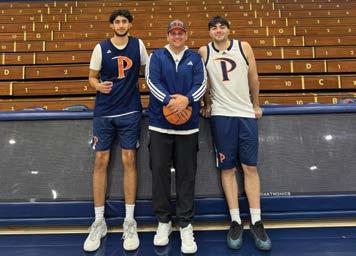
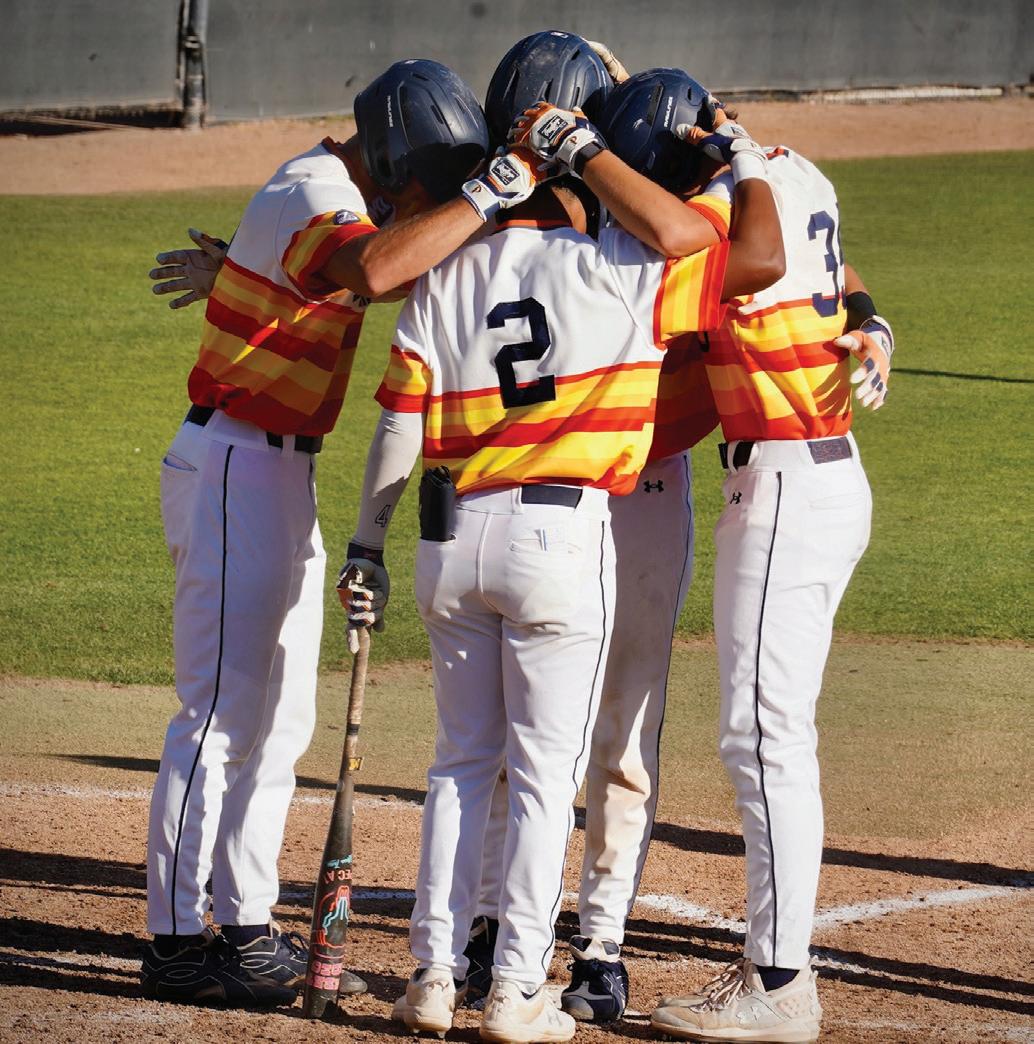
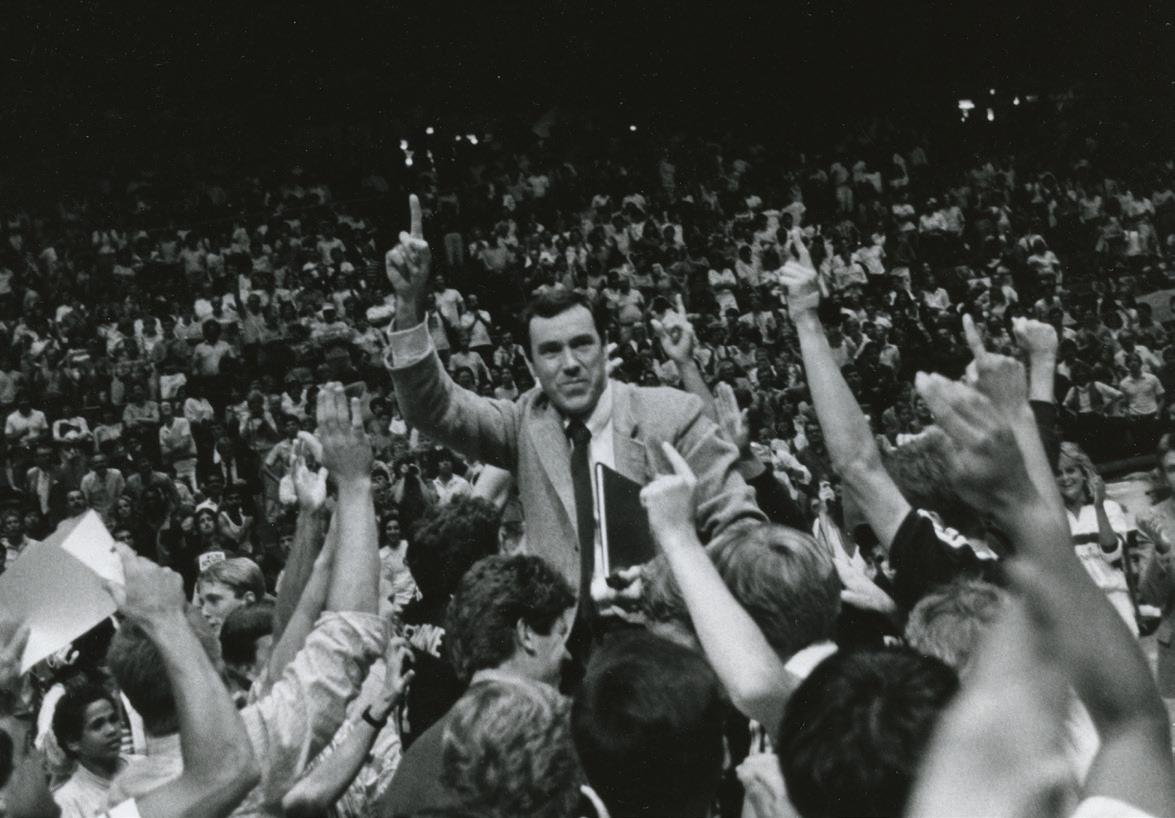
Less than a month after parting ways with Ed Schilling, Director of Athletics Tanner Gardner named Griff Aldrich as the 14th official head coach for the Pepperdine Men’s Basketball program.
Design & Photo by Amanda Monahan | Creative Director
Asha Weir
Peyton Stewart
Deslyn Williams
Niamh Rolston
. . .
April 14
Women’s Tennis vs. Loyola Marymount Cheer on Women’s Tennis as they compete aginst LMU. The game will be at Ralphs-Straus Tennis Center at 4 p.m.
April 16
Orchestra Masterworks Concert
Enjoy an evening of music as the Pepperdine Orchestra plays a repertoire of classics. The concert will be at Smothers Theatre at 7:30 p.m. Tickets are required.
April 18
Men’s Volleyball vs. University of Southern California Show Waves pride for Men’s Volleyball as they compete against USC. The game will be at Firestone Fieldhouse at 6 p.m.
Good News: Finding home in the newsroom
Tony Gleason Managing Editor
In my home, I have a room to work in, a place to sleep and an area to hang out and relax.
No, I’m not talking about my house in Danvers, Mass., nor am I talking about any of the dorms or apartments I’ve lived in as a Pepperdine student.
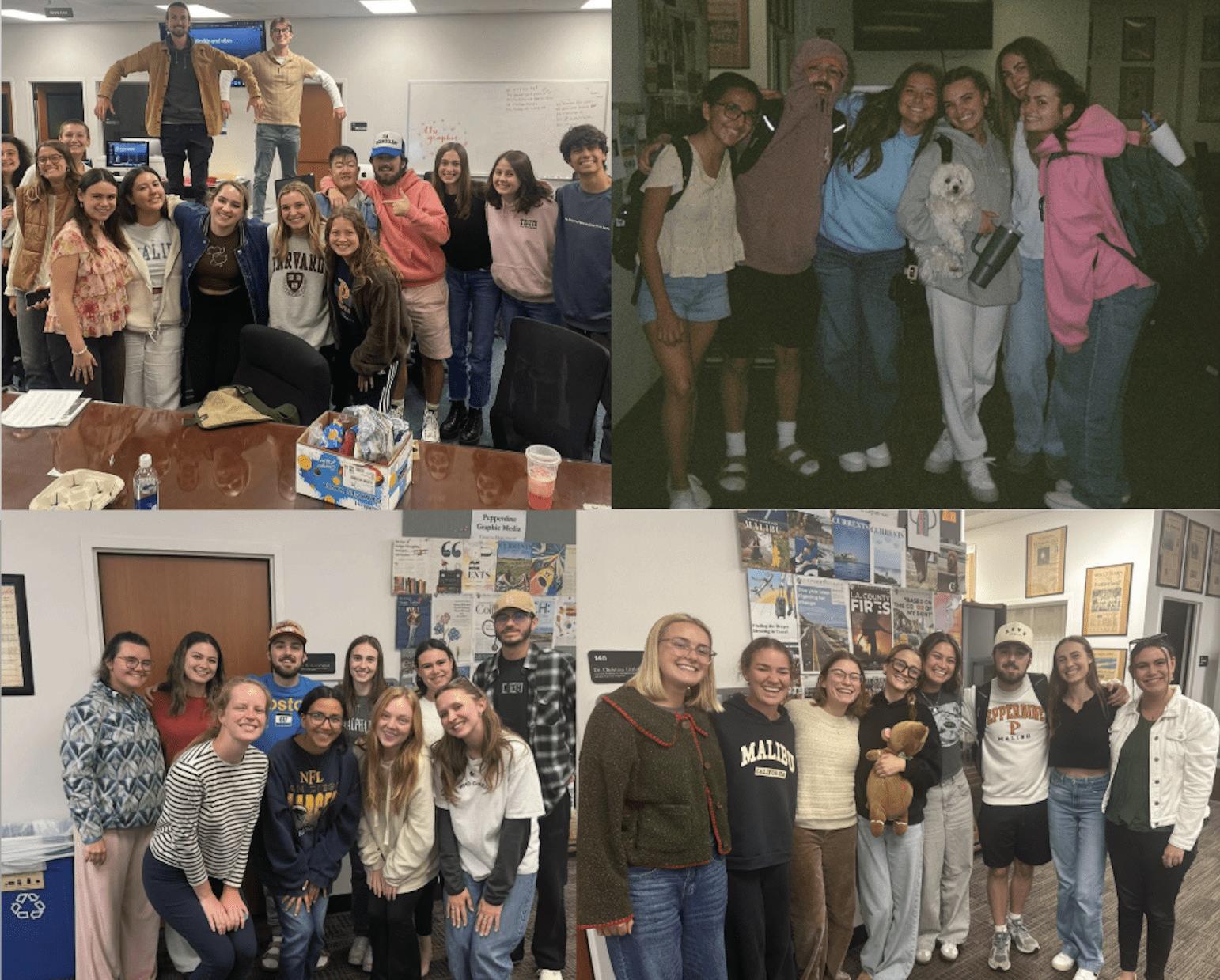
Rather, I’m talking about CCB 143, the Graphic newsroom. This location and Pepperdine Graphic Media have been my home for eight semesters now. Throughout my time as a college journalist, I’ve been lucky that so much of my work includes having conversations with people younger versions of me would have dreamed to have.
My favorite conversation is when I spoke on a zoom call with Bob Kendrick, president of the Negro Leagues Baseball Museum, for two hours about a side of baseball history not given the spotlight it deserves.
When work gets stressful and I need to rest, I can always lie down on the couches in the newsroom and take a nap, which I have done countless times.
vessel for deep, genuine connections.
Crossword Key | See B3 1. Bon Appetit 2. Tony 3. Prima 4. Cutting Board 5. Scott’s 6. Nobu 7. Cove 8. Cholada 9. Howdy’s 10. Duke’s
Director of PGM Elizabeth Smith once had to ask me not to sleep in there while she’s teaching JOUR 345 — or any class for that matter.
Most importantly, the newsroom has been a
Whether it was making plans to go to Taco Bell after the final production with former sta! members Jerry Jiang, Sam Torre and Alec Matulka, Creative Director Amanda Monahan and I making the background on every desktop a goofy photo we took for an April Fools’ Day joke last year or talking sports with Mike Bresnahan before class starts, I’ve been surrounded by a community that has welcomed me and given me a space that allows me to be myself.
Beyond moments like those, there’s also the simpler moments at the countless
Caught you !zzin’!
“Pepperdine Graphic Media (PGM) is an editorially independent student news organization that focuses on Pepperdine University and the surrounding communities. PGM consists of the digital and print Graphic, a variety of special publications, GNews, Currents Magazine, social media platforms and an Advertising Department. These platforms serve the community with news, opinion, contemporary information and a public forum for discussion. PGM strengthens students for purpose, service and leadership by developing their skills in writing, editing and publication production, by providing a vehicle to integrate and implement their liberal arts education and by developing students’ critical thinking through independent editorial judgment. PGM participates in Pepperdine’s Christian mission and a rmations, especially the pursuit of truth, excellence and freedom in a context of public service. Although PGM reports about Pepperdine University and coordinates with curricula in journalism and other disciplines, it is a student (not a University) news organization. Views expressed are diverse and, of course, do not correspond to all views of any University board, administration, faculty, sta!, student or other constituency.”
senior leader meetings, budget and pitch meetings, senior leader meetings and production nights I’ve been a part of.
CCB 143 has been my home, and I get to come back and help the next generation of PGM students.
As I enter the great beyond known as post-college life, I have one thing left to say.
Address: Student Publications Pepperdine University 24255 Pacific Coast Hwy. Malibu, CA 90263
Photo by Tony Gleason | Managing Editor
Various Graphic staff members from the past four years pose for a photo after a production night in the Graphic newsroom. The newsroom often felt like home for Managing Editor Tony Gleason.
Wait continues for Bohm’s PCH trial date
Tony Gleason Managing Editor
Amanda Monahan Creative Director
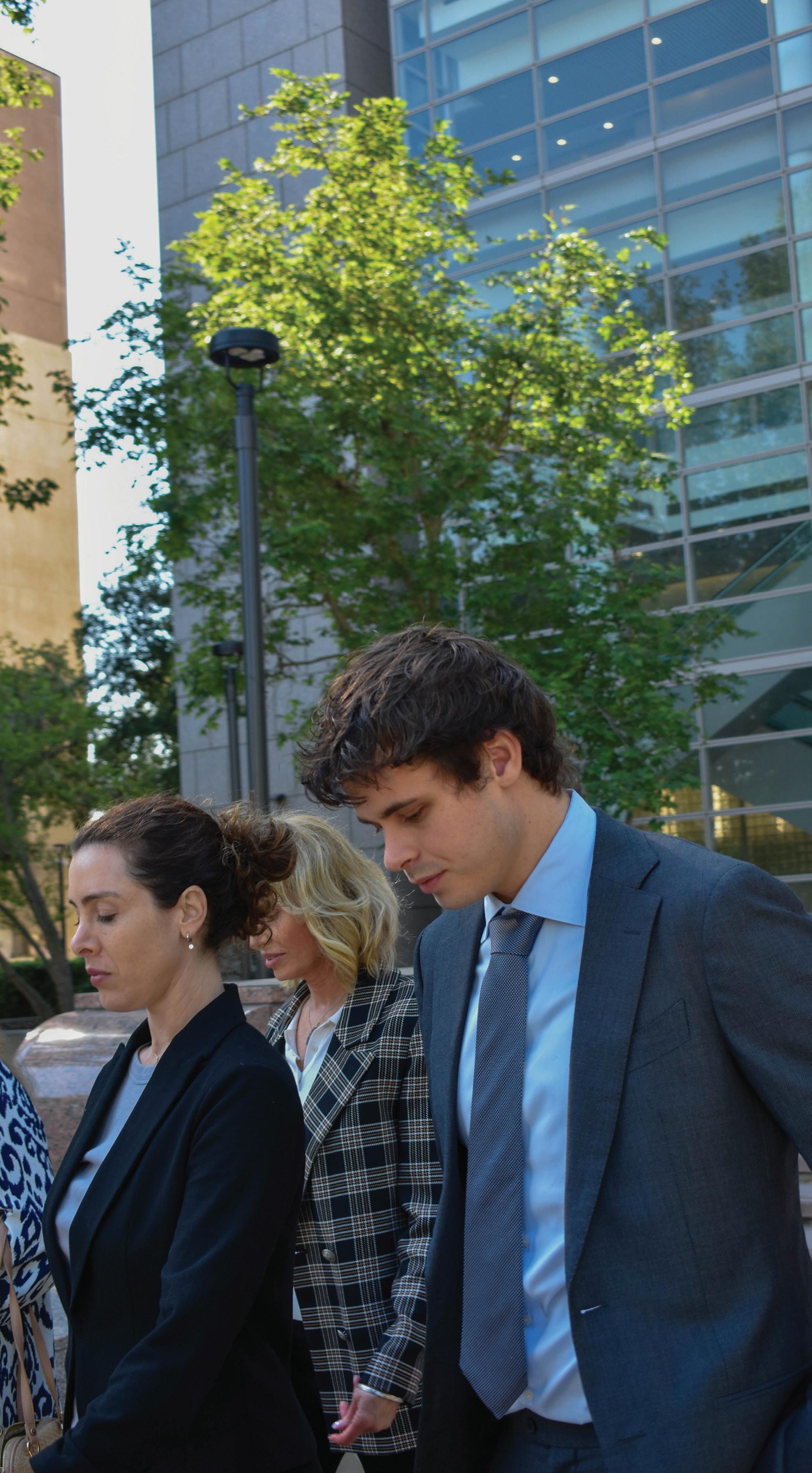
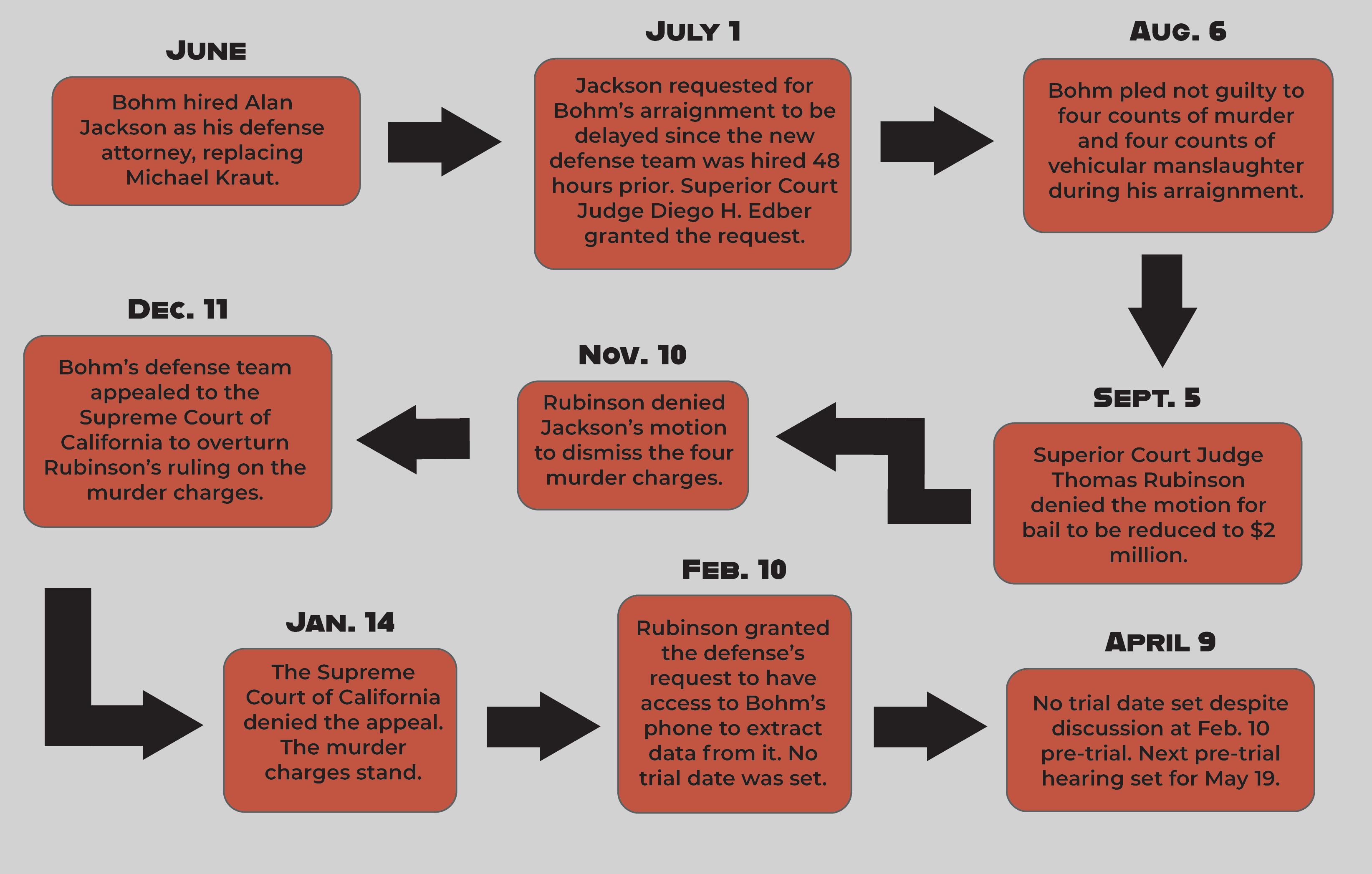
Superior Court Judge Thomas Rubinson did not set a trial date for Fraser Michael Bohm at the April 9 pre-trial hearing at the Van Nuys Courthouse.
Bohm is charged with four counts of murder and four counts of vehicular manslaughter with gross negligence in connection with the Oct. 17, 2023 crash that killed four Pepperdine seniors: Asha Weir, Deslyn Williams, Niamh Rolston and Peyton Stewart. At the previous pre-trial Feb. 10, all parties mentioned a trial date could possibly be set at the April 9 hearing.
Alumna Bridget Thompson (‘24), best friend and roommate of the four girls who has become a PCH advocate, has attended every pre-trial hearing. Thompson said she was disappointed a trial date has not been set.
“Even the days leading up to a hearing, I’m
anxious,” Thompson said. “I woke up this morning super anxious, filled with anxiety, and to just come and have it be five minutes is hard. It feels like a waste of time.”
While a trial date was not set, both the prosecution and the defense said they are hoping for a mid-summer start. Rubinson said he might take the first two weeks of August o , which will a ect the trial dates.
“We’ve been ready for quite a long time,” Deputy District Attorney Nathan Bartos said. “The only thing right now that we need to do is get all of our witnesses ready to go when we know what the actual start of the trial is.”
Bohm’s attorney, Alan Jackson, was not present at the hearing. At the Feb. 10 pre-trial hearing, the defense requested access to Bohm’s phone in order to extract data from it. The phone has been handed over and the data has been extracted.
Additionally, the defense requested Statewide Integrated Tra c Records System (SWITRS)
reporters from October 2013 to October 2023 for the 0.8-mile stretch from Carbon Canyon Road to Las Flores Canyon Road. They also requested speeding ticket data along the smallest area, including that 0.8-mile stretch from Carbon Canyon Road to Las Flores Canyon Road, only from October 2021 to October 2023.
Bartos said he is still working on sending the defense all of the SWITRS
reports, but has already sent some of them. For the speeding ticket data, he said there were not any citations in that period.
“It’s been two and a half years, and we’re still here doing the same thing and just awaiting a trial date,” Thompson said. “I think this should have been taken care of a long time ago, but I mean, I do understand that this is the process.”
The next pre-trial hearing will take place May 19
at the Van Nuys Courthouse. Thompson said as she continues to wait for the trial to start, she thinks about Asha, Deslyn, Niamh and Peyton every day.
“It’s just every day that goes by is a day that I miss my friends more — so it’s heartbreaking,” Thompson said.
anthony.gleason@pepperdine.edu
amanda.monahan@pepperdine.edu
Photo by Amanda Monahan | Creative Director
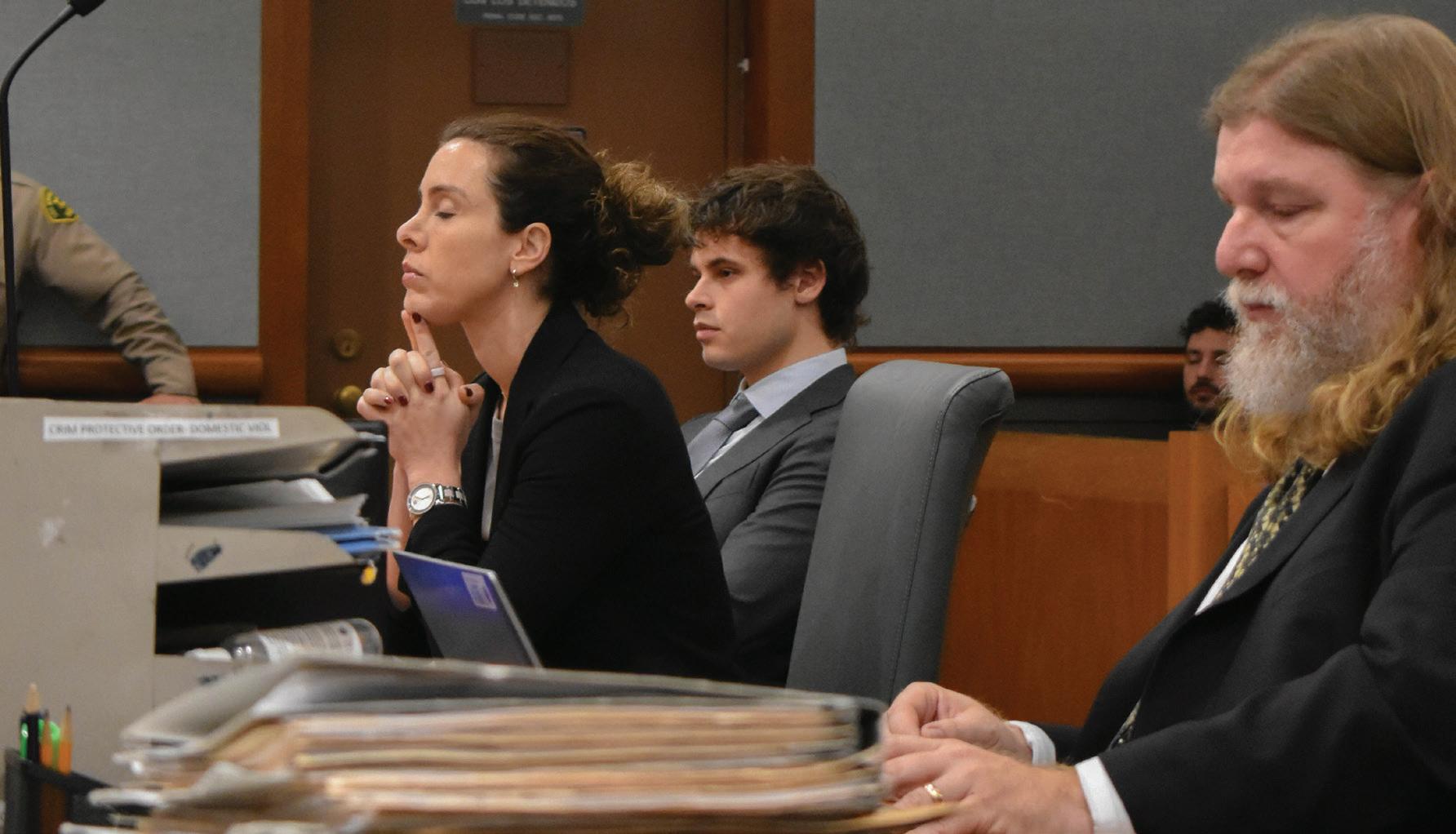
Fraser Michael Bohm (farthest back), Attorney Jacqueline Sparagna and Deputy District Attorney
Nathan Bartos (right) sit in the Van Nuys Courthouse at the April 9 pre-trial hearing. Superior Court Judge Thomas Rubinson did not set a trial date at the hearing.
Students elect SGA president, exec VP
Oliver Evans News Assistant
The student body elected sophomores Emily Espinosa and Jandy Nguyen on March 25 to serve as the Student Government Association’s (SGA) next president and executive vice president, respectively.
Espinosa, a Political Science major and first-generation college student from California, said she is motivated to be an example to other first-gens and to serve her community.
Nguyen, an Accounting and Finance double major and international student from Vietnam, said she is motivated to achieve her campaign promises.
“We’re leaving SGA in very good hands,” said Jacqueline Justiss, the current executive vice president. “Both of them have been go-getters their entire time here at Pepperdine.”
Emily Espinosa
Prior to becoming SGA President-elect on March 25, Espinosa served as the sophomore class president and a member of the general judicial council, according to her LinkedIn profile.
Among Espinosa’s professional experiences are internships with former Oklahoma Congresswoman Ajay Pittman and California State Senator Rosilicie Ochoa Bogh,
according to her LinkedIn profile. Espinosa said those internships helped strengthen her ability to put herself in other people’s shoes.
On campus, she founded the Association of Latino Professionals for America chapter and works as a teaching assistant, Espinosa said. She also works at In-and-Out Burger and founded a non-profit organization for pre-law and pre-policy Latino students, Legally Lawtino, pending tax-exempt status.
“I’ve always been involved in things that allowed me to serve my community,” Espinosa said.
A top priority of her administration will be ensuring that information from administrators previously available only to SGA members is accessible to everyone to better explain constraints, Espinosa said.
“It comes back to just being realistic and understanding the boundaries of your leadership position,” Espinosa said.
Espinosa said she wants to explore the idea of modifying the traditional town hall SGA has done in the past. The focus would still be on the students and SGA, but administrators would also be present to communicate ideas themselves.
Other candidates can promise things like a new fast food chain on campus, but there is a reason
why that has not happened, Espinosa said. She intends to focus on what she can do, which is advocate for better food quality in the cafeteria.
“A lot of neighboring institutions are also under Bon Appétit,” Espinosa said. “Students who have transferred from those institutions to Pepperdine have complained that the quality is drastically different.”
Additionally, Espinosa said she wanted to speak with deans and other administrators to advocate for a policy requiring professors to submit mid-semester grades to improve transparency between students and faculty.
Espinosa said she is always available to students through the SGA president’s email and through SGA committees. She wants to create either an anonymous physical suggestion box or an online feedback form.
Espinosa said playing golf, trying out new restaurants in Los Angeles and going to the beach are among some of her many activities outside of SGA. She hopes more students participate in future iterations of the Pacific Sounds Music & Arts Festival.
“My friends would describe my personality outside of SGA as spontaneous and caring,” Espinosa said.
Alumna and former SGA President Myers Mentzer (‘25), who once
mentored Espinosa, said she remembered the giant posters from Espinosa’s first-year senate campaign and how she got her entire suite together to help her campaign.
“The role of the SGA president is to represent Pepperdine’s student body to University leadership and administration,” said Mentzer. “Emily Espinosa will lead in her role by being visible to the students.”
Jandy Nguyen
Before becoming the executive vice president-elect, Nguyen said she was the captain of her high school basketball team and played several lead roles in high school theater. She has not previously held a position in SGA.
When she came to Pepperdine, she became vice president of finance for the Delta Sigmi Pi (DSP) business fraternity chapter, Nguyen said. She obtained that position despite being a new member of the organization at the time.
“It doesn’t matter how new you are,” Nguyen said. “As long as you’re qualified and passionate about leading, it’ll all work out.”
Nguyen said she campaigned on very specific promises such as softserve ice cream machines in the Waves Café, eliminating seed oils and opening up more networking
opportunities comparable to those o ered by business fraternities like DSP.
“When I see things that needs to change, I feel the urge to make that change,” Nguyen said. Nguyen said she felt a lot of students may underestimate her ability to fulfill her campaign promises, but she hopes to prove her capability of achieving them. She believes she has a proven track record in DSP.
Current Executive Vice President Jacqueline Justiss said Nguyen is a hard-working and passionate individual. She knows Nguyen will diligently work to ensure students are pleased with SGA and feel it is working on their behalf.
Nguyen was reasonable and articulate in what she wanted to accomplish, Justiss said. Additionally, Nguyen has already demonstrated her relational ability through her position at DSP and by reaching out to many people already in SGA.
In DSP, Nguyen said she created a new initiative that directly communicated the finances of the chapter to the members. Every week she informs the chapter how much revenue was generated and how much was spent.
“I did a lot of things already, and I’m doing more as I go,” Nguyen said.
Photo courtesy of Emily Espinosa
President-elect Emily Espinosa sits in the tree on Scaife Terrace in April 2025. Espinosa said the tree is her favorite place on campus.
Photo courtesy of Jandy Nguyen
Executive Vice President-elect Jandy Nguyen stands near the infinity pool at Heroes Garden on March 20. Nguyen said she likes listening to EDM while studying.
Farm promotes sustainability, inclusion
Henry Adams News Editor
Informed by Jewish values of compassion, sustainability, inclusivity and a moral obligation to help those in need, Shemesh Farms strives to make a positive impact in the Malibu community.
The Malibu-based volunteer initiative provides community and vocational skills to adults with disabilities, according to their website. Three times a week, dozens of volunteers with disabilities — known as farm fellows — spend two hours putting together products such as herb blends and jars of honey to be sold online and at local farmers markets.
“There’s a lot of isolation in the disability community, and so they get to come and feel like they belong, feel like they’re part of something bigger, feel like how they are — who they are — is absolutely OK,” said Nicky Pitman, director of Shemesh Farms.
The Farms started in 2013 after Rabbi Bill Kaplan, CEO of the Farms’ parent organization Shalom Institute, visited agrarian communities in Israel largely run by people with mental disabilities, Pitman said. With some seed money from Jewish Federation Los Angeles,
the Institute started the Farms at their campus in the western Santa Monica Mountains.
After the 2018 Woolsey Fire burned down that campus, Shemesh Farms moved its operations to the Malibu Jewish Center & Synagogue before again moving in 2023 to Malibu United Methodist Church, its current location, Pitman said. They opened a second campus in January at the Skirball Cultural Center south of Encino, which hosts
programming once per week.
“We’re so happy to be at the church, which has allowed us to do some really great interfaith work,” Pitman said.
Shemesh Farms hosts a garden with 22 hydroponic towers, about a dozen raised beds and a designated composting space, which are primarily maintained by Farm Manager Joe Aaron. Farm fellows typically come in groups from partner organizations such as Creative Steps and Light of
Hope, Pitman said. Community Engagement and Service at Pepperdine has also worked with Shemesh Farms, including on its annual Step Forward Day of volunteering.
Alongside personal coaches, farm fellows work on di erent tasks around the garden, including watering crops, trimming herbs and bottling herb blends. Fellows are also provided with coloring materials and books to read in the Garden of Readin’, in case they would prefer not to work, Pitman said. Whatever they decide to do during a given day’s programming, fellows get to spend time in community with one another.
“Everyone’s nice and friendly,” farm fellow Alex Mittelman said.
The Farms are committed to inclusiveness and sustainability through the setup of the garden itself. The hydroponic towers — where plants grow without soil — exemplify both of these commitments by saving water and being easier for people with mobility disabilities to cultivate due to their vertical setup, according to the Farms’ website.
Farm fellow Sally Tallman, one of three fellows who are employed at Shemesh Farms, started volunteering just over two years ago. She said she en-
joyed how peaceful and relaxing working at the Farms has been. She’s in charge of taking inventory, working farm stand events and anything else that’s needed on a given day.
“It’s way out of my comfort zone, and it’s something that I never did,” Tallman said.
After volunteers cleaned up their respective work stations, everyone present at the Farms’ March 26 program — including roughly 50 fellows — gathered to celebrate everyone with a March birthday. The group sang “Happy Birthday” and ate cookies freshly baked by a farm fellow to close out the morning.
Upcoming events include programming for LA Climate Week on April 14 and an annual open house fundraising event on April 26, according to Shemesh Farms’ website. The latter event will include live music, outside vendors, food and several workshops including yoga and pickle making.
henry.adams@pepperdine.edu
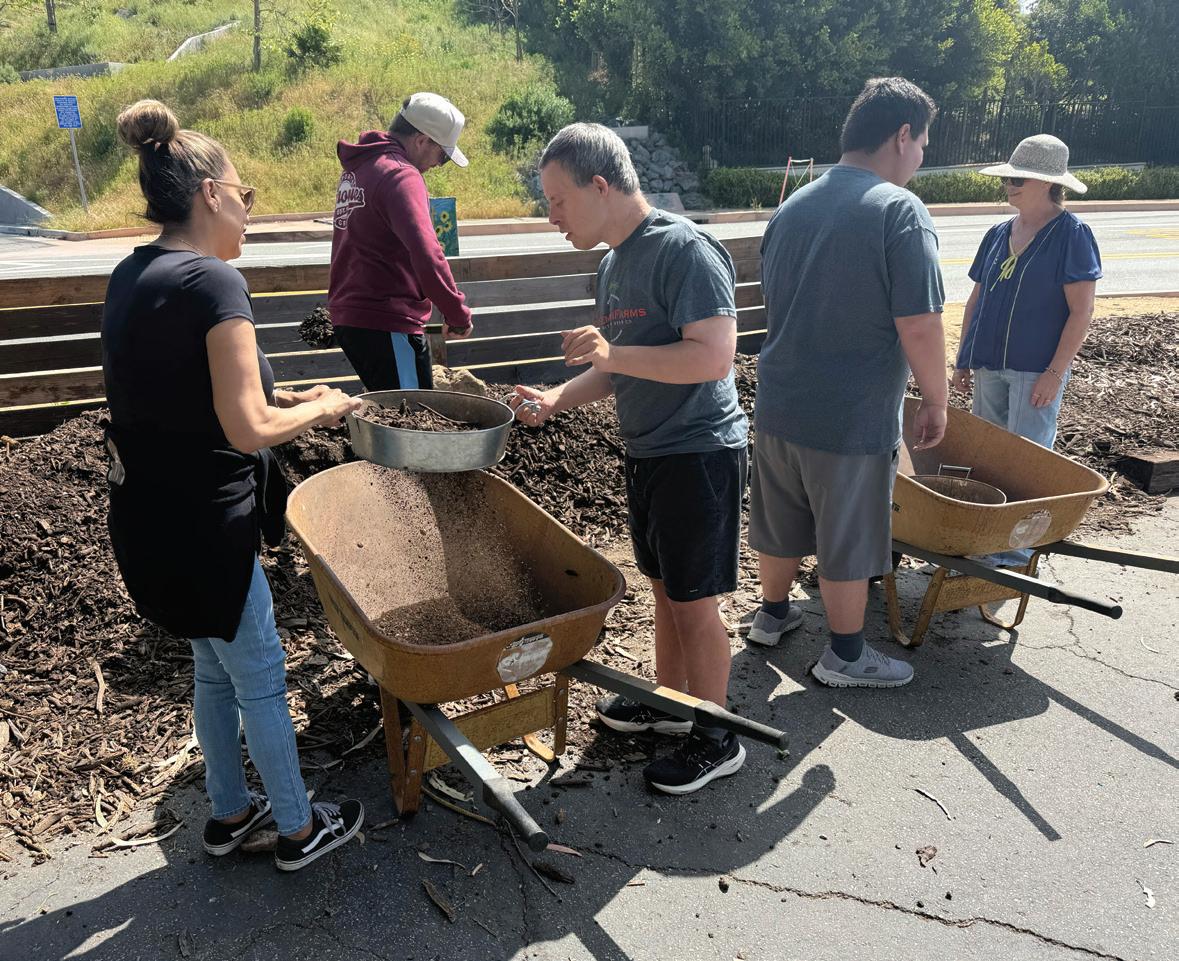
Photo by Henry Adams | News Editor
Pairs of adults with disabilities and their personal coaches separate wood chips and dirt at Shemesh Farms on March 26. Composting is one of several tasks that were included during the morning’s programming.
Political groups re ect on free speech
Nick Charkhedian Currents Editor-in-Chief
Censorship and free speech are often a hot topic on college campuses, and Pepperdine is no exception. Over the past academic year alone, students across campus have debated free speech issues, including art censorship and Turning Point USA deportation-themed Valentine’s Day cards.
In the midst of this campus climate, members of Pepperdine College Republicans, Pepperdine College Democrats and Pepperdine’s TPUSA chapter talked about what free speech means to them.
“I don’t think that it [free speech] should be abused or used for hate or anything in that realm,” said Anniah Smith, president of Pepperdine College Democrats and Graphic sta member. “It’s something that carries a lot of weight, and you have to be responsible when you’re engaging in it.”
The First Amendment to the U.S. Constitution was ratified Dec. 15, 1791, along with nine other amendments, according to National Archives. These amendments formed the Bill of Rights and would serve as a basis for the liberties of Americans throughout history. The First Amendment reads:
“Congress shall make no law respecting an establishment of religion, or prohibiting the free exercise thereof; or abridging the freedom of speech, or of the press; or the right of the people peaceably to assemble, and to petition the Government for a redress of grievances.”
Pepperdine College Republicans
Audrey Riesbeck, president of Pepperdine College Republicans, said freedom of speech is one of the most important things in the U.S. Constitution.
“It’s [free speech] the idea
that we can have a free and open civil discussion without fear of punishment,” Riesbeck said. “James Madison — he put free speech in the First Amendment because he felt that public opinion should be sovereign over the government.”
Even if a person doesn’t agree with somebody, there’s always something to learn, Riesbeck said. She believes people have the right to tell others if they think they’re wrong, and people have the right to try to understand where others are coming from.
Riesbeck said she doesn’t think anybody is necessarily afraid of speaking at Pepperdine.
“The school has created a culture where people feel like they can have an open discussion — at least, I hope people feel that way,” Riesbeck said.
Riesbeck said there are certainly people on campus who don’t respect others’ free speech, but for the most part, people are pretty good at having a respectful discussion.
Pepperdine College Democrats
Alternatively, Smith said it’s sometimes really hard to engage in free speech on campus if the speech you’re promoting isn’t popular.
While Smith said she believes Pepperdine College Democrats has never had an administrator or faculty member censor them, she believes they’ve implicitly been warned against promoting certain things. She said former President Olivia Berryman had to jump through a lot of hoops in order to protest when conservative intellectual Jordan Peterson came to campus for the President’s Speaker Series on April 7, 2025.
Alumna Cassandra Barron (‘25), former Graphic sta member and former president of Pepperdine’s GSA and Feminist clubs, helped orga-
nize the protests. Barron said she met with associate deans of Student A airs and Student Activities about how they could voice concerns, and they were told about the University’s Time, Place, and Manner Policy.
Students who wanted to protest had both demonstration location options, both of which were out of sight — closer to Raleigh Runnels Memorial Pool — of the Firestone Fieldhouse entrance attendees used. Additionally, Barron said students participating in an on-campus protest would have had to check in with their student IDs.
Students were told to be be careful what they put on signs, not to damage anyone’s reputation and not to to put Peterson’s name on a sign, Barron said.
Due to all of these obstacles, the protest organizers ultimately decided to move their demonstration o campus, near the University entrance at John Tyler Drive, Barron said.
Smith said the First Amendment was created to protect speech, but that doesn’t mean it’s a way for people to be dis-
respectful to each other. Smith believes Pepperdine College Democrats tries to make that evident in the way they engage in free speech.
“Free speech is really important to me,” Smith said. “I’ve always viewed free speech as a story of gaining dignity and respect for disenfranchised people. I think I’ve always viewed it through the lens of advocacy.”
Smith said free speech is a framework to stand against oppression, and throughout history, the First Amendment has helped people gain back their rights or their voice. She also believes free speech is a responsibility, not a weapon, because there are limits on free speech.
Smith said the barometer for respect has lowered significantly in this country because of the Trump administration. She said a lot of its rhetoric is hateful and can be harmful to certain people groups such as immigrants, people of color and women.
On campus, there can be a tendency to forget the humanity behind people and engage solely in politics without remembering people have souls and dignity, Smith said. Smith sees respect of human belief, autonomy and dignity as the central tenets of America and hopes Americans can circle back to those core values rather than the polarization and hatred that’s dividing them.
Pepperdine Turning Point USA
Sophia Markle, president of Pepperdine’s TPUSA chapter, said when people are unable to listen to people they disagree with, that’s when people dehumanize others. Markle, a Political Science major and Journalism minor, is a guest contributor to the Graphic.
This country was founded on the ability to have free speech, and Markle said she believes it’s important to ground ourselves in free speech, but
to also not hate or impose violence onto others.
“We think everyone deserves a voice on both sides,” Markle said. “Every belief you have — you deserve a voice, and it should be said.”
Markle said the TPUSA chapter wants all voices at their meetings to have and foster civil discourse.
On March 25, Pepperdine TPUSA hosted The Leadership Institute for a workshop that aimed to teach attendees how to have good conversations when people disagree with them and how to respect their opinion and listen. The Leadership Institute identifies, recruits, trains and places conservatives in government, politics and the media, according to their website.
Pepperdine TPUSA’s biggest goal as an organization is to spread God’s love, teach people who God is and let their faith into their politics, Markle said. Their second biggest goal is free speech.
Markle said Pepperdine TPUSA has come across censorship on campus, but declined to elaborate.
Photo by Katherine Lytle | Assistant Photo Editor
L.A. County Sheriff’s deputies drive by an anti-ICE protest outside the Malibu Library on Feb. 1. The Malibu Democratic Club organized the protest.
Photo courtesy of Sophia Markle
Sophia Markle poses for a photo with conservative political commentator Michael Knowles at AmericaFest on Dec. 21. AmericaFest is an annual convention held by Turning Point USA.
Wild res leave wake that won’t wash away
Nicolle Castro Guest Contributor
The water looks calm again after the rain: smooth and almost clean — but is it really? For some, that uncertainty is enough to keep them out of the water and prompt action.
After the fires, Malibu residents said they are navigating a new reality shaped by fear, uncertainty and a growing sense of responsibility. Questions about water quality resurface with every rainfall, as debris washes ashore and pollutants move unseen beneath the surface. With no clear end in sight, these lasting risks are reshaping how people live and how they return to the ocean.
“Your eyes can only see so much,” junior Jackson Cottrell said. “So in my brain, I’m fine, right? But how much fire debris and construction and everything can you not see?”
For some Malibu residents, the real concern begins after the skies clear, raising new questions about when it is safe to return and what might still be lingering beneath the surface.
After Heavy Rains
Cottrell said waiting three days before going into the ocean after heavy rain seems to be an unspoken rule among Malibu residents. Since the fires, that hesitation has only grown, making the return to the ocean more complicated.
Cottrell, a devoted surfer, said he typically goes to the beach three to four times a week to catch waves. But after the Franklin and Palisades fires, he has avoided the water altogether. When he returned in the fall, Cottrell said he could see pollution with his naked eye.
“Not even detritus because it wasn’t organic,”
Cottrell said. “It was from houses and things.”
Since then, Cottrell said he has avoided eastern Malibu beaches, which were more heavily a ected, and now sticks to areas like Broad Beach and Zuma Beach. Still, he worries rain can carry pollution even there.
“It was so small that if I went into the water, there’s a chance I could have swallowed some, or it could have gotten into my skin,” Cottrell said.
Heal the Bay scientists found higher levels of pollutants in the ocean after it rained, said Annelisa Moe, associate director of science and policy at the environmental nonprofit. Researchers refer to this as a “pulse e ect,” where pollution spikes after storms.
Although the invisible risks of water pollution remain a major concern for Malibu residents, fire debris continues to wash ashore. Darren Graves, whose family home in Big Rock Beach is currently in the engineering phase of rebuilding, said he has been dealing with the remaining debris firsthand.
Since March 2025, during each visit to the remains of his property, Graves said he has added to a growing pile of twisted metal, burned fragments and debris that the tide carried in. Graves has collected more than 600 pounds of debris, and with every rainfall, more material resurfaces.
“We thought we were done in July, August, when all the debris was cleared,” Graves said. “Then the winter storms came through, and the sand level dropped.”
Shifting sand and low tides expose more buried debris along the shore, Graves said. While the pieces washing ashore are smaller than they were in the months immediately after the fires, Graves worries they still pose risks to both people and marine life.
“If somebody came out here and didn’t know that there were pieces of steel and sharp metal objects in the sand, and they were barefoot, they could cut themselves and get tetanus,” Graves said. “So that’s a problem.”
The Invisible Threat
After the fires, rain — once a relief in Malibu’s dry climate — is now the factor that most concerns some scientists. Runo carries ash, debris and toxic remnants from burned homes into the ocean, introducing contaminants largely unseen from the surface; as that polluted runo settles, the contaminants sink and accumulate on the ocean floor, where they
can persist long after the water appears clearer, Moe said.
“I am also worried about contamination settled on the ocean floor that could be resuspended,” Biology Professor Florybeth La Valle said.
La Valle, a coral reef ecologist, said these pollutants threaten phytoplankton and kelp — organisms that form the foundation of the marine food web — by reducing the sunlight needed for photosynthesis.
“When chemicals dissolve, there is less photosynthesis,” La Valle said. “Murky water can block the sunlight they need to survive.”
Besides that, pollution coming from debris can reach our plates through the food chain. Unlike bacteria, heavy metals don’t dissipate — they accumulate as they move up the food chain, a process known as bioaccumulation, Moe said.
Over time, that means pollution introduced after a single storm can reach fish and eventually, humans, La Valle said. In more severe cases, the disruption can extend across entire ecosystems.
How Long Will the Damage Last?
There is no clear timeline for when Malibu’s beach ecosystems will fully recover, La Valle said. The process could take a decade or more, noting the environment has not yet recovered from the 2018 Woolsey Fire. With climate change shortening the time between fires, full recovery is even harder to predict.
Still, there are signs of hope. Moe said she believes nature
can begin to heal if people avoid leaving trash behind and take greater care of the environment.
“Life is miraculous,” Moe said, “We are already seeing dolphins and sea lions returning to areas they had once avoided.”
That sense of responsibility is shared by residents like Graves, who continues to confront the impact of the fires firsthand. As rebuilding moves forward, he said he believes the health of the environment depends on everyday actions the community takes.
“If you see a piece of trash, pick it up,” Graves said. “If you see a piece of heavy trash, pick it up. If you see a piece of corrosive debris, wear gloves and pick it up.”
A pile of debris collected by Malibu resident Darren Graves lies at Big Rock Beach, where his family home was lost in the Palisades Fire. He said he has been clearing the shoreline since March 2025, but more than a year later, debris continues to resurface.
Photo by Nicolle Castro | Guest Contributor
A car sits on PCH after it was burned in the Palisades Fire. Several cars accumulated on the Malibu shores, adding to the water pollution.
Photo courtesy of Brent Flaaten
Wellness machines help campus health
Genevieve Cantu Sports Staff Writer
At Pepperdine, gaps remain in students’ access to basic selfcare products during emergencies and late nights after resource centers like the Campus Bookstore and Student Health Center close. To resolve this issue, Pepperdine is following e orts similar to nearby Los Angeles universities by seeking to install wellness vending machines and aiming to implement them before the fall 2026 semester.
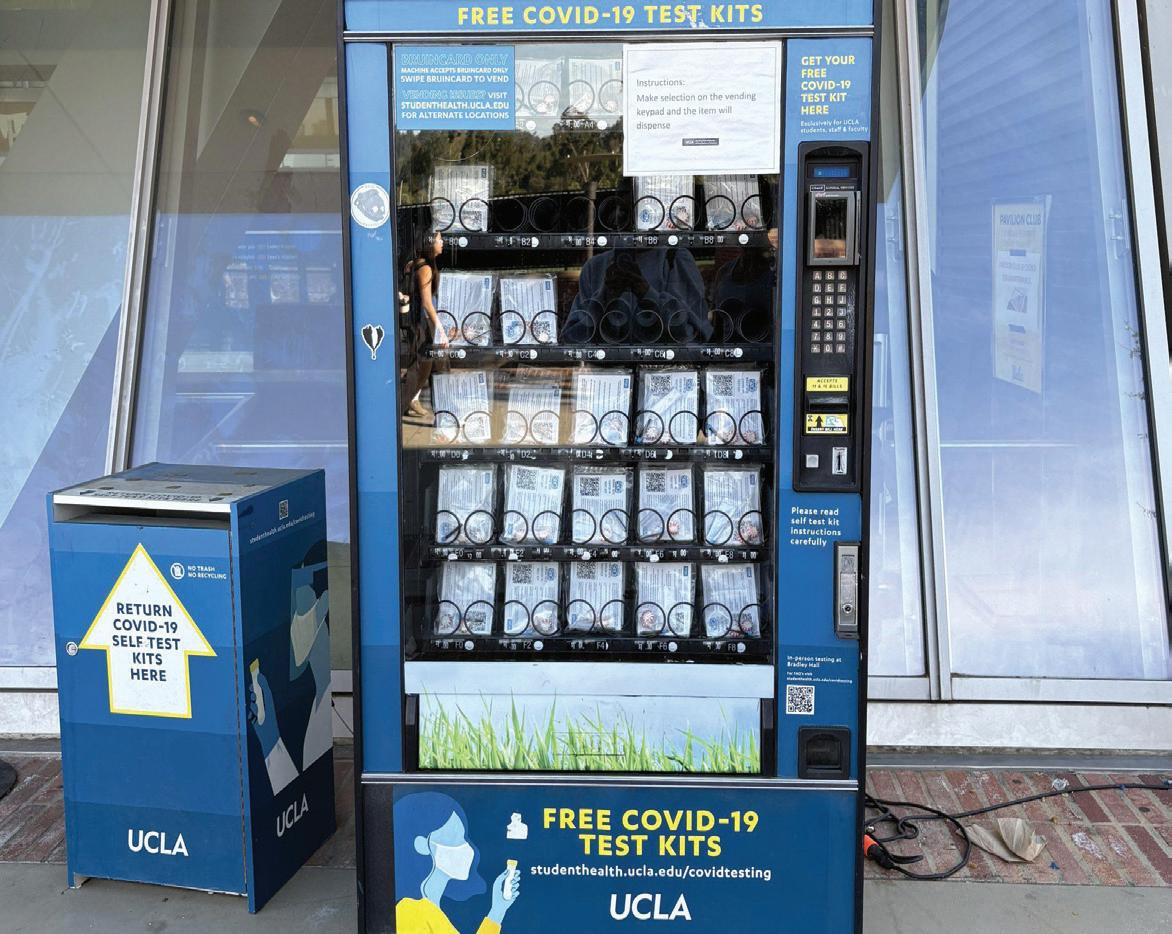
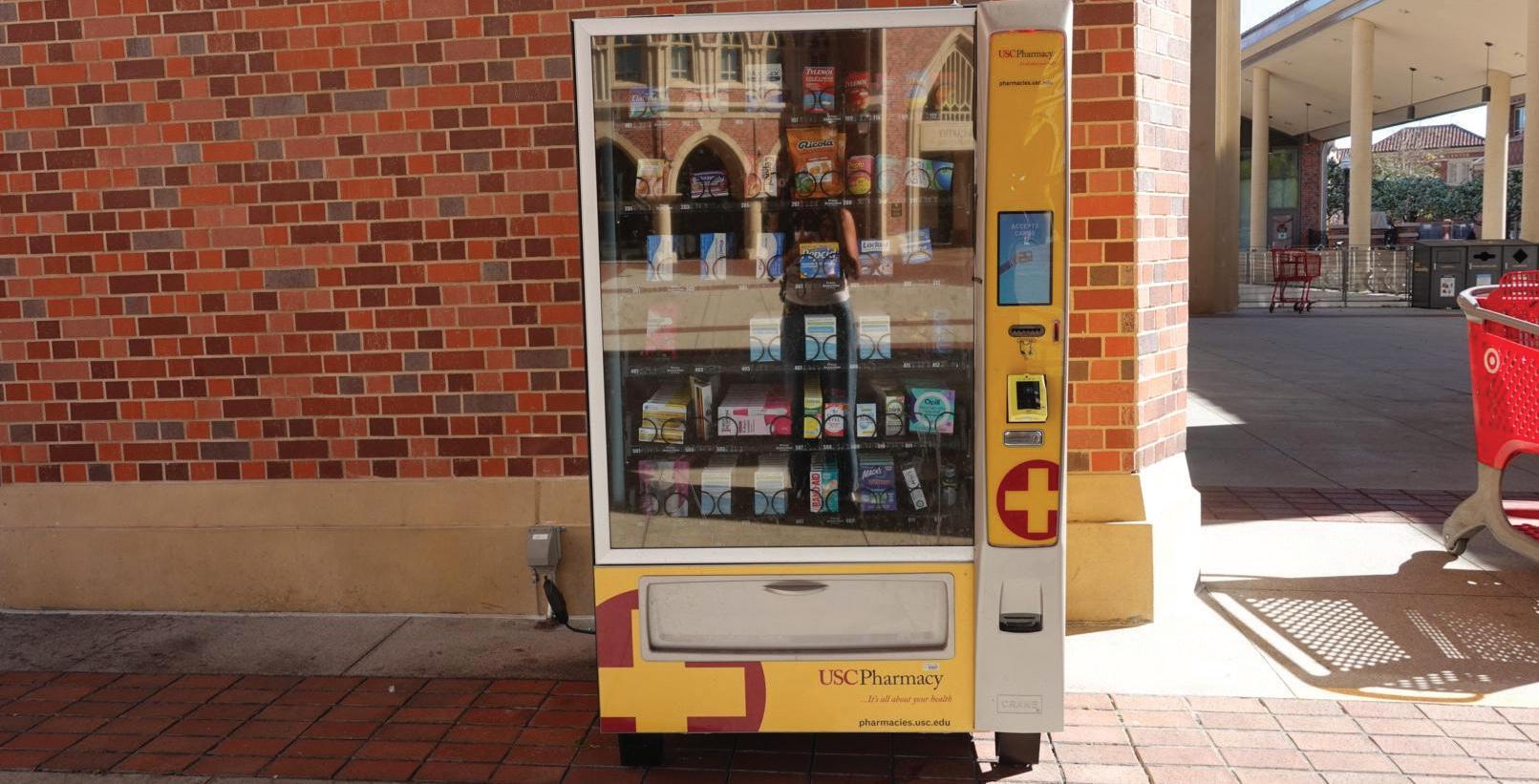
The University of Southern California (USC) and the University of California, Los Angeles (UCLA) have wellness vending machines that are always available and stocked with over-the-counter medications, at-home tests and hygiene supplies.
“Being able to get the supplies you need quickly, privately and without feeling judged by someone is really helpful, especially with the vending machines being 24/7,” junior USC student Eris Baker said.
At Pepperdine, demand for similar resources appears significant. A Graphic survey of 50 students found 76% have experienced a situation where they needed health supplies late at night when on-campus resources were not available.
Wellness vending machines have emerged as a beneficial tool for university campuses, especially at geographically isolated institutions like Pepperdine, where students said they have limited access to nearby retail options.
Pepperdine Takes Action
The wellness machines at USC contain a ordable access to over-the-counter medications, health supplies and hygiene products, according to a USC Alfred E. Mann School of Pharmacy and Pharmaceutical Sciences news release. UCLA’s machines carry comparable items and also include
school supplies, according to the Daily Bruin.
After assessing student needs and attending professional conferences, Sharon Beard, Pepperdine interim vice president for Student A airs, said her team has been working behind the scenes to move forward with plans to implement similar machines on campus.
“This is something our sta has wanted for years,” Beard said. “As soon as I stepped into the role in July of last year, we started working on it immediately.”
Beard said bringing wellness vending machines to Pepperdine’s campus is going to be a game changer for students. Her team has been in conversation with the Student Government Association (SGA) about the project, which on March 25 resulted in SGA passing a general fund request to award the Student Health Center $6,000 to move forward with the process, according to previous Graphic reporting.
“We have the resources to spend money this semester,”
SGA President H.L. McCullough said. “But it’s more than spending it; it’s finding the most optimal use of the resources. That means having those tough conversations to find ways that we can implement something like wellness vending machines here on campus and continuing that into long-term care.”
Beard said Pepperdine does not plan to profit from the wellness machines. They plan to keep product costs low and are working to improve accessibility by incorporating Apple Pay and enabling students to use Waves Cash through their ID cards.
Pepperdine Student Wellness Needs
Junior Melanie Donnell, who serves as a resident advisor (RA), said the implementation of the machines would be highly beneficial, as late-night requests for health
supplies are common.
“As an RA, there have been nights when students need something at midnight,” Donnell said. “Even when you just want to curl up in bed and go to sleep, you still have to be willing and available to help.”
The aforementioned survey found over-the-counter medications such as pain relievers and allergy medication were the most sought-after items during these late-night emergencies.
Wellness machines also allow students to obtain health supplies discreetly, a benefit senior and RA Sam Backus said could be highly valuable.
“These machines could help quiet or introverted people get the resources they need, no matter their background, personality or preferences,” Backus said. “As an RA, a lot of students are scared to ask or come to you for things because they think that they’re bothering you, so these machines are a great way to help all types of people.”
Having wellness vending machines could be helpful as students face higher prices for personal care items in the Campus Bookstore, Backus said. By o ering wellness machines, Pepperdine can help ensure students have access to essential items quickly and conveniently during emergencies.
“Sometimes you don’t have time to run up to Drescher before your class,” Backus said. “Or if it’s 3 a.m. and you just bled through your pants but don’t want to wake up your roommates or RA, you can just go and get menstrual products from the vending machine.”
Student Benefits Seen Elsewhere
Expanding access to health resources through wellness vending machines can improve student attendance, academic performance and overall well-being, according to Health Promotion Practice.
UCLA sophomore Noah
Ross said these benefits prove the importance of wellness machines on college campuses.
“There are no cons in implementing tools like wellness machines on college campuses,” Ross said. “Only benefits for its students, like their mental, physical and academic well-being.”
Wellness machines provide students with e cient, on-demand access to health resources. USC sophomore Maya Torres said she experienced this convenience firsthand.
“Last semester, me and my roommate were feeling sick and too weak to walk to USC’s health center,” Torres said. “We decided to check out the vending machine, which ended up carrying COVID and flu tests. Because of those tests, we found out we had COVID. During the week we were sick, we would always go back to the vending machine because it was so convenient.”
While improving access to on-campus health resources, Torres said the machines also provide a convenient option for students without reliable transportation.
“Living in LA can be super isolating,” Torres said. “Sometimes you need a car, a bus or the metro to get around to doctors’ appointments and things like that. It’s hard, but with wellness machines, we don’t have to travel far o campus to get resources that we shouldn’t have to be traveling for in the first place.”
Closing Wellness Gaps
Geographically isolated institutions create barriers to accessing health resources and obtaining basic health supplies when students need them most, according to Health Promotion Practice.
Pepperdine students reported similar challenges in Malibu, with 36% reporting di culty obtaining essential supplies due to limited transportation options and distance to nearby stores, according to the Graphic’s survey.
“It’s hard to live in Malibu and on this campus without a car,” Donnell said. “Without transportation, you can’t really get o campus easily and buy the products you need.”
Backus said she faces the same di culties, highlighting that wellness machines could provide the needed change to close the isolation gap for Pepperdine students.
“I personally don’t have a car on campus,” Backus said. “So I never know when I’ll be able to go and get the medication I need next.”
Understanding these needs and taking action, University leaders are now discussing potential locations for the machines, Beard said.
“Ideally, we would implement one outside of the TCC or bookstore and one in the HAWC,” Beard said. “Once The Mountain is completed, it would be great to get another one in there too. Then, we would hit all the main student touch points on campus.”
Beard said the initiative represents a simple yet meaningful step toward advancing student wellness.
“I don’t think there’s any real barrier to us getting them,” Beard said. “I am super excited about the conversations being had because it’s an easy solution to something that students desperately need.”
Lauren Berumen contributed to this reporting.
Photo by Genevieve Cantu | Sports Staff Writer
A wellness vending machine stocked with over-the-counter medications and hygiene products stands at The Shops at USC Village on Feb. 8. The machine provides students with access to basic health supplies in the center of the village.
Photo courtesy of Lauren Berumen
A wellness vending machine stocked with free COVID-19 test kits stands outside UCLA’s Covel Commons Center on Feb. 27.
The machine, one of several across campus, provides students with access to basic health supplies.
London program reroutes from Turkey
Christine Park Pixel Editor & Design Assistant
Students studying abroad in Pepperdine’s London program were scheduled to experience an educational field trip (EFT) in Turkey. But one day before departure, IP canceled the trip because of potential travel interruption and security issues, according to a March 1 email Ron Cox, dean of International Programs (IP), sent to the London program.
Instead, students of the London program departed April 10 for their Scotland EFT.
On Feb. 28, the United States and Israel launched a series of strikes towards Iran, escalating an ongoing conflict in the Middle East, according to CNN. Turkey is adjacent to the northern borders of Iran, Iraq and Syria, and uncertainty of how the war would play out led to the EFT’s cancellation, said Charlie Engelmann, associate dean of operations for IP.
“Student safety is our number one concern, that’s our kind of North Star,”
Engelmann said. “And so, in this situation, we felt it was absolutely the right decision to pivot and see what options we have, but we would not go to Turkey on Monday [March 2].”
EFT Planning
As part of the IP experience, each academic year program requires students to attend the seasonal EFT, according to Pepperdine’s website. EFTs are designed for students to learn and experience within a specific location, connecting the roles of history, religion, culture and global awareness.
Typically, EFTs are predetermined up to six to seven months in advance, said Brian Swarts, director of the Washington D.C. program.
The process includes submitting a detailed itinerary specifying transportation, activities, locations and housing to the University. Afterward, the University reviews any safety or political concerns in advance in collaboration with security firms to securely analyze the global situation.
“Changing EFTs is not uncommon at all, from year to year,” Swarts said. “But, changing it at the last minute [like] has happened in London, that’s a di erent situation.”
Pepperdine Responds
The London program was scheduled to depart for the Turkey EFT on March 2, the Monday after the Iran war started, Engelmann said. Whenever there is concern about an EFT, the IP o ce has a process to assess risk and gather information.
The team includes the local program director, IP partner organization International SOS, consultants and John Weber, senior director of Pepperdine’s O ce of Emergency Services and O ce of Insurance and Risk, Engelmann said.
In coordination with senior administrators, the University will determine the risk levels and what other options are available, Engelmann said. In determining whether it would’ve been safe for students to travel to Turkey, the team had to consider several factors: potential airspace complications, the risk of neighboring countries and possible
airport shutdowns.
“I’d say the ultimate determination really came down to the fact that we weren’t sure how it would ultimately play out,” Engelmann said.
London Program Director Heather Pardee did not respond to a request for comment.
Abroad programs will often have backup EFT options, Swarts said. The London program has previously traveled to the Scottish Highlands for its EFT, making this year’s last-minute..
“They have an itinerary that works that they can leverage for educational purposes,” Engelmann said. “It’s clearly a very di erent focus than Turkey, and there’s still ways that they can continue the dialogue that was central to the Turkey experience in that program.”
London Students React
Sophomore Emre Taner, who is abroad in the London program, said he recalls the weekend the program was supposed to leave for Turkey. When the U.S. attacked Iran, the director let students know they were monitoring the situation.
Taner, who lived in Turkey
for 12 years, said his peers in London continued to ask him what his thoughts were regarding what could happen.
“I told everyone, ‘I don’t think anything will happen’ ‘cause the chance of Turkey getting attacked by a missile was very low,” Taner said. “Especially since it’s a NATO country.”
Yet, around noon on the day of departure, Taner received a text message detailing the EFT was cancelled. Taner said he felt the attack was something that had been building up for a while and felt a bit shocked when the University didn’t anticipate it better.
Students reacted with a mix of emotions, Taner said.
“From what I saw, mostly everyone was mad,” Taner said.
Taner said he was looking forward to visiting his grandmother and showing his peers how beautiful Turkey is. In addition, seeing historical sites, Christian monuments and the city of Ephesus would have been fun for him.
christine.park@pepperdine.edu
Photo courtesy of Ali Pereza
Seniors Ali Pereza (left), Sarah Breck (middle) and Emilee Staley visit Turkey in March 2024. In the past, part of the London abroad program’s experience has been an educational field trip to Turkey.
Infographic by Christine Park
Photo courtesy of Alexa McGlathery Students pose together in Notting Hill, London during the spring 2026 semester. This semester’s London students are scheduled to visit Scotland instead of Turkey for their educational field trip.
PERSPECTIVES
Art by Cara Tang | Art Editor
Sta Editorial: Seniors o er advice to new students
Graphic Staff
Editor’s Note: PGM sta members decide on the topic of a Sta Ed together. The sta as a whole provides opinions and content included in this Sta Ed to provide thoughts about and shed light on solutions for happenings at Pepperdine.
Dear new students,
Whether you’re a first-year or a transfer student, know that you are far from being alone. If you’re a first-year, you are entering an entirely new stage of life. If you’re a transfer, being at Pepperdine can be an exciting adjustment.
Either way, you’re on the precipice of life-changing experiences.
You could be entering your undergraduate years as someone who knows exactly what they want to do. If so, it can be reassuring to look at those who have come before you and succeeded, like some of the University’s accomplished alumni.
Even if you aren’t yet sure what avenues you want to pursue, the undergraduate years offer a multitude of opportunities to figure it all out. Stay open to all of the di erent perspectives you will encounter here. Academically, there are advisors for all of your four-year plan and major-specific needs. Having classes lined up can
bring a sense of structure and peace of mind, key to successfully navigating your undergraduate path.
There are also a variety of organizations available on campus to get involved with — from natural science fraternities like Beta Psi Omega and business fraternities like Delta Sigma Pi to student-led ministries and identity-based clubs, there is truly a place for everyone.
It’s important to know these changes are absolutely normal and necessary for growth. Life would be so boring if we stopped learning new things about ourselves — embrace it.
Try to keep an active mindset of growth and acceptance. You gain knowledge through failures just as often as — and sometimes even more than — successes.
As the class of 2026’s graduation approaches, emotions can be a mixed bag. Some seniors are giddy to get out and start new jobs or pursue further education, while others are dreading leaving beloved classmates and professors. Either way, they are leaving their undergraduate years with skills, connections and community that will last a lifetime.
And you, now standing at the starting line, will walk the stage in due time. But before then, know that everything will work out.
Graphic Staff
Socially, people on campus are always ready to welcome you with open arms. Our advice to you: Jump in with both feet. Have that conversation with your fellow students. Don’t hesitate to make conversation with the person sitting next to you in class. Whatever you’re interested in, join that club. Your major, interests, career goals and even friendships could shift over the years.
THE
GRAPHIC
We know it can feel isolating and confusing, like you got dropped into a game at halftime with no sense of where you are or who’s on your team. But this community is filled with people who want to connect, so don’t hesitate. Experience the community for what it is.
Hip-hop listeners shouldn’t forget about the album
Nick Charkhedian Currents Editor-in-Chief
Transparency Item: The Perspectives section of the Graphic is comprised of articles based on opinion. This is the opinion and perspective of the writer.
“Inevitably, hip-hop records are treated as though they are disposable/They are not maximized as product even, you know, not to mention as art.”
Those words close out the intro of hip-hop band The Roots’ 1999 album, “Things Fall Apart.” In a time before the ringtone era — far before the TikTok era — one of the most artistic groups in the genre was clear about the state of hip-hop music.
This decade, good albums have been hard to come by in the genre. It’s not like there haven’t been good albums, there definitely have — “Learn 2 Swim” by Redveil, “Adjust to the Game” by Larry June, “Few Good Things” by Saba and more — but the broader focus of the genre seems to be on hit singles and viral songs rather than the album.
When I was a child, from the early 2000s up until the 2010s, hip-hop was dominated by catchy singles and choruses perfect for cell phone ringtones.
“Things Fall Apart” came out
before I was born, and I have no real memory of the ringtone era outside of being a child at the tail end of it.
In the 2010s, the genre collectively seemed to shift to a focus on technical rapping ability, the production blended elements of older hip-hop and other genres and the topics were far less materialistic than the decade preceding it.
I call this the genre’s Renaissance.
With the emergence of TikTok in 2016 and a natural decline of the Renaissance era, hip-hop blended the elements it had gained from the previous era — notably alternative, genre-bending exploration — with the catchy hooks and instrumentals that dominated the 2000s. I call this the TikTok era, which has been observed in online discussions as well.
I came to hip-hop consciousness in the genre’s Renaissance: J. Cole and Kendrick Lamar had emerged as the new faces of the genre, the mixtape era brought a focus on putting the quality of music back on the pedestal and rappers were going back and forth over lyricism and flow — the fundamentals of the genre.
In the years that followed, hip-hop began to focus more on instrumentals and the overall music, and trap rap dominated the mainstream. Simultaneously, the artists from the Renaissance era continued to flourish and release
some of my favorite albums from the decade, with a more mature touch than their earlier work — “4 Your Eyez Only” by J. Cole, “Some Rap Songs” by Earl Sweatshirt and “4eva is a Mighty Long Time” by Big K.R.I.T, to name a few.
However, towards the end of the Renaissance era, the value of the album had begun to decline.
There are plenty of veterans still putting out quality music, and up-andcoming artists show plenty of potential. However, there’s no clear “next one up.” The situation is oddly similar to the early 2010s.
As a fan of the genre — who is also anticipating a new era of hip-hop — I urge my fellow fans: Don’t forget about the album.
Albums keep hip-hop music from being disposable. It’s no secret
polished songs from polished albums tend to have more replayability, and a cohesive, developed feel makes listeners come back to find more.
Fast fashion’s cousin — fast music — is alive in hip-hop. As listeners, it’s our responsibility to show how much we appreciate quality.
Hip-hop will likely continue regardless of the album’s success. In a bizarre — but completely possible — future where rappers hardly release albums, music will still come out and the culture will probably carry on beyond just the music. But don’t overlook the impressive history and heritage of albums in the history of hip-hop. Don’t forget about the album.
nareg.charkhedian@pepperdine.edu
Abolish ICE, support immigrants
Ashley Burton Perspectives Editor
Transparency Item: The Perspectives section of the Graphic is comprised of articles based on opinion. This is the opinion and perspective of the writer.
Earlier this year, U.S. Immigration and Customs Enforcement (ICE) o cer Jonathan Ross shot and killed Renee Nicole Good, according to CNN.
Good was a mother, daughter and a wife. She was a queer woman, a poet and engaged in helping protect her community members from ICE, according to The New York Times (NYT).
For all intents and purposes, Good was a random person. She was killed on a typical Wednesday morning, and her wife said she was a Christian who cared about her community, according to MPR News.
Following her death, President Donald Trump claimed Good ran over Ross. Video analysis shows this is not the case, according to NYT.
The fact this shooting occurred, along with the president’s immediate defense of the act, reveals a serious issue Americans must grapple with: The institution of ICE is not only harmful but deadly, and it has been significantly growing in power.
Good’s shooting was only one of several results of Operation Metro Surge. The Operation consisted of the deployment of 3,000 ICE agents to Minnesota from December 2025 to February 2026, according to the Minnesota Reformer.
Less than three weeks later, Alex Pretti was shot 10 times and killed in the streets of Minnesota, according to the Minnesota Star Tribune.
Operation Metro Surge and these broad-daylight shootings came after the Trump administration directed ICE agents to meet a daily quota of 3,000 arrests, according to The Guardian. Not only this, but 32 people died in ICE custody in 2025, according
to The Guardian. These deaths have continued into 2026, with 14 ICE detainees having died in ICE custody as of March 30, according to NBC News.
While 2025 deaths were the highest in decades, this doesn’t discount the 67 deaths in ICE custody in previous years under Democratic presidents like Barack Obama, a president who also directed the deportation of 2.7 million people during his 2009-2016 presidency, according to the American Immigration Council. The rapid increase in deaths is merely a result of the expansion of ICE and its power.
ICE has also been maintaining a series of watchlists used to track protestors, “Antifa” and “domestic terrorists,” according to reporting by Ken Klippenstein. These terms are used broadly to apply to those who oppose the Trump administration, such as those
who are “anti-Americanism, anti-capitalism, and anti-Christianity,” according to the Brennan Center for Justice.
Many of ICE’s actions are illegal. In fact, U.S. District Court Chief Judge Patrick Schiltz found ICE violated at least 96 court orders in January alone, according to Fox 9. Despite this, the law has clearly not stopped ICE from continuing to spread harm.
The best way to stop the harm of ICE is to completely abolish the institution. Regardless of who is in control, ICE has been harmful and is continuing to expand. While it could be limited in the future, this harm will continue, just on a smaller scale.
While the abolition of ICE may be the goal, community involvement is still important.
Getting involved through protesting is a great way to find community and express dissent. Following the shooting of Good, protests swept the United States, showing people’s solidarity for those being targeted and harmed by ICE, according to NYT.
Most importantly, everyone can reduce the harms of ICE by supporting friends, family and community members. Mental and emotional support is more important than ever for immigrant communities.
“Psychological science is clear: detention, deportation, family separation, and the constant threat of such actions create chronic stress that increases anxiety, depression, trauma-related symptoms, and long-term health risks,” according to the American Psychological Association (APA).
Being there for friends who need it right now and showing them support is likely to lead to more positive mental health for them, according to the APA.
Do as Renee Good did and a little more. Get involved with your community, support immigrants and stand up for others. Ultimately, we must abolish ICE to fully solve this problem.
Art by Sofa Cifuentes | Staff Artist & Podcast Producer
Art by Mariah Mapa | Staff Artist
Pepperdine should lift protest restrictions
Anniah Smith Perspectives Staff Writer
Transparency Item: The Perspectives section of the Graphic is comprised of articles based on opinion. This is the opinion and perspective of the writer.
Like other major universities, Pepperdine follows “Time, Place, and Manner” policies.
Some of the measures Pepperdine has outlined in their statement limit the freedom of expression outlined in the United States Constitution and reinforced by the Department of Education.
Picketing, event disruption, sit–ins and encampments are some viable protest forms, according to American Civil Liberties Union (ACLU).
Pepperdine students cannot camp, lodge, create loud noises, use University spaces or remain on any portion of University property while protesting, according to Pepperdine’s Time, Place, and Manner restrictions.
“Protesting on campus was near impossible,” said Olivia Berryman, former President of Pepperdine College Democrats.
While organizing a protest April 17, 2025, as President Jim Gash welcomed Dr. Jordan B. Peterson onto Pepperdine’s campus for a discussion
surrounding “Biblical Narratives and the Power of Personal Sacrifice,” Berryman was met with significant resistance. The Graphic covered this speaker event.
“We were told by Student A airs that we could not have political signs propped up on campus in a way that could be interpreted as spreading political messaging,” Berryman said.
Berryman went on to express her concern students may face potential repercussions if they did not comply with the University’s guidance.
Peterson, a political commentator and author, is known for promoting hateful, inflammatory rhetoric surrounding climate change, hatred against non-binary and transgender individuals and an onslaught of sexism levied against women, according to The Guardian, The New York Times and the British Broadcasting Channel (BBC).
Pepperdine protected Peterson’s right to free speech when speaking with President Jim Gash. Ironically, during the same event, Pepperdine students were told to gather at the baseball field across campus if they wanted to respond, Berryman said.
“I am aware that Pepperdine has policies in place; it was just so di cult because there were so many di erent rules that we were required to follow,” Berryman said.
While measures like these seem to protect the University’s functioning on the surface, the tangible e ects are an inability for students to freely speak out about issues that have great personal impact. Protesting causes people to pause and actually pay attention to the issues at hand — Pepperdine University’s policies impede this process.
In light of many recent events plaguing the nation and directly impacting Pepperdine’s student body, including but not limited to: ICE abuses of power, abortion bans sweeping across the nation, restriction of Diversity, Equity and Inclusion initiatives and various foreign a airs such as the extradition of Venezuelan President Nicolás Maduro, the Russian-Ukraine war and the ongoing War in Iran, Pepperdine must reform its protest regulations so students can practice their First
Art By Sofia Cifuentes | Staff Artist
Amendment rights.
The backbone of the First Amendment’s right to speech and expression is solidified by students’ ability to protest on their university campus, regardless of the university’s political or social views. The result of Pepperdine’s restrictive protest policies is widespread censorship against the student body.
Pepperdine students should be able to engage in large-scale reform through campus protests. Additionally, students should feel free to engage in political e orts on campus without fear of expulsion or academic retaliation.
Advocacy without a voice is dead, and Pepperdine is standing in the way of revival.
anniah.smith@pepperdine.edu
SGA needs greater student awareness
Alyssa Hunnicutt Perspectives Staff Writer
Transparency Item: The Perspectives section of the Graphic is comprised of articles based on opinion. This is the opinion and perspective of the writer.
Pepperdine’s Student Government Association (SGA) provides many resources to clubs and students on campus. They help fund several events throughout the year, including a pancake breakfast meal during finals, shuttles to LAX at the end of the semester and Winter Wonderland, Pepperdine’s tree lighting ceremony, in December.
Students can often take these events for granted by not realizing how crucial SGA is to facilitating them.
When SGA interviewed 33 students about SGA, 31 of them said “they had no idea what SGA was,” according to Resolution #01-S26.
This raises the question: Do students see the impact of SGA’s work, and should SGA prioritize increasing its publicity?
In many ways, students lack knowledge of SGA’s current activities, showing more SGA visibility is needed.
One of the motions SGA passed Feb. 18 was in regard to Nature’s Edge and the snacks they provide.
SGA came to the conclusion they would work with Bon Appétit to develop a list of new snacks to add to Nature’s Edge, according to Resolution #01-F25. Some of these snacks included Arizona Iced Teas and Popcorners, according to previous Graphic reporting. In the process of developing the Nature’s Edge snack list, SGA sent a survey to see which snacks were top choices for students to be added to the inventory, according to Resolution #01-F25.
Because many students are unaware of SGA and its surveys, their accuracy is limited, highlighting the
by Adrianna Bean | Staff Artist
need for increased publicity to better incorporate student voices.
Samantha Backus, president of Days for Girls (DFG), a club advocating for global access to and education on menstrual health, said SGA has helped DFG’s restock initiative, which looks to keep menstrual products accessible throughout campus.
Regarding Nature’s Edge, both Backus and Jackie Gomez, Inter-Club Council (ICC) Representative for DFG and Pre-Med Club finance chair, said they know of some students’ hope to see healthier snack choices in Nature’s Edge.
“I know plenty of people who kind of go and they feel like most of the snacks are kind of just junk,” Gomez said.
Snacks like Arizona Iced Teas, which were included in the snack list above, are not considered healthy options due to their high sugar content, according to Healthline.
The easy access of these unhealthy snacks can make it easy for students to eat less nutritious foods. This can undermine students’ desire to have a healthy diet. Ultimately, this creates uncertainty
about the precision of SGA’s snack list and questions how much their recent e orts represent the interests of the student body.
“Besides that one thing they helped us pass, I don’t really see the e ects of what they do on campus,” Gomez said.
Given that many students are unaware of SGA’s role and do not see the outcomes of its e orts, increasing publicity should be the organization’s top priority.
To address the lack of publicity, SGA proposed creating a newsletter that “should include sections such as, future SGA events, updates on initiatives, and contact information for interested students” and “it is to be posted around approved places on campus, and even potentially distributed to students,” according to Resolution #01-S26.
This plan comes with some restraints, since the newsletter isn’t directly being sent to students yet and relies mainly on “interested students” instead of focusing on getting a majority of the student body involved.
Studies show increased student involvement on campus exhibited better retention rates and greater academic persistence, according to University of Houston.
Therefore, more student involvement can also benefit students beyond SGA related work by helping increase their academic e ectiveness.
Limited awareness of SGA and unreliable student surveys make it di cult for SGA to fully represent the student body. To address this, SGA should prioritize publicizing its actions and initiatives, encouraging more students to provide feedback. Increased input will allow SGA to better understand student needs, represent a broader range of perspectives and operate more e ectively.
Art
LIFE & ARTS
Blue and orange runs in the family
Alicia Dofelmier Life & Arts Editor
Editor’s Note: Life & Arts Editor Alicia Dofelmier’s mom, Irma Dofelmier, graduated from Pepperdine in 1990 with a master’s in Business Administration.
Like the tide always changing, so is the Pepperdine community.
As one group of Waves prepares to graduate and become alumni, another group is set to commit and start their journey.
There are 97 Seaver students whose parents are Pepperdine alumni, Nicole de la Torre, executive assistant and senior manager for Alumni A airs, said. These students shared how having a family member who attended Pepperdine has given another layer of meaning to their Pepperdine experience.
“I would encourage our students, when they see alumni on campus to interact — yes they might not know them, but the fact they are alumni, they are family,” said Hung Le, senior vice chancellor for Alumni Affairs.
Growing Up with Pepperdine
For certain students, the colors blue and orange and the name Willie the Wave are not just something they learned about when applying to college.
“Pepperdine was definitely in the background growing up,
and I always saw myself going here,” junior Katie Nehir said.
Senior Annie Fillback said growing up close to Pepperdine made it have a presence in her life.
“My mom hosted one of the London study abroad reunions at our house, and my brother did the Pepperdine baseball camps for kids,” Fillback said.
Senior Aidan Tune said his first core memory of Pepperdine involves volleyball camp.
“I went to Pepperdine volleyball camp when I was 13,” Tune said. “It was a cool experience seeing my dad coach all of the kids around me and getting to stay on campus.”
Tune is a member of the Pepperdine Men’s Volleyball Team, and his dad Rick Tune, a graduate of the class of 1998, also played for Pepperdine Men’s Volleyball.
While some students may have a sports connection in their family, others have family members who returned to work at Pepperdine. This is true for sophomore Danae Simmons.
Both of her parents graduated from Pepperdine, Simmons said.
“My dad later came back to teach some Biology classes from 1985 to 1990, and my mom worked here from 1988 to 1998,” Simmons said. “She worked on the finances for the Howard A. White Center when it was getting built.”
Similar to Simmons, firstyear Olivia Siluano’s mom also returned to work for Pepperdine.
Siluano said her mom,
Lesbiz Tovar, graduated in 2006 with a Bachelor of Science in Business Administration and a minor in Nonprofit Management. Tovar is a director in Pepperdine’s IT department.
“Growing up, me, my dad and my sister would always go visit Pepperdine and say hi to my mom,” Siluano said.
Carrying on the Legacy
Whether or not Pepperdine was a household name growing up, for alumni, it means a lot when their child gets accepted and decides to follow in their footsteps.
Senior Ryan Lilley, whose parents are both Pepperdine alumni, said his parents were more excited than he was when he applied.
“I wasn’t really even considering it [Pepperdine] for a lot of my applications, and they were kind of like, ‘You should just apply anyway,’” Lilley said. “When it came down to it, Pepperdine did fit me the best out of any of those schools.”
For some students, the Pepperdine legacy goes back further than just having a parent who was an alumni. Sophomore Canon Woodward said he has an older brother, older sister, mom, dad, two aunts and two uncles who have all attended Pepperdine.
Woodward said he and his siblings joked their parents brainwashed them into attending Pepperdine because they all ended up going.
“However, we all felt happy and supported in whatever decision we were going to make,” Woodward said.
Simmons said she knew she wanted Pepperdine to be a part of her future.
“My parents were both
really excited,” Simmons said. “We had been talking about Pepperdine, and they knew it was one of my top schools. They both knew it was coming eventually.”
Added Layer of Meaning
The alumni community at Pepperdine is one of a kind.
Le said his role involves working with all alumni, engaging them and their families in order to keep them connected to Pepperdine.
“When you’re a student, we use the term ‘family’ ubiquitously around here,” Le said. “That relationship doesn’t end when you walk across the stage and shake the hand of our president.”
Lilley said as an Economics major himself, he has experienced a lot of mirror moments with his dad also having been an Economics major.
“Last semester I had Professor [Robert] Sexton, and he was one of my favorite teachers,” Lilley said. “He was also my dad’s advisor, and they were friends when my dad went here and he knew my parents’ entire friend group so it was kind of funny comparing that.”
Following in his dad’s footsteps as a Pepperdine Men’s Volleyball player has a orded Tune the opportunity to feel more connected to his dad, Tune said.
“Knowing that this is what my dad went through and knowing we share that kind of experience is special,” Tune said.
Le said having an alumni connection elevates the Pepperdine experience.
“Pepperdine is in our vernacular, our DNA, so my sons already came in with stories embedded in their psyche,” Le
said. “For Corrine and I, although we loved to tell stories, we made sure that our sons got to have their own experiences.”
Fillback said there are similar experiences that she and her mom share too.
“I studied abroad in London, so I was in the same house she was in and being in the exact same dorms or houses your parents were in is a pretty rare thing which has made me feel closer to her in that way, rather than just as a mom,” Fillback said.
Nehir said that similar to her mom, Pepperdine has become her safe space.
“I’m glad I ultimately made the decision to go here,” Nehir said. “Pepperdine is what you make it and it has become my safe space, the same way Malibu is my mom’s comfort space.”
It’s truly special when students have alumni connections, Le said.
“One of the beautiful things about our students who have alumni connections in their families is we get to share the very best with our very best, and that is such a blessing,” Le said.
Photo courtesy of Hung Le
Hung Le, senior vice chancellor for Alumni Affairs, kneels in the front row (center) with a group of alumni in Heidelberg, Germany, during the Heidelberg Travel Experience July 2024. Le said he stays in touch with so many alumni because he wants to remain connected.
Photo courtesy of Katie Nehir
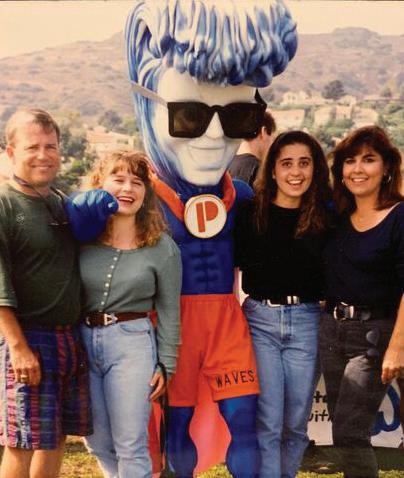
From left to right: Mike Dover, DeeDee Dover, Willie the Wave, Aimee Dover, and Reyanne Dover stand together for a photo at Alumni Park in 1993. Canon Woodward said he’s very thankful that his parents and family went to Pepperdine.
15 to 40+ Minutes:
Pokémon YouTube landscape grows to giant subsection
Tony Gleason Managing Editor
For 30 years now, fans have been catching ‘em all in the “Pokémon” series of video games.
For the fans who wanted more, though, they’ve had Pokémon YouTube to create content, which — just like the Pokémon themselves — has evolved.
Multiple “Pokémon” YouTubers (PokéTubers) said the PokéTube landscape has evolved over the years, each with their own trends and big name channels dominating the space. What was once barely a community has grown into a massive subsection of YouTube.
“Now it’s so big that we’ve kind of almost gone back to where we started, where the ‘Pokémon’ content creators are kind of in their own small section of the community, because there’s so much to cover,” said YouTuber Josh Wittenkeller, who runs the channel TheJWittz.
YouTuber Ron Sroor, who runs the channel Truegreen7, said the PokéTube landscape can be divided into three generations characterized by the most popular content from each: Gen I from 2012-2013, Gen II from 2014-2018 and Gen III from 2019-present.
Generation I: Birth of PokéTubing
The first-ever video about “Pokémon” was uploaded to YouTube on Aug. 12, 2005, six months after the site was created. Before Gen I PokéTubing started, Sroor said this era was “beta PokéTubing” where most videos were “Let’s Play” videos — a video series documenting the playthrough of a game.
Then around 2012-2013, Sroor said PokéTubers such as TheJWittz, Tamashii Hiroka (now Tama Hero), NateWantsToBattle (now Give Heart Records) and dookieshed, among a few others, formed the first generation of PokéTubers. “Let’s Plays” remained
popular, but another type of content became just as popular — top 10 videos.
“Once the first generation hit, it was mostly top 10s,” Sroor said. “Almost every video in the first generation of PokéTubing was either playthrough or top 10 or a fact video — fact videos were huge back then.”
Before 2010, YouTube videos could only be 10 minutes. In 2010, YouTube extended the time limit to 15 minutes and removed limits altogether later that year, according to Tech Crunch. YouTuber Josh Rosenberg, who runs the channel Jrose11, said for years, 10-15 minute long videos were still most popular despite the removal of time limits. This is part of the reason “Let’s Plays” and top 10s were so popular.
TheJWittz, Tama Hero and dookieshed each also had top 10 videos during this time with at least a million views, such as each of their top 10 favorite “Pokémon” videos, according to their channels. For “Let’s Plays,” PurpleRodri had many videos from this period that now have over a million views, and Marriland remained popular after coming back.
Multiple sources said something that made Gen I PokéTubing unique was its niche community, as these PokéTubers were among the few channels regularly posting “Pokémon” content.
“It was easily less than 50 people making regular YouTube “Pokémon” content it felt like when I started,” Wittenkeller said. “Now it’s probably more than 10,000.”
Generation II: The X & Y Boom
The sixth generation of “Pokémon,” “Pokémon X & Y” were the first 3D games of the series and released Oct. 12, 2013, according to Pokémon’s website. Multiple sources said starting after these games were released, the following years saw an influx of people starting to make “Pokémon” content, where the landscape went from
Photo by Tony Gleason | Managing Editor
this smaller niche to a large community.
“More people were becoming aware of YouTube and making content on YouTube,” Wittenkeller said. “The barrier to entry was a lot lower. It’s a lot easier to have a microphone that didn’t sound terrible and didn’t cost a fortune, [a] video webcam that looked good enough and didn’t cost a fortune.”
Throughout the next few years, other PokéTubers who have gone on to make a large name for themselves started posting videos during this time such as John Stone, Austin John Plays, Pikasprey and WolfeyVGC among many others, according to each of their channels.
“Some people are getting back into “Pokémon” because of “Pokemon Go,” or because of the newest generations — generation six and seven — so then now you have an influx of a lot of PokéTubers,” Sroor said. “Some are old fans; some are new fans.”
During Gen II of PokéTubing, multiple sources said many of the videos started being more heavily edited compared to Gen I.
The “Let’s Plays” and top 10s were popular during Gen II, but toward the end of this
generation, the type of content that was popular started to shift.
Challenge runs — playing through a “Pokémon” game with self-imposed challenges to make the game more dicult — became popular around 2018-2019. Rosenberg said he created one of these videos Aug. 25, 2018, when he uploaded a video of him playing through Pokémon Red with only a Magikarp. Seven years later, it is his most viewed video with 5.8 million views.
“That’s been the fundamental change,” Rosenberg said. “Where it went from lore-oriented to challenge-oriented.”
Pikasprey uploaded a video in February 2018 of him beating “Pokémon Red” with only a Ditto, which has 5.9 million views, according to his channel. Youtubers John Stone and Mah-Dry-Bread are another two to upload challenge runs, gaining at least a million views on some.
“There was a little bump before the pandemic, and then during, there’s a huge bump within the year or two of like, the massive titans of modern YouTube emerging because people have — because of the pandemic — flocked to YouTube, and they never left,” Rosenberg said. “And they’re just hungry for that kind of content, and people were more than happy to fill the gaps.”
Generation III: Professionalization of YouTube
While 10 to 15 minute videos reigned supreme at the start of PokéTubing, today’s audience wants something different. Multiple sources said the PokéTube audience wants longer-form videos.
“The sweet spot has gone from 10 minutes to 40 minutes,” Rosenberg said. “I remember my Magikarp video was 40 minutes — like, ‘Whoa. This is long.’ Now adef will regularly release videos that are
an hour [and] 50 minutes, and they have hundreds of thousands of views.”
Rosenberg said YouTube has replaced TV as people’s primary source of entertainment, which partially explains why the audience wants longer videos. Furthermore, Twitch and live streaming has also replaced the need for “Let’s Plays.”
“What we’re seeing is the professionalization of YouTube, because Twitch has sort of taken over that space,” Rosenberg said. “If you want to watch SmallAnt “Let’s Play” his challenges, you can go and follow him on Twitch and watch that. But when you get SmallAnt on YouTube, you’re getting a curated 30 to 40 minute professional voiceover with some live stu mixed in for atmosphere.”
While challenge runs are some of the most popular videos of the PokéTube landscape, they are still just one piece of the puzzle, as the size of PokéTube has grown to the point where it’s impossible to know everyone.
Wittenkeller said the landscape is now made up of a bunch of smaller categories that create similar content, without much interaction between communities who focus on di erent content.
“It’s become so big that you don’t know everybody anymore, and so all you can really do is like what you love the most and connect with other people that are doing the same,” Wittenkeller said.
“Pokémon Blue” plays on a TV on Feb. 27, 2024. The “Pokémon” series recently celebrated its 30th anniversary Feb. 26.
Infographic by Tony Gleason | Managing Editor
Armenian students bond over food
Nick Charkhedian Currents Editor-in-Chief
At a dorm room tucked into the northwest corner of Pepperdine’s George Page Apartments, students step into a slice of home.
Senior Kristina Urfalyan grew up cooking traditional Armenian dishes. Now that she’s a student at Pepperdine, she invites her fellow Armenian students to her dorm where she feeds them the foods they grew up eating.
“For me, sharing a meal is very important,” Urfalyan said. “I love splitting bread — that’s kind of how we say it in Armenian, where it’s like you split bread with someone, you trust them.”
Urfalyan said she’s always had a heart for the kitchen and began learning from a young age — her mom taught her how to make her signature Manti at 8 years old.
When Urfalyan’s grandmother would come down from Fresno, Calif., to Urfalyan’s home in Las Vegas, she would be working all day in the kitchen — Urfalyan was tied to her hip. She said some of her best memories come from being in the kitchen with her grandmother or mom.
Urfalyan carried that piece of home with her to Malibu.
“I’m someone that absolutely adores cooking,” Urfalyan said. “It’s kind of like my getaway from classes and from work and all the stress that comes with everyday life.”
In her first two years, Urfalyan lived on-campus without a kitchen in her dorm, meaning she would either have to eat the food on-campus or go out and buy food. Not having a kitchen or being able to cook for herself made the switch to university a
lot harder, Urfalyan said.
Urfalyan’s friend, senior Suzy Mirzakhanyan, found herself in a similar situation. Unsatisfied with the school’s cafeteria food, she said she started buying food from restaurants, which turned out to be costly. Now, she cooks Armenian food in her dorm — she calls it comfort food.
This year, Urfalyan moved into the George Page Apartments, where she has a kitchen in her dorm. Urfalyan and Mirzakhanyan started cooking at school, for themselves and their friends.
At one point, Mirzakhanyan said her and Urfalyan were cooking food every day.
One day, dinner would be at Urfalyan’s dorm, and the next it would be at Mirzakhanyan’s dorm.
Then, Urfalyan and Mirzakhanyan decided to set a standard — they needed to cook at least one Armenian meal every week.
“We make an e ort to do it because — I guess our culture feels like home,” Mirzakhanyan said.
Urfalyan’s roommate, senior Elen Akopyan, said Urfalyan taught her how to make Manti, and she now uses that recipe with her own family.
Urfalyan invites her friends over to her dorm two to three times a week to share a meal. Typically, she said she’ll decide in the morning if she’s going to cook that day, and then she sends out a text in a group chat with some friends. It isn’t planned days in advance — unless it’s a meal that requires more preparation.
Urfalyan cooks for a big group, even if the group is just five or six people. She said she doesn’t want anyone feeling like they can’t get seconds.
When she goes shopping for food, she said she
buys for a group.
“I genuinely feel like a mom of three kids,” Urfalyan said.
Mirzakhanyan said their tight-knit bond comes from their culture.
Their memories might be shared at the dinner table, but it’s not dedicated wholly to the meal. Urfalyan said everyone is kind of doing their own thing — conversing, doing homework, studying and watching Armenian soap operas together.
“We honestly just hang out,” Urfalyan said. “It’s just kind of quality time that we’re all spending together.”
Akopyan said their dinner nights are probably one of their most cherished memories from this current academic year.
“It’s spontaneous, but it’s also just a way for us to have conversation and hang out when the topic isn’t always about school,” Akopyan said.
After dinner, cleaning up is short — 5 to 10 minutes. Urfalyan said everyone helps contribute to the cleaning process. Usually, at the end of the night, they close o with a fruit board, a cup of tea or maybe some dessert.
Mirzakhanyan cooks for the group as well. She said it’s been harder for her to cook and host this semester because of school, but that her and Urfalyan would regularly contribute to a night together.
“If she was making dinner, I was hitting dessert, or if she was making something,
I was hitting a side or if I was making dinner, she was bringing a side or dessert,” Mirzakhanyan said.
Urfalyan’s cousin and her best friend are first year students. She doesn’t want them to go through the same dilemma she did, so Urfalyan said she told them to just text her when they want food, and that she’ll have something on the table for them.
“We’re always making an e ort to meet up and talk about our week and spend time together,” Mirzakhanyan said. “We genuinely do prioritize that.”
nareg.charkhedian@pepperdine.edu
ACROSS
2. Taverna [Our managing editor].
3. is new cantina opened where Tramonto Bistro once stood.
4. e popular sandwich spot on campus.
5. is restaurant has free so serve for Pepperdine students on weekdays.
7. Paradise _________.
9. is restaurant has a burrito called “ e Pepperdine.”
DOWN
1. Pepperdine’s food provider.
6. is luxury restaurant has a view of the fast food chain with golden arches.
8. is Pepperdine-favorite ai spot was lost to the Palisades Fire.
10. is iconic beachfront restaurant reopened in March.
Photo courtesy of Kristina Urfalyan
An array of dishes sits on a table at the George Page Apartments on Nov. 20. Urfalyan prepares both Armenian and non-Armenian dishes for her roommates and friends.
Crossword by Amanda Monahan | Creative Director
First-years re ect on a year of growth
Jordan Baquiran Life & Arts Staff Writer
College can be an unfamiliar and intimidating experience, especially when it requires moving away from family and friends. For many of Pepperdine’s first-year students, the past year has been a whirlwind of new friendships, unexpected opportunities and lessons about balancing responsibilities with relationships.
Nearing the end of their first year, students reflected on the moments that defined their experience, from sorority and fraternity involvement to spontaneous adventures with friends. Their stories highlight the excitement of a new journey, challenges that come with independence and lessons of personal growth they hope to carry into their sophomore year.
“I feel like I lived through every moment,” first-year Victoria Garcia said. “I have so many experiences to look back on, but it just came and went in the blink of an eye.”
Moments That Defined a Year of Firsts
Garcia, a member of Pepperdine Cheer, WAVES WORSHIP, The Well, Dance in Flight (DIF) and Pepperdine’s inaugural “For Greater Purpose” social media ambassador program, said this year has gone better than she could have imagined.
“By being here, I’m walking in the path God has set for me,” Garcia said.
Her favorite memories are the DIF shows in March and the WAVES WORSHIP songwriting retreat last October, Garcia said. After attending a competitive art school in her hometown, DIF reintroduced
her to her love for dance and the heart of why she loves doing it.
“Dance is an important part of my life, so being able to continue that in an environment that was spiritually uplifting warms my heart,” Garcia said. “Everyone’s heart for the Lord in that group is so inspiring to me.”
Garcia said she participated in weekly Bible studies that Caroline Rainey, DIF’s spiritual life leader, led every Saturday morning before rehearsal.
“It was awesome to learn from her,” Garcia said. “It set the tone for rehearsals and my heart posture — to remember I was doing it for His glory and not my own.”
Garcia said another highlight of her year was going to Big Bear with WAVES WORSHIP for their songwriting retreat, where they spent the weekend in God’s presence writing songs.
“Each and every single one of them has such a unique and beautiful insight on the Lord, who He is and His character,” Garcia said. “I have learned so much from them as mentors, and so much beauty came out of that.”
Mel Dott, first-year Musical Theater major, is a member of Pepperdine’s Psi Upsilon (Psi U) fraternity. He said he takes pride in his brotherhood group because they are the only service-based fraternity on campus.
“One night they sent us to The Well, and we had to write a two-page paper about the sermon, which was the coolest ‘horrible punishment,’” Dott said.
First-year Sasha Lindgren said she would describe the year as unexpectedly wonderful, since Pepperdine was not her original plan. She was initially set to take a gap year, but
she decided to commit to Pepperdine at 11:30 p.m. on April 30 — the night before National College Decision Day.
“I’ve gotten the chance to have a really great experience,” Lindgren said. “I love the people I’m with. I’ve met good people.”
Her favorite memories were with her suitemates, whom she’s grown close to, Lindgren said.
“We took a [weekend] road trip up the coast [to Santa Barbara and San Luis Obispo] after a month and a half of knowing each other, but we were already so close and comfortable,” Lindgren said.
Lessons Learned Along the Way
Garcia said one thing she’s taking away from her first year of college is to choose wisely what she wants to participate in so that she has enough time for her friends.
“If I want to be able to really slow down and make genuine connections and really pour into those relationships, I need to not throw myself into every single thing possible,” Garcia said.
Dott said this year has led him to gain more confidence in his singing abilities, especially with the help of Kelly Todd, assistant instructor of Teaching of Theatre in the Fine Arts Division.
“My technique has become a lot more refined, and my belief in myself in a professional setting surrounded by people my age [has grown],” Dott said.
Lindgren said she came in with the mindset of making the most out of her first year. For her, this included getting as involved as possible and saying yes to all events during New Student Orientation Week, which gave her amazing experiences on the back end.
“There’s no harm in getting to know people and getting to be friends with everyone,” Lindgren said. “No matter who they are, just being kind and friendly, especially at the start, is a huge thing and a good life skill.”
Lindgren said she never felt
inclined to rush, but she ended up participating in the sorority recruitment process and landed with Pi Beta Phi.
“[My sorority has] given me a lot of my favorite little memories of experiences, so I think that’s one of the totally unexpected things that’s been really enjoyable,” Lindgren said.
However, Lindgren said learning to balance involvement with taking care of herself has been challenging. She was sick for much of her first semester because she wanted to do everything.
“It was really hard to be like, ‘I need to do well in school, while meeting people, while doing this and that,’” Lindgren said. “The balance has honestly been the hardest part of all — trying to say yes to everything yet say no for myself.”
Looking Ahead to Sophomore Year
As an upcoming Spiritual Life Advisor (SLA) next year, Garcia said she wants to learn how to have a life outside of school and her extracurriculars.
“The whole point of that role is to be there for my residents, so it’s going to force me to learn how to slow down and be readily available to those people that need me,” Garcia said.
Dott said he is most looking forward to meeting the incoming group of Theatre majors.
“I can’t wait to mentor them and joke about the things I’ve already been through, because a lot of sophomores did that [to me] this year, and now I get to do that next year,” Dott said.
Next year, Lindgren will study abroad in the Florence, Italy, International Program. She said she wants to treat her year abroad like the beginning of her first year: get as involved as possible, meet as many people as possible and be as open as possible.
“I want to fully immerse myself as much as possible and really interact with the culture while I’m there,” Lindgren said. “Not just being a Pepperdine student studying abroad, but trying to actually
immerse myself in it.”
Garcia said she recommends that first-years get involved as much as they can, but only within reason.
“If it’s something that fills your cup, do it and make sure you still have time to slow down and really be with the people around you,” Garcia said.
Garcia is roommates with fellow Nursing major Victoria Valdez. She said she got lucky with her roommate, but living with other people is di erent than she imagined.
“Living with other people taught me a lot about being independent, taking care of my space and my own stu and having a schedule that doesn’t a ect my roommate’s ability to sleep,” Garcia said.
Dott said he would advise incoming students to stay on campus, even if they are from nearby cities. Despite the fact he is from Westlake Village, Calif., a 35-minute drive away, he only goes home once a month because staying on campus allows him to use his time more productively.
“It forces you to hang out with college friends on the weekend, forces you to meet people or find something new to do,” Dott said.
Dott came in with the notion that college is the opportunity to reshape himself, so he initially presented himself inauthentically, he said. However, once he let himself be true to who he is, he was able to make more friends and build real connections.
“I’m learning that I came in wanting to be perceived in a certain light, but the second all of that dropped, it just got better and better,” Dott said.
Lindgren said the Pepperdine experience is what you make of it, that it comes down to putting yourself out there, a positive mindset and how you decide to approach the adventure.
“It will be great if you choose to make it great,” Lindgren said. “You can flourish anywhere, but only if you’re willing to.”
Photo courtesy of Sasha Lindgren
Sasha Lindgren and her Pi Beta Phi sisters dress up for their formal at the Malibu Pier on Nov. 8. Lindgren said joining a sorority was not on her radar, but it has become one of her favorite aspects of the Pepperdine experience.
Photo courtesy of Victoria Garcia
Victoria Garcia (left) and Victoria Valdez (right) pose in front of the Amphitheatre on Sept. 5. The pair chose to room together and are coincidentally both Nursing majors, Garcia said.
Men’s Basketball welcomes head coach
Nina Fife
Sports Editor Grace Boktor Sports Staff Writer
A new era of Pepperdine Men’s Basketball o cially began April 7 with newly hired Head Coach Gri Aldrich introducing himself to the Malibu community as the 14th ocial head coach of the program.
In the past two years, Pepperdine Men’s Basketball has posted a 22-45 overall record under Ed Schilling. With a losing record, the University announced they were parting ways with Schilling on March 9 and would begin searching for their next leader, which they found in Aldrich less than a month later.
“With Gri , if you could have written down the position profile and lined up his accomplishments, he almost perfectly matched it,” Director of Athletics Tanner Gardner said.
The Gri Aldrich Era
The Waves are looking at a swelling year of change as 2026 progresses and the University looks toward the future. For Gardner, he said Aldrich was just one piece of the puzzle.
“Creating a great program is a systemic approach,” Gardner said. “It can’t just be about having a good coach, it can’t just be about having good players, it can’t just be about having a good facility, it can’t just be about having good support from the University. Really, all those things have to come together, and when you put all those things together with the support of the community, it just creates a condition for success.”
This year will be transformative for Pepperdine Men’s Basketball in more ways than one. Not only will the Waves be under the leadership of Aldrich as their new head coach, but they will also make the move from Firestone Fieldhouse to
The Mountain at Mullin Park, which is set to open fall 2026, according to Pepperdine Athletics.
While change can cause a lot of unknowns, Aldrich said he feels confident in how he can shape the program with the knowledge he brings from his past experiences.
Previously, Aldrich served as the associate head coach at the University of Virginia in the 2025-26 season but found his most success as the head coach at Longwood University. Leading the Lancers, Gri posted a 127-100 record and led the team to Big South regular season and tournament championships, as well as multiple NCAA Tournament appearances for the first time in the program’s Division I era, according to Pepperdine Athletics.
“Right now, it’s a new era of Pepperdine Basketball with The Mountain coming on — there’s renewed enthusiasm and support from a lot of different areas of campus,” Aldrich said. “This is an exciting time. A lot of the same things that we did at Virginia and at Longwood we will do here as well.”
For Aldrich, The Mountain represents much more than just a new athletic facility. The head coach said the advanced arena represents Pepperdine’s constant pursuit of greatness in all fields.
“This is a university that chases excellence,” Aldrich said. “There’s elite people all over campus, and the Men’s Basketball program will be chasing the same. It’s a real responsibility to put forth a great product and to work really hard so that we have a program and a team that represents the University well.”
President Jim Gash was also in attendance at the conference to introduce Aldrich as well as highlighting Pepperdine’s athletic success, including 14 national championships and recent wins in various sports.
Gash acknowledged Aldrich’s leadership qualities, his ability to develop players and his track record of leading teams to victory at three di erent institutions.
“We were looking for a leader who could build something meaningful and sustainable,” Gardner said, reinforcing how the program aligns with President Gash’s broader “For Greater Purpose” vision.
Although most of his life has been spent working on the East Coast, Aldrich said he is a Southern California boy at his core. Born in La Jolla, Calif., there was a sense of relief when bringing his family back to where his life began.
“One of the first things my mom said was, ‘You’re going home,’” Aldrich said. “We really felt called to be here, and we’re really excited about this new chapter and this new adventure.”
The Bigger Picture
When Gardner introduced Aldrich, he made sure to emphasize the new head coach isn’t just a team builder, he is a program builder. Shown through the rebuilding success
he has had at other schools, Aldrich said positive change all starts with pouring into the right people.
“We plan to really invest in people and ensure that we’re bringing in the right people, whether it’s sta members or players that will really fit the University and that are hungry to grow and develop,” Aldrich said. “Then we’ve got to just work extremely hard and give them a vision for what it means to chase excellence. How do you do that and do that on a consistent basis? We’ll establish a standard pretty quickly, and then we’ll fight to keep it.”
As Aldrich took the podium, he expressed both gratitude and excitement for the opportunity to lead Pepperdine Men’s Basketball. He acknowledged the challenge ahead, but said he is committed to developing young men who will represent the University and its values with integrity.
“We will have an identity rooted in togetherness, unselfishness and toughness,” Aldrich said. “We want to be men who represent the University well and are men of integrity and character.”
The transfer portal continues to play a big role in the everchanging landscape of college basketball, especially for mid-major programs like Pepperdine. To combat these changes, Aldrich said his program is going to focus on one simple thing: culture.
“When you allow players to feel seen and be seen where they feel that they’re cared for and they’re really developing, then it’s harder for them to leave,” Aldrich said. “We have to change as coaches to understand that we can still positively plant seeds, even if it’s only for 10 to 12 months, and be OK with that.”
Gardner said the search for the right people all comes back to the University’s mission statement. This year, Pepperdine has focused on the theme “For Greater Purpose,” and Athletics strives to align with this vision.
“The way we’re going to win is by leaning on what makes us best, and that’s described in our vision statement, which is championship athletics rooted in Christian values, academic excellence and community,” Gardner said. “So, that’s where we start here. We want people that want to come here for those things.”
As Aldrich focuses on transforming his program and the players within it, the head coach said he is also going to work on transforming the team’s relationship with the local community as well. For a family man, that starts with making sure Malibu knows who the Aldrich crew is.
“What gets me really excited is that you have a team and a program that draws people in, and they’re really excited to support them because they say, ‘Yeah, I really like those guys, I’m happy they represent us,’” Aldrich said. “But in order for that to happen, you have to engage with them.”
David Mager, a graduating guard, has been at Pepperdine through the tenure of three head coaches in Lorenzo Romar, Schilling and now Aldrich. While Mager said he values everything his past coaches have taught him, there is something fresh Aldrich is bringing to Malibu.
“I can already tell he has a strong foundation with the culture, and that’s the main starting point you need in a successful program,” Mager said. “He already has that, he’s already been trying to build that. Even in the two or three practices we’ve had, I could just tell there’s a di erent vibe with him coming in here. He has confidence. He knows what he’s doing.”
Photos by Olivia Schneider | Assistant Photo Editor
Griff Aldrich, newly appointed Pepperdine Men’s Basketball head coach, speaks with the Malibu community at a press conference April 7. Aldrich will be the program’s 14th official head coach.
(From left to right) Tim Perrin, senior vice president for Strategic Implementation, Director of Athletics Tanner Gardner, Head Coach Griff Aldrich and President Jim Gash come together at a press conference April 7. The University said they are excited to enter a new era with Aldrich and the opening of The Mountain at Mullin Park.
Hot Shots: F1 predictions after two races
Ava Walton Sports Staff Writer
Transparency Item: The views expressed in this article are the opinions of the writer.
After two races in the Formula 1 season, Mercedes and Ferrari are dominating the track. Mercedes currently leads the Constructors’ Championship with 98 points, while Ferrari follows in second with 67 points, creating a significant gap from the rest of the grid. The question now is: can they maintain this momentum throughout the season?
We’re in for an exciting racing season, likely featuring a championship battle between Mercedes and Ferrari. Mercedes has what it takes to secure both the Drivers’ and Constructors’ Championships.
I predict driver George Russell will claim his first championship title. That said, I expect Ferrari to put up a strong fight as the season progresses, and we could even see a four-way battle for the Drivers’ Championship.
Mercedes has shown impressive dominance so far, securing pole positions and double podiums. The team appears to have benefited
from the new regulations. At the Australian Grand Prix on March 8, Russell took the win, with teammate Andrea “Kimi” Antonelli finishing second. This race showed Mercedes was prepared to compete for victories this season.
At the Chinese Grand Prix on March 15, Mercedes again claimed the top spots. Antonelli celebrated his first Grand Prix win with Russell in second. This achievement was historic for Antonelli, who became the youngest driver to complete a hat trick of Pole, Podium and Fastest Lap during his first victory, according to the Formula 1 social media platforms.
Early season wins like these show great promise for Mercedes. Over the past two weekends, the team has demonstrated reliability in their car and e ectiveness in their strategy. After narrowly missing out last season, Mercedes has returned to the top.
After struggling last season, Ferrari has emerged as a strong contender this year, closely trailing Mercedes. Last season, Ferrari struggled to consistently secure podiums for both drivers and remain near the top of the standings, but the team seems to have turned a corner.
At the Australian Grand Prix, Charles Leclerc finished third, with seven-time world champion Lewis Hamilton in fourth. Ferrari’s new innovations and car updates appear to have paid o , keeping them competitive against Mercedes.
The Chinese Grand Prix offered another strong showing for Ferrari. Hamilton claimed third place, marking his first podium with the team, while Leclerc finished fourth. These results underscore Ferrari’s comeback early in the season.
Beyond the racing, Formula 1 also o ers memorable human moments. During the podium celebration in China, Russell stepped aside to allow Peter “Bono” Bonnington a moment with his former driver, Hamilton, and current driver, Antonelli. This podium overall was a symbolic scene representing Mercedes’ past, present and future.
While the spotlight has
focused on Mercedes and Ferrari, McLaren and Red Bull have faced a challenging start. Once the center of attention last season, these teams have struggled to keep pace.
After two races, McLaren surprisingly sits third in the Constructors’ Championship with 18 points but remains far behind the leaders. Red Bull is in fifth place with 12 points, trailing Haas. Teams that dominated last season are now clearly behind the top two.
For McLaren, Lando Norris has been the standout, scoring fifteen of the team’s eighteen points, while Oscar Piastri has managed only three. For Red Bull, the gap between drivers is smaller: four-time world champion Max Verstappen has eight points and teammate Isack Hadjar has four.
The contrast in performance highlights how teams are adapting to the new
regulations. Mercedes and Ferrari have adjusted quickly and e ectively, while McLaren and Red Bull face struggles, posibly due to the regulations or Red Bull’s recent switch from Honda to Ford power units.
As for Red Bull and McLaren, it’s still too early in the season to make a clear judgment. If I had to guess, Red Bull may find their form later on, with both drivers potentially reaching the podium. However, at the moment, both teams appear to be struggling. Although it is still early in the season, it is clear which teams are benefiting from the changes. Yet, as always in Formula 1, the battle for championships is unpredictable, anything can happen and every race matters in the fight for the top.
ava.walton@pepperdine.edu
Men’s Basketball crosses faith, sports
Sports Staff Writer
At Pepperdine University, the Men’s Basketball program is exploring a crossover movement, blending Division I basketball with intentional spiritual growth.
Raul Ortiz, character coach and chaplain for the team, is at the heart of this e ort. He said he attends practices, games and team events, o ering mentorship and guidance while making himself available for conversations about life, faith or whatever is meaningful to the players.
“My job is not to produce results — thats God’s job,” Ortiz said. “Scripture says His Word is like a seed, and seeds take time. My responsibility is to plant and water. When it grows — that’s not up to me.”
Redshirt freshman guard Anto Balian said balancing faith with basketball requires intentionality and discipline.
“Even 10 minutes a day makes a di erence,” Balian said. “Just because we’re student-athletes doesn’t mean we can’t make time. Everyone’s busy. You just have to separate yourself a little bit.”
One of the key ways Ortiz said he supports the team is by leading pregame chapels, creating a space where
everyone can reflect and center themselves before the games.
Sophomore forward Pasha Shemirani said that same sense of support carries into practices and everyday team life, where encouragement often shows up in small but meaningful ways.
“Small words of encouragement during practice or in everyday moments can make the biggest di erence,” Shemirani said.
Chapel, team devotionals and discussions about character are woven alongside workouts and games, creating
a culture where spiritual growth and basketball intersect, Ortiz said.
“The day I made that decision to redshirt, I went to him and talked about getting closer to Christ,” Balian said. “He gave me words of wisdom like a dad would. We prayed together, and it was just a great moment. That really stuck with me.”
Beyond personal reflection, Ortiz’s gatherings influence the team’s spiritual growth, evident in the way players interact with one another.
“He’s brought all of us together,” Shemirani said. “Even if guys are at di erent places in their faith, we all sit there together. We feel united. Those moments help us bond,” Shemirani said.
For college athletes, that kind of guidance can be essential when success is so often defined by statistics and playing time.
“Athletes are especially tempted to attach identity to performance because it’s measurable,” Ortiz said. “Minutes played, points scored, rebounds — it’s right there in front of them.”
Art by Rebecca Horowitz | Staff Artist
Photo by Grace Boktor | Sports Staff Writer
Pepperdine Men’s Basketball players Anto Balian (right) and Pasha Shemirani (left) stand with character coach and chaplain Raul Ortiz after practice in Firestone Fieldhouse. Players said Ortiz helps create a team culture where spiritual growth and Division I basketball crossover.
Grace Boktor
Hoops and home life: Head coach balances game and motherhood
Nina Fife Sports Editor
When tennis legend Serena Williams was balancing motherhood with professional competition, the star was focused on returning back to her sport while continuously striving to perform at an elite level. In a sit-down conversation with Vanity Fair in 2017, she said “I don’t think my story is over yet.”
Katie Faulkner, Pepperdine Women’s Basketball head coach, kept writing her own story while balancing motherhood and basketball. After giving birth to her third child, Cali Jo, in February, Faulkner returned to the sidelines just 10 days later to lead the Waves through their most successful season in eight years, according to previous Graphic reporting.
“When I was at the LMU game just the next week, someone asked how old Cali was and when I told them she was only a week old, they told me my wife was a badass, and that’s just true,” Katie Faulkner’s husband Derek Faulkner said. “She cares so much about her work and she works so hard. I’m her biggest fan.”
Growing Family
Cali makes the Faulkners a family of five as the third child after Baker, 4 years old, and Laney, who is 2 years old. Being close in age allows her kids to really grow together,
a rewarding part of being a parent, Katie Faulkner said.
“They’re best friends,” Katie Faulkner said. “They’ve really loved having baby Cali in their life. They just gang up together and do life together.”
With Cali being the third child the Faulkners have raised, the couple said they feel like they’re a little bit more experienced this time around. The lessons they learned with Baker and Laney help make the balance a bit easier with Cali.
“I used to put a lot of pressure on myself to be the perfect coach while also trying to be the perfect mother, and that just wasn’t possible,” Katie Faulkner said. “There’s a give and take. If you take the pressure o having to be perfect and rather just be present, that is what I learned is my best.”
Even though this wasn’t
Katie Faulkner’s first time balancing motherhood and basketball, she said Cali brought some new challenges to the family. With her three kids, Cali was the first one born in the middle of an active season.
“Cali coming right in the middle of conference added a little bit of unknown territory for me,” Katie Faulkner said. “I’ve never missed a game coaching before, so having to sit at home and watch was another layer of growth as a leader and being able to relinquish control and trust to my sta and players.”
Katie Faulkner said she felt confident in her program knowing they had routines and
habits in place that allowed them to function well without her presence. This certainly proved to be the case, as the Waves finished 21-13 overall and reached the Women’s National Invitation Tournament (WNIT) for the first time in seven years, according to previous Graphic reporting.
“It’s all just a reflection of Katie,” Assistant Coach Brian Porth said. “She’s created an incredible culture of people really connecting and serving each other. The mandate was simple: continue on with the culture that she set forward and keep the ship steady while she was away.”
Court Crossover
While Katie Faulkner continued to be inspired by her team’s success on the court, the program was, in turn, inspired by their head coach and the journey she had this season. Junior guard Elli Guiney said being a coach’s daughter herself, she understands firsthand how special that bond can be.
“Being able to be with your mom while she’s working and coaching, especially at this level, is a full-time job,” Guiney said. “The amount of energy and time she pours into us, I’m glad that she still has that balance of getting to play with her kids and her kids getting to see that. Honestly, it’s cool to see someone so focused and driven still making time for the people and things they love.”
Katie Faulkner’s family doesn’t only account for those she shares DNA with. For the head coach, her family spreads to the Women’s Basketball program, as well.
“The kids being around makes it a pretty casual atmosphere where people understand what the job is but they understand that this is a family also,” Porth said.
A true bond that Katie Faulkner cherishes is that between her blood and basketball family. Whether it was Baker and Laney or her newborn, Katie Faulkner said she values being able to have her family on the court with her.
“My life is her life,” Katie Faulkner said. “She’s our baby, but she’s also everyone’s baby. It’s been cool to experience everyone taking her in as their own. It can be chaotic, but you learn to find pockets of joy in the chaos. I love having her around the team and being able to see the girls hold her for the first time.”
The players said they value the Faulkner kids being around, as well. When the busy life of Division I athletics and
Women’s Basketball Head Coach Katie Faulkner holds her newborn baby while coaching through the 2025-26 season. Just 10 days after giving birth, Faulkner was back coaching the Waves with Cali close by.
high quality academics bring rising stress levels, Guiney said she was able to find a sense of relief in the kids being around the team.
athletics has always grounded them as a strong duo.
“It’s a sacrificial love,” Katie Faulkner said. “There’s lots of communication and high -fives along the way. I wouldn’t say one is harder than the other, but there’s definitely correlation with what basketball teaches you in life, and how life teaches you basketball.”
For Derek Faulkner, competitiveness plays a big part in their relationship and family. Whether it’s cards or a pick-up basketball game, the Faulkners are always focused on winning, which adds a layer of joy to the seriousness.
My life is her life. She’s our baby, but she’s also everyone’s baby.
Katie Faulkner
Women’s Basketball Head Coach
“It reminds me just of how much joy people can have,” Guiney said. “Seeing the kids brings a really interpersonal, human aspect that sometimes gets lost when it’s always athlete-student. The little kids don’t care about if you played well or you played bad, and it just reminds you that there’s more to life than just basketball.”
The crossover between basketball and her family is a unique experience, but not one Katie Faulkner takes for granted at all. When she finds herself lost in the swirl of being a head coach, she said she is always able to find peace when she looks up in the stands and sees her family there for her.
“I don’t think there’s any greater feeling than that of just seeing your people being a part of what you’re able to do from a work standpoint,” Katie Faulkner said.
Katie Faulkner said her eye in the storm has always been her husband. After meeting as coaches at Oregon State, the two have gone through many phases of life together and
“From our relationship standpoint, the competitive edge is always there,” Derek Faulkner said. “That’s the benefit of having someone who has played at a high level — who coaches at a high level. There’s an understanding when you both value winning but also having fun together.”
One of the most important things Waves fans can take away from Katie Faulkner’s story is the behind-the-scenes work she puts into her blood and basketball family, Derek Faulkner said. Her inspiration may not be something that is always obvious to the naked eye.
“A lot of people get to see the coaching result, but you don’t always get to see her being a good mom, and she’s one of the best,” Derek Faulkner said.
Photo courtesy of Pepperdine Athletics
Derek and Katie Faulkner hold newborn Cali Jo in February. Cali makes the Faulkners a family of five. Cali was the Faulkners’ first baby born midseason, bringing new challenges to the athletics-centered family.
Photo courtesy of Katie Faulkner
Patterson steps up to the plate as a game-changing leader
Madison Chavez Sports Assistant
Daniel Patterson, Pepperdine Baseball graduate infielder, was not expecting to play college baseball this season, but he is — and he’s making the most of every moment.
Ahead of the 2026 season, Patterson transferred from Westmont College in Santa Barbara and quickly became one of the Waves’ most consistent o ensive players, according to Pepperdine Athletics.
However, Patterson’s influence is not limited to playing baseball. He said his approach to the game is grounded in gratitude, freedom and a teamfirst mentality, leaving a mark that will be remembered.
“He plays the game with a passion that is unrivaled,” Head Coach Tyler LaTorre said. “He plays as if each day is his last day to play the game, and I think that is something that is very rare in this day and age.”
This is a mindset that did not come overnight.
Growing up in a sports household, Patterson said baseball has been part of his life ever since he was born.
“My dad specifically was a huge sports fan so he just wanted me to get involved in athletics at a really young age,” Patterson said. “I kind of played every sport, but the one that I liked in particular was baseball ever since a young age.”
A New Chapter in Malibu
Patterson’s path to Pepperdine and the player he has become was shaped during his time at Westmont, where he played under LaTorre for the
2023 and 2024 baseball seasons, according to Pepperdine Athletics.
Before Pepperdine named him the 18th head coach in Pepperdine Baseball’s program history in June of 2024, LaTorre was the head coach at Division II Westmont College, according to Pepperdine Athletics.
LaTorre said bringing Patterson to Malibu was an easy decision, not only because of his “God-given baseball abilities,” but because of who he is.
“He would rather see his teammates do well and win than himself do well and lose,” LaTorre said. “He is a high-character individual, and it just so happens that he’s a good baseball player too.”
Playing an additional season was not originally part of Patterson’s journey. Shortly after LaTorre’s departure from Westmont, Patterson said he was exploring other schools through the transfer portal. Unable to find a university that would allow him to graduate in the one year he had left, he discovered he had an extra year of eligibility due to the ongoing court cases surrounding NCAA eligibility.
“It’s a little bit di erent this year because I feel like I’m kind of playing with house money, and I’m playing a fifth year I didn’t know I had in the first place,” Patterson said. “So, I just feel so grateful to be at a place where I feel known by my teammates and especially my coach.”
LaTorre said Patterson’s adjustment to Pepperdine came naturally, not only because of their existing relationship, but because he became a quick leader after making the e ort to get to know his teammates
on a personal level in the fall.
“He has a lot of confidence, and when you have confidence in yourself and then you’re the servant leader that he is — he has a quiet confidence about him that people gravitate towards,” LaTorre said.
This season, Patterson has started nearly every game, demonstrating the level of trust and reliability that LaTorre deeply values. LaTorre said being able to write Patterson’s name in the lineup gives the team exactly what they expect every time he steps onto the field.
“We talk about being reliable and being dependable, and that’s what Daniel is,” LaTorre said.
Faith and Focus
Attending Westmont, another faith-based institution, began as a decision based largely on baseball. During his four years as a Warrior, Patterson said it turned into something much more meaningful as his perspective on both life and the game evolved.
“My faith changed the most while I was at Westmont,” Patterson said. “It was just a perfect opportunity for me to grow.”
Patterson said he was blindsided by not only the personal religious transformation, but also the impact on himself as a baseball athlete.
“The coaches did such a good job at developing me into not only a pretty good player but someone who deeply cares about their teammates,” Patterson said. “I’d like to think of myself as a somewhat good leader for the younger guys who are coming up in the program.”
In his earlier years, Patterson said he often overanalyzed and put pressure on himself every time he stepped up to the plate.
“When you’re young and fighting for playing time, it feels like every at-bat that you get is going to determine how
much you’re going to play for the next month,” Patterson said.
After the summer following his sophomore year, Patterson said he finally got a taste of what it felt like to play freely.
Playing without the performance pressure allowed Patterson to enjoy the game of baseball for its pure fun.
“I can focus all of my mental energy just on competing and beating the pitcher in front of me, rather than worrying about what happens if I don’t succeed in that moment,” Patterson said.
Heart of the Team
Patterson’s perspective has been reflected through his performance as he continues to lead the team in several o ensive categories, including slugging percentage, home runs, RBIs and hits, according to Pepperdine Athletics.
After blasting his second walk-o home run and eighth of the season March 31, Patterson is tied for second in home runs among the West Coast Conference, according to WCC Sports.
“Daniel works extremely hard, and I think it’s a combination of a lot of things,” said Tommy Scavone, graduate right-handed pitcher. “He knows what it takes to be successful, and he has a lot of confidence in himself and we have a lot of confidence in him.”
For pitchers like Scavone, Patterson’s presence brings a sense of peace, both defensively and o ensively.
“It’s definitely calming knowing that he’s playing behind me and he’s going to make the plays for us,” Scavone said. “It’s kind of like, ‘When are we going to get Daniel up to bat next?’ and that’s what we’re looking for.”
Even o the field, the trust remains just the same.
“Daniel is a great friend,” Scavone said. “I feel like he would do anything for me if I asked him to do it.”
Patterson said he was fortunate enough to have deep-rooted friendships during his time at Westmont, ones he hopes to build for his teammates now to feel the same close connections that were such a vital part of his own experience.
The Final Season
As one of the few graduate students on the roster, Patterson said he has stepped up to the plate and took on a leadership role, especially with younger peers.
“I feel like me trying my best to pour myself into the younger guys, I can hopefully give them that same feeling or a similar experience,” Patterson said.
Playing in an unforeseen season, Patterson continues to approach the game with gratitude.
“You only get to play this game so long,” Patterson said. “So, I want everyone to understand how grateful we should be to be in the position we’re in because there’s so many people that would give up a lot to be where we are at.”
Patterson playing in his fifth and last year of eligibility will end his collegiate career in fulfilling what LaTorre knew he was destined to do.
“He knows that he’s here to instill a winning tradition, even though he’s only going to be here for one year,” LaTorre said. “He knows that he’s going to leave a legacy for his teammates through his play, and it shows with the happiness that he plays with.”
Photos by Ava Walton | Sports Staff Writer
Graduate infielder Daniel Patterson steps up to the plate against University of San Diego on March 28 at Eddy D. Field Stadium. Patterson leads his team with 123 at-bats this season.
Patterson (right) smiles his way to home plate where freshman first baseman James Dell’Amico (left) and graduate outfielder Trey Dunn (middle) wait to celebrate his seventh home run of the season March 27 at Eddy D. Field Stadium. Patterson and Dunn were teammates at Westmont College and transferred to Pepperdine ahead of the 2026 season, according to Pepperdine Athletics.
The Pepperdine Baseball season is in full swing as the Waves defeated the University of San Diego Toreros (USD) March 27-29 in their conference home opener and took one game from the Gonzaga University Bulldogs on the road April 2-4.
The Waves have bounced back after a rough non-conference schedule
“I am very proud of where our team and program is at,” LaTorre said. “Do I wish our win and loss record was better? 100%, but we have been through a lot of adversity and we have come out a stronger team for it. We are looking forward to conference play.”
New Faces, Old Faces
Prior to the start of the 2026 season, LaTorre brought in Rick Hubbard as a pitching coach in hopes of turning
Hubbard’s analytics-driven style to coaching will hopefully bring a new-school style to Pepperdine Baseball, according to Pepperdine Athletics. Graduate infielder Daniel Patterson also made the journey from Santa Barbara to Malibu to play his last year of college baseball for the Waves. Patterson has been the backbone of the Waves’ o ense and leads the team in overall batting average at .305 and in home runs with eight, according to Pepperdine Athletics.
Waves’ lineup, playing in 29 out of 31 games. Only graduate infielder Julian Nunez has played in more at 30.
On March 10, Pepperdine Athletics announced that Waves Hall of Famer Steve Rodriguez would be rejoining Pepperdine Baseball as special assistant to the head coach. Rodriguez was a member of the Pepperdine Baseball 1992 national championship team and later served as the Waves’ head coach from 2004-15, recently joining the Athletics’
In this advisory role, Rodriguez will provide mentorship to the coaching sta and student-athletes while o ering strategic guidance based on his decades of experience in coaching college baseball, according to Pepperdine Athlet-
Having experienced Pepperdine Baseball as a player, coach and alumnus, Rodriguez is able to support the next generation of Waves in this role and continue to give back to the program that has helped define his career for decades, according to Pepperdine
The Waves pitching sta has flipped the switch coming into conference play. Pepperdine’s arms are boasting a team ERA of 4.04 with two pitchers yet to give up a single run.
Graduate
right-handed pitcher Tommy Scavone is leading the way with 17.1 innings pitched during conference play. He has posted a 2-1 record with an ERA of 3.12 and a WHIP of 0.99, according to Pepperdine Athletics.
On March 30, Scavone received WCC Pitcher of the Week honors for his performance against San Diego where he tossed six shutout innings and recorded eight strikeouts, according to Pepperdine Athletics.
“I’m trying to get ahead of everybody and play o my fastball,” Scavone said. “Being able to throw first-pitch strikes is the key to doing that.”
In addition to Scavone, senior right-hander Dylan Stewart has also made a name for himself by tossing five scoreless innings in the final game against USD and earning his first win. Stewart is boasting a 0.90 ERA as well as a 1.00 WHIP in 10 innings during conference play, according to Pepperdine Athletics.
“Most importantly, it was Dylan who went out there and took it to San Diego today,” LaTorre said in a March 29 postgame interview. “It was really special to watch, and he did such a great job of giving us an opportunity to get back in the game and take the lead. I’m really proud of him.”
Continuing the pitching dominance, sophomore lefthander Casey Euper tossed seven innings, surrendering zero earned runs and striking out four April 2 against Gonzaga.
“As the head coach, it is my responsibility to put each one of our players in a position to succeed,” La Torre said. “When our pitchers are out there on
Photo by Ava Walton | Sports Staff Writer
Men’s Baseball prays after a win against University of San Diego on March 29. The victory moved the Waves to 4-2 record in West Coast Conference play.
the mound, they should know that they are prepared and in the game for a reason.”
Out of the bullpen, graduate right-hander and closer Lucien Wechsberg picked up his fourth save of the year and lowered his season ERA to 1.76. Wechsberg has been dominant all season and has solidified himself as the stalwart on the sta responsible for shutting teams down in the ninth inning, according to Pepperdine Athletics.
“They should have confidence that their pitches, executed their way, are good enough and nothing more,” LaTorre said. “We will continue to emphasize limiting free bases and allowing our defense to make plays behind them.”
Wechsberg has yet to surrender a run in conference play and boasts an elite opponent batting average against of .125, according to Pepperdine Athletics.
Fantastic Freshmen
Pepperdine Baseball brought in 10 new freshmen for the 2026 season, and they have already made an impact during their short time on the field, according to Pepperdine Athletics. Freshmen infielders James Dell’Amico and Joshua Woodworth have already cemented themselves in the Waves’ everyday lineup.
Dell’Amico is second on the team in batting average at .304, and Woodworth is second in home runs with five. Before Scavone received honors,
Dell’Amico earned WCC Player of the Week for his performance against the University of Massachusetts, Lowell River Hawks March 12-14, according to Pepperdine Athletics.
Freshman outfielder Nash Horton has also earned his stripes during conference play by hitting .318 in 22 at-bats. Seeing mainly defensive action, freshman catcher Shawn Romero has posted a .333 batting average in nine at-bats, according to Pepperdine Athletics.
Solid Swings
Junior infielder Kai Laxa leads the Waves’ o ense during conference play, posting a stellar .394 batting average. Laxa has been Pepperdine’s everyday second baseman and has brought a sense of reliability to the position.
“First and foremost, I want to take the time to thank God. I think relying on what works for me most often has been the key for me,” Laxa said.
Laxa and Patterson have been crushing WCC pitching and show no signs of slowing down. Patterson, a close second to Laxa, is batting .382 in conference play. Both sluggers are also posting an .OPS over .1000, according to Pepperdine Athletics.
“We continue to really believe. I think that all the work we’ve put in is starting to pay o ,” Laxa said. “We’ve stayed connected through and through.”
The Waves have positioned
themselves as legit postseason contenders, and they look to continue their conference suc cess against LMU April 17-19.
connor.ford@pepperdine.edu
Patterson is ranked in the West Coast Conference for home runs. # 2 # 2
Design by Amanda Monahan | Creative Director
Pepperdine waves farewell to Firestone
52-50 Men’s Basketball loss to Pacific, according to Pepperdine Athletics.
Gymnasium. Convocation center. Shelter-in-place. Graduation center. Memorial site.
For the past 53 years, Firestone Fieldhouse has operated as a center for a variety of different events. The Mountain at Mullin Park — Pepperdine’s new athletic facility — is set to open during the fall 2026 semester, beginning a new chapter for Pepperdine while also bringing an end to the former.
“It’s an iconic venue, and it’s a venue that served us well for so long,” Director of Athletics Tanner Gardner said. “It’s home to multiple national championship teams, multiple conference champions, a lot of legendary players.”
Firestone’s Beginning
In the early 1970s, Pepperdine had just moved to Malibu from South Central Los Angeles, and the campus was far from what it is today — Smothers Theatre, the CCB and the shuttle system were all later additions to the University.
Firestone Fieldhouse and Pepperdine’s cafeteria were one of two original hubs on the Malibu campus, said John Watson, founder of the Sport Administration program and former director of Athletics.
“It was not uncommon to have 4,000 people there for home games,” Watson said.
The gym on the southeast part of the campus along John Tyler Drive debuted with a bright orange floor made of versaturf — a rubber surface.
The Fieldhouse was named after Leonard K. Firestone, former president of the Firestone Tire and Rubber Company of California, then-ambassador to Belgium under the Ford administration and supporter of Pepperdine, according to Sam Perrin, also known as the Ghost of George Pepperdine.
A year after the Malibu campus opened in 1972, Firestone Fieldhouse hosted its first home game Nov. 30, 1973 — a
When Firestone first opened, the section where the coaches’ o ces currently are used to be classrooms, and some male students were even housed down there as dorms, Watson said.
For almost two years, Firestone Fieldhouse operated as a sports venue prior to its dedication.
On Sept. 20, 1975, President Gerald Ford landed on Pepperdine’s Waves Park — the University’s baseball field now known as Eddy D. Field Baseball Stadium — in a helicopter. The president made the trip to Malibu and dedicated two notable structures on campus, the Brock House and Firestone Fieldhouse. Pat Boone performed the national anthem and actor John Wayne led the Pledge of Allegiance, according to Perrin.
Watson said there were 17,000 people at Firestone that day — 3,000 in chairs and the rest in bleachers.
Perrin wrote in an April 1 email to the Graphic the dedication has been called the largest event in Malibu history, but he’s not sure if that’s true. Perrin attributed the day Ford visited Pepperdine as the moment when the University went from being a college of merely local significance to a university of national or even international renown.
A Hub Through the Years
Throughout its 53 years, Firestone Fieldhouse has served as far more than a gymnasium. It hosted President’s Speaker Series, the annual Bible lectureship, now called Harbor, convocations, graduations and Frosh Follies, Perrin wrote. It’s even hosted funerals for major University figures, including former Pepperdine President M. Norvel Young and Chancellor Charles Runnels.
Additionally, Firestone functioned as a hub during emergencies throughout the years, Watson said.
“Firefighters and paramedics would just literally sleep on the floor in the Fieldhouse, and they would stage themselves in the parking lot,” Watson said.
During the 1984 Olympics, Pepperdine hosted the event’s water polo games. Watson said Firestone Fieldhouse became a secured venue and a hub for athletes in both rest and preparation.
While he was Director of Athletics, Watson said several NBA players — such as Reggie Miller — would come and train at Firestone over the summers.
One of the most memorable moments for Watson was when Firestone hosted a memorial service for the crash of Alaska Airlines Flight 261 that left 88 crew and passengers dead. At the same time, Marv Dunphy, former Men’s Volleyball head coach, was preparing his team for a National Championship. Watson said he talked to Dunphy about it, who told him there are things more important than volleyball and had his team set up for the service.
“It brought the community together, brought the faculty together, alumni together,” Watson said. “It was a place of gathering of people who have various experiences with the University, and we would bring them all together to one place.”
Accomplishments at Firestone
The most notable of all Pepperdine achievements for teams that play in Firestone Fieldhouse — Men’s and Women’s Basketball and Volleyball — is Men’s Volleyball’s national success. Under Dunphy, Men’s Volleyball won five NCAA Championships, according to Pepperdine Athletics.
None of those five championship trophies were won at Firestone, but all the teams that won called the Fieldhouse home. In October 2017, the volleyball court was dedicated to Dunphy, according to Pepperdine Athletics.
One of Dunphy’s favorite memories at Firestone — which he said he always referred to as “historic Firestone
Fieldhouse” — was a game against UCLA on April 22, 1978. The Waves were down two sets to one, 14-5 — one lost point could have lost the game for the Waves. Pepperdine pulled o the comeback win.
Dunphy remembers another game against UCLA around the same time. Pepperdine took a 1-0 lead, prompting a crowd response.
“Several players in the baseball team pulled out these brooms, and they started mocking like they were going to sweep UCLA,” Dunphy said.
The largest crowd Firestone ever hosted for a home game was Feb. 6, 1976. Men’s Basketball faced o against No. 3 UNLV. Dunphy said there was no aisle that wasn’t jampacked, and he remembers the lobby being filled as well.
The Waves grabbed a late 93-91 win against the Runnin’ Rebels in front of a crowd of 4,500 people.
Pepperdine Men’s Volleyball drew 1,278 attendees to their win against UCLA on April 3, the largest crowd in Firestone in eight years, according to previous Graphic reporting.
Shift to The Mountain
Due to The Mountain, the Fieldhouse can no longer be a spectator venue, meaning the seats will be removed, Gardner said. It will still serve as a gym, but exactly how is
still undetermined.
Scott Wong, Women’s Indoor Volleyball head coach, recalled plenty of moments during his tenure at Firestone and said playing at Firestone was an honor to be a part of. However, he also noted The Mountain — which is well along in its development — is first class.
“They’re [Women’s Volleyball players] so excited about The Mountain,” Wong said. “It’s something that we’ve talked to them in the recruiting process.”
Watson said one of the biggest advantages of building The Mountain and retaining Firestone will be allowing athletic teams to practice for to full the 20 hours that they’re allowed to practice each week under NCAA rules. Currently, four teams and intramural sports share Firestone, limiting gym time for athletes.
“We’re thrilled to move into The Mountain — a modern venue, a venue that will be one of the best on the West Coast, if not the country,” Gardner said. Pepperdine will likely still play some games at Firestone in the fall 2026 semester before The Mountain is set to open, Gardner said.
Addison Thomas contributed to this reporting.
Photos courtesy of Pepperdine Digital Libraries
Nick Charkhedian Currents Editor-In-Chief
Marv Dunphy excites students at Firestone Fieldhouse. Dunphy coached Men’s Volleyball at Firestone Fieldhouse for 34 seasons through it’s 53 years.