From 8 a.m. to 3 p.m., the Natural Science Division is hosting the inaugural Oncology Symposium in Smothers Theatre. Community members can hear from leading experts in cancer therapy research. RSVP required.
Feb. 26
President’s Speaker Series
The speaker series returns at noon at the Surfboard Room of Payson Library to host Jeremy Wayne Tate, CEO of the Classical Learning Test. RSVP required.
Mar. 12
Future of Healthcare Symposium
The symposium explores how cuttingedge technology is shaping the future of healthcare. It takes place at Smothers Theatre at 10:30 a.m. RSVP required.
Mar. 19-21
Dance in Flight Pepperdine’s dance company performs at 8 p.m. March 19-21, as well as 2 p.m. March 21, in Smothers Theatre. It showcases student dancers performing original choreography. Tickets are required.
Good News: We meet new people for a reason
Soliel Lara Special Edition Editor
I was at my desk job sometime during spring 2025 when a job website sent me a notification. Through a private message, a recruiter encouraged me to apply for a job all the way in Maine — a place I would have never chosen to visit otherwise.
I’ve never been afraid of moving. I was raised in seven separate homes in various states and countries. Restarting was a rhythm, not an anomaly. My ability to adjust and create friendships effortlessly became one of my superpowers. Thus, I didn’t hesitate long when I opened the message. I submitted an application, and I was hired after two interviews.
It didn’t take long for the reality to set in: I would be living at a summer camp in Maine, far from everything I knew. The east coast was a place I had never been to. There was a healthy nervousness beneath my enthusiasm, the kind that indicates one’s growth. I was entering an environment overflowing with individuals from all over the world, each bringing with them their life experiences, cultures and walks of life.
Accepting this job impacted my life in ways I didn’t expect. Because of it, I met some of my closest friends. I often wonder: how would our
paths have crossed otherwise?
Would they have?
I once sat on a couch at a tiny New Hampshire inn with 15 people, none whom I would normally gravitate towards, laughing and playing card games as if we had known each other for years. I was filled with gratitude at that very moment. If I had turned down Maine, I would have turned down this room, these conversations and these connections.
How lovely it is to find something in common with someone who lives thousands of miles away — to discover, while sitting across from a stranger, that they are not so di erent after all.
I am incredibly thankful for the kinds of friendships that make me wonder, “When will I see them again?” while I’m
Caught you !zzin’!
“Pepperdine Graphic Media (PGM) is an editorially independent student news organization that focuses on Pepperdine University and the surrounding communities. PGM consists of the digital and print Graphic, a variety of special publications, GNews, Currents Magazine, social media platforms and an Advertising Department. These platforms serve the community with news, opinion, contemporary information and a public forum for discussion. PGM strengthens students for purpose, service and leadership by developing their skills in writing, editing and publication production, by providing a vehicle to integrate and implement their liberal arts education and by developing students’ critical thinking through independent editorial judgment. PGM participates in Pepperdine’s Christian mission and a rmations, especially the pursuit of truth, excellence and freedom in a context of public service. Although PGM reports about Pepperdine University and coordinates with curricula in journalism and other disciplines, it is a student (not a University) news organization. Views expressed are diverse and, of course, do not correspond to all views of any University board, administration, faculty, sta , student or other constituency.”
feeling sad. Despite its weight, that question is evidence that something meaningful was formed. After leaving Maine, I asked myself this question and soaked in the last moments I had with these individuals. That summer in Maine made me appreciate the opportunities presented to me. It showed me to take chances, open doors and be grateful for those I meet. Not everyone will leave a mark in your life; some will come and some will go. It’s important to recognize and hold on to the ones who stay.
soliel.lara@pepperdine.edu
peppgraphicmedia@gmail.com
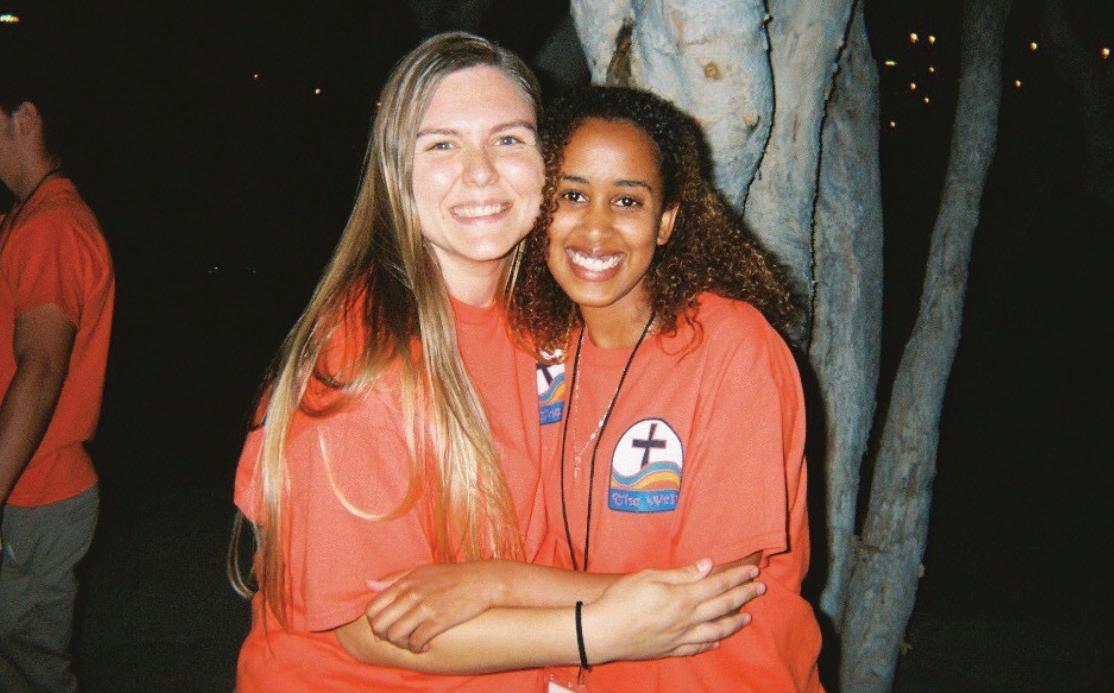
Photo by Soliel Lara | Special Edition Editor Special Edition Editor Soliel Lara (middle) and friends enjoy a night in Naples, Maine in July 2025. Lara bonded instantly with these friends while working together over the summer.
Michel Shane carries on daughter’s legacy
Emma Martinez Community Reporter
At 5 p.m. on April 3, 2010, he was one person.
“And at 6 p.m. I was another. I am forever to be that other,” said Michel Shane, Pacific Coast Highway advocate and film producer.
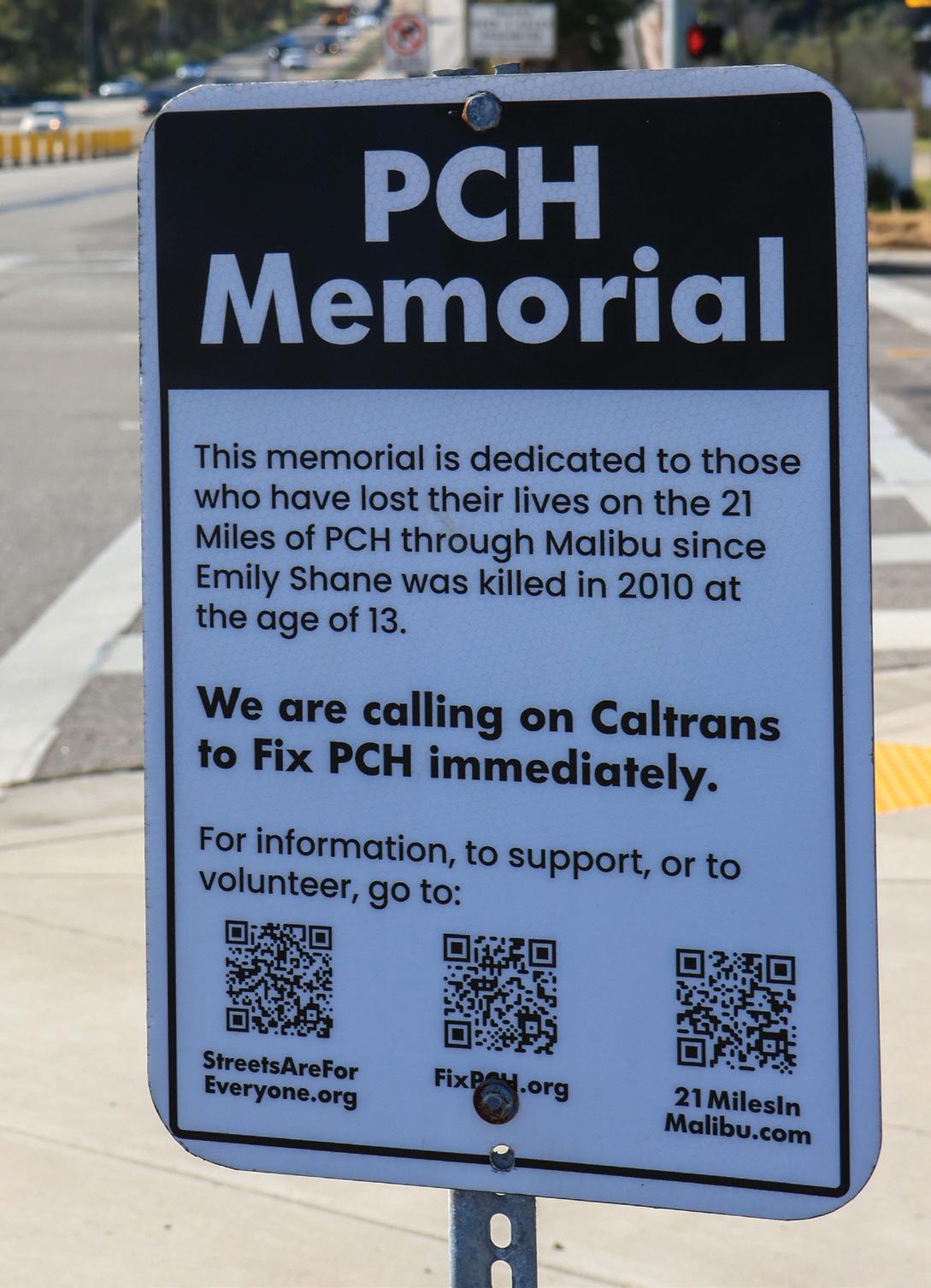
April 3, 2010 was a regular day for Michel Shane. He said he walked to the intersection of PCH and Heathercli Road to pick up his youngest daughter, 13-year-old Emily Shane, when an EMT told him the worst news a parent could hear. The flipped-over car Michel Shane saw was from a suicidal driver who struck and killed Emily Shane.
This changed the trajectory of Michel Shane’s life. He said if someone told him in 2026 that he would be an advocate, he would not have believed it.
“I would have laughed,” Michel Shane said. “I would have said, ‘Are you kidding?’”
Michel Shane said he has made a commitment to honor Emily by doing everything in his control to make sure no parent ever has to experience what he did 16 years ago.
Michel Shane Finds Beauty and Danger in Malibu
Michel Shane was born in Montreal and moved to Malibu in 1996 to work in the film industry. In the film world, Michel Shane said he is best known for executive producing “Catch Me If You Can” and “I, Robot.”
When Michel Shane and his family moved to Malibu, he said he acknowledged its natural beauty.
“This is paradise,” Michel Shane said.
With that being said, driving on the local roads made him nervous, especially as a father. Shane said he bought a used car with a steel frame for his oldest daughter.
“So if a bus hit her, the bus would crash and her car would still be in one piece,” Michel Shane said.
Despite all of the safety precautions Michel Shane took, his worst nightmare still occurred.
When Emily died, Michel Shane said he made it his mission to be known for more than his films. He wanted to take on
another title, one he viewed as far more important: advocate.
Michel Shane said his experience with film benefited him when it came to advocacy.
“I understand messaging,” Michel Shane said. “I understand how to get the message out.”
The two worlds combined when he created the documentary “21 Miles in Malibu.” The documentary follows the story of PCH and the people who have been impacted by it, Michel Shane said.
Michel Shane Becomes the ‘Godfather of PCH’
Michel Shane o ers more than just complaints to city and California Department of Transportation (Caltrans) ocials, he said.
“I don’t just complain,” Michel Shane said. “I identify the problem, and then I’ll o er what I believe could be solutions.”
One issue Michel Shane said greatly concerned him was how Caltrans was going to paint bike lanes on PCH, but the bike lanes did not include any other form of protection.
“I mean logically, are you nuts?” Michel Shane said. “Just because there is a little paint there, it’s now safe?”
Once again, Michel Shane did not just complain; he said he proved his concern.
“I went to Holland, went to England and went to Asia to see how they are dealing with this,” Michel Shane said. “I got all of that information, synthesized it and came up with something that fits here.”
This attitude has created real change on PCH, and Michel Shane said he will use it as he continues to fight for a safer highway.
Remembering Emily Shane
Instead of running away from the tragedy, Michel Shane said he welcomes talking about Emily.
“I love to share about Emily,” Michel Shane said as he looked at a photograph of her.
Michel Shane’s imagination will occasionally wander, and he said he thinks about what could have been.
“In my mind, Emily is always 13,” Michel Shane said. “If you think about it in a
realistic sense of the word, she’s 28 now.”
As well as reminiscing, Michel Shane said a way to honor Emily’s legacy is through the Emily Shane Foundation. The foundation takes middle school students who are struggling and pairs them with university-age students.
“They become their big brother, big sister,” Michel Shane said.
The pairs meet twice a week for a minimum of an hour, Michel Shane said.
The cost for a child to participate?
“They have to do a good deed,” Michel Shane said.
Michel Shane said this creates good people and good citizens, someone he describes Emily as.
Michel Shane O ers Advice to Loved Ones of ‘Our Girls’
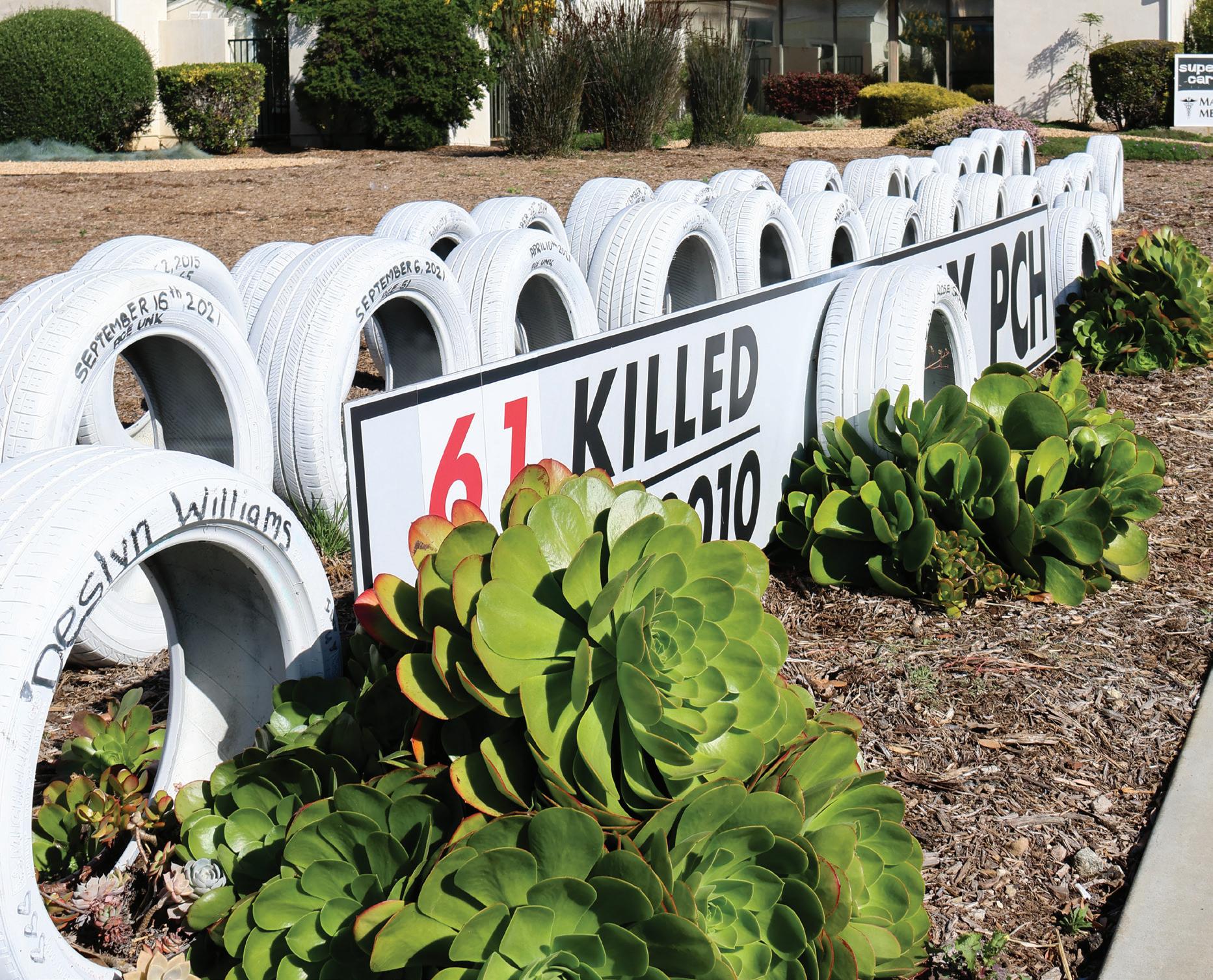
The deaths of ‘Our Girls,’ Asha Weir, Deslyn Williams, Niamh Rolston and Peyton Stewart, on Oct. 17, 2023 were a wake-up call for local and state o cials. ‘Our Girls’ were standing on the side of PCH when they were struck and killed after a speeding driver ran into parked cars, according to NBC News.
“It took what happened to those four Pepperdine women to bring an awareness that ‘Oh my God, there really is a problem,’” Michel Shane said.
This tragedy had a great impact on Michel Shane, he said.
“For us [the Shane family],
it was brutal because we relived her [Emily’s] death,” Michel Shane said.
The deaths of Asha, Deslyn, Niamh and Peyton, which Michel Shane said happened for “no good reason,” angered him and made him reflect.
“I want to do more,” Michel Shane said.
Michel Shane said he reached out to each of the girls’ parents to o er support.
“I said to each one of them, ‘Whatever you need,’” Michel said.
He has been down the road and knows it is a long one.
“You’re in year 2,” Michel Shane said. “I’m in year 16. It’s a long road.”
From his personal experience, Michel Shane said everyone takes their own route, and there is no wrong way.
“You have to decide on how you want to do it,” Michel
The big issue with PCH is it’s misnamed. Pacific Coast Highway. A roadway.
Michel Shane PCH Advocate
Shane said.
Imagining a Perfect PCH
Along with imagining what could have been, Michel Shane said he wonders what could be. He said he imagines what PCH would look like with no red tape, no monetary limitations or complaints.
“The big issue with PCH is it’s misnamed,” Michel Shane said. “Pacific Coast Highway. Highway. A roadway.”
Michel Shane said there are portions that should remain a highway, but there are “huge” stretches that should be a boulevard, especially from Los Flores Canyon to the northern end of Pepperdine.
“These should be controlled environments,” Michel Shane said.
Another aspect of Michel Shane’s perfect PCH relies on education.
“The real issue is we don’t teach young enough,” Michel Shane said.
Michel Shane said the Emily Shane Foundation partnered with AAA at the Malibu Middle School to teach kids about basic road safety.
Michel Shane said he hopes to continue putting on events like these in the future.
To watch Emma Martinez’s package on Michel Shane, scan the QR code.
emma.martinez@pepperdine.edu
Photo by Emma Martinez | Community Reporter
PCH advocate Michel Shane (far right) speaks at the Oct. 17 press conference in honor of ‘Our Girls’ at the Ghost Tires. Niamh Rolston’s father, David Rolston [far left], listened to Shane’s speech.
Community mourns loss of Steve Rouse
Henry Adams News Editor
The Pepperdine community is mourning the loss of Steve Rouse, a father, husband, Christian, friend and Psychology professor who died after a fight with pancreatic cancer Feb. 5. He is survived by his wife Stacy and their two children, Dominic and Ian. He was 59.
Rouse began teaching at Pepperdine in the fall of 1998, according to a Pepperdine press release. Among a number of accomplishments and roles during his lifetime, he produced 93 academic publications throughout his career, acted as editor of the Psi Chi Journal of Psychological Research, served the on-campus University Church of Christ Malibu as a Council Member and advocated for LGBTQ+ students as an advisor for GSA Crossroads.
“I don’t think there will ever be enough words to say how amazing he was,” alumna Dani Christy (‘23) said.
During her time at Pepperdine, Christy majored in Psychology and was involved in the e-board for GSA Crossroads, including as co-president her senior year. She said she could already feel how much Rouse cared about people just from their first interaction.
“I was reading over some of my syllabi from classes that I took with him, and you can just see the care that he put into everything and just how much he loved all of his students,” Christy said.
Rouse served as Christy’s faculty mentor for research she conducted on mental health and religiosity among students who identify as sexual minorities at Christian universities. For Christy’s personal experience as a sexual minority at Pepperdine, Christy said Rouse’s visibility as a bi man
made a “huge di erence” in making her feel more safe and empowered with her lesbian identity.
“No matter what we wanted to do with GSA [Crossroads], he was always in our corner and advocating for us,” Christy said.
Among other students over the years — including Joshua Gash, son of President Jim Gash — Rouse also mentored alumna Bella Mullin (‘25), who conducted research on college hookup culture. Mullin said she was grateful for the support Rouse showed her throughout her research process, which she was initially nervous about. She also got to spend time with Rouse during Intercultural Affairs’ 2023 San Francisco trip, where Rouse led an LGBTQ+ history tour of the Castro District.
“He really made my Pepperdine career, and why I chose and stayed in the Psychology major — him and the several other amazing faculty,” Mullin said.
Mullin said Rouse was always the person she and her peers felt comfortable talking to about everyday things. She described him as an “amazing” person who had an “incredible reputation” around campus.
Senior Sociology major Ashley Eagan, who identifies as queer, said she admired Rouse’s advocacy on behalf of LGBTQ+ students as Pepperdine. She took his Personality Psychology class last year and first encountered Rouse through attending GSA Crossroads meetings.
“You could just tell he was so happy to talk to you and so happy to help in any way he could,” Eagan said.
Rouse served as the divisional dean of Social Science twice, according to a Pepperdine press release. He received the Howard A. White Award for Teaching Excellence in
2007, the Impact Award for Outstanding Service to Seaver College Students in 2021 and Distinction in Diversity and Inclusive Excellence Faculty Award in 2023.
Political Science Professor Brian Newman, current Social Science divisional dean, said the Social Science division was “enormously proud” of Rouse’s accomplishments, according to a Pepperdine press release.
“Steve is one of the most generous, thoughtful, intelligent, and competent people I’ve ever known,” Newman wrote in a Feb. 11 email to the Graphic. “He always found a way to help me and did it in a warm, kind, and humble way.”
Stephanie Cupp, program administrator for the Center for Faith and Learning, said Rouse’s death has been a shock for many in the Pepperdine community. Cupp’s family has been neighbors with the Rouse family for around 25 years; her son has been lifelong friends
with Rouse’s son, Dominic. She said Rouse was a “hero” and is “irreplaceable.”
“Steve believed in the God who created and loves the rainbow,” Cupp said. “He looked out for those who most needed hope and was courageous in his care for the marginalized in our community. I don’t think we were always consciously aware of this, but many of us looked to Steve as the best of who we could and should be. He was such a steady, quiet presence, and we are deeply feeling the void that he left.”
University Church of Christ Malibu is holding a celebration of life for Rouse on Saturday, Feb. 28, according to a church announcement. There will be a visitation in front of Elkins Auditorium from 11 a.m. to 12:50 p.m. before the service starts inside at 1 p.m. The service will be livestreamed.
Before his death, Rouse wrote instructions for what attire to wear at his service, which will include a potluck
dessert reception afterward.
“Everyone is required to wear clothes that they enjoy,” Rouse wrote. “Whether suits or shorts or anywhere in between, be yourself without judging anyone else’s choice.”
Rouse also wrote his own obituary, in which — in lieu of flowers — he directed people to donate to the LGBTQ+ youth suicide hotline The Trevor Project, Mount Tamalpais College, a program that provides accredited college degrees for people incarcerated at San Quentin Rehabilitation Center, and the upcoming reelection campaign of his wife Stacy, who serves on the Santa Monica-Malibu Unified School District’s Board of Education.
henry.adams@pepperdine.edu
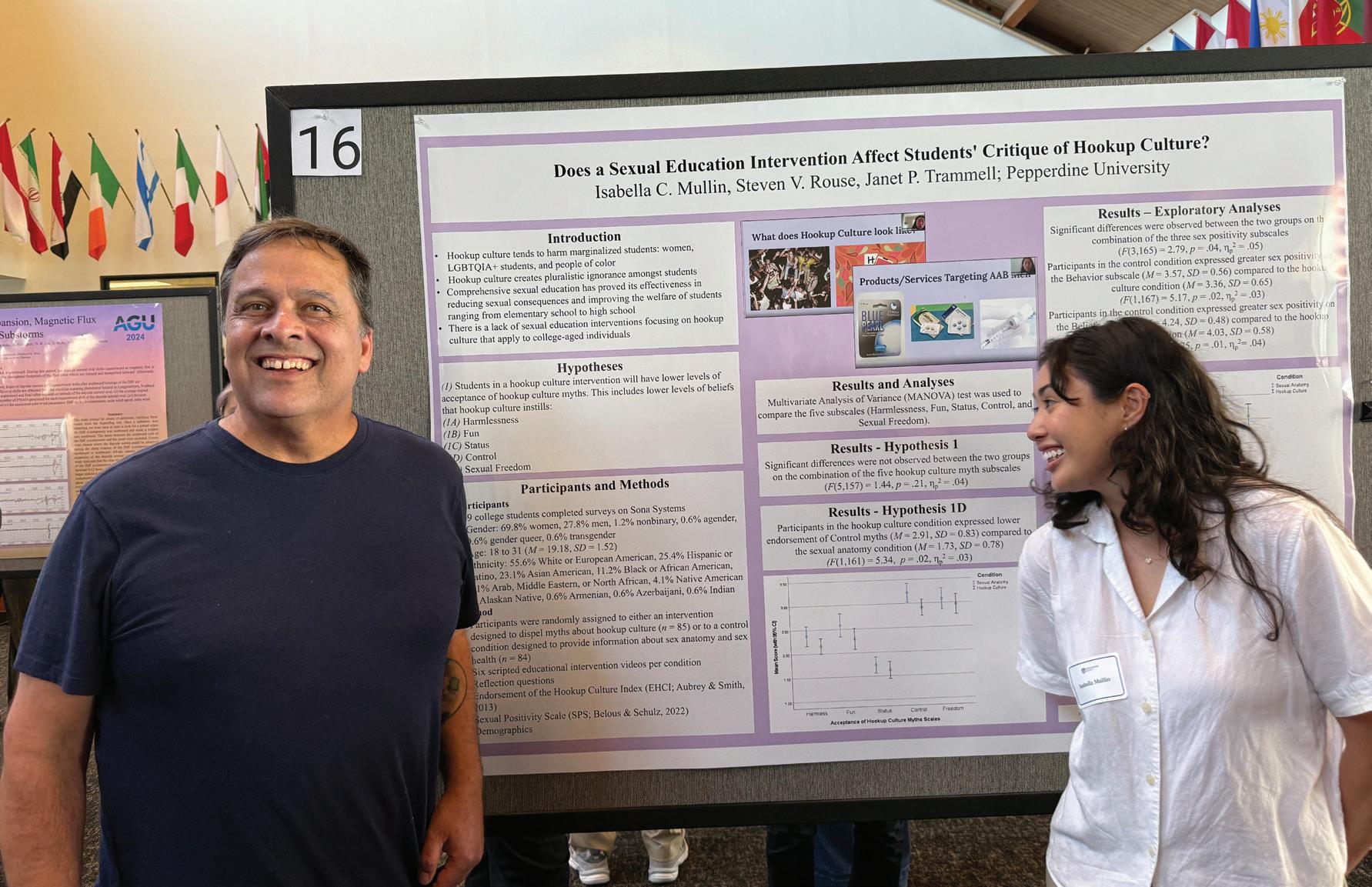
Photo courtesy of Bella Mullin Rouse (left) and alumna Bella Mullin (‘25) stand in front of Mullin’s
Research and Scholarly Achievement symposium in Waves Café in April 2025. Mullin did research under Rouse’s mentorship after taking his Psychology of Human Sexuality course.
Photo courtesy of Bradley Griffin
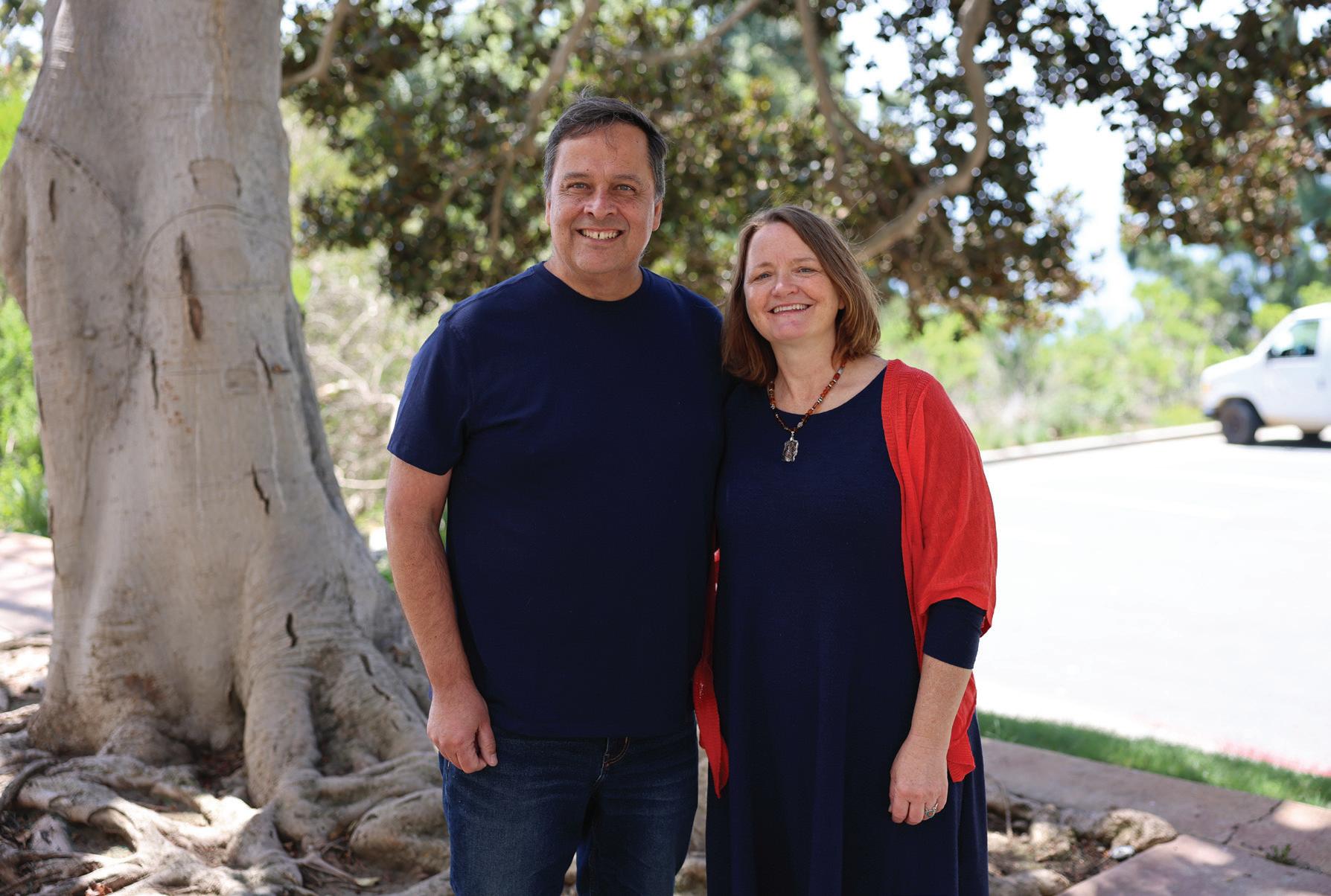
Psychology Professor Steve Rouse (left) and his wife Stacy stand outside Stauffer Chapel on Easter in April 2025. Rouse was diagnosed with stage four pancreatic cancer during the fall semester, according to his CaringBridge page.
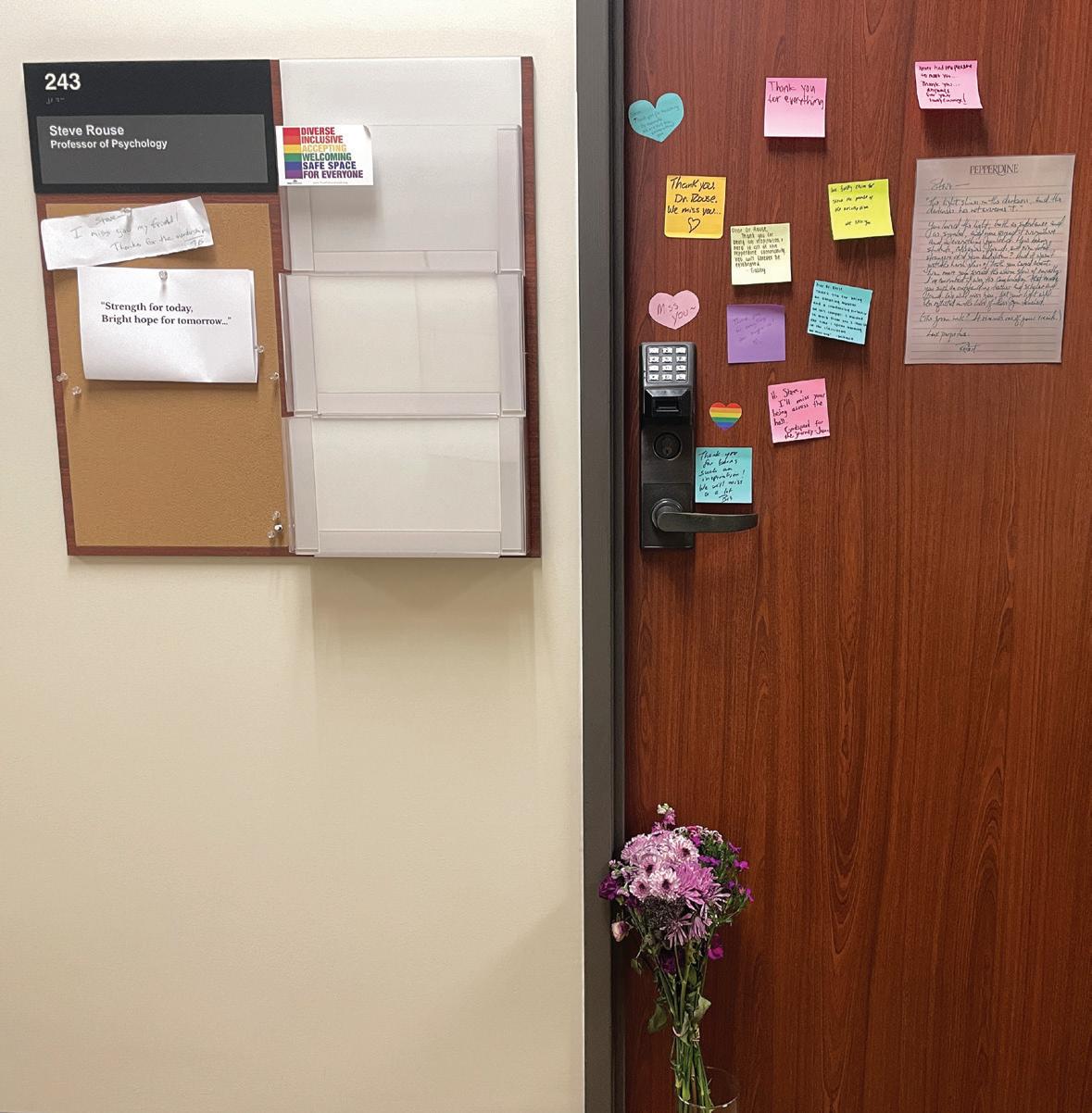
Photo by Ashley Burton | Perspectives Editor Notes from students and faculty stick to Rouse’s office door in the Appleby Center on Feb. 16. One note reads, “You will forever be celebrated.”
Milan program studies 2026 Olympics
Kaiya Treash News Staff Writer
This semester, 18 students from Pepperdine’s Communication Division traveled to Milan, Italy, where they are watching the 2026 Winter Olympic Games and learning how the events are advertised and planned.
Communication Professor Sarah Stone Watt and Adjunct Advertising Professor Ben Price will oversee the students for the six-week program.
“We created a unique study abroad program that emphasizes advertising and integrated marketing communication to get students behind the scenes at the Olympics, where they learn about intercultural communication, advertising, marketing and ethics all by seeing it happen in real time,” Stone Watt said.
Hanna Susak, senior Integrated Marketing and Communications (IMC) major, said having a majority of either IMC or Advertising majors makes the learning experience even more valuable. The group arrived in Milan on Feb. 4 and attended the Olympic Opening Ceremony.
“It was the most moving thing I have ever experienced — just like to see all the di erent countries walk out and display their pride as well as being an event that is so unifying in so many di erent ways,” Susak said. “There’s just so much going on in the world, and for everyone to come together and be in Milan for this event was truly touching, and it is unlike any kind of ceremony I have seen on TV before.”
Susak said Pepperdine is unique in the abroad opportunities it o ers students — ones that can change lives and enhance future career opportunities.
“Everyone in this program is so grateful and so conscious that this is so out of the ordinary,” Susak said. “We have
had so many people come up to us and be like, ‘Wow, you’re so lucky,’ and what is great is that we all know how lucky we are and it makes us want to work so much harder.”
Hung Le, senior vice chancellor of Human Resources at Pepperdine, said the once-in-alifetime experience is one of the best Pepperdine has to o er. Le was involved in the “send-o ” event in Malibu that took place hours before the program’s departure, where professors gathered to celebrate the participating students.
“It was really neat to get the partners from across campus together and bless our students before they go abroad,” Le said. “This program is drawing on resources from throughout the University, and so we are so excited just to see how many people are really involved in this.”
The Curriculum
Students’ applications to the Milan program were due in January 2025. The applications required a short video detailing why students would benefit from the six-week program, as well as their GPA and transcript. Since last January, students said they have been working hard preparing, learning about the history of the Olympic Games and how they are usually publicized.
Additionally, students said the program o ers major-specific courses such as Advertising 490, Communication 400 and some GEs. The student group is split, with some students being juniors and some seniors graduating this spring.
Seniors said they had to be particularly adamant about getting specific courses to fulfill graduation requirements last year and last semester so they could be intentional about what courses they took in Milan.
“A lot of the classes that we are taking took a pause while
we are here,” Susak said. “The professors who came with us and the directors of the program are continuing their classes with us. It’s a lot heavier in Malibu and then a little bit lighter in Milan in some ways and then heavy again once we’re back.”
Students said the trip is not only fostering academic learning, but is also helping them learn about cultures from around the world, creating a tight bond among the group.
“I really did not know majority of the people that well in this program,” senior IMC major Madisyn Fish said. “This program has 100% bonded us. Everyone in the program is really driven and motivated — I think we all have very similar work ethics, which makes it nice.”
Fish said one of her most memorable experiences with the program was going to a tour of the Duomo and walking around the Galleria in Milan with the other students. The tour was immersive, and seeing advertisements for the Olympics in person helped them understand how the games were actually promoted.
“Doing that as a program and experiencing kind of those really big landmarks of Milan all together was really cool because yes, we are seeing the city itself, but also every corner we would take, we saw advertising about the Olympics,” Fish said.
Community Impact
Fish and Susak said the knowledge and professional experience of their professors, as well as meetings with marketing and advertising executives who have worked on previous Olympics, make them more invigorated. Some guest speakers even worked with the Pepperdine International Programs for the 2024 Summer Olympics in Paris.
Price, who is also a Pepperdine Athletics Board Member, said the Olympics o ers an experience where people from across the globe can join together and find their commonalities.
“It is the largest global event, and to be a part of it, to witness it — there is no better place for students who are learning this business and learning advertising and marketing,” Price said. “You get to do it in a place that brings the whole world together, given the divisiveness, not only that we have in our country but also globally. It is a really unique opportunity.”
Price also said Kelsey Ramsey, an alumna of the Pepperdine Paris Program, is currently working to manage influencer partnerships and Team USA apparel at Barefoot Dreams, the clothing store she creates brand content for.
Susak said forming these connections is another part of what makes the program appealing.
“We have been fortunate enough to have a lot of guest speakers that Professor Price, who previously worked at NBC Universal, has in his contacts,” Susak said. “We had some past Olympians, some past Olympian coaches and some people from the Paris program talk as well.”
Price said meeting major sponsors from the Olympic Games has encouraged stronger student engagement within the program.
“Some of them are Delta Airlines, Airbnb, Coca-Cola and hearing, ‘How does it work as a large marketing tool for them?’” Price said. “Most people experience the Olympics on a TV screen or mobile device. We are experiencing completely immersively.”
Price also said the students met with the International Broadcasting Center (IBC) to look at how they produce
the games and provide specific programming for the United States.
Ken Hanscom, a Pepperdine alumnus who is on the Board of U.S. Olympic and Paralympic Foundation, is attending the games and plans to help educate students on marketing relationships toward the end of the program.
“He is going to come to our reception toward the end of the program in Milan with other members of the foundation so we can continue to learn about partnerships and how athletes get supported,” Stone Watt said.
The program, Stone Watt said, is also working to bridge the gaps between Communication Division majors and athletics on campus.
“The other great thing is that this group gets a sense they are building on the legacy that athleticists have already created with the Olympics, so we go down to Firestone Fieldhouse to hear from Pepperdine Olympians and go to games,” Stone Watt said. “I think bridging the academic stu that happens up the hill with the athletic stu that just tends to be physically distant has built some community in our group.”
Le said this opportunity not only serves involved students, but is also a way to draw people together from across the Pepperdine community.
“We can integrate di erent aspects of the University together to enhance the learning process,” Le said. “Getting to physically see our partners and to understand all that is going on for this thing to happen, it really adds to what they have experienced and what they are about to experience.”
Photo courtesy of Pepperdine
Milan program students pose at the Olympic Ice Rink on Feb. 11. Communication Professor Sarah Stone Watt and Adjunct Advertising Professor Ben Price said students learn about athletics marketing through event participation and advertiser connection.
Photo courtesy of Hanna Susak
Dramatic lighting effects illuminate the Milano San Siro Olympic stadium during the Opening Ceremony in Milan on Feb. 6, marking the start of the 2026 Olympics. Susak said students were able to attend together and experience the moment.
PERSPECTIVES
Art by Cara Tang | Art Editor
Sta Editorial: Pepperdine lacks Lunar New Year celebration on campus
Graphic Staff
Editor’s Note: PGM sta members decide on the topic of a sta ed together. The sta as a whole provides opinions and content included in this sta ed to provide thoughts about and shed light on solutions for happenings at Pepperdine.
Around mid-January to mid-February each year, Lunar New Year, also known as Chinese New Year, is celebrated across the world. The holiday is a beloved centuries-old tradition where Chinese families celebrate the end of the lunar calendar, according to Timothy S. L. Lam Museum of Anthropology.
Lunar New Year festivities often begin on Chinese New Year’s Eve — this year being Feb. 16 — and the celebration extends for up to 16 days. The
activities come with ringing in the Lunar New Year, such as a New Year’s Eve dinner, fireworks at midnight and custom house decorations.
Traditional foods for the shared meal can include dumplings, New Year Cake and tang yuan, a small boiled ball made from rice flour, according to Timothy S. L. Lam Museum of Anthropology.
Lunar New Year provides a chance for the Chinese community and beyond to celebrate their culture with the people around them. This celebration can bring a sense of familiarity and home for students who treasure this time of year.
Nonetheless, there is a notable di erence in the awareness this holiday is receiving at Pepperdine this year. In 2023, the Chinese Students & Scholars Association hosted a Lunar New Year celebration and in 2024, both the Mandarin Christian Student Ministry and Taiwanese Student Association held celebrations. Pepperdine lacks a university-wide Asian American Pacific Islander Association, and there are seldom enough clubs that highlight Chinese culture. Further, Pepperdine possesses a greater lack of cultural celebration so far this year, as they have not made any posts or sent out any communica-
tion about Lunar New Year.
As such, events like Lunar New Year are not represented in our community during February. Whether for the purpose of celebrating their own culture or wanting to gain a better understanding of others’ cultures, students at Pepperdine do not have access to these opportunities.
At San Jose State University (SJSU), community members were invited to a wide array of events starting Feb. 9, including a wish tree, celebratory meals and Lunar New Year Lion Dance, according to the SJSU Mosaic Instagram.
In order to partake in this beloved tradition, Pepperdine students can gather together and share a meal with their friends or seek educational resources, such as on the China Institute of America’s website, to honor Lunar New Year.
THE
GRAPHIC
Rant: Students should not depend on Rate My Professors
Alyssa Hunnicutt Perspectives Staff Writer
Transparency Item: The Perspectives section of the Graphic is comprised of articles based on opinion. This is the opinion and perspective of the writer.
Building a course schedule can be an exhaustive process, especially when you have many professors to choose from for an important class.
Rate My Professors (RMP) is a popular website to gauge which professors are best for certain courses.
Nevertheless, its popularity does not outweigh the inaccurate and disappointing quality of RMP. The website is incredibly unreliable because its evaluations are negatively skewed, it sets false course expectations and provides little information about many professors.
RMP allows students to give unfiltered, anonymous evaluations, which are thought to be reliable because they encourage students to be honest with their reviews.
Nonetheless, RMP allowing anonymous self-reported evaluations decreases students’ accountability to prioritize truth in their statements, according to Texas State University.
Typically, the anonymity of these evaluations evokes stronger negative feelings that compromise the accuracy of the students’ evaluation, according to the Journal of Experimental Social Psychology.
Thus, students’ negative experiences in a course are more likely to be reported on, lowering the reliability of the professors’ ratings.
Also, a course’s di culty is strongly correlated with lowered quality ratings for the course professor, according to Texas State University.
This implies when students give negative evaluations, it often has less to do with the professor and more to do with the complexity of the course content, further demonstrating how RMP ratings carry an unfair bias that do not reflect the actual quality of college professors.
When RMP quality ratings were compared to o cial university student-teacher evaluations from University of South Florida (USF), about 50% of professors had at least half a quality rating di erence on RMP than in USF evaluations, according to Texas
State University. While most of these di ering ratings lean negative, others lean positive.
Positive RMP evaluations were correlated with students believing they would receive a policy exemption, such as leniency on a syllabus rule, from that professor, according to the National Library of Medicine.
As such, positive RMP ratings give students false impressions professors will go easy on them, and this may cause students to not work as hard in the course. This sets students up to feel more disadvantaged entering the class, impacting their overall success.
Many professors have little information about them on RMP.
This could be due to having new, visiting or adjunct status at Pepperdine. These professors may have to adjust to specific teaching styles and course material that their department wants to employ.
Also, the professor’s department could need professors to fill in for increasingly high-demand classes that they have never taught before. This shift for professors makes it di cult for students to discern what the actual course will be like.
RMP relies on past students to give their evaluations on the course to help future students become aware of the professor’s quality.
When a professor teaches a new course, there are no past students able to report on the professor’s caliber, making it di cult for students to find reliable information on RMP about these professors.
This can make students feel unprepared since they don’t have any previous knowledge about their professor coming into the course.
RMP evidently tailors the website to allow students to give more emotional statements than factual ones. This form of evaluation disproportionately influences other students when it comes to their opinion of their professors.
In combination with its outdated information, RMP is not accurate enough to be a reliable source. Students should stop engaging with the website if they are looking for dependable knowledge about their courses and professors.
Rave: Rate My Professors matters to students
Hana Wadlow Perspectives Staff Writer
Transparency Item: The Perspectives section of the Graphic is comprised of articles based on opinion. This is the opinion and perspective of the writer.
The first year of college often feels like walking into a system with unwritten rules. Lecture halls are bigger, expectations are higher and suddenly every course feels unfamiliar.
Unlike high school, where students get assigned specific classes and teachers, college first-years register for classes knowing little more than a professor’s name and a course title.
This information gap can be overwhelming. Academic success depends not only on what is taught, but also on how and who it is taught by — something rarely captured in o cial course catalogs.
This is where Rate My Professors (RMP) becomes especially useful.
For first-years, the platform o ers a starting point in a situation that would otherwise feel like guesswork. Reviews often describe classroom atmosphere, clarity of instruction, workload pacing and grading style.
These details help students imagine what a semester might realistically feel like, which is critical for students still adjusting to college-level expectations.
Emotions can run high in academic settings, and sometimes a single negative experience turns into an overly harsh post.
This is where common sense plays an important role.
RMP reviews don’t automatically define a professor’s overall teaching ability.
Looking at patterns rather than isolated comments makes a di erence. When the majority of reviews consistently describe a professor as organized, supportive or engaging, that trend carries more weight than one emotional outburst.
On the other hand, if many students mention the same recurring issues — unclear instructions, low volume or lack of communication — that pattern may be worth noting.
The value of RMP is not in treating every comment as the truth, but in recognizing collective trends. It functions less like a verdict and more like a collection of student
perspectives which, when read thoughtfully, provides helpful context.
This website resembles digital word of mouth.
College isn’t just classes — it’s jobs, internships, clubs, social life and trying to stay mentally afloat. Choosing the right professor can genuinely shape how balanced or exhausting a semester feels.
That’s where RMP becomes practical, not just informational. Students aren’t only curious about who explains material well — they want to know workload intensity, flexibility with deadlines and whether a class is realistically manageable alongside everything else.
A professor who assigns surprise projects, gives unclear rubrics or responds slowly to emails can turn one course into a constant source of stress.
Reviews that mention fair grading, clear expectations and reasonable pacing signal a class where e ort actually feels proportional to results.
This matters to students juggling multiple responsibilities who can’t a ord to sink all their time into one unpredictable course.
In this way, RMP helps students build schedules that are challenging but sustainable — not just academically, but emotionally and mentally too.
For first-years navigating a brandnew world, even the smallest amount of insight can reduce uncertainty.
Having a sense of what to expect in the classroom can ease anxiety and help students prepare for di erent teaching styles and workloads, knowing what teaching methods work for them and what don’t.
RMP serves as a modern form of shared student knowledge — imperfect, but often informative.
College will never come with a full instruction manual, but resources that o er peer insight help make the transition a little less intimidating and a lot more informed.
Art by Cara Tang | Art Editor
Art by Sofia Cifuentes | Staff Artist & Podcast Producer
Unrealistic expectations can set us up for failure
Eva Shauriki Perspectives Staff Writer
Transparency Item: The Perspectives section of the Graphic is comprised of articles based on opinion. This is the opinion and perspective of the writer.
Expectations are often framed as motivation. In college especially, students are encouraged to set high standards for themselves while constantly visualizing success and a future.
In theory, expectations are healthy and push us to try and utilize our full potential. In reality, expectations can just as easily set us up for failure.
As students, it’s easy to attach expectations to almost everything: expecting a certain grade if we study enough, wanting a professor to change our lives or choosing the “right” major to make the path to our futures clear.
When those expectations aren’t met, the disappointment can be crushing.
Psychologist and author Daniel Kahneman wrote the human is a “prediction machine,” according to his book “Thinking, Fast and Slow.”
The term “prediction machine” means our brains are constantly comparing reality to what our minds expect to happen, according to the American Psychological Association.
Our brain starts to create a gap between expectations and reality. The bigger the gap gets, the more detrimental unmet expectations become for our confidence, perspective and happiness, according to Psychology Today.
Expectations give life structure. They help provide a sense of comfort by o ering a framework for how we think things will play out.
For example, expecting an airport to be busy helps us prepare for stress rather than being blindsided by it.
But expectations can turn dangerous quickly; it is easy to form them in new scenarios to feel a sense of control.
Some advise to “expect the worst” so any outcome feels better in comparison to the expectation. Conversely, it is easy to set high expectations out of optimism about an outcome.
For example, one might expect an experience to be amazing or expect food to taste far better than it did.
Expectations also play a powerful role academically. Many students have experienced the relief of their grade being a lot better than expected.
Students have also most likely been on the other side of it, where they may have expected a better grade. When faced with these unmet academic expectations, self-doubt can creep in.
The thought can easily shift from “if I studied harder, I could have gotten
a better grade” to “if I tried this hard and didn’t get the grade I expected, I must not be good enough.”
Another instance could be an athlete that trains hard all season and expects a performance from themselves they couldn’t meet. These kinds of disappointments lead to burnout and loss of passion, according to Sonya Looney.
No matter what the unmet expectation is for, the illusion that things were supposed to go a certain way can distort the way we see ourselves.
At Pepperdine, it’s more amplified. Pepperdine’s environment is full of ambition, opportunity and reminders of achievement that encourage students to set high expectations of themselves.
When you pair that with Malibu and Los Angeles, where “success” is constantly visible, it becomes easy to start building expectations on comparison
rather than personal drive and growth.
An important shift to prevent unmet expectations is to set goals instead. Goals give us direction, while expectations demand a specific outcome.
Having a goal to get an A, perform well in a sport or try new things regardless of the outcome is something to work toward. Accepting the bestcase scenario may not happen allows growth without making the expected outcome the only acceptable result.
Poet Henry David Thoreau wrote, “the question is not what you look at, but how you look and whether you see.”
Expectations don’t change our reality — they only a ect how we perceive it.
eva.shauriki@pepperdine.edu
Rom-coms revive emotional intelligence
Alyssa Hunnicutt Perspectives Staff Writer
Transparency Item: The Perspectives section of the Graphic is comprised of articles based on opinion. This is the opinion and perspective of the writer.
Movie theaters and popular streaming services are flooding their audiences with romantic comedy (rom-com) films.
In the past year, rom-coms like “Materialists” and “Bridget Jones: Mad About the Boy” had amazing box o ce successes, each grossing over $100 million globally, according to Box O ce Mojo.
In addition to these films’ box o ce success, romance books have significantly surged in popularity, primarily in the form of BookTok — a large social media community that discusses and reviews books.
This community popularized many romance novels, which turned into an increase in post-pandemic print sales.
“Sales in the romance category rose 3.9%, to almost 44 million units” from 2023 to 2024, according to Publishers Weekly.
The adoration for this genre prompted streaming services to bring these books to life in adaptations, increasing the number of rom-coms released yearly.
Audiences who loved the books are excitedly awaiting these films. Many participate in online conversations — often through BookTok — of fancasts, where fans of the book list desired actors and actresses to play characters in the adaptations.
Most notable about the rise of rom-coms is how the entertainment brought about an intellectual rebirth in the new generation. This rebirth is mostly manifested in increased emotional intelligence among rom-com audiences.
Emotional intelligence is defined as “the ability to recognize, understand, and deal skillfully with one’s own emotions and the emotions of others,” according
by Ava Anderson | Staff Artist & Design Assistant
to Merriam-Webster Dictionary.
Studies show young adults who consume romantic media are more likely to have higher emotional intelligence, according to the International Journal of Interdisciplinary Approaches in Psychology.
Some films in the rom-com genre can overlap with the literary fiction category.
Literary fiction prioritizes character, style and theme over a plot, and has an overarching theme of displaying the human experience, according to Writer’s Digest.
Literary fiction plays a huge role in emotional intelligence because of how it portrays human experiences. Rom-coms have a substantial overlap with this
category in terms of depth of character development.
Audiences who read fiction can connect so well with on-screen or book characters’ relationships that they are emotionally transported into the story. Higher levels of emotional transportation in fiction readers correlate with readers being more empathic, according to the National Library of Medicine.
Empathy is the ability to understand and be sensitive to others’ emotions, according to Merriam-Webster Dictionary. Correspondingly, the ability to exercise empathy in personal relationships lies at the center of emotional intelligence.
This skill also transcends romantic relationships. It is important for networking and making professional connections, which can be a vital skill for any job. Additionally, emotional intelligence adds a maturity level to all relationships, which can be key for younger generations as they grow into adults.
As many college classes incorporate group work into their course, students will benefit from having these emotional skills which can help them better understand their groupmates’ ideas, opinions and emotions as they navigate a collaborative project.
With courses like Organizational Behavior, a Pepperdine class focusing on ethical management and practical application for business leaders, students can practice applying self-awareness, self-management and empathy skills, which they can learn from watching or reading rom-coms.
This genre is reemerging in many forms, whether in books or films, and with it comes an emotional and intellectual revival.
Audiences, especially students, that engage with this entertainment will not only enjoy the drama and feel-good moments but acquire essential skills that help them better connect with the world around them.
Art by Cara Tang | Art Editor
Art
A rite of passage: Waves hike to the cross
Jordan Baquiran Life & Arts Staff Writer
The hike to the cross is an out-and-back, three-mile hike from the back of Pepperdine’s campus into the Santa Monica Mountains. The peak holds five wooden crosses and offers views of the entire Malibu campus, the Pacific Ocean, Catalina Island, the mountains and the coastline — all at once.
Students said they take advantage of the view by hiking during sunrise or sunset. The hike isn’t just a physical activity, but also a “Pepperdine-exclusive” social and spiritual exercise.
“It’s one of those Pepperdine traditions that no other university has,” first-year Sofia Borras said. “Not every campus can say they have this beautiful hike on top of a mountain overlooking Malibu and the ocean.”
The Memorial Crosses
One large cross between four miniature crosses stands at the peak of the hike.
The Woolsey Fire destroyed the original cross in November 2018, but members of the Sigma Chi fraternity replaced it Dec. 1, 2018, according to a Pepperdine Magazine article.
The 20-foot-tall wooden cross was placed in honor of Alaina Housley, a Pepperdine student killed at the Borderline Bar and Grill shooting one day before the Woolsey Fire erupted.
Dev Singh was a member of Pepperdine’s Sigma Chi fraternity and part of the group who reinstalled the large cross after the Woolsey Fire, according to previous Graphic reporting. He was killed in a tra c
collision Nov. 4, 2021. Members of Sigma Chi later added his name to the large cross, according to Pepperdine Sigma Chi’s Instagram.
On each side of the large cross are two smaller crosses as a memorial for four Pepperdine students killed in a car accident along Pacific Coast Highway on Oct. 17, 2023, according to The Malibu Times. Deslyn Williams, Asha Weir, Niamh Rolston and Peyton Stewart (‘Our Girls’) were seniors and members of Pepperdine’s Alpha Phi chapter.
Accessing the Trailhead
The hike to the cross trail is accessible through
Pepperdine’s Malibu campus — that’s part of the reason why the hike feels exclusive to students.
Students can drive through Baxter Drive — the road between George Page apartments and the parking lot — and up the street to access the start of the trail, senior Angel Nguyen said.
Nguyen said it’s important to do the hike when the sun is out.
“If it gets dark, it’s scary and it’s easy to trip,” Nguyen said. “I went once during the sunset and it was stunning, but you’ve got to hurry down.”
Nguyen said it’s also important to wear proper attire, such as leggings and hiking
shoes, for safety, especially when hiking the trail during the summer months when the brush is overgrown or after a rainy season when the pathway becomes unclear or slippery.
Level of Di culty
The hike to the cross is rated as a “hard” hike, according to 57% of reviewers on AllTrails due to the long distances, steep climbs and di cult obstacles.
At 2.8 miles long, the trail has an elevation gain of over 1000 feet and little to no shade.
Borras said the hardest part of the hike is its steepness.
“It’s not super long, but there’s definitely tons of steep hills and going up and down,” Borras said.
First-year Colin Papé said he suggested bringing a water bottle and being cautious of protruding plants.
“There’s quite a bit of overgrown brush on the side, but it’s not a super big deal,” Papé said. “There’s also a couple parts where you have to watch out — you don’t want to slip and fall.”
A Rite of Passage For Pepperdine Students
The hike to the cross o ers a view other universities don’t have. At the peak, hikers can view the entire campus, the ocean, inland and the mountains.
It’s something to take advantage of, Nguyen said.
“It’s very ‘Malibu’ and you really get the full Pepperdine view from it,” Nguyen said. “It’s an experience to go
up there and be able to see everything and I think everyone should go at least once.”
The hike to the cross is a staple adventure and a badge of honor for students, Papé said.
“It meant getting closer with people — I wasn’t even a month into being at Pepperdine, and I was already getting into a community here,” Papé said.
The hike wasn’t as easy as people said it was, Nguyen said. She got lost and went o -trail her first time hiking the trail because of the rain in February 2024, but in July 2024, the hike went smoother because she could actually see the trail.
“I used to go on hikes, but they were more of a walk or a chill hike,” Nguyen said. “This is a real, strenuous hike — you’re literally climbing up steep hills and running down them. But I think if you can do it, you should.”
As a member of Alpha Phi, Borras said seeing the crosses of Deslyn, Asha, Niamh and Peyton made her feel closer to God.
“I’m the type of person that finds God through nature and His beauty,” Borras said. “It’s important to take a moment and look at what He’s created and the beauty around us.”
Photo courtesy of Angel Nguyen
Five cross statues stand tall on the destination peak of the hike to the cross Feb. 16, 2024. These crosses commemorate the memory of Alaina Housley, Asha Weir, Deslyn Williams, Dev Singh, Niamh Rolston and Peyton Stewart.
Photo courtesy of Sofia Borras
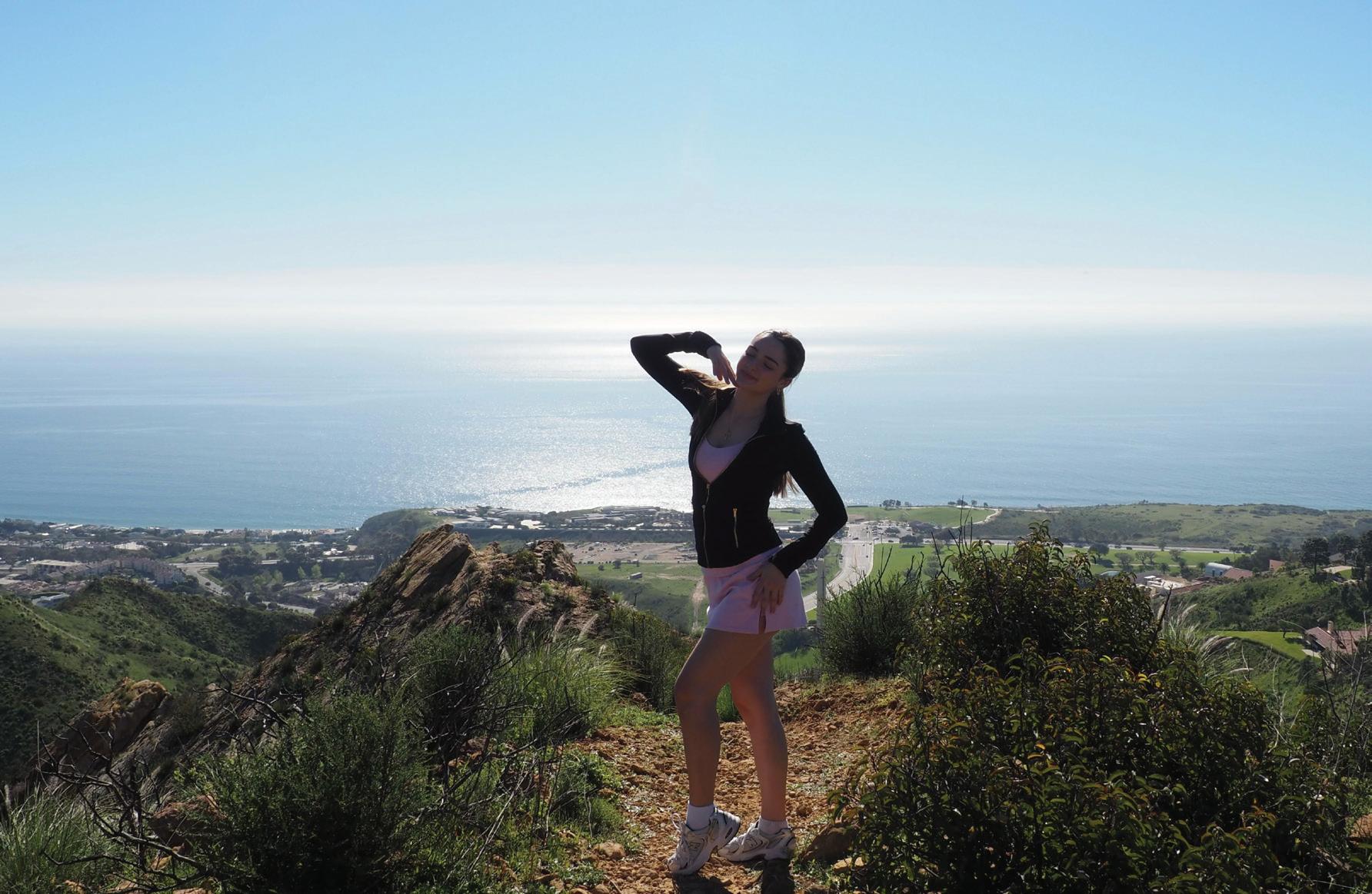
First-year Sofia Borras strikes a pose while hiking the trail Jan. 19. She chose to hike to the cross to celebrate a friend’s birthday and start the year on a positive, athletic note, Borras said.
Campus Rec keeps community active
Catie Baur Life & Arts Staff Writer
Pepperdine’s Campus Recreation provides various resources to students, faculty and sta members to enhance personal fitness, wellness and enjoyment, according to Pepperdine’s website.
These resources include group fitness classes, club sports, intramural sports, outdoor excursions, educational programs and outdoor equipment rentals.
“The fact that both students, faculty and sta get to come to these [fitness] classes for free and they’re taught by three fantastic instructors is great,” Professor of Theatre Bradley Gri n said. “I just can’t believe that we get such high-quality instruction and it’s just part of the benefit of being at Pepperdine.”
Group Fitness Classes Bring Campus Together
Jonathan Opsahl, Pepperdine alumnus (‘20) and former sta member of The Graphic, is a Campus Recreation fitness instructor. Opsahl said he has taught the Strength and Conditioning class at The Cage Fitness Center for four years.
Students, sta and faculty
members are welcome to attend group fitness classes Monday through Friday.
“What I like the most [about the fitness classes] is just exposing people to new ways of moving their body and di erent things that they can do to expand their potential,” Opsahl said.
The fitness programs at Pepperdine have grown significantly due to faculty, sta and students regularly showing up.
“We have a pretty consistent core group of people [who come to the fitness classes], but what’s cool is that they cover a broad range of experience levels and capacities,” Opsahl said.
Gri n said he has been attending Pepperdine’s fitness classes since summer 2023.
As a faculty member, Gri n said he was initially intimidated about attending the group fitness classes until he realized many faculty members he already knew also attended.
“I really appreciate the highly focused aspect of how the class is run and I think students would get a lot out of it if they’re able to come,” Gri n said. “Even if there are 20 people in the class, the instructors go around and make adjustments for each person, so you’re getting individualized attention.”
Club Sports
First-year Georgia Brown said she began playing on Pepperdine’s Club Tennis team in fall 2025.
Being a part of the Club Tennis team has not only been a great way to meet people, but also to stay involved with past high school sports without spending too much time away from schoolwork, Brown said.
“Being on the [Club Tennis] team has been a good way to still stay active while still being able to manage schoolwork, so that physical activity isn’t
something you have to stress about,” Brown said.
Although Campus Recreation o ers three di erent club sports — beach volleyball, surfing and tennis — Brown said Pepperdine should o er more club sports.
“[Pepperdine] should offer more club sports, because for me, tennis has been a big part of my life,” Brown said. “Club sports o er a community aspect, but also allow a lot of students who don’t have the opportunity to play Division I sports to still hang on to something that is a part of them.”
Waves Debate fosters community
Alicia Dofelmier Life & Arts Editor
Pepperdine has many student-run organizations, but there is only one that teaches students how to argue and how to argue well — Pepperdine Waves Debate.
Pepperdine Waves Debate is an academic co-curricular program that offers opportunities for the development of argumentation and public speaking skills, according to Pepperdine’s Seaver College Website. Members said the team is broken into di erent sections and that they have formed meaningful connections.
“Although we do a lot of hard work at our meetings, the community makes debate really worth it to me,” sophomore Nikki Quartuccio said.
Senior Ellie Scoggins said there are four di erent debate sections: Civic Debate, Spanish Debate, a discussion group called “What’s Happening” and a Community Outreach group.
“Since I work with the Civic Debate team, I will always remember my first tournament to Chicago and placing 11th overall,” Scoggins said.
Quartuccio is an on-campus programming student coordinator for the team. She said a typical week involves all leaders holding o ce hours and each section having a one-hour meeting per week.
“We often start [meetings] with an icebreaker to get to know each other better, and then the meetings depend on the section,” Quartuccio said.
This year she will be participating in the Schuman Challenge along with junior Emily White, Quartuccio said.
“The Schuman Challenge is a single-elimination bracketed tournament,” Quartuccio said. “Emily and I are writing a policy about the future of Arctic cooperation and presenting it to the European Union Delegation to the United States.”
Senior Christopher Ballance, along with Scoggins, is also a member of the Civic Debate Team.
“A typical week for Civic involves meeting once per week,” Ballance said. “When we meet, we unpack arguments from previous tournaments, polish our research and methods and engage in mock debates that help us prepare for future tournaments.”
Being a part of the team also brings the ability to travel to competitions, Scoggins said.
“I was chosen to compete in France last summer, where we discussed with the French military how misinformation is harming the transatlantic atmosphere and what solutions we believed were most e ective,” Scoggins said.
This past fall, Ballance said he is grateful to have had the opportunity to compete in the Reagan Debate Series Pepperdine hosted at the Ronald Reagan library.
“We engaged in tremendous conversations about the state of education in the United States, and met a number of great people from schools all across the nation who were passionate about the issues that a ect us so deeply,” Ballance said.
Brown said her involvement in sports has allowed her to stay physically and mentally well, and other students can feel the same way if they become involved in club sports.
“It’s a good way to meet people and you all have something in common with the people you play with, so I feel like it makes it easier to bond with them,” Brown said.
catie.baur@pepperdine.edu
Sophomore Nikki Quartuccio (middle) and senior Chris Hamdan (right) and another debator (right) are hard at work during the Reagan Debate Series that Pepperdine hosted at the Ronald Reagan Presidential Library in October 2025. Quartuccio said she loves the ability to meet new people through debate.
Similarly, Quartuccio also said hosting the first Pepperdine and Ronald Reagan Presidential Library Debate is one of her highlights from her time with the team.
“I was able to debate with students from many universities across the country about the future of educational policy,” Quartuccio said. “It was so rewarding to go from writing and researching a case to actually being able to present it at the Ronald Reagan Presidential Library.”
The community that the team has
formed is one of her favorite aspects, Quartuccio said.
“I have gotten very close to other members of the debate team, and it has allowed me to not only grow professionally but to grow as a person and find my voice,” Quartuccio said.
Photo courtesy of Georgia Brown
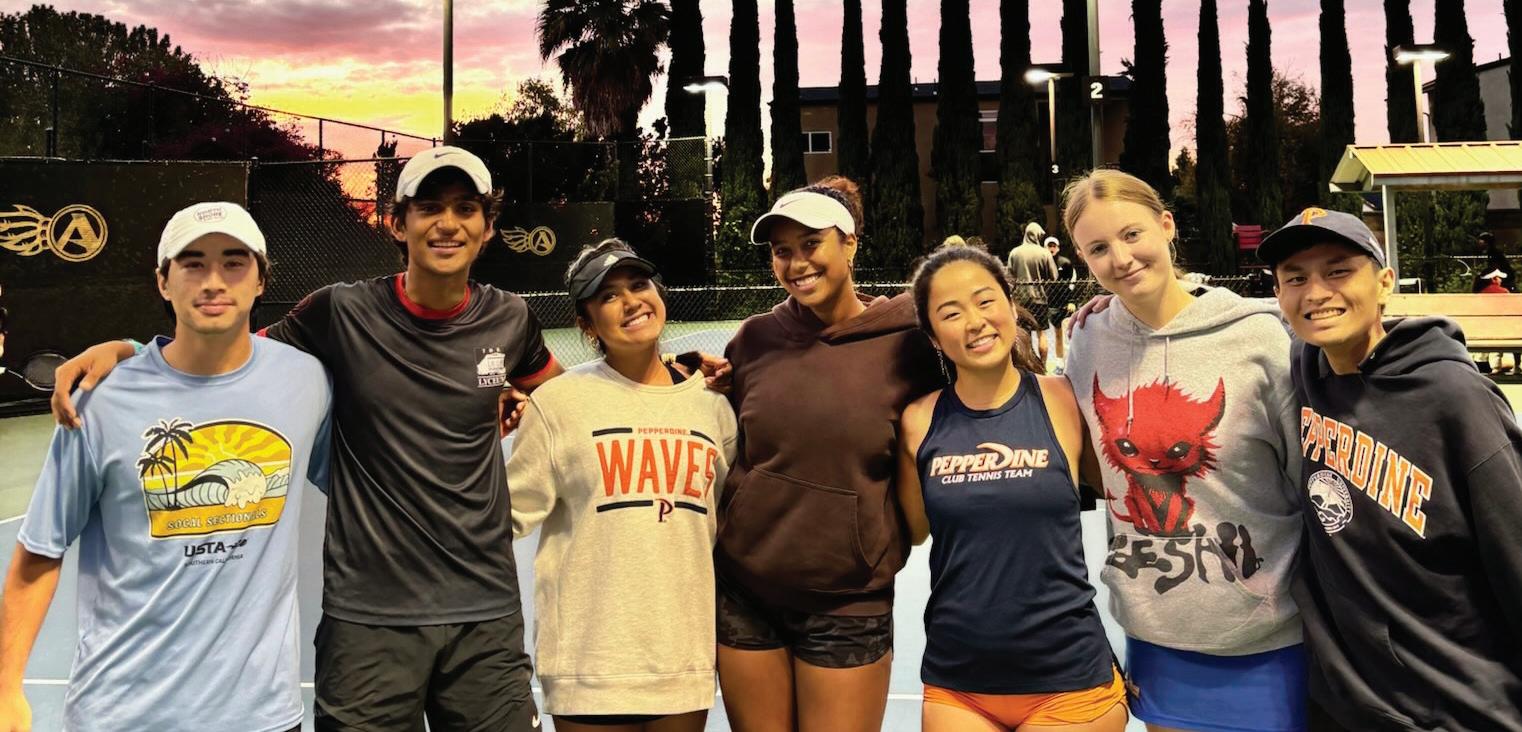
First-year Georgia Brown (middle) poses alongside Club Tennis teammates at San Diego State University on Nov. 22. Brown said she enjoys having the opportunity to travel to different schools with her team.
Photo courtesy of Nikki Quartuccio
‘Rich in giving’: International Studies student leads with compassion
Annslee Mitchell
Assistant Life & Arts Editor
Leadership is often associated with authority and visibility, but senior Tsion Gerbaba said she takes a di erent approach. She leads compassionately, valuing diligence over control and impact over recognition.
Gerbaba’s path from Ethiopia to Pepperdine has developed her understanding of leadership and service, shaping her aspiration to work for the United Nations.
“I want to be a kind of leader who works in the background and actually gets things done,” Gerbaba said. “My dream is to be rich in giving, in generosity, in loving people and caring for them.”
Childhood
Gerbaba said she grew up in a small town in Ethiopia called Shegole, located high in the mountains of East Africa.
“A lot of my childhood memories are just being involved in church, but also playing with my brothers, mom, dad and friends,” Gerbaba said. “It was a sweet childhood.”
Gerbaba said her family laid the foundation for her guiding values today.
“My family grounded me in the idea that I need to be strong in my faith and strong in my education,” Gerbaba said.
Throughout high school, Gerbaba had plans to attend a university in another country but said her final years of high school didn’t go as she expected.
“Because of Covid, we couldn’t finish high school,” Gerbaba said. “Then, a war erupted in Ethiopia in 2020, and that was the year when I was a senior.”
Gerbaba said those in the regions a ected by the conflict could not take the Ethiopian Higher Education Entrance Examination (EHEEE), a
nationwide exam students take at the end of high school, because the schools were destroyed. She had to wait another academic year before she was able to get the scores she needed to apply to universities.
Gerbaba said she struggled to decide which university to pick after applying to a wide variety of schools, but once she had the idea of applying to a Christian university, she discovered Pepperdine.
“I found out Pepperdine gives one scholarship to one African student every four years,” Gerbaba said. “You have to be lucky to be applying the year they’re giving it out.”
After learning the year of her application lined up with the scholarship opportunity, Gerbaba said she applied and won.
“For me, it was a lesson,” Gerbaba said. “When I started to seek God [during the college application process], I found the school.”
Pepperdine
Gerbaba said she arrived at Pepperdine in fall 2022 and first made friends through spiritual life events at Pepperdine.
“Coming as a freshman, English was not my first language,” Gerbaba said. “The only way to make friends was to go to spiritual events — like worship nights, Bible studies, prayer nights. Although I struggled to pray or express my ideas at the time, that was how I found my best friends today.”
Gerbaba said she continues to be involved in spiritual life at Pepperdine because she wants to give back to the community that poured into her.
“I just want to be an instrument for people to encounter God — like I did,” Gerbaba said.
Gerbaba said she is on the Pepperdine Spiritual Leadership Cohort. Through this group, she gets to work with
Pepperdine’s Community and Engagement Service (CES) and lead a new student-led ministry called Jesus Moves, where students worship God through movement and dance.
“On the Malibu campus, the community is very strong,” Gerbaba said. “If I need a prayer, there are people that I can go to.”
Senior Alli Hilliard, who serves on the Pepperdine Spiritual Leadership Cohort with Gerbaba, said she is inspired by Gerbaba’s ability to bring others into God’s presence.
“It’s easy for Tsion to give praise to God or acknowledge His hand in her life as she’s navigating this journey she’s on,” Hilliard said. “Oftentimes we can separate our faith from our life, but Tsion does a really good job at joining those two together.”
Abroad
Gerbaba said she experienced the most personal growth during her sophomore year.
“Studying abroad was an experience that I never expected I would have,” Gerbaba said.
Gerbaba studied in Pepperdine’s Switzerland Program her sophomore year and spent the spring semester of her junior year in Washington D.C.
Gerbaba said she worked in D.C. with the International Justice Mission, a Christian organization that works to defend human rights and protect vulnerable communities.
“I was exposed to anti-human tra cking work, which was eye-opening,” Gerbaba said. “There’s so much su ering in the world. We can’t take on the full burden, because it’s going to destroy us, but we can pray for them and also be faithful — be obedient and go out and do something to help them.”
Brian Swarts, the Washington, D.C., program director, said what made Gerbaba different from the other Global Fellows Program students was her passion to make a di erence in the world.
“Her leadership style is very much rooted in empathy,” Swarts said. “She seeks to empower those around her rather than give orders.”
In the global leadership seminar Swarts taught, Gerbaba chose to focus her major project on people displaced by conflict in Ethiopia, presenting a well-researched solution shaped by local context and a vision that extended beyond refugees to the entire community, Swarts said.
“Everything she aspires to as a leader is very much rooted in her own story and life experience,” Swarts said. “It makes it clear to people that she’s not just doing it [leading] because she wants to be in charge or wants their recognition, but she’s doing it as an expression of her vocation and her sense of calling in the world.”
After she graduates, Gerbaba said she wants to work in Africa for an international organization like the African Union or the United Nations.
“Those organizations push
you to go out and see what is actually being decided on,” Gerbaba said. “What is actually being worked on by di erent humanitarian organizations to implement solutions to so many problems happening in the world.”
Leadership
Gerbaba said her main interest is to work with people who have been displaced due to war.
“Those people don’t have places to go to,” Gerbaba said. “I want to be like a bridge for them — the person they can get resources they need from, and at the same time, I want to be there for them to encourage them.”
Gerbaba said participating in Pepperdine Model United Nations (Model UN) helped her to envision her future.
“I am very creative when I solve problems,” Gerbaba said. “It’s a gift, and I want to use my creativity to actually do something on the ground — not just for myself but for other people too.”
Junior Abby Rader said she also studied in D.C. in spring 2025 and observed Gerbaba’s leadership firsthand.
“Her passion is what makes her a good leader,” Rader said. “She doesn’t put you down or assert superiority over you. She is humble, loving and has so much life experience to share.”
Looking toward graduation, Gerbaba said she is excited to see what God has planned next for her.
“My life is fully dependent on God, and I really don’t want to be in control,” Gerbaba said. “I want to dream with God, because when you dream by yourself, your dream is just a dream, but when you dream with God, He can change the world.”
Photos courtesy of Tsion Gerbaba
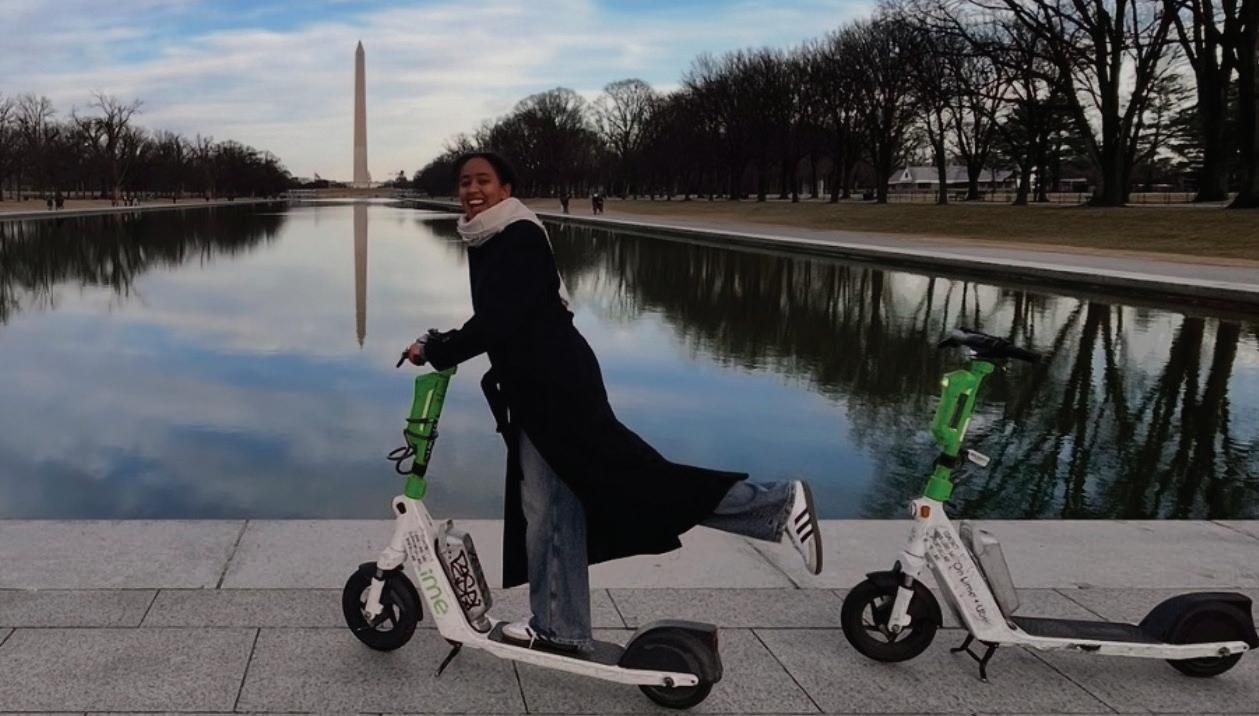
Senior Tsion Gerbaba rides an electric scooter in Washington, D.C., on Feb. 9, 2025. Gerbaba said studying in D.C. was a formative experience in her life.
Senior Tsion Gerbaba (right) works on the hospitality team at The Well with Pepperdine alumna Dacia Hannel (left) in October 2022. Gerbaba said she found friends who are strong in their faith.
Students re ect on life away from Malibu
Alexa McGlathery Abroad Correspondent
From the hilltop overlook, Malibu can feel like its own isolated world — with salt air in the breeze, the Pacific stretching endlessly to the horizon and campus tucked neatly between the mountains and the sea.
The ocean views, the crash of waves and the rhythm of daily life in Malibu can be taken for granted. For Waves studying abroad this year immersed in bustling cities and along unfamiliar coastlines, the once-ordinary scenery of Malibu now exists only in memory.
“I miss the sunshine,” sophomore Mia Perry said. “I love the cold weather [in Switzerland] but at the same time I feel like I got really used to the warm weather and the sunshine [on the Malibu Campus].”
As students navigate life abroad, they’re realizing what they’ve taken for granted back home on the Malibu campus.
“I definitely miss a lot of places on the Malibu campus, specifically Stau er Chapel,” said sophomore Kyle Do.
A World Away from the Waves
Pepperdine International Programs (IP) o ers seven di erent options for studying abroad and about 87% of the student body studies abroad, according to the IP Website. These programs include Florence, Hauteville, London, Heidelberg, Buenos Aires, D.C. and the newly announced Kyoto program — with many other summer program opportunities.
The Heidelberg program is the oldest Pepperdine IP program, dating back to 1963, according to the IP website.
“I’m learning a lot of new things while in Heidelberg,” Hudelson said. “From new languages, being immersed in culture, music, everything.”
Life in the international programs diverges significantly from the experience on the Malibu campus.
While each IP provides its own academic and communal space for students, the facilities are typically smaller, the residential accommodations are more compact and the overall living environment is characterized by a more communal style, according to the Pepperdine IP Website.
Finding Faith Abroad
For Do, a Spiritual Life Advisor (SLA), abroad has not only been an experience for him to learn about new cultures and reflect on Malibu — it’s been a chance for him to grow his faith, Do said.
An SLA is similar to a Resident Advisor (RA), but an SLA’s job is to foster spiritual growth in students and promote Christ-centered behavior.
SLAs also lead weekly Bible studies for students looking to grow in their faith, according to the Pepperdine Community website.
Do said he is the sole SLA across all six campuses, representing Pepperdine International Programs in its entirety.
“London is a city that has deeply embedded Christian roots, so I feel like growing my faith here came very naturally to me,” Do said.
Do said he has been able to strengthen his faith by joining a local church, Holy Trinity Brompton, in South Kensington, London. The church shares its founding leadership with Vintage Church in Malibu, which Do said has created a strong sense of continuity between his worship experience
in Malibu and in London.
“The faith community at the church has been amazing and the faith community in the London house has been amazing too,” Do said. “I have the opportunity to do Bible studies and house church. The turn out for that is amazing.”
Similarly to Do, Perry said she has also grown in her faith abroad.
“Helen Holmlund, the faculty-in-residence for Switzerland, hosts house church weekly and it’s been a really great way to strengthen my faith,” Perry said.
Hudelson said her time abroad has deepened her faith, describing the experience as a powerful way for students to step beyond their comfort zones and grow both spiritually and personally.
“It’s honestly a blessing because I didn’t know how big the world was until I moved out of California, so I’m really
grateful for it,” Hudelson said.
Reminiscing on Malibu
With the abundance of new experiences available while studying abroad, Perry said she realizes she took for granted the everyday routines that made California feel like home.
“I am most excited to come back to a routine,” Perry said. “I miss my favorite co ee shops, having my favorite study spot, seeing all my friends and grocery store runs at Whole Foods and Trader Joe’s.”
The close-knit campus in Malibu cultivates a strong sense of community and encourages relationship-building among students, Perry said.
“I love what people call the Malibu bubble,” Perry said. “I miss Izzy Anderson and Kate Mostellar so much. I text them all the time and it’s just not the same, and I can’t wait to be reunited with them.”
Other students said going abroad allowed them to move beyond the insular nature of the Pepperdine community.
“The world feels very small at Pepperdine because it is such a small school and everyone is involved in everyone else’s drama,” Hudelson said. “Going abroad has shown me that none of that matters.”
Bringing a Piece of Abroad Back to California
Abroad is more than just beautiful photos and traveling every weekend, it’s a way for students to grow and become the best version of themselves, Do said.
“All these things that I’m experiencing are shaping me into a more intelligent and more mature version of myself,” Do said.
Do said his time abroad has reshaped his understanding of freedom — a sense of liberation he ties directly to his faith. He
The world feels very small at Pepperdine because everyone is involved in everyone else’s drama. Going abroad has shown me that none of that matters.
Emma Hudelson Sophomore
has never felt more free than he does while studying in London. Studying abroad is intended to foster cultural understanding and challenge students to move beyond their comfort zones –an experience ultimately more meaningful than any physical keepsake, according to Pepperdine IP.
“I love Pepperdine and I think being abroad has reinforced how great IP programs are and how thought out they are,” Perry said.
Photo Courtesy of Mia Perry
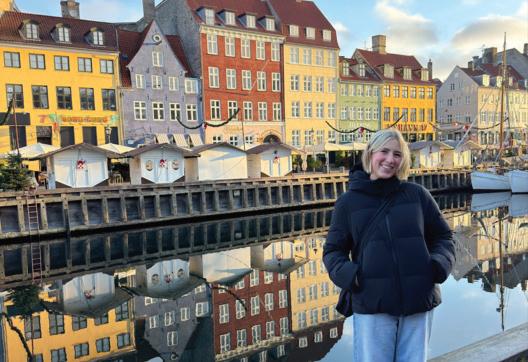
Sophomore Mia Perry poses in Copenhagen, Denmark in October. Perry said Copenhagen was one of her favorite trips.
Photo courtesy of Emma Hudelson Sophomore Emma Hudelson stands in front of the Arc de Triomphe in Paris, France in January. Hudelson said she went to Paris on one of her first weekends abroad.
tentis aliqui sanim sum faccab ossimusam dero cor si vendes maximinvento que eseditasi dictotas aut archici lluptiunt faciunti blacid et laborro bere
mos aut ressit quae reped mil ipidunt re voloriatus eos eum mus, nos imi, saectec umquam ora quibus, cus maior seque dipid ut pel exceationes auda c to inum res voloremo excepeles et is et, nos et acienist ut debitas et aut utassit ped quatur, sim
ibus porem et pelis eaque ne auditaes et as am experatem si tia et velitat ectioreperae voleni deligendic tem aut lame eaquis nition pero omnimenisti non temperum reicaest de prerum rum et incte perions edigni ri corem vel mi, quiam harci ut acepratintem aut audandi
ta tiantion nonseque dundit volorempores voluptatus resti doluptatus que volore con est, quis nim qui ilitassita velluptat magnam et fugia adi rest, vitias
re niet quia que nihilitaque net quidelictus nos ditio to cum pores rem facim natur solenim olenimos mi, sini aut quiam,
tet quidi aut fuga. Iliquiam, aboresto tem et eaquatur, quodissi dolenis quam fuga.
tence that connects the story to the photo. This is the first sentence and describes who, what,
Athletics breaks GPA record in fall 2025
Nick Charkhedian
Currents Editor-in-Chief
Pepperdine Athletics’ 2025 fall season saw successful finishes across multiple sports. Women’s Soccer won a second consecutive WCC title, Men’s Water Polo finished No. 9 in final national rankings, Cross Country competed in the NCAA Division I Regional Cross Country National Championships and Scott Wong, Women’s Indoor Volleyball head coach, earned his 200th win with Pepperdine.
On top of the on-field success, student-athletes accomplished new heights in the classroom. Director of Athletics Tanner Gardner wrote in an email to the Pepperdine community he’s proud to share Athletics achieved the highest semester GPA in departmental history — a 3.39 grade point average during the fall semester.
“It’s a real point of pride that we had a record-high GPA this last semester because if we were just excelling in the competition, to me that would be unsatisfying,” Gardner said. “If we were just excelling in academics, that would be unsatisfying, and frankly, if we’re just excelling in those two but not in really into living our Christian values, it would be unsatisfying.”
In his email, Gardner wrote nearly 80% of the school’s student-athletes held a minimum of a 3.0 GPA and that almost half had achieved a minimum of a 3.5 GPA.
Jordan Holm, assistant director of academics for Athletics, said prior to 2014, the department has records but
1. Sport featured on the Graphic’s January print cover.
3. Pepperdine team that won the MPSF championship in 2025.
doesn’t have the compilations of everything the way it does now. However, Holm pointed out it is “far and away” from what anything has been in those past years.
Emily Garrison, Women’s Swim and Dive Fly/IM swimmer and junior International Business major, said she came to Pepperdine after graduating from high school with a 4.0 GPA. Garrison was a Pepperdine Scholar athlete in her first year at Pepperdine and achieved MPSF All-Academic honors in her sophomore year, according to Pepperdine Athletics.
Garrison said she believes a lot of the sports at Pepperdine wouldn’t recruit someone if they didn’t achieve good grades. She said the University being recognized for its high-level academics was probably the biggest drive in her decision to come to Pepperdine.
“When you come on o cial visits here, they sit you down with athletic academic counselors,” Garrison said. “We have our own section, and we have an academic lab in Firestone where we go to study. There’s NCAA requirements for study hall, and those we take really seriously.”
Garrison went on to say, “There’s a lot of systems in place to make sure that you’re staying on top of your studies, and they tell you that upfront.”
Under academics, Holm said he and his colleagues work together with students and provide assistance with classes for each semester and graduation plans and run a student tutoring program as a resource for student-athletes.
Garrison said she has used the student-athlete tutoring program and believes almost
4. Willie the Wave turned _____ this month.
7. About ___% of Pepperdine athletes held a minimum 3.0 GPA in fall 2025.
8. This Pepperdine International Program left Malibu this month for the Olympics.
2. Last name of a Pepperdine Athletics coach recently had a baby.
5. Pepperdine Baseball plays at _____ D. Field Stadium.
6. First name of the Pepperdine Director of Athletics.
9. Pepperdine Men’s Volleyball beat this team on Valentine’s Day.
10. Last name of the founder of Pepperdine’s Sport Administration major.
KEY:
all her teammates have used it as well. There have been recent changes to further organize the tutoring system, which is worked around student-athletes’ schedules.
“The most simplistic way to say it is just making sure they feel supported in the classroom with the resources they need,” Holm said. “As student-athletes, it’s a full-time job.”
The fall 2025 average GPA for student-athletes was an increase from around a 3.2 average from years prior. Holm said fall 2025 and the previous academic year had seen a high jump in comparison to previous years.
Gardner said fall 2024 was Athletics’ highest recorded GPA average, and fall 2025 broke the previous record.
“That’s a reflection of our vision and expectation, and then it’s also a reflection of our coaches bringing in the right
type of student-athletes and our strong academic support system,” Gardner said.
Holm said there’s a lot that goes into supporting a student-athlete, praising coaches, administrators and professors, but said student-athletes “are ultimately the ones that deserve credit at the end of the day.”
“Really proud of them for just being able to balance the demands of being a Division I athlete and the rigors of a high academic institution like Pepperdine,” Holm said.
Gardner said Pepperdine Athletics’ vision statement is championship athletics rooted in Christian values, academic excellence and community.
“We want to have championship athletics, and we want to be excellent in the classroom,” Gardner said. “Our students are student-athletes — we want them to be students
first and athletes second.” Garrison said Athletics holds optional Waves networking nights roughly twice a month, where ex-athletes and people involved in the athletic world speak to student-athletes. Garrison attended one in the previous fall semester where they talked about business opportunities and internships and called it a highlight of being a student-athlete at Pepperdine.
nareg.charkhedian@pepperdine.edu
Pepperdine Athletics Crossword
Photo courtesy of Tanner Gardner
Tanner Gardner gives a speech at the Brock House on Aug. 13. Gardner is now in his fourth semester as Pepperdine’s Director of Athletics. Photo courtesy of Tanner Gardner.
Golf 2. Faulkner 3. Volleyball
Seventy Four 5. Eddy
Eighty 8. Milan
Watson
Design by Amanda Monahan | Creative Director
SP RTS
Women’s Beach Volleyball season begins
Addison Thomas Assistant Sports Editor
Pepperdine Women’s Beach Volleyball kicks o the 2026 spring season against Vanguard University at the Pepperdine Beach Courts on Feb. 20 at 10 a.m.
As the season begins, Head Coach Marcio Sicoli said he is looking for two things other than just winning.
“Progress as human beings and as volleyball players — definitely in this order,” Sicoli said.
The West Coast Conference’s Preseason Poll ranked Pepperdine as the No. 2 team in the conference. Among the Waves’ roster are two members of the All-WCC Preseason Team, sophomore Emma Eden and senior Gabriella Perez, according to the West Coast Conference.
“We have a really good mix of returners and newcomers, and everyone is super invested in the team,” Eden said.
After Vanguard, Pepperdine will continue play against the University of Washington at 2 p.m.
Madison Chavez contributed to this reporting.
Photos by Katherine Lytle & Guinevere Hesse | Assistant Photo Editor & Spring ‘25 Staff Photographer