THE PEPPERDINE GRAPHIC



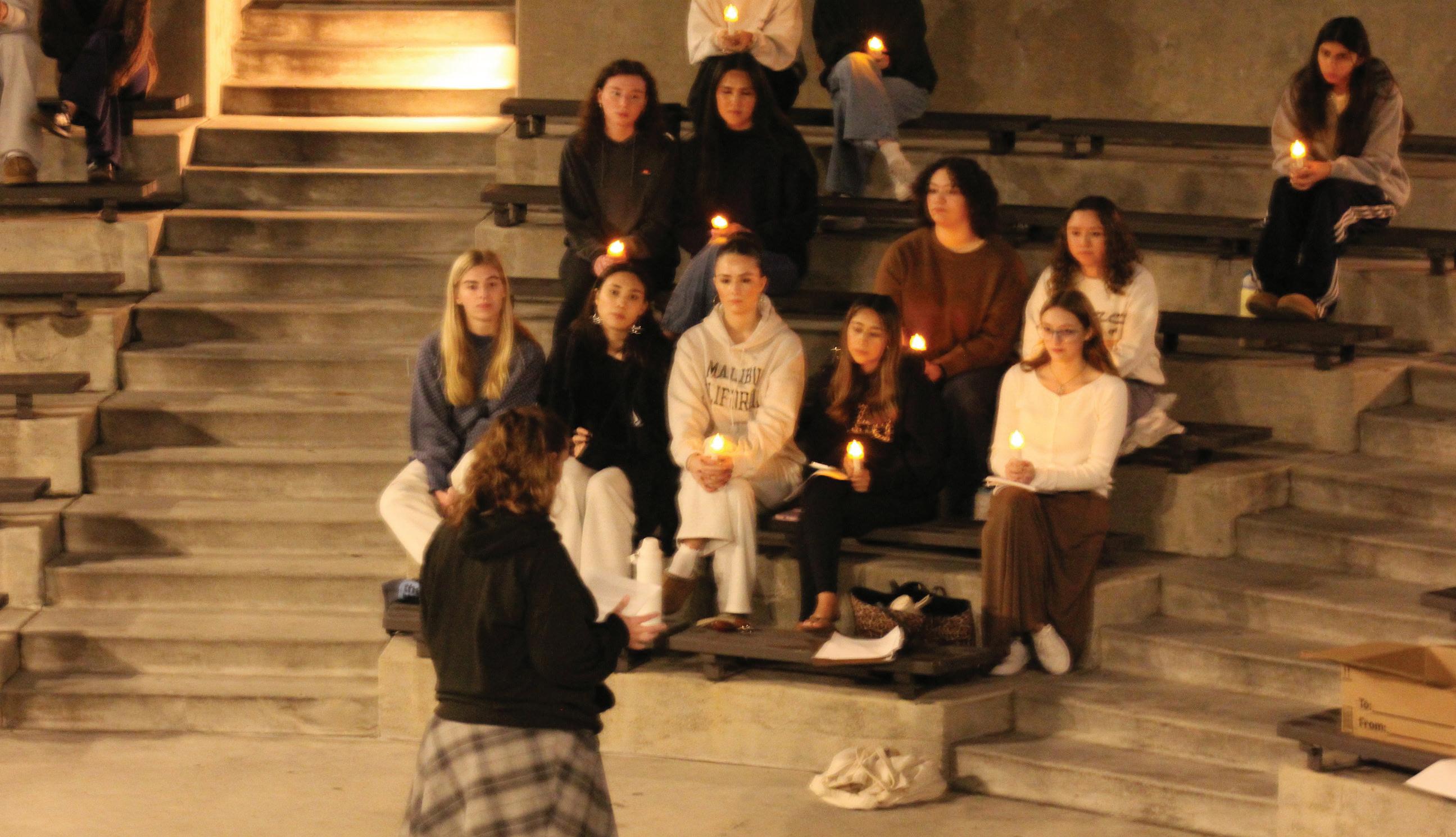
Pepperdine College Democrats hosted a vigil honoring the life of Renée Good in the Amphitheatre on Jan. 22. Several students spoke about the politics that led to the fatal shooting.
College stops being fun because the human brain adapts. Perspectives Staff Writer Hana Wadlow explores how habituation, anticipation and mindset shape happiness.
Pepperdine students use Rate My Professors to figure out which classes they should take. The website offers anonymous but sometimes skewed perspectives of college professors.

ReelStories Film Festival 17
Pepperdine’s 17th annual student film festival will commence at 6 p.m. RSVP required.
Arik Housley Book Talk
Arik Housley will speak about his 2025 memoir. Housley is the father of Alaina Housley, the Pepperdine student murdered in the 2018 Borderline Bar & Grill shooting. RSVP required.
Oncology Symposium 2026
From 8 a.m. to 3 p.m., the Natural Science Division will host the inaugural Oncology Symposium. Community members can hear from leading experts in cancer therapy research. RSVP required.
President’s Speaker Series
The speaker series will return at noon to host Jeremy Wayne Tate, CEO of the Classic Learning Test. RSVP required.
Alicia Dofelmier Life & Arts Editor
Over my past four years here at Pepperdine, I’ve grown a lot. But when I think about who and what enabled me to grow so much, most of my experiences lead me back to the Graphic.
When I joined the Graphic my first year during Waves Expo, I had no idea what to expect.
My first year on the Graphic is honestly kind of a blur, but I remember writing my first story, sitting down with my editor to go over it and wondering what on Earth I had signed up for.
Similarly, I remember when I designed my first page, I felt like I wanted to cry because everyone around me seemed to know what they were doing.
But, if anything, that first year made me become comfortable asking questions and asking for help.
I spent my sophomore year abroad, and when I came back, I had no idea what to expect. I left at the end of my first year having enjoyed my time with the Graphic but not really feeling connected to it.
But, from the moment Our Big Week (OBW) began my junior year, I knew I had found a home.
I learned how to become comfortable not knowing everything and became more confident in speaking up.

At the end of my junior year, I applied for a senior leadership position. Applying had never been on my radar because I wasn’t sure I could do it. But I put my fear aside and became Associate Editor for the first semester of my senior year.
Now, I’m currently serving as Life & Arts Editor, which is exciting and terrifying. I remember my first year watching my editor, Sam Torre, read the stories during budget and thinking to myself, ‘That is not something I ever see myself doing.’ This is ironic considering that is exactly what I am now doing every week.
Again, I’ve had to quickly learn to become comfortable with the uncomfortable and know that I am more than
“Pepperdine Graphic Media (PGM) is an editorially independent student news organization that focuses on Pepperdine University and the surrounding communities. PGM consists of the digital and print Graphic, a variety of special publications, GNews, Currents Magazine, social media platforms and an Advertising Department. These platforms serve the community with news, opinion, contemporary information and a public forum for discussion. PGM strengthens students for purpose, service and leadership by developing their skills in writing, editing and publication production, by providing a vehicle to integrate and implement their liberal arts education and by developing students’ critical thinking through independent editorial judgment. PGM participates in Pepperdine’s Christian mission and a rmations, especially the pursuit of truth, excellence and freedom in a context of public service. Although PGM reports about Pepperdine University and coordinates with curricula in journalism and other disciplines, it is a student (not a University) news organization. Views expressed are diverse and, of course, do not correspond to all views of any University board, administration, faculty, sta , student or other constituency.”
qualified for my position. Every single experience up in the CCB Newsroom has irrevocably shaped my college experience. I’ve made some of my closest friends up here, such as Betsy Burrow.
I’ve also grown as a writer, editor and designer and developed invaluable relationships with my advisers: PGM Assistant Director Courtenay Stallings, Prof. Christina Littlefield and Prof. Elizabeth Smith.
I will always thank firstyear Alicia for signing up for the Graphic because this community has become a gift of the unexpected.
alicia.dofelmier@pepperdine.edu
Oliver Evans News Assistant
Housing and Residence Life (HRL) converted several Seaside dorms into triple-bedrooms last semester. With the second semester underway, students and HRL sta can reflect on the decision and how it is a ecting the first-year experience.
The benefits of living in a triple, such as having more roommates for more diverse perspectives, far outweigh the negatives, triple-bedroom residents in Seaside said. The main downside is that there is less storage space when compared to a traditional double bedroom.
“It’s a great opportunity just to get multiple people in your room to bond with,” first-year Thomas Wiedensohler said. “Especially if you’re coming from a smaller household.”
HRL has a general target number for admissions next fall, but that number can sometimes be a moving target, said Brittany Skinner, associate dean of Student A airs. The larger first-year class this fall meant the University had to get creative with housing, and with a smaller incoming class next fall, not as many people may need to be placed in Seaside.
“The size of every class impacts our housing in a kind of four-year ripple e ect,” Skinner said.
Students who choose triples receive a $1,400 discount on their housing, according to previous Graphic reporting.
“One reason for a triple is to have something at maybe a di erent cost point,” Skinner said. “We don’t want that to be the only reason students choose a triple.”
If a resident leaves a triple
and only two people remain, it does not accomplish what HRL wants from a business and residential perspective, Skinner said. HRL wants residents to experience living with an additional person to build that community.
HRL has a lot of ideas if the University keeps triples for another year, Skinner said. For instance, would the University o er them to sophomores instead of first-year students?
“We’ve done triples on our campus, in di erent areas and with di erent students,” Skinner said. “Some of it is both data research and kind of what’s trending, and then trial by error.”
Asking those questions and seeing how it went for students is going to help the University decide, Skinner said.
When RAs in Seaside found out at the beginning of the year they would have residents in triples, they were surprised, said Suha Lim, a Seaside resident director who oversees the first-year section. RAs have adopted the idea that they will be seeing three people in these rooms, rather than two.
“Because there aren’t a lot of rooms with triples, RAs are actually able to give them more specialized attention,” Lim said. “Almost because they remember the triples more.”
Junior and Resident Advisor Isaiah Grey said he noticed these rooms felt very stu y and claustrophobic when he did knock-and-talks. During most of these knock-and-talks, the triple residents would be out of the room because it is hard for all three of them to work on things together.
“I’ve heard complaints, just minor complaints,” Grey said. “People just saying that there wasn’t enough space to keep all of their stu .”

Photo by Oliver Evans | News Assistant
The
given a choice at a lower price point; rather, they
Skinner said she does not think all of the triples in Seaside are full. HRL has received no feedback that suggests students want to move because of the triple experience.
“These spaces are very manageable for the amount of things students bring,” said Lim. “But definitely, I think minimalist is better.”
There was a situation in which a triple room became a single because two residents moved out, Lim said. It gave the resident, who still resided in the triple, the opportunity to invite two other friends because they felt it was a safer environment.
Grey said continuing to provide triples to students who cannot a ord regular housing is a solid option. However, he would advise against the trend of turning more doubles into triples.
“If anything, it would just be the seven rooms that we did,”

“One of the benefits of having a triple is having a little triangle relationship. I love having multiple people to talk to, getting multiple perspectives.”
Thomas Wiedensohler
Seaside Triple Resident
Skinner said. “Would we just continue to leave them as triples?”
With a smaller first-year class, there might be an opportunity to try triple bedrooms with second-year students, Skinner said.
The biggest issue is the lack of space because he likes to play instruments, first-year Hayden Chow said. He had an electric drum set that he decided not to bring back after the fall semester because it was taking up too much space.
One roommate was considering moving out but ultimately decided to stay because he liked the other residents, Chow said.
First-year Lauwidson Pangaribuan said he faces challenges in his triple when he wakes up for his 8 a.m. classes. He said he was afraid to wake up his roommates when he climbed down from his bunk and would accidentally drop things on the ground.
Wiedensohler said he felt
his academic life improved because his roommate was also a musician, and because Wiedensohler’s classwork involved a lot of guitar work, they could jam together. Most of his studying was done in the Seaside lobby. When one of his roommates moved out, he could not tell the di erence in terms of space.
Pangaribaun said his decision was heavily influenced by the financial soundness of selecting a triple rather than a double. Additionally, he said that he thought having a third roommate would help him connect with others on campus.
“I feel like nothing really changed,” Pangaribuan said. “I feel like I’m just as in the community as I would be if I were in a double.”
Even with the challenges of being in a triple, the good outweighs the bad, Pangaribuan said. He would not have had as much fun if he were in a double.
“One of the benefits of having a triple is having a little triangle relationship,” Wiedensohler said. “I love having multiple people to talk to, getting multiple perspectives.”
Marcos Lizarraga Assistant News Editor
Transparency Item: Gabby Sebastiani, social media manager for Pepperdine Graphic Media, also manages social media for Pepperdine College Republicans.
Among the nearly 100 clubs on campus, the Pepperdine College Democrats and College Republicans chapters invite students to engage in political dialogue and civic participation.
Despite political di erences, both clubs prioritize fostering community across the political spectrum.
“A common misconception is that this club is only for Republicans,” said Anthony Tokatlian, the College Republicans’ outreach chair. “It’s for people of all political backgrounds who want to learn more about politics and what our ideologies are.”
On Jan. 22, the College Republicans hosted their first
event of the semester. Senior Audrey Riesbeck, the chapter’s president, leads the club in building community through events and conversations about conservative ideas, according to Peppervine. Riesbeck declined to comment for this story.
The College Republicans opened their first gathering with a 36-question Kahoot quiz celebrating the upcoming 250th anniversary of the United States’ independence.
Tokatlian said events like these help the club build a stronger sense of community.
“College Republicans are here to foster a community of like-minded conservative individuals,” Tokatlian said. “Our club is very event-focused, and we host meetings to cultivate a sense of community where people can build ideas o each other and talk about politics without fearing any pushback.”
Over the past semester, the College Republicans attended Eric Trump’s book signing at the Ronald Reagan Presidential Library and hosted conservative commentator Elisha
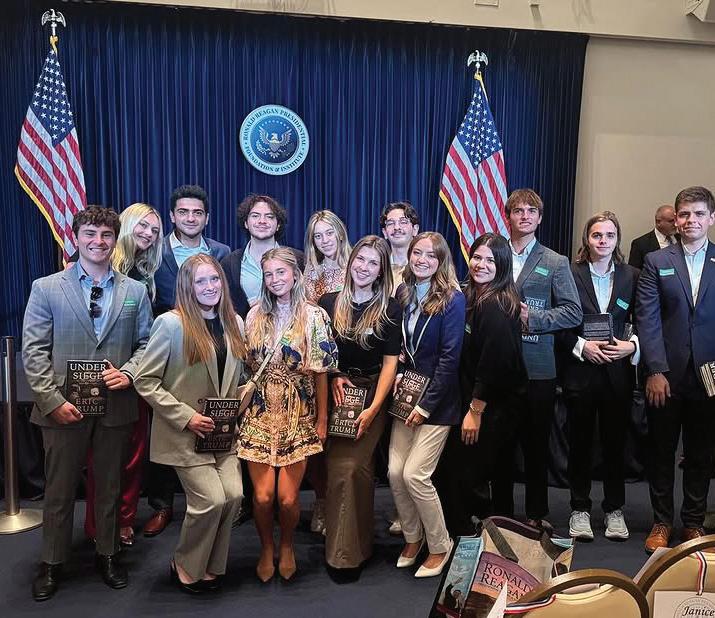
Pepperdine College Republicans attend Eric Trump’s book signing at the Ronald Reagan Presidential Library on Oct. 19. The event surrounded Trump’s new book, “UNDER SIEGE: My Family’s Fight to Save Our Nation,” according to the Reagan Foundation.

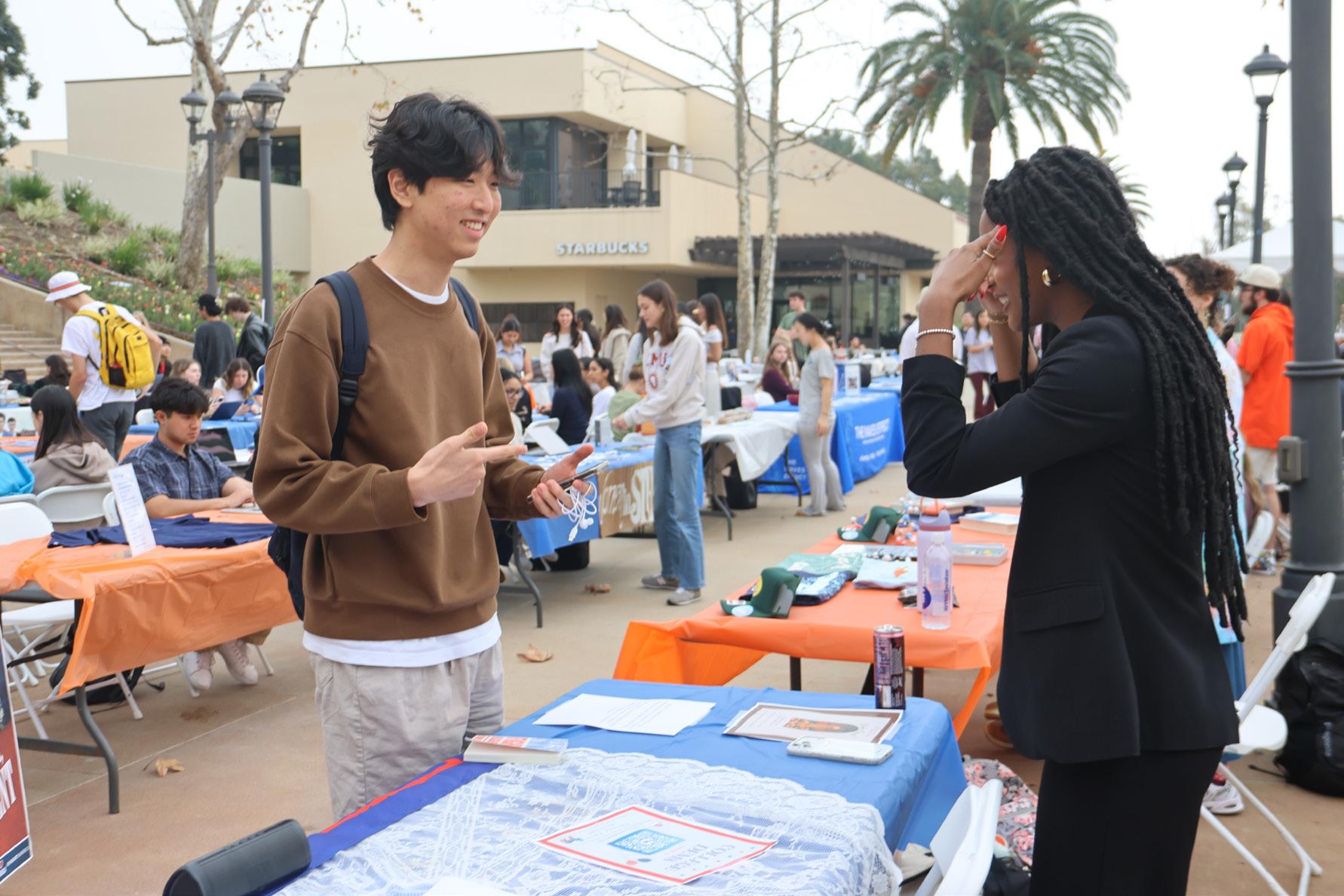
their recruitment efforts.
Krauss, whose lecture “Yes, All Women” presented her opinion on how the progressive movement claims to empower all women while often silencing or dismissing conservative voices.
Tokatlian said the club intends to continue bringing political figures to campus over the course of the semester.
“We’re just hoping to grow the community,” Tokatlian said. “We want to cultivate more exciting events and connect with influential speakers that can make a big di erence.”
Among the political figures the club plans to host is California gubernatorial candidate Steve Hilton, who is campaigning to “make California golden again” in the 2026 race, according to Hilton’s campaign website.
The College Democrats held their first meeting in the Appleby Center on Jan. 21, welcoming new and returning members. Senior Anniah Smith, president of the chapter and a Graphic Perspectives sta writer, provides an environment that facilitates individual growth and autonomy while fostering social responsibility within the larger campus community, according to Peppervine.
After introductions, the executive board led a news recap covering national and local stories — from the recent shooting of Renée Good to the upcoming 2026 midterm elections.
Junior Molly Sams, treasurer of the College Democrats, said the club has a semester-long goal of increasing awareness and encouraging student involvement in local issues.
“This club’s about raising awareness for issues on campus, particularly more liberal
and Democratic issues,” Sams said. “We want to get students engaged in political conversation and support some form of activism — within the bounds that still support the Christian mission of the school.”
Smith, who said she has attended private Christian schools her whole life, is familiar with navigating both faith and politics.
“Operating in a space like Pepperdine, where politics and being Christian are associated with one side, isn’t exactly new to me,” Smith said. “I wanted to make people proud to share their opinion — whether that be Democrat or something else — and not feel like they have to hide it.”
That sense of purpose, Smith said, has shaped how the College Democrats see their role within Pepperdine’s community.
College Republicans are here to foster a community of like-minded conservative individuals.
Anthony Tokatlian Outreach Chair of Pepperdine College Republicans
“I want people to know that it’s OK if you don’t think the same as everyone else,” Smith said.
Smith said fostering empathy and understanding is important when discussing
sensitive political and social issues.
“Everyone should be entitled to process their emotions or feel a sense of community,” Smith said
On Jan. 22, the College Democrats put that belief into action by organizing a vigil for Renée Good in the Amphitheatre.
While di erences exist among political organizations on campus, Smith said interactions with the College Republicans have been largely positive.
“Because we’re such a small school, we have to engage with each other,” Smith said. “They’ve always been nice to me, and they’ve always reached out to me. We’re actually planning an open forum with all of our presidents.”
Tokatlian also said the College Republicans value maintaining respect for political organizations on campus.
“There’s no bitterness between any of the clubs,” Tokatlian said. “We tabled last semester right beside College Democrats, and it felt like a very safe place. Our banner fell and they helped us tape it back up, and we likewise helped them.”
Henry Adams News Editor
Editor’s Note: The Renée Good vigil took place the night before ICE agents fatally shot Minneapolis resident Alex Pretti.
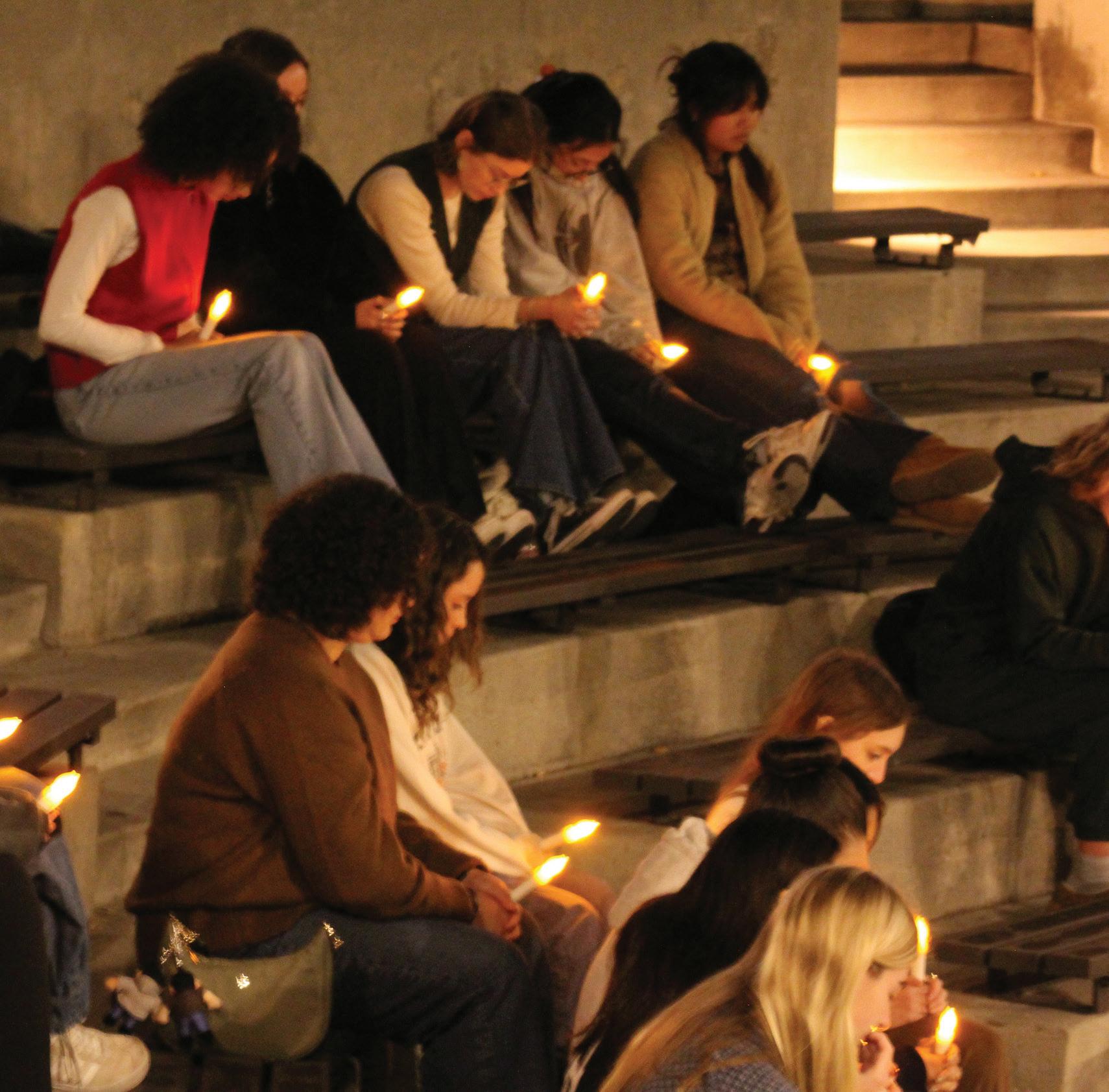
Around 30 community members gathered in the Amphitheatre for a vigil honoring the life of Renée Good on Jan. 22.
Several students and one faculty member spoke during the event, organized by the Pepperdine College Democrats after a U.S. Immigration and Customs Enforcement (ICE) o cer in Minneapolis fatally shot Good in her car, according to the Minneapolis Star Tribune. The killing prompted anti-ICE protests across the nation, according to NPR.
“We wanted to marry Pepperdine’s Christian ideals of service, of community, of honor with the grief that we’re all feeling,” said senior Anniah Smith, president of the College Democrats chapter and a Graphic Perspectives sta writer.
Attendees, among them two professors, were handed battery-powered candlesticks to hold throughout the evening vigil. Smith opened the event by speaking about how the killing was a “deeply terrifying moment,” regardless of political beliefs.
“Community is the best way for us to fight back against the fear that we’re all so rightfully feeling,” Smith said. “That’s why I wanted us to gather all here today — not only in remembrance, but also to be support for one another because what we need more than anything is to depend on our peers.”
Christina Littlefield, professor of Journalism and Religion, gave a lengthy “prayer of lament,” while stressing that her presence was not intended to endorse any political party. Littlefield serves as the adviser for Currents magazine, which
belongs
to Pepperdine Graphic Media.
“Lord, we lament that this global instability and the brokenness of our own system has led to so much fear and hatred of the other, where immigrants are being dehumanized and denounced in harmful ways and used as scapegoats for all other ills, whether that be crime or economic hardship,” Littlefield said. “Lord, have mercy.”
Senior Annie Casey, the chapter’s vice president, then gave a speech where she profiled Good’s life. She said Good should be remembered for how she lived, not only how she died.
Junior Emma Moran, the chapter’s secretary, followed after. Moran, who got choked up during her speech, shared her personal anxieties about being an immigrant during this time. She said she was born in Peru and became a naturalized U.S. citizen at a young age.
“Getting the text from my mom asking me to start carrying around my passport in my backpack is something that I didn’t think would have to come,” Moran said. “I ask us to just think of compassion and empathy in these hard moments and as we pay remembrance to Renée Good and to many of the other lives that have been lost or harmed.”
After that, junior Ashley Burton, GSA Crossroads President and Graphic Perspectives Editor, spoke about the killing, emphasizing the ways Good’s queerness has been either “erased” or “weaponized” by di erent media outlets.
“I ask that you walk forward in your life and ask, ‘How can I be like Renée Good?’” Burton said. “‘How can I stand up for others around me?’ Join a club. Join an outside organization. Protest.”
Senior Carolina Dawkins led a second prayer before moving the crowd to take a moment of silence. Worship music then played over the Amphitheatre speakers for a few minutes
before junior Molly Sams, the chapter treasurer, spoke.
“We are coming together to grieve,” Sams said. “To grieve the loss of life, to grieve a nation that is pulling people o the streets and tearing families apart. A nation that will punish you for looking out for your neighbors, for protecting the members of your communities.”
Smith gave one final prayer to end the vigil before inviting attendees to write along the margins of a poster that said “#DoGood.” After the audience dispersed, Smith hung the poster on the nearby Freedom Wall, next to two other posters with infographics about ICE. Three written messages quoted or referenced Matthew 22:39: “Love your neighbor as yourself.”
henry.adams@pepperdine.edu


Lucy Andrews Guest Contributor
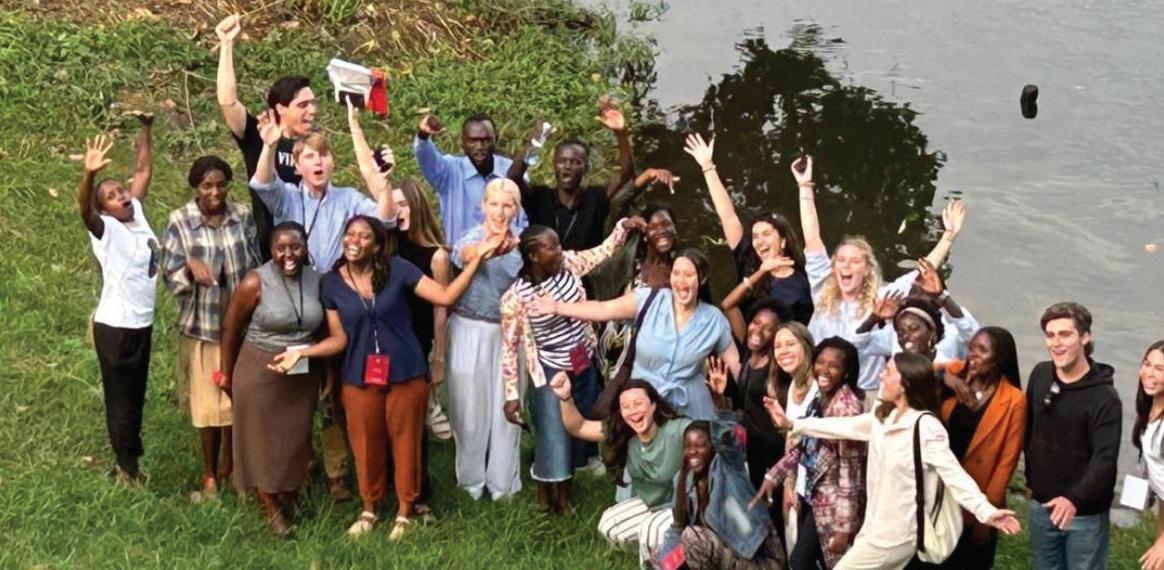
Being immersed in a foreign culture while being guided by Pepperdine faculty allows students to learn the intersection of foreign culture and Christianity in Japan, give presentations in the Wrens Museum in England and get baptized in the Nile River.
Unlike typical abroad programs, faculty-led programs are created by Pepperdine faculty members who design specialized courses to teach their students in new cultural contexts.
Students who have the opportunity to study their major in another country through a specialized faculty-led international program have a uniquely transformative experience that usually deepens their trust in their chosen path, senior History major Kat Johnston said.
“I knew I would love doing research, but I don’t think I realized how much spiritually I would be transformed by those experiences,” Johnston said.
Johnston said she felt the connection between culture and academics during her 2025 summer abroad with the Sudreau Uganda-Rwanda Justice Program (SURJ).
Faculty-led programs typically o er one-month long opportunities for a smaller selection of students compared to academic year abroad programs. This allows students to study in a variety of locations where Pepperdine does not own residential property, said Charlie Engelmann, senior director of operations of International Programs.
The selected group of students has the chance to experience a niche in their chosen field while being surrounded by new cultural contexts that o er unimaginable opportunities of growth and career development, Johnston said.
Faculty members who lead the programs go through rounds of editing and pitching to the International Programs o ce, which can result in successful faculty-led programs that find the intersection of passion, academics and student needs, said Nicole Gilhuis, assistant professor of History.
On average, IP hosts eight to ten faculty-led and specialized programs each summer, according to Pepperdine. The geography of the programs are just as diverse as the course o erings, which range from pre-medicine, sport administration, social justice and theatre.
When deciding which faculty-led programs move forward, the IP o ce takes certain Pre-Medicine and Theatre major sequences into consideration, Engelmann said.
“Sometimes we want academic o erings that are for certain majors that might have a harder time keeping the sequence to go for a full academic year in their sophomore year or majors that are even more limited,” Engelmann said.
Though Pepperdine’s academic-year programs remain a valuable experience, if the goal is to increase cultural awareness and understanding, shortterm programs may be an effective and practical option, according to the International Education Journal.
Johnston said she came home from Uganda, Rwanda and London in the same summer with a new sense of cultural awareness and aspirations.
“I feel like I knew what I was getting into, but I didn’t know how much it would rea rm my purpose, change my perspective on a lot of things,” Johnston said.
Johnston said the London Archival Research Program (INTAX) in July helped her pursue research in East African health care and get a head start on creating bibliographies and scanning sources for her senior thesis.
No two days were the same during the SURJ program in Africa, Johnston said. Some of her significant experiences were working with the law system, meeting a Supreme Court justice from Rwanda and working on the prison project in Uganda related to capital punishment cases.
I knew I would love doing research, but I don’t think I realized how much spiritually I would be transformed by those experiences.
Kat Johnston Senior
Johnston said her time in Uganda was interwoven with faith. A passing conversation about her sister’s baptism led to one her most cherished memories.
“I’ve been waiting a long time to be baptized,” Johnston said. “I was waiting for the right time and place, and there wasn’t going to be a better time and place than in Uganda. So we went down to the Nile River that afternoon and I got baptized. So that has been a really incredible experience for me, the most incredible memory.”
The speed of faculty-led programs creates a sense of
rush, but it is in the onemonth programs where people are stretched in unique ways, junior Religion major Jack Sulewski said.
“It’s just about you doing it and enjoying it, and that empowers you, that enriches you and who you are, which is really what I got out of the international programs,” Sulewski said.
Gilhuis said during her London archival research program and upon her return she was in awe of her students.
“They probably got tired of my beaming smile every time they would say something, and I was like, ‘You have no idea for the next 10 years that’s going to keep unfolding for you,’” Gilhuis said.
Student Career Directions Solidify
A survey of 37 Pepperdine students who have participated found the experience of faculty-led programs went far above expectations and left 75.7% of students “extremely confident” in their field of study.
Johnston said she feels incredibly lucky to have had the chance to experience tailored programs in the Uganda and Rwanda justice system in addition to working with archives around London.
“Getting the opportunity to be in Africa and partake in a justice system and work with attorneys and law students was really helpful in deciding, ‘Yes, this is what I want to be doing,’” Johnston said.
Sulewski said his time in the Japan program in 2024 showcased the interplay of Christianity in a new culture, while the July INTAX program helped him understand the exact reasons for his passion to become an Old Testament professor.
“Going through that dichotomy gave me more fuel of how to think about it, what that looks like and how that has to do with Christ and other theological things that were powerful for my faith, while also fueling the why behind my career,” Sulewski said.
Hands-on experience thro-
ugh internships and reflection is one of the many ways faculty-led programs contribute to students’ career development and success, according to the Journal of Studies in International Education.
Learning how to use databases and archives is usually reserved for students obtaining a master’s degree, but Gilhuis said undergraduates who participated in her London program gained those instrumental skills early for success in a PhD program, law school and becoming a professor.
Gilhuis said she saw students gain newfound conviction from diving head-first into the basement of archives in London searching for Eastern iconography in ancient architecture and from researching antique objects in relation to religion or health care in East Africa.
“The spark of students — I can say we had 12 students — probably four or five of them, by the end of the program, were expressing now, ‘I know I want to do research in my future,’” Gilhuis said. “It really gave them confidence.”
Faculty members from all divisions have the capability to create unique programs fueled by passion that can be shared and gifted to students, Gilhuis said.
Gilhuis said her INTAX program started as a concept that required workshopping with the dean of IP to find the student needs for the program. The end result was an extremely rewarding experience despite the accessibility challenges, time constraints of a one-month program and five years of planning.
“Once I met with the dean’s o ce, and they thought, ‘This puts together two high-impact practices for Pepperdine, which is student research and international programs,’ I started getting the green light that people would be interested in seeing a proposal,” Gilhuis said.
The most important consideration for faculty-led programs is to meet the most needs of students in interesting ways. Feasibly broadening the capabilities and scope of what students have the opportunity to do creates excitement for faculty-led programs, Engelmann said.
“That’s why we’re excited whenever we can be in Uganda, Kenya or Rwanda, some of these African-based programs help our students,” Engelmann said.
Klive Oh, associate professor of Public Relations, is co-leading the upcoming Korea C3 summer program which o ers an opportunity for students in the Communication Division. The program plans to teach students about Korea’s culture, soft power and strong public relation e orts, Oh said.
Within 10 years of being at Pepperdine, Oh said he had hoped for an opportunity to teach in East Asia. Currently in his ninth year, he is making his faculty-led program happen. His excitement and passion for the C3 program helped him actively pursue the hovering idea.
“So that passion just clicks, just my upbringing and background, what we have here, and how I know that it would be helpful for students,” Oh said. “I guess those three things just work.”

Graphic Staff
Editor’s Note: PGM sta members decide on the topic of a sta ed together. The sta as a whole provides opinions and content included in this sta ed to provide thoughts about and shed light on solutions for happenings at Pepperdine.
During the college years, many students experience or enter a part of their life when they no longer see their friends from home as often.
It can be di cult to feel a connection with a new community, and even students who aren’t in their first year at Pepperdine may struggle to feel supported by or contribute to the community around them.
This is where community building comes into play. This is the process of engaging with others in your community to find and create a sense of support and belonging.
Community building can seem like a di cult process to engage in for many people, and with Pepperdine’s small community, it can feel even harder. It requires engaging routinely with others who may not be familiar and putting e ort into the community through volunteer work, event participation, event organization and more.
At Pepperdine, heritage and identity-based clubs are a source for many to feel seen by their fellow classmates. These clubs are under the umbrella of Intercultural A airs (ICA), an o ce at Pepperdine focused on contributing to the school’s community.
ICA hosts a diverse range
of heritage and identity-based clubs, such as the Latino Student Alliance (LSA), Gender and Sexuality Alliance Crossroads (GSA) and Neurodiversity Student Association (NSA).
The existence of these clubs themselves contributes to community building at Pepperdine, as they give space for students of all di erent backgrounds to come together and support one another through club and event participation.
Clubs like Indian Student Association (ISA) host major cultural events like their annual Diwali celebration.
The lively event contains an array of Indian food, henna tattoos and dancing. Diwali is one of the most popular events on campus in which every student is welcome to attend.
Other big events include Black Student Association’s (BSA) Thanksgiving, LSA’s Dia de los Muertos event and Middle Eastern Student Association’s (MESA) Arab Heritage Night.
These events provide students with opportunities to learn about and engage with their variety of communities.
Many ICA clubs also host community-directed events, such as volunteering or fundraising events and opportunities.
GSA participated in a volunteering opportunity for Project Linus on Nov. 14 to make fleece blankets for children in need. Being able to participate in a project like this helps create meaningful bonds and brings people together for a good cause.
Being able to find your home away from home is hard when you are in a new place. These
clubs have helped many find their friends while being their true selves.
Identity and heritage-based clubs are meant to build a community among people who share experiences, creating new friendships where members feel seen and valued.
In today’s social climate, some of these clubs may feel threatened or marginalized for the very qualities that originally brought their communities together: heritage and identity.
The challenges of navigating these are hard; however, these communities are staying strong and continuing to be proud of who they are.
Last semester, LSA interviewed students on campus, asking one simple question: “What is your favorite thing about the Latino culture?” All students were eager to share their thoughts.
This semester, share that eagerness to participate in community at Pepperdine. Attend ICA club events, make new friends, learn about di erent cultures and participate in community building as a whole.
It is crucial for students to continue uplifting our communities and creating spaces where everyone feels valued and supported.
Hana Wadlow Perspectives Staff Writer
Transparency Item: The Perspectives section of the Graphic is comprised of articles based on opinion. This is the opinion and perspective of the writer.
College is supposed to be fun. Not just in hindsight, not just in Instagram sunset dumps at the end of the semester, but in the middle of a random Tuesday when walking to class or sitting in the same seat as always.
Even in a place like Pepperdine — where the ocean is always visible and the sunsets never really get old — college can start to feel oddly repetitive.
If the semester feels flatter than expected, it’s not because something is going wrong — it’s because the brain is doing exactly what it’s designed to do.
A psychological phenomenon called habituation explains why things lose their excitement over time.
Habituation is a basic form of learning in which behavioral responses decrease after repeated exposure to the same stimulus, helping the brain filter out the familiar so it can focus on what is new and important, according to a study in the National Library of Medicine.
The first bite of ice cream is always the best. The first day of vacation feels electric. Even the smell of a new place fades after a while.
No matter how exciting something is at first, the brain eventually adjusts and treats it as normal. That’s habituation in action.
There’s also research showing anticipation itself can generate strong positive emotions. Mental simulation of future rewards activates the brain’s reward system and releases dopamine, often producing more pleasure during the build-up than during the actual experience, according to Psychology Today.
It’s the idea of what’s coming that excites us. The brain works a lot like a social media feed.
New posts show up at the top, grabbing attention first. Older posts don’t vanish, but they get pushed further down, harder to find unless someone scrolls back.
That’s why college can start to feel routine. The campus doesn’t change, the walk to class stays the same and even things that once were fun blend into the background.
The solution isn’t waiting for something exciting to happen — it’s learning how to create newness again.
One way to do that is by rethinking what “fun” actually means.
We assume fun should always feel good in the moment, but that’s only one version of it. In reality, there are three types of fun, and a meaningful college semester usually has a mix of all three.
Immediate fun is the obvious one: fun in the moment and fun when you look back on it. This is laughing with friends, spontaneous beach trips, late-night food runs, cheering at a Waves sports game or showing up to a campus club meeting just to see what it’s about.
These moments feel light and joyful while they’re happening.
Growth fun doesn’t always feel fun at the time but becomes meaningful

later. This looks like going to an event alone, speaking up in class when unsure, trying out for a club or saying yes to something that is just scary enough.
These moments can feel awkward or uncomfortable in real time but often shape who we become. When we look back, we realize they were important to our growth.
The more deliberately college life is approached, the more it begins to feel meaningful, memorable and worth holding onto.
Hana Wadlow Perspectives Staff Writer
Story fun isn’t fun in the moment and isn’t even fun immediately after, but it becomes a good story. Getting lost. Missing the bus. A day where everything goes wrong.
These experiences might feel frustrating at the time, but they add texture to our lives and become part of the stories we start conversations with later.
If the semester only includes the first type of fun, it can start to feel shallow. If it only includes the second,
it can feel exhausting.
What makes college memorable is allowing space for all three. The truth is that fun doesn’t just happen on its own.
You can’t sit around waiting for life to become exciting. Every once in a while, someone might pull us out of a rut, but long-term, we are responsible for how our life feels.
Psychology shows mindset plays a powerful role in experience. How one behaves — smiling, showing curiosity, engaging with others — can influence both the internal mood and how people respond, according to a study in the National Library of Medicine.
Don’t wait to feel happy before acting happy — act happy, and the brain eventually follows.
Behavior Before Emotion
Another thing that quietly drains fun from college is constant phone use.
Many never really learned phone etiquette because they grew up alongside the technology.
Endless scrolling kills anticipation and flattens novelty, making everything feel the same. Many experts who study attention and digital behavior said constant stimulation from phones can reduce our ability to experience real-world rewards fully, according to Lone Star Neurology.
Cutting back isn’t about being boring — it’s about letting real moments feel sharp again.
Who we surround ourselves with also matters more than we think.
A simple way to evaluate relationships is to notice how we feel after spending time with someone. Some people leave us feeling energized and lighter, while others leave us feeling drained or insecure.
College is too short to spend energy on people who make life feel heavier. Choosing relationships that bring encouragement and a sense of belonging makes everyday experiences feel lighter and more enjoyable.
A more fun semester rarely happens by accident. It grows from intentional choices.
Trying something new each day — even something minor — can shift how routines feel. Take a di erent route to class. Start a conversation with someone new.
Show up to a Late Night Lineup event on campus. Join a new club. Participate in Fraternity & Sorority Life. Cheer at a game in the student section. Say yes to opportunities that might otherwise feel easier to avoid.
Do things that feel just scary enough to spark growth. Create experiences to look forward to.
This is how dopamine becomes something that is built, not just stumbled upon.
Fun isn’t only something that appears on its own — it’s something shaped through action and intention. The more deliberately college life is approached, the more it begins to feel meaningful, memorable and worth holding onto.
Ellya Asatryan Podcast Producer
Transparency Item: The Perspectives section of the Graphic is comprised of articles based on opinion. This is the opinion and perspective of the writer.
As a young woman, I love to scroll through the o cial pages of fashion designers and fashion magazines on social media platforms like Instagram, Snapchat and TikTok.
It is very obvious to me high value items are keenly wanted, and I admire that culture. I enjoy seeing women on TikTok making wish lists and commenting about how they are not going to stop working hard until they get what they want.
Of course, there is also a critical side to social media, where some users label this mindset as “materialistic.”
As I scroll through more comments, I also notice users try to persuade others to purchase items that are counterfeits through the phrase, “no one will know.” Some of the users commenting those phrases happen to be pages of actual online shops that specialize in counterfeit products.
Not only is the industry that promotes counterfeit products harmful, it also promotes a mindset within indi-
viduals, particularly young women, that we dress for others.
The counterfeit industry has successfully tempted people. It allows people to chase an illusion. It builds an idea that worth is defined by the speed at which materials are accumulated.
In reality, resisting the counterfeit industry shows confidence rather than insecurity. We show ourselves that we value our own pace and time within which we will get what we want. In turn, waiting for something truly worthwhile feels far more rewarding than settling for less.
Moreover, the counterfeit industry is illegal. The industry violates trademark laws and operates outside of environmental standards, according to the International Trademark Association. Many counterfeit networks exploit underpaid and child laborers without protections or rights in unsafe environments with toxic materials, according to the Washington International Trade Member Association.
Also, the counterfeit industry does not only concern clothing and fashionable items but delves into the electronic and pharmaceutical fields.
Recently, Amazon and Nintendo cracked down on a man selling counterfeit Nintendo products and profiting over $2 million, according to NBC News. In October, authorities in the

United Kingdom dismantled the active production and sale of fake weight loss medication through a factory. The factory raid found “raw chemical ingredients, and more than 2,000 unlicensed retatrutide and tirzepatide pens,” according to The Guardian.
Incidents such as these should impact our way of thinking. Desperation behind keeping up with images leads people to voluntarily associate with exploitative networks.
As someone who grew up with a strong admiration for the fashion industry and the art world, I find individuals engaging with counterfeits unsettling. This not only harms one’s sense of values, but on a larger scale, harms designers and artists.
Fashion designers have been revolutionary in terms of inclusivity, diversity and politics. The art world has
preserved culture and history. When we choose authenticity, we acknowledge the intention behind every piece. As young students, we should appreciate the thought, e ort and attention to detail within these industries rather than chasing the empty gratification behind a copy.
We must value quality in all areas of our lives. Our appreciation and value for how we make decisions in our fashion, health and electronic choices will transfer to our choices within goals and relationships.
Choosing quality and authenticity is a framework that will build patience and intentionality. It sets a standard for our goals that goes against settling for temporary satisfaction.
ellya.asatryan@pepperdine.edu
Alyssa Hunnicutt Perspectives Staff Writer
Transparency Item: The Perspectives section of the Graphic is comprised of articles based on opinion. This is the opinion and perspective of the writer.
George Pepperdine founded Pepperdine University in 1937. The University was first located in Los Angeles. A few decades later, the school moved to its current location, Malibu.
In 1968, three generous women donated the Malibu land to Pepperdine, and in 1972, the University received its first incoming students on the new campus, according to Pepperdine’s website.
The Malibu location o ers stunning views, cute markets and a calming atmosphere that make the Pepperdine experience enjoyable for students. Nevertheless, these positives do not outweigh the negatives that impact students and their connection to the Pepperdine community daily, especially on the weekends.
These significant drawbacks can be explained by Pepperdine’s barriers to transportation, closeness to students’ homes, limited activities and lack of campus accessibility on the weekends.
Pepperdine hosts many activities throughout the week, such as Waves Market, The Well and Late Night Lineup.
Late Night Lineup provides free food and fun on-campus every weekend. Without this Friday and Saturday night event, weekend activities on Malibu campus are scarce.
Additionally, reduced hours for the Caf, the libraries and the Howard A. White Center (HAWC) — all major on-campus locations — limit Pepperdine’s accessibility for students on the weekend.
This lowered weekend activity prompts students to go o -campus if they want to do something.
While many college campuses close to a city can
provide accessible activities for students, Malibu’s remote location makes it di cult for Pepperdine to provide the same.
Though many students do possess a car on campus, others do not.
It can be easy to get an Uber or carpool with friends to get o -campus. Nonetheless, Ubers can add up unnecessary costs, and carpooling with friends can be di cult if schedules start to conflict.
For those who have a car, it takes time to drive to desirable locations that Malibu notably lacks. The closest Target is 15.8 miles away, closest Trader Joe’s is 12.4 miles away and closest Taco Bell is 12.9 miles away, according to Google Maps.
In addition, access in and from Malibu to other
places is restricted by a lack of public transportation. Pepperdine has yet to gain a train line, and bus lines remain limited in Malibu.
This leaves cars as the best transportation method for students.
For the students who lack simple, accessible car transportation, it is easy to go days or weeks stuck on campus in Malibu, making Pepperdine students feel isolated and detached from the broader community.
Numerous on-campus academic and extracurricular activities occur during the week, encouraging togetherness in the Pepperdine community.
Finding weekly leisure time with friends can be easy for students when they have similar schedules and activities. If class schedules conflict or if there are loads of homework to be done, students rarely have time o throughout the week to see friends.
This makes the weekends a better time to plan activities since there are no classes, and homework can be less urgent.
California residents comprise 68% of Pepperdine’s student body and Los Angeles (LA) County comprises 58%, according to Pepperdine’s O ce of Institutional E ectiveness.
With the majority of students living close to home, LA County residents are more prone to going home for many weekends throughout the semester.
When students go home for the weekend, Pepperdine becomes empty and the community is less connected. Increasing campus activity on the weekend can better balance students’ opportunities to spend time with friends and return home.
To combat the negative e ects of Malibu’s location, Pepperdine must build up more on-campus weekend activities, like Late Night Lineup, to foster more leisure and community for all Pepperdine students.
Ashley Burton Perspectives Editor
Transparency Item: The Perspectives section of the Graphic is comprised of articles based on opinion. This is the opinion and perspective of the writer.
Everyone consumes media di erently. Many people use digital media, such as streaming services, while some use physical media instead.
Programs like Spotify are still some of the most subscribed-to music streaming services, according to Route Note.
Streaming for visual media is also commonly used, as about 83% of U.S. adults said they use streaming services, according to Pew Research.
Recently, there has been an increase in the popularity of physical media, according to Rolling Stone. Things like CDs, DVDs, vinyl records, physical books and even physical copies of video games seem preferred to streaming these kinds of content.
This return to physical media is a good thing.
There have been a variety of problems with digital media since it was introduced, but one of the biggest issues has become more noticeable recently. This issue is ownership.
Reading digitally has become more popular, and it comes with quite a lot of travel convenience. Despite this convenience, a problem some have experienced with digital reading is even if you pay for a book, you don’t own it.
For e-readers like a Kindle, Amazon runs the servers the device uses. When you purchase a book in this way, you are only purchasing a license to access, according to Amazon’s website.
A license is like paying for access to the content, but only as long as the seller elects to share it with you, according to Federal Trade Commission Consumer Advice.
Even though you paid for it, they can remove your access to the content you paid for.
This is not ownership.
This same licensing principle is often applied to other digitally purchased content, such as video games through Steam, according to Steam’s website.
Streaming services are similar, as services can remove, add or censor content at any time, despite one’s paid subscription.
At Pepperdine, I know a mix of people who use physical media and those who use digital media. Pepperdine students, in general, should engage more with physical media.
Spending the time and money to purchase the physical version of a piece

of media is beneficial to you in many ways. Primarily, you actually own the content.
This allows you to permanently access content and ensures you consistently know how and where to access it.
Buying physical versions of media also directly supports the artist. Streaming platforms often pay little to artists whose media they host, with Spotify in 2023 paying on average $3 per 1,000 streams versus Tidal in the same year paying on average $6.80 per 1,000 streams, according to Statista.
While the artist won’t get a fraction of a cent of a royalty every time someone puts in a CD and starts listening, the $10 to $20 paid for the CD will pay better for the artist than any streaming service.
As Pepperdine students, we can engage with physical media in so many ways.
Stores that have physical media are
near to Malibu and Pepperdine, such as The Record Outlet in Thousand Oaks.
If you’re not looking to spend money, KWVS Radio, the student-run radio station on campus, hosts events promoting physical media.
The Payson Library is also open to all students. Checking out books is a great way to engage with physical media in a more accessible way, and it can help save money instead of purchasing a physical copy.
This semester, take a break from the streaming services. Check out some physical media, gain ownership over what you love and help support artists even more.
ashley.burton@pepperdine.edu
Eva Shauriki Perspectives Staff Writer
Transparency Item: The Perspectives section of the Graphic is comprised of articles based on opinion. This is the opinion and perspective of the writer.
There are certain things we do to keep us alive. Tasks like eating food, drinking water and getting a decent night of sleep are non-negotiable elements to staying alive. Beyond these, there is one more essential often overlooked.
Social connection is a biological necessity.
“Evolution has placed a bet that the best thing for our brain to do in any spare moment is to get ready to see the world socially,” neuroscientist Matthew Lieberman said.
Humans are neurologically wired to seek relationships. Connecting with one another is vital to our species and imperative for our survival, according to Psychology Today.
This world has entered a digital age where screen times average nearly seven hours a day, according to Brown University Health. Having the ability to get into contact at any given second makes it pretty inevitable we are “connected.”
The question is no longer whether we are connected — it is more about how we are connected.
Social media platforms present themselves as tools for our innate social drive.
The issue is because phones and social media allow people to feel so “connected,” they begin to serve as a substitute for deep and genuine connections. Research shows face-to-face communication can provide enhanced quality of life, while internet communication cannot, according to PsychMinds. Snapchat, in particular, has severely reshaped the standard for what connection looks like. Friendships and relationships are often maintained through sending selfies without any depth.

There is so much more to maintaining a relationship than frequency of contact through Snapchat. Research on interpersonal communication shows deep connections need meaningful exchange of self-disclosure, something only achievable in person, according to a study in the Journal for Research in Applied Sciences and Biotechnology.
Unfortunately for Gen Z, this mode of communication has become the default, slowly allowing an entire generation to be constantly in touch without ever truly connecting.
Instagram can function as a shortcut for forming opinions about others. It is easy to scroll through a precisely curated profile and make assumptions about who someone is without ever speaking to them.
This creates a false sense of familiarity without real connection and allows people to feel socially “informed” without needing to make any true social e ort. In doing so, social media erodes human experience of first impressions and getting to know
people, replacing them with false senses of judgment. TikTok, especially, has become an easy escape from uncomfortable social moments.
As a student, I often walk into a classroom and nearly everyone’s head is down with their eyes locked on their phone. I am guilty of this as well, but when I look at it from an outside perspective, the zombie-like scene is pretty frightening.
While having the ability to escape reality through a phone feels easy and comforting, it becomes problematic when we start choosing our screens over the people physically around us and forfeit the use of social skills that are crucial for our beings.
In a 2012 presentation, MIT professor Sherry Turkle warns that technology and online personas are redefining human connection and communication, according to Turkle’s TED Talk “Connected but Alone.”
Turkle said people often view physical conversation as “dangerous” because it lacks control. Digital communication allows people to carefully construct how they are perceived.
Social media contributes to a world where meaningful connection is replaced by shortcuts. Social media and digital communication are substitutes for the e ort required to build real relationships.
In the long run, social media has not eliminated our need for connection; rather, it has given us the illusion we are fulfilling it.
“We are all hiding from each other even as we are all constantly connected to each other,” Turkle said.
It is time we stop hiding.
Pepperdine, thankfully, is a school built on community. There are so many opportunities to connect with one another on a real, genuine level.
Put down that phone, talk to someone new and go use the social skills that make us all human.
Annslee Mitchell Assistant Life & Arts Editor
As a new semester begins at Pepperdine, some students participate in Continuous Open Bidding (COB), an informal recruitment process that takes place in the spring. While COB o ers a second opportunity to join Fraternity & Sorority Life (FSL), it can revive the dilemma many students face as to whether or not they should attempt to find their community through a sorority.
FSL has long shaped student culture at Pepperdine and universities across the United States, but it’s not the only path to authentic friendship. Many students said they find connection in other spaces across campus.
“I knew coming to college that Greek life would be a big thing,” first-year Alexandra Mathis said. “A lot of my suitemates and a lot of girls during NSO (New Student Orientation) were always asking me, ‘Are you rushing? Are you rushing?’ But it’s just not my thing.”
Data
A majority, 67%, of Pepperdine women are independent of sororities, as reported in 2025 by U.S. News & World Report.
In 2025, 385 Pepperdine women registered for rush week, Sophia Sullivan, Fraternity & Sorority Life coordinator wrote in an Oct. 8 email to the Graphic. Out of this group, only 247 women actually received a bid, and 138 women withdrew.
Sociology Professor Robin Perrin said FSL plays an
influential role in connecting students to each other and to the university.
“We are human beings,” Perrin said. “We are social beings. We thrive on connections to others. That’s where Greek life has the potential to really play an impact.”
However, there are many reasons as to why so many Pepperdine women choose to find belonging elsewhere on campus.
The high cost of Greek life is a major deterrent for many girls joining sororities in the first place, often causing parents who can’t a ord to pay the expenses to encourage their child not to partake, journalist Michelle M. Miller wrote in a 1989 article in the Los Angeles Times.
There is a $50 registration fee for rushing any of the seven sororities at Pepperdine, in addition to the high cost of being an active member in a sorority, according to Pepperdine’s Panhellenic Association. This can range from $600 to $1,000 for the first semester of membership, Sullivan said.
Senior Katie Raymond said the financial aspect of FSL was one of the biggest factors in her decision to remain una liated.
“Everyone was talking about how it’s the most important way to meet friends, but they [sororities] are kind of expensive,” Raymond said. “I was getting really overwhelmed by the social aspects and the financial aspects, even before going to Pepperdine.”
In a Graphic survey of 50 responding students, 46% said the cost of Greek life impacted their decision to join.


For other students, choosing not to rush is a way to prioritize their studies, Mathis said.
“I know I’ll find friends anyway, and make my own path,” Mathis said. “But honestly, the main thing for me was just focusing on education.”
Despite the reasons, rush week and COB can be di cult for first-years who choose not to rush at a time when everyone seems to be finding their community, Raymond said.
“Walking around campus, it was really overwhelming seeing all the stu going on with sororities,” Raymond said.
First-year Urielle Rubayita said observing the stress of other students through the extensive rushing process a rmed her decision not to participate.
“It was eye-opening,” Rubayita said. “I was going back and forth [about rushing], but then I saw how exhausted they [my suitemates] were when they came back. They didn’t want to talk to anybody. Part of me was glad I didn’t rush, because my social battery goes down super fast.”
In a Graphic survey, 96% of 50 students said they were able to find community elsewhere on campus despite opting out of Greek life.
“Most of us find our circle,” Perrin said.
First-year Cindy Chan said it was not as hard as she thought it would be to find belonging on campus outside of FSL.
“It’s beneficial that everybody is coming in with the same mindset: ‘I need to find friends. I need to find friends,’” Chan said. “Everyone is trying to be super friendly to each other, and everybody is super inclusive, because we’re all
looking for the same things.”
Mathis said because there are a majority of students not participating in a sorority, one can still find connection while other students are rushing.
“You are capable of doing it [having a social life] on your own,” Mathis said. “You just have to be willing to put yourself out there.”
Suitemates and Clubs
Some first-year students find belonging within their suites, as Pepperdine’s firstyear housing places eight students together in shared living spaces.
Chan said she spent rush week getting to know her suitemates.
“I always asked sorority girls: ‘Should I rush? What are the benefits of being in a sorority?’” Chan said. “And I always got the same answer from people — making new friends, making new connections. But why can’t I just do that within my suite? I can. I can do that elsewhere. I don’t have to be in a sorority to do that.”
Instead of rushing, Rubayita said she found her community through intramural volleyball, the Black Student Association, the Pepperdine Africana Society and French Club.
First-year Bitsit Lakew said she found belonging through clubs such as the Waves of Silence Club and Bible studies led by upperclassmen.
“Clubs like the Africana society and the Black Student Association — those are more connected with me,” Lakew said. “There are di erent clubs that would connect with you on opinions on where you’re from, and that can definitely help you spark connections with the community if you feel like there’s not enough belonging,
which I’ve definitely found.” Raymond said she found her friendships naturally, through shared spaces and interests rather than organized recruitment.
“It was really important to me that my friends shared a lot of my values, and I felt like I was more likely to get that if I met people naturally,” Raymond said. “If I’m meeting people at Bible study, then we’re going to share the same faith. And if I’m meeting them at Dance in Flight, then we’re going to share the same hobbies.”
Reflection
Looking back on her time at Pepperdine, Raymond said she does not regret her decision to opt out of Greek life.
“I ended up being really content with it [my decision],” Raymond said. “Not joining a sorority allowed me to be more eclectic with the people that I’m hanging out with. My friends are from pretty di erent places on campus.”
Raymond said not being in a sorority gave her more freedom to choose who she was hanging out with, and that she has made beautiful friendships over the years through shared experiences and mutual interests.
“I know there’s a lot of pressure for people to make friends really quickly — and I felt that too, when I was a freshman,” Raymond said. “But sometimes finding friends a little bit slower can be better.”
Catie Baur Life & Arts Staff Writer
With 2026 just beginning, many people take it upon themselves to create new resolutions, mainly for self-improvement, according to a YouGov survey.
Several students said they begin the new year with the incentives of focusing on health, personal growth and relationships, all in hopes of making each year better than the last.
“We should always be growing whenever we have the ability to, and we shouldn’t wait for a milestone in order to start,” first-year Abby Reddick said.
Empathy and Perspective
Reddick said her New Year’s resolution last year was to be more emotionally available toward family and friends. Branching from last year’s resolution, her 2026 resolution is to show more empathy to those around her.
“I noticed my goal last year of being more emotionally available came with a new lens of not just ‘how can I be present for people,’ but ‘how can I also learn to understand them,’ too, especially when there are diverging ideas or views,” Reddick said.
By listening to other people’s perspectives and seeing di erences as a positive thing, Reddick said she wants to not only be a better friend, but also a better student.
“Goals should change over time throughout the year so they can evolve with us,” Reddick said.
Junior Gabby Cabai said her New Year’s resolutions are to make smarter financial decisions, continue to spend more time with the Bible and recommit to doing old hobbies.
Cabai said these are not just goals, but intentions that she hopes to implement more throughout the year.
“Sometimes resolutions can be a little bit intimidating because it’s just like changing a part of your life or starting from scratch,” Cabai said. “Whereas intentions are like, ‘OK, this is what I want to do a little bit differently or better this year.’”
Cabai said she feels like it is easier to incorporate these intentions into daily life, generally opting for a bit of a gentler approach and straying away from discouragement.
“I don’t have to reinvent myself because I like who I am,” Cabai said. “It’s just more about going back or starting

things that I feel will make me happier.”
First-year Cassidy Visser said she tries to create the same New Year’s resolutions every year, most of which are to be more active and stay on top of academics.
“Most of the time, I want to improve throughout the year, not just right as the new year
starts,” Visser said.
Visser said sometimes it’s hard to stay focused on her big goals.
“To hold myself accountable for these goals, the best thing that I can do is write them down,” Visser said. “I also like talking to my friends about my goals because then they can help keep me in check.”
Even doing small things like spending time doing homework outside or going to a
workout class makes a di erence in finding a healthy balance, Visser said.
“I am always trying to improve both my physical and mental health, and I feel like doing daily positive things makes a huge di erence,” Visser said.
catie.baur@pepperdine.edu
Alicia Dofelmier Life & Arts Editor
The Frederick R. Weisman Museum of Art recently premiered its new exhibit, ‘A Modern Look,’ which features paintings, drawings and sculptures by both modern and late modern artists drawn from the museum’s permanent collection. The exhibit, which opened Jan. 16, is scheduled to run through March 29, according to Pepperdine’s Center for the Arts website.
This exhibition is the first in the Weisman following the controversial removal of the ‘Hold My Hand in Yours’ exhibit. That exhibit was previously scheduled to run until March 29, according to previous Graphic reporting.
“Using works from the museum’s private collection feels like a sensible decision for introducing a new exhibit and reactivating the space,” first-year Kayla Voskanian said. “It allows the museum to move forward while showcasing existing pieces.”
While there may be some initial hesitation following the controversy from last semester, she intends to visit the new exhibit, Voskanian said.
In an ideal world, the last exhibit should not have been taken out, senior Delaney Dickey said.
“Art is a form of expression and is inherently political, regardless of the politics of a piece,” Dickey said.
The transition to a new exhibit is complicated, Voskanian said.
I hope this new chapter is seen not as settling, but as a confident step forward that still supports future artistic expression.
Kayla Voskanian First-year
“While introducing a new exhibit can represent resilience and forward movement, it may also feel as though the museum absorbed the impact of last semester’s events rather than fully addressing them,” Voskanian said. “I hope this new chapter is seen not as settling, but as a confident step forward that still supports future artistic expression.”
Junior Miriam Vawcek said she does not feel that there is a lot of communication going on regarding the museum.
“I feel like there’s not a lot of vocal communication about the happenings of the museum, like the new exhibit,” Vacek said. “However, I hope people are able to appreciate the new exhibit and enjoy it for what it is, despite the controversy of last semester.”
Dickey said even though she welcomes the exhibit she wonders what pieces will be displayed.
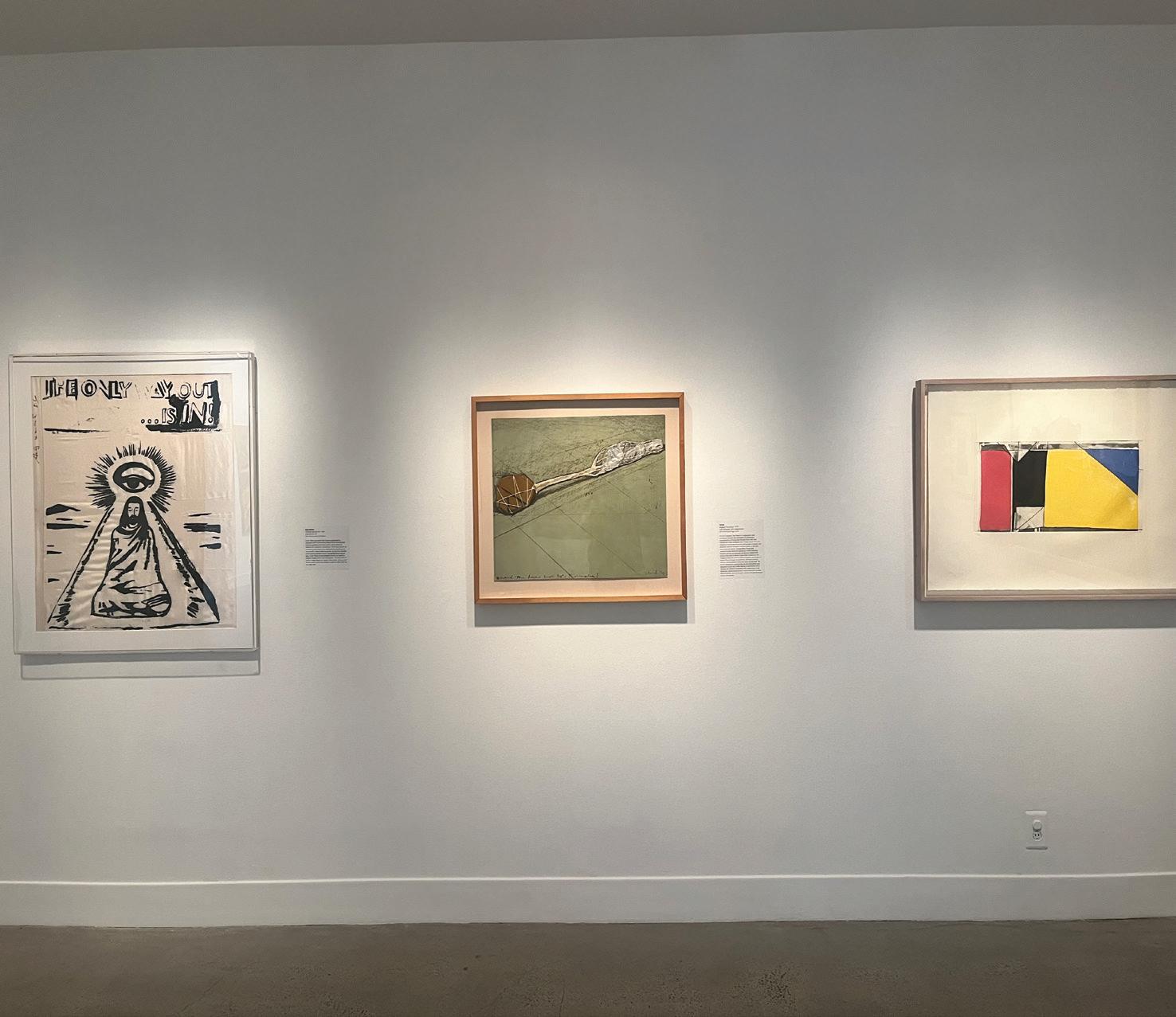
“I’m curious about what art pieces they [the museum] are curating to avoid politics, if that is their true intention,” Dickey said.
Voskanian said in the future, inviting outside artists could be a great way to continue to foster campus community.
“It could be an exciting way to expand the scope of the gallery,”
Voskanian said. “As an active student in the music program, I strongly believe in supporting artists and the work they dedicate so much time and e ort to creating.”
Amanda Monahan Creative Director
When she was 10 years old, senior Screen Arts major Alekza Rhyan asked her mom to put her in Italian lessons. Little did she know this request would shape her future.
As a child actress, Rhyan said she knew her biggest dream was to enter the entertainment industry. Yet she never knew a culture outside her own would be the way she would find her footing.
“When I was 10, I just woke up one day and told my mom, I said, ‘I need to learn Italian,’” Rhyan said. “I was obsessed with the show ‘Cake Boss’ and his family was Italian, and so I was like, ‘I need to be like Cake Boss.’”
Growing up in El Paso, Texas, in a Mexican-American household, Rhyan said she has always been used to balancing di erent cultures and languages. Though she was unaware at the time, this planted the seed for a future with this same balancing game.
“Multicultural values in the way I grew up and being bilingual had already helped push this need to understand di erent cultures and di erent languages,” Rhyan said.
When Rhyan started her academic journey at Pepperdine, she said she never intended to continue her study of Italian language from her childhood. She met with Brittany Corbucci, assistant instructor of Italian Studies, telling her she wanted to study abroad in Florence. After hearing this, Corbucci encouraged her to pick the language back up.
“I want students to see that continuing to take Italian can open so many doors, and you can find ways to combine your passions,” Corbucci said.
Rhyan ended up studying abroad outside of Pepperdine in a small city called Perugia in the summer after her sophomore year. Upon coming home, she said she immediately began figuring out a way for
her to return.
“When I went to Italy the first time, I kept trying to go back,” Rhyan said. “Every time I’d go back, I’d say, ‘This is where I’m happiest.’”
Though she describes herself as a workaholic, Rhyan said she adapted to and fell in love with Italian culture.
“Italians do life so well in the fact that there is no overworking,” Rhyan said. “There’s a saying in Italian called ‘Dolce far niente,’ which means ‘the sweetness of doing nothing,’ because they do [life] so calmly, and I think that they take importance to things that are actually important.”
Corbucci said she always reminds her students the language can create opportunities for them regardless of what field they desire to work in. It was this encouragement that helped Rhyan realize she could combine her longtime love of Italian culture and entertainment.
Corbucci helped connect Rhyan with Italian producers and directors who work in the film industry. She said she has taken her to film premieres in LA and helped Rhyan attend a screenwriting and film critique workshop in Rome, helping her realize her passion for international producing.
‘Made in Italy’
In her documentary class with Screen Arts Professor Paul Kim, Rhyan had to bring two pitches to class. Her classmate, senior Screen Arts major Dane Malzahn, said he didn’t love either of his own pitches but was drawn to Rhyan’s.
The two said they decided to take on the project together, as they could each play to their own strengths — Rhyan as a producer and Malzahn as director of photography.
“We can both give our input on the story, and we won’t really step on each other’s toes,” Malzahn said. “She wants nothing to do with the camera, and I don’t want anything to do with producing.”
Rhyan and Malzahn began working on the documentary,

called “Made in Italy,” which tells the story of Antonio Sessa, chef and owner of Made in Italy Bistro in Westlake Village. From the beginning, Rhyan emphasized the need to properly execute the story.
“I told everyone in the class, ‘If you do ‘Made in Italy,’ it will be in Italian. No buts, hows or whys,’” Rhyan said. “I thought it was really important to find something that could touch on culture in someone else’s language because I think a lot of media is centered around the American audience and American consumption.”
Rhyan describes herself as “Italian at heart,” though she has no Italian in her blood. Because of this, she said she approached the documentary thoughtfully, double-checking every theme and interview question with Corbucci and her friends in Italy.
“We’ve had a lot of conversations just about di erent elements of Italian culture and American culture and holding on to the best parts of your home culture while still being open-minded and trying to get the best of both,” Corbucci said.
Rhyan performed interviews for the documentary entirely in Italian, translating for English subtitles herself. Corbucci said

this is a testament to Rhyan’s language and cultural skills, describing her Italian as “impeccable.”
The film remains a rough draft, as there are certain cultural moments Rhyan said she wants to expand, which she and Malzahn continue to work toward this semester in their senior capstone.
Corbucci said Rhyan’s work ethic has taken her far and will continue to open new doors.
“She never lets an opportunity go — she’ll never miss out on an opportunity to learn or to grow in her career,” Corbucci said.
Rhyan has exemplified this trait throughout her time at Pepperdine, as she began working with the Dallas International Film Festival (DIFF) her first year. With the festival taking place annually during finals week, Rhyan said she has always gone, despite facing a dilemma.
“It’s always been a decision of, ‘Do you go and grow professionally, or do you stay and be academically responsible?’” Rhyan said.
This decision to grow has led Rhyan to become the festival’s programming coordinator, which is a role she said she continues to work in today.
Rhyan said she used to think success looked like working in the entertainment industry in LA, which was her primary reason for coming to Pepperdine. Now, thanks to the opportunities and mentorship she has had while studying here, she realized her dreams lie beyond the City of Angels.
“I was having this conversation with Professor Kim, and he said, ‘When you go through life, success will be measured di erently for you. What you thought was successful two years ago might look di erent two years from now,’” Rhyan said.
After graduating from Pepperdine this spring, Rhyan said she will move to Rome to continue working in creative development and international cinema with the connections she has made in LA.
“It was a really hard decision when everyone tells you that you should stay in Los Angeles,” Rhyan said. “But I think you should live where you’re happiest.”
Looking further ahead into her future, Rhyan said she hopes to one day become a trifecta of Mexican, Italian and American culture, particularly expanding Mexican representation in the entertainment industry.
Through a multitude of jobs, internships, learning experiences, student projects and more, Rhyan said it is important not to consider opportunity as luck but as something you work for.
“There’s a quote that says, ‘Hard work will win when talent fails to work hard,’” Rhyan said. “Putting in your all and working really, really hard towards your goals and taking every single opportunity is what leads to success.”
Jordan Baquiran Life & Arts Staff Writer
In an environment where social media is heavily integrated into campus culture, students said they may find themselves comparing their reality to other people’s highlight reels. This dynamic has the power to shape how students think about themselves and each other.
Social media o ers connection, entertainment and serves as a window into people’s lives — but constantly indulging in it can quietly impact mental health and self-image.
“It’s a big part of this era we’re in; everyone is connected to everyone through social media, so it totally makes sense that rising screen time is happening,” said junior Jillian George, RISE student organization liaison. “But also, it can be a little discouraging because a lot of us spend a lot of time on our phones instead of talking to each other in person.”
First-year Taylor Wooton, student event planner for RISE, said she believes the common habit of constantly indulging in social media was amplified by the COVID-19 pandemic.
“Everyone was inside so much so everyone just relied
on that [phone] and that’s just stuck with a lot of people, especially teenagers in a developmental stage at the time,” Wooton said.
When college students constantly consume media and see what society pushes to be normalized, it can lead to insecurities and a negative mindset, Wooton said.
“When people spend an excess amount of time online, there’s a lot of spending time inside rather than outside and doing a lot of less physical things, when being outside and being social has proven to make people happier,” Wooton said.
Pepperdine students said they feel pressured to be online and active on social media, especially Instagram.
“Whenever we see other people’s highlights, it’s like an iceberg,” senior TYGA Yeom said. “We’re only looking at the tip top of the iceberg and we don’t really see how they worked on it or how they are struggling.”
First-year Faith Kohr said she prefers to stay o social media as much as possible, especially as a busy Screen Arts


major and Songwriting minor. While she sometimes finds herself ‘doomscrolling,’ she uses it more to show her family and friends the place and environment she’s in now, especially being from Tennessee.
“It’s super fun, but it can be healthy to have a manageable time that you’re on it and drawing your attention to it,” Kohr said.
Setting Intentional Time Away From Screens
The moment Kohr said she realized the disadvantages of social media was when she noticed students glued to their phones instead of communicating face-to-face and having conversations.
“Phones or social media can control the room and be more of something we’re relying on,” Kohr said.
George said it’s important to spend time away from screens.
“It’s a healthy habit,” George said. “Especially if I find myself really attaching certain parts to my identity based on how many followers I have, or how good my post does.”
George said social media should solely be used as a form of communication, as it was intended to connect people, but it should not make people feel bad about themselves or second-guess what they’re doing.
There are a multitude of ways for students to disconnect from the world, Kohr said. As a Songwriting minor, Kohr enjoys turning her devices o and playing her guitar and singing. She also said she’s a big fan of The Well.
A recent Waves Church sermon from Pastor Taylor Walling made Kohr realize she needed to give her time more to God, rather than endlessly scrolling on her phone, Kohr said.
“If I can be consuming knowledge over something I’m not going to remember a minute later, it’s going to be way more beneficial,” Kohr said.
George said she enjoys
meditating, especially at times when she feels herself getting overwhelmed.
“I really like to just meditate and think about what I’m feeling and why I feel that way,” George said.
Wooton said she prefers to lock her social media apps from 9 a.m. to 9 p.m. It helps her stay o her phone during the day, but she still has time to use it while getting ready in the morning or while winding down in the evening.
Malibu is home to over 20 miles of coastline, as well as the Santa Monica Mountains, giving students endless access to the beach and mountains.
The nature surrounding Pepperdine’s Malibu campus can encourage many students to reconnect with the outdoors, Kohr said.
“We’re in Malibu,” Kohr said. “This is the beauty of the world. If we just look up at the ocean or sky, walk outside, it doesn’t get much better than this.”
While looking at how the campus overlooks the ocean, especially on the first floor of Payson Library, Kohr said she realizes how beautiful her location is. Her favorite beach is Zuma Beach, which is less than 10 miles away from campus.
Kohr surfs at Zuma Beach often. The environment helps her stay away from social media, since she said the beach isn’t a place to be glued to her phone.
Yeom said Stau er Chapel is an escape from digital noise.
“Whenever I go to church, I interact with people,” Yeom said. “Whenever I interact with people, I’m not using my cell phone.”
Kohr said going for walks is a helpful way to step away from social media.
“Even without music, just
listening to nature and the wind, maybe even taking your shoes o and being completely grounded to the earth, it really helps,” Kohr said.
Kohr said strolling in Alumni Park helps her to be present in reality beyond social media.
“We’re not made to know everything, even on the news or social media,” Kohr said. “We’re not made to have all this knowledge.”
Another way to disconnect is to socialize and connect with people in person, Kohr said.
“Scheduling intentional time with friends is so important — times to go eat with friends or go shopping, even just going to the beach,” George said. “Just having intentional moments with your friends outside of social media to really connect.”
George said another way to be more present is to delete social media and go on a oneweek detox.
“See what you can do with the time you would usually spend on it,” George said. “See what type of connections you can make outside of social media.”
Wooton said she recommends participating in Outdoor Recreation.
“It’s an opportunity to connect with people you wouldn’t seriously connect with outside of it and be in places you wouldn’t be in otherwise,” Wooton said. “Finding something you enjoy more than going on your phone helps.”
Wooton said she likes going to the gym with her roommate, but she said every individual should find their forte.
“You do have time to do those things if you just take time away from being on screens,” Wooton said.
Annslee Mitchell Assistant Life & Arts Editor
Before attending the first day of class, students said they had already formed judgments on their new professors through a popular online resource: Rate My Professors.
As a new semester begins at Pepperdine, students tend to rely on the uno cial rating site to shape their academic decisions, using the reviews on Rate My Professors to gauge workload, teaching style and even their professors’ personalities before meeting them. While several students said the platform can be a planning tool, professors said they doubt its accuracy.
“Some students give pretty helpful context for my class — what they liked or didn’t like,”
Religion Professor Laura Estes said. “Other students don’t give rationale for why they liked the class or didn’t like the class — or sometimes they write information that’s untrue.”
Students said Rate My Professors can be helpful in selecting classes, especially as a firstyear student, but the ratings can be unreliable.
“I prefer to ask people who’ve taken the classes,” sophomore Alana Mendoza said. “In some ways, it [Rate My Professors] is biased. For Pepperdine, not a lot of our professors are even on it. I had a di cult time finding the professors that were actually teaching my classes.”
The website can be a helpful tool when picking classes for the new semester, but Mendoza said students should take the written comments with a grain of salt.
Data
A study published in 2021
by the International Conference on Computing and Data Science found a negative correlation on Rate My Professors between perceived class di culty and teaching quality ratings. This means the more di cult a class, the lower the professor’s score.
Psychology Professor Michael Folkerts said students should be wary of trusting the website’s data.
“In psychology, we would very much be concerned with reliability,” Folkerts said. “Maybe a lot of negative scores were just from one semester, and the weight of that semester is stopping a professor’s average score from going up.”
Students should consider the motivations behind the people who post reviews on the platform, Folkerts said.
“Usually, you’re motivated out of frustration or you’re motivated because you had a wonderful experience,” Folkerts said.
Estes said she has noticed evaluations are often polarized.
“It does seem to be either heavily skewed at the five or at the one,” Estes said. “But probably most professors aren’t fives and aren’t ones. We mostly fall in the middle.”
Rate My Professors also lacks the regulations needed for validating the authenticity of reviewers, undermining its reliability for student-led evaluations, as reported in the International Conference on Computing and Data Science study.
Folkerts said there is no guarantee a “student reviewer” is even a student.
“Is there something that you have to clear that o cially recognizes you as a college student in the United States?” Folkerts said. “Do you have to register? That is a question I have. Who has access to Rate My Professors? That’s another variable.”
Estes said she was concerned over the sample size of students who submitted reviews.
DOWN:
2. Biggest classroom on campus.
4. e study of living things.
5. Requirement for rst-years and sophomores that used to be known as Seaver 200.
7. e learning platform Pepperdine switched to from Courses.
ACROSS:
1. Center for Communication and...
3. First name of the vice provost of Pepperdine.
6. A three-sequence class that is no longer part of the GE requirement.
8. e last name of Seaver College’s dean.

“We’re talking about a sample size of 18,” Estes said. “I’ve taught 650 students since I’ve been here, just in Religion 100.”
It does seem to be either heavily skewed at the five or at the one. But probably most professors aren’t fives and aren’t ones. We mostly fall in the middle.
Laura Estes Religion Professor
The study found the lowest average ratings appeared among female professors in STEM fields, which suggests
gender bias among reviewers. For 17 years, the website also featured a “hotness rating,” which was not removed until the site faced widespread criticism for including a metric that doesn’t correlate with teaching proficiency, according to Inside Higher Ed.
Estes said she was happy to be labeled “caring” by student reviewers but noted the tag seemed more likely to be applied to a woman than a man.
“It does strike me that I was described as caring,” Estes said. “I also would describe myself as caring. I value that, but it is one of those terms that I find is much more often applied to women professors than it is to men professors.”
Anonymous rating can be done responsibly, Folkerts said. Although the website is a scientifically invalid measure, students can learn about their potential professors from the platform if they utilize caution.
For students seeking an idea
of what their professor may be like, Estes said the website can be used thoughtfully.
“You should probably filter out a lot of the uncritical and also the too critical,” Estes said. “Try to see the things that people are specifically pointing to, recognizing that sometimes people are just angry about something in particular that might be specific to that student.”
She said talking to older students is a better way to learn.
“It [Rate My Professors] is not where I would suggest students go primarily for recommendations,” Estes said. “They’re much more likely to get good, nuanced recommendations from actually having conversations with people, mostly because then you have some sort of context.”
annslee.mitchell@pepperdine.edu


Alicia Dofelmier Life & Arts Editor
Coming to Pepperdine, the fact we didn’t have a football team never really bothered me. I can count on one hand the number of football games I attended in high school — not because I didn’t care, but because my school’s team wasn’t that good.
This brings me to my first point as to why Pepperdine does not need a football team: there is no guarantee that we would be any good. And, if we end up not being good, then no one would go to the games and Pepperdine would lose money — a lot of money.
A football team would cost Pepperdine a lot of money, millions to be more specific. Not only would there be the need to build a team but also a stadium.
In 2023, The State University of New York at Cortland spent a total of $4,628,397 on their football team, according to the D3 Playbook. Now, that’s for an already established team. So, it’s reasonable to assume having a football team would cost Pepperdine even more than that.
Finally, while creating a football team could theoretically improve school spirit, it would also have the potential to change campus culture as a whole.
While the allure of a Pepperdine football team sounds great in theory, in practice, it’s not exactly the most practical decision.
Alicia Dofelmier Life & Arts Editor
Pepperdine is known for being a small, liberal arts college, and the students who come here pick the school knowing it doesn’t have a football team. They pick it for other reasons, whether that’s the size of the student body or the incredible study abroad opportunities.
By introducing a football team, Pepperdine would be opening itself up to inviting in students who don’t really care about all the incredible opportunities and rather just care about how much of a role football plays.
While one could make the argument having a football team would raise school spirit, that’s only if we’re good. And yes, I know Pepperdine had an award-winning football team before moving to the Malibu campus, but there’s no guarantee that would remain the same if Pepperdine were to add a new football team.
While the allure of a Pepperdine football team sounds great in theory, in practice, it’s not exactly the most practical decision and would inevitably change Pepperdine culture, possibly for the worst.
Grace Boktor Sports Staff Writer
There is no better way to show school spirit than with a football team. As students approach the college application process, campus culture and school pride play a major role in deciding where to attend.
Tailgates and packed stadiums cheering your team on are defining parts of the traditional college experience — and Pepperdine is missing out.
Some of the biggest benefits of a football program are school spirit and pride. Football games bring students together and create amazing memories. Look at well-known California universities such as the University of Southern California, University of California, Los Angeles and University of California, Berkeley.
Beyond their academic excellence, these schools all share a major trait: they all benefit from the national exposure and institutional recognition that football provides.
American football remains the most dominant and visible college sport, and it unites students, alumni and surrounding communities while elevating a university’s national presence and long-term engagement.
Think about what your weekend could look like: getting ready with your friends, wearing all of your Pepperdine gear to support the team, heading out to a tailgate with fun music and time with friends then cheering the Waves on with excitement.
College football games are more than just the game —they’re a full production that showcase pride for our school. Let’s ask ourselves, would we rather have that or another night at the HAWC?
Football would also strengthen community building at Pepperdine. Currently, Pepperdine can feel isolating.
drive to get anywhere beyond the Country Mart, students lack reasons to stay on campus during weekends. A football team would create a vibrant culture, encouraging students to socialize, feel connected and remain local.
While Pepperdine o ers a unique college experience, it is far from traditional. Adding football would move us closer to that traditional university atmosphere, straight to the end zone. In an in-person, on-campus survey of 50 randomly selected Pepperdine students I conducted in April 2025, 71.4% cited social isolation as a reason to consider transferring. In the same survey, 37.1% of students said the lack of a football team would be a reason to transfer. Clearly, this is not a small issue.
From a visibility standpoint, football could significantly increase school recognition and attendance. Pepperdine is already known for its picturesque campus overlooking the ocean, and all of our sports compete at the Division I level. However, a Division I football team would elevate Pepperdine’s national profile even further, attracting students who want both strong academics and a lively campus culture.
There are also important scholarship and recruitment opportunities to consider. Many high school athletes want to continue their football careers in college, which automatically removes Pepperdine from their list of options.
Introducing a football team would open the door to athletic scholarships, increase enrollment and attract a broader range of students who may not have otherwise considered Pepperdine.
It’s time for a new kind of Wave, one that fills a stadium.
alicia.dofelmier@pepperdine.edu
With Malibu’s limited o -campus activities, often requiring a 30-minute
grace.boktor@pepperdine.edu
Tony Gleason Managing Editor
As Pepperdine Men’s Volleyball takes the court, their jerseys don’t just represent the current players; they tell the story of championships, legacy and unity, as well as how all of these factors have built the team of today.
Rather than just having a player’s own last name, the back of each set of Pepperdine Men’s Volleyball’s jerseys include the last names of the over 200 players who have been a part of the program. Members of the program said these jerseys subtly display the program’s storied legacy.
“Pepperdine is such a historic program, and a lot of our values and our culture is built o of all the guys that came before us,” said Ryan Barnett, redshirt senior outside hitter and team captain. “That one jersey that shows our culture and one capsule moment that this program, over 50 years, was built through everyone that played before us.”
Men’s Volleyball is Pepperdine’s winningest program, with five National Championships in 1978, 1985, 1986, 1992 and 2005, according to Pepperdine Athletics. The team has also been runner-up six times and made it to the NCAA semi finals in 2025 after winning three straight matches at Firestone Fieldhouse to win the MPSF.
One story these jerseys tell is of the talented pool of alumni who helped win those championships. Across the back of the jerseys are the names of the 63 players to have been named All-Americans and the five players to win National Player of the Year: outside hitter George Roumain in 1998 and 1999, middle blocker Brad Keenan in 2002, Sean Rooney in 2005, current Head Coach Jonathan Winder in 2007 and opposite hitter Paul Carroll in 2009, according to AVCA.
“Winning is infectious, and culture is something that can be contagious,” Winder said. “When you have alumni that are part of the program, their attitudes and their competitiveness and their stories just add to the fuel for the current players that they can really understand how to behave, how to act, work in training, how to have high standards for themselves on the court — on and as well o the court.”
Another story told through these jerseys is how many of Pepperdine Volleyball’s coaching sta were once athletes here. The back of the jerseys include ‘Dunphy’ for Head Coach Emeritus Marv Dunphy (‘74), ‘Winder’ for Head Coach Jonathan Winder (‘08), ‘Pollock’ for Associate Head Coach Matthew Pollock (‘12), ‘Wong’ for Scott Wong (‘01), Women’s Indoor Volleyball head coach, ‘Wexter’ for Michael Wexter (‘19), Women’s Indoor Volleyball assistant coach and ‘States’ for Max States (‘17), Women’s Beach Volleyball assistant coach.
After graduating from Pepperdine in 1974, Dunphy took over as Men’s Volleyball head coach in 1977, where he would go on to coach for 34 seasons and was at the helm for four of the five National Championships, according to Pepperdine Athletics. Thus, many of the names seen on the back of the jersey were once members of “Marv’s Army,” including all of the student-athletes turned coaches.
“I realized that their joys will be my joys,” Dunphy said. “Their disappointments will be my disappointments, and it’s lifelong, and the best thing about coaching is you get to choose the people you go through life with.”
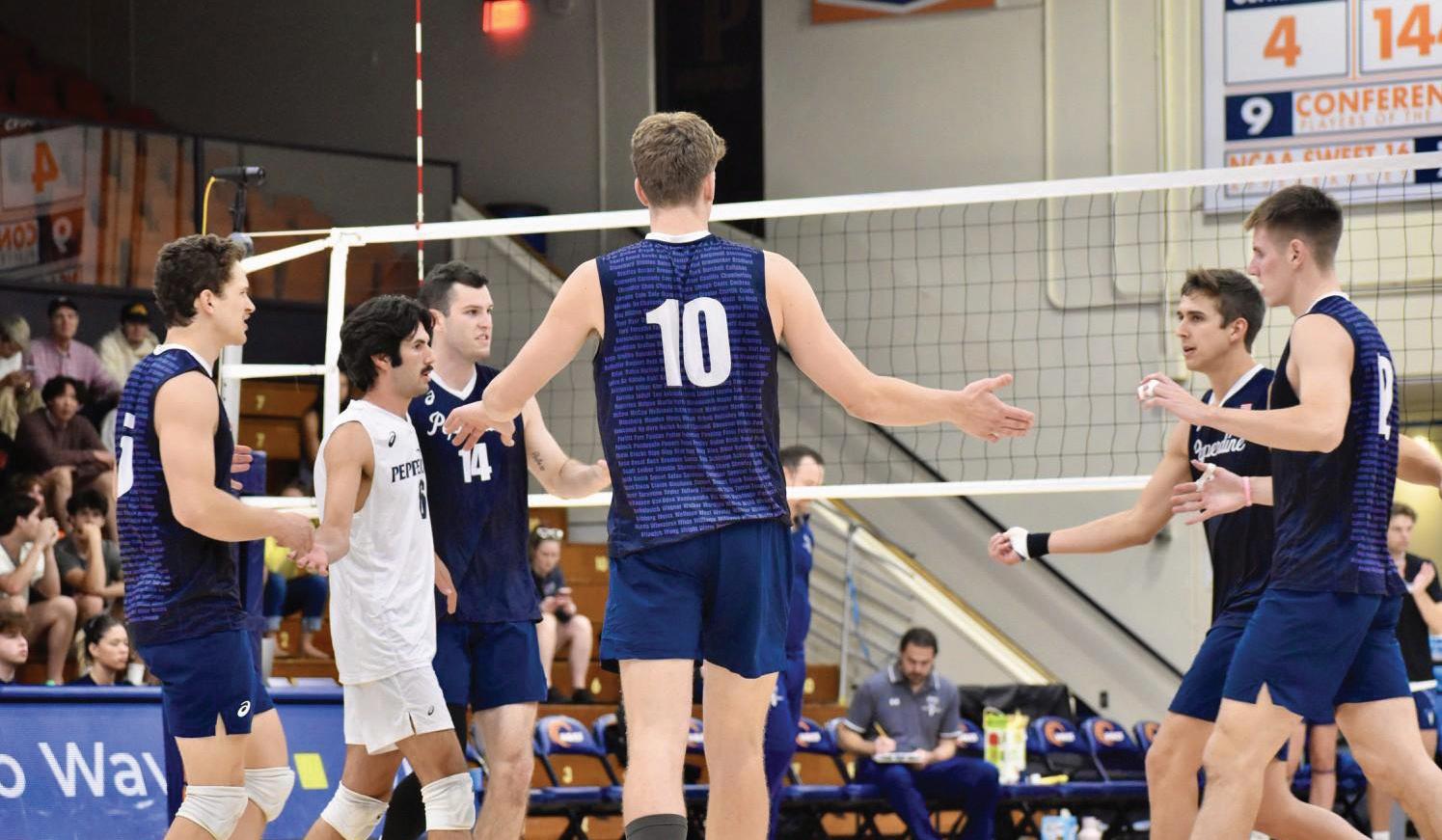
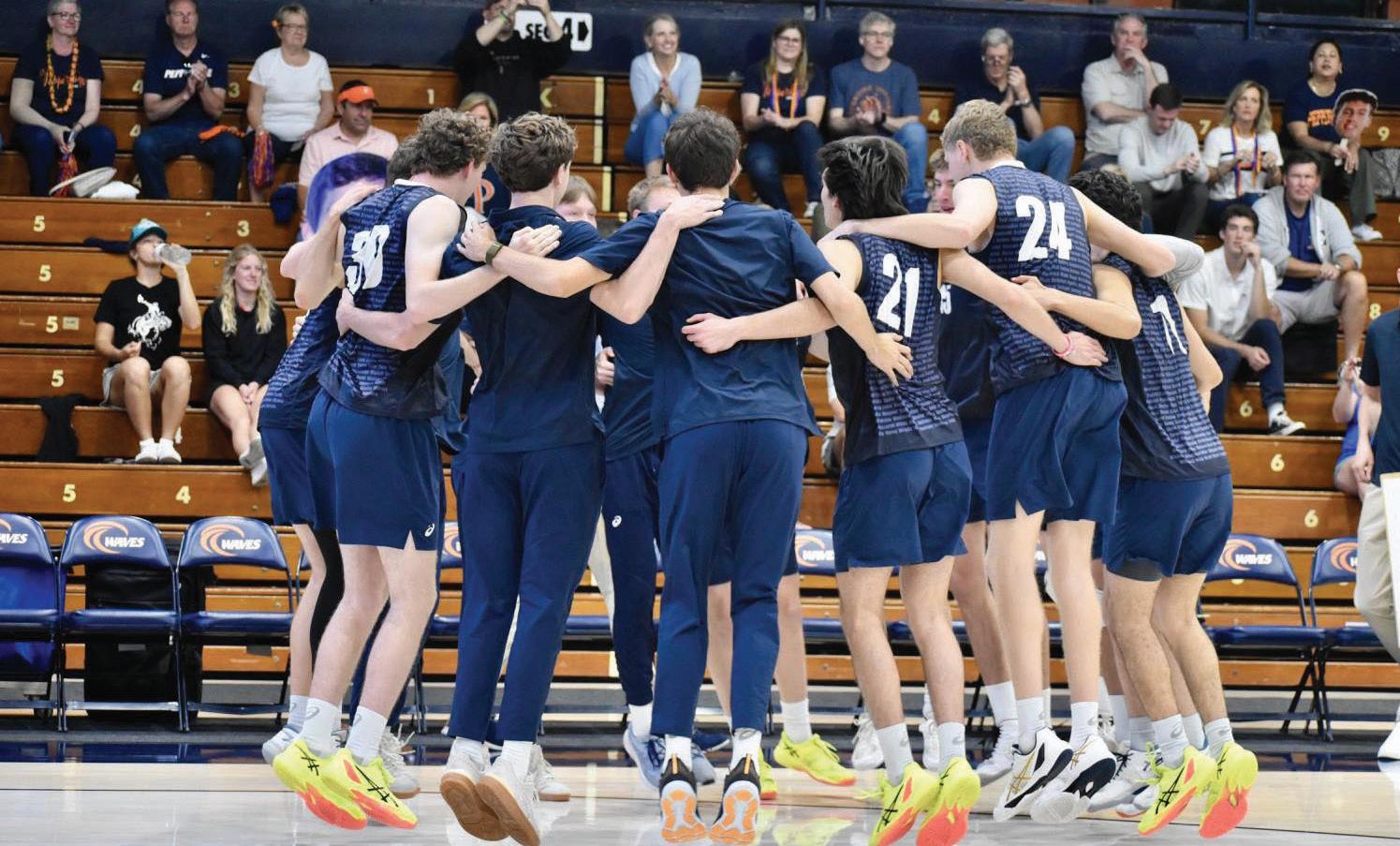
Winder was a player on Dunphy’s 2005 National Championship team, where he earned Freshman of the Year honors, according to Pepperdine Athletics. Other names on the team’s jerseys from the ‘05 team include the aforementioned Rooney, who was the NCAA Tournament MVP, and ‘Hein’ for middle blocker Andy Hein, who was a first team All-American that year.
Barnett said every player,

whether they were All-American or didn’t see the court much, has created the culture the team has today. The current team views wearing their jerseys as a privilege that isn’t fully earned until they graduate.
“The logo means so much more than any of us can imagine, and we’re carriers of this jersey,” Barnett said. “So we didn’t earn anything to represent that, to wear that logo — that’s a status that we have to achieve, that we get once we graduate. But now we’re just passing it down, and we’re representing it the best we could.”
One set of names Dunphy said stood out to him on the back of these jerseys is near the bottom, where it says “Rigg” four times in a row. This represents Mark, Scott, Matt and Doug Rigg, four brothers who each played under Dunphy.
“All four of them came here, and all four of them won national championships and kind of like in two di erent eras,” Dunphy said.
Mark and Scott Rigg were the first two to play for Pepperdine, as they were
members of the 1978 National Championship team, according to Pepperdine Athletics. Less than a decade later, Matt and Doug Rigg won back-toback National Championships in 1985 and 1986.
As for the future of the program, Pepperdine Athletics and Winder agreed to a contract extension through 2030, which the department announced Jan. 7. Winder said with staying in Malibu, his goal is to bring Men’s Volleyball their sixth National Championship.
“This is where I want to be, and this is the program I want to be stewarding and leading,” Winder said. “And so it’s my hope that our program can sustain this level of excellence that we’re always in the mix to be the one of the best teams in the country.”
Men’s Volleyball entered the season ranked No. 4 in the country, according to AVCA. Their next game is Jan. 30 against No. 2 Long Beach State in Malibu.
anthony.gleason@pepperdine.edu

Shane Stephens Assistant Sports Editor
Pepperdine Men’s Golf participated in the Southwestern Invitational at North Ranch Country Club in Westlake Village, Calif. from Jan. 26 to Jan 28. The Waves won the tournament, finishing 11 under.
The Waves entered the tournament ranked No. 15 as a team. Junior Willy Walsh, senior Brady Siravo and senior Mahanth Chirravuri all entered the tournament individually ranked No. 53, No. 26 and No. 3, respectively, according to SCOREBOARD.
Pepperdine shot seven under as a team after the first day of the tournament, solidifying
a five-stroke lead for first place over the University of Nevada, Las Vegas, according to SCOREBOARD.
Freshman Luke Dariotis shot a 67 and led the Waves in day one, putting himself in second place behind UNLV senior Trevor Lewis. Siravo also had a strong round, shooting a 68 and finding himself tied for fifth in the tournament after day one, according to SCOREBOARD. Walsh and sophomore Byungho Lee both placed ninth with a 69, while Chirravuri shot a 70 and placed 15th.
Pepperdine kept riding their wave of momentum into day two, extending their lead to 16 strokes and totaling 16 under as a team, according to SCOREBOARD.

Siravo shot a 66, leading the Waves for the day and moving up to second place in the tournament at six under.
Lee made a big push into the top three, shooting a 66

and bringing his tournament total to five under to tie for third place, according to SCOREBOARD.
Walsh jumped to sixth place after a 68 on the day, putting three Pepperdine players in the top six, while Dariotis and Chirravuri were one over and both tied for 14th, according to SCOREBOARD.
The Waves started the day 16 under, maintaining their first place position over San Diego State and UNLV, according to SCOREBOARD.
Siravo finished the tournament in second place, totaling five under after shooting a 73, while San Diego State sophomore Harry Takis took first place, shooting seven under in the tournament, according to SCOREBOARD.
Walsh tied for fourth, shooting a 73 on the day to bring his tournament total to two under, according to SCOREBOARD.
Lee fell out of the top three after day two, shooting a 76 and finishing tied for sixth with one under, according to
SCOREBOARD.
Chirravuri and Dariotis finished 11th and 17th, respectively, as Chirravuri totaled one shot over and Dariotis shot four over, according to SCOREBOARD.
Despite Pepperdine not having an individual winner, the Waves dominated the tournament as a team, winning the tournament, according to SCOREBOARD.
This is the Waves’ first tournament back since the Golf Club of Georgia Collegiate Invitational from Oct. 24 to Oct. 26 and their first win of the season, according to Pepperdine Athletics.
Pepperdine’s next tournament is the Amer Ari Intercollegiate from Feb. 5 to Feb. 7 at the Mauni Lani Golf Course in Waimea, Hawai’i.
shane.stephens@pepperdine.edu


With eight games left in the regular season, Pepperdine Women’s Basketball has already won at least 12 games for the first time since the 2019-20 season, according to Basketball Reference.
“We’re not satisfied,” sophomore guard Elli Guiney said. “We want to continue building off that. We’re super process-driven. I want to be able to compete when it comes to March and tournament time.”