
wire rope clips
safe. simple. on-site ready.
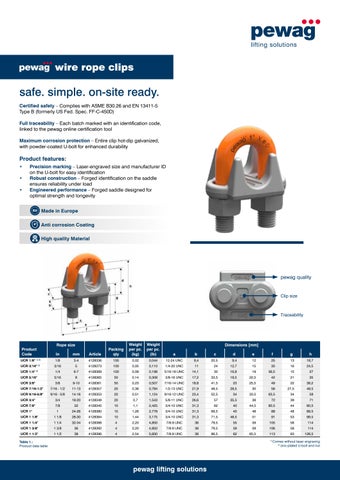
Certified safety – Complies with ASME B30.26 and EN 13411-5 Type B (formerly US Fed. Spec. FF-C-450D)
Full traceability – Each batch marked with an identification code, linked to the pewag online certification tool
Maximum corrosion protection – Entire clip hot-dip galvanized, with powder-coated U-bolt for enhanced durability
Product features:
• Precision marking – Laser-engraved size and manufacturer ID on the U-bolt for easy identification
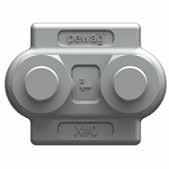
• Robust construction – Forged identification on the saddle ensures reliability under load
• Engineered performance – Forged saddle designed for optimal strength and longevity


Installation instructions
1. Prepare rope & install the first clip
• Turn back the rope the distance specified in Table 2 from the thimble or loop.
• Place the first clip one clip-width from the dead end of the rope.
• The U-bolt goes over the dead (free) end of the rope.
• The live (load-bearing) rope must rest in the saddle. Never put the saddle on the dead-end.
• Tighten the nuts evenly and alternately until the recommended torque is reached.
4. Test load and retightening of all nuts
To test the connection, the test load is applied. This load should be equal to or greater than the expected loads in service. The nuts are then examined and retightened to the recommended tightening torque.
Important Application Notes
2. Install the second clip
Position the second one as close as possible to the thimble or loop. Tighten the nuts evenly and alternately until the recommended torque is reached.
3. Install additional clips (if more than two)
If more than two clips are required, place the remaining clips evenly spaced between the first and second. Take up the slack in the rope. Then tighten all nuts evenly and alternately to the specified torque.
This wire rope clip is suitable for the following rope types: 6x19, 6x36, 8x19, 6x37, 19x7. Additionally, the specified number of clips also applies to rotation-resistant RRL wire ropes, rope class 8×19, IPS, XIP, up to 1½ inches in size, and to rotation-resistant RRL wire ropes, rope class 19×7, IPS, XIP, up to 1¾ inches in size. No metrical nuts should be used.
Never put the saddle on the dead-end.
The saddle must be on the live end of the rope, when the clips are installed.
Common Installation Errors to Avoid
• Incorrect tension: Too loose, and the rope will slip; too tight, and the strands may be damaged.
• Too few clips: Use the number of clips appropriate for the rope size (see Table 2).
• Incorrect spacing: Clips that are too close or too far apart weaken the hold.
UCR