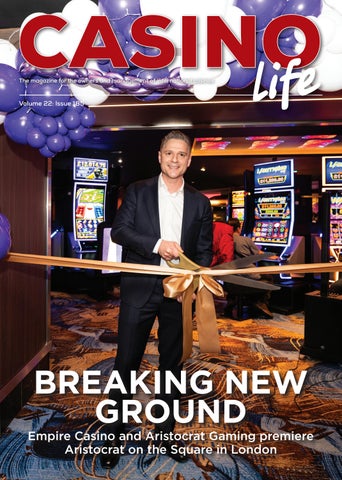
Casino Life Issue 185 Volume 22

Page 1


CASINO

Welcome... Race to the Bottom

Publisher: Peter White

Tel: +44 (0) 1892 740869

Mob: +44 (0) 7973 273714 peter@outsourcedigitalmedia.com

Editorial:

Editor in Chief : David McKee dmckee@huntingtonpress.com

Editor EMEA: Damien Connelly damien@outsourcedigitalmedia.com

Associate Editor Asia: Bill Healey healeywe@gmail.com

Online iGaming Editor: Mark McGuinness markmcguinness847@gmail.com

Columnist: Raymond Chan ymrchan@hotmail.com

Associate Editor EMEA: Andrew Behan a.behan@librasgroup.com

Las Vegas Correspondent: Ryan Slattery RyanSlats@gmail.com

International Correspondent: Lyudmyla Kyrychenko lyudmyla.kyrychenko@outsource digitalmedia.com

Production:

Designer: Stewart Hyde stewart@de5ign.co.uk www.de5ign.co.uk

Accounts: Helen Holmes accounts@outsourcedigitalmedia.com

IT Director: Pasha Kuzminskiy pasha@outsourcedigitalmedia.com

Poor Sheldon Adelson. Were he not already dead, what’s happening today in gaming would undoubtedly kill him. The United States is currently confronting Adelson’s worst nightmare: unfettered, unregulated (and untaxed) Internet gambling. Thanks to prediction markets, the iGaming that Adelson most feared has metastasized into a cancer that is consuming the body politic.

If you voted for Donald Trump, you are discovering that you voted for unrestricted iGaming, whether you wanted it or not. Prediction markets answer to no one and know no restraint. If you thought offshore iGaming was bad, this digital fungus is 10 times worse.

While much of America fretted over the disappearance of elderly Nancy Guthrie, Polymarket was taking wagers on her undoubtedly sad fate. Such bottom-feeding and moral bankruptcy are characteristic of the toxic slime from which event contracts have oozed.

If you wish for restraint, you hope in vain. The Commodity Futures Trading Commission, rudderless for the past year, now has made it clear it won’t lift a finger to rein in the Kalshis and Polymarkets of the world. Indeed, new CFTC Chairman Michael Selig is an errand boy for prediction markets, doing their dirty bidding.

In that respect, he’s a sock puppet for the White House. Trump has made it clear that he wants to get into sports betting himself, offering it on his Truth Social media platform. Were Selig to go against the boss’ desire for wide-open sports betting, his head would find itself on a plate.

Instead, the spineless Selig has reared up and proclaimed, “To those who seek to challenge our authority in this space, let me be clear: We will see you in court.” And if Americans who don’t want around-the-clock, ubiquitous gambling shoved in their faces … too bad, evidently.

Among those offended by Selig’s presumption was one of the U.S.’s relatively few admirable politicians: Utah Gov. Spencer Cox. The interests for whom Selig was running interference and “breathlessly defending are gambling – pure and simple,” something that would be unwelcome in his state, Cox said.

Next door, in Nevada, Sen. Catherine Cortez Masto reminded Polymarket’s Beltway toady that “Congress did not give the CFTC the authority to regulate sports gaming or gambling of any kind – that is a power that falls to the states.” It’s something Selig would do well to remember.

As more and more states move to curb or even outlaw prediction markets, a major showdown is in the offing. Congress could eradicate the pestilence of rogue sports betting and gambling but clarifying what is permissible – but probably won’t. They’re bought and paid for.

It will take our industry, via the American Gaming Association, and stalwart regulators to bring prediction markets to heel. There’s too much at stake to simply look the other way.

Following

The White Album

The VIP Player

The Compliance Era of Casino VIPs.

Based on extensive discussions with operators across both land-based and online sectors, the underlying economics of the casino industry remain unchanged.

A relatively small cohort of higher-value customers continues to generate a disproportionate share of revenue. What has clearly evolved, however, is the level of scrutiny surrounding how these relationships are initiated, managed and evidenced.

Information gathered through my meetings with operators in the United Kingdom and across Europe indicates that the traditional VIP proposition – historically characterized by discretion, speed and highly personalized service – now operates within a framework shaped by compliance, documentation and accountability. Source-of-funds enquiries, ongoing monitoring, affordability considerations and formal record-keeping are increasingly described as core operational requirements, rather than exceptional measures.

The Long Arm of the Law

Notably, operators report that this scrutiny is no longer limited to ultra-high-net-worth individuals. Medium-to-high-spend customers, those with access to significant discretionary income and active participation in wider leisure sectors, are frequently subject to similar due-diligence processes. Many operators describe a measurable shift in the customer journey, with additional verification steps and reduced reliance on informal relationship management alone.

In land-based environments, discussions with venue managements suggest that the VIP host role has expanded beyond traditional hospitality functions to include governance responsibilities. Staff are expected to recognize potential risk indicators, document interactions and escalate concerns where necessary. Online operators report parallel developments, with automated monitoring systems, behavioral analytics

and structured intervention protocols shaping customer engagement at scale.

Data-protection requirements form an additional layer of complexity. Operators consistently emphasize that privacy regulations do not prohibit due diligence. But they require that information be collected lawfully, proportionately and transparently, with clear justification and secure handling procedures.

Overdue Recognition

Commercially, many stakeholders note that enhanced controls increase the cost of servicing premium customers, and can introduce friction into onboarding and transactions. At the same time, casinos (particularly in major cities such as London) are widely recognized as important contributors to the nighttime economy, supporting adjacent sectors including dining, hospitality, transport and entertainment. Several operators expressed concern that if regulated venues are perceived as overly restrictive, then

Peter White, publisher of Casino Life Magazine

discretionary spending may migrate to other leisure activities or less-regulated environments.

Taken together, the information gathered suggests not a decline in the importance of highervalue customers, but a recalibration of how those relationships are structured. Discretion is increasingly being replaced by transparency, and trust is becoming something that must be demonstrable and documented.

United Kingdom

• Operators report strong emphasis on safergambling obligations alongside AML compliance

• Formal expectations regarding customer interaction and vulnerability indicators

• Increasing focus on affordability and spending patterns among higher-value players

• An active supervisory environment with visible enforcement actions

• Premium programs operate within tightly defined parameters

Continental Europe

• AML and financial-crime prevention remain the primary regulatory focus

• Regulatory approaches vary significantly between jurisdictions

• VIP management is often centered on financial due-diligence processes

• Less uniform emphasis on affordability, though tightening is reported

• Cross-border operators manage differing national requirements

The overall observation from industry discussions is …

The UK framework is widely described as integrating social-responsibility oversight directly into commercial operations, whereas many European regimes continue to prioritize financial-integrity controls. Both regions are tightening standards, but from different regulatory foundations.

Subscribe today via YouTube

Get Into Casino Life & Sports Betting Operator TV and gain insights from Presidents, CEOs, Owners and Senior Management at the World’s Leading Resort Casino and Sports Book Operators along with latest developments from manufacturers and Suppliers along with Gaming Equipment and Systems providers from Senior representatives at a select number of leading organisations in the Global Gaming Industry.

Back to its Roots

A Las Vegas hotel-casino is rebranded as The Resort at Summerlin.

What’s old is new again. Following a $75 million, top-to-bottom renovation that touched every square inch of the property, JW Marriott Las Vegas Resort & Spa and Rampart Casino have become a singular resort. And it has been rebranded back to The Resort at Summerlin.

The new name, which encompasses the entire 54acre Summerlin campus, just 13 miles northwest of the Las Vegas Strip, took effect January 1. This was following a multi-year, complete overhaul of the two adjoining properties. The remodel includes renovated guest rooms, a refreshed conference center, upgraded spa and fitness facilities, additions to the casino floor, and more than a half-dozen new restaurants, including a modernized food court.

“The property has such amazing bones and great architecture but it was starting to show its age at 25 years old,” explains General Manager Michelle McHugh. “That’s really why we decided to take the property to the next level. We needed a pretty significant remodel to stay competitive within the marketplace.”

A Resort by any other Name …

For longtime residents or scholars of Las Vegas history, The Resort at Summerlin may sound familiar. That’s because the property was originally known by that name when it opened in July 1999. McHugh says executives had a “hearty debate” over the name change but came to the conclusion that returning to its roots as The Resort at Summerlin best “covers everything that we have here on the property as a wholly integrated resort.”

But first let’s back up a bit. When the project was announced in 1996, it was meant to be more than just a neighborhood casino and slot hall. The complex was

designed to be a full-on Strip-style resort tucked into the ritzy Summerlin suburb. The vision was for it to be a relaxing golf and spa getaway far from the bustle of Las Vegas Boulevard. It came with a price tag of $275 million – an astronomical sum back then for what was viewed by many as a locals casino.

The resort was developed by Seven Circle Resorts under the umbrella brand of Regent International Hotels. Construction delays and cost overruns set an ominous tone from which the resort never recovered. Just over a year after opening, the company filed for Chapter 11 bankruptcy and sold the property, which continued to struggle. This continued for several

years before the Resort found some footing, as the surrounding area grew and locals began gambling at the property.

Today’s Resort at Summerlin is everything that the original developers had hoped for. It’s an allencompassing luxury resort that hosts, on average, 200 conventions and 250 weddings a year. In fact, convention business makes up 60 percent of all overnight stays at the property. The second largest group, roughly 30 percent, are Marriott Bonvoy loyalists and leisure travelers from Southern California.

“Like many properties in Las Vegas, we’ve operated the property as an integrated hotel-casino resort,”

McHugh says. “I just don’t think people understood how massive our operation was, and all the amenities we offer to our hotel and casino guests.”

A Touch of Zen

The resort consists of two six-story hotel towers with 549 guest rooms, 80 of them suites. Many of those rooms have balconies overlooking the grounds – a collection of lush gardens, tranquil waterfalls and koi ponds. In total, 98 rooms have walk-out or Juliet balconies, with an additional 11 suites featuring larger terraces.

From the carpet to the curtains to the dining tables and couches, every room was completely remodeled. Even the ceiling fans, 65-inch smart TVs and coffee machines are all new.

“We pretty much touched everything,” McHugh says. A desert color palette was chosen in an effort to blend into the environment and evoke a sense of calm and serenity, with subtle metallic accents that draw inspiration from the surrounding landscape.

That tranquil vibe carries over to Spa Aquae, where a new Hydra Lounge relaxation area and upgraded treatment rooms were added. Spa guests even have a special entrance that circumvents the casino. “We wanted a more Zen-like entrance so guests can walk through the gardens and feel relaxed when they arrive as opposed to coming from the hustle and bustle of the casino,” McHugh says.

Enter Caesars

Speaking of the casino, there have been big improvements there as well. The 63,000-square-foot casino floor has also been enhanced with new lighting, carpet and finishes, along with the addition of new high-limit rooms featuring cutting-edge gambling technology. The casino has more than 1,400 of the latest slot machines, 32 table games and a 300-seat bingo hall.

The Resort at Summerlin has partnered with Caesars Entertainment to open a Caesars Sportsbook. It includes 20 self-service betting kiosks. As part of the upgrade, sports fans will be able to watch games on a new video wall with a 360-degree LED display at the sports book bar.

The resort has also made enhancements to its loyalty program, Rampart Rewards. Under the program, players earn one base point for every $1 coin-in on reel and video-reel slot machines, one

point for every $2 wagered on video poker, and two points for every $1 played on bingo. Since February 1, Rampart Rewards members began earning points on all food and beverage purchases at a rate of 30 points for every dollar spent.

“With all of the exciting culinary additions, this is the perfect time to expand our popular Rampart Rewards program to include food and beverage purchases,” says McHugh. “We’re thrilled to offer this new benefit, making it even more rewarding to dine and socialize on property.”

Viva Viviani

At the request of its regular guests, the dining scene at the resort underwent massive changes. “Our customers are very vocal. We have a great relationship with them and they’re not shy about sharing their opinions with us,” admits McHugh explaining how that led executives to lead focus groups and initiate guest surveys. “They told us, ‘We love your food. We just want more variety.’

“So we listened and began working diligently on expanding our food and beverage offerings so that our guests have no reason to leave us.” That meant scouring the country for unique food offerings that would appeal to a wider audience, including a younger demographic.

As a result in 2025, the resort debuted several new outlets. First, it partnered with Top Chef alum Fabio Viviani, who opened three quick-service spots, in a

food hall section called The Neighborhood. There you’ll find Viviani dishing out slices from the traditional to truffle prosciutto at ai Pazzi Pizza, serving pan roasts and clam chowder from the counter of Pearls Oyster & Crudo Bar, and fresh pasta and seafood at his sit-down Italian restaurant, ai Pazzi.

Other new eateries include Nom Wah, the first West Coast location of New York City’s oldest dim sum restaurant, popular wine bar Wineaux, and two L.A. hotspots: Tacos 1986 and For The Win smashburgers.

Now with the renovations complete and the property ready for exploration, McHugh and the rest of the Summerlin team are able to relax and take it all in.

“It’s been really fun getting to show it off,” she says.

“It’s exciting to have people who aren’t in it every day notice all the great things we have going on here. They appreciate how fresh the property looks and are enjoying the new offerings we have for them.”

An Aristocratic Experience

Casino Life Life interviews Alex Oswald, managing director of Metropolitan Gaming, and Andrew Sackey, senior vice president of commercial strategy at Aristocrat Gaming. By Peter White

At Empire Casino in Leicester Square, Aristocrat Gaming has introduced a dedicated, branded-slot environment to the UK market.

The launch of Aristocrat on the Square has been described as a United Kingdom first. From your perspective, what made Empire Casino the right venue to introduce a dedicated Aristocrat space?

Oswald: Empire Casino was the natural choice to introduce Aristocrat on the Square because of both its scale and its standing within London’s entertainment landscape. Situated in the heart of Leicester Square, the venue benefits from exceptional footfall, attracting a broad mix of local regulars, destination players and international visitors every day.

As our largest and most recognizable casino, Empire provides the ideal platform to showcase something genuinely new. It’s a venue where innovation feels at home and where we can introduce premium product to a diverse audience who are open to discovery. That combination of visibility, volume and variety made Empire the perfect environment to debut a dedicated Aristocrat space and set a new benchmark for the UK market.

From Aristocrat’s perspective, what made Empire Casino in Leicester Square the right venue to introduce Aristocrat on the Square as a dedicated UK space?

Sackey: Being the first dedicated gaming space in the UK for Aristocrat Gaming, location and notability were obviously important factors. Just as importantly, we

Alex Oswald, managing director of Metropolitan Gaming

were looking for a partner who shared our long-term vision for creating a premium, dedicated Aristocrat experience.

Metropolitan Gaming has been highly aligned with us in that ambition. Together, we see significant potential for the space, from game mix and environment to player promotions and future development, and we’re excited about how it can continue to evolve.

Now that the installation has had time to settle in, how would you describe the way it complements the existing slots offering on the gaming floor?

Oswald: Since our launch, Aristocrat on the Square has settled in seamlessly and genuinely elevated the overall slots proposition at Empire. The space is positioned strategically between our wider slots offering and Kings Sports Bar, which creates a natural flow of traffic and encourages cross-engagement. Players moving through the floor are drawn into the area, whether they’re heading to the bar to watch live sports or exploring the wider slots offer. It feels integrated rather than isolated, which was critical to its success.

From a product perspective, it has significantly broadened our game mix. Introducing globally recognized Aristocrat titles such as Mo Mummy, Midnight Express and Bao Zhu Zhao Fu has added variety and depth to our portfolio. These are games with strong international followings, so they resonate both with London regulars and our global visitors.

Access to Aristocrat’s high-profile partnerships has also been a major advantage. Titles like NFL Triple Score create a strong cultural crossover, particularly given the proximity to Kings Sports Bar. Having that synergy between live sport and branded gaming content adds energy to the space and keeps the floor feeling current. More broadly, the installation reflects our commitment to innovation and premium gaming experiences.

Now that the installation has been live for some time, how would you describe the way British players have engaged with a premium, branded-slot environment like this?

Sackey: Response so far has been incredible. We’ve heard especially fond reactions from those who have played some of the titles elsewhere and now being able to play them close to home, in an environment that rivals casinos around the world.

What sort of player reactions or behaviors have stood out to you since the area opened?

Oswald: One of the most striking things has been the sense of curiosity the space has generated across very different player types. We’ve seen customers engaging with titles you might not traditionally expect. For example, watching an older guest confidently playing NFL Triple Score was a brilliant reminder that branded or sport-led content isn’t limited to one demographic. The dedicated environment seems to remove hesitation and invite experimentation.

There’s been a noticeable willingness to explore. Players are trying titles they haven’t played before, asking questions and spending time understanding the mechanics. That behavioral shift toward experimentation suggests the branded space gives people permission to step slightly outside their usual habits. In short, the standout behavior has been curiosity translating into action. The space isn’t just being observed, it’s being explored.

The launch highlighted a UK-tailored selection of titles, including NFL Triple Score, Lightning Link, Mo Mummy and Bao Zhu Zhao Fu Link. When you talk about tailoring content for the UK market, what does that mean in practical terms?

Sackey: This means we’ve not only configured based on regulatory requirements like max-bet limitations, but also localization for themes, currency and presentation configurations.

Leicester Square attracts a uniquely diverse audience. How does that environment influence the way you think about presentation, accessibility and overall player experience in a space like this?

Oswald: Aristocrat on the Square was designed to feel immersive yet welcoming. The layout is clear and straightforward, making it easy for guests to understand the offer and to get involved without feeling overwhelmed. In a high-footfall destination like this, removing friction is essential. At the same time, we’ve ensured the space can flex for different expectations. While some guests want to explore casually, others seek something more elevated. Features such as love seats and dedicated slot hosts allow us to deliver a more personalized experience, striking the right balance between accessibility and premium appeal.

How valuable are flagship venues such as Empire in helping Aristocrat build a deeper understanding of UK player preferences and behaviors?

Sackey: With the introduction of a dedicated gaming space like Aristocrat on the Square, we now have greater opportunity to observe player preferences and performance trends in a broader setting. The expanded game offering allows us to trial additional titles and provide players with an even wider range of gameplay experiences.

The Aristocrat area clearly has a distinct look and feel. How important is design and atmosphere when creating engagement around a slot product in a flagship casino?

Oswald: Design and atmosphere are absolutely critical, particularly in a flagship venue like Empire. Slots are inherently visual and experiential, so how a product is presented can significantly influence engagement.

Empire’s design is distinctive, with multiple vantage points across the gaming floor, sports bar and lounges. Aristocrat on the Square is positioned in a way that allows it to be seen from almost every angle. That visibility naturally draws attention and encourages footfall.

The addition of large-format wall and ceiling screens has helped create a more immersive environment around the product. It enhances the player experience and amplifies brand presence across the wider floor.

In a flagship casino, atmosphere is a tool for driving awareness, curiosity and engagement.

How does Aristocrat strike a balance between delivering a consistent brand experience while still allowing operators the flexibility to reflect their own venue identity and customer mix?

Andrew Sackey, senior vice president of commercial strategy at Aristocrat Gaming

Sackey: This is where the partnership piece becomes key. It’s a two-way street. We bring product expertise, global market knowledge and a vast portfolio, while operators bring deep understanding of their customers. Together, that combination creates a dynamic experience players can see and feel.

Have you found that having a clearly defined zone helps players navigate the floor more intuitively or encourages them to explore new content?

Oswald: Yes, absolutely. Having a clearly defined zone naturally draws attention and sparks curiosity.

It gives players a visual cue that there’s something new or different to explore. The space also feels more intimate, which helps guests settle in, get comfortable and spend time learning new machines without feeling rushed. That combination encourages exploration in a way that feels intuitive rather than forced.

The February “Home of the Hot Seats” activity supported the launch of the space. From your experience, what makes a launch promotion effective without detracting from the core player experience?

Sackey: The timing of the opening provided an opportunity to connect a dynamic promotion with the Super Bowl. With Aristocrat on the Square featuring NFL Triple Score, we were able to demonstrate how promotions can elevate offerings and enhance the overall experience.

This promotional activity helped bring additional focus to the launch. How valuable are light-touch promotional moments in introducing players to new areas without overwhelming the experience?

Oswald: Light-touch promotions are incredibly valuable because they add incentive and excitement without disrupting the natural flow of play. Using a familiar mechanic gave players a comfortable entry point into the Aristocrat area, encouraging organic exploration. Keeping the promotion simple and easy to understand was key.

Once a new installation has moved beyond its launch phase, what does “long-term success” look like from Aristocrat’s point of view?

Sackey: Long-term success means continuing to deliver new and dynamic titles, alongside promotions that elevate the overall player experience and game offering. It also includes demonstrating strong performance results that allow expansion of the concept to additional locations tailored to local customer bases.

More broadly, how do you like to see operations and marketing working together when new concepts are introduced on the gaming floor?

Oswald: The strongest launches happen when operations and marketing work as one. Our crossfunctional structure ensures new concepts are well presented, operationally sound and supported from day one. Alignment across teams allows new ideas to land confidently and deliver a strong customer experience.

How does feedback from operators such as Metropolitan Gaming typically feed into Aristocrat’s future product development and planning?

Sackey: We rely heavily on operator feedback because they see player preferences daily. That insight feeds directly into our roadmap, planning and development. With EMEA a key focus area, this collaboration supports continued growth across the UK.

Supplier relationships clearly play a role in innovation. What do you value most in partnerships when delivering something new to your customers?

Oswald: Strong supplier partnerships are fundamental to innovation. What we value most is collaboration, open communication and a shared commitment to quality and long-term success. When suppliers understand our venues and customers, we can deliver experiences that are genuinely considered and customer-first.

Looking more broadly, what key trends in landbased slots do you see emerging that UK operators should be preparing for?

Sackey: We have seen continued strong performance from hold-and-spin and multi-denomination formats, such as those featured on Lightning Link, and expect demand to remain strong. Triple-metamorphic titles

are also gaining momentum, as demonstrated by Mo’ Mummy and Bao Zhu Zhao Fu Link. Licensed content continues to resonate, alongside new multi-game products launching later this year.

Stepping back from Empire specifically, does Aristocrat on the Square represent a new format or template that we might see rolled out more widely across the Metropolitan estate?

Oswald: Aristocrat on the Square has been a valuable opportunity to explore how a dedicated branded gaming space can enhance the customer experience. We will continue to assess performance, player response and operational fit, but it clearly reflects our appetite to evolve the gaming floor thoughtfully and introduce premium experiences across the estate.

Finally, is Aristocrat on the Square being viewed as a format that could be rolled out more widely across Metropolitan Gaming and other casino estates, where appropriate, or is it intended to remain unique to Empire’s flagship setting?

Sackey: Our partnership with Metropolitan is a multiyear collaboration designed to support continued growth across the UK. Following the success of Aristocrat on the Square, we see strong potential to expand and adapt the concept for a variety of venues and audiences.

Sunshine, Sand and Slots

Why Florida is a hotbed of illegal gambling and what’s being done about it. By

There are states that have problems with illegal casinos … and then there’s Florida. The Sunshine State has seen an epidemic of unlawful gambling havens, more than law enforcement can handle, sources say.

The problem metastasized during the Covid-19 pandemic of 2020-1. While law-abiding, regulated casinos closed their doors, as mandated, renegade slot parlors did not. Floridians and tourists wanted to sate their gambling jones, and the unauthorized hangouts did the trick. The demands of investigation and enforcement of these gambling dens are prohibitive, Florida sources say, when weighed against misdemeanor offenses and picayune punishments.

In the past four years, the problem has not abated, although new solutions have been proposed. However, a timeline of a year in law enforcement shows the extensiveness of the situation:

December 16, 2024: Then-Attorney General Ashley Moody filed a complaint in Duval County, resulting in over 12 arrests, spanning 10 illicit gambling establishments. Named in the complaint as “boss” were Robin Rukab Aszzam and husband George. According to First Coast News, “They used illegal games like 'fish tables,' which involve shooting virtual fish with a cannon, ‘fire links,’ which are knock-off Las Vegas slot machines and Internet games called 'Classic Games.’” The proceeds were allegedly laundered through Florida’s legitimate casinos and via Triad Venture Capital.

December 18, 2024: The Lake County Sheriff's Office raided Icons, in Tavares. In addition to $48,200 in cash, 125 gambling devices were confiscated. Three arrests were made.

January 26, 2025: Palm Beach County busted a slot ring extending as far as Tampa Bay, seizing $900,000 and 1,000-plus slots. Operation Fool’s Treasure

dated back to 2019. Nina and David Roffey of JJE Technologies were arrested. Grandview Products was identified as the machine purveyor. “White-label” ATMs were seized from arcades, too, stocked with cash from slot play.

February 27, 2025: A lengthy investigation ended in a raid on El Rincon Market & Smoke Shop, Miami. Six slots and 56 pounds of marijuana were seized.

March 4, 2025: Sarasota County arrested Ciara Boles and Stivi Breshani, along with three others, for illegal gambling. Sixty slots were seized by Sheriff Kurt Hoffman, culminating an 11-month undercover investigation

June 26, 2025: The arrest of Sheriff Marcus Lopez for corruption led to a raid of a Kissimmee arcade, a bust conducted by the Florida Gaming Control Commission.

July 15, 2025: A senior-citizen entertainment center, Il Vilaggio, in Lady Lake was raided. The bust yielded 190 slot machines and $349,000 cash. Owner Rima Ray was charged with money laundering and keeping a gambling house

August 2025: Fifty-five slots and $127,000 were confiscated from Good Times Arcade in Bradenton.

September 3, 2025: Eleven raids were conducted in Polk County by Sheriff Grady Judd. The size of the seizure was not reported.

September 4, 2025: One hundred and eleven machines were seized and two people were arrested in Sarasota County. One defendant was found hiding in a locked closet.

September 8, 2025: Two women were arrested in Miami-Dade County, charged with operating a gambling house.

September 18, 2025: Sixty slots and six “fish” tables were seized, along with $20,000, in St. Petersburg from two arcades. Both arcades were the scene of monthly police calls.

October 7, 2025: A Jacksonville bust found an illegal casino inside an unmarked building. Two men were taken into custody and unnamed number of machines seized.

October 15, 2025: An FGCC raid in Tallahassee nabbed one Patrick Brown, 43 slot machines and 19 CPU-based games.

October 16, 2025: Three raids in Fort Myers netted 111 gambling machines and $36,888.

November 5, 2025: The Lee County Sheriff’s Office raided four arcades in one month. Machines were seized.

November 10, 2025: Eighty-three machines, 51 computer towers and $300,000 were seized in Bradenton. Manatee County said a cease-and-desist order had been ignored, prompting the raid. No arrests were made.

November 13, 2025: Fifty-eight machines were seized in Manatee County.

… and so forth.

“I see these gambling parlors across the state. Those are patently illegal,” says Sheriff Judd. “But yet there they are, which means either the state, county or cities have not adequately enforced the laws.”

“Because of the way gambling is structured in Florida you have a system where there’s legal forms of gambling and everything else is, by law, unable to

Sheriff Grady Judd

be regulated or licensed. They just exist as arcades,” explains Manatee County Commissioner Tal Siddique, an arcade opponent.

Inside the Dens

What would you see in one of these arcades? Nothing very colorful. According to an undercover investigation by the Orlando Sentinel, they are mostly storefronts about the size of a fast-food restaurant, populated with machines like MegaCash and Ultimate Fire Link. The slots have been sourced secondhand, usually, sometimes as circuitously as through Central America.

The hole-in-the-wall establishments not only operate openly, some even advertise in the newspapers. Military Trail, in Orlando, has been described as “the Las Vegas Strip for storefront slots parlors.” Speaking of Vegas, what you find inside wouldn’t be too different from a Dotty’s in Sin City. The Sentinel pictured a cozy scene: “25 or 30 machines, an ATM machine, free coffee, fountain drinks, and bags of cookies and potato chips.”

Floridians have no shortage of legal gambling options. There are seven tribal casinos and at least as many casino-enabled parimutuels in the Sunshine State. However, they are not evenly distributed across the state and some wannabe gamblers balk at driving all the way to a legitimate casino.

The prevalence of unauthorized gambling parlors during the pandemic led to a 71 percent spike in disordered players self-reporting, according to the Florida Council for Compulsive Gambling.

The arcades are also a drain on the federal government. During the first Trump administration, “loans” (no repayment was required) for Covid relief went from the Small Business Administration to nine slot parlors, thereby bilking Washington, D.C., of

$500,000. If, as some assert, American and Russian crime syndicates are running some of these parlors, that federal money went right to the Mob.

A Big Gamble

Gamblers who patronize these renegade operations are taking a chance with their money, says Florida attorney Steve Geller, a former lawmaker. “Since they’re not regulated, we have no idea if their randomnumber generators are set to pay off at 90 cents on the dollar or 15 cents—or if they’re even randomnumber generators and may be overrriden by the owners.

“I’ve heard numerous stories of people that have won money there and been told, ‘Sorry, you hit the jackpot and you’re supposed to get $5,000 but we just don’t have it. So come on back. We’ll give you $500 a month for 10 weeks … if we’re still here,’” Geller relates.

In Brevard County, Sheriff Keith Pearson’s office found a slot that hadn’t paid a jackpot in 4,000 spins. Pearson himself paid the price for cracking down on slot parlors: He was voted out of office. Don’t cry for him, though. Pearson subsequently landed a sinecure with the federal Department of Homeland Security.

Attempts to forcefully codify the problem have been further complicated by charities that rely upon graymarket gambling and casino nights to fill their coffers. Says an industry source who requested anonymity, “there are concerns among some charitable-gaming organizations, local VFWs, etc., that the language is written too broadly, and could have unintended consequences [where] they could be swept up into falling under the categorization of operating an illegal device. Those concerns are largely overblown.”

Even so, it was precisely such fears that torpedoed a 2024 attempt by Republican lawmakers Michelle Salzman and Jonathan Martin (neither of whom would be interviewed for this story) to stiffen the penalties on illegal gambling. Martin, in particular, warned that failure to crack down on gambling dens could terminate the state’s lucrative compact with the Seminole Tribe. After all, Florida could be seen to be turning a blind eye to unauthorized gambling within its borders.

Lack of Incentive

“The laws are pretty clear. The problem is resources,” says Geller bluntly. The ‘cost of doing’ business for

Tres York, vice president of government relations, American Gaming Association

slot dens may include paying the odd $500 fine to settle a misdemeanor beef.

As our industry source says, “When criminal penalties are such, especially for first-time offenders, that you’re going to be charged with an illegal-gambling misdemeanor, the risk/ reward is way of out balance, in the sense that they’re operating these storefronts with low costs and relatively low risk. They’re making a lot of money doing it.”

Adds Judd, offering a law-enforcement perspective, "We would much rather have more voluntary compliance and make no arrests and cause no economic pain or incarceration pain. But for a few people that’s just not possible, because they don’t cooperate at all.”

Judd provides a real-life example. “I recall some business that opened up a gambling parlor. Well, we went in there and seized everything right down to the carpet. They were hollering ‘woe is me.’ We told them, ‘Too bad for your lot. You clearly violated the law. You moved in. You moved machines in. You moved desks and chairs, and also infrastructure there to sell candies, drinks, and stuff. All of that’s illegal.’”

Crime without Punishment

Illegal or not, it’s said to be a low priority in Florida. The long arm of the law simply doesn’t extend to quashing every hole in the wall that opens. Geller asks, “If you’re the county sheriff, are you going to prioritize breaking and entry, rape, murder or are you going to prioritize cracking down on the adult arcades? The answer is they’re not going to pay a lot of attention to them.”

Agrees our industry source, “the interesting thing is Florda’s laws are written in a way that actually makes enforcement much easier.” However, “the criminal penalties are not stiff enough to deter these people from continuing their conduct. Undercover officers are needed to go into a place to verify there are illegal machines present."

Siddique calls the gambling-den problem “a very expensive type of crime to police because of the

storage costs, the time and effort to put into it, and the opportunity cost of going after more serious forms of crime, like drugs, violent assaults, those types of crimes – which certainly happen at these types of establishments but also throughout the rest of the county.

Indeed, collateral crime seems to follow the slot dens wherever they go. “It’s a story as old as time,” sighs the industry expert. “You can go back to the 1930s with the Mob. Basically, when illegal gambling is present you are very likely going to find other criminal activities that surround it.”

“If you talk to a lot of the sheriffs and certainly the Gaming Control Commission down in Florida,” the source continues, “they get complaints all the time of cars being stolen, fights breaking out, and when they finally get around to busting these operations they will find drugs present. They will find firearms present. They will find large amounts of cash.

Judd offers a first-hand view: “Criminals stake out places where people gamble because they know people there have money. Frequently you see that property values may go down and other criminal activity increases. That’s a historical perspective that I’ve noticed over the years of investigating this stuff.”

“At the end of the day, if the result of all of that is a misdemeanor,” the Casino Life source concludes, “it’s not exactly a great incentive for law enforcement to dedicate the time and the resources necessary. That’s why it’s extremely important for them to raise the criminal penalties.”

Ashley Moody, former Florida attorney general

Help Arrives

Fortunately for law enforcement, Florida’s government appears to be listening. Last October, Siddique introduced a Manatee County ordinance which would raise the cost of ignoring the law. Instead of levying a flat fine for illegal gambling, Siddique’s bill would extract $250-per-machine penalties. For someone operating even a dozen slot machines, that could quickly become expensive.

Siddique blames the proliferation of illegal gambling on a relaxation of Florida laws, whereby “the penalty was changed from a felony to a second-degree misdemeanor for the possession and operation of unlicensed machines. That led to an explosion in the operation of unlicensed machines.”

Until Florida’s Legislature acts, he continues, arcade opponents like Siddique will have to address the problem on a local basis. If you look statewide,” he says, “there are roughly only 18 Gaming Commission law-enforcement officers. They’re not going to look at small operations.”

Not everyone sympathizes. Siddique’s fellow commissioner, George Kruse, ridiculed the effort, telling a Bradenton newspaper, “All this is is protecting stupid people from themselves, and that’s not my job.” (Casino Life could not reach Kruse for further comment.)

However, the tide may be turning in Siddique’s favor. Last December, Florida Attorney General James Uthmeier advocated making the operation of illegal gambling a felony again.

His move was quickly seconded in the Legislature by Republican state Sen. Clay Yarborough. According to Florida Politics, Yarborough’s bill would “enhance penalties for those who stake, bet or wager on purportedly legitimate contests with predetermined outcomes, making those third-degree felonies.”

People caught running such operations would receive felony counts for repeat offenses and landlords of gambling houses would also find themselves at hazard. A companion bill was quickly introduced in the lower house.

At press time, it is too early to say if action will ultimately be taken. It could require the entire legislative session for Uthmeier’s and Yarborough’s wishes to become law, if at all. But they have friends in high places.

Says Tres York, vice president of government relations for the American Gaming Association, “There have been, to my knowledge, at least two bills that have been pre-filed for [the] legislative session that would significantly increase criminal penalties on illegal gambling. It’s something that we at the AGA definitely support.”

James Uthmeier, Florida attorney general

Land of the Rising Web

Japan’s government battles the spread of iGaming and seeks casinos. By

Japan is considering new measures for the development of the domestic gambling sector in years. This comes in a move to accelerate the fight with online illegal casinos. The administration also seeks to create conditions for the building of new gambling facilities in various prefectures across the country.

As for online casinos, the problem remains very pressing for Japan at present. The number of their users has significantly increased in recent years, and these figures continue to grow.

A Yen for Gambling

According to earlier data provided by Noriko Tanaka, official representative of the Japanese Association for Considering Gambling Addiction, official sales from online casinos, are said to be $7.7 billion, or approximately 1.1 trillion yen. This makes Japan the fourth-largest country in the world in terms of online-casino sales, only after those states which allow online-gambling activities.

In fact, the spread of online casinos in Japan has begun during the Covid-19 pandemic. According to data of the SimilarWeb Japan digital-analysis company, since that time the number of gamblers increased five- to sixfold or even higher.

As a rule, most online casinos in Japan are operated by overseas operators, and Japanese domestic law does not allow for their direct enforcement. In recent years many local users, however have been arrested, which resulted in their fines of up to 500,000 yen, as well as prison sentence of up to three years in case of habitual gambling.

Not Enough?

Yumiko Tamura, a well-known Japanese researcher in gambling-addiction prevention and social psychology has recently spoken out on the adoption of additional measures to fight with illegal gambling activities in Japan. These, he feels,

should be considered as one of the priority areas by the state at present. That would require the adoption of new, efficient legislation in this field. In addition, legal gambling activities also must become the subject of greater attention from the state.

Tamura comments, “Currently the existing forms of gambling, such as pachinko and pachislot, have an annual market size of approximately 20 trillion yen, while appropriate regulations and addiction prevention measures have been insufficient. Responsible gambling legislation is expected to bring great benefits to society as a whole.”

Tamura added that, currently, Japan’s gamblingaddiction rate is five times higher than the average for developed countries. According to her data, the percentage of people suspected of gambling addiction in Japan is about 10 percent, which is significantly higher than the average of two percent in other major countries. In this regard, the adoption of new legislative measures in this field by the state is considered by some as an acute need.

Remedial Measures

In the meantime, the Japanese government is aware of the existing problems and considering ways of solving them. That would involve the introduction of an admission-fee system for casino access; the imposition of a system of limiting entry based on the individual or his family's report, as well as other measures. At the same time, monitoring of capital flows will also be strengthened. Anti-money laundering measures will include mandatory identity verification for large cash transactions and the introduction of a suspicious-transaction-reporting system.

Particular attention will be also paid for strengthening regulations with regard to the pachinko and pachislot industries. The pachinko industry, which has been a gray area as of now, has now been clearly positioned as a target for measures to combat gambling addiction. Stronger restrictions on payouts, on business hours and on the installation of ATMs are being implemented in stages. In fact pachinko, a uniquely Japanese culture, plays a major role in the country’s social life, with announced sales of 14.6 trillion yen for fiscal year 2024.

Enter Casinos

As part of governmental plans, these systems have already proven effective in Singapore and Australia,

and similar results are expected in Japan. In the meantime, the present government also puts its hopes on the development of legal gambling activities in the country. These involve the development of the socalled integrated resorts.

As part of state plans, successful implementation will allow casinos to generate large-scale economic effects, primarily in the tourism industry. Currently, more than 10 prefectures are considering attracting casinos, while the central government expects that regional competition will continue to intensify.

It is estimated that a single IR facility will directly employ several thousand people, with tens of thousands workers in the case of related industries.

There are also high expectations for tax revenue. A special tax system for casino revenues will be introduced. At the same time, part of these tax revenues will be used to combat addiction and improve local welfare.

One of the largest such facilities will soon be opened in Osaka. The new resort IR will be operated as MGM Osaka and preparations for its launch are already underway. The Osaka resort will occupy approximately 49.2 hectares north of the Osaka Kansai Expo site, with a total floor area of approximately 780,000 square meters.

The Great Data Divide

Why casino operators are rich in data but poor in insight

asinos have data everywhere — yet insight remains scarce. Casino operators today hold more customer and operational data than any previous generation. Slot systems, table tracking, toyalty databases, hotel PMS platforms, F&B point-of-sale systems, surveillance logs, CRM reports, customerservice notes and marketing results.

CThe modern integrated resort can measure almost everything. Yet across Southeast Asia, Europe, the Middle East and many emerging markets—particularly outside North America—the same contradiction continues to play out. Operators are data-rich but still insight-poor. More importantly, they are digitally weak.

No Lack of Awareness

This is not because casino executives are unaware of digital. Most leaders understand that today’s customer expects a digital signature – a way to interact with

the brand, earn status, receive offers and remain connected between visits. Customers increasingly expect the same continuity from an integrated resort as they receive from airlines, retail, streaming platforms or ride-hailing apps: recognition, progress, relevance and a reason to return.

The failure is not awareness. The failure is capability.

Many operators outside North America still do not understand what is actually involved in building and running a digital-gaming business. When organizations do not understand something, they do what businesses always do: They delegate it, fragment it and ultimately outsource it.

This is where the great data divide begins. Because the divide is not between those who have data and those who do not. It is between operators who know how to turn digital into an owned-performance business and those who do not.

The Real Divide isn’t Data

Many casino groups still treat digital as a channel – a website, an app, a marketing platform, a branding exercise or a loyalty portal. But digital is not a channel. Digital is a business and running a digital-gaming business requires a fundamentally different operating model than running a casino floor.

Land-based operations are built around physical capacity, staffing, service standards, reinvestment and compliance. Digital businesses are built around product ownership, live operations, daily optimization, retention mechanics, engagement loops, continuous testing, content cadence and community building.

That difference is not theoretical. It shows up every day in how decisions are made.

A land-based operation typically measures success in cycles: daily, weekly, monthly. A digital operation measures success in minutes and hours. A landbased casino relies on leadership experience and instinct to read a room. A digital business relies on instrumentation, segmentation and rapid iteration to read behavior.

The land-based model is stable, structured and riskmanaged. The digital model is dynamic, experimental and performance-driven.

This is precisely why so many operators in these regions struggle. They do not fail because they lack data. They fail because they lack the structure, leadership and operating discipline to run digital as a true performance business. Until that changes, no amount of dashboards, CRM upgrades or vendor technology will close the gap.

The Illusion of Loyalty

Most operators will argue: “We know our customers. We have loyalty.” But most loyalty programs were designed as tracking and reinvestment systems, primarily focused on rated gambling activity. They measure coin-in and theoretical win, average bet, time played, visit frequency, win/loss and offer redemptions. This is valuable but it is not the full picture of the customer. In most integrated resorts, a reality remains under-appreciated: Around 80 percent of property visitors do not gamble or gamble so lightly that they remain effectively invisible in the data.

They come for dining, entertainment, retail, nightlife, conventions and hotel stays. They contribute to atmosphere, footfall and revenue. But because they are not strongly tracked through gaming systems, they

remain anonymous. And anonymous customers cannot be retained, nurtured or monetized intelligently.

This is one of the most important strategic reasons digital matters. It is not to “convert” the 80 percent into gamblers, because most never will, but to monetize them through a separate, entertainment-led business model that the operator controls.

The casino industry has historically been worldclass at extracting value from a known gambler. It has been far less effective at monetizing the broader resort community.

That gap is not just a marketing issue. It is a strategic blind spot. It is one of the biggest missed opportunities in modern integrated-resort economics.

Casinos don’t Have a Data Problem

It is fashionable to say casinos have legacy technology issues. They do. But the deeper problem is not technology. It is organizational structure — and more specifically, who is put in charge of digital.

Too many operators still make the same mistake: They hand “digital” to the gaming department, casino marketing or IT. That is like asking the slot director to run an airline.

Each function is essential but none is designed to run a digital performance business. Gaming is designed to manage the floor. Marketing is designed to promote. Information technology is designed to deliver systems and maintain stability.

Digital requires something else entirely: product ownership, live operations, daily optimization, retention mechanics and customer-lifecycle accountability. As a result, digital becomes fragmented, slow and reactive.

The operator might launch an app, upgrade CRM, implement a data warehouse or sign a platform deal but nobody truly owns digital performance end-to-end. No one is accountable for the daily rhythm of retention, progression and customer engagement.

This is why casinos can hold extraordinary amounts of data and still struggle to answer basic questions such as which customers are drifting before they disappear, which reinvestment creates long-term value rather than short-term lift, where the customer journey is breaking down and which segments are growing versus quietly declining.

These questions are not advanced. They are fundamental. But they require a digital operating model that most casino organizations outside North America still lack.

The Missing Role

One of the most common structural weaknesses in regional casino groups is that digital is rarely led as a P&L business. Digital is given to a department. Or to a project team. Or to a vendor. Or to a marketing head who already has 10 other responsibilities.

But digital cannot be managed as a side assignment. If the operator is serious about owning digital performance, there must be a leader with clear accountability for:

• product strategy

• customer-lifecycle performance

• acquisition efficiency

• retention and monetization

• long-term customer value

This is not a casino, IT or traditional-marketing role. It is a business leadership role. Without it, digital becomes what it is in too many casino groups today, a collection of disconnected initiatives that never become a true operating model.

The Outsourcing Shortcut

When an operator lacks an internal digital infrastructure, outsourcing becomes inevitable. It is the easiest path to a fast launch. It reduces internal workload. It brings external expertise. It looks like progress. But the real cost is rarely understood at the moment the deal is signed. Outsourcing digital does not simply involve technology. It shifts control of the product roadmap, the customer lifecycle and the long-term monetization model to someone else.

In many cases, the partner will run sophisticated marketing and CRM through a well-resourced back office. They will segment, optimize, reactivate and monetize with professional discipline. But they will do it within their ecosystem, aligned with their priorities, roadmap and commercial upside.

The operator may have speed to market but it has surrendered the ability to build digital competence, learn from digital performance and own the customer relationship over time. The financial impact is just as serious.

When digital is outsourced, margins are permanently diluted by revenue-share structures, platform fees, monthly minimum payments and partner-led cost models. Even when the top line grows, the operator’s share of the upside is capped.

This is the most overlooked part of the great data divide: Operators are not only losing control but also weakening profitability in the one area of gaming that should be scalable.

The most dangerous part is not even the margin. It is the learning. Outsourcing digital may launch a product but it prevents the organization from ever becoming digital.

Digital Operators Win because they Close the Loop

Digital gaming businesses, whether iGaming, sports betting or social casinos, operate differently. They are built around continuous loops of Acquire > Activate > Retain > Monetize > Reactivate > Measure > Optimise > Repeat. Every action generates data, every data point feeds a decision, every decision is tested and every test improves performance.

This is not simply marketing. It is the operating system. Casinos often admire digital performance but rarely replicate the underlying model because they lack the internal structure to operate digitally with the same rhythm, accountability and capability. Without that structure, they remain spectators in their own digital strategy.

The Bridge many Operators Miss

When many land-based operators hear “digital,” their minds immediately jump to regulated, realmoney iGaming, sports betting, licensing complexity, compliance risk, brand exposure, cannibalization and technical cost. But there is a far more strategic, lowerrisk bridge that too many operators outside North America still overlook: social gaming.

Social gaming allows operators to build a genuine, engaged digital community around their brand without entering regulated, real-money iGaming. It is one of the most underestimated tools in modern casino retention-and-customer strategy. This is not because

it is simple but because it requires ownership, internal capability and long-term thinking.

Social gaming matters because it does three things simultaneously: It extends engagement between visits, captures data from previously anonymous visitors, and it creates a controlled environment where operators can learn what works digitally and improve it over time. In other words, it turns the casino into a digital customer business without forcing the operator into a regulated iGaming battle on day one.

The Real Value of Social Gaming

Social gaming provides a pathway to convert previously anonymous visitors into known digital members –people who can be segmented, communicated with rewarded, and retained. But here is where the industry frequently makes a critical strategic error by assuming this audience is simply a group of “future gamblers,” waiting to be converted. They are not.

For most integrated resorts, the 80 percent of visitors who don’t gamble are not a temporary gap in the funnel. They are a permanent customer segment. They visit for dining, nightlife, entertainment, retail, events and the broader resort experience, and many will never become meaningful casino players. That does not make them low in value. It makes them under-monetized.

This is where social gaming becomes far more than a digital-engagement tool. It represents a substantial, independent revenue vertical, one that monetizes the same customer base through entertainment, progression, community and reward mechanics, without ever requiring them to risk money on the casino floor.

In many markets, especially where footfall is high and digital reach is scalable, social gaming has proven not just a supplemental channel but a material revenue contributor. Crucially, it allows operators to build the very thing they lack most: internal digital competence. That is because social gaming is not a compliance battle. It is an operating discipline.

When Operators Get it Right, it Shows

North America has already demonstrated what happens when digital is structured correctly. Several major United State operators have proven how powerful social gaming can be when it is built and managed as an owned performance business, with leadership, investment, and daily optimization discipline.

Hard Rock International, MGM Resorts International,

and Rush Street Interactive have all demonstrated that, when operators integrate social gaming into their broader loyalty ecosystem and treat it as a live operational vertical, managing it with realperformance accountability, it becomes a serious business … not a novelty. The difference is not brand strength or property scale. The difference is that these operators understand what a digital business actually is. And they have built the organizational muscle to run it.

Why many Operators still Miss the Mark

Social gaming fails when it is treated as a bolt-on, a marketing gimmic, or a loyalty add-on.

To deliver real value, it must be run as a true digital business: with ownership, live operations discipline and performance accountability. When it is structured correctly, social gaming does more than engage. It monetizes the 80 percent, closes the data loop and builds the internal muscle operators need to win digitally.

Until operators build competence, they will remain dependent on outsourcing models, and that dependency will continue to erode their control over their customer relationships, strategy and future. Because the great divide is not between land-based and online. It is between operators who understand what a digital business actually is and those who still think it is something you can outsource.

The next decade belongs to the operators who stop outsourcing “digital” and start building a digital business with real leadership, real capability and real control. It won’t punish casinos that lack data. It will punish casinos that lack digital competence. Think 10 years forward – or spend the next 10 years catching up.

The Fibonacci System

Betting strategies for non-card counters, continued. By Al O’Grady

n my last article, I talked about a betting strategy for non-card counters called the d’Alembert system. It is a strategy where you increase your bet by one unit after every loss and you decrease your bet one unit every time you win.

II have also written about the Martingale system, also known as double-up catch-up. This strategy suggests you keep doubling your bet after every loss and go back to the table minimum after you win. Both systems are flawed primarily because they increase your bet when you lose.

Chasing your losses is not wise. It is far better to increase your bets on winning streaks and to be betting the minimum on losing streaks. There is one system that does just that. It is called the Fibonacci system.

Renaissance Man

It is named after the 12th century mathematician Leonardo Fibonacci, who presented a numerical pattern that is still prevalent today in mathematics, computer algorithms, nature, art and even financial

forecasting. From the sequence, the Golden Ratio (.618) is derived. If you are a math geek like me, this sequence will blow your mind, since you can find this ratio in so many facets of our lives.

The numerical sequence is easy to construct. Your first two numbers are 0 and 1. To get the third number you add the first two numbers (0+1 = 1). Your sequence is now 0,1,1. To get the fourth number you add the second and third numbers (1+1 = 2). Your sequence is now 0, 1, 1, 2. To get the fifth number you add the third and fourth numbers (1+2 = 3). Your sequence is now 0, 1, 1, 2, 3. You continue this pattern as long as you like.

The first 12 numbers of the sequence are 0, 1, 1, 2, 3, 5, 8, 13, 21, 34, 55, 89.

A Casino Application

Since this sequence is prevalent all around us, someone had the idea that it would be a great blackjack betting sequence, too. Let’s examine that shall we. The idea is simple. You increase your bets on winning streaks so that it coincides with the Fibonacci sequence. If you are playing at a $25 table, one $25 bet represents one unit. Two units represents a $50 bet and so on.

The Fibonacci sequence represents the units bet on a winning streak. If you are at a $25 table and you are on a winning streak, your bets would be $25, $25, $50, $75, $125, $200 and so on. Before you get too exited, I need to burst your bubble and tell you the pitfalls of this system.

The one thing that I do like about this system is that you are increasing your bets on winning streaks and not on losing streaks. Losing streaks will happen. Minimize them.

When to Stop

Increasing your bets on winning streaks makes the wins that much sweeter. Here’s the problem. When do you quit? The most important skill to learn as a gambler is knowing when to walk away, whether you are ahead or behind. What is going to be your win limit? Theoretically, you could be winning and increasing your bet until you reach the table maximum. Most casinos have a 20:1 ratio comparing the table maximum to the table minimum. You could win seven in a row and on your eighth hand you could not bet 21 units but would be limited to 20 units. If you win that bet, will you continue betting the table maximum? Will you walk away or play two hands? I cannot answer that question. That depends on your goals and risk tolerances.

Maybe you just won a $125 hand, and the sequence has your next bet at $200. Do you stop or continue playing until the streak ends? There is no right or wrong answer with that, but if you play until the streak ends here are some things to keep in mind.

Scared Money

First, if you play your streak until you lose, you need to take the losing bet into consideration when reviewing the effectiveness of the streak. For example, let us say you won three in a row. You would have bet $25, $25 and $50. You cannot say that a winning streak of three would get you $100. Quite the contrary, a winning streak of three means you won $25, $25 and $50, and then you lost $75. A winning streak of three only nets you $25. You won three in a row, lost one and you are only up one unit. Is this worthwhile?

But there are bigger issues. Let’s say you are at that $25 table and have won five hands in a row. You have the mindset of playing the streak until it ends. Your next bet is $200. You have 11 and the dealer’s up card is a 5. Are you going to double down or just hit?

If you feel the extra $200 bet is too much, you are betting beyond your bankroll and you are playing with scared money. If you win, great. If you lose your double down, you have now lost $400 on one hand. Not only that, that one loss also wiped out your fivehand winning streak, putting you down $100.

A Fatal Flaw

It can get worse. What about splits? What about multiple splits? What about double downs after splits? One hand can get very, very expensive. And what if the dealer pulls a 21 and kills all your action. A great winning streak was wiped out by one hand that was played correctly.

I marvel at the Fibonacci numerical sequence. It is truly amazing where it can be found in the world but, unfortunately, not at the blackjack table. Streaks do happen but you should not be betting so high that one loss can wipe out a winning streak that is rare to begin with.

That is the fatal flaw with the Fibonacci system. So while it is easy to be a critic, some may ask me what system would I recommend? I will be answering that in my next article.

Until then, good luck at the tables and do not forget to tip the dealer.

Al O'Grady

Faster than Expected

Why Africa is catching up with Europe in player protection

n today’s technologically advanced world, the level of player protection is becoming a key factor in assessing the success of the iGaming industry. Traditionally, Western Europe has been regarded as the benchmark for KYC (Know Your Customer) standards, advertising restrictions and bonus policies. However, recent studies indicate that Africa is closing this gap faster than experts initially expected.

IKYC in Africa and Europe

Just a few years ago, the African market was highly fragmented in terms of regulation and compliance. Recently, however, this situation has begun to change. Betting companies and authorities have intensified efforts to combat financial abuses such as money laundering (AML), multi-accounting, bonus fraud and gambling addiction. This has accelerated the rollout of KYC procedures. According to surveys, approximately 75 percent of African operators now implement them, slightly exceeding the level seen in Western Europe (74 percent).

This shift can be attributed to several factors. Regulators are applying stronger pressure on operators and the growing number of licensed platforms is encouraging others to distance themselves from the illegal segment.

In Europe, KYC has long been established, yet more than 70 percent of operators admit they must adapt to each jurisdiction. Against this backdrop, Africa appears not merely to be catching up, but in certain areas may even surpass Europe.

Advertising Restrictions

In Africa, a significant share of the audience still perceives gambling as a viable and quick way to improve its financial situation. This mindset complicates the implementation of responsiblegambling tools, although notable progress has been made in recent years.

African countries have begun actively introducing restrictions on gambling advertising. Strict requirements are now in place in Kenya and Nigeria. For example, in Kenya, the use of celebrities and

influencers is no longer permitted, all advertising campaigns must be approved by the regulator, and both the formats and frequency of outdoor advertising are limited. This approach aligns with the European trend toward rejecting aggressive marketing.

In Western Europe, such rules have existed for years and are considered one of the most effective tools for player protection. Africa is adopting the best elements of European experience and tailoring them to the specifics of its own market.

How Bonus Policy Changed

For a long time, bonus policies remained unchanged across the African continent. Today, however, operators are increasingly introducing bonus limits, making terms and conditions as transparent as possible to reduce the risk of gambling addiction.

In Western Europe, such restrictions are part of a broader responsible-gambling strategy and Africa is actively integrating these frameworks. In some respects, African operators surpass their European counterparts. For instance, around 30 percent of them offer online consultations to players who have recorded large winnings, helping protect them from impulsive behavior.

Africa still lags behind Western Europe in many areas but progress is accelerating. Research confirms that the African market is not simply copying European approaches but refining them and developing its own model. As a result, a culture of responsible gambling is growing in the region.

7,435

The Predictions Gold Rush

Why your casino’s

sports book

is obsolete. By Mark McGuinness

Traditional fixed-odds wagering is becoming a relic of a smoky past. Unless land-based casino operators pivot to high-velocity-style prediction hubs, the 2026 World Cup could belong to the digital prediction exchanges such as Polymarket and Kalashi, just like Super Bowl LX did.

Having navigated the volatility of this industry both land-based and online for over two decades, I’ve watched us repeatedly sabotage our own progress. We are notorious for burying the core excitement of the chase under mountains of legal cease-anddesist or of technical jargon, and overly engineered products that confuse the very people they are meant to entertain.

Standing in the wake of February 2026, the analytics from Super Bowl LX reveal a seismic transformation in player behavior that land-based casino operators can no longer ignore. For those who overlooked the handle reports, the Seattle Seahawks’ victory was merely the backdrop to a much larger consumer trend: the definitive arrival of prediction markets as a mainstream force.

We witnessed a massive migration of volume away from the traditional sports book counter and toward liquid, non-traditional event contracts. The modern player wasn't interested in the static friction of a -4.5 spread; they were actively trading on punchy, binary realities, such as whether a defensive touchdown would occur in the opening half.

From Counters to Casino Trading Floors

The difference here is a potent mix of liquidity and simplicity. While traditional sports books were busy tweaking their margins and limiting winning accounts – a practice that continues to alienate our most engaged customers prediction exchanges were welcoming all comers with tight spreads and a transparent ‘Yes or No’ proposition.

We need to be honest with ourselves as leaders. The traditional fixed-odds wagering model is built on an inherent, often adversarial friction between the operator and the player. We want them to lose. They want to win.

By contrast, the prediction market model functions more like a financial exchange. This is not just betting anymore; it is trading on information. When I talk to C-level colleagues in the land-based sector, they see the writing on the wall.

What are the Odds?

The digital-native player does not want to spend their Saturday afternoon deciphering what 13/8 or 2.625 means while they are three beers deep in a sports bar. They want to know if the probability of a goal is 60 percent or 40 percent and trade accordingly.

The physical casino floor and the high-street betting shop are perhaps where this shift will be felt most acutely. For too long, land-based sports betting has been a secondary thought, delivered through clunky terminals that feel like they belong in the early 21st century.

If we want to capture the attention of the younger guest who has walked away from the blackjack table, we cannot hand them a complex, multi-page sports book menu. We need to offer them a binary choice.

Imagine the casino floor during the 2026 World Cup. Instead of rows of static screens, we have ‘Prediction Hubs’ that mirror the energy of a live trading floor.

These terminals do not ask you to calculate parlay returns. They ask you if Mexico will score in the next 10 minutes. It is fast, it is tactile and it is instantly understandable. By stripping away the intimidation factor of traditional odds or lines, land-based operators can finally bridge the gap between their casual hospitality guests and their gaming revenue.

The Hybrid Predictions Machine

We are essentially talking about the gamification of sports insight. It feels all the time but no one has come up with the correct secret sauce.

If a guest can understand a Red or Black bet on the roulette wheel, they can understand a Yes or No prediction on a penalty shootout. This logic must extend to the very heart of the casino: the slot hall. The future of the land-based experience is not siloed; it is integrated.

We are moving toward a reality where ‘Prediction Hubs’ are not just relegated to the corner of a sports book, but are embedded as secondary engagement tools within the slot cabinets themselves. Imagine the emergence of the hybrid wagering cabinet. This

is a terminal designed specifically for the younger, digital-first audience that demands multi-tasking and high-velocity engagement.

The cabinet features a primary RNG slot interface but is augmented by a high-definition live stream of a World Cup match. While the player engages with the auto-spin on their favorite game, a secondary prediction toggle allows that same player to own a position on a live sporting event happening in real time.

Solving a Problem

This dual-engagement model solves one of the oldest problems in land-based gaming: how to keep the sports fan at the machine and the slot player engaged with the brand’s broader ecosystem. The acquisition cost for a trader on a prediction exchange is significantly lower than for a punter on a sports book, primarily because the product itself acts as the marketing hook.

Predictions offer a back door into the player’s psyche. They are not sold as a gamble. They are marketed as an opinion.

This shift changes the entire top-of-funnel strategy for the casino operator. Instead of buying expensive media slots to shout about prices, the winners in 2026 are using prediction markets to drive organic engagement on the floor.

A prediction market on whether a specific player will be substituted before the 60th minute is not just a market. It is a talking point that lives and breathes on the gaming floor.

Scaling for World Cup 2026

The expansion to 48 teams is the final nail in the coffin for the manual feel of traditional sports betting. Managing the risk on 104 matches using old-school trading methods is an exercise in futility.

The prediction model, fueled by the landmark Stats Perform data deal signed earlier this year, allows for a level of automation and precision that fixed odds simply cannot match. When the data flows at ultra-fast speeds, the market becomes self-correcting.

The operator stops being the house and starts being the facilitator. For the C-suite, this is a dream for the bottom line. It reduces the reliance on massive, expensive trading floors and shifts the focus toward technology and user experience. During the World Cup, we will see that the most successful platforms are not the ones with the most props but the ones with the cleanest Yes/No interfaces.

We have to remember that the casual fan –the one who only shows up for the World Cup – is intimidated by a complex betting slip. They understand a Yes/No trade. It feels like a vote. It feels like participation. By installing these hubs in sports bars and casino halls, we provide a physical presence that validates the digital trade. This physicality is the ultimate trust-builder for a generation of players who want to own a position rather than just place a bet.

The Path Forward

So, what does this mean for those of us having a sports book inside the casino? First, we have to acknowledge that if you are still competing solely on having the best lines on a game, you are in a race to the bottom that nobody wins. The winners in 2026 will be those who build the best prediction interface, with tools that are simple, fast and feel human.

Second, we have to walk a regulatory tightrope. As prediction markets begin to look more like financial derivatives, this invites the scrutiny of different regulators. We must ensure these products are seen as an evolution of entertainment rather than a back door into unregulated financial trading and/or wagering.

Finally, we must accept that data is the new odds. Your sports book trading teams should not just be managing liability; they should be managing data flows.

I have always believed that our industry succeeds when it mirrors the world around it. We live in an era of instant opinion, a Yes/No culture and a demand for transparent data. Fixed-odds wagering is beginning to feel like a relic of the old betting shop era – all smoky rooms and physical slips.

Predictions feel like the future because they are clean, digital and intuitive. The 2026 World Cup is our chance to prove we are not just bookmakers but providers of a sophisticated, modern exchange for the global sports fan.

Let’s not blow the opportunity by sticking to the old playbook. Let’s engage and built out an experience for the modern player.

ABOUT MARK MCGUINNESS

Mark McGuinness is a global marketing leader with 20-plus years of experience across Web3, iGaming, and crypto. He specializes in building community-first brands, scaling growth strategies, and integrating NFTs, tokens and decentralized ecosystems into engaging digital experiences. As CMO of Devilfish.com, he is redefining social poker for a new generation of free-to-play players via monetization of digital avatars and micro-transactions within the cocreator ecosystem.

Progress and Progressives

Novomatic

delivers spectacular innovation at ICE 2026

At ICE 2026 in Barcelona, Novomatic once again demonstrated why it is one of the world’s leading gaming-technology groups.

As the show’s largest exhibitor, the group impressed international visitors with cutting-edge cabinet technology, high-performing game content, advanced system solutions and an integrated end-toend product landscape. Novomatic also emerged as the most successful company at the European Casino Awards.

From January 19 to 21, ICE Barcelona was once again the global hub of the gaming industry. With a booth of over 4,500 square meters, Novomatic brought its comprehensive, 360-degree portfolio to life, spotlighting the latest advances in gaming technology and integrated solutions. Alongside representatives of Novomatic headquarters, numerous subsidiaries and technology partners, including Loewen Entertainment, APEX and Ainsworth, showcased their latest innovations.

A dedicated area for visitors from Latin America was another highlight of this year’s presence. Bespoke market solutions and regional concepts underlined the group’s strong footprint across more than 130 markets worldwide.

Besides its technology showcase, Novomatic’s booth offered a vibrant and welcoming atmosphere, as well as distinctive hospitality and entertainment. Traditional culinary specialties included freshly prepared Austrian sausages and the AdmiralBet Pub, with its live sports coverage. These were complemented by interactive attractions, such as a darts challenge with German pro Max Hopp and a dedicated Fiesta Spirit photo booth.

Next-Generation Performance on the Gaming Floor

A major focus at ICE 2026 was Novomatic’s continuously advancing premium-cabinet portfolio. It underlines the group’s technical expertise in hardware development, player ergonomics and audiovisual immersion. The internationally acclaimed V.I.P. X Galaxy 2.65 turned many heads with its premium-comfort concept, further expanded through the global launch of the V.I.P. X Galaxy Lounge 2.65. This version of the cabinet delivers a high-impact, immersive experience in the more-compact footprint enabled by the Mamba seating solution. Novomatic also showcased the Diamond X

Quattro 1.55J, the group’s flagship cabinet and one of the most successful concepts on the international market. With their cutting-edge display technology, refined, glass touch deck and optimized sound performance, the Diamond X models featured monumental sign solutions that dominated the booth. The scalable Diamond X family of cabinets supports multiple game formats, linked progressives and highimpact jackpot installations, enabling high-visibility flagship deployments.

Linked Progressives and Game Innovations

Novomatic unveiled a strong lineup of new, linked progressives and multiple-feature games under the Extension World umbrella. Key premieres included Vision Link, a new generation of jackpot mechanics and player-engagement models engineered to maximize time on device and floor performance.

Another highlight was Xtension Link Volume 5, expanding one of Novomatic’s internationally mostsuccessful game families, with a powerful, new portfolio of feature-rich titles, designed for sustained player appeal. A further addition to the multi-feature portfolio, Impera Prolink 2, delivers advanced jackpot mechanics and feature-driven gameplay designed to enhance performance across multiple markets.

On the Novo Line platform, Rising Treasures II attracted strong attention, expanding the established brand with new themes, enhanced bonus structures and high-volatility-win potential, tailored to evolving player preferences. Completing the showcase, Novomatic presented its latest game mixes, including the highly customizable Gaminator X5 and the new Impera Line HD Edition 10, whose powerful tools allow operators to tailor content portfolios to local requirements and strategic floor objectives.

System Intelligence

In the electronic table games segment, Novo Unity Pro confirmed its status as one of the industry’s most advanced ETG platforms. With highly modular architecture that meets the evolving operational demands of modern gaming floors, the solution supports a broad portfolio of electronic live games, including roulette, blackjack, baccarat and sic bo. Advanced functionalities such as simultaneous betting deliver maximum flexibility, throughput and table utilization for operators.

Novomatic’s visionary casino management system, Novovision was once again a top attraction at ICE, underlining its role as a strategic backbone for state-of-the-art gaming floors. With its cutting-edge technology, the scalable CMS was demonstrated to new record numbers of visitors for its broad functionality, real-time data analytics and seamless, floor-wide integration.

Frontrunner at the European Casino “Oscars”

ICE 2026 once again hosted the prestigious European Casino Awards, where Novomatic emerged as the most successful company, securing four major honors and reinforcing its preeminent position in global gaming. The group received awards for Best Slot Machine (Diamond X Quattro 1.55J), Best Electronic Table Gaming Product (Novo Unity Pro) and Best CMS/Software Product (Novovision), as well as the Sustainability Initiative Award for Photovoltaic Systems.

Novomatic also received the ICE Landmark Award 2026 to honor its founder, Prof. Johann F. Graf, for 45 years of entrepreneurial vision, innovation and sustained international expansion. The award was accepted by Stefan Krenn, a member of the executive

board of Novomatic, on behalf of Graf. Together, these awards highlighted the strength of Novomatic’s 360-degree portfolio and firmly positioned the group at the forefront of the international gaming industry.

Looking Back

Krenn reflected that “ICE 2026 marked yet another defining moment for Novomatic. The international recognition that we received reflects the consistency of our strategic course and the capabilities of our technology solutions.

“Our award-winning portfolio of cabinets, games, ETG platforms, and system intelligence illustrates the scale and integration of our global offering,” Krenn continued. “We would like to thank our customers and partners worldwide for their continued trust, as well as our more than 26,000 employees, whose professionalism and commitment drive our sustained success.”

Thomas Schmalzer, vice president of global sales and product management, added, “The response to our innovations at ICE 2026 confirmed that we are precisely meeting the needs of today’s gaming floors. We greatly value the close collaboration with our customers and partners worldwide. Their feedback enables our teams to deliver state-of-the-art products and solutions that drive player satisfaction and operator performance. We look forward to a successful year for the industry and to meeting again at ICE 2027, and other international events in the months ahead.”

Spanish Springboard

DR Gaming Technology begins a new year at ICE Barcelona

R Gaming Technology (DRGT) concluded a successful appearance at ICE Barcelona last month, using the show to underline a key differentiator in today’s technology landscape: solutions that are not only innovative, but live-tested, stable, and proven under real operating conditions.

DFollowing its strongest growth year to date in 2025, DRGT demonstrated how its integrated-casino ecosystem is developed, validated and refined through its own Infiniti Casinos operations across Mexico, Belgium, and France. This unique model allows new functionality to be stress-tested in high-traffic environments with real players, before being released to customers.

“In an industry where reliability is non-negotiable, operating our own casinos gives us a decisive advantage,” says Jurgen De Munck, executive chairman of DRGT. “We don’t release technology until

it has proven its stability, accuracy and performance on busy gaming floors.”

At ICE, DRGT showcased a suite of new and enhanced player-focused solutions, including the drPlayerKiosk, drCARM cash-redemption kiosk and its transactional-banking kiosk. All are designed to streamline cash handling, reduce operational pressure and support secure, compliant, cashless play. Built on DRGT’s robust CMS framework, these solutions are engineered for reliability in high-volume casino environments.

The company also highlighted updates across its digital ecosystem, including the drPlayerApp with integrated third-party payments, drRewards for personalized loyalty and promotions, and drAnalytics, delivering real-time visibility across player activity, floor performance and promotional effectiveness. Integrated, system-driven jackpots further strengthen engagement, while remaining tightly controlled through the CMS.

The DR Gaming Technology team

“Our focus is on removing friction across the entire casino journey,” adds CEO Marco Herrera, “From smarter transactions to personalized engagement and actionable analytics, everything we showcased at ICE has been proven in live operations.”

With an expanding Infiniti Casinos footprint and growing international customer base, DRGT enters 2026 positioned as a trusted long-term technology partner for modern casino operators worldwide seeking stable, scalable and player-centric technology.

ABOUT DR GAMING TECHNOLOGY

DR Gaming Technology (DRGT) is an independent, global developer and supplier of integrated, scalable casino management, cashless, and jackpot solutions. Established in 2003 by Executive Chairman Jurgen De Munck and Chief Technology Officer Michiel van Dam, its state-of-the-art systems are developed using the latest technology, resulting in the unique ability to operate without a permanent server connection, in so doing simplifying system installation and implementation, and ensuring customers total management control over their entire operation(s).

At present, the company’s modular, flexible, and cost-effective system and jackpot solutions operate across over 70 different countries, and on more than 80,000 gaming devices, boasting some of the most powerful functionality in the world. In addition to its headquarters in Belgium, DRGT also has offices in Austria, Malta, Peru, Mexico, Colombia, Uruguay, Paraguay and South Africa.

Unlocking Potential

Strategies for success in research-based entrepreneurship. By

In an era characterized by rapid technological advancements, research teams in enterprises and academic institutions are at the forefront of generating groundbreaking ideas. However, the journey from innovative findings to successful businesses is fraught with obstacles, resulting in a low success rate for translating research into impactful ventures.

Many universities and organizations struggle to align their discoveries with market needs, and with effectively navigating the complex path to commercialization. This disconnect often stems from traditional business models that prioritize immediate returns and familiar markets over the exploration of nascent opportunities.

Practical strategies to bridge the gap between research and entrepreneurship are in demand. This ensures that valuable innovations do not languish in obscurity but instead flourish in the marketplace.

Curiosity vs. Opportunities

In most research institutions, curiosity serves as the primary driver for exploration and discovery. Researchers are often motivated by the desire to unravel the unknown, pushing the boundaries of knowledge in their respective fields.

However, this intrinsic curiosity can sometimes diverge from the practical realities of the marketplace, where successful businesses thrive on identifying and solving real-world problems. While curiosity fuels innovation, it’s essential for researchers to bridge the gap between theoretical exploration and tangible application. This disconnect can lead to groundbreaking discoveries that, unfortunately, remain uncommercialized, failing to address the pressing needs of consumers or industries.

Having a strong, experienced team is essential for driving progress. Individuals who have encountered failure and learned from their mistakes bring invaluable insights to the table. Iconic entrepreneurs like Steve Jobs and Elon Musk exemplify this journey, having navigated numerous setbacks before achieving success."

Entrepreneurship, Step by Step

To effectively make the transition from curiosity to impactful entrepreneurship, it is crucial to approach the process in a structured manner. The first step involves identifying real problems that are worth solving – those with the potential to create significant market opportunities, rather than issues that merely interest small groups. Many pressing challenges exist in our world, as highlighted by daily media coverage, ranging from healthcare disparities to educational inequalities and the complexities surrounding AI.

Next, it’s important to recognize that a single solution or invention rarely addresses a problem comprehensively. Instead, successful innovations often arise from a series of interconnected advancements.

For instance, the development of modern AI is built on a succession of innovations, starting with the Internet, which provided access to vast amounts of training data. It also includes the early innovations in GPU technology, which enabled high-performance computing for applications in gaming and cryptocurrency.

Finally, having a strong, experienced team is essential for driving progress. Individuals who have encountered failure and learned from their

ABOUT RAYMOND CHAN

Raymond is a software engineer by profession with a track record in corporate innovation and entrepreneurship. He co-founded two prosperous startups, TGG Interactive and Global Gaming Group in USA and Asia respectively, where he served as director and CEO to lead the electronic gaming businesses from 2007 to 2018. Earlier in his career, Raymond was a founding member of the business intelligence team at ETRADE from Morgan Stanley and played a pivotal role in designing the TiVo customer intelligence system in Silicon Valley.

Iconic entrepreneurs like Steve Jobs and Elon Musk exemplify this journey, having navigated numerous setbacks before achieving success.

By focusing on identifying substantial problems, embracing a multifaceted approach to solutions, and surrounding themselves with capable teams, aspiring entrepreneurs can significantly enhance their likelihood of turning innovative ideas into thriving businesses.

Conclusion

The true measure of research-based entrepreneurship lies beyond commercialization – it’s about channeling innovation toward humanity’s most pressing needs. When curiosity aligns with purpose, we stop asking “Can we build this?” and start asking “Should we?”

By intentionally directing resources toward problems like health-care accessibility, equitable education or ethical AI, we transform isolated breakthroughs into catalysts for societal progress. The goal is not merely successful ventures – it’s a world where technology heals, connects and elevates every community. That is the unlocked potential we owe the future.

mistakes bring invaluable insights to the table.

Turn static files into dynamic content formats.

Create a flipbook