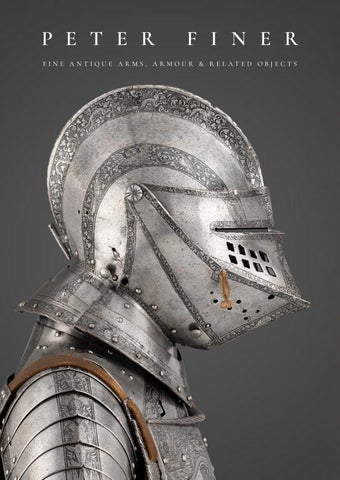
P E T E R
F I N E R
FINE ANTIQUE AR MS, AR MOUR & REL ATED OBJECTS
CON T EN TS 1 An Austrian Pavise, c. 1480
2 A Rare Infantry Broadsword of The Italian Wars, c. 1490-1500
3 A Rare North German Field Armour, Brunswick, c. 1555
4 An Etched Composite North German Three-Quarter Field Armour Made for the Court of Julius, Duke of Brunswick-Wolfenbüttel, c. 1562-3 5 An Extremely Rare Artisanal Tool, Probably by Balthasar Hacker in the Dresden ‘Cabinet’ Fashion etched after Virgil Solis, c. 1565-1600 6 An Extremely Rare and Very Fine Milanese Parade Shield, c. 1565-75
7 A Composite Armour for Light Cavalry or Service on Foot, Etched and Gilt in the Lombard Fashion, c. 1570-80 8 A Rare Decorated Girdle for a Lady, c. 1580-1600
9 A Dresden Powder-Flask Carried by Musketeers of the Trabantenleibgarde of Christian I, Prince Elector of Saxony, c. 1590 10 An Extremely Rare Pair of Sporting Crossbows, c. 1590-1630
11 A Swept-Hilt Rapier with Silver-Encrusted Hilt, c. 1610
12 A Riding Sword with Silver-Encrusted Hilt of Distinguished Quality, c. 1625-35
13 A Group of Four Parade Partizans, carried by the Bodyguard of Duke August Wilhelm of Brunswick-Wolfenbüttel, dated 1718 14 An Exceptionally Rare Rifled Small-bore Cannon of Twist Steel Made for August Wilhelm, Prince of Brunswick-Wolfenbüttel, dated 1729 15 A British Officer’s Rare and Important Embroidered Mitre Cap Grenadier Company 65th Regiment of Foot, 1758-1768
1
An Austrian Pavise, c. 1480 Austria, Klausen. Wood, canvas, pigskin, iron, pigment 21 cm × 49 cm / 8.27 in × 19.29 in Provenance The Arsenal of Klausen, South Tyrol, Austria Private collection, United States
T
he pavise is thought to take its name from the city-state of Pavia in Italy and is mentioned in records dating from the early 14th century in connection with the Pavians and their large rectangular shields. As the effectiveness of such shields in providing mobile cover spread, along with military innovations and condottiere from elsewhere in Italy, so pavises were found further from their place of origin, arriving on battlefields north of the Alps by the mid-14th century. The pavise remained in use as long as the crossbow remained an effective battlefield weapon, being rendered redundant by the growing use and effectiveness of gunpowder, against which it was no defence. Now giving a taste of the culture of the Middle Ages with their simple form and bright, natural primary colours, pavises once had an essential function on the battlefield: they acted as mobile walls behind which archers and infantrymen could shelter in case of need and, grouped together, they could form a temporary stockade against cavalry with larger variants carried by a dedicated shield-bearer or ‘pavisier’.
The archer armed with a crossbow needed time to ‘span’ and load his weapon between shots, slowly winding the bowstring back with a cranequin and then fitting the pointed bolt into place. At this time, he would be vulnerable as he bent over his weapon and so, when in the field - as opposed to when he was allowed the shelter of a town wall - the crossbowman would be accompanied and assisted by his pavisier, whose job it was to carry the pavise into battle and to position and move it in order to protect both of them from incoming missiles while the crossbow was being spanned and loaded. Part of a small group of pavises discovered in 1871 in a tower that formed part of the city walls of Klausen, an ancient town in the southern Tyrol, this pavise is similar to those discussed by Graf Oswald von Trapp in 1931. In the 130 years since their discovery in Klausen, this small group of pavises has been dispersed worldwide, to collections, both public and private, and so examples have become gradually harder to acquire. Von Trapp identified nine such pavises from Klausen, each of which was painted with the Austrian Bindenschild (the white horizontal stripe on a red background) and each of which bore the additional (and, as yet, unidentified) conjoined Shield of Arms shown on our pavise. This pavise was probably made for use by local crossbowmen and infantry of the time of Archduke Sigismund of Tyrol (1427-96).
2
A Rare Infantry Broadsword of The Italian Wars, c. 1490-1500 Northern Italy, probably Venice. Steel, re-patinated 105 cm / 41.3 in (overall length) Provenance Private collection, United States
I
n modern commentaries these swords are frequently ascribed to the Venetian Republic, the basis for this being the multiple examples preserved in the Armoury of the Palazzo Ducale, Venice. Of the related swords in the Palazzo Ducale, six examples have pommels comparable to the present one, but not identical to it, the latter being unusually tall and flattened both on each face and over the sides. Another two swords with similarly comparable hilts and pommels and which closely resemble those in Venice are in the Leibrüstkammer of the Kunsthistorisches Musem, Vienna (A 658 and A 667).
A possible single example of this hilt type with a shorter drop-shaped pommel is in the Askeri Museum, Istanbul, having been deposited in one of the Ottoman arsenals as booty taken in the latter decades of the 15th century or early 16th century. Another related example, with a tall pommel more closely resembling the present example, is in the Municipal Historical Museum in Valencia, albeit attributed by optimistic local tradition to the 13th century King Jaime I.
Fought in Lombardy as four campaigns in between 1423-54, the Venetian Republic clashed with its rival the Duchy of Milan for control of northern Italy. The conflict was far from the ‘bloodless war’ it was later said to have been. Within this period infantry troops from all Italian regions were for the greater part engaged on a mercenary basis, even when in the service of their own state, and organised to perform specialist roles in the field. The relatively lightly equipped assault infantry (rotularii) fought in a fast-moving defence/counter-attack role, carrying small round shields and armed with swords, such as the type under discussion. The subsequent period of French invasions of Naples, Lombardy and Piedmont, ‘The Italian Wars’, fought in five phases from 1494 to 1530, saw the Italian infantry equipped and engaged as before; doubtless any pre-existing serviceable swords of the present type, today first recorded in art in the 1460’s and ‘70’s, would for expediency have remained used by first-line troops.
3
A Rare North German Field Armour, Brunswick, c. 1555 Germany, Brunswick. Steel, brass, leather 89 cm × 142 cm / 35 in × 55.9 in Provenance Historic collections of the Dukes of Brunswick successively at Schloss Blankenburg and Schloss Marienburg Private collection, United States
T
his armour is constructed in such a way as to permit its use in a variety of military roles. As currently set up, this armour takes the form of a Küriss which, fitted with its lance-rest, was intended for heavy cavalry use. Removing its lance-rest and replacing the close helmet with a lighter and more open burgonet helmet would have converted this armour to a Harnasch, for medium cavalry use. In that configuration a buffe (neck and face defence) would have been attached by the staple seen at the upper centre of the breastplate; the use of a protruding staple for attaching the buffe is a particular characteristic of Brunswick armour. By removing the buffe together with the vambraces defending the arms, the gauntlets and the poleyns over the knees, this armour could be further converted to a Knechtische Harnasch for infantry wear. Removal of the lower section of the tassets and the reinstatement of its gauntlets (and possibly also its vambraces) additionally allowed this armour to be worn as a Trabharnisch for light cavalry wear. In this manner, each Brunswick armour of this type constitutes a versatile small garniture, capable of fulfilling all of the varied battlefield requirements of its day.
4
An Etched Composite North German Three-Quarter Field Armour Made for the Court of Julius, Duke of BrunswickWolfenbüttel, c. 1562-3 Germany, Brunswick. Steel, the leather modern 200 cm / 79 in (height) Provenance Historic collections of the Dukes of Brunswick successively at Schloss Blankenburg and Schloss Marienburg Robert Bohlmann collection The Ludwig Roselius Museum, Bremen, Germany Private collection, United States
J
ulius, Duke of Brunswick-Wolfenbuttel (15281568-1589) was the third son of Duke Heinrich I. Born with crippled feet, he engaged in an academic rather than a military career, studying first in Bourges and then in Lowen. A position in Cologne Cathedral in 1542 was followed by appointment as postulated Bishop of Minden in 1553. As a result of the death of his two elder brothers in the Battle of Sieverhausen in the latter year, he succeeded to his father’s title in 1568, subsequently proving himself a capable and cultivated ruler. With its proximity to the iron ores of the Hartz Mountains, Brunswick had long been an important centre for iron-working.
In the reign of Duke Julius the armourers of the city rose to particular prominence. Samuel Kriechel writing of his visit to Brunswick in 1585 noted that ‘In the said city many arms and armours are made, such as defensive armours and similar things like bits, stirrups and spurs’. Some sense of the high standing of the armourer’s craft within the city may be judged from the fact that in 1566 the painters and etchers of Brunswick noted in regard to one of their ordinances that among other things that could be accepted as a masterpiece was ‘a heavy field armour (Curitz) or light field armour (Drabhanisch) etched’. The fine armour shown here is one of a notable and highly distinctive group of armours bearing the devices of Julius of Brunswick-Wolfenbüttel. Of the twenty-two known examples of the group, eight can be recorded in the collection of the former Dukes of Brunswick in Schloss Marienburg, Lower Saxony, two in the Philadelphia Museum of Art (Acc. Nos 1977.167.19 & 23), and one each in the Metropolitan Museum of Art, New York (Acc. No.14.25. 711), the Higgins Armory Museum, Worcester, Massachusetts (Inv. No.JWHA 935), the State Hermitage Museum, St Petersburg (Inv. No.I. 78), the State Historical Museum, Moscow (formerly Musee de l’Armee, Paris, Inv. No. G53), the Musee des Arts Decoratifs, Paris, and the collection of H.M the King at Windsor Castle (Cat. No.111). The common element in the decoration of these armours is the representation of Daniel in the Lion’s Den (Daniel 6: 16-24), enclosed within an inscribed circular or quatrefoil border and usually accompanied, as in the present instance, by a crowned heart flanked by clasped hands and the initials ‘H’ and ‘I’. The combination of these latter devices prompted the long-held belief that these exceptional armours were made for the festivities associated with Duke Julius’s marriage to his niece Hedwig, daughter of Joachim II, Elector of Brandenburg, in Berlin on 25th February 1560.
A recent reappraisal of the evidence, however, has shown that this cannot have been the case, insofar as one of the armours in Schloss Marienburg is dated 1562, while that at Windsor is dated 1563. In addition, a closely related armour in the Philadelphia Museum of Art (Acc. No.1977.167.22) is dated 1564. Thus the initials ‘H’ and ‘I’ occurring in the decoration of these armours can – as in other cases - be taken to refer to Herzog Julius (Duke Julius) rather than to ‘Hedwig’ and ‘Julius’, while the devices of the crowned heart and clasped hands can be interpreted as having a spiritual rather than romantic significance. The clasped hands can, for example, be seen as representing true friendship, and the crowned heart, faith or heavenly love. Viewed in the light of such scriptural quotations as ‘God is Love’ (1 John 4: 16), ‘I will give you a new heart and put a new spirit within you’ (Ezekiel 36: 26), and ‘There is laid up for me the crown of righteousness, which the Lord, the righteous Judge, will award me’ (2 Timothy 4: 8), the juxtaposition of these devices with the pious inscription that borders the representation of Daniel in the Lion’s Den, takes on a new significance:
‘ACH GOTT BEWARE NICHT MEHR DAN LEIB, SELE, GVT UND EHR’ [Oh God, protect no more than [my] life, soul, property and honour]
Very likely inspired by St Paul’s line, ‘Now may the God of Peace Himself sanctify you entirely; and may your spirit and soul and body be preserved complete’ (1 Thessalonians 5: 23), the inscription appears in the variant form:
O.H.B.M.N.M.D.S.L.V.E. ‘O Herr behüt mir nicht mehr denn Seel, Leib und Ehr’ [Oh Lord, preserve me no more than soul, life and honour] On a series of two-handed swords made for the guard of Duke Julius in 1573 and 1574 and on the ‘Julius-Lösera’ minted from 1574. The image of Daniel in the Lion’s Den was a popular one among Protestants in the mid-16th century, being found, for example, on a Lower Saxon tapestry dated 1550 and on the ‘Daniel-Taler’ of the Regent Maria von Jever, dated 1561, and symbolising the position of Protestant Saxony within the Catholic states of Europe. Contrasting with this biblical theme, the upper border of the breastplate of the present armour shows Actaeon turned into a stag and pursued by hounds in punishment for having spied upon Diana bathing, while its central band shows Marcus Curtius leaping into the gulf. In the upper border of the backplate, the Imperial eagle is flanked by the rampant Brunswick lion. This mixture of biblical, classical and heraldic subjects, sometimes accompanied by scenes of the chase, is based on the graphic works of such diverse artists as Cornelius Bos, Virgil Solis and Cornelius Floris and is invariably executed to the highest standards: it is absolutely typical for the decoration of this group of armours as a whole.
Of the makers of these armours nothing certain is known. The ducal account books prior to 1568 are unfortunately very incomplete. Foremost among the Brunswick armourers of the 16th century were members of the Gabriel family, among whom Claus Gabriel the Younger (recorded 1551 to 1596 and for a while Mayor of the city) and Wulf Gabriel (who married in 1560, was appointed Ducal Armourer in the arsenal at Wolfenbüittel and died in 1581) could conceivably have been the makers of the armour shown here. The series of armours bearing the image of Daniel in the Lion’s Den, there remained in the Ducal Armoury at Wolfenbüittel in 1667, complete armours of Duke Heinrich and Duke Julius, together with 11 blued and four bright armours, making 17 in all. By 1732, however, only 13 were recorded, namely ‘a complete black armour with bright borders of Duke Julius on a wooden horse [very likely 1977.162.23 in the Philadelphia Museum of Art] and 12 bright etched armours without greaves’. Following the annexation of the Duchy of Brunswick by Prussia in 1866, a proportion of the most valuable contents of the arsenal at Wolfenbiittel was taken by the Dukes to Schloss Blankenburg, eventually to be transferred to Schloss Marienburg. In addition, some pieces went to the Ducal Museum (now the Landesmuseum), Brunswick, but the remainder - quite possibly including the present armour was sold in 1868 to a Hildesheim dealer for 20 thalers per hundred weight, since no bid higher than 15 thalers per hundredweight had been received in Brunswick itself.
5
An Extremely Rare Artisanal Tool, Probably by Balthasar Hacker in the Dresden ‘Cabinet’ Fashion etched after Virgil Solis, c. 1565-1600 The maker’s mark, the letter H within a fretted rectangle, is struck six times on both sides. Germany, Dresden. Steel 18.5 cm × 58.5 cm / 7.2 in × 23 in Provenance Likely made for the personal Kunstkammer collections of the Electors of Saxony in Dresden and included among the subsequent dispersal sales from the wider collection in the 19th century and post-1918. Private collection, Germany Private collection, United States
T
his imposing work, while somewhat resembling a slender type of anvil stake (a bickern) used for shaping metal, is more likely the specialist pick or hammer historically used in the laying of brick walls. The exaggerated proportions suggest the intention of presenting this piece as either a masterpiece or more likely, a ceremonial processional example. The maker’s mark, the letter H within a fretted rectangle is struck no less than six times on both sides. Although there would appear to be no record of Hacker’s mark, the fine styling of this work in the context of the electoral Kunstkammer collection gives strong plausibility to Balthasar Hacker as the maker.
The superb etched decoration and finish belies the utilitarian nature of this piece; in these respects, it is typical among the many 16th century tools and instruments made for the Saxon electors. An example in private ownership is far from typical. Constructed and finished to masterpiece standard throughout, the collection of ceremonial tools, implements and artisanal instruments made for the Saxon electors encompasses a comprehensive range of occupational disciplines. Today the collection numbers more than 7,000 pieces, the majority preserved in the collections of the Staatliche Kunstsammlungen, Dresden, and some of which are displayed in both the Rüstkammer and the room in the Kunstkammer called ‘Der Kurfürst als artifex’. Other pieces formerly in Dresden, including works attributed to Hacker, are in the Musée National de la Renaissance, Ecouen.
Balthasar Hacker was the pupil of the renowned Nuremberg inventor and engineer Leonhard Danner (1507-85). Among Danner’s many accomplishments are a marquetry wire-drawing bench made for the Elector August I, together with a variety of exquisite etched steel implements for the elector also. Working closely in Danner’s style in Dresden, in about 1565 Hacker made a folding combination tool of fourteen different implements, of finely etched steel, again for the Elector August. This was followed by other finely etched pieces, including a small goldsmith’s bench vice and a grappling hook, the latter also serving as a rope winder. Also preserved are a steel and wood pulley device made by Hacker for scaling walls, and a ‘screw-in’ chain, also a climber’s device; each of these is recorded in the inventory of the electoral collection of 1595. It is said that Hacker also invented and produced the first wheelchair. The peak of Balthasar Hacker’s works appears to have beenan elaborate multi-functional ceremonial war hammer, of cabinet quality, superbly etched and with gilt-bronze mounts, it bears the Saxon Ducal and Electoral Arms. The inventory of 1607 records Hacker being paid 30 thalers for it by the electoral court Chamberlain, and that the hammer was transferred to the care of Nicol von Miltiz, Master of the Stables, on 1st July 1593.
6
An Extremely Rare and Very Fine Milanese Parade Shield, c. 1565-75 Northern Italy, Milanese workshops. Steel, gold, silver, copper alloy with later spike and leaves 58 cm / 22.8 in (diameter) Provenance Richard Zschille, Grossenhain, Saxony (1847-1903), included in the sale of his distinguished collection of arms and armour, Christie, Manson & Woods, January 25, 1897, lot 39; Rudolph Lepke, Berlin, 21st -22nd March 1900, lot 34; Frank Gair Macomber collection, Boston; included in the negotiated sale of the collection to The Cleveland Museum of Art over the period 191623, the purchase funded by Mr. & Mrs. John Long Severance. Private collection, United States Exhibited The Chicago World’s Fair (aka. The World’s Columbian Exposition) May 1-October 30 1893, together with the Zschille collection of arms and armour as a whole. Metropolitan Museum of Art; Catalogue of a Loan Exhibition of Arms and Armor, February 6th -April 16th, 1911, by Bashford Dean, New York 1911, cat. no. 81, pl. XXXIII, lent by Frank Gair Macomber.
T
he earliest examples of European armour decorated with damascening in gold and silver are the parade pieces from the Milanese workshops of the distinguished Negroli dynasty of armourers, circa 1540. Foremost among these examples is a signed helmet dated 1543, preserved in The Metropolitan Museum of Art, New York (acc. 17.190.1720). Also attributed to the Negrolis is the damascened ‘Armure aux Lions’ of Francis I of France, circa 1540-45 and
similarly the silver-damascened armour made for Henry II as dauphin, circa 1540, each attributed to Negrolis and each in the Musée de l’Armée, Paris (G 50 and G 118). From this beginning in Milan a prolific line of development in the damascening of armour, the hilts of swords and daggers, maces, the barrels, locks and mounts of firearms, as well as luxurious domestic objects can be traced, flourishing in Milan well into the mid-17th century.
Almost parallel to this evolution in Milan a rival tradition of damascening had emerged in Spain, shortly joined by a near-identical ‘school’ of work in the Flemish city of Antwerp. The Spanish enterprise is attributed to Diego de Çaias, perhaps from Castille, his earliest known work, a gold-damascened ear dagger of circa 1530, is now in The Metropolitan Museum of Art, New York (acc. 39.159.1). Other examples of his damascened works confirmed as his own follow from circa 1539 to the mid-16th century, two of which he made for Henry II of France, another for Henry VIII of England and another for his son, Edward VI. Thereafter the numerous other damascened works created in the style apparently established by de Çaias are more loosely attributed, over course falling into the category of ‘workshop of’, suggesting the work of followers only.
The design style common to both is essentially the use of very fine but small arabesque scrollwork patterns punctuated by small vignettes and all usually set within fine linear borders. The vignettes, both framed and unframed, involve a number of variations but are universally characterised by working to a minute scale, most commonly illustrating walled towns or other architecture in pastoral landscapes, augmented by tiny figures, domestic animals and fantastic mythical beasts. A series of small, damascened caskets ascribed to the de Çaias / de Nerve workshops and dating from the mid16th century well-illustrates these themes: one in the Poldi Pezzoli Museum, Milan (inv. 557), another belonging to the Waddesdon Bequest (17) in the British Museum, and a third in Cluny (no. 14397), (see Blair 1970, nos. 31-33, pp. 1967, figs. 73-76).
The Antwerp branch of damascening followed the Spanish designs extremely closely and were only initially confirmed by the existence of a damascened rapier hilt in the Historisches Museum, Dresden (E.58), signed by Damianus de Nerve and dated 1556. A further twelve distinguished examples of damascened hilts and firearms are firmly attributed to de Nerve, together with the damascened decoration of a parade armour made for the Emperor Maximilian II, circa 1555-59.
The designs covering the rim of this shield reprise the themes of architectural landscape vignettes, now in a slightly larger scale and drawn to reveal an extraordinary level of characterful detail all picked-out in gold and silver. The buildings involved are in part neo-eastern, part Italianate, involving whole towns with church spires and domes, arches, rivers and trees, while scattered within are minute birds, animals and fantastic beasts, together with mounted warriors including St. George slaying the dragon.
In support of the present shield’s proposed attribution to a Milanese damascener’s workshop, the example is offered of a Milanese half-armour in the Hofjagd-und Rüstkammer of the Kunsthistorisches museum, Vienna (A 1408). Details such as the design of the more elaborate cartouche frames are clearly shared. On this armour also exist the tightly packed arabesque designs and the exotic small architectural designs more frequently attributed to Spain, but displayed here, as on the shield, within the finesse of Milanese style.
7
A Composite Armour for Light Cavalry or Service on Foot, Etched and Gilt in the Lombard Fashion, c. 1570-80 Northern Italy, Milanese workshops. Steel, gold, copper alloy, leather 175 cm × 62 cm / 70 in × 24.4 in Provenance Louis Bachereau, from his gallery at 46 Rue de Provence, Paris; To Edward Hubbard Litchfield, New York (1835-1930), Thence to his son, Edward Hubert Litchfield, included in the sale of his late father’s collection, Parke-Bernet Galleries Inc., New York, The Important Collection of Arms and Armor Mainly European. XV-XIX Century, Formed by the Late Edward Hubbard Litchfield, December 5 and 6, 1951, lot 122 (described incorrectly as French); Private collection, Mexico City
W
hile armour of this configuration had evolved in northern Italy for use in field combat, the notion of style remained central and important, not only as a mirror to wealth and rank within the aristocracy, but also to instil a uniform sense of loyal pride within select bodies of troops. This style of work is referred to as the Lombard school of etching, ascribed to the workshops of Milan, Brescia and to the smaller centres of armour production throughout the Lombardy region.
The portraits of military commanders wearing etched armour of this type are many, although one excellent example, complete with leg armour, exists in Caravaggio’s portrait of Alof de Wignacourt, Grand Master of the Order of Malta, circa 1607-8 (Musée du Louvre, inv. 57). Armour decorated in this distinctive manner appealed widely within the trading spere of the armour workshops of Milan and Brescia. Armours of this general type were certainly supplied over a broad geographic area, for example from the well-funded Amsterdam city guard and the armed retinues of Italian Princely and Ducal ruling Houses, to the Malta garrison of the Order of the Knights of St. John (as exemplified in the portrait referenced above). Consideration should be given equally to those examples worn by the foot soldiery of the late 16th century, not least because within this school of etching little difference existed between that which was applied to armour supplied to the nobility, and that on the armour worn more extensively by bodies of troops. One such illustration of this egalitarian distribution is found in the series of half-armours (corsaletti da piede), extending to the tassets (upper thigh defences) only and worn by the Amsterdam city guard, circa 1580; one of these armours is currently on loan to the National Military Museum in Soest. The only significant point of difference seen in the majority of military examples is that most these armours worn by common soldiers were supplied with a simple morion (zuccotto aguzzo) in place of a finely constructed and expensive burgonet. Half-armours of this type were notably popular worn by the Italian knightly aristocracy in the portraiture of the period, with the helmet removed but usually proudly visible to one side.
An armour such as this present one might also be supplied with full leg defences; the addition of these would naturally provide the protection necessary for mounted officers and light cavalry fighting from the saddle. Leg defences would be supplied as accompanying elements of a larger garniture of armour, or more commonly as a supplementary defence, perhaps even supplied subsequent to the initial purchase of the half-armour. As a garniture the legs would have been etched to provide a near-seamless match with the core pieces, but as possible subsequent additions it follows that the etching, while stylistically closely related, would unlikely be an exact match. Without doubt the most extensive example of such a garniture etched in the Lombard fashion is that removed from the armoury of Marquesses de Don Aguas in Valencia, which was made in Milan, circa 1550-75. Not only complete with its original leg defences, this armour additionally comprises an astonishing range of exchange pieces for both heavy cavalry and use in the variations of the tournament (Metropolitan Museum of Art, New York, acc. 1927.159. 1a-p). Numerous etched armours of the Lombard School are preserved in the arms and armour collections of museums in Italy, Spain, Britain, north-western Europe and the United States. Among these, examples most closely comparable with the present armour, include the following: The Philadelphia Museum of Art, the burgonet similarly fitted with a falling buffe (1977.167.26) The Metropolitan Museum of Art, New York (acc. 16.154.2) The Museo Nazionale del Bargello, Florence (M 1444 & 1133) The Stibbert Museum, Florence (ST 3495) The Museo Civico Marzoli, Brescia (943) The Museo Poldi Pezzoli, Milan (inv. 340) The Royal Armouries, Leeds (II.47) The Wallace Collection, London (A 55 & A54, the latter including a closely comparable burgonet).
Concerning the modern provenance of this armour, Louis Bachereau, from whom the great American collector Edward Hubbard Litchfield had acquired the armour, was by the beginning of the 20th century the Paris dealer most able to procure the finest examples of European armour for a wealthy but discerning clientele. Highly regarded as an antiquary, he ran his business from a sumptuous showroom at 46, Rue de Provence, the source of many of the armour and weapons treasures which are today preserved in the leading museum collections.
Louis Bachereau had inherited the dynastic business from his father, Victor, who had in turn taken over from preceding family. As a business they had dominated the Paris arms & armour trade for much of the 19th century and continued to do so under Louis until the late 1920’s or early ‘30’s. The celebrated collectors William H. Riggs and the Duc de Dino, each significant benefactors of The Metropolitan Museum of Art arms and armour collection, were among Bachereau’s foremost clients, as was Lord Astor of Hever, to whom Bachereau sold a number of the select-quality armours, all of which were ultimately included in the landmark Sotheby’s sale of the Hever Castle collection in 1983.
8
A Rare Decorated Girdle for a Lady, c. 1580-1600 Southern Germany, probably Nuremberg. Copper alloy (bronze), gold 102 cm / 40.2 in (overall length) Provenance Private collection, France
In western European sculpture, painting and monumental brasses, a slender girdle is shown frequently to have been the primary accessory to the costume worn by ladies of social substance since the mid-and later medieval periods, growing ever more ornamental from the late 12th century onward. The girdle acquired a strong association with chastity and fidelity within marriage (as later exemplified in Books of Hours within the early 15th century, in various illuminated pages involving the Blessed Virgin), but unsurprisingly it also developed as an item of feminine style, enduring over the centuries as a popular bridal gift for women across all social levels.
Within the late 12th-13th century the girdle became lengthened at one end so that this hung down the front of the robe: from this might be suspended small items such as an ornate purse, or keys as befitting the status of the lady of the house. By the 15th century the fashion was for broadened and shortened girdles, to be worn high on the ribcage with a near floor-length long-sleeved robe (see for example the Venetian woven cloth of gold girdle of circa 1450 in the Victoria and Albert Museum, London, acc. 4278-1857).
By the early 16th century, the fashion shifted again to notably slender styles, remaining so into the early 17th century, and the formerly extended pendant end of the girdle had returned and evolved to become a separate piece, naturally matching the delicacy of the upper girdle and its decorative mounts. After circa 1525 the girdle returned to wear about the waist, and its separate extension ultimately descended to hang at near ankle length. From this was suspended additional bijouterie, variously a book or personal table cutlery in a leather case. The detached hinge-plates and loop which accompany the present girdle would have been intended to carry small items such as these.
A fine period representation of a girdle worn with both cutlery case and purse suspended at this fashionable extreme length is seen in the fulllength portrait of Regula Rollenbutz, the wife of a notable burgher of Zurich, and painted in 1583. Also visible is the suspension loop with its pair of hinged straps (see Wüthrich & Ruoss, Katalog der Gemälde, Schweizerisches Landesmuseum, Zürich, 1996, cat. no. 630). A slightly earlier example is seen in the portrait painted circa 1551-55 of Mary Dudley, Lady Sidney, Lady-in-Waiting to Elizabeth I, attributed to the Tudor court painter Hans Eworth (Petworth House, NT 486275). Mary Dudley had married and become Lady Dudley in 1551, the inclusion of the superb girdle in her portrait is probably symbolic of her newly married status.
Another girdle, of slender chain and plate construction notably closely related to the present example, was included in Sotheby’s sale of Fine Decorative Arts: Medieval and Renaissance, 7 July 1999, lot 128, ascribed to a late 16th century German silversmith marked with the conjoined letters HS. In that example the links are similarly rectangular and cast with an openwork design formed of pairs of symmetrical scrolls, and the hinge-plates are comparable also, cast with closely packed Mannerist ornament within raised very narrow cabled borders, the latter being near-identical to those of the present example. The present girdle has all the glittering quality associated with a prized luxurious costume accessory. This tightly-packed relief ornament intended for occupying narrow strips reveals the direct influence of the workshop of the highly acclaimed Nuremberg goldsmith Wenzel Jamnitzer (150885). A fine illustrative example of Jamnitzer’s Mannerist rollwerk designs for slender straps exists in the strap-mounts of the Kunstkammer Ostrich-egg cup, formerly in the collection of Baron Ferdinand Rothschild, now in the British Museum (see Hugh Tait, Catalogue of the Waddesdon Bequest in the British Museum, vol. III. The ‘Curiosities’, cat. no. 4, detail fig. 42). Further close comparison with the relief designs for the present hinge-plates is seen in the claspplates among the mid-16th century mounts used in the re-binding of the important early 16th century Book of Hours referred to as ‘The Rothschild Prayerbook’ (Christie’s, The Collection of The Barons Nathaniel and Albert von Rothschild, 8 July 1999, lot 102).
9
A Dresden Powder-Flask Carried by Musketeers of the Trabantenleibgarde of Christian I, Prince Elector of Saxony, c. 1590 Germany, Dresden. Wood, copper, copper alloy, gold, iron, fabric, silk 24.6 cm / 10.43 in (overall length) Provenance The Saxon Electoral Armouries, Dresden Private collection, United States
T
he Musketeers of the Footguards within the Electoral guard numbered 74 men within the reign of Christian I (r.1586-91) and 36 within the tenure of Friedrich Wilhelm, Administrator of the Saxon Electorate (1591-1601). The Musketeers of the Electoral guard were dressed in a striking uniform of black and gold, matching the colours of their powder-flasks. In keeping with most of
the surviving arms and armour from the former Electoral Armouries this powder-flask has been preserved in wholly original and untouched condition. The present example is made more rare by the presence of the nozzle cap, which is missing from almost every other example in private ownership.
10
An Extremely Rare Pair of Sporting Crossbows, c. 1590-1630 Germany, possibly Saxony. Steel, core wood, palisander wood, staghorn, hemp-cord, silk 59.69 cm / 23.5 in (length of each crossbow) Provenance Christie’s London, Antique Arms and Armour, 29 March 1995, lot 102, The Property of a European Nobleman Private collection, United States
T
hroughout the historical period crossbows were individually made and it is very rare to find two which were constructed and decorated to form an exact matched pair. Until within the third quarter of the 17th century crossbow mechanisms required re-setting for every cycle of use. This involved the laborious insertion of cocking or setting-rods into various apertures in the tiller, by which means the internal components could be pushed into their cocked position. Mindful of this process it is perhaps towards the achievement of a quicker and more exciting rate of use that the owner of these luxurious bows went to the expense of a second one made. The relatively light and compact proportions of these crossbows are referred to by the German term ‘halbe rüstung’. This indicates that these are smaller bows intended for the lighter game animals, with the sportsman either in the saddle, or more frequently in a hide against driven game. Bows of this configuration were also used in prestigious target shoots against the ‘Popinjay’, a metal bird set atop a very tall pole. Participants came from the upper tiers of society and formed themselves into guilds competing nationwide. The winners were much lauded and awarded silver and gold prizes.
11
A Swept-Hilt Rapier with SilverEncrusted Hilt, c. 1610 Germany. Steel, silver and wood 120 cm / 47.5 in (overall length) Provenance Private collection of the former chairman of The Royal Armouries, Leeds Private collection, United States
T
he swept-hilt rapier is not only one of the most elegant forms of sword ever devised, but also one of the most interesting. At the height of its popularity in the late sixteenth and early seventeenth centuries, considerable variation could be found in the number and arrangement of the several guards that made up its hilt. Two features in particular serve to characterise the hilt of our rapier: the first is its possession of a forward quillon as well as a rear one, and the second, its possession of two diagonal outer loop guards respectively linking the lower end of the knuckle guard to the proximal end of the rear quillon and the proximal end of the front quillon to the lower end of the rear arm. A portrait of David Joris, probably by Jan van Sorrel, in the öffentliche Kunstsammlung, Basel (inv. No. 561), shows this combination of features to have existed as early as about 1540–5. The form of inner guard seen on the hilt of our rapier, however, is unknown before its appearance in Sir Martin Frobisher’s portrait of 1577 by Cornelis Ketel, in the Bodleian Library, Oxford.
Silver-encrusted decoration involving winged cherubs’ heads of the kind found on the hilt of our rapier is in fact a relatively common feature of high-quality English swords of the early seventeenth century, believed in some cases to have been made by the royal sword cutlers Thomas Cheshire, Nathaniel Mathew and Robert South of London. A royal warrant of 1614, for instance, authorised a payment to the second of those makers for, among other things, a sword decorated with ‘cherubyn heads de argento damasked’. Such decoration was nevertheless popular throughout much of northern Europe. It is found for example on the hilt of a German rapier of about 1610 in the Royal Armouries Museum, Leeds (inv. No. ix. 877), as well as on another of the same date and origin in the Collezione Odescalchi, Rome (inv. No. 415). This latter, aside from the fact that it lacks outer loop guards, is constructionally similar to that of ours. It even has a large vertically grooved pommel. Two further silver-encrusted swords possessing pommels of this type can be seen in the Schweizerisches Landesmuseum, Zurich (inv. Nos LM 16736 and 16988). The first belonged to Hans Gugelberg von Moos (recorded 1562–1618), and the second to Rudolf von Schauenstein (recorded 1587– 1626), whose name appears on its blade along with the date 1614. A third resembling them is in the Royal Armouries Museum, Leeds (inv. No. ix.1033). It seems probable from the foregoing that our rapier, like the pieces just discussed, was made in Germany.
That would almost certainly be true for its blade which bears the mark of an orb and cross, commonly found on the works of the sword cutlers of the north Rhine-Westphalian city of Solingen, then Europe’s leading producers of sword blades. Their Latin, however, seems not to have matched their metalworking skills. The inscriptions can be seen as an alternate phrasing of the last two lines of the Te Deum: In te, Domine, speravi non confundar in aeternum (In you, Lord, I have hoped may I never be put to shame) – sentiments to which the owner of any sword would have done well to subscribe. Closely resembling that of our example, except in having chiselled rather than encrusted ornament, are the hilts of two rapiers respectively preserved in the Musée de l’Armée, Paris (inv. No. PO 2024), and the Metropolitan Museum of Art, New York (acc. No. 14.25.1190). They have not only spherical pommels, but also spherical mouldings decorating their guards. Of perhaps greater relevance to our example, because of their possession of silver-encrusted ornament, are the hilts of three further rapiers of the pattern under discussion: one in the Deutsches Historisches Museum, Berlin (inv. No. W 602), and two in the Wallace Collection, London (cat. Nos 583 and 583). Another, in the Collezione Odescalchi, Rome (inv. No. 335), is of interest in showing details generally associated with English swords of the early seventeenth century.
12
A Riding Sword with SilverEncrusted Hilt of Distinguished Quality, c. 1625-35 Germany. Steel, silver, wood 110 cm × 22 cm / 43.3 in × 8.6 in (overall length) Provenance Swedish ancestral collection
T
he exceptional quality of this hilt has the added dimension of historic interest arising from its ancestral Swedish ownership. The original owner would undoubtedly have been a member of the Swedish nobility. With that perhaps, it is reasonable to suppose he was engaged within the tumultuous period of Swedish military campaigning across northern and central Europe. Both practical and supremely elegant, riding swords with rapier hilts sharing the constructional style of the present example would seem to have been popular among senior officers in the Swedish service during the Thirty Years War (1618-48). This vogue probably radiated from members of the royal circle of King Gustavus Adolphus (r. 1611-32), whose surviving personal weapons also reveal a preference for this style. The hilt of the king’s silver-encrusted rapier not only shares the typological characteristics of the present hilt, but a use of conspicuously naturalistic flowers, similar to those within the silver decoration of the present hilt; this rapier from the royal wardrobe is preserved in the Livrustkammaren, Stockholm (inv. 1845). The process of inlaying silver (or gold) decoration onto iron is in general referred to as damascening. In the present instance this inlay forms an attractive relief pattern rather than one which is
conventionally flat. The relief work is referred to as ‘encrustation’, and the small silver motifs of the encrusted design are further enlivened by engraving these in minute detail. The relationship between the encrusted silver work seen on both English and German hilts dating from circa 160520 is without doubt a close one. Direct parallels exist in both the overall styling and in much of the detail found on hilts ascribed to each country. This closeness is such that (the specific work of identifiable English royal hilt-makers aside) the majority of those hilts wishfully attributed to an English origin are only safely identified as such by certain national characteristics in their constructional form, rather than by their encrusted decoration. This cultural fusion is explained by the arrival in England of German hilt-makers and silver small workers within the reign of James I (r. in England 1603-25), fulfilling the fashion-driven demand for fine silver-encrusted hilts derived from their native working style. A good example of the very close similarities existing is found between the present German hilt and the surviving by-knife, pommel and crosspiece of the English crosshilted sword made for the Earl of Kimberly after 1607 (Claude Blair, ‘An English Sword with an Ottoman Blade in the Swiss National Museum – The Hilt and Scabbard’, in Blankwaffen, ed. Karl Stüber and Hans Wetter, Zurich 1982).
Few 17th century silver-encrusted hilts remain in this little-used state, the present hilt comparing in this respect with the silver-encrusted hilts of five rapiers and two of the daggers in the James A. de Rothschild Collection at Waddesdon Manor. Another silver-encrusted rapier with a pommel closely related to the present example was formerly in the collection of Lord Astor of Hever. Further closely related hilts coupled with a historic Swedish provenance include the sword of Colonel Måns Silverjelm, of the Västgöta Regiment, killed in 1645 (Livrustkammaren inv. 4311), together with that of Governor Melchior Wernstedt, who also died in that year: his sword is preserved in Roslagsbro Church, Uppland. While yet another, a rapier ascribed to circa 1630, is in the Army Museum, Stockholm (inv. D 17532). Evidence of a further link between this present type of sword and the Swedish royal court is provided by the related hilt in a portrait, dated 1624, of Friedrich Kasmir, Pfalzgraf von Jülich, Cleve und Berg; the sitter was second cousin and brother-in-law to Princess Katarina of Sweden, mother of King Charles X. The portrait hangs in the Swedish royal residence of Gripsholm castle,
Mariefred. Another of the royal rapiers, the hilt being of the same constructional type as this but instead made of plain gilt-iron, is believed to have been carried by the king at the battle of Dirchau in 1627, where it was extensively damaged; this too is in the Livrustkammaren (inv. 1947). The constructional grouping of the hilts to which each of these and the present example belong is defined chiefly by the single large side-ring which is sharply up-turned towards the hand, its top supported by a loop-guard and filled with a pierced sprung-in plate. In historic portraiture, the earliest example of a hilt of this type dates from circa 1625, in a painting by Frans Hals, in the Alte Pinakothek, Munich (inv. 14101). Another example is in a painting by Cornelis de Vos dating from the 1630’s, which is in the National Museum, Stockholm (cat. no. 689). In A.V.B. Norman’s detailed published survey of this present type of rapier hilt (type 84 and innerguard type 39), he concludes that surviving examples of this type are rare. We are indebted to this author’s seminal study, The Rapier and Small-Sword, 1460-1820, London 1981.
13
A Group of Four Parade Partizans, carried by the Bodyguard of Duke August Wilhelm of BrunswickWolfenbüttel, dated 1718 Germany, Brunswick. Wood, steel, fabric, gold, fabric 258.5 cm / 101.8 in (each partizan) Provenance Historic collections of the Dukes of Brunswick successively at Schloss Blankenburg and Schloss Marienburg Private collection United Kingdom Private collection, United States
T
his splendid and almost literally flamboyant parade partizan from the early 18th century is part of an important group of such emblems of authority from the ducal court of August II Wilhelm of Brunswick-Wolfenbüttel (1662-1731). There may once have been as many as 60, since one of the four exhibited in London between 1952 and 1953 was engraved with that number on one of its langets. Like halberds, partizans once had a battlefield use but, unlike halberds, (see the previous item in this catalogue) they were long obsolete for active service by the early 18th century. Carried as their weapons of office by the men of Royal and noble bodyguards - as they are still by the bodyguard found for HM Queen Elizabeth II of Great Britain by her Yeomen of the Guard - partizans were as much badges of office as weapons.
As such, of course, they normally bore as part of their decoration the insignia of the ruler whose body they symbolically Protected: thus, on our example, we find all the imagery associated with a ruler - his coronet and cypher, his armorial bearings and the ancient badge of his family. Close examination of the ducal monogram, not ‘AW II’ but ‘HAW II’, on one side of the blade of this partizan will reveal that the ‘H’ (for Herzog, or Duke) is similarly formed. Thus, there was clearly considerable reference made to the design of the bearing swords when this group of partizans was ordered for the ducal bodyguard in 1718.
14
An Exceptionally Rare Rifled Smallbore Cannon of Twist Steel Made for August Wilhelm, Prince of Brunswick-Wolfenbüttel, dated 1729 Signed by the maker ‘S. Hauschka 1729’ on the fillet moulding at the head of the first reinforce. Northern Germany, Wolfenbüttel. Steel, gold, silver, copper alloy (brass, bronze) and wood 166.5 cm × 63.5 cm / 65.5 in × 25 in Provenance Schloss Wolfenbüttel, residence of the Princes of Brunswick-Wolfenbüttel; one of four cannon of this type made by Hauschka and recorded in the 1732 inventory of the princely armoury, the present cannon historically recorded as ‘Nr.3’ in that inventory. Subsequently transferred within the latter decades of the 18th century to the von Veltheim family, Schloss Harbke, Saxony-Anhalt. In 1945 the castle and its estate were expropriated by Soviet forces, the contents having been removed prior to then by the surviving heir, Mechthild-Karin, Gräfin zu Pappenheim (née von Veltheim, d.2008). Sold anonymously by her heirs, Christie’s European Noble & Private Collections, part 1, 30 September 2014, lot 178. This cannon, together with another sold as lot 178A (the latter apparently neither signed nor dated but certainly from the Hauschka workshop) were each erroneously ascribed in the auction catalogue as having been made for August Wilhelm, Duke of Brunswick-Wolfenbüttel-Bevern. Literature Robert Bohlmann, ‘Johann Sebastian Hauschka Braunschweigischer Hof-Büchsenmacher’, in Zeitschriftfür Historische Waffen- undKostümkunde, Band 3 (12), Heft 8, September 1930, pp.187-193
J
ohann Sebastian Hauschka was a distinguished gunmaker and medallist who developed a highly individual style rooted in the Parisian Baroque tradition, which had spread to North German court gunmakers through the celebrated Electoral Court of Dresden. His finest firearms were commissioned by the ruling Princes of Brunswick-Wolfenbüttel as prestigious diplomatic gifts, as well as for their own use and that of their noble family. Hauschka’s royal patrons included the Dauphin of France, later Louis XV; Holy Roman Emperor Carl VI; Empress Maria Theresa; King Friedrich Wilhelm I of Prussia; and Crown Prince Friedrich, later Friedrich II ‘the Great’. Today, his Wolfenbüttel firearms are preserved in major collections in Leeds, Vienna, Berlin, New York and Brunswick, with further royal and presentation pieces in the Royal Collection at Windsor and private collections. This small-bore cannon is one of four of a generally similar type made by Hauschka for Duke August Wilhelm. It can be identified as ‘Nr. 3’ in Bohlmann’s 1732 inventory of the Wolfenbüttel armoury, entitled ‘Inventarium von Seren. Rüstkammer’, which also records 15 sporting rifles, 12 fowling guns and 10 pairs of pistols made by Hauschka for August Wilhelm. The barrel is remarkable for 1729, being rifled with ten grooves, a technical advancement not commonly seen in artillery until the mid-19th century, and made from costly twist steel, as used in fine sporting firearms of the period.
At the heart of its finely engraved and damascened decoration is a relief brass portrait of Duke August Wilhelm. Beneath it, an urn rises against a martial trophy of standards and cannon, its lid bearing the Duke’s ‘AW’ monogram and flanked by bound captives. Above the urn are his quartered arms as Prince of Brunswick-Wolfenbüttel and Prince Elector of Brunswick-Lüneburg, encircled by the collar of the Order of the Elephant and surmounted by a princely crown. His motto, ‘Parta Tveri’ (‘Defend your acquisitions’), is engraved below, while the armorial details are heightened in contrasting bright-gold damascene. The cannon were among the contents of Schloss Harbke removed in 1945 prior to its occupation by Soviet troops, subsequent conversion into a children’s home and eventual dereliction. The remarkable Baroque gardens created by August Ferdinand von Veltheim remain intact. In 1945, the castle was owned by Mechthild-Karin, Gräfin zu Pappenheim, née von Veltheim, the last surviving descendant of the von Veltheim family. The two cannon were included in the sale of the remaining contents by her heirs at Christie’s in 2014 (see Provenance).
15
A British Officer’s Rare and Important Embroidered Mitre Cap Grenadier Company 65th Regiment of Foot, 1758-1768 England. Velvet, satin, flannel silver and gold wire 30 cm × 21 cm / 11.8 in × 8.2 in Provenance Private collection, United States
C
aps such as our exquisite and important example were worn by the officers of British infantry regiments’ grenadier companies from the late 17th century until 1768, at which date embroidered caps for grenadiers were replaced by tall caps of bearskin with metal front-plates. The form of our fine cap is typical of the final thirty years of embroidered grenadier caps, circa 1738–68, when their height, craftsmanship and lavish decoration reached their zenith. Fewer than thirty such caps are thought to survive, representing regular British Army regiments, the Militia and several short-lived regiments of the 1740s, now dispersed among public and private collections worldwide. Concise version. Our cap is an exceptionally rare survival from the Seven Years’ War (1756–63), known in North America as the French and Indian War (1754–63), where the conflict began two years earlier. Exceptionally rare and remarkably well preserved, it has suffered virtually no moth damage; the fading of its silk velvet is unsurprising given its age and the fugitive natural dyes used to colour it.
In keeping with practice at the time, the 65th Foot’s right-flank company was designated the grenadier company and filled with soldiers selected for their height and strength. Grenadiers acted as storm troops, using muskets, bayonets and hangers alongside grenades hurled into enemy fortifications. To be a grenadier was to belong to an elite unit, their embroidered caps accentuating their height. For grenadier officers, the caps were grander still, their splendour reflecting both the officer’s purse and his hatter’s skill. The present mitre bears the regiment’s motto, embroidered in black silk: NEC ASPERA TERRENT (‘Difficulties Be Damned’). In keeping with regulations, grenadier caps matched the regiment’s facing colours and coat lace: for the 65th, a white front and silver lace. Uniquely among regular British Army regiments, the 65th Foot is known to have a second surviving mitre cap, now in the National Army Museum, London (1989-09-103). However, it is significantly less resplendent than the present cap: its body is wool rather than silk velvet, and its back-panel embroidery is simpler. It therefore likely belonged either to a less affluent officer or to a senior noncommissioned officer of the grenadier company.
SPECIFICATIONS
1 An Austrian Pavise, c. 1480 Of rectangular shape with rounded corners and a medial gutter of angular section narrowing to a projecting ‘beak’ at the top; and formed of wood covered with gessoed canvas. The front painted with the Bindenschild or arms of Austria, the red cross of St. George on a white ground and a six-pointed yellow – for gold – star on a green field and elsewhere with delicate scrolls coloured darker red on a red ground with a central horizontal white fess. The rear fitted with the remains of a carrying handle and straps.
2 A Rare Infantry Broadsword of The Italian Wars, c. 1490-1500 The present hilt is formed of lightly faceted bars, the knuckle-guard and quillon terminals swelling and rounded over the ends, the branching forward arm terminating in a highly stylised small monster’s head shaped to fit the edge of the blade ricasso. With its original tall pommel rising from a hemispherical basal field to a narrow apex, the sides flat over its full height, the outer and inner faces rounded at their base then changing to a flat surface. Retaining its original blade of thrusting type, of relatively slender proportions, formed of two double-edged stages, the forte of flattenedhexagonal section cut with a narrow medial fuller and with a rectangular ricasso. The ricasso bordered on each face by an incised linear framework, this a residual feature of some Italian and French blades datable to the mid14th century. The remaining forward stage of the blade of flattened-diamond section and tapering to a very sharp point. Struck with a mark on both sides and with a further mark on the forward inner face (unidentified), the blade tang unmarked.
3 A Rare North German Field Armour, Brunswick, c. 1555 Of white steel, comprising a close helmet with one-piece skull rising to a medial comb and fitted at the nape with a tubular plume-holder, forward-sloping visor pierced beneath a stepped and centrally divided vision-slit with sixteen square ventilation-holes arranged in two rows, prow- shaped upper bevor pierced with six rectangular ventilation-holes arranged in a single row, bevor and two gorget-plates front and rear, the visor, upper bevor and bevor attached to the skull by common pivots and secured to one another at the right side by spring-catches; collar of four lames front and rear; breast-plate with prominent forward projection over the belly, moveable gussets at the arm-openings, pierced stud for the attachment of a buffe at the centre of the neck opening and a pair of holes for the attachment of a lance-rest at the right of the chest; fauld of three lames cut with a shallow arch at the centre of its lower edge; long tassets each suspended on three straps, formed of seven lames, separable between the fourth and fifth and terminating in detachable winged poleyns of four lames; one-piece backplate with culet of one lame; symmetrical narrow-fronted pauldrons each of six lames; tubular vambraces each with a turner and independent one-piece bracelet couter; mitten gauntlets, each with a flared and slightly pointed cuff, five metacarpalplates, an embossed knuckle-plate, five shaped fingerplates and a scaled thumb-defence; the armour decorated throughout with finely roped edges, brass rosette-washers and bands and borders outlined by deeply incised lines.
4 An Etched Composite North German Three-Quarter Field Armour Made for the Court of Julius, Duke of BrunswickWolfenbüttel, c. 1562-3 Of comprising a close helmet with one-piece skull rising to a high medial comb, forwardsloping visor pierced beneath a stepped and centrally-divided vision-slit with two rows of square ventilation-holes, prow-shaped upper bevor with a threaded boss at its left side for the attachment of a reinforce, well shaped bevor and two gorget-plates front and rem; the visor; upper bevor and bevor attached to the skull by common pivots and secured to one another at the right side by spring-catches; ‘almain’ collar of four lames front and rear with integral spaudlers each of seven lames; breastplate with a prominent forward projection over the belly, movable gussets at the arm-openings and a pair of holes for the attachment of a lance-rest; fauld of five lames separable between the first and second; long tassels each of fifteen lames separable between the fifth and sixth and terminating in detachable winged poleyns of five lames; a one-piece backplate with a culet of one lame. The armour decorated throughout with roped turns and finely etched bands and borders of scrolling foliage on a blackened and stippled ground inhabited by animals of the chase, birds, fabulous beasts, angels, winged cherubs, masks and cornucopia; the upper border of the breastplate depicting the legend of Diana and Actaeon; the central band of the breastplate depicting Marcus Curtius leaping into the Gulf
above a transverse band bearing his name; the upper border of the backplate involving at its centre the double-headed Imperial eagle and at its outer ends the Brunswick lion; at the left of the breastplate a representation of Daniel in the Lion’s Den enclosed within a quatrefoil border inscribed: ‘ACH GOTT BEVVARE NIGHT NIEHR DAN LEIB SELE GVT VND HER’ surmounted by a crowned heart flanked by clasped hands and the initials ‘H’ and ‘I’.
5 An Extremely Rare Artisanal Tool, Probably by Balthasar Hacker in the Dresden ‘Cabinet’ Fashion etched after Virgil Solis, c. 1565-1600 This imposing work, while somewhat resembling a slender type of anvil stake (a bickern) used for shaping metal, is more likely the specialist pick or hammer historically used in the laying of brick walls. The exaggerated proportions suggest the intention of presenting this piece as either a masterpiece or more likely, a ceremonial processional example. The maker’s mark, the letter H within a fretted rectangle is struck no less than six times on both sides. Although there would appear to be no record of Hacker’s mark, the fine styling of this work in the context of the electoral Kunstkammer collection givesstrong plausibility to Balthasar Hacker as the maker. Constructed of steel and etched throughout with geometric designs and Arabesque patterns with prominent stamps on both sides.
6 An Extremely Rare and Very Fine Milanese Parade Shield, c. 1565-75 Conventional to the period the greater part of shield body is of shallow convex form with a flat narrow rim and turned cabled edge. At the centre a later pyramidal spike is fitted seated on an engraved and gilt calyx washer. The body is pieced with pairs of holes originally for rivets attaching the enarms (arm-straps), the rim retains some if its brass-capped rivets for attaching a lining. The innermost band of cartouches is formed as six petals each filled with a damascened flowering spray, the middle band is formed of six ovals all filled with minutely detailed differing architectural landscape vignettes, variously involving trees, rivers and classical ruins scattered with tiny hunting dogs, birds and a wyvern, and finely damascened throughout in gold picked-out in silver. Similarly damascened, a series of trophiesof-war punctuate the ovals of the middle band, pendant from the central band. The third band comprises a series of cartouches shaped as classical shields, each enclosing a damascened rampant dragon, these characteristically graphic monsters arranged as prominent opposing pairs; an alternating arrangement of further trophies and shaped rectangular gold arabesques is placed between. The entire outer surface is lavishly decorated with a complex gold-and silver-damascened plan made up of concentric bands of emblematic cartouches, their edges minutely punched and
damascened in gold throughout, the remaining smaller spaces filled with finely drawn gold arabesques, the smaller inner series of these repeated in expanded form within the third band of cartouches and again between the elaborate cartouches encircling the rim. Set between these cartouches is a further series of shaped rectangular arabesques, now alternating with a series of complex designs of tightly scrolling leafy tendrils with monster’s head terminals and inhabited by birds, and heightened by a contrasting open and spirited tendril pattern damascened in silver, transposed over the goldwork. The entire design set against a very light russet ground, naturally oxidised from the original blue, in very fine untouched condition throughout, the damascening preserved with little wear.
7 A Composite Armour for Light Cavalry or Service on Foot, Etched and Gilt in the Lombard Fashion, c. 1570-80 Decorated throughout with etched tightly filled bands and figural cartouches in the Lombard fashion, in part on a gilt ground and all arranged within gilt guilloche borders edged with slender blackened lines. The armour comprises at its core a complete half-armour for fighting on foot. This is formed of a burgonet of notably high quality, with one-piece skull somewhat swept to the rear, rising to a tall narrow comb cabled over the top, drawn-out at the front to well-developed acutely pointed peak, and with a corresponding neck-guard at the rear. Fitted with hinged pierced cheekpieces formed of a single plate, decorated brass plume-holder at the nape, and the lower sides of the skull fitted with brass pivot hooks for attaching a buffe, in the ‘Hungarian’ manner, involving three falling lames locked by springstuds. The uppermost of these is symmetrically pierced with both horizontal and vertical large slotted breaths, the medial lame pierced with a broad band of smaller slotted breaths across its full frontage, the next in lower succession is pierced in a similar manner, and the bottom lame shaped for the chin and carrying a single neck-lame. Collar of one lame front and rear and hinged at one side. Breastplate of fine strongly pronounced form drawn downwards to create a prominent point and a shallow medial ridge, with raised turned cabled flanges at the openings for the neck and arms, the etched decoration enriched by a pair of lightly embossed cabled volutes issuant from the upper corners and
enclosing a pair of male and female classical heads within their terminals, and fitted with a single waist-lame carrying a pair of short tassets each of eight moveable lames, each of the lower lames decorated with a pair of volutes en suite with the breastplate. The original backplate decorated in a matching fashion, formed with a narrow outward flange at the base. Full arm defences, constructed with a pair of large symmetrical pauldrons each of eight lames, the main plates each decorated with a further pair of raised volutes complementing the cuirass and tassets, looped about the front and rear contours to form larger tightly curled terminals enclosing classical heads over the sides, the central broad surfaces front and rear each centring on an elaborate etched cartouche filled with a classical personification, the figures at each front representing Venus & Cupid and Prudence respectively. Each of the lower lames carrying a tubular turner secured by a swivel pin, with composite vambraces formed of tubular upper-cannons, a pair of bracelet couters over the elbows, and hinged lower-cannons, and together with two fingered gauntlets (not a pair). Together with composite full leg defences comprising two cuisses (not a pair), poleyns of four lames and with wings with V-shaped gutters, and wellshaped greaves with hinged inner plates. The etched designs are ordered as a series of bands, in the present armour accentuating the bold contours of the burgonet and similarly emphasising the respective shapes of the
breastplate, backplate and the pauldrons defending the shoulders. Inwardly bordered by guilloche lines heightened by very slender blackened lines, these bands are characteristically tightly filled with myriad small trophies-of-war, monsters, beasts and mythical grotesques and all interspersed with figural emblems inspired by classical history, mythology and biblical sources, and all alternating with burnished vacant surfaces. In the instance of the armour at the centre of this discussion, the upper core of this armour, that is to say the complete defences including the tassets over the upper thighs, forms in its own right the complete half-length type of north Italian armour worn in the latter decades of the 16th century and early 17th century, specifically for field combat on foot (i.e. a corsaletto da piede); the absence of holes pierced in the breastplate for fitting the lance-rest essential to heavy cavalry further supports this. The burnished surfaces on the pauldrons are invariably each occupied by an elaborate cartouche front and rear, in the present instance these are filled with 16th century personifications of the Virtues.
8 A Rare Decorated Girdle for a Lady, c. 1580-1600 Typical of the second half of the 16th century, the construction is of delicate proportions and decorated in the Northern Mannerist fashion. The waist section is constructed as a chain of gilt-bronze links joined by pairs of small rings, each of the links is formed as a symmetrical rectangular arrangement of openwork foliated scrolls cast in low relief and set with an expanded flowerhead at its centre. The two ends are joined to elongated plates, also of gilt-bronze, these are in turn are joined by hinges to a two-part clasp of ‘male’ and ‘female’ configuration. The clasp mounts are again cast in relief, each involving pairs of bud-like projections on a decorated neck drawn-out from a moulded base. The female ring is cast as a wreath and includes an additional smaller ring projecting from one side, the corresponding male fitting is formed with a domed small terminal. The girdle is now mounted on a fabric-covered leather strap. The hinge-plates for the waist clasps and for the suspension loop are all cast as slender elongated gilt-bronze plaquettes, decorated in low relief with small rollwerk designs (strapwork) tightly filled with clusters of fruit, flowers, cornucopia and putto masks, and all bordered by extremely narrow raised and spirally fluted cabled strips.
9 A Dresden Powder-Flask Carried by Musketeers of the Trabantenleibgarde of Christian I, Prince Elector of Saxony, c. 1590 With wooden body of hollow-triangular shape retaining its original black fabric covering, the greater surfaces encased by gilt-copper panels pierced, engraved and pricked with scrollwork within an imbricated leaf border, the facing panel carrying a cartouche filled with the arms of the Electorate of Saxony and those of the Archmarshalship of the Holy Roman Empire. The top also of gilt-copper and formed with an engraved tapering nozzle with iron spring cut-off at the base, and, unusually, retaining its original closure cap suspended from a chain. With four iron rings retaining the original suspension cords of silk and gilt wire plaited in the black and gold state colours of Saxony, including four matching large tassels, also original, and preserved in exceptional and untouched condition throughout.
10 An Extremely Rare Pair of Sporting Crossbows, c. 1590-1630 Each of the present examples is constructed with a robust steel bow struck with a mark and retained by hemp cords also securing a small iron ring against a wooden block at its centre, the outer face of the bow retaining a series of early decorative crimson silk pompoms on their braided cord (possibly the originals), and fitted with an expertly restored bow-string. As a late 16th century development, the trigger mechanism is constructed on an internally seated four-axis release system, involving a folding set trigger and long angular trigger-guard engaging a pivot safety, the trigger-guard embellished with a further pompom and bound with cord. With wooden tiller conventional to the period, swelling in the middle and shaped for the cheek, the sides veneered over their length with exotic palisander wood and enhanced on each face by a slender segmental strip of contrasting horn engraved with undulating leafy tendrils. The upper and lower surfaces entirely veneered in white staghorn punctuated by finely engraved designs of scrollwork and strapwork, in part against a blackened hatched ground, and involving various grotesque masks cleverly merged within further small designs, both about the setting aperture on the underside, behind the bolt-rest at the front, and immediately ahead of the nut.
Fitted with a horn cap over the rear of the tiller decorated with a fine arrangement of clustered fruit and flowers, bone release-nut pivoting on cords, iron lugs for fitting a cranequin, and folding adjustable iron peep-sight.
11 A Swept-Hilt Rapier with Silver-Encrusted Hilt, c. 1610 With hilt of iron formed of a vertically grooved spherical pommel with waisted neck and small tang button, and guards of circular section comprising knuckle guard, long straight quillons supporting a pair of semicircular arms linked at their lower ends by an oval side ring enclosing a flat plate, two diagonal outer loop guards respectively linking the lower end of the knuckle guard to the root of the rear quillon and the root of the forward quillon to the lower end of the rear arm, and three inner loop guards diverging from the lower end of the knuckle guard to the lower ends of the arms, the quillons and the upper end of the knuckle guard each terminating in spherical finials, and the outer loop guards and side ring each interrupted at their centres by spherical mouldings between a pair of constricted mouldings, all except the inner loop guards and the inner faces of the arms richly decorated overall on a blued ground with silver-encrusted foliate scrolls and flower-heads inhabited at points by winged cherubs’ heads, grip of wood carved with a repeated chevronpattern and bound with fine twisted silver wire between Turks’ heads, and long slender blade of hexagonal section formed at each side of the ricasso with a single broad fuller, and at each side of the forte with a pair of narrow fullers respectively struck with the inscriptions INTE + DOMINE and SPE + RAVIT accompanied by an orb and cross on one side, and NONCONFODAT and INETERNVN on the other.
12 A Riding Sword with Silver-Encrusted Hilt of Distinguished Quality, c. 1625-35 The configuration of the inner-guard of the present hilt again conforms to a recorded type, identified by the thumb-ring linking the quillon-block to the centre of an ogival ring-guard. Matching the outer-guard, this is up-turned and filled with a pierced plate. The blade is signed by the cutler or bladesmith in a series of letters stamped within the parallel fullers on both sides: ‘PETER BERG / ME FECIT SOLINGEN’ repeated in two tiered parts punctuated by a series of repeated decorative marks, and including the Reichsapfel mark arranged in pairs (an orb of office involving the letter ‘S’ repeated over respective sides of the cross: ref. Weyersberg, Solinger Schwertschmiede des 16. und 17. Jahrhunderts und ihre Erzeugnisse, 1926, Pl. IV, fig. 201 D). The ricasso is additionally struck over sides with a mark in the Toledo fashion, repeated multiply, a marketing practice customary among 17th century German bladesmiths.
13 A Group of Four Parade Partizans, carried by the Bodyguard of Duke August Wilhelm of Brunswick-Wolfenbüttel, dated 1718 The steel spike of flattened diamond section, its base formed as a ducal coronet, the medial ridge of the spike continuing as a junction between the two blades, each of which is cut to form four individual flamboyant flukes. The entire blade fixed to a tapering steel socket decorated with turned mouldings and fitted with langets extending down the wooden shaft that terminates in a conical metal ferrule. The polished blade etched overall with decoration, either side of the spike’s base bearing a panel ‘en grisaille’ containing the horse ‘forcené’ of Brunswick beneath a ducal coronet; centrally between the two blades, the N!ges of which are decorated on both sides with floral gilded tracery, on one side, the Arms of Brunswick-Wolf enbuttel flanked by twin scrolls inscribed, ‘AUGUST WILHELM:’ and, ‘DC DUX BRUNS: EA LUNEB’. (August Wilhelm, by the Grace of God Duke of Brunswick and Lüneburg) with the date ‘1718’ beneath and, on the other side, a shield containing the monogram ‘HAW II’ (‘Herzog August II Wilhelm’: ‘Duke August II Wilhelm) above a scroll bearing the ducal motto ‘PARTA TVERI’ (‘Defend your Acquisitions’) above the date ‘1718’.
14 An Exceptionally Rare Rifled Smallbore Cannon of Twist Steel Made for August Wilhelm, Prince of BrunswickWolfenbüttel, dated 1729
Wilhelm, ‘Parta Tveri’ (Defend what you have Won) is engraved in a panel across the base of the urn, and the entire armorial design involving detail picked-out in contrasting bright gold damascene.
The mouldings punctuating the muzzle and chase sections of the present barrel are highlighted by wavy linear bands encrusted in silver, the cascable is similarly encrusted with a shaped fretted collar and a rosette over the end of its button finial. It is the section referred to as the first reinforce, however, on which Hauschka has lavished his attention, taking the opportunity of the larger surface area of a cannon barrel to expand upon the baroque motifs which are otherwise found in smaller scale over the breeches of his presentation-quality sporting guns and pistols.
The barrel is mounted on its wooden bracketcarriage moving on iron-shod spoked cambered wheels, characteristic of the type of German gun carriage intended for field use throughout the 17th and much of the 18th century. A detail of particular note is the iron reinforcing plates which partly enclose the front of the bracket cheeks. This detail and the entire range of its constructional details are near-identical to the carriage of Hauschka’s cannon now in the Deutsches Historisches Museum in Berlin and referenced below.
Central to the finely engraved and damascened composition over the reinforce is the profile bust portrait of Duke August Wilhelm, inset in brass cut in relief. An elaborate silver-encrusted swagged throne canopy or baldachin, a motif of the Paris and Dresden repertoire of baroque firearms ornament, is placed above him. Beneath the bust is a emblematic urn set against a martial trophy of standards and cannon, its lid bearing the monogram ‘AW’ of August Wilhelm and supported at each side by a bound captive figure. The full quartered arms of August Wilhelm as Prince of Brunswick-Wolfenbüttel and Prince Elector of Brunswick-Lüneburg is emblazoned over the centre of the urn, enclosed by the collar of the Order of the Elephant and surmounted by a princely crown. The personal motto of August
The ducal monogram ‘AW’ and the motto ‘Parta Tveri’, together with the crown and quartered arms of August Wilhelm as Prince-Elector are also found on the series of etched state partisans dated 1718, carried by the trabantenleibgarde of Duke August Wilhelm.
15 A British Officer’s Rare and Important Embroidered Mitre Cap Grenadier Company 65th Regiment of Foot, 1758-1768 Formed principally of four panels of silk velvet, the largest of which comprises the stiffened mitre-shaped front and the three remaining panels the back. The velvet of the front white, with the upturned false peak and ground for the Royal cypher faded scarlet; the rear panels faded scarlet; the rear flap white. The front panel applied with embroidery in silver wire satin stitch comprising the Royal cypher GR encircled by a wreath of laurel, the subsidiary stems of which are of green silk with the main stems and berries formed of gold wire and small sequins; the laurel wreath flanked by descending sprays of acanthus leaves in silver wire satin stitch, gold wire and spangled sequins; the laurel wreath surmounted by a monarchial crown in proper colours in gold wire satin stitch, silver sequins and red and green silk. The upturned false peak edged by latticed couched silver wire embroidered with the motto NEC ASPERA TERRENT [‘Difficulties be Damned’] in black silk and enclosing a horse courant in latticed couched silver wire upon a ground of gold satin stitch and green silk. The front and false peak edged with silver lace. Each of the three back panels bears applied embroidery in the form of descending acanthus sprays in silver wire satin stitch with green silk stems and small gold sequins, a train of silver wire and small sequins separating the sprays; dividing the panels are two bands of convex
silver lace. The flap bears applied embroidery consisting of a flaming grenade in latticed couched gold wire with flames of scarlet and black silk and gold and silver wire, the grenade flanked by the numerals 6 and 5 in silver wire satin stitch; the grenade and numerals flanked by the device of a sword entwined with a laurel spray, all in gold and silver wire satin stitch with green silk stems; the flap edged with a band of silver lace. The interior of four panels of sewn white flannel.
A N T I Q U E A R M S , A R M O U R & W O R K S O F A RT 38–39 Duke Street, St James’s, London, SW1Y 6DF +44 (0)20 7839 5666 gallery@peterfiner.com www.peterfiner.com