ABOUT THE EXHIBITION
‘Japan / A Love Story’ celebrates half a century of work by the renowned British-American photographer Michael Kenna, and his enduring relationship with Japan. His in-depth explorations and imagery of Japan since 1987 stand out as perhaps his most distinguished and well-known works.
An exceptional exhibition ‘Japan / A Love Story’ brings together 100 exquisite, hand-crafted silver gelatin prints, featuring both his earliest and most recent images across this period. The exhibition arrives in London this September, after its launch in Tokyo to great acclaim, and U.S. debut in Los Angeles.
Michael Kenna’s mysterious photographs, often made at dawn or in the dark hours of night, concentrate primarily on the interaction between the natural landscape and human-made structures. Kenna is both a diurnal and nocturnal photographer, fascinated by times of day when light is at its most pliant. With long time exposures, which might last throughout the night, his photographs often record details that the human eye is not able to perceive.
Kenna is particularly well-known for the intimate scale of his photography and his meticulous personal printing style. He works in the traditional, non-digital, silver photographic medium. His exquisitely hand crafted black and white prints reflect a sense of refinement, respect for history, and thorough originality.
CAREER
During Kenna’s fifty year career, his photographs have been shown in almost a thousand one-person gallery and museum exhibitions throughout the world, and are included in over a hundred permanent institutional collections, including The Bibliotheque Nationale, Paris; The Metropolitan Museum of Photography, Tokyo; The National Gallery, Washington, D.C.; The Shanghai Art Museum, Shanghai; and The Victoria and Albert Museum, London.
PUBLICATIONS
Ninety monographs and exhibition catalogs have been so far published on Kenna’s work, including; Michael Kenna - A Twenty Year Retrospective (Treville, 1994 and Nazraeli Press, 2000); Impossible to Forget (Marval and Nazraeli Press, 2001); Japan (Nazraeli Press and Treville Editions, 2003); Michael Kenna – A Retrospective (BnF, 2009); Immagini del Settimo Giorno (Skira, 2010); China (Posts and Telecom Press, 2014); France (Nazraeli Press, 2014); Forms of Japan (Prestel, 2015); Rafu (Nazraeli Press and Shuppan Kyodosha, 2018); Beyond Architecture - Michael Kenna (Prestel, 2019), Michael Kenna - Photographs and Stories (Nazraeli Press, 2023) and Japan / A Love Story (Nazraeli Press 2024).
Born in Widnes, Lancashire, England in 1953, Kenna currently lives with his family in Seattle, Washington, USA, and continues to photograph throughout the world.
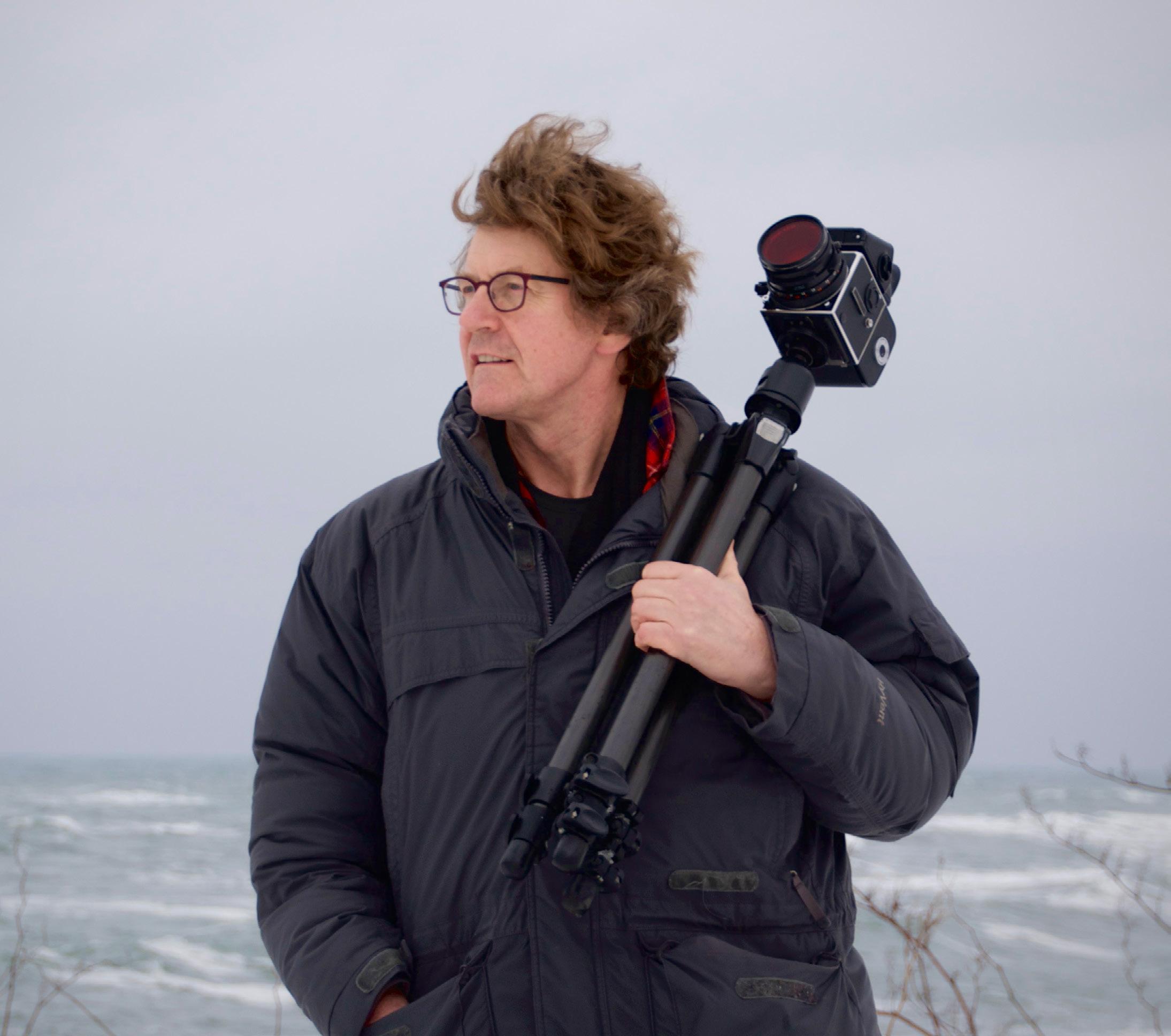
Michael Kenna © Tsuyoshi Kato
“Japan has a long and rich tradition of reciprocal gift giving. I have been the grateful recipient of so much over so many years in Japan, and I know that I will never be able to give back in equal measure. I hope this work can be seen as a small token of my desire to do so. I also hope this work can be viewed as a homage to Japan and that it will serve to symbolize my immense ongoing appreciation and deep gratitude for this beautiful and mysterious country”
—Michael Kenna
RED CROWN CRANE FEEDING, TSURUI, HOKKAIDO, JAPAN, 2005
© Michael Kenna / Courtesy Peter Fetterman Gallery
“I try not to make conscious decisions about what I am looking for. I don’t make elaborate preparation before I go to a location. Essentially I walk, explore, discover and photograph.“
—Michael Kenna
NINE BIRDS, IZUMO TAISHA, HONSHU, JAPAN 2001
© Michael Kenna / Courtesy Peter Fetterman Gallery
“I gravitate towards places where humans have been and are no more, to the edge of man’s influence, where the elements are taking over or covering man’s traces.”
—Michael Kenna
SANUKI FUJI, KAGAWA, SHIKOKU, JAPAN, 2022
© Michael Kenna / Courtesy Peter Fetterman Gallery
“Driving alone in Hokkaido, some twenty years ago, I was startled to see an attractive fence, climbing up a snow-covered hillside. I stopped the car by the side of the road and photographed it. Later, I would need a truck driver to tow me out of the field of snow where I had inadvertently parked, but that’s another story. Almost every year since, I have returned to Hokkaido and have continued to photograph this fence and the hillside. The minimalism and sheer simplicity of the scene transforms three dimensions into two. One might think that little could change, year in year out in such a scene. Yet, each time I revisit, I find that it is different. Perhaps a new pattern and configuration has appeared, an arrangement of forms changes, distance seems to contract or lengthen to become ambiguous; perspectives may shift, snow levels always vary, and the light is never the same. I am so appreciative of this location. It is a gift which keeps giving.”
—Michael Kenna
HILLSIDE FENCE, STUDY 7, TESHIKAGA, HOKKAIDO, JAPAN, 2016
© Michael Kenna / Courtesy Peter Fetterman Gallery
“I generally prefer suggestion over description, black and white over colour and Winter over Summer.”
—Michael Kenna
WHITE COPSE, STUDY 4, WAKKANAI, HOKKAIDO, JAPAN, 2020
© Michael Kenna / Courtesy Peter Fetterman Gallery
“Nothing is ever the same twice because everything is always gone forever, and yet each moment has infinite possibilities.“
—Michael Kenna
PILGRIM PATH, YOKOMINEJI, SHIKOKU, JAPAN., 2003
© Michael Kenna / Courtesy Peter Fetterman Gallery
I consider myself very lucky, and, when it comes down to it, surely, good fortune is one of the most valuable pieces of equipment a photographer can possibly be blessed with.”
—Michael Kenna
CIKISANI KAMUY, STUDY 1, SORACHI, HOKKAIDO, JAPAN, 2023
© Michael Kenna / Courtesy Peter Fetterman Gallery
“Torii gates in Japan symbolize the Shinto belief that deities reside not just in shrines, temples churches, mosques, synagogues and other institutionalized religious structures, but in nature, in the earth, sky and water. These gates serve as reminders to respect and honor the land, the earth and our universe. Personally, I regard them almost as road signs directing me to slow down and smell the roses. Every individual will have their own interpretations, but when I see a Torii gate, I immediately want to free myself from unwanted distractions, focus on what is important, escape from the noise of the world, unclutter my “stuff” and prioritize life. This particular Torii gate stands outside a small shrine on a sparsely populated island in Shikoku. I have photographed it three times so far, always cognisant that the experience of concentrated waiting and watching could be considered a form of meditation, appropriate to the location.”
—Michael Kenna
TORII GATE, STUDY 3, SHOSANBETSU, HOKKAIDO, 2014
© Michael Kenna / Courtesy Peter Fetterman Gallery
“If still images had embedded sound tracks, while observing this image we might hear hooper swans, plaintively calling out for their breakfast, embracing the chilly early morning stillness of Kussharo Lake, and preparing for the day ahead. The dawn mist has just cleared, distant mountains have become visible, snow still clings to the tree branches, and I am doing what I love to do, walking, observing, exploring, photographing, and welcoming another delicious Hokkaido experience.”
—Michael Kenna
KUSSHARO LAKE, STUDY 6, HOKKAIDO, JAPAN 2004
© Michael Kenna / Courtesy Peter Fetterman Gallery
“During long exposures, the world changes. Rivers flow, planes fly by, clouds pass and the Earth’s position relative to the stars is different. This accumulation of light, time and movement, impossible for the human eye to take in, can be recorded on film. Real becomes surreal, which is wonderful.”
—Michael Kenna
PHILOSOPHER’S TREE, STUDY 3, BIEI, HOKKAIDO, JAPAN, 2009
© Michael Kenna / Courtesy Peter Fetterman Gallery
© Michael Kenna / Courtesy Peter Fetterman Gallery
HYOMON, STUDY 1, HOKKAIDO, JAPAN, 2020