Bovine genome project will boost Brazil´s advantage in the international beef market
18 MEDICINE
Transplants using stem cell usher in the prospect of using this technique
108 INTERVIEW
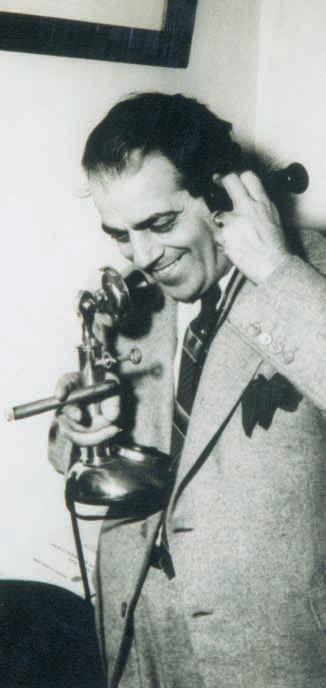
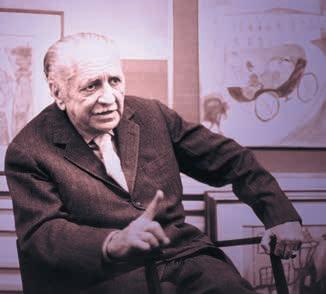
Ismail Xavier analyzes the dialog between the Brazilian cinema and the Nelson Rodrigues theater
70 SOFTWARE
Linguists and engineers formulate a speech system with a Brazilian accent
90 POPULAR CULTURE
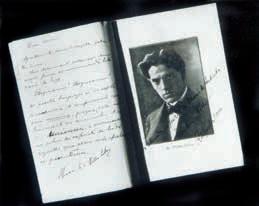
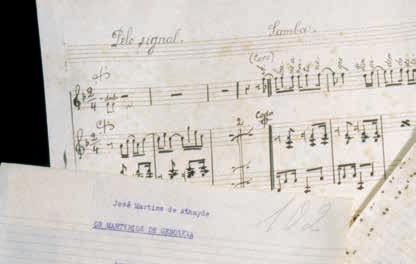
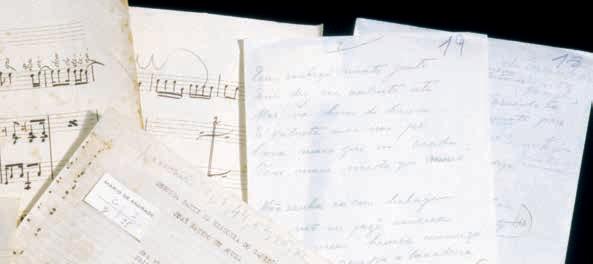
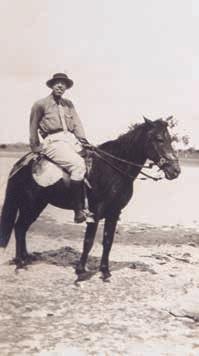
Researcher organizes collection of tunes,ballads and poems that was in Villa-Lobos possession
82 BIOTECHNOLOGY
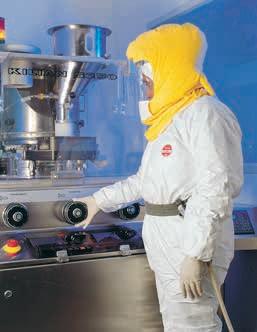
Small company teams up with Brazilian pharmaceutical industry to produce hormone against dwarfism
FAPESP
CARLOS VOGT PRESIDENT
PAULO EDUARDO DE ABREU MACHADO
VICE-PRESIDENT
BOARD OF TRUSTEES
ADILSON AVANSI DE ABREU, CARLOS HENRIQUE DE BRITO CRUZ,CARLOS VOGT, CELSO LAFER,HERMANN WEVER, HORÁCIO LAFER PIVA,MARCOS MACARI, NILSON DIAS VIEIRA JUNIOR, PAULO EDUARDO DE ABREU MACHADO,RICARDO RENZO
BRENTANI,VAHAN AGOPYAN,YOSHIAKI NAKANO
EXECUTIVE BOARD
JOAQUIM J.DE CAMARGO ENGLER
ADMINISTRATIVE DIRECTOR AND PRESIDENT DIRECTOR (TEMPORARY)
JOSÉ FERNANDO PEREZ
SCIENTIFIC DIRECTOR
PESQUISA FAPESP
EDITORIAL COUNCIL
LUIZ HENRIQUE LOPES DOS SANTOS (SCIENTIFIC COORDINATOR), EDGAR DUTRA ZANOTTO,FRANCISCO ANTONIO BEZERRA COUTINHO,JOAQUIM J.DE CAMARGO
ENGLER,JOSÉ FERNANDO PEREZ, LUIZ EUGÊNIO ARAÚJO DE MORAES MELLO, PAULA MONTERO,WALTER COLLI
EDITOR IN CHIEF
MARILUCE MOURA
MANAGING EDITOR
NELDSON MARCOLIN SENIOR EDITOR
MARIA DA GRAÇA MASCARENHAS
ART DIRECTOR HÉLIO DE ALMEIDA
EXECUTIVE EDITOR
RICARDO ZORZETTO EDITORS
CARLOS FIORAVANTI (SCIENCE),CLAUDIA IZIQUE (S&T POLICY)
MARCOS DE OLIVEIRA(TECHNOLOGY),CARLOS HAAG (HUMANITIES), HEITOR SHIMIZU(ON-LINE VERSION) SPECIAL EDITOR
MARCOS PIVETTA
ASSISTANT EDITORS
DINORAH ERENO ART CHIEF
TÂNIA MARIA DOS SANTOS ART JOSÉ ROBERTO MEDDA,LUCIANA FACCHINI PHOTOGRAPHERS
EDUARDO CESAR,MIGUEL BOYAYAN COLABORATORS
CLAUDIUS,DÉBORA CRIVELLARO,MARILI RIBEIRO, MÁRIO VIANA,NEGREIROS,TÂNIA MARQUES, THIAGO ROMERO (ON-LINE),YURI VASCONCELOS ENGLISH VERSION TRANSLATION
ROGER SKIPP,MARTIN FOLEY REVISION ALEX PADALKO SUBSCRIPTIONS TELETARGET
TEL/FAX:(55 11) 3838-4008 e-mail:publicidade@fapesp.br (PAULA ILIADIS) PRINTING GRAPHBOX-CARAN THIS EDITION PRINT RUN:2,000 COPIES DISTRIBUTION DINAP NEWSSTAND SUPPORT LMX (ALESSANDRA MACHADO) TEL:(55 11) 3865-4949 atendimento@lmx.com.br FAPESP
RUA PIO XI,Nº 1.500,CEP 05468-901 ALTO DA LAPA – SÃO PAULO – SP TEL.(55 11) 3838-4000 – FAX:(55 11) 3838-4181 http://www.revistapesquisa.fapesp.br cartas@fapesp.br BACK ISSUES
TEL.(55 11) 3038-1438
The signed articles do not necessarily reflect FAPESP’s opinion THE TOTAL OR PARTIAL REPRODUCTION OF TEXTS OR PHOTOGRAPHS WITHOUT PREVIOUS PERMISSION IS STRICTLY PROHIBITED
SECRETARIA DA CIÊNCIA TECNOLOGIA E DESENVOLVIMENTO ECONÔMICO
GOVERNO DO ESTADO DE SÃO PAULO
The best of the science made in Brazil
We are glad to present the most recent English edition of Pesquisa FAPESP,a leading science news magazine published monthly in Brazil.This special issue is the second one printed in English and exhibits some ofthe best articles written by our staffand collaborators between December 2002 and February 2004 – the first one was printed in 2002 and comprised articles written from March to November ofthat year.
The following 112 pages bring you a short overview of the Brazilian scientific production that reached 11,285 papers published in the ISI indexed journals in 2003 – almost halfof Latin America scientific production and 1.55% ofworld scientific production – in many different areas such as genetics,physics, medicine,ecology,chemistry,materials science and biochemistry,just to mention some.
December,2002
In this issue,you will discover that the preeminent Brazilian sanitarian Oswaldo Cruz,who lived in the beginning ofthe last century,was a promising talent since his early years when he went to study at Pasteur Institute in Paris.You will also find the most advanced results ofan experimental treatment:the transplant ofstem cells into the heart muscle to recover from heart failure.
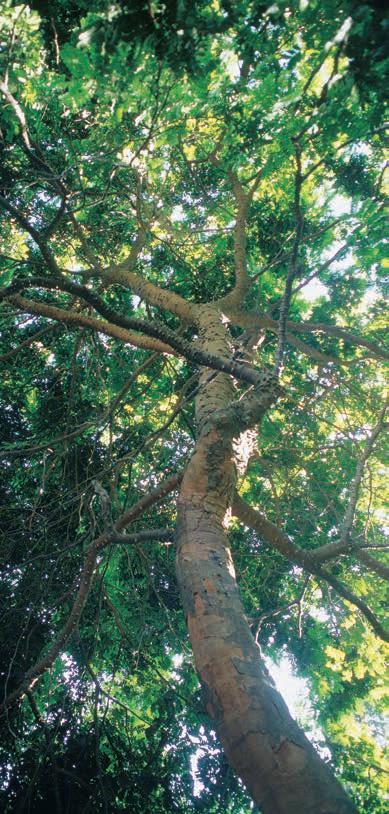
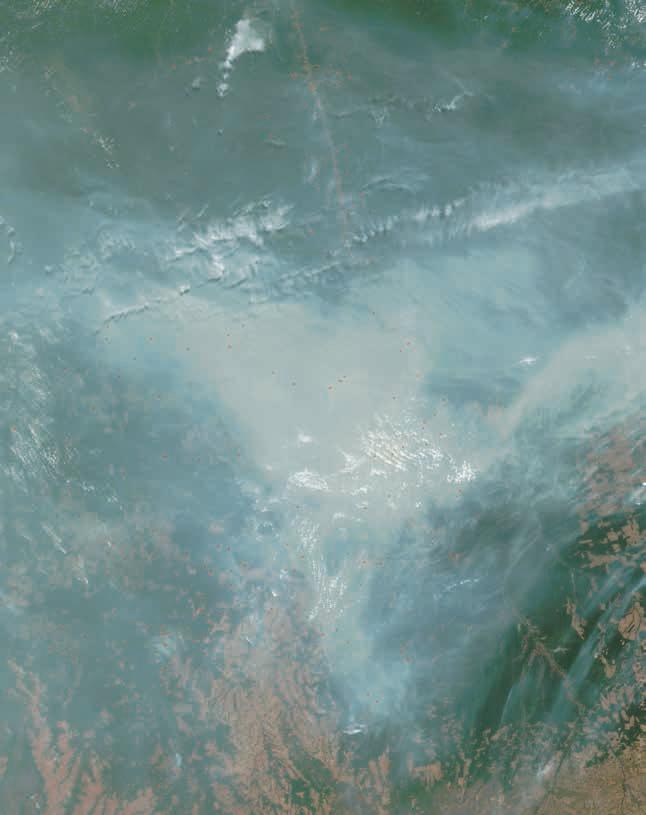
Pesquisa FAPESP narrates Brazilian researchers efforts to save pernambuco wood (pau-brasil in Portuguese),the tree that named the country,from the risk ofextinction and the climate alterations caused in the Amazon Forest by the use ofthe slash-and-burn clearance to prepare the land for cultivation.From page 72 to 75,we show the successful partnership between scientists that work at universities and scientists ofthe enormous Companhia Siderúrgica Nacional (CSN),one of the biggest Brazilian steel producer.At the huma-
nities section,you can read the charming story of a researcher that organized an abundance ofdocuments – tunes,parodies,songs and musical duels – registering popular culture that were in possession ofthe maestro Heitor Villa-Lobos,one of the most important Brazilian classical composer. Pesquisa FAPESP is an effective means to diffuse the scientific knowledge discovered by the São Paulo State Research Foudation (FAPESP),the second biggest science funding agency in Brazil that has been associated for 40 years with the expansion ofscientific research in São Paulo – state that produces nearly 50% ofthe Brazilian scientific production.Find every month at the web site of Pesquisa FAPESP (www.revistapesquisa.fapesp.br) –published in Portuguese,English and Spanish –an in-depth prospect ofthe most representative Brazilian studies in several scientific branches.
MARILUCE MOURA Editor in Chief
A promising start
At the age of early 20, Oswaldo Cruz published his first work
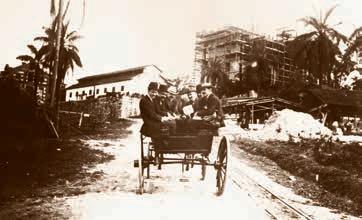
N ELDSON M ARCOLIN Cruz with other researchers in Manguinhos,Rio de Janeiro. In the background, the Serotherapy Institute
Published in May 2003
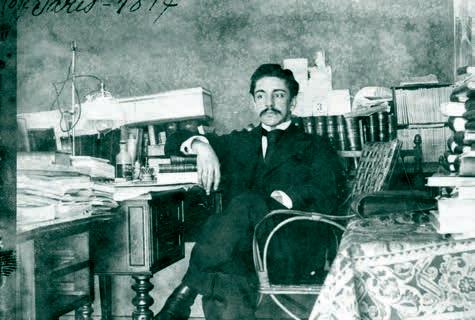
The sanitarian at the Pasteur Institute,Paris,in 1897:the first Brazilian to study at the institution
Sanitarian Oswaldo Cruz lived only 44 years,but he used every moment for learning and taking an active part in the life ofthe country.To start with,the thesis which earned him a doctorate,at the age of20. At the end ofthe 19th century,the candidates to become physicians would be enrolled in the rare courses available,and had to prepare,write and defend a thesis to be approved at the end ofsix years.A native ofSão Luís do Paraitinga,in São Paulo,but brought up in Rio de Janeiro,Cruz decided on medicine at the age of14. He graduated at 20,knowing exactly what he wanted to do in life.“Since the first day that is given us to admire the enchanting panorama that is descried when one puts the eyes to the eyepiece ofa microscope (...) the idea took root in our spirit that our intellectual efforts from now onwards would converge for us to acquire learning and become specialized in a science that supports itselfon microscopy”,says Oswaldo Cruz,in the first paragraph ofhis thesis Microbial Transmission through Water, defended on November 8, 1892,at the School of Medicine in Rio and published 110 years ago.In the same work,the patron ofthe Oswaldo Cruz Foundation and ofBrazilian sanitarism presented an apparatus invented by him, for collecting ground water with as little contamination as possible,as an alternative to foreign machines that he regarded as no good.This was just the beginning ofa brilliant
career that enjoyed the collaboration ofa new generation ofscientists, such as Carlos Chagas, Adolpho Lutz,Vital Brazil and Henrique da Rocha Lima,amongst others. Cruz studied at the Pasteur Institute (from 1896 to 1899),founded the Serotherapy Institute (1900),the future Oswaldo Cruz Institute,and became director-general ofPublic Health (1903),at the age of
30.His work was fundamental in campaigns to combat the epidemics of those times.This year,there will be the possibility of getting to know more about this scientist.The Bank of Brazil Foundation, Odebrecht and the House ofOswaldo Cruz have created an exhibition that will visit municipalities all over Brazil.For further information,write for cidadania-e@fbb.org.br.
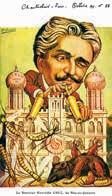
Cover of the thesis (left) and the caricature of the French magazine Chanteclair,of 1911 (above):international recognition
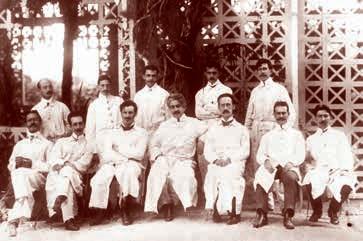
Cruz (in the middle, seated),with scientists at the Manguinhos Teahouse. Also seated,Carlos Chagas (2nd, from left to right) and Adolpho Lutz (the 5th)
The bovine functional genome project
will boost Brazil’s competitive advantage in the international beef market
Published in June 2003
The advance of the cattle herds
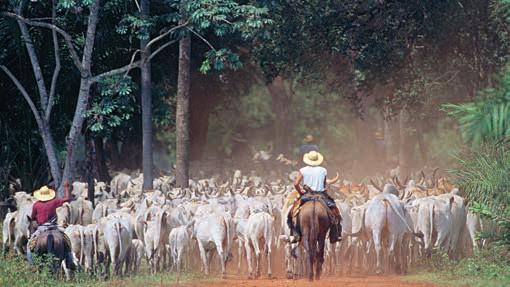
During 2002,Brazil counted some 183 million head ofcattle and moved on to have the largest commercial herd in the world.This year it is going to take over first place among beefexporting countries.With sales forecast at 1.2 million tons,passing ahead ofAustralia – whose external sales should not be more than 0.95 million tons since they are suffering from a bad drought – and the United States – that have maintained the historic mark ofbetween 1.05 and 1.1 million tons.
This performance,not at all bad for a country that twenty five years ago had registered a deficit in the trade balance ofthis product,must be accredited,in a large part, to the scientific research developed by the universities and specialized institutions in partnership with cattlemen’s associations that have guaranteed genetic improvements, the increase ofproductivity and the health of the herds,and added value to Brazilian ex-
ports.Looking only at the figures oflast year, the external beefsales accounted for US$ 1.1 billion.Ifthis total were to be added to the results ofall ofthe productivity chain – leather and leather goods and footwear –,one would arrive at an income ofUS$ 3.2 billion, out ofUS$ 60.3 billion coming from Brazilian exports during this period.
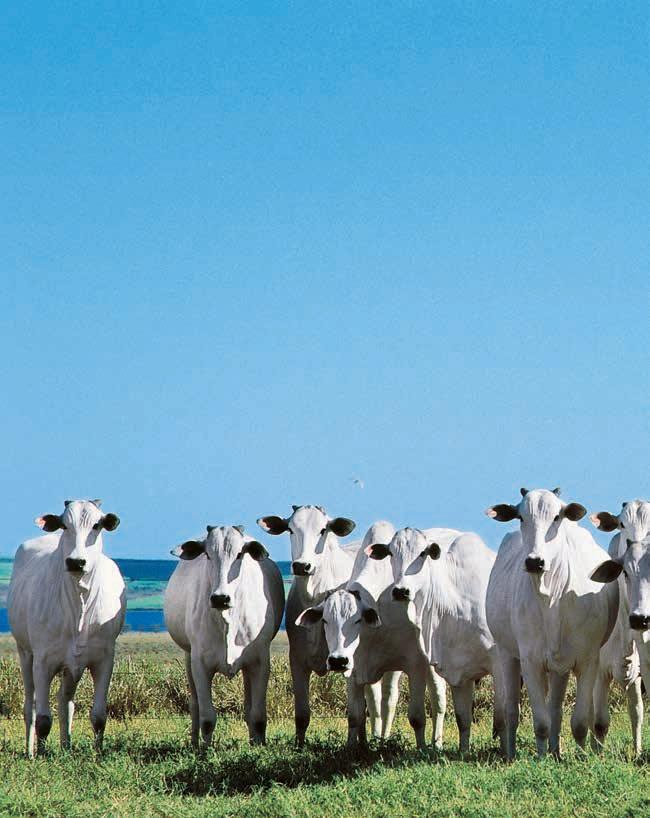
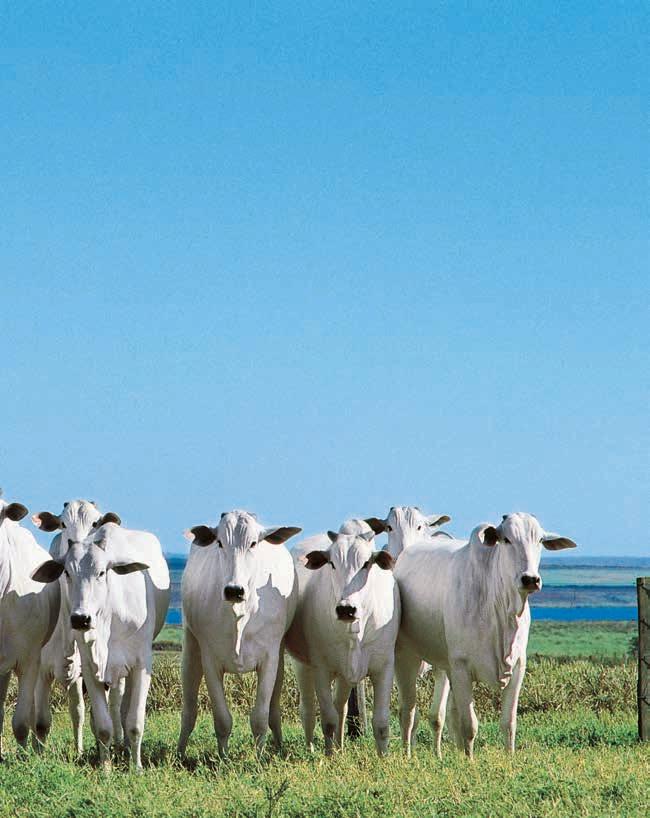
This competitive advantage gained by the country should widen with the research results from the Bovine Functional Genome Project,launched on the 7th ofMay ofthis year.The project is going to identify the bovine genes ofanimals belonging to the Nelore breed,a variety ofZebu (Bos indicus) –that make up 80% ofthe Brazilian cattle herds – in order to develop products and technologies that will permit overcoming limitations related to growth,quality ofmeat, health and reproductive efficiency,which still impedes greater competitiveness in the national cattle breeding. “This is a historic leap for the country”,declared the São Paulo
State Governor,Geraldo Alckmin,present at the launching ofthe project. The studies will be undertaken by researchers with the Agronomy and Environment Genomes Program (AEG), at twenty research laboratories.The project has a budget ofUS$ 1 million, funded by FAPESP in partnership with the Central Bela Vista de Genética Bovina (see Pesquisa FAPESP magazine, issue 87). “The final objective is to improve the quality ofthe meat so as to achieve good prices and get into new markets”,says Jovelino Mineiro from Bela Vista. “Biotechnology opens up a new window ofopportunity for the country”,emphasizes José Fernando Perez,FAPESP’s scientific director.
Besides boosting the productivity of the herds and sustaining the outstanding position ofBrazil in international beef commerce,the studies on bovine genome are going to allow the country to ad-
vance towards the demands ofthe World Trade Organization (WTO),responsible for establishing the rules for sanitation, genetics and zootechniques.These rules are based on research developed by countries with the most up-to-date scientific knowledge. “With the functional genome project,we can anticipate and even establish new rules that guarantee even greater advantages on the world beefmarket”,forecasts the State Secretary for Science,Technology,Economic Development and Tourism,João Carlos de Souza Meirelles.A cattle producer himself,the secretary is a qualified observer:he has been the President of the National Council ofCattlemen,of the National Committee for Animal Health,Vice President ofthe International Meat Secretariat and coordinator ofthe Forum for the Productivity Chain in the Bovine Cattle Raising for Mercosul,among other positions.
From registers to research - The functional genome study represents an extraordinary advance in bovine research that began last century when the first genealogical registers ofthe Brazilian herds were established. “The first necessary piece ofinformation to make any kind ofgenetic improvement is to know who the animal’s father and mother are”,comments Antônio do Nascimento Rosa,a researcher at the Brazilian Agriculture Research Corporation (Embrapa) BeefCattle,with its headquarters in the city ofCampo Grande, in the state ofMato Grosso do Sul.The first ofthese registers,dating back to 1904,was started in the town ofBagé, in the state ofRio Grande do Sul,and catalogued bulls and cows ofEuropean origin (Bos taurus).During 1918 a register for the Zebu breed (Bos indicus) was published by the Rural Society of the Minas Gerais Triangle (a cattle rai-
sing region in the state ofMinas Gerais),currently the Brazilian Association ofZebu Breeders (ABCZ);the original breed having come from India. Starting in the 50s,there began to be carried out in Brazil the so-called Proofs on Weight Gain (PGP in the Portuguese acronym). “Animals from different herds were brought together in a confined environment or in a closed field and exposed to the same conditions so as to know which animals would gain weight the fastest”,tells Rosa.At this point,the selection ofthe better animals would take place and they would be used for reproduction.
Classic genetics - In the 60s,the first great official leap forward in Brazilian production was registered with the establishing ofthe National Program for the Development ofCattle Breeding,when the country developed a cold store cycle andwent on to invest in production technologies to improve the sanitary conditions ofthe slaughter houses.Ten years afterwards there was the start ofclassical research into applied quantitative genetics,implemented by universities,research institutions and associations of cattlemen in order to improve the herds.
These programs had as their objective the production ofanimals with improved commercial characteristics,or that is to say,animals that put on weight faster,had precocious reproduction and produced a better quality of meat. “Today,after more than three decades ofresearch,we can say that Brazil is a world center ofreference in genetic improvement research”,declares Irineu Umberto Packer,from the Luiz de Queiroz College ofAgriculture (Esalq) ofthe University ofSao Paulo (USP).
The Advanced Center ofTechnological Research in the Agribusiness of BeefCattle belongs to the Zootechnique Institute ofthe Secretariat ofAgriculture ofthe State ofSao Paulo,one of the pioneers in research towards the reduction ofthe animal’s age for slaughtering,has registered scientific results and excellentpractices. “We can confirm a weight gainin the order of1% per year,or 3 kilograms,in the selected animals.With thisa young animal ofone year ofage,weighs close to 60 kilograms more than a similar animal twenty years ago”,explainsAlexander George Razook,who headed the selection program
ofZebu cattle (Nelore,Guzera and Gir) based on the post weaning weight and their effects on food conversion,reproduction and carcass,that started back in 1976. “This difference is translated in the weight at slaughter and in the carcass”,he stated.
Since 1991,researchers at the Sã o Paulo State University (Unesp)in the town ofBotucatu,have also been carrying out researchto accelerate the precocity ofthe animals. “In Brazil, cattle take on average three to four years to be ready for slaughtering.With our research intosuper precocious calves,we have reducedthis time to thirteen months.The sooner the animal is ready for slaughtering the softer is its meat”,explains Antônio Carlos Silveira, who coordinates the thematic project BeefCattle Growth on theSuper Precocious Biological Model,financed by FAPESP.Started in 1999,the project can count upon the participation ofthe Agrarian Sciences and Veterinary College (FCAV) ofUnesp at Jaboticabal, the School ofMedicine ofUSP at Ribeirão Preto,ofEsalq and ofthe Biosciences Institute ofUnesp at Botucatu. “Now we want to produce a super precocious calfusing only animals ofthe Nelore breed which,it is recognized,are considered late developers.We have to discover how to accelerate the speed of the growth ofbone and muscle tissue of the animal,and for this reason the Bovine Functional Genome Project is going to help us a lot”,says the researcher. The Southeast Embrapa Cattle has also been working to raise the productivity ofnational cattle raising by cross breeding among different breeds,but maintaining the Nelore as the base,explains Maurício Mello de Alencar.Five cross breeding systems involving bulls ofthe Nelore,Canchim,Angus and Simmental breeds along with cows of the Nelore or ofhigh interbreeding of the Nelore,are being evaluated.The research is part ofthe thematic project Cross Breeding Strategies,Management and Biotechnique Practices for the Sustained Intensification ofthe Production ofCattle Meat,also financed by FAPESP. “It is a project for animal production that involves genetic improvement based on commercial cross-breeding”, explains Alencar. “Our objective is to
produce biologically different large calves in order to study theirefficiency.” After birth the animals are evaluated in various aspects (genetic,nutrition, reproduction,health and economic) throughout their lives.The researcher explains that the calves and heifers are produced in different seasons ofthe year so that it will be possible to study distinct techniques offeeding andmanaging.This is a lengthy project whose results should come out next year.
Pasture improvement - Besides the efforts to increase the productivity ofthe herds,there is also a search on for improving pasture. “The average animal productivity in the country is offive arrobas (one arroba is equivalent to 15 kilograms) per hectare annually and 1,000 liters ofmilk per hectare per year. These numbers can get as high as 58 arrobas and 45,000 liters ofmilk,respectively,depending on the degree ofintensification ofuse ofthis pasture”, reveals Moacyr Corsi from Esalq,who has been investigating forms ofimproving Brazilian pasture for some thirty five years and is the coordinator ofthe thematic project Properties and Evaluation ofIrrigated Pastureland and its Management (Capim),financed through FAPESP.The quantity ofpasturage depends on an increase ofproductivity of the fodder plant and ofits management. “In Brazil the average efficiency in the pasture is around 30% to 50%,which means that between 50% and 70% of the fodder produced is lost.It is possible to raise the level ofefficiency to between 70% and 80%”,Corsi forecasts. The increase in production ofpasturage might well be achieved through better soil conditions,by the use ofliming and the application offertilizers containing nitrates,potassium and micronutrients.In the states ofParaná,Goiás and São Paulo,they have been able to reach a productivity ofaround 60 arrobas per hectare per year in non-irrigated pasture and above 70 arrobas in irrigated pasture”,says Corsi.
The economic and commercial results ofthe scientific research are unquestionable.In twenty years,the birth rate measured by weaning – generally occurring at nine months into the life ofthe calf – has fallen from 72% to 50%;the average age for slaughtering has been reduced from five years to
Scientific research has guaranteed genetic improvement and greater productivity of the herds
three and a half;and the production from the carcass – measured by the quantity ofmeat and bone after the animal has been gutted and its skin removed – has increased from 190 kilograms to 220 kilograms.This gain in productivity last year allowed the country to produce 8.2 million tons of meat,to register an internal consumption of37 kilograms ofmeat per capita, “one ofthe highest in the world”,according to Meirelles,and to export almost 1 million tons.
It has been this constant increase in productivity ofthe herds that during 1978 allowed Brazil to invert the inflection ofthe curve ofimporting and exporting.Up until that point,the country had exported beefto Europe, mainly to Great Britain,but imported an even greater amount from the Argentine and Uruguay. “During 1979 we became net exporters and we began thinking in a strategic manner about Brazilian cattle rearing”,the Secretary recalls.Starting at the beginning ofthe 80s,the Productivity Chain ofBeef Cattle,in the environment ofthe National Council ofBeefCattle was established.The Council organized the productivity sectors – “from the calfto
the beefsteak,passing through the leather industry”,says the Secretary –, started up scientific research,the production ofinputs,refrigerated slaughterhouses,the tanneries and the artifact sector and the leather industry. “Today this conjunction ofactivities makes up the productivity chain with the largest number ofdirect jobs in the country: 8.5 million workers”,emphasizes Meirelles.Currently the cattle industry represents two ofevery three hectares occupied by rural activities,or that is to say, ofthe 3.8 million square kilometers of the land where agricultural activities are being developed in the country,2.6 million are dedicated to cattle rearing.
Epic zoo-sanitation improvementHowever,to win over the external beef market,Brazil had to declare war on tuberculosis,on brucellosis and above all, the illness that terrorizes cattlemen:foot and mouth disease.Various countries will not import fresh meat from regionswith foot and mouth disease,among them the European Union,which is currently the main importer ofBrazilian beef. Scientific research and official vaccination campaigns against foot and mouth disease today guarantee that 140million
head ofcattle,from a total number of 183 million,are raised in zones free of this illness,in a production belt that runs from the states ofRio Grande do Sul to Bahia,passing through Tocantins,Mato Grosso and Rondonia.The expectation is that the illness will be completely eradicated by the year 2005. Recent research is also promising advances in combating bovine brucellosis,which brings about abortion in cows starting at the fifth month ofgestation.The vaccine most widely used in Brazil is produced starting from live microorganisms but Sérgio Costa Oliveira,from the Biological Sciences Institute ofthe Federal University ofMinas Gerais (UFMG),has developed a DNA vaccine,already successfully applied in mice,which is currently under test with cattle. “In genetic research we have evolved in a spectacular manner. From the sanitary point ofview the evolution ofthe Brazilian herds has perhaps been the greatest epic zoo-sanitation improvement in history,when one considers the size ofthe herds and the dimensions ofnational territory”,commemorates Meirelles. “We have most definitely left the state ofbeing mere shop assistants.”
MEGA SCIENCE
Network oflife
Softwarepermits the integration of data banks with information on plants, animals and microorganisms
R ICARDO Z ORZETTO
In the very near future,Internet users will be able to access an integrated network ofdata banks with information on the name, classification and distribution of thousands ofspecies ofplants,animals and natural microorganisms in the state ofSão Paulo – essential knowledge for the definition ofstrategies for the preservation ofthe local biodiversity. As yet without a defined name,this network will integrate the data ofthe Phanerogamous Flora Project ofthe State ofSão Paulo,which for nine years has been cataloguing 7,500 species offlowering plants,with those ofthe network Species Link,which brings together information on twelve herbarium and museum collections in the state of São Paulo,and microorganisms registered through the SinBiota,the Information System ofthe Biota-FAPESP Program,responsible for the survey ofthe biodiversity and natural resources of São Paulo.It will also be the first step that may allow the Brazilian participation in a much wider network,directed towards the conservation ofthe biological diversity ofthe planet.
Technically the fulfillment ofthis initiative,pioneer in Brazil and,in some aspects in the world,has become possible thanks to a protocol ofcommunication named DiGIR (Distributed Generic Information Retrieval),which allows tracking down information in distinct data banks and presents the results to the user as ifthe information had come from a single data bank source.The in-
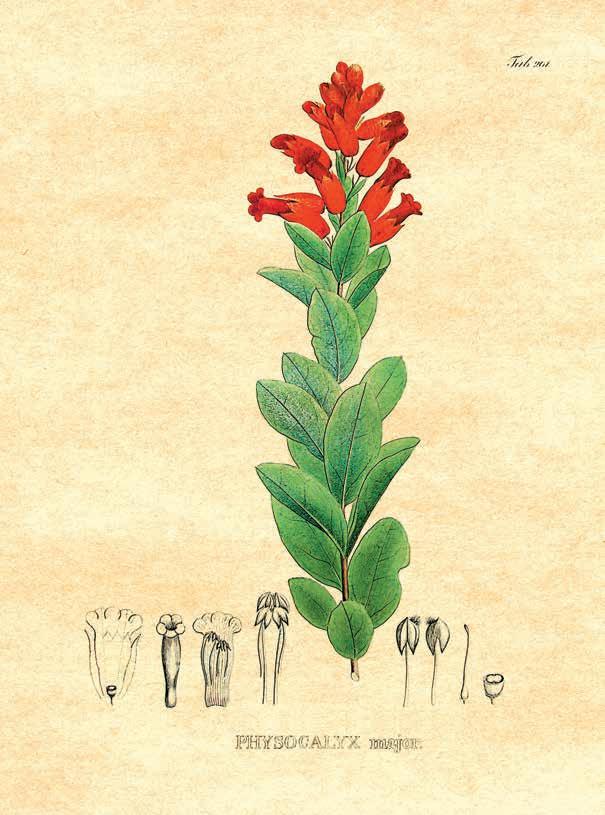
Difficult access:drawing of the shrub Physocalyx major,part of the work Nova Genera et Species Plantarum,by the botanist Karl von Martius Published in December 2002
ternational team that developed the software just about a year ago presented the most recent tested version,the last one before DiGIR 1.0,at the end ofOctober in the town ofIndaiatuba,in the interior ofSão Paulo,during the forum entitled Tendencies and Development in Information Technology for Biodiversity – the branch ofinformation technology directed towards the creation oftools applicable for the study of the distribution and analysis ofspecies. The team includes researchers from the Reference Center on Environmental Information (Cria in the Portuguese Acronym),the institution responsible for the maintenance ofSinBiota,and Australian and German specialists and others from the universities ofKansas and California,in the United States.
The idea ofdeveloping a program that would integrate data from different systems – the so-called inter-operability,essential for allowing access of a greatest number ofresearchers to the greatest possible quantity ofinformation on biodiversity – came about at a meeting ofthe Work Group on Taxonomic Data Bases that occurred during 2000 in Frankfurt,Germany. “Up to that moment,each network had developed its own software for exchanging information.We were on the road to developing the Species Link,and probably we might have created yet another different program,without the capacity of being able to inter-communicate with the other networks”,explains the systems analyst Ricardo Scachetti Pereira,
from Cria. “During the meeting the idea ofDiGIR was presented,which would allow the exchange ofinformation.Consequently we decided to participate in the development ofthis protocol ofcommunication.”
Exactly because ofthe possibility of exchanging information between different data banks,the influence ofDiGIR must not be restricted to the São Paulo network.It will also be a tool to be used in the virtual integration ofthis network with other networks ofdata banks on biodiversity existing in North America (Species Analyst),in Europe (European Natural History Specimen Information Network) and in Australia (Australia’s Virtual Herbarium).And furthermore,according to the researcher Vanderlei Perez Canhos,director president ofCria,the DiGIR program is even a strong candidate to be adopted as the protocol that would make the integration ofinformation systems ofa multinational initiative,much more ambitious,namely:the Global Biodiversity Information Facility (GBIF).
Catalogue of life - Established in 2001, under the auspices ofthe Mega Science Forum ofOECD (Organization for Economic Cooperation and Development),the GBIF is an international ini-
tiative responsible for the coordination ofa network that aims to integrate,and to make available through the Internet, not only the biology collections ofthe whole world – it is calculated that museums,herbariums and other collections store three billion examples ofall the organisms extinct or currently living –, but also an electronic list with the name and the taxonomic classification of 1.75 million species ofplants,animals and microorganisms scientifically described,the so-called catalogue oflife. All ofthis,with the objective ofassisting towards the solution ofa question as old as it is important:the loss ofthe planet’s biodiversity. “This is a global crisis in which everyone loses.It’ll only be slowed down ifconcrete measures are taken to preserve the environment, for which it is necessary to have a large portfolio ofscientific and technological knowledge”,Canhos comments.
Though the degradation of the environment has been under discussion since the 70s,the prospects for reversing the losses in biodiversity are not exciting.The very author ofthe term biodiversity,the American biologist Edward Wilson, from Harvard University,alerts in his most recent book The Future ofLife, about the need not only ofmaking data on described species available,but of completing,over a twenty five-year period,this inventory ofliving species along with the close to eight million still to be described.And for a worrying motive:over the last century human activity has triggered mass extinction never before seen since the Mesozoic era,which may eliminate or endanger a quarter ofthe plants and animals during the next thirty years.In an article published during 2000 in the magazine Science,Wilson estimated that it would be necessary to work twenty years and have an investment ofUS$ 5 billion to complete this mapping,done in a comparable manner to the Human Genome Project,which took some thirteen years to sequence man’s genetic material.
To turn the existing information available,to complete the mapping of the species and to analyze this data with information technology tools is an impossible task to be taken on by only a few institutions.It is an effort that de-
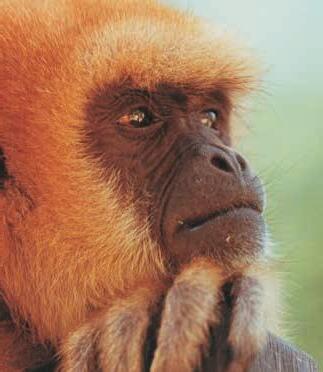
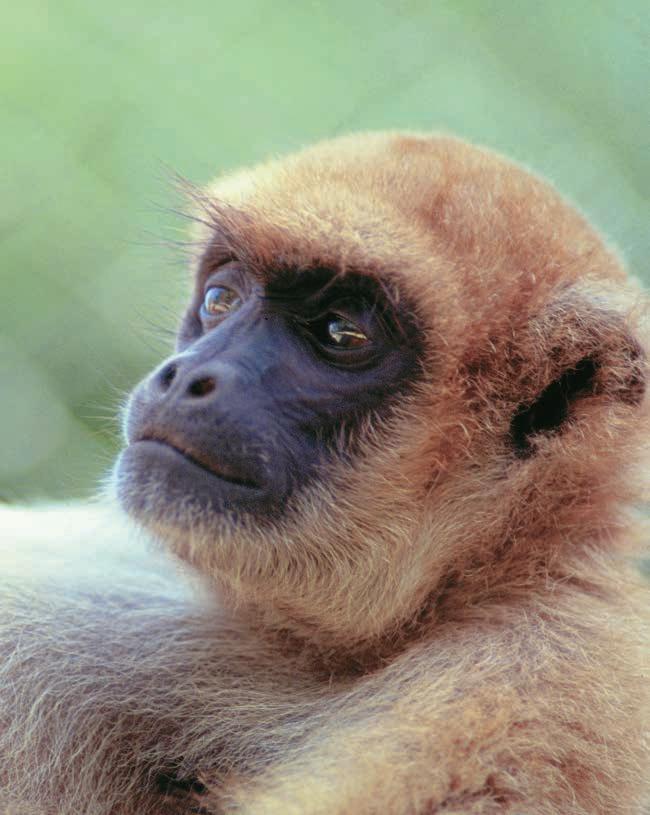
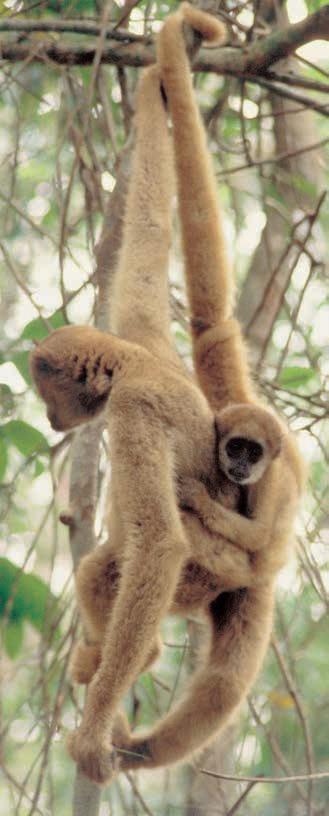
Catalogue of life: digitalization preserves data about diverse species,such as the woolly spider monkey (Brachyteles arachnoides) and the solanaceas (right)
mands the help ofresearchers from several areas and the involvement ofthe greatest number ofcountries as possible,working in a cooperative and integrated manner – a characteristic of mega-science projects,kicked offin biology by the Human Genome Project. “No single country’s capable ofcarrying this out alone”,comments Dora Ann Lange Canhos,the project director at Cria.For this reason,at the OECD meeting during 1996,the establishing ofa mega-structure (the GBIF) was recommended,capable ofstimulating the participation ofresearchers and institutes ofvarious countries – principally those that possess considerable biological diversity.
Lack of consensus - In spite ofbeing the owner ofthe largest biodiversity on the planet,Brazil has still not officially joined the GBIF – which is made up of around thirty nations – and participates only informally,through the development ofinformation technology tools for use in biodiversity.And it is not because ofa question ofbudget – joining would cost the country around US$ 50,000 annually,the equivalent of maintaining two doctorate students abroad for this period –,but because of a lack ofconsensus.While technical personnel from the Ministry ofScience and Technology (MCT) and an expressive part ofthe scientific community are in favor ofjoining,the Ministry of Foreign Affairs believes that Brazil would be at a disadvantage,since it would cede more information abroad than it would receive in return – and,in this manner,the decision will remain with the future government.
“Ifwe were officially part ofGBIF, Brazil would only gain”,says Cria’s director. “We would be able to have more ofan active participation in the GBIF’s work program,as well as financing for the development ofnational projects linked to the repatriation ofdata on biodi-
versity.” In the opinion ofIone Egler, from the Secretary for Policies and Programs ofthe MCT,the admission of the country into the GBIF would be important mainly during this initial phase in which the members taking part in the initiative are defining action priorities.During the forum at Indaiatuba,organized by the Cria,with financial support from FAPESP and other institutions,criteria were established for the selection ofprojects involving the digitalization ofdata from biological collecting,which should go into operation during the first semester of2003.
The active participation ofBrazil in the implementation ofthe GBIF would contribute to clearing up one ofthe principal difficulties ofnational research in this area:the lack ofaccess to information about Brazilian species that are found abroad,mainly in the North American and European institutions,in which there are deposited examples and Brazilian types (a type is an example used to describe a species) collected by historical exploration expeditions such as those ofHans Langsdorffand Karl Friedrich Philipp von Martius.Out ofthe GBIF,Brazil is lo-
sing,for example,the opportunity to propose priority actions,such as the digitalization ofinformation ofnational interest,which would permit to speed up the repatriation ofdata existing in institutions abroad.To illustrate the need for access to this information, Ione cited the case ofthe Phanerogamous Flora ofSão Paulo: “ There are some 7,500 species identified in the flora ofSão Paulo,but less than 500 types can be found in national collections. The rest is abroad.With this material digitalized,we would cede information on about 500 species,but would receive information on about 7,000.”
Flora Brasiliensis - Another example ofthis difficulty ofaccess is that which occurs with the work named Flora Brasiliensis,a collection offorty volumes edited by von Martius with information about close to halfofour national flora,today estimated at 56,000 species. Most ofthe work’s copies,mainly those complete and well preserved,can only be found abroad.As a consequence, this resource is underused by Brazilian researchers,according to the botanist George Shepherd,from the São Paulo State University ofCampinas – a situa-
tion that could begin to change shortly: Shepherd is coordinating a project,as yet in its initial phase,that aims to digitalize a complete copy ofthis work,an initiative that could serve as a base for the production ofa new Brazilian flora – digital and updated.
In an independent manner,foreign institutions have already been providing this type ofaccess to other countries.An example is New York’s Botanical Garden, which made available,on line,data about 600,000 examples ofplants – from a collection ofseven million.But as yet this is insufficient.To better understand national biodiversity,it is necessary to have access to information on the largest possible number ofcollections.
Ione Egler,from the MCT,was emphatic:“Without information about ourspecies,the country will not be able to recognize its biodiversity and will not implement the Biological Diversity Convention (which looks to promote conservation,the sustainable use ofbiological resources and the fair redistribution ofthe benefits coming from the use of genetic resources ofthis biodiversity)”.In the case ofnot integrating into the ini-
tiative,the country will fail to even benefit from the possibilities ofimproving the qualification ofpersonnel which the GBIF promotes and will remain without an active role in the definition of the information system adopted by it.
A frequent doubt,when one is dealing with the availability ofinformation about national biodiversity on the Internet,is to know ifthis will make biopiracy any easier. “This is an incorrect idea.In the case ofthe GBIF,we’re not dealing with material leaving the country,but an exchange ofinformation of which there is a lot available within scientific magazines”,Ione explains.The form ofhow the system is being proposed even allows that the researcher controls the information that he intends to place on the network.
But the greatest difficulty that the team from Campinas envisions for the effective implementation ofthe São Paulo network is to change the mentality ofresearchers so that they begin to share data and to work in a cooperative manner,as the very project demands. “People need to perceive that scientific information is essential for the formulation ofpolicies and for taking decisions”,says Dora. •
ENVIRONMENT
Protection for biodiversity
Biota-Pará Project draws up list of species threatened with extinction
Published in April 2003
The biodiversity ofthe state ofPará is starting to be assessed by Conservation International ofBrazil and the Emílio Goeldi Museum ofPará.This diagnosis,baptized as Biota-Pará Project,has the objective ofassisting political decisions on conservation and the use ofbiodiversity in the region.The survey will be concluded in four years and has a total budget ofR$ 1.3 million. The first product ofthis research,which should be made public before the end ofthis year,is a list ofendangered species.Ten researchers are now gathering information on the geographical and ecological distribution, behavior and population densities ofeach one ofthe candidate species,using as a basis studies,consultations ofreference works and syntheses offield studies not yet published.“In a second stage,some 50 researchers will be doing a critical analysis ofthis list ofspecies that are candidates for extinction during a workshop,to draw up the final list”,says José Maria Cardoso da Silva,the director for the Amazon ofConservation International ofBrazil. Among the species currently found in Pará and which are on the official list ofBrazilian animals threatened with extinction are the golden parakeet,the scarlet ibis,the hyacinth macaw,the black-tailed marmoset,and the white-nosed saki,amongst others.The list ofthreatened species,the first to be drawn up in the state,is one ofthe basic instruments provided for in Law 6462 ofJuly 4, 2002,which makes provisions for the State Forest Policy. The second product ofBiota-Pará will be a diagnosis ofthe biodiversity ofthe Belém Endemism Center – so denominated for sheltering endemic species that do not occur in any other region ofthe planet –,located at the far east ofthe Amazon biome,incorporating all the forests and associated ecosystems to the east ofthe Tocantins River and the whole ofAmazon in the state ofMa-
ranhão.The region is regarded as the most cleared sector ofthe whole ofBrazilian Amazon ,on account ofthe advance offarming and cattle raising,the high population density,and the action oflumbermen and settlers. “Some 60% ofits forests have already been cleared,and the few trees that are left remain under great pressure”, observes Ima Célia Vieira,the coordinator ofResearch and Postgraduate Studies at the Emílio Goeldi Museum. Recent studies have indicated,for example,that ofthe 531 species ofbirds recorded in the region,about 166,or 22%,were threatened with extinction.
Conservation plan - Pará has over 1.25 million square kilometers ofarea.About 16% – which is the equivalent ofthe state ofParaná – are areas offorests and fields that have now been altered by human activity.The annual rate offorest clearing between 1998 and 2000was 6,700 square kilometers,according to data from the National Institute for Space Research (Inpe). “The situation ofthe biota ofthe Belém Endemism Center is similarto the situation ofthe biota ofthe Atlantic Rain Forest.Unless something is done urgently,we may have a mass extinction ,the first ofthis kind to hit Amazonia sincethe entry of man into the region”,warns Cardoso da Silva.
•
When the diagnosis ofbiodiversity is concluded,the Emílio Goeldi Museum and Conservation International ofBrazil intend to draw up – together with other organizations,the state and municipal governments,indigenous leaderships and local communities – a conservation plan for the region.These actions will begin to be defined at a meeting scheduled for August this year,and they should include measures like the implementation ofecological corridors,by means ofthe creation ofprivate reserves and the restoration ofthe forests in critical areas that are currently degraded.
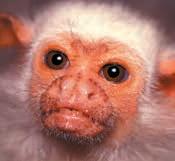
The black-tailed marmoset,a rare species at the Belém Endemism Center
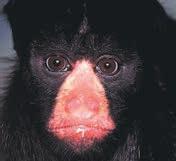
The white-nosed saki and the hyacinth macaw:two victims of forest clearing
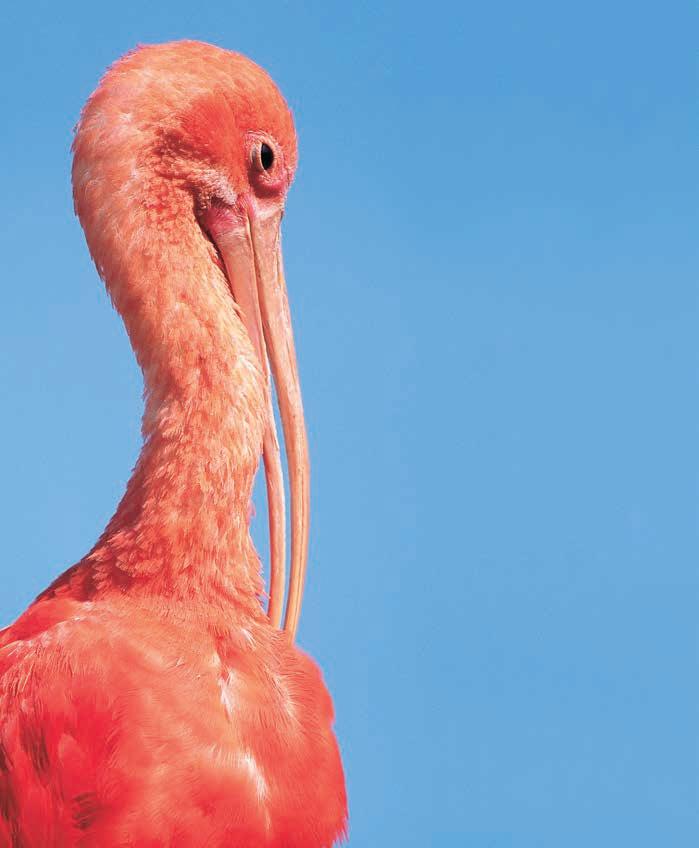
Project wants to save the scarlet ibis (left page) and the golden parakeet (above)
Restored Heart
Results from the first transplants using stem cells in Brazil usher in the
prospect of using this technique against cardiac arrest,one of the main causes of death in the world
Published in June 2003
The target ofsevere criticism and recent heated discussions,a special type ofcell comes back onto the scene,but this time bringing good news.These are the stem cells,intensely studied over the last five years because oftheir fantastic peculiarity:that of multiplying themselves and ending up as the cells ofthe different body tissues,as distinct as those ofthe skin,muscle and the nervous system.In Brazil,results from at least three research groups have come out which,in parallel with European and North American teams,consolidate the stem cells as an option for – ifnot a cure – at least improving the quality oflife ofpeople with serious heart problems,against which medicines no longer produce the desired effects.
Using distinct techniques,researchers from the States ofRio de Janeiro,Bahia and São Paulo have concluded that the transplanting ofstem cells is a promising alternative against chronic cardiac insufficiency brought on by hypertension,obstruction ofthe coronary arteries and by Chagas’s disease.A problem in which the heart progressively loses its capacity to pump blood,cardiac insufficiency hits
between 3% and 6% ofthe world’s population,and in Brazil between five to ten million people.The team from the Federal University ofRio de Janeiro (UFRJ) and the Pro-Cardiac Hospital,which published the most advanced data,recently obtained an international triumph for their results which they arrived at after two year’s work,a short periodoftime when dealing with a new area worldwide. On the 13th ofMay,the magazine Circulation, the most important scientific magazine dealing with clinical cardiology,published an article in which the researchers from Rio describe the first transplants using stem cells in sufferers from chronic cardiac insufficiency. Ofthe fourteen patients treated,twelve are doing well and two have died,apparently through causes not linked to the use ofthe stem cells,according to the doctors.
“The project only went so quickly because we had already had at the UFRJ a model for transplant in rats when we initiated the study”, recognizes the cardiologist Hans Dohmann, from the Pro-Cardiac Hospital. “The impression is that the totipotent use substitute the fibrous tissue for muscular cells”,comments Antonio Carlos Campos de Carvalho from
R ICARDO Z ORZETTO
Cardiac insufficiency:the left ventricle of the heart dilates on receiving oxygenated blood from the lungs (above) and cannot manage to contract and pump the blood to the body
Normal heart:with thicker and more flexible walls, the left ventricle dilates on receiving the blood from the lungs and then contracts, sending the oxygenated blood to the tissues
UFRJ,which works with the Millennium Institute ofTissue Bioengineering, supported by the federal government. This treatment increases the irrigation ofthe injured part ofthe heart,allowing the cells that have entered into a type hibernation to return to contracting themselves.
At the same time a group from the Heart Institute (Incor) and the School ofMedicine ofthe University ofSão Paulo (USP) applied these cells in nine patients suffering from cardiac insufficiency caused by hypertension,Chagas’s disease or ofunknown origin.Two distinct techniques were used.One,by applications either ofstem cells filtered from the blood ofthe patient himself,the other by using a hormone that stimulates the liberation ofstem cells from the bone marrow to the bloodstream.Four months afterwards three were no longer on the list for heart transplants,five improved considerably and one died,death being attributed to the serious state ofhealth the patient before entering into the experiment. “Looking at the as yet restricted number ofpatients,it is early to talk confidently about the efficiency ofthese techniques”,comments the cardiologist Edimar Bocchi from USP,one ofthe research coordinators. “But the results point to the prospect ofimprovement for these people who have an extremely serious illness.”
In practical terms,the teams from Rio and São Paulo have maintained beating – with a good part oftheir previous vigor – the hearts ofmen and women who could no longer walk in the morning to the baker’s shop nor feed themselves, such was the dimension ofthe tiredness brought on by cardiac insufficiency.Before the treatment with stem cells,the only solution for them was to wait for months for a heart transplant.Ifthey managed to resist,they would confront surgery that begins with a cut ofsome thirty centimeters in the thorax,finishes some nine hours later,demands a month for recovery,and in total the bill runs up to R$ 200,000.The implanting of stem cells is much simpler.Carried out by the introduction ofa catheter into the artery that runs from the thigh to the heart,the operation lasts a little more than an hour,demands only two days in hospital and costs ten times less.
Such is the confidence today depositedin the use ofstem cells that the National Commission ofEthics in Research (Conep in the Portuguese acronym),an organ ofthe Ministry ofHealth that authorizes medical research with human beings,approved in March ofthis year the proposal presented one year ago by the medical doctor Ricardo Ribeiro dos Santos,the coordinator at the Millennium Institute ofTissue Bioengineering and researcher with the Osvaldo Cruz Foundation (Fiocruz) in Salvador,Bahia.During this month,Santos in partnership with cardiologists from the Santa Izabel Hospital,also in the Salvador,intends to begin a study with five patients suffering from cardiac insufficiency caused by Chagas’s disease, the illness brought on by the protozoa Trypanosoma cruzi,the parasite that lodges in the cells ofthe heart.In recent research,Santos demonstrated that the use ofthis type ofcell reduces in a longstanding manner the inflamed anddamaged areas ofthe heart ofmice with
Chagas’s disease.This could be a way of keeping the healthy heart free oftrouble so that under these circumstances the parasite,which causes an illness that affects sixteen million people in Latin America ofwho six million are Brazilians,can then be fought against.
Only at the beginning - Even with these results some years will still be necessary before this type oftreatment becomes available to the population both in the public and private health systems.The experiments are merely the start ofa long trajectory until the approval ofnew medicines or medical procedures for human beings.This is called phase 1ofclinical studies the objective ofwhich is to investigate ifthe treatment is safe and does not cause any serious side effects. This is followed by other stages in which the efficiency ofthe treatment in tens and then thousands ofpatients are analyzed.
The Brazilian researchers are by-passing the ethical questions associated with the use ofthese cells because they are
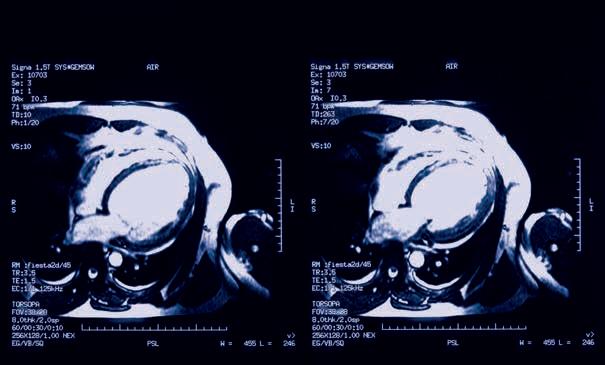
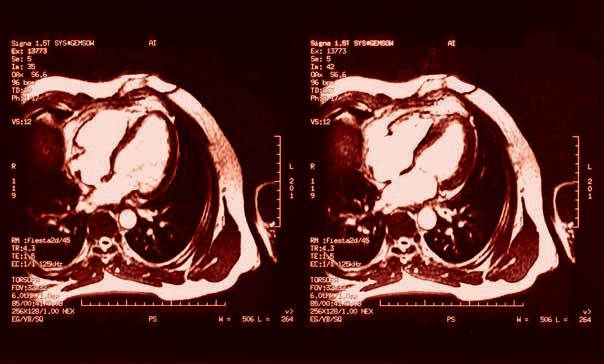
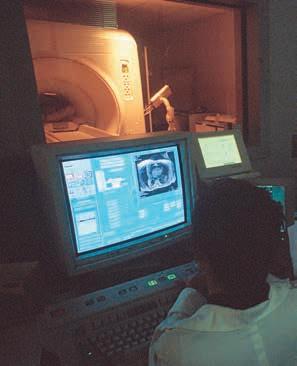
Before and after transplant with the stem cells:the Incor team evaluates via nuclear magnetic resonance (NMR) the capacity of the heart to pump blood
working with only one ofthe two types in existence.They are using adult stem cells,produced by the bone marrow of the individual himselfthat he will later receive in the transplant.In this manner,they are avoiding the controversial question surrounding the use ofthe other type ofstem cells,the embryonic stem cells,so-called because they are removed from embryos with only a few days oflife.This is exactly the reason for the controversy as the embryo dies when the cells are extracted.More versatile than the adult cells,the embryonic stem cells are capable oforiginating all types ofbody cells.For this reason, countries with legislation considered to be more liberal,such as Britain,have limited research to the cells removed from embryos discarded in the treatment of assisted fertilization.Nobody can also forget the more conservative attitude adopted by the President ofthe United States,George W.Bush,who has restricted federal financing only to studies with sixty two strains ofembryonic
stem cells already characterized in the laboratory.
In a situation in which the scientific result receives help by accident,the project ofthe implanting ofstem cells in the heart was born from a solution in search ofa problem.During 2000,Hans Dohmann,from the Pro-Cardiac Hospital in Rio,had been working with the Brazilian cardiologist Emerson Perin at the Texas Heart Institute,building a special catheter using a fine needle and sensors capable ofidentifying the dead portions ofthe heart.In this same year, they got to know at a meeting in Hamburg,Germany,that another team had completed the catheter before them.It was at that point that the specialists recognized that the gadget could be used in research with stem cells. “On the plane coming back to Rio,I was imagining that we would need cooperation with foreign teams in the case I decided to get involved in this area”,recalls Dohmann.
By chance he had fooled himself.In Rio,Radovan Borojevic and Antonio Carlos Campos de Carvalho,both from UFRJ,had initiated a study on the application ofstem cells to mice with artificially brought on cardiac insufficiency.This is something similar to what is observed when there is an accumulation offatty tissue in the coronary arteries that diminishes the flow ofblood to the heart.This reduction kills some areasofthe heart,which then stops pumping blood in an efficient manner to the body.In an attempt to compensate for the lack offorce,the heart increases in size,reaching double the normal in the most serious cases,as it can be seen on page 23.The green light for the work came through in October of2001,five months after Carvalho and Borojevic had verified in mice that the stem cells incorporated themselves into the heart muscle,and,even more importantly,restored,at least in part,its capacity to selfcontract. “There are as yet no detailed studies that explain what is happening”, comments Carvalho.
Little by little the researchers from Rio demonstrated,in a pioneering manner,that this type ofcellular therapy reestablishes the pumping ofthe blood by the heart in the most complicated cases ofcardiac insufficiency,in which the problem turns chronic and the patient feels fine only when he is sitting down. Under these conditions,the medicines that impede the increase ofthe size of the heart – such as beta-blockers and the inhibitors for the angiotensin converting enzyme – stop producing the desired effect.In some cases,it also becomes impossible to treat the disease using traditional therapies such as angioplasty,the introduction ofa catheter with a balloon on the tip,which squashes the plaques offat,or the implant ofa bridge,a way ofdetouring the blockedarea by using veins removed from the leg or the pectoral region.In the most severe cases,cardiac insufficiency kills halfofthe patients in six months.
Before this Brazilian study,Bodo Strauer,from the University ofDüsseldorf,in Germany,had published in September of2002 in the Circulation magazine an article in which he described an increase in the blood flow rate ofthe heart in patients who had received applications ofstem cells.However,the study took into consideration only people
who had suffered acute heart attacks and where part ofthe heart had remained close to a week with out an adequate supply ofblood.Furthermore,the capacity of these patients to pump blood was higher than the one shown by the Brazilians – which made their recovery simpler than when the problem became chronic.
With the approval ofConep, Dohmann and Perin selected their twenty-one volunteers who were integrated into the initial phase ofthe clinical study.Each person who was submitted to the therapy with stem cells passed through the same procedure:by way ofa small cut in the highest portion ofthe hip,the doctors introduced a needle into the ilium bone,which forms the bulging sides ofthe pelvis,and they extracted 50 ml ofmaterial drawn from the bone marrow.This viscous and dark red colored liquid consists ofa mixture ofcells,very rich in adult stem cells that are afterwards separated in the laboratory.
Back in the surgery theater four hours later,Dohmann and Perin had in their hands a red concentrate oflive stem cells.With the catheter,thirtymillion ofthem were injected into the internal wall ofthe left ventricle – the most important ofthe four heart chambers,which pumps blood rich in oxygen to the body.They applied the stem cells in the areas in which the cardiac muscle had gone into a type ofhibernation –inactive although still alive.Four months afterwards it was noted that the transplant had stimulated the appearance of small arteries in the region ofthe heart that had lost the capacity to self-contract. With the improvement in the blood flow rate,the area that is short ofblood decreased by 73% and the capacity to pump from the heart increased from 20% to 29%,sufficient to allow that the transplanted patients increased from five to seven minutes their time for slow steps on a treadmill. “It may seem small but this allowed these people to carry out activities that had become impossible through cardiac insufficiency such as changing their own clothes”,relates Dohmann.
The most exciting fact is that up until this moment the technique used on the group from Rio has not caused any serious complication,such as an alteration in heart beat (arrhythmia),which could lead to heart stoppage.The doctors have compared the quality oflife of the people who received the stem cells before the treatment and six months afterthe application.On average,they found them the same as or better than Americans ofthe same age.The seven members ofthe control group who took only medicine against cardiac insufficiency did not present any relevant improvement in the condition oftheir health during the same period.According to Dohmann,they should also receive the implantation ofstem cells,possibly starting in August.In a second phase ofthis study,forecast to begin at the end ofthis year,the researchers from Rio de Janeiro intend to analyze the performance of this technique in a larger group composed ofone hundred and twenty patients with chronic cardiac insufficiency.
Cellular reinforcement - In São Paulo the cardiologists Edimar Bocchi and Dalton Chamone have also verified an increase in the force ofthe heartbeat, restored by techniques distinct from the treatment with stem cells.Instead
ofextracting these cells directly from the bone and injecting them into the cardiac muscle,Bocchi and Chamone were able to count upon the collaboration ofthe organism itself.On average,during a five-day period they applied to their patients,injections of600 micrograms ofa special protein,the granulocyte-macrophage colony-stimulating factor.(GM-CSF),which make the stem cells migrate from the bone to the bloodstream.When they reach a certain concentration the doctors sent the transplant candidates for a series ofblood filtering to separate out the stem cells which were then frozen and stored before being once again injected into the bloodstream.
Ofthe nine patients between the ages ofthirty-three and sixty-five,two received injections ofstem cells into their coronary arteries by way ofa catheter.The other seven only injections ofGM-CSF – and all ofthe remaining work had to be done by the organism itself.It is believed that the damaged tissue,like that ofthe injured heart, exercises a type ofchemical attraction on the stem cells through the release of proteins that spur the communication between cells,such as the interleukin 6 and the Human Tumor necrosis factor-alpha.It was not only the methods
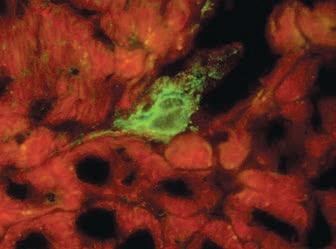
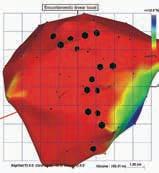
Results:on the left,stem cell (in green) lodged in the heart of a mouse with Chagas’s disease. Above,map of the left ventricle with implantation points of totipotent cells and improved blood flow
that varied.The people treated at Incor had cardiac insufficiency caused not by blocking ofthe veins but by causes as varied as Chagas’s disease,increase ofblood pressure (hypertension) or even an increase in the size ofthe heart without any known reason – an infirmity known in medical jargon as idiopathic dilated cardiomyopathy.In a general manner,the capacity to pump blood and the oxygen intake increased and three patients had their names taken offthe heart transplant list. Today they are only taking the medicine needed to control cardiac insufficiency.Two ofthem still present a pro-
THE PROJECT
Cellular Therapies for Degenerative Chronic Illnesses
COORDINATOR
RICARDO RIBEIRODOS SANTOS –Millennium Institute of Tissue Bioengineering
INVESTMENT
R$ 5,200,000.00 (Ministry of Science and Technology),
R$ 500,000.00 (Pro-Cardiac Hospital),
R$ 500,000.00 (Fiocruz-BA),
R$ 200,000.00 (Faperj)
blem that normally reaches 20 % ofcardiacinsufficiency sufferers:the blocking by coagulant blood ofthe artery that leads the blood poor in oxygen to the lungs. “An apparent small increase in the capacity to pump blood many times represents a significant improvement for the patients”,Bocchi explains.
Against Chagas’s disease - In Salvador,Santos from Fiocruz,and Fabio Vilas-Boas Pinto from the Santa Izabel Hospital,intend to use stem cells to specifically reverse the damage that Chagas’s disease produces on the heart.After getting into the blood stream,the parasite that causes the disease,the protozoa named Trypanosoma cruzi,lodges in the interior ofthe cardiac cells,which sets offan alert to the immune system.But the parasite is not the only one that loses.The heart cells have on their surface proteins similar to those oftrypanosome and for this reason they also suffer an attack from the defense cells. As a consequence,thousands ofscars appear throughout the organ.Both in Chagas’s disease and in a heart attack, which leads to the death ofa large area ofthe heart,the result is similar:30% ofthe sufferers from Chagas’s disease acquire the illness during infancy and only around forty years ofage do they deve-
lop progressive cardiac insufficiency thatleads to their death in ten years.
When insufficiency gets worse,the only way out is a heart transplant,not very efficient since the protozoa that remain in the bloodstream infect the recently implanted organ.An aggravation to the problem is that infection by the trypanosome is more frequent in the population ofrural areas,especially in the North and Northeast Regionsin which there are no heart transplant programs.Stem cells could alleviate this problem.In mice,as Santos verified,one only needs to give an injection of20 million stems cells associated to the use ofthe granulocyte-macrophage colonystimulating factor,the GM-CSF, in order to reduce the inflammation and the fibrous tissue of the heart.After two months,the mice treated using this method showed 80% fewer inflamed cells and fibrous tissue than the mice that had not received this therapy.The most important aspect is that this benefit seems to be long lasting:the improvement persisted for six months after the mice received the stem cells,a period equivalent to almost twenty years for human beings.
In a recently approved experiment by Conep,Santos is going to inject 30 million ofthese cells into the interior of the coronary arteries,as well as GMCSF,initially in five patients with cardiac insufficiency caused by Chagas’s disease.Ifthe technique shows itselfto be secure,the researcher from Fiocruz will widen and detail the study with a further twenty-five patients – five should receive stem cells and GM-CSF,ten will be treated only with stem cells and ten with medicine. “Using this therapy we hope to reduce the lesions on the heart to the minimal level,similar to those that occur with 70% ofthe carriers ofChagas’s disease who do not develop cardiac insufficiency”,says Santos.Ifa success,the treatment will allow that the doctors can give to the patients a medicine to combat the protozoa,named benznidazole,which,as it is toxic,cannot be used with people suffering from cardiac insufficiency.
•
IMAGES BY HANS DOHMANN/PRÓ-CARDÍACO
GENOMICS
On the trailofa vaccine
Brazilians sequence the genome of the bacterium that causes leptospirosis and request patents for twenty-four proteins
Anyone who has read the issue ofthe 24th ofApril ofthe British magazine Nature,one ofthe most influential scientific publications,verified that a team from theChinese Human Genome Center ofShanghai,had sequenced the complete genome ofthe Lai strain of Leptospira interrrogans, the most commonofthe bacteria that causes leptospirosisin that country.Transmitted to man by the urine ofrats and other animals infected with the pathogen,leptospirosis is considered the most widespread ofthe zoonoses,the diseases that animals transmit to human beings,especially in rural areas with a humid climate.Carried out by scientists from a developing nation outside ofthe axis Europe –United States,the work ofthe Asian group was, without a doubt,ofinternational relevance.But for the Brazilians the most important news about
M ARCOS P IVETTA
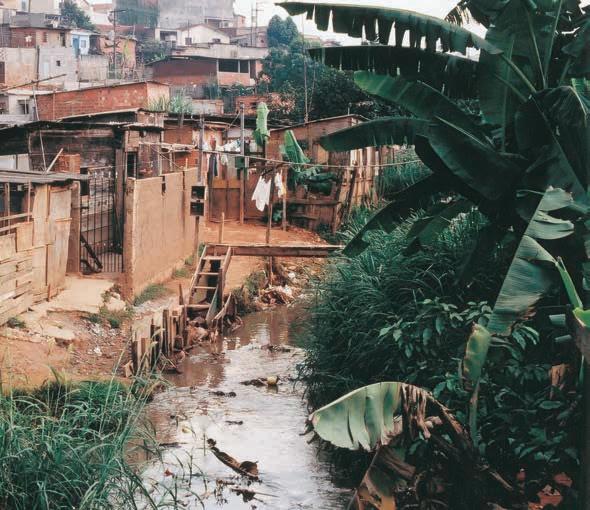
Open-air sewer: contact with contaminated water boosts the risk of transmission of leptospirosis
leptospirosis does not come from the Far East nor does it arrive via the pages ofsome publication – and has been, until now kept in silence.Working with discretionon a project in competition to the Chinese work,a research team from the Butantan Institute ofSao Paulo,with collaboration from colleagues at the branch ofthe Osvaldo Cruz Foundation (Fiocruz) in the state ofBahia and with São Paulo universities,have also concluded the complete sequencing ofanother lineage of L.interrogans,knownas serovar Copenhageni,responsible forthe majority ofhuman cases ofthe diseases in Brazil.
Integrated research - In reality,the Brazilian group did more than simply unmask the molecular structure ofa pathogen similar to that mapped by thescientists from Shanghai.They also tooka sure step towards strengthening a promising line ofresearch with the goalof developing better forms ofprophylaxis and diagnosis ofhuman leptospirosis,the project’s main goal.This is because in February 2002,one year and two months before the Chinese had published their article in Nature,the Butantan scientists had requested,in the United States,the patents for twenty four genes – and their respective proteins – identified during the work on sequencing and analysis ofthe genome ofserovar Copenhageni,carried out by the AEG,the public network ofSão Paulo laboratories that specializesin genomes concerning agronomy and the environment. “These proteins could be useful for the development ofa vaccine against human leptospirosis (today there is none) or for more efficient tests for the diagnosis ofdifferent serological forms ofthe illness”,says Ana Lucia Tabet Oller do Nascimento,from Butantan,the coordinator ofthe project on L.interrogans,which was funded by FAPESP.Such a hypothesis is based on preliminary tests in the laboratory that have shown that this group oftwenty four proteins react on contact with the blood serum ofpeople or rats infected
Leptospira interrogans:transmitted mainly by the urine of rats
with leptospirosis.The reply to the patent request,whose rights extend to Brazil,should come out next year.
Comparative study - The Butantan researchers have just completed a scientific paper comparing the genomes of the two varieties of L.interrogans.Much ofthe information on the work,which was submitted to a large international magazine and is awaiting the green light for publication,is still confidential.However,some general data,results ofthis comparison,can already be released.The two genetic sequences show
THE PROJECT
Sequencing of the Genome of Leptospira interrogans
MODALITY
Regular line of research assistance
COORDINATOR
ANA LUCIA TABET OLLERDO
NASCIMENTO – Butantan Institute
themselves to be almost the same size.The serovar Lai has almost 4.7 million pairs ofbases (the chemical units that make up the genetic code), divided in two circular chromosomes,one large and the other small.The serovar Copenhageni shows an almost analogous structure,also with two chromosomes,only that they represent around 60,000 fewer pairs ofbases than the strain studied by the Asian group.
The greatest difference between the two strains is regarding to their probablenumber ofgenes and respective proteins.In their study,the Chinese counted some4,727 genes and a similar numberofproteins in the serovar Lai.Working with the serovar Copenhageni, the Brazilians counted around 3,700 genes or proteins.This is a considerable difference for two genomes apparently so close to each other. “We do not believe thatthere are so many more proteins in the Lai in relation to the Copenhageni”,declares the biochemist Elizabeth Angélica Leme Martins, from the Butantan Institute,and an assistant on the project. “By ouranalysis, this number difference should be a lot lower,around 200proteins.” Another contribution from the Butantan team, which also was able to count upon the participation ofPaulo Lee Ho and Luciana Leite,was the discovery of250 new proteins on the surface ofserovar Copenhageni.These proteins stay on the membrane ofthe cells ofthe pathogen and are in direct contact with the host,man or animal infected by L.interrogans.Among this group ofproteins,a smaller group of174lipoproteins stand out,these could havegreater involvement in the process ofinfection caused by the bacterium. “Beforeour work began,only ten lipoproteins had been identified on L.interrogans” ,says Ana Lucia. “The Chinesedescribed only a few proteins ofthis type.”
In the towns - Differently from serovar Lai,typical ofthe flooded rice plantations ofAsia,the platform for a large part ofthe occurrence ofthe illness
in China,the Copenhageni strain is the one that is principally responsible for the incidences ofhuman leptospirosis in Brazil,where there have been a little more than 46,000 confirmed cases between 1987 and 2001, with an annual death rate offrom 6.5% to 20% ofthoseinfected.Here,instead of being a problem associated with open fields,the illness has a more metropolitan character.In towns people usually catch the disease in areas without basic sanitation,with accumulated garbage (which attracts rats) and with open sewage,or during the time ofthe summer floods when the public roads transform themselves into dirty streams and increase the risk ofcontact with water or earth contaminated with the urine ofrats infected by the bacterium.The sewage rat(Rattus norvegicus),an inhabitant almost as urban as modern man himself,is the main host for the serovar Copenhageni of L.interrogans.
Brazil and China are studying different varieties of the same bacterium
sease in a person helps to prevent the evolution ofthe infection,since there are strains with varying degrees ofaggression,and it is of fundamental importance for the creation ofa vaccine against this disease.This is even truer in the case ofthis pathogen. There are more than 250 known serovares of L.interrogans,with varying degrees ofcommon characteristics.To differentiateone type from another is not always easyfrom the point ofview ofits morphology,ofits external appearance. Seen with thehelp ofan electronic microscope,the varieties can be considered identical.Allofthem are fine and elongated,with a spiral form,without rigid cellular walls. “It is not possible to distinguish the varieties only by morphology”,Elizabeth explains.
pirosis is the existence ofmultiple antigens associated with the disease, each one ofthem literally different from the others.Any substance recognized by the organism as ofexternal origin or capable ofoffering danger to it is called an antigen.To defend against this potential aggressive agent, normally one or more proteins,the immunological system produces specific defenses (antibodies) against the antigen that is threatening it.In the case ofleptospirosis,due to the high number ofserovares ofthe bacteria that causes the illness,to have antibodies against a variety of L.interrogans does not necessarily confer protection against the other forms ofthe pathogen.
Once infected,a person can take from two to thirty days to develop the most common symptoms coming from the presence ofthe bacterium in his organism:fever,headache,shivers, vomiting,nausea and general ill-feeling.Ifit is not treated with antibiotics, normally penicillin or doxycycline,the L.interrogans can affect the kidneys and liver,and in extreme cases,lead to death.As its clinical manifestations don’t differ much from the symptoms unchained by other known illnesses such as dengue fever,and yellow fever, leptospirosis is often mistaken for other illnesses.In order to reach at a diagnosis with the minimum degree of confidence,it is necessary to carry out laboratory tests using blood or urine samples from the suspected case. “At times,even with these examinations, one will not manage to say exactly which serovar is responsible for the infection”,Ana Lucia comments.
It may well seem as just a detail to determine the serovar of L.interrogans responsible for an infection,but this impression is false.To know the variety ofthe bacterium that unchains the di-
The problem is that,ifits physical constitution does not change according to the serovar,other parameters are a long way from being always the same or similar in the diverse forms ofthe bacterium.The degree ofpathogenicity,location ofgeographic occurrence,most common host and preferential victims (man or other animal such as a dog,cow or rat) can vary considerably in function ofthe strain of L.interrogans.For example,certain forms ofthe bacterium cause leptospirosis only in men,others infect only animals and there also exist others that attack both.The Copenhageni and the Lai are among the most virulent varieties of L.interrogans that attack the human being.In the study ofthe comparison ofthe genomes ofthese two strains,the Butantan researchers believe thatthey identified two proteins present only in the variety sequenced in Brazil – and involved in the synthesis of polysaccharides,a type ofsugar – that could facilitate the process ofdifferentiating betweenthe serovares. “Ifconfirmed,this piece ofinformation could also be important for the understanding ofthe large antigenic variation ofthe Leptospirae”,forecast Ana Lucia.
Brazilian variation - The main clinical implication ofthe large diversity of the pathogens responsible for leptos-
In an ideal scenario,the perfect vaccine against leptospirosis would confer immunological protection against all ofthe forms ofthe bacterium,or at least those most disseminated.Nevertheless,the maximum that can be obtained in many cases is a more focused and specific product, capable ofimpeding the infection brought on by one or another type of serovares and that shows itselfinnocuous to the other forms ofthe pathogen.The countries that are deeply researching into leptospirosis,which are few,tend to focus their work on the most important local varieties.
Besides China and Brazil,that have sequenced distinct varieties of L. interrogans,the Australians are studying the genetic material ofanother strain ofthis bacterium. “We have to carry out our very own research with the serovar Copenhageni,which is the major cause ofhuman leptospirosis in Brazil,since nothing guarantees that a vaccine developed abroad,against another variety ofthe bacterium,will also be useful for us”,emphasizes Ana Lucia.Ifthe clues that the Brazilian researchers have picked up are shown to be correct and everything runs to plan,a form ofimmunization against the illness could become a reality in five to ten years time.To speed up the process,partnerships with the pharmaceutical industry and researchers in the veterinary area,which are also interested in new therapies against leptospirosis,are one ofthe priorities ofthe group from the Butantan Institute.
The one-way road of Müller’s ratchet: a way of understanding how mutations build up in an organism
PHYSICS
ofDNA The genesis
Mathematical model describes the competition between molecules that made it possible for living beings to emerge on Earth
C ARLOS F IORAVANTI
Published in May 2003
ABY MIGUEL BOYAYAN
n icon ofmodern science, the DNA molecule is the sole survivor ofa struggle that lasted millions of years.Unmistakable for its two intertwined strands,it emerged from an intense competition with other chemical structures that were capable ofcopying themselves.It only triumphed because there was cooperation,or,to borrow a term from anthropology,altruism,amongst them.The more refined molecules,which managed to buy time copying themselves by means ofenzymes,a kind ofprotein, helped the more primitive ones,probably in an involuntary way,which would generate replicas ofthemselves by more lengthy methods.The entirely selfish ones,for some reason unable to offer help,simply disappeared.Only after the conclusion ofthe process ofselection amongst the participants that were getting fitter all the time was it that the first organisms started to form themselves on Earth,a probable 4.5 billion years ago.
The reconstitution ofthe backstage oflife on the planet with this new ingredient,cooperation between molecules,results from work carried out not by a chemist or biologist,as one might expect,but by a physicist from
Rio Grande do Sul,José Fernando Fontanari,from the São Carlos Physics Institute (IFSC) ofthe University of São Paulo (USP).Seven years ago,he suspected that the formulas that he used to present to his students in statistical mechanics did not serve just to describe the ways by which atoms react to one another.Iflooked at as a model for interaction amongst particles,it would perhaps solve wider problems, which biologists dealt with only in a conceptual fashion,perhaps for feeling ill at ease with equations and mathematical models.
His hunch was right.In two recent articles,published in October and November 2002 in Physical Review Letters, Fontanari describes mathematically how the selection process took place that led to a single victorious molecule, DNA,whose elegant structure wasdiscovered exactly 50 years ago,as a result ofa joint work between physicists and biologists,and which is so well known today that there is no longer any need for reminding that this is the acronym for deoxyribonucleic acid.
By bringing physics close to biology,Fontanari solved a few paradoxes that had been aired 30 years ago by German chemist Manfred Eigen (1967 Nobel prize for Chemistry).Eigen had created
PHOTOGRAPH
the theory ofreplicators,molecules that succeed in making copies ofthemselves,and today,in their more refined version,DNA,store information that starts the process for producing proteins,indispensable for the formation ofall the parts ofliving beings.Capable ofattracting smaller fragments that,joined together,would result in a copy ofitself,the first replicator arose by chance. “It was an accident of history”,says Fontanari. But it was enough to change the pattern for producing molecules,before that formed by simple aggregation ofblocks,as ifthey were Lego pieces joining themselves together at random. Were it to depend on this first replicator,life would have no future on Earth.For being so small,it could not store sufficient information to start making proteins.It managed to copy itselfby acting as a mold for itself,but the process was still too slow and prone to errors,which would become more and more frequent as it grew. “The larger the molecule,the more difficult and time-consuming it is for it to make a copy ofitself ”,says the physicist,supported by proofs in experiments. “The probability ofthe first replicator making a perfect copy ofitselfwas practically nil.”
Strategic leap - There was another historical accident some time afterwards. Inaugurating the third pattern for making molecules,which persists until today, the descendants ofthe first replicator, now different from the original because ofthe accrued mistakes,manage to create intermediary molds – here are the enzymes,a kind ofprotein that speeds up chemical reactions. With them,the replicator gains time,avoids mistakes,and generates more copies ofitself.It is also more protected fromthe attacks ofother molecules,a situation close to the one found in some kinds ofvirus,in whicha molecule acts as a cover for the genetic material.
When formulating this thesis,Eigen noted thatthere was something odd, which was to be known later as the paradox ofaltruism.By creating an enzyme,instead ofsimply carrying on copying itself,the mutant molecule,which starts this new generation ofreplicators,does something that would not only be used by itself,but would also benefit the replicators that were still copying themselves by a mold. “Eigen solved the problems ofthe chemical complexity ofthe origin oflife,but he didn’t realize that this would mean there was altruism among the first more evolved molecules ofEarth”,Fontanari comments.English biologist John Maynard Smith,from the University of Sussex,England,repudiated this idea for thinking that it was impossible for there to be altruism amongst molecules.
Examining the impasse,Fontanari concluded that this new replicator had to pay a price for this new skill:it could not copy itselfwhile it was creating the enzyme.It is the same situation met by a worker who earns according to the number ofbottle tops that he can fit by hand.He can put the caps on more quickly by building a machine,but while he is building it he fails to meet the production target and earns less than his companions,for whom manual work is inevitable.
Compared with the selfish molecules,which had not stopped spawning copies ofthemselves nor did the replicating molecule see itselfat a disadvantage and therefore ran the risk ofextinction.It would only fail to be in a pic-
kle ifthe enzyme wouldonly work for itself– something improbable in the biochemistry ofthose times.In this way,the protein is going to assist other replicators,which use its advantages at no cost to themselves.
Isolation and mixture - An impasse emerged,however. “The mathematical study ofthe dynamics and the evolution ofthese two kinds ofreplicators competing for their building blocks shows that the enzymatic replicators can neither invade nor coexist with the population ofmold-type replicators”, the physicist comments. “But we know that an invasion must have happened, since the current replicators are ofthe enzymatic kind.” How to get out ofthis and explain altruism,an apparent disadvantage? Fontanari solved the riddle by showing mathematically that the enzymatic replicator manages to survive,even being generous with its companions and lending them its precious enzyme,provided that it is confined to a limited space or can not move much, so that the enzyme remains close to the mother molecule.
The equations agree with a hypothesis that enjoys growing acceptance among biologists,according to which life arose in cracks in rocks,particles ofmud,or drops ofwater,which would favor the confinement ofthe molecules.Another point that reinforced the thesis is that there is now no more talk that the first replicators emerged in a mixture,the primordial soup, but in a flat space,similar to a pizza – something like the surface ofpyrite,an iron oxide based mineral, the best bet for housing the ancient forms oflife.
Passing from a space of three to one or two dimensions,the chemical reactions would take place more easily.
Pyrites,on which life may have arisen: pizza instead of soup
That was still not enough.If they remained isolated,the enzymatic replicators,being altruists, would be eliminated by the others,the selfish ones.For this reason,Fontanari argues that,besides confinement,there has to be a mixture between the groups ofmole-
cules. “Due to the tides or to the wind, the group are periodically mixed together and are redistributed in a random manner in the compartments”,he says. “In this redistribution,clones ofthe enzymatic replicators,more numerous for succeeding in copying themselves more quickly,have better chances ofgoing back to the compartments,while those that do not succeed literally go with the wind.” This is the moment at the enzymatic replicators recover from their initial disadvantage,since the mixture makes it possible for the selfish ones to leave groups that are abundant in enzymes due to the presence ofthe altruists.When they fall into groups that are poor in enzymes,the selfish ones lose the power ofreplication and allow the altruists to become isolated. “Mathematically,it is shown that a repetition ofthis process ends up leading to the predominance ofaltruism”,the physicist avers.
But why was one molecule, DNA,left over? “It is a mathematical result,a consequence ofthe dynamics of replicators”,says Fontanari. He believes that there was the appearance ofanother kind ofreplicator:RNA, or ribonucleic acid,a simpler molecule (it is a single strand,while DNA is a double strand,like two intertwined threads).The idea gains strength with the proofthat RNA manages to act like a replicator,creating copies ofitself,and like an enzyme ofanother molecule. “DNA was an invention ofRNA and of other more complex replicators”,the physicist suggests.But it is the most recent invention that took the reins of evolution and,in the majority oforganisms – save for a few viruses that store their genetic material in the form of RNA –,today it is DNA that makes RNA,in the initial process for producing proteins.
This set ofideas,which also helps one to understand why there is a single recipe for the production ofproteins, the so-called genetic code,in any organism,contests the thesis ofbiological individualism,propagated after 1976 by the book The Selfish Gene,by English biologist Richard Dawkins.On the other hand,at no time does it run counter to Charles Darwin’s principle ofnatural selection. “Nature does not
need any organizing principle other than natural selection”,he says.
The advantages of sex - Fontanari solved other impasses that biologists already knew about,but they were unable toexplain with precision how they arose and developed.One ofthem is sexual reproduction.Scientists always wondered why sex can be an evolutionary advantage,particularly for organisms that enjoy both the alternatives – there are protozoa that can duplicate themselves with autonomy,without needing a partner,ensuring the continuity ofall their genetic material,contained in the DNA,but which opt for sexual reproduction,by means ofwhich they transmit only halfoftheir genes. “There is a selective pressure in favor ofthe recombination ofDNA”,says Fontanari, who in this area is working with evolutionist biologists from the Middle Tennessee State University,United States. Who raised the problem was American geneticist Hermann Joseph Müller (1890-1967),on discovering that X-rays cause mutations in fruit flies (Drosophila melanogaster),a finding that earned him the Nobel Prize for Medicine in 1946.Years later,there came the verdict:the mutations (changes in the DNA) do more harm than good,and they build up more rapidly in species that reproduce only in the asexual way,on a one-way road,which became known as Müller’s ratchet. Müller himselfsuggested that sexual reproduction,for permitting the mixture ofgenetic material,could succeed in reversing the ratchet,and avoid the harmful effect ofmutations,today seen as a source ofdiversity in living beings, but which – at least in part – threaten survival ifnot corrected,for continuously reducing the adaptation ofani-
THE PROJECT
Theoretical Molecular Evolution
MODALITY
Thematic project
COORDINATOR
JOSÉ FERNANDO FONTANARI – São Carlos Physics Institute – USP
mals and plants to the environment in which they live.
But an explanation was missing for the movement ofMüller’s ratchet,associated with phenomena that had been studied a lot,like the degeneration ofthe Y sexual chromosome.This was what Fontanari did in an article published in December 2001 in Physical Review Letters:the ratchet advances and the pawl moves,passing from one notch to another,when all the organisms ofa population acquire the same mutation.It was already known that it is more probable for few mutations to occur than many – in a virus,at least one mutation per genome occurs at each replication.
Equations reveal the intensity of natural selection
The researcher from São Carlos closes the article with two formulas that, according to him, “have great potential for practical use”,for determining the rate ofmutation per genome and the intensity ofnatural selection,provided that the distribution ofthe adaptability ofa species is known,measured by means ofthe frequency ofindividuals with different capacities for survival in one and the same environment. “If there were no mechanism like Müller’s ratchet to show that microorganisms with asexual reproduction are at a disadvantage for not managing to annul mutation,it is the asexual forms that would predominate”,he says.The same work shows why the ratchet does not stop,even though its movement may be slow.How slow? “It depends on the generation time ofthe organism involved”,Fontanari replies.For bacteria, whichcreate a new generation every 20 minutes,the ratchet will move a notch every 40 years,which corresponds to 1 million generations.
The elimination ofmutations that ceaselessly alter the DNA,by means ofthe continuous production ofnew beings,can also be understood by means ofan analogy with the Theory ofthe Red Queen,which refers to a character ofthe British writer Lewis Carroll in Through the Looking Glass.The Red Queen would not let anyone stop running,alleging: “We have to keep on running to stay in the same place”. •
tanding up,leaning on the jamb ofthe door at the front ofthe house,biology teacher Vitorino Coelho de Sousa listened,without paying much attention,to a garrulous lad who was enumerating for him the teachings ofthe Bible,in the hope of converting him to the evangelic religion.Suddenly,the calm conversation – one ofso many that still take up the late afternoons in small towns – took unexpected turns,gave rise to a story rich in apparent flukes,and resulted,days afterwards,in the finding ofroughly 70 dinosaur fossils some 110 million years old,found in the hinterland ofthe state ofMaranhão,and in the discovery ofa possible new species ofthese giant prehistoric reptiles,eliminated from the planet 65 million years ago.Up until then,samples of dinosaurs so old were rare in the Northeast.
We are in Coroatá,a town with 50,000 inhabitants,in the interior ofMaranhão,200 kilometers to the south ofthe capital,São Luís,on an afternoon at the end ofJuly last year.After listening to the visitor for a good many minutes,Vitorino lost his patience and went into a clash between science and religion,with heated arguments on both sides,while the young evangelist claimed that the animals existing in the world were ofdivine origin.Being a biology teacher at a secondary school,Vitorino decided to teach the lad a bit ofscience.He explained that petrified remains ofplants and animals,fossils,were a proof that present-day living beings were not a work of God,but they had evolved from other species that arose millions ofyears before.Amazed by the explanation,the youngster commented:“A short time ago,I saw some stones that looked like bone, right here in Coroatá,in someone’s house”.
Vitorino spent days intrigued with this comment.At the end ofthe week,he decided to check it out.He picked up his camera,went on to the region indicated,and arrived at the homestead of farmer Alexandre Marques Vaz,a planter ofcassava,potato,rice and corn,who had indeed collected,over 13 years,some stones that were similar to bones.The shape ofthese stones had already generated long debates between Alexandre and his neighbors.Some thought they really were bones ofan animal – perhaps even ofan elephant,by their size,and why not? –,while for others all that was no more than ordinary stones.
Vitorino had to spend a lot ofconversation to convince the suspicious farmer to show him the said stones,guarded with the zeal ofsomeone hiding a treasure.And there were not just a few of them:they lined the floor ofone ofthe rooms of the brick-built house,without any plaster,where the 32-year-old farmer lives with his wife and children.Alexandre had collected the stones from the banks ofthe tributaries ofthe Itapecuru river, which cuts through Coroatá and runs in a north-
Under the palm trees
westerly direction.From July to November,when it rains little,the bed ofthe river drops and the terrain dug out by the water becomes exposed, after having been covered by the forest ofbabassu palms – this is palm tree woodland,vegetation typical ofthis region ofthe Northeast,which spreads to the east through Piauí and Ceará,occupying an area that is larger than England.
The vertebra and the phone book - Under the shrewd gaze ofthe owner ofthe house,Vitorino straight away cast his eye on a cylindrical petrified bone,ofalmost 20 centimeters in diameter. Remembering his lessons in paleontology from his undergraduate course at the Federal University ofPiauí (UFPI),he immediately came to a conclusion:it was not an elephant bone,as they had imagined,but a petrified vertebra from the tail ofa dinosaur.
As the dinosaur fossils found in the country are rare,Vitorino knew he was facing some material ofgreat scientific interest.For this reason,he decided to make the discovery public and called a team from TV Mirante,which retransmits the Globo TV network in Maranhão,to do a story.But he did not like the program,which went on the air a few days afterwards,just in the Coroatá region. “It was sensationalist”,was his definition.Dissatisfied,Vitorino picked up the telephone directory in search ofa specialist,and arrived at paleontologist Manuel Alfredo Medeiros,from the Federal University ofMaranhão (UFMA). “I thought it was one more false alarm”,Medeiros recalls. “Two other times,they had called me to see fossils in other towns,but they were recent bones.”
A biology teacher and a farmer take part in the discovery of a vast deposit of dinosaur fossils in the interior of Maranhão
But as the region could in fact house dinosaur fossils,Medeiros took a chance.He went to Coroatá and was not disappointed:the fossils were indeed ofdinosaurs.The major part ofthe petrified bones are from sauropods,herbivorous dinosaurs with a long neck and tail – the largest sauropods,found in Argentina,reached 30 meters in length and weighed as much as 70 tons. The part with the greatest scientific value is precisely the vertebra from the tail seen by Vitorino at the first encounter with the farmer.According to Medeiros,the fossil belongs to a new species of sauropod,which must have inhabited this region between 110 million and 100 million years ago, during the geological period called the Cretaceous.It was an indirect dating,done on the basis ofgeological studies by Petrobras and the Federal University ofRio de Janeiro (UFRJ).
The discovery also confirms that this region ofMaranhão is an immense deposit ofcontinental fossils from a phase ofthe Cretaceous period that runs from 110 million to 95 million years ago.According to Medeiros,the findings are rare because the layers ofmore superficial rocks that contain fossils are to be found at a depth that ran-
R ICARDO Z ORZETTO
Treasures from Coroatá
110 million year old fossils found when the tributaries of the Itapecuru dried up
ges between 5 and 15 meters under the Cerrado (savanna) and the palm tree woodland. “Ifa new dating confirms the age ofthe fossils at between 110 million and 100 million years,this material should provide precious information about the continental fauna of this phase ofthe Cretaceous”,says Medeiros.In those days,South America and Africa were still right in the process ofseparation,and the landscape ofMa-
ranhão was very different from the present.Research by UFRJ and Petrobras has showed that the climate was predominantly arid or semi-arid,but in the regions close to the rivers,there were forests ofconifers similar to araucarias, bracken the size oftrees,and plants called equiseta,which look like horsetails.
As the conversation went on,Medeiros convinced farmer Alexandre Marques Vaz to make him a donation
at least ofthe sauropod vertebra,kept today at the UFMA’s Paleontology Laboratory.Now,starting from this bone, the researcher intends to identify the animal to which it belonged – before going any further,it does seem something really new,from a genus and species still unknown to science. “We want to know ifthese groups lived in Africa as well,or ifthey are exclusive to Brazil”,says the paleontologist.It is now up
The new dinosaur from Maranhão
In January,the team led by geologist Ismar de Souza Carvalho,from the Federal University ofRio de Janeiro (UFRJ),presented the reconstitution of a new species ofBrazilian dinosaur, which lived in Maranhão 110 million years ago.It is the Amazonsaurus maranhensis,a herbivorous quadruped of10 meters in length from head to tail and weighing some 10 tons.It was described in the December 2003 issue of Cretaceous Research,the most important scientific magazine about the Cretaceous, the last geologic period in which these large reptiles inhabited the planet.
The Amazonsaurus is the oldest Brazilian sauropod (a herbivorous quadruped dinosaur) from the Cretaceous,a geologic period that ran from 144 million to 65 million years ago,in which plants with flowers emerged and South America began to separate itselffrom
Africa.The team from UFRJ found fossils from this dinosaur on the banks of the Itapecuru river – in the municipality ofItapecuru-Mirim,130 kilometers to the south ofthe capital,São Luís –,an area oftransition between the Amazon Forest and the Cerrado,still within the legal Amazon.For this reason,this animal is regarded as the first dinosaur from the Amazon whose species has been identified.
Marked characteristics ofthis species are the neck and tail that are longer and more tapered at the ends than those of the other sauropods.On the back ofthe A.maranhensis,a small elevation is prominent:they are prolongations ofthe vertebras ofthe backbone,known as neural spines,that stand out as much as 20 centimeters.According to Carvalho,the new species is a distant relative ofa sauropod that lived in the northwestern
region ofAfrica in this same period, the Rebbachisaurus garasbae.The vertebras ofboth ofthem are very similar –a sign that they must have evolved from one and the same ancestral species.
The discovery ofthe Amazonsaurus will make a contribution towards an understanding ofhow Brazilian terrestrial environments evolved in the Cretaceous,much less studied than the marine environment in this same period,when the Brazilian reserves ofoil and gas,located in the Atlantic,were formed. “From now onwards,the analysis ofthe evolution ofthe sauropods will have to include a study ofthe Amazonsaurus maranhensis”,Carvalho explains.
The announcement ofthis discovery crowned 13 years ofwork marked by hitches.Under the coordination of the veteran chemist Cândido Simões Ferreira,today at the age of84 an eme-
to Darciléa Castro,from Medeiros’ team,in conjunction with paleontologists from São Paulo,to begin to classify the other 70 or so petrified bones. By dint ofmany scientific arguments, the reticent Alexandre abdicated his collection,which,it has now been agreed,will remain under the custody of the Coroatá House ofCulture.
The basin ofthe Itapecuru, which describes an arch from south to north in Maranhão,is regarded today as a veritable dinosaur valley.It was from there that came the fossils ofthe most recent Brazilian species ofdinosaur:the Amazonsaurus maranhensis,described by the team ofgeologist Ismar de Souza Carvalho,from UFRJ (see box).In 2001,the teams of Medeiros and Carvalho found on Ca-
MARANHÃO
jual island,in Alcântara,the vertebra ofa new species ofsauropod, those corpulent herbivorous dinosaurs with a long neck and tail and a small
SIRIO J.B.CAN
head.With an age ofabout 95 million years,this petrified bone belonged to a sauropod from a group ofsaltasauruses.Previously found only in Argentina,the saltasauruses used to measure about 8 meters from head to tail – they are the dwarfs ofthe family ofthe titanosaurs,animals that could reach to 30 meters and almost 70 tons.
The discovery ofthe fossil from Cajual island,almost 20 million years older than the Argentinean saltasauruses,made it possible for the Brazilian paleontologists to present a new version for the evolution ofthese animals. “They probablyarose in the region where the north ofBrazil is today,and then migrated south”,Medeiros says.The researchers from Rio and from Maranhão have now determined the genus and the species of the saltasaurus from Maranhão,but its name will only be revealed in a few months from now,with the publication ofthe scientific article that describes it.
ritus professor at UFRJ,in 1991 five young researchers did their first trip to the hinterland ofMaranhão to map the areas where there are outcrops ofrocks formed in the Cretaceous,to serve as training for the geology students at UFRJ.Regarded as being ofgreat economic interest for holding about half ofthe planet’s reserves ofoil and gas, these areas ofrocks from the Cretaceous add up to 150,000 square kilometers – or 1.5 times the size ofPortugal –in Maranhão alone.
Accommodated as best as possible in a Kombi van laden with provisions, the six researchers set offfrom Rio and crossed halfthe country in a five-day
journey.In three weeks ofintense work, the team covered hundreds ofkilometers analyzing plots ofland close to railroads and highways without locating a single area with the rocks they were looking for.Tense and tired,the researchers decided to change their strategy and began to cover the rivers ofthe region by boat,and then they arrived in the municipality ofItapecuru-Mirim – 70 kilometers away from Coroatá,where more dinosaur fossils were recently found.
In one ofthe first stops on the banks ofthe Itapecuru river,getting off the boat,Ferreira tripped on a large object,mistaken at first for a bone from a cow.This was the first part ofthe ske-
From north to south - After a mass extinction that swept a good part oflife
Amazonsaurus maranhensis: 14 years of searches
leton ofthe Amazonsaurus maranhensis,reconstituted from 20 well preserved pieces and another 150 bits gathered in the course ofsix years of excavations on the banks ofthe Itapecuru river.Just as difficult as extracting the fossils from the hard rock was to get recognition for the work,which Carvalho signs with Leonardo dos Santos Ávila,from the National Museum, and Leonardo Salgado,from the National University ofComahue,in Argentina.For dealing with an animal ofan unknown genus and species,the article underwent many revisions in the course ofthree years,before being accepted by Cretaceous Research
to Teresina (PI)
to Belém (PA)
Itapecuru-
offthe Earth 210 million years ago,the dinosaurs evolved from a carnivorous biped that measured less than a meter, the thecodont.Fossils found in different regions ofthe planet indicate that dinosaurs were the most abundant terrestrial animals during 150 million years,in a phase when the global climate was warmer and the continents ofthe Southern Hemisphere were still united in a supercontinent,Gondwana.
Paleontologists believe that several species ofdinosaurs used to inhabit what is today Brazilian territory,but the fossils ofthese animals are rare in these parts,mainly because the great reserves ofpetrified bones are covered by the palm tree woodland in Maranhão or by the Cerrado (savanna),in Mato Grosso and in São Paulo.
Reconstituted past:
Alexandre Vaz with fossils of animals that 110 million years ago lived close to rivers
The Araripe fossils - Even though they are few,the fossils ofBrazilian dinosaurs reveal valuable physical characteristics ofthese reptiles and are helping to understand how they evolved.Not very far from Maranhão there is one of the most important deposits in the world from a phase ofthe Cretaceous that runs from 140 million to 100 million years ago.It is the Chapada do Araripe,a table mountain 160 kilometers long by 50 wide that rises to a height of 900 meters in the south ofCeará and
spreads,to the east,to Pernambuco and,to the west,to Piauí.
In mining for limestone and gypsum in this region,fossils were found ofanother three species ofdinosaurs.Two of them are part ofthe group ofspinosauruses,biped reptiles ofup to 10 meters in length,from whose back a sort ofcrest stands up.One ofthese spinosauruses is the Angaturama limae,described in 1999 by paleontologist Alexander Kellner,from UFRJ’s National Museum, based on the fossils from the animal’s
snout.A relative ofthe species found in Africa and Europe,this dinosaur lived some 110 million years ago.It had an elongated head and snout,and teeth like those ofa present-day crocodile.In 1996, David Martill,from the University of Portsmouth,in the United Kingdom, using the hind portion ofa skull found in the Chapada do Araripe and smuggled to Europe,identified another species of spinosaurus:the Irritator challengeri. The Irritator won this name because ofthe anger its identification sparked
off.Martill noticed that the back part of the skull belonged to a dinosaur,but the snout was not compatible with the description ofany known group.It was only later that he discovered that the animal’s snout had been artificially reconstructed by the smugglers in order to boost the fossil’s sale price.
One ofthe most precious fossils is the Santanaraptor placidus,which also came from the town ofSantana do Cariri,in the Chapada do Araripe.It is the first fossil ofa dinosaur that,besides the bones,preserved part ofthe animal’s hide,muscles and blood vessels.Measuring only 1.8 meters,this carnivorous animal that lived 110 million years ago is an ancestor ofthe well-known and feared Tyrannosaurus rex,an enormous
predator that dominated North America about 40 million years later.
Perhaps as ferocious as the Tyrannosaurus was the Pycnonemosaurus nevesi, the largest Brazilian predator.A biped reptile,8 meters long,it lived 80 million years ago in the interior ofMato Grosso. With its short front members and welldeveloped tail muscles,the P.nevesi is similar to other animals from the same group found in India,Africa and Argentina.But the closest forms ofthe Pycnonemosaurus are in Argentina. “ There musthave been a fauna common to Argentina and Brazil,now different from that found in Africa”,says Kellner,who described this large predator in 2002,in the Archives ofthe National Museum,in partnership with paleontologist Dióge-
nes de Almeida Campos,from the National Mineral Production Department, in Rio de Janeiro.
In 1971,the team led by Farid Arid, from the São Paulo State University (Unesp) found in the region ofSão José do Rio Preto one ofthe two species of titanosauruses identified in São Paulo. There were only three petrified bones from the Antarctosaurus brasiliensis,an animal about which there is very little information.In the mid 80s,a farmer from Presidente Prudente,in the west ofSão Paulo,found fossils ofanother titanosaurus,which Kellner,in 1999, called Gondwanatitan faustoi – one of the most complete dinosaur skeletons found in the country.In spite ofits 8 or so meters,the Gondwanatitan,which lived between 90 million and 80 million years ago,had a shorter neck and tail than the Amazonsaurus
The oldest - But the cradle ofthe Brazilian dinosaurs is in fact in the environs ofthe municipality ofSanta Maria,in the central region ofRio Grande do Sul.The three oldest species ofthe country – and probably ofthe world –inhabited the lands ofRio Grande do Sul 225 million years ago,during the Triassic.The oldest ofthem,proved to have been the first Brazilian dinosaur,is the Staurikosaurus pricei.Discovered in 1937,this carnivore ofabout 2.5 meters is one ofthe oldest dinosaurs ofwhich one has notice.
Dozens ofthousands ofyears more recent than the Staurikosaurus is the Saturnalia tupiniquim,a herbivore of no more than 4 meters in length,described five years ago by Max Langer, nowadays at USP in Ribeirão Preto.A curious characteristic ofthis reptile,an ancestor ofsuch animals as the Amazonsaurus and the Gondwanatitan,is that,although it was a quadruped,it was capable ofgetting about on its hind legs alone in some situations.
In the municipality ofCandelária, on the banks ofthe Guaíba river,fossils were discovered ofa very primitive dinosaur with 1.2 meters.This was the Guaibasaurus candelaria,about 1 million years more recent than the Staurikosaurus.Initially classified as a carnivore,it is currently believed that this quadruped that could probably walk with just its hind legs was,in actual fact,a herbivore.
ILLUSTRATION BY ANDERSON PINHEIRO
BIOCHEMISTRY
Pitomba versus pests
Protein extracted from the fruit eliminates fungi and borers
Published in December 2002
The pitomba is not just the yellowish and sweet fruit ofthe pitomba tree ( Talisia esculenta),a tree of upto 10 meters in height found in the northern and northeastern regions ofBrazil.The word pitomba comes from Tupi (one the languages spoken by native Brazilian indians),and it means a slap,blow or strong kick.In certain way,it was precisely this pitomba that the biochemist Maria L í gia Macedo,from the Federal University ofMato Grosso do Sul (UFMS),in Três Lagoas,gave to the fungi and beetles known as “borers” that attack the varieties ofbeans most consumed in Brazil and in sub-Saharan Africa,and which at times of intense infestation can cause heavy
loss ofgrains ofbeans,soy and corn under storage.
From the seed ofthis olive-sized fruit,Maria Lígia extracted a protein –to be precise,lectin – that reduced by 60% the growth oftwo species offungi and killed most ofthe beetles that damage both the plants and the stored grain.Ifthe field tests prove the effectiveness achieved in the laboratory, this molecule may become an option in the fight against these pests and replace agrochemicals,which are toxic for animals and human beings.
Pitomba lectin,also known by the acronym TEL,from Talisia esculenta lectin,has proven to be versatile in inhibiting the development offungi ofbroad action:it acts against Fusarium oxysporum,which also attacks the leaves ofthe
sugarcane and coffee,and against Colletotrichum lindemuthianum ,which causes anthracnose,a disease common in agriculture which is,for example,responsible for the dark blotches on mangoes.It was also effective against the larvaeoftwo species ofbeetles that leave the grains ofbeans with more holesin them than a Swiss cheese: Callosobruchus maculatus and Zabrotes subfasciatus.Both attack not only peas,a legumewith a modest consumption in Brazil,but beans as well,one ofthe main sources ofproteins and carbohydrates in thecountry.
Maria Lígia and the researchers from the Campinas State University (Unicamp),and the North Rio de Janeiro State University (UENF) and the Oswaldo Cruz Foundation (Fiocruz)
do not yet know for certain how lectin works against the fungi or borers. They suspect that this protein prevents the growth ofthese organisms by combining itselfwith another molecule called chitin,the main component ofsome fungi cell walls.By reacting with chitin,the TEL could affect the growth of hyphae – the ramifications found in the majority of fungi. In the case ofthe insects,it seems to hinder the action ofdigestive enzymes that contain sugar in its composition and binds to a structure similar to a membrane – known as a peritrophic structure, which covers the inside ofthe intestines of these insects and is rich in chitin –,causing an imbalance in the absorption ofnutrients.
Distant plants - TEL shows a sequence ofsome 20 amino acids (the blocks that makes up proteins) similar to the one shown by a compound extracted from rice,the inhibitor of alpha-amylase,which plays a role on the defense mechanism of plants by acting on one ofthe insects’ digestive enzymes,alpha-amylase.Following this clue,Maria Lígia decided to assess the action ofpitomba lectin on borers,because other known lectins – extracted from peas,wheat germ,nettles and potato – work against Callosobruchus,but showno toxic effect on Zabrotes
lar saying did not inspire any more deeper investigation in this area,but it did open another path:in collaboration with the team led by Sérgio Marangoni,from the Biology Institute at Unicamp,the researcher purified and characterized the pitomba lectin,in work carried out with funds from the Foundation for the Support and Deve-
culata) and pitomba lectin in variable concentrations (from 0.5% to 2%).
After the eggs hatched,90% ofthe larvae that had consumed the false b eans containing a 2% concentration ofTEL died,as is attested by a study published in August’s Biochimica et Biophysica Acta
What was most surprising was that the pitomba lectin eliminated not only the larvae of Callosobruchus maculatus ,the main pest for yard-long beans,much consumed in the northeast ofBrazil and in subSaharan Africa.The protein also showed an unprecedented effect for a plant lectin, which normally serves as a nutrient in the process ofthe seed germination:it killed the larvae of Zabrotes subfasciatus,which attacks, besides the yard-long bean,another much more common kind ofbean,the common bean (Phaseolus vulgaris).
Reduced harvest:beans devoured by Zabrotes larvae.On the left, the adult insect
lopment ofTeaching,Science and Technology ofthe State ofMato Grosso do Sul (Fundect).
TEL represented a promising alternative,since it belongs to a plant family (the Sapindacea),which is distant from the leguminosae. “As the borers had not had any contact with the pitomba protein,there was the possibility that lectin would work”,comments Maria Lígia,who has known ofthe seeds of the pitomba tree since her childhood in Fortaleza in the state ofCeará,when she would frequently hear people claim that hens that ate the stone ofthe pitomba would always die.The popu-
At the same time,Maria Lígia tested the in vitro interaction between the new lectin and the digestive enzymes ofthe larvae ofthese borers and found that TEL does not suffer any action fromthem:for not being digested,it appears to build up in the insects’ intestines,causing a sort ofindigestion.She also assessed the effectiveness ofpitomba lectin in fighting the larvae that feed on grain – the adult beetles merely reproduce on the beans.The researcher’s team put females from the two species ofborer to lay eggs on artificial seeds,made with a gelatinous capsule with a mixture of paste ofyard-long beans (Vignaungui-
The team from Mato Grosso do Sul intends to experiment shortly with dusting pitomba lectin extracts on corn and soy crops, a more accessible alternative for small plantations,and to assess the action ofTEL against another bean borer,the Acanthoscelides obtectus,and the caterpillars ofthree moths: Spodoptera frugiperda,a predator ofcorn; Diatrea saccharalis,which attacks sugarcane;and Anticarsia gemmatalis,which damages soy leaves.
Maria Lígia is also considering the possibility ofproducing genetically modified plants capable ofexpressing pitomba lectin at levels that combat insects – not much would be needed, since the protein has already worked in a concentration (2%) regarded as lower than the one produced naturally by the plants (from 2% to 10%).
“ This would be an alternative for the large plantations”,is the biochemist’s comment.
•
PHOTOGRAPHS BY MIGUEL BOYAYAN
Germination of Caesalpinia echinata: reproduction facilitated
BOTANY
L ong life for pernambuco wood
Seeds of the plant are preserved for a year and a half,six times more than previously thought
M ARCOS P IVETTA
Published in February 2003
Halfa millennium after the arrival ofthe Portuguese,a new raid on pernambuco wood is under way.This time,the would-be conquerors ofthis beautiful and slightly perfumed tree, native to the Atlantic Rain Forest,are some 20 researchers from the São Paulo Botanical Institute.Assisted by colleagues from other São Paulo institutions and even from abroad,they have been attacking on several fronts,for almost two year,this natural resource so intimately linked to with the history ofthe country.However,instead ofextracting the brasilin,the dye that gave the ruddy tone to the clothes ofthe European royalty,or cutting down its precious timber,as did the tree’s exploiters ofthe past,the multidisciplinary team of, so to speak,contemporary exploiters (in the best possible sense) ofthe today scarce and still threatened with extinction Caesalpinia echinata is pursuing more noble ends.
By means ofexperiments in physiology,biochemistry, anatomy,ecology,technology,and even historical research,the group is little by little throwing light on some shadowy zones that sometimes made – and still make – scientific knowledge about pernambuco wood obscure or inexact.Accordingly,moreelements are appearing to steer the work ofpreserving the few remaining reserves ofthe species,and who knows,to assist in promoting its reforestation,or even its sustainable exploitation, ifthis proves viable one day. “We are gathering together scientiststo study in-depth the historical,scientific and economic importance ofthis tree,” explains Rita de Cássia FigueiredoRibeiro,from the Botanical Institute,who coordinates the project and is holding an international symposium on pernambuco wood in São Paulo between March 12th and 14th.“A lot ofpeople think that pernambuco wood has already been widely studied,but this impression is false.”
In a short time,less than two years,the project has expanded scientific knowledge on pernambuco wood considerably.For the time being,the most significant discovery shows that the seeds ofthe tree,known as being relatively fragile and difficult to preserve in their natural environment,can be preserved,provided that they are submitted to certain conditions,for 18 months,
a period six times longer than used to be sustained by the sparse scientific literature on the theme.Until the publication ofthe results ofthis work, which reached the pages of the Revista Brasileira deBotânica[Brazilian Journal ofBotany] in December,it used to be believed that the seeds of pernambuco wood were short living:they would last only one month ifkept in a natural environment,and 90 days, at most,ifkept in a coldchamber.This was the equivalent ofsaying that unless they were planted straight away, the seeds would not germinate and would rot.Mastering over more and more effective techniques for storing seeds ofpernambuco wood makes the task easier for those who dedicate themselves to projects for preserving this tree and reforestation with it.
Some specialists went so far as to suspect that pernambuco wood seedsdid not tolerate being dried, the main method used for the preservation ofthis kind ofreproductive structure.For the seeds ofa large number of plant species,reducingthe water content oftheir total mass to levels lower than 10% is an effective way ofensuring their longevity.Desiccation almost paralyzes their metabolic activityand reduces the occurrence ofharmfulreactions,as well as reducing the activity ofharmful microorganismsand insects. With pernambuco wood,this procedure did not seem to bring about a similar protective effect.Or so it seemed. Until the researchers from São Paulo showed that,withsome additional precautions,drying extends the useful life ofpernambuco wood seeds as well. They selected only the best,mature seeds,and submitted them to heat from 40 to 50° Celsius (C),which left them with a humidity ofa little over 8%. Finally,they stored them in an environment with the temperature controlled at around 8° C. “With these procedures,
Seeds and flowers:discoveries encouraged conservation and reforestation projects
we managed to extend theirlongevity considerably,” says Cláudio José Barbedo,who also comes from theBotanical Institute. “But the method only brings results when good quality seeds are used.” The researchers found that when they followed the procedures described above,over 80% ofthe seeds would ger minate,ifkept in a refrigerated environment for a year and a half. “We arenow trying to understand what metabolic changes make these dry seeds lose their viability at a given moment,” explains Rita. “ There are signs that this isrelated to alterations in their levels ofsoluble carbohydrates (sugars).”
Other findings have germinated from the pernambuco wood seed.The scientist found that the covering ofthe pernambuco woodseeds is not so thick
and is madeup ofa different kind ofcell from that usually present in seeds ofleguminosae,the family to which C. echinata belongs. “In the place ofthe cell structures that give rigidity to the covering ofleguminous seeds,we found stomata in pernambuco wood seeds,” says a specialist in plant anatomy,Simone Teixeira de Pádua,from the School ofPharmaceutical Sciences at the University ofSão Paulo (USP) in Ribeirão Preto.Normally located in the leaves ofplants,where they regulate the exchange ofgases with the environment and work like pores, stomata rarely occur in seeds.
Fragility - This anatomical peculiarity may be one ofthe reasons why the pernambuco wood shows seeds that are more fragile and complicated to preserve than other leguminous plants.A little bit of comparative anatomy helps one to understand thissituation.Simone comparedseeds from the pernambuco wood and from the Brazilianironwood (Caesalpinia ferrea ),a typical leguminous plant. More specifically,she analyzed the testa ofthe two seeds, the coat or integument that wraps and protects the embryo,popularly called theshell.The conclusion:the testa ofthe ironwood seed shows two layers ofcellsrich in lignin, the same substances that makes wood rigid,while the pernambuco wood’s testa is,literally,more porous,with stomata.It comes asno surprise,then,that the two kinds ofgerminativestructure behave quite differently whenput in their natural environment. “ The ironwood seeds are so hard and resistant that they can preserve themselves in the ground, without germinating,forup to two years, which does not happenwith the pernambuco wood seeds,” Simone notes. Other lines ofresearch have also arrived at important preliminary results. Agronomist engineer Marcelo Dornelas,who is doing postdoctoral studies at USP’s Luiz de Queiroz College of
Agriculture in Piracicaba,is studying the species’ reproductive capacity and observed that the development ofthe flowers ofthe C.echinata occurs in a similar way to other leguminous plants,” Dornelas believes.
There are also surveys that seek to understand the reactions ofthe tropical species under quite different environmental conditions from those in the Atlantic Rain Forest.In this line ofinvestigation,experiments carried out in the city ofSão Paulo and in a Spanish study center indicate that the pernambuco wood seems to grow less in environments with a high level ofa specific king ofpollutant,ozone gas,and develops better in places where the air is pure.“Apparently,the species is more affected by the presence ofozone than by the primary pollutants,such as carbon monoxide or sulfur dioxide,” comments Marisa Domingos,from the ecology section ofthe Botanical Institute.The first clue in this direction wasprovided by the as yet preliminary results ofa comparative study that has been under way for ten months in the capital city ofSão Paulo.
Resistance to pollutants - About 600 pernambuco wood plants were exposed at four different points ofthe city: the Ibirapuera Park,Congonhas Airport, a largegarden maintained by the State Secretariat for the Environment on the banks of the Pinheiros River (the Orchard Project),and a special nursery (VegetationHouse) at the Botanical Institute.Eachone ofthese places waschosen as a result ofthe pollutants to which they are most frequently exposed.At Congonhas,there is a large quantity of the so-called primary air pollutants, gases like carbon monoxide and sulfur dioxide,which are direct byproducts of fuel burning.In Ibirapuera,ozone predominates,a secondarypollutant that is not emitted directly by any polluting source:it is formed naturally in the atmosphere by chemical reactions between molecules ofhydrocarbons and nitrogen oxides,mediated by sunlight. In the Orchard Project,thereis a bit of everything:primary and secondary
The tree in the cities: concentration of ozone limits growth
The unbeatable Pernambuco
Some 230 years ago,Frenchman François Tourte constructed the first violin bow with pernambuco,a wood that gathers together a rare combination ofphysical attributes: rigidity,flexibility,density,beauty, and a capacity for keeping its curve foryears on end. Since then,nobody has discovered any material,synthetic or natural,better than pernambucofor making bows for violins,violas,cellos and string bas-
ses. “It is possible to make bows to an extremely high standard with other wood,such as ‘ipê’,but musicians are traditionalists and are prejudiced against new materials,” says Daniel Romeu Lombardi,aged 54,a graduated architect who in the 80s became
a bowmaker,as these craftsmen who sculpt this fundamental accessory for the string instruments ofan orchestra are called.
Each month,four bows leave his atelier in the city ofS ã o Paulo – actually,it is a room at the back ofhis house,in the Perdizes district.The most expensive, which can cost as much as US$1,000,are alwaysmade ofpernambuco wood.This does not mean to say that any piece of Caesalpinia echinata shows a potential for taking on the shape ofa
pollutants,plus the baleful effects from being in the vicinity ofa river in its death throes.The Vegetation House works as a control point,with its maximum temperature controlled at 28° C and pure,filtered air,to represent an urban spot free from pollution.
Although they have not yet reached the middle ofthe study,the researchers have already noted a tendency:plants cultivated in the nursery with pure air, where they receive sunlight normally, grow more than the others,and those exposed to an environment with a lot of ozone apparently develop less significantlythan those from other places.To see whether an excess ofozone may be the cause ofthis retardation in the growth of the Ibirapuera seedlings,a more detailed study was carried out at the Fundación Centro de Estudios Ambientales del Mediterráneo (Ceam),in Valencia.In specialchambers,pernambuco wood cuttings remained for one month in three environments with different characteristics:one with pure air,another with ofozone,and a third witha greater quantity ofthis gas. “Generally speaking,we saw that the higher thelevel ofozone in the atmosphere,the lower the levels of photosynthesis oftheplants and the production ofantistress (antioxidant) substances,” says Marisa.
Cities and termites - Why study the behavior ofa tree that is typical ofthe Atlantic Rain Forest outside its natural habitat and,on top ofall that,in pollutedplaces? The answer:to see ifit makes sense to establish a public policy to stimulate the planting ofpernambuco wood in the major Brazilian cities,a project that,besides its undeniable symbolic and historical value,could help to embellish urban centers.Capable of imparting to the air a subtle aroma that is reminiscent ofjasmine,pernambuco woodis,leaving patriotism aside,a pretty ornamental tree,above all in the period in which its yellow flowers blossom,between August and November,and it can reach a height of20 meters,although its dimensions are not great enough for it to have a massive presence in an urban setting.
With an equally practical approach, but focused on the physical and acoustic characteristics ofthe pernambuco wood’s timber,laboratory tests carried out at the Technological Research Institute (IPT) are beginning to come up with the first signs that the tree’s ruddy
Bowmaker Lombardi: bows of up to US$ 1,000
trunk that in other times gave color to the world may offer good natural resistance to the actions of termites.The species seems to have properties similar to those ofthe curupay or angico-preto (Anadenanthera macrocarpa),a tree that stands up well to being attacked by these insects (and to fungus as well).
“For the time being,we have seen that the wear and tear experienced by the pernambuco wood,when it is in contact with the termites,is limited to the surface”,says biologist Maria Beatriz Bacellar Monteiro.Also at the IPT,a study is being performed about the mechanical and acoustic properties of pernambuco wood,an attempt to understand why this wood is preferred by the makers ofbows for string instruments (violins,violas,cellos and stringbass),perhaps the only commercial use still maintained by this tropical tree (see article above).
Following a path that is uncommon in botany projects,the efforts ofthe researchers at the Botanical Institute are considering an onslaught on the pernambuco wood and a review ofits geographical distribution in Brazilian territory,in the past and in the present –today,this species is found naturally in the states ofPernambuco,Bahia and
first class bow. “There can be a lot of differencebetween two pieces ofpernambuco wood”,warrants Lombardi,who,on an informal basis,exchanges practical information with Edenise Segala Alves,a researcher from the São Paulo Botanical Institute.She coordinates the anatomical studies with the wood that serves as raw material for his work. “ That is why I sometimes have to discard some pieces. ” With the assistance ofan Italian apparatus,which emits an electrical field in the strips ofpernambuco wood in their semi-raw state that are intended to be transformed into bows,the bowmaker measures what he believes to be the acoustic potential ofthe bit being examined.
Cello bow:the wood has unique properties
Rio de Janeiro.Last year,working asa mixture ofa historian and a taxonomist,agronomist engineer Yuri Taveres Rocha,from the Botanical Institute,went on two long journeys.In April and May,he was in Portugal,from where he brought back copies ofsome 800 documents dating from the 16th to 19th centuries The main source ofhis research was the Ultramarine Historical Archives (AHU) in Lisbon.There,Rocha examined 500 manuscripts,with the purpose ofproviding input for telling the story ofthe exploitation and trade in pernambuco wood in the 17th and 18th centuries,based on the analysis ofthe cargoes ofthe
THE PROJECT
Caesalpinia echinata Lam. (pernambuco wood): from the Seed to the Wood, a Model for Studies of Brazilian Tropical Arboreal Plants
MODALITY
Thematic project
COORDINATOR
RITADE CÁSSIA LEONE FIGUEIREDO RIBEIRO – Botanical Institute
INVESTMENT
R$ 400,648.82 and US$ 68,754.88
When the result ofthe testis rather unpromising,Lombardi simply discards the strip ofa doubtfulstandard. In Japan,researchers have already tried to transfer some chemical compounds from pernambuco wood to other woods,in the hope ofpassingon the acoustic characteristics ofthe Brazilian tree.But the results are still not encouraging.Nature is winning this battle - for the time being.
ships that left the Brazilian coast,above all Pernambuco,on route to Portugal. “Until now,it is not known for sure how much pernambuco wood left Brazil and where it was that this tree used to occur naturally”,says Rocha.
Swapped identities - In the second trip, Rocha covered 12 São Paulo citiesby car,to carry out a survey ofthe main spots in the statewhere the pernambuco wood cuttings were planted. “This information is fundamental for us to know how the conservation ex situ (away from its natural habitat) ofpernambuco wood in São Paulo,” the researcher comments.A few findings:in Iperó,in the pernambuco wood Copse,for Conservation Ex Situ,there are over one thousandspecimens ofthis tree,planted in 1999;in Paulínia,in the Brazil 500 Copse,thereare another 500 specimens;on Lageado Farm onUnesp’s campus in Botucatu,Rocha cameacross a pernambuco wood tree 15 meters high,and probably 80 years old.
The travelling through the state of São Paulo also tried to answer a ques-
tion that intrigues scientists and historians:did the species occur spontaneously in São Paulo? There are reports that there were native reserves ofpernambuco wood in Ilhabela and Ubatuba,but up to now there has not been any scientific proof.Rocha went along trails in the Ilhabela State Park,always with the same result:all the tree formations pointed out to him as being pernambuco wood were instead,specimens ofother species,whose popular names swing between the funny and the nearly obscene:jacarand á -bico-de-pato (duck-billed rosewoodMachaerium sp.),cockroach shell or palmfiber rope ( Xylopia brasiliensis),araçá-piranga or big guava (Eugenia leitonii) and sow’s nipple (Zanthoxylum rhoifolium).The confusion was due to the fact that these trees have red bark or spineshaped protuberances (aculei) on the trunk or branches,characteristics that are reminiscent of pernambuco wood.
In spite ofhaving had fundamental importance for the history and the economy ofcolonial and even imperial Brazil,in many aspects,to use a hackneyed phrase,pernambuco wood is still an illustrious stranger.In the hands ofman, the calling ofthis natural resource was almost an unwritten maxim:a good tree was a felled tree.In the course ofsome 370 years,between the beginning ofthe 16th century and the end ofthe 19th, while the Atlantic Rain Frest still had considerable stocks ofthis tropical tree and artificial dyes had not yet made headway, C.echinata imparted its tones offire to clothes,paper and pictures, besides being used in construction and shipbuilding.After this,it was forgotten or relegated to a superficial role in the history books.Fortunately,this scenario is starting to change,with the advance ofthe efforts to preserve the species,which were given an impulse three years ago,during the commemorations ofthe discovery ofBrazil 500 years ago and the launch ofmajor scientific projects on the most Brazilian oftrees. •
ECOLOGY Shadows
Forest clearing fires (red dots) in Mato Grosso: smoke creates a sunshade for the forest
Shadows
overthe forest A
A overthe forest
Clouds of smoke from forest clearing fires block out 20% of the light from the sun,reduce rainfall and cool down the Amazon Forest
Published in April 2003
lmost everyone has already seen this scene,either live or on the television: clouds ofsmoke stain gray the sky of the Amazon at the peak ofthe forest clearing fire season,between August and October,the driest time ofthe year in the region.In this period, for lack ofvisibility,the airports ofcapital cities such as Rio Branco and Porto Velho close all the time for take-offs and landings,as microscopic particles – called aerosols – arising from the combustion ofthe vegetation,cloud the firmament in a striking manner.On a particularly murky day,a false,slow – and beautiful – sunset can begin at midday and drag on for hours.All because ofthe shadow ofthe aerosols that hangs over significant parts ofthe Amazon when man uses fire,one ofthe mostprimitive and polluting ways ofclearing and preparing the land for cultivation.The untimely darkness,as ifover the forest there were a giant manmade sunshade,can be the most visible effect of an atmosphere saturated with suspended particles, but it is far from being the only one.
It is only now that science is beginning to have some elements to see that these forest clearing fires, the main source ofaerosols during the dry season in the northern region,disturb the climate and the vegetation in even more subtle and perverse ways.Unleashing a chain ofphysico-chemical events a few kilometers above the forest,the startling concentration ofaerosols at the height ofthe fire season reaches peaks of30,000 particles per cubic centimeter ofair,a level some 100 times greater than found in the polluted city ofSão Paulo in deepest winter.This alters the environment immediately beneath the cloud ofsmoke.It reduces by an average ofone-fifth the
M ARCOS P IVETTA
sunlight that hits the ground,and has the potential for cooling the surface by up to 2º Celsius and for reducing by from 15% to 30% the rainfall in the region.The reduction in solar radiation on the surface,caused by the excess of particles in suspension,can also pull down the photosynthesis rate oftrees. “As the particles sometimes travel thousands ofkilometers in the atmosphere before falling to earth,the aerosols can show their effects at spotsthat are distant from where the forest clearing fires occur”,explains Paulo Artaxo,from the Physics Institute ofthe University ofSão Paulo (IF/USP),one of the researchers taking part in the Large Scale Biosphere-Atmosphere Experimentin theAmazon (LBA). “Particles coming from the Amazon have now been found in the Andes and in São Paulo.”
This does not mean that,due to the cooling down and the dry season,associated with the action ofthe aerosols,the sales ofsweaters have shot up or that umbrellas have fallen into disuse in sectors ofthe Amazon between August and October.Neither is there unequivocal evidence that the trees are suffer ing from lower photosynthesis in this period ofthe year.For the time being,except for the measurable fall in the light intensity that hits the surface at the time ofthe forest clearing fires,the other consequences attributed to the mantle of dust suspended over the forest still hold a considerable degree ofuncertainty.They appear more in theory,in the calculations and mathematical models run on computersthan in the daily reality.But one should not forget that the models are,in good measure,the laboratories ofthe climate scientists, and they wouldotherwise have no way ofstudying the impact ofsome ofnature’s phenomena.The good news is that the amount ofinformation that is beginning to arise about the climate of Amazonia with the LBA – an international US$ 80 million mega-project that since 1999 has gathered together over 300 researchers from Latin America, Europe and the United States,under Brazilian leadership – has no parallel, and is already helping the effectofthe aerosols in this ecosystem to be understood. “Now,we have amount ofin-
formation that had never been available”,says researcher Maria Assunção Faus da Silva Dias,from USP’s Astronomy,Geophysics and Atmospheric Sciences Institute,who is also participating in the project.
Action of the aerosols - When one talks about the forest clearing fires in Amazonia,the first environmental villain that comes to mind is carbon dioxide (CO2),one ofthe byproducts ofthe combustion ofvegetation.The main compound associated with the increase in the greenhouse effect,a phenomenon responsiblefor heating the atmosphere all over the planet and that can alter the condition oflife on Earth drastically, carbon dioxide is a recurrent theme. Aerosols,though,which have a diameter varying from 0.01 to 20 micrometers (1micrometer is a millionth part of a meter),area theme that is newer and less understood.Not for this reason less important. “This field ofstudy is still in fullspate ofdevelopment”,comments Carlos Nobre,ofthe National Institute for Space Research (Inpe) in São José dos Campos,the LBA scientific coordinator. “Itis more difficult to understand the impact ofthe aerosols.”
The hypothesis that aerosols have a deacreasing temparature effect is not an unprecedented one,nor is it used only in the context ofAmazonia.When it brokeout in eruption in 1991,the Philippine volcano Pinatubo expelled large quantities oflava and ash and led to a significant reduction in the average temperature ofthe planet throughout one year.In this context,a hasty thinker could conclude that mankind
ought to increase deliberately the levels ofproduction ofaerosols,to combat the global warmingcaused by the increase in the greenhouseeffect.Besides nobody knowing for sure wether this solution would really be effective, there is a sort ofcraziness within this line ofthinking:aerosols are a form of airpollution,and it makes no sense to fight global warming with more dirt. “They are harmful to human health and carry toxic elements that affect ecosystems”,Artaxo warns.
Everything that produces smoke in alarge quantity can originate aerosols. These particles may be produced by industrial activities,volcanoes eruptions,automobile engines,pollen grains,bacteria,and soil dust.In the north ofBrazil,during the dry season, it is the ashes from the forest clearing fires that cause a steep increase in the levels ofaerosols.As they are short lived,with about one week in the atmosphere,aerosols produce effects more at the local or regionallevel.They are not like carbon dioxide,a gas that takes over 100 years to vanish from the atmosphere and which has a much more cumulative and global action on the climate ofthe Earth.But as every year,during at least three months,the particles launched into the air by the forest clearing fires are incorporated into the Amazonian ecosystem with an impressive intensity,their repercussions should not be all that temporary in the northern region ofthe country.
Sunblocker - With the help ofsatellite images,instruments set up at fixed points ofthe forest that record without inter-
THE PROJECTS
Chemical and Physical Interactions between the Biosphere and the Atmosphere in Amazonia in the LBA Experiment
COORDINATOR
PAULO EDUARDO ARTAXO NETTO –IF/USP
project
1,814,179.30
Interactions between Radiation, Clouds and Climate in the Transition between the Dry and Rainy Seasons/LBA
COORDINATOR
MARIA ASSUNÇÃO FAUSDA SILVA DIAS – IAG/USP
1,538,922.32
ruption the temperature,the solar radiationand the flow ofgases,and measurements made with the help ofan aircraft,mainly during the two major campaigns carried out by the mega-project (one in the in the humid season, betweenJanuary and February 1999,and another at the time oftransition between drought and the beginning ofthe rains,from August to November last year),the action ofthe aerosols on the climate ofAmazonia struck the eyes of the researchers in the LBA.There are many uncertainties about the impact of the particles in suspension,but one thing is certain:they are really very efficient in blocking out the sun during the forest clearing fires in Amazonia,as the smoke cover can extend over an area offrom 2 to 4 million square kilometers,something between 40% and 80% ofthe total territory ofthis ecosystem.
It is true that to see this,one does not have tobe a scientist,one just has to look at the sky on a smoky day.But the researchers havejust quantified this decrease in solar radiation on the surface indetail.Calculations done at two points ofthe northern region – at Alta Floresta,in the north ofMato Grosso,and in Ji-Paraná,in Rondônia – show that,on average,from August to October,20% ofthe solar radiation is absorbed by the aerosols or reflected and sent back to space. In extreme cases,peaksoccur when the retention or reflection ofthe rays ofthe Sun can reach 50%.Even the light that is able to crossthrough the thick layer of smoke reaches the surface altered to a large extent:the quantity ofdirect radiation frequently falls to one third ofthe normal,and the diffused radiation (which does not strike the eyes directly) may increase up to sevenfold.
To obtain these results,the researcher Aline Sarmento Procópio, from Paulo Artaxo’s team,ofUSP’s
Physics Institute,analyzed the data referring to four yearsofobservation in JiParaná and Alta Floresta. “It is interesting to point out that despite being separated by roughly 700 kilometers, these two towns show similar patterns ofalterations to the flow ofsolar radiation caused by aerosols.This indicates that the problem is ofa regional nature and affects a major part ofAmazon”,Aline comments.
Cooling down - Ifdust in suspension works as a sort ofopaque sunshade over the forest,preventing a considerable part oflight to arrive at the surface, it is reasonalbe to thinkthat these particles induce a cooling effectat ground level during the dry season.It may seem ironical to say that a byproduct ofplant combustion – a process that, at the first moment,logically heats up the place where the forest clearing fire occurs – may bring about,at a second moment,a fall in the temperature.But, by the researchers’ reasoning,the concentration ofparticles coming from the forest clearing fires has,theoretically,the
Sunset at 10 a.m. in Ji-Paraná:the atmosphere saturated with particles
capacity for lowering the temperature on the surface immediately beneath the cloud ofsmoke by around 2º C (Celsius).In a region like the Amazon, where daily averages easily reach 35º C, a reduction like this in the temperature may seem modest.But thesevalues are, on the contrary,extremelyhigh,even more so when one knows that significant changes in the world’sclimate can be caused by oscillations in the order a mere halfdegree Celsius.
There are,however,a few flaws in this story oflooking at particles in suspension as an air conditioner installed above the Amazon.This concept is valid for the probable effects ofaerosols at ground level – but not a few kilometers above the forest,where these particles ofpollution are to be found.Ifthey cooldown the surface ofthe land by blocking the passage ofpart ofthe sunlight that reaches the planet,aerosols produce precisely the opposite effect in the troposphere, the layer ofthe atmosphere that extends to roughly 15 kilometers above the surface ofthe Earth.A portion ofthis blocked solar radiation is absorbed by the aerosols themselves,which set about raising the temperatureofthe atmosphere by the emission ofthermal radiation.
In this case,the warmed up air transmits some heat to what is underneath,to the ground,as a fireplace warms a person not very far away from it. “By convection,a part ofthe extra heat in the atmosphere passes to the surface,and so it diminishes the cooling action ofthe aerosols on the ground”, says Carlos Nobre,from Inpe.In this case,instead ofreducing the temperature on the surface by 2º C,aerosols,in practice,end up bringing the temperature down by only 0.5° C at the ground,according to Nobre.This is because the fall in the temperature produced by the aerosols at the surface is ofa magnitude that is a little greater than the warming up brought about in the troposphere.
Do you get it? Do you want more complexity in this picture? The scarcity ofhistorical data on the climate in the northern region makes any more longterm comparison difficult ofthe current impact ofaerosols on thetemperatures.No one,for example,knows
what the average temperature in Alta Floresta used to be in the 60s during the dry months,beforethe beginning ofthe projects for colonizing Amazonia.It is therefore impossible tocompare data from the past,which does not exist,with those of today.Indeed,40 years ago, the town had not even been founded and its current territory was no more than an untouched piece ofjungle.
One more complicating factor ? As the presence ofaerosols is far from being the only factor that determines the real measured temperature in a place,the cooling action ofthe ashes may not be so intense .Other climatic variants may soften or even offset its effect.For example,in the years when the El Niño phenomenon occurs,bringing alterations to the pluviometric levels at several spots on the globe,it usually rains less in the north ofAmazonia. “For all these conditioning factors,we still cannot see clearly the action that aerosols have on the surface temperature in the Amazon”,explains Artaxo,who coordinatesone ofFAPESP’s thematic projects within the LBA.
occur in the atmosphere also becomes lower.
Delayed rainfall - That poses the question about rainfall.What is the impact ofaerosols on the pluviometric levels in Amazonia? Nobody knows for sure, but,generally speaking,there is evidence that rainfall can be delayed or reduced by up to 30% as a result ofthe presence ofaerosols in the atmosphere.Following a logical line ofthought, the researchers believe that ifthe high concentrations ofaerosols lower the surface temperatures,the rate ofcloud formation in the region is also reduced.As there is less heat at ground level,less rising currents,the so-called thermals,are formed.On the basis of the fact that it is precisely these bubbles ofheat that are responsible for carrying water vapor from the Earth’s surface to the skies – as everyone knows,hot air rises – ,the quantity of raw material available for rainfall to
The excess ofaerosols may even influence the formation ofclouds in the Amazon by means ofanother mechanism.About two thirds ofthe particles ofsmoke in suspension in the atmosphere are capable ofretaining water and carrying out the role ofcloud condensation nuclei (CCN).The water vapor builds up around these nuclei and form drops ofcloud that grow to the point where the drops becomebig and heavy and fall in the form ofrain.When there are few aerosolparticles in the atmosphere ofAmazonia,outside the period for forest clearingfires,the evaporated water is concentratedin a few CCNs,which are quicker to reach the size necessary to go back to the ground as rain.It is a very efficient mechanism for precipitation.
There are times when just in one hour the drop,supported by a condensation nucleus,grows a million times in size and falls to the ground.In this case, the clouds,typical ofan environment with clean air,are ofthe maritime kind,
PHOTOGRAPH BY ARLAN NAEG/AFP
for their low altitude,small number of CCNs and large size ofthe drops.They reach up to 5 kilometers in height and produce constant and regular rainfall. This is the predominant pattern in the natural cloud formation in the Amazon during the greater part ofthe year, whenthe number ofcondensation nuclei in theatmosphere oscillates between 300 and 800 particles per cubic centimeter.
At the height ofthe forest clearing fires, the skies become so laden with aerosols that the peaks ofCCN concentration can reach 30,000 particles per cubic centimeter.This high level ofpollution changes the whole scenario ofcloud formation and rainfall in the Amazon.
“When there is an excess ofaerosols,the water vapor is spread over more condensation nuclei and takes more time to turn into rain”,explains Maria Assunção,from the IAG-USP,the coordinator ofanother ofFAPESP’s thematic projects within in the LBA.In this situation,the clouds are ofthe continental kind,commonly found in polluted places,and they can be as much as 15
Eruption of Pinatubo: an impact on the climate of the planet during one year
kilometers in height.The growth ofthe drops is so slow that,in some cases,the water does not fall in the form ofrain but evaporates once again into the atmosphere and is taken by the currents of wind to other regions.What happens then is a geographical displacement of pluviosity:the rain that ought to fall in one area is displaced to another.
Storms - Ifthe water from the continental clouds does not evaporate and this formation goes beyond 5 kilometers in height,it solidifies and turns into ice, since in this portion ofthe atmosphere the temperature is lower than0º C. The result is a cumulo-nimbus,a storm cloud,which produces thunder and lightning.In this case,the rain takeslonger to occur,but when it does happen, it is heavier and is concentrated in just one period. “During the campaign of the LBA last year in Rondônia,we were hoping for the rains to start in midOctober,but they only camein November”,recalls Maria Assunção. “There is no way ofguaranteeing that this delay is due to the aerosols launched into
the atmosphere by the forestclearing fires, although this is what we suspect.”
As it can be seen,the high levels ofaerosols,as was observedin at least three monthsofthe year in the Amazon,can make a mess ofthree major variants of climate:the levels ofsolar radiation, the temperature at the surface (and in the atmosphere) and the pattern of rainfall.Considering that the impact ofthese changes in the dynamics of the climate itselfis still not well known,what is there to be said ofits consequences in the ecosystem itself, in the forest and its inhabitants? At the first moment,the decrease of light in the forest strengthens the hypothesis that the photosynthesis ofthe plants should diminish in this dimmed environment created by the smoke from the forest clearing fires. But plant physiology does not respond in such a simpleand direct manner. “It may even be that the effect of the aerosols is greater on ecology than on the physics ofthe atmosphere,but we still need to carry outstudies along these lines”,comments Carlos Nobre, from Inpe.
The disarray in the climate ofthe Amazon caused by the emission ofaerosols is also ofdirect interest to other regions in Brazil and other countries. Ifit comes to be proved that the high concentrations ofsmoke lessens the rainfall in the northern region of Brazil,the becomes important for the international agenda.This is because the Amazonian rainforest is,after the oceans,the largest source ofwater vapor on the planet.Ifthe rainfall in Amazonia changes,the rainfall in other regions ofthe globe is probably altered.In a study published last October in Journal ofGeophysical Research,researchers from Duke University,in the US,simulated on a computer the climaticeffects at a few points on the planet that could result from the deforestation ofthe Amazon.In this work,they observed significant reductions in the levels ofrainfall and evaporation,above all during the wettest season,at spots on Earth as far away as South Dakota and North Dakota,states close to the border with Canada.
Monkeysthat almost speak
Typical of the Atlantic Rain Forest, the woolly spider monkeys have a singular form of communication
C ARLOS F IORAVANTI
Louise is one ofthe most restlessspider monkeys in the small reserve close to the city ofCaratinga,in the north ofMinas Gerais.With her pink face,small nose and prominent eyelashes,as ifshe were wearing make-up,she is the one who has most amorous encounters with all the adult males ofthe group.Until he died last year,Cutlip,recognized by the scar on his lip that earned him his name,was one ofthe centers ofattention for the band and was frequently sought out by his fellows to be given hugs, in constant shows ofaffection.
A few years ago,the special social organization of the wooly spider monkeys (Brachyteles arachnoides) surprised the researchers.Found for decades from
A representative of a society governed by friendship:no quarrels
the south ofBahia to Paraná,but today marooned in remnants ofthe Atlantic Rain Forest in Minas Gerais, Rio de Janeiro,Espírito Santo and São Paulo,these about 1.5 meter tall monkeys,including the tail – also called mono-carvoeiros in Portuguese -charcoal monkeys,because oftheir all-black faces,like coal miners –, form communities that are run on the basis offraternity andfree love.Not only Louise,but any other female of the group,even Cher,the most discrete and isolated, mate with all the adult males they live with – normally one third ofthe groups,which have between 15 to 50 members.When they come on heat,they warble,somethinglike a teeteetee,or then squeals and shrill whistles, like seeee,which they use to call the males,who remain nearby waiting for their turn.There are not quarrels or contests.The spider monkeys,the largest monkeys in the Americas,have managed to create a hierarchy that is governed by affection.At the center ofthe group are not the strongest,but the most liked,who stand out because it is they who are given most hugs by their companions,like Cutlip or Irv,recognized by the cross-shaped patches on his nose.
But the discoveries about the language of the spider monkeys are even more impressive.When they make their way through the forest,hidden by the foliage ofthe trees as they get further away from each other, these monkeys communicate in a way that has still not been found in any other species ofprimate.They recombine 14 elements ofsound,which are like the vowels and consonants ofhuman language,and produce a rich variety ofcalls – longer or shorter,higher or lower pitched –,in a process similar to the one we use to form words.Such is the reorganization ofthe sounds that one gets the impression that the spider monkeys even try to be inventive:when they strike up a conversation,they rarely repeat what the others have already said.
A researcher for the Language Studies Institute (IEL) ofthe State University ofCampinas (Unicamp), Eleonora Cavalcante Albano guarantees:these sounds from the woolly spider monkeys,described for the first time,form a natural language with a clear social sense, which helps to maintain the cohesion ofthe group.It only loses to ours,because it is possibly not symbolic. “It is a language that indicates the objects ofthe world, but it is not known ifit represents them”,she says.In a hypothetical situation,a spider monkey manages to tell another spider monkey that a tree is laden with fruit only ifit is in front ofit,but it has no way oftelling about the tree where it had been yesterday,nor to issue a specific sound for each kind oftree that it knows. In their vocabulary and in the recombinations ofsounds, though,spider monkeys are unbeatable when compared with other Brazilian species ofprimates,amongst these the capuchins,the pygmy marmoset and the tamarins,which have a complex vocal communication. The spider monkeys’ ability for recombining sounds is also greater than two other species known for the noise
they make:the African chimpanzee and the gibbon from the forests ofIndonesia and Malaysia.
At two different times,in July 1990 and August 1991,anthropologist Francisco Dyonísio Cardoso Mendes,a researcher at the Catholic University ofGoiás,in Goiânia,covered the Caratinga Biological Station,a 9-square kilometer remnant ofthe Atlantic Rain Forest,and registered all the sounds he could in 138 hours ofrecordings.In an analysis ofthis material,concluded at the end oflast year,Mendes put to good use the linkage he had established with Charles T.Snowden,at the University ofWisconsin,United States.He also worked with the supervisor for his MSE and PhD theses ,psychologist César Ades,a researcher from the Psychology Institute (IP) ofthe University ofSão Paulo (USP) and one ofthe greatest Brazilian authorities in ethology,the science that studies animal behavior.Together,Mendes and Ades transformed the recordings into sonograms,a sort ofgraph that shows the frequency,intensity and duration ofthe sounds,and they discovered that the spider monkeys’ vocabulary is made up of38 basic vocal calls.Twenty four ofthese are used in specific situations:there are sounds for play,at the moment ofan hug,or as a warning in a situation ofdanger;there is also the crying ofthe babies that feel they have been abandoned,the mothers’ calls to their straying offspring,or the grunts ofsatisfaction after they have stuffed themselves full offruit.But up to this point,nothing distinguishes spider monkeys from other animals. “These sounds areborn more or less ready,like the barks ofdogs,and they are used in specific contexts”,says Mendes.
It was the calls ofthe spider monkeys as they leap from one tree to another that were completely foreign to reports previously made by other scientists.Made up of14 elements ofsound,this form ofcommunication, which is the most common among them,was called sequential interchange,for a simple reason:one monkey calls and another answers,one at a time,less than 10 seconds later,almost like a conversation in which one waits for the other to finish before expressing himself. As the researchers discovered,there are two basic kinds ofcall within this category.The first is made up ofwhinnies,quite similar to the sounds from mares on heat or ofmale horses wanting to announce themselves.What identifies a whinny are the long,low-pitched and hoarse elements ofsound,like an oh-ohhh (with the h standing for a harsh,guttural sound).This set includes short, high-pitched sounds which are mixed with low pitched sounds and result in contrasting compositions,something like how-(as in owl) eehhoo as in (hood) uhh.Uttered by animals who are further away,over 50 meters from the center ofthe group,this whinnying has a tone ofanger or protest,meaning something like: “I’m far behind,wait for me,you hasty lot!.” The second group ofbasic sounds is the staccatos,made up only ofshort and sharp sounds,like ee-ee-ih.Produced by monkeys that are close to the center ofthe group,the staccatos
One woolly spider monkey tells another where it is:language helps to maintain the cohesion of the group
can be translated as something like:I’m here, it’s all right”.But in both cases,the interpretations are still frail. “The search for the meanings ofthe sounds is like the work ofanthropologists when they find a new culture”, Ades likens.
The sonorous inventiveness ofthe spider monkeys leapt before the eyes with an examination ofthe way that organize the 14 units of sounds that make up the whinnying and the staccatos.In the 648 calls recorded by Mendes,there were 534 different sequences,still taking into consideration repetitions ofthe ttptrrrtArZ kind – each letter corresponds to a sound,now in a graphic representation ofthe spider monkeys’ communication (the lower case letters stand for short sounds and the upper case letters,long sounds). Once the redundancies were eliminated,320 original sequences were left,without any repetition ofphonemes,and 231 orders in which the different kinds ofsounds would be combined,in longer or shorter calls.The spider monkeys’ vocal production is very rich in information,at the same time as it shows a certain reproductibility,which is a result ofa clear set ofrules for sequential organization”,Ades comments. “As in human language,there are elements ofsound used mainly at the beginning ofcalls,others mainly in the middle,and others only at the end”,says he.
At the beginning,it seemed as ifthe hue and cry had a very clear function:helping the members ofthe group to locate themselves in relationto the others,and so preventing them from getting lost – something fatal when one is dealing with a species that only knows how to live in a community.There is a certain logic:covered by foliage and 10,20 or 50 meters away from each other,monkeys cannot see each other. Shouting out from time to time indicates where they are,in a sort ofcall.But the whinnies and the staccatos do other jobs. “The spider monkeys let loose these calls not only when theyare in movement,but also when they are resting or eating,as ifthey were talking all the time”, says Mendes.Used more by adult monkeys,the whinnies and staccatos are more frequent in the morning,before the group starts looking for food,at the end ofthe afternoon,at the time they settle in the tree tops before sleeping,or when meeting other groups,and they contest for a place to rest or to feed themselves.
The Don Juans and their harems
In a line ofresearch started ten years ago,César Ades has been analyzing the differences in behavior between two groups ofanimals with a probable common origin,but which today have quite different life styles.One is the cavy (Cavia aperea),an animal of25 centimeters in length at the most,that lives freely,scattered over South America.The other is the guinea pig (Cavia porcellus), domesticated some 6,000 years ago in the Peruvian Andes,in a process in which it may have gained or lost skills, in a way that is similar to dogs,from the moment that their ancestors,the wolves, got close to a settlement some 15,000 years ago and discovered that they could win their food instead ofhunting it.
Patrícia Ferreira Monticelli,who is studying for a doctorate under César Ades,found that the mating ofguinea pigs is a much longer and more lively ritual than it is with cavies.Drawing close to the female,the male guinea pig starts a dance,the “rumba”,in which he wags the rear ofhis body and utters a long prooo-oooorr sound– this is the courting call,which he uses to try to at-
Itract the female.Afterwards,the male runs after the female,which responds to his approach by running and crying out eeec.The cavy,though,seems to be in a hurry:he dances a rumba that is broken up by warning gestures,and his call is lower,something like a prooor-prooor. “The cavy is courting and looking around him at the same time”,Patrícia says. “He reacts instantly to any strange noise that he may hear while he is with the female,and he even produces a special warning call,which sounds like derrrr.”
Domestication may have liberated reproductive behavior. “The male guinea pig frequently courts the female cavy,but a male cavy rarely courts a female guinea pig”,says Ades. “The guinea pig’s obsession with reproduction is much greater. The male courts the female all the time, even when she is outside the period for reproduction.” Both the male guinea pig and the male cavy participate very little in taking care oftheir offspring.There may even be rivalry between father and son.At the age ofone month,the young male guinea pigs start to take a beating from their fathers,ifthey venture to
fwe had shown that there are specific sounds for each situation and for each kind ofsocial interaction,it would be demonstrated that spider monkeys can speak”,comments Ades.The recombination ofsounds that these monkeys avail themselves ofis precisely the mechanism by which human beings produce language and meanings – of course,with a far wider repertoire,with 33 elements of sound or phonemes.For example,the words ‘ gruesome ’ and ‘ some grew ’ are made ofthe same phonemes,butthe meaning changes in accordance with the order in which they are used. “Could it be that there are common rules for recombining sounds for both monkeys and humans?”,Ades wonders.A positive reply could bring the two universes closer together.Immediately,the knowledge built up could be ofassistance in the projects for breeding or maintaining this species that is threatened with extinction,ofwhich there must be less than a thousand individuals left.
COORDINATOR
court the females,which includes their mothers and sisters,even though they are not yet able to copulate.When they are adult,the males form harems with six or seven females – and they have their favorites.The domesticated species is more flexible than the other in its social organization. “With the guinea pigs,when the population density increases,the animals split into subgroups,each male with his females,and each respecting the other’s territory”,the researcher comments. “The cavies are much less tolerant and do not form subgroups.”
Amongst the rodents,the guinea pigs and the cavies have one ofthe richest vocal repertoires,with 12 different calls, including cries ofpain and ofdefense, alarms in the face ofdanger and the shoot-shoot-shoot that they make all the time when they are in a group.The offspring that gets separated from their mothers utter a very high-pitched and repetitive whistle,like ooeec, ooeec, ooeec,thanks to which they manage to return to the group.César Ades’ team discovered that this whistle contains what they call a vocal signature,with charac-
It can no longer be said that we humans have a marvelous form ofcommunication,which is speech, and other animals just a simple communication”, says the researcher from Goiânia.Until recently,the sounds ofthe primates were seen merely as instinctive responses to situations offear,pain or joy, for example.No one would even cogitate this ofthe enigmatic hullaballoo ofthe spider monkeys,which, to give a free run to the imagination,recalls the primitive pleasure ofuttering sounds that we still experience,when turning a yawn or a sneeze into a public scan dal.A strictly evolutionist approach can also be adopted. “ Ifthere is no danger,it is possible to display oneselfand to show individuality”,Ades says. “ For other animals,producing sounds is to expose oneselfto predators.”
Mendes has been intrigued with the sounds ofspider monkeys even since he first heard them,in 1985.That was when he began to study the social struc-
teristics that distinguish one offspring from another,to make it possible to be recognized by their mothers.
“Recognition ofone’s offspring is a crucial biological necessity”,the researcher comments. “In nature,ifa mother fails to recognize her own children, she is subject to waste time protecting the offspring ofothers and feeding them,to the detriment ofher own.” In her doctorate,concluded last year,Rosana Suemi Tokumaru,who was recently hired by the Federal University ofEspírito Santo (UFES),proved in experiments that female guinea pigs recognize their offspring according to the smell ofeach one ofthem,and they
spend more time close to them than to the offspring ofother mothers.
Suemi wanted to see whether they would recognize their offspring at a distance,just by means oftheir whistles on separation.First,she created a learning situation,in which the mothers would hear repeatedly the whistle ofone oftheir offspring,which would come in contact with her after the call.Afterwards, in another situation,a mother would have to choose between the whistle of one ofher own offspring and one ofan offspring ofsomeone else.But the mothers did not distinguish between the calls,and would turn both to one and to the other. “The offspring’s whistle ofse-
ture ofthese animals,under the joint supervision of Ades and primatologist Karen Strier,from the University ofWisconsin,United States.A pioneer in the study ofthis species,which she has been accompanying since 1982,it was Karen who gave the names to the animals and taught Mendes to identify each one ofthem by the color oftheir fur,by their shape and by the marks on their faces.From observing them so much,he also learned to distinguish each monkey according to its temperament – there are those that are quieter or more restless,those that are more sociable or more isolated.
Mendes quickly discovered that he was looking at one ofthe most peaceful species ofprimates ever studied. The woolly spider monkeys donot bother about sharing trees to eat or to rest with members ofthe same band. “ The groups are organized by friendly contact,not by power”,says the researcher,based on his more than 990 hours of observation in this stage ofthe work.The peaceful behavior can be explained,at least in part,by the fact that the males are usually related to each other,since they have remained in the same group since they
Contrasts:a domesticated species, the female guinea pig takes care of offspring of another mother,while the cavy (near left) remains aloof
paration did not develop because ofrecognition by the mother”,Ades observes.
“The call ofthe offspring works,because the mother is usually near by,andalso because adults in the group are benevolent with regard to the youngsters,and even act as safety points.” Somethinglike a child that has gotten lost in a shopping center and already feels comforted when someone pays attention to him orher, even ifit is not the mother.The benevolence is so great,as Adriana Toyoda Tokamatsu proved in a work that is under way,that it is common for breastfeeding mothers to allow the offspring ofothers to have access to their milk.It may be another trait ofdomestication.
were born.It is only very rarely that they quarrel,even though one ofthe favorite pastimes ofthe youngsters is to provoke each other:they pester each other all the time,tickling or pulling their arms orlegs.Even when adult,the spider monkey hugs each other frequently,with an embrace lasting up to several minutes every two and a halfhours.Sometimes,five or six monkeys hug each other,using only their tails to hang from the branches.
Differently from what happens with other species ofprimates,the males seem not to contend for the females,which,when on heat,give attention to all ofthem.Scientists ponder that there may be,though, competition for sperm:the greater the quantity of sperm produced,the greater the probability offecundating the female.This hypothesis gains strength in the light ofthe huge size ofthe spider monkeys’ testicles,about 20 centimeters in length,and oftheir abundant ejaculation,to the point ofrunning down trees ofup to 15 meters in height,after copulation, until reaching the ground.The fact that the females mate with so many partners means that no male spider monkey knows which are really its children.Nor do the children,in turn,know who their father is. They do not seem to mind.
•
OCEANOGRAPHY
t worked in the laboratory,and the hope is that it will also work in the open sea.A group ofresearchers from Rio de Janeiro,Pernambuco and Bahia should start in April the reproduction in tanks of three ofthe 15 species ofcorals found in the shallow and warm waters ofthe Brazilian Northeast.By the end of the year,according to the time schedule ofthe Living Coral project,the first colonies ofcorals created in the laboratory should be implanted in the region ofPorto Seguro,in the south ofBahia.This repopulation is the newest prospect for recovering coral reefs,the richest and most fragile environment ofthe planet,which are spread along 3,000 kilometers ofthe Brazilian coast,from the north ofMaranhão to the south ofBahia.Veritable submerged gardens,which blend tones ofgreen,red,blue,white and brown,in the format ofa brain,a fan,a globe or a bush,the reefs are the ecosystem with the second greatest diversity ofspecies in the world,behind only the tropical forests.Environments ofextraordinary importance to life on land and at sea,they are under threat all over the world.
Oasis indanger I
Biologists plan the repopulation of the coral reefs,one of the richest environments in the world, threatened by excessive fishing
R
ICARDO Z ORZETTO AND V ER Ô NICA F ALC ÃO , FROM R ECIFE
rals – made up basically by a mouth with tentacles and a single cavity,responsible for gas exchanges,digestion and excretion.
On the Coral Coast,the surface ofthe reefs still inhabited by marine invertebrates varies from 5% to 25% - otherwise,three quarters ofthe surface ofthe limestone hills are bare or covered by algae,traditional rivals ofthe corals.The exuberance ofthe scenery may,however,be deceptive,because in the shallower water ofthis region there still live colonies ofmassive starlet corals (Siderastrea stellata),a globe ofup to 1 meter in diameter,and ofbranching fire coral (Millepora alcicornis),which are reminiscent ofmustardcolored bushes,so called because they cause burns in those who dare to touch their branches.In the deeper waters,colonies are to be found ofthe large star coral (Montastrea cavernosa),the species shown on the following page, whose brown and velvety surface recalls some strange planet full ofvolcanoes.
Unique species - Even in the better preserved places like the Abrolhos Bank,a region where the archipelago ofthe same name is to be found,in the south ofBahia,coral cover does not exceed 35% at some few spots –levels similar to those in regions with larger areas ofreefs,like the Caribbean and Australia.Although only 15 ofthe 650 known species ofcorals grow offthe Brazilian shore,the proportion ofspecies that are exclusive to the country is high:seven ofthem are only found over here,concentrated in a restricted area that corresponds to 0.4% ofthe world’s reefs, according to recently concluded research by Rodrigo Leão de Moura,a biologist from Conservation International Brazil’s unit in Caravelas, Bahia.
The first national survey showed that the state ofconservation ofthe coastal reefs in Brazil – the only ones in the South Atlantic – is worrying,even in protected areas like the Coral Coast,a long sequence ofbeaches with white sands bordered by coconut trees and a swimming pool blue sea.In front ofthese beaches there is the most extensive formation ofreefs in Brazil,which extends for 130 kilometers,from the municipality ofTamandaré,in the south of the state ofPernambuco,to Paripueira,in the north ofAlagoas.The reefs are limestone hills covered by millions or billions ofextremely simple invertebrate animals – the co-
Studies published in the Science magazine ofAugust 15,2003,details the seriousness ofthe international situation ofcoral reefs,protected since 1975 by the Convention on International Trade in Endangered Species ofWild Fauna and Flora,ofwhich Brazil is a signatory.In one ofthe articles,marine biologist Terence Hughes,from James Cook University,in Australia,estimates that 30% ofthe reefs are already seriously damaged,and another 60% should be lost by 2030,because ofa process ofalteration to the delicate balance ofthese marine environments,intensified last century by excessive fishing,pollution,agriculture,devastation ofcoastal forests and the climatic changes ofthe planet.
One ofthe signs that caught the attention ofinternational groups ofresearchers to the state ofconservation of the corals was a phenomenon called bleaching,easily identified for making the corals lose color.Observed in reefs from regions thousands ofkilometers distant from each
BY
PHOTOGRAPH
Between one clean-up and another: the neon goby cleaning fish swimming over the large star coral
Reefs suffer with small variations in temperature
other,such as offthe coast ofAustralia and in the Indian Ocean,bleaching is an indication ofthe influence ofthe changes in the climate and ofthe increase in the temperature ofthe oceans on the corals.There is evidence that,in some cases,a rise ofjust 1 degree in the temperature ofthe water already causes the death or expulsion ofmicroscopic algae (zooxanthellae) that live in the inside ofthe corals in a system ofinteraction with reciprocal benefits:the corals shelter the zooxanthellae,and,in exchange,these algae provide them with nutrients and oxygen and assist in the formation ofthe limestone skeleton. But when the environment is altered beyond a limit,the substances produced by the zooxanthellae become toxic for the corals,which then eliminate the algae responsible for their typical colors.As a consequence, they lose color and may die,depending on the quantity ofalgae they lose.
The specialists warn ofthe risk ofthe corals disappearing in the next few decades, should nothing be done to contain the increase in the temperature ofthe planet,deriving,in good measure,to the emission ofcarbon dioxide and other pollutants in the atmosphere.
On the Brazilian coast,bleaching has now been identified at spots on the coast distant up to 2,000 kilometers from each other.The most serious situation occurred in Maracajaú,Rio Grande do Norte,where 12% ofthe colonies showed white patches,according to this first national survey,coordinated by Beatrice Padovani Ferreira,an oceanographer from the Federal University ofPernambuco (UFPE),with funding from the Ministry ofthe Environment’s Conservation and Sustainable Use ofBrazilian Biological Diversity Project (Probio).Coral bleaching has also arisen,to a lesser degree,in Abrolhos,on Atol das Rocas,in Fernando de Noronha and on the Coral Coast – a strong indication that it really is part of a phenomenon on a world-wide scale, according to Beatrice.In spite ofthis suspicion,the cause ofthe problem in
Brazil is still not known for sure. “The coral bleaching observed in Abrolhos in 2003 may be linked to the excess of sunlight”,ponders Clovis Barreira e Castro,a specialist in corals from the National Museum ofthe Federal University ofRio de Janeiro (UFRJ) and one ofthose taking part in this study, presented in September to the Ministry ofthe Environment.Castro raises this suspicion,because it rained little and the waters were very clear the major part ofthe time during the year in which this episode ofcoral bleaching was observed.
Fish disappeared - The effects ofthe damages to the reefs do not appear just in the eyes ofthe specialists.They also arise in daily life,particularly ofthose who live on the coast or enjoy their seaside holidays there.Even in the most refined restaurants on Boa Viagem beach,the most feted in Recife,it is almost impossible to find the tasty steaks ofgrouper (Epinephelus spp or Mycteroperca spp).Traditional inhabitants of the Brazilian reefs,these fish,and the itajara (jewfish or Epinephelus itajara) as well – a big brown fish with black patches,up to 3 meters long and 400 kilos in weight,which it is forbidden to fish in Brazil – may indicate how the health ofthe corals is faring.When these carnivorous fish like the groupers began to get scarce,the fishermen started to catch smaller varieties and,more recently,herbivorous fish like the parrotfish (Scarus trispinosus),which weigh no more than 20 kilos.Voracious eaters ofalgae,parrotfishes are beginning to replace both groupers and itajaras on the menus ofBrazilian restaurants,as well as being exported to Europe and the United States.With parrotfish being fished,the algae that they used to feed on have started to proliferate freely on the reefs and to occupy the space of the corals. “This change in preferential species for fishing began five years ago on the coast offBahia and has been disseminated over the whole ofthe Northeast”,explains Beatrice,a specialist in fish population dynamics. She has managed to mobilize ten biological and oceanographic researchers from four states – Pernambuco, Rio de Janeiro,Bahia and Ceará – who saved time and energy by relying on the voluntary work of30 fishermen and di-
vers,trained to assist in the collection ofthe data,following the methodology for analysis ofReefCheck,an international organization that monitors the health ofthe reefs in 150 countries. This was how,in a relatively short time – from March 2002 to March 2003 –, they assessed five ofthe seven largest Brazilian reefformations,all in the region ofthe Northeast,the only one in the country with shallow warm waters, suitable for the growth ofcorals.In groups oftwo or three divers,armed with pencils and boards for writing underwater,they took note ofthe species ofcorals,fish and other marine animals that live in the 52 sample areas of 400 square meters in Abrolhos,in Bahia;on the Coral Coast,between Alagoas and Pernambuco;on Fernando de Noronha,Pernambuco;on Atol das Rocas and Maracajaú,both in Rio Grande do Norte.
The most serious situation is ofthe reefs located at less than 1 kilometer from the coast,as in the region of Porto de Galinhas,in the south ofPernambuco. “There,the state ofthe corals in the reefs closest to the beach is terrible”,notes oceanographer Jacques Laborel,from the University of Marseille,in France,the author ofone ofthe most complete descriptions of the Brazilian reefs,done at the end of the 1960s.In October 2002,Laborel returned to Brazil to take part in the commemorations for the 50th anniversary ofthe Oceanography Department, which he helped to create at the UFPE. He couldn’t resist and,at the age of68, dived into the sea that he had known almost four decades back.Laborel estimated that,close to the beaches,there has been a reduction of80% in the coral cover ofthe reefs,compared with what he had observed 40 years before.
“When the damage is great,the reefs are not capable ofrecovering themselves without assistance”,Castro comments.It is he who is coordinating the project for repopulating the coral reefs, in partnership with Débora Pires,also from the National Museum,Mauro Maida and Beatrice Ferreira,both from UFPE,as well as people taking part in the Friendly Turtle Project and Tamar (Maritime Turtle),intended to preserve turtles and Brazilian marine environ-
Bleaching of the large star: with warmer waters,coral expels algae,loses color and dies
From predator to prey:a coney, which is beginning to disappear from the reefs
PHOTOGRAPHS
ments.In the initial stage ofthis project,which has R$ 350,000 in funding from the National Environment Fund (FNMA),the researchers will be working with the main species responsible for the formation ofthe reefs,such as the brain corals ofthe Mussismilia genus,found only in Brazil,the large star coral and the small brain coral (Favia gravida),a globe ofsome 10 centimeters whose appearance is reminiscent of a human brain.Both the brain corals and the large stars are fecundated externally at a given time ofthe year, when they release male and female gametes into the water,where fecundation takes place.The eggs develop into microscopic larvae – called planulae –which swim for some time before fixing themselves on the rocks on the bottom ofthe sea and giving rise to new colonies.
The small brain coral,though,is a species with internal fecundation.Once a month,the males discharge into the water theirreproductive cells,which penetrate into the body ofthe females and fertilize them.Next, the female corals release the larvae, which swim for two or three days before fixing themselves on rocks and forming new colonies.
Recruits into the sea - At the same time,Castro and Débora,who since 1996 have been publishing together scientific articles describing the reproduction ofthe species ofthe Brazilian coast,intend to develop,in a laboratory in Porto Seguro,Bahia,a technique for artificial fecundation.The intention is to reproduce in captivity corals with external fecundation,like the Mussismilia braziliensis,which forms colonies with the aspect ofa giant mushroom,ofup to 1 meter,found only at Abrolhos. “In one year,we intend to take the first recruits,the individual colony formers,to the reefs ofPorto Seguro”,Débora reckons.Ifit works in Porto Seguro,where the reefs are more preserved,the researchers should set offto repopulate the more damaged reefs,such as those ofthe Coral Coast. “Taking care ofthe
health ofthe corals is a task for governments,as provided for in the Convention on Biodiversity,signed at the Rio92”,Castro comments. “As we know that the government has its limitations, we will try to meet part ofthis need in another way.”
But this is not the only way to prevent the reefs from disappearing.Measures that are apparently simpler,such as the creation ofprohibited zones for fishing,tourism and the extraction ofother living beings contribute,albeit in an indirect fashion,to the recovery ofthe reefs.This is what is revealed by studies from the Coastal Reefs Project,a program for preserving the reefs ofthe Coral Coast,coordinated by Mauro Maida,from UFPE.In the experimental branch ofthis project,which enjoys the participation of Ibama,ofthe state environmental bodies ofPernambuco and Alagoas,and US$ 1.75 million in finance from the Inter-American Development Bank (IDB),Maida’s team is assessing the evolution oftwo areas of5 square kilometers each – one in Tamandaré and the other in Paripueira –,classified by an Ibama regulation as zones forbidden for fishing and tourism.
In the course ofone year,the researchers carried out 43 counts ofthe spe-
THE PROJECTS
COORDINATOR
cies ofmarine animals and ofthe number ofindividuals found in the areas of restricted access and compared them with the results of52 surveys carried out in two areas ofreefs where fishing was permitted.The density offishes, octopuses and lobsters in the demarcated sector has become four times greater than that observed in the open area, reveals the analysis done by Maida, Beatrice and oceanographer Fabiana Cava.The concentration offishes,for example,was one individual per square meter in the forbidden zones,while in the open zones there was one fish in each 4 square meters.Even species rarely seen in Tamandaré,like itajaras, started to frequent the area free offishermen. “We also noticed a modification in the behavior ofthe fish,which in this sector became less aloofto our presence”,says Fabiana.The Brazilian researchers are not the only ones to advocate this alternative to prevent the corals from being destroyed.
The need for establishing forbidden zones for fishing and extraction ofliving beings appears to be an international consensus,since fishing at levels higher than those supported by nature is the main cause ofthe loss ofreefs –the estimate is that 3.5 tons offish a year are extracted from each square kilometer ofreefin Brazil. “In spite ofthe seriousness ofthe growing threat of pollution,ofdiseases and ofcoral bleaching”,comments John Pandolfi,in August’s Science,“our results show that the ecosystems ofthe coral reefs will not survive more than a few decades if they are not immediately protected from human exploitation.”
In the same issue ofthe magazine, Terence Hughes,from Australia,did a forecast for the next 50 years ofthe increase in the temperature ofthe oceans and ofthe rise in the rate ofcarbon dioxide dissolved in seawater,which makes the structure ofthe corals fragile. He concluded that ifthese problems continue to proceed at the current rate, the coral reefs are going to face,in the next five decades,a change in the marine environment so swift as the one they have passed through in the last 500,000 years.Accordingly,they may really even disappear,should the rate ofenvironmental change exceed the capacity of the corals for adapting to the new environment.
Pioneer study:voluntary divers assess the health of the reefs
The itajara,a fish that weighs up to 400 kilos,and the Mussismilia,brain coral, below,to be created in the laboratory
Burning beauty:specimens of the branching fire coral,with branches that cause burns
PHOTOGRAPH BY LEO FRANCINI
PHOTOGRAPH BY LEO FRANCINI
PHOTOGRAPH BY LEO FRANCINI
NANOTECHNOLOGY
ATOMS
FORDOINGCALCULATIONS
in the worldwide race in search of the quantum computer
Pyramids of germanium atoms, equivalent to the transistors in present-day computers:an alternative for controlling the spin of the electron and storing information (electron microscope image)
Published in April 2003
At least in the heads ofphysicists,a new kind ofcomputer is starting to be assembled,capable ofcarrying out in minutes calculations that the most rapid existing supercomputers would take billions ofyears to do.It is the quantum computer,so-called for working in a way that is completely different from common computers,following the laws ofquantum mechanics,the part ofphysics that explains the phenomena that occur in the world ofthe atoms,and often defy common sense.Although nobody knows for sure what the appearance ofthis computer will be like,it will possibly have a monitor,keyboard and a mouse,like today’s equipment.The most noteworthy modification should take place in the processor:instead ofhaving silicon chips (integrated circuits) with millions oftransistors,it should rely on a few dozen atoms.
To start with,the interest in producing a quantum computer was merely academic:physicists wanted to verify the possibility ofcarrying out logical operations based on properties ofatoms and to prove the forecasts ofquantum mechanics.But the capacity for calculating ofthese computers – theoretically infinite,because it doubles with every atom that is added to the processor – opened up the prospect for strategic applications:the quantum computer could break security codes that protect banking transactions and even the defense systems ofnations.It is to avoid disasters with the discovery ofthese codes that in countries like the United States,even the Department of Defense is funding studies to develop equipment of Brazilian physicists
R ICARDO Z ORZETTO
this kind.Today,the quest for controlling the intrinsic properties ofatoms and molecules is not restricted to the universities.Information technology giants,such as IBM,Microsoft and Hewlett Packard,are investing heavily in research in the area,with an eye on the market for microprocessors and memories,which has a turnover ofUS$ 100 billion a year.
Years or even decades are likely to pass by until a computer that works on the basis ofproperties ofatomic particles reaches the stores.The current stage ofdevelopment ofquantum computing would be equivalent to choosing the material to be used to build the foundations ofa building. Physicists are trying to discover the most feasible alternative for using as a basis for a quantum computer:atoms caught in magnetic traps,atomic nuclei submitted to magnetic fields,electrons caught in small pyramids (quantum dots) or even corpuscles oflight (photons).It is a stage comparable with the 50s,in the beginnings ofcomputing,with the invention ofthe transistor,which was to replace electronic valves.
Although it is probable that the first quantum computer will come out of some American laboratory,in view ofthe heavy investments that researchers there receive,Brazil is not out ofthe contest. Since studies in this area started,there have been important contributions.Even before talking about a quantum computer,at the beginning ofthe 80s,Amir Caldeira,from the State University of Campinas (Unicamp),was already showing that some quantum systems on an atomic scale – or even behaving like giant atoms – would lose energy to the environment that surrounds them. This phenomenon,quantum dissipation,is associated with another,decoherence,which leads to an undesirable effect:the loss ofquantum information before it can be interpreted.
Now it is physicists from Minas Gerais and Rio de Janeiro that are working together,studying a third kind ofcomputer,the semiquantum,which brings together characteristics ofthe classical and quantum ones,and should get round a few technical difficulties. “We believe that it will be faster than the common computer and slower than the quantum one”,says Carlos Monken,a physicist from the Federal Uni-
versity ofMinas Gerais (UFMG) and the coordinator ofthe team.
There was a leap forward in research in this area in the country,with the creation ofthe Millennium Institute of Quantum Information in 2001.Maintained by the Ministry ofScience and Technology,it has a budget ofR$ 5.2 million and gathers together teams from Rio de Janeiro,Alagoas,Minas Gerais, São Paulo and Pernambuco.Its coordinator,Luiz Davidovich,ofthe Federal University ofRio de Janeiro (UFRJ),is investigating properties ofatoms and photons caught in cavities made up of mirrors and produced in an entangled form,interconnected by a species oftelepathic property:everything that happens with one particle affects the other.
Based on twin particles,the group from UFRJ proposed the first experiment for transferring the state ofone particle to another distant one,called quantum teleportation,which was popularized with the science fiction series Star Trek.In an article published in 2001 in Physical Review Letters,which merited a comment in Nature,the physicists from Rio de Janeiro showed that it is possible to protect from decoherencethe quantum state of an atom in a magnetic trap,oneof theoptions thought up for the prototypes ofquantum computers.
The secret of the performance ofthis kind of computeris the way it handles the unit ofinformation,the bit.In the common – or classical – computer, the bits are registered by transistors,tiny devices in an electronic circuit that allow an electrical signal to pass or not, and are parts of the processor and the memory chips.
When carrying out a command,the classical computer associates with each bit just one oftwo values:either 0 or 1. As each transistor interprets just one bit at a time and the number oftransistors in a chip is limited – a Pentium 4 processor,for example,has 40 million transistors –,the calculating capacity of today’s computers is becomingrestricted,warns Iuri Pêpe,from the Optical Properties Laboratories ofthe Federal University ofBahia (UFBA).
In the world ofatomic particles –some hundred thousand times smaller than a transistor –,this ratio is not one ofexclusion,but ofsuperposition.However strange it may seem,instead ofassuming only one value or another (0 or 1),the quantum bit,or qubit,as it is abbreviated,can represent the infinite value existing between 0 and 1,including 0 and 1.All at the same time.It is a property ofatomic particles known as superposition ofquantum states that should govern the functioning ofthe new machines.
It is this superposition ofstates that allows each qubit to handle infinite bits ofinformation simultaneously, as ifthey were countless common computers acting at the same time on
one calculation and guaranteeing the quantum computer a matchless superiority in processing.Well,at least in theory,because the superposition of states also generates a difficulty.Another rule ofquantum mechanics – the uncertainty principle,according to which it is impossible to know the position and the velocity ofa particle at the same time – prevents one from knowing all the values that the qubits may take on at a single time when doing some calculation.The theory indicates that the computer should behave like a quantum one while processing the information and as a classical one when providing the results ofthe operations.Could there then be an advantage in building a computer ofthis kind?
The answer is yes,provided that one knows how to take advantage ofthe superposition ofquantum states.To do so,the physicists are dealing with the probability ofgetting a specific result. One example:there are at least two ways ofdiscovering how many people in a group often like chocolate ice cream.In both ofthem,each interviewee can only answer yes or no.The first manner,adopted by today’s computer,
is to ask each person ifthey like chocolate ice cream.Afterwards,add up the replies and get the final result in a total often consecutive operations (ten questions and the final totting up).The quantum computer manages to give the answer in a single operation,provided that one wants to know not the individual replies,but what percentage of them answers yes to the query.The secret lies in putting to the computer different questions,in an intelligent way”, explains physicist Reinaldo Oliveira Vianna,from UFMG.
Prototypes - The closest one gets to a quantum computer is today in the experimental physics laboratories ofuniversities in America,Europe and even in Brazil – like at UFMG,UFRJ and the University ofSão Paulo (USP).Even so, the pieces ofequipment that have been built are only primitive prototypes, which carry out very simple operations, such as the calculation ofthe divisors ofthe number 15,or a search in a database with only eight items.But this is only the beginning,ofcourse.There is no physical barrier to carrying out quantum computing on a large scale”, avers Ivan Oliveira,a researcher from the Brazilian Center for Physical Researches (CBPF),in Rio. “The computer will be made. It is a questionof time and investment.” With physicists from USP and from theFederal University ofEspírito Santo (UFES),Oliveira uses nuclear magnetic resonance, the same technique that produces images ofthe human body,to carry out basic logical operations (sums, divisions and multiplications) with atomic nuclei.
Even the physicists doubted this idea ofusing atoms and molecules to deal with information.In 1959,American Richard Feynman (1918-1988,Nobel Prize in 1965) felt in the flesh the skepticism ofhis colleagues when he put forward this possibility.The disbeliefpersisted until 1973,when chemist Charles Bennett,from IBM,showed the possibility ofcarrying out reversible logical operations – precisely the opposite to what happens in today’s computers,in which the bits used for a given calculation are undone.Almost ten years later,Paul Benioff,ofthe Argonne National Laboratory,in the United States,put forward the first model ofa quantum computer,capable ofcarrying out these reversible operations.
ORows of atoms: possible basis for the quantum computer
nly in 1994 did this subject acquire strategic importance.It was when Peter Shor,a scientist from AT&T,presented a process for calculating that would allow a quantum computer to reveal the components ofnumbers with thousands ofdigits in less steps and more quickly than the classical computer (the number 15,for example,can be broken down into 3 and 5).His juggling with numbers is the basis ofthe data protection systems adopted by Brazilian banks,which have a turnover of from R$ 2.5 trillion to R$ 6 trillion per month,in 50,000 to 80,000 encoded transactions.“A quantum computer could perhaps have a processing power that would make it possible to break this code in the course ofone day and not over one year”,comments Maurício Ghetler,the technology director of Banco Santos. “But this is not the system’s only protection,and,the moment a piece ofequipment ofthis kind is available,the financial system will use other forms ofprotection.”
Later on,physicist Lov Grover,from the Bell Laboratories,proposed a mathematical procedure that would make it possible for a quantum computer to carry out searches in a database in a way that would make it more efficient as the size ofthe database increases. According to this method ofcalculating,known as Grover’s algorithm, while a common computer has to carry out an average oftwo operations to do one search in a database with four records,the quantum computer needs
PHOTOGRAPH BY EDUARDO CESAR
THE PROJECTS
■ MINAS GERAIS
Development of Quantum Algorithms
COORDINATOR
CARLOS HENRIQUE MONKEN – UFMG
INVESTMENT
R$ 631,245.00 (CNPq/MCT)
■ RIO DE JANEIRO
Quantum Computing by Nuclear Magnetic Resonance
COORDINATOR
ALBERTO GUIMARÃES PASSOS FILHO – CBPF
INVESTMENT
R$ 7,200.00 (CNPq/MCT)
COORDINATOR
IVANDOS SANTOS OLIVEIRA JÚNIOR CBPF
INVESTMENT
R$ 7,200.00 (CNPq/MCT)
Quantum Information Institute
COORDINATOR
LUIZ DAVIDOVICH – UFRJ
INVESTMENT
R$ 2,144,000.00 (CNPq/MCT)
■ SÃO PAULO
Non-Perturbative Methods in Correlated Electronic Systems
COORDINATOR
AMIR ORDACGI CALDEIRA – Unicamp
INVESTMENT
R$ 80,657.74 (FAPESP)
Nanostructured Materials
Investigated by Tunneling and Atomic Force Microscopy
COORDINATOR
GILBERTO MEDEIROS RIBEIRO – LNLS
INVESTMENT
R$ 501,136.62 (FAPESP)
A Study of Slow Dynamics in Polymers Through NMR
COORDINATOR
TITO JOSÉ BONAGAMBA – IFSC/USP
INVESTMENT
R$ 93,704.14 (FAPESP)
only one step.For a query in a file with 16 records,a classical computer would do,on average,eight searches,and the quantum computer,four.
The discoveries by Shor and Grover gave a thrust to studies in the area – the number ofpublications on the theme went up,even in more general scientific magazines.It was in an article in Nature,for example,that Daniel Gottesman, from Los Alamos National Laboratory, and Isaac Chuang,from IBM,demonstrated that another property ofquantummechanics,teleportation,would make it possible to build a quantum computer with today’s technology. Chuang had already revealed that it would be feasible to manipulate the alignment ofatomic nuclei in relation to a magnetic field.Just like the needle ofa compass,some atomic nuclei show magnetism – it would be enough for them to be controlled by means ofnuclear magnetic resonance.In January this year,in Nature,Chuang corroborated another calculating process,which indicates whether a coin is genuine (one side is heads,the other,tails) or false (it has two heads or two tails),looking at just one ofthe sides.Any person needs to observe both sides ofthe coin before giving a minimally reliable reply.
One question still bothers researchers:in practice,would the processing ofcalculations carried out by a quantum computer really be quicker than the classical one? To find out,you would have to build a piece ofequipment with several dozens ofqubits,which would then be close to a real quantum computer.It doesn’t even have to be very big.A computer ofthis kind with some 300 qubits would be capable ofhandling more quantum states than atoms on the Universe,which is equivalent to number 1 followed by 80 zeroes.
For Reinaldo Oliveira Vianna,from UFMG,the experiments carried out to date,with about 7 qubits,are not sufficient to show that the quantum method ofcarrying our calculations is quicker. “The preparation ofthe data in the form ofqubits may take time,as it is still complicated to produce hundreds ofqubits”,the physicist explains. “It is only going to be possible to discover ifthe quantum computer really is more agile ifone is constructed.”
Version from Minas - As no one has managed to surpass the barrier ofa dozen qubits in the quantum computer, Vianna,Carlos Monken and Sebastião Pádua,from UFMG,alongside Paulo Henrique Souto Ribeiro,from UFRJ,all connected with the Millennium Insitute,are examining an alternative that seems to be simpler.This is the semiquantum computer,inspired on a model proposed by Jeffrey Yepez,ofthe Air Force Research Laboratory,ofthe United States.This hybrid equipment carries out the processing ofinformation in the quantum way,by means ofphotons,and stores the results on a classical memory chip.It should be quicker than the classical computer,for needing less qubits for processing the same quantity ofinformation,as the calculation ofthe team from Minas show.
Monken’s group also made some more progress,in the way ofstoring the information in the quantum computer. Usually,the unit ofinformation is associated with the direction ofvibration (polarization) ofthe photons,corpuscles oflight that behave like electromagnetic waves vibrating in space,like cords being shaken.The team from UFMG managed to associate another characteristic to the polarization of light,horizontal or vertical:the spatial form ofthe photon.By making the corpuscle oflight pass through a special crystal,the physicists succeed in splitting it into two parts,which are propagated in parallel,aligned horizontally or vertically.They thereby encoded in a single photon not one qubit,but two: one in the direction ofpolarization, and another in the spatial alignment,as shown in an article to be published in Physical Review Letters.
In USP’s São Carlos Physics Institute,a team led by Tito Bonagamba is looking for a way ofovercoming the loss ofquantum information (decoherence) during the processing ofthe data with nuclear magnetic resonance.In experiments with liquid crystal,carried out with Ivan Oliveira,Roberto Sarthour and Alberto Passos Guimarães Filho, from the CBPF,and Jair Checon de Freitas,from UFES,Bonagamba described with precision the decoherence time ofquantum information:one qubit is capable ofstoring it for up to 15 thousandths ofa second.The team is now proposing new ways ofcarrying
The half quantum,half classical computer: on an optic table like the one above,researchers from Minas and Rio associate the direction of the vibration of light (white stripes) with the spatial form of the photons (vertical or horizontal ellipses).Accordingly,they add one more piece of information per qubit.
out quicker experiments or preserving the information for longer,guaranteeing the possibility ofdoing complex calculations.
Antonio Vidiella-Barranco and José Antonio Roversi,from Unicamp,are working in a different way:they are manipulating the information with photons and ions (atoms with an electrical charge) trapped in cavities formed by mirrors.In Physics Letters A of July 2001,they showed that it is possible to perform logical operations with this system. “We proposed an alternative that involves a more robust system for storing the information (the vibration ofions),associated with light, which is good for transmitting data”, says Barranco.In another work,they indicated that it is possible to recover the original information,even after it has been lost through decoherence.By throwing a beam oflight on top ofanother,trapped in the cavity,they developed a scheme where everything hap-
pens as ifthe operations could take place with time frozen.
Pyramids - Because ofthe difficulty of controlling a sufficient number ofqubits that a quantum computer must have, to be able to work in systems that use photons or nuclear magnetic resonance,some physicists are betting that the most promising alternative is the imprisoned ions.But electronic engineer Gilberto Medeiros Ribeiro,from the National Laboratory ofSynchrotron Light (LNLS),in Campinas,disagrees. For him,the final form ofa quantum processor will be some kind ofsemicondutor,as happened with present-day computers. “Today’s computer started with valves and afterwards migrated to semicondutors”,says Ribeiro,who is producing structures that are hundreds oftimes smaller than transistors,quantum dots,pyramids with a base of20 nanometers and 3 nanometers high – a nanometer is one millionth part ofa
millimeter.Inside ofthem,a single electron is trapped,with the objective ofcontrolling the direction ofits rotation,or spin,in order to carry out logical operations.
Ribeiro has now shown it to be possible to control the number ofelectrons trapped in quantum dots ofindium arsenide,a semiconducting material that forms islets on gallium arsenide.In an article to be published in Physical Review Letters,he indicates how to foresee the distribution and the size ofquantum dots in another semiconducting material,germanium deposited on silicon.At the moment,Ribeiro and Harry Westfahl,from the LNLS,and Amir Caldeira,from Unicamp,are studying the decoherence time ofthe information stored in the spin ofthe electrons in the quantum dots,with the support of HP Brazil.It will not be easy to arrive at the quantum computer,but what is going to be learnt in search ofit should compensate for the effort.
•
CARLOS MONKEN/UFMG
SOFTWARE
The computer’s voice
Linguists and engineers from Unicamp formulate a speech system with a Brazilian accent
T Â NIA M ARQUES
Published in May 2003
Ifa good number ofmachines now “speaks”sufficiently well for carrying out simple tasks,and many people have for some years been “talking”to automated telephone answering systems and automatic teller machines,the synthetic voice resources in commercial use still show some difficulties in reproducing human speech with naturality.And their vocabulary is very limited.But there are indications that computers will soon be losing their digital accent and expand their linguistic universe.Big companies are starting to get results that are more natural and agreeable to the ears.This quest for perfection in sounds from computers began early at the State University ofCampinas (Unicamp).
A joint project,started in 1991,between the linguistic and electrical engineering areas produced software that today is capable ofreading aloud any text written in Portuguese,without the characteristic English accent ofthe systems produced outside Brazil.The Brazilian program bears the name ofAiuruetê,which means “true parrot” in the Tupy (the most common Brazilian indigenous language).
Right from the beginning,the development ofthe system has been subordinated to scientific ends,but the project has also produced some technological results. “We wanted to createa speech synthesis system in Brazilian Portuguese,starting with basic research and focused on it”,recalls Professor Eleonora Cavalcante Al-
bano,from the Phonetics and Psycholinguistic Laboratory ofthe Language Studies Institute (Lafape/IEL),who is coordinating the work.Maintaining the original target and with a broad vision ofthe phonetic-acoustic description of language,the venture included studies ofproblems ofarticulatory development and disturbances,phonological theory, phonostylistics and the analysis and synthesis ofspeech.
Swift evolution - In 1992,Professor Fábio Violaro,the coordinator ofthe Digital Speech Processing Laboratory ofthe Faculty ofElectrical Engineering (LPDF/ Feec) and his group ofresearchers embraced Lafape’s project. “We were already working with speech synthesis,but the results ofour efforts were limited,precisely for the lack oflinguistic knowledge”,says Violaro.At the time,personal computers were evolving apace,and their resources for processing and memory were already making it possible to develop voice synthesis programs.Today, Aiuruetê runs on any computer with a Windows operating system.
Speech synthesis programs,which can make a big contribution to distance learning and to the education ofthe visually impaired,besides a series ofcommercial applications,are usually based on the conversion from text to speech. Like similar foreign software,Aiuruetê works with textual information,which, in the preprocessing stage,is submitted to an analysis,to include the grammatical characteristics (acronyms,abbreviations and graphic symbols) andrewritten in full in the way it is read. Afterwards,it undergoes a phonetic transcription.Then the software looks in its database for utterances compatible withthe transcribed material and takes care ofstringing together the phonetic elementsthat make up the words,also giving them information on the intonation andrhythm ofBrazilian Portuguese.Does it seem easy? Well,it isn’t – so much so that since the beginning ofthe so-calleddigital ages speech synthesis has been a challenge to researchers from all over the world,who have attained a level that is no more than reasonable.
Several factors contribute towards the complexity ofthe process,in any language.In the first place,systems written for different languages have varied degrees ofphoneticity – only up to a cer-
tain point does the spelling ofwords determine their pronunciation.English,for example,has an orthography that is far from being phonetic.Words spelt in a different way,such as rite,write,right and wright are pronounced exactly the same way and have,therefore,the same phonetic transcription:RIT.The orthography ofPortuguese has medium phoneticity,but even so does not offer fewer difficulties.To stay with just one example,suffice it to remember thatthe letter “x” may have the sound of “sh”,“s”, “ks” or “z”.“Portuguese is nice,but Spanish is much better”,Eleonora jokes.
Addressing the question,a layman can imagine that the construction ofa database with all the words ofthe language is the solution. But an enterprise ofthis kind,besides being monumental,would be fated to failure:language is dynamic,and new words arise every day.Furthermore,the pronunciation ofone and the same word varies in accordance with the context, which would imply the need for recording the same word several times – there simply could not be any dictionary of such a size.Even words that are widelyused may not be in any dictionary,as wellas the verbal inflections and the diminutive and superlative forms.What software chiefly needs is parameters to guide the pronunciation by the machine.
“We opted for limiting ourselves to some 2,500 excerpts from recordings”, says Eleonora.The number is not a very high one,but the excerpts were submitted to a strict selection.In it, the researchers did not work with a
traditional concept in linguistics that defines the phoneme as the smallest mental unit corresponding to sound. Since the start ofthe work,the team has maintained the theoretical position according to which the phoneme is an abstraction influenced by alphabetical writing.One ofthe points ofthe study was ofthe various phonemes that undergo an influence from those that precede them and from those that follow them. “Many factors are combined in the articulation ofsounds,and a ‘p’ followed by an ‘a’ is pronounced differently from ‘p’ followed by an ‘i’ or a ‘u’”,Eleonora observes.
Another problem in developing a speech system is the differences between the graphic representations ofthe text and the way they are expressed in speech.Abbreviations,for example,can be read differently,even when they have the same number ofcharacters and are equally pronounceable.In this regard, it is worth comparing USA with NASA, for example.Reading a telephone number is different from a numerical expression – nobody would read 32220000 as 32 million,two hundred and twenty thousand.In Portuguese,measurements oflength are written in the same way in the singular and in the plural: 1 meter and 100 m.All this calls for complex algorithms.
Emotion and subtleties - “Although it can already be used in a series ofapplications,Aiuruetê is still under development”,explains Violaro.Among the improvements,there is the assimilation ofthe subtleties ofthe rhythms ofBrazilian speech. “In future,we want Aiuruetê to express even the tonal differentials ofemotion”,says Eleonora. According to Violaro,the program is beginning to arouse the interest ofsome companies that are specialized in information technology.One ofthem was to use Aiuruetê in a self-service system aimed at medical clinics,with the booking ofappointments and other functional features.Furthermore,the work will also result in building up a public database ofknowledge ofthe phonic aspects ofthe Portuguese spoken in Brazil.The software is therefore getting closer to one ofthe most appreciated properties oftrue parrots:being the most talkative ofthe Psittacidae family.
Test samples of ceramic materials developed at the UFSCar and Unesp laboratories
TECHNOLOGY
STEEL MAKING
Lucrative Marriage
A fourteen-year partnership between the university and the company CSN has brought in some US$ 85 million for the company
M ARILI R IBEIRO
Published in June 2003
The greatest difficulty in very successful partnerships between a university and business,when working together in search oftechnological innovation,is to quantify the gains.By the calculations ofthe gigantic company Companhia Siderúrgica Nacional (CSN),the improvement in the productivityoftheir steel mill at Volta Redonda,in the state ofRio de Janeiro,added to the increase in the quality ofthe steels obtained there,has resulted in gains in the order ofUS$ 85 million during the fourteen year period ofmarriage with the Federal University ofSão Carlos (UFSCar) and the São Paulo StateUniversity (Unesp) ofAraraquara.Profits coming from the application offorty one projects for the implementation ofnew methodologies and processes after research carried out by the Interdisciplinary Electrochemical and Ceramic Laboratory (Liec),which exists in the two universities,along with CSN’s own Research Center.For the past three years,this laboratory has made up part ofthe Multidisciplinary Center for the Development ofCeramic Materials (CMDMC),one ofthe ten Research,Innovation and Diffusion Centers (Cepids) that make up part ofa special program established by FAPESP.
The gains by the CSN through the innovations represent a considerable volume ofmoney for a country with little tradition in giving incentive towards research development.This value is even greater if we consider that a good part ofthis resulted from evolution in refractory ceramics,an input which less than ten years ago weighed heavily on Brazilian imports.The gains and the reversal ofthis point in the trade balance were attained thanks to the standards conquered by the Liec and CSN’s researchers,who
spread their knowledge all the way through the productivity chain,which stretches from the raw material producers for refractory material manufacture to the steel companies.Currently,many nationalcompanies,as is the case with the company Magnesita from the state of Minas Gerais,have turned into exporters oftechnology on refractory ceramics using magnesium-carbon and magnesium-carbon-aluminum mixtures.
The story ofthe CSN-Liec partnership started with a well-defined national flavor,following the publicity ofan electronic goods firm that had a lot ofsuccess and had produced a popular motto, something along the lines of: “Our Japanese are better than their Japanese”. Everything started with operational difficulties at the blast furnaces,the heart of the business ofa steel mill,where pig iron,the stage before steel,is produced. CSN hired a team ofconsultants from a Japanese company,who diagnosed a problem ofthermal shock in the ceramic burner ofthe regenerators.Responsible for the supply ofhot air for the blast furnace,the paralysis ofthe operating ofthis equipment for repairs,scheduled to last for a minimum ofsix months according to the Japanese technical team, would have created a drama in the production ofthe mill.Frightened when faced by such a prognosis and probable losses – in the end,the estimation for the repair ofthe burner was around US$ 15 million –,the managers at CSN decided to turn to Liec before making a final decision.
Two days ofincessant discussions sealed the year 1989 as one ofthe start of a marriage capable ofproducing fine fruit.At that time,after the evaluation ofthe UFSCar researchers,it was seen that the Japanese consultants had precipitated their analysis.There was no problem ofthermal shock in the refractory material ofthe ceramic burner,but there was strong corrosion,which could be counteracted by the installation offilters to remove particles ofiron oxide coming from the gas ofthe blast furnace.The solution presented by the Liec and CSN’s engineers ended up extending the life ofthe ceramic burner by three years,sufficient time to plan and to carry out repairs without hurting production on equipment that,
in later treatment,gained a further four years oflife. Everything was done without ever stopping work.
As he likes to remember,while emphasizing each word with the diction typical ofa school teacher,Professor Elson Longo,the director ofthe CMDMC in São Carlos, underlines: “When we arrived at CSN,they were producing 4 million tons ofsteel per year.Today they are producing 5.5 million tons practically with the same equipment.And this is taking into account that the nominal capacity ofthe steel mill was only 4.6 million”.The gain of 1.5 million tons is due to a complete change in the concept ofthe refractory material during the fourteen years ofmutually living together.
The excellence in the mastery oftheseceramic materials was made possible by a combination ofinvestments at the Liec in São Carlos.It was established with resources to the tune ofUS$ 400,000,sponsored by FAPESP,the Financier ofStudies and Projects (Finep),the National Council for Scientific and Technological Development (CNPq),the Bank of Brazil,and the Companhia Brasileira de Metalurgia e Metais (CBMM).And,even attending to the demands ofvarious large industrial groups present in their portfolio ofclients,it annually receives only R$ 180,000 ofprivate incentive for its maintenance,which costs around R$ 1.3 million per year.The bulk ofthe necessary resources comes from financing agencies.As well as FAPESP and the CNPq,there is collaboration from the Coordination for the Training ofPersonnel at Tertiary Level (Capes).
Accumulation of knowledge - In the specific case ofthe steel mill,the steels gained enormous competitiveness abroadafter the incorporation ofthe technological conquests. “National steel reachesthe United States cheaper that the one produced by them”,informs Longo. The gains calculated by CSN ofUS$ 85 million through the partnership are
considered to be a conservative estimate. “This is a number a long way away from reality because only the result obtained during the first year in which the innovation is implemented is considered,without taking into consideration later gains”,the Professor explains. “Nevertheless,the most important thing is not the number in itself,in spite ofit demonstrating that to invest in research gives excellent economic results,but it is necessary to highlight the accumulation of knowledge with the experiments,done in loco,that has been brought to the university and in the formation ofnew professionals”.
Although during the first two years the partnership with CSN had been established on the basis ofemergency situations in order to put out fires,afterwards there was a gradual definition of priority and the setting up ofa number ofprojects,together with the engineers Sidiney Nascimento Silva and Oscar Rosa Marques from CSN,which allowed for a deepening ofthe research in search of solutions to improve the quality ofthe steel and to give a reduction in production costs,as Professor Carlos Alberto Paskocimas,the coordinator of technological innovation at Liec explained.Today,in a clear sign ofthe importance ofthe partnership,CSN keeps
an apartment to house the university researchers who spend periods working at the Volta Redonda mill.They rotate doing research within the mill itself. Currently there are six doctorate professors,three students researching their doctorate degrees,two on their master’s degree and a further three undergraduates,all involved with projects concerning the mill.
“The contribution in knowledge and ideas by the university is a notable point in our area ofresearch and development”, explains Sidiney Silva from CSN. “For example,in the steel mill the researchers find instruments and conditions to carry out experiments with pig iron and liquid steel.We now have a series ofsimulation plants where they can finalize their studies initiated within the laboratory.”
After starting offby saving the ceramic burner,the Liec researchers,together with those at CSN,introduced various alterations that have guaranteed the performance and the useful life ofthese blast furnaces,from the change in the refractory material to the manner of manufacturing them. “Only in the improvement ofthe conditions ofthe blast furnaces there were twelve projects linked to operational questions,being that, with just the techniques ofthe addition oftitanium into the melting pot or cru-
cible,the lower region ofthe furnace where continuously the liquid pig iron that is produced accumulates,they have managed an economy valued around US$ 13 million for the company”,Longo explains. “The crucible is the heart of the blast furnace.It is surrounded with refractory blocks made ofcarbon and its performance is vital for the production ofthe mill”,says Silva from CSN.
The innovations applied to the crucible after laboratory research resulted, among other advantages,in a reduction ofthermal loses during the process, with a consequent saving economy in the reducing agent (coal that will be turned into coke),imported raw materi-
THE PROJECT
Multidisciplinary Center for the Development of Ceramic Materials (CMDMC)
MODALITY
Research,Innovation and Diffusion Centers (Cepid)
COORDINATOR
ELSON LONGO – Federal University of São Carlos
INVESTMENT
1,032,071.98 - during 2002
Through the application of innovative refractory material,the useful life of the blast furnace increased by 100%
als,used in prolonging the useful life of the equipment. “The life ofa blast furnace,which was on average ten years,is now programmed for twenty”,highlights Longo.One ofthe aspects studied in depth was the corrosion present in the coating surrounding the crucible. “We sought to evaluate the effects oftitanium,which,in contact with the carbon and nitrogen ofthe pig iron and with the calcium oxide ofthe slag ofthe blast furnace,brings about the formation of a protective layer on the refractory coating,” Silva explains.
Torpedo carriage - The next material step ofintroducing technological innovations into the routine ofCSN involved the torpedo carriage,given the job of transporting the liquid pig iron ofthe blast furnaces to the converters where it will be transformed into steel.One of the problems in the management ofthis equipment resides in a loss ofenergy during the filling ofthe carriage in the blast furnaces and afterwards transporting to the steel plant.The suggestion by the researchers was the installation ofa layer ofmicro porous silica on the refractory cover ofthe torpedo carriage.Immediately there was a decrease ofon average 25° C in the temperature during the transportation ofthe liquid pig iron to the steel plant.With the new coating on the torpedo carriage,the quantity ofpig iron transported rose by 250,000 to 450,000 tons.
The success ofeach innovation can be quantified by the economy ofenergy in each phase ofthe process,in the reduction ofinputs,increase in productivity and an improvement in safety conditions.The infinity ofdetails ofthis type oftechnological marathon by obtaining improved steels has prospered more than just CSN.Professor José Arana Varela from Unesp,the innovation coordinator at the Ceramic-Cepid informedthat the Liec now maintains conventionsjust as old as that with CSN an example being with the CBMM.There are other partnerships oflong standing,with WhiteMartins for some eight years,and with the Brazilian Industry ofRefractory Articles (Ibar),for almost ten years. •
PHOTOGRAPH BY JUCA MARTINS/PULSAR
Extra toughness in the air
Unprecedented product gives more resistance to the wingtip lights of Embraer’s aircraft
AY URI VASCONCELOS
Published in March 2003
technological innovation developed by a group ofresearchers from the University ofSão Paulo (USP) should assist Embraer in its project for nationalizing the parts and components used in the making of its regional and executive jets.This is a thin film ofsilicon nitride,that applied to the protective case ofan aircraft’s navigation lights,makes the part much tougher and resistant to wear and tear. These lights,located on the wingtips (red on the left wing and green on the right one) serve as visual orientation for other pilots,as to the aircraft’s flight path – whether it is moving away or coming closer to the observer.The outer coating makes the lenses - usually made ofpolycarbonate,a kind ofplastic very close to acrylic - support the strong attrition to which they are subjected during flight.The microabrasion generated by the friction ofparticles in suspension with the lenses jeopardizes their efficiency in illuminating.Embraer currently imports this part from a manufacturer in France.
The development ofthe product is the result ofyears ofresearch by Professor Luiz Gonçalves Neto,from USP’s São Carlos Engineering School,Professor Ronaldo Mansano and researcher Luís da Silva Zambom,both from the Electronic Systems Engineering Department,ofUSP’s Polytechnic School in São Paulo.The three ofthem,plus colleagues Patrick Verdonck and Giuseppe Antônio Cirino,also from the Polytechnic School,had already developed and patented,with assistance from FAPESP,a carbon film known by the acronym DLC (for Diamond-Like Carbon),also used for the external coating ofsurfaces.
The great advantage ofthe lenses covered with the silicon nitride film is its toughness.“In the tests carried out in the laboratory,in which the surface ofthe parts is scratched with a diamond bit,we found that the lens covered with silicon nitride is about twice as tough as the lights that equip the company’s jets today.We believe that the working life ofthe lenses will be far longer than that ofthe conventional
wingtips
lights,which is about two years”,Professor Mansano explains.One benefit arising from the increased durability is a reduction in the aircraft’s maintenance time.Another advantage,the researchers claim,is the low cost ofthe product.“We do not yet have the final amount,but we believe that it will be far lower than that ofthe part that is being used by Embraer”,he says.“Not to mention that,with our film,Embraer will no longer depend on importing the light from France”.
Ample cover - According to the researchers,the two main problems that arose in the course ofthe development ofthe process – the adherence ofthe film to the polymeric material and the uniformity ofdeposition – have now been solved. “We carried out mechanical and optical tests that proved that the adherence ofthe silicon nitride film to the surface is in accordance with the parameters ofthe aeronautical industry”, Luiz Gonçalves Neto explains.The scientists believe that the film may be used to cover other components ofthe air-
Legacy: innovation being tested on the
craft,besides the wingtip lenses,such as the windows,windscreen and external lights.It may also have a military application,covering the optic windows of missiles. “We are very optimistic”,says Professor Luiz Gonçalves. “We intend to get the patenting process under way before the end ofthe year.”
Tests in flight - A model ofthe lens coated with silicon nitride has been under test since January,in a prototype of the Legacy executive jet,Embraer’s newest aircraft,launched last year.The tests are run by the company’s technological development management. “It is still too soon to say anything about the results ofthese tests.We hope to conclude them by the end ofthe first half ofthis year,” explains materials engineer Ricardo Bou Reslan Calumby,who is responsible for the tests with USP’s lens.Embraer’s interest in the technological innovation was due to the fact that some ofthe French lenses that currently equip the Legacy have proved to turn opaque prematurely.We have had complaints and we saw that some of
these lenses showed a certain wear and tear during the flight or certification tests”,explains Embraer’s materials engineer Isabella Emmerick,who participates in the test team.
The Legacy is a medium sized executive jet,inspired on the platform for the ERJ 135/140/145 regional aircraft, which has over 600 units flying.It is available in two versions:Executive and Shuttle,with a capacity for up to 19 passengers.The jet is capable offlying some 5,700 kilometers without needed to refuel – the distance between London and New York,for example.The jet was launched in 2001 and certified to fly by the American and European aeronautical authorities at the end oflast year. Embraer has now delivered 15 units and received 164 orders for the plane from customers from several countries.
The demand from the aircraft manufacturer in São José dos Campos for the Legacy’s wing tip navigation lights is small,a mere 50 units a year.To cater for Embraer,assuming the part is approved in the tests currently under way, the researchers plan to set up a small
company in a technology-based incubator. “Besides equipping the Legacy, we are going to offer the product for the company’s other jets and to Brazilian airlines,which need to have the part in their workshops for the maintenance ofthe aircraft”,says Gonçalves Neto.
Other applications - To allow silicon nitride film to be produced on a large scale,the scientists are thinking ofother applications outside the aeronautical sector.One alternative is covering car headlights with the product. “In the future,we can hand over this technology to the automobile industry”,explains Mansano.The product can also be used to coat polycarbonate lenses in glasses, which are much lighter than glass lenses,but have the disadvantage ofscratching very easily. “We are now in contact with some manufacturers,who have shown interest in the product”.Besides protecting the lenses against scratching,the film works like an optic filter and esthetic covering,as their color can vary in accordance with the thickness ofthe film.
CHEMISTRY
Cachaca without anymystery
Compared to whiskies, the Brazilian drink has fewer aldehydes,substances that are responsible for hangovers
Y URI VASCONCELOS
Published in May 2003
Agenuine Brazilian drink,cachaça is the spirit most consumed in the country and the third in the world.The caipirinha drink (cachaça,sugar,lime and ice) is on the menu ofbars and restaurants ofseveral countries.In Brazil,over the last ten years, this spirit made from sugarcane juice has ceased to be just a drink only for the bars ofthe poorer classes and has started to be consumed in sophisticated environments.In spite ofits longevity in the nation’s culture and its recent commercial success,cachaça has spent a longtime as a great unknown to science,which has,for example,prevented one from knowing that the concentration ofaldehydes in this spirit is,on average,lower than in some imported whiskies.Fruit ofrecent research,this is an important result,as aldehydes are regarded as substances partly responsible for hangovers.
Carried out at the Cane Spirit Chemistry Development Laboratory (LDQA) ofthe São Carlos Chemistry Institute (IQSC) ofthe University of São Paulo (USP) – the studies have resulted in a considerable advance in the chemical characterization ofthis drink. This is going to serve not only to bring more quality to the cachaça produced – 1.5 billion liters and US$ 500 million dollars a year – but also to open up the market ofthe greatest economy in the world,the United States.This is due to the misunderstanding that the American customs authorities have between rum and cachaça.To enter the country, Brazilian cane spirit must have written on the label that cachaça is a kind of Brazilian rum. “The differences between the two spirits start with the manufacturing process.While cachaça is a product ofthe distillation offermentedsugarcane juice,rum is distilled from the product ofthe fermentation ofcooked
sugarcane juice or ofmolasses,a byproduct ofthe production ofsugar”,explains Professor Douglas Franco,the coordinator ofthe laboratory and director ofthe IQSC.
The work started ten years ago focused first on the chemical characterization ofBrazilian cachaça. “Our studies show an average quantitative and qualitative chemical profile ofthe cane spirit manufactured in the country.This is a pioneer and landmark research project that contributes towards knowing the composition and the chemical reactions that take place in sugarcane spirit.Besides water and ethanol, which correspond to over 98% ofthe composition ofthe drink,we have identified a large number ofsecondary chemical compounds.These are the substances,found in a lower concentration,that give cane spirit its organoleptic properties (connected with the sense organs),like color,flavor and
smell”,explains Franco. “We tried to understand the chemistry ofthe cachaça with a view to protecting the health of the consumer,to adding value to the product,to improving the training of the manufacturers and to stimulating agribusiness.”
Over 150 samples ofcachaça from the main producing regions in the country were studied.The purpose was to draw up a diagnosis ofthe presence of various substances,such as alcohols,carboxylic acids,esters,ketones,aldehydes, phenols,polyphenols,amino acids,dextrans,carbamates,aromatic polycyclical hydrocarbons (benzene derivatives) and sulphurated compounds in cachaça,among others. “We investigated the presence ofover 300 different substances,and have now identified over 100 secondary compounds that go into Brazilian cachaça”,Franco says.
Following this detailed study,it was possible to enumerate the main defects
in some samples ofthe national spirit, such as sulphurated compounds,flakes, aromatic hydrocarbons and carbamates. The study revealed the cause ofthe defects and what can be done to avoid them.The flakes,for example,are nonpoisonous deposits made up ofsubstances added to the cachaça – like the sugar that masks the acidity – which are joined together,originating a solid and insoluble material. “The sugar may be contaminated with a substance called dextran (an impurity formed by the Leuconostoc mesenteroides bacterium when the cane is cut and stored) that,when associated with amino acids and polyphenols present in the drink,form deposits on the bottom ofthe bottle.
Metallic copper - The cachaça,which used to be transparent,now comes to show an undesirable visual pollution”, says the researcher.To avoid the formation offlakes,the action ofthese vectors
Over 150 samples of cachaça collected for analysis in all the producing regions of the country
has to be controlled with chemical tests. With regard to the sulphuratedcompounds,in particular dimethylsulphide,that can give cachaça a disagreeable odor, the solution to reducing the problem lies in the adoption ofmetallic copper in the construction ofthe still.
Aromatic hydrocarbons (in particular,benzopyrene),found in 13% ofthe samples,may be the fruit ofcontamination by the residue from lubricant oils used in the mills or by the burning ofthe cane.
In the first case,the solution is to control the production process better.In the second,all that is needed is not to burn the sugarcane before harvesting.Another substance that is harmful for cachaça, ethyl carbamate,regarded as a carcinogenic agent,has various sources oforigin.It can either be formed during the process offermentation,in a distillation that is badly managed,or by chemical reactions during the storage ofthe beverage. “We found that ions ofcopper, iron and cyanide present in the final product have a much more important role in the formation ofcarbamates in cachaça than in other spirits”,Franco explains.To avoid contaminating the cachaça with carbamates,there has to be a more rigid control over the concentrations ofthese ions.In the samples studied at the IQSC,only 21% showed a concentration equal to or lower than what is established by Canadian law for distilled drinks.This parameter was taken into consideration because Brazilian legislation is remiss in not setting maximum limits for concentrations ofimpurities.
According to Franco,a proviso has to be made with regard to the flaws found in the Brazilian spirit. “These defects are common in all the drinks in the world.The problem is regulating and controlling the concentration ofthe unwanted substances”.The researcher also advises that,besides the defects already mentioned,many Brazilian producers do not carry out a proper control over the distilling process,which jeopardizes the final quality ofthe pro-
PHOTOGRAPH BY EDUARDO CESAR
From the slave quarters to the national drink
Danadinha [meanie], garapa-doida [crazy juice], esquenta-aqui-dentro [warms you up inside], dengosa [coy], ximbira, venenosa [poisonous], limpa-goela [throat clearer], bafo-de-tigre [tiger’s breath], lindinha [pretty], tome-juízo [use your head], desmancha-samba [break up the samba] and zuninga [humdinger].These are just 12 ofthe names by which cachaça is known in the four corners ofBrazil.In the Novo Dicionário Aurélio da Língua Portuguesa [New Aurélio Dictionary ofthe Portuguese Language] some 150 denominations are to be found,but it is estimated that there are many others that have not been cataloged and that,in total “água arden-
duct. “In spite ofthe existence ofgood professionals in this area,the process ofdistilling is still very faulty,because the producers do not follow the specifications recommended by the makers ofthe equipment”,says Franco.
One ofthe discoveries at the LDQA, which is also made up ofProfessors Benedito dos Santos Lima Neto and Ubirajara Pereira Rodrigues Filho,in collaboration with researchers from the Faculty ofFood Engineering (FEA) of the State University ofCampinas (Unicamp) and the Faculty ofPharmaceutical Sciences (FCF) ofthe São Paulo State University (Unesp),concerns the use ofwoods alternative to oak in the making ofbarrels for aging the drink. “The traditional oak is not part ofthe Brazilian flora.Our research showed that viraro (Pterogyne nitens),found in several regions ofthe country,is highly recommended for replacing it in barrel making”,explains Franco.
Besides the project for the chemical characterization ofBrazilian cachaça, financed by FAPESP,the LDQA’s coordinator has another project with the Foundation,which is included under the heading ofpublic policies,in partnership with the Municipal Secretariat for Science,Technology and Economic Development ofSão Carlos.The objective is to do a survey ofthe qualities and defects ofthe cachaça produced by
te”,or burning water,may have 500 different names.The Dicionário Houaiss [Houaiss Dictionary],in turn,clarifies that the beverage has been present in Brazilian life ever since the days ofColonial Brazil.In the definition under this heading,the dictionary explains that it is “a fermented beverage made from lees ofsugarcane juice or from raw molasses served to the animals and the slaves of the old sugar mills”.
According to the history books,cachaça arose in the sugarcane mills ofthe captaincy ofSão Vicente around 1540. The drink was produced using waste from the manufacture ofsugar candy and was given the name ofsour juice. Regarded as a secondary product ofthe
small producers from São Paulo (up to 200,000 liters a year) and to propose measures for the improvement ofthe product. “We are analyzing 104 samples ofcachaça coming from distilleries and stills in the state ofSão Paulo.In the first stage,we collected the samples.We are now carrying out a chemical analysis ofthe drinks.Besides identifying defects and qualities,we want to use this data to define chemical discriminators (substances that permit differentiation between two or more products) that associate cachaça with the region oforigin.Accordingly,São Paulo cachaça,and later,from the rest ofBrazil, will be able to have a regional deno-
sugar industry,it did not have,in its primordial days,any alcoholic content, and it used to be served as a food supplement for sheep and goats.In the sugar mills ofthe northeast,the juice was also given to slaves with their first meal of the day,for them to bear up to the hard work in the sugarcane plantations.
In the second halfofthe 16th century,the beverage started to be produced in clay stills and,later,in copper stills, and was given the name of ‘aguardente’ [firewater].In those days,it was even used as a currency for the purchase of slaves in Africa.The techniques for making it went on improving,and its improved quality made consumption grow rapidly.With time,the drink left the
mination,in a similar way to French and Italian wines.
Millionaire market - The effort to understand the chemistry ofcachaça has its raison d’être.The product drives a millionaire market.According to data from the Brazilian Institute ofCachaça from the Still (IBCA),ofthe 1.5 billion liters a year ofcachaça produced in the country,1,050 billion is industrial cane spirit,produced in distilleries,and 450 million is homemade cachaça,made in small stills.The sector covers some 30,000 producers,who pour onto the market 5,000 brands. There are roughly 400,000 direct jobs.
THE PROJECTS
On the Presence of Hydrocarbons, Flakes and Carbamates in Cane Spirit, their Quantification, Genesis and Prevention
MODALITY
Regular line of research grants
COORDINATOR
DOUGLAS WAGNER FRANCO – São Carlos Institute of Chemistry of USP
INVESTMENT
R$ 62,084.85 and US$ 149,445.57
Improving the Quality of Cachaça and Proposal of a Standard of Quality
MODALITY
Research in Public Policies Program
COORDINATOR
DOUGLAS WAGNER FRANCO – São Carlos Chemistry Institute of USP
INVESTMENT
R$ 60,000.00 and R$ 17,100.00 (partnership)
slave quarters and established itselfon the table ofthe lords ofthe mills and of the Portuguese families who missed their ‘bagaceira’,the spirit made from grape bagasse.It did not take long for “ sour juice” to begin to compete in the market with Portuguese wines and with ‘bagaceira’ itself.The colonial authorities decided,then,to prohibit the production and marketing ofthe drink in Brazil, claiming that it was responsible for tumults and commotion.As we know,all this was in vain.Firewater continued to be made and more and more consumed by the population.
In the course ofthe last five centuries,the drink has been present at the most important moments in the history ofBrazil.During the Inconfidência Mineira,at the end ofthe 18th century,cachaça was transformed into a symbol of “Brazilianness” and ofresistance to the Portuguese domination.The same happened in the Pernambuco Revolution of1817.The historians say the Father João Ribeiro Pessoa,one ofthe leaders ofthe movement,replaced the Port wine ofthe mass for genuine cachaça,as a way ofshowing to the faithful his support for the revolution that had separation
São Paulo is the leader in production, with 44%,followed by Pernambuco and Ceará,with 12% each.These states concentrate some ofthe major manufacturers ofindustrial cacha ç a –Pirassununga (SP),Velho Barreiro (SP), Pitú (PE),Ypióca (CE) and Colonial (CE).Minas Gerais,Rio de Janeiro,Goiásand Espírito Santo,each with 8% of the market,make up the list ofindustrial manufacturers.Analyzing just the figures for homemade cachaça,Minas Gerais is the main center ofproduction. “ The state has 8,466 stills that produce 230 million liters a year”,says José Lúcio Mendes,the IBCA’s director for Promotions.
After its nation-wide success,cachaça is winning over appreciators in other countries.Last year,14.8 million liters (about 1% ofthe production) were exported to 70 countries.Exports earn Brazil US$ 9 million a year,ac-
cording to data from 2001.The target for 2003 is to export 20 million liters, a growth ofover 30%.Europe buys around 60% ofthe cachaça exported, with Germany,the largest importer, taking 30%.It now remains to win over the American market,still immersed in the confusion between cachaça and rum. “We do not accept this classification.Rum is rum,and cachaça is cachaça.To get over this impasse, we agreed with the American authorities that we would do a detailed chemical analysis showing the differences between the two beverages”,says Maria José Miranda,the national manager ofthe Brazilian Program for Developing Cachaça (PBDAC),created by the Brazilian Beverages Association (Abrabe),with the objective ofpromoting the product on a world-wide scale.USP’s laboratory in São Carlos was contracted to do this work.
from Portugal as its objective.Years later,Dom Pedro I toasted the independence ofBrazil with a glass ofcachaça, a gesture that was repeated by former president Fernando Henrique Cardoso during the commemorations ofthe 500 years ofthe discovery ofBrazil,in 2000. In the two years that followed,the federal government published two decrees (3062/01 and 3072/02) that establishthe denomination “cachaça” as official and exclusive for sugarcane spirit produced in Brazil,in an effort to protect the brand and make it popular in theinternational market.
The São Jorge dos Erasmos sugar mill,in Santos (SP):sugar in the first half of the 16th century
To lay down the chemical foundations for the differences between the drinks,the team from the LDQA investigated the presence and concentration of150 compounds in 31 certified samples ofrum and cachaça.Chemometrical methods (for a statistical analysis ofthe results) were applied to the data collected,in which seven chemical discriminators were determined,to allow for an unequivocal distinction between rum and cachaça.These results are going to serve to eliminate the confusion that has arisen in the United States.
In its ten years ofactivity,the LDQA has established itselfas an important center for the production of knowledge on Brazilian cane spirit. In the period,seven masters and five doctors have been trained up until now.Twelve complete articles have been published in international scientific periodicals,eight in specialized Brazilian magazines and another 13 in national promotional magazines.The interchange with foreign institutions has also been important. “We are working in collaboration with several institutions in Denmark,Italy and Belgium.With our researches,we want to take cachaça to the same level ofqualityas the other distilled beverages marketed all over the world,such as whisky,vodka and rum”,says Franco. •
PHOTOGRAPH BY LALO DE ALMEIDA/FOLHA IMAGEM
Hormone on the market
Small company teams up with Brazilian pharmaceutical industry to produce a medicine against dwarfism
in December 2002
By the end ofnext year,Brazil will be joining a very select club:the makers of growth hormones using genetic engineering techniques.The entrance doors to this club will be opened by Hormogen Biotecnologia and by Genosys Biotecnologia, which have developed separately and on a pilot scale their first batches of hGH,the acronym for Human Growth Hormone.The medicine will get to the market thanks to two partnerships. Hormogen recently sold 75% ofits shares to the Brazilian company Biolab-Sanus,one ofthe largest pharmaceutical companies in the country,which is going to invest US$ 2 million from 2003 on to launch the product commercially. Genosys signed an agreement for production and distribution with another large pharmaceutical company,Braskap,which also has Brazilian capital (see issue 65 of Pesquisa FAPESP).At the moment,Brazil imports about one million doses ofgrowth hormone a year,spending an estimated US$ 15 million,but with these partnerships,it will start exporting the medicine.
Hormogen’s original path was the same as followed by Genosys and other small companies that received funding under the FAPESP’s Small Business Innovation Research program (PIPE)
and started their business activities at the Incubator Center for Technological Companies (Cietec),in São Paulo. Hormogen is going to carry on doing research as a sort ofsubsidiary ofBiolab.These are new products and processes that have earned an important financial incentive for carrying on research inside the company.
There is no lack ofother promising technological innovations.Komlux,a company from Campinas,has now put onto the market a blanket woven with optical fibers,called Blanket Lux,to treat jaundice in newborn children.Clorovale,from São José dos Campos,recently launched dentists’drills with synthetic diamond tips,far more resistant than the metal ones.The company is also getting ready to launch a version ofthis drill that is coupled to an ultrasound apparatus,which provides for a treatment without the awful noise of conventional drills and without any pain for the patients.In the telecommunications area,Asga,a company set up in Paulínea (SP),has developed a line ofmultiplexers and modems used in transmissions via optical fibers in telephone networks,the Internet and data processing.Their commercial success is already considerable.Asga sales leaped from R$ 16 million in 1999 to R$ 90 million in 2001,in the wake of
the expansion oftelecommunications in the country.
The same successful path seems to be the destiny ofcompanies using PIPE,which in five years has clocked up investments ofR$ 25.6 million and US$ 3.9 million.The importance does not lie merely in the economic value that will come from it,but the social value as well,as in the case of the growth hormone,which may have prices up to 30% lower than the imported product.
Fifth country - Prescribed above all for children with short stature,or dwarfism,in medical jargon – a disease that today effects around 10,000 Brazilians –, hGH has been employed in an increasingly wide range ofclinical treatments (see table).For the time being,it is produced in only four countries:in Sweden,by Pharmacia (recently acquired by Pfizer);in Denmark,by Novo Nordisk;in the United States,by Genentech and Eli Lilly;and in Italy,by Serono. “We have already filed our patent with the National Institute for Industrial Property (INPI)”,explains Paolo Barto-
Bioreactor:bacteria secreting the hormone at Hormogen’s factory
Biolab’s factory: hormone compactor
lini,one ofthree partners in Hormogen.He is also head ofthe Molecular Biology Center ofthe Nuclear and Energy Research Institute (Ipen).
The experience of transferring knowledge developed in a research institute to the market is also part ofGenosys’s story.The technique for obtaining hGH was carried out at the Chemistry Institute ofthe University ofSão Paulo (USP) by Professor Hamza Fahmi Ali El Dorry,who invited biochemist Jaime Francisco Leyton to set up Genosys.It was the company’s first product. hGH,says Bartolini, was also the first product developed by Hormogen. At the moment,the company is getting ready to leave the incubator and to move to Itapecerica da Serra,in the metropolitan region ofSão Paulo,where it will occupy part ofthe installations ofone ofthe four Biolab-Sanus factories and will carry on with the already begun re search into new medicines based on hormones.For Bartolini,the greatest appeal ofthe Biolab-Sanus deal – concluded in Fe-
bruary,after one year ofnegotiations –was the commitment taken on by the industrial concern to continue to invest funds in research.
For the shares that ensured its control ofHormogen,Biolab-Sanus paid US$ 100,000,a symbolic amount,according to Cleiton Castro Marques, vice-president ofthe Castro Marques
group,which the company belongs to. “But,in compensation,we took on 100% ofthe new investments”,he explains. This year,the new parent company is setting aside R$ 100,000 for Hormogen,besides ensuring the pay ofthe partner-researchers (all from Ipen), who kept a 25% stake, until hGH,their firstborn product,starts to be marketed. “In the following years,we will invest whatever it takes for the company to become operational”,explains Castro Marques.
To arrive at its pilot production and to attract the interest ofpotential investors,Hormogen turned to FAPESP,which between 1998and 2001, has released to the incubated company some R$ 350,000,through the Small Business Innovation Research program (PIPE).The funds were spent mainly in reagents and equipment – on its own,the bioreactor,for example where the hGH secreting bacteria multiply, soaked up US$ 113,000.With the pilot production assured,Hormogen has started to test the medicine,which has now been through the biological laboratory tests (using dwarfmice) and
Far beyond dwarfism
The most common indication for growth hormone (hGH) is dwarfism, a disease that affects some 10,000 Brazilian children,according to researcher Paolo Bartolini.But,he explains,it can also be transmitted by the genes and propagated through consanguineous marriages,as happens in the small town ofItabaianinha in Sergipe,115 kilometers from Aracaju;it has in its records some 100 bearers ofshort stature,the largest concentration ofthese cases in the country.
Besides fighting dwarfism,hGH can be administered to adults with a hormone deficiency,patients who have undergone a kidney transplant,girls with Turner’s syndrome – which causes short stature and infertility or Aids victims at an advanced stage (when there is a loss ofmuscular mass).But the range ofapplications ofthis medicine continues to grow.There is a movement of doctors in the United States that is proposing the assistance ofthis hormone in fighting osteoporosis and the reduction ofmuscular mass in the elderly,be-
sides contributing towards reducing localized fat.There are also several advanced studies,including in Brazil,according to Bartolini,that demonstrate the benefits ofhGH for women in the menopause.But the use ofthe hormone by adepts ofphysical activities,in search of muscular development,is dangerous.It may,for example,result in diabetes and in other diseases deriving from hormones being out ofbalance”,says Bartolini. Approved by the Food and Drugs Administration (FDA),the American agency that controls the quality offood
through the two modalities ofthe physicochemical and toxicological tests (with dogs),and immunological tests,to prove the hormone’s potency and purity;it cannot contain more than ten parts a million ofthe protein ofthe original bacterium,which are the main contaminants ofthe future medicine.
The next stage is the clinical, or bioequivalence,tests, which should be concluded in six months at the most.In this stage,Hormogen’s medicine and another similar imported product,available on the market,will be applied on 24 healthy persons.First,12 volunteers will be given the product already available,and the others,the Hormogen product. Next,the procedure will be repeated, exchanging the medicine,in such a way
THE PROJECT
Optimization of the Yield of Bacterial Expression, Fermentation and Purification of the Recombinant Human Growth Hormone
MODALITY
Small Business Innovation Research Program (PIPE)
COORDINATOR
PAOLO BARTOLINI – Hormogen-Ipen
INVESTMENT
R$ 72,800.00 and US$ 154,000.00
and medicines,in 1985,hGH is obtained using the recombinant DNA technique.With the use ofthis technique,scientists clone the genes that codify the molecule ofthe hormone produced by the pituitary gland,located at the base ofthe skull.This sequence of DNA is modified so that it adapts to the needs ofits new maker,usually the Escherichia coli bacterium.Afterwards, the sequence is inserted into a molecule ofthe bacterial DNA,the plasmid, which is finally introduced into the bacterium,which there upon starts producing hGH.Next,the bacterium goes to the bioreactor for fermentation,in the course ofwhich it multiplies
that the whole group receives the two products. “It is a complex procedure,which needs the hiring ofa pharmacologist, and the volunteers have to be taken into hospital”, Bartolini explains. “These tests should take about US$ 200,000”,Castro Marques estimates.
The company is hoping to get a high return from the investments carried out.According to Castro Marques,hGH is fifth in volume ofsales amongst genetic engineered medicines.Hormogen’s product,he believes,should win over 20% ofthe Brazilian market in one year,a period in which they may also start supplying some ofthe 17 countries in Latin America in which Biolab-Sanus has partnerships with distributors.This year,the first in which it is working in the foreign market,this executive says,the company exported the equivalent ofUS$ 800,000 to these countries,an amount that in five years may reach US$ 30 million,including sales ofhGH.
Batches from Hormogen:pilot scale
nes,a segment that accounts for 55% ofits sales.These should add up to between R$ 170 million and R$ 180 million this year,a 50% increase over 2001.Together,the sales ofBiolab and União Química should come to about R$ 340 million in 2002,a performance that justifies its position,in 12th place,on the list of the largest pharmaceutical companies in the country,according to the Gazeta Mercantil newspaper,and also fifth place in the Exame magazine’s ranking ofthe most profitable in the sector. “These results are a reflection of our focus in 2002 on products that do not have,nor will have,similar generic products in the next few years”,explains Castro Marques.
Created only five years ago,to occupy more specialized niches in the market for drugs – the other laboratory ofthe group,União Química,basically makes generic and hospital products - Biolab-Sanus had a swift ascent.It is now the third company in prescriptions for cardiological medici-
rapidly:in about ten hours,a single bacterium can generate billions of them,all producing the hormone. The next step is the centrifugation ofthe bacteria,from which a raw protein extract is obtained.This is the start ofa long stage ofthe purification ofthis extract,a sequence ofchromotographies and precipitations that lead to the hormone being obtained and the contaminants (the proteins ofthe bacterium) being separated.
According to researcher Paolo Bartolini,the process used by Hormogen makes it possible to obtain a hormone that is “identical” to the one made naturally by the human organism.
New culture - What Biolab-Sanus wants now is to add technology,making more and more exclusive products.Actually,this strategy started three years ago,with the launch ofLovelle,the only vaginal contraceptive marketed in Brazil.Besides Hormogen, they acquired another incubated company,Dalmatia,which makes cosmetics with a therapeutic action;it used to be housed in the Bio-Rio incubator,and it is currently associated with 18 projects from research institutions like the University ofSão Paulo (USP),Ipen and the Butantan Institute.With the purchase ofHormogen,Biolab-Sanus is planting its roots in the most prestigious and promising segment ofmedicines in the world,the genetic engineering segment. “We want to create in the company the culture ofbiotechnology, which is the future”,says Castro Marques.A future that should start as soon as next year,with the beginning ofproduction and the commercial launch of the growth hormone.
Oddly enough,the Biolab-Hormogen partnership is going to join a race with another partnership,Genosys-Braskap – which is building its industrial plant –,to see who will be first to put hGH onto the market, with the phrase “Made in Brazil” on its packaging. •
PHOTOGRAPH BY EDUARDO CESAR
MATERIALS
Rubber Medicine
Material made from the latex of the rubber tree closes ulcers and rebuilds the esophagus and the eardrum
D INORAH E RENO
Published in June 2003
The latex extracted from the rubber tree,the raw material,which during the 19th century placed Brazil as the major world exporter ofrubber,is the basis ofan innovative biomaterial with excellent results for the healing ofchronic ulcers and in the reconstruction of perforated esophagi and eardrums.Developed at the School ofMedicine in the town ofRibeirão Preto (FMRP),part ofthe University ofSão Paulo (USP),the biopolymer should initially be produced by the company Pele Nova Biotecnologia,in a pilot plant installed in the city ofCampo Grande,in the state ofMato Grosso.
The company was founded by the Brazilian Academy for Advanced Studies,a non-government organization(ONG) maintained by the company Avamax Biotecnologia,which has amongst its members the ex-president ofEmbraer and Varig,Ozires Silva.“We make the connection between scientists and investors by showing products with a potential for fighting for a place in the market”, Ozires explained,who has already promoted various meetings between the project’s coordinator,Joaquim Coutinho Netto from the Biochemistry and Immunology Department ofFMRP,and parties interested in knowing details ofthe new product.
The objective ofthese meetings,at which investors from Germany and Italy have already participated,is to raise the capital necessary to set up the pilot plant and later on an industrial plant.The pilot plant, scheduled to begin working this coming month ofJuly in an old factory used for the industrialization ofheart ofpalm,and belonging to Avamax,was projected according to the criteria demanded by the National Agency for Sanitary Vigilance (Anvisa in the Portuguese acronym).The plant will be installed in the industrial district ofRibeirão Preto,previously projected by the now Minister ofthe Treasury Department,Antônio Palocci,when he was the mayor ofthe town.
Dressings using a biopolymer based on vegetal latex show results on average within twelve days
Multinational competition - The biopolymer,which will initially be launched to treat chronic ulcers ofthe feet and legs, is going to compete with other products from large multinational companies such as Johnson & Johnson and Novartis.According to Coutinho,the formulae are different,but the results identical. “This is without saying that the treatment with our product will cost,at least,ten times less”,he says. “One imported 15 gram tube ofa healing ointment based on gel with human hormone costs US$ 350 and lasts for only a few days”,Coutinho compares.
The story that led to this biomembrane had its beginning in 1994 when the at that time master’s degree student in the surgeryarea ofFMRP,Fátima Mrué,from the state ofGoiás who spent two years in Tokyo,Japan,and followed surgery patients with cancer,decided to work on her thesis with the prosthesis ofTakimoto,which carried the name ofthe medical inventor,a compound of silicon and collagen and used to reconstruct the esophagus.Fátima got in touch with Coutinho in order to know how to obtain collagen from pigskin,a technique described in an article published during the decade ofthe 60s and which was to be used in the make up ofthe artificial substitute.
However,on being mixed with silicone,there was no way ofmaking the two materials combine together. “We couldn’t reproduce the Japanese prosthesis”,Coutinho recalls. “Takimoto didn’texplain his patent what to do to fix the collagen in the prosthesis”,Fátima even got in contact with the Japanese doctor to ask for help,but he did not reveal his well-kept secret.
rewas practically no scarring and also there wasnot the formation offibrosis at the repaired location,showing a process ofstructural neoformation”,says Coutinho.
The polymer was obtained under special conditions which has led to a patent
Inspiration in the past - “It was then that I had the idea ofmaking prosthesis from the latex ofthe rubber tree”,recalls the doctor,probably inspired in memories ofthe large rubber tree plantations ofthe small town in the interior ofthe state ofSão Paulo where he was born,Guapiaçu.He thought that it would be much easier to mix the collagen in the milk from the rubber tree. Fátima didn’t place much faith in the proposed solution,but decided to respect it.As they were going to need someone who would make the experimental prosthesis,they found in the region ofSão Jos é do Rio Preto the chemist Antônio César Zabrowski,from the company Globbor,that sells rubber to Goodyear.Zabrowski offered to manufacture the prosthesis and built them making use ofa ribbed glass mold,composed ofvegetal latex and 0.1% collagen or polylysine.
“The results were surprising and we decided to investigate the phenomenon in depth”,he explains.As the histological cut ofthe material showed the presence ofa large quantity ofblood vessels at the locality where the prosthesis had been placed,this could explain the process ofthe accelerated repair (healing).However,this property oflatex to stimulate angiogenesis (the formation ofnew blood vessels) was only discovered because the polymer was not obtained by the traditional method,known as vulcanization,using a temperature ofbetween 110º C to 125º C.Zabrowski had made use ofa technique ofpolymerization under special conditions, developed and patented by him,and later purchased by Avamax.
Today,Coutinho states that he had never imagined that that simple question concerning collagen would lead him to weekly meetings with people interested in investing in the biopolymer.In the end,in order to get rid ofthe student on that occasion – today Fátima Mrué is a surgeon at the Oncology Center ofthe Clinical Hospital ofGoiânia –, Coutinho said to her that ifshe found the paper he could help her in the job ofmaking a substitute material similar to Takimoto’s. “A very difficult and painstaking taking task for that time since there was no Internet”,as she herselfrecalls.Two days later,much to his surprise,Fátima returned with the paper in her hands.Coutinho,resigned to the fact,decided to help the persistent student in the preparation ofcollagen from pigskin.
The experimental prosthesis,a tube of8 centimeters in length by 2 centimeters in diameter was implanted in theesophagus ofeight dogs.However, an uncommon occurrence caught the attention ofthe researchers.Ten days afterthe implant,the prostheses were expelledtogether with the feces ofthe animal.They found this strange and decided to carry out an endoscopy in order to knowwhat had happened,since none ofthe dogs appeared to be ill.By the end oftheexamination both Fátima and Coutinho were surprised with the revelation that,in such a short period oftime,a new esophagus had formed in the separated fragment.In the histological analysis (an evaluation ofthe tissue under the microscope),it showed itselfto be practically equal to the normal esophagus,with all the layers. “The-
The proofthat the method ofobtaining the biopolymer was fundamental to the process ofangiogenesis was done when the researchers carried ut tests using surgical gloves and contraceptives that have the same raw material,namely latex,to see how they would behave in the process ofhealing. “But these materials didn’t show any angiogenesis activity”,Coutinho says.Tests were even done using embryonated chickens eggs to evaluate the formation ofveins,and with rabbits’ ears,to verify the speed with which the process ofhealing occurred. “The application ofthe biomaterial sped up a structural neoformation process, highly organized and without leaving a scar”,the doctor concludes.
Quick healing - After completing the cycle oftests on animals,the moment arrived to begin an evaluation ofthe biomaterial based on vegetal latex on human patients.In 1997,Coutinho and Fátima submitted to the Medical Ethical Commission ofthe Clinical Hospital of FMRP a request to begin experiments on humans. “This authorization was only granted one year later,allowing the student Paulo César Grisotto,who was copleting his doctorate degree at that time in Ribeirão Preto,to widen and to advancehis studies,dealing with patients with chronic ulcers ofdifficult healing at the hospital in Itajobi (SP),a town in the region ofSão José do Rio Preto”,Coutinho
says. “On average,twelve days after starting to use dressings with the biopolymer on the patients,the chronic wounds, mainly with diabetes patients,began to show signs ofevident granulation and epithelial formation,as against the six months necessary for traditional methods,that include interning in hospital”,the doctor states.According to an epidemiological survey carried out in the town ofJuiz de Fora in the State of Minas Gerais,by Marco Andrey Cipriani Frade,around 2.7% ofthe population has chronic ulcers on their feet or legs,a percentage that reaches as high as 10% in diabetes patients.These wounds represent the second highest reason for work absenteeism in Brazil.
Reconstructed eardrum - Six years after Dr.Grisotto had begun to carry out tests on humans,the number ofpatients stu-
died in the hospitals ofRibeirão,Itajobi,Juiz de Fora and others had reached 3,000 ofwhom 2,500 had ulcers and the remainder with a perforated eardrum by infection or trauma.All ofthe tests were carried out after approval by the Medical Ethics Commission ofthe respective institutions.
The surgeries to reconstitute the eardrum using a biomembrane oflatex were carried out at the Otolaryngology Sector ofthe Ophthalmology and Otolaryngology Department ofFMRP.This surgery,named myringoplasty,has as its objective the reconstitution ofthe mechanism ofsound transmission.Various materials are used for this objective,a favorite being the fascia (a layer of fibrous tissue that covers the body under the skin) oftemporal muscle,cartilage,placental tissue,among others,but the results showed up to 30% offailu-
Cut on the trunk of a rubber tree from which runs the latex,the raw material of the biopolymer
re from the anatomic point ofview and 19% ofre-perforation mainly caused by the lack ofblood vessels in the graft.
On the other hand,the use ofa biomembrane from latex showed intense vascularization,as indicated in the work ofthe otolaryngologists José Antonio Apparecido de Oliveira and Miguel Angelo Hyppolito from USP at Ribeirão Preto named “Myringoplasty Making Use ofa New Biosynthetic Material”,presented in 1998 during the 34th Brazilian Congress ofOtolaryngology in Porto Alegre.The team won first place by describing the success ofthe grafts using the biopolymer. “We verified intense vascularization in 100% ofthe grafts,which is not usual when not using a membrane made from natural latex”,states one of the parts ofthe prize-winning paper.The report refers to only nineteen perforated eardrums that received the biomaterial as a transitory implant during myringoplasty.Today the number ofsuccesses has reached five hundred.
Two doctorate theses,developed at the Surgery and Anatomy Department ofFMRP,under the guidance ofProfessors Jesualdo Cherri and Carlos Eli Piccinato,and defended by the vascular surgeons Mário Augusto da Silva Freitas and Paulo Cesar Grisotto,respectively in August of2001 and February of2003, have pointed out,after tests done with animals,that it is possible to recover cardiovascular arteries by way ofthe use oflatex prostheses.But as yet more experimental work is necessary before making tests on human patients,in order to evaluate the efficiency ofthis material that could substitute the current synthetic prosthesis or biological material ofanimal origin,such as the pericardium ofthe cow or pig.
These pieces ofresearch show that the biopolymer based on vegetal latex could still give origin to many other products,with diverse applications.The dressings are only the first step for the company Pele Nova Biotecnologia to enter into dispute for a national market estimated at around 4.5 million people,who,most probably,could not pay the very high cost for the imported medicine.
POPULAR CULTURE
Villa Lobos’s
backwoods trunk
Researcher organizes collection of tunes,ballads, poems and parodies that were in the composer’s collection
I know you take a long time, sir to come here to our place I stay here spinning around I hear here and there O,God ,ifthat guy Won’t show up as early as Christmas.
Chico Antônio
This music is part ofa genre ofimpromptu singing calledcoco,and it was improvisedby a singer called Chico Antônio,in Natal (RN),at the farewell for Mário de Andrade,in 1929.Imagine the surprise of researcherEdilene Matos on hearing it,last year,in front ofthe Model Market,Salvador (BA),played to the sound ofthe tambourine and viola by three singers.Mysteries ofthe oral tradition,the appreciators ofpopular culture would say.Edilene is one ofthem.Her post-doctoral study,carried out at the Brazilian Studies Institute ofthe University ofSão Paulo (IEB/USP) and financed by FAPESP,is
related to Mário de Andrade,Chico Antônio, Catulo da Paixão Cearense,Heitor Villa-Lobos,Leandro Gomes de Barros and so many other artists involved with valuing the art of the people.“Popular culture is no second fiddle to so-called erudite culture,it is creation in the same way,and it is the people that most renew,create and stir things up,”says the researcher.
Edilene set out to put in order the so-called Villa-Lobos Fund,an abundance ofdocuments – tunes,parodies,pamphlets,songs, musical duels and poems – that probably dates from 1905,and gathered together by artists in the role ofresearchers ofthe stature Pixinguinha and Donga,back in the 1920s.The commission originated from Arnaldo and Carlos Guinle,rich industrialists and patrons
This refrain is frequently used by the cantador (popular folk singer) Chico Antônio,from the State ofRio Grande do Norte,in the Northeast ofBrazil.It is an invocation for inspiration to create the lyrics ofa folk song. Such invocation,which was later incorporated by other folk singers,refers to the sabiá três pote – one ofthe many species ofBrazilian song-thrushes – and to the sirigóia – a small reddish sea crab (the siricóia in the folk singer´s lyrics).
ofthe arts from Rio de Janeiro,who intended to solicit themes and items of folklore throughout the north and northeast and to publish the production of the people in the four corners ofthe country.They brought back vast material,the fruit ofa wide-ranging and disorderly investigation.To organize it all, they invited Villa-Lobos.The composer’s objective,according to an interview given to journalist and writer Alcântara Machado,in Mappin’s tea room,in 1925,was to publish three books:the first on music;the second and third on poetry and dance.In 1927,he started to turn the papers over,but did not manage to make any headway,given the vast amount oftexts and to the busy life he was leading.Probably in 1929,he decided to pass them on to his friend Mário de Andrade,who had just undertaken his famous trips to the country’s hinterland,to study and to collect the art of the people.
Mário read all the material,made notes and marks with pencil or in ink. There were question marks,exclamation marks,crossed lines,references to authors or poems.He went so far as to
IMAGES BY FUNDO VILLA-LOBOS
Letter from Villa-Lobos to Mário, with a photograph and a dedication: study to yield a book and a CD-ROM with facsimiles of the documents, a precious source for revisiting the production of this writer from São Paulo
do a sort ofclassification,in spite ofnot believing in the pure genres,which he called “silly rhetorication”.He classified them into musical duels,narratives, historical and lyrical romances,epics, tunes,improvisations,ditties,slang and dialogs.The objective was to publish a major work on popular culture,the title ofwhich would be Na Pancada do Ganzá [To the Beat ofthe Rattlebox] (in an allusion the instrument that had been offered him by Chico Antônio,of whom Mário used to say that he was worth a dozen Carusos).The wish was revealed in a letter to his friend Manuel Bandeira,in 1930.
The researcher resolved to enter into “the fabulous realm built by Mário de Andrade’s foray into popular culture”,also inspired by the work carried out by researcher Ruth Terra, which culminated in her book A Literatura de Folhetos nos Fundos Villa-Lobos – The Pamphlet Literature ofthe Villa-Lobos Funds (IEB/Edusp,1981). In it,the author did a survey ofwhat she found in the collection.To start with,Edilene intended to work with seven files – in all,there are 22.But,as she read the texts,she thought it was better to carry out the organization,
systematization and analysis ofall the 22.They comprised 633 texts,some with over 60 pages.The greater part of them,some 300,were pamphleteering (cordel) ,literature on the border between the oral and the written works, typographically set,but which keeps all the marks ofthe oral tradition,besides rousing other languages,like the visual language,present on the front and back covers ofthe leaflets.Another 300 cover several genres,including parodies,popularized texts,lyrics for music and dialogs. “I put them in order and did a classification that see-
THE PROJECT
The Other Face of the Villa-Lobos Funds: Popular Poetry
EDILENE DIAS MATOS – Brazilian Studies Institute/USP
med to me suitable for the material I found,based on the dominant themes,” she says.
(I recall the healthy time ofmy dear childhood when I,in the freshness oflife, would play on the banks ofthe river admiring the beauty ofthe baroness’s bosom, which,let loose in the current, passed by like a ship)
(a poem/parody,with no indication ofauthorship,which reminds the reader ofCasimiro de Abreu and his anthological Meus Oito Anos [When I Was Eight].Mário made the following annotation: “Admirable. Compare with Meus Oito Anos”)
Edilene Matos made copies ofthe texts,took care ofdigitalizing them,ordered them into new files,but she left the originals in Mário’s order,who had embarked on “a disorganized organization.” She managed,with this work,to detect the authorship ofmany pamphlets,such as one “To the Beat ofthe Rattlebox”,which she attributed to Chico Antônio.
The researchers concluded the opening essay,in which she deals with such
Mário de Andrade: heir to the musician’s collection
issues as the primordial days ofpopular culture,the origins ofthe Villa-Lobos Funds,intertextuality,Mário’s relationship with popular culture,as well as an analysis ofthe Villa-Lobos Funds.She also intends to launch the material in a book,which will come with a CDROM.An idea praised by Professor Telê Ancona Lopes,from USP,who is the coordinator ofthe Mário de Andrade Archives. “This CD-ROM,like the volume where the analysis ofthe documentation is to be found,including Mário’s marginal notes and the summary ofeach content,expands the dissemination ofthe funds in an extraordinary manner,” says Telê.
(The wave ofthe people arose the general kept quiet the oligarchs thought that the state was the object that fathers left their sons and sons left for the grandchildren)
(political pamphlet Antonio Silvino at the election ofRego Barros to be gover-
nor ofParaíba,ofthe authorship ofLeandro Gomes de Barros.Mário noted in pencil: “Almost entirely excellent – taking out a few stanzas it looks very good”)
According to Telê,Mário worked with popular culture from 1922 onwards,in his study,but also by doing some fieldwork.In 1928,in the Revista de Antropofagia [Anthropophagy Magazine],he published his first study on folklore,with the title of O romance do Veludo [The Romance ofVeludo]. “He used to correspond with practically all those who tarried with popular culture – Câmara Cascudo, Ademar Vidal,even with Lehmann Nitsche,who complied South American Amerindian myths,” she says. When he became director ofthe Culture Department ofthe Municipality ofSão Paulo in 1936,he created the Ethnology and Folklore Society,with an enormous network ofinformers. He contracted a photographer and a filmmaker to record the cateretê country dance,the frolic ofthe Magi,the São Paulo rural samba,and he founded the Folklore Research Mission. Villa-Lobos’s backwoods trunk could not have been in better hands. •
The album of the patriarchalfamily
Thesis brings together the conflicting visions of Nelson Rodrigues and Gilberto Freyre on the Brazilians’ household upbringing
Published in March 2003
In just one thesis,Brazilian anthropology and theater won new interpretations at the end oflast year.With the supervision ofeminent anthropologist Gilberto Velho and defended by historian Adriana Facina,the doctoral thesis Saints and Scoundrels – An Anthropological Analysis ofthe Work ofNelson Rodrigues,which is to be turned into a book before the end ofthis year,does a reading ofhow the theater and journalistic production ofNelson Rodrigues portrays a vision ofthe world present in several portions ofsociety in his days,and not just the work ofthe author.
The challenge for the researcher was to develop an anthropological work without the possibility ofusing the classic methodologies ofanthropology:field work and participative observation. Moreover,there had to be the conviction that a work not belonging to the tradition ofnation al thinking could be analyzed under this prism.To overcome these impasses,Adriana opted to bring anthropology closer to history,taking out ofthe Rodriguean documents – his plays,chronicles and newspaper articles – the substrate for her research.Material published in the press on Nelson Rodrigues’theater was also taken into account.
The result is a text divided into four chapters that do a clear analysis ofthe work ofNelson Rodrigues,developed in several domains – from the public opinion ofthe polemical dramatist to the representations offamily and ofthe city in his plays.Adriana goes so far as to draw up a parallel between the theatrical works by Nelson Rodrigues and the studies by Gilberto Freyre on colonial Brazil. At the end,she does an analysis ofthe conservatism that took hold ofNelson’s journalistic texts during the military dictatorship.“The central idea that orients this extensive set ofsourcesis that there is, in the work ofNelson Rodrigues,a construction ofa vision ofhuman nature that oscillates between a profound pessimism and the search for possibilities ofredemption”,Adriana explains.
This ambiguity with which Rodrigues saw human nature, and which gave origin to the “saints and scoundrels”ofthe title, was accompanied by an oscillation ofopinions about his work
Illustration by Cícero Dias for the 1933 edition of Casa Grande & Senzala (The Masters and the Slaves)
Gilberto Freyre’s men and women
In the year that Casa Grande & Senzala [The Masters and the Slaves] completes 70 years,two unusual studies on the life and work ofGilberto Freyre are awaiting support from publishers to come out ofthe oven.The book A Festa do Sexo – O Masculino e o Feminino na Obra de Gilberto Freyre [The Festival ofSex – Female and Male in the Work ofGilberto Freyre],by Fátima Quintas,does an analysis ofthe description that Freyre makes ofwomen in Colonial Brazil in Casa Grande & Senzala and in Sobrados e Mucamos [TheMansions and the Shanties].Also under her coordination,a project still without a title gathers together 50 interviews with the anthropologist,published in newspapers and magazines.
The executive secretary ofthe Nucleus ofFreyrian Studies at the Joaquim Nabuco Foundation,in Recife,Fátima Quintas published Sexo e Marginalidade [Sex and Being on the Fringe ofSociety] (Vozes,1987) and A Mulher e a Família no Final do Século [Woman and the Family at the End ofthe Century (Joaquim Nabuco Foundation,2000).She soon noted that Freyre was the first anthro-
at the beginning ofhis career.Nelson Rodrigues wrote his first play for the theater, A Mulher sem Pecado [The Woman without Sin] in 1941,confessedly to make some money – he used to be a sports reporter with O Globo. While he was writing the second act, he discovered he had talent.And it was his second text, Vestido de Noiva [The Wedding Dress] (1943),regarded as a landmark in modern Brazilian dramaturgy that made Nelson fall into the good graces ofthe best theater critics, who came to regard him as a genius without precedent.
However,with Álbum de Família [Family Album] (1946),Nelson Rodrigues was execrated by the public and the critics for showing,with all frankness,a story based on incestuous relations:parents who love their children and viceversa,a brother who desires his sister, sister-in-law in love with brother-in-law. He was turned into an accursed,degenerate author,who perturbed Brazilian
Gilberto Freyre (above) and Nelson Rodrigues: according to the author,Freyre had a more optimistic vision that the carioca playwright
families with his treacherous,lascivious and ambiguous personages.
But,as Adriana’s thesis suggests,it is precisely these apparently perturbed personages that can draw Nelson Rodrigues closer to Gilberto Freyre.Besides both ofthem having come from Pernambuco and having held a mutual admiration for each other,Freyre and Rodrigues had the Brazilian family at the center oftheir works – one anthropological,the other theatrical.Accordingly,the representation ofthe Rodriguean family,which maintains incestuous relations and is also a victim oftreachery and violence, could be the continuity ofthe patriarchal and endogamic family described by Freyre in works like Casa Grande & Senzala [The Masters and the Slaves] (read more above),but turned inside out.
“Rodrigues was doing a criticism of the model shown by Freyre”,says Adria-
na. “While Gilberto Freyre saw in the patriarchal family a civilizational systemof the colonial period,Rodrigues,who was writing at another moment ofhistory, captured the moment that this family was crumbling”,the researcher explains. A result ofthis crumbling,according to her,is the strong presence ofthe female element as something diabolical.The woman who betrays or who seduces her relative is a woman in search ofan individuation that did not exist in the patriarchal family ofan older rural Brazil. “The quest for individuation ofthe Rodriguean personages is also a reflection ofthe urban environment”,she says. “Gilberto Freyre had a much more optimistic vision than Nelson Rodrigues,as far as this patriarchal family is concerned”,in Adriana’s comparison.
Nelson Rodrigues’ pessimism lay in the very reasons that led him to put into his dramaturgy the most frightening specters ofhuman nature. “For him,the more horrors,the more the theater puts
pologist to contextualize woman in the history ofBrazil. “He showed how this woman was oppressed and subjugated to the patriarchal system”,the researcher comments.
Oppression affected mainly the Portuguese vertex ofthe colonizing triangle. “Portuguese women were extremely oppressed sexually”,Fátima explains.Besides having attributed to her only the role ofprocreation,the Portuguese woman was prematurely introduced into a perverse endogamic system,in which cousins,uncles and aunts,and even brothers and sisters used to intermarry.
“They had to marry,at the age of12 or 13,with men they didn’t like.They were pregnant all the time,and often died early in one ofthe childbirths”,says the researcher.
The situation was aggravated by the sugar-making system itself.Extremely sedentary,they women would stay mostof the time at home,eating the sweets and tidbits produced in the Mansion. “They would become obese and often unattractive”,the researcher comments.It is not difficult to imagine that it was common
for the lord ofthe mill to seek sexual pleasure more outside marriage than inside it.This was one ofthe gates ofentry for blackwomen to take on an important role in the day to day at the Mansion.
“The Portuguese woman was obliged to live with the betrayal ofher husband,who kept an intense relationship with the ‘mammies’”,Fátima went on. Added to the sexual attraction,there was affectivity,for the fact that the slave women wet-nursed the children born to the white women. “ The Portuguese women didn’t have wet nurses becausethey wanted to,but because,always being pregnant,they were not able to breastfeed as well”,Fátima explains. Theintimacy between the white and black women often made the ladies of the sugar mill give vent to their cruelty.
“In a passage from Casa Grande & Senzala,a lady orders the mammy’s eyeballs to be pulled out and served on a platter to the patriarch”,says Fátima.
Although Indian women did not have an obligatory presence in the internal architecture ofthe Mansion,Fátima did not leave them out ofher
study.The contact between the Indian women and the Portuguese men was one ofgreat ‘sexual intoxication’,according to Freyre”,she says.Several reasons facilitated the relations between the Portuguese men and the Indian women.First,the nomadic nature ofthe autochthonous culture,with the long absences ofthe Indian men.Next,the absence ofthe notion ofbetrayal at the heart ofthis culture.
Besides being unprecedented for its times,the presentation that Gilberto Freyre made ofthe female universe in colonial Brazil denotes,in Fátima’s opinion,a personal characteristic that the anthropologist knew how to lend to his work. “Freyre would use all his sensesto expand his knowledge”,says she. It was these personal characteristics that the researcher wanted to capture in the interviews selected for her other project.“Besides being autobiographical,the interviews contain the essence ofFreyrian thinking”,Fátima reckons. Among the conversations,there is one famous one,from 1980,in which Freyre told Playboy magazine that,for him, you had to know all the angles oflife. Accordingly,he had already tried out homosexuality – and,in the end,opted for heterosexuality.
on stage this dimension ofthe dark side ofhuman nature,the more theater can have a purifying function”,Adriana comments. “It’s as ifhuman beings,when confronted with the more satanic aspect oftheir nature,could purge themselves ofthis,at least in part.For Nelson,this is the function ofthe theater”,the researcher concludes.
In her thesis,Adriana analyzes Nelson Rodrigues’ journalistic production at two moments.At the first,in the 50s, with his daily column A Vida Como Ela É [Life as It Is],Nelson Rodrigues took advantage ofthis privileged space to give backing to his theatrical creation. “The tales were important to officialize the scoundrel image,and they also served as a laboratory for his plays”,Adriana explains.Then in the 60s and 70s,Rodrigues used journalism to show his radicalism with regard to left-wing notions, surprising many by his engagement with the military and with his attack on confrontationist intellectuality in general. •
DARIO FO
A study,now transformed into a book,shows how the Italian dramatist guarantees the perenniality of the political theater
M Á RIO V IANA
Published in February 2003
Alone on stage,the man in dark clothes talks without stopping,gesticulates a lot,and draws in multitudes. At the age of77,he holds as if hypnotized audiences ofup to 8,000 persons at a single performance.Seductive as few,he transforms himselfinto each spectator’s best friend,to whom he tells, with a microphone,a story that seems to have happened yesterday.Ifsomeone in the audience coughs,sneezes or lets a mobile phone ring,the man takes advantage ofthe fact – and,without losing the gist ofwhat he has been saying for a moment,as ifwere both naturally interconnected.The public laughs, applauds,and is delighted by Italian Daniel Fo,a master in the almost surgical precision ofgestures and in the fabulous art oftelling stories.Actor,director,dramatist and,since 1977,Nobel Prize for Literature,Dario Fo also became the subject ofstudies by Neyde Veneziano,a lecturer in Theater at the Communication Arts School ofthe University of São Paulo (ECA/USP).Published by Editora Códex,the thesis for a doctorate Dario Fo’s Scene – The Exercise ofImagination,which enjoyed support from FAPESP,is the first study in Portuguese on the Italian artist.
The first achievement ofNeyde Veneziano’s research is to throw some light on the work ofa professional who is little accustomed to theories.A tireless researcher into the origins ofpopular comedy,Fo rescued for the contemporary stage some elements lost in the Middle Ages – like the buffoons,the story tellers (or raconteurs,as the professor prefers).He mixed these studies up with signs ofmore popular comedy,those done in the circus,and threw over everything a strong political seasoning – strong enough to mark his work and to link it to the thinking ofthe left.For some,this politicized posture could be the reason for a certain aging ofthe dramatist’s work:in Italy,a few universities wage veritable battles against Fo and his dra-
maturgy ofengagement.Others accuse him ofbeing a false revolutionary,as he advocates theses ofthe left,but does not dispense with the comfortable life,with a Mercedes in the garage,jewelry and other signs of “bourgeois luxury”.
In Brazil,this kind ofbickering did not catch on,and here he has several defenders. “Dario Fo is one ofthose artists that give new significance to tradition,in that they put it at a new level,bringing it up to date,but preserving its fundamental constituents,” explains Silvana Garcia,supervisory professor in the postgraduate studies program at ECA/USP. “He did this with commedia dell’arte,with the medieval comic tradition,with modern mimics,and to all these legacies he added critical political substance,which sends us back to the origins ofcomedy,Aristophanes.”
For director Antonio Abujamra,responsible for the first stagings ofDario Fo in Brazil,the Italian author is indispensable. “He is an arsenal ofpopular theater,” he explains. “As an author,Fo realized the lack ofspace there was for those defeated in History and decided to give them a voice in his work.”
Abujamra put his signature to two directions ofFo’s texts,both at the beginning ofthe 80s: Accidental Death ofan Anarchist, starred by Antônio Fagundes and with a full house over seven years;and An Adult Orgasm Escapes from the Zoo,a spectacle that served as a springboard for the “essential theater” of actress Denise Stoklos.In both – just as in the whole ofthe Italian’s work – acid humor is a constant. “Dario Fo knows that without humor it is not possible to bear the planet,” Abujamra comments. “It is impressive,because he is no great actor,but he is a tremendously good story teller.” This quality,Fo learnt in his childhood,listening to the storytellers ofLago Maggiore.It waswith him that the dramatist would learnto use dialects,to pay attention to movements in the audience,to use hyperbole and the surreal,and to pass from one per-
sonage to another,even telling a story narrated in the first person. Perhaps it is there that lies the key to one ofthe secrets ofFo’s permanence. “He researched the history ofgestures so deeply that,today,when he is on stage,he transforms the slightest movement into something enormous.He just moves his hand and the entire theater realizes what he is telling,” explains Roberto Birindelli,an actor from Rio Grande do Sul.For ten years,Birindelli has been visiting several cities – in Brazil and abroad – presenting the monologue Il Primo Miracolo,one ofFo’s funniest and most critical texts.In the play,he talks about how Jesus,accompanied by Joseph andMary,felt out of place when went to play with the children from Egypt. “He talks ofracial segregation,ofisolation from what is foreign and it is possible to adapt this to any situation,” says the actor,who remains alone on stage and represents 21 personages.
This is clearly a Fo method for presenting a spectacle.Although as a director,he knows very well how to use the resources offered by technology,when he goes to the stage Fo prefers a total cleanliness ofelements.Except that,to arrive at this simplicity,he works – and he works a lot. “There isn’t any inspirational muse,that comes at night and whispers verses in the dramatist’s ear, ” explains Neyde Veneziano. “It is all technique,a lot oftechnique,a lot of research.” The dramatist receives help from researchers,digests what he reads and assembles a text,which will serve only as a guide for the spectacle.In the process ofrehearsals,gestures and voices keep being given life and receive additions at each presentation. “At no moment does Fo reassemble a spectacle the same way he did ten,15 years ago. He changes it,adapts it,brings it up to date and perpetuates it.”
To gestures,Dario Fo adds the refined use ofthe voice.Born in a country where each city seems to have an accent ofits own,Fo realized that a good storyteller captures the voice ofeach personage in the midst ofthe people. “Few actors today understand that voice is body,that speaking has a poetic function,and that it only realizes itselfwith
Roberto Birindelli in Fo’s play Il Primo Miracolo: alone on stage,he interprets 21 personages
the use ofa concrete element,which is sound,” says Professor Sarah Lopes, who responds for the chair ofVocal Expression at the Scenic Arts Department ofthe Arts Institute at Campinas State University (Unicamp). “Dario Fo does this brilliantly.He is a master ofthe technique ofanecdotes,and for that reason he knows how to adapt each spectacle to the region in which it is being presented.Fo is like a musician who masters his instrument and is capable ofplaying to any rhythm.”
The capacity for prospecting the essence ofpopular comedy and discovering elements ofthe medieval in the
THE PROJECT
MODALITY
Postdoctoral grant
SUPERVISION
EUGENIA CASINI ROPA – Dipartamento di Musica e Spetacolo from the University of Bologna (Italy)
GRANT HOLDER
NEYDE VENEZIANO – Communications and Arts School at USP
Dario Fo’s Scene – The Exercise of Imagination
laughter oftoday has been,obviously, stimulated by the political slant ofDario Fo and Franca Rame,his wife,who also acts.The theater that they started doing in the 70s won a strong political coloring,with presentations in factories,trade unions,schools,bowling pitches and wherever else it was possible to put on spectacle.The organization of the company – which was connected to an arm ofthe Italian Communist Party – was communitarian – on the posters, the names ofFranca and Dario did not head up the cast,but modestly in alphabetical order.Even so,at no time would Fo give up his conception ofpo-
pular theater. “He wasn’t concerned with doing party political theater,but just political theater,” is Sarah Lopes’s analysis. “Dario Fo knows how to stand up for an ideology without losing at any moment artistic quality.”
“All theater with a political intent takes its sap from the historical moment,but it earns universality by employing allegorical and metaphorical constructions,” explains Silvana Garcia. “This theater accepts being updated, because it is willing to be an instrument that interprets reality,and is not a mere portrayal ofthat historical reality in particular.” In the case ofDario Fo,the
proofofthis is that his plays continue to be staged,and under geographical and historical conditions in all senses very distant from the original ones of this production.
“Those who think that resistance theater is out offashion do not understand anything about Dario Fo,” Neyde warns. “His political theater is not aggressive,it’s provocative, which is something quite different.”
For her,Fo the political man,as the years went by,came to arrive at the sensitive man. “He provokes,but he gives people a hug.It is as ifit were a humanistic political theater,” she says.A confessed admirer ofthe Italian,author,actor and director Hugo Possolo,ofthe Parlapatões group,thinks that Fo’s political engagement is not something that limits his dramaturgy. “As he relies basically on popular culture,always telling stories from the point ofview ofthe underdog,the work takes on a left-wing slant – but what really remains is its popular root presented with a tremendous poetic power,” says Possolo.
Ariano Suassuna - According to Neyde Veneziano and Sarah Lopes,the Parlapatões are the group in Brazil that does a job that is closest to the dramaturgy that Dario Fo produces in Italy – in literature,the work ofAriano Suassuna is what gets closest to the union ofthe popular and the erudite. “In the case of the theater,the difference lies very much on account ofthe technique,which Fo masters like nobody else,” claims Sarah. Something else that may be credited in favor ofthe Italian is Fo’s class,which avoids vulgarity at all costs.Possolo disagrees. “Just because he has won a Nobel prize,that doesn’t mean that he ought to be read like a sacrosanct author,” he claims. “There is a strong scatological side to his works,as in some stories of Mister Buffo,for example.” An artist with an impressive capacity for taking advantage ofthe moment ofthe audience and mixing it up with the story he is playing,Possolo – who seeks inspiration in the circus – does not hesitate to classify Dario Fo as a clown. “Just like another Italian,Léo Bassi,Fo reinstates the clown as a demolisher of ruling morals,capable ofmaking profound criticisms while he makes people laugh.And that is something that never becomes outdated.”
•
HISTORY OF ART
The Gothic in the tropics
A
pioneering study in Brazil analyzes the work of the German xylographer Dürer that is stored in Rio de Janeiro
D É BORA C
RIVELLARO
Published in January 2003
Whoever said that the dull magazines found in the dentist offices don’t have another purpose other than to entertain the next patient? The art historian Sandra Daige Antunes Hitner has excellent arguments to knock down this theory.It was while leafing through one of these examples that one ofher friends came across an article about the unexplored engravings ofAlbrecht Dürer (14711528) in the archive ofthe National Library in Rio de Janeiro and commented on the fact to her.To examine the work ofthe artist influenced by the Renaissance that changed German esthetics was the mission tailored made for this researcher,in love with medieval Nordic culture.At that moment her doctorate project was born,carried out at the Communication and Arts School (ECA) ofthe University ofSão Paulo (USP) and financed through FAPESP.It consisted ofa search for the authenticity and the antiquity ofthe work ofthe German artist, the greatest victim ofplagiarism in the history ofthe arts and the most coveted xylographer in the world.In her masters thesis Sandra had already been the first researcher in the country to investigate artistic patrimony using laboratory methods used by restorers,such as X-rays,infrared,ultraviolet,tangential light and the chemical analysis ofpaint and wood.In order to have an idea ofthe importance ofher research,only works examined in this manner by experts can figure in international catalogues, once they have gained a proven certificate.During her masters, she had carried out this study on a work ofthe primitive Flemish artist Hieronymus Bosch from the Museum ofArt of São Paulo (Masp).
When she chose Dürer,the researcher thought that she would be faced with an easy task.The major difficulties had already been overcome through the research ofBosch,in which everything was new – Sandra had training in Brussels,Belgium, in order to learn to interpret the results from the methods used
The Angel who holds the Key to Hell,belonging to the series The Apocalypse of Saint John, the first book by Dürer,done when the artist was twenty five years old.The Rio de Janeiro example bearing a watermark dating from the 16th century,but has no text on the reverse side
The Circumcision from the series The Life of the Virgin, has an amorphous watermark and is without text behind
in the search for the authenticity of works ofart.One can then fully understand her surprise when confronted with the Rio de Janeiro patrimony originating from the Portuguese Royal Library.The archive had passed through decades as the victim ofthe ignorance of its keepers.According to an explicit report in the researcher’s thesis,written by the director ofthe National Library ofRio in 1876,José Zephirino Brum, the works ofDürer had been in very poor state,deposited in drawers,eaten by bugs,in a non-acclimatized environment,worn down by salty air. “I had imagined that I was going to find something fine,after all it was the king’s archive”,Sandra says.His was definitely not what happened.Among the xylographs analyzed,there were many with low artistic quality.
Sandra Hitner found in the library some one hundred and sixty seven works by Dürer,all mixed together –xylographs (paper prints coming from
masters sculptured in wood),engravings and metal molds.Her first task was to separate out one from the other.Once this phase was completed,the researcher concentrated upon the ninety one xylographs that she had found.In order to begin the search for authenticity,it was necessary to study the material –in the case ofthe xylograph,the paper. However,she didn’t know how to do this since all ofher knowledge was based on the investigating examinations of paints on wood.
In order to familiarize herself with the material,the historian got in touch with the Dürer print archive ofthe Eugène Dutuit Collection,in the Petit Palais Museum in Paris.Afterwards she continued her studies in Nuremburg and Berlin in Germany,and in Vienna in Austria,at the Albertina Museum, locations that house the most important Dürer collections in the world. “I
almost fainted when I compared what I saw there with the collection that was in Brazil”,Sandra explains.According to the researcher,even the color ofthe paper was totally different,since the quality ofthe medieval material was also variable.The most important characteristic for the definition ofthis quality,as well as the color,are the water mark designs,since,according to the design that the paper bears,one can define the age and the location where it was made.
By observing the various certificates ofthe main archives,Sandra could verify that the Brazilian collection was not as noble as had previously been supposed.Xylographs are prints taken from a wooden master and can only be considered authentic when printed from the master.Hence their originality is not identified through autography.
The analysis ofa xylograph is very complicated because ofthe defects in the block printing.The older the mold,
the fewer the typical features that the print possesses.The pieces begin to show gaps,become worn,damaged or altered by the action oftime and by inclemency such as heat and humidity.The wooden masters are attacked by dry rot, which leave marks on the surface in the form ofroutes taken or holes,and,on the prints,they show up as white circles or oval marks.The restorations carried out over the centuries have destroyed important indicators ofauthenticity. The more they have been repaired the greater has been the de-characterization ofthe print,which ends up spoiling the beauty ofthe xylograph,which lies exactly in the clear and constant traits.The “ newer ” the impression the more it is discontinuous and rubbed out.There are works ofAlbrecht Dürer that had been taken from the original master starting from the 16th century and going on into the 19th century.
Having mastered the technique of recognition ofthe medieval paper,
Sandra moved towards the other laboratory tests.She made use oftangential light in order to analyze the constancy ofthe layers ofink.She placed them under the microscopic lens and ultraviolet light to observe the repairs and eventual repaired spots.She photographed using infrared film in order to capture the watermarks and the subjacent area,should there be any.In this manner she was able to produce a number ofpieces ofdata sufficient for the organization ofcertificates.
Apocalypse - The most well known xylographs ofDürer are those ofthe Christian series: The Apocalypse ofSaint John, The Great Passion and the Life of the Virgin.On the back ofeach one of them there was a text written by a Benedictine monk.Dürer made only a few engravings on their own,which are rare,as a manner oftesting and as gifts. However,all ofthem contained a manuscript on the back.This was one mo-
The Carrying of the Cross, from the series The Great Passion: cracks,gaps and rusty marks
re reason for discarding a number of other engravings from the Portuguese royal collection.Many ofthem do not have any text on the reverse side. Another absence to be found was in the watermarks (filigree) – various prints do not have them.And to finish, when Sandra was in Berlin,researching dictionaries,she got to know that many ofthe Brazilian archive watermarks don’t match up with those recognized in Germany.In order to be certain that the “Brazilians” were amorphous she went to the Municipal Upper Archive ofStuttgart,currently the largest agglomerated center offiligrees.There shefound the card catalogue ofGehard Piccard,the scientists who developed the painstaking work with the watermarks ofthe medieval German school. During a two week period the researcher examined more than eight thousand cards ofpossible watermarks.During the comparison she confirmed her skepticism:the Rio archive didn’t ma-
Saint John Swallowing the Book that the Angel had Presented to him, from the Apocalypse: the engraving didn’t merit a certificate
tch up with a single example from the Piccard Center.
Since 1999,Sandra has been journeying once per year in search ofmatching material.Amongst other specialists she has established contact with professor Matthias Mende from Nuremburg, one ofthe most knowledgeable persons concerning Dürer throughout the world,from whom she received facsimile books ofengravings,fundamental material to give continuity to her research.In Berlin,where Dürer’s engravings are on display,she had authority from the guardians ofthe museum to photograph what she liked, even those not normally allowed.As well she could touch the works in order to assimilate the small details.
Coming from the historian’s research project,twenty six ofthe ninety one engravings within the Brazilian archive have gained certificates oforiginality.Nevertheless,it is possible to note in some ofthem that,though
within the standards oforiginality,or that is to say,having been printed from the original Dürer mold,the print is not ofgood quality. “Consequently we have in the archive various other original magnificent prints,some ofthem
THE PROJECT
Historiographic Investigation of a Brazilian Patrimony: The Engravings of Albrecht Dürer – National Library Archive in Rio de Janeiro
MODALITY
Doctorate grant
SUPERVISOR
JOÃO EVANGELISTA B.R. DA
SILVEIRA – Communications and Arts School of USP
SCHOLAR
SANDRA DAIGE ANTUNES CORRÊA
HITNER – Communications and Arts School of USP
dated with precision”,Sandra says.The historian included in her doctorate thesis,under a separate heading,prints that do not demonstrate clarity under analysis,leaving out the certification –they were catalogued with respect to their inherent documental value. Those that were surprising for the variation in their watermarks will be sent to the Piccard Center in Stuttgart for cataloguing.
In the end the question remains: how could a royal archive contain within its collection examples so unequal? There remains the possibility ofsome ofthe engravings having been exchanged after the Portuguese court had left for Brazil.Or,who knows,the king’s ambassadors incumbent with the task ofgathering together precious articles in Europe for the Crown didn’t know much about art.The fact is that there is,within this field ofhistory,a lot to be uncovered in the National Library.
•
inEnglish and in Spanish
The site of Pesquisa FAPESP has English and Spanish versions of the content published in Portuguese. Just access www.revistapesquisa.fapesp.br and click on the button English or Spanish.The reports are samples of the diversity and dynamism of the Brazilian science.In 2002 the Brazilian researchers produced the equivalent of 44% of the indexed papers published by Latin Americans in the same period. Last year 11,285 papers were published which accounts for 1.55% of the world production.It is one the best rates in the developing countries.
have never seen
INTERVIEW:ISMAIL
XAVIER
Visions on stage
The critic and professor analyzes the dialog between the Brazilian cinema and the Nelson Rodrigues theater
Diderot,D.W.Griffith and Alfred Hitchcock,Nelson Rodrigues,Glauber Rocha and Arnaldo Jabor. In crystal-clear essays, the professor and cinema critic Ismail Xavier,56 years old,explains the contributions and the importance ofeach one ofthem for the cinema in his new book, O Olhar e a Cena [The Look and the Stage] (Cosac & Naify,382 pages). Easy to cover,the texts written between 1988 and 2003 were stitched together to tell ofthe passage ofthe theater and ofliterature to the cinema “in a broad sense,which goes beyond a case of adaptation”,as the author himselfsays.
The professor ofthe Cinema,Radio and Television Department ofthe Communications and Arts School of the University ofSão Paulo (ECA/ USP),at the beginning ofhis career Ismail Xavier wavered between mechanical engineering and the cinema.He did the two courses simultaneously at USP,the first at the Polytechnic School and the second at ECA.He graduated in 1970 and decided to study for a master’s degree at the Faculty ofPhilosophy,Literature and Human Sciences,under the supervision ofPaulo Emílio Salles Gomes,an icon in the defense ofthe Brazilian cinema.For his doctorate,he received supervision from Antonio Candido,another icon, this time ofBrazilian literature and culture in general.
In 1982,he became a Ph.D.in studies ofthe cinema by New York University,where he also did postdoctoral studies.The author ofseveral books and the coordinator ofthe collection Cinema,Teatro e Modernidade [Cinema, Theater and Modernity],by Cosac and Naify,Ismail Xavier seems to have taken the right decision by opting for studying the cinema,30 years ago:today,he is one ofthe most respected thinkers on Brazilian cinema.
■ Let’s begin by talking about your book: in it,there is a first,theoretical,part that addresses the development ofthe cinema in the course ofthe 20th century,the entry into melodrama,the relationships with the quests for social representation of that moment,and a little ofthe relationship ofthe cinema with the theater. How was this conception developed?
There are two sides to the coin that ended up combining well.This book is a collection ofarticles and essays,produced over a long period,from 1988 to 2003.I have brought together in it all the texts in which,whether in the case ofan analysis ofspecific films,or in the case ofmore theoretical texts,there was a discussion about the problem ofacting,understood as that notion ofthe look and the stage,as thought from the 18th century onwards.There is a moment in the history ofthe theater at which the idea arises ofseeking greater vigor in the question ofthe fourth wall – that
imaginary,invisible,wall between the public and the stage – and greater vigor in the relationship between the blocked and demarcated stage and the audience.What is fundamental in this notion is the idea ofestablishing a game in which the actor does everything for a given look that he knows to be there, but that at the same time he pretends to ignore.So he shows himselfoff,but at the same time has to pretend to be absolutely self-absorbed.This is a basic principle ofwhat people call bourgeois acting,created in the 18th century.
■ Is that where Diderot comes in (17131784).
Diderot is a key figure,because,in the first place,he did a criticism ofthe kind ofstaging that the French theater used to do ofthe classical tradition.He used to say: “That is not the stage,that is a recitation,nobody is worried about creating emotion,nobody is concerned with using the resources ofthe theater visually”.There was an excessive primacy ofthe text.It’s odd,because I myself was once in France watching plays at the Comédie Française,which is a very traditional theater,and up until today the staging is extremely timid.Even aftertwo and a halfcenturies,and the whole enormous array ofinnovations ofthe modern theater,you go to the Comédie Française and note that the actors are very discrete.The interesting fact is that Diderot makes a criticism ofthis and
M ARILUCE M OURAAND N ELDSON M ARCOLIN
asks for illusionism,asks for there to be this game that I have called the guile of acting,which is pretending with the body,with gestures,with words,to give the appearance ofa natural situation,to give the appearance that he is experiencing all those emotions ofthe personage.And, in this,Diderot formulated the famous paradox ofthe comedian,addressed explicitly to the actor.That is,he has to work with this game in which he gives the appearance ofliving the personage, when in actual fact he is merely simulating.There was a demand from the audiences who had accustomed themselves to the idea that ifyou have a scene in a personage’s office,there has to be a desk,the whole apparatus,the scenic space reproducing what would be the ambience ofthe personage,and this is a fact that began to appear then.
■ Could the cinema be the crowning of this total expression ofthe nature ofacting,or is it a break?
When the cinema appears,it has the most varied options for using the camera,for producing images.And there is a very interesting period,and the end ofthe 19th century and beginning ofthe 20th,which even historians call the cinema ofattractions,because everything is possible.You could – not least because the films were short – film a horse race, a walk in the city,trips,a boxing match, a ballerina...
■ Is this experimentation to be found up to 1920?
Before that.Drama gains ground and transformed itselfinto the main thing in a cinematographic spectacle from 1910 onwards.There was an inflection point,shall we say,in 1908, more or less,in which all that variety begins to disappear and this vein linked to drama consolidated itselfas the great genre ofthe spectacle.
■ This now happened with D.W.Griffith (1875-1948)?
I always refer to Griffith,because he is a symbolic figure,but he was not the only one.He was the main filmmaker ofthe United States,but there was also, in parallel,the same kind ofdevelopment in France,in Italy.
■ And we have in history that goes in this direction up to 1950.
Yes,practically.This remained as a conquest that is present up until today. The industrial cinema,the cinema that is the experience ofthe public at large, is the same.There are small changes of style,small alterations in content of things,but,in terms ofbasic principle, what was consolidated between 1908 and 1917 made up a system for acting, shall we call it,because there are certain rules and precautions that have to be taken.There are ways ofestablishing certain relationships that ifyou do not do it that way,you may confuse the public in terms ofconstruction ofspace, construction oftime and ofcharacterization ofpersonages.And the genre that made this process advance most was melodrama.
■ How do you outline melodrama,within the experience ofdramatic narrative in the cinema?
Within that principle ofDiderot’s, “you have to be an illusionist,you have to give importance to the staging”,there is a very strong relationship between the melodrama genre and this idea that the visuality ofthe spectacle,the thing that is given to the gaze,is the major framework for the sought-after effects. A melodrama is generally characterized by giving a lot ofimportance to action, to the plot,to twists and turns.At the same time,it gives importance to the playing out ofthe emotions,it has all the brand ofintensity.A genre created
‘Drama transformed itself into the main thing in a film from 1910 onwards‘
around 1800,melodrama was a kind of play written to be spoken normally,like any other play.When there is this idea that what should be expressed in the theater are emotions,sentiments,and struggles between good and evil,the body takes on more importance than before.And the looks as well,because from then on it becomes very convenient to start constructing the plot itself through situations in which someone sees something,and this vision brings new revelations in respect ofthe situation ofthe personages.So the look does not just come to have greater importance in the relationship between the stage and the public,but also in the very way how the conflicts between the personages are drawn.The look comes to have a very important role,which is what happens with the cinema.
■ But has this not become even more important in the cinema?
Obviously,in silent films this question ofthe look was got stronger,and the quest for the face on the screen and that which it is capable ofexpressing has two dimensions.One is the dimension ofexpressing inner feelings,emotion.But there is the other side,which is expressing a character’s intention and interest.All ofus,up until today, when we go to the cinema,follow the development ofthe actions,and the look is one ofthe great indicators that the spectator is offered:the spatial references and that which a character invests in a relationship or fails to invest, that which demonstrates the interests, etc.In other words,the most normal thing until today in the cinema is a device that has been created since those days,which is the thing that you have a personage that puts on some sort ofexpression and looks at something,looks offthe record,and next comes the response to the idealization ofthe spectator,because when you have an image like this one,the first question is: “What is it that he sees?” Then cinema gives the answer,the classic cinema does this a lot,this game ofquestion and answer all the time.
■ Why the choice in your book particularly ofAlfred Hitchcock (1899-1980) as one ofthe pillars ofthe cinema?
There are two poles.The first pole is the fact that,from the theoretical point
ofview,the book brings together a series oftexts in which my interest lies in discussing this passing from the theater to the cinema.The people who defended the cinema as an art,who sought to convince the intellectuals and the public from the elite that it was worthwhile to watch films,and that here was a very rich new form ofexpression, started from the theory that their biggest task was to separate the cinema from the theater.It was to say:the cinema is not the theater on film.The most important axis ofthis passing is melodrama.Because cinema is the popular art ofthe 20th century,just as melodrama was ofthe 19th century.And melodrama continues to be a popular art today,because the television soap opera, a great spectacle with a great audience, is a new version ofthe melodrama.I do a theoretical discussion in which,in first place,there is Griffith as a key figure for the formation ofthe classic cinema,and there is Hitchcock,because he is the apogee.Ifwe take the first halfof the century,in particular,the great master capable ofcirculating at ease in this classic system and at the same time comment on it,within his own films,is Hitchcock.Watching his films,we have a first level ofexperience,which is to accompany the story normally.The second level ofexperience is to observe in what way that story is a great commentary about the cinema.
■ And why is that?
In Hitchcock’s cinema,the question ofthe look comes into the center. Much ofwhat happens with the personages themselves is bound up with the way they employ the look,and in what fashion,within the film itself,this relationship happens between the look and the stage.The whole question from Hitchcock is the following:look,what are you here in the cinema for? We are not going to be moralists,you are here because you want to see the crime.If you don’t see it,you are going to get frustrated.You are here because,in a certain way,you want to have an experience in which,identifying yourselves with the personages,or with the afflictions ofthe personages,you will be committing a crime by proxy.The cinema does not exist to give a lesson in morals to anyone,but to offer everyone the opportunity to channel the aggres-
siveness that everyone has into a moment that could be something similar to catharsis.Hitchcock’s theory is the following:look,this moralism ofcriticizing violence in the cinema is nonsense,because the spectator does not go to the cinema to learn how to use this. The most important thing is that the spectator goes to the cinema to have,so to speak,that vicarious experience ofliving out the transgression incarnated in the personages and in the violence that is there on the screen,it’s precisely as a way ofhaving a safety valve.
■ Didn’t Billy Wilder (1906-2002) do the same thing?
When Billy Wilder works out the question ofthe cinema,the way he was ironic as far as the cinema industry was concerned went in the direction ofworking out mythologies:like people,actors and actresses etc.live a certain kind ofexperience as central figures ofthe star system,and what this can cause of the nature ofa caricature.I can cite as an example Sunset Boulevard,or when he does the comedy The Seven Year Itch,with Marilyn Monroe.
■ Hitchcock did a more universal work in the look about what cinema is?
Hitchcock talks oflanguage and does an interesting thing,because he identifies the filmmaker with the person who commits the perfect crime. That is interesting:what is it to commit the perfect crime? Instead ofwhat happened,it’s creating,it’s simulating a fiction capable ofconvincing people that the true story was different.That is what Vertigo is:the crime is perfect.At the time,this was a bit strange,because the criminal really goes out in the middle ofthe film.He succeeded in what he wanted and goes away.
■ As ifthe film ended there.
In two thirds ofthe film,the criminal disappears from the scene.And what is it that Hitchcock did the whole time? He created a film.The genial thing is that it is not enough to create a film,you have to create the proper look for watching that film.So what does the criminal have to do to hide his gesture and put in its place another order of events? He has to simulate,and simulation has to be effective,because it is done for a given look.The cinema industry
does exactly the same as the criminal, that is,it creates the story and at the same time supposes an audience that has a certain constitution.Effective cinema,in terms ofmarket,is cinema that is capable ofdoing precisely that: creating the scene,but not only the scene,knowing what kind oflook has to be addressed to the scene,and knowing that the audience,which is the target, will have that look and will have that constitution that you suppose it to have.It is then that the game is made.Like the story of Vertigo:it is the relationship between the cinema and its public. Well,this is one side ofthe story,it is a discussion ofmine ofthe melodrama and ofthis journey ofthe classic cinema since its formation up to this moment that I call the irony ofHitchcock and which reveals all the rules ofthe game.And the other side is that part, which is the second halfofmy book, that is the relationship between theater and cinema in Brazil,and there I took as its center the figure ofNelson Rodrigues for various reasons.The first is because he represents an exception.
■ An exception for the quantity ofcinema productions based on his work?
Yes.We do not have a strong relationship between theater and cinema in Brazil.Ofcourse,there have always been films that adapted plays.But although we had a theater that over a long time staged melodramas,our greatest strength has always been in comedy,with an enormous tradition that includes the vaudeville theater and musical comedy on the other.And it is curious to see the exceptions: O Ébrio [The Tipsy],by Gilda de Abreu,a film from 1946,is one ofthe few melodra-
‘
For Hitchcock, nobody goes to the cinema interested in taking lessons in morality‘
mas ofgreat success in the history of the Brazilian cinema.In the 1950s,the thing comes about in the same tone. That is to say,Vera Cruz,which had a strong industrial project,managed to get repercussions from dramas,like O Cangaceiro [The Brigand].But in terms ofa dialog between the cinema and playwrights,the first effective dialog, which today adds up to 20 films and has lasted 50 years – and a new film, Vestido de Noiva [The Wedding Dress] is now being announced –,is occurring with Nelson Rodrigues.
■ When structuring your essays about this dialog between the theater and the cinema,Nelson Rodrigues and the filmmakers, you analyze various different moments. They are various moments.There is a film,isolated back in the past,which is Meu Destino É Pecar [My Destiny is to Sin],from 1952,which does not come from the theater,it is an adaptation ofa newspaper serial ofgreat success that he wrote under the pseudonym ofSuzana Flag,at the end ofthe 1940s.It was the first and only one ofthe 1950s.In spite ofNelson having started to write the so-called ‘carioca`( from the city of Rio de Janeiro) tragedies in 1951,there were already plays like A Falecida [The Deceased] and others.With the exception ofthis first film,there was a silence ofthe cinema in relation to Nelson Rodrigues in this decade.
■ What were the reasons for this silence? There was censorship.But also the fact that,for example,in the cinema of Rio de Janeiro,the lode was musical comedy.And in São Paulo,Vera Cruz and its successors had their playwrights on duty.For example:Abílio Pereira de Al-
meida,a playwright who used to be a partner in Vera Cruz and a scriptwriter. Now,there is another aspect that I touch on in the book,which is the turnaround from the 1950s to the 1960s. There is a phenomenon,which is international,that is the potentializing of eroticism and a certain general freeing up ofsexuality in the cinema,which has certain icons.The greatest ofthem was Brigitte Bardot.
■ And,in Brazil,Norma Bengell. Yes.Who,oddly enough,in a musical comedy,imitated Brigitte.And afterwards we have in the European cinema an alteration in the acting standards ofsexuality,the bedroom scenes began to be more elaborate,nudity,etc.In Brazil,we had a similar turnaround,because in this beginning ofthe 1960s an adaptation takes place of Boca de Ouro [Golden Mouth],by Nelson Pereira dos Santos,in which we had the famous contest ofwomen’s breasts,and the film by Ruy Guerra, Os Cafajestes [The Vulgar People],in which Norma Bengell had a long sequence offrontal nude on the beach.At this moment,six films were made from Nelson Rodrigues: Boca de Ouro, A Falecida, O Beijo [The Kiss], Bonitinha mas Ordinária [Cute, but a Tramp] , Asfalto Selvagem [Savage Asphalt] and Engraçadinha depois dos 30 [Engaçadinha after 30].
■ Is this not also the moment when the New Cinema begins?
That is interesting:the New Cinema, much mobilized by political debate,a cinema that had as one ofits central dimensions the thematization ofBrazilian social life,did not adapt the playwrights that could be considered in tune with it.Note the inversion there is: Dias Gomes,who was a playwright from the left,has a play called O Pagador de Promessas [The Payer ofVows], and who adapts it is Anselmo Duarte, who has nothing to do with the New Cinema,in ideological terms.
■ Why did the New Cinema not establish relations with the playwrights identified with it?
In the full-length films,this in fact did not occur.Let us take the case ofthe Arena,where Gianfrancesco Guarnieri and Roque Veiga Filho were.Guarnieri had written the play Eles não usam
black-tie [They Don’t Wear Black Tie] in 1958 and staged it with success,hence an indication ofa possible adaptation.It wasn’t.The play adapted was Gimba,by Flávio Rangel,who was also not ofthe New Cinema.We had Roque, who was to become an actor ofNew Cinema,and did not have his play adapted.Jorge Andrade himself,once again,who adapted him was Anselmo Duarte,in Vereda da salvação [Path of Salvation].And Eles não usam blacktie was to come from Leon Hirszman in 1980.Nelson Rodrigues,seen as a playwright ofgreat stature,but at the same time a conservative man,is who is going to be adapted by two filmmakers much committed to realism,Nelson Pereira,after his fashion,and Leon Hirszman.
■ Was there an option for not adapting plays in the New Cinema?
One ofthe characteristics ofthe New Cinema was not to have this keynote.The adaptations that happened were a bit by force ofthe circumstances.Glauber Rocha,for example,would never adapt plays by others.Actually, the New Cinema was concerned with having a dialog with literature.
■ Did the lack ofa dialog between the left-wing playwrights and the New Cinema have political reasons or merely aesthetic ones?
The New Cinema claimed for itselfthe right to the author’s freedom of expression and the right to a very marked subjectivity in its films,something that from the point ofview ofthe Popular Center for Culture (CPC) – where the left-wing playwrights did part of their works – was not exactly the program.The New Cinema polemicized a lot with the CPC,and there was an estrangement.When we see the dialog with the playwright,it took place with Nelson Rodrigues.And this dialog is going to taken up again in the 70s,in another key then,by Arnaldo Jabor.As he even knew Nelson Rodrigues in person and had a more marked experience ofthe theater,he managed to synthesize in his two films, Toda nudez será castigada [All Nudity shall be Punished] and O casamento [The Wedding],the best dialog with the playwright. Toda nudez... is the most successful adaptation ofNelson’s work,because Jabor
knew how to explore the tones oftragicomedy that best express the connections between what happens in the private world,in these family dramas,and the broader context ofthe history of Brazil at a given moment.So Jabor,and there he was following the tradition of the New Cinema that always wanted to represent the country,always wanted to discuss things on a much broader scale.
■ After the phase ofthe six films on plays by Nelson Rodrigues,from 1962 to 1966, what happened?
There was a period ofsilence,broken in 1972 with Toda Nudez... But in the middle there was a fundamental thing,which was Tropicalism.Several things happen there.The first ofthem is the use ofstrategies that we call anthropophagic,inspired on the work and ideas ofOswald de Andrade,in the sense ofappropriating the discourse ofthe other,the parody,the irony,the idea that doing a criticism ofa certain state ofthings in Brazil could happen not just through the dramas ofthe New Cinema.
■ This is the moment when Macunaíma was launched too.
It is the moment ofa great dialog with literature.There is also Os deuses e os mortos,[The Gods and the Dead],by Ruy Guerra,which does a bit ofa dialog with Jorge Amado.There is a kind oftransformation in the Brazilian cinema in which there occurs and prepares, shall we say,the climate for which Jabor makes his intervention.At the end of the 1970,that is where there is a strongest side ofthe use ofNelson Rodrigues as a siren,because there was already this cliché ofthe plays that had a lot of sex,a lot oferoticism,in Bonitinha mas Ordinária, Os Sete Gatinhos [The Seven Kittens], Álbum de Família [Family Album], Perdoa-me por me Traíres [Forgive Me for Your Having Betrayed Me], Beijo no Asfalto [The Kiss on the Asphalt].They are all naturalist films,in that sense ofbeing very conventional as cinema.It is when the relationship between the cinema and Nelson Rodrigues was vulgarized.
■ Did this not also occur because ofthe political situation ofthe time?
In part.But there was plenty ofgood stuffdone in the Brazilian cinema bet-
ween 1972 and 1980,although we were under the military regime.Joaquim Pedro de Andrade made some great films, Os Inconfidentes [The Mistrustful], Guerra Conjugal [Connubial War],Leon Hirszman did São Bernardo,then he did ...They don’t wear black-tie,Nelson Pereira dos Santos made O Amuleto de Ogum [The Amulet ofOgum], Tenda dos Milagres [Stall ofMiracles].Jabor did the two by Nelson and also Tudo Bem [Everything’s Alright],which has no adaptation,but is Rodriguean.
■ When Jabor tried to do Jabor,he actually did Nelson Rodrigues.
Yes,because the affinity is very great,and it is going to be the same affinity ofthe chronicler.When Jabor goes to the newspapers,he brings all this imagery that is a mixture.He joins Glauber, on one side,the New Cinema,and Nelson Rodrigues,on the other.Jabor is an allegorist like Glauber,he likes making great diagnostics.The most dense and most interesting moment ofthe dialog with Nelson is what Jabor has offered us.And it is there that the relationships with acting as a whole,not by chance, are best resolved.In the moment I talk about Jabor in my book,the question I pose at the beginning,which is the tradition ofthe melodrama and the tradition ofclassic bourgeois acting,reappears forcibly,because we could draw an analogy,as I am going to do from Griffith to Hitchcock,in the world ofadaptation ofNelson Rodrigues,I go from the gothic,melodramatic,quite downright film,which is Meu Destino é Pecar [My Destiny is to Sin],to Jabor.Jabor is the moment ofconscience and of irony.
■ And how about contemporary cinema? The cinema today is living new realities that in part carry out a dialog with these other moments that I analyze.Today,we have a Brazilian cinema that,in part,in its dramaturgy,is collecting a gallery offrustrated masculine figures,who cannot manage to give a good account ofthings.One central problem in the Brazilian cinema and, in part,ofthe cinema worldwide,is using children as protagonists.They are the recurrent personages that enjoy the greatest success in the worldwide cinema today.This happens,first,because there is the question ofa generation
that has lost its paternal point ofreference and,on the other hand,is totally disenchanted with history.It is very difficult today to watch a film and accept the figure ofan adult hero.It is very difficult for the positive personages today to be truthful,there is a certain mistrust ofthe world.We realize that in serious dramas there is a situation in which it is very difficult to work out positive personages,who are shown as powerful heroes and with a capacity for deciding.We end up having a feeling that the personage that really can be treated with seriousness and liking,positively represented,a holder ofvalues which people identify themselves with, is the child.Several films have won international festivals with children as protagonists in the last few years.Walter Salles himself,with Central do Brasil [Central Station].This is also the strength of Cidade de Deus [City of God]:first,because the personages are children,and second,because the boys are extraordinary actors.
■ How do you see the relationship between the theater and the cinema in Brazil today?
Ifwe take the nucleus ofGuel Arraes in TV Globo,we see that he is working with plays by Ariano Suassuna, Auto da Compadecida [The Dog’s Will],and by Osman Lins, Lisbela e o prisioneiro [Lisbela and the Prisoner].Guel has a clear project ofincorporating a tradition ofa theater aimed at popular culture and playing it both on the TV and in the cinema.It is a project that is drawing commercial television closer to the cinema,something unprecedented in Brazil.
■ But isn’t it also a risk?
It can be dangerous.This is being consolidated by all these current successes, Cidade de Deus, Deus é brasileiro [God is Brazilian], Carandiru, Lisbela e o prisioneiro, O Auto da Compadecida, Os Normais [Normal People].Brazilian cinema is going to be divided between those who are in Globo’s scheme and those who are not.For the independents,it is a problem,because they are going to compete with a corporation that is economically strong,which has an enormous capacity for publicity.If things continue as they are,a little further on we shall have a watershed.My
vision is optimist,from the strict point ofview ofproduction.The more creative Brazilian cinema from authors has always had difficulties in the market, since it fights for space with the Hollywoodian cinema.The fact ofarising from the Brazilian production itselfof a strong group that,associated with certain competent filmmakers,is going to create a vein ofgreat success,and that may cause problems ofroom in the market for other Brazilian filmmakers,will cause a helluva shift.This makes the conflict internal,which is a good thing.I prefer the Brazilian cinema complaining about Globo than about someone who doesn’t hear us.
■ Has technology improved Brazilian cinemas in recent years?
In the past,we had some very bad movie theaters,and this has improved. Today,there has been a substantial alteration in the way how what is called the post-production is carried out,everything that happens after the filming. On the one hand,the equipment and the infrastructure for this have become cheaper,on the other,nowadays much ofthis is done outside Brazil,something that did not use to be done before.The cinema,generally speaking, now has a better sound.So it would be unfair to say there hasn’t been a technical improvement.But,beyond all this, there is the following:the cinema ofthe 1990s created a kind ofpoint ofhonor. We have a cinema that wants to legitimate itselfin the eyes ofsociety.
■ In the eyes ofBrazilian society and for export as well.
All right,but I think that the first problem that the filmmaker has today
‘Today,we have a cinema that wants to legitimate itself in the eyes of Brazilian society‘
is the desire to have a good image in the eyes ofthe public at large,the same public that watches television.It is different from other times,when we had the art film or a very unsatisfactory commercial film.
■ When did this concern ofBrazilian filmmakers start?
It was in the 1990s.And just look how it’s a deliberate thing,because there was no need for it to be that way. The films are being produced under the tax benefit laws,that is,the government foregoes tax instead ofreceiving it,allows a company to channel the money,which is public, towards production.When the filmmaker receives the money,those who gave this money is not now calling for him to bring a return.So he could make any film he wanted to,without worrying about the public.But what is happening is the opposite:filmmakers today think that the best way ofapplying this money is in really commercial films,for the market.Because they believe that,without this alteration in the image oftheir own profession, they will have no political clout for calling on the government to continue with the laws.The way for the Brazilian cinema to legitimate itselfand to continue to get support on the legislative plane is for it to have the support ofsociety.Getting this support means that when you talk about Brazilian cinema,people are going to say: “Great, I watched such and such film,it’s good,Brazilian cinema has improved”. This is important for filmmaker to speak more and more to the Ministry ofCulture,the president,or whoever. Or to Congress. •
CARTOON CARTOON
C LAUDIUS
USP researchers break the language ofthe wooly spider monkeys?