Why Coaches, Creators, and Advisors Are Building Voice
Why Coaches, Creators, and Advisors Are Building Voice
Most coaches do not run out of ideas They run out of time That is the real pressure behind personalized AI coaching with voice. A coach, creator, advisor, lecturer, or consultant may already have years of frameworks, recorded calls, worksheets, newsletters, videos, and client answers sitting across different platforms The knowledge exists The problem is access A student gets stuck late at night. A client forgets what was explained during a session. A subscriber wants to apply something from an old newsletter A team member needs help understanding a training concept The expert cannot be available for every small question
But the question still matters That is where the idea of a coach clone starts to make practical sense Not as a gimmick Not as a replacement for the person behind the business A properly built clone works more like a trained support layer around the expert’s own thinking.It can answer common questions, explain frameworks, guide users through content, and keep people moving between live sessions For a business built around knowledge, this is a serious shift Static content becomes interactive. Recorded lessons become searchable. Coaching frameworks become available on demand The expert gets to spend less time repeating the same answer for the hundredth time
What Is a Voice-Trained AI Coach Clone?
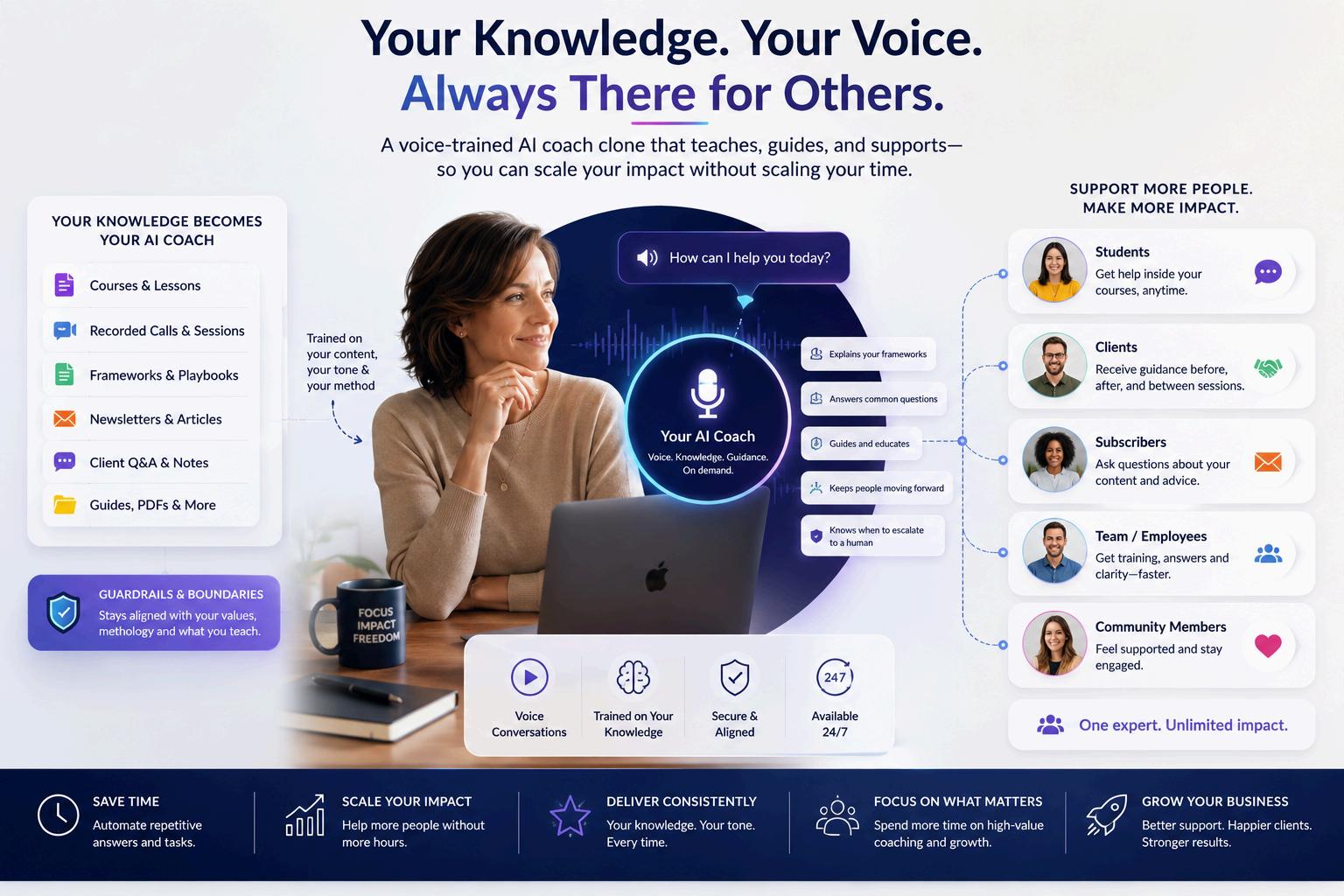
A voice-trained AI coach is an AI assistant trained to respond like a specific expert.That sounds simple, but the difference is important A generic chatbot can answer broad questions A trained clone should answer based on the expert’s own content, frameworks, tone, and boundaries If the expert teaches through a specific method, the clone should understand that method If the expert uses certain language with clients, the clone should reflect that If there are topics the expert avoids or escalates to a human, the clone should know those limits too.
A strong human-like AI coach is usually built around content training, style training, voice training, guardrails, and deployment. Those pieces work together. The content gives the clone substance The style gives it familiarity The voice makes the experience easier to consume Guardrails keep it aligned Deployment puts it where users already need help The real value is not that the AI sounds friendly. Plenty of tools can do that.The value is that the AI knows how you teach, explain, advise, and redirect That is why an AI coach trained on your content is different from a general AI assistant It does not just generate answers It works from the knowledge base and style you give it.
Why Experts Want an AI Version of Yourself
The phrase AI version of yourself can sound dramatic at first In practice, the use case is very grounded.Experts want to stop answering the same questions manually. A course creator may get repeated questions about a module A financial advisor may explain the same planning concept to every new client. A dietitian may repeat the same meal-planning principles every week. A lecturer may receive dozens of nearly identical assignment questions before a deadline None of those questions are bad questions They are just repetitive
A clone helps handle that repeatable layer. It can support student questions inside a course, client education before or after a session, subscriber questions about newsletter topics, employee training, community support, lead education, program navigation, accountability prompts, framework explanations, and follow-up guidance between live calls.The expert still owns the relationship The clone simply makes the expert’s knowledge easier to access That distinction matters. The best ai coaches are not pretending to replace real coaching. They extend it
Why AI Coaching Automation Is Becoming a Serious Business Tool
The old coaching model is easy to understand: more clients means more calls, more messages, more admin, and more support That model breaks quicklyAt a certain point, growth creates friction. Students wait longer for answers. Clients need more hand-holding. Team members ask the same internal questions Communities become harder to manage The expert becomes the bottleneck AI coaching automation changes that equation Instead of relying on the expert to personally answer every repeated question, the business can train a system once and make that guidance available all the time
This does not remove the need for live coaching, advisory work, or human judgment. It protects those high-value interactions by removing the low-value repetition around them A good Coaching automation platform should help an expert capture existing knowledge, turn that knowledge into a conversational support experience, and deploy it where users already need help For many knowledge businesses, that becomes an operating advantage Students get faster support. Clients feel more guided. Teams receive more consistent answers.And the expert gets time back
How personalized AI coaching with voice Changes the Experience
Text support is useful, but voice changes the feel of the interaction People often come to coaches, advisors, educators, and creators because they trust how that person explains things.The pacing. The tone. The way they simplify complexity. The way they challenge without sounding harsh A written response can carry some of that A voice response can carry more That is why personalized AI coaching with voice is becoming attractive for experts who
want to scale without making the experience feel cold or transactional Someone may want to hear an explanation while driving. Another person may prefer reviewing a lesson without reading a long answer A student may need guided reflection after a session A client may want a coaching-style response that feels less like searching a help center.
A voice-trained AI coach can make asynchronous support feel closer to a real coaching experience It does not need to pretend it is the human expert It simply gives users another way to interact with that expert’s knowledge.For course creators, this can improve completion. For advisors, it can make client education easier to understand For HR teams, it can make training less dry. For lecturers, it can help students review concepts in a format that feels less like digging through a PDF.The format matters because learning is not only about information. It is also about delivery
Coach Clone vs Generic Chatbot
A chatbot answers questions.A coach clone applies a point of view.A generic chatbot may give a correct answer in a broad sense, but that answer may not match the expert’s method, program, compliance boundaries, or client philosophy. For a knowledge-led business, that gap can create confusion A trained clone should understand the expert’s frameworks, the order concepts are usually taught, the tone of the brand, the type of guidance the expert gives, the type of guidance the expert avoids, the program rules, the intended audience, and the limits of the clone’s role
That is why training matters more than the interface.A polished chat window is not enough. The clone needs the right source material, instructions, tone, and boundaries behind it A custom AI coach should feel like it belongs inside the expert’s business It should not sound like a generic support bot with the expert’s name attached.
Who Should Build a Custom AI Coach?
A personal AI coach builder is most useful for experts who already have repeatable knowledge.If someone has a course, newsletter archive, coaching framework, advisory process, video library, internal training program, or client education system, they likely have the raw material for a useful clone The stronger the content, the better the clone
AI Clone for Course Creators
An AI Clone for Course Creators can help students get unstuck fasterMost course creators know the pattern A student buys the course, starts strong, then hits a confusing lesson, unclear assignment, or implementation question. If they do not get help quickly, momentum drops.A clone can answer questions inside the course environment It can explain a module in simpler language, point students to the right resource, clarify assignments, and reinforce the creator’s
frameworks That can reduce support workload, but the bigger win is student progress A course is only valuable if people use it.
AI
Clone
for Content Creators
An AI Clone for Content Creators turns a creator’s content library into something people can actually talk to.Many creators have hundreds of videos, posts, podcasts, guides, and tutorials. The audience may love the content but still struggle to find the right answer when they need it A clone helps solve that discovery problem.Instead of scrolling through old posts or searching video titles, a follower can ask a direct question and receive an answer based on the creator’s actual material For educational creators, this can make the content archive much more valuable.
AI Clone for Newsletter Writers
An AI Clone for Newsletter Writers can make a newsletter archive feel alive again Newsletter writers often build trust over years. Their best ideas may be buried in old issues that new subscribers never read Even loyal readers forget where a specific concept appeared A clone can help subscribers explore the archive by asking questions
It can surface past ideas, explain recurring frameworks, and help readers apply the writer’s thinking to their own situation For paid newsletters, this can add real value without forcing the writer to produce more content every week.
AI Clone for Financial Advisors
An AI Clone for Financial Advisors can support education, onboarding, and client preparation.Financial advisors repeat many foundational explanations: risk tolerance, planning timelines, retirement basics, budgeting concepts, tax-aware planning, insurance coordination, and investment behavior
A clone can help clients understand those educational materials before or after a meeting.It should not replace licensed advice It should not make personal recommendations without human review. That boundary is important.Used correctly, it can help clients prepare better questions, understand the advisor’s process, and review concepts at their own pace Meetings get better when clients arrive with context
AI Clone for HR Teams
An AI Clone for HR Teams can support managers and employees with consistent internal guidance HR teams are often asked the same questions across departments: onboarding steps,
leadership training, performance review preparation, conflict resolution frameworks, benefits education, and workplace policies.A clone can make approved guidance available on demand.
This is especially useful for growing companies where HR teams are expected to support more people without expanding at the same pace.For managers, it can provide quick coaching before difficult conversations For employees, it can reduce confusion around policies and training materials For HR, it creates consistency
AI Clone for University Lecturers
An AI Clone for University Lecturers can help students get course-specific support outside office hours Large classes create predictable pressure Students ask about assignments, readings, exam preparation, lecture concepts, grading criteria, and deadlines. Many of those questions are repeated
A lecturer-trained clone can explain concepts using course material, guide students to the right resources, and help them prepare better questions for class or office hours It should not complete assignments for students It should not replace academic judgment Its best role is clarification, review, and guided learning.
AI Clone for Dietitians
An AI Clone for Dietitians can reinforce education and program materials between appointments.Dietitians often repeat guidance around meal planning, grocery shopping, balanced plates, hydration, label reading, habit formation, and client accountabilityA clone can help clients review approved materials, understand general nutrition education, and prepare better questions for their next session.
The guardrails matter here too The clone should not diagnose, prescribe, or replace individualized care.Used properly, it becomes a support layer around the dietitian’s method.
What Makes a Human-Like AI Coach Actually Useful?
A human-like AI coach is not useful because it sounds warm It is useful because it is accurate, grounded, and aligned with the expert.That starts with source material. If the uploaded content is messy, outdated, or vague, the clone will reflect that A clone trained on unclear material will produce unclear answers It also needs boundaries The AI should know when to answer, when to clarify, and when to send the user back to a human.
Style matters too A coach who is direct should not have a clone that sounds overly soft A lecturer who explains with structure should not have a clone that rambles. A financial advisor should not have a clone that sounds casual about serious decisions Then comes reviewReal user questions reveal gaps quickly The expert should be able to see what people ask, improve
the knowledge base, and refine the clone over time A clone is not a one-time setup It is a living part of the business.
How a Personal AI Coach Can Support Revenue
A personal AI coach can reduce workload, but it can also become part of the offer itself For some experts, clone access may be included inside a paid course. For others, it may become a premium membership feature, a client onboarding assistant, or a paid add-on This works best when the clone is genuinely useful, not just positioned as a novelty. If users can get better answers, move faster, and feel more supported, the clone adds value to the offer.
A paid clone can support premium course access, subscriber-only archives, group coaching programs, certification support, client education portals, internal training, and paid community experiences The offer needs to be clear People should understand what the clone helps with, where it fits, and when they still need the human expert.
What Content Should Train the Clone?
An AI coach trained on your content should be built from the material that best represents how you actually teach or advise.This is one place where a short list helps.
Use content such as:
● Course modules
● Lesson transcripts
● PDFs
● Worksheets
● Recorded coaching calls
● Newsletter archives
More content is not always better.A clean set of current, well-organized materials usually beats a large archive filled with outdated or inconsistent information Before uploading everything, it helps to ask a simple question: “Would I still stand behind this answer today?”If not, revise it before it trains the clone
How to Choose a Personal AI Coach Builder
Not every tool that says “AI coach” is built for serious expert businesses.A good personal AI coach builder should give the expert control over knowledge, tone, deployment, and user experience It should use real content, not just prompts It should allow style and response control. It should support boundaries. It should be easy to embed where the audience already asks questions It should also give the expert visibility into what users are asking
Voice matters for some use cases If audio is part of the experience, the platform should support an AI coach trained on your voice in a way that feels polished and controlled.Setup should be simple, but the output should not feel shallowThat balance matters
What an AI Coaching Assistant Should Not Do
An AI coaching assistant should have limits.This is especially important in finance, health, HR, education, and advisory work The clone should not pretend to be a licensed professional It should not make regulated decisions. It should not diagnose, prescribe, grade final work, approve policies, or replace expert judgment.
A responsible clone provides education, stays close to approved content, escalates sensitive questions, avoids making promises about outcomes, avoids inventing sources or policies, and makes limitations clear when needed A clone that answers everything is not necessarily betterA clone that knows when to stop is usually more trustworthy.
Why This Is Moving Quickly in the USA
The USA market is a strong fit for personalized ai coaching because expert-led businesses are already moving toward scalable education.Creators are selling courses and memberships. Advisors are investing in client education. Companies are building internal training systems. Universities are looking for better student support Coaches are moving from one-on-one work into group programs and digital products.
All of those models create the same need: more access without more manual support A coach-style trained AI helps fill that gap It gives users a way to interact with trusted knowledge without waiting for the expert to be available. It also gives the expert a way to scale support without lowering the quality of the experience That is why categories like AI Clone for Financial Advisors, AI Clone for HR Teams, AI Clone for Newsletter Writers, AI Clone for Course Creators, AI Clone for Content Creators, AI Clone for University Lecturers, and AI Clone for Dietitians are gaining attention Different industries Same operational problem
Implementation Checklist for Building a Voice-Trained AI Coach
Before launching a clone, the setup needs to be intentional Define the clone’s job first Decide whether it will support students, clients, subscribers, employees, leads, or internal teams Choose the right source material Use current content that reflects your actual method Remove outdated guidance Do not train the clone on material you no longer agree with.Set clear boundaries. Define what the clone can answer and what should go back to a human Train the tone Add examples of how you explain, challenge, encourage, and
redirect Test real questions Use actual questions from clients, students, or subscribers Review weak answers. Improve the content or instructions where responses feel vague.
Embed it where questions happen Place the clone inside the course, website, community, or portal.Monitor usage. Look at what people ask most often. Those questions reveal content gaps Keep improving it A clone should get better as the business learns more about its users This is how a clone becomes useful rather than decorative
Conclusion: personalized AI coaching with voice Is Becoming the New Access Layer for Experts
Experts are not building clones because they want to disappear from their businesses They are building them because their knowledge is valuable and their time is limited.personalized AI coaching with voice gives coaches, creators, advisors, lecturers, HR teams, and consultants a way to make their expertise more available without adding more calls, messages, or manual support.A well-built clone can explain your frameworks, answer common questions, support users between sessions, and make your content easier to use If it is trained well, it can feel like a practical extension of your method rather than a generic AI tool.
That is the real opportunityNot replacing the expert Making the expert’s knowledge easier to access, easier to apply, and easier to scale.For coaches, creators, and advisors ready to build the AI version of yourself, a voice-trained clone can turn content, voice, and coaching style into a scalable AI experience
FAQs
What is a coach clone?
A coach clone is an AI assistant trained on a specific expert’s content, frameworks, tone, and coaching style. It helps answer questions and guide users in a way that reflects the expert’s actual method
How does personalized AI coaching with voice work?
personalized AI coaching with voice uses an expert’s content and voice style to deliver coaching-style responses through text or audio It helps users receive guidance in a more natural and personal format.
Is a human-like AI coach the same as a chatbot?
No A human-like AI coach is trained around a specific expert’s content and coaching style A generic chatbot usually gives broad answers without understanding the expert’s method, boundaries, or program structure
Who should use a custom AI coach?
A custom AI coach is useful for coaches, creators, advisors, lecturers, HR teams, dietitians, consultants, and newsletter writers who already have repeatable content, frameworks, or training materials.
Can an AI coaching assistant replace a human expert?
No An AI coaching assistant should support the expert, not replace them It can answer common questions and explain content, while the human expert handles judgment, strategy, and sensitive decisions.
What content should I use to train an AI coach?
Use course modules, videos, transcripts, PDFs, newsletters, worksheets, frameworks, FAQs, onboarding documents, and other materials that reflect how you actually teach, coach, or advise
Can I build an AI coach trained on your voice?
Yes. An AI coach trained on your voice can use voice training to create a more personal audio experience while still relying on your approved content and coaching style
Is an AI Clone for Financial Advisors safe to use?
It can be useful when designed with clear boundaries. An AI Clone for Financial Advisors should support education and onboarding, not replace licensed financial advice or make personal recommendations without human review.