Health: Behavioral Health

Page 1


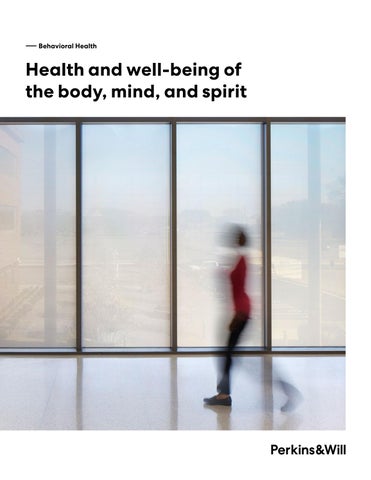
Health and well-being of the body, mind, and spirit

Introduction ― 4 Selected Projects ― 8

Front Cover:
Cherry Hospital, Goldsboro, North Carolina
Left:
UTHealth Houston John S. Dunn Behavioral Sciences Center, Houston, Texas

A passionate commitment to create dignified places

The COVID-19 pandemic and the companion global confrontation with social justice have together placed enormous strain on the mental and behavioral health of people worldwide. Spikes in anxiety, depression and other behavioral health issues accompany rising rates of developmental issues, addiction and eating disorders. Expanding clinical demands, coupled with research on neurological response to the built environment, are increasing demand for innovative and dignified treatment settings. These facilities have a powerful effect on the way patients feel about themselves, their situation and their place in the world—these spaces should embody principles of wellbeing, inclusion, sustainability, resilience and regeneration, the tenets of Living Design.

Developing innovative solutions to meet increasing demand and complex need

Scientific Advances Increased Access Empowered Consumers

Treatment breakthroughs are happening at an increasing rate; the evidence is driving new models of care. From standalone ambulatory treatment settings to behavioral health inpatient settings, the breadth of treatment is expanding exponentially to include genetics, neuroscience, endocrinology, and emerging treatments for PTSD and depression. In addition, environmental design research into built environment stimuli for special populations is changing the look and feel of care environments.

Societal shifts that promote health and wellbeing are destigmatizing mental health services and improving access to care. Dedicated behavioral health settings in Emergency departments, ambulatory clinics, and acute care address the full spectrum of care needs. Increased accommodation for virtual consultation is a new norm. Employers and insurers are increasing behavioral health offerings.

Consumers demand convenient, connected, coordinated care in settings that support dignity, choice and control. Simple, intuitive wayfinding underpins the quest for consolidated services that can flex with market demands and provider schedules. Reducing the stigma associated with behavioral illnesses emphasizes that the challenges people face are complex and deserve attention.

― Behavioral Health

Selected Projects

Duke Behavioral Health Center North Durham

Durham, North Carolina

Client: Duke Health - Duke Regional Hospital

Size: 121,500 square feet (new construction); 41,400 square feet (renovation)

Completion Date: 2021

With dignity, safety, and healing as core drivers, the patient entry provides a welcoming experience for both in and outpatients

Spaces to exercise and safely engage outdoor activities are central to a positive patient experience

― WHAT IT IS
Duke Health created a consolidated, comprehensive facility addressing trauma, inpatient, ECT, and outpatient therapy
― WHAT MAKES IT COOL
Duke now applies a whole-person approach to mental healthcare.
The healing environment is dignifying and highly adaptable.

Common spaces for staff, patients, and visitors provide space for relationship-building in more natural and informal ways

Open, transparent nurse stations prioritize a personal connection between patients and nurses, while providing safety as required

The pedestrian-scaled plaza and healing gardens welcome patients and visitors upon arrival

UTHealth Houston John S. Dunn Behavioral Sciences Center

Houston, Texas

Client: University of Texas Health Science Center

Size: 253,800 square feet (23, 579 square meters)

Completion Date: 2021

An example of how we are translating biomedical research into design principles—a true therapeutic environment tuned to the human experience

The program includes 264 new inpatient beds, support for staff and student education and research, and an off-unit therapy mall to support healthy recovery. The building integrates the healing features of nature through the use of strategic views from the unit and carefully planned courtyards designed for therapeutic benefits.

UTHealth Houston John S. Dunn Behavioral Sciences Center

Inside each unit, a daylit central common area is surrounded by single and double occupancy patient rooms. A warm material palette sets an overall tone of a soothing and comfortable space.

Additional amenities include a therapy mall, activity room, and a communal dining area with views onto an internal courtyard, as well as an external courtyard leading to a large, tree-filled area

Central Regional Hospital

Butner, North Carolina

Client: North Carolina Department of Health & Human Services

Architectural Collaboration:

Architect of Record – Perkins&Will;

Associate Design Architect/Engineer – CannonDesign

Size: 450,000 square feet (41,806 square meters)

Completion Date: 2007

Awards:

Honor Award–Unbuilt Category, AIA North Carolina, 2006

Clockwise from Top Right: An architectural language of site walls and linear volumes was used to weave this large facility into the sloped and wooded site. Three distinct programmatic zones are reinforced by these shapes, along with the use of color and interior features. A connecting stair promotes activity within the facility.

Cherry Hospital

Goldsboro, North Carolina

Client: North Carolina Department of Health & Human Services

Size: 410,417 square feet (38,129 square meters)

Completion Date: 2016

Clockwise from Top Right: Patient residences and recreational programs overlooks an outdoor courtyard; Treatment mall along main circulation spine; Outdoor Courtyard

Light-filled dining area and adjacent green roof courtyard

Modular treatment hubs and rooftop courtyards along ground level promenade

Varied indoor and outdoor environments create a setting that encourages patient rehabilitation and wellbeing
WHAT MAKES IT COOL

Broughton Hospital

Client: North Carolina Department of Health & Human Services

Size: 470,000 square feet (43,664 square meters)

Completion Date: 2019

Morganton, North Carolina ― WHAT IT IS

This 382-bed replacement facility creates a campus setting by pulling programmatic functions together around courtyards and activity spaces

This contemporary hospital replaced an obsolete campus of existing buildings, constructed between the 1880s and the 1960s.

Broughton Hospital

The group treatment “hubs” frame a great lawn that opens to landscape views while maintaining patients’ need for privacy

↓ Administrative functions, residential areas, and treatment areas are placed along a central spine

The
small wings around varying courtyards

Gardner Neuroscience Institute

Cincinnati, Ohio

Client: UC Health / University of Cincinnati

Size: 194,000 square feet (18,023 square meters)

Completion Date: 2019

Awards:

Winner: Healthcare Design (Under 25,000 sqm) Category, European Healthcare Design, 2020

High Commendation: Health and Life Sciences Research Category, European Healthcare Design, 2020

High Commendation: International Health Project Under 40,000 sqm, International Academy for Design & Health, 2020

Design Excellence, Distinguished Building, AIA Chicago, 2019

Winner: Healthcare Category, The Architect’s Newspaper, 2019

Editors’ Pick: Facades, Best of Design Awards, Architect’s Newspaper, 2019

Bronze Award – Healthcare Category, World Architecture News, 2019

Build Ohio Award, Associated General Contractors of Ohio, 2019

Award of Merit, ENR Midwest, 2019

― WHAT IT IS
A leading treatment, education, and research center for complex neurological and psychological conditions
Clockwise from Top Right: East-West Section; Wall Section South Façade; View from Southeast

― WHAT MAKES IT COOL

A unique façade that prevents glare and visual disorientation.

↑ Exam rooms accommodate families for extra patient support ← On the exam and clinical care floors, patients move along exterior light-filled corridors for comfort and visibility

→ A daylit human-scaled lobby combats potential vertigo while welcoming patients and community

Each component of the design was developed with patient, family, and caregiver input in collabotration with “neuro-architect” who studies and practices both architecture and clinical neuroscience, which influences how specific design elements can help improve the patient experience.

University of Virginia University Hospital Emergency Department Expansion — Behavioral Health Module

Charlottesville, Virginia

Client: UVA Health

Size: 4,000 square feet (Behavioral Health Module) within Emergency Department Expansion of 52,800 square feet (new construction); 12,100 square feet (renovation of existing)

Completion Date: 2019

Awards:

Category Winner – Healthcare, International Interior Design Association, 2021

Distinguished Building Award, AIA Chicago, 2020

Editors’ Pick – Healthcare, The Architect’s Newspaper, 2020

Best Health Care, ENR MidAtlantic, 2020

AEC Award of Excellence, Autodesk, 2018

The Emergency Department entrance lobby opens to a 28-foottall atrium with three circular skylights and a constellation of recessed ceiling lights, lending a celestial feel to the space. A light-colored wood ceiling, juxtaposed with white floors and ceilings, creates a feeling of brightness and warmth.

University of Virginia Hospital Emergency Department Behavioral Health Module

Bright clerestory windows in these rooms usher in natural light, creating a soothing effect

King Abdulaziz Medical City

Behavioral Health Facility

Client: National Guard Health Affairs (NGHA)

Size: 325,000 square feet (30,194 square meters)

Completion Date: Ongoing

Awards:

Award of Merit, Healthcare Design Showcase, 2015

Riyadh, Kingdom of Saudi Arabia ― WHAT IT IS A full-service integrated behavioral health campus, housing psychiatric and addiction treatment programs

Accessible courtyards and other outdoor areas integrate the natural landscape into the building and also serve as an organizing structure.

Courtyards are places to be engaged in the outdoors physically as well as visually, but they become ways to separate the communities. They become buffers as well as bridges to the outdoors.

― WHAT MAKES IT COOL

A residential environment allows for patients to transition and acclimate back into their lives

King Abdulaziz Medical City Behavioral Health Facility

UCSF Nancy Friend Pritzker Psychiatry Building

San Francisco, California

Client: University of California, San Francisco / SKS Partners & Prado Group

Size: 166,000 square feet (15,422 square meters)

Completion Date: 2022

Architectural Collaboration:

Perkins&Will (Architect of Record, Exterior) and ZGF Architects (Design Architect)

The 166,000 sf facility consists of five floors of clinic, exam, and administrative space and includes an underground garage, MRI facility, 250-seat auditorium, and a small retail space.

At the heart of the building is a light-filled five-story atrium. This soaring space, incorporate floating baffles for light and acoustic control and bridges for cross access

― WHAT IT IS

A center colocating clinicians and researchers to address pressing needs in psychiatry, psychology, and related fields

― WHAT MAKES IT COOL
A holistic approach, providing a positive connection to the community that helps normalize behavioral health care.
Top Right: Dedicated adult entry
Above: Warm wood defines a range of interior spaces
Right: A separate, welcoming entrance to the UCSF Child, Teen and Family Center
Left: A rooftop garden, accessible to staff and to patients, under supervision, caps the building
UCSF Nancy Friend Pritzker Psychiatry Building

Regional Mental Healthcare Facility

Charlotte, North Carolina

Client: HopeWay Foundation

Size: 52,000 square feet (4,830 square meters)

Completion Date: 2016

Awards:

Gold Seal of Approval for Behavioral Health Care Accreditation, 2017

Behavioral Health Home Certification, 2017

DesignWorks Honorable Mention Award in the Healthcare Category, IIDA Carolinas Chapter, 2017

DesignWorks Honorable Mention Award in Design Detail Category, IIDA Carolinas Chapter, 2017

Clockwise from Top Right: Client TV Lounge and Pantry; Covington library; Art-filled public lobby and seating area

Camp Southern Ground

Fayetteville, Georgia

Client: Camp Southern Ground

Size: 500 acres ( xxxx square meters)

Completion Date: 2015

Awards:

Contract Magazine Healthcare Environment Awards, Conceptual Design, 2013; American Society of Landscape Architects (ASLA), Georgia Chapter, Honor Award, Unbuilt, 2013

Camp Southern Ground serves typical children, children on the neurological spectrum, and the children of gold-star military families. The camp’s mission is to provide extraordinary experiences for children to recognize and magnify the unique gifts within themselves and others in order to profoundly impact the world.

― WHAT IT IS
A camp that serves children on the neurological spectrum, and returning military service personnel suffering from PTSD
Camp Southern Ground
― WHAT MAKES IT COOL
The camp provides a spectrum of opportunities for autistic youth

Living quarter pods featuring fold-away bunks and sliding wall panels are transformable and multi-purpose

← →

The building’s orientation has been carefully studied to maximize views, daylighting and access

Since 1935, we’ve demonstrated that design has the power to make the world a better, more beautiful place.

That’s why clients and communities on nearly every continent partner with us to design healthy, happy places in which to live, learn, work, play, and heal. We’re passionate about human-centered design, and committed to creating a positive impact in people’s lives through sustainability, resilience, well-being, diversity, inclusion, and research. In fact, Fast Company named us one of the World’s Most Innovative Companies in Architecture. Our global team of 2,700 creatives and critical thinkers provides integrated services in architecture, interior design, landscape architecture, and more. Our partners include Danish architects Schmidt Hammer Lassen; retail strategy and design consultancy Portland; sustainable transportation planning consultancy Nelson\Nygaard; and luxury hospitality design firm Pierre-Yves Rochon (PYR).

For more information, contact us at: perkinswill.com/contact/

Turn static files into dynamic content formats.
Create a flipbook
Issuu converts static files into: digital portfolios, online yearbooks, online catalogs, digital photo albums and more. Sign up and create your flipbook.