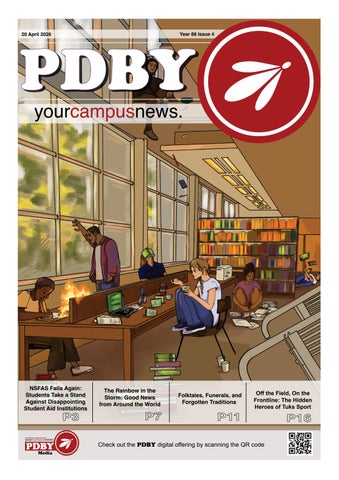
20 April 2026 Issue 4 Year 88

Page 1


PDBY PDBY

From the editor...

Afew weeks ago, I literally trekked across cities to go to the cinema. A close family friend mentioned that her daughter was the casting director for a new South African film, so I made it my duty to go see the film. The film I watched was Pretty How Town, directed by Alan Shelley and written by Richard Starkey. The casting director (my reason behind going) was Samantha Chapman, and can I say, if this were up for an Oscar, she would have received the newly named award for Best Casting Director.

The film follows the story of a transgender woman who returns to her hometown to look after her dying mother. The last time she was home, she hadn’t transitioned, and the film uncovers the events that led to her leaving. The film explores themes of family, acceptance, and LGBTQIA+ identity, specifically the trans experience. But I’m not going to give you a review of the film. As lovely as it was, I’d rather share what I took from it, because I think that was the purpose. Not necessarily the story, but what the story shows us about our society.

I watched the film with a close friend from high school, and both of us found the film to be an incredible portrayal of South Africa. The humour was hilariously South African, with its references to rugby and the clearly visible Maxed tags on the exercise clothes. Beyond this, what we found more South African were the attitudes of the characters towards the queer community. Queerness is tolerated in this little town, but not something directly spoken about –“We accept you, but please make sure you keep your experience to yourself” kind-of-business. And what’s more South African than that – the culture of not speaking about differences or anything that may make you feel uncomfortable. If something out of the ordinary happens, we slap

NEWS

some humour on it and sweep it under the rug. And this is exactly how the queer community is treated. Our constitution may be progressive, but what no one speaks about is how they are treated.

It’s one thing to tolerate a person, but it’s a completely different thing to actually take the time to understand them and accept them into your community. And I think that is what this film was showing us. Well done for giving a marginalised community the space, but what are you doing with that space to make them feel like they belong? One powerful scene at the end of the film showed a community member trying to explain the protagonist’s transition in rugby terms. As clever as this was, it was also evident that this community wasn’t going to try and understand the main character unless it was

Please find our online articles on pdby.co.za

• South African Involvement in the Recently Released Epstein Files by Kofi Donkor

• A Ticket is How Much? By Ilitha Nonkonyana

ENTERTAINMENT

• Retired From Sad Girl Music by Atanda Ntlantsana

Botaki Ba Afrika: Artistry That Does Not Break The Bank by Zizo Mtshemla

SPORT

on their terms. This sums up our South African attitude perfectly. It’s our way or the highway. If something doesn’t fit into our frame, we don’t want it.

We make jokes about this all the time, and this is something that South Africans pride themselves on. Our nonchalant, witty sense of humour to all our problems. But in this case, queerness is the “problem”, and this attitude is disturbing. While watching, I saw people I know reflected in these characters. So many microaggressions that come off as harmless jokes but really make an already isolated group feel more misunderstood. That is the beauty of this film –through its humour, it points out our bigotry.

I do think South Africa has a long way to go when it comes to accepting the queer community. I mean, there is clearly something to be said about the film only being distributed by a select few cinemas under the Ster Kinekor umbrella. It has, quite literally, been swept under the rug. The film brought me to tears for two reasons: because of the exceptional writing, and as a member of the queer community. I saw the lack of understanding that is the true backdrop of our society.This film needs to be made accessible. It's time for our country to put what we have on paper into practice. And I think that’s something people can be very defensive about. Everyone is quick to boast about our progressive constitution, but they are less willing to do some critical thinking about whether or not they follow it. So I ask you to think critically about what you say in your everyday conversations as a “funny” South African and how much of it is a major slap in the face not only to your beaming constitution, but to the people that add to the magic of our beautifully diverse country.

When Legends Speak: Chiefs’ Derby Defeat Sparks Culture Clash by Lindiwe Dubazane Top of the Log: Tuks Edge Maties to Maintain Perfect Varsity Cup Start by Cayden Coetzer

Media

about UP issues.

To advertise in PDBY contact Tel: 012 420 6597 Cell: 083 318 9738 carel.willemse@up.ac.za

PDBY Media

www.pdby.co.za

Twitter: @PDBYMedia

Instagram: @PDBYMedia

Facebook: PDBYMedia

Tel: (012) 420 6597

Editorial

Editor-in-chief carel.willemse@up.ac.za

Carel Willemse @Ed_in_Chief

Editor editor@pdby.co.za

Domonique Bennetts @pdbymedia

Deputy Editor digitalmanager@pdby.co.za

Jason Visser

News news@pdby.co.za

Relebogile Manana

Features features@pdby.co.za

Gabriella Hobson

Entertainment entertainment@pdby.co.za

Cara Heymans

Sport sport@pdby.co.za

Neo Paledi

Copy copy@pdby.co.za

Hannah Roberts Layout layout@pdby.co.za

Bell

Visual Media multimedia@pdby.co.za

Danielle Oosthuizen Dynamic Media

Jason Visser

Web webeditor@pdby.co.za

Sivenathi Makhanda

Social Media

Amai Ngulube

PDBY appreciates that freedom of speech is an inalienable right enshrined in the Constitution of the Republic South Africa. We encourage our readers to engage in discussion and debate on issues that affect them through letters to the Editor, comments on our website, tweets, or posts on Facebook. We ask our readers to keep the following in mind:

1. PDBY will not edit letters, comments, tweets, or Facebook posts in any way.

2. PDBY will label letters, comments, tweets, or Facebook posts as opinion. These do not represent the views of PDBY in any way.

3. The PDBY editorial must approve letters, comments, tweets, or Facebook posts before they are published.

4. PDBY will not publish letters, comments, tweets, or Facebook posts that are defamatory, or libelous, or that contain offensive content.

5. PDBY reserves the right to practice discretion when publishing letters, comments, tweets, or Facebook posts.

6. PDBY reserves the right to publish any content we receive unless the sender specifically requests otherwise.

7. PDBY reserves the right to retract a letter, comment, tweet, or Facebook post after it has been published.

8. PDBY will not accept responsibility for any consequences the author of a letter, comments, tweets, or Facebook posts may experience as a result of the letter being published.

9. PDBY will only publish letters between 150 and 200 words.

10. PDBY will not publish letters unless the writer confirms their full name, student number and contact number. PDBY will not publish this information, we need it for our records.

NSFAS Fails Again: Students Take a Stand Against Disappointing Student Aid Institutions

On 9 March, frustrated students took to the streets, angered by the failings of institutions meant to ensure student wellbeing. The protest was sparked by all too familiar issues: delayed NSFAS allowances, increased food prices at UP residences, and high fees at private student accommodations. Several student organisations, particularly the EFF Youth Command UP (EFFYC-UP) and the UP-SRC, collaborated with students in order to mobilise a stand against exploitation.

Issues relating to the protest seem to have begun towards the beginning of March, the EFFYC-UP released a statement on their Instagram account on 2 March. In this statement, they demanded that no additional fees should be charged to NSFASfunded students at NSFAS-accredited accommodations, and that all students that have already paid these additional fees must be refunded in full, demanding that these refunds must take place by 16 March or they will take decisive action. The statement concluded by demanding that all outstanding NSFAS allowances should be released before the end of the week. A follow-up statement was then released which detailed that NSFAS had communicated with accredited private accommodations back in February to cease charging NSFAS-funded students for deposits, administrative fees, and other non-rental amounts. The statement continues to call for the refunds to be paid to students who have already paid the additional fees, this time demanding that said refunds be provided no later than 20 March. The statement concludes by detailing engagement with the Student Service Centre (SSC) regarding speed-up of lease approvals at UP residences in order for students to receive their meal allowances.

The UP-SRC also released a statement addressing the issue of additional fees at private accommodations, detailing a meeting with Thrive Student Living management which resulted in the rental price for sharing rooms being reduced from R5 550 per month to R5 400. The SRC also requested that Thrive’s high lease and administrative fees not be imposed and that students who have already paid these fees be refunded within 14 days. However, Thrive rejected this request, providing that these fees were necessary for administrative purposes. The statement concludes

by detailing resolutions from the meeting with Thrive and The Fields Student Accommodation. The resolutions discuss quality of life issues such as maintenance, internal transfers between Thrive buildings, biometric access for NSFAS-funded students, and visitor policies.

The EFFYC-UP followed up on their previous statements, announcing the titular protest in an Instagram post a week before it took place. The post also demanded that the university release NSFAS allowances immediately, and that UP residences must be involved in administrative fee and deposit refunds. It further said that an accommodation cap must be implemented by the UP residence office, food prices must be reduced in TuksRes dining halls, and additional rental fees at private accommodations must be done away with. They also explained that accommodations that refuse to comply must have their NSFAS accreditation revoked. Finally, the post said that private accommodations will be shut down until all demands are met.

The protest began at the Prospect Street entrance at 11:30. Students had marched and demonstrated at several nearby private accommodations such as Varsity Studios, Respublica, and Campus Central. As per the EFFYC-UP’s statement regarding the protest, private accommodations owned by Thrive Student Living supposedly restricted students from leaving their buildings throughout the early hours of the protest.

PDBY spoke with Tjebane Mmabatho, a second-year Political Science student who attended and documented the protest through several videos on her TikTok page, @livelovelaughvenlee. One of Mmabatho’s videos was posted on the EFFYC Instagram account. Mmabatho corroborates the EFFYC-UP’s statement, providing that when demonstrators had arrived at Varsity Studios, a Thriveowned accommodation, residents were prevented from leaving the building. They were even supposedly told that if they joined the protest, they would not be allowed to return. Mmabatho had initial concerns about low attendance, however, these worries fell away as the march continued, gaining momentum and numbers with every accommodation visited. Mmabatho highlighted the sense of unity she had felt among fellow students at the protest as there was

collaboration between UP-SRC and EFFYC-UP leaders, as well as members of several different student political societies.

The march concluded at the SSC building with an address from SRC President Khutso Manyaka, who expressed his joy at the presence of students convening against exploitation. It should be noted that during the protest, Manyaka had been engaging with university management regarding the prevailing issues. In one of Mmabatho’s videos that documented the end of the protest, she reports that it was communicated that NSFAS allowances will be released. Some students in the comment section of this video shared that they have received their allowances while other commenters provide that they are still waiting.

In the EFFYC-UP’s statement following the protest, they reaffirm their demand for students who have paid additional fees at accommodations to be refunded by 20 March, saying that accommodations who refuse will be confronted by the EFFYC-UP and reported to the relevant offices at NSFAS and the Department of Higher Education and Training. The statement also details that the EFFYC-UP delivered several demands to the UP residence office. This statement demanded that TuksRes intervene in ensuring that students acquire refunds from private student accommodations, that the office does not accredit accommodations that charge students high fees, and that all accredited accommodations must have a minimum of two NSFAS cap-rated options. It said that TuksRes needs to provide affordable food for students residing at UP residences, that they need to reduce room prices, and that they should cancel and refund any non-rental affiliated charges to students. The statement concludes by saying that meal allowances have been released for TuksRes students.

The protest on 9 March is an example of how students are able to take action in order to stand up for their rights and contest exploitative policies. However, the surrounding situation also highlights the exploitative nature of institutions that are meant to help students. Private accommodations such as those owned by Thrive Student Living are quick to disregard the wellbeing of students in order to meet their bottom line. When all is said and done, it seems that these institutions simply view students as a means to gain capital.

Reporting Live from UP:

The DHET Weighs in on Funding and Readiness

Every year, the commencement of the academic calendar is marked by protests across South African universities, with students voicing their recurring concerns over funding and inflated costs associated with the pursuit of tertiary education. In February, these issues were once again raised during a TuksFM interview with the Deputy Minister of Higher Education and Training (DHET), Dr Nomusa Dube-Ncube, after her annual oversight visit to institutions of higher learning, including the University of Pretoria.

During the radio interview, Dr Dube-Ncube said that the purpose of these oversight visits is assessing institutional readiness. In response to whether her department had worked proactively in addressing the issues that have plagued students, Dr Dube-Ncube responded affirmatively and raised a few pertinent points. Upon request, the Office of the Deputy Minister swiftly furnished an email response, further supplementing information regarding the following:

Institutional Readiness

UP had attracted a sufficient number of applicants for most of its academic programmes, receiving a staggering 48 444 applications from FTENs with only 9 720 available spaces. However, the

The DHET, in collaboration with Universities South Africa (USAf), developed a monitoring tool that collects information on registration-related matters. This tool then compiles a comprehensive document from gathered data regarding applications received, available spaces for firsttime entering students (FTENs), registration dates (including any extensions), and student accommodation matters such as allocation processes and the provision of interim or transitional accommodation.

Registration Processes

While registration is primarily online, the university provides physical support for students requiring assistance.

university opened late applications for any programmes that had not attracted an adequate number of applications.

Student Accommodation

Students are placed in residences prior to the commencement of lectures. The allocation process remains an ongoing effort throughout the academic year aimed at effectively addressing students’ needs.

Funding Status

Regarding NSFAS, universities had received lists of eligible students and funding dispersal was reportedly in its final stages by early February.

However, uncertainty still remained regarding only 50 students who were classified as “loan students” and the potential of being either defunded or rejected by NSFAS. Both FTENs and returning students have a right of appeal should they be aggrieved regarding their funding outcome. Additionally, UP provides financial aid to academically deserving but unfunded students through bursaries and loan schemes.

According to the DHET, UP was fully prepared to begin the academic year and had implemented the suggested plans and procedures. However, on 9 March, these exact same issues culminated in an EFFYC-led student protest. Although the scale of the protest was strategically limited by private student accommodations restricting entry and exit onto their premises, the impact was still significantly felt.

The demonstration prompted the following immediate responses: private student accommodations, as accredited by and agreed upon with NSFAS, refunded and ceased charging NSFAS-funded students deposits, administrative fees, and other non-rental related amounts. Additionally, in engagements with the SSC Finance Office, lease approvals are set to be accelerated so that students can receive their meal allowances to purchase meals and groceries.

Despite all of these interventions, a lingering disconnect exists between the key role players responsible for ensuring student support. The miscommunication and lack of transparency, illustrated by the undefined deadlines or documents containing benchmarks and plans of action published for public scrutiny, created difficulty in determining which entity should be held accountable for the administrative and financial frustrations faced by students. This reinforces the need for more co-ordinated communication between the DHET, universities, NSFAS, or any other funding schemes, but most importantly, it must be efficiently communicated to students.

Londeka Mbokane
Photo: Sourced

Know Your Rights: What Every UP Student Should Understand About Their Rights on Campus

At the University of Pretoria, policies and procedures shape a large portion of student life, from academic requirements to disciplinary processes. While the rules are often clearly communicated, the rights that exist within these systems are not always equally understood.

For many students, awareness of their rights only becomes relevant at specific moments, such as during academic disputes, when seeking support, or when facing formal processes such as disciplinary hearings. In these situations, understanding how university systems operate can influence how students respond and what options are available to them.

Student rights at UP are embedded within the institutional frameworks. These include the rights to fair academic assessment and access to support services, the ability to raise concerns through formal channels, and the participation in structured processes where decisions affecting students are made. Rather than existing independently, these rights function within established procedures and policies.

PDBY spoke to SRC Transformation and Student Success Officer Andile Mathe, who said that misconceptions about student rights are common. He explained that students often assume that being registered at the university guarantees certain outcomes without recognising that rights operate within institutional processes. He explained that the SRC works to address this through awareness campaigns, student engagement, and information sessions that aim to improve understanding of university systems.

Beyond awareness, the SRC also plays a role in helping students navigate these systems. Mathe said that students are encouraged to approach SRC representatives when they need guidance, particularly when they are unsure of how to proceed in specific situations. He explained that the SRC assists students by directing them to relevant structures such as faculty offices, student support services, and formal

grievance mechanisms. They may also support students in ensuring that processes are followed fairly.

The relationship between students and institutional processes is also evident in disciplinary matters. Chairperson of the Student Disciplinary Advisory Panel Onakho Chulayo said that many students enter disciplinary proceedings without a clear understanding of what they are allowed to say or what evidence they can present. He noted that this lack of clarity is not necessarily linked to misconduct, but rather to limited familiarity with the procedures themselves. Chulayo added that efforts to address this include using social media platforms and targeted initiatives such as test week engagements to provide students with accessible information about their rights and responsibilities within disciplinary processes.

In addition to formal processes, access to information remains a key factor in how student rights are experienced. UP provides multiple channels through which students can find guidance and support. The Department of Student Affairs offers services related to student well-being and general support, while faculty offices deal with academic matters, including assessments and programme-specific requirements.

Official platforms such as the UP website and clickUP provide

access to various policies, including the Disciplinary Code and facultyspecific guidelines. These documents outline both student rights and the procedures through which they can be exercised. At the same time, student-led communication channels, including SRC social media platforms, contribute to making this information more visible and easier to engage with.

The role of information, where it is found, how it is understood, and when it is accessed shapes how students interact with these systems. While structures are in place, navigating them often depends on familiarity with processes and awareness of available support.

Therefore, student rights are closely linked to how institutional systems function in practice. They are not separate from rules, but part of the same framework that governs academic and campus life. This includes both formal mechanisms – such as hearings and grievance procedures – and everyday interactions with university structures.

As the academic year progresses, these systems continue to operate across different areas of student life. Engagement with them varies depending on individual experiences, academic contexts, and the situations in which students find themselves.

Inside the Library: How the University Library Supports Student Success

For many students, the library is a sanctuary of focus, a hub of late-night cramming sessions, and the backdrop to countless academic journeys. But how much do we really know about this campus cornerstone? Beyond the books and silent floors, the library is evolving, sometimes loudly, with construction buzzing in the background. The Merensky 2 Library is much more than a place to study because different activities take place throughout the year.

Zenzile Ntshabele, an employee of the library since 2016, describes some of the events that take place: ”Poetry nights for creative expression, visits from therapy dogs for students who find comfort in interacting with furry friends, easter egg hunts, and events that explore topics such as networking, mentorship, building resilience, and balancing academic demands with mental wellbeing.”

As students navigate their studies, they also have to deal with the noise in the Merensky 2

Library that has been going on. For the past few weeks, various construction noises have made it difficult for some students to study. Asenathi Nqobeni, a thirdyear BCom student, said, “It is so frustrating, and it affects me in a way that my focus shifts and I end up not doing what I came [to] the library [to do].” She also added, “They must work at night when there are no students studying on the computer side.”

PDBY spoke to Modisa Khosie, Deputy Director for the Department of Library Services, about the aim of the construction and how long it will take. He explained, “The construction is mainly [the] building of the new Gallery linking level 3 and 4 and upgrading the main lending reception desk. It also includes the complete makeover of the MakerSpace into a Digital Technologies Hub.” Khosie went further, saying, “The construction project is running from 12 January 2026 until 31 May 2026.”

The expected final look has been displayed on the screens that are in the library, and it seems it will become a more modern and efficient space.

The university’s main library provides students with different resources such as discussion rooms, short loaning periods for books in the Study Collection, and advanced technology through its MakerSpace (3D printing, Internet of Things, virtual and augmented reality, and much more). These resources are accessible to anyone who wants to use and explore them. For book enthusiasts, the library also hosts two book clubs, one at the Merensky 2 Library and another at the Education Library. In addition, students can explore a wide selection of fiction titles available in the Book Nook on Level 6 of the library, offering a perfect way to unwind from academic work.

Student academic success is a very important part of the library’s daily operations. When PDBY asked how the library achieves this, Ntshabele said, “[By] providing access to academic resources that are aligned with their curriculum, including prescribed books, eBooks, and credible research articles available through the library’s databases and website.” Nqobeni agreed that the library does enough to help the students succeed academically.

While the Merensky 2 Library is a work in progress, it remains a vital space for students, continually adapting to meet their evolving needs despite the occasional hum of drills at 11:00. The construction represents a necessary step towards modernisation. Khosie explained, “Building a 21st century library that enhances the user experience is our ultimate goal.” Ultimately, students come for the silence but stay for the activities and resources they did not even know existed.

University of Pretoria Leads Africa’s AI Governance Debate

Artificial intelligence is rapidly reshaping industries across the world, but questions about how it should be regulated, governed, and applied in Africa remain unanswered. At the University of Pretoria (UP), a new initiative is placing the institution at the centre of these debates.

The launch of the “Catalysing AI’s Potential in Africa through IP Innovation” project marks a shift from viewing artificial intelligence as a purely technological development to engaging with its issues surrounding legal policies and governance. The initiative brings together researchers, policymakers, and industry stakeholders to explore how intellectual property frameworks can guide the development and use of AI on the continent.

As AI systems increasingly rely on existing data, creative works, and knowledge systems, questions around ownership and control have become more complex. The project focuses on how intellectual property laws can respond to these challenges while supporting innovation and access in an African context.

PDBY spoke to the Acting Dean of the Faculty of Law, Prof. SJ Cornelius. He said that it is important for the faculty to remain engaged with technological developments such as AI and to consider the legal implications that arise from their use. He added that part of this responsibility includes preparing students to engage with AI in a responsible and competent way.

Beyond the classroom, the initiative reflects the broader role that universities are beginning to play not only in producing research, but also contributing to policy discussions that may influence how emerging technologies are governed. Prof. Cornelius indicated that the project is expected to contribute towards research that can inform policy decisions at both national and continental levels. He added that

the aim is to position the Faculty of Law as a space where legal and policy considerations around AI are actively examined.

From an institutional perspective, the project also aligns with UP’s wider research agenda. When Prof. Sunil Maharaj, Vice-Principal for Research, Innovation, and Postgraduate Education, spoke to PDBY, he said that artificial intelligence presents significant opportunities for Africa, including its potential to address challenges related to public health, environmental change, and resource management. At the same time, he indicated that AI introduces new questions around intellectual property, particularly in relation to ownership, use, and regulation.

These questions extend beyond individual institutions. As AI continues to develop, there are growing concerns about how access to technology and knowledge is distributed. The pace of innovation raises the possibility that existing inequalities may widen, particularly if regulatory frameworks do not account for the specific needs and contexts of African countries.

Prof. Maharaj noted that the university’s research efforts are aimed at ensuring that AI is used responsibly and ethically while also unlocking its potential to contribute towards long-term development on the continent. He added that AI-related research at UP spans multiple disciplines, reflecting the complexity of the technology and its applications.

The intellectual property-focused initiative adds a governance dimension to this work by creating a platform for engagement between different sectors, including academia, regulators, and industry.

Through this, the project contributes to ongoing discussions about how policies and legal frameworks can respond to rapid technological change.

Collaboration remains a central part of this approach. By bringing together stakeholders from across Africa and beyond, the initiative reflects a broader effort to situate African perspectives within global conversations about AI. This includes considering how policies can support innovation while also addressing concerns around access, ownership, and the use of existing knowledge systems.

While the long-term outcomes of the project will depend on how its research is applied, its launch signals a growing emphasis on governance in discussions surrounding artificial intelligence. It also reflects the role of universities in shaping how these technologies are understood beyond technical development.

As debates around artificial intelligence continue to evolve, initiatives such as this form part of a wider landscape in which research, policy, and innovation intersect, with implications that extend beyond the university environment.

Mandilive Mbethe
Ompha Mudau
Visual: Mpho Makwela
Visual: Jemma Thomson
Visual: Amy Lamplough

STARS Mentorship Meet and Greet: Meet Your Mentors

On 10 March, the STARS Mentorship Programme hosted its first annual Meet and Greet – an exciting gathering between mentors and the Executive Co-Ordinators. The gathering aimed to officially welcome mentors into the mentorship programme and discuss ways to assist first-year students as they transition from high school to university.

The first Meet and Greet was organised by Economic and Management Sciences Executive Co-Ordinator Satya Bandaru, Humanities Executive Co-Ordinator Relebohile Molebatsi, and Theology and Religion Executive Co-Ordinator Lutricia Phiri. The second Meet and Greet, which took place on 11 March, was organised by Engineering, Built Environment, and Information Technology Executive Co-Ordinator Cynthia Mashaba, in collaboration with Law Co-Ordinator Tidimatso Chauka, Natural Sciences Co-Ordinator Christopher Zulu, and Sports Sciences Co-Ordinator Christina Bourtsoukils. Education Co-Ordinator Kholofelo Maphanga, with the support of the STARS Mentorship Executive Co-Ordinators, will host the Education Meet and Greet at a later stage.

PDBY spoke to Thandazile Hlakanyane, a mentor for the STARS Mentorship Programme who attended the event. She said, “The event was good, especially when the Executive Co-Ordinators spoke

about day houses and academic success coaches.” She further explained that this was helpful “because there are second- and third-year mentors who do not know about these resources”. Hlakanyane also said that mentors often participate in the programme with the expectation of receiving certificates, but they may not be aware of the tools needed for effective mentorship. She added that the event was beneficial in building relationships with mentors from other structures, which she found particularly valuable.

When asked about the purpose of the event, Bandaru explained that the Meet and Greet aimed to introduce Faculty Co-Ordinators to the mentors and encourage collaboration across faculties. She noted that the event allowed mentors to connect with others outside of their own faculty, making it easier for them to reach out for support and share mentorship experiences. Bandaru added that the gathering also highlighted the importance of mentorship while

Wellness in Motion:

providing an opportunity to network and enjoy the moment together. She pointed out that her highlight of the event was seeing the subcommittee introduce themselves and interact with the mentors. She reflected that the moment made her reminisce about her own journey as a subcommittee member.

Speaking about the second Meet and Greet, Mashaba explained that the purpose of the event was to allow mentors from different faculties to connect in a relaxed social environment.

She emphasised that the gathering was not intended to be a formal training session, but rather an opportunity to build relationships, foster collaboration, and strengthen the mentorship community across faculties.

Mashaba explained that the event’s programme centred around six interactive games designed to encourage teamwork and engagement. Mentors were divided into groups and rotated through each

The Pantry x Only Friends x Law House Run

On 1 March, students gathered at 06:30 at Pantry in Hazelwood for Sunny Sundays with Pantry – a 5km community run organised through a collaboration between Law House and Only Friends Run Club. The initiative aimed to promote wellness and connection among students, particularly those studying demanding programmes such as Law. Participants were encouraged to arrive dressed in light and bright colours. When participants arrived, they were greeted with loud music and an energetic warm-up dance, which was interrupted as the rain began pouring over the runners. But despite this, participants set off running along the route.

The event was supported by several sponsors who helped contribute to the morning’s activities. Sponsors included BAIC Hatfield, SQUAD Cars, Stately, TANN Photography, Toe Jam Co, and Virgin Active. Representatives from BAIC Hatfield attended the event and displayed a new BAIC vehicle outside Pantry, drawing attention from runners who took photos and examined the new car.

As runners completed the route, SQUAD Cars handed out drinks to help everyone rehydrate while TANN Photography documented the event, capturing the warmup dance, runners setting off along the route, and the postrun celebrations. Following the run, attendees joined a guided cooldown session to stretch and recover from the activity.

After the run, participants gathered inside Pantry where special offers were available.

Gactivity, allowing them to interact with peers from various faculties. She noted that the programme began with a brief welcome and explanation of the day’s purpose, followed by the games. The festivities concluded with an informal wrap-up where mentors shared feedback while enjoying refreshments.

Reflecting on the event, Mashaba highlighted the lively atmosphere created by the games, noting that they helped break down barriers between faculties. She added that many mentors appreciated the opportunity to laugh, compete, and collaborate outside of their usual academic environment. According to Mashaba, mentors left the event with new friendships, stronger networks, and a renewed sense of unity across faculties, recognising that mentorship is not only about guiding students but also about supporting fellow mentors.

From referral speeches to games and music, the event demonstrated that mentorship is not merely a title. It is an active responsibility that requires continuous learning and engagement. Hosting an event that focuses on mentorship-related discussions marks the beginning of what promises to be an impactful year for the STARS Mentorship Programme. It highlights that mentorship extends beyond academics and plays an important role in helping students fully transition into university life.

Doomscrolling Between Lectures: The Silent Productivity Killer on Campus?

The promotions included buying a coffee and getting any croissant for free, and having the pepperoni and margherita pizzas being discounted by 10%. This encouraged runners to stay and socialise after the event.

According to Lipuo Macheitjie, Law House’s Culture Internal Executive Committee member, the collaboration was created to help students connect outside the pressures of academic life. She said: “Getting Law House involved in the Sunny Sundays initiative in collaboration with Only Friends and Pantry was really about creating a space for law students to connect outside of the academic environment. Because university can be incredibly demanding and [students] often become so focused on [their] studies and responsibilities, [they] do not always get the opportunity to socialise and build meaningful relationships with one another.”

Although the rain made conditions more challenging than expected, participants thoroughly enjoyed the run, coffee, food, and conversion. This event illustrated the importance of student activities such as this in creating meaningful opportunities for connection and well-being.

Look around the next time you sit in a lecture hall. You might notice a familiar scene: a lecturer explaining the day’s topic while dozens of students stare down at glowing phone screens. The reality of living in a digital age is that TikTok videos compete with lecture slides and Instagram notifications interrupt note taking. For most students, attending class is less about listening and about signing the register.

But how much of a problem is this really?

PDBY spoke to several students across campus to understand the growing habit of doomscrolling – the endless scrolling through social media feeds during lectures and study sessions. A study published in Computers & Education found that the behaviour is a widespread phenomenon. The study shows that over 95% of university students bring their phones to class, and many admit to using them during lectures. The research estimates that students spend more than 20 minutes of a typical class on their phones, often checking notifications every few minutes. And yet, many students say the habit does not necessarily affect their academic performance.

“I will check my phone for a minute and suddenly five minutes have passed… but I still feel like I am following the lecture,” said Lerato M, a second-year BA (Psychology) student. For others, scrolling offers a quick mental break during long academic days. “I sometimes have three lectures back-to-back,” said a first-year BCom student. “Scrolling for a bit helps me reset before the next class.”

Where Are We Supposed to Have Fun?

oing out is very popular here at the University of Pretoria, and students are spoilt for choice. Between the infamous Strip on Lynnwood Road and hotspots on Burnett Street, a good time is never far away. It makes perfect sense for these places to be popular as Hatfield is filled with students. This is the time to be going out with friends, grabbing a drink with the girls, and celebrating after a Varsity Cup win. A place filled with so many jolly people is also the least safe place to be at any given hour after dusk. As famous as Burnett Street and Lynwood Road are, we should refer to them as infamous due to a common factor: crime. It is not uncommon for a phone to be stolen, for a drink to be spiked, or

for someone to be harassed. Yes, our parents will always say “These are the things that come with going out”, but is that fair?

It is not fair that some people head to these places with good vibes and good intentions in mind only to come back home from the police station feeling distraught because something bad happened to you. Every time it seems that you have figured out the game, that you have outmaneuvered any potential danger, a video comes up on your TikTok feed with a new type of crime or scheme that you could not have imagined. Now, there is another threat to look out for. Having a phone stolen and never recovered is a common experience. For one student, their entire purse was snatched with the cellphone

pinging in Sunnyside.

Last year, the Hatfield Community Improvement District (CID) – a non-profit organisation that helps promote the safety of those in Hatfield –visited several residences to encourage students to download their app with a panic button in case one is in need of assistance in an emergency. There are not many reviews on the app, however, the organisation does state willingness to help in emergencies. The TikTok account @Hatfields_Pulse has many videos showing violent incidents that happen, with one individual always sharing tips on staying safe in Hatfield.

There seems to be no formula to having safe fun rather than staying vigilant, keeping your friends

Third-year law student Nadine Dube believes multitasking has become part of student life. “I can listen while scrolling. As long as I am still understanding the work, I do not see it as a big problem, and if I do miss something, I will just go for consultations.” However, psychologists warn that constant digital interruptions may affect the brain over time. Some studies suggest that frequent phone use can reduce your attention span and make it harder to maintain deep focus, particularly when studying complex material. At the same time, not everyone believes the issue is entirely negative.

Tutor and mentor Axi Nala argues that the impact of doomscrolling depends on the individual. “My opinion on doomscrolling between lectures as a silent productivity killer on campus is that the issue is largely subjective,” he said. “Different individuals have different ways of learning. What appears unproductive for one student may serve a different purpose for another.” He also notes that social media platforms can function as spaces for information sharing and even learning. “In today’s digital age, scrolling cannot automatically be classified as a productivity killer. It can also serve as a way for students to access information or simply take a mental break between academic tasks.”

Ultimately, the question may not be whether students should use their phones at all, but how they should use them. As smartphones become increasingly integrated into student life, the challenge is finding the balance between staying connected and staying focused. However, it is important to be aware because sometimes, the biggest distraction in the lecture hall might just fit inside your pocket.

in sight, and staying in a group you trust. Anything outside of that is outside of your control because bad people do bad things to good people. The places that have been established for us to have fun are there for a reason, and they will continue to exist even with all the dangers that surround them.

Ilitha Nonkonyana
Visual: Gabriella le Roux
Photo: Dineo Tswai
Photo: Keira Thaoge
Photo: Cynthia Mashaba

The Rainbow in the Storm: Good News from Around the World

There is a lot to be distressed about in the world right now, but there is also so much that can be celebrated. In the words of Marcus Aurelius, “Life is neither good or evil, but only a place for good and evil.” It is important that in the midst of disaster, we look to the aspects that make life more bearable by acknowledging the advances in the world that were once thought of as too far-fetched. Welcome to your one-stop, good news corner!

No DNA, just RSA!

At the brightest arc of our rainbow lies the people’s princess, Tyla, who made history by being the first South African to win a National Association for the Advancement of Colored People (NAACP) Image Award for “Is It” as the Outstanding International Song. Tyla has continuously shown her pride in her South African heritage and has put South Africa on the artistic map. Not only does she make chart-topping songs, but she gives credit where it is due by honouring South African artists and genres, showing her authenticity as an artist. If there is one thing you can take from Tyla, it is to be proud of who you are and where you come from.

Breaking Trends: Hope for Employment

With unemployment being one of the biggest problems faced in South Africa, the Nelson Mandela Bay Engineering Programme comes closer to minimising that problem and celebrates a 100% employment rate for all students that had been enrolled in the programme. To provide more insight, this is a programme based in the Eastern Cape that supports high school learners with the potential to become engineers with training opportunities and continued academic support in their university careers. The skills acquired from this programme have led participants to employability, and for the programme’s ten-year anniversary, they have acknowledged their prodigies. The Eastern Cape is recorded as the province with the highest unemployment rate of 42.5%, according to IOL News. This programme is a major win for the province.

It’s Raining Kindness

How many times have you complimented a stranger or offered help to someone in need?

According to the World Happiness Report, there have been many of these instances in the last year as they report an increase in global kindness for 2025.

It sounds bizarre to measure something like kindness as if it is numerically measurable, but actions such as sharing meals with people, volunteering, and helping strangers is a great way to begin. Luckily for us, these acts of kindness have been reported to have increased by 10% since 2019. According to The Citizen, COVID-19 had set a turning point in people’s appreciation for each other. Even if a pandemic caused an increase in global social relations, kindness is still a win.

#SavingThePlanet Global warming, climate change, and carbon footprint – we have all heard about it, but have you heard about what a town in Germany is doing to help give the planet a fighting chance? The city of Tubingen has added packaging tax onto to-go packaging to avoid added waste by having people second-guess their actions when literally having to pay for them. This has caused a tremendous decrease in waste and a cleaner city. According to Reasons to be Cheerful, this packaging tax had caused a huge legal debacle with McDonald’s. But in the end, Germany’s highest court favoured keeping the tax due to its positive impact.

The Quiet Ways We Exclude Each Other

Ableism is often imagined as something obvious: a cruel remark, a refusal to hire someone based on their disability, or a building with no ramp. These are visible, undeniable forms of discrimination. But ableism does not only live in these blatant acts. More often, it exists in quieter places, woven into everyday language, social norms, and the physical spaces we move through without thinking.

These quieter forms are easy to miss, especially for those who are not directly affected by them. And yet, they shape the daily experiences of many people with disabilities, often sending an unspoken message: this space was not designed with you in mind.

Consider the spaces we occupy – a building with stairs but no ramp, or a public building with narrow doorways. It is likely that neither of these situations have been created with exclusion in mind. Still, the outcome is the same: someone is left out. Accessibility is often treated as an afterthought rather than a starting point, which quietly reinforces the idea that certain bodies and ways of experiencing the world are the default.

According to Northeast Arc, language can cause exclusion in similar, subtle ways.

Everyday phrases such as “Turn a blind eye” or “Are you deaf?” are commonly used without harmful intent. But words carry histories and meanings that shape how we think about disability. When disability-related terms are used as insults or shorthand for something negative, they reinforce the idea that a disability is inherently undesirable or inferior.

Even well-meaning comments can unintentionally contribute to ableism. Ability Together outlines how statements like “You are so inspiring” directed at someone simply for living their life with a disability may seem like praise, but it actually reduces their identity to their disability. Similarly, assuming someone needs help without asking or speaking to a companion instead of the person with the disability reflects unconscious assumptions about capability and independence.

These patterns show that ableism is not only about individual attitudes – it is also about systems and habits. Many environments, technologies, and social practices are built around the expectation of a certain kind of body

Achieving the Impossible is Never Impossible Healthcare is a world sector that can always develop, and luckily for us, we have reached a point where diseases that were once deemed incurable are now curable. Gene therapy is a medical method that treats genetic issues. This form of treatment was first approved by the Food and Drug (FDA) in 2017. According to Liv Hospital, illnesses such as sickle cell disease and severe combined immunodeficiency (SCID) have been reportedly cured through gene therapy. This is not only a medical breakthrough; it is also a hopeful development for anyone living with diseases that were once deemed “incurable”. Remember to be hopeful and kind, and always try to look on the bright side when adversity gets you down.

When people fall outside those expectations, they are asked to adapt rather than having the system adapt to them.

Recognising these quieter forms of exclusion is not about assigning blame. Instead, it is about becoming more aware of how everyday choices shape who feels welcomed and who does not. Inclusion often begins with small, meaningful shifts. According to Access Living, the meaningful shifts include, but are not limited to: designing spaces with accessibility in mind, choosing language more thoughtfully, and listening to the experiences of people with disabilities.

Creating a more inclusive society requires more than avoiding obvious discrimination. It requires questioning the norms we rarely think about and noticing the subtle barriers that surround us. When we begin to see these patterns, we also begin to see opportunities for change.

Ableism, after all, is not only present in the loud moments of exclusion. It is present in the quiet ones too. And by paying attention to the quiet ways we exclude each other, we take the first step toward building communities where everyone is accepted, accommodated, and valued.

Medical Misogyny: The Marginalisation of Women’s Healthcare

On 16 February, the University of the Free State published a study finding that many popular menstrual products in South Africa contained multiple chemicals that disrupt hormones, lead to fertility problems, and can even cause some types of cancer. The presence of these chemicals can be attributed to lack of oversight and regulation on feminine hygiene products as well as negligent crosscontamination during the manufacturing process. This type of disregard for the safety and longterm health of women is not an isolated event; it is rather a continuation of the marginalisation of women’s healthcare that has been the norm for the past few centuries.

A lot of women’s reproductive and sexual disorders are under-researched, underdiagnosed, and under-represented.

According to an overview published by the National Health Service (NHS), one in four women experience pain during their period that is severe enough to impact their day-to-day life. And yet, these women are often not taken seriously when they seek medical attention. Even when they are taken seriously by their healthcare practitioners, there is not enough medical research to give them the help they need.

A good example of an under-researched disorder affecting women is endometriosis – a disorder where the tissue of a women’s uterine lining grows outside of the uterus. This causes severe pain during menstruation and can even lead to infertility. In spite of endometriosis already being described in 1690, the condition is so underresearched that the cause is still unknown,

and the most common, and not very effective, treatment prescribed for it is birth control and ibuprofen. It is also severely underdiagnosed, leading to at least 10% of women having to endure potentially debilitating pain every month without having a proper diagnosis. The lack of care for women’s health can feel discouraging for those looking for medical help. Due to a lack of understanding of so many conditions, it can take years to get the correct diagnosis, and even with a diagnosis, the treatment can often be ineffective. This is exactly why it is so important for women to advocate for themselves. As stated in the Patient Rights Charter, patients in South Africa have the right to request that certain diagnostic tests or exams be done, and if they feel that the practitioner is not taking them seriously, to get a second opinion. If you feel there is something wrong, it is your right to have those concerns taken seriously and addressed. In the 21st century, women’s healthcare deserves to receive the attention, funding, and consideration it so desperately needs. At the very least, women have the right to know what substances are in their sanitary products. They should be able to trust that the government is not allowing any harmful chemicals into the products they use every month.

Thoughts set aflame in the mind

Pondered ideas that create illusions

A perpetual loop of yes and no

For we believe in the glass

But they aren’t questions with answers

Correct statements said to be false

The glass isn’t half full nor half empty. The water has spilled all over because the glass didn’t exist.

We see the water without our eyes Clenched fists, overwhelming emotions No more, for we have learnt.

We are not underneath the water. Our airways aren’t obstructed. For we are one with the ocean Our eyes can see clearly now.

We stand on our boats and see the sea. The boats float atop the body of water. Our hands and lifebuoys we give to thee. We have conquered the storm.

Once the tears have passed They give us a lens.

A new way to perceive the world

And see everything as it is.

Yesterday was yesterday, Tomorrow is tomorrow and Today is today. For we have to live right now.

And only think about tomorrow

When tomorrow is today.

The rain will come and go

For we, see the rainbow.

We smile and dance in the rain. We do this because we have learnt. We are not sad, no more.

I am me and you are you.

Because without a rainy night

How would we know the difference? How can we differentiate between it And a bright sunny day.

The thoughts are clear.

The ash will settle after the fire.

The grass will grow once more And the world will see our smiles again.

Jason Visser
Visual: Jemma Thomson
Visual: Amy Lamplough

You’re pole position in my heart

Hello UP student – this is a safe space to shoot your shot at all those cute people you see on campus Tell those people how you feel about them, hit on your cr ush, or compliment a person on that outfit they were wear ing the other day Anything positive really Tr y to be as descr iptive and creative as possible with your descr iption so it makes it easy for the person to identify themselves If both people agree, PDBY will arrange a meetup Do you think this is you? Email: shootyourshot@pdby co za

To the dark-haired guy with the piercings in my MBY 251 prac, if you were bacteria, I’d streak you on my agar plate, bc i’m trying to culture something with you ;)

To the hot guy I saw at eng parking on Friday the 13th, you were wearing brown pants, a cute black sweater and you had glasses I think that you're REALLYY attractive And if you have a girlfriend, just remember, you can still score a goal with a goalkeeper

To the third year girl doing information science with the cute glasses, I see you everyday in monestary and I was hoping I could take down your information and maybe you could explore the science of our bodies together (consensually ofc)

So here we are with our broken hearts My dear you know that six of those Are there for every star Honey, I’m so sorry Please come back and talk to me so we can fix everything

To the second year bio-chem student; you may have been with 20 girls in your first year but I am ready to be your 21st ;)

To the hot silky haired blond in PHY, whose blue eyes are too beautiful to stare into, let me know if you are willing to reduce the displacement between us and take our relationship to the next level

To the beautiful man that was helping people register to vote, since you were looking for someone to shoot their shot on you here I am You seem like such a sweet guy and I have the biggest sweet tooth Hope you see this pookie xoxo the girl with the tattoo

To the guy that kissed me in the club, with the brown eyes and brown hair I literally fell in love with you and I want to have your babies and marry you

SCORESHEET

Don’t Believe Everything You Read

In an age where AI has taken over, social media is king, and fact-checking is simply ignored, it is very hard to accurately tell what is going on in the world. While reading is encouraged, reading alone will not affirm the current events of the world. How can readers tell the difference between the truth and biased opinions?

Trust is an important aspect of journalism, and trust is earned through truth. But what happens when the truth is warped? If history is any indicator, the result of distorted truth is propaganda, and in its most extreme case, propaganda leads to war. With recent talks of an imminent World War III, let us look into a series of articles relevant to this point.

In February 2026, Amnesty International released an article describing the events of the US’s military attacks in Venezuela and its implications on the Venezuelan people. The article went even further to describe the US’s political standing in a global context. This article clearly says, “Amnesty International unequivocally condemns both the unlawful use of force by the United States and the multiple crimes by the Venezuelan authorities against the people of Venezuela.” The article explains the history of Venezuelan president Nicolás

Maduro and his crimes against his own people, which provides the reader with a neutral, balanced perspective by offering context.

Another article released by The Conversation in January 2026 speaks on the same event and tries to understand its motives. The article acknowledges the pro-war rhetoric of the Trump administration. However, certain phrases, such as “the Trump administration is effectively debating its model for succession”, and the mention of Trump’s selfidentification with founding American presidents like Abraham Lincoln (who is known for his contribution to abolishing slavery in the US) paint Trump in a somewhat positive light in a way that seems to take away from the gravity of his actions. Factors like word selection separate news from propaganda, and the difference between the two articles mentioned lies in their stance. It is up to the reader to compare sources and verify where they stand in relation to them, given the current state of the world and the evidence provided to us.

There are different reasons for journalism that spreads bias, and one includes the desire to make money, as referenced in the Wellington Times Social media has been used as a tool to spread

You’re Not The Main Character

Have you ever heard Billy Joel’s “We Didn’t Start the Fire”? It is a great song

– you should check it out. The opening lyric might seem unimportant at first, but it actually changed how I see the world. Joel sings: “We didn't start the fire. It was always burning since the world's been turning.”

What he is really saying is riveting: the fire –the chaos, life, the world itself – has been going on long before you existed and will continue long after. You are, quite literally, a single drop in an enormous, roaring ocean. This is excellent news. Being a drop in the bucket means that most of the time, the world is not focused on you, and that is a freedom that few of us realise we have.

We have all been there: a friend replies to your text with a single “k”, a lecturer gives a mildly critical comment on your assignment, a plan gets cancelled last minute, and suddenly, you are spiraling. “Did I mess up? Am I annoying? Are people judging me?”

But here is the truth: probably not.

And here is the hard truth: most people are not paying that much attention to you.

Psychologists call this the Spotlight Effect –the brain’s tendency to overestimate how much others notice and evaluate us. In reality, most people are far too busy drowning in their own spotlight – worrying about their own hair, their own deadlines, and the awkward thing they said three years ago – to spend energy auditing your life. The single “k” is not a slight. Your lecturer’s comment is not a life sentence. Most perceived judgments exist mostly in your head. While it feels like insecurity, taking things personally is actually a trick of the ego. It is the subconscious belief that we are the primary cause of everyone else’s behavior.

MWhen we spiral over a "shrug" or a "meh", we are practicing a cognitive distortion called Personalisation. We take a neutral, external event and tether it directly to our self-worth. To break this habit, we have to look at some maths. According to BEACON Senior News, the probability of you being born – the perfect alignment of every ancestor and every cell – is 10 to the power of 2 685 000. That is 1 followed by nearly 2.7 million zeros. To put that number into perspective, if you tried to write it out, the zeros would fill over ten average-sized novels. Mathematically, your existence is so close to impossible that it is essentially a miracle.

When you zoom out, a brief embarrassment, a cancelled plan, or a shrug is absurdly small in the grand scheme of things. Realising you are not the centre of everyone else’s thoughts is liberating. It lets you breathe, laugh at yourself, and focus on what actually matters: learning, growing, and living.

Your life is not a judgmental reality show; it is yours to live, stumble through, and enjoy. Next time you feel personally attacked by a shrug, a “meh”, or a short reply, pause, take a breath, and zoom out. Ask yourself, “Does this actually matter in the grand scheme of things?” Most likely, it does not. Life is short and mostly pretty good. You are here. That alone is already extraordinary.

So take things less seriously, laugh at the small stuff, and remember: the world is not centered around you, and that is the best news you will hear all day.

information, and due to the rising trend of platforms paying for interactions, it seems as though anyone can take the opportunity to cover a money-making opportunity with the mask of information. This is known as clickbait. The US Department of Health and Human Services released an article titled “President Trump, Secretary Kennedy Announce Bold Actions to Tackle Autism Epidemic”. Firstly, this title refers to autism as an epidemic, which, by definition, is a widespread occurrence of an infectious disease. Secondly, it further increases the negative bias surrounding autism and the people that have been diagnosed with it. Autism is a neurodevelopmental condition which has existed for many years and consists of a community who has fought for the debunking of negative stereotyping. This article was released shortly after President Trump made unfounded comments about a connection between autism and the pain reliever Tylenol. This topic has caused a lot of discourse about the pain reliever and its connection to autism, opening up the floor to discrimination and negative stereotyping. The question that should be asked is whether the misleading title was worth the smear campaign against Tylenol.

In the spirit of asking questions and rising trends, let us dive into AI’s influence on journalism. With original writing and traditional research becoming less conventional, popular news outlets such as Associated Press and The New York Times have been open about using AI technology, according to International Business Machines (IBM). AI used to be used as a tool to analyse audience engagement and social monitoring. But now, it is being used to draft headlines, proofread articles, and come up with their outlines. Although this can be seen as eliminating back-end work, one could also argue that this takes away from the originality of a journalist’s work, especially when it comes to language-use – a very important aspect of journalism. When one is given the responsibility to report to the masses, it is imperative to avoid the lazy route.

If there is one thing to take away from this article, it is to not believe everything you read. If you care about forming an educated opinion on a matter, try to seek out as many sources as you can and read with comprehension. Allow yourself to learn the difference between an occurrence and a campaign.

Is English Bad for Your Mental Health?

In an era where we are encouraged to reflect on and deal with our feelings, we are often advised that “naming our feelings” is the first step towards managing them, but what if those very words are trapping us?

The common language on campus is English, so we tell others how we feel in English. When we describe those feelings, we tend to rely on definitive declarations – “I am sad” or “I am so anxious”. This phrasing does more than just describe a mood; it ties our entire identity fleeting emotion. By saying “I am”, we make these momentary feelings a part of who we are. But what if this way of expressing ourselves is actually making us sadder or even more anxious?

In a neuroscience experiment titled “Do words hurt? Brain activation during the processing of pain-related words”, psychotherapist Maria Richter found that negative words spoken, heard, or thought release stress and anxietyinducing hormones in people. So, when we use absolute language to describe our distress, we inadvertently prolong situational stress and long-term anxiety. This is corroborated by the book Words Can Change Your Brain, where neuroscientist Dr Andrew Newberg and communications expert Mark Robert Waldman explain that “a single word has the power to influence the expression of genes that regulate physical and emotional stress”.

The Batswana people say “Ke hutsafetse” or Ke utlwile botlhoko”, which translates more closely to “I feel sad” or “the feeling of sadness”. The emotion is treated as an external experience, something to feel rather than become.

In Afrikaans, one might say “ek is hartseer”, which combines the words heart and sore. This implies that it is temporary and promises recovery. It shows that just like a sore wound, it can and will heal.

Vernacular languages carry a long history of culture and values centred around communal joy and emotional wisdom, not only through direct phrasing but through idioms and proverbs such as the Xhosa saying “kuyasa nangomso”, meaning it shall dawn again tomorrow (tomorrow is still another day if you failed today). Carrying this into the English language offers a transformative way of processing feelings and expressing them. Adopting a more fluid way of speaking will not magically change our emotional and mental state. However, it can fundamentally shift our outlook. By learning from the wisdom of vernacular languages, we can move from “I am” toward “I feel”. It reminds us that what we feel in the moment is exactly that – in the moment.

The remedy may actually lie in the diverse South African linguistic landscape. If we compare English to other South African languages, we find a more fluid, temporary perspective on human emotions.

Do Lectures Still Work?

any students know what it is like to sit in a lecture and struggle to concentrate for more than a few minutes on end, missing out on important content and having to self-study the material on your own or checking your phone only for ten minutes to have suddenly passed. A recent poll on PDBY’s Instagram page revealed that 84% of UP students feel the constant need to check their phones during lectures. A common explanation that older generations love to give is that our generation has had our attention spans destroyed by the likes of social media, and their best advice is telling us that we simply need to put our phones aside. But the issue may be more complicated than that. While it is true that studies have shown a small decrease in attention span due to the presence of phones in lectures, the issue lies more in the fact that switching between devices and multitasking worsens our ability to retain the information we

hear. Instead of focusing deeply on our lectures, our brains become accustomed to rapid bursts of stimulation from social media platforms or apps. Another reason technology has impacted our ability to concentrate in lectures is sleep. After all, many of us have fallen victim to scrolling before bed and only going to sleep an hour after we originally planned to. This lack of sleep affects our attention span, our ability to retain information, our mood, and our motivation to study.

Based on what has been mentioned above, it is tempting to simply agree with the idea that social media and certain devices should be discouraged or even banned. However, this is both an oversimplification of the problem and not taking practicality into consideration. The reason social media disrupts students’ ability to listen in lectures and go to sleep on time is simple: it is addictive. Social media platforms are designed to flood our brains with frequent dopamine hits, making

our brains accustomed to constant stimulation and leading to things like lectures seeming dull and draining. Like any addiction, it is not possible for the majority of students to simply cut out social media use. A better alternative for universities would be to adapt to the new wiring of younger minds and change the teaching methods into something more engaging.

When we change our words, we remember that while our heart is sore today, it is not its destiny to stay that way.

a few minutes to solve them before continuing. It can also benefit the students if lecturers ensure that the majority of the class understands each concept before moving on. One of the major factors that explain why students do not listen in lectures is because they do not understand the concepts enough to keep up and therefore turn to their phones instead.

To a certain extent, the university has already started doing this by incorporating clicker questions into lectures, which forces students to actively participate instead of passively listening. Another way to ensure that lectures are more engaging is by allowing for short discussion breaks during lectures where students can talk through the work covered among themselves. Lecturers can even add examstyle questions into the lecture and give the students

It is definitely true that social media has impacted our ability to concentrate and retain information from lectures. It is also true that it is each student’s own responsibility to manage their screen time habits and ensure that they are keeping up with the lecturer. But if universities truly want to help their students, they need to adapt as well and see social media use for what it is: something students have become addicted to and something that is not going away anytime soon.

Rona Disetlhe
Visual: Gabriella le Roux
Visual: Mila Jordaan

Funerals, Folktales, and Forgotten Traditions

Picture this: You are at a funeral and it is time for another song. uMakazi looks to you and your cousins and says, qalani ingoma” – “Start a song”. You look at each other awkwardly, scratching your heads in thought. Finally, one of you starts to sing the only song that comes to mind: “Ngixolele”. Immediately, your aunt starts shouting at you for singing Busta 929 at a funeral. But it is the only song you know, so what were you meant to do? This is the scenario animated in TikTok user @Lamiinations’s video captioned, “When Ama2k are asked to start a song at a Funeral Service”.

Whether it be a funeral service, a church service, or a wedding, songs form a huge part of South African culture. Nowadays, there seems to be a growing impression that those born in the 2000s (or “ama2k”) do not have the knowledge of such culture and tradition. The thing with traditional songs is that you cannot just go to Genius and look up the lyrics if you want to learn more songs, so what are we supposed to do?

Most songs are learned from family and friends, or even at traditional events. This means that you will often find yourself not knowing songs if you are not actively attending or participating in traditional events. Many people born in the 2000s are less confident in their knowledge of cultural songs. We often find ourselves in situations where we are humming along and dancing, unable to actually join in on the singing.

The oral tradition is a big part of African culture. Folktales are passed down verbally rather than being written in physical books, even though there has been an increase in books which include African folklore. This means that for them to be passed on they have to be told and retold across generations. The issue at hand is that stories are forgotten, and it seems like we are starting to forget as well.

18-year-old Philasande describes his experience of feeling connected with culture as being influenced by growing up in suburbs where mainly English is spoken.

“Honestly, it’s also part of the economic set up of South Africa,” he says as he explains that when black families move to cities to find better opportunities, children begin to grow up in spaces where traditional cultural practices are not as present in their day-to-day life. 25-year-old Entle feels that there is a lack of knowledge of tradition within this generation. She says, “With colonisation and the dominance of English, a lot of things were lost. Because our traditions were passed down orally, it’s easy for things to get lost or misinterpreted across generations.” This begs the question then: what will happen when it comes time for us to be the ones leading traditional events?

Many share the sentiment that it will be a struggle and that we may find ourselves practicing a diluted version of our culture. Some feel that our families simply are not including us enough and are not actively teaching us our traditions. If we are not being included in traditions and are separated from our culture by suburbia, how can we be expected to know what to do when it becomes our turn to lead? Maybe it is an issue of lack of initiative. 41-year-old Ntombizamangwe says, “As time goes by and [you get] older, you understand and you will ask certain questions or [ask] for explanations as to why certain things are done the way they are done.” This is how tradition is passed on. It is a two-way street. We need to want to be included, and our families need to be willing to teach.

There is a consensus that tradition needs to be kept alive. Passing on tradition requires active participation. Yes, it is awkward to not know songs. It is embarrassing and even isolating to be the one quietly humming along while others sing and dance. But there is no shame in asking to be taught a particular song or allowing yourself to be clueless as you learn. So maybe Ama2k do not know traditional songs, but it is never too late to learn.

Cultural Mining: They Took the Gold and the

Gwara Gwara Too

We often believe that we are westernised, gentrified by US and European culture (if you are niche). But just as the West takes Africa’s natural resources – the DRC’s copper to make batteries, Nigeria’s crude oil to make plastic, Rwanda’s coltan to make electronics, or our very own South African diamonds and golide to deck their necks – the West also shoplifts our culture and, therefore, the credit, all to be resold to us at an extortionary price. Much like the skills and infrastructure gap, we have a cultural recognition gap.

A prime example of this is Afrobeats and Amapiano. We have all heard Drake’s “One Dance”, a song that uses African percussion and rhythms. It is funny how it takes Drake or Major Lazer to get people to listen to Afrobeats, but when Asake drops an absolute banger, the world yawns. Tyla will be playing in a Swedish club, but when someone asks who the song is by, you are greeted with paper-blank stares.

“Is It Wrong” that our music is being enjoyed and shared? No, but it is the credit that matters. Why? Because of one simple truth: western artists earn significantly more than African artists. 2010s Amapiano went viral – the global DJs racked in millions (and those millions were in dollars, mind you) while the original SA producers and artists got a whopping $17 in PayPal donations and a tiktok trend. We invented the vibe, and they sold the ticket. Apparently, Kim Kardashian invented the “Haute Cornrow”. Of course, South Africans have been rocking these for centuries and without a runway fee. Many Western brands and designers use African fabrics and patterns in their overpriced, appropriated collections. Imagine buying a Valentino dress for R80 000 that looks exactly like the Shweshwe you bought at the Boulders China Mall. TikTok calls it “cultural prints”, but it is the same Ankara fabric you can get at a street market in Durban or Lagos.

The West grabs at Africa’s indigenous fashion and style, slaps a “Dior” label on it, and resells it to us to break our bank accounts and inflate their own. Local is rebranded as western couture. Maybe the kasi markets can start serving grape juice, a free beveragino – which is, in all honesty, what the “luxury experience” is.

Furthermore, the West dominates television, film, and cinema, propagandising conveniently “coveted” Western lifestyles, interests, and ideologies to the global audience. More so, one could argue Nollywood is more insightful than the Western philosophers one studies. Schopenhauer maintained that we create the violent state of nature, while Pawpaw says that “people who run from fights live to fight another day”. All jokes aside, African industries like Nollywood produce huge volumes of films but receive far less global distribution investment. And yet, besides Nollywood being peak entertainment, there is also a versatile range of African filmmakers such as Kenya’s Judy Kibinge, Tunisia’s Kaouther Ben Hania, or our own Gavin Hood with his iconic Tsotsi

At the end of the day, we sadly turn to our beloved Marvel that exemplifies the cultural recognition gap and ask: why is there only one mush of African culture in Black Panther (when Wakanda is not even real) and not a much-needed representational diversity of different African cultures in the mainstream media franchise? Dear West, put some respect on Africa’s name, and stop stealing our sh*t without compensation – we know we are dope as hell.

Don’t Like, Don’t

Read: Censorship and the Archive Model in Fanfiction

Picture this: it is 2016, your hair has just been thrown into the perfect messy bun, and somehow, you have been sold to One Direction… It may seem like fanfiction only appeared on the internet 20 years ago, but did you know that it has existed for centuries? The earliest examples appeared after the 1726 publication of Gulliver’s Travels when readers began writing their own “shocking” stories about the characters. The modern pioneer of fanfiction was developed in the 1960s through the Star Trek fandom. However, for better or worse, one could argue that fanfiction has hit its peak popularity in the last five years – at least in the eyes of traditional media.

Today, fanfiction is mostly shared on online platforms. Launched in 1998, FanFiction.Net was the first major website dedicated to hosting fanfiction and remained the dominant platform for years. This continued for over a decade until 2013 when the so-called “Great Fanfiction Purge” took place, removing all R-rated and explicit works from the site without warning. The sudden deletion of thousands of stories sparked a widespread debate about censorship and creative freedom within fandom spaces.

The Purge caused a lot of authors and readers to jump ship to emerging sites such as Wattpad and Archive of Our Own (Ao3). However, over a decade later, Ao3 seems to have become the default. Wattpad was the go-to for many as a gateway platform; its user-friendly design and easy navigation made it perfect for beginners. It also gave authors a space to publish original works, with some notable successes including the Kissing Booth series. However, in the last couple of years, the focus has shifted more and more from the actual works to the monetisation of the app. Wattpad has now become practically unusable as a free programme due to the number of ads and paid content on the site.

In contrast to earlier platforms, Ao3 was designed specifically to resist the kind of censorship that caused the purge of Fanfiction.Net. Created in 2008 by the Organization for Transformative Works, the site was built as a noncommercial archive run by the fans, for the fans. It is not just an archive in name alone though. Archives collect and preserve content for long-term access rather than being curated or judged based on quality or content. This means that anything can go on Ao3 – anything. Ao3 relies on an extensive tagging system that allows writers to label their works correctly and readers to filter out unwanted content. The goal of the platform was not to curate fandom, but to preserve it. The tagging system has helped Ao3’s rise in success as its structure as an archive means that, in theory, works are preserved rather than periodically purged when rules change.

This emphasis on unrestricted expression has placed the platform at the centre of debates within fandom spaces about what kinds of content should be permitted. Fanfiction is created from one’s imagination and sometimes factors such as physics, biology, and international laws tend to become optional or just completely disregarded. The golden rule of fanfiction has, for a long time, been “don’t like, don’t read”.

For a while, this approach worked well, but with the new influx of readers joining the platform for the first time, the content can be… jarring. Many authors migrated from FF.net with the promise of being able to upload whatever they want, as long as it is still fanfiction, and the calls for the removal of some works are not being well received. Admittedly, there is content on the website that some may argue is the exact reason why Ao3 censorship should be a thing. The site’s infamous “Dead Dove: Do Not Eat” tag is used by fanfiction writers to warn potential readers that the work they are about to read is going to feature illegal or overly explicit content. The premise is simple: if the bag says “Dead Dove” and you open it to find a dead dove, you cannot complain that there is, in fact, a dead dove inside.

The demands for censorship go against the founding philosophy of the site. Fanfiction is meant to be a space for boundless imagination, even when it tests the limits. While discussions about content and appropriateness continue, the archive model shows that it is possible to safeguard creative freedom while still providing readers with tools to navigate the material responsibly. By emphasising preservation over curation, Ao3 ensures that works are not erased simply because they are controversial. In doing so, the platform reinforces the idea that fanfiction should be a playground for creativity, not a target for censorship.

Milan Govender
Visual: Jemma Thomson
Visual: Mila Jordaan
Visual: Sourced

“Truly Yours, Your Biggest Fan, This Is Stan”

It is rare to invent a term so iconic that it becomes a pop culture staple and is added to the prestigious Oxford Dictionary.

The term “stan” (a combination of the words stalker and fan) originates from Eminem’s 2000s hit of the same name, which tells a fictional story about a highly obsessed fan who drives his car off a bridge with his pregnant girlfriend in the boot because Eminem did not respond to his letters. Initially, the term was used to describe people with unhealthy parasocial relationships with public figures. However, as the internet grew in popularity, it began to be used more casually and eventually as a substitute for the word “superfan”. However, it is important to note that the casual use of the term did not erase its original meaning; it simply normalised the behaviour associated with it.

Being a stan goes beyond admiring your favourite public figure as it requires the collective idolisation of said figure. Platforms such as Twitter (now X), Instagram, TikTok, and Reddit have allowed stans to build digital shrines for their idols and interact with their idol’s social media posts and lives in a somewhat intimate, albeit one-sided, manner. This is known as a “parasocial relationship”. Furthermore, in these digital spaces, stans are known to dedicate their time to praising their favourite celebrities and are notorious for attacking people who have negative or even constructive criticism about their idols. For example, when YouTuber Kimberly Nicole Foster criticised Nicki Minaj’s new song “Super Freaky Girl” in 2022, she and her family were doxxed and threatened with physical and sexual assault by Minaj’s fanbase, “The Barbz”, quoting Minaj’s famous “go against Nicki, it’s gon’ cost ya” lyric as justification for their actions. Another

example is the cyberbullying of individuals who condemn Minaj for publicly supporting and defending her brother and husband, who are both convicted sex offenders.

These instances highlight a key aspect of stan culture: it cannot exist without the stan experiencing cognitive dissonance. According to the Cleveland Clinic, cognitive dissonance is the “psychological discomfort you experience when you hold on to two or more conflicting beliefs or values or when your actions contradict those beliefs”. People often use rationalisations and justifications to resolve this dissonance. Stans frequently find themselves defending their idols even when their idols actions clash with their personal morals or standards. Most of The Barbz may not believe in or support cyberbullying or sexual assault, but their devotion to their idol allows them to downplay and rationalise any wrongdoing. This helps them maintain unwavering loyalty while avoiding the uncomfortable realisation that their devotion or actions conflict with their personal or moral values.

Stan culture is not only dangerous to the people who criticise a stan’s idol. It can also pose a danger to the people who are idolised. With stan culture comes a sense of entitlement to the idol's life and time. In an interview, Lady Gaga said that one of the Little Monsters (the name of her fanbase) hid in her hotel room closet to

“surprise” her and ask for an autograph. In a more tragic instance in 2016, a fan who was infatuated with singer Christina Grimmie underwent a hair transplant, LASIK eye surgery, and lost weight to seem more attractive to the young star, whom he subsequently murdered at a meet and greet she held after her concert. Stan culture, a phenomenon that was largely observed in the music industry, has started to bleed into other fandoms. Recently, Olympic medallist and figure skater Alysa Liu expressed how uncomfortable and unsafe she felt when a mob of fans awaited her arrival at the airport for photos and autographs, which then escalated when some fans started chasing her to her car. Social media has exacerbated stan culture and parasocial relationships which breed unhealthy and toxic behaviours that not only affect stans and critics, but the very same people being idolised. Your favourite celebrity is not a “Mr I’m Too Good To Call or Write My Fans”. They simply just do not know you.

The Grass Is Greener Where We Water It

Zizo Mtshemla

Music festivals in South Africa have seen a resurgence in the last few years. Between 2025 and 2026 alone, major international acts like Gunna, Summer Walker, Sabrina Claudio, and a plethora of others have graced stages throughout the country. Interestingly enough, these artists tend to be the headliners of the respective festivals they perform at, and a large number of the invited South African artists are given the smaller stages at these events. However, this was not the case on 28 February. On opposite ends of the country, two festivals took place. The Sankofa Heritage Festival in Johannesburg’s Carnival City and the Quigney Culture Festival in KuGompo City’s (aka East London) Quigney neighborhood. Both festivals served as benefactors and uplifters of African art with homegrown talent on display on all stages – something that has been missing in the mainstream festival landscape in the country.

The Sankofa Heritage Festival was organised by Afro-Pop veteran Thandiswa Mazwai. It was the first of what promises to be an annual celebration of African cultures and the art forms born out of them. It was headlined by Mazwai herself alongside Msaki and Grammy nominated Ugandan/Rwandan artist Somi.

Another novelty was the Opening Act Competition that was held in preparation for the event. The competition highlighted emerging South African artists who work with indigenous musical forms. The winner, Vuyo Viwe, was picked from 250 applicants and performed as the festival’s opener. As opposed to other mainstream festivals, Sankofa Heritage Festival had a very pan-African vision – the promotion of unity, solidarity, and shared identity throughout the African continent. The diverse nature of Africa was on full display, and the turnout for the event reflected South Africa’s desire for a more African-centred lens to events in the country.

On the other side of the country, the inaugural Quigney Culture Festival took place in KuGompo City. The festival boasted headliners like Bongeziwe Mabandla, Internet Athi, and the SA jazz ensemble Kwanti Leeh! The festival was a celebration of the local restaurant, House 87’s, four-year anniversary. Furthermore, according to organiser Thando Thomas, the event was meant to take all that happens inside the restaurant (music, art, and food) out into the street and facilitate growth in the community that houses the establishment, creating a symbiotic relationship. The festival resulted in the creation of over 100 jobs, the showcasing of over 20 small businesses, as well as a variety of other economic boosts born from intra-country tourism.

The Quigney Culture Festival in particular showed the benefits that such events can bring for local communities. The organisers collaborated with the Buffalo City Municipality, the Department of Sports, Arts & Culture, and youth volunteers in order to bring the event to life and stage clean-up efforts throughout the neighbourhood. The Quigney community was also heavily involved and eager to lend a helping hand, further proving how South Africans yearn for such efforts, but are just waiting for mobilisation and support in order to make it happen. The event beautifully went against the negative connotations about South Africa and the Eastern Cape in particular. Thomas remarked that “the Eastern Cape is not a lost cause because its people aren’t”.

Both festivals served as proof that African art alone can be used to create events that pour back into their respective communities. They may have happened on opposite ends of the country, but the result is the same: South Africans long for events that are a representation of themselves. This is evident in the success of these festivals, which were both the first of their kind. These events are proof that art can be used as a tool for community upliftment and unification, and the way we allow for this is by showcasing and celebrating homegrown talent.

The Everest Problem: Seeing the Summit From Your Couch

100 years ago, you could go your whole life never seeing anything but your hometown. Now? The metal rectangle you carry around contains the entire world, available in just a few clicks. In an age where we can scroll past images of famous landmarks, natural wonders, and once-in-a-lifetime experiences, peppered in-between AI Reddit stories and war updates, the world can start to feel strangely blegh. This was felt by actor

Gabriel Basso when he revealed on The Tonight Show Starring Jimmy Fallon that he deleted Instagram after seeing a photo of someone standing on the summit of Mount Everest. Basso felt that he had not earned the privilege to see this product of years of hard work and human resilience from his couch. This highlights an unusual modern feeling: that witnessing extraordinary places online might change how we value experiencing them ourselves. This effect shows up in everyday life, not just in adventures like climbing Mount Everest. Seeing a sunrise over the Sahara Desert on Instagram or scrolling through TikToks of cherry blossoms in Kyoto can make experiencing similar moments in our own lives feel less special. Even visiting local landmarks can seem ordinary after we have already witnessed spectacular versions of them online. The constant stream of global images can quietly take away the sense of wonder, reminding us that no matter where we are, the magic of a firsthand experience can always be dulled by a screen. If you watch someone complete a marathon on TikTok, it can sometimes feel as though you have already shared in the moment, making the idea of doing

it yourself seem less exciting or urgent. The same feeling can happen with smaller experiences too. Watching a concert through a livestream, seeing countless travel vlogs, or scrolling past clips of people trying new activities can create the sense that you have already “been there”. This effect becomes even stronger when we consider the gap between what we see online and what real life experiences are actually like. Social media often presents a perfect version of the world with perfect lighting and angles. Because we encounter these filtered versions first, the real experience can sometimes feel underwhelming. Instead of experiencing something for the first time, we end up measuring it against the perfected version we have already seen on our screens.

Therefore, in short: go touch some grass. If once-in-a-lifetime experiences are starting to feel monotonous, it might be time to put the phone down and rediscover moments of joy and wonder for yourself. Simple things like watching sunlight filtering through leaves or trying a new restaurant without watching a dozen reviews first can make experiences feel fresh again. Do not wait until you hit your Everest. Take a step back and smell the roses before you reach that point. The internet can still have its place in our lives, but perhaps it is better used for watching orca videos than living vicariously through others.

Visual: Gabriella le Roux
Melissa Aitchison
Visual: Mpho Makwela

Earth Divination: The African Zodiac

The Baobab Tree (4 January to 3 February)

Characteristics: consistent, deep-rooted sense of self, honest, resilient, and realistic Element: air

Strongest sense: smell

Associated body part: the liver and gallbladder

Favourable day: Thursday

Favourable months: January and May

The Wealth of Amber and Silver (4 February to 5 March)

Characteristics: abundant, alluring, daydreamers, intuitive, and optimistic Element: air

Strongest sense: sight

Associated body part: the nervous system

Favourable day: Wednesday

Favourable months: February and June

Family (6 March to 4 April)

Characteristics: family-oriented, loving, loyal, harmonious, and selfless Element: earth

Strongest sense: smell

Associated body part: lungs

Favourable day: Tuesday

Favourable months: March and July

Small Services to the Neighbourhood (5 April to 4 May)

Characteristics: compassionate, creative, dependable, kind, and strong Element: earth

Strongest sense: hearing

Associated body part: ears

Favourable day: Saturday

The Ancestor (5 June to 4 July)

Characteristics: leader, responsible, stable, traditional, and wise Element: water

Strongest sense: taste

Associated body part: the head

Favourable day: Monday

Favourable months: June and October

The Kola Nut (5 August to 3 September)

Characteristics: equilibration, free-spirited, generous, positive, and vivacious Element: earth

Strongest sense: taste

Associated body part: sexual organs

Favourable day: Wednesday

Favourable months: August and December

The Traveler (4 September to 3 October)

Favourable months: April and August

The Market (5 May to 4 June)

Characteristics: adaptable, hospitable, openminded, rich, and understanding Element: fire

Strongest sense: touch

Associated body part: skin

Favourable day: Sunday

Favourable months: May and September

The Judge (5 July to 4 August)

Characteristics: analytical, fair, strong sense of justice, trustworthy, and unbiased Element: fire

Strongest sense: touch

Associated body part: kidneys

Favourable day: Tuesday

Favourable months: July and November

Characteristics: adventurous, curious, flexible, independent, and sensitive Element: air

Strongest sense: sight

Associated body part: feet and joints

Favourable day: Thursday

Favourable months: January and September

The Distance (4 October to 3 November)

Characteristics: authentic, deep, introspective, philosophical, and tranquil Element: water

Strongest sense: hearing

Associated body part: heart

Favourable day: Friday

Favourable months: February and October

The Child of the World (4 November to 3 December)

Characteristics: alchemist, compassionate, empathetic, gentle, and healer Element: fire

Strongest sense: taste

Associated body part: the hands

Favourable day: Saturday

Favourable months: March and November

The Harvest and the Granary (4 December to 3 January)

Characteristics: foreseeing, hardworking, nurturing, resourceful, and practical Element: water

Strongest sense: hearing

Associated body part: bones

Favourable day: Tuesday

Favourable months: April and December

Visual: Gabriella le Roux

More Than a Semi-Final: Tuks Women Deserved More Than Silence

On Friday, 10 April, the UP women’s rugby team played in the semi-finals of the Varsity Cup – a remarkable achievement that should have unified the university community in celebration as both the men and women’s teams made it through. Instead, it exposed a stark and uncomfortable reality: while one team was celebrated, the other was largely ignored.

The UP-Tuks women’s rugby team entered their semi-final as log leaders, a testament to a season of consistency, discipline, and belief. Their journey to that point was not accidental – it was earned. Despite this, their presence in the competition has been overshadowed from the very beginning.

From the absence of sponsors at games and the lack of food stalls to minimal marketing and visibility, the women’s Varsity Cup has operated in the shadows of the men’s competition. Many students on campus remain unaware that a women’s team even exists, let alone that they were one game away from a final.

And Friday made that disparity impossible to ignore. Outside Tuks Stadium, a long queue formed well before kickoff. But it was not for the semi-final itself. It was for a chance to win tickets to the men’s final – a match so highly anticipated that it had already sold out. The incentive? The first supporter through the gates at the women’s semi-final would receive those coveted tickets.

People came in numbers, but they did not come for the women. Once inside, many collected their tickets and left. The stands, which should have been filled with support for a team that had fought all season to be there, remained sparse. It was a moment that highlighted not

just neglect, but a deeper issue of misplaced priorities.

On the field, however, the Tuks women showed exactly why they deserved more. In a hard-fought clash, they went toe-to-toe with a strong UFH side, eventually falling 45–30. It was not the result they had envisioned, but it did not define their season. They had already proven their worth long before that final whistle.

Vice-captain Kwanga Majebe reflected on the

journey with a sense of pride and honesty: “It means a lot. We did actually trust ourselves to get through the semis… we even trusted ourselves to go to the final. The results were not what we expected, but we saw it happening – getting to the semis.”

Her words reflect a team that believed in itself when few others did. More than that, her message extended beyond rugby. “Just believe in yourselves… It’s a team sport. You’re not

The 2026 Soweto Derby: Momentum Meets Memory

The return of the Soweto Derby is set to capture the attention of football fans across the country when Kaizer Chiefs face long-time rivals Orlando Pirates at FNB Stadium on 25 April. More than just another league fixture, the clash carries a sense of unfinished business following their last encounter.

Kaizer Chiefs were beaten 3-0 by Orlando Pirates in their last encounter. In the most famous football rivalry in South Africa, the outcome gave Pirates an emotional gain as well as bragging rights. The upcoming Derby offers the Chiefs and their fans a chance to react and rebuild pride. However, the Pirates' goal will be to continue dominating the rivalry and show that their most recent victory was not a rare event.

For a long time, the Soweto Derby has been known for producing electric atmospheres and unforgettable moments. FNB Stadium is predicted to be packed with thousands of fans, forming a sea of black and white for the Pirates and gold and black for the Chiefs.

Thousands more people from all over the nation will watch, excited to see the drama, passion, and unpredictability that mark this historic match.

However, the Derby's impact goes far beyond the stadium. Arguments also take place in lecture halls, cafeterias, and residences while students proudly display their team flags. The Soweto Derby is a cultural event that is the diversity and passion of the student body, not just a football game.

The question still stands as 25 April draws near: will the Chiefs seek vengeance, or will the Pirates win once again?

playing alone. What you can’t do, the person next to you can do it… You are not alone.”

That sense of unity and resilience is what carried UP to the top of the log. It is what made them contenders, and it is what makes their lack of recognition so difficult to justify.

Majebe also addressed the reality of being part of a women’s sport that continues to fight for space: “It’s a struggle to actually get supporters for women’s rugby… but it’s worth supporting because it’s going there. There’s a lot to come.” And she is right. There is a lot to come, but only if people start paying attention.

The contrast between the men’s and women’s Varsity Cup experiences is not just about crowd sizes. It is about investment. At the men’s games, sponsors host activations, engage crowds, and create an atmosphere that elevates the spectacle. At the women’s games, that same energy is noticeably absent.

The message, whether intentional or not, is clear: one is prioritised, the other is not.

But Friday’s semi-final should challenge that narrative. Despite the lack of support, despite the empty seats, and despite the distractions outside the stadium, the Tuks women still showed up. They still performed. They still represented their university with pride. They did everything right. Now the question is whether the rest of us will.

This article is not just about a loss in a semifinal. It is about recognition. It is about fairness. It is about giving a voice back to a team that has spent an entire season proving they deserve one.

The UP women’s rugby team is not asking for charity. They are asking to be seen. And after a season like this, they have more than earned it.

Proteas vs India: Battle Under the Lights at Kingsmead

On 17 April at 18:00, the South African women's national cricket team will host the Indian women's cricket team in the second Twenty20 International at Kingsmead Cricket Ground. Both teams are eager to take the lead going into the second and final game of the short set after an intense first game.

The first Twenty20 match showed how well-matched the two teams are, with both sides displaying excellent batswomen, disciplined bowling, and smart defending. The Proteas will want to build on their advantages going into the second game, depending on their strong batting lineup and effective bowling attack to maintain pressure on their rivals.

On the other hand, India is known for their tactical approach and depth of play. They will be motivated to recover and show the versatility that has made them one of the best teams in women's cricket worldwide after a challenging start to the game.

Beyond the actual competition, the game emphasises how popular and well-known women's sports are becoming. International attention is drawn to matches between South Africa and India, which highlights the talent, self-control, and determination that define professional women's cricket. The match is more than just a sporting event for students. It offers a chance to honour the accomplishments of professional women athletes who are still breaking boundaries in professional sports while also celebrating national pride.

This game encourages students to take part in sporting events outside of the often male-dominated spotlight and recognises the value of participation in sports. In addition to competitive cricket, the match in Durban aims to be a worldwide celebration of women's sport.

Visual: Sourced
Visual: Amy Lamplough
Photo:

From Pride to Passion: Why Varsity Cup Matters for Students and Players

The Varsity Cup is back, and with it comes one of the most important traditions in South African university life. It is not just a sports competition; it is also a cultural event that brings together students, players, staff, and alumni. Every year, the tournament becomes a stage where pride, identity, and belonging are celebrated across campuses.

For students, the Varsity Cup is about more than watching rugby – it is about being part of something bigger. The stands are filled with chants, songs, and colours that show the spirit of each

university. It is a time when friendships grow stronger, rivalries feel sharper, and the energy of campus life reaches its peak. Students see themselves in the team on the field, and every try scored feels like a victory for the whole community.

For players, the Varsity Cup is a ground for them to prove themselves on. Many of South Africa’s future Springboks first showed their talents here.

The tournament gives young athletes the chance to test themselves under pressure, to balance the demands of study and sport, and to show resilience when the stakes are high. A game in the Varsity Cup is about more than just about winning – it is about proving that you belong among the best. For universities, the Varsity Cup is a showcase of excellence and tradition. It is a way to demonstrate

Clash of the Koshuis:

Men’s Res Rugby

Every year, thousands of students flood the residences at the University of Pretoria.

From the depths of B1 in House TAU and the Kelder of The Tower to Die Gat van Kollege and Camelot at Tuks Ekhaya, a familiar chant begins to echo through the halls. It is the sound of Wednesday nights: the call to the fields of LC de Villiers.

For the uninitiated, the TuksRugby Res League, better known as Koshuisrugby, is the heartbeat of Hillcrest Campus. Male residences from Hatfield and beyond face off in a seasonlong campaign for dominance.

Each season is divided into three distinct units:

• The u20s: The rising stars

• The Second Team: The grit and the depth

• The First Team: The heavy hitters fighting for the ultimate glory

While the league shifted to an open "franchise" format in 2014 – allowing anyone to put on a jersey for their chosen house – the change has

League Returns

done little to dilute the tribalism. The pride of the residences still flows thick through Hillcrest’s veins. These men do not just play for a scoreline; they play for the badge.

The rivalry at the summit is fiercer than ever. Last year, the grand final saw a titanic clash between Sonop and Tuks Ekhaya, with Sonop securing their third consecutive title.

On 11 March, after a series of nail-biting postponements, the 2026 season finally kicked off with a bang. In a highly anticipated rematch of last year’s final, Tuks Ekhaya sought redemption, but Sonop proved why they wear the crown. With clinical execution, the defending champions overpowered Ekhaya once again to claim an opening-night victory of 33-0.

The dust has barely settled on round one, and the intensity is only going to rise. If you want to witness the fiercest rivalries in Pretoria, there is only one place to be when the sun goes down on a Wednesday. See you at LC de Villiers.

community spirit, discipline, and pride. The tournament highlights the role of sport in shaping campus culture, reminding everyone that universities are not only about academics, but also about building character and unity.

The recent clash between UP-Tuks and Maties captured all of these elements. UP stormed to a 33–17 victory, showing power and precision on the field. But the match was about more than the score. It was about Pretoria pride, about students filling the stadium with energy, and about players proving their strength and determination. The rivalry between Tuks and Maties is one of the oldest in Varsity Cup, and this game showed why it remains so special.

The Varsity Cup matters because it connects tradition with the present. It reminds students why they are proud to belong to their university. It gives players the chance to dream bigger, and it allows universities to celebrate their values through sport. The UP-Tuks vs Maties game was not just another fixture; it was a vivid example of how the Varsity Cup continues to be the heartbeat of South African campus life.

The Loftus Lockdown: How the Bulls Found Their Rhythm Under New Command

There is a different kind of energy buzzing through Hatfield this week. For those of us at the University of Pretoria who live in Loftus Versfeld’s shadow, the start of the season was admittedly a tough pill to swallow. Between the coaching reshuffles and a frustrating string of losses across all competitions, the "faithful" were starting to feel the strain. But if there is one thing we know about Pretoria, it is that you cannot keep the Bulls down for long.

After another loss in a competition final, the Bulls’ management shook things up, which saw head coach Jake White getting axed. Johan Ackermann was appointed as the hero that will bring trophies back to Loftus, but he, too, was met with several losses and mixed results in the new United Rugby Championship (URC) and Champions Cup seasons.

Blame quickly shifted to the rest of the coaching staff, key support coaches were shown the door, and the new coach was left alone. A distress signal was sent out to the South African Rugby Union (SARU), and a few coaches from

the Springbok camp came to help out. It finally seemed like this was the moment things could settle at Loftus.

Former Bulls player Victor Matfield recently told Rugby365 what we all have been thinking. He echoed that Ackermann just had to find his feet, and he was happy to share that the culture in the team looks good. He said the defence from the Bulls has improved, and that is good.

The turnaround has not just been a stroke of luck; it has been a clinical shift. After a rocky transition period, the Bulls have officially found their rhythm, charging into an emphatic four-match winning streak. That momentum has already secured the team a hard-fought spot in the Champions Cup playoffs and put the team firmly on the map for a URC Top 8 finish.

As we head into the business end of the season, the question is no longer just about surviving the playoffs – it is about how far this momentum can carry us. The horns are up, the stands are loud, and Pretoria is blue once again!

Redrawing the Game Plan: How Women Are Rewriting Power in Football

For a long time, leadership in football has looked the same. Boardrooms, federation offices, and even the technical areas on the sidelines have historically been dominated by men. But that picture is slowly starting to change. Across the football world, more women are beginning to step into positions of power, not just as players, but as administrators, executives, and coaches shaping the direction of the sport itself.

One of the earliest breakthroughs came when Isha Johansen made history in 2013 by becoming president of the Sierra Leone Football Association (SLFA). It was the first time a woman had ever held that role, and it sent a powerful message that football governance did not have to remain a menonly space. Since then, the sport has slowly started to see more women move into leadership roles.

In Europe, figures like Lina Souloukou are a part of that shift. As CEO of Nottingham Forest Football Club, Souloukou represents a growing number of women stepping into the executive side of football. These appointments are still not common, but they reflect a gradual change in how leadership within the sport is beginning to look.

Football institutions themselves are also starting to recognise the need to develop women leaders.

Organisations such as the Union of European Football Associations (UEFA) have created initiatives aimed at preparing women for senior roles within the sport. One example is the UEFA Women in Football Leadership Programme, which focuses on mentorship, leadership training, and networking opportunities for women already working in football. Programmes like this are designed to open doors that have historically been closed, and they aim to help women build the experience and connections needed to move into decision-making positions.

However, leadership in football is not only happening in boardrooms. It is also happening on the touchline.

In South Africa, Desiree Ellis has become one of the most respected voices in the game. As head coach of Banyana Banyana, Ellis has helped guide the team through one of the most successful periods in its history while also helping to redefine what leadership in football can look like.

When asked about the qualities women bring to leadership in football, Ellis was quick to point out that leadership is not something that belongs to one gender. “I think everyone has their own leadership qualities,” she said. “There are male coaches in the

women’s game who are also very good leaders, so it’s not about saying women are better leaders.”

For Ellis, leadership is rooted in something much simpler: connection. “There is a nurturing element,” she explained. “Being able to connect with players and understand them is important.” That connection, she believes, comes from recognising something that can often get lost in elite sport. “You’re not just coaching players,” Ellis said. “You’re working with human beings first.”

It is a philosophy that shapes the way she approaches her role with Banyana Banyana. Ellis believes that leadership extends far beyond tactics and training sessions. Understanding the people behind the players matters just as much. “You have to be there not just on the field but off the field as well,” she said. “You have to understand who people are.”

Despite the growing success of women’s football in South Africa, Ellis believes the women’s game is still too often viewed through the lens of comparison. The achievements of Banyana Banyana are frequently measured against those of the men’s national team, Bafana Bafana. For Ellis, that comparison misses the point. “We have different dynamics and different challenges,” she said.

“When Banyana wins, people immediately compare it to Bafana. But we should celebrate each team for its own achievements.”

Looking ahead, Ellis believes the future of women’s football, particularly in Africa, depends on building stronger professional structures. “We’ve been left behind by other continents because they have professional leagues and systems,” she said.

“Professionalising the sport is one of the most important things we can do.” Without that structure, she warns, the progress the game has made could struggle to sustain itself. “If players leave the game and there is no system to replace them, then the progress won’t be sustainable,” Ellis said.

But despite these challenges, the direction of women’s football is clear. From federation presidents and club executives to national team coaches, women are slowly but steadily reshaping the leadership landscape of the sport. The change may not be happening overnight, but it is happening nonetheless. And as more women step into positions of influence across the game, football is beginning to reflect something it has often forgotten.

At its core, it is not just about tactics, trophies, or titles. Ultimately, it is about people.

Photos: Dineo Tswai
Corné Snyman

Sport

Off the Field, On the Frontline: The Hidden Heroes of TuksSport

When spectators fill the stands at Tuks Stadium or gather around their screens to watch a Varsity Cup clash, the focus naturally falls on the athletes battling it out on the field. The tries, tackles, and celebrations often dominate the headlines. Yet behind every match, training session, and tournament at the University of Pretoria lies an extensive support network working tirelessly to ensure that TuksSport operates smoothly.

From physiotherapists and strength trainers to referees, kit managers, event organisers, and student media teams, these individuals form the backbone of university sport. While their contributions rarely make it onto the scoreboard, they play a vital role in shaping the success of UP sport teams and the experience of athletes and supporters alike.

For many of these professionals and volunteers, the work begins long before the first whistle is blown. Physiotherapists and medical staff are often among the earliest arrivals at training sessions and match days.

During peak tournament periods, their work becomes even more intense as they ensure that athletes remain fit enough to compete week after week.

Alongside them are the strength and conditioning coaches who oversee athletes’ physical development throughout the season. Their carefully designed training programmes aim to improve performance while reducing the risk of injury. These coaches often spend hours analysing data, monitoring workloads, and tailoring training sessions to suit the needs of individual athletes.

Behind the scenes, kit managers ensure that players have everything they need to perform at their best. Jerseys, training equipment, hydration supplies, and medical gear must be organised and prepared before every training session and match. While the role may seem simple from the outside, the logistics involved in managing equipment for multiple teams and competitions require precision and dedication.

Event co-ordinators and operations staff play another crucial role in making university sport possible. From arranging venues and managing match schedules to co-ordinating security and crowd control, these individuals work to create a professional, safe environment for both players and spectators. On major match days such as Varsity Cup fixtures, their planning determines everything from stadium access to broadcast arrangements.

Referees, too, form an essential part of the sporting ecosystem. Often operating under immense pressure, they are responsible for enforcing the rules of the game and maintaining fairness on the field. Their decisions can shape the outcome of matches, yet their work is rarely acknowledged unless controversy arises.

The growth of digital media has also introduced new roles into the university sports landscape. Student journalists, photographers, videographers, and social media teams capture the moments that bring TuksSport to life for the broader campus community.

Their coverage ensures that matches, achievements, and athlete stories reach audiences far beyond the stadium. As the university sporting calendar reaches one of its busiest periods in March, the demands placed on these behind-the-scenes teams only increase. Competitions overlap, travel schedules intensify, and preparation becomes more complex. For many, the work continues late into the evening after the crowds have left and the stadium lights have dimmed. What unites these individuals is a shared commitment to the success of university sport. Their efforts enable athletes to focus on performance, knowing that the structures supporting them are in place.

While fans will always celebrate the players who score the winning try or cross the finish line first, it is worth remembering that those moments are made possible by a much larger team working quietly in the background.

At TuksSport, the action on the field may capture the attention, but the people behind the whistle are the ones who keep the game going.

Stadiums of Power: Football, Control, and Resistance in Iran

Football in Iran has never really been just football. In a country where the sport carries an enormous cultural weight, the Iranian state has long understood how powerful the game can be. It has the ability to shape stories, stir national pride, and project an image of unity to both citizens and the outside world. What should simply be a game played on grass often becomes something far more calculated: a stage where politics, identity, and sport collide, and where the regime tries to control not only the narrative but sometimes, even the emotions of millions of fans.

At the centre of this system is the Football Federation Islamic Republic of Iran (FFIRI), an organisation that sits far closer to political power than an independent football body normally would. Leadership positions and club ownership frequently overlap with government institutions and state linked organisations, making it difficult to separate the game from the system that surrounds it. Major clubs like Persepolis F.C. and Esteghlal F.C. have historically had ties to state bodies, which means football in Iran has rarely existed in isolation. In a country where the sport dominates conversations, stadiums, and television screens, that connection

between football and the state carries real weight. That influence becomes most visible when Iran steps onto the international stage. The Iran national football team, known to fans as “Team Melli”, carries far more than sporting hopes when it plays abroad. Every match becomes symbolic.

Victories are framed as proof that the nation is strong, resilient, and united, particularly in the face of sanctions, criticism, and political pressure from the outside world. The government understands something very simple: football can make people feel things that politics alone often cannot. But that same emotional power also makes football difficult to control.

During the 2022 FIFA World Cup, the Iranian national team suddenly found itself caught in the middle of a political storm. As the national

anthem played before their opening match against England, the players stood silently. They did not sing. It lasted only a few seconds, but it was impossible to ignore. Many around the world saw it as a quiet gesture of solidarity with the protests that had erupted after the death of Mahsa Amini, a young woman who died in the custody of Iran’s morality police. Her death sparked one of the most significant waves of public anger the Islamic Republic had faced in decades.

That moment of silence spoke volumes.

For a brief instant, the players who were supposed to represent the state appeared to be standing with the people instead. It revealed just how fragile the relationship between football and power can be in Iran.

The response from authorities was immediate.

Political figures and state media were quick to remind the players that they were not just athletes – they were representatives of the Islamic Republic itself. In other words, footballers were expected to play a political role, whether they wanted to or not.

And the pressure has not disappeared.

Reports surrounding Iran’s women’s national team during recent Asian Cup competitions have highlighted fears that players who refused to sing the anthem in protest could face consequences when they returned home. It is a reminder that, in Iran, even the smallest act of defiance in sport can carry serious risks.

This is what makes Iranian football so complicated. The game is both a powerful tool for the regime and, at times, a space where dissent quietly surfaces. Stadiums are some of the few

places where large crowds gather together. In those moments, chants, gestures, or even silence can become political acts. Fans come to watch football, but what unfolds in those stands often reflects something much deeper: frustration, pride, anger, or hope.

And now, another moment is approaching.

The 2026 FIFA World Cup could become one of the most politically charged tournaments Iran has ever entered. Although speculation around Iran’s participation intensified amid war and official threats not to attend, FIFA and the AFC have both indicated that Iran remains part of the tournament. For years, Iranian footballers have found themselves caught between representing their country and navigating the political tensions surrounding the state they play for. Their absence removes what could have been one of the most politically charged stories of the tournament. Instead of watching those pressures play out on the world’s biggest football stage, Iran’s withdrawal highlights just how deeply politics can shape who appears in global sport, leaving questions about the relationship between football, national identity, and political power unresolved.

Football in Iran has always been about more than goals and trophies. It is tied up with identity, pride, and power. But as the country moves toward an uncertain future, the game may become something the authorities cannot fully manage. Because in Iran, some of the most powerful moments in football do not happen when the ball is kicked. Sometimes, they happen in the silence before the match even begins.

Cayden Coetzer
Anastacia Couloubis
Photo: Sourced

Turn static files into dynamic content formats.

Create a flipbook
20 April 2026 Issue 4 Year 88 by PDBY - Official student newspaper of the University of Pretoria - Issuu