YEAR 5 ( AGE 9 - 10)
OVERVIEW OF THE TOPIC
CHANGING ME – PSHE (JIGSAW)
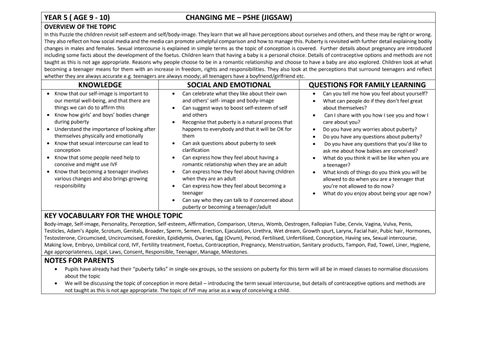
In this Puzzle the children revisit self-esteem and self/body-image. They learn that we all have perceptions about ourselves and others, and these may be right or wrong. They also reflect on how social media and the media can promote unhelpful comparison and how to manage this. Puberty is revisited with further detail explaining bodily changes in males and females. Sexual intercourse is explained in simple terms as the topic of conception is covered. Further details about pregnancy are introduced including some facts about the development of the foetus. Children learn that having a baby is a personal choice. Details of contraceptive options and methods are not taught as this is not age appropriate. Reasons why people choose to be in a romantic relationship and choose to have a baby are also explored. Children look at what becoming a teenager means for them with an increase in freedom, rights and responsibilities. They also look at the perceptions that surround teenagers and reflect whether they are always accurate e.g. teenagers are always moody; all teenagers have a boyfriend/girlfriend etc.
KNOWLEDGE
• Know that our self-image is important to our mental well-being, and that there are things we can do to affirm this
• Know how girls’ and boys’ bodies change during puberty
• Understand the importance of looking after themselves physically and emotionally
• Know that sexual intercourse can lead to conception
• Know that some people need help to conceive and might use IVF
• Know that becoming a teenager involves various changes and also brings growing responsibility
SOCIAL AND EMOTIONAL QUESTIONS FOR FAMILY LEARNING
• Can celebrate what they like about their own and others’ self- image and body-image
• Can suggest ways to boost self-esteem of self and others
• Recognise that puberty is a natural process that happens to everybody and that it will be OK for them
• Can ask questions about puberty to seek clarification
• Can express how they feel about having a romantic relationship when they are an adult
• Can express how they feel about having children when they are an adult
• Can express how they feel about becoming a teenager
• Can say who they can talk to if concerned about puberty or becoming a teenager/adult
KEY VOCABULARY FOR THE WHOLE TOPIC
• Can you tell me how you feel about yourself?
• What can people do if they don’t feel great about themselves?
• Can I share with you how I see you and how I care about you?
• Do you have any worries about puberty?
• Do you have any questions about puberty?
• Do you have any questions that you’d like to ask me about how babies are conceived?
• What do you think it will be like when you are a teenager?
• What kinds of things do you think you will be allowed to do when you are a teenager that you’re not allowed to do now?
• What do you enjoy about being your age now?
Body-image, Self-image, Personality, Perception, Self-esteem, Affirmation, Comparison, Uterus, Womb, Oestrogen, Fallopian Tube, Cervix, Vagina, Vulva, Penis, Testicles, Adam’s Apple, Scrotum, Genitals, Broader, Sperm, Semen, Erection, Ejaculation, Urethra, Wet dream, Growth spurt, Larynx, Facial hair, Pubic hair, Hormones, Testosterone, Circumcised, Uncircumcised, Foreskin, Epididymis, Ovaries, Egg (Ovum), Period, Fertilised, Unfertilised, Conception, Having sex, Sexual intercourse, Making love, Embryo, Umbilical cord, IVF, Fertility treatment, Foetus, Contraception, Pregnancy, Menstruation, Sanitary products, Tampon, Pad, Towel, Liner, Hygiene, Age appropriateness, Legal, Laws, Consent, Responsible, Teenager, Manage, Milestones.
NOTES FOR PARENTS
• Pupils have already had their “puberty talks” in single-sex groups, so the sessions on puberty for this term will all be in mixed classes to normalise discussions about the topic
• We will be discussing the topic of conception in more detail – introducing the term sexual intercourse, but details of contraceptive options and methods are not taught as this is not age appropriate. The topic of IVF may arise as a way of conceiving a child.