1
PEOPLE OF AFRICA WHERE EVERY VOICE MATTERS.
TABLE of Politics South Africa lets talk
Kitchen The Oil That Knows No Border
The Domino Effect A Continent Folding Inward
Women voice Daughters of AFrica
SPORTS The Lung of the World: Why the Rift Valley Never Stops
contents
PEOPLE OF AFRICA
Summer 2026 - 10
letter
from the editor If this summer taught us anything about the transformative, life-changing weight of human experience, it is the raw, electric power of the journey from zero to hero. We watched the goalkeeper of Cape Verde step out of relative obscurity to capture the hearts of millions. We witnessed the unscripted teardrops of pure joy and crushing sorrow; we felt the visceral pain ripple from the grass of the pitch up into the packed stands. And yet, beneath the high-stakes tension, we saw how effortlessly humanity can connect and become one. We read the poignant letters penned alongside Iranian footballers. We fell under the spell of Erling Braut Haaland’s dominance, watching the world roll together to embrace the Viking thunder. We fell head over heels for the Scottish supporters, whose infectious vibes illuminated the stands. We witnessed breathtaking, world-class goals that defied physics.
And then, our compass turned toward Morocco where the African women’s game wrote history in letters of fire. We watched Malawi shatter expectations, tearing through the net from their very introduction to the tournament all the way to a historic appearance as finalists. We felt the shattering weight of Nigeria’s dreams of lifting an eleventh trophy finally dim, and we felt the raw heartbreak of Moroccan players weeping on home soil after falling just short of the ultimate prize. Yet, this summer also marked seismic The Tapestry of a milestones: for the very first time, both Algeria and Malawi punched their tickets to Unforgettable the Women's World Cup, rewriting the regional balance of power. Summer Naturally, the question remains: what didn't we see? Beneath the dazzling goals lay the shocking upsets, the staggering emotional highs and lows, and the immutable beauty of the game. But controversy was never far behind. From the FIFA president’s attempts to quietly maneuver and commodify parts of the World Cup, to continental bodies standing firm against executive misconduct while Africa, too often, sat quietly and went along this summer left us with a mountain of truths to unpack. In our newsroom, we wrestled with where to begin and where to end. But what we ultimately learned from this season transcends the white lines of the pitch. Football reminded us how to coexist, how to share this fragile world, WHERE EVERY VOICE MATTERS. and that through the good and the worst, we belong to one another. Happy Fall, and may the crisp, changing light Chief Editor, People of Africa of autumn warm and light our souls.
Honeymoon Aljabri
PEOPLE OF AFRICA
Editorial If history is written by the victors, then the summer of 2026 was written in sweat, ink, and stadium turf. By every measure, this was the summer of football a global pilgrimage that stretched from the sprawling, multi-nation expanse of the United States, Mexico, and Canada, where the men’s game delivered high-stakes geopolitical theater and tactical masterclasses, down to the electric stadiums of Morocco, where African women’s football wrote a thunderous new chapter of history. This was not a quiet season. It was a season of raw nerves and roaring crowds, wrapped in the kind of fierce controversy, unbridled joy, and heartbreaking tears that remind us why this sport is more than a game; it is a mirror of our collective human condition. From the tactical chess matches under the North American sun to the indomitable rising tide of African excellence in Rabat, the margins were razor-thin, and the stakes were existential.
The Summer of Football
PEOPLE OF AFRICA
World cup When a season shakes the foundations of world sports this deeply, a standard, fleeting headline simply will not do. You cannot box a continental awakening and a global spectacle into a single, sanitized column. That is why we have dedicated this entire Fall issue to dissecting The Summer of Football. We are digging past the sanitized press releases to examine what went catastrophically wrong, what achieved absolute perfection, and what the shifting power dynamics on the pitch mean for the future of the global game with a specialized, unblinkered focus on Africa’s indelible footprint. So, without further ado, we invite you into our pages. Turn the leaf, settle in, and let us relive the summer that changed everything.
&WAFCON
lets talk
E H T E C A TP AD? U O Y E E H H A T T L E L I G W N TO ME
THE GATES OF RIO:
WHY OUR QUEENS ARE WALKING TOWARD HISTORY
AFRICAN WOMEN'S FOOTBALL: PREDICTABLY DOCUMENTED.
The boarding gate is open. The tarmac in front of them stretches out across the Atlantic, pointing straight toward the sun-drenched stadiums of Brazil. As our queens step forward, shoulders back and chins held high, they carry more than just luggage and boots; they carry the collective heartbeat, the unfinished dreams, and the unyielding pride of a billion people. For decades, the global game has asked Africa to admire its fireworks from afar. But today, the narrative belongs to us. This is the ultimate send-off not just to a tournament, but to an era of lingering doubt. The ceiling isn't just cracked; it is ready to shatter into a million pieces.
THE NEW ORDER: WHY AFRICAN WOMEN’S FOOTBALL IS RACING AHEAD OF THE MEN The summer of 2026 was an unrelenting symphony of football. From the neon-lit concrete of North America to the vibrant, high-stakes atmosphere of Rabat, the global game tested our nerves, broke our hearts, and ultimately forced the world to rewrite its assumptions. Yet, when the dust settled, the center of gravity shifted southward, and the women of Africa delivered a masterclass in revolution. For decades, the script of African women's football was written in predictable ink: Nigeria’s Super Falcons arrived, conquered, and took the trophy back to Lagos as a birthright. No more. The monopoly is broken, the old guard has been shaken to its core, and WAFCON 2026 proved that the continent’s footballing landscape has undergone a tectonic, irreversible shift. .
Consider the narrative arc of this past summer in Morocco. This was no polite coronation; it was a footballing uprising. Look at debutants Malawi, the lowestranked side entering the tournament, writing a textbook fairytale, scorching their way past heavyweights and marching all the way to the final. Look at Cameroon, galvanized by the tactical brilliance of their setup and the ice-cold heroics of Golden Glove winner Michaely Bihina, stunning hosts Morocco in the semi-finals before dismantling Malawi 3-0 in the championship match to lift their firstever WAFCON title. They stand now as only the fourth nation in history to etch their name onto the trophy, joining an exclusive club alongside Nigeria, Equatorial Guinea, and South Africa. And the casualties of this new era tell the real story of continental parity.
The shockwaves were absolute when giants like Nigeria and South Africa crashed out in the quarter-finals, reminding everyone that pedigree alone no longer guarantees survival. Nigeria’s historic exit meant they missed the semi-finals for the first time ever and failed to qualify for the FIFA Women’s World Cup in Brazil. Meanwhile, hosts Morocco suffered the cruel agony of penalty shootouts, signaling that they belong permanently among the elite. Joining Cameroon and Malawi on the plane to Brazil are Algeria and Morocco, who secured their historic tickets through grit and tactical evolution.
ARE HERE TO SUCCE ED, NOT J UST PAR TICIPATE . OUR WOM EN
So, as they pack their bags for South America, we face the defining question of our time: Do our elite women’s teams possess a genuine, accelerated chance to bring a senior World Cup trophy home to Africa long before the men do? The answer is etched into the very DNA of how .
Meanwhile the men’s game continues to grapple with the psychological ghosts of the final minutes, institutional double standards, and the dead weight of systemic gatekeeping, our women play with a visceral, unshakeable hunger. They are unburdened by the historic complex of "playing like underdogs." They march onto the turf expecting to conquer. .
The Super Falcons paved the path,
To ensure our queens do not suffer the heartbreaking, late-match collapses that have haunted our continent’s football history, the solution requires bridging the emotional and mental divide. Football at the highest international tier is won in the oxygendeprived space of the mind when the clock hits the 80th minute. If CAF and the national federations invest heavily in elite sports psychology, simulation of high-pressure wars, and institutional stability that treats women’s leagues with the professional reverence they have earned, the trajectory is clear.
The Super Falcons paved the path, but the new generation Cameroon, Malawi, Morocco, Zambia, and Algeria have blown the doors off the house. Do not look to Zurich or Paris for the future of African global dominance. Look at our women. They are not waiting for a seat at the table anymore; they have built a brand-new house, and now they are taking it to Brazil.
ALGERIA WHEN THE HILLS WEEP: ALGERIA'S FIRE TOUCHES OUR SOULS Our hearts ache with the families in Algeria tonight.
Wildfires have a cruel way of reducing centuries of history, ancient olive groves, and family homes to ash in a matter of hours. When the hills burn across the Mediterranean coast and the ridges of Kabylie, the grief belongs to all of us. By the time these words reach your hands, we pray the flames have quieted and the smoke has cleared. But we know that rebuilding a life after such devastation takes far longer than putting out a fire. People of Africa Magazine stands in deep solidarity with the people of Algeria. To those who lost loved ones, homes, and everything they worked a lifetime to build: we see your pain, we share in your sorrow, and we hold you in our thoughts as you begin the quiet, courageous work of healing and starting anew.
The Final Whistle and the Mirror
Issue 28
"I once was..." In a season dominated by the roar of 48 teams spanning North America and the historic, groundshaking triumph of African women in Morocco, it is easy to get swept up in the adrenaline of the pitch. We watch icons sprint down the turf, carry the hopes of entire nations on their shoulders, and chase immortality under the glaring stadium lights.
Yet, every tournament has its twilight. This summer, we watched veteran football legends play what will undoubtedly be their very last World Cup match knowing that the screaming crowds, the national anthems, and the adoration of millions will soon fade into the quiet echoes of history. It raises a sobering question: when the boots are finally hung up and the stadium lights go dark, who are we when the uniform comes off?
That exact human reality is captured with breathtaking power in the piece below by our publisher, written originally for her community and carrying a profound message that resonates deeply with this Fall issue. Here is "I Once Was." There is a quiet, devastating trend sweeping across social media right now that stops you dead in your tracks. You see it on your screen: an elderly resident sitting quietly in a care facility, holding a simple white index card bearing three heavy, unyielding words: "I once was..."
Time has a way of taking everything away. Then, the video flips. A faded photograph or a sharp archive clip reveals who they used to be decades ago: a brilliant surgeon, a fearless pilot, a mother holding her newborn, a powerhouse shaking up the world. The first time I watched it, it hit deep in my bones. Three simple words carrying an entire lifetime of existence. We spend our youth and middle age chasing the relentless thrill of the horizon titles, trophies, applause, and the glittering illusion of "making it." We run ourselves ragged on the treadmill of ambition, forgetting the one sentence we will all eventually have to utter. One day, you will look back and have to say: I once was. Not a CEO, not a director, not even a global icon. Just... I once was.
Saying goodbye is never easy This existential truth extends far beyond the quiet hallways of assisted living. We see it playing out in real-time under the blinding stadium lights across the globe. Right now, we are standing at the precipice of an ending. We are watching the final acts of football immortals Christiano Ronaldo, Lionel Messi, Neymar, and our own Egyptian king, Mohamed Salah and Sadio Mane For decades, these men have consumed our weekends, soundtracked our victories, and unified continents through the pure, transcendent poetry of sport. We watched them run like gods across green turf, chasing glory under the roar of millions. But time remains undefeated. The final whistle is drawing near. This upcoming tournament may very well be their last dance.
ESPECIALLY FOR SOMEONE YOU HOLD DEAR.
When that final curtain falls, and the boots are hung up for good, the headlines will fade, the record books will close, and they too will step away from the glare into the quiet. But unlike the rest of us, their "I once was" has already been permanently stamped onto the collective memory of humanity. They gave us joy when our own lives were heavy. They gave children in Cairo, Buenos Aires, Lisbon, and São Paulo something impossible to dream of. So as we prepare to watch them grace the grand arena one last time, let us not rush to critique their fading steps or measure them solely by their final statistics. Let us send them off with pride, dignity, and overwhelming gratitude.
Remember that they once were the architects of our joy. And that stamp will remain long after the cheers have died away.
EXPLORE ESWATINI
The Final Ten Minutes and the Golden Shackle:
Why African Football’s Greatest Battle is Played Off the Pitch
The dust of the summer’s global tournaments has finally settled across the stadiums from Cairo down to the Cape, leaving behind the haunting echoes of vuvuzelas and the familiar heartbreak of what might have been. For decades, the mainstream narrative has reduced African football to a tale of raw, untamed passion, brilliant bursts of technical genius that inevitably fade when the clock strikes ninety. But as any true follower of the continent's sports heritage knows, the reality is far more complex, structural, and deeply political.
Following the summer matches, we had to find the analytical minds at Football Intel Africa, a platform dedicated to uniting the continent through the beautiful game to strip away the diplomatic gloss and dig deep into the systemic realities holding our game back. We had the opportunity to sit down and chat with Victor Siokwu, a Nigerian media entrepreneur, humanitarian, sports journalist, and Physics PhD researcher, who is the driving force behind Intel Africa. From the psychological ghosts haunting our players in the dying moments to the heavy chains of economic dependency binding our administrators in Zurich, here is their uncompromising take on the state of African football.
Intel Africa
Football
The Psychological Ghost of the Final Ten Minutes We have all lived through the heartbreak: an African side battles fiercely for eighty minutes, dictating the tempo against traditional European or South American powerhouses, only to watch victory slip away in the dying ticks of the clock. Mainstream pundits often blame physical endurance. But according to Football Intel Africa, the real battle is fought in the mind: "The issue, in my view, is not necessarily the playing structure or the tactical system. More often, it is the inability to maintain absolute concentration from the first minute until the final whistle.. Once an African team takes the lead or enters the final stages of a match in a winning position, the players begin to subconsciously protect the result rather than continue to execute the game plan that got them there. They drop deeper, lose their aggression, stop making proactive decisions and give the opposition the initiative."
stop making proactive decisions and give the opposition the initiative."
This final ten-minute curse is a generational mindset issue. To overcome it, development must change at the roots. Young players in academy setups across the continent must be trained to view a lead not as a sanctuary to defend, but as a tactical baseline to expand
Beyond the Group Stage: Rewriting the World Cup Mentality
Until our teams step onto the pitch with the cold, unyielding expectation of victory rather than the fragile hope of survival, the global powerhouses will continue to capitalize on our hesitation.
Reaching the knockout stages of a World Cup is often celebrated across Africa as a historic triumph. Yet, Football Intel Africa argues that this very celebration reveals a deeper ceiling in our ambition:
"Too often, some African teams approach the World Cup with the objective of simply going as far as possible rather than with the genuine belief that they can win the tournament. There is a difference between hoping to have a good World Cup and believing that you belong among the teams capable of winning it... We need to move from celebrating how far we have gone to asking why we did not go further." Look at footballing giants like Argentina, who treat finals and trophies as an institutional expectation rather than a miraculous anomaly. If African football is to make the leap from participants to champions, our federations, coaches, and players must cultivate an ecosystem built on elite standards, continuous national projects, and the unshakable belief that we belong at the very top.
The Golden Shackle: Financial Dependency and the Silence of CAF
While global football fans openly critique FIFA’s leadership and refereeing controversies, the institutional silence from African football officialdom CAF has long baffled observers. Is it political patronage, or something deeper? Football Intel Africa points directly to the economics of the game:
"This financial weakness inevitably affects Africa’s bargaining power within the global football system. When you depend heavily on external funding, sponsorship or institutional support, it becomes more difficult to challenge the people and organisations that control those resources...
" Financial strength creates institutional independence, and institutional independence creates the confidence to challenge decisions you believe are not in your best interest."
Modern football is an unyielding business. Until African domestic leagues, broadcasting rights, and commercial structures generate independent wealth, our administrators will continue to navigate global politics from a position of economic vulnerability. True respect on the global stage cannot be begged for; it must be backed by institutional power.
The Vanguard: Why Women’s Football Will Bring the Trophy Home First Amidst the structural roadblocks of the men's game, a seismic shift is taking place across the continent. African women’s football is an absolute force of nature, led by the Super Falcons of Nigeria, alongside the meteoric rises of South Africa, Morocco, Zambia, Cameroon, and Malawi. According to Football Intel Africa, an African women’s side has a realistic, accelerated path to breaking the global drought:
"Yes, I genuinely believe African women’s football has a realistic and potentially accelerated opportunity to bring a senior World Cup trophy to the continent before the men do... The question should no longer be, 'How much can we afford to invest in the women’s game?' The question should be, 'How much are we willing to lose by failing to invest in it?'"
27
Yet, potential alone will not lift a World Cup trophy. CAF and national federations must stop treating women’s football as an afterthought. Enforcing minimum professional standards, building domestic grassroots pathways, and securing fair player welfare are nonnegotiable steps if we want to turn continental brilliance into global dominance. From the dusty academy pitches of our youth to the high-stakes boardrooms of Zurich and Cairo, the mandate for African football is clear. We have the numbers, the talent, and the burning passion. What we demand now through the uncompromising pages of People of Africa Magazine is the institutional courage to turn that fire into an unshakeable legacy.
Potential alone will not lift a World Cup trophy.
Victor Siokwu Thank you so much, son of the land, for taking your time to share your insights with People of Africa Magazine.
To our readers: Victor Siokwu is a rare multidisciplinary force a humanitarian, sports journalist, media entrepreneur, and Physics PhD researcher whose work bridges the gap between empirical science, community empowerment, and the beautiful game. As the founder of Football Intel Africa, Victor uses rigorous analysis and passionate storytelling to unite the continent’s football communities, challenge institutional complacency, and map out a truly sovereign future for African sports. Keep up the extraordinary work, Victor. Let Africa shine, and let us keep dreaming because in our lifetime, we will see an African nation lift that World Cup trophy 29
The "FIFA Wash": Geopolitics, Borders, and the Crime of Exclusion
When the 2026 World Cup rolled across the borders of North America, we were fed the grand, hollow fairy tale of a "universal" game. We watched the pyrotechnics, the corporate glitz, and the multi-billion-dollar marketing machine celebrate a borderless celebration of football. But let’s drop the polite illusions and call it what it was: a selective stage built on geopolitical exclusion. .
Bitter echo of colonial gatekeeping,
For Africa, this tournament did not feel like an invitation. It felt like an old, bitter echo of colonial gatekeeping, a reminder of decades past when our nations were permitted to supply the labor, the sweat, and the brilliance on the turf, but were locked out of the boardroom where real power is distributed. PEOPLE OF AFRICA
Chill
PEOPLE OF AFRICA
Look no further than the treatment of Somali referee Omar Artan. Here was an elite, continentally decorated match official holding an official FIFA appointment and a valid U.S. visa. Yet, he was subjected to an 11hour interrogation, targeted administrative harassment, and outright deportation before he could even touch the grass. And when the press confronted FIFA President Gianni Infantino about this blatant humiliation, what was his response? He smiled and told the world to "Chill." Chill.
United States, Canada, and Mexico That single word exposes the entire architecture of global sports governance. It is the arrogant dismissiveness of a system that views African dignity as negotiable. Let us dissect the institutional hypocrisy. The matches were farmed out across three sovereign North American nations the United States, Canada, and Mexico. If Washington's bureaucratic doors were slammed shut, why was an elite African referee not immediately reassigned to fixtures in Mexico or Canada?
PEOPLE OF AFRICA
This is the ultimate FIFA Wash: In an era where multinational conglomerates and world leaders run global operations instantly via digital infrastructure, are we genuinely expected to believe that remote administrative clearance or virtual operational integration was beyond the capacity of FIFA? Or was Artan’s physical absence a quiet, deliberate feature of a system that wants African players to run across the television screens, but refuses to let African professionals walk through customs as equals?
This is the ultimate FIFA Wash: laundering statesponsored discrimination under the comfortable corporate shield of "sporting neutrality," while Zurich washes its hands of accountability.
Are we done accepting a pat on the head and a patronizing instruction to chill ? In March 2027, the 77th FIFA Congress descended upon Rabat, Morocco. Gianni Infantino is heading to our continent seeking his next term, counting on Africa’s 54 member associations to act as his reliable, unquestioning voting block.They will wine us, dine us, and speak honeyed words about partnership and development funds. Here is the definitive question that must haunt every delegate walking into that Rabat convention hall: Are we going to go with the flow once again, trading our political weight for empty handshakes and transactional promises, or are we finally going to stand up and demand structural equality?
We are done accepting a pat on the head and a patronizing instruction to chill while our referees are deported, our journalists are blocked at borders, and our sovereignty is treated as an afterthought. If Rabat 2027 is going to mean anything for the future of African football, it cannot be another coronation for a system that locks us out. It must be a reckoning.
Thabo Mbeki, "I am an African. I owe my being to the hills and the valleys, the mountains and the glades, the rivers, the deserts, the trees, the flowers, the seas and the ever-changing seasons that define the face of our native land... I am born of a people who would not tolerate oppression. I am of a nation that would not allow that joy of freedom and happiness should be actually or potentially the right of only one fraction of the whole, whether white or black, free or unfree."
They stand behind the tattered velvet curtains of city clubs and makeshift stages, painting smiles across a weary nation while their own pockets remain heartbreakingly light. In a country where more than fifty million people navigate the daily grit of survival, comedians are the mirrors we refuse to look into too long.
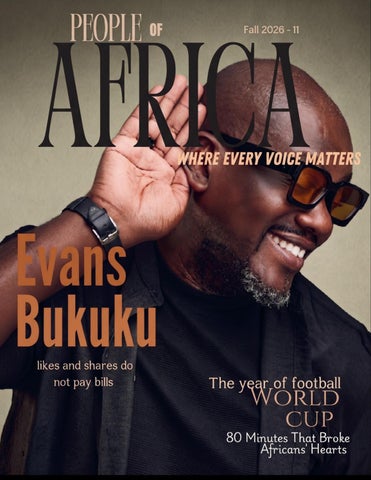
Behind the Curtain: The Tears of a Clown and the Rise of Evans Bukuku
Evans Buk uku
They a re the voice o who a f the s rticula treets te our letting , the o u n spoke nes us lau n gh aw a n we can x i e ay our ties, wake u collec p and irony tive pa face to is as s in so m h a orrow rp as a while . Yet, th Dar es they m e Salaam ake a n strugg ation f breeze les, th orget : e com strugg i t s e d i ans th le just emsel to feed ves of their o ten wn ha nds. y has long been Across the globe, comed weapon of social recognized as a potent litics, speak critique, a tool to shift po nerational hard truths, and heal ge a, the gap fatigue. But in East Afric ved clown of the between being the belo ainable, wealthcity and building a sust s been a generating profession ha chasm.
We sat down with Evans Bukuku the veteran Tanzanian comedian, radio presenter, and cofounder of Punchline Africa to pull back the curtain on the real state of East African comedy, give him his well-deserved flowers, and examine how a continent of storytellers is turning viral attention into institutional power.
Building an Industry from the Ground Up For Bukuku, who has spent over two decades navigating Tanzania’s media and entertainment trenches since 2005, the struggle has never been about raw talent. Tanzania is a crucible of brilliant voices and quick wits. The crisis is structural. "The biggest challenge is that we have talent, but we are still building the industry around that talent. There are brilliant comedians in Tanzania, but talent alone doesn't create a career. You need management, venues, audiences, marketing, intellectual property protection, touring opportunities, corporate partnerships and systems that allow artists to make money consistently."
Do not mistake likes for a livelihood. Yet, within that exact vacuum lies an unprecedented frontier. Africa boasts the youngest population on the planet, consuming entertainment at a breakneck pace. Digital borders are falling faster than traditional gatekeepers can erect them. "Africa has an enormous young population consuming entertainment every day. Comedy is crossing borders faster than ever. A comedian in Tanzania can now have an audience in Kenya, Uganda, South Africa, Nigeria, Europe or America without ever having to leave Dar es Salaam... I'm interested in asking, 'How do we build an industry where the next 100 comedians can have careers?' That is a much bigger challenge and a much more exciting one."
In the age of TikT ok algorithms an d Instagram reels, every smartphon e is a television stu dio. For Bukuku, social media chan ged the game entirely, allowing a joke cracked in a Dar es Salaam stu dio to land in Nairobi, Lagos, or London within minutes. But he is sues a sharp, necessary warnin g to the digital generation: do no t mistake likes fo r a livelihood.
Virali Live Cty is the Fr ont D omed o y is th e Houor, se
.
"A million views is great. But if those million people nev ticket, book you fo er buy a r a show, watch yo u r sp ec ia work, then you've l or support your built attention wit h out necessarily b business. For me, uilding a social media is th e fr o n t door. The intern introduce you to et can the audience. But live comedy is wh ere you build the relationship."
It is that intimate, raw communion between performer and audience that gives stand-up its enduring power. Comedy, Bukuku notes, is a mirror that bypasses our defenses. When a spectator watches his set and recognizes their own mother, their own sibling, or their own relationship chaos encoded in the punchline, healing happens. It challenges social norms without feeling like an academic lecture or a political manifesto. .
TEAR DOWN THE BORDERS: THE PAN-AFRICAN COMEDY EXCHANGE Bukuku's vision extends far beyond the borders of Tanzania. Through Punchline Africa and The Punchline comedy club in Dar es Salaam, he is engineering a cultural corridor across the continent. "I'm particularly interested in creating stronger comedy exchanges across the continent because I don't think African comedy should exist as isolated national scenes. We should be able to have a comedian from Tanzania perform in Kampala, a Ugandan comedian perform in Dar es Salaam, a Kenyan comedian perform in
Kigali, and a Rwandan comedian perform in Nairobi. I want African comedians to move around Africa the way our stories already do." This is the heart of the mission. For too long, African creative economies have looked outward toward Western validation, ignoring the vast, rich, interconnected markets sitting right next door. By establishing regular live circuits, nurturing young writers, and demanding that local corporates invest in the creative ecosystem, Bukuku and his contemporaries are turning comedy from a desperate hustle into a respected, transnational trade.
The Price of a Invest i t Ticket o elevatneaitr.t
As our conversation draws to a close, Bukuku leaves our readers with a call to action that echoes far beyond the comedy club walls. Supporting artists isn't just about double-tapping an Instagram post or forwarding a viral WhatsApp video.
"If you really want African comedy to grow, buy the ticket. Come to the show. Share the content. Recommend a comedian to a company looking for entertainment. Invite them to your event... Because behind every comedian you see on stage is an ecosystem of writers, producers, photographers, videographers, venues, promoters, sound engineers, managers and many other people. When you support comedy, you're supporting an entire creative economy." The “clowns” of the city have spent decades carrying the weight of our collective fatigue on their shoulders. It is time the rest of the ecosystem stepped up, bought the ticket, and built an industry worthy of their brilliance.
To embrace Africa is to explore its vibrant history...
people of Africa
44
THE HANDS THAT CARRIED A CONTINENT: THE UNTOLD HISTORY AND PRIDE OF
AFRICAN GOALKEEPING
THE SUMMER OF 2026 SHATTERED THOSE FRAGILE ILLUSIONS INTO DUST. For generations, Western football analysts looked at African players through a lazy, distorted lens. They praised our forwards for raw speed, our midfielders for relentless lungs, and our wingers for dazzling flair while whispering the old, insidious myth that
African athletes lacked the steady nerves, tactical discipline, and cerebral architecture required to marshal the penalty box as elite goalkeepers. It was a convenient fiction used to justify why European clubs hesitated to scout African numbers.
From the high-stakes drama of the expanded men’s World Cup across North America to the electric, soulstirring battlefields of WAFCON in Morocco, the African goalkeeper emerged not merely as a participant, but as a defining cultural and tactical force. But to truly understand why our sentinels stand so tall today, we have to dig deeper than the summer grass. We have to look at a history built on defiance, brilliance, and a legacy that mainstream media has spent decades ignoring.
The Eternal Duel:
How Cameroon Forged Modern Goalkeeping
To understand the soul of African goalkeeping, one must return to the 1980s and 1990s, an era when Cameroonian football captured the imagination of the globe. Long before modern tactics popularized the "sweeper-keeper," Cameroon was locked in one of the fiercest internal rivalries in football history: Thomas N'Kono versus JosephAntoine Bell. N'Kono was a force of nature, athletic, fearless, and possessing an instinctive, gravitydefying leap that turned routine saves into masterpieces.
At the 1990 World Cup in Italy, his breathtaking performances carried the Indomitable Lions to the quarter-finals, captivating a planetary audience. Among the millions watching was a young Italian boy named Gianluigi Buffon. So profoundly moved was Buffon by N'Kono’s style and charisma that he abandoned his outfield ambitions and vowed to become a goalkeeper, even naming his son Louis Thomas in his honor.
THE WORLD RESPECT THE AFRICAN MIND AS MUCH AS THE AFRICAN BODY Beside him stood JosephAntoine Bell, an intellectual titan who combined elite shotstopping with visionary sweeper-keeper mastery. Bell captained Marseille and broke every psychological barrier in European club football, demanding that . They did not just stop balls; they rewrote the geometry of the position.
The path carved by N'Kono and Bell opened the floodgates for a lineage of wall-builders who dominated the African continent and stamped their authority globally. Egypt’s Essam El-Hadary, affectionately nicknamed "The High Dam," stood sentinel for over two decades. With a career spanning four Africa Cup of Nations (AFCON) titles, El-Hadary proved that longevity at the absolute summit is a matter of ruthless professionalism and mental fortitude.
THE CONTINENTAL WALL-BUILDERS: FROM THE NILE TO THE ATLANTIC
When Nigeria’s Vincent Enyeama locked horns with Lionel Messi’s Argentina at the 2014 World Cup, his masterclass between the posts was a clinic in positional mastery. In the same vein, Algeria’s Raïs M'Bohli carried the weight of African pride on the global stage with unmatched composure under fire.
These were not anomalies; they were the inevitable product of a continent rich in unmined goalkeeping gold. Yet, European scouting networks persistently ignored this heritage, preferring to import raw outfield talent while leaving local keepers to develop in infrastructural isolation.
The Modern Vanguard: From Cabo Verde to Rabat
That historical neglect is finally burning away. The summer of 2026 proved that the golden era of African goalkeeping is no longer whispering, it is roaring. In North America, forty-year-old veteran Josimar "Vozinha" Dias anchored Cabo Verde’s fairy-tale run. With a masterclass of positioning and vocal leadership, Vozinha reminded the world that experience and composure are timeless currencies.
Mining Our Own Gold: The Blueprint for the Future Meanwhile, on the women's side, the standard reached unprecedented heights. Cameroon’s historic march to the WAFCON crown in Rabat was galvanized by the ice-cold heroics of Golden Glove winner Michaely Bihina. Across the tournament, keepers from debutants Malawi to resilient Algeria stood tall against continental powerhouses, proving definitively that if men can command the sticks, our women match every single save and punch it right back with interest.
Mental Fortitude and 80thMinute Resilience: If Africa remains a bottomless mine of natural goalkeeping brilliance, we can no longer wait for European academies to validate our talent. We must build our own institutions.
The path forward requires establishing Pan-African Goalkeeping Academies and Specialized Seminars elite developmental hubs anchored from Dakar to Cairo, Johannesburg to Yaoundé. These academies must focus on three critical pillars:
52
Pride of Africa Coalkeeping
Mental Fortitude and 80thMinute Resilience: Mental Fortitude and 80thMinute Resilience: Training our keepers to master the psychological pressures of the dying minutes, ensuring absolute confidence when stadium noise reaches a deafening pitch.
Sweeper-Keeper Mechanics: Marrying traditional African agility with high-IQ tactical distribution, turning the goalkeeper into the primary playmaker of the modern build-up phase.
African goalkeeping is a beautiful art form.
Indigenous Coaching Certification: Developing a standardized continental curriculum led by Africa’s legendary former keepers, ensuring our unique goalkeeping DNA stays home. For generations, our goalkeepers have stood as the last line of defense against historical erasure. Today, they are stepping out of the shadows of European scouting reports and claiming their rightful place at the center of global football. The posts belong to us.
September is Sickle Cell Awareness Month... Let us extend our hands to the heroes who are fighting this battle every day.
Donate blood... to save lives.
54
voices sound like noise when they echo in isolation. For decades, the ritual has remained unchanged. Zurich calls, and the capitals of the continent answer with a fractured chorus. When African football associations scatter their demands across the table trading collective leverage for token development funds and hollow handshakes we fulfill a predictable script.
Corruption We become a numerical currency spent to secure presidential terms, rather than architects commanding the structure of the global game. We love to repeat a cynical dark joke across the continent: "It’s only corruption if it isn't mine; if it is, I’ll defend it." We laugh because it stings, but on the world stage, it stops being a joke and becomes our cage. .
It’s only corruption if it isn't mine; if it is, I’ll defend it.
When March 2027 brings the FIFA Congress to Rabat, Morocco, the stakes will be absolute. If the football federations of Eswatini and Burundi walk into those halls alone, their voices dissolve into administrative static. But when Eswatini and Burundi stand shoulder to shoulder with Nigeria, Egypt, Morocco, Senegal, and South Africa, fifty-four distinct whispers become an unavoidable earthquake.
One Goal, 54 Voices Africa must stop arriving in Zurich with begging bowls and divergent wish lists. The mandate from the getgo should be unequivocal: permanent, structural equity. Demand permanent representation at the highest tiers of global competition starting with a guaranteed expansion of permanent World Cup slots that reflects our undeniable weight in the sport.
Africa stands together, or we fall alone. Whoever seeks Africa's vote to lead world football must first prove their commitment to elevating and respecting African football from the root. No more transactional loyalty. No more accepting a pat on the head while our referees and personnel face systemic border exclusions. It is time to make our choice clear in Rabat: Africa stands together, or we fall alone. .
[Explore the Work: Between Nations, Within Myself] Click here to purchase the book
[Join the Dialogue] Follow Ahmed Abdi on Social Media
THE SALT OF THE PITCH:
Honoring Player Number 12
A pot of traditional soup can be simmered to perfection, loaded with the finest meats and root vegetables, but without salt, it remains flat. It has nourishment, but it has no soul.
In the grand architecture of football, the first eleven players on the grass are the ingredients, but Player Number 12 the faithful, relentless, beating heart of the supporters in the stands is the salt. Without them, the game is merely a tactical exercise played in a vacuum.
Look into the global stands during any major tournament, and you will see them: the Congolese superfan standing rigid for ninety minutes without a single tremor, draped in national colors; the drummers from West Africa keeping a pulse that echoes through concrete bowls; families who sold land, skipped meals, and mortgaged their futures just to make the trip.
PLAYER NUMBER 12 They are the ones who wiped the sweat from a future captain's brow when he had no boots to wear, the mothers who stitched jersey numbers by candlelight, and the friends who stayed up late plotting a path out of the neighborhood. .
When Cabo Verde’s veteran goalkeeper, Vozinha, produced a masterclass of composure on the pitch defying age and logistics to anchor his squad the tears that finally broke his stoic exterior weren't just for the clean sheet. They were for the invisible army behind him. In that raw, shattering moment of triumph, the only face he searched the stands for was his mother’s.
That is what Player Number 12 creates. They carry the emotional gravity of an entire nation on their shoulders so the eleven men on the turf can fly. Yet, as the expanded tournament format finally allowed Africa to display its true depth with nine out of our ten teams surging into the Round of 32 on pure tactical merit a quiet, bureaucratic cruelty unfolded in the shadows.
While television screens beamed images of vibrant fan cultures across the globe, thousands of those exact supporters were locked out by the very immigration regimes meant to welcome them. Bureaucrats in Western capitals treated passionate African fans as security threats rather than cultural ambassadors. They slammed doors, delayed paperwork, and erected invisible walls, expecting the tournament to run on sanitized, corporate noise rather than authentic passion.
THIS IS A STRUCTURAL FAILURE THAT FIFA AND HOST NATIONS CAN NO LONGER IGNORE.
Football without its fans is a broadcast, not a movement. If the governing bodies want a truly universal game, they must institute streamlined, equitable travel pathways for supporters. Player Number 12 does not ask for special favors; they ask for the same dignity, respect, and operational recognition afforded to the players on the field.
PROTECT PLAYER NUMBER 12, OPEN THE GATES, AND LET OUR PEOPLE RISE RISE.
The players need the fans to lift their eleven souls when the legs grow heavy, and the fans need the game to mirror their sacrifices. As we look toward the future of international football, let the mandate be absolute: protect Player Number 12, open the gates, and let our people rise.
PEOPLE OF AFRICA
this is africa
Our pride is not shouted, it is lived.
87
TH E
th
M I N U TE : WH E N TH E DR E A M FA L TE R E D
The clock struck eighty-seven, and a continent held its collective breath only to watch the air rush out of our lungs all at once..
A FR I CA DI DN ’ T J U ST SH OW U P ; I T... For the first time in the history of the global game, the expanded 48-team bracket handed Africa ten distinct slots at the table.The ambitions were as vast as the Sahara. Africa didn’t just show up; it made history in the group stages, driving nine out of those ten teams past the opening hurdle and straight into the Round of 32. For weeks, the streets of Cairo, Dakar, Accra, and Abidjan hummed with an intoxicating, electric belief. .
THEN CAME THE DYING MINUTES.80”
Like clockwork, as the match timer crawled past the eightieth mark, the wheels came off. Ghana, Congo, Egypt, Cape Verde, Algeria, Côte d'Ivoire, South Africa, Senegal one by one, they stumbled at the finish line, crumbling like dry cookies under pressure.
Western pundits were quick with their lazy, condescending verdicts, whispering the old, tired trope into their microphones: Give the Africans time; they’ll flash brilliance, but eventually, they run out of gas. They break loose. One mistake, and they’re out. Let’s clear the air and throw that . lazy analysis straight into the trash where it belongs. This wasn't a matter of physical stamina or a lack of raw football genius. Our players possess the technical mastery, the vision, and the heart to match any giant on earth. The real fracture point ran much deeper than tired legs.
IT WAS A CRISIS OF BELIEF
When you spend generations telling you you don't belong at the summit, a subtle, devastating whisper creeps into your mind when victory is within touching distance: Do we actually deserve to be here?
That hesitation is all it takes at the highest level. A momentary lapse in concentration, a stray foot, a dropped shoulder in the box and the dream vanishes in a heartbeat. And let’s talk about the unspoken rules of survival on the world stage. We already know the cold, hard baseline of international officiating: African teams are never afforded the luxury of playing a clean, fair game.
When the referee’s whistle bends against you, playing by traditional rules is a mug's game. If you represent Africa on that stage, you cannot afford the naivety of playing as if the playing field is level. Even when you are ahead, you must play like you are three goals behind. You must master the dark arts, understand how the system is rigged, and learn how to bend the rules before they bend you.
SO, WH AT
MUST A FRICA L EARN F ROM
OF THE 87TH MINUTE?
THE
Africa has proven beyond a shadow of a doubt that it has the talent to shake the world. Nine teams in the knockout rounds proved our depth is real. But until we banish the psychological ghosts of the past, stop waiting for permission to win, and play with the ruthless, unyielding cunning of champions, the trophy will remain just out of reach. The curse of the final minutes is not a permanent sentence. It is a lesson written in blood and heartbreak. And when the next whistle blows, Africa will break that spell for good.
Being African is a pride that flows through our veins and resonates in our very souls.
The 2026 World Cup:
The African Performance Beyond the Gloss Africans came, Africans competed, and the world was forced to recalibrate its lens. For decades, the narrative handed down by western sports desks has framed African football through a patronizing prism of raw, unbridled physical energy devoid of tactical discipline, the classic trope that we run fast until we burn out.
Y
The 2026 campaign blew that myth to pieces. Look at the collective dominance: nine out of ten African teams jumping the first hurdle together. This wasn't just a sporadic flash of brilliance by a lone representative; it was a continental statement.
The Blue Sharks of Cabo Verde: On their historic debut, a tiny Atlantic archipelago with a population smaller than a mid-sized city went completely unbeaten through a group containing heavyweights Spain and Uruguay.Anchored by the timeless 40-year-old veteran goalkeeper Vozinha, whose composure under siege became a masterclass in modern goalkeeping, they pushed reigning champions Argentina to the absolute brink in a 3-2 extra-time thriller in Miami, featuring a jaw-dropping longrange missile from Sidny Lopes Cabral. They didn't park the bus; they took 16 shots against La Albiceleste because they knew they belonged on the same pitch.
The Tactical Maturity of North Africa: Morocco cemented its elite status with another relentless, clinical march into the knockout phase, proving Qatar 2022 was no historical accident. Meanwhile, Egypt carved their own path, securing their first-ever World Cup knockout victory by outsmarting Australia on penalties.
The Heartbreak of the Margins: When 9 of African teams exited in the Round of 32, the casual observer pointed to stamina or fading gas. We know better. Senegal’s devastating collapse against Belgium in the dying moments, and the razorthin one-goal exits suffered by South Africa, Côte d'Ivoire, DR Congo, and Ghana, exposed something sharper than physical fatigue. They exposed the fine line between tactical execution and the psychological weight of an uneven playing field.
Africa teams showed they have the technical genius to match anyone on earth. The final frontier now is not their legs; it is their unshakeable belief that they can break the rules of a system designed to exclude us and take the ultimate prize home.
MADE IN AFRICA
The Crucible of Victory::
Mental Fortitude and the 120 Minute We have the raw materials. We possess an abundance of talent, a furious, beating passion, and a tactical sophistication that makes European and South American tactical boards sweat. But if an African nation is going to cross the ultimate threshold moving past the celebratory milestones of the Round of 32 and marching straight into a World Cup final we must confront the invisible wall that has nothing to do with our feet and everything to do with our minds.
Look at the shifting landscape of our game. With the Confederation of African Football restructuring its calendar shifting toward quadrennial cycles and integrating regional pathways like the African Nations League our federations are searching for structural stability. Yet, the real battle is not fought in administrative boardrooms in Cairo or Zurich; it is fought in the quiet, agonizing stretches when the stadium clock ticks past the eightieth minute.
e w , e n e w r o th r c e : l a liz ars b o na ill l g tio p e e th titu abl n s ti i w t in go To us -ne m on n
Simulated 120-Minute Brutality: We cannot treat friendlies as polite exhibitions. For the nations carrying our flag onto the world stage, preparation must mirror the harshest realities of knockout football. Set up fixtures that demand 120 minutes of highintensity execution under extreme duress, hardening both muscle and morale against the fatigue that lazy commentators love to weaponize against us. The Psychology of the Final Ten Minutes: Goalkeepers and backlines need specialized mental conditioning to shatter the psychological ghosts of the past. Confidence is a discipline. When the clock hits eighty minutes, the belief that the match is ours to dictate not ours to defend in terror must be absolute. Institutional Mental Health Architecture: CAF and national federations must integrate mandatory sports psychology and mental performance coaching into every national camp. Our players must unlearn the generational narrative of being the underdogs. They must step onto the grass knowing their psychological baseline matches any titan on earth.
Road to world cup 2030 When these elements align, our players will no longer walk onto the pitch alone. They will carry the thunderous, unified backing of a continent that has finally stopped asking for a seat at the table and started demanding the keys.
Inspiring Reasons to Discover
Uganda & Namibia
In the West, they build "Dark Sky Parks" to remember what the night looks like. In Namibia, the entire nation is a telescope. This is not just a destination; it is a confrontation with the infinite.
NAMIBIA: The Cathedral of the Cosmos
At the Namibia Rand Nature Reserve, Africa’s only International Dark Sky Reserve, the night is not black it is crowded. We explore the "Star-Beds," where luxury is stripped down to a mattress rolled out onto a wooden deck.
THE SHADOW OF THE MILKY WAY Here, the celestial canopy is so dense and the air so thin that the Milky Way does not just glow; it casts a physical shadow on your blanket. It is a silent, shimmering riot that reminds you that we are all just stardust traveling through the void.
Where the Desert Meets the Dead From the silence of the stars, we move to the roar of the Skeleton Coast. This is a geographical anomaly where the towering orange dunes of the Namibia Desert some of the oldest on Earth, plunge directly into the violent, bone-chilling Atlantic.
This is a landscape of ghosts and giants, where the dunes literally "roar" as the wind shifts the sand. It is a place that makes you feel small in the best way possible a reminder that the earth was here long before our borders and will remain long after.
UGANDA: The Pearl Beyond the Primates
While the world queues for a glimpse of the great apes, Uganda’s true soul resides in the silences where the crowds never gather.
To find the "Pearl," you must go where the road ends and the ancient rhythm of the land begins.
Kidepo: The LongLost Africa Tucked against the rugged frontier of South Sudan lies Kidepo Valley National Park, a landscape that time forgot. This is Africa in its most honest form golden savannahs framed by the jagged, purple silhouette of the Morungole Mountains. Here, the lions do not compete with twenty idling jeeps; they share the silence with the Karamojong, a people whose lives are still dictated by the cattle and the seasons. In Kidepo, you aren't a tourist; you are a witness to the earth’s original design.
To the west, the earth literally boils. Semuliki National Park is a prehistoric extension of the Congo’s Ituri Forest, a place that looks and smells like the dawn of creation. At the Sempaya Hot Springs, steam rises from the forest floor as the ground exhales the heat of the Rift Valley. It is a dense, lush world of ancient trees and hidden wonders a reminder that under the surface of the "Pearl," the fires of the continent are still burning.
Semuliki: The Beginning of Time
Write to the Editors: [honey.aljabri@gmail.com] Where should we go next?
Africa is not a monolith; it is a grand estate with fifty-four unique rooms, each holding its own secrets, its own triumphs, and its own songs. let us know where should we head next
The House u of 54 Rooms The Ho
of
se
Rooms
This magazine belongs to you as much as it belongs to the soil. As we prepare for our next seasonal crossing, we want to know: Which room shall we unlock next? Whether it is the hidden highlands of Lesotho, the bustling creative hubs of Lagos, or the ancient manuscripts of Timbuktu tell us where the story is calling. Your Africa is our Africa. Let us together be proud of the land that birthed the world.
A Salute to the Sons of Africa (FACTS CREDITED TO WIKIPEDIA, WITH LOVE POURED IN BY US.)
People of Africa has dedicated its pages to the botanical strength of our Daughters and Sons of Africa who anchored our homes and revolutions. This fall 2026 issue, we turn our heads to the horizon to acknowledge the architects of our auditory awakening, who paid the price with their lives for the love of Africa. They chose Africa first then cost their lives, here we put the beautiful smelling flowers on top of their graves: Gaddafi, Sankara, and Lumumba
DRC
Patrice Lumumba
We salute Patrice Lumumba for the raw, unyielding courage of a prophet who knew his life would be the price of his vision. Stepping out of the postcolonial dawn in the Congo, he saw through the hollow illusion of a flag lowered and raised, recognizing that political independence without economic sovereignty was merely a polite rebranding of chains. He refused to bow to Brussels or Washington, choosing instead to stand upright for a united, self-determining people. They murdered the man in the Katangan bush, thinking lead could dissolve a dream, but they only succeeded in turning his name into an eternal compass for a continent still fighting to own its earth.
Burkina Faso
Thomas Sankaral We salute Thomas Sankara for proving that integrity is the most dangerous weapon an African leader can wield against imperialism. He stripped the luxury from the state, sold off the government’s fleet of Mercedes-Benzes, traded ministerial air conditioning for a bicycle, and planted ten million trees to hold back the creeping desert of the Sahel. The "Upright Man" of Burkina Faso rejected the structural adjustment chokeholds of the IMF, vaccinated millions of children in days, and taught his people that true freedom means feeding yourself, clothing yourself, and standing tall on your own two feet. They conspired to cut him down in his youth, but his spirit remains the conscience of every young African who refuses to kneel.
Libya
Muammar Gaddafi We salute Muammar Gaddafi for the fierce, unapologetic ambition of continental integration. Flamboyant, polarizing, and relentlessly visionary, he looked at a fractured map drawn by European cartographers and demanded a United States of Africa pooling our resources, funding our own development banks, and severing the financial umbilical cords of neo-colonialism once and for all. Whether financing liberation movements from the Cape to Cairo or dreaming of an African satellite in the skies to break Western communication monopolies, he poured his nation's wealth into the architectural backbone of the African Union. He paid the ultimate price for challenging the global financial architecture, but his blueprint for an autonomous, unified continent remains etched into the geopolitical horizon.
Painting with the Earth:
OLATUNDE
and the Revolution of Clay
If they stole For centuries, Western our past, we museums have stood as will build our sterile monuments to a own future quiet plunder displaying out of the our sacred bronzes, ground terracottas, and ancestral beneath our regalia behind glass while whispering the tired lie that feet.
Africans simply did not value or know how to preserve their own creations. They stripped the continent of its physical soul, carting it off to foreign capitals, while simultaneously telling us that our modern artists must play by European rules to matter. History is a relentless echo. While the West still locks our heritage away in climate-controlled vaults and undervalues contemporary African visionaries, a new generation of creators is waging the oldest war with a radically different weapon: absolute selfreliance. If they stole our past, we will build our own future out of the ground beneath our feet.
Meet Olatunde Emmanuel. Born in Bauchi, raised in Oyo, and forged in the creative crucible of Yaba College of Technology where he graduated with a distinction, he is known simply as The Clay Painter. We sat down with Emmanuel to pull back the curtain on a technique that turns raw earth into vibrant, lasting canvas and a philosophy that reclaims the sovereignty of African art. The Alchemy of Curiosity: Why I Paint with Earth Every great innovation begins with an accidental observation and a relentless mind. For Emmanuel, the journey from traditional oils and acrylics to raw soil was born from a simple student curiosity. "It all started when I saw clay being kneaded on a canvas-covered table, leaving a stain that, even when it flakes off, leaves the canvas retaining the color... I began to wonder, what if clay could be used for painting on canvas? At the time, I didn’t have the knowledge of paint-making processes. Three years later, during my HND in painting, I learned that traditional paints were made from nature plants, soil, rocks, shells. That was when the thought hit me back. Curiosity and talent pushed me into it."
MEET OLATUNDE EMMANUEL. BORN IN BAUCHI, RAISED IN OYO
The Living Spirit of African Art
Unlike artists who stumble blindly into mixed media, Emmanuel approached his medium like a scientist. Knowing the history of flaking clay, he engineered his bindings and stabilization calculations with meticulous precision before his brush ever touched the canvas. When he mixed his first batch of clay paint, it locked onto the fabric unshakeably. Beyond Commerce: The Living Spirit of African Art To understand Emmanuel’s work, one must understand that African art was never meant to sit quietly in a whitewalled gallery for passive consumption. It was born of function, spirit, and survival.
. "African art didn't start as we know it today. The elements used weren't for commercial purposes. Instead, they made art out of functionality, spirituality, culture, tradition, faith, legacy, and historical documentation. Our way of life is embedded in every form of art created... The Oni bronze head, the Benin terracotta head, the egungun clothing weren't just artworks for shows and sales. They were raw earth materials and resources used to capture and depict spiritual deities or conjure powers beyond human containment."
This profound cultural DNA is why African art remains unmatched in its distinctiveness. It is a total lifestyle, patterned after indigenous survival, expression, and beautification.
: N
BU
O N I T W C O E M R E R I T U D S O E Y R S G Why do Western markets O N I C consistently under-reward E D African masters while inflating L I the value of their own?
Emmanuel refuses to waste energy waiting for external validation from a system built to prioritize itself. "The Western ecosystem looks into African art, but that might be the reason we are not getting the right royalties compared to their very own artists... They built a system and thought of themselves first. Instead of worrying about a system that doesn’t reward us as much, we should build a bigger art ecosystem here in Africa that would beat the existing market. Nigerian collectors are not joking about artworks; they collect heavily and critically. That way, we can redirect attention to ourselves, and African artists would be the center of the market."
THE BLUEPRINT FOR TOMORROW Talent alone is a raw mineral; it requires the forge of strategy and discipline to become gold. For Emmanuel, the mission extends far beyond his own studio walls in Lagos. It is about intellectual awareness, systemic evolution, and dragging the next generation up with him. Talent alone is a raw mineral; it requires the forge of strategy and discipline to become gold. For Emmanuel, the mission extends far beyond his own studio walls in Lagos. It is about intellectual awareness, systemic evolution, and dragging the next generation up with him. "Working hard won’t just cut it out, because a lot of people are working hard. Those who learn and understand the system are the ones that get taken to the top... My legacy is beyond just art.
I'm alr my s eady to uch tu in Lago dents f rom g other s Ek fie th o like me a Art Scho e schoo lds with l l o yo Is la next ls gene round A Compe erved d unger f el u t r the f ones ation to rica, th ition 2.0 ring NY lows. O e S . m b C st If From reak won ne of akin , tak age won we hav g th the the eal e, or e sta soil 't be Emm ot o of B g c t anu l e o i f peo mb its auch el gate in fa o hard f ple i to t elf." keep is prov o c r t , h t t h ing a e ca h e your the e y mi nvas t eart ght of La h, bu brillian imeless be king c gos, trut ild y e, yo dom h: w Olat our u . d h o own und en t e foun n't ask f h or th e world dati on, a e ke tries y nd p to aint . You pi ck u your p own
! ! t o sN
i
The summer of 2026 exposed a simple, inescapable truth: the old script of African football is dead. While mainstream media obsessed over the men’s global campaigns across North America, the true tectonic shift erupted under the lights of the Prince Moulay El Hassan Stadium in Rabat. Let us drop the diplomatic fictions. For decades, the Confederation of African Football treated the Women’s Africa Cup of Nations like an administrative footnote, starving it of broadcast quality, promotional muscle, and basic respect. Yet, the players tore that script to shreds.
Women Have Proven Their Worth Now Listen... !
WAFCON 2026 shattered the predictable monopoly of Nigeria’s Super Falcons and delivered a tournament of breathtaking, unfiltered chaos. Ranked 153rd in the world, debutants Malawi, fueled by the Chawinga sisters wrote a stunning fairytale all the way to the final. Cameroon, anchored by Golden Glove hero Michaely Bihina, dismantled Malawi 3-0 in Rabat to claim their maiden title, joining an elite club alongside Nigeria, Equatorial Guinea, and South Africa. Meanwhile, titans crashed: Nigeria and South Africa stumbled in the quarters, with the Super Falcons shockingly missing out on direct qualification to the Brazil World Cup. The message from the grass is absolute: our women are no longer waiting for permission.
Possessing a fiercer, hungrier drive than their male counterparts, our elite women’s teams are on an accelerated path to bring a senior World Cup trophy home to Africa. But talent alone cannot fight institutional negligence. If CAF expects to lead this revolution, the era of treating women's football as an afterthought must end immediately. The demands for leadership are non-negotiable: Mandatory Professional Leagues: Tie development grants across all 54 member associations to fully funded, professional domestic leagues with living wages. Broadcast Parity: Treat WAFCON rights as prime-time gold, not bargainbin inventory, ensuring world-class production and marketing. Elite Infrastructure: Replace temporary training camps with permanent sports science, recovery pipelines, and full-time technical staff. The women of Africa have laid down the blueprint. Fund them properly, respect them entirely, and watch them conquer the world.
PEOPLE OF AFRICA
To travel Africa is to love Africa. Africa is waiting. Let the journey of a lifetime begin with a promise of forever in the wild heart of the continent.
VISIT
mauritania
THE COMPASS OF THE HEART: honeymoon aljabri A Personal Note from the Editor
EAST AFRICA IS MY HOME, YET MY SOUL HAS ALWAYS BEEN A NOMAD, LONGING FOR THE SILENCE OF THE NORTH.
If you know me, you know my heart has a compass that always points North. There is a specific frequency to the Sahara: a silence so loud it vibrates in your bones. While others look for the lush and the green, I find my sanctuary in the orange dunes and the ancient grit of the desert.
...... ......
As an East African, my rhythm was born of the Indian Ocean, but my soul longs for the Northern stars. If I were forced to choose a home for my spirit, it would be the Sahara, with a restless side-trip to the Kalahari just to remember how the earth breathes.
I HAVEN'T SET FOOT IN MAURITANIA YET,
but I can already taste the iron dust. Picture this: A threekilometer-long "Iron Snake" The Train du Desert winding through the scorched infinity of the Sahara. It is one of the heaviest machines on the planet, pulling the backbone of an entire nation’s economy from the deep mines of Zouérat to the Atlantic pulse of Nouadhibou.
But it isn’t just a train; it’s a nomadic theater. Imagine riding on top of the open wagons, perched on mounds of raw iron ore, the desert wind whipping a shroud of dust around you as the sun sets over a horizon that has no end. It is intense. It is unique. It is an unforgettable journey of free passage across a land that refuses to be tamed. And when I finally pack my bags for this northern trek, I won’t just be looking for the train. I’m looking for:
The Eye of the Sahara: The Richat Structure, a 40-km bullseye that looks like the earth is staring back at the heavens. The Desert Libraries: In the ancient town of Chinguetti, where UNESCOprotected manuscripts hold the intellectual weight of a thousand years in the middle of the sand. The Ship Graveyard: The rusting, metallic ghosts of Nouadhibou over 300 ships abandoned to the salt and the tide, a graveyard of human industry.
Mauritania is calling, and through this magazine, we are going to answer. In our next Fall issue, we will dig deep and see the history and culture beyond the snake of the desert on the train
we’re excited to start working on the next issue of People of Africa magazine, and we want to hear from you What stories do you want to read? what themes so you want us to explore ? who are the african changemakers, innovators, and trailblazers you want to learn more about share your idea with us , and help shape the next issue of people of africa magazine let us know what’s on your mind, and we’ll do our best to bring it to life in the next issue which country our eye should focus on let us know what’s on your mind, and we’ll do our best to bring it to life in the next issue
please contact us via: Phone: +1-202-977-7175 WhatsApp: [+1-202-977-7175]
PEOPLE OF AFRICA
Join us as we weave the tapestry of African stories and connect hearts and minds across borders.
People of Africa Magazine - Where Every Voice Matters.
Be Heard? Share Your Story with
People of Africa Magazine
Do you have a story waiting to be told? Is there someone you know whose experiences deserve recognition? We believe every voice has a story worth sharing, and we want to hear yours. People of Africa Magazine invites you to contribute to our vibrant community of storytellers. Each season, we curate four issues that capture the diverse narratives, rich cultures, and inspiring journeys across the African continent. Whether it's a personal journey, a community initiative, or an extraordinary achievement, your story could inspire, motivate, or enlighten others. We welcome contributions from writers, photographers, artists, and anyone passionate about storytelling. Editor-in-Chief Honeymoon Aljabri and the entire team are dedicated to amplifying voices and celebrating the essence of Africa. We want you to be part of this enriching experience. To share your story or nominate someone whose narrative deserves a spotlight, please contact us via: Phone: +1-202-977-7175 WhatsApp: [+1-202-977-7175] 99