FALL/WINTER 2024–25
THE MAGAZINE OF PENN VET
COMMITMENT TO CARE
Meet Our Clinicians
WELCOME, CLASS OF 2028 Embarking on a four-year journey, the Class of 2028 arrived at Penn Vet from around the world (see specifics on page 41), to fulfill their dreams of becoming veterinarians. The class gathered in front of the equine performance evaluation facility at New Bolton Center on the second day of their orientation.
FALL/WINTER 2024–25 #102
6 The Draw of Internal Medicine
Drs. Joy Tomlinson and Daniela Luethy’s Love of the Practice
2
10
DEAN’S MESSAGE
Ryan Hospital Staff Veterinarians Talk Life in Emergency Services and Critical Care
20
14
BOARD NEWS
16 Tara Gaab, V’17
From Classroom to Farms to Back Again
18 A Family Affair
Robert Marookian Supports New Bolton Center in Honor of His Mother and Brother
22 IN THE OFFICE
Departments
Contents
Ryan Hospital Launches Canine Hydrotherapy Services
ABOUT OUR COVER
24 RESEARCH BRIEF
26 GRADUATES
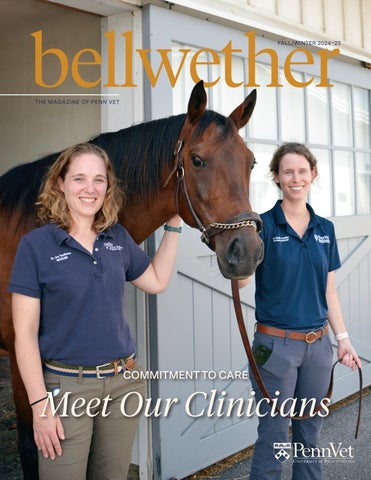
Dr. Joy Tomlinson (left) and Dr. Daniela Luethy, both members of New Bolton Center’s internal medicine team, pose with teaching horse Bliss.
Explore past issues of Bellwether magazine online at pennvet.pub/bellwether-archives. ERRATA In the Spring/Summer 2024 issue of Bellwether, Dr. Ann DiPastina’s name was misspelled. Dr. Craig Johnston’s graduation year was incorrectly denoted as 1982; he was a member of the Class of 1984.
29 FACULTY/ STAFF NEWS
34 STUDENT NEWS
42 ALUMNI NEWS
47 IN MEMORIAM
48 CALENDAR
DEAN’S MESSAGE
Dear Friends of Penn Vet, This past year, the University of Pennsylvania introduced In Principle and Practice: Penn’s Focus on the Future, a framework to guide Penn and its schools forward. Embedded in this framework are clear references to the work we do at Penn Vet to address emerging challenges—such as animal welfare, zoonotic diseases and pandemic preparedness, climate change, biodiversity, sustainable agriculture and food safety—facing both our local and global communities. The value Penn’s framework places on community engagement, something our clinicians in the hospitals, fields, and diagnostic labs do every day, is particularly gratifying. As a result of our ongoing efforts, and a relentless orientation to our mission, Penn Vet has emerged as central to Penn’s One Health and Climate and Sustainability vision for the future. Significantly, Penn Vet’s stature has grown among the schools at Penn over the last six years. This has boosted our interdisciplinary scholarship, better positioned us for faculty recruitment and retention, bolstered our faculty’s efforts to advance in their fields, and emboldened our graduates and house officers to pursue their dreams within and beyond the veterinary profession. Without a doubt we will reach new heights by the time we close out this decade. To do so will require us to focus on renewal and expansion of our facilities, reimagine models for the delivery of veterinary health care, and envision convening spaces that nurture learning and encourage creativity—central to the quality of life on Penn Vet’s campus. Some of this planning is already underway and some is under design or construction. By the time you read this, we will have opened our state-of-the-art Richard Lichter Advanced Dentistry and Oral Surgery Suite at Ryan Hospital, and in spring 2025 we will break ground on the Gail P. Riepe Center for Advanced Veterinary Education at New Bolton Center. Meanwhile, the Veterinary Diagnostic Laboratory has entered the design phase. To ensure a secure future however—for animals, humans, and the environment— Penn Vet will do even more to advance our health and climate efforts, guided by the In Principle and Practice framework. I know with your encouragement and support, we can shape the next generation of veterinary professionals, improve access to veterinary health care, and lead on the greatest global challenges of our time, a most rewarding set of goals that makes me excited to come to work every day at Penn Vet!
ANDREW M. HOFFMAN, DVM, DVSc, DACVIM
GILBERT S. KAHN DEAN OF VETERINARY MEDICINE
2
BELLWETHER FALL/WINTER 2024–25
“
“I know with your encouragement and support, we can shape the next generation of veterinary professionals, improve access to veterinary health care, and lead on the greatest global challenges of our time, a most rewarding set of goals that makes me excited to come to work every day at Penn Vet!” Andrew M. Hoffman, DVM, DVSc, DACVIM
WWW.VET.UPENN.EDU/BELLWETHER
3
SOME DAYS I’M NOT SURE WHO TAKES BETTER CARE O F WHOM.
EXCEPTIONAL CARE. HERE, EVERYONE GETS IT. To anyone who has been entrusted with their care, there are no ordinary horses. That’s why at New Bolton Center, exceptional care has always been the norm. From diagnosis to outcome, your horse’s care is in the hands of dedicated clinicians who excel in every specialty.
To make an appointment, call (610) 444-5800 or visit us online at vet.upenn.edu/newboltoncenter
bellwether
CONTRIBUTORS
From her home base in Philadelphia, Sacha Adorno writes about people, institutions, and businesses working to make the planet a better place for all life on it. As assistant director of social media, Ashley Hinton sniffs out stories about the people, research, and vet hospitals that make up Penn Vet. With her nose to the ground, she brings the student experience to life in print. Erica Moser is a science news officer in University Communications, writing for Penn Today about research in the social sciences along with news from Penn Vet, Penn Nursing, Annenberg School for Communication, and other centers at Penn. As director of content and news media, Caitlin Ware tells the impactful stories of the Penn Vet community— covering the innovative research, teaching, and learning taking place on and off campus.
EDITORIAL EDITOR John Donges CONTRIBUTING EDITOR AND WRITER Sacha Adorno WRITERS AT LARGE Martin J. Hackett, Ashley Hinton, Caitlin Ware CLASS NOTES EDITOR John Donges
DESIGN DESIGNER Anne Marie Kane, Imogen Design PHOTOGRAPHERS AT LARGE Liana DeNino, V’26, John Donges, Ashley Hinton, Elizabeth Parra, V’27
ADMINISTRATION GILBERT S. KAHN DEAN OF VETERINARY MEDICINE Andrew M. Hoffman, DVM, DVSc, DACVIM ASSOCIATE DEAN OF INSTITUTIONAL ADVANCEMENT Hyemi Sevening CHIEF COMMUNICATIONS OFFICER Martin J. Hackett
CHANGE OF ADDRESS Sarah Trout Office of Institutional Advancement School of Veterinary Medicine University of Pennsylvania 3800 Spruce Street Suite 151E, Philadelphia, PA 19104 strout@vet.upenn.edu (215) 746-7460
None of these articles is to be reproduced in any form without the permission of the School. ©2024 by the Trustees of the University of Pennsylvania. The University of Pennsylvania values diversity and seeks talented students, faculty, and staff from diverse backgrounds. The University of Pennsylvania does not discriminate on the basis of race, sex, sexual orientation, gender identity, religion, color, national or ethnic origin, age, disability, or status as a Vietnam Era Veteran or disabled veteran in the administration of educational policies, programs or activities; admissions policies; scholarship and loan awards; athletic, or other University administered programs or employment. Questions or complaints regarding this policy should be directed to: Executive Director, Office of Affirmative Action and Equal Opportunity Programs, Sansom Place East, 3600 Chestnut Street, Suite 228, Philadelphia, PA 19104-6106 or by phone at (215) 898-6993 (Voice) or (215) 898-7803 (TDD).
WWW.VET.UPENN.EDU/BELLWETHER
5
THE DRAW OF
Internal Medicine
Drs. Joy Tomlinson and Daniela Luethy’s Love of the Practice
BY SACHA ADORNO
“We had an appointment at New Bolton Center for a checkup,” said Blatchley. “But two days before it, Milena fainted in her stall. All bets were off—we went immediately.” Milena arrived at New Bolton Center with slight balance issues and rapid breathing. Her clinical team, led by Joy Tomlinson, DVM, PhD, DACVIM, assistant professor of large animal medicine, conducted comprehensive diagnostics on the horse’s heart, liver, and lungs.
Janet Blatchley (above) has a tight bond with her horse, Milena. Their relationship is as close as any human connection, so Blatchley noticed subtle signs that the 12-year-old Friesian “just wasn’t herself.” Her feistiness was gone, and her appetite diminished. At right, Dr. Joy Tomlinson visits with Milena.
Tests showed Milena had likely collapsed from a cardiac arrhythmia. Immediate intervention by the cardiology team was able to correct the arrhythmia. Structural abnormalities and pulmonary hypertension were ruled out, so the team looked for a source of inflammation that might have caused the arrhythmia. Bloodwork showed the liver enzymes were abnormal, and a liver biopsy showed an accumulation of protein and severe inflammation, likely caused by an immune response triggered by inflammation elsewhere in the body. The most revealing clue to Milena’s condition lay in her lungs. “The ultrasound and X-rays of Milena’s lungs showed some small areas of damage and nodules in both lungs,” said Tomlinson. “This and her other symptoms suggest equine multinodular pulmonary fibrosis (EMPF).” EMPF is a rare, progressive lung disease in horses characterized by scar tissue in the lungs. It often results in respiratory issues, such as labored breathing, coughing, and exercise intolerance. “Roughly 25 percent of horses with this condition will survive at least three months, and those that do may go into complete remission,” said Tomlinson. “We’re treating Milena with steroids at home. She’s being monitored by her regular veterinarian with intermittent recheck examinations at New Bolton Center for radiographs of the lungs and ultrasound of the liver.” One month after diagnosis, Milena is responding well to treatment. Blatchley is cautiously optimistic, taking it day by day.
The call of community and caseload 6
BELLWETHER FALL/WINTER 2024–25
“THE ULTRASOUND AND X-RAYS OF MILENA’ MILENA’S LUNGS SHOWED SOME SMALL AREAS OF DAMAGE AND NODULES IN BOTH LUNGS. THIS AND HER OTHER SYMPTOMS SUGGEST EQUINE MULTINODULAR PULMONARY FIBROSIS.” Joy Tomlinson, DVM, PhD, DACVIM
WWW.VET.UPENN.EDU/BELLWETHER
7
Milena represents why Tomlinson and her colleague, Daniela Luethy, DVM, MPH, DACVIM, assistant professor of large animal medicine, work in internal medicine at New Bolton Center. “Milena’s case is a great example of how all the body systems interact,” said Tomlinson. “Disease in one system—in this case, her lungs—can lead to disease in other organs like her heart and liver. This is why comprehensive examinations and diagnostics are so important to find the correct diagnosis and institute appropriate care, and the interconnection is what interests me about internal medicine.” Tomlinson and Luethy joined the Penn Vet faculty in the past year, attracted by the opportunity to tackle challenging conditions like EMPF with the most advanced tools available in veterinary medicine. They completed their residencies at New Bolton Center, leaving for other teaching and practice opportunities. Both then heard the call to return to Penn Vet’s people and caseload. “New Bolton Center is a strong community; everyone here cares about our patients and the people we spend our days with,” said Luethy. “We support each other and have rigorous discussions of cases, sometimes challenging each other in constructive ways that lift the standard of care we deliver.” For the two clinicians, New Bolton Center’s more than 6,750 in-hospital cases a year, which are mostly equine, and Field Service’s more than 23,000 animal visits annually offer a unique opportunity to care for animals they adore. Their patients include elite racehorses and beloved companion horses, rescued and agricultural cows, pigs, goats, sheep, and the occasional camelid. “In internal medicine, we see many different diseases across this spectrum of animals, from gastroenterology to oncology to infectious disease,” said Luethy. “It’s this broad
8
BELLWETHER FALL/WINTER 2024–25
“We support each other and have rigorous discussions of cases, sometimes challenging each other in constructive ways that lift the standard of care we deliver.” Daniela Luethy, DVM, MPH, DACVIM Above, Dr. Daniela Luethy and fourth-year student Austin Castellano perform a physical exam on their patient.
variety of cases that I find appealing. We see one of the highest caseloads of any academic, veterinary health care institution, which allows us to push boundaries in ways we might not otherwise.” Tomlinson added that the caseload combined with an infrastructure that includes advanced diagnostic equipment and clinical staff and faculty in several specialties— among them neurology, ophthalmology, neonatology, cardiology, surgery, and radiology— makes New Bolton Center a special place to practice. “It’s a tremendous advantage to have so many specialties on-site, both as separate services for clients and for consultation on our cases,” she said. “Milena’s care shows how internal medicine and specialty sections, including ultrasound and cardiology, diagnostic pathology, and radiology, work together to provide the most efficient information and the highest level of care for a patient.”
Driving medicine forward And then there’s research. Penn Vet’s pioneering research bolsters New Bolton’s Center dynamic practice environment. As clinicians, Tomlinson and Luethy can leverage Penn Vet’s groundbreaking studies and findings in their practices and conduct their own research to answer vexing clinical questions. “Several of Penn Vet’s clinicians have large research programs that are driving medicine forward and often include a component of clinical research,” said Tomlinson. “Our clients can participate in
clinical trials, if they choose, and benefit from the latest knowledge about disease progression and treatment.” Luethy and Tomlinson are also contributing to the science and practice of large animal medicine. “It’s exciting,” said Tomlinson. “If the scientific literature doesn’t exist or agree on the best approach, we have the infrastructure and the caseload to help answer those questions.”
Milena is in the “best hands she can be between her regular veterinarian, her amazing boarders and trainer, and the special experts at Penn Vet.” Janet Blatchley
Currently, Tomlinson’s research focuses on horse liver viruses, specifically parvovirus-hepatitis, equine hepacivirus, and equine hepadnavirus. She studies risk factors, transmission, and progression with the potential goal of creating a vaccine to prevent infection. Should Tomlinson pursue a vaccine, she may be bolstered by Penn Vet’s infrastructure. Last year,
the School’s Institute for Infectious and Zoonotic Diseases launched an mRNA Research Initiative to fast-track the development of veterinary mRNA-based vaccines and host-directed therapies. Luethy, too, is interested in developing novel diagnostics and treatments. “I hope to advance small ruminant internal medicine and earlier diagnosis and treatment of cancer in large animals,” she explained. And she zooms out a bit into the wider world, looking at a significant public health concern for veterinarians: mental health. “I am interested in helping to improve the well-being of the veterinary profession. I’ve been researching the relationship between physical activity and mental health and evaluating factors that might influence a veterinarian’s career decisions.”
Holding Milena in the best of hands All these factors come together in Milena’s case. The knowledge and community that attracts Tomlinson and Luethy to Penn Vet are also why Blatchley trusts New Bolton Center. Although she’s aware EMPF may take Milena sooner than she wants, Blatchley hopes for the best, knowing that Milena is in the “best hands she can be between her regular veterinarian, her amazing boarders and trainer, and the special experts at Penn Vet.” Editor’s note: At press time, we learned Milena passed away. The Bellwether team thanks her family for sharing her story with our readers.
WWW.VET.UPENN.EDU/BELLWETHER
9
Ryan Hospital Staff Veterinarians Talk Life in Emergency Services and Critical Care By Sacha Adorno
Penn Vet’s Emergency Service and Critical Care Unit at Ryan Hospital provides lifesaving care to extremely ill small animals. The service is open 24/7 and attracts clients and veterinary referrals from across Pennsylvania, New Jersey, Delaware, and other states outside the region. The hospital’s faculty and staff are experts in trauma, shock, and other emergencies. They are also a collaborative group working closely to help highly vulnerable animals survive with the best possible outcomes. Staff Veterinarians Catalina Montealegre, V’07, and Charles Garneau-So, MVB, are core to the team. They shared with Bellwether what it’s like working on the front lines of emergency veterinary medicine, the types of emergencies they encounter, and how they collaborate with the broader Penn Vet team to provide the best care available.
QA 10
BELLWETHER FALL/WINTER 2024–25
&
1 What brought you to Ryan Hospital, particularly Emergency and Critical Care? MONTEALEGRE: I was a nurse at Penn Vet in the early 2000s and worked in the Intensive Care Unit throughout vet school. I did an internship here as well. Then I left to practice with Red Bank Veterinary Hospital, following Dr. Dave Diefenderfer, V’81, GR’01. I gained a lot of experience in a busy emergency room. After leaving, I spent about a year doing veterinary relief work, which was also a fantastic experience. Eventually, I saw that Penn Vet was hiring for a staff veterinarian, and I knew it was the perfect fit for me—I’d always wanted to return. GARNEAU-SO: I was a medical director at a New York City animal hospital when the pandemic hit hard. I was considering my next move—opening my hospital or pursuing teaching—when the Penn Vet position opened. It was a tough decision to leave a familiar role for something new at a university, but it was the right choice. Now, I maintain a clinical practice and teach. Working with fourth-year students, interns, and residents is incredibly fulfilling.
2 What attracts you to this area of veterinary medicine? MONTEALEGRE: I like the surprise of not knowing what’s coming
next. In general, I love being a veterinarian. You know, saying, “If you love what you do, you’ll never work another day in your life.”—that’s me; I believe that and live it. Emergency medicine is fascinating and exciting because it’s never routine and is so diverse. Dr. Charles Garneau-So (left) and Dr. Catalina Montealegre (right) with Crystal Branch Wyman, LVT, examine Mo, a dog brought to Ryan Hospital through the Richard Lichter Charity for Dogs program, which gives shelter dogs world-class medical care.
GARNEAU-SO: Like Catalina, I love the unpredictability and the
variety. Every case is different. During an 11-hour shift, I might see up to 24 cases, ranging from routine issues to highly complex situations. We often see cases that other clinics can’t handle, which adds to the challenge and fulfillment of the job. Collaborating with interns and residents is another layer to the work—we discuss cases in-depth and explore all possible options.
WWW.VET.UPENN.EDU/BELLWETHER
11
3
How is working in a teaching hospital like Ryan different from a private hospital? GARNEAU-SO: The most significant difference
is the access to an entire team of specialists— surgeons, radiologists, oncologists, and nurses are all available to consult on cases. And, it’s a unique way to practice with the latest knowledge and research about prevention and care. In private practice, you rely heavily on your own knowledge and continuing education courses. At Penn Vet, we constantly learn from each other and the cases we see. We also benefit from facilities with the latest technologies that private practices may not have onsite. MONTEALEGRE: To that, I’d add students!
Students bring new energy and perspectives, which keeps us all engaged. They’re eager to learn and contribute, making day-to-day work more interesting. Beyond that, there’s a profound satisfaction in helping them grow into competent, compassionate veterinarians. GARNEAU-SO: I agree. They ask questions that sometimes we don’t immediately know the answers to, so we look things up together. It’s a collaborative learning process that benefits everyone involved. Each student has a different learning style—some are more visual, others are detail-oriented—and that diversity makes teaching both challenging and rewarding.
Dr. Catalina Montealegre and Ethan Bailey, V’25, perform an ultrasound on a dog.
From left, Dr. Catalina Montealegre, Lorna Evans, V’27, and Erin Gordon, CVT, attend to a patient.
4
What are some things you want students to understand beyond clinical knowledge and skills? MONTEALEGRE: I try to teach students the importance of understanding the context of each case. We must always appreciate veterinarians who send their patients to us for specialized care and give credit to our referring colleagues. This understanding fosters better communication and ultimately improves animals’ care.
I also emphasize the importance of empathy and resilience. Veterinary medicine can be stressful, especially in emergencies. It’s crucial that students learn how to manage their stress and feelings during what are crisis moments for our clients and patients. I want students to see that this career is deeply rewarding and find joy in the work, even on the most challenging days. GARNEAU-SO: I want students to understand how much veterinary medicine is about people, not just animals. In any type of clinical practice, the clients—the humans who love their animals—are an important part of every case, and we need to be skilled listeners and compassionate clinicians.
“I try to teach students the importance of understanding the context of each case.” —DR. CATALINA MONTEALEGRE
12
BELLWETHER FALL/WINTER 2024–25
5
We know every patient captures your heart. Can you share a recent case that represents the skill and spirit of Emergency and Critical Care at Ryan Hospital? GARNEAU-SO: Certainly! A recent case that stands out involved a cat referred to us for a blocked kidney. [See sidebar.] He needed a delicate procedure, essentially a bypass. The surgery was successful, and the cat went home four days later in great condition. Cases like this, where everything comes together seamlessly, highlight our team’s skill and dedication. Another one is a dog named Mo. She came to us from the Pennsylvania Society for the Prevention of Cruelty to Animals with severe bite wounds. We treated her, and she’ll eventually be available for adoption and have a chance for a loving home. MONTEALEGRE: I’ve worked on many cases that have deeply
impacted me. Recently, a client in a difficult situation involving abuse came into the hospital. The client was in the process of leaving a violent home situation and was very concerned about their pet. Thanks to the resources available at our hospital, including our social worker, we were able to help the client navigate this sensitive situation and ensure a safe outcome for the client.
Cases like this, where everything comes together seamlessly, highlight our team’s skill and dedication.
GO GIZMO! Ashley and Brittany Zaccaria spent the late hours of May 30 where no one wants to be—in the emergency room. They’d rushed their seven-year-old cat Gizmo to Ryan Hospital for decreased urine production. “There was no question that Penn Vet was where we needed to go,” said Ashley. “And we got there just in time.” Charles Garneau-So, MVB, staff veterinarian on the cat’s emergency care team, said Gizmo’s condition was severe. An examination found stones in Gizmo’s ureters, the tubes that connect the kidneys to the bladder. “We went through the options with Ashley and Brittany, which were at that point a consideration of euthanasia or surgery to relieve the obstruction,” said Garneau-So. “Surgery would give him a fighting chance, but it was a very serious case.” Again, there was no question for the Zaccarias: “Gizmo is family, and we wanted to do everything we could.”
—DR. CHARLES GARNEAU-SO
Left, Dr. Charles Garneau-So and Dr. Catalina Montealegre perform an ultrasound on a cat during the evening shift. Above, Mo rests comfortably in her cage following surgery to amputate her damaged leg.
The Ryan Hospital team, including the interventional radiology and surgical departments, moved quickly to perform surgery that night. It was a success, but Gizmo had a few post-procedure complications. His care team treated each one, and, after a few days, Gizmo was ready to go home to his four humans and two other cats, where he’s been doing well ever since. “Now, our biggest concern is keeping him from playing too roughly with our other cats,” said Ashley. “It’s a problem we’re happy to have.”
WWW.VET.UPENN.EDU/BELLWETHER
13
RYAN HOSPITAL LAUNCHES
Canine Hydrotherapy Services Addition of Underwater Treadmill Expands Treatment Options for Arthritis, Rehabilitation By Caitlin Ware
PENN VET’S RYAN HOSPITAL HAS INTRODUCED HYDROTHERAPY TO ITS ROSTER OF CANINE REHABILITATION THERAPY SERVICES THROUGH THE ADDITION OF AN UNDERWATER TREADMILL. By leveraging the physical properties of water—including buoyancy, resistance, and hydrostatic pressure—hydrotherapy provides a unique, low-impact treatment protocol that allows dogs to exercise without placing their full body weight on their joints, while building strength against water resistance. The hospital’s new underwater treadmill, installed during summer 2024, is specifically designed to support dogs suffering from degenerative joint and muscular conditions, recovering from surgeries, and experiencing neurologic injuries. The underwater treadmill functions similarly to traditional human exercise equipment found at gyms, with control over speed and resistance – except for the fact that a plexiglass and metal chamber sits on top of the revolving belt. Once filled with heated water, the chamber allows canine patients to engage in rehabilitation exercises and gait retraining in a controlled environment. The interior of the tank features resistance jets, which can
14
BELLWETHER FALL/WINTER 2024–25
Dr. Molly Flaherty (left) watches as Reggie walks the treadmill.
be utilized for increasing exercise difficulty and massage therapy. And a built-in water treatment and filtration system ensures sanitation and patient safety. Hydrotherapy can be especially helpful for senior dogs experiencing pain and decreased mobility due to arthritis, hip dysplasia, knee injuries, degenerative neurological disorders, spinal injuries, and unintentional weight gain. Treatment outcomes for patients experiencing these and other presenting symptoms often include improvement in overall range of motion, strength, and mobility, a decrease in pain levels, and weight loss, when appropriate. “For many dogs with sore joints who are limited in their ability to move on land, water therapy is often the best route for them to exercise and engage in rehabilitation,” said Ryan Hospital Clinical Instructor of Rehabilitation Medicine Molly Flaherty, DVM. “In water, we can take up to 63% of a dog’s body weight off of their joints, allowing for safe movement and strengthbuilding without the stress and discomfort that land-based rehabilitation can impose.” For patients seeking hydrotherapy services at Ryan Hospital, the process begins with a comprehensive evaluation. Each patient undergoes an intake assessment to identify specific needs, mobility limitations, and pain levels. Based on this assessment, a customized treatment plan is developed. While hydrotherapy can be used independently, it is often combined with complementary treatments available through Rehabilitation Therapy Services, including land exercise,
“For many dogs with sore joints who are limited in their ability to move on land, water therapy is often the best route for them to exercise and engage in rehabilitation.” MOLLY FLAHERTY, DVM
Ryan Hospital Clinical Instructor of Rehabilitation Medicine
acupuncture, laser therapy, and manual therapy, based on individual pet requirements. “Dogs tend to really enjoy the water therapy, and it helps build trust between them and our team,” said Flaherty. “These types of interactions make the rehabilitation process beneficial from a physical health perspective, and also an enjoyable experience for patients.” Ryan Hospital is one of only two venues currently offering hydrotherapy services in the city. The addition of an underwater
Dilly, who works at Children’s Hospital of Philadelphia, performs his exercises.
treadmill represents a significant step forward in accessible, comprehensive rehabilitation resources for canine patients and their caregivers. “The addition of an underwater treadmill is a significant milestone for our Rehabilitation Therapy Services,” said Ryan Hospital Director, Chief Medical Officer, and Associate Dean of Clinical Enterprise Brady Beale, VMD, DACVO. “With the new equipment, we are not just adding a service; we are expanding treatments for our patients. In addition to complementing our existing Sports and Performance Medicine and Orthopedic Surgery offerings, this equipment allows us to increasingly tailor our treatment plans to the unique needs of each canine patient we serve and ensure the best possible outcomes.” New patients seeking hydrotherapy services are currently being accepted, and no referral is necessary. Pet owners interested in utilizing the new underwater treadmill service can schedule appointments by contacting Ryan Hospital at (215) 746-8387, or visiting www.vet.upenn.edu/ veterinary-hospitals.
WWW.VET.UPENN.EDU/BELLWETHER
15
ALUMNI PROFILE BY SACHA ADORNO
Tara Gaab, V’17 From Classroom to Farms to Back Again TARA GAAB’S “A-HA” CAREER MOMENT HAPPENED DURING A SLEEPOVER WITH PIGS BETWEEN HER SECOND AND THIRD YEARS OF VET SCHOOL. AT THE TIME, GAAB WAS WORKING ON A RESEARCH PROJECT WITH THOMAS PARSONS, VMD, PhD, DIRECTOR OF PENN VET’S SWINE TEACHING & RESEARCH CENTER. “Dr. Parsons was looking at sleep as a way to assess the welfare of sows indirectly,” said Gaab, an assistant professor of animal science at the University of Delaware. She teaches animal science and health and welfare, including preventive care, husbandry practices, welfare compliance, and pain management and prevention in farm and fiber animals. “We were studying the animals’ circadian rhythms. So, I’d sit there at night in the dark with all these dozing pigs and record their muscle twitches. I got to know them and their personalities and realized these are animals I want to work with.” Gaab had arrived at Penn Vet to pursue a career in zoo medicine, but the overnights with the snoring sows had her thinking otherwise.
OWNING AN IDENTITY Coming to Penn Vet with a degree in animal science from Penn State, Gaab brought her experience with dairy cattle and other agricultural animals. “My vet school classmates saw me as the farm animal person, even though I saw myself as a zoo and wildlife person,” she said. “They’d ask me about pigs and cows—why and how they do things. I was the go-to, kind of a curiosity.” Then, around the time of the sleep study, Gaab started owning the identity of farm and fiber animal student and moving away from zoo and wildlife medicine. “I was increasingly interested in the health and welfare of agriculture animals—pigs, cows, sheep, chickens,” 16
BELLWETHER FALL/WINTER 2024–25
said Gaab. “Tom and Meghann [Pierdon, VMD, leader of food security for Penn Vet’s Center for Stewardship Agriculture and Food Security] were big influences on me—they’re pioneers in animal welfare.” Parsons, also the Marie A. Moore Professor of Animal Welfare and Ethics, and Pierdon led the formation and recent launch of Penn Vet’s Master of Science in Animal Welfare and Behavior (see page 28.) After finishing at Penn Vet, Gaab was hours away from signing on with a private practice in central Pennsylvania when Dr. Billy Smith, associate professor of medicine in Field Service at Penn Vet, approached her about an internship with New Bolton Center’s farm animal field service. She accepted and then stayed on after the internship for a residency in the service. “As I was finishing my residency and studying for my boards, the big question was whether I’d continue to do clinical work or go into academia,” said Gaab, who is board-certified by the American College of Animal Welfare. “I didn’t want to pick; I wanted to do both. I loved working with the field service. The team is wonderful—they’re family—and I developed deep connections with my clients.” At the same time, “I wanted to focus more on the big ideas and ethical discussions around animal welfare.” So, in 2022, when the position opened in the University of Delaware’s Department of Animal and Food Sciences, Gaab took the opportunity to transition from clinical care to teaching.
Dr. Tara Gaab speaks with barn worker Jillian
Mosley at the Penn Vet Swine Teaching and Research Center (left) and with University of Delaware students (below) as sows were loaded into their new crates.
SO MUCH TO CONSIDER
CLASSROOM BACK TO FARM
In her faculty role, Gaab is helping to bolster the university’s animal science and pre-veterinary medicine programs.
Although Gaab left full-time clinical service for higher education, she continues to practice part-time, advising the Delaware County 4-H program and consulting at New Bolton Center as the Swine Center’s veterinarian.
“With clinical care, you think of the medicine—the surgery, pain relief, that kind of thing,” said Gaab. “But there’s so much more to think about, talk about, and introduce people to.” She’s speaking of animal welfare, which focuses on an animal’s current state of being. “There are five basic components we look at in animal welfare: freedom from hunger and thirst; from discomfort; from pain, injury, and disease; freedom from fear and distress; and freedom to express normal and natural behavior. Our goal is always the gold standard of the best life ever,” she explained, adding that welfare is more than an ethical consideration. “The animal welfare discipline is rooted in science and research. Ethics and morals are how we view the world and live our lives. They inform some of what we choose to research in animal welfare, but the recommendations we make and things we know to be true are science-based.” At the University of Delaware, Gaab integrates animal welfare topics into the school’s animal science, pre-veterinary medicine, and animal biosciences curricula. “Most of my students are pre-vet track and headed to vet school or animal science majors that want to do a PhD or go straight into the industry,” she said. “My hope is they take what they learn here to whatever their careers are so that animal welfare and well-being become a standard consideration in all areas related to animal health and care.”
“I do a farm check at the Swine Center once a week, making sure the pigs look how they should, answering questions about animals, and doing ultrasounds,” said Gaab. “I’ll sometimes have undergrad students come with me to get hours for vet school, and often Penn Vet students are there too. There’s always someone hanging out to learn more.” Gaab knows many of these students have already established career goals, and she also understands that you can’t know what you’ll do until you get there. “I always tell my students that whatever you think you’re going to do is probably not what you will actually do,” she said. “I encourage them to say yes to everything and go outside their comfort zones. I once thought pigs were gross and weird and scary, but they are a huge part of my life now. I love them and love what I’m doing. Will I do this forever and retire? Maybe, maybe not. I don’t know. But I think something cool about veterinary medicine is that you can always evolve—there are many pathways.” WWW.VET.UPENN.EDU/BELLWETHER
17
Philanthropy
ROBERT MAROOKIAN
A Family Affair Robert Marookian Supports New Bolton Center in Honor of His Mother and Brother By Sacha Adorno Some of Robert “Rob” Marookian’s fondest childhood memories are visiting dairy farms with his father, Edgar Marookian, V’54. The two would travel together through Hunterdon County’s rolling hills as Edgar checked on the cows—and the farmers. p Rob Marookian, standing
far right, with his parents, Edgar and Myrval Marookian (far left), and his sons, James and Christopher, and wife Kelly. Penn Vet is a family affair for the Marookians.
18
MY DAD WAS MY HERO, AND HE WAS ALWAYS SO PROUD THAT HE GRADUATED FROM PENN VET.
BELLWETHER FALL/WINTER 2024–25
“I was so proud to watch him work. The farmers, who were real characters, loved him, and he felt the same way,” Marookian said. “My dad was my hero, and he was always so proud that he graduated from Penn Vet.” Marookian shared a favorite story about one of his father’s earliest cases. “He received a call for a cow that had eaten a bunch of metal nails and barbed wire fencing. He told the farmer, Orville Rounsaville, surgery was necessary, and it would be tricky. So, he also told the guy that if the cow died, he’d owe nothing on the visit.”
“This,” said Marookian, “was my dad in a nutshell.” The cow survived, and the gentleman went to all the other farmers in local townships and told them to “hire this kid.” Marookian remains friends with his son Bruce to this day. After that, Edgar, a U.S. Army veteran of World War II, 6th Ranger Battalion, built a steady practice until the number of dairy farms dwindled. He then entered veterinary pharmaceuticals, eventually establishing a consulting business before retiring in 1992. Penn Vet alumni and students will also recognize his name from the E.R. Marookian, VMD Auditorium, which was named in 1999 in gratitude for the highly regarded veterinarian, businessman, and noted alumnus.
THE GIFTS OF LOVE AND DISCIPLINE Along with his father, Marookian’s mother—Myrval Elizabeth Jones Marookian—profoundly influenced him and his brother Edgar, Jr., who passed away in 1990. Both Myrval and Edgar, Sr. are deceased as well. “We were blessed to have such loving parents,” said Marookian. “They loved us and gave us the discipline to work hard and contribute wherever we go, in whatever we do.” Marookian owns Precision Building, a New Jersey-based contracting business. Edgar, Jr., was a physician and alumnus of Penn Medicine.
p In 2006, the Marookian family attended the dedication of the E.R. Marookian, VMD Auditorium, located in Hill Pavilion. One of two new lecture halls, the auditorium allowed an expansion of class size while providing students with vital, state-of-the-art teaching space.
“My brother was six years older than me,” said Marookian. “He was very bright, just super bright, and I adored him. In contrast, I was always considered a little bit of the black sheep of the family. My brother was a doctor, my father a veterinarian, and my mother was a dedicated fourthgrade teacher, but school wasn’t for me. I dropped out of college and had a partier streak for a few years. My mom and dad stuck by me always, and I am forever grateful.”
HONORING A LEGACY The businessman and private pilot—Marookian co-owns Sky Manor Airport in Pittstown, New Jersey—takes every opportunity to show his gratitude. His most recent tribute was a gift to Penn Vet in memory of his mother and brother. He made a current and planned gift to support two rooms in the new Riepe Center on New Bolton Center’s campus. One of the rooms was given jointly with Edgar, Jr.’s estate and the other in honor of Myrval. “I recently visited New Bolton Center,” said Marookian. “Seeing the old farmhouse and the little courtyard brought everything together for me. The place is meaningful to my family, and I want to support it to remember people I love and miss very much.” He added that giving is a celebration of his parents and brother’s legacy: “They left an imprint on me that if you can give to something that’s going to benefit other people and the world, why not? My dad always said that if you’re blessed, you give back. Well, I am blessed and grateful. Giving back is the best way to show it.” WWW.VET.UPENN.EDU/BELLWETHER
19
BOARD NEWS
BOARD OF ADVISORS
A Message from Mark D. Spitzer, W’71, Chair, and Martin E. Winter, G’76, W’76, Vice Chair
Mark D. Spitzer, W’71 (left), Chair, and Martin E. Winter, G’76, W’76 (right), Vice Chair
Penn Vet has consistently proven its commitment to excellence in education, clinical care, and research, providing critical services to our society. As we near the end of the first half of the academic year, we would like to highlight the School’s noteworthy achievements and milestones over the past five years. Our faculty and leadership are justifiably proud of Penn Vet’s new competency-based curriculum offering greater clinical and surgical experiences and equipping our students to tackle the most pressing health issues affecting animals. And as the birthplace of many veterinary specialties, Penn Vet is now home to one of the largest specialty training programs in the world. What strikes us the most, however, is this overarching sense of innovation taking place throughout the School. Penn Vet not only serves as the gold standard in veterinary teaching and clinical care, but also leads in scientific collaboration and discoveries. The impact of Penn Vet’s research is global, improving the lives of countless animals and contributing to advancements in human medicine. For example, Penn Vet investigators are leaders in infectious disease prevention and preparedness. Still others are developing better diagnostics and treatment options for a variety of diseases in companion animals, including cancer. And
20
BELLWETHER FALL/WINTER 2024–25
BOARD NEWS
Penn Vet Board of Advisors As of September 2024 over the last few years, Penn Vet has emerged as a leader among veterinary schools in climate mitigation, environmental health, sustainable agriculture, wildlife disease surveillance, and the development of breakthrough techniques in the delivery of large animal care. This exciting collaboration of faculty, students, researchers, and clinicians—and collaborative partners throughout Penn and globally—is what we often refer to as “Penn Vet 2.0.” It builds upon over a century of great contributions by Penn Vet and adapts to the rapidly evolving science and challenges of today. As with any great endeavor, continued success is never assured and requires unwavering support. We encourage you to continue to engage with the School. Whether through financial contributions, advocacy, or volunteering time, your involvement is critical to ensuring that the School continues to lead in veterinary education, clinical care, and research. Your support, in any form, is an investment in a brighter future for both animals and people. Together, we can guarantee the continued growth and success of Penn Vet into the next decade and beyond. We look forward to working with all of you to continue building upon the legacy of excellence here at Penn Vet. Mark D. Spitzer, W’71, Chair, and Martin E. Winter, G’76, W’76, Vice Chair
“Your support, in any form, is an investment in a brighter future for both animals and people. Together, we can guarantee the continued growth and success of Penn Vet into the next decade and beyond.”
Mr. Mark D. Spitzer, W’71 Chair Mr. Martin E. Winter, G’76, W’76 Vice Chair Mrs. Patricia Lang Billhardt Emeritus Mrs. Kathryn L. Champ Ms. Christine C. Connelly Emeritus Mr. Christopher B. Cowan, WG’91 Mr. Michael S. Dana, WG’85 Juan Luis Ferrer Perez, VMD, C’78, V’82 Ms. Wendy Grubbs Mr. Christian Herr Ex-officio Mrs. Mindy Heyer, C’79, W’79, WG’80 Emeritus Ms. Abigail R. Kazam, C’02 Mrs. Linda Richardson Korman Mr. David J. Lentz Ex-officio William R. Levy, Esquire Mr. Richard Lichter Mr. Keith A. Morgan, C’83 The Honorable Dan Moul Ex-officio The Honorable Eddie Day Pashinski Ex-officio Mrs. Tamara Totah Picache, W’94 The Honorable Russell Redding Ex-officio Mrs. Gail Petty Riepe, CW’68 Deborah Sachs Rothman, Psy.D., C’95 Ms. Christa B. Schmidt The Honorable Judith L. Schwank Ex-officio Mr. Christopher Torres Ex-officio Anson J. Tsugawa, VMD, V’98 The Honorable Elder A. Vogel, Jr. Ex-officio Mrs. Lucy Zungailia, C’85
Mark Spitzer and Martin Winter
WWW.VET.UPENN.EDU/BELLWETHER
21
IN THE OFFICE
IN THE OFFICE WITH
Deborah Silverstein, DVM, DACVECC Chief of Emergency and Critical Care at Ryan Hospital By Sacha Adorno Deborah Silverstein, DVM, DACVECC, is as passionate today about her patients, clients, and career as she was when she came to Penn Vet more than twenty years ago. Her days move quickly, and she wouldn’t have the pace any other way. “Our patients are often critically ill, and our ability to act fast and appropriately can be their only chance at survival,” she said. “It’s intense work, but, at the end of the day, if I feel like I made a difference for a patient or client, student, resident, or nurse, it was all worthwhile.” The dynamic nature of emergency care requires quick triage and meticulous attention for a wide array of conditions. “Emergency and critical care medicine requires a deep knowledge of physiology and a
22
BELLWETHER FALL/WINTER 2024–25
thorough understanding of the animal body and all its different systems. We treat everything from eyes to ears, heart to lungs, kidneys to the tail. And you never know what each day will bring—it’s impossible to feel stagnant or predict what’s next. I like that—I like having to think on my feet and think critically and creatively. And I like that we’re still advancing a relatively young specialty of veterinary medicine.” As one of the pioneers in the field, Silverstein doesn’t spend much time in her office. When she is there, she’s surrounded by love. Her walls and shelves are filled with art, messages, and tokens of gratitude from family, friends, clients, students, residents, and colleagues.
IN THE OFFICE 1. Gifts of the heart, made by the hand. One of our longtime, now retired, ICU nurses, Chantal [Reme], made this. She was a superstar who led the way in critical care nursing in several ways. And she’s so crafty—this is one of many cute things she made and gifted me. I am always in awe of her talent.
1.
2. Do No Harm. This is my touchpoint. I always remind students and house officers that ‘do no harm’ is the heart of our oath. Every decision, even something as simple as administering IV fluids, requires us to ask if the risk is worth the potential benefit. We are the voice for animals who can’t speak; it’s our duty to ensure their well-being. Above all, we must protect our patients, keep their best interests at heart, and never forget the trust the little furry creatures place in us.
2.
3.
3. Sow Much Love. I’ve loved and collected pigs since childhood. My children made the papier-mâché pig for me. Piglet came from my mentor, Steve Haskins. He was a big reason I went into emergency and critical care medicine. He was a leader in the field who sadly passed away too soon in an airplane accident. This is a lovely reminder of him and his contributions.
5. One stop for studying. When I took my specialty boards, I dragged around 50–60 pounds of books because there wasn’t a single source that covered everything we needed to study—kidneys, lungs, heart, all the organs and diseases. I swore I’d make it easier for future residents to study for their final boards. I collaborated with my then-resident mate, Kate Hopper, to publish a comprehensive textbook for critical care medicine. It’s now in its third edition. There was even a scam version sold on Amazon—the smaller version on the left—full of nonsense about lumberjacks and logging. Amazon has since taken the fake down.
6.
4.
5.
7.
4. Cats in costume. My mother is an avid cat lover, and I think that’s where I get my love of cats. She collects cat art and sends pieces to me—some are odd, others more normal. I think this one is hilarious!
6. Catitute and gratitude. This picture is a classic! It used to hang in Lesley King’s office. Lesley was instrumental in developing the veterinary intensive care specialty and Penn Vet’s Intensive Care Unit. She hired me more than 20 years ago and mentored me as a young faculty member. She was a legend, and I inherited this gorgeous photo from her. 7. Samantha, the success story. During my residency, I had a patient named Samantha who looked like this and was a wonderful success story. She was six months old with a disorder called congenital megaesophagus, which means her throat was unable to propel food into the stomach properly. She responded well to treatment and lived a normal life. I kept in touch with her owners for more than a decade, and they sent me this dog figure when she passed away.
WWW.VET.UPENN.EDU/BELLWETHER
23
RESEARCH BRIEF
UNDERSTANDING HOW A RED SEAWEED REDUCES METHANE EMISSIONS FROM COWS BY ERICA MOSER
Methane is the second-largest contributor to climate warming after carbon dioxide, and so scientists have put a lot of attention toward addressing one of the top sources: methane emissions from livestock. In other words, cow burps are bad for the planet.
Farmers add various seaweeds to cow diets as a source of protein, unsaturated fats, and other healthpromoting ingredients that provide immediate energy, said Dipti Pitta, PhD, Penn Vet’s Mark Whittier and Lila Griswold Allam Associate Professor of Ruminant Nutrition, and a 2016 study in Australia found that feeding sheep a species of red seaweed called Asparagopsis taxiformis (AT) eliminated methane emissions by 80%. But the effects of this seaweed vary widely, and so researchers from Pitta’s Agricultural Systems and Microbial Genomics Laboratory (ASMG lab) and Pennsylvania State University undertook an assessment of how it alters the microbiome in the rumen, a compartment of a cow’s stomach. The results are published in the journal mBio. The researchers randomly split 20 cows between four treatments: a high dose of AT; a low dose of this
24
BELLWETHER FALL/WINTER 2024–25
red seaweed; oregano, which also inhibits methane formation; and the control group. They rotated the animals among the treatments in four 28-day periods. The team found that the high dose of the seaweed inhibited methane emissions by 55% in the first two periods, but the effect appears short-lived. It gradually declined by the third and fourth periods. Pitta said this is one of the first studies examining how methane is formed in the rumen and how methane pathways are altered under various mitigation strategies, noting the importance of preserving microbiome health and animal productivity when addressing methane reduction. Past research has not looked at the effects of AT on microbial populations and their functional pathways in this level of detail. The researchers found that in the first two 28-day periods, the high
“It’s very important to understand what the nutrient content of seaweed is and what the antimicrobial effects of seaweeds are so that we better understand the impact of the overall inclusion of different concentrations of seaweeds to the animal diet.” DIPTI PITTA dose of seaweed led to a near-total elimination of Methanosphaera, a microbe that uses hydrogen to reduce methanol to methane, in the rumen. Pitta said this is important because the seaweed treatment didn’t have the same effect on other microbes that produce methane, leading researchers to believe that Methanosphaera plays a larger role in methane formation than previously thought. However, the study explains that Methanosphaera populations spiked in later periods because they were unable to inactivate bromoform, a substance in seaweeds that suppresses the formation of methane in the rumen.
seaweed-treated animals compared to the control group. “It’s very important to understand what the nutrient content of seaweed is and what the antimicrobial effects of seaweeds are so that we better understand the impact of the overall inclusion of different concentrations of seaweeds to the animal diet,” Pitta said. Indugu said the past work of the ASMG lab led to the current study. Researchers previously reported that the organic compound 3-Nitrooxypropanol reduced
methane emissions by 26%, and a subsequent study determined the microbial characteristics of low-methane-emitting cows. Looking ahead, Pitta said the lab is working on combining different strategies, such as testing seaweed in the diets of cows that have been identified as high methane emitters or low methane emitters. “Combining those with the seaweeds might give us an opportunity to effectively reduce methane by a much higher magnitude than when you do any one strategy alone,” she said. Pitta added that researchers are also investigating different doses of seaweed varieties in methanogenic cultures, which will provide more specificity on the concentrations necessary to inhibit methanogenesis.
The study also explored the activity of enzymes involved in methanogenesis, the process of producing methane as a byproduct of energy metabolism. First author Nagaraju Indugu, PhD, a senior research investigator in the ASMG lab, said the enzymes involved in this pathway were reduced, compared to the control group, when the cows were given AT. The authors also noted that, while they expected indirect effects of AT on bacteria in the microbiota, they also found direct effects that were less expected. Specifically, types of bacteria that produce butyrate, a short-chain fatty acid serving as an energy source for cows, were significantly increased in
Bonnie Vecchiarelli, second from left; Dipti Pitta, middle; and Nagaraju Indugu, right, are among the authors examining the mechanisms by which a type of red seaweed inhibits methane emissions from dairy cows, with John Toth and Rachel Duffey, also of Penn Vet. (Image: Courtesy of Dipti Pitta)
WWW.VET.UPENN.EDU/BELLWETHER
25
Commencement On May 20, 126 members of the Class of 2024 walked across the stage at Zellerbach Theatre to receive their Veterinariae Medicinae Doctoris. Amanda Bisol, V’11, a member of the AVMA Board of Directors, delivered the commencement address. Class president Kasey Barber addressed her classmates and was presented with the V’24 class flag by Donald Neiffer, V’92. Beatrice DeMarco, V’24, administered the Veterinarian’s Oath.
2024 26
BELLWETHER FALL/WINTER 2024–25
Roxy Tamara Ackerman ∆ Kara A. Anderson Deepthi Aravind Karli Elizabeth Arbogast ▼ Kasey Lyn Barber Benjamin Bryce Barger ∆ Natalie Bauer ∆ Brinkley Raynor Bellotti * Zelda Winifred Blowers Brianna Gabrielle Blunck Madeline Clare Borden Rebecca Frances Brisman ∆ Katherine Marie Brooks ∆ Sarah Bussard ∆ Kyle David Cappo Jaclyn A Carlson * Selina Chan ∆ Georgia Winn Christensen Hannah Frost Cochran Maya L Coley Thomas Console Lauryn Marie Cooper Sofia Virgilia Corces Gina D’Addario Tryssa Ellis de Ruyter Bailey Lauren Debbs ∆ Amanda Price DeCruccio Beatrice Frances DeMarco ▼ ∆ Nicole Elizabeth DeRogatis ∆ Cody Daniel Dickens ∆ Cameron Elizabeth DiGate Madelyn Rae Dolinsky Melayna XiaoXue Dong John Richard Drisko Rebecca M. Dry ∆ Alexis Liselle D´Souza ∆ Bridget Duffy Andrew Christian Dunlap ∆ Elizabeth Egey ∆ Isabella Espenscheid ∆ Sophia Fagan ∆ Antara Finney-Stable Alyssa Noelle Gargagliano Samantha Rose Giaccone Carlin Christine Hagmaier ∆ Shelby Kate Haryslak Amanda Henry ∆ Philip Hicks * David Jonathan Higson ∆ Jordyn Ariel Horowitz ▼ Olivia Lucile Hurlock ∆ Katrina Ashley Iobst Katarzyna Alicja Jarog ∆ Hyo Jin Jeon Monica T Jimenez * Timothy Nibungco Jorge Asmita Shishir Joshi Luke Kazmierski Kenneth Michael Klopf Rebecca Koons ∆ Samantha Joy Kosin ∆ Justin Tyler Kozma Gabriela Landazuri-Saltos
Virginia Lauzon Tyler M Lavender ▼ Santiago Laverde Kathryn Louise Lenker ▼ Sophie Lin ∆ Casey Lorge ∆ Maria Josephine Maggio ∆ Alexa Marie Magsuci ∆ Cara Marie McNamara Vincent Meo Jr. Maxwell Reid Mikels ∆ Ruby Elizabeth Monn Alyssa Kate Monteith ∆ Catherine Jayne Moseley Daria Rebeka Mrugala Kaitlin Ann Murphy John Musnung ∆ Jake William Nicastro Maho Okumura Rachel Patricia Orth ∆ Kathryn Porter ∆ Rowan Gardener Prown Brittany Pugliese Jacob Rabin Katherine Marie Reilly Megan Elisabeth Reilly Catherine L. Revelas ∆ Bridget Elizabeth Ringenwald ∆ Leanne Chomas Riso Ronald Jacob Ritenour Isabel L Rodriguez Requena ∆ Katherine Rozek ∆ ▼ Angelique Ruggiero Mason Russell ∆ Jenna Fay Sandoli Inga Taylor Mauzy Schaus ∆ Aiysha Monee Scott ∆ Abigail Seeley Preethi Shankar ∆ Alyssa Marie Silverman ∆ Nicole Ann Silverstein ∆ Kelly Elizabeth Simonson ∆ Anna Nicole Smith Jaclyn Marie Soulas Lindsay Erin Sprague Amanda Lynn Stefan ∆ Carrington Stephenson Pamela Nicole Stevens-Linzer Tesa Anne Stone Samantha Jean Strong Julia Michelle Supino ∆ Haley Elaine Thomas ∆ Kaley Brooke Threet Vivian Tran Tiffany Lee Vargas Camden Vitale Kailey Lynn Werkheiser Julie Penn Wright Yucheng Wu Amélie Laurelle Ya Deau ∆ Hanna Melissa Zayas Sofia A. Zayas-Randel Bridgette Danielle Zerbe ∆
WWW.VET.UPENN.EDU/BELLWETHER
27
* VMD/PhD Program Graduate | ▼ VMD/Certificate in Law | ∆ Completed the Penn Veterinary Medicine – VBMA Business Certificate Program
Class of 2024
COMMENCEMENT
Animal Welfare and Behavior Program
Graduation Twenty-three Master of Science degree recipients and seven graduate certificate recipients were honored on June 14 at Penn’s ARCH Auditorium during the Animal Welfare and Behavior Program’s graduation weekend. Katherine Houpt, VMD, PhD, pictured below with Dean Andrew Hoffman, gave the keynote address, and Cameron Krier Massey, JD, MPH, and Sarah Conant, JD, delivered student addresses.
28
BELLWETHER FALL/WINTER 2024–25
Graduates
AWB GRADUATION
MASTER OF SCIENCE RECIPIENTS Esha Banerjee Jonah C. Binstock Leah Byrne Lockard Ariadne Cassity Kaitelyn Dorlette Jennifer N. Davis Meredith Eggers Alison Emmert Megan Koehn Cameron Krier Massey Brianna Cristal Li Fo Sjoe Indu Mani Maureen Renée McDonald Laura Eileen McRae Heather Elizabeth Mitchell Sheila Marie Phillips Nicholas Sabbaoth Roberts Amanda M. Seymour Harrison Hazard Vener Wendy Kay Weirich Emily Wheeler Briana Janel Williams
GRADUATE CERTIFICATE RECIPIENTS Rachel Anello Sarah Conant Kathleen Hornberger Elodie Jacques Rachael Mayer Vienna Paulina Ojeda Sylvia Ronquillo
FACULTY/STAFF NEWS
House Officers This summer Penn Vet welcomed the newest cohort of house officers to New Bolton Center and Ryan Hospital. These interns, residents, and fellows are entering the next phase of their professional veterinary careers, gaining additional training throughout many of our specialty services. Penn Vet has one of the largest house officer programs in the country. Our residencies in Medicine, Surgery, and Emergency and Critical Care are the School’s largest programs, reflecting the high demand for these specialists in veterinary medicine.
WWW.VET.UPENN.EDU/BELLWETHER
29
FACULTY/STAFF NEWS
Faculty/Staff News Morgan Agnew, VMD, was appointed adjunct assistant professor of reproduction. Jorge Alvarez, PhD, was promoted to associate professor of pathobiology. Michael Atchison, PhD, was publicly acknowledged for directing or co-directing the NIH/Boehringer Ingelheim summer research program for veterinary students for 35 years. The announcement was made at the Veterinary Scholars Symposium, where students present their research, by Dr. Monica Figueiredo, Director of Pharmacovigilance and Veterinary Technical Solutions at Boehringer Ingelheim. Atchison is the last of the old guard in academia who started these programs and symposia.
Igor Brodsky, PhD, was elected as a fellow of the American Academy of Microbiology. Rachel Clarkin-Breslin, VMD, was appointed assistant professor of emergency and critical care medicine. Stephen Cole, VMD, MS, DACVM, presented his work on carbapenemresistant organisms in companion animals to the Presidential Advisory Council for Combating Antimicrobial Resistant Bacteria, which advises the U.S. Secretary of Health on priorities and actions. He also joined the core faculty of the new Center for the Study of Antimicrobial Resistance at Penn Medicine.
Barbara Dallap Schaer, VMD, DACVS, DACVECC, has been appointed associate dean for clinical education and operations for New Bolton Center. Amy Durham, MS, VMD, earned an MSEd in medical education from Penn’s Graduate School of Education. Kristin Gardiner, VMD, DACLAM, was a contributing author and co-surgeon for a Nature publication entitled, “Neural signatures of natural behaviour in socializing macaques,” out of the Platt laboratory from the Neuroscience Department at the Perelman School of Medicine.
Brady Beale, VMD, DACVO, has been appointed associate dean of clinical enterprise. Susan Bender, VMD, PhD, DACVP, was promoted to associate professor of anatomic pathology. Ashley Boyle, DVM, DACVIM, was promoted to professor of medicine—field service. Charles Bradley, VMD, DACVP, was promoted to associate professor of anatomic pathology. 30
BELLWETHER FALL/WINTER 2024–25
Penn Vet’s Comparative Immunotherapy Program members formed the Canine Cancer Crushers to participate in the 10th annual Steps to Cure Sarcoma 5K fundraiser. Fifty teams came together to raise more than $250,000 to support sarcoma research at Penn Vet, Penn Medicine, and the Children’s Hospital of Philadelphia.
FACULTY/STAFF NEWS Rebecka Hess, DVM, MSCE, joined the Center for Clinical Epidemiology and Biostatistics at the Perelman School of Medicine as an Associate Scholar. Andrew M. Hoffman, DVM, DVSc, DACVIM, has been reappointed as Penn Vet’s Gilbert S. Kahn Dean through June 30, 2030. Emmelyn Hsieh, DVM, joined the core faculty of the new Center for the Study of Antimicrobial Resistance at Penn Medicine. Christopher Hunter, PhD, was the American Association of Immunologists Distinguished Lecturer at their Chicago Annual Meeting. Amy Johnson, DVM, DACVIM (LA & Neurology), was promoted to the Marilyn M. Simpson Professor of Equine Medicine. Thomas Lee, DVM, MVM, MS, was appointed assistant professor of radiation oncology. Nicola Mason, BVetMed, PhD, was awarded a Royal College of Veterinary Surgeons (RCVS) Fellowship in recognition of her outstanding meritorious contributions to knowledge in the veterinary profession. RCVS fellows are recognized for their demonstrated excellence across the entire veterinary landscape and distinguish themselves on account of their ongoing commitment to using their experience and knowledge to enhance the veterinary profession. She also received the 2024 Alan Kelly International Award in Canine Health from the International Canine Health Awards, administered by the Kennel Club Charitable Trust.
These awards are given in recognition of distinguished teaching characterized by transformational practices that are intellectually demanding, creative, coherent, and lasting. Engiles and Gartland, pictured below with Penn Provost John L. Jackson, Jr., were chosen from highly competitive nomination pools based upon peer and student letters written on their behalf.
Julie Engiles, VMD, DACVP, received the Lindback Award for Distinguished Teaching, an award given to up to four standing faculty members in the health schools at Penn.
Nancy Gartland, MS, EdD, received the Provost’s Award for Teaching Excellence, which is awarded to only one Associated Faculty or academic support staff in the four health schools.
WWW.VET.UPENN.EDU/BELLWETHER
31
FACULTY/STAFF NEWS
Ryan Hospital Director of Operations Michael McCallum, CVT, was awarded the 2024 Barry Stupine VHUP Staff Award. Kathryn McGonigle, DVM, has returned to Penn Vet in a full-time capacity as clinical curriculum associate and staff veterinarian. Louise Moncla, PhD, was named a 2024 Pew Scholar in the Biomedical Sciences. The 2024 Pew Scholars in the Biomedical Sciences were chosen from 198 applicants nominated by leading researchers and academic institutions throughout the United States. She will receive four years of funding to examine highly pathogenic H5Nx avian influenza viruses. Cristobal Navas de Solis, LV, MS, PhD, DACVIM-LA, was promoted to associate professor of cardiology, ultrasound, and internal medicine. Cynthia Otto, DVM, PhD, received the 2024 Special Award from the International Canine Health Awards, administered by the Kennel Club Charitable Trust. The Pennsylvania Equine Toxicology and Research Laboratory, directed by Mary Robinson, VMD, PhD, has been fully reaccredited from June 5, 2024, to May 31, 2026, to perform chemical testing. 32
BELLWETHER FALL/WINTER 2024–25
Erin Gibson, DVM, DACVS-SA, was named the Pamela Cole Career Development Chair of Small Animal Minimally Invasive Surgery. The Pamela Cole Professorship supports promising, early career faculty engaged in companion animal research.
The Penn Vet Cancer Center sponsored a session entitled, “One Health: Lessons from Other Diseases and Species,” at the Aegean Conference’s 6th International Conference on Cytokines in Cancer, which occurred in June in Loutraki, Greece. Matthew Atherton, BVSc, PhD, Andres Blanco, PhD, Serge Fuchs, MD, PhD, Jennifer Lenz, DVM, DACVIM, and Ellen Puré, PhD, presented at the conference. Fuchs served as an organizer, and Lenz and Puré also each chaired a session. Blythe Phillips, VMD, earned an MSEd in medical education from Penn’s Graduate School of Education.
Lauren Powell, PhD, received the Animals 2023 Young Investigator Award. Animals is an international, peer-reviewed, open access journal affiliated with the World Association of Zoos and Aquariums, European College of Veterinary Animal Welfare and Behavioural Medicine, and the Federation of European Laboratory Animal Science Associations. Enrico Radaelli, DVM, PhD, DECVP, was promoted to professor of pathology. Laurel Redding, VMD, PhD, was promoted to associate professor of epidemiology. She also traveled to Botswana with local graduate students to participate in research with collaborators from the Botswana-UPenn Partnership. She also joined the core faculty of the new Center for the Study of Antimicrobial Resistance at Penn Medicine. Erica Reineke, VMD, DACVECC, was promoted to professor of emergency and critical care medicine. Eduardo Rico, PhD, was appointed professor of population medicine, sustainable agriculture, and food security. Robert Samuel was appointed chief information officer.
FACULTY/STAFF NEWS
Tereza Stastny, DVM, was appointed assistant professor of emergency and critical care medicine.
The National Association of Equine Affiliated Academics named Sue
McDonnell, PhD, this year’s recipient of the 2024 Don Henneke Educational Impact Award. The award recognizes individuals who have had a sustained, industry-wide, national and/or international impact on education or educational practices within the equine industry. McDonnell was selected for her substantial body of research and knowledge on equine behavior that has advanced the understanding and application of evidencebased practices within the horse sector.
Boris Striepen, PhD, received a Method to Extend Research in Time (MERIT) Award from the National Institute of Allergy and Infectious Diseases of the National Institutes of Health. A MERIT Award is provided to support the principal scientific endeavor of an investigator who has demonstrated superior competence and outstanding productivity. This award will support Striepen’s Genetic Analysis of Cryptosporidium project, now in its third round of funding. This project produced a breakthrough in genetic engineering for the Cryptosporidium parasite and several other key advances.
Wang will also serve as co-editor-inchief for Biology of Reproduction, the flagship journal for the Society for the Study of Reproduction, starting on July 1, 2025, for a fouryear term. Elizabeth Woodward, PhD, hosted about 20 members of the American Herb Society to tour the Penn Vet Poisonous Plant Garden at New Bolton Center. This was the first formal visit to the garden by a non-Penn Vet group. A revival of a prior garden, this version was established in 2018 and contains 36 plants. Its mission is to serve as a valuable education resource for students, that is incorporated into rounds at New Bolton during the growing season.
Jason Syrcle, DVM, DACVS, was promoted to professor of small animal clinical orthopedic surgery. P. Jeremy Wang, PhD, MD, along with researchers from Penn Vet and Perelman School of Medicine, received $5.95 million in renewed funding from the National Institutes of Health to study male and female reproduction in animals and humans. The funding will support Wang’s investigation of the testisspecific protein TEX15, discovered by his laboratory, which is required for male fertility. His research program focuses on the cellular, molecular, genetic, and epigenetic controls of meiosis, the process of cell division that is unique to germline cells and generates genetic diversity.
Regina Turner, VMD, PhD, was awarded Theriogenologist of the Year at the joint meeting of the American College of Theriogenologists and the Society for Theriogenology.
WWW.VET.UPENN.EDU/BELLWETHER
33
STUDENT NEWS
SCHOLARSHIP RECEPTION
On May 2, the School hosted “A Night of Giving & Gratitude: Toasting Generosity” at the Springfield Country Club, bringing together current veterinary students who have received scholarships and the charitable donors who make it possible. Pictured below left, Nina Dellarte, V’25, Dean Andrew Hoffman, and Patricia Mapps, V’96, gave remarks.
34
BELLWETHER FALL/WINTER 2024–25
STUDENT NEWS
WWW.VET.UPENN.EDU/BELLWETHER
35
STUDENT NEWS
2024
STUDENT TEACHING AWARDS
V’27 STUDENT SPIRIT Steven Strauss V’27 BEST LECTURER Dr. Stephen Cole V’27 BEST LAB INSTRUCTOR Dr. Elizabeth Woodward
SENIOR VETERINARY STUDENT OUTSTANDING PATIENT CARE AWARDS RYAN Beatrice DeMarco, Casey Lorge, Megan Reilly NBC Daria Mrugala, Ruby Monn, Shelby Haryslak
V’26 STUDENT SPIRIT Holly Yost V’26 BEST LECTURER Dr. Susan Bender V’26 BEST LAB INSTRUCTOR Dr. Deborah Gillette
(top)
Dr. Jenni Punt
BEST RYAN RESIDENT Dr. Jessica Box BEST RYAN INTERN Dr. Elizabeth Riley
V’25 STUDENT SPIRIT Nina Kalkus
BEST RYAN NURSE Saffiera Esquilin
V’25 BEST LECTURER Dr. Patricia Sertich
BEST NBC RESIDENT Dr. Meredith Rudnick
V’25 BEST LAB INSTRUCTOR Heather Rudolph
BEST NBC INTERN Dr. Caitlyn Tukdarian
V’24 STUDENT SPIRIT Leanne Riso ZOETIS DISTINGUISHED VETERINARY TEACHER AWARD
RESIDENTS, INTERNS & NURSES AWARDS
BEST NBC NURSE Jamie Guiberson and Liz Bowden
V’24 BEST RYAN INSTRUCTOR Dr. Lillian Aronson
SAVMA CLUB AWARDS
V’24 BEST NBC INSTRUCTOR Dr. Maia Aitken
DISTINGUISHED COMMUNITY SERVICE Shelter Medicine Club (MLK Day of Service)
WILLIAM B. BOUCHER AWARD FOR OUTSTANDING TEACHING AT NEW BOLTON CENTER (bottom)
Dr. Sarah Colmer
36
BELLWETHER FALL/WINTER 2024–25
MOST EDUCATIONAL SAVMA EVENT One Health Club (One Health Week, Comparative Anatomy Exchange)
SAVMA APPRECIATION Jessica Marcus
WHITECOAT
STUDENT NEWS
CLASS OF 2026
In September, the Class of 2026 received their white coats, marking the beginning of clinical rotations. White Coat will now be held earlier in the semester due to the new curriculum. Class President Jennifer Grell welcomed the audience. Dean Andrew Hoffman and Drs. Brady Beale, Erica Reineke, and Rose Nolen-Walston provided remarks. Andrew Nebzydoski, V’84, addressed the class on behalf of the alumni. Nicholas Laganelli and Shorya Ghai shared their “Classmate’s Reflections.”
WWW.VET.UPENN.EDU/BELLWETHER
37
By Ashley Hinton
STUDENT TRAVELS
1 2
George
DeMERS, V’25 Lancaster, Pennsylvania
We caught up with five of our returning students to see how they made the most of their time away from class. From exciting externships to international travel opportunities and research experience, the summer of a Penn Vet student is never dull.
38
BELLWETHER FALL/WINTER 2024–25
This summer, I spent two weeks with Quarryville Herd Health Associates, a dairy-focused private practice located in beautiful Lancaster County, Pennsylvania. I spent my time assisting with surgeries, diagnosing pregnant cows, culturing milk samples, and even learning about dairy cattle nutrition. I was fortunate to learn from Penn Vet alumni Samantha Strong, V’24, James Widmann, V’08, Richard Winning, V’89, and Wayne Kreider, V’80.
Ariel
SHEPLEY-McTAGGART, V’25 Woods Hole, Massachusetts At the Marine Biological Laboratories (MBL), I spent two weeks shadowing the veterinarian and Marine Resources Director, Dr. Lisa Abbo, treating a diverse number of marine and exotic lab animals. I also helped organize transportation of marine species to other labs around the world and attended seminars about the research currently being investigated at the MBL. It was a very unique and interesting externship!
3
5 4
Caroline
iMOVES
CAMITTA, V’27
Chuncheon, South Korea I was part of the weeklong exchange program with Kangwon National University in South Korea. We learned about veterinary medicine in South Korea, experienced how wildlife medicine is practiced, and shared our stories and experiences with one another over meals. We got to try everything from bird necropsy to shark CT scans and suturing. We even toured the Goral Wildlife Center. I was super excited to practice subcutaneous fluids for the first time… and on a baby pigeon, no less!
Abigail
HAMILTON, V’26 Kennett Square, Pennsylvania This was my second summer working in the van Eps Laminitis Laboratory at Penn Vet’s New Bolton Center through the NIH/ Boehringer Ingelheim Summer Research Program. My project focused on analyzing the behavior of horse hoof cells affected by supporting limb laminitis. This experience has allowed me to be a part of research from the earliest stages of grant writing to presenting my results at the Veterinary Scholars Symposium, which has been very fulfilling.
MARIE STOFESKY, V’26 DEVON HALLIHAN, V’27 NATE KO, V’27 RILEY OCCHIPINTI, V’27 Padua, Italy iMOVES was a weeklong student exchange in Italy that taught us about public health and animal welfare from world experts. We attended lectures on sea turtle parasitology and discussed how environmental threats affect biodiversity in the Mediterranean. We toured Parco Natura Viva, a zoo outside Verona, and learned about their conservation and reintroduction projects. This experience gave us a new perspective on how veterinarians impact One Health. Beyond the classroom, we formed collaborative relationships with students from around the world. WWW.VET.UPENN.EDU/BELLWETHER
39
STUDENT NEWS
Student News FIVE PENN VET STUDENTS RECEIVE 2024–2025 AMERICAN KENNEL CLUB SCHOLARSHIPS The American Kennel Club (AKC) has awarded five Penn Vet students with AKC Veterinary Outreach Scholarships. The Kennel Club of Philadelphia, in partnership with the AKC, is a supporter of Penn Vet’s AKC Scholarship program.
The scholarships support students affiliated with AKC events and programs, who advocate for animal health and medicine. Penn Vet recipients of the AKC Scholarship are: Christina Capparell, V’26, a 2022 University of Delaware graduate, was a Sports Medicine Summer Veterinary Intern at Penn Vet’s Working Dog Center (WDC). While at the WDC, Capparell investigated osteoarthritis incidence in working dog breeds. Prior to arriving at Penn Vet, she worked as a veterinary technician in Schuylkill County, Pennsylvania. Robert “Zach” Cochran, V’26, is a 2020 University of North Carolina at Chapel Hill graduate. Prior to his arrival at Penn Vet, Cochran was a postbaccalaureate researcher at the National Institute of Environment Health Sciences, a division of the National Institutes of Health that investigates the effects of the environment on human health. Alaina Duessel, V’26, is a 2020 graduate of Allegheny College, where she majored in environmental science. Duessel was a veterinary technician in Butler County, Pennsylvania, before arriving at Penn Vet. Laura Grant, V’26, from Mt. Arlington, New Jersey, is a graduate of the University of Maryland, where she majored in animal science. Grant has a particular interest in the diagnosis, treatment, and health of small animals. Julianna King, V’26, is a 2021 Ohio State University graduate. King is a NIH/ Boehringer Ingelheim Veterinary Research Intern investigating the potential of canines to detect hemangiosarcoma through scent. She serves as treasurer of the student-run Canine Club and as a Purina Student Representative.
40
BELLWETHER FALL/WINTER 2024–25
NATALIE KIM STUDENT AWARD During Parents and Partners Day on August 19, Claire Bruno, assistant dean of admissions and student life, announced the recipient of the inaugural Natalie Kim Student Award—Brooke Aguilar, V’27. “Originally from Huntington Beach, California, Aguilar studied zoology at Colorado State University. Like Natalie, she worked as a vet tech part-time as an undergrad. Currently, she is the class president as well as the event coordinator for the Cardiology Club. Post program, Aguilar hopes to become a cardiologist, specifically zoological cardiology,” said Bruno. The Kim family has established the Natalie Kim Student Award to perpetuate Natalie’s legacy of devotion and kindness. The honor will be awarded annually to a rising second-year student who demonstrates outstanding academic performance and exemplifies the qualities that defined Natalie: commitment, courage, and kindness. Nominated by fellow Penn Vet students, faculty, and staff, each recipient will be selected by a committee formed by Bruno. Pictured above, Brooke Aguilar, V’27, (second from left) sits between Natalie’s parents, Jane and David Kim. At right is Yoon Chay, V’12, owner of Town & Country Veterinary Hospital and employer of Natalie before admission to Penn Vet.
133
Class of 2028
BY THE NUMBERS
STUDENTS
STUDENT NEWS
95 STUDENTS Mid-Atlantic, including Pennsylvania 10 STUDENTS New England 11 STUDENTS South 11 STUDENTS West 2 STUDENTS Midwest 1 STUDENT Puerto Rico
3 INTERNATIONAL STUDENTS China, Czechia, Spain
58 Pennsylvania residents 29 Pennsylvania counties represented (dark blue)
WWW.VET.UPENN.EDU/BELLWETHER
41
ALUMNI NEWS
ALUMNI & REUNION WEEKEND May 17 and 18, Penn Vet welcomed back 221 alumni, family, and friends. The celebration kicked off Friday with campus tours of New Bolton Center, followed by a happy hour at Allam House. On Saturday, visitors attended a student panel and toured the campus, followed by a reception in Old Vet Quad. The alumni awards were presented one each at the receptions. Read about the recipients on page 45.
42
BELLWETHER FALL/WINTER 2024–25
ALUMNI NEWS
WWW.VET.UPENN.EDU/BELLWETHER
43
ALUMNI NEWS
FROM THE ALUMNI BOARD
John Lewis, V’97
Veterinary Dentistry Specialists, Silo Academy Education Center
It’s a special honor to write the Alumni Board column for this issue of Bellwether. This column provides perspectives of Alumni Board members and allows us to share how Penn Vet helped shape our careers and lives.
As a proud member of the Penn Vet community, I’m honored to share my journey with you. I spent one-third of my life within the walls of Ryan Hospital, and I can confidently say that my time at this vibrant institution has been the highlight of my career. After completing my veterinary education at Penn Vet in 1997, I initially pursued a career in general practice in North Carolina before realizing my passion for dentistry and oral surgery. This realization led me back to Penn Vet for a residency, which was everything I could have wished for: a large and diverse caseload, wonderful mentors, and many opportunities! And having the University of Pennsylvania’s dental and medical schools close by was a huge advantage. I enjoyed the academic environment at Penn so much that I stayed after my residency, first as a lecturer, then as a staff veterinarian, then as an assistant professor, and eventually as an associate professor. Ryan Hospital also shaped my personal life: my wife Kim was a nurse in Transfusion Medicine, ICU, and Neurology services at Ryan Hospital. Our connection with Penn Vet has been deeply rewarding, personally and professionally. In 2013, I made the difficult decision to leave Penn and pursue new professional challenges. And even still, over
44
BELLWETHER FALL/WINTER 2024–25
the years, Penn Vet’s spirit of collaboration and dedication to advancing veterinary medicine inspired me. I eventually found myself embarking on a new venture with a former colleague, Carlos Rice, DVM, DAVDC, which led to the establishment of Veterinary Dentistry Specialists in Chadds Ford and the Silo Academy Education Center. This allowed me to continue pursuing my passion for veterinary dentistry while contributing to future veterinary professionals’ education and training. Reflecting on Penn Vet’s legacy and contributions, I am reminded of the vital role the School has played in shaping the landscape of veterinary specialties. The collaborative ethos and the emphasis on nurturing talent have been instrumental in fostering advancements in veterinary medicine. In this regard, our house officers have always made extraordinary contributions to Penn Vet’s clinical services.
The Alumni Board would like past and present house officers to know we appreciate your hard work. I speak for the entire Alumni Board when I say we consider all house officers an important part of the Penn Vet alumni community!
ALUMNI NEWS
Alumni Awards
2024 DISTINGUISHED ALUMNI ACHIEVEMENT AWARD
Donald Neiffer, V’92 The Distinguished Alumni Achievement Award honors alumni who have demonstrated exceptional innovation, leadership, and dedication to the veterinary profession, bringing distinction to themselves and to Penn Vet. With over 30 years of experience in zoological medicine, Neiffer has worked with both captive and free-ranging wildlife, as well as aquatic species including fish and marine mammals. As the chief veterinarian for the Smithsonian’s National Zoo and Conservation Biology Institute, Neiffer leads all aspects of preventative care, clinical medicine, pathology services, and quarantine programs for the Smithsonian’s animals. “Dr. Neiffer’s journey from Penn Vet student to the Smithsonian’s chief veterinarian exemplifies the transformative power of education,” said Dean Andrew M. Hoffman, DVM, DVSc, DACVIM. “Throughout his career, Dr. Neiffer has made significant contributions across a plethora of conservation programs and his work has not only earned him widespread recognition, but it has also inspired countless other veterinarians and conservationists to strive for excellence. Dr. Neiffer joins an esteemed group of Penn Vet alumni who have made extraordinary contributions to our profession, and to the world at large.”
2024 ALUMNI AWARD OF MERIT
Andrew (Andy) Nebzydoski, V’84 The Alumni Award of Merit recognizes alumni who have demonstrated outstanding service to Penn Vet and their communities, and integrity in the veterinary profession. As a youth on his family’s farm, Nebzydoski saw firsthand the impact that proper veterinary care had on the health and well-being of animals. Throughout his distinguished four-decade career, Nebzydoski’s commitment to animals, and their owners, has inspired a generation of veterinary students and alumni. Nebzydoski exercises an extraordinary commitment to Penn Vet. He is an ongoing supporter of the School’s Opportunity Scholarship Program. He was an executive board member of the School’s Veterinary Medical Alumni Society and a member of the Dean’s Alumni Council; and he is a constant presence at Penn Vet events. In 1990, Nebzydoski established Wallenpaupack Veterinary Clinic in Hawley, PA, with his wife, Patricia Morgan, V’85. “Dr. Nebzydoski embodies the values of compassion and integrity that define our profession,” said Dean Hoffman. “His enduring impact serves as a beacon of inspiration for current and future generations of veterinary students, reminding us of all the profound differences that can be made through a lifelong commitment to healing and service.”
WWW.VET.UPENN.EDU/BELLWETHER
45
ALUMNI NEWS
Class Notes 1970s Harvey Bendix, V’75, received the Pennsylvania Veterinary Medical Association’s Lifetime Achievement Award. Dr. Bendix has dedicated his life and career to the health and welfare of animals, and has mentored a generation of veterinarians, pre-veterinary students, and veterinary technicians. He is the owner of Norwin Veterinary Hospital, located southeast of Pittsburgh.
2020s 1980s Michael I. Kotlikoff, C’73, V’81, Cornell University provost since 2015, has assumed the role of Cornell’s interim president, and will serve until 2026. George Melillo, C’81, V’85, was recognized with the 2024 Veterinarian of the Year Award by the Pennsylvania Veterinary Medical Association. Dr. Melillo is co-founder and chief veterinary officer of Heart + Paw. The award recognizes outstanding achievement in veterinary medicine.
1990s Julianne Grady, V’96, has returned to Penn Vet as a staff veterinarian of primary care surgery. She is creating the new curriculum threeweek core rotation and looking forward to making students feel comfortable within the surgery suite.
46
BELLWETHER FALL/WINTER 2024–25
Dawn Mauro, V’92, wrote Tales of a Pet Vet: Stories from the Clinic and House Calls, that shares her colorful and memorable career as a veterinarian. The book was released on October 8, 2024. Learn more at https://drdawnthepetvet.com.
Kris Smith, V’21, VG’23, became a Diplomate of the American College of Animal Welfare. Dr. Smith is the first resident to complete ACAW board-certification in the first-ever accredited residency program in the College, developed at New Bolton Center by Meghann Pierdon, V’05.
2000s Todd Strochlic, V’08, GR’08, was appointed assistant dean of curricular integration at Drexel University College of Medicine.
2010s Eric Deeble, V’13, was promoted to deputy under secretary for marketing and regulatory programs at the U.S. Department of Agriculture. Heather Fowler, V’10, was named co-chair of the National Institute for Animal Agriculture’s Antibiotics Council.
IN REMEMBRANCE
1940s Craig Rowan, V’48 May 17, 2024 Boise, Idaho
1950s Harvey W. Hayden, V’57 May 2024 Sharon, Connecticut Calvin Moon, V’52 September 5, 2024 North Hanover, Pennsylvania
IN MEMORIAM
1960s Henry M. Fortna, V’64 June 14, 2024 Ephrata, Pennsylvania Joseph R. Godzik, V’61 May 11, 2024 Scituate, Massachusetts Allen L. Ingling, V’69 August 9, 2024 Earlysville, Virginia Terry L. Zimmerman, V’62 June 28, 2024 Milton, Pennsylvania
1970s Roy V. Bergman, V’70 June 29, 2024 Louisville, Colorado Frank Borzio, Jr., V’72 June 20, 2024 Middletown, New Jersey Robert Rigby Johnson, V’78 August 15, 2024 Paso Robles, California Elizabeth A. O’Brien-Means, V’77 April 11, 2024 Williamsburg, Massachusetts Lawrence W. Samples, Jr., V’71 July 9, 2024 Hummelstown, Pennsylvania
send us your news Email your news to the alumni office at vetalumni@vet.upenn.edu, or write to us at Alumni Relations, Penn Vet Alumni Office, 3800 Spruce Street, Suite 151E, Philadelphia, PA 19104. We may edit submissions for space.
Raymond Boston, PhD Raymond Charles Boston of West Chester, PA, passed away on June 29, 2024, at the Resorts at Chester River Manor in Chestertown, MD. He was 80 years old. He was born in Melbourne, Australia, on July 13, 1943, the son of the late Charles Thomas Boston and Stella Lironi Boston. In his youth, he was a proud Queen Scout and was an avid rower, participating on his high school’s rowing team. After graduating from high school, he attended Melbourne University for the next 10 years, earning his PhD in physics. He then began his lifelong career in academics, lecturing at Australian National University, La Trobe University, and Murdoch University, and later as a research scientist at the National Institutes of Health. Boston spent the remainder of his career at Penn Vet and retired as professor emeritus of applied biomathematics in the Department of Clinical Studies—New Bolton Center. As a biomathematician and biostatistician, Boston was a leader in the field of biomathematical modeling. His contributions to both his area of statistical expertise and to veterinary and medical research were enormous, with over 350 peer-reviewed publications. He also contributed significantly to the development of the WinSAAM program, used by research scientists globally. Boston lectured and taught at institutions across the world, from Glasgow to Taipei to Finland, and held joint and honorary appointments at Penn Medicine, St. Vincent’s Hospital in Melbourne, and the University of Sydney. He was also a member of the prestigious selection committee at the Franklin Institute. In 1966, he married his wife of nearly 60 years, Claire Boston. An avid football fan, Boston passed along his love of the Richmond Tigers Football Club to all four of his sons, a fact he was extremely proud of. He will be remembered as a devoted husband and father, and a doting grandfather. In addition to his parents, he was preceded in death by much loved son Paul. He is survived by his beloved wife, Claire; sons Sean, Marc, and James; grandchildren Aimee, Thomas, Ryan, Jillian, Alison, Jessica, and Lochlan; sister Leoni Mather; as well as a number of nieces, nephews, and cousins. New Bolton Center hosted a celebration of life for Dr. Boston on July 15. The memorial service was held in Alumni Hall with a reception following at Allam House.
WWW.VET.UPENN.EDU/BELLWETHER
47
CALENDAR
L
2024/25
For more information and to view a full list of upcoming events, visit www.vet.upenn.edu/events
December
9
ALUMNI RECEPTION AT AAEP Orlando, Florida
March 3
ALUMNI RECEPTION AT WVC Las Vegas, Nevada
PENNSYLVANIA FARM SHOW Harrisburg, Pennsylvania
25
ALUMNI RECEPTION AT VMX Orlando, Florida
48
BELLWETHER FALL/WINTER 2024–25
PENN VET WWW.VET.UPENN.EDU PENN VET
January
4-11
Follow Us
@PENNVET
May
16-17
ALUMNI AND REUNION WEEKEND
19
V’25 COMMENCEMENT Philadelphia Campus
@PENNVETSCHOOL @PENNVET
NEW BOLTON CENTER PENN VET NEW BOLTON CENTER @NEWBOLTONCENTER @NEWBOLTONCENTER
Last The Buzz at New Bolton Center Kaitlyn Krebs, DVM, MBA, holds a frame bearing honey from one of four hives housed at New Bolton Center. Visits to the hives offer students the opportunity to learn more about beekeeping, and this fall Krebs will lead a capstone session with first- and second-year students, as well as conduct a student through a clinical rotation on honeybee medicine.
Word WWW.VET.UPENN.EDU/BELLWETHER
49
Nonprofit Organization U.S. Postage
PAID
3800 Spruce Street, Suite 151E Philadelphia, PA 19104-6044
Bellmawr, NJ Permit No. 1485
United Way of Greater Phila. & So. NJ: #50178
Our mission is to train the next generation of leaders to advance health care outcomes and access, ensure global health, bolster sustainable agriculture, create and support interdisciplinary career paths, and foster diversity, equity, and inclusion in the profession.