PDMJ PENN DENTAL MEDICINE JOURNAL | FALL 2025
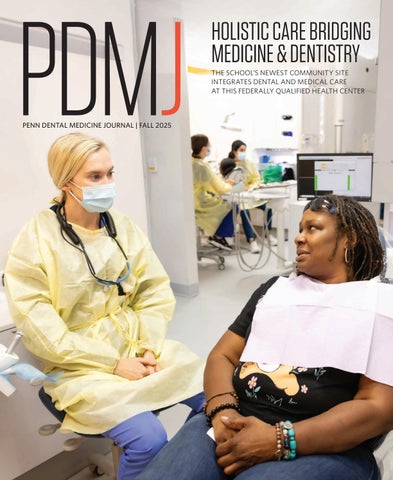
HOLISTIC CARE BRIDGING MEDICINE & DENTISTRY THE SCHOOL'S NEWEST COMMUNITY SITE INTEGRATES DENTAL AND MEDICAL CARE AT THIS FEDERALLY QUALIFIED HEALTH CENTER
FROM THE DEAN
Recognizing Milestones With each academic year, it is always rewarding to watch a new class of students mark the milestone of becoming part of the Penn Dental Medicine community, and once again, we welcomed a stellar group of students to both our DMD and advanced graduate dental education programs. This academic year, the entire Penn Dental Medicine community is also recognizing another special milestone as the School’s Department of Periodontics celebrates its 70th Anniversary (see page 14). Under the founding leadership of Drs. D. Walter Cohen and Morton Amsterdam, Penn indeed has a rich history of accomplishment in periodontics and periodontal prosthesis that continues to grow and develop through the ongoing commitment of alumni and faculty (see page 16). And with this academic year, our second cohort of dual-board eligible periodontalprosthodontics residents is underway. In January, we will mark two years of operation for our newest community care center — Penn Dental Medicine at PHMC on Cedar. Part of the PHMC Public Health Campus on Cedar, this federally qualified health center in West Philadelphia integrates dental and medical care, supporting improved health outcomes for patients and providing immersive coordinated-care experiences for our students, integrating with the health professionals at the Campus, and actively reducing emergency room utilization among the population (see page 10).
In the realm of research, while the uncertain landscape of federal funding is having a profound impact on investigations here and nationwide, our research enterprise continues to thrive. Under the leadership of Dr. Modupe Coker, who joined Penn Dental Medicine last year (see page 20), the Center for Clinical and Translational Research is supporting a growing portfolio of human-subjects research with more than 25 ongoing projects. In this issue, we also spotlight alumni who have chosen to serve the underserved through a career path in public health dentistry. In varied roles, they share the rewards of helping vulnerable communities improve their oral health (see page 32). We are also pleased to acknowledge the many alumni and friends who have supported Penn Dental Medicine this past fiscal year (see page 24). In FY25, 1,251 donors made a gift to a Penn Dental Medicine fund — thank you for your investment in the School’s mission and the many ways you are helping to propel Penn Dental Medicine forward. Stay well and stay connected.
Mark S. Wolff, DDS, PhD Morton Amsterdam Dean
INSIDE 10
Holistic Care Bridging Medicine & Dentistry The School’s newest community site integrates dental and medical care at this West Philadelphia health center
2 9 14 24
On Campus School News in Brief
31
Research Spotlight Translating Science to Practice
Faculty Perspective Views on Dental Topics & Trends Department of Periodontics Turns 70 Marking this Special Milestone Alumni Giving & Engagement Celebrating Philanthropic Impact & Engagement in 2024–2025
ON THE COVER: Penn Dental Medicine at PHMC on Cedar, the School’s newest community site, opened in January 2024 as part of the PHMC Public Health Campus on Cedar, located at 54th Street and Cedar Avenue at what was formerly the Mercy Hospital Building.
20
Advancing Clinical & Translational Research Modupe Coker, BDS, MPH, PhD, is analyzing the oral microbiomes of people living with HIV
32
Serving the Underserved
Penn Dental Medicine Alumni Choose a Path in Public Health
36 40 41 43
Alumni Highlights Profiles, Gatherings & Engagement
PENN DENTAL MEDICINE JOURNAL: Vol. 22, No. 1 University of Pennsylvania School of Dental Medicine www.dental.upenn.edu
Student Perspective Views on the Educational Experience
Dean: Mark S. Wolff, DDS, PhD Vice Dean of Marketing & Communications: Elizabeth Ketterlinus Associate Dean for Development & Strategic Initiatives: Maren Gaughan Director, Publications: Beth Adams Contributing Writers: Beth Adams, Judy Hill, Laura Dattaro, Debbie Goldberg Photography: Lisa Godfrey, Mark Garvin, Eddy Marenco, Eric Sucar Office of Institutional Advancement: 215-898-8951
44
Calendar Upcoming Events & Programs
Class Notes News from Fellow Alumni In Memoriam Remembering Members of the Penn Dental Medicine Community
Penn Dental Medicine Journal is published twice a year by the Office of Communications for the alumni and friends of the University of Pennsylvania School of Dental Medicine. ©2025 by the Trustees of the University of Pennsylvania. All rights reserved. The views expressed in this publication are not necessarily those of Penn Dental Medicine. We would like to get your feedback — address all correspondence to: Beth Adams, Director of Publications, Robert Schattner Center, University of Pennsylvania School of Dental Medicine, 240 South 40th Street, Philadelphia, PA 19104–6030, adamsnb@upenn.edu.
PHOTO: Eddy Marenco
PENN DENTAL MEDICINE JOURNAL | FALL 2025 1
ONCAMPUS
By the Numbers:
SCHOOL NEWS IN BRIEF
Recent Grads, Incoming Students DMD Class of 2025
198
DMD GRADUATES IN THE CLASS OF 2025, INCLUDING 150 WOMEN AND 48 MEN
Penn Dental Joins COP30 Climate Action Discussion Penn Dental Medicine’s Center for Integrative Global Oral Health (CIGOH) is presenting its 4th Global Oral Health & Climate Action Conference in conjunction with the 30th United Nations Conference of the Parties (COP30), being held in Belém, Brazil, Nov. 10–21, 2025. COP is an annual global meeting where world leaders, scientists, non-governmental organizations, and civil society leaders gather to discuss actions to tackle climate change. The CIGOH Conference is a livestream program with international participants. CIGOH has established its multi-year Global Oral Health and Climate Action Conference to promote and contribute to a consistent and coherent approach to addressing complex climate global challenges and help advance the discussion on how the dental community can build a climate-smart and resilient service and practice model in partnership with government, business, and society.
2 WWW.DENTAL.UPENN.EDU
The Global Oral Health and Climate Action Conference program has two components — a transdisciplinary program and a global oral health program with focused attention on themes and issues specific to oral health and dentistry. “The aim is to showcase innovation in sustainable dentistry, strengthen opportunities for oral health diplomacy and crosssectoral collaboration, and advance the integration and mainstreaming of oral health in and across global health and sustainability agendas,” says Dr. Julian Fisher, Director of Oral and Planetary Health Policies within CIGOH. “We hope to create new opportunities and partnerships and ensure that the dental community actively participates in planetary and human health decision-making at a global level.” Learn about the full program and register to attend virtually at www.dental.upenn.edu/ COP30.
112 students graduated with honors and 11 with dual degrees (5 Master in Law, 2 Master of Bioethics, 2 Master of Public Health, 1 Master of Science in Nutrition Science, 1 Master of Science in Engineering) 78 pursuing postdoctoral study in a dental specialty 64 entering dental practice 41 entering a general dentistry residency or an advanced education in general dentistry program 22 National Health Service Corps scholars 15 entering the military 50 Program for Advanced-Standing Students (foreign-trained dentists earning their DMD to practice in the U.S.), representing 15 countries
DMD Class of 2029
178
DMD STUDENTS IN THE CLASS OF 2029, INCLUDING 126 WOMEN AND 52 MEN 31 states, U.S territories, and Canadian provinces represented 29 languages spoken 3.82 average science GPA 23.49 DAT academic average 3.85 overall average GPA 2,999 applicants
“This meeting marks the start of a process intended to develop excellence in educational and research programs throughout Africa in order to establish innovative methods for improving oral health.” — DR. MARK WOLFF
Penn Dental Medicine Takes Part in Work to Advance Dental Education in Africa Penn Dental Medicine joined with deans, program directors, faculty, and Ministers from across Africa for the inaugural African Dental Education Symposium that culminated in the launch of the African Education Dental Association (AEDA), the continent’s first collaborative association committed to advancing dental education. The symposium took place July 11-12 at the Université Mohammed VI des Sciences de la Santé (UM6SS) in Casablanca, Morocco. Penn Dental Medicine was one of the institutional partners for the event with Penn Dental Medicine’s Morton Amsterdam Dean, Dr. Mark Wolff, and Dr. Michael Glick, Executive Director of the School’s Center for Integrative Global Oral Health (CIGOH), among the symposium speakers. Dean Wolff was part of a panel discussion that focused on dental curriculum in Africa, addressing standards, fundamental principles, preclinical and clinical instruction, and the role and importance of simulation centers in dental education.
“The wide range of educational and oral health needs across Africa requires new approaches to education and dedicated efforts to identify potential shared solutions,” says Dean Wolff. “This meeting marks the start of a process intended to develop excellence in educational and research programs throughout Africa in order to establish innovative methods for improving oral health.” Dr. Glick presented on evidence-informed practice guidelines and CIGOH’s collaboration with the American Dental Association (ADA) on the ADA Living Guideline Program. “It is rewarding to see educators from throughout Africa come together again to explore how to advance oral health,” says Dr. Glick. “This type of collaboration is what we are working to support within CIGOH and builds on what we saw at our Nairobi conference in 2023.” In November 2023, CIGOH partnered on a conference with the World Health Organization (WHO) Regional Office for Africa and the University of Nairobi
to bring together oral health leaders and experts from different African nations to discuss the oral health needs of the populations across their respective countries. This recent symposium under the theme “Unity and Collaboration for Dental Education in Africa” addressed current challenges related to dental science curricula, governance, and the promotion of educational human resources. “The creation of the AEDA will play a key role in bringing African nations together to support the exchange of dental education resources, while also advocating for improved dental health systems.” adds Dean Wolff. “We are pleased to lend our support to these efforts.” Representatives from the FDI World Dental Federation, American Dental Education Association, and Association for Dental Education in Europe also participated in the symposium, offering their guidance and support for African-led solutions. Mercy Ships was the official organizing partner of the gathering, noting its commitment to strengthening healthcare systems by equipping professionals to serve their own communities. ABOVE: Dr. Michael Glick, Executive Director of the School’s Center for Integrative Global Oral Health, presented on the development of evidence-informed practice guidelines.
PENN DENTAL MEDICINE JOURNAL | FALL 2025 3
ONCAMPUS STUDENT PROFILE: SHREYA SHAH (D’25, GD’27)
“My experience here has been phenomenal. I truly believe I would not be where I am today without the mentorship and guidance I received.” — DR. SHREYA SHAH (D’25, GD’27)
Hearing Loss Proved No Match for this Student’s Orthodontic Ambitions To help support her success at Penn Dental Medicine, a team of faculty and staff developed a coordinated plan to accommodate her needs and create a supportive learning environment. Shreya Shah’s dreams of becoming a dentist began young. Like many with such aspirations, she was inspired by positive childhood experiences of going to the dentist. But Dr. Shah (D’25, GD’27) was also motivated by something more specific — the desire to communicate better. Diagnosed with severe hearing loss at the age of three, Dr. Shah underwent intensive speech therapy where she learned to focus on people’s lips and teeth to see how sounds were formed and understand what people were saying. She noticed that people who were confident about the way their smile looked enunciated more clearly, which made it easier for her to lipread. Her desire to be a dentist sprang, she says, “from wanting to help create healthy smiles, so that I could understand more people around me.” Dr. Shah chose Penn for dental school — after attending UNC Chapel Hill for undergrad — in part because of the diverse populations she knew she would get to treat through the school’s community rotations and the Care Center for Persons with Disabilities. Moving
4 WWW.DENTAL.UPENN.EDU
to Philly also seemed like a good way for the Atlanta native to move out of her comfort zone and meet people with different backgrounds and perspectives. “My experience here has been phenomenal,” says Dr. Shah, who recently began her postgraduate training in orthodontics at the School. “I truly believe I would not be where I am today without the mentorship and guidance I received.” Dr. Shah was the only deaf/hard of hearing student in her class when she arrived at Penn, and her challenges were compounded by the COVID pandemic. In her first year of dental school, masking was required in all lectures and labs, which was problematic since she relied heavily on visual aids and lipreading to learn.
“We wanted to make sure that we had everything on site for her ready to go when she walked in,” says Vice Dean for Academics Dr. Faizan Alawi, who met with Dr. Shah the summer before she started the program to better understand her needs. Separately, Dean Mark Wolff also met with Dr. Shah. Dean Wolff and Dr. Alawi then coordinated a plan of action with a team that included leadership from the School’s Offices of Academic Affairs, Student Affairs and Clinical Affairs, the Department of Preventive and Restorative Sciences, Information Technology, the Center for Educational Technology and Innovation, and Student Disability Services at the University of Pennsylvania Weingarten Learning Center. “One of the first things we did,” says Dr. Alawi, “was to have all of our pre-existing lectures that were going to be reused in the curriculum transcribed.” With the use of a third-party real-time transcription service, Dr. Shah was also able to have access to live lectures as they were happening. In the preclinical lab, she was assigned to a seat at the front of the room right next to the faculty member who was demonstrating what the students had to do in the lab. She also wore her own device to amplify the sound. Clinic faculty also sometimes wore clear masks so that she could lipread them more easily as they provided feedback and instruction. Once COVID restrictions eased up in her third year, says Dr. Shah, “my professors pulled down their masks [the clear masks tended to fog up] to talk to me and understood the need to make eye contact with me, which made clinic a much easier environment to learn in.”
Sometimes, says Dr. Shah, professors would stay behind with her after lab ended, when there was less background noise, to explain concepts to her. She would also ask her fellow students to write down what they were talking about or asking her through the Notes app on her iPhone. “I still look back at these notes sometimes and feel dental school nostalgia!” she says. “In both lecture and lab settings, she did wonderfully well,” says Dr. Alawi. “She’s just a high-achieving student, and with these accommodations, she really excelled.” Every hard of hearing student learns differently and has a unique experience with their disability, says Dr. Shah, so reaching out to students early and establishing a connection with them, as Dr. Alawi did, is critical for understanding their personal needs and how they can succeed. When treating patients, Dr. Shah uses the same methods as her peers who are not hard of hearing — establishing rapport, asking questions, remembering personal details about them — and she communicates with them through lipreading and direct eye contact. Being deaf, she says, means she is more visually oriented, and some of her patients have told her that her use of direct eye contact has made them feel they have a provider that really listens and sees them as a whole person. Dr. Shah’s advice for dentists treating patients who are hard of hearing or deaf: “I recommend getting to know your patient as a person and being open minded in how you approach and implement dental treatment plans. Asking patients how you can make their dental experience in the chair easier for them goes a long way in showing you care about them.” For some patients, having written (rather than verbal) oral hygiene instructions is helpful, and using a text/video chat feature instead of a call can assist in scheduling appointments. Engaging an outside service that provides sign language interpretation may further enhance accessibility. As she begins her postdoctoral training in orthodontics, Dr. Shah is particularly interested in craniofacial orthodontics, which deals with complex skeletal and genetic disorders. “Many of these individuals also present with hearing loss and go through intensive speech therapy like I did,” she says. “I’d love to be able to be a part of helping this population.” — By Judy Hill
Dr. Yu Zhang Professor, Dept. of Preventive & Restorative Sciences
Dr. Yu Zhang Advancing Dental Materials Research Penn Dental Medicine’s Dr. Yu Zhang, Professor in the Department of Preventive & Restorative Sciences and Director of Restorative Research, has been recognized for his leadership in advancing the field of dental materials as the 2025 recipient of the International Association for Dental Research (IADR) Distinguished Scientist Wilmer Souder Award. The IADR Wilmer Souder Award recognizes excellence in the field of dental materials research among those scientists who, through research in this field, bring about outstanding advances in dental health. Established and supported by an endowment provided by IADR’s Dental Materials Group, the award is intended to confer the highest honor in the field of dental materials research and is one of the 17 IADR Distinguished Scientist Awards. Applying a background in physics and material science, Dr. Zhang is a highly respected researcher in the area of dental ceramics, with a focus on zirconia. His work has involved tailoring the composition and microstructure of zirconia, using a gradient approach to combine it with porcelain to make it more esthetic and improve cement bonding and durability. Applying the same gradient approach to calcium phosphate glass and zirconia, Dr. Zhang has also produced a strong material that promotes bone integration while repelling microbes. In addition, he is working on developing new protocols for ductile machining and ultrafast sintering of ceramics.
PENN DENTAL MEDICINE JOURNAL | FALL 2025 5
ONCAMPUS
CDE Spotlight: Medical/Dental Healthcare Collaboration In collaboration with the National Coalition of Dentists for Health Equity (NCDHE), Penn Dental Medicine is hosting a series that brings visionary leaders together to explore the importance of integrating oral health into whole health policy and practice. This four-part, Zoom-webinar series covers the wide-reaching implications of the current changes to the nation’s health system and highlights a critical path forward for oral health through medical-dental healthcare collaboration. Registration is free for the entire series with Penn Dental Medicine awarding attendees 1.5 continuing dental education lecture credits for each program. All sessions will be available through Penn Dental Medicine’s CDE Portal (https://cde.dental.upenn.edu) for viewing online after the livestream. The series includes: “Oral Health in Transition: Charting a Collaborative Path Forward” (presented live Sept. 10, among the panelists was the President of the American Dental Association, Brett Kessler, DDS, who played a key role in establishing Colorado’s adult Medicaid dental benefit); “Integration at the Clinical Level” (presented live Oct. 15); “Integration at the Community Level,” (live webinar Nov. 19, 6–7:30 pm EST); and “Call to Action – Policy and Advocacy,” (live webinar Dec. 10, 6–7:30 pm EST). View all and register at https://cde.dental.upenn.edu.
6 WWW.DENTAL.UPENN.EDU
Dr. Flavia Teles Recognized for Periodontal Research Dr. Flavia Teles, Professor in the Department of Basic & Translational Sciences, has been recognized for her periodontal research with two awards — the 2025 IADR/IAP Ricardo Teles Clinical Research Award and the American Academy of Periodontology (AAP) 2025 Clinical Research Award. Presented annually by the International Association for Dental Research (IADR) Periodontal Research Group, the Ricardo Teles Clinical Research Award recognizes Dr. Flavia Teles investigators who have made innovative and significant contributions in onset, progression, and treatment of periodontal diseases. The AAP Clinical Research Award recognizes the most outstanding published work each year that offers direct clinical relevance in periodontics, presenting innovative insights that can be readily applied by practitioners in the evaluation and management of periodontal diseases. Dr. Teles was recognized as lead author for the paper, Salivary and serum inflammatory biomarkers during periodontitis progression and after treatment. J Clin Periodontol. Teles FRF, Chandrasekaran G, Martin L, et al. 2024 Dec;51(12):1619-1631. Dr. Teles leads a world-class research program focused on the oral microbiome, particularly the discovery and characterization of previously uncultivated periodontal pathogens. Utilizing cutting-edge cultivation and molecular techniques, her lab aims to identify hidden members of oral biofilms. The study of these new bacterial species may lead to the discovery of new compounds and metabolic pathways, which can foster the development of better strategies for prevention and treatment of periodontal diseases as well as other oral conditions. Her program also explores salivary markers of periodontitis progression and response to treatment, aiming to enable personalized, at-home monitoring of gum diseases. She is also working on a project that will harness AI-based approaches to integrate and analyze genetic, immunological, and clinical data along with demographic information to build models that predict the likely course of periodontitis in an individual. Her multidisciplinary program is redefining oral health through the convergence of microbiology, immunology, informatics, and clinical innovation — promising earlier detection, personalized treatment, and improved outcomes for patients worldwide.
Dr. Kelly Jordan-Sciutto Named Vice Provost for Graduate Education Penn Dental Medicine’s Dr. Kelly Jordan-Sciutto, Professor in the Department of Oral Medicine and Associate Dean for Organizational Effectiveness, has been appointed to a new leadership role within the University of Pennsylvania, named Vice Provost for Graduate Education. Her appointment, effective July 1, 2025, highlights the integration of Penn Dental Medicine within the fabric of the University's educational and scholarly initiatives. This was one of two new vice Dr. Kelly Jordan-Sciutto provosts named at the University — the other being a Vice Provost for Undergraduate Education (Russell J. Composto, Professor at Penn Engineering). These two new positions will assume many of the previous administrative and oversight roles of the Deputy Provost and the Vice Provost for Education. “By creating these expanded new faculty leadership roles, dedicated separately to graduate and undergraduate education, we aim to recognize and address the specialized needs of our different groups of students,” said Penn Provost John L. Jackson Jr. when making the announcement. Among her many roles, Dr. Jordan-Sciutto served as Chair of Penn Dental Medicine’s Department of Pathology from 2011 through 2019 and Vice Chair of the Department of Basic & Translational Sciences from 2019 through 2022. Since 2017, she has also served as Associate Dean for Graduate Education and Director of Biomedical Graduate Studies in the Perelman School of Medicine. In addition, she has been Chair of the Faculty Senate Committee on Students and Educational Policy and part of both the Provost’s Leadership Academy and Penn Fellows Program, which provide leadership training to select Penn faculty members. She also participated in the Management Development Program of the Harvard Institutes for Higher Education. Dr. Jordan-Sciutto remains an active member of the Penn Dental Medicine Department of Oral Medicine, where her research focuses on the cellular and molecular responses to inflammation in the brain, especially how these mechanisms can be used therapeutically to advance new treatments for preventing cognitive changes in people with HIV, Alzheimer’s disease, and Parkinson’s disease.
Living Guidelines to Advance EvidenceInformed Care
A pioneering collaboration between Penn Dental Medicine’s Center for Integrative Global Oral Health and the American Dental Association (ADA) launched the ADA Living Guideline program earlier this year, the first and only known living clinical practice guideline program dedicated to oral health. The goal of the program is to provide dentists and other healthcare professionals continually updated, evidence-informed guidelines to help guide care and improve health outcomes. One of the first projects, currently underway, is to update a guideline on the early detection of potentially malignant disorders and oral cancer, last published in 2017. The recommendations are expected to be released later this year. In the meantime, to preview the visual and interactive format that will be used in the guideline program, the team brought its 2024 Adult and Adolescent Acute Pain Guideline into the new format, available at ADA.org/livingguideline. Living guidelines are free and open access for everyone.
PENN DENTAL MEDICINE JOURNAL | FALL 2025 7
ONCAMPUS “Carnival of the Senses” Welcomes Autism Community
Alumni Encouraged to Join Find a Penn Dentist Penn Dental Medicine launched “Find a Penn Dentist” in response to calls from the public who were interested in getting their dental care from a Penn Dental Medicine graduate. Currently, 1,449 alumni have added their practices to this web-based directory, which allows visitors to the Penn Dental Medicine website to search by city and state or zip code to find a Penn dentist in their area. Searches can also be done by dental specialty. All Penn Dental Medicine alumni are invited to list their practice information on Find a Penn Dentist. To sign up, contact the Office of Institutional Advancement at 215-898-8951 or complete a form online at www.dental.upenn.edu/enrollFAPD. Practices are added within one week of enrollment.
Add your practice >
RIGHT: Penn Dental Medicine students welcomed individuals with autism with one of the activities a toothpaste tasting with over 25 flavors.
8 WWW.DENTAL.UPENN.EDU
Penn Dental Medicine hosted the Carnival of the Senses, a vibrant health fair dedicated to individuals with autism and their families. Held September 27, 2025, the event welcomed families into a thoughtfully designed environment that celebrated sensory-friendly engagement and hands-on oral health education presented by Penn Dental Medicine students and faculty. With support from the Eagles Autism Foundation, the fair featured a variety of interactive stations, including toothpaste tasting with over 25 unique flavors, games and activities, tours of Penn Dental Medicine’s Personalized Care Suite, and sensory-friendly food options. Attendees also benefited from educational materials and live demonstrations, all designed to promote better understanding and practices around oral health in a welcoming environment. The event drew families from across the region, fostering community connections and highlighting Penn Dental Medicine’s commitment to accessible, compassionate care for the neurodiverse population.
FACULTYPERSPECTIVE VIEWS ON DENTAL TOPICS & TRENDS
Managing Peri-Implant Diseases: Risk, Prevention, and Patient Selection Contributed by Dr. Joseph Fiorellini, Professor, Dept. of Periodontics; Dr. Hector Sarmiento, Clinical Associate Professor of Periodontics; and Dr. Sean Mojaver, Adjunct Assistant Professor of Periodontics Dental implants have become a cornerstone of modern restorative dentistry, offering patients highly predictable function and esthetics. The dental implant market value is estimated to be $5.7 Billion by 20271. Alarmingly, the value of the peri-implantitis treatment market will be $1.3 Billion2. Despite the success of dental implants, there is a rising awareness of complications. Peri-implant diseases, such as mucositis and peri-implantitis, are now among the most pressing issues clinicians face in longterm implant care. As more patients receive implants, understanding how to prevent and manage these conditions has never been more important. Peri-implant mucositis is an inflammatory lesion confined to the soft tissues surrounding an implant. It presents with redness, swelling, and bleeding on probing, but without bone loss. If left untreated, mucositis can progress to peri-implantitis, a destructive condition involving both soft-tissue inflammation and progressive loss of supporting bone. Unlike periodontitis, peri-implantitis often shows a more aggressive trajectory, with crater-like bone defects that compromise implant survival. Prevalence estimates vary, but studies consistently show that mucositis affects nearly half of implant patients, and peri-implantitis occurs in about 15–25%. Peri-implant disease is multifactorial. Patient-related risks include a history of periodontitis, smoking, diabetes, and 1
inadequate plaque control. A patient’s periodontal history is one of the strongest predictors of implant complications. On the restorative side, excess cement, poor prosthetic contours, and malpositioned implants increase plaque retention and compromise cleanability. Implant surface roughness, once considered a biological advantage, may also contribute to biofilm persistence when exposed. Equally important are behavioral and systemic factors — patients who do not return for maintenance or struggle with oral hygiene inevitably face greater risk. The foundation of peri-implant care is prevention. Every implant case should begin with a risk assessment, and patient-specific modifications should be made before surgery, such as smoking cessation, improved glycemic control, or adjustments to prosthetic design. Once an implant is restored, early diagnosis is key. Peri-implant mucositis can usually be reversed with non-surgical therapy, patient re-education, and risk modification. When peri-implantitis develops, however, management becomes more complex. Non-surgical debridement may reduce inflammation but rarely eliminates disease progression. Surgical access is often required to achieve decontamination for regenerative outcomes. Techniques such as implantoplasty, use of lasers or bone substitutes with application of biologics can improve clinical results, but evidence remains mixed.
One of the most significant advances in recent years is the concept of supportive peri-implant therapy (SPiT). Similar to supportive periodontal therapy, SPiT provides structured maintenance protocols tailored to implant patients, emphasizing routine monitoring, professional debridement, and reinforcement of oral hygiene. Evidence shows that consistent supportive therapy markedly reduces the risk of peri-implantitis, even in susceptible individuals. Ultimately, the best way to manage peri-implant disease is to minimize its occurrence. Careful patient selection remains critical since implants are not for everyone, particularly those unable or unwilling to maintain long-term care. Patients must be educated that implant therapy is not a one-time event, but a lifelong commitment. As clinicians, we have powerful tools to replace teeth predictably, but long-term success depends less on the implant itself than on choosing the right patient, designing restorations that facilitate hygiene, and ensuring regular maintenance. With thoughtful prevention, supportive care, and timely intervention, we can manage peri-implant disease effectively and safeguard the predictability of implant therapy for the future.
https://www.fortunebusinessinsights.com/industryreports/dental-implants-market-100443. https://www.grandviewresearch.com/industry-analysis/periimplantitis
2
PENN DENTAL MEDICINE JOURNAL | FALL 2025 9
“Integrating dental care within a collaborative-care center, such as Cedar, where patients have access to comprehensive healthcare services, supports improved health outcomes.” — DR. MARK S. WOLFF
10 WWW.DENTAL.UPENN.EDU
HOLISTIC CARE BRIDGING MEDICINE & DENTISTRY
THE SCHOOL’S NEWEST COMMUNITY SITE — PENN DENTAL MEDICINE AT PHMC ON CEDAR — INTEGRATES DENTAL AND MEDICAL CARE AT THIS WEST PHILADELPHIA FEDERALLY QUALIFIED HEALTH CENTER WHEN SHIVANI IYER (D’26), a fourth-year student at Penn Dental Medicine, examined a patient’s blood pressure this spring as part of a routine exam, she assessed that it was, she says, “through the roof.” Typically, she would refer them to their primary care provider. At Penn Dental Medicine at PHMC on Cedar, she walked them upstairs. “I think a lot of times you can say something to a patient, and then it doesn’t end up happening because there are so many things that slip through the cracks for various reasons, or determinants that are preventing that patient from getting the care they need,” says Iyer. “So being able to actually take a patient for medical evaluation when they need it [is so helpful].” This system of dental-medical integration is by design. Penn Dental on Cedar — the School’s newest community care site that opened for patient care in January 2024 — is part of the PHMC Public Health Campus on Cedar, located at 54th Street and Cedar Avenue at what was formerly the Mercy Hospital Building. The Campus also includes the PHMC Health Center on Cedar, a federally qualified health center and HUP (Hospital of the University of Pennsylvania) Cedar, which provides emergency, inpatient,
and behavioral health services. Additionally, Children’s Hospital of Philadelphia offers a crisis response center for pediatric mental and behavioral emergencies. Penn Dental on Cedar features 11 stateof-the art dental operatories, and in 2024, its first year in operation, there were 2,348 patient visits and nearly 8,350 dental procedures completed at the site. “Maintaining optimal oral health is essential to overall well-being,” says Penn Dental Medicine’s Morton Amsterdam Dean, Dr. Mark S. Wolff. “Integrating dental care within a collaborative-care center, such as Cedar, where patients have access to comprehensive healthcare services, supports improved health outcomes.” At its core, the Cedar care center serves as a bridge between Penn Dental Medicine and the West and Southwest Philadelphia community — and also between types of care.
OPPOSITE: Penn Dental on Cedar features 11 state-ofthe-art operatories. In 2024, the first year of operation, there were 2,348 patient visits. ABOVE: Dr. Cassandra Gafford (D’13), Director of the Community Oral Health Clinics at Penn Dental Medicine (right) and Dr. Kari Hexem (D’15), Assistant Professor of Community Oral Health (left). STORY PHOTOS: Eric Sucar
PENN DENTAL MEDICINE JOURNAL | FALL 2025 11
HOLISTICCARE A BRIDGE BETWEEN DENTAL AND MEDICAL While connecting dentistry and medicine for overall healthcare is an integral part of Penn Dental Medicine’s care model, medical-dental integration at the Cedar site is the most holistic of the School’s community programs, being situated on a campus that offers behavioral health services, prenatal and postnatal care, emergency care, and more. And, perhaps most importantly when it comes to supporting “whole” healthcare, the dental and medical electronic health records of Cedar patients are also integrated. “Having that relationship between medical and dental really opens up and encourages the idea that dentistry is part of overall health, and allows for people who might otherwise not have access to a dentist to find dental care here,” says Dr. Cassandra Gafford (D’13), an Assistant Professor of Clinical Community Oral Health and Director of the Community Oral Health Clinics at Penn Dental Medicine, part of the Division of Community Oral Health. Penn Dental at Cedar is staffed with a combination of rotating third- and fourthyear Penn Dental Medicine students, residents in the School’s Advanced Education in General Dentistry program, and Penn Dental Medicine faculty and hygienists. Students and hygienists at Cedar also conduct free, optional screenings on select days of the week as part of physical exams at Cedar. “A lot of people who don’t have regular access to dental care, only go in for ‘episodic’ care — when something is wrong,” says Gafford. “So, to lower that barrier here at Cedar, if during a medical appointment they say, ‘I haven’t seen a dentist in a while,’ they can simply be directed downstairs to our center to make an appointment.” Another benefit of the co-location of medical and dental services is that the upstairs emergency department can redirect patients with dental emergencies to the Penn Dental Medicine care center, freeing up emergency resources. Gafford says this sometimes can happen several times per day. In addition, patients benefit as well given
12 WWW.DENTAL.UPENN.EDU
“Having that relationship between medical and dental really opens up and encourages the idea that dentistry is part of overall health, and allows for people who might otherwise not have access to a dentist to find dental care here.” — DR. CASSANDRA GAFFORD (D’13)
emergency departments do not always have the X-ray equipment to diagnose a dental issue and physicians do not have the level of expertise in oral care that a dentist has. There are also moments like Iyer’s, too, where a patient may present as hypertensive or gum health may indicate signs of diabetes, allowing Penn Dental providers to directly refer to a medical provider upstairs. Since the arrival of Dean Wolff in 2018, Penn Dental Medicine’s community sites have also broadened the level of restorative care and range of treatments provided. Today, most procedures can be conducted directly at Penn Dental on Cedar with more complex cases referred to the dental School for specialty care as needed.
SERVING THE PHILADELPHIA COMMUNITY Shelley Henderson, an Assistant Professor of Clinical Family Medicine and Community Health at Penn Medicine, has served as a provider at PHMC on Cedar since 2022. She’s long been committed to seeing patients in a community health center. “I love my patients, and I love that they can walk from across the street where many of them live,” says Henderson. The collaboration with Penn Dental Medicine, she says, has “changed the game for us,” being able to send patients for an optional dental examination during a visit for a physical. Patients have also been offered examinations while waiting, she says, on occasions when there is a longer than usual wait to be seen by a doctor.
COMMUNITY CARE BY THE NUMBERS Penn Dental Medicine’s five community care programs take comprehensive dental care to the neighborhoods where patients live and work, improving access to care while providing invaluable learning experiences for students. In 2024, there were a total of 9,013 patient visits and 32,511 procedures completed at the community sites, including: 4,810 PROCEDURES, 1,306 PATIENT VISITS AT MERCY LIFE (LIVING INDEPENDENTLY FOR ELDERS), 4508 Chestnut Street, which provides interdisciplinary medical, dental, behavioral and pharmacy services for elders living in West Philadelphia. 5,781 PROCEDURES, 920 VISITS THROUGH PENNSMILES, the School’s oral health outreach program that travels to area schools, Head Start programs, and other neighborhood sites. 8,019 PROCEDURES, 2,103 PATIENT VISITS AT PUENTES DE SALUD, 1700 South Street, which provides medical and dental care, as well as health education and outreach services to the predominantly Latino community. 5,553 PROCEDURES, 2,336 PATIENT VISITS AT MIKEY FAULKNER DENTAL CARE CENTER, Woods Services Langhorne, Pa. campus, which serves children and adults with intellectual and developmental disabilities and acquired brain injuries. 8,348 PROCEDURES, 2,348 PATIENT VISITS AT PENN DENTAL MEDICINE AT PHMC PUBLIC HEALTH CAMPUS ON CEDAR, 54th Street and Cedar Avenue, part of the federally qualified health center serving West and Southwest Philadelphia. To learn more on how to help support Penn Dental Medicine’s community care programs, contact Maren Gaughan, Associate Dean for Development and Strategic Initiatives, at gaughan@upenn.edu or make a gift at www.dental.upenn.edu/community.
“There can be a lot of trauma around dental care. For one reason or another, people can put that off,” says Henderson. “Diabetics with terrible infections, whatever the issue. And so, we try to hold them over until they can get a dental appointment, or follow up, and it’s drastically different to say, ‘Well, I can actually have them take a look at it right now.’” Jackie Cuccurullo (D’26), a fourth-year student at Penn Dental Medicine, came to Penn specifically to have the opportunity to work in community sites like Penn Dental on Cedar, as part of a dental curriculum that requires rotations in Penn Dental Medicine’s community care centers. She’s rotated in and out of Cedar for the past year and says the experience has helped her learn how to make patients who may not have a history with dentists that much more comfortable. “I think being within the community is really helpful for gaining perspective, because not everyone is going to come in and things are stable, where they’ve been coming for regular care,” she says. “One person came in and it was their first dentist appointment ever.”
It’s a contrast, she says, to have Penn Dental Medicine come to the neighborhood, rather than the other way around. “We’re there to serve the community,” says Gafford. “This is one of the ways Penn pursues its goal of being a good citizen and a good neighbor to West Philadelphia.” Gafford adds that care centers like the one at Cedar showcase to students that community dentistry is a viable alternative to private practices. “This is an exciting opportunity for [us] to be part of inspiring students to go out and treat everybody with dignity and respect and understand that this is a real career path,” says Gafford, “a way to do good work in the communities they serve. This is a mission-driven department, clinic, and site.” n — By Brandon K. Baker
OPPOSITE: Care centers like the one at Cedar, a federally qualified health center, showcase to students that community dentistry is a viable alternative to private practices. ABOVE: Penn Dental at Cedar is staffed with a combination of rotating third- and fourth-year DMD students, residents in the School’s Advanced Education in General Dentistry program, and Penn Dental Medicine faculty and hygienists.
PENN DENTAL MEDICINE JOURNAL | FALL 2025 13
DEPARTMENT OF PERIODONTICS TURNS 70 Penn Dental Medicine’s Department of Periodontics turned 70 this year, and throughout the 2025–2026 academic year, the Department is marking this special milestone. It was the pioneering work of Dr. D. Walter Cohen, who joined the faculty in 1951, and Dr. Morton Amsterdam, who joined the faculty in 1953, that led to the establishment of a separate Department of Periodontics in 1955. Together, their work established Penn as a national model for periodontics and periodontal prosthesis, launching decades of storied accomplishment and graduating many leaders in the field. Here we highlight some of the news and events celebrating this platinum anniversary.
A group shot of many of the attendees of the 7th Penn Periodontal Conference, held July 28-31. It drew nearly 180 participants from across the country and around the world.
14 WWW.DENTAL.UPENN.EDU
Penn Periodontal Conference Presents Leading Research in the Field
Upcoming CE Programs
Penn Dental Medicine brought together nearly 180 attendees from across the country and around the world for the 7th Penn Periodontal Conference, providing a forum to exchange the latest science in the field of periodontal research. The Conference, held July 28-31, was also a key event in the Department of Periodontics’ 70th Anniversary celebration.
THE EVOLUTION OF A PARADIGM: THE ROLE OF TEETH…IN THE AGE OF IMPLANTS NOV. 7–8, 2025 (IN-PERSON) The 2-day symposium will focus on presenting classic periodontic and periodontal-prosthesis concepts alongside modern advancements. Topics will include the management of compromised dentitions, interdisciplinary treatment in orthodontics, periodontal influences, the peritooth environment and its impact on restorative dentistry, and the evolving role of implants in modern practice. In addition, we will explore the impact of genetic disorders on dental management, the peri-tooth environment, and emerging technologies like digital aligners. Learn more: www.dental.upenn.edu/paradigm.
Held biennially, Penn Dental Medicine launched the first Penn Periodontal Conference in 2013 to not only bring together leading researchers in their respective fields of study but also to foster the development of junior researchers working with them. That dual focus – scientific excellence and promoting the next generation of scientists – has remained a primary goal of the conference. “We were honored to host nationally and internationally recognized researchers on a wide range of topics,” says Dr. Dana Graves, Vice Dean for Scholarship & Research and Interim Chair of the Department of Periodontics, who was Co-Chair of the conference with Dr. George Hajishengallis, Thomas W. Evans Centennial Professor in the Department of Periodontics. “The high level of science presented was inspiring.” The program speakers represented 21 universities and institutions within the United States, and seven international schools. The four-day scientific program featured presentations that addressed periodontal-related research topics across four key categories: microbiology, inflammation and systemic disease, pathogenesis, and regeneration. In addition, there was a session of junior investigator presentations. The two keynote speakers included John Seykora, MD, PhD, Professor, Departments of Dermatology and Pathology, University of Pennsylvania Perelman School of Medicine, who spoke on “How Analysis of Stratified Squamous Epithelium Informs our Understanding of Cancer and Inflammatory Diseases” and Pamela G. Robey, PhD, Senior Investigator, National Institute of Dental and Craniofacial Research, who presented “Stem Cells for the DOC Complex: What They Are and What They Can Do.” The program was structured to encourage interaction among participants with one afternoon free for networking and a poster presentation session that provided the opportunity for participating researchers to share their work and talk one-on-one with each other. “There were lively discussions and a great exchange of information,” notes Dr. Hajishengallis. “We hope the connections made and research shared will lead to new collaborations.”
DEPT. LECTURE SERIES, SPRING 2025 (WEBINAR) The Department of Periodontics will restart its lecture series in Spring 2025 with lectures on a diversity of topics on techniques and technologies. Watch for programming schedules at www.dental.upenn.edu/cde.
By the Numbers
20,335
PROCEDURES WERE PERFORMED WITHIN THE PERIODONTIC CLINIC IN 2024 WITH 9,140 PATIENT VISITS
PENN DENTAL MEDICINE JOURNAL | FALL 2025 15
PERIODONTICS70TH Investing in the Continued Strength of Penn Periodontics As Penn Dental Medicine’s Department of Periodontics marks its 70 years of leadership in the specialty, it is celebrating its legacy while also looking to the future, with a recent major gift from an alumnus promising to help advance the Department’s continued strength and development. This generous contribution was made by Dr. Hector Sarmiento (GD’14), who earned both a certificate in periodontics and a Master of Science in Oral Biology here in 2014. “This support will have a tremendous impact on the department and our residents, providing renewed energy as we continue to build on a history of excellence while ushering in a new era,” says Dr. Joseph Fiorellini, Director of the Penn Dental Medicine graduate dental education program in periodontics and former Chair of the Department of Periodontics. “Hector’s commitment to the field of periodontics and Penn are inspiring.” Sarmiento’s gift is twofold, establishing The Hector Sarmiento Support Fund and adding to The Hector Sarmiento Resident Award Fund, which he established in 2021 with a previous contribution. The purpose of the Support Fund is to provide financial support to the Department of Periodontics, including but not limited to renovations to the Department's spaces, faculty support, and resident support. The Award Fund will provide an annual award to one graduating resident of the program to give them $10,000 worth of equipment they may need in their first year of practice. In recognition of the gift, the periodontics clinic will be renamed The Sarmiento Center for Periodontics.
16 WWW.DENTAL.UPENN.EDU
DR. HECTOR SARMIENTO (GD’14) Clinical Associate Professor of Periodontics
“Just as others invested in me when I was a resident [as a Coslet Scholar], I feel motivated to do the same so that Penn continues to lead the way in periodontics, producing clinicians who patients can seek out with confidence. — DR. HECTOR SARMIENTO (GD’14)
Sarmiento has been sharing his passion for periodontics with Penn Dental Medicine students as part of the School’s faculty for the past 11 years, currently serving as Clinical Associate Professor of Periodontics. Sarmiento, who lives in Greenwich, Conn., is the lead clinician in New York Periodontics on East 64th Street, a long-established, legacy periodontics practice in New York City, and his research interests include peri-implantitis, sinus complications, and bone biology. We sat down with Sarmiento to learn more about his commitment to giving back to Penn Dental Medicine and to the field of periodontics.
WHY HAVE YOU MADE THIS COMMITMENT TO PENN PERIODONTICS WITH THIS GIFT? For me, giving a donation is not just about funding a project — it’s about inspiring fellow alumni to give back, whether financially or academically. Even a small gesture, like offering a Zoom lecture for residents or spending time in the clinic, has a tremendous impact. These contributions, big or small, help shape the future of our residents and strengthen the sense of community within our department.
IS THERE ANYTHING ELSE YOU’D WANT TO SHARE ABOUT THE PENN PROGRAM?
WHAT DO YOU THINK IS UNIQUE ABOUT PENN PERIODONTICS? I remember ten years ago, during the celebration of our department’s 60th anniversary, I had the privilege of sitting alongside Morton Amsterdam and the faculty members I looked up to then — and still do today. I recall thinking to myself that I wanted to give back to the department in the same way they had through knowledge, support, and friendship. That event was incredibly meaningful, and Penn made me feel like I was an integral part of its legacy. Now, as we celebrate our 70th year, I feel such pride in showcasing what we represent. I am incredibly proud of our residents. Moving forward, I want our department to shine in every way possible — from our residents becoming board certified and demonstrating their depth of knowledge, to patients seeking out Penn-trained periodontists with confidence. It’s about carrying a standard of excellence forward.
WHAT MOTIVATED YOU TO SHARE YOUR SKILLS AND KNOWLEDGE AS A TEACHER? One of my greatest motivations for teaching came from my mentor, Dr. Joe Fiorellini. I’ll never forget when he asked me to give a lecture that was originally his. When I asked him why, he said, ‘Part of being a teacher is making sure your students and residents shine even more than you do.’ Those words have stayed with me and continue to guide my approach. They remind me that our responsibility as educators is not just to teach, but to lift our students higher. That philosophy has fueled my dedication to making our field as special as it can be. I also feel deeply motivated to support the department financially, just as others did for me during my residency. I was honored to be a Coslet Scholar and I know firsthand how much it meant to
receive that support. Today, I feel it is both my duty and privilege to give back — whether through teaching, mentorship, or financial contributions — so that future residents can have the same opportunities to thrive.
WHY DID YOU CHOOSE TO PURSUE THE SPECIALTY OF PERIODONTICS? I was motivated by the finesse of the specialty. When practiced correctly, periodontics is like being the plastic surgeon of the mouth — you can truly transform a patient’s health and appearance. What excites me most is the opportunity to help patients both systemically and locally, including those with rare diseases where periodontics plays such a critical role. My residency gave me the confidence to work with biologic materials and advanced techniques, providing the tools to approach complex cases with confidence.
Support Penn Perio For more information on how to support the future of the department, please contact Maren Gaughan, Associate Dean for Development and Strategic Initiatives, gaughan@upenn.edu.
Penn periodontics shaped me from day one — it gave me the knowledge, skillset, and confidence to feel comfortable practicing independently from the very start. For that reason, I feel a deep responsibility to give back. I started with teaching residents and as my commitment to the program grew, the Office of Institutional Advancement and the Dean helped me focus that support into meaningful giving. I knew that I wanted to be a part of the future; supporting the program is my way of ensuring that future residents have access to the same level of training and opportunity that I did. Just as others invested in me when I was a resident, I feel motivated to do the same so that Penn continues to lead the way in periodontics, producing clinicians who patients can seek out with confidence.
Penn Perio 70th Anniversary Support Fund — This fund will benefit resident research, travel, new equipment, outside lecturers and a host of other discretionary costs. Joel Frankel Award & Wellness Lecture Series Fund — The award honors a Periodontics resident who exemplifies service and leadership, and The Wellness Series was created by Joel’s family to promote mental health and provide resources for dental professionals.
PENN DENTAL MEDICINE JOURNAL | FALL 2025 17
PERIODONTICS70TH Restoring Smiles, Transforming Lives
Service Program Providing Much-Needed Care to Ectodermal Dysplasia Patients In the 70-year history of Penn Dental Medicine’s Department of Periodontics, faculty and students have helped countless patients regain their oral health, but for nearly 20 years, they have also taken the lead in restoring smiles, and in turn, changing the lives of a special group of patients with particularly unique dental needs — those living with ectodermal dsyplasias. While there are many different types of ectodermal dysplasias, each caused by specific mutations in certain genes, individuals affected by these inherited disorders often have significant dental challenges — from unpredictable patterns of tooth eruption and poorly-shaped teeth to missing teeth altogether. It was at an implant symposium in 2007 that Dr. Jonathan Korostoff (D'85, GR'91, GD'92), Professor of Periodontics at Penn Dental Medicine, saw a presentation on the disorder by Mary Fete, now Executive Director of the National Foundation for Ectodermal Dysplasias (NFED), which included a video of patients describing how dramatically dental work has changed their lives. “I was so taken by what she shared with us,” says Korostoff. “It touched the core of what we as dentists are supposed to be doing — enhancing people’s lives.” Shortly after that introduction to the disorder and the work of NFED, Korostoff worked with Fete to establish Penn Dental Medicine as a NFED Dental Treatment Center (there are currently 24 such centers nationwide to which NFED refers patients). “Dr. Korostoff took an immediate interest in our community,” says Fete. “I can't thank him and the other Penn Dental Medicine faculty and students enough for
18 WWW.DENTAL.UPENN.EDU
their compassionate care and desire to truly make a difference in the lives of people affected by ectodermal dysplasias.” Korostoff stresses that it is an interdisciplinary team of dedicated faculty volunteering their time to support the program — in particular, Dr. Howard Fraiman (D’91, GD93, GD94), Clinical Associate Professor, Department of Periodontics and Department of Preventive & Restorative Sciences, and Director of
On average, two or three new ectodermal dysplasia cases come to the School each year, ranging from children needing their first set of dentures to adults who require a full-mouth restoration, with complex cases taking two or three years to complete. Patients come from throughout the Northeast and beyond (arrangements were made for a patient from Pakistan, who then couldn’t travel due to recent visa changes). Most patients travel at least two
“Along with this care being transformative for the patients, it's an amazing experience for our residents. They have an opportunity to see how their interdisciplinary training can benefit people that may not normally have access to this type of care.” — DR. HOWARD FRAIMAN (D'91, GD'93, GD'94)
Periodontal-Prosthesis (2017–2024); Dr. Harold Baumgarten (D'77, GD'82), Clinical Professor of Periodontics; and Dr. Dumitru Gogarnoiu (D'89, GD'92), Clinical Professor of Periodontics from the Department of Periodontics, along with Dr. Neeraj Panchal, Assistant Professor of Oral & Maxillofacial Surgery; Michael Bergler, Director of the School’s Center for Virtual Treatment Planning; Dr. Alina O’Brien, Director of the Pediatrics Graduate Dental Education Program; and Dr. Nupur Patel, Chief of the Division of Prosthodontics. Prior to this year, residents in the School’s former Periodontal-Prosthesis program and Pediatrics program worked on these cases with residents in the Prosthodontics and Periodontics graduate dental education programs now involved.
or three hours to come to the School, and through this service program, they only pay for the lab fees associated with prosthetics and the cost of any biologic materials used in surgery. All dental implants for these patients are donated by Straumann USA. “Along with this care being transformative for the patients, it's an amazing experience for our residents,” says Fraiman. “They have an opportunity to see how their interdisciplinary training can benefit people that may not normally have access to this type of care.” Dr. Marianthi Papaioannou (GD’24, D’27), who graduated last year from the Periodontal-Prosthesis program agrees. “I was motivated to get involved in this program because of the unique challenges
1
1A The before and after of two ectodermal dysplasia cases. TOP (1 + 1A): A 22-year-old female with multiple missing teeth and a history of both orthognathic and orthodontic treatment. Following a comprehensive review, the likelihood of achieving predictable outcomes with bone grafting was deemed limited due to inadequate bone volume. Consequently, the treatment plan focused on tooth-supported restorations in both arches.
2 and the profound, life-changing impact of this care for patients,” says Papaioannou. During her residency, she had the opportunity to work on two cases, teaming with a different resident on each. Their patients included a 22-year-old woman and a 30-year-old woman, both of whom she describes as presenting with significant partial anodontia (so very few teeth) and underdeveloped alveolar ridges (a common issue in these patients, for if they are born with few or no teeth the alveolar bone doesn’t develop either). “The cases required an interdisciplinary treatment approach to restore both function and esthetics,” says Papaioannou, noting that both patients underwent comprehensive full-mouth rehabilitation of the maxillary and mandibular arches. “It was
2A an invaluable learning experience — managing complex interdisciplinary treatment planning, gaining exposure to CAD/CAM design, and most importantly, witnessing the transformation in the patients’ confidence and quality of life.” Indeed, the impact on patients’ lives is immeasurable. Doug, who was 22 years old when he was referred by NFED to Penn Dental Medicine in 2018, travelled from Colorado to receive care (his brother also received care here a few years before him). Doug was missing about half of his teeth and shares that his case, completed over a two-year period, required a double sinus lift, bone grafts, and some extractions before receiving six implants and 12 veneers.
BOTTOM (2 + 2A): A 30-year-old female with a history of a few previously placed implants that failed. The treatment plan required extensive bone augmentation, followed by implant placement in both the maxilla and mandible. Definitive treatment consisted of implantsupported restorations.
“Receiving treatment has allowed me to live normally. I’m able to eat confidently in public, smile, and interact with others without thinking twice about my teeth,” he says. “I’m eternally grateful for the team at Penn and NFED for making this happen. It’s been absolutely life changing.” Penn Dental Medicine does accept referrals of patients affected by the disorder by contacting Korostoff at jkorosto@dental.upenn.edu.
SUPPORT THE PROGRAM To learn how to support the ectodermal dysplasia program, contact Maren Gaughan, Associate Dean for Development and Strategic Initiatives, gaughan@upenn.edu.
PENN DENTAL MEDICINE JOURNAL | FALL 2025 19
ADVANCING CLINICAL & TRANSLATIONAL RESEARCH
MODUPE COKER, BDS, MPH, PHD, IS ANALYZING THE ORAL MICROBIOMES OF PEOPLE LIVING WITH HIV, HOPING TO ILLUMINATE HOW BACTERIA IN THE MOUTH AFFECT COGNITION, WHILE ALSO SUPPORTING CLINICAL RESEARCH THROUGHOUT THE SCHOOL AS HEAD OF THE CCTR DR. MODUPE COKER GOT HER FIRST TASTE of the collaborative, interdisciplinary nature of research at Penn before she even arrived for her first official day as Assistant Dean of Clinical and Translational Research and the new director of Penn Dental Medicine’s Center for Clinical and Translational Research (CCTR). At the School’s 2024 Research Day just before the fall semester started, her colleague (Dr. Cagla Espinoza) encouraged her to apply for funding through the Penn Mental Health AIDS Research Center (PMHARC). Coker studied HIV, oral microbes, and cognition, not mental health, but she decided to give it a shot. She was already running a National Institutes of Health (NIH)-funded study comparing oral microbes, neurocognition, and makers of epigenetic age in Nigerian children with and without HIV, called Uncovering the Biological Link between Oral and Mental Health in Adolescents Living with HIV (uBLOoM). She proposed piloting a trial like that in Philadelphia. PMHARC funded her pilot, and Coker is now recruiting Philadelphians for the Interactions between HIV, Oral Microbiome, Epigenetics and Mental/Neurocognitive Impairment (iHOME) study. It’s one of several projects she has added to CCTR’s portfolio in her short time as director, and it’s a perfect
20 WWW.DENTAL.UPENN.EDU
example of Coker’s approach to research: interdisciplinary and using population-level information to improve individuals’ health. “The interdisciplinary part of my work is among the many reasons I take pride in what we do,” says Coker, an Associate Professor in the Department of Basic & Translational Sciences. “It combines infectious disease, mental health, the aging brain, and oral and dental health. Our work is translational in many disciplines and it’s inspiring to see colleagues advancing this field through their own innovative approaches.” Drs. Temitope Omolehinwa, Cagla Espinoza, and Kelly Jordan-Sciutto at Penn Dental Medicine are all conducting HIV-related research.
HIV AND DENTAL HEALTH Coker came to Penn Dental Medicine in August 2024 from the Rutgers University School of Dental Medicine, where she had served as an Assistant Professor of Oral Biology since 2019. A native of Nigeria, she earned her Bachelor of Dental Surgery from the University of Ibadan in 2004. At that time, HIV was spreading rapidly across sub-Saharan Africa, and she saw an opportunity to combine her interest in epidemiologic investigations with an urgent public health challenge. Coker moved to the United States to pursue a Master of Public Health from Johns Hopkins Bloomberg School of Public Health with a focus on Epidemiology and Biostatistics.
After graduating, she worked as a research associate at the University of Maryland Baltimore on a project, funded by the U.S. President’s Emergency Plan for AIDS Relief (PEPFAR), to provide care for people living with HIV in Nigeria. During her fieldwork, she noticed that people living with HIV, even when on treatment (antiretroviral therapy) had higher rates of dental caries. With encouragement from her mentors (Drs. Man Charurat and William Blattner), she pursued a PhD in Epidemiology at the University of Maryland School of Medicine, focusing on the link between HIV and dental health. It was during her doctoral work that she began the HICOM (HIV Infection and its Association with Caries and the Oral
“The interdisciplinary part of my work is among the many reasons I take pride in what we do. It combines infectious disease, mental health, the aging brain, and oral and dental health. Our work is translational in many disciplines and it’s inspiring to see colleagues advancing this field through their own innovative approaches.” — DR. MODUPE COKER
PENN DENTAL MEDICINE JOURNAL | FALL 2025 21
CLINICAL&TRANSLATIONAL mouth. Sluggish bacterial turnover is also associated with more of the bacteria that cause cavities and caries, Coker reported in a study published in June. “The children in this study are in their adolescence, experiencing a lot of changes in their bodies,” Coker says. “We expect the microbiome to change, so when it doesn’t, that signals impaired adaptability.”
THE ORAL-BRAIN AXIS
“It takes a community to conduct human research. What’s very exciting about having a center at Penn Dental is the spirit of transdisciplinary and interdisciplinary innovation it fosters. This is truly the place to do clinical research, and we are proud to serve as a model for this kind of work.” — DR. MODUPE COKER Microbiome in Nigerian Children aged 6 to 72 months) study. Coker’s advisor (Charurat) was studying differences in growth outcomes between children exposed to HIV in the womb and those never exposed to the virus. Because public health efforts in the United States have largely eradicated mother-to-child transmission of HIV, Coker and Charurat studied children in Nigeria, where — despite large drops in the country’s HIV prevalence rate — about 22,000 newborns contract HIV during their birth every year. This work laid the foundation for subsequent projects, including DOMHaIN (Dental Caries and its Association with Oral Microbiomes and HIV in Young Children–Nigeria) in close collaboration with colleagues. Families enrolled in the initial study were offered the opportunity to continue in follow-up research, resulting in longitudinal datasets now spanning more than a decade.
22 WWW.DENTAL.UPENN.EDU
Many of the children enrolled prenatally or in early childhood are now adolescents, allowing Coker and her team to track oral-systemic health across key developmental transitions. She’s learned a lot about them in the last decade. Children with HIV have different oral microbiomes than those who were prenatally exposed or are uninfected, a difference that’s more pronounced in diseased teeth than in healthy teeth. They also have a distinct oral mycobiome — the fungal community in the mouth — reduced salivary flow, and more developmental defects of the enamel surface. In the children without HIV, the populations of bacteria in the mouth are constantly changing, while those exposed to or living with the disease show more static microbial communities, suggesting they are less able to adapt to changing conditions in the
Coker’s work further opens a window into the connections between oral health and brain health in this vulnerable population. While Coker points out that the oral cavity and brain are developmentally linked, their connection extends beyond embryology. She notes that one of the most prominent pieces of evidence for this connection is a 2013 study finding traces of periodontal disease bacteria in postmortem brain tissue from people who had Alzheimer’s Disease. It's possible that the systemic inflammation caused by HIV can weaken the bloodbrain barrier, Dr. Coker says, enabling oral microbes to wander into the brain and wreak havoc. That means children living with HIV, who have systemic inflammation, could be a key to understanding this link. In collaboration with the uBLOoM study team, which includes Drs. Stephanie Shiau at Rutgers and Jibreel Abubakar Jumare at the University of Maryland, Baltimore, she is investigating whether microbial shifts in the oral cavity correspond to markers of premature aging and cognitive decline. In a cohort of 50 children and adolescents living with HIV, compared with 50 without the virus, she has found that HIV-positive children show genetic markers of accelerated aging in their blood as early as age 11, along with distinct oral microbiomes. Her team is analyzing whether these microbial changes correlate with differences in cognition, potentially offering insight into how oral health affects brain health. It’s troubling to her, then, that the NIH recently requested removal of all foreign subawards collecting new data in Nigeria, in what the administration calls an effort to focus on research benefiting U.S.-based populations.
“It’s really very sad,” Coker says. “When we don’t have the large cohorts and money to follow low-risk people over time, the best thing we can do to study the link between oral health and the brain health in a population where the signal might be loudest.” Still, Coker is undeterred. Through her grant from PHMARC, she is bringing the same research questions to Philadelphia, aiming to recruit adults living with and without HIV. Participants will provide samples, respond to surveys to assess their mental health and lifestyle, and play computerized memory games and puzzles designed to assess cognition — a test they’ll repeat after one year to measure any changes. In 2022, she was awarded a five-year grant of $4.5 million from the NIH to launch the HPV, HIV, and Oral Microbiota Interplay in Nigeria Youth (HOMINY) study, which will use data already collected from the Nigerian cohort to document the course of Human Papilloma Virus (HPV) and the ways HIV alters it, in the hopes of understanding how microbes impact the chance of HPV infection and the cancers it causes. Working with Drs. Osazuwa-Peters at Duke University School of Medicine, Nicolas Schlecht at Eastern New Mexico University - Roswell, and Yana Bromberg at Emory University, Coker ultimately aims to develop and test a deep learning algorithm based on clinical data and microbiome profiles to predict oral HPV persistence.
A PUSH FOR TRANSLATION It's the kind of work that’s right at home at CCTR, which was founded in 2019 with the mission of supporting Penn Dental Medicine researchers — from idea generation to clinical translation — who conduct clinical human-subjects research. Now, Coker oversees a team of 12, including dental clinicians and professionals, clinical research coordinators, data management specialists, and laboratory and research administrative staff, who support more than 25 ongoing projects with approximately $18 million in total funding since the Center’s opening. Through the Center, researchers applied for $36 million in grant funding in the 2025 fiscal year. Since the Center’s founding, 11 multidisciplinary projects have been successfully completed. They span a wide range of clinical and translational research, from pediatric studies such as the Hum Brush smart toothbrush project for autistic children and clinical trials testing cavity-preventing toothpaste in children to behavioral interventions like video-based oral health education in dental clinics, large surveys on oral health and access to care among college students, as well as investigations of oral health outcomes following bariatric surgery, studies exploring pain experiences and management in dental patients, and trials focused on preventing oral mucositis in cancer patients undergoing treatment.
Coker’s job is to support faculty through the process of translating their lab findings into treatments, products, and improvements to clinical practice that directly help patients. That also ultimately protects investment in basic dentistry research, Coker says. “The research we do won’t be relevant in five years if it doesn’t improve the way we take care of patients and prevent disease,” she says. “We cannot be better clinicians and providers if we do not invest in discoveries that improve health.” Nearly all of CCTR’s projects are funded by federal agencies like the NIH, which are now facing major budget cuts and policy changes. To address the challenge, Coker is tirelessly working to secure funding for CCTR itself, allowing the Center to directly support pilot studies and early-stage projects, instead of requiring investigators to first secure external grants — which overwhelmingly come from the NIH. That funding will likely come from industry partners, philanthropic individuals, and private foundations. Looking ahead, she also plans to expand the Center’s staff capacity, which would enable more robust support for clinical faculty who have limited time for research due to their patient care responsibilities. She also sees opportunities to strengthen partnerships with Penn’s School of Medicine, and she plans to build a centralized biobank to store discarded tissue and biospecimens from patients and study participants to accelerate future pilot studies. “It takes a community to conduct human research,” Coker says. “What’s very exciting about having a center at Penn Dental is the spirit of transdisciplinary and interdisciplinary innovation it fosters. This is truly the place to do clinical research, and we are proud to serve as a model for this kind of work.” n — By Laura Dattaro
OPPOSITE: Coker oversees a team of 12 within the CCTR. ABOVE: The CCTR is currently supporting more than 25 ongoing projects.
PENN DENTAL MEDICINE JOURNAL | FALL 2025 23
ALUMNI GIVING & ENGAGEMENT
CELEBRATING PHILANTHROPIC IMPACT & ENGAGEMENT IN 2024–2025 PARTNERS IN PROGRESS The generosity and involvement of our alumni, friends, and partners continue to strengthen Penn Dental Medicine — supporting our students, enhancing patient care, and advancing research across disciplines. Your investment is a powerful affirmation of our mission, and we are deeply grateful for the many ways you help propel the School forward. As we look ahead to the exciting opportunities of the new academic year, we are pleased to share key philanthropic highlights from the 2024–2025 fiscal year, which concluded on June 30, 2025.
$7.33M DOLLARS
committed to programs supporting Penn Dental Medicine’s mission of transforming global oral health and wellbeing through exceptional clinical care, innovation, scholarship, and research
$436,990 DOLLARS
raised for the Penn Dental Medicine Annual Fund which supports the daily operations essential to training the next generation of Proud Penn Dentists
$3M+
DOLLARS
received through planned giving options such as charitable bequests, gift annuities, and charitable giving using an IRA
1,251 117 9
DONORS
made a gift to a Penn Dental Medicine fund
NEW DONORS made their first gift to the School
ALUMNI SCHOLARS
providing support to students of all backgrounds pursuing their dream of a career in dental medicine
71 1,980
BENJAMIN FRANKLIN SOCIETY members recognized for their leadership in unrestricted support, including 9 Young Alumni members
ALUMNI & STUDENTS
participated in a Penn Dental Medicine Institutional Advancement event or continuing education course
Explore ways to support Penn Dental Medicine at www.dental.upenn.edu/giving. 24 WWW.DENTAL.UPENN.EDU
Honor Roll of Classes Penn Dental Medicine is proud to present the 2025 Honor Roll of Classes. Each section includes Dental (DMD/DDS), Graduate Dental, and Dental Hygiene alumni by decade representing outright gifts, pledges, and/or pledge payments to Penn Dental Medicine in the 2025 fiscal year: July 1, 2024 – June 30, 2025. Graduates with multiple degrees from Penn Dental Medicine are listed under the class year of their first dental degree. Charles Curtis Harrison Society * Ben Franklin Society (BFS) + PDM Leadership Volunteer (Board of Advisors, Dean's Council, Alumni Society Executive Board) ^
1930's
The late Clement C. Alpert, C32, D34
1940's
Cynthia White Hamilton, DH47 The late R. Leonard Weinberg, D49, GD54
1950's
The late Edwin S. Sved, D51 Mary Elizabeth Cyr, DH53 Bernard P. Lewis, D53 William A. Billingham, D54 + Joseph P. Falcetti, D54 Marlene Roach Hee, DH55 C. Wendell Lofland, D55 Jack Rubin, C52, D55 Estelle Gampel Cushner, DH56 David C. Dickinson, D56 Lois Greiss Graver, DH56 Myra H. Lehman, DH56 Bartley C. Reuter 3rd, D56 Thomas M. Sagges, D56
Richard M. Cushner, D57 Alan M. Stoneback, D57 Richard S. Altman, D58 Abe M. Finton, D58 The late Aaron M. Hader, D58 Barbara Gaylin Kannee, DH58 Myron I. Schaffer, D58 Charles W. Tager, D58 Richard Y. Cheskis, D59 Elisabeth Mc Clellan Peebles, DH59 Michael Schneider, D59
1960's
James L. Ackerman, D60 Calvin Z. Daks, D60, GD70 James H. Dyen, D60 Arthur Fertman, D60 Irwin I. Getz, D60 Daniel B. Green, D60 Helaine Roos Hazlett, DH60 Hugh C. Howarth, C57, D60 Robert J. Cooperman, D61 Richard M. Dannenbaum, D61, WG83 Harry E. Dolph, D61, GD64 James A. Hazlett, D61 Anastassios T. Koussis, D61 Walter L. Myers, C58, D61 Marjorie Jaffe Sitrin, DH61 Norman A. Whytock, D61
Robert C. Adams, GD62 Gordon B. Groff, D62 Barry W. Langsam, D62 Martin J. Peskin, D62 Mary Burdick Shaw, DH62 Arthur W. Sitrin, D62 David J. Crossley, D63 Henry S. Hammer, D63 Albert S. Mowery, Jr., D63 Jeanne Swallow Mowery, DH63 Richard L. Nyce, C59, D63 I. David Popkin, C59, D63 Betty Brussel Shamas, DH63 Ronald A. Thompson, D63 Emanuel R. Tress, D63 Jeffrey A. Watson, D63 Myron Allukian, Jr., D64 The late Breese M. Dickinson, Jr., GD64 Marshall J. Goldin, C60, D64 Mervin M. Kroop, C61, D64, GD68 Henry A. Miller, C59, D64 James D. Smallwood, D64 Sanford A. Stein, C61, D64 James A. Tatoian, Jr., D64, GD65 Frank R. Besson, D65, GD68 Richard E. Derrick, D65 Thomas A. Giegerich, D65 Robert F. Goulstone-Stone, D65 Abraham J. Kadish, D65 Joseph Kornbleuth, D65 Irvin G. Lubis, D65 Paul J. Markowitz, D65 George B. Marschall, D65 Albert J. Repicci, D65 Glenn D. Ruoss, D65 Howard J. Schare, D65 Theodore A. Souliotis, D65 Kathleen Arkle Borofsky, DH66 Howard Buckwald, D66 Bruce M. Elliott, D66 Neil B. Epstein, D66 Ronald M. Gittess, GD66 Jeffrey H. Harnett, D66 Robert Henner, D66 Myron E. Katz, D66 Samuel E. Molind, D66 + Thomas F. Morgenstern, D66 Donald C. Phillips, D66 Jerold R. Shapiro, GD66 Henry J. Turner, GD66
Philip C. Giarraputo, D67 Veronica Prang Giarraputo, DH67 Michael Russ Glogoff, D67 Robert L. Leff, D67 Walter E. Maust, Jr., D67 Roger H. McConnell, D67, GD71 Charles B. Millstein, GD67 Samuel R. Selzer, D67 Jeffrey B. Shapiro, D67, GD70 Murry A. Awrach, D68 Randall G. Baldwin, D68 Donald G. Bell, Jr., D68 Frederic J. Freidus, D68 Martin S. Greenberg, GD68 Donald M. Humen, D68, GD72 John E. Koyen, D68 Gerald H. Kreinces, D68 + William S. Laubach, D68 James S. McKelvey, D68 Charles Tzagournis, GD68 Dorothy Herrick Washburn, DH68 C. Robert Waters, Jr., D68 Julia A. Carr, DH69 Deborah Lychak Deldotto, DH69 James R. Elder, D69 Arnold I. Galer, D69 John F. Gell, D69 David H. Kornbluth, D69 Robert A. Leigh, D69 Judith Sinanis Nist, DH69 Richard L. Rothstein, D69 Lawton C. Thomas, Jr., C65, D69
1970's
Anonymous (2) Benedict V. Alibrandi, D70 David K. Anderson, D70 + John R. Bartlett, D70 Alan H. Frankel, C67, D70 James R. Granite, C66, D70, GD73 Gail Thompson Hiltunen, DH70 Bernard C. Maloney, Jr., D70 George H. Master, D70, GD73 Michael F. Miller, C67, D70, GD73 Robert E. Nist, D70 Louis F. Rose, GD70 Ivan Stangel, D70 Alvin T. Boyd, D71
PENN DENTAL MEDICINE JOURNAL | FALL 2025 25
ALUMNIGIVING Celebrating 50 Years Carol Ann Scuro (D’75) and W.Bradford Emery (D’72) commemorated their 50th class reunions by Taking a Seat in the William W.M. Cheung Auditorium. Their gift celebrates decades of connection to Penn Dental Medicine and creates a lasting tribute within a space where future generations of students will learn, collaborate, and be inspired.
Robert J. Collins, D71 C. Dwight Decker, D71 James A. Dyer, D71 Jeffrey G. Garber, D71, GR04, FEL75 Joseph E. Gian-Grasso, C67, D71^+ Allan C. Goldfeder, D71 Maria Perno Goldie, DH71 + Sandra T. Greenberg, DH71 Howard B. Grover, D71 Jennie Carcaud Hennigar, D71 Kenneth A. Ingber, D71 ^ + Mark A. Judy, D71 + Michael J. Kish, C67, D71 Edward D. Landau, D71 Arthur J. Lane, GD71 Charles E. Levy, C67, D71 Mary E. McFadden-Agostinelli, DH71 Joel Ross, D71 Michael H. Rutberg, D71 Thomas L. Snyder, D71, WG74 The late Mark Unger, D71 William S. Wray, D71
26 WWW.DENTAL.UPENN.EDU
Theodore M. Camesano, D72 Caryn J. Clayman, DH72 W. B. Emery, D72 Melvin J. Flamenbaum, D72 Robert S. Frankel, D72 Anne Rushmore Gershey, DH72 Joseph R. Greenberg, D72, GD76 Lawrence T. Herman, D72 Howard P. Kessler, D72 Martin D. Levin, D72, GD74 ^ + Richard E. Levitt, C68, D72, GD77 ^ David Levy, D72 Robert B. Martin, D72 Douglas E. Peterson, D72, GD76, GR76 Anthony M. Rossi, D72 Paul A. Scheier, D72 Robert J. Seltzer, D72, GD76 William G. Sloan, D72, GD87 Ronald P. Strauss, D72, GR79 Charles M. Brenner, D73 Richard A. Brogadir, D73 * David Brother, D73
Dennis N. Cohen, D73 * Elliott K. Gutman, D73 Neil S. Hiltunen, D73 Bernard W. Kurek, D73, WMP03, WEV04 ^ + Steven D. Lasser, D73 Vernon Loveless, D73 Vincent J. Mannino, C69, D73 Randolph C. Myerson, D73, GD78 Ralph S. Pfeifer, D73 Robert P. Reiner, D73 Richard L. Rush, D73 Howell I. Strauss, D73 Lance J. Adelson, D74 Harvey J. Barbag, D74 Alan M. Barnett, GD74 * John W. Burk, D74 + Walter I. Chinoy, D74 Ellen Eisenberg, D74 Howard Fluhr, D74 Jaclyn M. Gleber, DH74 Gene J. Goldstein, D74 Carl S. Gulrich, D74 W. Grant Hennigar, Jr., D74 Benjamin P. Iuvone, D74 + Richard M. Kanter, D74 John A. Kerchoff, D74 Allan D. Klenetsky, D74 + Jeffrey C. Laufer, D74 Jeffrey M. Leitner, D74 Arnold J. Mars, D74 Jay M. Neuschatz, D74 Robert I. Orenstein, D74 Charles F. Post, D74, GD75 Edwin W. Slade, Jr., D74 Mark B. Snyder, D74, GD77 Robert M. Sorin, D74 John E. Trapp, D74 Charles C. Wilson, D74 William S. Branting, D75 * Howard J. Bresin, D75 Scott M. Dubowsky, D75 Charlene Jennings Fenster, DH75 ^ Carol Falcone Fetter, DH75 Spencer Z. Forman, D75 Ronald S. Goldenberg, D75 Susan H. Kass, DH75 Melvyn J. Kellner, D75 William O. Knight, GD75 James W. McClellan, D75 Daniel P. Melien, D75
Fedele A. Musso, D75 Alan J. Rogoff, D75 Ruth Schanzer Rosenberg, D75 Louis E. Rossman, D75, GD77 ^ Sally R. Rutkowski-Morgan, DH75 Lisa Solden Schildhorn, DH75 Carol Ann Scuro, D75 Arlene S. Stein, D75 Timothy Tam, D75, GD77 Robin Friedmann Waner, DH75 Jack Weil, D75 Arthur Z. Weiss, D75 John C. Worsley, Jr., D75 Hymie Akst, GD76 Kenneth A. Fetter, C72, D76 John N. Gershey, Jr., D76 Robert J. Golden, D76 Victor Gregor, D76 Gary N. Kitazawa, GD76 Neil L. Moscow, GD76 Stephen D. Pascal, D76 David M. Roshkind, D76, WG76 Steven Alan Schwartz, D76 Walter G. Spigelman, D76 Alexandra A. Baker, D77 Peter R. Barnett, D77, WG79 Edward E. Best, GD77 Robert B. Bookman, C73, D77 Israel Brenner, D77 Richard Krauss, D77, GD79 Walter K. Kulick, D77 Robert N. Lipner, D77 Larry J. Quate, D77, M80 Garry Anthony Rayant, GD77 ^ Robert Resnick, D77 Mitchell A. Smolow, D77 P. Deborah Weisfuse, D77 Alan M. Zaretsky, D77 + Jay R. Augenstein, D78 Sidney Chonowski, D78 Arthur F. Dean, D78 Lawrence M. Erwich, D78 Cary J. Limberakis, C73, D78 Farideh Moattari Madani, GD78, GD80, D84 Mansoor Madani, GD78, GD81, D82 Mahvash Navazesh, GD78, GD80, D83 Larry Pepper, D78 Steven J. Rothenberg, D78 John R. Shaw, D78
Neal S. Slutsky, D78 Donna Lewis Smolow, DH78 Robert M. Solomon, D78 Cheryl Lang Ullman, D78 Patti Lee Werther, D78, GED78, GD81 Andrew B. Casabianca, D79 Jenny C. Chung, GD79 Nancy B. Creed, D79 Gary A. Di Santo-Rose, D79, GD80 Leslie S. Finkelstein, DH79 Hal D. Fruchtman, D79 Bruce H. Godick, D79, GD83 Stephen H. Grossman, D79, GD80 Gary L. Hartz, D79 Michael L. Iczkovitz, GD79 William G. Kelly, D79 Anna Kornbrot, D79, GD82 * Rochelle G. Lindemeyer, GD79 Isaac V. Perle, D79 Saul M. Pressner, D79 ^ Joanne S. Reiffe Fishbane, D79 David Tai-Man Shen, D79, GD81 ^ Leonard C. Taddei, Jr., D79 David A. Tecosky, D79
1980's
Anonymous Pamela L. Alberto, D80 + Joseph Bartoloni, D80 Jay A. Black, D80 Sherrie Allemang Black, D80 James V. Bordoni, D80 Gail Spiegel Cohen, C76, D80 ^ + Angela Collins, D80 Daniel C. Eckhard, D80 James F. Edelstein, D80, G96 Hillel D. Ephros, D80 Richard L. Fiese, D80 George L. Grillon, D80 David S. Hershkowitz, D80 Jeffrey Koslow, D80 Cynthia Keller Marra, DH80 Frederick J. Marra, D80, GD82 Charles M. Riotto, D80 Marian Glynn Royer, D80 Sandra L. Shire, D80
Gary B. Toubman, D80 Ronald W. Zartarian, D80 William W. M. Cheung, D81, GD82 ^ Johnson Chung, D81 Constance M. Killian, D81 Jerome A. Kleponis, D81 Michael R. Kremer, D81 Charles T. Loo, D81 Randolph L. Mitchell, D81 + Ann Nasti, D81 Richard L. Oshrain, D81 Richard J. Phillips, Jr., D81 Gary W. Seldomridge, D81 Susan L. Stern, C77, D81 ^ + John A. Weierbach II, D81, GD82 + J. Craig Alexander II, D82 Rainer H. Bergmann, GD82, D83 Earl D. Childs, D82 Francine Trzeciak Cwyk, D82, GD84 Neal D. Futran, C78, D82 Elizabeth Barry Garrett, DH82 Barbara Franco Hudson, DH82 James D. Hudson, D82 The late Christopher V. Hughes, D82 Francine J. Paladino, D82 Chester J. Palmieri, D82 Mark A. Ruggerio, D82, GD83, GD85 Ann Eshenaur Spolarich, DH82, GED99 + Emil W. Tetzner, D82 Robert H. Turchin, D82 Mark L. Waltzer, D82 Carolyn Izu Bergmann, D83 Scott J. Chanin, D83 + Jeffrey M. Finkelstein, D83 David E. Freilich, D83 Robert C. Garrett, D83 Steven M. Gilson, D83, C84, GD84 Michael G. Hasker, D83 Michael W. Lew, D83 Vanessa A. Morenzi, D83, GD84, GD89 Ira S. Rosen, D83 Walter F. Russo, D83 Gail E. Schupak, D83 ^ + Jane K. Segal, GD83 Francis J. Smithgall, C79, D83 Steven Speroni, D83 Shari Samansky Summers, D83 +
Investing in Pediatric Dental Resident Education Abhinav Sinha (D’05) and family established the Dr. Abhinav N. Sinha Pediatric Dental Medicine Leadership & Excellence Endowed Fund. This fund will provide enduring support to pediatric dental residents at Penn Dental Medicine and will enhance the curriculum by supporting advanced topics in laser surgery and airway health — equipping residents with expertise in critical, emerging areas of pediatric dentistry. Dr. Sinha’s gift underscores his commitment to advancing pediatric dental education and fostering leadership within the specialty.
Michael David Yasner, C79, D83, GD84, GD86 + Valerie Eisenberg Yasner, C79, D83, GD86 Marshall J. Alter, C80, D84 Jerald Blum, D84 Robert A. Brody, C80, D84 ^ + Peter Chin, D84 Mark B. Desrosiers, D84 Egidio A. Farone, D84 ^ Cecile Arlene Feldman-Zohn, C80, D84, GD85, WG85 + Jay S. Fishbein, D84 Joan D. Francis, D84 David A. Goodman, D84 Paula Grant, DH84 James G. Hupp, D84 Wendy Stavrides Hupp, D84 Steven C. Isaacson, D84, GD85 Wayne W. Maibaum, D84 Larry P. Markel, D84 Kathleen S. McAdoo, DH84 John C. Newland, D84 +
Brenda G. Paulen, D84 Michael R. Smith, D84 + Stephen A. Solomon, D84 Robert W. Baker, Jr., D85 Gregory L. French, D85 Rosalia Gallo, D85 Dominick A. Giordano, D85 Steven A. Karmel, D85 Kenneth L. Kobliner, GD85 John F. Lhota, D85 David A. Naegele, D85 Nguyen T. Nguyen, D85 Theresa M. O'Connell, D85 John R. Paquette, D85 Susan S. Plotnick, D85 Stephanie Ravett, D85 Karen Knopf Rosen, C82, D85 Keith F. Silverman, D85 Maria A. Smith, D85 Timothy P. Sweet, D85 Michael Andrew Carol, D86 Paul J. Carpinello, D86 Bruce J. Cutilli, D86, GD92
PENN DENTAL MEDICINE JOURNAL | FALL 2025 27
ALUMNIGIVING Championing Student Success Daniel (D’02) and Shanta (D’03) Richardson have continued their commitment to Penn Dental Medicine with a generous gift to bolster the Alumni Scholars Program and establish the Richardson Student Support Fund. The new fund will provide critical resources to enhance student life, support research and academic pursuits, and meet needs across both DMD and specialty programs. The Richardsons’ generosity reflects their passion for empowering students and enriching the academic experience at Penn Dental Medicine.
Judy DiDonato, D86, GD96 Andrew Michael Halbert, GD86 Emmy Omoto, D86 John W. Rosenlieb, Jr., D86 Erich G. Wunsch, C82, D86 Harry Kenneth Zohn, GD86 + Gregory S. DiRenzo, D87 Albert Smith Harris III, D87 Thomas A. Herberger, GD87 Irena Jug-Weiss, D87 Lloyd Kenneth Klausner, D87 Craig Steven Pate, D87 Richard Allen D'Innocenzo, D88, GD94 Marc Phillip Gimbel, D88 Douglas Scott Harte, D88, GD91 Frederick E. Kane, D88 Thomas Basil Puschak, D88 Paul F. Batastini, GD89, GD91 Gerard A. Begley, D89 Susan M. Chialastri, GD89 Vincent D. Dinick, D89, GD96, RES98 Michael J. Feldman, D89 Richard G. Gray, D89 Alice K. Lau, D89 Thomas P. Sollecito, D89, GD91 Gustavo A. Viggiano, GD89, GD91
28 WWW.DENTAL.UPENN.EDU
1990's
Anonymous (2) Hilary Chung, D90 Salvatore L. Franco, D90 Patrick C. Kline, D90 Lori B. Lubliner-Robinson, D90, GD92 Laura Ann Randolph, D90 Lawrence R. Selinger, GD90 Nipul K. Tanna, D90, GD91, GD10, GD11 Peter Timothy Bliss, D91 Marion Scialabba Brown, D91 Gilberto J. Debelian, GD91 Russell L. Forman, D91 Howard P. Fraiman, D91, GD93, GD94 ^ Jeong-Hwan Kim, D91 + Maria E. Parrella, GD91 Tony L. Skanchy, GD91 Lori Vespia, D91 Michael Glenn Weinberg, D91 Ann Kearney Astolfi, D92 Bruce W. Corbin, D92 Kara G. Fraiman, D92, GD94 + Jonathan A. Keller, D92 Ceceilia Marie McGarvey, D92
Sean Christopher Meehan, D92 Dianne Eileen Nottke, D92 Albani Quintero, D92 Jonathan Michael Richter, GD92 + Vicki Sobieski Schauber, D92 Masooma Saba Zaidi, D92 Paul Luff Boger, D93 Joseph T. Kelly, D93, GD95, GD96 Benjamin A. Maldonado, Jr., D93 Steven S. Oh, C89, D93 Andrew Lawrence Putter, C89, D93 AnnMarie Stefano, D93 Samantha A. Vitagliano, D93 Roger A. Achong, D94 Thomas K. Bachstein, D94 Joy Bockstein Abt, D94 Mi K. Chung, D94, GD97 Daniel C. Harper, D94 Robert S. Kane, GD94 Jose R. Lugay, D94 Wei-Hsin Men, D94 Alan M. Polson, D94 + Manaf Saker, D94 Jun Sun, D94 + Anne Annone, D95 Jill S. Baldinger, D95, GD98 Wendy M. Beratan, D95 Chun-Thai Chung, D95, GD97 + William N. Cummings, D95 Pouya Hatam Ebrahimi, D95, GD98 Richard Y. Liu, D95 + Michael Stephen Marmo, D95, GD98 Tony Saito, D95 ^ Maria-Paz U. Smith, D95, WMP03 Frederick Rodney Cho, GD96 + Chinyelu N. Dibor, D96 Donald Tsung-I Liu, D96, GD99 Yuci Ma, D96 Muralidhar Mupparapu, D96 John Rawa, Jr., D96 Constantine Simos, D96 Maria-Isabel Atique-Rojas, GD97 Patrick T. Cuozzo, GD97 Kevin T. Nii, GD97 John T. Wu, D97 Jeanne M. Badillo, GD98 David Rossi Boschken, D98, GD00 +
Eric J. Brendlinger, GD98 Shiaw-Wei Chang, D98, GD99 Ruby A. Gelman, D98 + Geoffrey M. Glick, D98 Rahul Malik, D98 + Brian A. Suh, D98, GD01 Laurence C. Articolo, GD99, GD02 Matthew J. Baron, D99 Jonathon S. Bowden, D99 Douglas L. Ditty, D99, M02, GD05, RES00 + Caryn Siegel Finley, C95, D99 + Matt Forster, D99, GD04 Wendy M. Halpern, D99, GD02, GD03 Aejaaz A. Issa, D99 + Noelle Ling, D99 Vincent Mongiovi, D99, GD01 + Gregg M. Nagel, D99 Trung D. Tran, D99 Soun L. Wong, D99
2000's
Anonymous (6) Nada M. Afeiche, D00 Alexander T. Kim, D00 Brian Lee, D00, GD04 ^ + Biplab K. Malo, D00 Taiwo Mary Osunkoya, D00 Neha K. Shah, D00 Nathaniel S. Treister, D00 Matthew S. Cantner, D01, GD04 John Chang, D01 Prathima Chawla, D01 M. Alexandre Cho, GD01, GD02 + Lina Frost, D01 Jessica L. Greenberg, C97, D01, GD03 Stephanie H. Nguyen, D01 Afolabi O. Ogunleye, D01 A. Steven Singh, GD01 Alicia K. Wong, D01 Vinamra Bhasin, D02 Gerry J. Cellura, D02 Paul J. Connolly, D02 Anthony P. Eltink, D02 Heather Lynn Zablocki Gietzen, D02
Ira E. Goldberg, D02, GD04 Alyssa Marlin Greenberger, D02 ^ + Alan Ching-Wen Ko, D02 Meetu R. Kohli, D02, GD05, GD25 ^ + Joseph C. Lattinelli, D02 Jay B. Laudenbach, D02, GD06 + Jane W. Liu, D02, GD03 Anne M. Parade-Polson, D02 + Rinku Parmar, D02, GD09 Abigail Quinn Peterson, C96, D02, GM23 Daniel T. Richardson, D02 ^ + Gregory R. Urfrig, C99, D02 Vivian A. Wasmuht-Perroud, D02 Lawrence Ck Wu, D02 Allen Yang, GD02, D04 Bradford G. Young, D02 Jamie Ahl, D03 + Amir H. Barati, D03 Ricardo A. Boyce, GD03 Wendy Seltzer Brill, C99, D03 Kai-Zu Chi, D03, GED03 Mark E. Doherty, D03 Carey L. Fister, D03 Carlos Enrique Gomez, D03, GED22 Tara L. Gostovich, GD03 Timothy Leung, D03 Frank Meng, CGS99, D03 Shanta D. Richardson, D03 + Yoon K. Tak, D03 + Erika Johnston Becker, D04 Bridget Chow, D04 Ryan K. Graver, D04 Gultaj Grewal, D04 + Jeffrey N. Grove, D04 ^ Jessica L. Jarecki, D04 Mulokozi K. Lugakingira, D04 + Brian T. Robinson, M01, GD04 Alison N. Shufran, D04 Xin Zhang, D04 Dean Chang, D05 Enehizena N. Ehondor, D05 Maki Ishii, D05, GD08 Jessica S. Kim, GD05 + Jeonghun Lee, D05 Sanam A. Magrey, D05 Aida Pasalic Miloradovic, CGS00, D05 Suketu Patel, D05, M08, GD11, RES11 +
Sang T. Pham, D05 + Monila Reheman, D05 + Adam L. Saylor, D05 Abhinav N. Sinha, D05 Larisse R. Skene, D05, GD08 Eddie Tailung Tai, D05, WEV06, GD07 * Courtney J. Ullrich, D05 Bobby Vijay, D05 ^ + Cheng C. Yen, D05 Ning Zhang, D05 + Angeli Agarwal, D06 + Adam C. Barbag, D06 Vinne Wei-Ying Chen, GD06 * Giselle Carmina Coelho, D06 Stephen W. Colite, D06 Julie E. DeSimone-Larsen, D06 Marianna Evans, D06, GD10 Roger F. Hennessey, D06 Hiroshi Ishii, GD06 Ronald Baker Rawlins II, D06 Igor Roitman, D06 Derek A. Sanders, D06 ^ Saman Souri, D06 Takako I. Tanaka, GD06 Dana L. Ahron, D07 Liya Avshalumov-Ostrow, D07 Benedict Bachstein, D07, GD08 Matthew S. Bryington, D07 Paul Jr Deitrick, D07, M11, M12, GD14 Emily F. Eilerman, D07, GD12 Amy D. Kuhmichel, D07 Elizabeth D. Spence, D07 Jenny M. Yoo, C04, D07 Sarah S. Yoon, D07, GD13 ^ + Brigitte Zinkovic, CGS04, D07 + Magdalena K. Zorawska, D07 Diya Chadha, D08 Havva Z. Ertugrul, D08 Ajikwaga Felli, D08 Byounggon Kim, D08 Sahng Gyoon Kim, GD08, GD09 Julia Hsin-Fong Liao, GD08, GD09 Alexander C. Quintner, D08 Trina Sengupta, D08 ^ Sweta B. Shah, D08, GD10 Dustin Snyder, D08 Melissa Bachstein, GD09 Nima Dejbod, D09, GD11 Pablo Elizondo, D09
Expanding Access & Advancing Care The Baker Family Foundation made the lead gift to support a new Sedation Center at Penn Dental Medicine. The suite will primarily serve patients in the School’s Care Center for Persons with Disabilities and will also reduce wait times for all patients requiring general anesthesia for complex dental procedures. IE] NRS
EQUIPMENT ALCOVE
Pre/Post 2
EQUIPMENT ALCOVE
PATIENT TLT
PRE/POST
QIIEa; ,,�, K
PROCEDURE #1
CLEAN STORAGE
NOUfflSHMENI
�
PROCEDURE CIRC
CIRCULATION
PROCEDURE #2
ANESTHESIA WORK
Jennifer L. Englebright, D09 Spyridon Floratos, GD09, GD10 Emily Ahlum Johnson, D09 Dawna M. Kowalski, D09 Lucas E. Mantilla, D09 Priya Mathew, D09 Marshall B. Montgomery, CGS06, D09 Anjali Puri Patel, D09 + Huan Su, GD09, GD10 Hilda M. Villegas, D09 Qian Zhang, D09
2010's
Anonymous (6) Ho Jung Cho, D10 J. S. Demeo, D10 Karina Hariton-Gross, D10 Harrison H. Jo, D10 Quan Liu, D10 Jessica R. Marinoff, C06, D10 Allison S. Park, D10 Spencer D. Peoples, CGS07, D10 Rhae Anna Riegel Alcorn, D11, M14, GD17, RES17 Stefani L. Cheung, C08, D11 ^ + Alysa Ann Donaldson, D11
Carmen A. Garcia-Paul, D11, WEV11 Markus S. Hill, GED10, D11, GED11 Obianuju Mbamalu, GD11 Alexander D. Paul, D11 Meenal Thirtha, D11 Alexander Apple, D12 Sandrine Barakat, GD12 Byung Choi, CGS06, D12 Carolyn R. Dominica, D12 Hayward B. Drane IV, C06, D12, GD14 Andrew M. Henry, D12, M15, GD18 + Sai N. Kham, D12 Jeff Y. Li, D12 Marcela R. Mujica, D12 Michael D. Segall, D12 Matthew K. Sones, D12 + Lyusya R. Badishyan, D13 James M. Barra, D13 Aynur Ismayil, D13 Keith D. Jackson, D13 + Peter Jackson, GD13 Jooyoung Kim, D13 Anthony A. Prousi, C03, M10, GD13, RES13 Tu-Anh Vu, CGS06, D13 Katharine Woehling Antoian, D14, GD16
PENN DENTAL MEDICINE JOURNAL | FALL 2025 29
ALUMNIGIVING Christine M. Capogna, D14, GD16 Fred Y. Chen, D14 Milda Chmieliauskaite, D14, GR14, GD16 Mohammed Forhad, D14 Chizobam N. Idahosa, GD14, GD15 Colleen O'Neill, D14 Charles Odion, GD14 Hector Sarmiento, GD14 ^ Amy M. Ames, D15 Meeta Chawla, D15 Hye-Yoon Choi, GD15 Evan R. Eisler, C11, D15 Yvonne A. Felli, D15 Shili Feng, D15 Caroline A. Fulop, D15 Kari Hexem, D15 Hillary Khodari, D15 Allison P. Lawrence, D15 Eunice Lee, D15 Sheedeh Madani, C09, D15 Allison Hoose Moala, D15 Bradley D. Packer, D15 Chafic Safi, GD15 Debbie A. Schub, C11, D15 Irina Zagorodny, D15, GD17 Anthony M. Bianchi, D16 Katherine A. D. France, D16, GR16, GD18 + Mark J. Guevarra, D16, GD18 Naa Norkor Hammond, D16 Stephen P. Howarth, D16 ^ + Brittany N. Lahoda, D16 Heather K. Lenker, D16 Bonolo B. Odirile, GD16 + Ali R. Abdul Majeed, D16 Joshua M. Simpson, D16 + Brett E. Stein, D16 Amanda B. Albin, D17 Daniel Q. Bui, D17 Michael J. Capogna, GD17 Martin Chocholik, D17 Sara Gholam, D17 Ashish P. Gurav, D17 Shutong Hartsell, D17 + John V. Kracke, D17, GD19 + Kristianne V. MacAraeg, D17, GD19 Wichayapha Manorak, GD17 Yoojin R. Rhee, D17
30 WWW.DENTAL.UPENN.EDU
Harold L. Robinson III, D17 Kevin B. Seto, GD17 Catherine Worthington, D17, GED17 Min-Seong Kim, D18 Catherine Lee, D18, GD20 Samaneh Mojarrad, GD18 Joyce D. Yin, D18, GD21 Alexia L. Blackhurst, D19, GR19 Scarlet Charmelo Silva, RES19, GD19 Jerry Choi, D19 Dasha F. Donado, C13, D19 Emily L. Funk, GD21 Ana Kodra, D19, GD24 + Roopali Kulkarni, D19, GR19, GD21, RES21 + Bret S. Lesavoy, D19 +
2020's
Diana M. Carvel, D20 Sara Hamzeinejad, D20 Juyoung Park, GD20, GD21 Nupur S. Patel, D20 Irada Rahman Lahnemann, D20 Leslie W. Tay, D20 Erica M. Weinberg Gatta, D20, GD22 Catherine M. Wroclawski, D20 Emily C. Alper, D21 Grace Huang, C18, D21 Kristen Leong, C16, GED20, D21 + Leanne Lin, GD21 Xuefeng Zhao, GD21 Adeyinka Dayo, D22, GM24 Byron B. Hu, D22 Madison E. Richards, D22 Aleena Defreitas, GD23, D28 Jeffrey William Goetz, GD23 Julie Berenblum Meyerson, D23 + Dhamar Al-Hammadi, D24 Analis T. Alba Valdes, D24 Mustafa Alkasem, D24 Elmaz Dzhaparova, D24 Neda Falsafi, D24 Sara A. Jawad, D24 Zoe A. Belen Brown, GD25 Kendra Domotor, D25, GM25
Angel Elias, D25 Emily Everlith, D25 Simran Grewal, D25 Dominque Gross, D25 Hazel Kerr, GD25 Caroline Grace Littlejohn, GD25 Sophia Nottoli, D25, GD28 Kiana Nwachukwu, D25 Katherine Skola, D25 Jessica Y. Tan, C22, D25 Payton Whyne, D25 Tanaya Williams, D25 Simrah Ajmal, D26 Lilian Arce, D26 Shreya Mukesh Dalal, D26 Joie Yuqing Dillon, D26 Carolina Guillen Del Castillo, D26 Puneet Nanda, D26 Malavika Ramesh, D26 Mehar Soni, D26 Claudia Valladares, D26 Veronica Tze June Wong, D26 Carly Camille Campion, D27 Brandon Lee Chin, D27 Mina E. Fahmy, D27 Lauren J. Ghong, D27 Peyton Rose Grant, D27 Natalie Heurtelou, D27 Celine Jinhee Jarvis, D27 Apurva Reddy Kanathala, D27 Rosemarie Giovanna Milelli, D27 Denis Parinov, D27 Sonam Pathak, D27 Nicole Rose Randazza, D27 Megan Tirrell, D27 Tina Zheng, D27 Annie Zhou, D27 Penelope Andreolas, D28 Gabriella N. Casiano, D28 Victoria L. Chan, D28, ML29 Ashley M. Chanpong, D28 Erica S. Chen, D28 Valerie Y. Chen, D28 Jimmy Cheng, D28 Seung Ah Choi, C25, D28 Sophia Choi, D28 Wesley D. Chow, D28 Kaylauni M. Cisneros, D28 Kenny Feng, D28 Evan D. Fortier, D28
Claire M. Griffin, C25, D28 Aidan Ho, D28 Jeonghoon Hyun, D28 Hanam Kim, D28 Casey R. Kozlik, D28 Sydney Lam, D28 Amanda W. Lee, D28 Charlotte Li, D28 Solomon Li, D28 Zicong Li, D28 Melodie Q. Liu, C24, D28 Anjie Luo, D28 Brianna M. Mearim, D28 Pooya Namavari, D28 Gina J. Oh, D28 Riya Patel, D28 Tulsi Patel, D28 Orell Rayhan, D28 Connor J. Riesenberger, D28 Natalie Sadek, D28 Maddie F. Sand, D28 Rachel M. Scheske, D28 Jenny A. Shulkin, D28 Layla M. Siahatgar, D28 Samuel Suslavich, D28 Andrew J. Thayer, D28 Meghan E. Tracy, D28 William C. Tsai, C25, D28 Emma J. Van Dorn, D28 Brooke A. Weaver, D28 Shuchen Zhang, GEN23, D28 Xiwen Zhu, D28
RESEARCHSPOTLIGHT TRANSLATING SCIENCE TO PRACTICE
Studying Dentition Wear and Tear One of the more important unsolved problems in dentistry is the problem of knowing when — and how — teeth start to functionally wear out from decades of use. “What are the key changes in tooth structure, chemical composition and other aspects of tooth biology that lead to the breakdown of occlusal surfaces and deterioration of efficiency?” asks Dr. Myra Laird, Assistant Professor in the Department of Basic and Translational Sciences. “If we can understand and tie together those earlywarning signals, we can know when to step in with clinical interventions.” Achieving that level of understanding will mean surmounting some major challenges. It simply isn’t feasible to study a cohort of human volunteers from early to late adulthood, controlling their diets and other variables, and recording relevant aspects of dental wear as their chewing function declines. Moreover, there are no good animal models for studying long-term human dental wear, given how much other animals differ from humans in their jaws, teeth and diets. That’s why Dr. Laird and her colleagues, under a substantial National Science Foundation grant, recently began working with a robot called “Chewy.” Built at the University of Minnesota, and known more formally as an Artificial Resynthesis Technology (ART VII) chewing simulator, Chewy does just one thing: chews. And chews, and chews — completing a year’s worth of human munching, gnawing and noshing in a day. The device can be mounted with pairs of opposing human teeth — even a mouthful — and programmed to chew in a natural human way. “Chewy modulates its chewing kinetics based on feedback about food texture, and replicates other factors that are important for human chewing such as cheeks, tongue, saliva, and mouth temperature,” Dr. Laird explains.
DR. MYRA LAIRD Assistant Professor Dept. of Basic & Translational Sciences
For their project, the researchers are fitting Chewy with human wisdom teeth (“third molars”) that have been extracted by dentists before incurring any wear. Dr. Laird and her team in Philadelphia perform much of the data analysis, while the device is operated in Chicago in the laboratory of co-investigator Dr. Kristin Krueger, Professor and Chair of Anthropology at the University of Loyola. The general idea is to evaluate how these teeth change during a simulated fifty-year adulthood’s worth of chewing. Throughout and within each of these “chewing lifetimes,” the researchers are controlling key variables such as the food being chewed, to see the effects of different diets. As the teeth go through these chewing lifetimes, the team tracks — at simulated five-year intervals — changes in different aspects of dental biology: dental function in terms of efficiency at breaking down food; the shape of each tooth’s chewing surface, a.k.a. “occlusal topography;” the fine structure of the tooth including enamel, dentin and other tissues; and lastly the detailed composition of calcium, phosphorus and other elements in the tooth surface.
The result, Dr. Laird says, will be the first truly comprehensive and integrated model of how human molars wear down — and potentially wear out — in a lifetime of use. The study is also likely to inform some wider issues. For example, it is believed that humans nowadays tend to grow substantially smaller jaws — incurring more dental overcrowding and misalignment — than they did in earlier times when foods were tougher and required more chewing. But perhaps our softer modern diets provide a tradeoff in terms of greater tooth longevity. “One of our hypotheses is that we’re going to see much higher rates of wear and earlier ‘senescence’ for teeth when they are chewing more mechanically challenging foods,” Dr. Laird says. Her work thus spans dentistry, basic biology, and anthropology. “Given our unique approach in this study, we expect our findings to have a broad, interdisciplinary significance,” she says. Dr. Laird’s dental wear research has also been supported by the 2024 Joseph and Josephine Rabinowitz Award for Excellence in Research at Penn Dental Medicine.
PENN DENTAL MEDICINE JOURNAL | FALL 2025 31
SERVING THE UNDERSERVED PENN DENTAL MEDICINE ALUMNI CHOOSE A PATH IN PUBLIC HEALTH Penn Dental Medicine has long prioritized providing students with opportunities to engage in community and public health experiences. Students, for instance, can join the Community Oral Health Honors Program, enroll in dual-degree master’s programs in either Oral and Population Health or Public Health, and all students gain experience working in community settings as part of the curriculum. “Penn Dental Medicine has a long-standing commitment to community engagement, and I think many students interested in public health are choosing Penn because they see that commitment,” says Dr. Joan Gluch, Professor of Clinical Community Oral Health at Penn Dental Medicine. Indeed, all Penn Dental Medicine students are required to work in communitybased care programs (see related story, page 10) at least one day a week for a calendar year, starting in their third year. Through this, students provide much-needed oral health services to local communities and come to better understand the impact of social, cultural, and economic factors on oral healthcare. “Our goal is to open our students’ eyes to the needs of patients who don’t have access to dental care, and to advocate for increased public funding in community settings,” Gluch says. Nationally, there is a growing need for public health dentists to provide care for vulnerable populations — including those in
32 WWW.DENTAL.UPENN.EDU
low-income, rural, and immigrant communities — that may have limited, or possibly no, access to oral healthcare. The U.S. Health Resources and Services Administration cites a shortage of at least 10,000 dentists needed to provide dental care for some 61 million people who live in underserved areas. That need is spread across more than 7,000 Dental Health Professional Shortage Areas, according to the federal agency. At the same time, Gluch sees interest in public and community health experiences continuing to grow at Penn Dental Medicine. For the 2025-26 academic year, there are 32 students enrolled in the Community Oral Health Honors Program, up from 25 students in the program just two years ago. The honors students spend a minimum of 120 hours developing and implementing community health programs from an interdisciplinary perspective. And, there are currently 29 National Health Service Corps (NHSC) scholars enrolled at Penn Dental Medicine. The
highly competitive program, which is part of the U.S. Department of Health and Human Services, covers the student’s total cost of attendance in exchange for a year of service for each year of support received, which can be fulfilled at a wide range of NHSCapproved sites in rural, urban, and tribal shortage communities that have limited access to dental care. The NHSC also offers loan repayment for students who join the program later in their dental school career. Gluch believes a good number of Penn Dental Medicine alumni who have been NHSC scholars often remain in public health even after their required service ends. “Anecdotally,” she says, “our conversations with graduates confirm that public health dentistry is a viable career option that offers many financial and nonfinancial benefits.” We talked with three Penn Dental Medicine alumni who have pursued careers in public health roles — their stories follow.
“Now, as a public health dentist, I can help people who come from similar means as I did when I was growing up.”
MARSHALL MONTGOMERY (CGS’06, D’09)
— DR. MARSHALL MONTGOMERY (CGS’06, D’09)
UNDERSTANDING THE NEED FOR ACCESS TO DENTAL CARE Growing up in San Diego with limited resources, Dr. Marshall Montgomery (CGS’06, D’09) did not have access to dental care until after graduating high school. By that time, he required extensive treatment, including a root canal, orthodontics, and corrective jaw surgery. These experiences, tough as they were, sparked a profound interest in dentistry, ultimately inspiring Montgomery to pursue a public health career dedicated to expanding access to care for others. It also opened his eyes to the problems posed by a lack of access to dental care, particularly in low-income and immigrant populations, ultimately driving his decision to work in public health. “I didn’t go to the dentist when I was younger because it was cost prohibitive,” says Montgomery, Dental Director at New Bedford Community Health, a Federally Qualified Health Center in New Bedford, Mass., that provides medical, dental, and mental healthcare. “Now, as a public health dentist, I can help people who come from similar means as I did when I was growing up.”
Montgomery has worked at the health center since graduating in 2009 from Penn Dental Medicine, where he previously worked in a research laboratory under Dr. Kelly Jordan-Sciutto, Professor and Vice Provost for Graduate Education, before starting dental school. As a NHSC scholar interested in working with the underserved, he says, “I found Penn Dental to be very supportive of planning a career in public health.” He spent his first four years at New Bedford fulfilling his NHSC commitment and became its Dental Director in 2011. Now, in addition to overseeing four other dentists at the health center, as Director, he has an impact on decisions that can help provide better patient care and services. In this practice, the rewards are many, but so are the challenges. Many patients, from newborns to the elderly, have not had regular — or sometimes any — dental care in their lives and come to the clinic with extensive caries, tooth loss, and other significant dental problems. “We see a lot of baby bottle caries in really young children, almost exclusively immigrant patients,” says Montgomery, noting that many are from Central America.
“In other countries, the water is not safe to drink, and a lot of parents will put soda or juice in the bottle. The parents are trying to keep their kids from getting sick from organisms in the water, but don’t realize they are wreaking havoc on their teeth.” There are other challenges working with the New Bedford population: most patients don’t speak English and need help from bilingual staff or remote translators to communicate, and many lack reliable transportation to get to appointments. Over the years, he has considered leaving public health dentistry. “There are certainly drawbacks: the compensation is lower, we do a more limited scope of services, and most of our patients need interpreters, which can make it tough to build rapport,” he says. For instance, he says, patients cannot always get the treatment they’d benefit from because they’re limited to what is covered by Medicaid. But on the whole, he says, working in public health allows for a good balance of income, work-life accommodations, and job satisfaction — a balance that works well for his family, which includes his wife, an intensive care physician, and three children. “At the end of the day, I feel like what I’m able to accomplish as a public health dentist has more meaning to me as both a person and a dentist,” Montgomery says. “I do think I’ve made a meaningful difference in patients’ lives, and that’s very compelling.”
PENN DENTAL MEDICINE JOURNAL | FALL 2025 33
PUBLICHEALTH
LISENIA COLLAZO (D’19, GR’19)
TREATING PATIENTS IN MICHIGAN’S UPPER PENINSULA In 2023, Dr. Lisenia Collazo (D’19, GR’19) was named Dental Director at Upper Great Lakes Family Health Center in rural Gwinn, Michigan, the Federally Qualified Health Center where she had fulfilled her four years of NHSC service. It’s a role she’d been preparing for even before she started at Penn Dental Medicine. “My goal was to work with children from low socio-economic and minority groups,” Collazo says. Now, Collazo is trying to encourage other dentists to consider jobs in public health, particularly in more remote areas of the country. Last year, she wrote an article, titled “Why I Chose to Practice in Rural Michigan,” for the Journal of the Michigan Dental Association, offering insights into the challenges and rewards of working with an underserved population in a rural area. The Upper Great Lakes Family Health Center offers integrated medical, behavioral, and dental healthcare at its 12 clinics, three of which provide dental care, and recently acquired a mobile dental unit to better serve the spread-out communities. The Upper Peninsula, as this area of Michigan is called,
34 WWW.DENTAL.UPENN.EDU
includes about 30 percent of the state’s land mass, but only 3 percent of its population. Four dentists, including Collazo, work in the three clinics, each of which has six treatment chairs. Even with her administrative responsibilities, Collazo spends most of her work time treating patients. “Unfortunately, both the children and adults in our population have high incidences of caries,” she says. Collazo was interested in public health from an early age. When she was 10, she left Allentown, Pa., to live with her grandparents in Puerto Rico, where she “became more aware of the struggles people face when they don’t have easy access to care.” After earning her undergraduate degree in cellular and molecular biology at the University of Puerto Rico, Collazo received both her DMD and Master of Public Health from Penn in 2019. She says the opportunity to earn a dual degree in public health was one of the reasons she applied to Penn Dental Medicine. At Penn, she participated in the Community Oral Health Honors Program, volunteering at the Philadelphia FIGHT health center and PennSmiles, the school’s mobile outreach program that travels to schools and other neighborhood sites.
In her fourth year, Collazo was named one of the inaugural Delta Dental Endowed Community Scholars, which provides $25,000 for students who plan to work with vulnerable populations. That year, Collazo also received the NHSC Students to Service award, which provided $120,000 in student loan repayment in exchange for three years of work in a public health setting. “The education I received at Penn, both at the dental school and in public health, gave me the foundation to ultimately succeed not only clinically but as a leader within a community health center,” she says. After receiving her DMD, Collazo completed a general practice residency at St. Peter’s Hospital in Albany, N.Y., before joining Upper Great Lakes Family Health Center. Two years into her NHSC commitment, she was named Dental Director. “It’s a broader role that utilizes my public health expertise,” she says. Several years ago, Collazo returned to Penn Dental Medicine along with her dental colleagues to receive on-site training for treating patients with intellectual and developmental disabilities. The on-site training (through a partnership with Delta Dental) within the School’s Care Center for Persons with Disabilities, focused on behavioral management, tools, and processes to increase access to preventive and therapeutic services for this population. Currently, in her role as Dental Director, Collazo is working to re-establish partnerships with local schools, which were put on hold during the Covid pandemic. The dental clinics also are putting more emphasis on educating families in oral health literacy, which she expects will have “more impact than just treating disease.” Another goal is to foster more medical and dental integration within the clinic, so for instance, a dental hygienist may be present during an obstetrics/gynecology appointment, providing additional opportunities to reach pregnant mothers and their children. “There’s such a huge need, and we try to do the best we can with the resources we have,” she says. “At the same time, it’s very rewarding that the patients we are able to see are very grateful for the care they receive.”
PROVIDING DENTAL CARE AT THE BOTTOM OF THE GRAND CANYON To commute to his first job after graduating from Penn Dental Medicine, Dr. Vick Hirani (D’01) would take a helicopter down to the bottom of the Grand Canyon to work in a single-chair clinic serving some 600 members of the Havasupai tribe. Once transported down to the clinic, he would spend one week a month on-site before helicoptering back up the walls of the canyon. “It was one of the most beautiful places in Arizona,” he says, “and there were no dentists for hundreds of miles.” During the three weeks a month that he wasn’t on the floor of the Grand Canyon, Hirani worked in clinics on the Colorado River and Lake Havasu that served other Native American tribes, including the Mojave, Chemehuevi, Navajo and Hopi. To reach some of these clinics, he used a more conventional commuting method — a boat. At the time, Hirani served as a lieutenant in the Indian Health Service, a branch of the U.S Public Health Service, fulfilling his two-year service commitment in exchange for dental school loan repayment. While on-site at the clinics, he stayed in government quarters and was available at all hours, as in a military deployment. His first supervisor in that role was another Penn Dental Medicine alumnus, Dr. Bernard Beriau (D’95). Now, as Dental Director for the state of Arizona, Hirani oversees dental activities for the Division of Developmental Disabilities, which serves about 60,000 people with conditions such as cerebral palsy and autism, and for whom the state acts as guardian. In this role, he helps regulate insurance companies that serve his constituents. “We want to change the rules of the game,” he says. “We’re always fighting for better coverage.” Over the years, Hirani worked in a number of private and public health jobs, both clinical and administrative, before moving into his current position in 2022. Along the way, he earned a Master of Business Administration using tuition benefits from his time in the Indian Health Service.
VICK HIRANI (D’01)
“It was one of the most beautiful places in Arizona, and there were no dentists for hundreds of miles.” — DR. VICK HIRANI (D’01) Hirani, who grew up in Mumbai and Texas, earned both his undergraduate and DMD degrees from the University of Pennsylvania through the seven-year accelerated program. At Penn Dental Medicine, he participated in Bridging the Gaps, an interdisciplinary community health internship program that gives Penn students in health-related disciplines the opportunity to gain experience working at community organizations. “Penn does a great job of teaching you to be a dentist and looking at the big picture, including public health and treating vulnerable populations,” he says. In addition, he notes, his experience training alongside medical colleagues through rotations at the Hospital of the University of Pennsylvania has helped him throughout his career.
“The dental school was very integrated with the medical school,” he says. “I learned to read medical charts and was familiar with the effects of such conditions as uncontrolled diabetes and alcoholism,” Hirani says. “I’m very focused on oral health as part of overall health.” That focus served him well during his time working at the Indian Health Service. Along with rampant caries enhanced by the adoption of Westernized high-sugar diets, the need for dental care was often compounded by the many medical issues faced by patients, including diabetes, infections, and drug and alcohol abuse. “I saw patients in need of full mouth rehabilitation, where every tooth was decayed, and children with advanced periodontal disease, things you don’t see in a traditional dental practice,” Hirani says, “It can be disillusioning, because there is so much unmet need.” Yet, helping to provide much-needed dental care for people in vulnerable communities continues to be compelling for Hirani. “The pressure is high-volume, high-needs, but the rewards for me are caring for the underserved,” he says. “We’re fighting a war on dental disease.” n — Debbie Goldberg
PENN DENTAL MEDICINE JOURNAL | FALL 2025 35
ALUMNIHIGHLIGHTS
PROFILES, GATHERINGS & ENGAGEMENT
Class of 2025 OKU Inductees Penn Dental Medicine’s ETA Chapter of the Omicron Kappa Upsilon National Dental Honor Society (OKU) welcomes its newest members, inducted from the Class of 2025 in May. New inductees are selected based on scholarship, exemplary traits of character, and potential qualities of future professional growth. The new OKU members from the Class of 2025 include:
Kelsey Busch
Dominque Gross
Ryan Noseworthy
Doris Chen
Nader Hanna
Ajaykumar Parasiya
Min-Hsuan Chen
Ebru Hazar
Jim Park
Emilia Dolaway
Shabhsangeet Kaur
Alexis Pettisani
Stephanie Dominguez
Andrew MacElroy
Eleanor Rhodehamel
Lindsay Fisher
Pietro Maisano
Armaghan Hojjati Sabet
Alexandra Fontana
Kathryn Mason
Jessica Tan
Nirel Gidanian
Corinne Nicolas
David Wall
Faculty inductees include Alicia Risner-Bauman and Muralidhar Mupparapu. ABOVE: Class of 2025 OKU inductees and other OKU members at the Senior Farewell in May.
36 WWW.DENTAL.UPENN.EDU
Join Us for Greater NY Reception
Save the date to join Penn Dental Medicine in New York, NY, for an alumni reception at the Greater NY Dental Meeting on December 1, 5:30-7:30. Last year marked the centennial anniversary of this large gathering, and over its 101-year history, a number of Penn Dental Medicine alumni have led the meeting as General Chairs — among them Carrol Whitcomb (D’15), Arthur E. Corby (D’17), Irving E. Gruber (D’41), Gerard E. McGuirk (GD’57), Jay Glat (D’59), John McIntyre (D’79), Marc Gainor (C’77 D’81), Jim Doundoulakis (D’82), and Richard Oshrain (D’81). In recent years, Paul Teplitsky (D’80), Edward Millers (D’92), and Gail Schupak (D'83) have also been actively involved. Penn Dental Medicine thanks all who have worked over the years to make this conference an outstanding success. Register for this year’s reception at www.dental.upenn.edu/GreaterNY.
Alumni Gatherings ALUMNI WEEKEND This past May, alumni, friends, and family returned to Penn Dental Medicine for Alumni Weekend 2025 to celebrate reunions and milestones.
PENN DENTAL MEDICINE JOURNAL | FALL 2025 37
ALUMNIHIGHLIGHTS Alumni Gatherings AAO RECEPTION In April, alumni and friends came together at Penn Dental Medicine in conjunction with the 2025 American Association of Orthodontics (AAO) Annual Meeting, which was held in Philadelphia.
SENIOR FAREWELL In recognition of the Class of 2025’s transition from predoctoral students to the Penn Dental Medicine Alumni Society, the Office of Institutional Advancement hosted the annual Senior Farewell at the Bellevue Hotel.
38 WWW.DENTAL.UPENN.EDU
AAE RECEPTION In April, more than 120 students, residents, and alumni gathered at the American Association of Endodontics (AAE) Annual Meeting in Boston.
Plan for Giving and Receiving with a Charitable Gift Annuity When you support Penn Dental Medicine through a Charitable Gift Annuity (CGA), you create a meaningful legacy and lock in guaranteed payments for life. This secure and tax-advantaged gift option allows you to turn valued assets into a guaranteed payment stream, backed by the University. By funding your CGA with cash, appreciated securities, or, in some cases real estate, you’ll receive: • Fixed, reliable payments for you or a loved one • An immediate income tax deduction • Tax-free treatment on a portion of each payment For a personalized illustration, contact:
Brian T. Myers Sr. Associate Dean of Institutional Advancement Penn Dental Medicine ' 215.898.4643
btmyers@upenn.edu giving.upenn.edu/gift-planning
Your generosity helps advance scholarships, research, and community care at Penn Dental Medicine. SAMPLE RATES FOR A $10,000 CHARITABLE GIFT ANNUITY ON A SINGLE LIFE Annuitant Age
55
60
65
70
75
80
85
Annuity Rate
4.8%
5.2%
5.7%
6.3%
7.0%
8.1%
9.1%
Annual Payment
$480
$520
$570
$630
$700
$810
$910
Charitable Deduction*
$3,231
$3,284
$3,409
$3,658
$4,077
$4,485
$5,260
*Deductions will vary with the IRS Discount Rate at the time of your gift. Assumed rate 5%. Not available to residents of WA state and PR. CGAs are not investments and are not regulated by the insurance department of any state. Not intended as legal or tax advice; please consult your personal tax adviser.
PENN DENTAL MEDICINE JOURNAL | FALL 2025 39
STUDENTPERSPECTIVE VIEWS ON THE EDUCATIONAL EXPERIENCE
“The support and aid I received from Penn Dental Medicine was nothing but exceptional. Now as a third-year student on track with my dental education, I am healthy and grateful.” — NAM LE (D’27)
Finding Support from the Penn Dental Medicine Community Contributed by Nam Le (D’27) It was Spring of 2024, when during my oral surgery consultation, Dr. Steven Wang noticed something about my facial development was off and recommended that I follow-up with a blood test. The test result came back as abnormal, with my hormone level off the chart. From there, I consulted with Penn physicians, took several more MRI scans, and was subsequently diagnosed with a brain tumor. The whole situation caught me off-guard, and I suddenly felt overwhelmed, “What would be my next step? How much will it cost? What would happen to my study and schooling? And most importantly, who will be there for me?” I would soon discover that the Penn Dental Medicine community would be there for me with tremendous support and guidance during this challenging time. Downhearted and unsure of my next steps, I stopped by Dr. Faizan Alawi’s [Vice Dean of Academics] office to let him know about the findings and seek his advice. The atmosphere in the room shifted, and he asked me a simple question — “How are you feeling?” — yet, I could not answer it at the time. I couldn’t say what I thought or what
40 WWW.DENTAL.UPENN.EDU
I felt back then — I was at a loss for words. He then told me to rest, keep following up with my doctors, and that the Offices of Academic and Student Affairs would reach out to me for support as needed. My symptoms then suddenly got worse — my vision got blurrier with migraines every day, my hands and fingers started swelling, and I could not focus on class or in the simulation lab, as the noise from the handpiece burs or the light in the lab would easily trigger my headache and nausea. It was then that Margaret Yang, the Director of Student Affairs and Engagement, and others from Academic and Student Affairs reached out to me, to give me not only academic help, but also the emotional support that I did not know I would need. Their help ranged from assisting me with the surgery scheduling and reorganizing the class schedule to best fit with my condition, to reaching out for support through the University’s Graduate Emergency Fund. The Fund assists graduate and professional students with urgent financial needs due to unanticipated circumstances. The Fund
expedited my father's VISA from Vietnam so that he could fly over to take care of me. To reunite with my father, who I barely saw for the past six years, to eat his homecooked meals, and have him at my surgical bedside was an emotional moment. I am indebted to everyone for the many favors I received during my hardship — it really meant so much to me. May 13, 2024, I had surgery. It was longer than expected — a whole 7 hours. While I woke up with a heavy headache, being able to see my dad, I felt happy. My dental school friends also visited me during my hospital stays, which gave me such a great mental boost to help in my recovery. The support and aid I received from Penn Dental Medicine was nothing but exceptional. Now as a third-year student on track with my dental education, I am healthy and grateful. Without everyone reaching out to me, I would have continued to be lonely and lost, overwhelmed with the whole situation. I am thankful I am here and have this opportunity in the Penn Dental Medicine Journal to express my appreciation to all.
SUPPORT THE STUDENT EMERGENCY FUND To learn how to support Penn Dental Medicine’s Student Emergency Fund, contact Maren Gaughan, Associate Dean for Development and Strategic Initiatives, gaughan@upenn.edu.
CLASSNOTES
NEWS FROM FELLOW ALUMNI
Dr. Allen Pearlman (D’83) recently retired from his periodontal practice after 38 rewarding years in South Florida.
1960s
Dr. Myron Allukian, Jr. (D’64) served as the 2024 White Coat Speaker at Penn Dental Medicine, inspiring the incoming class with a message of service. That same year, he was named an Honorary Member of the Hispanic Dental Association for his contributions to the profession and support of minority dentists. In 2025, the ADA dedicated Fluoridation Facts to Dr. Allukian and Dr. Howard Pollick in recognition of their lifelong advocacy for community water fluoridation.
Dr. Abraham (Av) Kadish (D’65) served as a Dental Officer with the U.S. Public Health Service at the Leech Lake Indian Reservation in Minnesota after graduating from Penn Dental Medicine. He later practiced in Kinnelon, New Jersey, from 1968 until his retirement in 2016. He now enjoys life in the Berkshires, spending time golfing, kayaking, and engaging in local cultural activities. He is the proud father of four and grandfather of seven.
Judith Sinanis Nist (DH’69) and Julia Carr (DH’69) recently reunited in Misquamicut, RI, for the first time since the COVID-19 pandemic. Dr. Robert Nist (D’70) also joined.
1970s Maria Perno Goldie (DH’71) has been a national and international leader in advancing dental hygiene. She served as President of both the ADHA (1997–98) and the International Federation of Dental Hygienists (2010–13) and has contributed to numerous advisory boards and public health initiatives. Her work has earned multiple honors, including the ADHA Alfred C. Fones Award, the inaugural Ann Battrell Visionary Legacy Award (2024), and the International Federation’s first Distinction in Service Award (2016). Dr. Edward Landau (D’71) retired from his practice in 2020. Since then, he has been involved in investment banking with RLS Associates, helping sell general businesses for their clients. He says it’s a great way to enjoy retirement.
Dr. Cary Limberakis (C’73, D’78) completed a highly successful tenure as the PDA's 156th President. During his term, he spoke at Philadelphia's 70th anniversary observance of community water fluoridation, introduced the free PALMM program (Professional Advice on Legal Matters for Members), successfully lobbied for Virtual Credit Card reform and increased the dental Medicaid budget for adults. Most significantly, he led the PDA's transition from a quadripartite to a tripartite governance structure, aligning with the ADA, and laid the groundwork for a return to a proportionate representative general assembly. Dr. George Yankopolus (D’79) relocated to Canton, Georgia, and is active with his local veterans’ group.
1980s Dr. James Jacobs (GD’81) was elected to a four-year term on the Board of Directors of the New York State Dental Association.
Dr. Erela Katz Rappaport (D’85) recently published a book titled Breathe Easy, Sleep Deep, a practical and accessible guide to sleep-disordered breathing and its impact on energy, focus, and long-term brain health. The book aims to empower both patients and healthcare providers to recognize symptoms and take action. It is now available on Amazon. Dr. Douglas Harte (D’88, GD’91) has been re-elected as a Director on the American Association of Orthodontics Political Action Committee (AAOPAC). His group is responsible for raising funds for federal advocacy and shaping policy on issues such as student debt, tele-dentistry, and small business support. Dr. Harte has held numerous leadership roles, including Past President of the Middle Atlantic Society of Orthodontists and Past Chair of the AAO Council on Government Affairs.
1990s
Share a Penn Perio Memory As we mark the 70th Anniversary of the Department of Periodontics, share a memory of Penn Periodontics by submitting a class note.
Dr. Glenn Burgner (D’82) is practicing full-time in Massachusetts and Rhode Island, specializing in both endodontics and periodontics. He enjoys cycling, traveling, kayaking, fishing, and spending time at Disney World with his four grandchildren. He sends warm wishes to all his classmates.
Dr. Ann Kearney Astolfi (D’92) recently became a grandmother and is thoroughly enjoying her new role. Her grandson, Luke, is now two years old.
PENN DENTAL MEDICINE JOURNAL | FALL 2025 41
CLASSNOTES
Dr. Miguel Hirschhaut (GD’95) received the Lee Graber Changing Lives Award from the World Federation of Orthodontists. He was recently named Associate Editor for Seminars in Orthodontics and has authored three cover articles for the American Journal of Orthodontics Clinical Companion.
Dr. Abhinav Sinha (D’05) recently celebrated the 20th Reunion of the Class of 2005 at Penn Dental Medicine. His accomplishments include establishing the Dr. Abhinav N. Sinha Pediatric Dental Medicine Leadership & Excellence Endowed Fund, creating the Sinha Family Commons at Penn Dental Medicine, being promoted to Professor of Clinical Pediatric Dentistry, and joining the prestigious Dean's Council.
Dr. Joseph Brier (D’17) launched Dental Care of Lucas, a startup practice in Lucas, TX, this past April. He has partnered with a local agency serving individuals with intellectual and developmental disabilities, combining his passions for dentistry and social work.
2010s
2020s
Dr. Benjamin Truong (D’19) recently purchased Brighton Dental Health in Chandler, AZ.
Dr. Akhil Ramani (C’21, D’24) recently opened his first dental practice in Palm Beach Gardens, Florida. After completing the Bio–Dental program at Penn and a General Practice Residency at the West Palm Beach VA Medical Center, he returned to his hometown with his fiancée, Anahita (D’24), to acquire and rebrand a long-standing local office — now Ramani Dentistry of Palm Beach Gardens. The practice blends advanced technology with a strong commitment to community care, reflecting the full-circle impact of his Penn education.
Dr. Madison Richards (D’22) has joined the faculty at the Dental College of Georgia as an Assistant Professor in the Department of Oral Health & Diagnostic Sciences, where she will be practicing and teaching Oral Medicine. She is excited to begin her academic career.
Dr. Tony Saito (D’95) and the Class of 1995 are planning a reunion in 2028 to celebrate Penn Dental Medicine’s 150th anniversary.
2000s Dr. Omar Hussain (D’12) has joined Dr. Jorge Mancia (D’12) as a partner at Asheville Oral and Maxillofacial Surgery. The practice recently celebrated its five-year anniversary. Also pictured is Dr. Alison Mancia (D’12), celebrating alongside her colleagues.
Dr. Mike Panahi (D’05) continues to make a significant impact in dental medicine as a senior executive, investor, and board leader. With over 15 years of experience scaling healthcare organizations, he helped grow Beacon Oral Specialists from 6 to over 120 locations, co-founded Roligo Dental (now with 18 practices in the tri-state area), launched Affinity Dental Management, and currently leads Haworth Capital Dental Partners, supporting innovative, patient-centered dental platforms.
42 WWW.DENTAL.UPENN.EDU
Dr. Michael Segall (D’12) and Dr. Colleen Segall (D’14) are happy to announce they are now the proud owners of the Double T Smiles Pediatric Dentistry & Orthodontics Practice in Lubbock, Texas. Dr. Julie Berenblum (D’23) married Henry Meyerson (WG’22) in Greenwich, CT. Her bridesmaids included Penn Dental Medicine alumnae Dr. Kylie Schlesinger (D’22), Dr. Jenna Panek (D’23), and Dr. Jaime Guberman (D’23). She is now practicing as a General Dentist in New York City with fellow Penn Dental alumna Dr. Julie Cho (D’98) and is thrilled to be joining the Alumni Society Executive Board.
Dr. Brian Rowan (D'15) has recently been appointed as a trustee of the Southwest Idaho Dental Society. This appointment acknowledges Dr. Rowan's commitment to excellence in the field of dentistry and dedication to serving the community. He is past President of Southwest Idaho
Share Your News We want to hear from you. Submit a Class Note to www.dental.upenn.edu/ classnotes
Or, you can send your submissions to: Robert Schattner Center Penn Dental Medicine Office of Institutional Advancement 240 South 40th Street Philadelphia, PA 19104
INMEMORIAM
REMEMBERING MEMBERS OF THE PENN DENTAL MEDICINE COMMUNITY
R. Leonard Weinberg (D’49, GD’54) West Hartford, CT; June 5, 2025
Sheldon Paley (D’61) Bradenton, FL; October 13, 2024
Sharon Kauffman Winstead (DH’68) York, PA; June 19, 2025
Edward S. Sved (D’51) Saint Petersburg, FL; March 8, 2025
David B. Payne (C’58, D’61, GD’63) Sarasota, FL; October 24, 2024
Vernon Y. C. Kwok (D’69) Hartford, CT; May 18, 2025
George L. Wisehaupt (D’51) Lancaster, PA; May 14, 2025
Dan C. Pullen (D’61) Hillsborough, NJ; August 7, 2025
David L. Rooney (D’70) Salisbury, MA; July 6, 2025
William Douglass (C’50, D’52) Wynnewood, PA, April 1, 2025
Stephen S. Rothman (C’56, D’61, GR’64) Sherman Oaks, CA; April 20, 2025
Jay M. Auerbach (D’71) Atlanta, GA; May 19, 2025
Dorothy A. Kinney (D’52) Scottsdale, AZ; February 21, 2025
James W. Shira (GD’61) Chambersburg, PA; July 24, 2025
Ronald Friedman (D’71) Delray Beach, FL; July 29, 2025
Elizabeth Fischer Brownlow (DH’53) Lenox, MA; April 27, 2025
Bonnie Wilson Hartsock (DH’61) Mechanicsburg, PA; August 18, 2025
Mark Unger (D’71) Center Valley, PA; June 17, 2025
Donna Hoke Dunkelberger (DH’54) Pittsburgh, PA; November 17, 2024
Charles W. Ashman (D’62) Las Vegas, NV; January 19, 2024
Richard B. Janney (D’72) West Barnstable, MA; February 14, 2025
Robert D. Zanone (GD’55) Crossville, TN; March 14, 2025
Martin Phillips (D’62) Boca Raton, FL; November 13, 2024
Ronald G. Mangan (C’68, D’72) Carlisle, PA; June 19, 2025
James A. O’Malley (D’57) Darien, CT; October 24, 2024
Edward A. Noe (D’56, GD’62) Ocala, FL; September 25, 2025
James E. Holford (GD’73) Lake Geneva, WI; July 17, 2025
Burton Rosan (D’57, GD’62) Haverford, PA; March 31, 2025
Jerome M. Pleskonko (D’63) Huntington, PA; April 14, 2025
Susan B. Marcus (DH’73) Saint Petersburg, FL; March 19, 2025
Theron A. Winter (D’58) Lewisburg, PA; May 28 2, 2025
William H. Baile III (D’64) Palmyra, PA; May 16, 2024
David S. Crimmins (D’74) Mt. Pleasant, SC; July 18, 2025
James J. Farrell (D’59) Binghamton, NY; May 2, 2025
Breese M. Dickinson, Jr. (GD’64) Stuart, FL; July 13, 2025
Kevin T. Kilcoyne (D’77) Philadelphia, PA; April 25, 2025
William O. Houston, Jr. (GD’59) Boise, ID; July 5, 2025
Malcolm R. Freedman (C’59, D’64, GD’67) Enfield, CT; August 27, 2025
Frederick J. Lacey (D’80) Hilton Head Island, SC; August 28, 2025
Stanley P. Brickman (GD’60) Atlanta, GA; January 26, 2025
Warner E. Lund, Jr. (D’64) Canton, MA; July 26, 2025
Dana R. Martin (GD’80, GED’80) Knoxville, TN; July 17, 2025
Stephen F. Goodman (D’60) New York, NY; May 21, 2025
E. Marston Jones (D’64, GD’65) Cambridge, MD; May 27, 2025
Stuart E. Lieblich (D’81) New York, NY; February 28, 2024
Arnold G. Green (D’60, GD’61) Lake Worth, FL; February 26, 2025
Joseph Damone II (D’65, GD’72) Williamstown, NJ; May 10, 2025
Jerald S. Matt (D’88) Hillsborough, NJ; August 11, 2025
Carole Balla Hutzell (DH’60) Ligonier, PA; March 7, 2025
Stanley M. Baer (D’66) Morristown, NJ; March 14, 2025
Darren E. Mantyla (D’13) Grosse Point Woods, MI, July 26, 2025
Arlene Clements Winters (DH’60) West Haven, CT; July 8, 2024
Charles V. Pasqualini, Jr. (D’66) Elkton, MD; March 1, 2025
Luis A. Pérez-Melean (D’16) San Antonio, TX; March 30, 2023
Arthur E. Zack (D’60) Boca Raton, FL; May 2, 2025
John T. Curtiss (D’67) Groton, CT; April 10, 2025
Edwin S. Mehlman (D’61) Providence, RI; July 8, 2025
Louis J. Landino (D’67) Seattle, WA; June 29, 2025
PENN DENTAL MEDICINE JOURNAL | FALL 2025 43
2025/2026CALENDAR UPCOMING EVENTS & PROGRAMS
NOVEMBER NOVEMBER 7-8, 2025
CDE: The Evolution of a Paradigm: The Role of Teeth… in the Age of Implants Penn Dental Medicine
NOVEMBER 10-21, 2025 Oral and Planetary Health Conference Series COP 30: Dentistry in a Changing World Webinar
NOVEMBER 14-15, 2025
CDE: Penn Interdisciplinary Microscopy Symposium Penn Dental Medicine
NOVEMBER 19, 2025
CDE: The National Coalition of Dentists for Health Equity Webinar 3: Integration at the Community Level Webinar
DECEMBER DECEMBER 1, 2025
FEBRUARY 8, 2026
DECEMBER 4, 2025
FEBRUARY 9, 2026
Greater New York Alumni Reception Javits Center Hospitality Suite CDE: Office Based Emergency Airway Management (OBEAM) Recognition and Management of Airway Problems Simulation Course Penn Medicine Simulation Center
DECEMBER 5, 2025
Ortho Alumni Day Penn Dental Medicine
DECEMBER 10, 2025
CDE: The National Coalition of Dentists for Health Equity Webinar 4: Call to Action – Policy and Advocacy Webinar
MAY 1, 2026
American Association of Orthodontists Alumni Reception Orlando, FL
MAY 12, 2026
FEBRUARY 25- 26, 2026
MAY 14, 2026
Career Fair Penn Dental Medicine
APRIL APRIL 15, 2026
Research Day Penn Dental Medicine
APRIL 16, 2026
American Academy of Oral Medicine Alumni Reception Dallas, TX
Visit www.dental.upenn.edu/cde or call 215-573-6841 for information on continuing dental education programs.
MAY
CDE: Penn Orthodontic Department Lecture Series Webinar
APRIL 23, 2026
CDE: Penn OMFS Alumni & Friends CDE Lecture and Dinner Hybrid
44 WWW.DENTAL.UPENN.EDU
Alumni Brunch Boca Raton, FL
American Association of Endodontists Alumni Reception Salt Lake City, UT
NOVEMBER 20, 2025
Visit www.dental.upenn.edu/events or call 215-898-8951 for information on alumni events.
FEBRUARY
Senior Farewell Philadelphia, PA ACCE Day Penn Dental Medicine
MAY 15-16, 2026
Alumni Weekend Penn Dental Medicine
MAY 18, 2026
Commencement Irvine Auditorium
MAY 28, 2026
CDE: CiPD Symposium Philadelphia, PA
PENN DENTAL MEDICINE ALUMNI SOCIETY 2025–2026 EXECUTIVE COMMITTEE Alyssa Greenberger, D’02 President Katherine France, D’16, GR’16, GD’18 Vice-President Members-at-Large Pam Alberto, D’80 Karam Alyashooa, D’25 David Boschken, D’98, GD’00 Scott Chanin, D’83 Gail Spiegel Cohen, C’76 D’80 Milan Doshi, D’07 Caryn Siegel Finley, C’95, D’99 Kara Fraiman, D’92, GD’94 Andrew Fraser, D’16 Maria Perno Goldie, DH’71 Jason Goodchild, D’98 Andrew Henry, D’12 M’15 GD’18 Stephen Howarth, D’16 Ken Ingber, D’71 Ana Kodra, D’19, GD’24 JV Kracke, D’17 GD’19 Daniel Kubikian, D’01, GD’04, GD’05 Roopali Kulkarni, D’19, GR’19, GD’21 Bernard Kurek, D’73, WMP’03 Kristin Lee, D’25, GD’27 Kristen Leong, C’16 GED’20, D’21 Bret Lesavoy, D’19 Kevin Luan GD’17 Craig McKenzie, GED’20, D’21 Julie Berenblum Myerson, D’23 John Newland, D’84 Nimesh Patel, D’09 Lindsay Pfeffer, D’08 GR’08 Shabnam Sedaghat, D’06 Josh Simpson, D’16 Matt Sones, D’12 Ann Eshenaur Spolarich, DH’82 Shari Summers, D’83 Ben Truong, D’19 Michael Yasner, C’79, D’83, GD’84, GD’86 Sarah Yoon, D’07, GD’13 Brigitte White Zinkovic, CGS’04 D’07
DEAN’S COUNCIL
Martin D. Levin, D’72, GD’74, Chair Gail E. Schupak, D’83, Vice Chair Robert Brody, C’80, D’84 Stefani Cheung, C’08, D’11 Charlene Jennings Fenster, DH’75 Joseph P. Fiorellini, DMD, DMSc Howard P. Fraiman, D’91, GD’93, GD’94 Joseph E. Gian-Grasso, C’67, D’71 C. Mitchell Goldman, WG’75 Jeffrey N. Grove, D’04 Elliot Hersh, DMD, MS, PhD Anil J. Idiculla, C’98, GD’06 Christopher Joy, D’80 Meetu Kohli, D’02, GD’05 Brian Lee, D’00, GD’04 Richard Levitt, C’68, D’72, GD’77 Daniell J. Mishaan, D’03 Saul M. Pressner, D’79 Michael Ragan, D’77 Daniel Richardson, D’02 Louis Rossman, D’75, GD’77 Derek Sanders, D’06 Trina Sengupta, D’08 Tara Sexton, D’88 Abhinav Sinha, D’05 Susan Stern, C’77, D’81 Bobby Vijay, D’05 Arnold Weisgold, GD’65
BOARD OF ADVISORS
David Tai-Man Shen, DMD, D’79, GD’81, Chair Ruchi Aggarwal Goel, WG’04 Stanley M. Bergman - Emeritus Dirk Brunner, MSC, MBA Julie Charlestein William W. M. Cheung, DMD, D’81, GD’82 - Emeritus Joanne Chouinard-Luth, D’79 Terri Dolan, DDS, MPH Matthew J. Doyle, PhD Egidio Farone, D‘84 Allen Finkelstein, DDS Anne Koch, D’77, GD’93 David Kochman Myechia Minter-Jordan, MD Vincent Mosimann Catherine O’Hern Lyons, C’86 Joan O’Shea, MD Daniel W. Perkins Garry Rayant, GD’77 Maria Ryan, DDS, PhD Tony Saito, D’95 Hector Sarmiento, GD‘14 Thomas Schweiterman, MD Alfred Spencer Heather Trombley Joerg Vogel Robert Zou, WG’94 Ex Officio Members Martin D. Levin, DMD, D’72, GD’74, Chair, Dean’s Council Alyssa Greenberger, DMD, D’02, President, Alumni Society
PDMJ ADVISORY COMMITTEE Beth Adams Director of Publications Dr. Faizan Alawi Associate Professor, Basic & Translational Sciences Associate Dean for Academic Affairs Dr. Markus Blatz Professor of Restorative Dentistry Chair, Department of Preventive & Restorative Sciences Sarah Burton Flynn Director of Strategic Development & Alumni Relations Maren Gaughan Associate Dean for Leadership Giving Dr. Joan Gluch Division Chief and Professor of Clinical Community Oral Health, Associate Dean for Academic Policies Dr. Dana Graves Professor, Department of Periodontics Vice Dean for Research and Scholarship Elizabeth Ketterlinus Vice Dean of Institutional Advancement Dr. Robert Ricciardi Professor, Acting Chair, Department of Basic & Translational Sciences Dr. Thomas Sollecito Professor of Oral Medicine Chair, Department of Oral Medicine Margaret Yang Director of Student Affairs and Engagement
INSTITUTIONAL ADVANCEMENT Elizabeth Ketterlinus, ekett@upenn.edu Vice Dean of Marketing & Communications Brian T. Myers, btmyers@upenn.edu Senior Associate Dean for Development & Alumni Relations Maren Gaughan, gaughan@upenn.edu Associate Dean for Development & Strategic Initiatives Sarah Burton Flynn, sburton@upenn.edu Director of Strategic Development & Alumni Relations Lindsay Murphy, lhonzak@upenn.edu Associate Director of Annual Giving Matthew Breen, breen1@upenn.edu Assistant Director of Events Services Domenic Gaeta, dtgaeta@upenn.edu Development Coordinator Beth Adams, adamsnb@upenn.edu Director, Publications Pam Rice, pamrice@upenn.edu Senior Director of Continuing Education Rachel Dager, rdager@upenn.edu Associate Director of Continuing Education Brittani Kelly, brikelly@upenn.edu Program Coordinator of Continuing Dental Education Office of Institutional Advancement: 215–898–8951
The University of Pennsylvania values diversity and seeks talented students, faculty and staff from diverse backgrounds. The University of Pennsylvania does not discriminate on the basis of race, color, sex, sexual orientation, gender identity, religion, creed, national or ethnic origin, citizenship status, age, disability, veteran status or any other legally protected class status in the administration of its admissions, financial aid, educational or athletic programs, or other University-administered programs or in its employment practices. Questions or complaints regarding this policy should be directed to the Executive Director of the Office of Affirmative Action and Equal Opportunity Programs, Sansom Place East, 3600 Chestnut Street, Suite 228, Philadelphia, PA 19104–6106; or (215) 898–6993 (Voice) or (215) 898–7803 (TDD).
Non-Profit Org. U.S. Postage PA ID Permit No. 2563 Philadelphia, PA
Robert Schattner Center University of Pennsylvania School of Dental Medicine 240 South 40th Street Philadelphia, PA 19104–6030
save the date
MAY 15-16, 2026
W E E K E N D
CHECK OUR WEBSITE FOR THE MOST UP-TO-DATE INFORMATION! Celebrating milestone reunions for class years ending in 1 or 6. www.dental.upenn.edu/ alumniweekend 215-898-8951 alumni@dental.upenn.edu
Connect with us online!
www.dental.upenn.edu