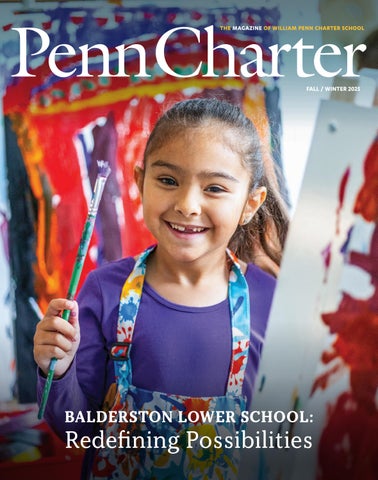

BALDERSTON LOWER SCHOOL: Redefining Possibilities
PENN CHARTER LEARNER
The Portrait of a Penn Charter Learner articulates the skills, attitudes and competencies Penn Charter seeks to nurture in our Lower, Middle and Upper School students.
THE PORTRAIT HAS FOUR CORE DOMAINS:
COURAGEOUS LEARNER CONSTRUCTIVE COMMUNICATOR
CHANGE CULTIVATOR
A Penn Charter learner discovers passions that inspire them to better the world while demonstrating personal, social and civic responsibility.
While working toward peace and justice with humility, a Penn Charter learner engages in their communities to shape and impact their world in positive and powerful ways.
A Penn Charter learner is an upstander, collaborator, and problem-solver who sees the Light in others while sharing their Light with the world.
COMPASSIONATE FRIEND
Read more about the Portrait of a PC Learner at penncharter.com/portrait.
Inaugural Youth Food Justice Conference Cultivates Change and Community
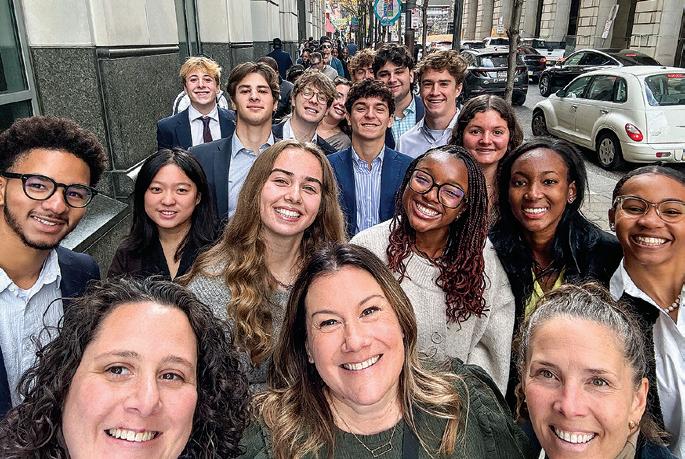
In June 2025, Penn Charter’s Center for Public Purpose partnered with Share Food Program to host the inaugural Youth Food Justice Conference, a three-day experience that empowered students to design a summit and act on issues of food insecurity in Philadelphia.
“The main goals were to teach others about the challenges people face living with food insecurity and inspire fellow students to make a difference, big or small, in working for food justice,” said senior Morelia Perez, who served on the planning committee.
The pilot program brought together nearly 30 students from Penn Charter and Abington Friends School for a weekend of learning, community engagement and reflection. They explored how local and global issues of food access intersect with environmental sustainability, social justice and public policy. These themes emerged, in part, from PC’s longstanding partnership with Share Food Program, which has deepened through the support of Tracey and Shanin Specter OPC ’75. The Specters’ gift to the Center for Public Purpose continues to strengthen community engagement and food justice education at PC.
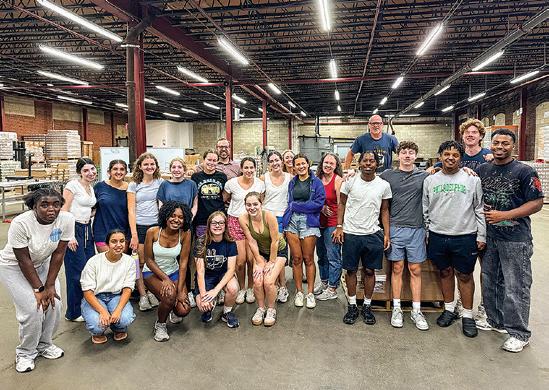
On Friday, the conference included dinner from local restaurants that support food security; student-led discussions on their pre-conference research; and a keynote by Colleen Watts, chief program officer at Share.
Saturday’s focus was hands-on service in the community: making lunches and packing the Friends Fridge, sharing a meal with neighbors at the St. James Welcome Table, and discussing current issues such as Supplemental Nutrition Assistance Program (SNAP) cuts, school lunch programs, food waste, climate change and land access for city farming.
“Stocking the Friends Fridge is important to me because I can actually see the change that I am making directly,” said junior Allie Morgan.
Morelia found meaning in sharing a meal with community members. “I realized that food is not only a basic right necessary for survival, but it is also important for forming connections and making memories with other people,” she said.
On Sunday, students visited Katie’s Cupboard, North10 and Sanctuary Farm, where they saw foodaccess work on a neighborhood level. Families joined the closing session, where students shared action steps they planned to take in the year ahead, and George Matysik, executive director of Share, emphasized the importance of ongoing education and advocacy around food access. “Through the hands-on projects we did,” said senior Marleigh Jackson, “I was able to get glimpses into the daily lives of people in our community, and that was an amazing experience.”
Building on this year’s success, the conference will become an annual event open to high school students across the greater Philadelphia area. “This pilot year showed what’s possible when students take the lead and lead with intention,” Alyson Goodner OPC ’96, director of the Center for Public Purpose, said. “They modeled what it means to be courageous learners leading with curiosity and truly living out our mission as change cultivators.” PC

12 Balderston Lower School:
Enriching Both Learning and Community
Since Penn Charter’s pre-K to grade 5 students rushed through its doors on Sept. 3, 2025, the Richard A. Balderston OPC ’69 Lower School has served as a wondrous, welcoming space for curious learners of all ages.
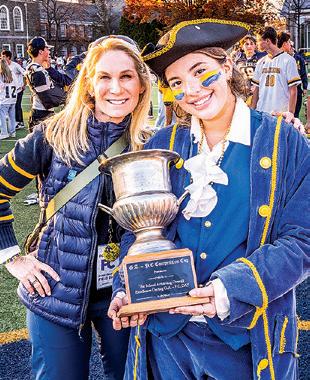
18 139th PC/GA Day
The Quakers retained the Competition Cup for yet another year and punctuated the day with an exciting football victory.
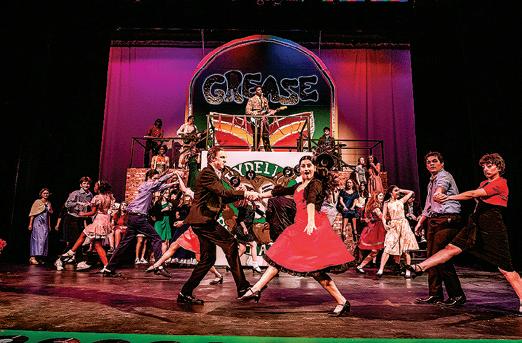
24 Grease
Upper School students lit up the stage with a high-octane performance in this classic musical comedy.

Within the Richard A. Balderson OPC ’69 Lower School is a teaching and learning community that redefines possibilities. (Photo: Michael Branscom)
OPENING THOUGHTS
From the Head of School
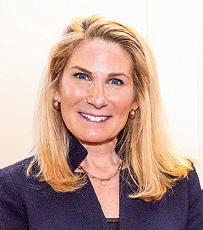
As this school year unfolds, I am struck by the extraordinary moment in which we find ourselves—a moment defined by purpose and a profound sense of possibility.
Moving through my third year as head of school, I continue to be inspired by the people, energy and enduring spirit of this community. The joy across campus is unmistakable—from the happy buzz around the new Lower School playground to the cheers during a triumphant 139th PC/GA Day on a perfect fall afternoon. This is an exciting time to be at PC.
This issue of Penn Charter magazine celebrates one of the most significant milestones in our modern history: the opening of the Richard A. Balderston OPC ’69 Lower School, and with it the completion of the academic village. Grounded in Quaker principles of community and designed with a strong connection to nature, it is a place designed for curiosity, collaboration and engagement. Walking through its halls, you can feel how thoughtfully the spaces were created to support the way children learn today and will learn tomorrow. Most inspiring, however, is what students are already doing within—and beyond—PC’s walls. Across all divisions, experiential learning is thriving. They are learning not only about the world but with the world, engaging in meaningful partnerships across Philadelphia. This learning continues to deepen as our students serve and learn alongside community partners who broaden their understanding and strengthen their sense of responsibility.
In this remarkable year, even as we mark the debut of the Richard A. Balderston OPC ’69 Lower School, we celebrate a century on the Pinehurst campus—100 years of Penn Charter students questioning, leading, competing, performing, and becoming their fullest selves on this extraordinary landscape. Together, these milestones invite us to look back with gratitude and ahead with excitement. The school that has grown here— rooted in 1689 and thriving in 2025—is both historic and forward-thinking.
This issue captures so many reasons to feel proud of and grateful for our community. Our mission—to educate students to live lives that make a difference—has never felt more alive. And what is most remarkable is that our students are not waiting until they graduate to begin making that difference. They are doing it now, in classrooms, on fields, in studios, on stages and throughout Philadelphia.
Thank you for being part of this journey—whether you are on campus every day or supporting Penn Charter from afar. I invite you to return to campus, connect with students and faculty, attend a play, concert or performance, and feel firsthand the extraordinary moment we are experiencing together.
With gratitude and optimism,
Karen Warren Coleman Head of School
Karen Warren Coleman Head of School
David Brightbill
Associate Head of School
Marcy Sosa
Assistant Head of School
Paul Hough OPC ’77 Clerk, Board of Trustees
MAGAZINE STAFF
Rebecca Luzi Editor
Lisa D'Orazio
Assistant Editor
April Torrisi
Contributing Editor
Sonia Belasco
Contributing Editor
Michael Branscom
Feature Photography
Proof Design Studios Design
William Penn Charter School
3000 West School House Lane Philadelphia, PA 19144
215.844.3460 www.penncharter.com
Penn Charter is the magazine of William Penn Charter School. It is published by the Marketing Communications Office and distributed to alumni, parents and friends of the school. In addition to providing alumni updates about classmates, reunions and events, the magazine focuses on the people, the programs and the ideas that energize our school community.
Follow Penn Charter at your favorite social media sites:
CAMPUS CURRENTS
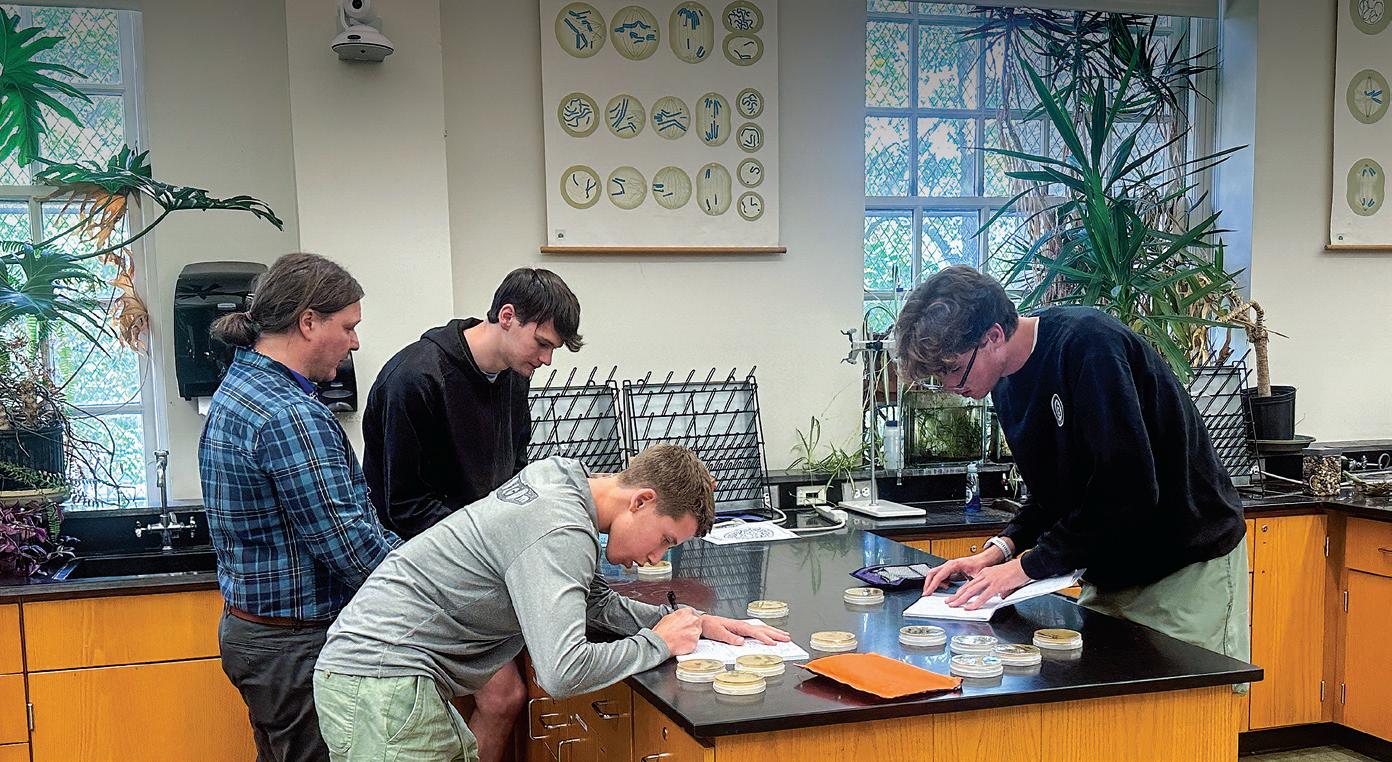
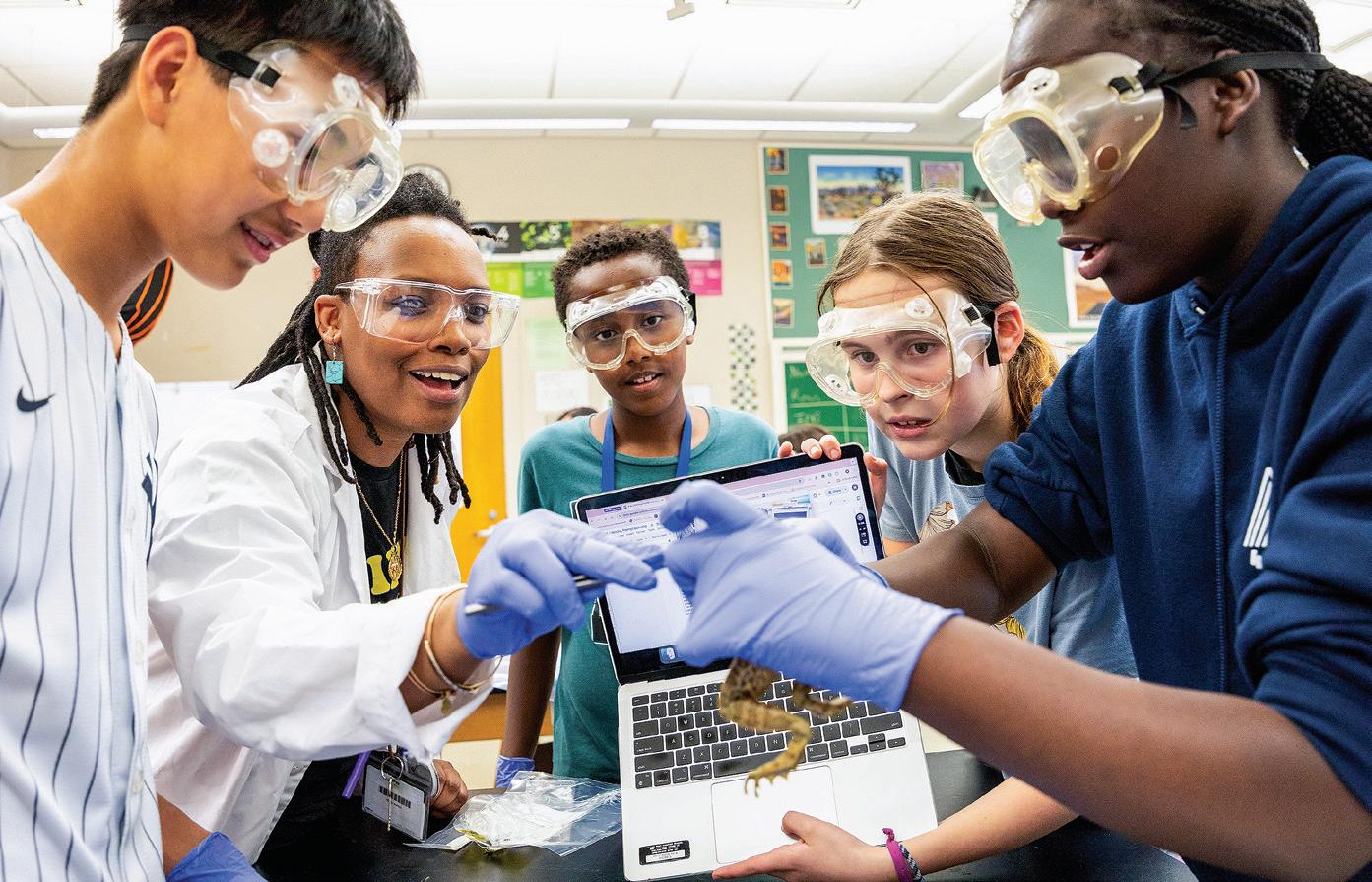
Biotech Students Light Up the Lab with Genetic Transformation Experiment
In October, Upper School students in David Nichols’
Biotechnology class made science glow, quite literally.
Conducting a transformation lab—a process in which foreign DNA is introduced into bacterial cells, resulting in new genetic traits—students first extracted a gene responsible for bioluminescence from a marine microorganism called Aliivibrio fischeri. A. fischeri helps creatures like the bobtail squid and pinecone fish shine in the ocean depths.
“These animals share a symbiotic relationship with A. fischeri,” Nichols said.
“The bacteria live in pores on their surface tissues, where the host provides nutrients, and in return the bacteria emit a soft blue-green glow. This bioluminescence helps larger organisms attract prey and mates, as well as camouflage themselves from predators.”
Biotechnology, a new course added to the Upper School science curriculum, is a hands-on experience designed to familiarize students with laboratory techniques utilized in molecular biology, specifically DNA isolation, characterization and manipulation. Students work in teams to collect and analyze data, and then explain the results as a laboratory cohort.
After long preparation, Nichols explained, students used the transformation process to remove the gene from Aliivibrio fischeri using restriction enzymes and inserted it into E. coli, a common laboratory bacterium that can grow at room temperature via plasmid vectors.
“Plasmid vectors are small, engineered pieces of DNA that can be used to insert the genes of interest—in this case, the ones for bioluminescence—
and transfer them from one organism to another,” Nichols said. “They often have other engineered genes in them to use as what are called ‘selectable markers.’ These markers make it easier to screen for the [bacterial] colonies of interest.”
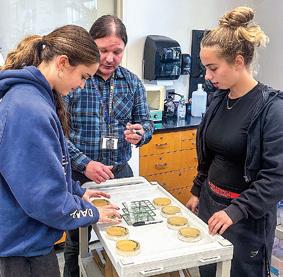
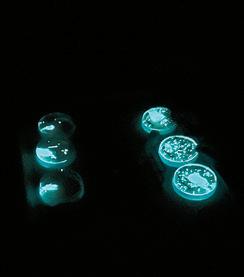
Once transformed, the E. coli was grown on Petri dishes and observed in a dark room. When the plates began to glow, students had visual evidence that the gene transfer had been successful.
“It’s a fun lab,” Nichols said, “because the proof of concept is right there— you literally see the bacteria glowing in the dark.”
Senior Zsuzsi Pollock (pictured above, right) shared what sets Nichols’ biotechnology class apart: “I love biotechnology not only because it is a smaller class and we can have more fun as well as learn more, but I also love how Mr. Nichols does not want us to stress over quizzes or tests, but instead allows us to dive deeply into labs and learn through hands-on experience.” PC
Walking into Community: The Seventh Grade Neighborho od Project
At Penn Charter, our surroundings are more than just scenery—they are living classrooms. The neighborhoods that touch our campus offer rich opportunities for students to explore the cultural, economic and historical significance of our urban environment.
The seventh grade Neighborhood Project provides students and faculty with a meaningful way to connect more deeply with the Germantown, East Falls and Wissahickon communities through frequent walking excursions. Guided by Quaker values of community, service, peace and stewardship, the project encourages students to experience firsthand the beauty, complexity and interdependence of the neighborhoods we call home.
“I wanted to share the joy and wonder I experience when walking and paying attention to people, buildings, landscapes and industry,” said Jennifer Chernak, Art and Quakerism teacher and last year’s seventh grade coordinator. “In a car, students can lose the awareness that Penn Charter exists within an urban ecosystem. Walking allows them to see that there is abundance here—beauty, history and real opportunities for social connection.”
Before setting out into these neighborhoods last spring, students engaged in advisory sessions to learn protocols for walking in groups and to reflect on guiding queries such as:
How can you get to know a neighborhood?
What makes a good neighbor?
How do we build community?
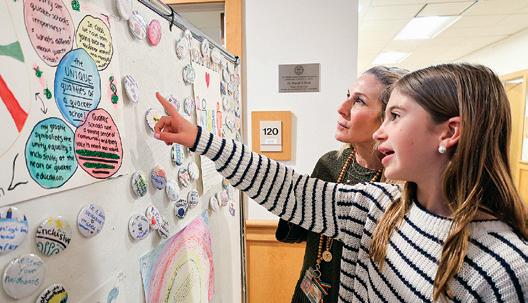
Students took outings to local cafes, food banks, historic landmarks, parks, trails, gardens and small businesses. Each walk was followed by personal reflection in digital journals, helping them process their observations and experiences. "Neighborhoods are such a necessary part of your daily life," Libby Senoff wrote. "Neighborhoods are important because they give access to jobs, resources, and create connections between people."
"I think that Penn Charter students should volunteer in places we learned and saw," Ines Sheer wrote. "We should also aim to teach people about the neighborhood, not just learn about it ourselves."
Through the support of Alyson Goodner OPC ’96 and the Center for Public Purpose, students also participated in panel discussions with local business owners and nonprofit leaders such as Historic Rittenhouse Town, Friends of the Wissahickon, and Thunder Mug Cafe, learning about their work and how they serve the community. "The panelists care so much about the community, from cafe owner to a volunteer director to neighborhood planner,” wrote Biffy Davenport. “Everyone comes together to support one community. A good neighbor is someone who looks out for their neighbor, helps their community, and does good for their neighbors."
In May, students planned and hosted a neighborhood celebration, where families were invited to learn about their journeys and the connections they had made. The celebration highlighted the project's central message: When we take the time to notice and understand the people and places around us, we become better neighbors—and stronger, more compassionate community members.
This year, the Neighborhood Project continues under the guidance of Nicole Watson, science teacher and current seventh grade coordinator. PC
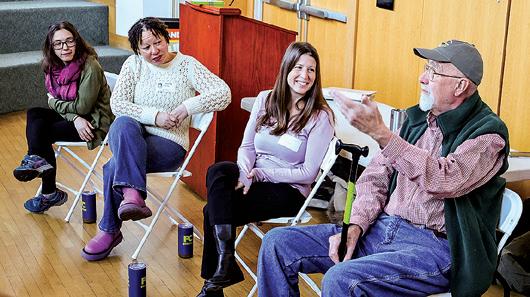
Michelle Feldman, director of East Falls Development Corporation; Lizette Apy, owner of Thunder Mug Cafe Town; Amy Ricci, executive director of Historic Rittenhouse Town; and David Bowers, volunteer coordinator for Friends of the Wissahickon spoke on a panel about neighborhood business and organizations collaborating with others to form partnerships.
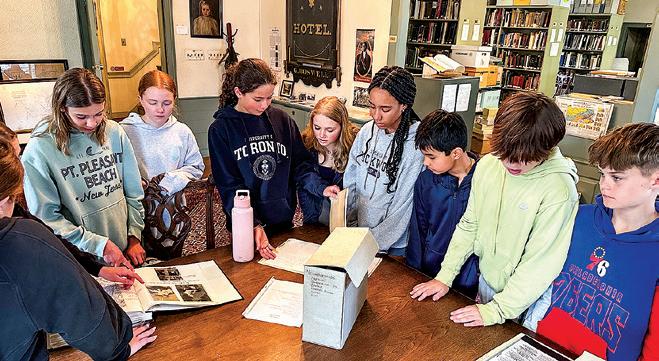
Top: At Germantown Historical Society, students viewed historical documents and learned what the neighborhood was like in the 18th and 19th centuries. Bottom: Students presented at the end of the year on their projects for friends and family.
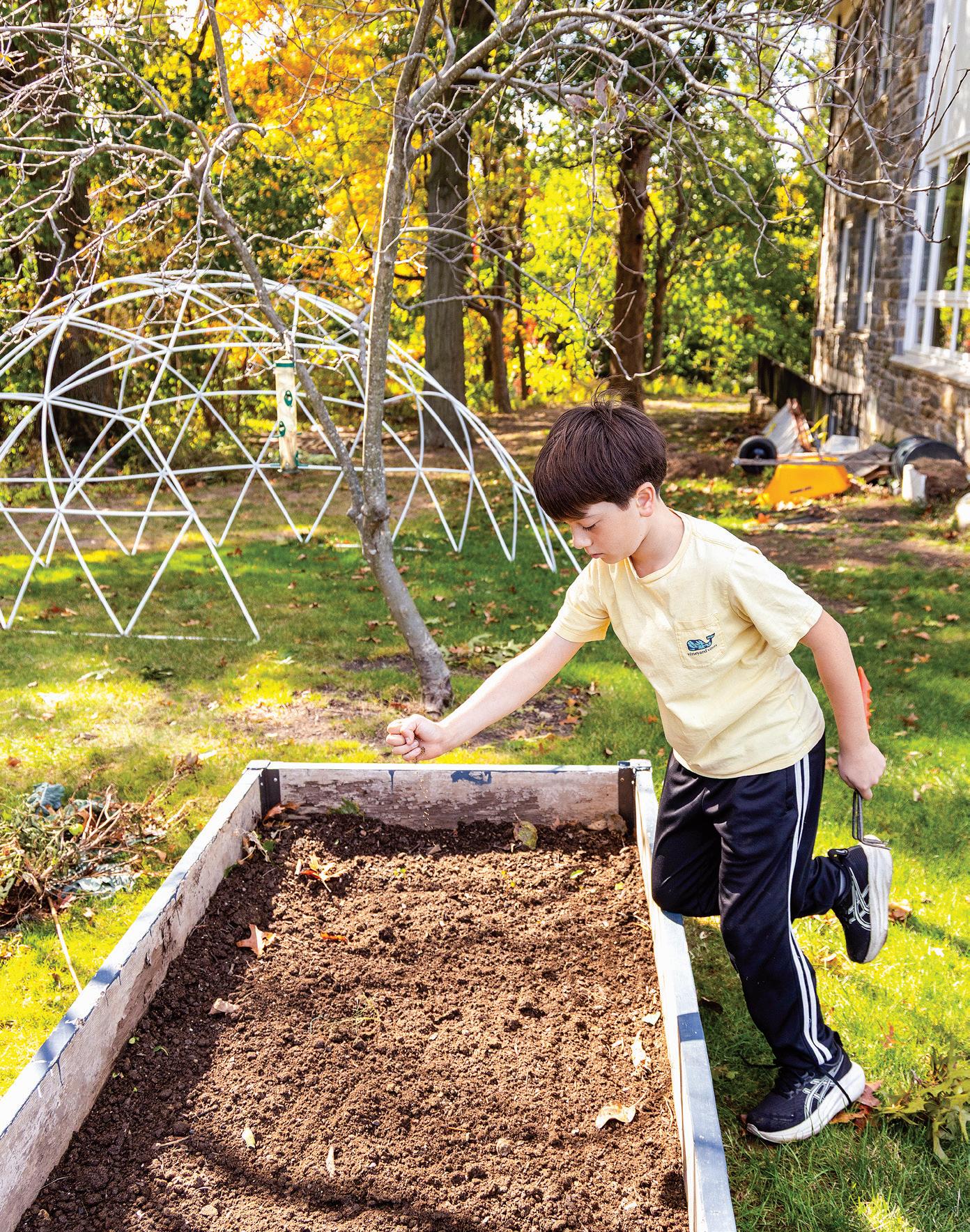
Sixth Grade Capstone and Learning Gardens
Each year, as part of its year-end Food Security Capstone, the sixth grade partners with local organizations that address the issue of food access in Philadelphia. Grouped by advisory, students learn and work alongside nonprofits like Share Food Program, Katie's Cupboard and Sanctuary Farms.
Last year, Middle School science teacher Dave Martina decided he wanted his advisory to stay hyper-local—right behind the building where they teach and learn every day. “There is so much potential at the back corner of the Middle School, and I want to bring life to it,” he recalls saying to Alyson Goodner OPC ’96, director of the Center for Public Purpose who supports the design and implementation of the Middle School capstone projects. Martina found inspiration in Sanctuary Farms’ urban gardens cared for by local communities in Philadelphia.
Goodner loved the idea of sixth graders building sustainable vegetable beds on campus, and the students were excited to grow a garden. But they would need materials—lots of materials. So the students created a proposal for the project and presented it to the school, securing the funds necessary to buy aluminum garden beds, soil and plants that they purchased through community partners.
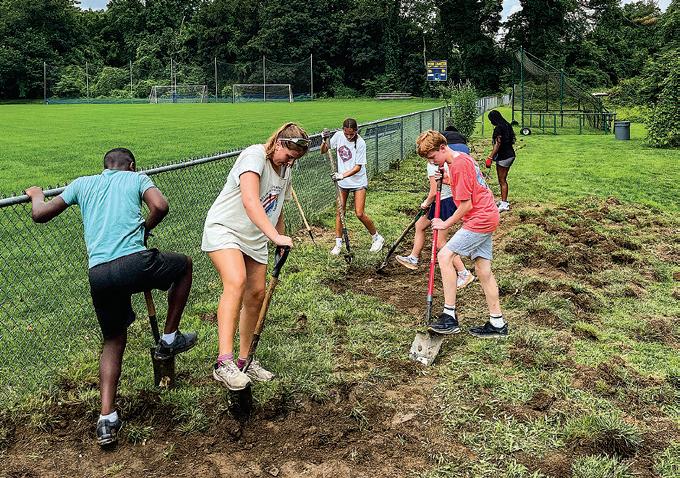
All spring, Martina’s advisory of 11 students worked about an hour a week to build the garden—designing it, assembling aluminum beds and constructing wooden ones, then hauling soil, planting and watering.
“I learned that gardening is actually really fun, but it also takes a lot of time and patience before you start to see any results,” said Jesse Rendell, now in seventh grade. “It was cool to watch everything slowly come together and realize how much work goes into it.”
Eventually, the work paid off, the plants flourished, and students harvested the food they grew, donating it to community refrigerators.
“After learning about food deserts and food insecurity all throughout the world, it felt amazing to be able to help, knowing that we could actually do something in our community,” said Henna Morris, also now in seventh grade.
But Martina worried: What would become of the harvest when students left for summer break?
Goodner had a solution. The Center for Public Purpose could support a stipend for Martina to harvest and tend the Middle School gardens through the summer. Building on this opportunity, Martina involved children attending Penn Charter’s Day Camp to spruce up and tend the Strawbridge Campus gardens as a stewardship project.
With all of this additional produce, he said, “I wanted to give back to the kids. I wanted to give back to the community.” So he and Goodner set up
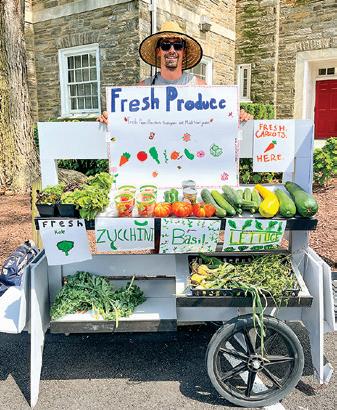
a farm stand on Thursdays at 3:00 p.m. and offered the garden harvest— lettuce, kale, cucumbers, tomatoes, peppers, zucchini, squash, basil—to campers, their families and the whole campus community.
This school year, Martina’s advisory will build on the success of last year’s sixth grade. “We are planting cover crops so we can keep our soil really rich,” Martina said. Cover crops, like rye, can withstand cold temperatures, and they keep the soil warm and compacted. “Then once we're ready to grow again in the spring,” he explained, “we'll cut them down and leave them there, and they become nutrients for the soil.”
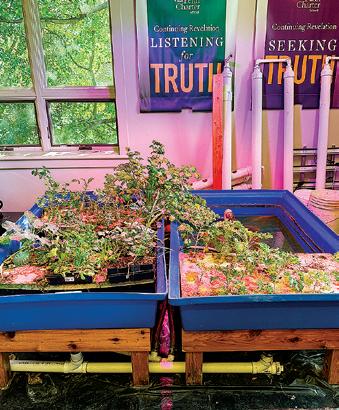
In addition, students have already begun growing plants from seeds using the aquaponics system in one of the Middle School science rooms, promising that this year’s spring and summer crops in the Middle School garden will have sprouted from the roots up. PC
CHOOSING HOME WHEN ZOMBIES ROAM
If you had to resettle after a zombie apocalypse, where would you choose to live? This is the question Jim Pilkington's seventh grade geography class tackled only a few weeks into the semester.
At their disposal were maps that cover everything from land elevation and agriculture zones to climate patterns and natural resources. Students must think about what locations in the continental United States might provide the best opportunities to cultivate food, build shelter and sustain life for the next 50 years—while also avoiding places where the virus-infected undead can more easily pursue humans.
This project is part of a unit on map reading, an essential part of any geography class. Students use paper maps and must be able to decipher what each map shows, what the key indicates, and how the maps relate to each other. In other words, what regions have both renewable energy resources and a longer growing season? What regions have higher population density, which means they also have higher numbers of zombies?
“We typically start the year in Geography exploring maps—how to use them, common features of maps, why they are useful—and we were looking for an activity that would be an application of those concepts in a real-world setting,” Pilkington said. “While a zombie apocalypse isn't exactly realworld, students have to pull information from a series of maps as they prioritize needs, think critically and work collaboratively to develop a resettlement plan. It's also a helpful early activity to talk about what good collaboration looks like and a barometer of how students work together.”
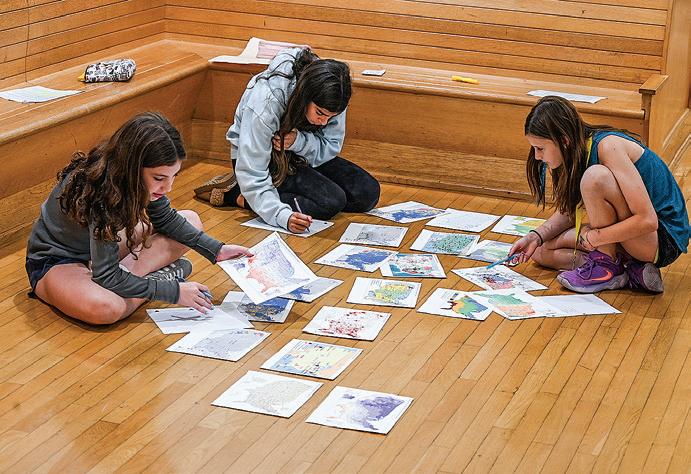
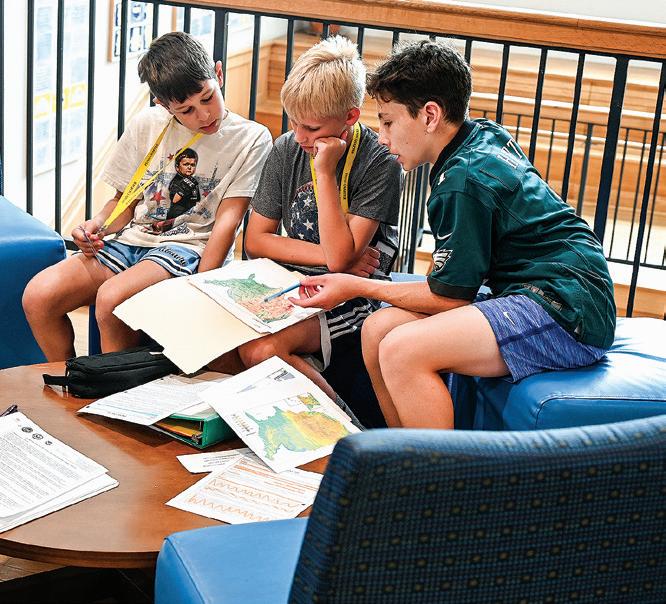
Students must synthesize a wide variety of information in order to make a decision about which resettlement region might be best and make an argument for their choice, though Pilkington prefaced the assignment by indicating there is no one right answer.
The teams offered various locations for resettlement, most of them in areas with low population in the central and western United States. “Where there were no humans there will be a lot less zombies,” noted Jay Copelovitch and Cayman Auguste in their presentation. Many also gravitated toward places with fewer natural disasters such as tsunamis, earthquakes and fires, and that were located near bodies of water so they could fish.
All locations offered some pros and some cons, and students had to balance both to make their decisions. “The only foods available [in Chinifrid, Montana] would be winter wheat, milk and fish,” said Caroline King, Jordyn Shaw and Sophia Kazimir in their presentation. "It would be hard to make food out of that, and we might have to go to towns and take stuff from people’s gardens so we can grow stuff."
“The maps helped us make our decision because they showed us real-life data about important information that impacted where our settlement would be," Giulia Krueger said. “Maps helped us find exactly what things we need to build our shelter and survive," Pierce Ecker added.
These seventh graders, with their newfound appreciation for maps, are prepared to make practical and complex decisions. “Remember, the future of the United States rests on your knowledge of geography,” the instructions read. “Good luck, and may your efforts ensure the survival of our nation!” PC
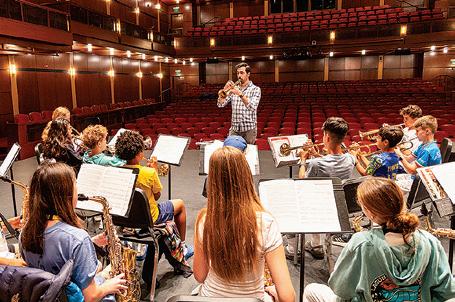
In Tune with Each Other: Kindergarteners Engage with Upper School Band and Quakers Dozen
When teacher Monica Freely's kindergarten class was learning about jazz musician John Coltrane two years ago, the students became curious about the instrument he played.
Freely reached out to Upper School band director Brad Ford, who happily provided a saxophone for further study. “Seeing the instrument up close fostered a lot of conversation and questions,” Freely said. “We asked Brad to organize an on-campus 'class trip' to the Kurtz Center.”
And he did just that. A few weeks later, the kindergarteners marched over to the Kurtz Center for the Performing Arts, where they joined the Upper School Band rehearsing music from How to Train Your Dragon and a medley from Wicked.
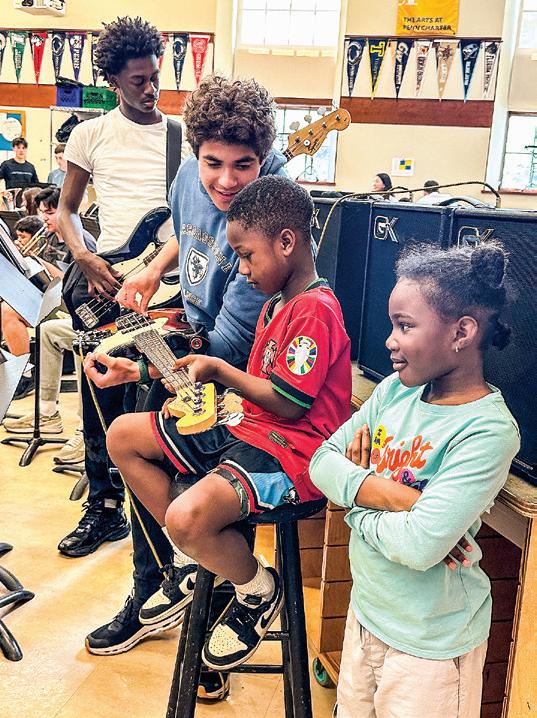
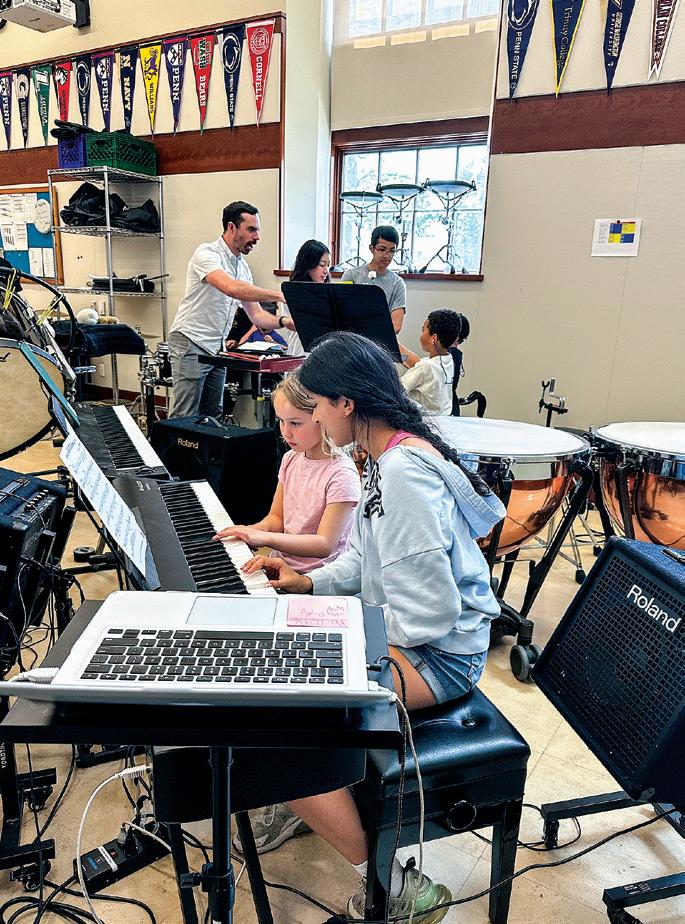
The young students also made a stop at rehearsals for the Quakers Dozen, one of Penn Charter's a capella groups, directed by Tony Yoo. Both younger and older students benefitted from this cross-divisional connection.
“We wanted to give our younger students a glimpse of the performing arts program,” Yoo said, “but it's more than that. The Upper School students are able to highlight their best attributes and be excellent representatives for our community. Seeing QD standing among the kindergarteners and singing ‘As We Leave This Friendly Place’ highlighted the growth we can expect to see from our students."
Now in the third year of this new tradition, Ford is eager to continue it. “Inviting our kindergarten students is a highlight of our band season,” he said. “My favorite part of the experience is watching the joy on the faces of all of the students in the room, especially when a kindergarten student gets to conduct the band on the podium.” PC
PINE H URST W I LLIAMPENN C H ARTERSCHO O L
PENN CHARTER CELEBRATES 100 YEARS AT PINEHURST
“Looking back over my seven years at Penn Charter at Eight S. Twelfth Street, the day that comes to my mind as the most outstanding is the one when we were called back to assembly shortly after our regular morning assembly had been dismissed. Our beloved Headmaster … announced that we had been willed twenty beautiful landscaped acres at Queen Lane where our playing fields would soon be located and where the school would eventually be moved. We were instructed to go right over to Broad Street Station, where a special train would be waiting to take all 500 students to Queen Lane so we could look the grounds over. It was as happy a group of boys as you would want to see, although most of us realized that we would be graduated before the school could be moved from the heart of Philadelphia to this beautiful location.”
– Richard P. Cuthbert OPC 1904
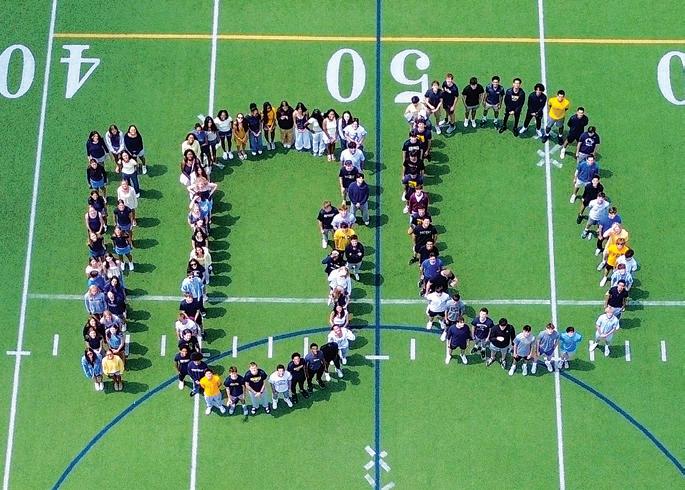
The sentiment above was excerpted from an essay titled “Looking Back to the Turn of the Century” and appears in the book Old Penn Charter, a collection of anecdotes documenting Penn Charter’s history and the many individuals who had an impact on the first 300 years of William Penn Charter School’s existence.
The anticipation that began in 1903 would last for more than two decades.
By the year 1897, enrollment had skyrocketed – from 17 students in 1689 to well over 400. Headmaster Richard Mott Jones knew his students needed more space and was anxious to have a plan in place to secure appropriate indoor and outdoor facilities for his burgeoning student body.
He would not need to wait much longer.
Following the passing of two Quaker women, Sallie M. Waln and Clementine Cope, the latter of whom was the sister of overseers Francis Reeve Cope and Thomas P. Cope Jr., Penn Charter was willed a 35-acre estate in “the country,” known as Pinehurst.
The campus stood, waiting for occupants, until 1923, when the school finally made an advantageous sale of the 12th Street property. But those 20 years were not in vain, as the school spent considerable time and
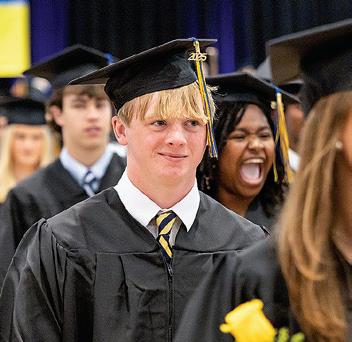
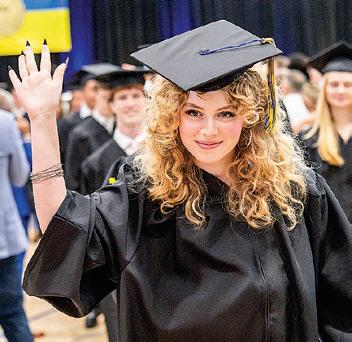
The Class of 2025 marked the centennial of William Penn Charter School’s home on School House Lane.
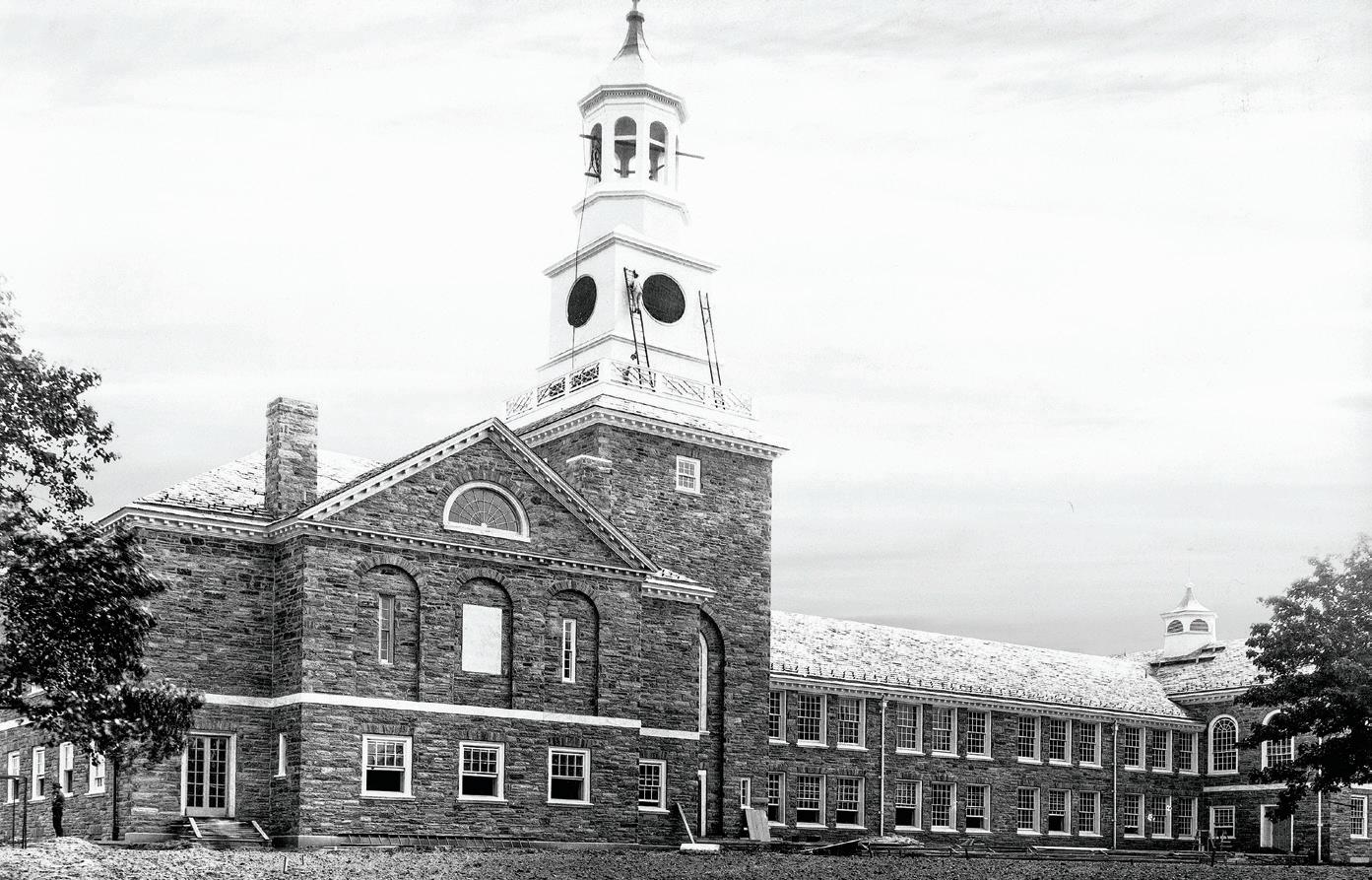
resources ensuring that the building, the classrooms and the fields would have the very best materials and resources when students would finally occupy those spaces.
The anticipation was palpable for the boys and young men of Penn Charter during the early 1920s. They had outgrown their campus and were ready for a more modern, spacious home, where they could learn and play, study and explore all across one expansive, green campus. And that day, Sept. 23, 1925, the first official school day on the Pinehurst campus, was filled with excitement.
“We have all experienced many more or less memorable events but one that will remain in our minds much longer than most all others is the day that the William Penn Charter School opened wide its doors for the first time at Pinehurst,” read the Penn Charter magazine in 1925.
Students were also thrilled with the modern new building—“the last word in academic up-to-dateness”—and determined its “splendid edifice whose tower pierces the air” would be dedicated to all who lived and worked with the “spirit of Penn Charter instilled in them.”
This fall marks 100 years since that momentous day, and Penn Charter’s campus footprint, student body and program have continued to grow. The 2025-2026 school year opened with a record 1,021 students—students
who are able to benefit from the dedication, foresight and investment of so many academic leaders and innovators who understood the power and impact of a Penn Charter education.
“That spirit of generosity and vision has been a longstanding hallmark of the Penn Charter community and is what allows us to proudly celebrate the 100th year of students attending our storied school on the current Pinehurst campus,” Head of School Karen Warren Coleman shared in her Commencement 2025 address. “This monumental time in our history is truly cause for celebration—this community has been blessed with generations of former and current leaders whose generosity has positioned us well for the future.”
The size of the school may fluctuate and expansion may take place, but what has not and will not change is the sense of belonging that has always been at the heart of the Penn Charter experience.
As Cuthbert shared in 1904, “It is one of the greatest satisfactions of my life that I was privileged to have spent those formative years at Penn Charter, and I am proud to be one of the many grateful graduates … I remember and cherish most of all the acute feeling of belongingness … that permeated the school. It was as if there was an unseen spirit that bound us one to the other. I feel it even today.” PC
— Lisa D’Orazio
Finishing touches on the new school, August 1925.
commencement 2025
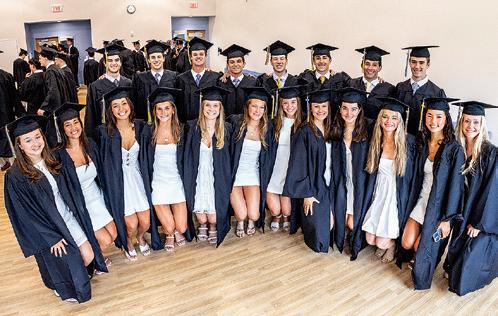
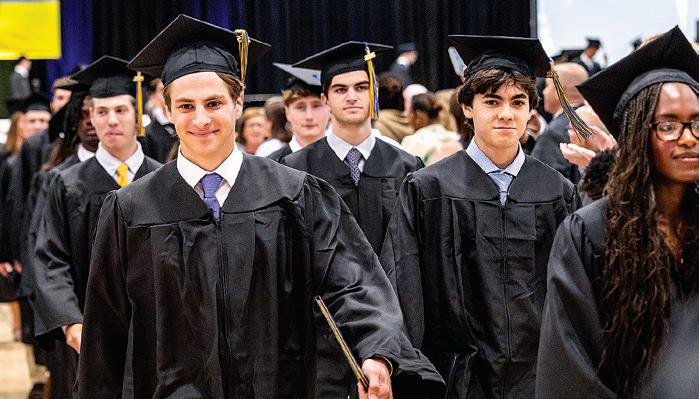
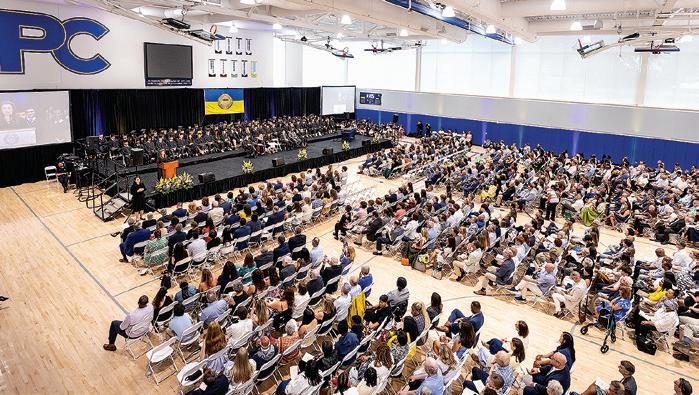
The Class of 2025 was the first to celebrate its Commencement in the spacious Graham Athletics & Wellness Center on June 7, cheered on by family, teachers and friends who no doubt appreciated the air conditioning on a warm and humid day.
“Tell me, what is it you plan to do with your one wild and precious life?”
– MARY OLIVER
Student speeches reflected on this line of poetry taught in 10th grade’s Literature and the Environment. They expressed gratitude for Lower School teachers and Middle School advisors. And they recalled small kindnesses from classmates, from help with polynomial division to telling the substitute teacher how to pronounce a student’s name.
Congratulations to these 119 students who have made their mark on Penn Charter—and on each other.
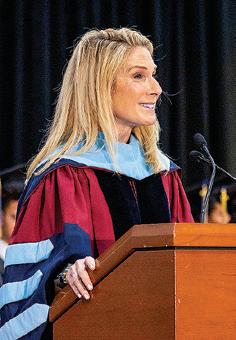
“Class of 2025, you have shown resilience— beginning your high school journey amid a global pandemic. …You have shown moral courage—one of the first classes to embrace and employ Quaker decisionmaking and meeting for business. …You’ve embodied an adventurous spirit, stepping beyond your comfort zones to embrace new experiences. …And perhaps most importantly, you have demonstrated a level of compassion and care for one another that has inspired and humbled even the most seasoned faculty and staff at Penn Charter.”
– Head of School Karen Warren Coleman in her Commencement speech
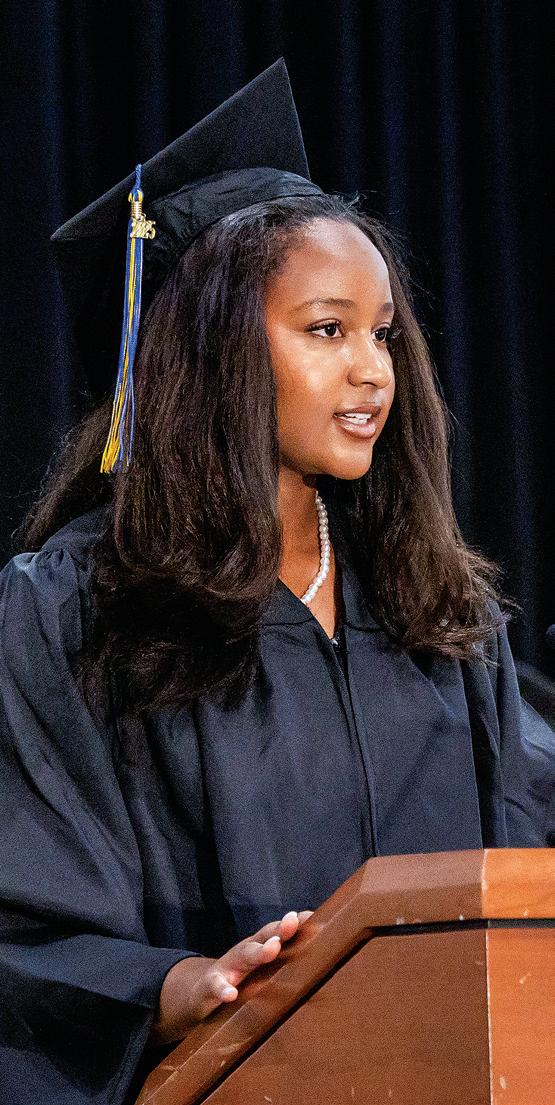
“This class is a group of people who, in a tied game, with two outs in the bottom of the seventh, and the tying run on third, want the ball in our hands because we know we can make the play. We can change the choreography on opening night because perfection is within our reach. We are changemakers who stay informed and will give our all in hopes of even the possibility of a better world.”
– Commencement speaker
Arielle Willis
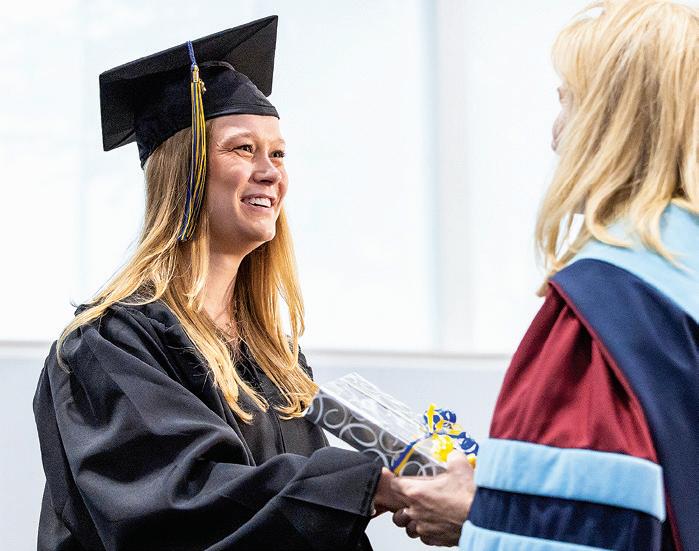
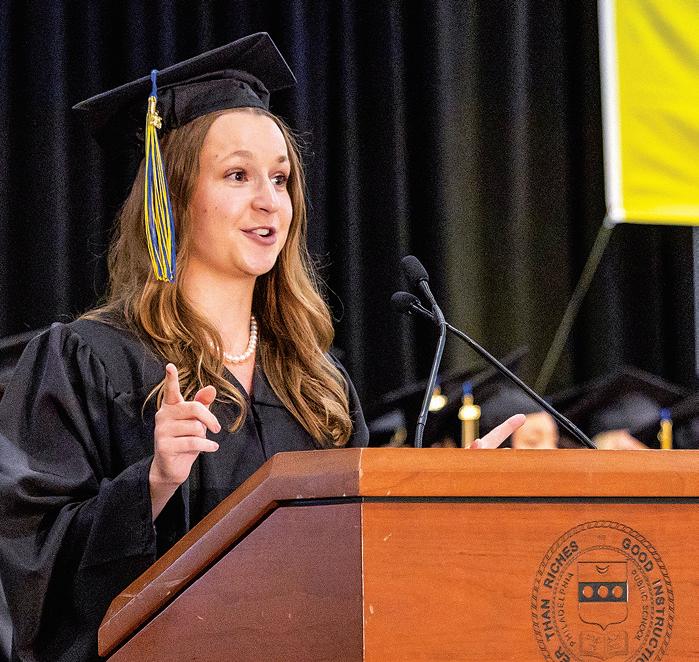
“In my eyes, the most powerful thing about our grade is our willingness and determination to use our voice. The most common phrase heard in your high school career is that your life starts after graduation.
From what I've seen, my classmates did not take that advice to heart. The Class of 2025 has used their voice to create change in school and beyond.”
– Commencement speaker Bridgette Gold
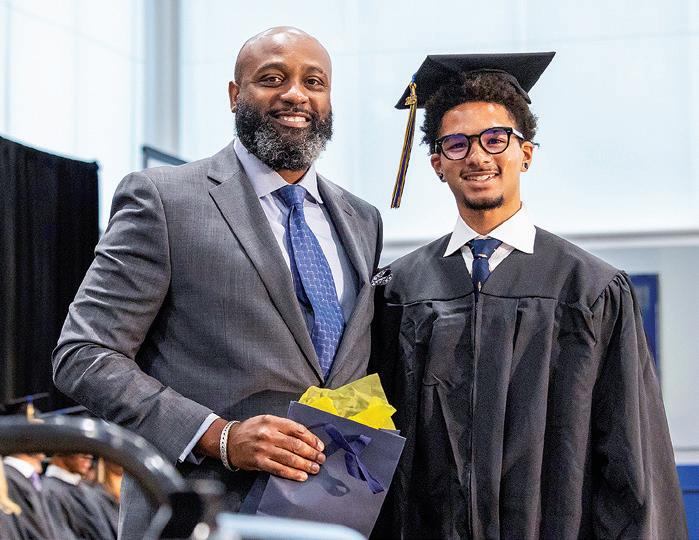
CONGRATULATIONS TO THE CLASS OF 2025!
The Class of 2025 enrolled at 76 colleges and universities across the United States and Scotland. Ninety-three percent of the students are attending a top-choice college.
American University
Boston College
Boston University
Brown University
Bucknell University
Catholic University of America
Chapman University
Clemson University
Coastal Carolina University
Colby College
Colgate University
Cornell University
Denison University
Drexel University
Duke University
Edinburgh Napier University
Fairfield University
Franklin and Marshall College
George Washington University
Georgetown University
Harvard University
High Point University
Howard University
Ithaca College
Kutztown University
Lafayette College
Lehigh University
Long Island University
Louisiana State University
Loyola University Maryland
Michigan State University
Middlebury College
New York Institute of Technology
New York University
Niagara University
North Carolina A&T State University
Northeastern University
Northwestern University
Pennsylvania State University

Pratt Institute
Princeton University
Rollins College
Saint Joseph's University
Smith College
Southern Methodist University
St. Olaf College
St. Thomas Aquinas College
Stetson University
Swarthmore College
Tufts University
Tulane University
Union College
United States Air Force Academy
University of Arizona
University of California–Los Angeles
University of Colorado Boulder
University of Connecticut
University of Delaware
University of Florida
University of Notre Dame
University of Maryland
University of Miami
University of Minnesota
University of North Carolina
University of Pennsylvania
University of Pittsburgh
University of Texas at Austin
University of Vermont
University of Virginia
Ursinus College
Villanova University
Wake Forest University
Wesleyan University
West Chester University
West Virginia University
Widener University
Williams College
Video of the ceremony and more photos at penncharter.com/commencement2025.
Alumni Society president Ed Morris OPC ’94 presented Oliver Jackson with the Alumni Society Senior Award in recognition of his scholarship, character, leadership and athletic ability.
Fiona Brady received the Phi Beta Kappa Award for excellence in scholarship.
ENRICHING BOTH Learning and Community BALDERSTON LOWER SCHOOL:
by Rebecca Luzi
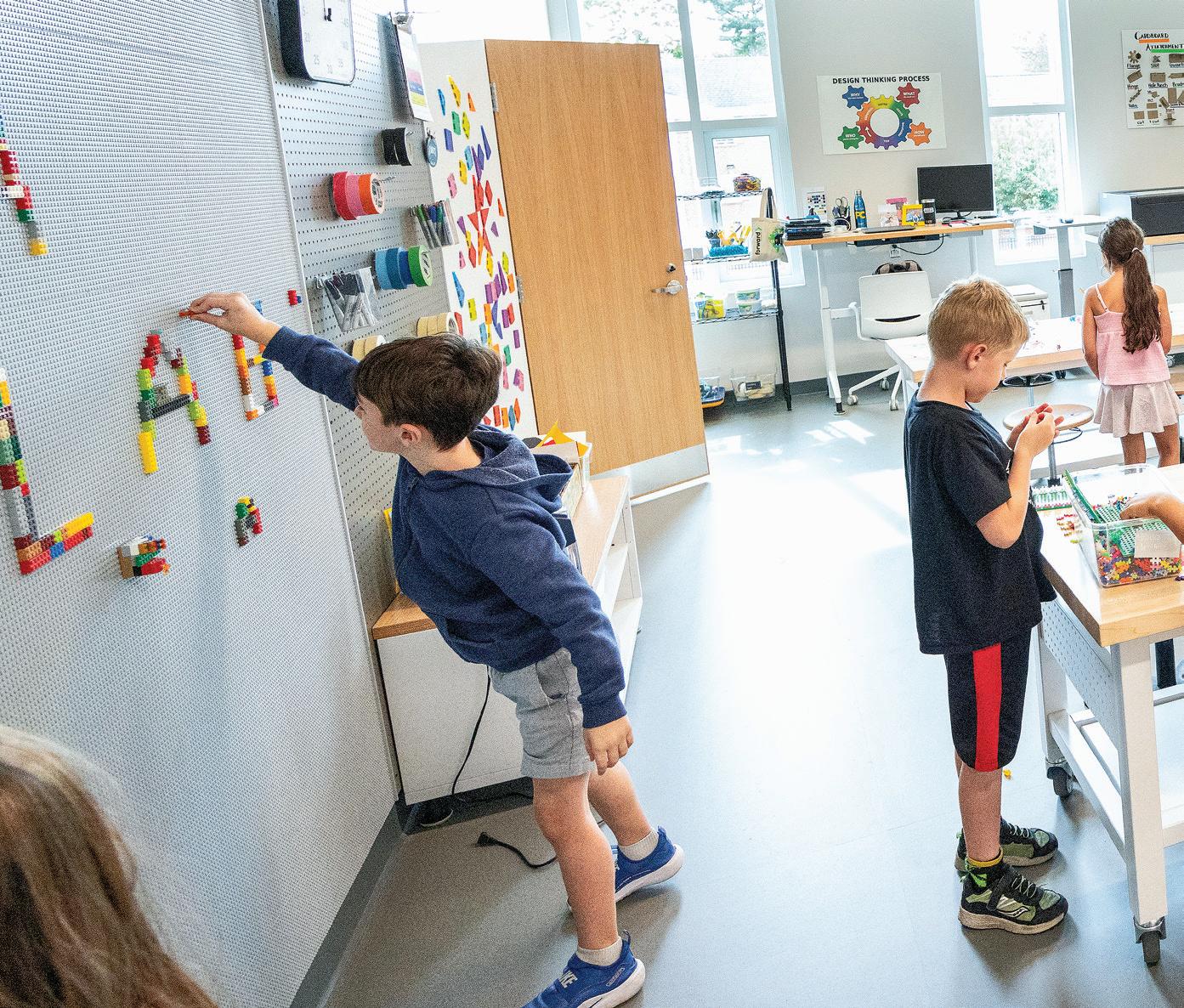
In the Reggio Emilia educational philosophy, a child-centered approach to learning, the parents and the classroom teacher are considered the primary and secondary teachers of a young child. As partners, they support and guide the child’s development.
The third teacher is the child’s environment—the physical space that stimulates curiosity and encourages exploration.
The new Richard A. Balderston OPC ’69 Lower School embodies this third teacher, offering an environment purposefully crafted to deepen and enrich every child’s learning experience.
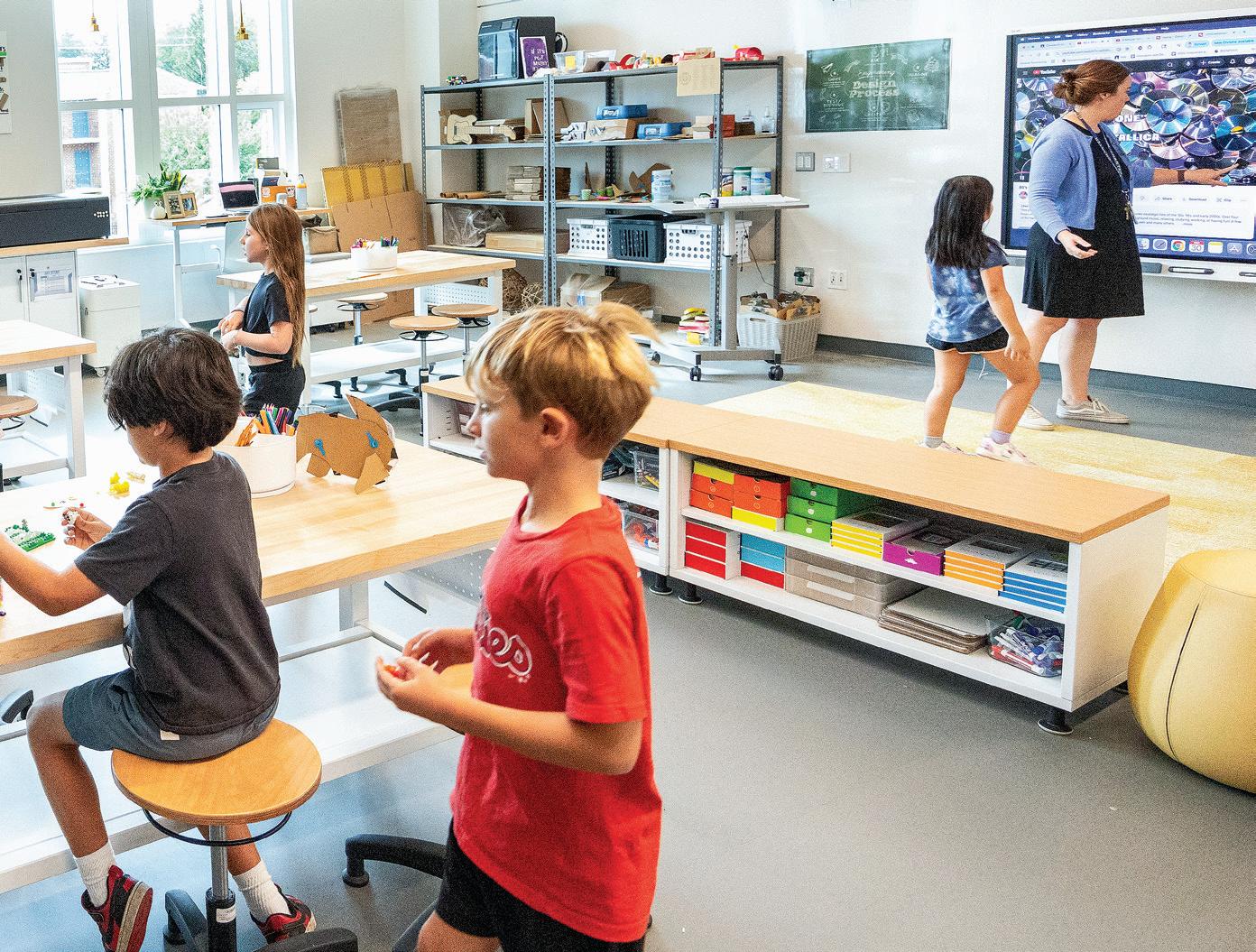
Since Penn Charter’s pre-K to grade 5 students rushed through its doors on Sept. 3, 2025, the Balderston Lower School has served as a wondrous, welcoming space for curious learners of all ages—a teaching and learning community that fosters collaboration, makes the curriculum come alive and redefines possibilities.
“Our goal is to present kids with tools and experiences and have the students apply them independently,” said Dan Stahl, innovation and design teacher for grades 1-5. “If they can walk out of the Lower School feeling like, ‘I can laser cut, I can 3D print, I can graphic design, I can code, and I can do all of that for a math class or an English class or a social studies class,’ that's a win in our book.”
“They'll take something that we present in a certain way and then take it in a different direction we never thought of,” added Rachel Evans, who teaches innovation and design along with Stahl.
It’s easy to innovate with all the tech options in the Idea Lab, including a ChompSaw, laser cutter, 3D printers, Cricut machine, Makey Makey, Hummingbird Robotics, Micro:bit circuit boards, Sphero coding robots, and Lego Education Spike Essential kits.
Stahl and Evan’s classroom in the original lower school building had some older versions of those tools, too, but they didn’t have space—if the 3D printer was out, the ChompSaw was tucked away—and that made a tangible difference in students’ agency. Now, Stahl said, “students feel like they can solve the problem because they see the tools that are readily accessible for them … it builds resiliency within them.”
They can also follow their imagination. “When they're working on a particular project,” Evans said, “they get to choose what they’re interested in and where it leads.”
continued on next page
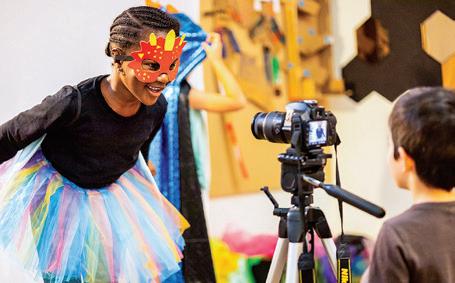
Imagination is Brooke Giles’ specialty. A pre-K teacher for 14 years, she now teaches Studio to both pre-K and kindergarten, and coordinates the Discovery Room, the newest space for multisensory play and experiential education in the earlychildhood curriculum—though everyone is welcome to play.
Influenced by the Reggio Emilia educational philosophy, Studio and Discovery are captivating rooms where children explore and create through art, movement, drama, storytelling and engineering. Until this year, Penn Charter’s pre-K was located adjacent to PC’s campus, in the Memorial Church of the Good Shepherd on The Oak Road.

For Giles, the proximity and connection to the rest of the Lower School community—for both her and the students in pre-K—are pivotal. “I love being seen again by my former students or the students who didn't know me,” she said. “It’s really good to feel that my connection isn't lost. I want the Studio to be a resource for all the students, no matter what they want to create.”
Hard at play in the Discovery Room. “That's the trick of early childhood, right? Disguising learning as play. That's our magic trick,” said Brooke Giles.

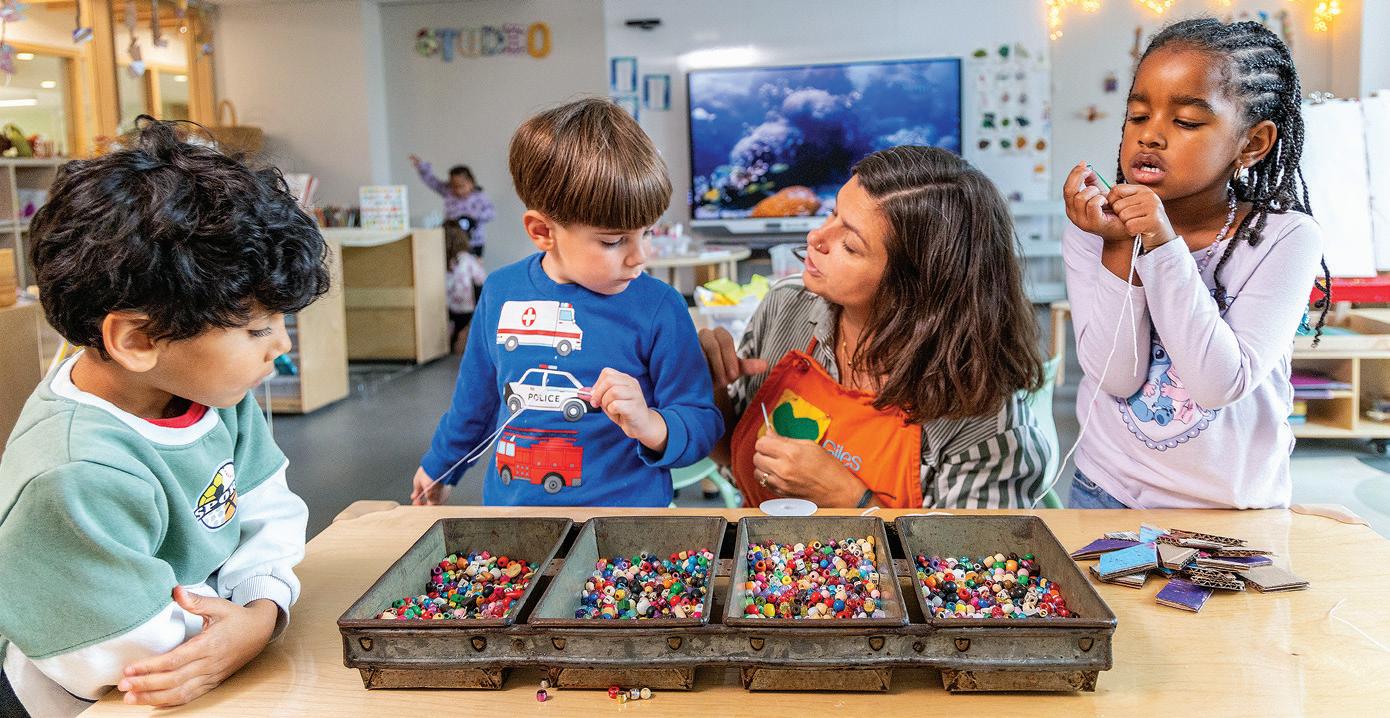

Kindergarten students have brought third grade—their buddy class—to the Discovery Room, which was designed for multisensory play and experiential education. “I'm loving that,” Giles said. "They're playing dress up, building with blocks, building giant marble ramps.” On a recent visit, third graders built a push car with Rigamajig, a building and engineering system. It doesn't take the older students long, Giles said, to stop wondering if they are too cool for the Discovery Room.
Second graders are so intrigued by the Discovery Room that many of the students visit independently. When Giles saw them playing with the Busy River, the small stream just outside Giles’ room that meanders through the playground, she encouraged them to experiment in the Discovery Room. Which materials sink? Which float? Can you recycle materials to build a boat?
The Balderston Lower School has a connectivity that the former building did not. Spaces that allow for collaboration and gatherings, like the Discovery Room, Friendship Hall and the Activities Room, which opens wide to the outdoor Amphitheater, are only part of it. The physical openness—skylights, hallways with large windows to learning spaces, connected classrooms—translates into community and well-being.
“Everyone's class is seen, and every teacher is seen,” Giles said, ”and that makes a difference in a student's sense of belonging and community. No one's hidden in this building. We're all very present.”
The thoughtful design of the Lower School “gives you a glimpse of the magic of what’s taking place,” added Director of Lower School Thu-Nga Morris. continued on next page
The Discovery Room is designed for multisensory play and experiential education. “The Lower School classrooms are remarkable,” Brooke Giles said, “but being connected, I think, is even more remarkable.”
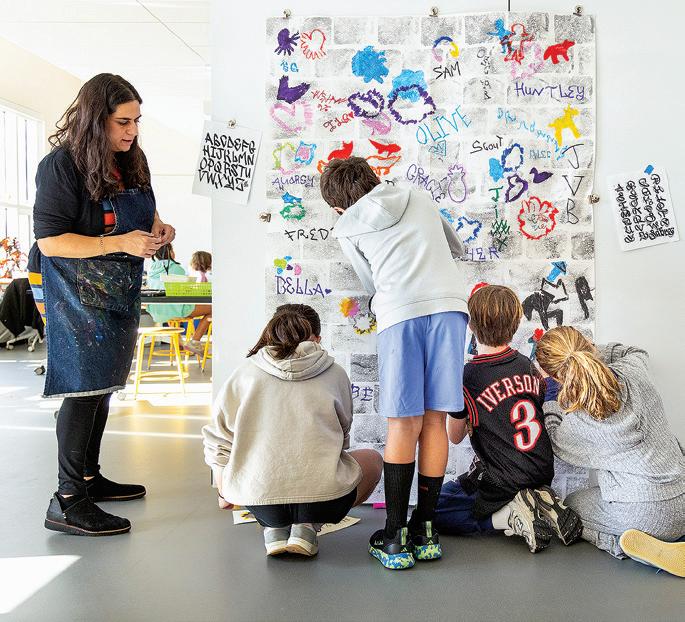
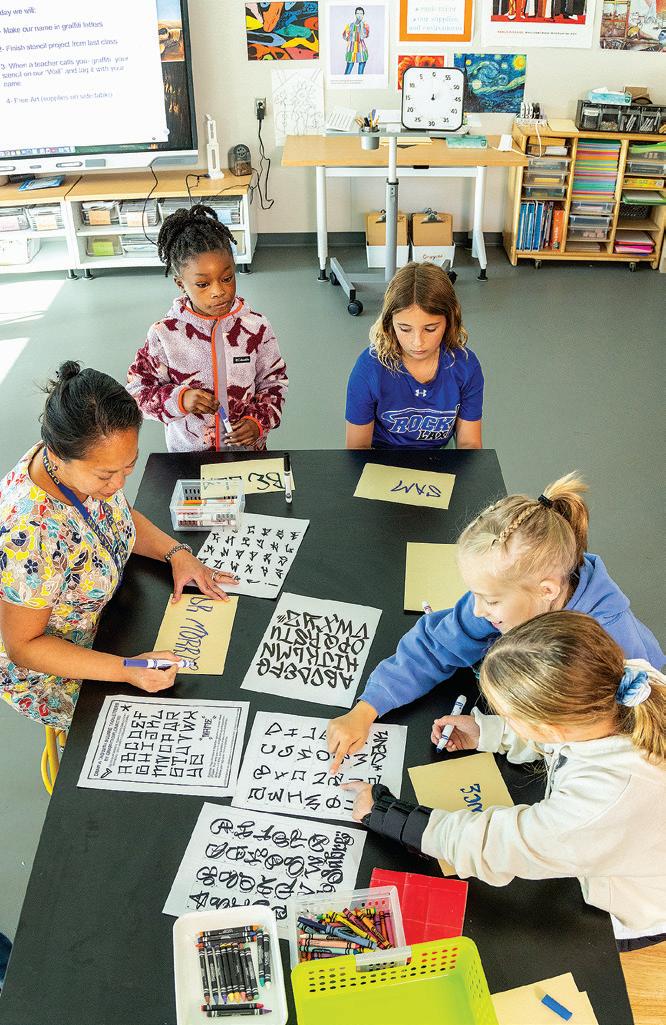
At a particularly exciting art class in October, fourth graders became graffiti artists. Though the class size was small, graffiti can be big and bold, so teachers Michelle Dowd and Karen Riedlmeier opened up the doors that divide the large art studio—one side outfitted with the tools and technology for 2D art and the other for 3D art such as clay and woodworking. The goal of this project was to teach positive and negative space and shapes, and graffiti was a way to engage the students.
After learning about famous anonymous street artists Banksy and Blek le Rat, the latter often called the "father of stencil graffiti," students practiced graffiti-style lettering and made their own “tags” (an artist’s stylized signature). Then, on large sheets of paper that Dowd had stamped with a block design to resemble a brick wall, students tried their hand at graffiti.
Blek le Rat and Bansky “decided their art was worth the risk because they had something important to share that they wanted to make accessible to everyone,” Dowd said. “And that's why I really loved that wall where our students all came together. Each stencil that they drew reflected some part of them, whether their favorite animal or a motif they enjoyed.”
The graffiti project illustrates the flexible space of the double art room that enables teachers to set up multiple stages of an activity so students can move through the project independently. This, combined with smaller class sizes for specials, Riedlmeier said, “honors children’s natural learning rhythms and patterns.”
Every feature of the Balderston Lower School was designed to foster a sense of community among students and educators. The building itself is a nod to Wissahickon Valley Park, with its winding form echoing the river valley that is muralized on its walls. The early childhood wing, comprising grades pre-K through one, supports gross motor skills through play and exploration with direct access to the outdoors. Friendship Hall, with its nature-inspired design, lush foliage and student art is a popular place to host faculty meetings and parent coffees. In the spring, students will generate ideas for what to grow in the second-floor terrace garden and then donate the produce to local organizations that support food security.
“Because it's easier to collaborate—to connect with each other—we're hoping this new environment inspires teachers to pursue new ideas and new projects in support of our students,” said Thu-Nga Morris, director of Lower School.
Director of Lower School Thu-Nga Morris creates her own graffiti tag with students.
Such pursuits are underway. In October, fourth grade students partnered with Emily Brennan’s and John Tralie’s Upper School Advanced Geometry students. Brennan recognized that her class could use the dotted patterns on the Friendship Hall windows—designed to protect wild birds from accidental window strikes—to practice calculating slope and equations of lines. She reached out to fourth grade teachers and proposed a collaboration: Geometry students could teach fourth grade math students how to calculate slope—typically taught in Middle School— using dryerase markers on the floor-to-ceiling Friendship Hall windows.
“That was a really fun way for us to enhance our academic program,” Morris said. “It was also a fun way for the kids to build community and connections with each other cross-divisonally.”
Students and teachers aren’t the only ones who have fun while learning in the Lower School. This year, parents and caregivers have been invited to sign up for MakerLab Mondays. About once a month, Dan Stahl and Rachel Evans offer parents a creative start to their day in the Idea Lab. In October, parent-child teams designed a mini catapult to fling candy pumpkins through a series of challenges. In November, they used the ChompSaw to create a mini parade float and then coded a robot to drive a Thanksgiving parade route. And in December, their assignment was to use simple circuits to create festive greeting cards that light up. Collaborative opportunities like these foster a supportive and engaging learning environment.
“The power of teaching, learning and the student-teacher relationship has always been at the heart of the Penn Charter experience, and we see that reflected in this building,” Head of School Karen Warren Coleman said.
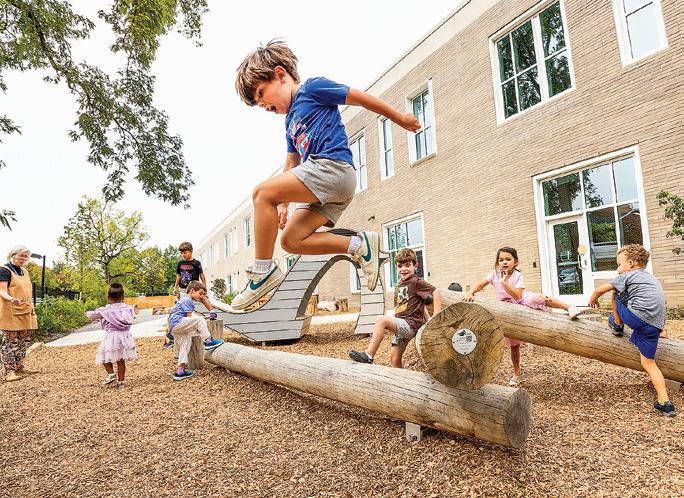
Students in pre-K and kindergarten have their own age-appropriate outdoor play spaces.
“Like others in our community who worked hard to realize this dream, I was so excited about the plans and details of this project. I knew it would advance the mission of the Lower School, elevate learning, widen opportunity. But it wasn’t until our students and teachers and families walked through those red doors that I realized how much the Richard A. Balderston OPC ’69 Lower School would nurture and uplift our entire community.” PC
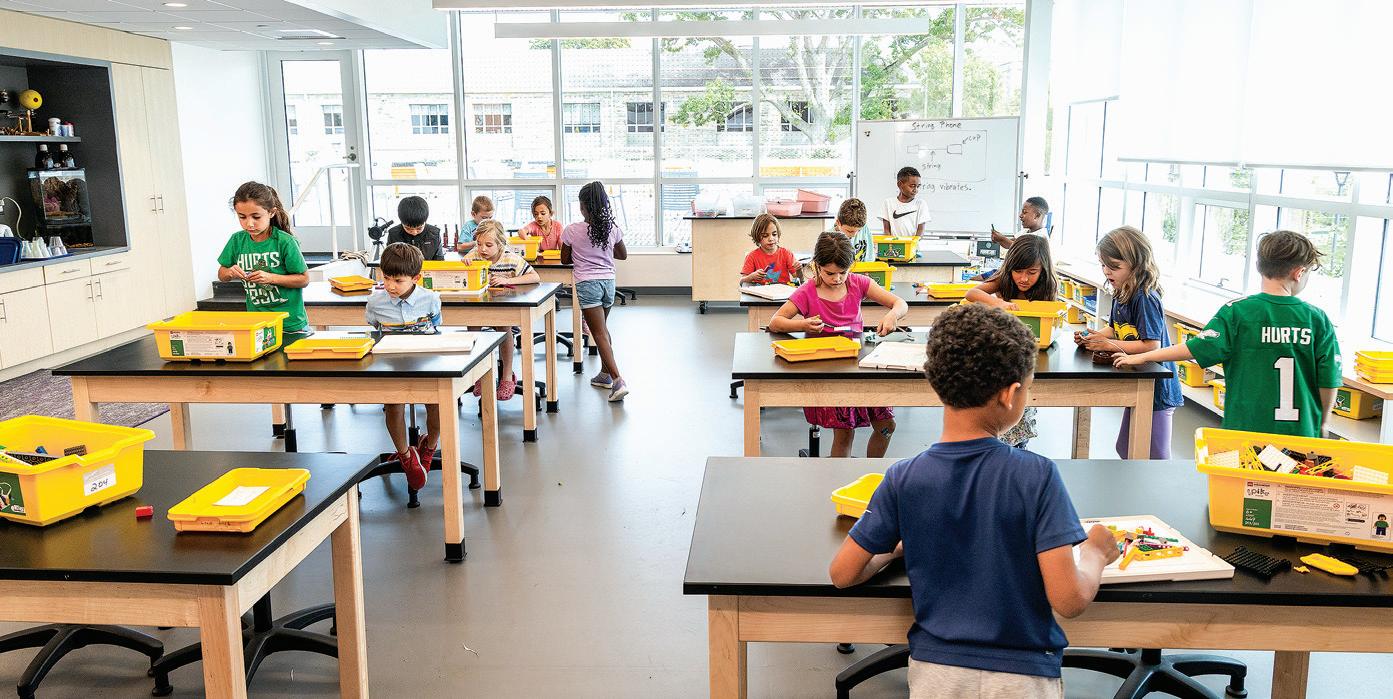
In the science classroom, which is connected to the second-floor terrace garden, first grade students work with Lego robots, producing a vibration to make sound.

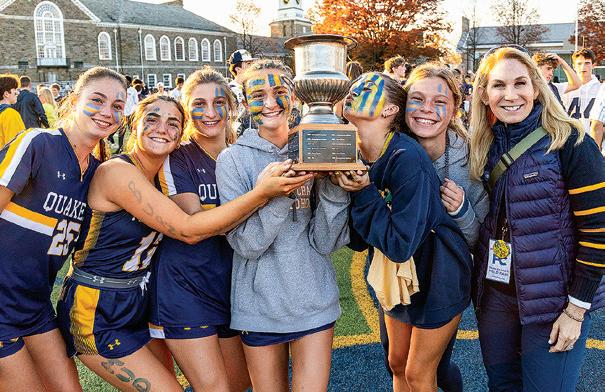
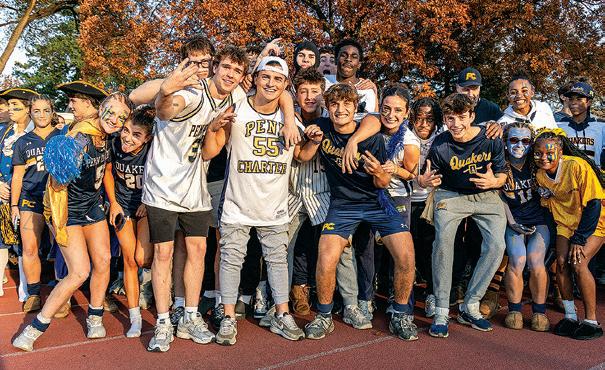
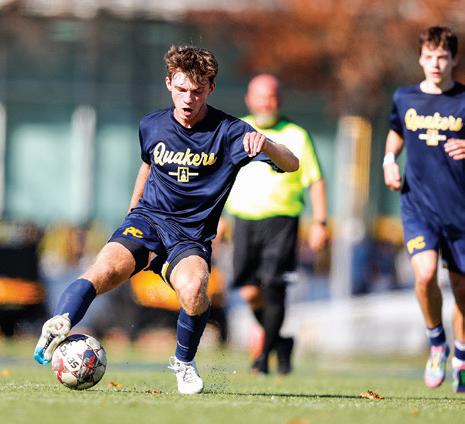
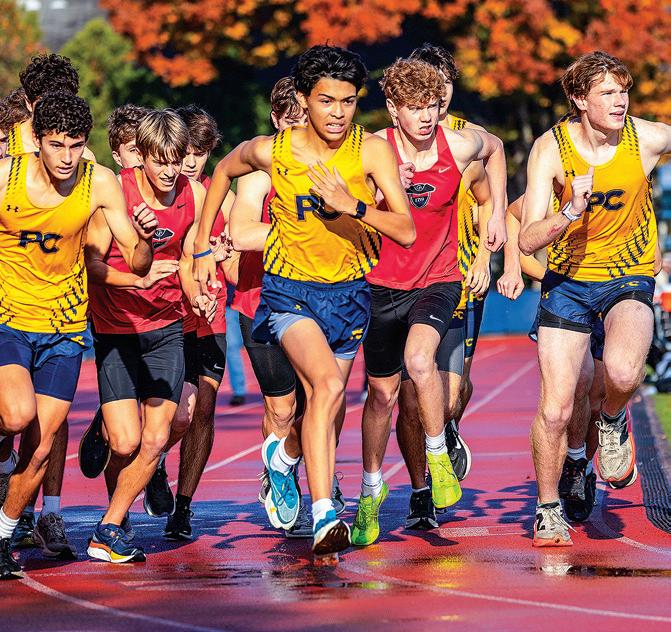
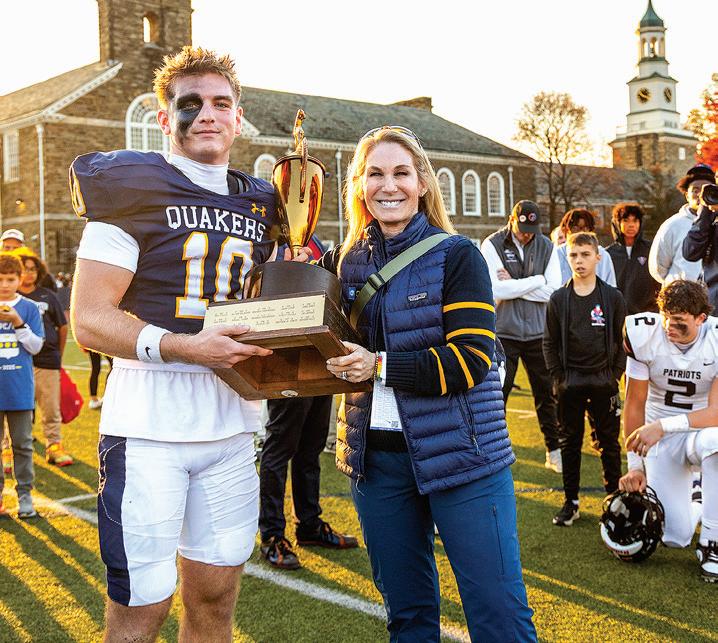
The 139th PC/GA Day on Nov. 8 ended with victories for the Quakers in seven of the 10 athletic events.
Not only did the Competition Cup remain with Penn Charter for yet another calendar year, but the day culminated with an exciting victory on the football field in head coach CJ Yespelkis’ inaugural season at the helm of the program. In addition to the football triumph, the Quakers were victorious in girls and boys water polo, girls and boys cross country, boys soccer and girls tennis. Germantown Academy secured tight wins in girls soccer and field hockey, while the golf match held earlier in the week ended in a draw. All told, it was another fulfilling day celebrating the oldest continuous high school football rivalry in the United States, and PC’s victory improved the Quakers’ all-time record to 90 wins, 38 losses and 11 ties.

To view more photos from PC/GA Day, visit flickr.com/photos/penncharter/albums
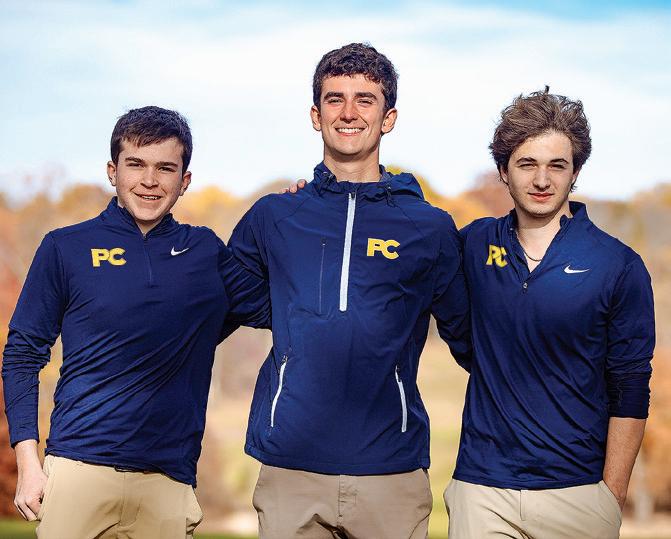
GOLF
The Quakers and Patriots kicked off the PC/GA Day festivities on Wednesday at Huntingdon Valley Country Club, with the two rivals playing to a 4-4 tie.
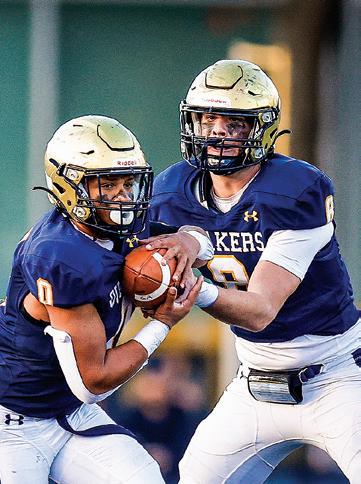
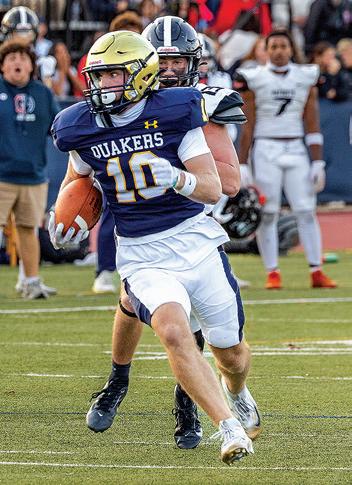
FOOTBALL
Entering the contest on a three-game losing streak did little to diminish Penn Charter’s desire to end Coach Yespelkis’ debut PC/GA Day with a victory. With the Quakers trailing 10-7 in the fourth quarter, senior quarterback Tom McGlinchey scored a go-ahead rushing touchdown to put PC in front for good en route to an exhilarating 14-10 victory. Wide senior receiver/cornerback Matt Furda hauled in five passes for 102 yards, including a 35-yard reception down inside the 10-yard line that set up McGlinchey’s winning touchdown. Furda was the recipient of the Geis Trophy, awarded annually to the football game’s Most Valuable Player. Senior Michael Banks also got into the end zone for the Quakers, and sophomore kicker Cecilia Albeck converted both of her extra points in the win. The result marked Penn Charter’s third consecutive football win on PC/GA Day. The Quakers finished the 2025 season with a record of four wins and six losses.
BOYS CROSS COUNTRY
In a truly competitive race, Penn Charter was able to edge the Patriots by a final score of 26-29 for a true team win to start the day’s festivities.
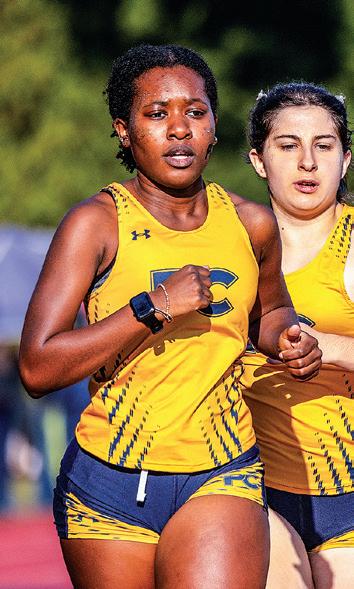
The Quakers secured a dominant 15-48 win over GA, with two-time Inter-Ac League Most Valuable Player freshman Mackenzie Skelly also securing the MVP of the PC/GA Day race.
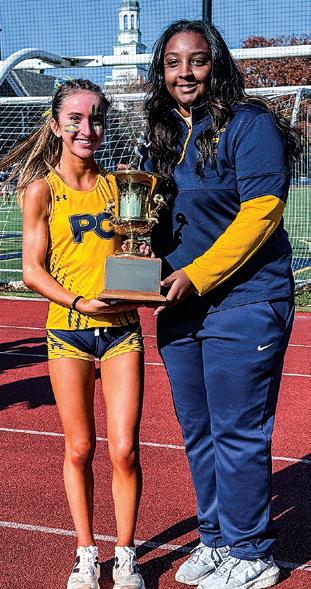
GIRLS CROSS COUNTRY
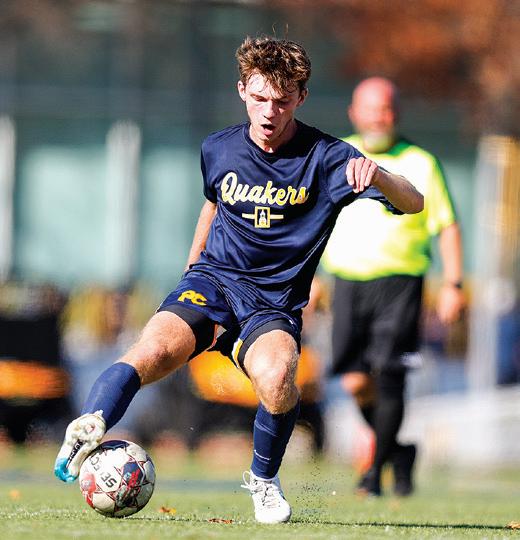
BOYS SOCCER
An intense, back-and-forth game ultimately yielded a 2-1 Penn Charter victory, with senior Willem van Beelen securing the James Rumpp OPC ’55 Trophy as the game’s Most Valuable Player. By virtue of defeating GA on PC/GA Day, the Quakers clinched their first Inter-Ac Championship in nearly a decade, finishing the season with an overall record of 15-5-2 overall and 8-1-1 against league opponents, concluding an impressive career for the 14 graduating seniors.
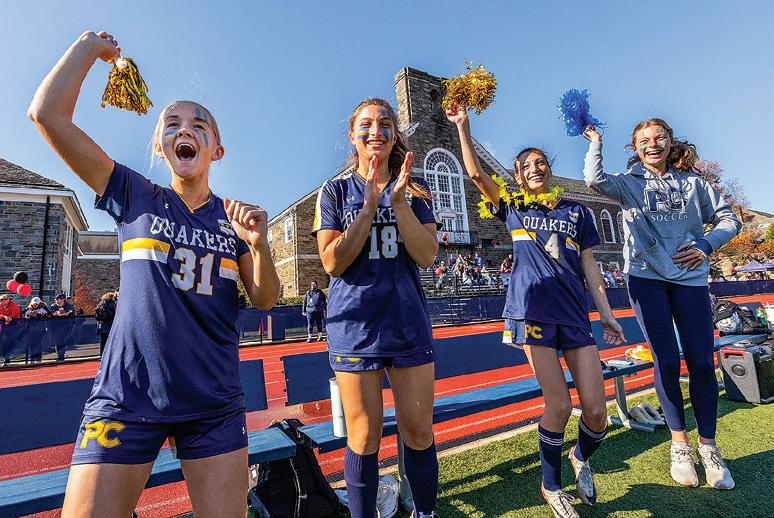
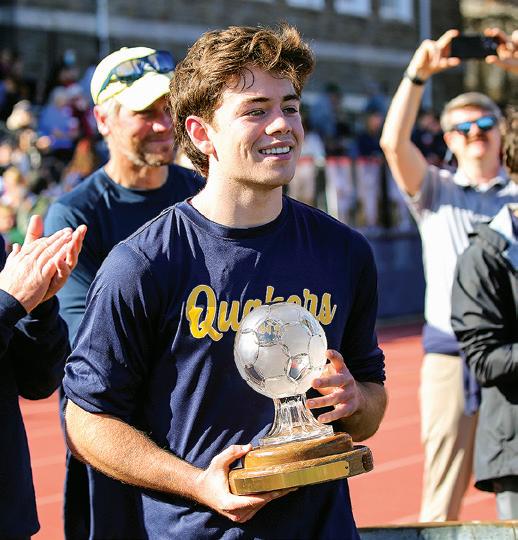
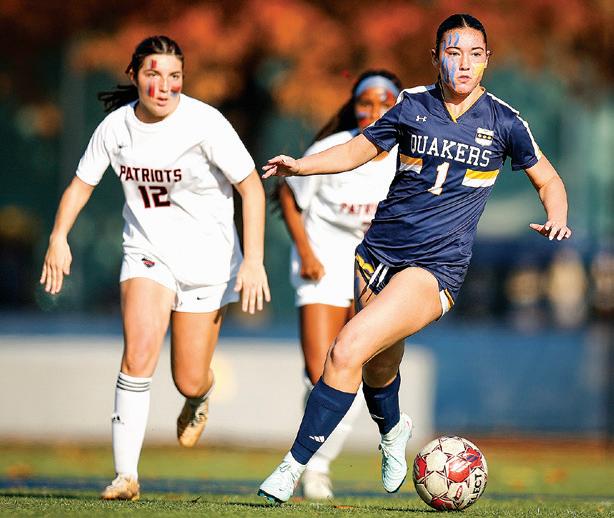
GIRLS SOCCER
The game was scoreless for the first 70 minutes of action until the Patriots were able to bury the only goal in an eventual 1-0 victory. Despite numerous season-ending injuries, the Quakers fought valiantly before coming up just short. PC finished its solid season with an overall record of 14-6-2 and 7-4-1 against Inter-Ac foes.
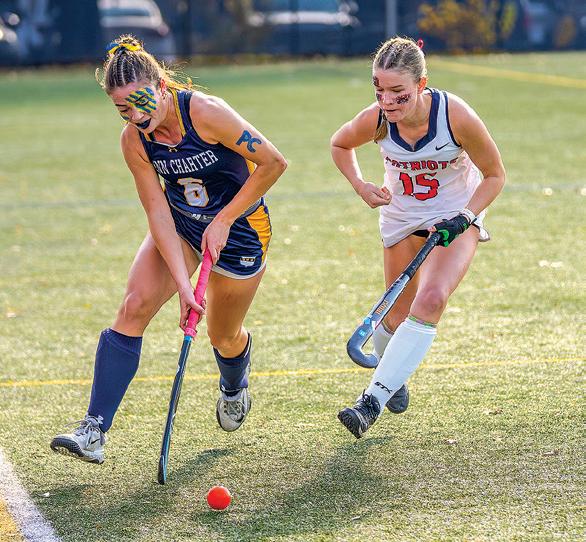
FIELD HOCKEY
Penn Charter’s team, which included 12 seniors, competed valiantly in the season's final high school contest, though it was Germantown Academy that came away with a 3-2 victory. The Quakers finished their season with five wins.
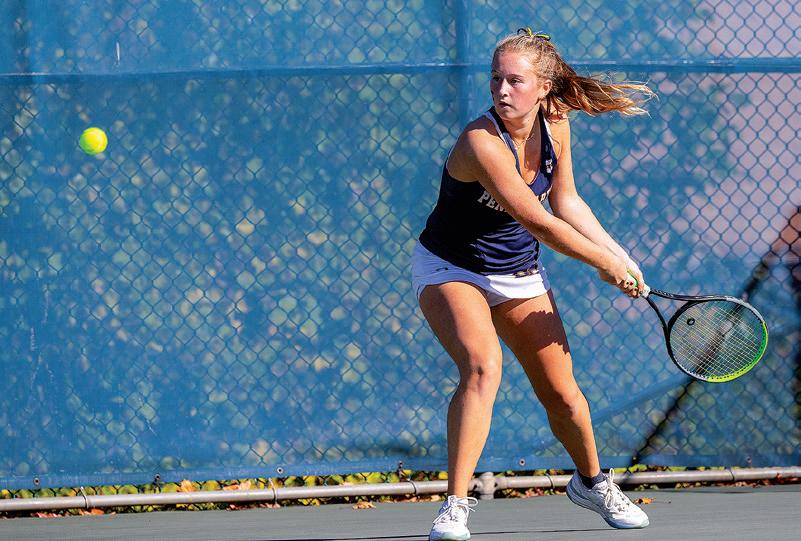
GIRLS TENNIS
Friday night’s rain soaked the Penn Charter tennis courts, leading to a delayed start on Saturday morning due to slick surfaces. The pushed back time did little to deter the Quakers’ resolve, as the team produced a dominant 5-2 win over the Patriots. Penn Charter’s number two singles player Payton Small was named the match’s most valuable player, further contributing to a strong finish to the team’s season. PC also advanced all the way to the PAISAA Tournament championship in 2025, finishing in second place as the team completed its season with an overall record of 11-6.
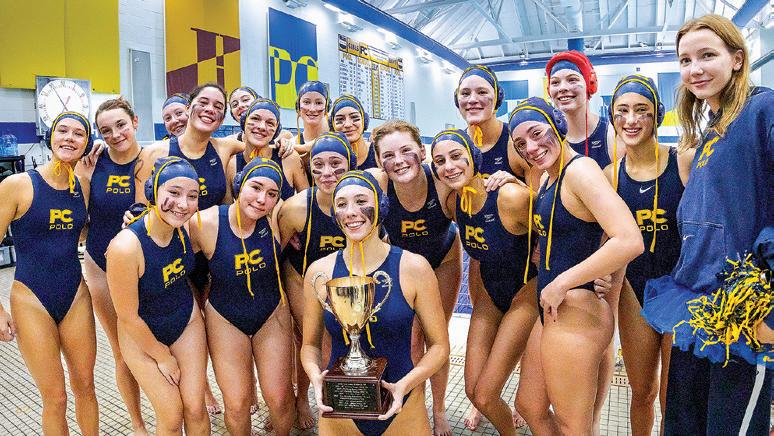
GIRLS WATER POLO
The Quakers put the finishing touches on another truly special season by knocking off GA, 13-4, in a commanding performance. Sophomore Eila Spaman scored a game-high five goals to lead PC, while senior Caroline Sumner earned the game’s most valuable player honor with a superb all-around performance of four goals, three assists and seven kick-outs drawn. Junior goalie Chelsea Gadsden posted 25 saves in the win. The Quakers finished the season on a fourgame winning streak as the second-best team in the state. They finished the 2025 season with an overall record of 19-2 and won the Eastern Prep Championship for the fifth consecutive year.
Athletics Achievements
BOYS WATER POLO
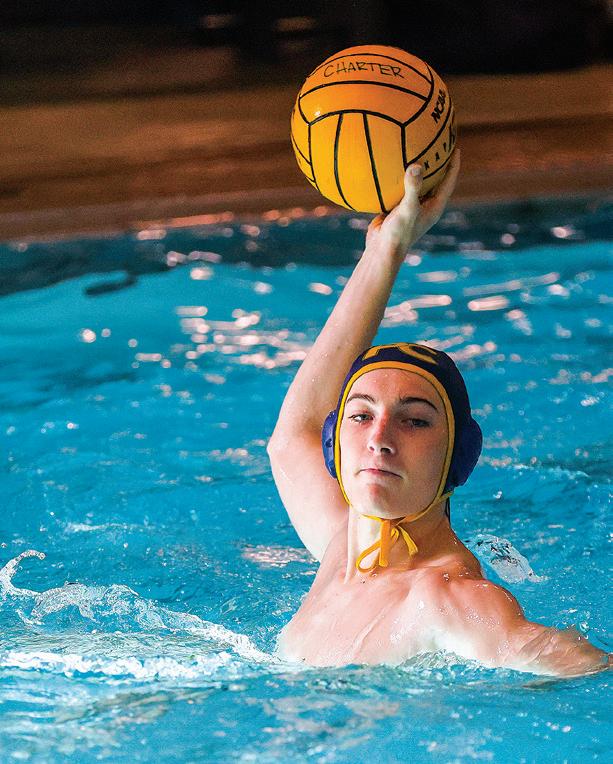
This battle was so tightly-contested that the teams needed two overtime periods to decide the ultimate winner—PC 11, GA 10. Senior Lev Puma secured the game’s most valuable player award in his team’s ninth overall win of the season.
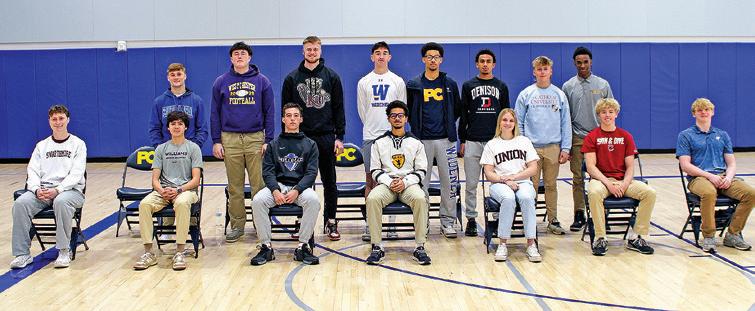
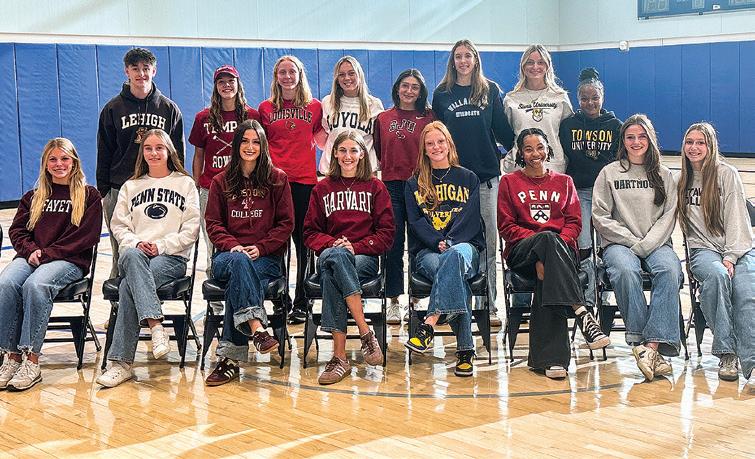
Congratulations to these student athletes—from both the Class of 2025 last spring, and the Class of 2026 this fall—who have been recruited to play their sport in college. Penn Charter is proud of the commitment and hard work of these students.
CLASS OF 2025
CLASS OF 2026
Back (L-R): Eian Kilpatrick (Franklin and Marshall College, football); Steve Blaker (West Chester University, football); Mike Gambone (Kutztown University, football); Ryder Stearn (Widener University, soccer); TJ Bryson (Widener University, basketball); Tate Taylor (Denison University, football); Rowan Griffith (Catholic University, baseball); Jamal Hicks (St. Thomas Aquinas College, basketball).
Front: Ben Zabierek (Swarthmore College, lacrosse); TJ Zwall (Williams College, cross country); Nate Arnold (Franklin and Marshall College, tennis); Oliver Jackson (St. Olaf College, track), Ali Sweeney (Union College, swimming); Aiden Trautwein (Chapman University, diving); Grey Catlow-Sidler (Long Island University, wrestling).
Not pictured: Nate Johnson (Middlebury College, cross country).
Back (L-R): Gavin Ruta (Lehigh University, baseball); Hannah Aldinger (Temple University, rowing); Lili DeMartinis (University of Louisville, rowing); Harbor Campbell (Loyola Maryland, lacrosse); Maddie Bergmann (St. Joseph's University, softball); Carol Sumner (Villanova University, water polo); Madison Wray (Siena University, softball); Ailyah Leonard (Towson University, lacrosse).
Front: Ryan Zinser (Lafayette College, swimming); Gwen Hamilton (Penn State University, track/cross country); Maeve Magarity (Boston College, lacrosse); Abigail Downin (Harvard University, track/cross country); Molly Dougherty (University of Michigan, lacrosse); Michaela Poland (University of Pennsylvania, track); Ana Buckley (Dartmouth College, lacrosse); Cassidy McCusker (Catawba College, soccer).
Not pictured: Tom McGlinchey (Northwestern University, football).

PC Profile
Neena Desai Ghose OPC ’95
BY MARK F. BERNSTEIN OPC ’79
It was only a middle school service project, but it may have turned Neena Desai Ghose OPC ’95 toward a lifelong career in the caring professions.
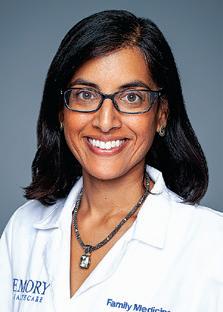
Ghose, now an assistant professor of family and preventive medicine at the Emory School of Medicine in Atlanta, remembers the impact more than the details. She was in seventh grade, and former PC teacher Fred LaMotte, who taught religious studies, took students to Trevor’s Place, a shelter for homeless families in North Philadelphia. As young as she was, Ghose did some tutoring and reading to the small children there.
“I think that was my first service experience,” Ghose recalls today. “And when I think about my trajectory into healthcare and social justice work, I credit a lot of that exposure to Penn Charter, and especially to Fred.” LaMotte also took Ghose to a conference on healthcare and homelessness held at Germantown Academy during her middle school years.
Those were hardly the only formative experiences for Ghose during her 13 years as a PC lifer. She edited The Mirror, played tennis and excelled academically. “There was nothing I wasn’t involved in,” she laughs now. “The volume and diversity of things you were able to engage in at Penn Charter was kind of unbelievable.”
From PC, Ghose went to the University of Pennsylvania, majoring in anthropology. She next earned a master’s degree in public health at Johns Hopkins before attending medical school at Jefferson Medical College, choosing family medicine as her specialty. After five years practicing family medicine, Ghose joined the Emory faculty in 2018.
She now has a clinic where she sees patients but also teaches medical students and family medicine residents. The residents go through rotations in different subfields, including hospital medicine, geriatrics, obstetrics, women’s health, contraceptive care and sports medicine. A lifestyle clinic helps with issues such as nutrition, weight loss and behavioral change.
The qualities that make a good family physician go beyond technical knowledge. “You have to meet the patients where they are,” Ghose explains. “You have to combine an evidence-based approach to patient care with a patient-centered focus, listening to their concerns and personal health
goals. You have to hear what they want and find some reasonable middle ground. You have to be pretty good at what I call empathetic listening.”
In sum, family medicine is “a little bit of everything,” Ghose says. “It’s always dynamic.”
The challenges, though, are only growing bigger. According to a 2024 report by the National Center for Health Workforce Analysis, there will be a shortage of more than 87,000 primary care doctors in the United States by 2037, with shortages greatest in rural areas. Many family physicians report feeling burned out.
Compared to previous generations, people today are less likely to see a family physician, someone they have gotten to know and who is familiar with their medical history. Instead, they are more likely to seek treatment from urgent care centers, walk-in clinics at pharmacy chains, and telemedicine appointments.
“I think people are prioritizing access,” Ghose reasons. “They’re trying to have better access to care, maybe at the expense of quality care from a known healthcare provider.”
Although the demand for family medicine is increasing, public support for it is under attack, which worries her greatly. Ghose’s department at Emory is facing a 30% budget cut, which negatively impacts programs aimed at women, children and families, as well as other vulnerable populations. “All of that is on the chopping block,” she says.
Decades after that middle school service project, Ghose’s commitment to service work remains strong. For the last several years, she has worked to provide healthcare clinics for migrant farmworkers in southern Georgia. Ghose has taken her students and residents into small, rural communities that often do not have family medicine practices of their own. The farm workers receive needed treatment and learn about preventive care for problems such as diabetes. The residents learn how to take patient histories and gain experience communicating with people they may not see regularly in urban settings. Those programs, too, are scheduled for big cuts in the fall.
“A lot of that funding will be gone,” Ghose says. “We can look for outside funding, but it doesn’t always happen, which adversely impacts our most vulnerable.” PC
PC Profile
Jon Wybar OPC ’96
BY MARK F. BERNSTEIN OPC ’79
Construction is always dirty. No matter how green or sustainable a builder tries to be, there is inevitably a lot of waste. Builders who aspire to get LEED certification from the U.S. Green Building Council, or just want to be eco-friendly, must dispose of their waste responsibly. That is when they call Jon Wybar OPC ’96 and his firm, Revolutionary Recovery.
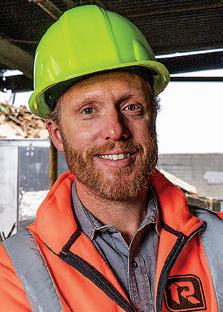
Revolutionary Recovery, which Wybar cofounded in 2004 with fellow alumnus Avi Golen OPC ’98, works with builders to find new uses for all that dirty leftover material. Drywall, for example, can be ground down and the gypsum used as fertilizer. Wood can be chipped up for mulch. Concrete can be broken up and made into new batches of concrete. Other materials, such as aluminum and copper wire, can also find a home.
From very small beginnings, Revolutionary Recovery now operates three recycling plants around the region, owns 28 haulage trucks, and has 135 employees.
“We started with nothing,” Wybar said, looking back. “We didn’t have any capital or any real knowledge, but we timed it well. The green building movement was just coming along, and there were new specifications from architects.”
One builder who is familiar with Wybar’s work is Craig Sabatino OPC ’74, the principal and cofounder of INTECH Construction. “Jon was doing this kind of work before it was in vogue,” Sabatino said. In fact, much of the waste generated in the construction projects INTECH has done recently on the PC campus—which include the Graham Athletics & Wellness Center and the Balderston Lower School—have gone to Revolutionary Recovery’s recycling sites.
Wybar was introduced to the construction cleanup business in perhaps the worst way possible. Early in 2002, Wybar, who had just graduated from college, answered an ad in the Chestnut Hill Local for a firm that was cleaning buildings near the World Trade Center site following the 9/11 attacks. Commuting daily to lower Manhattan, Wybar inspected the buildings and wrote environmental reports certifying that they were safe to be reoccupied.
A little over a year later, Wybar reconnected with Golen, who had seen how much waste was being thrown away at construction sites and thought there might be a way to recycle it. Starting with drywall, they soon began to offer recycling of other materials and founded Revolutionary Recovery in 2004. Their timing was good. With growing public awareness of recycling and greater demand for green buildings, there was now a market for handling construction waste responsibly. (Golen left the company in 2017.)
If Wybar has been running hard building a business, running seems to come naturally to him. He was born in Seattle and lived in England for several years before entering PC in fourth grade. He was Inter-Ac track champion in both the mile and two-mile events his junior year and won the Inter-Ac cross country championship as a senior, finishing second in the state.
Eager to continue running, Wybar walked on to the track team at the University of Oregon, a famed program in the sport; Wybar’s coach, Bill Dellinger, had previously coached legendary distance runner Steve Prefontaine. Wybar, who majored in geology, completed his collegiate career at the University of Texas.
At first, Revolutionary Recovery connected dumpster companies with existing recycling firms but soon moved to separating construction materials independently. It opened its first recycling plant, in Northeast Philadelphia, in 2008; added a second, in Delaware, in 2012; and a third, in Allentown, in 2018. Each site receives about 500 tons of construction waste a day.
Wybar acknowledges that too much industrial waste is still, well, wasted. He estimates that, although his company keeps 100,000 tons of materials out of landfills every year, just as much still ends up there. Some things, such as office equipment and roofing materials, just aren’t economical to recycle yet. Wybar is optimistic that there is still a lot more room to for his company to grow.
“Our mission has been to keep building materials out of landfills, to be green, and to support sustainable construction and sustainable building use,” he explained. “I feel the need is greater than ever. The landfill’s days are numbered.” PC
is the word!
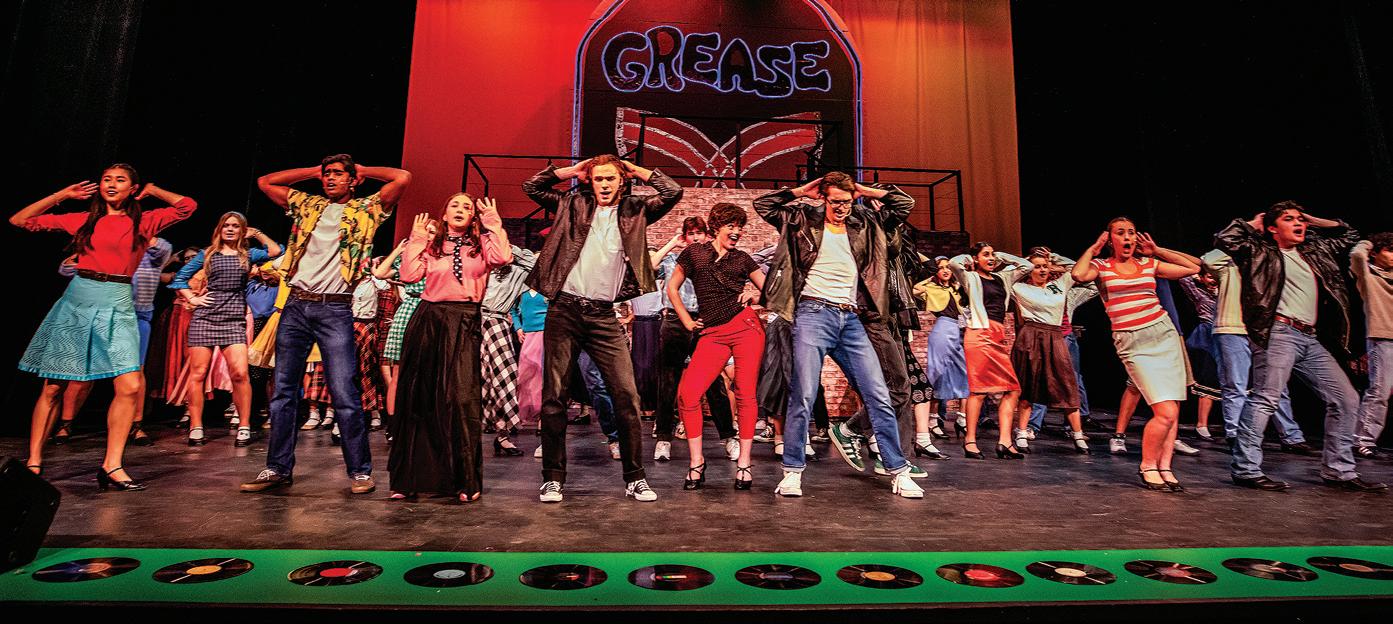
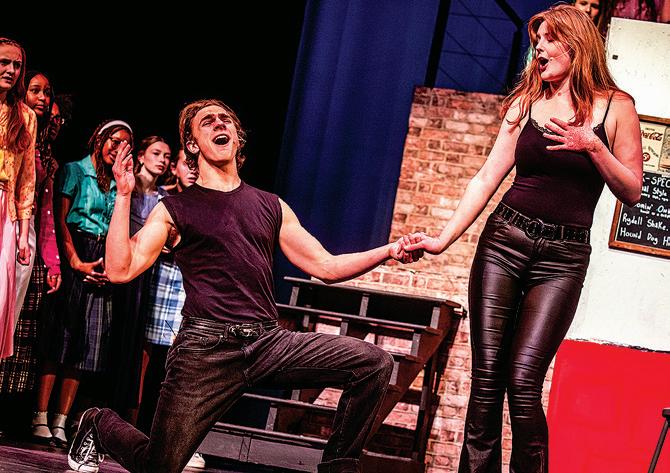
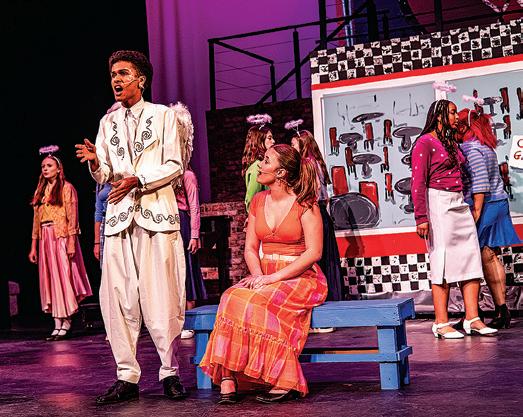
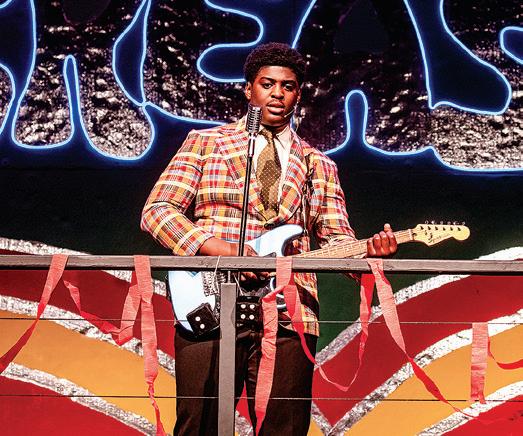
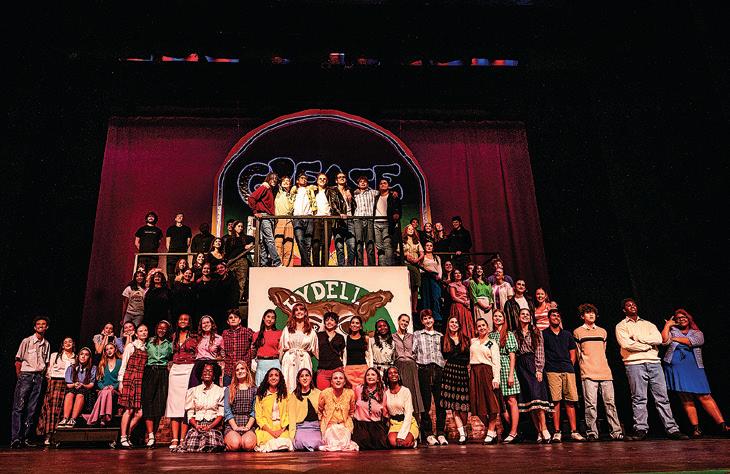
From “Summer Nights” to “Greased Lightning,” PC students lit up the stage in a high-octane performance of Grease on March 7 and 8 in the Kurtz Center for the Performing Arts.
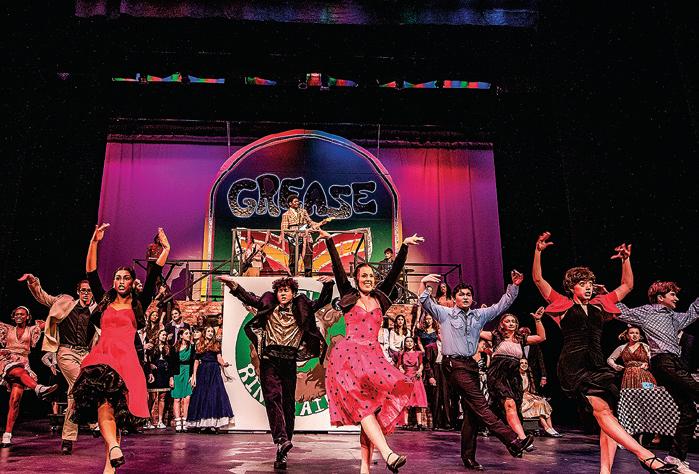
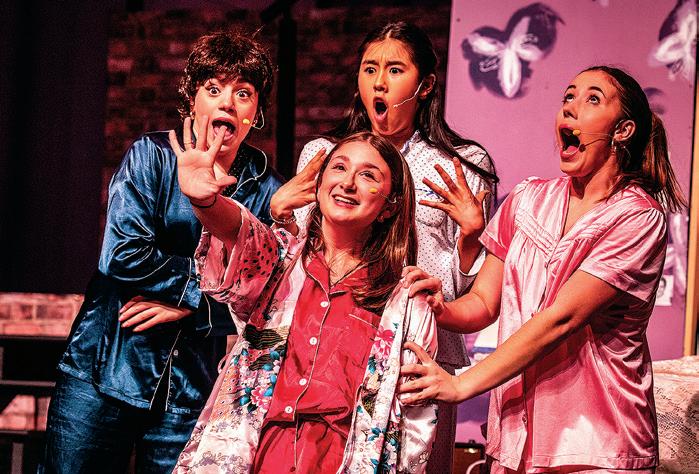
Set in the 1950s, the musical comedy Grease, with its story of the T-Birds and the Pink Ladies and rock-and-roll songs like “Born to Hand Jive” and “You’re the One That I Want,” captures the spirit of teenage friendship, love and rebellion—and Upper School students jumped at the chance to bring it to life.
For Bailey Handler, then in 10th grade, the best part of being in the musical was her peers. “There was such an infectious energy in the cast that made me excited to come to rehearsal every day,” she said, “and I think that really showed in the performance.”
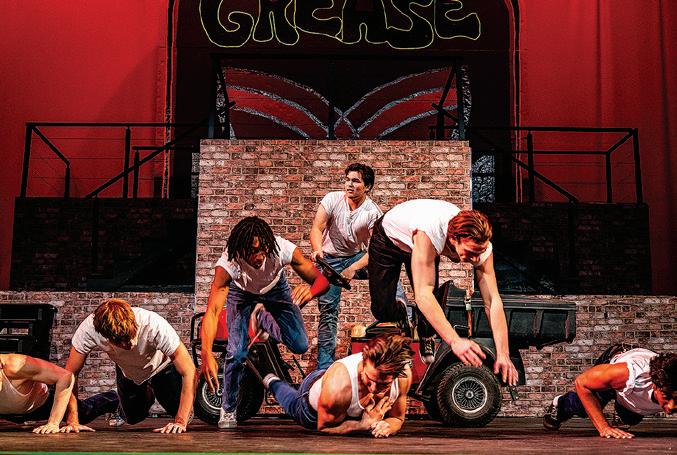
Her classmate Robert Rankin recalled one of the funniest moments from rehearsals— learning the “Greased Lightning” choreography. “There is a part in the dance where some of the guys are doing pushups and at the same time have to jump over someone who is rolling underneath them,” Robert said. “When that happened for the first time, about half of the guys fell on top of the person rolling underneath them.” It didn’t take them long to perfect it, though, and the sequence (pictured above, left) was one of the most impressive parts of the show.
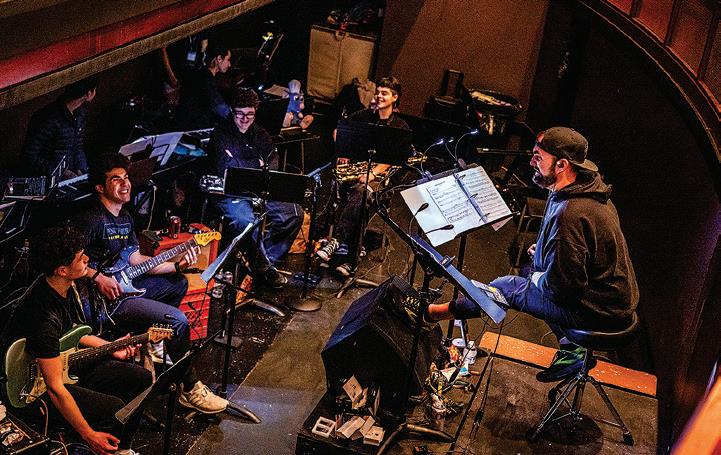
Director Ari Baker praised the unique sense of community that developed throughout the production. “We had over 100 students working on stage, backstage and in the pit to bring Grease to life, and the community that they built during the production process was unparalleled,” she said. “The actors helped each other learn choreography, showed up to celebrate the musician’s work at pit rehearsals, and turned up on deck to gush about the stage crew's construction while the set was in progress. They wanted to be with each other and be there for each other.”
With their dazzling performance, PC’s cast, pit and crew proved they’re the ones that we want! PC
See more photos at flickr.com/penncharter/albums.
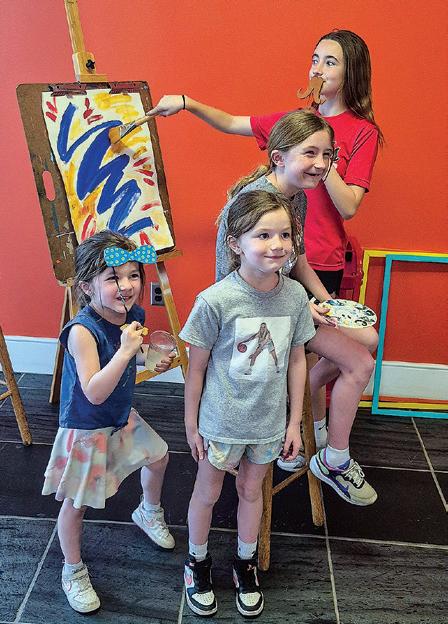
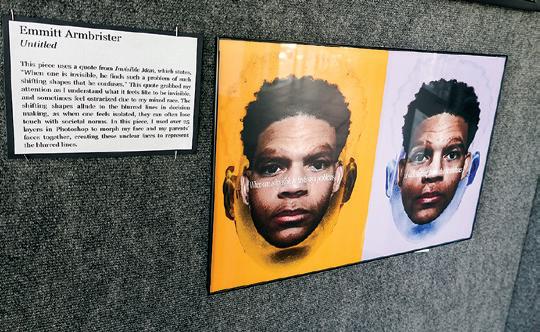
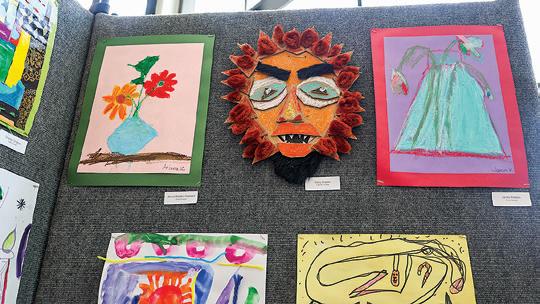
All-School Art Show
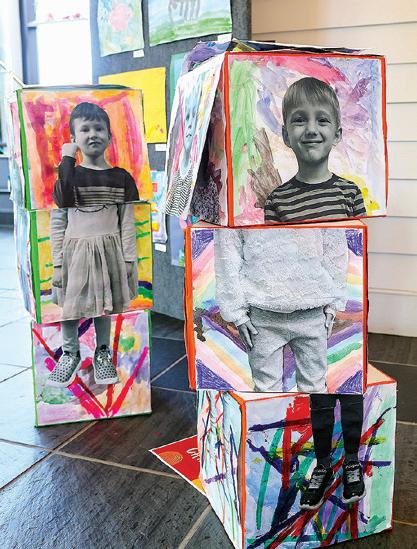
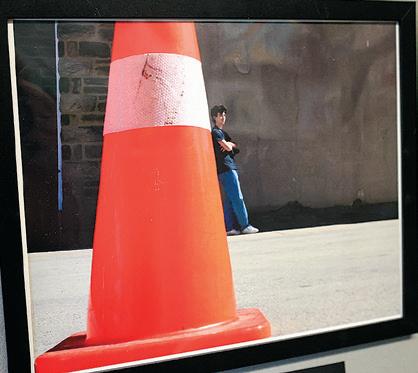
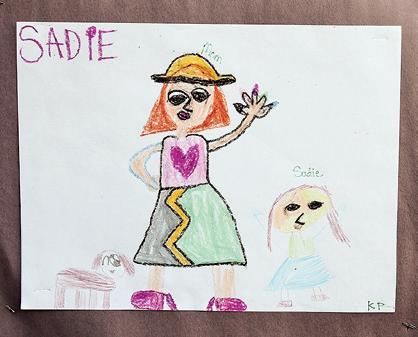
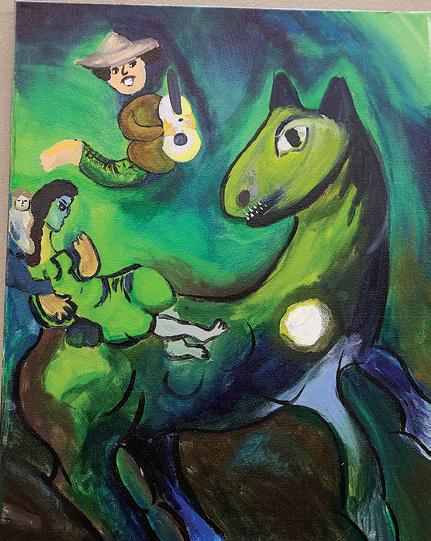
TOGETHER WE CREATE, the 2025 All-School Art Show, filled the sunlit lobby of the Kurtz Center for the Performing Arts with artwork that showcased a full sweep of student creativity, from the bold experiments of pre-K artists to the refined works of seniors.
Visitors encountered an impressive variety of styles and media—painting, drawing, sculpture, textiles, graphic design, even fashion design—reflecting the diverse talents of our community. This year, the show reached an even wider audience, traveling to the Woodmere Art Museum, where it was on view throughout the summer.
In addition, the art show included an OPCs in the Arts Film Screening honoring alumni who work in the television and film industry. The lineup featured James Bartolozzi OPC ’11, a technical director and filmmaker who has worked on music videos for Mitski and Thom Yorke, as well as Disney's Turning Red and Toy Story 4; Jennifer Diamond OPC ’01, cast member of off-Broadway shows such as This One's for the Girls and Ruthless! The Musical; and Zac Kline OPC ’03, whose short film Pauline won Best Ensemble at the the Best Actors Film Festival.
Penn Charter's art teachers encourage students to experiment creatively and see art as a form of play. This means sharing ideas and questions as well as producing work, whether through an animated conversation in Studio in the younger grades, or a peer critique or gallery walk in the older grades. "We create together because we believe that there is power in problem-solving together, in dreaming together, and in sharing our vision with others," said Joy Lai, chair of the Visual Arts & Design Department.
PC encourages alumni to join the Alumnifire “OPCs in the Arts” community to stay in touch about PC events and to learn of opportunities to speak with current students about their experiences in the arts. For more info, visit penncharter.alumnifire.com. PC
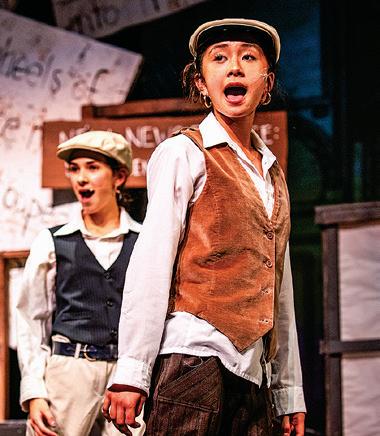
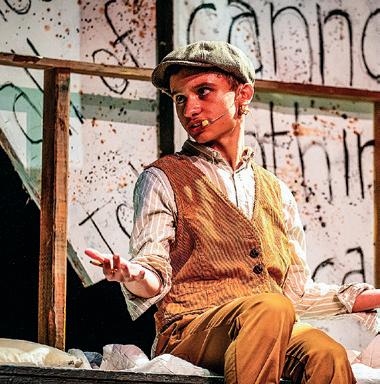

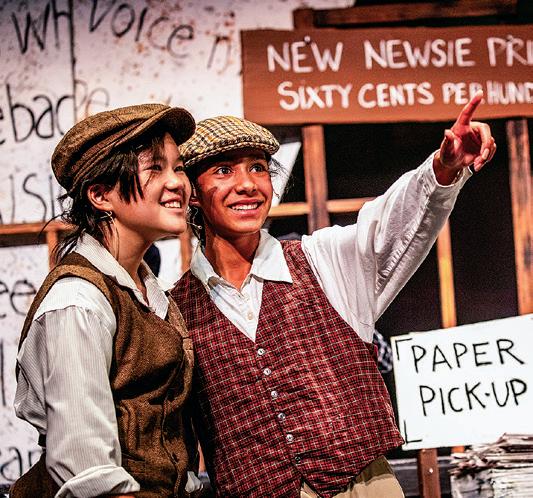
SEIZE THE DAY
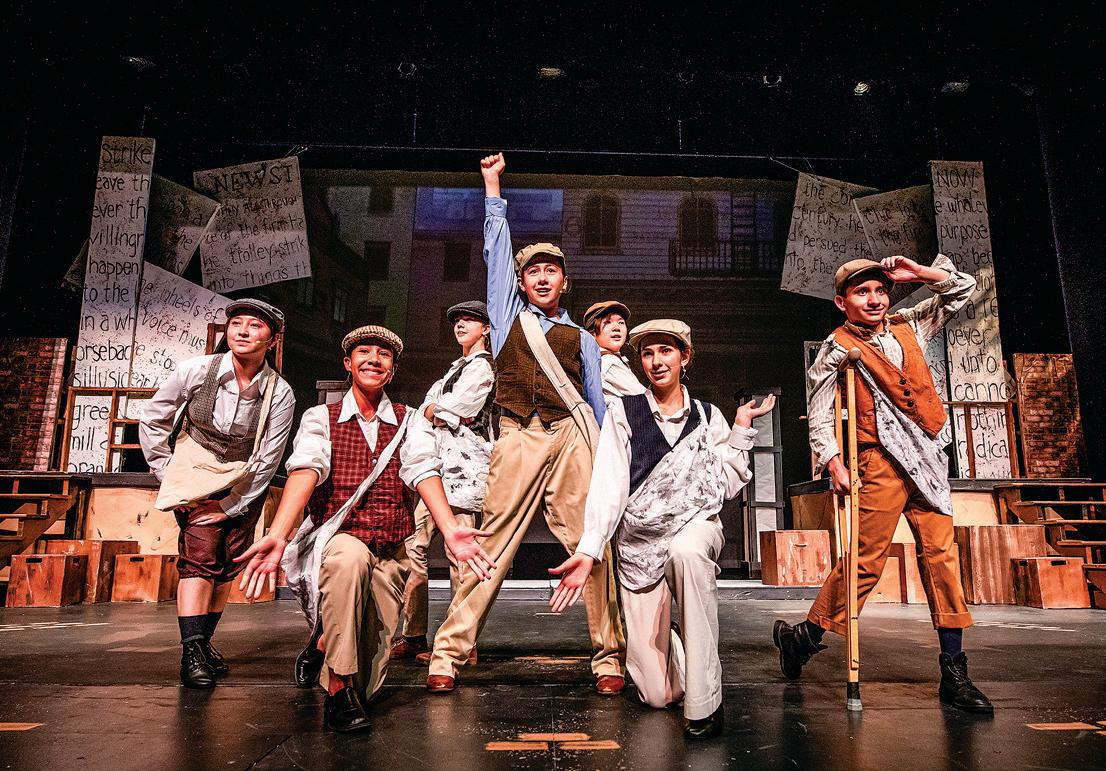
For two days last May, Middle School performers brought big energy and heart to the stage with Newsies Jr., an adaptation of the hit 2012 Broadway musical and 1992 Disney film.
The story follows charismatic newsboy Jack Kelly, who rallies his fellow “newsies” to strike when newspaper publishers raise prices at the boys’ expense. Through courage, solidarity, and song and dance, the newsies discover that they are stronger together and can create a movement to fight for what’s right.
For then-sixth grader Jackson Lightsey, the show was a transformative experience. “I was new to acting, and this was my first musical,” he said. “Even though I struggled at times, everyone in the cast helped me. Newsies helped me grow past my fear of being on stage and taught me to be more social. I also made many new friends.”

Lena Polite, then in seventh grade, had a similar experience. “It increased my confidence and made me comfortable singing in front of a large audience,” she said. “My favorite part was getting to know the cast and deepening my friendships.”
Director Michael Roche praised the skill and spirit of the cast and crew. “The talent on stage and behind the scenes for the Middle School show was exceptional, and one of the most motivated and self-disciplined groups I've had the pleasure to work with,” he said. “And what's awesome is the cast and crew are only going to get better each year. We are truly lucky to have them involved in the performing arts.” PC
See more photos at flickr.com/penncharter/albums.

WHERE LEARNING MEETS ADVOCACY:
The Story of Peace, Justice and Social Change
by Sonia Belasco
Open to 11th and 12th graders, teacher Sharon Ahram’s Peace, Justice and Social Change class explores the history of the U.S. Civil Rights Movement within the broader landscape of 20th century social movements. The course emphasizes the ways the African American Freedom Movement has shaped—and continues to shape—national conversations about equality, democracy and social justice.
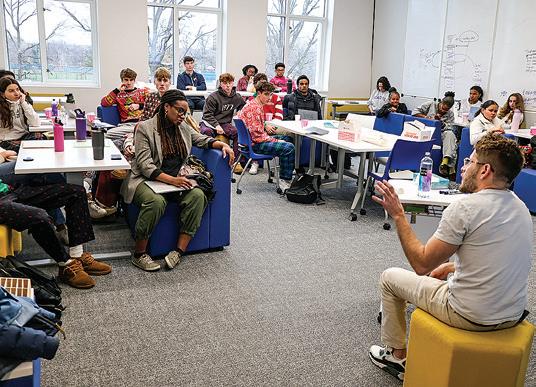
Peace, Justice and Social Change has evolved over decades. Retired Penn Charter teacher Jim Ballengee Hon. 1689 traces its roots back 37 years, noting that when he arrived at PC in 1991, religion teacher Bill Kashatus had introduced a series of courses known as Art of Caring. “The whole idea was to get kids out of the classroom,” Ballengee recalled. “While learning about issues connected to the curriculum, they were also working directly with individuals in the community. For a Quaker school, that was so natural—extending outward into the community is right in our wheelhouse.”
In earlier years, the course centered on urban issues and poverty. In Philadelphia, students volunteered in public schools, maintained food banks at St. James School, and partnered with St. Francis Inn Ministries in Kensington. In 2003, Ballengee’s third year teaching Peace, Justice and Social Change, he brought students to the South Bronx in New York to visit a homeless shelter and public housing project. The work culminated in 2015 with the founding of Penn Charter’s Center for Public Purpose,
Alex Kursman, a federal defender for the Capital Habeas Unit, spoke to students about his experiences defending inmates on death row.
launched under then-Head of School Darryl J. Ford Hon. 1689. With expanded resources and staffing, the center wove service learning into every grade level and strengthened partnerships with local organizations and marginalized communities.
As the course has grown and transformed, so too has its focus. Ahram, who took the reins from Ballengee in 2016, has reshaped the curriculum in response to student interests. “Year after year, students became really interested in the justice system—justice reform and mass incarceration,” she explained. “That’s where I started bringing in Bryan Stevenson’s work, along with research and advocacy from the Juvenile Law Center and the Innocence Project. I want students to know the history but also to see how we got here, what’s happening now and how they can be voices for change.”
Through guest speakers, site visits and case studies, Ahram encourages students to confront their own assumptions about the justice system, including stereotypes about people who are or have been incarcerated. “Ideally,” she said, “students begin to grasp the why behind problems in our justice system. These issues aren't isolated. They're rooted in deeper systems and histories that shape people's lives.”
The class often invites experts with firsthand knowledge of the legal system. One such visitor was Ahram’s former high school classmate, Alex Kursman, a federal defender who works on death penalty cases. Senior Zsuzsi Pollock recalled a powerful moment from that visit: “We use this quote in our class from Bryan Stevenson’s Just Mercy—‘Each of us is more than the worst thing we’ve ever done.’ The cases Mr. Kursman shared showed us the struggles inmates faced, the failures of the systems around them. Does it justify what they did? No. But it makes you more empathetic—to see that everyone is more than their worst day.”
For many students, Peace, Justice and Social Change becomes a springboard to independent projects. Inspired by guest speaker Judge Chelsey Lightsey, Zahir Kalam Id-Din OPC ’25 interned with her last year for his Senior Project. Reflecting on his experience, he said: “Many offenders were young adults not that much older than myself. I couldn’t stop asking: How do we prevent our youth from ending up in jail and becoming another statistic?”
Dean and Wills Kaiser, both OPC ’25, found a similar calling after learning about the case of Tyree Wallace, a man who served 26 years of a life sentence without parole for a second-degree felony murder conviction. After Wallace’s life sentence was vacated in November 2024, the brothers, then seniors, brought his story to Ahram’s class. Wills explained: “I realized one of the best ways to fight a wrongful conviction is to raise awareness—as loudly as possible.”
“Having a chance to participate in the movement for Tyree's rightful release, including speaking to him while he was incarcerated months before the hearing, has been one of the most impactful experiences of my life,” Dean said.
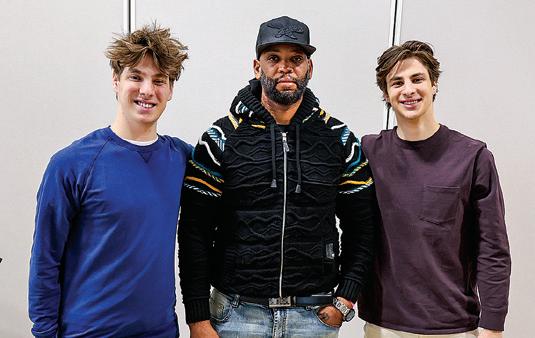
Their advocacy soon extended beyond the classroom. On Jan. 16, 2025, Wallace spoke at Penn Charter about his life in prison and his fight for reform. Addressing students and faculty, he credited their voices with helping to win his freedom. “The only reason I am here is because of people such as Dean, Wills and the other students who said, ‘We don’t care about procedure, we don’t care about technicality—he didn’t commit the crime, let him out.’ It was those voices—rallying, signing petitions, demanding better—that made the difference.”
Ballengee noted that Peace, Justice and Social Change not only inspires school projects and service but also has long-lasting impacts. “I still have kids who write to me and talk about the impact on the rest of their life from that,” he said. “It's really rewarding when you hear: ‘That really made a difference for me, that I confronted those issues and dealt with them in my own mind in my high school years.’” PC
On Nov. 4, 2024, Sharon Ahram's Peace, Justice and Social Change class attended Tyree Wallace's resentencing hearing, which set him free.
Tyree Wallace visited Penn Charter to speak about his time in prison and the activism that led to his release, including the advocacy of Dean and Wills Kaiser, both OPC '25.
OPC WEEKEND 2025
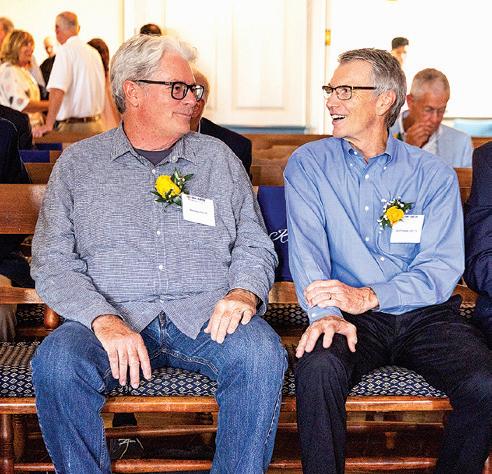
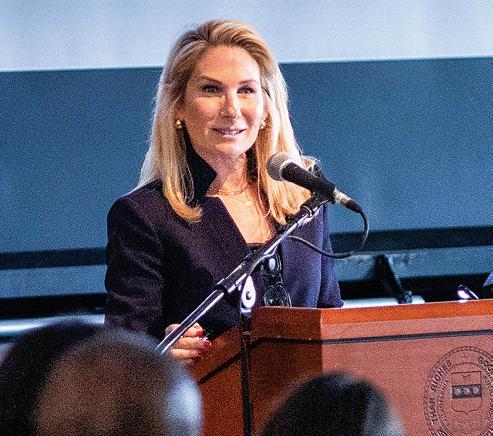
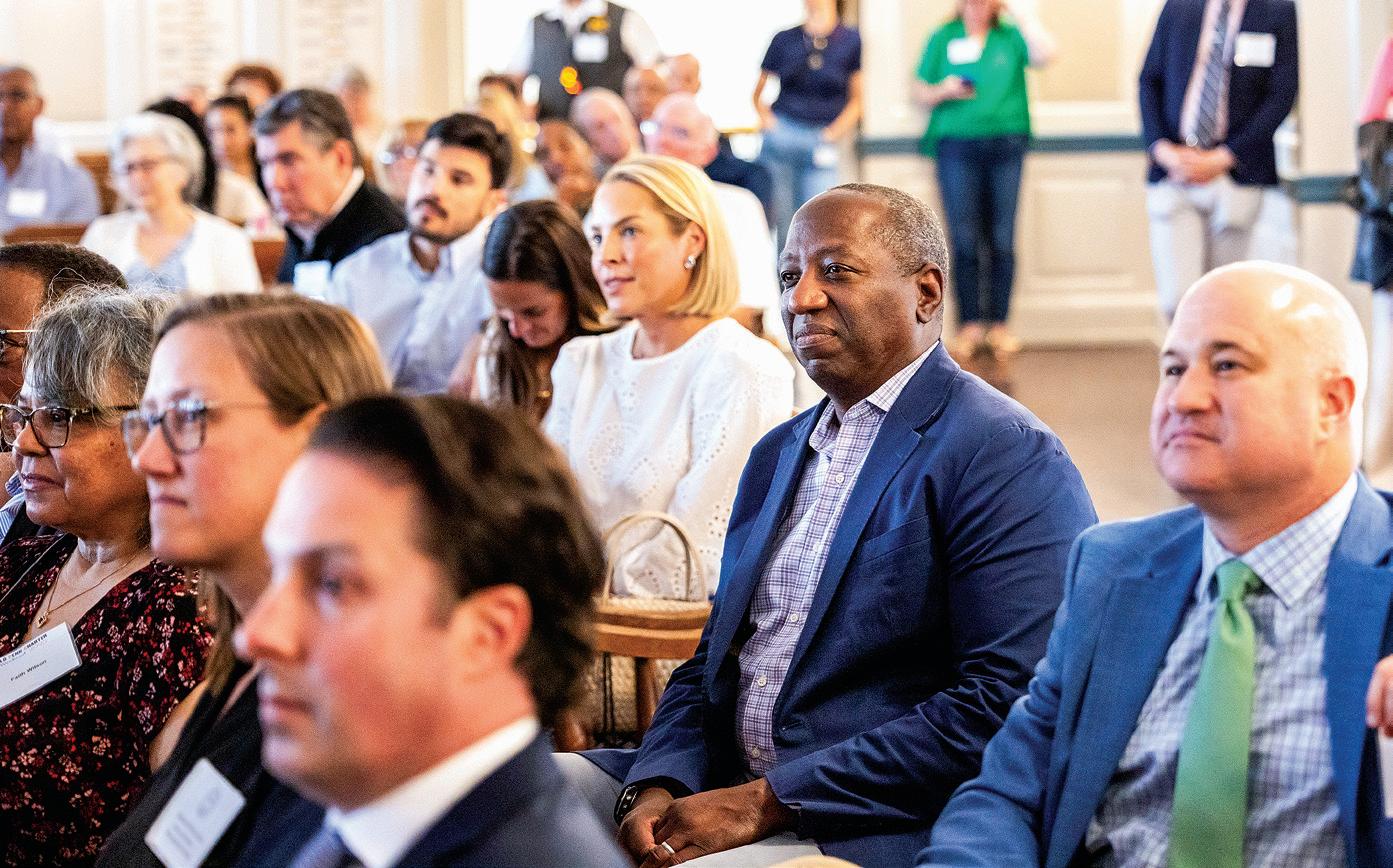
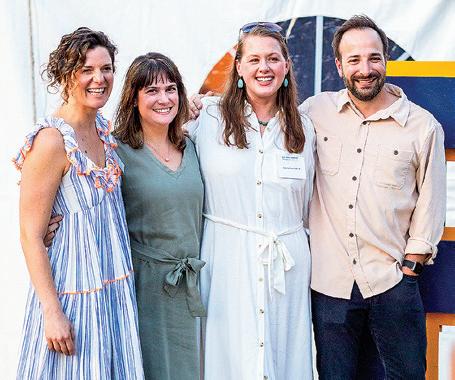
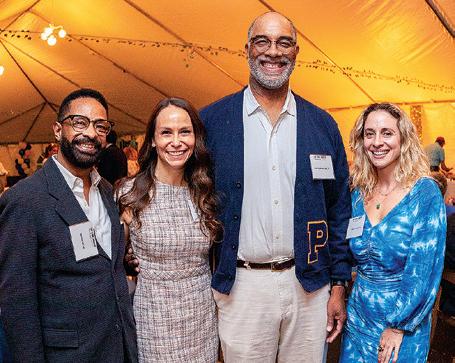
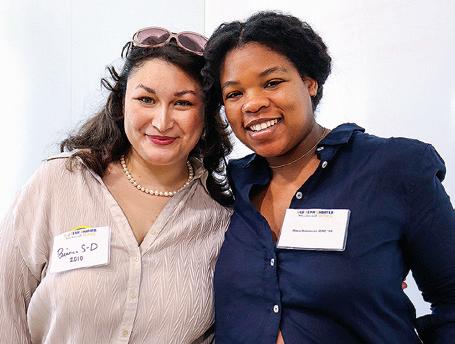
From the Class of 1965 to the Class of 2015, alumni gathered to celebrate reunions for graduation years ending in 0 and 5, and to cheer and applaud fellow OPCs and dedicated Penn Charter teachers at the OPC Weekend Awards Ceremony on May 2 and 3, 2025.
David P. Montgomery OPC ’64
Alumni Award of Merit
The Alumni Award of Merit is given “to a graduate of William Penn Charter School whose character and outstanding achievement have reflected lasting credit upon this old school.”
JOHN P. GROTZINGER OPC '75
John P. Grotzinger OPC ’75 received this year’s David P. Montgomery OPC ’64 Alumni Award of Merit. Grotzinger currently teaches geology at the California Institute of Technology and was previously chief scientist for NASA's Mars Rover Curiosity mission. His research includes the origin and early evolution of life on Earth, and the comparative evolution of Earth and Mars.
In her introduction of Grotzinger, Head of School Karen Warren Coleman said, “Before he was helping NASA explore Mars, before the medals, the professorships and the Mars rovers, John was a Penn Charter student with a love for science, a passion for the outdoors, and—according to his friends—a dangerous fondness for sneaking his dad’s sports car out for a spin.
“But what truly sets John apart,” Coleman said, “isn’t just the magnitude of his accomplishments. It’s the spirit behind them: his humility, his boundless curiosity, and his deep commitment to understanding the world—and sharing that understanding with others. He’s carried the values of Penn Charter with him every step of the way.” PC
CAESAR WILLIAMS OPC ’80
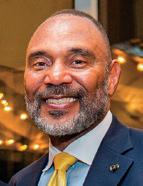
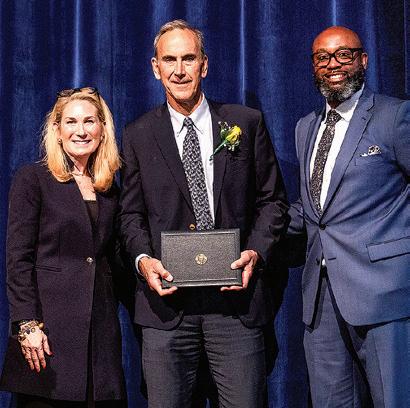
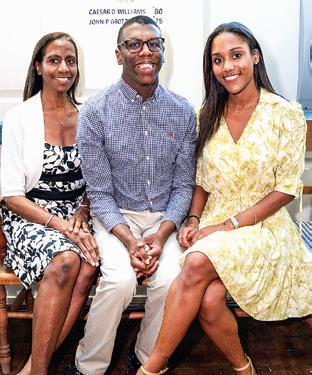
Caesar Williams OPC ’80, both a PC lifer and an OPC parent, was posthumously awarded the David P. Montgomery OPC ’64 Award of Merit. Stephen A. Bonnie OPC ’66, director of stewardship and special projects, spoke about his friend, who he said never missed PC/GA Day, Color Day or an OPCs of Color Brunch. “Caesar Williams was smart, humble, openminded, honest, enthusiastic, kind and generous of spirit,” Bonnie said.
Katrina Williams, his wife, and Tyler OPC ’15 and Trey, their children, (pictured) accepted the award on his behalf.
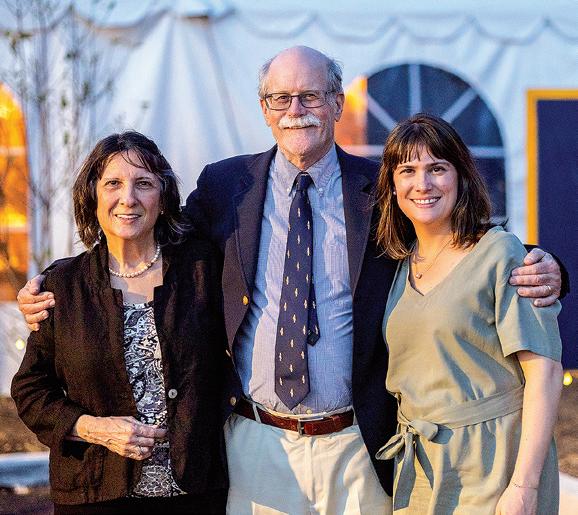
John P. Grotzinger OPC '75, center, with Head of School
Karen Warren Coleman and Ed Morris OPC ’94, president of the Alumni Society
John F. Gummere Distinguished Teacher Award
"Honoring those who have demonstrated outstanding scholarship, teaching and character, and whose work in their field, rapport with students and colleagues, and contributions to the intellectual field of the school merit recognition.”
ED MARKS HON. 1689
After 46 years of teaching social studies at Penn Charter, and on the cusp of retirement, Ed Marks Hon. 1689, received the John F. Gummere Distinguished Teacher Award.
Brooke Stratton, chair of the Social Studies Department, presented the award to Marks, sharing appreciations she had gathered from students and fellow teachers.
“I don’t think I’ve had a teacher that cares more about me as a person then Mr. Marks does,” one of his students had written. “He made it clear he wanted to hear from everyone. Each person’s story and opinions were interesting to him, and I knew that he valued us all as people. I loved hearing his personal memories and experiences. I knew that his wisdom and knowledge was worth learning and holding onto. I love history, but taking Mr. Marks’ government class made me realize that I wanted to do more and be the change that could make a difference.”
Stratton also shared her own reflection of Marks, as a colleague and friend. “You have been, in the truest sense,” she said, “a teacher—not just of history and government and ethics, but of what it means to live a life of purpose, kindness and care. On behalf of everyone whose life you've touched over these decades, thank you for showing us not what to think or teach, but how.”
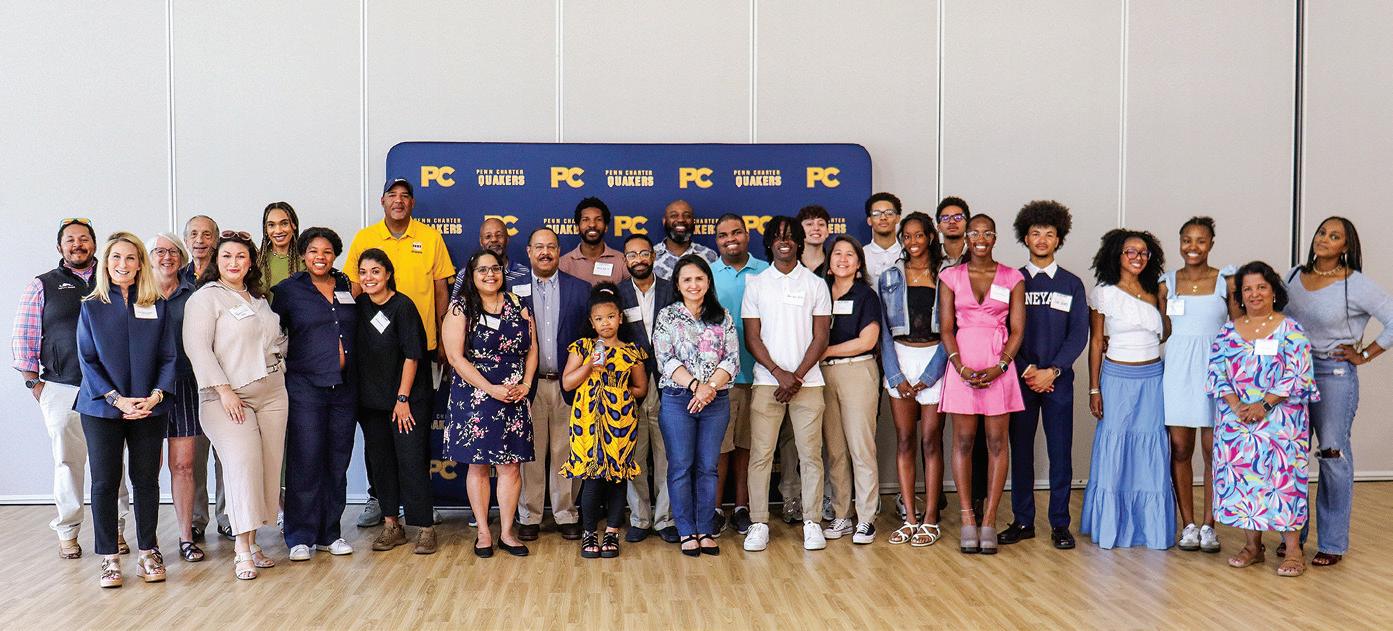
OPCs of Color Brunch
At this annual event, OPCs of color from many different class years connect for food and fellowship.
Ed Marks was accompanied at the ceremony by his wife, Margie, and daughter, Anna OPC ’05.
Honorary 1689
“Given to a member of the Penn Charter community who has shown extraordinary commitment to the school by demonstrating pride and excellence in the performance of their duties and by consistently providing encouragement and support to the student body.”
DEBBIE WHITE
Debbie White, in her 37 years of service to Penn Charter has, served as athletics director, physical education teacher, department chair and longtime girls lacrosse coach. She was also the Color Day boss, seamlessly executing, along with her PE colleagues, the K-12 Blue vs. Yellow races each May.
In introducing White, former Head of School Earl J. Ball Hon. 1689 spoke of her leadership and legacy. “Debbie came at a critical time in the development of coeducation at Penn Charter,” he said. “Girls were about to enter the Upper School. There were plenty of skeptics who thought that the school would not be able to develop a first-rate girls athletics program. Debbie, with her dedication, her leadership and her outstanding coaching ability, proved those skeptics wrong and was the central person in building a vibrant girls athletic program.”
Ball remembered a quote by novelist Pat Conroy: “A great coach rides with you forever.” “I am sure,” Ball said, “that Debbie White rides with the athletes that she has coached, and helps to guide them as they create their own paths and in many cases influence their own daughters to aspire to leadership.”
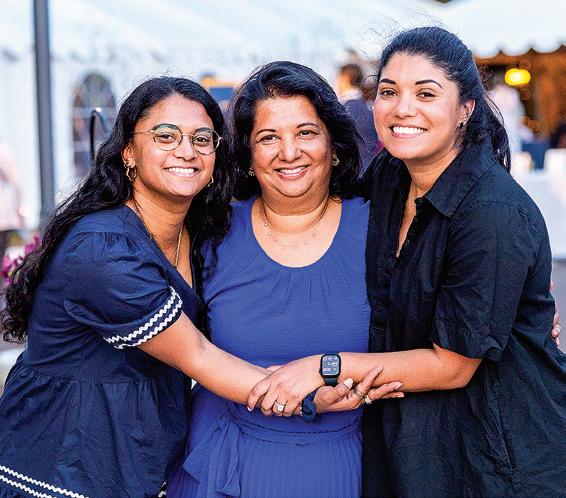
NAVEENA BEMBRY
Naveena Bembry taught Penn Charter’s Lower School students for 25 years before shifting her focus to supporting young educators of color through the Independent School Teaching Fellows Program of Greater Philadelphia.
Assistant Head of School Marcy Sosa, former director of the Lower School, recalled Bembry’s compassionate guidance and belief in the potential of each student. “Naveena made it a priority to ensure students felt seen, valued and supported,” Sosa said. “She did this by thoughtfully curating books and curriculum that reflected her students’ identities, as well as having books with identities represented in the world around them.”
In Naveena’s role with the teaching fellows, Sosa said, “she has brought unwavering commitment, creative vision and thoughtful strategic planning. Under her leadership, the program has grown in depth and reach, benefiting not only the fellows but also the schools they serve.”
Gabrielle Bembry OPC ’14 (left) and Danielle Bembry Westbrook OPC ’11 with their mother, Naveena Bembry Hon. 1689
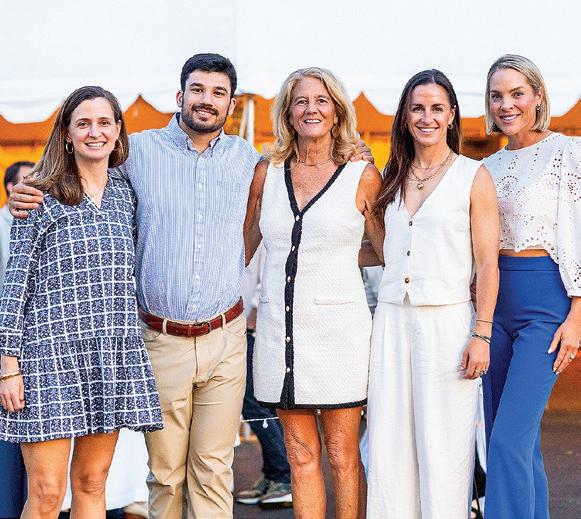
Debbie White (center) celebrated the conferral of her Honorary 1689 diploma with Stephanie Teaford Walters OPC ’95, son Riley White, girls lacrosse head coach Colleen Kelly and Jenny (Albright) Myers OPC ’99.
William Penn Charter School
Then & Now
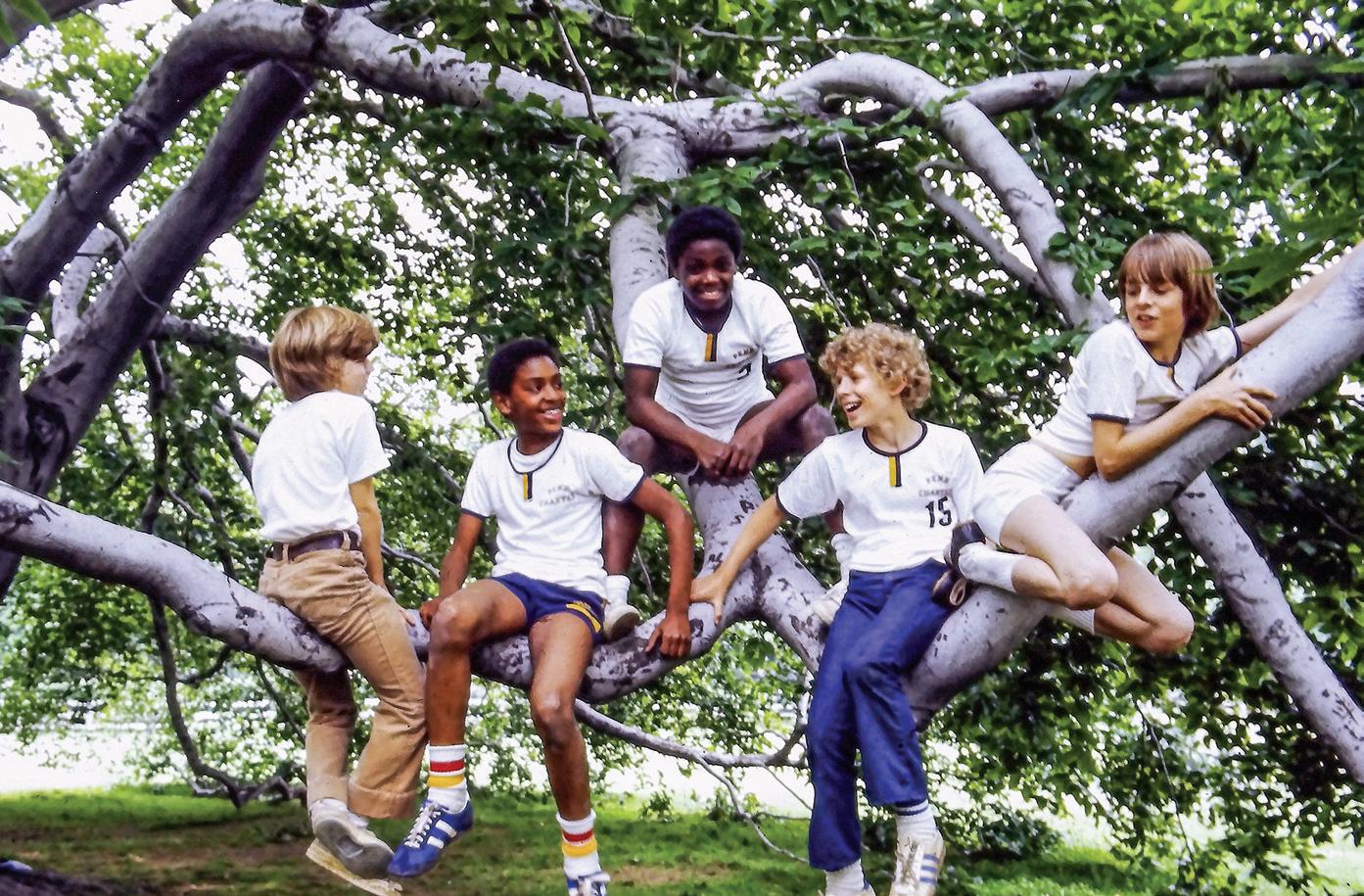
Lower School students hang out on the copper beech tree that had graced campus even before the school moved to this Pinehurst site. The beloved old tree was felled by a summer thunderstorm in 2003.
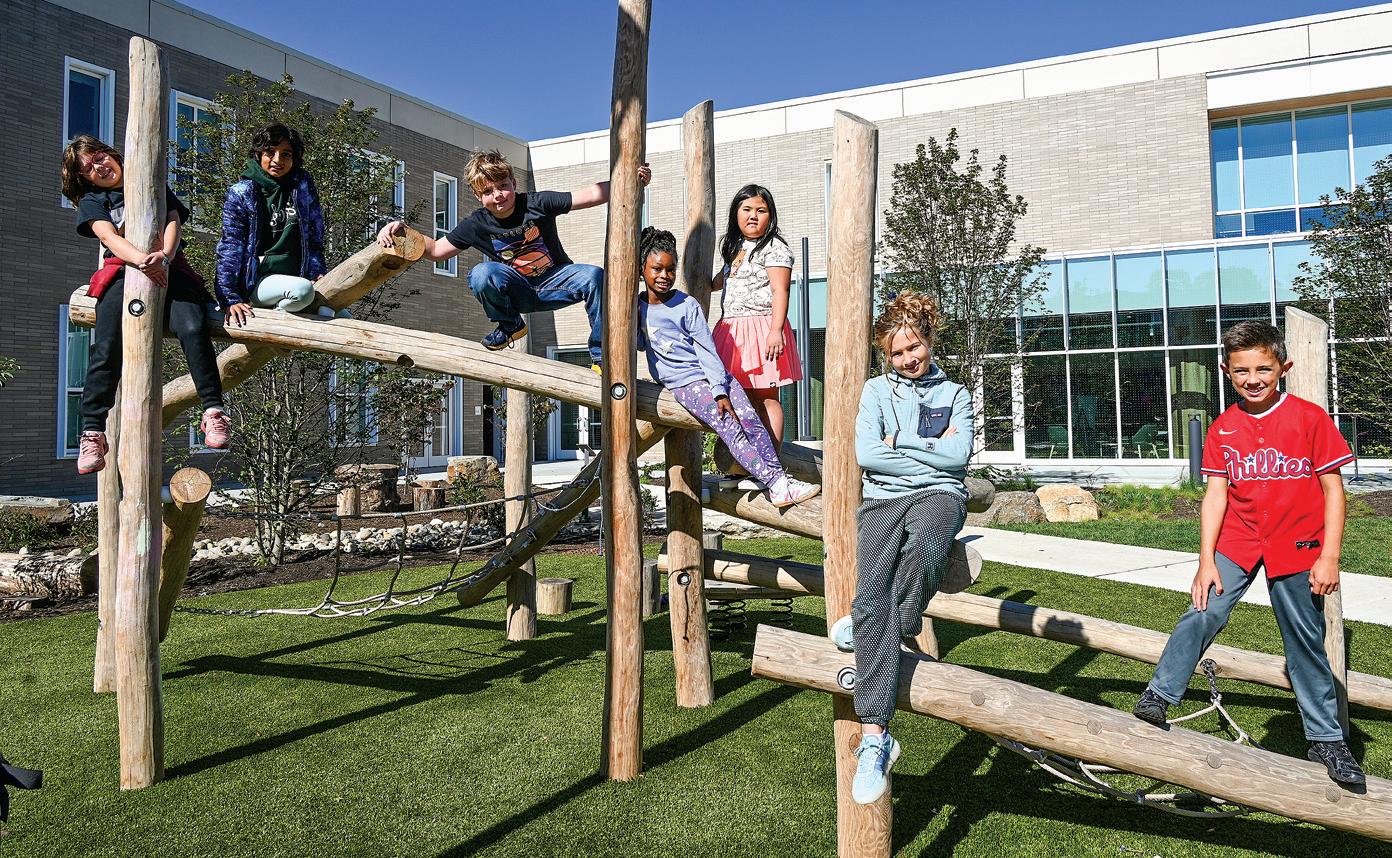
Fourth grade students perch on the popular wooden climbing structure on the Richard A. Balderston OPC ‘69 Lower School playground.
Class Notes
Penn Charter magazine wants to hear from you, and your classmates do, too! Submit your news and photos at penncharter.com/classnote. Digital photos should be 300 dpi JPEGs.
Hon. 1689
Jennifer S. Ketler saw Sammy Siani OPC ’19, then-center fielder for the Altoona Curve, play in Harrisburg last summer. The Curve is a Double-A affiliate of the Pittsburgh Pirates. Since then, Siani has moved up to the Triple-A Indianapolis Indians. From left: Jevyn Dyer OPC ’24, Hope Mazzilli, Jayce Dyer OPC ’19, Jennifer, Sammy, Kristin and Ralph Siani (Sammy's parents), and Michael Steinbrook OPC ’89.
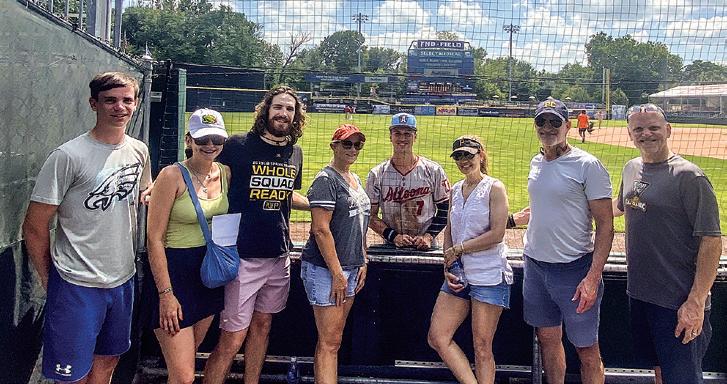
1954
George H. McGlaughlin writes, “Charlotte and I spend time traveling to see our seven granddaughters. Unfortunately, we do not live near classmates. It would be fun to get together with them to talk about Penn Charter days.”
1955
W. Donald Bateman reports, “I'm living with my wife, Kathy, in northern Virginia, near my eldest daughter. Fortunately, I am still able to have fond memories of my eight years at PC. Go Quakers.”
1957
Harold B. McFarland writes, “I was not a great student at Penn Charter. After college I was hired by the Dupont Company in the aircraft, marine and auto division. I suddenly found myself having to do a lot of public speaking. This is where I realized and appreciated my Penn Charter education. Later, I worked in the Midwest, then transferred to southwest Florida, responsible for the Southeast U.S. and Latin America. Thank you, Penn Charter, for helping me have a great career.”
1959
Robert H. Ezerman writes, “The VA came through after I struggled for almost two years for recognition by the VA of my RVN AO (Republic of Vietnam Agent Orange) disabilities. I have almost completed the first proofing of my four volume, mostly fictional series, You'll Be the First to Know. Still looking for a publisher. No biggie if that doesn't work out; I love my writing, one of the few activities in my life of which I am actively proud. To any vets out there with health issues: Contact a free service, like an American Legion advocate, to make sure you are or will receive the VA payments the country owes you for your service and exposure to nasty chemicals.”
Robert R. Matzke shares, “My wife of 58 years and I have lived in Colorado since 2002. We spend summers and winters in Breckenridge, where we ski in winter and sail and hike in summer. During spring and fall we live in Denver or travel. In June we revisited Paris, where my wife was born 80 years ago. Whenever I am in New York visiting my daughter and her family, I try to organize lunch in the city with David Evans (right) and Nelson J. Luria (middle), classmates and longstanding friends.”
Class Notes
1961
David L. Geyer and his wife, Carol, celebrated their 60th wedding anniversary by traveling to Rome and snorkeling in Belize. They plan to visit Paris for Christmas and Kiawah Island, S.C., in winter, while looking forward to celebrating his class’s 65th reunion in May.
1962
John Sheridan writes, “After my heart attack in April, my wife, Andrea DuFlon, and I joined the 73 million Americans over 65 in a search for a smaller home, on one story, with a walk-in shower. We now live in McMinnville, Ore. Classmates interested in the journey should read Atul Gawande's Being Mortal: Medicine and What Matters in the End with his lengthy description of senior planning and care.”
Roger B. Hedges and his wife, Kristi, last fall flew north from their home in Marietta, Ga., to visit family, including Roger’s daughter Stephanie in Washington, D.C., and his daughter Ann in Conshohocken.
While in the area, they cruised PC’s campus. The couple also visited their friend Audrey Simpson (pictured, with Roger, Ann and Kristi). Roger writes, “I believe the yearbook for OPC ’62—a photographic marvel for which shutterbug Michael B. Petosa and I created volumes of images—contains a snapshot of Steve Simpson and Audrey Murdaugh at the Lit Society Dance in 1958. Audrey became Mrs. Stephen W. Simpson less than a decade later, and our close friendship lasts to this day. There was great hope when my daughter Ann attended the Penn Charter senior prom with Steve's son Stephen W. Simpson OPC ’88 but alas … it was not to be. Over the years his father and I would toast ‘what was never to be,’ and I miss Steve terribly.”
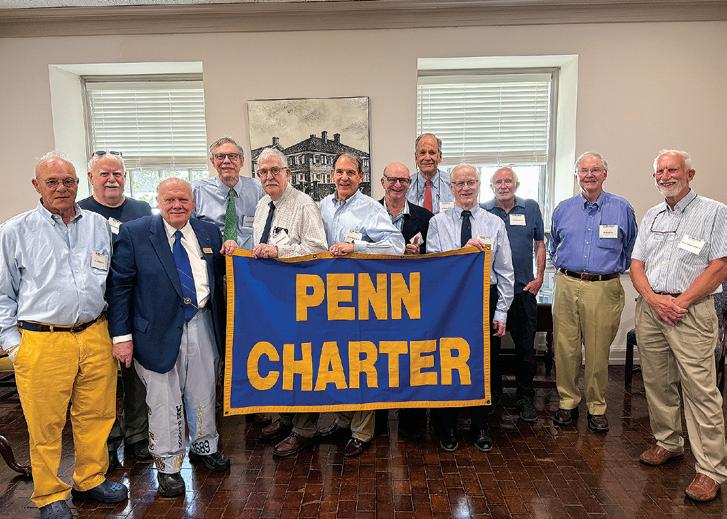
Their last stop was Maine to visit Roger’s grandson, Matthew Kellett (pictured), who teaches eighth grade math and is a registered Maine Wilderness Guide during the summer.
1963
Charles Kurz II and Richard (Dick) Dearnley again participated, as is customary every Fourth of July, in the most senior age group of the annual Longport American Mile. This annual seashore event attracts several hundred participants and benefits the Longport Volunteer Fire Department. “We are not as fast as we used to be, but we still enjoy the challenging competition,” Charley reports.
Class of 1965 60TH REUNION
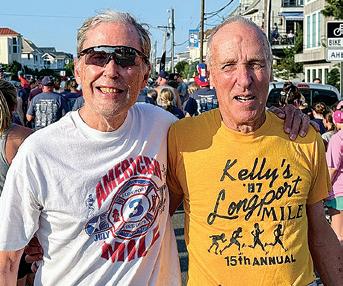
1964
Wayne Partenheimer is still practicing law with Philadelphia's Bennett, Bricklin & Saltzburg. He is chairman of the Haddonfield, N.J., Zoning Board and treasurer of the Haddonfield Lions Club. He and his wife, Debbie, are active in Haddonfield Friends Meeting.
1966
Thomas P. Lom reports, “I took a ‘bucket list’ trip to Alaska in June with my wife, Winifred, and our two daughters. Unlike many who cruise to Alaska, we did a ‘fly and drive’ and loved every minute. The itinerary included driving to Denali National Park and to the Matanuska Glacier (pictured) and to Seward, where we took a five-hour boat trip to see whales, sea lions, bald eagles and puffins, then to the Alyeska ski resort. We included an outbound stopover in Victoria, B.C., so we could visit the Butchart Gardens, one of the finest botanical gardens in the world. What a trip!”
1968
Edward S. Skinner shares, “In July, all 10 family members traveled to Suttons Bay, Mich., for a weeklong vacation and to celebrate the Fourth of July with a parade at Glen Arbor. After that week, Pam and I ‘escaped’ to Mackinac Island by ferry to our favorite hotel, the Iroquois.”
Joseph D. Goodwin recently attended his youngest daughter’s wedding in Switzerland. He writes, “What a lovely country and culture. Being in the construction business, I was absolutely impressed with the Swiss system of bridges, tunnels, roads, gondolas
and trams. And of course the cheese and chocolate (hence the photo of the ubiquitous cows). I am still working as a construction consultant and teaching skiing December to April. Lots of fishing and hiking.”

1969
Thomas C. Murphy writes, “Carol and I recently marked 10 years of living in our little corner of paradise on the barrier island of Vero Beach, Fla. We welcomed our second grandchild in June—a girl, born to our daughter and her husband living in Charleston, S.C. She joins a precious brother, nearly two, who has been the center of our attention. I still work selling luxury real estate, my second career, as well as continuing to serve many of my design and marketing clients from my business of 35+ years. Our son and his wife moved closer to us in Orlando, and I have been busy many weekends helping him with his fixer-upper. In addition to playing lots of pickleball, Carol and I plan two big trips per year, most recently to Switzerland and the Côte d'Azur. Like you, I enjoy seeing what our fellow OPCers are up to and maintain our class Facebook page at https://www.facebook.com/ share/g/19iCiS2555/.”
1971
Steven A. Balbus retired in October 2024 after a career teaching astronomy and physics at the University of Virginia, the École Normale Supérieure in Paris, and Oxford University, where he was the Savilian Professor of Astronomy. He will continue on at New College, Oxford, as a senior research fellow. He is editing a volume on the history of the Oxford Savilian Professors
of Astronomy, which is due out at the end of 2025, published by Oxford University Press. And he is writing his own textbook, An Introduction to General Relativity and Cosmology, due out in January 2026, published by Princeton University Press.
“My daughter, Elizabeth, lives and works in Paris,” he shares, “and my two sons, Alex and Adam, live and work in Charlottesville, Va. I plan to stay on in Oxford for some time, where my wife, Caroline, continues her work as a professor of physics and a fellow of University College. My son David will also start at Oxford this fall, studying classics and Near Eastern languages at Christ Church College. I am very fortunate to be able to enjoy my retirement in such a stimulating and wonderful environment! I hope to pass by PC at some point in the not too distant future.”
Peter S. Given writes, “I retired from corporate life six years ago, having been in food science my entire career with Nabisco, Kraft, PepsiCo and Green Mountain Coffee—which is how I ended up in Stowe, Vt. With two daughters grown (and three grandchildren), I have time to pursue many hobbies and activities: fine woodworking, restoring antique cars, painting, swimming, skiing. At 60, I gave up triathlons and soccer—age does take its toll. I took a job at Vail two days a week tuning skis but otherwise spend time at home or our summer ‘camp’ in Essex, Mass., with my wife of 47 years, Janie. I was pleased to host dinner for Frederick H. Landell last winter during his ski trip to Stowe. Lately, I’ve been focused on being a better artist, taking weekly group lessons and workshops as they come up.”

Class Notes
1973
Frederick H. Bartlett shared that he is happy to help coach Penn Charter’s sixth grade flag football team again this season.
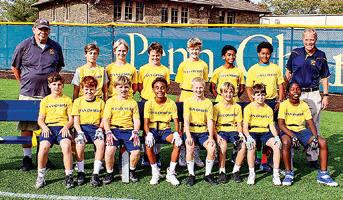
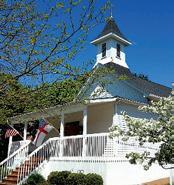
J. Barrington Bates writes, “Having flunked retirement, I have taken a new position as priest-in-charge of the Church of the Nativity in Boyne City, Mich. Located on Main Street (which is not the main street), the congregation worships in a former one-room schoolhouse. They are small but mighty in winter, and swell to 30 or more in summer.”
1974
Stephen G. Rhoads shares, “My wife, Lori, and I enjoyed a visit from classmate Jeff Kenkelen and his wife, Marie, who joined us for a few days in July at our summer cottage on Marquette Island on Lake Huron. Jeff and Marie spent two nights at the Grand Hotel on nearby Mackinac Island, where Lori and I tagged along for the ferry ride, a carriage tour and lunch at the Revolutionary War-era Fort Mackinac. Jeff and I have been friends since sixth grade, when we both entered PC as new students.”
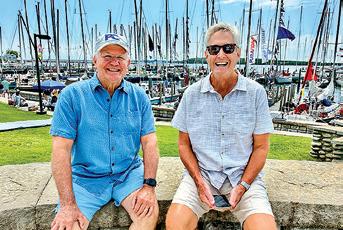
1975
John J. Maley writes, “I broke my own world record in the bench press at the Pennsylvania State Championships in York on July 19. This came nine months after tearing my rotator and diligently rehabbing. For the new mark, I hit 367.5 lbs. This is the world record in the 65-69 age, 220-lb. weight category. New personal goal is 405 by age 70!
Robert W. De Bolt OPC ’76 is my trainer!”
From left: Hugh Maley OPC ’25, Bob and Jack.
Class
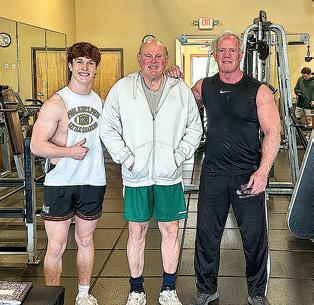
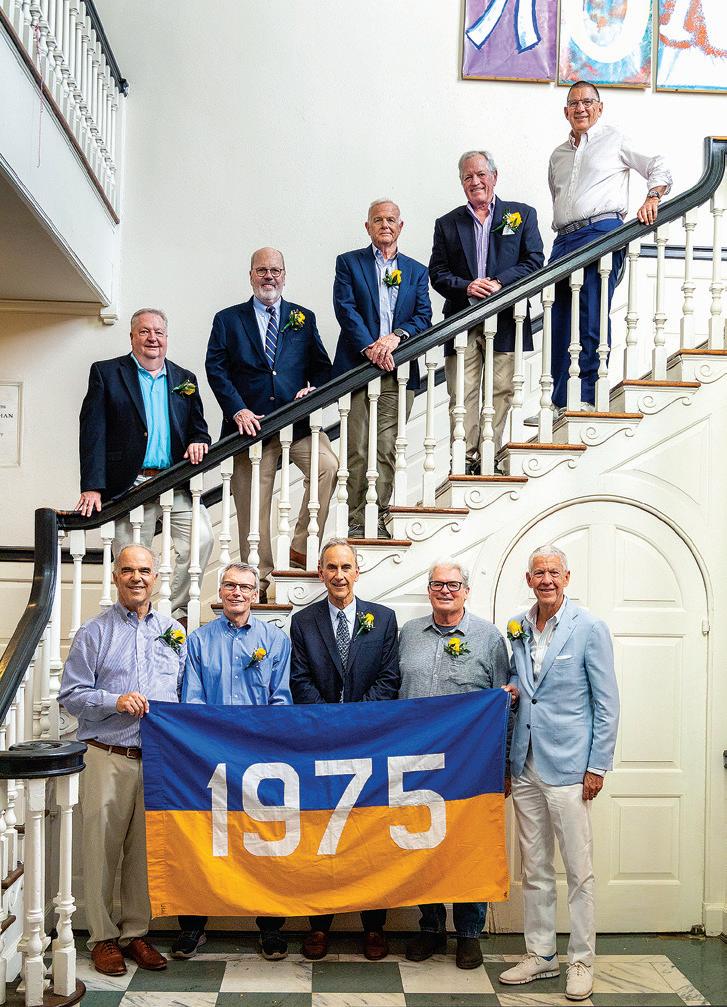
1976
Brent Sherwood was named a member and academician by the International Academy of Astronautics. He reports that he’s “getting started writing a few books.”
1977
Brooke D. Steytler reports, “My watercolor, ‘The Lock House’ won the Best-in-Show award at the last Schuylkill River Greenways juried art show, Scenes of the Schuylkill. This organization maintains the Schuylkill River trail. I also created the watercolor ‘Design’ for an exhibit at Art Fusion in Pottstown, where I teach cartooning and animation to kids and watercolor to adults. The theme of this show was to create a work of art inspired by a poem. I chose, ‘Design,’ by Robert Frost, which I remember from Mr. West's literature class. From the moment I read it and after Mr. West explained to us how it is based on a concept called ‘The Argument for Design’— which proposes that the complexity and apparent order of the universe suggests the existence of an intelligent designer, often identified as God—I was inspired by the verses. Frost ponders if this can apply to the tiny, seemingly random world of a spider and a fly. I often think about the books to which I was introduced to at Penn Charter, such as J.R.R. Tolkien’s The Hobbit and Ralph Ellison's Invisible Man. Also, as an art teacher, I often reflect back to the great art teachers I had at PC, especially Oliver Nuse and Randy W. Granger Hon. 1689.”
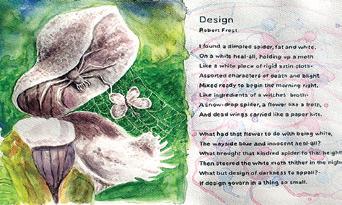
1978
Dag-Daniel Dittert (pictured below, left) wrote about his relationship with his “exchange brother,” Paul A. Bernard (right). Paul stayed with Dag’s family during his exchange year, 1976-77, in Braunschweig, Germany, at Martino-Katharineum School. And Dag stayed with Paul’s family during his exchange year, 1977-78, at PC. Fritz Kempner served as mentor for the exchange students.
“In September 2024,” Dag writes, “Paul and I met in Cologne, Germany, to celebrate the wedding of David Dittert and his wife, Caroline. Paul is David’s godfather and not only gave David the honor of attending the ceremony but he also gave the speech of the night. I am thankful that this sadly long-gone international connection between PC and M-K has brought about a lifelong friendship between families. Luckily, I could meet
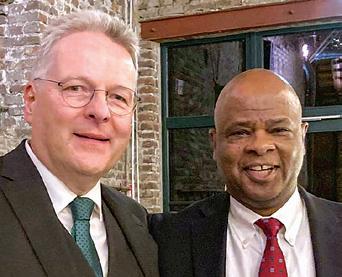
classmate Sterling H. Johnson III and his wife, Deena, during their trip to Paris and also Stephen K. Robertson, who looked us up on his trip to Europe—he was our guest at the engagement dinner for Caroline and David. If you travel to Europe, don’t hesitate to get in touch.”
1985
Robert L. Salkowitz had a cross-generation OPC meetup. He reports, “I ran into Madison A. Harden, Frank Driscoll, Sally S. Stanley and Kristina Ohemeng, all OPC ’16, at the wedding of Miriam Ruen Francisco OPC ’16 in Ann Arbor, Mich., last June. Miriam is the daughter of former PC art teacher, Sheila Ruen, and my former college roommate, Jason Francisco (who is from L.A.). Miriam is my goddaughter. Amazing how much continuity there was to talk about despite a 30-year gap.”
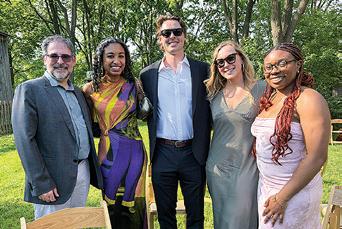
Class of 1985 40TH REUNION
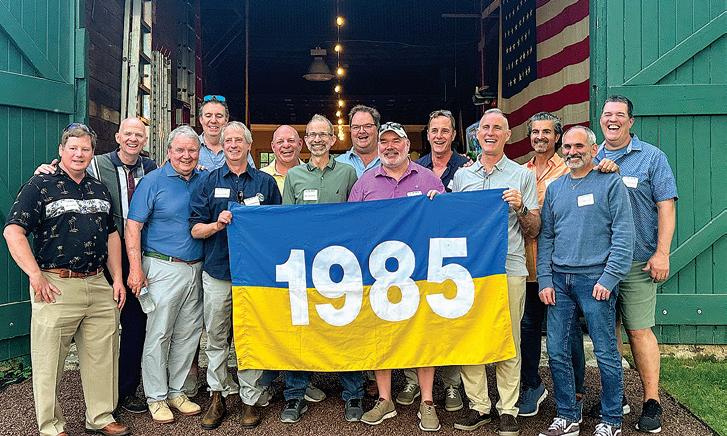
Class Notes
1987
James J. Fitzgerald IV writes, “My summer trip to Jackson Hole, Wyo., was topped off by seeing the great Jack Rogers Hon. 1689 (right).”
1990
David A. Kittredge's feature documentary Boorman and the Devil, which he directed and edited, will have its world premiere at the 2025 Venice International Film Festival. The film is about Academy Award-nominated director John Boorman (Deliverance, Hope and Glory) and his journey making the critically and commercially disastrous Exorcist II: The Heretic (1977).
Barry Markman invited Jack Rogers Hon. 1689 (his eighth grade basketball coach and friend) to the LEFSA annual fishing trip on July 28 on Island Princess off Long Island. Barry shares, “Since 2003, I has served on the LEFSA board. The fishing group was made up of former and currently homeless clients, and staff members and board members who serve the homeless community in New York City. LEFSA (Life Experience and Faith Sharing Associates) was founded by two Sisters of Charity in September 1986 as a response to the massive homelessness in NYC at that time
and which continues today. Their vision was to have formerly homeless people reach out to homeless people, supporting each other to not relapse into homelessness.”
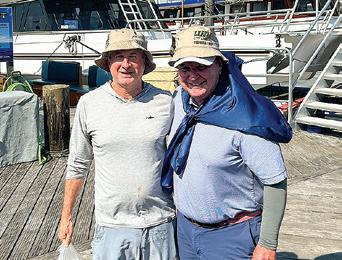
1991
John Merritt continues to live in St. Louis, Mo., with his wife of 28 years, Tamala. In 2024 John was named Missouri High School Football Coach of the Year after leading De Smet Jesuit High School to a state championship. John was also recently inducted into the St. Louis Football Coaches Hall of Fame.
1992
Jamie Leigh Wells has published a book that is a landmark work in the field of pediatric engineering, a newly emerging applied science, A Clinical Lens on Pediatric Engineering: Pioneering Science and Technology for Cutting-Edge Patient Care.
1996
Megan D. Preuss writes, “It's hard to believe that I've now lived in San Francisco for 18 years. My husband and I live with our three daughters and dog in a neighborhood at the edge of Golden Gate Park called Cole Valley. I loved getting together recently with Jeannine (Wiley) Vender, Anna (Ficken) Lesovitz, Nancy (Nejman) Fazzinga and Leah (Imperatore) Albright for our annual reunion at the beach in Avalon, N.J. I'm also happy to share that my sixth novel, The Memory Gardener, was published by Gallery Books / Simon & Schuster on Nov. 25!”
Class of 1995 30TH REUNION
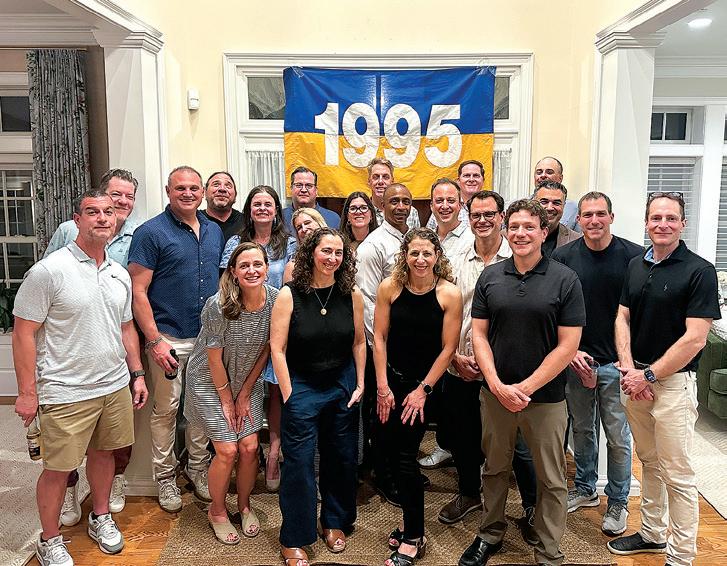
Stanley Idiculla (pictured with his wife, Ami, and their twin daughters) has been president of the Virginia Podiatric Medical Association for the past two years, practicing in Northern Virginia as owner of NoVa Foot and Ankle.
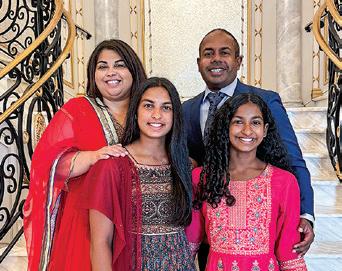
1999
Joseph O. Larkin was named litigator of the week by The American Lawyer.
2002
Gloria Baker shared that she switched gears and enrolled at Delaware Valley University, earning her certification to practice equine massage. She spends her time riding and working with horses throughout southeastern Pennsylvania. She donates one day a week to Ryerss Farm for Aged Equines, where she offers bodywork sessions for the retired horses. Gloria writes, “I am loving every minute that I get to spend with the horses and donkeys. Paul and I plan to purchase a farm in the future so that I can train and rehabilitate horses that have suffered injuries.”
Class of 2000 25TH REUNION
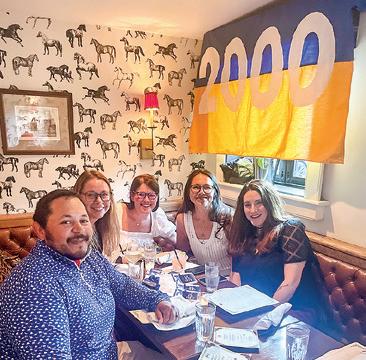
2003
Anthony E. McDevitt ran into several OPCs at the Philadelphia Eagles vs. Dallas Cowboys NFL season opener on Sept. 4. “The Eagles raised the Super Bowl banner, and Penn Charter was well represented,” he said. From left: Brian R. Henley OPC ’02, Tony, Jordan Canino OPC ’02, William Pawlowsky OPC ’02 and Bradley E. Roslyn OPC ’02.
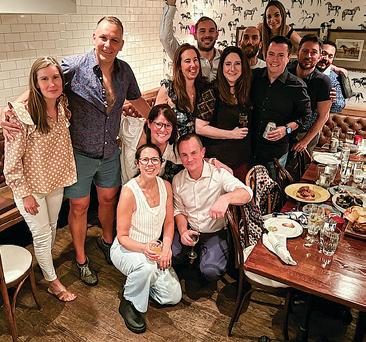
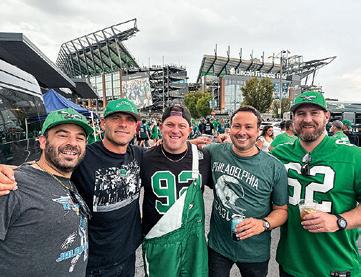
Class of 2005 20TH REUNION
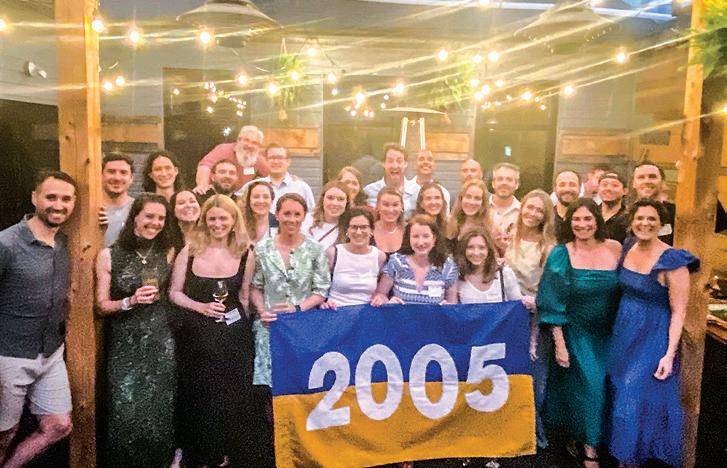
Class Notes
2005
Caroline F. Braun earned a doctorate in educational and organizational leadership from the University of Pennsylvania Graduate School of Education. She writes, “A special thank-you goes to Sr. Brightbill, Dr. Ford, Ms. Glascott and Ms. Ketler for their 25+ years of guidance and support. Now I look forward and am honored to continue serving the students and families of the School District of Philadelphia as a school administrator.”
2006
Emily Walker (Emma Bartlett) completed the Black Fly Half Marathon in Vermont’s Northeast Kingdom with her blind husky Nala Phoenix (left). Her husband, Justin, and new pup, Onyx Moon, cheered them on. She writes, “Come say hi if you’re ever up in Vermont! We live near Montpelier. emilywinnerwalker@gmail.com.”
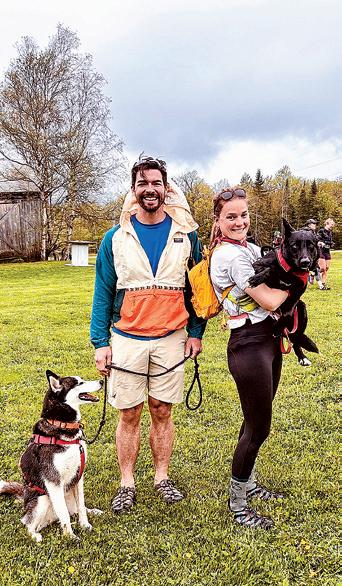
Class of 2010 15TH REUNION
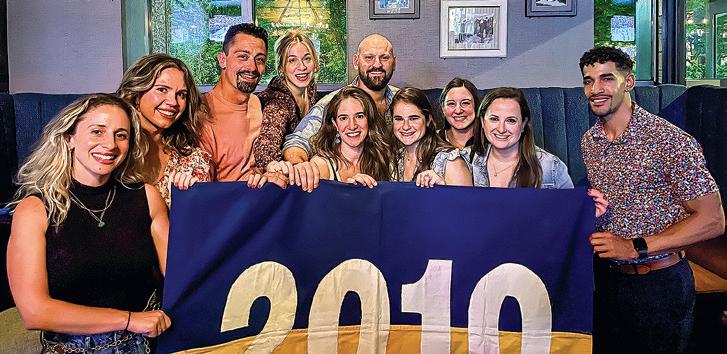
2010
Liz Thom writes, “In May 2025, I graduated from Harvard with a PhD in government and social policy and married my husband, Manuel (pictured). We're moving to Chicago this fall, where I'll begin as an assistant professor at Northwestern University. If you're ever in town, please reach out!”
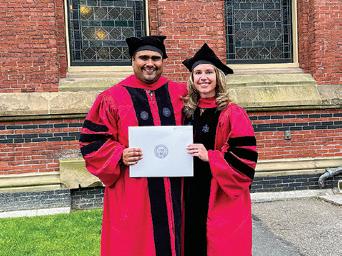
Class of 2015 10TH REUNION
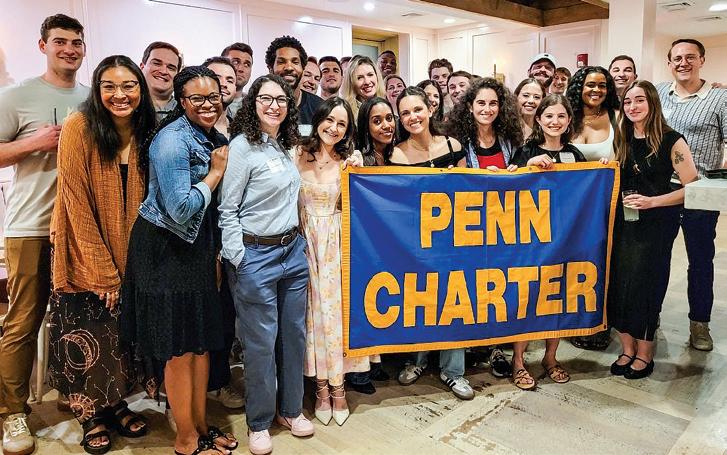
From left: Kelsey R. Flitter, Liz Thom, David Martina Jr. and wife Lindsay Bauer, James Lamb Jr., Daniela (Nazarian) Peraino, Jillian (Falkoff) Cohn, Stephanie Lamb, Blair L. Drossner, Michael X. Brown.
2016
Gabriela S. Rodriguez, after writing an episode for The Muppets Mayhem, was hired at NBC’s Lopez vs. Lopez at NBC, writing her first multi-cam sitcom episode.
Thomas Freitag graduated cum laude from Harvard Medical School in May 2025 and has since started their residency in general psychiatry at Johns Hopkins. Thomas intends to pursue training in child & adolescent psychiatry, with a focus on caring for LGBTQIA+ adolescents and young adults.
DEATHS
1942
Frank Loughran, on May 1, 2025.
1953
John E. Molyneux, on April 6, 2025.
Clark K. Riley, on June 18, 2025.
Frederick C. Tecce, on April 26, 2025.
W. Robert Wilson, on Aug. 23, 2023.
1954
Gregory P. Hetter, on June 22, 2025.
1956
Bernard Berlinger Jr., on June 25, 2025.
1957
Donald M. Kerr, on July 13, 2025.
1958
Malcolm McFarland Jr., on July 31, 2025.
1959
Henry Schneider Jr., on June 18, 2025.
1964
Michael Aron, on Aug. 13, 2024.
Stephen Cushmore, on June 4, 2025.
1965
F. John White, on June 13, 2025.
1969
Steven G. Marshall, on June 3, 2025.
1972
H. Scott Sinclair, on March 8, 2025.
1980
Frank Lippo Jr., on April 20, 2025.
1985
Patrick J. Delaney, on Aug. 12, 2025.
DEATHS
1988
Thomas A. Gennarelli, on Aug. 21, 2025.
MARRIAGES
2010
Liz Thom married Manuel Melendez Sanchez on May 28, 2025, in Cambridge, Mass.
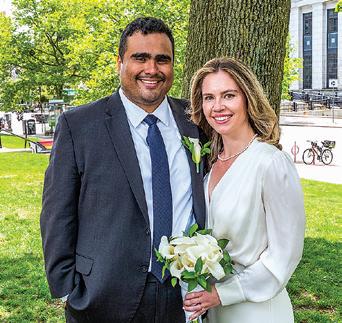
2015
Leah Kurtz married Ian Damiani on Nov. 2, 2024.
From left: Dolly Segal, Lela A. Lerner, Sarah Duys, Leah Kurtz, Tyler N. Williams, Sarah M. Jobes
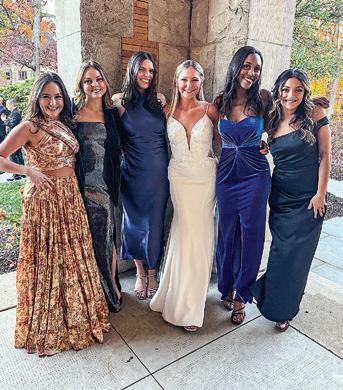
2005
Margaretha Ehret, on June 25, 2025.
2010
Joseph P. Chollak, on June 6, 2025.
2015
Francis (Frank) J. McGlinchey and Sabrina L. Koenig married on June 27, 2025.
Penn Charter was well-represented at the wedding.
Back, from left: David J. Huber OPC '13, Michael S. McGlinchey OPC ’13, Patrick McCain, Seamus McCain OPC ’23, Jack Magee (Class of 2028), Tom McGlinchey (Class of 2026), John P. Ryan OPC ’09, John F. Loughery OPC ’78, John H. Loughery OPC ’11.
Front: Alex Koenig OPC ’18, Molly (Pighini) Huber OPC ’13, Grace Magee OPC ’25, Mary Jane McGlinchey OPC ’17, Ari M. Rosenfeld, Sabrina, Frank, Jacob (Jake) McCain OPC '16, Glynis M. Braun OPC ’14.
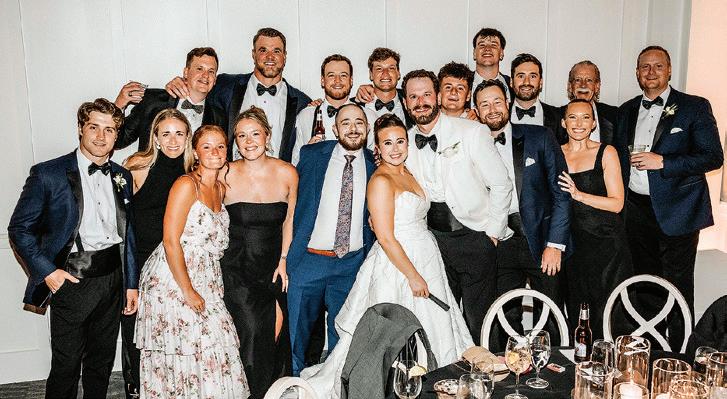
BIRTHS
2004
Hailey and Mackenzie, to Livio and Devon E. D’Alessio, on May 2, 2025.