





‘vulnerable


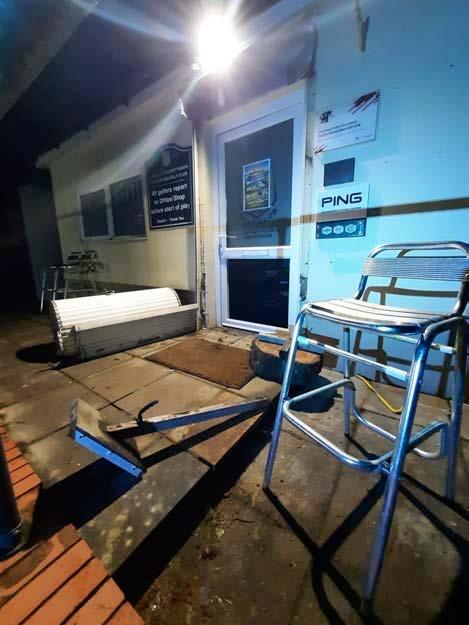
TWO men have pleaded guilty after targeting golf clubs in Haverfordwest and Carmarthen in an overnight burglary-spree.
Mikael Bourkhari, aged 45, and Simon Dickey, aged 38 – both from Newport, South Wales – were charged with two counts of burglary and one count of obstructing police.
At around 12.45am on Sunday 18 January, Dyfed-Powys Police received a call reporting that the intruder alarm had been activated at Haverfordwest Golf Club.
When officers arrived just six minutes later, it was clear that the building had been the target of a deliberate and forcible break-in.

With the alarm still blaring, and a light shining from inside, officers entered the golf club, prepared to catch the intruder redhanded.
Instead, they found that the scene had been abandoned and badly damaged.
Club owners arrived shortly after and noted that several golf clubs worth between £100 and £500 each had been taken from the club shop. It was estimated that the total value of items stolen was around £36,000.
While officers secured evidence at the scene, control room staff at police headquarters gathered intelligence on vehicles in the area that could potentially be linked with the crime.
A red Vauxhall van was identified as part of their enquiries, and a description of the vehicle was shared with officers in both Pembrokeshire and Carmarthenshire.
With officers over the county border alerted to the break-in, local units decided to patrol the golf club in Carmarthen as a precaution. On arrival, it was apparent that the Carmarthen golf club had also been hit.
The front door was extensively damaged, and a yellow crowbar abandoned at the scene. It was estimated that around £7,000 worth of golf clubs had also been stolen from the premises. It was also estimated that around £5,000 worth of damage
was caused to the building.
Shortly after 2am, Roads Policing Officers located the suspect vehicle travelling along the A48 towards Pont Abraham, despite fake number plates having been used.
The van was stopped, and a suspiciously large number of golf clubs and bags were found inside. The driver and his passenger – who identified themselves as “Richard Smythe” and “Michael Hale” – were arrested on suspicion of burglary.
Back at custody, the pair confessed to giving fake names and were further arrested on suspicion of obstructing police.
All the stolen items were recovered and returned to the golf clubs.
Mikael Bourkhari and Simon Dickey appeared at Llanelli Magistrates Court the following morning (19 January) and pleaded guilty to both counts of burglary and one count of obstructing police.
The two were remanded into custody until their sentencing on Monday 2 February.
Detective Sergeant Sophie Lambert of Dyfed-Powys Police said: “Crimes like this have a profound impact on the community, particularly those whose livelihoods are built on the success of their business.
“This was a fantastic example of multiple teams across different locations working together to stop these criminals in their tracks.
“The work by the control room staff to quickly identify the suspect vehicle played a crucial role in the swift interception by our Roads Policing Officers. This co-ordinated response undoubtedly prevented further offences from taking place.
“We welcome these guilty pleas and hope that this case sends a clear message that we will take robust action against anyone seeking to break the law in our force area.”
A Haverfordwest man has been sentenced to a year in prison after sending a threatening message online.
Michael Carruthers, 34, of Magdalene Street, Merlin’s Bridge, appeared at Haverfordwest Magistrates’ Court facing charges of common assault and sending a communication threatening death under the Online Safety Act.
The court heard that Carruthers assaulted a man in Haverfordwest on 13 January. Just three days later, on 16 January, he sent an online message stating: “I’m going to f***ing kill him,”
either intending the threat or being reckless as to whether it would be believed.
Carruthers pleaded guilty to both offences.
Magistrates were told that he was “unmanageable in the community” and showed a “flagrant disregard for people and their property.”
He was sentenced to 12 months’ imprisonment for the death threat, with a concurrent 12-week sentence for the assault. In addition, Carruthers must pay £200 in compensation to his victim and £85 in court costs.







TWO men have been jailed after a wave of burglaries across Pembrokeshire and south Wales last autumn, with homes targeted in coastal villages and residential streets.
Darren Inder, aged 46, and Christopher Welke, aged 43, appeared before Swansea Crown Court for sentencing following offences committed between September and October.
The court heard that Inder carried out a series of break-ins in Pembrokeshire, including burglaries in Nolton Haven on the night of October 18. During one incident, a holiday cottage was entered while guests were staying there, with torches and £200 stolen. The same night, a nearby farmhouse was broken into, where cash, coffee and milk were taken.
Inder later burgled another Nolton Haven property, stealing food items, a knife and a backpack, before striking again in Broad Haven on October 24, where cash was taken from a home.
Both defendants were also involved in burglaries in Dynevor Avenue, Neath, during the early hours of October 4. One homeowner was woken by police shortly after 3:00am after officers noticed signs of a break-in. Doorbell camera footage showed the two men leaving the property.
In a separate incident nearby, a neighbour discovered their Fiat Panda had been stolen from the driveway. Footage captured Welke attempting to avoid a doorbell camera before entering the vehicle. Items taken during the burglary included a purse, a bank card and two collectable pound coins. Footprint evidence from the address and the recovered vehicle linked Welke to the offence.
The court was told that Inder’s offending also included a burglary at a garage in Church Crescent, Baglan, where lip filler products worth around £8,000 were stolen, as well as cigarettes and a lighter taken from an address in Cae Canol. He also burgled two elderly
residents at Traherne Court, Neath, on October 4.
Prosecutor Alycia Carpanini outlined the pattern of offending, describing it as persistent and escalating.
Inder, of Chamberlain Road, Neath, admitted 11 burglary offences. He has 26 previous convictions for 92 offences, the majority relating to theft and dishonesty. His barrister, James McKenna, said Inder had made full admissions in interview but had relapsed into Class A drug use, which had fuelled his behaviour.
Welke, of Southall Avenue, Skewen, pleaded guilty to two burglaries and the theft of a motor vehicle. He has 91 previous convictions for 229 offences, including 148 for dishonesty. His defence said longstanding substance misuse problems had led to a rapid decline, including periods of homelessness.
Inder was sentenced to four-anda-half years in prison. Welke received a sentence of two years and three months.
A WOMAN who was almost three times over the legal drink-drive limit hurled aggressive abuse at a police officer after crashing her car into a wall in a hotel car park, a court has heard.
Caia Restall, aged 34, was seen by hotel staff driving a silver BMW in the Mariners Square car park in the early hours of New Year’s Day.
“They saw her collide with a wall and as a result alerted the police,”
Crown Prosecutor Sian Vaughan told District Judge Mark Layton, sitting at Haverfordwest Magistrates’ Court this week.
When officers arrived, Restall became
aggressive, calling one officer “a racist c***” and “a lying creep.”
“She was extremely intoxicated,” the prosecutor said. “When interviewed later, she had no recollection of the incident.”
A subsequent breath test showed Restall had 104 micrograms of alcohol in 100 millilitres of breath — almost three times the legal limit.
Restall, of Heol Penlan, Goodwick, pleaded guilty to drink-driving.
A probation report stated that she had been drinking with friends that evening but became concerned about the welfare of a family member.
“When she found this out, she
panicked and made the decision to drive before correcting herself and returning back to the car park,” her solicitor Fenn Richards said. “This was when the police arrived.”
Because Restall was already subject to a previous disqualification for a drugdriving conviction, she was disqualified from driving for a total of three years. The court also ordered her to complete ten rehabilitation activity requirement days, 150 hours of unpaid work, and to wear a 60-day alcohol monitoring tag. She was further ordered to pay a £114 court surcharge and £85 in costs.
CAMPAIGNERS say Caldey Island remains unsafe more than a year after an independent review into historic abuse, as survivors accuse church authorities and trustees of prioritising appearances over meaningful change.
The claims come as the island prepares to reopen to the public for Easter, when campaigners say thousands visitors could travel to the monastery island off Tenby.
Caldey Abbey, long promoted as a place of peace, prayer and retreat, has been at the centre of serious safeguarding concerns for years. Survivors say abuse was enabled by isolation, secrecy and a culture in which those who spoke out were ignored, disbelieved or actively discouraged.
One of the most prominent cases involved sex offender and cleaning company boss Paul Ashton, who arrived on Caldey in 2003. Survivors say Ashton groomed families over several years, using access to children and trust built through the monastery community.
Natalie Roberts, who has spoken publicly about her experiences, previously described how Ashton ingratiated himself with her family, including rehoming her cat in an apparent attempt to get closer. Ashton

Tom Sinclair editor@herald.email
was arrested in 2011 after being recognised from a “Most Wanted” television programme.
Campaigners say Ashton’s presence on the island for years, despite concerns being raised, is emblematic of deeper safeguarding



failures.
INdEPENdENT REvIEW ANd uNfulfIllEd ExPECTATIONS
In response to growing pressure, Caldey Abbey commissioned an independent safeguarding review led by Jan Pickles OBE. The review was published in December 2024 and examined historical abuse and safeguarding arrangements on the island.
The review found that victims had been treated with cruelty, hostility and disbelief, and that safeguarding systems were inadequate. All recommendations were accepted by the Abbey’s trustees.
However, survivors now say little has changed in practice.
“On paper everything looks fine,” one campaigner said. “But nothing meaningful has changed for victims.”
Survivor accounts: abuse, compensation and silence
Rebecca Philippart, one of the survivors who contributed to the review, said she was abused for around five and a half years until 1987 and again in 1989 or 1990. She said her abuser was Father Thaddeus, who later died in 1992.
In 2018, Philippart received £9,500 in compensation, which she said was handled by Father Daniel, the abbot at the time. She said further disclosures and information emerged after that payment, but she has since been denied additional redress.
Her husband, Eduardo Ormeno, said both had attended numerous
One of the most contentious issues remains vetting.
Campaigners say monks have daily contact with visitors, guests and island residents, including entering cottages, mixing with families, providing sacraments and offering pastoral guidance. They argue this makes them public-facing and therefore subject to Enhanced DBS checks.
They claim that while DBS checks have now been completed for monks, only one monk, Father Yann, has undergone an Enhanced DBS check.
Caldey Abbey disputes that monks are public-facing in the sense required for Enhanced DBS checks and says appropriate vetting is in place.
Another key recommendation of the Pickles review was greater transparency around island housing and tenancy agreements.
Campaigners say these agreements have still not been made public, leaving residents fearful of repercussions if they speak out.
“They are scared of losing their homes or their jobs,” one survivor said.
Abbey trustees: progress claimed, NDAs denied
In a detailed statement to The Herald, Caldey Abbey Charity said it takes safeguarding extremely seriously and recognises the profound harm caused by historical abuse.
The trustees confirmed that all recommendations from the Pickles review were accepted and are subject to ongoing oversight.
meetings with church authorities and trustees.
“No one has really looked at the wider issue,” he said. “There were paedophiles living there until October 2025. That has never been properly examined.”
Philippart said she attempted to contact island residents and workers but was met with what she described as a “wall of silence”.
“They said I was lying,” she said. “Even though what happened has now been proven.”
Campaigners allege that fear of losing homes or livelihoods has prevented people from speaking out. They claim some islanders and boatmen were aware of abuse but never came forward.
DBS checks and public-facing
They said the Abbey was audited in June 2025 by the Catholic Safeguarding Standards Agency, with the report published in December 2025. The CSSA assessed Caldey as “results being achieved”, while noting the need for continued vigilance. A further audit is scheduled for 2027.
On compensation, trustees said ex-gratia payments are considered with legal advice in line with Charity Commission guidance, and that therapeutic support has been offered to those who came forward.
They denied the use of nondisclosure agreements to silence safeguarding concerns and said there are no NDAs involving island residents, contractors or boatmen linked to safeguarding matters. They also denied that properties on Caldey or in Tenby were provided as part of any settlement.
The Abbey provided links to safeguarding policies, the Pickles
review, and audit documents on its website.
The Charity Commission confirmed it received historic safeguarding concerns relating to Caldey Abbey last year. After assessing the information and engaging with trustees, it provided regulatory advice and guidance but did not open a statutory inquiry.
The Commission said it would take seriously any concerns about misuse of NDAs or governance failures.
The Archdiocese of CardiffMenevia said Caldey Abbey is an independent charity under the Cistercian Order and that safeguarding oversight is supported nationally through the Religious Life Safeguarding Service and inspected by the Catholic Safeguarding Standards Agency.
It said Archbishop Mark had met survivors to offer pastoral and spiritual support and remained open to meeting anyone harmed within the Catholic Church.
Campaigners, however, allege that in private meetings the Archbishop expressed disgust and embarrassment at what had happened, but ultimately declined to intervene in governance or remove his blessing from the Abbey.
“Everyone points elsewhere” Survivors say responsibility is continually deflected.
The Abbey points to audits and policies.
Regulators say they advised but did not escalate.The Church says Caldey is independent.
“And in the middle are survivors who still don’t feel safe,” one campaigner said.
With Caldey reopening to the public for Easter, and tens of thousands of visitors expected, campaigners say the stakes could not be higher.
“We are not trying to tear anything down,” Natalie Roberts said. “We just want the truth acknowledged, accountability, and real safeguarding — not just words on paper.”
In a lengthy statement sent to this newspaper, Pembrokeshire County Council’s said that its safeguarding role is set in statute (Social Services Well-being (Wales) Act 2014) and national guidance, the Wales Safeguarding Procedures, which set out the processes and expectations for responding to concerns of abuse and neglect.

Additionally, PCC said that the Authority’s safeguarding role is focused on any other specific statutory functions that may apply depending on the circumstances (for example, where PCC is commissioning services or has a direct role in a regulated activity).
It said: “There is no regulated activity on the Island i.e. care provision(s) or schools, thus no regulatory oversight as we would recognise it. PCC does not ‘regulate’ Caldey Island as an organisation simply because it is located within Pembrokeshire.
“The Caldey Act 1990 formally assigns Caldey Island to the district of South Pembrokeshire for the matters relating to local and parliamentary
purposes and this Act also brings the Island under the jurisdiction of the Coroner and Health Board.
“PCC has not received any risk assessments, safeguarding plans or assurance documents connected to Caldey Islands reopening and visitor season. Responsibility for operational visitor safeguarding and site management rests with the body that operates Caldey Island’s visitor operations.
“The Council understands campaigners have raised concerns about safeguarding and visitor safety on Caldey Island and that they have sought assurance about implementation of the recommendations arising from the
independent Caldey Abbey Review. “Campaigners have been in touch with PCC Officers to share their frustrations, but no meetings have taken place to date.
“PCC has however offered to assist Caldey Abbey as is appropriate.”
If anyone has concerns about the welfare or safety of a child, young person or an adult at risk, PCC’s advice is to report it immediately to our Child Care Assessment Team: 01437 776444; Adult Safeguarding Team: 01437 776056 or Social Services Emergency Duty Team. In the event of immediate harm contact 999. PCC’s safeguarding guidance is clear: do not assume someone else will report; take positive action and report.
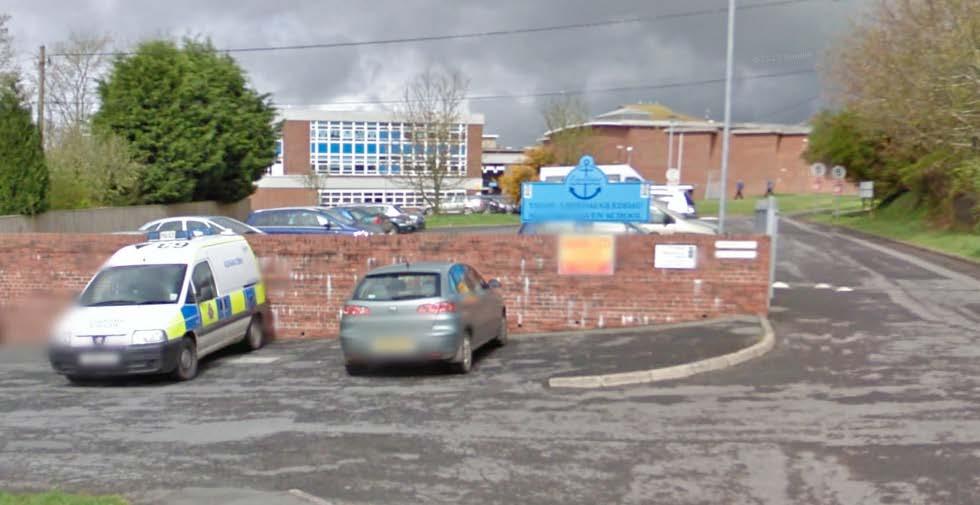
A MIlfORd HAvEN parent has raised serious safeguarding concerns after her 13-year-old son—who has AdHd and autism—was questioned by police at Milford Haven School in connection with suspected cannabis, without her being informed for several hours.
The police confirmed this, saying “We were called to a report that a small amount of cannabis had been found.”
Jenn Reynolds said the incident occurred at around 12:00pm, but she was not contacted until 5:00pm, when deputy head Mr Thomas phoned her. She alleges another pupil brought suspected cannabis into school and handed it to her son, Rhys, who she says was “forced” into looking after it. Rhys was searched and questioned by attending officers, and did not disclose the matter to his mother beforehand.
“My kid is vulnerable—he would agree to anything,” Ms Reynolds said. “He has additional needs, and I should have been notified immediately so I could be present during any search or questioning.”
She added that her son now faces disciplinary action, including possible expulsion or placement in the school’s “REMOVE” provision, an internal withdrawal or isolation room.
Ms Reynolds also referenced a prior Year 7 incident in which her son was assaulted and footage circulated on

Snapchat; she claims she was initially told the perpetrator was expelled but later learned it was only temporary, and her expressions of concern at that time led to a temporary ban from the school premises.
The matter is now being discussed in local parent group chats, with some encouraging escalation.
Pembrokeshire County Council confirmed its education and safeguarding teams are involved and that “appropriate communication was held with key agencies.”
On the delay in parental notification, a spokesperson said: “The parent should be advised of any safeguarding concerns as soon as possible—this may mean a delay as the school looks into the concerns and liaises with agencies such as police.”
The council emphasised support for vulnerable learners, adding: “Support is provided to any young person with an appropriate adult present and the process explained to them in a way which they would understand.”
In a further clarification, the authority confirmed that an appropriate adult was present during police interaction with the pupil. The council said the school would continue to maintain support and communication with the family.
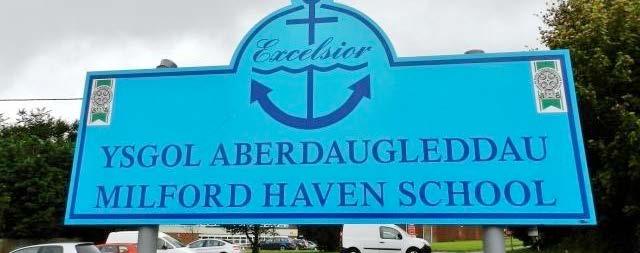
The incident comes against the backdrop of Milford Haven School being placed into special measures, Estyn’s most serious category of follow-up, following a core inspection, with the report published on Wednesday last week (Jan 22). Both the school and Pembrokeshire County Council have accepted the findings in full and committed to rapid
improvements.
Estyn identified a number of areas requiring urgent action, including weaknesses in teaching quality and consistency, low pupil attendance— below that of similar schools and well below pre-pandemic levels—with particular concerns around pupils eligible for free school meals, shortcomings in self-evaluation and improvement planning, a need to strengthen leadership challenge, inadequate toilet provision for pupils, and the requirement for more robust financial management.
Despite these concerns, inspectors also highlighted several strengths, describing the school as a “caring and inclusive community” where pupils feel safe. Estyn praised the school’s work to promote positive behaviour, its use of restorative approaches to tackle bullying, the range of curriculum and digital skills opportunities on offer, and its commitment to supporting disadvantaged learners.
Pembrokeshire County Council said it is working closely with Estyn and the school on a detailed postinspection action plan. Regular updates, engagement events, and communication with parents, carers, and the wider community are expected as improvements are implemented. Estyn monitoring visits are anticipated every four to six months until sufficient progress allows the school to be removed from special measures. Further details of the approved action plan are expected to be published on the Milford Haven School website.
The incident has prompted renewed local discussion about how schools— particularly those under heightened scrutiny—handle safeguarding, drugrelated incidents, vulnerability among neurodivergent pupils, and timely parental involvement.
The Herald will continue to follow developments, including progress on the school’s improvement plan.
ATTENdANCE was formally identified as one of the key weaknesses at Milford Haven School after inspectors placed the school into special measures — an issue that has also been raised at the Senedd as part of growing concern about school attendance across Wales.
In its November 2025 inspection report, Estyn made six recommendations for improvement at Milford Haven School, including a specific call to improve attendance, listed as Recommendation R5. Inspectors concluded that special measures were required and said progress would be monitored regularly.
The focus on attendance locally mirrors a broader national debate, after figures discussed in the Senedd showed that attendance levels across Wales remain significantly below pre-pandemic levels, particularly among vulnerable pupils.
During Spokesperson’s Questions to the Welsh Government’s Cabinet Secretary for Education, the Welsh Conservatives highlighted that more than half of the most vulnerable pupils in Wales were persistently absent during 2024/25, compared with 30.4 per cent in 2018/19. Persistent absence is defined as missing at least ten per cent of school sessions in a year.
The figures also showed that Year 11 pupils recorded the lowest attendance, averaging 86.8 per cent in 2024/25 — 6.4 percentage points lower than before the pandemic.
Following the exchange, Natasha Asghar MS, the Welsh Conservatives’ shadow cabinet secretary for education, said the Welsh Government was failing to

meet its own targets on attendance.
She said the government had promised to restore attendance to prepandemic levels by the end of the current Senedd term, but warned that with only a few months remaining, that commitment looked unlikely to be met.
She said vulnerable pupils were being disproportionately affected, adding that behind the figures were children missing out on learning, with potential long-term consequences for their education and future prospects.
The Welsh Conservatives also criticised the recent Labour–Plaid Cymru budget agreement, arguing that it would not deliver the changes needed to improve attendance or educational outcomes.
Estyn’s recommendation to improve attendance at Milford Haven School comes alongside other concerns highlighted in the inspection, including teaching quality, leadership and management, facilities, and financial oversight.
The inspection found that attendance at the school was below that of similar
schools and well below pre-pandemic levels — a pattern reflected across much of Wales, according to national data.
Education professionals and children’s organisations have repeatedly warned that attendance challenges are closely linked to wider issues, including mental health, additional learning needs, family pressures and disengagement following the pandemic.
Under the special measures process, Milford Haven School is required to produce a detailed action plan setting out how it will address Estyn’s recommendations, including attendance. Inspectors are expected to return every four to six months to monitor progress.
Pembrokeshire County Council has previously said it is working closely with the school and Estyn to support improvements, while the Welsh Government has said it continues to work with local authorities to improve attendance and re-engage pupils.
As scrutiny of school standards intensifies both locally and nationally, attendance is likely to remain a central issue — for Milford Haven School and for education policy across Wales.
A MOTHER-of-two has narrowly avoided an immediate prison sentence after injuring another woman’s face during an altercation at a Tenby pub.
Haverfordwest Magistrates’ Court heard that Courtney Howells, aged 28, was involved in the incident on Friday, September 27, 2024. Throughout her appearance in court this week, she maintained that she never intended to cause injury.
Her solicitor, Michael Kelleher, told District Judge Mark Layton that Howells had thrown a drink during the incident.
“She threw a drink, but unfortunately it caused an injury to the victim,” he said.
However, the Crown told the court that as Howells threw the drink
towards the victim, the glass left her hand and struck the woman in the face, ausing scarring.
In a victim impact statement read to the court, the victim, who was 17 at the time of the offence, said the incident had had a lasting effect on her confidence.
“I’m paranoid whenever I go out with my friends,” she said. “I’m constantly walking on eggshells and haven’t been back to the place where it happened.
“I’ve got scars on my face that are a constant reminder, and I have this insecurity over something that could have been prevented.”
Mr Kelleher submitted a probation report and several character references on behalf of his client, again stressing that the incident was
not intentional.
“It was reckless rather than intentional,” he said. “The defendant’s intention was to throw a drink, not the glass, and not to cause any injury.”
Howells, of Caerae, Martletwy, pleaded guilty to assault causing actual bodily harm.
District Judge Layton sentenced her to 42 weeks in custody, suspended for two years.
She was ordered to complete 150 hours of unpaid work, undertake 20 rehabilitation activity requirement days, and wear an alcohol abstinence monitoring tag for 60 days.
Howells was also ordered to pay £1,500 compensation to the victim, a £187 court surcharge and £85 in prosecution costs.
A restraining order was imposed

preventing her from having any direct or indirect contact with the victim for the next five years.

EARlIER this week, Hywel dda uHb published the results of a consultation into the future configuration of its clinical services. It is widely accepted that the current provision of clinical services is unsustainable. The Board cannot recruit enough staff to fill vacancies, particularly in rural areas, despite the existing staff shortages there. Only Prince Philip Hospital in Llanelli, situated close to the medical faculty and research facilities in Swansea, experiences relatively little difficulty recruiting and retaining staff.
Coles jon.coles@herald.email
Public reactions online to the publication of the results, particularly in Pembrokeshire, were plentiful and mostly negative. Those initial reactions were predictable, even where the report’s details had not been read. However, an examination of the consultation’s findings paints a troubling picture for the Board.
Many of the approximately 4,000 respondents to the consultation said they understood the practical difficulties of delivering healthcare across rural Wales with limited resources. However, many also said they did not expect the Health Board to act in good faith upon its findings. Using the definition of ‘many’ adopted by ORS, a slight majority of respondents to the consultation said, in terms, that they did not trust their local health board.
We asked the Health Board to respond to those findings.
The Board told us: “We hope that by giving the people and communities in Hywel Dda the chance to share their views, we can work together on planning for the future of health care that is safe, accessible, sustainable and kind. More than 4,000 people engaged with us by

with almost universal short shrift from the public.
The options proposed by the Board contained no hint of a transport assessment if key services were centralised, particularly from rural areas. Concerns about transport links, a bugbear for respondents from Pembrokeshire, were expressed by members of the public living in Ceredigion, in rural Carmarthenshire east and north of the M4 and A40.
Without a massive investment in patient transport services or a massively expanded public transport system, it is difficult to see how the Board could reasonably expect a patient with a debilitating condition to reach an appointment many miles away. Therefore, we asked the Board what transport it had commissioned to justify and underpin the options in the consultation.
attending our events, held throughout the Hywel Dda area, neighbouring Health Boards, and online.
“At the Extraordinary Board meeting on the 18 and 19 February, the Board will be considering 48 options across the nine services, 22 of which are alternative options generated directly through staff, public and stakeholder feedback during the consultation process. This reflects our genuine commitment to listening to our communities. There are no preferred options.”
The consultation report included a large range of responses expressing serious concerns about access to services close to home. Respondents aired even stronger misgivings about the linked issue of transport for those attending hospital appointments. Simply put, options that proposed centralising services in one centre or another met
The Board said: “We carried out Equality Impact Assessment (EqIA) and Quality Impact Assessment (QIA) during options development. Alongside this, there is a dedicated Patient and Travel Insights assessment to explore how changes could affect journeys and access to care. This includes analysis of travel times, transport patterns and the potential effects on different groups.
“We have carefully considered how proposed changes to healthcare services could impact travel and transport for patients, loved ones, and our staff. Some options may involve longer travel times for some people to ensure they can access better-quality care. We have worked with partners such as the Welsh Ambulance Service, the University NHS Trust, and the Adult Critical Care Transfer Service to ensure appropriate transport arrangements have been considered.
“We will continue to work with partners to understand how we can reduce the impact of any changes on travel and transport.”


This is at least the fourth consultation this reporter has reported on in the last eleven years. Each has suggested the future provision of healthcare services through technological solutions.
If patients must travel further for appointments, many of which will be clinically routine, remote medical appointments would go some way to addressing that issue. On the surface, it’s a win-win.
Progress has been slow. The technical demands of remote consultation and creaking IT infrastructure have delayed rollout. The risks attendant upon assessing a patient’s condition over a videolink remain undiminished. Moreover, a significant number of older patients either cannot or will not access services online. Rural broadband rollout, which remains piecemeal, has not been the cure-all previously imagined.
We asked how the options accounted for the factors listed above.
The Board’s response stated that: “Digital is increasingly becoming the means by which we all interact with each other and with everything around us. However, we understand that some members of our Hywel Dda population cannot always access services online, or prefer not to, and we will support them in accessing healthcare in the way that is most convenient for them.”
The problems West Wales has in attracting and retaining healthcare staff are well known. They are chronic and, despite numerous initiatives, have not gone away. Rural areas are a hard sell to young professionals, especially those ambitious to specialise in cutting-edge practice areas. All principal research centres are based in or close to cities. In South Wales, that means Swansea, Cardiff, and Bristol. It follows that the more distant a post is from those centres, the less likely an early-career professional will apply for it.
Meanwhile, working conditions,
shift patterns, and travel times to and from workplaces, often miles from home, mean that agency working (less secure, but better paid and more flexible) is an attractive alternative to direct employment. Despite Welsh Government diktats to cut the use of agency staff, healthcare delivery operates in the real world.
The Board told us: “Staff recruitment and retention are challenges across the NHS, especially in rural areas. We continue to recruit staff by offering them competitive remuneration packages and excellent opportunities to work, train and progress in our hospitals and health sites.
“An important motivation for the CSP programme was the expectation that more sustainable, higher-quality services would be more attractive to staff, helping with both retention and recruitment.
“Some options seek to recruit more substantive staff rather than temporary staff, which will be better for our clinical teams and improve patient care. Some options provide current staff with chances to work more closely together in teams and offer more training opportunities.”
Opposition to the options proposed by the Health Board was predictably strongest when it came to removing services from local hospitals. In Ceredigion, a 16,000-signature petition opposed the removal or reduction of stroke services at Bronglais. In Llanelli, an option to close the Emergency Care Unit drew a negative reaction. In Llandovery, the loss of radiology services garnered a similarly trenchant response. In particular, a large majority of responses rejected proposals to introduce a treat-and-transfer system.
Against that background, it is hardly surprising that Pembrokeshire respondents stood firmly against any further reduction in services provided in the county, and particularly at Withybush. Having experienced the salami-slicing

of services away from Haverfordwest, and in the face of repeatedly broken assurances regarding the return of services ‘temporarily’ removed, those reactions are unsurprising. Those feelings are not limited to the public. One staff member was directly quoted in the consultation report claiming that cuts to Withybush were baked into the options the Board presented.
We asked the Board to provide specific reassurance about maintaining current service provision at Withybush and other Pembrokeshire hospitals.
Whether the Board’s response addresses that question, the reader can decide.
“Withybush Hospital will have an important role to play in the health care of the region, and our long-term plan for our hospital sites has been set out in our A Healthier Mid and West Wales strategy. In the interim, our CSP consultation has included our thinking on the role of each of our acute sites. For example, we anticipate that Withybush Hospital will provide more planned care, and initial access to acute care would remain on site, with transfers to Glangwili Hospital for patients with the highest needs.”
Local Welsh Conservative Senedd
Members Paul Davies MS and Samuel Kurtz MS have warned that any decision which undermines the future of A&E services at Withybush Hospital would be “wholly unacceptable”, ahead of a crucial Hywel Dda University Health Board meeting in February.
Paul Davies MS, joined by fellow Welsh Conservative Senedd Member Samuel Kurtz MS, said Withybush Hospital must be protected as a vital lifeline for Pembrokeshire, and that communities are deeply concerned about the potential consequences of the Health Board’s proposals.
Paul Davies MS said: “People in Pembrokeshire are deeply worried about what these proposals could mean for Withybush Hospital. Over many years, we have seen a gradual erosion of services,
and communities are understandably anxious that this process will continue.
“Withybush Hospital is not a ‘nice to have’ — it is a vital lifeline for a large, rural population. Any changes must strengthen services in Pembrokeshire, not weaken them. I will not support decisions that place patients at greater risk or force them to travel unreasonable distances for essential care.”
Samuel Kurtz MS added, “People in Pembrokeshire have heard this story before. Time and again, we are told services are fragile, and the result is that Withybush loses out.
“The loss of SCBU, consultant-led maternity and children’s A&E is still deeply felt locally. Removing one service often makes others unviable, and that is exactly what people are worried about now.
“Any decision that threatens the long-term viability of A&E at Withybush Hospital is a red line. It would be wholly unacceptable and would be met with fierce opposition from the community.”
Mr Kurtz also stressed that rurality, transport challenges and ambulance pressures must be central to decisionmaking, not treated as secondary considerations.
“Pembrokeshire is a rural county. Asking patients to travel further for emergency or urgent care is not a theoretical issue — it affects safety, outcomes, families and staff.
He continued: “There is also deep frustration that these decisions continue to be made in the shadow of the socalled ‘super hospital’ elsewhere in west Wales, which has never come to fruition. Pembrokeshire cannot be left with a slow erosion of services while waiting for something that may not materialise for a decade or more.”
Both Senedd members have written to Hywel Dda University Health Board and the Welsh Government ahead of the February meeting.
Paul Davies MS concluded: “We will be watching the outcome of this meeting very closely. Withybush Hospital is vital to Pembrokeshire. It must be properly supported, not hollowed out.”



A SPECIAlIST search team has carried out a renewed and highly technical search of the River Teifi in Cardigan as efforts continue to find a man who was last seen entering the water earlier this month.
The operation was undertaken on Wednesday (Jan 28) by Specialist Group International (SGI), following a request from the family of Kurtis Brook.
Kurtis was witnessed entering the River Teifi on Saturday (Jan 4). Despite extensive searches involving multiple agencies and voluntary rescue organisations since then, he has not been located.
SGI confirmed that a sevenperson specialist team conducted a coordinated search along the river, working downstream to the mouth of the Teifi estuary. The operation involved the deployment of high-frequency side-scan sonar, equipment capable of detecting objects beneath the water’s surface even in low-visibility conditions.
However, the team said conditions on the river remain exceptionally challenging. Recent storms, prolonged high river levels, floodwater and tidal influence have significantly altered the river environment since the initial incident.
Tom Sinclair editor@herald.email
In a statement, SGI said the search area contained “significant debris, obstructions and strainers,” describing flood and tidal river searches as among the most complex and hazardous situations faced by rescue specialists.
The Herald understands that the River Teifi has experienced repeated high-flow events in recent weeks, complicating earlier search efforts and increasing risks for those operating on the water.
SGI added that while no breakthrough was made during the latest operation, their thoughts remain firmly with Kurtis’s family and loved ones, and they acknowledged the continued dedication shown by his friends and relatives throughout the search.
Emergency services and specialist teams have been involved in repeated searches since the incident, with the operation scaling back and resuming at various points as conditions allowed.
Anyone with information relevant to the disappearance is urged to contact Dyfed-Powys Police

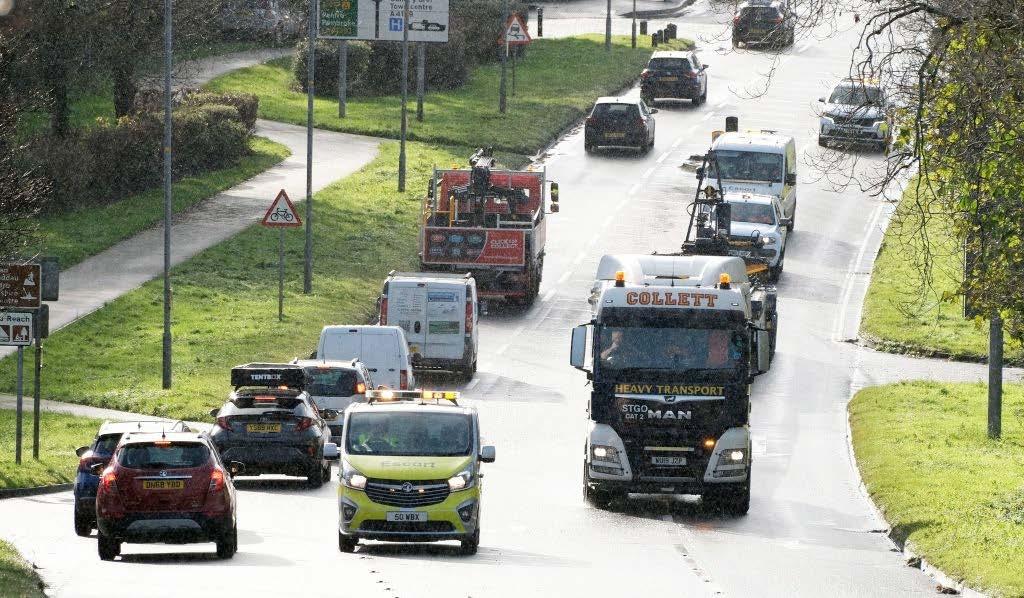
d RAGON l NG and d ragon Energy have confirmed that the final large component for a new wind turbine project has now been successfully delivered, bringing months of complex abnormal load movements on Pembrokeshire roads to an end.
The companies said the final turbine blade was delivered to the site on Wednesday (Jan 28, 2026), marking the completion of all major component deliveries associated with the project.
In a statement, Dragon LNG and Dragon Energy thanked the local community for its patience and cooperation throughout the delivery programme, acknowledging that the operation caused disruption on local roads.
Residents across parts of the county have previously experienced temporary road closures, traffic delays and police escorts as oversized turbine components were transported from the Port of Milford Haven to the site under tightly controlled conditions.
The abnormal load movements required months of detailed planning and coordination, involving route surveys, traffic management, police support and liaison with local authorities to ensure deliveries were carried out safely and with minimal
Tom Sinclair editor@herald.email
disruption wherever possible.
The companies also apologised for the inconvenience caused during the delivery phase, saying the support and understanding shown by residents had been “invaluable”
in allowing the project to reach this milestone.
A number of organisations were involved in supporting the operation, including Pembrokeshire County Council, Dyfed-Powys Police, haulage specialists Collett & Sons Ltd and Green Light Traffic Management. Local media outlets, including
The Pembrokeshire Herald, provided advance notice and updates during the delivery process to help keep residents informed.
With the final major deliveries now complete, Dragon LNG and Dragon Energy said the project would continue to progress to the next phase of construction on site.
A COuRT has heard how a 79-year-old Pembrokeshire man subjected his former long-term partner to a sustained stalking campaign that included distributing defamatory posters about her in public places.
Michael Lockheart appeared before Haverfordwest Magistrates’ Court this week, where he pleaded guilty to stalking the woman between July 27 and September 10, 2025. The case was heard by District Judge Mark Layton.
The court was told that during the period in question Lockheart repeatedly sent the victim unwanted emails despite being told to stop, placed defamatory posters in public locations, and sent malicious correspondence about her to both her GP and the local authority.
Crown Prosecutor Sian Vaughan said the defendant and the victim had been in a relationship for twelve years, but it ended when the woman felt overwhelmed by his behaviour and wanted to be left alone.
“Some of these posters were seen by the victim’s ten-year-old granddaughter.”
The court heard that Lockheart’s actions had a severe and lasting impact on the victim’s mental health.
In a victim impact statement read out in court, she said: “Since he started contacting me by text messages and putting posters up in public places, I’m feeling anxious and have started having panic attacks in my own home.
“This makes me feel isolated. I’m having trouble sleeping and suffer from nightmares. It’s had a profound effect on my mental health.”
The prosecution said the woman is now considering selling her home as a result of her anxiety and has already changed all of the locks at the property.
Lockheart, of Daisy Lane, Haverfordwest, was represented by defence solicitor David Wheale.
“He wouldn’t allow her to do that,” she said. “He then began putting messages up claiming she was a serious sex cheat and a predator, repeating these messages over and over again.

“All of a sudden, their communication ended, but he foolishly pursued the communication,” Mr Wheale told the court. “They’ve broken up in the past, and he believed this was the situation again on this occasion.”
District Judge Mark Layton
adjourned sentencing to allow a probation report to be prepared.
Lockheart was released on conditional bail. The conditions include not contacting the victim directly or indirectly and not approaching any address at which she resides.



A MAN caught driving through Milford Haven with cocaine in his system has been banned from the roads for three years.
Simon Bowen, aged 35, was stopped by police on August 2, 2025, as he drove through Hamilton Terrace, Milford Haven.
Subsequent blood tests showed Bowen had 240 micrograms of the cocaine metabolite benzoylecgonine and 27 micrograms of cocaine in his system. The legal limits are 50 and 10 micrograms respectively.
This week, Bowen appeared before District Judge Mark Layton sitting at Haverfordwest Magistrates’ Court via
video link from Swansea Prison, where he is currently serving a sentence for a separate drugs offence.
He pleaded guilty to two counts of drug-driving.
Addressing the court in mitigation, Bowen said: “I know I’ve made mistakes in the past, but I previously had an addiction.
“I’m now on a 12-step recovery process and working towards sorting out my drug addiction.”
In addition to the three-year driving disqualification, Bowen was fined £120 and ordered to pay a £48 court surcharge.
A PEM b ROKE d ock motorist has admitted causing criminal damage after biting a police blanket while in custody following his arrest on suspicion of drinkdriving.
Haverfordwest Magistrates’ Court heard this week that police were alerted after a member of the public reported concerns about a man sitting in the driver’s seat of a vehicle while revving the engine.
Crown Prosecutor Sian Vaughan said officers attended and found Sean Cook, aged 58, inside the vehicle.
“The person was concerned about the male who was sitting there with bulging eyes,” she told the court. “He was believed to be on drugs.”
Ms Vaughan said Cook told officers he was listening to the radio
while sitting in the vehicle, which was parked in a public driveway.
“It was clear to the officers that he was intoxicated as he was slurring his words,” she said. “He then deliberately refused to supply a breath test on three occasions.”
Cook, of Glenview Avenue, Pembroke Dock, was arrested and taken to Haverfordwest Police Station. While in custody, he began biting a police blanket, causing the stitching to split.
He pleaded guilty to failing to provide a specimen for analysis and to causing criminal damage.
Sentencing was adjourned until Monday (Feb 17) to allow for the preparation of a probation report.
An interim driving disqualification was imposed, and Cook was released on unconditional bail.
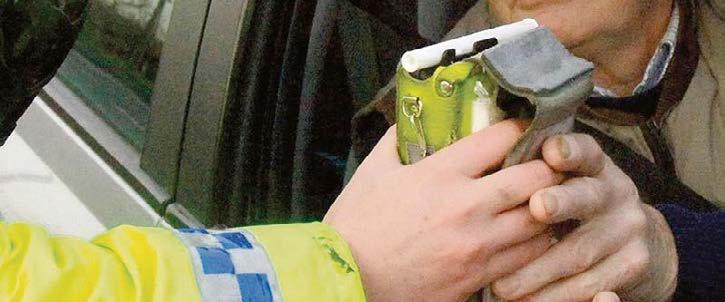

A fORMER serviceman has been sent to prison after tracking down and harassing a police officer who had arrested him two years earlier.
Gareth Nicholas, aged 41, from Waunarlwydd in Swansea, targeted the officer by discovering his home address and sending a threatening message via Facebook, Swansea Crown Court heard.
The officer had been part of a police team that executed a Scottish arrest warrant at Nicholas’s home in May 2023. Two years later, in August 2025, the officer received an unexpected friend request on social media, followed shortly afterwards by a message that immediately caused concern.
The message began with the words “I found you” and accused the officer of unlawfully entering Nicholas’s property, assaulting him while he was in his underwear, and “abducting” him. Nicholas also claimed he had identified a pattern of corrupt behaviour within the police and issued a veiled threat, stating: “I will catch you down the Liberty son. Look forward to it,” a reference to Swansea City’s former stadium.
The situation escalated further days later when a handwritten letter was delivered to the officer’s former address.
The new occupant contacted the officer to alert him to the letter, which repeated allegations of corruption and suggested the matter could be dropped if the officer assisted in exposing alleged police misconduct.
Nicholas was arrested on September 3 and admitted sending the communications, but denied at the time that his actions amounted to stalking.
In evidence, the officer told the court that while he had faced verbal abuse during his policing career, this incident felt different and deeply personal. He said his family installed CCTV cameras, security lighting and fencing, and put safety plans in place for their children. He added that he feared Nicholas had not let go of his perceived injustice and remained concerned the behaviour could continue.
The court heard Nicholas has a substantial criminal record in Scotland between 2019 and 2024, including convictions for stalking, malicious communications, threatening behaviour, domestic abuse offences and possession of ammunition without a licence.
Sentencing Nicholas, Judge Huw Rees acknowledged the trauma the defendant had experienced during military service, but warned him not to repeat the behaviour.
Nicholas, who appeared unrepresented, pleaded guilty to stalking and was sentenced to 20 weeks in prison, reduced by 20 per cent for his early guilty plea. Having already served time on remand, his release is expected shortly. He was also made subject to a five-year restraining order banning any contact with the officer.

the court the profile made clear the girl was 13 “from the outset”. During their exchanges, the decoy discussed school life and told John she would be turning 14 in November.
Despite this, John went on to “cultivate an online relationship” with the account between October 11 and November 3, 2021.
The court heard the messages quickly became sexual. John explained what masturbation was, asked whether he could show the child his genitals, requested photographs of her body and repeatedly told her he was aroused.
After sending the messages, John deleted them and asked the decoy to do the same. However, screenshots of the conversations had already been captured by the group.
In one exchange, John admitted he knew what he was doing was wrong.
The group later used a second decoy account, posing as an adult woman, to arrange a meeting at the Travelodge in Carmarthen. A local group confronted John at the hotel before police arrived and took possession of evidence, the court was told.
Officers seized John’s mobile phone and recovered the conversations.
When interviewed, John claimed he
did not truly believe the girl was 13 and said he had been trying to expose whoever was behind the profile as “scammers”.
However, on the day his trial was due to begin, he changed his plea and admitted attempting to engage in sexual communications with a child. The court heard he had no previous convictions.
Defence solicitor Ian Ibrahim said John’s guilty plea was among his strongest points in mitigation. He told the court the defendant had not reoffended in the more than four years since the offence and was dealing with several physical health problems.
Mr Ibrahim also said John had been “humiliated” after the paedophile hunter group posted footage of the confrontation online, making him “the subject of ridicule” locally.
Sentencing, Judge Catherine Richards said it was conduct like this that made the internet a more dangerous place for children.
John was sentenced to 12 months’ imprisonment, suspended for 12 months, and ordered to complete 20 rehabilitation activity requirement days. He must sign the sex offenders register for 10 years and was made subject to a sexual harm prevention order for the same period.

lOCAl Senedd Member Samuel Kurtz has called on lINK to hold a face-to-face meeting in Pembroke dock to discuss the forthcoming review of the decision that the town does not qualify for a banking Hub.
With the 12-month review window now approaching, Mr Kurtz says it is vital that LINK hears directly from residents, businesses and community groups who have been affected by the loss of the town’s final bank branch.
Pembroke Dock has been without any in-person banking services since the closure of its last bank, a situation campaigners say has had a significant impact on older residents, vulnerable people and small businesses who rely on face-to-face support and access to cash.
Under LINK’s current rules, once an assessment has been carried out, a further review cannot normally take place for 12 months unless there has been a significant change in local cash access provision. That review period is now nearing its end, allowing a formal reassessment request to be made.
Mr Kurtz has been leading efforts over the past year to build the case for a Banking Hub, including writing to the Financial Conduct Authority and HM Treasury on the national framework governing access to cash, and raising concerns with the Welsh Government and the Older People’s Commissioner for Wales.
More than 1,500 residents and businesses have now signed a petition backing the call for a Banking Hub, a level of support Mr Kurtz says

the review process.
“This is about giving the community
a fair hearing. If LINK is going to reassess its decision, it should do so with a clear understanding of local needs, and that means listening directly to those impacted. The last review was undertaken as a deskbased exercise and I’m asking LINK to come and visit to see for themselves the geography of South Pembrokeshire and understand that it is the wider community, and not just Pembroke Dock, that would use this facility.” he said.
Samuel Kurtz has written to LINK formally requesting that representatives attend a community meeting in Pembroke Dock ahead of the review.
Campaigners say they will continue to gather evidence and community support in the run-up to the reassessment and remain confident that Pembroke Dock meets the criteria and intent of the Banking Hub scheme. More information and the online petition are available at www.samuelkurtz.wales.
demonstrates the strength of feeling locally.
“Pembroke Dock has lost its last bank, and that has changed everyday life for many people,” Samuel Kurtz said. “Not everyone can bank online or travel to Carmarthen when there’s a problem. A face-to-face meeting in the community would allow LINK to hear first-hand how this decision is affecting real people.”
He added that holding the meeting locally would help ensure transparency and build confidence in
A MIlfORd HAvEN man has appeared in court charged with burglary and causing grievous bodily harm following an incident in victoria Road.
Stephen Collier, of Vaynor Road, Milford Haven, is accused of entering Nos Da Flat at 2 Victoria Road, Milford Haven, on Wednesday, December 3, and inflicting grievous bodily harm on a man, John Hilton, while inside.
Collier first appeared before Llanelli Magistrates’ Court on Friday, December 5, when no plea was entered. Prosecutors told the court the alleged burglary and assault were carried out jointly with Denis Chmelevski.
The case returned to court on Monday, January 26, at Swansea Crown Court, where Her Honour Judge
Catherine Richards outlined Collier’s bail conditions.
The court heard Collier is due to move to Suffolk and has prospects of employment. He was granted bail subject to strict conditions, including an electronically monitored curfew requiring him to remain indoors between 9:00pm and 6:00am.
He must not contact any witnesses connected to the case and is banned from entering Pembrokeshire.
Collier is next due to appear at Swansea Crown Court on Monday, May 12, when the matter is listed for trial. The trial is expected to last three days. Denis Chmelevski is due to appear in court at a later date in connection with the matter. The case remains ongoing.


A NEW pilot scheme designed to support children and young people after they have been arrested has been launched across the dyfedPowys Police area.
The Reachable Moments project aims to ensure those brought into custody receive the right help at the right time. The force will work with an Adferiad Reachable Moments worker to engage with young people, explore the causes of offending and steer them towards positive life choices.
Dyfed-Powys Police says wider scrutiny measures introduced over the past year have already reduced the number of children passing through custody. In 2024, 432 children were arrested and taken into custody. By the end of 2025, that figure had fallen to 326, following measures including closer oversight of decisions to arrest children.
While every encounter in custody can represent a “reachable moment” – a critical opportunity for early intervention – the new project aims to reduce the numbers further by offering support when young people may be most receptive to change.
Chief Inspector Jenna Jones said: “While we, as a force, are focusing on prevention and intervention in the community to prevent a child from ending up in custody, we recognised and acknowledged that there was a significant gap in support once a child is arrested and brought into custody.
“When young people are arrested or held in custody, they often spend long periods waiting to be processed or interviewed. This waiting time presents a crucial reachable moment – a window of opportunity where a trained professional can engage with the young person at a time they have less influence from peers or family members who contribute to their offending, and when they may be more open to support.
“Our ultimate aim is to break the
cycle of offending, and positively influence them into making changes to their behaviour.”
Launched on Sunday (Jan 12), 2026, the pilot provides a 24/7 oncall service for custody staff, allowing officers to request immediate support from a Reachable Moments Worker (RMW).
The worker will attend the custody unit to:
• Engage with the young person in a safe, one-to-one setting
• Provide emotional support, practical guidance and short-term mentoring
• Seek to understand the root causes of the offending behaviaour
• Link them to diversionary activities, community services and longer-term support to help prevent reoffending
The project is being delivered by Adferiad, a Welsh charity providing support for people with mental health and substance use needs, as well as other complex problems. DyfedPowys Police already works with the charity through its Appropriate Adult service operating across custody suites in the force area.
“For this project, Adferiad’s experience in supporting children and young people is key,” Ch Insp Jones said.
“A child being brought into custody is at a critical point, and one at which they often feel vulnerable, uncertain and isolated. They might be at risk of exploitation, gang involvement, or falling into a cycle of reoffending.
“This also might just be that moment they decide to engage.
“Reachable Moments workers are trained professionals, distanced from any statutory authorities, who can provide non-judgemental support in a safe place, helping the young person to reflect on their situation and
A HAvERfORdWEST man has been sentenced after launching into a struggle with a police officer while resisting arrest, a court has heard.
Malcolm Mathias, aged 40, took issue with PC Goymer when officers attended his address at Scotchwell View, Haverfordwest, on January 3 to investigate an unrelated matter.
“When officers attended his home address, Mathias took issue with the fact he was going to be arrested,” Crown Prosecutor Sian Vaughan told District Judge Mark Layton, sitting at Haverfordwest Magistrates’ Court this week.

consider alternative paths.
“They will build a trusting relationship, offering emotional support and guidance, and help prevent further harm, trauma and future involvement in crime, as well as reducing the trauma caused from just being in custody as a child.”
Following the initial meeting in custody, the Reachable Moments
worker will maintain contact with the young person to arrange followup appointments and help ensure relevant agencies are also involved. The service operates 24 hours a day, seven days a week. DyfedPowys Police said a full evaluation will be carried out after the pilot period to inform a decision on whether the project should continue.
“He tensed his arms, which resulted in a struggle, and continued to resist his arrest.”
As a result of the altercation, PC Goymer sustained an injury to his right knee and damage to his trousers.
Mathias pleaded guilty to obstructing and resisting a constable in the execution of his duty, as well as a further charge of refusing to provide a sample for a Class A drug test following his arrest.
He was fined £160 and ordered to pay £75 compensation to the officer. He must also pay £85 in court costs and a £64 surcharge.


A TRIbuNAl hearing into alleged breaches of the members’ code of conduct by a former Neyland town councillor has been adjourned and rescheduled, official papers confirm.
The case involving former Councillor Brian Rothero had been listed to be determined on Tuesday (Jan 27) at 10:00am, using remote attendance technology.
However, the tribunal meeting has now been adjourned at the request of the tribunal panel, with the case due to be determined instead on Thursday, February 12, at 10:00am, according to a notification issued by the Adjudication Panel for Wales’ Welsh Tribunals Unit at the eleventh hour (Jan 26).
The matter relates to allegations of breaches of the statutory members’ code of conduct. These include alleged failures to show respect and consideration, and requirements around treating others with respect and not using bullying or harassing behaviour.
The tribunal will determine the case on the papers only and will not hear oral submissions or evidence from the parties or any witnesses. The notification states that Mr Rothero’s
presence on the rescheduled date is not required. It also confirms the tribunal’s meeting, deliberations and adjudication will not be open to the public.
The adjournment comes amid an extended period of heightened scrutiny around Neyland Town Council, which has repeatedly featured in complaints and conduct-related disputes.
Pembrokeshire County Council’s Standards Committee has previously been told that Neyland Town Council accounted for a significant proportion of code of conduct complaints made about town and community councils in the county.
In a separate recent case, a Neyland councillor was banned from public office for four years after a tribunal found breaches linked to communications described as lacking respect and amounting to bullying or harassment.
The council has also faced ongoing rows over governance and decisionmaking, including controversy surrounding a co-option process that drew criticism over transparency.

A MI lf OR d HAv EN man has been sentenced for stealing five legs of lamb from an Iceland supermarke t.
On October 3, Martin Back entered the Iceland store in Gravesend and stole five legs of lamb valued at £70 This week he pleaded guilty to the theft offence when he appeared before Haverfordwest Magistrates’ Court. He was represented by solicitor Fenn Richards.

“He was leading a chaotic lifestyle at that time, being homeless and drinking,” she told District Judge Mark Layton. “But he’s now housesharing in Milford Haven and works on a farm.”
Back, of Milton Crescent, Milford Haven, was fined £300 and ordered to pay £70 compensation to Iceland. He must also pay a £120 court surcharge and £80 in costs.

THE WE l SH AM bul ANCE SERv ICE has revealed a series of inappropriate 999 calls made last year — including one from a person who rang emergency services after accidentally swallowing a small amount of mouthwash.
The call was among dozens of examples released by the trust to underline the growing pressure on emergency services caused by nonurgent use of the 999 system.
Figures show that of the 414,118 incidents recorded by the Welsh Ambulance Service in 2025, around 15 per cent — 62,454 calls — were deemed not suitable for an emergency ambulance response. That equates to roughly one in every seven calls.
Other examples included callers reporting a sore throat, a loose tooth, ointment in an eye, and minor ear and finger injuries — conditions that could have been treated through alternative NHS services.
Senior ambulance leaders warned that such calls divert vital resources away from genuine emergencies, including heart attacks, strokes, serious injuries and life-threatening incidents.

Tom Sinclair editor@herald.email
Andy Swinburn, executive director of paramedicine, said staff are trained to respond rapidly to severe and urgent medical situations, but misuse of the emergency line slows response times for those in real danger.
“When people call 999 for minor ailments, it takes valuable time away from call handlers and clinicians who may be trying to help someone in cardiac arrest or with catastrophic bleeding,” he said.
“Our message is simple — use common sense and help us protect emergency services for those who need them most.”
Lee Brooks, executive director of operations, added that none of the highlighted calls required an ambulance and that many would now be dealt with by telephone advice only under the service’s updated
clinical model.
“This is not about blaming people,” he said. “We understand that worry and anxiety can cloud judgement. But the ambulance service exists for urgent and life-threatening situations — not routine illnesses or minor injuries.”
He warned that calling 999 does not guarantee an ambulance will be dispatched, nor does arriving at hospital by ambulance mean a patient will be treated more quickly.
“While crews are tied up with non-urgent calls, someone else’s parent, child or friend could be lying unconscious after a serious collision or suffering a cardiac arrest,” he said.
The trust is urging the public to familiarise themselves with alternatives to 999, including NHS 111 Wales for urgent health advice, pharmacists for common conditions, and minor injury units for less serious injuries.
A spokesperson added that keeping basic medicines at home and staying on top of prescriptions can also reduce unnecessary pressure on emergency services.
The Welsh Ambulance Service said the real-life examples were shared to encourage responsible use of 999 and ensure help reaches those who need it most — when seconds truly matter.
A PETITION call for a public commitment to save Pembrokeshire’s River Cleddau which has attracted more than 2,200 signatures, and is due to be heard by full council, ends in a few days.
The e-petition on Pembrokeshire County Council’s own website, started by James Harrison-Allen, says: “We call on Pembrokeshire County Council to create and enact a Clean Rivers Policy to restore the Cleddau to good health after decades of neglect and degradation.
“The Cleddau flows through the heart of Pembrokeshire, including our county town, and is the foundation for Pembrokeshire’s prosperity. The river is failing, and we need to act now to save it from irreversible decline.
“What’s the problem? The Cleddau rivers and estuary are the worst (and worsening) polluted SAC (Special Area of Conservation) designated rivers in Wales; worse even than the Wye and the Usk (NRW Water Assessment Report 2024), and considerably worse than the neighbouring Towy and Teifi.
“Damaging impacts on Pembrokeshire’s economy, public health
and the natural environment. Ineffective regulation; monitoring, responding, policing, enforcement and prosecutions. What should PCC be doing to address this? Make a formal, public commitment to cleaning up the Cleddau. Make the health of the Cleddau central.”
Earlier this year, Henry Tufnell, MP for Mid and South Pembrokeshire, called for “urgent” action to tackle the poor state of the River Cleddau when he chaired a discussion bringing together key stakeholders, environmental experts, and community voices to address the issues surrounding water quality and pollution.
The panel event, organised by local river action group The Cleddau Project, covered topics including pollution sources, enforcement failures, and potential solutions to improve the river’s health.
The e-petition runs up to February 1, and had attracted 2,207 signatures by January 27.
If a petition gets 500 signatures, the creator will have an opportunity to debate it at a future full council meeting.

A PEMbROKESHIRE man has narrowly avoided an immediate prison sentence after assaulting three shop workers during a shoplifting incident at a Pembroke supermarket.
Haverfordwest Magistrates’ Court heard that Mark Abraham, aged 52, entered the Co-op store in Pembroke on Sunday (Dec 8) and selected an assortment of items valued at £46.16 before attempting to leave without paying.
Crown Prosecutor Sian Vaughan told District Judge Mark Layton that Abraham was challenged by a member of staff as he exited the store.
“The defendant was approached by a member of staff who challenged him,” she said. “He then punched and stamped the staff member to the head several times.”
Two further members of staff, along with a detention officer, came to assist but were also punched by Abraham during the incident.
Abraham, of The Green, Pembroke, pleaded guilty to theft and three charges of common assault. He was represented by solicitor Tom Lloyd.
Mr Lloyd told the court that his client had been fully cooperative with police and had shown genuine remorse.
“He has been completely forthcoming about everything that took place that day and is genuinely sorry for what he’s done,” he said. “He is now highly motivated to address his issues.”
District Judge Mark Layton sentenced Abraham to eighteen weeks in custody, suspended for eighteen months.
As part of the sentence, Abraham was ordered to complete twenty rehabilitation activity requirement days, wear an alcohol abstinence monitoring tag for nineteen days, and attend a nine-day drug review programme.
He was also ordered to pay £100 compensation to each of the four victims, £46.16 compensation to the Co-op store, a £154 court surcharge and £85 in prosecution costs.
In addition, a two-year restraining order was imposed, preventing Abraham from entering the Co-op store in Pembroke and from contacting any of the four victims.


HMP PARC, which houses many prisoners from Pembrokeshire, is set to refer a reported assault on a prison officer to police.
A prison officer was reportedly assaulted by an inmate at HMP Parc, it has been claimed.
The incident is understood to have happened at around midday on Thursday on D-Wing at the Bridgend jail.
A prison spokesman said the matter

would be referred to police and that support was being offered to the member of staff involved.
The spokesman said: “A prisoner was involved in an incident with a staff member on Thursday.
“We are supporting our colleague and will be referring the matter to the police.”
South Wales Police has been contacted for comment.


A PEMbROKESHIRE councillor has spoken out after learning that the Santander branch in Haverfordwest is set to close later this year, warning the decision will have a serious impact on local residents, families and businesses.
The bank’s Bridge Street branch is due to close on Monday (May 5) as part of a wider UK restructuring programme.
Councillor Thomas Baden Tudor said he was “lost for words” and urged the bank to reconsider, describing the closure as devastating for customers who rely on face-to-face services.
Santander says the decision is driven by declining footfall, with more customers banking online, and that services will remain available via digital platforms and Post Office counters.
However, the announcement follows a steady erosion of high-street
Tom Sinclair editor@herald.email
banking in Pembrokeshire. The Herald recently reported that Haverfordwest’s former Halifax branch is set to reopen as a nail salon.
In what appears to be a serious failure of planning, there is now not a single bank branch left anywhere in south Pembrokeshire. Towns including Tenby, Pembroke and Pembroke Dock are all without face-to-face banking facilities.
North Pembrokeshire has also been affected, with Fishguard and St Davids now lacking bank branches.
Pembrokeshire is understood to be left with just four bank branches in total — Nationwide in Milford Haven, and HSBC, NatWest and Lloyds Bank in Haverfordwest.
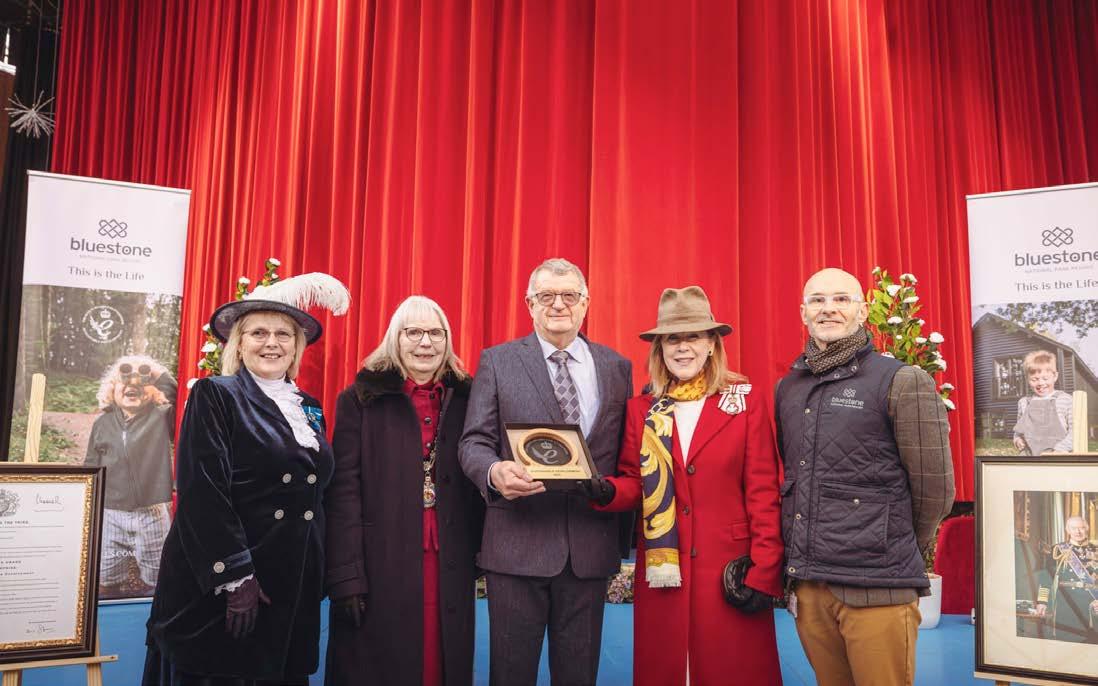
bluESTONE NATIONAl PARK
RESORT has formally received The King’s Award for Enterprise in Sustainable development, marking a major milestone for the Pembrokeshire-based resort.
The prestigious honour — the UK’s highest business award — was presented during an official ceremony at Bluestone’s Serendome by His Majesty’s Lord-Lieutenant of Dyfed, Miss Sara Edwards. It recognises Bluestone as the first holiday resort in the country to receive the award for sustainable development.
During the visit, the LordLieutenant met founder and chief executive William McNamara, director of sustainability Marten Lewis, staff members and invited guests, while also learning more about the resort’s long-term environmental strategy and its relationship with the local community.
The award follows an extensive assessment of Bluestone’s environmental, social and economic performance. Judges highlighted major progress in reducing carbon emissions, the resort’s move to a fossilfuel-free operation for all purchased energy — a first for a UK holiday park — and its adoption of circular economy principles. Bluestone was also praised for its support for the local economy, its work to protect and enhance wildlife, and an internal culture where sustainability is shared across the organisation. Around thirty per cent of the business is staff-owned.
Speaking at the ceremony, Miss Edwards said: “It was a great pleasure to present Bluestone with The King’s Award for Enterprise and to see firsthand the work they are doing. The team’s passion for sustainability and
Tom Sinclair editor@herald.email
their commitment to protecting the local area in Pembrokeshire shone through during my visit. Bluestone’s work is having a positive and lasting impact, and they should be extremely proud of what they have achieved.”
The recognition comes at a time when the tourism sector is under increasing pressure to balance growth with environmental protection, as travellers place greater emphasis on sustainable destinations.
Marten Lewis, who has led Bluestone’s sustainability strategy,
has been central to developing what the resort describes as its “operational blueprint” — combining environmental protection, community partnerships and local economic support. He has also represented Bluestone nationally and was recently congratulated in person by King Charles III at a reception for King’s Award recipients.
Reflecting on the achievement, Mr Lewis said sustainability was fundamental to the way the resort operates. He added that the award recognised years of collective effort across the business and would act as a powerful incentive to continue pushing standards higher.
Chief executive William McNamara said the award reflected a longstanding commitment to responsible tourism. He said that as travel continues to evolve, businesses have a growing duty to protect the places people come to enjoy, adding that national recognition of Bluestone’s approach was a moment of pride for the entire team.
Formerly known as The Queen’s Awards for Enterprise, the programme was renamed following the accession of King Charles III. Since its launch in 1965, more than 8,000 UK businesses have been recognised for outstanding achievement.

A PEMbROKE dOCK woman has been fined after hurling drunken abuse at shoppers when she entered a town centre store in a highly intoxicated state, a court has heard.
Karen Rees, aged 52, entered a store in Dimond Street, Pembroke Dock, just after 10.00am on January 6.
“She was heavily intoxicated, shouting and swearing and pushing cans off the counter,” Crown Prosecutor Sian Vaughan told
District Judge Mark Layton, sitting at Haverfordwest Magistrates’ Court this week.
“But she was also having difficulty getting her words out as a result of the level of her intoxication.”
Rees, of Kavanagh Court, Pembroke Dock, pleaded guilty to being drunk and disorderly in a public place.
She was fined £80 and ordered to pay £85 in court costs and a £32 surcharge.
A dRINK-driver was seen running a red light, swerving between lanes and narrowly missing another vehicle while being followed by police, a court has heard.
Reuben Kirkman, aged 26, was stopped by officers after being seen driving a Vauxhall Corsa along Iscoed Road, Hendy, on the night of June 21, 2025.
“He was stopped by officers as a result of his standard of driving,” Crown Prosecutor Sian Vaughan told District Judge Mark Layton, sitting at Haverfordwest Magistrates’ Court this week.
“He had a near miss with another vehicle, he had no lights on, he drove through a red light and he was seen swerving between lanes.”
Subsequent blood tests showed Kirkman had 147 milligrams of alcohol in
100 millilitres of blood. The legal limit is 80.
His solicitor, Peter Harper, told the court the offence occurred after Kirkman had spent the day with his football team.
“They ended up in the pub and he consumed some alcohol,” he said. “He planned to leave his vehicle there but failed to find a taxi.
“So he sat in his car for around 30 minutes, drank some water and made the stupid mistake of driving home.”
The court was told Kirkman, of Castle Buildings, Castle Street, Swansea, is a sport science and nutritional science graduate and is currently employed in food supply at Wetherspoons.
After pleading guilty to drink-driving, Kirkman was disqualified from driving for 17 months and fined £430. He was also ordered to pay a £172 court surcharge and £85 in costs.


A dOCK motorist has been sentenced for drink-driving after being seen leaving a supermarket car park while over the legal alcohol limit, a court has heard.
Police officers stopped Marius Badea, aged 40, after seeing him drive a Ford Transit van out of the Tesco store car park in Haverfordwest at around 10.30pm on New Year’s Eve.
“It was his standard of driving that caused officers to stop the vehicle,” Crown Prosecutor Sian Vaughan told District Judge Mark Layton, sitting at Haverfordwest Magistrates’ Court this week.
“He was swerving over the central markings.”
Breath tests carried out at the police station later showed Badea had 44 micrograms of alcohol in 100 millilitres of breath. The legal limit is 35.
Badea, of Llanion Cove, Cleddau Reach, Pembroke Dock, pleaded guilty to drink-driving and chose to represent himself in court.
“I’m a driver for an agency, but I have no excuses for what happened,” he told the court.
Badea was disqualified from driving for 12 months and fined £500. He was also ordered to pay a £200 court surcharge and £85 in costs.

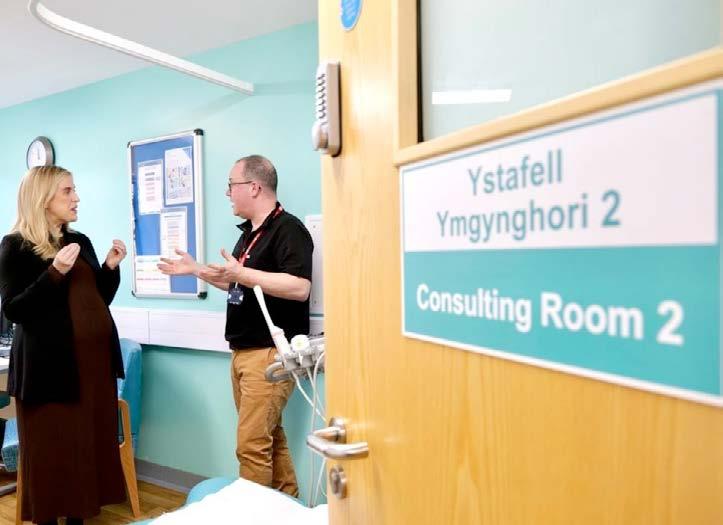
NEW women’s health hubs designed by women for women have begun rolling out across Wales this week, aiming to improve access to menopause, contraception and menstrual health services in communities.
By March, every health board in Wales will have at least one women’s health hub in place. While the format will vary locally — with some operating across multiple sites and others accessed partly online — all will follow a shared, holistic approach to women’s healthcare.
The hubs are intended to make it easier for women to access support through extended clinics, education sessions, online guidance and clear signposting. Some services will be
referral-based, while others will be available through open access.
On Thursday (Jan 29), Sarah Murphy, the Welsh Government minister with responsibility for women’s health, visited the first pilot hub run by Hywel Dda University Health Board at Padarn Surgery in Aberystwyth, where she met patients and clinicians.
The Minister said the hubs would bring care closer to home and address long-standing inequalities in women’s healthcare.
She said: “Women’s health hubs will make it easier for women in Wales to get care when they need it and bring that care closer to home.
“The two very different provisions I will have visited in Swansea and Aberystwyth over the past week reflect the wide variety of ways health boards are meeting the brief of tackling health inequalities and making sure women’s symptoms are not dismissed.
“As the pathfinder hubs and new services linked to them are rolled out, we’ll be listening to women’s feedback and adapting to make sure we are building a health service which meets the needs of women and girls, now and for generations to come.”
The Aberystwyth hub is GP- and nurse-led, offering menopause, menstrual health and contraception services alongside established pelvic physiotherapy and bladder and bowel nurse-led clinics. In time, women across Carmarthenshire, Ceredigion and Pembrokeshire will also be able to access a virtual multidisciplinary platform linked to the health board’s hubs.
Earlier this month, the Minister

attended an open pelvic floor physiotherapy session for women in Swansea, part of a new communitybased service being developed through the virtual hub model run by Swansea Bay UHB.
r Alan Treharne, Consultant Gynaecologist at Hywel Dda University Health Board and Clinical Director for the Ceredigion Community and Integrated Medicine Group, said the pilot scheme was already showing promise.
He said: “The pilot at Padarn Surgery is working well and we are looking forward to developing seven women’s health hubs based around our seven GP clusters across the Hywel Dda area.
“These hubs bring together new ideas and practical care, helping women living in mid and west Wales to get the support they need as close to home as possible.
“This is a great opportunity for us to keep testing new ways of delivering care, supported by the Bevan Commission through its exemplar and fellowship projects. As clinicians, we believe this model allows us to deliver care faster, more holistically and to a high standard.
“We are pleased that Welsh Government has provided funding to develop the hubs, enabling us to support women through menstrual health, contraception and menopause within their own communities.”
Dr Helen Munro, Clinical Lead for the National Strategic Network for Women’s Health, said the hubs marked a significant change in how women’s healthcare is delivered in Wales.
She said: “These new women’s health hubs represent a meaningful shift in how care is delivered. By bringing menopause, menstrual health, contraception and pelvic health services together in one accessible, communitybased model, we are removing barriers that have too often prevented women from getting timely support.
“What matters most is that these hubs have been shaped by women’s experiences and designed around the realities of their lives. As services expand across every health board, there is a real opportunity to listen, respond and build a system that treats women’s health with the priority and respect it deserves.”
The hubs form part of the Women’s Health Plan for Wales, published last year by the National Strategic Clinical Network for Women’s Health within NHS Wales Performance and Improvement. The plan sets out more than 60 actions across eight priority areas to close the gender health gap, based on feedback from around 4,000 women across Wales. Each health board has received an additional £300,000 this financial year to support the development of the pathfinder hubs, which will be formally evaluated later this year.
TENby’S Welsh-language signage has been targeted by vandals in a spate of graffiti attacks across the town.
Black spray paint has been daubed on a number of bilingual information boards at some of the resort’s busiest visitor areas, including around North Beach. In each case, the markings appear to focus on the Welshlanguage text, while the English information has been left untouched.
Signs affected include those giving practical guidance to visitors – such as parking instructions, motorhome information and notices about dog restrictions on local beaches.
A newly formed campaign group, Mudiad Eryr Wen, said it felt “compelled to respond” after images of the vandalised signs circulated online. The group – which describes itself as youth-led and focused on defending Wales and campaigning for independence – claimed the graffiti amounts to an attack on the Welsh language itself.
In a statement, a spokesperson said the incidents differ from previous


cases where Welsh place names were targeted, arguing that this time the Welsh wording on everyday

public signage appears to have been deliberately singled out. The group alleged the vandalism was driven by anti-Welsh sentiment and criticised figures and parties it believes have helped to fuel hostility.
Pembrokeshire County Council
confirmed it is aware of the damage and said arrangements are being made for signs to be cleaned or replaced where required.
A council spokesperson said: “Pembrokeshire County Council is aware of the vandalism of a number of signs around Tenby. The Council is currently arranging for the signs to be cleaned or replaced where necessary. Deliberate vandalism of this kind diverts time and resources away from important public services.”
Tenby’s Mayor, Cllr Dai Morgan, also condemned the graffiti, describing it as unacceptable and costly.
He said: “Tenby Town Council strongly condemns graffiti and vandalism anywhere in our town. Such behaviour is unacceptable. It damages property, spoils public spaces, and costs the community time and money to put right.
“It shows a lack of respect for Tenby and for the people who live, work, and visit here. The vandalism will be reported, and we encourage anyone with information to do the same.”

Author
By AlSmith






As valentine’s day arrives in Pembrokeshire, there is something about the county’s rugged coastline, quiet lanes and close-knit communities that makes romance feel a little more genuine. love here is rarely about grand gestures or extravagant displays. Instead, it’s found in thoughtful moments, shared experiences and the beauty of the landscape that surrounds us.
flowers remain one of the most enduring symbols of valentine’s Day, and local florists across Pembrokeshire are once again helping people express their feelings through carefully chosen blooms.
Buds In Bloom is a firm favourite for many, known for its eye-catching arrangements and attention to detail. Whether it’s a traditional bouquet of red roses or a softer mix of seasonal flowers, a bunch from a local florist often says far more than words alone. Another trusted name is Alison at The flower Garden, where customers appreciate the warm welcome as much as the flowers themselves. With a wide selection of arrangements, plants and thoughtful extras, the shop offers something for every kind of valentine’s celebration. Supporting local florists not only ensures quality and freshness, but also helps keep Pembrokeshire’s town centres thriving.
For those looking beyond flowers, handmade and locally produced gifts continue to grow in popularity. Cariad Crafts has long been associated with creativity and care, celebrating
the value of thoughtful, handcrafted items. Whether it’s a small keepsake, a decorative piece or something made with love, handmade gifts often feel more personal and meaningful than anything mass-produced. valentine’s day in Pembrokeshire doesn’t have to come with a high price tag, however. Some of the most memorable ways to spend the day are completely free and just as special. A walk along the Pembrokeshire Coast Path offers endless opportunities for quiet conversation, shared laughter and breathtaking views. Winter light on the sea can be just as romantic as a summer sunset, especially when enjoyed together.
beaches such as barafundle bay, Marloes Sands, freshwater West or Newgale provide the perfect backdrop for a peaceful stroll or a moment of reflection. For those who enjoy history, wandering through St davids, exploring the cathedral grounds or discovering hidden chapels and ancient sites along the coast can make for a meaningful and unhurried valentine’s experience.
As evening falls, Pembrokeshire’s famously dark skies offer a chance to slow down and look upwards. Stargazing together, wrapped up against the cold with a hot drink, is a simple pleasure that costs nothing but time. It’s often these quiet, shared moments that stay in the memory long after valentine’s day has passed. At home, small gestures can be just as powerful. Cooking a favourite meal together, writing a handwritten



note, or revisiting a place that holds special meaning can turn an ordinary day into something truly memorable. love doesn’t need to be loud or expensive to be real.
supporting local florists like Buds In bloom and Alison at The flower Garden, choosing a handmade gift inspired by Cariad Crafts, or simply enjoying the county’s natural beauty together, this is a day that reminds us that love is often found in the simplest of moments. one you love!
In Pembrokeshire, valentine’s day is a celebration not only of romance, but of place, community and connection. Whether you’re



Not a week goes by anymore when President donald J. Trump does not dominate the news. The man who came to power for a second time with the bold slogan “Make America Great Again” is instead turning that great nation into the Wild West — a label we all thought it had shaken off 150 years ago.
No sooner had the controversy surrounding his threats to Greenland abated somewhat than a second shooting of an innocent American citizen took place in Minnesota at the hands of ICE, the federal immigration enforcement agency Trump has entrusted with rounding up illegal immigrants. ICE are wreaking havoc on the innocent. The unfortunate individual who got in their way last week was Alex Perri, who followed Reene Good as another innocent alleged lawbreaker. This prompted the Democratic governor of Minnesota, Tim Walz, to state that the people have had enough, calling these officers violent and untrained. As per usual, Trump is now promising an investigation.
The president also found time to accuse British troops — whose forces lost 457 soldiers and suffered horrendous, life-changing injuries in Helmand Province, Afghanistan — of hanging back in battle. This sparked outrage across the political spectrum. Even Nigel Farage, a close ally of Trump, was shocked, and Sir Keir Starmer did not hold back either. As usual, by the end of the week the president almost apologised, describing the brave British men and women as warriors, only to let himself down in the same passage by saying they were second to none other than US troops.
The so-called special relationship
between the US and UK now looks somewhat fragile, but it must be remembered that this is Trump’s last term, so it could be repaired by his successor. I mean, he wouldn’t try to change the constitution to extend his term, would he?
So much for Trump hogging the limelight — I’ll try to be brief on other stories. The latest defection to Reform from the Tories is the fourth in two weeks, the most recent being former Home Secretary Suella Braverman, a woman Nigel Farage once described as “pathetic on immigration and small boats” during her time as Home Secretary. Reform hope to capture the seat of Gorton and Denton in a looming by-election, now made easier by Starmer blocking red-hot favourite Andy Burnham, who of course is after his job. Sir Keir used the excuse that Burnham is doing a great job as Mayor of Manchester — yes, Sir Keir, of course!
Russia continues to bomb the life out of Kyiv while peace talks go on between Russia, Ukraine, and the US. The talks have been described by Ukrainian President Zelensky as “positive”. I would hate to see negative ones.
And finally, a cuddly and rather sad story regarding two giant pandas. Thousands of people, many in tears, flooded into Tokyo Zoo at the weekend to bid farewell to giant panda twins Lei Lei and Xiao Xiao, who have done their best to repair poor relations between China and Japan. The five-year-old twins were born in Japan, but their parents, Shin Shin and Ri Ri, are in the care of China. There is an extraordinary rule imposed by China that pandas are only lent to countries — at quite a cost — but always remain the property of China.


bbC WAlES’ new true-crime series The Truth About My Murder begins on Tuesday, february 3, 2026, with an opening episode titled bones in the forest.
The programme is fronted by world-renowned forensic pathologist Dr Richard Shepherd, who uses pathology and modern forensic techniques to show how evidence
found on a victim’s body can separate fact from fiction – and help police catch a killer. The series combines Shepherd’s analysis with testimony from detectives and the families left behind.
In the first episode, Shepherd revisits the 1996 murder of Tyrone France, a Newport man whose remains were discovered at Wentwood Forest,
near Newport, south Wales.
Gwent Police were alerted to what was left of a fire at the crime scene. Officers found teeth, 343 small fragments of bone, and spent bullets. With so little intact, forensic investigators faced an extraordinary challenge: the fragments needed to be painstakingly examined and reconstructed in the pathology lab in the hope of identifying who the victim was.
Many of the pieces were from the body’s largest bone – the femur – and by piecing the fragments together through a complex process, pathologists were able to give police their first meaningful lead: an estimate of the victim’s approximate height.
A public appeal followed, prompting a breakthrough which led police to a name – Tyrone France, who had recently been reported missing.
The investigation then focused
on Jason Preece, who came forward claiming to have been the last person to see Tyrone alive. As inconsistencies emerged, Preece offered a new account – describing a planned drug deal, an unexpected shooting, and the alleged involvement of two other men, Simon Spring and Dylan Watcyns. At trial, the programme says, pathology played a central role in testing those accounts – including evidence about how Tyrone was shot, what happened next, and which version of events the forensic findings supported. The outcome, the episode claims, shocked police, journalists and local residents, and devastated Tyrone’s family, who remember him as their smiling “Baby Bear”.
The Truth About My Murder: Bones in the Forest airs on BBC Wales on Tuesday, February 3, 2026, from 10.40pm to 11.20pm.
dyfEd-POWyS POlICE is holding a four-week firearms Amnesty for five types of BRUNI-manufactured side/top-venting blank firers (TVBFs) which are now illegal to possess following testing by the National Crime Agency (NCA) and policing.
The amnesty will take place between 2 and 27 February, after which anyone in possession of one of the specified TVBFs could be subject to prosecution and up to 10 years imprisonment.
Tests by the National Crime Agency have shown that five specific types of top-venting blank firearms are readily convertible and therefore illegal.
Side/top-venting blank firers are legal to buy in the UK without a licence by over 18s unless they are readily convertible. Tests by the NCA and policing have shown that the following BRUNI models are readily convertible and are therefore illegal:
• 8mm PAK Bruni BBM Model 92 blank firing self-loading pistol
• 8mm PAK Bruni BBM New Police blank firing self-loading pistol
• 8mm PAK Bruni BBM Model 96 blank firing self-loading pistol
• 8mm PAK Bruni BBM Model ‘GAP’ blank firing self-loading pistol
• 380R (9mmK) PAK Bruni BBM ME Ranger single-action blank firing revolver
The amnesty will provide owners an opportunity to hand in TVBFs at police
Tom Sinclair editor@herald.email
stations around Dyfed and Powys. The locations in Dyfed-Powys are:
• Carmarthenshire: Ammanford, Carmarthen and Llanelli
• Pembrokeshire: Haverfordwest
• Ceredigion: Aberystwyth and Cardigan
• Powys: Brecon, Llandrindod Wells and Newtown
You can visit the stations between the hours of 8am-4pm Monday to Friday. To ensure safety when transporting a TVBF, please:
• Place the item in a bag or box to keep it out of public sight.
• Make a specific journey solely for this purpose to minimise the time spent in public.
• Upon arrival, inform the staff at the front counter that you are there to hand in a firearm before presenting it to them.
The police are asking people to hand in any TVBFs before February 27 in order to avoid prosecution and to prevent these pistols getting into the wrong hands.
Many TVBFs may be held in innocence and ignorance of their illegality or may be overlooked or forgotten in people’s homes. The

PEMbROKESHIRE could soon see life-size artwork reproductions of many National Gallery masterpieces, including works by Turner, Constable and Cezanne at locations throughout the county, in a scheme submitted to the national park.
In a Pembrokeshire Coast National Park application to the park’s own planners, permission is sought for the installation of 12 life-size National Gallery artwork prints on various locations in the national park, between June and November of this year.
Of the 12 locations for the ‘Art on your doorstep’ project, 11 will be on existing structures, the last on a selfstanding structure at Oriel y Parc, St Davids.
Carew will see four artworks: Constable’s The Hay Wain, at the tidal Mill Bridge; Koninck’s ‘An extensive landscape by a road, with a river,’ in the car park opposite Carew River which overlooks the castle; Hans Holbein the Younger’s ‘The Ambassadors,’ in the national park workshop; and Turner’s The Fighting Temaraire, by the village’s war memorial.
Castell Henllys will feature two works: Cezanne’s Bathers, and Titian’s Baccus and Ariadne.
St Davids’ Oriel y Parc will feature Van Gogh’s Wheatfield of Cypresses, and Canaletto’s The Stonemason’s Yard.
Porthclais will host Van Gogh’s Sunflowers, with Claude-Joseph Vernet’s A shipwreck in Stormy seas at Strumble Head.
Rosebush’s Tafarn Sinc will display Turner’s Rain, Steam, Speed, and a site at the skate park overlooking Tenby’s South Beach will host Monet’s Bathers at La Grenoville.
The application will be considered by the national park planning committee.

amnesty gives holders the chance to dispose of the TVBFs safely by taking it to one of the local police stations listed above and handing it in.
During the amnesty period, those handing in one of the five identified BRUNI TVBFs will not face prosecution for the illegal possession and they can remain anonymous.
Dyfed-Powys Police Sergeant Haydon Mathias said: “Gun crime in the Dyfed-Powys area remains very rare but we are not complacent about it, which is why we are supporting the national
BRUNI TVBF firearms amnesty.
“Surrendering these weapons now will help prevent them getting into the wrong hands in the future and being used by criminals, so we want as many top-venting blank firers as possible to be handed in.”
If you cannot travel to one of the locations during the amnesty, you can call us on 101, where we can discuss this with you to ensure you can take part.
If you are ever in doubt, we urge you to make contact with us for advice.




RESIdENTS, community groups and organisations are being invited to help shape the future of the Pembrokeshire Coast National Park as part of an early-stage public consultation on its next local development Plan.
The Pembrokeshire Coast National Park Authority has opened consultation on a series of key documents that will inform Local Development Plan 3 (LDP3), which will guide how the National Park develops over the coming years.
The consultation opened on Monday (Jan 26) and will run until 5:00pm on Monday, March 23.
Local Development Plan 3 will influence planning decisions across the National Park, including issues relating to housing, sustainability, communities, the natural environment and climate change. At this early stage, the Authority is seeking views on the main issues the Plan should address, helping to shape its direction from the outset.
The documents open for consultation are the Sustainability Appraisal incorporating the Strategic Environmental Assessment (SEA) Scoping Report, which includes background information on relevant plans, policies and environmental baselines; a Draft Issues, Vision and Objectives Paper setting out key challenges and a potential long-term
vision for the National Park; and the Local Development Plan 2 Annual Monitoring Report covering April 2024 to March 2025.
An online engagement event will be held on Monday, February 9, from 7:00pm to 8:30pm, providing an opportunity for participants to learn more about the documents and ask questions. The event will take place via Microsoft Teams.
Anyone wishing to attend must register by emailing devplans@ pembrokeshirecoast.org.uk
. Welsh-language translation can be provided on request if the Authority is notified by Monday, February 2. All consultation documents will be available on the National Park Authority’s website. They can also be accessed on public computers in libraries, with paper copies available at a charge.
Comments can be submitted online via the consultation questionnaire, by email, or in writing to the Strategic Policy Team at the Pembrokeshire Coast National Park Authority. All responses will be acknowledged and made public, and feedback will be considered as the Authority prepares the next stages of Local Development Plan 3.
Further information is available by contacting devplans@ pembrokeshirecoast.org.uk or calling 01646 624800.


MORE rape and sexual assault survivors across England and Wales will have the right to ask for their cases to be reviewed before a final decision to offer no evidence is made after pilot scheme is significantly expanded into three more regions.
Following positive feedback from an initial pilot in the West Midlands, which launched in June 2025, the Solicitor General has confirmed the scheme will now expand to three more CPS Areas.
Beginning with CPS North West in January, followed by CPS Yorkshire and Humberside in early February, and CPS Cymru-Wales in April.
Under the current system, criminal cases can be stopped at any point if a prosecutor decides there is no longer a realistic prospect of conviction. While victims can ask for the decision to be reviewed under the Victims’ Right to Review (VRR) scheme, this will not change the outcome.
The pilot gives victims of rape or serious sexual abuse the right for their case to be reviewed by a different prosecutor before any final decisions are made, and the chance to continue proceedings remains. If that prosecutor determines there is enough evidence, the case will continue.
The move will help to enhance confidence in the justice system by giving victims more control over their case, getting them the answers they deserve and putting perpetrators behind bars.
The pilot is an important part of the government’s VAWG strategy, which sets out its commitment to halving violence against women and girls within a decade.
Solicitor General Ellie Reeves MP, said: “Rape and sexual assault are abhorrent, causing long-lasting physical and emotional trauma to victims. Victims who come forward deserve to know that their experiences are being heard.
“This government is committed to halving violence against women and girls and following a positive pilot in the
West Midlands, I am working with CPS to roll out the victims right to review pilot to three more regions.
“This will increase routes to justice and above all, it will ensure victims are given fairness, dignity and are truly heard. “
Survivors eligible for the pilot in the West Midlands – including those who did not request a review – gave positive feedback, saying they valued having the opportunity for their case to be reconsidered before a final decision was reached.
The expansion will allow the Crown Prosecution Service to gather further evidence and data on the scheme’s effectiveness before any decision is made on a national rollout.
Jade Blue McCrossen-Nethercott, said: “It’s encouraging to see the VRR pilot expanding further. From lived experience, I know the difference an earlier opportunity for review can make, and the learning from the West Midlands shows this clearly – survivors have said that simply having this option makes a positive difference.
“Adding this right is an important step forward. It helps build confidence in the justice system by giving victims greater control at a critical moment in their case and the chance to get the answers they deserve. The phased, evidence-led approach reflects constructive engagement and a genuine willingness to learn from what’s working. I’m proud to see this steady progress and grateful for the openness to change.”
Secretary of State for Wales Jo Stevens said: “Survivors of rape and serious sexual assault deserve to have their voices heard and have the best possible chance of achieving justice.
“Expanding this pilot to Wales means that in cases where a decision has been made not to proceed, victims here will be able to ask for a review that could change the outcome.
“This is an important step which will help build confidence in the justice system and bring more perpetrators to court.”


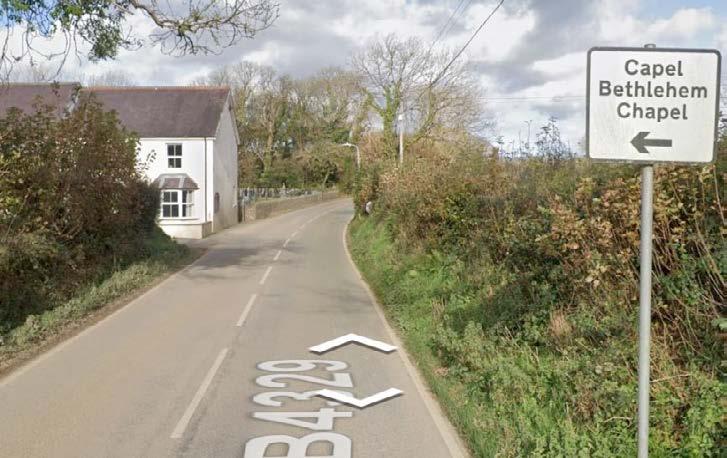
A CAll to extend a chapel and hall near Haverfordwest to provide much-needed space for activities has been given the go-ahead by Pembrokeshire county planners.
Reverend Jenny Gough, through agent Sureline Design Services Ltd, sought permission for an extension to Bethlehem Chapel and its attached hall, in the village of Bethlehem.
A supporting statement said:
“Bethlehem Baptist Chapel, located on the outskirts of Haverfordwest has 45 adults in membership of the church at the present time ranging from 19 years to those in their mid-90s.

In addition, on a Sunday we have a further 46 adults in regular attendance and 11 regular under 16-year-olds.
“The growth of the church fellowship in the past ten years has necessitated the provision of a portacabin in church grounds which is a temporary measure, intended to be removed once the proposed extension to the church hall is completed.
“Whilst the church is currently providing various community activities, we are limited in the number of people who can attend and often find that we are restricted in the services we would like to provide due to the space available.
“Allied to this, the need to meet public standards for disabilities, parking, health, and safety and the need for an extension becomes ever more pressing. The project aim is to provide a first-class facility that will enhance the community, be a welcome lift to the area, and enable existing and new activities to be undertaken in a pleasant, warm, accessible and welcoming environment.”
It added: “Over the last four to five years it has become increasingly clear that the current building facility could
not meet the needs of its users, nor hope to satisfy the ever-increasing regulatory demands placed on facilities that are open to the general public.”
The chapel hosts many activities including adult and toddler/baby group, ladies craft group, community lunch group, bereavement peer support group, dementia support group, primary school children’s holiday clubs, secondary school youth clubs, young adult groups, Christian teaching groups and social events.
“Since many of these activities are well attended, we are often lacking space in the building. For some larger gatherings we are forced to use halls in the communities around us, which increases our workload for holding the events in having to transport necessary equipment.
“The main result is that we are not holding events to our full potential, if more space was available at Bethlehem Chapel, we would be able to hold more events to benefit the wider community with what we are already providing.”
The application was conditionally approved by officers.

MIlfORd HAvEN ROuNd TAblE has formally thanked Milford Haven Town Council for its continued support, saying the council’s backing helps make some of the town’s biggest free events possible.
The group said the Town Council is a major supporter of its work in Milford Haven and plays a vital role in enabling community celebrations including the Milford Haven Carnival and the annual Fireworks Extravaganza, which draw thousands of people.
Representatives from the Round Table said it was “great to catch up” with the Mayor, Councillor William Elliott,
at the Christmas Lights Switch On in December, where they presented a small token of thanks to mark another year of collaboration.
Milford Haven Round Table said it is proud to support the town through fundraising, volunteering and delivering events which create memories, raise money for local causes and strengthen community spirit.
The group added that none of its work would be possible without strong partnerships across Milford Haven, and thanked the Town Council for its “ongoing support, trust and commitment” to the town and its residents.
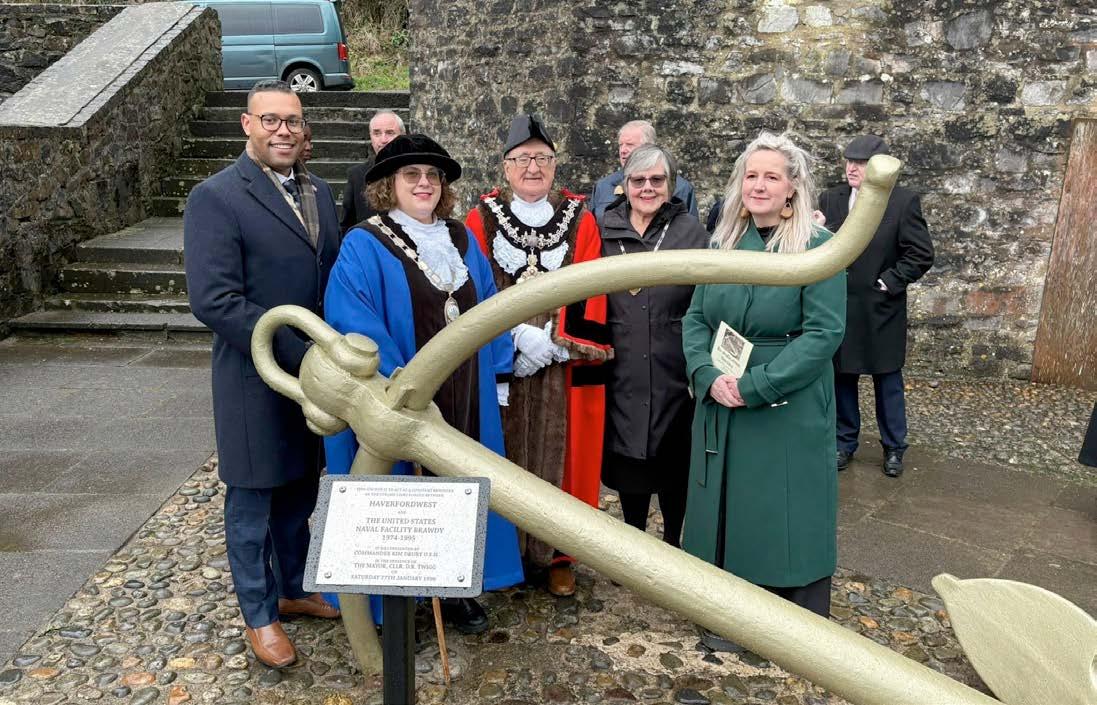
A SyMbOl of Haverfordwest’s wartime and Cold War connections with the united States was formally re-dedicated on Tuesday (Jan 27), marking 30 years since the anchor was first presented to the town by the uS Naval facility at brawdy.
The re-dedication service was hosted by Haverfordwest Town Council and brought together civic leaders, veterans, serving personnel and members of the public to honour service, remember history and celebrate enduring friendship between the UK and the US.
The Mayor welcomed guests including the Mayor’s Chaplain, the Reverend Heather Cale, along with civic dignitaries His Majesty’s Deputy Lieutenant of
Dyfed, Patricia Mawuli Porter, and the High Sheriff of Dyfed, Ann Jones. Also present were fellow councillors, invited guests and veterans, including James Phillips, Colonel (RN) and Veterans’ Commissioner for Wales, David Griggs, Lieutenant Commander (RN) and former Royal Navy Liaison Officer at the facility, and Squadron Leader David Warneford (RN), former Commanding Officer of RAF Brawdy.
Representatives from the 14th Signal Regiment (Electronic Warfare) at Brawdy and the Royal British Legion attended, alongside members of
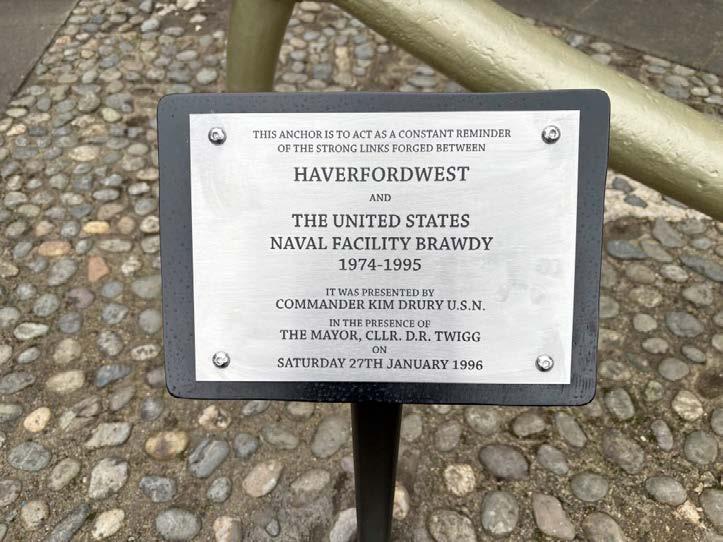
Champion at Pembrokeshire County Council and Haverfordwest Museum Curate, set out the historical context of the US Naval Facility at Brawdy, its relationship with the local community and the significance of the anchor’s presentation in 1996.
Town councillor Randell ThomasTurner offered a personal reflection, recalling that his father had been stationed at the US facility and speaking of the human connections forged during the American presence at Brawdy and the lasting bonds between service families and local communities.
Veteran Squadron Leader David Warneford followed with reflections on shared service and alliance, and on the continuing relationship between the US and the UK. The Mayor then spoke of the anchor as a permanent part of the town’s heritage and the importance of international partnership, before the formal act of re-dedication was led jointly by the Mayor and Mr Warneford.
Music included Sousa’s Hands Across the Sea, underscoring the theme of transatlantic friendship. The service concluded with a blessing and closing remarks, with thanks extended to speakers, organisers and attendees.
Pembrokeshire County Council, the town mayors of Neyland, Pembroke and Pembroke Dock, the Joint Presidents of the Pembrokeshire Agricultural Society/ County Show and local historian Mark Muller.
Family links to the original ceremony in 1996 were also recognised. Jonathan, the son of the late Mayor Councillor D Twigg—who was Mayor of Haverfordwest when the anchor was first presented— attended with his mother. Apologies were noted from former Town Clerk Mrs Pat Lewis, who had been in post at the time of the original presentation.
The service opened with reflection and prayer from the Mayor’s Chaplain before Dr Simon Hancock, Armed Forces
With Storm Chandra moving in at the start of the ceremony at 12.30pm, proceedings were held upstairs at the Town Council offices, allowing guests to look out towards the Quayside anchor from a distance. As the rain eased by the close of the service, attendees joined the Mayor, Sheriff and councillors at the anchor site itself, where a newly painted anchor and new interpretation sign— installed by Town Council staff—were unveiled.
A live recording of the re-dedication service has been shared in two parts on the Pure West Radio Facebook page, with thanks given to Alex at Pure West Radio, council staff, speakers and the Reverend Heather Cale for their support in making the event possible.
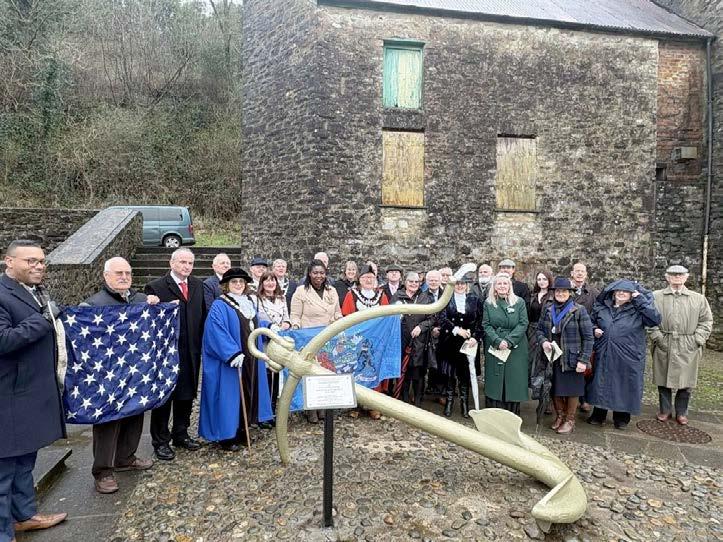
Exciting news that the much loved National botanic Garden of Wales Antiques fair and vintage market is returning to the Gardens Sa328HN on Saturday 7 th and Sunday 8th february with the same quality antiques, vintage and retro to be discovered at this popular fair.
The fairs uniqueness is down to its stunning setting. The wonderful array of the rare plants housed in the Glasshouse , make a perfect natural setting and backdrop, to the stands displaying in the World famous Glasshouse . The setting is both eye catching and memorable.
So fans of classic antiques and vintage should make their way to the various Garden venues – including the Great Glasshouse - for displays of Welsh art and pottery, quality jewellery and outstanding militaria collections.Step next door to Principality House which is now known as Ty Melyn and discover displays of quality Welsh textiles,a superb array of books, jewellery , silver and militaria, plus artwork and vintage delights.
The recently transformed Theatre Botanica will be exhibiting old favourites such as silverware and collection of Moorcroft, Lorna Bailey, Beswick and Doulton , art and treen plus collections of quality welsh furniture and textiles and quality jewellery.There will be folk art, stick chairs and French brocante. The Gallery room is also a welcome addition and will be show casing Welsh furniture and textiles and French brocante and some beautifully curated stands. The Apothecary will also be used as a go to venue , for some more vintage , militaria and ephemera Millennium Courtyard will be filled with a Vintage market , housing smaller marquees displaying vintage toys,clothing, retro and upcycled furniture .
Nostalgia often leads many people to seek out a cherished toy from their childhood and as a result ,vintage toys have been an area of collecting that has seen an increasingly popular market. We want that doll or teddy we use to cuddle, back in our arms or that model car that use to give us endless pleasure or the chopper bike that was green envy of the street. I have fond memories of being fascinated

by my older brother’s mechanical steam engine that would whir and puff out steam. I would stand mesmerised by the its moving parts and how it would suddenly come to life. I was lucky to recently acquire a similar steam roller manufactured by Mamod in the early 60’s . It will be taking pride of place at the fair.
This Mamod steam roller is a classic model from the renowned British manufacturer, Mamod.
Mamod steam roller engines were classic British live steam toys, powered by heating water with fuel (originally methylated spirits, later solid tablets or gel) to create steam, which drives a piston and cylinder, mimicking real steam rollers with forward/reverse motion and realistic sounds, though the company ceased production in 2024 due to rising costs and fuel regulations, making older models collectible. Key models like the SR1Aand TE1A feature metal construction, steering, and a belt-driven flywheel, requiring water and fuel under adult supervision.

Mamod was a toy manufacturer that was based in Britain that specialized in producing live steamModels.
The Mamod company was founded in Birmingham in 1937 by Geoffrey Malins.
The name “Mamod” is a combination of “Malins Models.” Initially, the company manufactured stationary steam engines, which were originally sold under the ‘Hobbies’ brand.
Between the end of World War One until around 1934/35, Hobbies Ltd. were selling steam engines made by Geoffrey Bowman, along with a range of HobbiesBowman boats. When the business failed to make as much money as Bowman had hoped,he decided to branch out into other engineering interests. Hobbies needed another source of supply, and struck up an agreement with anotherengineer called Geoffrey Malins, who had a background in marine engineering, and was already supplying the company with brass propellers.
Malins had had a variety of engineering

jobs, (like Bowman) enjoyed being selfemployed, and had set up a workshop in his garden shed and started somewhat ambitiously calling his business G.M. Patents Co.
After a meeting at the 1935 British Industries Fair, Malins was commissioned to produce small engines for Hobbies broadly similar to their previous “Bowman”produced range, manufacturing the stationary steam engines SE.1, SE.2, SE.3 and SE.4, and a marine engine for fitting to boats, the ME.1.
All of the new Malins stationary engines had Meccano-style bases. Understanding that there was also a significant market for selling the engines direct rather than just through Hobbies, Malins renamed the company Malins (Engineering) Ltd. ... which was less catchy, but left the door open for other possible manufacturing projects. Subsequently, Malins introduced the brand name Mamod.
Over time, Mamod expanded its range to include models of road rollers,


traction engines, steam wagons, steam locomotives and other steam-powered road vehicles. These models were primarily intended for the toy market and were designed to be user-friendly and operate at low boiler pressures for safety, although they were not precise scale models.
In the 1960s Meccano Ltd decided that they wanted to once again offer a stationary steam engine for powering Meccano models themselves, and contracted Mamod to make their new, unimaginatively-titled Meccano Steam Engine between 1965 and 1979. Mamod also started selling an updated solid-fuelburning version, the SP 3.
Mamod engines are now fired with safe, convenient Mamod solid fuel. All are fitted with a safety valve and are supplied with a safety valve and are supplied complete with filler funnel, fuel, (except in certain export countries), burner tray and full operating instructions. Boiler and steam fittings are all made from high quality brass and copper.
Sadly the Mamod company ceased trading in2024. However there is a keen collectors market for these models and there is a site where you can even purchase spare parts . The Mamod steam engine will be one of many vintage toys on display at the fair , from Steiff bears to die cast cars, to clockwork toys and dolls.
The National Botanic Garden of Wales fair has had a reputation for showcasing Welsh areas of collecting including Welsh pottery, welsh blankets,Welsh art and furniture. Again not to disappoint , there will be an amazing display of period Welsh oak furniture . From Welsh child’s chairs,milking stools to much larger pieces including dressers and cupboards. Richard Bebb’s collection of Welsh artists is impressive and a stand not to be missed.
The weekend of antiques, is set to be a busy one .The success of the fair has

been mainly down to the diversity and quality of the antiques on display in the splendid setting of the Garden.
A well known local potter from Carmarthen will be returning to the National Botanic Garden of Wales Antiques Fair with his stunning collection. He is renowned for his colourful and beautifully glazed pottery and exhibits all over the country.Jonathan trained in Stoke-on -Trent and after graduating in 1983 received a commission to design some work for the famous and highly collected Moorcroft. After establishing his ceramic career in the Potteries, he moved down to Carmarthen in South Wales in 1996 setting up a studio near the village of Peniel. Tubelining and lustreware on a floral theme has always been a feature of Jonathan’s work but he has also been busy developing his own glazes to produce the dramatic lustre effects that are a characteristic of his work. Jonathan’s ceramics can be seen in galleries and high end shows as well as on his website. Yo will find his display in the Gallery room near the shop.
The fair also has a rich cross section of antiques and vintage on display, from jewellery,watches, buttons ,books and silver , including ephemera, militaria and vintage clothes and accessories. There will also be collections of art glass and up cycled and pre loved furniture, plus interior design pieces including French brocante. I’m sure visitors will not be disappointed with the selection on offer at this popular fair.
Nestling into the Carmarthenshire countryside ,on the outskirts of Carmarthen and just 15 minutes away from the end of the M4, it’s conveniently situated.
The fair opens at 10am and closes at 4.00pm
Admission is £12 for a weekend ticket allowing you to enjoy 2 full days at the Antiques fair , plus a further 5 days admission to the Garden. The tickets last

for 7 days which is very good value.
*You can now buy your tickets on line from the NBGW website ahead of the fair and you then will be fast tracked through the entrance.*
Dogs are now welcome over the
Antiques weekend except in the Glass House.
For more information contact Derwen Fairs 07790293367 or follow on FB,Twitter and Instagram


PEMbROKE & MONKTON lOCAl
HISTORy SOCIETy began the New year in fine style with a talk by Nathen Amin, which proved hugely popular, with 120 people filling Pembroke Town Hall. Nathen is nationally recognised for his work on the history of Henry Tudor, but this time he delivered an impressive and engaging talk on the great Welsh patriot, Owain Glyndŵr. So warmly received in Pembroke, he has already promised to return as part of next year’s programme –

something to look forward to.
The Society’s next talk will take place on Saturday, 7 February at Pembroke Town Hall, continuing the Welsh theme. We are pleased to welcome John Brandrick, who will speak on: ‘The foundation, development and decline of Whitland Abbey’.
Whitland Abbey was an important Cistercian abbey founded in 1151. Under the patronage of powerful Welsh princes, it developed a strong Welsh cultural identity and grew in influence to become the motherhouse of the Cistercian order of monks in Wales. Several daughter houses were established, including Strata Florida, Strata Marcella, and Cwmhir. The abbey flourished during medieval Wales, before gradually declining and eventually being dissolved by Henry VIII in 1539.
John Brandrick is a retired engineering draughtsman whose main interests now include illustrating and researching Whitland Abbey, as well as drawing the machinery found in wind and water mills throughout Wales and beyond, helping to preserve an important record for
the future. His talk is a detailed, illustrated presentation covering who the Whitland Abbey monks were and where they came from; how the abbey was built; how it interacted with the nobility; and how it weathered the upheavals of the period from 1150 through to the dissolution. John will also explore the abbey’s later story –its gradual disappearance from view, its rediscovery in the 1800s, and the excavations carried out since, as well as its future. He is a member of the Friends of Whitland Abbey, a voluntary group that helps care for the site, which is open to the public at all times.
As usual, Pembroke Town Hall opens at 10:00am for the Coffee Morning, followed by the talk at 11:00am. Also open on the day will be Pembroke Museum and the Council Chamber, situated on the first floor of the Town Hall. A lift is available for disabled access. All are welcome to attend, and entry is free.
For more information, visit www. pembrokeandmonktonhistory. org.uk, and follow the Society on Facebook. Queries can be sent to pembrokehistory@live.co.uk.

vC GAllERy’S friday breakfast club in High Street, Haverfordwest, drew a strong mix of ages this week as local support organisations joined residents for a shared meal and a catch-up in the charity’s community space.
The VC Gallery said the session
Tom Sinclair editor@herald.email
“went down a real treat”, with “super cool vibes” and people coming together to enjoy the welcoming environment.
Breakfast was kindly donated by Haverfordwest Town Council, with volunteers and staff helping to set up and run the morning.
Guests included representatives from Citizens Advice Pembrokeshire, Pembrokeshire Advocacy Service and homelessness charity The Wallich, as the groups connected with residents and shared information about the help available locally.
VC Gallery said it was “great to be working towards a common goal for our community” and thanked those involved for their support.
Next week’s breakfast club will feature new guests, with live music also set to return as Goose is expected back to play during the session.
The VC Gallery is based in Haverfordwest and runs a range of projects aimed at supporting veterans and the wider community.












I Hate This Place is one of those rare horror games that grabs you first with its bold aesthetic and then with the way it refuses to let you feel comfortable ever again. From the moment you step into the cursed land as Elena, you’re thrown into a world that feels alive with menace and dripping with retro comic-book flair, where every shadow seems to twitch and every noise could be a harbinger of something far worse than you’d imagined. Instead of blending into the sea of dark, gritty survival horror titles out there, this game embraces a vivid ’80s-inspired visual language that makes every moment feel like you’re flipping through panels of a particularly unsettling graphic novel come to life; bold colors and stylized sound effects aren’t just cosmetic flourishes, they’re part of the tension, feeding into the game’s unique rhythm of exploration and
dread. The core of the experience lies in its survival mechanics scavenging for resources across haunted forests, derelict towns and infested bunkers, crafting tools and weapons to fortify your base and improve your chances against the myriad threats stalking you. Combat and stealth intertwine in clever ways, and too often brute force feels like a death sentence, forcing you to think like a tactician rather than a gunsblazing hero. The day-night cycle is more than just atmospheric; daylight offers a scarce window of safety to prepare and plan, whereas nightfall brings a cruel escalation in aggressiveness and danger, making every decision about when to push forward or hunker down feel loaded with consequence. There’s a satisfying layer of strategy to deciding how best to manipulate sound and environment to lure
nightmares into traps, and the way the world dynamically shifts as night approaches keeps you on your toes without ever feeling unfair. Narrative and setting aren’t afterthoughts either the world feels steeped in eerie lore, with twisted creatures, cultish figures, and the looming presence of the Horned Man driving a palpable curiosity about what truly lies at the heart of this forsaken place. While there’s always the risk that a distinctive visual style could distract from substance, here it enhances it, giving the horror a personality that’s as unsettling as it is serendipitously charming. For fans of survival horror who crave something that feels familiar yet innovatively different, I Hate This Place promises to be a standout a game that wears its influences proudly but isn’t afraid to carve out its own strange, unnerving identity.




Primate is a ferocious, nononsense horror thriller from genre helmer Johannes Roberts that seizes its simple premise and runs with it at full speed: what begins as a laid-back Hawaiian vacation for college student Lucy and her friends erupts into a bloody nightmare when the family’s beloved pet chimpanzee, Ben, is bitten by a rabid animal and transforms into a brutal predator with a taste for carnage. Directed and co-written by Roberts, the film wastes no time getting teeth into its audience, delivering tense survival sequences and oldschool creature horror that owe as much to classic animal-attack films as they do to modern genre sensibilities. Johnny Sequoyah leads the cast as Lucy, grounding the chaos with a resourceful performance that keeps you invested in her struggle to protect her loved ones, while Jessica
Alexander brings sharp energy to Hannah, one of her circle of friends caught up in the escalating terror. Oscar winner Troy Kotsur is a standout as Adam, Lucy’s father and a deaf author whose presence adds emotional texture and unexpected depth to the group dynamic as trust dissolves and panic grows. The supporting ensemble including Victoria Wyant, Gia Hunter, Benjamin Cheng, Charlie Mann, Tienne Simon and Miguel Torres Umba as Ben all contribute to an immersive, claustrophobic atmosphere that thrives on character reactions as much as the shocking set pieces. What distinguishes Primate from a garden-variety creature feature is its commitment to visceral impact: the practical and in-camera effects used to bring Ben’s terrifying descent into aggression feel immediate and disturbingly real,
and Roberts sustains a relentless tension that rarely lets up over the brisk 89-minute runtime. Sure, the setup is deceptively straightforward a cherished animal turned violent beast but the execution turns that simplicity into strength, offering a lean, unpretentious horror experience that balances gore, suspense and occasional dark humour with surprising effectiveness. By the time Primate reaches its climax, the film has earned its frights and given viewers a pounding, pulsequickening ride through fear of the primal and unpredictable forces of nature. With its January 2026 release marking a strong start to the year’s cinematic scares, this is one animal horror outing that manages to be both viscerally thrilling and memorably intense without overcomplicating its feral premise.




ACC l AIME d theatre-maker Sam f reeman is bringing We’re Not Getting A d og to the Torch Theatre in Milford Haven this f ebruary — a new, comic, roughly 72-minute solo show packed with domestic observation and a quietly rueful bite.
Told through passive-aggressive letters, early-morning jet-washing and the small rituals we cling to in an effort to make a house feel like a home, the production casts a wry eye on what it means to live close to other people — neighbours we see every day, yet barely know.
“It’s really hard to describe the show,” Freeman said. “I guess it’s best to imagine a really gorgeous Radio 4 late-night comedy, but performed live — it’s heart-warming and like being wrapped in a warm hug. It’s a show to warm the soul.”
The performance weaves multiple storylines together: a couple sprinting through rain to catch a bus, a man staring at a blank laptop screen in despair, and a woman opening an envelope to reveal a photograph. Each moment builds towards a bigger picture, drawing
the audience into a narrative where not everything is as straightforward as it first appears.
“It’s a real joy to perform because you let this story unfold,” Freeman added. “You see these moments where people laugh, occasionally cry, but also join the dots and discover that not everything is as simple as it first may seem.”
Read from a little black book, the show has been described as a hidden gem — a quietly powerful and comic examination of home, connection and distance.
And for anyone wondering about the dog on the poster, Freeman has an answer.
“Everyone wants to know about the dog on the poster… It’s my border terrier Poppy — absolute psychopath,” he said. “Whether she makes it into the show… well… you’ll have to see it to find out.”
We’re Not Getting A Dog will be performed at the Torch Theatre on Saturday, 14 February at 7.30pm. Tickets are £8. For more information, visit the Torch Theatre website or contact the Box Office on (01646) 695267.
OPINION: by PAul dOWSON
ARTIFICIAL INTELLIGENCE is no longer a future technology. It is not waiting for legislation, ethical consensus, or public debate. It is already here, embedded in systems that exercise immense power.
AI is in our warplane cockpits.
That single fact should change the entire conversation. This is not about chatbots or convenience. It is about authority: who holds it, who hides behind it, and who is left accountable when things go wrong.
In modern military aircraft, AI systems assist with navigation, threat detection, targeting support, and reaction timing. They operate at speeds no human can match. The case for their use is compelling. Machines do not panic, tire, or hesitate. In combat environments, hesitation costs lives.
So why should we be concerned?
Because the real risk of AI is not that it will suddenly develop malicious intent. That idea belongs to science fiction and distracts us from a far more ordinary, and far more dangerous, reality. AI is increasingly treated as neutral.
Neutral systems are trusted. Trusted systems stop being questioned. And what is no longer questioned quietly becomes authority.
We already live under layers of process. Decisions are routinely explained away with phrases like “policy”, “procedure”, or “the system”. AI is the most powerful extension of this trend yet. It produces outcomes while making it harder to say who actually decided.
In civilian life, this is already happening in areas such as welfare and public services. Eligibility decisions are increasingly shaped by automated scoring systems. Someone can be denied support, flagged for investigation, or pushed down a queue not because a person made a judgment,

but because “the system says” they do not qualify. The outcome feels final, yet the assumptions embedded in the model are rarely visible, and almost never open to meaningful challenge.
When responsibility is pushed into a system, accountability evaporates. No one “decided”. The model ran. The process was followed.
I have seen first-hand how “objective” systems can be steered toward particular outcomes without anything that looks like corruption. It does not require conspiracies or secret meetings. It happens through design: what data is used, what is left out, how success is defined, how risk is weighted.
To the public, the result looks inevitable.
To those who understand the system, it is engineered.
AI magnifies this effect dramatically. Once systems become complex enough, very few people can meaningfully challenge them. “The model says” becomes the end of the conversation. Questioning outcomes starts to sound like ignorance rather than scrutiny.
Supporters of AI are right: automation has already saved lives. Aircraft are safer today precisely because computers assist, and sometimes override, human pilots. In dangerous environments, AI can see more, calculate faster, and respond sooner than any person ever could.
Refusing to use such tools would be irresponsible.
That argument deserves to be taken seriously. But it still misses the deeper issue. What starts as assistance becomes reliance.
Reliance becomes deference. And deference becomes authority.
Over time humans stop deciding and start supervising. The human becomes the back-up. Judgment becomes confirmation.

The key question quietly shifts from “Is this the right decision?” to “Is there any reason to override the system?”
That shift matters. Because once humans are no longer the primary decisionmakers, responsibility becomes a formality rather than a reality.
We are told AI can be audited. In theory, yes. In practice, real scrutiny requires expertise, access, and the power to challenge outcomes. Most people, including many decision-makers, do not have these. For them, the system’s output is effectively unquestionable.
And systems are never neutral. They reflect priorities: military objectives, political pressures, funding decisions, strategic advantage. AI does not remove human values from decisions. It buries them beneath complexity.
What is happening in military aviation will
not remain confined there. The same logic is already spreading into finance, policing, welfare systems, hiring decisions, and border control. Everywhere AI is positioned as an objective arbiter, responsibility becomes harder to locate and harder to contest.
The greatest danger is not that machines will decide badly. It is that humans will lose the habit, and the authority, of deciding at all.
I support AI. Its potential is extraordinary. Used properly, it can enhance human judgment, reduce error, and save lives. But if we fail to shape how it is deployed, we risk building systems that do not supplement us, but quietly replace us.
AI does not need consciousness to reshape power.
It only needs our trust.
And trust, once handed over, is rarely reclaimed.


Netflix’s His and Hers, adapted from Alice f eeney’s novel of the same name, offers a richly suspenseful experience that fans of psychological thrillers will devour, yet part of what makes it so fascinating is seeing how the story changes when it moves from page to screen. Whereas the novel unfolds in a small b ritish setting with much of the tension rooted in Anna’s unreliable narration and deeply personal inner turmoil, the Netflix series transplants the action to d ahlonega, Georgia, and reshapes key elements of character and plot for dramatic effect, producing two distinct but complementary interpretations of the same core mystery.
The heart of both versions is the layered mystery and the question of perspective, but the book leans heavily into Anna as an unreliable narrator whose struggle with alcoholism and blackouts casts doubt on her own memories and actions, inviting readers to constantly question what is real and what might be a fragment of her fractured recollections. This sense of ambiguity is a defining feature of Feeney’s writing and makes the novel’s tension feel claustrophobic and psychologically intense. The
series, by contrast, downplays that unreliability; Anna’s drinking is present but not debilitating, which gives her a firmer grip on her own story and streamlines the narrative for a television audience. That shift subtly alters how viewers engage with her: where readers might have spent pages parsing her doubt, viewers are more quickly anchored in her resolve and determination.
Another notable difference lies in character dynamics and relationships. In the book, Anna’s entry back into the murder investigation is triggered by her role as a temporary news anchor covering for a colleague, creating a more tentative return to her career. The adaptation recasts this arc to give Anna a bolder career comeback, pushing her to actively pursue the story as a chance to reclaim her professional identity. This not only tightens her narrative drive on screen but also reshapes the emotional stakes of her interactions with her estranged husband, Jack, who in the novel operates with a different relational history. In both mediums, the chemistry and history between Anna and Jack anchor much of the emotional weight, but the show’s choices make their dynamic feel more immediately central to the unfolding
mystery.
Structural changes further distinguish the two. The pool of suspects is slightly altered, with some characters gaining more screen presence and narrative suspicion in the series than they carry in the book, and the final confrontation itself is streamlined for pacing and clarity. While both culminations deliver the shock of the truth behind the murders, the book’s climax is more sprawling and chaotic, whereas the series opts for a tighter, more focused dramatic showdown. Even the motives and how they are revealed shift subtly, shaping the emotional payoff differently for readers and viewers alike.
Ultimately, watching the Netflix adaptation and reading Feeney’s novel enrich each experience. The series captures the spirit of the book’s twisting plot and deeply flawed characters while making deliberate choices that reflect the strengths of visual storytelling, creating a version that feels familiar yet refreshingly distinct. Whether you prefer the introspective ambiguity of the novel or the taut, character-driven momentum of the show, His and Hers proves that a great story can thrive in multiple forms.
a coworker or friend and help them sort it out. If you choose the former, you’ll end the day a bit frustrated. But if you choose the latter, you’ll end the day as someone’s hero. Plus, you’ll feel pretty good about yourself.
CANCER
Is it getting hot in here? If you feel an increase in the temperature, it’s probably because the spotlight is pointed right at you. But have no fear. You have been working toward this moment (whether you realize it or not) for a long time, and there is no pressure great enough to make you sweat. In fact, you’ll probably find yourself enjoying and thriving in the attention. Romantically speaking, you have never been more in control of your opportunities. Make your move.
LEO If your life were a boxing match (and your opponent complacency), you would have definitely won this latest round! Congratulations. Now get back to your corner and regroup for the next round. It’s going to be a continuing struggle not to get bored or distracted now. This lack of stimulation could continue for a while, and while you might be trying your darndest to find a suitable challenge for your intellect, you won’t have any luck. Just keep trying to stay focused!
VIRGO
No matter how much pretty packaging you put around something, if it isn’t for you, it isn’t for you. Stop wasting time going with the trends. Give yourself permission to like what you like, and don’t worry about what other people think. If you love your pair of rainbow suspenders, wear them! If disco music is the only thing that gets you grooving, crank up the volume! Be proud of who you are and proud of all the things that set you apart from the rest of the world.
LIBRA
You have only just scratched the surface on a new goal, and this is one you can conquer! So keep working at it today, despite any potential schedule crunch. You should make amazing progress, and the sense of accomplishment you feel will give you the energy you need to keep at it, sort of like a self-fulfilling prophecy, but a good one! All this positive energy will feed new ideas and encourage things to go in the right direction. You officially have permission to get excited.
SCORPIO
Whatever odd behavior has been going on in your social circle simply can’t be ignored any more. You are going to have to give it some of your attention today. Luckily, you have all the time you need to address this now, so don’t use a tight schedule as an excuse. Set aside time early in the day to start the conversations you need to have. Be bold and up front. Don’t be afraid to get to the bottom of it as quickly as possible. You’ll be glad you did.
SAGITTARIUS
Today is not the day to run around willy-nilly or act spontaneously. It’s a day to plan every little detail out to the nth degree. You definitely need to get a better grip on the forces around you, because there is more going on than you may realize now. There’s no danger lurking, but there are facts you should uncover that could trigger a major change in your point of view. Educating yourself is always a good idea, so dig a little deeper and don’t accept things at face value.
CAPRICORN
More than ever before, today you’ll notice the fabric of the community around you and your place in it. Everyone has an effect on your day, which could be either good or bad. One car cutting you off might make you a few minutes late for work, but one person holding the elevator door could put you face-toface with the person of your dreams for seven floors. Enjoy the unpredictable nature of how strangers and friends can sway the path of your day.
AQUARIUS
The only thing you should focus on today is making plans. Cast your mind forward five years and imagine where you want to be and who you want to be there with. If you can solidify your goals,



WHEN you’re in a hole, stop digging.
badger and his kin have extensive experience in digging setts. but even we know that hole-digging has its limits.
Not so Milady Morgan of Humble Origins. With Labour’s support cratering, she has abandoned her pick and shovel and brought in the heavy machinery.
The Baroness of All Our Hearts delivered a speech last weekend in which she set out her vision for the future of devolution. So important was this OBVIOUSLY non-party political speech that the Welsh Government published the news through its official media channel.
The press release reads: “The First Minister will reiterate that the Welsh Government is seeking devolution of policing, rail, youth justice and probation, along with transfer of Crown Estate powers. She will also call on the Chancellor to make permanent the Welsh Government’s full access to its financial reserves.”
To all of which the response from Westminster has been “knickers!”. Labour MPs representing Welsh constituencies have no interest in devolving meaningful powers to Cardiff Bay. “Fairer funding”, a clarion call for years when Labour was in opposition in London, has been kicked not so much into the long grass as into the middle of the million trees the Welsh Government wants to plant in Uganda.
A revealing - if anonymouscomment attributed to one Labour MP indicated that the First Minister’s list of respectful and forelock-tugging suggestions was not on Westminster’s agenda. Not because the Labour government was too busy delivering on the people’s priorities and trying to keep Keir Starmer as popular as anthrax. No, readers. It’s because Westminster doesn’t know who will form the next Welsh Government after May’s elections.
It’s a sign of the high regard that Labour MPs hold their Welsh branch office that they are confident in ignoring their ragtag comrades who legislate west of the Severn Bridge.
Let’s be clear, readers, the idea of the Welsh Parliament getting a say over

any meaningful area of policy, other than those already devolved, apart from fiddling at the edges, is precisely nil. And it doesn’t matter who’s in government after May’s elections.
To say this represents an opportunity for Plaid Cymru is a wild understatement. However, the opportunity comes with a significant risk. Plaid Cymru are used to promising the earth in their manifestos. They’ve done so confidently, in the knowledge that they’ll never be in a position to deliver their top-line pledges. Now, with Plaid on course to be the largest party in the next Welsh Parliament, it must think about what it can actually deliver.
Let’s start with Welsh independence. That is off the table for the next Senedd term. Rhun ap Iorwerth has suggested there might be a referendum on the topic after the May 2030 election. To say ‘that depends’ is an understatement. What it depends on most is the consent of the Westminster Parliament and whoever is in government at the time permission for a referendum is sought. Labour in London won’t back it, and, it appears likely, won’t be in a position to deliver it. The idea that the Conservatives might back it is, umm, so far out there it’s in the next galaxy. Nigel Farage will be too distracted finding out where Clactonon-Sea is to bother. Meanwhile, the

Liberal Democrats will be occupied being Liberal Democrats and irrelevant.
So, an independence referendum is a non-starter. Unless, that is, Labour MPs think there might be votes in it for them and are confident Welsh voters will vote against.
The other point worth bearing in mind is that although interest in the concept of Welsh independence is increasing, it remains a minority interest. And, let’s face it, readers, it’s not high on the list of voters’ priorities for an incoming Welsh Government. Although increasing the Senedd’s powers over some policy areas would place the Welsh Parliament on the same footing as Northern Ireland and Scotland, constitutional ‘fairness’ is a hobbyhorse not worth riding in front of the electorate.
Like all other countries, and particularly in times as uncertain as ours, Wales needs a government that can distinguish between an issue and its symptoms. Welsh public services are in the emergency ward. Or would be if there were a bed available. Years of sticking plaster policies have not stemmed the haemorrhage.
Those services are, more or less, under Cardiff Bay’s direct control. If Plaid does nothing else, it must address the fundamental problems of organising and funding them. It will
certainly have to do so without any funding beyond what Labour would get. That means something, or some things, will have to give. That is how priorities in government work.
Plaid would certainly get a slap on the back from most voters if it cut Wales’s bloated client state and redirected the money splurged on it towards the NHS and councils. The proposition is simple: to ensure accountability, charities and NGOs should not be delivering essential services, and if the services they provide are inessential, they should not receive public subsidies.
Voters would also welcome it if Plaid curtailed the nice-to-have inessentials that have preoccupied Labour in the last decade. Wales needs a relentless focus on local government, health, education, and unemployment. Whether we need more cycle paths, foreign missions, or empty poses over issues Cardiff Bay does not control is debatable.
Fat chance of that. Plaid is as beholden to tokenism and gesture politics as Labour. There’s no cause closer to Plaid’s NEC than being as one with loons and luvvies like Owen Jones, George Monbiot, and a panoply of rainbow-hued hair-dos. Sod governing, let’s find something to protest about!
Whatever else you do, readers, you must vote in May. You must vote for strong local voices that will take the case for Pembrokeshire to the next Welsh Parliament. If you think that Eluned Morgan (number one on Labour’s list) is that person, you have not been paying attention. Meanwhile, Reform UK has no ideas relevant to governing Wales, while its candidates are too shy (or ashamed) to make themselves known. Badger’s concern about Plaid representing Pembrokeshire (where it’s usually done poorly) in the Welsh Parliament is that it’s abundantly clear, based on previous elections, that those elected won’t.
Goodness knows where that leaves you, but vote you should. Badger isn’t here to tell you how to vote; you must make up your own mind. One thing is clear: business as usual in the Bay cannot be an option. Change, in whatever form it takes, is now imperative. When you’re in a hole, readers, stop digging.
by editor tom sinClair

THERE is a growing danger that Wales is being sleepwalked into a policing model that looks neat on a Whitehall flowchart but fails the reality test on the ground. Proposals to slash the number of police forces across England and Wales, potentially leaving Wales with a single national force, risk dismantling local policing as we know it, particularly in rural and coastal communities like Pembrokeshire.
For Dyfed-Powys, the warning signs are stark. This force exists because geography matters. Policing a region stretching from the Irish Sea to the English border is fundamentally different from policing a dense urban area. Officers here rely on local knowledge, trusted relationships, and an understanding of communities where the police station may be many miles away and the same
officers are known by name.
That model was already under threat, even more so now.
While the UK Government talks up efficiency and modernisation, those closest to policing are urging caution.
All four Welsh Police and Crime Commissioners have expressed concerns about sweeping structural reform, warning that large-scale mergers risk weakening local accountability and diluting neighbourhood policing. Their position is clear. Collaboration can be strengthened without abolishing local forces.
The Association of Police and Crime Commissioners has gone further, warning that there is no evidence that bigger forces deliver better policing. On the contrary, mergers are expensive, disruptive, and slow to produce any frontline benefit. In the meantime, communities lose influence
and policing becomes increasingly remote.
Senior officers with experience of rural policing have also raised quiet but firm warnings. National or mega-force structures inevitably pull resources towards population centres. Strategic decisions are made far from the communities affected by them. Specialist units centralise. Local discretion erodes. Rural crime, already under-reported, becomes even easier to overlook.
We do not need to speculate about whether this will happen. Scotland has already shown us.
The creation of Police Scotland was sold as a bold reform that would improve consistency and resilience. Instead, it triggered years of criticism. Rural stations closed. Local priorities were overridden by national ones. Response times lengthened. Communities complained that policing felt distant and impersonal. Many of those issues remain unresolved more than a decade later.
Wales risks repeating that mistake, knowingly.
Chief Constable Ifan Charles has rightly emphasised that victim focus and neighbourhood policing remain priorities, and that for now it is business as usual. That reassurance is welcome. But structures shape behaviour. Once local forces are absorbed into a national system, the centre of gravity shifts. Promises made during transition phases rarely survive the pressure of budgets, performance targets, and national priorities.
Political opposition is also beginning to harden. The Welsh Liberal Democrats have been explicit in warning that a

Today is Holocaust Memorial day, January 27, 2026. Across Wales we remember the six million Jews murdered by the Nazis, and the Roma, disabled people, gay men and women, political opponents, and many others the regime labelled undesirable. We light candles, say “never again”, and tell ourselves that kind of evil is locked in the past. But if remembrance ends at the gates of Auschwitz, we miss the real lesson.
The Holocaust did not begin with gas chambers or cattle trucks. It began
in ordinary places, shops, streets, pubs, council chambers, with words that stripped people of their humanity, laws that pushed them to the margins, and propaganda that turned neighbour against neighbour. It began when ordinary people started seeing others as problems, as threats, as not really belonging.
It began with politicians pointing fingers at who to blame.
With newspapers branded enemies of the people.
With courts and rules quietly bent.
With minorities held responsible for hard times.
With cruelty sold as common sense.
And above all, it began with silence.
Last week in Milford Haven, I saw that silence in action.
A shopkeeper, someone who came here from another country, set up a business, pays his way and serves the town, was racially abused inside his own shop. He tried to stop a man walking out with unpaid beer. For doing his job, he was told to “go back home”, told he was not welcome. The thief responded by sweeping stock off the shelves and smashing it onto the floor.
I asked why he did not ring the police.

Wales-wide force would repeat Scotland’s failures and leave rural communities with fewer officers on the ground and slower responses. Local councils and community safety partnerships are increasingly uneasy about losing influence over policing priorities that directly affect their residents.
Support for mega-forces, by contrast, comes largely from the centre. The Home Office, the Treasury, and national system designers focused on scale rather than place. What is striking is the absence of any clear public demand for fewer Welsh police forces.
Reform is not the problem. Policing must evolve, share resources, and adapt to new forms of crime. But reform that hollows out local policing in the name of administrative simplicity is not progress. It is regression.
If Wales is serious about public confidence, effective crime prevention, and fair treatment for rural communities, it should heed the warnings already being sounded. Once local policing is dismantled, rebuilding it will be far harder than protecting it now.
His answer came straight away. “What’s the point? They won’t do anything. It’ll just happen again tomorrow.”
That exchange stuck with me. Not because it was uniquely shocking, but because it felt horribly familiar. No new laws. No uniforms. No symbols. Just raw contempt, casual racism, and the shared understanding that nothing would come of it. A man contributing to the community was made to feel like an outsider in his own workplace, and he had already lost faith that anyone would step in to protect him.
This is how it starts. Abuse becomes normal. Victims stop reporting because experience has taught them the system will not respond. Prejudice is dismissed as “just words” or “banter”. Indifference takes hold.
We are often told not to make comparisons, not to be alarmist, not to link today with that past. Fair enough. History does not repeat itself in neat patterns. But it does move in stages, and the most dangerous stage is the one people fail to notice. The slow normalisation of division, cruelty and disregard.
In towns like Milford Haven, Haverfordwest and Pembroke Dock,
places built on hard work and looking out for one another, we know what community means. We have weathered closures, recessions and hardship together. We do not turn away when one of our own is targeted.
Yet when a shopkeeper loses faith that the police or the public will stand with him, something vital erodes. When hate goes unchecked, the ground is quietly prepared for worse.
Holocaust Memorial Day is not about guilt. It is about vigilance. It asks the hardest question of all. Not what monsters once did, but what ordinary people allowed by doing nothing.
The worst crimes in history were not announced in advance. They were built quietly, policy by policy, lie by lie, while too many looked the other way.
That is why we still remember today. And why, in our Welsh towns, remembering must mean refusing silence.
If you see it, say something. If you hear it, challenge it. If someone is targeted, stand with them. Because “never again” only holds if we make it hold, here and now, in the places we live.



NOW then, flockmates, gather round the bollard because I’ve been flapping my wings over Sir Keir Starmer toddling off to China

like a gull eyeing a trawler at dawn. l ots of shouting from the cliffs, plenty of moralising from the rocks, and not much agreement on

whether he should be there at all. China, as even a dockside gull knows, is a very big bird indeed. Second-biggest in the sky, flaps out more stuff than the whole G7 shoal put together, and has shiny green energy tech that makes Western governments look like they’re still pecking at yesterday’s chips. You don’t just pretend it isn’t there. Even a seagull knows you don’t ignore the biggest fishing boat in the harbour.
Now, some Tory gulls have been squawking that Starmer’s gone for a “kowtow”. Nonsense. That’s just what gulls shout when they don’t have a better landing plan. Easy to scream about the Chinese Communist Party from a warm lamppost, much harder to explain what you’d actually do instead. Fly in circles? Dive into the sea and hope for the best?
Mind you, let’s not get misty-eyed and drop our chips either. There’s plenty to be wary of. Hong Kong’s freedoms clipped like a bad wing trim. Jimmy Lai locked up. Uyghurs treated appallingly. Beijing backing Putin while Ukraine burns. Spying, intimidation, and long beaks poking into places they shouldn’t. Even a
half-asleep gull can see those are rotten scraps, not something you sweep under the pier for the sake of a few quid.
Starmer says he’ll “raise what needs to be raised”. That’s politician for “I’ll mention it politely while everyone pretends not to hear”. He also says he won’t swap security for trade – a fine promise, that. Lovely words. Like saying you’ll guard your chips while standing next to a hungry gull colony.
Here’s the problem, and even I can see it from the air: you can’t cuddle up to President Xi without bumping into some very uncomfortable truths about democracy, freedom and who gets to shout back. That doesn’t mean you stay away. It does mean you’d better keep one eye on your chips and the other on who’s circling overhead.
So yes, engagement is necessary. Even gulls talk to trawler crews. But caution? Vital. Because if you’re not careful, you don’t just lose your lunch – you lose your footing on the rail entirely.
Now if you’ll excuse me, there’s a suspiciously unattended pasty near the fishmongers.


IN recent years, the idea of owning an exotic pet has gained traction, fuelled by social media videos and the false impression that unusual animals can be safely and happily kept in a domestic setting. Primates – including monkeys, marmosets and lemurs – often sit at the top of this wish list. Highly intelligent, expressive and seemingly affectionate, they
can appear to be the ultimate companion animal.
But behind the cute clips and novelty appeal lies a far more troubling reality. Animal welfare experts, including the RSPCA, strongly advise against keeping primates as pets and are actively calling for a ban on their buying, selling and private ownership in the UK.
One of the most overlooked
factors is longevity. Depending on the species, primates can live between twenty and forty years – and in some cases even longer. This makes them a commitment comparable to raising a child, yet many are purchased impulsively with little thought for what life will look like decades down the line.
As primates mature, their behaviour often changes dramatically. Animals that seem gentle and playful as infants can become unpredictable, territorial and aggressive in adulthood. Bites and serious attacks are not rare, and because primates are strong, fast and have sharp teeth, injuries can be severe and lifealtering.
A typical household environment is fundamentally unsuitable for a primate.
These animals evolved to live in complex natural habitats, spending their days foraging, climbing, socialising and exploring. Confinement to a cage, spare room or even a large indoor enclosure cannot replicate this.
Primates require constant mental stimulation and social interaction with their own species. Without it, they can develop abnormal behaviours such as self-harm, repetitive movements and extreme anxiety. Some species,
including marmosets, also scent-mark their surroundings, leading to strong, persistent odours that many owners are unprepared for.
Meeting a primate’s nutritional needs is exceptionally difficult. Their diets are highly specialised and vary by species, often requiring precise balances of fruit, vegetation, protein, supplements and access to ultraviolet light. When these needs are not met, many captive primates develop metabolic bone disease –a painful and debilitating condition that can cause deformities and fractures.
Veterinary care presents another major obstacle. Very few vets in the UK are trained to treat primates, and those that are often charge significant fees. Emergency care can be hard to access, leaving animals to suffer and owners facing distressing choices.
Primates can also pose serious risks to people. Many diseases can be transmitted between primates and humans, including measles, tuberculosis and herpes viruses. Some of these infections can be fatal or cause lifelong health problems. This zoonotic risk affects not just owners, but family members, visitors and veterinary staff.

A PETITION plea to save a Pembrokeshire village school under threat of potential closure will be heard at full council.
At the December meeting of Pembrokeshire County Council, a call for a breathing space before any decision is made on Stepaside school, Kilgetty, part of a wide-ranging range of education changes mooted in the south of the county, was defeated.
At that meeting, a recommendation before members asked that the Director of Education be authorised to undertake a public consultation on establishing a new 3-19 school, on a split site initially, but as part of a future investment to rebuild/extend Tenby’s Ysgol Greenhill site, or potentially on a new site was backed.
As part of that it also recommended Tenby Church in Wales Voluntary Controlled School and Ysgol Greenhill are discontinued.
A second part of the series of recommendations was a call to establish a new 3-11 primary

school on the Saundersfoot School site, discontinuing Saundersfoot School and Stepaside school.
A report for members said there were many surplus places for all the schools in the proposals, with Stepaside having a surplus capacity of over 50 per cent.
The Tenby area proposals were backed, with amendments, but a call for a deferral on the second part concerning Stepaside was made by local member Cllr Alistair Cameron.
Cllr Cameron’s amendment call for a deferral was defeated
by 37 votes to 12, the original proposal was later passed by 42 votes to seven, with the intention public consultations would be held next year.
Since then, an e-petition on the council’s own website, started by Angela Robinson, calls upon Pembrokeshire County Council “to Save Stepaside School and work with local communities to look at alternative solutions”.
“Stepaside School in Kilgetty is the heart of our community. It represents a high-performing local education asset that delivers significant public value. Any proposal to close it
must be assessed not only in terms of short-term financial pressures, but against wider statutory duties, long-term social impact, and the strategic use of public funds that invests in our children best interest.”
The lengthy petition adds: “The rationale for closure appears primarily financial, yet any credible public spending decision must be based on a holistic assessment of costs, benefits, risks, and outcomes. This includes impacts on carers, children with additional learning needs, families from global majority backgrounds, and those reliant on local support networks.”
The e-Petition, which has attracted 582 signatures to date, runs to February 17.
If a petition gets 500 signatures or more, the creator will have an opportunity to debate it at a future full council meeting.
At the December meeting petition pleas to save Manorbier School and Ysgol Clydau, also at threat of potential closure, were heard; members noting those petitions.

COMMENTING on a new report by the Senedd’s Children, young People and Education Committee, which found that excessive workload is hampering teacher recruitment and retention, laura doel,
national secretary at NAHT Cymru, said:
“These findings will unfortunately strike a chord with many school leaders across Wales, who consistently tell us they and their staff are struggling under unsustainable
levels of pressure and workload as the demands of the job continue to grow.
“At the heart of this issue is the completely inadequate level of funding going into our schools. This leaves leaders unable to ensure they have enough staff — including teachers and teaching assistants — to manage workload effectively and provide the pastoral support pupils need.
“The situation risks becoming a vicious cycle. Without proper support, and after a decade in which real-terms pay has fallen sharply, teaching is becoming increasingly unattractive to both existing staff and those considering entering the profession. In some areas, even when schools can afford to recruit, they are finding it ever harder to do so.
“Insufficient funding also means some pupils who require specialist provision are remaining in mainstream schools because there is no capacity elsewhere. This can

place children in environments that do not meet their needs, while also impacting other pupils and staff.
“Schools continue to be subject to an unfair funding postcode lottery. We urge the Welsh Government to clearly set out how it will respond to the findings of last year’s school funding review and to make significantly more money available to schools.
“However, investment is not only needed within education. Vital support services such as social care and mental health provision have also been under-funded in recent years, and schools are dealing daily with the consequences — from challenging behaviour to the wider impacts of poverty.
“We are calling on the Welsh Government to invest in creating the conditions where teachers and school leaders feel valued and supported. That means tackling workload, freeing staff to focus on teaching and learning, and ensuring they are paid appropriately.”




WElSH sheep farmers are set to see new rules introduced next week aimed at making the lamb market fairer and more transparent.
From Wednesday (Jan 28), slaughterhouses in Wales will be required to classify sheep carcasses and report prices using a standardised system.
The Welsh Government says the move will improve consistency in grading, make price information easier to compare, and help build confidence for farmers selling stock.
Deputy First Minister Huw Irranca-Davies announced the change during the Farmers’ Union of Wales (FUW) Farmhouse Breakfast event at the Norwegian Church in Cardiff.
He said the measures would
support the industry by ensuring a consistent methodology for classifying carcasses in slaughterhouses, promoting transparency, fairness and productivity within the sheep market.
“Our iconic Welsh lamb is celebrated around the world for its outstanding quality and high production standards,” he said. “These measures will implement a consistent methodology for classifying sheep carcasses in slaughterhouses, promoting transparency, fairness, and increased productivity within the sheep market.”
The regulations bring the sheep sector into line with rules already used for beef and pork.
Hybu Cig Cymru – Meat Promotion Wales chief executive José Peralta said the changes would allow for greater
data capture and analysis and improve transparency within the supply chain.
He said: “The new regulations, which now align with a similar position for cattle and pigs, will allow for greater data capture and analysis to be undertaken and support increased transparency within the sector. As a sector we must seek all opportunities for greater transparency within the supply chain to ensure that choices can be made from an informed position.”
The Welsh Government says the new approach is part of a wider UK framework, with similar arrangements already operating elsewhere.
During his address, the Deputy First Minister also pointed to further changes expected in 2026, including
the planned introduction of the Sustainable Farming Scheme, which the Welsh Government describes as a new partnership between the people of Wales and farmers.
The scheme is intended to support the sustainable production of food while also responding to the climate and nature emergency.
The Welsh Government has also confirmed its commitment to financial support during the transition, with up to £238 million committed to the Universal layer and the legacy Basic Payment Scheme in 2026.
Deputy First Minister Huw Irranca-Davies said: “I would like to reiterate the Welsh Government’s commitment to supporting Welsh family farms, not just in the short term but also in the long run. Our goal is to prioritise stability for the farming industry, ensuring to balance this with sustainability at its very core.”
He added that supporting farmers through the change would be a priority, with consistent advice and support offered across the sector.
Building fairness within the agricultural supply chain remains a key Welsh Government priority, which it says is also integral to food security.


A new £11m farming Connect programme will be available for farmers in Wales to support them as they prepare to move to the new Sustainable farming Scheme.
The programme was announced by the Deputy First Minister with responsibility for Climate Change and Rural Affairs, Huw Irranca-Davies during a visit to Penllyn Estate Farm.
The programme will be an integral part of the SFS and will support the implementation of the Scheme.
The key aims will be to assist farm businesses in increasing resilience and productivity by focusing on areas such as improving soil health, animal health and welfare, pest management, benchmarking and developing additional skills and knowledge on a range of subjects.
The Deputy First Minister, said: “I’m pleased to announce an initial £11 million so Farming Connect can keep providing its important services to farmers across Wales for another year.
“That support is more important than ever. Farming Connect will play a key role in helping farmers move towards the Sustainable Farming Scheme, and this funding shows our commitment to supporting them through that transition.
“I’d encourage farmers to find out more and make the most of the support available.”
Eirwen Williams, director of rural programmes with Mentera, who have won the contract to deliver the
Farming Connect programme through competitive tender, said: “We are proud of our record in delivering the Farming Connect programme on behalf of the Welsh Government since 2011 and we are delighted to be able to continue this work at such a crucial time for Welsh farming. Our priority is to keep supporting Wales’s rural industry with practical, trusted services that help farm businesses move forward. We’re committed to being a steady, constructive partner for the sector as it navigates the changes ahead.”
During his visit, the Deputy First Minister spoke to Tom Homfray, Penllyn Estate and heard more about how Farming Connect has supported the business over the years. Mr Homfray, said: “Farming Connect has been a vital resource for our business. Members of our team have undertaken essential training courses on a huge variety of machines, including telehandlers, sprayers, chainsaws and quad bikes. They supported our farm manager with the completion of his BASIS foundation course, and our shepherd has done courses on grassland, nutrition and parasite management.
“They have also helped us to prepare business plans for grant applications. It is a really good use of public money; they enhance technical skills, improve farm safety, provide opportunities to network, and ultimately help to boost farm profitability through better performance.”




Maris Piper has had its day; or has it? That was the provocative title of a Gb Potatoes debate at the british Potato Industry Event.
Arguing that the stalwart’s days are numbered was Katy Pook, Head of Brand & Marketing at Greenvale. She touched on Maris Piper’s near 70-year history saying it was bred to be resistant to the most common type of Potato Cyst Nematode.
“It would be fair to say that the food and farming industry looked a little different then, than it does now,” she said.
“The potato sector was dominated by tens of thousands of smaller multi-crop growers mainly supplying local markets and early versions of supermarkets. But that was a far cry from the national distribution networks we have today.”
“When Maris Piper arrived in the market in 1966, the variety Majestic accounted for 60% of the market, but its vulnerabilities to pests and disease and the rise of newer varieties led to its demise – doesn’t that sound familiar?”
Maris Piper’s resistance to PCN and consistency of yields and reliability made it popular with growers. Its multiuse nature meant that it soon established itself and remains in the public’s conscious now, said Katy. But she argued that it has had its day:
“The sector is more industrialised, there are bigger and more complicated machines, greater pressure from pests and diseases with fewer chemical control options and more volatile weather against a background of greater assurance demands.”
At the start of the 2000s, Maris Piper accounted for almost a quarter of the UK
potato area. Since the overall area has dropped by almost a third and Maris Piper only accounts for 10% of that area. Whilst also volume share of Maris Piper in the fresh retail market, has dropped from a 19.5% to 16.5% in the last four years, still incredibly meaningful – but a continuing directional trend.
“Importantly, consumers complain of poor quality, bruising and too much waste at certain times of the year. In the months from March to July Maris Piper’s complaint share is typically 40% of all complaints received – around double its share of units – but it has been as high as 54%.”
She said that Greenvale research found that despite consumers stating that they are attached to the variety, the reality is that 93% of consumers who buy Maris Piper would simply buy other varieties if it wasn’t available on the shelves.
“And, the fact is it is already changing. Retailers are already speaking to us about using alternative varieties and focusing on using Maris Piper, when it is at its best.”
Lots of life in Piper yet Standing up for Maris Piper and arguing that it will far outlive him and most people in the room, Gordon Stark, Director at Taygrow said:
“Maris Piper has seen off lots of different varieties. It has navigated its way through the chipping market, the packing market and even grown as a salad at one time. It was bred for PCN resistance, specifically rostochiensis. Now there has been an increase in pallida over the years. With the development of new varieties, pallida will be looked after and you will see an increase in rostochiensis and Piper will be part of the resistance armoury

to that strain.”
He said the consistency of Maris Piper means that 500,000 tonnes to 700,000 tonnes is still grown every year, with 60 million tonnes of the variety grown over the last 60 years –almost a tonne for every one of the current UK population.
“You look at Piper, it’s cheap to plant, you can get any market for it, it’s never had a penny of royalties paid on it, seed rates can be low in comparison to very high seed costs for other varieties.”
From a consumer point of view, Maris Piper is suggested for a large range of recipes by a host of famous chefs such as Delia Smith, Jamie Oliver, the Hairy Bikers and Nigella Lawson, according to Gordon.
He acknowledged that a changing climate does make growing Maris Piper more challenging, especially in England, but added that has seen more of the variety being grown in Scotland
“So it’s great for us that you guys can’t grow it anymore. And don’t keep growing if you can’t grow it. Don’t get ambition and ability mixed up lads and lasses!”
The audience debated blight and Maris Piper, the role of genetically engineering new varieties and the mashing quality of the variety and others.
Announcing the result of the vote, debate and GB Potatoes Chair Alex Godfrey said:
“I believe those who believe Maris Piper has had its day may just have the edge, but it is narrow victory and I don’t doubt the debate will rumble on. But congratulations on this occasion to Katy.”
To watch the Maris Piper debate from the British Potato Industry Event see https:// britishpotato.co.uk/industryevent/seminars/
Last week, rural communities across Wales came together in cafés, community centres and kitchens to celebrate FUW’s annual Farmhouse Breakfast Week. A total of 23 breakfast events were held across the country, bringing people together over a hearty meal while raising thousands of pounds for charity.
At the heart of the week’s success was the very best of Welsh produce - from bacon and sausages to eggs and dairy products. We are so grateful to the many Welsh businesses and producers who once again showed outstanding generosity, going above and beyond to support the event and help make the week such a success.
Coincidentally, the importance of Welsh food - and the challenges facing the sector - were underlined in a Senedd report published last week.
The report highlighted the need for a joinedup food strategy for Wales, warning that food security and Welsh meat processing are being put at risk by imports produced to lower environmental and animal welfare standards than those demanded of Welsh farmers and processors.
The Committee also called for stronger and more coordinated action to drive growth across the wider food sector. This included backing Welsh horticulture by committing to a target for 75% of vegetables consumed in Wales to be sustainably produced in Wales.
The Committee also set out clear actions to support the Welsh seafood processing sector and highlighted how better use of public procurement could create stable, long-term demand for Welsh food and drink.
In addition, the report warned that declining livestock numbers could threaten the future viability of the red meat sector in Wales. It urged consideration of measures such as a suckler calf premium to support beef production, maintain critical processing capacity and protect the supply of high-quality, locally produced food for Welsh consumers.
The FUW welcomed the opportunity to contribute to the inquiry and engage with the Committee on issues of such importance to Welsh farming and food production. We also welcomed the findings of the report, which reflect many long-held concerns around food security, fair competition and the need for stronger, targeted support for Welsh producers and processors.
At a time of growing international tensions, the importance of food security has been brought into even sharper focus. These global uncertainties underline the vital need for governments to do much more to protect and strengthen domestic food production. The Welsh Government needs to act to ensure that Wales can rely on resilient and sustainable supply chains rooted firmly in its own farming and food sectors.



THE first customer deliveries of the CHERy TIGGO 9 CSH have now been completed in the uK, marking a major milestone for the brand and the start of nationwide handovers of its new flagship seven-seat plugin hybrid Suv. Launched exclusively in Summit trim – the most luxurious specification level in the TIGGO model line-up – TIGGO 9 CSH is the most comprehensively equipped model in CHERY’s UK range. Now available through the brand’s growing network of more than 50 retailers nationwide, the model is priced from £43,105 OTR*.
Bringing together strong hybrid performance, generous seven-seat space and a thoughtfully refined cabin, the CHERY TIGGO 9 CSH has been designed for families who want a vehicle that fits seamlessly into everyday life, while also elevating longer journeys with comfort and ease. At the heart of the CHERY TIGGO 9 CSH is an advanced plug-in hybrid system capable of up to 91 miles of pure electric driving, and a combined total range of over 650 miles (WLTP). With rapid charging capabilities – replenishing 30-80% in around 18 minutes – and 6.6 kW of Vehicle-to-Load (V2L) support, the CHERY TIGGO 9 CSH is built for both convenience and versatility.
Inside, the focus is on calm, comfort and connectivity. Heated and ventilated seating, a premium 14-speaker SONY audio system, ambient lighting and a 15.6-inch central display help create a cabin that feels modern and inviting, while the spacious seven-seat layout supports family life without compromise. Every detail has been thoughtfully introduced to make the CHERY TIGGO 9 CSH feel welcoming on every journey.
The arrival of the model follows a significant milestone for the brand: the CHERY TIGGO 8 was recently awarded Carwow’s Car of the Year 2026, signalling strong recognition for CHERY’s approach to design, technology and value among UK drivers. The introduction of the CHERY TIGGO 9 CSH continues that trajectory, marking the next chapter in CHERY’s UK journey with a premium, technologyrich SUV centred on comfort, intelligent hybrid performance and everyday happiness.
Gary Lan, CEO of CHERY UK, said: “Seeing the first CHERY TIGGO 9 CSH reach a UK customer is an important moment for us [CHERY UK]. This model represents the next chapter of CHERY’s journey here – a flagship SUV that speaks to what UK families want today: electric capability, generous space, and a level of comfort and technology that
all of your regular monthly repayments you can either 1) Pay the Optional Final Repayment and own the car. 2) Part exchange the car for a new one (subject to settlement of your existing agreement, new agreements are subject to status). 3) Return the car to Creation without paying the optional final repayment. Providing you’ve not exceeded the maximum agreed mileage and the car is in good condition (fair wear and tear accepted) you will have nothing further to pay. If the vehicle has exceeded the maximum agreed mileage then a charge of 10p +VAT per excess mile applies.
Offers may be varied or withdrawn at any time.
feels effortless to live with.
“The CHERY TIGGO 9 arrives at a time of real momentum for the brand. Following the [CHERY] TIGGO 8’s recognition as Carwow’s Car of the Year 2026, this new model shows just how far CHERY has come in such a short amount of time – and how committed we are to offering drivers more choice, more refinement, and more value across the SUV segment.”
With first deliveries already underway through CHERY’s 58 UK retailers and order books now open, the arrival of the CHERY TIGGO 9 CSH marks a key milestone in the brand’s UK development. Deliveries will continue throughout the year, with more information available at cherycar.co.uk. Prices start at £43,105 OTR*, with finance offers starting from 1.9% APR and monthly payments from £499**. Terms and conditions apply.
Representative Example based on 8,000 miles per annum. Credit available subject to status.
UK residents 18+. Guarantees may be required.
This offer is available to Retail customers only and is not available in conjunction with any other offers unless specified. Images shown are for illustration purposes only.
With Personal Contract Purchase, once you have paid
UK is an Appointed Representative of Automotive Compliance Ltd, who is authorised and regulated by the Financial Conduct Authority (FCA No 497010). Automotive Compliance Ltd’s permissions as a Principal Firm allows OMODA&JAECOO UK to act as a credit broker, not as a lender, for the introduction to a limited number of lenders and to act as an agent on behalf of the insurer for insurance distribution activities only. We are a credit broker and not a lender. We can introduce you to a limited number of lenders and their finance products. We are not an independent financial advisor and we act as their agent for this introduction. We may advise you on the products, subject to your personal circumstances, though you are not obliged to take our advice or recommendation. We do not charge you a fee for our services. Whichever lender we introduce you to, we will typically receive commission from them (either a fixed fee or a fixed percentage of the amount you borrow). For your reassurance, all of the lenders we work with could pay commission at different rates, but the commission we receive does not influence the interest rate you will pay. Our aim is to secure finance for you at the lowest interest rate you are eligible for from our panel of lenders. If you ask us what the amount of commission is, we will tell you in good time before the Finance agreement is executed. All finance applications are subject to status, terms and conditions apply.




1.2


























At EV Wales, electric vehicles aren't just part of our business – they are our passion. As dedicated EV specialists, we provide a level of in-depth expertise in sales, service, and repair that goes beyond what a main dealer can offer. Are you looking to buy your first EV and need honest, real-world advice from people who drive them every day? Or are you an owner searching for expert, economical repair solutions that make sense? We are your trusted local partners. We believe in making electric driving simple, affordable, and exciting for everyone. For a better way to buy and maintain your EV, speak to the experts who live and breathe them.








b u I ld ING on the an already impressive collection of industry accolades the Škoda Elroq has added another major honour to its name by being crowned b est Medium Crossover at the 2026 u K Car of the year Awards. Judges commended the Elroq for its refined driving dynamics, clever interior packaging and outstanding overall value, noting how convincingly it leads its class.
Unlike awards programmes that divide entries into numerous niche classes, the UK Car of the Year Awards focus on just eight key sectors, with an overall winner chosen from these category champions. The 2026 UK Car of the Year will be revealed in late February after the final judging stage, which involves a team of judges driving all shortlisted cars back-toback.
This year’s judging panel brings together a broad mix of seasoned professionals from the UK motoring press, including editorial teams from Top Gear and Auto Express, alongside prominent freelance automotive writers. The panel unanimously placed the Elroq at the top of the Medium Crossover category, with John Challen commenting: “A fantastic all-rounder, without any unnecessary fuss – classic Škoda. The Elroq impresses in every department and is the perfect automotive companion for almost every occasion.”
James Batchelor added “Škoda has played a blinder here and successfully downsized everything that makes the larger Enyaq so great but put it into a smaller package. The
fact that it’s good fun to drive and has a quality feeling interior is the icing on the cake.” Praise also came from Paul Barker who said: “Brilliant all-round package, good value and plenty of typically clever Škoda touches.”
It’s motoring excellence was confirmed by Guy Bird who commented: “Quietly does so much right, without fuss and complication
while wearing Škoda’s smart new exterior face.” Keith Jones added: “A really sound, pragmatic choice for seasoned electric car owners and first-time EVers alike.”.
While Matt Robinson summed up the overall opinion of the panel by saying: “Does everything its big brother Enyaq does, only in a more compact package and at a more
affordable price. What more could you want from a family EV than this?” Introduced to the UK market in April 2025, the Elroq comes with a choice of three battery configurations: 63 kWh (59 kWh net), 82 kWh (77 kWh net) and the vRS-exclusive 84 kWh (79 kWh net). Rear-wheel drive is standard across the line-up thanks to a rear-mounted motor, while the flagship vRS variant features allwheel drive. With the largest 82 kWh (77 kWh net) battery in the SEL 85 and Edition 85, the Elroq is capable of a combined WLTP range of up to 355 miles. Depending on specification, power outputs span from 204 PS to 340 PS.
In 2025, the Elroq cemented its position as one of Europe’s most popular electric cars, becoming the continent’s second best - selling EV thanks to its standout combination of range, practicality and value. In the UK, the Škoda Elroq has rapidly become one of the most decorated new EVs, collecting a string of highprofile awards across the industry. Auto Express recognised the model’s strengths by naming it both Car of the Year and Mid-Size SUV of the Year, while What Car?’s Electric Car Awards 2025 honoured it as the Best Family Electric SUV. Adding to its growing list of achievements, the performance-focused Elroq vRS was selected as Car of the Year by The Sunday Times Driving.
A full database of images, b-roll and technical information relating the the Škoda Elroq is available to download at www.skodamedia.com.



A lARGE coastal pub overlooking Newgale beach has been put up for sale with an asking price of £325,000.
The Duke of Edinburgh Inn, in the heart of Pembrokeshire Coast National Park, has been listed by estate agent Sidney Phillips. Set on a site of around an acre, the property enjoys wide sea views and sits just above one of Pembrokeshire’s best-known beaches.
Inside, the venue includes a substantial bar and seating areas with capacity for more than 150 customers. Outside,
there is also a sizeable car park said to be able to accommodate over 100 vehicles.
The surrounding landscape is a major selling point, with the Coast National Park forming much of the backdrop — a stretch of protected coastline known for sandy bays, cliffs, estuaries and open hills.
Newgale itself is a popular destination for visitors and water sports enthusiasts, including surfers, windsurfers
and canoeists. The beach runs for roughly two miles and is backed by a large pebble bank, created after a significant storm in 1859. The village also has caravan parks, a campsite and local shops.
The pub building is mainly stone and brick with a pitched, tiled roof. The listing notes that planning permission is already in place for changes and refurbishment, giving a buyer scope to update the premises or reshape it more extensively.
Newgale Beach, which the inn overlooks, remains a draw
year-round and is particularly busy during the summer months. The area caters for surfing and kitesurfing, with hire and tuition available locally, alongside a café. Public facilities include toilets, and lifeguards typically patrol from June through to the end of September.
Despite the property having suffered notable fire damage, it is being marketed as an opportunity for a buyer looking for a renovation project in a prime coastal location, with views and redevelopment potential at its centre.
A CAll to convert a Pembrokeshire town centre former bank to a nail bar has been submitted to county planners.
Huw Tuyen Nguyen, through agent Hayston Developments & Planning Ltd, seeks permission for a change of use of the former Halifax bank at GradeII-listed 10 Victoria Place, in Haverfordwest’s conservation area, to a nail bar.
Halifax closed its Haverfordwest branch back in 2024, leaving it with no more branches in the county.
A supporting statement accompanying the nail bar application at the three-storey building said: “The previous use of the building, a bank operated by the Halifax, ceased a few years ago and remains vacant making no contribution to the vitality or viability of the town centre.
“This application seeks to put the ground floor to an alternative commercial/retail
use and which together with some internal and external alterations, also seeks to convert the upper two floors into a single high-quality flat. The upper floors have largely been under-utilised in the past. As such, the proposal would make a positive contribution to the town centre.”
It cited previous Pembrokeshire County Council policy calling for a need in town centres to “take a more flexible approach to accommodating other nonretail and complementary uses ‘towards making town centres multi-functional places’.”
It went on to say of the change of use to a nail bar: “This part of the application would allow the relocation and expansion of a professional service facility to serve Haverfordwest and the surrounding areas. This forms the basis of aspirations

to grow the business, both in the immediate short term, and in the future as the business continues to grow.
“The applicant has explained that the current business is a nail salon which has been trading for some 15 years but under a different management. The applicant has had the
business since January 2022.
“The business hours would be 9 am to 6 pm Monday to Saturday but closed on Sundays and which would employ 2/3 people.”
The application will be considered by planners at a later date.

PubS across Wales are warning of a fresh hit to their finances after changes to planning rules threaten to shut down one of the most profitable summer side lines available to rural venues: temporary pop up campsites.
Under revised Permitted Development Rights (PDR), landowners will be allowed to operate temporary campsites for up to 60 days a year, an increase on the current 28 day allowance. But the new rules also introduce restrictions campaigners say will disadvantage pubs, particularly those in villages where a small field beside a pub can make the difference between surviving the winter or shutting for good.
At the centre of the controversy is a new 100 metre exclusion zone around a “protected building”, described as a dwelling not occupied by the landowner or campsite operator, which critics say will effectively prevent many pubs from hosting campers at all.
Dan Yates, founder of outdoor accommodation platform Pitchup. com, said the Welsh changes risk “hammering the final nail into the coffin” of rural pubs.
He said: “The new so called permitted development rights are riddled with restrictions that make running pop up campsites harder, not easier. Restrictions which were not thought necessary in the 78 years since the rights were first introduced. “But it is pubs that will be really disadvantaged once it comes into force.
“The 100m exclusion zone essentially bans them from setting up temporary campsites, which in the summertime can mean the difference between going out of business and surviving another year.”
Residents’ concerns and local control
Supporters of tighter controls argue that unregulated or poorly managed temporary sites can cause problems for neighbours, including traffic, noise, waste and pressure on local services, and that new safeguards are intended to address concerns raised by residents.
The Welsh Government has said changes to permitted development rights are designed to balance rural enterprise and tourism with the need to protect communities and the environment, particularly in sensitive areas.
The new approach also introduces an approval requirement in Wales, meaning operators may need to obtain local authority sign off rather than simply proceed. Critics say this adds bureaucracy, while supporters view it as a necessary check to ensure issues like access, drainage, waste disposal and site management are properly considered.
Planning delays “too slow for summer trade”
r Yates warned that forcing publicans to seek planning permission could make the income stream unusable in practice, because approvals can take months and pubs need to plan well ahead for summer
trade.
He said planning authorities in Wales were already struggling to meet statutory deadlines, meaning pubs applying now could miss the key season.
He said: “Even if they applied today, it is unlikely they will get permission in time for the summer season. This is going to put many pubs at serious risk of going bust.”
The row comes as pubs face rising costs from staffing and utilities to wider tax and regulatory pressures, while footfall in many rural areas remains highly seasonal.
Pitchup.com says pop up campsites can generate thousands of pounds in extra revenue in a short window, helping venues stay afloat.
The platform claims its top performing pub campsite earned £93,706 in 2025, with other leading sites taking £84,267 and £62,939.
Outside Wales, some publicans say the model has transformed takings.
Morris and Gwyn Fenton, who run the Grade II listed Red Lion in Brinkley, Cambridgeshire, said their campsite brought customers who also spent in the pub.
Morris said: “We’ve found 50% plus of campers spend around £100 in our bar and restaurant and for a small country pub that’s significant.
“It’s been a great thing to try, and an incredibly enjoyable thing to do for us, personally.
“We really enjoyed meeting the people that we have stay with us.”
The British Institute of Innkeeping (BII) said temporary campsites help pubs diversify while supporting local tourism, keeping spend in communities rather than driving visitors into bigger centres.
Molly Davis, Head of Communications at the BII, said: “Pubs deliver so many opportunities for people to come together, connect and spend time with each other, and combining that with camping holidays offers the perfect way for families and friends to get away from it all.
“At a time where pubs are doing all they can to diversify their offer and provide brilliant services for their locals and visitors alike, the bureaucracy of these changes is incredibly frustrating.”
She added: “Temporary campsites offer the perfect solution for the visitor economy, keeping tourism local, and benefitting communities all at the same time, but without the flexibility for pubs to be able to offer this for just 2 months of the year, the pub’s existence will be threatened for generations to come. Common sense needs to be applied, to stop additional administration for local authorities, and to give rural pubs the chance they need to thrive.”
Wider backdrop in protected areas
The debate is playing out against a wider Welsh push to manage the impact of temporary camping, particularly in protected landscapes where councils and national park authorities have faced complaints about overcrowding, waste and environmental damage.
In Pembrokeshire Coast National Park, the planning authority has already taken steps to tighten rules on 28 day camping, caravan and mobile home sites inside the park, requiring planning permission from January 1, 2026.
Critics argue the combined effect of buffers, approvals and tighter controls risks undermining the point of permitted development, while supporters say stronger safeguards are needed to prevent harm and disruption.
For pubs, the fear is immediate: that a rule presented as an expansion of opportunity will, in practice, remove one of the few realistic ways rural venues can boost income quickly just as another difficult trading year looms.a



TWO separate controversies have reignited debate over health services in Wales, following fresh claims about delays in cancer care in the vale of Glamorgan and an escalating political row over the future of Maesteg Community Hospital.
Vale mum’s cervical cancer diagnosis after years of symptoms
Jessica Mason, from Penarth, says she spent years seeking help for worrying symptoms including pain, swelling and bleeding before she was diagnosed with cervical cancer requiring urgent treatment.
Ms Mason has described repeatedly going back and forth for appointments and feeling she was “fobbed off” before the problem was eventually taken seriously.
She says she only secured further investigation after “breaking down in tears” and pressing for answers.
The case has prompted
renewed discussion about how women’s symptoms are assessed, and the importance of timely escalation for specialist checks when patients report persistent or worsening problems.
Maesteg hospital campaign turns into political row
In a separate dispute, the Welsh Liberal Democrats have accused Labour of spreading misinformation as campaigners continue to press for clarity on the future of Maesteg Community Hospital.
The party claims Labour figures, including Huw Irranca-Davies MS, have publicly suggested that Dean Ronan — the Liberal Democrat Senedd candidate for Afan Ogwr Rhondda and a campaign organiser — refused to engage with the health board and declined meetings.
Mr Ronan has rejected the allegation, insisting he has never been contacted by the health board about
the hospital and could not have refused a meeting that was never offered. He has challenged Labour and the health board to publish evidence to support their claim.
The Liberal Democrats say the campaign has been community-led and cross-party, involving local supporters including the League of Friends, independent councillors and candidates from across the political spectrum. They have called for the public record to be corrected and for any claimed correspondence to be made public.
The health board has also faced criticism over the quality of public engagement around the hospital’s future, with local residents and campaigners seeking reassurance over services, beds and what could happen to the site.
Politics, pressure and public confidence
While the two stories relate to different parts of
Wales and different issues — cancer pathways in one case and local service planning in another — both have become flashpoints in a wider political argument over NHS performance, transparency and public trust.
Welsh Conservative MS Andrew RT Davies has now cited Ms Mason’s case in a strongly worded attack on Welsh Government priorities, issuing the following statement:
DAVIES: “Vale mum’s cancer treatment wait shocking”
South Wales Central Conservative MS Andrew RT Davies has condemned Senedd ministers after a Vale mum waited years for a cervical cancer diagnosis.
Jessica Mason went back and forth with swelling, bleeding and pain in her vagina but was repeatedly “fobbed off”.
After being referred for a scan after “breaking down in tears”, cancer was discovered that required urgent treatment.
Mr Davies said:
“For years, Plaid Cymru separatists and Labour starved our Welsh NHS of resources.
“The hundreds of millions spent on 36 more Senedd members, a Nation of Sanctuary for asylum seekers and an Anti-Racist Wales Action Plan should have gone towards treating patients like Jessica.
“Her appalling case shows how Senedd ministers’ warped priorities are putting lives at risk.”

HyWEl ddA uNIvERSITy HEAlTH bOARd will hold an Extraordinary board meeting over two days next month to consider the future model for nine key services included in its Clinical Services Plan.
The meeting will take place on Wednesday, February 18 and Thursday, February 19, 2026, and will focus on options for change in critical care, dermatology, emergency general surgery, endoscopy, ophthalmology, orthopaedics, stroke, radiology and urology.
The Health Board recently consulted with local communities on proposals designed to tackle service fragilities, improve standards and reduce waiting times for people needing diagnosis and treatment.
Mark Henwood, Executive Medical Director, said the current model cannot continue.
“We know that these services are fragile and cannot continue as they are. Our clinical teams are spread across multiple sites and recruitment is an issue across the NHS,” he said.
“Our hospitals require ongoing maintenance, with some parts approaching or having reached the end of their intended lifespan. We need to make decisions on the changes needed to address these fragilities, so our services raise standards and meet the needs of our population into the future.”
An independent consultation report prepared by Opinion Research Services (ORS) has now been received and is available on the Health Board’s website. The report summarises feedback from the public consultation, including more than 4,000 questionnaire responses, alongside views gathered at public events, staff meetings and stakeholder sessions. More than 4,000 people also attended Health Board events and meetings during the consultation. At the February meeting, Board members will consider the ORS report alongside a wider evidence pack, including an update on what has changed since the Issues Paper was published in March 2024. The Issues Paper set out the challenges facing the nine services and why change was needed. The update brings together the latest information on workforce and service resilience, the condition of estates, operational pressures, regional working, new clinical standards and how services link to each other.
The Board will also review refreshed impact assessments, which set out the likely effects of the proposed changes on people, services and the environment, and how negative impacts could be reduced. These include Equality Impact Assessments (EqIAs), looking at the impact on people with protected characteristics

and Welsh language needs, and Quality Impact Assessments (QIAs), considering patient safety, effectiveness and experience.
Health, environmental and climate sustainability impacts will also be considered, alongside transport analysis for emergency transfers and non-emergency patient transport, and programme assessments covering capital requirements, workforce and finance.
As part of the decision-making process, proposals will be assessed on whether they are clinically sustainable, deliverable, accessible, aligned with the Health Board’s long-term strategy, and financially sustainable.
In some cases, the Board may make provisional decisions which require further engagement or additional information before a final option is agreed. The Board will also consider how any changes could be implemented and whether this would need to happen in phases.
The Health Board said it has worked with clinical leaders to develop the options, and that consultation feedback is a vital part of the process. Alongside the options consulted on, Board members will also consider alternative ideas put forward during the consultation.
Dr Neil Wooding, Chair of Hywel Dda University Health Board, thanked those who took part.
“Thank you to everyone who shared their views during the consultation. The Board will be carefully considering the independent ORS consultation report alongside the latest evidence and impact assessments,” he said.
“The consultation report provides an important foundation for our discussions, but it is one of several factors that we must consider. We have a responsibility to weigh public feedback together with clinical evidence, workforce considerations, sustainability challenges and the need for services to meet the highest possible standards.”
“These decisions will shape our services for the longer term, so it is
essential that we take the time needed to reach well informed, balanced conclusions. Above all, we must ensure that the services we provide meet people’s needs, both now and into the future.”
Lee Davies, Executive Director of Strategy and Planning, said the aim of the plan is to strengthen services and improve outcomes.
“Community and staff feedback helps us focus on what matters most to people, while programme assessments show what is practical
and safe to deliver,” he said.
“Together, we will identify changes we can make now, those that need more detailed planning and where further engagement is the right next step.”
The Extraordinary Board meeting will be broadcast online. Board papers and a link to the meeting will be published on the Health Board’s website a week in advance.
More information on the Clinical Services Plan, including the full ORS report, is available on the Health Board’s website.







dyfEd-POWyS POlICE
Chief Constable Ifan Charles has responded to sweeping reform proposals outlined
by the uK Government, as ministers signal significant changes to how policing operates across England and Wales.
The statement follows an announcement in the House of Commons by Shabana Mahmood, who set out plans aimed at reshaping policing to meet changing patterns of crime and rapid advances in technology.
Chief Constable Charles said police leaders were united in calling for “bold and ambitious reform” that delivers a worldclass service for communities, officers, staff and volunteers.
He stressed that the focus of Dyfed-Powys Police would remain firmly on victims of crime and the communities the force serves, adding that it would be “business as usual” for now across the force area.
“Crime is changing, technology is evolving, and we
need to be set up in the best possible way to tackle crime in the modern world,” he said.
The Chief Constable also underlined the importance of maintaining strong neighbourhood policing while ensuring forces are equipped to respond to national threats, particularly within the large and diverse Dyfed-Powys policing area.
“I am committed to doing my utmost to ensure any changes to policing are right for the people of Dyfed and Powys,” he said. “Together with my fellow Chief Constables in Wales, we will continue to deliver the best possible service to Welsh communities.”
Further details of the proposed reforms are expected to emerge in the coming weeks, with Welsh forces closely monitoring how any changes may be implemented at a local level.
lOCAl businesses from across West Wales have voiced serious concerns about the impact of business rates at a dedicated roundtable hosted by Senedd Members Samuel Kurtz MS and Paul davies MS.
The online Business Rates Forum brought together businesses from the hospitality, retail and leisure sectors, alongside representatives from UK Hospitality, the British Beer and Pub Association (BBPA), PASC UK and the Federation of Small Businesses. Officials from the Welsh Government and the Valuation Office Agency (VOA) also took part.
The forum was convened in response to the forthcoming business rates revaluation in Wales, due to come into force on 1 April 2026. It gave businesses the opportunity to speak directly to policymakers and officials about the pressures facing high streets and employers across West Wales, including rising costs, changing consumer behaviour and ongoing economic uncertainty.
Since December, Samuel Kurtz MS has been examining the likely impact of the revaluation on small businesses in Pembrokeshire, an issue that has attracted significant attention. The move to update rateable values in line with current property
market conditions has left some businesses facing substantial increases in their business rates.
Participants heard from the Valuation Office Agency, including Nicola Broadbent, Head of Non-Domestic Revaluation Delivery, who explained how business rates are calculated in Wales, the reasons for the revaluation and how the checks, challenges and appeals process operates. Key differences between the Welsh system and arrangements in England were also outlined.
Industry representatives from UK Hospitality, the BBPA and PASC UK set out what the new rateable values could mean for businesses from April 2026, with a particular focus on small businesses and the hospitality and tourism sectors. Practical examples were shared, alongside common issues being raised by businesses across West Wales.
Welsh Government officials addressed the forum on the reliefs and transitional support currently available, while businesses questioned whether existing schemes go far enough to protect employers facing sharp increases in their rates bills.
A wide-ranging question and answer session followed, during which businesses spoke candidly about the challenges

they face, warning that higher business rates could put jobs, investment and long-term viability at risk.
The forum concluded with closing remarks from Paul Davies MS and Samuel Kurtz MS, who committed to ensuring that the concerns raised would inform ongoing representations to the Welsh Government. The Members of the Senedd have arranged dedicated business surgeries and circulated a Business Impact Form to gather further evidence in support of reform. The form is available at: https://www.samuelkurtz.wales/ campaigns/business-owners.
Commenting after the forum, Samuel Kurtz MS said:
“Businesses in West Wales are at a cliff edge. That is the clear message we are hearing. Employers are telling us that the current business rates system is placing real strain on
high streets at a time when they are already dealing with rising staffing, energy and supply costs. It is vital that the Welsh Government listens to those on the ground who take the risks, provide the jobs and drive the local economy. Policy should encourage investment and growth, not penalise it.”
Paul Davies MS added:
“This forum provided an important opportunity to bring businesses, industry bodies and government officials together for an honest discussion about the pressures facing our local economies. Many firms are already navigating rising costs and uncertainty, and sudden increases in business rates could be the final straw. We need a system that reflects economic reality and supports the small and medium-sized businesses at the heart of our communities.”
A NEW national police force for England and Wales is to be created under plans described by ministers as the biggest structural change to policing in generations.
The Home Office has confirmed that a National Police Service will be established to bring together national and cross-border crime-fighting functions currently split across several organisations. The government says the move will strengthen the response to terrorism, serious organised crime and large-scale fraud, while freeing local forces to focus on neighbourhood policing and the offences that most affect public confidence.
The proposals were announced over the past two days as part of a wider “policing reset” to be set out in a Home Office white paper due on Monday.
Under the plan, a National Police Service would be formed to take on work that regularly spans force boundaries, including counter-terrorism policing, serious organised crime and complex fraud investigations.
Ministers have indicated the new body would assume responsibilities currently spread across the National Crime Agency, Counter Terrorism Policing (which is led nationally through the Metropolitan Police), and regional structures that support forces with major investigations.
A National Police Commissioner would be appointed as the most senior police leader in the country, overseeing the new service and providing a single point of command for national threats.
Why the government says change is needed
The Home Office argues that crime has changed faster than policing structures have kept up.
Ministers say criminals operate across borders and online, and that cyber-enabled fraud and organised crime do not respect force areas. They contend that asking 43 separate forces to maintain the same level of specialist capability is inefficient and, in some areas, no longer realistic in the face of recruitment pressures and rising demand.
The government’s central claim is that the current system pulls local forces into complex national work, leaving fewer officers available for visible policing and “everyday” crime such as shoplifting, antisocial behaviour, vehicle crime and phone theft.

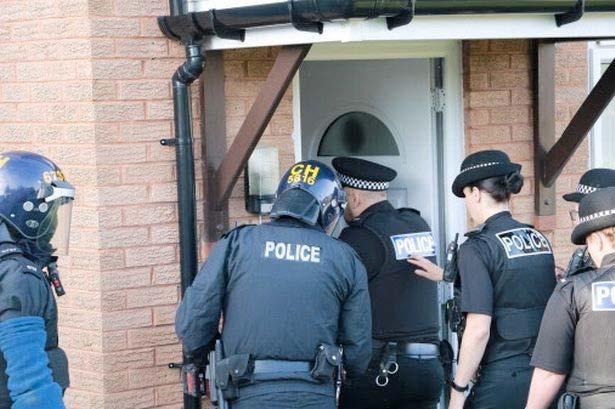
introduced in stages during a transition period, rather than via an overnight switch.
The government has stressed that the new service would still rely on local policing for intelligence and community engagement, and that neighbourhood teams will remain central to preventing extremism, disrupting organised crime and safeguarding vulnerable people.
One of the most significant shifts under the plan is national control over specialist technology and procurement. Ministers say the new structure will allow faster rollout of tools and systems across all forces, including better data sharing and modern investigative capabilities. The government has also indicated it wants to expand live facial recognition and other digital policing technologies more widely, arguing it can help identify suspects and protect the public.
Critics have already signalled that
technology will be a major battleground, with concerns expected over privacy safeguards, oversight, and how such tools are governed and deployed.
Force performance ‘dashboard’ and intervention powers
Alongside the creation of the National Police Service, the Home Office has also announced tougher national oversight of local forces.
Plans published on Friday include a public performance “dashboard”, with forces rated on measures such as 999 response times, victim satisfaction and public confidence. Poorly performing forces would be “named and shamed”, and ministers want stronger powers for the Home Office to intervene.
Those intervention options include sending in specialist support teams and, in serious cases, taking steps to remove chief constables judged to be failing. Police leaders have warned that targetdriven regimes can create perverse incentives, but ministers insist that stronger accountability is necessary to raise standards.
The government has also signalled support for further consolidation of police forces in England and Wales, potentially reducing the number of forces into larger regional units.
While no definitive map has been published, the direction of travel is towards fewer, bigger forces, with the National Police Service sitting above them to handle national threats and cross-border crime.
Professional standards and a proposed ‘licence to practise’
Another element announced alongside the structural changes is a professional standards reform package, including proposals for a mandatory “licence to practise” for officers in England and Wales.
Ministers say this would ensure continuing competence and help rebuild public trust after high-profile misconduct cases in recent years. The Police Federation and other staff representatives have raised concerns about workload pressures and the practicalities of introducing new requirements without significant investment in training and support.
Political reaction and policing response
Labour has presented the plan as a modernisation project to rebuild policing capability and restore confidence in the criminal justice system.
Senior policing bodies have welcomed the idea of stronger national coordination for modern threats, while stressing that the success of any national body will depend on preserving strong links with local forces and neighbourhood policing.
Opposition parties are expected to press ministers on costs, governance, civil liberties issues around technology, and whether centralisation risks weakening local accountability.
The Home Office white paper, expected on Monday, is due to provide further detail on the structure of the National Police Service, the role and powers of the National Police Commissioner, the transition timetable, and the legislative changes required to bring the reforms into force.
The scale of the plans means the changes are likely to take years to complete, with ministers facing scrutiny over whether the overhaul can improve the fight against fraud, terrorism and organised crime while also delivering the promised improvements to visible policing and the “everyday” crimes that shape public confidence.

W ITH ANDREW LYE
iberal
emocrats have criticised labour after the uK Government rejected rail devolution for Wales during Committee scrutiny of the Railways bill, while a Welsh labour MP argued against the liberal democrats’ devolution amendment being included in the bill, just days after first Minister Eluned Morgan promised a “new era of devolution”.
The amendment was tabled by Welsh Liberal Democrat Westminster Spokesperson David Chadwick MP and would remove rail transport from the list of powers reserved to Westminster. It would require the UK Government to transfer responsibility for rail infrastructure, investment and long-term strategy in Wales to Welsh Ministers within two years, placing Wales on the same constitutional footing as Scotland.
During the Committee debate, the Parliamentary Under-Secretary of State for Transport, Keir Mather made clear that the Government does not support devolving rail powers to Wales through this legislation. He argued that the Bill is intended to provide a single, integrated framework for the rail network across England and Wales and that introducing new statutory boundaries would risk fragmentation.
The Minister defended retaining rail as a reserved matter on the basis that cross-border services and infrastructure interfaces are better managed through partnership working and a memorandum of understanding between the UK and Welsh Governments, rather than through a statutory transfer of powers.
The Welsh Liberal Democrats said this position is difficult to justify, given that Scotland already exercises statutory rail powers within the same UK rail network and manages cross-border services under that system
perfectly without issues.
At the same Committee session, Andrew Ranger MP, Welsh Labour MP for Wrexham, argued that the rail devolution amendment should not be included in the Railways Bill, urging the Committee to “work with the situation as it stands now” and pointing instead to partnership working and the proposed memorandum of understanding.
The Welsh Liberal Democrats say the debate exposes a clear contradiction in Welsh Labour’s position. Earlier this week, First Minister Eluned Morgan promised a “new era of devolution”, including the devolution of rail, should Labour win the 2026 Senedd election. However, when given the opportunity to support rail devolution in Parliament, Labour Ministers rejected it and Welsh Labour MPs did not back the proposal, nor submit their own.
Commenting, David Chadwick MP for Brecon, Radnor & Cwm Tawe said:
“Labour Ministers have now put it on the record that they do not support devolving rail to Wales. That tells you everything you need to know about how seriously Labour takes devolution when it matters.
“The First Minister speaks about a ‘new era of devolution’, but she can’t even get her own MPs to back her. Everything outlined in her speech is empty rhetoric.
“Scotland already has these powers. Wales does not. Until Labour matches words with action, Wales will continue to be short-changed by billions of pounds, depriving communities of much-needed transport investment.”
Having Labour in power in Westminster and Cardiff has clearly failed to bring about the change that Wales needs. The Welsh Liberal Democrats will continue to push for urgently needed change.
at andrew.lye@pembslibdems.wales

A PETITION call for backing for a Pembrokeshire council group looking at its previous climate change commitment will be heard by councillors.
Last July, councillors agreed to set up a group to review its own decision to declare a climate emergency some six years ago.
In May 2019, the council declared a climate emergency following a notice of motion by Cllr Joshua Beynon, committing to becoming a zero-carbon local authority by 2030.
At the July 2025 meeting of Pembrokeshire County Council, a successful notice of motion by the late Cllr Mike Stoddart called for the establishment of a working group to review that decision.
That led to a recent petition, by Lynda Duffill of West Wales Climate Coalition, which attracted 725 signatures, calling on the
council to reaffirm its Declaration of a Climate Emergency, and retain the ambition to deliver Net Zero Council operations by 2030.
That petition was considered at the October meeting of full council; members agreeing the working group be asked to ensure the petition is included as evidence in its consideration of the matters referred to it by the council resolution in July 2025.
This led to a further petition, concerned at a potential increase in council tax from a re-affirmation of a Declaration of a Climate Emergency.
The latest e-petition, on the council’s own website, created by Carolyn Ellis, reads: “We call upon all elected members of
Pembrokeshire County Council to support and to take seriously the working group tasked with the review of the ‘climate emergency’ called in 2019 (by the-then 21-yearold councillor Joshua Beynon) and to question the hefty funds needed to spend on ‘net zero’.
“We refer to the recent petition by the West Wales Climate Coalition which purports to speak for the residents and council taxpayers of Pembrokeshire.
“There is potentially a far higher number of residents who do not share this unsubstantiated view and who are extremely concerned about the potential for huge hikes in council tax, especially if this tax is linked in future to the carbon efficiency of homes and businesses.
“This was hinted at as a possible lever for encouraging ‘compliance’ with decarbonising homes in the ‘Better Homes, Better Wales, Better World’ report. Therefore, not only could we be faced with more taxes, but also inevitable deterioration in service provision by PCC.”
The current petition runs to March 26, and has attracted 253 signatures to date.
Any petition of between 100 and 499 signatures triggers a debate at one of the council’s Overview and Scrutiny Committees, and any over 500 a debate at full council.
A dESCISION on the level of council rents in Pembrokeshire for the forthcoming year had to return to a special meeting after some figures were incorrectly reported when a decision was made last month.
A decision had previously been made at the December meeting of full council, but, following “a final review of the working papers to inform Revenue Services of the new 2026/27 rents, it was identified that in parts of the 2026-27 working papers the rent roll (individual actual rent figures for tenants) had not been updated with the 2025-26 rent increases [approved by council in December 2024].”
In a report presented at a January 21 extraordinary meeting of Pembrokeshire County Council, by Cabinet Member for Housing Cllr Michelle Bateman, members heard: “The consequence of this was that the supporting data
Bruce Sinclair Local Democracy Reporter
was incorrect. Nevertheless, this report confirms that the overall rental increase recommended [in] the report presented on December 12 was compliant with Welsh Government rental policy.”
It said supporting data incorrectly reported at that meeting “impacted the number of properties under Pembrokeshire Standard Rent, the actual number being higher than that shown”.
It added: “To clarify, the calculation on the overall income cap and the subsequent calculations on the amount of income required to deduct from the overall income cap for transitioning and for voids being relet was not affected by this omission, as these calculations had correctly used the rent roll for 2025-26 and there had
been an allowance included for uncertainty over some of the assumptions.
“The additional headroom has enabled the recommendation of ‘3.6 per cent plus up to £2.55 per individual rent that is currently below Standard Rent’ [as recommended in December] to remain compliant with WG rent policy.”
Members backed the January 21 recommendations that the previous decisions be rescinded; the Pembrokeshire Standard Rents are increased by 3.6 per cent plus up to £2.55 per individual rent that is currently below Standard Rent, garage rents be increased by 4.3 per cent, and for tenanted properties improved to the highest possible energy rating of EPC A or B, the rent for the property will increase until the Standard Rent for new/ improved homes rent levels is achieved.
A SENEdd debate on the financial crisis facing Wales’ hospice and palliative care sector ended with labour voting against a Welsh Conservative proposal to create a new funding model and commit an additional £40 million over the next Senedd term.
The motion, tabled by the Welsh Conservatives, recognised the role hospices play in providing end-of-life care and support to families across Wales, while warning that providers are facing unprecedented pressure from rising costs, staffing shortages and growing demand.
Deputy Leader of the Welsh Conservatives Paul Davies MS said the sector needed certainty and longterm stability, arguing that tax rises had forced hospices to make difficult decisions at a time when more people required specialist care.
He said: “I am disappointed that Labour did not support our muchneeded support package for the hospice and palliative care sector.
“Substantial tax rises have forced the sector to make difficult decisions. They are in need of certainty and a new, sustainable funding model.
“The Welsh Conservatives have

a credible plan to support hospices and palliative care and we are the only party putting money on the table to secure the long-term future of this vital sector.”
Charities working in end-of-life care used the debate to highlight wider pressures in the health and social care system, warning that too
and
Marie Curie Cymru said hospice services and community-based hospice care are essential to helping people receive the right care in the right place, and to reducing avoidable trips to A&E. The charity called for
clear leadership and action to integrate palliative and end-of-life care more effectively across services, warning that demand is set to increase in the coming years.
Hospice UK also said the current funding model is unsustainable, with charitable donations meeting a large share of costs, and warned that without urgent action Wales could see more services closing, loss of specialist staff and fewer options for families coping with life-shortening conditions.
Children’s hospice charity Tŷ Hafan said the Conservatives had been the first party to respond to its call for a fair funding pledge for the 2026–2031 Senedd term. It said a long-term uplift would help it reach more children and families, and urged other parties to match the ambition, arguing that children’s hospices in Wales have been underfunded for too long.
The motion debated in the Senedd called for the development of a new sustainable funding model and cited concerns that some hospices are already cutting services and facing potential bed closures.
The Welsh Government has come under criticism after it emerged that more than £40,000 of public money was spent supporting an African film festival held in Cardiff.
Figures show that £41,600.90 was paid in February 2025 to Watch Africa CIC, the organisation behind the annual Watch Africa Film Festival, which showcases African cinema through film screenings, workshops, filmmaker question-andanswer sessions and cultural events.
According to the festival’s organisers, the event was launched in 2013 and aims to celebrate the richness and diversity of African storytelling through film.
The spending has been challenged by Gareth Davies, the Welsh Conservatives’ Shadow Cabinet Secretary for Culture, Tourism, Sport and North Wales, who questioned the decision at a time when public finances in Wales remain under significant pressure.
Mr Davies said the allocation of funding was difficult to justify while Wales continues to experience the longest NHS waiting times in the UK, alongside growing financial pressures on households and mounting challenges for public services.
He also pointed to the situation facing Welsh cultural and artistic organisations, several of which have faced severe
funding difficulties in recent years. In particular, he highlighted the closure of National Theatre Wales in 2024 after it lost core financial support.
Mr Davies stressed that his criticism was not aimed at the Watch Africa Film Festival itself, which he said had a place within Wales’ cultural landscape. Instead, he said his concerns related to the use of taxpayer money and how limited culture and arts budgets are being prioritised.
Commenting on the spending, Mr Davies said it was concerning that the Welsh Government had chosen to allocate more than £41,000 to the project at a time when many families were struggling with the cost of living and public services were under intense strain.
He argued that when funding is scarce, it is hard to justify public money being used to support events that, in his view, should be capable of operating without government backing, particularly when long-established Welsh cultural institutions were allowed to collapse due to a lack of financial support.
Mr Davies called on ministers to reassess their priorities and ensure that future culture and arts funding is focused on supporting Welsh culture and organisations that preserve and promote Wales’ national identity.
The Welsh Government has been approached for comment.

SEND YOUR LETTERS TO: THE EDITOR, 11 HAMILTON TERRACE, MILFORD HAVEN, PEMBROKESHIRE, SA73 3AL
EMAIL US AT: editor@herald.email


Hong Kong registered LNG tanker Emei in Milford Haven this week: Pic: Richard Rees
TINNITUS WEEK
dEAR SIR,
As we mark Tinnitus Week (2 – 8 february), we know that for many people with tinnitus, it’s not just a hum in the background, but something that can make everyday life a challenge.
Despite tinnitus being more common than most people realise with one in seven adults experiencing it, too many are still left confused, worried or unsure of where to turn for help. Through our new research, two thirds (66%) of people with tinnitus told us it can impact their stress levels, while half (51%) said it makes them feel anxious or overwhelmed. Thankfully with the right support, lots of people can live well with tinnitus. There are many practical ways to manage each person’s needs, such as talking therapies, hearing aids, or mindfulness. No one should face tinnitus alone. If you’re finding your tinnitus difficult to manage or you’re worried about someone close to you, we’re here to help.
RNID’s free online tinnitus guide at rnid.org.uk/tinnitus offers plenty of helpful information, practical tips and advice to help you live a good, balanced life with tinnitus.
franki Oliver Audiology Manager at RNId
MOVE OVER AND EMBRACE A NEW AND ExCITING FUTURE
I note with considerable sadness our first Ministers comments re “Separatist’s”.
In days long past this kind of ridiculous comment would sadly instil an irrational fear into many. Thankfully those days are long gone, and to wish for self determination, as many do is a just aspiration, seeking to free our Nation from a rapidly failing unionist state is a worthy ambition.
Ms Morgan represents this failing state, and I among many wish to see the Nation of Wales free to join the community of free Nations, and to play our part in Europe and the world. This is not to be a “Separatist”, but a desire for the opposite
and to join the wider world free from the colonial remnants that continue to occupy Westminster.
Ms Morgan, you and the Labour party represent the past, move over and embrace a new and exciting future.
Cllr Michael Williams.
Many people would love to give something back to their community, but finding the time to volunteer can be a real challenge.
For many, it’s hard to commit to a traditional volunteering shift at a fixed time each week. Juggling work, family and dayto-day responsibilities often means even the best intentions never quite make it into the diary.
That’s why, with the support of players of People’s Postcode Lottery, Royal Voluntary Service has launched GoVo — a free platform designed to make volunteering easier to fit around real life. It helps people find opportunities
locally or remotely, matched to their interests, availability and the causes they care about.
As well as more familiar, regular roles, GoVo offers flexible oneoff options, remote opportunities and some more unexpected ways to help, depending on your area. These range from dog walking for someone with a terminal illness, to DJing at discos for people living with dementia, knitting baby clothes for families in need, or supporting young people with visual impairments through exam time.
Time is precious, and giving it can be priceless — not only for the people and causes you support, but for you, too. Volunteering can boost wellbeing, improve mental health, build confidence, develop new skills, and strengthen your sense of purpose and connection with others.
So, if you’d like to give volunteering a go — even if you feel short on time — I’d encourage you to explore what’s available at Govo.org, or visit your local volunteer centre. There’s a great deal out there, and you may be surprised at how easy it can be to make a difference.
dave Stott director of volunteering, Royal voluntary Service


M ARy passed away at Withybush Hospital on Thursday 8th January 2026 aged 82 years.
Much loved wife of Arthur, beloved mother to Louise and Andrew, dear mother-in-law to Tim and Sarah, treasured grandmother to Kira, she will be missed by her sisters Christine and Barbara and also her brothers Philip and Michael.
The funeral service will take place on Friday 6th February, 1:30pm at St. David and St. Patrick Catholic Church, Haverfordwest, followed by cremation service 3:15pm at Parc Gwyn Crematorium, Narberth.
Family flowers only.
Donations in lieu, if desired, made payable to the NSPCC may be sent c/o Mr Rex Davies, 12 Brickhurst Park, Johnston, Haverfordwest, SA62 3PA.
Further enquiries to F. G. Rees & Sons, Haverfordwest. Tel: 01437 764418.
Su E passed away peacefully at Withybush Hospital on Thursday 1st January 2026, aged 77.
Devoted Mother of Jamie and Kate, dearly loved sister and sister-in-law to Janet and Frank, fond stepmother of Julie and Richard and an adored grandmother and great grandmother. Sue will be missed by all her family and friends.
The funeral service will take place on Monday 9th February at 10.45am at Parc Gwyn Crematorium, Narberth.
Family flowers only.
Donations, if desired, can be made payable to Diabetes Cymru - www. diabetes.org.uk
All enquiries to Tom Newing & Son Ltd, Funeral Directors, Milford Haven. Telephone 01646 693180.
H OWARD D AVIES
T HE death occurred peacefully at his home in Kiln House l ane, Jameston, on Tuesday 13th

January, Mr Howard d avies, aged 87.
A loving husband to Helga, a muchloved father to Monika and Mark, loving grandfather to Anna, and a dear father-in-law to Mike and Vandy. Born of Pembrokeshire farming stock and having lived in Jameston almost all his life, he will be sadly missed.
The funeral service will take place on Thursday 12th February at Parc Gwyn Crematorium, Narberth, at 12.15pm.
Family flowers only.
Donations, if desired, payable to the Paul Sartori Foundation, c/o W & M J Rossiter & Sons Ltd, The Old Rectory, The Norton, Tenby, SA70 8AB, or via www.rossitersfunerals. co.uk.
P EACE fully at her home on 9th January, l ala, aged 91 years
Beloved wife of the late Terence. A
dearly loved sister and aunty. She will be sadly missed by her relatives and friends.
Funeral service Friday 6th February at 11am at St.David’s Cathedral.
Family flowers, donations if desired, for the St.Davids Day Centre c/o W.G.Bernard Mathias & Daughter, 62 New Street, St.Davids, SA62 6SU
G EO ff died suddenly on January 2nd, aged 83 years
Devoted husband of Kathleen and respected brother, brother in law, uncle and friend.
A private cremation has taken place.
Kathleen wishes to thank everyone for their messages and flowers which have been a great support at this difficult time.
W ILLIAM ‘“B ILL ”’ J AMES G RIFFITHS
bI ll P assed away on Monday January 12th aged 81 years
A former mechanic and co-owner at Popes Garage in Haverfordwest
Bill was a beloved husband to Sylvia, a much loved and loving father to Jenny, dear father in law to Sid, devoted grampy to Liam and brother of Mary, John, Dillwyn and the late Adrian. He will be sadly missed and fondly remembered by all his family and many friends.
Funeral Wednesday February 4th service 2.30 pm at Parc Gwyn Crematorium, Narberth.
Family flowers only. Donations for The Paul Sartori Foundation may be sent c/o The Treasurer, SA61 1RP. Paul Sartori House, Winch Lane, Haverfordwest, All enquiries to Roy Folland & Son Funeral Directors (01437) 763821.
















RECLAIMED BUILDING MATERIAL

RUBBISH AND WASTE REMOVAL


PROFESSIONAL CAR WASH

PODIATRY

SCRAP METAL
SHUTTERS & BLINDS

STORAGE TANKS

SOUND LIGHT AND STAGE

TECHNOLOGY AND COMPUTERS

TRAILERS

VEHICLE RECOVERY











THE Six Nations is fast approaching, and Wales enter the tournament facing challenges both on and off the field.
The team has lost every match in the past two Championships and are widely tipped to claim a third successive Wooden Spoon. Their current streak stands at 11 consecutive Six Nations defeats, with the last victory coming against Italy in Rome in March 2023. At home, Wales have not won a Six Nations match since beating Scotland in February 2022.
Across all internationals, Wales have lost 21 of their last 23 matches. The 2025 season brought particularly painful home defeats, including record losses to England, Argentina, and South Africa, with the hosts humbled 73-0.
With expectations at an all-time low, we look at how Wales’ Six Nations rivals view the team as head coach Steve Tandy prepares for his first tournament in charge.
E NGLAND V WALES : ‘ PASSIONATE ’ CLASH ANTICIPATED – B ORTHWIC k
Wales open their campaign against England at Twickenham’s Allianz Stadium on Saturday, 7 February. The two sides are in markedly different positions, with England on an 11-game winning streak, including a 68-14 triumph over Wales in Cardiff last March.
England head coach Steve Borthwick, however, insists that history will count for little on the day.
“Every single England v Wales game I have been involved in – whether playing, coaching, or watching – has been fiercely competitive and full of passion,” said Borthwick. “The intensity is enormous, and we expect nothing less this time. Wales have many talented and athletic players, so it will be a proper test.”
England hooker Jamie George described Wales under Tandy as something of an unknown tactical challenge but anticipated the familiar emotional intensity.
“We do not know exactly what to expect with a new coaching team,” said George. “What we do know is that any Wales side will bring huge pride, passion, and a physical, confrontational approach.”
F RIENDS RE u NITED IN C ARDIFF
Tandy spent six years as defence coach under Gregor Townsend with Scotland before returning home to take the Welsh job.
“It is great that Steve has had the opportunity to coach his own country,” Townsend said. “We miss him, and it was

an emotional moment when we told the players after the match against Samoa in November.”
Townsend believes Tandy’s influence will be positive for Wales.
“He has embraced the role with Welsh pride while working to build a new group of players,” he said. “I remember when he joined us, he was brilliant at that.”
The former colleagues will now meet as rivals when Scotland visit the Principality Stadium on 21 February. Scotland’s 2024 win in Cardiff marked their first away Six Nations victory there in 22 years.
“There are some fantastic venues in this tournament, but Cardiff always seems to give the home side an extra advantage,” Townsend added. “The supporters’ passion and the stadium’s layout make it incredibly noisy and energising.”
F RANCE VISIT C ARDIFF AFTER E NGLAND TRIP
France, led by captain Antoine Dupont, crushed Wales 43-0 in the opening game of the 2025 Championship on their way to winning the title. Les Bleus arrive in Cardiff for the second round on Sunday, 15 February, following a home opener against Ireland.
“It is probably my favourite stadium outside of France,” said Dupont. “The atmosphere is incredible, and the home fans make it very loud. It is always special to play there.”
Dupont will face Wales scrum-half Tomos Williams, who has impressed for Gloucester and is Wales’ second-most capped player behind returning prop Tomas Francis.
“I have played against him several times; he is a very good player and a key man for Wales,” said Dupont. “He is performing well in the Premiership, so it will be a strong contest again.”
I RELAND AND I TALY CLOSE WALES’ CAMPAIGN Wales travel to Dublin for a Friday night clash with Ireland on 6 March. Ireland coach Andy Farrell had only selected two Welsh players during his tenure with the British and Irish Lions in the series win over Australia: Ospreys flanker Jac Morgan and Gloucester scrum-half Williams, the latter injured before the series began.
Wales finish the tournament against Italy in Cardiff on 14 March. The Azzurri are chasing a third successive win over Wales, having also claimed victories in Cardiff in the previous two Championships and celebrating a notable win over Australia in November 2025.
“It is true that Italy has had some good results in recent years,” said Italy coach Gonzalo Quesada. “I am aware of the crisis in Wales and the challenges within their clubs, but I also know how much pride they will bring to the Six Nations. A strong performance would help during this transition.”
Quesada highlighted the difference in facilities between Italy and the other five nations.
“Wales have incredible facilities and conditions to prepare with,” he said. “We are the only federation without our own rugby training centre. It is not an excuse, just a fact. We aim to compete against Wales as we do against every other side.”
WALES’ 2026 S I x N ATIONS F I x T u RES
Saturday, 7 February: England v Wales, 16:40 GMT, Allianz Stadium, Twickenham Sunday, 15 February: Wales v France, 15:10 GMT, Principality Stadium, Cardiff
Saturday, 21 February: Wales v Scotland, 16:40 GMT, Principality Stadium, Cardiff Friday, 6 March: Ireland v Wales, 20:10 GMT, Aviva Stadium, Dublin
Saturday, 14 March: Wales v Italy, 16:40 GMT, Principality Stadium, Cardiff

THE SEvERN valley Stages – supported by Axon Commercial Catering Equipment –will make a much-anticipated return in 2026 as the opening round of the Motorsport uK british Rally Championship on Saturday (April 11).
The acclaimed gravel event is back with renewed momentum and a new-look route for crews and spectators, after the rally was cancelled in 2025 following the impact of Storm Darragh, which restricted access to large parts of the Welsh forest estate.
Organised by Midland Manor Motor Club, the Builth Wells-based rally will again offer one of the longest and most cost-effective forest events in Wales, featuring more than 50 competitive stage miles across some of the country’s most revered gravel roads.
A major talking point for 2026 is a significant route evolution. While driven by forest availability, organisers say the changes have produced what could be one of the most demanding Severn Valley Stages in recent years.
The world-famous Myherin Forest block will take centre stage, forming the backbone of the event and being used to its fullest potential. In combination with the Tarenig complex, organisers have created a series of challenging tests within Myherin, supported by the classic Sarnau stage, promising a flowing, high-speed but technical challenge throughout the day.
The rally will build towards a dramatic finale, with a joined Myherin–Tarenig stage in the afternoon forming an 18-mile test to close the event – a true sting in the tail for competing crews.
Proceedings begin on Friday evening at the Metropole Hotel & Spa in Llandrindod Wells with a ceremonial start designed to bring fans closer to the action and officially launch the weekend’s competition.
Builth Wells will host pre-event formalities and service, while the Metropole will act as rally headquarters and host the finish celebrations on Saturday evening.
As the 2026 BRC curtain-raiser, Severn Valley
Stages will welcome the latest generation Rally2 machinery and many of the UK’s leading drivers.
The event will also host the return of the Fuchs Lubricants British Historic Rally Championship, alongside rounds of the Motorsport UK Pirelli Welsh Rally Championship, West Wales Rally Spares HRCR Stage Masters and the T.C.S Plant Rally Challenge.
Clerk of the course Keith Ashley said: “After a frustrating year away, we’re incredibly proud to bring the Severn Valley Stages back for 2026 and to do so as the opening round of the British Rally Championship, alongside the returning British Historic Rally Championship, is something special.
“The revised route has allowed us to create a real driver’s rally, with Myherin at the heart of the event and a spectacular long stage to finish. We’re looking forward to welcoming competitors, championships and fans back to Mid Wales for what promises to be a memorable return.”
Fans can follow the event’s social media channels for up

CAREW produced an impressive second-half display to come from behind and claim a thoroughly deserved victory over high-flying St Ishmaels, making it three league wins in a row.
The match was the only fixture in the top flight to survive Storm Ingrid, with heavy rain and strong winds forcing the game to be switched to the all-weather surface at Bridge Meadow Stadium. In total, just six matches were completed across the county.
Jack Christopher’s side continue their climb up the table, moving into ninth place, while Graham Ninnis’ Tish remain third despite the setback.
The contest was an entertaining, end-to-end affair, featuring four excellent goals of real quality.
St Ishmaels made the perfect start, breaking the deadlock when Nathan Thomas unleashed a stunning 20yard strike that arrowed into the top corner, giving Tom Davies no chance in the Carew goal.
Carew, however, turned the game on its head just before the interval, scoring twice in quick succession.

First, Sam Christopher spotted Owen Thomas off his line and produced a sublime 30-yard lob to level the scores. Moments later, straight from the restart, Carew surged forward
again and Harry Peniket’s inviting cross was met by a superb diving header from captain James Hinchliffe to put the Rooks 2–1 ahead at the break.
The second half was a more cautious affair, with neither side able to gain sustained control, but the decisive moment arrived in the 69th minute. Defender Sonny Phillips stepped forward to fire a spectacular 25-yard left-footed strike into the top corner, sealing the points and capping an outstanding team performance.
St Ishmaels: Owen Thomas, Sol Goodall, Tom Williams, Archie Hillier-Wood (Daniel Coe 78’), Finley Armstrong, Brennan Devonald (capt), Tyler Sheil (Dylan Ninnis 83’), Ieuan Hawkins, Joel Mills, Ethan Davies (Corey Richards 65’), Nathan Thomas. Sub not used: Joe Davies. Carew: Tom Davies, Sonny Phillips, Gareth Lewis, Paul Hodge, Jonathan Bennett, Dylan Morgan, Sam Christopher (Jordan Richards 57’), Marcus Griffiths, Rhys Lewis, Harry Peniket, James Hinchliffe (capt). Subs: Hadyn Shapcott, George Waters, Ross Jones, Jack Christopher. Referee: Sean O’Connor.

division