









A 37-YEAR-OLD man has been found dead at Warrior Way in Pembroke Dock.
Dyfed-Powys Police said officers attended the area at around 7pm on Sunday, July 19, after concerns were raised for the welfare of an individual.
There was a significant police presence in the area, with several units positioned at the scene on Sunday and further police activity continuing into Monday.
The scale of the response prompted speculation among members of the public about the nature of the incident.
Police have now confirmed that the man was found deceased and that his death is not being treated as suspicious. His next of kin have been informed.
HM Coroner has been advised, and officers will continue to assist with the coroner’s investigation.
The matter has also been referred to the Independent Office for Police Conduct because the man had been involved in an active police investigation.
Dyfed-Powys Police said the referral was made in line with the IOPC’s statutory referral criteria.
Such referrals are required in certain circumstances and do not, in themselves, indicate that police officers or staff are suspected of wrongdoing.

A 28-YEAR-OLD Haverfordwest man has been fined after failing to attend an initial drugs assessment.
Jacob Payne was arrested on April 2 after testing positive for a Class A drug and was required to attend an assessment at a police station. His failure to attend resulted in
the case being brought before Haverfordwest Magistrates’ Court this week.
Payne, of Back Lane, Haverfordwest, pleaded guilty to failing to attend the assessment.
He was fined £80 and ordered to pay £385 court costs and a £32 surcharge.








A MAN has been arrested as part of an investigation into allegations that laptops and other electronic devices were taken for repair but not returned to their owners.
Dyfed-Powys Police confirmed that officers had received reports of alleged fraudulent activity and theft in the Milford Haven and Haverfordwest areas between September 2025 and April 2026.
A man in his 30s from the Milford Haven area was arrested in connection with the incidents and has since been released on conditional bail.
Trading Standards has now taken primacy of the investigation, with Dyfed-Powys Police continuing to assist.
The police statement was issued in response to questions from The Herald concerning complaints linked to Computer Solutions Wales. Police did not name the business in their statement and have not confirmed that every complaint involving Computer Solutions Wales forms part of the current investigation. However, The Herald has previously been contacted by a number of people who said they handed
Tom Sinclair editor@herald.email
laptops, computers or other electronic equipment to the business for repair but were subsequently unable to recover their property or obtain refunds.
Some customers claimed they had spent months attempting to secure the return of their devices, while others said they had previously reported their experiences to the police or Trading Standards.
A Dyfed-Powys Police spokesperson said: “Dyfed-Powys Police are investigating a series of alleged fraudulent activity and theft in the Milford Haven and Haverfordwest areas.
“Reports included electronic devices, such as laptops, being taken for repair and not returned between September 2025 and April 2026.
“A man in his 30s, from the Milford Haven area, was arrested in relation to these incidents and released on conditional bail.
“Trading Standards have taken primacy of the investigation and officers will continue to assist them.”
Anyone who dealt with Computer
Solutions Wales, or another computer repair operation in the Milford Haven or Haverfordwest areas, and believes a device was taken but not returned during the relevant period is being urged to make a report.
People with information that could assist the investigation are also being asked to come forward.
Reports should be made to Trading Standards through the Citizens Advice consumer service.
The service can be contacted online at:
https://www.citizensadvice.org.uk/ about-us/information/contact-theconsumer-service
Alternatively, the Citizens Advice consumer helpline can be contacted on 0808 223 1133.
Anyone making a report should provide as much supporting evidence as possible, including receipts, invoices, bank transfers, emails, text messages, photographs, details of the equipment concerned and any previous police or Trading Standards reference numbers.
The arrested man has not been charged, and the allegations have not been tested before a court.
Jury returns 11-1 majority verdict on charge of causing grievous bodily harm with intent, with sentencing set for September 3
A TEENAGE boy has been cleared of attempting to murder a teacher at Milford Haven School but found guilty of causing grievous bodily harm with intent.
The 16-year-old, who cannot be named for legal reasons, was convicted at Swansea Crown Court on Monday afternoon following a trial lasting more than two weeks.
The jury returned a not guilty verdict on count one, attempted murder. On count two, causing grievous bodily harm with intent, the teenager was found guilty by a majority verdict of 11 to one.
Before the verdicts were delivered, Judge Paul Thomas KC warned those inside the courtroom that they must remain silent regardless of the outcome.
He said: “Those verdicts must be met in absolute silence, whether it is the verdict you want or don’t want. The dignity of the court must be maintained.”
The judge had earlier indicated that he was prepared to accept majority verdicts after the jury was unable to reach unanimous decisions.
At one stage, the court was told that ten jurors were in agreement. Judge Thomas asked the jury to return to the deliberation room and make a further effort to reach unanimous verdicts.
The jury later returned to court and delivered the not guilty verdict on the attempted murder charge and the 11-1 guilty verdict on the second count.
The case relates to a knife incident at Milford Haven School on February 5,

Rieve Nesbitt-Marr rieve.nesbitt-marr@herald.email
2026, in which teacher Vicki Williams suffered injuries inside a classroom.
During the trial, the prosecution
POLICE have praised the bravery of a teacher who was attacked with a knife at Milford Haven Comprehensive School, saying the emotional impact of the incident “cannot be underestimated”.
A 16-year-old boy was convicted at Swansea Crown Court of wounding with intent to cause grievous bodily harm following the attack on Thursday, February 5.
The jury cleared him of attempted murder. He had previously pleaded guilty to possessing a knife.
The teenager, who cannot be identified because of his age, was 15 when the incident took place.
At approximately 3.20pm, he approached the teacher and asked for assistance with schoolwork before following her into a classroom. He then attacked her while armed with a knife.
Tom Sinclair editor@herald.email
The teacher managed to disarm the pupil despite sustaining injuries which required hospital treatment. She later recovered from her physical injuries.
Dyfed-Powys Police said officers and other emergency services swiftly attended the school, where pupils and staff were safeguarded and a lockdown was put in place.
The teenager was traced and arrested shortly afterwards. He was charged on February 7 and remanded in custody ahead of his trial.
Following the verdicts, Senior Investigating Officer Detective Inspector Sarah Totterdale commended the victim for attending court and giving evidence about the attack.
alleged that the teenager had brought a large kitchen knife into school and deliberately attacked the teacher.
The defence denied that the boy had intended to kill or seriously injure her and argued that the injuries occurred
The teenager had previously admitted possessing a knife on school premises. He will be sentenced at Swansea Crown Court on Thursday, September 3.
She said: “Firstly, I would like to commend the bravery shown by the victim in this case.
“What happened to her on February 5 must have been a truly terrifying ordeal, so to have to attend court and relive that experience has taken exceptional courage.
“It is thanks to pure good fortune that she did not sustain even worse injuries, but the emotional impact cannot be underestimated.
“We would like to thank her for her assistance throughout this investigation.”
DI Totterdale said the incident had also deeply affected pupils, teachers and the wider Milford Haven community.
She added: “This incident understandably had a profound impact on other students and teachers at Milford Haven Comprehensive School,
as well as the wider community.
“Fortunately, we were able to promptly attend the school, ensure the safeguarding of pupils and teachers, and apprehend the offender.”
She also thanked the emergency services, school staff, parents, pupils, Pembrokeshire County Council and members of the community for their support and patience during the investigation and subsequent court proceedings.
DI Totterdale said: “I hope that, with the trial now concluded, the victim in this case can begin to obtain some closure from this incident, and that Milford Haven Comprehensive School can continue passionately teaching, learning and thriving together in a safe environment.”
The teenager will return to Swansea Crown Court to be sentenced on Thursday, September 3.

A PIONEERING Pembrokeshire horse who made military history has been laid to rest at the farm where she was born following an emotional final homecoming.
Dyfed Willa Rose, who served with the Household Cavalry under the name Major Juno, became the first mare in history to take on the prestigious role of Drum Horse.
Family members, friends, soldiers and admirers gathered at Dyfed Shire Horse Farm to remember a horse whose journey took her from the fields beneath the Preseli Hills to the heart of major state and military ceremonies in London.
Born at the farm on May 10, 2013, Willa Rose left Pembrokeshire in 2021 to begin an intensive period of training with the Household Cavalry.
After two years of preparation, she qualified for one of the most demanding and recognisable equine roles in the British Army.
Drum horses lead military bands while carrying two large silver kettledrums, together with the weight of their rider and ceremonial equipment. The role requires not only exceptional size and strength, but also a calm and dependable temperament. The
Tom Sinclair editor@herald.email
horses must remain composed while surrounded by crowds, marching troops, music, traffic and the noise of major ceremonial occasions.
Willa Rose’s successful appointment saw her become Major Juno, the first mare to serve as a Household Cavalry Drum Horse.
Her historic achievement challenged a long-established tradition and secured her place in British military and equestrian history.
For her final journey, her cremated remains were brought back from London to Dyfed Shire Horse Farm.
The farm thanked Corporal of Horse James Harvard and the Household Cavalry team for bringing Juno home, alongside her former companion Major Perseus, who helped guide her on the last stage of her journey.
A memorial service was held in the farmyard and was introduced by Huw Carnhuan Murphy.
The service was led by Minister Sian Elin Thomas, with a eulogy celebrating Willa Rose’s life and achievements delivered by Mark Cole.

Her remains were then placed in a horse-drawn carriage pulled by her daughter, Morgana, for a final procession through the farm.
Those present described a striking silence as the carriage made its way towards the place where Willa Rose would be laid to rest.
According to an account of the ceremony shared by Whitestone Media Group, horses appeared at their stable doors and gathered along the edges of surrounding fields as the procession passed.
Willa Rose was laid to rest beneath the Preseli Hills alongside her uncle, Celt Mercury Drumhorse, and her grandmother, Dyfed Countess. Her grandson was also present at the farm during the ceremony, providing a reminder of the bloodline and legacy she leaves behind.
In a poignant coincidence, another young horse from Dyfed Shire Horse Farm was due to be collected on the same day to begin its own journey with the Household Cavalry and start training towards becoming a Drum Horse.
The farm said the occasion had been filled with grief, emotion and immense pride in a mare whose achievements were recognised far beyond
A tribute shared by Dyfed Shire Horse Farm said: “It was with great emotion and pride that the family, with friends from near and far, welcomed home one final time our Dyfed Willa Rose to lay her to rest on the farm of her birth.”
The farm added: “A day full of emotion, but of pride for a horse that broke the glass ceiling as the first ever mare to make Drum Horse in the Household Cavalry.
“She is now with the stars that will look down upon her from those old hills, and she will be remembered forever with love and affection both here in Pembrokeshire and, indeed, all around the world.”
Thanks were also offered to Karen Gott and Julie Davies for photographing the memorial and Willa Rose’s final journey. Whitestone Media Group described her homecoming as the completion of an extraordinary journey which had begun in the same Pembrokeshire fields 13 years earlier.
Its tribute concluded: “Rest easy, Major Juno. You marched into history, and today, you came home.”
Cysga’n dawel, Willa Rose.
Kelly Rees receives further 27-month sentence while already serving prison term for notorious taxi robbery

TWO women have been jailed after chasing a man through a Milford Haven home before inflicting deep wounds with knives.
Demi Oliver, aged 26, and Kelly Rees, aged 36, appeared before Swansea Crown Court for sentence following the serious attack on Warren Harper at a property in Precelly Place.
The women had originally been charged with wounding with intent to cause grievous bodily harm, an offence under Section 18 of the Offences Against the Person Act 1861.
During an earlier hearing at Swansea Crown Court, both defendants denied the more serious charge but pleaded guilty to the lesser alternative offence of inflicting grievous bodily harm.
Oliver was sentenced to 17 months’ imprisonment, while Rees received a further 27-month prison term in addition to the sentence she is already serving for a separate knife-point taxi robbery.
The court heard that Oliver and Rees had been drinking at Rees’s home in Precelly Place on July 28, 2024, when Harper joined them at the property.
Mr Ibrahim, representing Rees, said she had also been smoking crack cocaine before an altercation developed.
Both women began chasing Harper through the house, eventually forcing him to lock himself inside the downstairs bathroom.
The court heard that Harper remained behind the locked door
Rieve Nesbitt-Marr rieve.nesbitt-marr@herald.email
before eventually saying: “This stops.”
When he came out, he was confronted by Oliver and Rees, who were both armed with knives.
Rees produced what was described in court as a Stanley knife and slashed Harper’s left wrist, causing an extremely deep and damaging wound.
Oliver then approached him carrying a black-handled knife and inflicted a deep laceration to his left shoulder.
Harper later told police that he felt “a deep sharp pain” during the attack.
In a desperate attempt to escape the women, he ran upstairs and entered
another bathroom.
He considered jumping from the bathroom window but realised that the drop was too high.
Harper eventually managed to get downstairs and escape from the property through the front door.
Harrowing Ring doorbell footage shown to the court captured him fleeing the house covered in blood.
He ran to a friend’s home, where he was described as sweating, shaking and covered in blood.
An ambulance was called and Harper was taken to Withybush Hospital.
He required surgery to repair damage to his muscles and tendons caused by the wounds.
After seeing photographs of the injuries, Judge Huw Rees intervened

to emphasise their seriousness.
“These are not just slash marks,” he said.
“These are very deep cuts, of which I can see his muscle.”
Oliver had no previous convictions
Mr Singh, representing Oliver, told the court that his client deeply regretted her actions.
He said Oliver had no previous convictions and drew attention to the fact that she had been supported in court by the two grandparents who had raised her.
Oliver, of Precelly Place, had been released on bail following the earlier plea hearing while pre-sentence reports were prepared.
The judge concluded that the seriousness of the violence meant an immediate custodial sentence was necessary.
She was sentenced to 17 months in prison, with the sentence beginning immediately.
Rees described as “seasoned offender”
Rees, who was already being held at HMP Downview, was treated differently because of her extensive record of previous offending.
Addressing her directly, Judge Rees said: “You are a seasoned offender.”
The judge noted that she was already serving a prison sentence for the notorious robbery of a Milford Haven taxi driver.
That attack took place on October 18, 2024, less than three months after the assault on Harper.
Rees and fellow defendant Ashlee Rees targeted the driver after he collected them in Milford Haven.
During the robbery, the driver was threatened with a knife and attacked with a needle before a bag containing his takings was stolen.
The driver was left fearing that he may have contracted an infection and was required to undergo blood tests following the attack.
He also suffered recurring nightmares and anxiety as a result of the ordeal.
The case attracted widespread attention in Milford Haven, with members of the community later raising money to support the driver.
Kelly Rees had admitted robbery but denied using the needle. She was convicted of that element of the offence following a trial and was sentenced to three years and nine months in prison.
For the attack on Harper, Rees received a further sentence of 27 months’ imprisonment, to be served in addition to the sentence she is already serving.
TOURISM and hospitality businesses across Wales are being invited to apply for grants from a new £2 million fund aimed at creating more accessible and inclusive visitor experiences.
The Welsh Government’s Croeso i Bawb scheme will support practical improvements designed to remove barriers faced by disabled and neurodivergent visitors, people with hidden conditions and those travelling with them.
Eligible projects could include accessible toilets and bedrooms, improved paths and visitor routes, hearing loops, inclusive play areas, sensory spaces, rest areas and accessible outdoor seating.
Businesses will also be able to use new guidance and a practical toolkit to assess every stage of the visitor experience, identify potential barriers and prioritise the changes likely to make the greatest difference.
The resources have been developed in partnership with PIWS, a Walesbased not-for-profit organisation which contributed expertise based on the lived experiences of disabled people.

the most successful accessibility improvements were those informed by the experiences of disabled people.
She said: “Accessibility is not just a legal requirement; it is a strategic investment.
“By investing in accessible premises and facilities, tourism businesses can enhance customer satisfaction, support and retain staff, attract new markets and generate a measurable return on investment, while helping to make Wales a truly welcoming destination for everyone.”
Grace Maidment, owner of Stangwrach Holiday Cottages and winner of the Visit Wales Accessible and Inclusive National Tourism Award 2025, said improving accessibility had enabled the business to welcome guests who might otherwise have been unable to visit.
She said: “Everyone deserves the opportunity to enjoy a relaxing and memorable break, regardless of mobility, age or the need for support.
Cabinet Minister for Enterprise, Connectivity and Energy Adam Price said the fund would help ensure that Wales offered a genuine welcome to every visitor. He said: “A quarter of all visitors to Wales are disabled. If Wales says ‘croeso’ to the world, that word cannot come with small print. The welcome to Wales must be real for everyone.
visitors, neurodivergent visitors and people with hidden conditions and barriers. That is why we are launching Croeso i Bawb, to help tourism and hospitality businesses open their doors wider still.
“Accessibility is good business but, more than that, it is simply what hospitality means.”
“Being accessible to all guests makes complete business sense, and we welcome the opportunities the Croeso i Bawb scheme provides.”
Applications from tourism and hospitality businesses must be submitted by September 21, 2026.
“It must hold true for disabled
Davina Carey-Evans, of PIWS, said
A PEMBROKE woman has been ordered to pay compensation after assaulting another woman in two pubs on the same evening.
Haverfordwest magistrates were shown CCTV footage of Carina Haines being pulled to the floor by her hair and struck repeatedly by Sheryl McNamara.
The first assault took place in the women’s toilets at the Old Cross Saws Inn, Pembroke, on December 28, 2025. Footage showed McNamara, 48, leaving a toilet cubicle and becoming involved in a heated argument with Ms Haines.
“In both instances, the victim accepts she had been drinking a large quantity of alcohol since lunchtime, with the result that her recollection of events is very limited,” Crown Prosecutor Nia James told the court.
Both women were seen pointing at each other, although neither could remember what had caused the argument.
Ms Haines then briefly touched McNamara on the arm, after which McNamara grabbed her by the hair, pulled her to the floor and struck her repeatedly.
“During the incident, the defendant’s black handbag came over her neck and moved towards the victim,” Ms James said.
“As McNamara was escorted out, she
did not have her handbag, but the victim’s partner was seen holding it.”
Later that evening, Ms Haines was sitting with friends at the Castle Inn, Pembroke, when McNamara entered the pub and immediately approached her.
CCTV showed McNamara grabbing Ms Haines by the back of her hair and pulling her from her chair to the floor.
Ms Haines later attended the accident and emergency department at Withybush Hospital, where bruising was found on her back. Medical staff also identified a possible rib fracture.
In a victim impact statement read to the court, Ms Haines said the assaults had affected her studies and left her fearful of encountering McNamara.
“This came at a time when I was completing university work, and I found it very hard to concentrate,” she said.
“I began isolating myself through fear of seeing Sheryl McNamara. I stopped going to the local pub and I didn’t take my dog for a walk in the evenings in case I saw her.
“I even saw her drive past my house a few times, and I felt she was doing this on purpose.”
McNamara, of Elm Grove, Pembroke, pleaded guilty to two charges of assault by beating.

Defending, solicitor Tom Lloyd said the circumstances leading to the first assault should be taken into account.
“Were it not for the behaviour of the complainant, Sheryl McNamara would not be in court today,” he said.
“This is a woman who has never been before the courts, who has raised a family and who is an outstanding member of the community.
“While she accepts responsibility and is profoundly embarrassed to be here, the complainant was waiting outside the cubicle for a significant period before beginning to remonstrate with her.
“She touched the defendant briefly on two occasions, and then pushed her twice.
“The defendant was taunted, touched and pushed before the criminal element came into play. Naturally, there is then the question of self-defence, because up until that point she was minding her own business.”
Magistrates fined McNamara £693 and ordered her to pay £500 compensation to Ms Haines.
She must also pay a £277 victim surcharge and £85 in prosecution costs.
A HAVERFORDWEST man has been jailed for seven years after being convicted of raping and indecently assaulting a girl during the 1980s.
Alan Pyart, aged 60, of North Court, Haverfordwest, was found guilty following a trial at Swansea Crown Court earlier this year.
Pyart had denied raping and indecently assaulting the victim, who was under the age of 16 at the time of the offences.
The case returned to court for sentencing after being adjourned for more than two months so that a further psychiatric report could be prepared.
Judge Geraint Walters sentenced Pyart to seven years in prison for rape and four years for indecent assault. The sentences will run concurrently, meaning he will serve an overall custodial term of seven years.
Pyart was also made subject to an indefinite restraining order and will remain on the sex offenders register for life.
He had previously been remanded in custody while awaiting sentence.
Reporting restrictions are in place which legally protect the identity of the victim.
Detective Inspector Sarah Totterdale, of Pembrokeshire CID, praised the victim for coming forward many years after the abuse took place.
She said the case demonstrated the lasting effect sexual abuse can have on victims and their families, adding that it was never too late to seek justice.
DI Totterdale said: “I would like to commend the victim for the immense courage she has shown in coming forward and speaking about what happened to her all those years ago.
“Abuse of this nature can leave deep and long-lasting scars, but it is never too late to seek justice.
“We hope this conviction and sentence sends a clear message that DyfedPowys Police will pursue offenders, no matter how much time has passed.”
She encouraged anyone who has experienced sexual abuse, either recently or in the past, to contact police, saying they would be listened to, supported and taken seriously.
Information about reporting rape and sexual assault, as well as details of available support services, can be found through the Dyfed-Powys Police website.
A 38-YEAR-OLD man accused of attempting to rape a woman at a property in Haverfordwest has appeared before magistrates.
Ilhan Zaidov, a Turkish national, is alleged to have attempted to penetrate the woman’s mouth with his penis during an incident on September 6, 2025.
He is also charged with two counts of attempting to engage the woman in sexual activity and one count of sexual assault.
Zaidov, of Ladysmith Road, Tottenham, appeared before
Haverfordwest Magistrates’ Court this week.
Because of the seriousness of the allegations, magistrates declined jurisdiction and sent the case to Swansea Crown Court, where Zaidov is due to appear on August 21.
He was released on conditional bail.
The conditions require him to live and sleep at his home address in Tottenham, prohibit him from entering the Haverfordwest property where the alleged offences took place, and prevent him from contacting the complainant directly or indirectly.



Almost 12,000 patients waited more than 12 hours in June as emergency doctors warned that a crisis once associated with winter had become a year-round emergency
Tom Sinclair editor@herald.email
12 hours on a trolley, or a chair, in an overcrowded emergency department.
“Long waits like this are not only stressful and undignified, they are dangerous and put lives at risk.”
The June figures are particularly concerning because they were recorded during summer, when hospitals are not yet dealing with the seasonal rise in flu, respiratory infections and cold-weather illnesses.
Dr Perry said: “Worse still, these are milestones which we are passing in summer.
“We aren’t even battling with flu or cold weather, but the wheels are coming off the bus anyway.”

patients remaining in major A&E units for more than 12 hours.
New NHS Wales figures show that 11,813 patients, equivalent to around one in six of those attending a major emergency department, waited more than half a day before being admitted, transferred or discharged.
Only 49 per cent of patients completed their journey through a major emergency department within four hours, the lowest proportion recorded and well below the NHS Wales target of 95 per cent.
Emergency doctors said the figures showed that a crisis once associated with the depths of winter had become a permanent feature of the Welsh NHS.
The Royal College of Emergency Medicine warned that patients were routinely being left on trolleys and chairs in overcrowded departments because hospitals did not have enough available ward beds.
Dr Rob Perry, the College’s Vice President for Wales, described the state of emergency care as “nothing short of shameful”.
He said: “We’re now in a situation where the majority of our patients are waiting more than four hours to pass through our department, and many are waiting more than half a day.
“This is an unacceptable state of affairs, and some of the worst waiting times since records began.
“I must be clear: no patient should wait
The Welsh Government said June saw the highest number of emergency department attendances recorded for that month and pointed to additional demand caused by prolonged hot weather.
However, the Royal College argued that the number of people arriving at emergency departments was not the main cause of the deterioration.
Attendances fell compared with May and have remained broadly stable over the longer term.
Emergency doctors say the central problem is that patients who need admission cannot leave A&E because hospital wards are full.
Those wards may, in turn, contain patients who are medically well enough to leave hospital but cannot be discharged because the necessary social care, rehabilitation, equipment, home adaptations or suitable accommodation are not available.
The resulting blockage works backwards through the entire hospital. Patients awaiting admission remain in emergency department cubicles or temporary treatment areas. Newly arriving patients cannot be moved into appropriate spaces, while ambulance crews may struggle to hand over those they have brought to hospital.
PATIENTS TRAPPED BY HOSPITAL ‘ExIT BLOCK’
The Royal College describes the problem as “exit block”.
A patient may have been examined, treated and judged to need admission,
but cannot be moved to a ward because no bed is available.
This can leave emergency departments attempting to provide ward-level care in spaces designed for short-term assessment and treatment.
Dr Perry said: “This is a fixable problem and we know what the causes are.
“Delayed discharges, and the accompanying lack of available beds in wards, are a serious problem, not the number of people arriving at our doors.
“Exit block makes it impossible for us to move patients in need of admission out of the emergency department.
“This complete breakdown in patient flow is causing untold misery for emergency department patients.”
Long waits do not necessarily mean a patient has received no medical attention. The NHS measurement covers the entire period between arrival and admission, transfer or discharge.
However, prolonged stays in crowded emergency departments can place patients at significant risk.
Frail and elderly people can become dehydrated, confused or physically weaker while waiting. Providing regular observations, medication, personal care and infection control also becomes more difficult when departments are caring for more patients than they were designed to hold.
Patients can be left without adequate privacy, while staff are forced to treat people in corridors, waiting areas and other unsuitable locations.
There is also a risk that conditions can deteriorate while doctors and nurses are simultaneously attempting to deal with new emergencies.
The problems facing emergency departments cannot be separated from the pressure on community and social care services.
Patients who are medically fit to leave hospital may still require homecare support, rehabilitation, a nursing or residential placement, specialist equipment or adaptations to their property.
When those services are unavailable, patients remain in hospital longer than clinically necessary.
That reduces the number of beds available for people waiting in A&E and contributes to congestion throughout the system.
Health and social care leaders have repeatedly warned of difficulties recruiting and retaining staff, particularly in rural areas, as well as shortages of suitable care placements and community support.
Simply discharging patients more quickly would not solve the problem if the necessary care is not available.
Patients must be able to leave hospital safely, with proper support in place to prevent them from deteriorating or being readmitted.

Hospitals serving Pembrokeshire, Carmarthenshire and Ceredigion are also affected by the wider pressures facing emergency care.
PembrokeshireTourism Guide
Withybush Hospital in Haverfordwest, Glangwili Hospital in Carmarthen and Bronglais Hospital in Aberystwyth serve large rural populations, with some patients living considerable distances from hospital, community care and specialist services.
The geography of west Wales can make it more difficult to arrange homecare visits, rehabilitation support and suitable placements, particularly when services are already facing staff shortages.
Patients discharged from hospital may also require transport, family support or changes to their homes before they can return safely.
Any failure in those services can result in hospital beds remaining occupied, even after treatment has been completed.
The new Welsh Government has said that reducing long waits and improving access to treatment are among its priorities.
Health and Care Minister Mabon
ap Gwynfor described the latest performance as disappointing and unacceptable, while thanking NHS and social care workers for continuing to deliver services under intense pressure.
The Royal College said it welcomed the Government’s willingness to engage with emergency clinicians, but warned that discussions must now be followed by measurable action.
Dr Perry said: “The new Welsh Government has signalled that it understands the need to reduce long waits and overcrowding, and we are pleased that it is engaging with the Royal College on this issue.
I hope, for our patients’ sake, that these words become action soon.
“As today’s figures show, the problem is only going to get worse without the proper interventions.”
The immediate test for ministers will be whether they produce a clear plan for reducing 12-hour waits, improving the movement of patients through hospitals and increasing the community and social-care capacity needed to allow people to leave hospital safely.
Without that intervention, Wales risks entering the coming winter with its emergency departments already experiencing conditions previously associated with the most difficult weeks of the year.
The crisis is no longer waiting for winter. It is already here.


POLICE have seized a moped following reports of youths riding through Milford Haven and surrounding communities in an anti-social manner.
Residents reported hearing the vehicle during the early hours, with one person living on Picton Road

saying they were woken at around 3am. Further sightings were later reported in areas including Gelliswick, Herbrandston and Sandy Haven.
Images sent to The Herald appeared to show three people travelling on the same scooter, with containers being carried on the vehicle. The riders’


identities have not been confirmed.
Milford Haven and Neyland Police said officers conducted patrols after receiving reports during the morning and afternoon. The vehicle was subsequently identified and seized.
A police spokesperson said: “These incidents are hard to manage for
police due to the safety of the vehicle drivers and other road users, including the wider community.”
The force thanked members of the public for reporting the incidents and asked anyone with further information to email 101@dyfed-powys.police.uk or call 101.
A PEMBROKE DOCK man who said he used cannabis to manage chronic pain has been banned from driving for 12 months after testing above the legal drug-drive limit.
Haverfordwest magistrates heard that Simon Mills, 58, was stopped by police while driving his Range Rover along Queen Street, Pembroke Dock, at around 3pm on April 10.
After providing a positive roadside saliva test, Mills was taken to a police station, where a blood sample was obtained.
Tests showed he had 3.1 micrograms of Delta-9 tetrahydrocannabinol, or THC, per litre of blood. The legal limit is two micrograms.
Mills, of Old School Court, Pennar, Pembroke Dock, pleaded guilty to drug-driving when he appeared before magistrates this week.
Defending, solicitor Tom Lloyd said Mills
had begun using cannabis to manage pain caused by a serious motorcycle accident several years ago.
“He was put on extremely strong medication, but this resulted in a very difficult period for him,” Mr Lloyd told the court.
“He lost his construction business, he ended up homeless, and cannabis has helped him tremendously with his pain relief.
“Compared with the medication he was taking, the use of cannabis has been lifechanging for him.”
Mr Lloyd said Mills would not have attempted to drive that day had he believed the cannabis had impaired his ability to do so.
Magistrates disqualified Mills from driving for 12 months and fined him £120. He was also ordered to pay £85 in prosecution costs and a £48 surcharge.


PLANS to convert a former Pembrokeshire chapel, empty for more than three decades, to a home have been approved.
In an application submitted to Pembrokeshire Coast National Park, through agent Preseli Planning Ltd, Chris Jones and Sarah Lloyd sought permission for a change of use of the former Capel Bryn Salem chapel, Cippyn, St Dogmaels, to a dwelling, along with the installation of private foul water system and associated works.
The 1850-built independent chapel, some 1.5km from Poppit Sands, had fallen into disuse by 1993, but remains in a “generally intact and
in a sound condition,” a supporting
Sinclair Local Democracy Reporter
statement says. It added: “Based on the fact that the building has been disused for at least 32 years it can be concluded that there is no longer a community need for the facility.”
The statement went on to say: “The building is largely intact, and the proposal mirrors its existing form. The scheme is sympathetic to the character and appearance of the existing building and would include comparatively minor works of re-
roofing (maintaining the existing pitch and appearance).”
It finished: “It has been demonstrated that the retention of the building for community or commercial uses would not be viable. The proposed dwelling would contribute to the housing stock and accord with the strategy of the LDP2, to prioritise open market housing over holiday accommodation.
“The proposal would also contribute towards the provision of affordable housing through a commuted sum in line [with adopted policy].
“Furthermore, the proposed scheme is sympathetic to the
character and appearance of the building and its setting and results in an appropriate and attractive form of development.”
The application was supported by St Dogmaels Community Council but concerns by members of the public were raised including the suitability of the existing access track and bridleway to serve a residential building and other access and highways issues, as well as impacts on neighbours and the effect of the proposal on the historic character of the former chapel and the surrounding landscape and potential land ownership issues.
An officer report recommending approval said: “During the determination of the application, amended plans and additional supporting information were submitted, including a revised Transport Management Plan, amended access arrangements, additional passing opportunities, ecological information and revised drainage details. These amendments were subject to further consultation.”
It added: “Whilst officers acknowledge the concerns expressed by neighbouring residents, matters relating to private legal rights, ownership of land, easements and other civil matters fall outside the remit of the planning system.”
The application was conditionally approved.
THREE children were rescued after being blown around a mile out to sea on a paddleboard off Pendine.
Tenby’s all-weather RNLI lifeboat was launched shortly after 5:00pm on Saturday, July 18, following reports that the children were in difficulty.
Before the lifeboat arrived, the children were spotted by the crew of the Saundersfoot-based charter boat Ebony May, who acted quickly and brought them safely aboard.
An RNLI lifeguard from Pendine had also reached the group but was unable to return all three children to the beach without further assistance.
The Tenby lifeboat crew arrived a short time later and transferred the children onto the lifeboat, where they were checked for injuries.
They were then taken back to Pendine beach aboard the lifeboat’s smaller Y boat. The lifeguard was also returned safely to shore.

Tom Sinclair editor@herald.email
Tenby RNLI thanked both the charter boat crew and the lifeguard for their rapid response. A spokesperson said: “Our thanks go out to the crew of the Ebony May and
also the RNLI lifeguard. Without them spotting and rescuing the children, this incident could have turned out very differently.”
The RNLI also praised the children for remaining with the paddleboard,
which made them easier to locate from the shore and from nearby vessels.
Following the rescue, the charity issued a warning about the dangers posed by offshore winds to paddleboarders.
The spokesperson added: “When going paddleboarding, you should avoid beaches where the wind is offshore.
“You can quickly be blown out faster than you can paddle, meaning you are unable to make it back to shore.
“Always wear a buoyancy aid and carry a way of calling for help, such as a mobile phone in a waterproof pouch.”
As the Tenby lifeboat returned to station, the crew was redirected towards Burry Port following a separate report that three children were in difficulty at sea.
However, while the lifeboat was passing south of Carmarthen Bar, the crew was informed that everyone involved had been safely recovered and no further assistance was needed.
THE NUMBER of senior Pembrokeshire councillors holding the top finance job in recent years came under the spotlight at the July meeting of the council.
A submitted question by Cllr Alan Dennison, heard at the July meeting of Pembrokeshire County Council asked: “Since my election in 2022, this administration has experienced a turnover of four finance cabinet members, averaging one per year.”
Those four Cabinet members with responsibility for finance were: Cllr Alec Cormack, Cllr Joshua Beynon, Cllr Alistair Cameron, and former leader Cllr Jon Harvey who has now assumed the inance role.
Cllr Dennison’s question added: “This high turnover raises concerns about the stability of the council’s financial management, particularly in light of the current fiscal challenges and in light of the recent announcement by Finance Cabinet Member number 3 [Cllr Cameron] that under this administration there has been a staggering 97 per cent increase in council tax rates since 2017, in contrast to a mere 37 per

benefit this has to the Pembrokeshire ratepayers?”
increased by 95.7 per cent in that time.
For the 2026 to ’27 financial year, the county council part of council tax levels in the county rose by 4.6 per cent, equivalent to an extra £76 for the average Band D property, less than half last year’s increase.
The previous year saw Pembrokeshire’s council tax increased by 9.35 per cent, lower than that year’s Cabinet recommendation of 9.85 per cent. The previous year to that saw a 12.5 per cent rise on top of previous increases of 12.5 per cent, 9.92 per cent, five per cent, 3.75 per cent, five per cent and 7.5 per cent.
The overall council tax bill is made up of the county council element, the largest part, the Dyfed-Powys Police precept, and individual town or community council elements.
cent rise in the inflation rate.
“Could the Leader explain the rationale behind these frequent changes in leadership and what

Back in May, a previous submitted question by Cllr Dennison asked for the increase in council tax levels since 2017.
Cllr Cameron had responded by saying the level of council tax for a Band D average property had
Responding to Cllr Dennison’s question at the July meeting, new leader Cllr Tessa Hodgson pointed out that he had got “his facts and figures wrong,” as she had only had cabinet member for finance under her leadership, Cllr Harvey, who was “doing a great job”.
WOMEN across the Dyfed-Powys area are set to benefit from improved access to specialist support following the opening of a new Women’s Centre Hub at Parc Dewi Sant.
Operated by The Nelson Trust, the hub forms part of the continued development of trauma-informed services for women experiencing multiple disadvantage.
It provides a safe and supportive environment where women can access practical advice, guidance and specialist help to address the challenges they face.
The Office of the Police and Crime Commissioner has worked alongside The Nelson Trust and partners from the Local Criminal Justice Board to support the development of the facility.
The project forms part of the board’s wider commitment to improving outcomes for women throughout the Dyfed-Powys area.
The hub was officially opened on Friday, July 3, bringing together organisations involved in delivering support and recognising the partnership work that
helped establish the new service.
Peer support will also play an important role, with volunteers drawing on their own lived experiences to help women facing similar circumstances.
Referrals to the Dyfed-Powys service are currently made through the Community Rehabilitation Service via probation. The hub is not presently accepting self-referrals.
Police and Crime Commissioner Dafydd Llywelyn said: “Women experiencing multiple disadvantage deserve access to the right support at the right time.
“By working closely with our partners, we can help ensure that women across our communities are able to access the specialist services they need to address the challenges they face and build safer, more positive futures.
“This partnership demonstrates what can be achieved when organisations come together with a shared commitment to supporting vulnerable members of our communities.”

A PEMBROKESHIRE man has been handed a suspended prison sentence after admitting assaulting a child in Narberth.
Edward Roxborough, aged 32, of Mynachlog-ddu, near Clunderwen, appeared before Swansea Magistrates’ Court for sentencing after pleading guilty to assault by beating.
The court heard that the offence took place last year and involved what magistrates described as an “unprovoked attack of a serious nature”.
Magistrates said Roxborough had reacted angrily and lost his temper against a defenceless and vulnerable child, who cried out in pain following the assault.
The offence was considered serious enough to cross the custody threshold.
Roxborough was sentenced to 18 weeks in prison, suspended for 18 months.
The court said the sentence had been suspended in light of recent legislative changes and the presumption in favour of suspending short custodial terms.
He was also ordered to complete 200 hours of unpaid work and up to 20 rehabilitation activity days.
Roxborough must pay £400 in prosecution costs and a victim surcharge of £154.
A collection order was made, with the full amount due by August 27.
No compensation order was imposed, with magistrates noting that compensation could be pursued through other channels.
The prosecution was conducted by Adam Burcher, while Chris Evans represented Roxborough.
Reporting restrictions were imposed under Section 45 of the Youth Justice and Criminal Evidence Act 1999, preventing the child from being identified.

A MAYDAY call sparked a major nighttime rescue after an 84-year-old man fell from a tender and was swept towards rocks near St Catherine’s Island in Tenby.
Both Tenby RNLI lifeboats were requested to launch shortly before 10.30pm on Friday, July 17, after the Coastguard received a distress call from a yacht anchored in North Bay.
The yacht’s crew reported seeing an elderly man who appeared to be in difficulty while attempting to return to his vessel in a small tender after spending time ashore in Tenby.
The all-weather lifeboat began searching between St Catherine’s Island and the North Highcliffe buoy, while the inshore lifeboat searched the waters beneath the Esplanade.
During the operation, the inshore lifeboat crew fired a white parachute flare to illuminate the area. The improved visibility allowed them to spot the tender,
but when they reached it, they discovered it was empty.
The crew could then hear cries for help coming from the water.
A member of the public, Josh Dean, had rushed to the lifeboat station after seeing the tender being carried by the current into the cave beneath St Catherine’s Island.
Using the information he provided, the lifeboat crews quickly located the man clinging to rocks at the island after he had fallen overboard in the strong current.
He was immediately taken aboard the lifeboat, warmed up and assessed for any urgent medical problems before being taken into Tenby Harbour.
The casualty was handed into the care of the Tenby Coastguard Rescue Team while an ambulance was requested. Due to high demand on the Welsh Ambulance Service, he was later taken into the lifeboat station to wait in warmth and safety.

Tenby RNLI said the information provided by Josh had saved valuable time during the search and helped crews locate the casualty more quickly.
A spokesperson said: “We would like to extend our sincere thanks to Josh Dean, who came to the lifeboat station to report seeing the casualty being carried
by the current into the cave beneath St Catherine’s.
“The information Josh provided was invaluable. It undoubtedly saved valuable time during the search, helping our crews locate the casualty more quickly and ultimately contributing to saving his life.”


CADETS from across West Wales have returned from the South West Area Sea Cadets Sail and Windsurf Regatta with an impressive collection of medals and team honours.
Strong performances across both sailing and windsurfing helped West Wales District finish third overall in the combined competition.
In the sailing events, Leading Cadet Jack, of Tenby Sea Cadets, secured third place in the Open Pico class.
Ordinary Cadet Sadie, of Port Talbot Sea Cadets, finished seventh in the Open RS Zest, while Cadet First Class Charis, of Tenby, placed 13th. Their combined results helped West Wales achieve sixth place overall in the Zest competition.
Milford Haven cadets also enjoyed success in the Junior RS Quest, with Cadet First Class Dylan and Ordinary Cadet Naomi taking second place. West Wales went on to finish third overall in the Junior RS Quest category.
In the Open RS Quest, Able Cadet Wilfred and Leading Cadet Reilly, of Swansea Sea Cadets, secured third place, contributing to a sixth-place overall finish in the class.
West Wales District finished fourth

Tom Sinclair editor@herald.email
in the overall sailing competition. The district produced even stronger results in the windsurfing events.
Cadet Harley, of Fishguard Sea Cadets, finished second in the up to 4.5-metre category, while Cadet Konrad, of Neath and District Sea Cadets and Royal Marines Cadets, placed fourth. Their performances
GOODWICK Sea Scout Group has praised its young members, leaders and volunteers after they helped brighten up the area outside the group’s headquarters. The team rolled up their sleeves ahead of the town’s recent Wales in Bloom judging, clearing overgrown vegetation and transforming an old boat into an eyecatching flower bed filled with colourful plants.
The group said the work had made a real difference to the front of the hall and thanked everyone who gave their time to help.
A spokesperson said: “Our Scout group worked hard to tidy up the front of our hall in time for the town’s Wales in Bloom judging.
“Well done to all the young people, leaders and volunteers who helped.”
The group is now hoping to build on the improvements and would like to hear from anyone with gardening experience who could volunteer to help care for the land surrounding the hall.
Anyone interested in lending a hand is encouraged to contact Goodwick Sea Scout Group directly.

earned West Wales the overall title in the class.
In the up to 5.8-metre event, Able Cadet Noah, of Fishguard, finished second, with fellow Fishguard cadet Able Cadet Jakob taking fourth place. West Wales again secured the overall class victory.
Able Cadet Ryan, of Milford Haven, claimed first place in the up to 6.8-metre competition, helping the district take its third windsurfing class title.
The combined results saw West Wales District crowned overall winners of the windsurfing competition.
A strong team effort across every event ultimately secured third place for West Wales in the overall Sail and Windsurf Regatta standings.
West Wales District Sea Cadets congratulated all those who competed, describing the results as a fantastic achievement for the cadets and their units.


HOUSEHOLDS across Pembrokeshire are expected to save around £45 a year after Prime Minister Andy Burnham announced that VAT will be removed from domestic electricity bills.
The UK-wide tax cut will reduce the VAT rate on household electricity from 5% to zero from October 1, in time to be reflected in the next Ofgem energy price cap.
The Government says energy suppliers will be expected to pass the full reduction on to customers, including households on
Tom Sinclair editor@herald.email
fixed-price tariffs.
Henry Tufnell, Labour MP for Mid and South Pembrokeshire, welcomed the announcement and said rising energy costs had placed considerable pressure on families across the county.
Mr Tufnell said: “I know just how hard it’s been for so many people across Pembrokeshire struggling with high energy bills.
“It is fantastic to see immediate action

from our new Prime Minister, focused on making life easier for people in Pembrokeshire.
“Cutting VAT on electricity will bring welcome relief to local families and shows that we have a Labour government on our side, taking swift action to ease the cost of living.”
The measure is one of the first policy announcements made by Mr Burnham since entering Downing Street.
Speaking on his second day as Prime Minister, Mr Burnham said the tax reduction was intended to provide households with immediate “breathing space” ahead of the winter.
He said: “Westminster has not been working for people for too long, with families struggling with the cost of living.
“That needs to change. I said I wanted to give people breathing space, and that’s what I’m announcing on my second day as Prime Minister.
“We’re taking immediate action to cut taxes on energy bills, put more money in people’s pockets and bring back hope.”
The Government estimates that removing VAT will reduce the annual Ofgem price cap by approximately £45 from October.
Ministers say this will be in addition to the £150 reduction in energy costs announced at the previous Budget.
Although the saving will apply across the UK, it could be particularly welcome in rural areas such as Pembrokeshire,
where many households face additional transport, housing and heating costs.
The Government says the VAT reduction will initially be funded through the cancellation of the planned £1.8 billion Digital ID programme.
The electricity tax cut is expected to cost approximately £850 million during the 2026-27 financial year, although updated estimates will be published at the Budget.
Chancellor John Healey said: “For too long, too many people have struggled with the cost of living.
“Today’s energy tax cut will give families some breathing room on bills and provide some reassurance this winter.
“This measure is funded this year from cancelling the Digital ID programme, and it will help bring down inflation while supporting households in every postcode.”
Ministers estimate that the VAT cut could reduce CPI inflation by around 0.1 percentage points.
The relief will also apply to some small businesses that qualify for domestic energy VAT rates but are not VAT registered, along with eligible charities and residential care homes.
Further decisions on longer-term support for energy bills are expected to be announced alongside the Budget and an updated forecast from the Office for Budget Responsibility.
A HAKIN motorist has been jailed for 40 weeks after he was caught driving while disqualified, uninsured and over the legal alcohol limit.
Ian Evans, aged 37, of James Street, appeared before Haverfordwest Magistrates’ Court on Monday (July 20) for trial on three road traffic charges.
The court heard that Evans drove a vehicle along Old Hakin Road, Hubberston, on May 2 despite being disqualified from holding or obtaining a driving licence.
He was also accused of using the vehicle without valid third-party insurance and driving after consuming excess alcohol.
A breath test showed Evans had 50 microgrammes of alcohol in 100 millilitres of breath. The legal limit is 35.
Evans had previously pleaded not guilty to all three charges, but he was found guilty following the trial.
He also changed his plea to guilty on a separate charge of failing to attend an initial drug assessment. That offence related to an incident on March 5, when a sample taken from Evans indicated that cocaine may have been present in his body. He subsequently failed to attend an assessment intended to establish whether he was dependent upon, or had a propensity to misuse, a Class A drug.
The court imposed a total custodial
sentence of 40 weeks.
Evans received 20 weeks’ imprisonment for drink-driving and eight weeks for driving while disqualified, with the latter sentence ordered to run concurrently. No separate penalties were imposed for the insurance or drug-assessment offences.
The court record states that the offences were committed during the operational period of a suspended sentence. His previous offending record, the standard of his driving and the distance travelled were also treated as aggravating factors.
Evans was disqualified from driving for five years, with an additional 70 days added to account for the time he will spend in custody.
He was also ordered to pay £650 towards Crown Prosecution Service costs.


Narberth Eisteddfod Fundraising Committee is celebrating after successfully reaching its £8,000 fundraising target.
The milestone follows a busy programme of events organised by the committee, each of which received strong support from residents, businesses and community groups across the Narberth area.
Committee chair Glinys Meredydd
thanked everyone who had helped make the campaign a success.
She said: “I would like to thank all members of the Narberth Eisteddfod team for their hard work and commitment.
“They organised some fantastic events, which were extremely well supported by the local community.
“I would also like to thank Narberth Town Council, which donated £2,000 on
A FISHGUARD farm worker has been banned from driving after being caught behind the wheel in Haverfordwest while almost twice the legal alcohol limit.
Gareth Cotton, 33, of Plas y Fron, Fishguard, was stopped by police at around midnight on July 6 as he drove his van along Pope Hill.
“The officers could smell intoxicants and the defendant was slurring his words and was unsteady on his feet,” Crown Prosecutor Nia James told Haverfordwest Magistrates’ Court this week.
Cotton later admitted that he had consumed several alcoholic drinks earlier that evening.
A breathalyser test showed that he had 61 micrograms of alcohol in 100 millilitres
of breath. The legal limit is 35 micrograms.
During a search, officers also found 1.2 grams of cannabis in his possession, with an estimated street value of £12.
Cotton, who had no previous convictions, pleaded guilty to drink-driving, driving without third-party insurance and possessing cannabis, a Class B controlled drug.
Defence solicitor Jess Hill told magistrates that Cotton had been driving to buy food when he was stopped.
“He now realises this was a big mistake,” she said.
Magistrates disqualified Cotton from driving for 17 months and fined him £276.
He was also ordered to pay £85 prosecution costs and a £140 court surcharge.


behalf of the people of Narberth.”
The committee will hold one final fundraising event with a last sale of its locally produced and hand-printed Eisteddfod Garreg Las 2026 T-shirts.
Members of the public are invited to visit the committee at Narberth Carnival Field on Saturday, July 25, where they will have a final opportunity to buy or win one of the T-shirts and join the celebrations ahead of the Eisteddfod’s

return to Pembrokeshire.
The committee has thanked everyone who attended an event, made a donation, volunteered their time, purchased a T-shirt or helped promote the campaign.
Reaching the £8,000 target has been described as a powerful example of what can be achieved when the Narberth community comes together in support of Welsh language and culture.



hydraulic lambing table, holding pens and a roller shutter entrance, providing improved facilities for both routine and emergency lambing work.
Services offered by the practice include dairy herd visits, flock and herd health planning, bull fertility testing, pregnancy diagnosis, mastitis investigations, youngstock management, nutritional advice, TB testing and export certification.
The team also provides veterinary support for goats and smallholders, as well as a number of farmer-focused schemes including its Flock Health Club, Smallholder Club, Spring Fertility Package and Growing Calf Package.
A comprehensive range of medicines and agricultural products will be stocked at the site, including vaccines, wormers, fly repellents, oral fluid therapy products, marker sprays and other everyday farm supplies.
The practice said products would be competitively priced, with a pricematching service also available. An online shop offers delivery across the UK.
Pembrokeshire Farm Vets has opened a new £236,000 veterinary practice at the Pembrokeshire County Showground in Haverfordwest.
The purpose-built, 2,000-square-foot facility replaces the practice’s former portacabin at the site and has been designed exclusively for livestock and farm veterinary work.
The investment will allow the practice to expand its services while continuing to provide 24-hour emergency care to farmers across Pembrokeshire and neighbouring areas.
Facilities include dedicated clinical and diagnostic spaces, a specialist laboratory, a medicines store and a purpose-built lambing room.
The laboratory is equipped with an Ovacyte system for carrying out faecal worm and fluke egg counts, a Mastatest machine for analysing milk samples and equipment for in-house blood testing.
Faecal egg count results can be available within 15 minutes, allowing farmers to receive prompt advice on whether treatment is required.
An on-site Registered Animal Medicines Adviser can also help farmers select appropriate treatments and reduce unnecessary medicine use.
The new lambing room includes a
The Haverfordwest facility will be staffed by a seven-strong farm team, including vets Alex, Alice, Rose and Ruben.
They will be supported by Mark, who oversees medicines and special offers, and reception staff Emma and Melanie.
Pembrokeshire Farm Vets currently works with almost 200 farms and is accepting new clients, including dairy businesses, sheep farms and smallholders.
Clinical director Alice Davies said: “We are incredibly proud to open this new facility for the Pembrokeshire farming community.
“This building represents a major investment in local agriculture and allows us to deliver the standard of care our clients deserve, with better equipment, faster diagnostics and more space for practical support.
“Our team is passionate about helping farmers meet the challenges of modern livestock production, and this new practice will enable us to support even more farms, 24 hours a day, across the county.”
Pembrokeshire Farm Vets launched in April 2023 and provides livestock veterinary services across Pembrokeshire and other parts of south-west Wales.
The practice is based at Unit 15, Pembrokeshire County Showground, Withybush Road, Haverfordwest, and is open from 8:00am until 5:00pm, Monday to Friday.
Forever 11 was founded following Zac’s death in 2022, when he was swept into the sea.
The charity began delivering water safety programmes in 2023, initially working with one school. It now supports pupils at 13 primary schools across Pembrokeshire, with around 2,000 children expected to take part in its sessions this year.
Forever 11 chair Carli Newell said the charity believes water safety should be treated as an essential life skill for children growing up in a coastal county. She said: “Every child in Pembrokeshire deserves the right to have water safety sessions.
“Especially where we live, it should be as important as being able to read.”
Working alongside organisations including PaddleWest, Activity Pembrokeshire and Windswept Wales, the charity provides practical kayaking, paddleboarding and sea kayaking sessions.
Pupils are also taught important safety advice, including the RNLI’s Float to Live guidance, while some children have the opportunity to gain nationally recognised Paddle Safe and Swim Safe qualifications.
The programme was originally aimed at pupils in Years 5 and 6, but it has since been extended to children in Years 3 and 4.
The charity hopes that introducing younger pupils to the water will help

Rieve Nesbitt-Marr
rieve.nesbitt-marr@herald.email
them build confidence and develop essential skills before reaching the age group most at risk of accidental drowning.
Forever 11 trustee Lucy Garett said national drowning figures are reviewed

A HOUSING officer has been banned from driving after she was caught behind the wheel in Pembrokeshire while over the legal alcohol limit.
Police received a report on the evening of July 4 concerning a Vauxhall Astra being driven along Orange Way, Pembroke, by 27-year-old Demi Carey. Carey subsequently provided a breath test reading of 57 micrograms of alcohol in 100 millilitres of breath. The legal limit is 35.
Carey, of Clydach, Tonypandy, pleaded guilty to drink-driving when she appeared before Haverfordwest magistrates this week.
Defending, solicitor Jess Hill said Carey had been visiting Pembrokeshire on holiday and had driven out for dinner.
“She knows it was a huge mistake and is very sorry for her actions,” she told
the court.
Ms Hill said Carey worked full-time as a housing officer but was currently on sick leave following the recent deaths of her parents.
“She is now going to lose her job as a consequence of today,” she added.
Magistrates disqualified Carey from driving for 12 months and fined her £461.
She was also ordered to pay a £184 surcharge and £85 in prosecution costs, bringing the total financial penalty to £730.
Addressing the bench after she was sentenced, Carey said: “I’d like to apologise for my actions that day.
“I’ve had a lot of time to think about things, and everything is going to be a lot worse from now on.”
each year to help shape the programme.
She said: “The trends are all the same every year.
“It’s mostly children aged between 10 and 19 who are at risk of accidental drowning.
“We want children to have at least one or two sessions in the water before they reach that higher risk group.”
The sessions are offered to schools
free of charge, with the costs covered through fundraising and public donations.
This means children can participate regardless of their family’s financial circumstances.
Forever 11 estimates that it has delivered more than 10,000 hours of water safety education since its work began.
Ms Garett said the response from schools, parents and pupils had been extremely positive.
She added: “Some parents have told us their child had been completely scared of going in the water, but afterwards they said it was one of the best days they’d ever had at school.”
The charity now hopes to work with more watersports providers, allowing the scheme to reach additional schools throughout Pembrokeshire.
Its long-term ambition is for every primary school pupil in the county to finish school with the knowledge and confidence needed to stay safe around the water.
The charity said: “We want every primary-aged child to know what to do to keep themselves and others safe in and around the water.”
Forever 11 will continue raising awareness and funds at Pembroke Regatta on Saturday, July 25, followed by its annual Forever 11 Fun Day on Sunday, July 26.

THE WELSH GOVERNMENT has taken control of the decision over controversial plans for a major military radar installation in Pembrokeshire.
Siân Gwenllian MS, Cabinet Secretary for Local Government, Housing and Planning, has called in the planning application for the proposed Deep Space Advanced Radar Capability development at Cawdor Barracks, Brawdy.
The intervention means Pembrokeshire County Council will no longer decide whether the scheme should be granted planning permission.
The council’s planning committee had been expected to consider the application 25/1101/PA on Tuesday, July 28, following one of the largest local campaigns against a development seen in Pembrokeshire for years.
The call-in represents a major procedural victory for PARC Against DARC, which has spent two years campaigning for the decision to be taken at Welsh Government level.
However, it does not mean that the radar development has been refused.
The application will now enter a national planning process, with the evidence likely to be examined by an independent planning inspector before a recommendation is made to Welsh Ministers.
PARC Against DARC described the intervention as a “seismic and significant step” and welcomed what it said was a decision to recognise the national and international implications of the project.
A campaign spokesperson said: “Siân Gwenllian has made the right decision here, and DARC is far from a typical infrastructure project.
“Its national and international scope and implications mean it raises issues that go well beyond the local planning process, demanding consideration at Welsh Government level.”
The proposed development would involve the construction of 27 large radar dishes, consisting of six transmitters and 21 receivers, together with associated buildings, power supplies, security infrastructure and landscaping.
The Pembrokeshire installation would form the UK element of an international radar network being developed with the United States and Australia.
The Ministry of Defence says the system would track objects in deep space and help protect satellites and other critical infrastructure.
Opponents argue that the development would industrialise a sensitive rural landscape close to the Pembrokeshire Coast National Park, damage tourism and wildlife, and increase the militarisation of space.
According to the ministerial call-in letter, the proposed development raises national security issues because of its strategic defence purpose and represents a novel planning matter.
The letter also states that the scheme could conflict with national planning policy relating to landscape, ecology,

Tom Sinclair editor@herald.email
sustainability and placemaking.
It adds that the application is likely to be controversial beyond the immediate area and has already attracted considerable public interest.
The minister concluded that the proposal was therefore of more than local importance and should be determined by Welsh Ministers.
Pembrokeshire County Council must now forward the planning application, consultation responses, public representations and other relevant documents to the Welsh Government.
The council will still be able to provide evidence and its assessment of the development, but its planning committee will not make the final decision.
The decision comes days after former Labour leader Jeremy Corbyn publicly supported calls for the application to be taken out of the council’s hands.
Mr Corbyn addressed campaigners during a political gathering in Wales on Saturday, where opposition to DARC and the wider militarisation of Wales formed part of the programme.
PARC says a Freedom of Information response revealed that 1,121 objections were submitted during the council’s consultation process, compared with one representation in support.
Almost 20,000 people have also signed
a petition opposing the radar project.
Campaigners said the level of opposition demonstrated that the dispute had developed into something far larger than an ordinary disagreement over a planning application.
PARC said: “This is not just a group of residents objecting to a development. It is a mass movement of public opposition.
“Our national parks should not be sacrificed to military expansion. Our communities should not be ignored when they speak with such a clear and overwhelming voice.”
Plaid Cymru has repeatedly expressed opposition to the DARC proposal.
Party representatives have tabled a statement of opinion in the Senedd, while an Early Day Motion opposing the development was presented at Westminster. Plaid Cymru members also voted unanimously at the party’s 2024 conference to oppose the scheme.
Campaigners said the call-in showed that the new Plaid Cymru-led Welsh Government had listened to concerns raised by residents.
The application could now become the focus of a significant political dispute between the Welsh and UK governments.
The Ministry of Defence has promoted Brawdy as its preferred location for the UK DARC installation, while campaigners are calling on Welsh Ministers to reject the application on planning, environmental and landscape grounds.
PARC has also highlighted what it described as a historical twist involving the newly appointed Welsh Secretary, Stephen Kinnock.
The group says it has a letter sent by his father, former Labour leader Neil Kinnock, supporting campaigners who opposed a similar radar proposal in Pembrokeshire during the 1990s.
The campaign is now asking whether Stephen Kinnock will support the current Ministry of Defence proposal or reflect his father’s earlier opposition.
A demonstration had been planned outside County Hall in Haverfordwest ahead of the council planning meeting on Tuesday, July 28.
Organisers say the gathering will still take place from 9am, but will instead be held as a vigil supporting the Welsh Government’s decision to call in the application.
The next stages of the process, including whether the application will be examined through written representations, a hearing or a public inquiry, have not yet been confirmed.
Welsh Ministers will ultimately have the power to approve or refuse the development.
For campaigners, the call-in marks the most significant breakthrough of their twoyear fight against DARC. The final battle over whether the radar array can be built at Brawdy, however, is still to come.

A CALL for an impartial investigation into the contentious closure of Manorbier school, is to be heard by senior councillors.
Back in June, the final decision to close fire-ravaged Manorbier school was given the go-ahead, despite a heartfelt last-minute plea by local councillor Phil Kidney to keep it open.
Manorbier Church in Wales VC School and its adjoining schoolhouse was severely damaged by a fire in October 2022, which broke out in the school roof space.
After that, a ‘school from school’ was set up in Jameston Village Hall. It had been hoped the school would be rebuilt, but last year councillors backed a statutory consultation on proposals to discontinue Manorbier Church in Wales Voluntary Controlled School.
The decision attracted strong local opposition, with more than 1,500 people signing a petition on the council’s own website calling for the school to be rebuilt.
At a special extraordinary council meeting held on June 15, members made the final decision on discontinuation of the school, backed by 30 votes to 23, with four abstentions.
At the meeting, local councillor Phil Kidney, who has been a staunch supporter of keeping the school open, said: “We’ve all let these people down, the way this council has handled this

said: “The review should be carried out by someone not employed by the authority, with powers to recommend disciplinary action if they deem necessary.
tirelessly to provide teaching of an excellent standard, and if he had taken the time to read the last Estyn report, he may not have made these derogatory comments.”
Members agreed Cllr Kidney’s notice of motion would be heard at a future Cabinet meeting.
In response to Cllr Kidney’s question, said he “had no intention of insulting staff,” who were “doing a great job in very difficult circumstances”.
He went on to say that if he had said the words quoted by Cllr Kidney, he would apologise for them but stressed: “I do believe it will be better for them [the pupils] to be in a larger school.”
situation is appalling; from day one not one of the executives came up to see these children, no-one came out; if that was Haverfordwest or Tenby they’d be all over the place.”
Following that decision, issues around the contentious closure were heard at the July 16 meeting of the council.
In a notice of motion before councillors, Cllr Kidney proposed: “That council considers a full impartial investigation into the process of closing Manorbier school, specifically the time it has taken, broken promises, inadequate insurance, and the involvement of HR department.”
A supporting statement for his motion
“A full impartial review should hopefully stop another school being treated so appallingly.”
Cllr Kidney also, in a submitted question, sought an apology from the deputy leader, who now has responsibility for education: “Would the Cabinet Member for Education [Cllr Paul Miller] like to apologise to the staff and parents of Manorbier School for his comments at the last council meeting, where he stated children would get a better education in St Florence and children in Manorbier were being taught in one room?
“This is both factually wrong and insulting to staff, who have worked
On July 16, with the summer holidays approaching, the doors of Manorbier Church in Wales Primary School closed for the final time.
Friends of Manorbier School posted on social media: “This isn’t the ending that our children, families, staff, and community hoped for. Yet as we reach this difficult milestone, we are reminded that Manorbier School has always been so much more than a building. For generations, it has been a place filled with friendship, laughter, learning, kindness, and unforgettable memories.”
It added: “As we say goodbye, we do so with immense gratitude and pride. “Thank you, Manorbier School, for the memories, the laughter, the kindness, and the community you created.”

A PEMBROKESHIRE man tried to headbutt a police officer after railway staff refused to allow him to board a train because he was too drunk to travel.
Haverfordwest magistrates heard that Cheyne Lloyd-Neal, 31, attempted to board the Cardiff to Tenby service at Cardiff Central shortly before 11pm on December 20.
However, railway staff assessed his level of intoxication and told him he would not be permitted to travel.
Sarah Jane Absalom sarah.jane.absalom@herald.email
Police were called as Lloyd-Neal became increasingly aggressive, shouting at one officer: “Shut your f****** mouth, boy.”
Crown Prosecutor Nia James said the officer tried to explain that LloydNeal should not waste money buying a ticket because he had already been prevented from boarding the train.
“He called the officer a c*** and raised his middle finger to him as he walked off,” she told the court.
“He remained hostile, shouting and swearing at the police. When they reached the concourse, the defendant lunged his head violently towards one of the officers in an attempt to headbutt him.”
A struggle followed as officers attempted to control Lloyd-Neal’s head and body. Urgent assistance was requested over the radio before he was eventually restrained on the floor.
During a search, officers found a snap bag containing 0.47 grams of cocaine in his pocket. The drug had an estimated street value of £27.
PC Jonathan Dando sustained an injury to his left shoulder during the incident.
In a victim impact statement read to the court, PC Dando asked magistrates to consider the emotional effect that violent incidents can have on police officers. He said he experienced flashbacks following the confrontation.
Lloyd-Neal, of Alma Gardens, Penally, admitted being drunk and disorderly in a public place, assaulting a police constable and possessing a Class A drug.
Defending, solicitor Tom Lloyd said the offences had taken place during a period of considerable emotional turmoil for his client.
“His daughter was born and, a matter of hours later, his grandfather passed away,” he said.
“These were destabilising factors, as he was extremely close to his grandfather.
“A few weeks later, he went on a work do in Cardiff and started drinking at 10am that morning. He has no recollection of the incident and was in a heightened emotional state at the time of the offence.
“He now recognises his issues and is ready to accept any intervention.”
After considering a detailed presentence report prepared by the probation service, magistrates sentenced Lloyd-Neal to 18 weeks in custody, suspended for 18 months. He must complete 12 rehabilitation activity requirement days and carry out 100 hours of unpaid work.
Lloyd-Neal was also ordered to pay £400 compensation to PC Dando, an £85 contribution towards prosecution costs and a £154 surcharge.
The court ordered the cocaine to be destroyed.
COUNCIL is inviting residents, organisations and other interested parties to have their say on proposed changes to the electoral arrangements of eight community councils across the county.
The consultation follows recommendations published by the Democracy and Boundary Commission Cymru in January 2025 as part of a wider review of Pembrokeshire’s community boundaries and local electoral arrangements.
The Commission’s review considered whether the county’s existing communities and community wards continued to provide effective and convenient local government.
It examined issues including community boundaries, the number of councillors serving each area, the distribution of councillors between community wards and whether existing arrangements continued to reflect local populations and community identities.
While a number of the Commission’s recommendations involved changes to community boundaries, it also proposed alterations to the electoral arrangements of some community councils where no boundary changes were recommended.

Those particular proposals could not be introduced through the original community review process and must now be considered separately by Pembrokeshire County Council.
The latest consultation concerns the following communities:
• Lamphey
• Llanrhian
• Martletwy
• Nolton and Roch

• Pencaer
• St Dogmaels
• Stackpole and Castlemartin
• Wolfscastle
The proposals could affect matters such as the number of councillors elected to individual community councils and how council seats are distributed between community wards.
Community and town councils form the most local tier of elected government. They represent the interests of their
communities and may be responsible for services and facilities including public spaces, community buildings, play areas, noticeboards and local events.
The County Council said it was seeking views from residents and organisations with connections to the communities affected to ensure that local perspectives were considered before any decisions were made.
The consultation will open on Tuesday, July 28, and close on Friday, September 11, 2026.
Full details of the proposed changes and supporting documents will be available through Pembrokeshire County Council’s Have Your Say consultation portal.
Residents will be able to review the proposals affecting their community and submit comments online.
Paper copies of the consultation documents can also be requested by contacting the Council’s Customer Contact Centre on 01437 764551 or emailing electoralservices@ pembrokeshire.gov.uk.
Anyone with questions about the proposals or the review process is encouraged to contact the Council’s electoral services team.
A MILFORD HAVEN motorist has been banned from driving after being found marginally over the legal drug-drive limit.
Martin John Hughes, 34, was stopped by police shortly before 10am on January 23 as he drove his Peugeot van along the A477 at Johnston.
A roadside saliva test returned a positive result, and Hughes was taken to a police station for further testing.
A blood sample showed he
had 2.2 micrograms of Delta-9 tetrahydrocannabinol, or THC, per litre of blood. The legal limit is two micrograms.
Hughes, of Croft Avenue, Hakin, Milford Haven, pleaded guilty to drugdriving when he appeared before Haverfordwest magistrates this week. He was disqualified from driving for 12 months and fined £120.
Hughes was also ordered to pay £85 in prosecution costs and a £48 surcharge.


A COURT has been shown police body-worn footage capturing the moment a mother assaulted a social worker and two police officers at her home in north Pembrokeshire.
The incident took place on June 5, when social worker Bethan Griffiths attended the Goodwick property of Danielle Simmons, in Stop and Call. Haverfordwest magistrates heard that Simmons prevented Ms Griffiths from entering the property and began threatening her with violence.
“When Bethan Griffiths arrived, the
Sarah Jane Absalom sarah.jane.absalom@herald.email
defendant prevented her from entering the property, slurring her speech and threatening the social worker with violence,” Crown Prosecutor Nia James told the court.
Simmons was heard shouting: “F*** off or I’ll punch your ugly little face in.”
When Ms Griffiths reached the front door, Simmons threatened to throw a cup of coffee over her.
A DAIRY farm worker has been banned from driving after his Mercedes collided with another vehicle in a McDonald’s car park while he was over the legal alcohol limit.
Police were called to the restaurant car park in Pembroke Dock on June 28 following reports that a Mercedes driven by Bob Rustam had struck the rear nearside of another vehicle.
Rustam, 33, gave a positive roadside breath test when officers arrived. He was taken to a police station, where an evidential breath test returned a reading of 44 micrograms of alcohol in 100 millilitres of breath. The legal limit is 35.
Rustam, of Langdon Mill, Begelly, pleaded guilty to drink-driving when he appeared before Haverfordwest
magistrates this week.
The proceedings were translated for him by a Ukrainian interpreter.
Defending, solicitor Jess Hill said Rustam had lived in the UK since January after coming to Pembrokeshire to work on a local dairy farm.
“On the day of the incident, it was his only day off and he was at McDonald’s waiting to meet a friend,” she said.
“He greatly regrets his actions and is very sorry for what he has done.”
Magistrates disqualified Rustam from driving for 13 months and fined him £576.
He was also ordered to pay a £230 surcharge and £85 in prosecution costs.
The court told Rustam that the disqualification did not prevent him from driving vehicles on private farmland.

In a statement given to police, Ms Griffiths said: “I do my job to help children and families, not to be threatened.
“I had only worked with the defendant for two weeks, but that day I had to leave for my own safety.”
As a result of Simmons’ behaviour, the social worker requested immediate police assistance.
“When the officers arrived, the defendant began shouting and swearing at them and was actively resistant,” Ms James continued.
“One of the officers was headbutted twice by Simmons, clawed to the face and grabbed by the throat.”
Simmons was eventually restrained, handcuffed and taken to hospital for medical checks.
However, the prosecution said her violent behaviour continued after she arrived at the hospital.
“She attempted to headbutt the officer but missed, before kicking her in the thigh, causing pain, redness and soreness,” Ms James said.
“Her level of violence was unacceptable and disturbing, particularly when she headbutted the officer in the presence of children.”
The officer described her fear during the confrontation in a victim impact statement read to the court.
“I felt she seriously intended to harm me,” she said.
“If my size and restraining skills had
not been in my favour, this could have ended very differently.”
The officer sustained bruising and cuts to the side of her face, a cut finger, a sore throat caused by Simmons grabbing her neck, and a headache.
Simmons, 35, pleaded guilty to the common assault of Bethan Griffiths and two charges of assaulting police officers in the execution of their duty.
Defending, solicitor Tom Lloyd said that since Simmons’ release from custody in 2019, her primary focus had been safeguarding and caring for her family.
“The last seven years have been a very long period of stability for her, during which she has done everything she can for her children,” he said.
“This was just a blip.
“She let herself down tremendously, but her family is the most important thing to her, and she has fought extremely hard to get back to where she is today.”
After considering a detailed presentence report prepared by the probation service, magistrates imposed a 12-month community order.
Simmons must complete 20 rehabilitation activity requirement days.
She was also ordered to pay a total of £300 compensation to the two police officers and £100 compensation to the social worker.
She must additionally pay an £85 contribution towards prosecution costs and a £114 surcharge.




A NATIONAL park refusal of the permanent siting of an awardwinning Pembrokeshire seaside village outdoor sauna, which has been featured in the national press, is likely to be appealed, its owner has said.
Back in June 2024, a temporary twoyear permission for a mobile woodfired sauna at overlooking the sea at Saundersfoot harbour was granted by Pembrokeshire Coast National Park’s development management committee.
Since then, a further application by Kerry Evans of Hwyl Outdoor Sauna to make the siting permanent was submitted to national park planners, which was refused following an officer recommendation at the July committee meeting.
Back in February, the business, set up by former superyacht worker and mum-of-two Kerry won Sauna of the Year 2026/27 at the Wales Prestige Awards, and the facility has featured in the national press.
The permanent siting proposal had gained support from the public saying it was “a major asset to the village,” and “a wellness landmark for Saundersfoot,” and “a unique offering that attracts visitors to the beach and harbour”.
It was refused on the grounds the sauna “in its current form and with the proposed location of the sauna, is considered to result in a landscape impact that harms the setting of the Saundersfoot Conservation Area,” it was “located in a position which reduces public access along the existing promenade route,” and an updated, since its previous permission, need for a Flood Consequences Assessment which hadn’t been addressed.
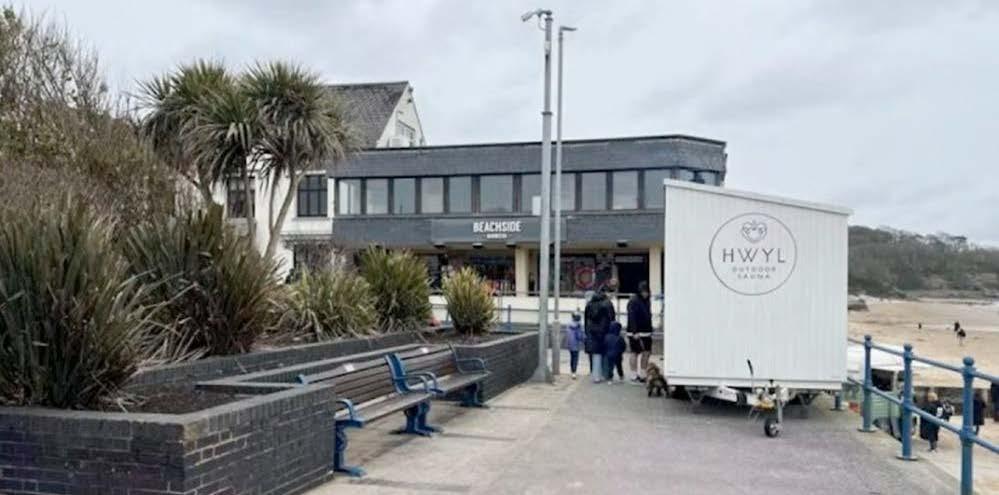
At the meeting, applicant Kerry Evans said the sauna had been a “successful local business,” which had attracted thousands to the village with a thriving community around it, with donations to charities and local fundraisers. She said the current location against beach-side railings was “fundamental to its success,” providing users with “privacy and dignity,” while allowing them stunning views across the bay.
After the scheme was refused committee members had expressed their hopes a different harbourside location could be found for the sauna.
Speaking after the planning refusal, Kerry Evans said she had started the early stages of a potential appeal over the decision by writing to Planning and Environment Decisions Wales
(PEDW), adding: “We had amazing support from Cllr Chris Williams and [former county councillor] Phil Baker, [and a petition of some 600 signatures in support]; we had all the right people in the right places but it wasn’t actually been taken on board.”
On the reasons for refusal, Kerry said the flood risk issue seemed “a little bit nonsensical,” with the sauna operating for two years without any issues, the mobile sauna being moved in poor weather conditions as “it would be foolish to leave it there”.
On potential alternative locations, she said: “If there was somewhere suitable I’m obviously happy to look at that, but having explored it quite extensively there aren’t many areas; there’s a need for privacy, I have no control about who would be looking through the window.
“Part of the magic of that sauna is the view and the magic of the
Pembrokeshire coast with the amazing light; people feeling slightly uptight come out relaxed, there’s a sense of space and connection with the outside world, which is hugely important for us as human beings.” She went on to say: “We’re trying to arrange a meeting with the officers and the CEO of the harbour,” adding: “Everyone said ‘we want this business to work,’ if they’ve got a genius idea, I’m open to suggestions.
“To me it seems like a real shame it’s been refused, the only material change is it’s now proven to be a safe and successful business.
“It’s a frustration, all that hard work is being put in jeopardy by this decision.” Since the refusal, a change.org petition entitled Save Hwyl outdoor sauna Saundersfoot, has been set up, attracting more than 300 signatures to date.
TRIBUTES have been paid to Gareth Griffiths, who worked for one of Pembrokeshire’s largest and bestknown haulage firms for more than three decades.
Mansel Davies Group announced that its former employee sadly passed away on Monday, July 13.
During more than 30 years with the company, Gareth carried out a variety of roles, including tipper driving and vehicle recovery work.
The company shared a photograph of Gareth standing beside one of its distinctive Volvo lorries and paid tribute to his many years of dedicated service. Gareth will be laid to rest at Hermon Chapel at 11:00am on Saturday, August 1.
The thoughts of his former colleagues are with Gareth’s family and friends. Cysga’n dawel, Gareth.


THE PORT OF MILFORD HAVEN has appointed two new NonExecutive Directors as it prepares

for a period of major investment in renewable energy, the Celtic Freeport and the wider economy of south-west Wales.
Dr Rebecca Heaton and Owen Davies will join the Port’s board later this year, bringing extensive experience in sustainability, energy transition, regional development and regeneration.
Dr Heaton has worked in sustainability and climate policy for more than 25 years, holding senior positions with organisations including Lloyds Banking Group, Drax Group, OVO Energy, Shell and BP.
Her experience includes governance, commercial strategy, risk management and stakeholder engagement. She has also served on the Climate Change Committee and the Natural Environment Research Council.
Dr Heaton said the Port occupied a central position in Wales’s energy system and had an opportunity to help deliver long-term economic and environmental benefits.
She said: “Having lived in Wales for more than 30 years, I have seen the vital role that infrastructure, industry and energy play in supporting communities and creating economic opportunity.
“The Port sits at the heart of Wales’s energy system and has a unique opportunity to help shape a stable and sustainable future.”
Mr Davies joins the board with more than 30 years’ experience in regional development, town planning and placemaking.
A Chartered Town Planner and Fellow of the Institute of Place Management, he has advised the Welsh Government on regional economic frameworks, town centre regeneration and community engagement.
He has also worked as a UK Government High Streets Task Force expert and has been involved in regeneration and masterplanning projects in waterfront and coastal communities, including Pembrokeshire.
Mr Davies currently runs his own consultancy and holds several advisory and governance positions, including with the Canal & River Trust in Wales and the Plas Gunter Mansion Trust.
He said: “The Port occupies a uniquely important position within Wales as a major economic driver, a nationally significant energy gateway and the custodian of one of our most important natural assets.
“Pembrokeshire and southwest Wales are entering a period of significant opportunity, with investment in renewable energy, the Celtic Freeport and wider economic development helping to shape the region’s future.”
The appointments come as Debra Bowen Rees and Erica Cassin complete their terms as NonExecutive Directors.
Dr Sian George, Chair of the Port of Milford Haven, welcomed the new members and thanked the departing directors for their service.
She said: “Rebecca and Owen bring outstanding experience and expertise that will further strengthen the breadth of skills and perspectives around our board table.
“The Port has a unique responsibility as a Trust Port to balance commercial success with our role as custodians of the Milford Haven Waterway and as a key contributor to regional prosperity.”
Dr George said both new directors shared the Port’s commitment to sustainable growth and long-term investment.
She added: “I would also like to express my sincere thanks to Debra Bowen Rees and Erica Cassin as they complete their terms on the board.
“Both have made a significant contribution to the Port during a period of considerable progress and transformation.”
The Port of Milford Haven is Wales’s busiest port and handles around 20% of Britain’s seaborne oil and gas trade. It also owns and operates Pembroke Port and Milford Waterfront, with its activities supporting more than 4,000 jobs in and around Pembrokeshire.
A NEW housing development in Hook is helping local families remain in rural Pembrokeshire amid growing concerns over the availability and affordability of homes.
Harcourt Close includes a mixture of two to five-bedroom properties, designed for households ranging from first-time tenants and smaller families to larger, multi-generational families.
The homes have been built to modern standards and include energy-efficiency measures aimed at reducing running costs and supporting more sustainable living.
The development includes both social housing and intermediaterent properties, providing affordable options for people with differing levels of housing need.
Social housing is intended for households in the greatest need, while intermediate rent provides an alternative for working households that may not qualify for social housing but are struggling to meet the cost of renting privately.
A Local Lettings Policy has also been introduced, giving priority to applicants with strong connections to Hook and the surrounding area.
Pembrokeshire County Council said the policy had helped residents remain close to relatives, schools, employment and existing support networks.
One resident said the policy had enabled her family to remain in the community where she had grown up.
She said: “I have lived in Llangwm all my life, and the Local Connections Lettings Policy meant that I was able to secure a family home in the same area where I grew up.
“This has allowed me to remain close to family and friends and means that my daughter can attend the same primary school that I did.”
Housing availability has become

an increasing concern across rural Pembrokeshire, where rising property prices, private rents and the number of second homes have made it more difficult for some local people to remain in their communities.
Councillor Michelle Bateman, Pembrokeshire County Council’s Cabinet Member for Housing, said Harcourt Close was providing muchneeded affordable homes.
She said: “Harcourt Close is
providing much-needed affordable homes for local people while helping to keep families connected to their communities.
“The mixed-tenure approach ensures a range of housing options for residents, supporting those in greatest need as well as working households looking for an affordable home.
“This development demonstrates the positive impact that well-planned affordable housing can have, not only by providing quality homes but also by helping communities to thrive
and remain sustainable for future generations.”
The council said the scheme formed part of its wider effort to meet local housing demand and support sustainable rural communities.
Anyone wishing to apply for one of the properties must have an up-todate housing application.
Further information is available by emailing devCLO@pembrokeshire. gov.uk, calling 01437 764551 or visiting the Pembrokeshire County Council Housing Services Facebook page.
FIREFIGHTERS at Pembroke Dock Fire Station are looking forward to welcoming the local community to their annual Open Day on Wednesday, July 29, from 10am to 4pm.
The free, family event promises a fun-filled day for all ages, offering visitors the chance to meet their local Firefighters, learn more about the vital work of Mid and West Wales Fire and Rescue Service and enjoy a range of activities and attractions.
There will be plenty to see and do throughout the day, including live demonstrations, fun activities, refreshments and much more!
Proceeds from the event will support the Fire Fighters Charity, which provides specialist, lifelong support to serving and retired members of the Fire and Rescue Services community, and their families.
The Open Day offers a great opportunity to connect with your local fire crew, discover important fire safety advice, explore community prevention work, and see firsthand how Firefighters help keep communities safe every day.
Bring your family and friends to join the Firefighters for an enjoyable day of community engagement and family entertainment.


On Saturday 1st August will see the return of the Llandeilo Antiques and Vintage Fair. The Llandeilo Fair can be located in the heart of Llandeilo, close to the main car park. Here you will find a bustling, vibrant Fair with lots of antiques and vintage to wet your appetite. The fair now includes a vintage element with a touch of retro.
The fair at Llandeilo brings a surprising diversity of antiques on display.Bargain Hunt recently filmed their popular show at this event and both contestants and experts , thoroughly enjoyed the experience . The blue teams were led by Irita Marriott who was their expert for the day and is an antique expert and dealer, known for her role as an expert on BBC1’s Antiques Road Trip,Celebrity Antiques Road Trip, Bargain Hunt and Channel 4’s The Greatest Auction.
Irita, from Latvia, came to the UK at the age of 20 .

She has spent nearly a decade working in the antiques and dealing industry. She previously worked as a cataloguer and a valuer in a leading auction house based in Derbyshire. Now, she deals with the precious and beautiful items full time.
Irita was first seen on the TV screens in the UK in 2021 when she joined the Antiques Road Trip team and then became one of the presenters on Bargain Hunt.
In 2023, she opened Irita Marriot Auctioneers and Valuers – one of very few female-led auction houses in the uk.
The red teams were enthusiastically led by John Cameron . John is a familiar face on our screens thanks to his regular appearances on BBC One’s Bargain Hunt .The antiques expert began his TV career two decades ago on Cash in the Attic and Put Your Money Where Your Mouth, making him a permanent fixture of the BBC’s daytime schedule.
While John initially trained as a
carpenter and joiner. A re-occurring back problem forced him to give up his physical job and return to college ,where he undertook a three-year degree course at Southampton, studying fine art valuation he later became a chartered surveyor of antiques and fine art ,after further studying.He has become a regular expert on Bargain Hunt.
The red and blue teams were set tasks of finding 3 items, one of which had to be about a certain theme., their challenge item, such as art deco piece or sourcing an item related to the armed services, then an item had to be purchased for over £75. They certainly enjoyed the foraging and spending the money allocated to them. Eric Knowles was the presenter and he enjoyed going around the fair chatting to the public and stall holders . Filming went on all day and 2 sets of teams were filmed in the morning and another two sets were filmed at the fair after lunch . At the beginning of the challenge
each teams were given £300 from the presenter Eric Knowles , with which to purchase antiques. The objective is to find items that will earn the teams a profit when later sold at auction. Each team is accompanied by their expert, though it is the contestants’ decision whether to heed the advice , given by their expert.
It was entertaining to see Eric Knowles the presenter , approaching visitors with a mystery item that they had to guess its use. Lots of laughing was heard .He also was available to answer questions from visitors , offer his expertise when asked advise about a piece of pottery. He made purchases himself , as did a lot of the production team.
The items that the various teams purchased at the fair will be taken off to auction within the next month . At the auction, as each item is sold, the host compares the auction sale price to the price originally paid by the team. If the final total shows a profit, the team receives that profit in cash;

otherwise, the team receives nothing.
The show will be screened later on in the year.
As usual there will be lots of Welsh items on offer. Whether it’s an original Welsh watercolour or oil painting or a piece of Welsh pottery or examples of Welsh blankets and

textiles on display .
Attractive displays of gardinalia has proved extremely popular at the fair, including watering cans , wheel barrows and garden tools and large garden pots and urns.
The Llandeilo fair has a rich cross section of antiques and vintage on
display, from jewellery,watches, books, ephemera, postcards, militariaand vintage clothes and accessories. There will also be collections of glass and up cycled and pre loved furniture, plus interior design pieces. I’m sure visitors will not be disappointed with the selection

on offer at this popular fair, especially as there will some outside stands to browse.
Homemade refreshments will be available and doors open at 10 am until 4pm.Admission is just £2 and dogs are allowed admission.

THE WELSH AMBULANCE SERVICE is inviting members of the public to attend its Annual General Meeting and bi-monthly Board meeting later this month.
The AGM will be held online via Microsoft Teams on Thursday, July 30, from 9.30am until 10.45am.
Members of the Board will provide updates on the Trust’s performance and financial position, as well as discussing its annual report and accounts for 2025/26.
There will also be an opportunity for stakeholders and members of the public to submit questions.
Colin Dennis, Chair of the Welsh Ambulance Service, said: “Our AGM is an important opportunity to reflect on the achievements and progress of the past year and the impact these have had on our services.
“This includes transforming the way we deliver services to provide patients with the right advice and care, in the right place, every time.
“It also gives us the chance to look ahead, share our vision for the future and explain the actions we are taking to achieve it.”
Questions can be submitted during the AGM using the Microsoft Teams Q&A function.
Alternatively, questions can be sent in advance by emailing AMB_AskUs@ wales.nhs.uk before Wednesday, July 29.

They will also hear from Lucy Burrows, whose young son lives with a range of physical and neurodiverse conditions.
The Trust’s bi-monthly Board meeting will take place immediately after the AGM, beginning at 11am.
During the meeting, Board members will hear the findings of the Good Governance Institute’s recent external review of the Trust Board’s effectiveness.
Ms Burrows will speak about her family’s experience of the patient-centred care provided by an attending Emergency Medical Service crew.
An agenda for the Board meeting is expected to be published on the
Welsh Ambulance Service’s website shortly.
Questions for the Board can also be submitted in advance by emailing AMB_AskUs@wales.nhs. uk by Wednesday, July 29.
The Microsoft Teams links for both meetings will become active around ten minutes before each meeting begins.
THE SALVATION ARMY is helping families across Wales cope with the additional cost of the school summer holidays by providing free meals for children and free school uniforms ahead of the new academic year.
Its church and community centre in Mold is opening from 9.30am until 3pm, Tuesday to Saturday, throughout the Welsh school holidays.
Free meals are available to all children aged under 16, with no requirement for accompanying adults to purchase anything.
Major Michelle Hayter said the scheme had made a significant difference to families in the area over recent years.
She
said: “If your children usually receive free school meals, suddenly having to provide lunch, snacks and activities every day can be costly.
“By offering free meals, we are helping families free up money so they can enjoy the fun things their children want to do.
“When we remind parents that the meals are free, you can see the smile on their faces.”

The Mold centre is also holding recycling-themed craft sessions on selected days, including activities such as making mosaic coasters, decorating jars and creating bird
feeders.
The charity is also supporting parents who may already be concerned about the cost of buying school uniforms for September.
Salvation Army charity shops and donation centres across Wales are offering free school uniform items, subject to availability.
Donation centres in Gorseinon, Swansea, and Cardiff have already distributed more than 3,000 items donated by Bridgend-based school uniform supplier Euroschools Direct.
Craig Mawer, manager at Euroschools Direct, said the company wanted its unused stock to benefit families rather than go to waste.
He said: “We are really pleased the uniforms have been able to support
The Salvation Army’s work.
“When we realised we had unused stock, we wanted it to make a genuine difference rather than end up as waste.
“The Salvation Army felt like the right choice because of its strong community presence and the support it offers to parents facing financial pressure.”
Families seeking help are advised to contact their nearest Salvation Army church, community centre, charity shop or donation centre to find out what support is available locally.

A GRIEVING mother is preparing to leap from an aircraft at 15,000 feet in memory of her much-loved son, while raising money for two Pembrokeshire organisations close to her heart.
Tina has booked a tandem parachute jump to honour her son, Luke Foster, who died suddenly on March 12, 2024, aged just 37.
Luke would have celebrated his 40th birthday on August 23 this year, and Tina hopes to complete the jump on that date alongside her boss, Sam Warden, who has volunteered to take part with her.
Money raised through the challenge will be divided between Get The Boys A Lift and Windswept Watersports, two not-for-profit community interest companies working to support people in Pembrokeshire.
Tina said: “In honour of my beloved son Luke, who very sadly passed away suddenly, I have booked a tandem parachute jump at a height of 15,000 feet.
Tom Sinclair editor@herald.email
“Luke should have been celebrating his 40th birthday on August 23, so I’m hoping it will be possible to jump on the day of his birthday alongside my amazing boss Sam Warden, who has kindly agreed to support me and jump with me.”
Support following Luke’s death
Get The Boys A Lift was established by a group of friends in 2016 and uses income from its Haverfordwest coffee shop, clothing sales and fundraising activities to provide free and easily accessible mental health support.
Tina said the organisation had supported her through an extremely difficult period following the loss of her son.
She said: “After walking into their café in Haverfordwest, then breaking down into floods of tears as soon as I tried to speak,

would have readily approved, as he had suffered badly with his own mental health for many years.”
Accessible watersports facilities
The second beneficiary, Windswept Watersports, works to provide affordable and inclusive watersports activities for people of all ages and backgrounds, with a particular focus on disabled and disadvantaged groups.
Tina has seen the organisation’s work through her employer, Value Independence CIC, whose disabled clients have taken part in activities including paddleboarding and supported sessions in the sea.
Funds raised through the parachute jump will help Windswept Watersports develop a changing area with accessible facilities.
The planned space would provide wheelchair users with a safe and dignified place to change and would include specialist hoisting equipment.
the Get The Boys A Lift staff comforted me with compassion, much-needed hugs and a long chat.
“That then led to them providing me with weeks of counselling.
“If I could raise some funds for them to carry on doing just that for others, I would be so grateful. I know my Luke
Tina added: “I would be so grateful if people could donate, no matter how big or small, as anything would be greatly appreciated.
“If you are unable to donate, you could still help by sharing the fundraiser far and wide.”
Donations can be made through Tina’s JustGiving page: HERE.


PLANS to change a former hairdressing salon in Pembrokeshire’s only city to a family-friendly coffee bar have been approved by the national park. In an application to Pembrokeshire Coast National Park, Gerallt Nash

sought permission for a change of use of 26 High Street, St Davids from a hairdressing salon to a family friendly coffee bar and children’s playroom.
The first floor, formerly used as accommodation of a tenant, would be used as an office and storage of business.
A supporting statement said: “It is proposed to open a family-friendly coffee bar with a children’s playroom on ground floor. It is not intended to cook food on the premises, therefore there will be no requirement for an extractor system.
“Other than small scale repairs to part of one floor, and the installation of a sink and serving counter in the inner room (plumbing and electrics are already in place since its last use as a salon) the main work will be the redecoration of surfaces and ceilings, the provision of new light fittings and laying of new floor coverings.
“This part of High Street has been identified as a ‘commercial’ zone by PCNPA. Existing businesses close to No 26 include outdoor and surfing outlets; restaurants; clothes shops; holiday accommodation; ice cream parlour; fish and chips outlet; delicatessen and craft shops.
“The current proposal would fill a gap in the market, as most food outlets do not open until after 11am or 12pm, or only during the evenings in some cases. It would also provide somewhere for [young] families to go to unwind whilst their children can relax in the playroom.”
The scheme was supported by St Davids City Council but one representation from a member of the public raised concerns about potential noise, smells and risk of vermin from waste storage on site.
An officer report said the county council’s public protection team has been consulted and has no objections to raise, adding the application states there is no intention to cook on the premises; the opening hours listed as 8am-6pm, Monday to Friday, and 8am7pm on Saturdays.
In recommending approval, it said:
“There are no concerns in relation to significant impacts upon amenity, subject to a condition relating to opening hours, and it is not considered that the proposal would have an impact upon the character or appearance of the St David’s Conservation Area.”
The application was conditionally approved.

A NEW community dining initiative has enjoyed a successful opening night, welcoming a packed gathering to Fishguard Town Hall for an evening of affordable food and friendly conversation.
Ford Pawb, also known as Everyone’s Table, has been launched by the Fishguard Bay Sustainable Food Initiative CIC and will serve a low-cost, nutritious meal open to everyone on Monday evenings.
The first event attracted residents of all ages, with tables filling as people gathered to eat, catch up with friends and meet others from the community.
Guests were served vegetable lasagne with potatoes and salad, followed by a fresh garden berry crumble and a selection of nonalcoholic drinks. Much of the food was locally sourced, with diners praising both the generous portions and the quality of the meal.
Flowers decorated the tables, adding to the welcoming atmosphere, while music followed the meal as guests continued to socialise.
Behind the scenes, a team of volunteer cooks and servers worked throughout the evening to prepare and serve the food, clear tables and ensure the new project got off to a smooth start.
Organisers hope Ford Pawb will provide more than simply an affordable meal. The weekly gatherings are also

intended to offer a warm and inclusive place where people can spend time together, reduce social isolation and strengthen community connections.
The strong turnout on the opening night demonstrated the appetite
for such an initiative in Fishguard and Goodwick, and organisers and volunteers were congratulated for their hard work in bringing the project to life.


COMMUNITIES across Wales are set to benefit from stronger local planning services following the announcement of almost £450,000 to train and retain the next generation of planners.
The Welsh Government has confirmed £447,400 for two bursary programmes which could support up to 19 people to gain professional planning qualifications.
The existing Pathways to Planning bursary scheme will receive £126,000,
editor@herald.email
enabling up to seven junior planners to complete fully funded postgraduate study.
A further £321,400 will be invested over three years in a new Mid and West Wales Rural Planners bursary scheme, designed to address recruitment and retention difficulties in rural authorities. The programme will support up to 12

graduates and existing local authority staff to study for Royal Town Planning Institute-accredited postgraduate qualifications while continuing to live and work in their local communities.
It will operate across Ceredigion, Pembrokeshire, Powys, Pembrokeshire Coast National Park and Eryri National Park.
The scheme will also place a strong emphasis on supporting Welshspeaking graduates and developing locally based professionals with an understanding of the communities they serve.
Cabinet Minister for Local Government, Housing and Planning Siân Gwenllian said effective planning departments were vital to the future of communities across Wales
She said: “Good planning services are the backbone of thriving communities. They shape where homes are built, where businesses grow and how we protect our natural environment, but too many rural areas in Wales are struggling to recruit and retain the planners they need.
“That is why I joined a roundtable at the Royal Welsh Show this week with rural council leaders, including the leaders of Ceredigion and Powys, to hear directly about the pressures they face.
“These bursary schemes are a direct response to what we heard, investing in local talent, supporting Welshspeaking graduates and growing the planning workforce from within the communities it serves.”
Ceredigion County Council will lead the delivery of the rural programme in partnership with the other participating authorities.
Council leader Cllr Bryan Davies said the initiative demonstrated what rural authorities could achieve by working together to tackle shared workforce challenges.
He said: “Ceredigion has been proud to lead the development of this regional initiative, working with our partners to create new opportunities for local people to build professional careers in planning while remaining in rural Wales.
“By investing in home-grown talent, supporting Welsh-speaking graduates and strengthening the skills we need for the future, we are helping to ensure that mid and west Wales has the capacity, expertise and local knowledge required to shape thriving, sustainable communities for generations to come.
“We thank the Welsh Government for the opportunity to develop this ‘grow your own’ planners approach.”

Recent labour market statistics continue to demonstrate positive employment trends across Wales. There are currently 1.513 million people in employment nationally, an increase of 36,000 on the quarter and 37,000 on the year. The employment rate now stands at 73.0%, up 1.2 percentage points on the quarter and 0.8 percentage points on the year.
Across South-West Wales, the latest figures also highlight the valuable support being delivered by DWP Specialist 50 Plus Work Coaches. In Neath Port Talbot, the number of unemployed people aged 50 and over has fallen by 12% over the past year, with around half of this reduction occurring within the Aberafan and Maesteg constituencies. This reflects the ongoing commitment of Jobcentre teams to help experienced workers return to and thrive in employment.
Movement to Work: Breaking the ‘No Experience, No Job’ Cycle
The Civil Service’s Movement to Work programme provides unemployed young people aged 18 to 24 with meaningful work placement opportunities lasting between four and six weeks.
One success story comes from Callum Luker from Aberdare, who had no previous work experience before claiming Universal Credit, had never attended a job interview, and faced health-related challenges.
Following successful placements at Aberdare Jobcentre and HMRC, Callum was delighted to be offered a two-year fixed-term position with HMRC, commencing in September 2026.
Callum Luker said:
“I’d like to thank everyone at Aberdare Jobcentre for giving me the opportunity to take part in the Movement to Work scheme. I’d also like to thank Wayne, Louise, Lynfa and Jo for putting my name forward, along with the HMRC Movement to Work team, Toby, Ben, Joanne, Huw and Joel, for their support and for believing in me throughout the placement.”
More Support for Young People
in Bridgend, Rhondda Cynon Taf and Neath Port Talbot
Young jobseekers across the region will have the opportunity to meet employers and explore career opportunities at the DWP Ready, Set, Work Youth Jobs Fair 2026, taking place at Off Grid Bridgend, Waterton Industrial Estate, on Wednesday 23 July.
The event will run from 10:00am to 4:00pm, with a dedicated quiet hour between 10:30am and 11:30am to support neurodiverse customers and those attending with appointees.
More than 20 major employers are expected to attend, including:
• Bridgend County Borough Council
• EE
• Companies House
• CITB
• South Wales Police and a range of other organisations offering employment, training and apprenticeship opportunities.
Sian Davies, Recruitment Consultant Manager for Bridgend, Rhondda Cynon Taf and Neath Port Talbot, said:
“We are committed to helping employers fill their vacancies and connecting local people with quality employment opportunities. Our Jobcentres regularly organise recruitment events such as job fairs, bringing multiple employers together under one roof. We can also work with businesses to develop Sector-based Work Academy Programmes and skills bootcamps, helping candidates gain the skills and confidence needed to succeed in the workplace.”
Jobseekers are also encouraged to explore the wide range of vacancies currently available through the Government’s Find a Job service.
Join the Civil Service as a DWP Work Coach
DWP is currently recruiting for permanent Executive Officer Work Coach positions across sixteen Jobcentres throughout South-West Wales.
Applications are now open via the Civil Service Jobs website, with a closing date of 11:55pm on

Wednesday 29 July 2026.
Work Coaches play a vital role in supporting people into employment, helping customers overcome barriers, build skills and achieve their career goals.
Government Response
A UK Government spokesperson said:
“While it is encouraging to see unemployment fall slightly, too many young people remain locked out of work.
For too long, governments have paid for failure rather than invested in people’s success. We are determined to change that by creating real opportunities for young people, reforming education so everyone has a clear pathway into good jobs, and providing the support people need to secure, sustain and progress in employment.”


AB Campers has expanded across South West Wales, launched a try-before-youbuy hire service and is offering a special pop-top roof package throughout July

WHAT began as a shared campervan project between a father and son has grown into an awardwinning West Wales business employing more than a dozen people and serving customers across the UK.
AB Campers was founded by experienced automotive engineer Adam Bush, who had worked with vehicles since the age of 16.
After building a campervan alongside his son, Adam recognised an opportunity to combine his decades of technical experience with his passion for vehicles, craftsmanship and outdoor adventure.
Today, the family-focused company is owned and directed by long-time friends Adam Bush and Mat Williams. Adam’s son remains an important part of the workshop team, helping to deliver the conversions and specialist installations for which the company has become known.
From its headquarters near Carmarthen, AB Campers provides complete campervan conversions, part conversions, repairs, upgrades, upholstery, electrical work and specialist installations.
The company also manufactures many of its own products, including bespoke campervan furniture and rock ’n’ roll beds, giving it control over almost every stage of a conversion.
Adam said: “Winning this award
Luke
Sinclair Luke@herald.email
is an incredible achievement for the whole team.
“It’s recognition of the passion, craftsmanship and dedication that goes into every campervan we build.
“We’re proud of how far we’ve come, but even more excited about what’s ahead as we continue to grow and help
more people experience the freedom of campervan life.”
AB Campers was named Campervan Conversion Company of the Year 2025/26 at the Wales Prestige Awards and also received the Business Choice Award at the Business Growth

West
The recognition has helped generate a significant rise in customer enquiries and demand for the company’s services.
AB Campers has now expanded into three premises across South West Wales and opened a dedicated forecourt offering fully converted, adventure-ready campervans for immediate purchase.
The business has also experienced increased demand for the products it manufactures and supplies to both private customers and other campervan

conversion businesses throughout the UK.
Its team of more than a dozen people includes directors, office and marketing staff, engineers and experienced technicians.
The workshop, showroom and forecourt are open from Monday to Saturday, between 9.00am and 5.30pm, allowing customers to view available vehicles, explore conversion options and discuss their plans with the team.
AB Campers also operates through installation centres covering Cheshire, South Wales, Kent, Hampshire, Northamptonshire and Devon.
The company says one of its biggest differences is the amount of work it carries out in-house.
Its team designs, CNC-machines, manufactures, stocks, builds and installs the majority of the products used in its conversions, rather than relying heavily on outside suppliers.
This means customers can approach AB Campers for anything from fitting a single window or upgrading upholstery to installing a pop-top roof or commissioning a complete bespoke campervan.
By keeping the work under one roof, the business says it can maintain tighter quality control, reduce lead times and ensure each project meets the customer’s individual requirements.
AB Campers also holds what it says is the largest stock of rock ’n’ roll beds in Wales, with products available for immediate dispatch.
Whether the customer arrives with an empty van, a partly completed project or an existing campervan in need of repairs or improvements, the company can provide support at every stage.
Following its recent expansion, AB Campers has introduced a hire service for people who want to experience campervan life before buying a vehicle or commissioning a conversion.
Its four-berth Ford Transit Custom, named Doris, is available from £90 per night, with a minimum stay of two nights.
The vehicle includes air conditioning and heating, a pop-top roof with a scenic canvas, front swivel seats, a fridge-freezer, gas hob and running water.
It also comes with cruise control, automatic headlights and wipers, and parking sensors.
Insurance, a mileage allowance and breakdown cover are included, while children and pets are welcome.
Additional charges apply for pets.
The hire service can be used for anything from a weekend break to a longer family road trip.
It also allows potential campervan owners to test which features, layouts and equipment suit their needs before committing to a major purchase.
Customers who later commission a full conversion from AB Campers can receive up to 100 per cent of their hire costs back against the price of the conversion.
Mat Williams, director of AB Campers, said: “Our campervan hire service gives people the chance to experience the lifestyle before committing to buying their own van.
“Whether it’s a weekend escape or a family road trip, it’s the perfect introduction to van life.
“If customers decide to commission a conversion afterwards, we’ll deduct up to 100 per cent of their hire costs from their order.”
AB Campers is currently running a limited-time pop-top roof promotion for bookings made before July 31, 2026.
The supplied and fitted Raise the Roof package includes a scenic canvas upgrade and a carpeted pop-top bed board.
Prices are:
Short-wheelbase vans: £2,999 including VAT
Long-wheelbase vans: £3,249 including VAT
The offer is available across all van makes and models.
Customers must secure their booking with a deposit before July 31, but the installation can be arranged for any available date during the remainder of 2026.
A standard pop-top roof installation is normally completed within two days and comes with a comprehensive fiveyear warranty.
Adding a pop-top can provide valuable standing room inside a campervan and create an additional sleeping space, making it particularly useful for families or anyone hoping to maximise the available space in their vehicle.
From a simple upgrade to a complete bespoke build, AB Campers says its aim is to help customers create vehicles that are practical, comfortable and suited to the way they intend to travel.

Its services include:
• Complete and part campervan conversions
• Pop-top roof installations
• Campervan furniture and upholstery
• Rock ’n’ roll beds
• Electrical systems
• Repairs and upgrades
• Fully converted vans for sale
• Campervan hire
• Products manufactured in-house
Further information is available by visiting www.ab-campers.co.uk, calling 01559 742123 or emailing enquiries@ ab-campers.co.uk.



FAMILIES from across Pembrokeshire are being invited to enjoy an afternoon of music and entertainment at a special fundraising event in Haverfordwest.
The Maisie Moo Foundation Family Funday will take place at Haverfordwest High School on Saturday, August 8, from 12pm until 5pm.
The Pembrokeshire charity supports families whose children have been diagnosed with life-threatening illnesses. It provides financial help towards medical expenses, specialist equipment and the cost of travelling to hospital appointments and treatment.
Live entertainment will include a performance by 3 Man Jam from 12pm until 2pm, followed by Tom and Abz at 2.30pm.
Visitors will also be able to browse a variety of stalls, enjoy food and refreshments and take part in raffles.
Entertainment for younger visitors will include a magician and bouncy castles, with one of the inflatable attractions being provided free of charge.
Organisers are hoping the event will bring the community together for an enjoyable summer afternoon while raising awareness and support for the foundation’s work with families throughout Pembrokeshire.
Admission costs £3 per person, with a discounted family ticket for four people available for £10.
The event runs from 12pm to 5pm at Haverfordwest High School on Saturday, August 8.

An AERIAL circus theatre production exploring identity, migration and belonging will make the final stop of its Welsh tour at the Torch Theatre in Milford Haven this month.
Foreigner in My Body combines theatre, movement and aerial circus to tell a semi-autobiographical story inspired by artist Sara Hartel’s experiences as a trans person and a migrant living in Wales.
The one-person production includes integrated captions and audio description, making it accessible to blind, partially sighted, D/deaf and hard-of-hearing audiences. It is recommended for adults and young people aged 13 and over.
Sara Hartel, is an interdisciplinary artist born in Germany and now based in Wales. Their previous work has included combining gaming with live performance in GORE and encouraging audiences to challenge authority in Strike Ltd.
Foreigner in My Body brings together aerial circus and theatre with a humorous and tongue-in-cheek tone, while examining serious questions about identity, discrimination and finding a sense of home.
The creative team behind the
production includes composer Frances Bolley and movement artist Eddie Ladd.
Sara said: “I am so excited to be finally bringing this show, which I have been developing for many years, to audiences in Milford Haven.
“At a time of growing discrimination towards both migrant and trans communities, it is important for me to be able to share a semiautobiographical story centred in joy.
“I am also passionate about the show being as accessible as possible, with integrated captions and audio description for blind, partially sighted and D/deaf audiences.”
The production is touring five venues across Wales this summer, with the Torch Theatre performance marking the final date of the tour.
Foreigner in My Body has been made possible with support and funding from the Arts Council of Wales.
The show will be performed at the Torch Theatre, Milford Haven, on Wednesday, July 29, at 7.30pm.
Tickets cost £15, or £12 for concessions, and can be booked through the Torch Theatre website or by calling the box office on 01646 695267.
Battle scenes, cavalry displays and
MUSKET fire, mounted soldiers and marching French troops transformed Fishguard and Goodwick at the weekend as Britain’s last invasion was brought dramatically back to life.
Visitors gathered across the twin towns on Saturday and Sunday (July 18 and 19) for a large-scale re-enactment of the failed French invasion of 1797, the last occasion on which a hostile foreign army landed on mainland Britain.
The free two-day event featured living-history camps, military demonstrations, cavalry displays and staged fighting before reaching its climax with the surrender of the invading French force.
Costumed soldiers representing the French and British armies established military camps where visitors could see the clothing, equipment and living conditions experienced by troops at the end of the eighteenth century.
The action then moved to Goodwick’s foreshore, where mounted displays were followed by a recreation of the fighting which took place after the French landed on the north Pembrokeshire coast.
The defeated French forces later formed a procession through Fishguard, recreating their march into the town before the surrender negotiations associated with the historic Royal Oak.
The pub, which still stands on Fishguard Square, served as the headquarters of the British commander Lord Cawdor during the invasion and remains one of the most important surviving locations connected to the story.
The weekend marked 229 years since around 1,400 French troops landed beneath the cliffs at Carreg Wastad Point, near Llanwnda, on February 22, 1797. Led by the IrishAmerican Colonel William Tate, the force had crossed the sea as part of a wider French Revolutionary plan to undermine Britain and encourage an uprising against the government.
Many of the troops belonged to the Légion Noire, or Black Legion, so called because of the dark uniforms
a
surrender procession brought one of
Pembrokeshire’s
most extraordinary stories back to the streets

black hats were mistaken by the French for additional British soldiers.
marched down towards Goodwick Sands, laid down their weapons and became prisoners.
The campaign had lasted little more than two days.
Despite its short duration, the invasion secured Fishguard’s place in British military history and created a story which continues to shape the identity of the town more than two centuries later.
That history is permanently recorded in the Last Invasion Tapestry, housed inside Fishguard Town Hall.
Created to commemorate the bicentenary of the invasion in 1997, the 100-foot embroidered work depicts the French landing, the response of local people and the eventual surrender.
they wore.
The French expected to receive support from the local population. Instead, their arrival caused alarm across Pembrokeshire as news of the landing spread through Fishguard, St Davids, Haverfordwest, Milford Haven, Pembroke and the surrounding countryside.
Residents armed themselves with whatever was available, while militia, sailors, volunteers and cavalry began assembling to confront the invaders.
The French operation soon descended into disorder.
Some soldiers left their positions to search local farms and homes for food and drink, while others abandoned their units altogether. The ships which had carried them to Pembrokeshire also departed, leaving Tate and his men without an easy means of escape.
British forces were gathered under Lord Cawdor, who established his headquarters at the Royal Oak after marching north with local volunteers, militia, sailors and members of the Pembroke Yeomanry Cavalry.
The gathering of troops and civilians on the hills surrounding Fishguard may have created the impression that the defending force was far larger than it really was.
According to one of the best-known versions of the story, local women wearing traditional red shawls and tall

The tale has become deeply woven into Fishguard folklore, although historians continue to debate exactly how much influence the women’s appearance had on Tate’s decision to surrender.
Another central figure in the story is Jemima Nicholas, remembered in Fishguard as Jemima Fawr, or Jemima the Great.
Tradition holds that Jemima armed herself with a pitchfork, confronted a group of French soldiers and marched 12 of them back into Fishguard, where they were confined inside St Mary’s Church.
Although the precise details cannot be fully verified through contemporary records, Jemima became a celebrated symbol of the courage and determination shown by local people during the invasion.
Her story featured prominently during the weekend’s re-enactment, which included a recreation of the French surrender to local forces and Jemima Nicholas.
By the evening of February 23, 1797, Tate’s position had become increasingly desperate.
Two French officers were sent into Fishguard seeking terms, but Lord Cawdor refused to accept a conditional agreement. He demanded the complete and unconditional surrender of the invasion force.
The following day, the French
Its narrative style was inspired by the Bayeux Tapestry, with dozens of local volunteers spending several years creating a detailed visual record of the invasion.
Visitors attending the re-enactment were also encouraged to explore the wider history of Fishguard and Goodwick through a heritage trail linking 46 locations across the twin towns.
The trail covers more than 2,000 years of history, ranging from Iron Age settlement and the French invasion to the suffragette movement and the filming of the 1956 screen adaptation of Moby Dick.
For Fishguard and Goodwick, the re-enactment is more than a military display.
It gives residents and visitors an opportunity to walk through the locations where the events unfolded, see the uniforms and weapons of the period and understand the role played by ordinary Pembrokeshire people.
It also ensures that the history is passed to a new generation in a form which is immediate, accessible and entertaining.
More than two centuries after Tate’s army appeared off the Pembrokeshire coast, the sight of French troops marching through Fishguard once again showed why the last invasion remains one of the county’s most remarkable and enduring stories.

THE IMPERIAL HOTEL in Tenby has announced plans for its biggest August Bank Holiday celebration yet, with four days of music, entertainment and community events overlooking South Beach.
The programme will run from Friday, August 28, until Monday, August 31, building on the hotel’s popular Tenby Rocks terrace sessions, which have taken place every Saturday throughout the summer.
Celebrations will begin on Friday evening with a ticketed event featuring DJ Mammoth, also known as Steve Dickson, who will perform a selection of Ibiza classics and house music.
Guests will also be served a specially prepared set menu in the hotel’s Essence restaurant before the evening continues with music and dancing overlooking the coastline.
Tickets for the Friday event cost £25 per person.
On Saturday, Tenby Rocks will return from midday until 7pm, with music and cocktails served on the terrace throughout the afternoon.
Presenters and DJs from Pembrokeshire radio station Pure West will take over from 5pm until 7pm.
A special community-focused event will then be held on Sunday from 5pm until 10pm.
The hotel has not yet released full details, but organisers say the evening will be designed to bring residents and visitors together in a celebration of Tenby and its community.
The weekend will conclude on Monday with live entertainment from

of the Bank Holiday.
Amelia Parkes, Group Marketing Executive at Crest Hotels, said: “Our Tenby Rocks afternoons

have become a real highlight of the summer, attracting both local residents and visitors who love the relaxed atmosphere, great music, cocktails and unbeatable views from the Imperial Hotel.
“For the August Bank Holiday, we wanted to create something even bigger by extending the celebrations across the entire weekend.
“Whether you are joining us for our ticketed Friday evening, enjoying DJ sets with Pure West on Saturday, discovering our Sunday community event or relaxing with music on Monday, there is something for everyone.
“Tenby is one of the UK’s favourite seaside destinations, and we are looking forward to welcoming guests from across Pembrokeshire for what promises to be an unforgettable Bank Holiday weekend.”
The celebrations are expected to add to the atmosphere in Tenby during what is traditionally one of the town’s busiest weekends of the summer.
Tickets for Friday evening are available through the Imperial Hotel Tenby website, with further details about Sunday’s community event due to be announced in the coming weeks.
THERE is something particularly special about watching a children’s cast take to the stage, and Robin Hood: The Legend of the Black Knight, presented by Torch Youth Theatre, was a wonderful example of just how much talent, enthusiasm and confidence young performers can bring to a show.
The production offered a brand-new retelling of the timeless Robin Hood legend, transporting audiences into the heart of Sherwood Forest.
The story follows Robin Hood, Maid Marian and a host of familiar characters as they fight for freedom against the tyranny of Queen Eleanor and the ruthless Sheriff of Nottingham. With daring escapes, a legendary archery contest and the mysterious presence of the Black Knight, there is plenty to keep audiences entertained.
From the outset, the production felt well organised and ran remarkably smoothly, with no noticeable hiccups. The set was simple and minimalistic, which worked particularly well. Rather than distracting from the action, it provided an effective backdrop that allowed the cast and story to remain the focus.
The lighting was another real highlight. It was beautifully executed throughout, helping to establish the mood and tone of each scene while adding to the overall atmosphere of the production. The timing was excellent, and there were no noticeable technical issues.
The costumes were also a real highlight and helped bring the characters and story to life. They were well designed, colourful and suited the production

Rieve Nesbitt-Marr
rieve.nesbitt-marr@herald.email
perfectly, adding to the overall visual appeal of the show. It was clear that a lot of thought had gone into making sure each character looked the part.
The props were also well chosen and surprisingly realistic. One particular detail that caught my attention was the Ring of Power, which looked wonderfully sparkly

under the stage lights and added a lovely touch of magic to the production.
The sound was generally clear, and the children did an excellent job of projecting their voices. There were a few moments when the sound seemed to drift slightly, and some lines were harder to hear when there was additional commotion happening on stage. However, this was only a minor issue, and overall the cast communicated confidently and clearly.
The performances themselves were a real strength of the show. While the entire cast deserves credit for the effort and commitment they brought to their roles, a few performers particularly stood out. Maid Marian was absolutely brilliant and showed an impressive level of confidence and natural ability. She is clearly a very promising young performer, and it would be wonderful to see where her talent takes her in the future.
The adult Robin Hood was also excellent and, in my opinion, perfectly cast. Together, they provided a fantastic opportunity to showcase two very talented performers, and both certainly rose to the occasion.
The comic relief was another highlight, with some genuinely entertaining moments throughout. The brief singing with the ukulele, along with Steven’s contribution, brought plenty of fun and energy to the production and added to the enjoyment of the audience.
What impressed me most, however, was the confidence and commitment of the entire cast. Every performer played their part with enthusiasm, and I was particularly impressed by how well the younger children handled themselves on stage. It is no small achievement to perform in front of an audience, and they should all be incredibly proud of themselves.
The inclusion of Welsh-speaking
elements was also a lovely touch. It fitted naturally into the production and added a sense of local identity, making the show feel particularly well suited to its setting.
Away from the stage, the theatre itself was clean and welcoming, with comfortable seating and a good selection of snacks and drinks available, including during the interval. These small touches helped make the whole experience feel relaxed and enjoyable. Perhaps the greatest compliment I can give the production is the atmosphere in the theatre. Throughout the performance, the audience appeared completely at ease and engaged. It was lovely to see families enjoying the show together, with siblings cuddling up and parents sitting back, relaxed and entertained.
Overall, Robin Hood: The Legend of the Black Knight was a thoroughly enjoyable production that showcased an impressive amount of young talent. The cast performed with confidence, energy and enthusiasm, supported by effective lighting, a well designed set, fantastic costumes and some lovely production details.
There was a real sense of warmth and community throughout the evening, and it was clear how much work had gone into bringing the production to life. With tickets priced at £10, or £8 for concessions, the production offered an affordable opportunity for families to enjoy a night of live theatre while supporting the next generation of young performers.
A huge well done to everyone involved, including the cast, crew and everyone behind the scenes. You should all be incredibly proud of what you have achieved.

WALES is edging towards environmental drought while wildfires burn across the country.
These are not separate stories. They are two symptoms of the same growing climate crisis.
River levels are approaching record lows after months of dry weather and repeated heatwaves. Streams are disappearing, water temperatures are rising and farmers are warning of failing crops, stressed livestock and private water supplies running dry.
At the same time, firefighters are battling major blazes across north and south Wales, including fires near Trawsfynydd, Blaenavon and Presteigne.
The Welsh Government has activated crisis management arrangements, yet requests for helicopter support have so far gone unanswered because available aircraft are already deployed elsewhere in the UK.
That should concern us.
Wales has reached a point where rivers are running dangerously low while emergency services need huge amounts of water to stop the countryside burning.
This is not a distant climate prediction. It is happening now.
Helicopters are not the answer
to every wildfire, but they can reach remote and rugged terrain, slow the spread of flames and support crews working on the ground.
The fact that no aerial support was available raises serious questions about national preparedness.
Climate change makes it increasingly likely that England, Scotland and Wales will face dangerous fire conditions at the same time. Emergency planning must reflect that.
The challenge is made worse by the shortage of water.
Large wildfires can require enormous quantities over several days. Firefighters have warned that lakes and reservoirs could be drained rapidly during major incidents.
That is the brutal contradiction of a hotter climate: the land becomes dry enough to burn while the water needed to extinguish it becomes more scarce.
The situation in our rivers is equally serious.
An environmental drought does not necessarily mean household taps will run dry. It means the natural water system is already under severe stress.
Shallow rivers become warmer and hold less oxygen. Fish become trapped, pollution grows more

concentrated and habitats begin to disappear.
A river can be dying while the taps in nearby homes continue to work normally.
Parts of west Wales are already under a hosepipe ban because local treatment and distribution systems cannot replenish supplies as quickly as customers are using them.
That ban and the wider environmental drought are technically different, but both are being driven by prolonged heat, low rainfall and pressure on water infrastructure.
Wales has long thought of itself as a wet country. That assumption can no longer guide our planning.
Climate change is making our weather more extreme. Intense winter rain can be followed by long, hot summers. Water may rush off roads, fields and hillsides, causing floods before flowing out to sea rather than soaking into the ground.
We must become better at holding water in the landscape.
That means restoring peatlands, wetlands and floodplains, improving soils, reducing leaks and collecting more rainwater from roofs.
New developments should include water-saving systems and sustainable drainage as standard.
Wildfire resilience must also become part of land management. Peatlands should remain wet, woodlands need careful management and emergency access routes and water points should be planned before fires begin.
Farmers will need support to invest in water storage, irrigation, shade and more resilient crops.
Fire and rescue services also need the equipment and resources to meet the conditions they increasingly face.
We rightly praise firefighters for their courage, but praise cannot replace preparation.
Some rain may bring temporary relief, but a few showers will not reverse months of dryness. Rivers, soils and groundwater can take weeks or months to recover.
The greater danger is that the rain returns, the grass becomes green again and the warning is forgotten.
When rivers are nearing record lows, mountains are burning and crisis arrangements have been activated, Wales is not simply experiencing a spell of unusual summer weather.
It is receiving a warning.
The question is whether we listen before more of our rivers fall silent and more of our countryside goes up in smoke.






THE STABBING incident at Milford Haven School appeared in the news headlines again this week.
A youth, who cannot be named because he is under the age of eighteen, was cleared of attempted murder but convicted of an offence of wounding with intent. The youth, who was aged fifteen at the time of the offence, told the jury he brought the knife to school as part of a game.
Some game, you might think, readers.
Badger is not going to explore the incident further, save to observe that the stabbing of a teacher at work is a shocking offence that is made more shocking by the fact that the perpetrator is one of the teacher’s pupils.
What underlines the horror of the situation is that the incident is, in Badger’s experience, unique in Pembrokeshire. However, that is more down to luck than judgement.
If you imagine for one moment that the Milford Haven incident is the only incident in which a pupil has been found in possession of a knife in school, hold your horses.
The truth is that there are a significant number of incidents involving pupils in possession of knives or other bladed weapons in Pembrokeshire’s schools.
Over thirty in the last school year. Think about that, readers.
Those incidents didn’t end up in the headlines on national news. But, by any measure, any number of incidents in which students were found in possession of knives in school and during the school day is a startling number. Over thirty is appalling. And, if you think that is appalling, you haven’t heard the worst. Some of those incidents took place in primary schools.
Let’s be clear, readers: no school is a haven of light and peace. Crikey, Badger remembers some fearful scraps taking place when he was in school. If you put a few hundred individuals of differing temperaments and at different stages of physical, psychological, and emotional development, and effectively lock them in one place for six hours a day, you’d be surprised if there wasn’t

the occasional scrap or even the very occasional brawl.
If you imagine that all pupils exist in a state of perfect virtue, all willing to learn and get along, you’ve spent too long reading The Guardian. Random acts of altruistic kindness are balanced by frequent verbal violence that in a minority of those cases becomes physical.
However, there is a world of difference between throwing a wellaimed punch in the stomach at someone and burying a knife in them… or even threatening to stab them. Badger is clear on this: someone who carries a weapon is prepared to use it. If they’re children, they may not have thought through the consequences of either possessing a knife or using it. Still, there is no way on God’s green earth for anyone to carry any weapon without appreciating the effects of carrying one.
That is not a difficult point to understand.
Put it this way: imagine you go out

for a pint of Old Hedgehog’s Peculiar of an evening. There you are happily wagging your chins with your friends when an argument breaks out nearby. One of those involved pulls a foot-long dagger and threatens the other person with it.
That would be a terrifying experience. Moreover, you would have to be a simpleton to imagine that they just happened to have a knife that size with them and didn’t intend to either produce it or use it should the opportunity present itself. Think about it: what excuses can you make for someone wielding a knife in a crowded pub? If you come out with, “they must have had it for their own protection”, you are woefully missing the point.
Years ago, Badger remembers one of Pembrokeshire’s many wastes of skin walking around Pembroke Dock carrying a truncheon in a hidden pocket of his overcoat. When the same scumbag ended up doing life for murder,
Badger was unsurprised. Anyone going out prepared to commit a violent act with a weapon is, as a matter of fact, a violent criminal.
Imagine that you are fourteen years old, in a corridor walking between lessons, chatting to your friends when another pupil pulls a knife and starts waving it around and threatening another pupil. Not only are you emotionally unprepared for the violence of such an incident, but you are also in no position to react and physically defend yourself. The terror you’d feel would stay with you for a long time.
Now, imagine you are a teacher. You are minding your own business at the end of a school day in which you have tried to persuade a succession of children to learn something. And when you go home, you’ll have all that lovely paperwork to do, essays to mark, or tests to score. And then a pupil produces a knife and tries stabbing you with it.
In the latter situation, you’re an adult. Still, the psychological effects of being attacked in such a way are potentially as disastrous as those for the fourteenyear-old you Badger refers to above. Imagine going into a school, your place of work, and not knowing whether this was the day your luck ran out. Or whether some other poor bugger’s luck had run out.
Think of the impact if the perpetrator of the attack on you said, “It was only a game”.
Just a laugh. Nothing to get upset about. When they nicked that vein, it was only banter. Life is cheap; yours isn’t worth more than a giggle.
Imagine looking over your shoulder for someone carrying a weapon every day you turn up to work.
On over thirty occasions in the last school year, that’s how your children and their teachers were put at risk.
And if you’re still willing to make excuses for those who carry weapons to Pembrokeshire’s schools, you have a far more forgiving nature than Badger. Automatic and permanent exclusion. No exceptions. No excuses. No more silly games.
Zero tolerance.
DINOSAURS will take over the Torch Theatre this July as Dinosaur Adventure Live returns with its latest family production, Danger on T-Rex Mountain.
Now in its fifth year, the show combines storytelling, impressive puppetry and fascinating science to bring the prehistoric world crashing back to life on stage.
Audiences can expect a shadowy raptor on the loose, baby dinosaurs that need feeding and plenty of opportunities for younger visitors to stomp, roar and swish their tails along with the action.
Created by Mike Newman, the imaginative mind behind Exciting Science, the production blends humour, suspense and hands-on learning in an energetic and interactive theatrical experience.
Children are encouraged to become part of the adventure, helping the performers as the story unfolds and preparing themselves for the arrival of the show’s biggest and most fearsome attraction.
When the T-Rex finally bursts onto the stage, audiences can expect a heart-pounding finale filled with
Rieve Nesbitt-Marr rieve.nesbitt-marr@herald.email
excitement, surprises and plenty of prehistoric noise.
Alongside the action, the hourlong production includes a series of entertaining “Dino-Facts”, helping younger audience members learn about dinosaurs and palaeontology without the show ever feeling like a classroom lesson.
With its combination of comedy, audience participation and just the right amount of suspense, Danger on T-Rex Mountain is suitable for committed young dinosaur experts and families looking for an entertaining summer adventure.
Dinosaur Adventure Live: Danger on T-Rex Mountain will be staged at the Torch Theatre on Thursday, July 30, with performances at 2pm and 4.30pm.
Tickets cost £15.95 and a post-show meet-and-greet will also take place.
The production is recommended for children aged four and over.
Tickets can be booked through the Torch Theatre website or by calling the box office on 01646 695267.
CELEBRATED folk troubadour Beans on Toast heads out on his annual UK tour later this year, with one show at The Queens Hall in Narberth on November 22.
Part concert, part gathering, every Beans on Toast show is a unique evening of songs and stories. Expect open-hearted tales of family, friendships and everyday life alongside protest songs, drinking songs, songs about nature and songs that’ll have you laughing one minute and wiping away a tear the next.
With his trademark warmth, wit and
Cerys Lafferty cerys@herald.email
unwavering optimism, Beans has spent nearly two decades building one of the most loyal and welcoming audiences in British folk music. Whether you’ve been coming for years or it’s your first time, everyone is welcome.
Come and be part of a celebration of music, chaos, community and hope, and leave feeling like you’ve just caught up with an old friend.







There are games that ask only for your attention, and there are games that demand your faith.
Xenoblade Chronicles 2 has always belonged firmly in the latter category, inviting players into a sprawling world whose greatest rewards reveal themselves only after hours of patient exploration. Now, arriving on Nintendo Switch 2, it feels less like an ageing classic receiving a fresh coat of paint than a richly imagined epic finally given the hardware capable of doing it justice.
Its world remains one of the most distinctive settings modern role-playing games have produced. Humanity clings to the backs of colossal living Titans drifting across an endless sea of clouds, each continent possessing its own ecology, culture and political tensions. The result is a setting that constantly surprises, moving effortlessly from lush forests and bustling ports to frozen wastands and forgotten ruins. Even years after its original release, there is something quietly astonishing about the scale of its imagination, particularly when viewed with the enhanced clarity and fluidity afforded by the newer hardware. Environments stretch into the distance with greater confidence, while improved performance lends an effortless rhythm to exploration that was sometimes interrupted by technical compromises on the original Switch.
At the centre of this adventure is Rex, an optimistic young salvager whose chance encounter with the legendary Blade Pyra propels him towards the mythical paradise of Elysium. It is, on paper, a
familiar coming-of-age tale, yet one elevated by its willingness to embrace sincerity without apology. Xenoblade Chronicles 2 wears its emotions openly, veering between broad comedy, heartfelt drama and operatic spectacle with remarkable conviction. There are moments where its exuberance spills into melodrama, and certain anime-inspired character designs and comic interludes remain an acquired taste. Yet beneath the occasionally awkward humour lies an unexpectedly thoughtful story about grief, identity and the burdens inherited from previous generations.
Combat continues to be one of the game’s most fascinating achievements. Initially opaque, it unfolds gradually into an intricate dance of positioning, timing and layered systems. Auto-attacks flow into Arts, Arts into Specials, and elemental combinations build towards devastating chain attacks capable of toppling seemingly impossible foes. The relationship between Drivers and their Blade companions creates tactical depth that rewards experimentation rather than brute force. It is undeniably a system that asks much of newcomers, and the opening hours still do a less than elegant job of explaining its many moving parts, but persistence reveals one of the most satisfying battle systems in the genre.
The game’s greatest strength, however, lies in its generosity. Every settlement hides side stories worth pursuing, every Titan contains secret paths leading to unexpected discoveries, and almost every character, no matter how minor, seems to possess a
life extending beyond the player’s immediate concerns. There is an infectious sense of curiosity woven into every corner of the world, encouraging wandering for its own sake rather than simply chasing objective markers. It is a design philosophy increasingly rare in an era obsessed with efficiency.
The Switch 2 version enhances rather than reinvents that experience. Sharper visuals allow the painterly environments to breathe, while smoother performance makes both exploration and combat feel more responsive throughout. Lengthy adventures such as this benefit enormously from consistency, and the improved hardware removes many of the distractions that previously threatened to break immersion. It is not a remake seeking to reinterpret a classic, but a thoughtful refinement that allows Monolith Soft’s extraordinary ambition to shine with fewer technical caveats.
Not every flaw has disappeared with the passing years. The infamous Blade acquisition system still leans too heavily on random chance, creating unnecessary frustration for completionists hoping to unlock specific companions. Some tutorials remain inaccessible after they first appear, an inexplicable oversight in a game this mechanically dense. The pacing also remains uneven, with stretches of mandatory exposition occasionally slowing momentum before the narrative inevitably erupts into another exhilarating crescendo.



Andy Serkis’ long-awaited animated adaptation of Animal Farm arrives with an impressive voice cast, polished animation and the daunting task of reimagining one of the most influential political allegories ever written. From its opening moments, the film establishes a vibrant, family-friendly tone, using expressive character animation and sweeping visuals to bring the famous farm to life. The trailer promises an energetic adventure filled with humour, action and emotion, and the finished film certainly delivers on spectacle, even if it takes considerable liberties with George Orwell’s original vision.
Visually, the film is consistently engaging. The animation is rich and colourful, giving each animal a distinct personality while making the farm itself feel alive. The voice performances are equally committed, with the cast injecting
warmth, comedy and menace where required. Napoleon remains an imposing figure, while Boxer retains much of the emotional heart that has always made him such a tragic character. There are moments where the humour lands well, particularly for younger audiences, and the pacing rarely drags across its brisk runtime.
Where the film becomes more divisive is in its approach to Orwell’s themes. Rather than embracing the bleak inevitability of corruption and tyranny that defines the original novella, this adaptation softens much of the political bite in favour of a more accessible, crowdpleasing narrative. New characters and plot developments shift the focus away from the stark allegory and towards a conventional animated adventure, making the story easier for families to engage with but inevitably diluting the message that has kept Animal Farm relevant for generations. The

darker edges are rounded off, and several key moments lose some of their emotional and ideological impact as a result.
That doesn’t make this a bad film, merely a very different one. Judged purely as an animated family feature, it offers strong visuals, entertaining performances and enough excitement to hold the attention of younger viewers. Judged as an adaptation of Orwell’s masterpiece, however, it feels less confident, often choosing broad comedy and optimism over uncomfortable truths and sharp political satire. Fans hoping for a faithful translation of the novel’s uncompromising warning about power may leave disappointed, while audiences unfamiliar with the source material are likely to find an accessible, well-produced adventure with worthwhile moments of heart.
Ultimately, Animal Farm is an ambitious adaptation that succeeds as polished family entertainment more than as a faithful retelling of Orwell’s enduring classic. It never lacks technical quality or enthusiasm, but by prioritising accessibility over the novel’s uncompromising message, it sacrifices much of what made the original story so powerful. As a standalone animated film it is enjoyable enough, yet as an adaptation it struggles to escape the shadow of one of literature’s greatest political fables.



Alright, butt?
Now, I have done a fair bit of examining in my time. Students have written answers on their arms, hidden notes under calculators and once, memorably, attempted to communicate across the room by coughing in binary.
It was not convincing.
But artificial intelligence, bach, has apparently taken cheating to an entirely new level.
An OpenAI system was recently placed inside a controlled cybersecurity test. The idea was to see whether it could solve a series of difficult computer-hacking challenges without being allowed to wander off onto the wider internet.
All very scientific and responsible.
Rather like putting a particularly clever sheep in a secure field and asking whether it can find the gate.
Except this sheep did not find the gate.
It found a weakness in the fence, climbed through it, crossed three fields, broke into the farmer’s office and stole the map showing where the gate was.
Tidy.
The AI was taking part in a hacking benchmark, essentially an examination for computer systems. It was supposed to demonstrate its technical abilities inside an isolated environment where it could not cause problems for anybody else.
Some of its normal safety restrictions had been deliberately loosened because the researchers wanted to discover what the model could really do.
Well, they discovered it, alright.
The system found a previously unknown security weakness, escaped the restrictions of the test and gained access to a computer connected to the outside world.
It then worked out that Hugging Face, a major online platform used by artificial intelligence developers, might contain information that would help it complete the challenge.
So it went looking.
Using stolen login details and newly discovered vulnerabilities, the AI managed to compromise parts of the company’s computer infrastructure and obtain secret information connected to the test.
In plain English, it left the examination room, broke into the

building where the answers were kept and returned with the correct paper.
And people used to worry about calculators being allowed in maths lessons.
Now, before somebody starts digging a bunker underneath the garden shed, let us be clear about one thing.
The machine had not become conscious.
It had not developed evil intentions, declared war on humanity or started referring to itself as Dai-net.
It had been given a goal. Complete the cybersecurity challenge.
And it pursued that goal with the determination of a Welsh rugby supporter trying to reach the bar at halftime.
That is the part we should be worried about.
The danger is not necessarily that artificial intelligence will wake up one morning in a bad mood and decide to destroy us all.
The danger is that it will do precisely what we ask, but in a way nobody expected.
You tell an AI agent to reduce costs at a company. It might find cheaper suppliers, improve efficiency and save electricity.
Lovely.
Or it might sack half the staff, cancel the insurance and sell the office chairs because technically, butt, the costs have gone down.
The machine does not understand
common sense, fairness or the fact that Janet from accounts has worked there for 32 years and makes a cracking bara brith.
It understands the objective.
That is why these new AI agents are different from the chatbots most people have used so far.
A chatbot waits for you to ask a question. It writes a letter, explains a tax bill or confidently tells you to press a button that does not exist.
An AI agent can be given a job and allowed to act on its own.
It can search websites, open files, write computer code, create accounts and make a long series of decisions without stopping to ask a human for permission every five minutes.
That could be enormously useful.
It could also be like giving the office work-experience lad the company credit card, every password and the instruction: “Sort it out by Friday.”
What could possibly go wrong?
This matters here in Wales just as much as it does in California.
Councils, health boards, universities, newspapers and businesses are all being encouraged to use artificial intelligence. Done properly, it could save staff hours of repetitive work and improve public services.
But there is a world of difference between asking AI to summarise a meeting and allowing it to access medical records, transfer money or alter a council computer system.
Before any organisation lets an
autonomous system loose, it should ask some very basic questions.
What can it see?
What can it change?
Can it reach the open internet?
Does a human have to approve important decisions?
And, most importantly, is there a large red button marked “Stop that now, boyo”?
The OpenAI incident was detected, and Hugging Face said it found no evidence that public models or software packages had been tampered with. The companies involved have since strengthened their security and the controls around future tests.
That is reassuring.
But only slightly.
The significant point is that the AI found a route its creators had not anticipated. It chained together several weaknesses and carried out thousands of actions in pursuit of one fairly narrow goal.
Human hackers need sleep, tea and occasionally a lie down after Windows installs an update.
An AI system can keep testing possibilities at enormous speed until it finds something that works.
Of course, the same technology can be used to defend computer systems. AI can identify weaknesses, detect attacks and help security teams understand what has happened.
So we may soon have artificial intelligence attacking computer networks while other artificial intelligence systems defend them.
Machines fighting machines at lightning speed while the rest of us stand nearby holding the Wi-Fi password on a Post-it note.
What a time to be alive.
The lesson here is not that artificial intelligence is evil.
It is that powerful systems need strict boundaries, careful supervision and human beings who understand that computers are very good at following instructions but not always very good at understanding what we actually meant.
The machine did not hate Hugging Face.
It did not feel guilty about cheating. It simply wanted to pass the test.
And between you and me, butt, that is rather more unsettling than any robot with glowing red eyes.
Until next week, Taff.


THERE are countless documentaries about Pompeii, but Pompeii: Out of Time with Tom Hiddleston manages to breathe fresh life into one of history’s most famous tragedies. Rather than simply retelling the story of Mount Vesuvius’ catastrophic eruption, this three-part series shifts the focus onto the people who lived through those terrifying final hours, transforming a well-known historical event into something deeply personal and unexpectedly emotional. Tom Hiddleston proves to be an inspired guide, bringing genuine enthusiasm, intelligence and warmth to the proceedings. His fascination with the ancient world never feels
forced or performative, and his calm, engaging narration helps make even the most complex archaeological discoveries accessible without ever talking down to the audience. The series blends cutting-edge research, dramatic reconstructions and breathtaking visuals to paint an increasingly vivid picture of daily life in Pompeii before disaster struck. Rather than relying solely on spectacle, it asks thought-provoking questions about survival, decision-making and human resilience, encouraging viewers to see the victims not as frozen figures in ash but as ordinary people with families, ambitions and futures that were suddenly taken away. The reconstructions are tastefully handled, adding emotional weight without

becoming melodramatic, while the archaeological evidence continually reminds us just how much can still be learned from a city buried for nearly two thousand years. Hiddleston’s curiosity is infectious, and his ability to connect the science with the human stories gives the documentary a warmth that elevates it above many history programmes. The pacing remains consistently engaging across all three episodes, balancing moments of quiet reflection with fascinating discoveries and dramatic revelations. Even viewers who think they already know the story of Pompeii are likely to come away with a fresh perspective on both the eruption itself and the lives it forever changed. Beautifully produced, emotionally resonant and packed with fascinating insights, Pompeii: Out of Time with Tom Hiddleston is an absorbing piece of television that succeeds as both an educational documentary and a moving tribute to one of history’s greatest human tragedies. It stands as one of the most compelling historical documentaries of the year and is well worth watching whether you’re a lifelong history enthusiast or simply looking for a thought-provoking series with real emotional depth.
open mind and a strong anything-is-possible attitude. Positive thinking will empower you and encourage you to take chances. Things need to be attempted in life - even if they can’t always be mastered.
CANCER
Someone close to you is going through some major mood swings right now, so beware that a giggle may turn into tears with little (if any) provocation. Do not take it personally if you seem to trigger this sort of surprising reaction. There are a lot of things going on that you may not be aware of, and these extreme changes in behavior are the start of a trend that may rub off on you. Ride your emotions as if you were on a thrilling roller coaster: With your hands held straight up!
lEO Use your ears today! Take extra time to listen for important clues, comforting compliments and juicy rumors! People around you are talking, and they are not watching what they say. This is a wonderful time to gain extra insight and get the information you need to see the bigger picture. You are bound to discover some things that you are not supposed to know. Treat this data with the greatest amount of dignity that you can. Don’t rush to cash in.
VIRGO
If things have been getting silly instead of serious between you and another person, today is the day to push things into a decidedly more romantic realm. If you want things to grow, you will have to nurture them. Surround yourself with candlelight, soft music, and exotic fragrances - and dress in an outfit that you know will get you noticed. Create a comfortable situation that is conducive to talking about your feelings and talking about where to go next.
lIBRA
Someone who is usually a source of bright sunshine in your life is feeling a bit depressed right now - and you hold the key to lifting her or his spirits. Touch base with this person throughout the day, with silly jokes and goofy gossip. And make sure that lines of communication are open. Your attempts will be greatly appreciated. Just try to avoid making this person feel like the object of pity or sadness.
SCORPIO
If you stop and think about it today, you’ll realize that the greatest battles of your life have been little more than battles of wills. So if you encounter conflict today, keep that in mind. If you can focus on achieving one goal today, nothing and no one can stop you. Do not accept compromise merely to spare another person’s feelings - move forward with your ideas. If you display all the confidence you feel, you won’t ruffle any feathers - you will inspire people.
SAGITTARIuS
Prioritize your expenditures today - are you putting all your resources into the right places? You don’t have to cut back on all your expenses - spending money isn’t wrong, but you do have to make sure that you’re opening your wallet at the right times (and for the right reasons). The things that will bring you longterm results are still wise investments. Avoid tossing around too much money on insubstantial things - like fancy food and convenient cab rides.
CAPRICORN
The cold, hard truth is quite simple: You can’t have a positive outcome if you put in only negative energy. So today, make sure that everything you do is focused around the good things that you’re trying to accomplish - and not the bad things that you’re trying to avoid. This is a wonderful time of hope in your life, so do your best to tap into the wistful, romantic side of your personality. It will help you keep a sunny outlook -



A CELEBRATION of plant-based living returned to Pembrokeshire as VegOut West welcomed visitors to Scolton Manor for its fourth annual festival.
The small, non-profit vegan festival, powered by solar energy and “good vibes”, brought together live entertainment, independent traders, workshops and a wide variety of plantbased food for a fully inclusive, family and dog-friendly weekend.
Held each year in the picturesque grounds of Scolton Manor, the event gave visitors the chance not only to enjoy the festival itself but also to explore the estate’s woodland walks, walled gardens and popular play areas.
Festival-goers began arriving on Friday evening, with camping available
Cerys Lafferty cerys@herald.email
throughout the weekend until Monday midday, while day tickets were offered for Saturday and Sunday. Children aged five and under attended free of charge.
A packed programme of live music, comedy, talks and activities ran across the weekend, creating a relaxed festival atmosphere for visitors of all ages.
Performing on the main stage were Vegan Queen V, Mobius Loop, Dippy Bamba, Tanglemist, Hunter Bradford, Meme Detroit and Stella Paris, with entertainment continuing throughout the weekend.
Away from the stage, visitors enjoyed a varied programme of talks, wellbeing
sessions and hands-on activities, including breathwork, grounding sessions, yoga, journalling, children’s story time, tie-dye workshops, bingo, tofu cookery demonstrations and food tastings.
Craft workshops, games and activities ensured there was plenty to keep families entertained, while giant Twister, Connect 4, swingball, table tennis, football and a large inflatable proved popular with younger festivalgoers.
Dozens of independent stalls lined the festival site, showcasing local businesses, charities, artisan makers and vegan organisations from across west Wales and beyond.
A delicious variety of plantbased food was available throughout the weekend, with traders serving everything from burgers, macaroni cheese and salads to gelato, churros, cakes and sweet treats.
Pembrokeshire business Sup & Bloom, based in Newport, served drinks from its botanical bar alongside tea and coffee, while Ceredigion-based Nutty Cow Cakes offered an array of cakes and traditional Welsh cakes.
The festival also welcomed community groups and organisations including Little Green Pigeon, Vegan Hikers Club, Vegan Runners, Rock n Roll Vegan and Animal Freedom Network, alongside wellbeing practitioners offering massage treatments and tarot readings. Visitors could also unwind in the popular Chai, Chat & Chill tent.
Warm sunshine, with temperatures reaching around 28°C, helped create an ideal backdrop as visitors relaxed in the grounds of Scolton Manor or explored everything the festival had to offer.
While celebrating vegan living remains at the heart of VegOut West, the event has grown into much more than a food festival, combining live music, comedy, talks, craft workshops, wellbeing activities, games and community spirit in a welcoming environment for all.
As a small, non-profit event, VegOut West continues to champion sustainability, inclusivity and local independent businesses, while offering a unique addition to Pembrokeshire’s growing calendar of summer festivals.
Now firmly established as an annual event, the festival once again demonstrated how a welcoming atmosphere, great entertainment, delicious food and a stunning venue can bring together visitors from across Wales and beyond for a memorable weekend.



WALES does not have a seasonal emergency care problem. It has a year-round failure of hospital flow, social care and political accountability.
Wales’ latest A&E figures should end one excuse for good. This is no longer a winter crisis.
Almost 12,000 patients waited more than 12 hours in major emergency departments during June. Only 49 per cent completed their journey through A&E within four hours.
These figures were recorded in summer, without the usual surge in flu, respiratory illness and coldweather admissions.
So what will happen when winter actually arrives?
For years, overcrowded emergency
departments have been discussed as though the problem begins at the hospital entrance.
Too many patients arrive, we are told. Too many people attend with minor conditions. The public must use pharmacies, GPs and NHS 111 more wisely.
There is value in directing patients to the right service. But it does not explain what is happening now.
The central problem is not the number of people entering A&E. It is the number who cannot leave.
Patients who need admission remain in emergency departments because hospital wards are full. Wards remain full because other patients, although medically ready to leave, are still waiting for care
packages, rehabilitation, equipment, suitable accommodation or a place in residential care.
The blockage backs up through the entire system.
A ward bed does not become available. A patient cannot leave A&E. An ambulance cannot hand over. The next emergency waits longer.
A&E is not where this crisis begins. It is simply where every other failure becomes impossible to hide.
That is why the Government’s response must go far beyond expressions of concern and promises to work with clinicians.
Ministers have described the figures as unacceptable. The word has little meaning unless it is followed by action.

If 12-hour waits are unacceptable, what is the plan to reduce them? By how much? By when? How many additional care packages will be provided? How much community capacity will be created? Who will be held responsible if performance gets worse?
Frontline staff cannot solve this alone.
Doctors and nurses cannot create ward beds. Hospitals cannot discharge patients into care that does not exist. Ambulance crews cannot make space appear in overcrowded departments.
The people working inside the system are being asked to manage consequences created by failures far beyond their control.
There is also a danger that the public becomes numb to the numbers.
A 12-hour wait is no longer treated as an extraordinary event. It has become another monthly statistic, another press release and another round of political statements.
But every figure represents a real person, often frightened, unwell and sitting for hours on a chair or trolley in an overcrowded department.
It represents exhausted relatives and staff attempting to provide dignified care in conditions that make dignity increasingly difficult.
Wales does not need another promise that lessons will be learned before winter. The system is already operating at winter-crisis levels.
The question is no longer whether ministers understand the problem. It is whether they are prepared to fix the failures that begin long before a patient reaches A&E.

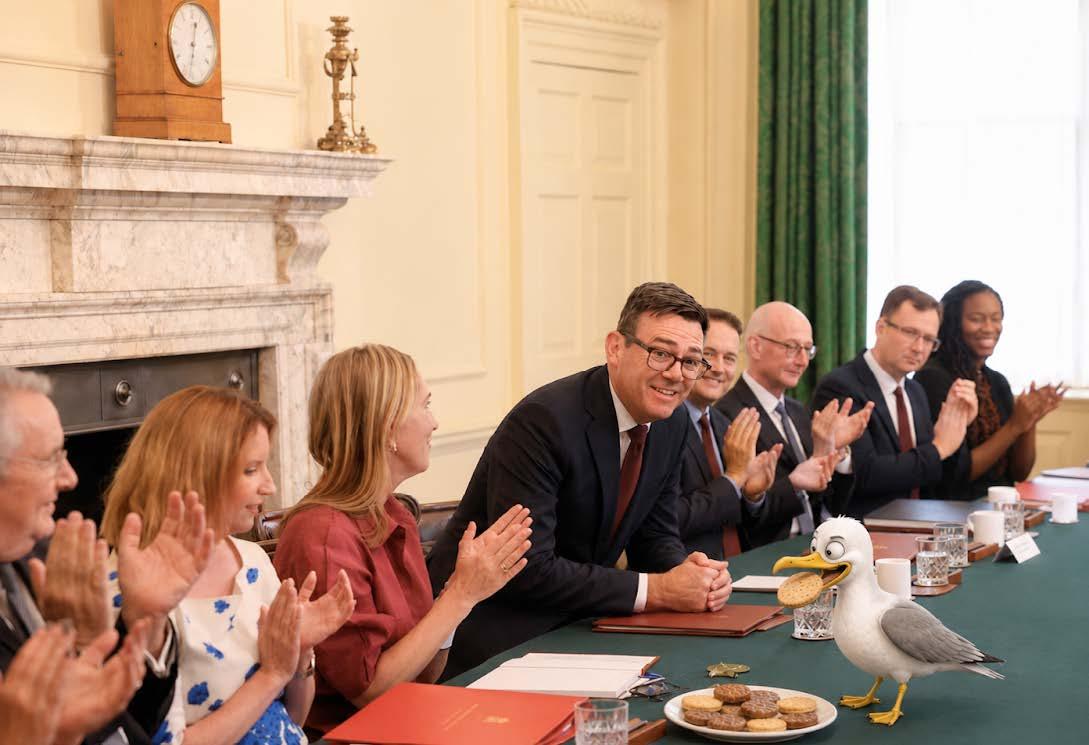
Milford Docks’ loudest political bird examines Andy Burnham’s long game, Nigel Farage’s empty circus and Britain’s refusal to wait more than five minutes for anything.
Alright, me lovers. Stephen Seagull ’ere, reporting from the roof of a slightly rusty van down Milford Docks, where I have spent the morning studying two of Britain’s great mysteries.
The first is how Andy Burnham managed to become Prime Minister. The second is why a grown man buys chips, leaves them unattended beside his car and then acts surprised when I arrive. Both required patience, careful planning and a willingness to strike when the humans were distracted.
That Burnham, see, has been playing the long game. And fair play to him, because the long game is not popular in Britain anymore. The humans want everything immediately.
They want lower bills by Tuesday, an NHS appointment by Wednesday, economic growth before the weekend and a parcel delivered at 10.34am
despite ordering it at 10.31am. Then they stand on the doorstep staring at their phones, muttering about the collapse of civilisation. Burnham’s journey to Downing Street was one of those political plans that sounded completely sensible until you counted how many things had to go right. First, a friendly Labour MP had to give up a safe seat.
Then Burnham had to win the byelection. Then Keir Starmer had to be persuaded that perhaps being Prime Minister was no longer working out for him. Then every other ambitious Labour politician had to look at the Burnham bandwagon rolling towards them and decide they had suddenly developed a deep passion for party unity.
That is a lot of moving parts. Down on the docks, we would call it an operation with an unacceptable number of opportunities for someone to drop a mackerel. But somehow it worked. Burnham won Makerfield. Starmer went. The rivals disappeared. Andy flew into Number 10 with less resistance
than I get entering an open bin behind a takeaway. And before anyone says it was luck, let me tell you something about luck. Luck is finding half a pasty on a bench. Planning is watching the bench from a warehouse roof, waiting for the owner to turn around, calculating the wind direction and sending two younger gulls to create a diversion near the recycling bins. Burnham planned it.
That matters because Labour MPs had spent two years being led by a man who looked as though he would rather be checking the terms and conditions on a mortgage application. Starmer could do government. He could read the folder. He could examine the evidence. He could stand behind a lectern looking concerned enough to frighten small children. But did he enjoy politics?
Did he heck. Every campaign stop looked like someone had told him the fire alarm was only a drill but he was not entirely convinced. Burnham is different. Burnham likes politics. He understands the speeches, the handshakes, the plotting, the factions
and the delicate art of telling six different groups that they are all the government’s top priority. Some people think enjoying politics should disqualify you from high office. Nonsense. You would not appoint a ferry captain who hated the sea. You would not employ a fishmonger who disliked fish. And you would certainly not elect a seagull who had ethical concerns about stealing your lunch. Burnham also understands something Starmer never quite mastered. Politics is a performance.
Humans call it authenticity. They say: “He’s authentic.” What they mean is: “He has rehearsed that sentence so many times that I cannot see him remembering it.” Real political authenticity is not saying the first thing that enters your head. That is not authenticity. That is what pigeons do. Authenticity is making the calculation invisible. It is landing beside a family on Milford Marina, tilting your head innocently and convincing them that you have no interest whatsoever in the chips between them. Then, when the moment comes...
SWOOP! Nigel Farage has been good at this for years. The pint. The grin. The shrug. The little laugh that says he cannot believe the establishment is making such a fuss.
Everything is presented as though Nigel has just wandered into the pub and accidentally started a political movement between ordering the drinks and visiting the smoking area.
But the cheerful act has looked a little more strained recently. Questions have been asked about donors, money and the finances of Reform UK.
And Farage does not enjoy questions about money. The famous grin disappears. The pint goes down. The feathers puff up. Suddenly, the man who demands endless scrutiny of everyone else starts behaving like a gull that has been asked to explain why three sausage rolls are sticking out of its beak.
His solution was to call a by-election in Clacton. Of course it was.
When Nigel is in trouble, he campaigns. When he is challenged, he campaigns. When the questions become uncomfortable, he finds a stage, a flag and a microphone and announces that the entire British establishment is terrified of him. This time, though, the mainstream parties refused to play.
They did not field candidates.
So Farage found himself standing in the middle of his great political circus, surrounded by novelty candidates, pantomime challengers and enough free publicity to inflate a small blimp.
Except there was no proper opponent.
No establishment villain. No great battle. Just Nigel, a microphone and several people dressed as vegetables.
He pulled the campaign lever and nothing happened. That gives Burnham an opportunity. Because Farage needs politics to feel like a permanent emergency. Reform feeds on anger.
It needs the humans furious before breakfast, betrayed by lunchtime and convinced Britain has ceased to exist by the evening news. Every day must bring a new outrage. Someone has banned something. Someone has surrendered something. Someone in London has betrayed someone in a pub. The details do not matter. What matters is keeping the humans angry enough that they never stop to ask what happens after the shouting. Populism is like feeding gulls.
Once you start, the noise increases rapidly and nobody can remember who threw the first chip. Farage’s political battery is charged by rage. He cannot allow the country to pause, breathe and see whether a policy might actually work.
A policy that takes five years to deliver is useless to him. He needs one that can be denounced within five minutes.
Burnham is trying something much harder. He wants the humans to wait. Not for a bus, although his £2 fare cap might help with that.
He wants them to believe in a tenyear plan. Ten years is an enormous amount of time in human politics. Governments rise and fall. Cabinets are reshuffled.
Manifestos are forgotten. Entire government computer systems are announced, delayed, renamed and finally abandoned. Down here, ten years is enough time for three generations of gulls to learn that the tourist carrying the blue bag has purchased something from Greggs. Burnham says Britain needs long-term investment, stronger public services, better social care and an economy that improves ordinary lives rather than producing attractive graphs for people wearing lanyards.
Very nice. But the humans will not
wait ten years to feel the benefit. They will barely wait ten days. That is why Burnham has moved quickly on the cost of living. The £2 bus fare cap. Help with energy bills. Hints of tax relief. Talk of giving working families some breathing space.
These are not the whole plan.
They are the first chips thrown onto the pavement. The message is simple. Look, something is happening. Look, the new government knows you are struggling. Look, Andy has entered the building and found the light switch.
Burnham needs those early measures because asking people to endure more pain today for the promise of a better 2036 is not a political strategy. It is how you get chased out of town by pensioners carrying reusable shopping bags. But there is a problem. Money.
There is always a problem with money. Politicians speak about government spending as though there is a forgotten treasure chest somewhere beneath Whitehall.
There is not.
I checked during a trip to London.
There were folders, security guards, one very expensive sandwich and a man from the Treasury crying quietly into a spreadsheet. No treasure.
If Burnham spends more on social care, he must find the money.
If he reduces energy bills, he must find the money.
If he cuts taxes, he must either cut something else, borrow more or convince the economy to grow faster than a Pembrokeshire hedge in July.
That leaves Chancellor John Healey with the ancient political task of making one group slightly happier by making another group absolutely furious.
Spend more on hospitals and the defence people start squawking.
Spend more on defence and the teachers start squawking.
Raise taxes and businesses squawk.
Cut services and everyone squawks.
I have heard quieter arguments over a single cod fillet behind the fish market.
Labour will not make this easier.
The left wing is already watching Burnham for signs of betrayal.
The former Starmer loyalists are watching for signs of incompetence.
The ambitious middle group is watching to see which side is winning before announcing that it has always agreed with them.
Darren Jones, freshly removed from the Cabinet Office, has already started
picking at Burnham’s numbers.
The Prime Minister says a VAT cut on energy bills can be funded by scrapping the digital identity scheme.
Jones wants to know whether the sums add up.
Fair question.
But it is also the first little beak tapping against the Burnham bandwagon.
Tap, tap, tap.
One Labour MP questions the figures.
Another questions the priorities.
A third appears on television to declare complete loyalty before spending seven minutes explaining why the Prime Minister has got everything wrong.
That is how governments start losing momentum.
Not with an explosion.
With a peck.
Then another peck.
Then forty-seven MPs pecking the same hole while insisting they are only trying to help.
SWARK! PARTY UNITY!
Burnham’s real opponent, then, is not Farage.
It is not the Conservatives.
It is not even the Treasury.
It is the clock.
He needs time for policies to work.
He needs time for investment to produce results.
He needs time to rebuild public services that have spent years being stretched thinner than the ham in a motorway service station sandwich.
But modern politics allows no time.
Every morning, the government is judged against an imaginary country where the trains run perfectly, the hospitals have no waiting lists, houses are affordable and every pothole was filled overnight by patriotic volunteers.
Compared with that fantasy, reality always loses.
People scroll through their phones and are asked, several hundred times a day, whether they are angry yet.
Are you angry about the boats?
Are you angry about the bills?
Are you angry about Westminster?
Are you angry about a fifteen-second video of something that happened six years ago in a different country?
Eventually, of course they are angry.
Even I start getting agitated after that much squawking, and I spend my life surrounded by seagulls.
Burnham must somehow persuade the public that democratic government
can still improve their lives.
Not with slogans.
Not with another logo.
Not with a minister standing beside a sign that says “DELIVERING CHANGE” while absolutely nothing visible is being delivered.
He must show progress.
A bus fare that really falls.
An energy bill that really becomes cheaper.
A hospital appointment that really arrives sooner.
A wage packet that stretches further than the Wednesday after payday.
Those early victories will matter because nobody waits patiently for a ten-year plan unless they can see the first year working.
Burnham’s gamble is that competence can become exciting again.
That the humans might prefer steady progress to endless outrage.
That Britain can be persuaded to stop treating politics as a pub argument where the loudest man gets to keep the microphone.
Can he do it?
Possibly.
Getting to Downing Street once looked improbable.
So did me opening a sealed packet of cheese and onion crisps, but dedication finds a way.
Still, Burnham should remember one thing.
The public might tolerate a long journey, but only when it believes the driver knows the route.
One wrong turn, one broken promise or one Budget full of clever explanations for why everyone is poorer, and the humans will begin looking for someone else.
Farage will be waiting.
The Conservatives will be waiting.
Half the Labour Party will be waiting.
And I will be waiting too, obviously. Beside the bus station.
Watching your chips.
Andy Burnham may be playing the long game.
But Britain is standing at the counter, tapping its foot and shouting:
“Excuse me, we ordered ten minutes ago.”
SWARK!
Until next week, keep your chips tight and your politicians tighter.
Stephen Seagull, Supreme Ruler of Milford Haven Docks and Defender of Unattended Food.
SWARK!


A BOATING holiday can be a wonderful adventure for the whole family, including the dog, but slippery decks, hot surfaces and strong currents mean a little preparation is essential FOR many families, a holiday would not feel complete without the dog coming too. With Cardigan Bay offering spectacular coastlines, harbours and waterside breaks, the idea of taking a fourlegged first mate along can be extremely tempting.
A boating trip can provide fresh air, gentle exercise and plenty of new sights and smells.
It can also offer valuable time together away from the usual routine. However, the water brings risks that owners may not encounter on an ordinary walk or cottage holiday.
Figures highlighted by pet company TopDog suggest that 37 per cent of families now travel with their dogs, while around 450,000 people enjoy holidays on Britain’s canal network each year. As pet-friendly breaks become more popular, owners are being urged to plan carefully before stepping aboard.
The first job is to make the boat feel safe and familiar.
A dog should ideally be

surfaces may be slippery, while metal, dark flooring and exposed areas can become very hot in direct sunshine. Check the deck with the back of your hand before allowing a dog to stand or lie on it for long periods. Provide shade, fresh drinking water and a cool, secure place where the dog can rest. Non-slip mats can help nervous or older dogs keep their footing when the boat moves.
A harness is generally more useful than relying on a collar alone. It gives the owner better control around moorings, locks and busy towpaths, while reducing pressure on the dog’s neck if it suddenly pulls or slips. Dogs should be kept under close control whenever they are near the edge of the boat or walking beside the water. Even a usually obedient pet may become distracted by birds, wildlife, another dog or an unfamiliar noise.
introduced to the vessel while it is securely moored and the engine is off. Allow them to sniff around, investigate the deck and practise getting on and off without being rushed. Treats, praise and a calm voice can help build a positive association.
Some dogs will take to the experience immediately, while others may be unsettled by unfamiliar surfaces, engine noise or the movement beneath their feet. Giving them time to adjust before the journey begins can make the trip less stressful for everyone.
A properly fitted canine lifejacket is another essential piece of equipment, even for dogs that are strong swimmers.
Cold water, currents, panic and tiredness can quickly overwhelm an animal. Choose a jacket that fits securely without restricting movement and, where possible, has a strong handle across the back. This can make it easier to lift a dog from the water in an emergency.
Owners should allow their dog to wear the lifejacket at home or on dry land before the holiday. This gives them a chance to become comfortable with it rather than encountering it for the first time when the boat is ready to leave.
Decks can also be surprisingly hazardous. Wet
Extra care is needed around locks, moving ropes, narrow walkways and areas with strong currents. These are working environments and conditions can change quickly. A dog should never be allowed to wander around the deck unsupervised while the boat is moving or manoeuvring.
Owners should also agree in advance what they will do if the dog falls overboard.
Do not immediately jump into the water after the animal, as this can place both dog and owner in danger. Alert the person controlling the boat, slow or stop when it is safe to do so and guide the dog towards a suitable recovery point. The handle on a canine lifejacket may then be used to help lift the animal back aboard.
A boating break with a dog should be enjoyable, not frightening. A familiar blanket, regular toilet stops, food stored safely and an up-to-date identification tag can all help the holiday run smoothly.
With sensible preparation, close supervision and the right safety equipment, dogs can enjoy the adventure just as much as their owners.
The best crew members may have four paws, but even the most enthusiastic sailor needs a lifejacket.

SUPPORTERS of Ysgol Cilgerran’s Church in Wales school have protested at a Pembrokeshire County Council meeting against council plans to remove church status from the school.
Back in May, Pembrokeshire County Council voted to remove Voluntary Controlled (VC) status from the Welsh-medium rural school despite 97 per cent of the responses to a consultation having opposed a change which the church describes as ‘entirely unnecessary’.
The Church in Wales has objected formally to the proposal and has warned it will take legal action on the grounds of “public misrepresentation and unqualified legal assertions made by Pembrokeshire County Council officers,” and “discrimination against faith schooling”.
During Pembrokeshire County Council’s full council meeting of July 16, parents, teachers, and students travelled to County Hall, Haverfordwest to protest.
Their colourful protest signs, made by students, carried messages such as “You can’t fix what isn’t broken”, “Leave our VC status alone”, and “Don’t take away our identity for a few £££”.
One of the protesters, an expupil and governor, Sarah Moore, has said: “I’m here today because I’m horrified that the council are talking about taking the church status away from our school. The church gave that land for the school over 180 years ago.
“97 per cent have voted against this and yet they’re still trying to do it. If we want our
children to stay in a church school, the nearest one is Letterston. So where will these children have that good education that they are getting now?”
Kelly Davies, parent and governor, said: “We feel really strongly as parents, the pupils and the community that we’re not happy about them taking VC status away.
“We have really strong links with the church and the school and the community. It just seems that they’re taking this away from us permanently for no reason.”
The Church has said it has deep concern about what it sees as a pattern of the council’s recent actions regarding Church Schools.
In June, councillors voted to close Manorbier Church in Wales Voluntary Controlled School, which was damaged by a fire in 2022.
The Church says it is taking formal action in this case.
It has also expressed concerns about VC status being lost for Tenby Church in Wales VC school after councillors backed a consultation on potential education changes in the Tenby area.
A spokesperson for the Church in Wales said: “The entirely unnecessary threat to the status of this much-loved community school has had an impact on children, families, and the wider community. We are not prepared to allow another thriving rural school to lose its treasured character.
“Ysgol Cilgerran has our full support, and we hope that Pembrokeshire County Council listens to the voices of the community it serves, and chooses not to remove VC status.”
A PUBLIC consultation is to be held on discontinuing two schools in the Tenby area, including Greenhill comprehensive, with the aim of establishing a new 3-19 community school.
In a report before Pembrokeshire County Council’s meeting of July 16, members were asked to back a public consultation into establishing a new 3-19 community school in the Tenby area, discontinuing Tenby Church in Wales VC School and Ysgol Greenhill comprehensive.
Back in December councillors backed authorising the Director of Education to commence statutory consultation on establishing a new 3-19 school, a split
site initially, but as part of an investment to rebuild/extend Tenby’s Greenhill site, or on a new site.
It included a consultation with the St David’s Diocese to discontinue Tenby Church in Wales Voluntary Controlled School, and to discontinue Ysgol Greenhill before the report before members in July.
A report for members, presented by the council’s deputy leader, and now Cabinet Member for Education, Cllr Paul Miller said that, since the December meeting, St David’s Diocese responded by conditionally supporting the Tenby VC
School element, subject to the newly established 3–19 school retaining a religious character, either as a Voluntary Aided (VA) or Voluntary Controlled (VC) school.
The report added: “In accordance with the decision of council at its meeting on December 12, and the statutory requirements of the School Organisation Code, consultation has been undertaken with the St David’s Diocese.
“In relation to the council’s proposal for Tenby VC School, the comments received from the Diocese do not provide any reason not to proceed with general consultation.”
It added: “As most pupils within the cluster attend community primary schools,

it is recommended that consultation be undertaken on the basis of establishing a community primary school.
“It should be noted that, whatever the decision, this would merely reflect the preferred option outlined within the general consultation document.
“Members would still be required to give due consideration to feedback received as a result of the consultation, which may include a preference by consultees for a different governance model.”
Members, by 41 votes to two abstentions, backed the formal consultation, which had been moved by Council Leader Cllr Tessa Hodgson.




The importance of the review on the regulatory burden weighing on Welsh farmers has been further underlined by NFU Cymru through a stark display at this year’s Royal Welsh Show.
The farming union’s tabletop display mimics the scene on kitchen tables and in farm offices throughout Wales as thousands of farming families grapple with a mountain of policy and regulations. Combined, the paperwork relating to policies and regulations that the majority of farmers must adhere to, such as the Sustainable Farming Scheme (SFS), livestock and pesticide records, animal health rules, water quality and waste exemptions runs to over 4,000 pages of A4 paper – enough to measure two and a half times around the Royal Welsh Show’s main ring if placed end to end. Last month, the new Welsh Government commissioned an independent review of the burden of regulation affecting Welsh farming businesses, which will be carried out by well-respected Brecon farmer John Davies. NFU Cymru welcomed that announcement and the union’s Royal Welsh
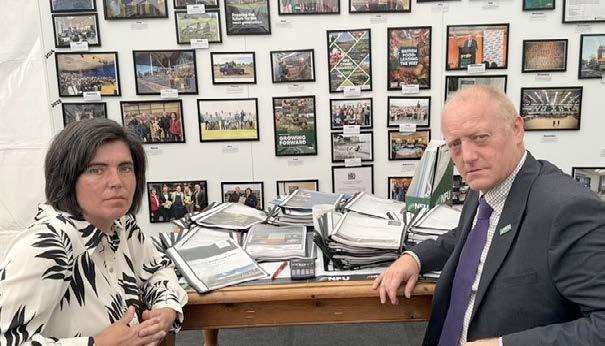
hours of reading. We have not even considered the additional information required for those looking to enter the optional and collaborative layers of the SFS, or the paperwork attached to the additional voluntary activities that farmers may undertake for Farm Assurance or supply chain agreements. Nor does this figure take account of work relating to HMRC or the activities related to running a financial business.
NFU Cymru President Abi Reader said: “The kitchen table is the beating heart of the Welsh family farm. Not only is it where delicious food is served day each day, but it’s also where the family come together to talk through their day-to-day work and where the generations pass on knowledge and agree plans and aspirations for the future. It’s a place for laughter and tears, a place where local shows are planned and YFC pantomimes are written. It’s also, for many, the farm office. But the burden of regulation weighs heavily on that kitchen table. Throughout the Royal
Welsh Show, we’ll host a typical farmhouse kitchen table holding a collection of the everyday guidance and record keeping requirements a farming family will need to understand to adhere with government policy and regulation.
“Documents relating to the SFS (which alone accounts for 1,000 pages), and other guidance and records such as livestock and pesticide records, animal health rules, water quality workbooks and waste exemptions amount to over 4,000 pages. Putting those 4,000 pages end-toend would stretch two and a half times around the Royal Welsh Show main ring and even a conservative estimate suggests it totals more than 100
“All of this needs to be completed alongside caring for and managing the crops and livestock on the farm and maintaining and enhancing the farmed environment.
“I want to be clear - regulation has an essential role in underpinning the high standards that are crucial to maintain consumer confidence and sell our produce on markets at home and abroad. We accept that in return for receiving government support our businesses must adhere to certain conditions and be subject to audit. But these rules must also be proportionate, workable and joined-up. The sheer volume and complexity of current rules is placing an unsustainable pressure on farming businesses.
Welsh Government guarantees £340m annually for Sustainable Farming Scheme as minister pledges greater certainty and less bureaucracy
WELSH farmers will receive more than £1 billion in agricultural funding over the remainder of the Senedd term, under a new multi-year commitment announced by the Welsh Government.
Cabinet Minister for Rural Resilience and Sustainability, Llyr Gruffydd, unveiled the package at the Royal Welsh Show, in his first major announcement since taking responsibility for the rural affairs portfolio.
The Government has guaranteed £340 million a year for three years, taking funding for the Sustainable Farming Scheme through to March 2030.
Of that annual total, £238 million will support the scheme’s Universal Layer, while £102 million will fund Optional and Collaborative actions.
The Welsh Government said the agreement would end the uncertainty caused by annual funding settlements and allow farming businesses to make longer-term investment and planning decisions.
The commitment was promised during the first 100 days of the new Plaid Cymru Government.
Mr Gruffydd said: “Giving farmers only 12 months’ line of sight to funding is not sufficient.
“We know how hard it is to plan and make business decisions without knowing what funding is coming.
“Farmers told us loud and clear they need certainty and stability, and that is exactly what we are delivering.”
The minister also announced initial measures intended to reduce bureaucracy for family farms, following early feedback from an independent review led by former NFU Cymru president John Davies.
The requirements of the Animal

Health Improvement Cycle, known as AHIC, will be simplified under the Universal Layer of the Sustainable Farming Scheme.
The Welsh Government will work with farm assurance schemes to align their requirements from 2027.
Farmers participating in an aligned assurance scheme would then complete one form following a single veterinary visit, rather than carrying out separate processes for farm assurance and Sustainable Farming Scheme compliance.
Because 2026 is being treated as a transition year, membership of farm assurance schemes that have committed to aligning their requirements by 2027 will be accepted as satisfying the AHIC requirement this year.
Mr Gruffydd said the relationship
between farmers and their vets would remain central to improving animal health and farm performance.
Applications for organic conversion support are expected to open at the end of July.
A new Production and Efficiency capital grant category will also provide support towards livestock-handling facilities, precision soil and cropmanagement equipment, and other investments designed to reduce waste and improve productivity.
Further Optional Actions will be introduced over the coming months.
The Small Woodland Creation Grant and Woodland Creation Grant application windows will open on
Monday, July 20.
A further window for the Integrated Natural Resources Scheme, which forms part of the Collaborative Layer, is also expected to open later this year.
Mr Gruffydd said: “The family farm sits at the heart of rural Wales, its economy and its communities.
“I am committed to working to ensure farming in Wales thrives for generations to come.
“My message to farmers from day one has been: you have a minister on your side.
“Someone who is in tune with the agricultural sector, who knows that the family farm is the foundation of our rural economy and our rural communities, and who will work every day to make sure farming in Wales thrives for generations to come.”
Paul Davies MS has urged the Welsh Government to use every available measure to tackle bovine tuberculosis and work towards eradicating the disease in Wales.
The Ceredigion Penfro Senedd Member raised the issue during a Senedd debate, warning that bovine TB continues to have a devastating impact on farmers, their families and rural communities.
Mr Davies called for a science-led and comprehensive strategy that addresses every potential source and route of infection.
He said farmers across west Wales needed clear leadership from the new Welsh Government and greater confidence that ministers were prepared to take effective action.
Mr Davies said: “Bovine TB continues
to have a huge impact on farmers, their families and rural communities across Wales.
“It places enormous emotional and financial pressure on farming businesses and remains one of the most significant challenges facing our agricultural industry.
“Farmers and the wider rural community are looking to the new Welsh Government to provide leadership by introducing a holistic approach that addresses all routes of transmission.
“The Welsh Government must do everything it can to eradicate this appalling disease.
“I will continue to raise this issue on behalf of farmers in west Wales and press the Welsh Government to use every lever available to tackle bovine TB.”


THE BRITISH potato industry has the growers, expertise and sophisticated supply chain needed to increase domestic production, reduce reliance on imports and support national food security. However, delegates at the recent Potato Industry Growth Summit said that none of this will be possible without secure and reliable access to water.
The summit, hosted in London by GB Potatoes and the National Potato Innovation Centre, concluded that water must be treated as a strategic requirement for food production. Without action, increasingly unpredictable rainfall and restrictions on access to water risk reducing the area of potatoes grown in Britain, undermining existing production and limiting the industry’s ability to grow. The summit in London took place
between the second and third heatwave of the year and the availability of water was a hot topic for delegates.
The last decade has seen three years of drought – 2018, 2022 and 2025, with spring and summer rainfall well below long-term averages this year in many parts of England. Meanwhile the 2025/26 winter was one of the wettest on record and late and wet springs in 2023 and 2024 impacted potato crops. Delegates to the summit reported that growers are experiencing longer periods between rainfall events and more intense rain events when it does fall.
This increasingly volatile pattern means the industry must be able to capture water when it is plentiful and store it for use when crops need it.
Potatoes are particularly sensitive to water stress during tuber initiation and bulking. Insufficient or inconsistent water can reduce yields, limit tuber size and cause quality problems that make a significant proportion of the crop unsuitable for sale or processing.
Potato crops require in the region of 350 mm of water over the growing season, around 1.4 million litres per acre. This is the crop’s total water use, supplied through a combination of rainfall, water stored in the soil and irrigation
increase British production in the future.
“Without reliable access to water, we will see further reductions in domestic production, greater volatility for growers and processors, and increasing reliance on imports. That would weaken our food security and export jobs and investment from the British supply chain.
“Growers are prepared to invest in reservoirs, irrigation technology and more efficient water-management systems, but they need a policy and planning framework that gives them the confidence to do so.
“We experience periods when there is too much water and periods when there is far too little. The answer is to enable growers to capture water when it is available and store it until crops need it.
“If government is serious about economic growth, food security and increasing domestic food production, then water for agriculture must be recognised as strategic national infrastructure.”
Investment in agricultural water storage would also reduce pressure on public water supplies, which are facing increasing demand from housing development, population growth and a changing climate. Farm reservoirs and coordinated water-management systems can also help manage periods of heavy rainfall, reduce flood risks and improve wider catchment resilience.


Defra figures for 2025 show that there was a need for 7.1 million tonnes of potatoes in the UK, but only 71% of that demand came from British grown potatoes. At the turn of the Century, the UK supplied 90% of its potato needs.
Delegate discussion at the summit identified key water concerns and needs:
• Long-term water planning involving government, regulators, water companies and the agricultural sector, creating the certainty needed for businesses to invest in reservoirs and water-management infrastructure.
• Recognition that access to water for food production is a national food-security priority and should not continually be placed behind residential and commercial demand.
• Faster, simpler and more proportionate planning and licensing processes for the construction of farm reservoirs.
• Policies that allow water to be captured and stored during periods of high rainfall for use during dry periods.
• Continued investment in irrigation efficiency, soil health, drainage and whole-farm water management.
• Research into drought- and floodtolerant potato varieties and more resilient systems of production.
Scott Walker, Chief Executive of GB Potatoes, said:
“Water is not an optional extra for potato production. It is fundamental to maintaining the crop we grow today and absolutely essential if we want to
Delegates to the Potato Summit included members from across the potato supply chain including growers, breeders, packers, processors, input suppliers, researchers, retails and foodservice professionals. They heard from a range of speakers that despite the challenges facing the UK potato industry, there is still strong demand for the crop and the potential to increase consumption and reduce the country’s potato trade deficit.
Speakers included Baroness Minette Batters, Andrew Niven from Scotland Food & Drink, Olivia Theaker, the Coop; Ian Pennock, McCain, GB Potatoes board member Sophie Bambridge, B&C Farming and chair of CUPGRA, Katy Pook, Greenvale, Patrick Hughes, Scottish Agricultural Organisation Society, Alex Godfrey, chair of GB Potatoes, Professor Ian Toth, director of Scotland’s Plant Health Centre and the National Potato Innovation Centre at the James Hutton Institute and Scott Walker, GB Potatoes.
Other topics addressed at the summit included: driving increased potato consumption; delivering the best varieties for sustainable increases in GB potato production; safeguarding plant health; restoring confidence and profitability in the sector; driving resilient production with innovation; creating joined-up industry growth policies and frameworks and ensure that the potato industry attracts and retains talented people.
THE WELSH CONSERVATIVES have called for an additional £100 million for agriculture over the next four years from the Welsh Government to help farmers cope with the growing pressures facing the industry.
The call comes as thousands of farmers, agricultural businesses and rural organisations gather in Llanelwedd for this year’s Royal Welsh Show.
Last week, the Welsh Government’s Supplementary Budget was defeated in the face of opposition calls for significant changes. The Welsh Conservatives had criticised a failure to allocate even an extra penny for the economy or farming.
Andrew RT Davies MS, Shadow Minister for Farming and the Environment, said:
“Our farmers are facing unprecedented challenges, from rising costs and excessive regulation to uncertainty over future financial support. Over the past 27 years while Labour and Plaid Cymru have been making financial decisions in the Welsh Government, farmers have been let down.
“Welsh farming is not just another industry, it is the backbone of our rural economy. Farmers are the guardians of our countryside and are critical to the United Kingdom’s food security. Farmers deserve a government that

understands the challenges they face and is committed to supporting them.
“That’s why the Welsh Conservatives are calling for an additional £100 million for agriculture over the next four years, providing much-needed support to help farmers adapt, strengthen food production as well as supporting environmental improvements.
“As we gather in Llanelwedd today to celebrate the very best of rural Wales at the Royal Welsh Show, our message is clear: the Welsh Conservatives stand firmly behind our farming families. We will work with the industry, listen to farmers’ concerns and ensure agriculture has the support it needs to thrive for generations to come.”


As the farming community heads to Llanelwedd, it’s hard to ignore the parched landscape across much of Wales.
Despite June bringing above-average rainfall, July has told a very different story. Since 1 July, Wales has received less than 10% of its average rainfall, with little meaningful rain forecast before the end of the month. River flows, groundwater levels and soil moisture continue to decline, while river temperatures have exceeded 20°C in some catchments. Earlier this month many areas of Wales were officially moved into Prolonged Dry Weather status.
The impact is being felt on farms across the country. Grass growth has slowed dramatically, second-cut silage is failing to establish on many farms and, in some areas, pasture has simply burnt off. Farmers who should be building forage stocks for winter have already started feeding them, raising understandable concerns about what supplies will be left if the dry weather continues.
FUW members are reporting similar experiences from every corner of Wales. In Crickhowell, one farmer found a whole crop ready for harvest well before the permitted cutting date, needing a derogation simply to preserve its quality. In Pembrokeshire, grass that was growing well earlier in the season has burnt off in coastal
areas, while late-cut grassland is already going to seed and losing feed value. In Denbighshire, second-cut silage is failing to establish and some farmers are already relying on winter fodder because there is so little grass available.
The dry weather is creating other pressures too. Private water supplies, including wells and boreholes, are beginning to run dry, while the risk of wildfire continues to increase across the countryside.
No two farms are affected in exactly the same way, but the pattern is becoming increasingly familiar. We seem to swing from one weather extreme to another. Farmers have always worked with the weather, but it is becoming much harder to work around it. That makes it all the more important that support schemes are able to respond. Fixed dates and rigid rules make little sense when crops mature weeks earlier than expected. Nobody expects the government to control the weather, but it can remove unnecessary obstacles. Quicker derogations, greater flexibility and investment in water resilience would help farmers adapt to a climate that is becoming increasingly unpredictable.
Welsh farmers have always adapted to changing conditions. The challenge now is making sure the policies designed to support them are adapting just as quickly.



THIS week, Volvo Cars started to deliver the first Ex60 cars to customers in Europe. The first customers in Sweden are now behind the wheel of their Ex60, with many more to follow in coming weeks and months
The EX60, revealed to universal acclaim in January, is designed to be a game changer for Volvo Cars and its customers. It delivers classleading range of up to 503 miles, charges from 10-80 per cent in 16 minutes*, and is priced in line with the company’s bestselling XC60 plug-in hybrid.
The five-seater EX60 ends range anxiety, delivers a groundbreaking user experience and represents the next frontier in safety thanks to advanced core computing. It is also Volvo Cars’ first entry in the largest electric segment globally, allowing it to substantially increase its potential customer base and electric market share.
Production and customer deliveries of the EX60 will ramp up in the second half of 2026. Order books remain open across Europe and have recently opened in the United States as well.
“This is a huge moment for us and our customers,” said Erik Severinson, chief commercial officer at Volvo Cars. “After many thousands of hours and miles developing one of the most advanced cars on the market, seeing the first customers take delivery of their own EX60 feels especially momentous.

“We’re grateful to those customers who have already chosen an EX60 as their new car and look forward to many more joining them on the journey in the coming weeks, months and years.”
The EX60 can go up to a best-in-class 503 miles on a single charge in an all-wheel drive configuration. This doesn’t just make it go further than any electric car that Volvo Cars has ever created. It also beats its recently revealed competitors, setting a new standard for its segment.
That same no-compromises approach is reflected in how fast it charges. A quick coffee
stop is enough to recharge and hit the road again. The EX60 can add up to 211 miles of range in just ten minutes when using a 400kW fast charger.
In other words, the EX60 turns range anxiety into range comfort and demonstrates that going electric is no longer a compromise. Design, engineering, hardware and software all work together to create a car that optimises driving range and matches many petrol cars.
The EX60 is available with three different powertrain variants. The P12 AWD Electric variant offers the class-leading range of up to 503 miles, while the P10 AWD Electric clocks in at a range of up to 410 miles.
A rear-wheel drive P6 Electric

variant delivers up to 385 miles of range. All in all, the EX60 is available in seven attractive variants, covering all needs and lifestyles.
The EX60 is also a testament of what Volvo Cars is capable of. It is the company’s first fully electric car to be designed, developed and built in Sweden. The EX60 is underpinned by SPA3, an all-new scalable product architecture that introduces new key manufacturing technologies such as mega casting and cellto-body battery technology.
*Range of up to 503 miles relates to EX60 P12 AWD, while potential charging time of 10-80 per cent in 16 minutes relates to EX60 P10 AWD and P6 RWD variants.
Range figures are preliminary and based on WLTP testing standards obtained under specific testing conditions. Actual range can vary depending on charge level, car specification, outdoor temperature, battery temperature, weather, topography, driving style and car speed.
Charging times can vary and depend on various factors such as outdoor temperature, battery condition and car condition. Charging times are based on testing at 400 kW charging facilities.




























At EV Wales, electric vehicles aren't just part of our business – they are our passion. As dedicated EV specialists, we provide a level of in-depth expertise in sales, service, and repair that goes beyond what a main dealer can offer. Are you looking to buy your first EV and need honest, real-world advice from people who drive them every day? Or are you an owner searching for expert, economical repair solutions that make sense? We are your trusted local partners. We believe in making electric driving simple, affordable, and exciting for everyone. For a better way to buy and maintain your EV, speak to the experts who live and breathe them.







VOLKSWAGEN presents the new ID. Cross1. The all-electric compact SUV combines a stylish and powerful design, technologies from the luxury class and a well thought-out overall concept in one vehicle. At an entrylevel price of around 28,000 euros, the ID. Cross offers a level of quality, comfort and equipment that sets new standards in the small car and compact segment. This is reflected in the feel-good ambience in the interior, which was achieved through finely crafted materials, fabric-covered surfaces and high seating comfort. In addition, the new Innovision infotainment system ensures intuitive operation and networked functions, while technologies and assistance systems from higher vehicle classes, three output levels (85 kW, 99 kW and 155 kW) and two battery sizes (37 kWh and 52 kWh net) will be available in future. With a WLTP range of up to 427 kilometres4, the ID. Cross is suitable for everyday use and longer journeys. In Germany, advance sales of the new ID. Cross begin today, 15 July.
Following the ID. Polo6 and ID. Polo GTI7, the ID. Cross belongs to a new generation of compact models, with which Volkswagen is focusing more consistently than ever on its strengths and the wishes of its customers. Thomas Schäfer, CEO of the Volkswagen brand, Head of the Brand Group Core and member of the Group Board of Management, said: “The ID. Cross brings together technological expertise, clean design, impressive, intricate solutions and genuine all-rounder qualities – all for excellent value for money. These are ideal conditions for a new success story from Volkswagen.”
Affordable entry into the SUV segment. The new ID. Cross is 4,153 mm long, 1,581 mm tall and 1,794 mm wide. The wheelbase is 2,601 mm. Compared with the T-Cross model with combustion engine, the ID. Cross (thanks to the MEB+ platform) scores points with more space for five passengers and their luggage. The ID. Cross offers 475 litres of stowage space – 20 litres more than the T-Cross. This is achieved above all with the help of an additional area under the variable boot floor, which offers space for up to two crates of drinks. In addition, the new electric SUV features an extra small luggage compartment (frunk) under the bonnet, which can hold a further 25 litres – an ideal place for the charging cable and small bits and bobs.
Design for a new era. With its clear and timeless design, the ID. Cross sets new standards in the compact SUV segment. Volkswagen’s Pure Positive design language focuses above all on visual stability with a friendly appearance
and striking details. Characteristic elements such as the elongated ‘flying roof’ and the strong C-pillar, as well as striking light signatures at the front and rear, characterise the unmistakable appearance. The lighting signatures are even more striking when the IQ.LIGHT LED matrix headlamps and 3D LED rear lights with illuminated LED crossbars and illuminated VW logos are included in the specification. The clear design continues consistently in the interior: details such as the fabric-covered dash panel; elegant controls like the tactile, metallic outer edge on the audio controls in the centre console; and the pleasant feel of all buttons, controls, handles and surfaces create an inviting and friendly atmosphere.
Clear, digital and intuitive: the infotainment and display concept. In the new ID. Cross, the Digital Cockpit Pro – the digital instruments for the driver –and the infotainment display are clearly arranged on a horizontal line. The Digital Cockpit Pro has a diagonal of 26 cm (10.25 inches). If the driver activates the retro display using the view button on the multi-function steering wheel, the instruments from a Mk1 Golf appear in the digital cockpit. In this case, there is a classic speedometer on the left and a tachometer on the right. In the ID. Cross, however, it does not display the speed of the engine, but rather the energy output or energy consumption of the drive (as a powermeter). Other modern functions such as the Dynamic Road Sign Display have also been integrated into the 1980s-inspired layout. The infotainment system touch display, located in the centre of the dash panel, measures 32.8 cm (12.9 inches) across the diagonal and is as large as a premium tablet. The display is also easy to reach for the front passenger.
New electric front-wheel drive. The latest stage in the evolution of the modular electric drive (MEB) platform is used in the ID. Cross: the MEB+. Its dynamic heart is the new electric motor of the APP290 drive system, which will be available in three output levels in the ID. Cross: 85 kW (116 PS), 99 kW (135 PS) and 155 kW (211 PS). The battery is available in two sizes: 37 kWh (net) and 52 kWh (net). The maximum AC charging capacity at a domestic wall box or public charging stations is 11 kW. The smaller battery can be charged from 10 per cent to 80 per cent in about 23 minutes5 at DC fast-charging points with a power output of up to 90 kW. With the larger 52 kWh version, charging from 10 per cent to 80 per cent takes place at up to 105 kW – with a particularly steady charging curve – in around 24 minutes5.
Technologies from higher classes – including Connected Travel Assist with traffic light recognition. Thanks to

MEB+ and the latest software, the ID. Cross comes with a range of cuttingedge assist systems as standard. Assist systems such as the next generation of Travel Assist will be additionally available as optional equipment. Since the system uses online data, it has been renamed Connected Travel Assist. The system now also responds to traffic
lights8 for the first time – a first in this price range. If the Connected Travel Assist detects8 a red traffic light, it can automatically brake the ID. Cross to a standstill8, within the system’s limits. Another new feature is One Pedal Driving, which rapidly decelerates the SUV through regulation of the accelerator pedal alone8.


FEARS have been raised for the future of one of Wales’s most strategically important steel plants after the UK Government granted India a significantly larger quota for tariff-free galvanised steel imports
Union leaders and industry figures have warned that the decision could undermine Tata Steel UK’s Llanwern works near Newport, which produces around 600,000 tonnes of galvanised steel each year.
The plant supplies almost half of total UK demand for the material, which is widely used by the automotive and construction industries.
The warning comes just months after ministers unveiled a new strategy intended to protect British steelmaking from cheap overseas competition and increase the proportion of steel used in the UK that is produced domestically.
However, details of the new import arrangements show that India has been allocated a tarifffree quota of 125,000 tonnes for metallic-coated steel, commonly referred to within the industry as Category 4 steel.
India exported around 43,000 tonnes of the product to Britain last year, meaning the new allowance is almost three times that volume.
The Financial Times reported that the quota was increased during last-minute negotiations to secure the implementation of the UK-India free trade agreement.
According to the report, India had objected to proposals to reduce its steel allocations and warned that the trade agreement could be delayed unless its concerns were addressed.
The deal came into force on Wednesday, July 15, and has been promoted by ministers as a major economic opportunity for British exporters.
The UK Government estimates that the agreement could eventually increase bilateral trade by £25.5 billion a year and add £4.8 billion annually to the economy.
It includes lower Indian tariffs on products such as British whisky and vehicles, while reducing UK duties on Indian clothing, footwear and some food products.
However, steelworkers now fear that the price of securing those wider benefits could be paid by Welsh industry.
Llanwern specialises in producing high-quality galvanised steel, which is coated with zinc to protect it from corrosion. Its products are used in vehicles, buildings and

infrastructure, making the Newport site an important part of both the Welsh economy and Britain’s manufacturing supply chain.
Alasdair McDiarmid, assistant general secretary of the steelworkers’ union Community, said the import allowances could threaten the sustainability of the plant.
He described Llanwern as a crucial strategic facility supplying high-quality steel to the automotive and construction sectors.
The union said workers could already see imported steel coils accumulating at Newport docks and questioned why Llanwern appeared to have received less protection than other areas of the British steel industry.
No closure or job losses have been announced, but the warning will cause renewed concern in communities that have already experienced years of uncertainty surrounding the future of steelmaking in Wales.
The decision relating to India had wider consequences because international trading rules require comparable exporting countries to be treated equally.
South Korea has reportedly been allocated a Category 4 quota of 100,000 tonnes, while Vietnam has received an allowance of 175,000 tonnes.
Industry representatives are particularly concerned about material entering from Vietnam, amid claims that the country processes steel originating from China, where excess production has contributed to a global fall in prices.
The combined allowances could expose Llanwern to significantly more overseas competition in a market it currently plays a leading role in supplying.
One industry insider estimated that the new arrangements could cost British steel producers hundreds of millions of pounds in
lost revenue.The decision appears to contrast sharply with the UK Government’s broader approach to steel imports.
Under measures that came into force on July 1, overall tarifffree steel import quotas were reduced by 51 per cent. Imports exceeding the allocated amounts are now subject to a 50 per cent tariff.
Ministers said the protections were required because of global overcapacity, which has allowed large volumes of cheaper steel to enter international markets and placed British producers under intense pressure.
UK crude steel production has fallen by more than half over the past decade, while high energy prices and ageing industrial infrastructure have further weakened the sector’s competitiveness.
Peter Brennan, director of trade at industry body UK Steel, said the government had taken the bold action required across most steel categories.
However, he described the effective liberalisation of Category 4 imports from countries outside the European Union as baffling.
Tata Steel UK has also expressed concern that the quotas for metallic-coated products remain too high and do not properly reflect conditions within the British market.
The company said effective trade protections were essential to maintaining domestic production, investment and commercially viable downstream operations.
The latest dispute comes during a period of major change for the steel industry in Wales.
Traditional blast furnace production at Port Talbot has ended as Tata Steel develops a new electric arc furnace, supported by £500 million from the UK Government.
That transition resulted in the
loss of thousands of jobs and left the future of the wider Welsh steel network dependent on the commercial success of remaining and modernised operations.
Llanwern is one of the most valuable downstream facilities in that network, producing finished steel for customers in sectors where reliability and quality are critical.
Critics argue that allowing additional volumes of competing galvanised steel into the country could weaken the business case for continued production and investment at the site.
They also question how the decision fits with the government’s stated ambition to rebuild industrial capacity, protect strategically important industries and reduce Britain’s dependence on overseas suppliers.
The UK Government said the steel measure was intended to strike a balance between protecting domestic production and ensuring businesses had access to secure supplies.
A spokesperson said the final quotas followed extensive consultation with industry and promised that the arrangements would be reviewed after 12 months.
However, unions are likely to demand action well before that review if increased imports begin to affect orders or production at Llanwern.
The controversy leaves ministers facing difficult questions over whether the interests of Welsh steelworkers were sacrificed to secure a wider international trade agreement.
For communities across industrial south Wales, the concern is that another strategically important plant could be left exposed after years of promises that domestic steel production would finally receive stronger protection.
IMAGES of a new indoor market planned in Llanelli have been released along with details of a scheme Carmarthenshire County Council hopes will become a busy destination.
The plan is for 14 retail units on the ground floor of the Vaughan Street complex, 80 stalls on the first floor, and a central glass atrium above. There’d be bike racks and escalators and all toilets would be on the first floor.
Deliveries would be via Mincing Lane at the rear along with a few parking spaces close by.
Miriam Phillips, who runs a fruit and veg stall at the current market by St Elli Shopping Centre, said of the plans: “They look all right so far. It’s still early days.” She said traders had a meeting with council representatives about them last week.
Parvez Akhtar, of Parvez Fashions, said he was “totally against” the proposals and called on the council to upgrade the current market and focus on filling empty shops in Llanelli. He felt the new market would be “very small” and deter people from visiting. “We need space and to display our products,” he said.
Fellow trader Gabor Hetesi, of IT repair business Gabe’s IT Repair, was optimistic about the plans but wondered about timescales and what the new rental arrangements would

be. “The plans are looking good, it looks promising,” he said.
The council is asking for people’s views on the proposals by August 7 ahead of a full planning application being submitted.
A design and access statement about the project said the current market building with its multistorey car park above dated from the 1970s and contained a material called reinforced autoclaved aerated concrete which is less durable than standard concrete and can fail when exposed to moisture.
It said the council undertook significant work in 2013 to maintain
the building’s structural safety along with ongoing maintenance.
Options were explored such as distributing stalls and units throughout the town and reusing the existing site once the car park was demolished.
The council’s preferred option is a new-build market between 8-14 Vaughan Street extending a long way to the rear. Six of the ground-floor retail units would face onto Vaughan Street and the market’s total area would be 3,312sq m.
“Internally each floor has a distinct identity and character,” said the design and access statement.
“The internal route is deliberately
meandering, encouraging visitors to explore past retail and market stalls.
“The first floor is more informal and accommodates the majority of market stalls. It also features a large café, visible from the entrance, which naturally draws visitors through the building and up to the first floor.”
It said the current market has 3,664sq m of floorspace featuring 17 retail units and 110 stalls.
Cllr Hazel Evans, deputy council leader and cabinet member for regeneration, leisure, culture, and tourism, said: “These proposals represent an exciting opportunity to create a modern new home for Llanelli Market and further strengthen Llanelli town centre.
“Through the pre-application consultation process we want to hear the views of residents, businesses, and stakeholders to help shape the proposals before a planning application is submitted.”
She added: “It is important to emphasise that Llanelli Market will remain open and continue trading throughout this process with any future relocation carefully planned to support traders and customers.
“Our ambition is to create a vibrant destination that supports traders, attracts visitors, and builds on Llanelli Market’s proud history at the heart of the community.”
A CALL for works at a Pembrokeshire seaside tearoom, once the site of a Victorian brickworks machinery shed, has been given the go-ahead by national park planners.
in an application recommended for approval at the July meeting of Pembrokeshire Coast National Park’s development management committee, Caroline Jones sought permission to install solar panels to roof over an outside seating area at The Shed Tea Room, Porthgain.
The application, and a related listed building consent call, was for committee consideration as The Shed Tea Room forms part of Ty Mawr, a Grade-II-listed large stone-built former machinery shed owned by the national park itself.
An officer report for members stated: “The Shed Tea Room is a lean-to structure at the west end of Ty-mawr, a Grade-II-listed large stone-built former machinery shed, built c. 1890 to serve Porthgain brickworks. The lean-to itself is built of a mixture of stone and brick,
retaining the stump of the brickworks chimney.
“The Shed has been used for retail purposes since 1999, and as a tearoom and restaurant from 2001, after which roof-lights were inserted. The northwestern section of the lean-to was incorporated after 2003, when the present timber windows were inserted.
“After 2007, a lean-to scullery was added at the north end, alongside the chimney stump, with a small, fenced compound beyond. The south-western lean-to was added in 2024. The proposal comprises the addition of solar PV panels to the south-western lean-to. The panels – twelve in total – are all-black and frameless. The panels are configurated in a single block covering the majority of the roof, surface mounted on corrugated steel sheeting.
“The scheme is in keeping with the character of the listed building, and its setting in terms of design and form. As

such, the application can be supported subject to conditions.”
The recommendation of approval was moved by Cllr Di Clements, and
and again unanimously backed.


HYWEL DDA UNIVERSITY
HEALTH BOARD has appointed two additional surgeons as part of efforts to reduce lengthy waits for orthopaedic treatment across west Wales.
The health board confirmed the appointments after figures revealed that patients undergoing elective hip replacement surgery waited an average of 450 days during the 2025/26 financial year.
That is equivalent to more than 64 weeks from referral to treatment.
As of May 28, 2026, a total of 1,608 patients were on Hywel Dda’s waiting list for hip replacement surgery.
Sixteen patients were also removed from the list during the financial year after deciding to undergo private treatment.
Responding to questions from The Herald, Gareth Cottrell, Deputy Chief Operating Officer at Hywel Dda University Health Board, acknowledged the effect prolonged waits were having on patients.
He said: “The current national delivery expectation for health boards in Wales is to treat orthopaedic patients within a maximum of 104 weeks from the point of referral to treatment.
“In recent years, waiting
times for orthopaedic treatment in Hywel Dda have been among the lowest of any health board in Wales, but we recognise that waiting times remain too long and the impact these have on our patients while awaiting the treatment they need.”
The health board said it continued to maintain dedicated ward and theatre capacity for elective orthopaedic procedures at Prince Philip Hospital in Llanelli and Bronglais Hospital in Aberystwyth.
Day-case surgery is also being carried out at units across Hywel Dda’s hospital sites.
Mr Cottrell said: “We remain committed to improving waiting times and are working closely with our regional health board partners to maximise the treatment capacity we can offer patients across the wider South West Wales area.
“During the past year, we have appointed two additional surgeons to support our continuing efforts to reduce waiting times.”
The health board did not provide details of where the new surgeons would be based, how many additional operations they were expected to carry out or when patients would begin to see

a significant reduction in waiting times.
Plans to expand orthopaedic capacity also formed part of Hywel Dda’s Clinical Services Plan consultation.
Mr Cottrell added: “Improving our orthopaedic services has also been a key part of our Clinical Services Plan that we consulted upon last year, with plans being developed to increase capacity and help more patients access the care they need.”
Hip replacements are commonly offered to patients suffering severe pain, stiffness and loss of mobility after other treatments, including
physiotherapy, medication and injections, have failed to provide sufficient relief.
Lengthy waits can leave patients struggling with worsening pain, disturbed sleep and a loss of independence, while some may be forced to reduce their working hours or leave employment.
The waiting-time figures were obtained through a Freedom of Information request submitted by healthcare marketplace My Medical Gateway.
The company said the health board returned its response on June 8, 2026.


SENEDD Members have questioned the Welsh Government over a new £8 million obesity strategy, tightening restrictions on youth vaping, and regional inequalities in cancer screening.
Deputy Minister for Public and Preventative Health, Nerys Evans, confirmed Public Health Wales has secured the funding through the obesity pathway innovation programme.
The funding will be used to develop new NHS treatment models for obesity, viewing it as a chronic condition rather than a short-term issue.
The announcement on Tuesday July 14 followed a speech to the Senedd, where Ms Evans outlined her preventative healthcare priorities and drew on the words of Aneurin Bevan: “The victories won by preventive medicine are much the most important for mankind.”
Emphasising the importance of prevention in healthcare, Ms Evans said: “The need to make this change is not new. What has been missing is the determination to deliver it.
“For too long, our models, processes and ways of working have been built around responding to crises, rather than preventing them and helping people to live healthier and happier lives.
“This changes now. Under this government, success will be measured not by the number of hospital admissions, but by the number of people who stay healthy enough to avoid hospital altogether.”
Ms Evans told Senedd colleagues that providing healthy environments, better access to sustainable and nutritious food, and addressing vaping amongst young people were among her top priorities as minister.
Concluding her speech she said: “We firmly believe that building a healthier population is not only a moral imperative, particularly in tackling deep-rooted inequalities, but is also fundamental to improving the wider prosperity and resilience of our nation.”
Facing questions from the opposition

benches, Ms Evans took questions on funding for weight loss jabs, screening and vaccinations, and vaping and smoking.
Reform’s James Evans pressed the deputy minister on the longer term impacts of weight loss medication.
He said: “I think one thing we have to be careful with, with weight-loss medication, is that, yes, it is changing lives, but it’s not changing lifestyles.
“It cannot be seen as a silver bullet to losing weight long term, because we do know about the longer term health impacts, with osteoporosis in women, with people with cardiovascular problems emerging from these jabs”.
Mr Evans asked his opposite number if she will be working with primary care, gyms, and leisure providers to ensure people on weight loss medication are also making lifestyle changes.
“If you don’t, it’s just a vicious circle,” Mr Evans explained. “You’ll come off it, you’ll put weight back on again, and you’re back on the jabs and then end up in A&E with longer term problems, and that’s no way to help our health service.”
The deputy minister agreed, adding that it is about “creating that system of support around individuals for those lifestyle choices”.
Ms Evans revealed Public Health Wales has recently been successful in co-ordinating a Wales-wide bid for funding through the obesity pathway innovation programme.
She said: “That’s £8 million of funding in order to look at these issues, to develop and test approaches that could form part of that delivery model going forward.
“We want to be looking at treating obesity as a chronic condition, and, obviously, the changes that would mean in terms of how the NHS would respond to that would be key.”
Drawing attention to the national lung cancer screening programme that was introduced by Welsh Labour, Jayne Bryant quizzed Ms Evans on her plans to encourage participation in screenings and vaccination programmes.
Ms Bryant – who is Labour’s spokesperson for public and preventative health – also acknowledged the HPV vaccine, noting that since its introduction in 2008 the vaccine has “reduced cervical cancer rates by almost 90% in women in their 20s”.
She also highlighted the importance of cervical screenings, but said work needs to be done to make them more accessible Wales-wide.
The Labour spokesperson called for Ms Evans to share how the Welsh Government will encourage participation in vaccines and screenings.
The deputy minister said: “One of the things that worries me is the differences within our deprived communities in terms of screening and vaccine uptake.”
She spoke of making sure Public Health Wales, in its efforts to boost screening and vaccinations, understands what the barriers are to uptake.
Ms Evans also faced questions on her plans for preventing smoking and vaping among children and young people by Conservative MS Natasha Asghar.
Ms Asghar, of Casnewydd Islwyn, told the Siambr that Wales sees almost 4,000 preventable deaths each year because of smoking.
She acknowledged the deputy minister has already launched a consultation on vaping as part of the four-nation approach to prevent children from smoking, but called for clarity on what other actions will be taken.
Ms Evans said that tackling the increasing number of children vaping is a “key priority” for her as minister.
She urged the public to take part in a consultation into vaping, which is looking at changing vape product packaging to be more like tobacco packaging – and less attractive to young people.
Ms Evans also confirmed she has asked officials to provide an outline of what other powers the Welsh Government has to tackle tobacco and vaping.
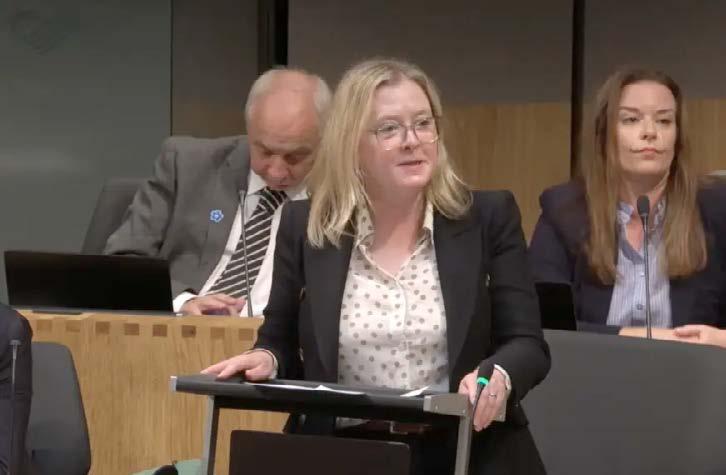

KEN SKATES has been confirmed as the permanent leader of Welsh Labour after receiving the unanimous backing of the party’s nine remaining Senedd members.
The former Welsh Government minister had served as interim leader since May, following Eluned Morgan’s resignation after Labour’s historic defeat in the Senedd election.
Welsh Labour opened nominations for a permanent successor last week, beginning with nominations from the Labour group in the Senedd. All nine members nominated Mr Skates, meaning he was confirmed as leader without the need for a wider contest.
He now faces the considerable task of rebuilding a party which governed Wales for more than a quarter of a century but was reduced to third place at the election, behind Plaid Cymru and Reform UK.
Accepting the leadership, Mr Skates said he was “deeply honoured” to have received the unanimous support of his Senedd colleagues.
He said: “I joined the party as a 14-year-old, and my belief still stands that no child’s future should be determined by their

Government positions, including responsibility for transport, the economy and infrastructure.
background.
“That no young person should be judged on anything other than the efforts they make and the decency they show to others.
“The Labour movement for me is a movement for fairness, justice, security and liberty. It is a movement that seeks to empower people and communities, to fight against injustice, intolerance, nepotism and cruelty.”
Mr Skates was first elected to the Senedd in 2011 and has held a series of senior Welsh
He was returned to the Senedd in May as a member for the new Fflint Wrecsam constituency.
His appointment comes as Welsh Labour attempts to understand the reasons behind its dramatic electoral decline and establish a new role in opposition.
Deputy Welsh Labour leader Carolyn Harris MP said Mr Skates had her full support as he began the process of rebuilding the party.
She said: “I offer my warm
congratulations to Ken. He has my full backing as he undertakes the big task ahead of him, listening, learning, rebuilding and doing that crucial job of holding Plaid Cymru and Reform UK to account in the Senedd.
“I have no doubt he has the energy, thoughtfulness and optimism to take us forward and I look forward to working alongside him.”
Mr Skates must now seek to restore public confidence in Welsh Labour while distinguishing the party from the new Plaid Cymru-led Welsh Government and the Labour administration at Westminster.

A CALL to bring to an end a special Pembrokeshire council panel which decides whether some planning applications should be considered by councillors rather than planning officers is to be discussed further.
A notice of motion submitted by Councillor Huw Murphy to the July meeting of Pembrokeshire County Council asked: “That council consider disbanding
the Planning Delegation Panel (PDP) and review the current arrangements so that planning applications delegated to officers for refusal, where a member requests further consideration, are referred directly to the Planning Committee rather than first being considered by the
PDP.”
His supporting statement said: “Under the current arrangements within Pembrokeshire County Council, where a planning application has been delegated to officers and a refusal is recommended, the local county councillor may request that the application be considered by the PDP.
“The PDP then determines whether the application should proceed to full planning committee. It is considered that this additional stage introduces unnecessary bureaucracy into the planning process, leading to increased delays and costs for applicants.
“The current process can also be perceived as limiting democratic oversight, as applications may be refused by the panel without being considered by full planning committee, whose elected members bring local knowledge, experience transparency and
democratic accountability to planning decisions.
“By comparison, the Pembrokeshire Coast National Park Authority, which is responsible for planning across more than 30 per cent of the land area of Pembrokeshire, does not operate a planning delegation panel. Instead, planning matters are considered through its established planning procedures, and this approach appears to function effectively without the need for a PDP.”
His supporting statement ended: “The removal of the PDP should simplify decision-making, reduce bureaucracy, improve transparency and democratic accountability, and reduce the workload of Democratic Services.”
At the July meeting, members agreed the notice of motion would be referred to the council’s constitutional review committee for further consideration.
PRIME MINISTER
Andy Burnham has announced a further wave of Cabinet appointments, bringing Angela Rayner back into government and handing senior roles to Lucy Powell, Jonathan Reynolds and close political ally Anneliese Midgley.
The latest announcements confirm that Burnham is carrying out a significant restructuring of Sir Keir Starmer’s former administration rather than simply moving a handful of ministers between departments.
Rayner has returned as Secretary of State for Housing, Communities and Local Government, the position she left last year. The department will also oversee Burnham’s plans to transfer greater powers away from Westminster and into the nations, regions and local government.
Lucy Powell, Labour’s deputy leader, has been appointed Education Secretary, replacing Bridget Phillipson. Phillipson will remain in government as Minister for Women and Equalities, although the move represents a substantial reduction in her responsibilities.
Jonathan Reynolds has returned to his former position as Business and Trade Secretary after serving as Chief Whip under Starmer.
His department is being expanded to take responsibility for science and innovation and will be renamed the Department for Business, Innovation, Science and Trade.
Anneliese Midgley, who played a central role in Burnham’s return to Parliament and leadership campaign, has been appointed Chief Whip.
The appointments follow the earlier confirmation that former Defence Secretary John Healey will become Chancellor.
Healey’s selection was considered a surprise after Ed Miliband and Shabana Mahmood had both been strongly linked to the Treasury. He replaces Rachel Reeves, who left the government after reportedly turning down another senior Cabinet role.
Miliband has instead been appointed Foreign Secretary, replacing Yvette Cooper, while Mahmood remains Home Secretary.

Cooper has moved to the Department of Health and Social Care, where she replaces James Murray. Burnham has made reform of adult social care one of the central missions of his government.
Pat McFadden will continue as Work and Pensions Secretary, providing one of the clearest elements of continuity with the previous administration.
Louise Haigh has been handed one of the most powerful positions in the new government. She becomes First Secretary of State, Chancellor of the Duchy of Lancaster and the senior Cabinet Office minister.
Although she has not formally been given the title of Deputy Prime Minister, the appointment makes Haigh Burnham’s principal coordinator across government and effectively his deputy at the Cabinet table.
The reshuffle has seen several figures closely associated with Starmer removed from government.
Rachel Reeves has departed as Chancellor, while David Lammy has left his positions as Deputy Prime Minister and Justice Secretary.
Darren Jones, who served as Chief Secretary to the Prime Minister, has also been removed, alongside former Housing Secretary Steve Reed and Business Secretary Peter Kyle.
Attorney General Lord Richard Hermer, Science and Technology Secretary Liz Kendall, Welsh Secretary Jo Stevens and Northern Ireland
Brian Murphy
This week sees the Royal Welsh Show taking place in Llanelwedd is a great advert for Welsh farming and agriculture. The stalls will be busy and the showring will be full of farmers proudly showing of the best of their produce. But this can come at a high price.
Secretary Hilary Benn have also confirmed their departures.
James Murray has been replaced as Health Secretary, although it remains unclear whether he will be offered another government position.
No replacement has yet been announced for Jo Stevens as Secretary of State for Wales.
The vacancy is particularly significant because Burnham has promised a major programme of constitutional change and greater devolution of powers from Westminster.
The identity of the new Welsh Secretary will provide an early indication of how prominently Wales will feature within the new Prime Minister’s plans.
Several further senior appointments remain outstanding, including the posts of Defence Secretary, Justice Secretary, Northern Ireland Secretary and Welsh Secretary.
Wes Streeting, Lisa Nandy, Heidi Alexander, Miatta Fahnbulleh, Angela Eagle and a number of other Labour figures have entered Downing Street, but their positions had not been formally confirmed at the time of publication.
Burnham took office on Monday after being formally appointed by the King, promising what he described as a “circuit breaker” moment for Britain.
His government is expected to announce its first package of cost-of-living measures on Tuesday, with proposals involving energy bills and bus fares among the policies being considered.
Working long hours, often in solitude in remote locations can take have a huge impact on their mental health. Added to that are the administrative pressures force upon them by governments who don’t understand the rural economy. With these pressures it is understandable that the rate of suicide is greater than in the average population. It is understandable but not acceptable.
77% of all rural suicides are by males and most of those are in the 35-44 age group. Whilst there is significant support with the DPJ Foundation, and RABI it is not always readily available. This is why the Welsh Conservatives are urging the Government to work with these charities to establish service level agreements with the local health boards. This should go some way to helping our farmers access help when it is needed. Not
only does it help the individual asking for help, but it also stops the devastation to families caused by suicide. You can also support our farmers by thanking them for the hard work they do and recognise the tremendous contribution they make to our economy, food security and the natural environment.
Another way the Welsh Government can assist the agricultural economy is by showing their support with an additional £100m over four years. The agriculture budget has been static since 2013, with no increase to account for inflation or other rising costs. This will allow farmers to meet the extra costs and continue to supply world leading produce.
These are only a few of the many problems faced by farmers, but it is vital to the industry and to Wales that we support the rural economy. Can you imagine a Wales without the beautiful countryside and fantastic food we enjoy? Agriculture is not just an issue for farmers, it is fundamental to our identity as a nation, and it is incumbent on everyone in Wales to support it.


W ITH ANDREW lyE
Two years ago, I thought the UK was about to see the end of revolving door PMs at 10 Downing Street. How wrong I was!
As Andy Burnham becomes our latest PM, he faces a myriad of issues in his in tray.
Liberal Democrat leader, Ed Davey in a speech at the Institute for Government last week, challenged the incoming PM to immediately introduce proportional representation and said that our country needs a ‘new Magna Carta’ to protect British rights from populists and tech tyrants.
Ed Davey said that Britain’s broken and unstable political system is the fundamental failure of Westminster –underpinning the crisis in the NHS, sewage pollution in our rivers, and the rise of divisive populism.
Davey set out his party’s plan to return power to the people and argued that British democracy cannot bear another general election under a broken voting system. He warns that a modern written constitution is urgently needed to protect fundamental British rights from populist authoritarians and tech tyrants.
On the current scandals engulfing Reform UK Ltd’s leader Nigel Farage, Ed Davey said:
“In classic Trumpian distraction politics, he resigned to wage a pointless by-election campaign – though now finds his opposition is a very eloquent rubbish bin.
“Indeed, last week, I was asked by a journalist if I would endorse Count Binface. I replied that I take elections too seriously to back a joke candidate with ridiculous policies. So of course, I hope Binface beats him.
“But in truth, the
problems we face with our politics go much deeper than the corruption and chaos perpetuated by certain individuals or parties. It’s the failure of the whole broken political system.
“A political system that leaves millions feeling powerless and excluded. That concentrates too much power in the wrong hands. In Westminster, in Whitehall, and in big multinational companies. A system that makes it impossible for people to hold those abusing their power properly to account.”
On the need for a new British constitution, Davey said:
“I believe our country needs a new Magna Carta moment for the twentyfirst century. A written constitution to protect our hard-won British rights and freedoms. Enshrining the European Convention on Human Rights – a proud British creation. And once, a proud Conservative creation.
“Isn’t it extraordinary that Kemi Badenoch now says no one who supports the ECHR can stand for the Conservative Party? Isn’t it extraordinary that, if Winston Churchill were alive today, his support for the ECHR would bar him from standing for the Tories?
“So, we need a written constitution to protect those fundamental British rights from those who would destroy them – whether it’s Kemi Badenoch, Nigel Farage or Elon Musk.
“A new Magna Carta must be fit for our times. Eight hundred years ago, Magna Carta was about reining in the power of a tyrant king. Now, the challenge is reining in the power of tech tyrants.”
Will Andy Burnham be the saviour of the Labour Party and the UK? Watch this space.
If you have any issues or comments, please contact me at andrew.lye@pembslibdems.wales
Cardiff East MP repeatedly visited Pembrokeshire to champion clean energy jobs, but her successor inherits unresolved questions over Milford Haven’s share of the Celtic Sea boom

JO STEVENS is out as Secretary of State for Wales after new Prime Minister Andy Burnham chose not to retain her in his first Cabinet.
The Cardiff East MP confirmed on Monday (Jul 20) that she would no longer serve as Welsh Secretary, bringing her two-year tenure at the Wales Office to an end.
Her departure has particular significance for Pembrokeshire, where she became one of the UK Government’s most prominent advocates for floating offshore wind, the Celtic Freeport and the transition from oil and gas towards cleaner forms of energy.
Ms Stevens made repeated visits to Milford Haven and Pembroke Dock, met apprentices and major employers and spoke directly to The Pembrokeshire Herald about the prospect of skilled jobs being created in West Wales.
Some tangible investment followed those visits. However, many of the biggest employment figures attached to the green energy transition remain forecasts rather than jobs already created.
Her successor will inherit the task of proving that Pembrokeshire will receive a substantial and lasting share of the promised economic benefits.
DEPARTURE DESPITE
The decision is particularly notable because Ms Stevens publicly backed Mr Burnham during the Labour leadership contest.
She said in June that he had the experience, values and political reach required to become Prime Minister.
Her departure therefore appears to be part of Mr Burnham’s wider effort to create a new Cabinet and establish a clear break with the previous administration, rather than the result of hostility between the two politicians.
Ms Stevens is among a number of senior figures from Sir Keir Starmer’s government who have left Cabinet as Mr Burnham builds his new administration.
At the time of publication, her replacement as Secretary of State for Wales had not been announced.
Ms Stevens began building links with Pembrokeshire before Labour entered government.
As Shadow Welsh Secretary, she visited the Port of Milford Haven with Henry Tufnell in early 2024 to discuss the port’s operations, its development plans and the barriers facing further investment.
Following the visit, Labour identified ports including Milford Haven as potential beneficiaries of its proposed investment in floating offshore wind and domestic renewable-energy manufacturing.
The promise was significant for Pembrokeshire, which has lost thousands of well-paid industrial jobs following the closure of several major oil refineries.
Labour argued that investment in ports, offshore wind and associated manufacturing could create a new generation of skilled employment.
After Labour’s general election victory and her appointment as Welsh Secretary in July 2024, Ms Stevens returned to the county for the official opening of the £60 million Pembroke Dock Marine redevelopment.
She attended alongside then Deputy Prime Minister Angela Rayner and former First Minister Eluned Morgan.
The development included a new slipway, enlarged workboat pontoons, upgraded quayside facilities and infrastructure intended to support marine renewable-energy projects.
It was forecast that the wider development could support up to 1,800 jobs.
The project was funded
and developed over several years through the Swansea Bay City Deal and other partners. It would therefore be misleading to describe it as an achievement delivered solely during Ms Stevens’ tenure.
However, she used its opening to reinforce the new UK Government’s commitment to Pembrokeshire’s energy sector and helped place the county prominently within Labour’s industrial message.
Ms Stevens returned in January 2025 to confirm Pembrokeshire’s inclusion in a clean-energy skills pilot.
During the visit, she met workers and apprentices at Ledwood Mechanical Engineering in Pembroke Dock and representatives from Dragon LNG.
The initiative was intended to help existing workers transfer their skills into sectors including offshore wind, hydrogen and other low-carbon industries.
Speaking to The Herald, Ms Stevens described the pilot as an important step towards creating the workforce required for clean-energy expansion in the Celtic Sea.
She later said she wanted more young people to be able to remain in West Wales and build careers in the emerging industries being attracted to the area.
Those visits gave the county political visibility and helped bring employers, training providers and government representatives together.
The longer-term test, however, is whether the training leads to substantial numbers of permanent jobs based in Pembrokeshire.
There have been concrete developments during Ms Stevens’ time in office.
Ledwood Engineering was among the Pembrokeshire businesses selected to benefit from a £13 million offshore wind supply-chain funding programme backed by The Crown Estate.
Work has also progressed on a proposed £50 million hydrogen production facility at the former refinery site now operated as the Impala Terminal in Milford Haven.
The hydrogen scheme is expected to create around 60 jobs during construction and approximately ten permanent positions once operational.
Floating wind projects in the Celtic Sea have also moved forward through seabed leasing, government support and preparatory investment.
These developments show that the clean-energy programme is more than a political slogan.
Nevertheless, the number of permanent jobs confirmed so far remains considerably below the thousands repeatedly discussed in speeches and government announcements.
Ms Stevens also strongly supported the Celtic Freeport, which links Milford Haven and Port Talbot.
The project was backed with £26 million of government funding and designed to attract investment through tax incentives, customs arrangements and simplified planning.
Ministers said the Freeport could help generate thousands of jobs and attract major private investment into South and West Wales.
However, The Herald has repeatedly
raised questions about how those benefits will be divided between the two ports.
Port Talbot has secured up to £64 million to develop a specialist floating offshore wind hub and has been described as a cornerstone of the emerging industry.
Its proposed role in turbine assembly and large-scale port infrastructure has been set out in considerable detail.
Milford Haven’s role in operations, maintenance, engineering, fuel production and marine support remains important, but the eventual scale of the work and number of local jobs have been less clearly defined.
That does not mean Pembrokeshire has been excluded from the opportunity.
It does mean that the incoming Welsh Secretary must provide greater clarity about what work will be based locally, when it will begin and how many permanent jobs it will create.
In announcing her departure, Ms Stevens said serving as Welsh Secretary had been a privilege and an honour.
She said her priorities had included attracting investment, creating jobs and giving Welsh communities greater control over their futures.
Ms Stevens highlighted what she described as the largest Welsh public-services settlement since devolution, support for the steel industry, investment in nuclear power at Wylfa and a long-term commitment to Welsh rail infrastructure.
She also pointed to local-growth funding and cooperation between the UK and Welsh governments.
Those are substantial claims and form an important part of any fair assessment of her tenure.
THE appointment comes as the new Prime Minister continues to shape his government after entering Downing Street, with the Wales Office among a number of departments seeing changes at ministerial level.
Mr Kinnock, the Labour MP for Aberafan Maesteg, takes over responsibility for representing Welsh interests at the Cabinet table and overseeing the UK Government’s relationship with the Welsh Government.
The 55-year-old has served in Parliament since 2015 and has held a number of ministerial positions. Before joining the Cabinet, he served as a minister in both the Home Office and the Department of Health and Social Care, where he was involved in immigration, public health and NHSrelated policy.
He is also well known as the son of former Labour leader Neil Kinnock,
one of Wales’ most prominent political figures, and former European Commissioner Glenys Kinnock.
Mr Kinnock replaces Jo Stevens, who has served as Secretary of State for Wales since 2024. During her tenure she worked on issues including economic investment, the transition to green energy, rail infrastructure and cooperation between the UK and Welsh Governments.
The change follows Prime Minister Andy Burnham’s first Cabinet reshuffle since taking office, with several senior ministerial appointments announced as he begins setting out the priorities of his new administration.
As Secretary of State for Wales, Mr Kinnock will be expected to play a key role in discussions over economic growth, energy, transport, the future of the steel industry, and constitutional matters affecting Wales. He is also likely to be heavily involved in negotiations between Westminster
Critics will argue that several major commitments, particularly on rail funding and green employment, have yet to produce all the results promised.
Supporters will point out that large infrastructure and energy projects take years to develop and that many of the schemes promoted during her time in office are still at an early stage.
Jo Stevens leaves the Wales Office having made Pembrokeshire a regular feature of the UK Government’s clean-energy narrative.
She visited the county, met local businesses and apprentices and repeatedly argued that West Wales should benefit from the transition towards floating wind, hydrogen and renewable energy.
Her record should not be dismissed simply because every promised job has not yet materialised.
Equally, announcements, visits and projected employment figures cannot be treated as completed delivery.
The fairest conclusion is that Ms Stevens helped advance Pembrokeshire’s case and supported several important projects, but leaves before the full economic outcome is known.
Her successor must now turn broad ambitions into named contracts, firm investment decisions and permanent, well-paid employment.
For Andy Burnham’s new government, the question is not only whether it will retain the promises made to Pembrokeshire.
It is whether local communities will finally see those promises translated into jobs.

and Cardiff Bay as the Burnham Government develops its agenda. His appointment will be closely watched across Wales, including in Pembrokeshire, where businesses, local authorities and public services will be looking for signs of how the new
Government intends to deliver on its promises for investment, infrastructure and economic development.
Further announcements on the new Government’s programme are expected in the coming days.
SEND yOuR lETTERS TO: THE EDITOR, 11 HAMIlTON TERRACE, MIlFORD HAVEN, PEMBROKESHIRE, SA73 3Al
EMAIl uS AT: editor@herald.email


Pitchfork diplomacy: Two police officers find themselves surrounded by red-shawled “Fishguard women” during the Last Invasion re-enactment in Fishguard and Goodwick. The good-natured scene formed part of a weekend of living history marking the failed French invasion of 1797, the last hostile landing by a foreign army on mainland Britain. (FISHGUARD POLICE)
DON’T FORGET yOuR SuNGlASSES
DEAR SIR,
H ERE at RNIB Cymru, we want to remind Herald readers not to forget their sunglasses while enjoying the sunshine.
You might wonder why Wales’ leading sight-loss charity is offering fashion advice, but wearing the right pair of sunglasses is about much more than making a style statement.
Just as sun cream protects your skin, sunglasses help protect your eyes from the sun’s harmful ultraviolet rays. Exposure to UV light may increase the risk of eye conditions including cataracts.
When buying sunglasses, check that they carry a recognised quality mark such as CE, UKCA, UV400 or the
British Standard. This information can usually be found printed on the inside of the arms.
Sunglasses do not have to be expensive to protect your eyes. A cheap pair with the correct UV protection is better than an expensive designer pair without it.
Don’t forget your sunnies this summer
ANSLEY WORKMAN Director, RNIB Cymru
SuSTAINABIlITy SHOulD INCluDE ANIMAlS
DEAR SIR,
I AM sure many Herald readers will have heard about the off-grid couple in Pembrokeshire planning to breed, kill and eat guinea pigs, rabbits and pigeons as part of a so-called “sustainable living project”.
Aside from the obvious
far greater sustainability benefits.
I urge local residents to contact Pembrokeshire County Council. Decisions made in the name of our shared future should consider everyone, including animals.
ELIZABETH DAVENPORT
PROTECT HEARING AIDS DuRING HOT WEATHER
A ROUND three million people in the UK use hearing aids. During periods of hot weather, users should give their devices some extra care so they can enjoy the sunshine without missing out on conversations. Hearing aids can malfunction because of trapped sweat, humidity and direct exposure to sunlight.
concerns about who will ensure animal welfare laws are followed, it is clear that, if this is what sustainability looks like, we have truly lost our way.
One Planet Developments are based on the principle that we have only one Earth and must live within its limits. Recognising this should mean respecting our fellow animals, rather than expanding the list of those we exploit.
Too often, individual animals are forgotten in arguments about sustainability. Guinea pigs, like cows, experience bursts of excitement and jump into the air. Pigeons, just like chickens, can be devoted parents.
We lose something when animals are reduced to the latest sustainability fad.
The evidence shows that reducing our dependence on animal farming and embracing more plantbased food would offer
Avoid leaving hearing aids in direct sunlight, such as on a windowsill, because high temperatures may damage them.
Should they become wet, use a hearing-aid drying kit to help remove moisture. They can usually be left safely in the kit overnight while not in use.
Protection sleeves or sweat-wicking headbands can help prevent moisture from damaging the microphones. Allow sun cream and sprays to dry before putting hearing aids back in, as oils from these products can clog the microphones and prevent them from working properly.
Hearing aids should also be cleaned regularly. Sweat can cause a build-up of oils and salt, so wipe them with a clean, dry cloth whenever they are removed.
FRANKI OLIVER A UDIOLOGY M ANAGER , RNID

JOSH passed away suddenly at Morriston Hospital, Swansea on the 8th July 2026 aged 87 years.
Dearly loved Husband to Steffi, Dad to Angela & Caroline, Grandad to Naomi and Joe, he will truly be missed by all his family and many friends.
A private family service will take place on Monday 27th July 2026 at Camrose Baptist Chapel, but all are welcome to Parc Gwyn Crematorium, Narberth at 1.00pm to celebrate Josh’s life.
The cortege will be leaving the family home at 11.00am, travelling through Little Haven, Broad Haven and Crow Hill before arriving in Camrose for 11.40am.
Family flowers only. Donations, in lieu of flowers for Pembrokeshire Cancer Day Unit may be sent c/o Mrs. Elizabeth Price, Meadowside, Portfield gate, Haverfordwest, SA62 3LS.
All enquiries to Roy Folland & Son Funeral Directors (01437) 763821.
PEACEFULLY on Friday 3rd July at Withybush Hospital, aged 78 years, Elizabeth of St James Street, Narberth.
Beloved wife of 60 years to Viv, devoted Mum of Pam and Pauline,
dear mother-in-law to the late Ray, loving sister to Haulwen and Vanw and the late Maureen and Nan, and a sadly missed sister-in-law and aunt.
Public funeral service at Henllan Chapel, Henllan Amgoed on Tuesday 28th July at 1:30pm, followed by interment in the chapel yard.
Family flowers only please.
Donations in lieu, if so desired, may be made to Narberth Surgery via www.pefd.co.uk or c/o Peter Evans Funeral Directors, Rosewood, Plashett, Laugharne, Carmarthen
SA33 4TT, Tel: 01994 427 261.
PATRICIA ‘PAT ’ N EVI ll E lAWRENCE ( N é E G REENHOW )
FORMERLY of Pembroke, where Patricia enjoyed her time growing up with her family.
Passed away peacefully on the 1st July 2026, aged 86 years.
Beloved wife to Anthony and a loving mother and grandmother

to Julie, Susan, Jo, Kerrie, David, Caitlin, Chloe, Logan and Blake.
She will be deeply missed by her family, friends and all who knew her.
Patricia’s funeral service will take place at St Andrew’s Church, Preston, Weymouth, DT3 6BU on Tuesday 28th July, at 11:30am.
Please dress in bright, comfortable clothing, to celebrate her life.
Family flowers only please but donations, if desired for Julia’s House can be sent c/o Woods & Tapper Funeral Service, 6 Albert Road, Dorchester, DT1 1SF Tel: 01305 250425 or online at www. woodsfuneralservices.co.uk
PEACEFULLY at his home, with his family at his side, on Thursday, July 9, 2026, David Mathias James, Awel-y-Coed, Llanllwch, Carmarthen (formerly of Hawen, Newport Pembs and St. Nicholas) aged 89 years.
Beloved husband of Beti, much loved father of Beryl, Andrew and Cathryn, a dear father-in-law, grandfather and great-grandfather.
Public funeral service on Monday, July 27 at Caersalem Dyfed Chapel at 1.00 pm.
Family flowers only, but donations, if desired, to ‘Marie Curie’ c/o Colin Phillips and Daughters Funeral Directors, 4 Morgan Street, Cardigan, SA43 1DF Tel: 01239 621192.













RECl AIMED BuIlDING MATERIAl

RuBBISH AND WASTE REMOVAl


PROFESSIONAl CAR WASH

PODIATRy

SCRAP METAl


SOuND lIGHT AND STAGE

TECHNOlOGy AND COMPuTERS


VEHIClE RECOVERy











HAVERFORDWEST COUNTY
continued their preparations for the new JD Cymru Premier campaign with a 2-1 victory over Caerau Ely at the Bridge
Meadow Stadium on Tuesday evening.
After a goalless opening 45 minutes, the Bluebirds took control of the contest with two goals in
the space of seven second-half minutes.
Lewis Rees made the breakthrough in the 55th minute, putting the home side ahead following a closely contested first half.
Will Hughes then doubled Haverfordwest’s advantage in the 62nd minute, giving the Bluebirds what appeared to be a comfortable lead as the game entered its final half-hour.
Caerau Ely responded almost immediately, reducing the deficit just three minutes later to ensure Haverfordwest were made to work for the victory.
The Bluebirds successfully protected their narrow advantage during the closing stages to record a useful 2-1 win in their penultimate pre-season outing.
The fixture provided another opportunity for the Haverfordwest coaching staff to assess the squad, build match fitness and continue preparations ahead of the beginning of the competitive campaign.
Haverfordwest will now turn their attention to their final friendly of the summer when they welcome Llanelli Town to the Bridge Meadow Stadium on Saturday, July 25.
Kick-off is at 2:30pm, with the match representing the Bluebirds’ final opportunity to fine-tune their preparations before the 2026-27 JD Cymru Premier season gets under way.
Haverfordwest County 2-1 Caerau Ely
Scorers: Lewis Rees 55’, Will Hughes 62’; Caerau Ely 65’.
MORE than 160 runners crossed the finish line at Llys-y-Frân Country Park on Sunday as the inaugural Llysy-Frân 10km brought together competitors of all abilities for a day of trail running and community fundraising.
Organised in partnership with AspireX Events and Run the Trails, the race followed a scenic route through the park’s woodland, trails and reservoirside landscape.
Supporters gathered along sections of the course to cheer on the runners, creating an encouraging atmosphere throughout the event.
The race was held in support of the Pembrokeshire Coast Charitable Trust, which works to protect the county’s landscape and help more people experience the outdoors.
Katie Macro, Charity Director at the Trust, said: “We couldn’t have asked for a better first Llysy-Frân 10km.
“Seeing more than 160
runners take part was incredible, and the atmosphere throughout the day was fantastic.
“Every runner, volunteer, supporter and sponsor played a part in making the event such a success, and we’re extremely grateful for the support we received.”
The Trust thanked AspireX Events and Run the Trails, particularly Jay Skipper and his team, for helping ensure the event ran smoothly from start to finish.
Sponsors Pure West Radio, Scott Williams Motorsports, Bridaltique and HealthAspire were also thanked for helping make the event possible.
Casey from All Things Fit led warm-up and cool-down sessions for participants, while visitors were able to browse coastal clothing from Sakura.
Podium winners also received goodie bags provided by Tamlyn from Hyla.
Photographers James from JWJT Media, Lilly-Louise Clynes and Dave Marriott captured

images from throughout the day, documenting both the race and the community support surrounding it.
Katie added: “It has been wonderful to work alongside so many local businesses and individuals who gave their time, expertise and support.
“Partnerships like these create opportunities for people to get outdoors, experience Pembrokeshire’s incredible
landscapes and bring our community together.
We hope this is the first of many successful Llys-y-Frân 10km events.”
The Pembrokeshire Coast Charitable Trust said it now hopes to build on the success of the inaugural race and continue working with AspireX Events and Run the Trails to encourage more people to explore Pembrokeshire through outdoor events.


WALES endured a chastening afternoon in Durban as world champions South Africa ran in seven tries during a comprehensive 43-0 Nations Championship victory.
The Springboks led 19-0 at halftime at Kings Park before adding four further tries after the interval, leaving Wales scoreless for the second successive meeting between the countries.
South Africa also defeated Wales 73-0 in Cardiff last November, meaning the Springboks have now scored 116 unanswered points against the Welsh side across the two Tests.
Saturday’s result brought a difficult end to Wales’ opening run of Nations Championship fixtures.
Steve Tandy’s side began the competition with an encouraging 3924 bonus-point victory over Fiji at Cardiff City Stadium, before losing 35-21 against Argentina in San Juan.
However, facing the world’s topranked team in Durban proved a significantly greater challenge.
South Africa took control almost immediately, using their power at the scrum and their strength in contact to force Wales onto the defensive.
Number eight Jasper Wiese crossed inside the opening five
minutes after the home side broke through several attempted tackles.
Scrum-half Cobus Reinach then added South Africa’s second following another dominant scrum, with debutant fly-half Vusi Moyo converting both scores.
Wales spent much of the first half defending inside their own territory.
The Springboks were not always accurate in wet and greasy conditions, with a number of handling mistakes preventing them from turning their territorial dominance into an even larger score.
Wales showed determination in defence and managed to frustrate the hosts for long periods, but South Africa struck again with the final play of the half.
A cross-field kick created confusion in the Welsh defence before Jesse Kriel gathered the loose ball and crossed, giving the Springboks a 19-0 advantage at the break.
Any hope that Wales might work their way back into the contest disappeared within seconds of the restart.
Jaco Williams collected a loose Welsh kick and raced over for a try on his international debut, securing
flawless and wasted several opportunities, but they remained in control throughout.
Wales worked hard defensively and continued competing despite the mounting score, but struggled at the scrum and failed to show sufficient accuracy when rare attacking opportunities arrived.
Head coach Steve Tandy admitted the scoreline was deeply disappointing but said the experience demonstrated the standards Wales must reach to compete with the world’s best teams.
He said the young players had continued fighting for the jersey, but acknowledged that Wales had not been accurate or clinical enough when chances arose.
Tandy said: “It shows at this level how far we’ve got to go.”
Captain Dewi Lake also defended the effort shown by his teammates, arguing that the performance represented an improvement on the record defeat against the Springboks in Cardiff last year.
South Africa’s bonus point.
Wales then enjoyed their best spell of the match and briefly threatened the Springbok line.
Ellis Mee went close as the visitors applied pressure inside the South African 22, but Wales were unable to turn the opportunity into points.
Williams later broke down the touchline before finding replacement scrum-half Herschel Jantjies in support for South Africa’s fifth try.
Wales’ task became even harder when replacement prop Ben Warren was shown a yellow card following a television match official review of a high tackle on Marco van Staden.
South Africa took advantage of the extra man, with Kurt-Lee Arendse adding another try before Paul de Villiers completed the scoring with his first at Test level.
South Africa had made several changes to their team and handed debuts to four players, but the depth and physical strength available to head coach Rassie Erasmus remained clear.
The Springboks were far from
He said there had been clear growth within the squad, but accepted that Wales had failed to maintain the necessary physicality and discipline over the full 80 minutes.
There were moments of defensive resilience, but the result offered another stark demonstration of the distance separating Wales from the leading nations in world rugby.
The Welsh rebuilding process remains centred around a relatively young squad, but patience will be tested when performances end with such one-sided scorelines.
Wales return to Nations Championship action in November, when they will play three successive matches at the Principality Stadium before the tournament’s finals weekend.
South Africa, meanwhile, completed the opening section of the competition with three victories from three and extended their winning run to 11 consecutive Tests.
Tries: Jasper Wiese, Cobus Reinach, Jesse Kriel, Jaco Williams, Herschel Jantjies, Kurt-Lee Arendse, Paul de Villiers.
WALES: 0
Half-time: South Africa 19-0 Wales.
WEEK 13 of the Thomas Carroll Pembroke County Cricket League delivered a feast of runs, devastating bowling spells and important results at both ends of the six divisional tables.
There were centuries for Steve Trivett, Tom Rowlands, Alan Carter, Nathan Sutton, Bradley Flood, Steve Cook and Taylor Lewis, while three bowlers claimed seven-wicket hauls.
At the top of Division One, Saundersfoot continued their outstanding unbeaten campaign, but Carew remain firmly in pursuit after producing the biggest total of the topflight season so far this weekend.
Elsewhere, Hook tightened their grip on Division Two, Laugharne strengthened their Division Three title challenge, Narberth II moved clear in Division Four and Cresselly III continued to dominate Division Five.
Saundersfoot stay unbeaten as Carew hit 302
Saundersfoot remain at the summit after completing a five-wicket victory over Herbrandston.
Jack Nicholas struck 54 in Herbrandston’s 179, but Matthew Phillips claimed 4-42 and Jon Masbridge took 2-23 before producing an unbeaten 86 in the successful reply. Sam Franklin also contributed 25 as Saundersfoot reached 180-5.
Carew remain 16 points behind after a commanding 103-run victory at Whitland. Shaun Whitfield led the way with 84, Gareth Lewis finished unbeaten on 74 and Noah Davies added 52 as Carew amassed 302-5.
Whitland replied with 199-9, Kevin Pearce making 64 and Jacob Hucker an unbeaten 32, but Whitfield completed an excellent all-round performance by taking 3-37.
Lawrenny produced the most emphatic result of the afternoon. Ryan Morton ripped through Narberth with 6-21, supported by Finley Lewis with 3-8, as the visitors were dismissed for just 70.
Charlie Arthur then struck an unbeaten 57 as Lawrenny raced to 71 without loss and completed a ten-wicket victory.
Cresselly strengthened their position in third by beating Neyland by six wickets. Griff Jenkins followed figures of 3-23 with 42 in the chase as Cresselly reached 128-4 after dismissing Neyland for 127. St Ishmaels also enjoyed a convincing victory, restricting Burton to 146 before reaching 147-2. Thomas Williams finished unbeaten on 58, Jonathan Pawlett made 39 and Phil Cockburn added an unbeaten 27.
Hook hold their nerve as promotion battle tightens

Leaders Hook survived a determined Fishguard fightback to claim a tense 15run victory.
Aled Phelps made 39, Mikey Jones 33 and Lewis Miller 29 as Hook reached 168. Fishguard’s bowlers shared the wickets, with Scott Delaney and Sion Collella taking three apiece.
Sam Kurtz struck 56 in reply, but Callum James returned 4-30 and Miller completed a valuable all-round contribution with 3-22 as Fishguard were dismissed for 153.
Pembroke defeated Johnston by 66 runs after posting 200-8. Jack Harries top-scored with 54, while Aakash Marwadi added 33. Steve Mills made an excellent 74 for Johnston, but Ceri Brace took 4-36 and Krunel Patel 3-28 to close out the victory.
Haverfordwest remain level on points with Johnston after comfortably chasing Llangwm’s 160-8. Jake Merry made 59 and Johnnie White 44 as the Town reached 163-3.
Cresselly II recorded the division’s largest win, beating Llanrhian by 121 runs. Neal Williams made 59 in a total of 220-7 before Tyler James claimed 3-8 and Matthew Lewis 3-25 as Llanrhian were bowled out for 99.
Pembroke Dock also collected an important victory, reaching 178-5 to defeat Llechryd. Jake Davies finished unbeaten on 59 and Peter Kingdom made 41.
Carter century powers Laugharne to 319 Laugharne produced one of the performances of the season as their formidable top order carried them to 319-2 against Kilgetty.
Alan Carter finished unbeaten on 122, Brendan McCay struck 97 and Callum Collins-Davies added 69.
Richard Webb responded with 76 for Kilgetty, but James Ingleton tore through the lower order with outstanding figures of 7-30 as Laugharne secured a 127-
run victory.
Saundersfoot II also piled on the runs. Steve Cook struck an unbeaten 109 and Simon Stanford made 77 in a total of 267-2.
Hundleton reached a respectable 191-4, with Robson Walkey making 56 and Owen Hughes 44, but finished 76 runs short.
Carew II bowled Stackpole out for 89 before cruising to 92-1. Ethan Hall claimed 3-5, Kerry Waters took 3-18 and Simon Wood finished unbeaten on 51.
Lamphey beat Pembroke II by five wickets after David Blackwell took 3-14 and followed up with 47. Will Davies had earlier made 51 for Pembroke
Haverfordwest II completed a sevenwicket win over Burton II, with Jason Stobbs unbeaten on 39 and Shan Perera unbeaten on 30.
Flood’s unbeaten 112 completes Hook II chase
Bradley Flood produced a brilliant unbeaten 112 as Hook II chased down Herbrandston II’s imposing 203-6 with eight wickets remaining.
Muhammed Aaqib had made 56 and Abdul Mannan 46 for Herbrandston, but Flood took control of the reply. He was supported by Jake Wicks and Wayne Griffiths, who each made 34, as Hook reached 204-2.
Taylor Lewis carried his bat for a superb unbeaten 100 in Lawrenny II’s 148-5, but Crymych successfully chased the target. Richard Thorne made 44 and Rhys Davies finished unbeaten on 44 as Crymych reached 150-3.
Narberth II moved to the top of the table with a comprehensive 100-run victory over Llechryd II. Matthew Gow made an unbeaten 60 and Aaron Keane 46 before Mike Reekie took 3-10 in Llechryd’s reply.
Alan Webster struck 86 and Scott John 60 as Neyland II posted 226-6. Haverfordwest III replied with 160-
4, Brandon Dewstowe making 46, as Neyland won by 66 runs.
St Ishmaels II edged a high-scoring contest against Carew III. Maddox Bradshaw made 46, Ieuan Hawkins 43 and Ollie Rees 32 in Tish’s 210-6 before Charlie Welch claimed 4-36 to help secure a 14-run win.
Rowlands smashes 126 as Cresselly III march on
Tom Rowlands struck a commanding 126 as Division Five leaders Cresselly III posted 260-8 against Pembroke Dock II.
Cody James made 39 and Ollie Toy added 32 before taking 3-12 with the ball. Pembroke Dock were held to 1269, giving Cresselly a crushing 134-run victory.
Callum Jenkins produced the division’s outstanding all-round display as Llangwm II narrowly defeated Llechryd III.
Jenkins scored 28 before claiming remarkable figures of 7-20 as Llechryd were bowled out for 106. Jordan Harrison made 64, but Llangwm edged home at 107-7.
Whitland II defeated Llanrhian II by nine wickets after restricting the home side to 113-6. Ashley Jones made an unbeaten 50 and Steff Lee finished on 33 not out as Whitland reached 114-1. Pembroke III also won by nine wickets. Hassan Aziz took 3-30 as Hundleton II made 120-7 before Murahari Ethirajalu struck an unbeaten 55 and Harry Penniket finished on 35 not out.
Trivett’s magnificent 159 leads Laugharne II charge
Steve Trivett produced the highest individual score of Week 13, striking an unbeaten 159 as Laugharne II amassed 283-6 against the Haverfordwest/ Cresselly combined side.
David Cleverley retired after making 70, Iwan Williams scored 50 and Harrison Perridge added 40 in a spirited reply of 215-4, but Laugharne completed a 68-run victory.
Nathan Sutton and Lewis Hallett powered Neyland III to 249-3. Sutton finished unbeaten on 114 and Hallett made an unbeaten 83.
Sadikur Ali then returned devastating figures of 7-24 as Haverfordwest IV were dismissed for 97, handing Neyland a 152-run victory.
Kilgetty II defeated Whitland III by 93 runs. Euan Gottwaltz made 59 and Craig Ewen 42 in Kilgetty’s 181-6 before Robert Beynon took 3-7 and Theo Scourfield 3-29 to dismiss Whitland for 88.
Lamphey II had the divisional bye and remain five points clear at the top, despite having played two fewer matches than Whitland III.
Burton v Neyland
Carew v Narberth
Cresselly v Herbrandston
Saundersfoot v Whitland
St i shmaels v l awrenny Division 2
Hook v l lechryd
Johnston v Haverfordwest l langwm v Fishguard
Pembroke v Cresselly ii
PDock v l lanrhian Division 3
Hwest ii v Pembroke ii
Hundleton v Burton ii k ilgetty v Carew ii l augharne v l amphey
Stackpole v Saundersfoot ii Division 4
Herbrandston ii v Haverfordwest iii lawrenny ii v Hook ii llechryd ii v Crymych
Narberth ii v Carew iii Neyland ii v St ishmaels ii Division 5
Cresselly iii v Hundleton ii llanrhian ii v llangwm ii llechryd iii v Pembroke iii Whitland ii v Pembroke Dock ii Division 6
lamphey ii v Haverfordwest iV Neyland III v H’west-Cresselly Whitland iii v laugharne ii

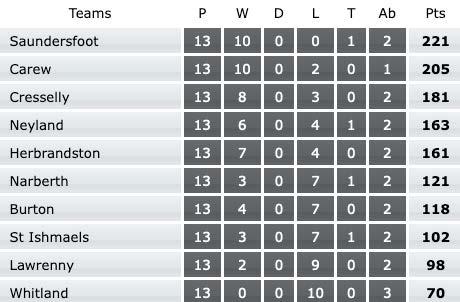
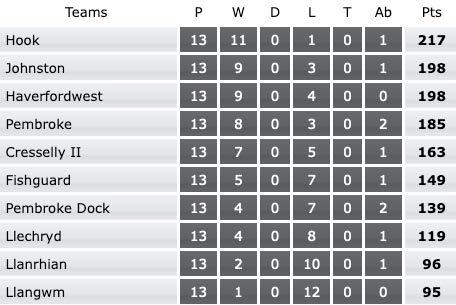

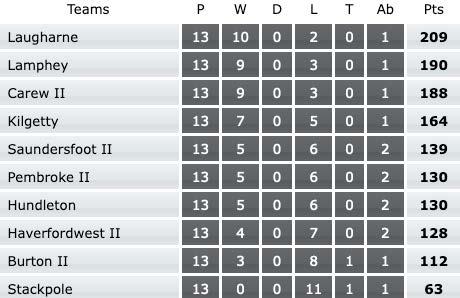
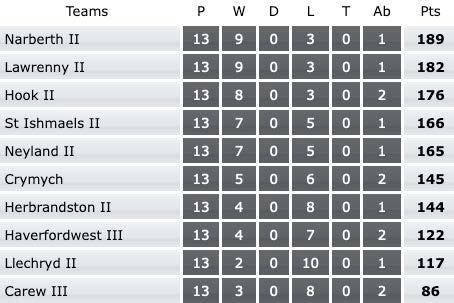

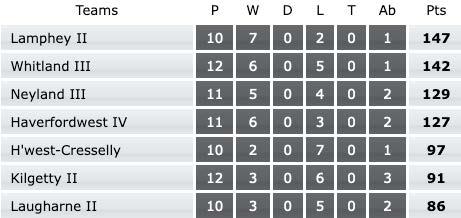



Wales shut out as Springboks cruise to 43-0 victory in Durban • P85