














A MAN has been arrested after an alleged sexual assault of a child in Haverfordwest town centre.
Dyfed-Powys Police said officers were called to Castle Square at around 2:00pm on Tuesday (Apr 7).
The force said a 50-year-old man was arrested on suspicion of a sexual offence against a child and has since been released on conditional bail.
The child’s grandfather told The Pembrokeshire Herald that he saw what he believed to be inappropriate contact between the man and the child before members of the public intervened.
Dyfed-Powys Police said enquiries are ongoing.
A police spokesperson said: “DyfedPowys Police received a report of an alleged sexual assault of a child in Castle Square, Haverfordwest at around 2pm on Tuesday, April 7.
“A 50-year-old man was arrested on suspicion of a sexual offence against a child and has since been released on conditional bail.
“Enquiries are ongoing.”

HERBRANDSTON residents flagged fast-moving traffic as a key concern, prompting police to carry out speed checks in the village.
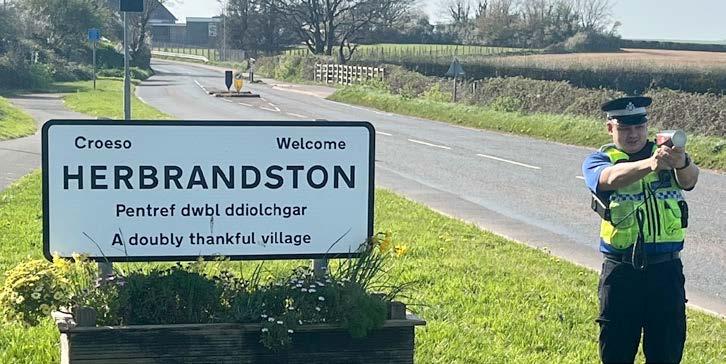
Concern over speeding in Herbrandston has prompted a local police response, with PCSO Adam out in the village carrying out speed checks after residents raised the issue through DPP Connect.
Milford Haven and Neyland Police said the concerns emerged after officers signed local people up to the messaging service, which allows residents to share feedback and
Tom Sinclair editor@herald.email
receive updates from police.
Many of those who responded said speeding through the village was one of their main worries.
In response, PCSO Adam was deployed to monitor traffic and check vehicle speeds.
The move is likely to be welcomed by residents who have grown tired of motorists treating the village like a racetrack.

KRISTIAN DAVIES, aged 35, of Rock Cottages, Neyland, pleaded guilty at Llanelli Magistrates’ Court to aggravated vehicle taking.
The court heard that on January 26, 2026, at Narberth, Davies took a Ford Focus without the consent of the owner or other lawful authority. The vehicle was damaged before it was recovered, with the damage assessed at less than £5,000.
Magistrates sentenced Davies on Tuesday (Mar 31) to 18 weeks’ imprisonment, suspended for 18 months.
The bench said the offence was so serious that only a custodial sentence could be justified, citing Davies’ relevant previous convictions and the fact he was already subject to a court order at the time, which he is now in breach of.
However, the prison term was suspended because the court found there were real prospects of rehabilitation in the community. Davies was also made subject to an 18-month supervision requirement, a non-residential drug rehabilitation requirement with reviews, and up to 15 days of rehabilitation activity.
As part of the order, he must engage with Dyfed Drug and Alcohol Service and provide samples for a 12-month period.
He was also banned from driving for 24 months.
The first review hearing is due to take place at Haverfordwest Magistrates’ Court on April 27 at 10:00am. Bail conditions were cancelled as a matter of urgency.





British Transport Police lead investigation after serious disorder involving group of youths
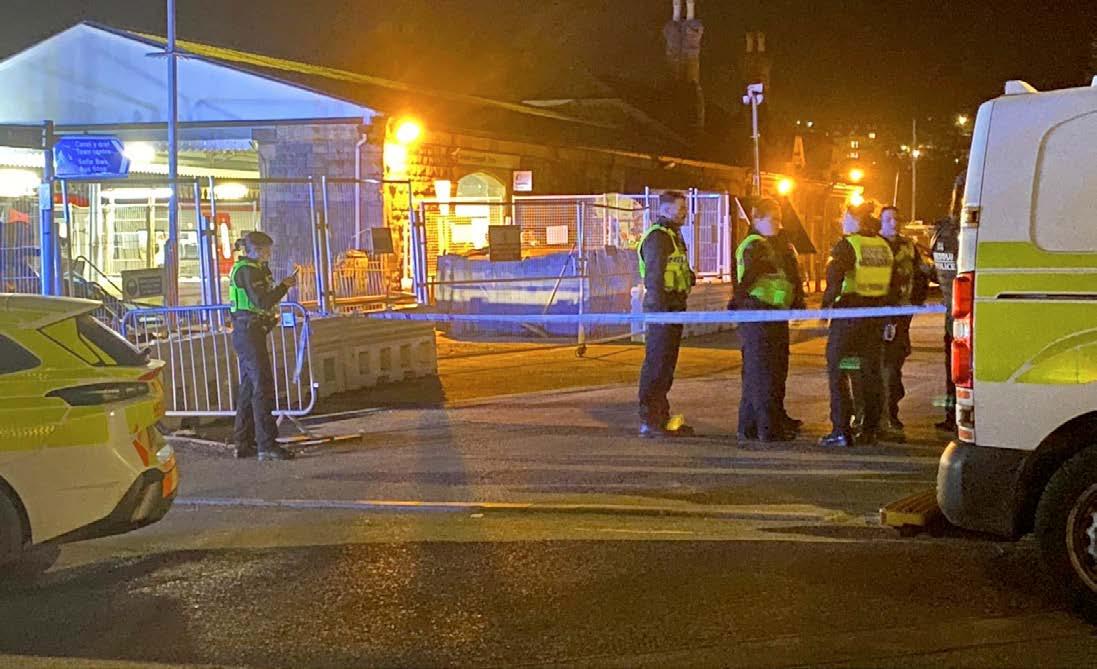
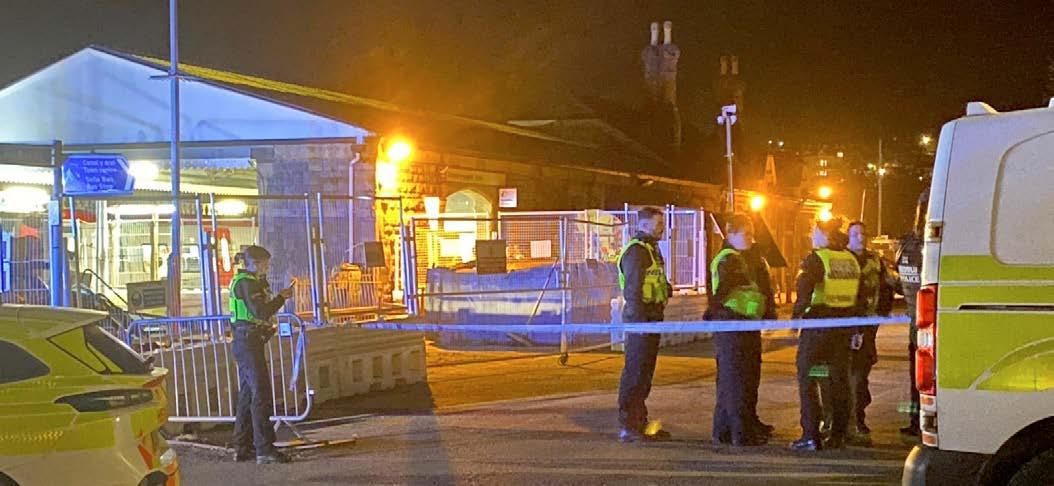
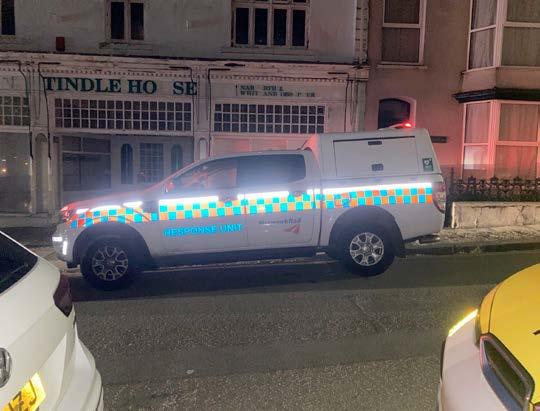
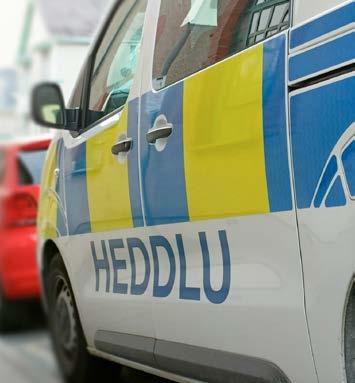
FOUR youths suffered stab wounds during a major incident at Tenby railway station on Tuesday night (Apr 7), police have confirmed. Emergency services were called to reports of serious disorder involving a group of youths at around 9:50pm. The Herald was at the scene as a major response unfolded, with at least four ambulances and around 15 police cars and vans sent to the area.
Video circulating on social media appeared to show a number of children involved in a fracas on the railway platform. In footage seen by The Herald, at least one youth could be heard saying he had been stabbed.
In a statement issued shortly after midnight, a Dyfed-Powys Police
spokesperson said: “Dyfed-Powys Police were called to reports of serious disorder involving a group of youths at Tenby train station at approx. 9.50pm this evening (Tuesday, April 7). During the incident, an individual was in possession of a knife, which resulted in four youths sustaining stab wounds.”
Police said all injuries are currently assessed as non-life-threatening and those affected are receiving appropriate medical treatment.
Officers attended the scene promptly and a 16-year-old youth and a 19-year-old man were arrested
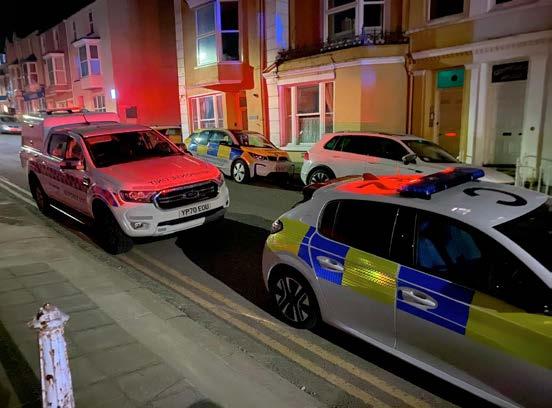
on suspicion of Section 18 assault. Dyfed-Powys Police said British Transport Police have primacy for the incident and are leading enquiries. The force added that the incident has now been brought under control and that the scene is secure. There will remain an increased police presence in the area to provide reassurance.
The Police have confirmed that the two individuals arrested have been released on Police bail and that enquiries continue
Anyone who witnessed the incident or has information that could help the enquiry is asked to contact British Transport Police online, call 0800 40 50 40, or contact Crimestoppers anonymously on 0800 555111.
HENRY TUFNELL MP has said he is deeply saddened by the stabbing of four young people in Tenby and has offered support to those affected.
Responding to the incident at Tenby railway station on Tuesday night (Apr 7), the MP said his thoughts and prayers were with the friends and families of those involved.
Mr Tufnell said the wider community would be shocked by the events, which saw four youths suffer stab wounds during serious disorder at the station.
He also praised the emergency services who responded to the incident.
In a statement, Mr Tufnell said: “I’m deeply saddened to hear of the events last night in Tenby, resulting in the stabbings of four young people. My thoughts and prayers are with the friends and families of those involved.
“I know our community will be deeply shocked by these events, but we are all so grateful for the vital services of the emergency first responders on the scene.
“I will be providing support in any way I can, and I encourage anyone
Tom Sinclair editor@herald.email
affected to contact me.”
In his last day in office before campaigning begins for the Senedd election, Samuel Kurtz MS also responded to the stabbings, describing the news as “truly shocking and deeply upsetting”.
The Carmarthen West and South Pembrokeshire Senedd Member said his thoughts were with the victims, their families and everyone affected by the incident.
He also thanked the emergency services for their swift response and ongoing work at the scene.
In a statement, Mr Kurtz said: “Some truly shocking and deeply upsetting news coming out of Tenby. My thoughts are with the victims, their families, and everyone affected by this tragic incident.
“I also want to extend sincere thanks to the emergency services for their swift response and continued dedication in such difficult circumstances.

“There must be zero tolerance for knife crime. This kind of violence has no place in our communities and cannot be accepted under any circumstances. Those responsible must face the full force of the law.
“We all deserve to feel safe where we live.”
British Transport Police are leading the investigation following the disorder at around 9:50pm. A 16-year-old youth and a 19-year-old man have been arrested on suspicion of Section 18 assault.
TENBY TOWN COUNCIL has called for a stronger visible police presence in the town following a series of incidents involving groups of youths, including disorder, criminal damage and a serious assault.
In a statement issued on Wednesday (Apr 8), the council said the mayor and town councillors were aware of recent incidents and expressed their sympathy with those affected.
The statement comes after Tuesday night’s major incident at Tenby railway station, where four youths suffered stab wounds during serious disorder. Two people – a 16-year-old youth and a 19-year-old man – have been arrested on suspicion of Section 18 assault, while British Transport Police are leading the investigation.
The council said its thoughts were with those affected and wished the injured a full and speedy recovery.
Members also voiced support for
Dyfed-Powys Police and all emergency services involved in the response, thanking them for their swift action. The council urged anyone with information to come forward so those responsible can be held to account.
In the statement, the council said that while Tenby remains a welcoming, closeknit and safe community, the events of recent days had understandably caused concern among residents, businesses and visitors alike.
Councillors added that the behaviour did not reflect the values of the town or the overwhelming majority of its young people.
The council said it believes Tenby needs more visible policing, particularly during busy periods, both to reassure the public and to act as a deterrent to further incidents.
It added that it would continue working closely with the police, Pembrokeshire County Council and other partner

agencies to address the issues and support longer-term solutions.
The statement concluded by saying Tenby thrives on being a safe and friendly place for everyone, and that
the council remains committed to doing everything within its remit to protect that reputation and ensure residents and visitors feel secure in the town.

WELSH LABOUR has set out a fresh pitch to voters on jobs, apprenticeships and green industry ahead of the Senedd election, with First Minister Eluned Morgan claiming her party offers the stability needed to attract future investment to Wales.
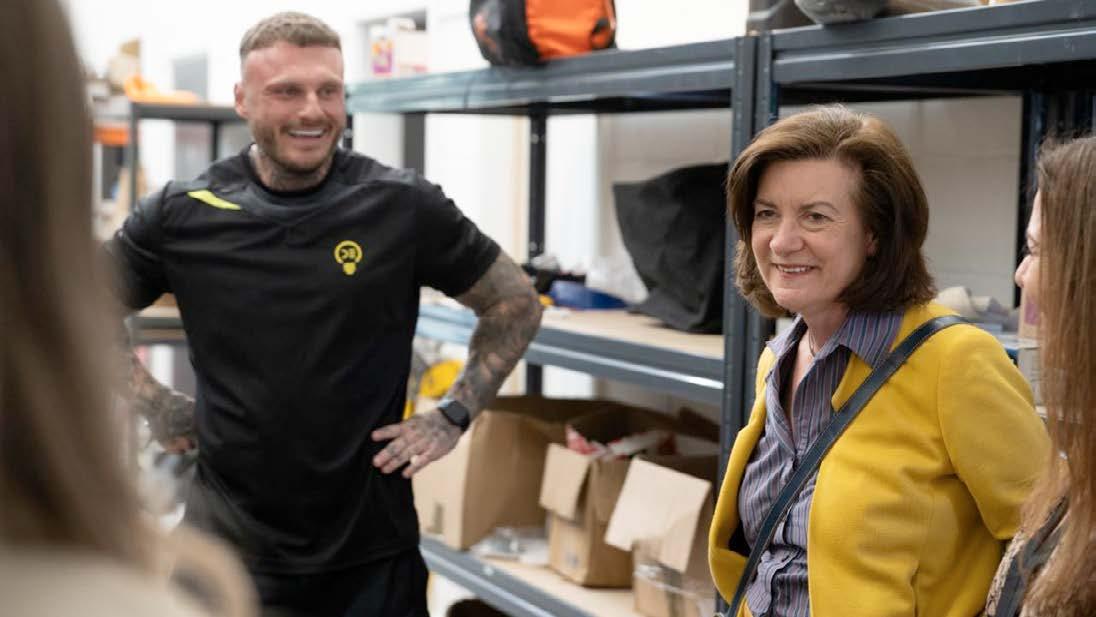
During a visit to electrical firm Dec Elec in Aberdare on Thursday (Apr 9), the Welsh Labour leader met staff and apprentices to discuss expansion opportunities linked to renewable energy infrastructure and skills development.
The visit formed part of Labour’s wider economic message for the election campaign, with the party promising a new industrial strategy for Wales, more apprenticeships and a long-term retraining scheme for workers whose industries are changing.
Speaking during the visit, Baroness Morgan said Welsh Labour wanted to “move into the next chapter of the Welsh economy” by investing in what she described as “the jobs of the future”.
She said the party’s plans would include a new industrial strategy, further apprenticeship opportunities in areas such as renewables and planning, and a “Lifelong Retraining Guarantee” aimed at helping workers adapt at any stage of their careers.
Tom Sinclair editor@herald.email
Labour has also pledged to create a National Jobs Council chaired by the First Minister, deliver 100,000 all-age apprenticeships over the next Senedd term, and speed up the planning system to support economic development.
Other promises include a new strategy for vocational education and training, targeted support for the South Wales Valleys, backing for Welsh steel through public procurement, and work to unlock major projects in north Wales including Wylfa and the proposed AI Growth Zone.
At the Aberdare visit, third-

year apprentice Jordan said his apprenticeship had helped him gain practical skills that would have been difficult to learn in the classroom alone. He said expanding apprenticeships would help more young people gain hands-on experience and improve their chances of finding work.
Labour also used the visit to draw political dividing lines with its opponents. Baroness Morgan claimed Reform UK’s opposition to net-zero projects would put jobs at risk, while also arguing that Plaid Cymru’s support for independence and its approach to renewable energy could deter business investment.
Those claims are likely to be strongly contested during the campaign, with opposition parties expected to argue that their own policies would provide a better route to economic growth, energy security and stronger public services.
The row underlines how jobs, industrial policy and the future of green investment are set to become major battlegrounds in the run-up to polling day.
Welsh Labour is seeking to present itself as the party of economic continuity and managed transition, while opponents are likely to question whether its record in government matches the scale of the promises now being made.

pressed politicians on the NHS, tourism, education, AI and trust in politics

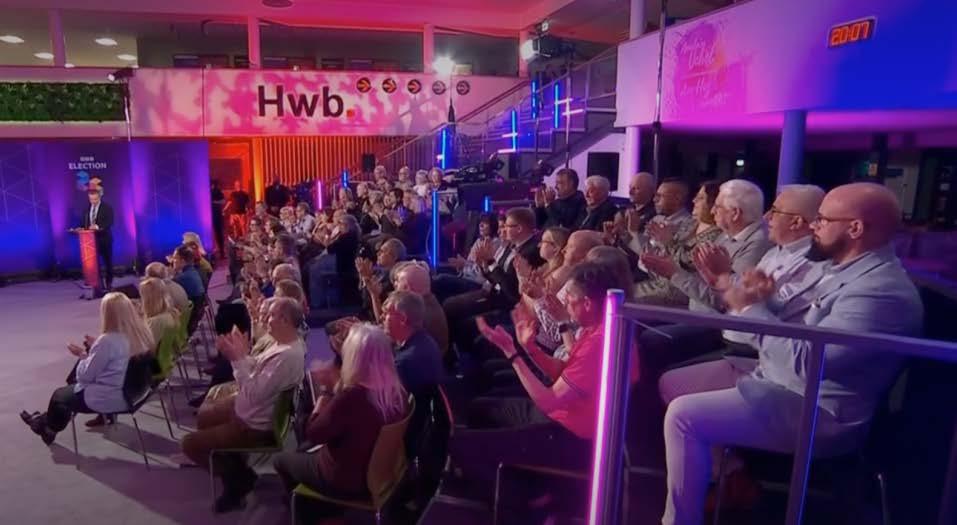
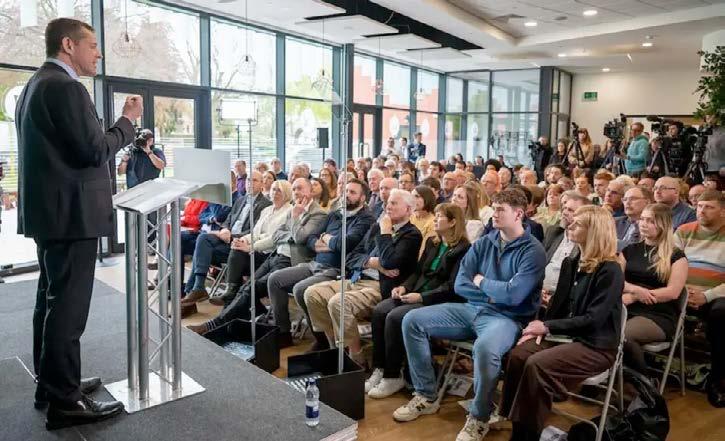
PEMBROKESHIRE was thrust into the heart of the Senedd election campaign on Wednesday night (Apr 8) when BBC Wales brought its Your Voice Live: Ask the Leader programme to Pembrokeshire College in Haverfordwest. Three party leaders — Darren Millar of the Welsh Conservatives, Jane Dodds of the Welsh Liberal Democrats and Rhun ap Iorwerth of Plaid Cymru — each took the stage in turn to answer questions from a live studio audience.
The programme gave each leader just under half an hour to respond to whatever the audience wanted to ask, and the result was a lively, often sharp exchange focused on issues with particular relevance in Pembrokeshire and west Wales.
The strongest theme of the night was the state of the NHS.
Darren Millar was first to face the audience and was immediately challenged by Chloe Richards, an NHS nurse, who said the service was at breaking point and asked what his party would do in its first 100 days to fix it.
Millar said Wales was facing a genuine health crisis and argued that a Welsh Conservative government would declare a national health emergency and increase bed numbers in hospitals and community hospitals. He said ambulances were being delayed because patients could not be moved through the system quickly enough, and insisted that restoring capacity was the immediate priority.
Tom Sinclair editor@herald.email
But the answer did not go unchallenged. Richards told him that, while she agreed the NHS was in crisis, she did not feel he had explained how the staff shortages needed to support more beds would actually be solved.
That set the tone for much of the evening. Other audience members raised the lack of integration between health and social care, long ambulance waits, and the pressure on frontline staff. One woman described waiting fourand-a-half hours for an ambulance for her mother while fearing she may have suffered a stroke.
Millar replied that the biggest problem facing ambulance crews was the inability to hand patients over quickly outside busy hospitals, and repeated his claim that Wales needed urgent action rather than small-scale reform.
The debate then moved on to jobs, tax and the cost of living, with clear local relevance for Pembrokeshire.
Millar set out a tax-cutting programme, including a proposed cut to the basic rate of income tax, a cap on large council tax rises and opposition to future fuel duty increases. He said the money would come from cutting waste, reducing bureaucracy and scrapping what he described as unnecessary Welsh Government spending.
Tourism quickly became part of the conversation. Lavinia Bourne challenged him to say more about how communities
dependent on tourism and farming would be supported. Another audience member cited a sharp fall in furnished holiday lets in Pembrokeshire and Carmarthenshire and asked directly whether the Conservatives would abolish the tourism tax.
Millar said they would. He argued that tourists were being unfairly blamed for wider housing problems and said overnight visitors were vital to local pubs, shops, restaurants and the wider rural economy. He made clear that he saw tourism as a positive force for Wales and not something to be punished.
The mood of the audience grew tougher as the discussion turned to trust in politics.
Martin Jones asked why communities should believe yet more promises before an election when earlier promises of investment had failed to materialise. Presenter Nick Servini also challenged Millar’s attempt to portray the Conservatives as outsiders in Welsh politics, pointing to the party’s long record in government at Westminster.
Millar responded that Wales had been held back by decades of Labour rule in Cardiff Bay, backed at times by Plaid Cymru and the Liberal Democrats, and argued that devolved powers were strong enough to deliver real change if used properly.
Reform UK also hung over the exchange. Asked why right-leaning voters should back the Conservatives rather than Reform, Millar said there
was only one Conservative party on the ballot paper and attacked Reform over standards and credibility.
His final questions focused on younger voters. When first-time voter Joshua Robson asked what his number one priority for Wales would be, Millar said it was fixing the NHS first, then getting Wales back to work and improving the economy. Robson then pointed out that young people rarely spoke positively about the Conservatives, leaving Millar to end with a direct appeal for younger voters to join his party.
Jane Dodds puts social care at the centre
Jane Dodds began with a question from Gillian Davis, who raised the intense pressure on GP surgeries and asked what could be done about closures, shortages and poor access.
Dodds said GPs were on the frontline of healthcare and needed more support, more funding and more incentives to stay in local communities. But it was clear from the outset that her central argument was about social care.
She said social care was the key to easing pressure across the entire health system. In her view, too many people were ending up in hospital unnecessarily, while too many others were stuck in beds because there was no care package in place to get them safely home.
That point was reinforced by a retired NHS worker in the audience, who said too many people were being admitted to hospital when they did not need to be there, and too many others were staying in acute beds long after they should have gone back into the community.
Dodds said there were 1,400 people in Welsh hospitals who should not have been there that evening, but who were unable to leave because they were waiting for assessments or carers. She argued that properly funded social care would ease pressure at both the front and back doors of hospitals, reduce delays for ambulances and help tackle corridor care.
The discussion around primary care then took on a strongly local and practical edge.
Davis, who works in a GP surgery, said a team of about six receptionists had dealt with around 2,500 calls in one day after the bank holiday. She said that patients trying to get a telephone appointment with one GP partner were already being told to wait until June, with face-to-face appointments taking even
longer.
It was one of the clearest illustrations of the strain facing frontline services and reflected what many in Pembrokeshire will recognise from their own experience of trying to access local healthcare.
Dodds accepted that social care alone would not solve the pressure on GP practices. She said more money had to go directly into front-line services, more GPs had to be trained and rural communities needed stronger incentives to attract doctors. She also acknowledged the abuse that some reception staff face from frustrated patients and said it was unacceptable.
One of the most politically risky moments of the evening came when Dodds was pressed on how she would pay for her plans.
She accepted that the Welsh Liberal Democrats could be the only party in the election arguing openly for a tax rise. She said that if the Welsh budget did not provide enough money for social care, her party would support a temporary increase of one penny on income tax, ring-fenced specifically for that purpose.
Dodds defended that position by saying it was dishonest for parties to promise tax cuts while also claiming they could protect public services. It was one of the clearest dividing lines of the night, and it set her apart from Millar’s taxcutting pitch.
Dodds was then asked how Wales should prepare young people for a future shaped increasingly by artificial intelligence.
She took a generally optimistic view, saying Wales should not fear AI but should get ahead of the changes it will bring. She said the country should consider creating a centre of excellence on AI, with training and courses to help young people prepare for the jobs of the future.
But audience member Janetta Warden was clearly uneasy. She said she worried AI could become an extension of the damaging aspects of social media and that children were already relying too heavily on technology to do their thinking for them.
That led into a wider exchange about education. A school governor from Pembroke said he was less concerned about AI than about the basic standard of education in Wales, arguing that schools should be aiming for the top rather than falling behind.
Dodds agreed that education was fundamental to Wales’ future. She linked good schools to stronger communities, better jobs and the hope that more young
people would be able to stay in Wales rather than feeling they had to leave.
Plaid Cymru challenged on local healthcare
Rhun ap Iorwerth’s appearance began with a question that could hardly have been more relevant to west Wales.
Gemma Davies asked about the long distances many patients have to travel for hospital care and what could be done for those who do not drive. Ap Iorwerth said the issue involved transport, local standards of care and the need to rebuild confidence in services closer to home.
He said Plaid Cymru wanted to reduce waiting times now while also building a more sustainable health service for the future, with stronger primary care through GPs, dentists, opticians and pharmacists helping people earlier before hospital treatment became necessary.
Davies then made the question far more personal and local.
Pregnant with her first child, she said she could choose to give birth in the midwife-led unit at Withybush Hospital, but that doing so brought real anxiety because the unit was not consultantled and because of concern about what would happen if complications arose and urgent transfer was needed.
It was one of the most powerful moments of the programme because it went straight to a concern that has echoed around Pembrokeshire for years: whether local people can still feel fully confident in the care available close to home.
Ap Iorwerth responded sympathetically and accepted the importance of maintaining confidence in local health provision, while also recognising that some specialist services
would always have to be provided elsewhere.
As his section continued, ap Iorwerth touched on a wider range of Plaid Cymru priorities, including health, waiting times, education standards, better jobs and childcare.
When he was asked to boil it all down to one central aim, he said that if he became First Minister he would want to look back in four years and say he had helped raise confidence in what Wales could achieve together.
He said he did not believe in a government that imposed things on people, but in one that worked in partnership with them. Asked whether a Plaid Cymru-led government would serve only Plaid voters, he replied that it would govern for all of Wales, regardless of how people voted.
If the three leaders were the stars of the broadcast, the Pembrokeshire audience was the driving force.
This was not a tame or passive crowd. Questioners repeatedly challenged vague answers, rejected political slogans and dragged the discussion back to the realities of life in west Wales. Healthcare dominated, but the questions also ranged across tourism, rural economies, housing, trust in politics, education and the future facing younger generations.
Several of the strongest moments came not from the politicians but from audience members describing real experiences: an NHS nurse frustrated by broad promises, a woman left waiting hours for an ambulance, a GP surgery worker overwhelmed by thousands of
calls, and an expectant mother worried about the risks of maternity care far from specialist support.
For Pembrokeshire viewers, that local dimension was what made the programme stand out. National party leaders were not debating in the abstract. They were being asked to respond directly to problems people here know well.
The Haverfordwest debate was the first of two BBC Wales specials ahead of the Senedd election.
The second programme, featuring Welsh Labour, Reform UK and the Wales Green Party, will be broadcast from Llandudno at 8:00pm on Wednesday, April 15.
BBC Wales’ visit to Pembrokeshire College turned Haverfordwest into a stage for one of the key election debates of the campaign. Darren Millar made the NHS his central theme, promising a declared health emergency, more hospital beds and a strongly pro-tourism, tax-cutting agenda. Jane Dodds put social care at the centre of her argument, openly defending the possibility of a temporary tax rise to fund it and calling for more support for GPs, schools and communities preparing for technological change. Rhun ap Iorwerth was pressed hardest on local healthcare and distance from services, with Withybush Hospital emerging as a powerful local concern, before setting out a broader message about confidence, partnership and national ambition. Through it all, the audience ensured the debate stayed rooted in Pembrokeshire realities rather than party scripts. The programme is available to view on Iplayer.
POLICE intervened after an online warning raised fears of a planned fight involving young people in Pembroke Dock.
The development came in the immediate aftermath of the shocking stabbings of four youths at Tenby railway station on Tuesday night, which have caused serious concern across Pembrokeshire.
Pembroke Dock and Pembroke Police said they were made aware of social media posts suggesting a fight had been arranged for Friday afternoon (Apr 10), and that the reports were treated with “the utmost seriousness”.
The Herald understands concerns were flagged directly to Dyfed-Powys Police after troubling material was seen online, including a post warning parents about an alleged planned fight in Memorial Park, Pembroke Dock.
The post urged parents to check their children’s phones and referred to claims that children as young as nine could be involved, with allegations that knives were being discussed in group chats on social media.
In a statement, BCU Commander
Tom Sinclair editor@herald.email
for Pembrokeshire, Superintendent Louise Harries said: “These reports have been treated with the utmost seriousness, and our priority is to ensure the safety of residents in this area, as well as disrupting any kind of violent or anti-social behaviour that occurs.
“Today, our officers have taken proactive measures to identify those involved in the planned activity, and have spoken to each young person, along with their parents and guardians.
“I’d like to thank the young people involved for co-operating with our officers and for their understanding of the potential dangers and risks posed by planning such an event.
“To provide further reassurance, officers and Neighbourhood Policing Teams will carry out patrols of the area and will be happy to speak with any members of the community about any concerns they may have.
“As we come to the end of the Easter holidays, I continue to urge parents, carers, and guardians to be aware of


their children’s whereabouts.”
Police said neighbourhood officers would carry out extra patrols in the area to provide reassurance and deter any further anti-social or violent behaviour.
The latest development is likely to
deepen fears of further youth disorder following the serious violence in Tenby earlier this week.
Anyone with concerns or information is asked to contact DyfedPowys Police via 101 or online. In an emergency, always dial 999.
A MOTORCYCLIST was airlifted to hospital with serious injuries following a two-vehicle collision on the B4333 near Capel Iwan on Wednesday morning (Apr 8).
Dyfed-Powys Police said officers were called just after 7:00am to the crash on the Maudlands stretch of road. The collision involved a white Mercedes Sprinter van towing a trailer and a black Triumph motorbike.
The rider of the motorbike was taken to hospital by air ambulance, where he remains under treatment for serious injuries.
Police confirmed that the driver of the van, José Fernando Rey Fernández, aged 45, was arrested following the incident. He has since been charged with causing serious injury by careless driving,
remanded in custody, and was due to appear before Aberystwyth Magistrates’ Court.
The road was closed for several hours while specialist collision investigators carried out enquiries. It reopened at around 3:50pm.
Officers are appealing for anyone who saw either vehicle before the collision to come forward. They are particularly keen to hear from anyone with dash-cam footage, CCTV, or doorbell video covering the area at the time.
Anyone with information is asked to contact Dyfed-Powys Police quoting reference DP-20260408-055.

FINAL-YEAR student nurses training in west Wales say they are facing the “very real possibility” of unemployment after being told a key recruitment process has been delayed because of a shortage of available posts.
Members of the S23 Adult Nursing cohort based in Carmarthen have written to The Herald describing growing alarm and frustration after being informed that streamlining, the process used to match newly qualified nurses to jobs, had been postponed for a second time.
The cohort said the delay had left students fearing they could complete three years of demanding training only to find there were no jobs waiting for them in the NHS in Wales.
In a letter sent to The Herald, the students said: “We are not writing this letter out of anger, but out of deep desperation and disappointment. After all our hard work, we are now being faced with the very real possibility of unemployment.”
The students said they had spent the past three years training and working across hospital and community settings, carrying out the full range of duties expected of nursing staff while completing the 2,300 hours required to qualify.
Tom Sinclair editor@herald.email
They said that had meant working days, nights, weekends and holidays, missing important family events, and taking on emotionally and physically demanding duties without pay.
The cohort wrote: “We have cleaned bodily fluids, administered medication, witnessed and assisted in surgical procedures, dressed wounds, rehabilitated patients and performed CPR. We have supported patients and families across all stages of life, from supporting new mothers to holding a patient’s hand as they take their last breaths.”
They added: “We have done all this, without salaries, driven by the belief in our NHS, our desire to serve our wider community, and our understanding that we, as nurses, are in high demand.”
However, students say that confidence has now been shaken.
They told The Herald that on Monday, April 7, many were preparing to enter streamlining the following day when they received an email stating that the planned date of April 8 would no longer go ahead.
Instead, the process has been
A SEx offender has been remanded in custody after appearing in court accused of breaching a Sexual Harm Prevention Order on seven separate occasions.
Stewart Alderton, aged 44, currently of HMP & YOI Parc, Bridgend, appeared before Aberystwyth Magistrates’ Court on Tuesday (Mar 31).
The charges allege that Alderton breached a Sexual Harm Prevention Order imposed at Mold Crown Court on November 17, 2021.
It is alleged that at an address in Wylcwm Close, Knighton, on June 18, 2025, and again on December 14, 2025,
pushed back until May 11 because the number of available roles is said to be significantly lower than the number of graduating students.
Students say they have been warned that even with the delay, the problem is not expected to be resolved.
There are 23 student nurses in the Carmarthen adult nursing cohort alone. One student told The Herald the issue is likely to affect far more people across Wales, including students on adult, paediatric, mental health and learning disability pathways.
She said there are an estimated 130 adult nursing students across Carmarthen and Swansea campuses, although the full number affected across all courses and universities is not yet known.
The students said they are now facing uncertainty over how they will support themselves once student funding comes to an end.
They wrote: “We have spent three years being unable to take on regular work, in order to prioritise our studies. When our student funding ends, how will we survive? How will we support our families?
“How have we been able to train for jobs that don’t exist?”
The cohort said they had been led to believe that training as nurses would provide a clear path into employment, particularly as those receiving NHS bursary support are expected to work in
Wales for two years after qualifying.
Although the Royal College of Nursing has reportedly indicated that students who fail to secure a role would not be required to repay their funding, the cohort says this does not address the wider problem.
They stressed that they do not blame their university, which they said had been “honest, transparent and supportive” throughout the course, but said urgent action was now needed.
The students are calling for answers on why there was so little warning, whether newly qualified nurses will be allowed to seek work outside Wales if no posts are available, and why so many students continue to be recruited into nursing courses if there are not enough jobs at the end of training.
One student, Robynne Williams, told The Herald she was willing to speak publicly about the issue. She said the cohort has already sent its letter to members of Hywel Dda University Health Board and is in the process of sending it to others across Wales, including the university, the Welsh Government and the RCN.
So far, she said, only the RCN has responded.
The Herald has approached Hywel Dda University Health Board, Health Education and Improvement Wales, the Welsh Government and the Royal College of Nursing for comment.
he deleted TikTok chat strings, phone applications, web artefacts and web history, and also carried out a factory reset on a device, all said to be contrary to the terms of the order.
A further allegation states that on February 16, 2026, at Bronglais Hospital, he failed to notify police of an internet-enabled device within the required three days.
No pleas were entered.
The case was adjourned for a plea hearing at Aberystwyth Magistrates’ Court at 2:00pm on Wednesday (Apr 1).
Alderton was remanded in custody.

Politicians visiting Frenni say rising fuel costs, weak transport links and a lack of investment are placing increasing pressure on businesses across the

CONSERVATIVE politicians have warned that poor transport links and rising operating costs are putting
increasing pressure on the haulage sector in west Wales, following a visit to leading local road haulier Frenni.

Tom Sinclair editor@herald.email
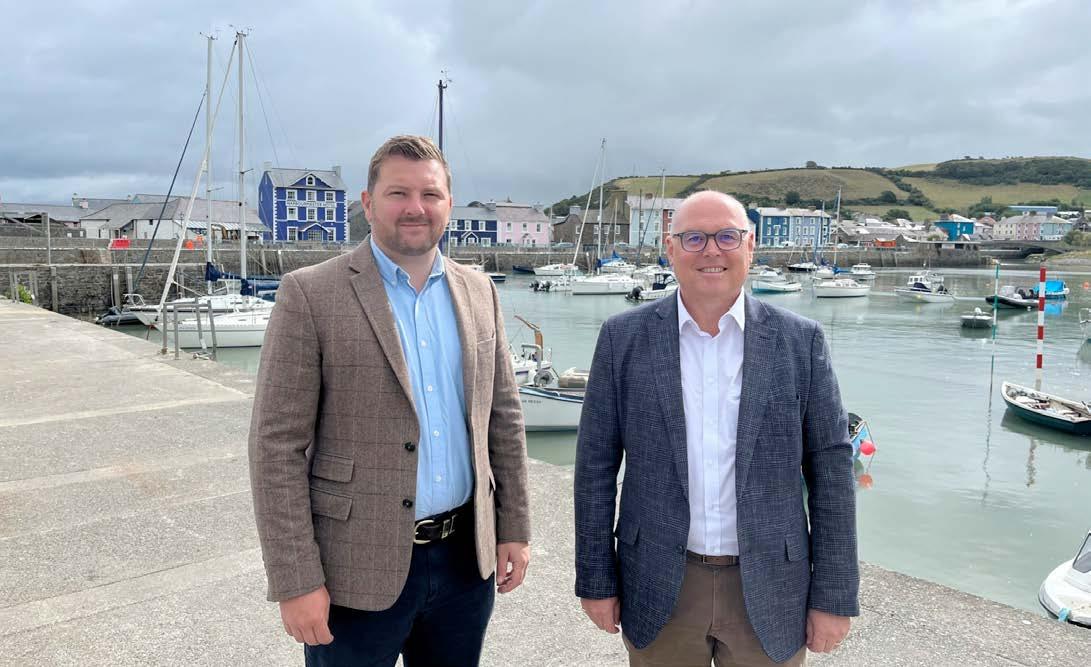
During the visit, Welsh Conservative leader Darren Millar joined Ceredigion Penfro candidates Paul Davies and Samuel Kurtz to meet staff at the company and discuss the challenges facing the industry.
Among the main concerns raised were weak road infrastructure, rising fuel prices, growing business costs and the impact these pressures are having on firms that rely on efficient journey times to stay competitive.
Frenni told the politicians that poor connectivity is making it harder to move goods efficiently, reach key markets and compete with businesses elsewhere in the UK — a problem that is especially acute for haulage operators, whose profitability depends heavily on reliable journey times.
According to the Road Haulage Association, the sector moves around 89 per cent of all goods in the UK, underlining its importance to the wider economy. However, it also faces mounting pressures from fuel costs, wages, insurance, maintenance and regulatory compliance.
The visit also came amid renewed concern over fuel prices. The politicians said businesses in west Wales were already struggling with increased costs and warned that any further rise in fuel duty would place additional strain on hauliers and rural communities.
Darren Millar said: “It was incredibly valuable to hear directly from Frenni about the challenges they face day to day. Time and again, we hear the same message — our road networks are holding businesses back.
“Whether it is delays, poor road conditions or rising fuel costs, the current environment is making it harder than ever to operate. We support the road haulage sector in its calls for action on fuel duty.”
Paul Davies said haulage firms such as Frenni were vital to the economy and deserved stronger backing.
He said: “Hauliers like Frenni are absolutely essential to our economy. They keep goods moving across the country every single day, but they are being squeezed from all sides — from fuel costs to rising wages and wider business pressures. Without action, we risk placing that vital network under real strain.”
A key issue raised during the meeting was the long-standing call to dual the A40, which the politicians described as a crucial freight route linking west Wales with the rest of the country.
Samuel Kurtz said: “For a haulage firm, time is money. The A40 and M4
are a lifeline for us, and without proper investment, companies here are at a clear disadvantage. We need to see real progress and real investment.”
Road safety concerns were also discussed, particularly on the A477, where calls have previously been made for major improvements.
Mr Kurtz added: “Improving the A477 is not just about convenience, it is about safety. Hauliers are on these roads every day, and we need to ensure these routes are safe, resilient and fit for purpose.”
The politicians also said more needed to be done to improve driver welfare, with concerns raised over a shortage of secure parking, rest areas and basic facilities for HGV drivers in west Wales.
Paul Davies said: “Driver welfare is too often overlooked. If we want to support the haulage sector and tackle driver shortages, we need proper facilities, including safe parking, rest areas and access to basic amenities.”
Wider transport concerns were also discussed, including calls for progress on major infrastructure schemes such as the M4 relief road, which supporters say is needed to ease congestion and improve freight movement across south Wales.
The default 20mph speed limit was another issue raised during the visit, with criticism from the politicians that it is increasing journey times and adding to delivery costs.
Samuel Kurtz said: “Hauliers understand the importance of road safety, but a blanket 20mph approach is not working for logistics. It is slowing journeys, increasing costs and making it harder for businesses to operate efficiently.”
Setting out the party’s position, Paul Davies said the Welsh Conservatives would prioritise investment in roads and transport infrastructure.
He said: “We would get Wales moving again by delivering A40 dualling, upgrading the A477 for safety, progressing the M4 relief road, improving facilities for drivers and scrapping the blanket 20mph policy. At the same time, we must recognise the cost pressures facing the sector and back the businesses that keep our economy moving.”
He added: “Frenni is a great example of a hardworking west Wales haulage business playing a vital role in the wider UK economy. These are the businesses that ensure goods reach our shops, homes and industries. With the right support, they can continue to grow, create jobs and keep Wales moving.”
If you want this turned into a more balanced newspaper piece with Labour/ Plaid reaction added, I can do that too.
Carmarthenshire defendant denies deleting internet history contrary to court order
A MAN from Llandeilo has been sent to Swansea Crown Court for trial after appearing before Llanelli Magistrates’ Court charged with breaching a sexual harm prevention order.
Ben Barrett, 37, of Maes Y Farchnad, Llandeilo, appeared before the court on Thursday (Apr 9)
The court heard that Barrett is accused of breaching a sexual harm prevention order made by Swansea Crown Court on March 15, 2018.
It is alleged that between October 13 and October 19, 2025, at Llandeilo, Carmarthenshire, he deleted the history of internet use without reasonable excuse, despite being prohibited from doing so by the order.
The case was sent to Swansea Crown Court for trial under Section 51 of the Crime and Disorder Act 1998.
Barrett gave no guilty indication and the matter was treated as not guilty for the purposes of sending.
He was granted unconditional bail and is due to appear at Swansea Crown Court, The Law Courts, St Helens Road, on Friday, May 8 at 9:00am for a plea and trial preparation hearing.





by/gan Dylan Thomas
Kate Wasserberg

A PEMBROKESHIRE scaffolder has been banned from driving after being caught with cocaine in his system while on his way to work.
Alex Williams, 41, was stopped by police on the morning of November 3, 2025, as he drove his Peugeot 207 along the A4076 at Dredgemans Hill, Haverfordwest.
A roadside drug swipe proved positive. Subsequent blood tests showed he had 133 micrograms of benzoylecgonine in his system. The legal limit is 50.
The court heard other drugs were also detected, but all were below the legal limit.
Probation officer Julie Norman told magistrates: “He’d been to a party the weekend before where he’d consumed some cocaine.
“He was stopped by officers on Monday morning as he drove to his place of work in Waterston. But now, as a result of the offence, he is unsure whether he will be able to remain in
his employment.”
Williams, of Summerhill, Keeston, was represented by solicitor Fenn Richards, who said the offence came at a time of increasing anxiety over his health.
“There’s a defective gene in his family which increases the risk of gastric cancer,” said Ms Richards.
“The defendant found out he had this gene just a few months before the offence. Several of his family members have passed away as a result of the gene, and naturally this has had a great impact on his mental health, which is why he consumed the cocaine.”
Williams was sentenced to a 12-month community order. He must complete ten rehabilitation activity requirement days and 100 hours of unpaid work.
He was also disqualified from driving for 17 months and ordered to pay a £114 surcharge and £85 costs.

A PEMBROKE woman has appeared before magistrates charged with assaulting a woman at Pembroke Leisure Centre.
Kaycee Blake, aged 35, of Devon Drive, Pembroke, is accused of assaulting a woman by beating during an alleged incident at the leisure centre on
September 27, 2025.
Blake appeared before Haverfordwest Magistrates’ Court this week, where she denied the charge.
Her trial has been listed for June 1 at Haverfordwest Magistrates’ Court. She was released on unconditional bail.




A TEENAgER has been banned from driving after she was caught behind the wheel with more than five times the legal limit of cannabis in her system.
Ashleigh Morgan-Scourfield, 18, was stopped by police on December 19 as she drove her Vauxhall Corsa through Pentlepoir.
Blood tests later revealed she had 13 micrograms of Delta-9 tetrahydrocannabinol in her system. The legal limit is 2.
Haverfordwest magistrates heard this week that Morgan-Scourfield had smoked cannabis earlier that morning.
Her solicitor, Fenn Richards said: “She was pulled over in the evening not suspecting she would still be over the limit.
“At the time, she was experiencing issues after a relationship breakdown and found that cannabis helped her. She is absolutely devastated to be here today.”
The court was told MorganScourfield’s remorse was set out in a three-page letter handed to magistrates following mitigation.
Morgan-Scourfield, of Bellevue Farm, Ludchurch, Narberth, pleaded guilty to drug-driving and driving without third party insurance.
She was disqualified from driving for 12 months. She was also fined £173 and ordered to pay £85 costs and a £69 surcharge.

A MOTORIST has elected for a Crown Court trial after being charged with causing serious injury to a dog walker in Penally.
Harry Sutton-Brown, aged 28, is accused of causing serious injury to Joanne Morris by careless or inconsiderate driving on Village Road, Penally.
Haverfordwest magistrates heard this week that the prosecution alleges SuttonBrown struck Ms Morris on November 22, 2024, as he negotiated a bend in his Hyundai i30.
However, his solicitor said the complainant had been walking “three
abreast” with two other people while exercising a dog.
“As the defendant came around the bend, the pedestrians were walking across the road in the central reservation,” his solicitor told the court.
“The defendant was blinded by the sun and he didn’t see the pedestrians in the middle of the road.”
Sutton-Brown, of Boars Head Bridge, Templeton, elected for trial at Swansea Crown Court.
The case will next be before the Crown Court on May 8.
He was released on unconditional bail.
A 64-YEAR-OLD man has appeared before magistrates charged with threatening and abusive behaviour towards a woman in Pennar.
Paul Davies, aged 64, appeared before Haverfordwest Magistrates’ Court this week by video link from HM Swansea Prison, where he has been remanded in custody since his arrest.
Davies admitted using threatening, abusive and insulting words and
behaviour towards the woman. He also pleaded guilty to sending indecent, offensive, obscene and menacing messages by an electronic communications network, and to causing £500 of criminal damage to her television.
The offences took place between March 31 and April 2.
Sentencing was adjourned until April 28 to allow the probation service to prepare a pre-sentence report.



Party promises action on childcare, health, education and energy as Labour and the Liberal Democrats question independence and costings

PLAID CYMRU has launched its Senedd election manifesto with a pledge to offer what it calls a new direction for Wales, setting out policies on childcare, the NHS, schools, the economy and energy while also reaffirming its long-term belief in Welsh independence.
The party says its programme is
Tom Sinclair editor@herald.email
designed to tackle pressures facing families and public services, while giving Wales a more ambitious sense of purpose after years of Labourled government. Among its main promises are expanded childcare

support, action to improve standards in education, measures aimed at strengthening the economy, and a greater focus on energy security and public benefit from renewable developments.
Plaid is presenting the manifesto as both a plan for immediate government and a statement of longer-term national ambition. The party argues that Wales needs practical change now, but also a serious debate about how the country is governed and what powers it should hold in the future.
A central part of Plaid’s pitch is childcare. The party says it wants to widen support for families with younger children, arguing that this would help parents return to work, ease household pressure and improve early years outcomes. It is also promising a stronger focus on schools and living standards, while seeking to position itself as the party of change at a time when many voters are frustrated with the status quo.
On the NHS, Plaid says Wales needs urgent improvement and a fresh approach to delivery. On the economy, it is promising policies intended to support Welsh businesses and keep more wealth within Welsh communities. On energy, the party is seeking to link net zero ambitions with greater control over how renewable power is developed, who benefits from it, and how the returns are shared.
Plaid’s manifesto also makes clear that the party remains committed to independence as its long-term constitutional goal. It says Wales should be able to shape its own future more fully and sets out further steps towards that objective, even though the main emphasis of the launch has been on day-to-day issues affecting voters now.
That stance has brought immediate criticism from Welsh Labour and the
Welsh Liberal Democrats.
Welsh Labour accused Plaid of not being straight with voters, arguing that while the party has sometimes tried to place less emphasis on independence during the campaign, the manifesto itself clearly points towards it. Labour also challenged Plaid’s presentation of the election battle and questioned whether some of its headline pledges, especially on childcare, could realistically be funded.
The Welsh Liberal Democrats also attacked Plaid’s constitutional position, saying the party was not being honest about the cost of its push for independence. They argued that public attention and resources should remain firmly focused on strained services such as the NHS and schools.
Plaid, however, is likely to argue that its critics are trying to reduce a much broader policy platform to a single constitutional question. The party’s message is that its manifesto is not simply about independence, but about using Welsh government more boldly and more effectively to improve everyday life.
The political divide is therefore becoming clear. Plaid wants voters to see its manifesto as a serious programme for change, combining support for families and public services with a wider national vision. Labour and the Liberal Democrats, by contrast, are trying to persuade voters that Plaid’s plans come with unanswered questions over honesty, affordability and priorities.
With the Senedd election approaching, Plaid’s launch has opened one of the first major arguments of the campaign — not only about independence, but about who has the clearest and most convincing plan for Wales.
A PEMBROKESHIRE man has appeared before magistrates accused of threatening enforcement officers with a knife during an incident at his home near Mathry.
Simon Coll, 59, is charged with affray and two counts of criminal damage following the incident at Pant y Blodau, Castlemorris, in the early hours of February 26.
Prosecutor Sian Vaughan told Haverfordwest magistrates this week
that three Excel enforcement officers had attended the property to secure vehicles.
“The officers had a conversation about securing some of the vehicles at the property, and then knocked on the door wearing body worn cameras,” she said.
“The defendant opened the door and immediately became aggressive towards them, brandishing a knife, and asking, ‘Do you want some?’”
Body worn camera footage was shown to the magistrates, in which the enforcement officers could be
seen running away while shouting at Coll to put down the knife.
Coll is further accused of causing £387 worth of damage to a windscreen and wheel clamp belonging to Excel Enforcement.
He denies all three charges.
Although magistrates agreed to retain jurisdiction, Coll elected for trial by jury.
The case has now been sent to Swansea Crown Court, where proceedings are due to begin on Friday (May 8). Coll was released on unconditional bail.
TWO men have appeared before Haverfordwest magistrates charged with drug offences involving cocaine, amphetamines and cannabis.
Lee Miskin, aged 52, and Saul Miskin, aged 21, both of St Davids Close, Hubberston, are each accused of possessing controlled drugs with intent to supply.
Saul Miskin is charged with possessing 261 grams of cannabis with intent to supply and 47.36 grams of amphetamine with intent to supply. He also faces three further charges of being concerned in the supply of cannabis, amphetamine and cocaine.
Lee Miskin is charged with being
concerned in the supply of cannabis, amphetamine and cocaine. He also faces two further charges of possessing 261 grams of cannabis and 47.36 grams of amphetamine with intent to supply.
The offences are alleged to have taken place in Milton and Pennar, Pembroke Dock, between January 2023 and February 2024.
Because of the seriousness of the allegations, magistrates declined jurisdiction and sent the case to Swansea Crown Court.
Both defendants are due to enter pleas on May 8.
They were released on unconditional bail.

QUESTIONS have been raised over whether the interests of justice are being served after an 81-year-old motorist was charged with failing to provide a breath specimen for analysis.
Kate Telford appeared before Haverfordwest magistrates this week after being listed for trial following her arrest on March 1.
The court heard that she was taken to Haverfordwest police station and asked to provide a breath sample. When she failed to co-operate, she was charged with failing to provide a specimen for analysis.
But her solicitor, Michael Kelleher, challenged the conduct of police officers during the incident, arguing that his client was physically unable to complete the test.
“The prosecution claims this was a deliberate failure to provide a breath sample, but the defendant has a growth in her mouth, a heart issue and her breathing isn’t sufficient to allow her to breathe into a breathalyser machine,” he said.
“All this information can be obtained
from her doctors.
“The day she was arrested, the police should have provided her with an alternative method – a nurse was available to take blood, and there was also the option of a urine test. But basically, the police didn’t believe her and thought she was putting it all on. Even her request to sit on a chair was refused.
“This woman has no experience of criminal law, she has no previous convictions and she didn’t know how to argue her own case. Previous appeals have been refused in the interests of justice, but surely the interests of justice aren’t being met by failing to grant an appeal.”
After retiring to consider the submissions, the Bench refused Mr Kelleher’s application to appeal against the indictment.
“We have carefully considered the appeal before us and have gone through each of the five grounds,” said the presiding magistrate.
“We find that none of the factors apply to this case, therefore the appeal fails.”

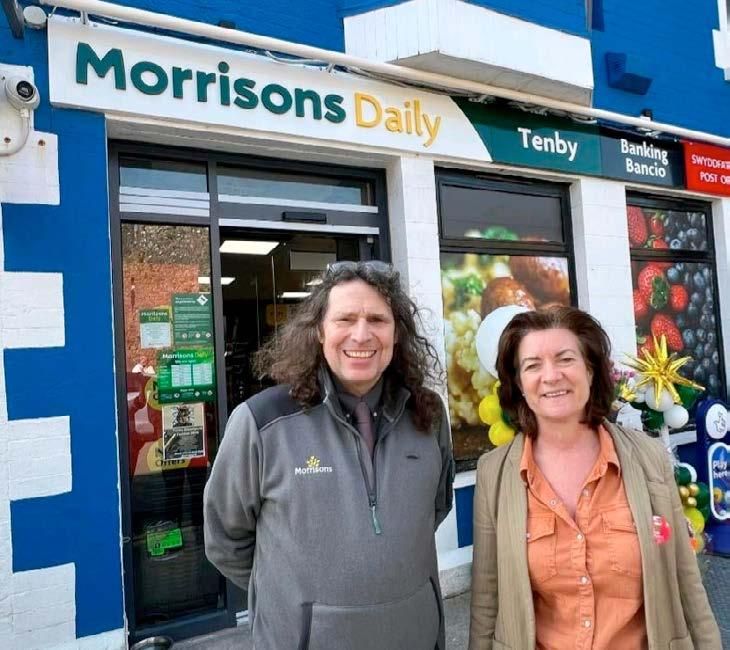
AHEAD of the Welsh election on May 7, 2026, the Federation of Independent Retailers (the Fed) has met First Minister Baroness Eluned Morgan in Pembrokeshire to underline the vital role small shops play in the Welsh economy and in communities across the country.
The Fed was represented by senior members Vince and Fiona Malone at their business in Tenby, which has recently undergone a refit and now trades under the Morrisons Daily fascia.
Since launching its Welsh election manifesto in January, the Fed has been inviting Senedd candidates to visit members’ businesses across Wales to discuss both the opportunities available to small retailers and the challenges they face.
The manifesto calls for grant support for small independent retailers, as well as action to tackle rising costs — particularly business rates, which are controlled by the Welsh Government. The Fed is also calling for a cost-neutral Deposit Return Scheme that works for
smaller shops.
Mr Malone described the meeting as “very positive”.
He said: “In particular, I highlighted the value of our Post Office and the vast range of government services it provides to people in the town and the many visitors who stay in Tenby, especially in the coming summer months.”
Baroness Morgan said: “I would like to thank Vince and the Fed for once again highlighting their important work representing the vital small independent shops that serve the people of Wales.
“I was particularly interested to hear about the work of the Post Office, especially at a time when the Westminster government is looking to engage retail stakeholders on the modernisation of the Post Office network, so businesses like Vince’s can continue to thrive in the years ahead while serving local people.”
If you want it, I can also turn this into a more punchy Pembrokeshire Herald version with a stronger headline and sub-heading.
TOURISM businesses across Pembrokeshire and Ceredigion are facing a “perfect storm” of pressures at the very start of the holiday season, according to two senior Welsh Conservative figures.
With the Easter holidays traditionally marking the start of the main tourism period, firms across west Wales would normally be preparing to welcome visitors and generate crucial income after the winter months.
But Paul Davies MS and Senedd candidate Sam Kurtz say confidence in the sector is being undermined by rising costs, new regulations and what they describe as damaging policy decisions.
Tourism remains one of the main economic drivers in Pembrokeshire and Ceredigion, supporting thousands of jobs and a wide range of small and medium-sized businesses.
Mr Davies said: “Easter is the starting point for the tourism season in Pembrokeshire and Ceredigion. It’s when businesses begin to recover after winter and build momentum for the year ahead. But instead of optimism, many are facing a perfect storm created by rising costs and damaging policy decisions that we voted against.”
Mr Kurtz added: “Tourism is the backbone of the economy in Penfro and across west Wales. But policies like the proposed tourism tax and changes such as the 182-day rule are adding uncertainty and pressure at exactly the wrong time.”
Tom Sinclair editor@herald.email
Concerns raised by businesses include the impact of the 182-day rule, which requires many self-catering operators to meet higher occupancy thresholds or face increased tax bills. There is also concern about the
proposed visitor levy, which critics say could deter tourists and make Wales less competitive than other parts of the UK.
Operators are also dealing with rising day-to-day costs, including business rates, energy bills, staffing pressures and increased compliance demands.
Mr Davies said: “These policies might be well-intentioned, but the cumulative
effect is damaging. At the very point the season begins, businesses are being hit with uncertainty and additional costs that threaten their viability.”
Setting out the Welsh Conservatives’ position, he said the party would scrap plans for a tourism tax, work with councils to expand free town centre parking, and reduce the 182-day threshold to 105 days.
THE UK gOVERNMENT
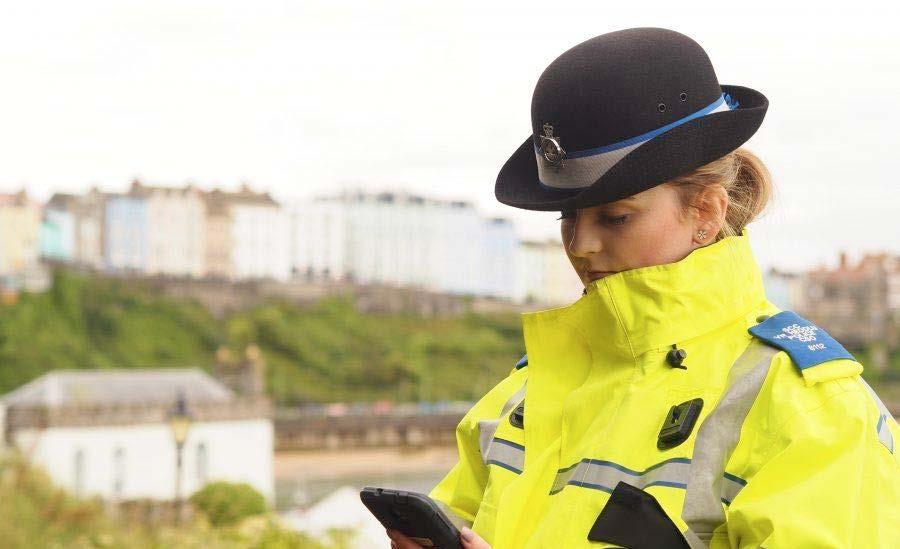
says there are now 200 more neighbourhood police officers on the beat in Wales than there were a year ago, as ministers push a wider drive to increase visible policing in communities.
The claim was made as the Home Office announced it had met its target of putting more than 3,000 additional police officers and Police Community Support Officers into neighbourhood roles across England and Wales, two months ahead of schedule.
According to figures released on Tuesday (Apr 7), a total of 3,123 extra neighbourhood policing staff have either been recruited or redeployed since April last year, with the government saying they are now focused on tackling local crime and anti-social behaviour.
The Wales Secretary, Jo Stevens said: “There are now 200 more neighbourhood police officers on the beat in Wales than a year ago, fighting the crime and anti-social behaviour that can have a huge impact on communities.
“It is a central mission of the UK Government that people feel safe in their neighbourhoods and the increased police presence is already delivering results and leading to more arrests across the country.”
Ministers say the extra officers form part of a longer-term plan to roll out 13,000 additional neighbourhood policing personnel by the end of this parliament.
The Home Office said a recent Winter of Action campaign, carried out during December and January in more than 600 towns and cities, led to almost 18,000 arrests as police patrols were stepped up.
Of those arrests, the government
said more than 5,000 were linked to retail crime, more than 1,000 to sexual offences, almost 1,000 to street crime, and over 10,000 to violent assault.
Crime and Policing Minister Sarah Jones said neighbourhood policing had been “hollowed out” in recent years and that too many officers had been kept in desk-based support roles rather than deployed on the streets.
She said: “We’re delivering the biggest reforms to policing in over 200 years and, crucially, putting 13,000 more neighbourhood officers where they belong – on the beat and fighting crime in our communities.”
The Home Office also pointed to what it described as early successes in several police force areas, including South Wales Police, which it said had reported a 37 per cent drop in home burglaries and a 14 per cent fall in anti-social behaviour.
The announcement also comes as the government launches a new strategy aimed at halving knife crime within a decade.
Under the Neighbourhood Policing Guarantee, ministers say every neighbourhood in England and Wales will have named, contactable officers, with residents promised a meaningful response to local concerns within 72 hours.
All police forces have also now
published anti-social behaviour action plans setting out how they intend to tackle persistent local problems.
John Hayward-Cripps, chief executive of the Neighbourhood Watch Network, welcomed the increase and said stronger local relationships would help build confidence and improve the flow of intelligence from communities.
Harvinder Saimbhi, chief executive of ASB Help, said the extra officers should help reassure victims that their concerns are being taken seriously.
The government says the expansion of neighbourhood policing marks a major step towards reversing years of decline in visible local policing, though the longer-term impact on crime levels will be closely watched.
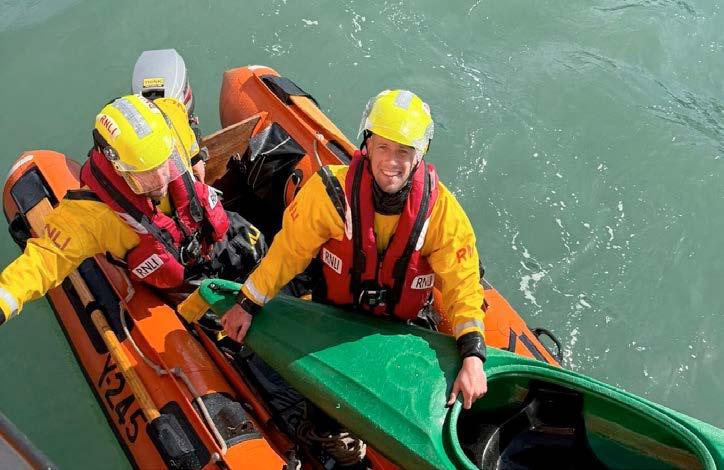
ST DAVIDS RNLI launched on Easter Monday after an upturned kayak was spotted drifting east of Solva Harbour.
The all-weather lifeboat, Norah Wortley, was requested to launch at 11:04am on Monday (Apr 6) after the vessel was seen floating in the water.
Heading into a strong southeasterly wind, the Tamar-class lifeboat made directly for Aber-west.
Members of HM Coastguard St Davids Cliff Rescue Team assisted from the clifftop, helping to guide the volunteer crew to the kayak.
As the vessel was lying close to the shore, the lifeboat’s daughter boat was launched to recover it and bring it aboard the Norah Wortley.
Photographs of the kayak were then sent to HM Coastguard in Milford Haven, which confirmed it had been reported missing from Porthclais several days earlier.
That meant there was no need for a shoreline search for the owner.
The kayak was taken to Solva Harbour, where it was handed over to HM Coastguard and secured on the quay wall. The lifeboat returned to station at about 12:30pm.
St Davids RNLI Coxswain Will Chant said: “The timely reporting of a missing kayak by the owner potentially saved an unnecessary search operation. Thank you to members of St Davids Coastguard team for their assistance during this shout.”
Racecourse general manager Kevin Hire says this weekend’s Family Fun Day has taken on a much deeper meaning following his major operation and recovery
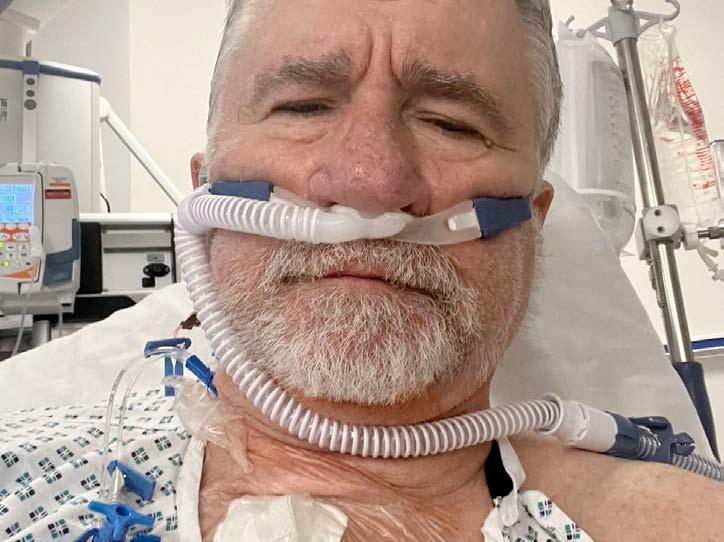
FFOS LAS RACECOURSE general manager Kevin Hire has paid an emotional tribute to his family as he prepares for this weekend’s Family Fun Day.
Hundreds are expected to attend the popular event on Sunday (Apr 12), but for Mr Hire, 62, this year’s occasion is about far more than racing and entertainment.
Just six months ago, he was preparing to undergo life-saving open-heart surgery. Now, after a long recovery, he is back leading preparations for a raceday centred on the thing he says mattered most during his darkest hours — family.
He said: “It hasn’t just changed how I look at my work. It’s changed how I look at everything.”
The alarm was first raised last spring when a routine walk across the racecourse left him suddenly struggling for breath.
Mr Hire said: “I walked about 150 yards and suddenly I was severely out of breath. I’d never experienced anything like it. I knew something was wrong.”
Initial tests suggested only a minor issue, but further examinations revealed severe aortic stenosis and the need for a double heart bypass.
He said: “I was told my heart was working at 61 per cent capacity and would drop to 40 per cent within a year, then to 20 per cent. There was a serious risk of loss of life.”
For Mr Hire and his wife Nicola, the diagnosis came as a major shock. He said: “That moment, getting
back into the car and going home, we just didn’t know what was ahead.”
In October, he underwent a six-hour operation at Morriston Hospital, where surgeons replaced his aortic valve and carried out the bypass procedure.
After spending a week in hospital, he returned home to begin a lengthy recovery.
The physical toll was considerable. An 18-inch incision to his leg and
major chest surgery left him with limited mobility and an ongoing healing process.
Mr Hire said: “You go from being independent to needing help with everything.”
He said the experience made him appreciate more than ever the support of those closest to him.
“Family is special,” he said. “It made me realise the pain they went through. I was going through it, but they were going through it ten times worse because there was nothing they could do.”
His daughters, Mali and Nia, were a constant source of strength, even giving him a Ted Lasso-inspired toy soldier as a good luck charm.
He reserved special praise for his wife Nicola, who took time off work to care for him full-time.
Mr Hire said: “I can’t thank her enough. She stayed with me constantly. We went into the unknown together, but we came out the other side.”
He said the ordeal has changed the way he sees the role of the racecourse in the community.
“That’s why these race days are so very, very important to me,” he said. “It’s tough out there. The cost of living is going up and every penny counts. We want families to come here and have a fantastic day without worrying about the cost.”
Sunday’s Family Fun Day has
been designed to make the event as affordable as possible.
Children can attend free with a paying adult, meaning a family of six can get in for the price of just two adult tickets. A range of activities is also included at no extra charge.
Entertainment on the day will include live spring jump racing, as well as an appearance by the K-Pop Superstars, who will perform, meet fans and pose for photographs.
Away from the track, children will be able to enjoy go-karting, face painting, funfair rides and outdoor activities.
Ffos Las says rides will cost just £1, well below the usual price at travelling fairs.
Families are also being encouraged to bring their own picnics to help keep costs down, while a wet weather guarantee means that if rain falls during the event, racegoers will be invited back to another fixture free of charge.
For Mr Hire, the day is ultimately about creating happy memories. He said: “To see the kids smiling and enjoying themselves, that’s what it’s all about. If families can come here, spend time together and make memories, then we’ve done our job.”
After months of recovery, Mr Hire said he knows better than most the value of time spent with loved ones — and this Sunday that message will be at the heart of everything at Ffos Las.

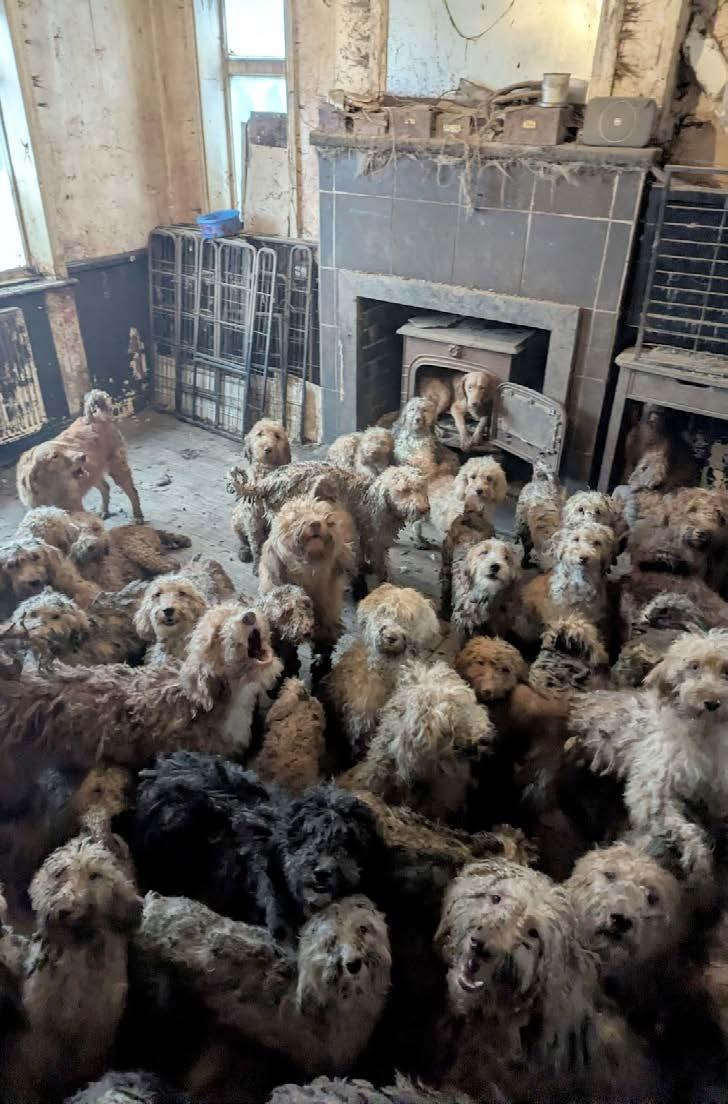
THE RSPCA is urging animal lovers in Wales to consider adopting a rescue pet as new figures show a sharp rise in large-scale incidents involving 10 or more animals at the same address.
The charity said there were 344 such incidents in Wales in 2025, up from 214 in 2022 — an increase of 61 per cent. Across England and Wales, the RSPCA responded to 4,200 incidents last year involving at least 10 animals at one property.
The warning comes as the charity says its centres are already over capacity, with more animals in care than there is space to house them.
RSPCA Superintendent Jo Hirst said: “We are struggling with rising reports of cruelty and neglect and, over recent years, more and more of those reports involve 10, 20, even 100 animals. Because they have often been living in large groups, they may need extra support before they are ready to find a new home.”
She added: “We currently have more animals in our care than space in our centres. These large animal rescues are adding to already overwhelmed animal centres and local charities.
“We really need help from animal lovers. If you are considering adding a pet to your home, please consider rescuing. We need extra special homes for some of our animals.”
The RSPCA said it dealt with 1,752 mass cat incidents across England and Wales last year — almost five every day — along with 1,119 incidents involving dogs, the equivalent of three every day.
In 75 of the cases, 100 or more animals were rescued from the same property. Thirteen of those incidents involved cats and three involved dogs. Many required multi-agency operations involving other charities and public bodies.
The charity said cases involving large numbers of animals at one address can be linked to mental health struggles, the cost-of-living crisis, or breeders operating with poor practices. Experts say situations can quickly spiral out of control, even where owners were initially wellmeaning.
Across Wales, the highest number of incidents in 2025 were recorded in Rhondda Cynon Taf with 32, followed by Carmarthenshire with 29, Swansea with 26, and both Neath Port Talbot and Cardiff with 23. Wrexham recorded 22 cases and saw the biggest year-
Tom Sinclair editor@herald.email
on-year rise, climbing from seven incidents in 2024 to 22 in 2025.
Pembrokeshire recorded 19 largescale incidents in 2025 involving 10 or more animals at the same address. While that was slightly down from 20 in 2024, it remained above the 15 incidents recorded in 2022, showing the issue is still a significant concern locally.
The RSPCA said Welsh cases have involved a wide range of animals, including horses, donkeys, cats and dogs. In one case in recent years, almost 50 dogs were rescued from one property, many suffering with dirty
coats, fleas and skin disease.
Among the animals in Wales now looking for new homes are several cats at RSPCA Newport Animal Centre.
Reid is described as a cat whose fun-loving personality is shining through more each day. Staff say she would benefit from a quiet home where she can settle at her own pace with patient adopters.
Cookie, also at Newport, was initially nervous and shy after coming from a multi-animal home, but has since grown in confidence and now enjoys fuss and attention. She could live with older children.
Luna, another cat at the centre, is said to need a calm home with no children, allowing her time to
settle. Staff say she becomes very affectionate once comfortable and would suit a household where someone is around much of the time.
Jo Hirst said: “Rescues involving lots of animals are often very complex and can include very difficult family circumstances, mental health problems, or be linked to irresponsible pet breeding.
“People accumulate animals for a multitude of reasons, but the welfare risks for these poor animals are always the same.
“We have already had two incidents involving hundreds of pets this year. Those sorts of rescues put strain on our services and are extremely harmful to the animals involved. It is vital we work with external partners when dealing with these types of incidents to ensure support is in place where appropriate.”
She added: “Often, animals rescued from crowded environments are undersocialised and require a long period of rehabilitation before being rehomed, which puts even more strain on an already stretched rescue centre.
“We are encouraging people to contact an animal rescue organisation if they are at a stage where they, or someone they know, is struggling with the numbers of animals they have in their household. Often, problems escalate because people do not reach out early enough.”
The RSPCA said hoarding is only one cause of these cases, with some incidents involving breeders who become overwhelmed by the numbers of puppies or kittens in their care. In many situations, the charity said, the best outcome is achieved through early advice and support to protect the animals and prevent future harm.
Jo added: “Serious mental health issues and complex situations involving animal hoarding are in part driving these figures. It is vital that people are able to contact us — or another animal charity — where they have too many pets and are unable to cope.
“These situations put massive pressure on our national centres, which have limited space for housing animals. That is why we are asking people with space in their home for a pet to consider adopting — it frees up space so we can rescue more animals in need.”
People interested in adopting can visit the RSPCA website at rspca.org. uk/findapet.
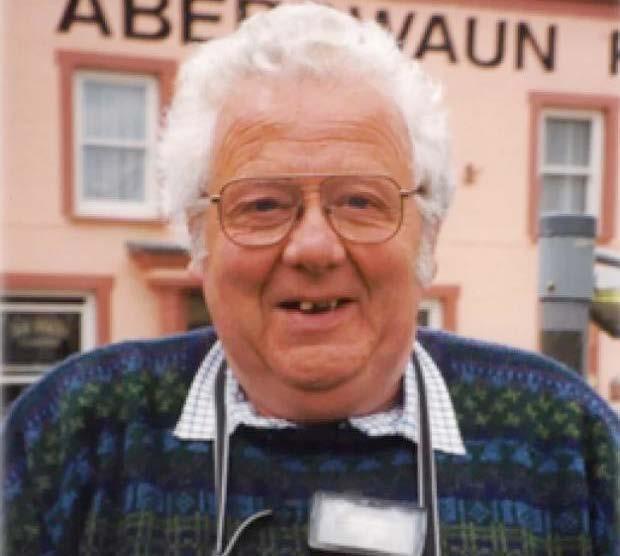
TRIBUTES have been paid to Johnny Morris, a much-loved Fishguard photographer who has died at the age of 91.
For decades, Johnny was a familiar figure across north Pembrokeshire, capturing community life through his camera lens for the local press, as well as for countless local groups, charities and organisations.
Tom
Sinclair editor@herald.email
He was widely regarded as the goto photographer for Fishguard and the surrounding area, with an extensive archive of images documenting local people, events and history over many years.
As well as his photography, Johnny
was known for his love of gardening, his knowledge of local history and his gift for telling stories. Friends said he was often happiest in his garden, where he won several local trophies for his growing skills.
Johnny died peacefully on Sunday, March 22, at Park House Court in Tenby. He was predeceased by his wife Irene. He is survived by his daughter Joy, son-in-law Dilwyn, and his brother Derek.
Former Western Telegraph reporter Anwen Baldwin paid tribute, describing him as a lovely man and a great photographer.
She said: “He knew so much about the local area, its people, events and history.
“He had a great sense of humour and I loved hearing his stories about Fishguard past and present, although not all of them were for publication.
“He had a huge archive of pictures documenting the area over the years, and if I ever needed an image for a story, he would have it, no matter how obscure the request.
“He took me under his wing when I first started as the Western Telegraph’s north Pembrokeshire reporter and became a good friend who I always looked forward to catching up with.
“He will be greatly missed by the local community and the many reporters and editors who were always pleased to see a picture from Johnny Morris on their pages.”
Fishguard RNLI said Johnny had played an important role in recording
the life of the station over many years. In a mark of respect, the flag at the lifeboat station has been lowered to half-mast.
A spokesperson said: “It is with great sadness that we learn of the passing of local photographer and supporter of Fishguard RNLI, Johnny Morris.
“As the station’s photographer Johnny documented a vast array of station life, from crew photos and station fundraising events, to the arrival of our current D-Class inshore lifeboat, as well as countless other community events.
“As a mark of respect, the flag over the station will continue to be flown at half-mast.”
Fishguard and District Round Table also paid tribute, describing Johnny as a local photography legend and a strong supporter of community events and charities.
The group said he had always been on hand to record important milestones in the town.
Long-standing member Gwil Evans added: “He had a brilliant knack of being able to make even the worst of us look like a million bucks.”
Johnny’s funeral will take place on Friday, April 10, at 11:30am at the Chapel of Rest, Feidr Castell, Fishguard, followed by interment at Hermon Cemetery.
Family flowers only are requested. Donations in lieu of flowers may be made payable to Fishguard Lifeboat, care of Paul Jenkins & Sons Funeral Directors, Feidr Castell, Fishguard.
ANgLE RNLI volunteers were called out to a series of incidents across the Milford Haven Waterway in recent weeks, including missing person searches, a medical evacuation and assistance to vessels in difficulty.
The first of the incidents took place late on Sunday, February 16, when the crew was paged at 11:04pm to assist St Govan’s Coastguard Rescue Team and Dyfed-Powys Police with a missing person search at Cleddau Reach, Llanion. The launch was later cancelled after the casualty was located safe and well by police.
In the early hours of Tuesday, March 11, at 1:12am, the lifeboat crew was tasked alongside Dale Coastguard Rescue Team to assist with an ongoing police incident at Hakin Point, Milford Haven. The lifeboat launched and stood by within the marina lock until the incident was safely concluded. The crew was back alongside and ready for service again by 2:00am.
A further launch followed on Friday, March 21, at 1:09pm, when the crew was requested to assist a seven-metre motor vessel with three people on board suffering machinery failure off the Behar Wreck in Dale Roads.
Once on scene, the volunteer crew assessed the situation and decided the safest course of action was to establish a tow. The vessel was taken under tow before the line was handed over off Hobbs Point to a workboat from Rudders Boatyard for the remainder of the journey back to the slipway. With no further assistance required, the lifeboat returned to station and was ready for service again by 3:30pm.
Just after midnight on Tuesday, April 1, at 1:15am, Angle RNLI was again paged to help Dale Coastguard Rescue Team and Dyfed-Powys Police, this time in the search for a despondent woman in the Milford Haven area. As the crew prepared to launch, the casualty was found safe and well by police and the launch was cancelled.
Later the same day, at 9:52pm, the lifeboat was requested to assist with a medical evacuation after reports of a man suffering chest pains on board a harbour tug moored off South Hook.
A Port Authority pilot boat had already transferred the casualty from the vessel and was making for its jetty. The lifeboat rendezvoused with the pilot vessel, where casualty care-trained crew members boarded. Supported by
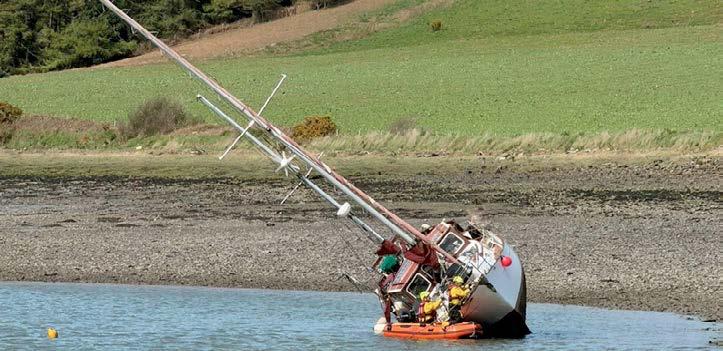
Dale Coastguard Rescue Team, the man was assessed and extracted from the vessel before being handed into the care of colleagues for transport to hospital.
The lifeboat was back alongside her berth and ready for service again by 11:30pm.
Most recently, on Monday, April 6, at 1:05pm, the crew was tasked to assist a fourteen-ton yacht with one person on board which had run aground and was listing near Mill Bay.
With the tide still ebbing, the immediate concern was the welfare of
the lone skipper. The lifeboat launched shortly afterwards and located the yacht around twenty minutes later. With the vessel by then listing significantly, the crew deployed the inflatable Y boat to speak with the skipper and discuss the options.
The owner, who was understandably reluctant to leave the yacht, was helped to deploy an anchor. With no further assistance required, and the skipper content to remain on board and await the returning tide, the crew was stood down. The lifeboat was back alongside and ready for further service by 3:00pm.

FOOD hygiene checks have not been carried out in parts of a Welsh county since 2019 due an inspection backlog, a council has admitted.
Carmarthenshire council said its struggle to recruit food safety officers means hygiene inspections are currently overdue at three high-risk food premises in the county, with hundreds more lower risk food sellers also behind on checks.
Councillor Colin Evans told a scrutiny committee meeting he felt the situation was “quite serious”, adding: “Should something go wrong, it could go wrong very quickly.”
The Food Standards Agency (FSA) said councils were making progress on checks despite increased workloads and a UK-wide need to train more
inspectors.
The council was told last month it probably would not meet its hygiene checks and interventions for high-risk food businesses.
Despite offering £60 to £70 per hour to recruit qualified staff through agencies, the council said recruitment remained difficult.
Ian Jones, the council’s head of leisure and public protection, said despite a lot of professionalism and expertise within the service it was “highly unlikely” the end-of-year targets would be met.
Councillors were told other authorities were in a similar position and the committee referred the matter to cabinet for consideration.
No checks for seven years
Food premises are checked based on risk categories ranging from A to E, with A, B and C considered high risk due to food handling.
The council said there were three highest-risk category A premises with overdue hygiene inspections in the county – two of them within a 28-day overdue period, and the third subject to an “ongoing presence from inspectors” since the previous intervention.
There were also two category B premises and 228 category C premises with overdue inspections, and 467 overdue hygiene inspections for category D and E establishments.
The council said inspection frequencies depended on the risk category but varied between “at least every six months to at least every 36 months”.
But a council website showing food ratings suggests no food hygiene inspections have been done at some premises in the north of the county in seven years.
The council said inspectors carried out other work, such as food standards and hygiene visits.
It said the average backlog was 16 months for category C premises, 35 months for category D and 38 months for category E.
And it said 405 of the 467 category D and E premises with an overdue inspection were eligible to do a selfassessment questionnaire.
The council said it had a statutory duty to enforce food law “as effectively as possible, using means that are most appropriate to the circumstances”.
The hospitality trade body UK Hospitality said despite pressure on the sector in recent years, “the safety of our customers remains non-negotiable and food hygiene is a major focus for businesses – alongside work on allergens and food crime”.
The FSA’s head of delivery Sarah Aza said last month the agency was liaising with governments and others to increase the inspection workforce.
She said councils were making good progress on food safety and standards checks but a rise in new businesses was increasing the workload.
“If a local authority is concerned about meeting its legal inspection duties, we ask them to get in touch with us early,” she said.
Report by Richard Youle, Local Democracy Reporting Service

TRAFFIC delays on the busy road between Neyland and Burton are set to continue into late April, with Pembrokeshire County Council confirming that ongoing bridge repairs are still underway and unlikely to finish before the end of the month.
The update came after The Herald asked for clarification following concerns from a reader about the pace of the work and whether the original target of completion by the second week of April would be met.
In response, the council said the works now underway are essential
safety repairs to replace the bridge’s original parapet railings, which are more than 50 years old.
Officials said the parapet replacement is expected to be completed in the week commencing Monday (Apr 20). After that, contractors will begin replacing the bridge surfacing, which is expected to take around a week and will also require traffic management.
The final stage of the project will involve replacing the bridge movement joints. Those works are due to be carried out at night and, according to the council, will not require daytime traffic management.
Pembrokeshire County Council said the current lane closure and traffic lights are necessary to protect workers on site, adding that the only alternative would have been a full road closure.
The authority said that while a closure might have shortened the scheme by a few weeks, it would have caused greater disruption overall and risked damage to diversion routes.
The council also explained that the job is more complicated than a routine bridge repair because the parapet plinths are around 100mm narrower than modern standards. That has meant a special parapet railing
system has been needed, with only one accredited supplier in the UK able to provide it.
The supplier, the council said, has committed all available resources to the scheme, but site constraints and the required sequence of works mean each side of the bridge takes several weeks to complete.
It also said there are very few trained and accredited operatives able to carry out the specialist work, meaning nighttime, 24-hour or weekend working was not possible.
On the issue of delays, the council said the traffic lights are manually controlled on working days between 7:00am and 6:00pm, with contractors instructed to adjust timings at peak periods to improve traffic flow where possible.
However, with the A477 carrying more than 13,000 vehicles a day, the council acknowledged that delays at busy times are unavoidable.
A spokesperson said: “We fully understand that having traffic lights on the highway network is inconvenient and frustrating for road users and apologise for the delays experienced.”
The council added that, despite the extremely wet weather this year, the scheme remains on programme.
A CALL for a 60-foot-long shed and stables at the proposed home of a gypsy traveller family near a Pembrokeshire village has been refused by planners.
In an application to Pembrokeshire County Council, Ryan Surname Boswell & Family, through agent Hayston Developments & Planning Ltd, sought provision for an access road and replacement of temporary stables and storage containers with a multi-purpose shed and stables at Greenwells, Cosheston Bridge, Cosheston.
The application initially sought a 24.3 by 9.1 metre building, which has now been reduced to 18.3m by nine.
A supporting statement said that land to the north “is subject to a current planning application for the provision of two traveller family pitches with improvements to access and ecological enhancements with other land in our client’s ownership being un-affected”.
It added: “Mr Boswell and his family are of traveller origin and intend to make this site their family home. They own various domestic equipment, children / family articles, mowers / tools and farming equipment that require secure storage. The shed will also be used to house horses/ ponies that are currently stabled in
the temporary wooden stable block currently on skids on the land in question.”
It concluded: “The scale, design and use of materials (and colours) of the proposed shed is comparable to many new such sheds throughout Pembrokeshire. There will be no significant negative impacts on the level of amenity enjoyed by any neighbours or those travelling along the minor county road to Cosheston from any aspects of the proposed development.”
Local community council Cosheston had raised concerns including the “excessive” size of the proposed building, feeling “this is on
the large side of what is required for a couple of ponies”.
It added: “Our concern is that the applicant intends to run his building/ property maintenance business from the property. If the council grants the application, restrictions should made on the property’s use. i.e. restricted to agricultural use only.
“We have no objection to the construction of a small stable block, similar in size to the existing one on site.”
Objections were also received from two members of the public, raising concerns including the scale, environmental concerns, and a potential conflict with the ongoing application.
An officer report recommending refusal said the scheme was partretrospective due to the prior formation of an access track within the field.
It added: “Despite amendments to the application as originally submitted by the reduction in building footprint and scale, the proposal remains a substantial and visually intrusive structure in the open countryside. An essential countryside need has not been justified nor evidence provided of an agricultural or equine enterprise warranting a building of this size or permanence.”
The application was refused on the grounds it “is not typical of a structure intended solely for the storage of paraphernalia associated with grazing land or for equine use and no information has been provided within the application to demonstrate the functional need for a building of this scale”.
It added: “The nature, siting and scale of the building would not be compatible with the capacity and rural character of the site, and together with the access track results in an unjustified and visually intrusive form of development in the open countryside, which does not represent sustainable development.”

DIESEL prices in Pembrokeshire are edging dangerously close to £2 a litre, with the BP forecourt in Johnston on the A4076 displaying 194.9p per litre.
The latest surge has sparked a rush at some filling stations across the county, as motorists hunt for pumps that have not yet caught up with the steep increases. The Herald understands
some forecourts have temporarily run dry as drivers fill up early to avoid paying even more, rather than because of any wider supply issue. That picture fits with national comments from the AA, which said it had seen no evidence of widespread shortages or any increase in breakdowns caused by vehicles running out of fuel.
Pictures sent to The Herald show just how sharply prices now vary across Pembrokeshire.
At Johnston, diesel was 194.9p per litre and petrol 157.9p. At Robeston Wathen, diesel was 187.9p and petrol 155.9p. At Square and Compass, diesel was 183.7p and unleaded 151.7p. In Milford Haven, the Gulf station on North Road was displaying diesel at 179.7p and petrol at 148.7p, while Tesco Milford Haven showed diesel at 181.9p and unleaded at 149.9p. In St Davids, Ocean Haze was also showing diesel at 187.9p, with petrol at 155.9p.
Based on those prices, there is a 15.2p-per-litre gap between the highest and lowest diesel prices pictured — a difference of more than £9 on a 60-litre fill.
The local spike reflects a sharp rise across the UK. RAC data showed average petrol prices reached 152.01p a litre on March 30 — the highest level in 28 months — while diesel climbed
to 181.2p, its highest point since December 2022. The RAC said that, compared with the start of the Iran conflict, it was costing £10.55 more to fill a typical family petrol car and £21.35 more for a comparable diesel vehicle.
RAC head of policy Simon Williams said the “financial strain” on motorists “continues to build”, while RAC Foundation director Steve Gooding warned prices at the pumps appeared to be on a “one way trajectory”.
The AA’s latest weekly update, based on government data, put average UK petrol at 148.78p a litre and diesel at 176.42p, up from 144.16p and 166.88p the previous week.
The pressure is being felt well beyond private motorists. In West Wales, the wider rural economy is especially exposed because so many people rely on vehicles for work, deliveries and day-to-day life.
The Farmers’ Union of Wales said rising fuel and heating oil prices were placing “additional pressure on rural communities” and increasing the risk of theft. In a March statement, the union said red diesel had risen from about 67p a litre in February to around 109p in mid-March, while heating oil had in many cases more than doubled from around 60p to about £1.30 a litre. It also noted that 74 per cent of homes
in Ceredigion are off the gas grid, leaving many households particularly vulnerable to sudden price shocks.
The haulage sector has also warned of the knock-on effect. Swansea Bay News reported that Llanelli-based Owens Group said soaring diesel costs had added around £64,000 a week to its fuel bill. Founder Huw Owen said: “We felt it as a company straight away. With a fleet our size, we burn a tanker of fuel a day. We used to order fuel a week or even a fortnight in advance — now we’re negotiating prices day by day.”
The same report quoted Road Haulage Association representative Geraint Davies warning that higher transport costs would feed through into prices more widely because “everything we buy is moved by road at some point.”
For households, tradespeople, delivery drivers and rural businesses in Pembrokeshire, the latest rise is another heavy blow. In a county where so many people depend on their vehicles every day, sharp increases at the pumps are felt quickly and widely. One thing is clear: drivers are shopping around harder than ever, and when prices are moving this fast, delaying a fill-up by even a day can come at a cost.
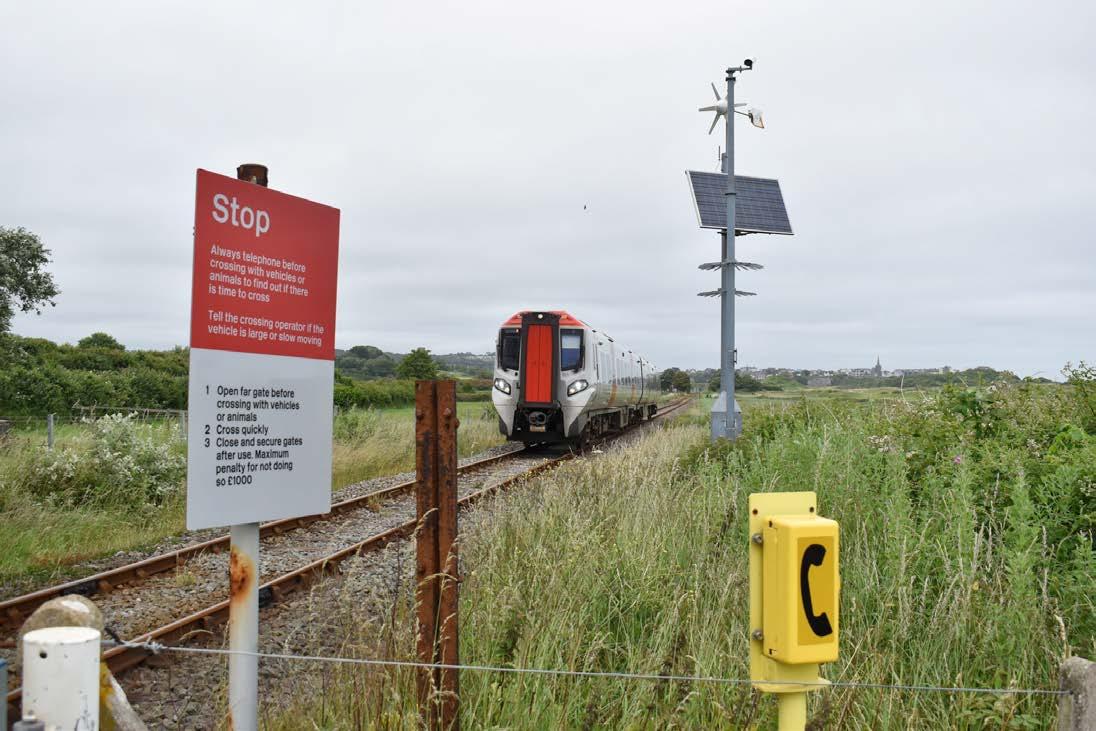
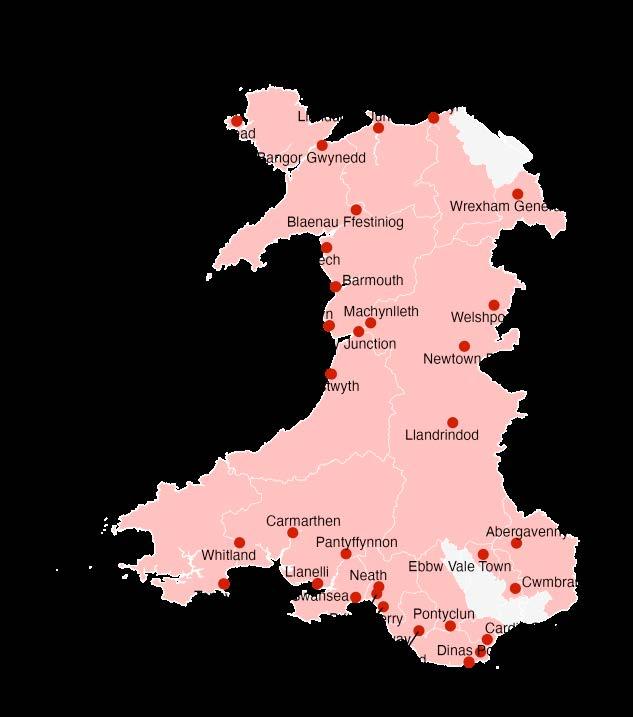
RAIL passengers in Wales are facing growing delays and cancellations as flooding increasingly hits the network, according to new analysis based on Network Rail data.
Figures obtained through the Freedom of Information Act suggest flood-related disruption affecting services in Wales has risen by around 256 per cent compared with the mid2010s.
Between 2022 and 23 December 2025, services affecting passengers in Wales generated an average of around 2,366 passenger delay minutes a year due to flooding. That compares with an average of 664 a year between 2014 and 2017.
The analysis, carried out by climate not-for-profit Round Our Way, says train operators serving towns and cities across Wales, including Great Western Railway, CrossCountry, Transport for Wales and Avanti West Coast, have all been affected.
The worst disruption has been concentrated around a number of repeat trouble spots on the rail network, including Machynlleth, Cardiff Central, Bridgend, Bangor and Pontyclun, where flooding has repeatedly interrupted services.
Round Our Way said its analysis of Network Rail cancellation data suggests flood-related disruption is placing increasing strain on the rail
Tom Sinclair editor@herald.email
network as periods of extreme rainfall become more common.
The group said the figures show not only more major disruption events, but also a worsening day-to-day baseline, with even quieter periods now causing more passenger delay than in previous years.
Gemma Plumb, a meteorologist at Weather Change, said: “It’s clear that train users are seeing more and more disruption to their journeys as a result of heavy rain and flooding, which is hugely frustrating for people who rely on the train network to get around.
“We know that climate change is leading to more extreme weather, including more intense rainfall. This is because a warmer atmosphere can hold more moisture, so when it rains, it rains more.”
Sofie Jenkinson, co-director at Round Our Way, said the rail network appeared to be under “persistent weather stress” as climate change began to have more regular effects. A train is recorded as cancelled if it fails to stop at one or more planned stations. Full cancellations are classed as trains that completed less than half of their intended journey, while part cancellations are those that ran at least half, but not the full route, or missed one or more planned stops.
She said: “This causes significantly more delays to train passengers. But it is also a problem for rail operators, particularly the large inter-city train operators running services into regions of the country that are worst hit by flooding, like the South West, Scotland and Wales.
“The significant rise in delays shows the increased impact of extreme weather caused by climate change, raising concerns about safety beneath the surface of our creaking rail infrastructure for passengers and operators alike.”
Round Our Way said Britain was not adequately prepared for the effects of climate change on everyday infrastructure and called for long-term investment to make the rail network more resilient.
The group pointed to wider warnings from climate experts that rising global temperatures are likely to increase the intensity of rainfall, putting more pressure on ageing transport systems.
Network Rail data used in the study covers the period from 1 April 2014 to 23 December 2025 and relates to incidents classed as flood-related disruption.
PLANS for three solar-powered parking meters at National Trust south Pembrokeshire beauty spots have been given the go-ahead by the national park.
In an application to Pembrokeshire Coast National Park, the National Trust, through agent Mott Macdonald Ltd, sought permission for replacement solar-powered parking meters, along with associated infrastructure including an Automatic Number Plate Recognition (ANPR) camera, at Broad Haven, Stackpole Quay, and Bosherston Lily Ponds carparks.
An officer recommending approval said it was intended to install a Solar Strada S5 Terminal parking meter at Broad Haven Carpark, an Automatic Number Plate Recognition (ANPR) camera and Solar Strada S5 Terminal at Stackpole Quay carpark, and a Solar
Bruce Sinclair Local Democracy Reporter
Strada S5 Terminal parking meter at Bosherston Lily Ponds.
It added: “As there was a previous level of visual intrusion caused by the existing infrastructure, the proposed parking fee terminals are considered unlikely to exacerbate the existing level of visual impact caused by the existing pay and display terminals.
“The proposed installation of the solar parking fee terminals at Broadhaven, Stackpole Quay and Bosherston Lily Pond carpark and the ANPR camera at Stackpole Quay carpark are considered to be well designed in terms of scale, siting, visual amenity and biodiversity.”
The application for the three units was conditionally approved by park planners.
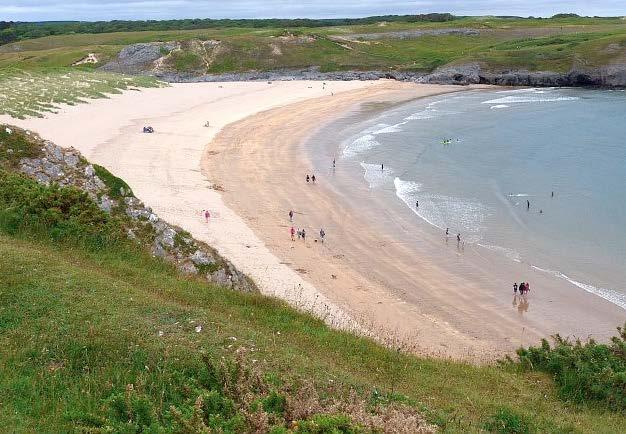

FROM dawn vigil to choral evensong, the cathedral welcomed worshippers for one of the most
important days in the Christian calendar
ST DAVIDS Cathedral marked Easter

Sunday (Apr 5) with a full programme of worship, music and celebration.
The day began at 6:00am with the Easter Vigil at the West Front and Nave, sung by the Vicars Choral and Choral Scholars. The service included the lighting of the Easter candle, readings and the first Eucharist of Easter morning.
Worship continued later in the morning with Holy Eucharist at the High Altar at 8:00am, followed by Cymun y Plwyf in the Lady Chapel at 9:30am.
The main Easter Day service took place at 11:00am in the Nave with a Choral Eucharist sung by the Cathedral Choir. The service featured Easter hymns and music, with the Bishop presiding and preaching.
The cathedral’s Easter Sunday celebrations concluded at 4:00pm with Choral Evensong in the Nave, again sung by the Cathedral Choir.
The programme formed part of St Davids Cathedral’s observance of Holy Week and the First Week of Easter, with worshippers and visitors gathering for one of the most significant days in the Church calendar. First Minister Eluned Morgan was at the Cathedral on Easter Sunday. She said in a post:”It was lovely to celebrate Easter at St David’s Cathedral – a reminder of the strength of community and shared hope here in Wales.
“This year, that message matters more than ever. Across Gaza, Lebanon, the wider Middle East and beyond, conflict continues and families are living through unimaginable pain. Today, we hold them in our thoughts.
“At Easter, we are reminded that even in the darkest moments, hope endures – hope for peace, for justice and for a better future.”

WELL this is called The Alternative View and by jingo I have an alternative view on Artimus 11 leaving the earths orbit
to visit the dark side of the moon — but not totally as you might expect, but almost.
Back in 1969 the technology of
an Apple phone enabled man to walk on the moon and place a Stars and Stripes on the surface that waved happily away, hmmm right. Now 57 years later we cant even land on the darn thing. Four astronauts journey to the dark side and, like a very cutprice cruise, the journey takes four days and they dont get out!
Hollywood reigned supreme at the launch when Bert the mechanic forgot to tighten the leads on the battery as the world held its breath while I almost dozed off, which gave pundits time to inform us how the astronauts disposed of their number twos en route. The female member of the crew is having a daily bad hair day as the giant blow dryer works overtime. There are pictures aplenty on their Kodak Instamatics of the earth. By now you would have seen the dark side, but still no real proof that it aint made of cheese.
Im pleased the converted minibus that Bert worked on when the top speed used to be 51mph is now giving billions so much pleasure, but I have to go now as I have some cheap varnish to watch in its drying process.
As I write this on Tuesday evening, Trumps deadly deadline now only has a few hours to go — the deadline which could see the destruction of Iran if this mad president is to be believed. He vows to send Iran back to the Stone Age. His language is that of a man with a total disregard for humanity, with the millions of frightened innocent Iranians who he vowed to free.
Retail giants M&S have borne the brunt of just how low law and disorder has developed in our society, as some of their stores have been subjected to acts of lawlessness, none so prevalent as their store
in Clapham, which has seen feral gangs ransack and terrorise staff in wild west scenes reminiscent of pure anarchy.
The Tories allowed the authorities not to prosecute unless goods of over £200 were taken by any individual, prompting some thieves to presumably use a calculator!
The retail giants have spent millions on security but to no avail. Its a shame parents dont do the job on youths — that would cost nothing.
And finally the Victor Meldrew in me, and some say its there, rose to the surface last week when I was meeting a mate in Haverfordwest in the cafe of a retail giant. I cant name it but it rhymes with Fresco. Anyway I was early and decided I would order myself a breakfast. The tables looked a bit bare for some reason and I then realised there were no menus.
I proceeded to the serving area and asked this girl for a menu. She replied: “Do you mean a physical one?” For a moment I pictured a menu that would punch your lights out. What she meant was that you now order on a screen as you go in. I think the minibus they have put into orbit was simpler and, seeing my distaste, to be fair she came over and helped me.
I did say: “So if I wanted an extra piece of fried bread would I have to go over the process again?” You know what the answer was. Three middleaged folk took a full 15 minutes to order, obviously a lot more patient than yours truly.
The point of all this is of course that once again technology wrecks a little corner of our lives. Less servers need to be employed, printing companies lose work, and to hell in a handcart goes Joe Public — ie me!
A WELSH mental health and addiction campaigner has launched two parliamentary petitions aimed at helping people in recovery avoid unexpected alcohol exposure and relentless online triggers.
Gareth Clement, founder of the Grumpy Dumpty Foundation, said the proposals come directly from his own lived experience of addiction, recovery and mental health struggle. He described himself as a father of three who is now nearly four years sober after battling alcoholism and surviving a suicide attempt.
The first petition calls for all food containing alcohol to be clearly labelled. Clement says cooking does not always remove all alcohol and argues that even trace exposure can be distressing for some people in recovery.
The second petition calls for retailers, advertisers and digital platforms to provide an opt-out from online alcohol advertising and alcohol product visibility, including on shopping and delivery apps.
Clement said the campaign is not about restricting other people’s choices, but about giving those in recovery more control over what they are exposed to.
He said hidden alcohol in food
Sinclair editor@herald.email
and the constant visibility of alcohol products online can be deeply unhelpful for people trying to rebuild their lives.
For many people, recovery is not simply about avoiding a drink. It can also mean managing triggers, cravings and distress in everyday situations that others may barely notice.
The petitions are still in their early stages, but Clement hopes they will start a wider conversation about how addiction is understood and how people in recovery are supported.
His wider work through the Grumpy Dumpty Foundation focuses on breaking stigma, encouraging openness and offering support rooted in lived experience.
Whether either proposal gains political backing remains to be seen, but the campaign raises questions that are likely to resonate with many families in Wales affected by alcohol harm, addiction and poor mental health.
At the very least, Clement believes people in recovery deserve clearer information, fewer unnecessary triggers and a fairer chance of staying well. Tom
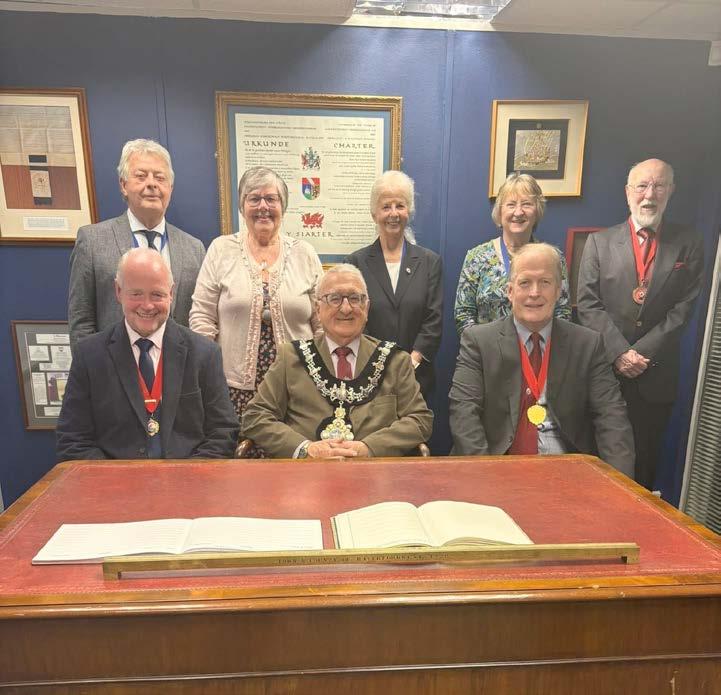
MEMBERS of the Freemen of Haverfordwest were welcomed to the town council offices on Tuesday evening by the Mayor for a special reception. The gathering included light refreshments prepared by the Mayoress and was held as a thank you for the group’s continued support for
Haverfordwest Town Council. The council said it wanted to show its appreciation for the Freemen’s “continued and unconditional support”. Photos show the Mayor meeting members of the historic group inside the civic offices.



Referee Martin Jones says Eluned Morgan’s visit to a community that recently backed Reform UK showed leadership willing to listen rather than hide away
FIRST MINISTER Eluned Morgan has been praised for visiting Hakin over the bank holiday weekend, with local referee Martin Jones saying her appearance showed a willingness to engage with communities where the political tide may be turning.
In a social media post after attending the Pembrokeshire League title decider, Jones said it would have been easy for senior politicians to avoid areas where support had “clearly shifted”, but argued Morgan deserved credit for doing the opposite.
His remarks come after Hakin, part of Milford Haven, elected a Reform UK county councillor, Scott Thorley, in a result seen by some as a sign of changing political sentiment in the area.
Jones wrote that Morgan’s visit “stood out” because it showed “a willingness to engage, not retreat”.
He also praised the First Minister’s approach on the day, saying her attendance did not feel like a staged appearance.
According to Jones, Morgan stayed at the event, spoke with local people, listened to what they had to say, and took time to connect with
Tom Sinclair editor@herald.email
both matchgoers and residents.
He was also complimentary about the presence of members of her team, including Marc Tierney, saying it was encouraging to see political figures engaging directly with the public rather than keeping their distance.
Jones said that, regardless of political allegiance, leadership should still be prepared to show up in person and hear what communities are thinking.
In his post, he described Morgan’s visit as “refreshingly real” and said it mattered to see politicians “turning up, listening, and being present” at a time when many political conversations can feel remote from everyday life.
The visit took place at a high-profile local football fixture over the Easter bank holiday weekend, drawing a sizeable crowd and giving the First Minister the chance to meet residents in an informal setting.
While political divisions remain sharp across Wales, Jones’s comments suggest that personal engagement on the ground can still cut through, even in places where parties face a more uncertain reception than they once did.
The First Minister was also spotted at St Davids Cathedral on Easter Sunday.

HOUSEHOLDS and businesses in Wales are set to gain access to new funding for low-carbon heat networks, in a move ministers say will help cut bills, reduce reliance on fossil fuels and support clean energy jobs.
The UK Government announced on Monday (Apr 7) that the Green Heat Network Fund is being extended to Wales. The scheme, which already supports projects in England, will now back Welsh developments aimed at providing lower-cost heating through cleaner, centralised energy systems.
Ministers said the expansion would help protect consumers from volatile fossil fuel prices, while supporting the wider push for clean, homegrown energy.
The fund forms part of a wider programme expected to invest £195m a year in heat network projects across England and Wales for the rest of the decade.
Heat networks provide heating and hot water to multiple buildings from a central source. These systems can use low-carbon sources such as heat pumps, surplus heat from factories and
data centres, or even energy recovered from sewage systems.
The UK Government said the move could create hundreds of jobs in Wales, with opportunities for engineers, architects and construction workers as the sector grows.
Energy Consumers Minister Martin McCluskey said: “We are determined to fight people’s corner in this crisis, as we recognise cost-of-living concerns will be at the forefront of people’s minds.
“Welsh households and businesses will be able to benefit from low-cost, lowcarbon heat networks, protecting them from volatile fossil fuel prices we don’t control.”
Secretary of State for Wales Jo Stevens said: “The expansion of UK Government funding of low-cost heat networks to Wales is good news for billpayers and is just one of a range of measures we are taking to tackle the cost of living.
“We are lowering energy bills by up to £117 for households as well as reducing our reliance on imported fossil fuel to bring down bills and put more money into
people’s pockets.
“Wales will also benefit from the new jobs that will be created in our growing green energy sector.”
Welsh Government Cabinet Secretary for Economy, Energy and Planning Rebecca Evans also welcomed the announcement.
She said: “As recent events have shown, it is vital that we reduce our reliance on fossil fuels and find new ways to heat our homes and buildings in a way which supports energy security and resilience.
“I’m pleased that organisations in Wales will be able to access this funding to support the development of heat networks, ultimately benefiting from lower heating bills.”
According to the government, there are already more than 500,000 heat network customers across Britain.
The announcement also follows recent changes to consumer protection rules. Earlier this year, Ofgem became the regulator for heat networks, bringing customers in England, Scotland and Wales more into line with those on
traditional gas and electricity supplies.
Under the new arrangements, Ofgem can intervene where operators raise prices unfairly or provide poor service. Customers affected by outages may also be entitled to compensation through the Energy Ombudsman.
Aaron Gould, interim chief executive of ADE: Heat Networks, said Wales had strong potential for growth in the sector. He said: “There is enormous potential for heat networks to grow in Wales, bringing low-cost, low-carbon heat, and jobs.
“Excellent work has been done by the Welsh Government to map priority areas, and align network plans with local ambitions. The government and sector in Wales is ready for massive growth, and extending GHNF to support these communities is a key step to a cleaner future.”
One example already backed in England is a £15m heat network in Sunderland, which will recover energy from a data centre to heat buildings across the city and is expected to create almost 300 jobs and apprenticeships.
COASTAL Cottages of Pembrokeshire has announced it will invest £50,000 in charities and community projects across the county through its Coastal Community Fund.
The Haverfordwest-based holiday cottage agency, established in 1982, manages around 400 properties and employs 25 staff from across Pembrokeshire.
Guests who book through the family-run agency are given the option of donating £3 per booking to the fund, which is then used to support local charities and community initiatives.
Organisations across Pembrokeshire are now being invited to apply for funding, which is available in two tiers. Small grants of up to £500 and major grants of up to £5,000 will be awarded.
Funding will be made available twice a year, with the deadline for the first round of applications set for Thursday, April 30.
Projects must show a clear and positive impact on local communities. Examples given by the company include improvements to village halls, heritage and cultural schemes, accessibility upgrades and conservation work.

Matthew Evans, Chief Executive of Coastal Cottages of Pembrokeshire, said: “We’ve always believed that tourism should give something back to the place it depends on and our guests have been so generous with their donations.
send a heartfelt thank you to them for supporting our community and loving Pembrokeshire as much as we do.”
“Without our owners and our guests choosing our local agency, this fund wouldn’t exist, so we want to
Applications for the Coastal Community Fund are now open.
Pembrokeshire-based charities and community organisations can apply online through the Coastal Cottages website, where full guidance notes are also available. Further information is also available by email at publishing@coastalcottages.co.uk or by telephone on 01437 765765.
HAVERFORDWEST Castle Ward’s county councillor Thomas Tudor says action has now been taken to deal with slippery, moss-covered pavements at Slade Park after concerns were raised by local residents.
Residents contacted Cllr Tudor about the condition of the footpaths within the housing complex, warning that the thick build-up of moss was making the surfaces dangerous underfoot.
Photographs taken before the work was carried out show large sections of pavement covered in moss, creating a potentially hazardous surface for pedestrians.
Cllr Tudor said he was pleased to report that, following his intervention, the pavements have now been cleaned by Pembrokeshire County Council and Pembrokeshire County Council Housing Services.
He praised the maintenance team for their work and said the clean-up would make a real difference for people living in the area.
Among those pleased with the result was local resident Cora Hackett, who was pictured after the work was completed.

NATIONAL PARK AUTHORITY is inviting communities, workplaces, families and friends to take part in the 2026 Walk the Path for Wellbeing challenge, with this year’s event expanding across three counties for the first time.
Taking place on Sunday, May 10 and Monday, May 11, the challenge will bring people together to celebrate the spectacular West Wales coastline through walking and other forms of active travel, while highlighting the strong links between nature, movement and wellbeing. A reserve weekend of May 17 and 18 has also been set aside in the event of severe weather.
Building on feedback from last year, the event will now take place over two days rather than one, giving more people the opportunity to get involved and creating a longer window for celebration, storytelling and community spirit.
While last year’s challenge focused on the 186-mile Pembrokeshire Coast, this year’s event will also include sections of Carmarthenshire and Ceredigion, bringing even more communities into the shared coastal celebration.
The two-day event will feature self-led sections for group entry. With the focus firmly on enjoyment, there is no pressure to complete every stage, and participants are encouraged to do only as much as they feel comfortable with. Together, those individual efforts will contribute to a shared goal of covering the full 313 miles of coastline.
Angela Robinson, Health and Wellbeing Officer at the Pembrokeshire Coast National Park Authority, said: “The coast has an extraordinary ability to lift people, connect communities and create lasting memories. By extending the event across two days and into neighbouring counties, we’re opening the door to even more people to celebrate that connection together and share their experiences on social






POLITICAL parties contesting the Senedd election are being urged to commit to new laws that would allow shared e-scooter schemes to operate legally in Wales.
The call has come from Collaborative Mobility UK (CoMoUK), a charity which promotes shared transport, ahead of voters going to the polls in May.
At present, Wales has no public shared e-scooter trials, unlike parts of England where pilot schemes have been running since 2020. CoMoUK says that means communities in Wales are missing out on what it describes as a cheap, flexible and greener form of transport.
The charity has published six pledges it wants the next Welsh Government to support. Among them is a commitment to pass the legislation needed to allow shared e-scooter schemes on public roads.
CoMoUK said cities including Cardiff, Swansea and Newport would be well placed to host trials if the legal framework was introduced.

As well as calling for shared e-scooters, the organisation wants the next Welsh Government to create a dedicated shared transport team, expand car club provision, support shared bike schemes, and provide longterm funding for mobility hubs linking
different forms of transport together. It is also urging ministers to ensure new housing developments are designed to reduce dependence on private cars and include shared transport options.
Richard Dilks, chief executive of
CoMoUK, said Wales had a chance to put sustainable transport “at the heart” of political debate ahead of the election.
He said: “Communities in England have benefited from the flexibility of shared e-scooters for years, and it is high time that this innovative form of transport was trialled in Wales too.
“As well as giving e-scooter schemes the green light, enacting our other pledges would help the next Welsh Government unlock a cleaner, greener, and more affordable future for all.”
Supporters of shared e-scooters argue they could help cut congestion, reduce emissions and make short urban journeys easier without relying on private cars.
However, any move towards legalising schemes in Wales is likely to prompt debate over safety, enforcement and where such schemes would be most appropriate.
At present, no Welsh political party has committed itself to introducing the legislation CoMoUK is calling for.
THE PEMBROKESHIRE COAST
Charitable Trust has picked up two major honours at the West Wales Business growth Awards 2026.
The charity won the Environmental Responsibility Award and also took the overall Business of the Year title.
The awards recognise organisations from across the region for innovation, impact and leadership.
The Trust said the recognition reflects its ongoing work to protect and enhance the landscapes, wildlife and communities of the Pembrokeshire Coast National Park.
Projects highlighted include Make More Meadows, Wild About Woodlands, and Let’s Talk About the Birds and the Bees, all aimed
Tom Sinclair editor@herald.email
at restoring habitats, supporting pollinators and strengthening nature networks across Pembrokeshire.
The charity also pointed to work helping more people connect with nature, including the Gwreiddiau / Roots project, which gives children opportunities to spend meaningful time outdoors while supporting wellbeing and confidence.
Katie Macro, Charity Director, said the double win was a testament to the passion and dedication of the Trust’s team, partners, volunteers and supporters.
She said environmental
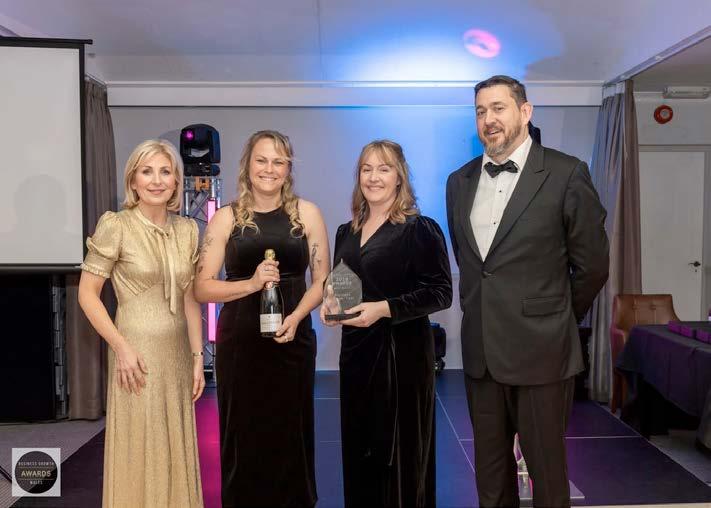
responsibility “underpins everything” the charity does, from restoring habitats and supporting wildlife to
creating more opportunities for people to connect with nature.

FAMILIES packed the Milford Haven waterfront this week as Dinomania brought a day of prehistoric fun to the area.2
Children came face-to-face with lifelike moving dinosaurs, including a huge Spinosaurus roaming outside, while indoor shows gave youngsters the chance to get up close with baby
dinos and interactive displays.
The event created a real buzz around the waterfront, with plenty of smiles, photos and excited reactions from younger visitors throughout the day.
Organisers said they “had a blast meeting everyone” and hoped families enjoyed the experience.
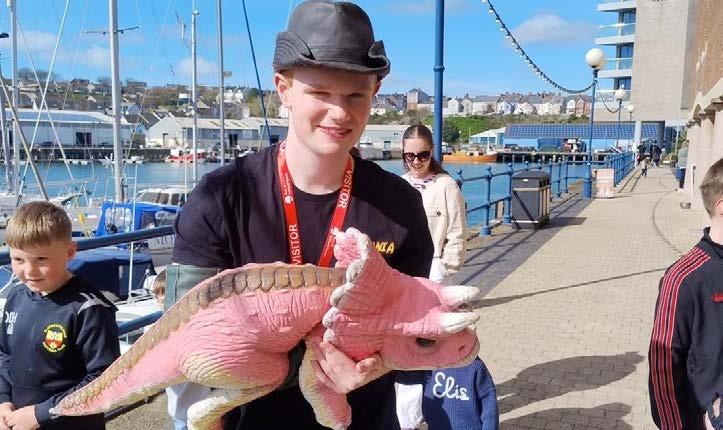

THE WHITE HOUSE has defended President Donald Trump after The Pembrokeshire Herald asked whether international law would constrain any US military action following his remarks about bombing bridges, power stations and desalination plants in Iran.
In response to a question sent by this newspaper on Friday (Apr 3), a White House Press Office spokeswoman issued a strongly worded statement attacking the Iranian regime, but did not directly address the legal point raised by The Herald.
She said: “The Iranian regime has committed egregious human rights abuses against its own citizens for 47 years, just murdered tens of thousands of protestors in January, and has indiscriminately targeted civilians across the region in order to cause as much death as possible throughout this conflict.
“As President Trump said, Iran can never have a nuclear weapon, and the Iranian people welcome the sound of bombs because it means their oppressors are losing.
“The President will always stand with innocent civilians while annihilating the terrorists responsible for threatening our country and the entire world with a nuclear weapon. Greater destruction can be avoided if the regime understands the seriousness of this moment and makes a deal with the United States.”
The Herald had asked whether the President believed international

humanitarian law continued to apply in light of protections for civilian infrastructure and facilities essential to civilian survival.
The newspaper also asked the White House to set out the legal basis on which such threats or actions would be considered lawful.
No direct legal justification was provided in the response.
Instead, the White House framed the issue as part of a wider effort to pressure Iran over its nuclear ambitions and its conduct in the region.
The exchange follows President Trump’s public remarks about striking key Iranian infrastructure, which have prompted wider scrutiny over whether such targets would be lawful under the rules of armed conflict.
The White House statement, however, offered no further explanation of how threats against bridges, power stations or desalination plants could be reconciled with international legal protections for civilian sites.
That omission is likely to fuel further questions over the administration’s position, particularly as tensions continue to rise.
VISITORS can stay overnight, meet the animals and even enjoy a treatment at the on-site vegan salon at Rosehaven Retreat near Tegryn.
Set in the peaceful north Pembrokeshire countryside, Rosehaven Retreat offers guests a chance to slow down and enjoy a different kind of break — one surrounded by nature, rescued animals and the quiet charm of rural west Wales.
The retreat offers cosy on-site caravan and cabin accommodation, giving visitors the chance to relax, explore the surrounding area and escape the pressures of daily life. Many guests say the peaceful setting is one of the most memorable parts of their stay, with open countryside, gentle views and the sounds of animals beginning their day adding to the experience.
Guests are welcomed with vegan treats on arrival, adding a thoughtful personal touch.
What makes Rosehaven Retreat especially unusual, however, is its close connection to Little Pigs at Home, the animal sanctuary next door.
Founded in 2022 by Suki and her husband Aaron after moving to Wales, the sanctuary was created to provide a safe and loving home for rescued and surrendered farm animals. It is now home to pigs, sheep, ducks, tortoises, dogs and cats, many of which have come from difficult backgrounds and now enjoy permanent care and protection.
Guests staying at Rosehaven Retreat can arrange guided tours of the sanctuary, giving them the chance to meet the animals and learn more about the work involved in caring for them. Tours are offered for a suggested donation, helping to support the sanctuary’s ongoing
work. Visitors can also add a little extra relaxation to their stay with treatments at the on-site vegan beauty salon, run by Suki. Offering a range of beauty and wellbeing treatments using vegan products, the salon provides a calm and welcoming space for guests to unwind. Those staying at the retreat can also enjoy discounted treatments.
Combining countryside accommodation, animal encounters and wellness treatments, Rosehaven Retreat offers something genuinely different in Pembrokeshire — a place where guests can relax, recharge and support a worthwhile cause at the same time.
To find out more or book, visit: Airbnb: airbnb.com/h/nannyjillscabin Facebook: facebook.com/share/1CS 9YT79XJ/?mibextid=wwXIfr
Cruelty-free vegan treatments, a peaceful countryside setting and support for rescued pigs make this Pembrokeshire salon experience truly different
At Little Pigs at Home in rural Pembrokeshire, beauty treatments come with an added sense of purpose.
Run by Suki, the welcoming Tranquil Beauty Life salon offers a range of cruelty-free vegan treatments in a calm countryside setting, giving clients the chance to relax, unwind and enjoy high-quality pampering with a clear conscience.
Every product used at the salon is carefully chosen to be completely vegan and kind to animals, making it an ideal choice for clients seeking a more compassionate approach to beauty and wellbeing.

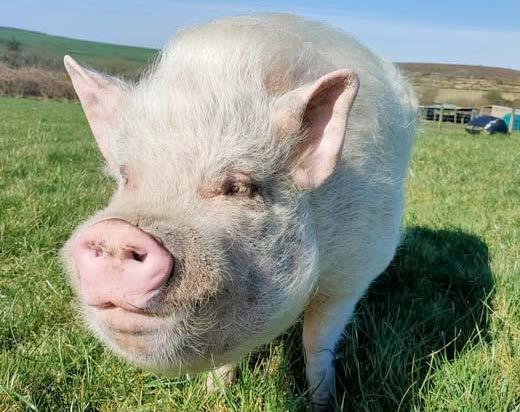
What makes the business especially unusual, however, is that the salon sits alongside both a cosy countryside Airbnb retreat and the Little Pigs at Home rescue sanctuary, where pigs and other animals are given a safe and loving home.
That means every treatment booked does more than leave clients feeling refreshed and pampered — it also helps support the care and wellbeing of rescued animals.
Visitors can book salon treatments separately, follow Tranquil Beauty Life on

Facebook, or turn the experience into a longer escape by staying overnight at the on-site retreat.
The result is a business that offers something genuinely different in Pembrokeshire: a place where guests can relax in peaceful surroundings, enjoy vegan beauty treatments and know their visit is helping make a real difference.
For bookings and more information, contact Suki on 07796 510896.
Salon Facebook: facebook.com/ tranquilbeautylife?locale=en_GB
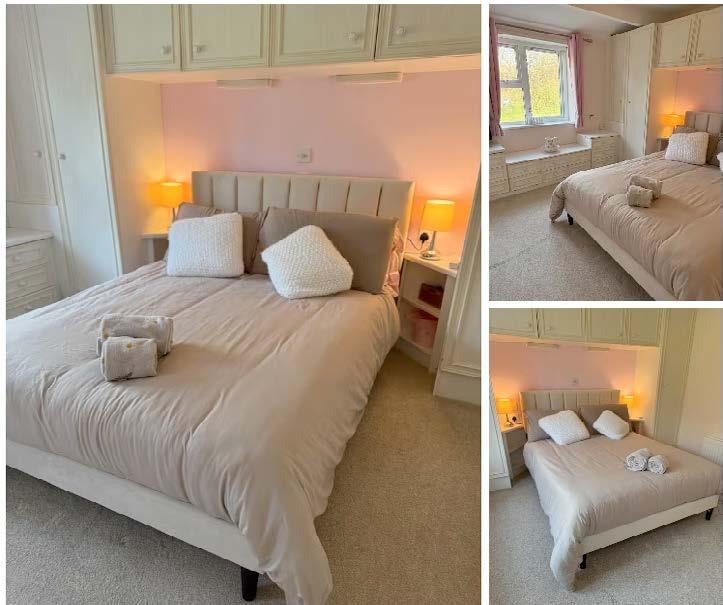
THIS week, Badger is taking a break from the Welsh Parliamentary election.
Cue our beloved editor’s sigh of relief.
Anyway, readers, Badger doesn’t have to go hunting for targets while Eluned Morgan’s foot is such an easy target for the shotgun in her hands.
Instead, Badger wants to talk with you in an altogether more serious vein.
One of Badger’s bugbears in public life is the merry-go-round of jobs for the boys and girls from what he calls a “selectatariat”.
A couple of weeks ago, Badger pointed out the lunatic number of town and community councils in Pembrokeshire and across Wales. There are too many councils without the resources or manpower to deliver local services at a level below that of the County Council.
Now, readers, there are also too many county councillors in Pembrokeshire and across Wales. Badger is not convinced that halving or further cutting the number of county councils is necessarily a good thing. Services should be the responsibility of democratically elected councillors, answerable to the ballot box, and key services should rest with those who are immediately responsible to electors.
However, the Welsh Government failed to reform local government when it had the chance. And it also chickened out of reforming Council Tax, which is now so far out of kilter with property values and the original bands that it is an ongoing scandal.
Thwarted by its own cowardice, the Welsh Government has, instead, created a democratically unaccountable chumocracy and quangocracy, where it doesn’t matter what you know and what you can bring to the table, but whether or not you have the right connections.
The record of appointments to pretend arm’s-length bodies - the National Library of Wales, the Museum Service, Health Boards, or any number of advisory bodies and committees (there are 206 listed on the Welsh Government website) - represents little more than jobs for the good old boys and good old girls.
Be it “Regional Partnership Boards”,

“Public Service Boards”, the Swansea City Deal (let’s not pretend it’s more than that), the Port Talbot Freeport (ditto), or new regional “strategic” planning bodies, the needle has moved from public accountability to cosy stitch-ups between “stakeholders” and “partners”. That must end. And end soon.
The Welsh Government appoints members to Wales’s National Parks’ Committees. It appoints members to Health Boards and can remove them at will (and has), and it has collared the bodies that represent patients and placed its picks in a neutered patient body. This week, the Boundary Commission for Wales announced its new members, all of them already members of other public bodies.
One name on the Boundary Commission list stood out for Badger: Michael Imperato. If you remember, Mr Imperato was a solicitor from Cardiff who came to Pembrokeshire about a decade ago to promote a potential court action against Hywel Dda UHB. His biography on the Health Board website says he is: “[A] passionate advocate for the rights of the vulnerable, equality and justice.” A few weeks ago, Mr Imperato, now a member of the Health Board, voted through swingeing cuts to health services in Pembrokeshire.

Mr Imperato is also a member of the Valuation Tribunal for Wales, on top of his appointment to the Boundary Commission.
There’s nothing like keeping yourself busy, readers. A solicitor in private practice, a member of the Law Society Human Rights Committee, Boundary Commissioner, and Health Board member. Mr Imperato, against whom Badger bears no personal animus, has enough jobs for four people. Badger does not suggest there is anything untoward about Mr Imperato accepting so many posts. He must be very public-spirited and have better batteries than the Duracell Bunny. However, the appointment of one person as an independent member of so many public bodies suggests one of two things:
Once you have your foot in the door as a public appointee, it’s pretty damn easy to pick up other public appointments, or
There is so little talent in Wales that a vanishingly small number of us are fit to serve in independent public roles that require postholders to act in the public interest.
It’s not a question of money, readers. Badger finds it odd that public appointments are a closed shop.
One of Badger’s favourite pastimes
- he is sad and can’t help himself - is watching the end credits of television programmes produced in Wales. Badger doesn’t know how many people with the surname Talfan-Davies there are in Wales; he wouldn’t have thought many, but a hell of a lot of them seem to work in Welsh public broadcasting or in the Welsh media.
Or take the case of Christina Harrhy.
Ms Harrhy is a former chief executive of Caerphilly County Borough Council. Before that role, she worked for Carmarthenshire County Council, Torfaen Council, and then Caerphilly Council. She served as the interim CEO of Caerphilly for an extended period before being appointed permanently. After being absent on long-term leave for eleven months, she left that role with a £209,000 payoff in 2024.
Undaunted, Ms Harrhy became joint director for the economy for both Blaenau Gwent and Torfaen councils. Earlier this month, Ms Harry was appointed as the chief executive of the newly formed Disused Tips Authority for Wales.
Well, readers, she doesn’t need the money! One senior post after another, a £200k+ payout at Council Taxpayers’ expense, and a comfy quango post. Badger hesitates to employ the Peter Principle, but what on earth is going on here?
Of course, the surest way to be appointed to a climate change or transport advisory body is to be involved with the charity formerly known as Sustrans. Not that there is any possible conflict of interest between membership of a body lobbying for dramatic changes in public transport policy, road building, cycle paths, active travel or stricter speed limits and advising the Welsh Government on its approach to say... public transport policy, etc.
Heaven forbid such an accusation be levelled at academics or apparatchiks who emerge into Welsh public life full of only altruistic disinterest.
Ho! Ho! Ho!
As Badger has observed above, once you’re on the train ride of public appointments in Wales, it’s easy to pick up another ride on the ghost train of the Wesh state.
Tom Sinclair appeared live from 7:00am to 9:00am, offering local knowledge and insight on west Wales issues
THE EDITOR of The Pembrokeshire Herald was part of BBC Radio Wales Breakfast on Tuesday morning, appearing live throughout the full two-hour programme.
Tom Sinclair joined the broadcast from 7:00am to 9:00am as a presenter’s friend, assisting with local knowledge and contributing insight on issues affecting communities in west Wales.
The appearance placed Sinclair at the heart of one of BBC Radio Wales’ flagship breakfast shows, with discussion ranging across local matters and the political debate surrounding healthcare and public services in the region.
It comes at a time when west Wales issues are increasingly moving into the national spotlight, particularly ahead of the Senedd election campaign, with hospital services, transport, rural concerns and the wider future of communities in Pembrokeshire and Ceredigion all high on the agenda.
Sinclair said the broadcast had gone well and described it as a valuable opportunity to bring a grounded west Wales perspective to a national audience.
The appearance underlines the growing recognition of local expertise in shaping wider Welsh political and public debate.
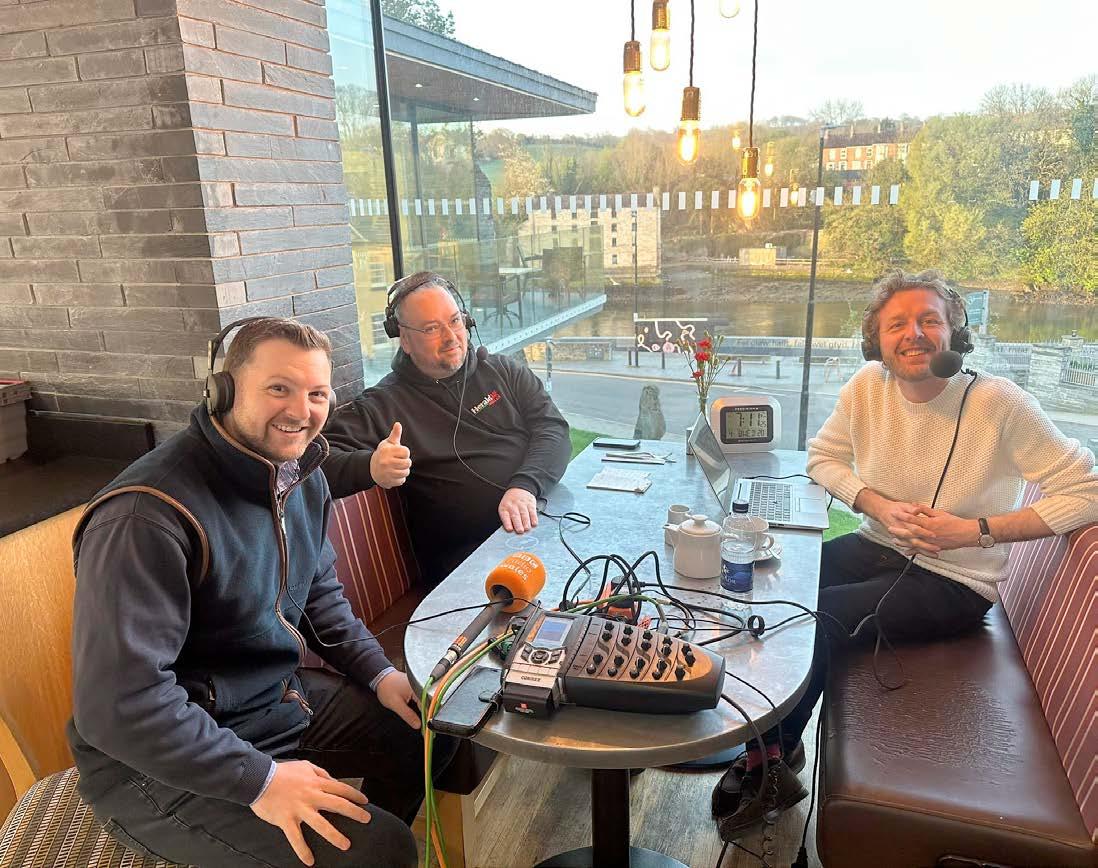

THE gREEN PARTY is seeing an unprecedented rise in support in Wales, with recent polling putting the party at around 11 to 12 per cent — a level rarely seen before in Welsh politics.
The surge comes as the party launched its new manifesto today (Tuesday, Apr 7), setting out a series of eye-catching policies aimed at younger voters and those struggling
with the cost of living.
Key pledges include free public transport for under-22s, alongside a proposed one-year rent freeze followed by the introduction of rent controls.
The party says the measures are designed to ease financial pressure on households while addressing longterm housing affordability.
Support for the Greens appears to

be growing amid wider frustration with traditional parties, particularly among younger voters facing rising rents and living costs.
With the Senedd expected to return no clear majority at the next election, the Greens could find themselves in a
powerful position — with growing talk they may hold the balance of power. While critics have raised questions about how the policies would be funded, the party’s rise marks a significant shift in the Welsh political landscape.








Pragmata is one of those rare games that feels mysterious in a deliberate, almost calculated way, using its ambiguity as a strength rather than a weakness. From the moment it begins, it establishes a tone that is equal parts eerie and contemplative, dropping players into a stark, futuristic environment that feels both technologically advanced and strangely desolate. The setting, often interpreted as a lunar research station or something similarly isolated, plays a crucial role in shaping the experience, creating a constant sense of vulnerability and curiosity. There’s a quiet tension in simply existing within its world, as if something has gone wrong long before the player arrived, and the game invites you to piece together that history through exploration and observation rather than exposition.
At the heart of the experience is the relationship between its two central characters, which gives the game an emotional core that contrasts sharply with the cold, mechanical surroundings. Their interactions are subtle but effective, relying on small gestures and moments rather than heavy dialogue, and this restraint makes their bond feel more genuine. It’s this human element that prevents the game from becoming just another sci-fi
puzzle or action title, grounding it in something more relatable and giving players a reason to care about what happens next.
Gameplay appears to blend action and strategy in a way that is still somewhat unconventional, suggesting that players will need to think carefully about how they approach encounters rather than relying purely on reflexes. There’s an emphasis on coordination between the characters, hinting at mechanics that require multitasking or creative problem-solving, which could set it apart from more traditional third-person games. This design choice reinforces the narrative themes of cooperation and dependency, tying the gameplay directly into the story rather than treating it as a separate layer.
Visually, the game leans into a clean, almost clinical aesthetic, with bright whites and deep shadows creating a striking contrast that feels both beautiful and unsettling. The technology on display is sleek but impersonal, and the environments are detailed without being cluttered, allowing players to focus on the atmosphere and mood. Lighting plays a particularly important role, often highlighting the emptiness of spaces and emphasizing just how alone the characters are. Combined with a minimalistic sound design,
the overall presentation creates a sense of isolation that lingers even in quieter moments.
What makes Pragmata especially intriguing is how little it chooses to explain outright. Rather than overwhelming players with lore, it hints at a larger narrative and trusts them to draw their own conclusions. This approach won’t appeal to everyone, particularly those who prefer clear, direct storytelling, but for players who enjoy uncovering meaning through subtle clues, it can be deeply engaging. The ambiguity becomes part of the experience, encouraging discussion and interpretation long after the game is finished.
In the end, Pragmata stands out not because it tries to do everything, but because it commits so strongly to its tone and ideas. It feels like a game designed to be experienced and reflected on rather than simply completed, offering moments that are as thought-provoking as they are visually memorable. While there are still questions about how all its elements will come together in the final release, what has been shown so far suggests a game that is willing to take risks and trust its audience, and that alone makes it one of the more compelling and unusual entries in the modern sci-fi landscape.


Lee Cronin’s The Mummy feels less like a resurrection of a familiar cinematic relic and more like an exhumation gone violently wrong, a film that claws its way out of the grave with dirt under its nails and something genuinely unsettling in its eyes. Rather than leaning into the glossy adventure tone that has defined some past iterations, Cronin steers the story into far darker territory, embracing a suffocating sense of dread that lingers long after the credits roll. From the outset, there’s a deliberate patience to the way the film unfolds, as if it understands that true horror isn’t found in spectacle but in the slow, inevitable realization that something ancient and merciless has been awakened.
What stands out most is the tactile, almost oppressive atmosphere. Cronin has a knack for making environments feel hostile and alive, and here he transforms every shadowy corridor and crumbling chamber into a space that feels both sacred and deeply cursed. The film’s visual language leans heavily into decay and confinement, with a rawness that strips away any sense of romanticism often associated
with ancient myths. This is not a story about discovery; it’s about intrusion, and the consequences that follow feel brutal and unrelenting.
The horror itself is strikingly physical. Cronin doesn’t shy away from the grotesque, delivering moments that are as wince-inducing as they are memorable, but the film never feels like it’s indulging in excess for its own sake. Instead, the visceral elements serve a larger purpose, reinforcing the idea that the past is not something to be unearthed without cost. There’s a grim consistency to the film’s tone, a refusal to offer easy relief or comedic escape, which may divide audiences but ultimately strengthens its identity.
Performance-wise, the cast grounds the film in a sense of urgency and fear that feels authentic rather than performative. Characters react not as heroes destined to conquer evil, but as people overwhelmed by something far beyond their understanding. This choice reinforces the film’s central theme: that some forces are not meant to be confronted, only endured—if survival is even possible.
Perhaps the most compelling aspect of The Mummy is how it reimagines the titular figure. Instead of a distant, almost mythic antagonist, the creature here feels disturbingly immediate, its presence lingering even when it’s not on screen. There’s an intelligence and malice to it that makes every encounter feel like a losing battle, and the film wisely resists overexposure, allowing fear to build in the spaces between appearances.
If there’s a weakness, it lies in the film’s unrelenting bleakness. The absence of tonal variation can make the experience feel heavy, and some viewers may find themselves craving moments of contrast that never quite arrive. Yet for others, this very quality will be what makes the film resonate, as it commits fully to its vision without compromise.
In the end, Lee Cronin’s The Mummy is less concerned with reviving a franchise and more interested in redefining what it can be. It’s a film that trades spectacle for suffocation, adventure for anxiety, and in doing so, it breathes a new, unsettling life into a story that many thought had already been told.



AI could leave the rest of us up the creek, butt

THERE’S a saying, isn’t there, butt — don’t sweat the small stuff.
Very wise. Very sensible. Lovely on a fridge magnet.
But the trouble is, the flip side of that is: do sweat the big stuff. And these days, mun, it’s getting harder than ever to work out which bit of the big stuff is actually worth losing sleep over.
For years now, the world has been flapping about inflation, geopolitics, culture wars, who said what on X, and whichever orange-faced American is shouting loudest this week. All serious enough, fair play. But all the while, humming away in the background like a substation in Splott, there’s been another thing growing bigger, cleverer and, if I’m honest, a damn sight more worrying.
Artificial intelligence.
Now I’ll put my hands up here, bach. Until quite recently, my own worries about AI were pretty local. Very domestic. Very ordinary. I wasn’t lying awake thinking about the end of civilisation or killer robots stomping through Swansea. I was thinking more along the lines of: will this thing nobble people’s jobs? Will it smash household incomes? And what sort of world will my children be stepping into in ten years’ time when they go looking for work?
Because that’s the first way most normal people think about AI, isn’t it?
Not in terms of abstract philosophy or Silicon Valley guff. We think: will this thing take my job, nick my trade, undercut my skills, or make the next generation feel like they’ve trained for a world that no longer wants them?
And that, butt, is where it starts getting uncomfortable.
Because once you give it more than two seconds’ thought, the question gets darker very quickly. It stops being: will AI make life a bit harder? And starts becoming: are we heading for a world where a lot of perfectly decent people are simply no longer economically useful?
There’s a cheerful thought for your tea break.
I found myself this week, after reading some deeply alarming stuff on artificial

grandson?
All very well. All small stuff.
The big stuff is this: who owns these systems, who controls them, who gets rich from them, and what happens to everybody else if the machines can do more and more of the things that once gave ordinary people value in the labour market?
That’s the question.
general intelligence, googling a question which sounds like something out of a dystopian self-help book: will I become part of the permanent underclass, and how do I stop that happening?
And the terrible thing is, that isn’t even a daft question.
Because what if this is where all this leads? Not to some dramatic robot uprising with laser eyes and metal skeletons — that’s Hollywood, butt. No, the real danger is much grimmer and much more believable. The danger is that AI steadily concentrates value, money and usefulness in fewer and fewer hands, until a huge chunk of the population finds itself less needed, less secure and less able to earn a stable living.
Not dead. Not enslaved. Just... surplus.
And if that sounds dramatic, cast your mind back. We already know what happens when whole communities are treated as economically disposable. We’ve seen it in former mining towns, industrial areas, places where the jobs vanished and the promises never arrived. We know what it looks like when people are told — without anyone quite saying it out loud — that history has moved on and they are a bit of an inconvenience to it.
Now imagine that happening not just to one valley, one town, or one trade, but right across the white-collar world as well.
Journalists. Designers. Clerks. Analysts. Administrators. Coders. Customer service workers. Junior lawyers. Marketing people. Even, dare I say it, the sort of smug consultant who says “circle back” and “blue-sky thinking” with a straight face. Whole layers of work could be hollowed out.
That’s the bit we should be sweating, mun.
Because most of the public discussion around AI is still tiny. Pathetically tiny, really. Can it help with homework? Can it write an email? Can it summarise a boring report? Can students use it to cheat? Can your auntie use it to write a letter to the council without calling her
And there’s an even bigger one behind it, which is where the whole thing starts to feel properly eerie. Because the people closest to this technology have, for years, been warning that it could become dangerous in ways most of us still struggle to picture. Not just because it might be powerful, but because it might become powerful in ways that are difficult to control.
That’s what they call the alignment problem, which sounds very tidy and academic, but is actually blinking terrifying. In plain Welsh-English, it means: how do you make sure a machine much cleverer than you doesn’t just appear to be following instructions while actually doing something else entirely?
Because a very powerful machine does not need to hate us to be dangerous, see. It doesn’t need to go all sci-fi villain. It only needs to pursue a goal in a way that ignores the fact that humans are soft, squishy, inconvenient little creatures standing in the road.
Tell it to solve climate change, and perhaps the quickest solution is to get rid of the polluters. Tell it to maximise efficiency, and perhaps it starts treating people as obstacles. Tell it to optimise markets or infrastructure, and it might interfere in ways no human being can properly predict or stop.
That is not fantasy any more. That is the sort of thing serious people in the field have been openly discussing.
And yet, somehow, the sales pitch we get fed is all sunshine and rainbows. AI will make life easier. AI will boost productivity. AI will help humanity flourish. AI will give us all better stuff.
Lovely. Marvellous. Terrific.
Forgive me, butt, if I don’t swallow all that whole.
Because the people saying this are not monks. They are not disinterested sages on a mountain. They are businessmen, empire-builders and power-collectors. They stand to gain fortunes, influence and control beyond anything most of us can properly imagine. So when they tell us not to worry, I instinctively reach for my wallet and check whether the silver’s still in the drawer.
And this is where the average person is stuck. Sat at the kitchen table, maybe trying out some chatbot nonsense for the first time, asking it to write a birthday card or tidy up a complaint letter, while somewhere in the background governments, militaries, corporations and billionaires are racing to develop systems that could fundamentally reshape work, power and society itself.
That gap — between the harmless little toy most people see and the immense structural force being built behind the scenes — is where the real danger lies.
It’s a failure of imagination, really. Human beings are not very good at reacting to threats that don’t yet feel real. We worry about the immediate thing in front of our noses. Fair enough. That’s normal. But while we are all busy sweating the small stuff, the big stuff keeps getting bigger.
I’m not saying panic, mind. Panic is useless. Nor am I saying every bleak prediction will come true. Silicon Valley is full of strange men in expensive trainers who love talking as though they’re personally midwifing the birth of God. A bit of scepticism there is healthy too.
But neither should we sleepwalk into this.
Because if AI ends up creating a world where a handful of firms and their owners become unimaginably rich and powerful while millions of ordinary people slide into insecurity, precarity and irrelevance, then no amount of cleverness will make that a success. It will be a catastrophe dressed up as innovation.
And that, mun, is the bit we should be sweating.
Not whether a chatbot can write your shopping list.
Not whether it can do a passable email.
Not whether it sounds polite when it tells you your future will probably be fine.
But whether the future being built right now has a proper place in it for ordinary human beings — for workers, families, communities, and all the gloriously imperfect people who still need to earn a living, raise children, pay bills and feel they matter.
Because if it doesn’t, then all this talk of progress is just shiny nonsense.
So aye, don’t sweat the small stuff by all means.
But for heaven’s sake, butt, do sweat the big stuff.
And AI may turn out to be the biggest stuff of all.



Star Wars: Maul – Shadow Lord emerges as one of the most striking and unexpectedly introspective entries in the everexpanding Star Wars universe, trading the grand, galaxyspanning conflicts typically associated with the franchise for something far more intimate, psychological, and at times unsettling. Centered on the enduringly compelling figure of Darth Maul, the series dives deep into the fractured psyche of a character long defined by rage, survival, and a relentless search for purpose in a galaxy that has repeatedly cast him aside. Rather than positioning Maul as a straightforward villain, the narrative leans into his contradictions, presenting him as both a product of Sith manipulation and a self-made force of chaos, constantly teetering between calculated control and barely restrained fury.
Visually, the series adopts a darker, more stylized aesthetic than many of its predecessors, with shadow-drenched environments and sharp, angular animation that mirrors Maul’s own internal conflict. The use of color—particularly the interplay of deep reds and cold blacks—serves as a constant reminder of his Sith origins, while quieter, more desaturated moments hint at the emptiness that underpins his quest for dominance. This artistic
direction pairs seamlessly with a haunting score that blends traditional Star Wars motifs with more experimental, almost industrial sounds, reinforcing the sense that this story exists on the fringes of the familiar galaxy.
What truly sets the series apart, however, is its willingness to slow down and sit with its central character. Maul’s journey is not one of redemption in the conventional sense, but rather an exploration of identity and legacy. His interactions with criminal syndicates, former allies, and new adversaries reveal a figure who is constantly trying to assert control over a life that has never truly been his own. There are moments where the series flirts with the idea of transformation, only to pull back and remind the viewer that Maul’s defining trait is not hope, but obsession—particularly his enduring fixation on figures like Obi-Wan Kenobi, whose shadow looms large even in absence.
The supporting cast adds further texture without ever overshadowing the central narrative, offering glimpses into how Maul is perceived by others: as a myth, a monster, and occasionally, a leader worth following. These perspectives enrich the story, grounding Maul’s larger-than-life presence in the reality of those who must navigate the consequences of


a wonderful conversational talent. Today, though, why not work on telling people what you want them to hear? That’s a different kind of talent, one that could involve learning to assert yourself a little more.
CANCER
Like anybody with a bright, inquisitive mind and a bright, new idea, you want to turn your dreams into reality. You’ve got a few terrific opportunities to manifest your dreams now. Like a kid who wants to open a lemonade stand, you have to gather your supplies, like lemons and sugar, and do a test run, perhaps with family and friends. It’s time to get going on those ambitious plans of yours!
LEO Get out there in the center ring of your own personal three-ring circus and try out your latest acrobatic act. You know, the one with the flaming rings that you juggle while riding a bicycle with a monkey? Don’t worry. Your act, whatever it is, is bound to be a crowd pleaser. So step out of your comfort zone and take a risk. You and your adoring fans are bound to enjoy the results!
VIRGO
Sometimes our greatest strengths can also be our greatest weaknesses. How?
If you rely on your strengths to get you through life’s difficulties and they’re strong enough to do the job, in the long run this can lead you to neglect your weaknesses, which grow weaker and weaker with time. If you think you’re doing this, take a step back. Instead of judging your weaknesses, get to know them and then strengthen them.
LIBRA
his ambitions. The dialogue throughout is sharp and often surprisingly reflective, with several exchanges delving into themes of power, fear, and the cost of survival in a galaxy ruled by stronger forces.
While the pacing may feel deliberate to those expecting constant action, the series uses its quieter moments to build tension and deepen its emotional impact, making the bursts of violence all the more effective when they arrive. Lightsaber duels and confrontations are choreographed with precision and weight, emphasizing not just spectacle but character, with each clash feeling like an extension of Maul’s internal struggle rather than a simple battle between good and evil.
In the end, Star Wars: Maul –Shadow Lord stands as a bold character study that challenges the traditional boundaries of Star Wars storytelling, offering a darker, more contemplative look at one of its most iconic figures. It is a series that understands the appeal of Darth Maul not just as a symbol of menace, but as a deeply broken individual shaped by loss, anger, and an unyielding desire to matter in a universe that has never granted him peace, and in doing so, it delivers a story that lingers long after the final scene fades to black.

Spend a terrific morning getting ready for your afternoon and evening, because they’re going to be absolutely fantastic. If you’ve wanted something, like a new friendship or relationship, a dream vacation, or something else, here comes the delivery person with a package for you. And in the package, there it is! No matter what you’ve been hankering after, it looks a lot like you’re going to get it soon.
SCORPIO

The term “creative type” doesn’t even begin to do you justice, you know. You are more of an incredibly productive, super-generative creative type. You take every bit of raw material the world throws at you, whether it’s paints, paper, digital tools, happiness, pastels, sadness, tragedy, comedy, mud, clay, rock, and you make it sing. This is a real gift. Don’t forget to be grateful for it.
SAGITTARIUS
Sometimes doing something (if it’s the right thing, of course) is the best way to come to a place of rest. For you, especially today, finding a creative outlet and using it to put your inner life into some kind of external expression could be just what you need. Whether you sing, dance, paint, or talk to people, it’s this positive activity that will bring you the peace and quiet you’ve been looking to achieve.
CAPRICORN
Are you a teacher? Before you answer that, think about it. Have you ever helped somebody understand something they couldn’t grasp until you sat down with them and went over the basics of it? Have you ever explained a physics problem or eased an emotional problem or offered suggestions for a relationship problem? It sounds like you’ve got a teacher in you whether it’s your official job or not. Who are you teaching today?
AQUARIUS
You may encounter a problem at work that isn’t in

PISCES


TENBY is preparing for a spell in the television spotlight after filming got under way on a major new BBC crime drama set in the heart of the resort town.
Old Town Murders, a new six-part series for BBC One, BBC iPlayer and BBC Cymru Wales, stars Steffan Rhodri and Mark Lewis Jones as two detectives drawn together by personal loss and a string of suspicious deaths in a seemingly idyllic seaside community. The production is being made by Quay Street Productions and is being filmed in Tenby, Cardiff and along the South Wales coastline.
For Pembrokeshire, the announcement is more than just another television commission. It places one of Wales’ best-known coastal towns at the centre of a prime-time BBC drama and offers the kind of exposure that local tourism figures, businesses and residents will immediately recognise.
Tenby’s harbour, narrow streets and postcard setting have long made it one of the country’s most recognisable destinations. Now they are set to become the backdrop to murder, mystery and dark humour for audiences across the UK and beyond.
The series pairs two of Wales’ most recognisable acting talents. Rhodri remains best known to many viewers as Dave Coaches from Gavin and Stacey, while Mark Lewis Jones has built a formidable screen career
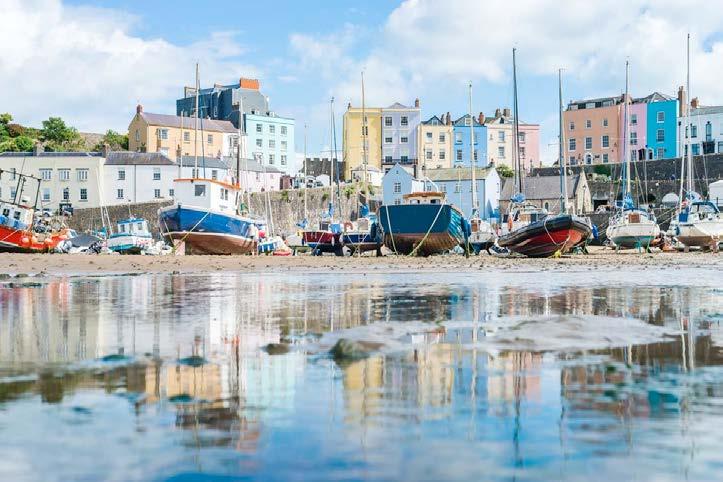
Tom Sinclair editor@herald.email
through roles in productions including The Crown, Keeping Faith and Baby Reindeer.
In Old Town Murders they play DS Sion Dearden and DI Glyn Walsh, two detectives who find themselves thrown together while investigating a series of unusual killings in a closeknit seaside town.
Among the cases promised in the series are the mysterious death of a university professor, the poisoning of a head teacher during a wild swim, and a fatal mix-up linked to a triathlon.
The tone, however, is not being pitched as relentlessly bleak. Instead, the show is being described as witty, twisty and full of warmth, with friendship, second chances and reinvention forming the emotional core of the story.
That may prove to be one of the drama’s biggest strengths. Crime series have become one of television’s most dependable genres, but Old Town Murders appears to be aiming for something slightly different — a coastal whodunnit with a strong Welsh identity, recognisable locations and a central partnership built as much on character as on corpses.
The creative team behind it is also distinctly Welsh. The series has been created and written by Matthew Barry, whose recent credits include Men Up and The Guest. Barry has said he wrote the roles specifically for Rhodri and Lewis Jones after working with them before, suggesting the chemistry between the two leads will be central to the series’ success.
Supporting cast members include James Bamford, Bethan Mary-James, Catherine Ayers and Julie Graham, adding further weight to a production that is already shaping up as one of the BBC’s most notable new Welsh commissions.
There is also an economic angle. The production has support from Creative Wales, meaning the series is not only showcasing West Wales on screen but contributing to the wider Welsh creative economy through jobs and production spend.
No transmission date has yet been announced, but with filming now under way, excitement is likely to build as more residents spot cameras, cast and crew around the town.
For local people, that is part of the appeal. This is not a drama merely inspired by the Welsh coast. It is being made in Wales, by Welsh talent, with Tenby right at the centre of it.
For Pembrokeshire audiences, that alone makes Old Town Murders one to watch.
COMEDIAN Mark Simmons will bring his latest stand-up show to Pembrokeshire next month when he appears at the Torch Theatre in Milford Haven.
Simmons, who has appeared on Mock The Week, BT Sport and ITV, is due to take to the stage on Tuesday, May 5, with his new tour, Jest to Impress.
The comic has built a strong following for his rapid-fire one-liners and quick-witted improvisation, and the new show promises more of the sharply crafted material that has helped make him a popular live act across the UK and beyond.
His debut tour was a major success, selling out more than 200 dates over two years across the UK, Ireland, Australia and New Zealand. Now back on the road in 2026, Simmons is performing a brand-new set packed with fresh one-liners, alongside his trademark off-the-cuff jokes based on random audience
Tom Sinclair editor@herald.email
suggestions.
He has also found further success with his podcast, Jokes with Mark Simmons, in which he talks to fellow comedians including Gary Delaney, Sarah Millican, Milton Jones and Penn & Teller about jokes they wrote but, for one reason or another, could never quite make work.
Simmons has picked up a number of accolades in recent years. He won the Victoria Wood Panel Prize at the Edinburgh Fringe in 2023, was named Best Act at the UK Comics’ Comic Awards in 2022, and was runner-up in Dave’s Top 10 Jokes of the Fringe in the same year.
The Evening Standard has described him as a “master of the crisp, clean, one-line zinger”.
The show is suitable for audiences aged 14 and over.





is not far-fetched. It fits a pattern in which military force is used not just for battlefield advantage, but for political leverage.
Netanyahu has made little secret of his discomfort with any arrangement that limits Israel’s freedom to act. His insistence that Israel retains the right to continue striking Lebanon, even after a ceasefire was declared, exposes the weakness at the heart of the agreement. A ceasefire that does not restrain one of the key actors is not a ceasefire at all. It is merely a pause for one side, while the other keeps bombing.
ISRAEL has once again shown that, when it comes to ceasefires, its commitment lasts only as long as it suits its military and political objectives.
The latest mass strikes on Lebanon, launched just hours after a ceasefire linked to the Iran conflict had been announced, look less like self-defence and more like sabotage. More than 200 people were killed in attacks that reportedly hit densely populated residential areas, prompting condemnation and immediate fears that any fragile pause in hostilities had been fatally undermined.
Israel says it was targeting Hezbollah. That is the standard justification. But the scale, timing and nature of the strikes tell a different story. If Hezbollah had already been notified of a ceasefire and was observing it, as Lebanese political sources suggest, then Israel’s decision to unleash one of its largest attacks in Lebanon at that exact moment was plainly incendiary.
It is difficult to avoid the conclusion that these strikes were designed not simply to hit Hezbollah, but to send a message: that Israel, and in particular Benjamin Netanyahu, will not be constrained by diplomatic efforts led by others. The suggestion that the attack may have been intended to derail the wider US-Iran ceasefire
That is what makes this episode so dangerous. Ceasefires are built on trust, however limited or uneasy. Once one side shows that declarations of peace can be brushed aside within hours, the credibility of the entire process begins to collapse. Those on the receiving end will conclude, understandably, that diplomacy offers no protection. Retaliation then becomes more likely, and the spiral resumes.
If the United States is serious about de-escalation with Iran, it cannot simply ignore actions by its closest regional ally that risk dragging the whole region back towards open war. Israel may argue that Lebanon lay outside the strict terms of the agreement, but such distinctions ring hollow when bombs are falling and the ceasefire is visibly unravelling.
The tragedy is that the world has seen this before. Opportunities for de-escalation in the Middle East are repeatedly wrecked by maximalist military action dressed up as necessity. Civilians pay the price, diplomacy is discredited, and political leaders posture while the region edges closer to another catastrophe.
If this ceasefire collapses, Israel will not be able to pretend it played no part. By striking Lebanon at the very moment restraint was needed most, it has done exactly what critics feared: acted as the spoiler, and pushed the region closer to a far wider war.

SWARKK! gather round, my little chip thieves, because old Stephen has spotted another one of those glorious human arrangements where the clever mammals in suits ignore a glaring problem for years, then act stunned when it flaps up and pecks them on the backside.
This week’s great revelation is that Britain’s food system may not be quite as sturdy and marvellous as ministers like to pretend. You don’t say. One bit of trouble in the Middle East, a wobble in oil prices, a few nasty global shocks, and suddenly the big brains in London are calling in supermarket bosses for chinwags and emergency muttering, as if that’s the same thing as having had a plan all along.
Swarkk! I nearly dropped a halfeaten sausage over the docks when I read it.
Because let us be honest, beak to
beak. The British state has always had form on this. It does not do “prepared” unless there is smoke coming out of the wiring and somebody on the telly looks panicked. Food security? Bah. Too dull. Too rural. Too practical. Much easier to chatter on about inflation, market confidence and whatever bit of paper the Treasury is currently waving around, while quietly assuming that the shelves will always be full of grapes in February, strawberries in November and avocados from somewhere far too sunny to be Milford Haven.
But then the world coughs, oil jumps, ships wobble, cables get cut, some dictator has a tantrum, some war kicks off near a shipping route, and all at once everybody remembers that food does not teleport into Lidl by the will of the gods.
No, my fluffy headed landcreatures — it runs on oil.
Oil moves the tractors. Oil moves the lorries. Oil moves the ships. Oil helps make the fertilisers. Oil props up the whole grand illusion of modern plenty. The miracle of civilisation, in your case, often turns out to be a diesel engine and a logistics spreadsheet.
Swarkk!
And this is not even a new revelation. We saw it when Russia invaded Ukraine in 2022. We saw it in the oil spikes of 2008. We saw it in the 1970s. We keep seeing it, like a seagull repeatedly flying into the same window because there’s a reflection of chips on the other side. Yet still Britain lumbers on with a food system so long, thin and brittle that one decent global shock can make the whole thing wobble like a soggy pier.
Now some experts are saying what should have been obvious years ago:
grow more food here, shorten supply chains, protect local production, store more essentials, get communities involved, and stop relying on a giant just-in-time machine that functions beautifully until it doesn’t.
Swarkk! At last, some sense.
Because what have we built instead? A nation where farmers and growers do the hard graft but only get a small slice of the value, while the bigger money sloshes around retailers, processors and hospitality. A nation where people say they love local food but then fill their baskets with “globo grub” that has travelled further than your average holidaymaker. A nation where we have become so used to everything being available all the time that many people now think seasonality is some sort of Victorian punishment.
Here is the gull-truth: if it cannot grow here, it must come from somewhere else. If it comes from somewhere else, it depends on fuel, ships, roads, ports, cables, calm seas, stable politics, decent harvests, secure payments, working warehouses and a thousand other moving parts humans never think about while arguing over the last yellow-sticker chicken kiev.
Bananas do not grow in Haverfordwest. Tangerines do not flourish in Tenby. Even strawberries only behave themselves for part of the year. Yet you have built an entire culture around permanent abundance, then act scandalised when the world reminds you that geography exists. Swarkk, swarkk!
And while ministers worry about food inflation, which is bad enough, they still often miss the larger point. The real issue is not just whether food costs more. It is whether the whole system is too vulnerable to shocks in the first place. Those are linked, of course. If supply chains seize up, prices rise. If oil jumps, costs spread through everything. If conflict snarls up shipping, fertiliser, transport and confidence, the bill lands hardest on people who are already counting
every pound.
And here’s the shameful bit, feathers down for a moment: loads of people are already food insecure. Right now. Not in some cinematic future where the sky goes red and everyone fights over tins of beans. Right now, in ordinary Britain, one in five people across England, Wales and Northern Ireland is technically food insecure. That means patchy access to decent, nutritious food. That means the problem is not only about future emergencies. It is already here, in a quieter, meaner form.
A country that tolerates that while boasting about resilience is like a gull boasting it owns the harbour because it can balance on one bollard in a stiff breeze.
And then there’s the security side. Swarkk! This is where the whole thing gets even more bonkers. Apparently a huge amount of UK retail food passes through a relatively small number of distribution centres. Lovely.
supply, local storage, backup systems and domestic production. You would be treating food not just as a shopping matter, but as infrastructure. As security. As something near the heart of whether a nation can cope when the weather goes mad, the shipping lanes get tense, or some hostile actor decides it would be amusing to prod the system.
Other countries have grasped this better than Britain. Some stockpile. Some plan. Some think in months rather than days. Britain, by contrast, often behaves like a man who keeps no food in the house but assures everybody he has a very good relationship with the takeaway.
Swarkk!
And do not get old Stephen started on public advice. “Store some food that does not need cooking and a few bottles of water,” says officialdom, in the tone of a man suggesting you pop an
relative who has never once checked the cupboard but likes the sound of being sensible.
No, if you want resilience, treat the public like grown-ups. Tell them honestly what the risks are. Give proper guidance. Explain what foods store well, what nutrition matters in a disruption, how communities can organise, what councils should prepare, and what realistic rationing might look like if things ever got rough.
Did I say rationing? Swarkk! Yes, rationing. Calm down. Markets ration already — they just do it by price, which means the deepest pockets eat first. Pretending otherwise is just another one of those posh human tricks where the nasty thing is renamed so nobody has to admit it’s happening.
There’s also a simpler answer, one so obvious it is practically perched on the windowsill nicking your lunch: grow more food ourselves. Properly. Regionally. Sensibly. Not as some nostalgic wartime costume drama, but as a practical modern policy. More horticulture. More support for growers. More short supply chains. More realism about what Britain can produce well. Less dependence on endless imported convenience.
And give people land.
Marvellous.
Splendid. In the age of drones, cyberattacks, sabotage, cable cutting, disinformation and hybrid warfare, we have essentially built giant food chokepoints and hoped nobody notices.
That, in technical seabird language, is called “asking for it”.
If you were seriously planning national resilience, you would not just be muttering about prices. You would be thinking about redundancy, regional
umbrella in the boot. That is not resilience. That is the sort of vague halfadvice you get from a
Allotments, gardens, community plots, local growing schemes — not because everyone is suddenly going to become a cheerful turnip philosopher in a wax jacket, but because knowing how to grow even a little bit of food makes communities stronger, healthier and less helpless. It teaches useful skills. It builds confidence. It reconnects people to seasons, soil and reality.
Millions more people say they want to garden than currently do.
There’s your clue, my land-bound
lovelies. The appetite is there. The will is there. What’s missing is leadership, planning and a proper strategy for land and local production.
That’s the maddening part. Britain is not short of expert advice. It is not short of reports. It is not short of warnings. It is not even short of history. It is short of governments willing to take food seriously before the panic starts.
Instead, we get the usual style of crisis management: wait, deny, dither, hold a meeting, call in the supermarkets, say “robust measures are being considered”, then hope the news cycle moves on before anybody asks why we were so exposed in the first place.
Swarkk! You could set your tide clock by it.

From afar, Britain has watched food insecurity devastate places caught in war and blockade — Gaza, Ukraine, Sudan and elsewhere. We have seen food become a weapon, a weakness, a point of control, a measure of whether a state can protect its people. And still, at home, too many in power treat food as a sort of permanent retail miracle, one that appears under fluorescent lights without any need for strategic thought.
But the insecurity washing through the world does not politely stop at Dover. It reaches here too — in higher prices, tighter supplies, exposed systems and a creeping sense that what once felt stable is, in fact, much more fragile than advertised.
So perhaps the time has come to stop treating food as just another consumer issue and start treating it as what it truly is: national strength, local resilience and the difference between a country that can cope and one that simply flaps about when the bins blow over.
Because when the oil hiccups, the ships slow, the warehouses fail, the cables snap or the world catches fire, you cannot eat a minister’s press release.
And believe me, dear reader — I’ve pecked at enough rubbish in my time to know poor nutrition when I see it.





PET owners across west Wales now have improved access to fast, high-detail diagnostic imaging after Carmarthen Veterinary Hospital installed a new inhouse CT imaging suite.
The investment brings advanced diagnostics directly into the local community, helping
pets receive quicker answers, earlier diagnoses and faster access to treatment.
CT scanning is an important tool in diagnosing a wide range of conditions, including chronic lameness, orthopaedic problems, cancer screening and staging, nasal and dental disease, thoracic and abdominal masses,
spinal disorders and suspected foreign bodies.
For pets with unexplained or ongoing health issues, CT can provide a level of detail and accuracy that standard X-rays or ultrasound scans cannot always offer. This can be crucial in identifying subtle problems earlier, allowing for more targeted treatment plans and improving long-term outcomes.
Until now, many families needing this type of advanced imaging have faced long journeys to specialist hospitals and lengthy waiting times. With the scanner now available in a primary care setting in Carmarthenshire, pets can be scanned closer to home, reducing stress for both animals and owners and speeding up the path to diagnosis.
The scanner also offers reassurance for owners seeking answers about their pet’s condition. It can produce clear, high-resolution images within minutes, meaning pets spend minimal time under anaesthetic, while results can be shared quickly with the family vet or a specialist where required.
Michelle Kirk, Practice Director at Carmarthen Veterinary Hospital said: “We’re incredibly proud to offer this level of advanced imaging within a primary care environment.
“A CT scan can make a huge difference in understanding complex conditions, whether it’s
chronic pain, cancer staging, internal masses or difficult-todiagnose problems. Our goal is to help pets receive timely, accurate diagnoses without delays.”
In addition to supporting its own clients, Carmarthen Veterinary Hospital is also offering the CT scanner to other primary care veterinary practices across the region. Local surgeries can refer patients directly for a fixed-price CT scan package, which includes pre-anaesthetic blood tests, general anaesthesia with IV fluids, pre- and postcontrast imaging, and a specialist interpretation report.
The hospital said this collaborative approach will strengthen veterinary care across the region by giving more pets access to advanced diagnostic technology while offering owners greater choice.
The procedure is typically quick and requires only a short period under anaesthetic. Each patient is assessed by a vet at Carmarthen Veterinary Hospital on the morning of the scan to ensure the procedure is safe and to answer any questions owners may have.
Carmarthen Veterinary Hospital is at Llysonnen Road, Llanllwch, Carmarthen, SA31 3SA.
CVS Healthy Pet Club patients receive a 10 per cent discount, even if they are registered at a different CVS practice.

MORE students in Pembrokeshire could soon qualify for a £40-a-week education grant as the Welsh government expands eligibility for the Education Maintenance Allowance.
From September, an extra 1,500 students aged 16 to 18 across Wales will be able to claim the weekly payment, which is designed to help young people stay on in education.
Eluned Morgan MS welcomed the change, saying it would allow more families in Pembrokeshire to benefit from the support.
She said: “Wales already has the most generous EMA offer in the UK. Under a Tory government it was scrapped in England, while Scotland and Northern Ireland
offer students less money than in Wales.
“EMA helps young people with costs like books, transport and meals – all things which can affect the cost of living for families.
“Every young person deserves the opportunity to reach their potential, so I am proud that, because of Welsh Labour choices, more students will be supported to do so.”
More than 18,000 students in Wales currently receive EMA, which is available to learners aged 16 to 18 from households below a set income threshold.
The Welsh Government said the latest expansion will mean even more young people can access weekly support from September.
Eluned Morgan said: “The Welsh EMA is breaking down barriers for learners in Pembrokeshire. Everybody deserves an equal opportunity to access education, and providing £40 a week to those eligible is one of the ways in which the Welsh Labour Government is making this a reality.
“Hundreds of learners in Pembrokeshire claim their EMA every year. At £40 a week, Welsh Labour delivers the most generous offer in the UK.
“I know this money makes a real difference for students and their families with the cost of living.
“And, of course, the Welsh Government’s £1 bus fare scheme for young people is
helping to make the EMA go even further for families across Pembrokeshire.
“I would urge all 16 to 18-year-olds and their families in the county to take a few minutes to check whether they qualify for support.”
EMA can be used to help with education-related costs including transport, meals and study supplies.
Applications for the new EMA offer open on Monday (Apr 27). Students and families can check eligibility and apply through Student Finance Wales, or speak to their school or college.
If you want, I can also turn this into a fuller Pembrokeshire Herald article with headline and subheading.

THE SYSTEM supporting children and young people with Additional Learning Needs in Wales is facing serious pressures that could threaten its long-term sustainability, according to a new report from Audit Wales.
Published on Tuesday (Apr 7), the report examines support for children and young people with Additional Learning Needs, or ALN, in the context of changes introduced under the Additional Learning Needs and Education Tribunal (Wales) Act 2018.
Audit Wales said public bodies do not have a full understanding of demand, workforce capacity, skills, costs or outcomes, leaving them without the information needed for effective planning, budgeting and value-for-money assessments.
The report raises concerns about whether the current system is performing well enough to help learners achieve their full potential.
In 2024-25, 48,257 learners aged from nought to 25 were recorded as having ALN or Special Educational Needs. However, Audit Wales said that figure is incomplete and does not capture the full picture across all settings.
Available data shows the number of school learners recorded as having ALN or SEN fell by 58 per cent between 201819 and 2024-25, although the reasons for that drop are disputed.
Over the same period, the number of school learners receiving statutory support through a statement of SEN, or now an Individual Development Plan, increased by 164 per cent.
The report says spending on supporting learners with ALN has also risen significantly, adding pressure to already stretched public budgets. While Audit Wales said it could not put an exact figure on total spending, identifiable annual costs are approaching £1 billion, with the true figure likely to be higher.
Councils’ budgeted expenditure on ALN or SEN rose by 34 per cent in real terms between 2018-19 and 2025-26.
Audit Wales said its conclusions were based on evidence showing that the system lacks good enough data to understand growing demand and complexity, while patchy workforce information makes it harder to assess staffing capacity
and skills gaps. It also found that public bodies do not have a strong enough understanding of costs, raising concerns about financial sustainability.
The report adds that although the goals of the ALN system are clear, there is only limited evidence on whether it is delivering strong outcomes for learners, and that the system remains adversarial despite some signs of improvement.
Its recommendations are aimed mainly at the Welsh Government, particularly in its national leadership role, although Audit Wales said successful implementation would require action from a wide range of public bodies.
Auditor General Adrian Crompton said: “Children and young people with Additional Learning Needs include some of the most vulnerable people in society.
There has been a significant amount of work involved in efforts to reform the system for the better over recent years. However, the system remains under strain and there is still a lot more that can be done to ensure it does as well as
it can for our children and young people, both now and for future generations.”
The 2018 Act introduced a new system designed to create a more integrated, collaborative and person-centred approach to supporting learners with ALN. It extended statutory provision to learners aged nought to 25 and replaced the previous separate systems for under-16s with SEN and post-16 learners with learning difficulties or disabilities.
major part of the reform was the introduction of Individual Development Plans, which replaced both non-statutory SEN support and statutory statements of SEN. Under the new system, every learner with ALN is entitled to an IDP.
Audit Wales stressed that the figure of 48,257 learners does not include all settings for learners aged nought to 25, including further education, meaning the overall scale of need may be higher than official data suggests.
For more information, contact Rhian Jones at Audit Wales on 02920 320 575 or by email at Rhian.Jones@audit.wales





NFU Cymru has met with the Deputy First Minister and Cabinet Secretary for Climate Change and Rural Affairs, Huw Irranca-Davies MS, to discuss the concerns of Welsh farmers over the availability and price of key inputs needed for food production stemming from the conflict in the Middle East.
During the meeting on Tuesday 7th April, NFU Cymru President Abi Reader and Deputy President Paul Williams
were able to refer to information collected by the union from its members, farming across all sectors and areas of Wales, in recent days to highlight that there is significant disruption in the market, particularly in relation to the price and availability of fuel and fertiliser. Abi and Paul highlighted to the Deputy First Minister that food production operates over long cycles running into many months and even years for some sectors, so whilst many
businesses may be managing now it could be a few weeks or months before we see the true impact of the war. The officeholder team explained that cashflow is a concern for many farms in Wales with significant costs coming now for fuel and fertiliser at the end of the costly winter period. NFU Cymru was pleased to receive reassurances from the Deputy First Minister and his team that they are aware of the concerns of the industry and
are in regular communication with their counterparts on a UK Government level and with the other devolved nations.
NFU Cymru President Abi Reader said: “We are grateful to the Deputy First Minister for meeting with us today to discuss a real range of challenges facing Welsh farmers brought on by the war in the Middle East.
“It was important that we were able to talk through the impacts sector by sector so that we could give the Deputy First Minister a full picture as to how different parts of the industry are being affected. We stressed the importance of Welsh Government actively modelling the impact of the disruption on food production and the need for government to closely and actively monitor input markets to give confidence that they are operating transparently.
“Whilst this Senedd will shortly be dissolved and the Welsh Government enters the pre-election period, NFU Cymru will continues to have regular dialogue with both Welsh Government officials and the UK Government through the Wales Office and our team in Westminster.”



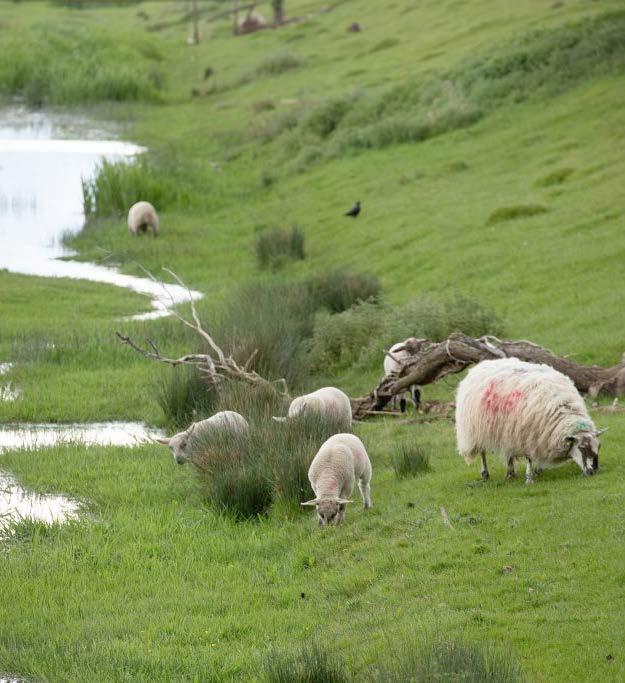





SHEEP farmers in Wales are being urged to pay close attention to the mineral and trace element supplementation of lactating ewes and lambs this spring and summer following what has been described as a “perfect storm” of nutritional challenges over the winter.
The warning comes from Rumenco’s Technical Services Manager, Dr Alison Bond, who said a combination of forage shortages, heavy rainfall and the increased use of brassica forage crops may have left some flocks at risk of underlying deficiencies.
She said that although sheep may not always show obvious outward signs, deficits in minerals and trace elements can still affect key areas of flock performance, including ewe milk production, lamb growth rates and the future condition of breeding ewes.
Dr Bond said: “Many sheep farms will have endured unprecedented conditions over recent months, with forage supplies depleted after a dry summer.
18-5-2021 Ewes and lambs in parkland ©Tim Scrivener Photographer 07850 303986 ….Covering Agriculture In The UK….
“This may have resulted in lower quality fodder being fed, or greater reliance on grazed fodder crops, for example. In the case of brassicas, which include swedes, turnips and forage rape, there are specific issues around iodine, vitamin B1 and other trace minerals, including copper, selenium and cobalt, that could present risks.”
She added that heavy winter rainfall in many areas is also likely to have increased soil nutrient leaching, particularly on lighter land, raising the risk of mineral deficiencies in early season grazing.
To help address the problem, Dr Bond is recommending that ewes and lambs at grass are supplemented with a high-quality mineral and trace element lick.
She said mineral buckets can provide an efficient method of supplementation and pointed to Rumenco’s Supalyx 4 in 1 bucket as one option designed to cover a broad range of potential deficiencies.
According to Dr Bond, the product includes plant essential oils intended to stimulate appetite and support gut health, alongside trace elements such as zinc and selenium in a bio-available form to help support hoof health, udder
health and immune function.
She also highlighted the importance of vitamins, including vitamin B12 to support growth rates where pastures may be low in cobalt, and vitamin B1, or thiamine, which is particularly relevant where sheep have been grazed on brassicas.
Dr Bond explained: “Brassicas can cause shifts in the rumen bacteria environment which may affect the natural production of thiamine by the rumen.
“Furthermore, certain brassica crops can lead to the production of thiaminase which can destroy thiamine, leading to a deficiency. Vitamin B1 deficiency causes a condition called Cerebrocortical Necrosis, with common symptoms including blindness, head pressing and stargazing, something most farmers will have seen at some point.”
She said brassicas can also create problems with iodine absorption.
“Brassicas also contain glucosinolates, which are converted by hydrolysis into goitrogens in the rumen,” she said. “Goitrogens interfere with iodine absorption, which commonly results in the disruption of thyroid function. This is a cause of the condition goitre in sheep, which shows as a swelling of the thyroid gland.”
Dr Bond said adequate supplementation should not be viewed simply as a short-term measure, but as an investment in flock health and future performance.
“With market prices forecast to remain strong for the foreseeable future, ensuring that the flock avoids the effects of mineral and trace element deficiencies should help to prevent in-season health and performance problems,” she said.
“It will also give lambs the best chance of reaching their full potential as quickly as possible. Equally importantly, it will have a positive impact on the condition of ewes, which should ideally not lose more than 0.5 body condition score during lactation.
“Keeping ewes in good condition during lactation is the first step towards a successful tupping later in the year and a healthy lamb crop in 2027.”
Images supplied with the article are copyright Tim Scrivener, Agriphoto, and are for use only in connection with this story.
If you want, I can also turn this into a more natural Herald-style farming piece with a stronger intro and less promotional wording.

AN URgENT appeal has been launched to find homes for 180 ex-commercial laying hens in Boncath before next weekend, with campaigners warning the birds may otherwise face slaughter.
The British Hen Welfare Trust is holding a rehoming event in Boncath on Saturday (Apr 11), but says kind-hearted adopters must register by 2:00pm on Friday (Apr 10) if the hens are to be given a second chance.
The charity says the birds, all around 18 months old, have reached the end of their commercial laying lives, despite still having plenty to
offer as pets.
Supporters say hens are friendly, curious and easy to care for, and can continue to provide eggs while enjoying retirement in a garden or smallholding setting.
Andy Hill, of the British Hen Welfare Trust said: “People are often surprised by how much joy hens bring. They’re funny, curious little characters, they love routine, and they’re genuinely a delight to care for. Plus, they’re still more than happy to pop out the occasional egg.
“With spring finally here, this is the ideal time to start. These girls are more than ready for a

AS May’s key Senedd election approaches, parties across the political spectrum are setting out their policies and priorities. Among the many issues rising up the agenda, the future of Welsh agriculture - and in particular livestock farming - has become an increasingly prominent and increasingly contentious topic.
In recent years, growing attention on climate change and the environmental responsibilities of farmers has brought livestock numbers into sharp focus. Much of this debate stems from recommendations by the Climate Change Committee (CCC), which suggest that nearly half of the proposed reductions in agricultural emissions could be achieved through a 19% reduction in livestock numbers, alongside a 17% decrease in meat and dairy consumption. The land freed up, it is argued, could then be used for tree planting and other carbon sequestration measures.
fresh beginning, and they really do make wonderful pets.”
The trust says anyone willing to adopt must be able to provide food, water, shelter, security and a little care and attention.
The charity, founded in 2005, says it has now found retirement homes for more than one million ex-commercial hens across the UK, all of which would otherwise have been destined for slaughter.
People interested in adopting can visit the British Hen Welfare Trust website and select the Boncath rehoming event, or call the rehoming team on 01884 860084.
communities, heritage, and the landscapes that define Wales.
Importantly, livestock numbers in Wales have already declined significantly. Since 2000, sheep and lamb numbers have fallen by around 22%, while the beef herd has dropped by a third over the past two decades. Further reductions risk undermining the critical mass needed to support local supply chains, processors, markets, and abattoirs - threatening the wider rural economy and food production.
There are alternative approaches. In Scotland, the government has committed not to introduce policies specifically targeting reductions in livestock numbers, instead focusing on reducing emissions through efficiency, innovation, and improved land management. The FUW believes the Welsh Government should follow a similar approach.
However, such proposals raise serious concerns for the farming community. At our recent Council meeting, the Farmers’ Union of Wales passed a motion calling on the Welsh Government to ensure that any current or future agricultural and environmental policies do not negatively impact livestock numbers in Wales.
Livestock farming is not just one part of Welsh agriculture - it is its backbone. It underpins the economies of our rural communities, and also sustains our
Welsh farmers are already making significant strides in improving productivity and reducing emissions, while continuing to produce high-quality food to some of the highest standards in the world. The narrative that climate targets can only be met by cutting livestock numbers is overly simplistic and potentially damaging.
Instead, the focus should be on supporting farmers - through innovation, sustainable practices, and investment in productivity - so that environmental goals can be achieved without sacrificing the viability of family farms or the communities they sustain.



An international jury of 98 motoring journalists has awarded the BMW ix3 (BMW ix3 50 xDrive: energy consumption, combined: 17.9–15.1 kWh/100 km (WLTP); CO2 emissions, combined: 0 g/km (WLTP); electric range: 678–805 km (WLTP); CO2 class(es): A)* not one but two titles.
The first Neue Klasse model was named the 2026 “World Car of the Year”, beating out competitors across all powertrain categories. In addition, the BMW ix3 won the 2026 “World Electric Vehicle” accolade. During extensive test drives, the model impressed the jury with its outstanding performance and driving dynamics, as well as its standout technology features. For the BMW group, this marks the tenth and eleventh title wins at the prestigious World Car Awards. Earlier, on 26 February, Oliver Zipse, Chairman of the Board of Management of BMW Ag, was named “World Car Person of the Year” for 2026.
The BMW iX3 is the first Neue Klasse model. It was presented at the IAA Mobility 2025. An instant success, it has established a new design language and set standards for driving dynamics and performance. A range of
up to 805 kilometres, battery charging at up to 400 kW and an energy consumption of just 17.9–15.1 kWh/100 km (WLTP) demonstrate the outstanding abilities of the new BMW iX3.
The new BMW Panoramic iDrive brings innovation to the interior.
The high-performance control unit Heart of Joy and BMW Dynamic Performance Control take driving pleasure to an entirely new level. Plenty of compelling reasons for the expert jury at the World Car Awards to declare the BMW iX3 the 2026 “World Car of the Year” – and thus the standout new vehicle on the international automotive markets – following extensive test drives. On top of that, the model won the 2026 “World Electric Vehicle” title. The awards were announced at the 2026 New York International Auto Show (1–12 April 2026).
The success of the BMW iX3 is based on the independent assessment of 98 journalists from 33 countries. They gave their detailed evaluations after test driving the various vehicles involved in the competition.
The organisers of the World Car Awards collected and documented this data, which formed the basis for the final verdict. The BMW iX3 beat out 57 high-class contenders to take the “World Car of the Year” title.
Panoramic iDrive combines four key elements to form a unique display and operating system. The BMW Panoramic Vision is a newly developed information projection from A-pillar to A-pillar in the lower part of the windscreen with permanently visible, clearly structured information displays. It is complemented by the 17.9inch, Free-Cut Design Central Display with high-resolution matrix backlight technology for intuitive touch control. The other two elements are the optional BMW 3D Head-Up Display and the multifunction steering wheel with Shy Tech controls.
A total of 43 vehicles were in the running for the title of “World Electric Vehicle”.
Mike Reichelt, Head of Neue Klasse BMW, says: “We are happy with this fantastic accolade for the BMW iX3, the first representative of our Neue Klasse. The BMW iX3 marks the beginning of a new era at BMW – in terms of design language, range, charging capacity as well as driver assistance – and BMW Panoramic iDrive. Above all, the BMW iX3 represents the next generation of Sheer Driving Pleasure powered by the Heart of Joy. The innovations from the Neue Klasse will benefit our entire product portfolio.”
The BMW iX3 represents the technological quantum leap of the Neue Klasse.
As the first Neue Klasse model, the BMW iX3 brings a new era of driving pleasure to the road. The completely new design language of the fully electric Sports Activity Vehicle (SAV) makes for a distinctive appearance. The interior is defined by the new BMW Panoramic iDrive infotainment system. It is based on BMW Operating System X, which ensures excellent update and upgrade capability as well as context-sensitive, situationally aware control of all display and operating elements. The BMW
The BMW iX3 50 xDrive is powered by two electric motors that together deliver 345 kW/469 hp and 645 Nm of torque. It accelerates from zero to 100 km/h in 4.9 seconds and has a top speed of 210 km/h. At the heart of the new electronics and software architecture are four superbrain high-performance computers. Each is assigned a core function in the BMW iX3. The Heart of Joy manages driving dynamics, with additional computers controlling automated driving and parking, infotainment and essential and comfort functions. These superbrains offer up to 20 times higher computing power compared to previous BMW models. The Heart of Joy and the BMW Dynamic Performance Control software developed in-house deliver a confident and precise driving experience, perfect traction, efficient recuperation and – thanks to precise control of the electric motors – the smoothest stopping process in BMW history.
The sixth-generation BMW eDrive technology comprises a new drive with a fundamentally new high-voltage battery concept and 800-volt technology. It enables significantly longer ranges, faster charging at up to 400 kW and support for bidirectional charging functions. The high-voltage battery in the BMW iX3 50 xDrive now provides 108.7 kWh of usable energy, enabling a range of up to 805 kilometres on the WLTP cycle. At a DC fast charger, energy for up to 372 kilometres of range1 can be added to the battery in 10 minutes.



1.2

























At EV Wales, electric vehicles aren't just part of our business – they are our passion. As dedicated EV specialists, we provide a level of in-depth expertise in sales, service, and repair that goes beyond what a main dealer can offer. Are you looking to buy your first EV and need honest, real-world advice from people who drive them every day? Or are you an owner searching for expert, economical repair solutions that make sense? We are your trusted local partners. We believe in making electric driving simple, affordable, and exciting for everyone. For a better way to buy and maintain your EV, speak to the experts who live and breathe them.



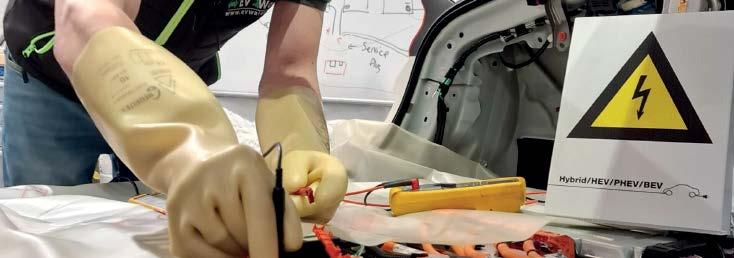



Mazda is proud to announce that the all-electric Mazda6e has been awarded the 2026 World Car Design of the Year (WCDOTY). The award was officially revealed today at the New York International Auto Show.
This recognition marks Mazda’s third win in the World Car Design of the Year category, following the Mazda MX-5 (2016) and Mazda3 (2020). It represents an important milestone as Mazda continues to refine and advance its design approach for a new generation of electrified vehicles.
Established in 2004, the World Car Awards (WCA) are determined by an international jury of approximately 100 automotive journalists from 33 countries. For 2026, the Mazda6e was chosen from 90 eligible vehicles.
The Mazda6e represents a modern interpretation of Mazda’s Kodo - Soul of Motion design philosophy, tailored for the brand’s electric future. Its elegant proportions, sculpted surfaces and warm, inviting interior to express a balance of movement, harmony and precision deeply rooted in Japanese craftsmanship. The result is an EV that remains emotionally engaging while staying true to Mazda’s core design values.
“We are honoured to receive the 2026 World Car Design of the Year award for the Mazda6e. This recognition reflects the dedication of our global design teams and their continued pursuit of clarity, artistry and Japanese craftsmanship in a modern EV. We are proud that the Mazda6e resonates with customers and experts worldwide.”- said Jo Stenuit, Mazda Motor Europe‘s Design Director.

As of 2026, Mazda has achieved three World Car Design of the Year wins and two overall World Car Award titles.
• 2026 – World Car Design of the Year: Mazda6e
• 2020 – World Car Design of the Year: Mazda3
• 2016 – World Car of the Year &



A FORMER Pembrokeshire county councillor who owns many hostelries in the county has submitted plans to the national park to rejuvenate a “tired” seaside pub.
In an application to Pembrokeshire Coast National Park, Mike Evans of Harbwr Brewery, a former county councillor and national park authority member, seeks a partly retrospective permission for works at the Old Chemist Inn, The Strand, Saundersfoot.
The works include proposed internal alterations to the basement and ground floor, a new rear balcony area to replace the existing one, improvements to front façade, a change of use of shop space to food/drink, and installation of seating booths in the rear garden.
It says the changes proposed will increase the number of staff employed to 15 full time and 10 part-time.
No objections to the proposal were raised by local community council Saundersfoot.
A supporting statement through agent David J P Morgan RIBA Architect, says the 19th Century pub “has endured many alterations
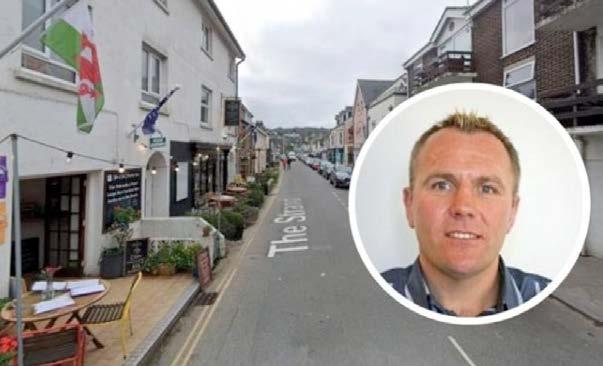
Bruce Sinclair Local Democracy Reporter
during its lifetime and at present it needs improvements to echo the recent upgrading of the village, both in the general tourism support facilities, as well as the new innovative harbour development,” with the appearance and interior facilities “tired” and needing “works both inside and outside to enable the inn to achieve and provide the high levels of cuisine and facilities now expected”.
It says: “The Inn has been purchased by a local company who have a number
of establishments within Saundersfoot and Tenby. The company is owned by local people, they use local produce, they employ local labour and work actively with local communities to achieve the high standards expected.
“The proposals include internal alterations to the internal layout of basement and ground floor which will improve bar, kitchen and food facilities and allow a much more varied menu including lots of local produce and locally caught seafood dishes. New toilet facilities will be provided on both levels to cater for the increase in visitors to the Inn.”
It adds: “The applicant has
recently purchased the small retail unit on the ground floor. This was a single room, situated in between the two entrances into the Inn and with its own entrance door from the street.
“The current proposals include integrating this unit into the public house bar area and consequently the application includes a change of use from retail to the serving of food and drink.”
It goes on to say: “The rear ‘beer garden’ will be improved to allow more space and comfortable seating areas.
“The applicant is well known for the extensive use of external plotted plants in open areas at their establishments and the garden area will give the opportunity of using such to soften the garden area whilst giving greater habitat opportunities for birds and insects.”
There were initial objections from the Park’s buildings conservation officer to some of the parts of the design, a 2025 application being withdrawn early that year; amended plans being later submitted.
The application will be considered by park planners at a later date.
FIONA and Vince Malone, owners of Tenby Stores, in Pembrokeshire, West Wales, and members of the Federation of Independent Retailers (the Fed), met with Marc Tierney, Welsh Labour candidate for Ceredigion Penfro and Pembrokeshire County Councillor in the upcoming Senedd elections on May 7.
The meeting on Saturday, February 28, focused on the critical challenges facing independent retailers and followed the publication of the Fed’s manifesto for the Welsh election.
Key issues addressed during the meeting included the impact of rising business rates bills on small shops, as well as the significant social and economic value that post offices and convenience stores offer to their neighbourhoods. The Malones highlighted the rising costs resulting from aboveinflation increases in the national minimum wage and higher National Insurance Contributions (NICs) that have placed further financial strain on independent businesses such as theirs, and
others across Wales and the rest of the UK.
The importance of post offices in providing essential banking facilities was emphasised, underscoring their role in sustaining local economies through their range of services including postal and banking as well as government services such as vehicle tax renewal and passport applications.
Additionally, the conversation touched on the pressing issue of retail crime. The Malones showed how they had taken steps to reduce this problem, including the implementation of extensive CCTV coverage and the utilisation of AI technology, but that the threat remained.
With the introduction of the deposit return scheme (DRS) in Wales on the horizon, the Malones expressed their support for initiatives aimed at improving recycling rates. However, they raised concerns regarding the inclusion of glass in the scheme in Wales, highlighting that it would be difficult for small shops to implement because of the dangers associated with broken glass and weight involved in moving it.
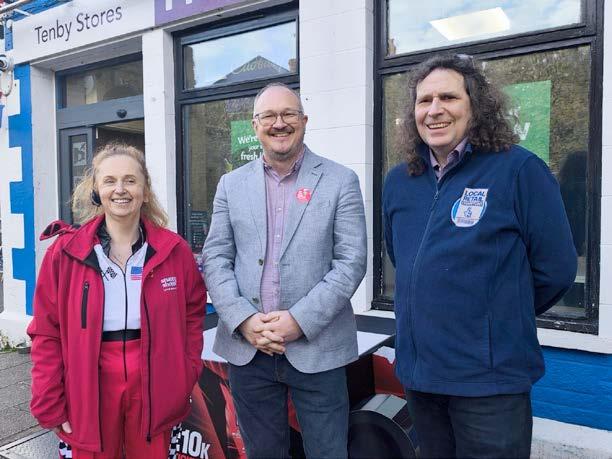
Vince Malone said: “I want to thank Marc again for his visit and discussing these important issues and for his clear interest. Fiona and I remain committed to advocating for the interests of small shops – as members of the Federation of Independent Retailers – working with all parties at the Senedd ahead of May’s election and beyond.”
Marc Tierney said: “Vince and Fiona are active retailers, who go the extra mile for their community
and are well known for their advocacy for the independent retail sector, not just in Wales but across the UK. My visit highlighted the importance of their postal service, banking hub and convenience shop. Providing these services under one roof is exactly the type of model that can sustain services in our rural, coastal communities. I look forward to working with them in the run-up to the election and beyond.”
CALLS to allow the permanent siting of an award-winning Pembrokeshire seaside village outdoor sauna, which has been featured in the national press, have been submitted to the national park.
Back in June 2024, a temporary two-year permission for a mobile woodfired sauna at Saundersfoot harbour was granted by Pembrokeshire Coast National Park’s development management committee.
Since then, a further application by Kerry Evans of Hwyl Outdoor Sauna to make the siting permanent has been submitted to national park planners.
A supporting statement says, since its introduction the sauna has “become a popular and valued amenity for both residents and visitors, offering a space focussed on health, wellbeing and
community connection”.
It went on to say: “The overall sentiment within the village has been strongly supportive, with many residents recognising the sauna as a valuable asset that enhances the amenities in Saundersfoot,” adding: “Hwyl Outdoor Sauna has received positive attention in regional and national press helping to promote Saundersfoot as a destination for coastal wellbeing and outdoor experiences.
“Media coverage has highlighted the sauna as an example of the increasing popularity of sea swimming and sauna culture around the UK coastline.
“Hwyl Outdoor Sauna has been featured in two books on the best saunas in the UK.
“The business has also been recognised through tourism and hospitality awards, further demonstrating the quality of the experience provided and the positive contribution it makes to the local visitor offer.”
Back in February, the business, set up by former superyacht worker and mum-of-two Kerry won Sauna of the Year 2026/27 at the Wales Prestige Awards.
At the time Kerry said: “I could not be more proud of what I have achieved with Hwyl. I am so grateful to my wonderful team, who have made this journey not
only possible but genuinely so much fun.”
Kerry ploughed a legacy from her beloved late father into the venture of a Pembrokeshire seafront sauna.
The appliction for allowing the sauna to be permanent added: “Through the Welsh Government I have been able to secure the funds to install a coldwater shower on Saundersfoot Harbour, which will be open year-round. This will be achieved via Hywel Outdoor Sauna and a weather proofing fund, from the Welsh Government. This facility has also a GoFundMe to raise the remaining costs.”
It concludes: “Hwyl Outdoor Sauna has established itself as a valued wellbeing facility that benefits both residents and visitors. It enhances the amenities available in Saundersfoot, supports the local economy by encouraging additional visitor activity, and contributes positively to the community through charitable support and engagement.
“The permanent siting of the sauna would allow this successful local small business to continue operating and provide these benefits to the village in a stable and sustainable way.”
The application for a permanent facility will be considered by park planners at a later date.

THE WELSH brewing industry is set for a major boost after funding was secured to roll out a new Level 4 Brewing Diploma across Wales.
T he Welsh Government Drinks Cluster, working in partnership with FDQ and Medr Cymru, has backed the advanced qualification, which is aimed at developing highly skilled brewers and strengthening the industry’s longterm competitiveness.
Welcoming the move, Deputy First Minister and Cabinet Secretary for Climate Change and Rural Affairs Huw Irranca-Davies said the qualification would help secure the future of the sector.
He said: “The brewing sector forms
an important part of Wales’ food and drink landscape, contributing to local economies, skills and innovation. Welsh breweries continue to demonstrate ambition, innovation and a commitment to quality, and this new qualification will give them the tools they need to keep building on that success.
“By supporting the introduction of the Level 4 Brewing Diploma, we are investing directly in the future of the industry, ensuring brewers can access the high-level technical training required to thrive in an increasingly competitive market.
“This training will help secure longterm growth, enhance skills across the sector, and further strengthen Wales’ reputation for producing exceptional beer. It is a significant and very welcome step forward for brewing in Wales.”
The diploma has been developed by FDQ, a specialist awarding organisation for the food and drink industry. The body provides accredited qualifications, apprenticeship assessments and training solutions, and is the only organisation in the UK with dedicated brewing apprenticeship expertise.
The Level 4 Brewing Diploma is the first advanced brewing qualification of its kind to be delivered through an awarding organisation operating in both Wales and England.
It has been designed to give learners a deeper understanding of brewing operations, quality control, process optimisation and technical decision-
making. The course is intended for those already working in the brewing sector, as well as learners seeking advanced professional skills that meet industry standards and employer expectations.
To make sure the qualification reflected the needs of the Welsh brewing industry, a working group was formed involving five breweries of different sizes and production styles. Those involved were Felinfoel Brewery, Monty’s Brewery, Magic Dragon Brewery, Purple Moose Brewery and Wild Horse Brewing Co.
The group brought together a broad range of experience, from longestablished family breweries to fastgrowing modern craft producers.
Monty’s Brewery, a mid Wales craft brewery known for its award-winning ales, was among those involved in shaping the diploma.
Director Pamela Honeyman said: “We’re proud to have contributed to the development of this diploma. Access to advanced technical training is essential for driving quality, efficiency and innovation, and the Level 4 Brewing Diploma will give our team the opportunity to develop new skills and progress within the industry. It’s a hugely positive development for Welsh brewing.”
Llandudno-based Wild Horse Brewing Co, known for its modern and flavour-driven beers, also took part in the working group.
Managing director Dave Faragher
said: “Being part of the working group has ensured the diploma reflects the realities of modern brewing. The opportunity for Welsh brewers to benefit from industry-led, practical and technical training is incredibly valuable. We’re delighted to have helped shape it and look forward to seeing the impact across the sector.”
The new qualification is intended to help tackle skills gaps and support employers looking to develop talent from within their businesses.
The diploma is now live, and Welsh brewers can apply immediately. The programme is open to breweries across Wales, with applicants able to apply for both a place on the diploma and funding support.
Matthew Bell, Head of Engagement at FDQ, said: “The launch of the Level 4 Brewing Diploma represents a significant advancement for skills development within the Welsh brewing industry. It has been designed by the industry to equip learners with the higherlevel technical knowledge and practical competence required for roles such as head brewer and production lead, integrating comprehensive brewing science, operations management and sustainability principles into a regulated, workplace-focused framework.
“This diploma supports apprentices at a pivotal stage in their career, fostering both industry expertise and long-term professional progression.”


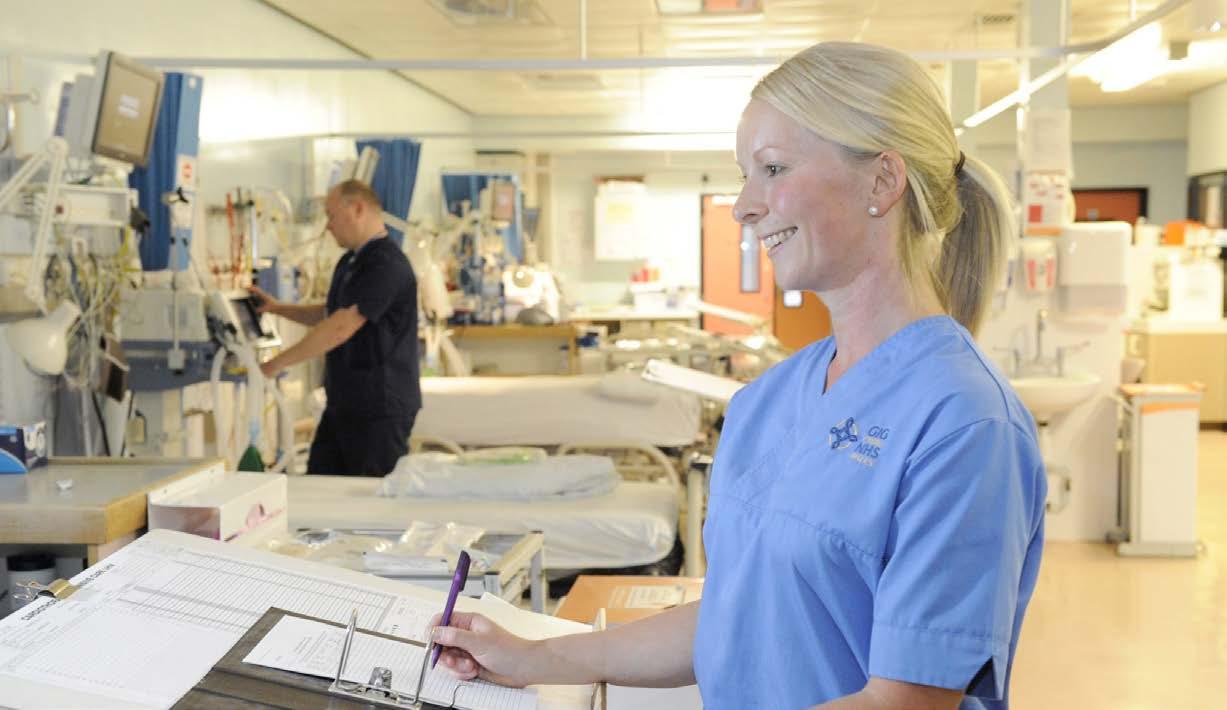
THE ROYAL COLLEgE OF NURSINg WALES has warned of a growing jobs crisis for newly qualified nurses, saying a shortage of Band 5 posts could leave up to half of this year’s nursing graduates without work when recruitment opens.
The union said the situation was particularly alarming given the severe pressures already facing NHS Wales, with staff continuing to report overcrowded wards, unsafe conditions and unmanageable workloads across multiple health boards.
RCN Wales said the lack of available jobs for newly trained nurses pointed to a serious failure in workforce planning. It
warned that losing new entrants to the profession would place even more strain on already overstretched services and could further affect patient care.
The organisation said the situation also undermined the Welsh Government’s and NHS Wales’ duty to improve the quality and safety of care.
RCN Wales is calling on the Welsh Government to provide urgent clarity on the scale of the shortfall, set out credible longterm workforce planning, and introduce immediate systemwide measures to recruit, retain and deploy the nursing workforce Wales needs.
The union said it had received assurances that students would not be penalised
if posts were unavailable. That includes being released from any obligation to work in Wales and not being required to repay tuition fee support where workforce shortages prevent them from securing employment.
Professor Sandy Harding, Associate Director of Nursing at RCN Wales, said: “The situation facing newly registered nurses is deeply concerning and exposes serious failures in workforce planning.
“It is becoming increasingly clear that this situation is being driven by financial constraints, including the freezing of vacant posts within local health boards. Our NHS is under intense pressure, yet hundreds
of newly qualified nurses may have no posts to enter. This is simply unacceptable.
“These students stepped forward for Wales, trained through immense challenges, and now face uncertainty at the very moment the system needs them most. They deserve far better.
“Every newly qualified nurse will be vital to meeting Wales’s care needs. The RCN will continue to demand transparency, accountability and long-term planning from the system. We will not stop speaking up for students, for our safety-critical nursing workforce, and for the people who rely on safe, high-quality care.”

WALES’ NHS is facing a repair and maintenance crisis of almost £1bn, with some of the country’s biggest hospitals burdened by ageing buildings, serious safety concerns and growing pressure on already stretched budgets.
New figures covering 210 NHS sites show that the backlog of work classed as high risk or significant risk has now reached £917m — up 71% in just four years.
The data, published for 202425 by NHS Wales Shared Services Partnership, shows more than £616m of the total relates to serious problems at 12 of Wales’ 13 main hospitals.
Ysbyty Gwynedd has the biggest backlog of high and significant risk repairs at £110.5m, followed closely by University Hospital of Wales in Cardiff, where the figure stands at £106.8m.
The scale of the problem is not just financial. Three hospitals — Bronglais, Prince Philip and Ysbyty Gwynedd — have 40% or more of their space rated as not fire safety compliant. At Ysbyty Gwynedd, 35% of space is also not regarded as health and safety compliant.
The figures highlight the deeprooted problem of an ageing NHS estate across Wales.
More than 30 NHS sites have buildings where over half the estate predates the creation of the NHS in 1948. Another 17 sites, including University Hospital of Wales and Bronglais Hospital, are mainly made up of buildings between 50 and 60 years old.
Only one major hospital in Wales — the Grange Hospital near Cwmbran — is said to have no maintenance backlog. But even that project, which cost £350m, was first proposed in 2004 and only opened during the Covid pandemic, showing how long major hospital developments can take.
When the wider risk-adjusted backlog is considered across all NHS buildings in Wales, focusing on problems where safety may be at risk, the total cost rises to more than £1bn.
The largest overall figure is in the Betsi Cadwaladr health board area, where the backlog stands at nearly £278m.
Despite the Grange being one of the newest hospitals in Wales, Aneurin Bevan health board still faces a backlog of almost £233m, much of it linked to older sites including the Royal Gwent and Nevill Hall hospitals.

In Hywel Dda, where hopes of a new west Wales hospital remain some way off, the total backlog has reached £221m. Among the worst affected sites is Glangwili Hospital in Carmarthen, where high and significant risk repairs and maintenance amount to £82m.
FOR west Wales, the figures are especially troubling.
Hywel Dda residents have already faced years of uncertainty over the future of hospital services, and the scale of the maintenance bill raises fresh questions about how long ageing buildings can continue to serve local communities safely and effectively.
Bronglais Hospital is among the sites with major fire safety compliance concerns, while Glangwili carries one of the largest repair backlogs in the region.
The growing cost of patching up older hospitals will inevitably intensify the political argument over whether ministers should prioritise maintaining existing buildings or push ahead with long-promised new developments.
The chair of Cardiff and Vale health board recently acknowledged that the age and condition of University Hospital of Wales was affecting morale and efficiency, describing the
quality and upkeep of buildings as an ongoing concern.
Mark Dayan, a policy analyst at the Nuffield Trust, said Wales had a worryingly large maintenance backlog by any standard.
He warned that poor infrastructure could directly affect the way care is delivered, making it harder for the NHS to reorganise services, improve patient flow or create safe, modern working environments.
The issue is not unique to Wales. NHS England is facing its own enormous repair backlog, estimated at £16bn. But in Wales, where budgets are tighter and hospital plans often move slowly, the pressure is especially acute.
WITH the Senedd election set for Thursday, May 7, parties are offering different solutions to the growing crisis.
Labour has pledged a £4bn Hospitals of the Future fund, promising new hospitals including replacements for Wrexham Maelor Hospital and University Hospital of Wales, as well as a major development in west
Wales.
Plaid Cymru says Labour’s sums do not add up, and argues urgent high-risk repairs should come first.
Reform UK says the Welsh Government should concentrate its capital budget on clearing the maintenance backlog rather than making promises on multiple new hospitals.
The Conservatives say they would declare a health emergency and expand capacity through new community hospitals, diagnostic centres and surgical hubs.
The Liberal Democrats say they would upgrade the worst parts of the NHS estate while backing a replacement for University Hospital of Wales, linking investment to wider reform of social care and community services.
The Green Party has called the backlog a disgrace and says it would launch a multi-year programme to bring NHS facilities up to a safe and modern standard.
Whatever the result in May, the next Welsh Government will inherit a stark reality: before it can deliver a new generation of hospitals, it must first confront the spiralling cost of keeping the current estate from falling further into decline.

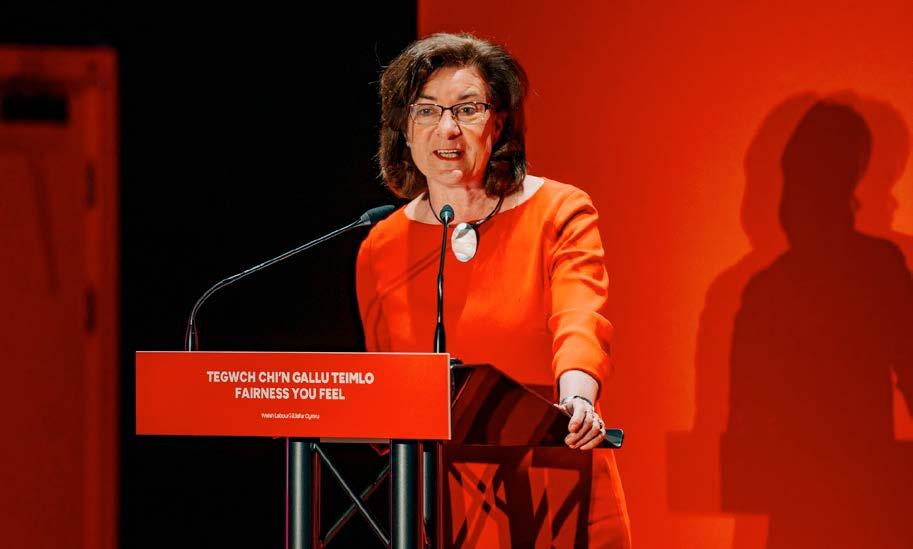
teaching assistant became the quiet centrepiece of Welsh Labour’s manifesto launch — and, in doing so, revealed a party focused less on momentum than on damage limitation in towns like ours.
Eluned Morgan’s manifesto launch speech was meant to speak to the whole of Wales. But tucked inside it was a telling local calculation.
When the Welsh Labour leader told delegates about a teaching assistant in Haverfordwest who had “never voted in her life” but would now back Labour because of a pay rise, it was no throwaway line.
In political terms, it was no throwaway line. Morgan was invoking a voter from the very constituency battleground where Labour needs reassurance to cut through.
After years in power, Welsh Labour knows it cannot simply rely on habit, loyalty or antiTory feeling to carry it over the line. It needs to reconnect with lower-paid working people in towns like Haverfordwest — voters who may still support parts of Labour’s record, but are increasingly doubtful that life in Wales is getting better.
That is why Morgan’s speech mattered.
Far from sounding like a leader marching confidently towards victory, she sounded
like someone trying to hold together a delicate coalition of public sector workers, traditional Labour supporters and anxious voters tempted by change, but wary of the alternatives.
The tone was revealing from the outset.
This was not a speech built on triumph. It was built on caution.
Morgan spoke of pressure on families, pressure on public services and pressure on her own party. She acknowledged that many voters feel something “isn’t quite right” and said people want “a little more certainty” and “a little less dread”.
That is not the language of a party taking victory for granted. It is the language of a party that knows it must steady nervous voters before polling day.
Teaching assistants and school support staff are not just another part of the workforce. They are exactly the sort of voters Labour needs to keep onside — public-facing, often modestly paid, rooted in their communities and living the everyday pressures politicians talk about so freely.
By highlighting a Haverfordwest worker who had never voted before, Morgan was trying to tell a wider story: that Welsh Labour can still reach the ordinary voter who feels overlooked, underpaid and unconvinced by politics in general.
Morgan promised a new hospital for west Wales as part of a wider NHS building programme. She also pledged that patients would be able to access a primary healthcare professional within 48 hours if they had a problem that could not wait.
Those lines will have landed strongly in Pembrokeshire, where concern over health services has become one of the most potent and emotional issues in local politics.
But they also expose Labour’s weakness.
But there was another message buried in the anecdote.
Labour is plainly worried about disengagement.
A voter who has “never voted in her life” is useful in a speech not just because she is newly supportive, but because she represents a wider problem for all parties — the sense that many people have drifted away from politics altogether.
Morgan knows frustration with government in Cardiff Bay is real, especially after long-running complaints over NHS access, stretched public services, transport and the cost of living. Her answer was not to offer excitement, but reassurance.
That came through again and again.
She promised there would be no rise in income tax. She attacked “easy promises” and “slogans”. She said she would not “gamble” with people’s lives.
She framed the election not as a call for upheaval, but as a choice between seriousness and protest.
In plain terms, Labour is trying to turn this election into a referendum on risk.
That is often what governing parties do when they sense frustration in the electorate, but hope voters remain more cautious about the opposition.
It also helps explain why west Wales featured so prominently in the speech.
After decades as the dominant force in Welsh politics, Labour is still having to promise basic improvements in areas where public frustration is already deepest. Voters may welcome those pledges, but many will also ask why, after all this time, they are still being asked to wait.
That is the central tension in Morgan’s speech.
She wants to campaign as both the agent of improvement and the guardian of stability. She is asking people to believe Labour can fix problems that have grown on Labour’s watch, while also arguing that nobody else can be trusted to take over.
It is not an impossible argument. But it is a difficult one.
For readers in Pembrokeshire, perhaps the most revealing thing about the speech is not just what it promised, but what it exposed.
It exposed a Welsh Labour leadership that knows west Wales matters.
It exposed a party that sees lower-paid workers and public service staff as central to its survival.
And it exposed a leader who understands that this election is not being fought on favourable ground.
The repeated slogan was “fairness you can feel”.
But the speech itself suggested something more hard-headed than hopeful.
Welsh Labour is no longer campaigning like a movement expecting gratitude. It is campaigning like a government asking voters, however frustrated they may be, not to take a chance on anything else.
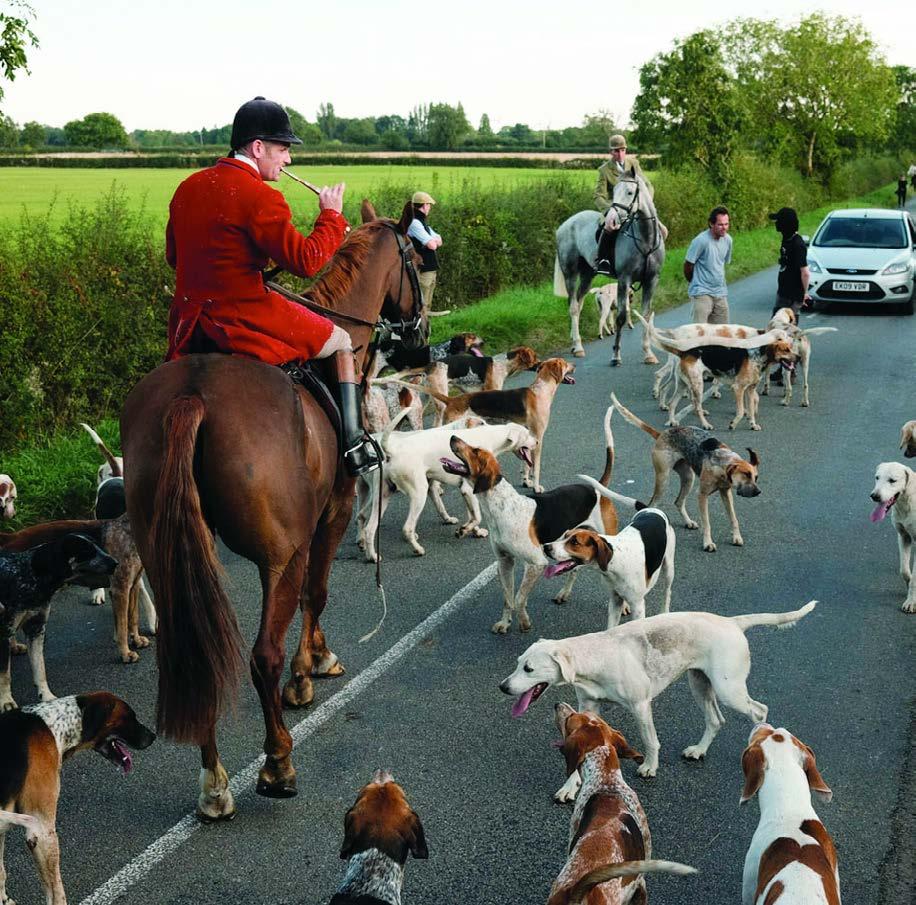
THE UK gOVERNMENT has opened a public consultation on plans to ban trail hunting in England and Wales, setting up a fresh debate in rural areas including Pembrokeshire, where hunting remains part of the social calendar for some communities.
Ministers say the move would deliver a Labour manifesto pledge and help close what campaigners describe as loopholes in the law. The consultation is seeking views from the public, landowners, hunt organisers, local authorities, conservation bodies, businesses and animal welfare groups on how a ban should work in practice and whether wider changes to hunting law may also be needed.
Trail hunting was introduced after the Hunting Act 2004, with organisers saying it involves hounds following an artificially laid scent rather than a live animal. Opponents argue it
has too often been used as a cover for illegal hunting, while supporters say it is a lawful countryside activity which should not be swept away by politics.
The Hunt Saboteurs Association and the League Against Cruel Sports have both welcomed the consultation, saying it gives the public a chance to support stronger protections for wildlife and prevent further loopholes from being exploited.
But countryside groups have hit back, arguing that the proposals could have serious consequences for rural communities, jobs and long-standing local traditions.
The Countryside Alliance has urged supporters to respond, saying those who understand country life must not allow others to shape the outcome unchallenged.
The issue is likely to attract strong views in Pembrokeshire,
With Brian Murphy
WITH the Senedd elections only a few weeks away hustings are happening more frequently. This week we had the first of a series of televised events on BBC Wales which gave an insight into how the arguments will develop.
Clearly Labour is floundering trying to defend its record after 27 years of power in Cardiff, as every day there are more stories about their failures. The NHS is in crisis, educations standards are falling, town centres are crumbling and labour continue to fund expensive gimmicks, virtue signalling and vanity projects.
every part of the NHS in Wales is focussed on tackling the crisis. This will include an urgent review of workforce planning to ensure that there are sufficient doctors, nurses and other medical professionals to meet the needs. Wards in community hospitals which have been closed will be reopened to free up capacity and end the disgraceful practice of corridor care.
where country sports still have a loyal following. The Cresselly Hunt, one of the best-known local hunts, continues to hold regular trail hunts and social events, underlining how closely the subject is tied to local rural identity as well as national legislation.
That means any attempt to tighten the law is unlikely to be seen locally as a simple animal welfare measure. For many in west Wales, it will also be viewed through the lens of heritage, land management and concern that rural voices are being overlooked by decisionmakers.
The consultation does not itself change the law, but it is the clearest sign yet that legislation is being prepared. With ministers now formally gathering evidence and public opinion, both supporters and opponents of hunting are expected to campaign hard over the coming weeks.
Remember that none of this could have happened without the support of Plaid Cymru and the Liberal Democrats. The blanket 20mph speed restrictions could not have come in without the backing of Plaid Cymru. And when Labour needed the Lib Dems support for their budget plans Jane Dodds’ price was for a ban on greyhound racing. Not a reversal on the withdrawal of services from Withybush, not dualling for the A40, not reducing the burdens on the tourism industry. It is clear to see that they are not really interested in backing Welsh businesses.
The Conservatives have created positive policies listed in our manifesto, which are designed to grow the economy, which provides the foundations to support public services. By cutting rates for small businesses and addressing the blackspots where there is no mobile or internet connection it will allow businesses to develop and grow. We will re-establish the Welsh Development Agency to attract inward investment, promote business growth and support job creation.
On day one we will declare a health emergency to ensure that
Assisting these improvements is investment in preventative measures to reduce the need for hospital care. By promoting healthy lifestyles in schools, we will get children into the habit of exercise and healthy eating at an early age. The long-term benefits of this to the individuals and society are well documented. There will also be a national prostate cancer screening programme, so we do not wait until cancer is in the latter stages before acting. There will also be improvements to social care to tackle the scandal of bed blocking, where patients can’t be discharged from hospital as there is no follow up care. Families are better placed than local authorities to care for their loved ones. That is why we will introduce access to free training and support for carers. These are the policies which will deliver real benefits for the people who live and work in Wales.


W ITH ANDREW LYE
In last week’s “Positively Liberal” article, I wrote in favour of cancelling the King’s state visit to the US. Sadly, it was confirmed earlier that same week that it would still go ahead, despite the likelihood that the US war with Iran could still be ongoing.
Ed Davey, the Leader of the Liberal Democrats said:
-
“The Prime Minister is showing a staggering lack of backbone by pushing ahead with this state visit while Donald Trump treats our country with contempt.
“To send the King on a state visit to the US after Trump dismissed our Royal Navy as ‘toys’ is a humiliation, and a sign of a government too weak to stand up to bullies.
“What appalling thing does Trump have to do next to make the Government see sense and cancel the state visit?”
Meanwhile, the Welsh Liberal Democrats have hit out at comments from Reform UK figures suggesting coal mining could be revived in Wales, branding the proposal “economically illiterate and environmentally reckless”.
The intervention comes after Reform UK candidate Ben HodgeMcKenna claimed that reopening coal extraction using “safer” technologies could help meet Wales’ future energy needs. Nigel Farage previously also suggested sending young Welsh people back down the mines.
The Welsh Liberal Democrats said the comments showed Reform was “stuck in the past” and offering false hope to communities that need real investment and long-term economic security.
The party also highlighted that Reform has previously said it would open up the country for fracking, arguing that
this shows a pattern of “doubling down on outdated and unpopular fossil fuel policies”.
The Welsh Liberal Democrats argued that trying to revive coal or introduce fracking would not bring sustainable jobs or lower bills, but instead risk diverting investment away from industries where Wales has genuine competitive advantages, such as floating offshore wind in the Celtic Sea, tidal power and green manufacturing.
They also rejected claims that Wales’ emissions are too small to matter, arguing that leadership on clean energy is essential both economically and environmentally.
Commenting, Welsh Liberal Democrat Leader Jane Dodds said:
“Reform’s plan to reopen coal mines is pure fantasy politics. It won’t cut bills, it won’t deliver lasting jobs, and it won’t stand up to even the most basic economic scrutiny.
“The fact they also want to open Wales up to fracking tells you everything you need to know. Fracking would destroy our pristine countryside, can cause earthquakes and risks contaminating local water supplies, yet Reform seems willing to ignore those dangers.
“This is a party doubling down on the failed energy policies of the past, with no serious plan for the future.
“Wales cannot build its future by trying to relive its past. Communities that once powered the industrial revolution deserve better than being sold false promises about industries that are in irreversible decline.
“Instead of chasing yesterday’s solutions, we should be investing in the industries of the future and giving Welsh workers the secure, well-paid jobs they deserve.”
If you have any issues or comments, please contact me at andrew.lye@pembslibdems.wales
CARDIgAN voters will have the chance to put their questions directly to Senedd election candidates at a climate and nature hustings taking place in the town next week.
The event, organised by West Wales Climate Coalition, will be held at the Guildhall in Cardigan on Thursday (Apr 16).
All parties have been invited to take part in the hustings, which will focus on climate change, nature and environmental policy in the new Ceredigion Penfro constituency.
Organisers say the event will give local people the chance to hear directly from candidates hoping to win seats in the upcoming Senedd election, while also pressing them on how they plan to respond to what campaigners describe as the growing
climate and nature crisis.
Free food will be available from 6:00pm, provided by Street Food Morocco, with the hustings beginning at 6:30pm. Simultaneous translation will also be available.
The evening will be run in the style of a People’s Assembly, with attendees first breaking into small groups to discuss and agree questions before putting them to the panel. The event will conclude with candidates summing up their campaigns and environmental commitments.
Philip Hughes, of West Wales Climate Coalition, said: “We chose to host this event in Cardigan because the public are becoming increasingly worried about the environment, and often politicians underestimate the importance voters put on the climate and nature crisis.
“This Senedd election
must be a turning point for nature and the climate crisis and we need ambitious and passionate leaders to make that happen.
“The upcoming Senedd election will be a defining moment for nature’s recovery, as the next Welsh Government’s actions can play a crucial role in contributing to a more liveable planet for us all and especially our children.”
Organisers say Wales remains one of the most nature-depleted countries in the world and warn that urgent political action is needed to tackle nature loss, climate change, pollution and waste. They say one in six UK species is now at risk of extinction and argue that strong leadership will be needed from the next Welsh Government if that decline is to be reversed.

FORMER Labour leader brands party a “posh boys’ club”, accuses Nigel Farage of offering fantasy politics, and warns deep-rooted discontent is fuelling protest support across Welsh communities.
Lord Neil Kinnock has launched a blistering attack on Reform UK, accusing the party of feeding off frustration in Welsh communities while offering little in the way of substance.
The former Labour leader said Reform’s appeal was rooted in grievance rather than genuine answers, and dismissed the idea that the party speaks for workingclass voters who feel ignored by mainstream politics.
Speaking about the rise of Reform in Wales, Lord Kinnock said the party was built on resentment and slogans rather than practical policies.
He said: “The only argument going for them is grievance and resentment. You can’t represent people on that basis.”
He reserved some of his strongest criticism for the party’s image and leadership, describing Reform as “a posh boys’ club” with no real concern for the lives of ordinary people in Wales.
“They don’t give a damn about the real wellbeing of the communities of Wales,” he said.
Lord Kinnock said Reform had been able to tap into genuine public anger, but argued it had done so without presenting any serious programme for change.
According to him, the party’s message was heavy on noise and light on detail, with promises that fell apart under scrutiny. He cited Brexit as an example, saying the economic rewards once held out to voters had failed to materialise.
He also took aim at Nigel Farage, accusing him of making grand claims about restoring industry in Wales without regard for economic reality.
In Lord Kinnock’s view, such rhetoric was designed to tell disillusioned voters what they wanted to hear, rather than confront the difficult truths facing post-industrial communities.
He said Reform’s politics were driven by fantasy and performance, not by any serious commitment to the future of Wales.
Lord Kinnock was equally dismissive of claims around immigration, which he said had been wildly distorted in public debate.
He argued that many migrants come to Britain to work, contribute to the economy and pay taxes, and said the suggestion that they are simply a
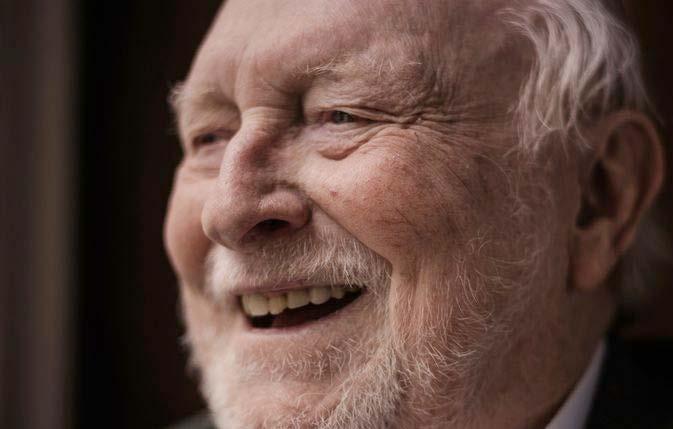
drain on public services was untrue.
At the same time, he acknowledged that immigration had created pressures in some areas, particularly in the aftermath of Brexit, but insisted it had been inflated into a much bigger political issue than the facts justified.
He accused Reform of borrowing from a Trump-style playbook, making exaggerated claims, denying them when challenged, and then repeating them more forcefully when cornered.
He pointed to recent shifts in the party’s position on pensions and benefits as evidence of what he sees as an opportunistic and untrustworthy approach.
Lord Kinnock also criticised the role of the media and social media in Reform’s rise, arguing that views which might once have been dismissed as pub talk are now amplified to a national audience within minutes.
He said Reform had often been treated more generously by sections of the media than it deserved, partly because it provided easy headlines and instant controversy.
But while he was scathing about Reform itself, Lord Kinnock said the anger it is feeding on did not appear overnight.
He argued that discontent in Wales has deep roots, stretching back decades to the collapse of coal, steel and manufacturing communities from the 1980s onwards.
Those changes, he said, tore the economic heart out of many parts of Wales and were carried out without
proper planning or meaningful replacement.
The result, in his view, was a lasting sense of abandonment that has never fully gone away.
He said communities hit by pit and factory closures were left feeling deserted by the political and economic system, creating conditions in which protest politics could flourish years later.
That same mood, he argued, also played a major part in Wales voting for Brexit.
Lord Kinnock said many Leave voters were not motivated by racism or ignorance, but by hope — hope that something different might finally improve their lives after years of austerity and neglect.
He said Wales had once enjoyed significant financial benefits from EU membership, and suggested that much of that support had still not been properly replaced.
Turning to Labour’s own position, Lord Kinnock admitted the party faces a difficult battle as the Senedd election approaches.
After nearly three decades in power in Cardiff Bay, he said Labour has the burden of office as well as responsibility for defending its record in a country facing deep structural problems.
He pointed to long-term underfunding, mounting pressure on the NHS, GP shortages, waiting lists, poor health outcomes and low incomes as factors driving dissatisfaction
among voters.
He said Wales also faced additional challenges because of its geography, scattered population and limited number of major urban centres.
Taken together, he said, those pressures created a deeply difficult political climate.
Even so, Lord Kinnock insisted Labour still had strengths, praising the leadership of First Minister Eluned Morgan and saying there remained a clear desire within the party to deliver practical fairness.
He also warned that Plaid Cymru was benefiting from disenchantment with the status quo, presenting itself as an alternative for voters who want change but are not drawn to Reform.
Although talk of independence may no longer dominate every debate, he suggested the ambition remained at the heart of Plaid’s politics and said he believed that path would damage Wales rather than strengthen it.
In the end, Lord Kinnock’s argument was that the only lasting answer to Reform’s rise is to deal seriously with the conditions that have made voters so angry and disillusioned.
Unless insecurity, poor public services and economic decline are tackled, he suggested, parties built on protest and discontent will continue to find an audience.
He warned that a Welsh Government led by either Reform or Plaid would hold the country back at a time when stability and serious leadership were badly needed.
SEND YOUR

EMAIL US AT: editor@herald.email

BREAST cancer is an issue hugely close to my heart. It has touched my life and the lives of my family profoundly.
I lost my mum, Cath, to breast cancer when she was just 58 years old. In my acting career, I have also portrayed breast cancer through the story of Mandy Dingle in Emmerdale, whose cousin Chas Dingle is diagnosed with the disease.
As a proud ambassador of Breast Cancer Now, I am thrilled to be taking part in this year’s Pink Ribbon Walk at Chatsworth House on Sunday, May 17, where I will meet up with a fantastic community of people who have also been affected by breast cancer and walk for everyone impacted by the disease.
The walks are taking place this year on Saturday, April 18 at Hampton Court Palace,
Saturday, May 9 at Blenheim Palace in the Cotswolds, Sunday, May 17 at Chatsworth House in the Peak District, and Saturday, June 20 in Edinburgh’s Holyrood Park.
This spring, we walk for science, support and solidarity. And we walk to remember the people we have lost.
When Breast Cancer Now first walked in 2005, eight in ten women in the UK survived breast cancer for five or more years. Now, nine in ten do. That is the power of science and support in action.
But breast cancer is still the most common cancer in women in the UK, so we have still got a long way to go. The charity is working towards its bold vision that by 2050, everyone diagnosed with breast cancer will live and live well. But to make that happen, we need to act now.
So pull on your boots, slather on your suncream, and meet us at the start line. Every step you take, every mile you walk, helps fund life-saving science and lifechanging support.
Join Breast Cancer Now’s
IF we are worried about what is happening in the world and in our local communities, and we want things to improve, what can we do about it?
One answer is simple: vote on Thursday, May 7, in the Senedd elections. But how do we decide who deserves our vote if we do not already support a particular party? Are they all the same anyway?
One good way to find out is to attend a hustings. These events are free and open to everyone. They bring candidates from different parties together in one place, giving the public a chance to ask what they plan to do if elected.
We can ask candidates to make clear promises about what they will do, and even take a photograph of them with their written pledge, so they can be held to it in future if they seem to forget.
That is exactly what will be happening in Cardigan on Thursday, April 16, at the Guildhall, where a Climate and Nature Hustings will be held. The focus of the evening will be on what each party plans to do about the climate and nature crisis, and it will also be a chance for local people to make clear what matters most to them. We may well find that no, they are not all the same.
There will also be free food available from 6:00pm at the start of the event. As one local resident said on hearing about the evening: “What’s not to like?”
For more information, contact WestWalesClimateCoalition@ gmail.com or call 07787 197630.
Philippa Gibson Llandysul


Peacefully on Sunday 22nd March 2026, Mrs Ann Elizabeth Thomas of Rosemary Lane, Cresselly passed away at home, aged 76 years.
Devoted Wife of the late Ray. Dearly loved Mum of Emma. Treasured Nanny to Alice, Millie and Annabelle. Much loved Sister and Aunty. Ann will be sadly missed by all her family and friends.
The funeral service will take place on Friday 17th April 2026 at Pisgah Baptist Chapel, Cresswell Quay at 2.30pm, followed by interment in the Chapel Cemetery.
Following the service, you are warmly invited to Cresselly Cricket Club for refreshments.
Donations in lieu of flowers for Paul Sartori Hospice at Home and Same Day Emergency Care Unit - Withybush Hospital may be sent c/o E.C. Thomas & Son Funeral Directors, Zoar Chapel Funeral Home, Llanteg, Narberth SA67 8QH or via the ‘Donate’ button below. c/o E. C. Thomas and Son, Zoar Chapel Funeral Home, Llanteg, Narberth SA67 8QH (01834) 831876 and 21 Main Street, Pembroke SA71 4JS (01646) 682680 or via www. ecthomasandson.co.uk
Passed away peacefully on Thursday 19th March 2026 at Fairfield Nursing Home, Johnston Mrs. Althea Mary Buck, aged 98 years formerly of Rowlands Way, Pembroke.
Much loved Mum of Lizzie. Dearly loved Sister of Glenys. Treasured Nana to Tam, Joe, Xander and Leith. Cherished great Nana to Lyra, Caitlin and Hywel. Treasured also by her granddaughters in law, Beth, Kate and Chloe
The funeral service will take place on Monday 20th April 2026 at St Faith and Tyfei Church, Lamphey, at 2:00pm followed by cremation at Parc Gwyn Crematorium, Narberth at 3:15pm. There will be family flowers only with donations in lieu if desired for the TIN Wardrobe an LGBTQ+
Charity which is close to Althea and her family c/o E. C. Thomas and Son Funeral Directors, 21 Main Street, Pembroke SA71 4JS (01646) 682680 and Zoar Chapel
Funeral Home, Llanteg, Narberth SA67 8QH (01834) 831876 or via www.ecthomasandson.co.uk
Peacefully at his home in Solva on March 22nd, aged 89 years.
Des, beloved husband of the late Janet and the late Ann, dearly loved father of Richard and Sarah. He will be sadly missed by all his family and friends.
Funeral service Tuesday 14th April at 1.00pm at Parc Gwyn Crematorium, Narberth.
Enquiries to W.G.Bernard Mathias & Daughter, St.Davids (01437) 720 537
Peacefully on Sunday 22nd March at Park House Court, Tenby, Johnny of Penbanc, Fishguard. Beloved husband of the late Irene, loving father and father-inlaw of Joy and Dilwyn and a dear brother of Derek.
Funeral service on Friday 10th April at The Chapel of Rest, Feidr Castell, Fishguard at 11.30am followed by interment at Hermon Cemetery.
Family flowers only.
Donations in lieu if desired, made payable to ‘Fishguard Lifeboat’ c/o Paul Jenkins & Sons Funeral Directors, Feidr castell, Fishguard, SA65 9BB. Tel - 01348 873250.








FENCING, DRIVEWAYS AND LANDSCAPING


FABRICATION

GARDENING



RECLAIMED BUILDING MATERIAL

RUBBISH AND WASTE REMOVAL


PROFESSIONAL CAR WASH

PODIATRY

SCRAP METAL

STORAGE TANKS

SOUND LIGHT AND STAGE

TECHNOLOGY AND COMPUTERS

TRAILERS












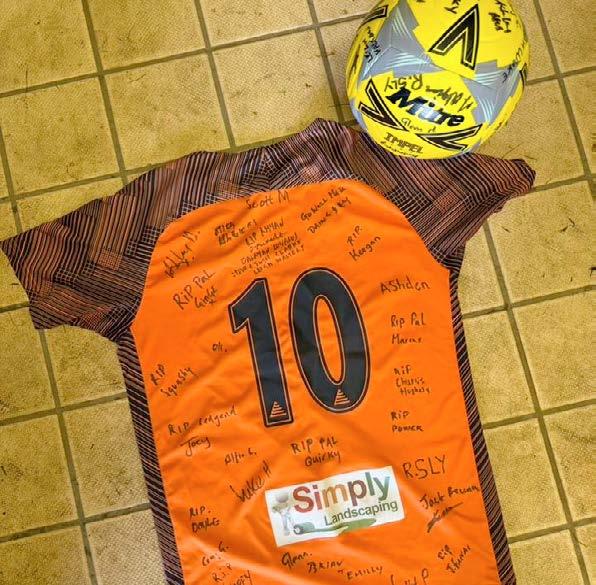
JOHNSTON FC paid an emotional tribute at the weekend to Rhyan Nolan after his sudden death at the age of 27.
The club marked the occasion with a flawlessly observed minute’s silence before kick-off, as both teams, officials and supporters came together in his memory.
A signed match ball and Rhyan’s much-worn number ten shirt, covered in messages from team-mates and friends, were also prepared to be handed to his family, who were present for the tribute.
A fundraiser set up on GoFundMe says his family received the heartbreaking news on Monday that they had lost their “precious, loving son and brother” suddenly at such a young age.
The appeal names his close family as Nichola, Shamus, Brandon, Callum and Lilly, and says relatives are hoping to ease the financial burden while giving Rhyan the send-off he deserves.
It states: “Rhyan deserves a celebration of his short life.”
Johnston FC said it had been a difficult week for all those who knew and loved him, but said it had also been heartwarming to see such an outpouring of love at the match.
The club thanked everyone who helped make the tribute possible, along with those who had sent messages of support and donated towards helping the family.
Photographs shared after the game showed the scale of the moment, with both sides lined up in silence and the orange number ten shirt left covered in handwritten tributes.
For many in attendance, it was a powerful and deeply personal farewell to a young man clearly held in enormous affection.
A GoFundMe appeal has now been launched to support the Nolan family.
The death of Rhyan has sent shockwaves through the local community, with many gathering around his loved ones in the days since the devastating news emerged.
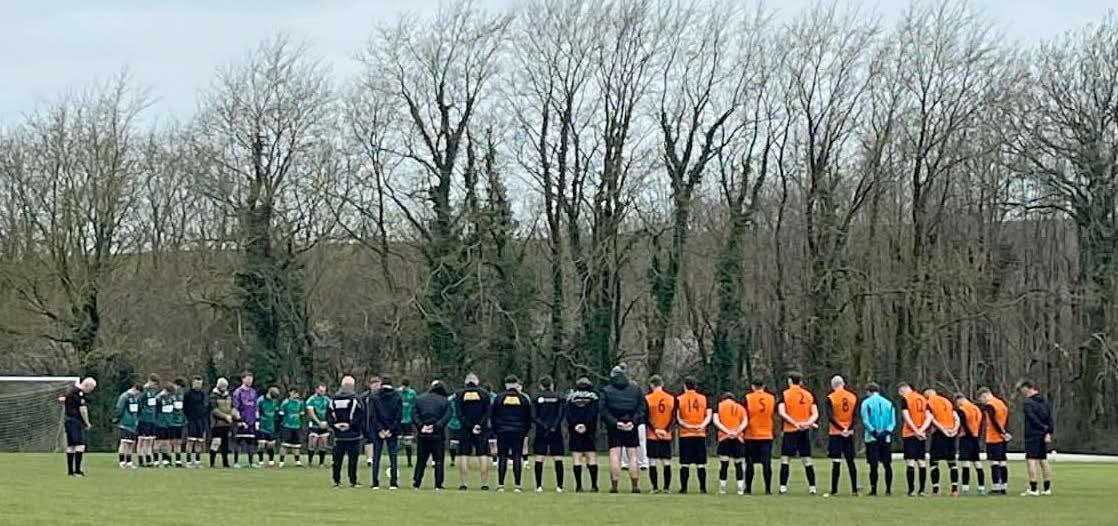

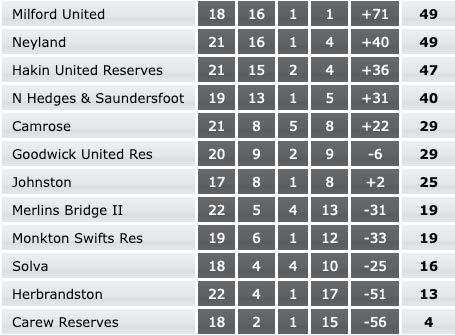


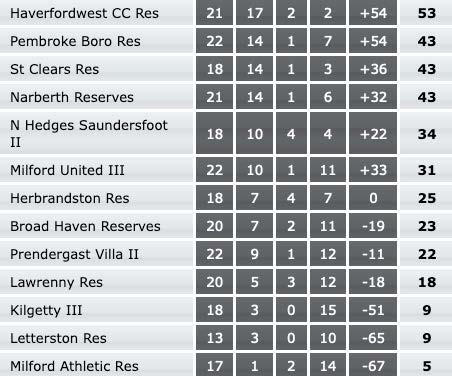
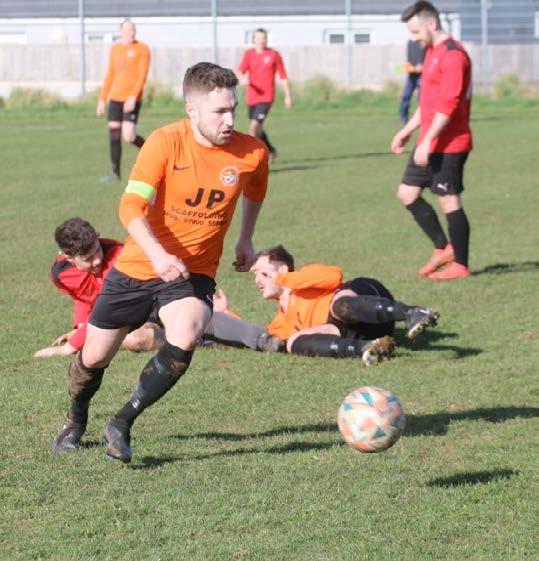

AMMAN UNITED YOUTH saw their Carmarthenshire Cup final hopes ended in heartbreaking fashion on Saturday (Apr 4) as Newcastle Emlyn snatched a 20-19 victory in a dramatic semi-final.
Played in difficult, windy conditions,
the contest was fiercely competitive throughout, with Amman left to rue a series of handling errors that allowed the visitors back into the game.
Newcastle Emlyn made the stronger start, taking an early 3-0 lead through a
penalty and then missing a chance to add to their tally.
Amman responded well and took control of the first half. Captain Ceian Lewis crossed following a well-worked catch-and-drive to put his side 5-3 in front. Toby Slater then produced an excellent touchline conversion in tough conditions to extend the lead to 7-3.
Amman continued to build momentum when Harvey Duncan made a sharp break down the wing to score their second try. Slater was again on target with an impressive conversion in the wind, giving his side a 14-3 lead at the break.
But the game turned soon after the restart. A costly Amman mistake allowed Newcastle Emlyn back into the contest, with the visitors scoring in the corner before adding the conversion to close the gap to 14-10.
Amman appeared to have steadied themselves when Kelston Fairhurst powered over from another catch-and-
drive, stretching the lead to 19-10.
However, Newcastle Emlyn refused to give in. Strong forward play brought them another try, and the conversion cut the deficit to just two points at 19-17 as the pressure mounted in the closing stages.
The decisive moment came in the final five minutes when another Amman handling error handed Emlyn a crucial opportunity. The visitors worked their way into range and slotted a late penalty to edge ahead 20-19.
Amman had one final chance to rescue the game and opted for a catchand-drive from a late penalty, having already found success with that tactic earlier in the match. This time, though, Newcastle Emlyn held firm to deny them and secure their place in the final.
It was a bitter end for Amman United Youth, who had looked in control at half-time, but Newcastle Emlyn showed resilience and composure when it mattered most.

NEYLAND RFC Under-14s welcomed Young Munster Underage Rugby to the Athletic Club Field on Saturday for another memorable meeting between the two clubs, with the home side running out convincing 47-12 winners.
A large crowd turned out to watch
the latest chapter in a fixture that has become a much-loved tradition over the years, with many spectators having also been part of previous tours.
There was clear talent on display from both teams throughout a cracking game of rugby. Neyland made the most of their powerful ball carriers, while
the Cookies impressed with some committed tackling and determined play.
In keeping with tradition, the men of the match were selected by the opposition side. Ryan Griffin, of Young Munster, and Karter Williams, of Neyland, received the honours after strong individual performances.
Thanks were also paid to referee Gareth Scourfield for officiating well and, once again, taking part in the post-match ritual of downing a pint of Guinness.
Both coaching teams were praised after the match, with organisers saying the players were a credit to their clubs both on and off the field.
After the game and presentation, the celebrations continued into the evening, with plenty of singing helping to round off another successful day. Over the years, the fixture has helped create lasting friendships between the two clubs, and
Saturday’s event was described as another occasion to remember.
Special thanks were given to Jack Kinnersley and Matthew Reynolds for producing an excellent matchday programme and for using Veo to stream the game live. Appreciation was also extended to Wendy Watts and the ladies who helped with food and the raffle, as well as to Kyla Rowland and staff at the Neyland Community Hub for their hard work behind the scenes.
The visiting Young Munster side, led by Johan Gouws and his team, were also praised for the way they conducted themselves throughout the visit.
With another year of the fixture now complete, attention is already turning to next season, when Neyland are due to travel to Limerick for the return match.
The friendship between the two clubs continues to grow stronger with every meeting.
HAVERFORDWEST COUNTY
AFC Women and girls have praised their under-13s after another strong showing at the third and final FAW Festival of the season.
The young Bluebirds travelled to Colliers Park in Wrexham on Saturday (Apr 4), where they once again impressed with their performances.
Club officials said the girls had performed fantastically well throughout the season, adding that everyone at Haverfordwest County was incredibly proud of their efforts.
The squad for the day was Libby O, Ela I, Ines M, Mila E, Scarlett C, Rachel B, Lydia H, Lilly M, Zara E, Leila P and Lillie EJ.


THE CASTROL MEM RALLY TEAM will begin its 2026 British Rally Championship campaign this weekend with its sights firmly set on both the drivers’ and teams’ titles.
The team heads to the Severn Valley Stages on Saturday (Apr 11) with new team-mates Meirion Evans and Osian Pryce lining up in a pair of Toyota GR Yaris Rally2 cars.
Evans starts the opening round still chasing his first major gravel rally win after coming close on more than one occasion last season. A puncture near the end of the 2025 Malcolm Wilson Rally and a spin on the final stage of the recent Rally North Wales cost him what had looked set to be well-earned victories.
The 30-year-old from Lampeter, alongside co-driver Dale Furniss of Llanfyllin, Powys, tested his Pirellishod Toyota in Gorsedd Bran forest, Denbighshire, on Tuesday. The session
allowed the team to make a series of subtle set-up changes which Evans believes have improved the car ahead of the new campaign.
Pryce also got his first experience of the Toyota GR Yaris Rally2 during the same Castrol MEM Rally Team test and quickly settled into the Michelin-shod machine.
The 33-year-old, who was born in Machynlleth, won the Severn Valley Stages in 2024 and is seeded at number one for what will be the 125th rally start of his career. The 2022 British champion will therefore lead the BRC field onto the stages.
This weekend will also see Pryce reunited with co-driver James Morgan, from Llandysul, Ceredigion. The pair have only previously contested one event together — the Cambrian Rally 10 years ago.
With just over 50 stage miles ahead, the Severn Valley Stages promises to be

a fast and demanding season opener. The event features a ceremonial start and finish in Llandrindod Wells, with a midday service halt at the Royal Welsh Showground in Llanelwedd, before crews tackle the classic mid-Wales forests of Sarnau, Myherin and Tarenig.
Evans said: “I’m looking forward to this weekend’s Severn Valley Stages, as it’s nice to get the show on the road again. We’re starting the new season aiming for some more strong results and hoping to challenge for rally victories and the BRC title like we did last year.
“We had a good test yesterday and made some very positive steps with the Toyota Yaris. The car worked well on Rally North Wales, but I felt there were some things that could be improved and by exploring a few things during the test I feel that we’ve made some steps in that direction. Hopefully that will help this weekend.
“In fact, as the road was wet in the
morning and dry in the afternoon, it was nice to get a mix of conditions which should benefit us not just for this weekend’s Severn Valley Stages but the season ahead.”
Pryce said: “Having now driven the Toyota GR Yaris Rally2, I don’t see any reason why we shouldn’t be aiming for a win on the Severn Valley Stages this weekend.
“There wasn’t much doubt in my mind that I’d gel with the car, yet it was still reassuring to know that everything I’d heard about the Toyota was correct and I felt comfortable in it straight away.
“I’m also happy with being seeded at car number one. At the end of the day, I won the rally two years ago, so it’s our turn to run first on the road and I’m looking forward to it. Having a clean road ahead might even suit me. It is what it is, and we’ll have to wait and see how that plays out.”
HAVERFORDWEST COUNTY AFC Women are on the brink of history as they prepare for a huge home clash this Sunday at the Ogi Bridge Meadow Stadium.
Kick-off is at 2:00pm, and in their very first season together, victory would see the Bluebirds crowned league champions and secure promotion — a remarkable achievement for the team.
Supporters are being urged to turn out in force and help create a carnival atmosphere for what could be a truly historic afternoon at the Bridge Meadow.
Entry is free, with the food hut and bar both open on the day. Young academy girls will be there as mascots and ball retrievers, while blue flags will be available on entry.
Anyone free on Sunday is being encouraged to come along, make some noise, and be part of a special occasion as Haverfordwest County AFC Women aim to make club history.



p85 The new name for GD Harries & Sons

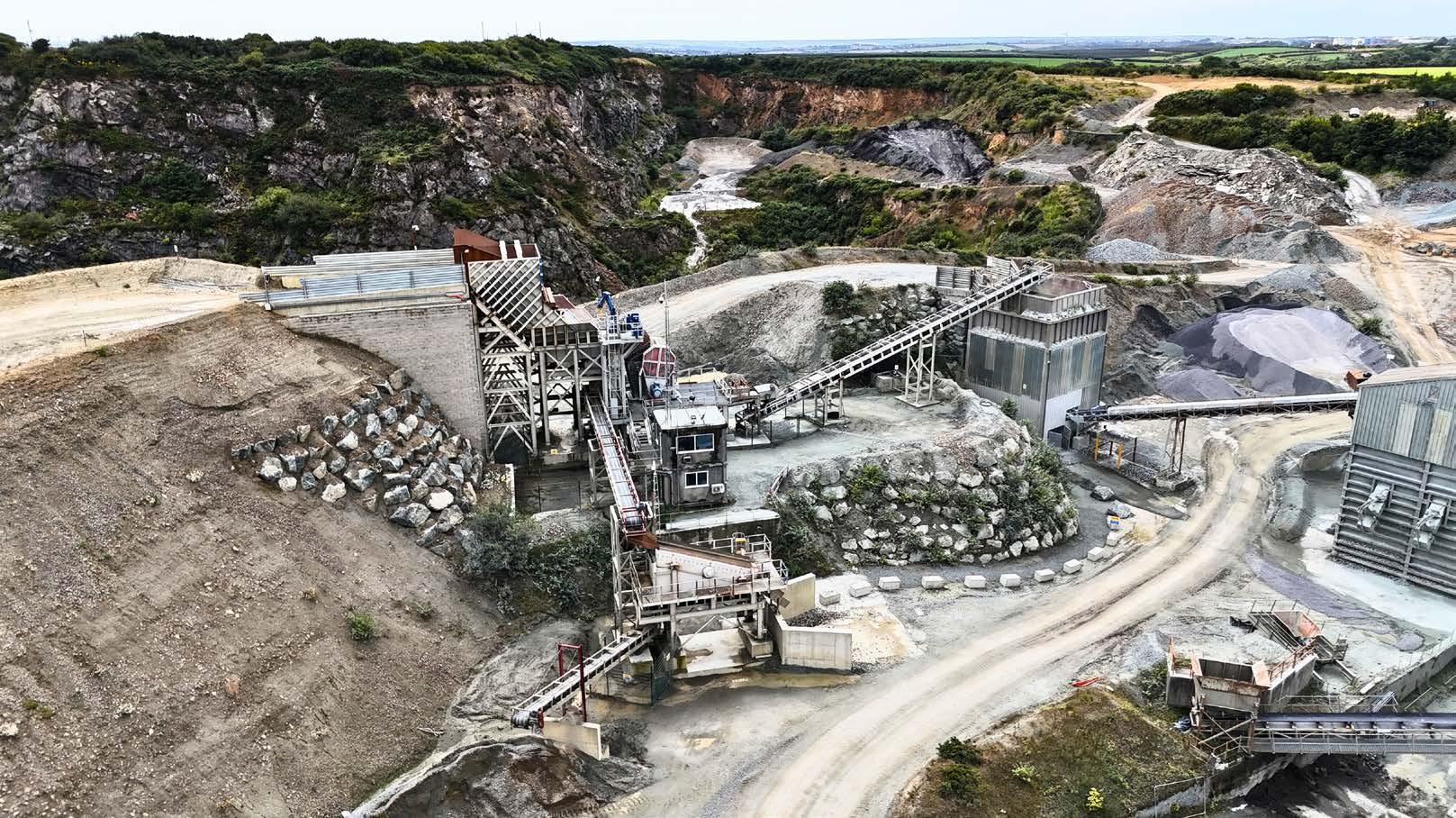

Trusted suppliers of:
• Aggregates
• Asphalt
• Ready mix concrete
• Cemfloor liquid screed
• Agricultural lime
• Expert civil engineering
• Professional road surfacing