Portfolio_Peiyu Chen

Page 1


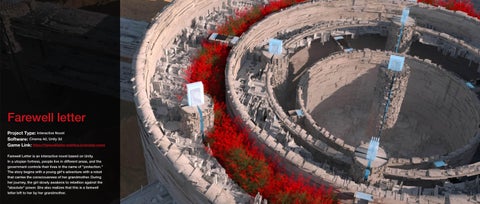
Farewell letter

Project Type: Interactive Novel

Software: Cinema 4d, Unity 3d

Game Link: https://farewellletter.webflow.io/amdas-news

Farewell Letter is an interactive novel based on Unity.

In a utopian fortress, people live in different areas, and the government controls their lives in the name of "protection."

The story begins with a young girl's adventure with a robot that carries the consciousness of her grandmother. During her journey, the girl slowly awakens to rebellion against the "absolute" power. She also realizes that this is a farewell letter left to her by her grandmother.

Inspiration Research

The project was inspired by Musk's claim in 2022 that he would upload his brain to the cloud, sparking a technological debate on "immortality" and "consciousness uploading". But it also raises the question of the future subjectivity of human beings.

At the same time, in the face of the inherent complexity of human beings, can we rely purely on technology to mould character? Can we realise our self-worth through technology without sacrificing ourselves?

When it comes to character building, think of my grandmother. She grew up with me and shaped my self, but the passage of time tells me that eventually we will say goodbye. While consciousness uploading seems to have solved this problem, can we make sure that the good is as good as we think it is?

Heidegger saw the essence of modern technology as "Entbergung", reflecting the practicality of existence. He called it "Gestell", the breakdown of existence through organisation. This subjects humans, nature and life to the power of technology. It limits human perception to the framework of technology, while human subjectivity will be at risk of dissolution in the alienation of technology.

Nietzsche reminds that the convenience of machines replacing human labour comes with the risk of anonymisation and depersonalisation. This ethical and political issue is crucial in the modern technological discourse.

Digital outcasts

As many services are slowly being digitised, non-network users are being marginalised, affecting the basic rights of specific groups. This group is a harmful by-product of the digital age - the digital outcasts.

Nietzsche put forward the concept of the "three metamorphoses", which divides life into three stages: camel, lion and infant. The camel represents the bondage of tradition, the lion symbolises the challenge of tradition, and the infant signifies the creation of new values. He linked life to the will to power, arguing that the meaning of life derives from creative activity, not only in the body but also in the spirit, based on the critical nature of negation. This emphasises that dynamic creative activity gives meaning to life.

"Anonymisation" and "Dehumanizing slavery" should be an essentially ethical and political dimension of contemporary technological discourse. Still, the reality is that too little attention is paid to this "anonymizing But the reality is that too little attention is paid to this population, which is being "anonymised".

Instead, the project will unfold through the lens of digital outcasts, looking at the issues involved in today's technology and the technology of the future through a different lens.

Concept Worldview Game Development Elements

The core concept of this project is to explore how human beings can redefine the will, the self, and the meaning of existence in the face of the onslaught of modern technologies such as technological advancement and consciousness uploading. Drawing on Nietzsche's three metamorphoses, the project seeks to delve into the inner nature of the human being as well as the moral and ethical challenges of humanity.

Combining elements of science fiction, utopia, and government, Farewell Letter explores technologies such as consciousness uploading and body modification in a futuristic world, provoking thoughts about human nature, free will, and the ethics of technology.

Through this project, I aim to convey reflections on the attitude toward life and explore Nietzsche's concept of 'eternal recurrence' as a potential solution to these issues. 'Eternal recurrence' views life as the unity of the fleeting and the eternal, encouraging individuals to overcome lack with overflowing will and strength, ultimately achieving spiritual empowerment.

In a utopian future, Earth's resources have been depleted and the polluted air has forced humanity to retreat to a high-security fortress. The government has divided the fortress into three distinct zones. The technology and materials of the fortress are managed by a corporation called "Sirens". In this fortress society, people are divided into three categories: Initials, Transformers and Supermen. However, as time passes, a class divide emerges, with the residents of the First City struggling to make a living, the Second City prioritising entertainment, and the Third City being so godlike that no one can get a glimpse of their current state of affairs.

People are running around every day for breathing agents and essential supplies.

The robot her mum brought home to store her grandmother's consciousness keeps trying to go outside, and the girl decides to explore where it wants to go.

People pursue all the popular elements and entertainment is the motto of the city.

They are much admired, but their current status is unknown. City 1 City 2 City 3

In the second city, they encountered some events, and the girl gradually let go of her emotional baggage.

At the end of the story, the girl also realises that the journey was a farewell letter from her grandmother to her.

Design Process

and Coding

City 1

Life here is full of constant toil. People work day and night, longing for goods and services that will satisfy their basic needs.

A mixed system school exists in the city, but sadly, an atmosphere of bullying and inequality pervades the school. Pupils from different cities can be subjected to bullying by their peers and the distribution of educational resources can lead to inequality.

City 2

It is full of advertising, consumption and traffic. People use the latest prosthetics as a fashion target and trap themselves into one consumer trap after another. Here I have mixed meta elements and designed a real news site to report on the actions of the protagonists in the Second City. The comparison between the news and the game's plot reveals a place where people have been "dehumanised and enslaved", where the death of a human being goes unnoticed, while the breakage of a machine is lamented. Here the people loathe and fear the humans of the First City, but they forget that they are the same.

City 3

According to the protagonist, it is a city of the "dead". The people here have abandoned their physical bodies and gone to the electronic world to become their gods. But will the human spirit be strengthened in that electronic world? That is an unknown. By the way, here take a slight dig at the formalism of some governments who like to spend their energy on superficial things rather than spending those funds where they are needed.

The Ocean

After uploading consciousness, people no longer need to endure physical pain or part with their loved ones and friends in life and death, and all this may sound very good. However, there is always a rationale for existence. Life has its duration and a reason for existence.

In the end, the protagonist realises that this journey is a farewell letter from his grandmother, completes his awakening and begins his own journey. This may be the very continuation of life, a deeper continuation that transcends the physical body and continues in memory and spirit.

Female SameSex Hatred

Project Type: 3D Animation

Software: Cinema 4d, Octane

Video Link: https://vimeo.com/showcase/11491982

"Female Same-Sex Hatred" analyzes the origin and extension of the complex emotional states between women, characterized by both love and hate, admiration and jealousy. By exploring concepts such as self-awareness under patriarchy, the theory of the mirror, and entrustment, the project seeks to uncover the deeper causes behind these emotions. Presented through 3D animation, it discusses in detail how women can confront and resolve these emotional conflicts.

Research

When I first read the Neapolitan Novels, I became puzzled by the relationship between Raffaella and Elena. If their feelings are a form of like, why do they sometimes harm each other? If their feelings are rooted in dislike, why do their gazes so often linger on one another?

The Unacknowledged Other

When the self encounters the Other and begins to acknowledge their existence, self-awareness begins to form.

In Phenomenology of Spirit, Hegel points out that self-consciousness consists of two forms: "independent consciousness" and "dependent consciousness." These two aspects, through mutual dependence and struggle, jointly form complete self-awareness.

This kind of unconventional emotional dynamic can also be seen in other literary and cinematic works, such as the relationship between An Lingrong and Zhen Huan in Empresses in the Palace and between Mayuko and Riri in Kenja No Ai. This suggests that such emotions are not unique.

aren't we ‘masters’?

The internet has coined the term “Female Same-Sex Hatred” to describe the contradictory and complex emotional states between women—love and hate, admiration and jealousy. Therefore, I hope to explore in this project how these intricate and subtle emotions arise and extend between women.

as a master

However, within the structure of patriarchy, women are seen as the "Other," and the formation and development of their self-awareness are thus suppressed and marginalized. As a result, women are forced to place their selfidentity in relationships with other women, attempting to gain true subjectivity through this means.

Satisfaction in interdependence and struggle

In Female Same-Sex Hatred, women, through self-reflection in the mirror, perceive the other in the relationship as the idealized version of themselves. According to Lacan's theory of the mirror stage, the ideal image becomes the object of projection for the subject, who seeks to gain self-identity by constantly imitating and approaching this ideal self reflected in the mirror.

In Phenomenology of Spirit, self-consciousness is fulfilled through the mutual dependence and struggle between independent consciousness and dependent consciousness. This fulfillment is, in fact, an expression of one self-consciousness’s desire to dominate the other. This desire manifests as a longing for self-transcendence and self-perfection. This complex dynamic forms the intertwining of love and hate in Female Same-Sex Hatred.

Entrustment

Luisa Muraro’s concept of "Entrustment" (Affidamento) draws on Irigaray's idea of the "female genealogy" and emphasizes that women achieve shared freedom through mutual dependence and support. By establishing trust and reliance, women can form emotional connections and, on this foundation, realize a form of "shared freedom" that does not depend on men or traditional social structures.

Accepting differentiation

and affirmation

Reinventing the self

In Muraro’s theory, Entrustment is also a way of establishing "female genealogy" . It encourages women to seek out symbolic mothers and daughters, building intimate relationships. This forms a non-linear, non-patriarchal historical narrative, allowing women’s experiences to be preserved and transmitted.

Sharing experiences and value system

Give recognition

Concept

This project explores my understanding of the complex emotions within women’s relationships, using Female Same-Sex Hatred as a starting point. By integrating mirror theory, the master-slave dialectic, and the concept of "Entrustment," it analyzes the mechanisms behind the formation of these emotions and potential pathways for their resolution.

Sketch

Through reflecting on the contradictions and breakthroughs in women’s relationships, the project aims to offer new perspectives for fostering emotional connections among women.

Mind Map

Visual symbols

Lnfusion tube: these factors go both ways to make up the relationship and are at the same time intricate

Design Process

I begin by creating the models and composition in Cinema 4D, followed by refining the lighting and shadows. Next, I move into Octane to fine-tune the materials. Finally, I use Premiere Pro and After Effects for post-production and sound design.

The Great Mother

I have outlined the changes in women’s circumstances through the transition from matriarchal to patriarchal societies in a timeline format: In matriarchal societies, women held central roles in economic, cultural, social, and spiritual functions. However, with the shift to patriarchal societies, these functions were gradually stripped away, marginalizing women and reducing their roles to mere appendages of men. This transformation has become one of the key roots of Female SameSex Hatred.

Mirror

Initially, a delicate balance existed between the self and the ideal self. However, as the self projected its desires onto the ideal self, this perfect, idealized image gradually became the object of relentless pursuit for the dependent consciousness (the real self). The individual attempted to "control" and "surpass" the ideal self reflected in the mirror to achieve self-perfection. Yet, this pursuit ultimately ended in failure. The relationship between the self and the ideal self unraveled, and the original balance collapsed entirely.

Entrustment

In this concept, I designed a story of adventure between a 'Bubble Person' and a woman. The three scenes represent the constraints of patriarchy, the woman’s confusion about her current situation, and a vision of a hopeful future. Throughout the journey, they are equals, and their adventure symbolizes a process of inheritance and mutual growth.

Project Type: Interaction device

Software: Cinema 4d, Octane, TouchDesigner

Video Link: https://vimeo.com/showcase/11493514

Alp is an interactive installation themed around the "Mountain Goddess," combining Lacan's mirror theory and Foucault's concept of the body utopia to explore how selfawareness can balance the real and the fictional, returning to the essence of life. The work integrates natural symbols and elements of ethnic minority culture, showcasing the body as a meeting point of nature, time, and ideals. Through cyclical narrative, Alp guides the audience to reconsider the relationship between self and environment, exploring the essence of life.

Brainstorming Solution

Self-construction Subject expredsion

Foucault, whose body has been an essential subject of concern since he began writing The History of Madness in the Classical Age, rarely speaks about the body's status. In his essay Le Corps Utopique, he explains what he perceives as the question of the position of the body.

Visual element refinement

[Perception] [Soul] [Reorganisation] [Body]

The Mirror Stage Question

In Lacan's theory, identity is a self-perception formed by human beings after exposure to mirrors and language, and its deception is related to the subject's uncertainty, leading to the subject's misunderstanding of the self and the formation of identity.

How can we find a balance between the reality and fiction of the body through clear self-knowledge in order to overcome subject splitting and alienation and achieve a return to the origin of life?

This question points to the internal conflict arising from the individual’s alienation from themselves and their environment in modern society. This fragmentation of the self is not only reflected in misunderstandings of the body, but also in the rift between the individual and the external world, nature, and others.

Deception and subjective uncertainty

Self-perception is often shaped by social culture, which in turn is affected by individual psychological structure and emotions. Lacan believes that the subject is alienated into the conscious self and the unconscious other, forming a split existence.

From the wisdom of China's ethnic minorities, we learn how to direct our attention back to nature and the whole, finding the rhythm of life within the flow of time. The Naxi people integrate time's cycle through the Dongba rituals, the Tibetans accept the flow of life through the concept of reincarnation, and the Hmong people engage in dialogue with the land through their songs.

These cultures teach us to reconnect the body with nature, returning to an inner harmonious rhythm. In the flow of time, we touch the true self, balance reality with fiction, and ultimately return to the origin of life.

Concept of Installation Comparison of different materials

I extracted two key words, spatiality and limitation. Spatiality represents social, cultural and political power, and visual spatiality represents place. My goal is to visualise these invisible, potential factors. Limitation is an adjunct to place and suggests that we are controlled by these invisible factors.

Visualisation

& Cultural]

Rights] [locations] [Containment]

Materials

Effect Issues

Re-imaging + Refractive deformation

Acrylic board + Projection film Fake holographic projections

Spectrograph + Arduino + LPS screen

The image is blurred and the intention is not clear

Key Words

Lack of spaciousness, too small a unit

Interaction Flow Symbolic

I chose to use a combination of touchdesigner and camera to control the playback of the video by testing the distance of the hands, in which the viewer's hands form a worshipping motion

The relationship between distance and the changes of animation

Through this approach, the installation not only presents the fracture between the body and the external world but also becomes a medium, where the act of worship redirects people’s attention back to the image itself. The image symbolizes the natural world and the origin of life, and through interaction with the image in the installation, it repeatedly strengthens our connection to nature. Just as we are material beings in space, traveling through time, the image and installation together guide us toward the direction of returning to our origin.

[Goddesses] [Self-awareness]
[Wind] [Light] [Freedom]
[Goddesses] [Wind & Free] [Alpine Goddess] [Perfect illusion]
[The Mirror Stage] [The Illusory Nature of the Self]

Visual Elements

I use stones, bones, and plants as symbols of nature, representing unawakened existence, the basic form of life, and an idealized state, respectively. This symbolic system not only reflects the dynamic transformation from matter to life and from stillness to flow but also serves as a metaphor for the process of self-recognition in Lacan's mirror theory. Through the "mirror" of nature, the individual progresses from a vague sense of existence (stones) to the initial formation of self-awareness (bones) and finally to the construction of the ideal self (plants). Gradually, they realize that the real and the ideal are not opposites but two inseparable facets of life, thereby achieving self-integration and a return to the meaning of life through the resolution of internal divisions.

I incorporated the Naxi headdress and the Tree of Life symbol to showcase the dialogue between Eastern and Western perspectives on nature and life. The transformation of bones growing skin symbolizes the evolution of life and the individual's reunderstanding of the body. The act of opening eyes awakens consciousness, while the Tree of Life symbol reflects the intersection of the body with nature and time. Ultimately, the figure transforms into stone, completing the cycle of life's return to nature. aim to explore the body as a meeting point of nature and culture, guiding the audience to rediscover the essence of life.

Design Process

In c4d, I control the vertex field to achieve the effect of growth and material switching .

Using data from the camera, measure the data between the viewer's hands and set thresholds to limit the speed of animation,ransparency and volume.

Use the TOP component for colour mixing and strobing effects, and use camera data to add background effects and glow intensity.

After Nature

Project Type: VR Game

Software: Cinema 4d, Octane, Unreal Engine

Video Link: https://vimeo.com/1038647108

This project is a VR-based game that explores how the symbolic systems of humans and non-human life forms can be integrated to establish a cross-species dialogue framework. Players will reinterpret and understand the symbolic language of nature through the game, constructing a symbiotic symbolic ecosystem. The game emphasizes communication that transcends species boundaries, allowing players to reconsider humanity's role in nature and inspiring reflection on future ecological balance and coexistence.

Background

I have thoroughly analyzed the production logic of each project. I symbolize the concepts want to convey and then skillfully transmit these symbols to the audience through technology.

Research

However, I am now beginning to think about a key question: Who actually establishes the meaning of these symbols?

In our everyday culture and society, symbols are imbued with specific meanings and emblems, which are often shaped in specific historical, cultural and social contexts.

By studying a number of de-anthropocentric projects or works, we find that there is often a tendency to ascribe anthropomorphic features to non-human creatures, or to impose human symbols on non-human creatures, etc.

These symbols characterise various parts of our world in a variety of ways, from language to art, from beliefs to social conventions.

The fact is that symbols are customised by humans. When we habitually apply this model to non-human creatures, we may create a bias, rooted in anthropocentrism, that places too much emphasis on human ways of perceiving and communicating, while ignoring the fact that other creatures may have different ways of perceiving and communicating. Can symbols be consistently understood and accepted globally across different cultures and contexts?

Concept Scene Setting

This project explores how the symbolic systems of non-human beings can be integrated into a broader semiotic framework, establishing cross-species connections with human symbolic systems. The goal is to create a new symbolic ecosystem where human expressions no longer dominate nature but engage in an equal dialogue with it, forming a network of shared meanings. This ecosystem symbolizes a symbiotic future—a linguistic system that transcends species boundaries, enabling humans to redefine and reimagine their role within nature.

Viewpoint

In this project, I want to explore symbiosis from a human perspective.

chose W.G. Sebald's poetry collection After Nature as the informational text because it profoundly explores the intertwined relationships between humans and nature, as well as life and death. Sebald's writing blurs the boundaries between humanity and nature, presenting a cyclical and integrated mode of existence. This lends philosophical and emotional depth to the narrative.

Design Process

I did the modelling and initial construction of the scene through C4D. Further refinement of scenes, programming and materials in UE4. I learned and used the blueprint feature in UE to set up interaction effects

Screen 1

The moon, as a natural symbol, signifies creation and cycles, while the spiral staircase symbolizes the spiral development of life, rendering the dynamic process of life tangible. The mechanical devices in the scene operate by absorbing the moon's energy, while also supporting and elevating it. This imagery portrays a symbiotic relationship between nature and technology—technology is no longer merely a tool for extracting power from nature but becomes a collaborator through its integration with natural processes.

Screen 2

The second scene uses mechanism as a metaphor to reveal the common alienation of nature and human beings under the capitalist system. When nature is reduced to a resource to be exploited, human beings can hardly escape from the fate of being instrumentalized, and both are plunged into the abyss of degradation and exploitation in the capitalist relations of production.

Screen 3

In the third layer, I will explore the concept of a symbiotic world, where in this era, humans, nature, and technology mutually depend on each other, coexisting in a dynamic network. My goal is to break free from the prevailing modernist ideology, the constraints of the "Anthropocene," where humans perceive the Earth merely as an extension of their actions. To achieve this transformation, we need to embrace a fresh perspective, recognizing that both human and non-human entities have the right to coexist on Earth and evolve together through interdependence.

Project Type: 3D Animation

Software: Cinema 4d, Octane

Game Link: https://vimeo.com/showcase/11494320

Consciousness observes itself to form perceptions about itself, and the perceptions formed are incorporated into itself to change its very existence. And it is precisely because of the extreme unreliability of this observation that each renewal will go in a direction that can never be predicted. The torrent of information is never ending and theories will increase with time. Our consciousness will change with the new.

Research Question

Free Will Determinism

Free will is the ability of an individual to independently choose and determine his or her behaviour and decisions without being constrained by external coercive or deterministic factors.

According to Schopenhauer's theory, free will is a natural law, derived from the supra-personal will, rather than from natural law.

Schopenhauer believed that even without sensory self-perception, we can still experience our endogenous will.

In summary, before being reflected and perceived, our essence is the will. People's physical bodies are nothing more than representations of the human will's observations of the outside world. Since both our bodies and the external world are presented through representations, Schopenhauer argues that the external world, like human beings, is essentially will.

Determinism is an intensification of the law of cause and effect, which says only that there must be a cause and an effect, whereas determinism emphasises that this cause must have this effect, i.e., the connection between cause and effect is definite. Because there are so many kinds of determinism, Laplace's demon will be used here as an example.

He argued that the current state of the universe is seen as a cause and effect of the past and future. For the wise man, if all the forces and positions of objects could be known in a single instant, the movement of the universe would be reduced to a simple formula. For the wise man, there is no ambiguity; the future is like the past.

Free will and determinism seem at first sight to be diametrically opposed to each other. But when one tries to answer this question, no matter which of the two one chooses, one is always left with some contradiction that one cannot resolve.

Carnap considered determinism to be the special argument for the causal structure of the world, an argument that insists that the causal consequences of the world are so strong that if a complete description of the whole state of the world at a given moment is given, then with the help of this causal law any event in the past or in the future can be calculated.

Wundt and W. James, for example, take a theoretically evasive approach:

on the one hand, they insist that psychology should support a deterministic approach to explanation, but at the same time they argue that there is a need to recognise freedom of will in people's everyday lives.

But when we discuss free will and relativism, are we falling back into the trap of dualism?

New Compatibilism

Further Research Ideation

Classical Compatibilism

Freedom is the ability to do what we want to do, i.e. there are no restrictions on our behaviour. They distinguish that it is coercion and restriction, not necessity, that are opposed to freedom, from which they conclude that free will is compatible with determinism.

While classical compatibilists usually interpret free will as a concept that is not subject to external constraints or coercion in the empirical context, new compatibilists prefer to understand free will as a concept that is subject to conditions internal to the individual.

Hierarchical Desire Theories

Harry Frankfurt believed that human beings have a special structure of will, which consists of lower-order desires and higher-order desires, and that human beings have free will only if their first-order desires are subordinate to their second-order desires.

Free Will

Capable

Determinism

Unconstrained and Unrestricted Want to

Second-order desires can be divided into those that keep the desire inactive and those that make the desire a will, the latter of which Frankfurt called second-order will.

However, this programme it too abstract and mirrors can bring in other metaphors.

In the improvement described above, chose to have parallel screens in front and back, with separate animations for front and back. The before and after represent the law of cause and effect. However, guiding people's thoughts through the visual elements suggests that autonomous choices can be made under known conditions, thus provoking thoughts about the delicate balance between decision and control. Display programmes need to highlight free will and decisions. Mirrors can reflect different perspectives and viewpoints.

Design Process

Use MD to create and simulate character costumes.

the

#include "octane-oslintrin.h" shader OslGeometry( int Iterations = 10, float Power = 2.0, float Bailout = 20, output _sdf c = _SDFDEF) { vector pos = P; vector z = P; float dr = 1.0; float = 0.0; for (int = 0; < Iterations i++) = length(z); if (r>Bailout) break;

// convert to polar coordinates float theta = acos(z[2]/r); float phi = atan2(z[1],z[0]); dr = pow r, Power-1.0)*Power*dr + 1.0;

// scale and rotate the point float zr = pow( r,Power); theta = theta*Power; phi = phi*Power;

// convert back to cartesian coordinates z = zr*vector(sin(theta)*cos(phi), sin(phi)*sin(theta), cos(theta)); z+=pos;

c.dist = 0.5*log(r)*r/dr; }

Using code to generate Mandelbrot sets

Scene building and rendering are done in C4d.
Generated using
animation feature of Disco diffusion.

Scene 1 conveys the importance of free will, emphasising the ability of the individual to autonomously choose and create his or her own reality. It covers the complexity of relationships, emotions and creativity, while emphasising free will as central to individual uniqueness and autonomy.

By contrasting prosperity and desolation, music and silence, life and death, this scene inspires the audience to reflect deeply on society, the individual and life. A reminder to consider the law of cause and effect reveals the interrelationship between social culture, power structures and life values and individual choices.

The scene reflects the complexity of free will and determinism in contrast, while emphasising the finite and complex nature of life. The audience is encouraged to reflect on the controversies of fate, choice and free will in human existence, and the uncertainty of life. The intention is to provoke deep reflection on self mastery, the meaning of life and religious concepts.

Front

Back

Turn static files into dynamic content formats.

Create a flipbook
Portfolio_Peiyu Chen by Peiyu Chen - Issuu