
CLINICAL CONNECT PEER EDUCATION



Introduction | 5
ACKNOWLEDGEMENT
Thank you to Kin Strategy and Research who provided expertise, guidance, and support to Pegasus Health for the development and implementation of the Clinical Connect Peer Education Programme Measurement Framework and Strategy.
KEY HIGHLIGHTS
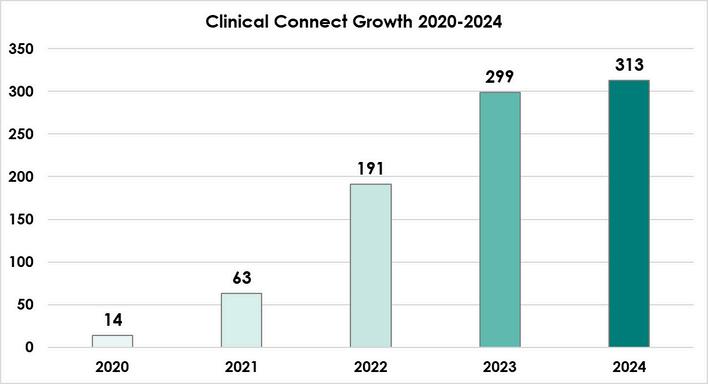
Clinical Connect attendance across Tū Ora Compass Health continues to grow from 26 attendees in the first year (2020/2021) of the programme to 320 in the 2024/2025 contract year
Clinical Connect delivers high quality peer education sessions that support quality improvement and improve health outcomes
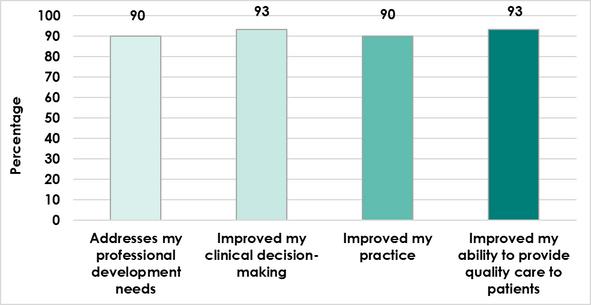
93% Tū Ora clinicians state that the programme impacted and/or improved their clinical decision-making
Clinical Connect sessions are valued highly by the Tū Ora clinicians, averaging 4.6 from 5 for overall quality
Clinical Connect increases the resilience of the Tū Ora workforce through peer connection and encourages them to work as teams
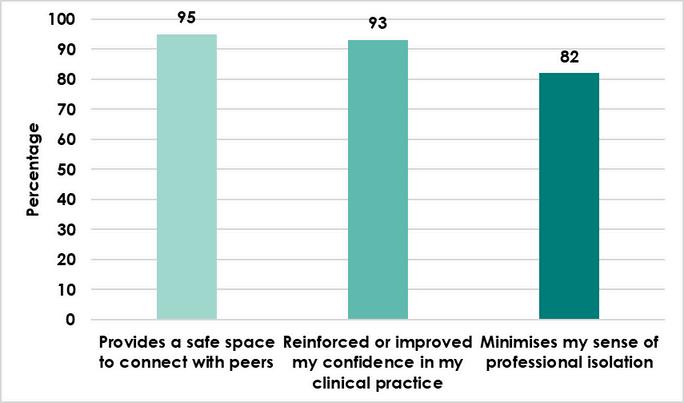
95% clinicians state the programme provides a safe space to connect with peers
BACKGROUND
Tū Ora Compass Health partners with Pegasus Health to deliver the Clinical Connect Peer Education Programme across the Tū Ora quality peer group network.
The Clinical Connect Peer Education programme, formerly known as the Pegasus Small Group Education Programme, was founded in the early 1990s to deliver high quality, evidence and data informed education to support best use of resources and best practice primary care. Through the programme clinicians meet regularly in small groups to discuss clinical education topics relevant to primary care with a strong focus on quality improvement For further information: https://clinicalconnect.nz/.
In November 2020, Tū Ora Compass Health partnered with Pegasus Health to offer the Pegasus programme as part of their establishment of the quality peer group network The Tū Ora programme was established with two groups in Waikanae and Paraparaumu and grew to 10 groups across the wider region in 2022.
In 2023 Pegasus embarked on a process to better understand, measure, and report on the impact of the Clinical Connect Programme. A social impact approach was established to better understand the outcomes and impacts of the programme, moving beyond attendance and utilisation data alone. Impact goals and an impact model (theory of change) are supported by a social impact measurement framework with indicators. Further information about the development of this approach is available in the Pegasus Small Group Education Programme Impact Report 2023 available here: https://www.clinicalconnect.nz/our-impact#impactreports
INTRODUCTION
This report draws on the Clinical Connect evidence-based impact measurement framework. Using this framework, we have explored how Clinical Connect is strengthening clinical quality and supporting everyday clinical practice for primary care clinicians in Tū Ora Compass Health practices
The findings in this report are presented against the four Clinical Connect impact goals:
Keeping clinicians up to date with the latest clinical evidence and supporting best practice decision making
Creating a more resilient primary care workforce that feels confident and supported in their clinical practice
Building a more connected primary care workforce not working in silos
Supporting optimal resource use and reducing unhealthy variation
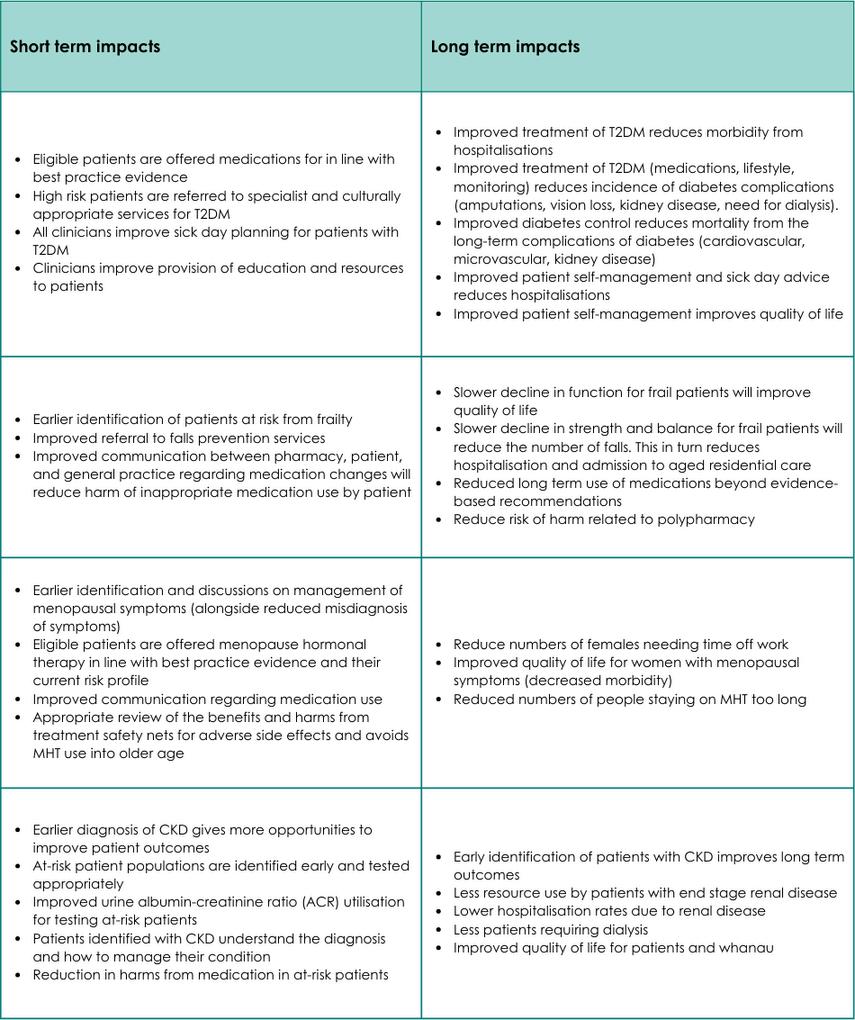
Impact indicators for each goal are described throughout the report, alongside direct feedback from clinicians who participated in the 2024/2025 programme. Information is drawn from evaluation of sessions, an annual survey completed in October 2025, and attendance data [1-3]. Additionally topic related questions were included in the annual survey to identify the short and long term impacts of the specific sessions, these are outlined in appendix one.
ENGAGEMENT
Clinical Connect continues to grow [1]
320 attendances across the four Clinical Connect sessions
Ten peer groups
Average of 80 individual clinicians attending each topic
Clinical Connect sessions continued to rate highly for quality (Average 4.6/5) [3]
Type 2 Diabetes - the highs and the lows Nov 2024
Frailty & Legacy Prescribing –opportunities for improvement Feb 2025
Menopause –embracing change and new beginnings May 2025
Chronic Kidney Disease – what’s your piece of the puzzle? Sep 2025 Overall Quality
Attendance (number
The demographics of those who responded to the annual survey highlight the long-term engagement of most of the peers in the groups [3]. There were 40 responses to the annual survey. If we consider an average of 80 clinicians attending per topic, this would seem a fair and representative sample although it would be reasonable to assume a bias towards more engaged clinicians providing responses to the survey.
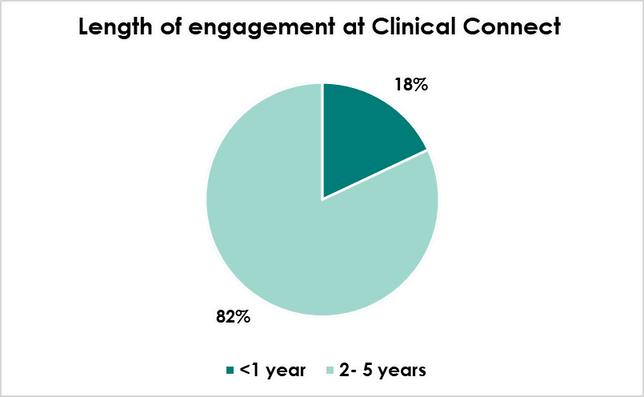
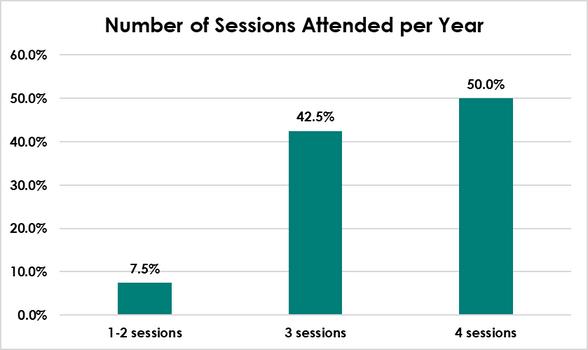
The clinicians participating in the sessions, attend the majority of the four topics per year [1]. This means they can benefit from the peer connections, and continuous learning the small group model provides
IMPACT INSIGHTS
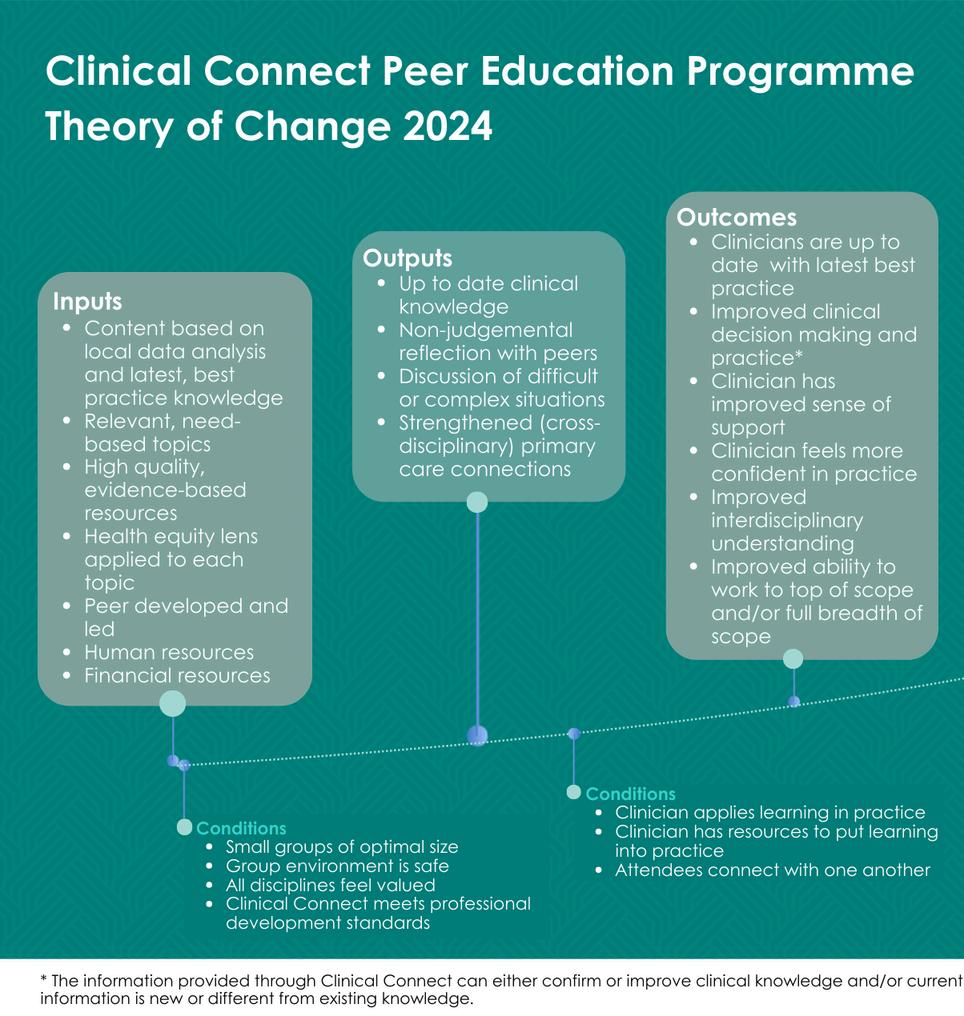
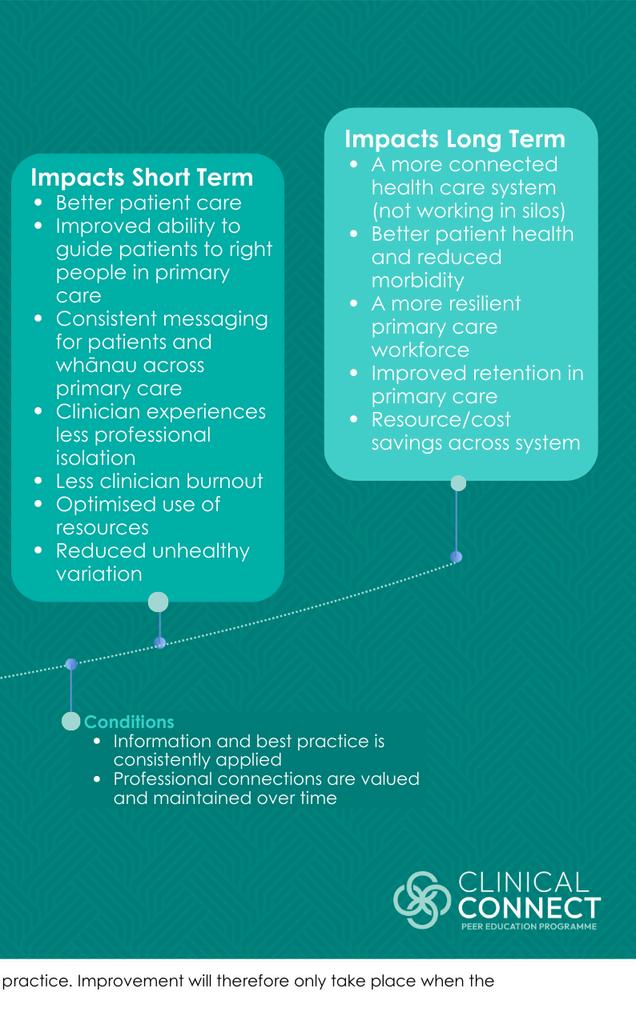
The Clinical Connect Peer Education Programme impact measurements are based on an analytically sound, theory of change impact model (see appendix two) By monitoring our predefined impact indicators rigorously throughout the year, we can provide the following evidence-based statistics and insights about the impact of the programme.
Indicator data outlined below is collected through a combination of per session feedback and annual survey data from those who have engaged in one or more sessions over the previous 12-month period. We also use illustrative quotes from clinicians who have attended the sessions
IMPACT
GOAL - Clinical Connect keeps clinicians up to date with the latest clinical evidence and supports best practice decision making
The information provided through Clinical Connect keeps clinicians up to date, which supports best practice decision making and, where relevant, leads to improvements in clinical practice. This in turns supports the provision of improved, quality patient care
The indicators for this impact goal were very strongly affirmed as outlined below:
90%cliniciansstatetheyhavemadechanges/improvement aresultofattendingClinicalConnect
“Iammoremindfulofbothotherprofessionalsandh understandthing'sdiscussed”
“Greaterawarenessofinequitiesandr
93%cliniciansstatetheprogrammeimprovedtheirabilityto topatients
"Iconsiderpatientsholisticallyandavoidsilosof
“Ihaveawiderunderstandingofmultipleperspectivesonh abletodiscussoptions.“
Aminorityofcliniciansreportedlimitedprofessionaldevelop commonlynotingthatClinicalConnectdoesnotencompas developmentneedsorthatsomecontentwaslessrelevantt patientpopulations,suchaspracticesservingpredominantl 28%cliniciansexperiencedbarrierstoapplyinginformationf Connect,mostfrequentlythebarrierwasalackoftime(44% funding[3].Similarly,timeandfundingarethebiggestbarrie theCanterbury-basedClinicalConnectprogramme.
Understandingtheclinicians’barrierstoapplyinginformation contributestocontinuousimprovementoftheprogramme,s futuretopicdevelopment.ItalsohighlightsareaswhereTūO andPegasusHealthmaybeabletosupportsystemenabler care[3]
IMPACT GOAL
- Clinical Connect creates a more resilient primary care workforce that feels confident and supported in their clinical practice
Both the format and group-based nature of the Clinical Connect sessions allow for the creation of a safe space, where practitioners can connect with one another, share experiences and feel supported This in turn positively impacts clinicians’ ability and confidence in clinical practice. This in turn helps to reduce (or avoid) a sense of professional isolation.
Clinical Connect supports connection and learning from one another: The annual survey showed that the chance to discuss and exchange experiences with peers was a major attraction of the Clinical Connect model that lifted it above most other professional development opportunities:
One GP commented on the benefits of learning about frailty alongside their nursing colleague
The case “mirrored exactly a patient which I had asked the practice nurse to support, and we were able to discuss our roles as equals as we both attended this session”
Indicators

95% clinicians state the programme provides a safe space to connect with peers
“It ensures I am working based off up-todate best practice, and it is a way to bounce ideas off and discuss cases with other clinicians”
93% clinicians state the programme has reinforced or improved my confidence in clinical practice
The Clinical Connect attendees valued the professional support and connection provided through regular interaction with peers in their small groups. Connection with others who work in the same or similar roles affirms that clinicians are not alone in the difficulties they encounter
82% clinicians agree being part of the programme minimised their sense of professional isolation.
The positive impact of the programme on minimising a sense of professional isolation is particularly relevant in maintaining a sustainable and resilient primary care workforce. Professional isolation is a red flag risk for burn out, which in turn contributes to clinicians leaving the health sector and/or early retirement of health professionals [4-7]
IMPACT
GOAL - Clinical Connect helps build a connected primary care workforce that is not working in silos
The multidisciplinary nature of the Clinical Connect programme strengthens cross discipline connections and working relationships. This enables problem solving, continuous improvement, and teamwork, optimising stretched workforce resource and supporting consistent quality care for patients and whānau.
Indicators
Clinical Connect paves a smoother path through the healthcare system: A better understanding of each other’s roles and practices improves clinicians’ ability to guide patients and whānau to the right people within the healthcare system. The resources provided in the sessions further supports this by listing relevant organisations and appropriate referral pathways
81% clinicians indicated that they are better able to direct patients and whānau to the right people and services in the health system after attending the Clinical Connect sessions
83% increased their understanding of other professional roles in primary care
When analysed by professional group, the GPs most experienced this benefit with 90% of the GPs who replied to the annual survey reporting an increase in their understanding of other professional roles
“Having the opportunity to discuss how I give care to patients, and to hear how other people would do it too is helpful for my own reflections on practice. I can always learn more.”
These results highlight how learning together supports working collaboratively. The World Health Organisation also identify interprofessional education as an important strategy to create collaborative practice-ready workforce better prepared to respond to local health needs [8].

IMPACT GOAL - Clinical Connect supports optimal resource use and reduces unhealthy variation
outcomes for older patients and addressing legacy prescrib identification enables more individualised and appropriate patients, while legacy prescribing refers to the continued use beyond the period of clear benefit, where the potential for h therapeutic value.
In the annual survey, 76% clinicians reported improved scree their patients.
Improving the screening for frailty enables clinicians to bette patients to help slow the decline in their daily abilities. Earlier interventions following screening can help older adults to live and reduce the likelihood of hospitalisation.
Addressing legacy prescribing is also an opportunity for impr prevents harm to patients.
Annual survey data reported 90% clinicians improved how th legacy prescribing.
Several clinicians explained how they annotate their prescrip legacy prescribing:
“Write duration of treatment on scripts as I issue them, e (antidepressants)”
“End dates on scripts, looking at PPI scripts (proton pump in reflux) much more closely now too”
Menopause – embracing change and new beginnings – Sessions delivered May 2025
The evidence base for menopause management has evolved substantially over several years, resulting in persistent misconceptions among clinicians, particularly around the use of menopausal hormone therapy. A learning goal of this topic was to address these misconceptions and support best practice, evidence-based management
Annual survey data showed the Clinical Connect sessions had improved prescribing for menopause symptoms:
78% reported it improved how or what medications they prescribed or recommend for menopause symptoms
“I'm starting the discussions more often to affected patients”
“Being aware of asking the appropriate questions especially when carrying out HPV screening”
Chronic Kidney Disease – what’s your piece of the puzzle? – Sessions delivered September 2025
This topic focused on proactively addressing key aspects of chronic kidney disease (CKD) to improve health outcomes, with an emphasis on early identification and improved access for high-risk populations.
One of the learning objectives was to improve the opportunistic screening for chronic kidney disease. This was affirmed in the annual survey with 87% clinicians reporting the sessions had improved how they utilise screening for chronic kidney disease for patients
“All patients with CKD are now on annual recall, same as we do with people with diabetes”
In addition, clinicians reported improvements in both knowledge and choice of tools for estimating kidney function, this is of particular importance when prescribing particular medications or for particularly vulnerable patients:
“Use of the CrCl tool (kidney function measure) on Medtech when assessing patients for antimicrobial medications and medications that effect the renal system”
Appropriate calculation of medications that can be toxic to the kidney lessens the risk of an acute kidney injury and hospitalisation
SUMMARY

This report demonstrates the value and impact of the Tū Ora Compass Health Clinical Connect Peer Education Programme.
Our impact analysis shows the positive impact on the knowledge, capability and confidence of individual clinicians in Tū Ora Compass Health and how it contributes to a connected, supported and more resilient clinical workforce A workforce that is not operating in silos, provides consistent messaging to patients, and can better guide patients and whānau to the right primary care providers within the wider health system. It also demonstrated that the programme delivered against its’ four impact goals.
Engagement in the Clinical Connect programme continues to grow [1] and the positive feedback from attendees with overall quality rating of 4 6 from 5 [2] demonstrates the value of the programme to those attending. There is potential for the Pegasus and Tū Ora teams to further explore growth across the network, particularly thinking about the growth in nurse practitioner, practice pharmacist, and nurse prescriber roles and how these can best be supported.
93% clinicians stated the topics delivered impacted and/or improved their clinical decision-making and 93% indicated an improved ability to provide quality care to patients [3]. These indicators demonstrate the positive impacts on clinical quality improvement which is critically important as the programme is a key part of the wider quality programme for Tū Ora.
s and nicians me tively e orter for pics in h , and ers tation ion at d nd e of more n this e, ). me will opics nt of on d onsive
APPENDIX 1
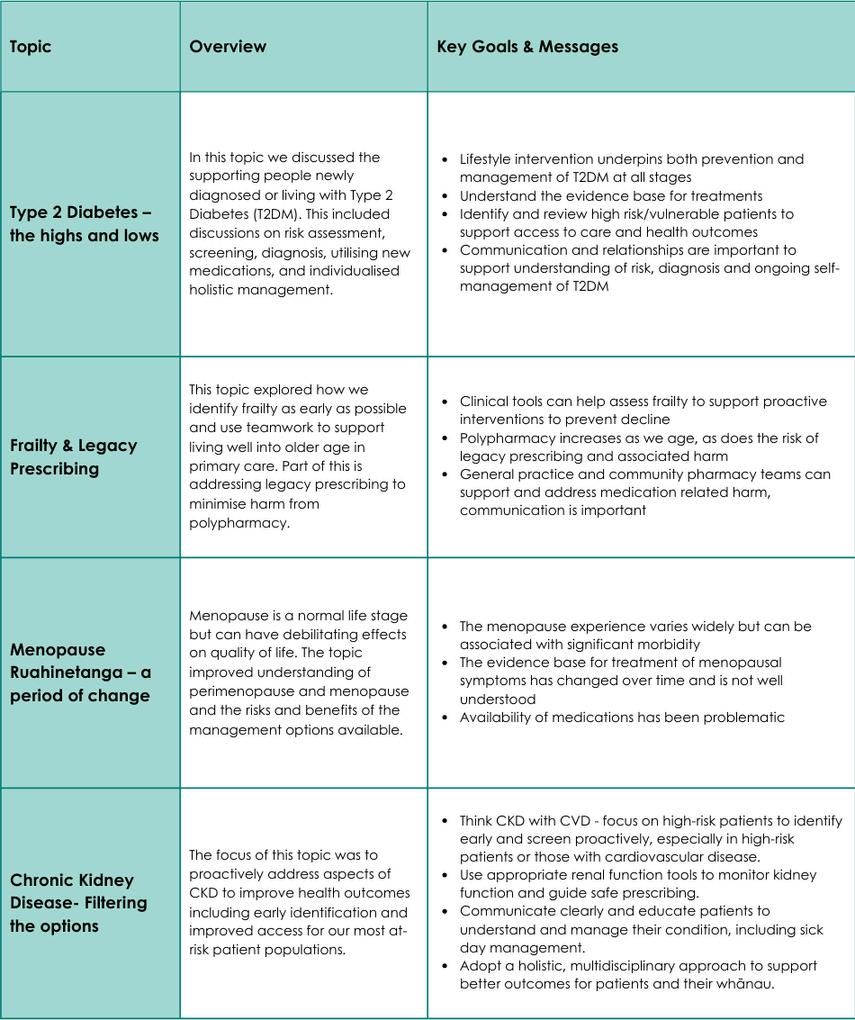
Clinical Connect topics delivered July 2024 - June 2025
Clinical Connect Theory of Change Impact Model
https://clinicalconnect nz/theory-of-change/
REFERENCES
1.Tū Ora Compass Health, Analysis of attendance at 2024/2025 Clinical Connect Peer Education Programme in Tū Ora Compass. 2025.
2 Tū Ora Compass Health, Clinical Connect Tū Ora Compass Health: Attendee & Leader Session Feedback. 2025.
3 Clinical Quality & Education, Annual Impact Survey for Tū Ora Compass Health Clinical Connect Peer Education Programme - 2024/2025. 2025, Pegasus Health,.
4 Christie, C , et al , Self-care of Canterbury general practitioners, nurse practitioners, practice nurses and community pharmacists. Journal of Primary Health Care, 2017 9(4): p 286-291
5.Mandy, A. and P. Tinley, Burnout and occupational stress: comparison between United Kingdom and Australian podiatrists. Journal of the American Podiatric Medical Association, 2004 94(3): p 282-291
6.RNZCGP. Burnout: Let's understand it and find solutions. 2022; Available from: https://www rnzcgp org nz/resources/data-and-statistics/burnout-survey/
7.Wasoski, R.L., Stress, professional burnout and dentistry. Journal - Oklahoma Dental Association, 1995. 86(2): p. 28-30.
8 WHO Framework for Action on Interprofessional Education & Collaborative Practice (WHO/HRH/HPN/10.3). World Health Organisation (WHO). 2010; Available from: https://www who int/hrh/resources/framework_action/en/
CLINICAL CONNECT PEER EDUCATION PROGRAMME IMPACT GOALS