2 9 Ō K E T O PA /
I S S U E / P U TA N G A 1 5
OCTOBER 2021
Pegasus 2025 Kia atawhai ki te tangata
A MESSAGE FROM OUR CEO Tēnā koutou katoa - Greetings to you all Meeting the needs of Canterbury youth. Aotearoa’s young people are growing up in a world of constant change, pressure, and uncertainty. They face distinct challenges in terms of education, employment and health as a result of Covid-19. In turn, health providers are faced with ensuring that they understand the unique needs of our young people so they can enjoy equitable access to health care. This issue, we look at some of the initiatives that Pegasus Health is undertaking to deliver better health outcomes to youth. Later this year, we’ll be breaking ground on a dedicated health and mental health centre to meet the needs of Canterbury’s young people and we’ve also begun a partnership with Christchurch-based, support and advocacy group, Qtopia, to better understand and share knowledge on how to provide compassionate, quality care to our rainbow community. Health Reforms The Health Reform Transition Unit held a roadshow earlier in the month, and last week the Pegasus Board met with Director, Stephen McKernan. The two interim entities that are core to the reform, Health New Zealand and the Māori Health Authority, have been established and members appointed to the boards. They have also created a Future of health website, where you can find all the latest
information about the health reform. We continue to watch this space, and discuss the role of primary care and Pegasus as changes are made in the health and disability system. Covid-19 Update I would like to join with Director-General of Health, Dr Ashley Bloomfield, and Canterbury DHB CEO, Peter Bramley, to congratulate Canterbury on an incredibly successful Super Saturday outcome. More than 17,000 vaccinations were given in an effort that wouldn’t have been possible without the tremendous effort from our health professionals. I want to thank each and every member of our practices and the Pegasus whānau who helped make Super Saturday such a success. There is still work to do to achieve 90 for Canterbury, and with a case now in the South Island we need to remain vigilant and ensure we are each doing our bit by scanning and staying home if we’re sick. It’s timely to remember that there are many young people who are making their first autonomous vaccination decision. Read on to find out how Pegasus Health GP, Dr Kim Burgess is supporting Canterbury youth to make informed decisions and breaking down the barriers to getting vaxxed.
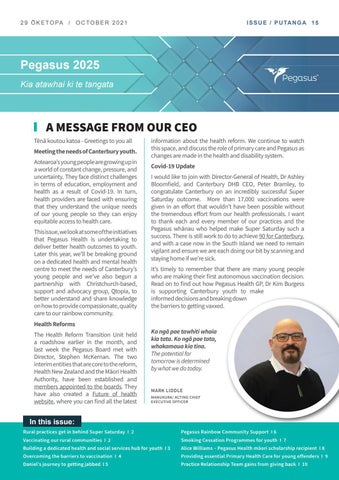
Ko ngā pae tawhiti whaia kia tata. Ko ngā pae tata, whakamaua kia tina. The potential for tomorrow is determined by what we do today. MARK LIDDLE MANUKURA/ ACTING CHIEF EXECUTIVE OFFICER
In this issue: Rural practices get in behind Super Saturday I 2
Pegasus Rainbow Community Support I 6
Vaccinating our rural communities I 2
Smoking Cessation Programmes for youth I 7
Building a dedicated health and social services hub for youth I 3
Alice Williams – Pegasus Health māori scholarship recipient I 8
Overcoming the barriers to vaccination I 4
Providing essential Primary Health Care for young offenders I 9
Daniel’s journey to getting jabbed I 5
Practice Relationship Team gains from giving back I 10
PEGASUS 2025 P U TA N G A / I S S U E 1 5
2 | 2 9 Ō K E T O PA OCTOBER 2021
RURAL PRACTICES GET IN BEHIND SUPER SATURDAY Home-baking, sausage sizzles, music, transport, and all-day ‘walk-in-clinics’ were some of the ways rural Canterbury practices helped boost vaccination rates on ‘Super Saturday’. Leeston Medical Centre lead vaccinator, Helen Rawstron, said they vaccinated as many patients (170) during Super Saturday as they normally do in a week. People who attended included farm workers, those without transport, and elderly who found it difficult to attend appointments in the city. Kaikōura Healthcare’s Health Services Manager Angela Blunt said the practice was supported by district council staff, Te Tai O Marokura, community groups and volunteers to vaccinate 171 people. “We had a sausage sizzle, coffee cart, homebaking, music, and transport available. The 100th person vaccinated on the day won a chocolate prize.’’ Methven Medical Centre owner Gayle O’Duffy said they advertised a ‘Super Saturday’ clinic on social media and in the newspaper and were thrilled to administer 335 doses that day, including to people who had delayed getting the vaccine because they were in ill health but “realised they would be far worse off if they got COVID”. Tony Dann, Business Manager at Ashburton’s Eastfield Health, said they were ‘positively over-whelmed’ by the response to their clinic held at a vacant central city store. They vaccinated 414 people that day, including a number of families and younger people. Oxford Health Business Manager Richelle Jorgensen said widespread publicity around the day encouraged 101 people to get vaccinated. Many were elderly accompanied by younger family members because the clinic was local and on the weekend. Watch the video
Leeston local David Robertson gets his vaccination from Helen Rawstron
VACCINATING OUR RURAL COMMUNITIES Rural practices have been putting in the hard work for months to support and encourage locals to get vaccinated. A recent University of Otago study found rates of Covid-19 vaccination in rural areas were more than 10 per cent less than their urban counterparts. Methven Medical Centre owner Gayle O’Duffy said Super Saturday was a continuation of previous ‘assertive’ efforts to get patients vaccinated. “We gently enquire about people’s vaccination status during all consultations and contacted patients as their age group became eligible.” Oxford Health Business Manager Richelle Jorgensen said she was proud of the practice’s team who had vaccinated more than 3000 locals since mid-August through hard work and diligence. Business Manager at Ashburton’s Eastfield Health, Tony Dann, said they opened a large vaccination clinic at the local race course in August to allow ample opportunity and easy access for people wanting to get vaccinated.
PEGASUS 2025
3 | 2 9 Ō K E T O PA
P U TA N G A / I S S U E 1 5
OCTOBER 2021
BUILDING A DEDICATED HEALTH AND SOCIAL SERVICES HUB FOR YOUTH A dedicated youth hub where Pegasus Health practices can refer young people for specialist health and mental health services is a step closer to completion, with construction work on the site scheduled to begin later this year. The first phase of the facility – a health and mental health centre and accommodation for young people - is expected to be complete by the end of 2023. The second phase will involve youth apartments or a creative centre. Dame Sue Bagshaw, Youth Hub Trust chairperson, says the group has just signed the contract for the $10 million funded through the Government’s ‘shovel-ready’ projects. This follows council approval last year for the 4250 square metre youth hub that will offer healthcare, mental health support, training, recreation and employment services to young people aged between 10 and 25.
Dame Sue says she hopes primary care practices will benefit from the opening of the Youth Hub by providing a specialist onesto p - yo u th - h u b where they can refer their young enrolled patients. The Youth Hub will be an extension of services currently provided by the 298 Youth Health Centre, now based at Churchill Street in Christchurch city. ‘298’ currently provides a range of services including medical care for people in youth justice facilities, and support for gender diverse patients. Pegasus practices are able to refer patients now to the 298 Youth Health Centre who they feel would benefit from care from specialist professionals.
PEGASUS 2025
4 | 2 9 Ō K E T O PA
P U TA N G A / I S S U E 1 5
OCTOBER 2021
OVERCOMING THE BARRIERS TO VACCINATION FOR THE YOUNG PEOPLE OF CANTERBURY Online opportunities for young people to ask questions about the COVID vaccine, conveniently-timed drop-in and drivethrough clinics, and collaborations with youth groups are some of the ways a team led by a Pegasus Health GP are working to raise vaccination rates among Canterbury youth. Pegasus Health is hosting and supporting the primary care part of the Canterburywide vaccination programme. Its aim is to better educate young people about the COVID-19 vaccine and make it easier for them to get vaccinated. Long-time Pegasus Health GP, Dr Kim Burgess, is the clinical lead for the primary care vaccination programme. She says those aged under 30 have only been offered the opportunity to get vaccinated since the beginning of September. In that time an ‘impressive’ roughly 60 per cent of that group in Canterbury have either been vaccinated or booked in to do so. To further support those efforts, the Canterbury vaccination programme team researched the barriers for young people and set about addressing them.
The main barriers identified are: • time and the opportunity to get vaccinated; • transport; • the cost of time off work, and travel to get vaccinated; • difficulty navigating the health system to find and book a vaccination; • a sense that COVID was not a big threat to young people; • a lack of urgency to get vaccinated; • hesitancy or anxiety about the vaccine, its side-effects or needles; • and worry caused by anti-vaccination messages. Kim says the vaccination programme team has offered factual information through webinars in partnership with youth groups such as the Christchurch Youth Council and Canterbury Youth Workers Collective. They are also arranging more drop-in and drive-through clinics - making it more convenient for young people to get a vaccination. They will also text enrolled patients under the age of 35. Clinics will be set up at Canterbury tertiary educators, some schools, community centres and rugby clubs. Tailored clinics are also being made available for groups such as the deaf community, Māori and Pasifika youth, and those with the need for a lowsensory environment.
The main barriers are time and the opportunity to get vaccinated and transport.
Dr Kim Burgess
PEGASUS 2025
5 | 2 9 Ō K E T O PA
P U TA N G A / I S S U E 1 5
OCTOBER 2021
DANIEL’S JOURNEY TO GETTING
Seeing friends and family get vaccinated and remain safe and asking experts about the vaccination process in online webinars helped 17-year-old Daniel McNeill feel confident to get ‘the jab’. Daniel had reservations about getting the COVID-19 vaccine. He wanted to wait until there was more evidence about any possible long-term effects. He is also afraid of needles. “I thought, ‘I’m going to hold off and see if there are negative consequences of having the vaccine’. There is a lot of that feeling in my family too. But when I saw friends and family were getting the vaccine and were completely fine, that helped me make the decision to get the jab. It’s obviously not as bad as some people are making out,’’ he said. “Once I felt more confident about the safety of the vaccine I did some research and went on to the Ministry of Health website and attended a
webinar with the Christchurch Youth Council where we got the chance to ask questions from an expert. I was really reassured when [the expert] said that the people at the vaccination clinics don’t rush you and are really supportive. Because I am not great with needles, that made me feel much better.” At the end of September Daniel got his first vaccination at a drop-in clinic at South City Mall. “I hadn’t had a vaccine for a long time, and I was very nervous, but everyone at the clinic was very supportive and explained everything to me and I felt very safe and informed. I’ve booked to get my second one and am glad that I will be protected. You hear about people losing their sense of taste or having bad flu symptoms and I now know the vaccine impacts how sick you get.”
...I did some research and went on to the Ministry of Health website and attended a webinar with the Christchurch Youth Council where we got the chance to ask questions from an expert. Daniel representing Bulgaria at a mock United Nations event
PEGASUS 2025
6 | 2 9 Ō K E T O PA
P U TA N G A / I S S U E 1 5
OCTOBER 2021
PEGASUS RAINBOW COMMUNITY SUPPORT Pegasus Health is aiming to improve access to health care and address health inequities experienced by the rainbow community by partnering with Qtopia, an Ōtautahi-based group providing support to rainbow young people. Jennifer Shields is spearheading the partnership in the newly established role of Rainbow People Health and Wellbeing Advisor which sees her seconded to Pegasus one day a week and based with the Equity leadership team. “In general, across all ages the rainbow community experience poor access and health inequities,” says Ester Vallero, CALD Health Manager. “That’s why we’re doing this, because Pegasus understands that things need to change and the way to change it is to create the space for people to tell us how to do it better.” Estimates are that up to 10% of the New Zealand population identifies as being a
member of the rainbow community, or LGBTQIA+ (lesbian, gay, bisexual, transgender, queer, intersex, and asexual). Jennifer came out as a trans woman at the age of 17; now aged 26 she has spent the past 10 years advocating for the rainbow community particularly within the health system and brings the value of her lived experience to the role. The aim of the role is to help Pegasus provide better support for the rainbow community by supporting the organisation internally as well as its’ GP practices and services, however Jennifer says a significant piece of her work is data collection. “I am trying to get a clear picture of how the rainbow community access health care, what services they access, how many referrals there are and how many procedures are carried out, because we currently don’t have that information and it’s important we have a baseline.” The partnership with Qtopia is a one-year trial and in that time Jennifer wants to access as many Pegasus services as possible to offer the diversity and inclusion training that Qtopia specialises in and that she describes as the “golden ticket” to helping people understand and breakdown the barriers that the rainbow community experience. “I want to move as much competence and confidence into primary health care as possible. The dream is that any rainbow person can go to their regular GP or family doctor and receive really competent and responsive care.”
PEGASUS 2025
7 | 2 9 Ō K E T O PA
P U TA N G A / I S S U E 1 5
OCTOBER 2021
SMOKING CESSATION PROGRAMMES FOR YOUTH Jo Butler is a Quit Coach employed by Pegasus Health as part of the Te HāWaitaha Smokefree Support programme. She explains what she and her colleagues are doing to support Canterbury’s young people to stop smoking. What are rates of smoking among youth? Today most youth in New Zealand are smokefree with 3% of 15-17 year-olds currently smoking – down from 14% in 2006/07 (Source: Smokefree.org.nz). Why is it important we help this group? They are the future of New Zealand and if we don’t educate them properly, New Zealand won’t be smokefree by 2025. In my view, cigarettes shouldn’t be available to young people. But, as they are we need to provide them with age-appropriate information to help them make better, healthier decisions. They think differently than adults and have different priorities so need to be supported and educated in a different way. How do young people get help? Myself and the other Quit Coaches take referrals from general practices who have young patients who need help with smoking cessation. We then provide evidence-based, tailored support programmes to either individuals or groups, depending on what will work best. We run programmes for group in schools and with young mothers.
How do targeted programmes for youth work? The way support is offered to schools is tailored to their needs. Some prefer one-on-one support for students, while in other schools a very small group approach works. During sessions we find focusing on the near future is important as young people often don’t or can’t think about the future implications of smoking but can about something this week, like how it might affect their performance in an upcoming sports game. Our programme for young mothers is done in a larger group as they support each other and have much in common. This group is not limited to those who are smoking but welcomes those who have a partner or family member who smokes so they can learn ways to address this and minimise harm to themselves and their pepi. To connect a young patient with the Te Hā-Waitaha Quit Coaches, refer via ERMS.
3%
of 15-17 year-olds currently smoking
14%
of 15-17 year-olds were smoking in 2006/2007
PEGASUS 2025 P U TA N G A / I S S U E 1 5
ALICE WILLIAMS – PEGASUS HEALTH MĀORI SCHOLARSHIP RECIPIENT
It was while Alice Williams was working as a part-time support worker for Nurse Maude in the Tasman District that she had what she calls “the light bulb moment” that began her nursing studies.
8 | 2 9 Ō K E T O PA OCTOBER 2021
Pasifika and Culturally and Linguistically Diverse students. “There are so many people benefitting from the work they do and the ongoing support they offer through bilingual providers, interpreters and cultural competency training. The education opportunities they offer for health care providers and workers is awesome.” Alice says she is yet to specialise in her own career path – “I’m sure my area of specialty will change as I broaden my skill set” – but she is very excited about an upcoming placement in a palliative care facility at a hospice.
Alice (Te Ātiawa, Ngāti Maru), was no stranger to university study at that point. Before she began her current double degree at Ara in Christchurch – a Bachelor of Nursing and a Master of Health Sciences Professional Practice – she had completed a degree in psychology and education at Victoria University in Wellington, graduating in 2013.
“That’s definitely an area I want to learn a lot more about and although I’m keen to work in as many areas of nursing as possible to develop a diverse set of skills, I may well end up in palliative care long term,” she says.
Now, as a recent recipient of the Pegasus Health Māori Workforce Development Scholarship, Alice is two years into her double nursing degree and she looks forward to becoming a registered nurse by the end of this year.
Alice is also passionate about research and throughout her studies, she has undertaken a number of projects including research into the psychological effects of the Christchurch earthquakes on youth with Christchurch’s Collaborative Trust; the social determinants and factors contributing to why young Māori women smoke; and research on the Meihana model, which is based on the Māori health framework Te Whare Tapa Whā, a clinical history-taking model that supports health practitioners to gain a broader understanding of Māori patients’ presentations.
She also knows she’s now on the right path. “I was inspired by two of my aunts who are nurses, and two of my close friends. I always wanted to help people in a practical caring job and when I saw what they did to help others, the idea of nursing hit me like a lightning bolt.” Alice says winning the Pegasus scholarship has made an enormous difference to her life as an adult student. “Doing a double degree means I need double the resources and the scholarship support means I’ve been able to buy my textbooks and keep them as ongoing reference, and I’ve been able to buy some more basic nursing equipment. The money has also helped with my fees, for which I am so grateful,” she says. Alice says winning the scholarship has also opened windows of opportunity for her. She’s been able to meet some key Pegasus Health people involved in recruiting new nursing staff, which she sees as an invaluable step toward building vital networks. “The scholarship presentation event also opened my eyes to the incredible level of support that Pegasus Health offers to Māori,
“It’s such a special area of nursing and looking after our elders is key. That’s something I’m very passionate about. I also plan to embark on the Nurse Practitioner pathway of study in the future.”
“I’m passionate about research and I hope to do further work in some of these areas. There is so much to learn and I’m keen to learn anything that can shed a light on Māori health. “That’s something else that Pegasus Health does incredibly well – they’re keen to grow the number of Māori in the health sector and that makes total sense to me. The inequities in health outcomes between Māori and Pākehā are not acceptable and they’ve gone for far too long. More Māori working with Māori is the change we need.”
PEGASUS 2025
9 | 2 9 Ō K E T O PA
P U TA N G A / I S S U E 1 5
OCTOBER 2021
PROVIDING ESSENTIAL PRIMARY HEALTH CARE FOR YOUNG OFFENDERS The Pegasus Health nursing team, based at Te Puna Wai Tuhinapo Youth Justice Residence, is helping to transform the health and lives of young people who are ordered by the courts to stay at the facility. Te Puna Wai is a 40-bed, secure facility near Rolleston that caters for young offenders from age 13 years to 20 years – the majority are male but at times females are required to stay there. The Residential Youth Health Service at Te Puna Wai is staffed by five registered nurses led by Moyra (last name withheld for security reasons) who is the Clinical Lead. “A lot of these kids are from gang backgrounds, there’s alcohol and drug abuse, neglect, poverty, parents with poor mental health, parents in prison and poor health education,” says Moyra. “When a young person comes in, regardless of their length of stay, we offer as much health care to them as we can, we see it as a real window of opportunity. A lot of these kids have never had basic hearing, vision or dental care, so we try and cram as much care into them as we can possibly can.” Te Puna Wai is one of five youth justice facilities in the country. It is the only one
in Te Waipounamu (South Island) and the only one with an independent primary health care team providing nursing services. It receives young people from all over the country, with 7080% being of Māori and Pasifika descent. They can stay for periods as short as one night and up to three years depending on the type of offending. Some transfer to a Corrections facility when they turn 18 years old. “Sadly, for some of the young people this is the best time of their lives – they blossom, they get regular meals, they are safe at night, and they receive excellent health care. We have a doctor’s clinic here twice a week run by a GP from 298 Youth Health, a physio clinic once a fortnight, ear suction clinics once every six months; lots of things they wouldn’t seek help for in the community. “Up to 70% of the young people we see aren’t registered with a GP. Sometimes the most equitable health outcomes and interventions for primary health care can happen once they reach prison because there are less barriers to access,” says Moyra. “Education is also a big part of what we do. We don’t like what they have done, but we really enjoy them and we feel passionate about doing the best we can for these kids, because they’ve missed out on so much.”
(From left) Reuben (student nurse) and members of the Residential Youth Health Service team at Te Puna Wai Tuhinapo Youth Justice Residence, Sarah (Registered Nurse), Moyra (Clinical Lead) and Leanne (Registered Nurse). Karen and Rebekah (absent).
PEGASUS 2025
10 | 2 9 Ō K E T O PA
P U TA N G A / I S S U E 1 5
OCTOBER 2021
PRACTICE RELATIONSHIP TEAM GAINS FROM GIVING BACK The newly-formed Practice Relationship Team chose to spend their recent team building day ‘giving back’. They spent the day planting native trees at Ōruapaeroa/Travis Wetlands. The wetlands are home to many native wetland plants and birds, it also has a 4km loop walking track with boardwalks, viewing platforms and an information centre.
“It was nice to do something for the community. Plus, while we were planting we could relax and were able to chat and get to know each other better as people rather than colleagues in an office.”
Practice Relationship Manager Donna Gardiner said the team came together about six months ago and ‘wanted to do something out of the office to bond’. “We looked at things like an escape room or a dinner but decided we wanted to do something that gave back and was meaningful.”
•
The Practice Relationship Team • Formed in 2021. Consists of a team leader, four practice relationship managers and a service coordinator. Promotes and fosters partnership between Pegasus Health and general practices by guiding, supporting, and assisting with business models of care and process manager expertise.
• Each practice is assigned a relationship manager as their first point of contact.
“It was nice to do something for the community.” (From left) Chenoa Walker, Lovey Ratima-Rapson, Mark Henare, Karen O’Malley, Donna Gardiner on their team building day volunteering at the Travis Wetland Craig Watson (absent).
Pegasus Health 2025 is produced by the Communications Team at Pegasus Health (Charitable) Ltd. Content within Pegasus Health 2025 newsletters has been included with the approval of content providers therefore please contact us if you wish to reproduce or alter and transmit any of the information or images contained within. Contact communication@pegasus.org.nz