I S S U E / P U TA N G A 1 0
2 5 M AY / H A R AT U A 2 0 2 1
Pegasus 2025 Kia atawhai ki te tangata
A MESSAGE FROM THE CEO Kia ora koutou REVIEW ANNOUNCEMENT
It was great to attend the Health and Disability review announcement in Wellington last month. Many groups involved in health, from primary and secondary health to nongovernment organisations, attended the announcement and flow-on meetings. The big focus was on establishing Health NZ and the Māori Health Authority. You can read more about Pegasus Health’s ‘take’ on the review later in this newsletter. BIG WEEK FOR EVENTS
Last week was a big week for events and celebrations at Pegasus. We hosted the Chairs and CEOs of the N4 (Pro Care, Pinnacle, Tū Ora Compass and ourselves) at Pegasus House, followed by the General Practice NZ (GPNZ) face to face forum. Both meetings addressed the challenges and opportunities presented by upcoming structural changes to the health and disability system.
In this issue:
GPNZ attendees were presented with a Pegasus 2021 snapshot document detailing the work Pegaus is currently doing in the primary healthcare space. You can view the document online. We also marked International Nurses’ Day on 12 May and World Family Doctor Day on 19 May. You can check out our acknowledgement to nurses on our facebook page. Last Tuesday night we celebrated our Pegasus Workforce Development Scholarships, which award health students from Māori, Pasifika and Culturally and Linguistically Diverse (CALD) communities with a financial scholarship to support them in their studies. I've been attending these annual ceremonies for a number of years and they are always a very special event where students from many different backgrounds share their personal experiences and journey in studying towards a health qualification. You’ll find a story about the scholarships in this newsletter and we’ll continue to feature individual stories in Pegasus 2025 newsletter future editions. I te manaakitanga
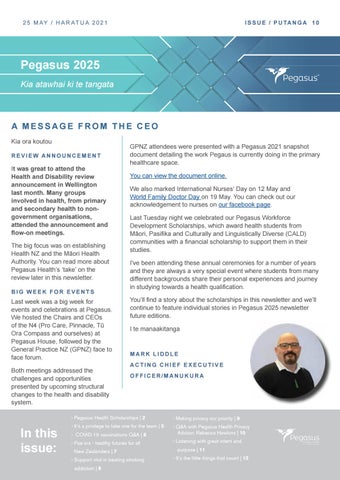
MARK LIDDLE ACTING CHIEF EXECUTIVE OFFICER/MANUKURA
› Pegasus Health Scholarships | 2
› Making privacy our priority | 9
› It’s a privilege to take one for the team | 5 › COVID-19 vaccinations Q&A | 6
› Q&A with Pegasus Health Privacy Advisor, Rebecca Hawkins | 10
› Pae ora - healthy futures for all
› Listening with great intent and
New Zealanders | 7
Support vital in beating smoking 2 5 M A Y / H A R A T U A› 2 021 addiction | 8
purpose | 11 › It’s the little things that count | 12
1 |
PEGASUS 2025 I S S U E / P U TA N G A 1 0
P E G A S U S H E A LT H S C H O L A R S H I P A W A R D S - H A R D W O R K , B U T S O R E WA R D I N G ! The annual Pegasus Health Scholarship Awards proved to be another powerful and emotional evening celebrating the diversity and successes of our 16 recipients. Samuel Equbazgi was an experienced journalist working for the Government’s Ministry of Information in his East African homeland of Eritrea before he was forced to flee. He says he felt unsafe and insecure, he was oppressed and having a Government job meant he was vulnerable. In 2019, he was sent to New Zealand as a refugee, and today he is in his second year of a Bachelor of Social Work degree with Honours. “I know what it’s like to be oppressed, to have no freedom to speak and to see friends CALD Health Advisory Deputy Chair Vibhuti Patel with scholarship recipient Samuel Equbazgi and CALD Health Advisory Group Chair Sade Iposu. imprisoned. I couldn’t be the person I wanted to be in my own country. In New Zealand, I have only found love and friendship. I want to be a social worker to support people and change their lives for good.” Samuel was among the 16 scholarship recipients overall this year and one of five from the Culturally and Linguistically Diverse (CALD) group. In accepting his award, he began by apologising for not being a confident public speaker, then went on to mesmerize the 150 friends and whānau gathered at Tūranga as he recounted his journey of emancipation. “The scholarship is an acknowledgement of hard work; it gives me motivation. My journey has been tough, but I am one lucky person,” he says. The evening was opened with karakia from Sally Pitama (Ngāi Tahu, Ngāti Toa) on behalf of tangata whenua. Pegasus Health board member Jane Huria (Ngāi Tahu) followed by welcoming everyone to the awards celebration. The first of two guest speakers was Fuimaono Karl Pulotu-Endemann, Samoan-born academic, nurse and staunch advocate for Pasifika health equity. He told the audience there are huge disparities in health that need to be addressed before wellbeing can be achieved for Pasifika people, and warned scholarship recipients that the way ahead will be difficult. “Nursing, medicine, social work in the context of your own cultural group - it is hard work. It is hard, but it is so rewarding and one of the greatest gifts you can ever have,” he said. Hineari Kahu (Ngāi Tahu, Ngāpuhi, Ngāti Tūwharetoa, Ngāti Whakaue) a fifth year Bachelor of Medicine student from Kaikōura is resolute in her plans to return and work in her community as a doctor. Receiving 2 5 M AY / H A R AT U A 2 0 2 1
2 |
PEGASUS 2025 I S S U E / P U TA N G A 1 0
her scholarship, she acknowledged the legacy of her tāua (grandmother) Miriama Kahu, who in the 1990s founded the town’s first and only Māori health provider, Te Tai o Marokura Whānau Health and Social Services. “I decided to be a doctor when I was 6 years old, and ever since I have been encouraged, inspired and nurtured by my whānau to fulfil that vision. I will specialise in general practice and rural medicine to return to Kaikōura as the first ever Māori GP. I am proud to add to my taua’s legacy by providing a ‘by Māori, for Māori’ service through Te Tai O Marokura. “This scholarship not only brings financial relief, but it further supports that dream,” she says. Guest speaker Suli Tuitaupe, a former Pasifika scholarship recipient, spoke of the work he and his clinical and health promotion teams are doing at Tangata Atumotu Trust, the Pasifika community health and social service provider. Two days a week he also works as a Practice Nurse at Eastcare Health.
Guest speaker Suli Tuitaupe spoke of his work within the Pasifika community.
He congratulated the recipients on their success and encouraged them to be proud of their identity, ethnicity and culture. “This is just the beginning of your journey, do the hard yards now and you will reap the rewards. Stay in the journey together, be the change agent, never give up the crusade of improving health outcomes and ultimately achieving health equity for all New Zealanders.” Leon Haiu spent many years as a youth worker supporting rangatahi within residential homes, he held different community worker roles and worked as a Corrections Officer for two years; and never dreamed of being a nurse. However, the experience of losing his brother to cancer and the opportunity to work within Auckland and Middlemore Hospitals’ acute inpatient mental health services opened his eyes to the opportunities nursing could offer. “It was there I got to meet firsthand all these Māori and Pasifika nurses – and there were heaps of males – that really encouraged me.” Leon was born in New Zealand, but comes from the tiny Pacific island of Uvea. He is in his second year of a Bachelor of Nursing at Ara Institute and wants to be a mental health nurse. “There’s huge need everywhere particularly in primary health and our Pasifika communities,” he says. Pegasus Health, Acting Chief Executive Officer, Mark Liddle closed the evening and noted that over the 10 years he has attended the awards he has met so many deserving recipients, and it is an honour and a privilege for Pegasus to continue to support diversity in primary health and this year’s recipients on their health career journeys. 2 5 M AY / H A R AT U A 2 0 2 1
3 |
PEGASUS 2025 I S S U E / P U TA N G A 1 0
C O N G R AT U L AT I O N S T O A L L O U R 2 0 2 1 P E G A S U S H E A LT H WORKFORCE DEVELOPMENT SCHOLARSHIP RECEPIENTS MĀORI RECIPIENTS
Emily Tagicakibau, Fijian, Tongan
Hineari Kahu, Ngāi Tahu, Ngāpuhi, Ngāti Tūwharetoa
3rd year Bachelor of Social Work
5th year Bachelor of Medicine
C U LT U R A L LY A N D L I N G U I S T I C A L LY
Jasmyn Williams, Ngāi Tahu, Ngāti Tūwharetoa, Uenuku
Arshi Nadeem, Indian
4th year Bachelor of Medicine
DIVERSE (CALD) RECIPIENTS
2nd year Master of Nursing Science Lobna Farouk Sidrak Falestine, Egyptian
Kaimana Gallop, Te Rarawa, Ngāpuhi
1st year Master of Nursing Science
3rd year Bachelor of Nursing
Sia Seol Young Woen, Korean New Zealander
Iwitea Ataria-Ivannikova,
3rd year Bachelor of Nursing
Rongomaiwahine, Ngāti Kahungunu, Ngāti Tūwharetoa
Felisha Joy Thain, Somali New Zealander 1st year Postgraduate Diploma in Clinical Psychology
2nd year Bachelor of Nursing Alice Williams, Te Ātiawa, Ngāti Maru
Samuel Hidray Equbazgi, Eritrean/ African
2nd year Bachelor of Nursing Setu Te Hae, Waikato- Tainui, Hauraki, Samoan
2nd year Bachelor of Social Work with Honours
2nd year Bachelor of Nursing PA S I F I K A R E C I P I E N T S
Akerita Alatimu, Samoan 2nd year Bachelor of Nursing Master of Health Sciences Professional Practice Leon Haiu, Uvean 2nd year Bachelor of Nursing Simione Tagicakibau, Fijian 2nd year Bachelor of Nursing Maca Vuniwaqa, Fijian
Māori scholarship recipients (from left) Alice Williams, Setu Te Hae, Iwitea Ataria-Ivannikova and Kaimana Gallop. Absent: Jasmyn Williams.
3rd year Bachelor of Social Work
2 5 M AY / H A R AT U A 2 0 2 1
4 |
PEGASUS 2025 I S S U E / P U TA N G A 1 0
I T ’ S A P R I V I L E G E T O TA K E O N E F O R T H E T E A M Frontline health staff are now getting vaccinated against COVID-19 to protect themselves, their whānau and their patients. Mass vaccination centres have been set up in Christchurch by the Canterbury District Health Board, supported by additional primary care designated clinics, which are being established in Christchurch and across rural areas of Canterbury. Pegasus Primary Mental Health Clinician Ruth Surtees has just had her second COVID-19 vaccination. Her motivation is to protect mental health clients she comes into contact with, and whānau who are immune comprised. “This is all about keeping other people safe,” says Ruth. “We know our clients are vulnerable and although we, as health professionals, feel we are strong, we have a duty of care for others,” says Ruth.
Ruth Surtees was motivated to keep other people safe when she received her COVID-19 vaccinations.
You can find more information about the vaccination rollout, including frequently asked questions, resources, and links through to sites at the local vaccination website: vaccinatecanterburywestcoast.nz. Significant work is also being undertaken to provide access for our Māori and Pasifika communities, as well as culturally and linguistically diverse populations, disability groups and people living in residential care.
2 5 M AY / H A R AT U A 2 0 2 1
5 |
PEGASUS 2025 I S S U E / P U TA N G A 1 0
Q&A WITH CANTERBURY PRIMARY RESPONSE GROUP EMERGENCY RESPONSE MANAGER, MARTIN CARRELL What are the designated groups for receiving the COVID-19 vaccination and when will they receive the vaccination? The Ministry of Health has developed a vaccine rollout plan aimed at protecting Aotearoa. Everyone in the country falls into one of four groups. The priority is to vaccinate those most at risk, such as border workers and Managed Isolation and Quarantine (MIQ) staff and their household contacts. This will be followed by frontline healthcare workers and others most at risk of getting seriously ill. Pegasus Health primary care staff have been invited to receive their vaccination as part of this strategy. As Canterbury has an international airport, a major port, MIQ facilities and a large healthcare workforce, we’re still vaccinating Groups 1 and 2 and will continue doing so for the next couple of months. We’ll then move on to vaccinate Group 3 (public who are at risk of getting very ill from COVID-19), then Group 4 covering the general population. You can find out about the rollout timeline for Canterbury on the COVID-19 website. Are we meeting Canterbury vaccination targets? We’re progressing well against our target, with 31,355 doses delivered as at 9 May to people in Canterbury since the start of the rollout. In order to vaccinate even 70% of the Canterbury population against COVID-19, we need to provide close to 320,000 vaccinations, twice. To reach this level of vaccination we need to vaccinate up to 35,000 people weekly from July. This is on top of annual flu vaccinations and other scheduled vaccinations such as Measles, Mumps and Rubella (MMR). This will require significant collaborative effort across the Canterbury health system but is achievable.
2 5 M AY / H A R AT U A 2 0 2 1
What are the biggest challenges? The process of setting up vaccination clinics is very complex. The processes and systems we’re working on together are becoming more streamlined. We’re aware that there have been difficulties making bookings via the call centre, including longer wait times. The local call centre has limited capacity, but it is available 24/7. A tip for those who don’t have time to wait on hold – call in the afternoons or evenings, as the morning is the call centre’s busiest time. A national booking system is in the last stages of testing and we anticipate it will be available to pilot at some rural designated clinics in the coming weeks. There are also physical challenges. Each vaccine journey starts in a freezer in Auckland. We have 120 hours to get it via the pharmacy fridge in Christchurch Hospital and then out to vaccine facilities. Once diluted (there are six doses per vial) we have six hours to use it. Will anyone miss out on the vaccine? No. There is a commitment that everyone in New Zealand over the age of 16 has the opportunity to be vaccinated. This will take time, but the good news is that as there is no general community spread of the virus in New Zealand, we can (at the moment) afford to take the time to get this right.
6 |
PEGASUS 2025 I S S U E / P U TA N G A 1 0
PA E O R A - H E A LT H Y F U T U R E S F O R A L L NEW ZEALANDERS On 21 April, the Government announced a new health system in response to the Health and Disability Review, which looked at different vehicles to deliver what is needed by our health system. The Review found that the country’s health system is supported by a dedicated workforce, but has become overly complex and fragmented and could provide more equitable and better care. The first phase of the announced reforms are major structural changes that refocus the Ministry of Health’s role on stewardship, strategy and policy; the formation of Health NZ which will be responsible for the day to day running of our health system (replacing the district health boards) and the formation of the Māori Health Authority, which will bring a strong focus on health outcomes and care for Māori. The Government’s vision is to build a system which achieves pae ora - healthy futures for all New Zealanders. To achieve pae ora, the system must focus on delivering: •
Equity – tackling the gap in access and outcomes among all New Zealanders especially Māori, Pasifika and mental health consumers.
•
Partnership – including co-design in how healthcare is designed and delivered.
•
Sustainability – preventing and reducing health need rather than just addressing illness.
• Person and whānau-centred care – empowering everyone to manage their own health and wellbeing. •
Excellence – high quality care, pinnacle leadership, innovation and new technologies.
Pegasus Health Acting CEO Mark Liddle says one of the key elements of this change is a more consistent approach to the services available to communities, addressing the current issue of ‘postcode medicine’. Primary health and community services are also set to be strengthened to better serve communities through the development of locality-based provider networks that will enable health and social care providers to work together towards shared goals. “Success for the Government looks very much like what the Canterbury health system has been working towards in Canterbury over the last 10 years. This vision strongly aligns with Pegasus’ role and purpose that all people in Canterbury lead healthy lives, and together making Canterbury the best place to receive primary health care. “We believe that, for most people, their general practice is the place they’ll receive care most of the time. We recognise that general practice cannot do it all but has a lead role in supporting patients’ access to the health and social services they need. “Our role is to work across the health system so people are in control of their own health and can readily navigate access to the services they need,” says Mark.
2 5 M AY / H A R AT U A 2 0 2 1
7 |
PEGASUS 2025 I S S U E / P U TA N G A 1 0
S U P P O R T V I TA L I N B E AT I N G S M O K I N G A D D I C T I O N Ben started smoking cigarettes at age 12. Over the years, the now 40-year-old developed, and eventually fought, addiction to various substances. He’s been drug-free for more than five years. But nicotine was an addiction he struggled to overcome. In early 2021, Ben sought help from Te Hā – Waitaha, a smokefree support service to stop smoking, and was connected with Pegasus Health Quit Coach Josh Grenfell. “The cigarettes were the crutch I couldn’t drop,’’ says Ben. “I tried by will, and using patches, with no luck. I realised I needed support to quit that final addiction.” At the beginning of 2021, Ben was smoking at least 25 cigarettes a day. Since getting the help of Josh about three months ago he has quit entirely. “At first, to get on top of smoking I took two weeks off work. There are people there who smoke and it was a huge temptation. With support from Josh, we formed a plan. I put on the highest strength of nicotine patch and had support and regular home visits from Josh. This included cutting down the cigarettes day-by-day; using a device that monitors the toxins in my body; and keeping a diary of how I was feeling and what triggered me. I’ve also started walking at the times people in my workplace are smoking so I’m not tempted.” Ben says the Te Hā - Waitaha service is “awesome”. Having Josh coming to his home really helped as well as having to breathe into a device that shows if he’s been smoking. “It keeps me honest,” he says. The next step on Ben’s journey is to cut out nicotine patches altogether. Josh says he’s really honoured to be in a job where he can help people like Ben quit smoking. He is one of a number of Te Hā - Waitaha Quit Coaches. Quit Coaches are based at a range of organisation such as Pegasus Health, and Community and Public Health. Te Hā - Waitaha recently rebranded, with posters of some Quit Coaches and clients they have helped in their smoke free journey now appearing in the primary care environment and community. The service remains the same. Maraea Peawini, Smokefree Manager and Programme Lead for Te Hā - Waitaha Smokefree Support, says the rebranding enables the service to express who and what it is about. “We are about caring for individuals and their whānau on this journey. We are about our people, about our communities and beating this addiction.” Ben (right) now walks instead of smoking during his work breaks.
2 5 M AY / H A R AT U A 2 0 2 1
8 |
PEGASUS 2025 I S S U E / P U TA N G A 1 0
M A K I N G P R I VA C Y O U R P R I O R I T Y New Zealand’s annual Privacy Week, promoted by the Office of the Privacy Commissioner to raise privacy awareness, was held from 10 May, with the theme being: “Make privacy a priority.” Of particular importance this year is the acknowledgement that the Privacy Act and Health Information Privacy Code were updated in December 2020. Pegasus has been working with practice policies and processes to make sure they are up to date, and in line with the recent legislation changes. Pegasus Privacy Advisor, Rebecca Hawkins says Privacy Week provides a good opportunity to spotlight our Health Information Privacy Code Rules, Privacy Act Principles and privacy best practice as it affects our staff and our community. “At Pegasus Health, staff and practices are kaitiaki (stewards) of personal information, where privacy is everyone’s responsibility, to ensure patients’ rights are respected and their care is enhanced,” says Rebecca. “Our strong privacy culture and privacy programme mean we already make privacy a priority every day. However revision of the Act and Code is a good chance for everyone who uses health information to refresh and reset policies,” says Rebecca. The main point of the changes has been to modernise the rights and provisions of privacy in light of new technology and the global superhighway of information flow. “The fundamental day to day rules of patient information management haven’t changed. However, what we do have is an easier process to follow if a breach were to occur. There are also financial penalties to highlight the importance of following the rules,” says Rebecca.
Pegasus Health Privacy Advisor Rebecca Hawkins sees the Act and Code update as a great chance to refresh and reset privacy policies.
2 5 M AY / H A R AT U A 2 0 2 1
9 |
PEGASUS 2025 I S S U E / P U TA N G A 1 0
Q & A W I T H P E G A S U S H E A LT H P R I VA C Y A D V I S O R , R E B E C C A H A W K I N S
How is your health information protected? The Health Information Privacy Code controls how health information is handled. The Code has 13 rules that set out obligations for organisations to only collect the information they need, to be open with people, and to ensure their information is used and protected appropriately. If you know your rights, you can help to make sure your information is safe. What are the 13 rules? The 13 rules cover anything from what sort of information you can collect to how you collect it and what you can use it for. The Office of the Privacy Commission (OPC) has a full list of these and examples of how they work. What are the key changes? • There is now a mandatory requirement for businesses to notify the Commissioner and affected individuals of privacy breaches that have (or are likely) to cause serious harm. • The Commissioner can issue compliance notices to require a business to do (or stop doing) something to comply with the Act. The Commissioner can also direct an organisation to provide information when it has been requested by an individual (known as an access determination). • Businesses cannot send an individual’s information overseas, unless the overseas country has similar protections, or the individual is informed and consents to the disclosure. • There are new criminal offences, including misleading an organisation to access someone’s personal information, and for a business to destroy personal information, knowing that a person has requested access to it. The penalty for these offences is a fine of up to $10,000. For more information please visit the OPC website PEGASUS 2021 - A SNAPSHOT
We’ve recently created a snapshot document detailing the work the Pegasus Health does in the Primary Health Care space. You can view the document online.
2 5 M AY / H A R AT U A 2 0 2 1
10 |
PEGASUS 2025 I S S U E / P U TA N G A 1 0
L I S T E N I N G W I T H G R E AT I N T E N T AND PURPOSE Homecare Medical has a new name Whakarongorau Aotearoa. The English version of the name is New Zealand Telehealth Services. There is no change to the service brands. Chief Executive, Andrew Slater says they began the review into their organisational name in 2018. “We wanted to find a name that better described the work we do. Over that time we de-prioritised this work as we have focused on service delivery, and most recently on supporting the Government’s COVID-19 response,” says Andrew. We asked contemporary Māori artist Wayne Youle to look at an icon to describe and represent our purpose and our mahi. He was inspired by the whakatauki ‘he reo marohirohi ka taringa rongohia’ - a brave voice deserves a sympathetic ear.”” Whakarongorau is a word to describe the many ways to listen; whakarongo (to listen), ā-rongorau (a modern word for multimedia, the many ways of communication or media). It is derived from the old Māori word whakarongorua, to listen with great intent and purpose. More information about Whakarongorau Aotearoa available here
Whakarongorau Aotearoa (Homecare Medical as it was known then) has been providing clinical support for general practices after hours for more than 20 years. Since November 2015, it has also been operating Government-funded free to the public, 24x7 national telehealth services across seven digital channels. Those services include Healthline, 1737 – Need to talk?, Quitline, the national sexual harm helpline Safe to talk, the Puāwaitanga counselling service, and the cervical and bowel national screening coordination centres. These services are co-funded by the Ministry of Health, ACC, Te Hiringa Hauora Health Promotion Agency, Ministry of Social Development, and the Department of Corrections. Events of the last 18 months have disrupted and reshaped Aotearoa and the health landscape. Whakarongorau Aotearoa have set up and operate the COVID Healthline and the COVID vaccination helpline. To date over 1 million contacts have been made to these COVID support services. The Whakarongorau Aotearoa run services are supported by nine clinical teams of registered nurses, mental health nurses, psychologists, psychotherapists, psychiatrists, counsellors, doctors, paramedics, poisons officers, health advisors, family and sexual harm professionals, and emergency triage nurses. Around 1,200 staff work from contact centres in Auckland, Kaikohe, Wellington, and Christchurch and from their homes across Aotearoa. Whakarongorau Aotearoa responded to 1.33 million contacts in the twelve months ending 30 June 2020. That is an increase of 45% on the previous year and saw the team connect with over 700,000 individual people^ (1 in 7 people in Aotearoa). Whakarongorau Aotearoa is owned by ProCare and Pegasus Health. ^The total number of individual people in the year is the sum of unique service users each month, so may include users who have contacted the service in multiple months.
2 5 M AY / H A R AT U A 2 0 2 1
11 |
PEGASUS 2025 I S S U E / P U TA N G A 1 0
I T ’ S T H E L I T T L E T H I N G S T H AT C O U N T Keen cyclist Elodie de Lapeyre visited the Pegasus 24 Hour Surgery (24HS) recently after bike accident injuries required further treatment. She said it was the thorough treatment of her wounds and kindness of staff that made her visit especially memorable. Elodie was cycling near her home when a patch of gravel led to a fall, concussion, lacerations to her face, damage to an arm and deep gashes. At home the next morning Elodie became concerned over her wounds. Her partner took her to 24HS in Madras Street, Christchurch. She was treated by Dr Brendan Kane and nurse Jaimee Hornblow. A cyclist himself, Dr Kane was able to put Elodie at ease by sharing his experiences and talking her through the evaluation of her wounds. Jaimee then thoroughly cleaned the gashes and antibiotic gel was applied. Elodie says that in addition to Jaimee’s obvious competence and reassuring bedside manner, it was a simple act of kindness by Jaimee that meant a lot. “My partner hadn’t eaten for 12 hours, had barely slept and had been sitting with me at Christchurch Hospital and 24HS throughout. Jaimee noticed this and offered him a cup of coffee. I can’t stress enough how much that small act meant for us,” says Elodie. Elodie is recovering well, in line with Dr Kane’s advice.
Elodie de Lapeyre is back to enjoying her cycling after a visit to the 24 Hour Surgery.
Pegasus Health 2025 is produced by the Communications Team at Pegasus Health (Charitable) Ltd. Content within Pegasus Health 2025 newsletters has been included with the approval of content providers therefore please contact us if you wish to reproduce or alter and transmit any of the information or images contained within. Steve Addison, Head of Brand and Communications, Pegasus Health steve.addison@pegasus.org.nz
2 5 M AY / H A R AT U A 2 0 2 1
12 |