I S S U E / P U TA N G A 1
6 A U G U S T / A K U H ATA 2 0 2 0
Pegasus 2025 Kia atawhai ki te tangata
WELCOME TO OUR FIRST ISSUE OF PEGASUS 2025 It’s a collection of stories - He Pitopito Kōrero, highlighting the work that Pegasus Health is doing in the primary health care space.
THE PEGASUS RESPONSE TO COVID-19 When COVID-19 emerged as a pandemic, Pegasus staff connected with their colleagues throughout the Canterbury health system to respond. We are grateful to all our staff Pegasus-wide, who went above and beyond to help control the outbreak and to ensure we had the best possible primary care response in place. Of those people, Pegasus Nursing Development Coordinator Di Bos, Pegasus Project Manager Akshay Shukla, Pegasus Commercial Manager Chris Lee and Canterbury Clinical Network Integrated Services Programme Manager Deborah
In this issue:
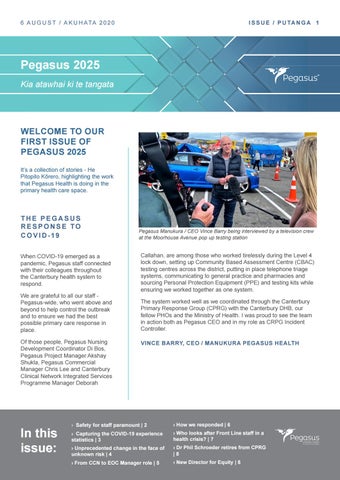
Pegasus Manukura / CEO Vince Barry being interviewed by a television crew at the Moorhouse Avenue pop up testing station
Callahan, are among those who worked tirelessly during the Level 4 lock down, setting up Community Based Assessment Centre (CBAC) testing centres across the district, putting in place telephone triage systems, communicating to general practice and pharmacies and sourcing Personal Protection Equipment (PPE) and testing kits while ensuring we worked together as one system. The system worked well as we coordinated through the Canterbury Primary Response Group (CPRG) with the Canterbury DHB, our fellow PHOs and the Ministry of Health. I was proud to see the team in action both as Pegasus CEO and in my role as CRPG Incident Controller. VINCE BARRY, CEO / MANUKURA PEGASUS HEALTH
› Safety for staff paramount | 2
› How we responded | 6
› Capturing the COVID-19 experience statistics | 3
› Who looks after Front Line staff in a health crisis? | 7
› Unprecedented change in the face of unknown risk | 4
› Dr Phil Schroeder retires from CPRG |8
6 A U G U S T / A K U H A›TFrom A 2 0 2CCN 0 to EOC Manager role | 5
› New Director for Equity | 8
1 |
PEGASUS 2025 I S S U E / P U TA N G A 1 S A F E T Y F O R S TA F F PA R A M O U N T Pegasus Nursing Workforce Development Coordinator, Di Bos’, biggest challenge was moving out of a structured environment into an agile fast moving one, as she worked to ensure the Community Based Assessment Centres (CBACs) were staffed, safe and effective. “Communication was a big part of my role. The team needed to understand frequent changes, as the testing strategy changed, and be empowered to implement them,” she said.
“We had to determine how we could provide a safe environment for staff, and for people being tested.” “We needed to ensure uniformity of processes throughout our CBACs, mobile and pop-up testing facilities, and spread this to general practitioners and practice nurses testing in their practices.” “We needed to create a structure that gave people a sense of safety. My biggest fear was that someone working in a CBAC would catch COVID-19 and take it home to their family or their usual place of work”, Di said.
Di Bos focussed on a structure that provided safety
“We had a team of 200, mostly young doctors and nurses, who had in most cases never worked together before. It was an amazing group of people who just stepped up. I was humbled to get to know them.” Connectivity was really important and was helped by cross-sector relationships and an understanding of the Canterbury Health System from my day job, she said.
Melinie Hansen (left) and Nicola Ferguson working at the 24 Hour Surgery in PPE 6 A U G U S T / A K U H ATA 2 0 2 0
COVID-19 saw many Pegasus staff moving into new temporary roles. Above: Richard Butfield Pegasus Events Co-ordinator takes on his new role of transporter. 2 |
PEGASUS 2025 I S S U E / P U TA N G A 1 G L O B A L E X P E R I E N C E VA L U A B L E A team of doctors with experience around the world made a big difference to the ability of primary care to respond to the COVID-19 crisis, says Pegasus Project Manager Dr Akshay Shukla. Akshay has worked in places as diverse as Lebanon and Afghanistan, while other doctors had worked in the Congo and South East Asia. “Another had worked in Hong Kong during SARS”, he said. Canterbury had the first CBAC set up in the country and was well prepared to begin testing the first cases. “It was important that people saw the potential dangers of COVID-19. It is not just another type of ‘flu,” he said. “We had to change people’s perceptions. Something like this had not been seen in New Zealand in a lifetime.”
Dr Akshay Shukla provided global experience
The Canterbury Primary Response Group (CPRG) benefited from strong relationships across the heath system. “The support of Canterbury DHB infrastructure teams was critical,” he said.
Pegasus Health Practice Service Liaisons, Ali Dewsbury, Pauline Armstrong and Louise Matson, helping with distribution of PPE
6 A U G U S T / A K U H ATA 2 0 2 0
3 |
PEGASUS 2025 I S S U E / P U TA N G A 1 C O - O P E R AT I O N E S S E N T I A L F O R SUPPLIES
this with changing Ministry of Health case definitions, caring for patients and whānau coping with life in lockdown and it is easy to see why team work has been vital. 24HS Operations Manager, Claire McQuilken says staff did not only ‘step up’ when media coverage was heavily outlining health risks to frontline health staff and their whānau, they also came into work early for handover meetings to make sure there was time to understand current safety and best practice advice. The team includes more than clinical colleagues. Claire says that working across wider Pegasus teams has been really rewarding, receiving help with technology hardware and software, PPE provision and collegiality both virtual and in person. “The atmosphere between different Pegasus teams and people has reflected the best of Pegasus, why we work here and how we care for our community,” says Claire.
Chris Lee helped source PPE for front line staff
“It was one of the most stressful roles in my life,” says Pegasus Commercial Manager, Chris Lee, who had the task of co-ordinating supplies to general practice and pharmacies. “It was a daily rush to keep up with demand, especially for personal protection equipment (PPE),” he said.
Providing appropriate services in a safe way to Aged Residential Care, where the risks of COVID-19 transmission is an equal threat to those giving and receiving services, has proven especially challenging. Perhaps this experience is best summed up by a 24HS staff member – “It really is wonderful to have a sense of purpose and be part of a team and actually be able to come to work [during lockdown].”
“It took a lot of lateral thinking and the cooperation of the Canterbury Health System to get practices and pharmacies what they needed.”
“Often we would start the day with a list of needs and no readily available supply, but somehow we always managed to get what was needed and get it to where it was needed,” Chris said. UNPRECEDENTED CHANGE IN T H E FA C E O F U N K N O W N R I S K The 24 Hour Surgery and Acute Demand teams have been dealing with both suspected COVID-19 and routine patient health needs during this time. They very quickly became familiar with the complexities of working in PPE and the additional workload of significantly intensified cleaning requirements. Couple
6 A U G U S T / A K U H ATA 2 0 2 0
24HS staff (from left) Charlotte Taurima, Alicia Thackwell and Isaac Ryan outside a portacom set up as a community based COVID-19 assessment and testing centre
4 |
PEGASUS 2025 I S S U E / P U TA N G A 1
FROM CCN TO EOC MANAGER ROLE Deborah Callahan (right) stepped aside from her role as Integrated Services Programme Manager with the community respiratory team for the Canterbury Clinical Network (CCN) when the COVID-19 pandemic arrived. She has supported the Canterbury Pandemic Response Group (CPRG) in many previous challenges and has latterly filled the Emergency Operations Centre (EOC) Manager role in the COVID-19 response. It’s a role that Deborah has assumed numerous times for the many challenges that have affected Canterbury during the last decade and one she says is full of observations.
“It’s phenomenal to see the whole of the Canterbury health system come together to meet these challenges head on. I have so much admiration for the way we have all responded,” says Deborah.
Deborah Callahan has played a key role in the CPRG during the pandemic
Videos showing people what to do when visiting a Community Based Assessment Centre were produced in a number of languages.
6 A U G U S T / A K U H ATA 2 0 2 0
5 |
PEGASUS 2025 I S S U E / P U TA N G A 1
HOW WE RESPONDED THE COMMUNITY BASED ASSESSMENT CENTRES (CBACS)
Along with general practice, CBACs became the public face of the response, especially with the government’s focus on testing. At the height of the pandemic, 10 CBACs were operating across urban and rural areas in Canterbury with a mobile unit providing testing facilities for front line and at risk workers such as the Police, hotel staff, rest home and supermarket staff. CBACs were staffed by doctors, nurses and administration staff and provided clinical assessment, testing, advice, triage, and referrals to other services. Pegasus staff were involved in many aspects of the CBAC through the CPRG operation including sourcing facilities, setting up and supporting technology and patient management systems, rostering and staffing, communication with referrals, finance and accounts as well as general management and oversight. SURVEILLANCE TESTING
On April 17 the first COVID-19 surveillance testing was conducted at Moorhouse Pak’nSave where more than 400 people were tested. The directive from the Ministry of Health to set up this ‘pop-up CBAC’ was given on the previous day and many staff were involved in a short and intense burst of activity to get this CBAC operational for Friday morning.
P R I M A R Y M E N TA L H E A LT H S E R V I C E
The Primary Mental Health service had to change its face to face consultation model and adopt new technologies to allow phone consultations. During the course of lockdown, the service saw some real benefits of moving to this model with ‘Did Not Attend’ rates dropping and high engagement with the service. With referral rates from general practice initially dropping during the response, the service was also able to dramatically decrease wait times. SUPPORTING GENERAL PRACTICES
Pegasus staff, across a range of teams, were involved in supporting general practices overcome the challenges and changes faced in delivering care for their patients. An essential initiative was the provision of technology and guidance to provide virtual consults for patients. Advocating for general practice with the Ministry of Health through GPNZ was also a key focus throughout the pandemic, helping ensure practices remained sustainable. When demand at general practices decreased and patients hesitated to seek usual care, the Pegasus communications team organised a media campaign to encourage people to continue to contact their practice in the usual way. This campaign ran in The Press, online and social channels as well as radio advertisements translated into a number of languages. Regular and routine support services for general practices were also required during this time, often adjusting to new ways of doing things such as organising new claims and payments, technology support and support for clinicians, including pastoral care. With the pandemic arriving at the start of the ‘flu season, Pegasus also worked behind the scenes to help ensure there was a supply of ‘flu vaccines so that front line staff and vulnerable people could be vaccinated.
A CBAC was set up in the east of Christchurch at Ngā Hau e Whā Marae where Pegasus worked in partnership with He Waka Tapu, Whanau Ora Community Clinic and Te RŪnanga o Ngā Maata Waka. This CBAC did a fantastic job, reaching out to vulnerable communities and ensuring barriers to accessing tests were removed while providing advice to the community about COVID-19, access to financial and other support services.
6 A U G U S T / A K U H ATA 2 0 2 0
Pegasus Commercial Manager, Chris Lee working at Pegasus House to keep up with demand for personal protection equipment (PPE)
6 |
PEGASUS 2025 I S S U E / P U TA N G A 1 WHO LOOKS AFTER FRONT L I N E S TA F F I N A H E A LT H CRISIS? Pegasus Health’s Pastoral Care Programme has been in place since 2009. Designed to detect problems at an early stage and support doctors on an individual basis through times of increased stress, burnout or personal problems, the programme has proved its worth through Canterbury’s pattern of crisis, change and progression. The programme offers a combination of peer support counselling and education, covering such areas as prescribing habits and business sustainability. Referrals often come from nurses, pharmacists and doctors with concerns for their clinical colleagues. It’s a safe environment to share concerns and a step before the involvement of the Medical Council. Dr Caroline Christie is a General Practitioner, Deputy Chair of the Pegasus Health Membership Committee and also oversees the Pastoral Care Programme. She says the programme has, not unexpectedly, seen an increase in referrals during the COVID-19 response.
“We are preparing for a further rise of GPs needing support during this ongoing and likely long term response to COVID-19. All our GPs need to look after themselves and their colleagues, their patients and their businesses as well as adapt to the changing environment in healthcare. Even at Level 1 it is, without question, a very challenging time,” says Caroline. Support may be required for a range of issues including depression, bereavement, anxiety or organisational issues. Care is individualised according to level of impairment, career stage, insight and motivation. GPs are also offered mentoring by one of five doctors in a pastoral care role. Support may involve a visit with a review of file notes. A formal practice review may be done in-house by a peer.
Dr Caroline Christie oversees the Pegasus Pastoral Care Programme
Advertisements encouraging people to continue to visit their general practice appeared in newspapers and on radio
“I feel we are well equipped to assist our colleagues through this period,” says Caroline. 6 A U G U S T / A K U H ATA 2 0 2 0
7 |
PEGASUS 2025 I S S U E / P U TA N G A 1
DR PHIL SCHROEDER RETIRES FROM CPRG As the chair of the Canterbury Primary Response Group (CPRG), Dr Phil Schroeder has helped lead his primary colleagues through some of the most eventful decades in Canterbury’s recent history. The list includes swine flu, earthquakes, floods, major snow storms, fires on the Port Hills and now COVID-19. Dr Schroeder stepped down from his role with the CPRG last month, after 15 years with the group, of which he has been chair for 12. The Canterbury earthquakes stand out the most in his experiences, and he is grateful that the CPRG was in place with systems and processes to assist primary care, pharmacy and district nursing at a critical time. Dr Schroeder was in Rotorua in February 2011 when the earthquake struck and got himself to Auckland and on a flight to Christchurch in the morning. He recalls being shocked at the devastation as he drove to the 24 hour Bealey Avenue surgery from Christchurch airport. “It was really quite emotional. Reality struck, it was worse than I had imagined.” “On the day after the earthquake, Afterhours were operating in the car park dealing with things as best they could. They were next door to Southern Cross so had their facilities and specialists on hand to help for fracture diagnosis and treatment.” When the CPRG began in 2005, in response to Avian ‘flu, it was solely focused on pandemics and later ‘flu. The group lobbied the Canterbury District Health Board to provide a broader response to any emergency involving a primary care response and was given the go-ahead just five days before the February 2011 earthquake. A key role of the CPRG has been helping primary care to manage seasonal ‘flu, he said. 6 A U G U S T / A K U H ATA 2 0 2 0
Dr Phil Schroeder at work in his General Practice
“We have been able to help forecast when the season will peak and help rest homes, primary practice and pharmacies to manage,” he said. A low point for Dr Schroeder was the 2019 measles outbreak, which was hampered by inconsistent and at times incorrect communications from national organisations and vaccine suppliers. “But, each response has taught us something.” The combined experience of the past 15 years has meant Canterbury was “well placed” to tackle the challenges of COVID-19, he said. “The rest of New Zealand and the world have been interested in what we have done here. We are often called to offer advice to other parts of the country, Australia, Canada and the UK,” he said. “It has been a real privilege to be involved with the CPRG team and the care of the people of Canterbury. The CPRG is something unique and will carry on serving our community,” he said. NEW DIRECTOR SUPPORTING EQUITY IN P R I M A R Y H E A LT H C A R E Irihāpeti Mahuika has been Pegasus’ Director of Hauora Māori and Equity for eight months. Her appointment to this newly-created role is crucial to Pegasus Health’s commitment to the Treaty of Waitangi, equity
8 |
PEGASUS 2025 I S S U E / P U TA N G A 1 and access, reducing inequities, increasing access to services and improving hauora outcomes for Māori in Canterbury. Irihāpeti joined Pegasus from Haeata Community Campus, where she was Director of Learning. She has a great passion for Kaupapa Māori and believes that strong, mana-enhancing relationships and communities centred around whānau are key to empowering Māori people to take charge of their lives. Irihāpeti is of Kāi Tahu descent and is committed to strengthening partnerships with mana whenua as well as Pasifika, Culturally and Linguistically Diverse (CALD) and rainbow people and communties.
Q&A
Where do you think you can make the most impact on primary health care for Māori as part of Pegasus? My hope is that I am able to positively impact the work that has been started, to be able to reduce the inequities in the health sector. In primary health, we have the opportunity to interact with our people and our communities in ways which support them in leading healthier lives. Our populations, which generally experience poorer health outcomes, are also underserved by the health system. This is where my work can make the most impact. What do you consider that Pegasus has already done to positively support equity in primary health care to this point? We have some great champions of equity and hauora Māori in our network and organisation. Individually, these fantastic health professionals make an impactful difference for the people they work with. This work and these individuals need to be celebrated and their best practice should become the expectation moving into the future. What is your main focus within Pegasus for the rest of this year? Bringing equity considerations to the front and centre of everything we do.Through collaborative strategic direction, support and development of leaders to ensure we are building capability across our organisation. This is where we must begin, as this will build the capacity and sustainability of this important work in the primary health network. Do you feel Māori have been especially impacted by the COVID-19 pandemic? What has Pegasus done to address this? We have been able to support the COVID-19 response with an equity lens by asking questions at the right time. There is always learning and development which needs to happen in any work and we acknowledge we did not get it right all of the time.
Irihāpeti Mahuika joined Pegasus from the Haeata Community Campus
As a result of being closely involved with the response, we have some clear recommendations and expectations to include in our emergency planning. As a wider network, many of our Māori providers and organisations were able to support Whānau Māori with a focused welfare and holistic response. This is something to be proud of as a health network.
Pegasus Health 2025 is produced by the Communications Team at Pegasus Health (Charitable) Ltd. Content within Pegasus Health 2025 newsletters has been included with the approval of content providers therefore please contact us if you wish to reproduce or alter and transmit any of the information or images contained within. Steve Addison, Head of Brand and Communications, Pegasus Health steve. addison@pegasus.org.nz
6 A U G U S T / A K U H ATA 2 0 2 0
9 |