I S S U E / P U TA N G A 2
2 6 A U G U S T 2 0 2 0 / A K U H ATA 2 0 2 0
Pegasus 2025 Kia atawhai ki te tangata
A MESSAGE FROM THE CEO
C O V I D - 1 9 L E V E L 2 R E S P O N S E B A C K I N O P E R AT I O N
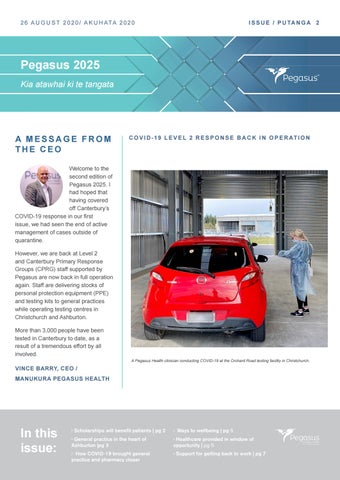
Welcome to the second edition of Pegasus 2025. I had hoped that having covered off Canterbury’s COVID-19 response in our first issue, we had seen the end of active management of cases outside of quarantine. However, we are back at Level 2 and Canterbury Primary Response Groups (CPRG) staff supported by Pegasus are now back in full operation again. Staff are delivering stocks of personal protection equipment (PPE) and testing kits to general practices while operating testing centres in Christchurch and Ashburton. More than 3,000 people have been tested in Canterbury to date, as a result of a tremendous effort by all involved. A Pegasus Health clinician conducting COVID-19 at the Orchard Road testing facility in Christchurch.
VINCE BARRY, CEO / MANUKURA PEGASUS HEALTH
In this issue:
› Scholarships will benefit patients | pg 2
› Ways to wellbeing | pg 5
› General practice in the heart of Ashburton |pg 3
› Healthcare provided in window of opportunity | pg 5
› How COVID-19 brought general practice 26 AUGUST I AKUH A T A 2 0and 2 0 pharmacy closer
› Support for getting back to work | pg 7 1 |
PEGASUS 2025 I S S U E / P U TA N G A 2
S C H O L A R S H I P S W I L L B E N E F I T PAT I E N T S Pegasus Health’s annual Workforce Development Scholarships provide a positive boost for primary health students.
“I feel very grateful for the position that I am in,” says Toriana. “Patients and their whānau place a lot of trust in the healthcare system, so it is very special when they feel like they can open up to me.”
Pegasus Health established the Māori scholarships in 2001 and followed up with Pacific scholarships in 2007. Scholarships for Culturally and Linguistically Diverse (CALD) health students became available in 2014.
The scholarship has been beneficial for Toriana, taking away some of the financial pressures she previously faced. She is looking forward to finishing her degree and working towards a specialty that she is passionate about.
Health students who identify as Māori, Pasifika or from CALD communities, who are studying medicine, nursing or allied health are invited to apply for the scholarships. This year 23 students received scholarships for study in areas from medical training to midwifery and social work. Fifth year medical student Toriana Murray (Ngāti Apa, Te Āti Awa, Te Whānau ā Apanui) has always been intrigued by how the body works.
“If I got the opportunity to focus on Māori health and to give back to my hapori whānui, I would certainly be driven in that direction, “ says Toriana.
Pegasus Health CEO, Vince Barry, says the annual scholarships are a great way to demonstrate Pegasus’ commitment to bringing equity to the centre of its work. “We are proud to offer these scholarships to health students. There is no doubt recipients will contribute significantly to their respective fields and patients will benefit. There are long standing inequities in health for Māori, Pasifika and people from CALD communities. These scholarships are just one way we can help support patients from these communities,” says Vince.
Toriana is also driven to be part of creating change within the community, alongside the small but strong contingent of Māori wāhine in medicine. Toriana is particularly captivated by people’s stories and developing longterm doctor-patient relationships. She learnt early on that there is always more to people than the illness that they are experiencing.
Toriana Murray is driven to be part of creating change alongside Māori wāhine in medicine.
2 6 A U G U S T I A K U H ATA 2 0 2 0
2 |
PEGASUS 2025 I S S U E / P U TA N G A 2
IN THE HEART OF ASHBURTON, HELPING TO SERVE THE WHOLE OF THE DISTRICT Ashburton’s Eastfield Health opened in July 2020 and is already making a difference to its community. The general practice is in a newly-built, purpose-designed facility, providing a warm and welcoming integrated health care facility for everyone, from children to the elderly. It has replaced Sealy Street Medical Centre.
“I am delighted that previous ways of working do not constrain this general practice,” says Craig. “They have nurses working at the top of their scope, they are using telephone and video triage, and the team is always finding new and efficient ways of doing things.” Chair of the Board of Eastfield Health Ltd, Mary Ross, explains the innovative approach of the building, which currently serves 5,400 patients.
Rural Health Manager at Pegasus, Craig Watson, is proud of this general practice. He recognises the enormous effort involved by all of the team at Eastfield Health. “There have been some huge challenges for Eastfield Health, as they sought to open their doors at a time of a national health crisis,”says Craig. “ As with many rural practices, the impacts of local events are often felt at the medical centre. Whether it’s a change to tourism, a drop in farming prices or a local business closure, the medical centre is often the first to manage impacts on its enrolled population. “It’s exciting to see a significant investment in a rural practice that allows more services to be provided locally,” says Craig. Working to the Health Care Home model, the practice is developing clinical teams of GPs, nurse practitioners, pharmacists and social workers. This collaborative approach underpins the desire to provide holistic patient care and create a sustainable medical centre for the community.
2 6 A U G U S T I A K U H ATA 2 0 2 0
Accredited by the Royal College of GP’s Aiming for Excellence programme, Cornerstone, high standards are the norm for Eastfield Health.
“We manage the flow of patients to allow efficient use of everyone’s time and more privacy for patients. GPs don’t have their own specific rooms and the consulting rooms all mirror each other, so that the layout is efficient, and supplies can be easily accessed,” says Mary. Mary is keen to move away from the legacy of GPs being under stress and dealing with a large, often complex, case load to an environment where the health team enjoy their roles. Eastfield Health is giving rural residents the chance to be part of cutting-edge patient-centred services. For example, ConnectMed is an online portal for patients to be able to make appointments online, order repeat prescriptions and see test results as they come through. “It’s a journey, not an instant destination,” says Mary. “But we are committed to working towards the Health Care Home model. I am so proud of the team.”
3 |
PEGASUS 2025 I S S U E / P U TA N G A 2
HOW COVID-19 EXPERIENCE BROUGHT GENERAL PRACTICE AND PHARMACY CLOSER TOGETHER With the swift arrival of COVID into New Zealand, the health system benefitted from existing relationships between Pegasus general practices and pharmacies.
Problems were ironed out quickly. For example, where a general practice had an oversupply of Personal Protection Equipment (PPE), and their local pharmacies didn’t, stock was handed over with ease.
The elements of trust, openness and clear communication were the binding factors that meant general practices and pharmacies could work well together. Cantabrians are all too familiar with crises, so having been through the earthquakes, for example, our emergency response was well tested. The COVID experience built on this earthquake experience.
“We have a strong collegial relationship with Eastern Pharmacy, Aranui,” says doctor at Eastcare Health General Practice, Marie Burke. “I have worked with the pharmacy for more than seven years, and always have positive experiences with them.”
“We already had the structures and systems in place,” says Canterbury Community Pharmacy Group (CCPG) General Manager, Aarti Patel. “As a result, it was easy for us to ring every pharmacy and find out what the challenges were.” This timely intelligence was then fed to the Canterbury Primary Response Group (CPRG) . At a local level, this meant mapping out a matrix of vulnerable and high-risk pharmacies and making sure we were communicating with them.
Marie said the strong existing relationship meant it was easy to ask for and offer help. The instant messaging system between general practice and pharmacists, Jitsi, worked well between Eastcare Health and Eastern Pharmacy, ensuring positive outcomes for patients, as problems and queries were solved quickly. “It is our goal to make things easier and better for patients,” says pharmacist at Eastern Pharmacy Aranui Simon Church. “We were grateful that Eastcare Health gave us some of their hand sanitiser and PPE, and we were able to supply ‘flu jabs to the general practice when they had a shortage.”
The Eastcare Pharmacy team works closely with Eastcare Health - from left: Diane, Sarah, Suzanne, Lisa, Jacinta, Simon, Jacqui and Stevie.
2 6 A U G U S T I A K U H ATA 2 0 2 0
4 |
PEGASUS 2025 I S S U E / P U TA N G A 2
W AY S T O W E L L B E I N G Pegasus Health’s Mental Health team is strengthened its relationships with other providers during the COVID-19 response.
“The aim is to make wellbeing and mental health support services more accessible for high priority groups such as Māori, Pasifika, youth, or people with other equity issues,” she says.
They are embracing the opportunity to support the roll-out of a new holistic way of delivering mental health, addiction and wellbeing care through general practice, and working towards a longer-term solution by providing an integrated model of primary healthcare – Te Tumu Waiora model.
Te Tumu Waiora is currently operational in six practices within Canterbury, with more planned for this year. These practices provide immediate brief intervention to patients, reducing the need for people to be referred for lengthier interventions.
Te Tumu Wairoa Canterbury is a joint initiative led by the Canterbury Clinical Network in partnership with Pegasus Health, Waitaha Primary Health, Christchurch PHO, Canterbury DHB and NGO partners. It puts wellbeing and mental health as the heart of general practice with the introduction of new focused roles working as part of the general practice team – the Health Improvement Practitioner (HIP) and health coaches (HCs). Shelley McCabe is the Clinical Implementation Lead on this project.
Pegasus Mental Health Services team members. Back row from L – R: Charlotte Burgess, Shelley McCabe, Dan de Boer, Tim Marshall.Front row L – R: Ruth Surtees, Claire Miller, Eliza Boyle, Karl Belcher.
H E A LT H C A R E P R O V I D E D I N W I N D O W O F O P P O R T U N I T Y Most of the youth offenders at Te Puna Wai ō Tuhinapo need some form of mental health support. The Youth Justice Residential facility located just outside Rolleston is operated by the Ministry for Vulnerable Children, Oranga Tamariki. It can house up to 40 residents. Their length of stay varies from one week to several months and lasts while they are on remand, until sentenced by the court. Pegasus Health provides primary health care services to Oranga Tamariki. This includes services at Te Puna Wai Youth Justice Facility and Te Oranga – Care and Protection Facility in Burwood. Residence Youth Health Nursing team leader Moyra Docherty, Sarah Hadley and Kym Delahunty work primarily at the Rolleston facility while Rebekah Coapman is based at Burwood. Moyra says their care provides a window of opportunity for long neglected health problems to be checked and as much health care ‘infused’ into the young person as possible. The nursing team at Te Puna Wai sees and assesses all new residents within two days of their arrival. They work hard to make sure the connection with health professionals is a positive experience.
2 6 A U G U S T I A K U H ATA 2 0 2 0
5 |
PEGASUS 2025 I S S U E / P U TA N G A 2 “More of our residents are arriving with complex mental health needs. They are more likely to be withdrawing from substance abuse and some have been affected by foetal alcohol syndrome,” says Moyra. Sarah Hadley says the time residents spend at Te Puna Wai is often the only time they have a positive relationship or connection with health care. “There are some really sad stories here. We have young people who have had to look after their siblings, trying to keep them fed and safe from violence in the home. They see their mother being ‘bashed’ or a parent lashing out. They live in poverty and many have seen an awful lot of violence,” says Sarah.
This was life-changing for him, he could then do school work,” says Sarah. The list of health concerns can be long. Sexually transmitted diseases, vision and hearing problems, substance abuse, declining mental health, skin infections and fungal feet are common. Preventative care like personal hygiene education and immunisation is also provided.
On arrival the residents are assessed for heath needs and wrapped in layers of care. Each young person is assigned a case leader and connected with the youth forensic team, sexual health clinic and dental services. “All the agencies really try and help. We have some big challenges,” says Moyra. One young male arrived wearing $5 glasses. “These were completely useless as reading glasses, he was virtually blind. We got him an appointment with an optometrist and new prescriptive glasses.
Nurses at Te Puna Wai (from left), Kym Delahunty, Sarah Hadley and Moyra Docherty work hard to infuse as much health care into young people in their care.
2 6 A U G U S T I A K U H ATA 2 0 2 0
6 |
PEGASUS 2025 I S S U E / P U TA N G A 2
SUPPORT FOR GETTING BACK TO WORK Here Toitū is a new (2019) national programme designed to support people living with a health condition or disability to feel better, set their own goals and aspirations, and where they can, return to earning, learning, caring or volunteering in a workplace. The programme is jointly run by the Ministry for Social Development (MSD) and Primary Health Organisations across New Zealand. Pegasus Health’s Community Liaison Access Manager, Melissa McCreanor, has been working with the programme’s predecessor, Step Up, since 2017. This has now evolved into Here Toitū after a successful pilot and trials. The new programme has taken the best aspects of Step Up, combined them with elements from similar programmes from Mana Taimahi (Auckland and Whanganui based programme) and Well Plan (Auckland based) and scaled up the service to more general practices in their regions, making it available to more people. “We’ve already seen through our work with Step Up that it’s about more than just returning to work. We’ve heard great stories from our general practices about patients with complex mental health needs feeling really satisfied through volunteering, and their families say it’s great to see them doing something they wouldn’t have thought possible in the past”, says Melissa. A team of health navigators work individually with people to meet the specific health needs affecting their wellbeing and ability to work. Melissa says there is collaboration between general practice, Ministry of Social Development and the Health navigators. A participant who has re-entered the workforce through the Step Up Programme says the Health Navigator helped her with interview confidence and pointers on how to approach and talk about her illness with future employers. Melissa McCreanor leads a team of Here Toitū health navigators
Q&A WITH MELISSA MCCREANOR What does the name Here Toitū mean? The name ‘Here Toitū’ and the whakatauki (Māori proverb) below were gifted from one of Pegasus Health’s partners, the National Hauora Coalition. Here Toitu meaning Here – To bind individual strands together Toitū – To strengthen the strands so they work better together
2 6 A U G U S T I A K U H ATA 2 0 2 0
7 |
PEGASUS 2025 I S S U E / P U TA N G A 2
Whakatauki (Māori proverb) Whakatauki E hara taku toa He takitahi He toa takitini Which means “My strength is not due to me alone, but due to the strength of many”. How does it help people? It gives people a team of professionals to help them manage any health and social barriers that may be affecting their ability to work. The Health Navigators are also in touch with the person’s General Practice team, MSD and a range of other services who all pitch in to help improve their health and wellbeing and to become work ready.
Positive individual outcomes include improved health and wellbeing, enhanced coping strategies and people engaging in further study, training, voluntary, part-time and fulltime work.
How does Here Toitū differ from Step Up? Step Up teamed patients on a voluntary basis with a Health Navigator to help the patient take steps to improve their health and get back to work. What role does General Practice play? In order to take part people must be enrolled with a general practice. The general practice team who know their patients well, will refer a patient if they think they will benefit from the service. How do people become part of the programme? As well as being enrolled with a participating general practice and referred by their GP, a person needs to be receiving a main benefit, have a medical condition that stops them from being able to work, want to return to work and be connected with a MSD service centre. You can find more information about Here Toitū on the Pegasus Health website or contact Team Leader Loni Beach Loni.Beach@pegasus.org.nz (022 013 0716) or Melissa McCreanor on Melissa.mccreanor@pegaus.org.nz (021 868 491).
Pegasus Health 2025 is produced by the Communications Team at Pegasus Health (Charitable) Ltd. Content within Pegasus Health 2025 newsletters has been included with the approval of content providers therefore please contact us if you wish to reproduce or alter and transmit any of the information or images contained within. Steve Addison, Head of Brand and Communications, Pegasus Health steve.addison@pegasus.org.nz
2 6 A U G U S T I A K U H ATA 2 0 2 0
8 |