P U TA N G A / I S S U E 1 8
1 0 H U I - TA N G U R U / F E B R U A R Y 2 0 2 2
Pegasus 2025 Kia atawhai ki te tangata
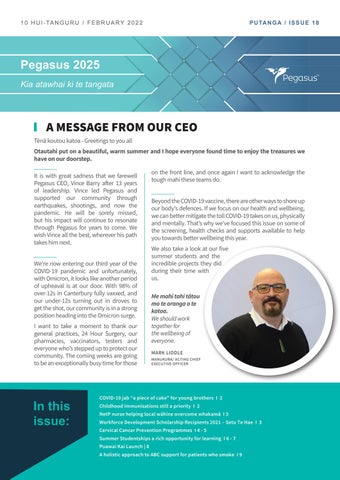
A MESSAGE FROM OUR CEO Tēnā koutou katoa - Greetings to you all Otautahi put on a beautiful, warm summer and I hope everyone found time to enjoy the treasures we have on our doorstep. It is with great sadness that we farewell Pegasus CEO, Vince Barry after 13 years of leadership. Vince led Pegasus and supported our community through earthquakes, shootings, and now the pandemic. He will be sorely missed, but his impact will continue to resonate through Pegasus for years to come. We wish Vince all the best, wherever his path takes him next. We’re now entering our third year of the COVID-19 pandemic and unfortunately, with Omicron, it looks like another period of upheaval is at our door. With 98% of over-12s in Canterbury fully vaxxed, and our under-12s turning out in droves to get the shot, our community is in a strong position heading into the Omicron surge. I want to take a moment to thank our general practices, 24 Hour Surgery, our pharmacies, vaccinators, testers and everyone who’s stepped up to protect our community. The coming weeks are going to be an exceptionally busy time for those
In this issue:
on the front line, and once again I want to acknowledge the tough mahi these teams do. Beyond the COVID-19 vaccine, there are other ways to shore up our body’s defences. If we focus on our health and wellbeing, we can better mitigate the toll COVID-19 takes on us, physically and mentally. That’s why we’ve focused this issue on some of the screening, health checks and supports available to help you towards better wellbeing this year. We also take a look at our five summer students and the incredible projects they did during their time with us. Me mahi tahi tātou mo te oranga o te katoa. We should work together for the wellbeing of everyone. MARK LIDDLE MANUKURA/ ACTING CHIEF EXECUTIVE OFFICER
COVID-19 jab “a piece of cake” for young brothers I 2 Childhood immunisations still a priority I 2 NetP nurse helping local wāhine overcome whakamā I 3 Workforce Development Scholarship Recipients 2021 – Setu Te Hae I 3 Cervical Cancer Prevention Programmes I 4 - 5 Summer Studentships a rich opportunity for learning I 6 - 7 Puawai Kai Launch | 8 A holistic approach to ABC support for patients who smoke I 9
PEGASUS 2025
2 | 1 0 H U I - TA N G U R U
P U TA N G A / I S S U E 1 8
FEBRUARY 2022
COVID-19 JAB “A PIECE OF CAKE” FOR YOUNG BROTHERS Nine-year-old Zach Crossen described getting his first COVID-19 vaccination as being ‘a piece of cake’. He reckoned the needle was small and didn’t really hurt. Zach and his seven-year-old brother Alexander recently got their vaccination at Village Health in Addington – a practice doing more than 300 paediatric COVID-19 vaccinations on a busy day, according to Practice Manager Vanessa Shearer.
Michelle booked the appointments on the ‘Book my Vaccine’ website. Her sons were vaccinated less than a week after booking the appointment at a practice within five kilometres of her Halswell home. “I found the whole process easy. Booking was easy, the doctor that gave the boys their injections was lovely, and she explained everything thoroughly so the boys knew what to expect.”
Mum Michelle Crossen says she got her boys vaccinated as quickly as possible to protect them from getting sick and help keep vulnerable people in the community safe from the Omicron variant. “I don’t want the boys to get sick if we can prevent that or they get a milder dose. I want them to be able to keep going to school and for me to keep working. With Omicron in the community and lots of people expected to catch it, I want the boys protected. Hopefully it will also protect older family members and little ones.’’
CHILDHOOD IMMUNISATIONS STILL A PRIORITY Mum of three, Sarah Saxton, feels strongly about ensuring her children are up-to-date with their childhood immunisations. “We’re easily able to protect our children from getting unwell with the flu, measles, mumps, rubella and a whole range of other vaccine-preventable disease. And now we have the opportunity to minimise harm from COVID-19. For me, making sure my kids are vaccinated is a priority, even when things get busy.” This year, she says, it was particularly important her youngest son - Nikos, 4 –
had his scheduled DTaP (diptheria, tetanus, pertussis and polio) vaccinations on time. “Nikos is not old enough to get vaccinated against COVID-19 so I wanted to make sure he is up-to-date with his other immunisations to avoid him getting sick, where we can prevent it, and ensure he’s in the best position coming into winter and with COVID-19 in the community.” Sarah says she also made it a priority to get her older children vaccinated against COVID-19 so Nikos and others in the community who can’t get the coronavirus vaccine are protected. “My daughter was hesitant to get the COVID-19 jab until she realised it would help protect her little brother.”
PEGASUS 2025
3 | 1 0 H U I - TA N G U R U
P U TA N G A / I S S U E 1 8
FEBRUARY 2022
NETP NURSE HELPING LOCAL WĀHINE OVERCOME WHAKAMĀ Pegasus Health supported NetP nurse Kiri Manihera to do a specialist cervical screening course and respond to a need she saw in her low-decile community.
She noticed how low cervical screening rates were for enrolled Māori and Pasifika patients. She also had patients tell her that they would get the screening if she did it.
Kiri will graduate from the NetP programme this month. During the yearlong programme, Kiri worked at the Hei Hei Health Centre.
“I’m the first Māori nurse they’ve had at the practice for quite some time, and [patients] would say ‘if you do it, I’d get it done’. So many people were saying that, I thought ‘there is a need here, and I can do something about it’, so I talked to Di [the Pegasus Health NetP coordinator] and got onto a course on cervical screening.”
“I live just down the road. I have family here. I am Māori. It’s a really low-decile community and where I want to be. My heart is in general practice and the community.’’
Kiri is the first NetP nurse to do the course; programme participants usually do university papers. She will graduate from the programme this month. She says she is honoured Pegasus Health let her forge a new path – so she can make a difference in her community. “Let’s be honest, women are the Mums, providers, homemakers and often care for others in extended whānau. When there is a choice, women often put themselves last. But if they weren’t there to do all those things, everyone would be affected. Screening is such a simple way to protect ourselves. There are barriers like whakamā – they are embarrassed and it’s quite a tapu thing – but if we can work to minimise those barriers we can help our women look after themselves.”
WORKFORCE DEVELOPMENT SCHOLARSHIP RECIPIENTS 2021 – SETU TE HAE After training and working as a carpenter, second year nursing student, Setu Te Hae, realised that he was on the wrong career path. With a long-held interest in health and wellbeing due to his background in sport, Setu decided to give nursing a go. “It was actually my dad, who works for Kaupapa Māori provider, Purapura Whetu, who asked me if I was interested in health. I decided to give it a go and I’ve been really enjoying it.” Born and raised in Christchurch, Setu’s
parents are Samoan and Māori (Waikato-Tainui and Hauraki) and this heavily influences where he wants his career to lead. “I’m most interested in Māori and Pacific health. I’ve got a soft spot for our community. We need to understand the importance of health and the lifestyles that we live. It comes down to breaking the cycle. “It’s also about being a role-model and paving the way for young Māori and Pasifika nurses to come through.”
PEGASUS 2025
4 |
P U TA N G A / I S S U E 1 8
1 0 H U I - TA N G U R U FEBRUARY 2022
CERVICAL CANCER PREVENTION PROGRAMMES JOINT EFFORT TO IMPROVE CERVICAL SCREENING RATES Pegasus Health and ScreenSouth are working together on a coordinated approach to improving cervical screening coverage for eligible women across Canterbury. Louise McCarthy, General Manager at ScreenSouth , explains the motivation behind this collaboration. “Due to COVID impact and a persistent equity gap in cervical screening for Māori, Pasifika, Asian, unscreened and under-screened women, we need to do something different to what has been done before. “We’ve been looking at what’s happening around the country and looking at other initiatives and we think we need to take a
targeted approach, working much more closely with general practice to support the practice team to engage priority women in cervical screening.” “We’re very conscious of the pressures on general practice at the moment. Our proposal is around working with practices that have high populations of priority women, low coverage for priority women, and who also may not take up the free smears initiative. “We’re looking to provide some staff resource to work very closely with the practice team to help them do their invites and recalls.”
HPV VACCINATION RATES DROPPING Anna Thorpe, Mātanga Hauora Taupori / Population Health Specialist at Pegasus Health, is passionate about the eradication of the human papillomavirus (HPV), the cause of more than 95% of cervical cancer. “The HPV vaccine prevents HPV cancers. The vaccination programme is the first line of defense against cervical cancer. “We know what can be done. Australia began their HPV vaccination programme earlier than we did and they’re seeing great results. In New Zealand, HPV vaccination is offered in school at Year 8 and parental consent can be challenging to get as it isn't bundled with the other pre-teen vaccinations. After Year 8 it’s up to general practices to do checks and recalls. Anna supports opportunistic vaccination. “We know practices are under so much pressure. Taking a whānau-centric approach and looking at what immunisations and screenings the whole family needs, makes it easier for the whānau and is an effective approach."n
“I’M DOING THIS FOR ME AND MY WHĀNAU”
PEGASUS 2025
5 | 1 0 H U I - TA N G U R U
P U TA N G A / I S S U E 1 8
YOUNG PERSON’S PRAGMATIC APPROACH TO GETTING THE HPV VACCINE Twelve-year-old Carys Western received her HPV vaccination at her local GP last year. “I knew it was important to get jabbed. I didn’t object to getting it at all. The nurse explained it quite thoroughly. She explained what it would prevent, she was very comforting.” Carys’ mother, Kim Thomas, is a strong advocate for all immunisation, but the HPV vaccine in particular. “It was essential to me that Carys get vaccinated. We’ve got the opportunity to reduce significantly, the chances of getting cervical cancer so why wouldn’t I do it? The vaccine wasn’t around when I was younger. I have considered getting the vaccine as an adult after having some abnormal smears. But I think it’s way better for people to get it before they’re sexually active.” “Carys and her sister’s grandma died of cervical cancer in her 40s so we’re pretty lucky that we’ve got a way of preventing that now.” Carys shares her mother’s viewpoint. “I’m just really happy that they’ve made a vaccination for it. Back when my Nana was young, if she’d had the chance to have that vaccination, maybe it could have been prevented. I’m very happy that if I come into contact with the virus that I am protected.” For more information on vaccinations for older children, visit healthinfo.org.nz
FEBRUARY 2022
“The national government targets are 80% eligible women screened. The Pegasus results are similar to those across NZ, although Pegasus practices report higher Māori and Asian screening rates.” – Anna Thorpe WOMEN SCREENED WITHIN 3 YEARS
TOTAL 68%
PEGASUS (NOV 2021) CANTERBURY (DEC 2021)
72.4%
MĀORI PEGASUS (NOV 2021) 65%
ASIAN 65%
CANTERBURY (DEC 2021)
61.9%
PEGASUS (NOV 2021) CANTERBURY (DEC 2021)
57.2%
PASIFIKA PEGASUS (NOV 2021) 59%
CANTERBURY (DEC 2021)
64.6%
PEGASUS 2025
6 | 1 0 H U I - TA N G U R U
P U TA N G A / I S S U E 1 8
FEBRUARY 2022
SUMMER STUDENTSHIPS A RICH OPPORTUNITY FOR LEARNING Over December and January, five students from a diverse range of disciplines and backgrounds joined Pegasus Health as part of their learning journey. Each student was placed within a team and undertook a project that matched their individual interests and area of study. Summer Studentship coordinator and Pegasus Director of Hauora Māori and Equity, Irihāpeti Mahuika, reflected on the presence and mahi of the students during their presentation of their projects at the conclusion of their time with Pegasus. “I feel we have been absolutely blown away and privileged to spend time with you and learn from you.”
Back row from left: Lobna Falestine, Setu Te Hae, Maca Vuniwaqa. Front Row: Reuben Kemna, Leon Haiu.
LEON HAIU Second year nursing student, Leon Haiu, was placed with the Equity Leadership Team. Accepting the student position was tough as Leon faced the feeling of imposter syndrome.
done in regard to these summer internships. I can’t sing the praises of this organisation enough. It really has been transformational for me. I want to take manaakitanga and share it in my future workplaces.”
“I can’t sing the praises of Maria Pasene and Irihāpeti Mahuika enough. They really helped get me across the line,” Leon explains.
Leon worked closely with fellow student, Maca Vuniwaqa, and Tangata Atumotu Trust to develop a COVID-19 resource for Pasifika. This is a resource created by Pasifika, for Pasifika and, in Leon’s words, reflects the “collective paradigm in how we live, move and speak.”
“I’ve been reflecting the whole way through and I’m so, so grateful for Pegasus Health and what they’ve
REUBEN KEMNA Southlander, Reuben Kemna, was placed with the nursing team at Te Puna Wai, supporting them in providing primary health care to the young people at the facility. This was Reuben’s second time joining the Te Puna Wai team, as he completed his community placement for his nursing degree there earlier in 2021. “I couldn’t say enough about the [nursing] team and what they do. It’s really hard to put it into words. They’re doing really cool stuff and making big differences in health out there, and they’re just a wee small team. “All it takes is one really awesome role model to turn a young person’s life around. We only hope that on their
journey that they can meet one person that perhaps changes their trajectory entirely. It’s a massive hope but it would be awesome if they went out and never came into touch with youth justice or correctional services again.” Reuben worked closely with the wider Te Puna Wai team to research and develop an online information hub called Te Aka Hauora. “It’s a youth website and it’s for improving navigation and access to healthcare for youth. It brings together all the services that exist for youth health in Canterbury into one central hub, with equity as its guiding principle.”
PEGASUS 2025
7 | 1 0 H U I - TA N G U R U
P U TA N G A / I S S U E 1 8
FEBRUARY 2022
SETU TE HAE Setu Te Hae is about to enter his final year of his nursing degree at Ara Institute of Canterbury. With an interest in primary health care, Setu was placed with the Practice Relationship Team. “It’s been an amazing experience. I’ve been on numerous GP visits where I’ve sat in just to see what it is they do. I also got some experience working in the community, at Menz Medical and the COVID-19 testing station at Nga Hāu e Whā. “The team gave me awesome opportunities
to experience a range of things. They’re just so supportive.” Setu’s studentship project was around equity. “I designed an Equity Policy Template for General Practices.” The first step in the project was to survey the general practices. Generally, the practices recognised a gap in their policies around equity and were eager for support to develop a policy to address equity.
MACA VUNIWAQA Final year Bachelor of Social Work student, Maca Vuniwaqa, came to New Zealand from Fiji in 2005. Since being here, she’s taken the opportunity to follow her passion. “I want to help my own people and my own community and my own family. For Māori and Pasifika, it’s good to have our own people to help.” Maca took this drive with her into her studentship project. Working with Leon and Tangata Atumotu Trust, Maca helped develop a COVID-19 resource for Pasifika. “This resource is really important to us, as Pasifika, because English is our second language. We wrote it so a Year 8 student could understand because that
LOBNA FALESTINE Egyptian student, Lobna Falestine, has been juggling her Master of Nursing Science with working as a Mental Health Support Worker, a choice she makes to achieve balance and connection. “I work to give and provide and see people growing in front of me. With my study I’m gaining skills and feeling more confident in what I’m doing.” Lobna completed her summer studentship with the Clinical Quality Education Team. “I was working with the Small Group Education team who were preparing a range of material and I chose
way our Matua with English as a second language can also understand. Many Pasifika hold a spiritual belief that makes them wary of the vaccine. “We go in as Pasifika to help them understand that it’s something that helps their wellbeing and their health.” Maca has found a second family in the Partnership Community Worker team. “They’re very supportive and they really care me. They’re always there when I need help.”
Go together, go far – MACA VUNIWAQA
to research eating disorders in children and athletes, because my area of interest is mental health. “The team supported me to the extent that I’ve found myself more confident in my research, which is so great!” “The CQE team are a gracious team to work with. The really demonstrate manaakitanga. I felt supported and valued by the team. I’ve learned that we can be influential wherever we go to create this kind of safe environment in our workplaces.”
PEGASUS 2025
8 | 1 0 H U I - TA N G U R U
P U TA N G A / I S S U E 1 8
FEBRUARY 2022
PUĀWAI HEALTHY LIFESTYLE TEAM LAUNCH NEW PROGRAMME - PUĀWAI-KAI What is Puāwai-kai? Puāwai-Kai is a new, free group lifestyle education and cooking programme run by Pegasus Health. The programme has been developed with feedback from primary care professionals and following nine pilot courses with a wide range of Cantabrians including Māori, Pasifika, men, seniors, and migrant communities. Courses start in the second school term. During the eight-session programme, participants learn how small changes in the way they live can add up to a big change in health. It runs for eight sessions, two hours per week. It is delivered in small groups of up to 16 participants by trained facilitators. The first three weeks focus on lifestyle changes, with kai to support each session. This is followed by five weeks of cooking – putting the ideas into action. All eight sessions end with sharing kai together. Some of the topics, and kai, involved in the programme include: • Enjoying a healthy relationship with food and having a routine • Filling up with healthy foods, and making water your friend • Sleeping well, moving, taking care of yourself and eating mindfully
• • • •
How to read a recipe and knife skills Why home cooking is good for health Turning a simple recipe into many whanau meals Kai to taste and cook includes: breakfast foods, curried kumara soup, salad bowls, mini vegetable quiches, nachos and chickpea and vegetable curry with rice. The Puāwai-Kai team have also developed resources for health professionals to learn from and share with patients. Our Puāwai-Kai team The Puāwai-Kai team have worked together for more than five years, so the programme and name are new but the expertise and commitment are long-standing. Team member, Wendy Scanlon, says the team includes a dietitian, nutritionist, and those with much experience in engaging with a wide range of community groups, including Māori and Pasifika. “We are a small but diverse group. We are very proud of the new programme and believe it takes the best of the programmes we have run before (Appetite for Life and Senior Chef). We are really excited because we have taken the time to think about equity and access and believe it will make a big difference to lots of people. We’ve had very positive feedback from the people on our pilot courses, but also asked lots of questions and fed the answers into the Puāwai-Kai programme that will start in May 2022.” How to join or refer to Puāwai-Kai? For GPs and practice nurses: phone the Puāwai Healthy Lifestyle team on 0800 333 405.
The Puāwai, Healthy Lifestyles Service team, from left: Lucy Carey, student Eliose Stevens, Eve Ji, Chris John, Donna Ellen, Jane Callaghan and Wendy Scanlon.
PEGASUS 2025
9 | 1 0 H U I - TA N G U R U
P U TA N G A / I S S U E 1 8
FEBRUARY 2022
A HOLISTIC APPROACH TO ABC SUPPORT FOR PATIENTS WHO SMOKE As a disease that primarily attacks the lungs and respiratory system, it comes as no surprise that a UK study in 2021 found that smokers were 80% more likely to hospitalised due to COVID-19 than nonsmokers. As we enter the third year of the pandemic, and with preparations for the Omicron wave underway, it’s timely to consider a holistic and equitable approach to ABC Support.
When you ring a patient, look at them holistically and notice that that patient needs a cervical screen, cessation support offered, and a catch up imms… that kind of approach. At a minimum, we ask all our practices if they can holistically recall their Māori and Pasifika patients as a priority. And then the ABC team can assist with recalls to offer Cessation Support to other overdue patients.
Sue Aitken, Kaiārahi, Team Leader – Health Promotion Programmes, asks practices to remember the ABC pathway, and to refer patients requiring support to Te Hā Waitaha via ERMS. “One of the most efficient ways is to opportunistically check and update patients if they’re a smoker and ask if they’d like any support to quit, as part of any general consult or health check.” “Update the dashboard fully. When you’re updating alcohol or smears or any other checks on the dashboard, update their smoking and offer brief advice as well. “Or, if you’re writing it in the daily record, make sure you also code ABC, so it shows it’s been done and doesn’t end up on someone else’s list of recalls.” Sue’s second piece of advice for improving equity, is to look at your patients holistically. “Don’t build up a whole list and think, I’ve got to do a whole lot of smoking phone calls and ring them just about their smoking.
Pegasus Health 2025 is produced by the Communications Team at Pegasus Health (Charitable) Ltd. Content within Pegasus Health 2025 newsletters has been included with the approval of content providers therefore please contact us if you wish to reproduce or alter and transmit any of the information or images contained within. Contact communication@pegasus.org.nz