P U TA N G A / I S S U E 2 0
7 PA E N G A - W H Ā W H Ā / A P R I L 2 0 2 2
Pegasus 2025 Kia atawhai ki te tangata
A MESSAGE FROM OUR CEO Tēnā koutou katoa - Greetings to you all I’ve seen some great feedback being shared on social media about the proactive work our general practices are doing to support their communities currently. Within hours of positive COVID-19 test results being logged through the government portal, patients are being contacted, assessed and supported by their registered practice. Pegasus Health grew from the desire of a group of Christchurch GPs to make the most of available resources and provide their communities with the very best in primary health care. Thirty years on, it’s clear these values are still driving primary health care provision in Canterbury. Kua pai te mahi. I was recently humbled by the offer to be the next Pegasus Health CEO. There wasn’t a moment of doubt that I wanted to continue to work alongside the dedicated Pegasus team, and continue to support the goal of together making Canterbury
the best place to receive and provide primary care. Many of the desks at Pegasus Health have been empty for a few weeks as working from home has become standard. Often staff have also been redirected to the COVID-19 response, and this month we share some of our staff stories as they pivot to work in new spaces. We continue, this month, to share resources around mental health awareness. We look at Te Tumu Waiora with Implementation Lead, Shelley McCabe, and our Puāwai Healthy Lifestyles Team offers some advice on how to manage stress. Ko koe ki tēnā, ko ahau ki tēnei kīwai o te kete You at that handle and I at this handle of the basket.
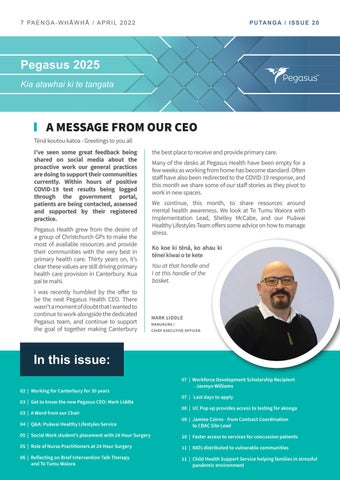
MARK LIDDLE MANUKURA / CHIEF EXECUTIVE OFFICER
In this issue: 02 | Working for Canterbury for 30 years 03 | Get to know the new Pegasus CEO: Mark Liddle 03 | A Word from our Chair
07 | Workforce Development Scholarship Recipient - Jasmyn Williams 07 | Last days to apply 08 | UC Pop up provides access to testing for akonga
04 | Q&A: Puāwai Healthy Lifestyles Service
09 | Jamiee Cairns - from Contract Coordination to CBAC Site Lead
05 | Social Work student’s placement with 24 Hour Surgery
10 | Faster access to services for concussion patients
05 | Role of Nurse Practitioners at 24 Hour Surgery
11 | RATs distributed to vulnerable communities
06 | Reflecting on Brief Intervention Talk Therapy and Te Tumu Waiora
11 | Child Health Support Service helping families in stressful pandemic environment
PEGASUS 2025 P U TA N G A / I S S U E 2 0
2 | 7 PA E N G A - W H Ā W H Ā APRIL 2022
WORKING FOR CANTERBURY FOR 30 YEARS – A HISTORY OF PEGASUS HEALTH Kia atawhai ki te tangata / Care for the people Pegasus Health (Charitable) is the largest Primary Health Organisation (PHO) in the South Island. Funded by the Ministry of Health and the Canterbury District Health Board, the role of Pegasus Health is to make Canterbury the best place to receive and provide primary care. Pegasus Health was founded in 1992 by a group of Christchurch general practitioners who wanted to leverage the health sector restructure to get the best possible outcomes for their local community. These early Pegasus pioneers brought together the majority of Christchurch GPs to form an independent collective with a strong clinical education foundation and a focus on more efficient use of available resources. The savings achieved went to building a range of programmes and services for patients, such as the first free GP visits for under 5s, free mammography screening for at risk women (before the national programme began), and the PEGS smoking cessation programme. Pegasus innovations continue to lead health service design and delivery across the country, with the Pegasus small group Clinical Quality Education programme setting the standard for clinical education content and delivery in Aotearoa. Pegasus-owned 24 Hour Surgery is one of New Zealand’s most enduring round-theclock general practices. Established in 1987, 24 Hour Surgery was purchased by Pegasus Health in 2005 from a collective of Christchurch GPs. At this time, an increasing number of after-hours services across Aotearoa were struggling. Pegasus felt strongly about ensuring the Christchurch community could access
GP care at all hours and so secured the future of 24 Hour Surgery. Another round-the-clock health service delivered by Pegasus is Whakarongorau Aotearoa // New Zealand Telehealth Services. This is a social enterprise owned by Pegasus and ProCare. It offers the people of New Zealand free, national telehealth services, 24 hours a day, seven days a week, over multiple digital channels. Those services include Healthline, the COVID Healthlines, 1737 – Need to talk?, Gambling Helpline and Quitline. Today, Pegasus Health continues to have the people of Canterbury at the heart of all they do. They support general practices and community-based health providers within Canterbury to deliver quality health care, to more than 450,000 enrolled patients. Cantabrians have been through a lot in the last decade and Pegasus Health have responded by growing community-based mental health services. Te Tumu Waiora, Brief Intervention Talk Therapy, and the Pegasus Child Health Support Service all support whānau who are struggling day-to-day. Pegasus Health overtly, purposefully and strategically threads equity and Te Tiriti o Waitangi through all they do and how they operate. Equity is prioritised in all considerations, structures, decisions and processes so that the health outcomes of all of our people and communities in Canterbury are improved.
PEGASUS 2025
3 | 7 PA E N G A - W H Ā W H Ā
P U TA N G A / I S S U E 2 0
APRIL 2022
GET TO KNOW THE NEW PEGASUS CEO:
MARK LIDDLE
Mark is a family man with a blended family of six kids. “I’ve been in New Zealand for 21 years. I came here for a better life for myself, my wife and my family.” He’s also a keen musician and plays bass guitar in a grunge band after growing up listening to 90s bands like Soundgarden and Nirvana.
“I grabbed the amazing opportunity to be the inaugural manager of a brand new purpose-built medical centre, Central Med, in Tauranga. That was my first introduction to primary care. We did so much engagement with our population and we really built services around what people wanted.
Born and educated in England, Mark has spent his working life in the health, disability and community sectors. His leadership potential was recognised from an early age when he was offered a head of department position with the National Health Service (NHS) in London aged 20.
“For me, Pegasus, an organisation with people living well at the heart of its purpose, really resonated with me. I’ve seen how small changes in primary care can make a massive difference in the lives and wellbeing of our communities, particularly focusing extra services around what people actually need to be well and stay well.”
Before leaving the UK for the greener pastures of Aotearoa, Mark spent five and a half years at the Great Ormond Street Children’s Hospital in London. “Probably the place that gave me as much passion for my job as Pegasus does, was Great Ormond Street Children’s Hospital,” Mark says. “The work Great Ormond Street does is phenomenal and I still stay in contact with them now.” Since working in New Zealand, Mark’s commitment to community engagement has become a central tenet to his approach to developing health care services.
“I’ve been at Pegasus for ten years. It’s the longest I’ve ever been anywhere, and I’m really proud and privileged to be where I am now. I consider it an honour to be the Manukura here. It’s got the best culture and probably the most committed people of any organisation I’ve ever worked in. With change on the horizon, Mark is quietly confident in his ability to lead Pegasus through the health reforms. “There is a lot of change coming and most of what the health reforms are aspiring to see in the community is at the heart of what we do. There’ll be some change, but my job over the next year or two is to position us really well for the future and keep building on the legacy that comes from this organisation that was born of general practice.”
A WORD FROM OUR CHAIR At our board meeting on February 23, 2022, Mark Liddle was formally confirmed as the CEO of Pegasus Health (Charitable) Ltd, succeeding Vince Barry.
Mark’s leadership skills are outstanding and he is the right person to ensure a strong position for Pegasus in the health sector.
The appointment follows a process by the Board to appoint a chief executive with the right mix of skills to navigate a strong path forward as we move through the health reforms. Mark has demonstrated strong leadership while Acting CEO and the Board is very pleased that he accepted the permanent role.
Mark has had a positive impact on Pegasus, in both the role as Chief Operating Officer and in the role as Acting Chief Executive. The Board looks forward to working with him as we focus on improving the health of people who live in Canterbury, and making Canterbury the best place to provide and receive primary care. Peter Townsend
Board Chair, Pegasus Health (Charitable) Ltd
PEGASUS 2025
4 | 7 PA E N G A - W H Ā W H Ā
P U TA N G A / I S S U E 2 0
APRIL 2022
PUĀWAI HEALTHY LIFESTYLES SERVICE The newly renamed Puāwai Healthy Lifestyles Service has provided some simple tips on minimising stress to improve health and wellbeing. Q1: Why is it important to minimise stress? Stress can negatively impact many aspects of our lives; such as the quality of our sleep, our productivity, and relationships with others. However, if we shift our perspective and see stress as a positive thing it can help. Q2: How can we see stress as a good thing? People who view stress as a positive thing can reduce its impact on their health and wellbeing. Try to welcome stress. For example, heart racing? Breathing fast? That’s your body giving you extra strength and energy.
Q3: What are your top five tips for minimising stress? 1. Get moving – Even a couple of minutes a day in the garden, a lunchtime walk, or a quick dance can make a difference to your mood. 2. Connect with others – Reaching out to others releases the hormone oxytocin which helps us recover from stress faster. We are social beings and supposed to be around others. It can be as simple as joining a community group, phoning a friend, or getting mates together for a game or walk. 3. Be in the moment and take notice – Research shows mindfulness is good for your wellbeing. Give your full attention to what is happening right now and experience it with curiosity and kindness. Notice a rainbow or smell a flower. 4. Sleep well – One of the most important things you can do for your health is sleep well. Establish a routine of winding down and going to bed at the same time. Dim the lights a couple of hours before sleep. Put devices down and stop the distracting notification beeps. 5. Make water and whole foods your friends – Water is vital to keep our bodies working well. Studies show eating lots of vegetables and fruit increases happiness. Aim for your plate or meal to be at least half colourful vegetables or fruit.
PEGASUS 2025
5 | 7 PA E N G A - W H Ā W H Ā
P U TA N G A / I S S U E 2 0
APRIL 2022
SOCIAL WORK STUDENT’S PLACEMENT WITH 24 HOUR SURGERY Undertaking a Bachelor of Social Work with the University of Canterbury, Nikki Nute is currently on placement at 24 Hour Surgery for 16 weeks. Nikki’s background has been working as a Child Health Coordinator at Pegasus Health, working with children and their whānau through the Child Health Support Service - a service that aims to improve the health, social and behavioural needs of children up to 17 years old. Nikki has been temporarily released from this role to complete her placement at 24 Hour Surgery. Part of her placement will involve providing social and support work to the team and their patients, being available for consults with staff around their patients to help navigate pathways, assist with patient
follow ups, assess needs and create plans for on going support. “I am excited to be placed at 24 Hour Surgery for my first social work placement as I work towards my Bachelor of Social Work,” says Nikki. She will be working on projects during this time centred around mental health and transport which Jasmine MacKay, Clinical Director, says she is keen to explore with 24 Hour Surgery. “Gaps have been found around the availability of services that provide free transport. There are costs associated with most options and they often need to be booked in advance,” says Nikki.
ROLE OF NURSE PRACTITIONER/ MĀTANGA TAPUHI AT 24 HOUR SURGERY Have you ever thought about becoming a Nurse Practitioner? It’s a highly skilled role that involves advanced education and clinic training, allowing Nurse Practitioners (NPs) legal authority to practice above the level of a Registered Nurse (RN). Sarah Bothamley, Nurse Practitioner Coordinator at Pegasus Health, says her role is dynamic within 24 Hour Surgery. “We take on more of a biopsychosocial model and can draw on our nursing skills to do a bit more for the patient ourselves instead of delegating tasks to RNs,” Sarah says. Sarah has a background in Emergency but became interested in becoming an NP after a fellow NP inspired her to become one. She then decided to advance her education and officially registered as an NP in November 2020. “Since then, my career has grown
exponentially, in part thanks to the opportunities that have been presented to me from people within Pegasus Health,” she says. To become a Nurse Practitioner, you must be a Registered Nurse and complete a Master of Nursing following a predetermined pathway that includes papers on advanced assessment, diagnostics and therapeutics, and prescribing. You must also pass a ‘viva’ set by the Nursing Council, as well as a portfolio demonstrating expert level competence in four areas: advanced clinical practice, leadership, facilitation of education, and evidence of research and development. “We are fortunate to have the support from Pegasus Health to have two Nurse Practitioner interns this year,” says Sarah. The Ministry of Health has funding for some interns to pay for two supernumerary days a week during semesters. Pegasus Health also adds to the funding to allow NP interns to be completely supernumerary for their intern year.
PEGASUS 2025
6 | 7 PA E N G A - W H Ā W H Ā
P U TA N G A / I S S U E 2 0
APRIL 2022
REFLECTING ON BRIEF INTERVENTION TALK THERAPY AND TE TUMU WAIORA Shelley McCabe joined Pegasus Health as the Mental Health Service Manager in 2017. With a background in secondary mental health as both a clinician and manager, Shelley was ready to shake up a system that was no longer fit for purpose or meeting the demands placed on it. “When I came into the service as a manager, what I saw was that there were some excellent clinicians working here, but they all had a different approach. I thought, that’s not equitable. We need a more consistent model that fits with primary care and the demand that sits in our community. “Our brief intervention clinicians now all use FACT which is Focused Acceptance and Commitment Therapy. It’s not focused on cognition so much as behavioural change. Often what people need is someone in the here and now to talk to and come up with a plan for how they can change things in their lives, to make things easier and help get them out of their head. It’s more around changing behaviours. We’re asking, ‘what can you do? What will lead you toward living a life that feels more aligned to your values?’ Shelley is also
“What will lead you toward living a life that feels more aligned to your values?”
the Clinical Implementation Lead for Te Tumu Waiora across Canterbury. Te Tumu Waiora is a new model of primary mental health and addictions support that came out of the He Ara Oranga report in 2018. The model is based around new roles in the primary care workforce – The Health Improvement Practitioner (HIP) and the Health Coach. These two roles are based in general practice and ‘warm handover’ – a GP offering immediate psychological/wellbeing support for patients – is at the heart of the Te Tumu Waiora model. There is also a third role of a Support Worker, who offers a conduit between general practice and community resources. “The focus of the HIP is to support people’s wellbeing. It’s moving away from a diagnostic clinical intervention towards normalising things for people. It’s encouraging people to feel like there’s no stigma when they need to get some support. “Our HIPs also predominately use Focused Acceptance and Commitment Therapy. They’re not using diagnostic language around depression or anxiety, but normalising it and saying, well, there are times in our lives where we all struggle with mood.” Pegasus Health was one of the first PHOs to trial the Te Tumu Waiora model in Aotearoa, before it was funded by the Ministry of Health. “We’ve got about 35 practices across Canterbury who now have the model of care. They’re down as far as Ashburton and as far north as Pegasus town. We’re only funded for a limited number of FTEs, so we targeted our top 30 practices based on some key areas that we’re trying to address with this model of care around equity. We targeted practices with relatively high Māori, Pasifika and rainbow community populations, low socio-economic communities and rural practices where there are fewer resources available. “We’re currently covering about a third of the total number of general practices across Canterbury and with more funding coming over the next wo years, we hope to extend this to about 60% of general practice”.
PEGASUS 2025
7 | 7 PA E N G A - W H Ā W H Ā
P U TA N G A / I S S U E 2 0
APRIL 2022
WORKFORCE DEVELOPMENT SCHOLARSHIP RECIPIENT
JASMYN WILLIAMS We invited scholarship winner Jasmyn Williams to share her journey since receiving the Pegasus Workforce Development Scholarship in May 2021. Here’s her story. I’ve just started my 5th year at Christchurch hospital and I’m loving it. My first run is orthopaedics and advanced surgery which has actually been my favourite so far. Over the summer I was up in Auckland working for a Māori health provider as part of the clinical team supporting whānau who were isolating at home with COVID. This involved triaging, dropping kai and medications, and referring for financial aid. This was really rewarding mahi as I could expand my clinical knowledge and engage meaningfully with whānau. Now back in Christchurch, I’m hoping to be a part of the community isolation supports here, while continuing remote work for our Auckland whānau too. Considering the future, I’m still unsure about which specialty to choose for my career. However, I am planning on remaining in Canterbury for the remainder of my studies and early years as a doctor, with the focus of improving Māori health outcomes.
LAST DAYS TO APPLY
Winning the Pegasus Scholarship last year was a big highlight. It alleviated a lot of my financial worries, which is pretty rare being a student, and instead I was able to focus more on soaking up everything the Medical School has to offer. I’m still very humbled to have received the scholarship as I know Canterbury has a lot of academic talent and rising numbers of Māori and Pasifika health care professionals in training (which in itself is amazing and will create generational positive change for our people). In summary, I’d like to thank Pegasus Health again for their support.
Māori 2021 Scholarship Recipients (absent: Jasmyn Williams).
We are delighted to invite students who identify as Māori, Pacific or from Culturally and Linguistically Diverse (CALD) communities, studying medicine, nursing or allied health to apply for the Pegasus Health Workforce Development Scholarships 2022. Pegasus Health has for many years recognised that developing our workforce is vital to improving the health status of the populations in the communities in which we serve. Since 2001 when these scholarships were first established, numerous aspiring recipients have been assisted, many of whom have gone on to outstanding careers in primary health care. For more information on how to apply, click here.
PEGASUS 2025
8 | 7 PA E N G A - W H Ā W H Ā
P U TA N G A / I S S U E 2 0
APRIL 2022
UC POP-UP PROVIDES ACCESS TO TESTING FOR ĀKONGA During the start of the Omicron outbreak, the University of Canterbury (UC) had one of the largest clusters of positive cases amongst students. The decision to have a pop-up site on campus was to help aid the demand of the cluster, specifically for those ākonga in the halls of residence, where initial cases swiftly increased. Jamiee Cairns, Site Lead for the pop-up COVID-19 testing station, says they had hundreds of students coming through every day, starting off with Polymerase Chain Reaction (PCR) testing. Eventually this changed to Rapid Antigen Testing (RAT) to keep up with the demand and allow students to self-test at home. “The testing clinic was greatly appreciated and made a significant difference for our students,” says Ripeka Tamanui-Hurunui, Director of Equity. “Having your team on campus meant that hundreds of students were able to access testing that would not have been accessible to them otherwise,” Ripeka says.
Many students on campus are first-time students with no access to transportation and living away from their hometown. Having a testing station on site meant that it was accessible for them to get tested and reduced demand at other testing sites. “There was a high level of need and anxiety about accessing testing; the team arrived just in time. It took the pressure off when we most needed it and allowed us to focus on those who needed medical attention,” says Teàrlach MacLean, General Practitioner at UC Health Centre. Vikram Selvaraj, University of Canterbury’s Student President says he was glad to see the testing site on campus. “It gave students the opportunity to get tested, keeping themselves and others safe. The site was open for several days, giving students the opportunity to drop in whenever they could,” says Vikram. The pop-up testing station at the University of Canterbury saw over 1,300 students, staff and whānau. More than 650 PCR tests were done and close to 1,000 RATs were distributed during the seven days they were on campus. “Our team thoroughly enjoyed working at UC, with several requesting to be rostered there. The students, despite being sick, were friendly and supportive of each other,” says Jaimee.
PEGASUS 2025
9 | 7 PA E N G A - W H Ā W H Ā
P U TA N G A / I S S U E 2 0
APRIL 2022
JAIMEE CAIRNS
FROM CONTRACT COORDINATION TO CBAC SITE LEAD Pegasus Health Contracting Coordinator, Jaimee Cairns, has been so busy putting her logistics skills to use supporting the Canterbury COVID response, that she’s almost forgotten what her usual role looks like. Jaimee typically spends her time in a dual role within the Practice Support and Coordination Service and Contracting and Funding team. Some of her core responsibilities include coordinating and overseeing funding and service delivery contracts. “For several months, I’ve been supporting CPRG and EOC in an admin capacity,” Jaimee says. “I have been involved in the COVID response since the initial outbreak in early 2020. First I worked in the phone triage based out of Pegasus, that was introduced as a means to support practices. Since then, I have supported in a variety of different ways as well as attempting to balance my usual role.” “With the Omicron outbreak, I was called in to help set up the Wigram Community-
based Testing Centre (CBAC). From there it was identified that there was a growing cluster at the University of Canterbury. I was stationed there as Site Lead for a week and a half with a team of six. We were set up to provide PCR tests for the students to help the Health Centre on campus. This allowed them to focus on providing routine health care and care for their growing number of positive cases. Eventually we moved into the distribution of Rapid Antigen Tests (RATs).” “Since then I’ve been the site lead at the distribution site in Rangiora, managing staff, admin and logistics.” Jaimee has found her new roles a welcome challenge. “It’s a highly evolving situation where things are changing all the time. I’m getting to work with different people across the health sector and expanding both my skills and knowledge.” Jaimee’s top tip for managing these times is all about social support. “Check in on your friends and family. Everyone’s getting pretty fatigued, and a bit over it all,” Jamie says. “For me, I have a really good support network of great colleagues, friends and family. I’m getting through with lots of FaceTime calls.”
PEGASUS 2025
10 | 7 PA E N G A - W H Ā W H Ā
P U TA N G A / I S S U E 2 0
APRIL 2022
FASTER ACCESS TO SERVICES FOR CONCUSSION PATIENTS A collaboration between Pegasus Health, ACC, Auckland PHO ProCare, and the Auckland University of Technology (AUT) will mean the more than 3,000 Cantabrians who experience a concussion every year will have a shorter wait to access specialist care. Pegasus Health Strategic Development Manager, Dr Akshay Shukla, says a new pathway will be available from March for GPs to refer patients. The pathway means that trained GPs can refer patients directly to one of three concussion services in the region, without approval from ACC. Currently, ACC must approve a patient’s referral to a concussion service. ProCare PHO in Auckland is also trialling the Pegasus Health-initiated pathway. Akshay says the new initiative will reduce waiting times for patients and help their recovery from the often life-affecting condition. The pathway is a pilot and will first involve practices using the MedTech 32 patient management system. Akshay says GPs can get training on a tool to assess a patient’s situation following concussion and their ongoing management needs. The assessment could involve referring the patient to a specialist multidisciplinary concussion service. Practices will soon be sent an expression of interest, and those who want to be involved in the pilot can apply for training. Education material will also be developed for patients and their caregivers, Akshay says.
Of the approximately 35,000 New Zealanders who sustain traumatic brain injuries every year,
95% HAD CONCUSSIONS
21,000 CONCUSSIONS CLAIMS Only
were lodged with ACC in 2019, so about a third of injuries are unrecognised, unreported, untreated, or not treated under an ACC claim.
18 DAYS
It takes an average of before a patient with concussion first presents to their primary care providers Source ACC.
An ACC-commissioned AUT survey of primary health professionals found:
THERE WAS NO CONSISTENT TOOL
for assessing concussion in general practice.
THEY WANTED MORE INFORMATION
about the assessment and management of concussion.
57% WANTED ASSESSMENT TOOLS INTEGRATED into a patient management system.
PEGASUS 2025
11 | 7 PA E N G A - W H Ā W H Ā
P U TA N G A / I S S U E 2 0
APRIL 2022
RATS DISTRIBUTED TO VULNERABLE COMMUNITIES With the increase of Omicron in the Canterbury region, some of our most vulnerable communities have been struggling to get access to Rapid Antigen Tests (RATs). Pegasus Health decided they wanted to help these communities by purchasing over 10,000 RATs to distribute to community partners and vulnerable groups. “The Pegasus Strategic Leadership Team and Pegasus Board were keen to contribute to the RAT testing drive in a meaningful way, that assisted groups who were engaging with our most vulnerable populations. Having equitable access to RATs was the key driver in this initiative,” says Michael McIlhone, Director of Nursing at Pegasus Health. Chief Executive Officer of Pegasus Health, Mark Liddle says that helping these vulnerable communities aligns with our purpose of ‘all people living in Canterbury leading health lives’. RATs were not easy to obtain and were expensive, creating a barrier. “While RATs were becoming available to purchase, they remained out of reach for many parts of the community due to cost. Cost is a barrier to access so we saw this as a way of removing that cost and associated inequity,” Mark says. More than 7,000 RATs have been distributed so far, with community groups feeling greatly appreciative, as they will make a real difference for vulnerable populations. “The RATs help us to further serve our Pasifika community, providing families with easy access to COVID-19 testing and support in reporting positive results,” says Carmen Collie, General Manager of Tangata Atumotu Trust. “We are so appreciative that our Christchurch interpreters were receiving
free RATs and masks. It’s a great advantage that we now have access to RATs to distribute to the community according to their needs,” says Maria Fresia, Interpreting Canterbury Coordinator. Pegasus Health have distributed RATs to the following non-government organisations (NGOs) as they were seen as community groups with the highest need: Interpreting Canterbury, Tangata Atumotu Trust, Aranui Community Trust, YWCA Women and Children’s Refuge, Cholmondeley Children’s Centre and Mental Health Advocacy and Peer Support. In addition, our Pegasus Partnership Community Workers (PCWs) have been provided with several hundred tests to distribute to vulnerable clients they work with. “Although it is only a small part of the overall distribution programme, it is something tangible that Pegasus Health can do to complement the mahi currently underway,” Michael.
PEGASUS 2025
12 | 7 PA E N G A - W H Ā W H Ā
P U TA N G A / I S S U E 2 0
APRIL 2022
CHILD HEALTH SUPPORT SERVICE HELPING FAMILIES IN STRESSFUL PANDEMIC ENVIRONMENT The COVID-19 pandemic is creating challenges and increased stress levels for children, says Child Health Support Service Manager (CHSS) Karen Meadows-Taurua. Everyday life has been impacted, including changes to many comforting routines such as school and socialising with friends. Karen says change and uncertainty can increase stress or anxiety in children, including those as young as pre-schoolers, and create behavioural or emotional issues. General practices can refer whānau needing support around behaviour, social and emotional difficulties to the CHSS. Once a referral is received, CHSS makes contact with the family and book a time for a consultation – which can be in person or virtual – where a CHSS support worker will get an understanding of what is going on, and offer tips, resources and guidance for further support in the community if required.
KAREN’S TOP FIVE TIPS for minimising stress in children: 1 Keep routines as predictable as possible to create stability for all the whānau 2 Prioritise regular quality 1 to 1 time with children. Get out the paints, playdough or go for walks and treasure hunts. 3 Try to keep an eye on screen time as this can overstimulate children or make them more irritable. Maintain existing boundaries or family rules. 4 Model calm behaviour as best you can. Children look to adults to understand the situation and its likely impact. 5 Reach out if you need help. Adults need support too, so try to look after yourself as part of keeping all the whānau safe and well.
Pegasus Health 2025 is produced by the Communications Team at Pegasus Health (Charitable) Ltd. Content within Pegasus Health 2025 newsletters has been included with the approval of content providers therefore please contact us if you wish to reproduce or alter and transmit any of the information or images contained within. Contact communication@pegasus.org.nz