I S S U E / P U TA N G A 1 4
30 HEPETEMA/ SEPTEMBER 2021
Pegasus 2025 Kia atawhai ki te tangata
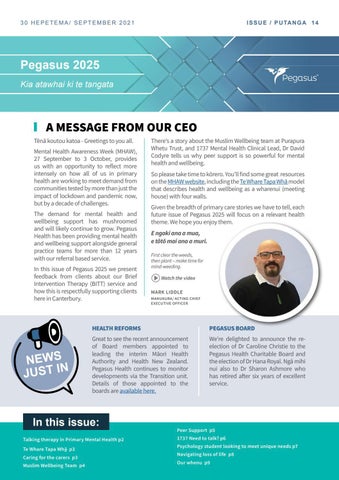
A MESSAGE FROM OUR CEO Tēnā koutou katoa - Greetings to you all. Mental Health Awareness Week (MHAW), 27 September to 3 October, provides us with an opportunity to reflect more intensely on how all of us in primary health are working to meet demand from communities tested by more than just the impact of lockdown and pandemic now, but by a decade of challenges. The demand for mental health and wellbeing support has mushroomed and will likely continue to grow. Pegasus Health has been providing mental health and wellbeing support alongside general practice teams for more than 12 years with our referral based service. In this issue of Pegasus 2025 we present feedback from clients about our Brief Intervention Therapy (BITT) service and how this is respectfully supporting clients here in Canterbury.
NEWS JUST IN
Muslim Wellbeing Team p4
Given the breadth of primary care stories we have to tell, each future issue of Pegasus 2025 will focus on a relevant health theme. We hope you enjoy them. E ngaki ana a mua, e tōtō mai ana a muri. First clear the weeds, then plant – make time for mind-weeding. Watch the video MARK LIDDLE MANUKURA/ ACTING CHIEF EXECUTIVE OFFICER
PEGASUS BOARD
Great to see the recent announcement of Board members appointed to leading the interim Māori Health Authority and Health New Zealand. Pegasus Health continues to monitor developments via the Transition unit. Details of those appointed to the boards are available here.
We’re delighted to announce the reelection of Dr Caroline Christie to the Pegasus Health Charitable Board and the election of Dr Hana Royal. Ngā mihi nui also to Dr Sharon Ashmore who has retired after six years of excellent service.
Talking therapy in Primary Mental Health p2 Caring for the carers p3
So please take time to kōrero. You’ll find some great resources on the MHAW website, including the Te Whare Tapa Whā model that describes health and wellbeing as a wharenui (meeting house) with four walls.
HEALTH REFORMS
In this issue: Te Whare Tapa Whā p3
There’s a story about the Muslim Wellbeing team at Purapura Whetu Trust, and 1737 Mental Health Clinical Lead, Dr David Codyre tells us why peer support is so powerful for mental health and wellbeing.
Peer Support p5 1737 Need to talk? p6 Psychology student looking to meet unique needs p7 Navigating loss of life p8 Our whenu p9
PEGASUS 2025
2 | 30 HEPETEMA
P U TA N G A / I S S U E 1 4
SEPTEMBER 2021
BRIEF INTERVENTION TALKING THERAPY (BITT) SURVEY SHOWS POSITIVE RESULTS A survey canvassing the experiences of Brief Intervention Talking Therapy (BITT) clients has showed they felt supported, respected and had benefited from the service. Pegasus Health’s Brief Intervention Mental Health Service was introduced in 2006 as an extension of general practice and to provide mental health/well-being support for its enrolled population. Brief Intervention Talking Therapists see patients referred by their general practitioners. They help patients normalise thoughts and feelings that can be over medicalised. They also validate people’s responses and teach them skills to manage difficulties and choose behaviours which will improve their life. Almost 600 clients were surveyed after they had been discharged from the service. Pegasus Health Mental Health Clinical Team Lead Karl Belcher said the survey was intended to provide insights into trends over time, how the service addresses patients’ needs and ways to improve the service. “We are really pleased so many of our clients have a positive experience and learn from the service, and we look forward to making it even better,” Karl said.
JUST LIKE TALKING TO A WISE FRIEND Callum Ross, 28, has always loved playing music, being in bands and engaging with other musicians. After moving from Wellington to Christchurch for work he felt ‘really depressed, lost and lonely’ and without a musical ‘tribe’ to belong to. He sought help from Pegasus Health’s Brief Intervention Talk Therapy (BITT) service.
“I was skeptical at first but I would now totally encourage anyone to do it. It was just like talking to a wise friend and I benefited from it so much.” During therapy Callum said he realised he needed to re-engage with his music and move closer to a support network in the Hawkes Bay. He is now living in the region and working as a farm shepherd.
“I’m a social person and when I moved back (to Christchurch) I was trying to find the community of people I had at uni, but they weren’t really there for me anymore. The happy place for me is playing and performing music and I wasn’t really involved in that when I was feeling so down.” He struggled for about three or four months before going to his general practitioner and being referred to the BITT service. “He (the therapist) was so easy to talk to at a time I was struggling to find someone I could open up with. I learnt a range of coping strategies for the present and explored issues from the past and how they might have contributed to where I was at now,’’ he said.
Callum Ross has revived his love of music
PEGASUS 2025
3 | 30 HEPETEMA
P U TA N G A / I S S U E 1 4
SEPTEMBER 2021
TE WHARE TAPA WHĀ FOUNDATION Te Whare Tapa Whā is a Māori health model designed by leading Māori health advocate Sir Mason Durie in 1984. It features as a key component in this year’s Mental Health Awareness Week. The model describes health and wellbeing as a wharenui (meeting house) with four walls. These walls represent taha wairua (spiritual wellbeing), taha hinengaro (mental and emotional wellbeing), taha tinana (physical wellbeing) and taha whānau (family and social wellbeing). Our connection with the whenua (land) forms the foundation. When all five of these elements are in balance, we thrive. When one or more of these is out of balance, our wellbeing is impacted. Pegasus Health has kicked off a week of activities for staff centred around the model and based on the MHAW guide.
CARING FOR THE CARERS Pegasus Health’s GP support for general practitioners has been operating since 2009 and a new suite of support services for nurses was launched last year. These services are designed to provide support through times of increased stress, burnout or personal problems. To better understand the pressure and challenges being faced by our health workforce in Canterbury, we’re asking Doctors, Nurses, Nurse Practitioners and Community Pharmacists what they’re facing in their day-to-day work.
PEGASUS 2025
4 | 30 HEPETEMA
P U TA N G A / I S S U E 1 4
SEPTEMBER 2021
MEETING COMPLEX MENTAL HEALTH NEEDS WITHIN MUSLIM COMMUNITY The Muslim Wellbeing team at Purapura Whetu Trust continues to grow and adapt to meet the evolving complexity of needs of the community it serves. Pegasus Health works closely with the team, one of two culturally responsive mental health services in Christchurch. The team was set up in response to the Christchurch terror attacks almost two and a half years ago and it continues to receive increasing numbers of clients from within the Muslim community with complex needs. “We have new clients coming in every week, sometimes up to seven a week,” says the team’s Clinical Lead, Kereama Carmody. “There has been a shift from supporting the directly-affected, to dealing more with the ripple effects, with a lot more of the trauma and psychosocial issues coming out. Two years after the event there’s been a real increase in clients presenting with severe trauma. ”
“Six months ago, we had 70-90 clients, currently we have 144 active clients, and the need continues to grow,” says Carmody. The Wellbeing Team includes a part-time Muslim youth worker, Bariz Shah, who supports young Muslim men aged between 13 to 25 years who lost their fathers in the attack and are dealing with trauma. He runs outreach programmes focused on outdoor education and camps. The service is expanding to include a community development position to increase it’s ability to work with larger groups providing activities that promote Aotearoa as a safe and inclusive place to live. The team has eight full-time and two part-time staff, as well as a specialist team of four clinical psychologists. It includes Carmody as clinical lead, a psychologist - managing external clinical supervision, community support workers, a youth worker, counsellor, and physiotherapist. They hail from Afghanistan, Somalia, Pakistan, and Jordan and speak a range of languages from Arabic, Dari, Farsi, Somali, Hindi, Urdu, and Pashto. Looking to the future, the Purapura Whetu Trust is focusing on growing and developing interpretation and translation capacity to help the community engage with agencies, as well as upskilling their community support workers to meet the community’s needs.
“Six months ago, we had 70-90 clients, currently we have 144 active clients, and the need continues to grow.”
The Purapura Whetu Trust Muslim Wellbeing Team comes together once a week to discuss progress and support each other (from left): Muneir Gwasmeh - Muslim wellbeing practitioner, Kereama Carmody - Team Leader, Bariz Shah - Muslim Wellbeing youth worker, Abdifatah Ibraham, Farial Savul and Nawal Hussein - Muslim wellbeing practitioners. Absent: Suhayla Asghari - Muslim wellbeing practitioner, Ruby Sadat - Counsellor.
PEGASUS 2025
5 | 30 HEPETEMA
P U TA N G A / I S S U E 1 4
SEPTEMBER 2021
PEER SUPPORT POWERFUL FOR MENTAL HEALTH AND WELLBEING Whakarongorau Aotearoa New Zealand Telehealth Services offer free online services to the public, 24 hours a day, seven days a week, over multiple digital channels. The organisation is owned by Pegasus Health and ProCare Health Limited and includes Healthline, the COVID Healthlines, 1737 – Need to talk?, Gambling Helpline and Quitline services. 1737 is a free service for New Zealanders feeling down, anxious, a bit overwhelmed or just need to chat to someone.
1737 – A 12-MONTH SNAPSHOT In the year ending 30 June 2021, the 1737 service...
answered around
132,000 CONTACTS
The service’s Mental Health Clinical Lead, psychiatrist Dr David Codyre says peer support can be powerful.
supported more than
A trained peer support worker can help a person normalise an experience of distress and, when appropriate, share what helped them, or suggest actions that might help. Once the person is able to make sense of their situation they can make changes that help them recover. Support provided by someone who has “walked in your shoes” has a powerful impact and many people find this to be an influential factor in their recovery. “Peer support workers can help people navigate through challenging life situations, which can cause a loss of confidence, or bring about feelings of shame. Having these feelings normalised, and being supported, is for many people a very healing experience,” said Dr Codyre.
63,000 PEOPLE and engaged in more than
50,000
TEXT EXCHANGES
PEGASUS 2025
6 | 30 HEPETEMA
P U TA N G A / I S S U E 1 4
SEPTEMBER 2021
1737 – NEED TO TALK? WITH DR DAVID CODYRE,
CONSULTING PSYCHIATRIST MENTAL HEALTH AND ADDICTIONS WHAKARONGORAU AOTEAROA 1737 Need to talk? is New Zealand’s national mental health and addictions service. It’s completely free to call and text and available 24 hours a day, 7 days a week. | Who is the 1737 service for? Anyone feeling stressed, anxious, worried, depressed, down or overwhelmed can call or text 1737 to connect with a trained counsellor. The service is also available for people who are worried about a friend or whānau member and the team offers advice on mental health or addiction issues. 1737 offers brief one-on-one counselling support, helping people with issues they’re immediately facing. | Who is at the other end of the phone? A team of trained counsellors. They are based in three offices around Aotearoa – Auckland, Wellington, Christchurch – and many work from their homes, located across the motu (country). It is a culturally diverse team - more than 20% of its team are Māori or Pasifika and they have access to 150 languages through interpreter services.
| 1737 Peer Support People looking for mental health support also have the option of speaking to someone with lived experience of raruraru hinengaro (mental distress) when they call 1737 Need to talk? The free peer support service is available by phone between 2pm and 10pm. It is an addition to the phone and text support from trained 1737 counsellors already on offer 24 hours a day, seven days a week. | What are the key themes from people contacting 1737? Since the Government’s Level 4 lockdown announcement on 17 August, we are hearing from people experiencing mental distress around ongoing lockdown anxiety and isolation, distress over boundary exemptions, ongoing uncertainty regarding work and school / university, and relationship issues. We give support to people contacting us for righthere-right-now, offering a range of advice, particularly encouraging them to be easy on themselves and those around them.
SHARE YOUR STORY If you’ve got a Pegasus Health story you’d like to share, email communication@pegasus.org.nz
PEGASUS 2025
7 | 30 HEPETEMA
P U TA N G A / I S S U E 1 4
SEPTEMBER 2021
PSYCHOLOGY STUDENT LOOKING TO MEET UNIQUE NEEDS Felisha Thain has been on a personal journey over the past year learning about her Somali culture, so it was a welcome surprise when she received a Pegasus Health Scholarship.
Raised by her mother, Felisha has never met her father who is Somali. About a year ago she decided to reach out to the Somali community through social media which led to an introduction to Sahra Ahmed at Pegasus Health who by chance knew her father and was able to connect them.
Felisha plans to become a clinical psychologist and is currently completing a Post-Graduate Diploma in Psychology at Canterbury University. She says the scholarship has been “super helpful”.
“The closer I got to clinical psychology, where we are working with patients and having to understand people and the importance of culture in their lives, the more important it became to me to learn about my own culture.”
“I have been studying for a long time, so it’s been a huge financial help.” Felisha began her studies in 2014 completing a Bachelor of Psychology with Honors, before starting her PhD in 2018, which she has almost finished, and then this year went on to start the post-grad diploma that she will complete in 2024. “I have always had a fascination with people in general and why they make the decisions they make, and, although it is cliché, I always had a desire to help people and that combined nicely into psychology.”
They have since been in touch by phone and her journey to understand her culture and get to know her father has helped spark a desire to work with migrant and refugee communities. “As I’ve become more in touch with my culture, I’ve become more interested in helping ethnic minority groups in general. I have greater understanding now of what it might be like for someone from an ethnic minority and the extra barriers they face across the board, accessing support and things like that. “I’ve come to understand that they have unique needs and our systems here are so stretched - I want to be able to help address that.”
“I always had a desire to help people and that combined nicely into psychology.”
Felisha Thain (centre) shown here receiving her scholarship certificate from Culturally and Linguistically Diverse (CALD) Health Advisory Deputy Chair Vibhuti Patel (left) and CALD Health Advisory Group Chair Sade Iposu,(right)
PEGASUS 2025
8 | 30 HEPETEMA
P U TA N G A / I S S U E 1 4
SEPTEMBER 2021
NAVIGATING THE LOSS OF LIFE BY SUICIDE A new initiative by Pegasus Health’s Suicide Prevention Team is better informing and supporting primary healthcare professionals, bereaved whānau, and community members in the aftermath of a suspected suicide. The team now calls practice managers to let them know about the death of an enrolled patient in a suspected suicide on the same or next working day after being officially informed of the death by the Coroner. One of the team follows up the call with an email containing details for getting further support or advice. Elle Cradwick, Pegasus Health Suicide Prevention Co-ordinator, says previously, general practices were only officially informed of deaths by suspected suicide in cases where patients died in hospital. Often, practices would learn of a death from bereaved whānau or community members. The new initiative means practices get directly informed about a death that can impact on other enrolled patients like family members and friends and their own health professionals who may have been a key provider of care for some time.
“We hope this initiative, and our support, will best position general practice staff to provide optimal care to those who have sadly been bereaved.”
“Staff and patients connected with the person who has died may experience varying degrees of grief and loss. By letting the practice manager know about the death they can inform relevant people within their practice and draw on the assistance our team offers. We can also provide information to provide timely support and identify any suicidal ideation in other patients and people who may be impacted by the death,’’ Elle says. “We acknowledge loss and suicide can be difficult to navigate with patients and will always be a challenging part of a health professional’s role. We hope this initiative, and our support, will best position general practice staff to provide optimal care to those who have sadly been bereaved.” Pegasus Health is contracted by the Canterbury District Health Board to provide suicide prevention co-ordination, including activities after a suicide such as ‘postvention’. Postvention is an organised, inter-agency response in the aftermath of a suspected suicide, aimed at reducing community distress, suicide attempts, and especially further suicides. For more information or resources please contact Pegasus Health’s Suicide Prevention Team: suicideprevention@ pegasus.org.nz
PEGASUS 2025
9 | 30 HEPETEMA
P U TA N G A / I S S U E 1 4
SEPTEMBER 2021
OUR WHENU Deb Bradshaw, Clinical Team Lead, Te Tumu Wairoa, Primary Mental Health Team. Deb Bradshaw has been working in the addiction field for more than 25 years. She joined Pegasus as a Health Improvement Practitioner (HIP) two years ago and is now a Clinical Team Lead. Watch the video
THE FIVE WAYS TO WELLBEING are five simple yet proven actions you can use every day to help you find balance, build resilience and boost your wellbeing
TUKUA
ME WHAKAWHANAUNGA
ME KORI TONU
ME ARO TONU
ME AKO TONU
For more information on the Five Ways to Wellbeing see: www.mentalhealth.org.nz/home/ways-to-wellbeing/
PEGASUS HEALTH ANNUAL REPORT Our 2021 Annual Report highlights our partnership with primary care and how we’re working together with general practice to ensure that together we make Canterbury the best place to receive and provide primary health care. You can find it here.
Pegasus Health 2025 is produced by the Communications Team at Pegasus Health (Charitable) Ltd. Content within Pegasus Health 2025 newsletters has been included with the approval of content providers therefore please contact us if you wish to reproduce or alter and transmit any of the information or images contained within. Contact communication@pegasus.org.nz