14 HŌNGONGOI / JULY 2022
PUTANGA / ISSUE 3
PEGASUS 2025 K ia at awhai ki te tangata
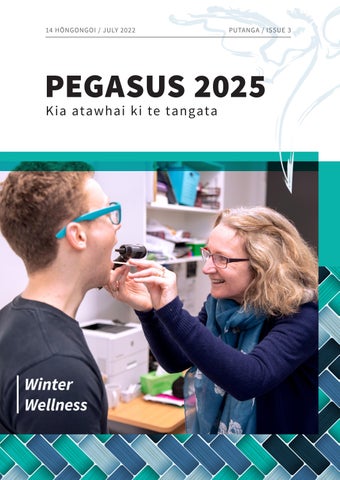
Winter Wellness
CO N T E N TS Spotlight on education . . . . . . . . . . . . . . . 4 Health reforms update. . . . . . . . . . . . . . . . 5 Chomondeley supports tamariki . . . . . . 6 Tips for keeping your whānau warm and healthy this winter . . . . . . . . . . . . . . . . . . . 7 Hikitia helping GPs meet patient needs. . . . . . . . . . . . . . . . . . . . . . . . . . . . . . . . . . . . . . .8 Ara health student Wikitoria joins Suicide Prevention & Postvention team . . . . . . . . . . . . . . . . . . . . . . . . . . . . . . . . . . . . . .9 Changes to streaming processes at 24 Hour Surgery . . . . . . . . . . . . . . . . . . . . . . . 10 What‘s on in July. . . . . . . . . . . . . . . . . . . . 11 Staying well this winter . . . . . . . . . . . . . . 12 Working with community to support Māori vaccination rates. . . . . . . . . . . . . . 13 Pegasus Health Workforce Development Scholarship recipients. . . . . . . . . . . . . . . 14
2
| PEGASUS 2025
Tena koutou katoa.
A MESSAGE FROM OUR CEO
Two weeks ago, I joined the ranks of the over 1.3 million New Zealanders who have had COVID-19. With anywhere from 5 to 9,000 new cases being reported each day, along with RSV and influenza cases on the rise, it has caused an overwhelming demand on acute medical care. July 1 saw the launch of Te Whatu Ora | Health New Zealand and Te Aka Whau Ora | Māori Health Authority, replacing the District Health Board (DHB) structure. The initial focus will be on developing a national health system that remove disparities across the districts, focusing on hospital and the old DHB systems. CEOs Margie Apa (Te Whatu Ora | Health New Zealand) and Riana Manuel (Te Aka Whau Ora | Māori Health Authority) have recorded introductory videos, which can be viewed on the Future of Health website. These cover topics such as how the organisations will work together, what the top priorities are and a bit more about themselves as people. Primary health care will maintain the status quo for now. While the rest of the system goes through changes. Pegasus Health will continue to support and advocate for primary care and the people of Waitaha.
MARK LIDDLE MANUKURA | CHIEF EXECUTIVE OFFICER Ko ngā pae tawhiti whaia kia tata, ko ngā pae tata, whakamaua kia tina. Seek out distant horizons and cherish those you attain. / The potential for tomorrow depends on what we do today. PEGASUS 2025 |
3
SPOTLIGHT ON EDUCATION MANAGING RESPIRATORY ILLNESSES IN PATIENTS Canterbury DHB (now Te Whatu Ora - Waitaha Canterbury) reports an increase in influenza and respiratory syncytial virus (RSV) patients on top of the ongoing COVID-19 cases. Dr Marie Burke, Clinical Facilitator at Pegasus Health Clinical Quality & Education Team, and GP at Eastcare Health urges GPs to reinforce public health measure when talking to patients. “Those public health measures of stay at home when you are sick, wash your hands and social distance really do work,” Marie says. In 2020, lockdown had been lifted by the time winter arrived and yet admission rates to Christchurch Hospital for non-COVID-19 respiratory illnesses stayed low. “As long as you maintain hand hygiene and do it properly, it makes a real difference,” she says. GPs can also help ease the pressure on the emergency department by 4
| PEGASUS 2025
setting realistic expectations with their patients regarding the duration of colds and flu. “Making sure your patients understand that coughs and colds can last two weeks or more will help to keep them away from the emergency department when their symptoms continue,” says Marie. When considering prescribing antibiotics, GPs should be considering environmental factors that may impact the ongoing health of the patient. Antibiotics are not shown to significantly reduce symptoms in self-limiting illnesses like coughs and colds and should be avoided. However, from her practice in Aranui, Dr Burke warns against under-prescribing to priority groups. “Factors like damp housing and overcrowding can increase the likelihood of respiratory tract infections developing into something more. Prescribing antibiotics in these instances may be recommended if there is risk that the illness will not be self-limiting,” Marie says. You can find more information at about colds here, and to view the full bulletin from The Antibiotic Small Group here.
HEALTH REFORMS UPDATE On Friday 1 July Te Whatu Ora | Health New Zealand and Te Aka Whau Ora | Māori Health Authority officially launched. This comes on the back of the successful passing of the Pae Ora (Healthy Futures) Act last month. Te Whatu Ora | Health New Zealand has informed Pegasus Health that the processes and services that we run will continue unchanged for now. Contracts that Pegasus Health had with Canterbury District Health Board have moved over to Te Whatu Ora - Waitaha Canterbury. We are
Stay home if you are sick.
Keep a 1 metre distance from others.
also anticipating, based on strong signals from Te Whatu Ora | Health New Zealand, that the Public Health Organisation (PHO) Services Agreement that Pegasus Health operates under will continue for at least two more years. One of the changes that came into effect last Friday was the implementation of a new set of Health System Indicators. These include the percentage of people who say they can get primary health care from a GP or nurse when they need it. This will be measured against a baseline of 84% of people who reported they could get health care when they need it. This baseline was taken from data pre-COVID-19 (December 2019).
Wash and sanitise hands often.
Wear a face covering PEGASUS 2025 | in shared spaces.
5
CHOLMONDELEY SUPPORTS TAMARIKI A growing relationship between Pegasus Health and Cholmondeley Children’s Centre is ensuring tamariki in need get access to vital health and wellbeing support. Cholmondeley is a charity based in Governor’s Bay that provides short-term, planned and emergency respite for tamariki aged three to twelve, as well as support to whānau in the community through its outreach programme. Cholmondeley General Manager Toni Tinirau says she reached out to Pegasus Health after taking on the leadership role at the charity last year. “I asked for support with the health needs of our tamariki. Since then we are building and growing a relationship of mutual trust,” she says. Pegasus Health has already provided Cholmondeley with medical supplies such as epi pens, which some tamariki need, particularly in Spring when there is a lot of pollen around Governor’s Bay.
6
| PEGASUS 2025
Pegasus Health also liaised with the Canterbury DHB (now Te Whatu Ora Waitaha Canterbury) to arrange for free toothbrushes and toothpaste for children. Toni says the two organisations are working together to provide training on diabetes for Cholmondeley staff so they can better assist children in their care with the condition. Pegasus Health general practices also provide ongoing support in the management of medications for some tamariki. Cholmondeley also has relationships with Pegasus Health’s Partnership Community Workers (PCW) and outreach staff from general practices who arrange for tamariki to stay at Cholmondeley when their parents are unwell or having an operation. “We are a charity so assistance with medical supplies and expert medical advice for our tamariki is wonderful. The evolving relationship with Pegasus Health has already produced some great results and will continue as both organisations play their part in the collective effort to support whānau in need.”
TIPS FOR KEEPING YOUR WHĀNAU WARM AND HEALTHY THIS WINTER With the weather getting cold, COVID and other illnesses such as influenza, and gastro bug are widespread in the community. With the cost of essentials such as food, electricity and petrol rising, it makes it more difficult for parents and caregivers to keep their tamariki warm, happy and healthy this winter. Pegasus Health’s Child Health Support Service Manager Karen Meadows-Taurua gives some tips for maintaining children’s winter wellness. • Stop the spread of germs and sickness by ensuring children wash and dry their hands regularly. • The flu vaccine is now free for children aged 3-12 years old. • Keep children at home when they are sick so they do not spread illness to others. • Keep warm - insulation, heating and ventilation keep homes warm and dry. Canterbury has curtain banks and a blanket bank and Community Energy Action has advice on saving power and keeping homes warm. • Keep homes and cars smoke-free. • Keep to established routines where possible such as regular meal times and bed times. Children often find routine comforting. • Turn devices off well before bedtime to help children get a better night’s sleep. Try to limit device time during the day too, and spend time playing, moving, or talking with tamariki. • Try to eat as healthy as possible. Cost-effective recipes and tips are available at puawai.org.nz or lovefoodhatewaste.co.nz • If tamariki share their feelings, validate them. For example, acknowledging that they are feeling frustrated or angry about all the things happening beyond their control. • If tamariki need support, suggest reaching out to friends or whānau. Provide resources like Child Health Support Services or Right Service Right Time.
PEGASUS 2025 |
7
HIKITIA HELPING GPS MEET PATIENT NEEDS Hikitia, is a programme developed by Pegasus Health to help support general practices to become more flexible, efficient, and innovative in how they meet patient needs. In the past year, 16 Pegasus Health practices have completed the Hikitia programme.
WHAT IS HIKITIA? Based on the Health Care Homes approach, Hikitia was developed by Pegasus Health to support general practices to become more flexible, efficient, and innovative in how they meet patient needs.
Pegasus Health Practice Relationship Manager, Chenoa Walker, has been leading the development and roll out for nearly 12 months now. She says the programme success lies in its ability to be tailored to each individual practice.
Hikitia is a built on eight core elements from telehealth consultations to leadership. A Pegasus Health Practice Relationship Manager supports the practice on their Hikitia journey and ensures that each module within the programme is bespoke to the goals and community of their individual practice. Additionally, areas within this programme will support a practices Foundation Standard or Cornerstone requirements.
“Every practice is a niche environment. It is fundamentally important to the programme that we, as Practice Relationship Managers, listen to what is going on at the practice and what their pain points are, so that we can focus the core elements of the programme to their needs,” Chenoa says. One example of this is within the patient portal module. Online portals that allow patients to book appointments and access their health information are a proven way of improving clinical effectiveness and workforce efficiency. Practice relationship Managers will show you the financial and staffing returns to be made by implementing a patient portal or increasing engagement with an existing portal. All this is considered within the understanding of the practice’s enrolled population. A diminishing workforce of GPs, combined with an increase demand for general practice as more and more secondary care is offloaded GPs, means practices need to be flexible, responsive, and innovative. This is where the Hikitia programme comes in. “The biggest thing with this programme is the ability to look beyond the day-to-day and see the long-term outcomes through the short-term pain. “If practices are employing the eight core elements of the Hikitia programme, then they are working in a way that will improve their capacity and efficiency,” Chenoa says.
Contact your Pegasus Health Practice Relationship Manager for more information.
8
| PEGASUS 2025
Practices who complete the Hikitia programme benefit from efficiency improvements and are better able to meet the specific needs of the communities they serve. In addition, practices are better able to adapt to crises, while still ensuring their staff are cared for and able to adapt to the changing needs of the population.
EIGHT CORE ELEMENTS
Patient Portal
Clinical Phone Assessment
Shared Care Plans Telehealth Consultations
Continuous Quality Improvement Plan
Access to Services Joining a Peer Group
Change Leadership
ARA HEALTH STUDENT WIKITORIA JOINS SUICIDE PREVENTION & POSTVENTION TEAM Wikitoria Kurene has joined the Suicide Prevention and Postvention Team (SP&P) for her 130 hour student internship based at Pegasus Health, where she will be for one to two days a week until November 2022.
“Despite the challenges of Omicron, Wiki has joined our hui online, connected with members of the team, and has taken opportunities to learn more about the mahi we do and help with the development and rollout of some suicide prevention initiatives,” says Tim.
She has recently finished her first year in her Applied Science Degree majoring in Health Promotion at Ara Institute of Technology. Prior to starting with SP&P Wiki has been working with the Māori/Indigenous Health Innovation (MIHI) Māori vaccination team.
Wiki is focused on the voice of those that the SP&P team work with and the vulnerable and disadvantaged groups.
“I jumped at the opportunity to join the Pegasus Health Team for placement as it focused on areas that were relevant to health promotion and areas I am personally interested in,” says Wiki. “I chose to work within the Suicide Prevention and Postvention space as I felt a pull to learn and understand more in this space and have always felt passionate about people and their wellbeing,” she says. Team Leader of the Suicide Prevention and Postvention Team, Tim Chainey, says it’s great to have Wiki on the team.
“Her strong interest and background in health promotion has resonated well with the team and has encouraged us to think about this as another aspect of suicide prevention,” says Tim. Wiki has enjoyed her placement so far, saying it has confirmed the spaces she would like to be further involved in and how she can utlilise her skills and knowledge further to help others. “A quote that I think relates well to how my placement is going so far, and what I believe this team represents for me is: Ehara taku toa i te toa takitahi, engari he toa takitini My strength is not that of one, but that of many.” “I am looking forward to the rest of my time with the SP&P team. There are some exciting projects I would love to get stuck into and see where and how they progress in the coming months,” says Wiki. PEGASUS 2025 |
9
CHANGES TO STREAMING PROCESSES AT 24 HOUR SURGERY Experiencing periods of high demand coming into the winter months, Pegasus Health 24 Hour Surgery have made some changes to the way patients are streamed then triaged on arrival. “We had predicted lower COVID-19 numbers in Canterbury by now, than what we are currently experiencing. With increasing viral illnesses other than COVID, we needed to be conscious of the risks of maintaining the triage outside,” says Jasmine
MacKay, Clinical Director 24 Hour Surgery. Approved by Canterbury DHB (now Te Whatu Ora - Waitaha Canterbry) COVID Technical Advisory Group, and still utilising infection control measures, triage is now inside for most patients, while the confirmed COVID-19 cases will still be managed safely in heated portacabins. Patients will still be greeted at the entrance before being allocated to their safest area. Please advise patients to call Healthline on 0800 611 116 for advice before leaving home.
Urgent Care is currently experiencing very high volumes
10
| PEGASUS 2025
WHAT‘S ON IN JULY 22 - 24 JULY Conference for General Practice 2022 Te Pae, Christchurch Convention Centre
9 - 24 JULY KidsFest Visit www.kidsfest.co.nz
28 JULY World Hepatitus Day Visit www.worldhepatitisday.org
11 - 14 AUGUST South General Practice Confreence and Medical Exhibition Visit www.http://www.gpcme.co.nz/south
Te Pae, Christchurch Convention Centre
PEGASUS 2025 |
11
STAYING WELL THIS WINTER
“During the winter months, it’s easy for people’s mental and physical health to suffer, and this winter seems to be increasingly stressful,” says Pegasus Health Partnership Community Worker (PCW) Chrissie Robertson. PCWs like Chrissie are based in community organisations and work with people to help them overcome barriers in accessing healthcare. “We (PCWs) work hard to make sure people know about and have access to the healthcare services they need. We want to empower people to manage their own health and wellbeing, but often they don’t know what is available or how to get help, so that’s part of what we do,” Chrissie says.
Pegasus Health Partnership Community Workers (PCWs) are available through the following agencies: He Waka Tapu Te Ora Hau Linwood Avenue Community Corner Trust Christchurch City Mission Tangata Atumotu Trust
12
| PEGASUS 2025
Christchurch Resettlement Services Christchurch Methodist Mission Presbyterian Support Aranui Community Trust Incorporated Society
Chrissie is based at the Aranui Community Trust Incorporated Society (A.C.T.I.S). A.C.T.I.S manager, Rachael Fonotia, says a key focus for the trust is ensuring its community has good access to healthcare services. “In partnership with Pegasus Health we can support our people to sort a plan for what they need. A lot of mahi goes into getting them linked into the health and wellbeing services, such as getting them enrolled with a GP. We want our people to be seen at the top of the cliff not the bottom, when they end up in ED,’’ Rachel says. “Any time of the year, our people need safe, dry, warm homes. In winter, this becomes even more crucial because without these basics their health, mental health and wellbeing can be badly impacted,” she says.
WORKING WITH COMMUNITY TO SUPPORT MĀORI VACCINATION RATES In June, 2021, Pegasus Health Hauora Māori Manager, Melody Tuliau, was seconded to the Canterbury DHB vaccination team as Māori Equity Lead. Over that year, Melody worked with a number of Māori providers to facilitate COVID-19 vaccinations for Māori and ensure Māori and Pasifika were able to receive their vaccination in a safe and respectful way. This involved supporting the set-up of vaccination clinics in partnership with Māori providers, particularly Ngā Hau e Whā, Māui Clinic @ The Hub Hornby and Māui Clinic @ South City. She worked alongside Maria Pasene, Pegasus Pacific Health Manager, to collaborate with Te Puawaitanga ki Ōtautahi Trust and Tangata Atumotu to provide mobile vaccination events in schools. This year, the focus has been on paediatric vaccinations and boosters. Melody collaborated with organisations such as Te Puawaitanga ki Ōtautahi Trust, He Waka Tapu, Purapura Whetu, and
Fully vaccinated
94.0%
MIHI (Māori/Indigenous Health Innovation, University of Otago, Canterbury) to provide mobile vaccination events within Māori communities. She also worked with the Canterbury DHB (now Te Whatu Ora - Waitaha Canterbury) to develop the service specs that enabled Māori providers to provide home vaccinations to whānau who may have difficulty getting out to a vaccination site. In May, hundreds attended a Health Day event held at Takahanga Marae in Kaikoura. The event offered COVID-19, influenza and MMR vaccines. In addition, a Māori pharmacist was on site to do medication reviews and a doctor was available for health checks. The event was a partnership between Māori health and social services provider, Te Tai o Marokura and MIHI and was supported by Melody and the Canterbury DHB COVID-19 vaccination team. As the colder weather hits, we are seeing an increase in respiratory illnesses like colds and flu in addition to the ongoing stream of new COVID-19 cases. “We know winter can be tough for many people in our community. Hand hygiene and mask wearing proved to be effective in reducing the spread of COVID-19 and also applies to colds and flu, particularly when we’re close together or without good ventilation,” Melody says. Vaccination remains an effective tool against illness so now is also a good time to kōrero with whānau and check Influenza, Measles, COVID-19 and other childhood immunisations are up to date. Other ways to take care of our hauora include staying active, eating good kai and keeping warm.
4TH HIGHEST IN COUNTRY Partial vaccination
97.0%
Partial vaccination
HIGHEST IN COUNTRY
4TH HIGHEST IN COUNTRY
CANTERBURY
CANTERBURY
12+ YRS
5-11 YRS
Boosted
Fully vaccinated
60.5%
3RD HIGHEST IN COUNTRY
44.9%
19.3%
3RD HIGHEST IN COUNTRY PEGASUS 2025 |
https://www.health.govt.nz/covid-19-novel-coronavirus/covid-19-data-and-statistics/covid-19-vaccine-data#ethnicity
13
e c r o f k r o W h t l a e H s u s a g Pe s t n ie ip c e R ip h s r a l o h c S t n Developme LEAH RUHA Nursing student, Leah Ruha (Ngāi Tahu, Te Whānau a Apanui), has been interested in working in health since she was 15. When she was made redundant from her role as a short haul flight attendant in 2020, she took the leap to nursing. “I was diagnosed with breast cancer when I was 31. After my journey through diagnosis, treatment, and recovery, that is when I realised, I do want to become a nurse. So then when I was made redundant, I thought, ‘it is now or never.’ It has been a whirlwind,” Leah says. Still in her second year at Ara Institute of Technology, Leah is undecided about where she would like her nursing career to take her. “I would really like to spend some time in Oncology, or work in a primary care so that I am exposed to what is actually going on in the community and what people are dealing with every day,” she says. While she is still on the fence about what area she wants to work in, Leah does know what kind of nurse she wants to be. In addition to her own breast cancer journey, Leah spent a lot of time around nurses when her mum was diagnosed with breast cancer when she was 15. “I would always see nurses come in and out of our home and look after Mum so well. And even in her final days at Christchurch Hospital, the care she received was just amazing,” Leah says. She wants her patients to feel comfortable to ask her anything and walk away understanding what is happening to them. “I want them to know what treatment they will be receiving and with the understanding that they can contact me. I want them to have that reassurance that I am there for them,” says Leah. Although life as an adult student has its challenges, Leah’s confident that she has made the right decision. “I look back now and think, this is the right path for me,” she says. 14
| PEGASUS 2025
ANGELIN PERUMBALLY Angelin Perumbally grew up learning two languages: Malayalam which is native to Kerala, India where she was born, and English. Angelin is now in her fourth and final year studying a Bachelor of Speech and Language Pathology at the University of Canterbury. “I’m currently doing an optional research project in my Honours year, looking at stuttering in bilingual children,” says Angelin. With bilingualism on the rise, the amount of research into therapy and support for bilingual children is alarmingly low. “I had a small stutter as a child, so it is a very interesting area for me to research,” she says. Angelin has discovered a real passion for supporting adults with speech
and language needs, particularly in a hospital setting. “I had a small placement last year at Southland DHB in Invercargill and discovered that working with adults is definitely where my strengths are and where I would like to take my career in the future,” says Angelin.
CALD Scholarship Recipients: (L-R) Vibhuti Patel, Sahra Ahmed, Angelin Perumbally, Nasteho Mohamed, Kanwal Yousaf (and children), Mark Liddle, Jennifer Micere Ngondi, Miron Habte, Samuel Equibazgi.
PEGASUS 2025 |
15
Pegasus Health 2025 is produced by the Communications Team at Pegasus Health (Charitable) Ltd. Content within Pegasus Health 2025 newsletters has been included with the approval of content providers therefore please contact us if you wish to reproduce or alter and transmit any of the information or images contained within. Contact communication@pegasus.org.nz
16
| PEGASUS 2025