5 HAR ATUA / MAY 2022
PUTANGA / ISSUE 1
PEGASUS 2025 K ia at awhai ki te tangata
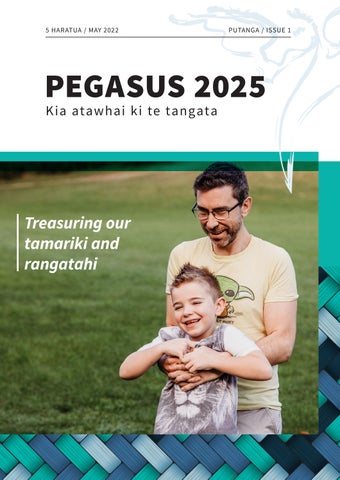
Treasuring our tamariki and rangatahi
CO N T E N TS Spotlight on education . . . . . . . . . . . . . . . 4 Health reforms update. . . . . . . . . . . . . . . . 6 Moana Vā providing safe space for Pacific rainbow+ community. . . . . . . . . . 8 Right Service Right Time connecting whānau with services. . . . . . . . . . . . . . . .10 Newly launched: Te Whiri Ora provides support for whānau . . . . . . . . . . . . . . . . . 11 Living with perinatal depression. . . . . . 12 Mental health and whānau: Lobna Falestine shares her research. . . . . . . . . 14 COVID-19 roundup . . . . . . . . . . . . . . . . . . 16 Pregnant mother successfully quits smoking. . . . . . . . . . . . . . . . . . . . . . . . . . . . 18 Pink Shirt Day: workplace bullying. . . . 19 UC develops relationships and sexuality education app . . . . . . . . . . . . . . . . . . . . . . 20 International Nurses Day. . . . . . . . . . . . . 22 Canterbury DHB Youth Advisory Council offers professional development . . . . . 23 PCW Success Story: LGBTQI+ youth in need. . . . . . . . . . . . . . . . . . . . . . . . . . . . . . . 25 Puāwai Kai Healthy Lifestyles programme launches. . . . . . . . . . . . . . . . 26
2
| PEGASUS 2025
Ko te ahurei o te tamaiti arahia ō tatou mahi. Let the uniqueness of the child, guide our work.
A MESSAGE FROM OUR CEO Tēnā koutou katoa. Pegasus 2025 looks a little different this month. This edition of our monthly newsletter is just for you, our primary care superstars. As well as our usual patient and service stories, we have introduced some regular columns: we take a look at upcoming topics and events in the Pegasus education space, and we also provide a quick rundown of what’s been happening in the health sector as a whole as we move through the reforms. COVID-19 continues to be at the front of our minds as many practices and pharmacies are impacted by staffing shortages due to the virus. Your Relationship Manager is always available to support you as needed. As we move out of the COVID environment I am working to reengage with general practice at a personal level and will be visiting practices over the next few months. I look forward to seeing you all and discussing how Pegasus can support you in this rapidly changing world. Our national borders are re-opening meaning many of us are able to be reunited with whānau and meet new family members. This edition we are celebrating our tamariki and rangatahi. We share with you a range of services in our community that exist to support whānau and young people, including Right Service Right Time, Te Whiri Ora, and Moana Vā. We are also excited to launch Pūawai Kai, our new wellbeing and nutrition programme that replaces Appetite for Life and Senior Chef. This is the result of a tremendous effort from the Healthy Lifestyles Team, and we will be sharing the stories of some of our pilot participants over the coming months.
MARK LIDDLE MANUKURA | CHIEF EXECUTIVE OFFICER
PEGASUS 2025 |
3
SPOTLIGHT ON EDUCATION This monthly column takes a look at current or upcoming education for health professionals. Oral Health Small Group Education will run through June and July and cover oral health services available for all ages and how to access them, the role of primary care in oral health, and how primary care providers can help achieve oral health equity. 4
| PEGASUS 2025
BETTER HEALTH OUTCOMES FOR TAMARIKI In April, the Clinical Quality and Education Team were delighted to host a webinar with the Canterbury DHB dental team. The full webinar will be available soon on the Pegasus Education website. Oral health is increasingly recognised as a window to whole body health. Evidence shows a two-way relationship between inflammation and disease in the mouth and multiple other systemic disorders such as cardiovascular and respiratory diseases. This is relevant throughout the lifespan, but starts from getting oral healthcare right from infancy. Within Canterbury, paediatric referrals to secondary dental care outnumber the capacity of our community dental services. CQE Kaiwhakahaere, Louise Kennedy, shares some key learnings from the webinar for primary care providers. “Primary care has a role in helping to reinforce preventative measures when it comes to oral health. Dental decay is the most prevalent chronic and irreversible disease in Aotearoa New Zealand,” she says. Poor oral he alth can have se ve re adverse impacts for our tamariki and effects in children include pain, sleepless nights, difficulty concentrating at school, difficulty eating, and poor self esteem. “GPs, nurses and pharmacists can all share information with patients and whānau about regularly brushing teeth twice a day, improving kai choices, reducing acidic drinks and the importance of fluoride containing toothpaste. These are simple interventions parents can make to improve the oral health of their tamariki, for now and for their future health.”
Poor oral health disproportionately affects Māori, Pasifika, culturally and linguistically diverse (CALD) communities and those with serious mental illness and/or addiction (SMIA). Research by John Broughton out of the University of Otago in 2016 looked at the importance of cultural connectedness with relation to oral health to improving outcomes for tamariki. Kaiwhakahaere Rongoā (Clinical Facilitator), Loren Vincent, has been helping develop content for upcoming Small Group Education on oral health. “The mouth and head have significant cultural connotations for Māori. It is important that health care providers are aware of a te ao Māori approach to oral health,” Loren says. “John Broughton’s study provided dental care to 200 Waikato hapu māmā [pregnant mothers]. They also provided ongoing oral health intervention for the tamariki while upholding the cultural aspects of te ao Māori. At 36 months, not one child had had a tooth extracted for decay or been admitted to hospital for any dental care treatment. It just shows what can be achieved.”
Watch an overview of the Small Group Education Programme. PEGASUS 2025 |
5
HEALTH REFORMS UPDATE
MONDAY 9 MAY Riana Manuel (L) and Fepulea’i Margie Apa (R)
Chief executives were appointed late last year for the interim Māori Health Authority and interim Health New Zealand. They are: •
Fepulea’i Margie Apa, Interim Chief Executive, Health New Zealand.
•
Riana Manuel, Interim Chief Executive, Māori Health Authority.
On 1 July 2022, the two new national health organisations will be officially launched: The Māori Health Authority and Health New Zealand. On this date, all District Health Boards (DHBs) will be disestablished. DHB Chie f Exe cutive role s will be disestablished as of 1 July 2022. All CEOs have received offers to stay on through the end of September 2022 to provide leadership support during the transition. Nine communities have been selected to roll out the locality approach to guiding health and wellbeing planning. 6
| PEGASUS 2025
Riana Manuel and Fepulea’i Margie Apa will be hosting a hui and Q&A session on Zoom, Monday 9 May from 3:00pm. JOIN MEETING HERE
PRIVACY WEEK 2022 “Privacy: The foundation of trust”
PRIVACY & SECURITY TIPS
CREATE STRONG, UNIQUE PASSWORDS Use passwords that are hard to guess, and keep track of it using a password manager. Suggestions for password managers are here.
USE SECURE WEBSITES & WIFI
Don’t download content from sites that are not trustworthy. Look for the padlock image in the website address.
WATCH OUT FOR PHISHING EMAILS
Check the sender and don’t open any unusual attachments or emails. CERT guidance on phishing is here.
KEEP DEVICES SAFE
Lock your device when you step away, and be mindful of shared workspaces. Apply software updates regularly.
The Privacy Commissioner has specific privacy guidance for Health, available here. CERT's protect your business online guide available here. PEGASUS 2025 |
7
MOANA VĀ PROVIDING SAFE SPACE FOR PACIFIC RAINBOW+ COMMUNITY Pegasus Health is proud to support Moana Vā a new collective offering a safe space for the Pacific Rainbow+ community in Ōtautahi Christchurch. Moana Vā wants to support the mental health and wellbeing of Pacific Rainbow+ community members of all ages by connecting friendships and mentorships, with a variety of Rainbow leaders, whose lived experiences have enabled them to flourish and will help them develop and explore how to be the best versions of themselves. Founder Suli Tuitaupe says the collective’s vision has always been to cre ate a place of be longing for our communities where they can be themselves, connect with likeminded people, receive support, advocacy and friendship. “After seeing the struggles Rainbow LGBTQIA+, MVPFAFF+ (mahu, vakasalewa, palopa, fa’afafine, akava’ine, fakaleiti, fakafifine) have been facing in the mostly conservative Ōtautahi Christchurch area, it was clear a space or vā for our communities, was necessary,” says Suli. Unfortunately, many of our Pacific Rainbow+ youth through to those in their early to mid-adulthood end their lives because they do not see the light at the end of the rainbow. Through fellowship, connectivity, events, and workshops we will be able to support our marginalised folks. MahMah Timoteo who identifies as “any pronouns used with respect” 8
| PEGASUS 2025
says navigating being queer is one thing but being queer and brown is different again. “Moana Vā provides this sense of safety and community for a group of people who may not have had it before,” says MahMah. “There are a lot of complexities with Pacific communities in the way we navigate our queerness. Religion plays a huge part in who we are and how we identify. It can be hard for Pacific peoples to present their whole self to the world, MahMah says. Moana Vā officially launched on February 25, 2022, originally set to be an in-person event, a virtual platform had to be used due to COVID-19 restrictions. Undaunted by having to accommodate the everchanging climate around event holding, the Moana Vā Collective (the “Collective”) invited Pacific Rainbow LGBTQIA+ MVPFAFF+ (mahu, vakasalewa, palopa, fa’afafine, akava’ine, fakaleiti (leiti), fakafifine) communities in the Canterbury Region and beyond to be part of the “Grand Coming Out” event. The collective received 116 registrations to attend the online Zoom launch, with 68 participants attending on the
MahMah Timoteo, member of Moana Vā.
night from all around the motu and several Canterbury District Health Board staff. While the colle ctive has big dreams for Moana Vā, Coordinator Lana Shields, who also works for Pegasus Health in the Equity Team, says the current focus is on relationship building within the local communities and providing visibility to Pacific Rainbow and their families. “Our hope is our collective will help inspire other Rainbow+ communities around Aotearoa to form like-minded groups,” Lana says. Over the next six months they hope to encourage youth to join their programme, increase
visibility of Moana Vā, build the team and grow their knowledge of what the local Pacific Rainbow+ community need and want. Long term they hope to host workshops, train facilitators to present at local schools and to find a physical safe space where people can get together, to provide information sessions, events, workshops, and a place to connect. You can connect with Moana Vā on Facebook: Moana Vā or Instagram: moana_va. Moana Vā are currently looking for Rainbow+ Pacific youth volunteers to join their team, if you are inte re ste d, ple ase contact: moanava2022@gmail.com PEGASUS 2025 |
9
RIGHT SERVICE RIGHT TIME CONNECTING WHĀNAU WITH SERVICES Right Service Right Time (RSRT) is a community-based initiative that Pegasus Health supports which seeks to improve the wellbeing of tamariki, rangatahi and their whānau, whatever their circumstances may be, to get the right service at the right time. With over 60% of referrals for whānau coming from general practices (GPs) it shows that this service is widely used by the primary health sector within the region. Whānau seeking assistance often have multiple needs and require more than one programme. They often go to multiple locations, interact with a range of processes and workers and have to tell their story many times. Right Service Right Time, however, is a one-stop-shop that is easily accessible and responsive for whānau. “If a GP sees a child or parent at the practice and they say they need help with parenting, budgeting or counselling for their whānau, rather than the GP having to take valuable time to know the range of services available,
they simply refer to RSRT on ERMS,” says Donna Ellen, Community Support Manager at Pegasus Health. The referral then comes through to Right Service Right Time and the Coordinator works with the whānau to see what their specific needs are and what services are on offer that they choose to be supported by. “Right Service Right Time is a longstanding collaboration of over 40 partner organisations including kaupapa Māori, Pasifika, refugee and migrant services, providing a diverse array of programmes for whānau in Canterbury. With a focus on these targeted populations, RSRT works to reduce barriers and to ensure timely access to health and wellbeing supports,” she says. Pegasus Health is a supporter of this integrated approach which ensures that health care services are coordinated around the needs of the diverse population of Canterbury. The client feedback speaks for itself, with many whānau thanking Right Service Right Time for their help and support. “The service I received was so welcoming, I got more assistance in a couple of weeks than I did in 3 years in the UK. Thank you so much and thank you for the referral for my youngest boy. You are all too kind,” says one client.
To find out more go to: www.rightservice.org.nz 10
| PEGASUS 2025
“The Right Service Right Time Coordinator was fantastic to deal with. She explained everything clearly and quickly established all the necessary help we needed. Thank you all for your help and advice,” says another client.
NEWLY LAUNCHED: TE WHIRI ORA PROVIDES SUPPORT FOR WHĀNAU Te Whiri Ora, a collaborative programme supported by Pegasus Health, is a new coordination service that supports agencies to work together with tamariki, rangatahi and whānau to achieve their aspirations, working for them, when they need it, helping them create a network of supports. The initiative, previously run by Oranga Tamariki, is now governed by the Right Service Right Time, a longstanding social service collaboration. Over the last six months, they have been working collaboratively to rename and co-design to Te Whiri Ora. “Te Whiri Ora is a client-centered initiative, with clients in charge of their own health needs, determining what they need. This changes the power base and dynamic of the engagement. We wanted Te Whiri Ora to be whānau-centric,” says Donna Ellen, Community Support Manager at Pegasus Health. Unlike Right Service Right Time which helps whānau connect with a service of their choosing, Te Whiri Ora have created a whānau centered pathway which includes whānau voice, whānau hui , and a Kaiwhiri
who work alongside the whānau for support to achieve their goals, for as long as it takes. “We are working with whānau who have high and complex needs and may need multiple services. Te Whiri Ora works with all professionals, whereas Right Service Right Time finds a service for the whānau,” says Aroha Wetere, Clinical Lead for Te Whiri Ora. The role of the Kaiwhiri is to establish a plan with the whānau, set what the priorities are for that whānau and what people are going to do towards that plan. “They engage in whānau hui to ensure the services are doing what they say they are going to do and have direct engagement with the whānau,” says Victoria Newcombe, Chair of the Right Service Right Time Governance Group. “That’s the big difference, the Kaiwhiri engagement,” she says. To make it easy for General Practice Teams to refer for Te Whiri Ora whānau support, it is planned to be on Health Pathways via an ERMS referral, in the near future.
PEGASUS 2025 |
11
LIVING WITH PERINATAL DEPRESSION Pegasus Health GP, Dr Joan Leighton, and mother of two, Kat Anthony, both agree that asking for help when you are experiencing depression is one of the hardest things to do. Kat spent six weeks as an inpatient at Mothers and Babies Mental Health Service after the birth of her second son. She credits the nurses at Princess Margaret Hospital, her husband, and Dr Leighton for helping her get through her severe postpartum depression. “My GP was awesome in supporting my choices. She helped me, access counsellors, when I was experiencing postpartum depression after the birth of my first boy,” Kat says. Dr Leighton recognises that a stigma still exists around talking about mental health and so everyone at the practice has a role in screening proactively for hints that a person, or a new mother, may be struggling. “Oftentimes it is about picking up clues from the patient. It might be a lack of eye contact or the way they are speaking about or interacting with their baby. And it is not just the GP who can notice and raise their concerns about the patient, it could be the
12
| PEGASUS 2025
practice nurse or another worker,” says Dr Leighton. When Kat’s youngest child, Connor, was born just 15 months after her first, her post-partum depression skyrocketed. “I was so far removed from reality, I think that is the insidious thing about depression, it lies to you. I believed I could do everything, and I could not ask for help not even from my husband,” Kat says. Dr Leighton remembers when Kat’s husband brought them to see her when baby Connor was three weeks old. “It is very difficult for partners. People do not have all the answers and acknowledging that you need outside help is a very uncomfortable place to be in,” Dr Leighton says. “That is why patients need to build a relationship with one GP. When there is a link, it is easier for patients and partners to know where to go for that help and support.” Within three hours of seeing her GP that day, Kat was admitted into the C-Ward at Princess Margaret Hospital. “Dr Leighton listened to what Ian, and I were saying, she showed us so much respect and understanding and leapt into action to help secure the safety of my family, says Kat. Although Kat still struggles with depression today, she knows her GP is always available to help her access the help and support she needs.
Common Symptoms of peri-natal depression include: • Tearfulness, weeping frequently • Panic attacks & anxiety • Being unable to sleep or feeling exhausted even when you have had sleep • No sense of enjoyment • Feeling grumpy, irritable or angry • Constant worry over your own health or that of your child/ children • Not feeling any emotion to your baby • Thoughts that you may harm your child or a member of your family either accidentally or deliberately • Feelings of being overwhelmed • Feeling numb & lack of emotion • Putting on a brave face, or “mask”, to hide how you feel • Feeling like a failure and a “bad mother” • Feeling of wanting to escape and that your family would be better off without you • Self harm • Suicidal thoughts and feelings www.perinatalwellbeing.org.nz Support available: Refer to HealthPathways for more information. 1737, Need to talk? Free call or text 1737 to talk to a trained counsellor.
Hurihia to aroaro ki te ra tukuna to ātārangi kia taka ki muri i a koe. Turn your face to the sun and the shadows fall behind you.
Perinatal Wellbeing Canterbury run support groups that are safe and supportive. The Plunket Postnatal Adjustment Programme (PNAP) offers home visits, phone and group support.
PEGASUS 2025 |
13
MENTAL HEALTH & WHĀNAU Pegasus Workforce Development Scholarship recipient, Lobna Falestine, share her thesis research. After working as a mental health support worker for many years, Master’s of Nursing Science student, Lobna Falestine, is passionate about both the impact of mental health on whānau and the impact of whānau on mental health recovery. Her lived experience with postpartum depression steered her toward her thesis topic: the impact of parental mental health illness on tamariki, partners, whānau and the community. “Internationally, there are a number of different models that take a familyfocused approach with parents who have a mental illness in mental health services to create better outcomes for our precious tamariki and community,” Lobna says of her research. Family focused practices practice includes routine identification of parents with dependent children in mental health services and providing psychoeducation for parents, partners and children about mental illness, resilience, communication and more. “Parents with mental illness often do not want to ask for help, or do not want to reveal how impacted they really are by their mental illness. They love their children and can often feel real fear of losing their children if they open up about their illness or their challenges with parenting,” says Lobna. Spending the summer doing a studentship with Pegasus Health, Lobna had the opportunity to interact with several young people and adults who came from families where mental illness and addiction were present.
14
| PEGASUS 2025
“I visited Te Puna Wai (Youth Justice Facility) where many young people have parents with mental illnesses or drug and alcohol addiction. Parents can often be afraid to ask for help or feel incapable of looking after their children. We are seeing trans-generational impact with children from these families demonstrating conduct disorders,” she says. Often parents are afraid of coming to professionals for support due to fear of loosing their children. Doctors and health professionals need to be seen as a place of trust and support. “My research indicates health professionals should focus on the strengths of the whānau, not the weaknesses. They need to build trust and connection and take a whānau centred approach to care. Having a family and belonging helps with recovery and whānau restoration,” Lobna says. “In Australia and UK, health and social services often have “champions” who understand the supports available in the community, both for parents and children. Their role is to promote family focused practice within teams and services by acting as a resource and support to colleagues working across the mental health and children’s services interface. They take on the role of helping the whānau access services and ultimately enable better outcomes for family and the community.”
Lobna Falestine (far left) with the other four Pegasus Summer Students.
PEOPLE WHO HAVE BEEN VACCINATED AGAINST FLU AND DOUBLE VACCINATED OR BOOSTED AGAINST COVID-19 ARE AT SIGNIFICANTLY LOWER RISK OF BECOMING SERIOUSLY ILL. Dr Ramon Pink, Canterbury Medical Officer of Health
PEGASUS 2025 |
15
COVID-19 ROUNDUP In March 2020, Pegasus Health was contracted by the Canterbury District Health Board to oversee community based assessment and testing. Learn what other activities Pegasus Health have undertaken in the past 27 months to support the COVID-19 response in Canterbury.
RAT Testing Introduced
PEGASUS CEO seconded
First COVID-19 case in NZ
Second national Alert Level 4 lockdown begins.
Vince Barry seconded to Ministry of Health to lead the COVID-19 vaccine rollout across the South Island.
After following the virus’ international journey, it lands on our shores.
At 11:59pm, New Zealand moves to Alert Level 4, and the entire nation goes into self-isolation.
Rollout of first COVID-19 vaccinations to port and airport workers, followed by family and close contacts.
2020
FEB
Orchard Road CBAC
2021
JAN
FEB
CBAC Clinical Lead Role
First EOC stood up
CBAC clinical lead role for COVID-19 response established ensuring uniformity of processes across the regions CBACs.
17 March 2020, Canterbury stands up their first primary care Emergency Operations Centre (EOC) covering this COVID-19 response..
Telephone triage call centre established. Triaged incoming calls from general practice and Healthline calls for Canterbury.
Pegasus admin support Pegasus HR and BIS teams support CBACs with recruitment, rostering, contracts, funding and claims.
16
| PEGASUS 2025
Expanded CBAC capacity with general practice teams also providing COVID assessment and testing.
First mass public COVID-19 surveillance testing to determine prevalence of COVID-19 in the community. Over 400 people tested at Pak N Save carpark.
AUG
2.8
People from across Pegasus step up to help out vaccine rollout including a focus on equity such as development of a vaccination programme for Māori.
COVAX team established Pegasus COVAX team leads the establishment of COVID-19 vaccination clinics within primary care, including general practice and community pharmacies.
Border testing Work site surveillance testing Conducted surveillance COVID-19 testing with Police, Fire, St John, Aged Residential Care workers and other critical workers.
Phone consultations for mental health Primary mental health moved to phone consultations to maintain engagement with patients.
JAN
May 2020, commenced onsite testing of border workers (airport, sea port and MIQ staff) plus supported testing of people returning in to NZ (MIQ) and foreign sea workers.
FEB
RAT tests are sourced and distributed free to vulnerable communities in Canterbury.
Extra drive-thru sites set up Jan 2022: Omicron outbreak. CBAC established in Wigram, with addditional RAT distribution sites in Rangiora, Christchurch Arena and Rolleston.
Webinars for young people Young people invited to ask questions and ease their mind about the vaccine.
Hauora Coordination Hub CPRG clinical leads assist in the establishment of Canterbury Hauora Coordination Hub to support general practice to care for COVID-19 positive patients.
eSmall Groups begun CQE quickly respond to lockdown and move to online small group education to ensure ongoing professional development.
NOW
RAT distribution
Supporting vaccination effort
Testing expanded
Mass testing set up
Telephone triage call centre
The first paediatric COVID-19 immunisations begin across NZ.
First COVID-19 testing at Orchard Rd, near Christchurch airport.
AUG
MAR
200
Paediactric vaccines
First vaccinations
25 March 2020
14
COVID-19 testing shifted away from PCR to self-administered RAT testing.
17 August 2021
First 6 months 14 CBACs operating concurrently across rural and urban Canterbury, including two mobile units.
CBAC pop-ups Pop-up testing clinics set up in response to community needs, including New Brighton and the University of Canterbury.
Over 200 nurses and doctors stepped up to staff CBACs in first 6 months.
A 2.8km queue for RAT kits on 3 March 2022 at Orchard Road Community Testing Centre.
1,130
PCR tests conducted in a single day at Orchard Rd (28 October 2021).
4,500 95%
PCR tests across general practice and CBACs in one day (February 2022).
Of all general practices in Canterbury have contributed to PCR testing.
900
From March to July 2020, Pegasus Health actioned over 900 requests for PPE gear across Canterbury.
140
140 primary care COVID-19 vaccination clinics account for up to 80% of vaccinations delivered in Canterbury.
CBAC = Community Based Assessment Centre. Pegasus Health acknowledge the incredible effort by the Canterbury Primary Response Group in planning, supporting and leading the primary care response to the COVID-19 pandemic. PEGASUS 2025 |
17
PREGNANT MOTHER SUCCESSFULLY QUITS SMOKING With the help of a Te Hā - Waitaha quit coach, Maria Cornell is putting in the mahi to stop smoking to give her newborn and teenage children a better future.
role model for them not a bad one. As well as trying to make things better for my kids, I started to see my body as a taonga that should be treated with more respect.”
While going smokefree has been a challenge, Maria says she’s determined to be a better role model for her teenagers, who smoke, and give 5-week-old son Kempton a healthier start to life.
Maria says she feels well-supported by her quit coach and motivated by the incentives Te Hā - Waitaha has for hapu māmā working to be smokefree.
With the support of Te Hā - Waitaha quit coach Josh Grenfell, Maria stopped smoking during her pregnancy. “I smoked all the way through my pregnancies with the other kids but I really wanted to do things differently with this baby and give him a better chance.” Maria says recognising the influence her smoking had on her teenagers also provided a strong motivation to quit. “When my teenagers asked me for smokes I thought ‘oh my god, they are following in my footsteps.’ I decided I wanted to be a good
You can refer patients to Te Hā – Waitaha through ERMS. Te Hā- Waitaha has quit coaches who work with those wanting to go smokefree and their whanau. Specific support is available for Māori, Pasifika, pregnant women or those living with a hapu woman. Te Hā – Waitaha also has a Pregnancy Incentive Programme that provides incentives to celebrate smokefree milestones:
18
| PEGASUS 2025
“Josh (Maria’s quit coach) is really good. He is regularly in communication with me, is very supportive, but most importantly he keeps me accountable. He visits me, or texts, and he also got me a pēpipod (flax cot) for baby.” Maria says she feels confident about the future and her ability, with support, to stay smokefree. “It’s been hard mahi but I look at my baby and absolutely know I’m doing the right thing. I also feel and look better, and food tastes better. The effort to give up is so worth it.”
•
A $50 voucher for all pregnant women who attend an initial session with Te Hā - Waitaha.
•
Further vouchers are provided at certain points in the smokefree journey.
•
Pēpipods, which encourage safer sleep, are available FREE to all pregnant women through the programme.
WORKPLACES THAT PREVENT BULLYING SHOW:
STRONG, WELL-COMMUNICATED POLICIES REGARDING BULLYING
LEADERSHIP COMMITMENT TO PREVENTION AND INTERVENTION REGARDING BULLYING
DIVERSITY IN STAFF AND AFFIRMATIVE RECRUITMENT PRACTICES
POSITIVE COMMUNICATION
PEGASUS 2025 |
19
UC DEVELOPS RELATIONSHIPS AND SEXUALITY EDUCATION APP A mobile app providing sex, sexuality, relationship, gender, and identity education for young Kiwis, aged 13 to 24, is under development at the University of Canterbury. Faculty of Health Lecturer Tracy Clelland, Masters student Cate Mentink, and Health Educator Jessica McQuoid are the driving force behind the app called Te Puāwaitanga: Beyond the Birds and the Bees. “Te Puāwaitanga will be a one stop shop for young people for resources on relationships, sex and sexuality. In addition to quality written content, it’ll be an interactive app with features like flip cards and quizzes, as well as questions to prompt their thinking,” says Jessica. “There’s nothing like this in Aotearoa and we are hoping that it will help to support and further extend relationship and sexuality education in this country.” 20
| PEGASUS 2025
The project began in 2020 with Cate Mentink completing focus groups with young people. The results showed that youth struggled to find quality, reliable information about sex, relationships, and sexuality. “They told us an app is what they wanted,” says Cate. “In particular, it was highlighted that relationships and sexuality education has not been meeting the needs of our Māori and Pasifika rangatahi,” says Cate. With funding from KiwiNet and Pegasus Health, a working prototype has now been developed. The next step is to take this to young people to get their feedback and involve them in further co-development. Irihāpeti Mahuika, Director of Hauora Māori and Equity at Pegasus Health, has a background in teaching and a passion for
ensuring health education is accessible and in a form that young people are going to use. “We are so pleased to be able to contribute to the work Tracy and Jessica are doing,” says Irihāpeti. For young people where social interaction is at the centre of their world, access to good health information is increasingly important. “Te Puāwaitanga is an opportunity for our general practice teams to have something to refer our young people to,” says Irihāpeti. The app is due to launch in November 2022 however, difficulties sourcing further fundings could put development at risk. “We are collaborating with youth health organisations and young people for content, but there’s still a long way to go. Extra funding ensures we get the best content in the hands of our young people as soon as possible,” says Tracy.
WATCH: Jessica McQuoid discusses the motivations behind developing the new app.
31 May
PEGASUS HEALTH SMOKEFREE ABC RECALL TEAM
9676
smokers contacted to offer motivational cessation support.
410
patients referred to Te Ha - Waitaha for quit support.
PEGASUS 2025 | 21 Data Source:Pegasus Health ABC Recall Team July 2021 to April 2022
INTERNATIONAL NURSES DAY 2022 31 MAY
This International Nurses Day, we are recognising the hard mahi of nurses across the Pegasus network. We have six $100 vouchers to give away. Watch Hayley Lotter, Nurse Educator, and email nursingteam@pegasus.org.nz to nominate a deserving nurse. 22
| PEGASUS 2025
CANTERBURY DHB YOUTH ADVISORY COUNCIL The Canterbury DHB Youth Advisory Council (YAC) offers tailored professional development to GPs and practices who want to ensure they offer a welcoming, inclusive and a friendly space for rangatahi. YAC is a group of young people between 16 to 24 years old who voluntarily advocate for 12 to 24 year olds in the Canterbury Health System. The council was formed in 2014 to advise the Canterbury DHB on youth-related matters in relation to policy and health services. Council members represent the diversity of Canterbury youth and include Māori, Pasifika, CALD, disability representatives, and members of the rainbow community.
“Our professional development presentations cover communicating with young people, navigating confidentiality, inclusiveness, and includes tips and tricks for making your practice accessible and welcoming to young people. “After a presentation by one or more of our Council members we facilitate a Q&A session with attendees. We offer our professional development in person or via Teams or Zoom. It’s really up to the practice what they would prefer.”
YAC Chairperson, Chelsea Skinner, feels strongly about empowering and uplifting the youth voice in our health system. “We know that many young people have a difficult time navigating from paediatric to adult health services,” she says. “YAC have created professional development opportunities for GPs and health professionals to help them provide a friendly, youth inclusive environment.”
Chelsea (R) with backpacks that YAC distribute to young people admitted to Christchurch Hospital.
PEGASUS 2025 |
23
Jen Shields (L) Qtopia, talks to PCW Emma Peak.
The Partnership Community Worker service is a free, confidential navigation service. It is based in the community and reflects the needs of the community. The purpose of the service purpose is to improve access and promote equity within health and social services, and to understand inequalities in order to improve health outcomes for Māori, Pasifika, low income, refugees and migrants. Those who access the service are given the opportunity to attain their highest level of health and wellbeing outcomes.
24
| PEGASUS 2025
PCWs work with a wide range of people from diverse backgrounds, and usually when an individual is in a place of vulnerability. They build relationships,and work to enhance an individual’s capacity to manage their own life inways that enhance wairua and mana.
LGBTQI+ YOUTH IN NEED This story was first published in our annual PCW Success Stories roundup available on the Pegasus website. The Partnership Community Worker (PCW) service received a referral from a Christchurch Hospital Social Worker for an 18-year-old who, while in hospital for a routine surgery, disclosed to staff that he was a transgender male. The hospital staff were supportive, but his parents disowned him, so he was left homeless. A member of the community housed him, got him a bank account and helped him apply for a benefit. The PCW did a home visit and made a plan to provide support. He has an emotional age much lower than his biological age and a diagnosis of dyslexia, dyspraxia, and generalised anxiety. He also struggles with phone calls, filling out forms, and basic life skills. The PCW provided the following supports for him: • Provided transport, a healthcare voucher, and support for the initial GP appointment. • Advocated for a referral to the transgender psychological package of care, a medical certificate for MSD to reduce work obligations, disability allowance to cover ongoing medical costs, and the depo provera injection to stop menstruation which is an ongoing distress for transgender males. • Supported at a GP appointment to talk about his mental health. He had to change housing so moved into a different property and was struggling with his mental health, due to one of his parents contacting him and turning up at places he frequents. • Transported and supported at a Health Improvement Practitioner (HIP) appointment where he spoke about his mental health and concerns about his personal safety. The HIP discussed safety options. • Made an appointment with Community Law at The Loft and provided transport and support to discuss the option of a
•
•
Protection Order. Provided caregivers with contact details for the NZ Dyspraxia Support Group as they were struggling with his lack of basic life skills in the home. The caregivers told the PCW that they were unsure if they could continue housing him due to his high needs. Facilitated an assessment with a youth worker at 298 Youth Health who supports transgender young people, to explain the situation and urgent need for mental health and life skills support. The Youth Worker arranged to have the transgender package of care referral transferred to them and an appointment was made for the following week.
A plan was made between the PCW, the youth worker and the young person. The Youth Worker took over as support person providing mental health and lifeskills support.
PEGASUS 2025 |
25
New healthy lifestyle and cooking programme: Puāwai-Kai starting mid-May. The new eight-week Puāwai-Kai programme is open for referrals to help patients adopt a healthier lifestyle and cook cost-effective, healthy food. The new eight-week Puāwai-Kai programme is open for referrals to help patients adopt a healthier lifestyle and cook cost-effective, healthy food. The programme was developed by Pegasus Health’s Puāwai Healthy Lifestyle Service, with feedback from primary care professionals and a diverse group of Cantabrians. It incorporates the best of the Senior Chef and Appetite for Life programmes with an added focus on wellbeing skills such as stress management, and handson cooking skills. It runs for eight sessions, two hours per week, and is delivered in small groups of up to 16 participants by trained
26
| PEGASUS 2025
facilitators. Participants will learn about: • Healthy relationships with food • Cooking and trying meals with healthy seasonal ingredients • Sleeping well and moving more • Taking care of the whole person The Puāwai-Kai team ran nine pilot groups to ensure the course was suitable for a wide range of Cantabrians. One of the participants in a pilot group of retirees was Robyn Smith. She was referred by her GP to try and help with her diabetes. Since completing the course Robyn has felt more in control of her diabetes, and enjoys sharing her new knowledge about food and recipes with her granddaughter.
“I have gained quite a lot of knowledge about the food and the things I should keep away from, as well as what I should be using to help with my diabetes. I’m cooking for my granddaughter when she comes to stay with me. She is prone to (being) overweight like I am. So it’s all a learning thing for her too.” General practice staff can refer via ERMS (community nutrition support) or by visiting puawai. org.nz. Call the Puāwai team on 0800 333 405 if you have any questions.
Robyn was recommended the Puāwai Kai programme by her GP. At the time she was struggling to balance her sweet tooth and her diabetes. Since completing the course, Robyn’s enjoyed sharing her knowledge and recipes with her granddaughter. WATCH her chat about the Puāwai Kai programme.
PEGASUS 2025 |
27
Pegasus Health 2025 is produced by the Communications Team at Pegasus Health (Charitable) Ltd. Content within Pegasus Health 2025 newsletters has been included with the approval of content providers therefore please contact us if you wish to reproduce or alter and transmit any of the information or images contained within. Contact communication@pegasus.org.nz
28
| PEGASUS 2025