9 TIHEMA /
I S S U E / P U TA N G A 1 7
DECEMBER 2021
Pegasus 2025 Kia atawhai ki te tangata
A MESSAGE FROM OUR CEO As 2021 draws to a close, and with this being our final edition of Pegasus 2025 for the year I wanted to say thank you to everyone who has contributed to our health system and the many challenges we have had thrown our way. Without all of you we simply wouldn’t have been able to do it.
COVID-19
Personally, I have enjoyed the many challenges of the acting CEO/Manukura position since stepping into the role in March this year.
We know that this can be a particularly difficult time of year for everyone in terms of stress, workload, financial and familial concerns. In this edition of Pegasus 2025 we’ve focused on caring for your mental wellbeing this holiday season.
Health and Disability System Review
Me mahi tāhi tatou mot e oranga o te katoa. We should work together for the wellbeing of everyone.
It has been an honour to work with the Strategic Leadership Team and the Board to establish our strategic direction and determine the role Pegasus Health will have in the new healthcare landscape. I’m particularly proud of the work our teams have done in developing improved co-design processes as we put in place the foundation for the locality-based model of care that will be the future of health services delivery.
Last week saw Canterbury reach a 90% fully vaccinated eligible population. I have to acknowledge the efforts of our GP teams and community partners in caring for our community through COVID-19. Read on to discover some of the awesome mahi being done around vaccination rollout. The Holiday Season
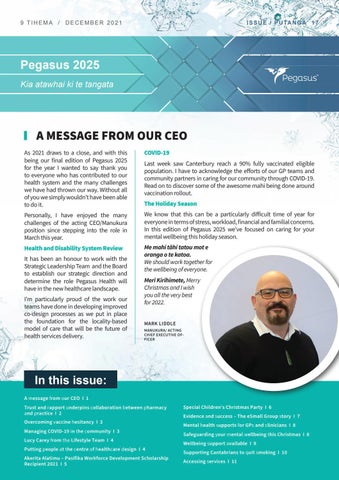
Meri Kirihimete, Merry Christmas and I wish you all the very best for 2022. MARK LIDDLE MANUKURA/ ACTING CHIEF EXECUTIVE OFFICER
In this issue: A message from our CEO I 1 Trust and rapport underpins collaboration between pharmacy and practice I 2 Overcoming vaccine hesitancy I 3 Managing COVID-19 in the community I 3 Lucy Carey from the Lifestyle Team I 4 Putting people at the centre of healthcare design I 4 Akerita Alatimu – Pasifika Workforce Development Scholarship Recipient 2021 I 5
Special Children’s Christmas Party I 6 Evidence and success – The eSmall Group story I 7 Mental health supports for GPs and clinicians I 8 Safeguarding your mental wellbeing this Christmas I 8 Wellbeing support available I 9 Supporting Cantabrians to quit smoking I 10 Accessing services I 11
PEGASUS 2025
2 | 9 TIHEMA /
P U TA N G A / I S S U E 1 7
DECEMBER 2021
TRUST AND RAPPORT UNDERPINS COLLABORATION BETWEEN PHARMACY AND PRACTICE Mitchell Trezise, Pharmacy Manager, believes building trust and rapport with their local medical centre is key to being able to respond to the changing need of the Yaldhurst community. Kiwi Pharmacy and Inspire Health Medical share their building with a range of other health professionals. “We’re working collaboratively in terms of processes, and we have informal collaboration as well. We’re able to reflect on experiences that the doctors have had and we’ve had. We use messaging apps to communicate back and forth quickly.”
One of the highlights of the collaboration between the pharmacy and the practice has been around the COVID-19 vaccination rollout. “During the August lockdown we saw quite a surge in people’s demand to get vaccinated or swabbed. The pharmacy and the GP practice were already working collaboratively for medicine provision. To ensure that we met the needs of the public, we had to recognise how we could support each other in the clinic. The GPs were able to offer and they had the funding for the swabbing, and we had the manpower for scaling up the vaccination service. So, it allowed us to focus on one task each, essentially, during that first period anyway. Just so that we could work out the processes well, upscale it and now at this point we’re both working almost in tandem.” Inspire Health Medical Practice Manager, Doris Chua, appreciates the efficiencies her GPs have gained from this collaboration. “We only do a few in-house vaccinations here for those patients that would prefer us to administer it, so it’s very helpful having the pharmacy in the same building to direct our patients to. “It’s been a really useful partnership because we rely on them when we have patients with issues or questions regarding the vaccine. We’re able to direct our patients to the pharmacy for answers.”
THE BLOKES BOOK
The suburb of Yaldhurst has a vaccination uptake rate of 95%, which Mitchell describes as ‘validating’. “We feel very privileged to be in a position to be able to offer it to the community.”
MĀORI
Vaccine Data for Canterbury (based on residence within Canterbury DHB boundaries) as at Tuesday 7 December 2021
ALL ETHNICITIES
FIRST DOSE RECEIVED
FIRST DOSE RECEIVED
FULLY VACCINATED
97% 91%
FULLY VACCINATED
89% 78%
PASIFIKA
FIRST DOSE RECEIVED
95% 85%
FULLY VACCINATED
PEGASUS 2025
3 | 9 TIHEMA /
P U TA N G A / I S S U E 1 7
DECEMBER 2021
OVERCOMING VACCINE HESITANCY Rosita Wharepapa was sceptical about getting the COVID-19 vaccine but thanks to conversations with general practice staff she decided to protect herself and her family. Rosita was nervous about getting the vaccine because wider family members had shared vaccine conspiracy theories with her. She had also seen media coverage about protests against the vaccine and mandates to ensure key occupations were vaccinated. But when she visited her long-time general practice Eastcare Health for a cervical smear, a simple conversation with a familiar nurse reassured her. “She did my smear and said ‘Rosita, what about this vaccine?’ …She said, ‘your kids are getting their vaccines right from six months upwards, this is not different’. That for me was enough. She booked me in for my first jab and when I went in the very next week she gave me a big hug and said, ‘Welcome to Team New Zealand’.”
MANAGING COVID-19 IN THE COMMUNITY
A lot of practices have given patients the opportunity to get vaccinated when they visit about other matters...
Dr Kim Burgess is the clinical lead for Canterbury’s primary care vaccination programme. She says general practices have played a key role in providing information and reassurance for patients hesitant about vaccination. “The relationship that people have with their GP staff means they can ask questions and have a honest conversation about their concerns,’’ she says. “A lot of practices have given patients the opportunity to get vaccinated when they visit about other matters, in addition to the walk-in clinics and longer hours offered, which has made a big difference.” Kim says, from 2022 primary care will have different demands as COVID-positive patients are managed in the community. A Canterbury COVID Coordination Hub has been set up to support patients, practices, and other community in this new phase. Pegasus Education was involved in a recent webinar explaining the Hub, its services, how to access it, and who does what in supporting the community.
PEGASUS 2025
4 | 9 TIHEMA /
P U TA N G A / I S S U E 1 7
DECEMBER 2021
LUCY CAREY
FROM LIFESTYLE TEAM Lucy Carey is part of the Puāwai Healthy Lifestyles team, a dietitian, and fellow of the Australian Society of Lifestyle Medicine. She shares some tips for health and the holidays. What is lifestyle medicine? It bridges the gap between preventative healthcare and treatment of diseases impacted by lifestyle choices. The six key pillars are: • feet (physical activity) • forks (good nutrition) • fingers (reduced smoking/ alcohol/ risky substances) • sleep (sufficient and quality) • stress (managing it) • love (positive social connections). Top tips for health and wellbeing? Nutrition and physical activity are important but they are only part of a bigger picture. Things such as social connections and how well we sleep have a bigger impact than we might think – and their impact is backed by robust research.
Top nutrition tips? • Focus on wellbeing not weight • Think about what to include in your day not what to exclude. If you mostly fill up on whole food and have ‘junk’ food sometimes, you are doing well • Food is more than fuel. It connects us with memories and culture . Growing, gathe ring and cooking kai is good for your wellbeing, as is sharing it with loved ones • Cook as much of your own food as you can and gets kids involved. They’re more likely to eat their veggies if they’ve helped cook them! How to avoid over-eating and unhealthy behaviours over Christmas? Don’t stress about the holidays. We put way too much pressure on a couple weeks and forget the rest of the year is much more important.
PUTTING PEOPLE AT THE CENTRE OF HEALTH CARE DESIGN The Health Quality & Safety Commission has launched a new health forum for consumers to have their perspectives reflected in the design, delivery and evaluation of health services. Members of the consumer health forum will be connected with the health system to give their insights into the design, delivery, and evaluation of health services. The Health and Disability Review Transition Unit has commissioned this work as part of the health reforms and the Pae Ora (Healthy Futures) Bill, and it will lay the foundation for transformation of the health system including structural reform. Learn more at the Health Quality and Safety Commission website.
PEGASUS 2025
5 | 9 TIHEMA /
P U TA N G A / I S S U E 1 7
DECEMBER 2021
AKERITA ALATIMU –
PASIFIKA WORKFORCE DEVELOPMENT SCHOLARSHIP RECIPIENT 2021 A value of service is what led second year nursing student, Akerita (Rita) Alatimu, to this career path. “Nursing has always been on my agenda, where I saw myself going. The whole being who I am, and my dad being the Minister of our church, it kind of breeds a value of service which you carry into your everyday life,” Rita explains. In addition to her nursing degree at Ara, Rita is also completing her Masters in Health Sciences having completed an undergraduate degree at the University of Otago in Forensic Science and Psychology. She’s now on her first placement at Christchurch Hospital in the Cardio Thoracic Unit. “I got the choice of where I wanted to go. I chose cardio thoracic because it’s a surgical ward so we get a day in surgery and a day in recovery. If you think about the heart as being the main battery then it makes sense to start there.”
Pacific people are prideful people. It’s important to be able to understand the feelings around their presentation in terms of their culture.
While she’s enjoyed her time as a theatre nurse, that’s not necessarily where she wants her career to take her. “I did my undergraduate in forensic science and psych so I’m just waiting on my mental health placement. I’m hoping that I can get into forensic mental health and to connect what I already know with the nursing pathway.” Rita’s Samoan heritage and community play a big role in her education and career choices. “I’m here to serve, I’m not here to be a standout person. I’m here as a worker bee. Half the reason why I went into nursing was to be able to serve my community in a different capacity. When people are in hospital they’re at some of the lowest points of their life and it’s to work in the trenches with them and to hopefully see them come out.” “Pacific people are prideful people. It’s important to be able to understand the feelings around their presentation in terms of their culture. Rather than how can I treat that immediate thing that they’re coming in with. Cultural understanding is something that we really need.”
PEGASUS 2025 P U TA N G A / I S S U E 1 7
6 | 9 TIHEMA / DECEMBER 2021
SPECIAL CHILDREN’S CHRISTMAS PARTY Pegasus Health is honoured to have sponsored the 2021 Special Children’s Christmas Party. This event saw 1,200 very special Cantabrian children celebrate Christmas in a big way. The children invited are all living with challenges, whether that’s ill-health, disability, or difficult home situations. For a few hours, they get to mingle with superheroes, farm animals, bikers and, most importantly, Santa. Organiser, Sam Jorgenson reflects, “It’s such a positive day for an often-overlooked part of the community. A lot of these children who attend would not receive a Christmas present if it wasn’t for the Special Children’s Christmas Party. The highlight for me is seeing the joy on the children’s faces, and the general positivity at the event is really heart-warming. This year, as we all know, it has been very challenging, especially for many of these children who attend as many of them have underlying health conditions.”
Grace and Jack were two kids in attendance this year. Both live with health issues. Jack, who’s legally blind, has attended a number of times in the past. This year, Grace and Jack enjoyed spending time with the farm animals. “All of the costs for this event are covered for by the generous sponsorship from the Canterbury community. Without the financial backing from the community this event simply wouldn’t happen,” shares Sam. Each child was sent home with a cuddly donkey and a bag of toys, made possible by the support of Pegasus Health and other sponsors.
PEGASUS 2025
7 | 9 TIHEMA /
P U TA N G A / I S S U E 1 7
DECEMBER 2021
EVIDENCE AND SUCCESS – THE eSMALL GROUP STORY In 2020, Louise Kennedy, Kaiwhakahaere, and the Clinical Quality and Education Team, responded quickly to the COVID-19 lockdown in ensuring that Small Group education could continue for clinicians. The result was eSmall Group, a new approach to online learning. “In our team, we always look for evidence. The first thing we did was have a conversation with Susan [Bidwell] and I said, ‘right… if we’re going online, what do we need to do?’” Susan’s research turned up three key principles that would inform the development of eSmall Groups: 1. Group online learning must be interactive and real time due to the complex issues that are discussed. 2. The technology and the attendees must be supported so that people are not demotivated by access problems. 3. Resources must be available to attendees after the fact and ongoing. Added to this, was Louise’s own mantra: Keep it simple – Keep it Small Group. “We didn’t change. We didn’t become a webinar. Yes, we took our learning into an online meeting, but we replicated an inperson meeting online. We were really clear about what small group is and what it needs to be successful.” “Overall, people were so grateful that we kept going when so many things stopped,”
shares Susan. The success of the eSmall Group Programme is reflected in the attendance numbers for 2021. While, in theory, some groups returned to in-person meetings and some remained online, Louise predicts over half of all Small Group education has been delivered online this year. “We can see by what was evidenced with the lockdowns in August, that our effort last year has paid dividends. We were able to continue the Small group programme. “Our attendance numbers this year have been very stable. They haven’t dropped when we’ve had to go online, which is fantastic.” This year, the CQE team have also launched a Learning Management System. “We’ve had a website that’s been developed which has the Zoom links and it’s much easier. It’s also a repository for our materials which goes back to the research Susan did.” And what are the plans for eSmall Groups in 2022 and beyond? “We do hope to bring back in-person Small Group meetings but will still offer eSmall Groups, that way we can offer a choice for our primary care colleagues, and make the programme more accessible.” “Next year might be different under a vaccine passport scenario, who knows? We just adapt again.” They’ve also submitted a paper to the Journal of Primary Health Care that they’re hoping will be published next year. “Part of the reason that we went down the route of writing it up and seeking publication was there’s a lot of research about undergrad type settings, but not in continued development of health professionals. It’s completely different. There wasn’t a lot out there about the eSmall Group style of online learning where it happens in real time and it was dependent upon reflective discussion for learning and change.”
PEGASUS 2025
8 | 9 TIHEMA /
P U TA N G A / I S S U E 1 7
DECEMBER 2021
MENTAL HEALTH SUPPORTS FOR GPS AND CLINICIANS Simon Wynn Thomas, Senior Clinical Leader, wants all primary care clinicians to make sure they’re looking after themselves, especially as many are struggling to manage burnout and stress. “It’s about caring for the carers. If someone wants to get good quality care from their health team, they need their primary health team to be in the best shape possible. And one of Pegasus’ roles is to try to make sure that clinical teams are functioning as well as they can to serve the patients that they see. “The last couple of years, particularly with COVID-19 and the way it’s affected the way we all practice healthcare delivery, and not to mention other stresses in the health
system at the moment, quite a lot of our GP teams are finding things tough at the moment. “Pegasus has been giving support across various domains: • We offer one to one confidential mentoring from a senior GP colleague • We can work with GPs and look through their notes and prescribing data to see if there are any ways we can assist them to improve their efficiency or to reflect on their practice • And the third thing we do is provide funded confidential counselling. GP members are entitled to three confidential counselling sessions.”
SAFEGUARDING YOUR MENTAL WELLBEING THIS CHRISTMAS COVID-19 uncertainty and lockdowns have increased stress for many Cantabrians this year. Karl Belcher, Pegasus Health’s Mental Health Clinical Team Leader, gives some tips on safeguarding your mental wellbeing during the silly season. Karl says he and the mental health team encourage people to take a break and recharge over the holidays. And to take some time to cherish what is important to you. “With COVID it has been hard to plan and look forward to things, but we can take the opportunity to focus on and enjoy the small things. Connecting with people is also important and hopefully we can all enjoy a
ME WHAKAWHANAUNGA
TUKUA
little of this during Christmas.” He says the Mental Health Foundation promotes the ‘Five Ways to Wellbeing’. Evidence has shown that incorporating these five simple principles into day-to-day life can improve wellbeing. Using the five ways is good thing to do at any time, but especially in situations of extra stress – such as Christmas sometimes brings with extra financial pressure, spending a lot of time with extended family or, for some, loneliness at a familyorientated time of the year. The Five Ways to Wellbeing are: 1. Connect – talk and listen 2. Give – your time, your words, your presence 3. Take notice – remember the simple things that give you joy 4. Keep learning – embrace new experiences 5. Be active – do what you can.
ME ARO TONU
ME AKO TONU
ME KORI TONU
WELLBEING SUPPORT AVAILABLE SUPPORT AVAILABLE TO ALL 1737
1737 is a free service for New Zealanders feeling down, anxious, overwhelmed or in need of a chat. You’ll be able to talk with a trained peer support worker who’s faced their own battles with mental health. Call or text 1737.
ALL RIGHT?
All Right? champions wellbeing for Cantabrians. They have online resources covering a range of areas including parenting, workplace wellbeing and coping in hard times.
There are a many resources available to support your mental health. You can find support by visiting your general practice team, or by calling or visiting one of the resources listed. We also have a range of mental health supports available for Pegasus members and their teams.
Find them on Facebook or www.allright.org.nz
ANXIETY HELPLINE
A dedicated 24/7 phone line to give support to people who are experiencing anxiety or panic attacks. Trained volunteers help with strategies and exercises you can use in times of high anxiety and stress.
In a medical emergency, please dial 111.
Call 0800 269 4389.
MENTEMIA
Mentemia is a phone app co-founded by John Kirwan. The free app supports wellbeing by delivering daily tips and tools to your phone, tailored to your unique challenges and goals.
SUPPORT AVAILABLE TO MEMBERS NURSING TEAM
The Nursing Team have funding available for nurses to access counselling or professional supervision as needed. Applications for funding can be made through the Nursing Team. More info is available on Pegasus World.
SELF CARE PACKAGE FOR GPS
GPs can access three free, confidential counselling sessions from a range of counsellors, depending on their preference and need. More info is available on Pegasus World.
GP SUPPORT PROGRAMME
The GP Support Programme is available for GPs in need of support. GPs can refer themselves or a colleague to the Senior Clinical Leader who can offer individualised support and mentoring by a range of doctors in a pastoral care role. More info is available on Pegasus World.
PEER GROUPS
We host six-weekly peer group meetings for doctors, nurses and administration staff. These meetings offer an opportunity to collaborate with your peers on the issues you face in your practice. More info is available on Pegasus World.
PRACTICE SUPPORT MAS FREE EAP
If you’re a MAS Member, you can access three free, confidential counselling and support sessions. This is available 24/7 and run by EAP Services. Call EAP Services direct on 0800 327 669.
XERO ASSISTANCE PROGRAMME
If your practice uses Xero, you can access the Xero Assistance Program (XAP) for you, your staff and even their families. You can access three free, confidential counselling sessions through EAP provider, Benestar.
PEGASUS 2025
10 | 9 TIHEMA /
P U TA N G A / I S S U E 1 7
SUPPORTING CANTABRIANS TO QUIT SMOKING
The risk of death among COVID-19 patients is
19% HIGHER FOR SMOKERS In NZ there are approximately
12 DEATHS EACH DAY
due to tobacco use & exposure.
12% of all NZers smoke daily
DECEMBER 2021
29%
of Māori smoke daily Our ABC Team completed over
800 REFERRALS
to quit programmes in 2021.
Sue Aitken, Kaiārahi, Team Leader - Health Promotion Programmes, has one simple smoking cessation message:
“We don’t expect practices to provide the actual support themselves. They are far too busy. Please refer your patients to a specialised quit coach via ERMS.” It’s simple and easy to do. Specialised quit support is provided through Te Hā-Waitaha Smokefree Support (THWSS). Te Hā translates to “The Breath”. THWSS have 11 quit coaches and the patient will be allocated a fully-qualified quit coach. “Over the past year, we’ve noticed a significant drop in referrals to Te Hā-Waitaha Smokefree Support from primary care. We encourage practices to continue to offer smoking cessation support to patients. People are under a lot of stress yet many still want help to quit smoking.” It’s evidenced that with specialised quit support, smokers are more likely to quit. In addition, the service provides Nicotine Replacement Therapy (NRT) completely free and there are incentive programmes available for Hapū Māmā (pregnant women) which are very effective. Although, the ABC team has been diverted to support the COVID-19 response at times, they’ve still managed a very successful year. The team’s major success this year was achieving equity for Māori patients in terms of being offered cessation support. Historically, Māori patients were offered support at a lower rate than non-Māori. “In Pegasus practices, on average, we now have Māori being offered cessation support at the same rate as non-Māori. One of the ways we have achieved this is the Pegasus ABC Team supports practices with recalls to non-Māori patients, freeing up time for the practice to work equitably and focus on offering smoking cessation to Māori under a holistic approach.” In addition, the team have been part of a wealth of success stories. “We’ve had so much positive feedback from clients that have been successful at going smokefree this year. It’s been fabulous to hear stories from individual people. Whether that’s a Hapū Māmā, people with previous addictions or serious mental health issues or just someone who’s been smoking for 20 years and couldn’t give up and now they can,” Sue shares.
Stop Smoking Practitioner and Te Hā-Waitaha Quit Coach, Josh Grenfell
One such case was profiled in Pegasus 2025, back in May. With the support of Josh Grenfell, Pegasus Health Quit Coach, and a whole lot of hard work, Ben, quit a 25-a-day, 38 year smoking addiction.
PEGASUS 2025
11 | 9 TIHEMA /
P U TA N G A / I S S U E 1 7
DECEMBER 2021
ACCESSING SERVICES Pegasus Health corporate offices close between 23 December and 10 January. However, access to urgent services will be available during this time.
PARTNERSHIP COMMUNITY WORKERS (PCWS) There will be a PCW available, except for the statutory holidays, to contact for information. The number to call is 021 906 926. If you have an urgent health issue, please contact the 24 Hour Surgery, 401 Madras Street Christchurch, ph 03 365 7777.
24 HOUR SURGERY
Stays open throughout.
MENTAL HEALTH TEAM The Brief Intervention Service will be closed from 24 December and re-opening 10 January. Referrals received during the closure period will be triaged on 10 January. Call or text 1737 24 hours a day to talk or text with a trained counsellor. Free online support is also available via Just a Thought or Small Steps. For urgent mental health support contact Crisis Resolution on 0800 920 092.
HEALTH IMPROVEMENT PRACTITIONERS AND HEALTH COACHES If your practice has access to a Health Improvement Practitioner and a Health Coach, this support will continue to be accessible over the closure period.
HERE TOITU SERVICE This service will be closed from 23 December 2021 to 7 January 2022. Health Navigators have advised their clients of their leave plans and the team phone and email will not be operating during the closure period. Referrals will be picked up from 10 January 2022.
Pegasus Health 2025 is produced by the Communications Team at Pegasus Health (Charitable) Ltd. Content within Pegasus Health 2025 newsletters has been included with the approval of content providers therefore please contact us if you wish to reproduce or alter and transmit any of the information or images contained within. Contact communication@pegasus.org.nz