The Lineup
SPORTS EDITOR
Chris Vinel
SPORTS COLUMNIST
Ken Willis
DESIGNERS
Joey Schaffer
Lee Benson
PROOFREADERS
Heather Hewitt
Sherrill Amo
PROJECT COORDINATOR
Gene Myers
SPECIAL THANKS
Alicia Del Gallo, Chris Thomas, Chris Fenison, Clarissa Shine, Bill Cannon, Kirkland Crawford, Aussie Mike Burdenell, Mickey Welsh, Ernest Masche, Tom Kreager, Ryan Ford, Jared Sábado-Hernández
About the book
“EARNHARDT!” condenses a half-century’s worth of the world’s best coverage of legendary NASCAR racer Dale Earnhardt from the Daytona Beach News-Journal. For continuing behind-the-scenes coverage of the latest news and events at the World Center of Racing, go to news-journalonline.com. Order digital and print subscriptions or access the eNewspaper at subscribe.news-journalonline.com/offers. This book includes coverage from the USA TODAY Network, which includes the News-Journal.
On the cover
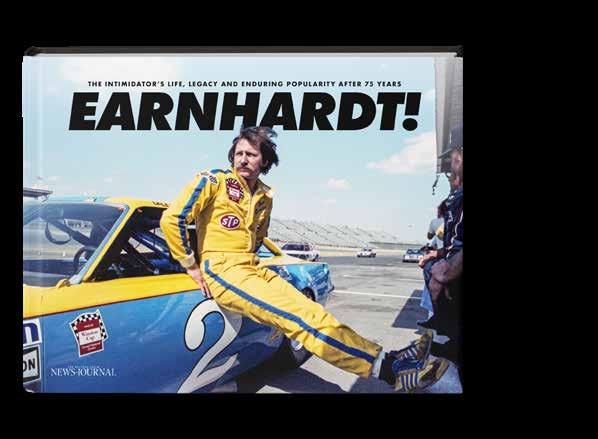
In February 1980, before he was known as The Man in Black and The Intimidator, Dale Earnhardt continued making a name for himself while driving the No. 2 Wrangler Jeans car for Rod Osterlund. He won rookie of the year honors in 1979, tested well at Daytona International Speedway in the winter and won his first race at the track, the 20-lap Busch Clash when he passed Darrell Waltrip on the last lap.
NEWS-JOURNAL
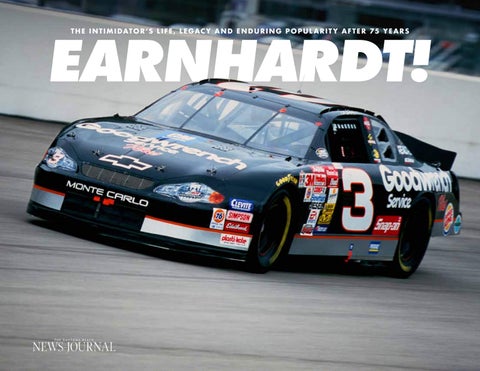
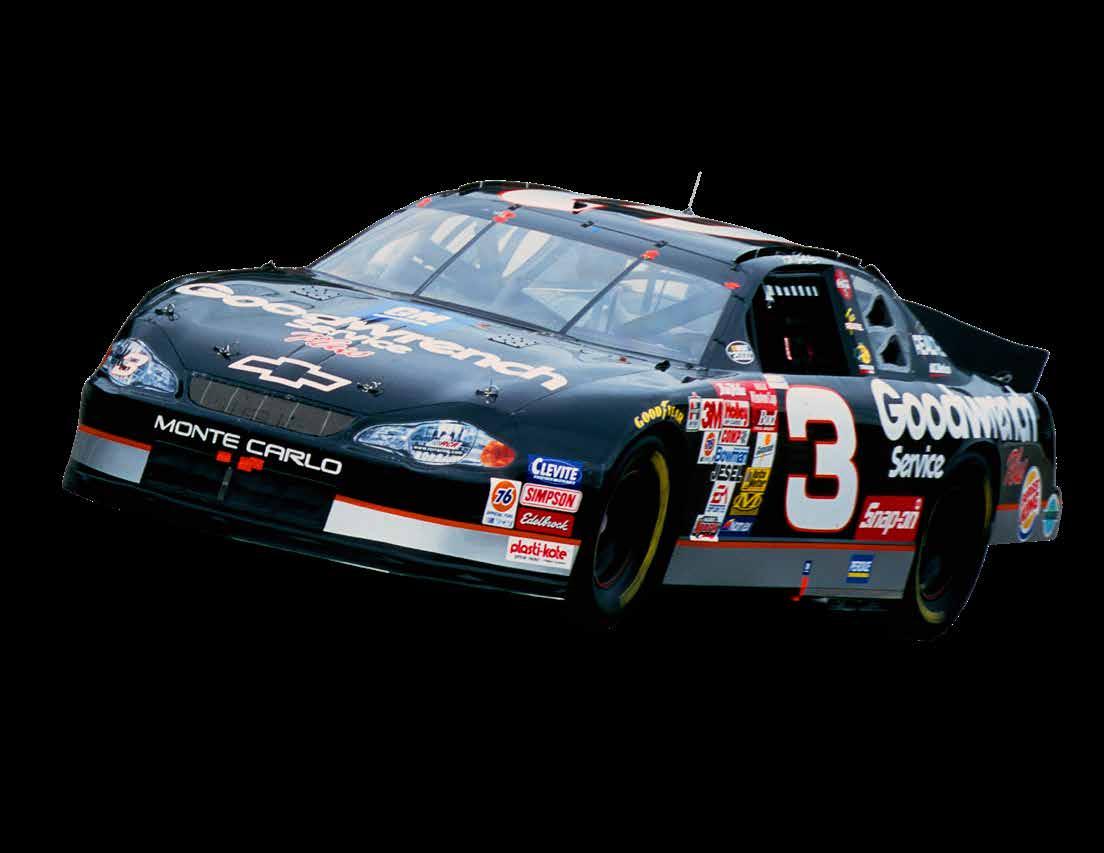
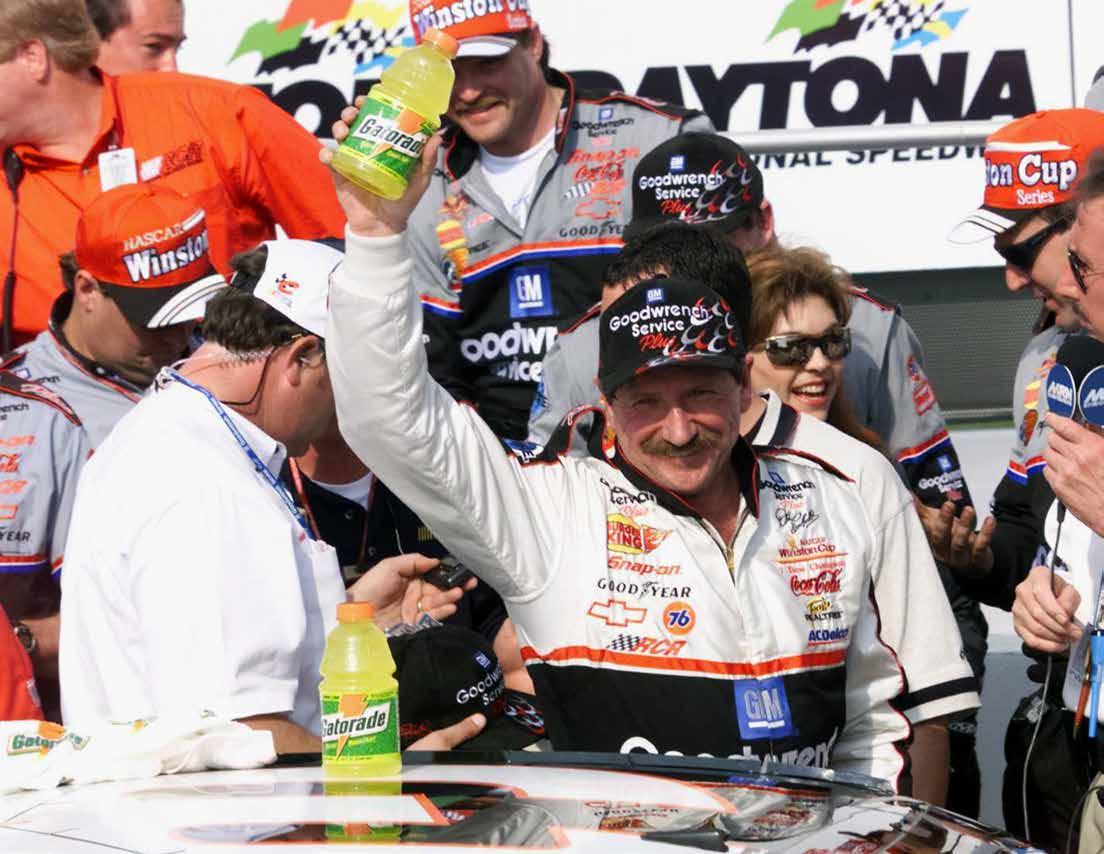
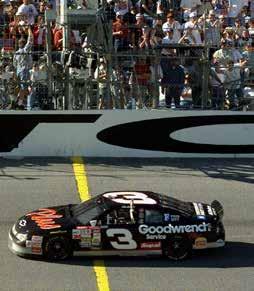
PREVIOUS PAGE: Shown driving his signature black No. 3 Chevrolet sponsored by GM Goodwrench, Earnhardt won 34 races at Daytona International Speedway, most famously the 1998 Daytona 500 on his 20th attempt. IMAGN IMAGES
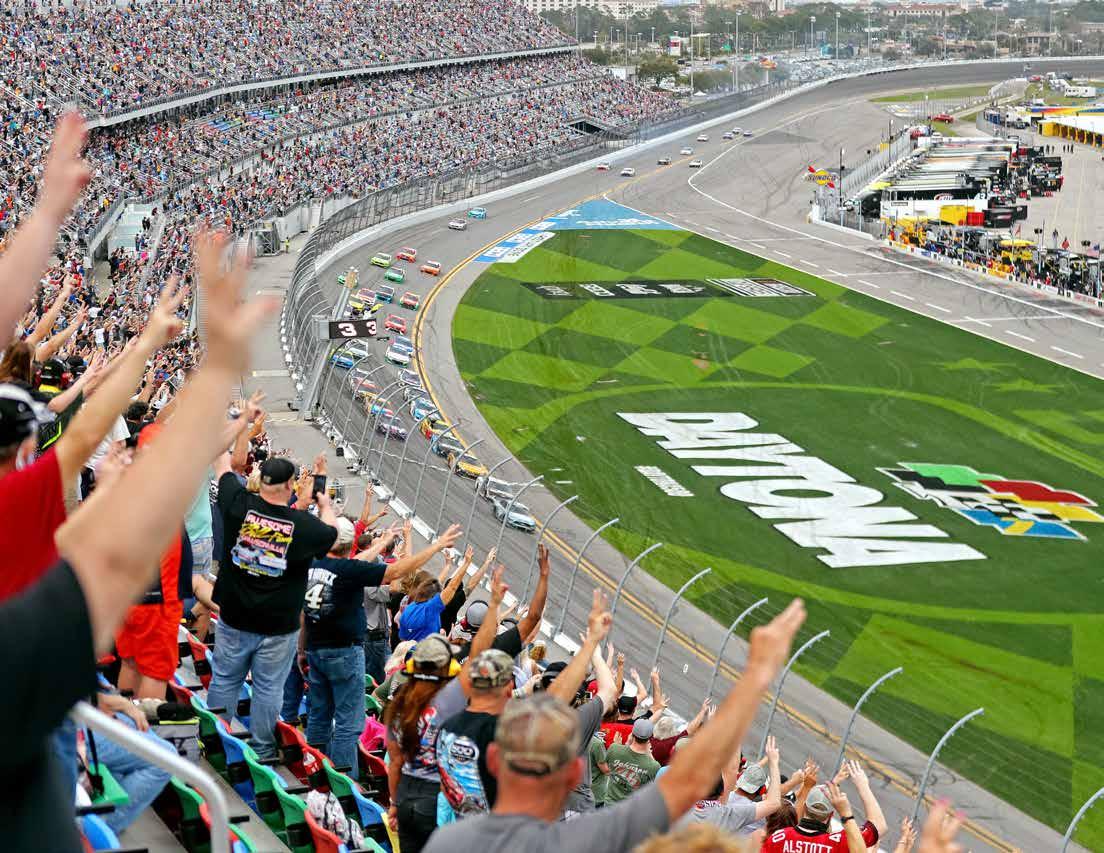
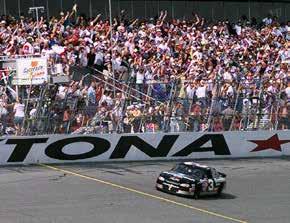
OPPOSITE PAGE: Twenty years after Earnhardt’s death, fans held up three fingers during the third lap of the 2021 Daytona 500 as a silent salute to the legendary driver. MARK J. REBILAS / IMAGN IMAGES
No part of this book may be reproduced, stored in a retrieval system or transmitted in any form or by any means, electronic, mechanical, photocopying, recording or otherwise without prior written permission of the copyright owner or the publisher.
Published by Pediment Publishing, a division of The Pediment Group, Inc. • www.pediment.com • Printed in Canada.
This book is an unofficial account of Dale Earnhardt’s life from news coverage by the Daytona Beach News-Journal and is not endorsed by NASCAR or the Earnhardt family.

Copyright © 2026 by The Daytona Beach News-Journal All Rights Reserved • ISBN: 978-1-63846-189-0
20 CHAPTER ONE HIS ROOTS
38 CHAPTER TWO HIS RACES
72 CHAPTER THREE HIS DEATH
110
CHAPTER FOUR HIS AURA
148 CHAPTER FIVE HIS SPIRIT
FOREWORD
A quarter-century later, stock car racing still misses its skilled and polarizing leading man

MIKE JOY
In all of NASCAR’s 80 years, there has never been as polarizing a figure as Dale Earnhardt.
Yet there never has been a driver so badly missed on the track as the years since Dale’s last race continue to pass by. As a young race driver, trying to make a name and a living for himself, he was raw, undisciplined and fearless. As his racecraft matured, people took notice of the lanky kid from Kannapolis, and doors opened for him to grow his talent and his following.
His self-styled frammin’ and bammin’ on short tracks got his cars to the front of the pack, but Dale could make enemies on the track as easily as he made fans. The sport’s blue-collar fan base easily
took to his humble beginnings and how he scratched and clawed for each opportunity. He was one of them.
Sponsors took full advantage of his rough-and-tumble populist appeal, branding him “one tough customer” and later “The Intimidator.” With the retirement of legends Petty, Pearson, Allison and Yarborough, NASCAR’s future sat squarely on Dale’s shoulders. He carried it proudly.
His merchandise sales were unparalleled, his fan base by far the largest in the sport, and the victories kept coming.
Some of those races, such as the 1998 Daytona 500 and 2000 Talladega, were unforgettably dynamic.
But some of his victories weren’t pretty — detractors groused that when Dale stepped over a line, Bill France Jr. would just move the line.
The sport and Dale’s stardom continued to grow, and Dale’s seven driving titles equaled Richard Petty’s.
As 2001 began, renewed hope and talk of an eighth championship were rampant. When tragedy struck on the last lap of the Daytona 500, many felt that racing’s compass had lost its true north.
Indeed, many of Dale’s ardent fans turned away from the sport … a NASCAR without Earnhardt was just too difficult for them to comprehend.
I would love to have seen how his chase for an eighth championship would have played out, how Dale would transition from driver to full-time team owner, how he might someday race at Le Mans with his son.
Twenty-five years on, he is still badly missed, and this sport will never know another like him.
With 57 years of motor sports experience and awards in television, radio and print, Mike Joy marked his 26th consecutive season as the lead announcer for Fox’s NASCAR coverage in 2026. Joy has led Fox’s team since 2001, its first year broadcasting the sport. Forty-seven times he has been a part of live TV or radio coverage of the Daytona 500, flanked by analysts Clint Bowyer and Kevin Harvick in 2026. Born in Chicago and raised in Connecticut, Joy was an accomplished sports car racer, winning at Lime Rock, Pocono and Watkins Glen, and competed in the Rolex 24 Hours of Daytona.
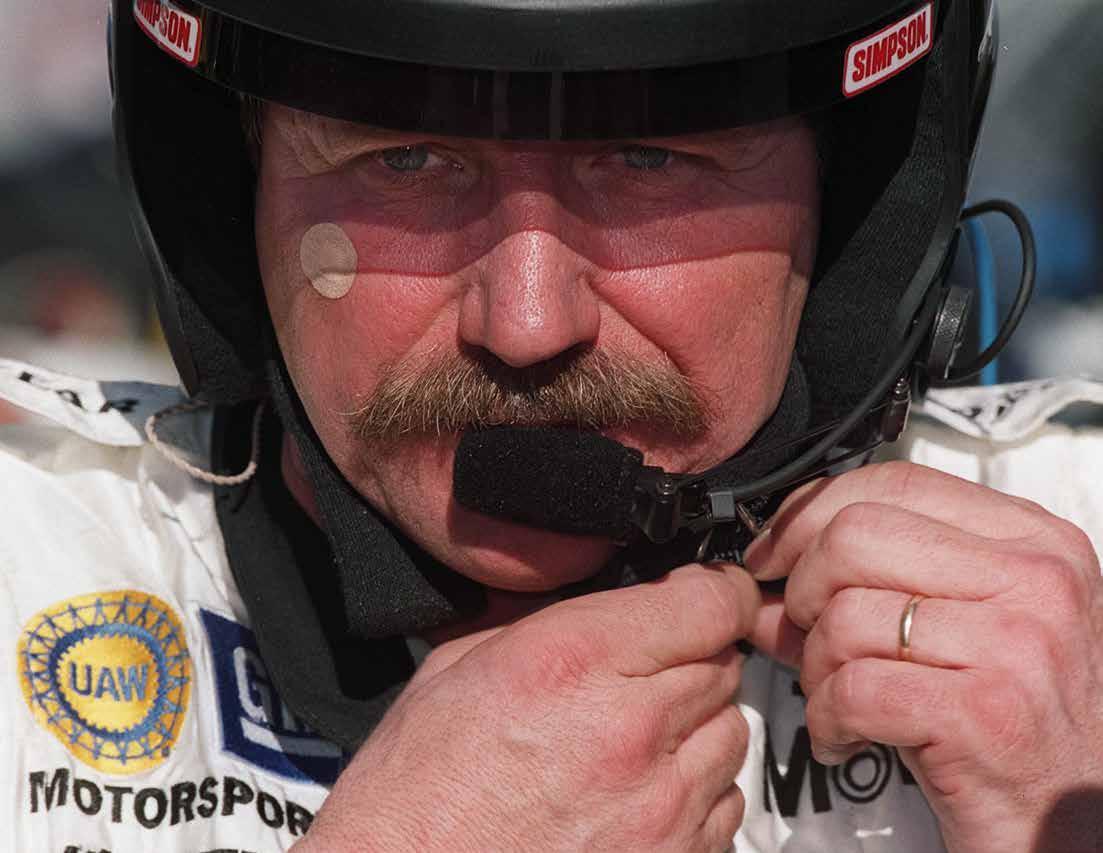
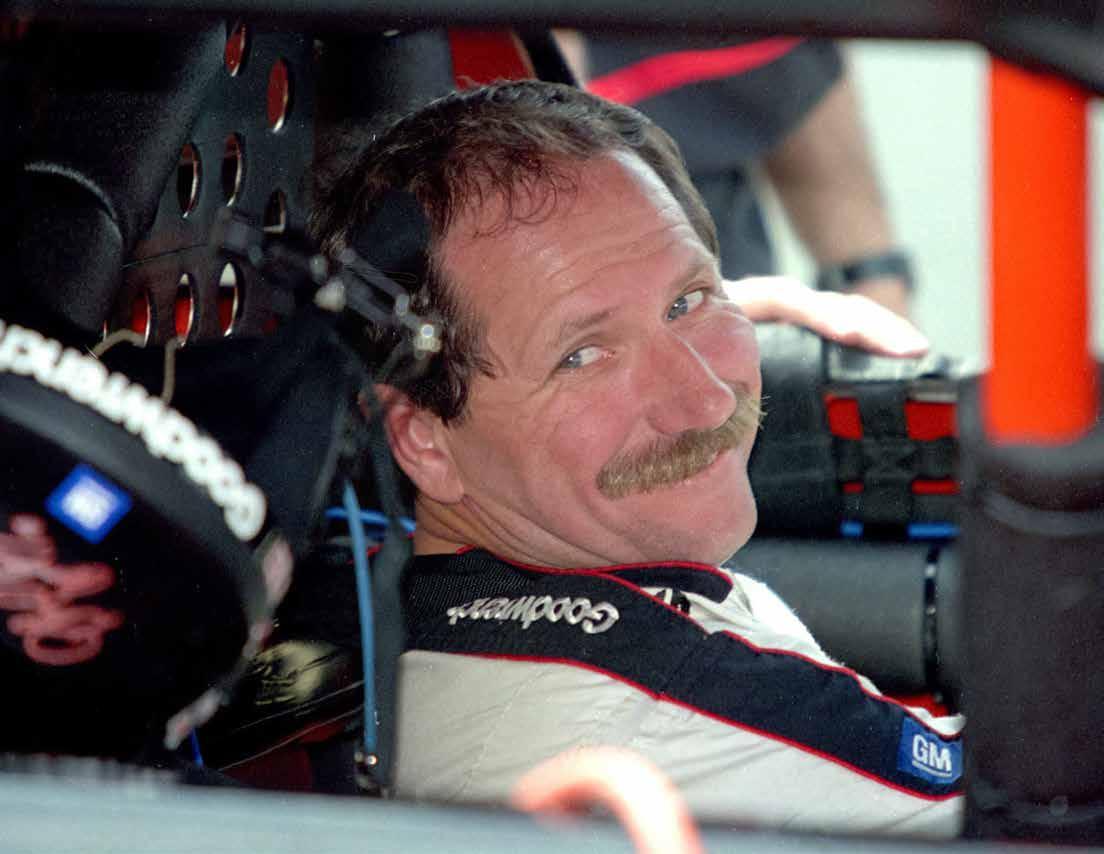
OPPOSITE: Adjusting the open-faced helmet he insisted on wearing, Dale Earnhardt prepared for a test session at Daytona International Speedway in early January 2001. Six weeks later, Earnhardt died in a last-lap accident in the Daytona 500. At that time, 10 weeks from his 50th birthday, he was in third place. DAVID TUCKER / NEWS-JOURNAL
INTRODUCTION
Dale Earnhardt’s twin legacies: Lasting star power and a safety revolution for NASCAR

KEN WILLIS
To this day, watching the replay, you expect him to get out of the car with mixed emotions. Angry with whomever he felt started the whole crash, but thrilled that two cars he owned finished 1-2 in the Great American Race.
But knowing what we knew soon thereafter, Dale Earnhardt’s crash on the final lap of the 2001 Daytona 500 was a perfectly imperfect storm — lots of speed, and impact at what would be called the “killer angle,” just a bit to the left of head-on.
But most of all, a wreck without all of the driver protections that would become common in the aftermath of NASCAR’s most public — and publicized — on-track death in the sport’s history. Some consider it Dale Earnhardt’s most endearing and enduring legacy — the
safety revolution his death triggered, a revolution (knock on wood) involving 25 subsequent seasons without a NASCAR racing fatality.
That was a big part of the story everyone heard a lot about in February 2026 on the 25th anniversary of the crash. The other part was the story of loss. Personal loss for those in the immediate Earnhardt orbit, where the gravitational pull was great. And overall loss for a sport that lost its Hollywood-caliber leading man. He would have turned 75 in April 2026.
If your memory is fuzzy or if you simply weren’t around for it, you might wonder whether the remembrances have been inflated with time, as they often are.
No, they’re not. You simply can’t overestimate what The Intimidator meant to fans and detractors alike, nor the void his loss left in an industry still hoping a
suitable replacement surfaces someday. So far, they haven’t even come close.
Before the tragedy, Earnhardt’s Speedweeks was out of the norm
Earnhardt’s death on Feb. 18, 2001, came on the final lap of perhaps the oddest Daytona Speedweeks he ever had experienced.
He came to town with 34 total Daytona victories, beginning with the 1980 Bud Shootout, through 10 straight victories in Thursday’s 125-mile qualifying races, his long-awaited Daytona 500 triumph in 1998, and his 34th in the 2000 IROC race.
No one else is even close to that Daytona record — Tony Stewart is second, with 19, while Dale Earnhardt Jr. and Bobby Allison are tied with 17.
But in 2001, Dale Earnhardt was in a supporting role. It began during his debut in the Rolex 24, where he was part of a two-car Corvette team that included
Daytona Beach News-Journal columnist Ken Willis was born in the shadow of Daytona International Speedway — give or take a couple blocks of Speedway Boulevard. He began working at the News-Journal at age 19 and has written about every sport at one time or another. Auto racing, particularly NASCAR’s version, has been the one constant in his career, beginning with the 1983 Daytona 500. In February 2026, he wrote about his 44th consecutive Speedweeks and Great American Race. He wasn’t around to cover Ralph Earnhardt, but he has chronicled the careers of three subsequent generations of Earnhardts.
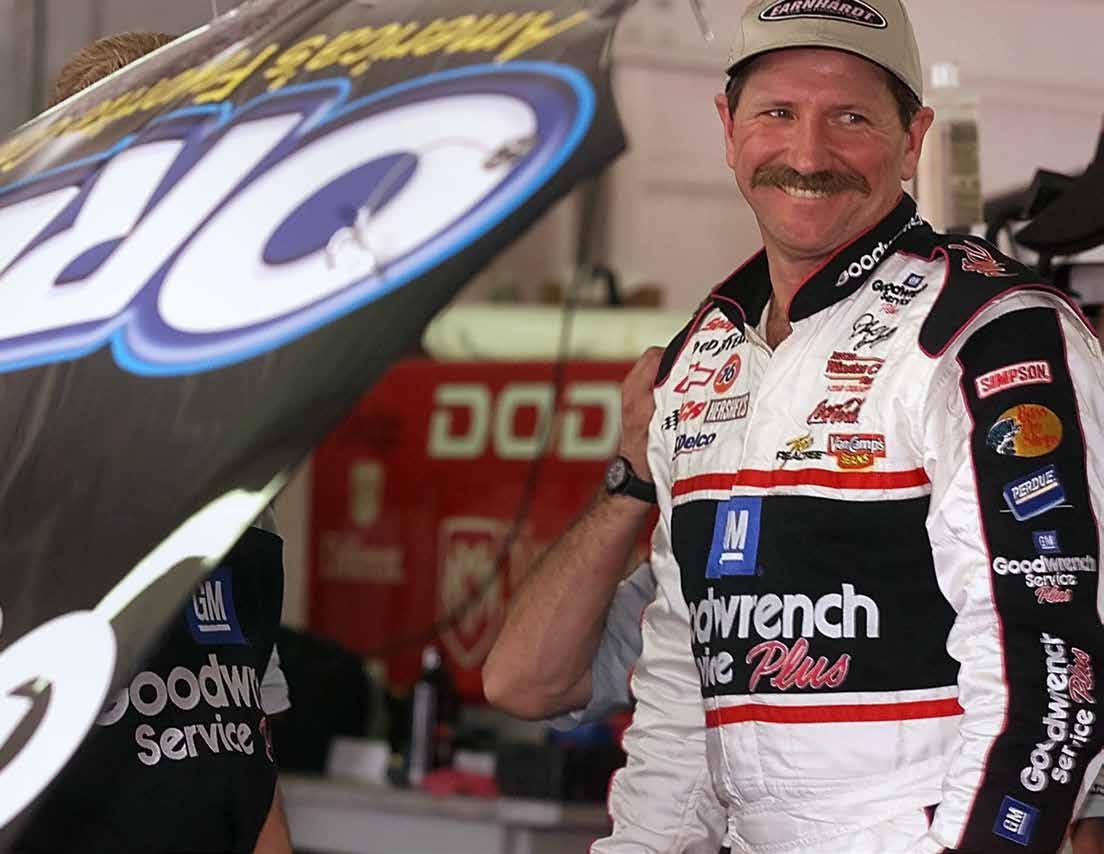
OPPOSITE: Not far from his 50th birthday, Dale Earnhardt was all smiles in the garage preparing for the 2001 Daytona 500. “That week,” Darrell Waltrip said in retrospect, “he was having fun. I think he was feeling a little different about everything.” Earnhardt died in a last-lap crash on Feb. 18, 2001. KELLY JORDAN / NEWS-JOURNAL
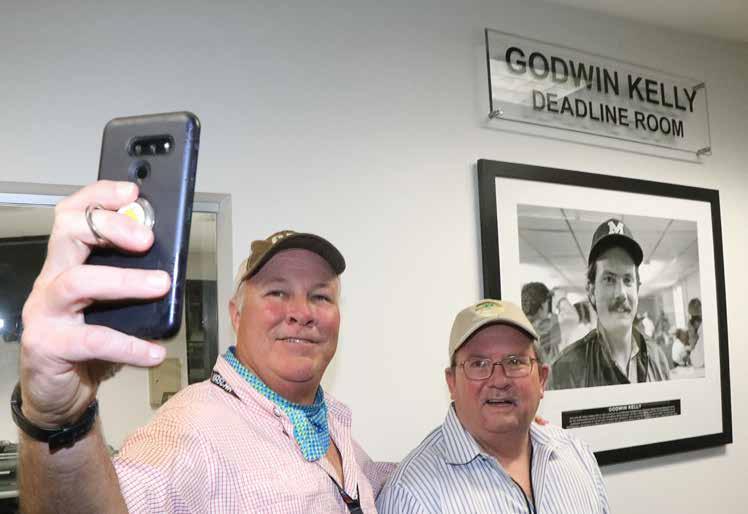
RIGHT: In Daytona International Speedway’s infield media center, columnist Ken Willis of the News-Journal documented a special moment with Godwin Kelly. In February 2021, the center’s main working area was renamed for Kelly, who retired a year earlier after a four-decade-plus run as the NewsJournal’s motorsports editor. Willis’ and Kelly’s stock car expertise follow throughout this book. DAVID TUCKER / NEWS-JOURNAL
OPPOSITE: Earnhardt passed the time while waiting to qualify for 1995’s Bud at the Glen in Watkins Glen, New York. Two months earlier, at Sears Point in Sonoma, California, Earnhardt won for the first time on a road course, leading for only the last two laps. At the Glen, he finished 23rd. SIMON WHEELER / ELMIRA STAR-GAZETTE
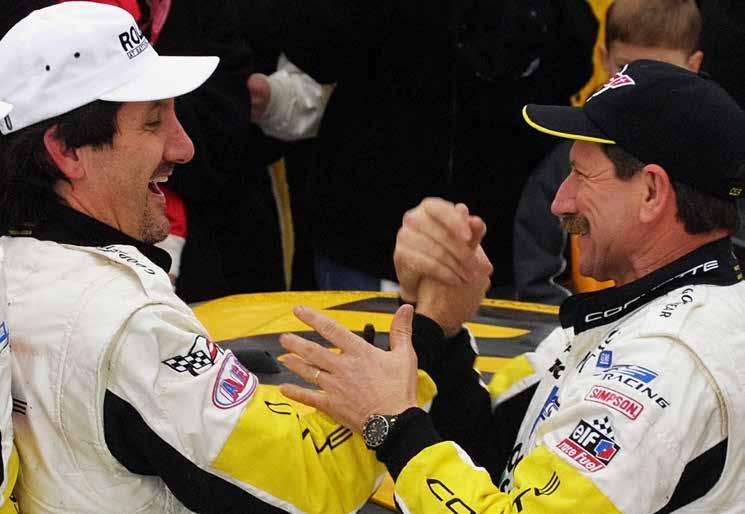
Dale Jr. and several sports car veterans. The Earnhardts’ Corvette, which they shared with Andy Pilgrim and Kelly Collins, finished fourth overall while the sister ’Vette won the marathon race. Earnhardt, who happily had integrated himself into the team during testing and prerace practice sessions, marched to Victory Lane and was all smiles as he celebrated with all of his new teammates from both Corvette entries.
It was a side of Earnhardt few had seen. Several days later, the NASCAR portion of Speedweeks unfolded and
included some more unfamiliar roles for Earnhardt. In the exhibition Bud Shootout, a week after the Rolex 24 and a race he had won six times, he was passed by Stewart on the next-to-last lap and finished second.
Four days later, in the qualifying race now known as the Duel — he had won 12 of those in his career, including 10 straight! — he led seven of the final eight laps, but on the eighth, he was passed by Sterling Marlin, who was first to the checkers.
Friday bought the International Race
of Champions (IROC) and the first of four 2001 races on its schedule. Earnhardt was particularly fond of competing in a field of 12 racing stars from various forms of motorsports, and especially fond of racing them at Daytona, where he had won six IROC races in 12 starts.
But on this Friday in 2001, things literally took a turn. Earnhardt was leading — yet again — as he came past the flag stand for the 38th time in the 40-lap race. Former Indianapolis 500 champion Eddie Cheever attempted to pass him on the outside coming out of
the frontstretch trioval.
The two cars banged side-to-side at about 185 mph, and while everyone expected the Indy driver to learn a lesson, it was Earnhardt who was sent to the left, off the track and through the grass, an unfortunate detour that usually ended badly.
Usually.
Ironically, Earnhardt getting roughed up actually added to his legend. Through the grass, he kept his foot in the throttle and not only returned to the track in Turn 1, but blended back into the race
without incident, though way behind the leaders.
“I can’t tell you how incredible it is. Dale Earnhardt, what a job,” said Dale Jarrett, who skirted the dustup and won the race. “He showed why he’s the greatest race car driver in the world right there. That car was supposed to wreck, and wreck everybody with it.”
Earnhardt playfully retaliated on the cooldown lap, sending Cheever into a slow-speed spin down the backstretch. He marched to Cheever’s car on the postrace grid, and though some were anticipating fireworks, Earnhardt grinned a big grin, cussed a bit and cupped the back of Cheever’s neck in one of Earnhardt’s signature personal moves.
Mentally, race fans bookmarked the season’s next IROC race, two months later in Talladega. Cheever quickly and forcefully tried to play down any hint of animosity that day at Daytona.
“I have no rivalry with Earnhardt,” he said. “I have a lot of problems in life, and that’s not one of them.”
In April, Cheever was one of 11 drivers — not 12 — who competed in Talladega’s IROC race.
How the tragedy unfolded on final lap of 2001 Daytona 500
Up until late afternoon on that final Sunday of 2001 Speedweeks, Earnhardt’s performances and results had been just a bit off-kilter. He remained front and center, and he remained the man to beat at the track where he had long dominated, but never before had he been routinely booted from leader to follower, and in such dramatic fashion.
All of that was swept away on Lap 200, of course, but even in the moments
immediately preceding the fatal crash, we again were witnessing something once unthinkable.
Maybe he simply didn’t have the needed horsepower to catch the two drivers ahead of him — Michael Waltrip and Dale Jr., both driving for Dale Earnhardt Inc. (DEI), starting its fourth season as a full-time Cup Series organization.
That might be the case, but it sure seemed to some as if he was sitting there in third place and fighting like hell to keep potential pursuers occupied while the two cars he owned sped off Turn 4 toward the checkers.
As Waltrip and Dale Jr. extended their lead, Earnhardt’s black No. 3 was in a fourcar knot with Kenny Schrader, Sterling Marlin and Rusty Wallace. Earnhardt was in the center lane, with Schrader just outside his right-rear and Marlin just inside his left-rear, with Wallace trailing Earnhardt by a few feet in the center lane. With the cars bobbling slightly, as they do in the high-speed draft, Earnhardt’s left-rear and Marlin’s right-front made ever-so-slight contact. Earnhardt’s car turned left, touched the track’s lower apron and shot to the right, back up the track.
The crash likely would have been a rough one, but its fatal conclusion may have been sealed when Earnhardt’s careening car clipped Schrader’s and was turned toward the outside wall in the aforementioned killer angle.
His star power hasn’t waned; NASCAR adds safety protocols
In 1964, NASCAR lost three drivers to racing accidents — Jimmy Pardue, superstar Fireball Roberts and two-time defending champion Joe Weatherly.
Weatherly had crashed at the road course in Riverside, California. He didn’t use a driver’s side window net because he feared being trapped in a burning car — a particularly legitimate fear in those days. Without the net, his upper body was flung outside his window opening and he was killed when his head hit a retaining wall.
Roberts died because of extensive burns suffered in a crash at Charlotte, North Carolina, four months later. Gas spilled heavily into his car during the crash, a flame ignited and he barely escaped, only
to die five weeks later.
Pardue also died at Charlotte Speedway, crashing through a guardrail and down an embankment during a tire test.
In short order, sensing quick fixes to the Weatherly and Roberts incidents, window nets and rubberized fuel cells were mandated.
Thirty-six years later, NASCAR lost another three racers — truck racer Tony Roper at Texas, Cup racers Adam Petty and Kenny Irwin at New Hampshire. All three died after crashing headlong into concrete walls.
There had been talk about stepped-up experiments with “soft wall” technology, and a head-and-neck safety restraint device (the HANS) was gaining popularity among racing organizations.
No American tracks were outfitted with the softer walls, and it’s believed only two racers — Brett Bodine and Dale Jarrett — wore HANS Devices in the 2001 Daytona 500. Later in 2001, NASCAR began mandating neck-restraining devices. By 2002, Indianapolis began the long line of tracks covering their concrete walls with something called a SAFER
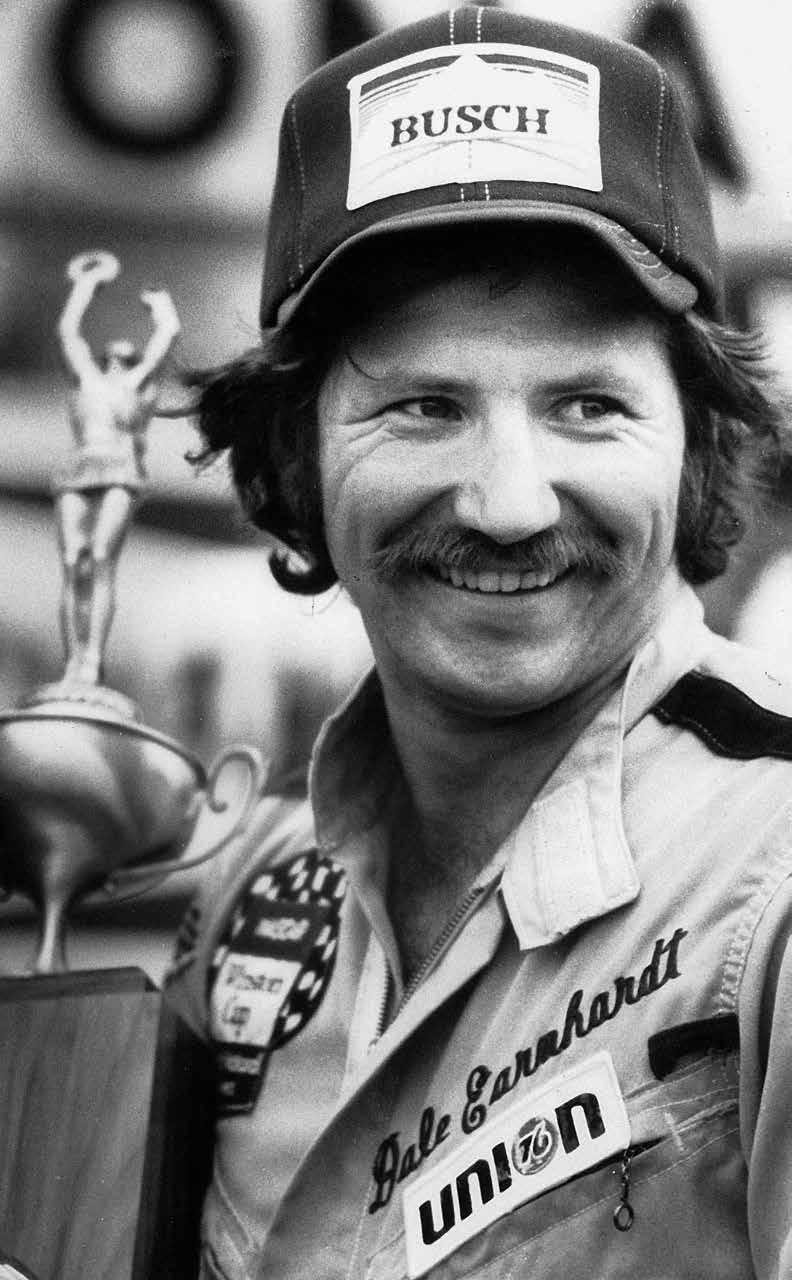
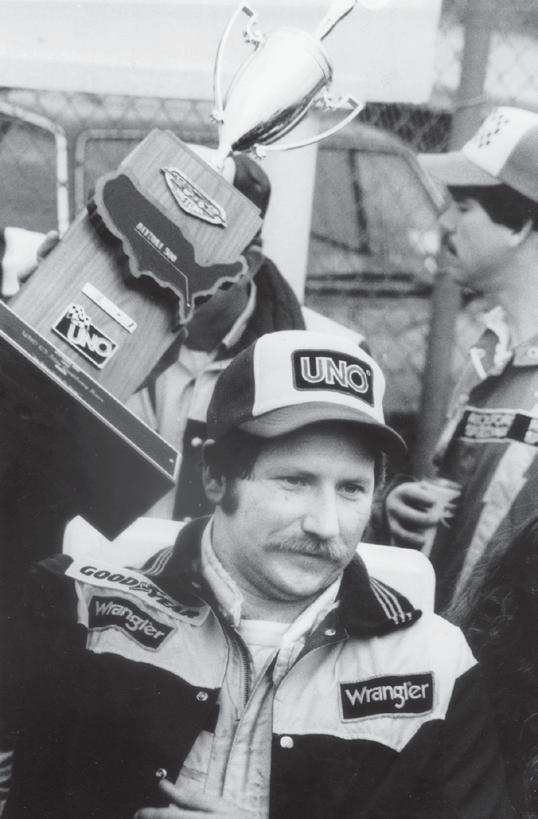
OPPOSITE: For the first of 34 times, Dale Earnhardt won the race to the checkers at Daytona International Speedway. Driving an Oldsmobile in the Busch Clash of 1980, he passed Darrell Waltrip on the last of the 20 laps, received a nice trophy and pocketed $50,000. NEWS-JOURNAL
LEFT: In Victory Lane, Earnhardt (right) congratulated Ron Fellows after Fellows’ No. 2 Corvette team won the Rolex 24 At Daytona on Feb. 3, 2001. Earnhardt finished fourth with the No. 3 Corvette team, which included Dale Earnhardt Jr. NIGEL COOK / NEWS-JOURNAL
Barrier (steel and foam energy reduction), designed by Dr. Dean Sicking at the University of Nebraska-Lincoln. Those are undoubtedly the two biggest reasons NASCAR hadn’t experienced a fatality since 2001. To this day, every time fans see a head-on crash and watch as the driver crawls out of the car and walks away, many wonder whether he’s among those who have been saved by the post-Earnhardt safety revolution. That revolution included changes in the way safety-belt systems were built and utilized, crush-zone technology
CHAPTER 1
HIS ROOTS
Dale Earnhardt was never going to be a plumber. Think about it. He lived in a house, in the middle of a town, in the middle of the cradle of stock car racing. Also in that house was a father who did the unthinkable in those days: He raced for a living!
And guess where his dad’s race shop sat. Yep, in the side yard of that house. It’s the shop where Ralph Earnhardt did what was needed to race for a living. Everything about Dale Earnhardt’s youth pointed him toward racing. But it was hardly a given that he would take that direction and reach the levels he achieved.
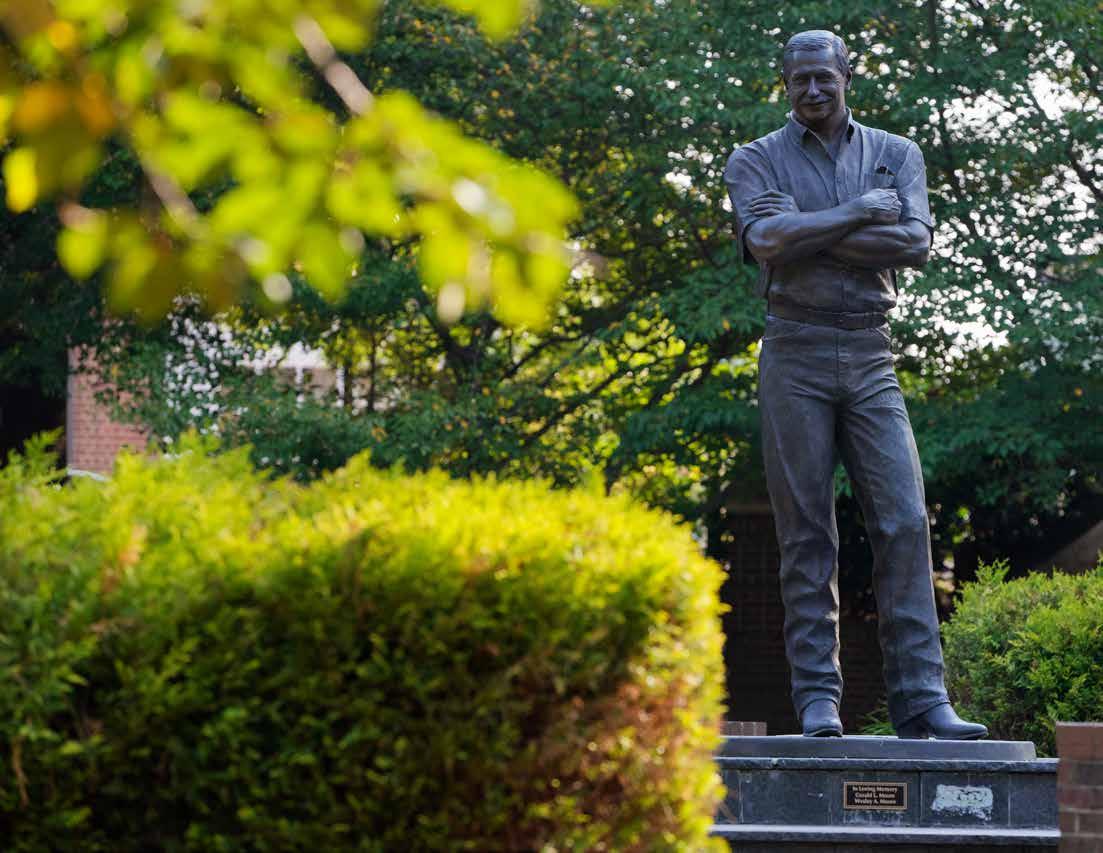
OPPOSITE: Kannapolis, North Carolina, proudly built a 9-foot, 900-pound bronze statue of its favorite son. Martha Earnhardt, Dale’s mother who lived to be 91, waved a green flag at the 2002 downtown groundbreaking ceremonies. JACK GRUBER / IMAGN IMAGES
A story of drive from a high school dropout: From Kannapolis to Daytona and far beyond
In 2002, the year following Dale Earnhardt’s death in the Daytona 500, News-Journal columnist Ken Willis traveled to Charlotte, North Carolina, and nearby Kannapolis, Earnhardt’s hometown.
KEN WILLIS
FEB. 17, 2002
The odometer tells you that the distance from Sedan Avenue in Kannapolis, North Carolina, to the big mirrored building in Mooresville is 14 miles.
Just a straight shot up Highway 136. Fourteen miles.
But you know better. There’s no way you go from 1412 Sedan Ave. to 1675 Coddle Creek Highway without passing through places like Darlington, Bristol and, of course, Daytona Beach.
You measure it again, going the other way, and yup, 14 miles. Just 14 miles from the grand (or gaudy, depending on your architectural tastes) Dale Earnhardt Inc.
headquarters to the humble mill town where it all started.
Among American race fans, the word Kannapolis conjures up a certain magic. Other hometowns have the same appeal. Who can think of French Lick, Liverpool and Latrobe without thinking of Larry Bird, the Beatles and Arnold Palmer? Somewhere within the boundaries of this throwback town must be the secret to Dale Earnhardt’s otherworldly talents behind a steering wheel. Could it be the road into town that creates such skill? Nope — while Highway 136 has just enough turns and hills to keep your attention, it still allows for moments to daydream of bigger and, perhaps, better places.
Could it be the town itself? Hardly. The mammoth Fieldcrest Cannon plant, smack-dab in the middle of Kannapolis, seems to swallow any hint of personality.
Something as big as that plant must have its own gravitational pull, and only a man like Earnhardt could drive hard enough and fast enough to escape to all
corners of the globe.
Could it be the people? Maybe, but doubtful. Friendly and accommodating, but, by and large, they’re just folks.
When you add it up, you begin to realize that Dale Earnhardt could have been from any other racing-mad town in the region — from Spartanburg to Statesville to Sherrills Ford — and he still would become Dale Earnhardt.
The secret, in the end, was in his genes — thank you, Ralph Earnhardt — and in his jeans (was there ever a better seatof-the-pants racer?).
But make no mistake, there was nothing about the Kannapolis of Dale Earnhardt’s youth that dissuaded him from building his unmatched legacy. To fully understand where Earnhardt ended up, it helps to know where he came from.
Earnhardt’s roots: Fast engines carrying fast men
Frank Dayvault lived and worked a long time in Kannapolis before moving
“to the beach,” as they say around here — meaning Myrtle Beach, South Carolina. He and his family are known well in these parts for their mechanical green thumbs.
Early on, Dayvault was among a group of hotshot engine tuners who worked for a quiet and tough auto shop owner named Berl Eddleman, whose reputation was so high that most of the local bootleggers trusted only him and his men to provide their horsepower.
If Dayvault was on one side of a motor, tweaking and pulling, he could often look on the other side and see another young wrenching ace, Ralph Earnhardt, who helped pay for his budding racing career by building and rebuilding motors for Eddleman.
Flat-head Fords, 1940 version, were the choice of the faster moonshine runners. The fastest of the fast could afford to have Eddleman’s crew load a Cadillac V-8 engine, with three carburetors, into their Fords.
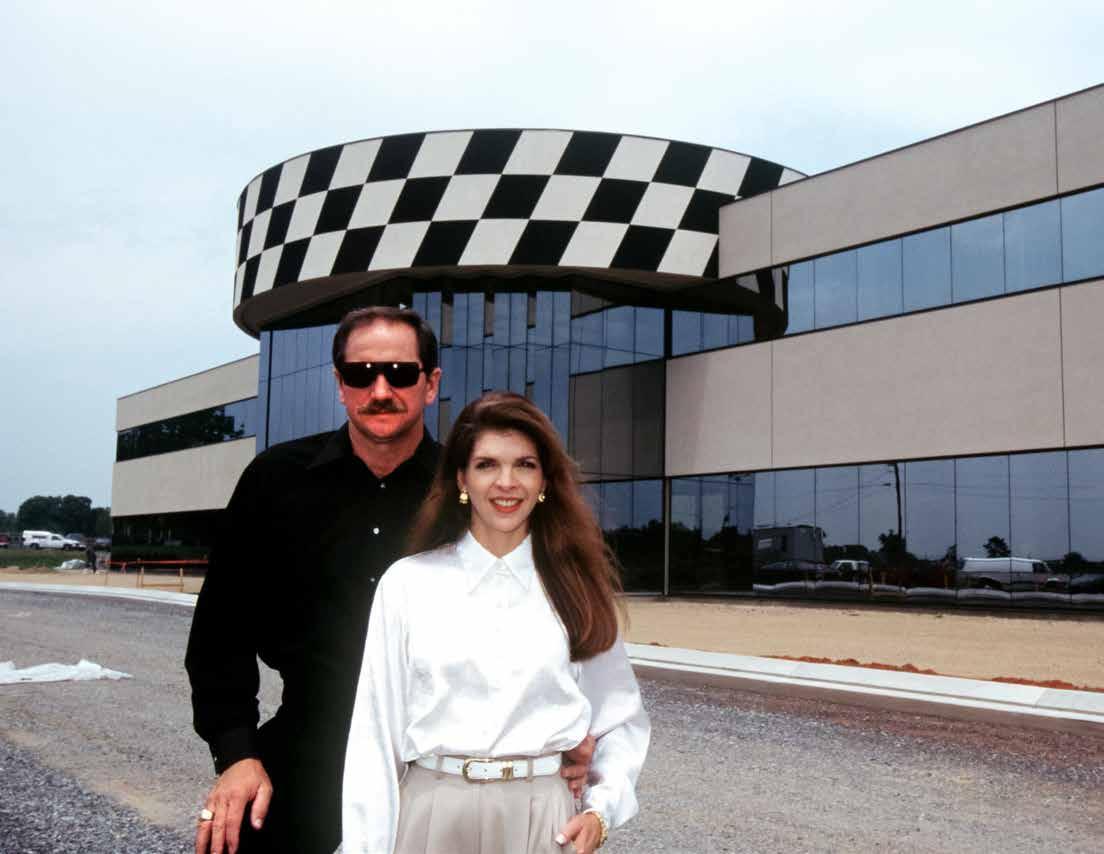
OPPOSITE: In June 1997, Dale and Teresa Earnhardt posed outside the headquarters of Dale Earnhardt Inc., once nicknamed the Garage Mahal. Located on Coddle Creek Highway in Mooresville, North Carolina, it served as the home for DEI businesses, its charity foundation and a public showroom and offered space for weddings and corporate events. ERNEST MASCHE / USA TODAY
“The police — they were called ABC officers at the time — would come by sometimes and want us to work on their cars, but I don’t think Mr. Eddleman ever worked on any of ’em,” Dayvault says. “Now, we also did a lot of race car stuff at the time, but the biggest things were the whiskey cars.”
The moonshiners generally wouldn’t hang around the shop. They would arrive, with license plates removed from the car, drop off the Ford, then return later to pick it up.
“You didn’t really talk to these people a lot, so you didn’t know a lot about them,” Dayvault says.” There were
certain groups who told you too much, but not many.
“Junior Johnson and his brothers … they didn’t say much.”
At the time, Junior was building his first legend — that of an ungodly fast whiskey runner who left dust, whistling leaves and frustrated lawmen in
his wake. His second legend — that of stock car royalty — came later. The two endeavors, without question, are related.
“Bootleggin’, that was big business back then,” Johnson says. “My neck of the area and over in Virginia, that’s where the root of the sport are, and
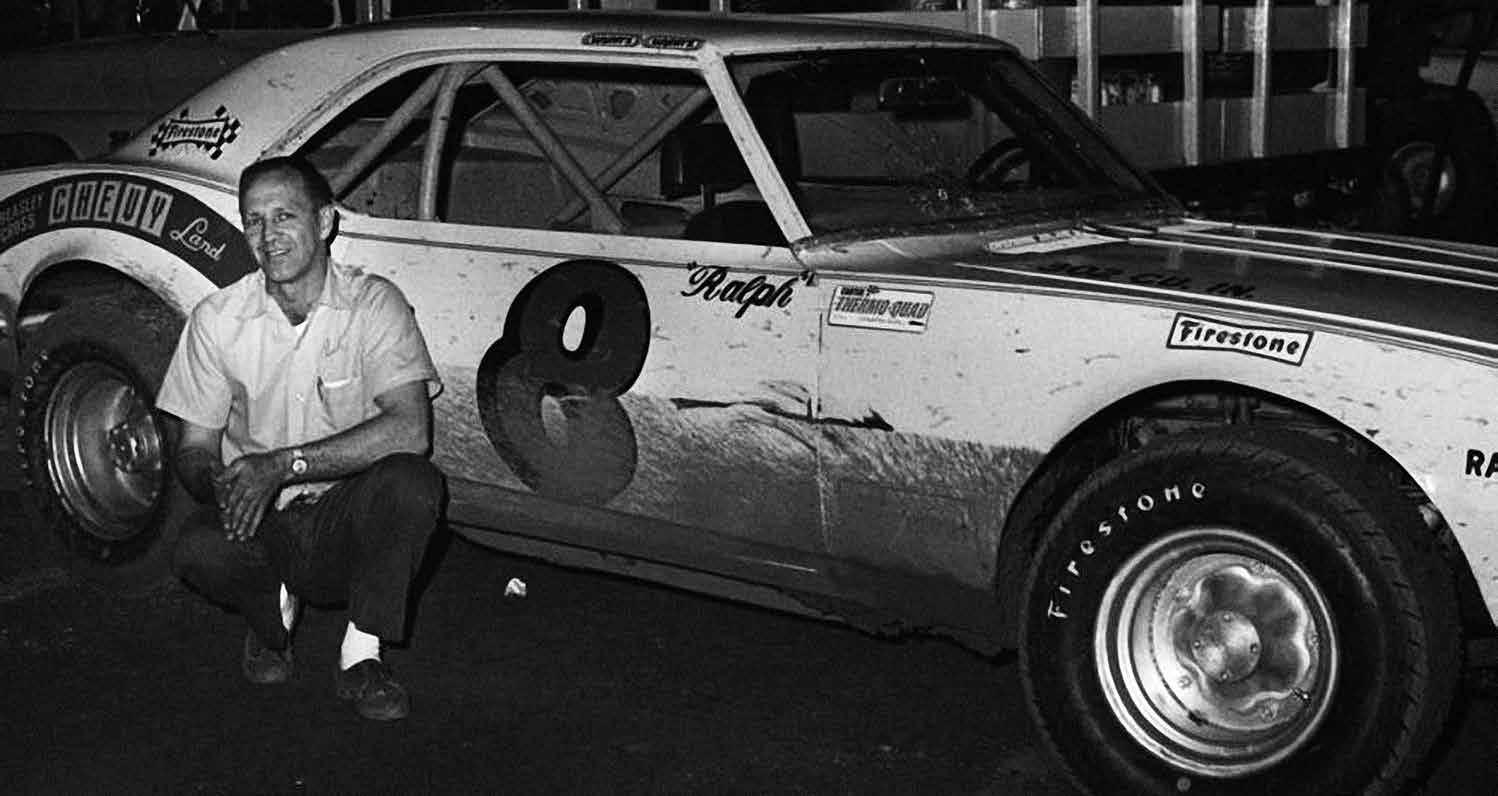
ABOVE: Ralph Earnhardt, the patriarch of a racing family spanning four generations, posed with his No. 8 Chevrolet. He was a master of North Carolina’s short tracks starting in the 1950s. For its 50th anniversary in 1998, NASCAR appointed a panel to select its 50 greatest drivers, a list that included Ralph and Dale Earnhardt. NEWS-JOURNAL
from the shop,” Dayvault says. “Kind of a ‘flying mile’ — we’d get a head start and hit the line running. The flat-head Fords were good for about 34 seconds, which was like 108-110 miles per hour. A regular street Ford would go about 85.
“We had a couple of cars we worked on that were capable of doing it in 30 seconds — that’s 120 miles per hour. I took one down there once to time it, but it just felt too risky to me. I didn’t like the way it was handling.
“So, one night we took Ralph down there to run it. He said it was kinda hairy, that it wanted to move around on him. But he drove it. He was excellent … really good.”
Just like his son later, Ralph Earnhardt played for keeps
NASCAR wouldn’t truly go “uptown” until 1971, when R.J. Reynolds began flooding the racing plains with sponsorship cash. Prior to that, stock car racing was still very regional. And no region took to it with the drunken gusto of the Carolinas.
“Those people, they raced every weekend, right up until high school football started,” Robert Yates says. “Then they’d race on just Saturday nights until it got too cold.”
where it really took a hold years ago.”
Johnson and his brothers, Fred and L.P., would leave their customized Ford to Eddleman and return to find a fire-breathing, ’shine-running beast with revived horses spilling out from under the hood.
“We’d have to do that about every three or four months,” Johnson says through a chuckle, perhaps remembering the harsh punishment those cars endured. “Never had any trouble with ’em; they’d just wear out. They knew what they were doing at Eddleman’s. And at the particular time, I was just interested in going fast and hauling whiskey.”
The days and nights at Eddleman’s did more than perfect Ralph Earnhardt’s engine wizardry. He also was, from time to time, allowed to quench his thirst for speed.
“We had a measured mile marked off down Highway 29, down the road
Yates, the famed Winston Cup car owner, was conceived in Kannapolis. His family moved about 20 miles down the road to Charlotte two months before he was born.
“I always tell everybody, if my family hadn’t moved, I could’ve been Dale Earnhardt,” he says with a half-grin. In his youth, including after he had landed jobs building engines for assorted
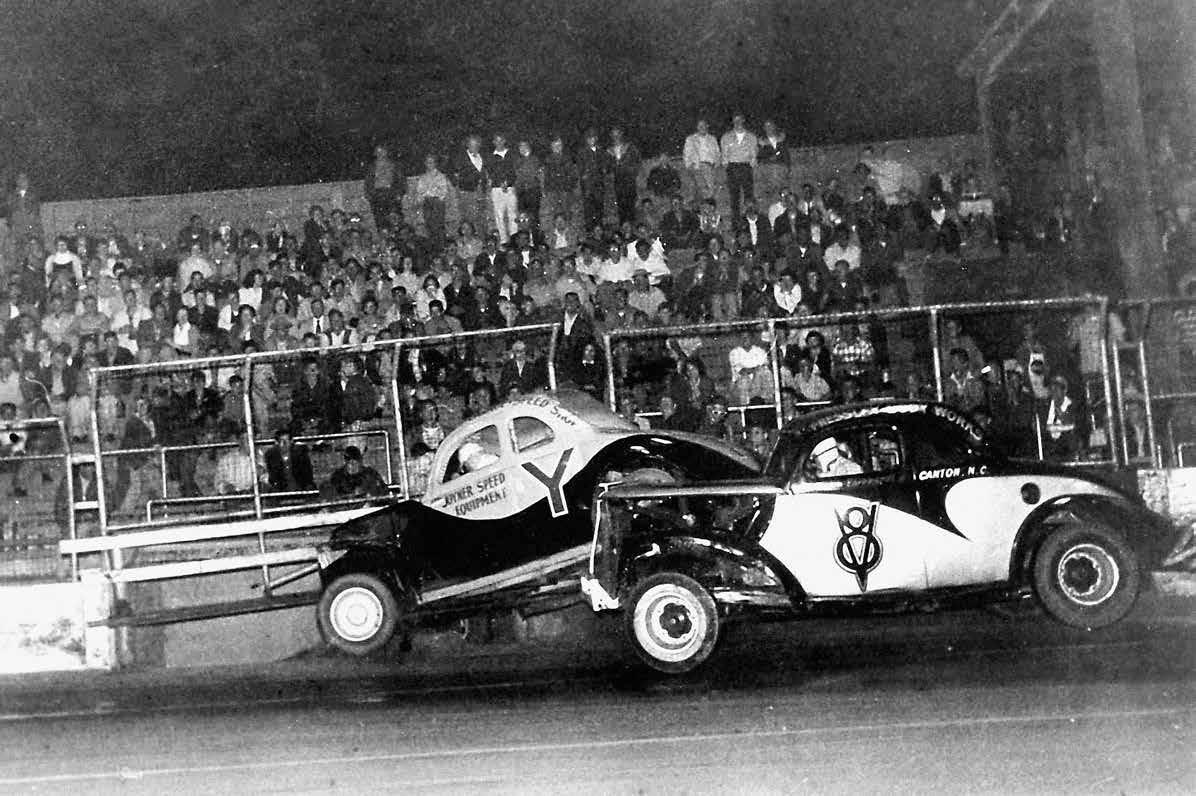
ABOVE: Ralph Earnhardt, racing at McCormick Field in Asheville, North Carolina, bumped Dickie Plemmons in 1958. Earnhardt died from a heart attack in 1973. He was 45, son Dale was 22, grandson Kerry was 3 and grandson Dale Jr. hadn’t been born. PROVIDED BY JOHN BELL
CHAPTER
2
HIS RACES
Dale Earnhardt’s early racing life, unlike what came later, was similar to many hungry hot-rodders who only needed a break to make the big time. He beat short-track trails similar to those his dad plowed before him.
He started a handful of Cup Series races in the mid-1970s, in overmatched equipment, but in 1978 he overachieved in another handful of starts and people began to take notice. Once he got a full-time ride in 1979, things happened in a hurry. A big hurry.
Rookie of the year one year, Cup champ the next, followed by a career hiccup and finally, along came Richard Childress and a partnership that rewrote the boundaries of NASCAR stardom.
OPPOSITE: Of Dale Earnhardt’s amazing feats, none topped his streak of 10 straight victories in 125-mile Daytona 500 qualifiers. In 1999, he passed Tony Stewart on Lap 8, never trailed again and edged Jeremy Mayfield by .251 seconds. SCOTT
WHEELER / LAKELAND LEDGER
With two races to spare in 1994, Earnhardt ties Petty’s record of seven championships
THOMAS POPE
OCT. 23, 1994
Elementary math says that three plus seven makes 10, and Dale Earnhardt was a perfect 10.
Earnhardt, driver of the famed black No. 3 Chevrolet, won a seventh driving title in convincing style, clinching the Winston Cup crown with a victory in the AC Delco 500 at North Carolina Speedway. Earnhardt led the most laps, including the last by a scant 6/100ths of a second over Rick Mast.
Earnhardt locked up the championship with eight laps to go when Rusty Wallace, his lone pursuer, was locked into 35th position with engine failure. Earnhardt also won championships in 1980, 1986-87, 1990-91 and 1993. His seventh championship tied the record held by Richard Petty, who won No. 7 in 1979 and retired in 1992.
“I never thought I’d see one,” Earnhardt
said. “I really grew up around racing with my dad as my idol, and people like Ned Jarrett, Tiny Lund, Humpy Wheeler, the Pearsons, the Pettys, the Yarboroughs, the Allisons. They brought me to where I am today.
“People say I’m from the old school — that I drive harder than I need to sometimes. I drive 100% the whole time because that’s the way I learned, that’s what the team expects and that’s the way I’ll drive until I retire.”
It was the second time that Earnhardt, 43, clinched the championship with a victory; he also did it at Atlanta in 1986. And it was the second time he wrapped up the title at Rockingham before the season’s end; a second-place finish got the job done in 1987. With a 448-point lead, Earnhardt could sit out the final two events and still beat Wallace with room to spare.
Wallace’s hopes of overtaking Earnhardt were of the slim-and-none
variety. Down by 321 points when the green flag fluttered, he could bear no bad luck of any kind, yet that was exactly what transpired on Lap 300. He suffered engine failure for the second consecutive race.
“Well, I’m disappointed,” said Wallace, who had eight victories this year to Earnhardt’s four. “Earnhardt did a great job. We just blew too many engines this year.”
Earnhardt started almost halfway back in the 42-car field, but a fast car and quick pit work found him riding in the top five before 100 of the 492 laps had been run. He moved into the lead for the first time on Lap 173.
But Earnhardt had plenty of competition up front, and at times the Hendrick Motorsports trio of Terry Labonte, Ken Schrader and Jeff Gordon ran 1-2-3. Schrader, though, was set back by a broken driveshaft on Lap 222, and Gordon called it quits with engine failure on
Lap 274. Labonte finished fifth behind Morgan Shepherd and polesitter Ricky Rudd.
A crash with 15 laps left set the stage for a checkered flag shootout. Mast had nine green flag laps to try to root Earnhardt out of first. He only got one good chance, choosing to go to the high side of Turn 4 on the final lap and sliding his Skoal Classic Ford sideways in the process. He came across the finish line barely a car length behind the winner-champion.
“He did what he had to do,” said Mast, going for his first victory. “He knows I ain’t going to wreck him, but he ain’t going to wreck me either if I’m in front and using a lot of racetrack. I just wasn’t strong enough to beat him.”
Earnhardt earned $60,600 for his 63rd victory.
“I’ve got a race team,” he said. “It’s not who wins the most races, it’s who finishes the best all year.”
Again, it was Dale Earnhardt.
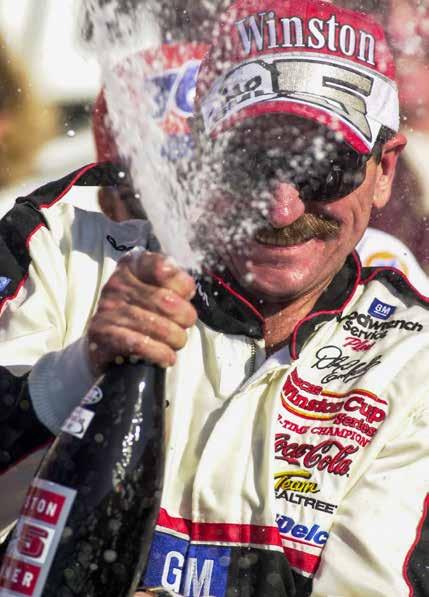
OPPOSITE: How does a driver win seven NASCAR Cup Series championships? By spraying champagne. By crossing finish lines. By holding up trophies. By trusting the team. In 1994, after clinching title No. 7, Dale Earnhardt said: “Childress and the guys work so hard every race to keep coming back. They do what they’ve got to do.” USA TODAY NETWORK
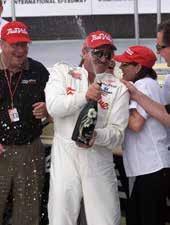
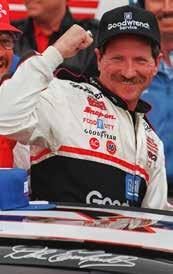
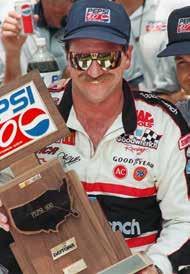
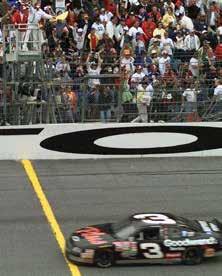
MICKEY WELSH / ADVERTISER
TONY RANZE / THE LEDGER
PAM LOCKEBY / NEWS-JOURNAL
RICK WILSON / FLORIDA TIMES-UNION
RICK WILSON / FLORIDA TIMES-UNION
RICK WILSON / FLORIDA TIMES-UNION
SCOTT WHEELER / THE LEDGER
SCOTT WHEELER / THE LEDGER
PAM LOCKEBY / NEWS-JOURNAL
In his own words: Not long before his death, Earnhardt reflected on his career and image
On Feb. 1, 2001, Daytona Beach NewsJournal motorsports editor Godwin Kelly sat down with Dale Earnhardt for a one-on-one interview. It was one of The Intimidator’s last extended interviews before his death 17 days later from a lastlap crash in the Daytona 500.
GODWIN KELLY
FEB. 17, 2001
Talk about your first race at Daytona.
“We decided to come down to Daytona to run the Permatex Sportsman race. We got everything together. We had to scrounge all of our resources. We got two or three guys to help me out to come down and work for me for free. (He laughs.)
“It worked out pretty well. After we prepaid the hotel room, we had 650 bucks to come down here on expense money. We came down and had a great
time. We waxed the car a lot. (He laughs again.)
“We qualified 20 something. When we drove down here, I was pulling a one-ton truck, pulling the trailer and race car on it and all of our stuff was throwed on the back of it. It was my dad’s old truck.
“We come off on to Highway 92. You could see the grandstand from a great distance away. We got it and you’re driving along and you keep driving along. You go through one light, two lights and another light and you’re still driving by the speedway. It was pretty damn amazing just seeing it from the outside by a kid who has just seen half-miles and quarter-miles (tracks).
“When we got checked in and got inside the track they parked us out in the back. I looked around and I said, ‘What is this?’
I saw all these big turns. I knew it was Daytona, but I couldn’t have imagined it was this big. It was pretty interesting
and exciting and intimidating when I first came in the place and seen it.
“When I first went out to practice, I was like, ‘Damn, where do I run on this thing? Up high? Down low?’ You could run about anywhere you wanted to because you’d run flat-out.
“We qualified in the 176 mph range. When I got into the race and started racing, I liked it, I really liked it. I really enjoyed it. So, every time I came back I enjoyed it more and learned more and understood it more.
“Fortunately, I’ve done real well here at Daytona. It’s been sort of like a home track to me. You come here for the first race of the year. You come here and test through the winter. And you spend more time here than any other track. I’m very comfortable when I come here. I’ve had some great wins, great experiences.
“I’ve had some tragic experiences like losing Neil (Bonnett). Those kinds of
things stick in your mind. Still, it didn’t take the mystique of the racetrack or the town or the whole atmosphere of Daytona and Speedweeks or the excitement of it away.
“I’ve had some bad crashes here. Still, it’s the racetrack I would choose to race at any given day. They’ve modified the rules over the years. The cars have changed with the restrictor plate and all that stuff. It’s still the racetrack I enjoy racing at the most.”
Talk about your victory in the 1998 Daytona 500.
“The 500 had eluded me for 20 years. To have all the wins I had up prior to that race and not win that race is pretty amazing to myself.
“We had a dominant car in a number of races. Being a winner at Daytona, being successful at Daytona, does push your status up in this sport. Then there have
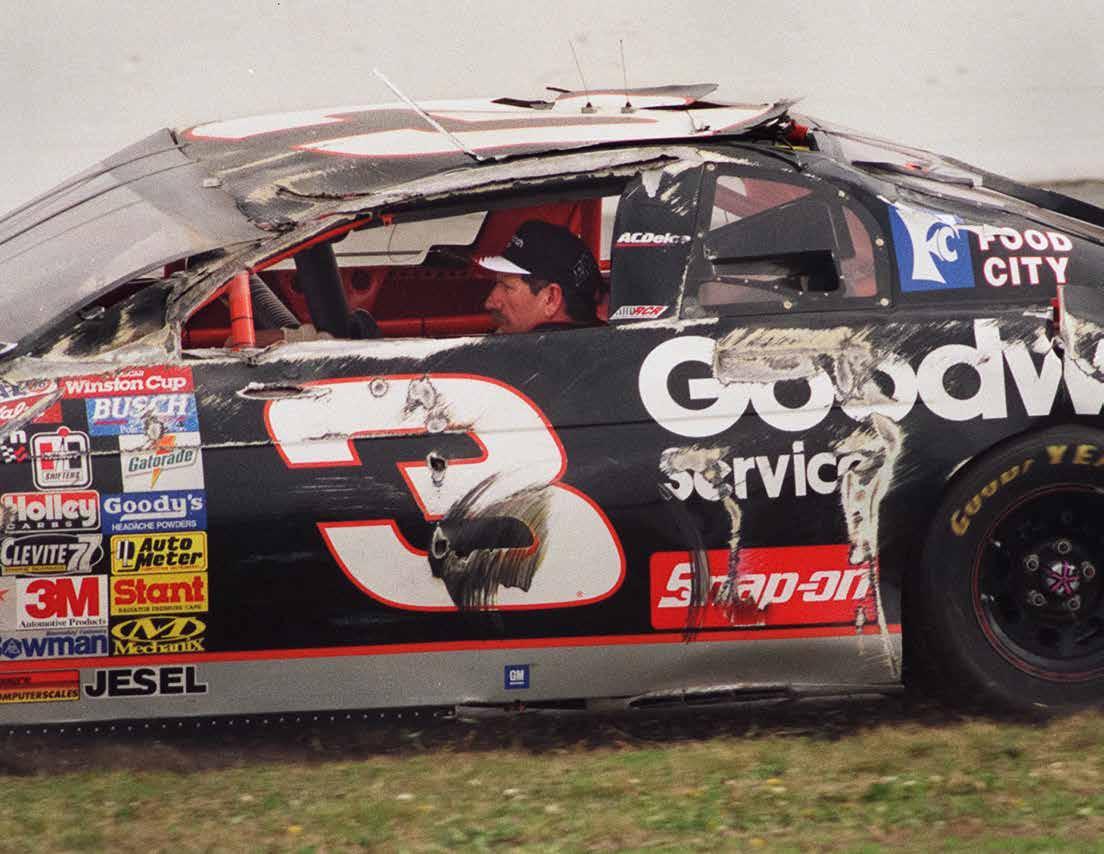
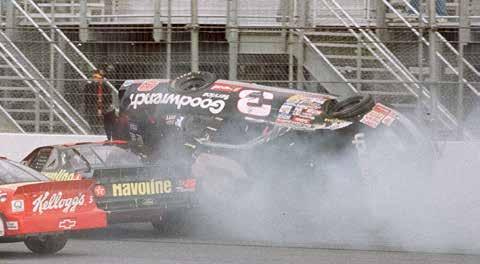
OPPOSITE: On Lap 189 of the 1997 Daytona 500, in a six-pack of leaders, Dale Earnhardt brushed the wall, Dale Jarrett hit him, the No. 3 Chevy flipped over, Ernie Irvan slid under him and Earnhardt rolled into the grass. But he left the ambulance, restarted his car — wearing a baseball cap — drove to pit road and finished the race. SAM CRANSTON / NEWS-JOURNAL
OPPOSITE INSET: Earnhardt rolled over while entangled with Irvan and the wall. “I got out of the ambulance,” he recounted, “and asked the guy inside the car who was hooking it up and said, ‘See if it will crank.’ He cranked it up, and I said, ‘Get out. Give me the car back.’ So, I drove it back around here and we taped it up.” DAVID MILLS / NEWS-JOURNAL
‘Celebration of Life’: Drivers break code of skipping funerals to bid Earnhardt farewell
KEN WILLIS
FEB. 22, 2001
There he was, absolutely resplendent in his blue suit, tan face, god-like aura, and hair as white as the frosty air escaping his mouth with each word and nostrils with each breath. Looking just like we all should look in our autumnal years.
We don’t see enough of Junior Johnson anymore, now that he’s left the racing game. But there he was, and who better to explain the loss of a near-mythical Southern icon such as Dale Earnhardt than the man once dubbed — by no less a figure than Thomas Wolfe, by the way — “The Last American Hero.”
If anybody can figure this out, surely Junior Johnson can.
Junior, whose hill-country talk and mannerisms belie a mind working overtime, was like the rest of us — still numb. And on this Thursday in Charlotte,
outside the big church, the biting breeze and near-freezing temps matched that numbness. But Junior built his racing legend in the 1950s and ’60s, so this isn’t his first time wearing a suit and sad face. He had seen others fall around him. So, he again thanked his stars and tried to treat this one like all the others.
“Yeah, I had some serious wrecks myself. You gotta feel lucky if you come out in good shape,” Junior says. “Dale had some serious accidents, too. It finally caught up with him.”
Race on. Take it to Rockingham, then on through the rest of the year. Count up the points, the money and survivors when it’s done. Take the week off? What do you think this is, golf?
“It’s their way of life,” Junior says of a racing community to which he once belonged. “If they wait till next week, it won’t make a difference. This sport has always been a life-threatening sport.”
Soon, however, the cowboy talk gives
way to the truth. Others have fallen, but this is very different. Dale Earnhardt is the one man, more than anyone else, responsible for the lofty place in which NASCAR has landed in recent years — the one man who came to mind when you heard the words “race car driver.”
Junior, 69, couldn’t care less about most things anymore, content to play gentleman farmer and late-life father to two small kids. But this one, he knows, was big.
“I’ve seen Joe Weatherly, Fireball Roberts, Curtis Turner and other race drivers die,” he says. “But none of ’em created the multitude of heartbreak this one has. Dale Earnhardt was the greatest there’s been. His special way of showing what a race car driver is made of can’t be duplicated.
“I don’t think this one will be shaken off for a while.”
Only Dale Earnhardt could get the majority of today’s drivers to break their
silly old code of skipping funerals.
“I’ve never seen this many drivers at another driver’s funeral,” Junior says. “It shows they’ll miss him. It’ll go on, but I don’t think they’ll forget Dale for a long, long time.
“There’ll be others to come along, and they’ll say, ‘This guy’s gonna be as good as Dale Earnhardt.’ But it ain’t a-gonna happen, I don’t think.”
The stiff gaits, hollow eyes and lowhung jaws throughout Thursday’s gathering confirmed that so many others shared Junior Johnson’s belief.
The large, ultra-modern Calvary Church (how many churches have escalators?), a rather fancy design that draws snickers from some locals who call it “The Pink Palace,” hardly seemed the place a raw-boned Earnhardt would have picked for such an occasion. But the church — which looks as if it could wear the tag “Our Lady of Hyatt Regency” — was the only one in the area big enough
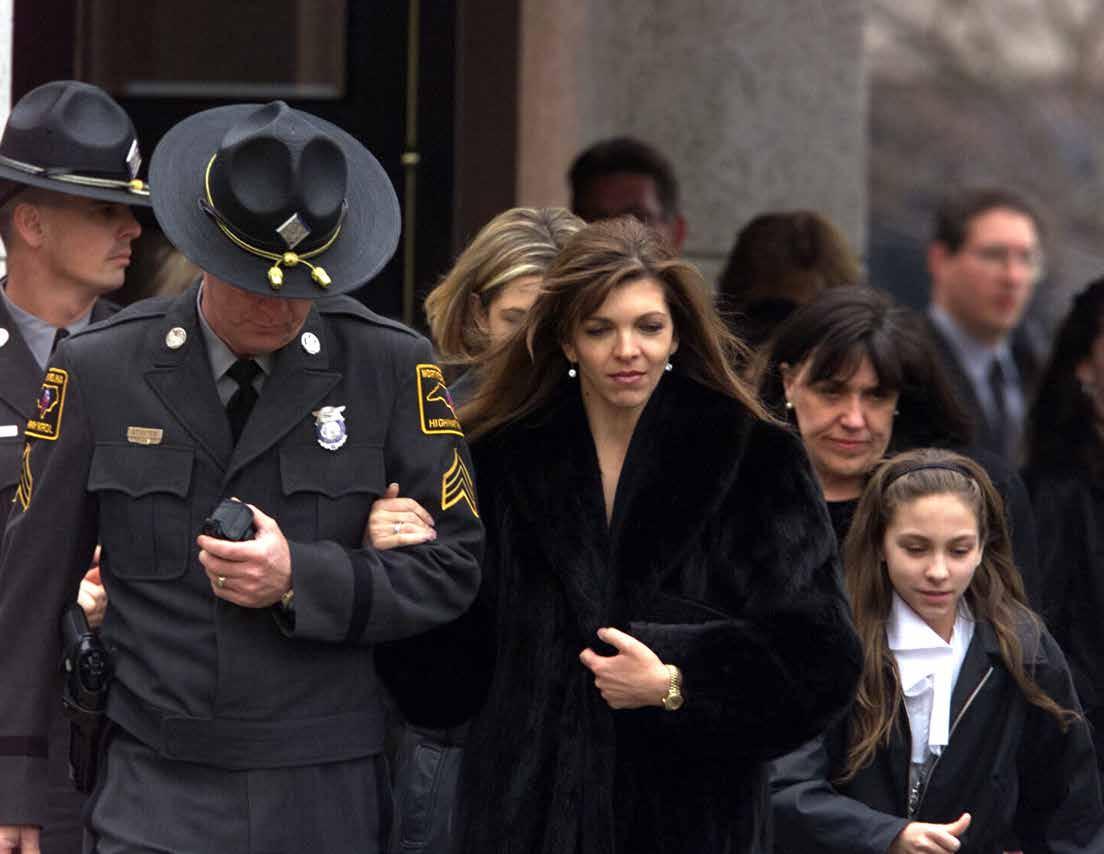
OPPOSITE: Teresa Earnhardt, suddenly a widow at age 42, and daughter Taylor Earnhardt, fatherless at age 12, received an escort by a state trooper from Calvary Church in Charlotte after the memorial service for Dale Earnhardt. Nearly 6,000 people were in attendance four days after his fatal accident at the Daytona 500. TIM DILLON / USA TODAY