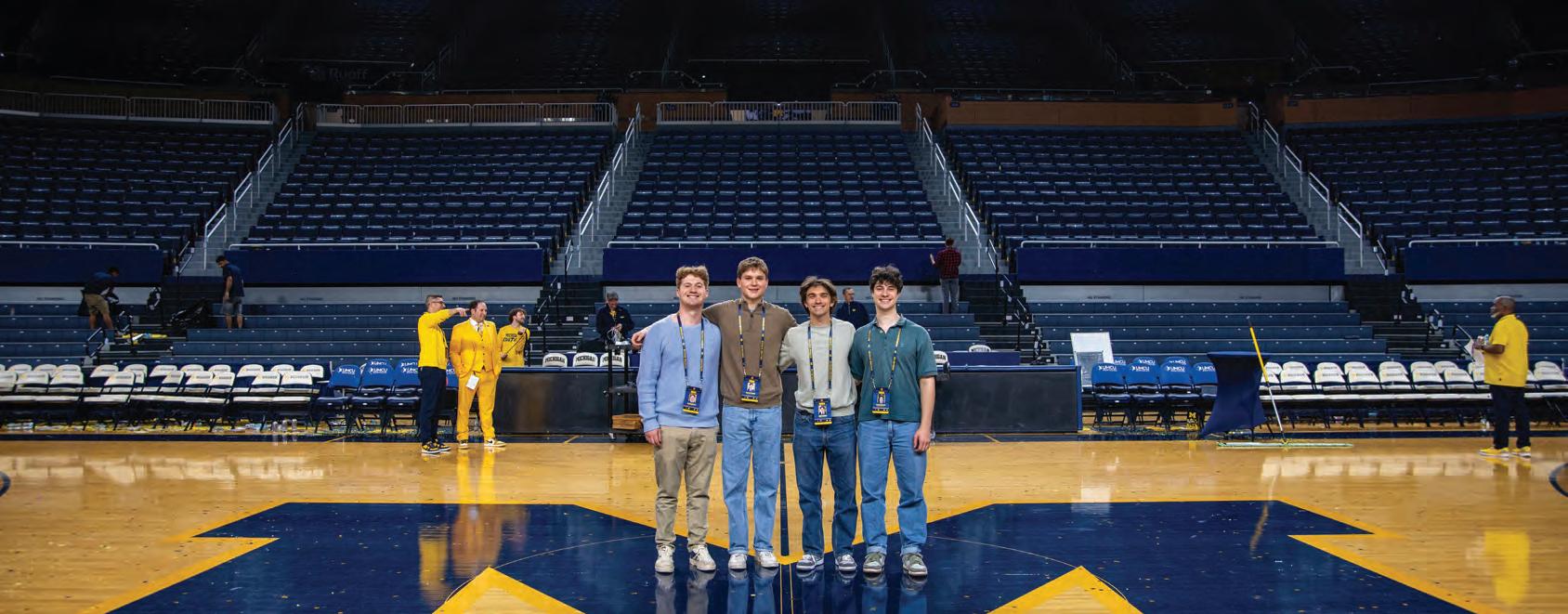
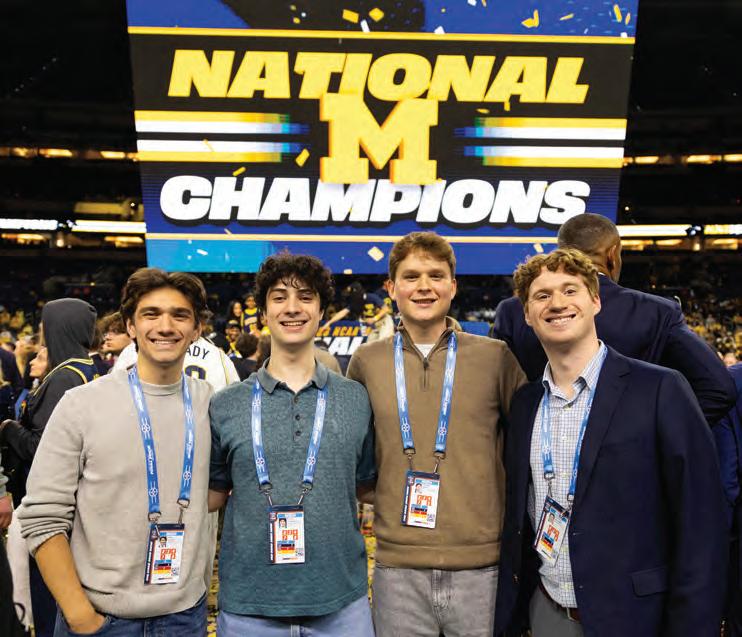
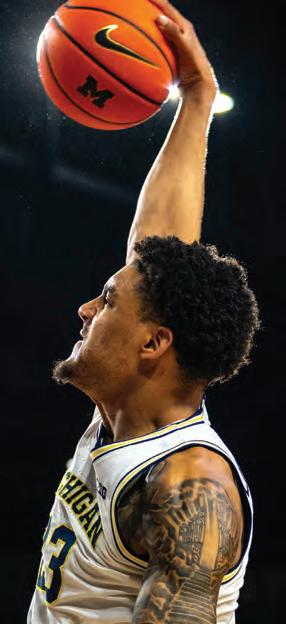
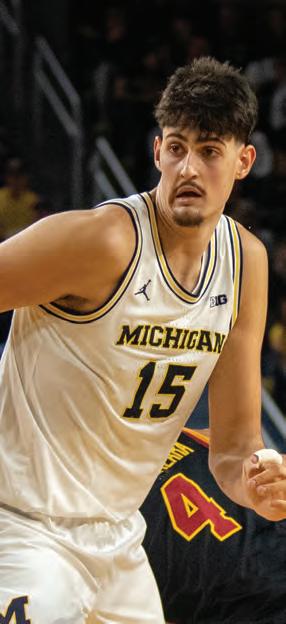
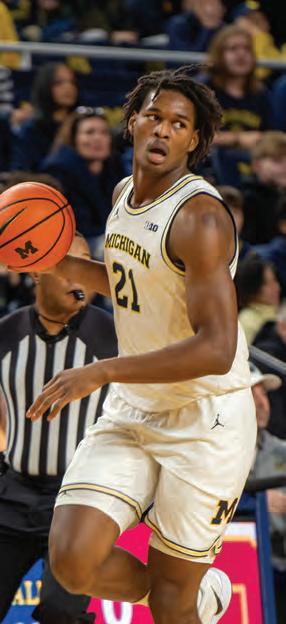
DREW LENARD, GRAHAM BARKER, XAVIER CHOUSSAT & ZACH GOLDSTEIN
2026 Men’s Basketball Beat
ANNABELLE YE
Project Lead
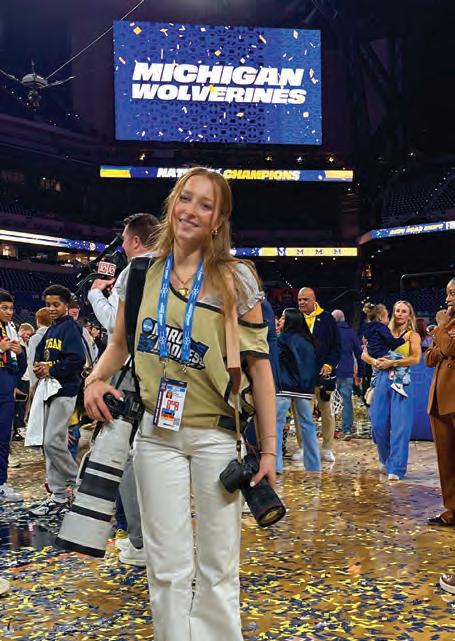
BRIDGETTE BOL & HOLLY BURKHART
2026 Managing Photo Editors
JONATHAN WUCHTER & ZACH EDWARDS
2026 Daily Sports Columnists
All content featured in this book was produced and edited by The Michigan Daily’s student journalists.
No part of this book may be reproduced, stored in a retrieval system or transmitted in any form or by any means, electronic, mechanical, photocopying, recording or otherwise, without prior written permission of the copyright owner or the publisher. Published by Pediment Publishing, a division of The Pediment Group, Inc. • www.pediment.com. Printed in Canada.
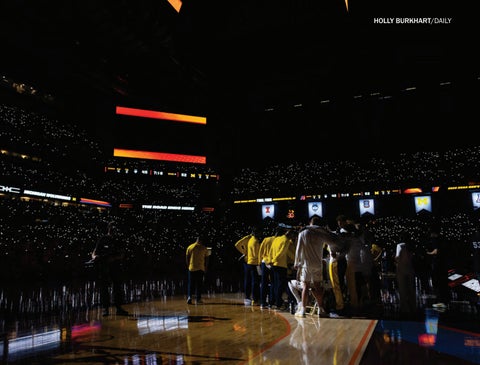
HOLLY BURKHART/DAILY
Daily Alum & Faculty at University of Wisconsin-Madison’s School of Journalism and Mass Communication
FOREWORD By Adam Schrager
Adam Schrager is an alum of the University of Michigan and The Michigan Daily, serving as its Editor in Chief and as a sports editor and reporter throughout his time on campus from 1986 to 1990. He currently serves on the faculty at the University of Wisconsin-Madison’s School of Journalism and Mass Communication after a nearly 30-year career as a broadcast political journalist, where he won dozens of Emmy Awards at stations in Denver and throughout Wisconsin, including PBS. After leaving journalism, Schrager launched the storytelling unit for Wisconsin’s first Public Benefit Corporation, featuring entrepreneurs working to close equity gaps throughout the country. He’s written four books, which have received positive reviews in media outlets like The Wall Street Journal, The Washington Post, and on NPR and conducts media training and storytelling seminars for state lawmakers, startup founders, corporate executives and non-profits around the country.
When Michigan last won a men’s national basketball championship in 1989, we were popping the collars on our polo shirts and wearing acid-washed jeans. We were exposed to Michael Jackson’s original music on the radio instead of through Balthazar Bratt in the movie, Despicable Me 3 or through an epic biopic released in theatres. While some things change, the similarities of this most recent title to the one back then are evident: Michigan lost to Wisconsin in the regular season, watched a key backup
point guard suffer a season-ending injury (Kirk Taylor and L.J. Cason) and eventually celebrated the pinnacle of college team sporting achievements with a three-word phrase, “Shock the World,” that felt far more appropriate then than it does now.
Even though any championship journey is unique, as one of The Michigan Daily men’s basketball reporters back then, it’s hard to convey just how bananas March and April that year actually were.
Never before and never since has an interim head coach won the NCAA championship. To make the storyline more compelling, longtime assistant Steve Fisher took over in 1989 after the regular season ended and before the tournament started after head coach Bill Frieder took the Arizona State job and Michigan Athletics Director Bo Schembechler famously said, “A Michigan man will coach Michigan!”
Throughout the next few weeks, Fisher would sit down at news conferences and literally introduce himself to the public.
“For the benefit of those who don’t know me, I’m Steve Fisher and I am now the head coach at Michigan.”
He would win the first six games of his head coaching career, endure a Final Four slugfest against Illinois with 33 lead changes and seven tie scores, before beating Seton Hall on two Rumeal Robinson free throws in overtime for an 80-79 win.
That ’s when Glen Rice, the team’s best player, climbed the ladder to cut down the
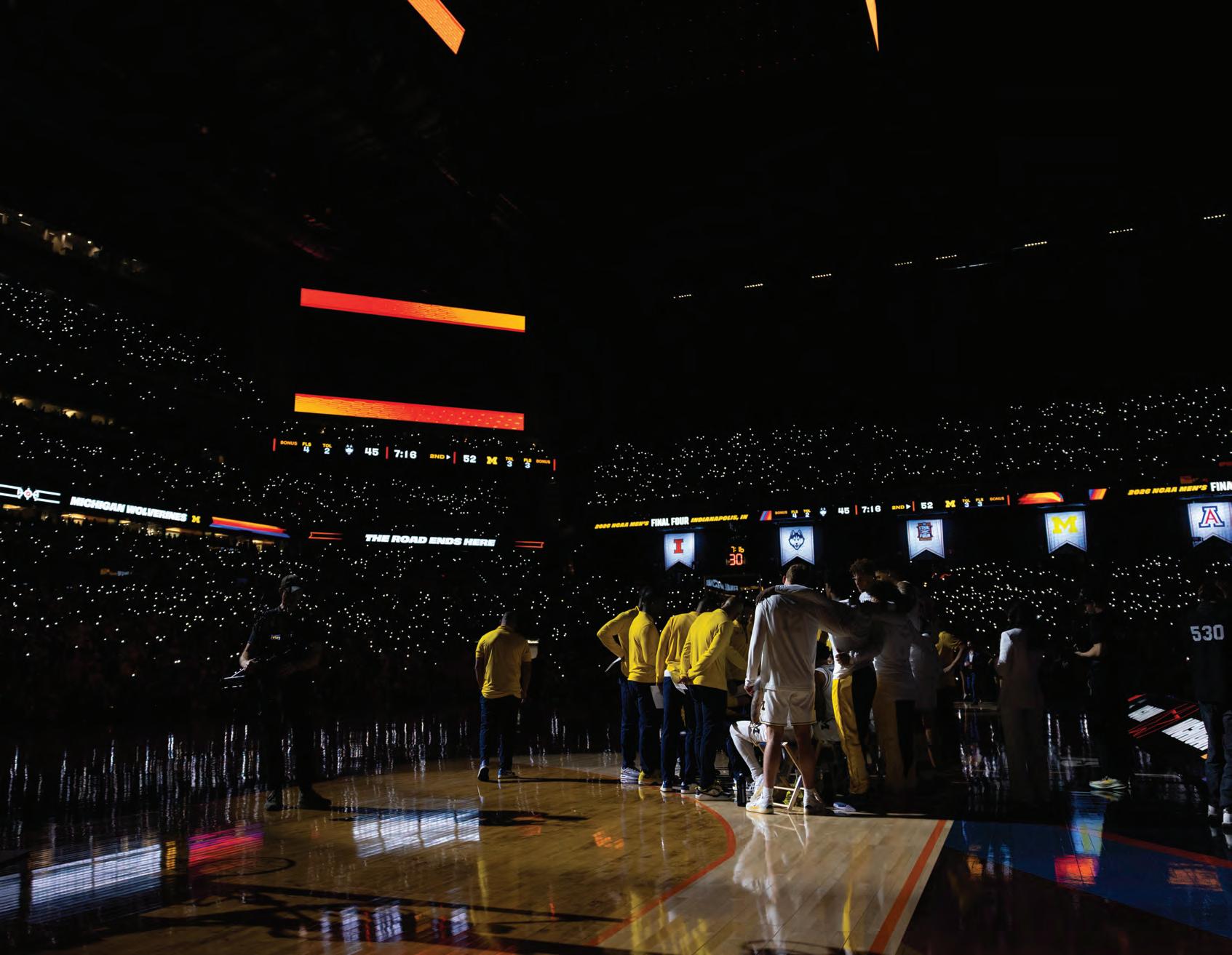
net and featured a sign that read “Shock the World Boys Go Blue.” You know, the same sign that Yaxel Lendeborg, this team’s best player, shared when he climbed the ladder after the win against Connecticut.
Maybe most importantly, tying the two championships together was The Michigan Daily. I was courtside at The Kingdome in Seattle for that title and was asked by Graham Barker, one of The Daily’s current Managing Sports Editors who was in Indianapolis for the win over UConn, to put all this into perspective.
There may not be a better job in journalism than to be on the sports staff at The Daily because your content is always relevant. There’s always interest. There are always readers. And fortunately, there’s tremendous skill showcased in the pages you’re about to read.
This season’s coverage from Barker, Drew Lenard, Xavier Choussat, Zach Goldstein and others featured in this book will remind you how special this season has been for Michigan basketball fans. My personal favorite was Lenard’s column about sitting in the student section at Purdue’s Mackey Arena as there are few things more satisfying than frustrating a rabid opposing fan base in their own gym.
While there may have been a sense of inevitability associated with this team’s title, we all know as Michigan fans, there’s never anything remotely comfortable about outsiders’ perceptions of our teams, even if they’re positive.
So, let’s relive and enjoy the stories about Lendeborg, Morez Johnson, Elliot Cadeau,
Aday Mara, Trey McKenney and the rest of this fantastic Michigan team. And let’s remember and believe the words of Dusty May in this book about how money didn’t buy this title. In the stories you’ll read, you’ll better understand that talent and teamwork are more appropriate descriptions.
I have two enduring memories of covering the 1989 title. The first was when my tape recorder broke while I was interviewing ESPN’s Dick Vitale over chicken soup and ham and cheese sandwiches. He talks really fast in real life and on television. Secondly, I remember the Seton Hall student reporter being kicked off press row with two minutes to go in the national championship game for loudly cheering in a space reserved for objectivity. My colleague Steve Blonder and I low-fived under the table in case you’re wondering.
That moment convinced me I wanted to be a fan of my teams in the future. I wanted to cheer.
And thanks to these amazingly talented athletes and the journalists who covered them all season long in The Michigan Daily, I’ve been able to.
Their memories are codified in this book. Yours will be, too.
MARCH 29 vs #6 seed TennesseeW 95-62 vs #2 seed UConn
Goldstein: Depth and fit will make or break Michigan’s season, not its top-end talent PRESEASON
ZACH GOLDSTEIN
2026 SENIOR SPORTS EDITOR
Not every team has the luxury of saying it has a preseason Naismith College Player of the Year Award contender, but the No. 7 Michigan men’s basketball team has one of the best players in the country in graduate forward Yaxel Lendeborg.
At 6-foot-9, Lendeborg provides versatility on both sides of the ball for the Wolverines as a high-level scorer and playmaker with an ability to switch onto smaller defenders. His talents propelled him to back-to-back seasons averaging a double-double at UAB and an AP Preseason All-America Team selection this year. He was even in talks to be a first-round NBA Draft pick in 2025.
Michigan coach Dusty May knows of Lendeborg’s accolades and his potential. In fact, May coached against him at Florida Atlantic two seasons ago. Lendeborg terrorized the glass en route to a 17-point, 21-rebound performance in a UAB win over the Owls. And so far this preseason, May has been singing the praises of Lendeborg.
Sure, Lendeborg will lead Wolverines on the court like he had for the Blazers in years past. But for all the merit Lendeborg brings, his stardom alone won’t be what defines Michigan’s season. Instead, the supporting cast will tell the Wolverines’ story.
Last season, Michigan featured a frontcourt duo of forward Danny Wolf and center Vlad Goldin. Despite the pair’s strong play — which led the Wolverines to a Big Ten Tournament title and a Sweet 16 appearance — depth issues were a consistent problem. Without a deep cast of role-playing guards with the ability to score and facilitate consistently, Michigan fell short in numerous key moments.
This season, though, those holes are not as
pressing. The Wolverines have enough to field out a full rotation of complementary pieces if they can work together.
On paper, Michigan has the requisite depth to make an even deeper run — perhaps even winning the national championship. It returned important pieces like senior guard Roddy Gayle Jr., graduate guard Nimari Burnett and graduate forward Will Tschetter. The Wolverines also made splashes in the transfer portal, swapping Tre Donaldson out for junior guard Elliot Cadeau and adding big men in sophomore forward Morez Johnson Jr. and junior center Aday Mara.
The underclassmen have already shown promise as well. Freshman guard Trey McKenney was a blue-chip, five-star recruit out of high school. Freshman guard Winters Grady knocked down a pair of 3-pointers against Cincinnati and was a positive in his minutes. Sophomore guard L.J. Cason showed flashes as a microwave scorer and figures to be the primary ball handler for May’s bench unit.
away the ball a combined 42 times already in preseason exhibition games. This issue burned them against the Bearcats and led to 22 points off turnovers for St. John’s.
Last season, Wolf and Donaldson often turned the ball over, and there was a lack of efficient playmaking otherwise. This year, the playmakers are there, and arguably there’s too many of them. What Michigan needed last season for Wolf and Goldin is what it will need once again for Lendeborg — complementary pieces. And if those pieces can operate as a fleshed out unit with scorers, facilitators and connectors, the Wolverines can and will live up to their preseason hype.
For Michigan, whether or not its depth can support its stars will define its season.
“I don’t think anyone on last year’s team or this year’s team would disagree that we have more natural ability, more proven success on this year’s team,” May said Sept. 30 at Michigan Media Day.
Depth of talent alone won’t be enough for Michigan to build on last year’s successes — the supporting cast around Lendeborg will have to gel together. Despite having a potential scheme that fits a championship contender needs, it’s yet to be seen if this group will truly mesh. Through two exhibition games, the turnover problem that persisted last season has returned, with the Wolverines giving
“We weren’t playing with good rhythm, and I felt like almost everyone caught the ball and tried to be the primary playmaker,” May said Monday. “We just didn’t have a lot of guys trying to connect the offense. And that’s something that I think all of us in the basketball universe are striving for now, to find connectors to make it all work. And usually the beautiful thing about basketball is those connectors end up scoring more, and they do it at a much higher, efficient rate.”
With Lendeborg as the guy and Cadeau as the primary ball handler, the Wolverines’ connecting options are their wings and forwards. Burnett and Gayle Jr. were previously used as ball handlers, but are both efficient shooters who can stretch the floor and play off the ball. Taking them away from the primary action on the floor and out on the wing or corner should keep opposing defenses honest. Those floor-spacing connectors could solve another problem: Michigan’s shooting woes.
Shooting just 33.2% from long distance, 13th in the Big Ten last year, the Wolverines failed to effectively space the floor even as it played with a high pace and often in transition. Outside of Burnett, no returner shot above 36% from behind the arc last season. If Michigan’s “connectors” can effectively space the floor, that poor 3-point figure should improve.
As May said, though, for any of these positive changes to happen, he needs his players to intentionally play as connectors and floor spacers. A gameplan or scheme to do so is one thing, but actions and results on the court are another. There weren’t enough of these “connectors” against Cincinnati, and it’s yet to be seen to what capacity players will operate in such a role.
“If we find a couple more guys that have that mindset, that they simply want to space the floor, find a way for it to look more, look better together with more functionality than those guys will play,” May said. “Because we have some unique pieces, and when you have unique pieces, then you’ve got to find a way to connect it and make it all work together.”
Having an experienced rotation with a litany of fitting complementary pieces around a star is a proven model for success in college basketball. Last season, Florida won the national championship with a complete roster that filled its needs around guard Walter Clayton Jr. The prior two years, Connecticut repeated as champions with rotations built around stars like Tristen Newton and Adama Sanogo.
The Wolverines have a star in Lendeborg. They have surrounding pieces like Burnett and Gayle. On paper, they have a full rotation. For Michigan, whether or not its depth can support its stars will define its season.
MADALYN BRAUN/DAILY
Yaxel Lendeborg’s mom has always known best PRESEASON
XAVIER CHOUSSAT
In a world increasingly centered on training athletes from the youngest of ages, one constantly inundated with stories of early risers and after-practice stayers, it seems strange for a projected firstround draft pick to not have always been committed to the grind.
But for graduate forward Yaxel Lendeborg, that training-obsessed life just wasn’t him at first.
“All my friends when I moved to New Jersey played basketball,” Lendeborg told The Michigan Daily. “So it was just a given to continue to play when I got into the system. It was all just fun. At first, I didn’t take anything serious. I played the same way that I did outside (when I was) playing stupid with my friends.”
In spite of her son’s half-heartedness, Lendeborg’s mom, Yissel Raposo, remembers a different outlook:
“I always bought NBA clothes for Yaxel,” Raposo told The Daily. “And when he was little I asked Yaxel, ‘What are you gonna do when you grow up?’ and he always said, ‘NBA.’ ”
Even with Lendeborg’s hesitance to give basketball his all, his mom never doubted him. She saw his innate potential and understood that he had the ability to make his childhood dream come true. All he needed was a little push.
***
Lendeborg isn’t the first in his family to play basketball — not by a long shot.
Growing up playing basketball and volleyball, Raposo took her own talents in both sports to the American University of Puerto Rico. She eventually continued playing both sports for her home country, the Dominican Republic.
Lendeborg’s father was also a prominent player in the Dominican scene throughout
the ‘90s and the early 2000s. He played for both the national team as well as professionally within the Dominican Republic’s National Basketball League.
All of this culminated into Lendeborg being instilled with a love of sports from birth. Between watching his mom play courtside and growing up in a house that mandated sports as an extracurricular, Lendeborg was all but born with a ball in his hand.
Trying everything from hockey to gymnastics, Lendeborg thought that baseball would’ve been the sport that stuck. As he grew up, though, persuasion from his mom and his friends pushed basketball into a prominent position in his life.
But again, even with his mom trying to convince him to follow in her footsteps, Lendeborg didn’t commit. It wasn’t for a lack of love for the game — playing with friends remained a weekly pastime — but he never integrated it fully into his life as much as his mom wanted.
“When he was younger, she always tried talking to him, telling him, ‘You need to take basketball more seriously,’ ” Raposo’s daughter translated into English. “And he wouldn’t take it seriously and he would just play basketball with his friends, not to actually succeed.”
In middle school, Lendeborg finally gave it a shot, trying out all three years. However, he never made a team — attributing it to the fact that he just wasn’t good enough. At 15 years old, Lendeborg had still never played a competitive minute of basketball.
Lendeborg got his shot once again in high school, officially making the team his freshman year. However, a lack of effort sidelined him again, but this time it wasn’t on the court.
Ruled academically ineligible halfway through his freshman year, Lendeborg didn’t even suit up for a game after joining the roster. Being described as a good kid by his mom, it was solely the indifference in the classroom that held him back. Without substantial
improvement his sophomore and junior years, Lendeborg continued to stay off the court. But still holding the belief that basketball was the future for her son, Raposo stepped in.
“The last year when he was at school, I talked to the counselor, because I wanted Yaxel to study, finish school and play basketball,” Raposo said. “… So (Lendeborg’s school) told me about a program, the same program at the school, but in a different place. It was in Camden and we lived in Pennsauken. … And I said to Yaxel, ‘Hey, we need to do something different. We need to sacrifice.’ ”
And the sacrifice of switching programs his senior year truly paid off, just like Raposo thought it would. With A’s and B’s across the board, Lendeborg made it onto the court for the final 11 games of the season, finishing with a record of 10-1. Still, Raposo knew that Lendeborg had higher mountains to climb.
Despite getting onto the court for the final half of his senior year season, Lendeborg didn’t get the attention of any scouts. Even with the raw physicality of a professional player and with two parents who had walked the walk, Lendeborg’s basketball journey ended as quickly as it began.
Soon after graduation, Lendeborg picked up another job, working in a warehouse alongside his mom.
“At my job, they give opportunities to teenagers, and I said, ‘Hey, can he work with me?’ And they said, ‘Yes,’ ” Raposo said. “But you know Yaxel was 17 and I said to Yaxel, ‘This is not your life. You’re very tall. You have talent, so you need to play basketball.’ ”
So Raposo took matters into her own hands once again. With her years spent playing in the Dominican system, she had
enough connections to get Lendeborg invited to a basketball camp in New York that focused on evaluating the next generation of Dominican talent.
While Lendeborg might not have had the most impressive high school career, he showed out at the camp. Due to a somewhat quasi-rivalry with his cousin, Lendeborg was pushed to be his best, resulting in him becoming one of the camp’s top performers. This drew a couple of eyes, but only one coach kept his gaze on him — Kyle Isaacs, then-assistant coach for the junior college Arizona Western.
After a couple weeks of speaking with Raposo, the Matadors offered Lendenborg a scholarship and a spot on their basketball team. But they didn’t offer it directly to Lendeborg.
“Oh my god, I was scared, because I never let Yaxel go alone anywhere,” Raposo said. “And then my other friend said, ‘I have a school for Yaxel, a junior college.’ I’m scared, but I was into the college and I said, ‘OK, I want this for Yaxel.’ ”
However, Lendeborg wasn’t as keen on the idea. Still not sold on the basketball lifestyle, departing to Western Arizona wasn’t his preferred turn of events.
“At the end of (the camp), my mom got in contact with a junior college coach,” Lendeborg said. “There’s only one coach that interested me and they were talking for a couple weeks. Later on, with a week left, my mom says I have to go to Arizona, so I pretty much got forced on a plane.”
Even with all the hesitations in the world, less than a season of high school basketball under his belt and a trip that meant moving to the other side of the country, Lendeborg boarded that plane, trusting his mother.
It wasn’t easy. While missing home and still a work-in-progress on the court, Lendeborg’s freshman year with the Matadors wasn’t anything close to a seamless transition.
“My first year there was awful,” Lendeborg said. “I don’t think I averaged more than 4.3 rebounds. I sucked. Ultimately, the lifestyle was horrible as well. My first time away from my mom, so it was brutal. I couldn’t
really manage it. There were many times I wanted to quit. I kept calling my mom (but) she kept saying no.”
As time wore on, things improved drastically. Supported by two of his new teammates — and soon friends — guards Marquis Hargrove and Evan Butts, Lendeborg was forced out of his shell both socially and on the court. With more confidence as the season wore on, Lendeborg became more outspoken and started to commit to the game in ways his mother wished he’d always had. It wasn’t his choice to get on that first flight, but eventually it became his choice to stay, to improve and to trust the process.
***
Derailed a bit due to the COVID-19 pandemic, Lendeborg still finished his junior year with a slate of stellar statistics and accolades to make him an attractive offer at the Division I level. Bolstered by conversations he had with his coaches and with the support of his teammates, Lendeborg decided to enter the transfer portal, ultimately committing to UAB alongside Hargrove.
In his two seasons with the Blazers, he doubled down on his performance at Arizona Western. He notched All-American Conference First Team twice and American Conference Defensive Player of the Year twice, all while averaging a double-double. Lendeborg wasn’t just in a position to transfer to a big-name school — he was in a position to get drafted.
And again after conversations with his coaches, he decided to participate in the NBA Combine and enter the transfer portal. Ultimately forgoing the league and opting to develop one last season before pushing all his chips in, Lendeborg selected the Wolverines as his final collegiate destination.
Now in his last season, Lendeborg is a step away from completing his mom’s final wishes.
“She is ecstatic, she definitely rubs it in my face about her pretty much, telling me I could be here, and here I am now,” Lendeborg said when asked how his mom
feels about his current position. “… And she always had dreams for her son, I guess I exceeded that in her eyes. And it’s always something that makes me tear up a little bit, makes me emotional.”
The faith of Raposo to push him onward again and again, the trust that Lendeborg
would respond and live up to his potential, the sacrifice needed to commit to the grind and the love that upheld it, all stemmed from his mother’s actions. Behind Lendeborg’s rise to the top of collegiate basketball — and beyond — will always and forever be the undying work of his mother.
REGULAR SEASON
MICHIGAN 121 | OAKLAND 78
GOLDEN START
Michigan pummels Oakland’s zone defense in season opener rout
2026 SENIOR SPORTS EDITOR
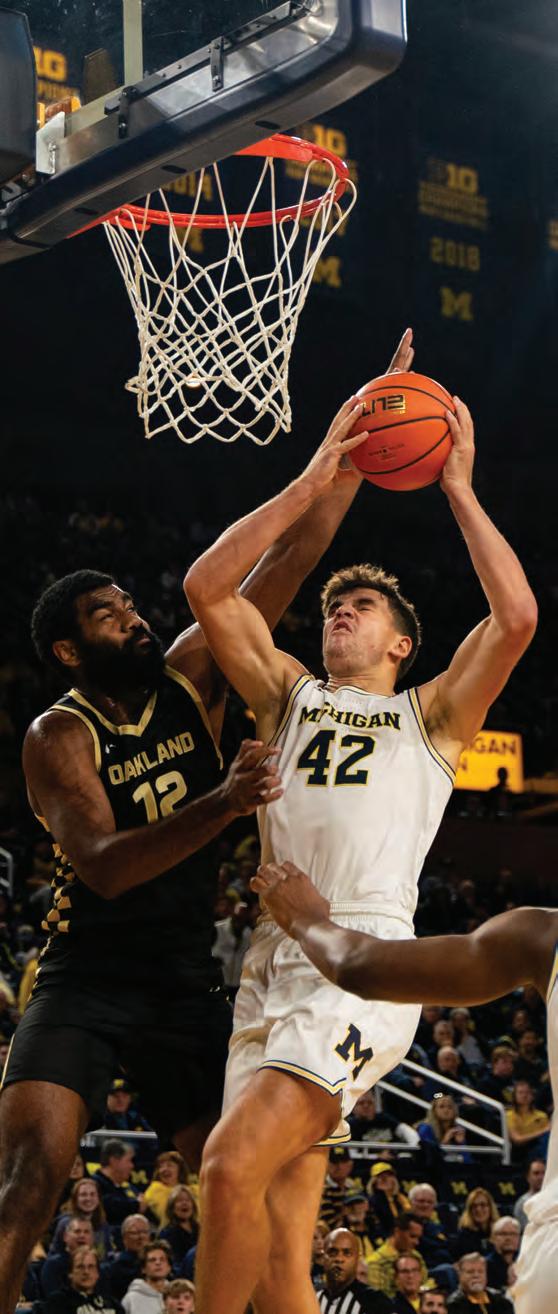
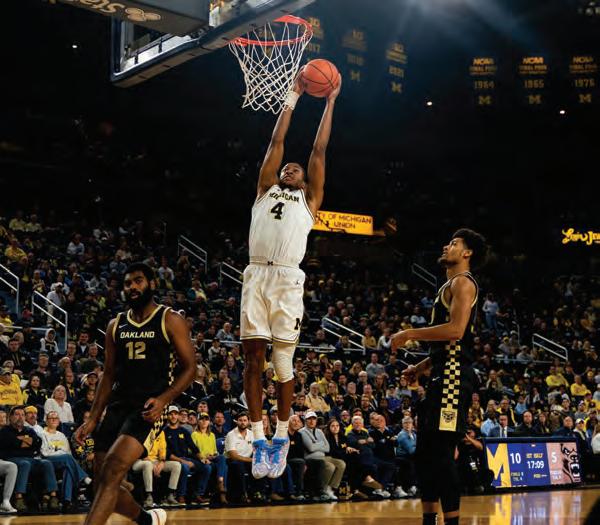
As the No. 7 Michigan men’s basketball team’s coach Dusty May will freely admit, the Wolverines don’t often see zone defenses in the Big Ten. But against Oakland, which uses a 1-3-1 as its basic defensive set, Michigan looked like an expert against the zone.
Feasting down low and from beyond the arc, the Wolverines (1-0) wasted no time stretching the Golden Grizzlies’ (0-1) zone to its breaking point. The damage Michigan did in the first half left little doubt in the result, powering it to a 121-78 victory in Monday night’s season opener.
“I do think our players gave (the crowd) something to cheer for,” May said. “A very unselfish effort by us. We looked connected. We looked determined to fix some things. And overall, I thought we did some really nice things with a long way to go for us to be as good as we can possibly be.”
Those connections were noticeable almost immediately as the Wolverines had no problem exploiting weaknesses in Oakland’s zone. Utilizing its bigs often and early, Michigan found lobs and overhead passes to feed both junior center Aday Mara and sophomore forward Morez Johnson Jr. down low.
Getting out to an early lead behind the big-man duo, the Wolverines conditioned the Grizzlies to expect a body in the paint,
creating open shots along the perimeter. By using ball fakes, those open shots became easier as Michigan got Oakland to bite.
“We practice on it,” freshman guard Trey McKenney said. “Just shot fakes, ball fakes, eye fakes. And the shooting helps as well in the zone.”
Out of the under-16 timeout, Johnson’s size and athleticism singlehandedly overwhelmed the Grizzlies. Johnson powered
the Wolverines on a 20-0 run in just a four-minute stretch, including 10 of his 20 first-half points to push Michigan’s lead above 20 just eight minutes into the contest. With the established scoring threats inside the arc, those open shots that started to fall early became nearly automatic. The Wolverines consistently found open 3-pointers from the right wing and corner in the final 10 minutes of the first half as Oakland’s
baseline defenders struggled to move from side to side. By the time the buzzer sounded, Michigan had converted on a whopping 9-of-17 3-point attempts and scored a program record 69 first-half points.
“They can be pretty effective when they get their zone set,” graduate forward Will Tschetter said. “So you got to be able to beat it down the floor in transition when they’re matching up in there, in man. That’s when that floor is really spaced out, so it’s easy to pick them apart before they get set.”
The Wolverines’ scoring ways went nowhere in the second half. Aided by its own suffocating defense, Michigan used its offensive pace to extend its lead. The Wolverines consistently pushed the ball down the floor, using transition and outlet passes to get to the basket quickly.
Regardless of the defensive look or circumstance, shots continued to drop, including an and-1 layup from McKenney as the lights inside Crisler Center went out for a brief moment. And as the game came to a close, the punishment continued as Michigan closed out its inevitable win.
The Wolverines used Oakland’s zone defense as a clinic on how to score easy baskets, drilling 64.3% of their shots and 54.3% of their 3-pointers. By using size, athleticism and shooting prowess in the paint and from deep, Michigan had no problem drowning out the Grizzlies in the season opener.
CALEB ROSENBLUM/DAILY
REGULAR SEASON
Depth proving useful for Michigan early on
GRAHAM BARKER
2026 MANAGING SPORTS EDITOR
Usually when a team’s Preseason All-American star player has an off night, the team suffers with them. But Tuesday night against Wake Forest, The No. 6 Michigan men’s basketball team was able to overcome that obstacle.
For Lendeborg, who transferred from UAB, this is something new. Six of the Blazers’ 13 losses last season came in games where Lendeborg shot 40% or worse from the field. Now, he and the Wolverines have a deep enough roster where one player’s off night doesn’t have to drag down the team like it would at UAB.
“It’s a new environment for (Lendeborg) where we’re not counting on him to
Graduate forward Yaxel Lendeborg was 4-for-12 from the field with three turnovers, mostly a non-factor for the Wolverines outside of a few open dunks and one 3-pointer. But with six other players scoring eight or more points, Michigan’s depth stepped up and helped deliver a win.
carry us,” Michigan coach Dusty May said Tuesday. “He just has to be another spoke in the bike tire. We’ve got a lot of good spokes in our locker room, so (he’s) gotta just stay with it and figure out ways to impact the game when the ball is not dropping.”
On Tuesday, one of those spokes was junior center Aday Mara, who recorded 18 points and 13 rebounds. Junior guard Elliot Cadeau scored 17 and led the team in assists. Off the bench, senior guard Roddy Gayle Jr. hit a couple of big shots down the stretch.
In the Wolverines’ season opener, it was a different batch of standout players. Graduate guard Nimari Burnett had 14 points against Oakland, while graduate forward Will Tschetter and freshman guard Trey McKenney combined for 10 3-pointers. So far, Michigan hasn’t needed one guy to lead the charge — the Wolverines have put up their points by committee.
For players like Lendeborg, that means less pressure to perform and more freedom to take the game as it comes to him. But that depth has ramifications elsewhere, too. Against the Golden Grizzlies, Michigan was able to let a few key injured players rest while still fielding a team good enough to secure 121 points and a win.
“These guys could play if they absolutely had to, but we’re more thinking long term, and we have so much depth that we’re not gonna put a guy out there at 75, 80% unless we absolutely have to,” May said Nov. 3 after beating Oakland.
Knowing they have plenty of players that can contribute to winning, the Wolverines have the luxury of resting players with minor or lingering injuries. Sophomore guard L.J. Cason sat out the Grizzlies win, but came back healthy against the Demon Deacons and scored eight points in 14 minutes.
Meanwhile, freshman guard Winters Grady is still working up to game action after a foot injury, but his perimeter shooting will add yet another spoke to Michigan’s wheel.
“Grady is back practicing now,” May said Monday. “… With Winters, if you can get him a clean look, there’s probably as good a chance of the ball going in as anyone on our team.”
The Wolverines are just two games in, but the depth they hyped up in the preseason is already showing its face. Whether stepping up when its stars disappoint or providing room for patience with injuries, Michigan’s depth will continue to play a vital role as the season continues.
CALEB ROSENBLUM/DAILY
Dusty May, Michigan still in search of ‘cheat code’
DREW LENARD
2026 DEPUTY SPORTS EDITOR
The No. 7 Michigan men’s basketball team is out to a 3-0 start halfway through November. It’s won each of its games fair and square, by the book. And to Wolverines coach Dusty May, that’s the problem.
“Right now, we’re still trying to figure out what our cheat codes are gonna be,” May said Monday. “We’re still figuring out what are gonna be our ways of scoring when the game slows down.”
May then cited former center Vlad Goldin and former forward Danny Wolf specifically as the athletes that granted last year’s team such significant advantages.
Now those old cheat codes have expired. It’s a new season, a new game to be played with mostly new players. And while Michigan has been winning through its first month of play, this top-10 team has been playing on easier settings against lesser opponents. As the season picks up steam and conference play brings tougher opponents into view, it will be important for May to find his next go-to guy.
Right now, there’s no shortage of options on May’s refurbished roster as to who could become this year’s cheat code. In fact, that exact term was flying around social media last week after junior center Aday Mara’s imposing performance against Wake Forest. But just three days after the big man recorded 18 points, 13 rebounds and six assists against the Demon Deacons, Mara faded on Friday night.
In 20 minutes against Texas Christian, Mara was a prime contributor to the turnover problem that almost sunk the Wolverines in their first road contest of the season. By the time the final buzzer rang and Michigan had escaped by another thin margin, Mara had taken just two shots all game, and sat at a plus-minus rating of negative six on the evening.
Graduate forward Yaxel Lendeborg, who withdrew from the NBA Draft to spend a season with the Wolverines, was putting up video game numbers a year ago at UAB. Coming in as the No. 1 prospect in the transfer portal, he’s expected to do the same in the Big Ten.
Though so far, Lendeborg has blended in with the masses on the court. He went 1-for7 from deep against Wake Forest on a night where Michigan desperately needed one to fall from beyond the arc, and scored just nine points all evening. Friday’s affair with the Horned Frogs saw Lendeborg record his first double-double of the season as he came up with clutch assists and free throws in the final minutes of the game.
Lendeborg’s performance Friday may have been enough for some fans to feel confident that he can be this year’s cheat code. But for May, who saw Lendeborg’s statline in the exhibition against Cincinnati — 31 points and 12 rebounds — and said he was unsatisfied with the effort, it may take some more convincing.
“We need to get him in space more, we need to have him create more, we need to have him trust his jump shot more,” May said Monday. “Those things will come with time, and he’s going to continue to get better.”
Outside of Mara and Lendeborg, plenty of other Wolverines have strung together some solid games as well. Sophomore forward Morez Johnson Jr. had himself the best night of his college career against Oakland. Senior guard Roddy Gayle Jr. is averaging 11 points per game and delivered on some big-time looks in Michigan’s most recent contests. Junior guard Elliot Cadeau is tied for eighth in the nation in assists per game at 7.3, and has been a threatening presence in the lane at times — most notably clinching the game-sealing free throw against Wake Forest.
With consistently solid performances across the board from an already deep roster, the Wolverines have been able to come out on top in their recent close contest without having to lean on just one or two guys. It’s just enough, for now.
“We have nine really good players, so when a guy doesn’t have his best stuff, say, your best player has a 2-for-12 (performance), you still find a way to win,” May said. “You don’t have to count on him. You’re not disappointed in him. You never feel like this guy or that guy has to carry you to win. You have a cumulative effort.”
Thus far, Michigan has scraped by its nonconference schedule by getting just enough out of a selection of its athletes. It wouldn’t be surprising if that trend continues into January. But once the difficulty settings get cranked up come conference play, it won’t be as easy for the Wolverines to win without finding a cheat code.
ALYSSA MULLIGAN/DAILY
PLAYERS ERA TOURNAMENT
SAN DIEGO STATE
94-54
The No. 7 Michigan men’s basketball team set itself up well. After going down 5-0 in the open to San Diego State, the Wolverines used two scores in the paint, three free throws and four 3-pointers to jump out to a 21-9 lead.
Then, up 8-7, Michigan rattled off three straight 3-pointers: the first by junior guard Elliot Cadeau and the next two by graduate forward Will Tschetter. All three were assisted. Mara tipped in two more points off another offensive rebound, Lendeborg hit two free throws, and just like that the Wolverines were up 21-9 less than eight minutes in.
EMILY ALBERTS/DAILY
BANK MONEY
AUBURN
“This one just meant more. Tuesday night’s matchup with No. 21 Auburn was not only the No. 7 Michigan basketball team’s first matchup with a ranked opponent this season, but also the long-awaited rematch of last year’s Sweet 16 in which the top-seeded Tigers put a cork in Wolverines coach Dusty May’s historic first-year program turnaround.
102-72
What ensued was the first of many scoring runs from the Wolverines, an 11-point unanswered onslaught which rained on Auburn’s parade. As it has all season so far, Michigan did numbers on the Tigers in the paint, drawing eight free throws in the first six minutes of competition and outsmuscling Auburn for offensive rebounds and easy points in the lane all game.
The closest Auburn brought the contest in the second half was still a 24-point deficit as Michigan’s confidence only rose as the clock drained out. Leaving his starters on the court for the majority of the second half, May kept his foot on the gas with last year’s Sweet 16 loss firmly in the rearview mirror.
IN THE
GONZAGA
“Feeding off Lendebong’s early threes as the game progressed, the seventh-ranked Wolverines began to light up No. 12 Gonzaga from beyond the arc. With eight 3-pointers in the first half, Michigan got everyone involved. A NBA-range 3-pointer from Cadeau, deep-corner shots from graduate forward Will Tschetter, pull-up shots from beyond the arc from freshman guard Trey McKenney and more fastbreak 3-pointers from graduate guard Nimari Burnett kept the Wolverines’ healthy cushion alive going into halftime.
101-61
“Yeah, absolutely,” Lendeborg said when asked if this game proved the Wolverines were the best team in the country. “A lot of the guys on the team felt like we were getting disrespected because of our first couple game struggles. So today was just putting the world on notice that we’re here to be the best team in the nation.”
”Beating their opponents by an average margin of 36 points, there was almost nothing that went wrong for the Wolverines at this tournament. Twos, threes, rebounds, frontcourt, backcourt, the pure domination was all there. And with that domination came Michigan’s million dollars and possibly a spot looking down at the rest of college basketball.