2
March 24, 2014 · Volume 146, Issue 11
»
»
» »
» » » »
»
» »
CANADIAN COMMUNITY NEWSPAPER AWARD 2013
» »
»
FIRST PEEK
As it says in my byline above, I write about sports. And to do so well, to know what the hell I’m talking about, I watch a lot of sports. Maybe too much. I care about sports. If everyone has a “thing,” sports are mine. I think we can all agree that that’s a normal thing for a guy to be into, especially one in his early 20’s. Ballet, however, is not. I would know; I was a ballet dancer for a large portion of my life, and I’ll be damned if I wasn’t pretty good at it. That’s no secret — there are pictures on Facebook of me during my time with the Royal Winnipeg Ballet — but it’s hardly something I broadcast. Not because I’m embarrassed, but because it’s such a big deal to so many people. A girl I dated wouldn’t let me bring it up because it wasn’t manly enough. An editor from The Peak from a few generations ago couldn’t believe I was
March 24, 2014
a ballet dancer because I “write about football and stuff,” as if the two were mutually exclusive. As if one was “less straight” than the other. You can think of me and other male dancers how you will; I’ve been called a “faggot,” enough to not care anymore. But keep your gender roles out of my sports, please and thank you. Sports, especially team sports, have been defined by their masculinity for so long. How often do you hear “it’s a man’s game” being thrown around during a football broadcast? And then, when one of those football players comes out as gay, there are questions of his masculinity, despite his talent.
University of Missouri star Michael Sam announced to the world that he is gay three months before he was scheduled to enter the NFL Draft. CBS Sports had Sam, fresh off being named a first-team All-American and his conference’s Co-Defensive
Player of the Year, ranked as a third-round prospect prior to his announcement. Now, there are questions of how far he’ll fall in the draft, if picked at all. Women in football have it worse: you’re a sex symbol, whether you’re cheering on the sideline or playing in the Lingerie Bowl. There’s nothing even close to equality in football, and when you break away from the alpha-male stereotype, as Sam did, you don’t belong. When a woman breaks through to a man’s world, she must either be lesbian or willing to bare skin. It’s too easy to call female hockey players “butch” or “dykes,” and I’m sure those stereotypes are as accurate as those surrounding male dancers. Then there are the Danica Patricks of the world, who I’m sure you all know more for kinda-sorta taking her clothes off for GoDaddy than anything she’s done on the race track. Too often gender roles define athletes off the court, field, track, or ice. They shouldn’t, because none of it matters. I don’t want to hear about Michael Sam, Gay Football Player’s draft journey. I just want to watch Michael Sam, All-American, play football in the NFL. Then I’ll go see Romeo + Juliet with my mom.
3
GL-CMYK
NEWS
Last week’s SFSS debates kicked off not with a bang, but with a chuckle. At least, that’s what many in attendance were tweeting throughout both the at-large and faculty rep candidate debates held on March 19 and the executive candidate debates that happened the following day. During what many in attendance — both in the West Mall atrium and via cyberspace — called some of the spiciest and juiciest SFSS debates they’d ever seen, candidates for each SFSS board position faced off in a conversational style debate. The Wed. debates, held for the at-large and faculty rep candidates, began amiably, with candidates expressing their plans for the board should they be elected. The mood, however, began to turn as the Communication Art and Technology candidates, Natalie Cheung and Shirin Escarcha, took the stage. From that point on, the conversational nature of the debates became more heated, especially between candidates on opposing slates. This year, candidates with selfproclaimed shared visions for the society joined together to form two different slates: ACE and Move the Mountain. Independent candidates also contributed to the lively dialogue happening on stage. As the debates ran longer into the afternoon, those in attendance both jeered and cheered for the competing candidates. The battle truly came to a head, however, with the final debate between candidates for at-large reps. One hot topic was that of the open textbook program, advocated for by candidate Jeremy Pearce.
March 24, 2014
news editor email / phone
Leah Bjornson associate news editor news@the-peak.ca / 778.782.4560
During the debates, #SFSSElection was trending on Twitter in Burnaby, BC. Pearce responded to candidate Humna Ahmad’s question about the program, saying that he has just become involved with it, but feels it is more accessible than giving students more bursaries. Ahmad replied, “Bursaries are more than just funding textbooks. They’re there to support students’ lives.” After Ahmad cited statistics pertaining to the program, Pearce remarked, “I appreciate you incorporating statistics I gave you at the last debate.” The tension of the moment was broken by candidate Baqar Hassan, who complimented fellow candidate Rebecca Langmead on her basketball skills. It seemed the intensity would carry on into the executive debates, which occurred the following afternoon. The four and a half hour long debate went over time, but there was never a dull moment. The proceedings started off on a light note as the VP, student life candidates introduced themselves. Candidate Kayode Fatoba demonstrated his rapping skills with original lyrics that had the room clapping along. Topics under discussion pertained to bettering the student experience. Candidates also shared
stories of their successes and failures. The idea of transparency was presented and became a recurring topic for the afternoon. “The SFSS is not very open, [. . .] I want to change this. A transparent student society is what we need,” said VP, student life candidate, Blossom Malham. Many candidates restated the claim that many students don’t even know SFU has a student society, let alone what it does. The most talked about issue during the hour-long VP, finance, discussion was not only how to maintain the budget, but how to potentially increase revenue through avenues such as sponsorship and renting out spaces like the Highland Pub. Several members from opposite slates argued about the importance of engaging students in SFU culture through throwing events, versus other issues that affect students, such as affordable tuition and services like the Health and Dental Plan. The most highly anticipated conversation of the afternoon was between the presidential candidates. As with the Surrey all-candidates debates, only three out of the four were in attendance. There was much back and forth between
Choong Jin Ng / The Peak
opposing slate members, Chardaye Bueckert (Move the Mountain) and Brandon Chapman (ACE). Bueckert brought up clear policy violations that have occurred in the SFSS, while Chapman challenged her on having a negative attitude towards the current board. He said, “You blame the current board for its current situation.” Chapman spoke to his slate’s mandate of cultivating a stronger sense of community on the principles of accountability and excellence. Bueckert emphasized a strong need for change within the society, saying, “Vote for who is going to represent you best.” Meanwhile, presidential candidate Alexander Morris says he has a new perspective and a “fresh face” to offer to SFU students. His platform rests on promises of bringing free coffee to students, condensing similarly mandated clubs, and engaging every single member of the SFU community. The so-called “spicy” debates that took place last week gave candidates the stage, but now the fate of the next SFSS board of directors rests in the hands of undergraduate students. Voting for the positions will take place between March 25 and 28.
Melissa Roach
5
6 NEWS
March 24, 2014
The engineer selection committee recommended to board the approval of three groups as engineering consultants on the Build SFU student union building (SUB) project. The board approved the selection of Integral Group as mechanical engineering consultants, Fast + Epp as structural engineering consultants, and MMM Group Limited as electrical engineering consultants for the SUB. This marks the next step in the SUB project as it enters the architectural design development phase. On Thurs., Mar. 20, the architects also presented potential building designs for the student union building and asked those in attendance for feedback.
Plans for the SFSS Spring Sendoff concert are well underway, and this second event promises to be bigger and boozier than the first. In response to student feedback from the dry Fall Kickoff concert, this time around there will be a separate beverage garden open to concert-goers of age, pending final university approval. The event will take place on Apr. 4, and will feature electronic dance music artists 3LAU, Vicetone, Moiez, FKYA, and the winner of this semester’s SFU DJ contest. Student interest in the concert appears to be high, with over 700 tickets sold as of last week.
Last fall’s concert was met with hesitation on the university’s part, but in light of its success and positive feedback, SFU approved a second concert. While both the university and SFSS agreed to keep the event largely the same, a major change is the inclusion of a beverage garden. Board members did discuss changing the genre of music in order to appeal to a greater scope of students, however, it was decided that the lack of alcohol was the biggest complaint and, therefore, the natural next step. Brandon Chapman, business rep on the SFSS board of directors, explained that their aim is to make incremental changes to the concert model, so as to not risk the university’s disapproval. The SFSS has already received approval from the City of Burnaby and the RCMP for the beverage garden. They are still in conversation with the liquor inspector, after which they can be receive the official green light from the university and will have a clearer idea of how the beverage garden will run.
Chapman has spearheaded the project since the SFSS began to entertain the idea of a second concert near the end of the fall semester. A task force of 12 people was formed mid-December and put forth the proposal to board on Jan. 20.
Despite concerns from other board members over the near $19,300 deficit of the last concert, the spring concert was approved. “That won’t happen again,” said Chapman of the deficit. “We’ve already secured over $12,000 in sponsorships, which is huge.” A sum of $10,000 was contributed by the university and the rest came from external sources. Ticket prices have also increased slightly to offset the cost
of the concert, but it is still important to the organizers to keep this event affordable for students. The team is also evaluating the expenses of the fall concert to see where money could have been saved. Chapman said that the society’s goal for similar future events is to break even. The SFSS has been working closely with Student Services to move towards a more sustainable and cost-efficient way of hosting concerts. There has already been talk of another kickoff event next fall, which could potentially offer a more varied collection of artists. Chapman shared his vision for this event with The Peak: “Imagine Terry Fox Field being a place where people can come and just listen to some indie music in the afternoon when the sun shines, have a beer with some friends and reminisce about the summer.” You can follow Melissa Roach
The board approved up to $4,000 from the Space Expansion Fund for the purpose of creating a soup and sandwich station in Higher Grounds. The motion was brought to board by John Flipse, food and beverage services manager. “We are not making the soup in house like the Ladle, we are rather buying from a wholesaler,” explained Emad Shahid, treasurer. He said the money will be used to purchase all the pots and pans used to “heat up the stuff.”
The board approved $19,000 plus taxes from the Space Expansion Fund to upgrade the AV system in the lower area of the Highland Pub. “The plan is to make the lower pub busier than it is right now,” Shahid said. “That could potentially help us to host events that are specific to a number of people that would not take up the entire pub.” Applied sciences representative Raham SaberiNiaki questioned the $19,000 price tag, but Shahid explained that the company that gave them the estimate was the same firm that installed the AV system in 2010.
NEWS
A recently launched SFU-based website is hoping to find you the perfect match — but we’re not talking about a love connection. Campus as a Living Lab aims to pair students and faculty with projects and people in order to gain experiential learning as well as course credit. Helen Luo, a work-study student from SFU Teaching and Learning Centre, had the idea for the site last May. Working alongside Vivian Neal, her supervisor and an educational consultant for SFU in the Applied Sciences and Environment faculties, Luo hopes to expand the university’s offerings to include more experiential learning in its course curriculum. Neal explained that this site is meant to fill a gap in what is offered at SFU. She said, “There’s lots of co-op student job planning sites and there’s volunteer project sites [ . . . ] but there seems to be very little to match action learning with credit based courses.”
The site encourages students who are looking for projects to fulfill course credit — either as individuals or groups — to post ideas on the site. There, they can be connected
March 24, 2014
with researchers or companies with similar goals. Eventually, Luo hopes the site will act as a project database, where both students and researchers can scroll through listings, choose projects in which they are interested, and form partnerships based on research compatability. According to Neal, inspiration for the project came from the university population’s own desire for greater opportunities. “Instructors were looking for projects for their students, and students in project courses were looking for good projects, and they didn’t know where to find them,” Neal said. “They didn’t know what were useful things to do, on campus or near campus, that would have a real world outcome.” Luo extolled the site’s accessibility as one of its most attractive features. “As you can see on the site, anyone can post a project, whether you are a student or staff,” she said. She explained that this provides a vehicle for those who may have a vision, but not necessarily the resources to put a project into action. Although the current project listings are mainly related to sustainability, Luo and Neal feel that all faculties at SFU could benefit from the site. “There’s probably lots of hidden histories at SFU which would be interesting to dig up,” Neal said. “[There could be] real life, campus based research for history students.” Anyone can find their scholarly soul mate: Neal continued, “Pretty much for students in any discipline, there is going to be something on or near campus which could be studied or managed or proposed.” Although the two anticipate challenges, such as getting students to engage with the site, Neal is optimistic that students will use this opportunity “to engage in real world problems and problem solving through programs and research so they can make real changes on campus.” You can follow Leah Bjornson
7
BCIT protects.
CARLOS CACERES UNDERWRITER, GORE MUTUAL GENERAL INSURANCE AND RISK MANAGEMENT ’10
When you’re driving, on vacation or even renting out an event space, almost everything you do or see is protected by insurance. The BCIT General Insurance and Risk Management program will prepare you to work in this thriving and growing sector. You will learn the importance of insurance and risk management, how it affects all industries, and how you can make a difference in someone’s life at home or abroad. Safeguard your career with an exceptional education.
bcit.ca/insurance
info 1 Ad Name: General Insurance 1314 & 1415 2 Media: SFU Peak
Real Experience. Real Results.
8 NEWS
Shahid presented a preliminary budget planning sheet for 2014/2015 to the board, asking for input on variable line items (i.e. those that have flexible budgets). Board members were invited to approach Shahid in the upcoming weeks, with any proposals from board going to FASC for approval. Once board members have given their final input, the board will bring the proposed budget to students for feedback.
March 24, 2014
Michael Silverman, an associate professor of biology at SFU, has made an important contribution to the collective knowledge about Alzheimer’s disease through his research on cellular neuroscience. Today, the prevalence of Alzheimer’s disease is undeniable. The degenerative disease targets the brain, resulting in loss of memory, behavioural changes and disintegration of language abilities. Alzheimer’s does not discriminate, and can seemingly target anyone as they age. However, Silverman has come across a rare gene variation which may prove helpful in understanding the disease.
Two years ago, Silverman went to Japan for a fellowship, bringing his strengths in the field of cell biology to work alongside geneticists and physicists. During his time there, researchers did genetic marker studies on mice, without a specific goal in mind, but hoping to find a genetic pattern between the subjects. After raising mice with indistinguishable genetic backgrounds in identical settings, scientists found that some of the mice had a specific gene that led to the slowing down of amyloid precursor protein (APP) transportation in the cells, resulting in greater deterioration. In simple terms, this is a gene anomaly that leads to Alzheimer’s. After the initial studies, they tested for the same specific gene in people with the disease, and they too, had this genetic anomaly. Silverman explained, “[This] doesn’t say it’s causative, necessarily — it’s correlative. If you have this gene variation, there’s
a good chance you’re going to have this disease.” Researchers have struggled with Alzheimer’s because it does not have a strong genetic component, at least not one researchers have discovered. While this discovery is promising, it does not necessarily mean researchers will find a cure for the disease anytime soon.
Alzheimer’s disease is still an incredibly complex enigma, but as Silverman said, “finding more pieces to the puzzle [is] essential.” Any information that can help doctors and researchers understand more about the disease is valuable and may lead to treatment or earlier detection for those who are at risk of developing Alzheimer’s, he concluded.
NEWS
March 24, 2014
“The Peak pays staff? That’s enough to go drinking with a friend and leave a bad tip!”
LAYOUT ASSISTANT
WEEKLY STIPENDS $150 PROOFREADER
$85
9
10
OPINIONS
During an awkward icebreaker game at the beginning of the semester, someone asked me if I planned to take an internship. I laughed nervously and told her no, considering most of the internships in my field of interest were unpaid. I was taken aback by her response: she recoiled in horror, as if she were going to catch some sort of unemployment plague, and demanded to know how I expected to get a job in the future. My annoyance bubbled below the surface, but I managed a tight smile. I want to know why I am expected to sell myself short because of the precarious title I bare. I, along with many other students, do not have the luxury of throwing a whole working summer away, and the idea of selling labour for free because of my status as a student seems ludicrous. Regardless of the fact that we were raised in this post-fordist era of experience over compensation, why do students work laboriously
to leave empty handed, save for (fingers crossed!) a glowing recommendation? Unpaid internships are not a fair and noble exchange between those in power and students; they are a shady way of extracting cheap or free labour. When the topic of unpaid internships came up in one of my tutorials last semester, few people recalled good experiences. While some people did mention that completing an unpaid internship for a not-for-profit organization left them with valuable job experience, the overwhelming majority felt like they were being taken advantage of. The rule of unpaid internships is that interns cannot do the same work as paid employees. Unpaid internship advocates’ solution to potential exploitation of interns is for interns to have a firm awareness of their rights by reading the Employment Standards Act. Realistically, though, even if interns are equipped with this awareness, they would accept breached rights if it meant keeping their employers happy, and safe-guarding a potential future job. As one girl in my tutorial put it, “I was so bent on pleasing my boss in order to get a good recommendation, that I never objected to doing the same menial tasks as the secretaries.”
March 24, 2014
The act itself perpetuates class division. Unpaid internships create a distinction between the privileged who can afford to take them, and the middle class or poorer students who cannot. The privileged are allowed these unpaid “opportunities,” while most students are forced to take jobs outside of their area of interest to make money. This situation begs the question: are those who get unpaid internships really the crème de la crème of intern candidates, or has the competition just been sufficiently thinned out to only include the wealthy? If you ask me, it’s the latter. Unfortunately, as long as there are students willing to settle for these unpaid internships, the belief that students are okay with this sort of relationship to those in power, and the belief that the wealthy deserve this leg up on the rest of us, will continue to be perpetuated. Instead of climbing over one another on our race to employment, students should rally together and
As SFU faculty, we join with SFU 350 in calling on the Board of Governors to 1) increase transparency about the climate risk and carbon intensity of SFU’s investments, 2) immediately freeze any new investment in fossil-fuel companies, and 3) divest within five years from direct ownership and from any funds that include fossil-fuel public equities and corporate bonds. [. . .] It is not too late to limit climate change and thus reduce the suffering of millions of people around the world. To limit global warming to the “safe” target of 2°C above pre-industrial levels, it is increasingly clear that we must make a rapid shift away from fossil fuels. According to the most recent report of the Intergovernmental Panel on Climate Change, future global CO2 emissions from human sources must stay below 1.01 trillion tonnes (1,010 GtCO2) to preserve just a 66% chance of limiting warming to 2°C. Yet estimates of the emissions potential from existing, economically-viable fossil fuel reserves (2,800 Gt CO2) exceed that target several times over. Proven and probable reserves in Canada alone amount to 174
opinions editor email / phone
Joel MacKenzie opinions@the-peak.ca / 778.782.4560
hold ourselves to a higher standard. I think it’s high time we challenge the status quo. The mindset that
GtCO — one sixth of the carbon budget for the entire planet. In other words, if we want to avoid the strong possibility of catastrophic climate change, most of the Earth’s fossil fuel reserves must not enter the atmosphere. [. . .] SFU aspires to be “a leader in our progress to a sustainable way of living” and, accordingly, it must advocate for immediate action to dramatically reduce our reliance on fossil fuels. But when SFU invests in fossil fuels, it sends the opposite message: the university appears to be betting that the extraction of fossil fuels will continue unabated, and that we will fail as a species to come to terms with climate change. Even if the world does continue to burn carbon at current rates, there is no reason to assume that SFU must invest in fossil fuels in order to fulfill its fiduciary responsibility. A study by S&P Capital IQ found that if universities had divested 10 years ago from their fossil fuelbased investments, their endowments would likely be larger than they are today. Many organizations around the world have already committed to divestment, including nine postsecondary institutions, 22 cities,
perpetuates internships might have had a place in the Feudal era, but not in 2014.
19 foundations, and 23 religious organizations. [. . .] We call upon the Board of Governors to end business as usual at SFU and immediately begin the process of divestment from fossil fuels. Divestment is an opportunity for SFU to engage the world by boldly demonstrating a commitment to a sustainable future. To quote again from SFU’s Sustainability Plan, “Taking action on the environment means significant change in both social and economic structures. Behaviours and expectations need to be aligned around the unified goal of a healthier planet. If we are serious about this endeavor, educational institutions must help show the way.”
Michael T. Schmitt (Psychology) Rosemary Cornell (Molecular Biology and Biochemistry) Nilima Nigam (Mathematics) Shane Gunster (Communication) Arne Mooers (Biological Sciences) Kirsten Zickfield (Geography) More information can be found at www.divestSFU.ca
OPINIONS
March 24, 2014
11
To the editor, Re: “Lean times as opportunity for reform in Venezuela” It is as laughable as claiming that Cuba’s economic problems are caused by socialism without considering the 50-year economic blockade by the US, claiming that the collapse of the Soviet Union was caused by socialism without considering the actual history of the region from 1800 to 1950, or trying to understand ballistics without considering gravity. Victor Finberg, SFU staff
Joel MacKenzie Disagreeing makes the world go around. In fact, there’s nothing more human. People can’t be absolutely sure of anything, bound to our own perceptions, our senses and memories. How could we trust our experiences to be true to anyone else but ourselves? Of course, there is merit in striving for truth; it’s what makes relationships and the law, for instance, function. But the absolute uncertainty of reality always remains.
Children see disagreement as a personal attack. To not like the colour green is to not like me, every essence of me, because I like green. I often receive letters that disagree with writers’ opinions. But one I received recently had only a short legitimate claim against the article, surrounded by attacks on the author personally: the letter writer cited the author’s name several times, made sure to call them “foolish,” and repeatedly questioned The Peak’s editorial
This doesn’t have to be disappointing, though. Not knowing can be freeing. The inability to know anything means everything could be true. There is space to entertain every idea as true or possible, even if momentarily, because it might be. This is what makes agnosticism so fun. So, disagree with me. Let’s talk, let’s have a conversation, let’s look at the world in ways we’ve never thought of before.
process, which allowed for such an article to be printed. Elementary school teaches to argue in a disagreement. Aruge, but know that taking the situation too personally, and having the loudest and angriest voice doesn’t make you more correct. Letters such as this remind me that I have to be an adult, too. I could throw my metaphorical legos at them, but I’d rather take their nuggets of truth, learn from them, and move on.
I could not focus in my class this past Friday. As hard as I tried, my mind could not let go of what I had seen on my way to my lecture hall in the AQ. “Men and women DO regret abortion,” the poster read, an assertion made by the Lifeline club at SFU in order to promote their upcoming event “Silent No More” on campus. I admit I was a few minutes late to class, taking my time to study the contents of the poster and trying to understand exactly what message was covering the walls of my school. Compounding my confusion was the presence of the student society (SFSS) logo on the poster. The logo is available for download on the SFSS webpage, welcome to be used on “your sponsored [sic] event poster or flyer,” with the accompanying logo branding guide only stipulating
the font styles and colours that can be used with the logo. Rather than aesthetics, however, my concern here is with the implication of the logo. While most club event promotions that bear the SFSS logo are arguably neutral in nature, the message presented by Lifeline’s posters is clearly not. Lifeline, whose club description on the SFSS webpage refers to abortion as an assault, is a prolife club on campus. By branding the choice to terminate a pregnancy as a widely-held regret, the poster shames those who have chosen to exercise their reproductive rights. This message is particularly troubling in the context of a university, a place of higher learning comprised of a predominantly young student population. The presence of the SFSS logo on the poster inadvertently legitimizes Lifeline’s negative, inflammatory message. While the poster affected me deeply, I cannot imagine the impact it might have on a student or employee of the university who has had experiences with terminating a pregnancy.
The message asserted by the poster targets these individuals and creates an environment in which they are not welcome. The presence of the SFSS logo brings an official sense to Lifeline’s beliefs and is not indicative of a university student society that strives to represent its undergraduate student population. Though Lifeline is welcome to exercise free speech and organize on the basis of their beliefs, I believe the use of the SFSS logo should be further regulated, ensuring that the logo is not used in situations where assertions that can be harmful to members of the university population are made. In the context of this issue, it would be as simple as reposting the posters without the SFSS logo or altering its language: “Men and women share their experiences with abortion,” for example. Ensuring that the use of the SFSS logo on club promotional material is held to a certain standard of neutrality is necessary in order to prevent the association of club beliefs with the views of our student society.
ne of the happiest days of my life was the day I realized I had gotten my period for the first time. To me, my menarche was like being initiated into a club that I had been admiring my entire life. So, naturally, as any excited-beyond-belief 11-year old would do, I went to school the next day fully intending to tell all my friends. Much to my dismay, everyone met my excited whispers of “I got my period last night!” with various levels of disgust and reproach. For many years afterwards, I would conform to the “normal” way of dealing with my period: treating it as a secretive burden. As a teenager, I found tactful ways of hiding tampons at all times, and began to refer to my cycle as “the curse.” It wasn’t until I turned 19 that the financial strain, social stigma, and inconvenience of tampons lead me to do some digging on how I could make my period a less miserable part of my life. Why was I spending more than $15 per month on products that didn’t really work for me? Where does that money go? Is there anyone else out there who is struggling with this? What did women do before tampons? And why should I have to be secretive of something that happens to about 50 per cent of the population?
I explored the history of the taboo behind the period — I found that in Judaism and Christianity, menstruation is described as being part of the punishment for the disobedience of Eve for eating the Forbidden Fruit. According to the Orthodox Christian Information Center, “These bodily functions are not sins, but they represent and emphasize the consequences of our fallen states.” Some Christian churches even refused communion to women on their periods. In Nepal, women have traditionally been kept in in “menstrual huts,” or cow-sheds, for days while menstruating. Japanese Buddhism considered menstrual blood to be pollution — women were sentenced to Blood Pool Hell for their “sin.” In Western Africa, the Asante considered menstrual blood to be powerful, and used it in harmful supernatural rituals. For them, menstruation was analogous to the inherent danger of the cycles in nature. Much 19th century writing argues that women should not attend university because menstruation debilitates them and their capacity to learn. In 1883’s Sex in Mind and Education, Henry Maudsley argued that women are “of another body and mind which for one quarter of each month, during the best years of life, [are] more or less sick and unfit for hard work.” Five years earlier, the British Medical Journal published a report about the chance of meat spoiling when touched by menstruating women, and argued that women may not be fit to practice medicine while menstruating.
While some progress has been made, menstruation remains a taboo for much of the world today, and that makes information on the history of menstrual products few and far between. Yet, there are rumours of tampon-like tools in ancient Egypt, Rome, and Japan made of materials such as papyrus, wool, and paper. During the 19th century, European and American women may have simply bled onto their clothing or washable menstrual pads which fastened from the waist with a belt. At the turn of the century, though, new products appeared as a result of the industrial revolution. Patents for products such as menstrual cups (which are reusable and hold the menses to later be poured out), and still-popular disposable tampons, were born during this era. By the 1930s, the taboo of menstruation had been solidified in the US and Canada: “Advertising such a sensitive topic to a national audience would require just the right touch, a combination of aggressive selling and delicate good taste.” And it did. In 1936, led by Ellery Mann, Tampax boasted 11 million buyers of its new product.
Predictably, advertising has played a big role in popularizing the feminine hygiene industry throughout the 20th century. But many of these advertisements have both euphemized and vilified menstruation, to make it more easily marketable. A 1965 magazine ad from Tampax cites the “freedoms of Tampax [. . .] the swimming, the sunning, the poise, the comfort, the cool, clean, fresh feeling [. . .]” Later ads have involved women running through open fields in white dresses, usually with cheesy adult contemporary chiming away in the background. All these ads have sent the same basic message: menstruation is unclean and undesirable, and buying menstrual products that can be easily disposed of is the only way to avoid social and cultural transgression. Things aren’t much better in the Internet age. Tampax’ website includes a storied history of “The First Tampon” on the “About Us” page. It tells the tale of the modern tampon being invented by a man named Dr. Earle C. Haas in 1929, and how Tampax was co-founded by Thomas F. Casey in 1936. The description reads, “Mann had the good sense to select men with the expertise and temperament to compliment his own special talents and personality.” The subtext here is clear: women are too hysterical to design and sell products they’ll be using. That, of course, is a job only a man can handle.
Fast-forward to the present day, where Tampax’s parent company Procter & Gamble controls over 30 per cent of the global market share in the feminine care category. In 2013, P&G made $22 billion on its disposable products, including tampons, pads, toilet paper, and diapers. Kimberly-Clark, another FemCare conglomerate, reported that its brand Kotex is an over $1 billion business. Energizer Holdings, owner of both Playtex and o.b., came in at over $2 billion in sales in 2013. The best part? The CEO of each and every company I listed is, as far as I can tell, a non-menstruating person. So, with all this money being made, there must be a lot of products. Where do all those little cotton torpedos end up? When I used disposable tampons, I generally went through about 25 each month. So that’s five tampons a day, for five days every month, for about 40 menstruating years. That would be 13,000 tampons and about 150 kg of waste in my lifetime. Factor in nearly all other menstruating people on the continent, and about 20 billion tampons, applicators, and pads are sent to North American landfills every year. If you’re still asking yourself, “what’s the big deal,” consider this: What’s in that Tampax tampon you use every month? These things are going inside your vagina, an orifice like your mouth, ears, and nostrils — if it contained harmful chemicals, wouldn’t you want to know about it? Maybe not. Tampon companies are not required to display or reveal the ingredients of their products to the general public in the way that food products, pharmaceuticals, and cosmetics are. How are disposable pads and tampons made? Well, they start from wood pulp, which is treated with chemicals such as viscose to create the fiber rayon. The rayon and pulp are further processed with a variety of bleaching agents and other chemicals to render them white, absorbent, and fluffy. All the major FemCare brands (Tampax, Kotex, Playtex, o.b., etc.) use this method, which combines rayon and bleach. This combination creates dioxins which are proven cancer-causing agents that can disrupt the hormone system and have been linked to endometriosis — a once-rare disease that can cause internal bleeding, permanent scar tissue, and infertility. The pesticides used to treat cotton for menstrual products have been linked to infertility, neurological dysfunction, and developmental defects. To top it off, the “fragrance” found in some tampons and pads has been known to contain dozens of secret chemicals, which are linked to skin irritation and reproductive harm.
How can you avoid harming your bank account, the environment, and your body? Ditch the disposables! There are countless companies all over the world which provide eco-friendly options for menstrual health. For the inside scoop, I sat down with Madeleine Shaw, one of the founders of Lunapads: a natural FemCare company based right here in Vancouver. “We specialize in natural feminine hygiene products, which is to say reusable alternatives to single-use, mainstream pads and tampons that are sort of ubiquitous in our culture and world,” said Madeleine, when I sat down with her at the East Van Lunapads HQ. Lunapads makes reusable, washable cloth pads, pantiliners, and underwear, while also selling reusable menstrual cups. “We also have as part of our mission, an obligation to have a positive social and environmental impact,” Madeleine explained. “It’s all part of a liberation and a truthtelling which leads to empowerment, which leads to healthier lives — because, really, this comes down to health. This comes down to our reproductive health and the health of our planet, which is also a reproductive organ that we need to take care of.” In addition to their products, Lunapads runs a non-profit organization called One4Her, which supports “better access to education for girls in developing nations by providing sustainable, affordable menstrual care products for girls in need, as well as improving menstruation awareness.” In case you don’t know, millions of girls in the developing world stay home from school during their periods due to lack of access to menstrual products. This can equate to missing up to 20 per cent of their education, making them more likely to drop out, which in turn can lead to early marriage and a greater risk of contracting HIV or dying in childbirth. This is why we need to change the way we look at menstrual health and hygiene: by advocating a safer, destigmatized, and sustainable system, millions of people’s lives can be changed for the better.
Reusable products, such as menstrual cups, adhere to the greater societal trend of reusability and recyclability: cloth shopping bags, reusable coffee mugs and water bottles. Companies like Lunapads also offer a product that recognizes that not all women menstruate, and not all who menstruate are women. “Lunapads users and community members are cisgender, transgender and genderqueer individuals who span the gender spectrum.” There’s a growing cultural movement aimed towards promoting menstrual health and crushing the period taboo. Torontobased artist Petra Collins has inspired praise and controversy for her American Apparel Tshirt entitled “Period Power,” which features a line drawing of a vulva, pubic hair, and a manicured hand with watercolour menstrual blood. In an interview with Vice, she said, “[. . .] we’re so shocked and appalled at something that’s such a natural state — and it’s funny that out of all the images everywhere, all of the sexually violent images, or disgustingly derogatory images, this is something that’s so, so shocking apparently.” Petra and other artists involved in the Period Power movement help break down the taboos that limit the way we talk about menstruation in our society. How people feel about their periods should be as unique as their bodies — whatever the case, these are conversations worth having, and they can’t happen until we eliminate the stigma that has haunted menstruation since day one. The truth is that whether or not you get your period, menstruation affects everyone economically, environmentally, and socially. It’s a natural and healthy process, and one that should never be shamed or stigmatized. So, if someone says to you, as I did to my classmates when I was 11, “I got my period today,” consider opening the discourse about a taboo topic of global health. You’ll be glad that you did.
14 OPINIONS
Like it or not, for many people in our society, feminism is still a bad word. Female pop stars from Katy Perry to Taylor Swift to Madonna have openly rejected the term, citing the same tired “I’m not a feminist, I’m an equalist” argument we’ve heard a million times before. For this reason alone, the depressingly small number of female pop singers who do openly support feminism deserve our applause and support. Beyoncé is one such woman. It hasn’t always been this way — back in 2010, Beyoncé only referred to herself as “feminist in a way,” mainly because she valued her female friendships. But four years later, she’s publicly proclaimed herself a modern day feminist, both in her music and in her everyday life. She even wrote an open essay last year in response to a study which reported that 42 million women in the United States were living in poverty. “We need to stop buying into the myth of gender equality,” she argued, urging men and women alike to fight for equal pay and equal treatment in society. That sure sounds like a feminist to me.
It seems the phrase “I’m just a big kid at heart” couldn’t be more applicable to current research from SFU, which revealed that cyberbullying (or cyber-harassment) is more prominent among students and faculty members than we’d expect. So prominent, in fact, that I am dismayed and ashamed of academic populations after learning the details. The study, conducted by Professor Wanda Cassidy and her colleagues, included 30
March 24, 2014
To be fair, Beyoncé isn’t a flawless exemplar of feminist ideology — her music videos skew towards the male gaze, and some of her lyrics are more than a little problematic. But arguing that these issues disqualify her as a feminist icon treats feminism like the kind of exclusive club that feminists have been trying for centuries to undermine. Especially on her most recent album, Beyoncé, her lyrics have advocated sex positivity, self-confidence, girl power, and positive body images. With each new record, her feminist lens focuses more clearly on the issues affecting girls and women in North America and beyond. Feminism is an open conversation, a movement with plenty of room for dissenting voices and different cultural experiences. Beyoncé’s is one such voice, and it deserves to be heard, both by her fans and her critics. At the end of the day, Beyoncé is one of the most popular and influential women in the Western world, and she’s using her power to promote feminism and gender equality. What more can you ask?
interviews and a survey of over 2,000 people from four universities across the country. The results found that, surprisingly, many students harass their TA’s through social media smear campaigns, and faculty members harass each other most prominently through emails and text messages. One situation concerning a TA grabbed my attention: the TA claimed that a colleague felt that she was being gossiped about, and consequently sent the TA derogatory messages up to 73 times a day. When the TA did not reply, the messages became worse. Other instances include professors who have been attacked by students calling them “lousy, incompetent and useless,” causing instructors to fear going to work each day. I’m sure I’m not the only one who witnessed cases of
Beyoncé is a strong woman. She’s a fantastic performer and artist. She is a feminist. But her feminism is problematic. Feminism itself is a slippery term. Generally, it can be defined as advocating for women’s rights to achieve equality among the genders, on levels of economics, politics, and sociality. It is a movement that affects everyone, not just women. The problem is that it’s hard to say exactly what constitutes behaviour that strives to meet this goal. Thus, feminism is a constantly changing, open debate about the best way to do so. Looking at Beyoncé’s music — the clearest vehicle for the pop icon’s opinions and influence on the general public — she only makes female empowerment statements in relation to men. This attitude does not contribute much to long-term gender equality. Of course, I lack sufficient room here to do justice to anywhere near all of Beyoncé’s work. And she has done writing outside of her song lyrics that addresses feminism. But again, her lyrics are what she uses to communicate with the masses, and they should be seen as a fair representation of what she stands for.
cyberbullying while in high school. I’ve even been a victim, and (I’ll admit) at times a perpetrator of this harassment. I am well aware of the adolescent life played out through social media and texts, one that can be careless, self-absorbed, malicious, and without shame. Furthermore, being from a small town, it was fairly routine for cyber-harassment cases to spread by word of mouth to all the townsfolk. After a particular instance in which one student attacked several teachers with a Youtube video, causing widespread distress among the school staff, I remember thinking to myself that I couldn’t wait to graduate and leave the degrading, singleminded woes of small town, adolescent life behind me. Of course, I knew harassment would still exist, but
I look here at two examples of her work, though this theme appears throughout. Listen to “Single Ladies.” This song is an apparent response to not receiving a proposal from a man. From this point of view, the power remains in the man’s hands. The only agency that the woman assumes in the song is spiteful revenge amassed by flirting with other men. Certainly, “Run the World” has a lot of explicit positives — suggesting that women college grads can be powerful, for instance. But beyond some simplistic notions about women power, the song begs for a gender struggle of women versus men, rather than equality. This perpetuates the same problem that feminism is a response to, and is exactly what spurs the reaction from loud-mouthed, ignorant persons (Men’s Rights Activists) who become threatened and take an opposite stance in the same gender struggle. It is awesome that Beyoncé can stand as a strong woman and inspire anyone to feel empowered. And it is certainly necessary to talk about relationships amongst genders. But only when we can look at women as independent and equal, not only as such in relation to men, can equality be achieved.
I think these realities were shrouded by my vision of university as some kind of paradise, the adult holy-land of professionalism. Reading about cases in studies such as this further erodes the pit of reality in my stomach.
Cyberbullying is what children do. Children who are paranoid about popularity and self-image, who have trouble thinking before acting, and who don’t yet understand the values of creating
and maintaining positive relationships. When adults who claim to be mature individuals seeking skillful employment and companionship, turn around and harass each other like this, there are some serious consequences. Do you want your professional image tarnished? Do you want to be sleep-deprived and anxiety-ridden? How about thoughts of suicide? As a guy who has very little tolerance for bullying of any sort, I am proud to say that I make an effort to treat everyone with kindness and respect, no matter their differences. I try to understand the outlooks of others, and I’ve come to learn the value of upholding positive relationships. Clearly, these are concepts that too many striving academics have yet to grasp.
ARTS
March 24, 2014
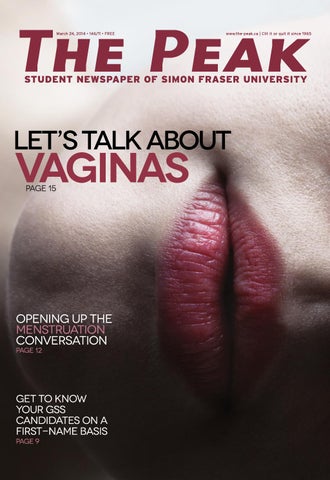
“Vagina” is a sticky word. While it refers to part of the female anatomy, it is incredibly intimate in connotation. Unlike its male counterpart, “penis” or “dick,” the word “vagina” is not used liberally in society; in fact its use seems almost like a faux pas. Yet it is that very body part that not only defines a woman in the physical sense but is also a powerful symbol of who she can be. This is the mindset that The Vagina Monologues aims to tackle. Created by Tony Award winning playwright Eve Ensler, this beautiful collection of monologues explores the ups and downs of being a woman — with stories ranging from hilarious sex tales to heart wrenching accounts of sexual abuse. It was this very collection of works which inspired the creation of the V-day movement — a global activist movement that aims to end violence against women and girls. The cause has now raised over $100 million through proceeds from productions such as The Vagina Monologues that are being performed all over the world. SFU will be hosting a production of The Vagina Monologues with proceeds from the show benefitting the North Shore Women’s Centre. Eighteen talented young women have been hard at work in order to bring these stories to life. Performer Gabrielle Lamoureux says of the show, “I think The Vagina Monologues is still so relevant because it deals with vaginas and womanhood in an open and often positive way. With media portrayals and public dialogue on the subject [often being] demeaning and oppressive, we need art like this to encourage discussion of our own experiences.” Fellow performer Diana Bartosh agrees and says of her
participation in the production, “I saw the show at UBC last year and immediately wanted to get involved because I missed doing theatre. The show starts important conversations that people can be afraid of initiating.” Indeed, even the title of the show is straight-forward and in your face, allowing for the societal taboo surrounding the word to be addressed before its opening lines. Camila Cardenas, Nina Boosheri, and Erika Dee are the three students who have organized the event and worked with the actors to make it a reality at SFU. One of the directors, Camila Cardenas, says of her love for the show: “It is one of the shows that I have enjoyed [doing] the most. It is funny, sad, inspirational, intuitive . . . I think shows like this help to acknowledge the very real part of our humanity.”
It is not a raunchy romp of sex stories, although there are plenty of laughs in store for the audience. The stories of these women echo with threads of vulnerability, brokenness, and in the midst of it all, an inherent source of strength. Relatable and humorous, the show also explores issues such as how women are seen and treated in society. The monologues will be performed on March 26 at the Orpheum Theatre downtown and on March 28 at the SFU Images Theatre on the Burnaby campus. Tickets can be purchased online or at the door and can be accessed through the link posted on The Vagina Monologues Facebook event page. You can follow Bernice Puzon
arts editor email / phone
Daryn Wright arts@the-peak.ca / 778.782.4560
15
16 ARTS
March 24, 2014
“There’s a sense of wonder coupled with tension,” he said, as the audience is always wondering what’s going to happen next. “They have a sense of purpose, and the audience is trying to connect and figure out why,” said Nolan.
Three years of working on the Blue Man Group show has changed Jesse Nolan’s perspective on the world. “It has changed the way that I look at everything,” he said. As the show’s musical director, Nolan said his challenge is to create musical accompaniment that outlines the stories and action on stage. He describes it as “painting with sound.” Working on the show and thinking like the Blue Man character has helped Nolan expand his own thinking. “I’ve been
encouraged to think a little bigger about everything,” he said, “I think more creatively in all aspects of life.” There is something about the mysterious Blue Man character that people are attracted to. Nolan has been interested in the show since he was 12 and saw it for the first time in New York City. “There’s a sense of exploration,” he explained. “When you watch the Blue Men move and interact, they’re always exploring. There’s a hunger for learning and knowledge.” Nolan said that children find them especially compelling. The Blue Men also love to involve the audience in their shows. There are a few signature things that they do in every show, including climbing over the theatre seats up the rows. They literally take the show into the audience, and Nolan said that this creates an interesting atmosphere.
the founders (Chris Wink, Phil Stanton, and Matt Goldman) are also still involved from their base in New York along with a team of musical directors and designers. The essence of a Blue Man is a curious, innocent trickster, and Nolan hopes the show can reach out to adults just as much as it reaches kids. He hopes that adults can also “experience life through the eyes of a Blue Man,” saying, “That’s what we want to leave them with.”
This show has a very heavy emphasis on technology and the role it plays in our lives. For example, the Blue Men interact with “Gi-pads,” huge eight foot iPads that allow them to comment on the influence of technology. “The outcome is thought provoking or comedic,” said Nolan, explaining
that, compared to previous iterations, there is more video content, lights, LED screens, and even some wearable technology. The great thing about a Blue Man Group show, said Nolan, is that it’s always fresh and new. Their performance philosophy is one of collaboration and an ever evolving show that is never the same from one night to the next. “We’re using the characters and style to tell a different story,” he said, adding, “we’re doing this thing that can’t repeat itself tomorrow.” One thing that never changes, however, is the mess they leave behind on the stage. Of course there is splattered paint everywhere as they hit drums covered in it, but the Blue Men also play with food. “It ends up being a mixture of paint, food, and sweat,” laughed Nolan. The content of each show comes together through collaboration, and
Living in a Wes Anderson film is like living in a perfectly symmetrical doll’s house, but with complex characters and an overwhelming amount of 70s nostalgia. Anderson’s latest masterpiece, The Grand Budapest Hotel, follows Gustave H (Ralph Fiennes) and his
protégé Zero Mustafa (Tony Revolori). Gustave is the concierge and Zero the lobby boy at the esteemed Grand Budapest Hotel. The diligent Gustave keeps the hotel in immaculate condition, much like Anderson and the aesthetic of his films. He is brutally honest, witty, vain and has a particular fondness for elderly rich women. His most notable fling is with Madame D (Tilda Swinton), who assigns Gustave the fictional renaissance painting Boy with Apple in her will. When the time comes for Gustave’s inheritance of the painting,
Madame D’s son Dmitri (Adrien Brody) is not keen on giving up the notable piece of art, especially to the man he accuses of murdering his mother. The Grand Budapest Hotel follows the wild string of events that ensue to retrieve the painting and clear Gustave’s name. It also follows the beautiful friendship that develops between the kind and lowly lobby boy Zero and the clever, liberally-perfumed Gustave. The story is narrated by Zero retelling the events in his old age. He portrays the hotel sentimentally, indicating his gratefulness for the place and all that happened there. The film is hilarious and made me laugh out loud on several occasions, but it is also poetically written and full of heartwarming connections. Watching the world Anderson created in the film is like living in the doll house that you always wished would come alive when you were a child. The colours are vivid and, in true Anderson style, reminiscent of the 70s. The buildings and scenery are almost cartoon-like, appearing as though they are made of clay — this is the world of Wes Anderson, where polished, dreamlike settings turn nostalgia into
a backdrop for complicated humans. The score is also eclectic, adding to the whimsical nature of the characters and plot. The characters are brought to life by the cast, as Fiennes flawlessly delivers the genuineness and hilarity of Gustave. Saoirse Ronan plays Zero’s brave and fiery girlfriend Agatha. Zero’s character was cast perfectly with newcomer Tony Revolori, as the charmingly loyal companion of Gustave. All of the classic cameos you would expect
from a Wes Anderson film are successfully delivered. Watching The Grand Budapest Hotel is an immersive experience — it’s like playing a game that you get so involved in you don’t even know how long you’ve been playing. You are fully transported to witness the inner-workings of the hotel and the polished madness that is happening around Zero and Gustave. It is cheeky and so very endearing, and a more than worthy addition to the Anderson canon.
You can follow Tessa Perkins
ARTS
In a quiet room nestled in the SFU Woodward’s building, Stephen Collis addressed what it means to resist as a community in his lecture “Riot Dogs and Research Labs — Poetry and Struggle.” The event was the fourth in a collection of talks, performances, public auctions, publications, and an exhibition that have made up the project Spaces of Contestation: Art, Activism and the City. The compilation, curated by Mariane BourcheixLaporte, examines the collective walk/protest/public demonstration as both a performance and a social formation. The series was presented by SFU’s Vancity Office of Community Engagement, the SFU
March 24, 2014
Institute for the Humanities, and UNIT/PITT Projects. This fourth talk was a critical discussion in how to negotiate the future and build considerable capacity to resist what we don’t wish to see in our world, but also how to evoke alternative ideas about what we do want. Collis is a poet and professor of contemporary literature at SFU. In his work, he invites us to embark on a journey of exploring the capacity to resist. In this dialogue-centered presentation he focused on three “spaces”: the street, the commons, and the future. He began with the street, the most obvious contested space. When we — in Vancouver and the Western world — “take to the streets,” we are rebelling in a way that could be categorized as safe compared to acts of civil disobedience in other parts of the world. For example, not only do many of us feel confident that nothing terrible is going to happen to us when we go to a demonstration or march, but protests
in the city are safe in that they are often even escorted by the police force themselves. Collis asked, “Are street protests rooted in the past?” He referred to the language around these events as well as their “reactive” nature. If we are simply reacting to something that’s already been initialized, what are we ignoring? Despite these thoughts, he said that the street is an important place of contestation as it builds capacity for resistance in a direct and immediate way, and it frustrates the state authorities.
Collis then explored the “commons,” spaces characterized by shared livelihood. We have been dependent on
common ground, he reminds us, throughout history. Before the 17th century, there was absolutely no concept of private property: everything was communal. He urged us to see that in recent decades, capitalism has continually enclosed (privatized) these spaces, rendering different ways of thinking essentially impossible. He evoked a sense of yearning for these places to which we have lost connection with a beautiful poem titled “Blackberries”; it’s about a berry patch that thrived in an abandoned lot, a junk space, off of Prior Street in Vancouver. The wild thorns and fruit draw our attention to a space absent of market relations and state. The berry patch represents another site where resistance occurs in a reactionary form. Collis is interested in timelines — where do we cognitively map things in time and space? He explored the idea that we are always thinking of ourselves either in the past or in the future. It is fitting, then, that the third space he investigated is “the future.”
In the arena of climate change, he explained how we think of the future as an absolute — something that has basically already happened. Corporations are already counting on burning all the CO2 that is still in the earth, as if it were already extracted and ready to go. As he explained, “Here we are, the dead of all times dying once again, but now in order to live.” He emphasized the importance of functioning as a “we” — a collective — in the future if we want to actualize futures that have not been created yet. Reactionary resistance, he concluded, isn’t really about having true freedom and creating positive change. It is a negative discourse we employ as a way of saying, “no, I don’t want that.” Alternatively, capacity building moves beyond what’s happened in the past to proactively create alternative realities. It is this positive capacity building that Collis wants to continue to engage in, through his poetry, studies, and dialogue with others.
PAY FOR 3 MONTHS
GET 4TH MONTH
FREE! South Vancouver Self Storage 8866 Laurel St • 604-229-3262 vancouver@sentinel.ca
Coquitlam Self Storage 195 Schoolhouse St • 604-229-3260 coquitlam@sentinel.ca
Richmond Self Storage 11151 Bridgeport Road • 604-229-3261 richmond@sentinel.ca
Visit www.sentinel.ca
17
18 ARTS
On the third floor of the Maggie Benston Centre, when the day is nearing its end and many people have headed home after a busy day of school, you may hear the faint echoes of an orchestra playing. “There’s a [musical] presence on the Burnaby campus — other than the pipe band!” says orchestra co-president Kristen McLaughlin. The SFU Concert Orchestra, founded in 2007 by Jerry Yon and George Chung, is a studentrun club on the Burnaby campus. The club was started as the SFU Chamber Orchestra, but as it expanded, the name changed to adapt to the additional members and instruments. Yon and Chung founded the club to fulfill the lack of musical groups on the campus.
I will be the first to admit that I love cheese and am in no way a vegan. If you’ve ever read the arts section, you probably already know this, as I never tire of talking of my adoration of all things fromage. I also have a major sweet-tooth, and sometimes it becomes detrimental to my health, in more ways than one. Craving cheesecake at 10:00 p.m., I once walked several blocks just to buy a little slice to satisfy my very specific desire. I’ve also been known to eat an entire bag of five-cent candies while bingewatching Gilmore Girls. Sometimes, my sweet-tooth takes the wheel. Occasionally, a (moderate) intervention is needed, and while my sweet cravings will likely never dissipate — I pity the soul who has to supply me with pints of ice cream and almond croissants when I’m pregnant — there is a solution: healthy sweets.
March 24, 2014
The current co-presidents Adrienne Mariano and Kristen McLaughlin, and vice president Nathalie Scott-Hsiung, look back at their past three years with pride and delight when they talk of their fellow musicians, whom they have witnessed transform before their eyes, often in the course of one semester. Today, the orchestra averages at about 30 to 40 members each semester. Mariano notes that when she first joined, the audition process was an intimidating hurdle, one she attributes to the group’s smaller size years ago. “If it would have scared us away, it would have others as well.” Now, instead of an audition, any musicians with some experience looking to join can sign up at Clubs Days at the start of the fall or spring semesters. With so many diverse members, it’s interesting to note that none of them are going to school for music studies. Each person comes from different backgrounds, with different majors and hobbies, yet they have one thing in common: the drive
And I’m not talking just fruit here, folks. I’m talking creamy, citrusy lime squares made entirely of healthy ingredients. So while I still love a classic lemon or lime tart or cheesecake square, the discovery of entirely vegan, raw treats has rocked my world a little. These lime squares are so incredibly creamy and flavourful that you’d never know they were made from nuts. It’s kind of, well, nuts. This recipe is also highly adaptable. Not a fan of lime? Try lemon with a blueberry compote, or add some chocolate and peanut butter to the mix and really get the party started.
and the commitment to make the orchestra better and more enjoyable each year. The SFU Concert Orchestra would not be the growing club that it now is without the hard work and talent of its members. Many use the club as an opportunity to grow a childhood passion, while others perform in this orchestra as well as youth orchestras in the Metro Vancouver area, and SFU’s various other music groups and clubs.
Each semester the orchestra holds a concert at the SFU Burnaby theatre. This spring’s concert will take place on March 29 at 7:00 p.m. Each semester the concert is named after a favourite piece in the show, resulting in this semester’s title: The Sound of Music. The concert will feature Celtic and classical music, and the presidents say that “the audience will get a bit of everything.” The show will also feature sectional showcases of some of the musicians.
Additionally, the orchestra will be performing at the Burnaby Rotary Club’s Wine and Music Festival in the heart of Loughheed Mall on April 26. The SFU Concert Orchestra is optimistic about the future: “In our three years, we’ve seen it grow slowly but surely every year,” says Scott-Hsiung. As the school’s awareness of the club grows, they intend to continue growing as a group, and develop their personal musical talents.
DIVERSIONS / ETC
March 24, 2014
19
CLASSIFIEDS@ THE-PEAK.CA
Across
1. French film festival which awards the Palme d’Or 4. An average score on a golf course 6. A lake in Lyon 7. The Peak’s irreplaceable Production Editor Alayon 8. Pop art royalty Lichtenstein 11. Earthbound prefix 12. Jerry’s favourite food on Seinfeld 15. Controversial antipiracy bill proposed in 2012 (abbr.) 18. Old school Hollywood actor Grant 19. Swiss structuralist semiotician Ferdinand de 23. Cheesy restaurant chain ___ Friday’s 24. Latin, meaning “for each� 25. The Peak’s peppy News Editor Leah 27. Colloquial term for drug commonly used by athletes 29. Oddly spelled “A� in NATO’s radio alphabet 30. Old world term for a 6
3
(
7
+
0
(
5
$
0
$
,
6
(
,
7
$
7
9
,
7
2
5
6
7
8
'
0
$
'
0
(
<
9
5
+
&
+
/
(
(
/
5
.
0
6
1
$
7
7
( '
8
$
(
2
1
&
1
2
6
)
)
6
$
2
)
8
:
$
&
+
)
5
<
(
(
(
man castrated at a young age 32. Seventeenth letter of the Greek alphabet 35. Producer and ambient musician Brian 36. Arts Editor for The Peak and unapologetic cat lover Wright 37. To ___ out of a deal 38. Performance artist and Lennon spouse Yoko 39. A type of antelope found in Botswana, Zambia, and the DRC Down
5 $
$
$
3
5
6
5
(
*
$ 2
(
,
5
/
, $
5
$
/
,
(
(
/
7
1. Garment by superheroes and James Brown 2. The other category in
this crossword 3. Absolutely certain 5. A call to arms; a ________ cry 6. Every online gamer’s worst nightmare 9. Ruthless Lord of the Rings baddies 10. Irish poet and Nobel laureate W.B. 12. Television comedienne Burnett 13. Mediocre Best Picture winner directed by Ben Ass-fleck 14. Latte ingredient (hint: theres’ no “X� in it) 16. An engineered wood particleboard (abbr.) 17. For Hindus, a ritual in honour of the Gods
20. A pattern of vowels, minus the “I� 21. Medical term for whizz 22. The error function in a normal distribution (abbr.) 26. Something of minimal width 28. A dull brown hue 31. “Come on, Yolanda, what’s Fonzie like?� 33. Public Enemy hit: “Don’t Believe the ____� 34. The most populous Canadian province (abbr.)
20
SPORTS
After playing their first two homes games of the season, the Clan softball team is still searching for their first win of the year. Playing their first home games almost a month after three exhibition contests were snowed out, SFU was in tough against the defending Great Northwest Athletic Conference (GNAC) champions, the Saint Martin’s Saints. A scrappy Clan team gave the Saints everything they had, but fell in both ends of the weekend doubleheader. SFU fell 9–6 in the first game. SMU jumped out to an early 3–0 lead, but the Clan tied it in the fourth, and then took over the lead 6–3 before the inning was over. SFU held the lead until the sixth inning when the Saints pounded the Clan for six more of their own. “I think I’ve got to go buy some bullet proof cleats for our players because we seem to find a way to shoot ourselves in the foot every game,” said head coach Mike Renney. “The first game, the wheels just came off in one inning where we made several errors against the team that won the conference, that’s
sports editor email / phone
March 24, 2014
Adam Ovenell-Carter sports@the-peak.ca / 778.782.4560
projected to win the conference again and they took advantage of it with a six spot in a game where we had worked hard and earned the lead. Other than that one inning, we competed the entire game.” The second game featured a Clan collapse as well. SFU lost 5–2, but only trailed by one heading into the seventh and final inning. With the top of the SFU order due up in the bottom of the seventh, the Clan’s defence allowed two more Saint runs in the top half to seal the deal. The two losses drop the Clan’s record to 0–8 within the GNAC and 0–17 overall.
“I was really pleased with our compete [this weekend],” added Renney. “Having said that, we’re not where we need to be yet and we’re not where we want to be but I’m confident in this group of athletes.” SFU’s next batch of home games are this weekend, against Central and Western Washington, two teams near the top of the GNAC standings. Renney’s squad will need all the compete they can muster to earn their first win of the season.
The Clan women’s basketball season came to an end last week, following a 76–68 loss to the Montana State University-Billings
TIED UP WITH YOUR TAXES?
Yellowjackets in the NCAA West Region semifinal. It was the second time in as many years that the Clan made it to the semis, and though the loss to the #2 Jackets undoubtedly stings, it’s hard not to look at this season as a success. After stars Nayo RaincockEkunwe and Kristina Collins graduated, the team was expected to regress. Though there were some struggles midway through the year, SFU still put together one of its best seasons in the NCAA.
CALL US TODAY AND SEE IF WE CAN HELP YOU.
$130
$70
FOR A BASIC TAX RETURN* STUDENTS ONLY SPECIAL Offer ends April 1st, 2014 Valid for Canadian tax returns only
Income Tax Statements Returns Income Tax Returns Financial Bookkeeping Payroll Tax GST US Tax Returns
Kemp Harvey Hamilton Inc. CERTIFIED GENERAL ACCOUNTANTS Suite 103 - 4430 Halifax Street, Burnaby (604) 291-1470 www.khgcga.com
“In a week, we’ll probably be pretty pleased with our season,” said head coach Bruce Langford, whose team was ranked third in the West, right behind MSUB. “There were a lot of high points, a lot of good points. We hit a bit of sickness in the middle and had a bit of a lull but we recovered from it and started to play pretty good basketball in the last three weeks or so.”
His captain agreed with him. “I think we had a tremendous season,” said Erin Chambers, the Clan’s leading scorer. “To get this far was great for the team.” Chambers finished the game against MSUB with a game-high 33 points, but a 12–1 run by the Jackets to open the second half — which started tied at 35 apiece — put the Clan in a hole they couldn’t climb out of. But it wasn’t for lack of trying. The deficit would reach 18 points with just three and a half minutes to play, but SFU went on a 10–1 run to close out the game, tightening up the score before time ran out on their season. SFU finishes the 2013-14 season with an impressive 20–10 record. Though they must bid farewell to seniors Kia Van Laare, Marie-Line Petit, Chelsea Reist and Rebecca Langmead — all key contributors — they’re poised to bounce right back. “In the next year, I’m really excited to watch this team get better,” said Chambers, who will enter her senior season next fall. “We’re going to go and we’ll all work on our game. We’ve got some good kids coming in and I think we’ll give it a good run next year.” You can follow Adam Ovenell-Carter
SPORTS
March 24, 2014
Although the Canucks are still realistically out of the playoff picture, they have shown marked improvement as of late. Scoring, which was hard to come by even in December when the Canucks were winning, has not been the issue recently, with the Canucks scoring three or more goals in many of their last few games. Alexandre Burrows — who had not scored up until a game against Winnipeg two weeks ago — is scoring nearly every game, perhaps making up for lost time. This has reignited the first line, along with rookie call-up Nicklas Jensen. Jensen had a slow start in the AHL, but is averaging just under a point a game playing with Burrows and Henrik Sedin. For the first time in a long time, the first line looks like a first line. In the game against the Tampa Bay Lightning on March 17, though it ended in a 4–3 loss, the Canucks mounted an impressive third period comeback from 4–1. Perhaps “impressive” is a strong word, but it was only a week or
two ago that 2–0 would have been a safe lead against the Canucks. It should be noted in that game that the comeback was in the third period, after a lackluster first two periods. Previously, the third period was the Canucks’ kryptonite: If they had a lead it would almost surely be surrendered; if they were behind, there was no chance.
The fact that they came back from a sluggish start is promising, in contrast to the 6–1 Dallas whooping in which the Canucks looked like they gave up early. Even David Booth, who will still likely be bought out this offseason, has been showing a better game, laying hits on the competition making up for his lack of scoring. Also notable is new addition Shawn
Matthias who looks like he could be a solid player for the Canucks. There have still been problems, no doubt. The Canucks are still amazingly inconsistent, the defence seems questionable, there are too many boneheaded penalties, and the pressure seems to be making de facto No. 1 Eddie Lack uncomfortable. Not to mention, the Canucks would be hard pressed to
to take on the Oregon State Beavers who currently sit second in the conference behind the Clan. The Beavers came out fighting, netting the first goal of the game and putting the Clan behind early for the second time on the weekend.
It was tough for the Clan lacrosse team last weekend, but the Burnaby boys managed to continue their strong season with wins over the University of Utah and Oregon State University. The two wins up the Clan’s winning streak to six games, and improve their record to 5–0 in the conference and 7-1 overall. The two-game trip started with a neutral site game against the University of Utah Utes in Vancouver, Washington. The Clan got off to a slow start with
the Utes going up 2–0 early in the first, but after the rude awakening, the Clan went on a 9–3 run to take control of the game in the first half. The Clan slowed down a bit in the third, but still outscored the Utes 3–2 to bring the score to 12–7. In the fourth however, the momentum swung heavily in the Clan’s favour, as they outscored the Utes 6–1 over the last 15 minutes to bring the final score to 18–8. The Clan’s firepower was led by two-time All-American Sam Clare who tallied five goals and two assists, while leading scorer Tyler Kirkby (two goals, four assists), and Ward Spencer (five goals, one assist) both had six points. The Clan then made their way down to Corvallis, Oregon
(three goals, two assists), followed closely by Kirkby, who had four (three goals, one assist). Senior goaltender Darren Zwack played both games for the Clan, stopping 10 of 18 for a save percentage of .556 against Utah and stopping 11 of 16 for a save percentage of .688 against OSU. His save percentage for the season is now an impressive .690. The Clan will slow things down for the rest of the season, with just one game a weekend until the playoffs. Up next for the Clan are two home games against Washington State on March 29 and Portland State on April 5. The Clan remain at #10 in the Men’s Collegiate Lacrosse Association rankings but look to continue their rise in the standings as the playoffs approach.
It was an uphill fight for the Clan, but they eventually pulled away and took the game 9–5. Spencer led the way for the Clan offensively with five points
21
make the playoffs even if they won every one of their games. But, recently, there has been light. They have been playing decent, entertaining hockey; every game seems winnable, not just some futile exercise. If they started playing like this at the Olympic break, they would likely be in playoff contention, though that’s hardly a silver lining.
22
HUMOUR
March 24, 2014
Is something missing here? Not according to this breakfast.
protein and most vitamins covered just among us.” These thoughts were echoed by the rest of the breakfast who just couldn’t see the legitimacy in the value that their chocolatey compadre always talks up on TV.
CLOVERDALE — A local breakfast is reportedly doing “just fine” on its own without Reese’s Puffs, a cereal long believed to be an essential part of it. According to the group of three pieces of toast, scrambled eggs, a grapefruit and a medium-sized orange juice, they feel just as “complete” as ever even without the presence of Reese’s Puffs who was not purchased this week. “I really don’t know what he was even bringing to the table,” one of the pieces of toast told The Peak, “I mean, we’ve already got grain,
“Sure, he’s a sweet guy and he’s got a little protein but I don’t think it’s fair to say he completes us,” explained the orange juice. “Really, if anything he’s bringing us down, making us unhealthy.” While the majority of the breakfast was quick to dismiss Reese’s Puffs, some did rise to his defence.
humour editor email / phone
Brad McLeod humour@the-peak.ca / 778.782.4560
Kenneth Uzodinma / The Peak
“I’ve got to admit, without him, we’re pretty boring; you’re never going to find a neat prize in a carton of eggs,” the grapefruit commented. “Plus, he’s the one who always gets the milk to come around and, if I’m being honest, dairy is pretty important to us.” While the breakfast may be somewhat divided on the worth of Reese’s Puffs in their meal situation, they agree that the chocolate-snack branded cereal could be easily replaced. “We’ve had everything from Frosted Flakes to Shredded Wheat come in here and do more than a great job in that role,” Toast-Piece #2 explained. “RP is fine to have around the house, maybe join us on weekends, but we can get along just fine without him.” As of press time, Reese’s Puffs did not make an official statement regarding the situation although he is reportedly also doing just fine on his own, quote “actually making kids happy.”
Listen, I know a lot of people think that airport security employees aren’t always the most impartial people when it comes to “random checks” but I’ve got to say that I, for one, do not discriminate based on race, creed, or ethnicity. The only thing I look at when I see another human being is their turban, that’s it. If they’ve got one, I know they’re carrying a bomb and I won’t rest until they are brought to justice. You could be brown, black, white . . . hell even purple and I wouldn’t give a damn. I treat every single one of god’s creatures the same, as long as you don’t got a turban on. Personally, I can’t believe we still live in an age where people are judged on where they were born and not on what type of obviously weapon-concealing headgear they wear. Terrorists can come in all shapes and colours, you know, so it’d be crazy to just single out one group based on something as arbitrary as the country they grew up in.
Race is just a made-up concept anyway, but it’s a known fact that a turban’s only purpose is to hold explosive devices. So yeah, when I see one of these turban-wearers, I don’t even see what colour they are or what shape their jaw-line is, I just stop them immediately and take them back for three hours of questioning. I don’t just do it when I’m at work either, even when I’m off-duty I help make our world a little safer and our country a little-less destroyed.
And I’d say I’ve been pretty successful too; I’ve never let a single bomb go off on my watch. Not on a plane, not at the grocery mart, and not even at my favourite Pakistani restaurant, which I always have a few close calls at. So please, do not judge a man on the colour of his skin . . . just check if he’s wearing a bomb-hat. If we can manage to do that, discrimination will become a thing of the past in no time.
HUMOUR
March 24, 2014
23
24 LAST WORD
T
features editor email / phone
Max Hill features@the-peak.ca / 778.782.4560
here are few feelings that ever rivaled breaking open the seal of your brand new crayon box as a primary school student. No more borrowing crayons from the other kids at school. You could finally use any colour you wanted: Carnation Pink, Sky Blue, Brick Red. The anxiety of being stuck with the five most unwanted, useless colours to have ever existed in the Crayola world was gone. Brown. Black. Yellow. Red. White. With so many different colours to choose from, these five colours seemed boring and ugly in comparison. So, who felt the need to categorize seven billion human beings — all with distinct, individual cultures — into five of the most disliked crayon colours of our youth? To be clear, I’ve never been personally offended by someone calling me “brown”; I suspect this is because the term has become normalized in our society. I myself have been using the term casually for years.
if I were given a list of countries and asked to check where I was born, I would be forced to check the box next to India. Sovereign states are the foundation of our current global political economy and, therefore, have a monopoly on their citizens’ identities. If people used nationalities to describe individuals instead of colours in our society, I would be labelled an “Indian” and forcibly be identified with a state that has intentionally made a point of oppressing my people both historically and presently. The label “brown” serves a purpose here: it doesn’t limit my identity within a political border, and allows me to fill in the blanks of my ethnicity myself. Chantal Chow, a Communications major at SFU, struggles with a similar issue. Both of her parents are from Hong Kong, and if people were to refer to each other by their ancestral nationalities, she would most likely be labelled “Chinese.” According to Chantal, this label
But a conversation I had with my cousin from Manchester, who uses “Asian” to refer to the same group of people we North Americans refer to as “brown,” made me question the terms I use in my everyday life. Is it right to identify individuals by a colour, even if those terms don’t paint a complete picture? “As long as your character is what precedes you, I’m okay with being called a black guy,” says Kayode Fatoba, an Health Science student at SFU. “Black is beautiful, I’m black and I’m proud . . . Calling me Kayode is much cooler, though.” Colour labels might serve a beneficial purpose. I am Punjabi. It is the only ethnic label I feel proud and honoured to identify with. I was born in Punjab, India. Both my parents are Punjabi. But
would not express her identity correctly, because there is a deeply embedded and significant reason for making a distinction between Hong Kong and China. She’d prefer to be recognized as Canadian first since she was both born here and holds Canadian citizenship. Taking this into consideration, using a colour to describe an individual transcends our traditional sovereign state system and avoids mistaking someone’s nationality or their preferred regional identity. But is defying the traditional state system with the use of a broad and overly-generic colourcoding system a form of rebellion, or just laziness?
According to Mariam Hanjra, a Psychology major at SFU, labels, nationalities, and colour are not the best way to break down boundaries. Where someone is born or where their parents were born is not an accurate representation of their identity. As someone who is half-Pakistani and half-Filipino, Mariam knows all too well the problems with putting someone in the most convenient colour category, and ignoring a part of their identity in the process. Identifying people by their colour or nationality is meant to be efficient, but that efficiency comes at the cost of minimizing and marginalizing an individual’s identity. After all, when you call me “brown,” what insights have you gained about me and my family? About who I am as a person? The colour-coding system also ignores specific ethnic groups and their historical struggle for independence and a sense of identity. The “white” category carries a strong stigma, along with all the other colour categories I’ve discussed. Imperialism, colonialism, and privilege are almost exclusively associated with the white race. In our society, however, we have conglomerated almost every country in the “Global North” under this banner of whiteness. By continuing to use “white” to describe the Irish, for example, we effectively
March 24, 2014
ignore the very crucial and significant history of the Irish people. According to Jess Furney, a Criminology student at SFU, who is half Irish, “To be fully alright with being defined by such an all-encompassing term seems a contradiction, and suggests disrespect to my family’s ancestry and circumstance in their fight against British exploitation, famine, and the like.” So I ask you again: Is it right to identify individuals by a colour, or by their ancestral nationality? It doesn’t have to be one or the other. It’s not primary school anymore, so why settle for such a limited colour palette? It may be more difficult to look past our system of categorization to see the person beneath, but it’s worth doing so. We live in a world bursting at the seams with culture and individuality — using simplified terms to describe ourselves only serves to minimize our diversity. We’re so much more than colours in a box. It’s time our language reflects that.