2
FIRST PEEK
June 23, 2014 · Volume 147, Issue 8
»
»
»
»
» »
»
»
»
» » CANADIAN COMMUNITY NEWSPAPER AWARD 2013
CANADIAN COMMUNITY NEWSPAPER AWARD 2014
»
»
FIRST PEEK
The amount of sexual violence faced by students at Canadian universities is staggering. Every semester, the average post-secondary institution in this country sees eight different cases of sexual assault in the first eight weeks of classes — that’s one instance every week, per school. Canadian women aged 15 to 24 are by far the most likely victims of sexual assault in the country, and university students are no exception: the Sexual Assault Centre of Hamilton and Area reports that 29 per cent of female university students have experienced some form of sexual assault. That’s almost one third of students. Something is seriously wrong here. University culture, one that usually promotes openness and exploration, has also historically been a silencing factor for many assault victims. Recently, however, activists have been more vocal than ever about universities upscaling their policies to prevent sexual assault and punish abusers. Statistics would argue that sexual assault is becoming more prevalent: there’s been a 52 per cent increase in rape reports on American campuses from 2001 to 2011. More
June 23, 2014
than anything, though, it’s a sign that assault victims and allies are making greater efforts to voice their experiences and change the way we think about assault on campus. And we’d do well to listen. We know that most sexual assaults go unreported, and that victims are encouraged by our culture to hide their experiences rather than discuss them openly. As an article in Time magazine noted, this statistic “doesn’t necessarily mean that more sexual assaults [have] occurred as much as it shows that colleges are getting better at acknowledging the ones that have always taken place.”
Whether or not the numbers have always been this high, it’s only now that we’re finally realizing the scope of the issue. This is — a little counterintuitively — actually a good thing. The number of complaints towards colleges in handling and accurately defining sexual assault cases has risen steadily over the last 10 years, showing that people are, now more than ever, feeling capable of speaking up. Though these numbers are deeply disturbing, it is important that we realize just how dangerous and unsafe university campuses prove for many people. Since most victims of assault in post-secondary settings seek justice within the schools rather than through police
or legal action, institutions have a serious responsibility to protect their students; the increasing outcry towards university policy on assault is a crucial step in the right direction. In an op-ed for The Los Angeles Times, Gabrielle Glaser writes, “The disciplinary systems of colleges [. . .] have proved utterly inadequate to deal with the more serious issue of sexual assault.” Accordingly, she says “Many women report feeling victimized a second time by their universities.” This is not an uncommon experience — many assault victims have shared stories of ill treatment from universities when reporting their experiences. Consider Angie Epifano, an Amherst College student whose first person account of her rape, along with the story of how college officials brushed her off, went viral in 2012. Her story is the story of thousands of people whose assault has been treated with disinterest — sometimes even disdain — by the very people who should be helping and protecting them. In order to end the crisis of sexual assault in North American universities, we need to look past the individuals who commit these crimes, and examine the institutions that allow these attacks to occur in the first place, and that don’t respond appropriately. Taking these institutions to task is crucial in promoting a safe campus environment for everyone, and making sure university students can focus on what’s important: their education.
3
4
NEWS
June 23, 2014
International medical experts and researchers gathered at SFU Surrey from June 19 to 22 to attend the Canada India Networking Initiative (CINI) 2014 conference. The event focussed on four key areas of health and civil society: nursing and allied health education, health-technology and the economy, chronic disease management, and the role of yoga, science, and modern medicine in wellness.
Students gathered at Harbour Centre on Monday for professor David Mitchell’s examination of the one-time X-rated 1969 film, Midnight Cowboy, which follows a male prostitute and his sickly friend who struggle to survive on the streets of New York City. Mitchell discussed how the film represented the “alternative lived experience of queer/crip relations in late liberalism” and explored how the subjective experiences of the disabled can alter the collective consciousness.
A recent study has concluded that the Nordic Model of prostitution laws could endanger sex trade workers even further and does not affect the demand for prostitution. The Nordic Model, originating in Nordic nations such as Norway and Sweden, criminalizes the act of buying sex but not selling it — johns and pimps are prosecuted rather than sex trade workers themselves. Conducted by UBC researchers and the Gender & Sexual Health Initiative (GHSI) of the BC Centre for Excellence in HIV/AIDS, the study found that the Vancouver Police Department’s (VPD) new policies — which focus on punishing clients — neither deterred prostitution nor increased the safety of sex trade workers. Since the VPD’s policy shift, sex work related arrests have increased from 47 in 2012 to 71 in
news editor email / phone
2013, a 51 per cent increase. However, the report notes that there has been “no change in rates of work-related physical and sexual violence against sex workers” since the change in policy. Andrea Krüsi, one of the authors of the report and a research assistant at GHSI, explained the results to The Peak: “In the context where clients are criminalized, it’s still in the shared interests of the client and the sex worker to be undetected by the police and so this led to women having to rush screening their clients [. . .] What they need to do is just hop into the car and hope for the best.” The report states that the VPD’s new approach “severely limits street-based sex workers’ control over their health and safety due to [an] inability to screen clients or negotiate terms of transactions,” being forced to relocate to remote areas such as industrial areas, and an “inability to access police protection.” In addition, due to the increased difficulty of targeting clients who are willing to risk potential criminal charges, many sex workers are forced to stay out longer, thus increasing their risk. Krüsi added that, even though the police emphasized prioritizing the safety of sex workers, “sex workers were reluctant to report violence
Leah Bjornson associate news editor news@the-peak.ca / 778.782.4560
to police because they were worried that if they go to [the] police to report a violent client, that the police might use some of that information they give to refine their enforcement methods.”
“Our findings are very clear: that when clients are continued to be targets, the harms of criminalization are reproduced.” Earlier this month, the federal government tabled new legislation on prostitution that would criminalize selling sex in areas where children under 18 are present. It would also criminalize advertisement of sex services, for which sex workers could face five years in prison. However, these new regulations would share the Nordic Model’s focus on clients by criminalizing the buying of sex, which was previously legal. John Lowman, an SFU criminology professor, said that policies targeting just clients could be challenged as unconstitutional: “To have one party in what is a legally consenting adult
Melissa Roach
relationship [. . .] held criminally responsible while the other party is not, is state-sponsored, institutionalized entrapment.” Lowman expressed concern that new regulations designating areas where sex is criminalized could further endanger sex workers by forcing prostitution out of residential districts. He explained that police enforced similar policies in the 1990s, and would not go after sex workers if they worked in places such as industrial districts. “That industrial area, which the police had turned into a red light district in the 1990s, became the killing field of Vancouver. That’s where Mr. Pickton picked up most of [his] victims,” said Lowman. Both Lowman and the report state that decriminalization of sex work, with the potential for regulation and protection, is the best way to ensure the safety of sex workers, following the lead of countries such as New Zealand. “[We should focus on] accepting that prostitution is a profession and is not inherently sexual abuse,” Krüsi told The Peak. “And therefore we should allow women, or sex workers in general to have working conditions that are conducive of safety and not make it harder to protect themselves.”
NEWS
As part of his financial plan for the year, Potvin brought forward a proposal to shift the operating costs incurred by Food and Beverage Services from Building Operating Costs to the Food and Beverage Service department (FBS). Potvin explained that before 2010, the FBS had $90,000 for operating costs, but the previous board took this out in order to to lump the pub deficit in with the other operating costs to make the deficit more manageable. Both Potvin and SFSS president Chardaye Bueckert asserted the importance of passing this decision in the interest of transparency. The motion was passed, with business representative Shadnam Khan and VP student life Zied Masmoudi opposed.
SFU is looking to modify student orientation from its current structure — namely, a big “rah-rah” event with all the activities packed in to one or two days — into a Week of Welcome from September 4 to 7 this fall. Brian Fox, SFU student life coordinator, hoped to include the SFSS “as much as possible” in the week, proposing that the SFSS host a BBQ. While board was optimistic about a partnership, VP finance Adam Potvin raised concerns about blurring the lines between SFU services and services offered by the SFSS. SFU will still be offering an orientation, called “Welcome days,” on August 27 at Surrey campus and August 28 at Burnaby campus, during which students will be able to tour the campus. Furthermore, SFU is offering a free course available through Canvas for all new high school admittees that will serve as a sort of SFU 101. The program has already connected with 1,500 students who will be attending SFU in the fall.
June 23, 2014
To reignite that old passionate spark in your relationship, research suggests that, rather than chocolates and long walks along the beach, the answer lies is engaging in activities that kick in your fight or flight response. Sex therapist and relationship counselor Desiree Spierings specified that the solution is not as simple as engaging in something scary or dangerous with your significant other. “It is about doing something new, novel and exciting [together] that is what really does the trick and keeps things interesting and alive,” she said. Spierings explained that these ideas were first tested in 1974 in a Canadian study called the Capilano Bridge Study, conducted by psychologists Arthur Aron and Donald Dutton. This study examined two groups of men, one having just walked over the swaying Capilano Bridge, and another having walked over a steady bridge.
According to a new study, the old saying should go, “happy wife, happy night life.” Research shows that a woman’s satisfaction in her relationship is revealed through how well a couple sleeps together. Lead author and researcher at the University of Pittsburgh, Heather Gunn, has been studying sleep through a different lens. “Most of what is known about sleep comes from studying it at the individual level; however, for most adults, sleep is a shared behaviour between bed partners,” said Gunn. Her findings
After crossing the bridges, each man was approached by a young female psychology student and asked to participate in a survey. She then provided her number and said that he could call that evening for the results. The study found that men who walked over the swaying bridge were more likely to call later, and even ask her on a date. Spierings explained that, “lingering excitement from one situation — say walking across a shaky bridge versus a stable one — can intensify a subsequent emotional state.” This phenomenon has been called misattribution of fear, as well as the excitation transfer theory. Diana Bedoya, a lecturer in the BPK faculty at SFU, explained the basis of these labels as relating to the biological connection between the fear and arousal systems; the body’s initial responses to fear and arousal are actually the same mechanism. Bedoya told The Peak, “a lot of the physiological responses are the same, but how we interpret them are different.” When our bodies trigger a stress response, the result is a surge of the hormone epinephrine. This hormone triggers changes in multiple organs, including, but not limited to, the heart, pupils, digestive system,
show that “how couples sleep together may influence and be influenced by their relationship functioning.” The synchronicity of partners’ sleep — how much time they spend awake or asleep together — is likely linked to the satisfaction of the female partner within the relationship. Contrarily, how a man feels about the relationship doesn’t appear to affect either’s sleeping patterns. The study involved 46 different heterosexual married couples. Their sleep was monitored over a period of ten days, then all were asked to evaluate their relationships. Results showed that, in general, couples were awake or asleep at the same time for 75 per cent of the night. This percentage was higher when the wives reported higher levels of satisfaction with their marriage.
and liver. These changes occur so that the body can prioritize energy usage. That moment you make eye contact with your crush from across the room and, suddenly, they are all you can focus on, is actually very similar to the physiological response that you would have if you were face to face with an angry grizzly bear.
“The sleep of married couples is more in sync on a minute-by-minute basis than the sleep of random individuals,” said Gunn. She continued, “This suggests that our sleep patterns are regulated not only by when we sleep, but also by with whom we sleep.” An assistant professor of psychiatry at the University of Pittsburgh, Wendy Troxel, conducted a different study showing that the presence of a partner improved quality of sleep for women.
5
The body interprets that romantic moment with a stress response and spends its energy focusing on the overall task at hand, not the details of the situation. Bedoya said that this is why our bodies could send us messages that conflict with our thoughts and reason: “It feels really good. It may be bad for you, it might not be right, but it feels exciting.”
Troxel went on to investigate how a poor night’s sleep on the wife’s part could result in issues for the couple. “We found that wives’ sleep problems affect her own and her spouse’s marital functioning the next day, [. . .] Specifically, wives who took longer to fall asleep the night before reported poorer marital functioning the next day, and so did their husbands.” Their collective findings give a whole new meaning to waking up on the right side of the bed.
Graduation Photos by Robin Wong
Emind Photo Studio.com
3580 East Hastings St, Vancouver (604) 618-8200 www.RobinWongPhotos.com
6 NEWS
A Japanese member of parliament is taking the country’s population crisis into her own hands by promoting policies that would encourage Japan’s younger generations to get busy and start making babies. By hosting national matchmaking parties and encouraging a return to old-style marriage introductions, Yuriko Koike hopes to increase the number of marriages in Japan from 600,000 in 2013 to one million by 2020. The government has put three billion yen towards this mission in a country that faces its lowest birth rate since 1899. “Their problem is pretty serious,” professor of international studies Michael Howard told The
June 23, 2014
Peak. “It’s not like they’re about to be hit by a tsunami or anything, but it’s looming pretty fast within the next decade, and the problem is that of course these things do take a long time to find solutions for.” Shrinking by a record 244,000 people in 2013 alone, Japan’s population of 127 million is expected to fall to approximately 87 million by 2060, according to a recent analysis by government researchers. Koike told The Telegraph that these policies are meant to revive the sort of old-school romance that gets lost in the midst of pursuing careers: “Younger generations, both men and women, complain that they have less opportunity to get to know each other. Japanese businessmen and women also work too long, normally until midnight, so there is no time to become acquainted with new people.” Although these policies may seem unusual, other East Asian countries have pursued similar programs to combat falling population growth rates. In 2003, the Singapore government launched a “Love Boat” cruise service that offered couples a program
of fertility seminars, massages, aphrodisiacs, and a night at a holiday resort — all designed to put couples in the mood. “Singapore is a nice example of a country that has all these extreme policies to try to get people to have more children. [. . .] It doesn’t work very well,” said Howard. “They’ve tried everything you can with all the best frills in the world, but basically once you hit a certain level of development, you get women educated, and they’re just not going to have very many children.” Japan’s current fertility rate is 1.4, which represents the average number of children a woman is expected to have over her lifetime. Koike explained that for Japanese women, it is often a choice between getting married and having children or having a career. “To tell them to drop out of the workforce and produce 2.5 children or something like that, they’re not going to do it,” said Howard. “Outside of lining them up against a wall and threatening them to produce children I don’t know what’s going to work.”
One of the consequences of this decline in birth rates is a rapidly aging population. By 2055, international statistics organizations estimate that 38 per cent of the population will be over 65. “Theoretically one could suppose that [Japan] could simply become a big retirement home,” said Howard. Howard suggested that increased immigration may be
the most effective solution to the population crisis. However, he said that Japan does “not have a history of being an immigrant-friendly country,” and this is therefore unlikely. “These are things that are really tough to overcome [. . .] unless they can really come up with some policies that people are willing to agree with,” said Howard. Until that happens, Howard said, “it’s just going to get worse.”
NEWS
June 23, 2014
7
traveling through hyperlinks. To start the program, one manually enters a website involved in child exploitation. The program will then follow any suspicious hyperlinks found on the site that are not on safe domains.
A new grant will enable SFU International Cybercrime Research Centre to further their development of a web-crawling software that targets child exploitation. By combining computer science and criminology, researchers are developing a digital mapping software that will help guide police to sources of websites involved in internet crime related to the manipulation and/or coercion of minors into sexual activity. Richard Frank, an assistant professor of criminology at SFU, became involved in the project when another researcher in the department pointed to the time consuming nature of manually tracking the social network of child exploitation. Frank saw the opportunity for a software that could do the work automatically. The software he developed is a “web-crawler” that works by
New research reveals that couples are falling in love faster than their parents, and it’s all thanks to technology. According to Pixmania.com, the use of social media is reducing the amount of time required for young couples to fall head over heels. The courting process now takes a mere 224 tweets or a simple 163 text messages. It can happen after a casual 70 Facebook messages. Even a handful of emails or phone calls at 37 and 30, respectively, can have young lovers falling hard.
Frank told Global News, “The problem is that it’s very, very easy to set up websites and webpages to take this content and put it on. If police or a service provider shuts it down, then [the offenders] create a new one and put it up again.” Once on the site, the crawler looks for keywords and travels through image fingerprints to see if either exists in the police database. If the website is suspected of hosting content associated with child exploitation, the web-crawler will branch out again and continue traveling through the hyperlinks. The team recently received a grant to continue their work from the Canadian Internet
The study showed that previous generations took much longer to enter into a relationship. For participants aged 55 and older, the average time it took to begin calling one another boyfriend and girlfriend was 78 days. Compare this to the age group of 25 and under, for which the time taken to fall in love was 24 days on average. Modern communication technology has essentially halved the time to fall in love. Researchers attribute this to the fact that previous generations were not able to communicate with each other constantly. Instead of following the “three day rule” to contact a date, research revealed 68 per cent of respondents would text someone a mere four hours after a date. The differences in communication patterns were also seen across gender. On
Registration Authority (CIRA). In an interview with The Peak, Byron Holland, CIRA president and CEO, said, “SFU’s International Cybercrime Research Centre, and the project they proposed, is a prime candidate as an initiative to help advance the safety and security of the Internet in Canada, and fill a social and legal need that will have a significant impact across the country.”
average, a man sends approximately 517 Facebook messages and tweets per year—compared to a woman’s 386—in hopes of wooing a potential suitor.
Using this grant, the team is attempting to develop a geolocator to work with the software. The current software can efficiently track content being displayed but it cannot see who else is visiting a website or who runs it. With a geolocator, the software would be able to track the website’s source location. Once the source is found, the police can uncover important
information that the software cannot, such as who accessed the site. Internet crime is still a relatively new and growing field in the technology age, but Frank believes this software could eventually be used to track down other harmful social networks. For now, the web-crawler should provide a needed helping hand to police on the hunt for exploitative cybercrime.
LOUGHEED VILLAGE BAR & GRILL ALL REQUEST DJ CRIPPLE CRIP - ON FRIDAY NIGHTS CLUB NIGHT - ON SATURDAY NIGHTS
FRIDAY AND SATURDAY
$3.00 HI BALLS FRIDAY AND SATURDAY
EVERY TUESDAY IS GAMES NIGHT Technology also proved a useful tool during break ups. Thirty-six per cent were willing to end a relationship with a phone call, 27 per cent by text, and even 13 per cent by base social media. This research suggests an important shift has occurred in traditional dating practices. According to the marketing director of Pixmania. com, Ghadi Hobeika, “The days of penning a simple love letter to woo your new beau are over.”
A GREAT NIGHT FOR STUDENTS!
-9,, 7663 -9,, +(9;: -9,, -66:)(33 -9,, :/<--3,)6(9+ -9,, )6(9+ .(4,: IT’S NOT LIKE THERE WILL BE NOTHING TO DO!
LIVE ENTERTAINMENT THURSDAYS JUNE 26TH IS COMEDY NIGHT
GREAT FOOD AND DRINK SPECIALS
OUR PRICES ARE UNBEATABLE
www.thelougheed.ca GOOGLE 9304 SALISH COURT, BURNABY DOWNSTAIRS BESIDE FITNESS 2000
LIKE US ON FACEBOOK - THE LOUGHEED VILLAGE BAR & GRILL FOLLOW US ON TWITTER - @LOUGHEEDBAR
8
OPINIONS
Being abstinent in university isn’t just for the people who aren’t so great at sliding their number across the table at the bar. I have chosen (yes, chosen) to not have premarital sex and have enjoyed the benefits associated with my decision. Choosing to make sex a part of marriage as opposed to a casual ordeal does not mean that I sit at home in a long skirt with my parents every Friday night. I have a great time with my friends, I enjoyed dating, and now I am happily engaged. I don’t feel like I have missed out on the university experience because I have chosen to remain abstinent, and neither should you. I am not naive enough to believe that this is the popular choice among most 20-somethings. But I can say that abstinence isn’t just a fallback plan for people who have a hard time getting laid; in fact, it might be more popular than you think. SFU is a diverse school, with a wide array of cultures and religions represented. With confidence, I can say that many of
Girls, we are not ashamed to eat our breakfast in the morning because we are hungry, take our morning wee, or go out for a run to work out our bodies, so why is masturbation still such a big deal to talk about? Considering the fact that human sexuality is an inherent part of almost everyone’s lives, you would think that it would have been normalized and
June 23, 2014
opinions editor email / phone
Joel MacKenzie opinions@the-peak.ca / 778.782.4560
the cultures that are part of the fabric of our university do not think of sex as casually as North American culture does. It is important to understand the view that our peers and friends may have been raised with, and why people around us may view abstinence before marriage as valuable. Religions that value this guideline all have different takes, but here is something that most people can probably identify with: despite what we might like to think, our bodies and our emotions are not always easy to tear apart from one another. Sex doesn’t always end as casually as it begins.
Abstinence is not an easy decision being that casual sex is part of our culture and it is an expectation that partaking in it casually is just another step in the growing up experience. Being raised in Canada, choosing to be abstinent was always something I was ashamed of and felt excluded because of. Changing someone’s mind with regard to their personal decision on sex is something that I do not intend to attempt, but I want to ask, have we become so immersed
accepted as just a bodily function by now. But this is not yet the case. For some reason, it seems like we are far more comfortable talking about a steamy hook up than a little self-loving, and that doesn’t make sense to me. From my experience this attitude is especially common among women versus men. I believe this is because women are still uncomfortable talking about female sexuality out of the context of being with another individual. This attitude is just archaic, rooted in a patriarchal society in which women are used as sex objects, not active participants in their own sexuality. Masturbation has been cast out as an activity reserved for the perverse individual, which
in a sexual culture that we are beyond understanding someone who chooses an alternative? It was only a few generations ago that premarital sex was something to be ashamed of; now the pendulum has swung so far the other way that people whose
culture or religion leads them to choose abstinence feel ashamed. Is this true sexual liberation? Whether you consider being abstinent a concept for our grandparent’s generation or find North American culture disgustingly over-sexualized, it is worth
at least considering the idea that many of the cultures represented at SFU may have a more conservative view. If we are truly a university that is sexually liberated, we need to understand, respect, and appreciate those around us.
cannot be true. We do not look at other animal species and make these accusations, so why do we put them on ourselves?
satisfaction doesn’t have to be regarded as a purely sexual activity. We learn how to please ourselves simply because it feels good. Arousal doesn’t have to be based off of porn, fantasy, or being with another individual. We know this because even as infants we are capable of masturbating without any of these thoughts in our heads! I come from a really open family, so the shame and embarrassment associated with the mere thought of masturbation were not issues for me. But I know that my situation is not typical; I can recall several female friends who simply burst with joy at the chance to talk about their own experiences with masturbation when I brought it up.
This is because most of them had never spoke about it before and had always felt like they were alone. Now, but especially in high school, that isolation can be scary; no girl should ever have to feel that way. Now, I know not every guy out there is ready to go out and talk about pleasing himself, but I think that society is far more comfortable with the idea of men masturbating than women. That needs to change. Females out there should not feel like they will be judged for what they do with themselves to make themselves feel good. It is not only healthy to masturbate, it will also make any sexual encounter in the future a lot more comfortable. Masturbation is about learning to please yourself first, and that action should neither be judged nor questioned.
It is not like we as humans are special: masturbation is seen all over the animal kingdom. From dogs spending quality time with blankets, to dolphins, parrots, horses, and turtles, it is a widely observed behaviour. This may sound like a contradiction, but the act of seeking
OPINIONS
What do T.E. Lawrence, Isaac Newton, Janeane Garofalo, and Emily Brontë have in common? They identify and identified as asexuals. Like these people, I am also asexual. Due to my self-identifying as asexual, I have experienced negative comments ranging from disbelief to amusement. I have also felt like I was not normal, and because of the negative backlash, I was afraid to tell anyone about it. There is a growing need among asexuals for a support group to discuss these experiences and feelings and the LGBTQ community has been the only support group for minority sexualities thus far. Contrary to some beliefs, asexuality should be included under the LGBTQ umbrella because it is a minority sexuality that is ostracized by society through prejudice, discrimination, and ignorance. There has been some defensiveness on the topic of including asexuals in the community. The use of the Q, for “queer” within LGBTQ, to describe asexuals has been opposed by some members on the grounds that the gay rights movement has been active in fighting for their rights while asexuals have remained silent. They have also argued that asexuals have not faced discrimination or prejudice, and, even if they have, theirs is not as bad as prejudice faced by the LGBTQ community.
June 23, 2014
The community uses the term “queer” to describe sexual minorities that have been stigmatized by society; asexuality fits this description. Our society is obsessed with sex, and consequently, asexuality is often regarded as non-existent or abnormal. Asexual people are, therefore, as excluded from the social norm of heterosexuality as gay, lesbian, or transgendered people. In fact, this exclusion and isolation is more apparent with asexuals as they only make up one per cent of the population.
With this exclusion and isolation, asexuals also share the process of “coming out.” As I noted before, we share the same feelings and experiences of doubt and discrimination. Furthermore, asexuals can help the LGBTQ community gain more social acceptance of alternative lifestyles through their support. David Jay, the founder of Asexual Visibility and Education Network (AVEN), argues that 90 to 95 percent of “aces” are either supporters of the LGBTQ community or define themselves
as LGBTQ. I, myself, am among one of these supporters. The argument of the lack of discrimination or prejudice towards asexuals by some members of the LGBTQ is wrong, as asexuals have experienced rape and death threats, corrective rape, and sexual assault. In an interview with the Huffington Post, asexual activist and blogger Julie Decker recalled an incident where a male friend tried to “fix” her by sexual assault. Decker also noted the death and rape threats she has received by
9
online commentators on Youtube and her blog. In my own experience, the mantra “all he/she needs is a good raping” is an alltoo-commonplace response to asexuality on the web. It is important that asexuality gets the recognition and respect it deserves within the increasingly tolerant world of the 21st century. Most of all, though, asexuals need support from a community. This awareness, tolerance and support can only come through the strong foundations of the LGBTQ community.
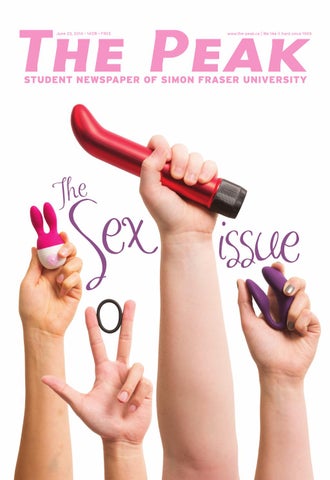
A word I heard for the first time on a tire swing in grade two. It was used as a personal insult by one schoolboy to another: “Dude, you’re such a dildo!” The word itself fascinated me because it was such an effective gibe — its built-in alliteration, minimal syllables, and ability to conjure images of both Dilbert and a do-do bird simultaneously. In my eyes, this playground bully was a comic genius just waiting to be discovered. It wasn’t until I started to use the word against my brother at daycare that it was explained to me that the term I found so hilarious actually describes a sexual object, and is generally considered an inappropriate conversation topic for an eight year-old. Nowadays, living in the Internet Age, it’s increasingly rare to meet someone who doesn’t know the meaning of the word dildo. However, for those of you who would like to get better acquainted with the dildo — and its cousins, the vibrator, the butt plug, and the cock ring — here is a little Sex Toy 101 list of definitions.
Dildo: A phallic object usually made of silicone that is used for stimulation and/ or penetration. It may be strapped on or double-ended, and is sometimes designed to resemble a more lifelike penis. This toy is manual, which means that it keeps going until your wrist gets sore. Vibrator: A vibrating object used to stimulate nerves, usually in the clitoris but can also be used anally. Some plug into an electrical outlet, while others run on batteries and can be waterproof. They come in many different shapes and sizes and some also function as a dildo. Butt Plug: Shorter than a dildo and with a flanged end, it is designed to be inserted into the rectum. Can be made of latex, silicone, or glass, and when paired with plenty of lube, can be moved in and out or left in for longer periods of time. Anal Beads: Not to be confused with a butt plug, anal beads consist of multiple balls strung together. The beads are inserted into the rectum then removed (typically upon orgasm) at various speeds to enhance pleasure. Cock Ring: Typically worn around the base of the penis to slow blood flow to prolong an erection. Not to be confused with a Prince Albert piercing, cock rings can also be worn to restrain the testicles — some even include vibrators.
Penis Sleeve and Fleshlight: A cylindrical device used by inserting the penis into it. Often modelled in look and feel after vulvae or anuses, these penile toys replicate the sensation of intercourse. Pumps: Used to temporarily enlarge and increase blood flow to any body part with erectile tissue, such as the penis, nipples, or clitoris. The pieces include the cylinder, the pump, and sometimes a hose or a sleeve. Sex Machines or Sex Furniture: Chairs, stools, blocks, benches, blankets. Sex furniture makes sex easier for people with limited mobility, or who just want to get off the bed for a change. Made of material that’s easy to clean, some sex machines also hold dildos or vibrators that make for a hands-free fuck.
The histo further than discovered b ished stone many. This to means it wa Age to warm In the M Cantonese used to imit dildo. Other also used in Sutra, on the dildos made The word italian word word is surp word most h in the Weste
BDSM or bondage toys: BDSM, which stands for bondage and discipline (BD), dominance and submission (DS), and sadism and masochism (SM), can employ any number of toys for erotic pleasure. Some examples include restraints (belts, collars, cuffs), floggers and crops (used for whipping or spanking), nipple clamps, gags, and electro pads. No vanilla sex here, no sir. DIY sex toys: Anything already at home used for pleasure! Some examples include a massaging showerhead, a vibrating toothbrush, cell phone, pillows, couch cushions, and fresh fruit. But please, for goodness’ sake, be careful and stay safe.
The first was the anc losopher Hip contempora fered from a er hysteria) for uterus. T uterus as an inside a wo “wandering cause seriou The cure? phallic objec stone — to so
ory of the sex toy goes back a lot you might think. The oldest dildo by modern humans is a 20 cm polphallus excavated near Ulm, Geroy is about 28,000 years old, which as likely used by people in the Ice m up — if you know what I mean. Middle Ages, a plant called the groin was soaked in water and tate an erection, then used as a r plants, such as bananas, were n Polynesian countries; the Kama e other hand, makes reference to e of tubular stalks or reeds. d dildo actually comes from the diletto, which means delight. This prisingly in stark contrast with the historically associated with sex toys ern world: hysteria.
person to classify this epidemic cient Greek physician and phippocrates, as he and many of his aries believed that women sufcondition known as hystera (lat— named after the Greek word The ancient Greeks thought of the n animal that wandered around oman’s body, causing illness: a womb,” as they called it, could us mental and physical problems. ? Women were given olisbos — a ct usually made of leather, wood or oothe the beast within.
For centuries, hysteria was considered a medical condition in need of professional treatment, lest women fall into the moral sin of masturbation. The Hippocratic symptoms associated with hysteria included difficulty breathing, swallowing, anxiety, and fits; these all stemmed from an affliction known as “suffocation of the womb.” Its cure? Pelvic massage. (Wink wink, nudge nudge, say no more.) The result of the prescribed pelvic massages performed by doctors was a “hysterical paroxysm” — what you and I would recognize as an orgasm. You know: cumming, the big O, la petite mort. Since clitoral stimulation didn’t require intercourse, in those days, it wasn’t considered sexual; it was purely medical. By the 1900s, hysteria had become one of the most commonly cited medical illnesses — people were complaining of hysteric symptoms about as often as they were fevers. Naturally, calls for increased medical treatment increased, and the sexually repressive Victorian era saw an incredible influx of women seeking medical treatment by paroxysm. This treatment became tiresome for the wrists and fingers of most practitioners, and so machines were built to accommodate. “The Manipulator” was one of the first vibrating massagers, patented in 1869 by American physician George Taylor. This large, wooden table was equipped with a steam-powered vibrating sphere, which the patient would lay on. While it was apparently invented to treat pelvic disorders, Dr. Taylor did warn against “overindulgence,” and prescribed that patients be supervised during its use. Just a little over a decade later, Dr. Joseph Mortimer Granville patented the first electromechanical vibrator. This machine had a 40 pound wet-cell battery, so while it was technically portable, there was still plenty of room for improvement. At the 1900 Paris Exposition, many new types of portable medical massagers were introduced — not long afterwards, the vibrator began to move slowly from the doctor’s office to the bedroom. Did you know that the vibrator was the fifth widely available electric home appliance in North America? That’s right. Preceded only by the sewing machine, fan, kettle, and toaster, it’s clear that these buyers had their priorities straight.
In the first two decades after the turn of the century, vibrators were advertised and sold as essential home appliances, mostly to housewives. This period saw the advertisement of products such as Dr. Macaura’s Pulsocon Blood Circulator (hand crank), Vigor’s Horse-Action Saddle (vibrating chair), The American Vibrator (plugged into light bulb socket), and the White Cross Electric Vibrator (plugged into an electrical outlet, included with a myriad of applicators). Advertisements of these products stressed their benefits without overtly mentioning anything sexual — but I’m sure any savvy reader knew what was up for grabs. Whether it was society’s growing knowledge of female sexuality (and what those vibrators were actually being used for) or the appearance of vibrators in the stag (porn) films of the 1920s, advertisements for sex toys began to disappear from catalogues and magazines around 1930. But the toys themselves certainly didn’t go away. The history of the sex toy between the 1930s and 1960s is pretty thin — people had learned to be discreet about their taboo bedroom habits — but sex toys maintained their popularity, leading to what is now a $15 billion industry. Among sex toy users, women are the biggest fans: in North America, 44 per cent of women between 18 and 60 have admitted to using a sex toy. You may recognize some of the following products from snooping in your grandma’s room: the Miracle Ball-Grip Massager, the Wahl Hand-E Electric Vibrator, the Hollywood Vibra-Tone, or the Spot Reducer. There’s no way to know for sure, but come on; I’m pretty sure these were used for more than what was described on the box. Predictably, the written history of the sex toy doesn’t pick up again until the sexual reawakening of the late 1960s and early 1970s. The electric vibrator wasn’t publicly reintroduced as a pleasure device until 1973 by Betty Dodson at a women’s sexuality conference. It was here that she promoted the use of the still-popular-today Hitachi Magic Wand — the vibrator to end all vibrators. Since that day, vibrators, dildos and everything in between have built up a large fanbase. Today, there are toys available that are more body-safe, versatile, waterproof, quiet, and effective than ever before; and, as it turns out, there’s a toy out there for just about everyone. So what’s all the buzz about, anyways? Well, to start, orgasms have many health benefits: they’ve been known to suppress pain, relieve stress, and improve sleep. For folks who don’t have a significant other or fuck buddy on hand, a sex toy sure can come in hand-y. Sex toys can also be adapted to meet a variety of their users’ needs — some toys can accommodate increased or decreased sensation, mobility and motor control issues, and fatigue, to name a few.
Sex toys can also be crucial in defining a person’s sexuality, pleasure, and intimacy if they are living with a disability. For example, diseases such as multiple sclerosis can damage nerve pathways to sexual organs, and affect mobility and fatigue. Some vibrators which are inserted vaginally or anally — or worn as a ring around the penis — can be controlled with a remote, and some dildos can be fastened to harnesses or used with the help of a partner. Thanks to sex toys, people with physical disabilities can get off just as well as those without. Speaking of sex toys in relationships, many of you may be wondering: why would you need one? Well, contrary to some beliefs that sex toys are only for lonely single folk, plenty of toys are used in couples because they provide different sensations than what another body part can. Why limit yourself, right? As long as there is open communication, approaching your partner(s) about using a toy can be simple and fun. Some people with vulvae need clitoral stimulation in order to orgasm (hint: vibrator), and you’ll never know what a butt plug can do to spice up your sex (until you try it). There are also scores of sex toys that work better with two people than one (whips, cock rings with clitoral stimulators — the list goes on)
Hopefully I’ve piqued your interest as to what toys are available to you. The next step is to get out there and buy one already! For some expert advice on choosing a toy, I sat down with Brit Carpenter from Womyn’s Ware, Vancouver’s best sex-positive shop. What are they all about? “Helping people express themselves in healthy, positive ways,” says Carpenter. “We have everything out on display for people to feel and see if the controls work for them.” When buying a toy, especially if it’s your first toy, it’s important to do your research. You should know what you’re looking for (BDSM toy, butt plug, cock ring, dildo, vibrator — pick your poison), as well as how much you’re willing to spend on it. If you’re shopping for a toy you plan to use with your partner(s), bring them along! “Come with enough time to really talk about it,” Carpenter suggests. “Do research and some self exploration and have an idea of what you’re after.” Choosing a store to buy from is equally important. “Most of those XXX stores you walk into don’t have the research or education,” says Carpenter. “We do a lot of research to make sure that when an order comes in, it’s safe and it works and we can warrant it.” I recommend buying from a store that’s local, well-lit, clean, and where the staff is friendly and informed — it sure beats one of those dingy, windowless shops you tend to find in abandoned strip malls. Of course, the most important thing to remember when buying a sex toy is that you are the expert on your own sexual health and pleasure. There are no wrong answers when it comes to picking the perfect sex toy for you; but that doesn’t mean there aren’t plenty of people and helpful resources that can help you on your way. Some of my favourite resources are local sex shop Womyn’s Ware; online toy retailer Come As You Are; webcomic Oh Joy! Sex Toy; and sexual health clinic Options, with locations across the Lower Mainland. Well, what are you waiting for? Get out there and enjoy!
12 OPINIONS
If you feel like you don’t want to go all the way, that is absolutely fine. Don’t let anyone tell you otherwise, especially in our very sex-driven society. And stop watching teen/college movies: they’re not accurate.
If you feel passionately about staying abstinent, that’s awesome. If you like sex, and you’re doing it safely, also awesome. Don’t tell every person you pass, but don’t bottle it up. It’s a part of you, and it’s not embarrassing.
These artists’ silky-smooth, chocolate voices will make you want to make some love, or at least hug yourself. Feeling romantic: Go for Cohen. Feeling dramatic/tragic: Del Rey. Feeling uplifted: Blacc.
This is but a short segment of a long list of the un-sexiest voices in popular culture. I’m not saying their music is bad, I’m saying making out while their music is playing is impossible.
Fetishes are a testament to the fact that the whole body is sexy, and a part of sexual attraction. Of course, if all you see on your partner is their sexy feet, you should try looking at their whole body in the same light. You might be pleasantly surprised.
Does this disgust stem from high school, or porn? We’re out of high school, and let’s consider other porn logic: the penis is always erect; people don’t kiss before sex; etc. Being untamed could be problematic, but ask yourself if your shaving expectations come from an unrealistic place.
Cool! Yeah, I’m into that. There’s nothing wrong with describedvideoing for the visually (or temporarily cognitively) impaired. Yeah, cool. Oh!
Good god, can I not do this. It turns into something close to a Jerry Seinfeld-level of failure. It’s sure to follow with, “Just stop. Stop. I get it.”
June 23, 2014
I speak for all guys when I say we have sex on our minds a lot — like right now (guys, don’t deny it). Naturally, there’s an app for that. Many, in fact. But, like with many online interactions, people are less inhibited than they would be faceto-face, which leads to some pretty nasty situations. . . exacerbated when sex is involved. This seems to be more prominent in the gay community. What happens on meetup apps for guys who are interested in guys is pretty ironic, given LGBTQ history. For a society that has long fought for acceptance simply for being who we are, apps such as Grindr relentlessly perpetuate discrimination, exclusion, belittling, and, one could even say, elitism. It’s only been a few years since the first geosocial networking platform tailored towards gay, bisexual, and bicurious guys launched, and now almost every 20-something gay guy has one on his phone. According to its inventors, apps such as Grindr make “socializing easier” (i.e. put sex at every horny guy’s fingertips).
Scrolling through the plethora of Adonis torsos, profiles read as follows: No fems, Masc only, Asians + +, Drama free, Discreet only, No Asians, NSA, Not into twinks, Straight-acting, NEG U B 2, Love bears / otters, Jocks front of the line! Oh, but my personal favourite? Must be built (and variations of this). I’m sorry, not all of us spend five days a week at the gym, taking shirtless/headless selfies.
Apparently, this taxonomy of gays is a growing, unforgiving practice. Categories such as twink (a young, boyish look) or bear (having a hairy body) invalidate gay guys. These categories turn into “gatekeepers” to gay sex. If you don’t fit into a type, you aren’t worthy of intimacy. This is not to say we should all just have unfiltered processes of getting into bed with everyone, but this casual discrimination and exclusion should be reconsidered when it comes to casual fun/sex. This discrimination denies guys a sense of self-worth as they’re judged on things out of their control such as genetics and race, which affect things far more important than just
having sex. Does this level of discrimination sound familiar? Though we rally together for equality in a hetero-dominant world, there is still much work to be to done. We want everyone else to love and accept us for who we are, yet we can’t even do it amongst ourselves. We use sex as a means to thicken lines of division when it could safely be used to do the complete opposite! Yes, everyone has preferences, and don’t get me wrong, there’s nothing wrong with having them! But coming off as blatant and rude is not sexy. This bluntness is also shocking to some heterosexual people as well. In one video, “Straight Men React To Grindr,” a couple of guys say, “I see a lot of abs [. . .] This is just straight up honesty.” Another states, “You cannot have this in the straight world.” When it comes to guy on guy sex, the interaction seems to be far more straight to the point. Maybe we enjoy being braver than assumed to be. But is parading this forwardness worth the cost of another’s self-worth? In the virtual sea of perfectly sculpted, pretentious, and discriminating bodies, though, there is still hope. There are those who use “socializing-turned-finding-sex apps” for other purposes, and make these intentions clear: No hookups, Whatever happened to just chatting?, Here 4 friends but open to possibilities. These are just some enlightening words that seldom appear, but that are the truly sexy ones.
OPINIONS
Late last year, the Supreme Court of Canada struck down key provisions of this country’s anti-prostitution laws, ruling that these provisions violate constitutional guarantees of life, liberty, and security of person. It has taken the past six months for the federal government to introduce new legislation. Bill C-36, known as the Protection of Communities and Exploited Persons Act, is an adaptation of the Nordic Model that is employed in Sweden, Norway, and Iceland. This model immunizes prostitutes of both genders from any criminal liability involved in prostitution, while targeting the pimps and johns that fuel the demand for the service. This bill, once passed into law, amounts to a major step forward for the issue of prostitution. By targeting those who fuel the demand for prostitutes, rather than the prostitutes themselves, the new law places the blame on those who are purchasing the services, and treats sex workers as victims of exploitation rather than criminals.
June 23, 2014
The one exception to the decriminalization of the selling of sex is a ban on communications intended to sell sexual services in neighbourhoods and areas where children could reasonably be expected to be present, which will likely have to be more clearly defined before the bill passes into law. Furthermore, the bill also contains a provision for an initial $20 million for organizations involved in assisting persons wishing to exit the trade. While this initial funding is likely to be insufficient, it is at least a step in the right direction. Many who are recruited by force into the sex trade enter into it between the ages of 14 and 20, and suffer severe abuse along the road to the street. This bill reflects the goal to restore them to their families.
There are quite a few criticisms of the bill at this point, including that it still does not do enough to protect those involved in the sex trade. Unfortunately, there does not seem to be a good solution. Even Justice Minister Peter MacKay had to admit that “no model will ever make prostitution a safe endeavour.�
This is inherently true, as the legal status of the sex trade is not an issue in relation to its safety. Rather, it is the vulnerability necessary for the act of sex that makes prostitution dangerous. To engage in it, one is completely physically, and often emotionally, exposed. There are others that are disappointed that the government has criminalized the purchase of sexual services, preferring that prostitution be legalized outright. Their disappointment is somewhat difficult to understand, as it is nearly impossible to see a Conservative government that has generally taken a firm stance on traditional morals legalizing the sex trade; the Prime Minister even went as far as to state that a Conservative government would never legalize prostitution. In addition, legalizing the sex trade does not eliminate the underground trade, as many nations that have legalized the trade have discovered. In the state of Victoria in Australia, which has had legal and regulated brothels for several years, police continue to discover illegal brothels. It is my hope that this bill is passed for the protection of this exploited group within our society. Ideally, the targeting of johns and pimps will aid in driving down the demand for sex workers, which will in turn cut down on the human trafficking that is involved in the trade. While I am not naive enough to believe we can ever eliminate the demand, this bill is at least a step in the right direction.
13
14 DIVERSIONS / ETC
June 23, 2014
CLASSIFIEDS@ THE-PEAK.CA
BODY SHAM
ING
Across 1- Sash 6- Author Hunter 10- Spheres 14- Hiding place 15- Top-flight 16- ___ avis 17- Slippery as ___ 18- Numbered rds. 19- Lots and lots 20- Military decorations 22- Alluring 24- Vinegar’s partner 26- Aztec god of rain 27- Emblem 31- Mineral suffix 32- Entreaties 33- Flat surface 36- Actor Byrnes 39- Pearl Buck heroine 40- For ___ (cheap) 41- Baseball family name 42- Sun. delivery 43- Last letter of the Greek alphabet 44- Destroy by immersion 45- Madrid Mrs. 46- Assembly 48- Bear witness 51- Feeling of self-importance 52- Estimator
54- Abrading tool 59- Carson’s predecessor 60- Egyptian goddess of fertility 62- Newly married woman 63- Regal address 64- Sgts., e.g. 65- Ancient Greek colony 66- Estimator’s phrase 67- Movable barrier 68- Coarse wool cloth
of a chair leg 7- Ballot choice 8- Concerning 9- Young bird 10- Delphic shrine 11- Rate 12- Rodeo horse 13- Squealed 21- Lisa, to Bart, briefly 23- Must’ve been something ___ 25- Pass into disuse 27- Wall St. debuts 28- Fr. miss 29- Fleshy fruit Down 30- Hurried 34- Limb of a felled tree 1- Con game 35- Make ___ for oneself 2- Walking stick 36- “The Time Machine” 3- Served perfectly people 4- Perlman of “Cheers” 37- Feathers 5- Wooden wheel rims 38- Manure 6- Decoration at the top 40- Collecting
41- This was produced by Van Gogh, for example 43- Mine finds 44- Re-enter the atmosphere 45- Sound investment? 47- The fruit of a hen 48- Light ___ 49- Autocratic Russian rulers 50- Puccini classic 52- Lhasa ___ 53- Public disturbance 55- Get one’s ducks in ___ 56- Fork feature 57- “What I Am” singer Brickell 58- Peruse 61- Wind dir.
Do you want to hear your voice on the radio?
To attend various music events? To have fun? Then CJSF radio is for you! Join CJSF 90.1 FM as a volunteer and take a 45-minute orientation tour WR OHDUQ PRUH DERXW LW 'URS LQ RQH RI WKHVH WLPHV WR ¿QG RXW ZKDW \RX can do and learn at your campus radio. (We’re in TC216 right over the Burnaby campus main entrance.) 1st Friday of the month at 3pm 2nd Tuesday at 4pm 3rd Thursday at 3 pm Hope to see you there! 4th Wednesday at 6:15 pm
ARTS
Welcome to a column by two seemingly regular suburban hoodlums who lead out of the ordinary, fabulous lives. This column will chronicle our suburban socialite adventures with sex, food, wine, art, and culture. As two Italian winos, we get cozy with a few bottles every now and again, and again . . . and again. A rambunctious night with friends, dinner with la famiglia, or a post finals bubble bath — all of these situations present a perfect opportunity to dip into your cellar. But, the best pairing is most definitely wine and the bedroom. In honour of this week’s sex issue we suggest marrying your romance with a bottle or two of Barolo. Imagine that you’re in Whistler, in a chalet during a blizzard. The
Sexy Sick Chic Lit is a new literary genre that was coined by Canadian authors Robyn Michele Levy and Kim Clark during the 2012 Sunshine Coast Festival of the Written Arts. It was at this festival that the two women first met and quickly realized that they had something in common — Levy has Parkinson’s disease and breast cancer, while Clark has multiple sclerosis (MS). According to Levy’s website, the genre is “written specifically by and about women with chronic diseases and/or disabilities,” and features humorous, sassy, and sometimes even sexy elements.
arts editor email / phone
June 23, 2014
room is dark. Cave dark. The walls are decorated in dark mahogany panels with moose and deer antlers. There you are, lying on the rustic, parquet floor in front of the crackling wood fire, covered in a bear fur (and not much else) with your lover beside you. The moment is right. You just need to find the perfect companion. Well . . . instead of the muscled Brazilian across the hall, we recommend you ménage à trois with a Barolo. This powerhouse from the Italian region of Piemonte is a big, soul-warming, almost blackred wine that fills your mouth and seeps down to your toes. Barolo is made out of the Nebbiolo grape, which is one of the stars of Italy. Like the grapes they come from, these wines have high tannins, huge power, and structure. They evoke flavours such as leather, chocolate, prunes, figs, violets and, sometimes, tar. Be very careful about opening this baby up too early. At the minimum, a Barolo should be aged five years: in the cellar, we have one from 1996 and it’s still considered a baby! For that sexy chalet evening, if you want to splurge, we suggest
Last Thursday, they performed at Slocan Hall through Kickstart Disability Arts and Culture. A dozen or so people, mostly older men and women, some in wheelchairs and others with canes, were present. Tea and snacks were laid out on a counter. The event began with introductions, aided by a translator for those with hearing impairments, before the authors took turns reading excerpts from their novels. Levy is a visual artist and writer who previously worked for CBC Radio. Her first book, Most of Me, is a memoir of her journey with Parkinson’s. The book was shortlisted for the 2012 Steven Leacock Medal of Humour and the 2012 Edna Staebler Award for Creative Non-Fiction. Clark began writing after being told that she had progressive MS. Her latest book Attemptions, features a collection of fictional stories
Tessa Perkins arts@the-peak.ca / 778.782.4560
the 2007 Gaja Dagromis. Jordan tasted this wine at a fabulous dinner four months ago and it was phenomenal with hints of black currant and tobacco that will stimulate more than your
taste buds, and a finish that goes on and on and on! However, for those of us who don’t want to spend $150 on a bottle, we recommend the 2006 Tre Donne Barolo. This is a wine from a
about women who suffer from physical ailments and the multiple ways they deal with this reality.
important to “decide you’re interested . . . [to] decide to spend time with yourself or have the energy to be interested.” Ultimately the books are “part of who we are and not everything about us,” says Levy, “[but] it gets the attention of the world.” Levy’s clever use of words and powerful voice showcase her strength and confidence. In one excerpt, she describes visiting her neighbour, a dentist, in the middle of the night. If you didn’t know her disease had immobilized her left arm, the entry would read almost like a midnight rendezvous. It’s amusing then, that when she sees her neighbour, she says, “floss me,” in the same tone another might say, “kiss me.” Clark’s excerpts introduce a girl named Mel whose MS afflicted body can only have six more orgasms. With this bizarre situation, we hear Mel trying to figure out the
Chronic diseases continue to carry a stigma; women and men still hesitate about coming out and talking about them. So, it was heartening to hear both women tell their stories with such humour. Their accounts give hope that, despite everything, the body is not something to be ashamed of. Levy had her right breast removed due to breast cancer and opted out of reconstructive surgery. Clark believes that it’s
15
small estate yet it gives off all the power and flavour of its more expensive brothers. Going out before taking it in? La Cucina in North Vancouver offers an old world Barolo that will tempt you and your partner to head for the car. This wine is the perfect prelude to love making. A fragrant bouquet of aromas smoothly caress your tongue. It all wraps up with a vivacious yet tender finish, making your lips weak and your body, well, powerless. Your partner a cheap drunk? Try Provence’s sister restaurant, The Wine Bar, in Yaletown. Perfect for the novice sipper, this quaint venue offers wines on tap, giving you the opportunity to try an array of freshly un-oxidized vinos. Butter up your partner with a flight or two of some silky wines and find yourselves slinking off your silks in the sheets. Wine and sex go together like bread and butter, like Beyonce and Jay Z, like calendars and firefighters. These things are just truths, things you can’t argue with, and things you don’t want to live without. Cheers! To arousing wine tasting and sensual lovemaking.
best way to budget this reality, as she fusses with dating sites and dating profiles. While fictional, Mel’s struggle is reflective of the realities of such a disease, mainly the difficulties of managing what used to be a simple, if not common, activity. Sexy Sick Chic Lit is a genre that may seem geared towards women, but at it’s core it is simply about people who have suffered. Both women and men, old and young, the affected and the unaffected, can read these novels and gain something. Facing chronic diseases and disabilities is difficult, and “having a sense of humour does help,” as Levy says, because in the end, “your voice is your power,” and this is what this genre is truly about.
16 ARTS
As film and television move into new media, high quality web-based interactive and multiplatform storytelling is finally getting due recognition at Canada’s film and television awards. The Canadian Screen Awards (Geminis) recognized digital media in 2010, and the Leos followed in 2013. This year, Vancouver’s own The True Heroines achieved national prominence at the Canadian Screen Awards with a nomination for Original Series-Digital Media Fiction, and won Best Web Series at the Leos. The True Heroines is a unique dramedy for the web with a feminist edge that combines a burlesque, science fiction, 1950’s style talkie with live cabaret shows, and an upcoming print comic. After performing together in Vancouver’s popular cabarets, multi-talented Fiona Vroom, Jovanna Huguet, and Paula Giroday began to dream about finding a way to bridge the gap between film and cabaret. “Small web series inspired us,” said Vroom. “The web has no barriers and we could create a smaller
June 23, 2014
scale project.” At the time Vroom, Huguet, and Giroday looked to the Canadian series Sanctuary as a model. It began as an eight-series webisode, but was picked up by Syfy network and transformed into a TV series. Friend and cabaret compatriot Joel Sturrock, a performer and choreographer, added his talents to the mix and together the four came up with the idea for The True Heroines.
There’s nothing like The True Heroines out there; as Huguet said, in the British Columbia film and television industry, “when they see a good idea they jump on it. Everyone we approached said yes. So, I guess, we must have had a good idea.” It was not long before The True Heroines found their director, Michelle Ouellet, and their writer, Nicholas Carella. The story follows three housewives with superpowers who lead double lives in small-town Paradise Hill. They are products of a wartime research project, run by The Corporation, to develop super soldiers, otherwise known as Humans with Special Abilities (H.S.A.’s). The three were cabaret dancers in the military entertainment services during
World War II. The time is now 1951, and The Corporation is hunting down the H.S.A.’s to hide evidence of their experiments. Hiding their superpowers from their husbands, the true heroines make sure they have “dinner on the table by six” as they try to discover what happened to them and stop The Corporation. The talented team founded the production company, The True Heroines Entertainment, in 2010 and independently funded
two pilot webisodes through live cabaret shows. They then spent two more years fundraising to finish the remaining three episodes in the first season. “It feels surreal. I’m so proud of us,” said Giroday. “We worked with such amazing talent, and our team really pulled together. It feels like we did the right thing.” On top of gaining critical recognition, The True Heroines recently attracted interest from an
executive at Bell Media, and Ouellet and Carella managed to pitch to the Space Network while at the Canadian Screen Awards. The True Heroines are feeling good about the future, said Giroday: “We’ve had the opportunity to be in front of the right eyes, so we will have to see.”
ARTS
Maybe you lost it on a heavenly hotel room duvet sprinkled with silk rose petals, covered in droplets of spilled champagne and sweat reeking of romance. Perhaps it was in the backseat of a ’96 Toyota Camry surrounded by empty water bottles, fastfood containers, and promises. Heck, maybe you awoke covered in body paint and vomit, wrapped in the arms of a person you only met hours prior! Despite how you bid good riddance to your virginity, I’m sure that we can collectively agree that it was super awkward, exhilarating, messy, adorable, and — most importantly — hilarious. Recognizing this, comedians Brent Constantine and Stefan MacNeil have joined forces to create what is sure to be a memorable comedic storytelling event. How I Lost It will feature Constantine and MacNeil (along with other renowned stand up comics in Vancouver) talking about how they lost their virginities, making sure to cover every uncomfortable, exciting, disgusting detail along the way. I sat down with these two masterminds, and this conversation alone should make you nostalgic for the moment that you lost your virginity.
June 23, 2014
17
18
HUMOUR
June 23, 2014
explained, still reeling from the previous night’s events. “Don’t tell me that it was just a mistake, that word sounds nothing like the ones she normally yells at me!”
VANCOUVER – A local man is incensed after his girlfriend of over five months screamed out a racial slur in the middle of intercourse that wasn’t a term for his racial makeup. Terence Smith, a blackCanadian, says he’s starting to have serious concerns that his girlfriend, Caitlin, is cheating on him after she aggressively called him a “filthy c****” during sex. “Believe me, I love dirty talk, especially when it’s racially charged, but you’ve got to get the words right,” Smith
Smith said that this is the first time this has happened in their relationship, which has, up to this point, only been filled with love and n-words directed towards him during sex. Now he says he can’t help but feel as if she may not be being faithful to him. “I know that mistakes happen, like when she yelled out my friend Tyrone’s name instead
of mine a couple weeks ago,” Smith continued. “But I understood that, it was just because all black people look the same to her. This is totally different.” While Caitlin has assured him that last night was an accident and that she just had a brief lapse in judgement in the heat of the moment, Terence has still decided to put the relationship on hold. “He’s completely overreacting, I’m just a passionate person,” Caitlin told The Peak. “I swear to god that I meant to call him a ‘filthy c***,’ it was just a terrible, stupid slip-of-the-tongue.” Caitlin has said that she is extremely embarrassed by the whole situation and hopes they can move forward from it soon. “I love him and he should know that I would never, ever, ever have sex with a Chinese person,” Caitlin said in conclusion. “I just want to move past this . . . hopefully Tyrese will come around soon.”
humour editor email / phone
Brad McLeod humour@the-peak.ca / 778.782.4560
HUMOUR
June 23, 2014
19
20 LAST WORD
features editor email / phone
Max Hill features@the-peak.ca / 778.782.4560
I haven’t always been comfortable asking for what I want. For most of my teenage years, sex was something I just didn’t really talk about — with friends, maybe, but certainly not with a partner. I had been taught that sex was a language of passion, and not the time for actual language. Why ruin the moment by talking? It took several failed relationships and lacklustre lays before I learned that open communication — in the bedroom and outside of it — is the most important part of a healthy sexual relationship with another person or persons. Whether it’s a one night stand, a friends with benefits situation, or a boring, meat-and-potatoes monogamous relationship (count me in the third category), the absolute best thing you can do to spice up your sex life is to tell the person with whom you’re having sex what you want — and ask them to do the same. We learn from movies, TV shows, and yes, porn, to expect an idealized, picture perfect version of sex that pretty much doesn’t exist at all. Let’s be honest here. Real life sex hardly lives up to the glamour and grace we tend to see performed in films, whether PG-13 or NC17. People’s bodies make funny noises, some positions just don’t work out the way you’d like them to, and no one is a mind reader. These hyper stylized representations of sex and sexuality are fun in moderation, but they betray the reality of sex: sometimes, it’s messy. What I eventually learned — once my mental image of the glistening, grunting, piano music in the background version of sex had fallen flat — was that the best way to get what you want out of a sexual relationship is to just go right out and ask for it. The truth is, no matter how emotionally connected you are with another person (or how much you want to bang them), no one knows your own body better than you do. Now, I’m comfortable talking about any and all decisions I make in the bedroom with my significant other, and both of us end up safer, happier and more satisfied knowing we’re providing the best experience possible for each other. At first, it wasn’t easy. I felt embarrassed and nervous to talk about my sexual appetites — what I liked, what I didn’t like, what I wanted to change or wanted to try — because I felt like I would be insulting my partner, or making them uncomfortable. The best advice I can give to those feeling the same way I did is to start slow: try to make your partner feel included, while being as honest and upfront as possible. To make sex an open conversation, you have to break the ice: start by complimenting your partner, crack a joke, and make sure the tone is playful and unserious. (Unless, of course, you’re into serious.)
June 23, 2014
Opening the lines of communication in a sexual relationship, even if there’s no emotional side there, is also a valuable factor in establishing consent. You’ve probably heard consent being discussed before, but it’s a more nuanced concept than many people realize: giving your consent means that you’re a willing participant in a sexual activity. And consent isn’t only expressed verbally: it can also change based on someone’s level of inebriation, their body language, and a host of other factors. Even if you’re in a relationship with someone, that doesn’t necessarily guarantee consent — it’s never okay to engage in any sort of sexual activity with someone who expresses any sort of unwillingness, or is unable to consent for any reason. If you’re feeling uncomfortable in any way, speak up; if you’re not sure that your partner is consenting, check in with them and ask if they like what you’re doing. Consent is one of your most valuable tools in a sexual relationship, because it’s yours (and only yours) to give and to take away.
In the same vein, talking about how best to protect yourselves from STIs and pregnancy is the best way to ensure both you and your partner feel totally secure when you’re getting down to business. Not a fan of the pill? Talk it out. Latex condoms giving you a rash? Chat about a solution. The dreaded STI conversation isn’t the sexiest one you’ll have in your life, but it will lead to plenty more sexiness down the road — mostly because there’s nothing steamier than feeling completely safe and protected when you’re doing the deed. Ultimately, talking with your partner (or partners) is the best way to make sure that you’re getting everything you want out of your sex life. Who doesn’t like to be told what they’re doing is good — or not so good, for that matter? I don’t know about you, but for me, few things are sexier than being told exactly what a partner wants in the sack, and being able to provide that for them. Sex can mean a lot of things to a lot of different people, but all sex has one thing in common: it should be enjoyable! Take it from me: the best way to make all of your fantasies come true — and to help make your partner’s come true, too — is to talk about them. Screw politesse: let’s talk about sex!