

Issue No. 7
![]()


Issue No. 7


Take advantage of Stack’s Bowers Galleries award winning auctions and realize top dollar for your numismatic holdings. The market is strong and buyers are enthusiastically adding to their collections. The same team that has brought to market many of the greatest numismatic cabinets ever assembled, will dedicate itself to your consignment. Take a look at some of these fabulous prices realized from our recent auction sales:


Undated (1652) NE Threepence. Noe 1-A, Salmon 1-A, W-1. Rarity-8. EF-45 (PCGS). CMQ-X. From the Janssen Sastra Collection. Realized $2,520,000


1911-D Indian Eagle. MS-66 (PCGS). CAC. CMQ.
From the James A. Stack, Sr. Collection. Realized $1,800,000

1882


1794 Flowing Hair Silver Dollar. BB-1, B-1. Rarity-4. MS-63+ (PCGS). CAC. CMQ. Property of a Texas Gentleman. Realized $4,500,000


1798 Capped Bust Right Half Eagle. Small Eagle. BD-1. Rarity-7. AU-53 (PCGS). CAC. CMQ.
From the James A. Stack, Sr. Collection. Realized $2,820,000


1870-CC Liberty Head Double Eagle. AU-55 (PCGS). CMQ.
From the Bernard Richards Collection. Realized $1,440,000


1881-O Morgan Silver Dollar. Proof-64 (PCGS). CAC. CMQ. From the Darrel O. Neidigh Jr. Collection. Realized $660,000

Spring is melting into summer as we continue winding our way through the numismatic calendar – one that is filling up with a variety of events. Among those are regional and nationwide conventions where PCGS is offering on-site grading and other exciting opportunities for attendees, and we’re hosting PCGS Trade and Grade Showcase events across the country this year, including the PCGS Trade and Grade Showcase being held in Huntington Beach, California, May 19-21, 2026, and other events later this year in Philadelphia and Las Vegas.
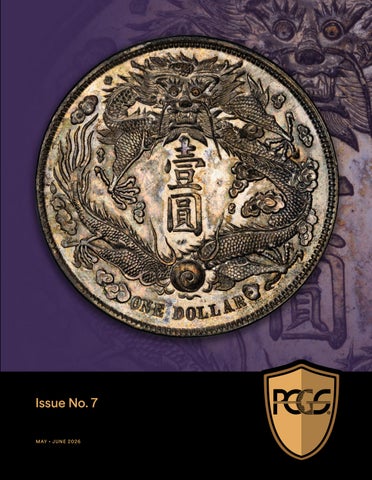
Whether you’re on the East Coast, West Coast, or somewhere in between, there are many reasons to turn the pages of this PCGS Insider, where we shine the spotlight on a magnificent China 1911 Short-Whiskers Dollar Pattern – this issue’s PCGS Featured Coin. This outstanding piece is one of the great rarities in Asian numismatics and one of the world’s leading trophy coins. This example, graded PCGS SP64+, carries the prestigious Peh Family pedigree and is offered by Heritage Auctions.
The months of May and June are when we celebrate two very important holidays: Mother’s Day and Father’s Day. We therefore are compelled to honor the mothers and fathers of numismatics by showcasing three parent-child profiles; these include a successful father-daughter dealer duo in Florida, a motherson story featuring one of the biggest names in numismatic research, and a California family of two parents and two children who started a bullion-based cottage industry together.
As we approach the middle of the year during which PCGS celebrates its 40th anniversary, we take a look at some of the most important highlights in the company’s history, including the introduction of many popular holder features, online elements, and – yes, break out the red carpet – our debut on the silver screen back in the mid-1990s!
We’re also going to introduce you to several numismatic luminaries, including our very own Jay Turner, a world coin grader whose passion for coins began when he was a kid. Speaking of young numismatists, you will meet Eric Lindholm, who turned his love for “pennies” into a career he loves. And wait until you meet Dennis Weber, a longtime coin collector who has more than 120 PCGS Registry Sets!
As things really heat up going into the summer, remember to stay cool on at least a couple bourse floors (check out PCGS.com/shows for the scoop on all the events where you can meet our team and submit coins, banknotes, and more). I also hope your numismatic ambitions lead you to a few hot acquisitions for your collection.
Warm Greetings,
Joshua McMorrow-Hernandez PCGS Insider Editor-in-Chief
Editor-in-Chief
JOSHUA MCMORROW-HERNANDEZ
Creative Director
JACK ARCHER
Art Director
GEOFF PARRISH KEITH DEWALD
Designer JAMES DAVIS
Production Artist CHRIS WILSON
Staff Writer
SANJAY C. GANDHI
ABIGAIL ZECHMAN
EDWARD VAN ORDEN
NATHANIEL UNRATH
JAY TURNER
JAIME HERNANDEZ
VIC BOZARTH
Contributing Writer
RONALD BURNETT
Advertising
TARYN WARRECKER
ARIANNA TORTOMASI
PCGS INSIDER
PCGS Insider Magazine USPS Pending Periodical #226, Copyright © 2026 by The Collectors Universe is published bimonthly by The Collectors Universe, 1610 E St Andrew Pl, Santa Ana, California, 92705. Application to Mail at Periodicals postage is Pending at Santa Ana, CA and additional mailing offices. Printed in Canada.
Nothing herein is intended to provide financial advice. Past sales do not guarantee future results.
POSTMASTER
Send address changes to Collectors Universe, 1610 E St Andrew Pl, Santa Ana. California, 92705.
BUSINESS & EDITORIAL OFFICES
1610 E St Andrew Pl Santa Ana, CA 92705 (949) 567-1234
ACCOUNTING & CIRCULATION OFFICES
1610 E St Andrew Pl Santa Ana, CA 92705 (949) 567-1234
Call (949) 567-1234 to subscribe.
Periodical postage is paid at Blaine, WA.


By Jay Turner


There are many rarities in Chinese numismatics, yet the pattern 1911 Ta Qing silver dollar coinage from the Central Mint in Tientsin offers some of the most famous and desirable issues in the entire Asian coin catalog. Many of the most sought-after pieces are patterns, and the Short-Whiskers Dollar Pattern is one of the scarcest and most desirable from the series.
The Central Mint at Tientsin was founded in 1901 and began producing coins three years later, in 1904. The governmental goal of the mint was to develop a unified currency for the Chinese Empire, rather than the non-uniform coinage of the provincial mints. Silver dollar coin production began in limited production along other minor denominations in 1907. Mass production of dollar coins began the following year, in 1908, along with 20 cent and 10 cent coins. Dollar coin production continued again in 1910 with a pattern produced with dies made at the Vienna Mint in Austria.
In 1911, new patterns were produced for the next dollar coinage of the Tientsin Mint. One of the most famous engravers within Chinese coinage, Luigi Giorgi from Italy, engraved the dies for the series. Giorgi had become the chief engraver at the Tientsin Central Mint in 1910. His first project as chief engraver of the mint was year three (1911) dollars and fractional coinage. As a result, multiple designs were produced as patterns featuring a similar obverse (the side carrying Chinese characters). The reverse, or dragon side, featured several variations.
Featuring a unique dragon design for Chinese coinage, two of the designs have picked up the nicknames Long-Whiskers and Short-Whiskers. The LongWhiskers dragon features a smaller head but longer whiskers measuring around 14 millimeters in length. The Short-Whiskers dragon features a larger head with whiskers measuring approximately nine millimeters. While all the pattern coinage for the 1911 dollars is rare and desirable, the ShortWhiskers type is one of the most elusive pieces. When Eduard Kann wrote his book, Illustrated Catalog of Chinese Coins, he was said to have documented just five examples of the Short-Whiskers dollar patterns. Of those, Kann himself had ownership of two examples.

Silver Coins by Lin Gwo Ming, the standard reference for Chinese coinage, where it is cataloged as LM-30. In the book Top Chinese Coins: Silver Coinage by Michael Hans Chou, Ron Guth, and Bruce Smith, the patterns are ranked number four.
In the Top Chinese Coins book, by Michael Hans Chou and Sun Hao, the patterns are ranked number eight.
The adopted design for the 1911 Dollar from the Tientsin Mint became the largest and final production for the mint. It is believed that even after China transitioned into a republic, the mint continued striking 1911-dated dollars; annual reports from 1909 through 1916 show a cumulative mintage of 77,153,042. Despite a large mintage for Chinese Dollars bearing the 1911 date, the early patterns are extraordinarily rare, with the 1911 ShortWhiskers Dollar proving virtually elusive.

Today there are eight confirmed examples known of the Short-Whiskers type. Of the eight documented examples, only three are in private hands, with five being institutionalized within museum collections. Of the three examples in private ownership, the cover coin featured here, the Peh Family Collection example, is the first to come to market since its previous sale in Chang Foundation Collection. The Peh Family coin is special, not only for its incredible pedigrees, but it is also the plate coin for Illustrated Catalogue of Chinese Gold &
The Peh Family 1911 Short-Whiskers Dollar was the first and only such example ever certified by a third-party grading service. That service was PCGS, where the coin received the grade of SP64+.
The coin has been consigned to Heritage Auctions, which is offering collectors a once-in-ageneration opportunity to obtain a 1911 Short-Whiskers Dollar Pattern.
“Bar none, this is one of the most significant Chinese rarities,” said Heritage Auctions Numismatist Tita Peterson. “The most voracious collectors face defeat trying to acquire a Short-Whiskers dragon. The type simply does not surface publicly.” Auction records show choice examples of the LongWhiskers dragon type breaking the seven-figure threshold. “This, combined with the frothiness of the vintage Chinese market right now – no doubt inspired by the irrefutable quality and prestige of the Peh Family Collection – indicates that the sky is the limit for the Short-Whiskers.”


By PCGS Staff
PCGS didn’t just become a leading, trusted third-party grader in the numismatic world. It earned that claim, and it did so over the course of 40 years, becoming the go-to name early on as a pioneer in the industry. PCGS further cemented its place in the hobby through decades of innovation, growth, and evolution. Let’s take a look back over the last 40 years at some of the defining moments in the history of PCGS.
PCGS is established on February 3, 1986, and within days is grading coins. The first to receive a consensus grade? A 1934 Light Motto Washington Quarter.
PCGS is making waves amid a boom in the rare coin market. The advent of sight-unseen trading, somewhat resembling how stocks are bought and sold on Wall Street, was fueled by PCGS and leads the third-party grader to the encapsulation of its millionth coin on December 21, 1988.
PCGS ventures into new and exciting holder designs with its Regency holder. This larger, green-colored holder saw limited production over the course of the mid-1990s and was mostly reserved for the encapsulation of rare or special coins. The first PCGS Special Labels and customized labels also premiered with the Regency holder.


PCGS splashes onto the silver screen as a main plot point in Getting Even with Dad, a summer comedy starring Ted Danson and Macauley Culkin. PCGS has a central role in this featurelength film that is based on a rare coin heist led by Danson’s character, who must go to great lengths to make things right with his estranged son.
CoinFacts, a popular online numismatic encyclopedia, debuts online. PCGS begins making major overhauls to CoinFacts in 2004.


After years of operating on an analog-based system, the PCGS Set Registry hits the internet. It becomes the first online coincollecting platform of its kind.
PCGS begins offering its TrueView photographs to customers. The proprietary imaging service affords collectors the opportunity to have a high-resolution photographic record of their coins and the ability to share high-quality photos of their coins with others for personal use.


PCGS launches its Secure Plus service to help thwart a rise in artificial alterations and excessive resubmissions as well as help identify stolen coins. The service is elevated in 2018 with the debut of PCGS Gold Shield service.
PCGS announces it would begin implementing Near-Field Communication technology in its holders to help combat counterfeits, a rising issue in third-party holders. PCGS becomes the first and still remains the only numismatic grading company to offer this anticounterfeiting technology, which is now automatically included with every new holder.


The long-anticipated PCGS Banknote grading service debuts, with half-pack and full-pack grading options giving collectors the chance to keep coveted serial number runs intact. Service is available for large- and small-size currency as well as paper currency from throughout the diverse United States catalog and nations around the world.
PCGS enters its ancients era, unrolling this service with grading options for the Chinese cash coinage of the Qing Dynasty. Along with PCGS Ancients is the adoption of a new 10-point grading system that is poised to become the industry standard for this area of numismatics.

As a numismatist since my teen years, one of my rituals is to try making it to the Annual USMex Convention, a large coin show held in Scottsdale, Arizona, each October. It was there, just last year, that a prominent dealer and good friend of mine opined, in so many words, “What we do doesn’t matter. It’s coins. It’s not like we are saving the world.” I have thoughts on that…
I have worked as a full-time professional grader for over 20 years. During that time, I’ve seen the other side of the coin: the worst pieces, heard the worst stories, seen people taken for countless sums of money. For me it isn’t about saving the world, it’s about integrity. That is why I get up every day and strive to do better. For me, working with top numismatists and elite graders isn’t about saving the world – it’s about serving others with integrity. And it’s been my driving passion for many years.
I inherited this hobby at the age of 13. My uncle passed away and left my brother and me his coin collection. Most of the coins were silver removed from circulation after 1965. However, seeing pieces previously unknown to me, such as Mercury Dimes, Standing Liberty Quarters, Walking Liberty and Franklin Half Dollars, and even a Flying Eagle Cent was thrilling. My father took me to get a copy of A Guide Book of United States Coins (widely known as “The Red Book”), and I sat down to sort this treasure.
For about a year, my father joined me in collecting coins – until I discovered he had bought a counterfeit gold dollar coin. When I pointed it out to him, he tried to return it to the dealer where he was brusquely told “tough luck,” and he quit collecting altogether. I carry this lesson to this day: one mistake or one bad coin can end a lifetime of collecting.
As I sold duplicates from my collection, I reinvested the money into acquiring new coins. I was fortunate to grow up in the San Fernando Valley of California, where several coin shops were within my easy reach. One such shop, Mid-Valley Coin Company, held a weekly bid board that offered 810 items from both inventory and consignment. Each auction closed on Friday night, sometimes drawing over 50 collectors and dealers. It was there that I first learned about coin varieties and was introduced to world coins.
In 1998, I joined a new ecommerce website called eBay. It was revolutionary for coins, allowing individuals to sell them to a worldwide market. I quickly capitalized on this opportunity as a part-time job while I was in high school. The shop soon took notice of my frequent buying and began consigning coins to me, and I eventually sold these pieces on eBay for them. For the next two years, I spent my Fridays and Saturdays working at the shop. I left when I left for college at University of California Santa Barbara. I spent the next four years working on a Bachelor’s of History degree and visiting the local shops when I could.
When I was preparing to graduate, I had several career paths ahead of me. I had been accepted to graduate school, law school, and business school, but none of them truly excited me. In 2004, when I attended the Long Beach Coin Show, I had considered coins as a possible career, though I wasn’t sure how to pursue it. At the show, I spoke with three grading services to ask what it would take to become a coin grader. One service had an employee who frequented the coin shop where I worked and provided me guidance. At the next Long Beach show, I test graded for a major coin grading company, and they hired me as a grader of modern coins. I was going to give it a shot, deciding that if grading didn’t work out, I would go back to school and explore another path.
Grading ultimately worked out for me. I relocated to Florida, where I spent 14 years working my way up the ranks. I was primarily involved in bulk submissions and eventually worked in many different areas, including grading modern and vintage coins, varieties, medals, tokens, and world coin attribution, census and data entry, registry management, and even became a grade finalizer for world coin submissions.
I worked with many good people, some of whom I am still great friends with today. However, people and places changed, and I was ready to embark on the next chapter of my career. In 2017, while attending the Beijing Coin Show, I met Don Willis, who was serving as president of PCGS at the time. I was offered a position with PCGS as a full-time world coin grader. Becoming a PCGS grader was always my dream job. I accepted the offer and returned to California in 2017.
The amount of work at PCGS was much greater than what I had been used to, but the exceptionalism and professionalism of the team created a better environment for support and learning. Part of my agreement included international travel to serve the PCGS international offices. From 2017 until the end of 2019, I traveled to Shanghai and Hong Kong 10 times a year and Paris twice a year to grade internationally.
International travel was greatly limited amid the COVID pandemic in 2020, and the backlog of submissions at PCGS was so great that we couldn’t even keep up with domestic demand. Over time, PCGS caught up on the backlog and travel restrictions were lifted. In February 2024, onsite operations at the PCGS office in Paris resumed, and since then I have worked at every onsite grading event there.
While I have given numerous lectures on numismatics and written hundreds of articles, it was in 2023 that I was contacted by the American Numismatic Association (ANA) and invited to teach at their Summer Seminar, a popular academic and lecture program delivered each year at the organization’s headquarters in Colorado Springs, Colorado. In 2024, the first class I gave – alongside my fellow PCGS grader Dylan Dominguez –exclusively focused on world coin grading. We repeated the class in 2025 and plan to offer more in 2026 and beyond.
In delivering educational lectures, writing articles, and reaching out to the numismatic
community, it’s my hope that someone discovers something new and is inspired to pursue the hobby. I still get excited finding a new piece for the collection or even getting a Lincoln Wheat Cent in change. That thrill of the hunt keeps me passionate about coins and motivates me to continue learning – both to do a better job and to write something that inspires others to enjoy numismatics.
As we continue celebrating PCGS’s 40th anniversary in 2026, it is hard to believe I have already been at PCGS for more than eight years. While PCGS has always been considered the premier service for United States coins, it is the people who help attain
and maintain that prestigious reputation. When I first met PCGS Director of World Grading Mike Sargent, he told me that he believes that in order to do this job you need to have passionate collectors at the helm. This might be one of the keys to the success of PCGS. Without that passion, without that self-interest of being the end buyer, you aren’t going to care enough to assign the correct grade, catch the counterfeits, and correct attributions. It was this mentality that I understand: I don’t save the world, but I work to improve every day, uphold the highest integrity, and make it a little better for numismatics.

By Abigail Zechman
“Learning is not attained by chance, it must be sought for with ardor and diligence.” ~Abigail Adams

Abigail Adams was the second first lady, known for being a trusted political advisor to her husband and an outspoken believer in women’s rights. However, this isn’t the full story.
Adams was born at a time when women didn’t receive a formal education. She was taught how to read at home and took advantage of her family’s extensive libraries to further her learning. She was very bright and curious, always seeking new opportunities to further her knowledge, which earned her the title of one of the most academically accomplished women of her time.
In 1764, Abigail and John Adams were married. Her mother didn’t immediately approve of the match because he was just a country lawyer at the time. However, the couple genuinely cared for each other, so she eventually gave in. The mutual care and respect in their marriage is abundantly clear from the extensive letters the two wrote to each other.
Since John Adams had to spend a lot of time away on political business, Abigail Adams was often left to run their property alone. She regularly made decisions about their family finances and the farm’s workforce without John’s input. Many consider this to be a feminist act of the time, but it was really just a necessity.
Because of her famous quote, “Remember the ladies,” Adams is typically regarded as a woman with outspoken and liberal political views. If one were to read more of her letters, the reader will conclude that was not the case. While she firmly believed that women deserved better education and was an avid abolitionist, that was where her “liberal” views ended. Beyond receiving higher education, she believed that women should fulfil a domestic role in society. And while she often participated in political discussions, they were primarily confined to private conversations with her husband.
Even though Abigail Adams was not quite the feminist icon she is considered by many today, she was still a strong, welleducated, and an incredible woman. Her letters have provided us with one of the greatest historical references into the life of an early first lady through her unique experiences and perspective.
In 2007, the U.S. Mint launched the Presidential Dollars program. The First Spouse commemorative series was launched the same year and follows the same release pattern, ensuring the designs of the first ladies are released at the same time as their respective presidential husbands. Abigail Adams was featured on the $10 gold coin released in 2007. The obverse of this coin features the official portrait of Adams. She stares at you, her gaze filled with strength and determination. The dates of her time as first lady, 1797-1801, are inscribed below her portrait. The reverse shows Adams writing a letter to her husband. This is an important image because John Adams was often traveling for his political work, and the two wrote each other thousands of letters to stay in touch. The coin also highlights the first words of her famous quote, “Remember the ladies, and be more generous and favorable to them than your ancestors. Do not put such unlimited power into the hands of the husbands…” This coin represents the letters that give us an inside look into the life of a first lady, a fitting highlight for this series.
By Joshua McMorrow-Hernandez
Numismatics is a hobby often passed on down from one generation to the next, and sometimes it’s a pursuit shared by two generations – frequently parent and child. As calendars herald the arrival of Mother’s Day in May and Father’s Day in June, it’s a timely occasion to profile a few collectors who share just such family ties.
These collectors have turned their intergenerational love of numismatics to successful heights, an achievement that each could posit happened in large part because of the love, support, and guidance they receive from their family. Surely, each of the people featured in this article have the skill, passion, and talent to achieve great things in the hobby on their own. However, it’s clear that – at least for these parent-child numismatists –the hobby is something best enjoyed when it’s all in the family.
Long before Stack’s Bowers Galleries Director of Numismatic Americana John Kraljevich made a name for himself as a premier numismatic writer and researcher, he was a young kid mesmerized by many things vintage. “My dad had the usual stash of a sock-full of silver coins and red seal bills that he had put aside in the 1960s, and our frequent visits to local country auctions often resulted in me staring through glass display cases at old coins sold alongside model trains and rusty tools,” recalls John.
“My maternal grandmother, who had been a very serious collector of seashells along with my granddad, recognized my interest early and brought me Wheat Cents she spotted in the till of her job at a hospital gift shop. A Civil War token found in one of her penny jars fascinated me early on.” But he says it was his mom, Gail Baker, who really spurred his transformation into a young numismatist. “From the time I was 10 until I was out of high school, she was my constant companion at numismatic events of all kinds.”
He said when he joined the American Numismatic Association (ANA) at the age of 10 in 1988, he asked his mom if they could go to the organization’s big convention in Cincinnati that summer. “My mom declined but said if it ever came to our home state of Pennsylvania, she’d be happy to drive me there.” As serendipity had it, the 1989 ANA Convention would be held in Pittsburgh – a six-hour drive down the Pennsylvania Turnpike. “The promise had been made, Mom was on the hook, and I set my eyes on Pittsburgh the next year.” John recalls his mom brought books to read by the pool during their foray to the 1989 ANA Convention, but the numismatic bug bit his mom, too. “I made reservations at the host hotel and packed lots of books to keep me busy while he was on the bourse floor,” Gail recounts.
“John had signed up to be a page. On the first day of the show, I went with John to the convention center and asked to see the bourse where John would be the rest of the day. Just inside the door were the club tables. The Hobo Nickels and Love Tokens

caught my eye. I met [numismatic author and variety expert] Bill Fivaz, who captivated me with his stories for over an hour, and I decided this was a pretty interesting place. I never did read my books that week as I met and talked to many, many people – all of them kind and willing to answer my many questions. It became important for me to learn the language of numismatics and be involved but in a different way than John.”
Gail became a chaperone at the ANA Summer Seminar for many years. “I got to know so many of the young and upcoming numismatists – too many to count!” she says. “John’s hobby buddies often hitched rides and, at conventions, several of the YNs stayed with us.”
John says his mom knew his friends and adult mentors. “The world of coins was a safe place to see me blossom intellectually, and I’m certain my attraction to research reminded her a lot of her own parents’ collecting paths,” he remarks, noting that his maternal grandfather was the one of the most respected zoologists and shell collectors of his generation. “As a collector in a working-class family – my dad worked as a welder and my mom worked as a dental hygienist – my mom knew the financial investment of a coin collection could be a good learning experience. But she also had to make sure it was a sound financial decision.” The agreement was any money John spent on buying coins had to be recouped when it came time to pay for college tuition. “So I built a collection, consigned it to auction, and learned a great deal while raising my first year’s tuition. I’d recommend that kind of partnership for any parents and their collecting children. The support and encouragement I felt as a young person has been instrumental in becoming a confident and well rounded adult, and coins were at the root of all of it,” John concludes.
“Collecting coins can be a solitary activity, but my mom realized early on that the social aspect was as important as any part of it,” says John. “I met lifelong friends (including my current Stack’s Bowers Galleries colleague Vicken Yegparian, who’s been a constant in my life since we were 13), gained confidence in talking with adults, and experienced the lessons of travel by attending conventions and coin club meetings. While I was happy to read every coin magazine and book I could get my hands on (and my mom never said no to a book), my real learning experiences came face to face with many of the industry leaders I count as colleagues today.”
Gail adds, “Spending quality time and supporting your children’s interests is magical in a parent-child relationship. We had a great time traveling the numismatic highway together. The experience kept us close through his important teen years and beyond. I learned to speak numismatics so I could communicate with my son; but I gained as much and probably more from our relationship with each other and the hobby we both love.”

John Zieman was 10 or 12 years old when his grandfather introduced him to numismatics. “My mother would also look through pocket change with us and set aside one of each coin, John recalls. “Back then, silver coins, Buffalo Nickels, and Indian Cents were pretty common. My mother and grandfather both encouraged me to have a hobby, and it was fun to go through pocket change.”
Life got busier for John as he grew up, served in the United States Army, and started a family. In 2004, after John moved to Florida with his wife and his daughter, Alexandrea, he received a flyer in the mail advertising a coin show in Tampa. “I showed it to Alexandrea and asked her if she wanted to go to see what I did with my grandfather as a kid. She wasn’t sure why, but I offered to buy lunch after the show, so she said ‘OK.’”
Alexandrea was eight years old when her dad brought her to that first coin show. John continues, “I think at the very beginning, Alexandrea was unsure – she told me that day we decided to go to our first coin show ‘doesn’t everyone collect money?’” But he also remembers how much fun he and his daughter had spending every last cent of the $100 they allocated for buying items from bargain bins at that show. “Alexandrea was going dealer to dealer looking and amazed seeing so many coins and the prices some were. She loved the hunt, the beauty, and –most importantly – the history.”
Before long, John and Alexandrea were bonding over coins –and food. “Alexandrea was pretty much hooked from day one,” says John, who has made it an annual tradition to attend every Florida United Numismatists Show with Alexandrea since 2007. “We even have a tradition to go out to eat sushi after each show we attend – we plan our dinner in advance and love hanging out.” In 2008, John began his career as a coin dealer at Howard’s Flea Market in Homosassa Springs, Florida, and a teenaged Alexandrea joined him as his business partner.
“Probably the most fond memory was my father quizzing me on coins, usually on our way to shows,” Alexandrea recalls. “I always loved being quizzed and learning that way. We also had the most joy in the coin club we helped start, the West Hernando Coin Club. My father would be the auctioneer for the coin club, and he always made auctions fun and enjoyable.”
Alexandrea says one of her favorite moments was when she and her dad gave an educational seminar about father-son United States Mint Directors Robert Patterson and Robert Maskell Patterson, who served as the Mint’s fourth and sixth directors, respectively. “We had an incredible display of artifacts from the 1700s and 1800s involving U.S. Mint history. That educational
seminar we gave was so impressionable that we still get members from that club talking about it to this day. The club covered our expenses as well as gifted us a Silver Eagle, which is still in our collection as a memento.”
As much as John helped Alexandrea navigate the numismatic waters during her teenage years and early 20s, he implored her to chart her own way. “My father always encouraged me to follow my own path and to never let anyone or anything distract me. So many people throughout my upbringing didn’t have faith in my career choice as a numismatist. My father always would say that with enough talent and hard work that anything was possible.” Alexandrea eventually started running her own flea market booth and was hired as a grader for a third-party grading firm. She soon moved into a role as a numismatist for Heritage Auctions in Dallas, Texas. “He called me everyday and loved learning about my experiences.”
The COVID-19 pandemic changed plans for many, including Alexandrea, who left Heritage Auctions and returned home to Florida. But she never lost sight of her numismatic ambitions. “We drove to Saint Augustine, Florida, and found a shop within 15 minutes after parking,” John says. Soon, Alexandrea opened the door on the next chapter of her numismatic career, where she serves residents and tourists alike who traipse through the scenic seaside town. John adds, “It was meant to be.”
John says, “Life is short, do something you love.” For him, that love is lived through building a career in coins with his daughter. “My life is what I never could have imagined – family having fun together while making a living. It doesn’t get better than that.” Alexandrea agrees, advising parents to make the numismatic journey with their children fun and engaging. “I was always interested in learning because my father was engaged in conversation and in what I was learning. This is something that stuck with me and has made me more passionate about coins as I grew up. Coins will always be fun, and we enjoy it together.”

For the Eiler family of Orange County, California, coins and bullion are more than just collectibles and investment vehicles – they help bring people together. Just ask Jordan Eiler, who with his wife, Carrie, and two homeschooled children, 16-yearold Noah and 15-year-old Zoe, built Viking Family Foundry, a business where they buy, sell, and trade precious metals.
Jordan and Carrie recall the financial devastation of families who lost nearly everything during the dot-com bust – and subsequent 401k and 403b collapse – of the early 2000s and later the Great Recession of the late 2000s and early 2010s. So they wanted to invest in tangible assets, but they were dismayed by months-long turnaround times when buying tubes of American Silver Eagles and other bullion purchases.
The Eilers began shopping around for other sources of precious metals. Eventually, they sold their own inventory of bullion to family, then friends, and eventually a network of customers that is growing mainly through word of mouth.
“Our first time ever visiting a coin store, the gentleman had been in business for 60-plus years, and one of his customers was there and was interested that a young boy (Noah) was in his shop,” recalls Jordan. “The customer said it reminded him of when he was a young collector, and he bought him a ‘Red Book’ [A Guide Book of United States Coins].”
“Noah kept the ‘Red Book’ in the car, and everywhere we drove he would just read the ‘Red Book’ and he just became an expert,” Carrie says. “And, so, we would ask him, ‘what’s this worth, Noah? What’s that worth, Noah?’”
Noah, who is already working on his biomedical engineering degree, has a penchant for detail. “The thing that was really interesting to me was the variation,” Noah recalled of his “Red Book” read. “Even if it was the same type of coin, all the changes that can happen within a certain period of time,” notes Noah, adding, “there is also all the alterations and different ways [the Mint] would proof coins against fraud, such as adding a reeded edge to protect against shaving of the edges.”
“He’s the eyeballs for us when it comes to aesthetics on the coins,” said Jordan. “Though we’re a house divided on toned coins.”
“I personally dislike the toned [coins] and prefer something bright and shiny,” Noah opines.
“It depends on the tone and the coin,” Jordan clarifies of his own stance on the matter. “If the toning goes over the face of Miss Liberty and gives her a moustache, then maybe not,” he laughs.
Zoe appreciates coins herself, and she has an affinity for French coinage. Yet, for her, the most exciting part about being involved in her family’s business is creating designs and helping people. “Helping design stuff and being a part of it is really a big thing for me,” says Zoe, academically many years ahead of most of her peers. “I like having a say.” Zoe is also highly creative, and she combines her love of design and building connections with others by offering world coins to other young children who happen to be at events where her family sets up shop to buy, sell, and trade bullion.
Both of the kids help drive the direction of their family’s bullion cottage industry, Zoe on the creative and outreach side, and Noah with numismatics. “Noah is driving the family business more toward collectibles,” Carrie says. “We have to because of Noah’s talent for grading – Noah’s just really good. And we see the huge upside potential financially with numismatics. It’s far and away better than bullion by itself.”
The family continues learning more about numismatics while they expand their bullion enterprise. “Pretty much everywhere we go we stop at the local coin shops,” notes Jordan. “Wherever we go, it seems people want to invest in the kids. Coin shops, shows, wherever. It seems people are really happy to see the kids there. It’s really cool.”
As Jordan and Carrie continue curating their business, Noah and Zoe clearly have their eyes on building their futures around the world of coins and bullion.
“I want to have a homestead and fill a safe with coins for the generations to come,” Zoe says.
Noah, who hopes to one day acquire a Saint-Gaudens Double Eagle, also looks ahead. “I’m hoping to share my love of coins with my future family, continue the business, and continue getting people interested.”

By Joshua McMorrow-Hernandez
Dennis Weber began his numismatic journey at the age of 13. That was when his parents gave him a 1961 Proof Set to honor the year of his birth, and he also received a Morgan Dollar that belonged to his grandfather. His interest in coins continued onward into the early 2000s, when he submitted his 1961 Proof Set to PCGS for grading.
“I submitted them to PCGS because their standard has always felt like the true ‘gold standard’ of grading,” he says. Years later, his numismatic eyes turned overseas to England, from where his grandfather hailed. “As a child I was fascinated by the Indian Cents he had. That curiosity led me to explore English and other world coins more seriously.”
Weber’s eclectic numismatic passions are supported by the resources PCGS offers. “From the very beginning, I believed PCGS was the right direction for my collecting goals. Any time I needed a coin that was graded by another service, I would submit it for crossover to PCGS to keep my sets consistent.”
He now has 122 completed PCGS Registry Sets representing nations and coinage from around the world, with 31 of those sets ranked number one. There are too many
coins in his collection to pick just one favorite. He cites his English Groats, Queen Victoria and Queen Elizabeth II Hong Kong issues, and circa 1200 Armenian Kingdom of Cilicia coins bearing the portrait of King Levon as highlights. He also enjoys his Austrian Vienna set, British Shillings set, Coronation set, and all of the Jubilee sets for Queen Elizabeth II as other top picks. Then there is the beautifully toned Queen Victoria Maundy Set, a crown jewel of Weber’s world cabinet.
The numismatic jetsetter also holds a special place in his heart for his complete American Silver Eagles, modern commemorative, and Morgan Dollar date sets. “I also enjoy the ‘oddities’ — the 1804 Half Cent; the Liberty Seated set including the 20-cent piece, 2-cent and 3-cent coins; and the 1878 $3 Princess. And of course, the sentimental favorite: my 1961 Proof Set that started it all.”

Part of the challenge for maintaining a collection like Weber’s is keeping international representation hip to the shifting geopolitical winds; his ongoing showcase project is his Around the World set, with a coin from every country. “Some countries have since changed names, so keeping everything current is a fun challenge.”
Regardless of where your collecting desires take you, Weber implores collectors to follow their passions. “Choose coins you truly enjoy and will appreciate for years to come.” It’s a lesson he hopes his two young grandsons, budding numismatists themselves, take to heart. “We periodically go through the coins together, and at ages 7 and 9, their curiosity and questions show they’re off to a great start.”


By Joshua McMorrow-Hernandez
Ask 24-year-old Eric Lindholm how he ventured his way into numismatics a decade ago, and he would tell you it was all about the algorithms. “I was 14 years old when I saw a YouTube video titled something to the effect of ‘$200 Error Penny You Can Find in Circulation.’ My curiosity caused me to click on it and learn about the various die varieties and mint errors produced on cents.”
Lindholm learned about valuable oddities like the 1955 and 1969-S Doubled Die Lincoln Cents as well as the 1998, 1999, and 2000 Wide AM Lincoln Cent varieties and asked his mom to get him to a bank where he could buy rolls of one-cent coins and begin his search. “Eventually, I was buying two heavy $25 boxes at banks within biking distance and lugging the coins home in a backpack. I was obsessed with looking for rare die varieties and kept a spreadsheet of my finds.” He adds, “I never found a holy grail error coin, but instead discovered my passion for coins as a whole.”
Lindholm eventually landed a 1903 Indian Cent he estimated was a G4 example from a machine-wrapped roll – the only Indian Cent from among 65,000 coins he searched. The coin spurred his interest in becoming a coin dealer. “It sparked my curiosity to buy a ‘Red Book’ [A Guide Book of United States Coins] and analyze the Indian Cent series.” Noticing the differences in value between the relatively scarce 1864
Bronze L on Ribbon (with the initial for coin designer James Longacre) and more common 1864 Bronze No L Indian Cents. “I went on eBay and cherrypicked a corroded VF 1864 L that was advertised as just a regular 1864 bronze.” He resold the coin on eBay, netting $15.05 after all fees

associated with the sale of his coin. “After realizing I could use knowledge to make real money, there was no looking back. My fledgling coin dealing career had begun.”
He began attending coin shows as a vest pocket dealer who focused on cherrypick-
ing and selling die varieties and eventually expanded into toned coins, all the while building a client list and learning more and more about the industry. “Now being postgrad and [dealing in] coins full time, I’ve started setting up at certain major shows and traveling the national show circuit regularly. I’ve been doing coins as my full-time job for over two years now.”
Enjoying the personal freedom, opportunities to interact and engage with all kinds of people, and the financial potential of being a coin dealer, Lindholm believes “coin dealing is one of the greatest jobs you can have if you can tolerate a certain level of risk taking and stress while loving to learn and interacting with people.” He’s learned to ride the waves of the market, including the undulations of the bullion market and the ripples caused by the end of production for circulating “pennies” – a coin near and dear to his heart.
“It’s interesting how the circle of life played out for the cent and how its status in American commerce evolved into it now being a defunct symbol of the past that the government eliminated for cost-efficiency reasons,” he remarks. “I’m sure some data will show whether cents will gain more popularity in the years to come. I would certainly be all for it!”
By Nathaniel Unrath
My wife and I have been binge-watching the AMC-produced Interview with the Vampire television series, which is (loosely) based on Anne Rice’s eponymous series of gothic novels. The first episode involves a surprising amount of paper money, so of course I viewed it with particular interest!
For those not familiar with this television series, the plot of Interview with the Vampire centers around the character Louis. He is describing to a contemporary journalist his life before and after meeting Lestat, an older vampire who converted him. (In the 1994 movie version, these characters were played by Brad Pitt and Tom Cruise.) There is also a subplot involving the sister of Louis, who gets married in the first episode.
The first episode definitively states that the story begins in 1910. Louis’ sister makes an offhand remark about getting married in a month. (These details will become important later!) Louis and Lestat also meet, and engage in a kind of contest to see who can “out pay” the other by throwing down increasingly larger stacks of notes. This precipitates a flurry of large red and brown seals, and it was good to see them! It looked like Louis and Lestat were dropping a mix of Series 1880 Legal Tenders and series 1891 Treasury Notes. (Probably Series 1891 because I saw some of the characteristic simplified “open” reverse designs of the 1891 Treasury Notes but none of the ornate 1890 backs. On the other hand, they did go by quickly!)
Although series 1901 and 1907 Legal Tenders ($10 and $5, respectively) would have been more strictly contemporary to the storyline, I suspect the show opted for the older notes with an eye to the visual impact of the different styles and colors of seals. (Say what you will about Bisons and Woodchoppers, but a small scalloped red seal is not very dramatic!) And it doesn’t stretch credulity that Series 1880 Legal Tenders and series 1891 Treasury Notes would still have been around at the time, albeit definitely nearing the end of their circulating lives.
Then comes the wedding of Louis’ sister. (Recall that the story, and the wedding, is definitively stated to take place in 1910!)
After the ceremony, the bride is shown with large notes pinned to her dress. This tradition is called a Money Dance – money is attached to the bride’s dress while dancing with the bride, or in order to secure a dance with the bride. The same tradition is shown in one of the wedding scenes in the movie The Godfather
And what notes do we see? As you can probably guess, a couple of 1914 $100 Federal Reserve Notes, like the highquality example accompanying this article, which is a Fr. 1091 from New York in 66PPQ with the signature combination of Treasurer Frank White and Secretary of the Treasury Andrew W. Mellon. Given that the Federal Reserve System itself would not be created until 1913, and there’s no mention of vampires being able to time travel, this is an obvious anachronism! (Even worse, there are a couple of 1923 $1 Silver Certificates pinned to the bride’s dress as well!)
This seems like a glaring oversight, given the attention paid in the earlier scene to attractive and period-correct money. I suspect there was some editing done to compress the timeline in the show and/or some re-writing in the voiceover, so that earlier events as shot were set even earlier, and later events were even later.
None of those observations are to fault this note, of course. The Large-Size

Federal Reserve Notes were, in terms of the overall face design, an obvious predecessor to our modern small-size Federal Reserve Notes. Many of the features are familiar: the black main print and border, an oval portrait of Ben Franklin on the $100, the black Federal Reserve Branch seal at left, and a colored Treasury Seal (blue, in this case, instead of green) at right.
But the reverse, outside of the expected green color and border, is nothing like the modern small-size version, which shows Independence Hall in Philadelphia. Almost the entire note is taken up by a group of five allegorical figures, which I interpret as: Liberty (with Phrygian cap and crowned by laurel leaves) embracing, at left, Prosperity (represented by the cornucopia and crowned with wheat ears) and, at right, Peace (holding out an olive branch). Prosperity gestures towards Agriculture (with a sickle in his belt, holding a sheaf of wheat) and Peace gestures towards Industry. (This might be more specifically Transportation, represented by Hermes, in winged hat and shoes, carrying his caduceus and a package tied with string.)
But it is difficult not to consider this allegory in its larger historical context. What would become World War I began in July 1914, and although the United States would not be drawn

into the conflict until April 1917, the choice of central figure seems prescient. And then there is the figure of Prosperity. The period of December 1913 to January 1914 was a financial recession in the United States, with business and industry declining an average of 20% to 25% during that period. Later on in 1914 there was also a financial crisis, during which the stock market in the United States was closed for four months. However, this crisis also led to the subsequent ascendancy of the United States in the world financial markets.
To further complicate the picture, the Federal Reserve Act, which allowed for the issue of the 1914 Federal Reserve Notes, was passed by Congress, then signed into law by President Woodrow Wilson on December 23, 1913. The impetus for the creation of the Federal Reserve was actually the Panic of 1907, sometimes called the Banker’s Panic or the Knickerbocker Crisis. In October 1907, the stock market fell 50% over a three week period when a bid to corner the stock of the United Copper Company failed, forcing the third-largest trust company in New York City into bankruptcy. Industrialist J.P Morgan ultimately arrested the Panic (and essentially saved the economy) by pledging his own resources and buying some of the principal institutions in distress.
The Panic of 1907 brought about the National Monetary Commission, which suggested something like the Federal Reserve System. Like, but not quite. The Aldrich Plan was most likely formulated in a secret meeting in 1910 between the head of the commission, Senator Nelson W. Alrich of Rhode Island, and the heads of the so-called “Money Trust.” It was opposed by rural and western states, as well the Democratic party generally in the 1912 election, for giving too much power to private banks in New York City and too little power to the federal government. A 1912 House of Representatives subcommittee, the Pujo Committee, concurred.
So, instead of a National Reserve Association, with 15 branches and 46 directors from various regional banks, we have a Federal Reserve System, with 12 branches and an independent sevenmember Federal Reserve Board. Members of the board are appointed by the president and approved by the United States Senate. This allows the Federal Reserve to effectively oversee the banking system and regulate the money supply.
It also led to the creation of this beautiful $100 1914 LargeSize Federal Reserve Note, now safely encapsulated in a PCGS Banknote holder – even if Hollywood can’t seem to quite get the chronology right!
By Jay Turner
Among Persian Islamic coinage, most issues carry designs that feature only inscriptions. However, during the reign of FathAli Shah Qajar, some rare gold coins were issued featuring the king’s portrait. Incredibly rare and prized today, one such coin was recently submitted to the PCGS office in Paris for certification.

Those who study Islamic numismatics are surely familiar with Aniconism – a cultural avoidance or even a prohibition of images, especially of deities, prophets, and living people. This is to prevent idolatry, with conceptual representation replaced by symbols, calligraphy, or abstract patterns. This practice started in the 690s AD for coinage of Islamic rulers. This carried over to Persia with the Islamic conquest. While there are exceptions during some periods, such as Ilkhanids with Mongol influenced coinage, it wouldn’t be until the Qajars that the first Persian royal portraits would appear on coinage for a short period during the Fath-Ali Shah Qajar reign.
Fath-Ali Shah Qajar, who ruled between 1797 until 1834, was a different ruler who liked to deliberately push the boundaries, and this included matters relating to coinage. He looked to
the coinage of the Sasanian Empire, which featured royal portraits, and felt that it would continue a historical legitimacy and continuity with ancient Persian monarchy. As shah, he had both political and religious authority and saw his portrait as state propaganda – a symbol of sovereignty, not an object of worship. As such, he would commission paintings, murals, and other court art with his image. This would include some coins.
A rare example of one of these coins was submitted to the PCGS on-site grading event in Paris. The coin features the image of the shah seated on a throne with his name in cartouche with the date 1249 (AH) (1834 AD). The reverse has a Persian inscription in cartouche, which reads “Isfahan Palace Mint.” The coin was graded MS61 by PCGS and is currently the only example certified by the company.
After Fath-Ali Shah Qajar, successors returned to not using portraits on coinage struck during their reigns. A number of factors led to this, including a weaker royal authority with a greater religious clerical influence and a move away from European style, returning to Islamic tradition. This is why the coinage featuring Fath-Ali Shah Qajar’s portrait is so rare and prized today.


By Sanjay C. Gandhi
Bruce Lee riveted millions in movie theaters across the globe during the 1970s. I was eight years old visiting India in 1979, and my Uncle Shailesh took me to see a martial arts movie starring Lee. I didn’t know who Lee was… He was a legend, and I can’t recall which movie my uncle took me to see. However, there is a sequence in the movie The Way of the Dragon where Lee is using a defense weapon called nunchaku, or nunchucks. He doesn’t use one pair to defend himself – he has two. Lee beats up the bad guys and puts on a show with his nunchucks. The bad guys ran, with quickness!
In 1982, I was introduced to Karate Magazine by my friend Dave at the age of 11, and he had a pair of nunchucks in his possession. This is just what two clumsy 11 year olds need to be flinging around with their hands. This weapon consists of two sticks that are connected by either a cord, rope, or metal chain. The origin of this weapon may have been Chinese, but historians note that it evolved between the 17th and 19th centuries in the Ryukyu Kingdom. This kingdom existed independently between 1429 and 1879, and then it became the Okinawa Prefecture, which was eventually incorporated into Japan. My ability to use nunchucks was at the lower end of the scale and practice did not produce improvement in my case. Dave mentioned this was a choice weapon for the ninja (shinobi) who acted as secret police or spies in the country of Japan. The ninja generally collaborated with the military dictator in Japan, the shogun.
From the 4th century to the end of the 8th century, Japan was unified as a central government, and ruled by the Emperor of Japan. Citing the public relations office of the government of Japan, “Gold coins were first minted in Japan around the middle of the 8th century, but they would not become a form of currency until much later. Until the 16th century, mainly gold dust was used for large transactions between merchants or as awards to samurai for their military achievements.” From the end of the 8th through the 12th century began the Heian period. This was the beginning of Imperial Court culture, which was aristocratic. However, the arts, such as poetry and calligraphy, were encouraged, and women were at the center of these artistic movements. New customs were developed, and this was also a period where Japanese culture began to distinguish itself from Chinese influence.


During the Hentai period, the first title of a shogun was given to a Japanese general by the name of Sakanoue no Tamuramaro. Because of Sakanoue’s military prowess, he was named sei-itaishogun around the late 8th century. Other shogun names were used, and they could be based on differing degrees of responsibility. For example, Chinjufu-Shogun translates into “commander in chief of the central peacekeeping headquarters” and Seiteki Taishogun is “commander in chief of the barbarians.”
Between 1180 and 1185, the Minamoto clan (less noble) and Tiara clan (noble) were jockeying for dominance within the Imperial Court. The Tiara were trying to maintain their power and Minamoto wanted more power. This resulted in The Genpei
War, a national civil war between the Minamoto and Tiara. The Minamoto defeated the Tiara, and the Kamakura shogunate was established. The head of the Minamoto clan, Minamoto no Yoritomo, declared himself shogun in 1192. This type of ruling system was known as the Bukuhan, and the shogunate (military government) controlled the nation.
Land was owned by shogunate, and the daimyo were feudal lords who reported to the shogunate as vassals (a person who provides military service for land). The land that the daimyo (feudal lord) controlled was known as han, and this land was overseen by the samurai who carried a sword called a katana. This began the era of shogunate rule (feudalism), the samurai culture began, and so did organized military rule (shogunate).
By 1203, the Minamoto clan had lost power, and rule was transferred to the Hojo clan, who held the title of shikken (regent) of the Kamakura shogunate. This dynasty ruled from 1203 to 1333.
The Kamakura shogunate introduced New Buddhism, which emphasized rationalism, social engagement, and mindfulness. Also, new schools of thought to teach New Buddhism were established, and they expanded these teachings. The period from 1333 to 1336 is known as the Kenmu Restoration Period. During this time, Emperor Go-Daigo took rule away from the shogunate, with the assistance of a defecting Kamakura general named Ashikaga Takauji. Ashikaga is also known as one of Japan’s Three Great Villains throughout history. The Emperor returned to a civilian-based government, which had been on hiatus for a period of 148 years after the shogunate took over Japan.
The Imperial Seal, a 16-petal yellow or orange chrysanthemum emblem that was used during the Kenmu Restoration period is still used within Japanese coinage today. By 1336, the military class (samurai) did not agree with Emperor Go-Daigo’s policies. The former Kamakura general Ashikaga, who assisted the emperor to overthrow the Kamakura shogunate, now decided to overthrow the emperor, and he succeeded. The new shogunate ruling clan became the Askikaga shogunate also known as the Muromachi shogunate, which ruled from 1336 to 1573.
During the Ashikaga rule, the Iwami Ginzan silver mine was discovered within the city of Oda in 1526. A wealthy Japanese merchant named Kamiya Jutei founded this mine, and in 1533 he introduced haifukiho, which is a smelting method to extract pure silver efficiently. Kamiya invited two individuals from Korea to demonstrate the refining process they were using in their country. The Iwami Ginzan mines have more than 600 tunnels and demand for high-quality silver by merchants was insatiable. In 1543, the Japanese started to trade with the Portuguese which introduced armor, cannons, and firearms. The Portuguese also brought goods from China, which were restricted from being exported to Japan because of conflict and ongoing embargoes. European trade had also increased because of the discovery of the Iwami Ginzan mines. The legend of these mines being rich with silver rivaled that of the Cerro Rico mines found in Potosi, Bolivia, by the Spanish. However, between the 16th and 18th centuries, Cerro Rico (Rich Mountain) mines produced about 80% of global silver which was sent to Spain. Gold would play a more important role within the Japanese economy about 50 years later.
In 1573, Japan entered the final phase of civil wars within the country which had been fought for centuries. This timeframe is referred to as the Azuchi-Momoyama period, and Oda Nobunaga was a Japanese samurai and daimyo at this time. He had been involved in civil wars before 1573 and this was the year he overthrew the Ashikaga shogunate. Nobunaga is regarded as the “great unifier” of Japan, and he was unfortunately ambushed by another samurai in 1582. The Battle of Kamaki and Nugakute involved a series of wars pitting Toyotomi Hideyoshi forces against Oda Nobukatsu and Tokugawa Ieyasu on the other side.
Hideyoshi was triumphant, then Tokugawa was invited to pay his respects to him in Osaka Castle, he went, and ended up joining his opponent. This decision eventually led to the development of the Tokugawa becoming shogun in the years to follow. Oda Nobunaga’s predecessor was Toyotomi Hideyoshi and he finalized Oda Nobunaga’s unification from 1585-1592.
In late 1591, Tokugawa Ieyasu sought out Goto Shozaburo who headed gold mining during this time. Ieyasu wanted to establish an institution like a bank to mint gold coins for the Tokugawa clan’s government.
Toyotomi Hideyoshi was not only one of the unifiers of Japan, he also introduced the oban as did the Edo shogunate. An oban, or 10 ryo, measured about 14 to 17 centimeters in length, they were made of 70-76% gold, some silver, and weighed approximately 165 grams. Oban’s are signed in black calligraphy, which denoted the weight, gold, content, and value. Finally, the piece is stamped with a paulownia crest (Go-shichi no Kiri). The crest was the official seal of Toyotomi Hideyoshi which has three leaves with three flower stalks, arranged with five flowers on the left or seven in the center, and five on the right. These variations are denoted by 5-3 or 5-7. This large gold hand-hammered object was not intended for circulation but given as an award or a gift, it was used for ceremonial, and presentation purposes.
According to the public relations office of the government of Japan, “Toyotomi Hideyoshi had Goto Tokujo, the fifthgeneration head of the Goto family which had been making sword fittings as a family business for generations, create the Tensho Oban in 1588. This coin determined the format for later oban coins.” Each gold oban was signed by a Goto family member.
On April 2, 2021, Stack’s Bowers Galleries offered a PCGS MS60 Japan Tensho-Hishi Oban JNDA 09-1 No Date (1588) as part of The Pinnacle Collection. The “JNDA” stands for the Japanese Numismatic Dealers Association, which issues a catalog with numbers that identify banknotes and coins. Only six surviving examples exist, the piece weighs 165.53 grams, and the Oban sold for a record $1,920,000! Here are some comments from the original description: “The hammer marks appear to be randomly applied, slowly working from one end to the other. The three Kiri stamps on the obverse, one at the top and two at the bottom, are deeply applied with good definition. Due to the crude nature of manufacture, a ‘Y’ shaped planchet crack has formed on the obverse and is the result of a lamination on the reverse; both of which add character to this incredible early Japanese gold issue.”
Toyotomi Hideyoshi began invading Korea in 1592 and it was during this time period that Tokugawa Ieyasu participated in several campaigns with him which were unsuccessful. Soon after, Hideyoshi became erratic in his behaviors and he had several of his family members executed. Toyotomi’s health began to fail in the middle of 1598. He called an assembly of five of his most trusted members called the Council of Elders, which included Tokugawa Ieyasu. Hideyoshi died in September 1598. Tokugawa Ieyasu had been designated to take over and he would soon become the Shogun of the Tokugawa shogunate. The Iwami Ginzan silver mines in Oda were always on the minds of the shogunates since they had first been discovered in 1526. Commerce had increased with Europe because of silver and the shogunates over the decades had taken notice. After the Battle of Sekigahara in 1600, the silver in Iwami Ginzan were forcefully taken over by the Tokugawa shogunate
In 1599, the first rectangular shogunate gold coin produced was in the region of Edo (Tokyo), denominated as a Bu or Ichibu (denomination), and the coin bears no date. I watched a video by numismatic researcher Lianna Spurrier titled Solving the Mysteries of the Gaku Ichibu (NNP - Newman Numismatic Portal Symposium) 2021. In this video, Spurrier thoroughly explores the origin of the specifics of this coin and much more. According to Spurrier’s impressive numismatic sleuthing, this coin was minted as a prototype for a future national coinage system by Tokugawa Ieysu, the purity of the gold is 84.3%, and the mintage is unknown. The coin is identified as JNDA 09-30 Gaku and is the first coin of the PCGS Japanese Shogunate Gold Set, Circulation Strikes (1599-1869). This coinage is also referred to as Japanese Bar Money. Several denominations exist within this set, approximate weights are noted for the Bu (4.474.51 grams), 2 Bu (3.0-3.1 grams), Shu (1.4 grams), 2 Shu (1.64 grams).


In July 2023, I received an email from PCGS Director of World Grading Mike Sargent. He said that he received an email from a member who is requesting PCGS put together two sets in addition to our Japanese Shogunate sets we currently have listed. The member was Spurrier, who gave us remarkable insight about the Gake Ichibu mentioned above. Sargent forwarded Spurrier’s email to me, she had requested two sets from the shogunate era, and one was the gold set listed above. Her other request was the Japanese Shogunate Silver Set, Circulation Strikes (17721869). Spurrier provided many of the coins that should be in the set and helped properly organize some of the other coins listed within the sets.
PCGS’s Set Registry has five categories within the country of Japan. The category with the most sets is “Japanese Shogunate Coinage.” Spurrier has helped boost this category in the past few years with her set requests. In addition, her passion for shogunate or bar money coinage is out of this world. She has been kind enough to link PCGS Set Registry through her website rectanglecoins.com, which is nothing short of amazing, and check it out if you have a chance. PCGS wants to thank Spurrier for her set requests, promotion of shogunate sets, and her assistance with the organization of these sets.
Spurrier has a passion for the arts, is a renowned scholar, and seems to really enjoy coins. At the end of 2025, Spurrier released a book titled, Untangled: A Die Study of Keicho Ichibu. This book is described in her own words, “this book represents the first comprehensive study of die study of the Keicho Ichibu, a rectangular Japanese gold coin minted from 1601 to 1695.” Tokugawa Ieyasu became Shogun in 1603, and he is credited with developing the currency system within Japan. The beginning of the Tokugawa shogunate or pre-Meiji period began in 1603 and ended in 1868. The shogunate system would rule Japan with military might for a little over 675 years. Edo Castle, which was built in 1457 by Ōta Dōkan, became part of the Tokyo Imperial Palace which was the home of the Emperor of Japan. Remnants of the building still stand today as a memory of the shogunate. As do their beautiful coins.
By Edward Van Orden


To commemorate the discontinuation of the Lincoln Cent, we have been featuring in recent installments of this column (as well as throughout PCGS Insider) a number of Lincoln Cent subtypes, varieties, and error-varieties. Among them are the 1960-D Small Date Over Large Date; the doubled ear of some 1983-D, 1984, 1988, and 1997 issues; and the subsets of varieties known as the “Wide AM” and “Close AM” reverses. Other doubled die obverses like the 1995 and 1995-D with doubling of “IN GOD WE TRUST,” “LIBERTY,” and the date and the 1982 zinc small date with doubled “UNITED STATES OF AMERICA,” “E PLURIBUS UNUM,” and “ONE CENT” were also mentioned. While all of these errorvarieties are challenging to find in pocket change or changefilled water bottles of pennies, they are attainable with enough diligent searching (and some luck).
We also highlighted the famous and more difficult 1955 Doubled Die Obverse Lincoln Cent with its dramatic doubling in every numeral of the date, the eyelid, lips, and nose, and every letter of “LIBERTY” and “IN GOD WE TRUST.” Although it is estimated that about 5,800 to 6,000 of these exist, they are still considered scarce to rare bearing in mind the substantial mintage of 330,958,200 cents made at the Philadelphia Mint in 1955.
There are three Lincoln Cent error-varieties, however, that are rare by any measure: the 1958, 1969-S, and 1970-S doubled die obverses. And when one considers that nearly 560 billion Lincoln Cents had been struck by the end of its run (more than five times its runners-up the Roosevelt Dime [116 billion] and the Washington Quarter [105 billion]), the rarity of these three, after decades of frantically being sought for in the wild, seems even more so. Let’s turn our attention to the third rarest: the 1970-S.
The 1970-S Large Date Doubled Die Obverse Lincoln Cent has been avidly pursued by collectors since it was first publicized in 1974. For many years, all working dies produced at the United States Mint were hubbed at least two times in order to get a strong impression of the image. When a working hub presses, or hubs, a working die, it causes the face of the working die to become too hard and brittle to allow a complete image with only one pressing. In order to achieve a complete image, the working die, after the initial pressing, is annealed (heated to soften the die), then pressed again.

This 1970-S Lincoln Cent obverse working die rotated counter-clockwise in the hubbing press before the second hubbing, resulting in the clockwise doubling of “IN GOD WE TRUST,” “LIBERTY,” and the date (except the mintmark, which was punched after the die was hubbed). This doubling is referred to as Class I, Rotated Hub Doubling, and is the same doubling found on the previously mentioned 1955 and 1969-S Doubled Die Lincoln Cents. (The 1958 has Class V, Pivoted Hub Doubling, which will be further explained in a future installment.)
This rare Lincoln Cent error-variety has a PCGS population of only 132. To put that in perspective, over 690 million business strikes were produced at the San Francisco Mint in 1970.


By Jaime Hernandez

The 1802 Draped Bust Half Dime has a miniscule mintage of 3,060 pieces, and it’s estimated that no more than 35 examples exist! This coin seldom emerges at auction, with block appearances perhaps only once every few years. The 1802 Half Dime is so scarce, that even some major historical collections from the past were missing this coin, and it’s absent from many major collections today. All examples of this issue are known in circulated condition, with no specimens known in Mint State condition. Most examples are in the lower circulated grades at XF or lower, while the highest-graded examples are in AU grades. This is the type of coin that collectors cannot be choosy about, as owning this coin in any grade is a huge accomplishment.
On August 26, 2025, Heritage Auctions offered an example graded PCGS VG10. This particular specimen exhibits excellent overall detail. The obverse shows Liberty’s face and hair along with the legends, stars, and date in good overall detail. On the reverse, most of the design can still be seen with the legends almost complete and fully in place, with some significant weakness on the eagles wings and feathers. Overall, this is a very nice coin showing great detail given its VG10 grade. This specimen was sold by Heritage Auctions August 26, 2025, for $102,000.

2007-W PLATINUM $100 AMERICAN EAGLE FROSTED FREEDOM, PCGS PR70DCAM
Back in 2011, a collector discovered the first known Frosted Freedom $100 Proof Platinum Eagle. According to a U.S. Mint spokesperson, the 2007 Proof Platinum Frosted Freedom varieties were produced as pre-test strikes. But after these test strikes were produced, the U.S. Mint decided that the word “FREEDOM” on the reverse of the coin would look better with a mirror finish, as opposed to having the frosted finish. The U.S. Mint confirmed that up to 12 of the one-ounce, roughly 21 of the half-ounce, and 21 of the quarter-ounce Frosted Freedom coins may have been accidentally sold to customers by the U.S. Mint. As of today, far fewer examples have been located.
The discovery of the first Frosted Freedom in 2011 created headlines throughout the coin marketplace, and soon after collectors all over the country were checking their 2007 Proof Platinum Eagles in hopes of finding one of these rare Frosted Freedom varieties.
Today, the 2007 Proof Platinum Eagles with the Frosted Freedom inscription are considered to be some of the rarest modern coins in existence. At PCGS, these coins also made it into the Top 100 Modern coins list, and they remain toward the top of the prestigious marquee. Examples of any 2007 Proof Platinum Eagle Frosted Freedom varieties rarely appear at public auction or offered for private sale. On January 11, 2026, GreatCollections sold an example at auction that fetched $290,124. This is a record price for the coin at auction.

The regular-strike 1897 Indian Cent has one of the highest mintages for its series. Therefore, finding a nice example should not be very difficult. However, finding examples in the super-high grades such as MS67 or beyond can prove to be extremely challenging. Currently, the highest-graded example for this issue is a lone PCGS MS68 example, and it recently came up for sale at Heritage Auctions. The 1897 Indian Cent offered at auction was in immaculate condition. It has full Red surfaces, which is very difficult to achieve on classic copper coins – especially those that are nearly 130 years old such as this one. The coin also has great luster, stellar eye appeal, and mostly clean fields. Its Repunched Date variety, recognized as FS-402, only adds to this specimen’s allure.
One may ask, “How is it even possible for this coin to exist in such a high grade?” “How many different collectors have owned this coin?” “How has this coin been preserved so well for so long before being encapsulated in a protective PCGS holder?” The answers can be summed up this way: whoever its stewards were, the coin earned a stunning PCGS MS68 grade with a population of just one, with none better. This is only two grades away from a perfect 70 grade – just breathtaking! It traded hands in a Heritage Auctions event for an outstanding $84,000.

Higher-denominated Large-Size National Bank Notes always seem to command significant premiums when they make appearances at auction, especially those within higher, bettergrade categories. Issued at a time when $100 amounted to a very large sum of money for the average individual, not many of these were printed and placed into circulation due to the lack of necessity within commerce. This stunning series 1902 $100 Red Seal National from a small Bonham, Texas, bank features a portrait of John J. Knox, Comptroller of Currency from 1872 through 1884, and displays bold “100” denomination counters at lower-left and top-right corners flanking the institution’s formal title presented at center.
The 1856-O Liberty Head Double Eagle has a reported mintage of only 2,250 coins produced by the New Orleans Mint. This is one of the lowest mintages for a double eagle as well as New Orleans gold coins issued for circulation. This low mintage can be attributed to the logistics of transporting gold. It was easier to transport gold to the Philadelphia Mint than the New Orleans Mint. In the 1850s, much of the gold from the California Gold Rush was transported to New York via steamships, whereas sending gold to the New Orleans Mint proved difficult, expensive, risky, and more time consuming.
With so many factors affecting production output at the New Orleans Mint, it’s amazing that any coins were struck at all during some of those trying years. As a result, we have one of the lowest-mintage and rarest gold coins in U.S. Mint history. On December 9, 2025, Stack’s Bowers Galleries offered a PCGS XF40 example that sold for $312,000.

By Vic Bozarth
Collectors often recognize the appeal of an item before anyone else “gets it.” If you follow any financial reporting, the next big thing, so to speak, is often touted as an “emerging market.” Much of that new market might be influenced by physical factors like population gains or political implications, but much of the appeal of an item is visceral.
Do you like something because it is currently popular, or does that item speak to you?
Recently, I had the pleasure of visiting Crystal Bridges Museum in Bentonville, Arkansas. The museum is largely concentrated on honoring U.S. art, ranging from that of the early indigenous peoples to contemporary artists. One of the neatest sites on the museum’s grounds is a home designed by famous American architect Frank Lloyd Wright and originally built in New Jersey. The historic edifice was relocated and rebuilt, brick by brick, at the museum. That home, beautifully integrated among its Ozark surroundings, certainly spoke to me. Of course, I couldn’t take it home with me, but I did imbibe on some elaborate guidebooks at the museum – something far more practical (and budget-conscious) for me to enjoy.
The flip-side to practicality, in addition to budget and affordability, is simply supply. Most items in a gallery or museum, like Crystal Bridges, are unique works of art. On a practical basis, most of these treasures are not collectible in terms of their availability. Even if one comes on the market, I couldn’t afford it anyway.

Similar perspective can be applied to numismatic collecting and building sets of coins that entail higher-priced rarities. While I am a coin collector with several projects, I never pigeonhole myself into passing on a great deal because “I don’t collect, or even like, those.” If the deal is lucrative, I’ll probably buy it, then sell it, and proceed to use the profits on coins I really want.
However, it’s important to narrow down what those “really want” items are. You might have, say, three to five sets of U.S. coins you want to assemble, winnowing down your search with price and availability factors addressed first. The PCGS Price Guide will give you totals for what it costs to build a variety of U.S. coin sets at a said PCGS-awarded grade.
For example, a PCGS-graded Peace Dollar set in MS63 will cost you around $16,700 (as of this writing), depending on the coin and availability too. The same Peace Dollar set for all dates and mintmarks in a grade of PCGS MS64 will cost you $26,165, depending on the same factors. This is practical information you can use to determine whether to pursue the project and in what grade you could accomplish it. Just be sure you don’t hamstring your efforts by pursuing an unrealistic goal. Remember you can always upgrade what you have later.
While my numismatic and collectible studies have not always led to profitable outcomes, I have gained an incredible amount of knowledge and expertise – two practical things that never diminish in value. As for getting ahead of that next emerging market? Well, if it involves buying and selling houses designed by Frank Lloyd Wright, I’m going to need a little more disposable income and a lot more space in my vault.

By PCGS Staff
For the second year in a row, 28 of the top 30 highest auction prices realized for coins sold at auction during the course of 2025 were achieved with coins graded by PCGS. It builds on a continuing trend of the rarest and most valuable coins being encapsulated by PCGS, which celebrates its 40th year in 2026.
“The objective results speak for themselves,” declares PCGS President Stephanie Sabin. “The best coins end up in PCGS holders, and we’re proud to maximize the value, security, and liquidity of the top coins in the hobby. This is the case, too, with world coins, of which 16 of the top 20 sold in 2025
were also graded by PCGS,” adds Sabin. Among the top coins sold in 2025 was a previously unpublished 1804 Draped Bust Dollar that now becomes the 16th specimen of “The King of American Coins,” a 1794 Flowing Hair Dollar representing the first year of American silver dollars, and an ultra-rare 1927-D Saint-Gaudens Double Eagle. “The cumulative hammer prices of those three coins approach $15 million, underscoring the trust that the numismatic community places in us.”
The top 30 coins sold in 2025 by price are as follows:
• #1 – 1804 Draped Bust Dollar, Class III, BB-306, PCGS PR65; $6,000,000, Stack’s Bowers Galleries
• #2 – 1794 Flowing Hair Dollar, BB-1, PCGS MS63+; $4,500,000, Stack’s Bowers Galleries
• #3 – 1927-D Saint-Gaudens Double Eagle, PCGS MS65+; $3,840,000, Heritage Auctions
• #4 – 1798 Draped Bust Half Eagle, PCGS AU55; $3,000,000, Heritage Auctions
• #5 – 1907 Indian Head Eagle, Rolled Edge
JD-1, PCGS PR67; $2,400,000, Heritage Auctions
• #6 – 1880 Coiled Hair Stella, Judd-1660, NGC PF67; $2,280,000, Heritage Auctions
• TIED #7 – 1879 Liberty Head Double Eagle, PCGS PR64DCAM; $2,160,000, Heritage Auctions
• TIED #7 – 1894-S Barber Dime, PCGS PR66; $2,160,000, Heritage Auctions
• #9 – 1874 $10 Pickford, Judd-1373, PCGS PR65DCAM; $2,040,000, Heritage Auctions
• #10 – 1835 Classic Head Half Eagle, HM-5 High 7, PCGS PR67+DCAM; $1,800,000, Heritage Auctions
• TIED #11 – 1921 Saint-Gaudens Double Eagle, PCGS MS66; $1,560,000, Heritage Auctions
• TIED #11 – 1849-C Gold Dollar, Open Wreath Winter 1, PCGS MS62; $1,560,000, Heritage Auctions
• #13 – 1792 Disme Pattern, Judd-11, PCGS MS64RB; $1,500,000, Heritage Auctions
• #14 – 1879 Coiled Hair Stella, Judd-1638, PCGS PR65; $1,440,000, Heritage Auctions
• #15 – 1869 Liberty Head Double Eagle, PCGS PR66+DCAM; $1,372,500, GreatCollections
• #16 – 1795 Draped Bust Eagle, PCGS MS65; $1,338,750, GreatCollections
• #17 – 1849 $5 Pacific Company, PCGS AU58; $1,260,000, Stack’s Bowers Galleries
• TIED #18 – 1884 Trade Dollar, PCGS PR65; $1,140,000, Heritage Auctions
• TIED #18 – 1803 Draped Bust Dollar, PCGS PR66; $1,110,000, Heritage Auctions
• #20 – 1794 Flowing Hair Dollar, BB-1, PCGS XF45; $1,020,000, Stack’s Bowers Galleries
• TIED #21 – 1854 Liberty Head Double Eagle, JD-1, PCGS PR61; $900,000, Stack’s Bowers Galleries
• TIED #21 – 1859 Liberty Head Double Eagle, JD-1, PCGS PR64DCAM; $900,000 Stack’s Bowers Galleries
• TIED #23 – 1901 Morgan Dollar, PCGS MS66; $720,000, Stack’s Bowers Galleries
• TIED #23 – 1893 Liberty Head Double Eagle, JD-2, PCGS PR66DCAM; $720,000, Stack’s Bowers Galleries
• TIED #23 – 1870-CC Liberty Head Double Eagle, PCGS AU50; $720,000, Stack’s Bowers Galleries
• TIED #26 – 1856-O Liberty Head Double Eagle, Winter 1, PCGS AU58; $690,000, Heritage Auctions
• TIED #26 – 1852 $50 Assay Office 900 Thous. K-14, PCGS MS64; $690,000, Heritage Auctions
• TIED #26 – 1927-S Saint-Gaudens Double Eagle, PCGS MS67; $690,000, Heritage Auctions
• #29 – 1864 Liberty Head Double Eagle, NGC PF65UCAM; $669,375, GreatCollections
• #30 – 1867 Liberty Head Double Eagle, JD-2, PCGS PR64+DCAM; $660,000, Stack’s Bowers Galleries
• HONORABLE MENTION – 2025 Omega Privy Lincoln Cents, Final Coins Struck Set, PCGS Set MS64-69; $800,000, Stack’s Bowers Galleries
Many of the coins hailed from the prestigious James A. Stack, Sr., Collection, which has been parceled off in various sales by Stack’s Bowers Galleries over the last 50 years and represent some of the finest quality ever seen in a numismatic cabinet. The Honorable Mention listed above references a set of three Lincoln Cents that were the very last ever struck for circulation and exclusively graded by PCGS as part of a special arrangement by Stack’s Bowers Galleries.

Every Wednesday Collectors Lobby Santa Ana, California
May 6 / June 3
Harborside Office Jersey City, New Jersey
See full show schedule at PCGS.com/shows
MAY
May 15 - 17
Texas Numismatic Association Convention Will Rogers Memorial Center Fort Worth, Texas
May 19 - 21
*PCGS Trade & Grade Showcase Paséa Hotel and Spa Huntington Beach, California
May 28 - 30
* On-site grading
Pennsylvania Association of Numismatists
Monroeville Convention Center Monroeville, Pennsylvania
June 11 - 13
Whitman Baltimore Summer Expo
Baltimore Convention Center
Baltimore Maryland

ACROSS
3. A note with a palindromic serial number.
4. Describes the safe, non-reactive plastic used in slabs.
9. A short-lived, decorative 1989 label style.
11. A design with Liberty wearing a mobcap used on four denominations.
14. The light reflection or “cartwheel” shine on a mint-state surface.
17. The bustling area where dealers trade at a show.
19. The division PCGS launched in 2020 for paper currency.
21. A specific sub-type of a coin, like a “Large Date” or “Overton.”
23. ____ of Fame - The prestigious PCGS honors list for legendary collectors.
24. A finish between business strike and proof, often “SP.”
25. The newest category added to PCGS grading in 2025.
27. Professional photography for PCGS-graded coins.
28. ____ Shield - The high-security label featuring an NFC chip and TrueView.
DOWN
1. PCGS Founder, Hall, who revolutionized the industry in 1986.
2. The component graders consider that measures how sharp a design is.
5. The rarest date in a specific coin series.
6. A suffix for exceptionally reflective regular issue coins.
7. The secure chip technology in modern PCGS labels.
8. Common term for an encapsulated coin.
10. A grade assigned to coins with damage or cleaning.
12. What we call the blank metal disc before the coin is struck.
13. The original 1986 Gen 1.0 holder known for its noisy coin movement.
15. Creator of the 1-70 grading scale.
16. The online set-building competition hosted by PCGS.
18. The premium green-velvet-backed Gen 3.1 specialty holder.
20. The third printing on a banknote, including the seal and serials.
22. A coin struck with two dies not intended to be a design pair.
26. The colorful oxidation that can be found on coins.


