
PCGS-Insider-2026-No06-MarApr

Page 1


Spring 2026 Showcase Auction Stack’s

1793 Liberty Cap Half Cent. Head Left. C-2. Rarity-3. VF-20 (PCGS). From the Widmer Family Collection.

1794 Liberty Cap Cent. S-31, B-13. Rarity-1. Head of 1794, Marred Field. MS-64+ BN (PCGS). Ex Parmelee-Earle-Williams-Sloss-Oechsner.

1795 Draped Bust Silver Dollar. BB-51, B-14. Rarity-2. Off-Center Bust. MS-64+ (PCGS). Ex Stack Family Type Set-Oliver JungCardinal Collection-Jack Lee.

1831 Capped Head Left Quarter Eagle. BD-1. Rarity-4. MS-65 (PCGS).

1797 Draped Bust Cent. S-136, B-7. Rarity-3. Reverse of 1797, Stems to Wreath. MS-62 BN (PCGS). From the Widmer Family Collection. Ex Proskey-Hines-Sheldon-Naftzger.

1889-CC Morgan Silver Dollar. MS-63 DMPL (PCGS).

1841 Liberty Head Quarter Eagle. EF-45 (PCGS). One of Only 16 Known.

1943-S Lincoln Cent. Struck on a Bronze Planchet. AU-55 (PCGS). Gold CAC. Third Finest of Only Seven Confirmed; The Only Gold CACApproved 1943 Bronze Cent.

1882 Liberty Head Double Eagle. JD-1. Rarity-6+. Proof-66 Deep Cameo (PCGS). CAC. Finest CAC-Verified of Fewer than 20

1922 Peace Silver Dollar. Modified High Relief Production Trial. Judd-2020. Rarity-7+. Proof-63 (PCGS). Only Six Known; Unique Sandblast Proof Strike.

1899 Liberty Head Eagle. JD-1. Rarity-5. Proof-67 Deep Cameo (PCGS). CAC. Tied for Finest Certified at PCGS and CAC.

“1893” (1895) Reginald Huth Medal. Princess Kaiulani. Medcalf-Russell 2MH-5B. Copper. Proof-65 BN (PCGS).

1875 Three-Dollar Gold Piece. JD-1. Rarity-6. Proof-64 Cameo (PCGS). CAC. Ex Atwater-Carter-Ebsen-Kramer.
1861-S Liberty Head Double Eagle. A.C. Paquet Reverse. AU-58 (PCGS). CAC. Tied for Finest Certified with CAC Approval.
Known.

Issue No. 6

Can you feel it? Spring has sprung, and the numismatic calendar is heating up with auctions and conventions galore – during PCGS’s 40th anniversary year, no less. We are appearing at shows from coast to coast with on-site and drop-off grading events, meet-and-greets, and other exciting opportunities to engage with the PCGS team and enrich your numismatic experience.

Meanwhile, we’re unveiling new and exciting elements here at PCGS to make the collecting experience safer, more exciting, and more fun for everyone. We continue enhancing the Online Submission Center with refinements to make tracking your orders easier, and we’re upgrading the depth of information on PCGS CoinFacts – the largest and most comprehensive encyclopedic numismatic resource online (and it’s free!).
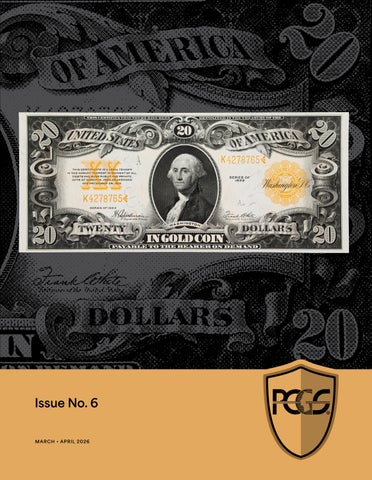
And here among the pages of PCGS Insider, you’re going to find a diversity of topics that cover the gamut of the numismatic hobby. We kick off with the PCGS Featured Banknote, a 1922 $20 Gold Certificate boasting an astounding grade of PCGS Superb Gem Unc 68 PPQ. This magnificent mule note, offered by Stack’s Bowers Galleries, offers just three specimens with none graded higher.

As we continue celebrating our 40th anniversary, Christopher Bulfinch looks back at some of the most important PCGS-graded coins to cross the auction block over the last four decades, including the world’s most valuable coin. As you may have heard, 2026 also marks the Semiquincentennial of the United States, which celebrates its 250th anniversary this year. But back in 1976, as an article by Steven Bieda recalls, numismatists were talking about the Bicentennial and the coins that marked that patriotic occasion.

Are you aware of the 1966 silver Washington Quarter? If not, you’re about to be! Sanjay C. Gandhi shares the story about this incredible transitional error that PCGS recently graded and will surely have you looking through more of your pocket change. You’re also going to learn more about the John Paul Jones Medal, which honors an American Revolutionary War hero.

From grading coins and banknotes to educating the public about numismatics, PCGS doesn’t do what it does without the knowledge and talent of its team. PCGS Director of Sales Taryn Warrecker is someone who is familiar to many who attend coin shows, and she shares her story in this issue of PCGS Insider. We’re also going to check back in on PCGS Set Registry member Tony Littlejohn, who we last interviewed a few years ago, and you’ll meet young numismatist Mathilde HuffordVarrone, a world coin collector who’s really going places.

We hope you’re going places this spring, including some of the many coin shows we’re hosting or attending in March and April. So, please feel free to drop by our booth and say hello – we’re always happy to see you and grateful for your support.

Happy Collecting,

Editor-in-Chief

JOSHUA MCMORROW-HERNANDEZ

Creative Director

JACK ARCHER

Art Director

GEOFF PARRISH

KEITH DEWALD

Designer JAMES DAVIS

Production Artist

CHRIS WILSON

Staff Writer

SANJAY C. GANDHI

ABIGAIL ZECHMAN

EDWARD VAN ORDEN

PHILIP THOMAS

JAY TURNER

JAIME HERNANDEZ

VIC BOZARTH

Contributing Writer

CHRISTOPHER BULFINCH

STEVEN M. BIEDA

LAURENT BONNEAU

Advertising

TARYN WARRECKER

ARIANNA TORTOMASI

PCGS INSIDER

PCGS Insider Magazine USPS Pending Periodical #226, Copyright © 2026 by The Collectors Universe is published bimonthly by The Collectors Universe, 1610 E St Andrew Pl, Santa Ana, California, 92705. Application to Mail at Periodicals postage is Pending at Santa Ana, CA and additional mailing offices. Printed in Canada.

Nothing herein is intended to provide financial advice. Past sales do not guarantee future results.

POSTMASTER

Send address changes to Collectors Universe, 1610 E St Andrew Pl, Santa Ana. California, 92705.

BUSINESS & EDITORIAL OFFICES

1610 E St Andrew Pl

Santa Ana, CA 92705 (949) 567-1234

ACCOUNTING & CIRCULATION OFFICES

1610 E St Andrew Pl

Santa Ana, CA 92705 (949) 567-1234

Call (949) 567-1234 to subscribe. Periodical postage is paid at Blaine, WA.

1922 $20 Gold Certificate, PCGS 68 PPQ

What makes something “distinguished?” Merriam-Webster may be our best bet to assist with this basic semantic inquiry, where we learn that if something is “marked by eminence, distinction, or excellence” – it is, by definition, distinguished. Within real estate, it may be the location that sets a property apart from the rest. For a fancy restaurant, it could be the ambience. A diamond becomes distinguished based on its size, clarity and color. And for a collectible – especially one within the fastidious world of numismatics – its condition is almost always the primary distinguishing factor.

By this measure, this 1922 $20 Gold Certificate (Fr. 1187m), freshly certified by PCGS Banknote as Superb Gem Uncirculated 68 PPQ, is unquestionably distinguished. With over 10,000 examples of the Friedberg type currently reported in the Track & Price census (both Mule and Non-Mule varieties combined), and perhaps an amount equal to that unaccounted for, this series is on the more “common” side of the spectrum within the broader category of U.S. large-size type notes. But its towering numeric grade of 68 on the 70-point Sheldon Grading Scale – appropriately modified for application to paper currency, of course – is entirely uncommon. The jaws of even the most finicky, eagle-eyed members of the PCGS Banknote grading team were dropped as it recently made the rounds through the grading and certification processes.

There is a lot that can happen to a piece of paper – both during production and after issuance into circulation – that would warrant immediate disqualification from obtaining a grade anywhere close to this. Let’s start with a banknote’s origin story. In this case, the journey began at Crane & Co. from where banknote paper has been sourced since 1879 and continued on to the U.S. Bureau of Engraving and Printing which provided the finished product. From the quality of the paper stock and the precision of inking and drying, to the cutting of sheets and collation and strapping into packs, there are countless (and frequently occuring) flaws, smears, hiccups, misalignments, bumps, biffs, bends and bruises that can work to demerit its grade below the Gem 65 threshold before it even leaves its security print shop. This note managed to avoid all of that trouble, leaving only the largest hurdle left in its fateful quest for near-perfection: circulation.

It is important to keep in mind that paper money is meant to circulate, and an overwhelmingly substantial proportion

of it does. After being released into the wild, packs of 100 notes typically get broken down into singles or small runs and dispensed by bank tellers to their depositors, who are eager to participate in a little cash-and-carry commerce. What is the first thing they do? Fold those notes up in half, or into thirds, for storage inside of a wallet or pocket. A note experiencing this type of treatment would be ineligible for a grade 60 or better as it has now, officially, been circulated. Then the number keeps getting lower and lower from there as it makes its way around throughout the economy – more folds, more handling, more counting, more wear and tear. Again, this note saw none of that, distinguishing it from so many millions of its peers.

For all intents and purposes, this note is about as close to perfection as any vintage U.S. issue can ever reasonably expect to be. Production, from paper characteristics to the registration of its face and back printing phases to its final cut, was nearly flawless. Its advanced age (over 100 years) and its larger size (about 40% larger than the banknotes we use today) left it vulnerable to a whole host of potential condition-downgrade exposures. Yet, miraculously, it somehow persevered. The black intaglio plate-printed inks on face appear as if they were just laid down yesterday, deeply contrasted to the underlying clean, crisp, blast-white paper. And the fierce, golden-orange overprinted elements and back design serve as a stunning, aesthetically delightful reminder of the very precious metal that once supported this in-kind paper monetary instrument, on deposit in the U.S. Treasury and available for conversion at a rate of $20 per ounce, whenever its bearer decided to make the demand.

“To say that we are proud to offer such a spectacular example of this extremely popular U.S. type note is an understatement,” says Peter A. Treglia, vice president and managing director of currency for Stack’s Bowers Galleries.

“It is certainly one of the nicest we’ve ever had the pleasure of handling. The immaculate state of preservation and lofty grade issued by PCGS Banknote are sure to draw intense interest from collectors looking to obtain only the very best material available,” he continues, referencing Stack’s upcoming Spring 2026 Showcase Auction where the note will be publicly offered. The sale takes place the week of March 9-13, when just one distinguished suitor will be able to claim this spectacular rarity as their own.

FOUR DECADES of MARQUEE PCGS COINS

The world’s most valuable coin is in a PCGS holder. Many of the world’s rarest coins are, too. For remarkable, rare, exceptionally valuable coins, the benefits of thirdparty grading are obvious, often obviating debates about authenticity and grade.

PCGS Manager of Numismatic Research and Programs

Charles Morgan has observed industry trends for years, and his assessment of PCGS’s role in authenticating, grading, and encapsulating top-end rarities is this: “PCGS has set the gold standard for authentication and grading for 40 years.” Morgan goes on to say, “PCGS’s expert graders rigorously

verify the coin’s genuineness, protecting buyers and sellers from counterfeits. Our graders are the best in the industry, and each coin graded by PCGS is backed by the PCGS Guarantee of Grade & Authenticity. This guarantee provides an invaluable layer of protection for a significant asset such as a legendary rarity.”

Over the course of four decades, many marquee coins have been encapsulated and graded by PCGS. So, an exhaustive accounting of rare, famous, or exceptionally valuable coins in PCGS holders would require a book-length treatment. Let’s look at five such notable coins.

1913

LIBERTY NICKEL, PCGS PR66

The first coin to sell for more than a million dollars was the Louis Eliasberg specimen of the 1913 Liberty Nickel, which was eventually graded PR66 by PCGS after its initial record-breaking sale. Struck under murky circumstances at the Philadelphia Mint around the time of the design transition for the nickel five cent piece from the Liberty to the Buffalo motif, only five 1913 Liberty Nickels are known. The finest example ended up in the collection of Louis Eliasberg, who assembled one of the most valuable coin collections of the mid-20th century. In 1996, two decades after Eliasberg’s passing, the coin was cataloged Proof-66 and sold for $1.485 million – the world-record price for any individual coin at that time; it was subsequently graded PR66 by PCGS.

After it was graded by PCGS, the Eliasberg specimen continued to realize remarkable prices, first in 2001, when it sold in a Superior Galleries sale for $1.84 million. In 2005, it crossed the block for $4.15 million in a Legend Numismatics sale. Two years later, it reportedly sold in a private transaction for over $5 million. It went up for auction again in 2018, realizing $4,560,000, the highest price for a base-metal coin at the time. The specimen was once owned by collector Dr. William Morton-Smith, whose passion for Liberty Nickels was described this way by Stack’s Bowers Galleries in 2018: “Morton-Smith’s passion for collecting can be traced back over generations, passed on to him when he inherited a beautiful antique colonial desk,” which he found to contain a collection of proof Liberty Nickels once owned by his grandfather. “He spent decades finding important rarities, including completing his grandfather’s proof Liberty Nickel collection when he purchased the Eliasberg coin.

1804 DRAPED BUST DOLLAR, PCGS PR68

In the late 1990s, PCGS graded another of the United States’ most famous, valuable coins, the Childs-Pogue example of the 1804 Draped Bust Dollar, which in 1999 sold for more than $4 million, setting what was then a new record price for any individual coin sold at auction. All 1804-dated silver dollars were produced decades after the date they bear; though silver dollars were struck at the Philadelphia Mint in 1804, they are all thought to be dated 1803. The Childs-Pogue specimen is among eight Class I 1804 Dollars, which were produced for inclusion in sets of United States coinage given as a diplomatic gift to various heads of state around the globe, including the Sultan of Muscat.

The Sultan of Muscat 1804 Dollar resided in numerous notable collections after surfacing in the United Kingdom in the mid-19th century. In 1999, the coin was certified PR68 by PCGS and auctioned for its then world-record price of $4.14 million with the rest of the Walter H. Childs Collection by Bowers & Merena, entering the Pogue Collection. It sold again in a 2021 Stack’s Bowers Galleries sale for $7.68 million. PCGS co-founder John Dannreuther offered this assessment of the coin’s quality in a July 8, 1999, press release ahead of the Pogue coin’s record-breaking sale: “It’s a 100% original coin, as perfect an early proof coin as one could imagine […] obviously the subsequent owners have treated the coin with the distinction befitting its title, ‘the King of Coins.’”

1652 NEW ENGLAND SIXPENCE, PCGS XF45

The first coinage produced in British North America was quite crude. The New England Coinage of 1652 was produced by silversmith John Hull in what is today Downtown Crossing in Boston, Massachusetts. The coins’ only devices are the letters “NE” that appear in a cartouche on the obverse and the denomination, in Roman numerals, in a cartouche on the reverse. For many years, only two examples were known: a holed example held by the Massachusetts Historical Society and another that disappeared from Yale University Library’s collection at some point in the last century, identified by a 19th-century woodcut. A few years ago, another example appeared, with a provenance connecting it to Boston’s Quincy family. Over the course of several years, many accomplished numismatists analyzed the coin and PCGS determined it was authentic, assigning it an XF45 grade in 2024. PCGS President Stephanie Sabin said of the coin in a September 2024 Coin World article: “This is one of the most important coins in all of American numismatics […] Since before the Civil War, collectors have regarded the 1652 New England Threepence as the single-rarest American colonial coin. And for more than a century it’s been known as entirely unobtainable for private collectors.” She added, “It was an honor to grade this coin, protecting it for future generations before it heads to auction this autumn.” The landmark threepence crossed the block in November of that year for $2.5 million.

1794 FLOWING HAIR DOLLAR, PCGS SP66

On January 24, 2013, a 1794 Flowing Hair Dollar certified SP66 by PCGS broke the all-time price record for any coin, realizing $10,016,875 (including buyer’s premium) in a Stack’s Bowers Galleries auction. The coin is the finest known among America’s first silver dollars. A total of 1,758 silver dollars were reportedly struck in 1794, all on a single day; fewer than 200 are known today. Silver plugs were added to examples struck on underweight planchets, including the record-breaking example that traded hands in 2013 and was previously part of the Cardinal Collection Education foundation.

The coin is the only example of the issue to receive the Specimen designation from PCGS. It later sold in a private treaty transaction in 2022 that was facilitated by GreatCollections, taking $12 million. Laura Sperber, the founder of Legend Numismatics, the firm that paid the record-breaking price in 2013, offered this perspective on the role of third-party grading: “As with any coin, third-party grading offers unequalled safety and security. You [know] the coin has not been messed with and is genuine. It also shows you the grade as opinioned by several experts. Buying or selling [a coin in] a third-party holder makes a huge difference.”

1933 DOUBLE EAGLE, PCGS MS65

Any list of rare, famous, and valuable coins residing in PCGS holders must reckon with the world’s most valuable coin: the 1933 Saint-Gaudens Double Eagle, graded twice by the firm. The coin’s remarkable life story has been the subject of multiple books; PCGS entered the story twice, first in 2002, when a team of PCGS experts examined the coin and determined that it merited an MS65 grade, though the coin was not officially graded and encapsulated at that time. The second time the coin crossed through the custody of PCGS, the coin was formally graded MS65 and encapsulated by the company. GreatCollections President Ian Russell helped coordinate the PCGS encapsulation of the 1933 Saint-Gaudens Double Eagle in 2021. “We have likely submitted 500,000+ coins to PCGS over the past 10 years, but the standalone highlight was this 1933 $20,” said Russell. “It is the pinnacle of numismatics, and we are grateful to the owner for entrusting it with us.”

Struck at the Philadelphia Mint shortly before Executive Order 6102 and the Gold Reserve Act of 1934 forbade the private ownership of gold bullion, the 1933 Double Eagles wasn’t officially issued. An unknown number of 1933 Double

Eagles were secreted from the Mint, likely late in 1930s, and were ensconced in the collections of prominent numismatists by the time a Secret Service investigation revealed the theft in 1944. One of these coins was sold to King Farouk of Egypt and exported (with a license) in March of that year; it was slated to appear in an auction of the king’s extensive holdings held by Sotheby’s in conjunction with the Nasser government that overthrew Farouk, in 1954. The coin vanished before the sale, resurfacing in the mid-1990s.

After some legal wrangling over the coin’s illicit origins, an agreement was reached between the U.S. government and the British coin dealer who uncovered the coin from a source in the Middle East to auction the coin, splitting the price down the middle. It broke the existing world record price for a coin, set by another coin on this list, the Sultan of Muscat 1804 Dollar, realizing $7,590,020 – the final $20 being an administrative fee to re-monetize the coin. When the coin resurfaced at auction again in 2021, it again notched a world-record price when it garnered $18,872,500 on June 8, 2021, upon its sale in a Sotheby’s auction. The PCGS-graded 1933 Saint-Gaudens Double Eagle is still the most valuable coin in the world.

The John Paul Jones Medal

“I have not yet begun to fight!”

That’s a quote many know from the defiant American naval figure John Paul Jones when asked if he was ready to surrender by the British aboard the Bonhomme Richard, a ship converted from a French East Indiaman and gifted to the Americans. The battle began when Jones engaged the superior British frigate HMS Serapis off Flamborough Head, England. The Bonhomme Richard was heavily outgunned, on fire, and sinking, when Jones emitted the words that live on to this day.

John Paul was born the son of a gardener in Scotland. Leaving for sea at the age of 13 as a ship’s boy, he was a skilled sailor by the age of 20. After killing a mutinous sailor in self-defense in Tobago, he fled to America and added the name Jones. In 1775, he moved to the American colonies, and Jones offered his services to the Continental Congress. He became the first lieutenant on the first American flagship, the Alfred, and is credited with raising the first American flag over a naval vessel. Jones quickly received the first commission as captain of the Continental Navy.

Above: American Revolutionary War naval captain John Paul Jones as portrayed by George Matthews around 1890, based on a portrait by Charles Willson Peale / Public domain image sourced from Wikimedia Commons

On September 23, 1779, the Bonhomme Richard engaged the HMS Serapis in what became the most famous naval duel of the American Revolution. As the Bonhomme Richard sank, Jones successfully locked the two ships together and boarded the Serapis. The crew surrendered to Jones and as the Bonhomme Richard settled below water, Jones sailed away with the prize – the Serapis. These events off the coast of England sent shockwaves through Britain and made John Paul Jones a hero to America and France.

Following the signing of the Declaration of Independence, the United States struck medals to honor key Revolutionary War victories and leaders in a fashion that inspired Americans, impressed European allies, and created lasting propaganda for the fledgling nation. Since the United States had no official

mint or skilled engravers to consign for these purposes, the task was outsourced to the Paris Mint with Benjamin Franklin and Thomas Jefferson as overseers.

This series of medals beginning in 1776 eventually became known as the Comitia Americana Series – Latin for “American Assembly.” A total of 11 different medals were commissioned, with issues being struck in gold, silver, and bronze. The gold medals were specially made for presentation to living recipients or their heirs. Only one of two gold medals of each type were struck. Additionally, silver and bronze medals were produced for members of Congress, foreign dignitaries, universities, and allied sovereigns. It is believed that across all 11 designs and medals, the cumulative mintage was under 500 pieces.

The 1789 John Paul Jones Comitia Americana medal is the 10th and second-to-last medal made in the series, as well as the only issue among these medals to feature a Naval battle and victory. With the Congressional Resolution on October 16, 1787, Congress unanimously voted to award John Paul Jones a “medal of gold” for his “valor and brilliant services” in the Flamborough Head action. It was left to the U.S. Minister to France, Thomas Jefferson, to oversee the project. In January of 1789, Jefferson received detailed excerpts of Jones’s journal to ensure historical accuracy. It was Augustin Dupre, who had engraved most of the series, that Jefferson entrusted with bringing the medal to life. Jefferson requested dies capable of striking about 350 medals in gold, silver, and copper. The medals would be delivered to diplomat William Short in December 1789. The gold example was awarded to John Paul Jones personally when he returned to Paris in 1790.

The medal features a right-facing bust of John Paul Jones in naval uniform. “JOANNI PAVLO JONES / CLASSIS PRAEFECTO / COMITIA AMERICANA” (To John Paul Jones, Commander of the Fleet, the American Congress”) is inscribed. The reverse depicts the moment of the battle when the Bonhomme Richard is locked broadside to the Serapis Jones is on deck with a sword raised, as American sailors board the Serapis amid cannon fire and smoke. “HOSTIUM NAVIBUS CAPTIS SVCCESSV AC FVGATIS / AD ORAM SCOTIAE XXIII SEPT MDCCLXXIX “The enemy’s ships were captured or put to fight on the coast of Scotland, 23 September 1779”) is inscribed on the reverse.

Above: (1789) bronze Comitia Americana Medal bearing the bust of John Paul Jones

The numismatic dilemma with these medals is they were restruck. These restrikes were made at different time periods, with different dies, and at different mints. Relatively little research goes into medals in comparison with coinage, and often this research is not published publicly and used to the benefit of only that researcher.

Here is the breakdown of the John Paul Jones medals:

• The original-struck examples from the Paris Mint with original dies exist as the following pieces –

• Gold – Unique gold medal awarded to John Paul Jones in Paris of 1790 and currently held by the U.S. Naval Academy

• Silver – PCGS spec number 935307

• Copper – PCGS spec number 886416

• Copper, with an indented collar - PCGS spec number 528917 (These medals were made with an indented collar leaving a square piece of extra medal positioned at 12:00 with the intent making the medal easier for mounting)

• Tin - Obverse Cliche PCGS spec number 974800

• Tin - Reverse Cliche PCGS spec number 825359 (These are uniface impressions for display purposes; the single example certified by PCGS has a later inscription on the paper coated undesigned side)

The original die, original strikes can be distinguished by several die details but the easiest pick up point would be on the flower on the obverse, one side being repunched.

• Yellow bronze, with a plain edge - PCGS spec number 974801 (These medals are believed to be produced between 1815 and 1832; they have the flower still doubled, but

lack die defects found on later strikes)

• Silver, with a plain edge - PCGS spec number 668336 (Struck sometime before 1832, these medals feature the doubled flower but also have an irregular reverse wire rim)

• Copper, with plain edge - PCGS spec number 975060 (Struck before 1832 and same as above silver)

• Silver, with anchor and “ARGENT” on edge - PCGS spec number 974802 (these were struck between 1841 and 1842)

• Copper, with hand and “CUIVRE” on edge - PCGS spec number 925859 (These were struck between 1845 and 1860)

All except the earliest restrike in yellow bronze will have the irregular reverse wire rim detail along with the doubled flower.

NEW DIES

At some point in 1880 or after, the Paris Mint reengraved new dies and struck restrikes from these non-original dies. The flower on the obverse is no longer doubled in these examples:

• Silver, with cornucopia 2 and ARGENT on edge - PCGS spec number 707496 (Struck after 1880, these are struck in a matte finish)

• Bronze, with cornucopia and BRONZE on edge - PCGS spec number 882920 (Struck after 1880, these are struck in a matte finish)

• Gilt Bronze, with cornucopia and BRONZE on edge - PCGS spec number 874964 (Struck after 1880, these are struck in a matte finish)

• Bronze, with cornucopia and BRONZE on edgePCGS spec number 827236 (Struck sometime in the 1960s, this medal has an antiqued surface)

UNITED STATES MINT GUNMETAL STRIKES

United States Mint “Gunmetal Dies” strikes mark the first John Paul Jones medals produced on United States soil. Copied from an original strike in 1863 with dies made of bellmetal (gunmetal), only 25 were struck with an additional 25 struck in 1868 from these dies.

• “Gunmetal Dies” - PCGS spec 975059 - (Made in bronze, the flower is doubled, the rim is flat, and often these are seen with die breaks)

• U.S. Mint Copy - PCGS spec 615296 (Produced in bronze between 1875 and 1904, these medals are copies of the Paris Mint dies but instead of having flowers on the obverse they have four circles instead; the original engraver’s name Dupre has also been removed from the dies)

UNITED STATES MODERN RESTRIKES

• Silver - PCGS spec 974454 (Struck sometime in the 1970s through the 1980s, these are more like commemoratives tied to the American Bicentennial and carry an antiqued finish)

• Bronze - PCGS spec 977806 (Same as above, with origins in the 1970s and 1980s and bearing an antiqued finish)

The United States Navy was largely disbanded after the Revolutionary War, leaving John Paul Jones without a command. In 1788, he accepted a commission as rear admiral in the Russian Navy under Catherine the Great. Jones fought the Ottoman Empire in the Black Sea under the Liman campaign. While he was victorious at battle, he failed in Russian court with jealous and resentful people also in Russian service. After a smear campaign in 1789 and accusations designed to ruin him, he was forced to leave Russia forever.

Jones spent his last three years in Paris, dying in 1792 at the age of 45 – largely forgotten. He was buried in an unmarked grave and was lost for decades. It wouldn’t be until 1905 when U.S. Ambassador Horace Porter located his grave after exhaustive research. John Paul Jones was returned to the United States and re-interred with full honors at the U.S. Naval Academy in Annapolis, Maryland, in a tomb modeled after Napoleon’s.

Inside PCGS Inside PCGS

Inside PCGS Taryn Warrecker

Above: Taryn Warrecker’s 2006 Quarter-Ounce China Gold Panda

Taryn Warrecker has become one of the most familiar faces in numismatics. You may have seen her on the bourse floor of a coin show, maybe met her at a regional or international numismatic convention, or perhaps even have a long-running professional relationship with PCGS by way of a connection you and she established. She oversees PCGS vintage, world, and show categories and helms Certified Coin Exchange (CCE), Collectors Corner, and PCGS advertising. She also wears many hats as PCGS director of sales. “My title is short. The work is not,” she says.

Perennially busy, Warrecker says she was always up for the role. “I got my start in the industry back in 2004, working for [coin dealer] Ron Gillio in Santa Barbara. He owned the Long Beach and Santa Clara Expos, and I helped coordinate those shows. When Collectors bought the Long Beach Expo in 2006, they brought me along.” By that time, Warrecker had already worked as a hotel operator and served in loss prevention and safety for a major luxury resort in Southern California. “I took on projects that improved both guest and employee experiences. Sustainability. Safety. Service training. That instinct to jump into cross-functional work ended up being the foundation for my career at PCGS,” she says.

For Warrecker, it wasn’t always about climbing corporate ranks, but rather exploring new frontiers. “My path hasn’t been linear. The scenic roads shaped me the most.” She adds, “Leadership encouraged my curiosity and gave me room to grow.”

She really found her way in sales. “Being in sales at PCGS is the role I always wanted, even before I knew it existed. Representing a grading company with the polish and standards of a top luxury brand brings a level of pride you feel the moment you step into any room. With leadership that champions you and a team built for shared wins, it

becomes a role you fight to do right.” Among Warrecker’s favorite aspects of her role with PCGS is working on auction collections. “These projects bring out the best of what PCGS does. Precision, trust, and real collaboration with experts across the hobby. The dealer community has been one of the greatest gifts of my career. They’ve supported me, taught me, and trusted me. They have shaped my knowledge and my confidence. I don’t take that lightly. Every day I’m reminded how lucky I am to do this work.”

As busy as she is, Warrecker finds time to enjoy kicking back with her family. She is also a numismatist who enjoys collecting both coins and banknotes. She purchases new releases from the United States Mint. However, she especially enjoys modern pieces from the various world mints. “[Their] minting quality is outstanding, and the price point makes them accessible.” The coin she counts as the “crown jewel” of her collection is the first coin she ever bought: a 2006 Quarter-Ounce China Gold Panda. She bought it to celebrate the birth of her first son. “The coin graded PCGS 70 and has sentimental value nothing else can top.”

Like her Gold Panda, Warrecker’s career at PCGS was also minted in 2006. “This year marks my 20th anniversary, which lands right as PCGS celebrates its 40th. Sharing a milestone with the company feels meaningful.” Over her time with the company, Warrecker has experienced many changes both at PCGS and across the hobby at large. “Collectors are more informed than ever. At the same time, the hobby has stayed grounded in tradition,” she says.

“We all leaned on technology when we needed to, but shows never lost their importance.” This was especially true during the COVID-19 pandemic in the early 2020s. “COVID changed how we operated internally. Suddenly, we were meeting on Zoom regularly, and I connected with people I had never worked with outside of shows,” she recalls. “As we all adapted, I saw where I could add value and expand my work.” Through it all, some things never change. “Even with virtual auctions and more online trading, collectors still want face-to-face conversations and the trust that comes with them. That balance, and savvy buyers who still value relationships, keep the hobby strong.”

A strong believer in putting her boots on the ground, Warrecker sees the value of attending many numismatic events across the country each year. “Shows are one of the best market indicators we have. If you skip them, you lose the pulse of the hobby. You learn who’s active, who’s growing, and who’s shifting their business. You meet future customers. You strengthen existing relationships. There is no replacement for that.” Besides, she really enjoys what she does. “I love the freedom shows give me. Because of my role across multiple verticals, I can talk to anyone at any table. Submissions, CCE, PCGS advertising, or something brand new, it all matters, and it all connects.”

A shifting marketplace and the hobby’s growing presence on the digital sphere is opening new doors for collectors, dealers, and even content creators. “We are in an interesting moment for the hobby. The market is evolving, collectors are more informed, and opportunities are everywhere. I’m excited to play a part in shaping what comes next for PCGS and for the community that has supported me for two decades.”

What does Warrecker tell others who aspire to grow as collectors or numismatic professionals? “Don’t be intimidated by what you don’t know. This industry is full of people willing to share their expertise. Your credibility comes from your honesty, your effort, and your willingness to ask questions. When you let people see who you are and how hard you work, trust follows. This hobby rewards authenticity. If you lead with that, the right doors open.”

America’s Bicentennial Coinage at 50

Fifty years ago, during the United States Bicentennial, dual-dated 1776-1976 quarters, halves, and dollar coins were produced with designs selected from a national competition. The three denominations were produced in cupro-nickel for circulation as well as in 40% silver for collectors. Although considered common today, the series contains one unique and somewhat mysterious rarity: a one-of-a-kind dollar coin that appeared in the till of a popular Washington, D.C., retailer.

As the United States embarks on its semiquincentennial celebration, where Americans celebrate the 250th anniversary of their nation’s independence, we turn the clock back 50 years. Just as the United States Mint endeavors on an ambitious one-year design program to mark the nation’s 250th birthday, back in the mid-1970s the American numismatic scene was all about the Spirit of ‘76.

A WINNING PROPOSAL

The 1776-1976 Bicentennial coins consisted of special reverse designs for the three larger coin denominations: quarter, half dollar, and dollar. The designs were chosen as a result of the first open coin design competition since the 1938 Jefferson Nickel contest. The competition was announced in October 1973 and resulted in 884 entries. The designs were narrowed down to 12 semifinalists, from which three designs were chosen.

Jack L. Ahr had the honor of his colonial drummer design chosen for the quarter dollar. Seth G. Huntington’s Independence Hall design was selected for the half dollar. Meanwhile, Dennis R. Williams – a 22-yearold art student – won with his design superimposing the Liberty Bell over the Moon for the dollar coin.

In addition to the circulating coinage, the authorizing legislation provided for 40% silver coins in all three denominations. It was the only time this composition was used for the quarter, as well as the last time this composition would be used for any official U.S. coinage. The coins were offered in three-coin uncirculated and proof sets, all bearing the “S” mintmark of the San Francisco Mint. The authorizing legislation authorized a mintage of 45 million of the 40% silver versions. This proved overly ambitious and subsequently resulted in the silver issues being sold intermittently by the U.S. Mint up until 1986, after which the remaining coins were melted. The net result was approximately 11 million uncirculated and four million proof sets.

Above: 1976 United States Mint Proof Set in original packaging with that year’s six coins, including the three copper-nickel clad Bicentennial issues / Courtesy of Heritage Auctions, www.HA.com
Right: 1986
United States Mint catalog page showcasing the last round of Bicentennial offerings a decade after their initial release

At the time of their release, the new designs were met with both joy and derision by the collector community. Some complained of the U.S. Mint using a depiction of Independence Hall, as it had previously appeared on the 1926 Quarter Eagle commemorative for the nation’s Sesquicentennial, others found issue that the dollar design similarly reverted to a previously used design theme, noting the Liberty Bell had appeared on both the 1926 Sesquicentennial Half Dollar, as well as the Franklin Half Dollar series of 1948 through 1963.

A small controversy also erupted over the quarter design. The designer of a United States postage stamp issued in 1973 made the accusation that the motif was copied from his stamp design, which similarly featured a colonial drummer. Others chimed in with admiration for the designs. The quarter design seemed to be the favorite, although all three had their admirers.

Above: 1973 United States postage stamp with colonial drummer boy design / Public domain image sourced via Wikimedia Commons
Right: 1926 Sesquicentennial Quarter Eagle, 1948 Franklin Half Dollar, 1926 Sesquicentennial Half Dollar
Top: Jack L. Ahr’s Colonial drummer boy reverse on the 1976 quarter

STRIKING UP THE SPIRIT OF ‘76

The official first strike ceremony for the coins was held at a dramatic time in American history. On August 9, 1974, President Richard Nixon had resigned his twoterm presidency amid his embroilment in the Watergate scandal. Three days later, the first strike ceremony for the 40% silver proof coins went on as planned on August 12 at the Philadelphia Mint. As was the practice at the time, Philadelphia issues did not carry a mintmark. These coins were subsequently displayed at the 1974 American Numismatic Association convention in Baltimore. While photos of these coins were utilized for promotional material, the coins were destroyed by the Mint. Although it was reported at the time that the first strike coins were given to the designers as well as a set for President Gerald Ford, it was subsequently clarified that these were never distributed. In any event, the Mint’s position was that the Philadelphia silver proof issues were destroyed. The circulating cupro-nickel versions of the coins were produced at the Philadelphia and Denver Mints. To address concerns that ample coins were available for circulation, the authorizing legislation allowed the Mint to produce 1974 quarters, halves, and dollars into 1975, to be followed by

the release of the Bicentennial coins the same year. No 1975-dated quarters, half dollars, or dollars were struck.

During the early stages of the regular production strikes for the dollar, it was determined that there was an issue of proper metal flow. The design submitted by Dennis Williams featured thick lettering for the inscriptions consisting of “UNITED STATES OF AMERICA” and “ONE DOLLAR.” Chief Engraver Frank Gasparro remedied this by changing the font of the lettering to a more slender and narrow appearance. This resulted in changes made in early 1975.

The hobby quickly designated the varieties as Type I (Williams’ original design) and Type II (the modified version). For the circulating issues, both varieties were produced at the Philadelphia and Denver Mints and released into circulation at the same time. A price premium developed for the Type I Dollar early on, especially for the Philadelphia version, which had the lowest mintage; this premium eventually dissipated. Mint and proof sets for 1975, as well as the special 40% silver proof and uncirculated versions, all sported the Type I reverse. The Type II reverse would appear in the annual 1976 mint and proof sets containing the cupro-nickel strikes.

Above: President Gerald Ford (center) examining the three 40% silver Bicentennial coins presented to him by Mint Director Mary Brooks (right) and Director of the American Revolution Bicentennial Administration John Warner (left)/ Public domain image via the Gerald R. Ford Presidential Library

COLLECTING BICENTENNIAL COINS

Today, the regular circulating issues still occasionally show up in change, some well-worn, others in uncirculated condition as long-hoarded coins returned to regular commerce. The proof cupro-nickel and 40% silver issues are commonly encountered in the coin market, with the silver pieces generally at prices reflective of their metal content.

Many collectors, while noting the historical significance of the issues, largely dismiss the high-mintage coins as somewhat of a nuisance in the numismatic marketplace. Anthony Swiatek, aka “Mr. Commemorative,” notes that “the Bicentennial coinage was wildly popular at the time of issuance, resulting in many being hoarded. Today, these issues are commonly available, and examples of all three denominations are often heavily represented in accumulations and causal collections.” To many coin dealers, these issues have become somewhat annoying, and Swiatek notes that the coins have become a “bane of a coin dealer’s existence when people bring them into the coin shop.” Swiatek advises that “these easily obtainable coins are not rare, but that unscrupulous individuals have mass marketed these common coins selling them greatly in excess of their actual value.” Still, Swiatek acknowledges that the upcoming 250th anniversary is likely to increase interest in the Bicentennial issues, although probably not leading to any meaningful price increases.

Undoubtedly, the coins are important pieces of numismatic history. High-graded PCGS examples, similar to other modern issues, are highly desired. Other meaningful collectibles are the PCGS designer-signed Special Label examples, each holder containing the authentic signatures of the respective coin’s designer encapsulated along with the various cupro-nickel or 40% silver three-coin sets that were produced and marketed over the years.

Above: Comparison of the Type I (left) and Type II (right) reverses on the 1976 Bicentennial Dollar

A SENSATIONAL SPECTACLE

The series contains one unique super rarity: a proof 1976 40% silver Type II dollar lacking a mintmark was allegedly discovered in 1977 in a cash register at a Woodward & Lothrop department store in the Washington, D.C., area. Woodward & Lothrop was a prominent department store in the D.C. metro area.

Speculation is rife as to the provenance of the piece. We can rule out that it was struck at the August 1974 first strike ceremony, as it is well documented from photographs that the Type I reverse was utilized. Indeed, the Type II reverse wasn’t even anticipated at that time, the need for revisions having been discovered relatively early in 1975 during the production of the coins intended for circulation. Some have speculated that the unique coin was intended as a presentation piece intended for a VIP. This theory seems implausible, especially when considering how the Mint destroyed the first-strike ceremony coins. A more likely scenario was that it was a prototype, struck at the Philadelphia Mint and utilizing the Type II reverse intended to be used on a 40% silver coin which was never put into general production.

Past practice seems to support this conclusion; the 1975 annual proof sets contained Type I cupro-nickel dollars, and the 1976 annual proof sets contained the cupronickel Type II variety. It seems logical to suggest that the Mint similarly anticipated using the Type II reverse for future strikes of the 40% silver dollar coin. The prototype would have been produced in Philadelphia, (thus no mintmark) then sent to the Mint headquarters in Washington, D.C., for examination or approval.

How it ended up in a cash register at “Woodies” is anyone’s guess, but its proximity to both the Mint’s D.C. headquarters as well as the Treasury Building offers some clues to its provenance. In any event, the first recorded sale of the coin occurred in 1982, when it was purchased for $5,000. The coin would change hands at incrementally higher prices and was eventually graded by PCGS in PR66.

Mike Byers, an error-coin dealer and publisher of MintErrorNews.com, notes that this is the rarest of the Eisenhower Dollar coins, and “that it is in a class of its own, being among the rarest United States silver dollars ever struck.” Acknowledging the unique provenance of the coin, Byers notes that “[t]he 1976 Type 2 ‘No S’ Silver Proof Eisenhower Dollar is one of America’s great mystery coins!” He acknowledges the speculation on why the coin was produced, noting the most common theories that the coin “was struck as a pattern or as a presentation piece without the S mintmark at the Philadelphia Mint, for a government or White House official in Washington. It is not considered to be a Mint error. It appears to have accidentally entered circulation and was spent.” Byers confidently projects a valuation of “over $1 million” as the coin “is considered unique.”

Byers, like Swiatek, believes that “[t]he upcoming 250th anniversary of the birth of our nation will increase interest in the Bicentennial coinage series,” including Bicentennial coin errors and the unique Philadelphia proof issue, “as well as the 1776 Continental Dollars.” As America celebrates its 250th anniversary, a numismatic reflection of the Bicentennial coinage finds much to appreciate – many common collectable coins, along with one very uncommon rarity with a mysterious past.

Women On Money: Frida

Kahlo

“At the end of the day, we can endure much more than we think we can.” ~Frida Kahlo

Frida Kahlo was one of the greatest and most groundbreaking Mexican artists. She was a controversial figure and represented and advocated for many disenfranchised groups, such as Mexicans, women, the LGBTQIA+ community, and anyone who defied “the norm.” Her work was heavily influenced by Mexican folk art and indigenous cultures, as well as European art movements such as Surrealism and Realism. Her paintings were vibrant and symbolic, often exploring themes of personal identity and the body.

Kahlo was attracted to art at a young age, but it was something that she only really started to take seriously at the age of 18, when she suffered severe injuries from a bus accident. She was bedridden for three months, and her mom got her a special easel so she could paint in bed. This was when she began exploring themes of self-reflection. She had a mirror mounted on her ceiling so she could make selfportraits even while confined to her bed.

Most of her early work drew on European art forms, but after moving to Morelos,

Mexico, with her husband, she became increasingly inspired by traditional and indigenous art. As someone who suffered from chronic pain and illness, she often used her art to showcase and express the pain she went through both physically and psychologically. It often made people uncomfortable, which is how she first earned her controversial reputation.

Kahlo passed away soon after turning 47, but her fame only grew. She may not have sold much of her art while alive, but her work now sells for incredibly high prices. She set a record for the most expensive Latin American work sold at auction and is among the highest-selling female artists. She is also considered a feminist icon for defying gender norms and creating raw, real depictions of the female experience.

In 2007, the Mexico City Mint issued a medal to honor the work of Frida Kahlo and her husband, Diego Rivera. The obverse of the medal shows one of Rivera’s paintings, but the reverse features a version of Kahlo’s famous painting, The Two Fridas. The painting

represents her struggle with her recent divorce and her sense of self.

You can see two different versions of Kahlo holding hands in front of a stormy sky. On the right, the artist is wearing a white, high-necked, European-style wedding dress to represent the European heritage on her father’s side. On the right, you see a “traditional” Kahlo wearing the traditional colorful Tehuana dress worn by the indigenous Zapotec women on the Isthmus of Tehuantepec. She often wore these dresses as an expression of her Mexican heritage from her Mother’s side. The “modern” Kahlo has a broken heart connected to the complete heart of the “traditional” Kahlo. Even on the small canvas of the surface of the coin, you can see that “traditional” Kahlo holds a picture of her husband, Diego Rivera, while “modern” Kahlo holds the surgical scissors that cut her heart. This represents the sadness she felt during her brief divorce. The stormy sky in the background represents the inner turmoil she experienced between the two versions of herself.

Above: Mexican one-ounce silver medal featuring a replica of the Frida Kahlo painting, The Two Fridas

YOUNG COLLECTOR PROFILE:

MATHILDE HUFFORD-VARRONE

Mathilde Hufford-Varrone was five years old when she began venturing into numismatics. “I was first introduced to numismatics by my dad, great uncle, and papa,” she recalls, now at the age of 18. “I would look through numismatic magazines with my dad and point out all the coins I liked. My great uncle, who lived a floor below us, would also give me rolls of quarters or other interesting finds, and my papa gifted me a lockbox to keep my growing collection in.” She still adds coins to that little lockbox.

“Initially, I gravitated toward animal coins because I loved animals and I really enjoyed those designs. I also really liked colorized coins because I found the way color was incorporated into the design fascinating and it made certain details stand out.” Hufford-Varrone eventually was drawn into banknotes after her father brought some home for her from a coin show. “I became interested in the political imagery and propaganda sometimes depicted on banknotes.”

Her love for global paper money was furthered by a seminar she took covering world banknotes at the

American Numismatic Association Summer Seminar. That scholarly scene inspired Hufford-Varrone to participate in a variety of enriching numismatic activities, including serving as head of a young numismatist auction last summer. “As auction head, I delivered speeches promoting the auction, collected and cataloged donations, and made sure the auction went smoothly. I really enjoyed being the auction head, and it was really nice to give back to a community that has done so much for me.”

Her mission to continue learning compelled her to major in biomedical engineering, which she studies at University of Oklahoma on a pre-med track. “I am hoping to go to medical school and become a pediatric doctor or potentially do research in health,” she says. “Although my career will likely not be related to numismatics, I plan to stay engaged in the hobby and continue collecting.” She is interested in the Stack’s Bowers Galleries Professional Numismatist Program and wants to contribute numismatic articles to various publications to share her knowledge with other collectors. “My main piece of advice is to take opportunities as they come to you. So many people in this hobby want to uplift young collectors and dealers,” she says. “Everyone brings different knowledge to the table, and everyone can learn so much from each other, so do not be afraid to talk to others in the hobby and ask them questions.”

Hufford-Varrone also recommends collecting whatever piques your interest, “no matter how niche or weird.” She adds, “When I started collecting more seriously, I felt like I had to collect American coins. While they were interesting, I did not feel very passionate about them, which made me feel less attached to the hobby. However, when I started collecting banknotes with vibrant art or historical significance, I found myself falling in love with the hobby again and feeling the same enthusiasm I did when I first started collecting.”

Right: Cambodian banknote produced by the Bank of Cambodia from 1972-1975, making it one of the last banknotes produced before the reign of the Khmer Rouge / Courtesy of Mathilde Hufford-Varrone

COLLECTOR HIGHLIGHT

Tony Littlejohn

Tony Littlejohn began collecting coins during his childhood in the early 1960s, amid the final throes of circulating 90% silver coinage in the United States. “I told my mother that we should keep all coins with silver in them as they would someday be rare,” Littlejohn recalls. “She didn’t believe me, so I started removing silver from circulation, primarily Mercury Dimes, Standing Liberty Quarters, and Walking Liberty Halves as the newer coins seemed more common,” says the collector who searched for numismatic treasures in his school lunch money. Vintage Lincoln Cents, Buffalo Nickels, and other novelties were thrown into the budding collector’s growing hoard of silver coins, which he eventually threw into a strongbox and tucked away in a closet – forgotten for years.

Some 15 years passed. Littlejohn graduated college, became an engineer with a major petrochemical company, and built a family – nary a spark alight for numismatics all that time. That changed in 1985, when he took a youth group on a trip to Colorado and decided to take the kids on a tour of the Denver Mint. “The tour ended in the Mint’s store, and I looked at the proof sets for sale. I decided to get one for each of my daughters from their birth years: 1981 and 1983. They did not have the 1981 set at the Mint, and they directed me to go to a coin shop to get them.” Upon returning home, he paid his local coin shop a visit.

Above: Tony Littlejohn

“As I looked around the shop, the proprietor asked about my interest in coins and suggested that I might be interested in collecting again.” Indeed he was, leaving the shop with a type set album and a numismatic love rekindled. He was soon on his way to tackling a type set as well as runs of Buffalo Nickels and Barber Half Dollars before building an incredible collection of Standing Liberty Quarters. “I was very low key and under the radar in purchasing my Standing Liberty Quarters from various sources,” remarks Littlejohn, whose Standing Liberty Quarters set – a basic run consisting of 37 coins – achieved top status on the PCGS Set Registry in 2017; it ranked all-time finest in 2020. “I have continued to upgrade my set since then and have acquired some real beauties to add to my collection.”

It was around that time that PCGS previously interviewed Littlejohn, when he was upgrading other sets and had already expanded into Eisenhower Dollars and Susan B. Anthony Dollars. “However, my primary focus was on the coins I loved most: the Standing Liberty Quarter.” One of his favorite acquisitions is also one of his more recent ones: a 1916 pattern catalogued as J-1796A/1988. “I am still a Standing Liberty Quarter collector and enjoy the ‘one-of-a-kinds.’ I acquired another Standing Liberty Quarter pattern: the 1916 J-1796A/1988, PCGS spec number 62287.” He goes on to say, “This coin represents the earliest form of Hermon MacNeil’s Standing Liberty Quarter design struck in coin form at the Mint and is the only one in private hands. Littlejohn adds, “Three are known to exist – two of which are permanently housed in the National Numismatic Collection at the Smithsonian.”

It’s one of the many coins among Littlejohn’s 81 PCGS Registry Sets. “I continually look for upgrade additions to my top sets, the Standing Liberty Quarter

and Susan B. Anthony Dollar sets.” He also recently completed a magnificent Booker T. Washington Half Dollar set that took him three years to complete. Two of Littlejohn’s main numismatic goals still lay before him: upgrading his completed Everyman Standing Liberty Quarter and 12-piece Everyman Gold Type Sets, to have every coin with a top grade of PCGS AU58+. “The competition is fierce for the elusive AU58+ coins in these two sets.”

It’s the challenge of competing with top-level numismatists that has helped shape Littlejohn’s approach to the hobby. One of the main hurdles has been sourcing and consolidating the information he needs to track down the coins he wants to obtain for this collection. “The large number of auction companies as well as the progression of coins being sold on social media makes finding the coin you are looking for in a timely fashion more difficult – especially when combined with the growing number of young numismatists having quality coins for sale, many of which you can only acquire at coin shows.”

But it is in the oft-frustrating pursuit of coins that Littlejohn also finds his joy. “Enjoy the collection process which I call ‘The Hunt.’ Searching for the coins to complete your collection is as much or more fun than finding them in some cases. Have a wide enough net that you minimize missed opportunities and spend the extra it takes to obtain ‘quality.’” Ultimately though, what makes numismatics enjoyable for Littlejohn aren’t necessarily the coins in his collection but the folks he meets along the way. “If you see me at a coin show, say ‘Hi!’ Because, for me, the relationships – the people – are what drive the fun. You may have shows where you don’t buy a single coin, but there are always the people, dealers, and collectors that make the journey fun.”

PCGS Abroad: The Beginning of the Capetian Dynasty Coin

The Carolingian Empire was founded before Holy Roman Emperor Charlemagne’s rule, and under Charlemagne was the unification of the Frankish Empire and lands. The Empire ended rule in West Francia in 987 AD, when Louis V died childless in a hunting accident leaving the throne vacant. By this time, Louis V nicknamed “The Do-Nothing” and his father Lothar had weak control of what was once a major empire, now controlling only scattered areas of land that included Laon and Orleans as well as surrounding areas; this left other nobles with much larger influence and power. The empire fell to two main candidates: Charles of Lower Lorraine (the uncle of Louis V and the last legitimate male heir to the Carolingian Empire) and Hugh Capet. Born around 940, Capet was son of Hugh the Great, a powerful noble (Duke of the Franks and Count of Paris) and Hedwig of Saxony (the sister of Emperor Otto I). He had inherited the Robertian family lands and titles, making him the most powerful magnate in northern France, including Duke of the Franks, Count of Paris, Orleans, and many abbeys.

In 987, after the death of Louis V, an assembly of magnates elected Capet as the new king. The Archbishop of Adalbero justified the rule by “The throne is not acquired by hereditary right…crown him who is most distinguished by his noble birth, wisdom, and good faith.” Charles of Lorrain contested the election and with his eventual capture in 991 and subsequent imprisonment, he died incarcerated in 995 and ending the last Carolingian threat.

Capet ruled from 987 until his death in 996. While he had limited royal domain, he had a strong alliance with the Church and great vassals. In 988, Capet crowned his son Robert (Robert II “The Pious”) co-king to ensure his family dynastic continuity. This standard created the Capetian Dynasty, which would rule from 987 to 1328 in a direct line of succession. Branches would rule France until 1848. While he was a minor king in terms of power his dynasty’s longevity makes him one of the most consequential figures in French history.

Sometimes an empire dies in a whimper; sometimes, in that same energy, a new empire begins – one that can grow into something substantial. In a recent submission came a coin that serves as a relic of the start of a new dynasty – one that would last for more than 800 years.

A coin from Capet’s reign was submitted at a recent PCGS grading event in Paris. The coin was struck between 987 and 996 and is a silver denier from the Beauvais Mint, located about 50 miles outside of Paris. The coin is listed as Duplessy-1, the very first coin in the reference book. The specimen was graded PCGS AU55, and this series is not terribly rare – an average example currently sells for less than $1,000USD. However, it is an incredible artifact of history – a starting point for a dynasty. In that sense, the coins are priceless.

Above: France (987-996) Denier Hugh Capet Dup-1 Beauvais Mint, PCGS AU55

The 1966 Silver Washington Quarter: Unique? Possibly…

I remember attending the South Hills Coin Club Show at the Crowne Plaza in South Hills, Pennsylvania, during 2012. At that time, I was an independent coin dealer and this hotel is located right across the street from the South Hills Village Mall, which I frequented as a kid. My goal for the show was to find nice-looking world coins to place into inventory, as I knew very little about United States coinage.

I asked one of the dealers at the show if he had any world coins, and he replied, “No, not here, but we have a whole bunch at the shop – and my name is Jon Walker.” I introduced myself, as I approached the dealer at his booth, operating under the banner “Treasure Hunt.”

I said, “I’ve been to your store before and the folks mentioned they don’t carry world coins.” Jon replied, “Well, I’m currently the numismatics manager. We have a new location, and we have plenty of world coins. Come down and see me.” I thanked him and soon became a fixture at his location.

Jon manages the numismatics department for 11 stores in Pennsylvania. Treasure Hunt buys and sells gold, silver, and jewelry as well. Ironically, his boss is named John as well, he is just as congenial as Jon Walker, and so is Jeannette. I left Pittsburgh in 2017, but I had bought many coins over the years from Jon. We have kept in touch and chat at random intervals when possible. I’ve been over to Jon’s home for dinner multiple times. On one occasion at dinner, we ate ghost peppers and scorpion peppers, because we enjoy eating hot peppers. Jon’s wife, Megan, might have thought, “why are you guys torturing your taste buds?” One day in late September 2025, Jon called me and reported, “PCGS recently certified a coin that I took a look at and submitted.” He shared the certificate number with me, I entered it, and the image popped up. I said, “Cool, a silver 1966 Washington Quarter.”

Jon replied, “I think it’s unique.”

I was busy with some work at the time. “Let me give you a call back,” I replied. He then sent me a few texts with more information about when the U.S. Mint transitioned from striking 90% silver coins to debased coinage made in copper-nickel clad in 1965.

I called Jon back and asked if he would agree to an interview about his recent find, and he obliged…

Sanjay: Do you remember the call you made to me on September 28, 2025?

Jon: Yeah...

Sanjay: I had to think for a second and then you sent me the certificate for the coin. Then it dawned on me what you sent. Wow. I’ve never seen one of these.

Jon: Ha, neither have I! As you and I both know, the United States Mint supposedly stopped striking 90% silver content coins in 1964 (The United States was going off of the silver standard for coinage based on the 1965 Coinage Act). However, the Mint was still striking 90% silver quarters and dimes dated 1964 in 1965 and 1966 concurrently with the newly issued clad coinage. Clad coinage consists of two different non-precious metals bonded together and in this case it was copper and copper-nickel. These two denominations were struck when the Kennedy half dollar was being struck in 40% silver which is referred to as silver-clad.

1965 Roosevelt Dime struck on 90% silver planchet, PCGS

Sanjay: You mentioned the 1964 silver quarter was a frozen date?

Jon: Yes, from my research, the 1964-dated silver quarter was struck in 1964, 1965, and 1966. The U.S. Mint [facilities] still had a whole bunch of 1964 silver planchets. They were still trying to make sure there was enough change that was circulating. There was fear that the public would pull all the silver coinage out of circulation, which would make dimes, quarters, and half dollars scarce.

Sanjay: Got it.

Jon: There were no mintmarks on coinage from 1965, 1966, and 1967. No P, D, or S mintmarks exist on coins from those years as identifiers [to determine what mint facility struck them].

Sanjay: The U.S. Mint was afraid they were going to run out of silver quarters?

Jon: No, they feared they were going to run out of clad quarters.

Sanjay: So the U.S. Mint was sitting on a supply of unused silver blanks?

Jon: I’m not certain, but I haven’t read anything that mentions the U.S. Mint’s purchasing silver stock when they transitioned into clad coinage. You could use a freedom of information request to get specifics though.

Sanjay: So, from what you noted, additional silver quarters dated 1964 were struck when clad coinage was struck as well to keep an ample supply of coinage circulating?

Jon: Correct, the United States government wanted the transition from silver coinage to clad coinage to be smooth. Keep in mind that 1964 was a frozen date for the silver dimes and quarters that were struck in 1965 and 1966.

Sanjay: There are examples of 1965 quarters struck in silver. (On July 5, 2022, a PCGS XF45 1965 90% silver Washington Quarter was sold for $9,300 by Heritage Auctions.)

Jon: That is correct – whether it’s a dozen or two I’m not certain. There are also 1965 dimes struck in silver. (On September 16, 2024, a PCGS AU58 90% silver 1965 Roosevelt Dime fetched $9,000 by Heritage Auctions.)

Above: 1965 Washington Quarter struck on 90% silver planchet, PCGS XF45 / Courtesy of Heritage Auctions, www.HA.com

Sanjay: Interesting! I didn’t know that.

Jon: Supposedly there is one 1966 dime struck in silver, but I have not seen an auction record to date. Maybe it’s just an urban legend.

Sanjay: But you found a 1966 silver Washington Quarter.

Jon: That’s right.

Sanjay: So, you were looking through a bag of 90% silver coins that was brought to you over the counter. Correct?

Jon: We buy 90% silver coins from customers that bring in bags, we count them, and pay them for the silver content. The sorting of the actual coins is done at a later time. Generally, there is no time that day or week to sort through the coins. Usually there are no valuable coins to be found as they have been picked through for the better dates. I’ll pull out better dates but, usually, there are none to find.

Sanjay: A majority of these coins are to be melted or smelted. They are sent to the refiner?

Jon: These 90% silver coins are sent to refineries that turn them into bullion. I look through 90% silver coins because I collect varieties. From 1956 through 1964, you can find quarters from the Philadelphia Mint with a Type B reverse which were used for “proof” coins only.

Sanjay: Ok. I follow you.

[Prior to this conversation, Jon sent me a text reading, “Washington Quarters Reverse Design Varieties (RDV) From A to H and beyond. Presented by Miguel Gallego Heartland Coin Club. This correspondence was from the California State Numismatic Association (CSNA), 48th Annual Northern California Educational Symposium Van Nuys, CA April 23, 2016.” I had scanned over the document, which covers an extensive amount of varieties for quarters. It’s an interesting read to say the least, and I learned quite a bit about varieties.]

Jon: Additionally, you can find the 1964 Denver, “D” [strike] with a Type C reverse, which is a 1965 reverse. Apparently, a quarter of 1% of the 1964-D mintmark [quarters] that were struck had the Type C Reverse. Which is the same as the 1965 reverse of the quarter.

[Jon sent me an additional text; it has two screenshots about multiple reverses on the quarters. Then, he followed with some information from the late coin expert David W. Lange who wrote an article titled “The Anonymous Coins of 19651967.” I had taken a quick glance at it before this phone call.]

Sanjay: So there were four reverse varieties that were used for the 1964 quarter?

Jon: No. Three, Type A, which is standard; Type B, which has strengthened tail feathers; and for the Denver Mint there is Type C, which has further-strengthened tail feathers and is more detailed. That’s the easiest way to describe the different reverses without pictures.

Above: PCGS AU53 1966 25 Cents Struck on Silver Planchet

Sanjay: As you mentioned earlier, you collect different reverse varieties of the quarter. How did you recognize the 1966 silver quarter?

Jon: I found this one as I was going through the coins. I spotted a 1964-D quarter with Type C reverse, which is a fairly valuable coin. It’s a low-mintage coin and worth between $150 to $200 if they are in PCGS MS63+ grade. The reverse is strikingly different as you learn the intricacies of each type. As I was going through a bag, I spotted a Type C reverse and immediately noticed it wasn’t the “D” mintmark.

Sanjay: Go on...

Jon: My first instinct was that, sometimes, copper-nickel coins get missed in the 90% silver coins when we buy them. Lo and behold, when I flipped it over it was 1966. Sanjay: What was your initial reaction?

Jon: Uuhhhhhhhhh… Bit of a shock… Disbelief! The 1965 silver quarter, I could understand finding one from a left over planchet from 1964. But a 1966 silver quarter doesn’t make sense unless you read the information I texted over to you from David W. Lange.

[From earlier screenshots I received, Lange in this work notes that “The San Francisco Assay Office, deactivated as a coining facility in 1955, was refitted with equipment to produce planchets in 1964 and actually resumed coin production the following year. It struck more than 15 million 1964 silver quarters in 1965 and another 4,640,865 early in 1966, all, of course, without mintmarks.”]

Sanjay: How do you think this 1966 90% silver quarter got minted?

Jon: Without obviously being at the Mint at the time, I surmise that a canvas tote or bin that the Mint facilities used to transport blanks to the planchet machine was the source.

Sanjay: Are those the bins that are on rollers or casters that I’ve seen in vintage photos?

Jon: Yes, the canvas bins are bolted to a wooden cart. They are fairly large and can hold lots of blanks. Those bins have nooks, crannies, and folds that planchets could get stuck within at times. Normally this doesn’t matter. But when you have transition years, it could. Take, for example, the 1943 zinc-plated steel cents. Copper blanks from 1942 could have conceivably been stuck in the cart and shifted free. The same type of logic could have played out with the 1965 or 1966 silver quarters and dimes that have been found.

Sanjay: This type of transition from one metal to another has unknowingly created rarities.

Jon: Yes, if the cart was reused for silver production from 1964, possibly somebody grabbed that and dumped copper-nickel planchets into it in 1966. That cart may have had a silver blank within the cart that was stuck somewhere and it got minted.

Sanjay: Reusing carts would seem to be normal practice within the Mint.

Jon: Yeah, it’s part of just moving material around. It’s never a problem because the composition of the coin generally doesn’t change frequently.

“It’s been fun finding varieties so far. This one kind of blew me out of the water. This wasn’t your standard variety.”
- Jon Walker

Sanjay: Unless you have transitional years. In this case it’s a span of three years.

Jon: Presumably, my best guess is that the Mint had a couple of presses minting the 1964 silver quarters, and other presses minting the 1966 copper-nickel quarters. There was probably a rule in place that certain carts were designated for silver blanks and certain carts were only [for] clad or copper-nickel blanks. Maybe someone grabbed the wrong one at the wrong time. It’s been fun finding varieties so far. This one kind of blew me out of the water. This wasn’t your standard variety.

Sanjay: Would you say the 1966 90% silver quarter is the coolest variety you have ever found?

Jon: From the research I have done as far back as I could go, this is the only 1966-dated 90% silver quarter that I’ve found any evidence of being in existence. It’s certainly the rarest – and most likely unique – variety that I’ve found to date.

Sanjay: I hope you find another one.

Jon: Lol, I hope so, too!

Varieties, Errors & More: 1842 Subvarieties

The 1830s and early 1840s was a period of improvement, technological advancement, and creative experimentation at the United States Mint. The Coinage Act of 1834 raised the silver-to-gold weight ratio from its 1792 level of 15:1 to 16:1 and lowered the gold content in the quarter eagle ($2.50), half eagle ($5.00), and eagle ($10.00) to discourage the export and melting of them. In 1836, the steam coin press was installed in the U.S. Mint, dramatically improving the number of coins capable of being struck over what screw presses could produce. And, by 1840, the design of nearly every denomination had either been modified or almost completely redesigned.

1842 is a distinctive year for experimentation at the United States Mint. Across 10 denominations and the four mintmarks, no less than 32 subvarieties were created with some combination of either a small or large date and small or large letters on the reverse. The reasons for enlarging these features predominantly on 1842 coinage have yet to be discovered but may have been to improve the striking up of the coin or enhance its appearance. Nonetheless, many of these subvarieties are relatively easy to acquire, some are quite challenging, and two in particular are nearly impossible to collect. Let’s discuss some of the 1842 date and letter size pairings.

The 1842 Half Eagles were struck at the Philadelphia, Charlotte, Dahlonega, and New Orleans Mints, and have the distinction of providing more subvarieties contingent

on mintmark, date, and letter variations than any other denomination struck that year. All are somewhat difficult to acquire in decent condition but the 1842-D Large Date and 1842-C Small Date stand out as particularly tough. The total mintage struck at Dahlonega is 59,608, however it appears that far fewer with the large date have survived (less than 100), making it the second-rarest Dahlonega half eagle after the 1861-D. The total 1842 mintage at the Charlotte Mint was even less, at 27,432 with the small date the rarity at about 50 known specimens. It is the rarest half eagle from the “C” mint and the rarest collectible coin from the Charlotte Mint.

The rarest 1842 business-strike subvariety is the Liberty Seated Small Date, Small Letters Half Dollar from Philadelphia. First discovered relatively recently in 1998, it combines the small date logotype (which started in 1839) with the Small Letters “Reverse of 1839” (used from 1839 through 1841). Although the total mintage for Philadelphia-mint 1842 Half Dollars is a robust 2,012,764, only four Small Date, Small Letters examples are known to exist at this time, the finest of which graded MS64 by PCGS. The 1842-O Small Date, Small Letters, while not nearly as rare, is a scarcity in its own right with a mere 100 examples estimated to exist.

One of the greatest of all rarities in American numismatics is the proof-only 1842 Small Date Quarter. The Philadelphia and New Orleans Mints both struck quarters with small and large dates. The Large Date subvarieties from each mint are relatively attainable. It is the proof-only 1842 Small Date Quarter (all Philadelphia-minted business strikes have a large date), however, that is the unequivocal rarity with a mere seven examples reported, the finest being graded PCGS PR65.

Top: 1842 Liberty Seated Half Dollar, Small Date - Reverse of 1839
1842
Seated Half Dollar, Reverse
1842 Liberty Head Half Eagle Small Date

Auction Action

SPACEFLOWN 2000-W 22-KARAT GOLD PROOF SACAGAWEA DOLLAR, PCGS PR69DCAM

In 1999, the United States Mint struck 39 special proof Sacagawea Dollars in 22-karat gold bearing the “W” mintmark. Although these Sacagawea Dollars feature the “W’” mintmark, usually indicative of production at the West Point Mint in New York, it is believed that these coins were struck at the Philadelphia Mint – a necessity due to the urgent need to strike these coins for presentation and marketing purposes. Soon after the coins were struck, 12 of the nicest examples were chosen to be flown aboard Space Shuttle Columbia in July 1999 on the first mission helmed by a woman; the remaining 27 coins were destroyed.

Of the dozen Sacagawea Dollars that were whisked into space aboard Mission STS-93 under the command of Eileen Collins, just five of the coins were retained by the United States Mint for their collection. The coins were held in the custody of Fort Knox in Kentucky for many years until early 2025, when the United States Mint consigned numismatic auction house Stack’s Bowers Galleries to sell the coins. With these famous coins being offered to the public for the first time, bidding was fervent when they hit the auction block on September 12, 2025 – leading to truly astronomical prices. One example graded PCGS PR69DCAM hammered for an out-of-this-world sum of $550,001.

1857-S S.S. CENTRAL AMERICA LIBERTY DOUBLE EAGLE

In 1857, the historic S.S. Central America was carrying hundreds of passengers, along with millions of dollars in gold and other treasures. On its way from California to New York, it ran into a hurricane that ultimately caused the ship to sink off the coast of the Carolinas. More than 400 lives were claimed, with tons of gold lost to the floor of the Atlantic Ocean.

Some 130 years later, recovery crews located the ship’s wreckage and began bringing up thousands of coins, many of which were 1857-S Liberty Head Double Eagles in dazzling Mint State grades. As the coins were retrieved, many of them were graded by PCGS and earned the S.S. Central America pedigree. On October 26, 2025, GreatCollections offered one of the highest-graded examples of the 1857-S Liberty Head Double Eagle, grading an exceptional PCGS MS67+. This example, currently with a population of only five in that grade and just one grading higher, hammered $286,875 at the auction.

1896 $5 SILVER CERTIFICATE FR. 268, PCGS SUPERB GEM UNC 68 PPQ

The 1896 $5 “Educational” Silver Certificate has a powerful, artistic design on its face. Some consider this impressive and intricate short-lived issue to be one of the most beautiful designs ever produced by the Bureau of Engraving and Printing. The back offers its distinguished portraits of Civil War Generals Ulysses S. Grant and Phillip Sheridan at left and right. Although numerous uncirculated examples of the Fr. 268 1896 $5 Silver Certificate exist, few have achieved the elevated grade of Superb Gem Uncirculated 68 or higher. PCGS Banknote has graded only three at this level, with none higher. Specimens of this caliber are rare and seldom appear in the marketplace. In May 2025, Heritage Auctions offered this example and it fetched $72,000.

1964 SMS KENNEDY HALF DOLLAR, PCGS MS68

In the 1990s, some unusual sets of coins appeared at a Stack’s auction sale. Few collectors at the time knew the status of the coins being offered. The coins were a group of 1964-dated issues with special, distinct finishes characteristic of the Special Mint Set coins produced for collectors in 1965, 1966, and 1967. When these atypical 1964-dated coins appeared on the market, they may have been considered “normal” coins by the plurality of collectors – especially since the coins were only about 30 years old. However, an astute collector happened to recognize the distinctive qualities of these coins, different from regular proofs or business strikes, and bought them at the sale.

As years went by, the coins traded hands multiple times and eventually were submitted to PCGS, where the coins were recognized for what they indeed are – Special Strikes. We still don’t know exactly why these coins were struck, but one thing we can ascertain is that the 1964 Special Strikes are undoubtedly scarce. It’s estimated that only a few dozen coins exist for each of the 1964 SMS Lincoln Cent, Jefferson Nickel, Roosevelt Dime, Washington Quarter, and Kennedy Half Dollar. There is strong collector demand for the 1964 Special Strike coins and they seldom appear at auction. On August 26, 2025, Heritage Auctions offered a Kennedy Half Dollar graded PCGS MS68 at one of their auctions where it sold for $108,000.

Market 101: All About Eye Appeal

There is an art to appreciation. While many coins might not “be for me,” so to speak, I can appreciate eye appeal with most coins in virtually all grades. Remember: circulation wear symbolizes history! Possibly the most important aspect of eye appeal is that we are free to like what we like.

If you have experience searching for rare coins, finding that right coin can be confusing. While I will always recommend you spend your numismatic dollars on PCGS-graded coins, the question is what is the “right” coin in a PCGS holder?

Why do some things appeal to us, while others fail to garner any interest? Sure, there’s the matter of personal taste, but I’m more curious about how we quantify “appeal.” Indeed, how do we measure the strength of the appeal, at least in the numismatic sense?

PCGS revolutionized the coin authentication and grading sector by quantifying grading standards, thus standardizing the third-party-graded coin market. Dealers knew what they had and what they were either buying or selling. It was a no-brainer!

But, what about eye appeal? Indeed, rare coin dealers have always paid more for “pretty” coins. As a young collector, I was always trying to buy colorful U.S. Commemorative Half Dollars. I quickly realized these pretty coins have always been in high demand. Many of the issues are known to have colorful toning. The more attractive the toning, the larger the premium. Conversely, what about “blast white” brilliant cartwheel luster?

During decades of rare coin sales, I had dozens of want lists that specified “brilliant only” or “no toning.” Isn’t stunning luster appealing, too? You bet! And that is the beauty of numismatics – that maybe it’s surface quality that makes you go “WOW!”... Or, perhaps it’s an unusually lustrous example with an amazing strike. It may even be a coin kissed with every color in the spectrum that makes you open your pocketbook.

Pragmatically speaking, many dealers promoted “brilliant only” coins because they could both have a larger potential supply of a particular coin, as well as having a relatively homogeneous product that was visually appealing. Pretty, toned coins are difficult to locate, while brilliant coins are not so much… At least that’s the situation in most cases. Some coins are not available in bright-white brilliant condition in all grades. A good example is the highly sought-after 1932 Washington Quarter, a firstyear issue that is most often toned when original.

Regardless, I like both toned and brilliant coins. Yet, in either case we must ask a couple of questions before making the purchase. The first question I ask is, “What does the coin grade?” Then I’ll ponder if the toning is natural (for colorful coins) or if the coin was dipped (if it’s blast-white). Prior to the advent of PCGS, these questions were harder to ascertain answers for. Consider that it was once common practice for a “slider” (About Uncirculated) coin to be artificially toned and sold as a higher eye-appeal uncirculated coin. PCGS grading eliminated much of this unscrupulousness by weeding out artificial toning and denoting wear on the labels of encapsulated coins, but the appeal of the pretty toning wasn’t the culprit. Coins were often dipped to mimic uncirculated luster on AU coins, too.

When all is said and done, eye appeal is just that. A coin with eye appeal invites the numismatist to enjoy the allure of a truly lovely example.

PCGS Newsflash: PCGS Graded 16 Of The Top 20 Selling World Coins in 2025

PCGS has been the trusted leader for authenticating, grading, and encapsulating world coins for four decades. However, as the company’s reach continues to grow worldwide, the numismatic industry is seeing more and more PCGS-graded world coins take top prices at auction. In 2025, PCGSgraded coins scored 16 of the top 20 highest auction prices realized, including the highest price realized, at over $4.3 million (USD, as all prices in this article are listed).

Just as impressive as the results is the sheer diversity and rarity of the coins in this top 20 list, which is topped by one of the rarest and most sought-after of all Chinese coins:

Above: (1927) China: Republic Chang Tso-lin silver Specimen Pattern Dollar Year 16, PCGS SP63

1. (1927) China: Republic Chang Tso-lin silver Specimen Pattern Dollar Year 16, PCGS SP63 –$4,320,000; Heritage Auctions, December 7, 2025

2. 1898 South Africa Gold “9” Pond, NGC MS63PL –$2,160,000; Heritage Auctions, January 13, 2025

3. (1911) China: Hsüan-t’ung Specimen Pattern

“Large-Tailed Dragon” Dollar Year 3, PCGS SP64 –$1,740,000; Heritage Auctions, December 7, 2025

4. (1897) China: Kiangnan. Kuang-hsü Specimen

Pattern Dollar ND, PCGS SP66 – $1,500,000; Heritage Auctions, December 7, 2025

5. (1906) China: Kuang-hsü gold Specimen Pattern

Kuping Tael (Liang) CD, PCGS SP64+ – $1,260,000; Heritage Auctions, December 7, 2025

6. (1890) China: Kweichow. Kuang-hsü Dollar (Silver Cake) Year 16, PCGS MS61 – $1,140,000; Heritage Auctions, December 7, 2025

7. (1889) China: Kwangtung. Kuang-hsü Specimen “Seven Three Reversed Pattern” Dollar ND, PCGS SP67 –$1,140,000; Heritage Auctions, December 7, 2025

Coin collectors and coin dealers who are interested in submitting their world coins for authentication, grading, and encapsulation are encouraged to visit the PCGS website for their region, including

Above: (1927) China: Republic Chang Tso-lin silver Specimen

Pattern Dollar Year 16, PCGS SP63 – $4,320,000; Heritage Auctions, December 7, 2025

8. (1928) China: Tientsin. Pattern Dollar, PCGS SP62 –$1,020,000; Stack’s Bowers Galleries, April 7, 2025

9. (1906) China: Kuang-hsü gold Specimen

Pattern Kuping Tael (Liang) CD, PCGS SP66 –$810,000; Heritage Auctions, June 18, 2025

10. (1924) China: Republic Tuan Chi-jui gold Specimen

Pattern Dollar ND, PCGS SP64 – $750,000; Heritage Auctions, December 7, 2025

11. TIED (1897) China: Kiangnan. Kuang-hsü Specimen Pattern 50 Cents ND, PCGS SP67+ –$720,000; Heritage Auctions, December 7, 2025

11. TIED 1702 Russia: Peter I Medallic Polupoltina of 3 Ducats, NGC AU Details – $720,000; Heritage Auctions, December 9, 2025

13. TIED (1934) China: Republic Sun Yat-sen gold

Specimen Pattern “Junk” Dollar Year 23, PCGS SP61 – $660,000; Heritage Auctions, December 7, 2025

13. TIED (1889) CHINA. Kwangtung. 7 Mace 3 Candereens (Dollar), ND. Kwangtung Mint, PCGS MS63 – $660,000; Stack’s Bowers Galleries, April 7, 2025

13. TIED 2024 United Kingdom: Paul McCartney Gold 5 Kilogram Commemorative Coin, Unique, OGP –$660,000; Stack’s Bowers Galleries, March 19, 2025

16. (1907) China: Kuang-hsü gold Specimen Pattern Kuping Tael (Liang), PCGS SP61 – $552,000; Heritage Auctions, December 8, 2025

17. TIED (1908) China: Kirin. Kuang-hsü Dollar CD, PCGS MS63 – $528,000; Heritage Auctions, December 7, 2025

17. TIED (1906) China: Kuang-hsü gold Specimen Pattern Kuping Tael (Liang) CD, PCGS SP62 –$528,000; Stack’s Bowers Galleries, April 7, 2025

19. TIED (1916) China. Gold Dollar Pattern, ND. Tientsin Mint. Hung-hsien (Hongxian [Yuan Shih-kai]), PCGS SP64+ – $504,000; Stack’s Bowers Galleries, October 13, 2025

19. TIED (1911) China: Hsüan-t’ung Silver Restrike Specimen Pattern “Long-Whiskered Dragon” Dollar, Year 3, NGC SP63 – $504,000; Heritage Auctions, June 18, 2025

PCGS.com for United States submissions, https:// www.pcgseurope.com/ for submissions in Europe, and https://www.pcgsasia.com/ for submissions in Asia.

PCGS Show Schedule

MARCH

Every Wednesday

PCGS Walk-In Wednesday Collectors Lobby

Santa Ana, California Jersey City, New Jersey

March 5 - 7

Whitman Coin Expo * Baltimore Convention Center Baltimore, Maryland

March 31 - April 2

Trade & Grade Showcase * Hilton Phoenix Resort at the Peak Phoenix, Arizona

APRIL

Every Wednesday

PCGS Walk-In Wednesday Collectors Lobby

Santa Ana, California Jersey City, New Jersey

April 23 - 26

Central States Numismatic Society Convention * Schaumburg Renaissance Hotel and Convention Center Schaumburg, Illinois

MAY

Every Wednesday

PCGS Walk-In Wednesday Collectors Lobby

Santa Ana, California Jersey City, New Jersey

May 15 - May 17

Texas Numismatic Association Convention Will Rogers Memorial Center Fort Worth, Texas

May 28 - May 30

Pennsylvania Association of Numismatists

Monroeville Convention Center

Monroeville, Pennsylvania

* On-site grading

PREMIUM QUALITY SILVER DOLLARS PREMIUM QUALITY SILVER DOLLARS PREMIUM

QUALITY SILVER DOLLARS PREMIUM QUALITY SILVER DOLLARS PREMIUM QUALITY

DOLLARS PREMIUM QUALITY SILVER DOLLARS PREMIUM QUALITY SILVER DOLLARS

QUALITY SILVER DOLLARS PREMIUM QUALITY SILVER DOLLARS PREMIUM QUALITY

DOLLARS PREMIUM QUALITY SILVER DOLLARS PREMIUM QUALITY SILVER DOLLARS

PREMIUM QUALITY SILVER DOLLARS PREMIUM QUALITY SILVER DOLLARS PREMIUM SILVER DOLLARS PREMIUM QUALITY SILVER DOLLARS PREMIUM QUALITY SILVER

PREMIUM QUALITY SILVER DOLLARS PREMIUM QUALITY SILVER DOLLARS PREMIUM

QUALITY SILVER DOLLARS PREMIUM QUALITY SILVER DOLLARS PREMIUM QUALITY

DOLLARS PREMIUM QUALITY SILVER DOLLARS PREMIUM QUALITY SILVER DOLLARS

QUALITY SILVER DOLLARS PREMIUM QUALITY SILVER DOLLARS PREMIUM QUALITY

DOLLARS PREMIUM QUALITY SILVER DOLLARS PREMIUM QUALITY SILVER DOLLARS

PREMIUM QUALITY SILVER DOLLARS PREMIUM QUALITY SILVER DOLLARS PREMIUM SILVER DOLLARS PREMIUM QUALITY SILVER DOLLARS PREMIUM QUALITY SILVER

PREMIUM QUALITY SILVER DOLLARS PREMIUM QUALITY SILVER DOLLARS PREMIUM

QUALITY SILVER DOLLARS PREMIUM QUALITY SILVER DOLLARS PREMIUM QUALITY

DOLLARS PREMIUM QUALITY SILVER DOLLARS PREMIUM QUALITY SILVER DOLLARS QUALITY SILVER DOLLARS PREMIUM QUALITY SILVER DOLLARS PREMIUM QUALITY

PREMIUM QUALITY SILVER DOLLARS PREMIUM QUALITY SILVER DOLLARS PREMIUM QUALITY SILVER DOLLARS PREMIUM QUALITY SILVER DOLLARS PREMIUM SILVER DOLLARS PREMIUM QUALITY SILVER DOLLARS PREMIUM QUALITY SILVER PREMIUM QUALITY SILVER DOLLARS PREMIUM QUALITY SILVER DOLLARS PREMIUM QUALITY SILVER DOLLARS PREMIUM QUALITY SILVER DOLLARS PREMIUM QUALITY DOLLARS PREMIUM QUALITY SILVER DOLLARS PREMIUM QUALITY SILVER DOLLARS QUALITY SILVER DOLLARS PREMIUM QUALITY SILVER DOLLARS PREMIUM QUALITY

DOLLARS PREMIUM QUALITY SILVER DOLLARS PREMIUM QUALITY SILVER DOLLARS PREMIUM QUALITY SILVER DOLLARS PREMIUM QUALITY SILVER DOLLARS PREMIUM SILVER DOLLARS PREMIUM QUALITY SILVER DOLLARS PREMIUM QUALITY SILVER

Turn static files into dynamic content formats.

Create a flipbook
PCGS-Insider-2026-No06-MarApr by Professional Coin Grading Service (PCGS) - Issuu