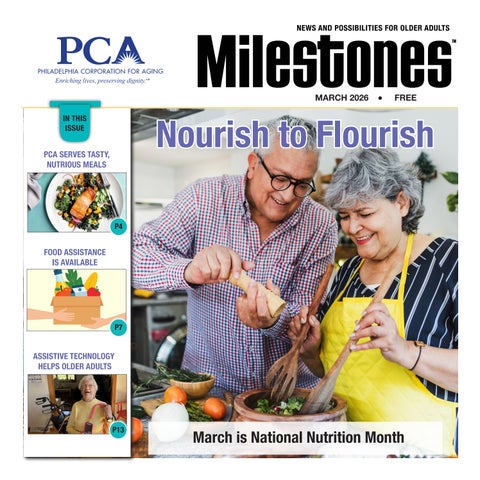
March 2026 Milestones newspaper

Page 1


PCA SERVES TASTY, NUTRIOUS MEALS

FOOD ASSISTANCE IS AVAILABLE

ASSISTIVE TECHNOLOGY HELPS OLDER ADULTS

MARCH 2026 FREE

to Flourish

Philadelphia Corporation for Aging (PCA) is the Area Agency on Aging for Philadelphia County and is dedicated to serving Philadelphia’s older adults and adults with disabilities.

PCA publishes Milestones and offers:

• Care in the home

• Caregiver & grandparent support

• Employment & volunteer programs

• Health education

• Home-delivered meals

• Home repairs & modifications

• Information & referral

• Legal services

• Ombudsman services

• Protective services

• Senior centers

• Transportation

• Veteran-directed care

Report suspected elder abuse 24/7 to the PCA Helpline: 215-765-9040.

For general inquiries about PCA or aging services, email AskHelpline@pcaCares.org or call 215-765-9040.

Published by Philadelphia Corporation for Aging

Najja R. Orr, DBA, FCPP

President and CEO

PCA Board of Directors 2026

Glenn D. Bryan, Chair

Louis G. Colbert, Co-Chair

Jaqueline S. Zinn, Ph.D., Secretary

Denise Adamucci, Treasurer

Satya B. Verma, O.D., Immediate Past Chair

Cheryl Croxton

Patricia Canela-Duckett

Lynette Killen

Sandra McNally

Norma D. Thomas, DSW

Sharlene Waller

Milestones is published monthly and distributed at more than 800 locations throughout Philadelphia.

Check us out online: pcaCares.org

Editorial & Distribution: Alicia M. Colombo 267-507-2168 MilestonesNews@pcaCares.org

Advertising: Kristin Long 215-606-7310 Kristin.Long@pcaCares.org

Subscriptions: Home delivery: $12/year MilestonesNews@pcaCares.org

The views expressed in Milestones are not necessarily those of Philadelphia Corporation for Aging (PCA). Milestones will not knowingly accept or publish fraudulent or misleading advertising. Milestones reserves the right to edit, revise or reject ads. Milestones assumes no responsibility for errors, misprints, omissions or misinformation; for failure to publish an ad; or for any damages of any kind. Neither the publisher nor any other party is rendering expert advice in this publication. No part of this newspaper may be reproduced without the permission of PCA.

Nourish to flourish: National Nutrition Month

March brings a chance to focus on health, nourishment, and the role of good nutrition in everyday life.

National Nutrition Month reminds us that food is more than just fuel for the body. Food supports strength, independence and well-being at every stage of life. For many older adults, access to nutritious meals can be limited by many factors. These include income, mobility, health challenges or social isolation. Barriers increase the risk of malnutrition, and affect health, energy and well-being.

Nutrition is a powerful form of prevention. Consistent, healthy meals help older adults maintain strength, manage chronic conditions and live safely at home. Without reliable access to nutritious food, everyday tasks can become harder and health risks increase. At every stage of aging, nutrition plays a decisive role in how independently and confidently we are able to live.

PCA’s nutrition services support health, safety and independence for older adults.

Our Home-Delivered Meals Program provides regular, healthy meals for older Philadelphians. These meals help them remain independent, safe and nourished. Nutritious meals and food-focused activities are also provided at senior centers. At these locations, you can eat lunch, learn new recipes, and enjoy connecting with others.

March is an opportunity to reflect on your well-being and the habits that support it. Small steps can have a meaningful impact on how we feel each day. These steps might include eating well, staying hydrated and engaging in community programs.

As we move into spring, thank you for helping us build a stronger community and give older adults access to resources they need.

To learn more about supporting PCA programs that make a difference, call the PCA Helpline at 215-765-9040 or visit pcaCares.org/support-pca.

Behind the scenes of PCA’s Senior Nutrition Program

For thousands of older Philadelphians, a healthy meal is more than food on a plate. It is steady nourishment and support for health. For many people, it is also a chance to feel connected – with others and their community. Philadelphia Corporation for Aging’s (PCA’s) Senior Nutrition Program helps make that possible. Meals are served in community settings throughout Philadelphia. PCA also delivers meals to the homes of older adults who cannot safely shop or cook for themselves.

Helping lead this work is PCA’s Nutrition Manager Amy Goldstein. Using her expertise as a nutritionist, Goldstein makes sure the meals meet older adults’ nutrition needs while still feeling familiar and enjoyable. Her job mixes nutrition knowledge with real-life needs. These include taste, texture and variety for people with different health conditions and appetites.

“The goal is not just to provide food,” Goldstein says. “Through PCA’s Senior Nutrition Program, the goal is to support health and independence, not to simply provide

a meal. When older adults know they can count on balanced food day after day, it reduces stress and helps them stay stronger in every part of life.”

The meals in PCA’s Home-Delivered Meals Program are planned by a registered dietitian. Goldstein says these meals follow the Dietary Guidelines for Americans. Meals are designed to provide one-third of the Recommended Daily Value of nutrients needed for older adults. The meals also contain moderate levels of fat and sodium. These standards ensure that meals support health and help older adults stay independent.

“Nutrition has to work in real life,” Goldstein says. “We take nutrition standards seriously. But we also know the meal has to be enjoyable and easy to eat. That means paying attention to flavor, familiarity and textures that work for different needs. A meal only helps if people look forward to eating it.”

PCA provides meals in communities and homes across the city. At 18 senior community centers and 10 satellite meal sites, people can eat together and enjoy conversation. For many participants, this social time is just as important as the meal itself. PCA also provides home-delivered meals for people who cannot shop or cook for themselves and who may not have help at home.

“Food supports health, and community supports health, too,” Goldstein says. “In community meal settings, the benefit is both

nutritional and social. A shared lunch can become a reason to get out, to connect and to feel part of something. That kind of routine and interaction is meaningful for overall well-being.”

PCA’s Senior Nutrition Program has provided more than 43.5 million nutritious meals since 1973. In a recent report, PCA noted that more than 1.5 million meals were served to older Philadelphians last year.

PCA also looks for new ways to help older adults get meals. In January, PCA launched the Community Cafe pilot program. Eligible participants can dine at approved restaurants and use a PCA-issued card to redeem up to 10 meals per month. To help guide the program, PCA has built in staff support and feedback.

“Choice and access matter,” Goldstein says. “Older adults’ lives and routines are not all the same. So, access has to be flexible. Whether meals are served in a group setting; delivered to the home; or offered through new options, like Community Cafe, the priority is making nutrition reachable in the way that fits someone’s circumstances.”

You can support PCA’s Senior Nutrition Program by donating (at www.pcaCares.org/donate) or by raising awareness. To learn more about PCA’s meals programs, call the PCA Helpline at 215-7659040 or visit www.pcaCares.org/ home-delivered-meals.

PCA’s meals programs

PCA helps older Philadelphians and eligible adults with disabilities access nutritious meals in ways that fit their needs:

• Meals at senior community centers (congregate meals): Dietitian-approved meals served in group settings — plus social connection and conversation.

• Grab-and-go meals: Frozen meals can be picked up at 11 non-kosher senior community centers and satellite meal sites in Philadelphia.

• Home-Delivered Meals: Nutritious meals and regular contact for older adults who can’t shop or cook and need support at home.

• Community-based meals: PCA’s Community Cafe pilot program expands access to prepared meals for older adults who may have limited access to senior centers. PCA is currently partnered with On Charcoal: Colombian Restaurant in Northeast Philadelphia, and hopes to expand to nearby eateries to offer nutritious meals. Participants must be 60+ and live in the following ZIP codes to participate: 19135, 19136, 19137, 19124, 19149 or 19152.

To learn what programs you or a loved one may qualify for, contact the PCA Helpline at 215-765-9040.

Bill Conallen is the public relations specialist at Philadelphia Corporation for Aging.

Smart design: A bright idea for aging in place

“Aging in place in a home of choice in the community is the preferred living disposition of older adults as they grow older and is linked to better quality of life and overall health and well-being,” said Monique Chabot, Ph.D., associate director of assistive technology at Temple University’s Institute on Disabilities.

Smart design and technology can aid older adults in the kitchen by improving safety and helping them make healthy meals. Design encompasses organization, placement and flow. Smart technology refers to electronic devices that are connected through the internet. These devices help improve convenience and efficiency. You do not have to remodel your entire kitchen or purchase expensive appliances to improve the design and efficiency of your kitchen and cooking methods.

Smart design

According to Chabot, who holds a doctorate in architecture and de-

sign from Thomas Jefferson University, smart design can help in the kitchen by “reducing physical demands so you’re less likely to get out of breath. You might not have to do as much movement. You don’t need as much strength to do things.”

Assistive technology is anything that helps an older adult in daily life. “It doesn’t have to be special to be labeled as tech,” she said.

Certain brands design their products to be ergonomic, meaning that they reduce discomfort, fatigue and injury. Examples include large labels that help shoppers make the right product choice. Some plastic bags have easy-open tabs. Some utensils and gadgets have bigger, softer or more comfortable handles/grips.

Ergonomically designed products can really help someone who is older and experiencing arthritis or other issues with limited hand dexterity, Chabot said.

Having good storage, with the ability to see and reach everything, is important. Poorly designed

(Continued on page 6)

Home-Delivered Meals

PCA’s home-delivered meals program provides nutritious meals and regular contact to frail older individuals and people with disabilities who struggle to afford balanced meals, are unable to cook or shop for food, and have no one to help prepare meals.

Good nutrition is essential for health at any age, but it’s especially important as you grow older. Finding consistent nutritious meals can be a challenge for older Philadelphians, but there are many resources available in our area to help. PCA offers a variety of meal programs aimed at providing nutritious food for older adults.

Meal Components

All meals provided by PCA are designed by a registered dietitian to meet one-third of the Recommended Dietary Allowance for older adults, meet the Dietary Guidelines for Americans and are moderately low in fat and sodium. Each meal includes complements such as milk, fruit, bread and dessert. Kosher meals are available by request.

(Continued from page 5)

kitchens create risks for falls.

“The extra effort and frustration in trying to reach things drains brain energy,” Chabot said. “Anytime you drain brain energy, that’s less than you have to make sure you are safe in the kitchen. It can lead to accidents.”

Chabot noted that kitchens are set up in a way that makes construction easier. But when using their kitchens, older adults should think about functionality. Chabot suggested asking yourself, “Do you have pull-out drawers? Do you have the ability to get things easily out? Do you have items clustered in areas where you are most likely to use them? (Or do you) have to go clear across the kitchen to get an ingredient, spoon or bowls?”

An efficiently designed and well-organized kitchen makes cooking easier and safer. “Then you are reducing the amount of energy you are spending. You’re more likely to make your meals and to be able to do it safely,” Chabot said. “And you are more likely to continue to do it because it doesn’t drain you as much cognitively or physically.”

These changes allow older adults to remain independent longer.

Smart appliances

Smart technology can compensate for vision or hearing loss and cognitive decline. “It can also help with cognition, so you don’t have to remember to do things. It also keeps an eye on the safety of what’s going on. If something’s

going on accident-wise, it can help circumvent that,” Chabot said.

You may have seen commercials for smart appliances with features that integrate with a smartphone. Here’s an overview of some options that are available. Although currently expensive, these products may come down in price over time and become more widely used.

A smart refrigerator can monitor the food inside. This means it can create a grocery list and send it to a shopper’s list while they are at the store. It can track expiration dates of food. A smart refrigerator can also provide nutritional recipes. If the appliance has a screen, it can display a recipe and walk the food preparer through the steps.

A safety feature of smart ovens is sensors that can shut off the unit if the heat becomes hazardous or if there is a fire. Smart water monitors can track leaks in pipes and shut off the water before flooding occurs.

“There is no relationship between age, comfort with technology and self-perceived ability to use technology with the likelihood of using it,” Chabot said. “This suggests that smart technology does not distract or affect people’s cognition after they become used to the devices.”

For information about Temple University’s Institute on Disabilities, see article on page 13.

There’s still time to Make Your Voices Heard!

Philadelphia Corporation for Aging (PCA) wants to hear from you! Let us know what services and resources could help you live better. To help us plan for the future, we’re gathering feedback through PCA 2.0: Make Your Voices Heard. This includes a short survey. Your answers will help us understand what’s working and what needs to be improved in your community. The information you share will guide PCA’s work, from advocacy to strategic planning. We’re so excited to engage with you!

Food assistance is available

Food is essential for good health. But healthy food often comes with a high price tag. Low-cost, highly processed foods are extremely high in sodium and offer little nutritional value. If you are having trouble buying healthy food to eat, reach out to these resources for assistance.

Philadelphia Corporation for Aging (PCA)

Each year, PCA serves millions of nutritious meals to older adults in community settings and at home. For more information, see article on page 4, contact the PCA Helpline at 215-765-9040 or go to www.pcaCares.org.

Philadelphia food and meal finder

The City of Philadelphia maintains a database of locations to:

• Pick up supplemental food and groceries.

• Get ready-to-eat meals.

• Apply for public benefits or access social services.

For information, call 311 or go to www.phila.gov/food. Before you go, contact the site to confirm their hours and services.

Senior Food Box Program

Older adults, age 60-plus, in Philadelphia, Montgomery, and Chester counties who meet income guidelines may

receive one box of food per month. The box contains fruit, vegetables, cheese, milk, juice, meat, poultry, fish, plant-based protein, cereals, pasta and rice. Except for the cheese, the food is shelf-stable and does not need refrigeration.

To apply for the Senior Food Box, contact the Share Food Program at 215223-2220 or www.sharefoodprogram. org (click “Find Food” then “Food for Seniors.”)

Supplemental Nutrition Assistance Program (SNAP)

SNAP, formerly called “Food Stamps,” provides monthly funds to buy groceries. It is the largest anti-hunger program in America, helping more than 41 million people annually. Eligibility depends on household size, income, age (60 or older) and disability status. To apply online, go to www.compass.dhs. pa.gov. To apply in person or for more information, contact the Philadelphia County Assistance Office Headquarters, weekdays from 8 a.m. to 5 p.m., at 801 Market St. or 215-560-7226. The PCA Helpline (215-765-9040) can also assist with SNAP enrollment.

Jewish Relief Agency (JRA)

JRA provides a monthly box of kosher pantry staples to income-eligibile households in certain Bucks, Montgomery and Philadelphia ZIP codes. Food boxes are available to all who qualify without regard to race, religion, national origin or other criteria. The food box will contain culturally appropriate food items for the Jewish holidays of Rosh Hashanah, Hanukkah, Purim and Passover. To apply, contact JRA at 610-6600190 or go to https://jewishrelief.org.

Contact us for information and resources to assist older adults, caregivers and adults with disabilities in Philadelphia.

PCA Helpline: 215-765-9040 | AskHelpline@pcaCares.org

Call to report elder abuse 24/7.

Learn about our services or request assistance online: www.pcaCares.org

Milestones e-news: Receive Milestones newspaper by email for free.

Email MilestonesNews@pcaCares.org to sign up for the e-news or to share ideas for Milestones.

Connect with PCA on social media!
Alicia M. Colombo is editor of Milestones newspaper.

Events

March 2026

THIS MONTH:

• WOMEN’S HISTORY MONTH

• NUTRITION MONTH

• MARCH 8: DAYLIGHT SAVING TIME BEGINS

• MARCH 17: ST. PATRICK’S DAY

MARCH 1-8 (STARTS FEB 28)

PHILADELPHIA FLOWER SHOW

2026 theme: “United by Flowers.” Breathtaking displays by the world’s premier floral & landscape designers. Opens at 10 a.m. PA Convention Center, 1100 Arch St. 215-988-8800 | $43

MARCH 4

YOGA

Ease your mind, body & spirit with stretches, both seated & standing. 9:30 a.m. KleinLife: Northeast Philadelphia, 10100 Jamison Ave. 215-698-7300 | Free

MARCH 5

ART CLASS

Learn a variety of mediums, including painting, watercolors, paper-mache, sketching & collage. 10 a.m. Lutheran Settlement House, 1340 Frankford Ave. 215-426-8610 | Free

Send your calendar items two months in advance to: MilestonesNews@pcaCares.org Questions? Call 267-507-2168.

MARCH 6

PINOCHLE

Whether you’re new to the game or looking to refine your skills, this class covers rules, strategies & techniques. 1 p.m. Journey’s Way, 403 Rector St. 215-487-1750.

MARCH 10

MUSIC THERAPY

Music interventions to accomplish individualized goals with a credentialed professional. 9 a.m. Lutheran Settlement House, 1340 Frankford Ave. 215-426-8610 | Free

MARCH 10

PASSPORT TRAVEL PROGRAM

Each week, learn about the culture, traditions & unique experiences of a new country. Tuesdays, 10 a.m. Marconi Older Adult Program, 2433 S. 15th St. 215-717-1980 | Free

MARCH 11

BINGO

10 a.m. Philadelphia Senior Center –Allegheny, 1900 W. Allegheny Ave. 267286-1455 | $0.10/board, 6-board minimum

MARCH 12

POETRY CLASS

Engaging & interactive class for older adults who want to explore the art of poetry, whether lifelong writers or first timers. 10:30 a.m. Center in the Park, 5818 Germantown Ave. 215-848-7722 | Free

MARCH 14

‘UNFORGETTABLE’

Award-winning play follows a family as it struggles with the emotional & practical challenges of caring for a loved one living with Alzheimer’s disease. Presented by The Alzheimer’s Association & Gdavis Productions. 2 p.m. William Penn Charter School, Kurtz Center for the Performing Arts, 3000 W. School House Lane. Register online: https://tinyurl.com/UnforgettablePhilly| Free

MARCH 13

CHAIR ZUMBA

Sitting & standing (with chair support) exercises to upbeat music. 9:30 a.m. KleinLife: Northeast Philadelphia, 10100 Jamison Ave. 215-698-7300 | Free

MARCH 15

ST. PATRICK’S DAY PARADE

Annual parade dating back to 1771. 11 a.m. start at 16th & JFK Blvd. Ends on Market St., between 6th & 5th streets. Also televised. 267-237-2953 | Free

MARCH 19

QUILTING CLASS

Welcoming space for both beginners & experienced quilters to develop skills. Noon. Martin Luther King Older Adult Center, 2100 Cecil B More Ave. 215-685-2715 | Free

MARCH 20

OPEN TECH CENTER

Computer use with some instruction (if needed). Technology topics include iPads, smartphones & Zoom. 10 a.m. KleinLife: Northeast Philadelphia, 10100 Jamison Ave. 215-698-7300 | Free

MARCH 24

ENHANCE FITNESS

Revitalizing exercise class for older adults. Low-impact, full-body workout to improve strength, flexibility & mobility. 10 a.m. Center in the Park, 5818 Germantown Ave. 215-848-7722 | Free

MARCH 25

PROTECTION FROM ABUSE WORKSHOP

Pennsylvanians for Modern Courts presentation about personal safety, what constitutes abuse under Pennsylvania law & when to seek an attorney. 1:30 p.m. Philadelphia Senior Center – Avenue of the Arts, 509 S. Broad St. | Register: 215-5465879 or www.pmconline.org/events | Free

MARCH 25

TOTAL FITNESS CLASS

Total workout standing & sitting with the use of light, hand-held exercise equipment, including weights & fitness balls. 10:30 a.m. Philadelphia Senior Center – Allegheny, 1900 W. Allegheny Ave. 267-286-1455 | $1

MARCH 26

CROCHET CLASS

Make friends & improve skills. Beginners welcome. 9 a.m. Lutheran Settlement House, 1340 Frankford Ave. 215-426-8610 | Free

MARCH 27

LINE DANCE

Move, groove & have fun in this energetic class. Beginners welcome. 9:30 a.m. Martin Luther King Older Adult Center, 2100 Cecil B Moore Ave. 215-685-2715 | Free

MARCH 27

MARCONI OPEN HOUSE

Learn about the center & programs. Lunch & DJ. Free year of membership for joining at event. 11 a.m. to 12:30 p.m. Marconi Older Adult Program, 2433 S. 15th St. 215-7171980 | Free

MARCH 30

SILVER SNEAKERS

Exercise program for older adults focused on strength, flexibility & balance. 8 a.m. Center in the Park, 5818 Germantown Ave. 215-848-7722 | Free

MARCH 31

MEDIATION CLASS

Improve your mental & physical health through meditation with friends. 9:30 a.m. Center on the Hill, 8855 Germantown Ave. 215-247-4654 | $12

In Memoriam: Mike Chambers, PCA’s Meal Distribution Center Manager

It is with sadness that we share the passing of Michael “Mike” K. Chambers, who died on Jan. 29. Mike served as the Meal Distribution Center Manager at Philadelphia Corporation for Aging (PCA) for the past three years. In this position, he oversaw the delivery of more than 1.2 million meals to older Philadelphians each year. Mike took great pride in his work, which he carried out with dedication and care.

Born and raised in Northeast Philadelphia, Mike was a graduate of St. Joseph’s Preparatory High School, and earned his bachelor’s degree from Temple University. He spent many years coaching football at St. Joe’s Prep and other Philadelphia Archdiocesan high schools.

Control autoimmune inflammation with nutrition

Older adults are more likely to develop a late-onset autoimmune disease due to immune competence decline, according to research published in the National Library of Medicine. The Global Autoimmune Institute categorizes this as an age-related immune shift that increases the risk of developing an autoimmune disease.

Inflammatory autoimmune conditions include rheumatoid arthritis, lupus, inflammatory bowel disease and myositis (chronic muscle inflammation). Autoimmune conditions can impact the skin, digestive tract, nervous system and blood vessels.

Key nutrition tips

If diagnosed with an inflammatory autoimmune condition, intentional nutrition can help ease symptoms. Olena Zinshtein, MS, RD, LDN, Founder of Key Nutrition, LLC, suggests several steps to combat autoimmune conditions with nutrition.

Focus on anti-inflammatory foods.

These include colorful vegetables (cooked if digestion is sensitive), fish rich in omega-3, olive oil, herbs and spices. These foods help calm inflammation while still allowing flexibility.

Prioritize gut health.

Autoimmune conditions often involve the gut. Gentle fibers, fermented foods (as tolerated), and adequate protein support healing and immune balance.

Eat consistently and mindfully.

Skipping meals or eating erratically can worsen fatigue, blood sugar swings and inflammation. Regular meals help stabilize energy and digestion.

“I encourage older adults to view nutrition as a tool for maintaining independence, strength and quality of life,” Zinshtein said. “As we age, our bodies become less efficient at absorbing certain nutrients, such as vitamin B12, vitamin D, calcium, iron and magnesium.”

Prioritizing protein at each meal, staying hydrated and choosing nu-

trient-dense foods can have a significant impact on mobility, cognition, immune function and mood.

“Nutrition doesn’t just support longevity; it supports living well,” says Zinshtein.

Foods to avoid

People with autoimmune conditions benefit from limiting highly processed foods, including those high in refined sugars, excess sodium and industrial fats (hydrogenated and trans). These products often include frozen dinners and luncheon meats.

The following foods can exacerbate symptoms by increasing inflammation or digestive stress:

• Deep-fried foods.

• Fermented and cultured foods – yogurt, kombucha, sauerkraut.

• Baked goods and yeast breads.

• Overripe fruit and fresh fruit juice.

• Flavor extracts and condiments that contain vinegar.

Older adults can enjoy these types of foods occasionally. Reducing consumption frequency can still yield healthy results.

Foods to enjoy

According to the Mayo Clinic Health System, the following foods may help decrease chronic inflammation:

(Continued on page 11)

“Everyone has the power to transform their life and overcome the challenges of obesity. At Roxborough Memorial Hospital, we’re here to support your journey toward better health and a brighter future.”

— Dr. Piotr Krecioch, General and Bariatric Surgeon

Bariatric Surgery and Wellness Program
This article is not intended to provide medical advice. Individuals should follow the advice of their doctor.

• Citrus fruits, such as oranges and pomelos.

• Cruciferous vegetables, including broccoli, cauliflower, cabbage, kohlrabi, turnips and radishes.

• Deep blue or purple foods, such as blueberries, blackberries, plums, and Concord grapes.

• Deep orange, yellow, red and dark green foods, such as pumpkin, sweet bell peppers, tomatoes, carrots, kale, spinach, Swiss chard, arugula and endive.

• Onions.

• Plant-based proteins, including beans, lentils and soy.

• Spices and herbs, including ginger, garlic, turmeric, cardamom, black pepper, cinnamon and rosemary.

• Whole grains, such as wheat, oats, rye, buckwheat, millet, quinoa and brown rice.

Avoid nutrient deficiency

Every day individuals hear about a new meal kit, diet or supplement, claiming to reduce weight and contribute to a healthier lifestyle. Friends may even suggest specific diets. Diets that work well for one person can be ineffective, or even harmful, for another. This is especially true for individuals with autoimmune conditions or older adults. Popular diets often remove entire food groups without considering medical history, nutrient needs or lifestyle.

“I always recommend personalization,” Zinshtein said. “Working with a registered dietitian can

help individuals understand why certain foods work for them and help them avoid unnecessary restriction or nutrient deficiencies.”

Zinshtein sees nutrient deficiency trends in older adults. Several nutrients commonly fall short, including protein, fiber, omega-3 fatty acids and key micronutrients. These gaps are often due to reduced appetite, limited food variety or outdated nutrition beliefs. Persistent fat and protein avoidance trends — rooted in outdated dietary guidance — can place older adults at risk for muscle loss, frailty and nutrient inadequacy.

“Nutrition should feel supportive, not stressful,” Zinshtein said. “Food is meant to fuel the body, bring enjoyment and support health — not create fear or confusion.”

Small, sustainable changes over time are far more powerful than drastic overhauls when improving inflammatory autoimmune symptoms. Talk to your health care provider about working with a nutritionist.

(See page 15 for crossword)

Recipe Box

Caramelized Plantain Porridge

Plantains are dense and starchy. They make the perfect thick and creamy, grain-free base for porridge. Naturally vegan and glutenfree, this plant-based recipe relies on coconut milk and turmeric for its antiinflammatory compounds and beautiful yellow color.

Ingredients:

1 tbsp. coconut oil

2 ripe plantains, diced 2 cups coconut milk

1 tsp. vanilla extract

½ tsp. ground turmeric ¼ tsp. ground ginger

1 tbsp. coconut sugar

Directions:

In a large skillet over medium heat, melt the coconut oil. Once the oil is hot, add the plantains. Cook for 5 minutes, stirring occasionally, allowing the plantains to caramelize and turn golden brown.

Pour in the coconut milk. Stir in the vanilla, turmeric and ginger.

Bring the mixture to a boil, then reduce heat to a simmer. Cover with a tightfitting lid. Simmer for 5 minutes.

Remove the lid, and gently mash the plantains with a potato masher or large fork. Return the lid and simmer for another 5 minutes.

Remove the skillet from the heat and stir in the coconut sugar, just before serving.

Tip: Use a combination of spices to make this dish your own. Cinnamon, grated fresh gingerroot, coconut flakes and pure maple syrup all make excellent additions.

Source: The Hashimoto’s AIP Cookbook

Mary Anna Rodabaugh is a writer, editor and writing coach.

TechOWL Program provides assistive technology to older adults

Older adults and people living with disabilities can explore assistive technology options through

a free lending library operated by TechOWL (Technology for Our Whole Lives). This is Pennsylvania’s Assistive Technology Act Program, which is part of Temple University’s Institute on Disabilities.

Visitors can borrow a device from TechOWL and test it out for five to nine weeks, depending on the item.

In addition, users can request a one-on-one demonstration of devices with an assistive technology specialist. Individuals can also invite care team members, therapists and family members to join them in learning about technology options and resources.

The goal is to help potential users make informed decisions about technology they may want to use, according to Monique Chabot, Ph.D., associate director of assis-

tive technology at Temple’s Institute on Disabilities.

The program allows users to test devices before making a purchase. “Technology can cost a lot of money, and a device is not always returnable once you buy it,” Chabot said. Users can say, “I’m going to try out this thing. If I don’t like it, now I know I didn’t spend a thousand bucks on a device I’ll never use. I borrowed it. It didn’t work for me. I need something else. I’m not going to waste that money.”

Borrowing helps people make informed decisions about what devices might meet their needs, Chabot said.

TechOWL’s lending library has more than 500 devices that range in price from $5 to $5,000. A maximum of three items may be

borrowed at one time. The items will be shipped and picked up from the borrower’s home for free.

Among the technology devices that TechOWL has in its lending library are:

• Mobility devices, including folding canes, rollators and wheelchairs.

• Low vision devices.

• Hearing aids.

• Smart speakers, which are voice-controlled and can help with everyday tasks, such as controlling a thermostat.

• Smart light bulbs, which can be managed by a phone app and can control brightness levels.

At the TechOWL Community Space (1392 Cecil B. Moore Ave.),

(Continued on page 14)

We listen first, then bring the right care to you. We help seniors stay safe and independent, all while receiving medical and social support services at our wellness center. At Mercy LIFE, empathy leads the way and experience gets you where you want to be.

us to learn if you or a loved one qualifies.

(Continued from page 13)

visitors can work with assistive technology experts who can provide demonstrations, explain device features and help users make decisions. The Community Space is open Monday and Wednesday, from 10 a.m. to 2 p.m., and Tuesday and Thursday, from 1-5 p.m. Walk-ins are welcome at any time but appointments are recommended. Contact TechOWL at 1-800-204-7428 or email TechOWL@temple.edu with questions or to make an appointment.

Chabot recalls when a neighborhood resident who is hard of hearing came into the Community Space recently. After meeting with an expert and looking at different devices, the resident selected a “pocket talker,” which uses a microphone to amplify sound for a listener while filtering out background noise. The device was sent to the woman’s house for her to test out. Staff members also showed her apps on her smartphone that might also help her hear what is going on around her better. In addition to the lending library, TechOWL operates the following programs:

• ReUse distributes gently used donated devices for free.

• The 3D printing program has a catalog of more than 30 devices that are made in-house and sent to people for free. These 3D printed items include nail clipper holders and toothpaste squeezers.

• Pennsylvania’s Telecommunication Device Distribution Program provides free adaptive phones for people who have difficulty hearing, talking, seeing, thinking or moving.

“Don’t be afraid to give us a call,” Chabot said. “We have a very active phone, chat and email system with someone monitoring it all through the day, so you will get somebody. And we’re very, very good about returning calls. If you have a question, if you’re not sure if our services are right for you or if you’re looking for something, just give us a call. We’ll connect you with the right person in the Institute (on Disabilities). People will help you with everything.”

Chabot added that often older adults don’t consider themselves disabled. But if a person has a functional impairment or wishes there was a gadget that could help them with an activity, TechOWL can help.

“Nothing makes us happier than to sit down with you and talk about what we can do for you,” she said.

The Institute on Disabilities at Temple University is one of 68 University Centers for Excellence in Developmental Disabilities Education, Research and Service. These centers work toward a vision of self-determination, independence, productivity and community inclusion for people with disabilities throughout the lifespan. They are funded by the Administration for Community Living, through the U.S. Department of Health and Human Services. For information, contact the Institute on Disabilities at 215-204-1356 or visit https://disabilities.temple.edu.

Celebrate & Aging

CALL FOR ARTISTS

Presented by Philadelphia Corporation for Aging Submission deadline: Tuesday, March 31

PCA’s month-long celebration held in May features extraordinary original artwork by artists aged 55 and older from across the Greater Philadelphia Region.

To get involved or for more information on the application process and submission guidelines, please visit: pcaCares.org/Art or call 445-456-0741.

“Cherry Blossoms & Crane” by Avelene Jacobs
Jay Nachman is a freelance writer in Philadelphia who tells stories for a variety of clients.

Understanding nutrition labels Clean up

Nutrition labels provide clear information about packaged foods. Understanding this information can help you make the right choices to support your health.

Start with the serving size and servings per container. All nutrition information on the label is based on one serving. Eating more than one serving increases nutrients and calories.

Next, review calories per serving. Calories show how much energy food provides. Calories are only one part of the label and should be considered alongside nutrients.

Higher intake of saturated or trans fats, sodium, and added sugar is linked to increased risk of heart disease, high blood pressure and diabetes.

The Percent Daily Value (%DV) shows how much of a nutrient one serving provides.If a food or nutrient has a %DV of 5% or less, it is considered low in that nutrient, indicating that it may be a better choice for those looking to limit intake of that nutrient.

You will also want to pay attention to the following nutrients, which you want to eat more of:

• Fiber.

• Protein.

• Calcium.

• Potassium.

• Iron.

• Vitamin D.

These nutrients support heart health, digestion and bone strength. A higher %DV for these nutrients is generally better.

The ingredients list appears at the bottom of the label. Ingredients are listed from most to least by weight. Foods with shorter ingredient lists can be one indicator of less processing. However, unfamiliar ingredient names are not automatically unhealthy or more processed. For example, ascorbic acid (vitamin C) and tocopherols (vitamin E) are often added to foods to maintain quality and freshness. Added sugars may appear under several names, including corn syrup or cane sugar.

Key points to remember:

• Use serving size to understand portions.

• Compare %DV when choosing between similar foods.

• As guided by your doctor, aim for low added sugars, sodium and unhealthy fats.

• Aim for high fiber and essential nutrients.

Learning to read nutrition labels supports informed decision-making and healthier eating patterns over time.

Janai Johnson is the multimedia communications specialist at Philadelphia Corporation for Aging.
This article is not intended to provide medical advice. Individuals should follow the advice of their doctor.

Turn static files into dynamic content formats.

Create a flipbook