Philadelphia Corporation for Aging (PCA) is the Area Agency on Aging for Philadelphia County and is dedicated to serving Philadelphia’s older adults and adults with disabilities.
PCA publishes Milestones and offers:
• Care in the home
• Caregiver & grandparent support
• Employment & volunteer programs
• Health education
• Home-delivered meals
• Home repairs & modifications
• Information & referral
• Legal services
• Ombudsman services
• Protective services
• Senior centers
• Transportation
• Veteran-directed care
Najja R. Orr, DBA, FCPP
President and CEO
PCA Board of Directors 2026
Glenn D. Bryan, Chair
Louis G. Colbert, Co-Chair
Jaqueline S. Zinn, Ph.D., Secretary
Denise Adamucci, Treasurer
Satya B. Verma, O.D., Immediate Past Chair
Cheryl Croxton
Patricia Canela-Duckett
Lynette Killen
Sandra McNally
Norma D. Thomas, DSW
Sharlene Waller
Report suspected elder abuse 24/7 to the PCA Helpline: 215-765-9040.
For general inquiries about PCA or aging services, email AskHelpline@pcaCares.org or call 215-765-9040.
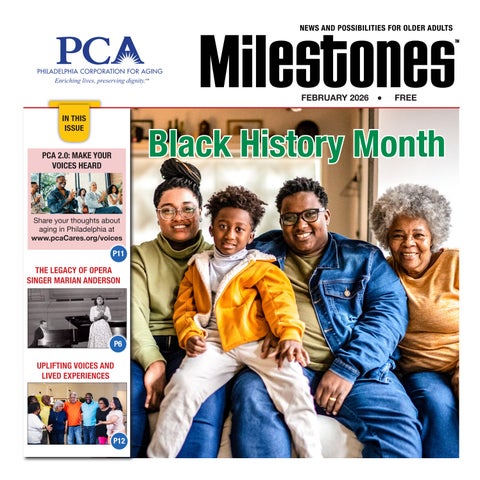
Black History Month: How Black culture has shaped Philadelphia
By Najja R. Orr, DBA, FCPP PCA President & CEO
Milestones is published monthly and distributed at more than 800 locations throughout Philadelphia.
Check us out online: pcaCares.org
Editorial & Distribution: Alicia M. Colombo 267-507-2168 MilestonesNews@pcaCares.org
Advertising: Kristin Long 215-606-7310 Kristin.Long@pcaCares.org
Subscriptions: Home delivery: $12/year MilestonesNews@pcaCares.org
The views expressed in Milestones are not necessarily those of Philadelphia Corporation for Aging (PCA). Milestones will not knowingly accept or publish fraudulent or misleading advertising. Milestones reserves the right to edit, revise or reject ads. Milestones assumes no responsibility for errors, misprints, omissions or misinformation; for failure to publish an ad; or for any damages of any kind. Neither the publisher nor any other party is rendering expert advice in this publication. No part of this newspaper may be reproduced without the permission of PCA.
During Black History Month, we reflect on how Black history and culture shaped Philadelphia into the strong, caring city it is today. The Black community has been an important part of the city’s growth, showing strength, leadership and pride over the years.
Philadelphia has a deep connection to freedom and justice. Mother Bethel AME Church is the oldest African Methodist Episcopal church in the country, dating to 1794. This church served as a place for worship, learning, and organizing when Black voices were often excluded. The city also played an important role in the Underground Railroad.
Black leaders shaped the city through education and civil rights. Octavius V. Catto, a Philadelphia native, teacher, and activist, expanded voting rights and access to equal education.
First printed in 1884, The Philadelphia Tribune is the oldest continuously published African-American newspaper in the United States.
The African American Museum in Philadelphia is the nation’s first museum funded and built by a major municipality to preserve, interpret and exhibit African American heritage.
Black culture continues to bring people together through art, music, and tradition. Philadelphia is home to the largest public murals in the world, many of which honor Black history and lived experiences. Jazz, soul, and poetry tell stories of community, joy and resilience that continue to inspire today.
At PCA, we see this history in the older adults we serve. Many Black older adults in Philadelphia lived through segregation and social change. Their strength and leadership shaped the neighborhoods we call home.
Black History Month is a time to honor and learn from these stories. It reminds us that Philadelphia grew stronger when people helped one another. Thank you for supporting PCA as we continue helping older adults feel valued, supported, and connected.
If you would like to help support PCA programs that benefit older adults in Philadelphia, call the PCA Helpline at 215-765-9040 or visit www.pcaCares.org/ support-pca to learn more or make a donation.
Published by Philadelphia Corporation for Aging
Back to work, on your terms: Job training, placement for older workers
By Bill Conallen
With Americans living longer and the cost of everyday life continuing to rise, more older adults are choosing to work, or returning to work, to strengthen their financial footing in retirement. But reentering the workforce is not always simple. Many face obstacles like age discrimination, gaps in employment history, or the challenge of updating skills after years away from a job.
To help meet this need, Philadelphia Corporation for Aging (PCA) offers employment and job training options that support older adults as they pursue meaningful work. These programs are built to connect participants with practical resources, skill-building opportunities, and guidance that can make the job search feel more manageable and more successful. At the heart of these efforts is the Older Americans Act (OAA), a federal law created to support
job training through the Mayor’s Commission on Aging and JEVS Career Solutions for 55+. These resources offer a range of supports, including job readiness training, job search help, and vocational training. Participants can also take part in job fairs, workshops, and job clubs, where they can build confidence, practice new strategies, and connect with employers and peers.
ipants are placed in positions at community organizations, such as schools, hospitals, and government agencies, where they gain on-the-job experience. They can also help to strengthen the services those organizations provide. The goal is to help participants build skills and confidence that can support a transition into unsubsidized employment.
the well-being and independence of older adults. While the OAA is best known for funding services that help people age safely and comfortably, it also supports employment initiatives. Across the country, Area Agencies on Aging use OAA resources to offer services such as career counseling, job placement assistance and training programs that help older adults remain active in the workforce.
“We believe that every senior should have the opportunity to live with dignity and respect, and that includes having the ability to earn a living and support themselves,” said LaToya Gilmer, program manager of employment services at PCA. “Our employment and job training programs help seniors overcome the barriers they may face in reentering the workforce and provide them with the skills and resources they need to succeed.”
Locally, PCA helps connect older adults to employment and
“PCA’s employment and job training programs provide a unique opportunity for older adults to reignite their passion for work, re-discover their self-worth, and contribute to their community in meaningful ways. For many older adults, employment and job training programs are more than just a means to a paycheck. They are a pathway to a renewed sense of purpose and fulfillment,” said Wanda Mitchell, PCA director of community engagement. “Our programs help older adults build new skills, develop new interests, and connect with other people in their community. Through employment and job training, older adults can continue to grow, learn and make a difference in the world around them.”
Two major OAA-supported employment efforts highlight what’s possible when older adults are given the right tools and opportunities.
One is the Senior Community Service Employment Program (SCSEP), which provides parttime, community service-based job training for low-income individuals ages 55 and older. Partic-
Another is the Senior Environmental Employment (SEE) program, which offers opportunities for older adults to take part in environmental and conservation-related projects. Through partnerships with federal and state agencies, non-profit groups, and private organizations, participants may contribute to projects involving conservation, environmental research, public land efforts, and related initiatives.
Together, programs like these help older adults stay engaged, build new skills, and earn income that supports greater independence. They also benefit the wider community by matching experience and reliability with roles where those strengths can make a real difference.
To learn more about how PCA helps older adults gain job skills and find employment opportunities, call the PCA Helpline at 215765-9040 or visit www.pcaCares. org/employment-job-training.
Bill Conallen is the public relations specialist at Philadelphia Corporation for Aging.
Protect yourself from shingles
By Mary Anna Rodabaugh
According to the Centers for Disease Control and Prevention (CDC), one in three people will develop shingles in their lifetime. Shingles, also known as herpes zoster, is a painful rash illness that occurs when the same virus that causes chickenpox reactivates. The CDC estimates that 1 million people in the United States get shingles each year. It is more common in individuals with weakened immune systems.
Symptoms
Shingles begins as an itchy, burning patch of skin localized to one side of the body. The rash can be widespread; however, discomfort can occur before a rash even
develops. Some other symptoms may include fever, headaches, chills, and an upset stomach. The itchy rash will form blisters, and within 7 to 10 days, the blisters will form scabs.
Typically, the scabs will clear up in about two to four weeks.
“Shingles is not something older adults should try to wait out — early medical care can make a significant difference,” says Hal Farber, MD, a board-certified physician specializing in skin conditions and care of older adults.
Shingles may also cause longterm complications, including long-term nerve pain, called postherpetic neuralgia (PHN). The risk of PHN increases with age. This long-term nerve pain can last months or even years after the initial condition is treated and cleared. It typically occurs at the site of the rash. Symptoms of shingles on the face or near the eyes could even cause vision loss.
“Any redness, swelling, or changes in vision during shingles require prompt medical attention,” says Farber.
When to see a doctor
If you are experiencing any new, unexplained burning, tingling, or pain on one side of the body, you should be evaluated promptly, especially if a rash or blisters appear.
As we age, shingles can be more severe, and recovery can take longer, making early evaluation especially important for older adults.
A dermatologist is often best equipped to diagnose shingles quickly and manage both the rash and skin-related symptoms.
“Starting treatment within the first few days can shorten the illness and lower the risk of long-lasting nerve pain,” says Farber.
Treatment
There is no cure for shingles, but there are treatment options your healthcare provider may prescribe to ease symptoms. The first is an antiviral medication that can reduce irritation duration, decrease how severe the rash becomes, and lower the risk of PHN. For pain, dermatologists may recommend acetaminophen or ibuprofen.
If you receive treatment within three days of getting the rash, you can prevent complications; however, if you receive treatment after three days, it still has benefits.
During and after treatment, Farber recommends rest, hydration, and proper nutrition to support healing, as well as keeping the affected skin clean and protected to help prevent infection and improve comfort.
“If pain continues after the rash clears, patients should know that follow-up care and additional treatment options are available,” says Farber.
Lingering pain is not something older adults should have to deal
with. Seeing a dermatologist can make a real difference in quality of life.
Vaccination
The shingles vaccine is the only way to protect against shingles and related complications. Given in a two-dose series, the shingles vaccine can be given at the same time as other vaccines. The shingles vaccine is recommended for adults 50 years and older with the two doses separated by two to six months.
“Adults age 50 and older — even those who have had shingles before — should discuss vaccination with their healthcare provider,” says Farber.
A new study by Stanford University suggests that the shingles vaccine may also protect against dementia. Vaccinated participants who remained cognitively healthy were less likely to develop mild cognitive impairment, and those who did develop dementia were nearly 30% less likely to die from it over the course of nine years. The results “suggest that there is a slowing of this degenerative process.”
Bottom Line
“Older adults in the Philadelphia area have excellent access to dermatologic and medical care and should feel comfortable seeking evaluation early rather than managing shingles on their own,” says Farber.
Mary Anna Rodabaugh is a writer, editor and writing coach.
February 2026
Celebrating the legacy of opera singer Marian Anderson
Marian Anderson in performance with her accompanist, Franz Rupp, circa 1958. Photos provided by the Marian Anderson Museum and Historical Society Archive Collection.
By Jay Nachman
Visitors to The National Marian Anderson Museum’s Semiquincentennial exhibition, “Marian The American Story,” “will get a dramatic and powerful eye-opening view of Marian Anderson’s life through the lens of our nation,” according to Jillian Patricia Pirtle, the museum’s CEO.
“Marian The American Story” opens on Anderson’s birthday, February 27. Among the artifacts the exhibition will include are performance gowns of Anderson spanning from the 1920s -1990s; the Congressional Medal of Honor, which was presented to her by
Anderson Scholar Artist Program and Arts Empowerment Program for children.
Anderson, who was born in 1897, joined the junior choir at her Baptist church at six. Before long, she was nicknamed “The Baby Contralto.” When Anderson was 13 years old, she joined the senior choir at church and began visiting other churches after accepting invitations to sing. She became so popular that she sometimes performed at three different places in a single day.
After winning a singing contest through the Philadelphia Philharmonic Society in 1925, she entered the Lewisohn Stadium competition and sang in New York’s amphitheater with the Philhar-
monic Orchestra accompanying her. On December 30, 1928, she performed a solo recital at Carnegie Hall. A New York Times critic wrote: “A true mezzo-soprano, she encompassed both ranges with full power, expressive feeling, dynamic contrast, and utmost delicacy.”
Anderson began touring the states coast to coast, Europe and Latin America. The most famous event occurred in 1939 when a promoter tried to rent Washington, D.C.’s Constitutional Hall, but was told no dates were available. Washington was segregated and even the hall had segregated seating. In 1935, the hall instituted a
(Continued on page 7)
President Carter in 1977 (Anderson was the first African-American to receive the honor); and letters, performance programs, recordings; and her grandmother’s Bible.
Anderson purchased the house, now a national historic landmark, at 762 South Martin Street in Center City West for $4,000 in 1924.
The Marian Anderson Museum and Historical Society is dedicated to keeping alive the legacy of Marian Anderson, considered one of the most important opera performers of the 20th century, through the display of her home as a museum for tours and education, as well as through the Marian
HEART-SMART TESTS THIS FEBRUARY!
*Restrictions apply. Take advantage of our Heart Month Specials! Discounted Coronary Artery Calcium Scans are available for $65.00, plus Free Peripheral Arterial Disease (PAD) Screenings.
February 4 and February 20.
Free parking and giveaways! Click the QR code to learn more!
Marian Anderson stands in her home on Martin Street before leaving for her historic Lincoln Memorial performance on April 9, 1939.
new clause: “concert by white artists only.”
The public was outraged, famous musicians protested, and First Lady Eleanor Roosevelt resigned from the Daughters of the American Revolution, who owned the hall. With the help of the NAACP, a free open-air concert on the steps of the Lincoln Memorial for Easter Sunday was arranged. Anderson sang before 75,000 people.
In 1957, she toured India and the Far East as a goodwill ambassador through the U.S. State Department and the American National Theater and Academy. She traveled 35,000 miles in 12 weeks, giving 24 concerts. After that, President Dwight Eisenhower appointed her as a delegate to the United Nations Human Rights Committee. She sang at his inauguration, as well as John F. Kennedy’s in 1961.
During Anderson’s career, she received many awards, including the Springarn Medal in 1939, given annually to a Black American who “shall have made the highest achievement during the preceding year or years in any honorable field of endeavor.” In 1941, she received the Bok award, given annually to an outstanding Philadelphia citizen. She used the $10,000 prize money to found the Marian Anderson Scholarships. In 1963, President Lyndon Johnson awarded her the American Medal of Freedom. In 1986, President Ronald Reagan presented her with the National Medal of Arts.
Anderson insisted on “vertical” seating in segregated cities, meaning Black audience members would be allotted seats in all parts of the auditorium. Many times, it was the first time Black audience members could sit in the orchestra section. Anderson died of heart disease at age 96. More than 2,000 admirers attended a memorial service at Carnegie Hall.
“Anderson,” said Pirtle “did extraordinary things in a time of extreme oppression and difficulty.”
The museum has reopened after a catastrophic flood in 2020 rendered the site inaccessible. The building has been restored. The museum is in the midst of a capital campaign to continue to improve the building and the visitor experience.
The museum is open daily from 10 a.m.- 4 p.m. Monday through Saturday. Reservations are required. For more information, visit marianandersonhistoricalsociety.weebly.com.
Jay Nachman is a freelance writer in Philadelphia who tells stories for a variety of clients.
Contact us for information and resources to assist older adults, caregivers and adults with disabilities in Philadelphia.
Learn about our services or request assistance online: www.pcaCares.org
Milestones e-news: Receive Milestones newspaper by email for free.
Email MilestonesNews@pcaCares.org to sign up for the e-news or to share ideas for Milestones.
Events
February 2026
THIS MONTH:
FEB. 1 – BLACK HISTORY MONTH
FEB. 14 – VALENTINE’S DAY
FEB. 16 – PRESIDENTS DAY
FEB. 20 – NATIONAL CAREGIVERS DAY
BLACK HISTORY EVENTS & EXHIBITS
The African American Museum in Philadelphia preserves, interprets, and exhibits the history of African Americans from pre-colonial times to the present. Hours: Thursday through Sunday, 10 a.m. to 5 p.m. 701 Arch St. aampmuseum.org
FEBRUARY 3
CARD GAME HOUR
Join us for our weekly card game hour! Play any card game you would like with other center members. Cards are provided. Noon. Lutheran Settlement House. 215-426-8610 | Free
FEBRUARY 5
QIGONG CLASS
Come and experience the gentle, healing movements of the ancient Chinese art of Qigong. 9 a.m. Center on the Hill. 215-2474654 | $12 per class
FEBRUARY 9
Send your calendar items two months in advance to: MilestonesNews@pcaCares.org Questions? Call 267-507-2168.
ENHANCE FITNESS CLASS
Exercise is a whole lot of fun in this evidence based Enhance Fitness exercise program. Participants are led by a certified instructor in an hour-long class focused on dynamic cardiovascular exercise. 9:30 a.m. Lutheran Settlement House. 215-426-8610 | Free
FEBRUARY 11
TAI CHI
Lean this popular form of gentle exercise and moving meditation. 11 a.m. Philadelphia Senior Center–Allegheny. 267-286-1455 | $1
FEBRUARY 12
PAINTING GROUP
Come enjoy friendship and fun as you paint your next masterpiece. 9:30 a.m. Center on the Hill. 215-247-4654 | Free
FEBRUARY 13
YOGA
This yoga class combines breathing, exercise, stretching and meditating for a full body workout in a chair. 1 p.m. Philadelphia Senior Center–Allegheny. 267-286-1455 | $1
FEBRUARY 17
STRETCHING CLASS
Enhance flexibility and relieve tension in our gentle stretching class designed for all fitness levels. 11:30 a.m. Center in the Park. 215-848-7722 | Free
FEBRUARY 18
BILLIARDS
Whether you’re a seasoned player or new to the game, join us for a relaxed and friendly environment where you can enjoy a game of pool. 9 a.m. MLK Older Adult Center. 215-685-2715 | Free
FEBRUARY 21
CHAIR ZUMBA
Get moving with Chair Zumba, a fun, seated workout combining dance and fitness to lively music. 9:30 a.m. KleinLife Northeast Philadelphia. 215-698-7300 | Free
FEBRUARY 22
BINGO
Come and test your luck, enjoy some friendly competition, and have a blast at our bingo game. Noon. MLK Older Adult Center. 215-685-2715 | Free
FEBRUARY 23
TLC SUPPORT GROUP
This class offers suggestions for coping with issues of today. Discussions are confidential. 10 a.m. Philadelphia Senior Center–Avenue of the Arts. 215-546-5879 | Free
FEBRUARY 24
POETRY CLASS
Unleash your creativity in our poetry class, where you’ll explore writing techniques and share your work in a supportive setting. 10:30 a.m. Center in the Park. 215-8487722 | Free
FEBRUARY 26
LINE DANCE
Step into the rhythm and join our line dance class for older adults. This fun, upbeat class teaches popular line dance routines in an easy-to-follow format. 9:30 a.m. MLK Older Adult Center. 215-685-2715 | Free
FEBRUARY 27
POTTERY CLASS
Discover your creativity in our pottery class, where you’ll learn basic techniques to shape and design your own clay creations. 11 a.m. Center in the Park. 215-848-7722 | Free
25 @ 10 a.m. to 2 p.m.
Corporation for Aging, 642 N.
St.
event includes lunch and parking (on North Street, between Broad and 15th streets)
at www.SarahRalstonFoundation.org Philadelphia is home to a strong network of organizations working to provide care, connection and critical services. This event brings those organizations together in one place, creating opportunities for learning, engagement and meaningful support.
meet dozens of nonprofits, learn about their missions and services, and explore volunteer and giving opportunities.
Presented by: In partnership with:
Employment access/accommodations for workers with disabilities
By Sarah Greer
The Americans with Disabilities Act (ADA), enacted in 1990, supports the right of people with disabilities to have equal access to employment. A central requirement of the ADA is that employ-
ers provide reasonable accommodations. These are changes to the work environment or the way a job is performed that enable employees with disabilities to do their work effectively.
Workplace accommodations are highly individualized. Disabilities can be physical, sensory, cognitive, neurological or related to mental health. Many are not visible. As a result, accommodations must be flexible and responsive to each employee’s specific needs and job responsibilities.
Accommodations can take many forms. Some involve physical adjustments, such as accessible workstations, ramps, elevators, adjustable desks, ergonomic seating or wider doorways. Others focus
on assistive technology, including screen readers, speech-to-text software, adaptive keyboards or voice-activated devices. Flexible work arrangements include modified schedules, telework options or additional breaks. These supports can help employees manage chronic health conditions or fluctuating energy levels.
Accommodations may also include job-related adjustments, such as reorganizing tasks, providing written or visual instructions or assigning duties that align with an employee’s strengths. For some workers, reducing sensory distractions through quiet or sensory-friendly workspaces, noise-can-
(Continued on page 11)
We listen first, then bring the right care to you. We help seniors stay safe and independent, all while receiving medical and social support services at our wellness center. At Mercy LIFE, empathy leads the way and experience gets you where you want to be.
Contact us to learn if you or a loved one qualifies. Call 215-339-4747 or visit mercylife.org.
celing headphones, clear routines or structured task lists can significantly improve their ability to focus and succeed.
These supports are essential because barriers in the workplace often stem not from a person’s ability to do the job, but from environments and systems that were not designed with disability in mind. Without accommodations, talented and capable employees may struggle unnecessarily or be excluded altogether. When accommodations are put in place, employees are better able to focus on their work. They can contribute their skills and perform at their full potential.
Providing accommodations also benefits employers. Inclusive workplaces are more productive, experience higher employee retention, and foster stronger team collaboration. Many accommodations, such as clear communication practices, flexible scheduling and accessible technology, improve workflows for everyone. These benefits extend beyond employees with disabilities.
The ADA emphasizes an interactive process where employers and employees collaborate to identify effective accommodations. This ensures accommodations adapt over time. Key takeaway: Ongoing cooperation between employer and employee is vital.
Despite legal protections, many employees hesitate to request accommodations. This is often due to fear of stigma or misun-
derstanding. Employers play a critical role in creating a culture where accessibility is normalized and support is readily available. Proactively sharing information about accommodations and demonstrating flexibility helps ensure employees feel safe seeking the tools they need.
Workplace accommodations are not special treatment. They are a means of ensuring equal access. By removing barriers and supporting diverse needs, employers uphold the ADA’s principles and create workplaces where all employees can thrive, contribute, and succeed.
(See page 15 for crossword)
Sarah Greer is the Communications Manager at Philadelphia Corporation for Aging.
Senior centers honor Black History Month by uplifting members’ voices and lived experiences
By Bill Conallen
Philadelphia Corporation for Aging (PCA) supports 18 full-service senior community centers and 10 satellite meal sites across the city. Many of these senior centers are recognizing Black History Month by uplifting the voices and lived experiences of older adults across the city, celebrating Black culture, honoring the past, and highlighting the ways history continues to be made every day.
Throughout February, senior centers are creating space for conversation, learning, and community. These special events help members reflect on history while celebrating culture and connection. Some of the most meaningful moments come from a simple question asked directly to the people at the heart of PCA’s work: What does Black History Month mean to you?
At PCA’s Southwest Senior Center, members described Black History Month as both remembrance and recognition. A time to honor those who came before while cel-
ebrating Black excellence in the present. Many spoke about history as something they have not only studied, but lived, and about the importance of sharing what they have seen and experienced with others. “Black History Month is a time to reflect, but it’s also a time to gather,” said Carolyn Sims-Nesmith, member of Southwest Senior Center. “Our members have lived through history, they’ve contributed to it. This month gives us a chance to uplift their voices, celebrate their resilience, and remind one another that our stories matter.” For members, the center is more than a place to spend the day. It is a community space where stories are welcomed, friendships are built, and traditions are carried forward.
At Martin Luther King (MLK) Older Adult Center, members emphasized the importance of preserving the full story of Black history, not only the nationally recognized figures, but also the everyday people whose courage, work, and leadership helped shape fam-
ilies, neighborhoods, and opportunities for those who followed. Members spoke about how easily important stories can be overlooked and how necessary it is to pass knowledge down. “Black History Month means telling the truth and making sure the next generation knows where we’ve been,” said center member James Cauley. Others described the month as a reminder that Black history is American history, and that understanding the nation’s story requires honesty about both struggle and progress, as well as recognition of the countless contributions Black Americans have made in every field and every community.
At PCA’s Firehouse Active Adult Center, members spoke about pride and cultural joy, describing Black History Month as a time to celebrate the creativity, music, traditions, and community bonds that have always been central to Black life. Members reflected on the ways culture has sustained families and communities through difficult times, and how celebration itself can be a form of strength. “It’s pride and it’s joy,” said Firehouse member Elizabeth Richburg-Durand. “Black history is more than what we survived. It’s what we built.” Members also noted that the month is not only about looking back, but also about recognizing the ways older adults continue to lead, mentor, volunteer, and contribute to their communities, shaping what comes next through their example and service.
Across the three centers, responses carried a consistent message of gratitude, responsibility, and legacy. Members spoke of remembering the people who made a way and not taking that progress for granted, of pride rooted in strength, creativity, and faith, and of stories that matter even when they were never formally recorded. Several members described Black History Month as a reminder that honoring history means more than reciting names and dates. It means listening to lived experiences, valuing truth, and creating spaces where people can be seen and heard. At PCA senior centers, Black History Month is an opportunity to reflect, learn, and celebrate, but it also connects to PCA’s broader mission of ensuring older Philadelphians feel supported in spaces that promote wellness, belonging and connection. For many members, Black history is not distant. It is lived experience, lessons learned, and contributions made every day, in ways large and small. This month, PCA centers are helping ensure those contributions are recognized, those stories are shared, and that the voices of older adults continue to guide and strengthen the community.
PCA supports 28 senior community centers and satellite meal sites throughout Philadelphia. To locate a senior center near you, call the PCA Helpline at 215-7659040 or visit www.pcaCares.org/ senior-centers.
Bill Conallen is the public relations specialist at Philadelphia Corporation for Aging.
Box Slow Cooker Thai Curry with Chicken and Riced Cauliflower
This rich, yet heart-healthy, dish marries chicken, vegetables and coconut milk. Riced cauliflower creates a nutrient-rich addition to soak up the sauce.
Ingredients:
1 medium head cauliflower, cut into florets
Cooking spray
¼ tsp. salt
¼ tsp. pepper
¼ cup fresh parsley, chopped OR 2 tsp. dried parsley, crumbled
1 lb. boneless, skinless chicken breasts, cut into 1-inch cubes
1 medium sweet potato, peeled and cut into 1-inch cubes
1 medium onion, diced
3 medium garlic cloves, minced
1 (14.5-oz.) can no-salt-added diced tomatoes, undrained
1 cup water
¾ cup unsweetened lite coconut milk
1 (6-oz) can no-salt-added tomato paste
2 tbsp. low-calorie sweetener
2 tsp. curry powder
1 tsp. cumin
1 tsp. coriander
1 to 2 tsp. crushed red pepper flakes
¼ cup fresh basil leaves, thinly sliced OR 1 tbsp. dried basil, crumbled
1 ½ cups broccoli florets
Optional (for garnish):
8 fresh basil leaves, coarsely torn
1 medium jalapeño, seeds and ribs discarded, sliced
1 medium lime, cut into 4 wedges
Directions:
Put the chicken, sweet potato, onion, garlic, tomatoes with liquid, water, coconut milk and tomato paste in a slow cooker.
In a small bowl, stir together the sweetener, curry powder, cumin, coriander and red pepper flakes. Sprinkle over the chicken mixture. Top with basil.
Cook, covered, on low heat for 8 hours or high heat for 4 hours.
About 30 minutes before the chicken is done cooking, add the broccoli to the slow cooker.
When the chicken is almost done cooking, working in batches, in a food processor or blender, gently pulse the cauliflower just until it becomes the texture of rice.
Lightly coat a large skillet with cooking spray. Cook the cauliflower, salt and pepper over medium heat for 5 minutes, or until the cauliflower is tender, stirring occasionally.
Put the cauliflower into serving bowls. Sprinkle with parsley. Serve the curry over the cauliflower. Top with the garnishes, if desired.
Source: American Heart Association
Health and Wellness Programs
Our Health & Wellness Programs help older adults stay active, reduce pain and manage chronic conditions — all in a supportive, welcoming group setting.
You’ll learn practical skills you can use every day, guided by trained instructors who understand different mobility levels and health needs. Classes are designed to be safe, engaging, and adapted so everyone can participate comfortably.
What you can expect:
• Friendly, small-group classes at a relaxed pace.
• Clear, practical guidance you can use right away.
• Options for different fitness and ability levels.
• A supportive environment focused on confidence and independence.
Programs include:
• Managing Chronic Conditions & Pain: Learn proven strategies to reduce discomfort, manage symptoms and feel more in control of your health.
• Walk with Ease and EnhanceFitness: Improve strength, balance and mobility through gentle, guided movement.
• Fall Prevention Education & Screenings: Learn ways to stay steady, safe and confident at home and in the community.
Programs are offered at locations across Philadelphia by trusted community partners.
February is American Heart Month
By Janai Johnson
Your heart deserves attention every day. Regular visits with a healthcare professional can help you track your blood pressure, cholesterol, and blood sugar levels. Knowing your numbers gives you the information you need to make daily choices that support your health.
Daily habits also play a role in heart wellness. Small changes can make a big difference over time:
• Move more: Walking, gardening, or light exercise keeps your heart active.
• Eat heart-healthy food: Include vegetables, fruits, lean protein and whole grains. Limit salt, sugary drinks and highly processed foods.
• Avoid smoking: Quitting or reducing tobacco use protects your heart and blood vessels.
• Maintain a healthy weight: Staying in a healthy weight range reduces strain on the heart.
• Sleep well: Most adults benefit from 7 to 9 hours of sleep each night to support overall health.
• Check your cholesterol: Regularly monitor cholesterol levels to keep your heart strong.
• Monitor blood sugar: Keeping blood sugar within a healthy range helps protect your heart.
• Track blood pressure: Healthy blood pressure lowers the risk of heart strain and long-term complications.
Heart Month is a great time to explore new ways to care for your heart. Schedule a check-up, try a hearthealthy activity or learn CPR to be prepared for emergencies.
Taking steps today, even small ones, can help you stay active, enjoy life, and protect your heart for the future. Make heart health a priority this February and build habits that support a strong, healthy lifestyle.
More words
Janai Johnson is the multimedia communications specialist at Philadelphia Corporation for Aging.